Article

Influence of Heat Treatment on Solidified Microstructure, Phase Transformation Behavior and Mechanical Properties of Thin NiTi Alloy Samples Fabricated by Laser Powder Bed Fusion

1
Ulster College, Shaanxi University of Science and Technology, Xi’an 710021, China
2
Jiangsu Key Laboratory of Advanced Food Manufacturing Equipment & Technology, School of Mechanical Engineering, Jiangnan University, Wuxi 214122, China
3
College of Mechanical and Electrical Engineering, Shaanxi University of Science and Technology, Xi’an 710021, China
4
Jiangsu Province Engineering Research Center of Micro-Nano Additive and Subtractive Manufacturing, Wuxi 214122, China
*
Authors to whom correspondence should be addressed.
Metals 2026, 16(6), 629; https://doi.org/10.3390/met16060629
Submission received: 21 April 2026 / Revised: 4 June 2026 / Accepted: 5 June 2026 / Published: 8 June 2026
(This article belongs to the Section Additive Manufacturing)

Abstract

This work systematically investigates the effects of various heat treatment regimes, including solution treatment, solution treatment followed by aging at 623 K, 723 K and 823 K, and direct aging at the same temperatures, on the solidified microstructure, phase transformation behavior, and nanoindentation properties of thin NiTi samples fabricated by laser powder bed fusion (LPBF). The as-fabricated sample exhibits a strong {100}B2<001>B2 Cube texture (maximum texture index 25.77), a high dislocation density (2.70 × 10¹⁸ m−2), a single-step B19′↔B2 reversible transformation with Af = 308.17 ± 3.08 K, and a recovery ratio of 0.46 ± 0.02. Subsequently, solution treatment homogenizes the microstructure, resulting in a lower dislocation density and a partial transformation from the Cube texture to the Goss texture. Further aging at 623 K after solution treatment achieves the highest recovery of 0.52 ± 0.03 by introducing fine and inferred-coherent Ni4Ti3 precipitates while maintaining a higher fraction of B2 phase at room temperature. However, aging at 723 K after solution treatment leads to a Goss-dominated texture, mixed austenite/martensite phases, and the lowest recovery (0.34 ± 0.01). In contrast, direct aging at 623 K or 723 K also yields lower recovery ratios (0.40 ± 0.06 and 0.35 ± 0.01, respectively), due to retained compositional inhomogeneity and higher dislocation densities. For direct aging at 823 K, however, the recovery ratio significantly increases to 0.49 ± 0.06. It is therefore suggested that the enhanced recovery performance can be achieved by combining solution treatment with low-temperature aging, which synergistically combines coherent precipitates, a fully austenitic matrix, and a favorable texture.

1. Introduction

NiTi shape memory alloys (SMAs) exhibit shape memory effect and superelasticity that are not present in conventional metallic materials due to NiTi’s unique thermoelastic martensitic reversible phase transformation [1,2,3]. In particular, they form a hysteretic energy dissipation loop similar to that of rubber during loading and unloading, demonstrating high energy absorption characteristics. Among traditional metallic materials, NiTi alloys have the second-lowest elastic modulus, second only to Mg alloys [4], enabling elastic energy absorption under low-strain conditions. The excellent energy absorption properties of NiTi alloys have led to their widespread application in vibration-damping/shock-resistant structural components in aerospace, defense, and other fields. For example, NASA researchers developed NiTi-based SMA wheels for Mars rovers [5]. Tests showed that the new wheels could withstand impact loads exceeding ten times the wheel weight, operate within a temperature range of −130 °C to 90 °C, exhibit superior rock and soil grip compared with aluminum alloy wheels, and climb slopes with an inclination exceeding 23%.
In recent years, the rapid development of laser 3D printing technology has provided a new technical approach for developing high-performance vibration-damping/shock-resistant materials, effectively expanding the design freedom of novel vibration-damping/shock-resistant structures and enabling continuous breakthroughs in their functional characteristics [6,7,8]. However, considering the ultra-high cooling rate (105–106 K/s) and complex non-equilibrium solidification processes involved in laser forming, the as-fabricated parts often exhibit a high dislocation density, coarse columnar grains, residual stress, and compositional inhomogeneity [9]. Vibration-damping/shock-resistant components are often designed based on porous structural models, with unit features mainly consisting of thin walls and thin struts. These thin wall/strut features, having a large specific surface area, dissipate heat more rapidly and experience steeper temperature gradients during forming, leading to more concentrated internal stresses. Heat treatment, as an important post-processing method, has been widely used to regulate the microstructure, phase transformation behavior, and functional properties of NiTi alloys fabricated by laser powder bed fusion (LPBF), with core objectives including residual stress relief, compositional homogenization, precipitate control, and optimization of superelasticity [10,11,12,13,14]. For instance, S. Saedi et al. [11] conducted a relatively detailed aging study to reveal the effects of aging temperature and aging time on the phase transformation behavior of LPBF-fabricated NiTi alloys. They found that the transformation temperatures gradually increased with increasing aging temperature below 500 °C, while above 500 °C, they began to decrease. Moreover, the intermediate R-phase disappeared when aged above 500 °C. X. Wang et al. [14] proposed a simple heat treatment process comprising solution treatment at 1273 K for 3 h followed by aging at 623 K for 0.5 h, which effectively improved the superelasticity of the alloy, achieving a recoverable ratio exceeding 80% even after 317 loading-unloading cycles. Regarding texture evolution, LPBF-fabricated NiTi alloys typically exhibit strong crystallographic texture, mainly originating from directional heat flow and epitaxial growth during forming [15]. Solution treatment can partially modify the as-formed texture and may induce recrystallization texture, while aging treatment mainly affects the texture intensity. However, it is worth noting that there are still few reports on texture evolution during heat treatment and its coupling effect with superelasticity.
Research on heat treatment of additively manufactured NiTi-based thin-walled structures is currently mostly found in reports on laser additive manufacturing of NiTi-based porous structures and their functional properties [16,17,18], where heat treatment serves as a strengthening method to regulate the functional characteristics. For example, C. Tan et al. developed a NiTi-based biomimetic functionally graded lattice structure by laser additive manufacturing [17]. Then, they effectively changed the solidification microstructure characteristics and achieved cross-scale hierarchical strengthening through heat treatment, significantly increasing the specific strength to approximately 70 kN·m/kg while maintaining a low elastic modulus and good ductility. It should be noted that although such studies emphasize the beneficial effects of heat treatment modification on the mechanical properties and functional behavior of NiTi-based porous structures, they have not systematically characterized or investigated the NiTi-based thin-walled units. Compared with bulk NiTi alloys, research on heat treatment of LPBF-fabricated thin NiTi alloy samples has the following obvious deficiencies: (1) The unique thermal cycles experienced by thin NiTi alloy samples during laser forming (including inter-layer remelting, local heat accumulation, etc.) are fundamentally different from those of bulk parts [19], and most existing heat treatment parameters are directly adopted from bulk part studies, lacking necessary validation of whether they are applicable to thin samples; (2) The shape constraint effect of thin NiTi alloy samples affects stress relief and recrystallization behavior during heat treatment, yet research in this area is almost absent; (3) The stress state experienced by thin NiTi alloy samples under service conditions is complex, requiring more refined heat treatment design to balance mechanical properties and superelastic recovery capacity, for which systematic research is still lacking. In summary, there are few reports on heat treatment of thin NiTi alloy samples, and a deep understanding of the intrinsic relationships among heat-treatment-regulated microstructure, phase transformation behavior, and superelasticity of thin samples is still lacking. Therefore, systematic research on heat treatment of LPBF-fabricated thin NiTi alloy samples to reveal the influence mechanisms of heat treatment on microstructure, phase transformation behavior, and superelastic recovery performance is of significant academic value and engineering significance.
In this work, a systematic study was conducted on LPBF-fabricated thin NiTi alloy samples, investigating the phase composition, microstructural characteristics, grain orientation, phase transformation behavior, and nanoindentation properties under different heat treatment processes. Emphasis was placed on the influence mechanisms of heat treatment methods and aging temperatures on microstructure, phase transformation behavior, and room-temperature recovery performance. Notably, most existing studies focus on bulk NiTi or simple geometries, whereas this work systematically investigates thin NiTi samples (1 mm thickness), which exhibit distinct thermal histories, residual stress states, and heat treatment responses due to their high surface-to-volume ratio and constrained geometry. Besides, a direct comparison between solution + aging and direct aging routes across a range of temperatures (623, 723, 823 K) is provided, which is rarely performed systematically. Furthermore, the texture evolution (including Cube-to-Goss transition) is linked to room-temperature recovery behavior in thin NiTi samples, an aspect largely overlooked in prior LPBF NiTi heat treatment studies. Generally, this work will provide important technical support and theoretical guidance for the heat treatment performance modification of LPBF-fabricated NiTi-based porous structures.

2. Experimental

2.1. Raw Material and LPBF Fabrication

In this work, nearly spherical Ni-rich NiTi pre-alloyed powder with a nominal chemical composition of Ni50.6Ti49.4 (in at.%) and a particle size distribution of 15–53 μm was used as the raw material for the LPBF process, which was produced by an electrode induction-melting gas atomization (EIGA) process. Based on our previous work [19], the pre-alloyed powder had a lower Ms (martensite transformation start temperature) than 273 K and a dominated B2-phase. Subsequently, a batch of thin NiTi-based samples with a dimension of 5 × 5 × 1 mm3 were built by using an iSLM 160 machine (ZRapid Technologies Co., Ltd., Suzhou, China). This machine is equipped with an IPG ytterbium fiber laser with a maximum power of 500 W and a spot diameter of 80 μm (IPG Laser GmbH, Burbach, Germany), a scanning galvanometer system, an automatic powder spreading device with a flexible scraper blade, an inert argon gas circulatory protection system. The optimized laser process parameters were applied for the LPBF forming of these NiTi-based TWS samples, including laser power P of 100 W, scanning speed v of 1000 mm/s, hatch spacing h of 50 μm, and layer thickness d of 30 μm. Besides, in order to decrease the residual thermal stress, a line scanning strategy with a 90° rotation angle between adjacent layers was further used during the LPBF process.

2.2. Heat Treatment Procedures

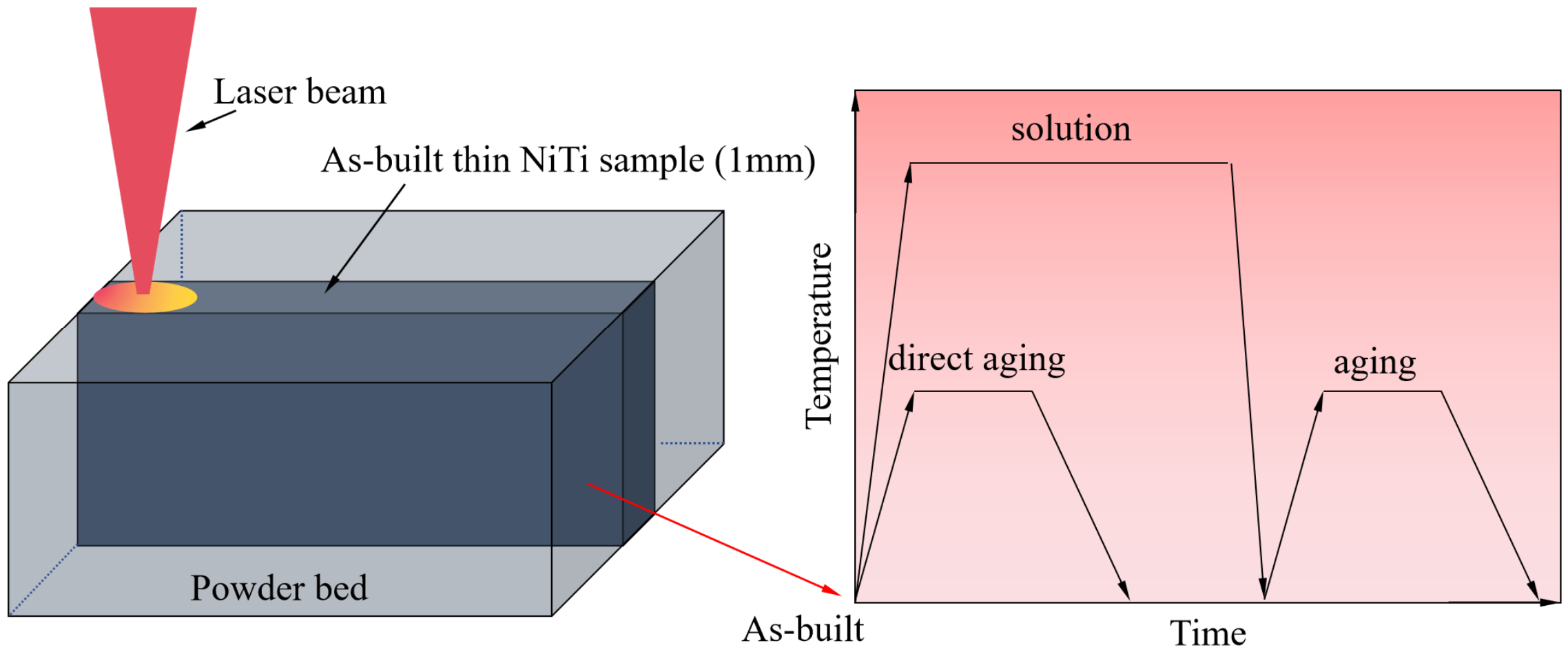
The heat treatment experiments were conducted using an OTF-1500X tube furnace with single temperature zone (HF-Kejing Co., Ltd., Hefei, China) under argon atmosphere. To investigate the effect of post-heat treatment condition, some different heat treatment regimens, including single solution treatment, solution + aging treatment and direct aging treatment, were designed, as shown in Figure 1. The specific experimental conditions for each heat treatment process are listed in Table 1. The selected aging temperatures (623, 723, and 823 K) were chosen based on the well-established Ni-Ti phase diagram and prior literature. Specifically, 623 K is near the lower end of Ni4Ti3 precipitation range, where fine and coherent precipitates are usually expected; 723 K is within the peak-aging range for many NiTi alloys, where Ni4Ti3 precipitates are stable but may lose coherency; 823 K approaches the solvus temperature of Ni4Ti3, where dissolution or transformation to Ni3Ti may occur. These temperatures thus allow us to systematically probe the transition from coherent to incoherent to dissolved precipitate states and their influence on phase transformation behavior and room-temperature recovery behavior. The heating rate of the furnace for all heat treatment methods was set as 5 °C/min. Besides, after the holding time at the operation temperature, various cooling modes were applied for solution treatment and aging treatment, corresponding to water quenching and air cooling, respectively.

2.3. Material Characterization

To investigate the effects of heat treatment on the phase composition and dislocation density of the as-built samples, the XRD tests were carried out using a D2 PHASER A26-X1-A2E0B2A0 benchtop polycrystalline X-ray diffractometer (Bruker AXS GmbH, Karlsruhe, Germany). A Cu target was used for the measurements, with a scanning angle range of 20–90°, a scan rate of 4°/min, and a step size of 0.01°. As for the phase transformation behavior, the DSC tests were performed using a DSC-TA Q200 differential scanning calorimetry (TA Instruments, New Castle, DE, USA). During the testing process, a continuous flow of high-purity nitrogen was used as a protective inert gas. The temperature program of the DSC equipment was set as follows: first, cooling from room temperature to 193 K, holding for 1 min; then heating to 373 K at a rate of 10 K/min, holding for 1 min; followed by cooling again to 193 K at a rate of 10 K/min to complete one cycle. A series of transformation temperatures (TTs, including Mf, Ms, As and Af) and enthalpy change (ΔHA-M and ΔHM-A) were therefore determined by the tangent method. What’s more, optical microscopy (OM, DM-2700M, Leica Microsystems, Wetzlar, Germany) and a Zeiss Sigma 300 field emission scanning electron microscope (FE-SEM, Carl Zeiss Microscopy GmbH, Oberkochen, Germany) were used to characterize the microstructure morphology features. Additionally, electron Backscatter Diffraction (EBSD) was further performed by a FEI Quanta 650 FEG FESEM (Thermo Fisher Scientific, Hillsboro, OR, USA) equipped with HKL Channel 5 system (Oxford Instruments, Abingdon, Oxfordshire, UK) at a voltage of 20 keV, to conduct the grain orientation analysis. To investigate the effects of heat treatment on the elastic modulus and recoverable behavior of the as-built samples, quasi-static nanoindentation tests were conducted on polished NiTi samples using a Hysitron TI Premier nanoindenter (Bruker Corporation, Billerica, DE, USA). The experimental conditions were as follows: a load-unload mode was selected, with measurements taken at eight random points; an applied load of 20 mN, a holding time of 5 s, and loading/unloading rates of 40 mN/min were used.

3. Results

3.1. Phase Composition and Dislocation Density

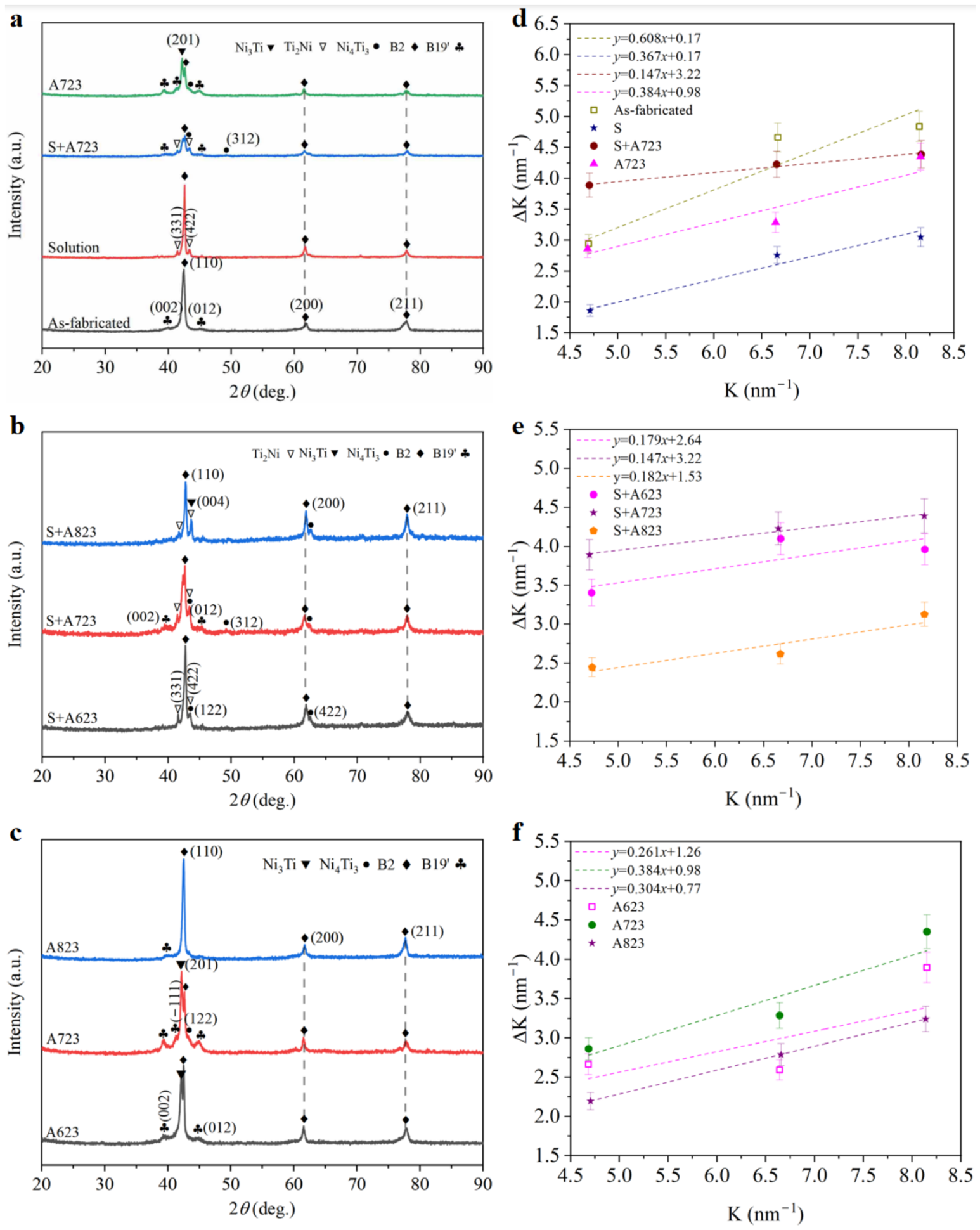
Figure 2a–c shows the XRD patterns of thin NiTi alloy samples fabricated by LPBF and after different heat treatments. It can be clearly seen from Figure 2a that the heat treatment process has a significant effect on the phase composition as well as the intensity and width of the diffraction peaks of the NiTi alloy. For the as-fabricated sample, three strong diffraction peaks corresponding to (110)B2, (200)B2 and (211)B2 are clearly detected, indicating that the phase composition is mainly B2 phase. In addition, a weak B19’ diffraction peak is also detected, suggesting the possible presence of a small amount of martensitic phase. After solution treatment, the B2 phase diffraction peaks still dominate, while the intensity of the (110)B2 main peak increases slightly. Solution treatment involves a high temperature for a long time, during which some precipitates re-dissolve into the matrix, and sufficient atomic diffusion promotes the homogenization of composition and microstructure in the matrix. Consequently, the B2 phase becomes more stable, showing an increase in peak intensity. When aging treatment at 723 K is further applied on the basis of solution treatment, it can be found that the intensity of the B2 phase diffraction peaks decreases significantly, accompanied by the appearance of more small diffraction peaks of B19’ and Ni4Ti3 phases. This indicates that the aging treatment promotes the precipitation of Ni-rich phases and further induces the martensitic transformation. Compared with the S + A723 sample, the direct aging-treated A723 sample shows a similar phase composition, but the peaks of the B19’ phase are more pronounced. This may be due to the high density of dislocations and residual stress in the as-fabricated sample, providing sufficient nucleation energy for the martensitic transformation [20].
In addition to the heat treatment method, the heat treatment temperature also has a significant effect on the diffraction peaks, as shown in Figure 2b,c. For the solution + aging treatment mode, when the aging temperature is low (e.g., 623 K), some small Ni4Ti3 diffraction peaks are still observable, but the B19’ peaks are not obvious, suggesting that the precipitated Ni4Ti3 phase is fine and coherent with the matrix. When the aging temperature rises to 823 K, the small Ni4Ti3 diffraction peaks become almost invisible, and the possible presence of Ni3Ti is detected, indicating that an excessively high aging temperature may cause the Ni4Ti3 phase to re-dissolve or transform into the more stable Ni3Ti phase. For the direct aging treatment, the general trend is similar to that of the solution + aging treatment, but local differences also exist. First, for the A623 sample, the presence of Ni4Ti3 is not clearly detected; instead, Ni3Ti appears. In the A723 sample, Ni4Ti3 is detected again. According to our previous work [13], because no solution treatment is performed, the direct-aged samples maintain the inhomogeneous composition distribution of the as-fabricated state, so some regions with locally high Ni content may directly precipitate Ni3Ti. When the direct aging temperature reaches 823 K, neither Ni4Ti3 nor Ni3Ti is detected, indicating that the supersaturated Ni atoms may remain in a solid solution state at this temperature.
Based on the modified Williamson–Hall method [21,22], the diffraction data of the B2 main peaks in the XRD patterns were further processed to estimate the dislocation density in the samples under different treatment conditions, as shown in Figure 2d–f. Dislocation density, as an important parameter reflecting crystal quality and integrity, directly affects the diffraction peaks and diffraction angles of the crystal. Its relationship with the diffraction peak width is as follows [23]:
Δ K = 0.9 d + π A 2 b 2 ρ C ¯ 2 K
where ΔK = (Δ2θ)cosθB/λ, K = 2sinθB/λ, λ is the X-ray wavelength (1.54056 Å), Δ2θ is the full width at half maximum of the diffraction peak at θB, d is the average coherent domain size, A is a constant determined by the effective cutoff radius of dislocations (here taken as 2.5 [24]), b is the magnitude of Burgers vector, ρ is dislocation density, and C ¯ is the average contrast factor determined by the elastic constants and crystalline plane index [24,25,26]:
C ¯ = C ¯ h 00 1 q H 2
H 2 = h 2 k 2 + k 2 l 2 + l 2 h 2 / h 2 + k 2 + l 2 2
The anisotropy parameter q for B2 NiTi was determined from the slope of the linear fit of C ¯ vs. H2, using the contrast factor formulation [25]. We obtained q = 1.32 for the B2 phase, which falls within the typical range for cubic crystals. Regarding C ¯ h 00 , the average contrast factor for {h00} reflections, was calculated based on the elastic constants of B2 NiTi (C11 = 162 GPa, C12 = 129 GPa, C44 = 34 GPa) using the method of Ungár et al.’s work [24], giving C ¯ h 00 = 0.273. Based on the XRD diffraction pattern results and the above equations, the dislocation density can be obtained from the linear fitting results of ΔK-K. Accordingly, the dislocation densities in the as-fabricated, solution, S + A723, and A723 samples are determined to be 2.70 × 10¹⁸ m−2, 1.63 × 10¹⁸ m−2, 6.51 × 10¹⁷ m−2, and 1.70 × 10¹⁸ m−2, respectively. The uncertainty in ρ due to this fitting procedure is approximately ±15%. The results indicate that the S + A723 sample possesses the lowest dislocation density, while the as-fabricated sample exhibits the highest dislocation density, which is primarily attributed to the non-equilibrium metallurgical nature of the LPBF process involving significant and complex internal stress evolution. Q. Zhang et al. further pointed out that a large number of supersaturated vacancies were generated during the rapid solidification of LPBF, and the collapse and condensation of these vacancies ultimately led to a high dislocation density in the as-fabricated sample [27]. In contrast, heat treatment, especially solution treatment, greatly accelerates atomic diffusion and causes crystal defects such as vacancies and dislocations to migrate to grain boundary regions or be eliminated through dislocation reactions. Consequently, the dislocation density of the NiTi alloy is significantly reduced after heat treatment. Notably, due to uncertainties arising from peak fitting, background subtraction, and the choice of the constant A in Equation (1), the calculated dislocation density values are not absolutely reliable. However, these values are within the range typically reported for LPBF-fabricated NiTi (1015−18 m−2), and the relative trends (as-fabricated > solution > aged) are robust regardless of absolute accuracy.

3.2. Microstructural Evolution

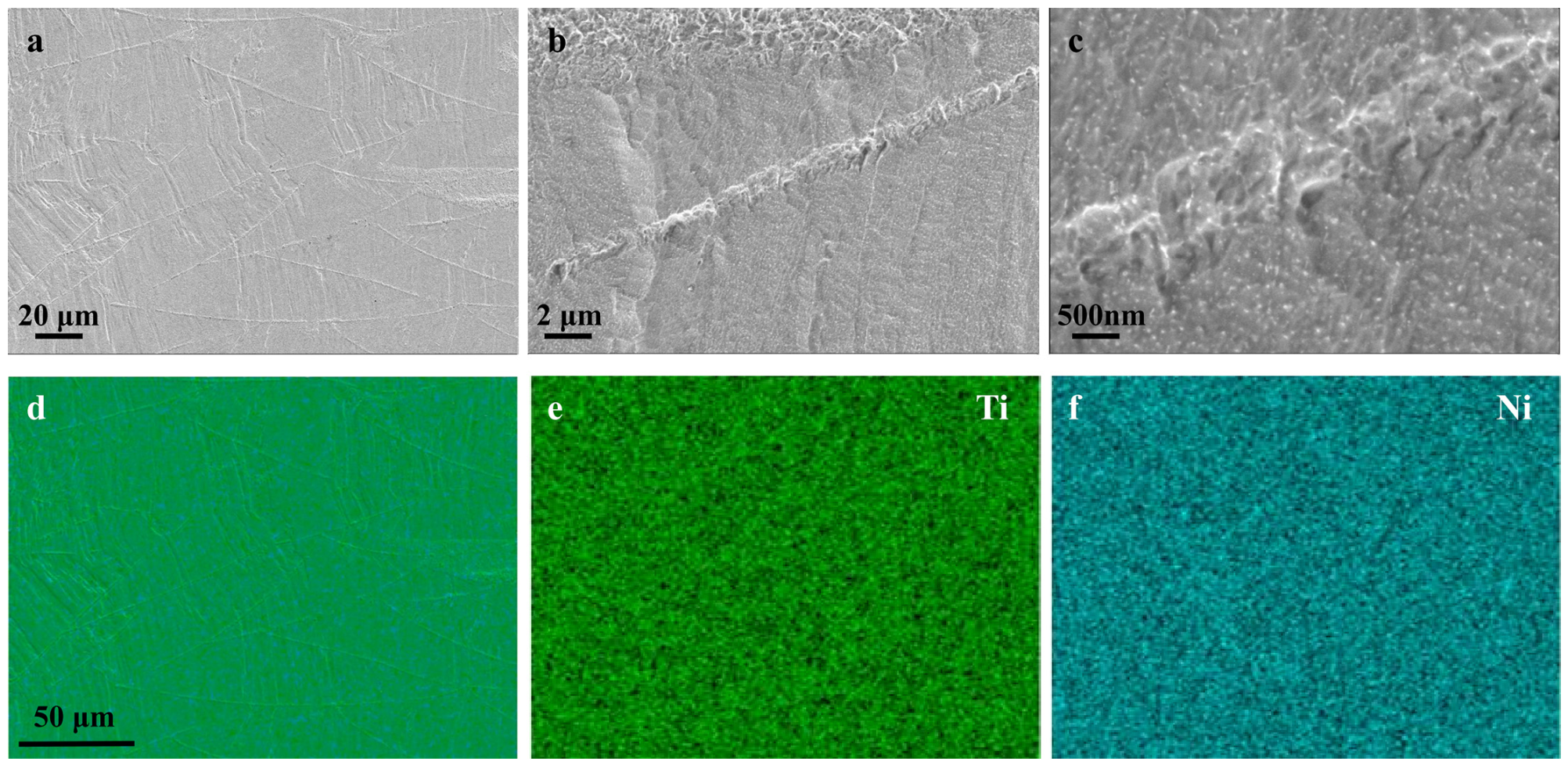
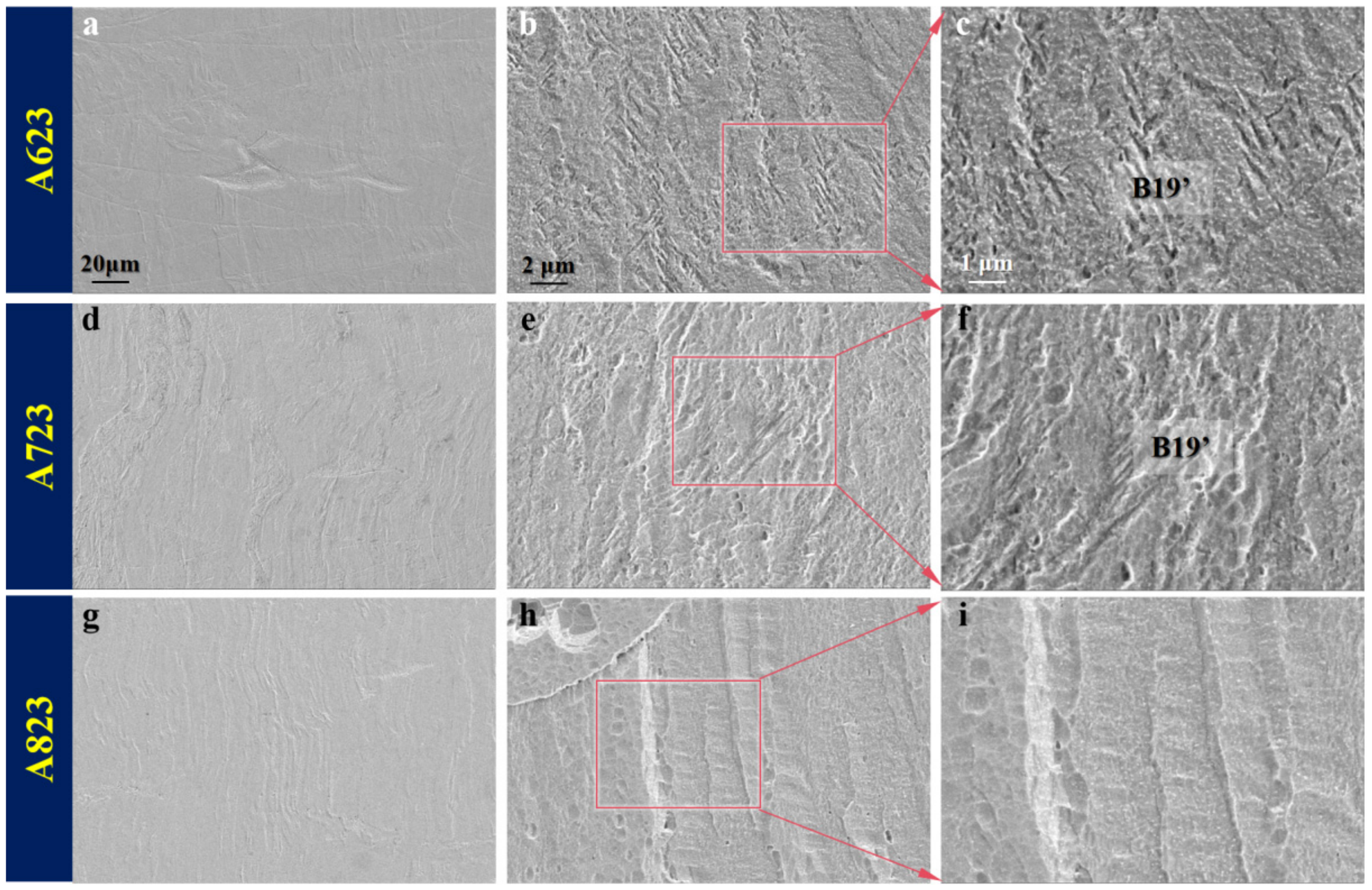
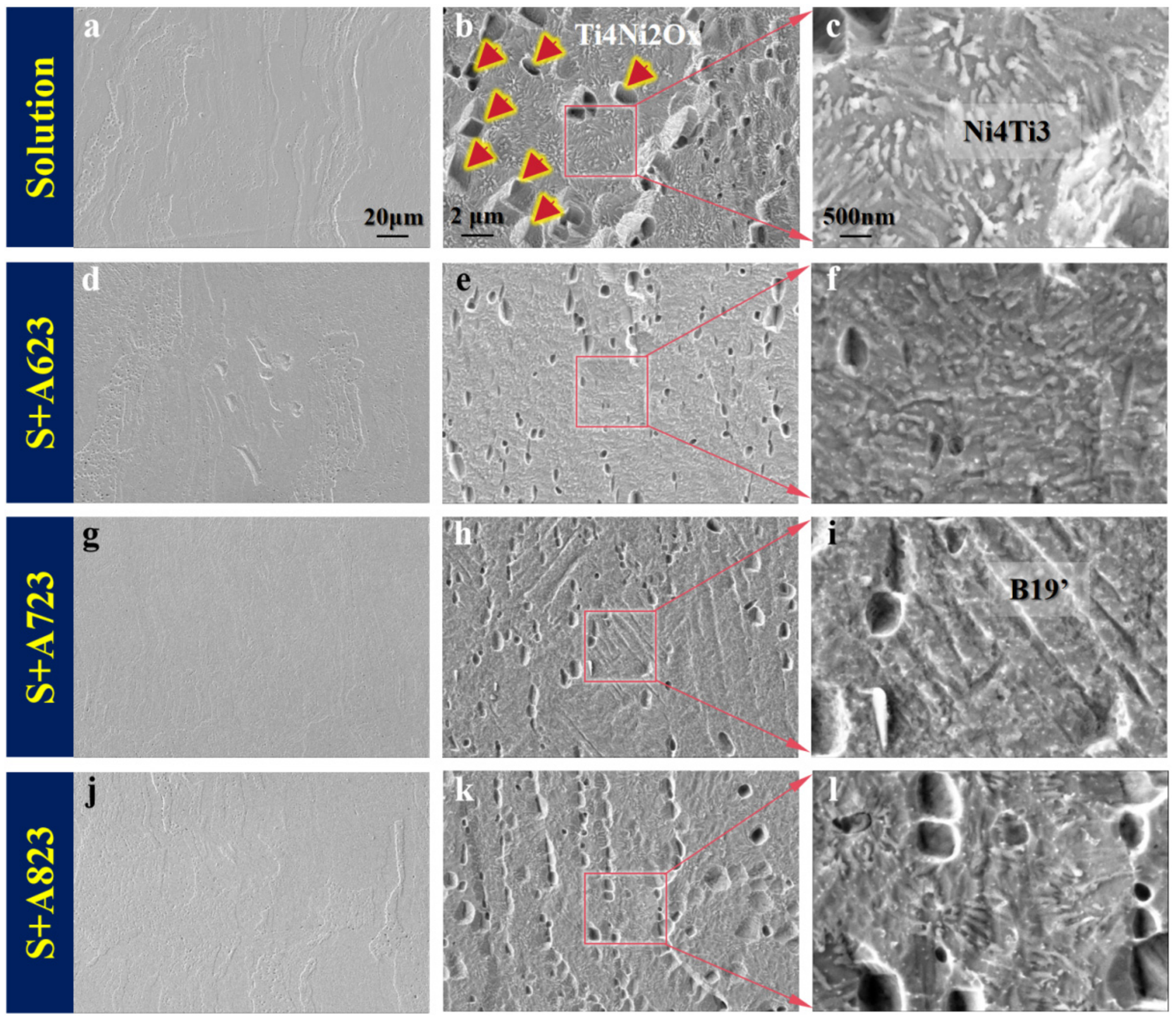
Figure 3 shows the cross-sectional microstructure characteristics of the as-fabricated thin NiTi sample. It is found that the as-fabricated sample exhibits a clear molten pool morphology. Regarding the microstructure, the interior of the molten pool is mainly composed of a large number of epitaxially grown columnar grains, while the molten pool boundaries are characterized by fine equiaxed grains. In addition, a large number of fine nanoparticles are observed to be dispersed within the matrix. According to our previous work [15], these nanoparticles are likely the Ti4Ni2Ox phase. Kai et al. [28] found through first-principle calculations that the formation enthalpy of Ti4Ni2Ox was significantly lower than that of Ti2Ni, indicating that during any thermal processing of NiTi alloys, when Ti2Ni combines with oxygen from the powder feedstock or residual oxygen in the build chamber, it readily transforms into the stable Ti4Ni2Ox precipitate phase. Further EDS elemental mapping shows that the molten pool boundary as well as the grain boundary are slightly Ti-rich while the grain interior is slightly Ni-rich, with a slight segregation. Figure 4 shows the microstructural characteristics under solution treatment and solution + aging treatment conditions. The results show that after solution treatment, the molten pool boundary contours disappear in all samples, which is mainly attributed to the accelerated elemental diffusion during the prolonged high-temperature treatment, reducing the microstructural differences between different regions of the molten pool. Meanwhile, the microstructure of the solution-treated sample still consists primarily of epitaxially grown columnar grains, but the grains are coarser. In addition, numerous micron-scale granular second phases are observed in the solution-treated sample, mainly distributed at the columnar grain boundaries. According to a previous study [29], this second phase is likely Ti4Ni2Ox, which is consistent with our XRD results. Since the large number of Ti4Ni2Ox particles formed in the as-fabricated sample hardly dissolve into the matrix during solution treatment, they rapidly grow under the subsequent prolonged high-temperature exposure. Moreover, some submicron-scale Ni4Ti3 precipitates are also found, as indicated by arrows in Figure 4c. These Ni4Ti3 likely originate from the as-fabricated state: on one hand, the formation of a large amount of Ti4Ni2Ox promotes the formation of a Ni-rich matrix; on the other hand, the thermal cycles during the LPBF process facilitate the precipitation of Ni-rich phases. Considering that the solution treatment temperature is 950 °C, the Ni-rich phases may not be fully dissolved and tend to grow under prolonged high temperature. When aging treatment is further applied on the basis of solution treatment, fine Ni4Ti3 phases further precipitate in the matrix (Figure 4f). Notably, at an aging temperature of 723 K, an obvious interlaced B19’ phase is observed (Figure 4i), further corroborating the precipitation of the Ni4Ti3 phase. Figure 5 presents the microstructural characteristics of the direct-aged samples. At relatively low aging temperatures (e.g., 623 K and 723 K), the molten pool boundary features remain clearly visible (Figure 5a,d), and the presence of the B19’ phase is observed in both cases (Figure 5c,f). However, when the aging temperature increases to 823 K, the molten pool boundaries become invisible (Figure 5g), and no obvious B19’ phase or particle precipitation is observed.
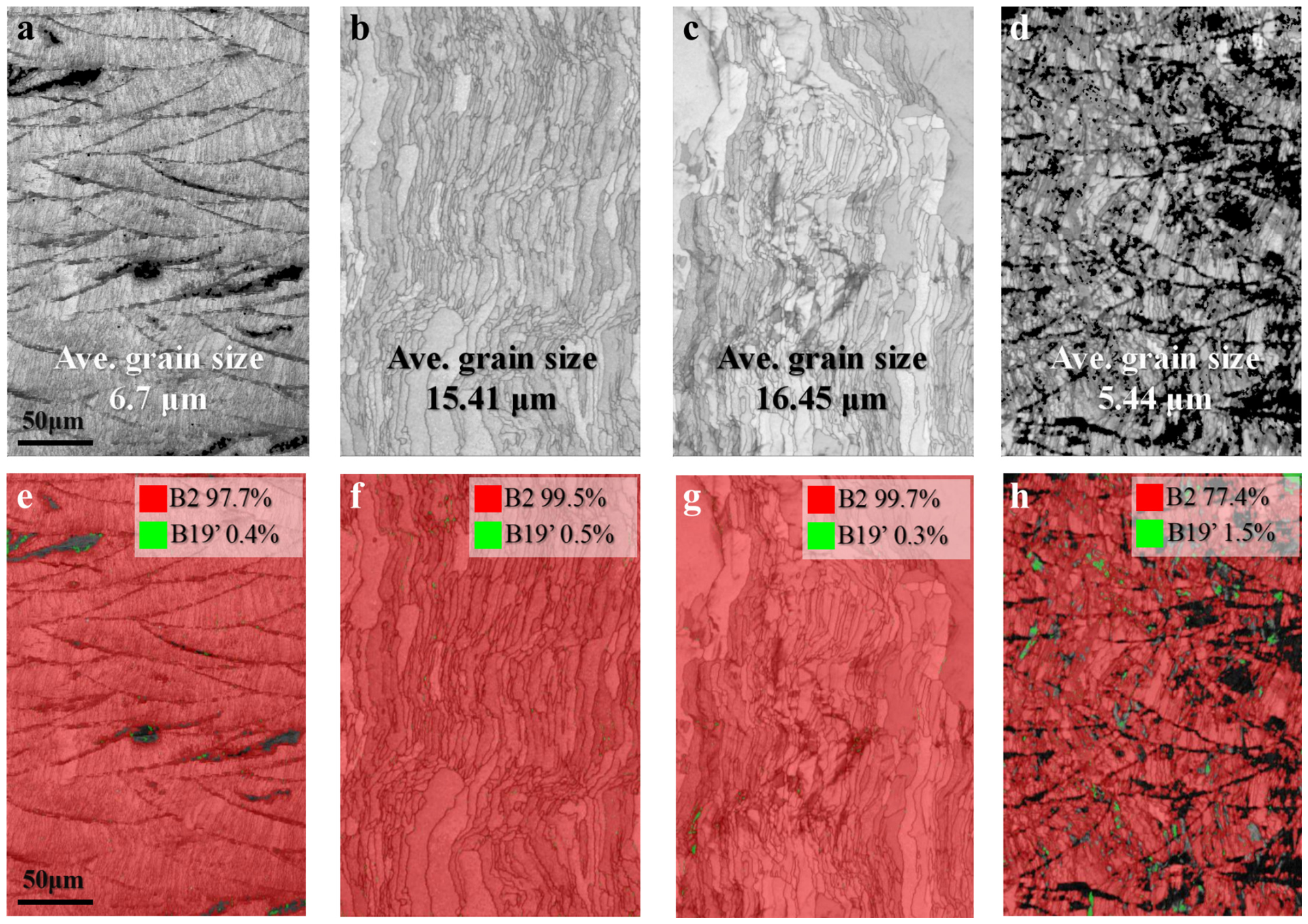
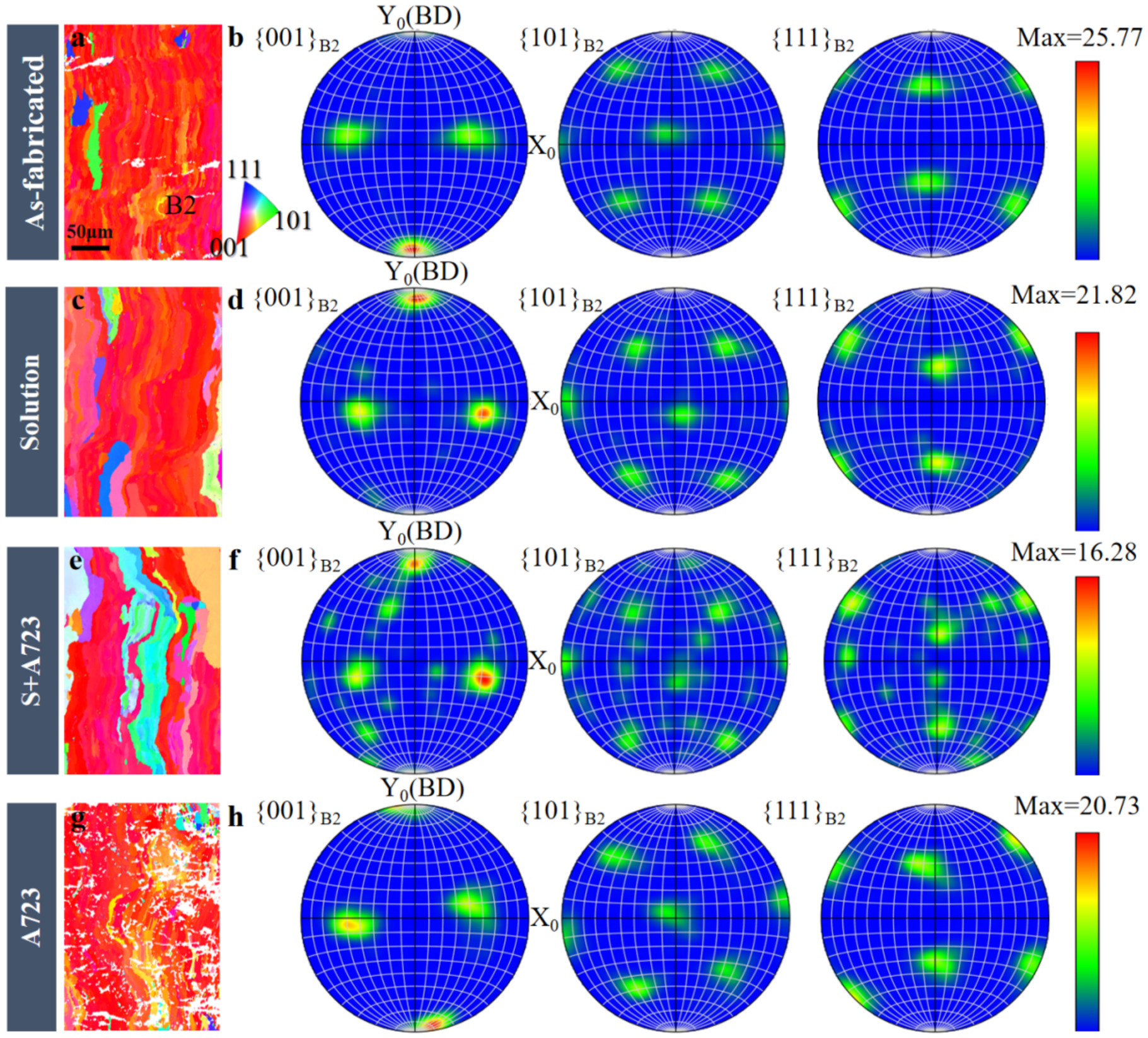
To further investigate the influence of different heat treatment methods on the microstructure, texture, and grain boundary misorientation distribution of LPBF-fabricated NiTi alloy samples, EBSD characterization was performed on the as-fabricated, Solution, S + A723, and A723 samples. Figure 6 mainly shows the band contrast maps and phase distribution maps of these four samples. Similar to the SEM observations, the as-fabricated and direct-aged samples still retain clear molten pool contours (Figure 6a,d), while the molten pool boundaries disappear after solution treatment and solution + aging treatment (Figure 6b,c). In addition, all heat-treated samples exhibit a columnar grain structure roughly parallel to the building direction (BD), but the grain size indeed changes significantly under different heat treatment conditions. According to statistics, the average grain sizes of the B2 phase in the as-fabricated, Solution, S + A723, and A723 samples are 6.70 μm, 15.41 μm, 16.45 μm, and 5.44 μm, respectively. It is evident that the samples subjected to high-temperature solution treatment (S and S + A723) have significantly larger average grain sizes than the as-fabricated and direct-aged (A723) samples. This is because high-temperature solution treatment can dissolve small grains, causing them to merge with the initial columnar grains, thereby forming coarse and irregular columnar grains—a phenomenon known as Ostwald ripening [30]. Compared with the average grain size of conventionally processed NiTi alloys (90 μm) [11], the LPBF technique exhibits a grain-refining effect, which can be attributed to the extremely high heating and cooling rates during its forming process. From the phase distribution maps (Figure 6e–h), it is observed that all samples are mainly composed of the B2 phase, and only the direct aging treatment leads to an increase in the B19’ phase (Figure 6h). In addition, the directly aged sample also shows many black regions that are difficult to index, indicating that the precipitated phases during the direct aging process cause significant internal stress. This is mainly because the grain size in the tested area is too small and the magnification is relatively low. When collecting data from fine-grained regions, pattern overlapping occurs, leading to a low indexing rate and these unsuccessfully indexed regions. Typically, these regions are located at the molten pool overlap areas, and similar phenomena have been observed in previously reported studies [31]. Moreover, similar phenomena can also occur in regions of lath-type martensite with small feature sizes. Figure 7 further presents the inverse pole figures (IPFs) from the EBSD measurements of the four samples as well as the pole figures of the main crystal planes of the B2 matrix phase. The as-fabricated sample exhibits a strong {100}B2//BD orientation texture, with a maximum texture index of 25.77. After solution treatment, the {100}B2//BD orientation texture remains strong, but the maximum texture index slightly decreases to 21.82, and a weak orientation texture appears at a deviation of 35–45° from the X0 direction. Compared with the single solution-treated sample, the S + A723 sample subjected to high-temperature solution + aging treatment shows a further reduction in the maximum texture index to 16.28. It is worth noting that at this stage, the maximum texture intensity of {100}B2 appears at a deviation of 35–45° from the X0 direction rather than along the BD. For the direct aging treatment, the sample mainly retains an orientation texture similar to that of the as-fabricated sample, but the texture direction is slightly shifted by about 5°, and the maximum texture index is also slightly reduced to 20.73. The above results reflect that the heat treatment process has a significant effect on the texture orientation of LPBF-fabricated NiTi alloys: solution treatment differentiates the orientation texture along the BD to a certain extent, while aging treatment mainly weakens the texture index.
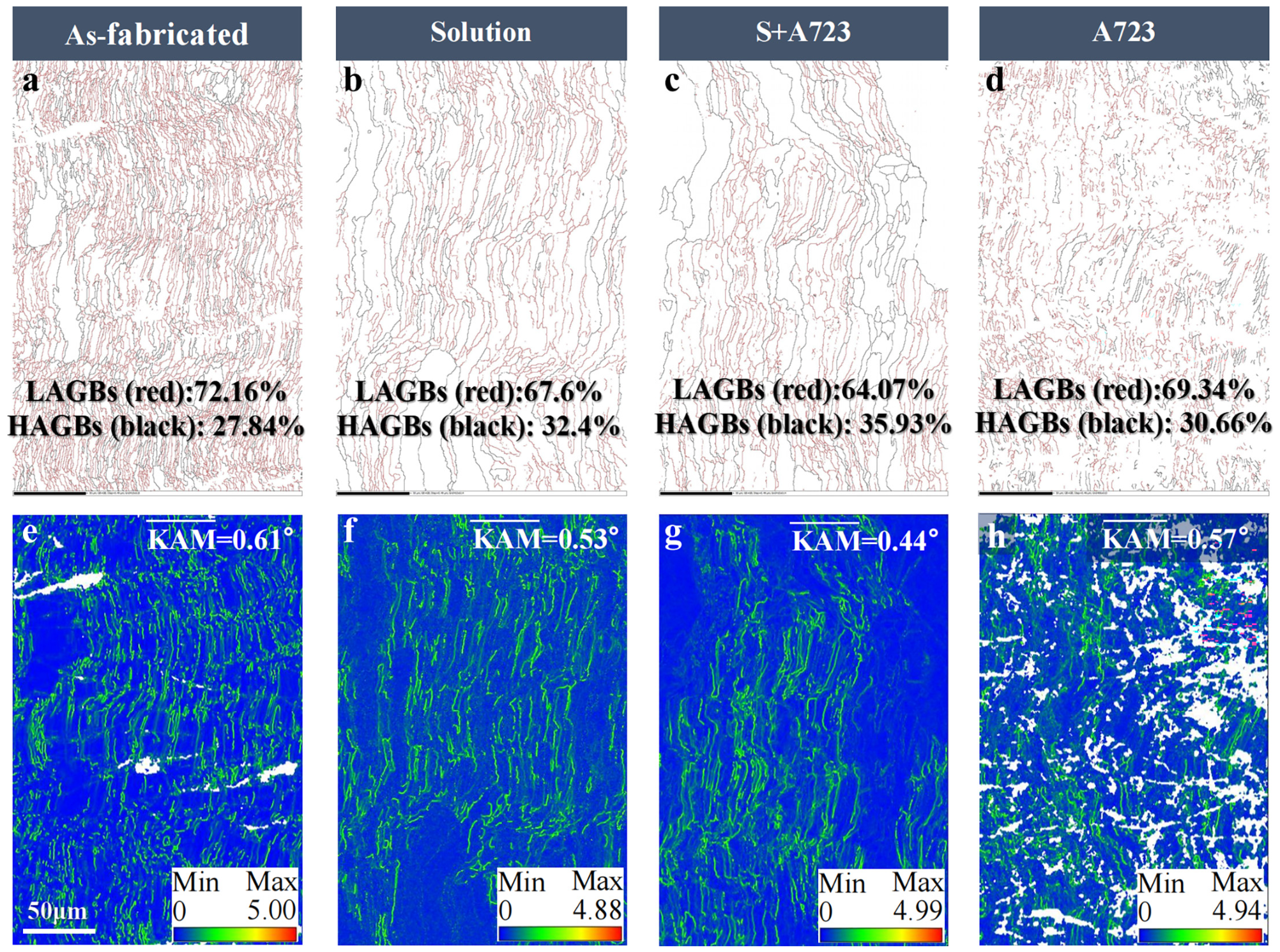
Figure 8 further presents the grain boundary misorientation distribution maps and KAM maps under different heat treatment conditions. The statistical results show that the as-fabricated sample has a low-angle grain boundary (LAGBs, 2–15°) fraction of 72.16% (Figure 8a), which is significantly higher than that of all other samples. LAGBs are usually composed of dislocation arrays, and a high fraction of LAGBs implies a high dislocation density. During the LPBF process, the ultra-high temperature gradient induces significant thermal stress, and the extremely fast cooling rate readily leads to the formation of a large number of crystal defects, especially dislocations. These dislocations tangle with each other during motion, forming dislocation walls, which subsequently transform into LAGBs. After solution treatment, the LAGB fraction decreases significantly from 72.16% to 67.6% (Figure 8b), which is mainly attributed to the accelerated atomic diffusion and dislocation motion under prolonged high-temperature exposure. Notably, further aging treatment also exhibits a reducing effect on the LAGB fraction (Figure 8c), which may be because some local high-density dislocations can act as nucleation sites for martensite or precipitate phases. Similarly, the direct aging treatment also results in a certain reduction in the LAGB fraction compared with the as-fabricated sample, further validating the above speculation. It is worth noting that the S + A723 sample possesses the lowest fraction of LAGBs, indicating that it has the smallest dislocation density, which is consistent with the XRD analysis results described above. Figure 8e–h corresponds to the KAM maps of the four samples. The KAM method is commonly used to reflect the uniformity of residual stress or deformation within a sample. According to the statistics, the as-fabricated sample has the highest average KAM value of 0.61° (Figure 8e), indicating that the as-fabricated sample possesses significant stored energy and large residual stress. After high-temperature solution treatment, the lattice distortion inside the sample is effectively relieved, so the average KAM value correspondingly decreases to 0.53° (Figure 8f). With further aging treatment on the basis of solution treatment, due to the release of quenching stress, the sample exhibits the smallest average KAM value of 0.44°. In contrast, the direct-aged sample, which still maintains a relatively high residual stress, shows only a limited reduction in average KAM value, remaining as high as 0.57°. Furthermore, from the distribution of KAM values, it can be observed that the positions with high KAM values in all samples roughly coincide with the LAGBs.

3.3. Phase Transformation Behavior

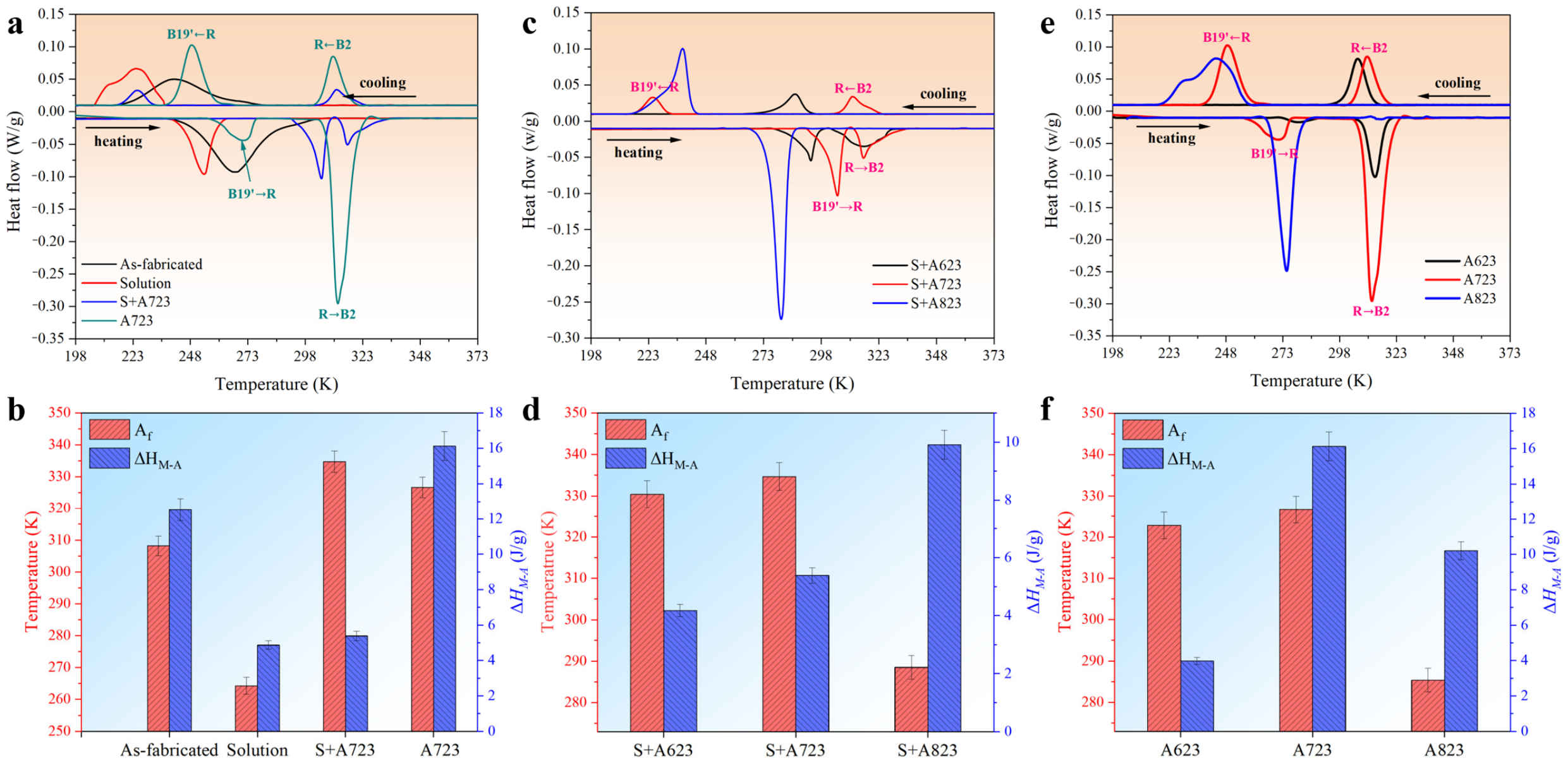
Figure 9 presents the DSC curves and statistical transformation characteristic values of the LPBF-fabricated NiTi alloy under different heat treatment conditions. From Figure 9a, it is seen that the as-fabricated and solution samples only undergo a reversible single-step B19’↔B2 phase transformation during heating and cooling. Compared with the as-fabricated NiTi alloy, the solution-treated sample exhibits a significantly narrower transformation temperature range and a pronounced leftward shift of transformation temperatures, with Af decreasing from 308.17 ± 3.08 K to 263.72 ± 2.64 K (Figure 9b). For LPBF-fabricated samples, the solidification microstructure and composition under non-equilibrium metallurgical conditions are usually inhomogeneous, thus showing a wide transformation temperature range. In contrast, the prolonged high-temperature exposure during solution treatment facilitates the dissolution of Ni-rich precipitates and homogenization of the composition, resulting in a narrowed transformation temperature range and decreased transformation temperatures. Furthermore, solution treatment also leads to a substantial attenuation of the transformation peak area, i.e., a decrease in transformation enthalpy from 12.52 ± 0.63 J/g in the as-fabricated state to 4.87 ± 0.24 J/g in the solution-treated state, which may be related to the formation of a large number of coarse Ti4Ni2Ox particles.
For the S + A723 and A723 samples, both undergo a reversible two-step B19’↔R↔B2 phase transformation during heating and cooling. The appearance of the R phase is usually directly related to the precipitation of coherent Ni4Ti3 nanoprecipitates in the matrix, which is consistent with the aforementioned XRD results. The presence of Ni4Ti3 nanoprecipitates affects the local Ni element distribution and strain/stress field variations, increasing the difference in nucleation barrier between the R phase and the B19’ phase, thereby causing the R phase transformation with smaller lattice strain to occur preferentially during the transformation process [13]. Compared with the A723 sample, the multi-step transformation in the S + A723 sample during heating is more uniform and continuous, which is closely related to the prior high-temperature solution treatment experienced by the sample. In addition, the transformation temperatures of the S + A723 and A723 samples are significantly elevated compared with those of the as-fabricated and solution-treated samples, which can be mainly attributed to the precipitation of the Ni4Ti3 phase and the consequent reduction of Ni content in the matrix due to aging treatment. Meanwhile, it is found that the transformation enthalpy of the A723 sample is the highest among all heat treatment conditions, reaching 16.13 ± 0.81 J/g, far exceeding that of the samples under other conditions.
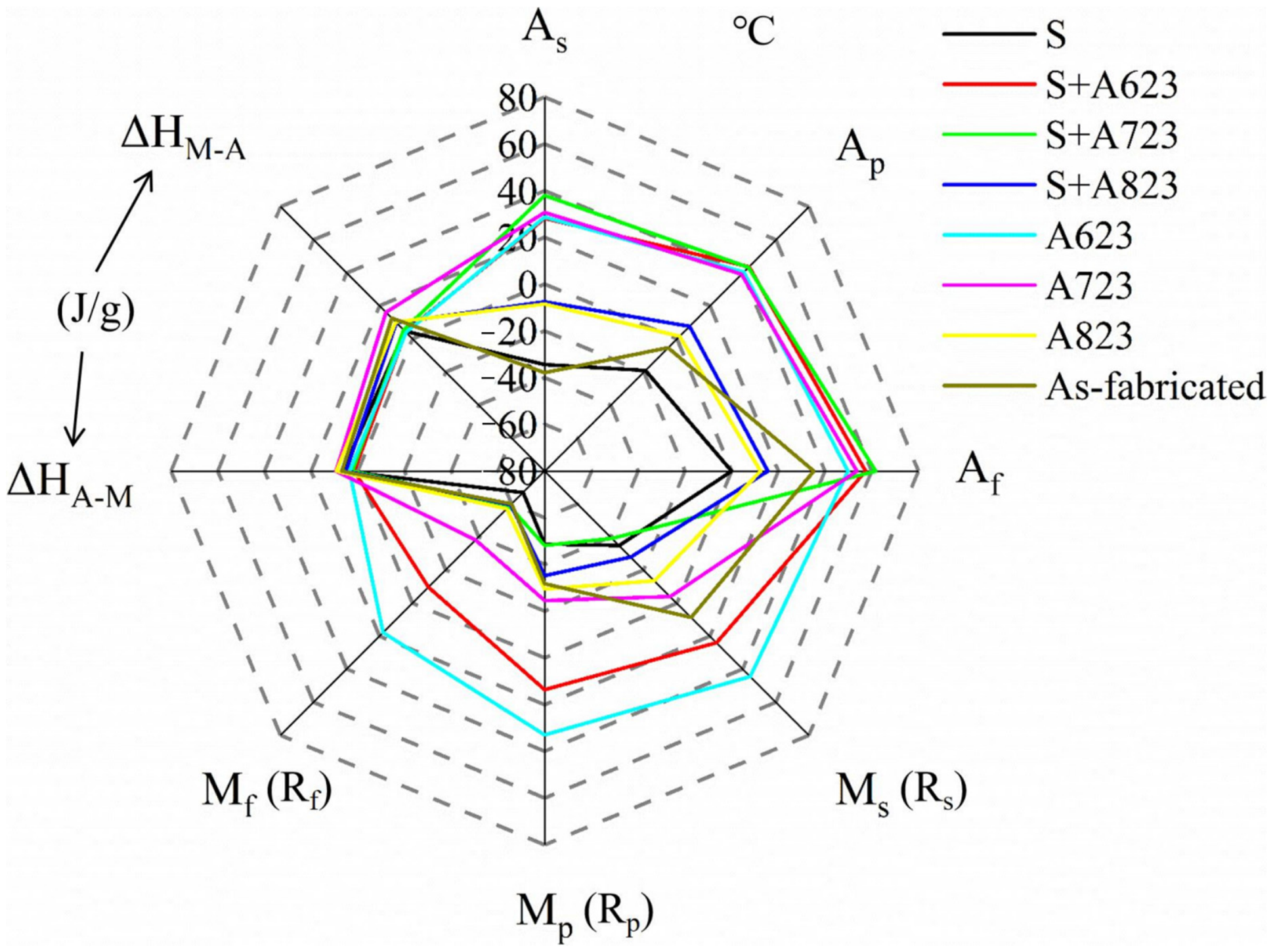
Subsequently, for the two heat treatment methods (solution + aging and direct aging), the influence of different temperatures on the transformation behavior was further investigated, as shown in Figure 9c–f. For the solution + aging treatment, it is found that the S + A623 and S + A723 samples both undergo a two-step transformation process during heating and cooling. As the aging temperature increases, the S + A823 sample exhibits only a single-step transformation characteristic with a significantly reduced transformation temperature. This indicates that aging treatment at 823 K may inhibit the precipitation of supersaturated Ni atoms, maintaining a high Ni content in the matrix. The effect of heat treatment temperature on the transformation curves of the direct-aged samples is similar to that of the solution + aged samples, but the areas of the transformation peaks are significantly larger than those of the solution + aged samples. It is worth noting that the A623 sample does not undergo a two-step transformation like the S + A623 sample during heating and cooling, but only a single-step transformation (Figure 9c), although the transformation temperature does increase considerably compared with the as-fabricated sample. This indicates that a certain amount of Ni-rich precipitates indeed form, but they are unable to promote the occurrence of the R phase transformation. This may be attributed to the still relatively high dislocation density at this stage, which inhibits the formation of the intermediate phase to some extent, thus directly leading to a single B2→B19’ transformation path. When the direct aging temperature reaches 823 K, the transformation behavior is similar to that of S + A823. Figure 10 presents a radar chart summarizing the comparison of average transformation temperatures and average enthalpy changes for all samples under different conditions. Compared with the as-fabricated sample, solution treatment and high-temperature aging treatment both lead to a significant decrease in Ms and Af temperatures, while solution + low-temperature aging or direct low-temperature aging both result in a marked increase in transformation temperatures.

3.4. Nanoindentation

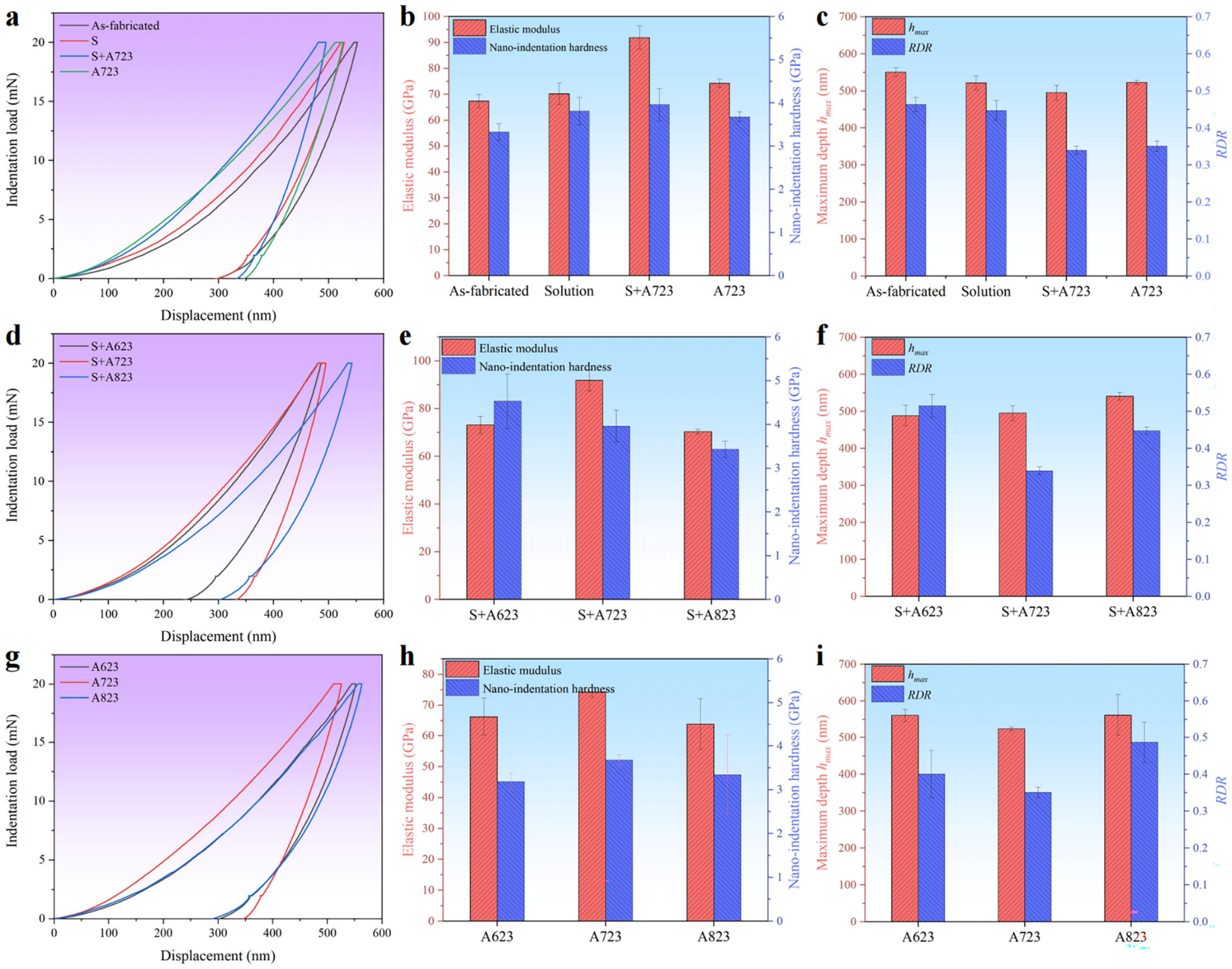
Subsequently, nanoindentation characterization was performed on the NiTi alloy samples under different heat treatment conditions to evaluate the influence of heat treatment on the elastic modulus, nanohardness, and room-temperature superelastic recovery behavior of the NiTi alloy. Figure 11a–c shows the load-depth curves from nanoindentation testing of the as-fabricated, solution, S + A723, and A723 samples, as well as the corresponding bar charts of elastic modulus, nanohardness, maximum indentation depth, and room-temperature recovery ratio (RDR). It can be clearly seen that the as-fabricated sample exhibits the lowest elastic modulus and nanohardness (67.39 ± 2.64 GPa and 3.33 ± 0.19 GPa, respectively). After high-temperature solution treatment, the elastic modulus and nanohardness of the sample increase to 70.22 ± 4.03 GPa and 3.81 ± 0.31 GPa, respectively, which may be related to the precipitation of a large number of micron-scale Ti4Ni2Ox particles induced by the solution treatment. With the application of aging treatment, the elastic modulus of the S + A723 sample increases dramatically to 91.89 ± 4.53 GPa, and the nanohardness also rises to 3.97 ± 0.37 GPa. This is mainly attributed to the precipitation of Ni4Ti3 nanoprecipitates during aging, which provides precipitation strengthening. Compared with the S + A723 sample, the directly aged A723 sample shows lower elastic modulus and nanohardness (74.26 ± 1.58 GPa and 3.68 ± 0.11 GPa, respectively), but both values remain higher than those of the as-fabricated sample.
Then, the recovery ratio is defined as the ratio of the recovered depth (maximum depth minus residual depth) to the maximum depth to quantitatively evaluate the room-temperature recovery behavior of the samples under different heat treatment conditions [32]. Obviously, a larger recovery ratio indicates better recoverability. As shown in Figure 11c, the as-fabricated sample without any heat treatment exhibits the highest recovery ratio of 0.46 ± 0.02. After high-temperature solution treatment, the recovery ratio of the solution sample decreases slightly to 0.45 ± 0.03. However, with further aging treatment, the recovery ratio of the S + A723 sample drops significantly to 0.34 ± 0.01. In comparison, the directly aged A723 sample also shows a low recovery ratio of 0.35 ± 0.01. In addition, the maximum indentation depth exhibits a similar trend to the recovery ratio. In summary, the as-fabricated and solution samples possess good room-temperature recovery performance, while the aged samples (S + A723 and A723) exhibit poor room-temperature superelasticity.
Figure 11d–i presents the nanoindentation results for the solution + aged and directly aged samples at different aging temperatures. Specifically, as shown in Figure 11e, for the solution + aged samples, the elastic modulus first increases and then decreases with increasing aging temperature, with the S + A723 sample exhibiting the highest elastic modulus of 91.89 ± 4.53 GPa at an aging temperature of 723 K. In contrast, the nanohardness shows a decreasing trend with increasing aging temperature. For the directly aged samples, both elastic modulus and nanohardness first increase and then decrease with increasing aging temperature. This can be attributed to precipitation strengthening from Ni4Ti3 precipitates of different sizes and volume fractions. Among them, the A723 sample (direct aging at 723 K) shows the highest elastic modulus and nanohardness among the direct-aged series, reaching 74.26 ± 1.58 GPa and 3.68 ± 0.11 GPa, respectively. Furthermore, the S + A623 and S + A823 samples exhibit similar basic mechanical properties. Comparing the basic mechanical properties of the solution + aged and directly aged samples at the same aging temperature, it can be seen that the solution + aged samples exhibit significantly higher elastic modulus and nanohardness than the directly aged ones, indicating that the prior high-temperature solution treatment is crucial for improving the mechanical properties.
From Figure 11f, for the solution + aged samples, the recovery ratios of S + A623, S + A723, and S + A823 are 0.52 ± 0.03, 0.34 ± 0.01, and 0.45 ± 0.01, respectively. As the aging temperature increases, the recovery ratio first decreases and then increases. For the directly aged samples, the recovery ratios of A623, A723, and A823 are 0.40 ± 0.06, 0.35 ± 0.01, and 0.49 ± 0.06, respectively, also showing a trend of first decreasing and then increasing. It is believed that the Ni4Ti3 precipitates play an important role in the superelastic recovery performance, which will be discussed in detail in the following discussion.

4. Discussion

4.1. Regulation Mechanism of Heat Treatment on the Solidified Microstructure

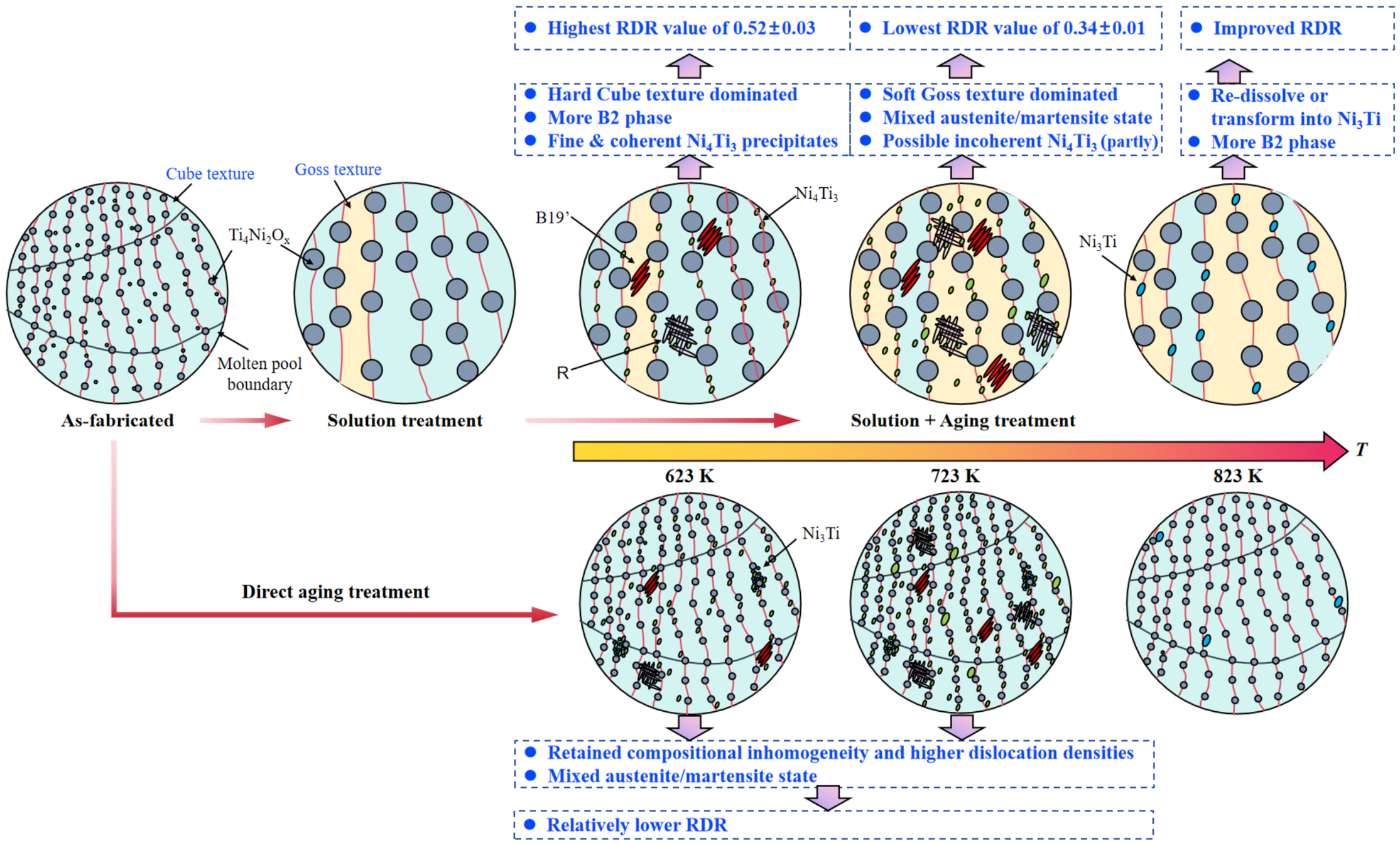
Based on the above-mentioned experimental results, it is found that different heat treatment approaches can influence the solidified microstructure to varying degrees. To better elaborate on the regulation mechanism of heat treatment on the solidified microstructure, a schematic illustration of microstructure evolution is provided, as shown in Figure 12. As for the LPBF process, due to the incredible Ni evaporation, the solidified microstructure is mainly characterized by a B2 matrix and Ti4Ni2Ox nanoparticles (Figure 3 and Figure 6e). Notably, the Ni evaporation might occur in some random zones, in view of the heterogeneous energy input. Under the ultrahigh cooling rate, supersaturated solid solution B2 phase with high Ni content further facilitates the formation of the depleted Ni zones and resultant Ti4Ni2Ox nanoparticles. Specifically, around some Ti4Ni2Ox nanoparticles, Ni4Ti3 might therefore precipitate from the matrix driven by the intrinsic thermal cycles. Besides, the directional heat flow and epitaxial grain growth during LPBF lead to a strong cube texture {001}B2<001>B2 along the BD, where the <001> direction aligns with the maximum thermal gradient. When subjected to the solution treatment at 950 °C, Ti4Ni2Ox nanoparticles hardly dissolve into the matrix according to the Ni-Ti binary phase diagram. On the contrary, long-time high-temperature treatment tends to cause adjacent Ti4Ni2Ox nanoparticles to merge and grow. Significantly coarsened Ti4Ni2Ox micron-scale particles therefore emerge after solution treatment (Figure 4a). As for the B2 matrix, according to M. Liu et al.’s work [33], the recrystallization temperature of the LPBF-fabricated NiTi alloys is around 780 °C, which is apparently lower than as-used solution temperature in this work. What’s more, the as-fabricated sample has high stored energy in consideration of its microstructure featured by high fraction of LAGBs (72.16%) and high density of dislocations (2.70 × 10¹⁸ m−2), which enables recrystallization and even abnormal grain growth (AGG) through the solution treatment. On the other hand, considering the {101} close-packed plane is the crystal plane with the lowest energy and the best stability, the growth of recrystallized grains tends to form a Goss texture (namely {101}B2<001>B2, as shown in Figure 7c,d), accomplishing the release of stored energy. The partial Cube-to-Goss transition is thus interpreted as a recrystallization texture transformation, where Goss-oriented grains grow at the expense of Cube-oriented grains. These also reasonably account for the formation mechanism of coarse columnar grains with a slightly different orientation texture after solution treatment. It is noted that either the LPBF process or solution treatment involves a rapid cooling period. In this condition, excessively solubilized Ni atoms, combining with dispersed Ti4Ni2Ox particles, can effectively suppress the martensite transformation. Therefore, on the basis of solution treatment, further aging treatment can decrease the transformation barrier via the precipitation of Ni-rich intermetallics (e.g., Ni4Ti3) and consequently induce the formation of B19’ phase and R phase. In comparison with the S + A treatment, direct aging treatment can basically retain the original microstructure features (e.g., molten pool boundary, relatively fine columnar grains) of the as-fabricated sample. Besides, accompanied by the precipitation and growth of Ni4Ti3, some martensitic twins and R phase might naturally form according to the XRD and DSC results, similar as the case of the S + A treatment. Additionally, for the middle-temperature aging treatment (S + A723), the texture intensity decreases with a change in orientation components from Cube to Goss. It can be deduced that solution treatment provides the initial Goss nuclei for the texture evolution in S + A723. What’s more, the Ni4Ti3 precipitates selectively disrupt the orientation integrity of Cube grains (through precipitate-induced strain fields and recovery-driven subgrain rotation), whereas Goss grains are preserved due to differences in precipitation response and lower strain energy, ultimately leading to the relative dominance of the Goss texture in S + A723. Considering the relatively smaller amount of Ni4Ti3 precipitates and lower aging temperature, S + A623 sample might maintain the Cube-dominated texture. Specifically, it is further found that a significant decrease in dislocation density emerges in both cases of S + A and direct aging treatment, by 75.9% and 37%, respectively, when comparing with that in the as-fabricated sample. Waitz et al. pointed out that specific dislocation configurations could act as possible nucleation sites of martensite plates [20]. Hence, the decrease in dislocation density might be attributed to the martensitic transformation to some degree. Regarding the evolution of Ni4Ti3 precipitates, TEM characterizations need to be performed in future work.

4.2. Correlation of Modified Microstructure with Phase Transformation Behavior and Room-Temperature Depth Recovery Behavior

Variation of the microstructure consequentially brings about different phase transformation behavior and room-temperature depth recovery behavior. As for the phase transformation behavior, this influence can be interpreted by the Landau free energy. For the solution treated sample, the matrix is Ni-rich due to rapid cooling rate and growth of Ti4Ni2Ox particles. High Ni content can increase the lattice stability of the B2 phase and significantly raise the Landau barrier, thus resulting in a larger driving force (e.g., a lower TT, as shown in Figure 9a) for the martensitic transformation to occur. When further suffering from aging treatment, the precipitated Ni-rich phases (e.g., Ni4Ti3) lead to a decrease of Ni content in the matrix. In this condition, the TTs return to a higher level. Notably, the lattice mismatch between the Ni4Ti3 phase and B2 matrix introduces a coherent strain field within the matrix. These strain fields can act as heterogeneous nucleation sites, promoting the nucleation of the R phase at a lower energy, thereby leading to the occurrence of a two-step phase transformation in the S + A623 or S + A723 sample (Figure 9b). However, when the aging temperature rises to 823 K, the Ni4Ti3 phase might partly redissolve into the matrix according to the Ti-Ni phase diagram. As a result, an increase in the Ni content of the matrix occurs and the TTs decrease accordingly. For the directly aged samples, a similar evolution mechanism can be described.
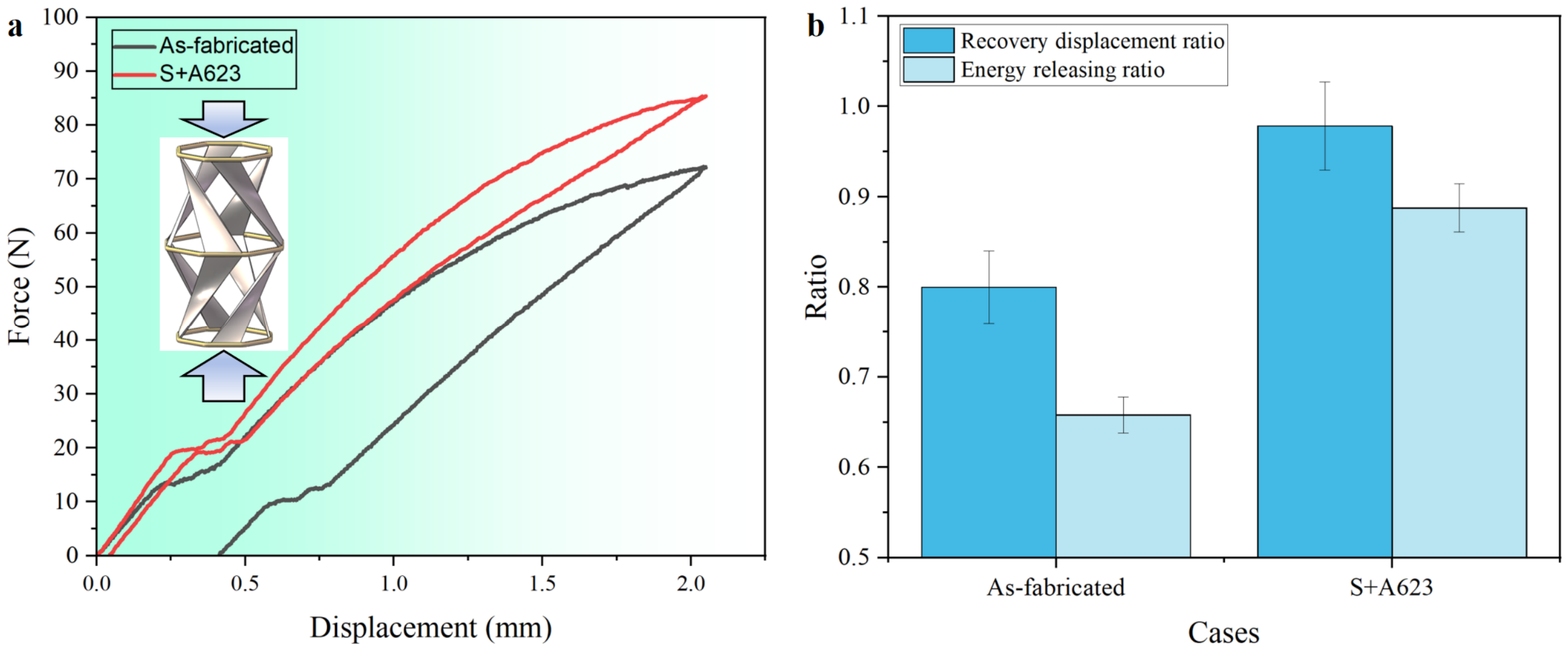
Regarding the superelastic recovery property, it is believed that the precipitate characteristics, dislocation density and crystallographic texture jointly govern it. For the as-fabricated sample, a relatively high RDR of 0.46 ± 0.02 is obtained. On the one hand, it is almost fully austenitic B2 phase at room temperature (Af = 308.17 ± 3.08 K), which is beneficial for stress-induced martensitic transformation (SIMT) and its reversible recovery. On the other hand, the as-fabricated sample has a strong {100}B2<001>B2 Cube texture (nmax = 25.77) along the BD. Since the <001>B2 direction is a hard orientation with the highest critical resolved shear stress, slip systems are difficult to activate, which promotes the preferential occurrence of SIMT rather than dislocation slip under loading, thus favoring superelastic recovery. Although the as-fabricated sample possesses the highest dislocation density (2.70 × 10¹⁸ m−2) and a high fraction of LAGBs (72.16%), the orientation advantage conferred by the Cube texture partially compensates for the adverse effects of defects on transformation reversibility. Compared with the as-fabricated sample, the solution-treated sample shows a slight decrease in recovery ratio to 0.45 ± 0.03. At this stage, the sample still maintains a strong {100}B2//BD texture, but the nmax decreases to 21.82, and a weak Goss texture ({101}B2<001>B2) component begins to appear at a deviation of 35–45° from the BD (Figure 7). This partial texture transformation implies that some grains deviate from the hard <001>B2 orientation, making dislocation slip relatively easier, thus leading to a slight decline in the overall recovery property of the sample. On this basis, further aging treatment (e.g., S + A723) results in a significant drop in recovery ratio to 0.34 ± 0.01. According to the EBSD results (Figure 7), the texture intensity further decreases (the nmax is only 16.28), and the maximum texture intensity appears at a deviation of 35–45° from the BD, i.e., the Goss texture component becomes dominant. Besides, due to an extensive precipitation of Ni4Ti3, the Ni content in the matrix is significantly decreased, thus leading to higher TTs (Figure 9b) and more B19’ or R phase retaining within the matrix (Figure 2). Therefore, the orientation softening induced by the Goss texture, combined with the decrease of the B2 phase fraction, leads to the worst recovery performance. However, when the aging temperature is raised to 823 K, the recovery ratio of the sample returns to 0.45 ± 0.01. At this point, no Ni4Ti3 peaks are detected by XRD (Figure 2), indicating that the precipitates may have re-dissolved or coarsened. The higher aging temperature removes the hindrance of precipitates on the transformation, but may introduce some coarsened phases or dislocation structures; thus, the recovery performance rebounds compared to S + A723 but does not exceed that of the as-fabricated sample. In contrast, when the aging temperature is lowered to 623 K, the sample exhibits the highest recovery ratio (0.52 ± 0.03). It is inferred that at this temperature, the precipitated Ni4Ti3 phase is fine and well-coherent with the matrix, in views of the existence of considerable R phase transformation. The corresponding coherent strain field can enhance the reversible recovery of SIMT. Meanwhile, relatively lower Af temperature allows more B2 phase at room temperature, also contributing to the improved RDR. For the direct aging treatments, both A623 and A723 samples obtain relatively low recovery ratios, which may be attributed to the presence of pre-existing martensite and R phase that limit transformation reversibility. Moreover, the absence of a prior solution treatment leads to more pronounced compositional inhomogeneity, which also brings about the reduction in recovery. However, when the aging temperature reaches 823 K, the recovery ratio increases to 0.49 ± 0.06. Compared with S + A823, this sample retains the fine grain structure and relatively high dislocation density of the as-fabricated sample; these factors may facilitate the nucleation and reversible recovery of SIMT, so its recovery performance approaches that of the as-fabricated sample. It is noted that the reported recovery ratios are obtained by nanoindentation and should be interpreted as a local, comparative indicator rather than an absolute macroscopic superelastic property. To confirm the macroscopic superelastic trend, two cyclic compression testing cases of the thin-walled chiral structures were further performed, as shown in Figure 13. The result clearly shows that the superelastic response of the S + A623 treated sample is significantly superior to that of the as-fabricated one.

5. Conclusions

In this study, the effects of different heat treatment regimes (solution, solution + aging at 623–823 K, and direct aging at 623–823 K) on the solidified microstructure, phase transformation behavior, and room-temperature recovery behavior of LPBF-fabricated thin Ni50.6Ti49.4 samples were systematically investigated. The main findings are summarized as follows:
  • The as-fabricated sample exhibits a strong {100}B2<001>B2 Cube texture, high dislocation density (2.70 × 10¹⁸ m−2), and a single-step B19’↔B2 transformation, achieving a recovery ratio of 0.46 ± 0.02. Solution treatment homogenizes the composition, reduces dislocation density, induces a partial Cube-to-Goss texture transition, and slightly lowers the recovery to 0.45 ± 0.03.
  • Aging at 723 K after solution treatment (S + A723) leads to a Goss-dominated texture and a mixed austenite/martensite state, thereby yielding the poorest recovery (0.34 ± 0.01). In contrast, aging at 623 K (S + A623) produces fine, inferred-coherent Ni4Ti3 precipitates, maintains a higher fraction of B2 phase, and achieves the highest recovery (0.52 ± 0.03).
  • Direct aging generally gives lower recoveries (0.35–0.49) than solution + aging treatments due to retained compositional inhomogeneity and higher dislocation densities, except for A823 (0.49 ± 0.06) which is slightly superior to that of the as-fabricated sample. The recovery performance is governed by the synergy of room-temperature phase state, precipitate coherency, dislocation density, and crystallographic texture.

Author Contributions

Writing—original draft, Validation, Investigation, Formal analysis, G.W.; Writing—original draft, Methodology, Investigation, Formal analysis, Data curation, X.P.; Writing—review & editing, Supervision, Investigation, Conceptualization, D.Z.; Writing—review & editing, Supervision, Investigation, Funding acquisition, C.M. All authors have read and agreed to the published version of the manuscript.

Funding

This research was funded by Jiangsu Province Youth Talent Support Program (JSTJ-2024-450).

Data Availability Statement

The original contributions presented in this study are included in the article. Further inquiries can be directed to the corresponding authors.

Conflicts of Interest

The authors declare no conflicts of interest.

References

  1. Ramezannejad, A.; East, D.; Murphy, A.B.; Lu, G.; Yang, K.V. Optimising Additive Manufacturing of NiTi and NiMnGa Shape Memory Alloys: A Review. Metals 2025, 15, 488. [Google Scholar] [CrossRef]
  2. Zhao, T.; Huang, J.; Zhao, H.; Xiang, R.; Song, X.; Fan, D. Effect of Phase Structure on the Properties of Additively Manufactured NiTi Alloy Based on Molecular Dynamics Simulation. Metals 2025, 15, 411. [Google Scholar] [CrossRef]
  3. Xiang, Z.; Yang, Q.; Zhang, T.; Shen, X.; Chen, J.; Huang, S. Effect of Process Parameters on Superelasticity of LPBF Ni-Rich Ni51.3Ti48.7 Shape Memory Alloy. Metals 2024, 14, 961. [Google Scholar] [CrossRef]
  4. Hao, S.; Cui, L.; Jiang, D.; Han, X.; Ren, Y.; Jiang, J.; Liu, Y.; Liu, Z.; Mao, S.; Wang, Y.; et al. A Transforming Metal Nanocomposite with Large Elastic Strain, Low Modulus, and High Strength. Science 2013, 339, 1191–1194. [Google Scholar] [CrossRef] [PubMed]
  5. Naghipour, P.; Padula, S.; Creager, C.; Oravec, H. Large-Scale Numerical Models for Shape Memory Mars Spring Tires: Development and Implementation. Shap. Mem. Superelasticity 2024, 10, 341–355. [Google Scholar] [CrossRef]
  6. Guo, D.; Wang, Q.; Liu, L.; Liu, S.; Cao, H.; Xie, J.; Yin, F. Damping and Compressive Properties of SLM-Fabricated Rhombic Dodecahedron-Structured Ni–Ti Shape Memory Alloy Foams. Metals 2025, 15, 335. [Google Scholar] [CrossRef]
  7. Fayyaz; Bashmal, S.; Nazir, A.; Vattathurvalappil, S.H.; Khan, S. Numerical and Experimental Investigation of Vibration and Damping Performance of Additively Manufactured Mechanical Metamaterials. Results Eng. 2025, 28, 108258. [Google Scholar] [CrossRef]
  8. Zheng, G.; Gao, Z.; Ren, P.; Wu, Y.; Sun, H.; Wang, S.; Li, Y.; Liu, X.; Zou, Y.; Zhou, K.; et al. Design, Properties and Applications of Additively-Manufactured Functional Hierarchical Structure. Prog. Mater. Sci. 2026, 161, 101725. [Google Scholar] [CrossRef]
  9. DebRoy, T.; Wei, H.L.; Zuback, J.S.; Mukherjee, T.; Elmer, J.W.; Milewski, J.O.; Beese, A.M.; Wilson-Heid, A.; De, A.; Zhang, W.; et al. Additive Manufacturing of Metallic Components-Process, Structure and Properties. Prog. Mater. Sci. 2018, 92, 112–224. [Google Scholar] [CrossRef]
  10. Xiang, Z.; Yang, Q.; Zhang, S.; Zhang, T.; Xia, Z.; Huang, M.; Chen, J.; Huang, S. Influence of LPBF Parameters and Post-Annealing Temperature on Martensitic Transformation and Superelasticity of Ni-Rich Ni51.9Ti48.1 Alloy. Metals 2025, 15, 1180. [Google Scholar] [CrossRef]
  11. Saedi, S.; Turabi, A.S.; Andani, M.T.; Moghaddam, N.S.; Elahinia, M.; Karaca, H.E. Texture, Aging, and Superelasticity of Selective Laser Melting Fabricated Ni-Rich NiTi Alloys. Mater. Sci. Eng. A 2017, 686, 1–10. [Google Scholar] [CrossRef]
  12. Saedi, S.; Turabi, A.S.; Taheri Andani, M.; Haberland, C.; Karaca, H.E.; Elahinia, M. The Influence of Heat Treatment on the Thermomechanical Response of Ni-Rich NiTi Alloys Manufactured by Selective Laser Melting. J. Alloys Compd. 2016, 677, 204–210. [Google Scholar] [CrossRef]
  13. Ma, C.; Gu, D.; Setchi, R.; Dai, D.; Wu, M.; Ma, S.; Miao, X. A Large Compressive Recoverable Strain Induced by Heterogeneous Microstructure in a Ni50.6Ti49.4 Shape Memory Alloy via Laser Powder Bed Fusion and Subsequent Aging Treatment. J. Alloys Compd. 2022, 918, 165620. [Google Scholar] [CrossRef]
  14. Jiang, M.; Jiang, H.; Xi, R.; Ren, D.; Ji, H.; Lei, J.; Wang, X. Superior Superelasticity of Laser Powder Bed Fusion Fabricated NiTi Alloys Achieved by Post Heat Treatment. Scr. Mater. 2025, 257, 116476. [Google Scholar] [CrossRef]
  15. Gu, D.; Ma, C.; Dai, D.; Yang, J.; Lin, K.; Zhang, H.; Zhang, H. Additively Manufacturing-Enabled Hierarchical NiTi-Based Shape Memory Alloys with High Strength and Toughness. Virtual Phys. Prototyp. 2021, 16, S19–S38. [Google Scholar] [CrossRef]
  16. Li, S.; Hassanin, H.; Attallah, M.M.; Adkins, N.J.E.; Essa, K. The Development of TiNi-Based Negative Poisson’s Ratio Structure Using Selective Laser Melting. Acta Mater. 2016, 105, 75–83. [Google Scholar] [CrossRef]
  17. Tan, C.; Zou, J.; Li, S.; Jamshidi, P.; Abena, A.; Forsey, A.; Moat, R.; Essa, K.; Wang, M.; Zhou, K.; et al. Additive Manufacturing of Bio-Inspired Multi-Scale Hierarchically Strengthened Lattice Structures. Int. J. Mach. Tools Manuf. 2021, 167, 103764. [Google Scholar] [CrossRef]
  18. Zheng, M.; Wang, Y.; Elambasseril, J.; Yang, Y.-S.; Wang, Y.; Xu, W.; Ghabraie, K. High-Strength Low-Stiffness Porous NiTi Scaffold Manufactured via Laser Powder Bed Fusion. J. Mech. Behav. Biomed. Mater. 2026, 179, 107434. [Google Scholar] [CrossRef]
  19. Peng, X.; Ma, C.; Yuan, L.; Dai, D.; Zhu, D.; Wu, M. Understanding the Role of Laser Processing Parameters and Position-Dependent Heterogeneous Elastocaloric Effect in Laser Powder Bed Fused NiTi Thin-Walled Structures. Smart Mater. Struct. 2024, 33, 045003. [Google Scholar] [CrossRef]
  20. Waitz, T.; Kazykhanov, V.; Karnthaler, H.P. Martensitic Phase Transformations in Nanocrystalline NiTi Studied by TEM. Acta Mater. 2004, 52, 137–147. [Google Scholar] [CrossRef]
  21. Ungár, T.; Ott, S.; Sanders, P.G.; Borbély, A.; Weertman, J.R. Dislocations, Grain Size and Planar Faults in Nanostructured Copper Determined by High Resolution X-Ray Diffraction and a New Procedure of Peak Profile Analysis. Acta Mater. 1998, 46, 3693–3699. [Google Scholar] [CrossRef]
  22. Gu, D.; Chen, H.; Dai, D.; Ma, C.; Zhang, H.; Lin, K.; Xi, L.; Zhao, T.; Hong, C.; Gasser, A.; et al. Carbon Nanotubes Enabled Laser 3D Printing of High-Performance Titanium with Highly Concentrated Reinforcement. iScience 2020, 23, 101498. [Google Scholar] [CrossRef]
  23. Lin, H.; Hua, P.; Huang, K.; Li, Q.; Sun, Q. Grain Boundary and Dislocation Strengthening of Nanocrystalline NiTi for Stable Elastocaloric Cooling. Scr. Mater. 2023, 226, 115227. [Google Scholar] [CrossRef]
  24. Ungár, T.; Dragomir, I.; Révész, Á.; Borbély, A. The Contrast Factors of Dislocations in Cubic Crystals: The Dislocation Model of Strain Anisotropy in Practice. J. Appl. Cryst. 1999, 32, 992–1002. [Google Scholar] [CrossRef]
  25. Dragomir, I.C.; Ungár, T. The Dislocations Contrast Factors of Cubic Crystals in the Zener Constant Range between Zero and Unity. Powder Diffr. 2002, 17, 104–111. [Google Scholar] [CrossRef]
  26. Šittner, P.; Heller, L.; Pilch, J.; Curfs, C.; Alonso, T.; Favier, D. Young’s Modulus of Austenite and Martensite Phases in Superelastic NiTi Wires. J. Mater. Eng. Perform. 2014, 23, 2303–2314. [Google Scholar] [CrossRef]
  27. Zhang, Q.; Hao, S.; Liu, Y.; Xiong, Z.; Guo, W.; Yang, Y.; Ren, Y.; Cui, L.; Ren, L.; Zhang, Z. The Microstructure of a Selective Laser Melting (SLM)-Fabricated NiTi Shape Memory Alloy with Superior Tensile Property and Shape Memory Recoverability. Appl. Mater. Today 2020, 20, 100547. [Google Scholar] [CrossRef]
  28. Kai, W.-Y.; Chang, K.-C.; Wu, H.-F.; Chen, S.-W. Formation Mechanism of Ni2Ti4Ox in NiTi Shape Memory Alloy. Materialia 2019, 5, 100194. [Google Scholar] [CrossRef]
  29. Li, B.; Wang, B.; Wang, L.; Oliveira, J.P.; Cui, R.; Wang, Y.; Zhu, G.; Yu, J.; Su, Y. Effect of Post-Heat Treatments on the Microstructure, Martensitic Transformation and Functional Performance of EBF3-Fabricated NiTi Shape Memory Alloy. Mater. Sci. Eng. A 2023, 871, 144897. [Google Scholar] [CrossRef]
  30. Bormann, T.; Müller, B.; Schinhammer, M.; Kessler, A.; Thalmann, P.; de Wild, M. Microstructure of Selective Laser Melted Nickel–Titanium. Mater. Charact. 2014, 94, 189–202. [Google Scholar] [CrossRef]
  31. Kang, N.; Zhang, Y.; El Mansori, M.; Lin, X. Laser Powder Bed Fusion of a Novel High Strength Quasicrystalline Al–Fe–Cr Reinforced Al Matrix Composite. Adv. Powder Mater. 2023, 2, 100108. [Google Scholar] [CrossRef]
  32. Gu, D.D.; Ma, C.L. In-Situ Formation of Ni4Ti3 Precipitate and Its Effect on Pseudoelasticity in Selective Laser Melting Additive Manufactured NiTi-Based Composites. Appl. Surf. Sci. 2018, 441, 862–870. [Google Scholar] [CrossRef]
  33. Liu, M.; Lin, D.; Zhang, Y.; Wang, D.; Xiao, B.; Xu, L. Excellent Mechanical Properties and Superelasticity: Bimodal Heterostructure Enhances NiTi Alloy Fabricated via Laser Powder Bed Fusion. Int. J. Plast. 2025, 195, 104544. [Google Scholar] [CrossRef]
Figure 1. The schematic of the LPBF fabrication process of a thin NiTi-based sample, as well as different heat treatment regimens.
Metals 16 00629 g001
Figure 2. The XRD patterns of the LPBF-fabricated thin NiTi samples after different heat treatments within a 2θ of 20–90° and the corresponding ΔK-K relationship curves. (a,d) as-fabricated and different heat treatment cases; (b,e) solution and aging treatments at different temperatures; (c,f) direct aging treatments at different temperatures.
Metals 16 00629 g002
Figure 3. The cross-sectional SEM images and EDS mapping images of the as-fabricated thin NiTi sample. (ac) The SEM images showing the cross-sectional microstructure morphologies at different magnifications; (df) EDS element mapping images corresponding to Ni+Ti, Ti and Ni, respectively.
Metals 16 00629 g003
Figure 4. The cross-sectional SEM images of solution and S + A samples at different magnifications. (ac) Solution treatment; (df) S + A623; (gi) S + A723; (jl) S + A823.
Metals 16 00629 g004
Figure 5. The cross-sectional SEM images of direct aging-treated samples at different magnifications. (ac) A623; (df) A723; (gi) A823.
Metals 16 00629 g005
Figure 6. The band contrast images and phase distribution maps of the as-fabricated and different heat treated samples. (a,e) as-fabricated sample; (b,f) solution treated sample; (c,g) S + A723 sample; (d,h) directly aged sample.
Metals 16 00629 g006
Figure 7. The inverse pole figures (IPFs) and pole figures (PFs) of the as-fabricated and different heat treated samples. (a,b) as-fabricated sample; (c,d) solution treated sample; (e,f) S + A723 sample; (g,h) directly aged sample.
Metals 16 00629 g007
Figure 8. The grain boundary distribution maps and KAM maps of the as-fabricated and different heat-treated samples. (a,e) as-fabricated sample; (b,f) solution treated sample; (c,g) S + A723 sample; (d,h) directly aged sample.
Metals 16 00629 g008
Figure 9. The DSC curves and corresponding transformation characteristic values of the LPBF-fabricated NiTi samples after different heat treatments. (a,d) DSC curves, Af and ΔHM-A values at different heat treatments; (b,e) DSC curves, Af and ΔHM-A values at different aging temperatures after solution treatment; (c,f) DSC curves, Af and ΔHM-A values at different direct aging temperatures.
Metals 16 00629 g009
Figure 10. A radar chart summarizing the comparison of average transformation temperatures and average enthalpy changes for all samples under different conditions.
Metals 16 00629 g010
Figure 11. The nanoindentation curves and corresponding characteristic property values of the as-fabricated and different heat-treated samples. (a,d,g) Nanoindentation curves; (b,e,g) Elastic modulus and nanoindentation hardness values; (c,f,i) Maximum depth hmax and RDR values.
Metals 16 00629 g011
Figure 12. The schematic showing the microstructure evolution mechanism through different heat treatments.
Metals 16 00629 g012
Figure 13. The macroscopic cyclic compression behavior of the as-fabricated and S + A623 treated thin-walled chiral structures. (a) Compressive force-displacement curves and (b) comparisons of recovery displacement ratio and energy releasing ratio.
Metals 16 00629 g013
Table 1. The specific experimental conditions for different heat treatment regimens.
Sample NumberHeat Treatment Regimen
SSolution (at 1223 K for 5.5 h)
S + A623Solution (at 1223 K for 5.5 h) + aging (at 623 K for 1 h)
S + A723Solution (at 1223 K for 5.5 h) + aging (at 723 K for 1 h)
S + A823Solution (at 1223 K for 5.5 h) + aging (at 823 K for 1 h)
A623Aging (at 623 K for 1 h)
A723Aging (at 723 K for 1 h)
A823Aging (at 823 K for 1 h)
Disclaimer/Publisher’s Note: The statements, opinions and data contained in all publications are solely those of the individual author(s) and contributor(s) and not of MDPI and/or the editor(s). MDPI and/or the editor(s) disclaim responsibility for any injury to people or property resulting from any ideas, methods, instructions or products referred to in the content.