Review

Selective Preferential Separation and Extraction of Rhodium: A Review

1
Technical Center for Pyrometallurgy, BGRIMM Engineering Technology Co., Ltd., BGRIMM Technology Group, Beijing 100160, China
2
School of Metallurgical and Ecological Engineering, University of Science and Technology Beijing, Beijing 100083, China
3
School of Resources and Environmental Engineering, Wuhan University of Technology, Wuhan 430070, China
4
Center for Environmental Remediation, Institute of Geographic Sciences and Natural Resources Research, Chinese Academy of Sciences, Beijing 100101, China
*
Authors to whom correspondence should be addressed.
These authors contributed equally to this work.
Metals 2026, 16(6), 612; https://doi.org/10.3390/met16060612
Submission received: 13 March 2026 / Revised: 18 May 2026 / Accepted: 19 May 2026 / Published: 3 June 2026

Abstract

Due to its extensive industrial applications and high market prices, as well as low mining yield, the recovery of rhodium from various secondary resources is becoming increasingly urgent for addressing its supply issues. Generally, rhodium is extracted last from the leaching solutions containing other platinum group metals and base metals. The lengthy processing flow led to the inevitable yield loss of rhodium. Compared to the conventional extraction process, selective preferential separation and extraction of rhodium are of great significance for achieving its high economic value and efficient recovery. However, selective preferential separation and extraction of rhodium have to face many difficulties, such as its kinetically inert properties, being prone to hydration and hydrolysis reactions, etc. This paper reviews various promising improvements and new technologies for selective preferential separation and extraction of rhodium from mixed metal solutions, including precipitation, liquid–liquid extraction, adsorption and other emerging technologies. The advantages and disadvantages of those reported technologies were evaluated. It is pointed out that the selective preferential adsorption of rhodium based on molecular recognition and ion imprinting is a promising rhodium recovery technology, which is economical and consistent with the concept of green chemistry.

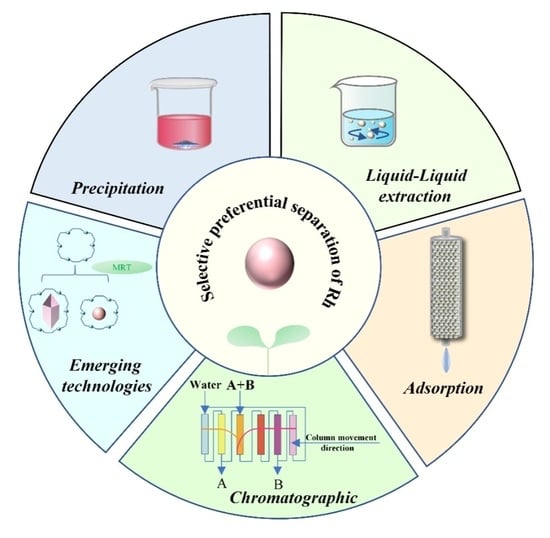
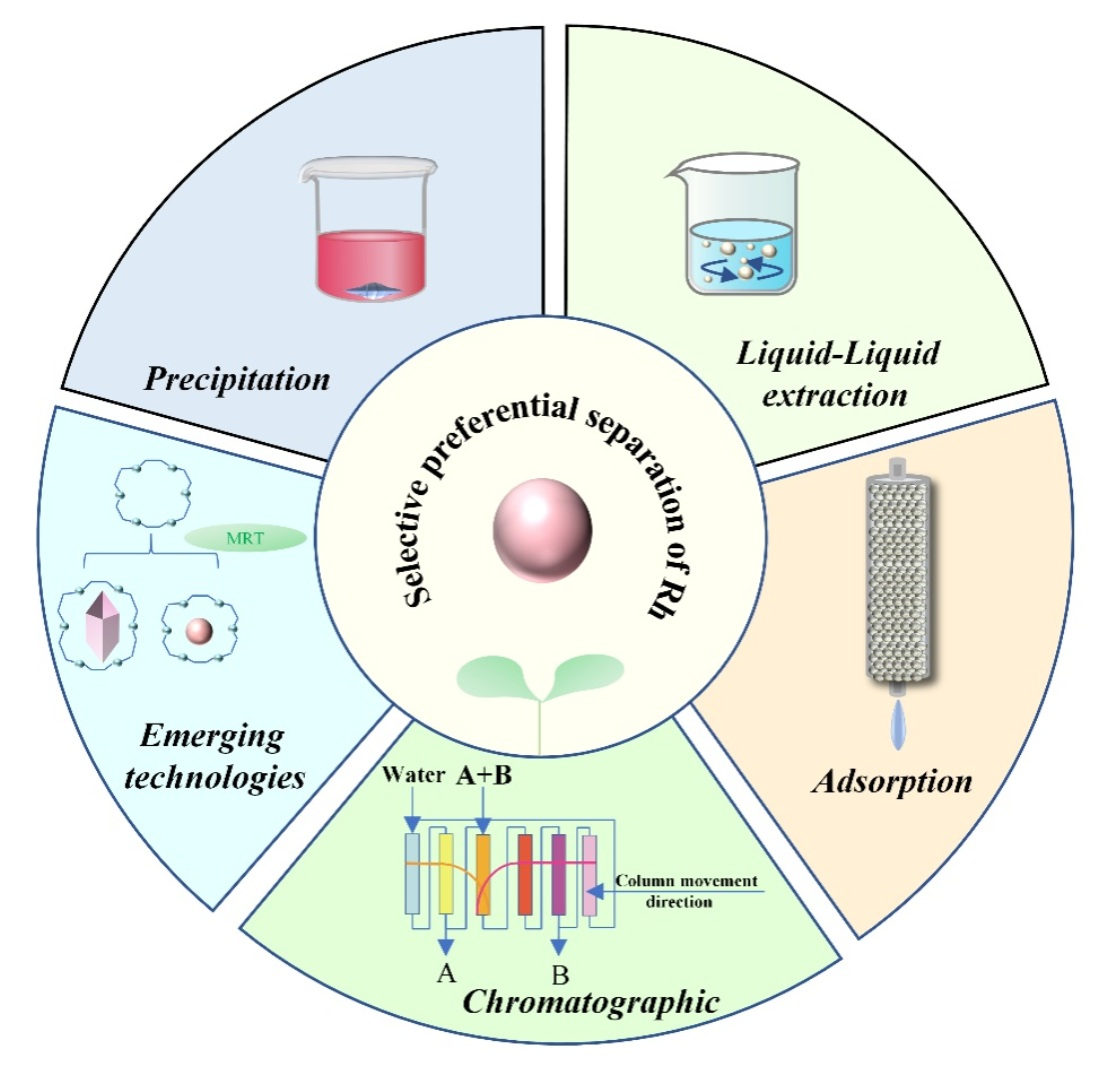
Graphical Abstract

1. Introduction

Owing to its high catalytic activity and excellent oxidation resistance, rhodium (Rh) plays an indispensable role in the aerospace, military, automobile, and petrochemical industries, among other disciplines. The exceedingly low concentration (2~10 ppm) in the natural ore, the complex mining procedures and the low index replacement in specific applications are the foundation for the widespread and urgent demand for Rh. Since spent catalyst materials, industrial equipment, and electronic instruments contain Rh with a higher concentration than that of natural minerals, recovering Rh from scrap not only offers an additional source to satisfy market demand but also reduces the risk of ore over-exploitation [1]. Whether recovered from natural ore or secondary resources, the Rh present in them must be separated, purified and processed to obtain the desired product type, which is typically accomplished via hydrometallurgical methods following pyrometallurgical enrichment. Current industrial recycling activity by companies like Johnson Matthey (London, UK and Wayne, PA, USA), BASF (Florham Park, NJ, USA) and Umicore (Brussels, Belgium) is being conducted to complement supply from mining [2]. After the pyrometallurgical enrichment, Rh will be transferred from solid to liquid streams [3]. Consequently, it is vital to investigate the separation and extraction of Rh from aqueous solution.
The classical precipitation scheme for the Rh recovery is a lengthy and tedious process (Figure 1) [4]. For the precipitation, Na(NH4)2[Rh(NO2)6], however, it is important that a high concentration of aonia be used to suppress the solubility of the Rh complex, in order to achieve almost complete Rh precipitation [5]. From the flowsheet, it can be seen that the repeated precipitation–dissolution steps make the process inefficient and time-consuming. Moreover, the concentrations of aonia used for precipitation and chloride in the solution need to be high.
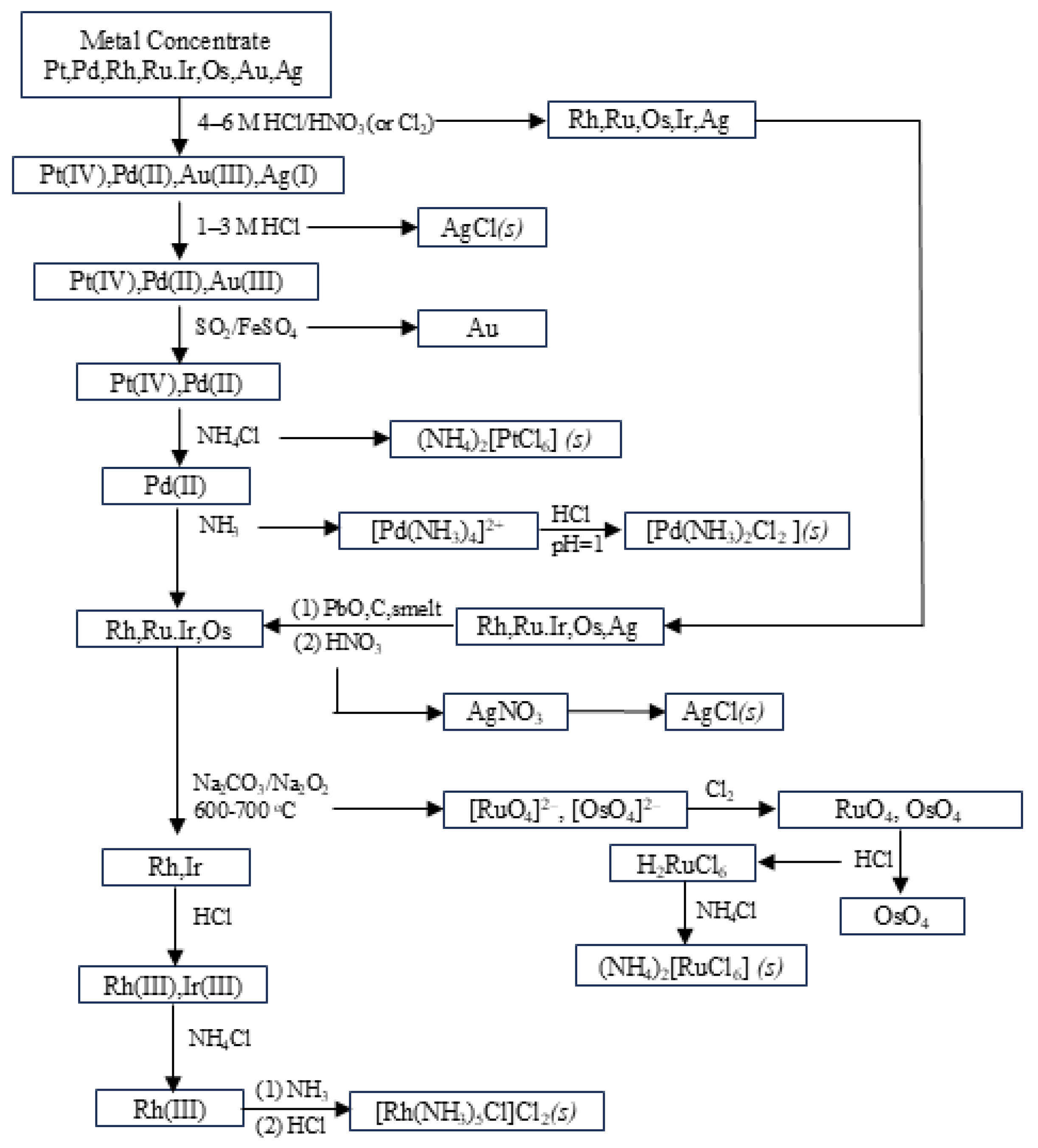
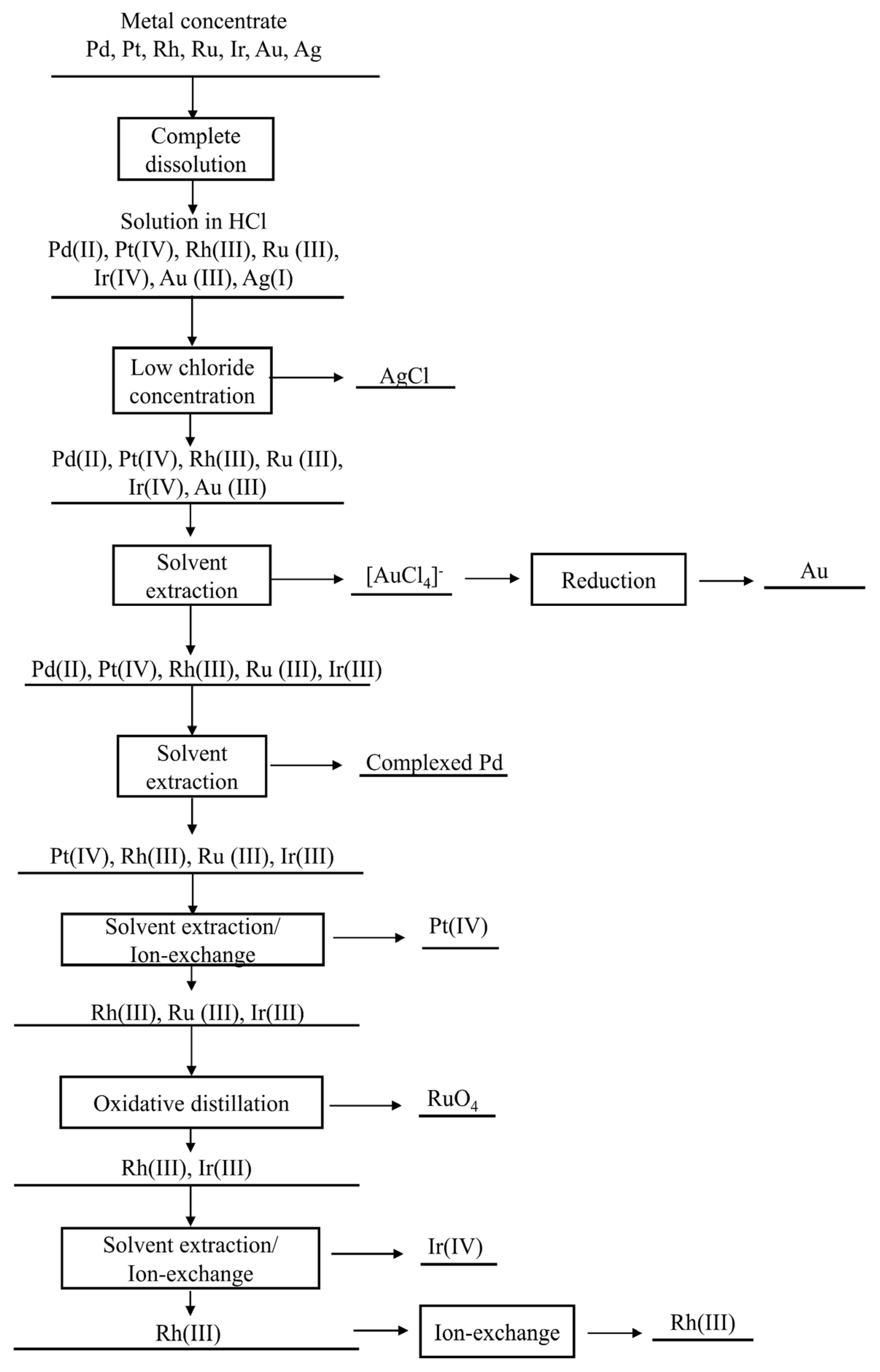
A typical process for the separation of platinum group metals (PGM) by traditional solvent extraction is shown in Figure 2. Starting from a mixed solution containing Pd(II), Pt(IV), Rh(III), Ru(III), Ir(IV), Au(III), and Ag(I), other PGMs are sequentially separated through multi-stage fractional extraction, with rhodium being recovered in the final step. First, the concentrate is completely dissolved in hydrochloric acid to obtain a solution of the above metal ions. At a low chloride concentration, Ag(I) is preferentially separated as an AgCl precipitate. Subsequently, AuCl4 anions are selectively extracted by solvent extraction and further reduced to metallic gold. Pd(II) in the remaining solution is extracted and separated as PdCl42− anions, while Pt(IV) is further separated by solvent extraction or ion exchange. The residual Rh(III), Ru(III) and Ir(III) in the solution are treated by oxidative distillation, in which ruthenium is removed as volatile RuO4 gas. Finally, iridium is converted to Ir(IV) by oxidation control and then separated by selective extraction or ion exchange, while the Rh(III) remaining in the raffinate is recovered by ion exchange or reduction.
Table 1 presents a summary of the recovery methods employed by some major primary PGM refiners in the world [7]. It can be seen from the classical refining methods mentioned above that, in the majority of industrial processes, Rh is extracted from the raffinate after performing the extraction approach for recovering other PGMs and other base metals [8]. From an economic perspective, rhodium recovery and separation are traditionally arranged in the final process step, which inevitably causes dispersion losses and a reduction in the overall yield. In addition, rhodium is the most expensive platinum group metal (PGM) with a rising price trend and the largest price volatility, making it difficult to withstand the risks brought by market price fluctuations. From a technical perspective, on the one hand, the leachate features complex components and low rhodium concentration, accompanied by severe interference from coexisting elements. On the other hand, rhodium exhibits kinetic inertness and tends to be locked in the aqueous phase, making its extraction extremely difficult. Therefore, it is of great significance to preferentially separate and extract rhodium from aqueous solutions containing other platinum group metals and base metals.
Previously, extensive reviews on the recycling of PGMs have been compiled. Although recent articles [2,9,10] are mainly concerned with the available technologies of the whole recovery process, very few attempts are conducted associated with the review of selective preferential separation and extraction of Rh from aqueous solution. Therefore, this paper reviews various improved and emerging technologies for achieving preferential separation of rhodium, including precipitation, solvent extraction, adsorption, and emerging molecular recognition technologies, and provides a critical comparative analysis of these technologies. A methodological approach of the systematic literature review and qualitative comparison is adopted, with a focus on evaluating the applicable conditions and separation efficiency of each technology. Representative research studies are selected and evaluated. Finally, development suggestions are proposed based on existing challenges.

2. Difficulties in Selective Preferential Separation and Extraction of Rh

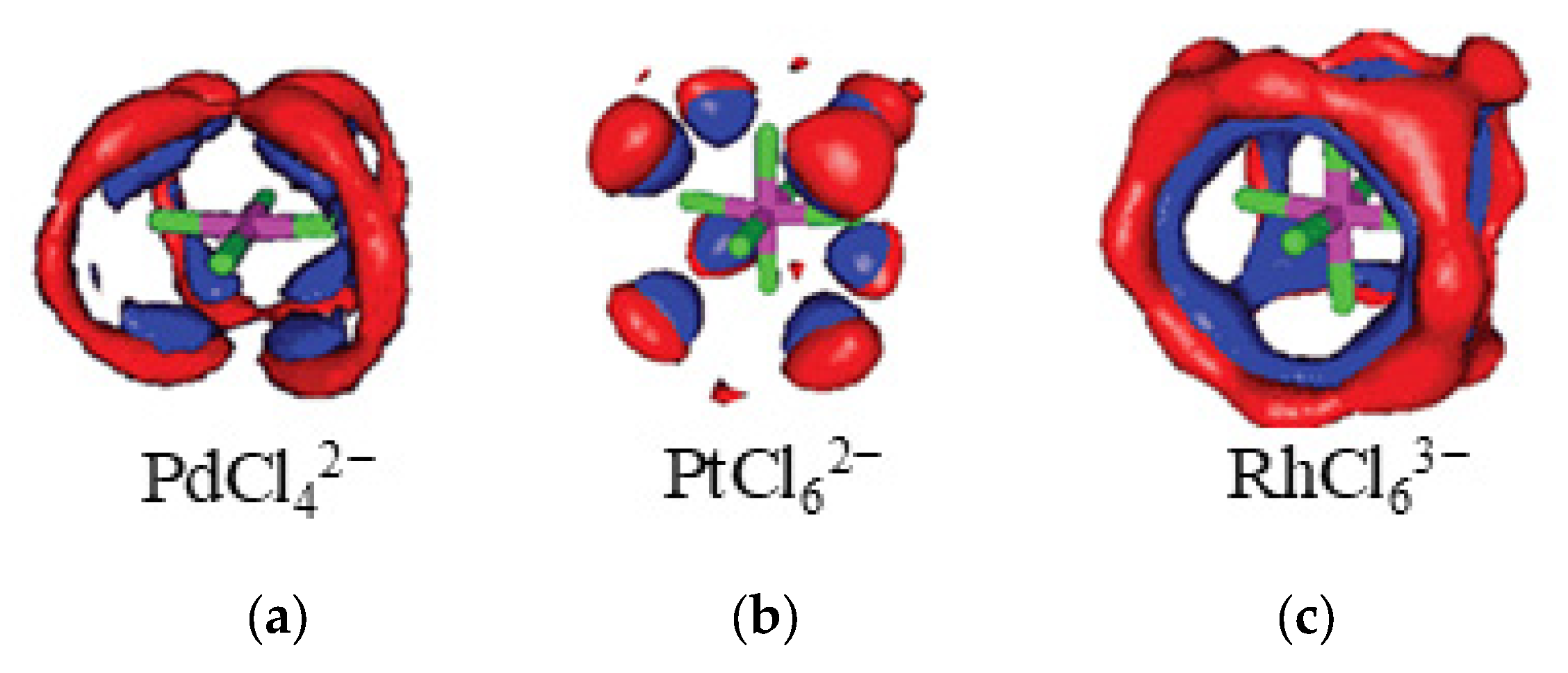
It is difficult to extract Rh prior to other PGMs because of its complex aqueous chemistry in chloride solutions and in relatively concentrated HCl solutions (>1 mol/L), in which [RhClX (H2O)6−X]3−X (X = 5,6) are the dominant Rh species [5,11]. On the one hand, the primary reasons for the difficulties in selective extraction of Rh (III) are as follows: (1) steric hindrance of the highly charged octahedral complexes [12]; (2) the difficulty of packing two or three cationic organic molecules around a single ion [12]; (3) the activation energy barrier to be overcome in the reaction of Rh aquo-chloride complexes with extractants is high, and there is kinetic inertia (Figure 3); and (4) it is easy to hydrolyze to form multinuclear molecular aggregates. On the other hand, especially when it comes to the separation of PGMs, it is exceedingly challenging to extract Rh preferentially. It is known that the metal chloro-complexes have a tendency to form ion-pairs with chelating anion exchangers according to: [MCl6]2− > [MCl4]2− >> [MCl6]3− > aqua species [13]. The chloro-complex anions of Pd (II) and Pt (IV), [PdCl4]2− and [PtCl6]2−, can be extracted, whereas that of Rh (III), [RhCl6]3−, is quite difficult to extract based on ion-pair formation [14]. Furthermore, compared to other PGMs like Pt and Pd, Rh is more susceptible to hydration and hydrolysis. For instance, [RhCl6]3− undergoes hydration reaction to form [RhCl4(H2O)2] and [RhCl5(H2O)]2−, which are quite to be unextracted.
In response to the difficulties mentioned above, researchers have made many attempts to achieve selective preferential separation and extraction of Rh through various technologies, which will be discussed in the following five chapters. Some representative cases of selective separation and extraction of Rh are summarized in Table 2 at the end of the article.

3. Selective Precipitation

Precipitation is a typical method for selective separation and recovering Rh from mixed metal solutions, which has been employed for a long time and is continually being explored and improved. In both laboratory-stage and industrial applications, the most commonly involved strategy for selective precipitation of Rh is: Rh chloride complex and precipitant form a specific ion-pair.
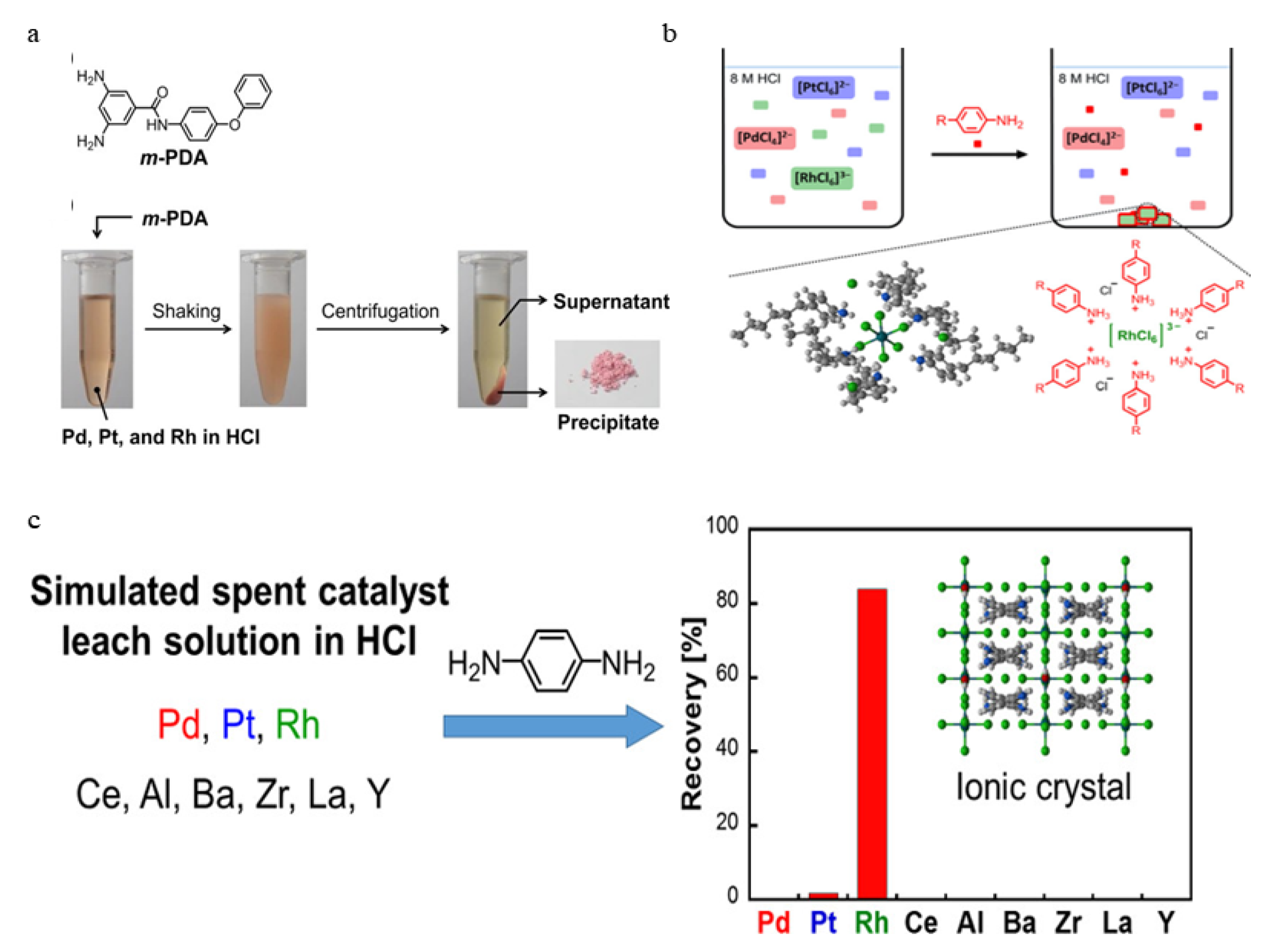
We present some findings on directly realizing the separation and recovery of Rh prior to other PGMs (Figure 4). Suzuki et al. [16] added 3,3′-diaminobenzidine (DAB) to PGM synthetic solutions to separate Pt (IV), Pd (II) and Rh (III). DAB exhibited exceptional selectivity for Rh in 7 and 10 mol/L acidity. Rh (III) ions form a 1:2 complex with [H3·DAB] cations. Meanwhile, the affinity of DAB for [PtCl6]2− and [PdCl4]2− was significantly lower than that for [RhCl6]3− in 7 and 10 mol/L HCl solutions, which explains the mechanism of Rh’s preferential precipitation.
The Matsumoto group investigated a variety of precipitants (4-alkylaniline and m-phenylenediamine (m-PDA)) to realize the preferential precipitation of Rh (III) from metal mixed solution [8,17]. In the high concentration of HCl solution (6.0~8.0 mol/L), Rh can be precipitated preferentially to Pt (IV) and Pd (II). It found that one [RhCl6]3− complex anion forms an ion-pair complex with six cations and three chloride anions, while the complex of m-PDA and Rh consists of one [RhCl6]3− anion and three m-PDA (monovalent) cations. However, the ion-pairs of Pd and Pt are alkyl-terminated hydrophobic structures, and the use of 4-alkylanilines has a risk for co-precipitation of Pt and Pd when their concentrations are high. In order to address this problem, Matsumoto et al. [14] have studied using phenylenediamine dihydrochloride (PPDA) as the precipitant. In the experimental procedure, PPDA was added to an HCl solution containing Pd (II), Pt (IV) and Rh (III) (300 mg/L each) and the mixture was vigorously shaken at room temperature. The results showed that the maximum precipitation percentage of Rh in 5.0 mol/L HCl was 82%, while Pt and Pd were hardly precipitated under the study conditions (1.0~9.0 mol/L). However, in their series of work, to obtain the high selectivity of Rh, the acidity of the solution must be kept within a specific range. Further investigation is required before these precipitants can be utilized in industrial production.
Table 2 compares the rhodium separation performance of four aromatic amine precipitants (DAB, 4-alkylanilines, m-PDA, and PPDA) in chloride media. The underlying mechanisms include anion exchange, hydrophobic/hydrophilic ion pairing, and three-dimensional ionic crystal lattice matching, all achieving rhodium recoveries of 80–90%. Among these, m-PDA and PPDA exhibit the most effective suppression of Pd/Pt co-precipitation (<5%), along with simple operation, low cost, and favorable scale-up potential. In contrast, DAB requires high-acid conditions and poses significant toxicity concerns, while 4-alkylanilines suffer from a narrow operational acidity window and are prone to Pd co-precipitation under low-acid environments. Overall, aromatic amine precipitation represents a viable single-step technology for rhodium separation. Future industrial applications should focus on optimizing reagent stability and recyclability, leveraging the excellent anti-interference performance of PPDA and m-PDA in complex feeds containing various impurities to realize large-scale and sustainable rhodium recovery.
Table 2. Comparison of various precipitation reagents.
Precipitation ReagentsApplication ConditionsCore Reasons for Selectivity DifferenceInteraction Mechanism with Rhodium ComplexesRecovery YieldRef.
4-AlkylanilinesnDAB = 0.2 mmol/Lol, [Metal]init = 1 mmol/L, [HCl]init
= 3–8 M, and [L]/[Metal]init = 30. mol/mol
Hydrophobic alkyl chain structure; Rh forms stable hydrophobic ion-pairs under high HCl concentration, while Pd/Pt ion-pairs are prone to proton exchange and dissolution; co-precipitation of Pd easily occurs in low-acid environmentsHydrophobic ion-pair mechanism: 6 aniline cations encapsulate 1 [RhCl6]3− to form a 1:6:3 hydrophobic ion-pair, which is stable under high acid and easily dissociates under low acidRh > 80%, Pd < 30%, Pt < 30%[8]
p-phenylene diamine dihydrochloride (PPDA)[Metal]init = 300 mg/L, [HCl]init
= 3–9 M, and [L]/[Metal]init = 15 mol/mol
Smallest aromatic diamine structure with extremely strong hydrophilicity; the three-dimensional ionic crystal has precise lattice matching with [RhCl6]3−; Pd/Pt complexes have mismatched size/charge and do not precipitate at allThree-dimensional ionic crystal mechanism: 2 PPDA cations + 1 Cl + 2 crystal water form a 1:2:1:2 three-dimensional network lattice with [RhCl6]3−, achieving molecular-level selectivityRh > 80%, Pd < 50%, Pt < 5%[14]
3,3′-diaminobenzidine (DAB)nDAB = 0.15 mmol/Lol, [Metal]init = 10 mmol/L, [HCl]init
= 7.0–10 M, and [L]/[Metal]init = 3.0 mol/mol
Tetraamine structure with rigid biphenyl skeleton; trihydrochloride precipitate is first formed in concentrated HCl, followed by specific binding to Rh via anion exchange; Pd/Pt only form coordination complexes without stable precipitationAnion exchange mechanism: [H3·DAB]Cl3 precipitate is first formed, then Cl in the precipitate is replaced by [RhCl6]3− to form a 1:2 ion-pair, preferentially binding to -3 valent Rh complexesRh > 90%, Pd < 20%, Pt < 20%[16]
m-phenylene diamine (m-PDA)nDAB = 0.2 mmol/Lol, [Metal]init = 1 mmol/L, [HCl]init
= 3–8 M, and [L]/[Metal]init = 15 mol/mol
Diamine structure with balanced hydrophilicity and hydrophobicity; the strong hydrophilic end can overcome the large hydration shell of Rh complexes; the hydrophilic end of Pd/Pt ion-pairs is easily protonated, resulting in poor stability and no precipitationHydrophilic ion-pair mechanism: 3 m-PDA cations form a 1:3 hydrophilic ion-pair with 1 [RhCl6]3−, stabilized by hydrogen bonds and electrostatic attractionRh > 90%, Pd < 5%, Pt < 5%[17]

4. Selective Liquid–Liquid Extraction

The liquid–liquid extraction method has a greater selectivity than the classic precipitation method [4]. Numerous researchers have conducted studies on the concept of selective preferential extraction of Rh. To begin with, some have sought suitable extractants to directly extract Rh complex anion, such as [RhCl6]3−, [RhCl5 (H2O)]2−, etc. In addition, some researchers pretreat the simulated leach solutions by adding reagents to replace Cl/H2O in the inner boundary of the Rh complex anion, which has a lower charge density and is simpler to extract. In light of the high inertia of the Rh aquo-chloride complex, it was proposed to use a chlorine-free medium in order to generate Rh complexes that have better extraction performance. Finally, ionic liquids are recommended as an alternative to conventional extractants for the sake of enhancing the efficiency of the selective extraction of Rh. The aforementioned research concepts can be loosely grouped into four categories: extraction of Rh complex anion [RhCl6]3− or [RhCl5 (H2O)]2−, replacing the ligand of Rh, extraction using a chlorine-free medium and extraction using ionic liquid.

4.1. Extraction of Rh Complex Anion [RhCl6]3− or [RhCl5 (H2O)]2−

Kostanski et al. [18] demonstrated that 4-(non-5-yl) pyridine (NP), a pyridine derivative, can directly form a complex with [RhCl6]3−, which can be extracted as the ion-pair [RhCl6]3−·3HNP+ to preferentially separate Rh from other PGMs. Under the optimum conditions of Rh ([Rh] = 5 × 10⁻⁴ mol/L, [Cl] ≥ 3 mol/L, [NP] = 0.3 mol/L, [H+] = 0.08 mol/L), Ir was extracted in the form of the ion-pair [IrCl6]2−·2HNP+ at very short extraction times (<1 min). However, when the solution appeared slightly acidic (pH ≈ 6), Ir was not extracted at all, whereas the extraction of Rh did occur, realizing the preferential extraction of Rh from Ir.
Rh can still be extracted prior to other PGMs when the Rh complexes are hydrated, as [RhCl6]3− is transformed to [RhCl5 (H2O)]2−. Narita et al. [19] developed N-n-hexyl-bis (N-methyl-N-n-octyl ethylamine) amine (HBMOEAA) to selectively recover Rh (III) after back-extracting from PGM synthetic solution containing Pd (II) and Pt (IV). PGMs were extracted at the acidity of 2.0 mol/L HCl into the organic phase, where Rh was extracted as the species of [RhCl5(H2O)]2− by HBMOEAA, and then they were back-extracted into the aqueous phase using 10.0 mol/L HCl. A total of 90% Rh was back-extracted, whereas Pd and Pt were not extracted at all. This study shows that the carbonyl O atom of the HBMOEAA molecule can be hydrogen-bonded to the H atom of the coordinated water in the [RhCl5(H2O)]2− complex. This method cannot, however, extract Rh before Pt and Pd in one step.

4.2. Replacing the Ligand of Rh

Certain specific reagents are capable of entering the inner boundary of Rh complex anions. Replacing the ligand of Rh to obtain a hydrophobic complex anion [RhnClmXp]k− (X = I, SnCl3, etc.) enables preferential extraction of Rh, among which the addition of SnCl2 for activation has the most promising development prospects. In the presence of Sn with relatively high HCl and metal concentrations, Narita et al. [11] investigated the coordination properties of Rh complexes using Rh and Sn K-edge XAFS spectra. The results indicate the following species are present in 3 mol/L HCl.
(1) [Sn]/[Rh] < ca. 2: [RhIIIClm(H2O)n(SnIICl3)6-m-n]m−3 (1 ≤ m ≤ 5, 0 ≤ n ≤ 1) is dominant.
(2) ca. 2 < [Sn]/[Rh] < ca. 6: the concentrations of [RhI(SnIICl3)5]4− and [SnIVCl4(H2O)2], which are formed by the reductive reaction of [SnIICl3(H2O)], increase with the [Sn]/[Rh] value; simultaneously, [RhIIIClm(SnIICl3)6m]m−3 decreases.
(3) [Sn]/[Rh] = 12.4: [RhI(SnIICl3)5]4− is the only Rh species; an excess amount of [SnIICl3(H2O)] is present along with [SnIVCl4(H2O)2].
According to the research results, in the presence of SnCl2 in concentrated HCl solution, Rh (III) is reduced to Rh (I). Meanwhile, the Sn directly coordinates to Rh by replacing the H2O/Cl to form [Rh2Cl4(SnCl3)2]4− or [Rh(SnCl3)5]4−, which can be represented as Equations (1)–(3).
2 RhCl 6 3 + 4 SnCl 3 = Rh 2 Cl 4 SnCl 3 2 4 + 2 SnCl 6 2 + 2 Cl
RhCl 6 3 + 6 SnCl 3 = Rh SnCl 3 5 4 + SnCl 6 2 + 3 Cl
RhCl 5 H 2 O 2 + 12 SnCl 3 Rh SnCl 3 5 4 + SnCl 6 2 + 6 SnCl 3 + 2 Cl + H 2 O
The acceleration of the Rh extraction can be explained by the formation of the [Rh(SnCl3)5]4− complex, which is readily transferred to the organic phase via an ion-pair mechanism. In the subsequent process, [Rh2Cl4(SnCl3)2]4− or [Rh(SnCl3)5]4− in the loaded organic phase will become the Rh species to be back-extracted.
When SnCl2 is added to a solution containing PGMs, the original extraction sequence can be changed to Rh extraction first. Alam et al. [20] used Kelex 100 (8-hydroxyquinoline derivative) to extract and separate Pt (IV), Pd (II) and Rh (III) in PGM synthetic solution, studying the extraction performance of each metal before and after adding SnCl2. When there is no SnCl2 in the solution, PGMs extraction was of the following order: Pd > Pt > Rh at low acidity and Pt > Pd > Rh at high acidity. When a certain amount of SnCl2 is added, the sequence changes to Rh > Pd ≈ Pt at low acidity and Rh > Pt > Pd at high acidity. The addition of a high quantity of SnCl2 boosts the extraction percentage of Rh to about 98%, whereas the percentages of Pt and Pd fall. With this characteristic, Rh can be separated selectively from solutions containing Pt, Pd and Rh. However, the issue of Rh’s poor back-extraction percentage still needs to be resolved, and the highest back-extraction percentage can only reach 69.78%. Mhaske and Dhadke [21] recommended Cyanex 925 (26.4% tri-(2,4,4-trimethyl pentyl) phosphine oxide and 65.9% trioctyl phosphine oxide as major components) for separating and recovering Pt (IV), Pd (II) and Rh (III) from a simulated spent catalyst leaching solution. As Rh (III) and Pt (IV) were activated and reduced to Rh (I) and Pt (II), the presence of SnCl2 was essential for the complete separation of them from Pd. The results showed that Pd remained as unextracted, whereas Rh and Pt were extracted to the organic phase. Subsequently, the two-stage back-extraction percentage using 4 mol/L HNO3 for Rh can exceed 91.10%, which is higher than Alam’s method. The extraction process using Cyanex 925, Rh and Pt can, however, be extracted simultaneously when the SnCl2 concentration is relatively high. Then the separation of the two metals needs to be achieved by controlling the SnCl2 concentration. The separation extraction of PGMs in mixed solution with N, N′-dimethyl-N, N′-diphenyltetradecylmalonamide (DMDPHTDMA) was investigated by Malik et al. [22] The extraction percentages of five PGMs are less than 40% in 5 mol/L HCl, and the extraction trend is Pt (IV) > Rh (III) ≈ Ir (III) > Pd (II) > Ir (IV) > Ru (III). Subsequently, SnCl2 was added to PGM synthetic solutions with different HCl concentrations, and Rh could be extracted prior to the other three PGMs except Pt.
Separation of Rh and Ir has been studied by various extractants with the addition of SnCl2, including Cyanex 921 (Tri-n-octylphosphine oxide) [23], Cyanex 301 (Bis(2,4,4-trimethylpentyl)dithiophosphinic acid) [23], TBP (Tri-n-butylphosphate) [24] and Alamine 336 (Tri-n-octylamine) [25], etc. In the presence of SnCl2, Ir is reduced to the low valence state, the complexes are relatively stable, and there is competition between the Sn ion and Ir ion for extraction, resulting in the extraction percentage being lower than that of Rh.
In the study of Le et al. [23], SnCl3 forms [Rh2Cl4(SnCl3)2]4− through an ion association mechanism. Therefore, the extraction of Rh (I) by Cyanex 921 can be expressed as Equation (4):
Rh 2 Cl 4 SnCl 3 2 4 + 4 Cyanex 921 H + org = Cyanex 921 H + 4 Rh 2 Cl 4 SnCl 3 2 org 4
The stripping experiments were performed in an acidic medium. Several stripping agents, such as H2SO4, HCl, HNO3, HCl + NaCl, HCl + (NH2)2CS, HCl + NaNO3, and HCl + NaClO3 at specific concentrations, were employed at an O/A ratio of unity. Rh was selectively stripped over Sn by other stripping agents except 3 mol/LH2SO4, and the highest stripping percentage was obtained by 3 mol/L HNO3. The strong oxidizing property of HNO3 will cause the rapid and severe decomposition of the large complex structure in the organic phase, so the stripping percentage was higher than that of other reagents [26].
In the study of Zou et al. [24], during the stripping process, Rh (I) and Sn (II) were oxidized to Rh (III) and Sn (IV), respectively, by the chlorine in a strong HCl medium, and the structure of the [Rh2Cl(6−n)(SnCl3)n]4− (n = 2~4) anions was destroyed. The reaction is expressed as Equation (5).
2 n + 2 Cl + n + 2 Cl 2 + Rh 2 Cl 6 n SnCl 3 n 4 = 2 RhCl 6 3 + nSnCl 6 2 n = 2 ~ 4
By contrast, Ir remained in the organic phase, achieving selective stripping of Rh. For the stock solution containing a high concentration of Rh and Ir, adding more SnCl2 will lead to high loaded organic phase and a low extraction percentage. Therefore, the concentration of metal ions in the stock solution should be limited to a certain level to obtain better stripping efficiency and separation effect.
SnCl2 generates the strongly coordinating SnCl3 anion in HCl medium, which can competitively coordinate with various platinum group metal (PGM) ions in the solution. For Rh(III), SnCl3 reduces and coordinates it to form low-valent Rh(I) bulky complexes, such as [Rh(SnCl3)5]4− or [Rh2Cl4(SnCl3)2]4−. These complexes possess high hydrophobicity and negative charge density, facilitating their binding with extractants (e.g., amines, phosphine oxides) via an ion-pair mechanism and subsequent transfer to the organic phase. Rh(I) has a d8 electronic configuration, readily forming five- or four-coordinate square planar structures, which enables fast coordination with SnCl3 and results in stable complexes. In contrast, although Pt(IV), Pd(II), and Ir(III) also undergo ligand exchange or partial reduction in the presence of SnCl2, the resulting complexes generally exhibit lower stability and hydrophobicity than those of Rh, leading to relatively lower extraction efficiencies. From the perspective of the hard and soft acids and bases (HSAB) theory, Rh(I) is a soft acid and SnCl3 is a soft base, forming a stable soft–soft complex. Meanwhile, commol/Lon extractants such as Kelex 100 and Cyanex series contain soft base donor atoms (e.g., S, P) and have a strong affinity for the soft acid Rh(I). The addition of SnCl2 converts Rh from the hard acid Rh(III) to the soft acid Rh(I), which better matches the soft base characteristics of the extractants, thereby significantly enhancing extraction selectivity.
Nevertheless, this method still has several inherent limitations. First, stannous chloride (SnCl2) is a polluting heavy metal reagent with certain biological toxicity, which brings unavoidable environmental and occupational safety hazards in industrial applications. Long-term exposure to SnCl2 dust and aerosols may irritate the human respiratory tract and mucous membranes, while the tin-containing wastewater and solid waste generated in the production process will increase the difficulty of industrial waste disposal and environmental compliance costs. Second, high concentrations of SnCl2 can cause the co-extraction of rhodium, platinum, and iridium. Therefore, precise control of SnCl2 concentration is essential for the effective separation of the three precious metals, which greatly improves the difficulty of on-site process regulation and continuous industrial production. Third, the addition of SnCl2 introduces a large amount of tin impurities into the system. Sn2+ is prone to form stable rhodium–tin–chloride complexes with rhodium, which significantly increases the difficulty of rhodium–tin separation and cannot be effectively removed by conventional extraction and filtration processes. Additional post-treatment procedures are required in industrial production for tin removal and rhodium purification. The mainstream separation and purification technologies include oxidation pretreatment coupled with TBP/TOPO solvent extraction for tin removal, pH-regulated hydrolysis precipitation for impurity removal, selective sulfide precipitation for tin separation, and deep purification via ion exchange resin. These technologies can destroy the stable structure of rhodium–tin complexes and achieve the selective removal of tin impurities to purify rhodium. However, the cumbersome post-treatment process prolongs the production cycle, increases the consumption of reagents and energy, and causes trace entrainment loss of rhodium, which ultimately reduces the overall recovery rate and product purity of rhodium.

4.3. Extraction Using Chlorine-Free Medium

Rh (III) chloride complex is poorly extracted, which is due to the charge of the complex as well as its labile character toward aquation [27]. Researchers have investigated the extraction capacity of Rh in various media (malonic acid, nitric acid, etc.). The remarkable benefits of organic acid medium include the ease of adjustment of pH value, controllable concentration of complexing ligand and effective stripping of complexes.
The extraction of Rh prior to base metals can be realized by using a chlorine-free medium. Kolekar [27] and Suryavanshi et al. [28] solved the problem of low separation efficiency of precious and base metals. After a slight amount of hydration, Rh chloride complexes are transformed into more stable Rh malonic acid complexes, which are simpler to extract. Kolekar et al. used N-n-octylaniline to extract Rh from an aqueous solution of sodium malonate, with an extraction percentage up to 99.9%. In the experiment of separating Rh from ternary mixtures, this approach can extract Rh prior to other precious metals. The extracted species seems to be protonated N-n-octylaniline, which forms cationic species as RR′NH2+, while malonate combines with Rh (III) to form anionic species as Rh(C3H2O4)2(H2O)2 and both of them associate to form an ion-pair of the type [RR’NH2+Rh(C3H2O4)2(H2O)2]org and being neutral constitutes extractable species. To extract Rh from malonic acid medium, Suryavanshi et al. utilized 2-octylaminopyridine (2-OAP) as the extractant. In the solution containing base metals and PGMs, Rh (III) was quantitatively separated from other metal ions due to the formation of a stable ion-pair complex with extractants as [2-OAP+Rh(C3H2O4)2]. This approach has the benefit that the extraction percentage can reach equilibrium in a relatively short time and is unaffected by a large number of cations and anions. However, in the PGMs recovery process in industry, malonic acid cannot replace traditional media (such as HCl and H2SO4) due to its inability to effectively leach PGMs.

4.4. Extraction Using Ionic Liquids (ILs)

ILs are molten salts that contain organic cations and organic or inorganic anions. IL extractants generally have higher flash points, are easy to regenerate, are “generally considered to be more environmentally friendly” and can be specifically synthesized for particular operations [2]. When ILs are employed for solvent extraction, the literature describes two different usages: some authors choose to utilize pure ILs, in which case ILs serve as both extractants and diluents. Other authors used ILs as extractants and placed them in diluents [29]. Recent research findings [30,31] also indicate that Rh was extracted from the leaching solution using various types of ILs or in conjunction with solvent extraction.
As extractants, ILs are capable of extracting Rh prior to base metals. Kakoi et al. [32] investigated the Rh (III) extraction from HCl solution using a liquid surfactant membrane (LSM) supported by IL 1-octyl-3-methylimidazolium hexafluorophosphate ([Omim][PF6]). LSMs can preferentially recover Rh (III) (4 ppm) from 1 mol/L HCl solution when a significant amount of Sn (II) (240 ppm) was added as a modifier. In the presence of Sn, the extraction performance of LSMs for Rh had been improved, and was superior to that of Sn. Subsequently, researchers investigated the effects of important operational parameters on the recovery of Rh using three different solvents: H2SO4, HNO3 and 2-amino-2-hydroxymethyl-1,3-propanediol (Tris) for stripping. The results indicated that using Tris (1 mol/m3) as the stripping reagent, in contact with an equal volume (3 × 10⁻⁵ m3) of loaded organic phase and stirring at 300 rpm, 95% Rh was recovered within 5 min. Moreover, Rh exhibited better stripping results than the other acid systems.
Some researchers endeavor to give ILs with superior qualities so that Rh can be extracted prior to other PGMs. Yin et al. [33] produced 1-hexyl-3-methylimidazol-2-thione (HMImT), which is utilized to extract Pd (II), Pt (IV), Rh (III) and Ir (IV) from PGM synthetic solution. In the binary separation of Rh (III) and Ir (IV), the optimal conditions included the following: 1.0 mmol/L metal solution, 1.0 mol/L HCl solution, a mole ratio of Sn/Rh = 10. Rh (I) extraction percentage can reach 99.6%, but Ir (III) was barely 0.1% when the dosage of HMImT was over 1.6 mg. Rh (III) was converted to Rh (I) in the form of [Rh(SnCl3)5]4 by SnCl2, after which it forms a complex with HMImT and was extracted.
Combined with the data in Table 3, ionic liquids exhibit far superior performance in rhodium/iridium separation compared to conventional extractants: their Rh/Ir separation factor can exceed 10,000, and the extraction equilibrium time is less than 5 min, while offering advantages such as thermal/chemical stability and low volatility. However, they currently suffer from limitations including dependence on Sn(II) activation, high cost, high viscosity, and a lack of long-term industrial validation. In contrast, conventional extractants (e.g., TBP, Alamine 336, and the Cyanex series) feature mature processes and low costs, but are significantly inferior in terms of selectivity and extraction kinetics. Therefore, ionic liquids show great potential in the field of precious metal separation, yet further improvements are still required in modification, economic viability, and operational convenience.

4.5. Extraction Using Deep Eutectic Solvents (DES)

Lanaridi et al. [34] studied the extraction capacity of several phosphonium-based ILs for PGMs in deep eutectic solvents (DES) acidic solutions. In the initial separation experiment, 1 part aqueous mixed PGM solution:5 parts DES:1 part HNO3 were all mixed, which aims to produce a simulated PGM solution with properties similar to those of DES. Pt, Pd and Rh were extracted from the obtained solution by four groups of phosphonium-based ILs, with Rh extracted at higher percentages than Pt and Pd; therefore, Lanaridi et al. also achieved the highly selective extraction.
In summary, by using specific extractants and adjusting the coordination environment and hydration state of metal ions, the extraction method can achieve the separation of rhodium and iridium in hydrochloric acid solutions. However, this method still suffers from issues such as co-extraction, poor selectivity, and the introduction of new impurities.

5. Selective Adsorption

Organic solvents used in industrial separation processes are usually toxic, flammable and volatile [3]. Meanwhile, the adsorption method can extract and separate Rh from ultra-low concentration solutions, and the liquid–liquid extraction method lacks this advantage. Rh can be preferentially recovered by various adsorbents, such as miscellaneous resins, activated carbon and mesoporous silica, among which ion exchange resin is the most widely utilized in PGMs separation. The reaction mechanism of ion exchange resin can be classified into ion association and chelation. Lee discovered that the ion exchange resin involved in the chelating mechanism has a higher selectivity for Pd (II) ions compared to Pt (IV) and Rh (III) ions [35], which is consistent with the hard and soft acid–base theory. Ion exchange resins with selectivity for Rh (III) generally involve an ion association mechanism. The selective adsorption of Rh from mixed metal solutions using three types of adsorbents is discussed in the following subsections.

5.1. Ion Exchange Resins

Up to now, many anion exchange resins have shown great performance in preferential adsorption of Rh to base metals. Kramer et al. [36] reported the design of three silicon-based ion exchangers: monoamine (1), ethylenediamine (2) and diethylenetriamine (3) for the extraction of Rh (III) from a synthetic solution containing base metals and Rh (III). In the presence of divalent base metal ions Cd, Zn, Ni and Cu, the three anion exchangers exhibited high selectivity for Rh, especially at low pH values. At pH = 2.6, the adsorption percentage of Rh on anion exchanger 3 exceeded 60%, while the other four base metals are hardly adsorbed. At low pH values (<2), the amines are predominantly protonated, and positively charged amine ligands bind to negatively charged [MClx]n−x complexes in an ionic fashion through ion association. In another of their work, Kramer et al. [37] developed three silicon-based ion exchangers with monoamine (1), ethylenediamine (2) and diethylenetriamine (3) functional groups in order to extract Rh from tertiary leach liquor (TLL) containing large amounts of transition metals. The data indicated that in TLL (pH ≈ 1.1), the extraction for Rh could be increased from 17% after the first extraction to 22% after four cycles, whereas the transition metals Cu, Ni and Fe were not detected.
Kramer et al. [38] discovered that the selective extraction of PGMs from authentic precious metal refinery (PMR) process solutions by anion exchangers containing a guanidine group possessed promising potential. In acidic solution with pH 0.2 and Cl concentration of 1.7 mol/L, the six exchangers rarely adsorbed base metals Cu, Fe and Ni, whereas they exhibited remarkable selectivity for Pt, Rh and Ir. The anion exchangers containing a guanidine group can selectively adsorb over a broad pH range and possess potent adsorption properties. However, this document’s findings indicated that the adsorption percentages of Pt, Rh and Ir in the specific solution were relatively low, and co-adsorption occurred. The following separation of PGMs is still required. Shen et al. [39] utilized the anion exchanger Diaion WA21J to adsorb metals from the chlorination leaching solution of spent auto-catalyst. Add 300 mL chloride solution containing 10% HCl to 10.0 g resin and agitate at 150 rpm for 40 h. A total of 91.53% Pt, 90.21% Pd and 89.89% Rh were adsorbed, and the adsorption percentages of other accompanying metals were less than 10%, excluding Zn (17.58%) and Pb (55.14%). However, since Pt, Pd and Rh were co-adsorbed, further steps are required to recover Rh from Pt and Pd.
It was reported that some ion exchange resins can also adsorb Rh prior to other PGMs. Gaita et al. [40] employed three anion exchange resins to separate Pt, Pd and Rh from a highly acidic synthetic solution, including a large number of other metals, and found that Rh could be selectively stripped through Amberlite IRA-93. In the adsorption process, Pt, Pd and Rh had respective adsorption percentages of 99.9%, 97.0% and 61.0%. In the subsequent stripping process, 25.0 mL of 6.0 mol/L HCl solution was employed to treat the resin at room temperature. As a result, 80% Rh was preferentially stripped, whereas Pt and Pd remained in the resin. The following year, Kononova et al. [41] published a study on the adsorption behavior of seven anion exchangers on Pt (II, IV) and Rh (III) in PGM synthetic solutions of different acidity. In the HCl solution with acidities of 1.0, 2.0 and 4.0 mol/L, Rh exhibited higher adsorption percentages than Pt after being adsorbed by Purolite S985, an anion exchanger with polyamine functional groups. Nonetheless, the study indicated that the difference between the two adsorption percentages was less than 6%, showing that the adsorption selectivity was weak.

5.2. Silica-Based Adsorbent

The silicon adsorbent (MP-HMS) designed by Abughusa et al. [42] uses nanotechnology to separate and extract Rh from simulated ultra-low concentration solutions. A total of 2 mg MP-HMS was suspended in 50 mL Rh (III) solution, and the mixture was stirred at room temperature for hours. The adsorption experiments were repeated under different reducing conditions by adding NaHB4 to the solutions with varying concentrations (5, 10, 15, and 20 mmol/L). Rh (III) was reduced to Rh (II) by the addition of NaBH4, which then combined with the mercaptan ligand in MP-HMS. By contrast, MP-HMS exhibited a poor adsorption capacity for other metal ions in solution, such as Cu2+, Ni2+ and Zn2+ (about 100 ppb in each). This tailored nanostructure adsorbent can therefore be utilized to selectively absorb Rh.
Jinchuan Group Co., Ltd. (Jinchang, China) [43] reported a method for preferentially recovering Rh and Ir from replacement slag containing base metals. The replacement slag containing Zn and Mg was dissolved with 10~15 wt% HCl. The solid-to-liquid ratio was maintained at 1:(5~7) (g/mL), and the solution potential was adjusted to 900~1000 mV. Subsequently, the pH value was adjusted to −0.5~0.1, and a modified silicon-based compound adsorbent was added to adsorb PGMs at room temperature for 6~12 h in order to acquire a saturated adsorbent. This patent reported that these modified silicon-based compounds can achieve the separation of Rh and Ir from other base metal impurities, and the adsorption percentages of them can reach over 95%. This method is economical, environmentally friendly and effective, avoiding the generation of nitrogen oxide gas during the conventional method of desorbing Rh and Ir using aqua regia, achieving the researchers’ goal of simultaneously adsorbing Rh and Ir and separating them from base metals.

5.3. Carbonaceous Adsorbent

Kononova et al. [44] studied the adsorption of Pt(II, IV) and Rh(III) in HCl solutions using carbon adsorbents (anthracite-based LKAU, brown coal-based AUIS, and wood-based ULK-3) preconditioned with 1 mol/L NaCl. Under batch conditions (0.2 g adsorbent, 20 mL solution, 0.01–0.1 mol/L HCl, 24 h, 20 °C), ULK-3 showed the highest adsorption. During desorption, 97% of Rh was recovered while Pt remained on the adsorbent, enabling Rh recovery prior to Pt. However, co-adsorption remains a problem, and incineration of the resin risks secondary pollution.

5.4. Solid Phase Extraction (SPE)

Some studies have achieved the preferential adsorption of rhodium over base metals. Wang et al. [45] used nano-Al2O3 as a solid-phase extraction agent to extract Os(IV) and Rh(III) from a simulated industrial leach liquor. The mixed solution contained 2.60 × 10⁻⁵ mol/L Os(IV), 4.85 × 10⁻⁵ mol/L Rh(III), and 0.02 mol/L each of Cu(II), Zn(II), Co(II), Ni(II), Cd(II), Pb(II), and Fe(III). In column experiments, the solution was pumped through a nano-Al2O3-packed microcolumn at a flow rate of 0.2 mL/min. The results showed that nano-Al2O3 exhibited high adsorption capacity and selectivity for Os and Rh, while adsorption of base metals was negligible, enabling the extraction of Os and Rh prior to base metals. The extraction equilibrium was reached within five minutes, offering advantages such as good selectivity, reusability of the packed column, and fast reaction kinetics.
Alam et al. [46] used Fe(III) as a template ion to prepare oxidized chitosan via a template crosslinking method and applied it for batch adsorption of Rh(III) from a synthetic solution. The initial metal concentrations in the solution were: Rh(III) 9.7 × 10⁻⁴ mol/dm3, Cu(II) 1.6 × 10⁻³ mol/dm3, Pt(IV) 5.1 × 10⁻⁴ mol/dm3, and Sn(II) 8.4 × 10⁻³ mol/dm3. The addition of Sn(II) significantly enhanced the adsorption capacity for Rh, and the adsorption selectivity order was Rh(III) > Pt(IV) ≫ Cu(II). When the [Sn]/[Rh] molar ratio exceeded six, the adsorption capacity for Rh reached its maximum, which may be attributed to the co-adsorption of Sn(II) onto the chemically modified chitosan and the activation of Rh complexes. Although this method ensures that Rh is adsorbed preferentially over Pt and Cu, the separation of Rh from other PGMs and base metals still requires further investigation.
Uheida et al. [47] investigated the adsorption behavior of Fe3O4 nanoparticles toward Pt(IV), Pd(II), and Rh(III) in a synthetic PGM solution. Owing to their large specific surface area and high surface activity, the Fe3O4 nanoparticles rapidly adsorbed Pt, Pd, and Rh. The maximum adsorption capacity was highest for Rh (0.149 mmol/g), followed by Pd (0.103 mmol/g), and lowest for Pt (0.068 mmol/g), indicating that the Fe3O4 nanoparticles exhibited a higher affinity for Rh in the coexistence of Pd and Pt. During elution with 1 mol/L NaHSO3 solution, the elution percentages of Pt and Pd were only 13% and 18%, respectively, while Rh(III) was reduced to Rh(I) and achieved a recovery as high as 60%, thus enabling the preferential elution of Rh over Pt and Pd.
Yang et al. [48] used 2-allylthionicotinic acid (ANA) as a functional monomer to prepare a Rh(III) ion-imprinted polymer via precipitation polymerization and established an ion-imprinted solid-phase extraction (IIP-SPE) method using this polymer as an adsorbent for the selective extraction of trace rhodium from a synthetic PGM solution. The procedure was as follows: at a flow rate of 0.5 mL/min and pH 6.0, 2 mL of sample solution containing 100 ng each of Rh(III), Ru(III), Pd(II), Ir(III), and Pt(IV) was loaded; then elution was performed with 2 mL of 3 mol/L HCl at a flow rate of 0.5 mL/min. Prior to elution, the extraction percentage of Rh exceeded 90% regardless of whether a washing step was included, whereas the extraction percentages of Ru(III), Pd(II), Ir(III), and Pt(IV) did not exceed 50%. Moreover, the selectivity for Rh became more pronounced after the washing step.
The adsorption method exhibits a clear co-adsorption issue when selectively separating rhodium, as it simultaneously adsorbs other platinum group metals such as platinum and palladium, making it difficult to achieve the isolated separation of rhodium in a single step. Moreover, this method generally shows low adsorption rates for rhodium and does not offer a distinct selectivity advantage. Therefore, further improvements are still needed in terms of separation efficiency, selectivity, and process simplicity.

6. Molecular Recognition Technology (MRT)

In view of the existing problems of poor selectivity, low extraction capacity and difficult stripping after adsorption in the selective preferential separation and extraction of Rh, iterative development of new technologies is also one of the effective ways to achieve the goal. It is anticipated that it will be utilized in the future for the selective preferential separation and extraction of Rh.
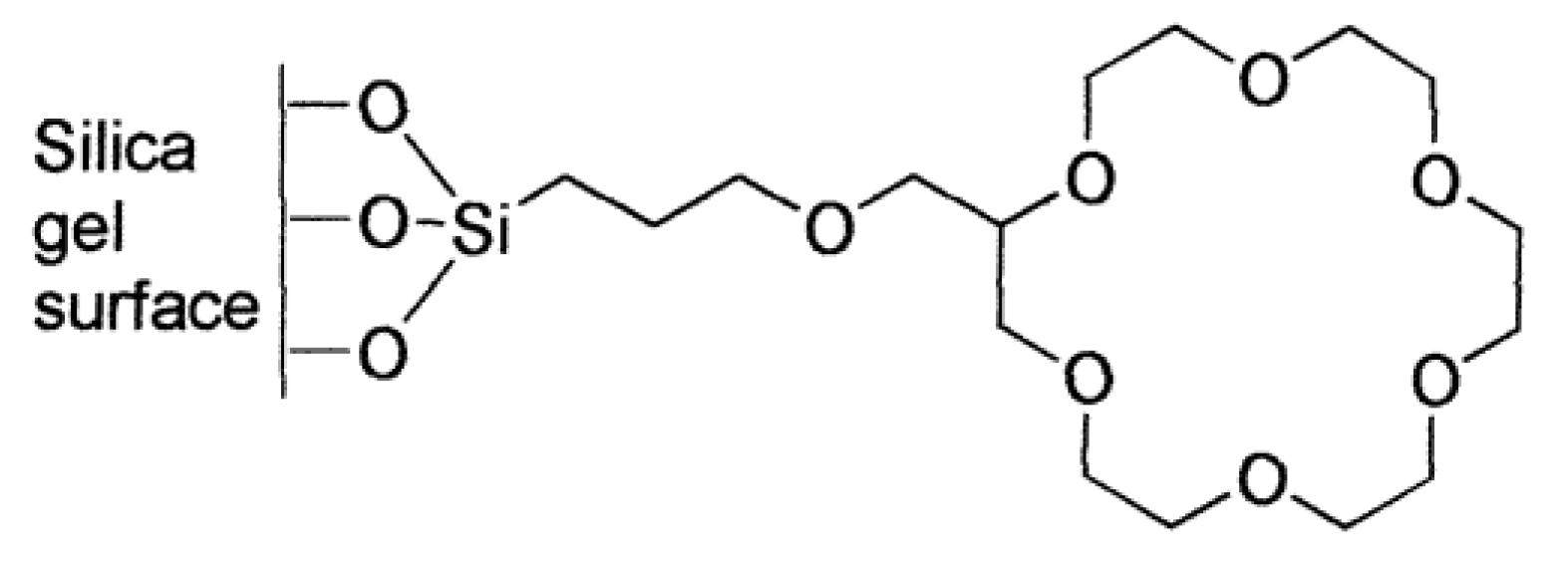
Pedersen [49] and Izatt [50] et al. reported the physical and chemical properties of a variety of macrocyclic crown ethers and determined their coordination equilibrium constants with a number of alkali metals, alkaline earth metals, and transition metals. The matching degree between the internal cavity size of macrocyclic molecules and the target ions plays a dominant role in the selective recognition of metals. Izatt et al. [51] have developed a series of Superlig® materials with molecular recognition ability by bonding macrocyclic crown ether compounds to solid carriers such as SiO2 surface (Figure 5). Sequential separations of Pt, Pd, Rh and Ir from a typical base metal matrix are presented in [52]. Superlig® 190 can selectively adsorb Rh in complex feed solutions, greatly reducing the accumulation of Rh in the separation process. Therefore, we can focus on the extraction behavior of Rh by macrocyclic compounds such as crown ethers, calixarenes and cyclodextrin, etc.
Crown-type macrocyclic compounds, known as “crown ethers” (CE), have specific cavity diameters and can improve the extraction effect for difficult-to-separate metal groups. Jyothi et al. [53] studied four crown ethers (18-crown-6, benzo-15-crown-5, dibenzo-18-crown-6 and dicyclohexyl-18-crown-6) as extractants for separating and extracting Pt and Rh in PGM synthetic solution. It was found that when the concentration of hydrochloric acid was 10 mol/L, the extraction percentages of Rh corresponding to the four CEs were higher than that of Pt, resulting in a phenomenon where Rh takes priority over Pt in extraction. The reaction mechanism of the CE system is as follows:
M n + + mCE + xCl = M Cl x CE m
where M = Pt or Rh, CE = crown ether, m, n or x = number.
To extract PGMs, Calix[n]arenes can orderly incorporate diverse functional groups [54,55] with a strong affinity for PGMs. Ohto [56] reviewed the current state of research regarding the extraction of various metal cations by calixarene derivatives. By placing appropriate functional groups on the “upper” and “lower” edges of calixarene, polydentate functionalized calixarene can selectively extract PGMs compared to commercial extractants. Among them, Kumar et al. [57] used 25, 26, 27, 28-tetrahydroxy-5, 11, 17, 23-tetra-[4-(N-hydroxyl-3-phenylprop-2-enimidamido) phenylazo] calix[4]arene (THPAC) to extract Rh, Co, Cu and Ir from nitric acid synthetic solution. Maximum enhancement of the distribution ratio was obtained in the presence of 30 vol.% 1, 2-dichloroethane in dimethylformamide. The results indicated that the distribution ratio of Rh was higher than that of Ir, which realized the preferential extraction of Rh. However, this method has a low extraction selectivity and cannot eliminate interference from other ions.
In summary, the efficient extraction of rhodium requires precise control of the solution potential and acidity to regulate its speciation (Table 4). However, the easy hydration tendency of RhCl63− in concentrated hydrochloric acid leachates leads to the presence of various rhodium aqua complexes (RhCln(H2O)6n3−n, with n = 3–5), making it difficult to achieve selective recognition and coordination between macrocyclic molecules and rhodium anions. Although molecular recognition offers specific structural features for the spatial coordination of target ions, the random orientation of macrocyclic molecules during physical adsorption may reduce the selectivity of such spatial coordination [58]. Moreover, since the binding sites between ions and macrocyclic molecules are confined to limited regions, the rigid orientation of macrocyclic molecules on the surface of resin particles fails to achieve structural responsiveness. In addition, the adsorption capacity of the resin and the dissolution loss of macrocyclic molecules from the resin surface must also be taken into consideration.

7. Conclusions and Prospects

Despite extensive study and the successful industrial application of various methods for preferential separation and extraction of Rh, it is still necessary to address certain limitations.
As a traditional method for recovery of Rh, the precipitation method has inherent drawbacks such as low separation efficiency, repeated process and the necessity to modify the acidity of the solution regularly. In addition, the use of a precipitation agent introduces additional ingredients, which increase the difficulties of following treatment. A succession of efforts by some researchers overcame the problem of the poor selectivity, but the requirements for solution acidity are stringent. Moreover, due to the variety of leachate media in industry, there is still a significant amount of space for research on the practical use of precipitation methods.
The liquid–liquid extraction method has been widely utilized in priority recovery of Rh, there are still significant limitations: (1) it is unsuitable for solutions with low metal concentration; (2) Rh can be extracted preferentially only with the addition of reductant; (3) traditional organic extractants pose potential toxicity and safety risks; (4) the low extraction capacity and few extractant cycles limit the application of this method in the precious metal recovery industry. Owing to the volatilization of poisonous and flammable solvents, ILs are the most promising alternatives to organic solvents. However, the problem that anions of ILs can easily enter the aqueous phase and cause losses still needs to be solved. To advance the development, fundamental research on the recovery of ILs and harmless treatment technologies should be bolstered to prevent secondary environmental contamination.
Adsorption is the most favored technology, which involves conventional adsorption, chromatographic separation and emerging technologies. However, the limitations of the adsorption are also evident: (1) in the majority of adsorbents, Rh and other metals may co-adsorb with low selectivity; and (2) the complexity of the elution process and high reagent usage will lead to increased expenses.
MRT is in line with the concept of green chemistry with high selectivity for PGMs, particularly from highly complex solutions. This technology should be improved to address the following issues: (1) low-cost batch preparation and stability development are formidable challenges; and (2) selectivity is still insufficient.
From the perspective of economic benefits and sustainable resource utilization, future breakthroughs in preferential rhodium separation methods are expected to be achieved through the following technological pathways: First, the development of highly selective extractants or synergistic extraction systems [59] with specific coordination environments or functional groups to overcome the kinetic inertness of rhodium in aqueous solutions, enabling its efficient and preferential extraction from complex systems. Second, the exploration of low-toxicity, renewable, or environmentally friendly green reducing agents (such as bio-based reductants or electrochemical reduction methods) to facilitate the transformation of rhodium from an inert state to an easily extractable form under mild conditions, thereby reducing reliance on highly toxic activators like SnCl2. Third, the advancement of process intensification separation technologies incorporating external fields (e.g., microwave, ultrasound, electric fields) or novel techniques such as microfluidics [60,61], which shorten mass transfer times and improve interfacial contact efficiency, achieving rapid preferential separation of rhodium from dilute solutions. Fourth, the promotion of functional materials based on molecular recognition and ion imprinting technologies [62], leveraging their “cavity matching” and “memory effect” to achieve high-precision targeted capture of trace rhodium in complex matrices. The exploration of these directions not only helps shorten process flows and reduce reagent consumption and waste emissions but also lays the theoretical and technological foundation for building a green, low-carbon, and efficient rhodium resource recycling system.

Author Contributions

Conceptualization, H.Z., Z.Y. and X.M.; validation, H.Z., Z.Y. and X.M.; formal analysis, H.Z., Z.Y. and X.M.; investigation, H.Z. and Z.Y.; resources, Y.J.; writing—original draft preparation, H.Z. and Z.Y.; writing—review and editing, H.Z., Z.Y., K.H., Y.J. and X.Z.; visualization, H.Z. and Z.Y.; supervision, H.Z.; project administration, K.H., Y.J. and X.Z.; funding acquisition, K.H., Y.J. and X.Z. All authors have read and agreed to the published version of the manuscript.

Funding

This research was funded by the Youth Science and Technology Innovation Fund of BGRIMM Technology Group, National Key Research and Development Program (Nos. 2021YFC2903), National Natural Science Foundation of China (Nos. 52074031, 51574213), and the Fundamental Research Funds for the Central Universities of China (No. 06500104). The APC was funded by the Technical Center for Pyrometallurgy, BGRIMM Engineering Technology Co., Ltd., BGRIMM Technology Group, Beijing 100160, China.

Data Availability Statement

No new data were created or analyzed in this study.

Conflicts of Interest

The authors declare that the APC for this article was funded by the Technical Center for Pyrometallurgy, BGRIMM Engineering Technology Co., Ltd., BGRIMM Technology Group, Beijing 100160, China. The company was not involved in the study design, collection, analysis, interpretation of data, the writing of this article or the decision to submit it for publication.

References

  1. Jia, M.; Jiang, G.; Chen, H.; Pang, Y.; Yuan, F.; Zhang, Z.; Miao, N.; Zheng, C.; Song, J.; Li, Y.; et al. Recent Developments on Processes for Recovery of Rhodium Metal from Spent Catalysts. Catalysts 2022, 12, 1415. [Google Scholar] [CrossRef]
  2. Saguru, C.; Ndlovu, S.; Moropeng, D. A review of recent studies into hydrometallurgical methods for recovering PGMs from used catalytic converters. Hydrometallurgy 2018, 182, 44–56. [Google Scholar] [CrossRef]
  3. Zheng, H.-D.; Ding, Y.-J.; Wen, Q.; Liu, B.; Zhang, S.-G. Separation and purification of platinum group metals from aqueous solution: Recent developments and industrial applications. Resour. Conserv. Recycl. 2021, 167, 105417. [Google Scholar] [CrossRef]
  4. Bernardis, F.L.; Grant, R.A.; Sherrington, D.C. A review of methods of separation of the platinum-group metals through their chloro-complexes. React. Funct. Polym. 2005, 65, 205–217. [Google Scholar] [CrossRef]
  5. Benguerel, E.; Demopoulos, G.P.; Harris, G.B. Speciation and separation of rhodium(III) from chloride solutions: A critical review. Hydrometallurgy 1996, 40, 135–152. [Google Scholar] [CrossRef]
  6. Pianowska, K.; Kluczka, J.; Benke, G.; Goc, K.; Malarz, J.; Ochmański, M.; Leszczyńska-Sejda, K. Solvent Extraction as a Method of Recovery and Separation of Platinum Group Metals. Materials 2023, 16, 4681. [Google Scholar] [CrossRef]
  7. Crundwell, F.K.; Moats, M.S.; Ramachandran, V.; Robinson, T.G.; Davenport, W.G. Chapter 37-Refining of the platinum-group metals. In Extractive Metallurgy of Nickel, Cobalt and Platinum Group Metals; Crundwell, F., Moats, M., Ramachandran, V., Robinson, T., Davenport, W.G., Eds.; Elsevier: Oxford, UK, 2011; pp. 489–534. [Google Scholar]
  8. Matsumoto, K.; Yamakawa, S.; Sezaki, Y.; Katagiri, H.; Jikei, M. Preferential precipitation and selective separation of Rh(III) from Pd(II) and Pt(IV) using 4-alkylanilines as precipitants. ACS Omega 2019, 4, 1868–1873. [Google Scholar] [CrossRef]
  9. Ding, Y.J.; Zhang, S.G.; Liu, B.; Zheng, H.D.; Chang, C.C.; Ekberg, C. Recovery of precious metals from electronic waste and spent catalysts: A review. Resour. Conserv. Recycl. 2019, 141, 284–298. [Google Scholar] [CrossRef]
  10. Trinh, H.B.; Lee, J.C.; Suh, Y.J.; Lee, J. A review on the recycling processes of spent auto-catalysts: Towards the development of sustainable metallurgy. Waste Manag. 2020, 114, 148–165. [Google Scholar] [CrossRef] [PubMed]
  11. Narita, H.; Tanaka, M.; Shiwaku, H.; Okamoto, Y.; Ikeda-ohno, A.; Yaita, T. Inner-sphere structure of rhodium complexes with Tin(II) chloride in concentrated hydrochloric acid solution. Bull. Chem. Soc. Jpn. 2013, 86, 203–209. [Google Scholar] [CrossRef]
  12. Narita, H.; Morisaku, K.; Tanaka, M. Highly efficient extraction of rhodium(III) from hydrochloric acid solution with amide-containing tertiary amine compounds. Solvent Extr. Ion. Exch. 2015, 33, 407–417. [Google Scholar] [CrossRef]
  13. Nikoloski, A.N.; Ang, K.L. Review of the application of ion exchange resins for the recovery of platinum-group metals from hydrochloric acid solutions. Miner. Process. Extr. Metall. Rev. 2014, 35, 369–389. [Google Scholar] [CrossRef]
  14. Matsumoto, K.; Hata, Y.; Sezaki, Y.; Katagiri, H.; Jikei, M. Highly selective Rh(III) recovery from HCl solutions using aromatic primary diamines via formation of three-dimensional ionic crystals. ACS Omega 2019, 4, 14613–14620. [Google Scholar] [CrossRef]
  15. Naidoo, K.J.; Klatt, G.; Koch, K.R.; Robinson, D.J. Geometric Hydration Shells for Anionic Platinum Group Metal Chloro Complexes. Inorg. Chem. 2002, 41, 1845–1849. [Google Scholar] [CrossRef]
  16. Suzuki, T.; Ogata, T.; Tanaka, M.; Kobayashi, T.; Shiwaku, H.; Yaita, T.; Narita, H. Unique anion-exchange properties of 3,3′-diaminobenzidine resulting in high selectivity for rhodium(III) over palladium(II) and platinum(IV) in a concentrated hydrochloric acid solution. Anal. Sci. 2019, 35, 1353–1360. [Google Scholar] [CrossRef] [PubMed]
  17. Matsumoto, K.; Yamakawa, S.; Haga, K.; Ishibashi, K.; Jikei, M.; Shibayama, A. Selective and preferential separation of rhodium (III) from palladium (II) and platinum (IV) using a m-phenylene diamine-containing precipitant. Sci. Rep. 2019, 9, 12414–12422. [Google Scholar] [CrossRef] [PubMed]
  18. Kostanski, M.T.; Freiser, H. Extraction of rhodium and iridium with 4-(non-5-yl) pyridine. Anal. Chim. Acta 1991, 242, 191–201. [Google Scholar] [CrossRef]
  19. Narita, H.; Morisaku, K.; Tanaka, M. The first effective extractant for trivalent rhodium in hydrochloric acid solution. Chem. Commun. 2008, 5921–5923. [Google Scholar] [CrossRef] [PubMed]
  20. Shafiqul, A.M.; Inoue, K. Extraction of rhodium from other platinum group metals with Kelex 100 from chloride media containing tin. Hydrometallurgy 1997, 46, 373–382. [Google Scholar] [CrossRef]
  21. Mhaske, A.; Dhadke, P. Liquid-liquid extraction and separation of rhodium(III) from other platinum group metals with Cyanex 925. Sep. Sci. Technol. 2001, 36, 3253–3265. [Google Scholar] [CrossRef]
  22. Malik, P.; Paiva, A.P. A novel solvent extraction route for the mutual separation of platinum, palladium, and rhodium in hydrochloric acid media. Solvent Extr. Ion Exch. 2010, 28, 49–72. [Google Scholar] [CrossRef]
  23. Le, M.N.; Nguyen, T.H.; Lee, M.S. Comparison of separation behavior of Ir(IV) and Rh(III) between tin(II) chloride and ascorbic acid as a reducing agent in the extraction with Cyanex 921 and Cyanex 301. Solvent Extr. Ion Exch. 2018, 36, 272–285. [Google Scholar] [CrossRef]
  24. Zou, L.H.; Chen, J.; Huang, Y. An alternative way to separating Ir(IV) and Rh(III) ions from a mixed chloride solution with added stannous chloride. Hydrometallurgy 2004, 72, 31–37. [Google Scholar] [CrossRef]
  25. Sun, P.-P.; Lee, M.S. Separation of Ir(IV) and Rh(III) from mixed chloride solutions by solvent extraction. Hydrometallurgy 2011, 105, 334–340. [Google Scholar] [CrossRef]
  26. Sole, K.C.; Brent Hiskey, J.; Ferguson, T.L. An assessment of the long-term stabilities of Cyanex302 and Cyanex301 in sulfuric and nitric acids. Solvent Extr. Ion Exch. 1993, 11, 783–796. [Google Scholar] [CrossRef]
  27. Kolekar, S.S.; Anuse, M.A. Solvent extraction separation of rhodium(III) with N-n-octylaniline as an extractant. Talanta 2002, 58, 761–771. [Google Scholar] [CrossRef]
  28. Suryavanshi, V.J.; Patil, M.M.; Kokare, A.N.; Zanje, S.B.; Pawar, R.R.; Anuse, M.A.; Mulik, G.N. Development of a liquid-liquid extraction system for rhodium(III) by 2-octylaminopyridine from weak malonate media. J. Chin. Chem. Soc. 2016, 63, 694–702. [Google Scholar] [CrossRef]
  29. Paiva, A.P.; Nogueira, C.A. Ionic liquids in the extraction and recycling of critical metals from urban mines. Waste Biomass Valor. 2021, 12, 1725–1747. [Google Scholar] [CrossRef]
  30. Yan, Y.; Wang, Q.; Xiang, Z.Y.; Yang, Y.Z. Separation of Pt(IV), Pd(II), Ru(III), and Rh(III) from chloride medium using liquid–liquid extraction with mixed imidazolium-based ionic liquids. Sep. Sci. Technol. 2018, 53, 2064–2073. [Google Scholar] [CrossRef]
  31. Funaki, K.; Ma, S.; Kawamura, S.; Miyazaki, A.; Sugie, A.; Mori, A.; Muramatsu, A.; Kanie, K. Metal-selective deprotection-mediated palladium(II) extraction by ionic liquids with tetrahydropyran-2H-yl-protected thiol moieties. Chem. Lett. 2017, 46, 434–437. [Google Scholar] [CrossRef]
  32. Kakoi, T.; Muranaga, K.; Goto, M. Extraction of rhodium by liquid surfactant membranes containing ionic liquid as a carrier from hydrochloric acid solutions. J. Chem. Eng. Jpn. 2018, 51, 917–920. [Google Scholar] [CrossRef]
  33. Yin, X.L.; Yi, H.L.; Wang, Q.; Wang, Y.D.; Sun, X.; Lv, C.; Guo, J.X.; Yang, Y.Z. Extraction and separation of multiple platinum group metals from hydrochloric acid solution with sole 1-hexyl-3-methylimidazole-2-thione using microextraction method. Hydrometallurgy 2017, 174, 167–174. [Google Scholar] [CrossRef]
  34. Lanaridi, O.; Platzer, S.; Nischkauer, W.; Limbeck, A.; Schnürch, M.; Bica-schröder, K. A combined deep eutectic solvent–ionic liquid process for the extraction and separation of platinum group metals (Pt, Pd, Rh). Molecules 2021, 26, 7204. [Google Scholar] [CrossRef]
  35. Lee, J.-C.; Kurniawan; Hong, H.-J.; Chung, K.W.; Kim, S. Separation of platinum, palladium and rhodium from aqueous solutions using ion exchange resin: A review. Sep. Purif. Technol. 2020, 246, 116896. [Google Scholar] [CrossRef]
  36. Kramer, J.; Erkelens, J.A.; Garcia, A.R.A.; Driessen, W.L.; Reedijk, J. Remarkably fast and selective recovery of a rhodium-containing catalyst with silica-based (poly)amine ion exchangers. New J. Chem. 2002, 26, 822–826. [Google Scholar] [CrossRef]
  37. Kramer, J.; Driessen, W.L.; Koch, K.R.; Reedijk, J. Highly selective extraction of platinum group metals with silica-based (poly)amine ion exchangers applied to industrial metal refinery effluents. Hydrometallurgy 2002, 64, 59–68. [Google Scholar] [CrossRef]
  38. Kramer, J.; Dhladhla, N.E.; Koch, K.R. Guanidinium functionalised silica-based anion exchangers significantly improve the selectivity of platinum group metal recovery from process solutions. Sep. Purif. Technol. 2006, 49, 181–185. [Google Scholar] [CrossRef]
  39. Shen, S.B.; Pan, T.L.; Liu, X.Q.; Yuan, L.; Wang, J.C.; Zhang, Y.J.; Guo, Z.C. Adsorption of Rh(III) complexes from chloride solutions obtained by leaching chlorinated spent automotive catalysts on ion-exchange resin Diaion WA21J. J. Hazard. Mater. 2010, 179, 104–112. [Google Scholar] [CrossRef]
  40. Gaita, R.; Al-bazi, S.J. An ion-exchange method for selective separation of palladium, platinum and rhodium from solutions obtained by leaching automotive catalytic converters. Talanta 1995, 42, 249–255. [Google Scholar] [CrossRef]
  41. Kononova, O.N.; Melnikov, A.M.; Borisova, T.V.; Krylov, A.S. Simultaneous ion exchange recovery of platinum and rhodium from chloride solutions. Hydrometallurgy 2011, 105, 341–349. [Google Scholar] [CrossRef]
  42. Abughusa, A.; Amaratunga, L.; Mercier, L. The recovery of rhodium ions at ultra-low concentrations using nanostructured adsorbents. In Nanoporous Materials Iv; Sayari, A., Jaroniec, M., Eds.; Studies in Surface Science and Catalysis; Elsevier: Amsterdam, The Netherlands, 2005; Volume 156, pp. 957–962. [Google Scholar] [CrossRef]
  43. Xing, X.Z.; Pan, C.M.; Yang, L.H.; Yang, W.H.; Gao, X.Q.; Li, R.; Pan, W. Method for Recovering Rhodium and Iridium from Rhodium and Iridium Replacement Slag. 114277248A, 5 April 2022. [Google Scholar]
  44. Kononova, O.N.; Leyman, T.A.; Gavrilova, V.N.; Konontsev, S.G.; Kashirin, D.M. Sorption of platinum and rhodium on carbon adsorbents from chloride solutions. J. Porous Mater. 2010, 17, 351–358. [Google Scholar] [CrossRef]
  45. Wang, F.; Wang, Y.J.; Li, Y.H.; Wang, Q.; Qi, X.Y.; Zhang, L. New approach for highly selective separation and recovery of osmium and rhodium by using a nanoparticle microcolumn. Ind. Eng. Chem. Res. 2014, 53, 15200–15206. [Google Scholar] [CrossRef]
  46. Alam, M.S.; Inoue, K.; Yoshizuka, K.; Ioshizuka, H. Adsorptive separation of rhodium(lll) using Fe(Ill)-templated oxine type of chemically modified chitosan. Sep. Sci. Technol. 1998, 33, 655–666. [Google Scholar] [CrossRef]
  47. Uheida, A.; Iglesias, M.; Fontàs, C.; Hidalgo, M.; Salvadó, V.; Zhang, Y.; Muhammed, M. Sorption of palladium(II), rhodium(III), and platinum(IV) on Fe3O4 nanoparticles. J. Colloid Interface Sci. 2006, 301, 402–408. [Google Scholar] [CrossRef]
  48. Yang, B.; Zhang, T.; Tan, W.X.; Liu, P.; Ding, Z.T.; Cao, Q.E. Determination of rhodium by resonance light-scattering technique coupled with solid phase extraction using Rh(III) ion-imprinted polymers as sorbent. Talanta 2013, 105, 124–130. [Google Scholar] [CrossRef] [PubMed]
  49. Pedersen, C.J. Cyclic polyethers and their complexes with metal salts. J. Am. Chem. Soc. 1967, 89, 7017–7036. [Google Scholar] [CrossRef]
  50. Izatt, R.M.; Bradshaw, J.S.; Nielsen, S.A.; Lamb, J.D.; Christensen, J.J.; Sen, D. Thermodynamic and kinetic data for cation-macrocycle interaction. Chem. Rev. 1985, 85, 271–339. [Google Scholar] [CrossRef]
  51. Izatt, N.E.; Bruening, R.L.; Krakowiak, K.E.; Izatt, S.R. Contributions of professor Reed M. Izatt to molecular recognition technology:  From laboratory to commercial application. Ind. Eng. Chem. Res. 2000, 39, 3405–3411. [Google Scholar] [CrossRef]
  52. Izatt, S.R.; Bruening, R.L.; Izatt, N.E. Green Chemistry Approach to Platinum Group Metals Refining. In Proceedings of the International Precious Metals Institute 38th Annual Conference, Orlando, FL, USA, 7–10 June 2014. [Google Scholar]
  53. Jyothi, R.K.; Lee, J.Y. The role of macrocyclic compounds in the extraction and possible separation of platinum and rhodium from chloride solutions. Sci. Rep. 2016, 6, 27668–27681. [Google Scholar] [CrossRef]
  54. Kim, J.Y.; Morisada, S.; Kawakita, H.; Ohto, K.; Kim, Y. Relationship between chemical structure and extraction efficiency toward palladium with ketonic derivatives of p-tert-octylcalix 4 arene in nitric acid media. J. Incl. Phenom. Macrocycl. Chem. 2015, 82, 25–32. [Google Scholar] [CrossRef]
  55. Atanassova, M.; Kurteva, V. Synergism as a phenomenon in solvent extraction of 4f-elements with calixarenes. RSC Adv. 2016, 6, 11303–11324. [Google Scholar] [CrossRef]
  56. Ohto, K.; Ishii, H.; Kawakita, H.; Harada, H.; Inoue, K. Solvent extraction of rare earth and precious metals with quaternary ammonium type of calix [4] arene. J. Ion Exch. 2007, 18, 390–395. [Google Scholar] [CrossRef]
  57. Kumar, A.; Sharma, P.; Chandel, L.K.; Kalal, B.L.; Kunsagi-mate, S. Synergistic solvent extraction of copper, cobalt, rhodium and iridium into 1, 2-Dichloroethane at trace level by newly synthesized 25, 26, 27, 28-tetrahydroxy-5, 11, 17, 23-tetra-[4-(N-hydroxyl-3-phenylprop-2-enimidamido) phenylazo] calix[4]arene. J. Incl. Phenom. Macrocycl. Chem. 2008, 62, 285–292. [Google Scholar] [CrossRef]
  58. Sessler, J.L.; Roznyatovskiy, V.; Pantos, G.D.; Borisova, N.E.; Reshetova, M.D.; Lynch, V.M.; Khrustalev, V.N.; Ustynyuk, Y.A. Synthesis and Anion Binding Properties of 2,5-Diamidothiophene Polypyrrole Schiff Base Macrocycles. Org. Lett. 2005, 7, 5277–5280. [Google Scholar] [CrossRef]
  59. Carrick, A.I.; Patrick, J.; Schofield, E.R.; O’Shaughnessy, P.; Breeze, B.; Love, J.B.; Morrison, C.A. Separation of rhodium from iridium through synergistic solvent extraction. Sep. Purif. Technol. 2024, 333, 125893. [Google Scholar] [CrossRef]
  60. Yang, Z.; Zhou, H.; Wu, X.; Huang, K. Confined molecular recognition in microchannels: Specific recognition of hydrated anions at interface. Colloids Surf. A 2026, 734, 139335. [Google Scholar] [CrossRef]
  61. Yang, Z.; Zhou, H.; Li, S.; Cui, K.; Huang, K. Shear Laminar Flow-Induced Controllable Preferential Separation of Rh(III) Chloric-Complexing Anions Using Microfluidic Extraction. Ind. Eng. Chem. Res. 2024, 63, 13762–13775. [Google Scholar] [CrossRef]
  62. Zhou, H.; Yang, Z.; Sui, N.; Li, S.; Meng, F.; Huang, K. Molecular recognition on the surface of concentrated hydrochloric acid: Hydration configuration-driven preferential recognition of Rh (III) anions with inner-coordinated water molecules. J. Mol. Liq. 2024, 409, 125393. [Google Scholar] [CrossRef]
Figure 1. Classical Rh precipitation–purification process (adapted from [4]).
Metals 16 00612 g001
Figure 2. Classical process for PGMs separation via solvent extraction or ion exchange (adapted from [4,6]).
Metals 16 00612 g002
Figure 3. PGM complex chloroanions with water isoprobability density surfaces (oxygen in red and hydrogen in blue), at 50% greater than bulk for (a) [PdCl4]2−, (b) [PtCl6]2−, and (c) [RhCl6]3−(Reprinted with permission from ref. [15]).
Metals 16 00612 g003
Figure 4. Rhodium preferential precipitation system (adapted from [8,14,17]). (a) m-phenylene diamine (m-PDA); (b) 4-Alkylanilines; (c) p-phenylene diamine di-hydrochlo-ride (PPDA).
Metals 16 00612 g004
Figure 5. Attachment of a ligand to a solid support via a connecting arm (adapted from [51]).
Metals 16 00612 g005
Table 1. Recovery methods used by some major PGMs refiners in the world.
CompanyCountryRecovering TechnologySeparation SequenceFirst-Pass Yields (Rh)Ref.
Lonmin’s Western Platinum RefinerySouth AfricaDistillation and precipitationAu-Base metals-Os-Ru-Ir-Rh-Pt-Pd77%[7]
Krastsvetmet RefineryRussiaPrecipitation and solvent extractionAg-Au-Pt-Pd-Os-Rh-Ru-Ir-[7]
Johnson MattheyUnited KingdomSolvent extraction and distillationAg-Base metals-Os-Ru-Au-Pd-Pt-Ir-Rh80%[7]
Anglo AmericanSouth AfricaSolvent extraction and distillationOs-Au-Pd-Pt-Ru-Ir-Rh82%[7]
Impala PlatinumSouth AfricaIon exchange and precipitationAg-Au-Pd- Base metals-Ru-Pt-Ir-Rh80%[7]
Table 3. Comparison between conventional extractants and ionic liquid extractants.
SystemExtractantRh/Ir Separation Factor (β)Extraction Equilibrium TimeExtractant StabilityProcess CostRef.
Conventional extractantsCyanex 921/Cyanex 301 + SnCl2Cyanex921: 150
Cyanex301: 80
30 minStable, hydrolysis-resistant, with goodModerate[23]
TBP + SnCl240060 minAcid-resistant and recyclableLow[24]
Alamine 336 + SnCl2175030 minAcid-resistant, but prone to emulsification and degradationModerate[25]
Ionic liquid extractantsHMImT + SnCl2>10,000<5 minThermally/chemically stable, non-volatile; high viscosityHigh[33]
Table 4. Summary of selective preferential separation and extraction of Rh.
Processing MethodMatrixExperimental ConditionsTechnological Indicators of RecoveryRef.
Selective precipitation4-alkylaniline1.0 mmol/L Pd, Pt, Rh; 0.2 mmol/L 4-alkylaniline; 6~8 mol/L HCl; 3 h of shakingRRh > 85%, RPt < 5%, RPd < 5%[8]
p-phenylene diamine dihydrochloride (PPDA)300 mg/L Pd(II), Pt(IV), and Rh(III); PPDA/Rh = 15 mol/mol, 3~7 mol/L HCl; 6 h of shakingRRh > 80%, RPd < 2%, RPt < 5%[14]
3,3′-diaminobenzidine (DAB)10 mmol/L Pd(II), Pt(IV), and Rh(III); [L]/[Metal]init = 3.0, 3~7 mol/L HCl; 1 h of shakingRRh > 90%, RPd < 20%, RPt < 20%[16]
m-PDA1.0 mmol/L Pd, Pt, Rh; m-PDA/Rh molar ratio of 15:1; 3~8 mol/L HCl; 1 h of shakingRRh > 90%, RPt < 5%, RPd < 5%[17]
Selective Liquid–Liquid ExtractionHBMOEAA10−3 mol/L Pt, Pd, Rh; 0.5 mol/L HBMOEAA in chloroform; shake for 30 min, 2 mol/L HCl; Back-extraction: 10 mol/L HClBack-extraction percentage of Rh = 90%, about 0% for Pd and Pt[19]
Kelex 1002 vol.% Kelex 100 in toluene; 5 mol/L HCl; CSn/CPGMs > 10; shake for over 24 h, 303 KERh > 97%[20]
Cyanex 925200 g Rh(III), 100 g Pt(IV), 25 g Pd(II); 1.0 mol/L HCl; 0.4 mol/L SnCl2; 0.1 mol/L Cyanex 925ERh > 91.10%, EPt > 99.20%, EPd > 99.45%[21]
DMDPHTDMA(PGM] = 1 × 10⁻³ mol/L, PGM:Sn(II) = 1:10, [DMDPHTDMA] = 0.1 mol/L in 1,2-DCE, 1~9 mol/L HCl; A/O = 1, stirring speed 900 rpm, room temperature, equilibration time 10 minERh > 70%, EPt ≈ 100%, EPd < 10%, EIr < 10%, ERu < 10%[22]
Cyanex 921110 mg/L Ir, 100 mg/L Rh, 1~5 mol/L HCl; 0.1 mol/L Cyanex 921 in kerosene; 0.005 mol/L SnCl2; O/A = 1ERh ≈ 80%, EIr ≈ 0%[23]
tri-butyl phosphate (TBP)1.94 × 10⁻³ mol/L RhCl63−, 1.02 × 10⁻³ mol/L IrCl62− and 1.18 × 10⁻² mol/L SnCl3ERh ≈ 99%, EIr ≈ 1%[24]
Alamine 3360.00025 mol/L Ir, 0.0005 mol/L Rh, 9 mol/L HCl; 0.5 mol/L Alamine 336; 0.01 mol/L SnCl2; shake for 30 min, O/A = 1DRh/Ir = 1750[25]
2-OAP200 μg Rh, 0.025 mol/L malonate, 0.05 mol/L 2-OAP in xylene, pH = 8, back-extraction: 2 mol/L HClERh ≈ 100%, other precious metals and base metals remained unextracted[28]
1-octyl-3-methyl-imidazolium hexafluorophosphate ([Omim][PF6])4 mg/L Rh, 240 mg/L Sn, 1 mol/L HCl; 0.05 mol/L [Omim][PF6]-[32]
HMImT1.0 mmol/L Rh and Ir, 1.0 mol/L HCl solution, Sn/Rh molar ratio = 10, activation time 5.0 min; dosage of HMImT > 1.6 mgERh = 99.6%, EIr = 0.1%[33]
P66614Cl48 mg/L Pt, Pd, Rh; 1.0 M HCl; 50% (w/w) IL P66614ClEPt ≈ 100%, EPd ≈ 100%, ERh ≈ 99%[34]
Selective adsorptionIon exchanger100 mg ion exchanger 3, ligand to metal molar ratio = 2:1; pH 2, base metal ions: Cd2+, Zn2+, Ni2+ and Cu2+; desorption: 2 mol/L HNO3Adsorption percentage of Rh = 60%, desorption percentage of Rh = 100%[36]
Silica-based (poly)amine ion exchangers100 mg ion exchanger 3, ligand to metal molar ratio = 2:1; pH 0.8~3.7, base metal ions: Cd2+, Zn2+, Ni2+ and Cu2+; desorption: 2 mol/L HNO3Adsorption percentage of Rh = 30%, Rh = 30%, Cd, Zn, Ni and Cu < 15%,[37]
Guanidinium-containing silica-based ion exchanger300 mg Guanidinium-containing silica-based ion exchanger; pH 3.2, other metals: Pt, Ir, Cu, Fe and NiERh = 32%, base metals were not adsorbed[38]
Diaion WA21J ion-exchange resin43.9 mg/L Pd, 29.5 mg/L Pt, 8.9 mg/L Rh, 999.8 mg/L Al, 560 mg/L Fe, etc., resin = 10.000 g; 21 °C; 150 rpm; 40hAdsorption percentage of Rh = 89.89%, Pd = 90.21%, Pt = 91.53%, base metals < 1%[39]
Amberlite IRA-93 resin340 mg/L Pd, 280 mg/L Pt, 380 mg/L Rh; resin = 2 gAdsorption percentage of Rh = 61%, Pd = 99%, Pt = 97%, base metals < 1%[40]
Purolite S 985Purolite S 985 0.1~0.2 g resin; 1~4 mol/L HCl, 0.25 mmol/L Rh, other metal: Pt; desorption: 1 mol/L thiourea in 2 mol/L KOHAdsorption percentage of Rh = 94%, desorption percentage of Rh = 97.4%[41]
MP-HMSMP-HMS 2 mg, other metals: Cu2+, Ni2+ and Zn2+Adsorption percentage of Rh = 100%, base metals < 5%[42]
Nano-Al2O32.60 × 10−5 mol/L Os, 4.85 × 10⁻⁵ mol/L Rh, 0.02 mol/L Cu, Zn, Co, Ni, Cd, Pb and Fe; 10 mg nano-Al2O3, flow rate 0.2 mL/min, pH = 2.5RRh = 99.9%, ROs = 95.1%, base metals remained unabsorbed[45]
SPE extractant9.7 × 10−4 mol/dm3 Rh, 1.6 × 10⁻³ mol/dm3 Cu, 5.1 × 10⁻⁴ mol/dm3 Pt, 8.4 × 10⁻³ mol/L Sn; SPE extractant: Fe (III)-templated oxine chitosanSequence of adsorption selection: Rh > Pt > Cu[46]
Fe3O4 nanoparticlesAqueous solution containing Pd, Rh, and Pt; 1.0 mg/mL Fe3O4 nanoparticles, pH 2.5, contact time 1 h, 22 ± 1 °CMaximum capacity of Pd, Rh, and Pt is 0.103, 0.149 and 0.068 mmol/Lol/g[47]
SPE extractantLoading: 2 mL of sample solution containing 100 mg Rh, Ru, Pd, Ir and Pt, pH 6.0, flow rate 0.5 mL/min; washing: pH 5.0, flow rate 2.0 mL/min; eluting: 2 mL 3 mol/L HCl, flow rate 0.5 mL/min; SPE extractant: Rh (III) ion-imprinted polymerERh = 94.2%, ERu = 10.7%, EPd = 11.2%, EIr = 8.9%, EPt = 9.6%[48]
Emerging technologies
(Molecular Recognition Technology)
SuperLig® 190Rh, Pd, Ir, Pt, based metal, 6 mol/L HCl, 900–950 mV vs. Ag/AgCl-[52]
CE5 × 10−3 mol dm−3 for each CE, 5 × 10⁻⁴ mol dm−3 Pt and Rh, A/O = 1; 25 ± 1 °C, 250 rpm, 0.1~10.0 mol dm−3 HClERh > EPt for 4 CEs in 10.0 mol/L HCl[53]
Calix[4]areneSynthetic solution containing Cu, Co, Rh and Ir, 3 mol/L HNO3; 0.02 mol/L THPAC in 30% 1, 2-dichloroethane in DMFDRh > DIr[57]
Disclaimer/Publisher’s Note: The statements, opinions and data contained in all publications are solely those of the individual author(s) and contributor(s) and not of MDPI and/or the editor(s). MDPI and/or the editor(s) disclaim responsibility for any injury to people or property resulting from any ideas, methods, instructions or products referred to in the content.