Deep Copper Removal from High-Arsenic, Low-Copper Spent Copper Electrolyte by Gas–Liquid Sulfidation
Abstract
1. Introduction
2. Materials and Methods
2.1. Chemical Agents and Materials
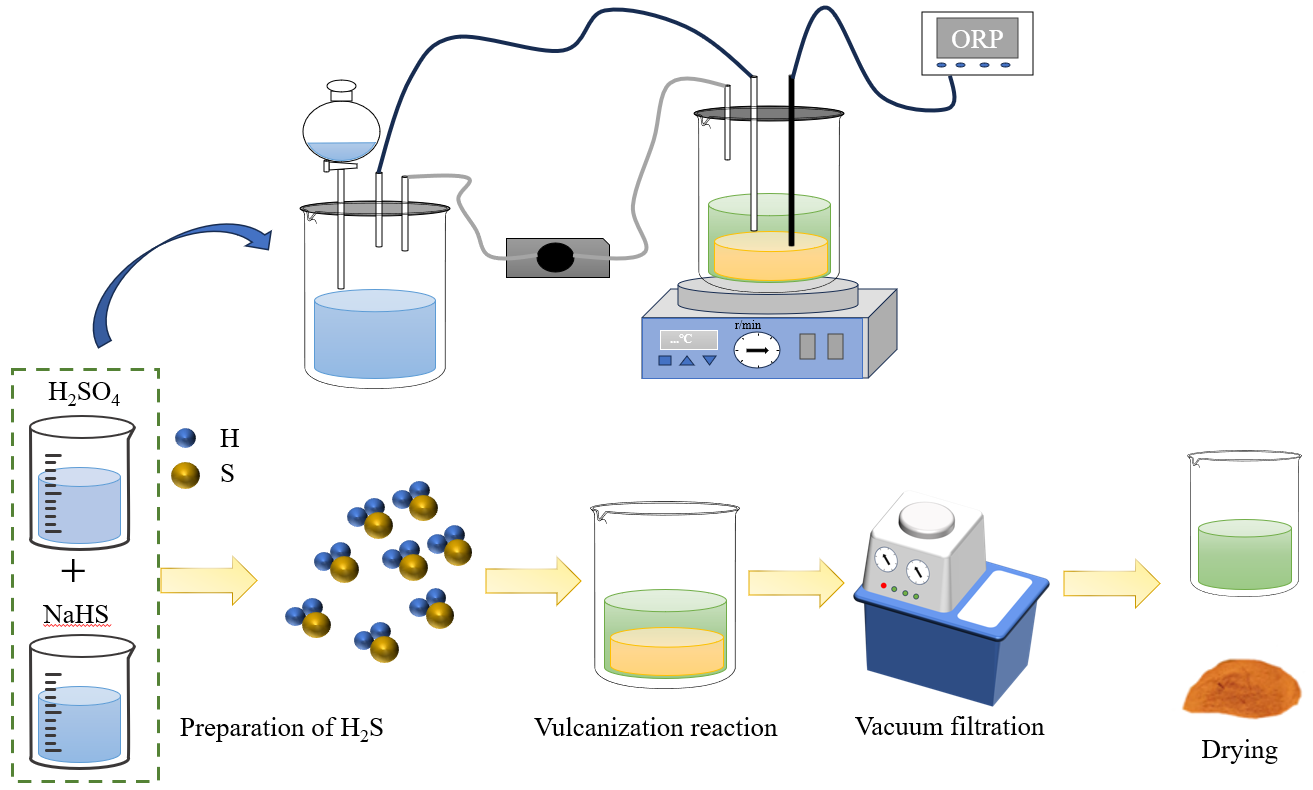
2.2. Sample Preparation
3. Results and Discussion
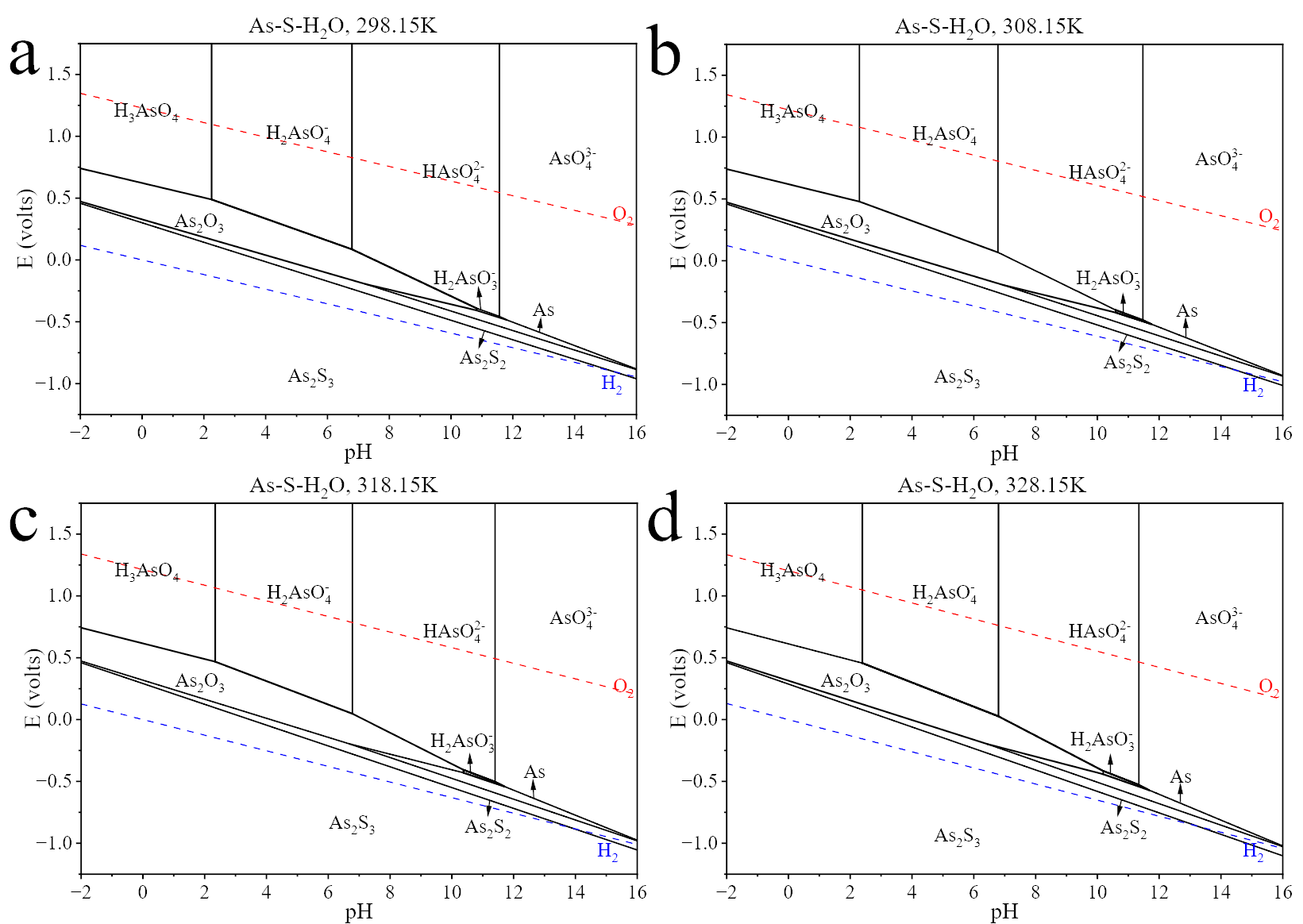
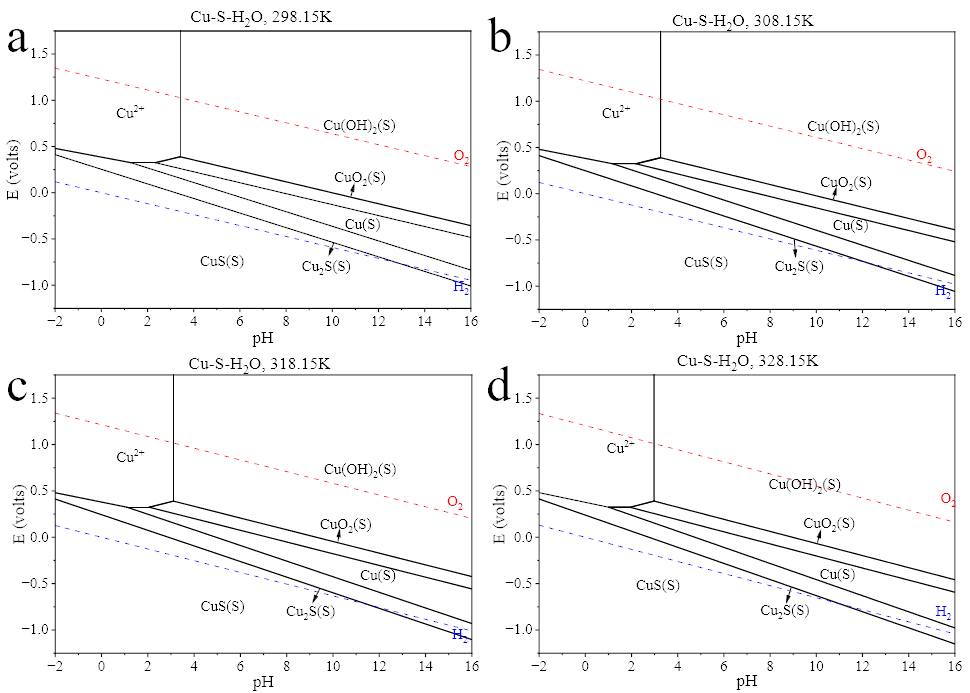
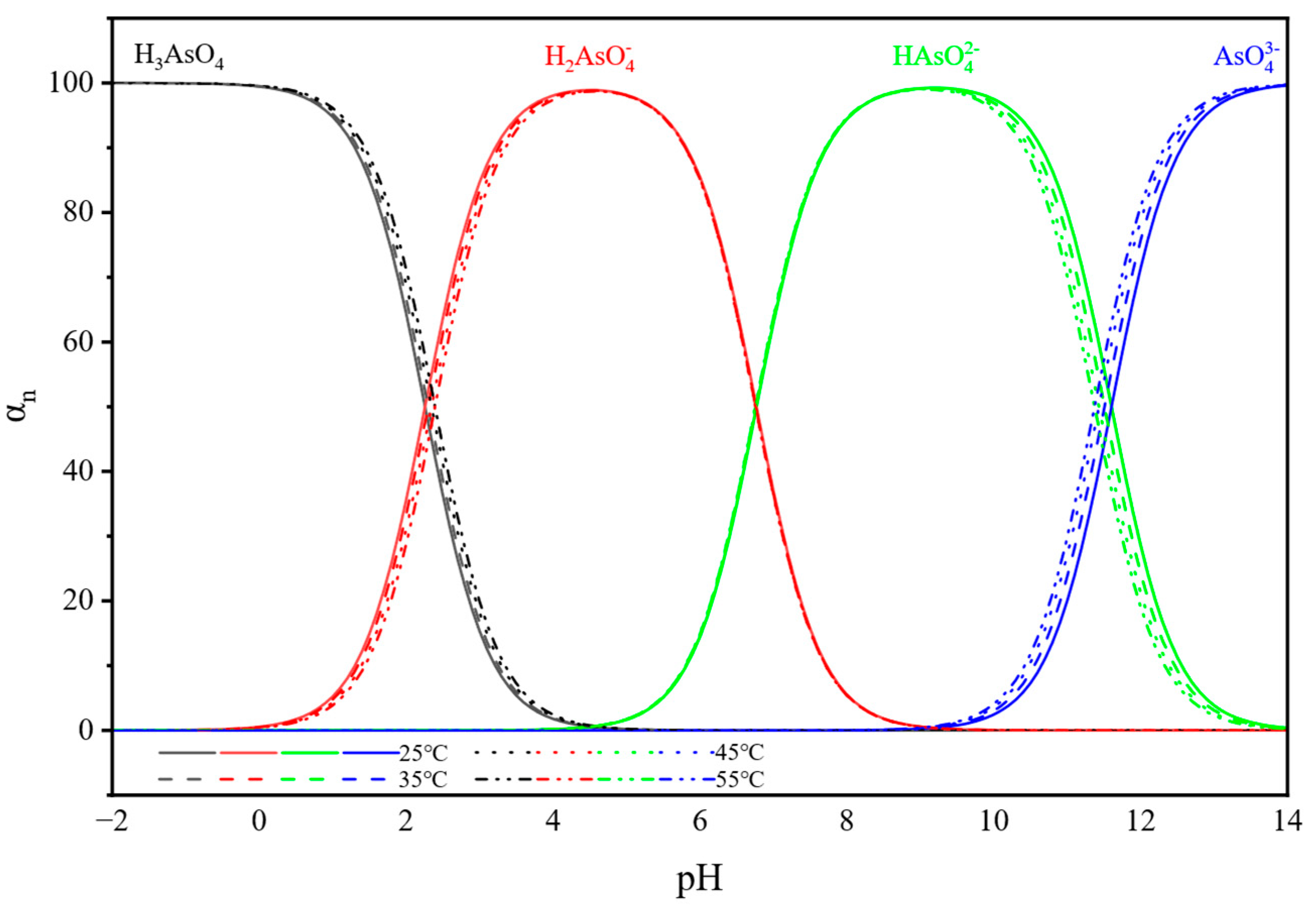
3.1. Thermodynamic Analysis
3.2. Effect of Gas–Liquid Sulfidation Conditions on Copper and Arsenic Precipitation
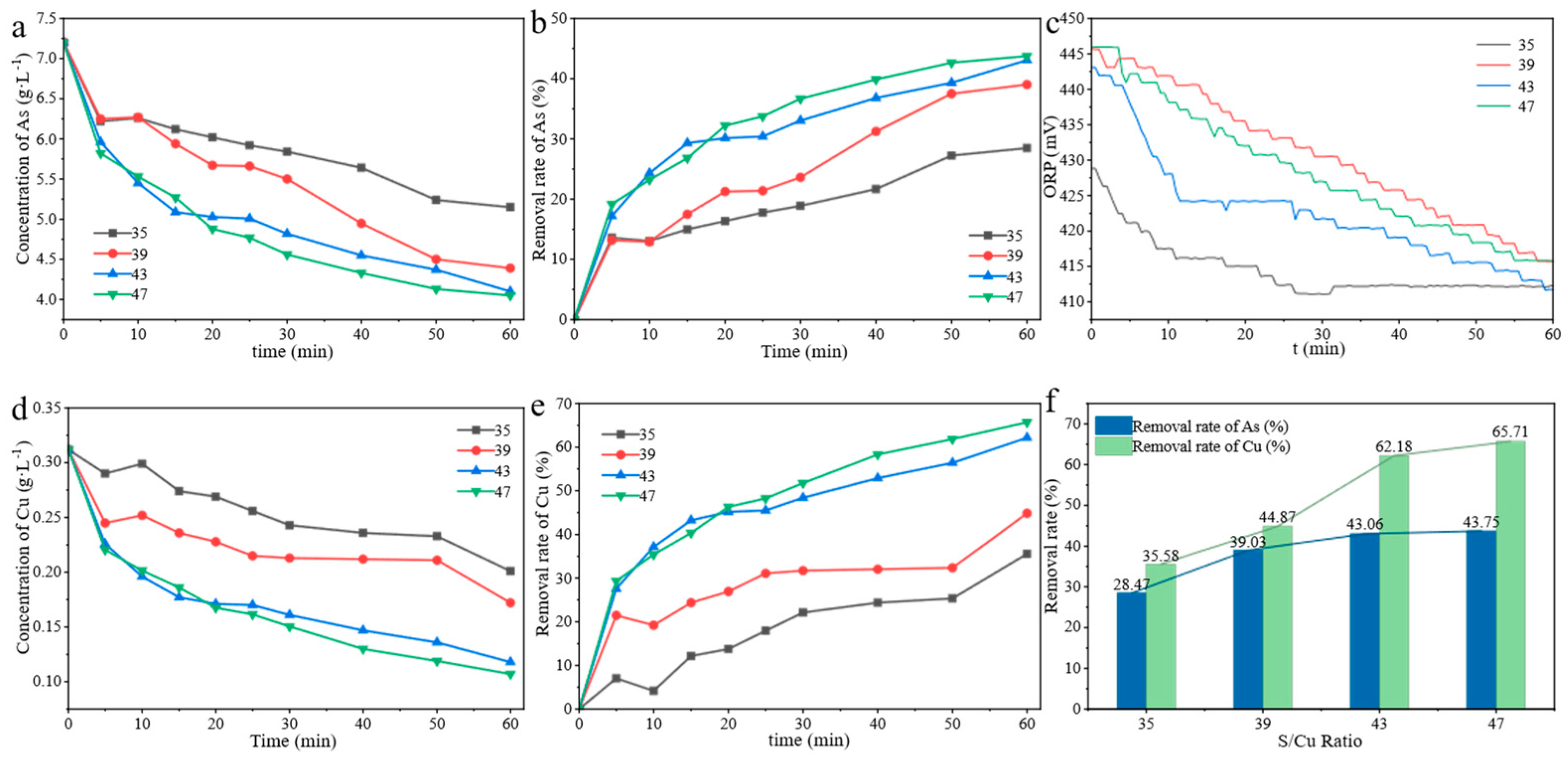
3.2.1. Hydrogen Sulfide Excess Coefficients
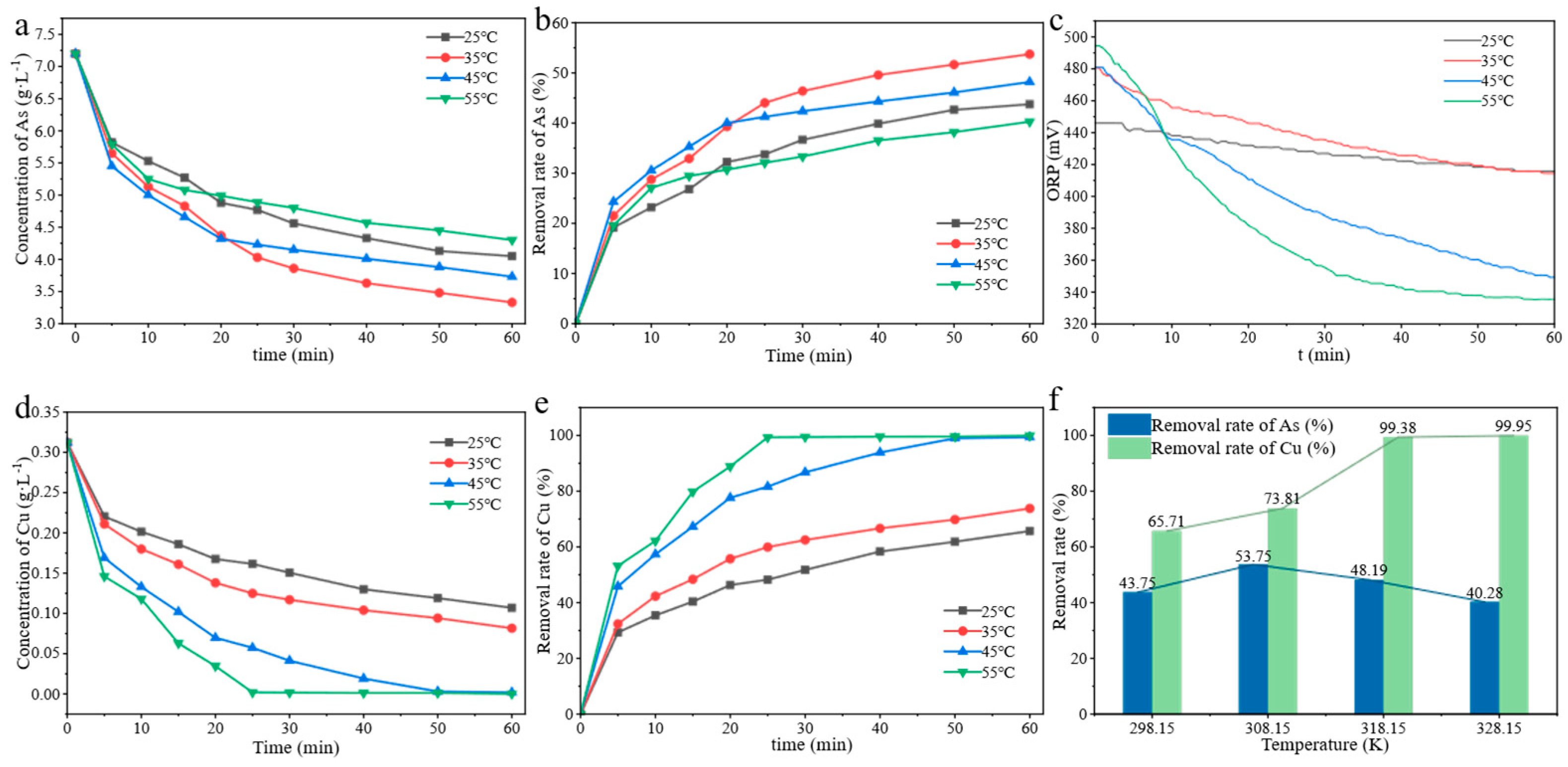
3.2.2. Gas–Liquid Sulfidation Temperature
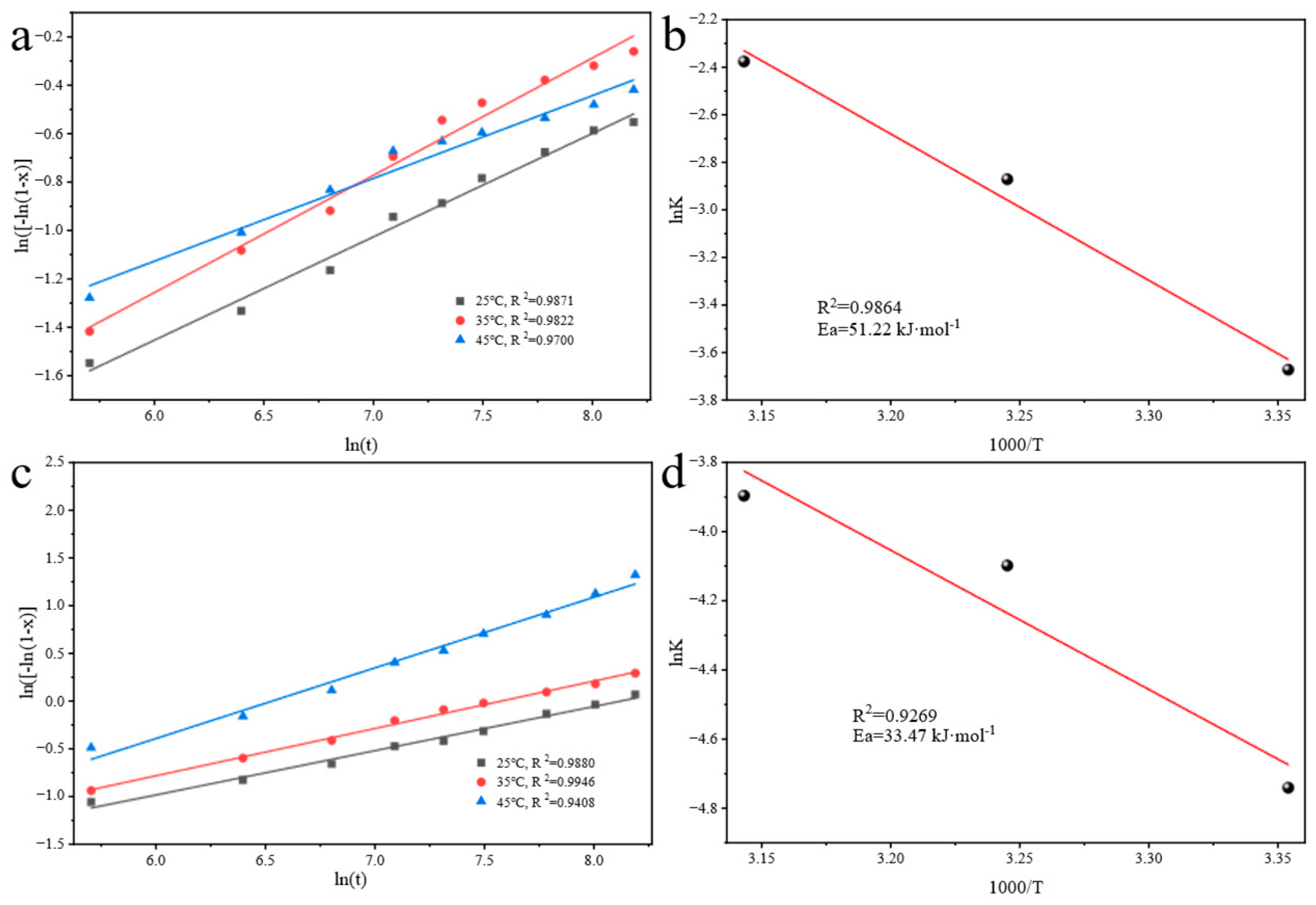
3.3. Kinetic Analysis
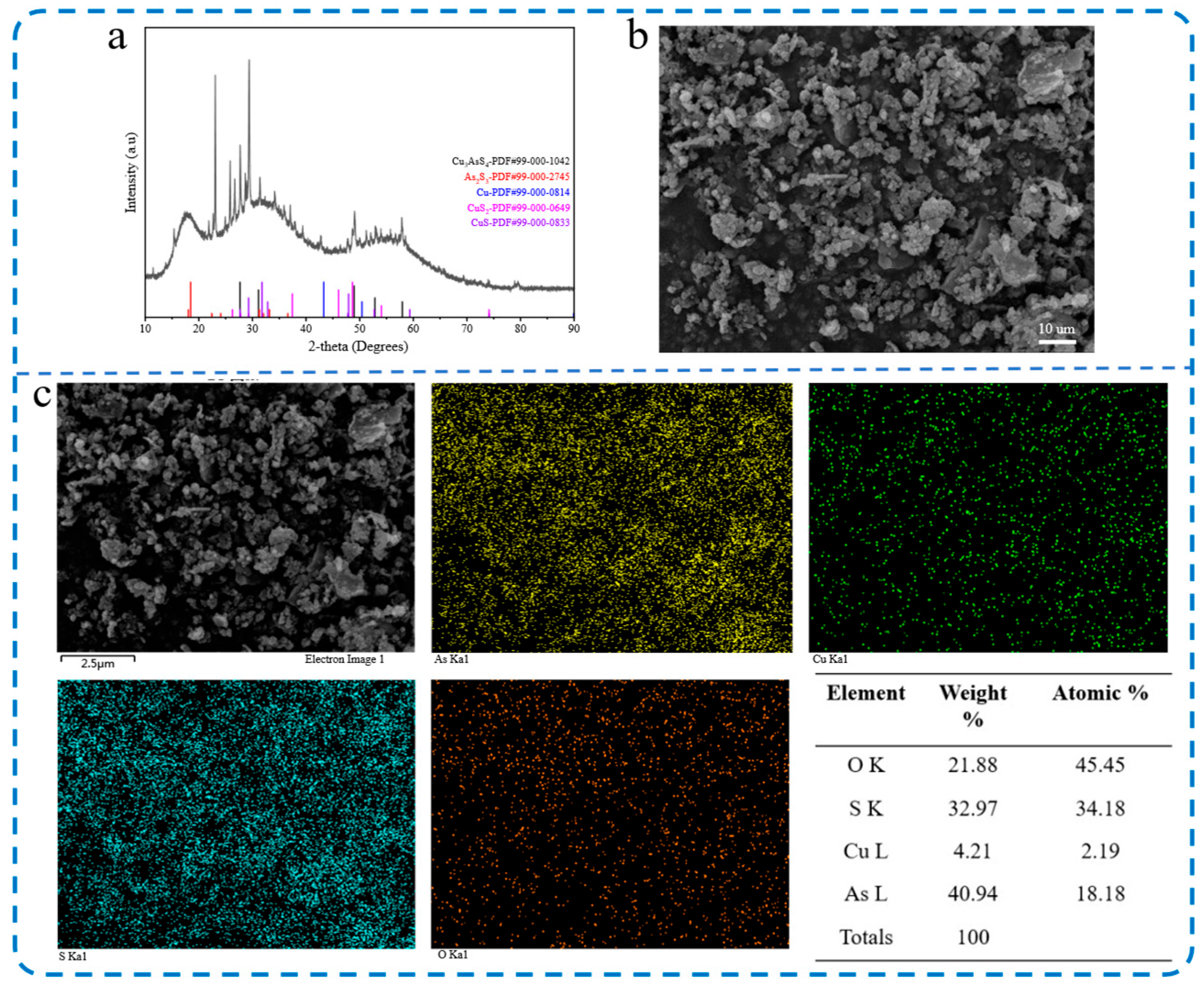
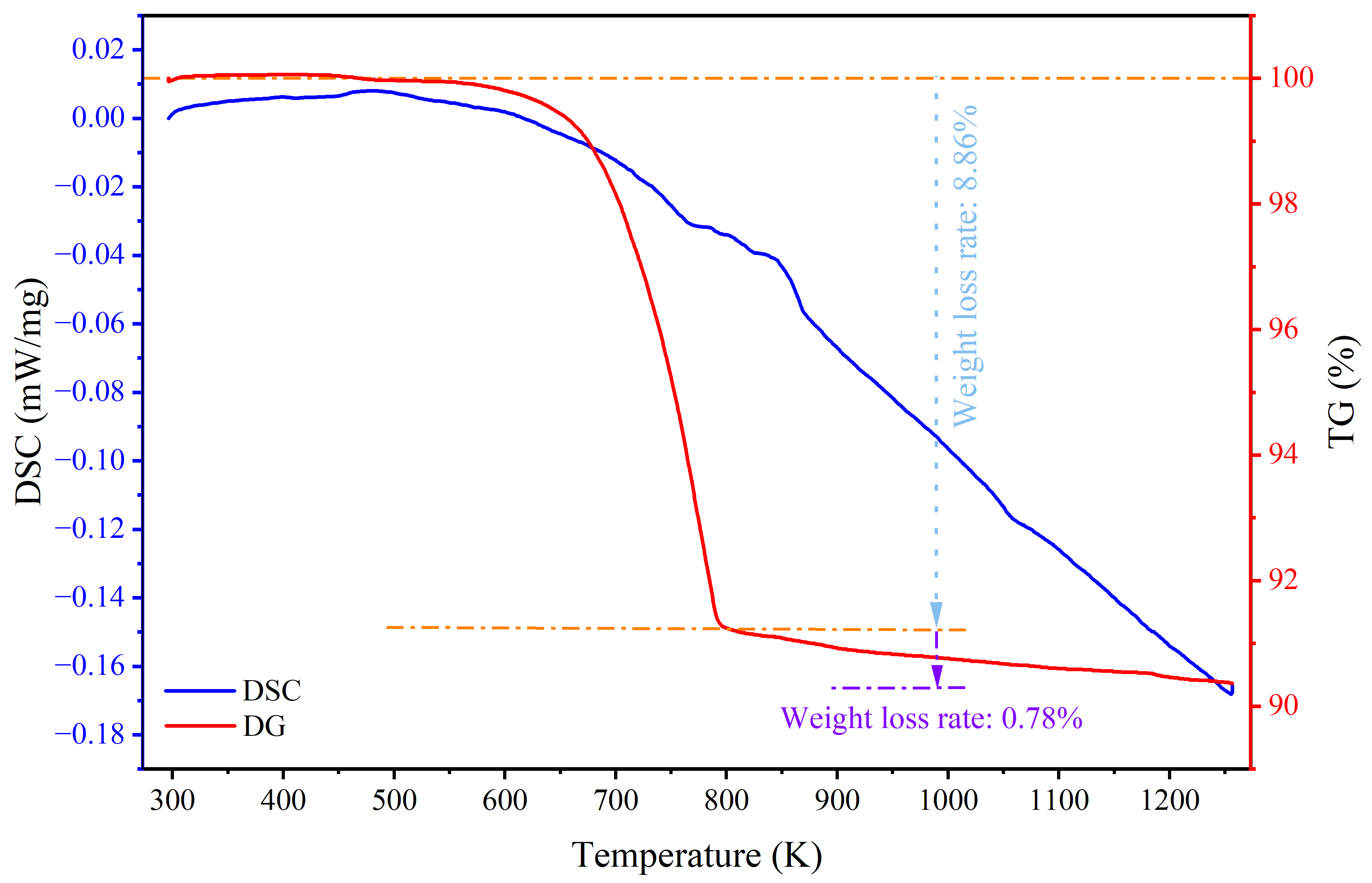
3.4. Copper–Arsenic Co-Precipitation Residue Characterization
3.4.1. DSC-TG Analysis
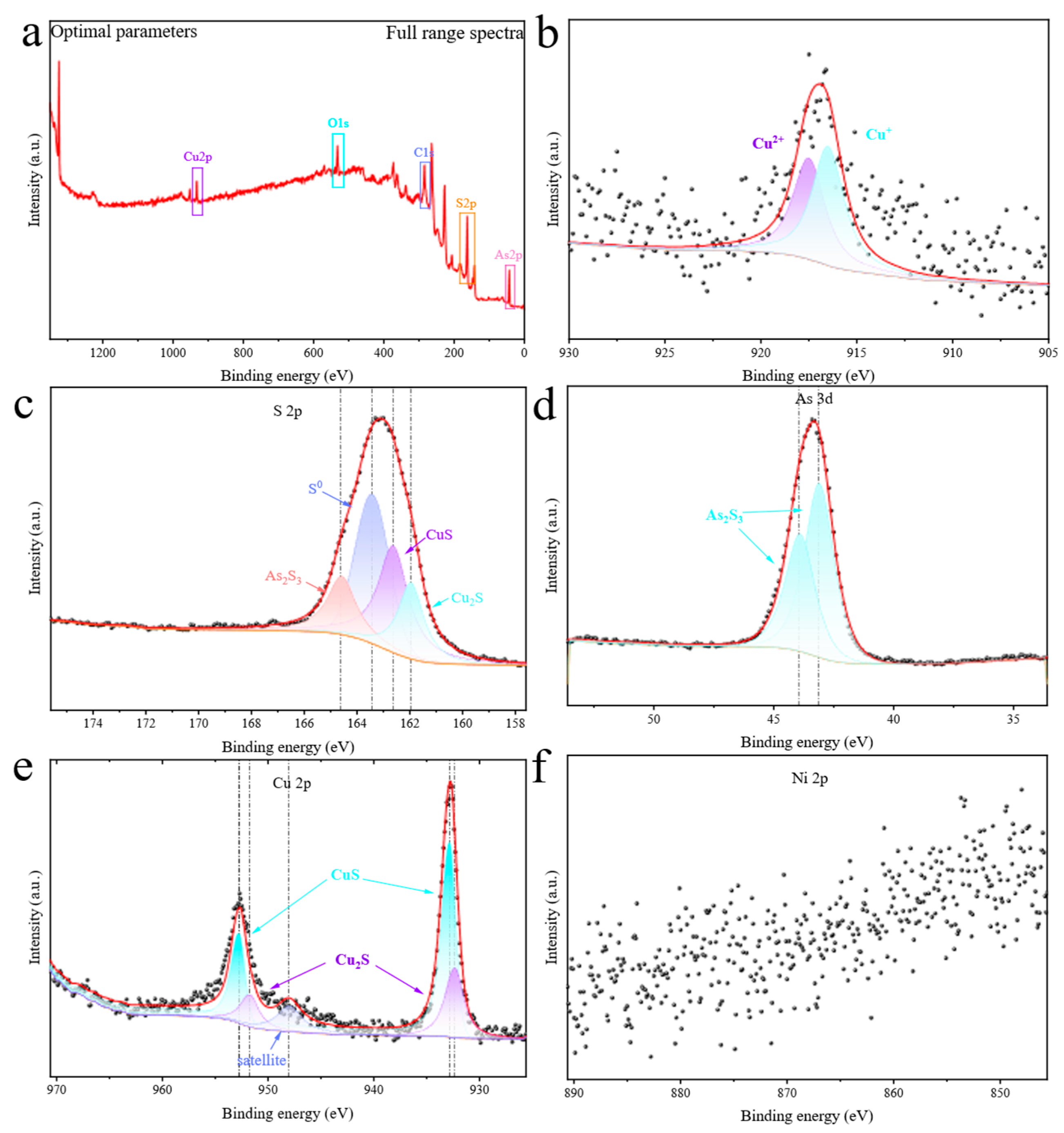
3.4.2. XPS
3.4.3. XRD and SEM
4. Conclusions
- (1)
- Thermodynamic analysis indicates that by examining the E-pH diagrams of the Cu-S-H2O and As-S-H2O systems, a thermodynamic window (E > 0.4 V vs. SHE) exists under strongly acidic conditions (pH < 2). By controlling the system’s redox potential, Cu2+ can be selectively precipitated as CuS while arsenic remains in solution as soluble arsenate species. This thermodynamically verifies the feasibility of copper–arsenic separation.
- (2)
- The optimal process parameters have been determined: the hydrogen sulfide excess coefficient (S/Cu) and the reaction temperature are key factors controlling the separation efficiency. At 298.15 K, increasing the S/Cu ratio promotes copper precipitation but intensifies arsenic co-precipitation, with diminishing returns observed when S/Cu > 43. To achieve deep copper removal while suppressing arsenic co-precipitation, the optimal conditions are identified as S/Cu = 47, temperature = 328.15 K, and reaction time = 60 min. Under these conditions, the copper concentration can be reduced from 0.312 g/L to 1.25 mg/L, and arsenic co-precipitation is effectively suppressed.
- (3)
- The kinetic mechanisms of copper and arsenic precipitation are fundamentally different. Kinetic analysis based on the Avrami model shows that the apparent activation energy for copper precipitation is 33.47 kJ/mol, indicating a mixed control process, while that for arsenic precipitation is 51.22 kJ/mol, corresponding to an interfacial chemical reaction-controlled mechanism.
- (4)
- The reaction mechanism and product characteristics have been elucidated. XPS analysis confirms that arsenic in the precipitate exists in the form of As(III)–S bonds, demonstrating that As(V) must first be reduced before forming As2S3. Excess H2S not only provides a sulfur source but also generates polysulfides upon oxidation, which can increase the local redox potential, thereby promoting the reduction of As(V). This also explains why arsenic removal efficiency increases with a higher S/Cu ratio. However, excessively high temperatures (e.g., 328.15 K) significantly lower the redox potential, triggering competitive side reactions of sulfur species that consume the effective sulfur source and consequently inhibit arsenic removal.
Author Contributions
Funding
Data Availability Statement
Conflicts of Interest
References
- Feng, S.; Che, J.; Zhang, W.; Zuo, Y.; Wang, C.; Ma, B.; Chen, Y. A Sustainable Approach for Recovering Copper and Zinc from Copper Smelting Flue Dust: Paving the Path for Waste Reduction. Sep. Purif. Technol. 2024, 342, 127037. [Google Scholar] [CrossRef]
- Yang, Z.; Yang, Z.; Yang, S.; Liu, Z.; Liu, Z.; Liu, Y.; Drewniak, L.; Jiang, C.; Li, Q.; Li, W.; et al. Life Cycle Assessment and Cost Analysis for Copper Hydrometallurgy Industry in China. J. Environ. Manag. 2022, 309, 114689. [Google Scholar] [CrossRef]
- Zhang, J.; Liu, Z.; Liu, Z. An Efficient and Affordable Hydrometallurgical Process for Co-Treatment of Copper Smelting Dust and Arsenic Sulfide Residue. J. Clean. Prod. 2023, 419, 137955. [Google Scholar] [CrossRef]
- Hernández-Pérez, L.; Muñoz-Pérez, A.; Ortega, E.M.; Pérez-Herranz, V.; Montañés, M.T.; Martí-Calatayud, M.C. Increasing the Sustainability of Copper Electrorefining: Selective Electrodeposition of Antimony in the Presence of Bismuth from Highly Concentrated Hydrochloric Acid Effluents. J. Environ. Chem. Eng. 2024, 12, 112005. [Google Scholar] [CrossRef]
- Sun, X.; Jiang, L.; Duan, N.; Zhu, G.; Xu, Y.; Jin, H.; Liu, Y.; Zhang, R. Efficient Recovery of Copper Resources from Copper Smelting Waste Acid Based on Cu(II)/As(III) Competitive Sulfuration Mechanism. J. Clean. Prod. 2024, 451, 141975. [Google Scholar] [CrossRef]
- Gong, A.; Cao, C.; Yan, K.; Li, J.; Tian, L.; Ke, L.; Chen, T.; Xu, Z. A Novel Method for Rapid and Highly Selective Removal of Arsenic from Copper Electrolyte Using Zirconium Salts. Chem. Eng. J. 2024, 481, 148460. [Google Scholar] [CrossRef]
- Wang, Y.; Li, B.; Wei, Y.; Wang, H. Effect of Zn2+ on the Extraction of Copper by Cyclone Electrowinning from Simulated Copper-Containing Electrolyte. Sep. Purif. Technol. 2022, 282, 120014. [Google Scholar] [CrossRef]
- Lewis, A.E. Review of Metal Sulphide Precipitation. Hydrometallurgy 2010, 104, 222–234. [Google Scholar] [CrossRef]
- Liang, Q.; Jiang, L.; Duan, N.; Xu, F.; He, H. Exploration of the Arsenic Removal Performance Fluctuation Using H2S from Highly Acidic Wastewater in Copper Smelting. J. Clean. Prod. 2022, 376, 134311. [Google Scholar] [CrossRef]
- Yang, T.; Hu, B.; Liu, W.; Zhang, D.; Chen, L. A Novel Process for the Treatment of Copper-Smelting Waste Acid with a High Arsenic Concentration. JOM 2018, 70, 2022–2026. [Google Scholar] [CrossRef]
- Zhu, F.; Hu, X.; Kong, L.; Peng, X. Calcium Sulfide-Organosilicon Complex for Sustained Release of H2S in Strongly Acidic Wastewater: Synthesis, Mechanism and Efficiency. J. Hazard. Mater. 2022, 421, 126745. [Google Scholar] [CrossRef]
- Shi, M.; Min, X.; Shen, C.; Chai, L.; Ke, Y.; Yan, X.; Liang, Y. Separation and Recovery of Copper in Cu−As-Bearing Copper Electrorefining Black Slime by Oxidation Acid Leaching and Sulfide Precipitation. Trans. Nonferrous Met. Soc. China 2021, 31, 1103–1112. [Google Scholar] [CrossRef]
- Liu, R.; Yang, Z.; He, Z.; Wu, L.; Hu, C.; Wu, W.; Qu, J. Treatment of Strongly Acidic Wastewater with High Arsenic Concentrations by Ferrous Sulfide (FeS): Inhibitive Effects of S(0)-Enriched Surfaces. Chem. Eng. J. 2016, 304, 986–992. [Google Scholar] [CrossRef]
- Li, R.; Li, L.; Zhang, Z.; Chen, G.; Tang, Y. Limiting Factors of Heavy Metals Removal during Anaerobic Biological Pretreatment of Municipal Solid Waste Landfill Leachate. J. Hazard. Mater. 2021, 416, 126081. [Google Scholar] [CrossRef] [PubMed]
- Li, Y.; Zhao, Q.; Liu, M.; Guo, J.; Xia, J.; Wang, J.; Qiu, Y.; Zou, J.; He, W.; Jiang, F. Treatment and Remediation of Metal-Contaminated Water and Groundwater in Mining Areas by Biological Sulfidogenic Processes: A Review. J. Hazard. Mater. 2023, 443, 130377. [Google Scholar] [CrossRef]
- Ji, L.; Xu, H.; Sun, X.; Huang, W.; Qu, Z.; Wang, Y.; Zhang, A.; Yan, N. Multi-Roles of SO2 to Enhance the Removal of Arsenic from Wastewater in Sulfidation Processes. J. Hazard. Mater. 2022, 436, 129038. [Google Scholar] [CrossRef]
- Rochette, E.A.; Bostick, B.C.; Li, G.; Fendorf, S. Kinetics of Arsenate Reduction by Dissolved Sulfide. Environ. Sci. Technol. 2000, 34, 4714–4720. [Google Scholar] [CrossRef]
- Paz-Gómez, D.C.; Pérez-Moreno, S.M.; Gázquez, M.J.; Guerrero, J.L.; Ruiz-Oria, I.; Ríos, G.; Bolívar, J.P. Arsenic Removal Procedure for the Electrolyte from a Hydro-Pyrometallurgical Complex. Chemosphere 2021, 281, 130651. [Google Scholar] [CrossRef] [PubMed]
- Shabani, A.; Hoseinpur, A.; Yoozbashizadeh, H.; Vahdati Khaki, J. As, Sb, and Fe Removal from Industrial Copper Electrolyte by Solvent Displacement Crystallisation Technique. Can. Metall. Q. 2019, 58, 253–261. [Google Scholar] [CrossRef]
- Jiang, G.; Peng, B.; Chai, L.; Wang, Q.; Shi, M.; Wang, Y.; Liu, H. Cascade Sulfidation and Separation of Copper and Arsenic from Acidic Wastewater via Gas-Liquid Reaction. Trans. Nonferrous Met. Soc. China 2017, 27, 925–931. [Google Scholar] [CrossRef]
- Zhang, X.; Zeng, L.; Wang, Y.; Tian, J.; Wang, J.; Sun, W.; Han, H.; Yang, Y. Selective Separation of Metals from Wastewater Using Sulfide Precipitation: A Critical Review in Agents, Operational Factors and Particle Aggregation. J. Environ. Manag. 2023, 344, 118462. [Google Scholar] [CrossRef]
- Liu, Y.; Dong, L.; Zhang, F.; Wang, J.; Ma, H.; Fu, Y.; Liu, J. A Precipitation Separation Behavior of Cu and As by H2S in Electrolytic Copper: Mechanism and Efficiency. Sep. Purif. Technol. 2026, 382, 135720. [Google Scholar] [CrossRef]
- Zhu, G.; Jiang, L.; Duan, N.; Liu, Y.; Zhang, R.; Sun, X.; Jin, H. The Sulfurization Precipitation and Competition Mechanisms of Cu(II) and As(V) in Electrolyte towards Efficient Recovery of Copper. J. Clean. Prod. 2024, 473, 143526. [Google Scholar] [CrossRef]
- Sun, X.; Jiang, L.; Duan, N.; Bao, L.; Jin, H.; Zhu, G.; Liu, Y.; Song, Z.; Zhang, R. Diversified Competitive Sulfuration Behaviors of Concomitant Heavy Metal Ions on Copper Recovery from Copper Smelting Waste Acid. Chem. Eng. J. 2024, 500, 157279. [Google Scholar] [CrossRef]
- Ostermeyer, P.; Bonin, L.; Folens, K.; Verbruggen, F.; García-Timermans, C.; Verbeken, K.; Rabaey, K.; Hennebel, T. Effect of Speciation and Composition on the Kinetics and Precipitation of Arsenic Sulfide from Industrial Metallurgical Wastewater. J. Hazard. Mater. 2021, 409, 124418. [Google Scholar] [CrossRef] [PubMed]
- Estay, H.; Barros, L.; Troncoso, E. Metal Sulfide Precipitation: Recent Breakthroughs and Future Outlooks. Minerals 2021, 11, 1385. [Google Scholar] [CrossRef]
- Sun, X.; Ji, L.; Huang, W.; Li, Z.; Liao, Y.; Xiao, K.; Zhu, X.; Xu, H.; Feng, J.; Feng, S.; et al. Production of H2S with a Novel Short-Process for the Removal of Heavy Metals in Acidic Effluents from Smelting Flue-Gas Scrubbing Systems. Environ. Sci. Technol. 2021, 55, 3988–3995. [Google Scholar] [CrossRef]
- Kong, L.; Peng, X.; Hu, X. Mechanisms of UV-Light Promoted Removal of As(V) by Sulfide from Strongly Acidic Wastewater. Environ. Sci. Technol. 2017, 51, 12583–12591. [Google Scholar] [CrossRef]
- Liu, Y.; Sun, X.; Jiang, L.; Jin, H.; Zhu, G.; Li, W.; Cai, S.; Shi, G.; Wang, L.; Wang, H.; et al. Enhanced Solid-Liquid Separation of As(III) Sulfide from Copper Smelting Waste Acid: Synergistic Effect and Mechanism of As2S3 Seed and PAM Flocculant. J. Environ. Chem. Eng. 2025, 13, 119951. [Google Scholar] [CrossRef]
- Jiwarungrueangkul, T.; Sompongchaiyakul, P.; Tipmanee, D.; Kumsopar, S.; Khammanee, N.; Sangmanee, C.; Charoenpong, C. Equilibrium Partitioning Approach for Metal Toxicity Assessment in Tropical Estuarine Sediment of Bandon Bay, Thailand. Mar. Pollut. Bull. 2024, 203, 116418. [Google Scholar] [CrossRef]
- Jin, H.; Jiang, L.; Duan, N.; Liu, Y.; Wang, L.; Sun, X.; Zhu, G.; Song, Z.; Wang, H.; Yuan, D. Eco-Friendly and Cost-Effective Recovery of Copper and Arsenic from Copper Electrolyte Purification Solutions via Sulfide Precipitation Coupled with Self-Reduction. Resour. Conserv. Recycl. 2026, 225, 108632. [Google Scholar] [CrossRef]
- Jin, H.; Jiang, L.; Duan, N.; Wang, J.; Sun, X.; Liu, Y.; Zhu, G.; Bao, L.; Zhang, R. Selective Recovery of Cu and Efficient Removal of As(V) from Cu Electrolyte via Four-Stage Continuous Coupled Sulfide Precipitation. J. Clean. Prod. 2025, 486, 144447. [Google Scholar] [CrossRef]
- Liang, Q.; Jiang, L.; Zheng, J.; Duan, N. Mechanism Study of the Effect of Copper Ions on the Stability of As(III) Sulfuration Precipitation in Acidic Copper Smelting Wastewater. Environ. Monit. Assess. 2024, 197, 36. [Google Scholar] [CrossRef]
- Jin, H.; Liu, Y.; Jiang, L.; Duan, N.; Wang, J.; Sun, X.; Sheng, S.; Zhu, G.; Li, W. Diverse Effects of Concomitant Ions on Copper and Arsenic Separation from Copper Electrolyte Purification Solutions by Sulfide Precipitation: Thermodynamic, Kinetic and Mechanistic Investigations. Sep. Purif. Technol. 2025, 376, 133880. [Google Scholar] [CrossRef]
- Xu, H.; Wang, Y.; Yao, L.; Ke, Y.; Luo, Y.; Zhang, L.; Du, J.; Yu, L.; Cao, J.; Min, X. Treatment of Acidic Solutions Containing As(III) and As(V) by Sulfide Precipitation: Comparison of Precipitates and Sulfurization Process. Metals 2023, 13, 794. [Google Scholar] [CrossRef]
- Khormali, A. Using a New Mixture of Reagents for Effective Inhibition of Corrosion and Salt Precipitation in the Petroleum Industry. J. Chem. Pet. Eng. 2021, 55, 257–276. [Google Scholar] [CrossRef]
- Guo, P.; Ai, G.; Yao, W. One-Step Synthesis of Amine-Rich Demulsifiers at Ambient Temperature and Insight into Hydrogen Bond-Driven Demulsification Mechanisms. Sep. Sci. Technol. 2026, 1–14. [Google Scholar] [CrossRef]
- Zheng, Y.; Chen, K. Leaching Kinetics of Selenium from Selenium–Tellurium-Rich Materials in Sodium Sulfite Solutions. Trans. Nonferrous Met. Soc. China 2014, 24, 536–543. [Google Scholar] [CrossRef]





| Content | Cu (g/L) | As (g/L) | Sb (g/L) | Bi (mg/L) | Ni (g/L) | H+ (mol/L) |
|---|---|---|---|---|---|---|
| 0.312 | 7.2 | 0.129 | 0.235 | 8.5 | 5.07 |
| No. | Ionization Reaction | Ionization Equilibrium Constant | lg k | |||
|---|---|---|---|---|---|---|
| 298 K | 308 K | 318 K | 328 K | |||
| (4) | −2.258 | −2.301 | −2.347 | −2.395 | ||
| (5) | −6.772 | −6.759 | −6.756 | −6.763 | ||
| (6) | −11.604 | −11.508 | −11.432 | −11.374 | ||
Disclaimer/Publisher’s Note: The statements, opinions and data contained in all publications are solely those of the individual author(s) and contributor(s) and not of MDPI and/or the editor(s). MDPI and/or the editor(s) disclaim responsibility for any injury to people or property resulting from any ideas, methods, instructions or products referred to in the content. |
© 2026 by the authors. Licensee MDPI, Basel, Switzerland. This article is an open access article distributed under the terms and conditions of the Creative Commons Attribution (CC BY) license.
Share and Cite
Zuo, X.; Wang, Q.; Wang, W.; Zhong, X.; Bai, Y.; Wu, J.; Yu, Q. Deep Copper Removal from High-Arsenic, Low-Copper Spent Copper Electrolyte by Gas–Liquid Sulfidation. Metals 2026, 16, 609. https://doi.org/10.3390/met16060609
Zuo X, Wang Q, Wang W, Zhong X, Bai Y, Wu J, Yu Q. Deep Copper Removal from High-Arsenic, Low-Copper Spent Copper Electrolyte by Gas–Liquid Sulfidation. Metals. 2026; 16(6):609. https://doi.org/10.3390/met16060609
Chicago/Turabian StyleZuo, Xiaofeng, Qitao Wang, Wei Wang, Xianlin Zhong, Yunlong Bai, Jiachen Wu, and Qinxu Yu. 2026. "Deep Copper Removal from High-Arsenic, Low-Copper Spent Copper Electrolyte by Gas–Liquid Sulfidation" Metals 16, no. 6: 609. https://doi.org/10.3390/met16060609
APA StyleZuo, X., Wang, Q., Wang, W., Zhong, X., Bai, Y., Wu, J., & Yu, Q. (2026). Deep Copper Removal from High-Arsenic, Low-Copper Spent Copper Electrolyte by Gas–Liquid Sulfidation. Metals, 16(6), 609. https://doi.org/10.3390/met16060609