Article

Corrosion Inhibition of Carbon Steel by Expired Omeprazole: Insights from Electrochemical Noise and DFT Studies


by
Omar Alejandro González Noriega
1,*,
Alejandro Flores Nicolás
2,
Jorge Uruchurtu Chavarín
1,
Laura Montserrat Alcantar Martínez
3,
María Yesenia Díaz Cárdenas
4,
César Augusto García Peréz
1,
Susana López Ayala
1 and
Elsa Carmina Menchaca Campos
1
1
Centro de Investigación en Ingeniería y Ciencias Aplicadas, Universidad Autónoma del Estado de Morelos, Av. Universidad 1001, Col. Chamilpa, Cuernavaca Mor 62209, Mexico
2
Facultad de Ingeniería, Arquitectura y Diseño, Universidad Autónoma de Baja California, Ensenada 22860, Mexico
3
Instituto Politécnico Nacional, Escuela Superior de Ingeniería Química e Industrias Extractivas, Zacatenco, Mexico City 07738, Mexico
4
Tecnológico de Estudios Superiores Coacalco, Tecnológico Nacional de México, Avenida 16 de Septiembre No. 54, Cabecera Municipal, Coacalco de Berriozabal 55700, Mexico
*
Author to whom correspondence should be addressed.
Metals 2026, 16(5), 552; https://doi.org/10.3390/met16050552
Submission received: 18 April 2026 / Revised: 9 May 2026 / Accepted: 9 May 2026 / Published: 19 May 2026
(This article belongs to the Section Corrosion and Protection)

Abstract

The corrosion of carbon steel in marine–industrial atmospheric environments remains a significant challenge due to the combined effect of aggressive ions such as chlorides and sulfates. In this context, this study aims to explore the inhibitory action of expired omeprazole applied to mild steel AISI 1018 evaluated on a solution simulating atmospheric corrosion (0.1 M Na2SO4 + 3% wt NaCl) over 72 h. The material was characterized using EDS to determine its composition of AISI 1018 steel, while Raman spectroscopy was employed to identify the functional groups and heteroatoms present on the molecular structure of omeprazole. Electrochemical noise (EN) measurements were used to evaluate the corrosion rate, type of corrosion and mechanism. Also, quantum chemical calculations of density function theory (DFT) were performed to predict the relationship between molecular structure and inhibition efficiency. The results indicate that 50 ppm provides the most stable and effective corrosion inhibition over time, as evidenced by increases in noise resistance and inhibition efficiency. In contrast, 75 ppm exhibits improved surface morphology at the end of the exposure period, which indicates enhanced surface coverage. The DFT results reveal that omeprazole possesses suitable electronic properties for corrosion inhibition, including moderate reactivity, electron-donating ability, and favorable charge distribution that promotes adsorption onto the metal surface. SEM analysis corroborates that surface damage is significantly reduced in the presence of the inhibitor, particularly at 75 ppm. This study provides new insights into the use of expired pharmaceutical compounds as corrosion inhibitors and demonstrates the capability of combining electrochemical noise analysis with DFT to evaluate both inhibition efficiency and film stability.

1. Introduction

Carbon steel is the most used material in industries such as automotive, construction, petroleum, and nuclear due to its properties like high strength, low cost, ductility, etc. However, this material is highly susceptible to corrosion when exposed to aggressive environments, particularly acidic media (HCl, H2SO4, among others) or chloride ions (Cl) and sulfur dioxide (SO2) in the case of atmospheric corrosion. The standards of ISO 9223, 12944 [1,2], etc. established that for atmospheric corrosion, the degree of environmental aggression can be classified from C1 to C5, where C5 is the most aggressive condition, which is subclassified into C5M and C5I (these are influenced by Cl and SO2); also, the ASTM has some standards for evaluating atmospheric corrosion, like A588, A847, B117 [3,4,5] and others. The most important characteristics of a natural atmosphere are temperature, relative humidity, pH, and the main aggressive ions present in the environment [6,7,8,9,10,11,12,13,14,15,16,17,18,19,20,21,22,23].
Furthermore, there are different methods for mitigating corrosion, such as inhibitors, coatings, cathodic protection, etc. The danger presented to the environment by synthetic organic inhibitors occurs because these contain chromium, lead, and heavy metals, which affect them; for this reason, there has been continued development of inhibitors that are friendly to the environment (not toxic and biodegradable), which can be obtained from extracts from seeds, fruits, leaves, flowers, or other plants or even from expired drugs. The main compounds of corrosion inhibitors are unsaturated bonds, aromatic rings and heteroatoms like S, N, O, and P [1,17,18,19,20,21,22,23,24,25,26,27,28,29,30].
On the other hand, commonly used electrochemical techniques include potentiodynamic polarization, electrochemical impedance spectroscopy (EIS), linear polarization resistance (LPR), and electrochemical frequency modulation to investigate inhibitors, but these methods do not allow for the determination of the current density of localized corrosion. Electrochemical noise (EN) is an electrochemical test for determining the corrosion rate, type of corrosion and mechanism of corrosion; it is also known because it is a unique technique for measuring the localized corrosion rate. Furthermore, this technique is non-destructive and non-perturbative because it works with free potential without the need for external polarization. There exist different methods for the data treatment of electrochemical noise, for example: the probabilistic method (dominion of time), Fourier transform (dominion of frequency), Wavelet transform (dominion of time–frequency), Hilbert–Huang (dominion of time–frequency), Chaos theory (dominion of time), etc. [31,32,33,34,35,36,37,38,39,40].
According to the literature, DFT is a powerful tool for predicting the behavior of a corrosion inhibitor through the use of functional density theory for calculating parameters such as total energy ∆E, HOMO and LUMO energy, dipole moment (μ), the global hardness (η), among others. These chemical quantum parameters provide information on reactivity, electronic donation, adsorption, and inhibition, among others [41,42,43,44,45,46,47,48,49,50,51,52,53].
Omeprazole, a proton pump inhibitor containing heteroatoms such as nitrogen, oxygen, and sulfur, has been investigated as a corrosion inhibitor in acidic media such as H2SO4, HCl, and H3PO4, showing inhibition efficiencies close to 90% [54,55,56,57,58,59,60]. Expired pharmaceutical compounds may enter environmental systems through improper disposal, where interaction with metallic infrastructure is possible, particularly in industrial or wastewater environments. However, most studies have focused on acidic environments and conventional electrochemical techniques, leaving a gap in the understanding of omeprazole performance under atmospheric corrosion conditions using electrochemical noise. Although omeprazole has previously studied as a corrosion inhibitor, limited attention has been given to the use of expired pharmaceutical compounds and their potential reuse as sustainable inhibitors. Furthermore, most studies rely on conventional electrochemical techniques, whereas the application of electrochemical noise analysis combined with density functional theory (DFT) to evaluate both inhibition performance and film stability remains limited.
Therefore, this work aims to evaluate the corrosion inhibition performance of expired omeprazole on AISI 1018 steel over time in a solution composed of Na2SO4 and NaCl, designed to simulate a marine–industrial atmospheric environment where sulfate and chloride ions coexist. The presence of Cl promotes localized corrosion, while SO42− contributes to the overall electrolyte conductivity and simulates industrial atmospheric pollutants. The inhibitor performance was analyzed using electrochemical noise (EN) and supported by DFT calculations, providing new insight into both inhibition efficiency and film stability. To the best of our knowledge, this is one of the first studies to evaluate expired omeprazole under these conditions using electrochemical noise analysis.

2. Materials and Methods

2.1. Preparation of the Samples

The material used in this work consisted of AISI 1018 steel samples cut into 1 cm × 1 cm coupons, corresponding to the exposed working area. The samples were mechanically polished using silicon carbide (SiC) sandpapers (Buehler, Lake Bluff, IL, USA) with sizes ranging from 80 to 600. Subsequently, the samples were cleaned with acetone and alcohol and then stored in a desiccator prior to use [54,55,56].

2.2. Testing Solution

A simulated solution prepared with distilled water was used as the corrosive medium. Its chemical composition is provided in Table 1. The Na2SO4 + NaCl solution was selected to simulate a marine–industrial atmospheric environment, where chloride ions promote localized corrosion and sulfate ions contribute to electrolyte conductivity. Sodium chloride (NaCl) and sodium sulfate (Na2SO4) were purchased from Sigma-Aldrich (St. Louis, MO, USA).
All the tests were performed using 200 mL of solution at room temperature (25 °C) and atmospheric pressure in triplicate. The pH of the solution was neutral (pH = 7).

2.3. Inhibitor of Expired Drug Omeprazole

The inhibitor used in the electrochemical test was expired commercial omeprazole acquired from Farmacia del Ahorro (Mexico City, Mexico). The drug was ground into fine powder and dissolved in methanol at a ratio of 0.01 g in 8 mL. The physicochemical properties of omeprazole, including its molecular structure, solubility, melting point, and other characteristics, have been reported elsewhere [61,62,63,64,65,66,67,68].
The selected inhibitor concentrations (25–100 ppm) were chosen to evaluate the effect of low, intermediate, and high surface coverage conditions, allowing for the identification of the optimal concentration and adsorption behavior.

2.4. Electrochemical Test

The electrochemical technique employed was electrochemical noise (EN). The tests consisted of time series of 1024 s (1 data point per second). The experiments were conducted using a three-electrode electrochemical cell consisting of two nominally identical working electrodes made of AISI 1018 steel and an Ag/AgCl reference electrode, in accordance with ASTM G199 [69]. The use of two identical working electrodes is required in electrochemical noise measurements to allow the detection of spontaneous current fluctuations between them without applying an external perturbation. This configuration ensures that the measured noise signal arises from the stochastic nature of the corrosion process, minimizing systematic differences between electrodes and improving the reliability of the acquired data. All experiments were performed in triplicate to ensure reproducibility. The measurements were carried out using an ACM Instruments GillAC potentiostat [35,36,37,38,39,40].
Electrochemical noise analysis allows the real-time evaluation of corrosion processes without external perturbation, providing information on corrosion mechanisms and film stability through parameters such as noise resistance (Rn) and localization index (LI).

2.4.1. Removal of the Trend (Method Point to Point)

For data processing, trend removal is performed using the point-by-point method, which is applied to current and potential. Using Equation (1):
x n = x n x n 1
The next step is to determine the probabilistic parameters with the untrended data.

2.4.2. Arithmetic Average ( x ¯ )

The mean value of the electrochemical noise signal ( x ¯ ) was calculated as the arithmetic average (2) of the time series, where x(i) represents the measured signal (potential or current) at the i-th sampling point and N is the total number of data points.
x ¯ = i = 1 N x ( i ) N
The mean value was subtracted from the original signal in order to remove the DC component and center the signal around zero. This preprocessing step is essential to avoid distortion in both statistical parameters and frequency domain analysis [36,38].
The mean corrected signal was subsequently used for further processing, including the application of a Hann window and Fourier transform.

2.4.3. Mean Square Root

The mean square root (3) of the current is calculated [36,39].
R M S = i = 1 n x i 2 N

2.4.4. Standard Deviation

The standard deviation (4) of the current and potential is calculated.
σ = i = 1 n ( x i x ¯ ) 2 N 1
Based on these concepts, it is possible to determinate the resistance to electrochemical noise and the localization index. These, in turn, allow us to identify the type of corrosion [36,38,39].

2.4.5. Resistance to Electrochemical Noise (Rn)

The noise resistance (Rn) is estimated on the data set using Equation (5) and/or (6). Rn represents the relation between the standard deviation of noise potential (σv), deviation standard of current noise (σi), or can be represented by the constant K = 1, between the current density (icorr) [34,35,36,37,38,39,69].
R n = σ v σ i
R n = K i c o r r

2.4.6. Hann Window Application in FFT Analysis (w(n))

Prior to the frequency domain transformation, the time domain electrochemical noise signals were processed using a windowing function (7) to reduce spectral leakage effects. In this study, a Hann window was applied to the data.
w n = 0.5 1 c o s 2 π n N 1
where w(n) is the window function, n is the sample index, (n = 0, 1, …., N − 1), and N is the total number of data points in the time series [70,71,72,73].
The original time domain signal x(n), corresponding to either the potential or current noise signal, was multiplied by the window function to obtain the modified signal (8):
x * n = w n × x ( n )
where x*(n) is the windowed signal used for subsequent FFT analysis [66].
The application of the Hann window minimizes discontinuities at the boundaries of the sampled signal, thereby reducing spectral leakage and improving the accuracy of the frequency domain representation.

2.4.7. Fourier Transform Analysis of Electrochemical Noise Signals (Xk)

The frequency domain analysis of electrochemical noise signals was performed using the Fast Fourier Transform (FFT). The discrete Fourier transform was calculated according (9):
X k = n = 0 N 1 x n e j 2 π k n N
where xn represents the sampled signal in the domain (either potential or current), N is the total number of data points, k is the frequency index, and j is the imaginary unit [35,39,70,71,72,73].
The magnitude of the Fourier components was calculated from their real and imaginary parts as (10):
F F T ( X ) k = R ( X k ) 2 + J ( X k ) 2
where Xk corresponds to either the potential or current Fourier transform [69].
The frequency associated with each spectral component was determined by (11):
f k = k N t
where Δt is the sampling interval [70].

2.4.8. Noise Impedance (Zn)

The noise impedance Zn was estimated in the frequency domain as the ratio between the Fourier transform of the potential noise signal and that of the current noise signal (12):
Z n ( f ) = X V ( f ) X I ( f )
where XV(f) and XI(f) correspond to the Fourier transforms of the potential and current time series, respectively, and this information is analogous to electrochemical impedance spectroscopy [74,75].

2.4.9. Localization Index (LI)

The localization index (LI) is expressed by (13); this equation allows identifying the type of corrosion (based on the value of LI (see Table 2), where Irms is the root mean square or noise current value [34,38,39,69].
L I = σ i I r m s

2.4.10. Efficiency of Noise Resistance (ηRn)

The inhibition efficiency (η%) was calculated from the noise resistance (Rn) values using the following Equation (14):
η ( % ) = 1 R n b l a n k R n i n h × 100
where R n b l a n k and R n i n h represent the noise resistance in the absence and presence of inhibitor, respectively [72,76,77].

2.5. Density Functional Theory (DFT) Calculations

Density functional theory (DFT) calculations were conducted using Gaussian 09 (Gaussian Inc. Wallingford, CT, USA). The first step was drawing and optimizing the molecular structure of omeprazole. Subsequently, DFT calculations were carried out using the B3LYP hybrid exchange-correlation functional and the 6–31G (d, p) basis set, which provide a reasonable balance between computational cost and accuracy for organic corrosion inhibitors. The equations for obtaining the chemical quantum parameters are the following:
Where EHOMO and ELUMO are the energies of the highest occupied, the lowest unoccupied molecular orbitals and ΔE is the energy gap (Equation (15)). These energies allow to estimate the ionization potential (I) and electron affinity (A) based on the Koopmans theorem (Equations (16) and (17)) [42,43,45,46,47,48,49].
E = E L U M O E H O M O   ( The   energy   gap )
I = E H O M O   ( Ionization   potential )
A = E L U M O   ( Electron   affinity )
According to Pearson and Parr, chemical reactivity descriptors such as electronegativity (χ), chemical hardness (η), and softness (σ) can be approximated using ionization potential (I) and electron affinity (A) can be calculated with Equations (18)–(20) [42,43,45,46,47,48,49].
χ = E L U M O + E H O M O 2 = I + A 2 = μ   ( Electronegativity )
η = ( E L U M O E H O M O ) 2 = I A 2   ( Chemical   hardness )
σ = 1 η   ( Chemical   softness )
The global electrophilicity index (ω) was introduced by Parr, measures the propensity of chemical species to accept electrons (21) [47,49].
ω = μ 2 2 η   ( Global   electrophilicity   index )
The fraction of electrons transferred from the inhibitor (expired drug omeprazole) to a metallic surface (AISI 1018 steel) ΔN is described by the following Equation (22) [43,44,45,46,47,48,49].
N = ϕ χ i n h 2 ( η M + η i n h )   ( Fraction   of   electron   transferred )
where the value of ϕFe was used according with the literature obtained from the work function for Fe 4.82 eV, ηM the value of global hardness of iron is 0 eV, and ηinh the chemical hardness and χinh is the electronegativity of the inhibitor [43,44,48].
The dipole moment (μ) describes the polarity of a molecule and is a vector quantity that depends on the distribution of charges within the system. It can be expressed in vector form (23) or as its magnitude (24) [48,49]:
μ = q r   ( Dipole   moment   vector   form )
μ = μ x 2 + μ y 2 + μ z 2 ( D i p o l e   m o m e n t   m a g n i t u d e   f o r m )

3. Results

3.1. Energy Dispersive Spectroscopy (EDS) of AISI 1018 Steel

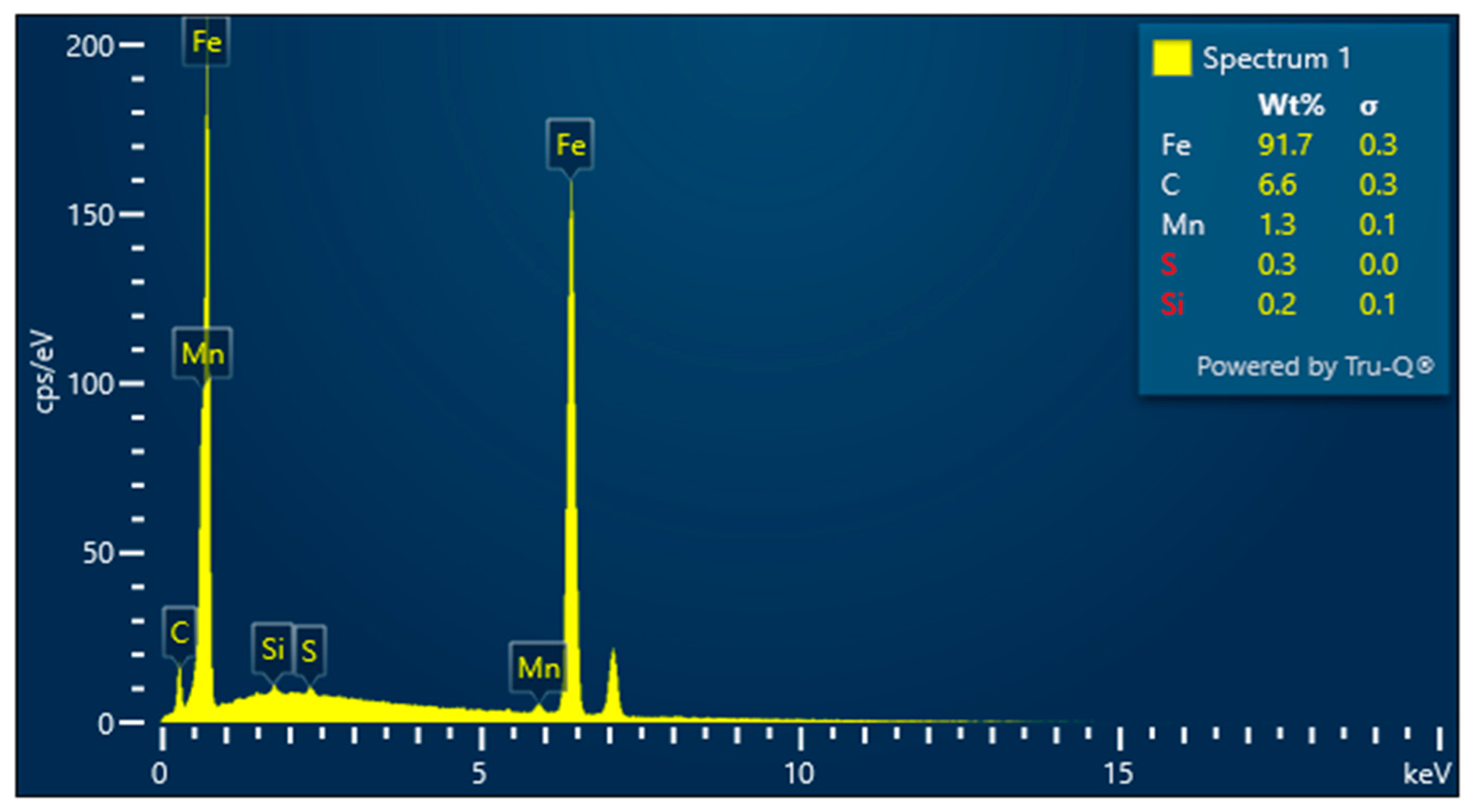
The chemical composition of AISI 1018 steel was determined by energy dispersive spectroscopy (EDS, CIQTEK SEM3200, CIQTEK Co. Ltd. Hefei, China) to identify the elemental constituents of the material and confirm its suitability for corrosion analysis. The EDS spectrum and corresponding quantitative results are shown in Figure 1. The analysis revealed that iron (Fe) is the main element, with a composition of approximately 91.7wt.%, along with minor contributions of carbon (C), manganese (Mn), and trace elements. The values are in good agreement with the nominal composition of AISI 1018 steel reported in the literature [78,79].
The consistency between the experimental results and the standard composition confirms the reliability of the material used in this study for subsequent electrochemical corrosion analysis.

3.2. Raman Spectroscopy

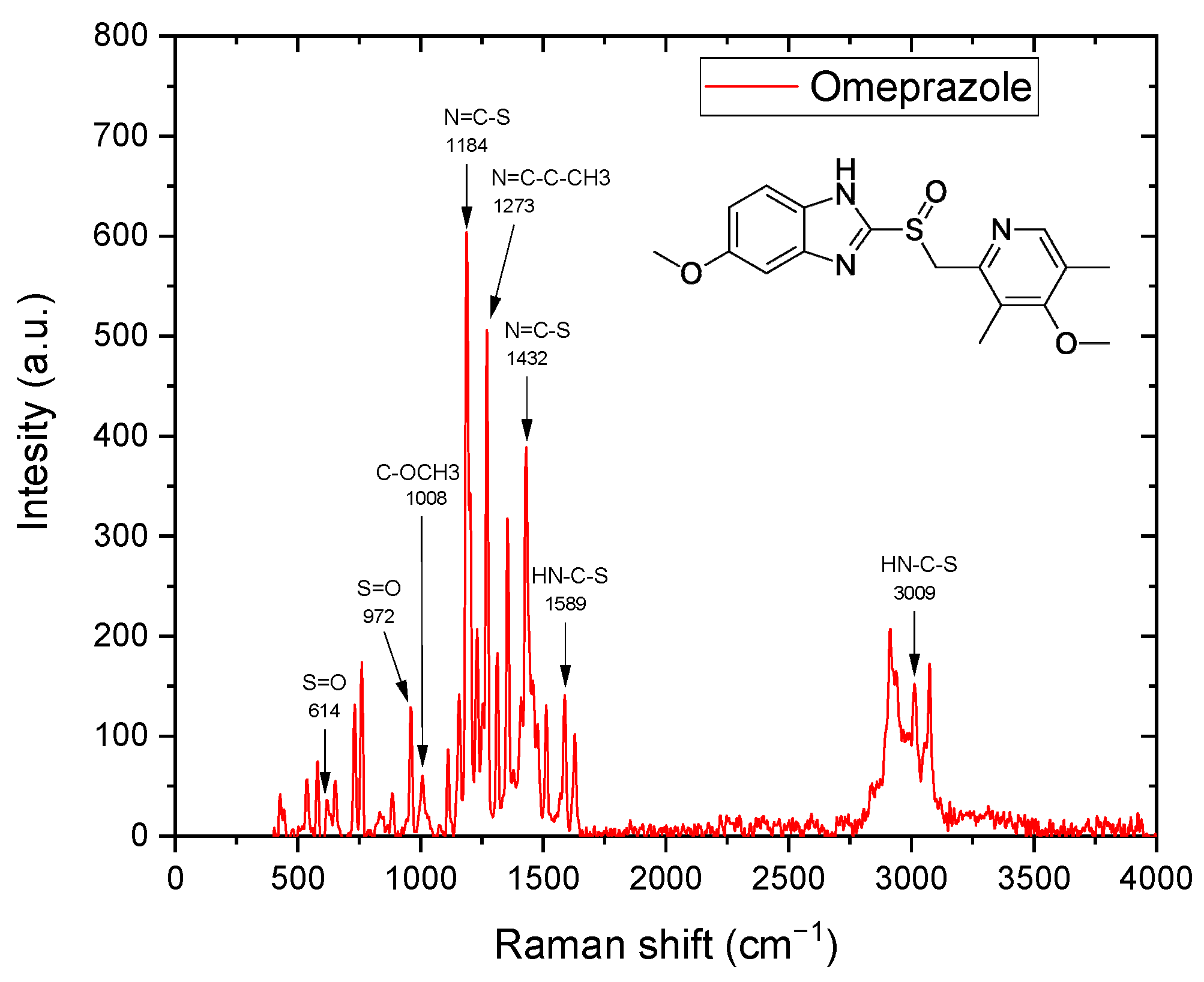
The Raman spectrum of expired omeprazole (Figure 2) was analyzed to identify the characteristic vibrational bands associated with the main functional groups present in the molecule. Bands observed around 3000 cm−1 were attributed to C–H stretching vibrations, while the signals between 1588 and 1629 cm−1 correspond to aromatic C=C and C=N stretching vibrations [80,81,82]. The band located at approximately 1432 cm−1 was associated with CH3 deformation vibrations, whereas the signal near 1273 cm−1 was assigned to C–N and C–S bonds [80,81,82]. Additionally, bands detected at 1009 and 978 cm−1 were related to S=O stretching vibrations characteristic of sulfoxide groups, while the peaks around 635 and 618 cm−1 correspond to C–S stretching vibrations [80,81,82].
The identified functional groups, particularly those containing nitrogen, sulfur, and oxygen heteroatoms, provide active sites with available electron pairs that can promote adsorption of the inhibitor onto the steel surface. This adsorption process facilitates the formation of a protective film that contributes to corrosion inhibition [80,81,82]. Slight variations in Raman shifts are attributed to differences in experimental conditions and literature sources.

3.3. Electrochemical Results

3.3.1. Electrochemical Noise (EN)

Current Noise Time Series
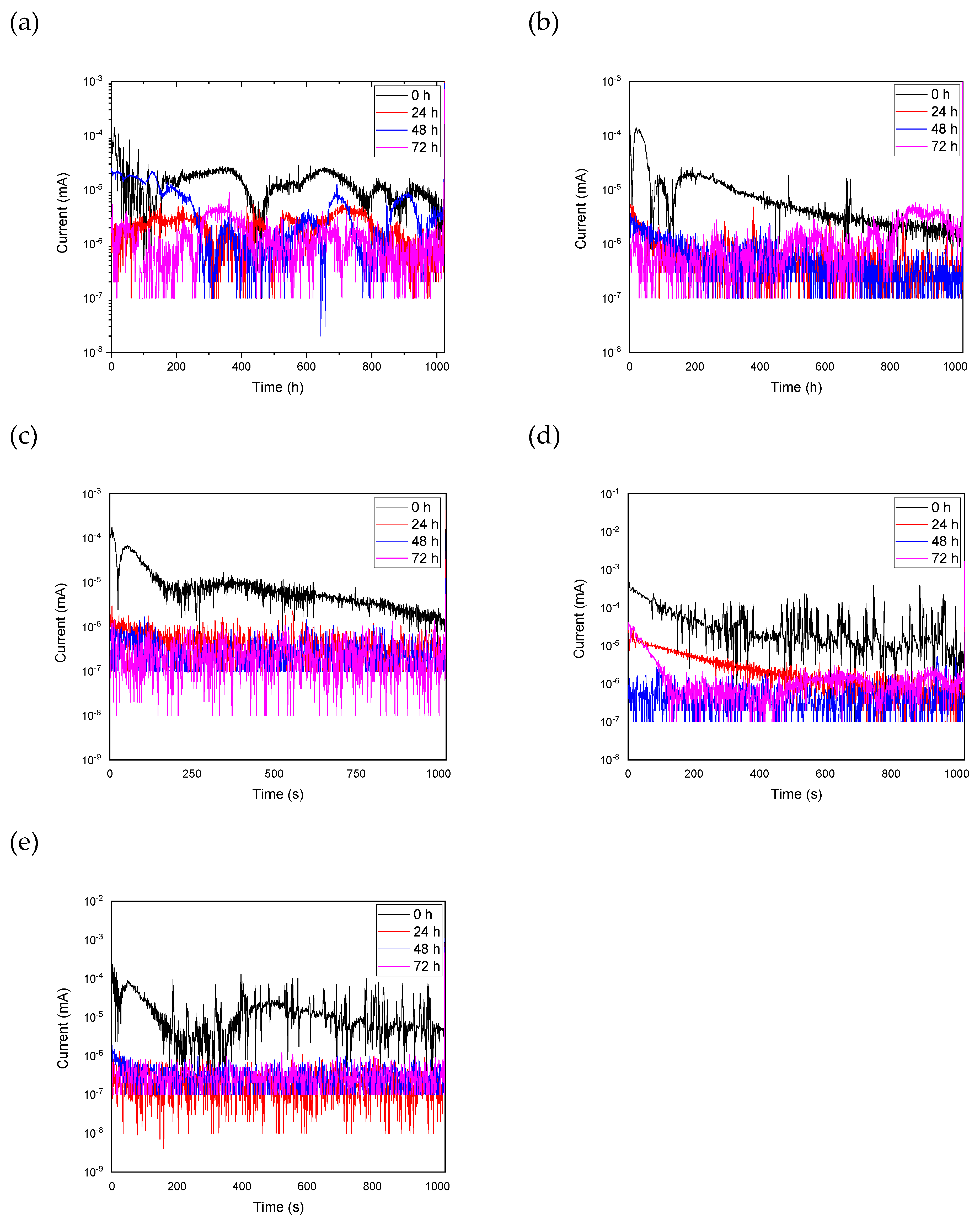
Figure 3 shows the behavior of AISI 1018 steel and material in the presence of an inhibitor at different concentrations evaluated in solution simulating atmospheric corrosion conditions over time. For condition (a), the material exhibits transients at low and middle amplitude. The number of transients decreases at middle amplitude, although pitting sites are still observed. In condition (b), fluctuations are observed to increase in intensity over time. Condition (c) shows a behavior similar to that of (b); however, at 72 h, higher-intensity noise signals are observed, likely associated with pitting through the inhibitor film. Nevertheless, a reduction in current density is also evident. Based on condition (d), the current density is higher at immersion, with current spikes appearing throughout time. At 24 h, the corrosion rate decreases along with the number of transients and pitting sites. At 48 h, the current density continues to decrease; however, the number and intensity of transients, as well as the extent of pitting, increase, likely due to deterioration of the corrosion product film. At 72 h, both the corrosion rate and the intensity of fluctuations decrease. In condition (e), the current density decreases, with current spikes present throughout the time. At 24 h, both the number and intensity of transients increase, whereas at 48 and 72 h they decrease. Overall, the current noise signals suggest the presence of both generalized and localized corrosion events. However, this qualitative observation does not allow a definitive classification. Based on the localization index (LI) and potential noise analysis, the corrosion mechanism is predominantly localized under all conditions [31,33,34,35].
Potential Noise Time Series
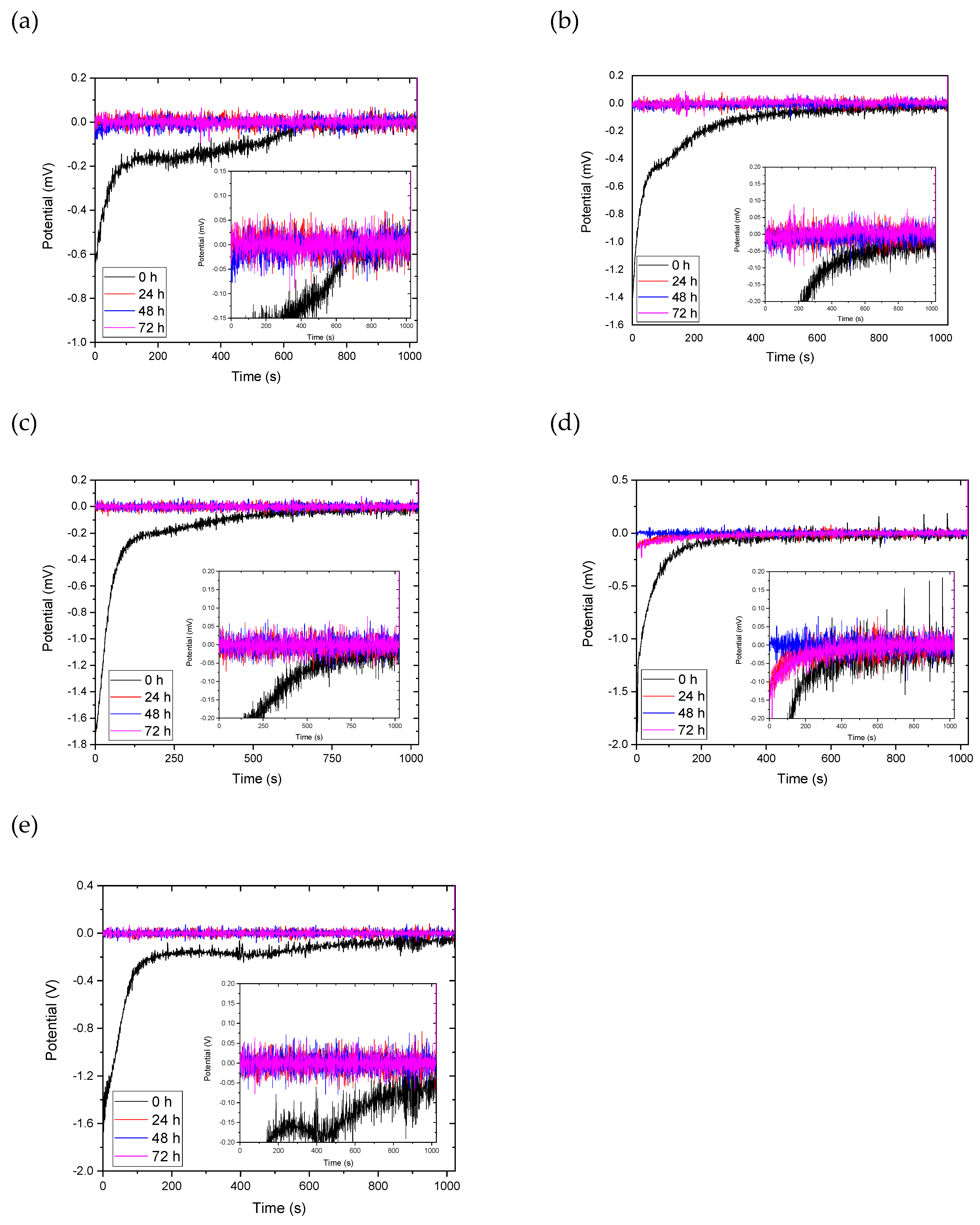
Figure 4 presents the potential noise time series of AISI 1018 steel in the absence and presence of a corrosion inhibitor at different concentrations evaluated in a solution simulating atmospheric corrosion conditions over time. In condition (a), the blank sample shows an initially active potential that stabilizes due to the formation of corrosion product. Over time, a shift toward more noble potentials and a reduction in transients indicate partial surface protection; however, an increase in transient intensity is observed at 72 h. In condition (b), the addition of an inhibitor initially shifts the potential to more active values. Nevertheless, it gradually shifts toward more noble values over time, accompanied by higher-intensity transients but fewer pitting sites. In condition (c) presents a behavior similar to (b), with an initially more active potential that becomes more noble over time. The presence of lower-intensity transients suggests a reduction in pitting activity due to the formation of a protective inhibitor film. In the case of (d), the potential again becomes more active at immersion and shifts toward more noble values with time. However, the increase in the number and intensity of transients indicates the development of localized corrosion, likely associated with deterioration of the protective film. Finally, condition (e) exhibits a response similar to that of (c). Overall, all conditions indicate localized corrosion [34,38,39].
Resistance vs. Time
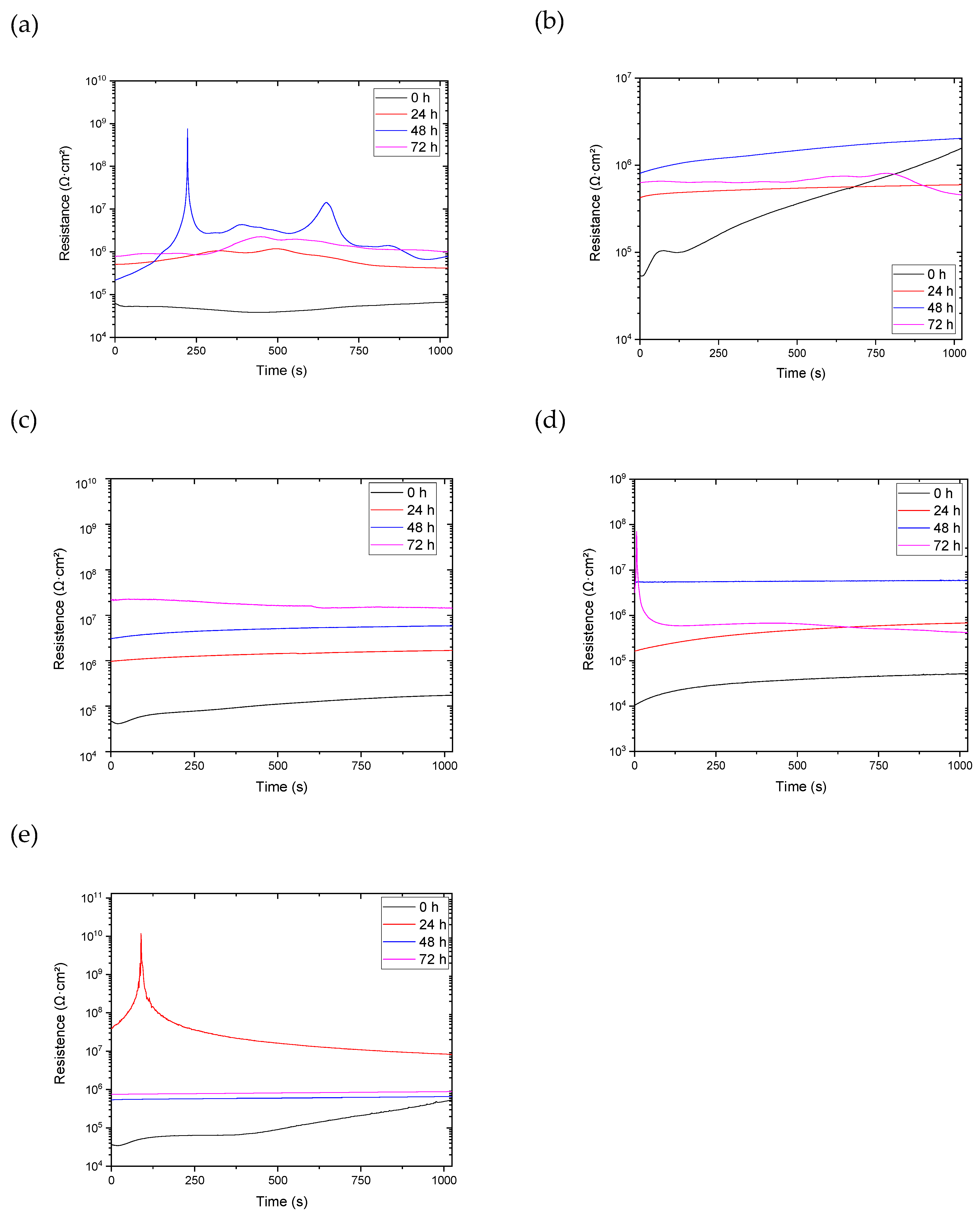
According to Figure 5, the evolution of resistance with immersion time allows the evaluation of the behavior of the material in the absence and presence of inhibitor at different concentrations in a 0.1 M Na2SO4 + 3 wt.% NaCl solution over 72 h. In the blank condition (a), the resistance increases up to 48 h, which suggests the formation of corrosion products; nevertheless, high-intensity transients are observed at 48 h, attributed to the dissolution of the products on the surface. However, as immersion time increases, the resistance decreases due to the dissolution of corrosion products. For condition (b), the resistance increases during the test, reaching a relatively constant value at 24 h. At 48 h, the resistance increases further, which may be associated with the formation of corrosion products that reduce the current density. At 72 h, a decrease in resistance is observed, which can be attributed to the dissolution or destabilization of the corrosion product layer. In condition (c), the resistance remains relatively constant during the test, with a gradual increase as the immersion time progresses, reaching its highest value at 72 h. Based on condition (d), the behavior is similar to that observed for condition (c). However, at 72 h, the resistance shows a high initial value followed by a decrease, after which it remains relatively constant. This behavior may be associated with the dissolution of corrosion products. Finally for condition (e), the resistance increases up to 24 h, which can be attributed to the formation of protective oxide layers on the surface. However, as immersion time increases, the resistance decreases, likely due to the dissolution of corrosion products [33,34,35,38].
Noise Impedance in the Frequency Domain
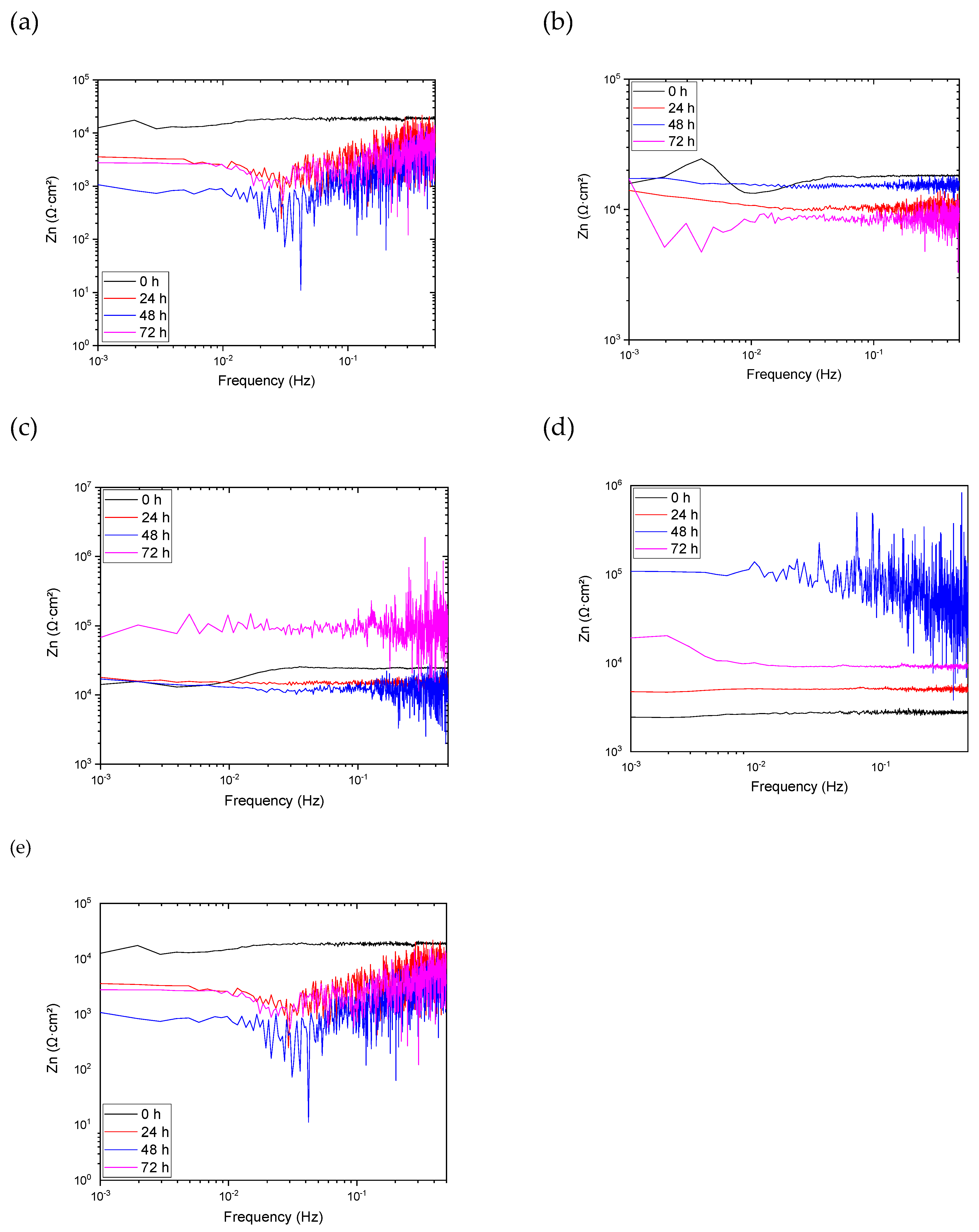
Figure 6 shows the noise impedance versus frequency behavior for the blank sample and material in the presence of different concentrations of omeprazole evaluated over 72 h in a 0.1 M Na2SO4 + 3% wt NaCl solution. The blank sample at the initial immersion shows that the noise impedance (Zn) remains relatively constant at the beginning of the test. However, fluctuations appear in the middle and high frequency regions, indicating the initiation of pitting corrosion. With increasing immersion time, a similar behavior is observed at 24, 48, and 72 h. For the sample with 25 ppm of inhibitor, fluctuations are initially observed, which decrease over time due to the adsorption of the inhibitor onto the metal surface. At 24 h, Zn remains relatively constant, although moderate fluctuations appear at high frequencies, possibly associated with pitting through the corrosion product film. At 48 and 72 h, the behavior is similar; however, the transients increase in intensity and Zn decreases at 72 h, suggesting deterioration of the protective layer and a reduction in charge transfer resistance. At 50 ppm, Zn remains stable at initial immersion, with a slight increase in the middle and high frequency regions. At 24 h, the response is similar, with small high frequency transients attributed to the onset of localized corrosion. At 48 h, the number and intensity of transients increase, indicating the progression of pitting. At 72 h, Zn reaches higher values, suggesting an increase in charge transfer resistance, although transients of moderate intensity persist, indicating localized attack. For 75 ppm, Zn remains relatively constant with small fluctuations at high frequencies, associated with the initiation of shallow pitting. At 24 and 48 h, Zn increases, indicating improved corrosion resistance; however, transients become more frequent and intense at middle and high frequencies. At 72 h, Zn decreases slightly but maintains relatively stable behavior. At 100 ppm, Zn remains constant at initial immersion, but decreases at 24 and 48 h, with high intensity transients appearing in the middle and high frequency regions. At 72 h, Zn increases again, showing a similar response pattern [35,39,73].
Noise Resistance vs. Time
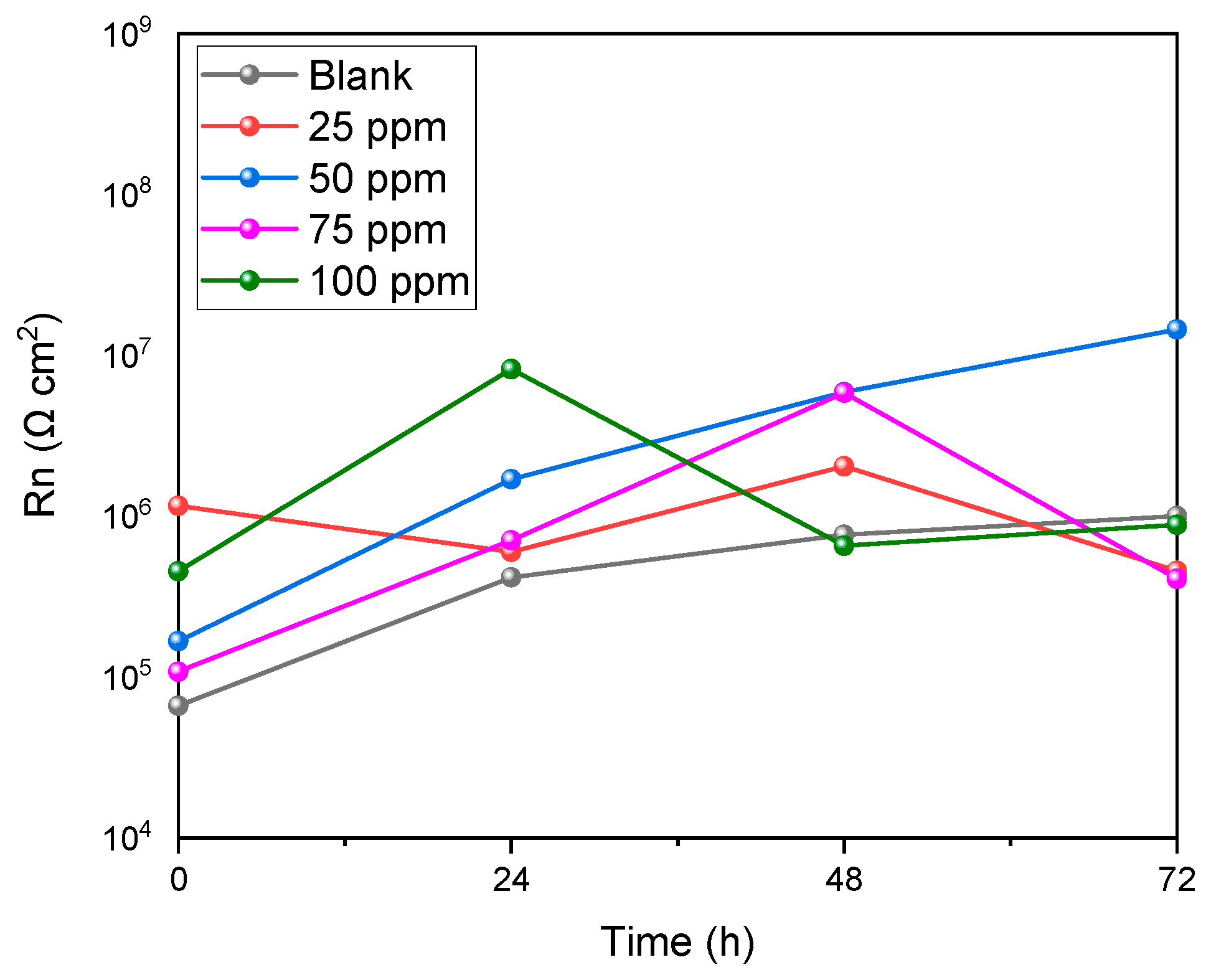
Figure 7 presents the evolution of electrochemical noise resistance (Rn) of AISI 1018 steel in the absence and presence of inhibitor at different concentrations over time. As is well known, the noise resistance is inversely proportional to the current density. The blank condition shows consistently low Rn values, confirming active corrosion. At 25 ppm, a slight decrease is observed up to 48 h, followed by fluctuations in the Rn values, indicating limited and unstable inhibition performance. At 50 ppm, Rn increases steadily with time, reaching the highest value at 72 h, suggesting the formation of a stable and protective film. In contrast, 75 and 100 ppm exhibit high Rn values at intermediate or early times but decrease significantly at longer exposure times, indicating reduced film stability. Overall, 50 ppm provides the most effective and sustained corrosion inhibition, while higher concentrations lead to less stable protective behavior over time [33,34,38].
Index of Localized vs. Time
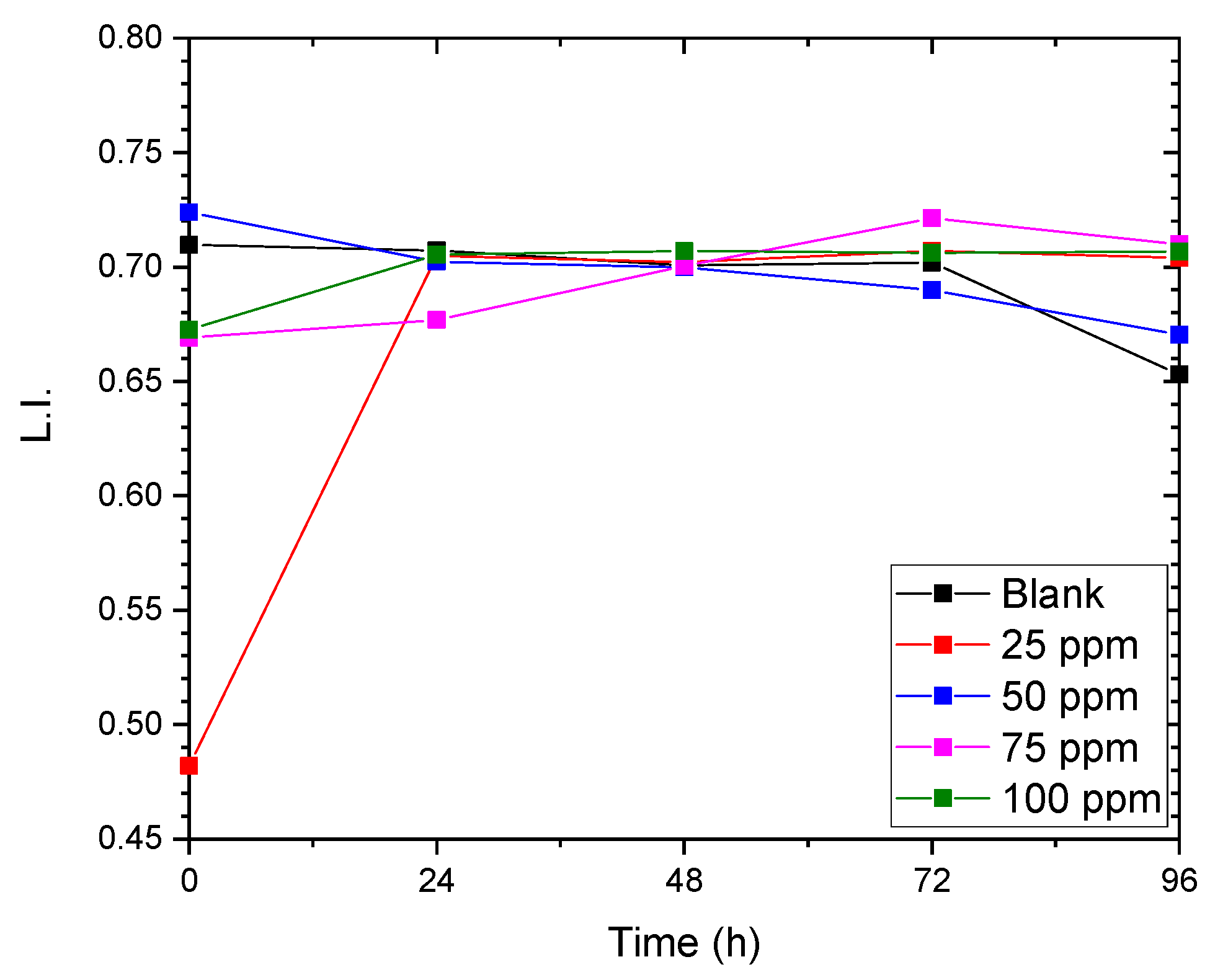
Figure 8 shows the localization index (LI) as a function of time for the blank and material in presence of different inhibitor concentrations evaluated in the 0.1 M Na2SO4 + 3% wt de NaCl solution. For the blank sample, the localization index increases with immersion time. As is well known, the localization index is inversely proportional to the current density; therefore, this behavior indicates a decrease in the corrosion rate. For 25 ppm and 100 ppm, the localization index decreases with immersion time up to 24 h and then remains relatively constant. In all cases, localized corrosion is observed. However, the behavior of the inhibited samples suggests that the addition of the inhibitor reduces the number of active sites, leading to a decrease in current density. After this stage, the system stabilizes, resulting in a nearly constant LI. In the case of 50 ppm and 75 ppm, the LI decreases progressively with immersion time, indicating a reduction in the corrosion rate. This behavior may be associated with the formation and growth of a protective corrosion product layer. The decrease in LI is attributed to the adsorption of the inhibitor onto the metal surface, which blocks active sites and consequently reduces the current density [34,38,39,71].
Inhibition Efficiency (η)
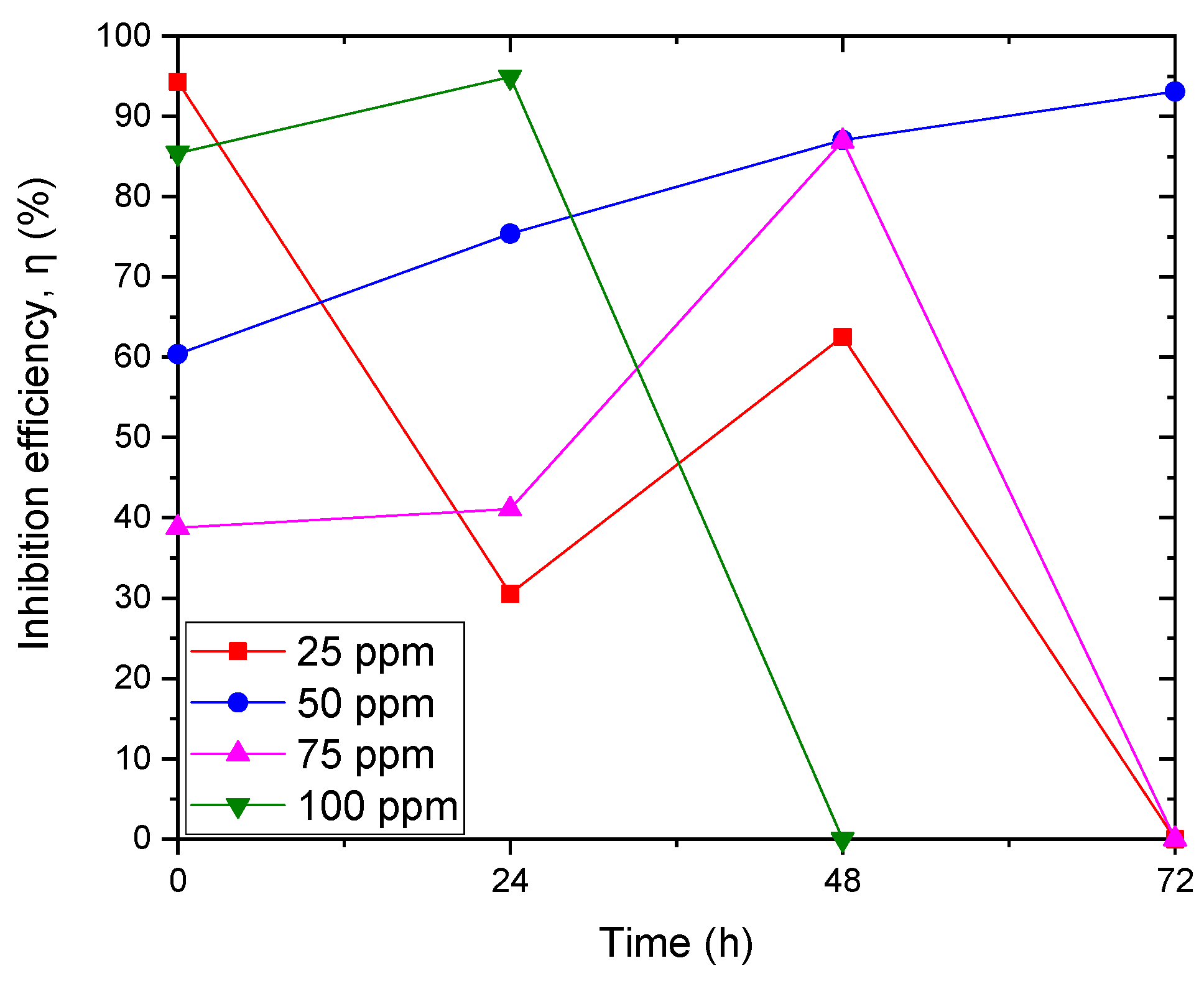
Figure 9 presents the evolution of inhibition efficiency (η) over time in the blank and material in the presence of different concentrations of the inhibitor in 0.1 M Na2SO4 + 3% wt de NaCl solution. The inhibition efficiency shows a strong dependence on both inhibitor concentration and exposure time. At 25 ppm, a high initial efficiency of 94.30% is observed at 0 h; however, this value decreases significantly after 24 h (30.55%), followed by a partial recovery at 48 h (62.55%), indicating an unstable adsorption behavior over time. In contrast, at 50 ppm, the efficiency increases progressively with immersion time, from 60.42% at 0 h to 93.10% at 72 h, suggesting the gradual formation of a more stable and protective adsorbed layer on the steel surface. A similar trend is observed for 75 ppm, where the efficiency improves from 38.80% at 0 h to 86.94% at 48 h, although slight fluctuations are observed at longer exposure times, indicating possible desorption or rearrangement of the inhibitor film. At 100 ppm, the inhibitor exhibits high efficiency from the early stages (85.44% at 0 h), reaching a maximum of 94.91% at 24 h, which suggests rapid adsorption and effective surface coverage. However, the absence of consistent efficiency values at longer exposure times may indicate instability or changes in the protective film. Overall, the results indicate that intermediate concentrations, particularly 50 ppm, provide a more stable and sustained inhibition performance over time, whereas lower and higher concentrations exhibit fluctuations that may be associated with competitive adsorption, desorption processes, or changes in the inhibitor film structure.
Table 3 summarizes the electrochemical noise parameters, including the standard deviation of potential (σv) and current (σi), noise resistance (Rn), inhibition efficiency (η), localization index (LI), and the corresponding type of corrosion.

3.4. Electrochemical Reactions

Electrochemical material behavior of AISI 1018 steel in 0.1 M Na2SO4 + 3%wt NaCl solution can be described by the following reactions [9,11,15,83]: Reaction (25) corresponds to the anodic dissolution of iron, while reactions (26) and (27) represent the cathodic reactions, namely oxygen reduction and hydrogen evolution, respectively. Under the evaluated conditions hydrogen evolution is considered negligible.
Fe Fe 2 + + 2 e
O 2 + 2 H 2 O + 4 e 4 O H
2 H 2 O + 2 e H 2 + 2 O H
The electrochemical reactions with NaCl are represented by reactions (28) and (29) corresponding to the formation of soluble complexes and acid hydrolysis inside the pits, respectively.
F e 2 + + 2 C l FeCl 2
FeCl 2 + 2 H 2 O F e ( O H ) 2 + 2 H C l
The electrochemical reactions involving sulfate ions are described by reactions (30)–(33), which correspond to the formation of ferrous sulfate, initial precipitation, oxidation, and transformation processes, respectively.
Fe 2 + + SO 4 2 F e S O 4
F e 2 + + 2 O H F e ( O H ) 2
4 F e ( O H ) 2 + O 2 4 F e O O H + 2 H 2 O
F e O O H F e 2 O 3 · x H 2 O

3.5. Scanning Electron Microscopy (SEM)

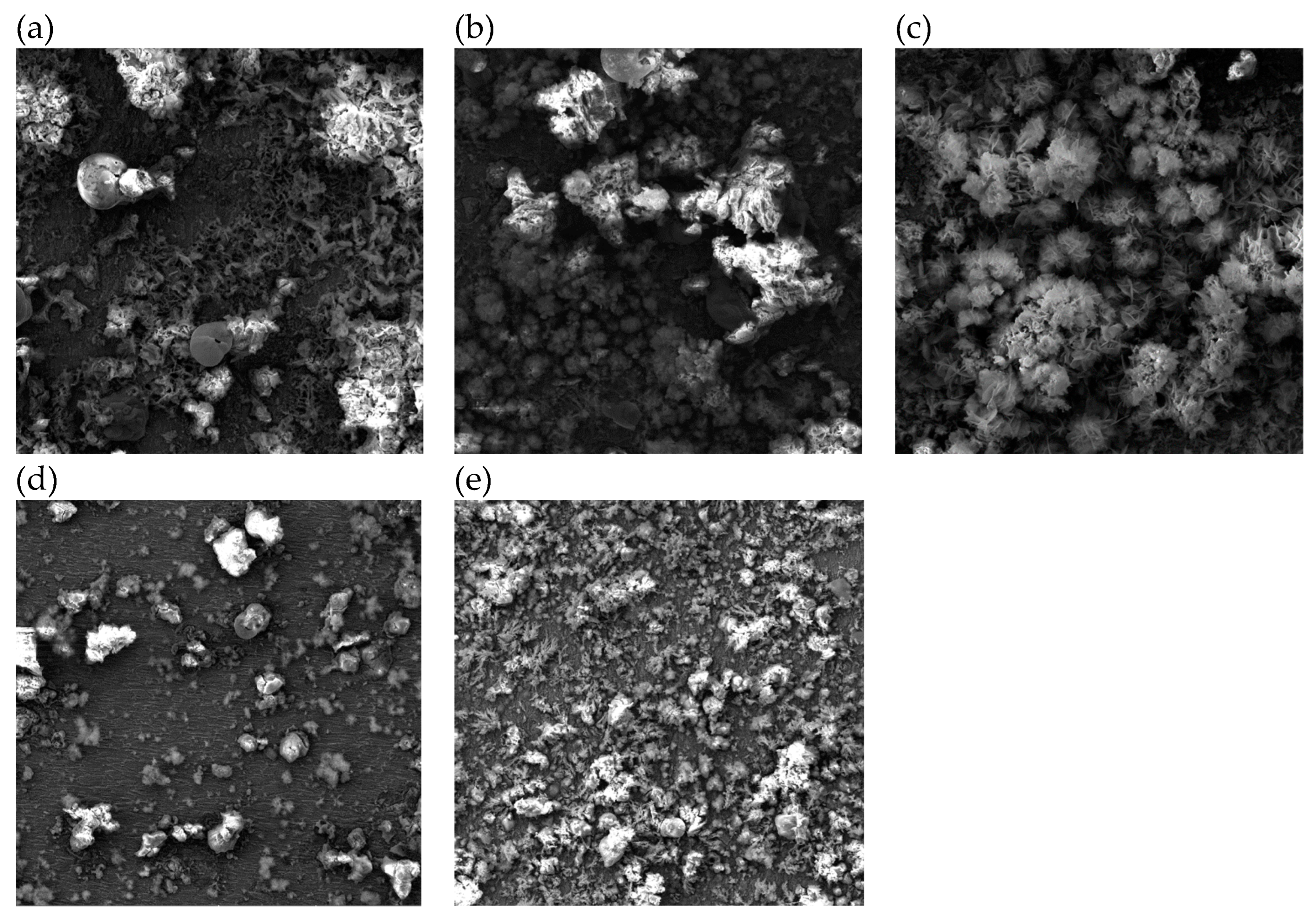
Figure 10 shows the morphology of the surfaces of AISI 1018 steel in the absence and presence of different concentrations of expired omeprazole after 72 h of exposure to 0.1 M Na2SO4 + 3%wt NaCl solution at a magnification of 500×. The SEM images reveal a clear evolution in surface morphology with increasing inhibitor concentration. The uninhibited sample (a) exhibits a rough and heterogeneous surface with porous and agglomerated corrosion products, indicating active corrosion and the formation of non-protective oxides. At 25 ppm (b), a slight increase in surface compactness is observed; however, the presence of irregular and porous regions suggests only partial protection. As the inhibitor concentration increases to 50 ppm (c), the surface becomes more compact and homogeneous, indicating the formation of a partially protective film. At 75 ppm (d), a significantly smoother and more uniform surface is observed, with fewer corrosion products, suggesting the formation of a more effective and continuous protective layer. At 100 ppm (e), the surface appears more heterogeneous again, with irregular agglomerates, indicating that excessive inhibitor concentration may lead to the formation of a less compact film. Overall, the SEM results indicate that 75 ppm provides improved surface coverage at the end of the exposure period. However, this observation corresponds only to the final stage (72 h) and does not necessarily reflect the long-term electrochemical stability of the inhibitor, as discussed in the electrochemical noise analysis [76,79].

3.6. Density Functional Theory Analysis

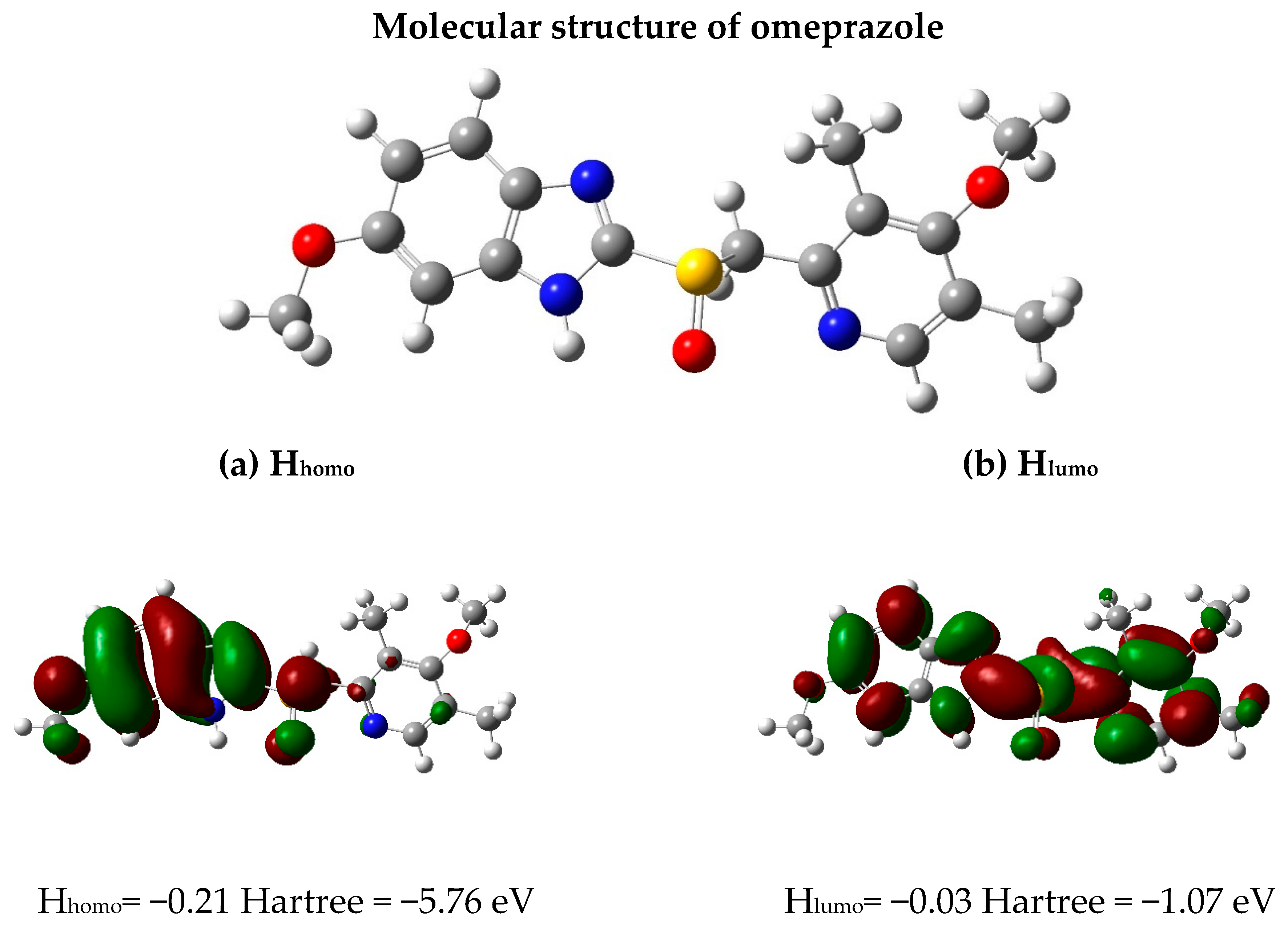
Figure 11 shows the optimized molecular structure of omeprazole along with its frontier molecular orbitals (HOMO and LUMO). The quantum chemical parameters calculated using Density Functional Theory (DFT) are also summarized in Table 4. The relatively high HOMO energy (−5.76 eV) indicates a strong electron-donating ability, facilitating adsorption onto the metal surface through interaction with vacant d-orbitals of iron. Additionally, the low LUMO energy (−1.07 eV) suggests a good capacity to accept electrons, allowing back-donation from the metal surface. The energy gap (ΔE = 4.69 eV) reflects moderate molecular reactivity, which is favorable for adsorption processes. Furthermore, the electronegativity value (χ = 3.42 eV) and chemical potential (μ = −3.42 eV) indicate a tendency of the molecule to interact with the metal surface, while the relatively low chemical hardness (η = 2.34 eV) and high softness (σ = 0.42 eV−1) suggest enhanced reactivity and adsorption capability. The positive fraction of electron transfer (ΔN = 0.29) confirms that electron donation from the inhibitor to the metal surface is thermodynamically favorable.
In addition, the electrophilicity index (ω = 2.49) and dipole moment (3.30 Debye) indicate that the molecule possesses adequate polarity and charge distribution to promote strong interaction with the metal surface. These results suggest that omeprazole can effectively adsorb onto the steel surface, forming a protective layer that reduces corrosion [41,42,43,44,45,46,47,48,49,50,51,52,53].
Overall, the DFT results are in good agreement with the experimental findings, confirming the strong adsorption capability of omeprazole on the steel surface. The combined effect of high electron-donating ability, moderate energy gap, and favorable electron transfer supports the formation of a stable protective film. These theoretical insights reinforce the proposed inhibition mechanism and validate the use of expired omeprazole as an efficient corrosion inhibitor.

3.7. Proposed Inhibition Mechanism

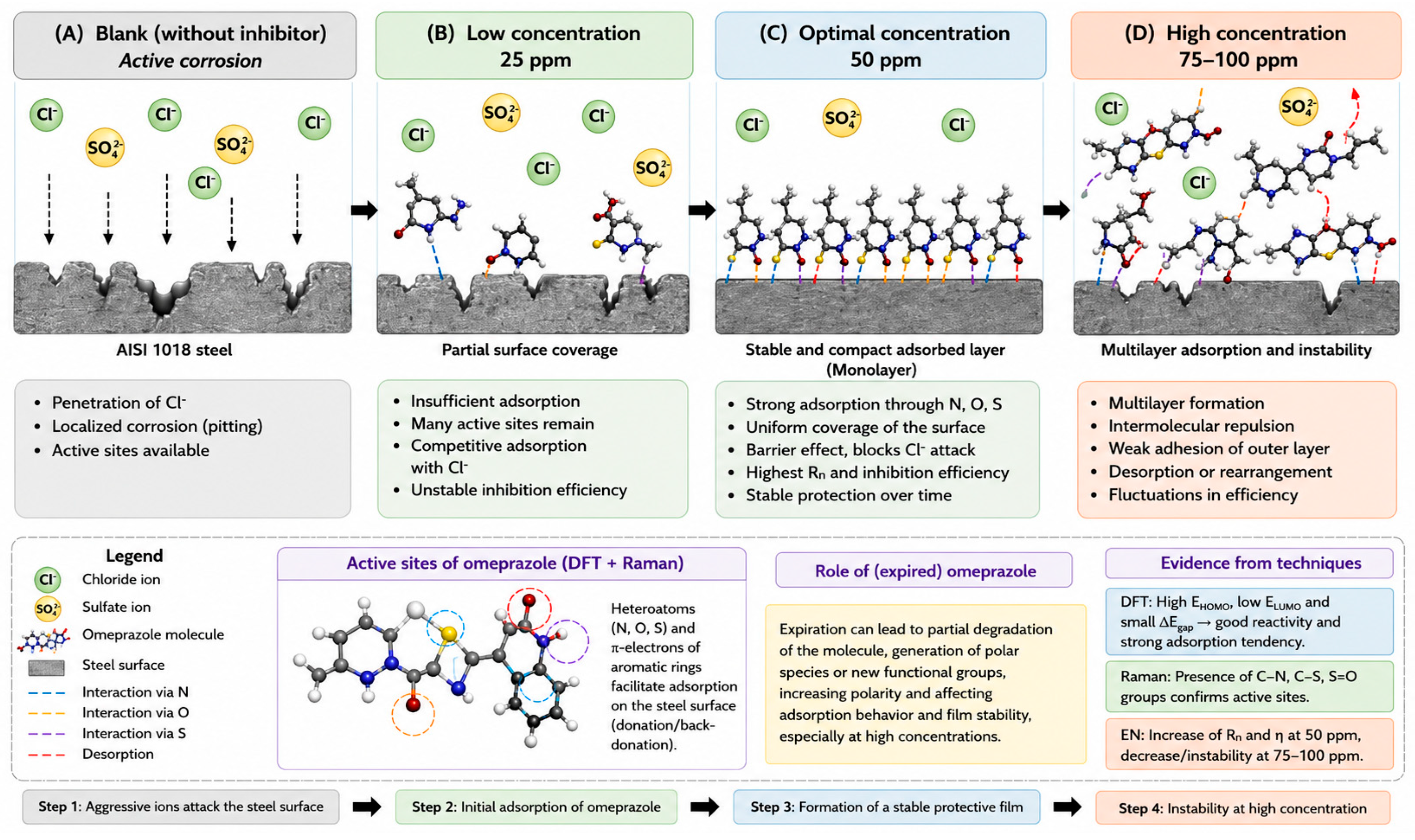
A schematic representation of the inhibition mechanism of expired omeprazole on AISI 1018 steel in the 0.1 M Na2SO4 + 3 wt.% NaCl solution is proposed based on the combined analysis of electrochemical noise (EN), Raman spectroscopy, and Density Functional Theory (DFT) results (Figure 12). The proposed mechanism integrates structural (Raman), electronic (DFT), and electrochemical (EN) evidence to explain both the inhibition efficiency and its stability as a function of inhibitor concentration.
The inhibition behavior of omeprazole is mainly attributed to its molecular structure, which contains heteroatoms such as nitrogen, oxygen, and sulfur, as well as aromatic rings. According to the DFT results, the presence of these heteroatoms and the distribution of the frontier molecular orbitals (HOMO and LUMO) suggest that the molecule has a strong tendency to interact with the metal surface through electron donation and back-donation mechanisms [46,48,49]. These interactions promote adsorption of the inhibitor onto the steel surface, forming a protective layer [42,44]. Raman spectroscopy confirms the presence of functional groups associated with C–N, C–S, and S=O bonds, which are consistent with the active adsorption centers predicted by DFT [80,82]. These groups facilitate the interaction between the inhibitor molecules and the metal surface, supporting the formation of an adsorbed film that reduces active corrosion sites. The DFT results are consistent with the experimental findings, as the electron-donating ability and charge distribution of omeprazole favor its adsorption onto the steel surface, supporting the formation of a protective film observed in SEM and the increase in noise resistance (Rn).
The electrochemical noise results further support this mechanism. The increase in noise resistance (Rn) and inhibition efficiency (η), particularly at intermediate concentrations, indicates the formation of a protective barrier that limits charge transfer and reduces corrosion activity. Additionally, the localization index (LI) values indicate that corrosion remains predominantly localized; however, its intensity is significantly reduced in the presence of the inhibitor [34,38,75].
At low inhibitor concentration (25 ppm), the adsorption of omeprazole is insufficient to fully cover the metal surface, leading to partial protection and unstable behavior over time. This is consistent with the observed fluctuations in inhibition efficiency, which can be attributed to competitive adsorption between inhibitor molecules and aggressive ions such as Cl [24,25]. At an intermediate concentration (50 ppm), a more uniform and stable adsorbed layer is formed, resulting in higher and more consistent inhibition efficiency. This suggests the formation of a compact monolayer that effectively blocks active sites on the steel surface, minimizing corrosion processes.
In contrast, at higher concentrations (75–100 ppm), although high inhibition efficiency is initially observed, the protective film becomes less stable over time. This behavior is attributed to the formation of multilayer adsorption and increased intermolecular interactions, which reduce film compactness and adhesion to the metal surface [25,44,51]. As a consequence, partial desorption or molecular rearrangement occurs over time, leading to decreased stability of the protective film.
The use of expired omeprazole plays a significant role in the inhibition mechanism. Partial degradation of the drug can modify its molecular structure, polarity, and availability of active adsorption sites, directly affecting adsorption behavior and contributing to the reduced stability of the inhibitor film, particularly at higher concentrations [57,58,59].
Overall, the inhibition mechanism can be described as an adsorption-controlled process, where omeprazole molecules interact with the steel surface through heteroatoms and π-electrons, forming a protective film. The effectiveness and stability of this film depend strongly on the inhibitor concentration, with intermediate concentrations providing the most favorable conditions for corrosion protection.
The schematic model (Figure 12) illustrates (i) adsorption through heteroatoms and π-electrons, (ii) the formation of a compact and stable monolayer at optimal concentration (50 ppm), and (iii) the development of less stable multilayer structures at higher concentrations (75–100 ppm).

4. Conclusions

  • Noise impedance analysis indicates that at 75 ppm there is an increase in charge transfer resistance and a reduction in high-frequency transients, suggesting effective surface coverage by the inhibitor film at specific exposure times.
  • Based on electrochemical noise resistance (Rn), 50 ppm provides the highest and most stable values over time, indicating sustained corrosion protection and lower current density.
  • The localization index (LI) decreases in the presence of the inhibitor, particularly at 50 and 75 ppm, confirming a reduction in corrosion activity, although localized corrosion remains predominant in all cases.
  • SEM observations show that 75 ppm produces a more homogeneous surface after 72 h, suggesting effective surface coverage at the final stage of exposure.
  • Overall, considering both stability and inhibition efficiency, 50 ppm is identified as the optimal concentration.
  • DFT results confirm that omeprazole possesses suitable electronic properties for corrosion inhibition, including electron-donating ability, moderate reactivity, and favorable charge distribution, which promote adsorption onto the AISI 1018 steel surface and the formation of a protective layer.
  • From an environmental perspective, the use of expired omeprazole represents a promising and sustainable alternative, promoting the reutilization of pharmaceutical waste and reducing reliance on conventional toxic inhibitors.
  • The evaluated system simulates a marine–industrial atmospheric environment, suggesting potential applications in corrosion protection of carbon steel. However, further studies are required to assess long-term stability and validate the results using complementary electrochemical techniques.

Author Contributions

Conceptualization, O.A.G.N., L.M.A.M. and J.U.C.; methodology, O.A.G.N. and E.C.M.C.; software, O.A.G.N., A.F.N., L.M.A.M. and C.A.G.P.; validation, O.A.G.N., J.U.C., E.C.M.C., C.A.G.P., S.L.A. and M.Y.D.C.; formal analysis, O.A.G.N., A.F.N., M.Y.D.C., S., S.L.A. and J.U.C.; investigation, O.A.G.N. and E.C.M.C.; resources, J.U.C. and E.C.M.C.; data curation, O.A.G.N., A.F.N., S.L.A. and L.M.A.M.; writing—original draft preparation, O.A.G.N.; writing—review and editing, O.A.G.N., A.F.N., L.M.A.M., C.A.G.P., M.Y.D.C. and S.L.A.; visualization, O.A.G.N.; supervision, J.U.C. and E.C.M.C.; project administration, O.A.G.N., J.U.C. and E.C.M.C.; funding acquisition, O.A.G.N., J.U.C., E.C.M.C. and M.Y.D.C. All authors have read and agreed to the published version of the manuscript.

Funding

This research received no external funding.

Institutional Review Board Statement

Not applicable.

Informed Consent Statement

Not applicable.

Data Availability Statement

The original contributions presented in the study are included in the article; further inquiries can be directed to the corresponding author.

Acknowledgments

The authors gratefully acknowledge Bernardo Campillo Illanes and Rafael Ivan Puente Lee for their support with the chemical characterization of this project.

Conflicts of Interest

The authors declare no conflicts of interest.

References

  1. ISO 9223:2012; Corrosion of Metals and Alloys—Corrosivity of Atmospheres—Classification, Determination and Estimation. International Organization for Standardization: Geneva, Switzerland, 2012.
  2. ISO 12944-1:2017; Paints and Varnishes—Corrosion Protection of Steel Structures by Protective Paint Systems—Part 1: General Introduction. International Organization for Standardization: Geneva, Switzerland, 2017.
  3. ASTM A588/A588M-24; Standard Specification for High-Strength Low-Alloy Structural Steel, up to 50 ksi [345 MPa] Minimum Yield Point, with Atmospheric Corrosion Resistance. ASTM International: West Conshohocken, PA, USA, 2024.
  4. ASTM A847/A847M-23; Standard Specification for Cold-Formed Welded and Seamless High-Strength, Low-Alloy Structural tubing with Improved Atmospheric Corrosion Resistance. ASTM International: West Conshohocken, PA, USA, 2023.
  5. ASTM B117-26; Standard Practice for Operating Salt Spray (Fog) Apparatus. ASTM International: West Conshohocken, PA, USA, 2026.
  6. Silva, T.A.R.; Marques, A.C.; dos Santos, R.G.; Shakoor, R.A.; Taryba, M.; Montemor, M.F. Development of biopolyurethane coatings from biomass-derived alkylphenol polyols—A green alternative. Polymers 2023, 15, 2561. [Google Scholar] [CrossRef] [PubMed]
  7. Muñoz Ledo, R.; Uruchurtu Chavarín, J. Caracterización de la agresividad atmosférica sobre los materiales metálicos estructurales en la Zona Metropolitana de la Ciudad de México. Rev. Int. De Contam. Ambient. 2002, 18, 27–32. Available online: https://www.redalyc.org/articulo.oa?id=37018103 (accessed on 8 May 2026).
  8. Fu, G.Q.; Liang, L.D.; Jing, M.; Liang, G.X.; Yong, Z.M. Synergistic effect of sulfur dioxide and chloride on the corrosion of 3.55 wt% Ni weathering steel. Mater. Res. Express 2020, 7, 116503. [Google Scholar] [CrossRef]
  9. Chico, B.; de la Fuente, D.; Díaz, I.; Simancas, J.; Morcillo, M. Annual atmospheric corrosion of carbon steel worldwide: An integration of ISOCORRAG, IPN/UNECE and MICAT database. Materials 2017, 10, 601. [Google Scholar] [CrossRef]
  10. Avila Ayón, V.; Rodríguez Quesada, A.L.; Lías Rodríguez, Y. Influencia de los parámetros medioambientales en la corrosión de elementos estructurales metálicos. Cienc. Holguín 2005, 11, 1–11. [Google Scholar]
  11. Morcillo, M.; Díaz, I.; Cano, H.; Chico, B.; de la Fuente, D. Atmospheric corrosion of weathering steels: Overview for engineers. Part I: Basic concepts. Constr. Build. Mater. 2019, 213, 723–737. [Google Scholar] [CrossRef]
  12. Flores Nicolás, A.; Menchaca Campos, E.C.; Flores Nicolás, M.; Martínez González, J.J.; González Noriega, O.A.; Uruchurtu Chavarín, J. Influence of recycled high-density polyethylene fibers on the mechanical and electrochemical properties of reinforced concrete. Fibers 2024, 12, 24. [Google Scholar] [CrossRef]
  13. Farro, N.W.; Veleva, L.; Aguilar, P. Copper marine corrosion: I. Corrosion rates in atmospheric and seawater environments of Peruvian port. Open Corros. J. 2009, 2, 114–122. [Google Scholar] [CrossRef]
  14. Alcántara, J.; de la Fuente, D.; Chico, B.; Simancas, J.; Díaz, I.; Morcillo, M. Marine atmospheric corrosion of carbon steel: A review. Materials 2017, 10, 406. [Google Scholar] [CrossRef]
  15. Cai, Y.; Zhao, Y.; Ma, X.; Zhou, K.; Chen, Y. Influence of environmental factors on atmospheric corrosion in dynamic environments. Corros. Sci. 2018, 137, 163–175. [Google Scholar] [CrossRef]
  16. Maria, C.; Maria, E.; Raúl, G.; Nancy, E. Corrosividad atmosférica del cobre y del acero en dos localidades de Villahermosa, Tabasco. Ing. Investig. Tecnol. 2015, 16, 197–206. [Google Scholar] [CrossRef]
  17. Gladkikh, N.; Makarychev, Y.; Petrunin, M.; Maleeva, M.; Maksaeva, L.; Marshakov, A. Synergistic effect of silanes and azole for enhanced corrosion protection of carbon steel by polymeric coatings. Prog. Org. Coat. 2020, 138, 105386. [Google Scholar] [CrossRef]
  18. Jamali, S.S.; Mills, D.J. A critical review of electrochemical noise measurement as a tool for evaluation of organic coatings. Prog. Org. Coat. 2016, 95, 26–37. [Google Scholar] [CrossRef]
  19. Li, X.; Cao, G.; Guo, M.; Peng, Y.; Ma, K.; Wang, Z. Initial corrosion behavior of carbon steel Q235, pipeline steel L415, and pressure vessel steel 16MnNi under high humidity and high irradiation coastal-industrial atmosphere in Zhanjiang. Acta Metall. Sin. (Engl. Lett.) 2023, 59, 884–892. [Google Scholar] [CrossRef]
  20. Thandar, W.; Win, Y.Y.K.; Khaing, T.; Suzuki, Y.; Sugiura, K.; Nishizaki, I. Investigation of initial atmospheric corrosion of carbon and weathering steels exposed to urban atmospheres in Myanmar. Int. J. Corros. 2022, 2022, 4301767. [Google Scholar] [CrossRef]
  21. Benali, O.; Zebida, M.; Maschke, U. Synthesis and corrosion inhibition effect of two thiazole derivatives for carbon steel in 1 M HCl. J. Indian Chem. Soc. 2021, 98, 100113. [Google Scholar] [CrossRef]
  22. Schweitzer, P.A. Corrosion Technology; Taylor & Francis: Oxfordshire, UK, 2006. [Google Scholar]
  23. Berdimurodov, E.; Kholikov, A.; Akbarov, K.; Obot, I.B.; Guo, L. Thioglycoluril derivative as a new and effective corrosion inhibitor for low carbon steel in a 1 M HCl medium: Experimental and theoretical investigation. J. Mol. Struct. 2021, 1234, 130165. [Google Scholar] [CrossRef]
  24. Kooliyat, R.; Kakkassery, J.T.; Raphael, V.P.; Cheruvathur, S.V.; Paulson, B.M. Synthesis, cyclic voltammetric, electrochemical, and gravimetric corrosion inhibition investigations of Schiff base derived from 5,5-dimethyl-1,3-cyclohexanedione and 2-aminophenol on mild steel in 1 M HCl and 0.5 M H2SO4. Int. J. Electrochem. 2019, 2019, 1094148. [Google Scholar] [CrossRef]
  25. Refait, P.; Grolleau, A.-M.; Jeannin, M.; Rémazeilles, C.; Sabot, R. Corrosion of carbon steel in marine environments: Role of the corrosion product layer. Corros. Mater. Degrad. 2020, 1, 198–218. [Google Scholar] [CrossRef]
  26. Tamalmani, K.; Husin, H. Review on corrosion inhibitors for oil and gas corrosion issues. Appl. Sci. 2020, 10, 3389. [Google Scholar] [CrossRef]
  27. Sánchez-Salazar, E.; Vázquez-Vélez, E.; Uruchurtu, J.; Porcayo-Calderón, J.; Casales, M. Use of a gemini-surfactant synthesized from mango seed oil as a CO2-corrosion inhibitor for X-120 steel. Materials 2021, 14, 4206. [Google Scholar] [CrossRef] [PubMed]
  28. Benea, L.; Simionescu, N.; Mardare, L. The effect of polymeric protective layers and the immersion time on the corrosion behavior of naval steel in natural seawater. J. Mater. Res. Technol. 2020, 9, 13174–13184. [Google Scholar] [CrossRef]
  29. Zheng, D.; Gui, Q.; Xu, Y.; Song, G.-L. Modified AC–DC–AC method for evaluation of corrosion damage of acrylic varnish paint coating/Q215 steel system. Prog. Org. Coat. 2021, 159, 106401. [Google Scholar] [CrossRef]
  30. Lesly, T.; Pedro, M.; Edgar, A.; Maria, B. Plant extracts used as corrosion inhibitors. Inf. Técnico 2014, 72, 155–164. [Google Scholar]
  31. Li, L.; Qiao, Y.; Zhang, L.; Ma, A.; Ma, R.; Zheng, Y. Understanding the corrosion behavior of nickel–aluminum bronze induced by cavitation corrosion using electrochemical noise: Selective phase corrosion and uniform corrosion. Materials 2023, 16, 669. [Google Scholar] [CrossRef]
  32. Ghanbari, A.; Shahrabi, T.; Ramezanzadeh, B. Using of asymmetric cell to monitor corrosion performance of 304 austenitic stainless steel by electrochemical noise method. J. Mater. Res. Technol. 2022, 21, 3232–3246. [Google Scholar] [CrossRef]
  33. Zhang, Y.; Liu, H.; Wang, P.; Liu, Q.; Wang, X. Effect of loading conditions on corrosion fatigue process of FSW AA6061-T6 joint in 3.5% NaCl studied by electrochemical noise. J. Mater. Res. Technol. 2023, 24, 9808–9823. [Google Scholar] [CrossRef]
  34. Lv, J.; Yue, Q.-X.; Ding, R.; Wang, X.; Gui, T.-J.; Zhao, X.-D. The application of electrochemical noise for the study of metal corrosion and organic anticorrosion coatings: A review. ChemElectroChem 2021, 8, 337–351. [Google Scholar] [CrossRef]
  35. Lara-Banda, M.; Almeraya-Calderón, F.; Jáquez-Muñoz, J.M.; Nieves-Mendoza, D.; Baltazar-Zamora, M.A.; Olguín-Coca, J.; Estupiñan-Lopez, F.; Cabral Miramontes, J.; Santiago-Hurtado, G.; Gaona-Tiburcio, C. A study of the corrosion behavior of AHSS complex-phase CP 780 employing an electrochemical noise technique analyzed by different methods. Metals 2025, 15, 59. [Google Scholar] [CrossRef]
  36. Permeh, S.; Lau, K.; Duncan, M.; Simmons, R. Identification of steel corrosion in alkaline sulfate solution by electrochemical noise. Mater. Corros. 2021, 72, 1456–1467. [Google Scholar] [CrossRef]
  37. Tres, G.; Arriaga, R.; Malo, J.M.; Uruchurtu, J. Monitoreo por ruido electroquímico de la corrosión del acero en una atmósfera contaminada. Rev. Int. Contam. Ambient. 2001, 17, 171–178. Available online: http://www.redalyc.org/articulo.oa?id=37017401 (accessed on 8 May 2026).
  38. Obot, I.B.; Onyeachu, I.B.; Zeino, A.; Umoren, S.A. Electrochemical noise (EN) technique: Review of recent practical applications to corrosion electrochemistry research. J. Adhes. Sci. Technol. 2019, 33, 1453–1496. [Google Scholar] [CrossRef]
  39. Jáquez-Muñoz, J.M.; Gaona-Tiburcio, C.; Cabral-Miramontes, J.; Nieves-Mendoza, D.; Maldonado-Bandala, E.; Olguín-Coca, J.; Estupiñán-López, F.; López-León, L.D.; Chacón-Nava, J.; Almeraya-Calderón, F. Frequency analysis of transients in electrochemical noise of superalloys Waspaloy and Ultimet. Metals 2021, 11, 702. [Google Scholar] [CrossRef]
  40. Jáquez Muñoz, J.M.; Gaona Tiburcio, C.; Cabral Miramontes, J.; Nieves Mendoza, D.; Maldonado Bandala, E.; Olguín Coca, J.; López Léon, L.D.; Flores De los Ríos, J.P.; Almeraya Calderón, F. Electrochemical noise analysis of the corrosion of titanium alloys in NaCl and H2SO4 solutions. Metals 2021, 11, 105. [Google Scholar] [CrossRef]
  41. Espinoza Vázquez, A.; Rodríguez Gómez, F.J.; Martínez Cruz, I.K.; Ángeles Beltrán, D.; Negrón Silva, G.E.; Palomar Pardavé, M.; Lomas Romero, L.; Pérez Martínez, D.; Navarrete López, A.M. Adsorption and corrosion inhibition behaviour of new theophylline–triazole based derivatives for steel in acidic medium. R. Soc. Open Sci. 2019, 6, 181738. [Google Scholar] [CrossRef]
  42. Fakhry, H.; El Faydy, M.; Benhiba, F.; Laabaissi, T.; Bouassiria, M.; Allali, M. A newly synthesized quinoline derivative as corrosion inhibitor for mild steel in molar acid medium: Characterization (SEM/EDS), experimental and theoretical approach. Colloids Surf. A Physicochem. Eng. Asp. 2021, 610, 125746. [Google Scholar] [CrossRef]
  43. Beltrán-Pérez, C.; Serrano, A.A.A.; Solís-Rosas, G.; Martínez-Jiménez, A.; Orozco-Cruz, R.; Espinoza-Vázquez, A.; Miralrio, A. A general use QSAR-ARX model to predict the corrosion inhibition efficiency of drugs in terms of quantum mechanical descriptors and experimental comparison for lidocaine. Int. J. Mol. Sci. 2022, 23, 5086. [Google Scholar] [CrossRef] [PubMed]
  44. Ouakki, M.; Galai, M.; Benzekri, Z.; Arribou, Z.; Ech-Chihbi, E.; Guo, L.; Dahmani, K.; Nouneh, K.; Briche, S. A detailed investigation on the corrosion inhibition effect of by newly synthesized pyran derivative on mild steel in 1.0 M HCl: Experimental, surface morphological (SEM-EDS, DRX & AFM) and computational analysis (DFT & MD simulation). J. Mol. Liq. 2021, 344, 117777. [Google Scholar] [CrossRef]
  45. Espinoza-Vázquez, A.; Figueroa, I.A.; Rodríguez-Gómez, F.J.; Pérez-Vásquez, A.; Mata, R.; Ángeles Beltrán, D.; Miralrio, A.; Castro, M. (−)-Epicatechin gallate as a corrosion inhibitor for bronze in a saline medium and theoretical study. J. Mol. Struct. 2021, 1227, 129416. [Google Scholar] [CrossRef]
  46. Alaoui Mrani, S.; Ech-Chihbi, E.; Arrousse, N.; Rais, Z.; El Hajjaji, F.; El Abiad, C.; Radi, S.; Mabrouki, J.; Taleb, M.; Jodeh, S. DFT and electrochemical investigations on the corrosion inhibition of mild steel by novel Schiff’s base derivatives in 1 M HCl solution. Arab. J. Sci. Eng. 2021, 46, 5691–5707. [Google Scholar] [CrossRef]
  47. Kaya, S.; Tüzün, B.; Kaya, C.; Obot, I.B. Determination of corrosion inhibition effects of amino acids: Quantum chemical and molecular dynamic simulation study. J. Taiwan Inst. Chem. Eng. 2016, 58, 528–535. [Google Scholar] [CrossRef]
  48. Verma, D.K. Density Functional Theory (DFT) as a Powerful Tool for Designing Corrosion Inhibitors in Aqueous Phase; IntechOpen: London, UK, 2018. [Google Scholar] [CrossRef]
  49. Obot, I.B.; Macdonald, D.D.; Gasem, Z.M. Density functional theory (DFT) as a powerful tool for designing new organic corrosion inhibitors: Part 1: An overview. Corros. Sci. 2015, 99, 1–30. [Google Scholar] [CrossRef]
  50. Danaee, I.; Nikparsa, P.; Khosravi-Nikou, M.R.; Eskandari, H.; Nikmanesh, S. Density functional theory and electrochemical noise analysis of corrosion inhibition behavior of N,N′-bis(1-(3,5-dihydroxyphenyl)ethylidene)propane-1,3-diamine on steel in HCl solution. Prot. Met. Phys. Chem. Surf. 2019, 55, 986–1000. [Google Scholar] [CrossRef]
  51. Benhiba, F.; Benzekri, Z.; Guenbour, A.; Tabyaoui, M.; Bellaouchou, A.; Boukhris, S.; Oudda, H.; Warad, I.; Zarrouk, A. Combined electronic/atomic level computational, surface (SEM/EDS), chemical and electrochemical studies of the mild steel surface by quinoxalines derivatives anti-corrosion properties in 1 mol·L−1 HCl solution. Chin. J. Chem. Eng. 2020, 28, 1436–1458. [Google Scholar] [CrossRef]
  52. Obot, I.B.; Obi Egbedi, N.O.; Umoren, S.A. Antifungal drugs as corrosion inhibitors for aluminium in 0.1 M HCl. Corros. Sci. 2009, 51, 1868–1875. [Google Scholar] [CrossRef]
  53. Obot, I.B.; Obi Egbedi, N.O. Adsorption properties and inhibition of mild steel corrosion in sulphuric acid solution by ketoconazole: Experimental and theoretical investigation. Corros. Sci. 2010, 52, 198–204. [Google Scholar] [CrossRef]
  54. El Hamdouni, Y.; Bouhlal, F.; Kouri, H.; Chellouli, M.; Benmessaoud, M.; Dahrouch, A.; Labjar, N.; El Hajjaji, S. Use of omeprazole as inhibitor for C38 steel corrosion in 1.0 M H3PO4 medium. J. Fail. Anal. Prev. 2020, 20, 563–571. [Google Scholar] [CrossRef]
  55. Hossam, K.; Bouhlal, F.; Hermouche, L.; Merimi, I.; Labjar, N.; Chaouiki, A.; Serghini-Idrissi, M.; Dahrouch, A.; Chellouli, M.; Hammouti, B.; et al. Understanding corrosion inhibition of C38 steel in HCl media by omeprazole: Insights for experimental and computational studies. J. Fail. Anal. Prev. 2021, 21, 213–227. [Google Scholar] [CrossRef]
  56. Liu, Y.; Wang, Z.; Chen, X.; Zhang, Z.; Wang, B.; Li, H.-J.; Wu, Y.-C. Synthesis and evaluation of omeprazole-based derivatives as eco-friendly corrosion inhibitors for Q235 steel in hydrochloric acid. J. Environ. Chem. Eng. 2022, 10, 108674. [Google Scholar] [CrossRef]
  57. Tsygankova, L.E.; Bryksina, V.A.; Uryadnikov, A.A.; Abramov, A.E. Protective efficiency of expired drug against acid corrosion of carbon steel. Int. J. Corros. Scale Inhib. 2022, 11, 564–576. [Google Scholar] [CrossRef]
  58. Vaszilcsin, N.; Kellenberger, A.; Dan, M.L.; Duca, D.A.; Ordodi, V.L. Efficiency of Expired Drugs Used as Corrosion Inhibitors: A Review. Materials 2023, 16, 5555. [Google Scholar] [CrossRef]
  59. Baari, M.J.; Sabandar, C.W. A review on expired drug-based corrosion inhibitors: Chemical composition, structural effects, inhibition mechanism, current challenges, and future prospects. Indones. J. Chem. 2021, 21, 1316–1336. [Google Scholar] [CrossRef]
  60. Bustos, V.; Concha, L.; Menchaca-Campos, C.; Uruchurtu, J.; Romero, M.A.; Esparza, M.; Covelo, A.; Hernández, M.; Sarmiento, E. Eco-friendly recycled pharmaceutical inhibitor/waste particle containing hybrid coatings for corrosion protection. In Biobased and Environmentally Benign Coatings; Tiwari, A., Galanis, A., Soucek, M.D., Eds.; Wiley: Hoboken, NJ, USA, 2016; pp. 245–256. [Google Scholar]
  61. Al Badr, A.A. Omeprazole: Comprehensive profile. In Profiles of Drug Substances, Excipients and Related Methodology; Brittain, H.G., Ed.; Elsevier: Amsterdam, The Netherlands, 2010; Volume 35, pp. 151–262. [Google Scholar]
  62. STAT RX USA LLC. PRILOSEC® (Omeprazole) Delayed Release Capsules: Description [Etiqueta del Producto]. U.S. Food and Drug Administration. Available online: https://www.accessdata.fda.gov/drugsatfda_docs/label/2006/019810s083lbl.pdf (accessed on 8 May 2026).
  63. Gul, W.; Sajid, S.; Hamid, F.; Bhatti, S. Effect of acidic pH and heat on the degradation of omeprazole and esomeprazole. Pharma Innov. J. 2015, 4, 19–21. [Google Scholar]
  64. Rivai, H.; Hasanah, R.; Azizah, Z. Development and validation of omeprazole analysis methods in capsules with absorbance methods and areas under curves methods with UV Vis spectrophotometry. Technol. Innov. Pharm. Res. 2021, 3, 35–47. [Google Scholar] [CrossRef]
  65. Chaudhari, S.S.; Phalak, S.D. Development and validation of UV spectrophotometric method for simultaneous equation of aspirin and omeprazole in tablet dosage form. Pharm. Anal. Acta 2020, 11, 618. [Google Scholar] [CrossRef]
  66. Espinosa Bosch, M.; Ruiz Sánchez, A.J.; Sánchez Rojas, F.; Bosch Ojeda, C. Analytical methodologies for the determination of omeprazole: An overview. J. Pharm. Biomed. Anal. 2007, 44, 831–844. [Google Scholar] [CrossRef]
  67. Patta, S.; Afreen, S.; Tappa, S.; Nagarajan, C.; GnanaPrakash, K. Simultaneous estimation of aspirin and omeprazole (YOSPRALA) in bulk by UV spectroscopy. J. Drug Deliv. Ther. 2017, 7, 87–91. [Google Scholar] [CrossRef][Green Version]
  68. Karljikovic-Rajic, K.; Novovic, D.; Marinkovic, V.; Agbaba, D. First order UV derivative spectrophotometry in the analysis of omeprazole and pantoprazole sodium salt and corresponding impurities. J. Pharm. Biomed. Anal. 2003, 32, 1019–1027. [Google Scholar] [CrossRef] [PubMed]
  69. ASTM G199 09(2020)e1; Standard Guide for Electrochemical Noise Measurement. ASTM International: West Conshohocken, PA, USA, 2020. [CrossRef]
  70. Aballe, A.; Bethencourt, M.; Botana, F.J.; Marcos, M. Using wavelets transform in the analysis of electrochemical noise data. Electrochim. Acta 1999, 44, 4805–4816. [Google Scholar] [CrossRef]
  71. Ritter, S.; Huet, F.; Cottis, R.A. Guideline for an assessment of electrochemical noise measurement devices. Mater. Corros. 2012, 63, 297–302. [Google Scholar] [CrossRef]
  72. Arman, S.Y.; Naderi, R.; Pouryosefi Markhali, B. Effect of DC trend removal and window functioning methods on correlation between electrochemical noise parameters and EIS data of stainless steel in an inhibited acidic solution. RSC Adv. 2014, 4, 39045–39057. [Google Scholar] [CrossRef]
  73. Barrozo, S.; Peres, R.N.; Witzler, M.J.; Benedetti, A.V.; Fugivara, C.S. Electrochemical noise analysis to obtain the Rsn value via FFT using Excel. Eclét. Quím. 2020, 45, 57–70. [Google Scholar] [CrossRef]
  74. Lee, C.C.; Mansfeld, F. Analysis of electrochemical noise data for a passive system in the frequency domain. Corros. Sci. 1998, 40, 959–962. [Google Scholar] [CrossRef]
  75. Jáquez-Muñoz, J.M.; Gaona-Tiburcio, C.; Méndez-Ramírez, C.T.; Martínez-Ramos, C.; Baltazar-Zamora, M.A.; Santiago-Hurtado, G.; Estupiñán-López, F.; Landa-Ruiz, L.; Nieves-Mendoza, D.; Almeraya-Calderón, F. Electrochemical noise analysis: An approach to the effectivity of each method in different materials. Materials 2024, 17, 4013. [Google Scholar] [CrossRef]
  76. Danaee, I.; Nikparsa, P. Electrochemical frequency modulation, electrochemical noise, and atomic force microscopy studies on corrosion inhibition behavior of benzothiazolone for steel API X100 in 10% HCl solution. J. Mater. Eng. Perform. 2019, 28, 5088–5103. [Google Scholar] [CrossRef]
  77. PourghasemiHanza, A.; HosseinpourRokni, M.; Naderi, R.; Kowsari, E.; Mousavi, M. An imidazole-based benzilic-dicationic ionic liquid performance in 1.0 M HCl solution to mitigate the mild steel degradation: Electrochemical noise/impedance investigation. J. Mol. Liq. 2021, 336, 116320. [Google Scholar] [CrossRef]
  78. Shridhar; Janapareddy, P.K.; Kumar, G.B.V.; Sahu, S.K.; El-Rayyes, A.; Giri, J.; Singh, B. Mechanical properties and residual stresses in multi pass AISI 304 to AISI 1018 steel welds by SMAW and GTAW. Sci. Rep. 2025, 15, 27052. [Google Scholar] [CrossRef]
  79. Ahmed, M.M.Z.; Jouini, N.; Alzahrani, B.; Seleman, M.M.E.-S.; Jhaheen, M. Dissimilar friction stir welding of AA2024 and AISI 1018: Microstructure and mechanical properties. Metals 2021, 11, 330. [Google Scholar] [CrossRef]
  80. Vrbanec, T.; Šket, P.; Merzel, F.; Smrkolj, M.; Grdadolnik, J. Spectroscopic characterization of omeprazole and its salts. J. Spectrosc. 2017, 2017, 6505706. [Google Scholar] [CrossRef]
  81. Šahnić, D.; Meštrović, E.; Jednačak, T.; Habinovec, I.; Parlov Vuković, J.; Novak, P. Monitoring and Quantification of Omeprazole Synthesis Reaction by In-Line Raman Spectroscopy and Characterization of the Reaction Components. Org. Process Res. Dev. 2016, 20, 2092–2099. [Google Scholar] [CrossRef]
  82. Bellia, G.F.; Gil-Ramírez, G.; Baron, M.G.; Croxton, R.; Gonzalez-Rodriguez, J. Analysis of omeprazole and esomeprazole obtained from traditional pharmacies and unlicensed internet websites using Raman spectroscopy, 1H-NMR and chemometric analysis. Vib. Spectrosc. 2020, 106, 102996. [Google Scholar] [CrossRef]
  83. Lin, C.; Liu, Z.; Wang, X.; Zhang, Y. Electrochemical corrosion behaviour of four low-carbon steels in saline soil. RSC Adv. 2022, 12, 25289–25299. [Google Scholar] [CrossRef] [PubMed]
Figure 1. Spectrum EDS of AISI 1018 steel.
Metals 16 00552 g001
Figure 2. Raman spectrum of expired drug omeprazole.
Metals 16 00552 g002
Figure 3. Series of noise in current vs. time of AISI 1018 steel and material with inhibitor at different concentrations evaluated on the solution 0.1 M Na2SO4 + 3% wt NaCl through the 72 h. (a) blank, (b) 25 ppm, (c) 50 ppm, (d) 75 ppm, and (e) 100 ppm.
Metals 16 00552 g003
Figure 4. Serie of noise in potential vs. time of AISI 1018 steel and material with inhibitor at different concentrations evaluated on the solution 0.1 M Na2SO4 + 3% wt NaCl through the 72 h. (a) blank, (b) 25 ppm, (c) 50 ppm, (d) 75 ppm, and (e) 100 ppm.
Metals 16 00552 g004
Figure 5. Series of resistance vs. time of AISI 1018 steel and material with inhibitor at different concentrations evaluated on the solution 0.1 M Na2SO4 + 3% wt NaCl through the 72 h. (a) blank, (b) 25 ppm, (c) 50 ppm, (d) 75 ppm, and (e) 100 ppm.
Metals 16 00552 g005
Figure 6. Impedance of noise vs. frequency of AISI 1018 steel and material with inhibitor at different concentrations evaluated on the solution 0.1 M Na2SO4 + 3% wt NaCl through the 72 h. (a) blank, (b) 25 ppm, (c) 50 ppm, (d) 75 ppm and (e) 100 ppm.
Metals 16 00552 g006
Figure 7. Diagram of noise resistance versus time, of the AISI 1018 steel and material with inhibitor at different concentrations evaluated in the 0.1 M Na2SO4 + 3% wt NaCl solution over time.
Metals 16 00552 g007
Figure 8. Diagram of the localization index versus time, of the blank and material using inhibitor at different concentrations evaluated in the 0.1 M Na2SO4 + 3% wt NaCl solution over time.
Metals 16 00552 g008
Figure 9. Inhibition efficiency (η) as a function of immersion time for different concentrations of omeprazole.
Metals 16 00552 g009
Figure 10. Morphology of surface with 500× after electrochemical impedance spectroscopy during 72 h. (a) blank, (b) 25 ppm, (c) 50 ppm, (d) 75 ppm, (e) 100 ppm.
Metals 16 00552 g010
Figure 11. Optimized molecular structure of omeprazole and its frontier molecular orbitals obtained from DFT calculations: (a) highest occupied molecular orbital (HOMO) and (b) lowest unoccupied molecular orbital (LUMO).
Metals 16 00552 g011
Figure 12. Mechanism of inhibition proposed for expired omeprazole on AISI 1018 steel in 0.1 M Na2SO4 + 3%wt NaCl solution.
Metals 16 00552 g012
Table 1. Chemical composition of the simulated solution used in this work, based on literature data [58,60].
ComponentsConcentration (g/L)
NaCl30.00
Na2SO414.20
Table 2. Corrosion type classification according to the localization index [38,39].
ValuesCorrosion Type
>1Initiation of pitting
0.1–1Localized corrosion
0.01–0.1Mixed corrosion
0.001–0.01Generalized Corrosion or Passivation State
Table 3. Values obtained from the electrochemical noise of steel 1018 evaluated in 0.1 M Na2SO4 + 3%wt NaCl solution at different concentrations of inhibitor based on expired drug omeprazole.
MaterialTime
(h)
σv
(mV)
σi
(mA)
Rn
(Ω·cm2)
ηLIType of Corrosion
Blank0 h4.48 × 1026.78 × 10−36.61 × 10⁴-0.70Localized corrosion
24 h4.94 × 1021.19 × 10−34.16 × 10⁵-0.70
48 h5.15 × 1026.74 × 10−47.64 × 10⁵-0.70
72 h5.15 × 1025.13 × 10−41.00 × 10⁶-0.70
25 ppm0 h4.81 × 1024.15 × 10−41.16 × 10694.300.48Localized corrosion
24 h5.22 × 1028.72 × 10−45.99 × 10530.550.70
48 h5.30 × 1022.59 × 10−42.04 × 10662.550.70
72 h5.13 × 1021.12 × 10−34.57 × 10⁵-0.70
50 ppm0 h4.62 × 1022.77 × 10−31.67 × 10560.420.72Localized corrosion
24 h5.19 × 1023.06 × 10−41.69 × 10675.380.70
48 h5.29 × 1028.97 × 10−55.90 × 10687.050.70
72 h5.21 × 1023.60 × 10−51.45 × 10793.100.69
75 ppm0 h4.67 × 1024.33 × 10−31.08 × 10538.800.67Localized corrosion
24 h5.10 × 1027.22 × 10−47.06 × 10541.080.67
48 h5.26 × 1028.99 × 10−55.85 × 10686.940.70
72 h4.95 × 1021.21 × 10−34.08 × 10⁵-0.72
100 ppm0 h4.69 × 1021.03 × 10−34.54 × 10585.440.67Localized corrosion
24 h5.18 × 1026.33 × 10−58.18 × 10694.910.70
48 h5.08 × 1027.78 × 10−46.53 × 10⁵-0.70
72 h5.05 × 1025.73 × 10−48.81 × 10⁵-0.70
Table 4. Results obtained from electronic configuration calculations DFT of the inhibitor based on expired drug omeprazole.
InhibitorEHOMO (eV)ELUMO (eV)ΔE
(eV)
A (eV)I
(eV)
η
(eV)
χ
(eV)
σ
(eV−1)
µ (eV)ωΔNµ
(D)
Omeprazole−5.76−1.074.691.075.762.343.420.42−3.422.490.293.30
Disclaimer/Publisher’s Note: The statements, opinions and data contained in all publications are solely those of the individual author(s) and contributor(s) and not of MDPI and/or the editor(s). MDPI and/or the editor(s) disclaim responsibility for any injury to people or property resulting from any ideas, methods, instructions or products referred to in the content.