


Abstract
Metal additive manufacturing (AM) has progressed from prototyping toward industrial deployment, yet adoption remains uneven because many initiatives are still driven by isolated process demonstrations rather than system-level manufacturing strategy. This framework review proposes a gated decision workflow for integrating metal AM into industrial systems by coupling process-family selection and route definition, Design for Additive Manufacturing (DfAM) and sustainability considerations. The paper consolidates a comparative matrix of six metal AM process families for early down-selection, introduces a minimal evidence checklist linking each decision gate to required artifacts, and contextualizes the workflow through representative part archetypes. The framework is further supported by practical guidance on process-specific DfAM constraints, including support strategy, residual stress, and surface integrity in powder bed fusion; shrinkage-driven design in sinter-based routes; and machining allowances in repair and hybrid manufacturing. Rather than positioning metal AM as a universal substitute for conventional manufacturing, this work defines it as a complementary, strategy-dependent enabler whose sustainability benefits depend on system-level integration and application context.
1. Introduction
Additive Manufacturing (AM) has fundamentally altered how components can be designed and fabricated, particularly in applications where geometric complexity, functional integration, and material efficiency are critical [1,2,3]. Among AM technologies, metal AM has attracted sustained attention due to its ability to produce high-performance components for the aerospace, automotive, energy, and biomedical sectors [4,5]. Despite significant advances in process control, material development, and qualification, the industrial integration of metal AM has remained uneven. Many organizations continue to treat AM as experimental or auxiliary technology rather than embedding it into established manufacturing and product development strategies [5,6,7,8].
This disconnect has limited the realization of AM’s broader value. Metal AM is frequently evaluated in isolation, based on build quality, density, or mechanical performance, without sufficient consideration of design paradigms, post-processing requirements, sustainability impacts, or organizational readiness. As a result, promising technical demonstrations often fail to translate into robust industrial implementation [9,10,11].
Metal AM should not be framed as a replacement for subtractive or formative manufacturing processes. Instead, it represents a distinct production paradigm characterized by digital workflows, geometric freedom, and localized material placement [12,13]. When integrated strategically, metal AM can reduce material waste, enable part consolidation, shorten supply chains, and support more flexible production models. These benefits, however, are contingent upon early-stage design decisions, informed technology selection, and an understanding of lifecycle impacts [14,15,16]
Design for Additive Manufacturing (DfAM) is a central enabler of this transition. DfAM extends beyond geometric accommodation to encompass functional integration, load-path-driven design, and manufacturability constraints specific to each AM process. Without DfAM, AM parts often replicate legacy geometries, forfeiting potential gains in performance and sustainability [17,18,19,20,21]. Nevertheless, DfAM adoption remains inconsistent in industrial practice, frequently constrained by organizational inertia, skill gaps, and uncertainty about return on investment [22,23].
In parallel, metal AM is increasingly associated with sustainability and circular economic objectives. Reduced buy-to-fly ratios, digital inventories, and localized production are frequently cited advantages [24,25,26]. At the same time, challenges such as high energy consumption, powder management, and extensive post-processing complicate sustainability assessments. Consequently, the environmental performance of metal AM cannot be assumed a priori; it depends on how, where, and why the technology is applied [26,27,28].
This paper addresses the persistent gap between the technical potential of metal AM and its strategic industrial deployment. Rather than introducing new process variants or material datasets, the contribution lies in a structured, decision-oriented synthesis that integrates AM process capabilities, DfAM principles, and sustainability considerations into a coherent decision framework [5,7,8,29]. The objective is to support engineers, manufacturers, and policymakers in determining when, why, and how to deploy metal AM to generate durable industrial and societal value. Prior studies have already proposed AM selection and decision-support approaches focused on production economics, process-time and cost estimation, and broader mapping of AM application spaces [30,31,32]. For example, earlier work examined the economic viability of layer-manufacturing routes for production use, the production-volume conditions under which metal AM becomes competitive for end-use parts, approximate build-time and cost models for early AM process selection, and broader categorizations of AM products and services [1,33,34,35]. However, these approaches have generally emphasized isolated decision dimensions rather than an integrated, gate-based logic that explicitly links process-family down-selection, DfAM, qualification-aware route definition, and screening-level sustainability considerations for industrial metal AM deployment. Accordingly, the contribution of the present work is not merely the proposal of another AM framework, but the integration of previously fragmented decision dimensions into a single workflow for strategic metal AM adoption. This article adopts a decision-oriented framework review approach rather than a systematic literature review or meta-analysis. Its aim is not to exhaustively catalogue the metal AM literature, but to synthesize decision-relevant knowledge into a structured workflow that reflects how industrial AM adoption decisions are made in practice. Literature is therefore intentionally selected, filtered, and organized to support capability mapping, risk identification, and stage-gated decision-making, rather than bibliometric completeness or statistical aggregation. The synthesis draws on peer-reviewed, Scopus-indexed sources covering metal AM process families, DfAM methods, and sustainability considerations, complemented by comparative process analysis and the authors’ industrial and research experience. This approach consolidates fragmented knowledge into an integrated framework (Section 5) that explicitly links technology selection, design strategy, manufacturing route definition, and lifecycle screening—dimensions that are frequently treated independently in existing reviews. Rigor in this contribution is therefore grounded in the transparency of the review logic, the traceability between decision gates and required evidence, and the alignment of the proposed workflow with recurring industrial decision processes. Source selection is guided by relevance to process capability characterization, DfAM constraints, sustainability trade-offs, and qualification considerations that materially influence industrial decision-making in metal AM [36,37].
The novelty of this work does not lie in redefining individual metal AM process families, which are already extensively reviewed in the literature. Instead, its contribution lies in synthesizing these established knowledge domains into a decision-oriented framework that links functional intent, DfAM maturity, process-family capability, manufacturing-route definition, lifecycle screening, and organizational implementation readiness through explicit gates. Existing AM selection, DfAM, lifecycle, qualification, and implementation studies typically address these dimensions separately. The proposed framework integrates them into a common decision logic in which each gate requires defined evidence, exposes dominant risk drivers, and produces traceable gate-exit artifacts. In this sense, the manuscript contributes a structured adoption framework rather than a new process taxonomy or a universal scoring algorithm.
2. Metal AM Process Families: Capabilities, Constraints, and Strategic Positioning
Metal AM encompasses a family of processes that fabricate components layer by layer using fundamentally different mechanisms. These processes vary widely in resolution, productivity, achievable material properties, and economic characteristics. As a result, no single metal AM technology is universally optimal. Strategic integration requires understanding these differences in relation to part function, production volume, and lifecycle considerations [38,39,40].
This work focuses on six metal AM process families that are especially relevant for industrial deployment and strategic decision-making: Powder Bed Fusion (PBF), Directed Energy Deposition (DED), Material Extrusion (MEX, including FFF, Fused Filament Fabrication, and FGF, Fused Granular Fabrication routes), Binder Jetting (BJT), Material Jetting (MJT), and Cold Spray (CS). These families occupy distinct positions within the design–performance–cost–sustainability space and enable different forms of value creation, shown in Table 1.
Table 1.
Comparative overview of metal AM technology families for strategic selection (compiled from the accompanying dataset). Adapted from refs. [7,8,37,41,42,43,44,45,46,47].
2.1. Powder Bed Fusion
PBF consolidates fine metal powders layer by layer within a controlled atmosphere using a focused energy source, most commonly a laser in Laser PBF (LPBF) or an electron beam in Electron Beam Melting (EBM). Among metal AM routes, LPBF offers high geometric resolution and dimensional control, enabling the fabrication of complex external geometries and intricate internal features such as lattice structures, conformal cooling channels, and internal flow paths [39,48,49]. When process parameters and post-processing routes are appropriately controlled, LPBF can achieve near fully dense components with mechanical properties approaching those of wrought materials [50,51]. Figure 1 schematically illustrates the LPBF process, highlighting the powder bed, recoating mechanism, focused laser energy input, and layer-wise consolidation that underpin the process capabilities and constraints discussed in this section.
Figure 1.
Apparatus of the LPBF system: (1) laser source, (2) beam expander, (3) adjustable mirrors, (4) Z -axis system, (5) scan head (or galvanometric scanner), (6) laser beam, (7) building part, (8) metallic powder, (9) build plate, (10) build compartment, (11) powder overflow container, (12) container of powder to the delivery system, and (13) recoater. Reprinted from ref. [4].
These capabilities make LPBF particularly suitable for performance-critical components where functional integration and geometry-driven performance gains are central to the value proposition [52,53]. However, LPBF is subject to well-established constraints, including relatively low build rates, limited build volumes, and high capital and operating costs. In addition, support structures are typically required, and residual stress management, surface finishing, and post-processing operations (e.g., heat treatment, HIP, and machining) are often integral parts of the manufacturing route rather than optional steps [54,55,56].
From a strategic perspective, LPBF is most defensible when applied to high-value components for which performance enhancement, part consolidation, or system-level benefits outweigh the associated route complexity and cost [31,32]. Conversely, for geometrically simple or cost-sensitive parts, these constraints often limit their competitiveness relative to alternative AM or conventional manufacturing routes [57,58,59].
2.2. Directed Energy Deposition
DED builds metallic components by delivering feedstock—either powder or wire—into a melt pool generated by a high-energy source, most commonly a laser or electric arc [60,61]. As schematically illustrated in Figure 2, material is deposited coaxially or laterally into the energy beam and consolidated layer by layer onto a substrate or existing component. Compared to powder bed-based processes, DED is characterized by high deposition rates and large effective build volumes, enabling the fabrication of large near-net-shape structures and the addition of material to pre-existing parts [39,62,63].
Figure 2.
DED apparatus: (1) laser source, (2) pyrometer, (3) laser beam, (4) adjustable mirrors, (5) chamber, (6) deposition head, (7) nozzle, (8) lens, (9) inert gas and metallic powder flow, (10) focused laser beam, (11) focal plane, (12) building component, and (13) substrate. Reprinted from ref. [41].
DED is frequently deployed in hybrid manufacturing environments, where additive deposition is integrated with in situ or subsequent subtractive machining to achieve dimensional accuracy and surface quality [64,65,66]. This hybrid capability makes DED particularly well-suited for repair, refurbishment, feature addition, and geometric modification of high-value components, as well as for the production of large structural parts where fine geometric resolution is not the primary requirement [67,68,69].
However, DED is subject to important constraints. Geometric resolution is limited relative to PBF, and dimensional accuracy typically depends on downstream machining [64,70]. In addition, thermal management is critical, as high heat input and complex thermal histories can lead to microstructural heterogeneity, dilution effects, and residual stress accumulation [39,40,71]. From a manufacturing route perspective, process planning must explicitly account for deposition strategy, tool-path accessibility, machining allowances, and inspection requirements, which are often decisive for industrial viability [64,65]. From a system-level standpoint, DED is most defensible when the value proposition is driven by part size, repairability, deposition rate, or lifecycle extension, rather than by fine-feature resolution or surface finish [72,73]. Consequently, DED adoption is typically motivated by reductions in lead time, material waste, or asset downtime, rather than by geometric complexity alone [74,75].
2.3. Material Extrusion (MEX): Metal FFF and FGF Routes
MEX for metals comprises a class of sinter-based AM routes in which a metal–binder feedstock is deposited layer by layer to form a green body that is subsequently debinded and sintered to achieve metallurgical bonding and densification [76,77,78]. Unlike fusion-based processes, MEX decouples geometric shape generation from densification, transferring a substantial fraction of dimensional control and property development to downstream thermal processing stages [8,79,80].
As a consequence, debinding and sintering constitute central process stages rather than auxiliary post-processing steps, governing final density, dimensional accuracy, microstructural evolution, and mechanical performance. Figure 3 summarizes the complete metal MEX process chain, encompassing feedstock preparation, extrusion-based shaping using either metallic filament (FFF) or metal-based pellets (FGF), followed by debinding and sintering to produce the final metallic component.
Figure 3.
Schematic of feedstock Production, MEX process: (A) Feedstock preparation: (A1) metallic powder, (A2) binder system, (A3) mixture equipment for feedstock production, (A4) metal–polymer feedstock, (A5) feedstock granulator, (A6) granulated feedstock, and (A7) filament production and cooling. (B) Component production chamber: (B1a) metallic filament spool, (B1b) metal-based pellets, (B2) extrusion head, and (B3) green component. (C) Debinding and sintering. (D) Brown component. (E) Sintered component reprinted from Refs. [41,77].
From a system perspective, MEX routes are characterized by low equipment complexity during shape generation, combined with a strong dependence on feedstock formulation, binder chemistry, and thermal processing control [81,82,83]. Variations in binder removal behavior and sintering conditions directly influence shrinkage, residual porosity, distortion, and part-to-part repeatability, making robust route definition and process integration essential for industrial deployment [76,84,85,86,87,88,89]
Debinding and sintering are central process stages in MEX, governing densification, dimensional accuracy, and mechanical performance. Debinding is typically conducted via chemical, thermal, or combined routes, and insufficient control may lead to cracking, distortion, or incomplete binder removal, directly degrading sintering outcomes [90,91]. Sintering enables metallurgical bonding via solid-state diffusion, with thermal cycle parameters controlling the trade-off between densification, grain growth, and dimensional stability [89,90,91,92,93]. Sintering-induced shrinkage, typically 15–20%, must be anticipated at the design stage, as post-sintering dimensional correction is limited [39,92].
Two MEX variants are of particular industrial relevance: Metal FFF, which employs pre-compounded metal–polymer filaments, and Metal FGF, which processes granulated metal–binder feedstock directly [43,85,93]. Both routes offer a lower-cost, more accessible entry point into metal AM than powder-bed or directed-energy deposition processes, while avoiding the handling of loose metal powders during manufacturing. [79,80,85].
Across both variants, MEX parts generally exhibit lower achievable density, reduced mechanical performance, and limited dimensional accuracy compared with fusion-based routes such as LPBF or DED, primarily due to sintering-induced porosity, diffusion-limited densification, and geometry-dependent distortion mechanisms [94, 95]. Consequently, MEX is best positioned for non-critical components, tooling, fixtures, and low-volume functional parts, where performance requirements are moderate, and accessibility, cost efficiency, and design flexibility dominate the value proposition [77,94,95,96].
2.3.1. Metal Fused Filament Fabrication
Metal FFF is a MEX implementation in which a pre-compounded metal–polymer filament is deposited layer by layer to form a green component [97,98]. The defining characteristics of Metal FFF arise from filament feedstock quality, extrusion stability, and geometric resolution during deposition [79,99], while final part properties are governed by the debinding and sintering stages described in Section 2.3. By avoiding the direct handling of loose metal powders, Metal FFF offers reduced equipment complexity, lower safety barriers, and straightforward integration into conventional workshop environments compared with powder-bed-based processes [100,101].
From a process capability standpoint, the defining characteristics of Metal FFF arise from filament feedstock quality, extrusion stability, and achievable geometric resolution during deposition [102,103]. The use of pre-compounded filament imposes constraints on powder loading, filament flexibility, and rheological behavior, which in turn influence extrusion consistency and dimensional fidelity in the green state. Figure 4 illustrates the typical Metal FFF apparatus, highlighting the filament feed system, heated extrusion head, and nozzle-based layer-wise deposition of the green component.
Figure 4.
Apparatus of the FFF system: (1) filament coil, (2) filament (metal-based), (3) rollers, (4) extrusion head, (5) nozzle, (6) metal AM component, and (7) build plate. Reprinted from refs. [41,77].
Metal FFF provides moderate geometric resolution and is particularly sensitive to geometry-dependent sintering shrinkage, typically 15–20%, depending on feedstock composition, part geometry, and thermal cycle parameters [41,104]. As a result, design-for-sintering considerations, including shrinkage compensation, uniform wall thickness, and avoidance of constrained geometries, constitute primary design drivers rather than secondary manufacturability constraints [8,79,105].
Due to residual porosity and sintering-related microstructural features, the mechanical performance of Metal FFF parts generally remains below that of fusion-based AM routes [106,107]. Nevertheless, the resulting properties are sufficient for a wide range of non-critical functional applications, including tooling, fixtures, jigs, spare parts, and customized low-volume components [81,108]. Accordingly, the strategic value of Metal FFF lies in accessibility, reduced capital investment, and rapid design iteration, rather than in maximizing structural performance [109,110].
2.3.2. Metal Fused Granular Fabrication
Metal FGF represents an alternative MEX implementation in which granulated metal–binder feedstock is processed directly, rather than being pre-compounded into filament [85,93]. By decoupling feedstock formulation from filament extrusion, FGF enables higher deposition rates, increased material throughput, and greater flexibility in powder–binder system design, particularly for medium- to large-sized components and tooling applications [43,93].
Figure 5 illustrates a representative Metal FGF extrusion concept, in which metal-based pellets are fed through a hopper into a heated extrusion system, plasticized, and deposited layer by layer to form the green component. Compared with filament-based FFF, this pellet-fed configuration relaxes constraints on feedstock geometry and supports higher build rates, albeit at the cost of increased sensitivity to feedstock homogeneity, flow stability, and extrusion consistency.
Figure 5.
Apparatus of the FGF system: (1) pellets (metal-based), (2) hopper, (3) heated chamber, (4) extrusion screw, (5) nozzle, (6) metal AM component, and (7) build plate.
From a process capability perspective, FGF systems can accommodate coarser or tailored powder–binder mixtures, potentially reducing feedstock cost and enabling scalable deposition [43,111]. However, this flexibility introduces challenges related to powder–binder dispersion, segregation, and rheological control, making feedstock formulation and process stability central determinants of achievable quality [112,113]. As with all MEX routes, final density, dimensional accuracy, and mechanical performance remain dominated by the debinding and sintering stages defined at the process-chain level in Section 2.3.
Strategically, metal FGF occupies a niche between filament-based MEX and higher-cost fusion processes [85,93,99]. It is well-suited for larger non-critical parts, tooling, and functional prototypes, where build rate and material cost outweigh the need for fine geometric resolution [114,115]. When combined with subtractive post-processing, FGF can support hybrid manufacturing routes that balance near-net-shape deposition with final dimensional control, extending its applicability within industrial tooling and low-volume production contexts [41,93,116,117].
2.4. Binder Jetting
BJT is a powder-based, indirect metal AM process in which a liquid binder is selectively deposited onto a powder bed to form a green component, followed by curing and thermal consolidation through debinding and sintering [118,119]. Because no melting occurs during shape generation, BJT decouples geometry formation from densification, resulting in high build rates, minimal thermal distortion, and support-free fabrication, even for complex geometries with internal features [120,121]. These characteristics make BJT particularly attractive for batch production of small- to medium-sized components [118,121].
Figure 6 illustrates the BJT process architecture, including powder spreading, selective binder deposition via an inkjet printhead, and layer-wise component formation within an unbound powder bed that inherently provides geometric support. Compared with fusion-based routes such as LPBF or DED, BJT avoids high-energy heat sources during manufacturing, thereby eliminating residual stress and significantly reducing thermal warping [9,122,123]. As a result, BJT enables high geometric fidelity and scalability, particularly in applications prioritizing throughput and design freedom over maximum material performance [120,124].
Figure 6.
BJT schematics. (1) liquid binder, (2) inkjet printhead, (3) building component, (4) powder roller, (5) metallic powder, (6) build plate, (7) container of powder to be delivered, and (8) build compartment. Reprinted from ref. [41].
From a system perspective, BJT shares key characteristics with other solid-state AM routes, such as MEX, in that final part properties are established during debinding and sintering rather than during deposition [98,107,118]. However, unlike MEX, BJT relies on a powder bed and binder saturation to define geometry, which enables finer feature resolution but results in lower green strength and higher sensitivity to post-processing conditions [111,125,126]. Consequently, sintering shrinkage, residual porosity, and dimensional variability represent primary technical challenges that must be addressed through careful route definition and qualification [94,127,128].
Mechanical properties of BJT components typically remain below those of LPBF parts but can be comparable to those of metal injection molding components, particularly when advanced sintering strategies or post-process densification steps, such as hot isostatic pressing (HIP) or infiltration, are applied [39,118,129,130]. Achieving uniform density, especially in larger components, remains challenging and imposes stringent requirements on powder characteristics, binder distribution, and control of sintering parameters [121,122]. In large-component densification problems, not only geometric and thermal gradients during sintering but also furnace atmosphere uniformity and part orientation can be equally critical [87,126,131].
Strategically, BJT is best positioned for applications where throughput, cost efficiency, geometric complexity, and scalability dominate the value proposition, rather than peak mechanical performance [121,128,132]. Typical application domains include aerospace components with complex internal geometries, such as fuel system parts, as well as customized medical implants and prosthetics, where design freedom and batch production capability are critical [118,133,134]. Ongoing research efforts focus on in situ monitoring of binder deposition and powder bed quality, as well as on improved binder systems and sintering strategies, to enhance process robustness and part consistency [119,126,135].
2.5. Material Jetting (MJT)
MJT for metals is a droplet-based additive process in which printheads deposit material in a spatially controlled manner to form geometry at a fine scale. In the most relevant metal implementations, droplets consist of metal-containing inks (often nanoparticle suspensions) and/or support/binder-like fluids, generating a near-net-shape green body that is subsequently cured/dried [108,136]. Unlike LPBF or DED, where consolidation occurs in situ through melting and solidification, MJT is primarily an indirect route, and typically requires debinding and sintering (and, where needed, secondary densification and finishing) to reach functional density and metallic properties [137]. Figure 7 schematically illustrates a representative MJT system architecture, including build/support reservoirs, jetting printheads, a wiper blade for layer leveling, and a Z-stage platform that enables layer-wise fabrication. MJT denotes droplet deposition of metal-containing inks, whereas BJT refers to binder deposition onto a powder bed.
Figure 7.
MJT apparatus for metals (schematic, this work). (1) Build material reservoir (metal-containing ink), (2) Support material reservoir, (3) In situ curing/drying unit (UV/IR/thermal depending on ink system), (4) Jetting printheads (build + support), (5) Wiper blade (for leveling), (6) Support material (sacrificial), (7) Fabricated green component, (8) Build plate/substrate, (9) Build platform, and (10) Z-stage platform elevator.
From a system perspective, MJT aligns with other sinter-based metal AM routes (notably MEX and BJT) in that final dimensions and properties are predominantly set during thermal post-processing, making shrinkage control, distortion avoidance, and uniform densification central determinants of part quality [138,139]. Its primary differentiator is the native feature resolution and surface quality enabled by droplet-scale deposition, which can support thin walls, sharp edges, micro-textures, and high-definition external detail, provided these features are robust to the debinding/sintering cycle [119,138]. At the same time, MJT introduces process-specific constraints linked to ink rheology and solids loading, drying/curing-induced defects, printhead stability (e.g., nozzle clogging), and limited build envelopes, all of which influence repeatability and qualification effort at an industrial scale [136,140].
Strategically, MJT is most defensible when the value proposition is driven by fine detail, surface finish, and customization, rather than high structural loading, large-section components, or maximum throughput [138]. It is best suited for small, intricate parts where machining access is limited or post-machining must be minimized, and where the design explicitly anticipates thermal post-processing sensitivity, avoiding large, continuous cross-sections, abrupt section transitions, and slender unsupported features that are prone to distortion or collapse during densification [8]. As with other sinter-based routes, sintering-related variability (residual porosity, density gradients, and part-to-part scatter) and material portfolio constraints typically limit MJT adoption for heavy industrial, performance-critical components [39,78].
Consequently, representative application domains include dental and orthodontic components, jewelry and decorative hardware, and miniature housing/connectors for electronics, where the combination of resolution and fit/aesthetic precision justifies the post-processing burden and aligns MJT with high-value, low-volume production strategies.
2.6. Cold Spray (CS)
CS is a solid-state AM and repair process in which metal powder particles are accelerated to supersonic velocities in a high-pressure gas stream and bonded to a substrate primarily through severe plastic deformation and interfacial shear instabilities, rather than bulk melting [141,142,143]. Depositions occur without a melt pool, CS minimizes heat-affected microstructural changes and thermal distortion, which can be advantageous for heat-sensitive substrates, distortion-critical components, and applications where retention of the feedstock or substrate microstructural state is desirable [142,144,145]. Figure 8 illustrates a representative CS system architecture, including the high-pressure gas supply, powder feeder, mixing chamber, De Laval nozzle, and substrate/workpiece deposition.
Figure 8.
CS apparatus for metals (schematic, this work). (1) High-pressure gas supply, (2) gas pre-heater, (3) powder feeder, (4) CS gun mixing chamber, (5) accelerated powder particles in gas jet, (6) De Laval nozzle (converging–diverging), (7) deposit/build-up, and (8) substrate/workpiece.
As deployed in industrial settings, CS is positioned less as a primary geometry-generation route and more as a system-level enabler for surface restoration, dimensional build-up, corrosion protection, and repair [146,147]. Its capability is strongest for near-surface or externally accessible features where material can be deposited efficiently and subsequently brought to tolerance [148]. Thus, CS is frequently deployed in hybrid manufacturing routes (e.g., CS + machining), where additive build-up provides material restoration or functional coatings and machining delivers final dimensional accuracy and surface finish [143,148,149].
From a system perspective, CS adoption is constrained by specialized equipment and tight process control requirements, including gas selection and pressure/temperature control, nozzle design and standoff distance, and substrate preparation (e.g., roughening/cleaning) to achieve stable deposition efficiency and bond quality [150,151]. In addition, geometric capability is limited by line-of-sight access and feature occlusion, and mechanical performance may be sensitive to residual porosity, inter-particle bonding quality, and post-deposition treatments where required [152]. CS is most defensible when value is driven by lifecycle extension, reduced downtime, and avoidance of distortion or metallurgical risks associated with fusion-based repair, rather than by fabrication of complex freeform geometries [149,153,154].
The representative application domains include repair of high-value aerospace and industrial components, dimensional restoration of worn surfaces, corrosion-resistant and wear-resistant coatings, and additive build-up for re-machining, where the solid-state nature of the process supports robust refurbishment and protection-focused manufacturing strategies.
2.7. Comparison Between Processes
Table 2 summarizes the main metal AM process families considered in this work, comparing their underlying process logic, primary strengths, principal constraints, and most defensible industrial use cases. The purpose is not to rank these technologies universally, but to clarify where each route is most credible within a decision-oriented industrial context.
Table 2.
Comparative overview of major metal AM process families.
The quantitative and semi-quantitative indicators in Table 2 are intended for early screening rather than qualification. Feature scale, route cost, and energy/post-processing intensity depend strongly on alloy, machine platform, feedstock condition, part geometry, build volume, production volume, process parameters, and post-processing route. Therefore, the values are reported as indicative decision bands and should be refined using application-specific data during Gate 3 and Gate 4.
3. Design for Additive Manufacturing as a Strategic Lever
DfAM is often reduced to a set of geometry-based manufacturability rules. However, the literature shows that its role extends beyond geometric compliance toward integrated product, process, and lifecycle decision making, particularly when used early in design and coupled with computational optimization and architecture-level redesign [5,162]. In this broader role, DfAM can support part consolidation, load-path-driven material placement, and multifunctional integration, although these outcomes are better described as difficult or economically impractical, rather than universally impossible, to realize as integrated solutions using conventional manufacturing and assembly routes [163,164].
Conversely, when DfAM is not adopted, AM is often reduced to the additive reproduction of legacy designs, with redesign lagging behind process development and existing products being transferred to AM without fully exploiting architecture-level redesign opportunities [164,165]. Such approaches frequently struggle to justify AM adoption once the full manufacturing route is considered, including process planning, post-processing, cost, and qualification or certification burdens, which are especially significant in metal AM and in regulated sectors [166,167]. Strategic DfAM adoption, therefore, requires more than geometric redesign; it also depends on organizational commitment to new workflows, knowledge integration across design, materials, and manufacturing functions, and the early incorporation of validation and metrology tools capable of linking digital intent to physical part realization [168,169].
3.1. DfAM Maturity Levels and Strategic Outcomes
From an industrial perspective, DfAM can be interpreted as a progressive maturity continuum with distinct strategic implications, moving from printability-oriented redesign toward performance- and lifecycle-driven system redesign [5,162]. At the most basic level, designs are geometry-enabled: they are printable by AM, but still largely reproduce conventional design intent and product architecture. This level is valuable for feasibility demonstrations and early process transfer, but it rarely delivers measurable system-level benefits [163,170,171].
At an intermediate level, process-aware design explicitly incorporates AM constraints and downstream route requirements, including support strategy, deformation control, shrinkage compensation, machining allowances, post-processing, and inspection planning. This improves repeatability and reduces downstream risk, but its strategic contribution remains limited if the overall product concept is unchanged [36,163,172,173].
The highest maturity corresponds to performance- and system-driven design, in which functional requirements govern material placement, internal architecture, and part integration. In this regime, DfAM enables topology-optimized load paths, conformal internal features, and part consolidation, with measurable outcomes such as reduced assembly counts, improved structural efficiency, and enhanced thermal performance [163,172]. Evidence from tooling and structural applications indicates that AM becomes most strategically defensible at this level, where the justification shifts from printability alone to quantifiable performance and lifecycle benefit [162,163,173].
3.2. Computational DfAM: Topology Optimization and Generative Design
Topology Optimization (TO) represents a central computational pillar of advanced DfAM, enabling the systematic redistribution of material within a prescribed design domain subject to structural, thermal, or coupled multiphysics objectives and constraints. In combination with AM, TO enables lightweight and mechanically efficient structures that exploit geometric freedom more effectively than conventional design workflows, particularly in high-value structural applications and thermally managed tooling [172,174,175,176].
Recent work has increasingly integrated TO with manufacturability-aware and multiphysics simulation environments, combining structural objectives with constraints related to overhang control, distortion, enclosed-void accessibility, and thermal or fluid performance. This is important because optimization results that ignore AM process constraints often require late-stage redesign, support-intensive workarounds, or route changes that erode the original performance benefit [177,178,179].
From a DfAM perspective, the strategic value of computational design lies not only in generating lighter shapes but in embedding process logic directly into the design stage. In metal AM, this may include overhang limits in LPBF, accessibility for powder removal in enclosed regions, distortion sensitivity, build-orientation effects, and post-processing allowances. When such constraints are treated only after optimization, the resulting geometry is often no longer optimal in either performance or manufacturability terms [172,179,180].
Generative Design (GD) extends this computational paradigm by enabling automated exploration of large design spaces under competing objectives, such as stiffness, mass, thermal response, and manufacturability. In this broader sense, it can support early-stage decision-making by generating and comparing multiple feasible design candidates rather than optimizing a single topology. Its industrial relevance is strongest when coupled with explicit evaluation logic, allowing performance deltas relative to baseline concepts to be quantified and compared in a form suitable for engineering decision making and AM justification [181,182].
Accordingly, computational DfAM should be understood not as a geometric styling exercise, but as a design-decision infrastructure that links functional targets, process-aware constraints, and measurable value creation. This role is especially important in industrial settings, where AM adoption must be justified by objective improvements in structural efficiency, thermal management, manufacturability, or lifecycle performance rather than by geometric novelty alone [174,183].
3.3. Process-Specific Design Constraints and DfAM Coupling
Effective DfAM must be grounded in process-specific physics, because each metal AM route imposes distinct design constraints that directly influence achievable performance, route robustness, and downstream risk [184].
In LPBF, support requirements, scan-strategy effects, residual-stress accumulation, distortion sensitivity, and minimum-feature limitations strongly influence both design decisions and the post-processing burden [39,156,185]. In sinter-based routes such as BJT and metal extrusion, the dominant design drivers shift toward debinding behavior, sintering shrinkage, anisotropic dimensional change, porosity evolution, and distortion compensation, often making the full densification route more decisive than the printed geometry alone [76,87,158,184].
DED introduces a different constraint structure, in which toolpath accessibility, heat accumulation, dilution control, repair geometry, and machining allowances must be integrated into the design intent from the outset, particularly in hybrid additive–subtractive workflows [69,74,186]. In CS, by contrast, dimensional accuracy is commonly achieved through subsequent machining rather than through the as-deposited geometry itself, which shifts DfAM attention toward substrate condition, deposition strategy, buildup allowance, and restoration function rather than fine geometric definition [141,143,145,161].
These differences imply that technology selection and DfAM are inherently coupled with decisions rather than sequential steps. Designs optimized without explicit reference to processes, physics frequently fail during route definition, post-processing integration, or qualification planning, which reinforces the need to treat DfAM as a strategic enabler embedded early in industrial decision making rather than as a downstream geometric adjustment [162,172].
3.4. DfAM Workflows and Validation from Prior Case Studies
Recent studies have shown that DfAM in industrial metal AM is most effective when implemented as a structured workflow rather than as an isolated geometric optimization step [187,188]. In this context, prior work on additively manufactured milling tools provides relevant evidence of how functional requirements, process constraints, computational design, simulation, and manufacturability assessment can be integrated into practical AM development workflows [13,17]. These studies indicate that the practical unit of DfAM adoption is an end-to-end development sequence linking requirement definition, boundary condition formulation, computational redesign, manufacturability assessment, and production-oriented refinement.
One example is the redesign of an industrial eight-insert milling cutter head for LPBF using 17-4 PH stainless steel. The study combined topology optimization, conformal coolant-channel design, FEA, and CFD within a DfAM-oriented workflow. The redesigned tool achieved approximately 10% mass reduction, reduced maximum simulated deformation from 160 µm to 151 µm, and improved coolant delivery to the inserts. The study also reported approximately 12% reduction in coolant pressure drop after channel redesign. This example illustrates how AM adoption decisions can be supported by measurable evidence linking functional intent, structural response, fluid-flow behavior, and LPBF-specific manufacturability constraints [13].
A second example concerns the development of a reproducible workflow for fabricating Metal FFF milling cutter bodies with integrated internal coolant channels. In that study, topology optimization, FEA, CFD, support-free channel design, slicing-based manufacturability verification, and machining allowance definition were combined for 17-4 PH stainless steel tooling. The workflow was developed for an 8-insert milling cutter body and subsequently applied to 7- and 6-insert variants, supporting its repeatability across related tool geometries. The study reported a 20% mass reduction relative to the baseline design while maintaining comparable simulated displacement behavior and directing coolant flow toward the cutting edges [17].
These studies are not presented as a full empirical validation of the strategic gated framework proposed in this review. Rather, they demonstrate the type of evidence that should populate the framework gates: quantified value hypotheses, process-specific DfAM constraints, route definition, manufacturability assessment, structural simulation, fluid-flow verification, post-processing planning, and scalability assessment across related components [13,17]. Their relevance lies less in the specific milling-tool geometry than in the workflow logic they exemplify, in which AM adoption is evaluated using measurable technical evidence rather than geometric feasibility alone.
For framework implementation, DfAM maturity should be linked to measurable indicators rather than assessed only qualitatively. Examples include mass ratio relative to the baseline design, maximum-displacement ratio under equivalent loading, pressure-drop variation in internal channels, minimum wall thickness, unsupported overhang fraction, support-removal accessibility, machining allowance, number of eliminated parts or assembly interfaces, and inspection access for critical features. These indicators allow DfAM to be treated as gate evidence rather than as a descriptive design philosophy.
4. Sustainability Considerations in Metal AM Integration
Metal AM is frequently associated with sustainability benefits, including reduced material waste, localized production, and digital inventory models [6,189,190,191]. These advantages can be real, but they are conditional and depend on how AM is integrated within the broader manufacturing system. Energy intensity, feedstock losses, powder reuse limits, and post-processing requirements can offset material-efficiency gains if they are not explicitly considered during technology selection and route definition [167,192,193].
A meaningful sustainability assessment of metal AM therefore requires moving beyond isolated process metrics toward system-level evaluation, in which system boundaries, functional equivalence, and production context are clearly defined [191]. In many industrial applications, the primary sustainability contribution of AM is indirect, arising from part consolidation, improved use-phase performance, or supply-chain restructuring, rather than from reductions in manufacturing energy alone [189,194,195]. Without explicit integration of these factors into decision-making, sustainability claims remain descriptive rather than operational [194,196,197].
From a decision perspective, AM sustainability performance varies strongly across part classes. High-value, performance-critical components may benefit from weight reduction or functional integration that dominates lifecycle impact [194], while geometrically simple substitution parts often do not alter downstream performance and may not justify higher manufacturing energy or post-processing burden [167,191,193]. This distinction is central to credible sustainability positioning.
4.1. Lifecycle Hotspots and System Boundaries
Sustainability outcomes in metal AM are highly sensitive to the selected system boundary [197]. Comparisons limited to the manufacturing stage can be misleading, as AM often shifts the value proposition toward use-phase and system-level effects, including weight reduction, functional integration, reduced assembly operations, and simplified logistics [6,191,194].
Accordingly, sustainability conclusions depend on whether the comparison is framed at the gate-to-gate, cradle-to-gate, or cradle-to-grave level, and on whether functional performance equivalence has been established. For components where AM enables performance improvements, such as reduced mass in transportation systems or enhanced thermal efficiency in tooling, use-phase effects may dominate lifecycle impact [6,58,189]. Conversely, for parts that primarily substitute conventional manufacturing without altering functional performance or logistics, manufacturing-stage impacts remain decisive [196].
Energy-intensive stages, including laser processing, sintering, HIP, and machining, often represent dominant environmental hotspots, particularly in low-volume or low-complexity components [58,167,192]. As a result, sustainability assessments must explicitly distinguish between applications in which AM enables system-level benefits and those in which it primarily replaces an existing process without altering lifecycle performance [58,189,191].
4.2. Feedstock Management and Circularity Levers
Feedstock strategy is a practical and often underutilized lever for improving sustainability in metal AM. Powder reuse protocols, controlled blending strategies, and contamination management can reduce material waste and resource consumption [198,199]. However, these practices introduce quality and repeatability risks if powder history, degradation, and contamination are not systematically monitored and controlled [198,200].
A commonly proposed circular-economy pathway is cross-route feedstock repurposing, for example, evaluating whether powders initially used in LPBF can be reconditioned or redirected to sinter-based processes. In practice, such strategies are constrained by process-specific feedstock requirements [198,200,201]. Compared with LPBF, sinter-based routes often rely on finer, more tightly controlled powder-size distributions, along with binder-compatibility requirements that affect rheology, debinding, and sintering behavior. These differences limit direct reuse and indicate that circularity strategies must align with physics processes rather than procurement convenience [76,98,118].
Effective circularity in metal AM, therefore, depends less on universal reuse strategies and more on controlled, route-specific feedstock management supported by traceability, qualification protocols, and acceptance criteria linked to part performance [28,36,199].
4.3. Energy Intensity and Post-Processing Reality
Energy consumption in metal AM must be evaluated across the complete manufacturing route rather than at the building stage alone [189,193,197]. For LPBF and DED, the deposition process is inherently energy-intensive but may be justified in applications with high buy-to-fly ratios or where significant performance gains are achieved [202]. In contrast, for BJT and MEX routes, the printing stage is comparatively low energy, while thermal post-processing, particularly sintering, becomes the dominant energy contributor [76].
Post-processing steps, including support removal, heat treatment, HIP, machining, and surface finishing, are often integral to the AM route and can significantly influence total energy consumption and environmental impact [189,202]. Neglecting these stages in sustainability assessments frequently leads to overestimation of AM benefits [189,197].
For decision-making purposes, energy intensity should be assessed over the full manufacturing route and normalized per qualified final part, rather than per build time, deposited mass, or individual unit operation [197]. This normalization captures the combined effects of yield, rework, scrap, and post-processing burden, which are critical in industrial deployment [193].
4.4. Operational Metrics for Decision-Making
To transition from aspirational to operational sustainability, organizations must define a limited set of decision-relevant metrics aligned with design maturity and the industrialization stage [6,196].
At early screening stages, relevant indicators include buy-to-fly ratio, expected material yield, logistics intensity, and estimated use-phase performance improvement relative to a baseline solution [191,195]. These metrics support rapid identification of applications where AM has potential system-level advantages.
During process development and industrialization, metrics should shift toward qualified yield, scrap rate, powder reuse ratio, post-processing burden, and energy consumption per accepted part [36,200]. These indicators capture route robustness and operational efficiency.
At the scaling and deployment stages, additional factors such as requalification frequency, inspection intensity, process stability, and supply-chain integration become relevant, as they influence both environmental performance and economic viability [36].
Even simplified, screening-level lifecycle assessments can be highly informative, provided that assumptions, functional units, and system boundaries are explicitly defined [196,197]. Within this framework, sustainability assessment is positioned as a decision-support tool that enables early identification of dominant trade-offs and prevents late-stage adoption of AM routes that are environmentally or economically misaligned [6,189].
For screening-level decision-making, sustainability indicators should be normalized to a functional unit, such as a single component, an operating hour, or a service-life-equivalent part. Useful early indicators include material-yield ratio, buy-to-fly ratio, post-processing intensity, route-cost ratio, energy consumption per qualified part, expected scrap or rework rate, logistics-distance reduction, and use-phase performance benefit. These metrics do not replace full lifecycle assessment, but they provide quantitative evidence to determine whether a candidate AM route should proceed to a detailed assessment.
4.5. Qualification, Certification, and Sustainability Trade-Offs
In industrial contexts, sustainability outcomes in metal AM are strongly influenced by qualification and certification requirements [36,71]. These requirements often introduce additional material consumption, energy use, and process redundancy through extensive testing, conservative parameter windows, increased inspection frequency, and restricted feedstock reuse, particularly in safety-critical applications [203].
Such constraints can partially offset anticipated sustainability gains derived from material efficiency or design optimization. For example, reductions in buy-to-fly ratio may be counterbalanced by increased scrap during qualification builds, limited powder reuse, or conservative post-processing cycles required to ensure repeatability and compliance [39,199,204].
From a framework perspective, this trade-off becomes critical during implementation and scaling, where organizational readiness, certification pathways, and quality management systems determine whether a technically viable AM route can be deployed in a resource-efficient manner [37,71]. Early consideration of qualification strategies, including the use of non-critical applications, modular certification approaches, or progressive qualification pathways, can therefore act as indirect but significant sustainability levers [205].
By explicitly incorporating qualification and certification into the sustainability discussion, this framework recognizes that environmental performance is shaped not only by process efficiency but also by regulatory constraints, risk management strategies, and organizational capability [6,36,197]. This perspective is necessary to ensure that sustainability claims remain credible under real industrial deployment conditions.
5. A Framework for Strategic Integration
The central contribution of this work is a structured framework that links AM process selection, DfAM principles, and sustainability objectives. The framework emphasizes three decision layers:
- Functional intent: What performance or system-level improvement is required?
- Process capability: Which AM process can realistically deliver this improvement?
- Lifecycle impact: How does the chosen solution affect material use, energy consumption, and value chain configuration?
Before presenting the gated workflow, it is necessary to clarify how the proposed framework differs from existing AM decision-support approaches. The objective is not to replace established process-selection methods, DfAM workflows, lifecycle assessment tools, qualification protocols, or implementation-readiness models. Rather, this work’s contribution is to integrate these normally separate decision domains into a single, staged logic for industrial AM adoption. Existing approaches often provide strong support for one part of the decision problem, such as process capability, design optimization, sustainability assessment, or organizational readiness, but they less frequently connect these dimensions through explicit gate questions, minimum evidence requirements, and traceable decision outputs. Table 3, therefore, positions the proposed framework relative to major streams of AM decision-support literature and clarifies the specific contribution of the present synthesis.
Table 3.
Positioning of the proposed framework relative to existing AM decision-support literature.
This positioning also defines the intended level of generality of the framework. The framework is not proposed as a universal scoring algorithm or as a substitute for detailed process qualification, cost modelling, or lifecycle assessment. Instead, it provides a decision architecture that determines when such evidence is required, how it should be organized, and how it should inform progression, rejection, or iteration at each adoption gate.
By addressing these layers in an integrated manner, organizations can avoid technology-driven adoption and instead deploy metal AM only where it provides clear, defensible, and context-specific value.
As illustrated in Figure 9, these three layers are operationalized through a stage-gated workflow (Gates 0–5). The upper row of the figure represents the sequential decision logic, while the lower row explicitly maps each gate to the dominant analytical layer. Early gates primarily address functional intent (Layer A), mid-stage gates establish process capability (Layer B), and lifecycle and economic considerations are intentionally deferred to Layer C once technical feasibility has been demonstrated.
Figure 9.
Gated workflow for strategic metal AM adoption and its link to the three decision layers (functional intent, process capability, and lifecycle impact).
5.1. Stepwise Decision Workflow (Gated)
Building on the framework shown in Figure 9, a stepwise, gated workflow is proposed to operationalize the approach. Each gate produces either a go/no-go decision or a narrowed set of candidate routes, together with explicit assumptions and unresolved risks. This structure forces early articulation of value creation and prevents premature “technology-push” adoption.
Gate 0—Part classification: Functional requirements, operating environment, certification constraints, target production volume, allowable lead time, and acceptable risk are defined. Parts are classified (e.g., performance-critical vs. non-critical), and a minimum qualification evidence package is established at the outset.
Gate 1—Value-creation hypothesis: The mechanism by which AM is expected to create value is explicitly stated (e.g., part consolidation, mass reduction, enhanced heat transfer, supply-chain compression, repair or restoration). Wherever possible, the expected benefit is quantified (e.g., mass reduction, assembly count, lead time, buy-to-fly ratio, or use-phase energy savings). Gates 0 and 1 collectively populate Layer A (functional intent) in Figure 9.
Gate 2—Process family down-selection: Candidate AM process families are screened using capability envelopes (Table 1), considering achievable resolution, build size, material availability, mechanical property requirements, and post-processing burden. One to three families are retained. Dominant process-specific failure modes (e.g., distortion, porosity, surface integrity limitations, sintering shrinkage) driving selection or rejection are explicitly documented. This gate initiates Layer B (process capability).
Gate 3—Route definition and controls: For each retained process family, the full manufacturing route is defined, including feedstock specification, build strategy, heat treatment or sintering, HIP (if required), machining and surface finishing, inspection and qualification steps, and feedstock reuse rules. As shown in Figure 9, this gate remains fully within Layer B, as it establishes whether the route can reliably and repeatably deliver the required performance.
Gate 4—Screening sustainability and economic assessment: Only after technical feasibility has been demonstrated is a screening-level sustainability and economic assessment performed. Using a consistent functional unit (e.g., per qualified part over its service life), the analysis identifies dominant lifecycle and cost hotspots, including energy intensity, post-processing effort, scrap rates, and feedstock losses. At this stage, the objective is to assess whether use-phase benefits or supply-chain effects plausibly offset manufacturing burdens, thereby populating Layer C (lifecycle impact) with decision-relevant evidence. The economic assessment at Gate 4 is intentionally limited to order-of-magnitude screening rather than detailed cost modeling. Its purpose is to identify dominant cost drivers, feasibility ranges, and potential misalignment between the value-creation hypothesis and the expected cost structure of the proposed AM route. Introducing detailed cost models before demonstrating technical feasibility would create false precision and may obscure the primary economic risks that govern go/no-go decisions at this stage. Accordingly, cost estimates are used to rank competing AM routes, identify dominant cost contributors, and eliminate clearly non-viable options, rather than to determine final production cost or pricing. Sensitivity to key assumptions, particularly production volume, expected scrap rate, and post-processing intensity, was evaluated qualitatively or through simple scenario variation. The objective is to determine whether route ranking is robust to reasonable parameter changes, rather than to converge on a single cost value. Routes whose apparent viability depends on narrow or unrealistic assumptions are screened out at this stage.
Gate 5—Implementation and scaling: For routes that pass screening, an implementation plan is defined, including organizational readiness, required competencies, availability of DfAM tools (e.g., TO or GD), process monitoring and data management (digital thread), and supplier or partner strategy for scaling and qualification.
5.2. Evidence Checklist and Typical Failure Modes
A frequent cause of unsuccessful industrial AM adoption is the late discovery of critical technical or organizational risks, such as distortion sensitivity, sintering variability, surface integrity limitations, or excessive qualification burden. Accordingly, the proposed framework should be paired with an evidence checklist that links each gate to a minimum dataset encompassing design, process, and lifecycle evidence.
A frequent cause of unsuccessful industrial AM adoption is the late discovery of critical technical or organizational risks, such as distortion sensitivity, sintering variability, surface-integrity limitations, or excessive qualification burden. Accordingly, the proposed framework should be paired with an evidence checklist that links each gate to a minimum dataset encompassing design, process, lifecycle, and implementation evidence. Table 4 converts the gate descriptions introduced in Section 5.1 into an operational checklist. The “minimum evidence” column defines the minimum dataset required before a gate decision is made, whereas the “minimum gate-exit artifacts” column identifies tangible decision records that should be produced before progression, including comparison matrices, route sheets, risk registers, screening memos, and implementation roadmaps. The table is not intended to function as a complete qualification protocol. Rather, it provides a traceable decision-support structure that makes the framework auditable, repeatable, and easier to apply across different AM process families and industrial contexts.
Table 4.
Operational evidence checklist for the gated AM adoption framework: gate questions, minimum evidence requirements, and required gate-exit artifacts for decision traceability.
5.3. Process Family Interaction with the Gated Decision Framework
Building on the gated workflow introduced in Section 5.1 and Section 5.2, this subsection synthesizes how the metal AM process families considered in this work behave within the proposed decision framework. While Section 2 describes their technological principles and capability envelopes, the present discussion focuses on how different process families interact with Gate 2 (process family down-selection) and Gate 3 (route definition and controls), where most industrial AM initiatives either converge toward implementation or fail.
Across all metal AM routes, Gate 2 primarily functions as a technological plausibility filter. At this stage, process families are screened against functional requirements and value-creation hypotheses defined earlier in the workflow. LPBF and DED frequently survive Gate 2 when performance, geometric complexity, or part size dominates the value proposition. In contrast, sinter-based routes such as MEX (FFF and FGF) and BJT are more often retained when cost, accessibility, safety, or batch productivity are prioritized over peak mechanical performance. MJT and CS typically pass Gate 2 only for narrowly defined applications aligned with their specific capability envelopes, such as fine-feature components or repair and surface restoration, respectively.
In contrast, Gate 3 represents the dominant point of risk concentration across nearly all metal AM process families. At this stage, the full manufacturing route is defined, including feedstock specification, process parameters, post-processing, inspection, and qualification. For fusion-based processes (LPBF and DED), late-stage failure is most commonly driven by route complexity, residual stress management, surface integrity requirements, and qualification burden. For sinter-based processes (MEX and BJT), unsuccessful implementation is more frequently associated with insufficient control of feedstock quality, debinding kinetics, sintering shrinkage, and dimensional variability. Across both categories, a recurring failure mode is treating post-processing and quality assurance as secondary or corrective steps rather than as integral elements of the manufacturing route.
Recent process–surface–performance studies further reinforce the need to treat post-processing and surface integrity as gate-level evidence. For example, Davoodi et al. investigated PBF-EB/M Ti–6Al–2Sn–4Zr–2Mo surfaces retaining support-fingerprint morphology and showed that grinding and combined grinding–tumble finishing altered hardness-related indicators and high-temperature tribological response [206]. Their results demonstrate that surface topography inherited from AM support conditions and subsequent surface treatments can directly affect wear and friction behavior. This type of evidence is particularly relevant to Gates 3 and 4 because it links the process route, surface state, post-processing, and functional performance rather than treating surface finishing as an independent downstream operation.
This distinction reveals a generalizable pattern: Gate 2 determines technological plausibility, whereas Gate 3 determines industrial viability. Processes that appear promising based on manufacturing capability alone may be rejected once route definition and control requirements are imposed. LPBF may be technically attractive for complex, performance-critical components, but its adoption depends on whether support strategy, residual-stress mitigation, powder management, heat treatment, HIP, machining, surface integrity, and qualification can be justified by the value hypothesis. DED may be attractive for repair, remanufacturing, or large near-net-shape preforms, but requires explicit control of thermal history, dilution, machining allowances, and inspection strategy. MEX and BJT may offer accessibility or batch productivity, but their viability depends strongly on debinding, sintering, shrinkage compensation, dimensional control, and acceptable property envelopes. MJT is defensible when fine detail, surface quality, or miniaturization dominate, whereas CS is more appropriately positioned as a repair, restoration, or coating route than as a general geometry-generation process.
A critical implication of the framework is that AM process selection is often less decisive than route viability. Literature frequently emphasizes the enabling capabilities of AM, including geometric freedom, part consolidation, material efficiency, and supply-chain flexibility. However, these advantages are conditional rather than intrinsic. Geometric freedom may increase support-removal difficulty, inspection burden, and qualification complexity. Material efficiency during near-net-shape fabrication may be offset by high powder cost, inert-gas consumption, failed builds, or post-processing intensity. Localized production may reduce logistics burden but introduce new requirements for digital traceability, parameter control, and distributed quality assurance. Similarly, sustainability benefits depend strongly on the functional unit, production volume, energy source, post-processing route, and use-phase performance. These trade-offs justify the gated structure: early gates test whether AM has a defensible value hypothesis, while later gates test whether the complete route can deliver that value reproducibly and sustainably.
Overall, the proposed framework does not position any single metal AM process family as universally superior. Instead, it provides structured logic for aligning functional intent, process capability, route definition, and lifecycle considerations. This supports informed selection of AM routes that are not only technically feasible, but also economically defensible, reproducible, and organizationally sustainable.
5.4. Role of DfAM Within the Gated Decision Framework
Within the proposed framework, DfAM is not positioned as a downstream design activity, but as a gate-dependent enabling mechanism that informs and constrains decision-making across the gated workflow introduced in Section 5.1 and Section 5.2. Rather than being applied after technology selection, DfAM influences how value hypotheses are formulated, how process families are screened, and how manufacturing routes are defined and validated. Its role evolves across the workflow: generative at early stages, constraining during route definition, and supportive during sustainability screening and implementation.
At Gate 1 (value-creation hypothesis), DfAM enables translating functional intent into quantifiable design opportunities. Concepts such as part consolidation, load-path-driven material placement, internal functional integration, and thermal or fluidic optimization are explored using computational DfAM tools, including TO and GD. At this stage, DfAM enables value hypotheses to be expressed in terms of measurable performance deltas rather than qualitative expectations of geometric freedom.
At Gate 2 (process family down-selection), DfAM primarily acts as a constraining mechanism. Designs that are optimized without explicit consideration of process physics—such as support strategy in LPBF, shrinkage behavior in sinter-based routes, or tool-path accessibility in DED—may appear viable at the conceptual level but are frequently eliminated once realistic constraints are imposed. In contrast, DfAM-informed concepts allow competing process families to be compared on the basis of achievable performance and manufacturability, reducing the risk of premature or misaligned technology selection.
The influence of DfAM becomes most critical at Gate 3 (route definition and controls). At this stage, the feasibility of an optimized design is assessed against the complete manufacturing route, including feedstock specifications, post-processing, inspection, and qualification requirements. DfAM workflows that integrate manufacturability checks, multi-physics simulation, and process-aware constraints significantly reduce late-stage redesign and qualification risk. Conversely, designs that rely on post hoc correction of manufacturability issues often negate the performance benefits obtained during earlier optimization stages.
At Gate 4 (screening sustainability and economic assessment), DfAM no longer drives design generation but provides essential input data for screening-level evaluation. Material efficiency, mass reduction, internal feature integration, and post-processing requirements—outcomes directly shaped by earlier DfAM decisions—strongly influence energy use, scrap rates, and cost structure. At this gate, DfAM contributes indirectly by defining the manufacturing and lifecycle profile to be assessed, rather than introducing new design freedom.
Finally, at Gate 5 (implementation and scaling), the role of DfAM is primarily enabling rather than directive. Design maturity achieved through DfAM affects organizational readiness, data requirements, and qualification pathways, but strategic decisions are dominated by production planning, quality management, supply-chain integration, and certification. Here, the value of DfAM lies in reducing uncertainty and variability rather than in further design optimization.
By embedding DfAM explicitly within the gated decision process, the framework shifts its role from a specialist design activity to a strategic risk-reduction capability. This integration ensures that design freedom is exploited early, constrained realistically, and evaluated rigorously, supporting consistent alignment between functional intent, process capability, lifecycle performance, and downstream industrial implementation. In this sense, DfAM becomes a core component of strategic metal AM adoption rather than an optional enhancement applied after key decisions have already been made.
5.5. Preliminary Operationalization for Practical Decision Support
To improve its practical applicability, the proposed framework can be operationalized as a semi-quantitative gate-exit matrix rather than as a universal prescriptive scoring model. For each candidate AM route, the decision team should record four types of information at each gate: baseline-normalized performance indicators, evidence confidence, residual risk level, and decision status. This structure allows candidate routes to be compared objectively while preserving the application-specific nature of AM adoption decisions.
The most useful indicators are those that can be expressed relative to a conventional manufacturing baseline or to a clearly defined incumbent route. Examples include mass ratio, part-count ratio, lead-time ratio, material-yield ratio, route-cost ratio, post-processing intensity, manufacturing energy or carbon-dioxide-equivalent proxy per functional unit, expected scrap rate, and qualification effort. Expressing these quantities as ratios or bounded ranges avoids misleading comparisons based on absolute values that may be strongly dependent on part size, production volume, machine platform, or organizational context.
In practical use, each gate therefore produces a manageable decision output. Gate 0 produces a part-selection and constraint record. Gate 1 produces a quantified value hypothesis. Gate 2 produces a ranked shortlist of technically plausible process families. Gate 3 produces an end-to-end manufacturing route and risk register. Gate 4 produces a screening-level economic and sustainability comparison against the baseline. Gate 5 produces an implementation and scaling roadmap. These outputs enable the framework to support go/hold/no-go decisions, identify evidence gaps, and define the next experiments or analyses required to improve decision confidence.
Importantly, the framework does not assign a universal score to AM suitability. Such a score would imply a level of generality and predictive accuracy that cannot yet be justified without cross-industry validation. Instead, comparability is achieved through normalized indicators, explicit assumptions, uncertainty ranges, and documented gate-exit artifacts. Organizations may introduce weighting factors for internal decision-making, but these weights should be reported transparently and treated as context-specific rather than universal. In this way, the framework provides practical and improvable decision support while retaining methodological caution.
The framework is intended to be generalizable at the decision-architecture level, not at the level of universal numerical thresholds. The gate sequence, evidence categories, and decision artifacts can be applied across sectors because most industrial AM adoption problems involve recurring questions about functional value, process capability, route definition, lifecycle impact, and implementation readiness. However, the gate-exit criteria must be sector-specific. Aerospace, medical, energy, automotive, tooling, and repair applications differ substantially in qualification burden, acceptable risk, inspection requirements, documentation needs, and consequences of failure. Therefore, the framework should be interpreted as transferable decision logic, with its thresholds, weighting factors, and acceptance criteria calibrated to the industrial context. In high-criticality sectors, progression through the gates may require statistically supported material data, formal qualification plans, nondestructive inspection, traceability, and certification evidence. In lower-criticality applications, the same gate structure may be applied with simpler evidence requirements, such as prototype testing, dimensional verification, and cost–performance comparison.
6. Representative Application of the Framework
To strengthen the practical relevance of a framework-oriented contribution, its decision logic must be grounded in recurring industrial practice rather than illustrated through typical recurring patterns. The application archetypes presented in this section are therefore abstractions derived from repeated metal AM adoption scenarios encountered across prior industrial projects and applied research activities. Rather than representing single case studies, they consolidate common patterns of value creation, gate progression, and failure modes observed across multiple organizations, application domains, and AM process routes. While individual industrial implementations are not disclosed for confidentiality and intellectual property reasons, the recurrence of these archetypal decision pathways across independent projects provides empirical grounding for the proposed gate structure and decision logic.
6.1. High-Performance, Geometry-Driven Components (PBF)
For performance-critical components in which geometric complexity is directly coupled to functional performance, such as conformal cooling channels, internal flow paths, or lattice-reinforced structures, LPBF frequently emerges as the leading candidate at Gate 2. In these cases, DfAM is central to the value-creation hypothesis, targeting quantifiable performance deltas including stiffness-to-weight ratio, thermal efficiency, or functional integration through part consolidation.
However, industrial viability is primarily determined at Gate 3, where the full manufacturing route must explicitly address support strategy, residual stress mitigation, surface integrity at functional interfaces, powder reuse limits, and post-processing chains, including heat treatment, HIP, and machining. The authors’ prior benchmarking of LPBF systems for die production demonstrates that process capability, powder characteristics, dimensional accuracy, and post-processing requirements must be evaluated jointly rather than in isolation to achieve reproducible industrial outcomes [5]. Within the framework, LPBF adoption is therefore most defensible when the performance gains enabled by DfAM justify the associated route complexity and qualification burden.
6.2. Batch Production of Small/Medium Parts (BJT)
For batch production scenarios where throughput, geometric complexity, and reduced thermal distortion during manufacturing dominate the value hypothesis, BJT often survives Gate 2 as a competitive alternative to fusion-based processes. This is particularly relevant for non-critical components or applications where MIM-like properties are acceptable.
In this archetype, design-for-sintering becomes the dominant DfAM activity. Shrinkage compensation, distortion control, green-part handling, and density targets must be explicitly defined based on end-use requirements. Industrial risk concentrates at Gate 3, where insufficient control of sintering behavior frequently undermines otherwise attractive manufacturing productivity. The framework therefore emphasizes early coupling between design intent, sintering capability, and post-sinter machining allowances, thereby preventing late-stage rejections driven by dimensional or property variability.
6.3. Repair, Remanufacturing, and Hybrid Manufacturing (DED/CS)
When the business case is dominated by asset downtime, replacement cost, or lifecycle extension, repair and remanufacturing routes using DED and/or CS frequently outperform “new build” strategies. In such cases, Gate 1 is decisive, as the value hypothesis must clearly distinguish between material buildup, property restoration, or surface protection.
At Gate 2, DED and CS are retained not for geometric freedom but for their ability to add material locally to existing components. Industrial success is governed by Gate 3, where route definition must integrate deposition strategy, substrate preparation, thermal management, bonding quality, machining allowances, and inspection requirements. Treating these processes as geometry-generation technologies rather than as system-level repair solutions is a common source of misalignment between expectations and outcomes. The framework enforces early clarification of repair objectives and qualification pathways, reducing implementation risk.
6.4. Accessible Metal AM for Tooling and Non-Critical Parts (MEX)
Metal MEX routes, including FFF and FGF, are strategically attractive when low capital expenditure, safer shop-floor integration, and rapid iteration dominate the decision space. At Gate 2, MEX frequently survives when performance requirements are moderate and flexibility, accessibility, or supply-chain resilience outweigh peak mechanical properties.
However, Gate 3 represents the primary risk concentration point for MEX. Sintering variability, shrinkage control, and achievable density and property ranges must be explicitly defined and accepted early in the workflow. Consequently, the framework emphasizes early agreement on acceptable performance envelopes and on the debinding and sintering controls required to achieve them. In this archetype, feedstock quality—including powder PSD, binder chemistry, and thermal processing control—emerges as the dominant lever for repeatability and should be incorporated into the qualification strategy rather than treated as a procurement detail.
6.5. Worked Gate-by-Gate Demonstration: AM-Redesigned Milling Tooling Application
To reduce the abstraction of the proposed framework, this subsection illustrates how Gates 0–5 can be applied to an AM tooling application derived from previously published workflow-based studies on milling cutter bodies and cutter heads. The example is not presented as full validation of the proposed strategic framework, but as a worked demonstration of the type of evidence that can populate each gate.
At Gate 0, the candidate component is identified as a milling cutter body with functional requirements related to stiffness, insert positioning, coolant delivery, dimensional stability, and compatibility with post-processing. At Gate 1, the AM value hypothesis is defined in terms of measurable improvements relative to the conventional baseline, including mass reduction, improved coolant delivery, reduced pressure drop, and preservation or improvement of structural stiffness. At Gate 2, process-family down-selection compares LPBF and Metal FFF against functional and route constraints. LPBF is favored where resolution, internal-channel complexity, and high-performance tooling requirements dominate, whereas Metal FFF is relevant where lower capital cost, safer feedstock handling, and workflow accessibility are prioritized.
At Gate 3, route definition becomes decisive. For LPBF, critical route evidence includes build orientation, support strategy, powder removal from internal channels, stress relief, heat treatment, surface finishing, and machining of critical interfaces. For Metal FFF, the decisive controls shift toward support-free internal-channel geometry, debinding, sintering shrinkage, final density, dimensional compensation, and post-sinter machining allowances. At Gate 4, economic and sustainability screening should be performed against a functional unit such as one qualified milling cutter body over its service life, using indicators such as mass ratio, route-cost ratio, post-processing intensity, material utilization, pressure-drop change, and expected use-phase benefit. At Gate 5, implementation readiness depends on machine access, qualified parameters, inspection capability, post-processing availability, operator competence, and the ability to reproduce the route across related tool geometries.
This example shows that the framework output is not a single universal AM suitability score. Instead, it produces a structured decision record: candidate route, quantified value hypothesis, dominant route risks, required validation evidence, post-processing plan, and go/hold/no-go decision. Prior tooling studies provide examples of gate-relevant evidence, including topology optimization, FEA, CFD, support-free coolant-channel design, slicing-based manufacturability checks, and machining allowance definition.
6.6. Cross-Archetype Synthesis: Where Value Is Created and Where Adoption Fails
Across the archetypes, the dominant pattern is that early AM value is usually design-driven, whereas industrial viability is route-driven. LPBF tooling and high-performance components may create value through internal channels, lightweighting, or functional integration, but adoption can fail at Gate 3 if residual stress, support removal, surface integrity, inspection, or qualification requirements are not controlled. BJT and MEX can be attractive from a cost, accessibility, or throughput perspective, but their viability is often governed by sintering shrinkage, density, dimensional control, and acceptable property envelopes. DED and CS can be highly defensible for repair and remanufacturing, but only when the value hypothesis is linked to asset-life extension, downtime reduction, or surface restoration rather than to geometric complexity alone.
7. Conclusions and Outlook
Metal additive manufacturing has progressed beyond technological feasibility and can now support meaningful industrial deployment across multiple application domains. However, its industrial value depends less on isolated advances in individual processes than on coordinated integration across design, process selection, manufacturing-route definition, lifecycle assessment, and organizational readiness. This work therefore positions metal AM as a system-level enabler whose successful adoption requires DfAM, informed process-family selection, sustainability assessment, and implementation planning to be considered together.
The gated decision framework proposed in this paper structures this evaluation around functional intent, process capability, and lifecycle impact. By linking DfAM activities, process-family behavior, route definition, and stage-gated evidence requirements, the framework provides a practical basis for reducing late-stage risk, avoiding technology-driven adoption, and aligning AM deployment with defensible value hypotheses. The application archetypes illustrate how this logic can be applied across recurring industrial use cases, moving the discussion beyond isolated process demonstrations toward structured adoption decisions.
The framework should nevertheless be understood as a structured decision-support logic rather than as a prescriptive scoring model. Its early gates remain partly dependent on practitioner judgment, and the present version does not yet define universal quantitative gate-exit thresholds, validated weighting factors, or predictive success probabilities. In addition, the framework has not yet been validated using a large cross-industry dataset and is limited to six metal AM process families considered most relevant for current industrial deployment. These limitations mean that its immediate value lies not in producing a single deterministic suitability score but in generating transparent and comparable decision records, including candidate-route shortlists, quantified value hypotheses, dominant risk drivers, evidence gaps, uncertainty ranges, and prioritized validation actions.
To support practical implementation, the framework can be operationalized through baseline-normalized indicators, evidence-confidence levels, residual-risk classification, and gate-exit artifacts. This enables comparable route ranking and go/hold/no-go decisions while avoiding the false precision of an unvalidated universal scoring model. Such outputs provide a practical basis for industrial application and can be progressively improved as additional validation data, sector-specific thresholds, and organization-specific weighting schemes become available.
Future work should focus on industrial validation through complete gate-by-gate case studies using real production data. A second research phase is already underway to apply the proposed framework to industrially representative AM adoption cases, using measurable gate-by-gate decision criteria. This phase will document value hypotheses, process-family down-selection, route-risk identification, economic and sustainability screening, implementation readiness, and gate-exit artifacts. The objective is to move from framework demonstration toward empirical validation by comparing gate decisions with measured production outcomes, qualification evidence, and lifecycle-relevant performance indicators. Further refinement should include economic and sustainability sensitivity analysis, sector-specific decision thresholds, organizational change management, AM capability building, and the incorporation of process monitoring, in situ quality control, and data-driven optimization into the gated workflow. Together, these developments would strengthen the framework’s ability to support objective, comparable, and continuously improvable AM adoption decisions in industrial contexts.
Funding
This research was funded by the project SNexT: Nova geração de ferramentas híbridas (nr 14419, COMPETE2030-FEDER-00582100).
Data Availability Statement
The original contributions presented in this study are included in the article. Further inquiries can be directed to the corresponding author.
Conflicts of Interest
The author declares no conflicts of interest.
Abbreviations
The following abbreviations are used in this manuscript:
| AM | Additive Manufacturing |
| BJT | Binder Jetting |
| CS | Cold Spray |
| DED | Directed Energy Deposition |
| DfAM | Design for Additive Manufacturing |
| FFF | Fused Filament Fabrication |
| FGF | Fused Granular Fabrication |
| GD | Generative Design |
| HIP | Hot Isostatic Pressing |
| MEX | Material Extrusion |
| MJT | Material Jetting |
| PBF | Powder Bed Fusion |
| TO | Topology Optimization |
References
- Gao, W.; Zhang, Y.B.; Ramanujan, D.; Ramani, K.; Chen, Y.; Williams, C.B.; Wang, C.C.L.; Shin, Y.C.; Zhang, S.; Zavattieri, P.D. The status, challenges, and future of additive manufacturing in engineering. Comput. Aided Des. 2015, 69, 65–89. [Google Scholar] [CrossRef] [Scilit]
- Blakey-Milner, B.; Gradl, P.; Snedden, G.; Brooks, M.; Pitot, J.; Lopez, E.; Leary, M.; Berto, F.; Du Plessis, A. Metal additive manufacturing in aerospace: A review. Mater. Des. 2021, 209, 110008. [Google Scholar] [CrossRef] [Scilit]
- Zhou, L.; Miller, J.; Vezza, J.; Mayster, M.; Raffay, M.; Justice, Q.; Al Tamimi, Z.; Hansotte, G.; Sunkara, L.D.; Bernat, J. Additive Manufacturing: A Comprehensive Review. Sensors 2024, 24, 2668. [Google Scholar] [CrossRef] [Scilit]
- Costa, J.M.; Sequeiros, E.W.; Santos, R.F.; Vieira, M.F. Benchmarking L-PBF Systems for Die Production: Powder, Dimensional, Surface, Microstructural and Mechanical Characterisation. Metals 2024, 14, 520. [Google Scholar] [CrossRef] [Scilit]
- Thompson, M.K.; Moroni, G.; Vaneker, T.; Fadel, G.; Campbell, R.I.; Gibson, I.; Bernard, A.; Schulz, J.; Graf, P.; Ahuja, B.; et al. Design for Additive Manufacturing: Trends, opportunities, considerations, and constraints. Cirp Ann.-Manuf. Technol. 2016, 65, 737–760. [Google Scholar] [CrossRef] [Scilit]
- Ford, S.; Despeisse, M. Additive manufacturing and sustainability: An exploratory study of the advantages and challenges. J. Clean. Prod. 2016, 137, 1573–1587. [Google Scholar] [CrossRef] [Scilit]
- Diegel, O.; Nordin, A.; Motte, D. Additive Manufacturing Technologies; Springer: Singapore, 2019; pp. 19–39. [Google Scholar]
- Gibson, I.; Rosen, D.W.; Stucker, B. Additive Manufacturing Technologies: Rapid Prototyping to Direct Digital Manufacturing; Springer: New York, NY, USA, 2010. [Google Scholar]
- Armstrong, M.; Mehrabi, H.; Naveed, N. An overview of modern metal additive manufacturing technology. J. Manuf. Process. 2022, 84, 1001–1029. [Google Scholar] [CrossRef] [Scilit]
- Popov, V.V.; Grilli, M.L.; Koptyug, A.; Jaworska, L.; Katz-Demyanetz, A.; Klobčar, D.; Balos, S.; Postolnyi, B.O.; Goel, S. Powder Bed Fusion Additive Manufacturing Using Critical Raw Materials: A Review. Materials 2021, 14, 909. [Google Scholar] [CrossRef] [Scilit]
- Mohd Yusuf, S.; Cutler, S.; Gao, N. Review: The Impact of Metal Additive Manufacturing on the Aerospace Industry. Metals 2019, 9, 1286. [Google Scholar] [CrossRef] [Scilit]
- Pei, E.; Bernard, A.; Gu, D.; Klahn, C.; Monzón, M.; Petersen, M.; Sun, T. Springer Handbook of Additive Manufacturing; Springer: Berlin/Heidelberg, Germany, 2023. [Google Scholar]
- Costa, I.B.; Cunha, B.R.; Marouvo, J.; Figueiredo, D.; Guimarães, B.M.; Vieira, M.F.; Costa, J.M. Topology Optimization of a Milling Cutter Head for Additive Manufacturing. Metals 2025, 15, 729. [Google Scholar] [CrossRef] [Scilit]
- Tian, X.; Wu, L.; Gu, D.; Yuan, S.; Zhao, Y.; Li, X.; Ouyang, L.; Song, B.; Gao, T.; He, J.; et al. Roadmap for Additive Manufacturing: Toward Intellectualization and Industrialization. Chin. J. Mech. Eng. Addit. Manuf. Front. 2022, 1, 100014. [Google Scholar] [CrossRef] [Scilit]
- Muthu, S.S.; Savalani, M.M. Handbook of Sustainability in Additive Manufacturing: Volume 1; Springer: Singapore, 2016. [Google Scholar]
- Badiru, A.B.; Valencia, V.V.; Liu, D. Additive Manufacturing Handbook: Product Development for the Defense Industry; CRC Press: Boca Raton, FL, USA, 2017. [Google Scholar]
- Cunha, B.R.; Guimarães, B.M.; Figueiredo, D.; Vieira, M.F.; Costa, J.M. Development of a Workflow for Topological Optimization of Cutting Tool Milling Bodies. Metals 2026, 16, 116. [Google Scholar] [CrossRef] [Scilit]
- Nyamekye, P.; Unt, A.; Salminen, A.; Piili, H. Integration of Simulation Driven DfAM and LCC Analysis for Decision Making in L-PBF. Metals 2020, 10, 1179. [Google Scholar] [CrossRef] [Scilit]
- Kanishka, K.; Acherjee, B. Revolutionizing manufacturing: A comprehensive overview of additive manufacturing processes, materials, developments, and challenges. J. Manuf. Process. 2023, 107, 574–619. [Google Scholar] [CrossRef] [Scilit]
- Maute, K.; Tkachuk, A.; Wu, J.; Jerry Qi, H.; Ding, Z.; Dunn, M.L. Level Set Topology Optimization of Printed Active Composites. J. Mech. Des. 2015, 137, 111402. [Google Scholar] [CrossRef] [Scilit]
- Gibson, I.; Rosen, D.; Stucker, B.; Khorasani, M. Design for Additive Manufacturing; Springer International Publishing: Berlin/Heidelberg, Germany, 2021; pp. 555–607. [Google Scholar]
- Jordan, J.M. 3D Printing; MIT Press: Cambridge, MA, USA, 2019. [Google Scholar]
- Costa, J.M.; Sequeiros, E.W.; Figueiredo, D.; Reis, A.R.; Vieira, M.F. Optimizing Metal AM Potential through DfAM: Design, Performance, and Industrial Impact. In Additive Manufacturing—Present and Sustainable Future, Materials and Applications; Montealegre-Meléndez, I., Ed.; IntechOpen: Rijeka, Croatia, 2024. [Google Scholar]
- Thomas, D.S.; Gilbert, S.W. Costs and Cost Effectiveness of Additive Manufacturing. NIST Spec. Publ. 2014, 1176, 12. [Google Scholar] [CrossRef] [Scilit]
- Franco, D.; Ganga, G.M.D.; de Santa-Eulalia, L.A.; Godinho, M. Consolidated and inconclusive effects of additive manufacturing adoption: A systematic literature review. Comput. Ind. Eng. 2020, 148, 106713. [Google Scholar] [CrossRef] [Scilit]
- Faludi, J.; Baumers, M.; Maskery, I.; Hague, R. Environmental Impacts of Selective Laser Melting: Do Printer, Powder, or Power Dominate? J. Ind. Ecol. 2017, 21, S144–S156. [Google Scholar] [CrossRef] [Scilit]
- Chowdhury, S.; Yadaiah, N.; Prakash, C.; Ramakrishna, S.; Dixit, S.; Gupta, L.R.; Buddhi, D. Laser powder bed fusion: A state-of-the-art review of the technology, materials, properties & defects, and numerical modelling. J. Mater. Res. Technol. 2022, 20, 2109–2172. [Google Scholar] [CrossRef] [Scilit]
- Sun, X.; Chen, M.; Liu, T.; Zhang, K.; Wei, H.; Zhu, Z.; Liao, W. Characterization, preparation, and reuse of metallic powders for laser powder bed fusion: A review. Int. J. Extrem. Manuf. 2024, 6, 012003. [Google Scholar] [CrossRef] [Scilit]
- Leary, M. Design for Additive Manufacturing; Elsevier Science: Amsterdam, The Netherlands, 2019. [Google Scholar]
- Hopkinson, N.; Dickens, P. Analysis of rapid manufacturing—Using layer manufacturing processes for production. Proc. Inst. Mech. Eng. Part C-J. Mech. Eng. Sci. 2003, 217, 31–39. [Google Scholar] [CrossRef] [Scilit]
- Atzeni, E.; Salmi, A. Economics of additive manufacturing for end-usable metal parts. Int. J. Adv. Manuf. Technol. 2012, 62, 1147–1155. [Google Scholar] [CrossRef] [Scilit]
- Ruffo, M.; Tuck, C.; Hague, R. Cost estimation for rapid manufacturing—Laser sintering production for low to medium volumes. Proc. Inst. Mech. Eng. Part B J. Eng. Manuf. 2006, 220, 1417–1427. [Google Scholar] [CrossRef] [Scilit]
- Conner, B.P.; Manogharan, G.P.; Martof, A.N.; Rodomsky, L.M.; Rodomsky, C.M.; Jordan, D.C.; Limperos, J.W. Making sense of 3-D printing: Creating a map of additive manufacturing products and services. Addit. Manuf. 2014, 1–4, 64–76. [Google Scholar] [CrossRef] [Scilit]
- Bikas, H.; Lianos, A.K.; Stavropoulos, P. A design framework for additive manufacturing. Int. J. Adv. Manuf. Technol. 2019, 103, 3769–3783. [Google Scholar] [CrossRef] [Scilit]
- Bikas, H.; Koutsoukos, S.; Stavropoulos, P. A decision support method for evaluation and process selection of Additive Manufacturing. Procedia CIRP 2019, 81, 1107–1112. [Google Scholar] [CrossRef] [Scilit]
- Seifi, M.; Salem, A.; Beuth, J.; Harrysson, O.; Lewandowski, J.J. Overview of Materials Qualification Needs for Metal Additive Manufacturing. JOM 2016, 68, 747–764. [Google Scholar] [CrossRef] [Scilit]
- Mellor, S.; Hao, L.; Zhang, D. Additive manufacturing: A framework for implementation. Int. J. Prod. Econ. 2014, 149, 194–201. [Google Scholar] [CrossRef] [Scilit]
- Herzog, D.; Seyda, V.; Wycisk, E.; Emmelmann, C. Additive manufacturing of metals. Acta Mater. 2016, 117, 371–392. [Google Scholar] [CrossRef] [Scilit]
- DebRoy, T.; Wei, H.L.; Zuback, J.S.; Mukherjee, T.; Elmer, J.W.; Milewski, J.O.; Beese, A.M.; Wilson-Heid, A.; De, A.; Zhang, W. Additive manufacturing of metallic components—Process, structure and properties. Prog. Mater. Sci. 2018, 92, 112–224. [Google Scholar] [CrossRef] [Scilit]
- Mukherjee, T.; Zuback, J.S.; De, A.; DebRoy, T. Printability of alloys for additive manufacturing. Sci. Rep. 2016, 6, 19717. [Google Scholar] [CrossRef] [Scilit]
- Costa, J.M. Exploring the Potential and the Disruptiveness of Additive Manufacturing for Metallic Materials. Doctoral Dissertation, University of Porto—Faculty of Engineering, Porto, Portugal, 2025. [Google Scholar]
- Godec, D.; Gonzalez-Gutierrez, J.; Nordin, A.; Pei, E.; Alcázar, J.U. A Guide to Additive Manufacturing; Springer International Publishing: Berlin/Heidelberg, Germany, 2022. [Google Scholar]
- Zhang, J.; Jung, Y.-G. Additive Manufacturing: Materials, Processes, Quantifications and Applications; Elsevier: Cambridge, MA, USA, 2018. [Google Scholar]
- Kumar, L.J.; Pandey, P.M.; Wimpenny, D.I. 3D Printing and Additive Manufacturing Technologies; Springer: Berlin/Heidelberg, Germany, 2019; Volume 311. [Google Scholar]
- Herderick, E. Additive Manufacturing of Metals: A Review. In Proceedings of the MS&T 2011: Proceedings from the Materials Science & Technology Conference, Columbus, OH, USA, 2011; pp. 1413–1425. [Google Scholar]
- Tofail, S.A.M.; Koumoulos, E.P.; Bandyopadhyay, A.; Bose, S.; O’Donoghue, L.; Charitidis, C. Additive manufacturing: Scientific and technological challenges, market uptake and opportunities. Mater. Today 2018, 21, 22–37. [Google Scholar] [CrossRef] [Scilit]
- Müller, B. Advances in metal additive manufacturing. In Proceedings of the 3D Printing & Additive Manufacturing, Industrial Applications Global Summit 2013, London, UK, 19–20 November 2013. [Google Scholar]
- Mohammadi, H.; Ahmad, Z.; Petrů, M.; Mazlan, S.A.; Faizal Johari, M.A.; Hatami, H.; Rahimian Koloor, S.S. An insight from nature: Honeycomb pattern in advanced structural design for impact energy absorption. J. Mater. Res. Technol. 2023, 22, 2862–2887. [Google Scholar] [CrossRef] [Scilit]
- Dejene, N.D.; Lemu, H.G. Current Status and Challenges of Powder Bed Fusion-Based Metal Additive Manufacturing: Literature Review. Metals 2023, 13, 424. [Google Scholar] [CrossRef] [Scilit]
- Narasimharaju, S.R.; Zeng, W.; See, T.L.; Zhu, Z.; Scott, P.; Jiang, X.; Lou, S. A comprehensive review on laser powder bed fusion of steels: Processing, microstructure, defects and control methods, mechanical properties, current challenges and future trends. J. Manuf. Process. 2022, 75, 375–414. [Google Scholar] [CrossRef] [Scilit]
- Oliveira, J.P.; Lalonde, A.D.; Ma, J. Processing parameters in laser powder bed fusion metal additive manufacturing. Mater. Des. 2020, 193, 108762. [Google Scholar] [CrossRef] [Scilit]
- Plocher, J.; Panesar, A. Review on design and structural optimisation in additive manufacturing: Towards next-generation lightweight structures. Mater. Des. 2019, 183, 108164. [Google Scholar] [CrossRef] [Scilit]
- Wei, C.; Li, L. Recent progress and scientific challenges in multi-material additive manufacturing via laser-based powder bed fusion. Virtual Phys. Prototyp. 2021, 16, 347–371. [Google Scholar] [CrossRef] [Scilit]
- Yap, C.Y.; Chua, C.K.; Dong, Z.L.; Liu, Z.H.; Zhang, D.Q.; Loh, L.E.; Sing, S.L. Review of selective laser melting: Materials and applications. Appl. Phys. Rev. 2015, 2, 041101. [Google Scholar] [CrossRef] [Scilit]
- Zhang, J.; Song, B.; Wei, Q.; Bourell, D.; Shi, Y. A review of selective laser melting of aluminum alloys: Processing, microstructure, property and developing trends. J. Mater. Sci. Technol. 2019, 35, 270–284. [Google Scholar] [CrossRef] [Scilit]
- Malekipour, E.; El-Mounayri, H. Common defects and contributing parameters in powder bed fusion AM process and their classification for online monitoring and control: A review. Int. J. Adv. Manuf. Technol. 2018, 95, 527–550. [Google Scholar] [CrossRef] [Scilit]
- Baumers, M.; Holweg, M. On the economics of additive manufacturing: Experimental findings. J. Oper. Manag. 2019, 65, 794–809. [Google Scholar] [CrossRef] [Scilit]
- Kellens, K.; Baumers, M.; Gutowski, T.G.; Flanagan, W.; Lifset, R.; Duflou, J.R. Environmental Dimensions of Additive Manufacturing: Mapping Application Domains and Their Environmental Implications. J. Ind. Ecol. 2017, 21, S49–S68. [Google Scholar] [CrossRef] [Scilit]
- Ferreira, A.A.; Darabi, R.; Sousa, J.P.; Cruz, J.M.; Reis, A.R.; Vieira, M.F. Optimization of Direct Laser Deposition of a Martensitic Steel Powder (Metco 42C) on 42CrMo4 Steel. Metals 2021, 11, 672. [Google Scholar] [CrossRef] [Scilit]
- Svetlizky, D.; Zheng, B.; Vyatskikh, A.; Das, M.; Bose, S.; Bandyopadhyay, A.; Schoenung, J.M.; Lavernia, E.J.; Eliaz, N. Laser-based directed energy deposition (DED-LB) of advanced materials. Mater. Sci. Eng. A 2022, 840, 142967. [Google Scholar] [CrossRef] [Scilit]
- Wolff, S. Directed Energy Deposition; Springer International Publishing: Berlin/Heidelberg, Germany, 2023; pp. 459–474. [Google Scholar]
- Gu, D.D.; Meiners, W.; Wissenbach, K.; Poprawe, R. Laser additive manufacturing of metallic components: Materials, processes and mechanisms. Int. Mater. Rev. 2012, 57, 133–164. [Google Scholar] [CrossRef] [Scilit]
- Frazier, W.E. Metal Additive Manufacturing: A Review. J. Mater. Eng. Perform. 2014, 23, 1917–1928. [Google Scholar] [CrossRef] [Scilit]
- Flynn, J.M.; Shokrani, A.; Newman, S.T.; Dhokia, V. Hybrid additive and subtractive machine tools—Research and industrial developments. Int. J. Mach. Tools Manuf. 2016, 101, 79–101. [Google Scholar] [CrossRef] [Scilit]
- Zhu, Z.; Dhokia, V.G.; Nassehi, A.; Newman, S.T. A review of hybrid manufacturing processes—State of the art and future perspectives. Int. J. Comput. Integr. Manuf. 2013, 26, 596–615. [Google Scholar] [CrossRef] [Scilit]
- Merklein, M.; Junker, D.; Schaub, A.; Neubauer, F. Hybrid Additive Manufacturing Technologies—An Analysis Regarding Potentials and Applications. Phys. Procedia 2016, 83, 549–559. [Google Scholar] [CrossRef] [Scilit]
- Pinkerton, A.J. 16—Laser direct metal deposition: Theory and applications in manufacturing and maintenance. In Advances in Laser Materials Processing; Lawrence, J., Pou, J., Low, D.K.Y., Toyserkani, E., Eds.; Woodhead Publishing: Cambridge, UK, 2010; pp. 461–491. [Google Scholar]
- Saboori, A.; Aversa, A.; Marchese, G.; Biamino, S.; Lombardi, M.; Fino, P. Application of Directed Energy Deposition-Based Additive Manufacturing in Repair. Appl. Sci. 2019, 9, 3316. [Google Scholar] [CrossRef] [Scilit]
- Ahn, D.-G. Directed Energy Deposition (DED) Process: State of the Art. Int. J. Precis. Eng. Manuf.-Green Technol. 2021, 8, 703–742. [Google Scholar] [CrossRef] [Scilit]
- Svetlizky, D.; Das, M.; Zheng, B.; Vyatskikh, A.L.; Bose, S.; Bandyopadhyay, A.; Schoenung, J.M.; Lavernia, E.J.; Eliaz, N. Directed energy deposition (DED) additive manufacturing: Physical characteristics, defects, challenges and applications. Mater. Today 2021, 49, 271–295. [Google Scholar] [CrossRef] [Scilit]
- Sames, W.J.; List, F.A.; Pannala, S.; Dehoff, R.R.; Babu, S.S. The metallurgy and processing science of metal additive manufacturing. Int. Mater. Rev. 2016, 61, 315–360. [Google Scholar] [CrossRef] [Scilit]
- Pinkerton, A.J. Advances in the modeling of laser direct metal deposition. J. Laser Appl. 2014, 27, S15001. [Google Scholar] [CrossRef] [Scilit]
- Gorsse, S.; Hutchinson, C.; Goune, M.; Banerjee, R. Additive manufacturing of metals: A brief review of the characteristic microstructures and properties of steels, Ti-6Al-4V and high-entropy alloys. Sci. Technol. Adv. Mater. 2017, 18, 584–610. [Google Scholar] [CrossRef] [Scilit] [PubMed]
- Saboori, A.; Gallo, D.; Biamino, S.; Fino, P.; Lombardi, M. An Overview of Additive Manufacturing of Titanium Components by Directed Energy Deposition: Microstructure and Mechanical Properties. Appl. Sci. 2017, 7, 883. [Google Scholar] [CrossRef] [Scilit]
- Keist, J.S.; Palmer, T.A. Role of geometry on properties of additively manufactured Ti-6Al-4V structures fabricated using laser based directed energy deposition. Mater. Des. 2016, 106, 482–494. [Google Scholar] [CrossRef] [Scilit]
- Suwanpreecha, C.; Manonukul, A. A Review on Material Extrusion Additive Manufacturing of Metal and How It Compares with Metal Injection Moulding. Metals 2022, 12, 429. [Google Scholar] [CrossRef] [Scilit]
- Costa, J.M.; Sequeiros, E.W.; Vieira, M.F. Fused Filament Fabrication for Metallic Materials: A Brief Review. Materials 2023, 16, 7505. [Google Scholar] [CrossRef] [Scilit]
- Tuncer, N.; Bose, A. Solid-State Metal Additive Manufacturing: A Review. JOM 2020, 72, 3090–3111. [Google Scholar] [CrossRef] [Scilit]
- Bankapalli, N.K.; Gupta, V.; Saxena, P.; Bajpai, A.; Lahoda, C.; Polte, J. Filament fabrication and subsequent additive manufacturing, debinding, and sintering for extrusion-based metal additive manufacturing and their applications: A review. Compos. Part B Eng. 2023, 264, 110915. [Google Scholar] [CrossRef] [Scilit]
- Nurhudan, A.I.; Supriadi, S.; Whulanza, Y.; Saragih, A.S. Additive manufacturing of metallic based on extrusion process: A review. J. Manuf. Process. 2021, 66, 228–237. [Google Scholar] [CrossRef] [Scilit]
- Costa, J.; Sequeiros, E.; Vieira, M.T.; Vieira, M. Additive Manufacturing: Material Extrusion of Metallic Parts. U. Porto J. Eng. 2021, 7, 53–69. [Google Scholar] [CrossRef] [Scilit]
- Cano, S.; Gonzalez-Gutierrez, J.; Sapkota, J.; Spoerk, M.; Arbeiter, F.; Schuschnigg, S.; Holzer, C.; Kukla, C. Additive manufacturing of zirconia parts by fused filament fabrication and solvent debinding: Selection of binder formulation. Addit. Manuf. 2019, 26, 117–128. [Google Scholar] [CrossRef] [Scilit]
- Wagner, M.A.; Engel, J.; Hadian, A.; Clemens, F.; Rodriguez-Arbaizar, M.; Carreño-Morelli, E.; Wheeler, J.M.; Spolenak, R. Filament extrusion-based additive manufacturing of 316L stainless steel: Effects of sintering conditions on the microstructure and mechanical properties. Addit. Manuf. 2022, 59, 103147. [Google Scholar] [CrossRef] [Scilit]
- German, R.M. Metal Powder Injection Molding (MIM): Key Trends and Markets; Elsevier: Amsterdam, The Netherlands, 2019; pp. 1–21. [Google Scholar]
- Altıparmak, S.C.; Yardley, V.A.; Shi, Z.; Lin, J. Extrusion-based additive manufacturing technologies: State of the art and future perspectives. J. Manuf. Process. 2022, 83, 607–636. [Google Scholar] [CrossRef] [Scilit]
- Ahn, S.; Park, S.J.; Lee, S.; Atre, S.V.; German, R.M. Effect of powders and binders on material properties and molding parameters in iron and stainless steel powder injection molding process. Powder Technol. 2009, 193, 162–169. [Google Scholar] [CrossRef] [Scilit]
- Wei, X.; Li, X.; Bähr, R. Optimizing metal part distortion in the material extrusion-thermal debinding-sintering process: An experimental and numerical study. Heliyon 2024, 10, e28899. [Google Scholar] [CrossRef] [Scilit] [PubMed]
- Chen, S.; Xiao, C.; Liu, K.; Li, N.; Khan, S.B.; Wu, J.; Su, C. Investigation of debinding sintering strategy and analysis of different structure properties of printed ceramic clay materials based on liquid deposition molding technology. Discov. Appl. Sci. 2024, 6, 106. [Google Scholar] [CrossRef] [Scilit]
- Kahhal, P.; Jo, Y.-K.; Park, S.-H. Recent Progress in Remanufacturing Technologies using Metal Additive Manufacturing Processes and Surface Treatment. Int. J. Precis. Eng. Manuf.-Green. Technol. 2024, 11, 625–658. [Google Scholar] [CrossRef] [Scilit]
- Silvain, J.-F.; Gifford, D.L.; Fourcade, S.; Cuzacq, L.; Grosseau-Poussard, J.-L.; Debiemme-Chouvy, C.; Tessier Doyen, N.; Lu, Y. Study on Debinding and Sintering Conditions in Extrusion-Based Additive Manufacturing of 316L and 316L + Cu. Metals 2023, 13, 1858. [Google Scholar] [CrossRef] [Scilit]
- Wagner, M.A.; Hadian, A.; Sebastian, T.; Clemens, F.; Schweizer, T.; Rodriguez-Arbaizar, M.; Carreño-Morelli, E.; Spolenak, R. Fused filament fabrication of stainless steel structures—From binder development to sintered properties. Addit. Manuf. 2022, 49, 102472. [Google Scholar] [CrossRef] [Scilit]
- Seiz, M.; Hierl, H.; Nestler, B.; Rheinheimer, W. Revealing process and material parameter effects on densification via phase-field studies. Sci. Rep. 2024, 14, 5350. [Google Scholar] [CrossRef] [Scilit]
- Kalle, J.; Joni, K.; Alexander, S.; Juhani, O. Potential and Challenges of Fused Granular Fabrication in Patternmaking. Int. J. Met. 2023, 17, 2469–2476. [Google Scholar] [CrossRef] [Scilit]
- Mostafaei, A.; De Vecchis, P.R.; Kimes, K.A.; Elhassid, D.; Chmielus, M. Effect of binder saturation and drying time on microstructure and resulting properties of sinter-HIP binder-jet 3D-printed WC-Co composites. Addit. Manuf. 2021, 46, 102128. [Google Scholar] [CrossRef] [Scilit]
- Schüßler, P.; Franke, J.; Czink, S.; Antusch, S.; Mayer, D.; Laube, S.; Hanemann, T.; Schulze, V.; Dietrich, S. Characterization of the Metal Fused Filament Fabrication Process for Manufacturing of Pure Copper Inductors. Materials 2023, 16, 6678. [Google Scholar] [CrossRef] [Scilit]
- Bhuvanesh Kumar, M.; Sathiya, P. Methods and materials for additive manufacturing: A critical review on advancements and challenges. Thin-Walled Struct. 2021, 159, 107228. [Google Scholar] [CrossRef] [Scilit]
- Thompson, Y.; Gonzalez-Gutierrez, J.; Kukla, C.; Felfer, P. Fused filament fabrication, debinding and sintering as a low cost additive manufacturing method of 316L stainless steel. Addit. Manuf. 2019, 30, 100861. [Google Scholar] [CrossRef] [Scilit]
- Gonzalez-Gutierrez, J.; Cano, S.; Schuschnigg, S.; Kukla, C.; Sapkota, J.; Holzer, C. Additive Manufacturing of Metallic and Ceramic Components by the Material Extrusion of Highly-Filled Polymers: A Review and Future Perspectives. Materials 2018, 11, 840. [Google Scholar] [CrossRef] [Scilit]
- Roshchupkin, S.; Kolesov, A.; Tarakhovskiy, A.; Tishchenko, I. A brief review of main ideas of metal fused filament fabrication. Mater. Today Proc. 2021, 38, 2063–2067. [Google Scholar] [CrossRef] [Scilit]
- Sadaf, M.; Cano, S.; Gonzalez-Gutierrez, J.; Bragaglia, M.; Schuschnigg, S.; Kukla, C.; Holzer, C.; Vály, L.; Kitzmantel, M.; Nanni, F. Influence of Binder Composition and Material Extrusion (MEX) Parameters on the 3D Printing of Highly Filled Copper Feedstocks. Polymers 2022, 14, 4962. [Google Scholar] [CrossRef] [Scilit]
- Sadaf, M.; Bragaglia, M.; Nanni, F. A simple route for additive manufacturing of 316L stainless steel via Fused Filament Fabrication. J. Manuf. Process. 2021, 67, 141–150. [Google Scholar] [CrossRef] [Scilit]
- Kumar, J.; Mishra, V.; Negi, S. An Overview of Research on FFF Based Additive Manufacturing of Polymer Composite. In Proceedings of the Recent Advancements in Mechanical Engineering; Springer: Singapore, 2024; pp. 215–227. [Google Scholar]
- Diaz Vallejo, N.; Lucas, C.; Ayers, N.; Graydon, K.; Hyer, H.; Sohn, Y. Process Optimization and Microstructure Analysis to Understand Laser Powder Bed Fusion of 316L Stainless Steel. Metals 2021, 11, 832. [Google Scholar] [CrossRef] [Scilit]
- Léonard, F.; Tammas-Williams, S. Metal FFF sintering shrinkage rate measurements by X-ray computed tomography. Nondestruct. Test. Eval. 2022, 37, 631–644. [Google Scholar] [CrossRef] [Scilit]
- Yang, L.; Hsu, K.; Baughman, B.; Godfrey, D.; Medina, F.; Menon, M.; Wiener, S. Additive Manufacturing of Metals: The Technology, Materials, Design and Production; Springer: Berlin/Heidelberg, Germany, 2017. [Google Scholar]
- Jacob, J.; Pejak Simunec, D.; Kandjani, A.E.Z.; Trinchi, A.; Sola, A. A Review of Fused Filament Fabrication of Metal Parts (Metal FFF): Current Developments and Future Challenges. Technologies 2024, 12, 267. [Google Scholar] [CrossRef] [Scilit]
- Musa, N.H.; Mohd Yusuf, S.; Abu Mansor, M.R.; Abdul Kadir, A.Z.; Suhaimi, M.A.; Gao, N.; Yang, S. Material extrusion (MEX)-based additive manufacturing of metallic materials: Review of current trends, challenges, and opportunities. Int. J. Adv. Manuf. Technol. 2025, 141, 5903–5929. [Google Scholar] [CrossRef] [Scilit]
- Srivastava, M.; Rathee, S.; Patel, V.; Kumar, A.; Koppad, P.G. A review of various materials for additive manufacturing: Recent trends and processing issues. J. Mater. Res. Technol. 2022, 21, 2612–2641. [Google Scholar] [CrossRef] [Scilit]
- Ngo, T.D.; Kashani, A.; Imbalzano, G.; Nguyen, K.T.Q.; Hui, D. Additive manufacturing (3D printing): A review of materials, methods, applications and challenges. Compos. Part B Eng. 2018, 143, 172–196. [Google Scholar] [CrossRef] [Scilit]
- Rafi, K.; Liu, A.; Bates, P.; Shamsaei, N.; Seifi, M. Innovative Training to Support Adoption of Additive Manufacturing; Springer International Publishing: Berlin/Heidelberg, Germany, 2023; pp. 881–892. [Google Scholar]
- Martin, V.; Witz, J.-F.; Gillon, F.; Najjar, D.; Quaegebeur, P.; Benabou, A.; Hecquet, M.; Berté, E.; Lesaffre, F.; Meersdam, M.; et al. Low cost 3D printing of metals using filled polymer pellets. HardwareX 2022, 11, e00292. [Google Scholar] [CrossRef] [Scilit]
- Shaik, Y.P.; Schuster, J.; Shaik, A. A Scientific Review on Various Pellet Extruders Used in 3D Printing FDM Processes. OALib 2021, 8, 1–19. [Google Scholar] [CrossRef]
- Ramos, A.; Angel, V.G.; Siqueiros, M.; Sahagun, T.; Gonzalez, L.; Ballesteros, R. Reviewing Additive Manufacturing Techniques: Material Trends and Weight Optimization Possibilities Through Innovative Printing Patterns. Materials 2025, 18, 1377. [Google Scholar] [CrossRef] [Scilit]
- Woern, A.L.; Byard, D.J.; Oakley, R.B.; Fiedler, M.J.; Snabes, S.L.; Pearce, J.M. Fused Particle Fabrication 3-D Printing: Recycled Materials’ Optimization and Mechanical Properties. Materials 2018, 11, 1413. [Google Scholar] [CrossRef] [Scilit]
- Jemghili, R.; Aittaleb, A.; Mansouri, K. Additive manufacturing technology, process parameters influencing product quality and its applications. Int. J. Adv. Technol. Eng. Explor. 2022, 9, 1678. [Google Scholar] [CrossRef] [Scilit]
- Zutin, G.C.; Pulquerio, E.C.; Pasotti, A.V.; Barbosa, G.F.; Shiki, S.B. Application of robotic manipulator technology and its relation to additive manufacturing process—A review. Int. J. Adv. Manuf. Technol. 2024, 133, 257–271. [Google Scholar] [CrossRef] [Scilit]
- Peng, F.; Vogt, B.D.; Cakmak, M. Complex flow and temperature history during melt extrusion in material extrusion additive manufacturing. Addit. Manuf. 2018, 22, 197–206. [Google Scholar] [CrossRef] [Scilit]
- Mostafaei, A.; Elliott, A.M.; Barnes, J.E.; Li, F.; Tan, W.; Cramer, C.L.; Nandwana, P.; Chmielus, M. Binder jet 3D printing—Process parameters, materials, properties, modeling, and challenges. Prog. Mater. Sci. 2021, 119, 100707. [Google Scholar] [CrossRef] [Scilit]
- Li, M.; Du, W.; Elwany, A.; Pei, Z.; Ma, C. Metal Binder Jetting Additive Manufacturing: A Literature Review. J. Manuf. Sci. Eng. 2020, 142, 090801. [Google Scholar] [CrossRef] [Scilit]
- Miyanaji, H.; Momenzadeh, N.; Yang, L. Effect of printing speed on quality of printed parts in Binder Jetting Process. Addit. Manuf. 2018, 20, 1–10. [Google Scholar] [CrossRef] [Scilit]
- Ziaee, M.; Crane, N.B. Binder jetting: A review of process, materials, and methods. Addit. Manuf. 2019, 28, 781–801. [Google Scholar] [CrossRef] [Scilit]
- Bafaluy Ojea, S.; Torrents-Barrena, J.; Pérez-Prado, M.T.; Muñoz Moreno, R.; Sket, F. Binder jet green parts microstructure: Advanced quantitative analysis. J. Mater. Res. Technol. 2023, 23, 3974–3986. [Google Scholar] [CrossRef] [Scilit]
- Milewski, J.O. Additive Manufacturing of Metals: From Fundamental Technology to Rocket Nozzles, Medical Implants, and Custom Jewelry; Springer International Publishing: Berlin/Heidelberg, Germany, 2017. [Google Scholar]
- Praveena, B.A.; Lokesh, N.; Santhosh, N.; Praveena, B.L.; Vignesh, R. A comprehensive review of emerging additive manufacturing (3D printing technology): Methods, materials, applications, challenges, trends and future potential. Mater. Today Proc. 2022, 52, 1309–1313. [Google Scholar] [CrossRef] [Scilit]
- Gruber, S.; Grunert, C.; Riede, M.; López, E.; Marquardt, A.; Brueckner, F.; Leyens, C. Comparison of dimensional accuracy and tolerances of powder bed based and nozzle based additive manufacturing processes. J. Laser Appl. 2020, 32, 032016. [Google Scholar] [CrossRef] [Scilit]
- Huber, D.; Vogel, L.; Fischer, A. The effects of sintering temperature and hold time on densification, mechanical properties and microstructural characteristics of binder jet 3D printed 17-4 PH stainless steel. Addit. Manuf. 2021, 46, 102114. [Google Scholar] [CrossRef] [Scilit]
- Mostafaei, A.; De Vecchis, P.R.; Nettleship, I.; Chmielus, M. Effect of powder size distribution on densification and microstructural evolution of binder-jet 3D-printed alloy 625. Mater. Des. 2019, 162, 375–383. [Google Scholar] [CrossRef] [Scilit]
- Mostafaei, A.; Steven, E.L.; Ference, J.J.; Schmid, D.E.; Chmielus, M. Binder jetting of a complex-shaped metal partial denture framework. Addit. Manuf. 2018, 21, 63–68. [Google Scholar] [CrossRef] [Scilit]
- Kumar, A.; Bai, Y.; Eklund, A.; Williams, C.B. Effects of Hot Isostatic Pressing on Copper Parts Fabricated via Binder Jetting. Procedia Manuf. 2017, 10, 935–944. [Google Scholar] [CrossRef] [Scilit]
- Yegyan Kumar, A.; Bai, Y.; Eklund, A.; Williams, C.B. The effects of Hot Isostatic Pressing on parts fabricated by binder jetting additive manufacturing. Addit. Manuf. 2018, 24, 115–124. [Google Scholar] [CrossRef] [Scilit]
- Do, T.; Kwon, P.; Shin, C.S. Process development toward full-density stainless steel parts with binder jetting printing. Int. J. Mach. Tools Manuf. 2017, 121, 50–60. [Google Scholar] [CrossRef] [Scilit]
- Yap, Y.L.; Wang, C.C.; Sing, S.L.; Dikshit, V.; Yeong, W.Y.; Wei, J. Material jetting additive manufacturing: An experimental study using designed metrological benchmarks. Precis. Eng. 2017, 50, 275–285. [Google Scholar] [CrossRef] [Scilit]
- Gibson, I.; Rosen, D.; Stucker, B.; Khorasani, M. Binder Jetting; Springer International Publishing: Berlin/Heidelberg, Germany, 2021; pp. 237–252. [Google Scholar]
- Careri, F.; Khan, R.H.U.; Todd, C.; Attallah, M.M. Additive manufacturing of heat exchangers in aerospace applications: A review. Appl. Therm. Eng. 2023, 235, 121387. [Google Scholar] [CrossRef] [Scilit]
- Mostafaei, A.; Ghiaasiaan, R.; Ho, I.T.; Strayer, S.; Chang, K.-C.; Shamsaei, N.; Shao, S.; Paul, S.; Yeh, A.-C.; Tin, S.; et al. Additive Manufacturing of Nickel-based superalloys: A state-of-the-art review on process-structure-defect-property relationship. Prog. Mater. Sci. 2023, 136, 101108. [Google Scholar] [CrossRef] [Scilit]
- Gibson, I.; Rosen, D.; Stucker, B.; Khorasani, M. Material Jetting; Springer International Publishing: Berlin/Heidelberg, Germany, 2021; pp. 203–235. [Google Scholar]
- Doddapaneni, V.V.K.; Lee, K.; Aysal, H.E.; Paul, B.K.; Pasebani, S.; Sierros, K.A.; Okwudire, C.E.; Chang, C.-H. A Review on Progress, Challenges, and Prospects of Material Jetting of Copper and Tungsten. Nanomaterials 2023, 13, 2303. [Google Scholar] [CrossRef] [Scilit] [PubMed]
- Elkaseer, A.; Chen, K.J.; Janhsen, J.C.; Refle, O.; Hagenmeyer, V.; Scholz, S.G. Material jetting for advanced applications: A state-of-the-art review, gaps and future directions. Addit. Manuf. 2022, 60, 103270. [Google Scholar] [CrossRef] [Scilit]
- Gülcan, O.; Günaydın, K.; Tamer, A. The State of the Art of Material Jetting—A Critical Review. Polymers 2021, 13, 2829. [Google Scholar] [CrossRef] [Scilit] [PubMed]
- Ibrahim, B.; Lopez, L.; Kulkarni, S.; Jobes, D.; Forgiarini, M.; Barber, J.R.; Gordon, J.V. Increasing strength properties in sinter-based additive manufacturing of SS316L via metal material jetting of sub-micron powders. Addit. Manuf. 2024, 89, 104268. [Google Scholar] [CrossRef] [Scilit]
- Assadi, H.; Kreye, H.; Gärtner, F.; Klassen, T. Cold spraying—A materials perspective. Acta Mater. 2016, 116, 382–407. [Google Scholar] [CrossRef] [Scilit]
- Moridi, A.; Hassani-Gangaraj, S.M.; Guagliano, M.; Dao, M. Cold spray coating: Review of material systems and future perspectives. Surf. Eng. 2014, 30, 369–395. [Google Scholar] [CrossRef] [Scilit]
- Yin, S.; Cavaliere, P.; Aldwell, B.; Jenkins, R.; Liao, H.; Li, W.; Lupoi, R. Cold spray additive manufacturing and repair: Fundamentals and applications. Addit. Manuf. 2018, 21, 628–650. [Google Scholar] [CrossRef] [Scilit]
- Yin, S.; Meyer, M.; Li, W.; Liao, H.; Lupoi, R. Gas Flow, Particle Acceleration, and Heat Transfer in Cold Spray: A review. J. Therm. Spray Technol. 2016, 25, 874–896. [Google Scholar] [CrossRef] [Scilit]
- Prashar, G.; Vasudev, H. A comprehensive review on sustainable cold spray additive manufacturing: State of the art, challenges and future challenges. J. Clean. Prod. 2021, 310, 127606. [Google Scholar] [CrossRef] [Scilit]
- Alonso, L.; Garrido, M.A.; Poza, P. An optimisation method for the cold-spray process: On the nozzle geometry. Mater. Des. 2022, 214, 110387. [Google Scholar] [CrossRef] [Scilit]
- Chu, X.; Chakrabarty, R.; Che, H.; Shang, L.; Vo, P.; Song, J.; Yue, S. Investigation of the feedstock deposition behavior in a cold sprayed 316L/Fe composite coating. Surf. Coat. Technol. 2018, 337, 53–62. [Google Scholar] [CrossRef] [Scilit]
- Li, W.; Yang, K.; Yin, S.; Yang, X.; Xu, Y.; Lupoi, R. Solid-state additive manufacturing and repairing by cold spraying: A review. J. Mater. Sci. Technol. 2018, 34, 440–457. [Google Scholar] [CrossRef] [Scilit]
- Falco, R.; Bagherifard, S. Cold Spray Additive Manufacturing: A Review of Shape Control Challenges and Solutions. J. Therm. Spray. Technol. 2025, 34, 1023–1041. [Google Scholar] [CrossRef] [Scilit]
- Lupoi, R.; Meyer, M.; Wits, W.W.; Yin, S. The role of particles flow characteristics in the performance of cold spray nozzles. CIRP Ann. 2020, 69, 189–192. [Google Scholar] [CrossRef] [Scilit]
- Singhal, C.; Murtaza, Q.; Parvej. Simulation of Critical Velocity of Cold Spray Process with Different Turbulence Models. Mater. Today Proc. 2018, 5, 17371–17379. [Google Scholar] [CrossRef] [Scilit]
- Vaz, R.; Garfias, A.; Albaladejo, V.; Sanchez, J.; Cano, I. A Review of Advances in Cold Spray Additive Manufacturing. Coatings 2023, 13, 267. [Google Scholar] [CrossRef] [Scilit]
- Peng, D.; Tang, C.; Matthews, N.; Jones, R.; Kundu, S.; Raman, R.K.S.; Alankar, A. Computing the Fatigue Life of Cold Spray Repairs to Simulated Corrosion Damage. Materials 2021, 14, 4451. [Google Scholar] [CrossRef] [Scilit] [PubMed]
- Kafle, A.; Silwal, R.; Koirala, B.; Zhu, W. Advancements in Cold Spray Additive Manufacturing: Process, Materials, Optimization, Applications, and Challenges. Materials 2024, 17, 5431. [Google Scholar] [CrossRef] [Scilit] [PubMed]
- Lewandowski, J.J.; Seifi, M. Metal Additive Manufacturing: A Review of Mechanical Properties. Annu. Rev. Mater. Res. 2016, 46, 151–186. [Google Scholar] [CrossRef] [Scilit]
- Mercelis, P.; Kruth, J.P. Residual stresses in selective laser sintering and selective laser melting. Rapid Prototyp. J. 2006, 12, 254–265. [Google Scholar] [CrossRef] [Scilit]
- Dass, A.; Moridi, A. State of the Art in Directed Energy Deposition: From Additive Manufacturing to Materials Design. Coatings 2019, 9, 418. [Google Scholar] [CrossRef] [Scilit]
- Blunk, H.; Seibel, A. Design guidelines for metal binder jetting. Prog. Addit. Manuf. 2024, 9, 725–732. [Google Scholar] [CrossRef] [Scilit]
- Zhu, B.; Li, R.; Yuan, T.; Li, W.; Cai, D.; Kang, N. Metal binder jetting additive manufacturing: An overview of the process, materials and reinforcement methods. J. Alloys Compd. 2025, 1037, 182196. [Google Scholar] [CrossRef] [Scilit]
- Simonelli, M.; Aboulkhair, N.; Rasa, M.; East, M.; Tuck, C.; Wildman, R.; Salomons, O.; Hague, R. Towards digital metal additive manufacturing via high-temperature drop-on-demand jetting. Addit. Manuf. 2019, 30, 100930. [Google Scholar] [CrossRef] [Scilit]
- Schmidt, T.; Gärtner, F.; Assadi, H.; Kreye, H. Development of a generalized parameter window for cold spray deposition. Acta Mater. 2006, 54, 729–742. [Google Scholar] [CrossRef] [Scilit]
- Vaneker, T.; Bernard, A.; Moroni, G.; Gibson, I.; Zhang, Y. Design for additive manufacturing: Framework and methodology. CIRP Ann. 2020, 69, 578–599. [Google Scholar] [CrossRef] [Scilit]
- Schmelzle, J.; Kline, E.V.; Dickman, C.J.; Reutzel, E.W.; Jones, G.; Simpson, T.W. (Re)Designing for Part Consolidation: Understanding the Challenges of Metal Additive Manufacturing. J. Mech. Des. 2015, 137, 111404–111412. [Google Scholar] [CrossRef] [Scilit]
- Kim, S.; Tang, Y.; Park, S.-I.; Rosen, D.W. A systematic design method for additive manufacturing: Reconceptualizing product architecture. J. Mech. Sci. Technol. 2024, 38, 4545–4555. [Google Scholar] [CrossRef] [Scilit]
- Lopes, A.C.; Sampaio, A.M.; Fernandes, F.; Vaz, P.M.; Pontes, A.J. Design and industrial implementation of a multi-functional part produced by powder bed fusion. Prog. Addit. Manuf. 2024, 9, 935–945. [Google Scholar] [CrossRef] [Scilit]
- Saliba, S.; Kirkman-Brown, J.C.; Thomas-Seale, L.E.J. Temporal design for additive manufacturing. Int. J. Adv. Manuf. Technol. 2020, 106, 3849–3857. [Google Scholar] [CrossRef] [Scilit]
- Baumers, M.; Dickens, P.; Tuck, C.; Hague, R. The cost of additive manufacturing: Machine productivity, economies of scale and technology-push. Technol. Forecast. Soc. Change 2016, 102, 193–201. [Google Scholar] [CrossRef] [Scilit]
- Reinke, G.; Dos Santos, A.C. A systematic review and unified framework for design for additive manufacturing (DfAM). Int. J. Adv. Manuf. Technol. 2026, 143, 4507–4535. [Google Scholar] [CrossRef] [Scilit]
- Pradel, P.; Zhu, Z.; Bibb, R.; Moultrie, J. A framework for mapping design for additive manufacturing knowledge for industrial and product design. J. Eng. Des. 2018, 29, 291–326. [Google Scholar] [CrossRef] [Scilit]
- Kranz, J.; Herzog, D.; Emmelmann, C. Design guidelines for laser additive manufacturing of lightweight structures in TiAl6V4. J. Laser Appl. 2015, 27, S14001. [Google Scholar] [CrossRef] [Scilit]
- Adam, G.A.O.; Zimmer, D. Design for Additive Manufacturing—Element transitions and aggregated structures. CIRP J. Manuf. Sci. Technol. 2014, 7, 20–28. [Google Scholar] [CrossRef] [Scilit]
- Zhu, J.; Zhou, H.; Wang, C.; Zhou, L.; Yuan, S.; Zhang, W. A review of topology optimization for additive manufacturing: Status and challenges. Chin. J. Aeronaut. 2021, 34, 91–110. [Google Scholar] [CrossRef] [Scilit]
- Yang, S.; Min, W.; Ghibaudo, J.; Zhao, Y.F. Understanding the sustainability potential of part consolidation design supported by additive manufacturing. J. Clean. Prod. 2019, 232, 722–738. [Google Scholar] [CrossRef] [Scilit]
- Zegard, T.; Paulino, G.H. Bridging topology optimization and additive manufacturing. Struct. Multidiscip. Optim. 2016, 53, 175–192. [Google Scholar] [CrossRef] [Scilit]
- Shi, G.; Guan, C.; Quan, D.; Wu, D.; Tang, L.; Gao, T. An aerospace bracket designed by thermo-elastic topology optimization and manufactured by additive manufacturing. Chin. J. Aeronaut. 2020, 33, 1252–1259. [Google Scholar] [CrossRef] [Scilit]
- Brooks, H.; Brigden, K. Design of conformal cooling layers with self-supporting lattices for additively manufactured tooling. Addit. Manuf. 2016, 11, 16–22. [Google Scholar] [CrossRef] [Scilit]
- Allaire, G.; Dapogny, C.; Estevez, R.; Faure, A.; Michailidis, G. Structural optimization under overhang constraints imposed by additive manufacturing technologies. J. Comput. Phys. 2017, 351, 295–328. [Google Scholar] [CrossRef] [Scilit]
- Zhang, K.; Cheng, G.; Xu, L. Topology optimization considering overhang constraint in additive manufacturing. Comput. Struct. 2019, 212, 86–100. [Google Scholar] [CrossRef] [Scilit]
- Misiun, G.; van de Ven, E.; Langelaar, M.; Geijselaers, H.; van Keulen, F.; van den Boogaard, T.; Ayas, C. Topology Optimization for additive manufacturing with distortion constraints. Comput. Method. Appl. Mech. Eng. 2021, 386, 114095. [Google Scholar] [CrossRef] [Scilit]
- Zhang, K.; Cheng, G. Three-dimensional high resolution topology optimization considering additive manufacturing constraints. Addit. Manuf. 2020, 35, 101224. [Google Scholar] [CrossRef] [Scilit]
- Watson, M.; Leary, M.; Downing, D.; Brandt, M. Generative design of space frames for additive manufacturing technology. Int. J. Adv. Manuf. Technol. 2023, 127, 4619–4639. [Google Scholar] [CrossRef] [Scilit]
- Moon, J.; Park, K.; Park, S.-i.; Rosen, D.W. A generative design framework for automated feasible design generation and decision-making in the early design process for additive manufacturing. Adv. Eng. Inform. 2026, 72, 104526. [Google Scholar] [CrossRef] [Scilit]
- Lamarche-Gagnon, M.-É.; Molavi-Zarandi, M.; Raymond, V.; Ilinca, F. Additively manufactured conformal cooling channels through topology optimization. Struct. Multidiscip. Optim. 2024, 67, 138. [Google Scholar] [CrossRef] [Scilit]
- Chen, S.-g.; Gao, H.-j.; Zhang, Y.-d.; Wu, Q.; Gao, Z.-h.; Zhou, X. Review on residual stresses in metal additive manufacturing: Formation mechanisms, parameter dependencies, prediction and control approaches. J. Mater. Res. Technol. 2022, 17, 2950–2974. [Google Scholar] [CrossRef] [Scilit]
- Mukherjee, T.; Elmer, J.W.; Wei, H.L.; Lienert, T.J.; Zhang, W.; Kou, S.; DebRoy, T. Control of grain structure, phases, and defects in additive manufacturing of high-performance metallic components. Prog. Mater. Sci. 2023, 138, 101153. [Google Scholar] [CrossRef] [Scilit]
- Feldhausen, T.; Heinrich, L.; Saleeby, K.; Burl, A.; Post, B.; Macdonald, E.; Saldana, C.; Love, L. Review of Computer-Aided Manufacturing (CAM) strategies for hybrid directed energy deposition. Addit. Manuf. 2022, 56, 102900. [Google Scholar] [CrossRef] [Scilit]
- Ponche, R.; Kerbrat, O.; Mognol, P.; Hascoet, J.-Y. A novel methodology of design for Additive Manufacturing applied to Additive Laser Manufacturing process. Robot. Comput.-Int. Manuf. 2014, 30, 389–398. [Google Scholar] [CrossRef] [Scilit]
- Kumke, M.; Watschke, H.; Vietor, T. A new methodological framework for design for additive manufacturing. Virtual Phys. Prototyp. 2016, 11, 3–19. [Google Scholar] [CrossRef] [Scilit]
- Kellens, K.; Mertens, R.; Paraskevas, D.; Dewulf, W.; Duflou, J.R. Environmental Impact of Additive Manufacturing Processes: Does AM Contribute to a More Sustainable Way of Part Manufacturing? Procedia CIRP 2017, 61, 582–587. [Google Scholar] [CrossRef] [Scilit]
- Salas, D.A.; Ramirez, A.D.; Rodríguez, C.R.; Petroche, D.M.; Boero, A.J.; Duque-Rivera, J. Environmental impacts, life cycle assessment and potential improvement measures for cement production: A literature review. J. Clean. Prod. 2016, 113, 114–122. [Google Scholar] [CrossRef] [Scilit]
- Faludi, J.; Bayley, C.; Bhogal, S.; Iribarne, M. Comparing environmental impacts of additive manufacturing vs traditional machining via life-cycle assessment. Rapid Prototyp. J. 2015, 21, 14–33. [Google Scholar] [CrossRef] [Scilit]
- Ding, Z.; Wang, Y.; Zou, P.X.W. An agent based environmental impact assessment of building demolition waste management: Conventional versus green management. J. Clean. Prod. 2016, 133, 1136–1153. [Google Scholar] [CrossRef] [Scilit]
- Peng, T.; Kellens, K.; Tang, R.; Chen, C.; Chen, G. Sustainability of additive manufacturing: An overview on its energy demand and environmental impact. Addit. Manuf. 2018, 21, 694–704. [Google Scholar] [CrossRef] [Scilit]
- Huang, R.; Riddle, M.; Graziano, D.; Warren, J.; Das, S.; Nimbalkar, S.; Cresko, J.; Masanet, E. Energy and emissions saving potential of additive manufacturing: The case of lightweight aircraft components. J. Clean. Prod. 2016, 135, 1559–1570. [Google Scholar] [CrossRef] [Scilit]
- Gebler, M.; Schoot Uiterkamp, A.J.M.; Visser, C. A global sustainability perspective on 3D printing technologies. Energy Policy 2014, 74, 158–167. [Google Scholar] [CrossRef] [Scilit]
- Serres, N.; Tidu, D.; Sankare, S.; Hlawka, F. Environmental comparison of MESO-CLAD® process and conventional machining implementing life cycle assessment. J. Clean. Prod. 2011, 19, 1117–1124. [Google Scholar] [CrossRef] [Scilit]
- Kokare, S.; Oliveira, J.P.; Godina, R. Life cycle assessment of additive manufacturing processes: A review. J. Manuf. Syst. 2023, 68, 536–559. [Google Scholar] [CrossRef] [Scilit]
- Vock, S.; Klöden, B.; Kirchner, A.; Weißgärber, T.; Kieback, B. Powders for powder bed fusion: A review. Prog. Addit. Manuf. 2019, 4, 383–397. [Google Scholar] [CrossRef] [Scilit]
- Seyda, V.; Kaufmann, N.; Emmelmann, C. Investigation of Aging Processes of Ti-6Al-4 V Powder Material in Laser Melting. Phys. Procedia 2012, 39, 425–431. [Google Scholar] [CrossRef] [Scilit]
- Santecchia, E.; Spigarelli, S.; Cabibbo, M. Material Reuse in Laser Powder Bed Fusion: Side Effects of the Laser—Metal Powder Interaction. Metals 2020, 10, 341. [Google Scholar] [CrossRef] [Scilit]
- Lanzutti, A.; Marin, E. The Challenges and Advances in Recycling/Re-Using Powder for Metal 3D Printing: A Comprehensive Review. Metals 2024, 14, 886. [Google Scholar] [CrossRef] [Scilit]
- Morrow, W.R.; Qi, H.; Kim, I.; Mazumder, J.; Skerlos, S.J. Environmental aspects of laser-based and conventional tool and die manufacturing. J. Clean. Prod. 2007, 15, 932–943. [Google Scholar] [CrossRef] [Scilit]
- Yadollahi, A.; Shamsaei, N. Additive manufacturing of fatigue resistant materials: Challenges and opportunities. Int. J. Fatigue 2017, 98, 14–31. [Google Scholar] [CrossRef] [Scilit]
- Calignano, F.; Galati, M.; Iuliano, L. A Metal Powder Bed Fusion Process in Industry: Qualification Considerations. Machines 2019, 7, 72. [Google Scholar] [CrossRef] [Scilit]
- Gumpinger, J.; Seifi, M.; Shamsaei, N.; Seidel, C.; Russell, R.W. 20—Recent progress on global standardization. In Fundamentals of Laser Powder Bed Fusion of Metals; Yadroitsev, I., Yadroitsava, I., du Plessis, A., MacDonald, E., Eds.; Elsevier: Amsterdam, The Netherlands, 2021; pp. 563–582. [Google Scholar]
- Davoodi, F.; Moazzen, P.; Taghian, M.; Galati, M.; Mohammadi, M.; Saboori, A. Synergistic surface engineering of PBF-EB/M Ti–6Al–2Sn–4Zr–2Mo: Linking support-fingerprint morphology to high-temperature tribological behavior. Prog. Addit. Manuf. 2026, 1–20. [Google Scholar] [CrossRef] [Scilit]
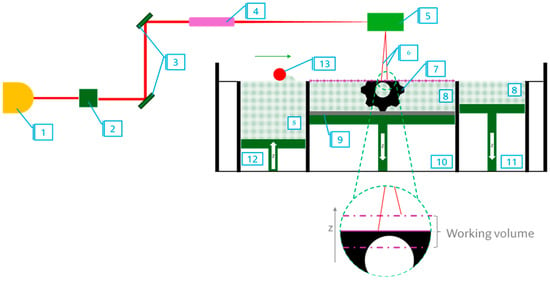
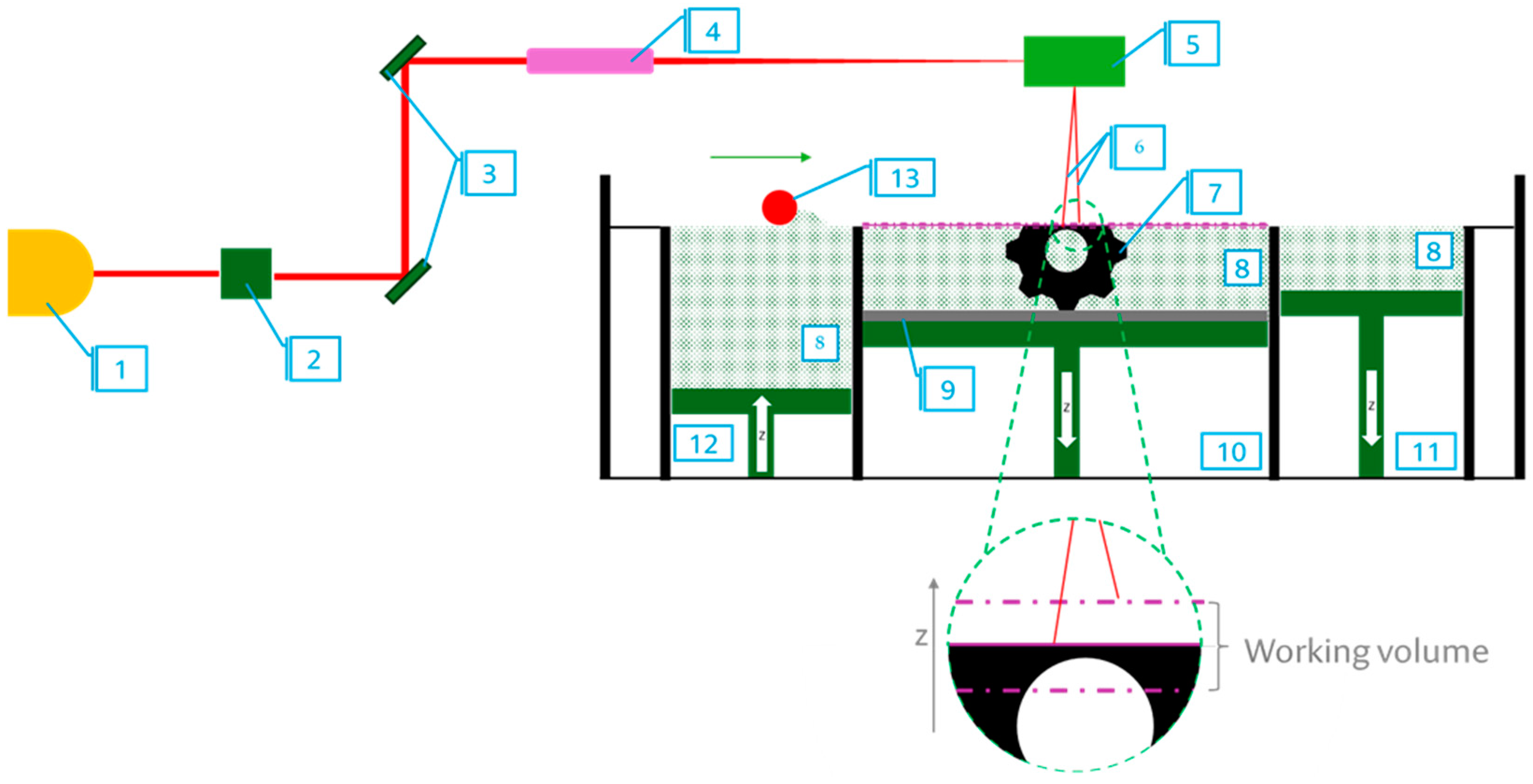
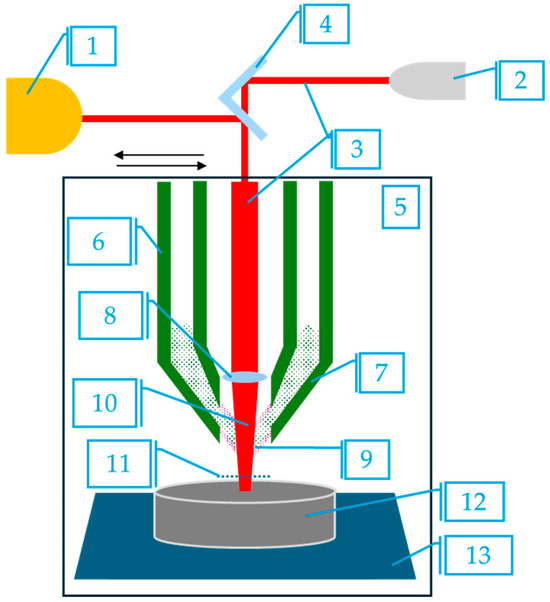
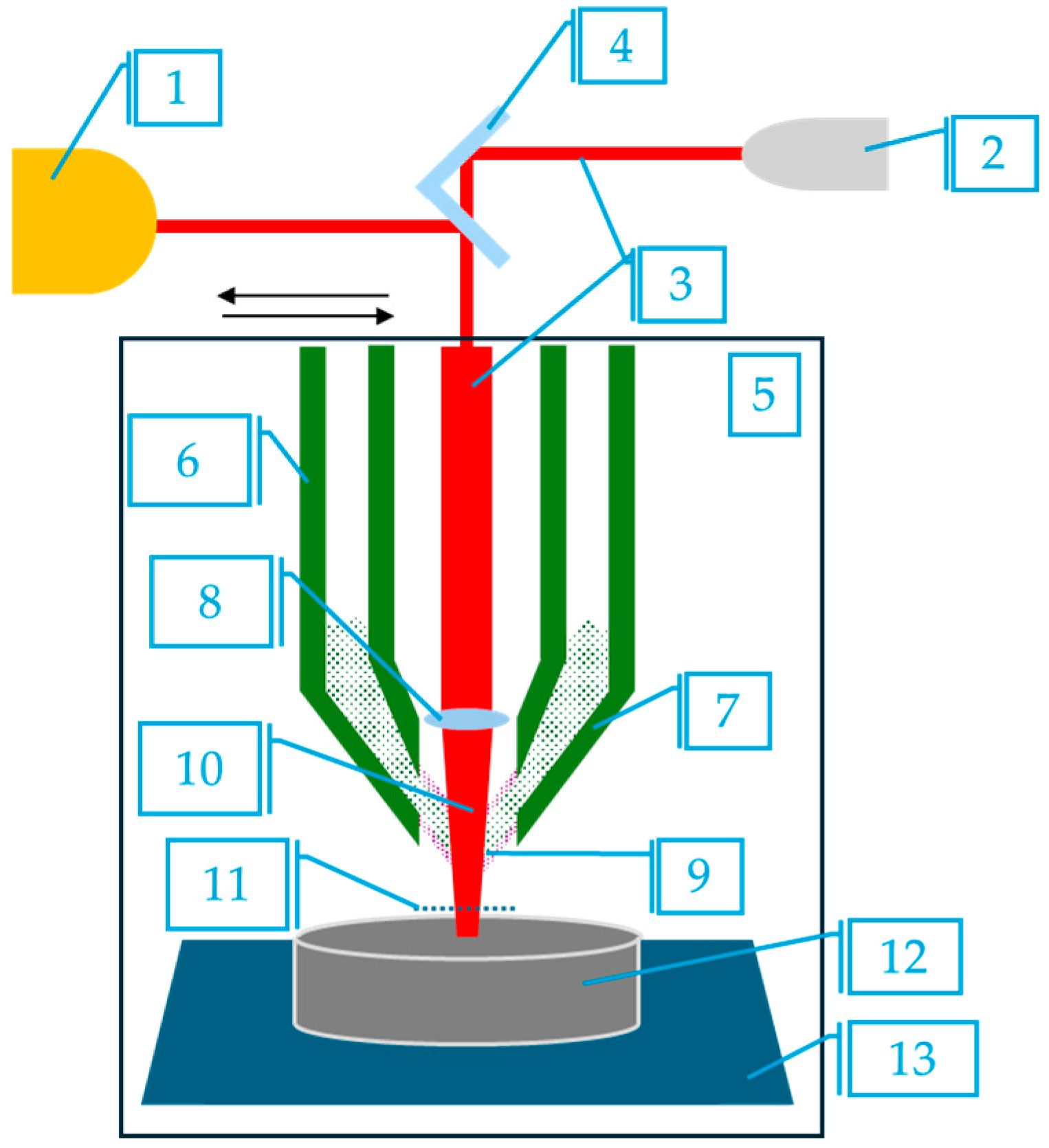
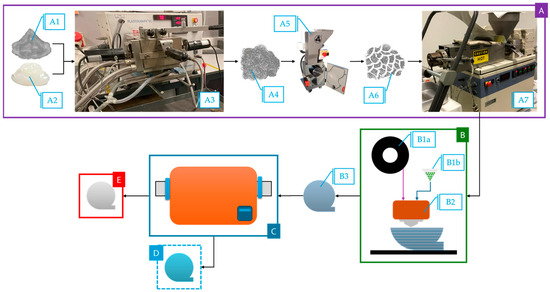
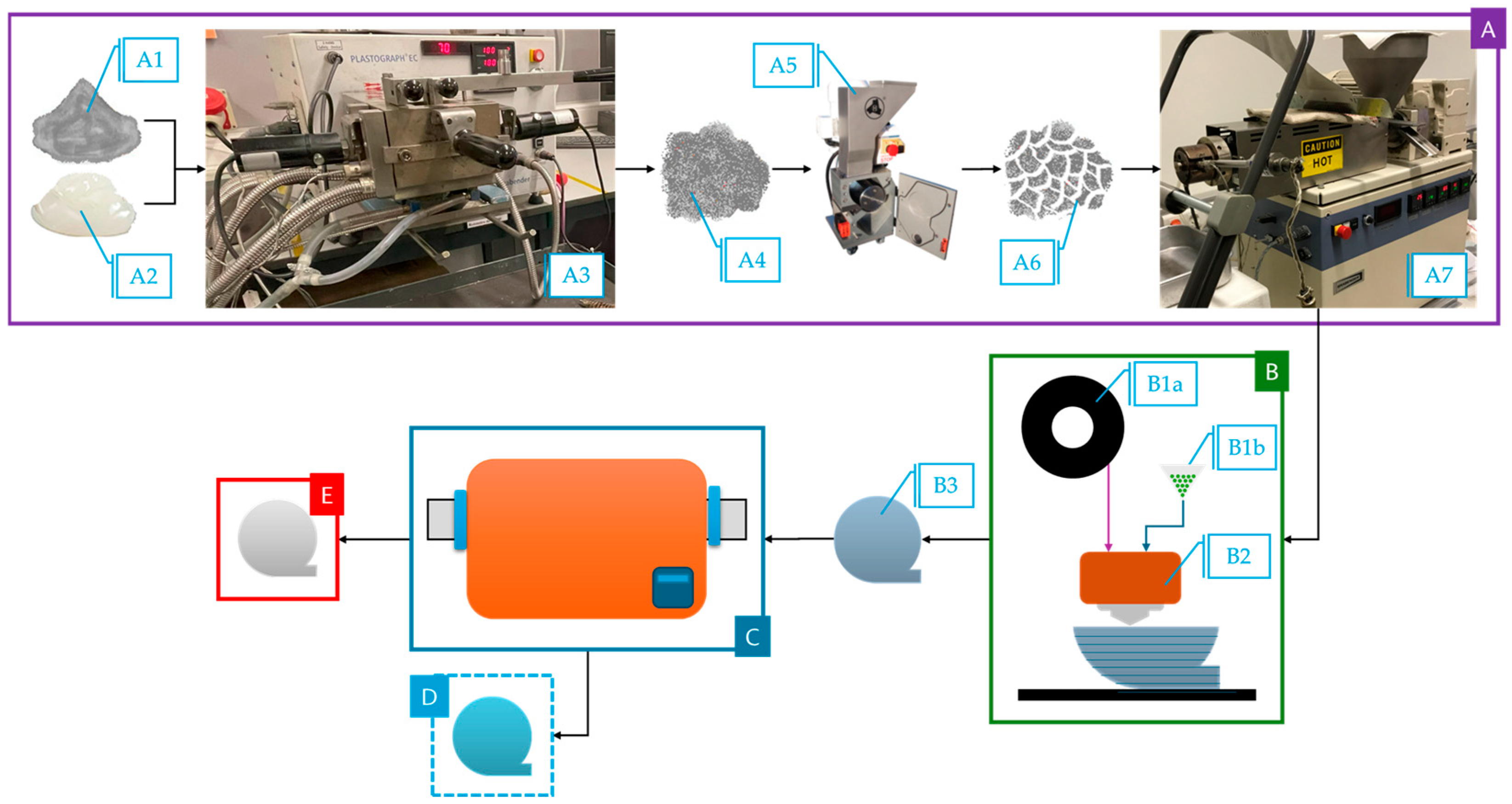
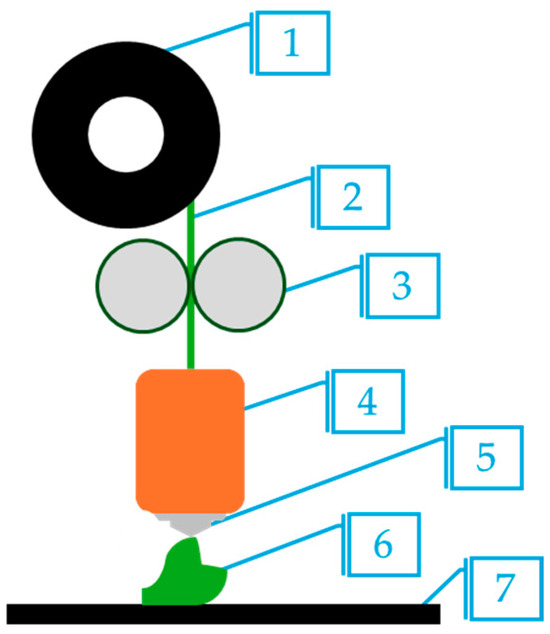
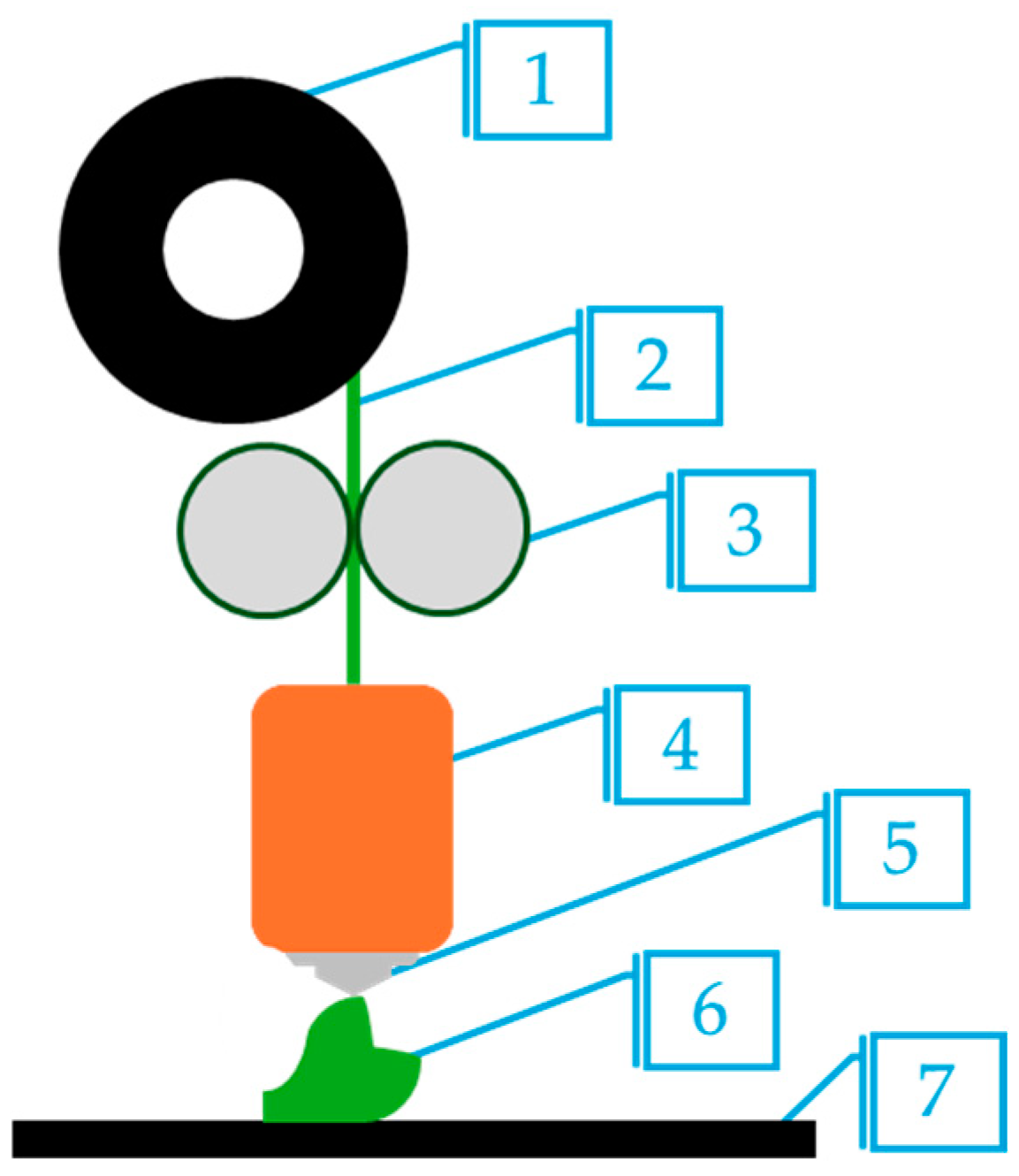
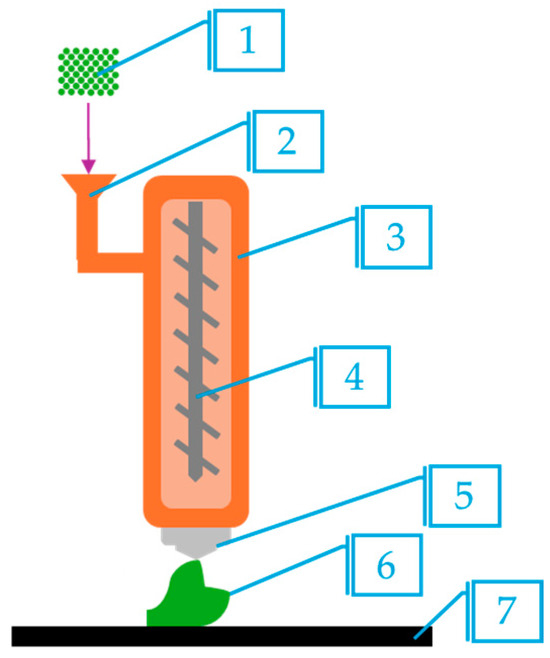
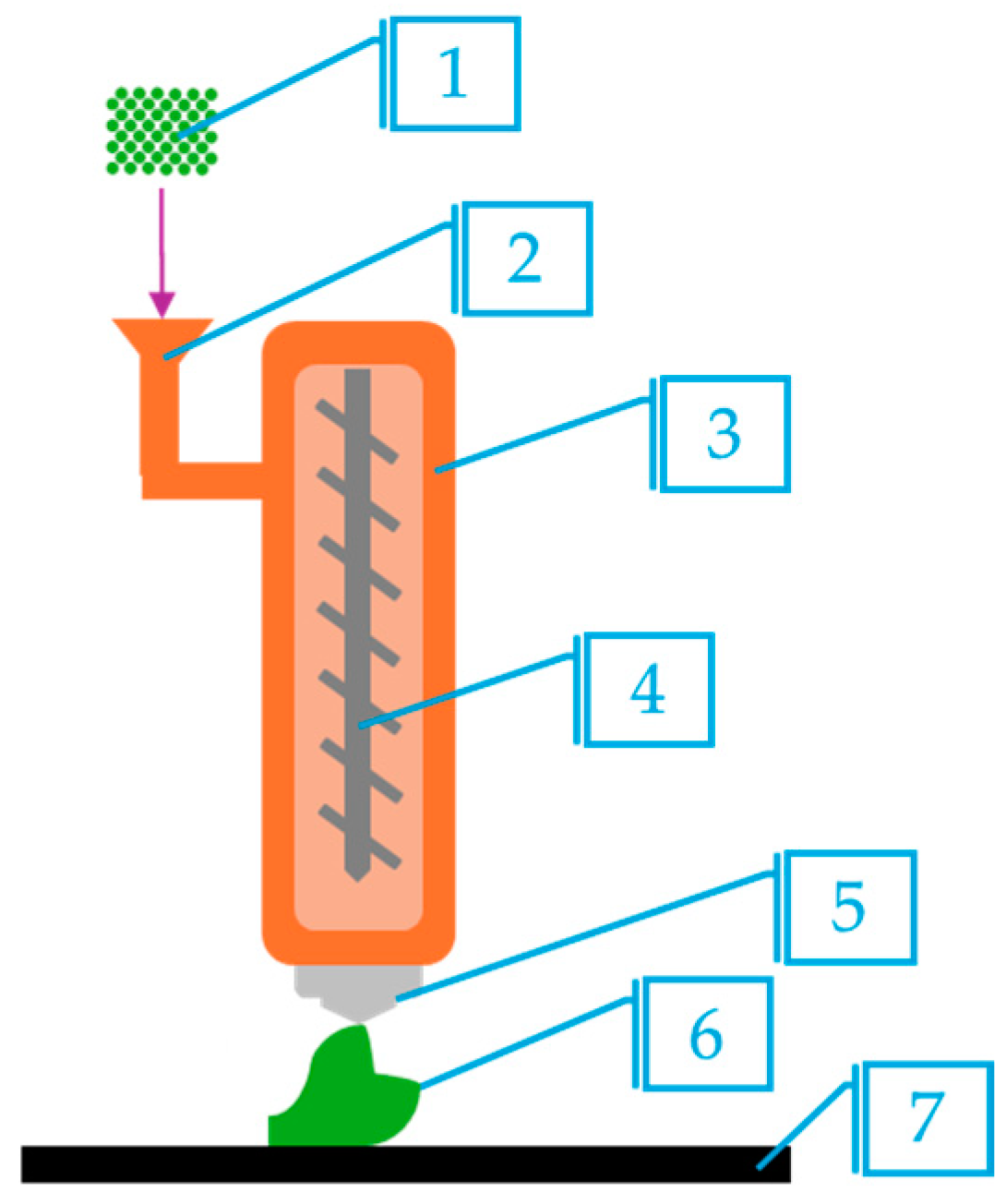
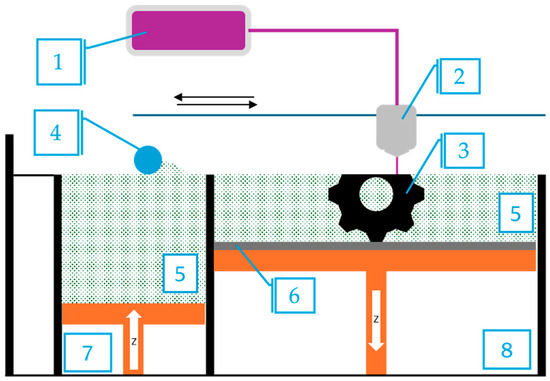
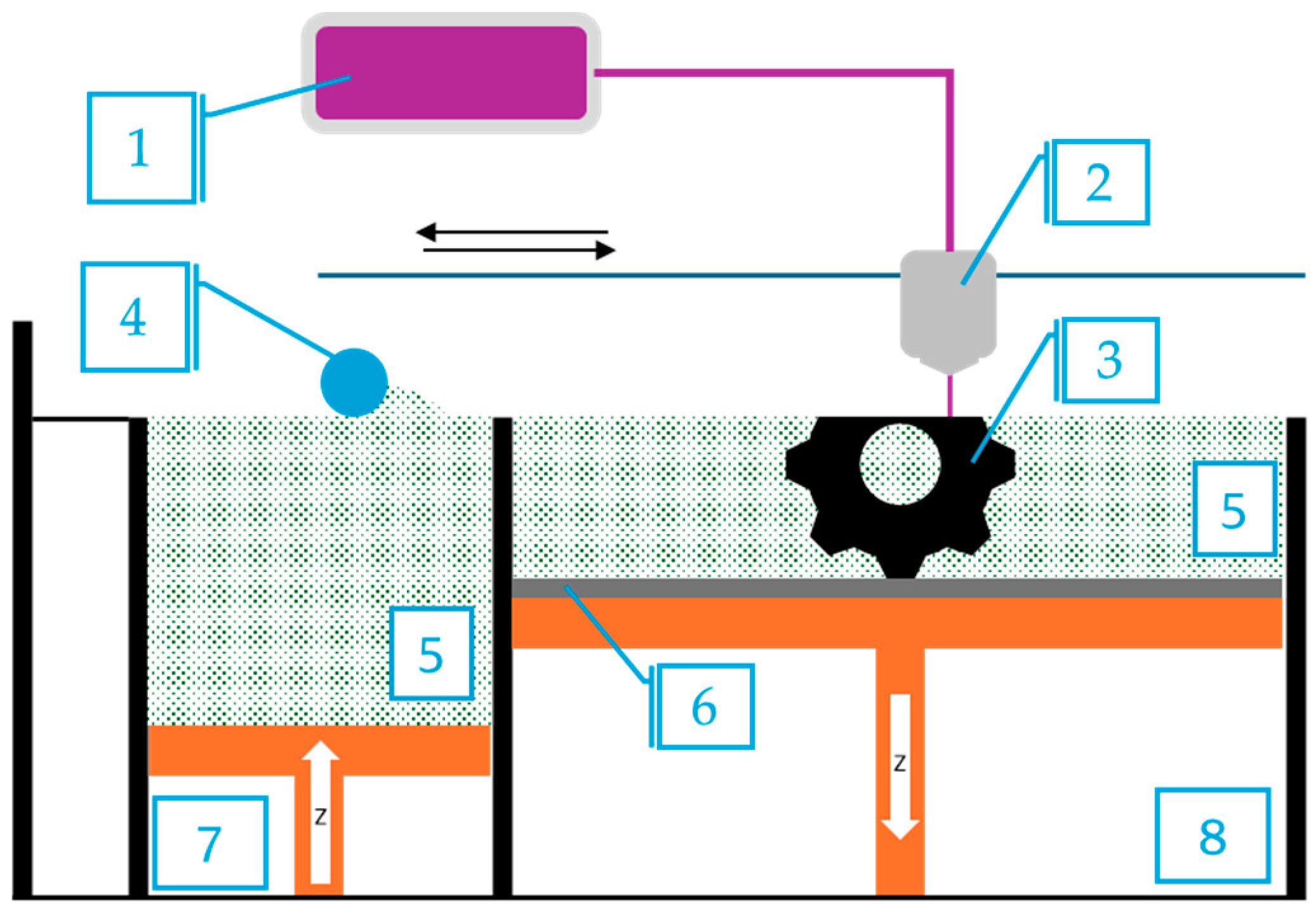
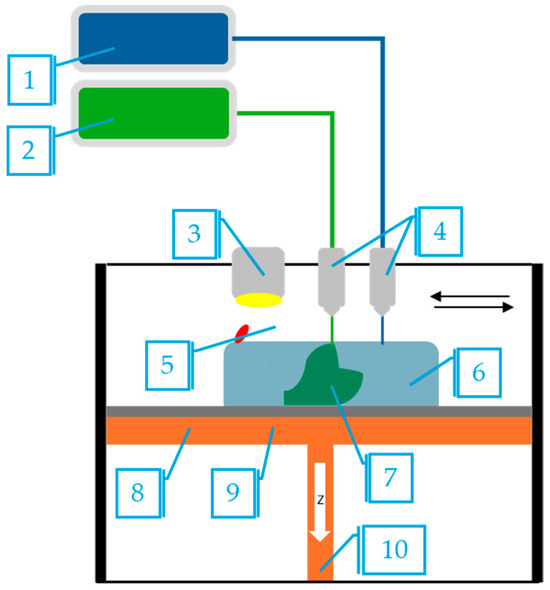
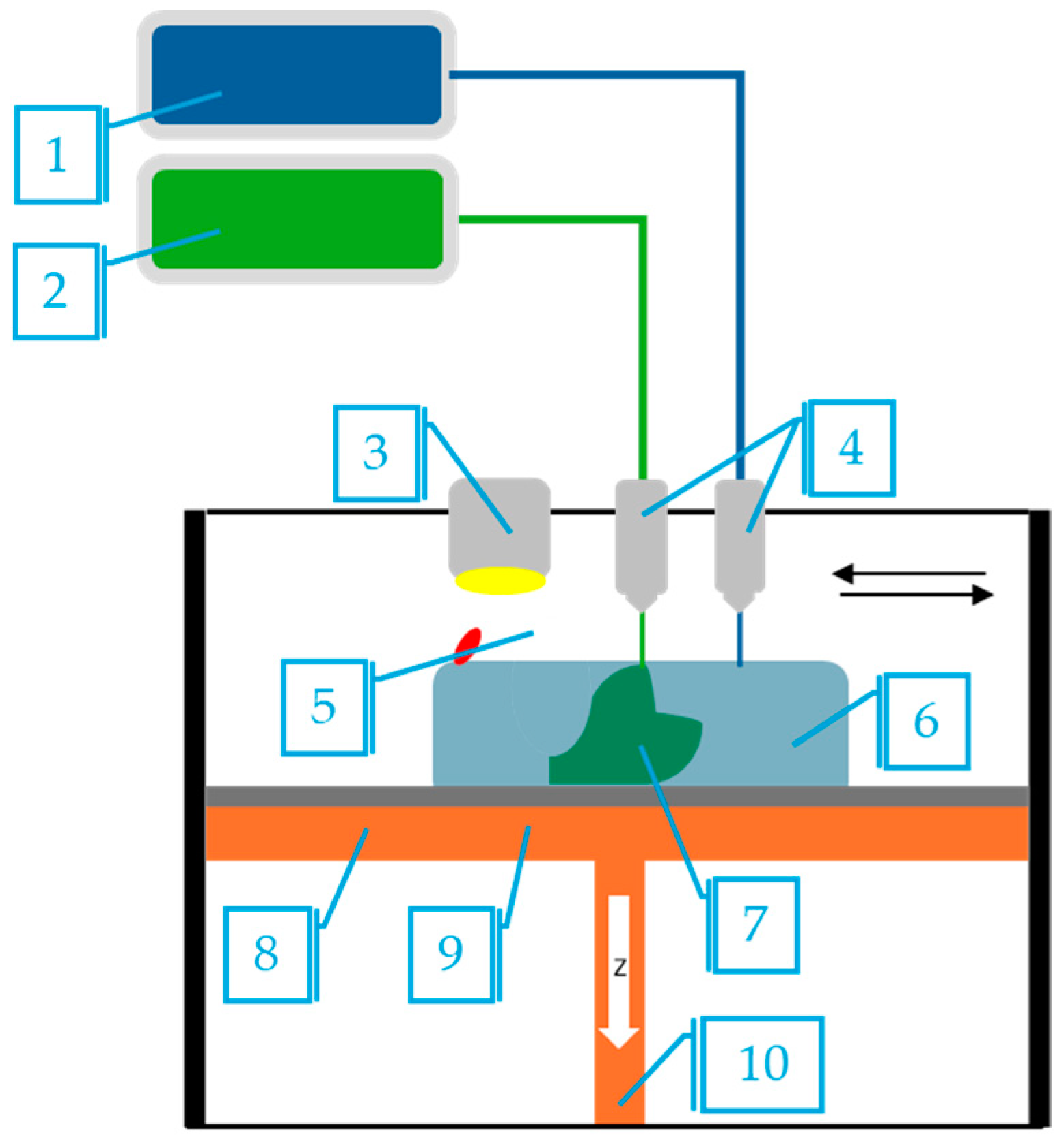
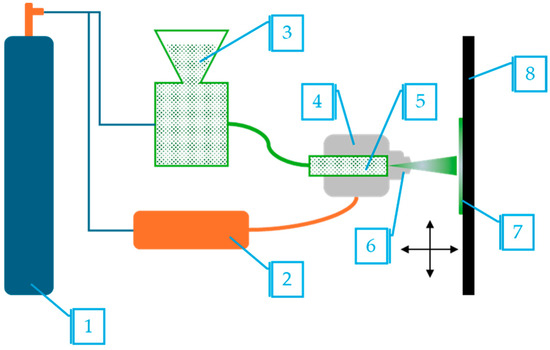
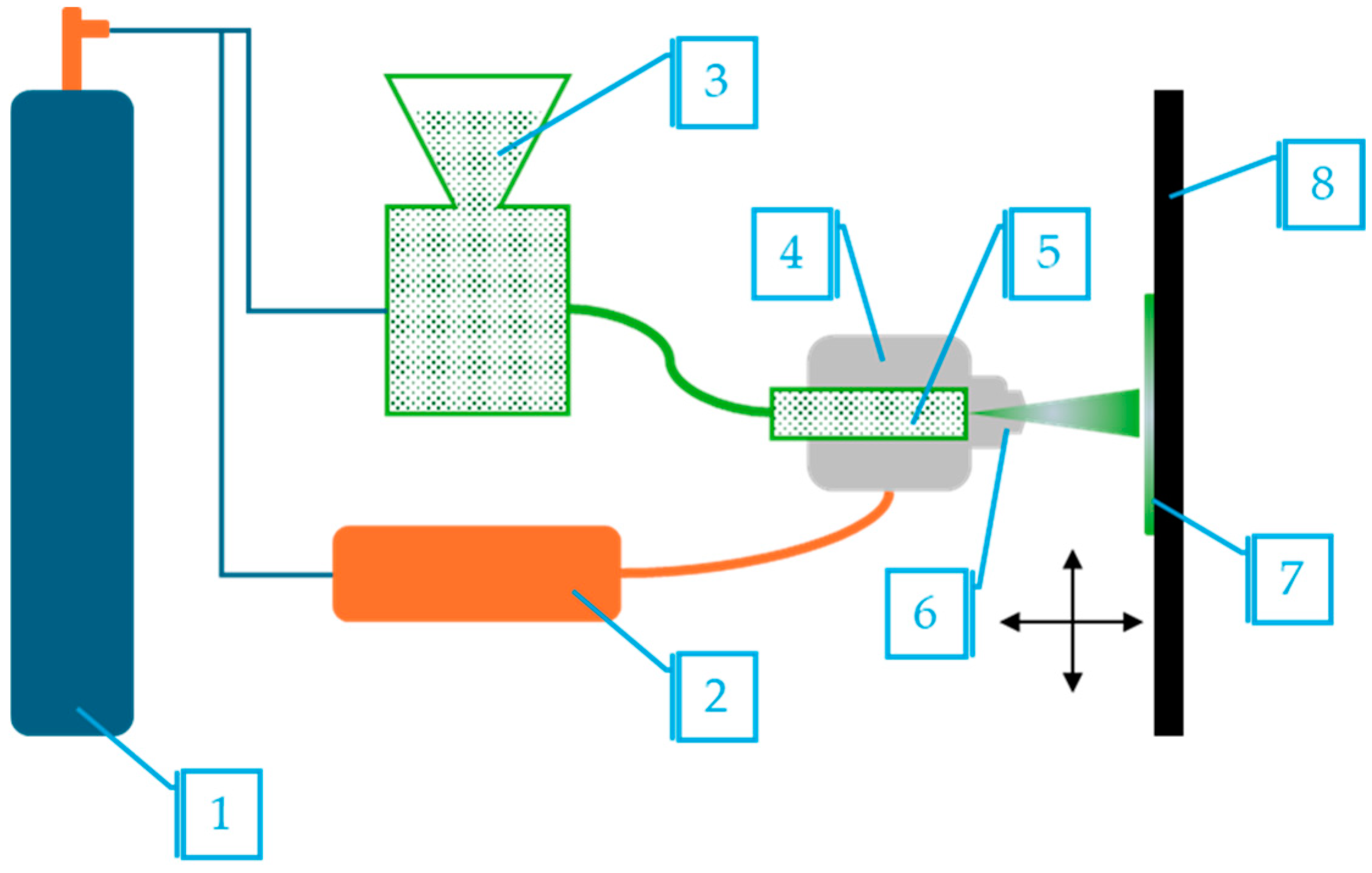
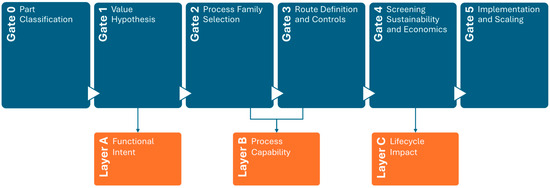
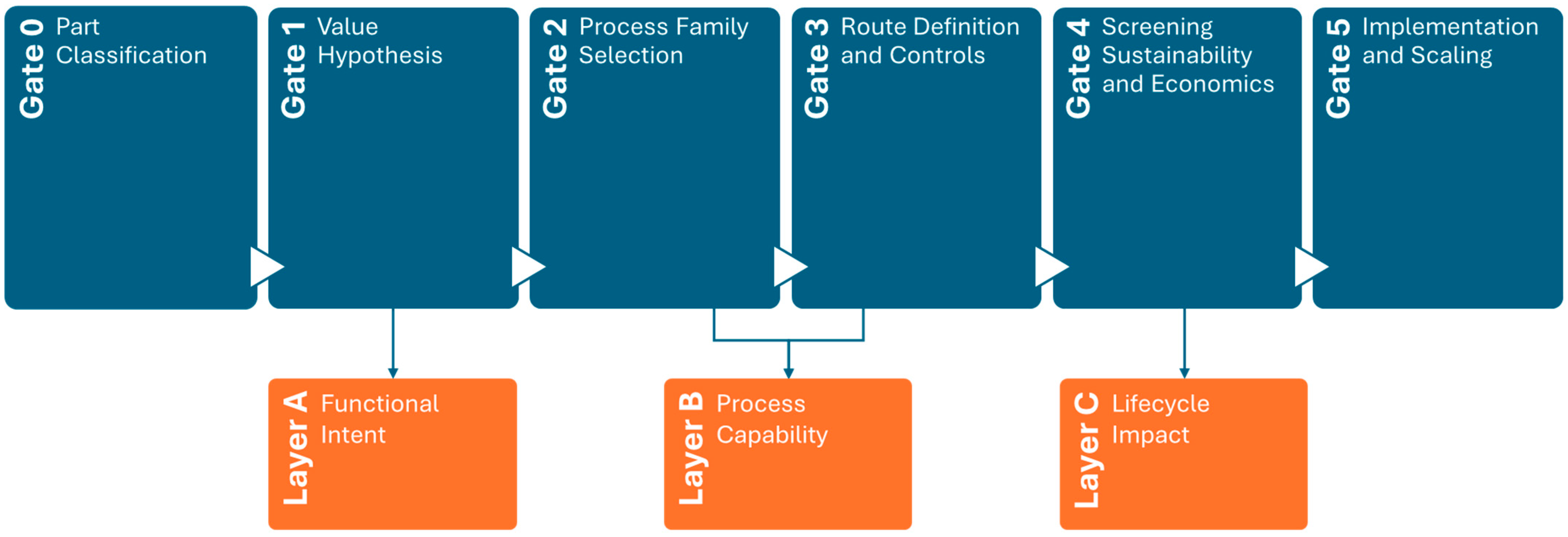

Disclaimer/Publisher’s Note: The statements, opinions and data contained in all publications are solely those of the individual author(s) and contributor(s) and not of MDPI and/or the editor(s). MDPI and/or the editor(s) disclaim responsibility for any injury to people or property resulting from any ideas, methods, instructions or products referred to in the content. |
© 2026 by the author. Licensee MDPI, Basel, Switzerland. This article is an open access article distributed under the terms and conditions of the Creative Commons Attribution (CC BY) license.