


Abstract
This article presents the results of developing a hydrometallurgical method for processing polymetallic sublimates containing arsenic, zinc, copper, and lead. Using sublimates from “BalkhashPolymetal” LLP (Kazakhstan) as an example, the optimal conditions for sulfuric acid leaching were determined as follows: t = 80–85 °C, H2SO4 = 25 g/dm3, τ = 60 min. Under these conditions, extraction of arsenic was 93%, zinc 80%, and copper 42% was achieved. Iron(II) hydroxide was used to remove arsenic from the solution, which made it possible to reduce the residual As content in the solution to 0.02 g/L and return approximately 97% of copper to the process cycle. Eh–pH analysis of the Fe–As–Cu–H2O system confirmed the thermodynamic stability of Fe(II/III) arsenates in the selected pH range 3–5. The obtained results can be used to develop safe and resource-saving technologies for processing technogenic raw materials.
Keywords:
lead; arsenic; zinc; copper; polymetallic sublimates; sulfuric acid; leaching; hydrometallurgy; Eh–pH analysis 1. Introduction
Polymetallic fumes, dusts, and fines generated during non-ferrous metallurgy processes are increasingly recognized as important secondary mineral resources, containing both valuable metallic components and hazardous impurities such as arsenic. The depletion of high-quality ore reserves and the increasing complexity of raw materials have forced the industry to develop efficient and environmentally sound methods for processing arsenic-containing waste to minimize its environmental impact and recover useful metals [1,2,3].
Arsenic, one of the most toxic trace elements, poses a serious health and environmental hazard due to its high mobility, chemical stability, and tendency to circulate in metallurgical processes in both volatile and dissolved forms [4,5].
Traditional pyrometallurgical methods involve oxidation and evaporation of As2O3 and pose an environmental hazard [6,7]. An alternative is hydrometallurgical schemes based on acid leaching and selective precipitation [8,9,10,11,12,13,14].
It has been shown that optimization of sulfuric acid leaching parameters (pH, temperature, liquid/solid phase ratio) has a decisive influence on the degree of arsenic extraction and the distribution of copper and zinc between the solid and liquid phases [9,10]. A number of studies have found that at pH < 2, arsenic predominantly passes into solution in the form of arsenate ions; however, this increases the risk of copper co-dissolution, which complicates subsequent selective processing [11].
Alternative approaches include alkaline and oxidative leaching, as well as combined processing schemes. Alkaline leaching of converter and polymetallic dusts allows arsenic to be dissolved in the form of sodium arsenates, but is characterized by reduced selectivity and high solubility of associated elements [12]. Multi-stage hydrometallurgical schemes combining acid leaching with subsequent controlled precipitation of arsenic compounds are considered more promising [13,14].
In the literature, particular attention is given to the precipitation of arsenic using iron compounds. Precipitation in the form of Fe(III) ferrarsenates is widely used; however, it is accompanied by copper losses due to co-precipitation and adsorption on iron hydroxide phases [3,14]. In recent years, it has been shown that the use of Fe(II) at strictly controlled pH values allows the formation of less soluble and more selective arsenate phases with minimal copper losses, making this approach promising for the processing of polymetallic solutions [14,15].
Despite significant progress in practical technologies, a comprehensive understanding of the thermodynamic aspects and phase stability of arsenic compounds in hydrometallurgical systems remains limited, especially for complex Fe–As–Cu–H2O systems. Thermodynamic interpretation of arsenic behavior using qualitative Eh–pH analysis allows us to predict the stability regions of arsenites, arsenates, and iron-containing phases over a wide range of redox and acid–base conditions [8,14]. This approach is a key tool for substantiating arsenic precipitation mechanisms and developing scientifically based strategies for its selective removal.
Table 1 presents known methods for removing arsenic from metallurgical fumes and dusts.
Table 1.
Overview of methods for removing arsenic from metallurgical dusts and sublimates.
The purpose of this research study is to optimize sulfuric acid leaching of arsenic-containing polymetallic sublimates and to identify conditions for the selective precipitation of arsenic with Fe(II) hydroxide. The study includes a set of experiments examining the influence of temperature, pH, and the liquid/solid phase ratio on metal extraction, as well as a thermodynamic Eh–pH analysis of the Fe–As–Cu–H2O system to substantiate the observed effects.
2. Materials and Methods
2.1. Characteristics of the Feedstock
The studies were conducted on polymetallic copper–lead–zinc sublimates produced by “BalkhashPolymetal” LLP (Astana, Kazakhstan). The material was a finely dispersed grey powder (<0.16 mm). Determination of Pb, Zn, Cu, As, Fe, Bi, Cd, and Sb was obtained by atomic absorption spectrometry on a Shimadzu AA 7000 spectrometer; a control check was performed by ICP OES (Agilent 5800, Santa Clara, CA, USA); sample preparation was performed by dissolution in HNO3 + HCl (1:3).
Chemical analysis of polymetallic sublimates samples from “BalkhashPolymetal” LLP is presented in Table 2.
Table 2.
Chemical analysis of average samples of “Balchaschpolimetall” LLP.
X-ray phase analysis of the original samples was performed on a DRON-3 diffractometer (JSC Burevestnik, Moscow, Russia, Cu Kα = 1.5406 Å) with comparison using the PDF-4 database (ICDD 2024). The presence of PbSO4 was confirmed (PDF#36-1461), ZnO (PDF#36-1451), CuO (PDF#45-0937), As2O3 (PDF#04-0630); crystallite sizes were calculated using the Scherrer equation (β = 0.15°, λ = 1.5406 Å, k = 0.9).
In the samples of sublimates of “BalkhashPolymetal” LLP, metals are found in the form of oxides of zinc, copper, iron, and other metals (MeO, Me2O3), as well as in the form of sulfides (MeS) and sulfates (MeSO4) of these metals.
Most of the lead is found in sublimates in the form of oxides PbO and sulfates PbSO4.
Arsenic in sublimates is in the form of arsenic(III) oxide As2O3; part of the arsenic is contained in the form of arsenites and lead arsenates.
The presence of these compounds is confirmed by X-ray phase analysis of these samples. The results of particle size analysis of polymetallic sublimates show that the highest arsenic content was found in the −0.16 mm fraction obtained by sieve analysis, which accounts for 42.2% of the total sample mass. This fraction refers to material with particle sizes smaller than 0.16 mm, rather than the size of individual oxide phases. For hydrometallurgical processing, dust fractions of the −0.16 mm size class were used.
2.2. Sulfuric Acid Leaching
Leaching was carried out in a thermostatted 1 dm3 glass reactor equipped with a mechanical stirrer. The stirring speed was 900 rpm. Sulfuric acid solutions with a concentration of 15–30 g/L (0.15–0.31 M) were used as the leaching agent. The liquid/solid ratio varied between 1:1 and 6:1. The process temperature varied from 20 to 100 °C, and the duration varied from 20 to 120 min. The experiments were carried out in triplicate; the discrepancy was no more than ±2%.
2.3. Arsenic Precipitation
Arsenic precipitation from productive solutions was accomplished by adjusting pH and adding iron(II) hydroxide. Fe(OH)2 was obtained in the laboratory from a freshly prepared iron(II) sulfate solution by adding NaOH solution at 20–25 °C under conditions of limited oxygen availability. The resulting suspension was used immediately, which minimized the oxidation of Fe2+ to Fe3+.
Cu3(AsO4)2 + 3Fe(OH)2 → 3FeAsO4⋅2H2O + 3Cu2+ + 2OH−
Solid phases were analyzed by X-ray phase and AAS methods.
3. Experimental Part
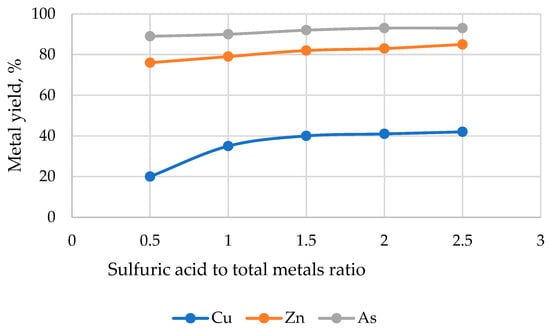
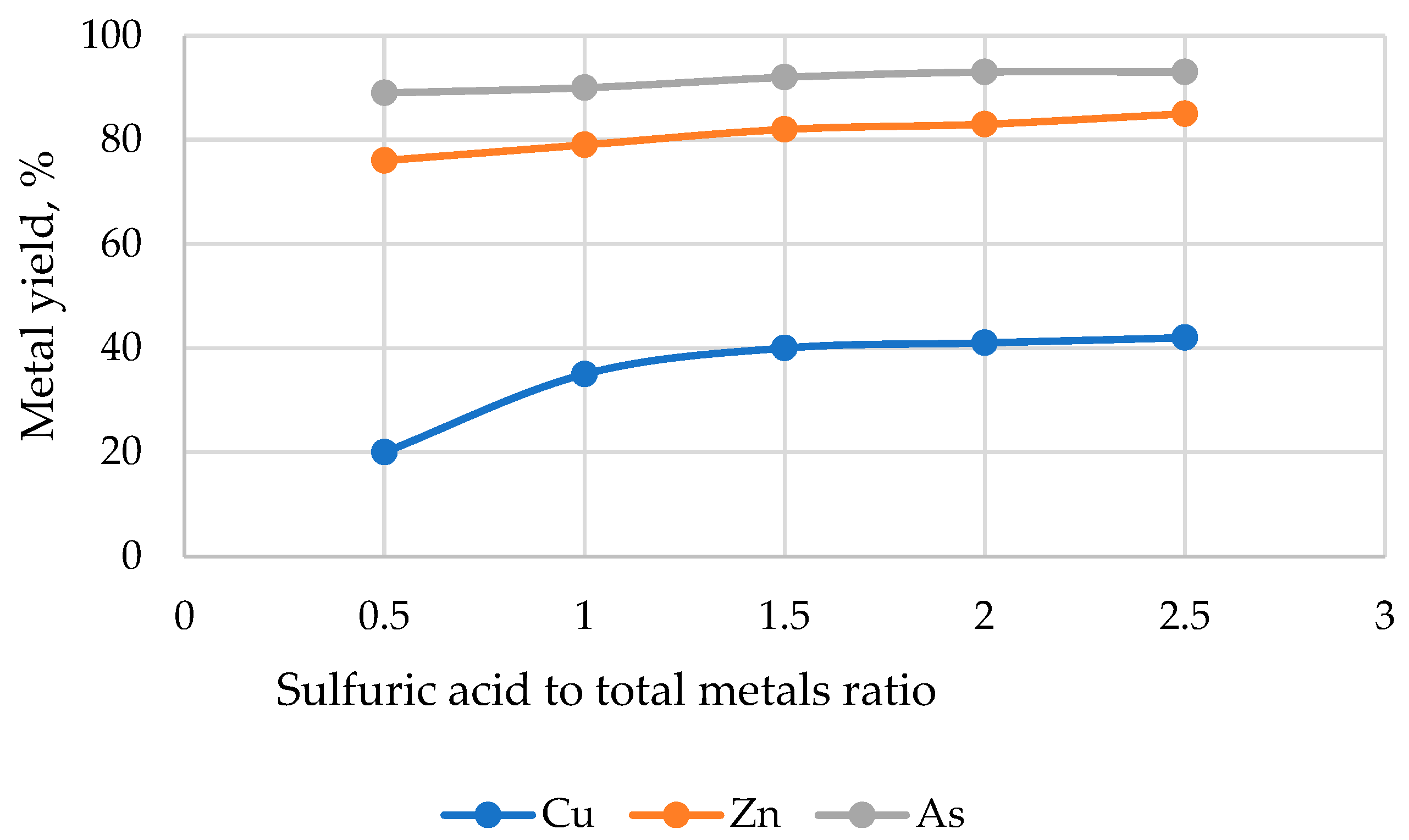
The dependence of copper, zinc, and arsenic extraction on acid concentration is shown in Figure 1.
Figure 1.
Dependence of metal yield on sulfuric acid concentration.
Maximum extraction of zinc (82%) and copper (39%) is achieved with an acid ratio of .
The increase in acid consumption is explained by the presence of copper, lead, and zinc oxides in the polymetallic sublimates, the dissolution of which requires acid.
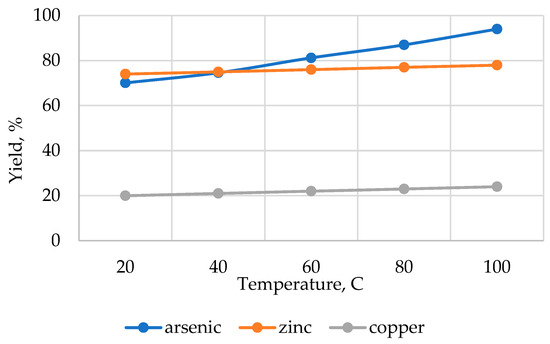
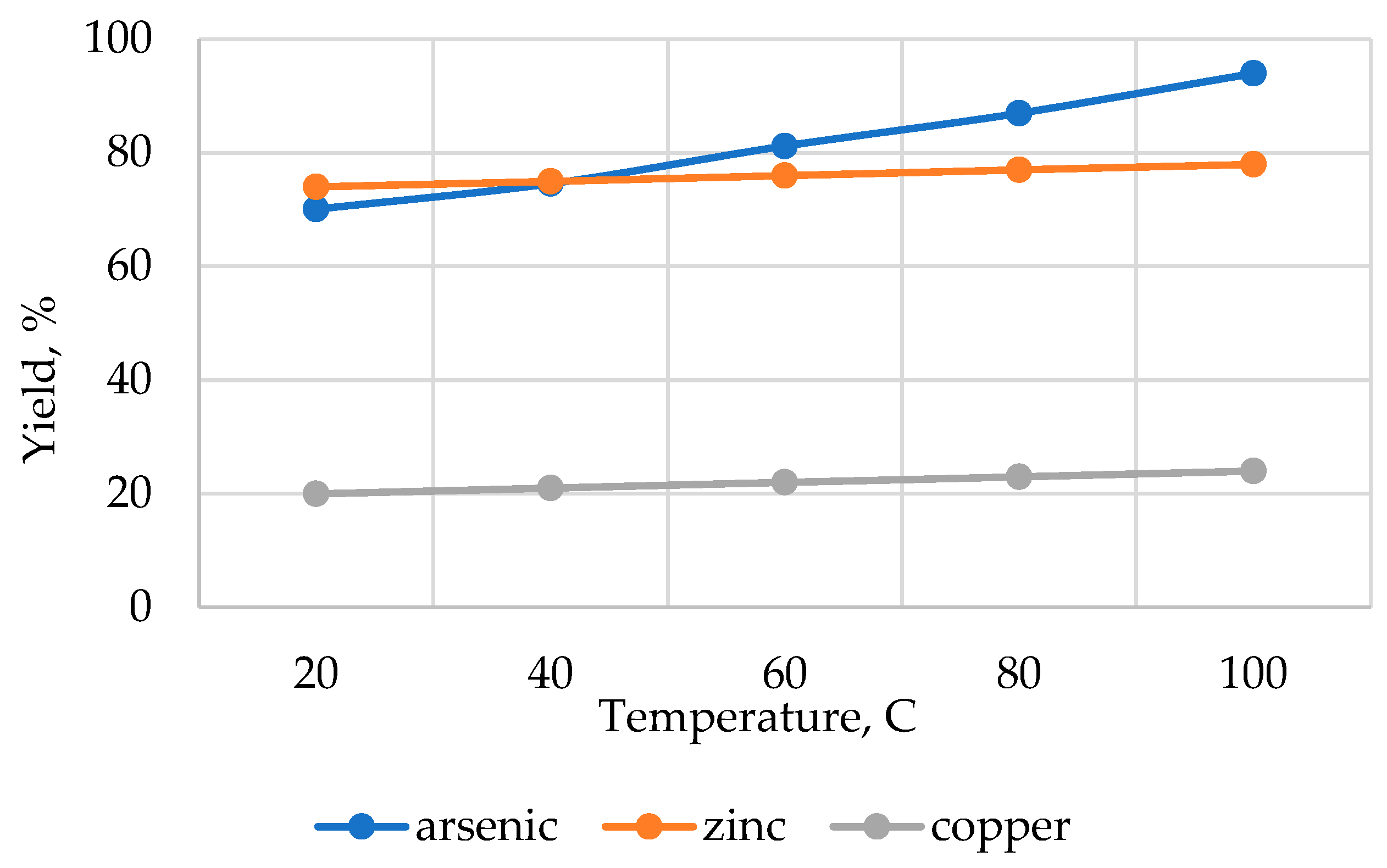
The research on the effect of temperature on the leaching of metals from sublimates is presented in Figure 2.
Figure 2.
Effect of temperature on the extraction of metals from sublimates.
According to the obtained data, 92% of arsenic is extracted at 80–85 °C and an initial sulfuric acid concentration of 24–28 g/dm3. Maximum extraction of copper and zinc is achieved at a temperature of 60–80 °C. Maximum extraction of these metals occurs at the ratio
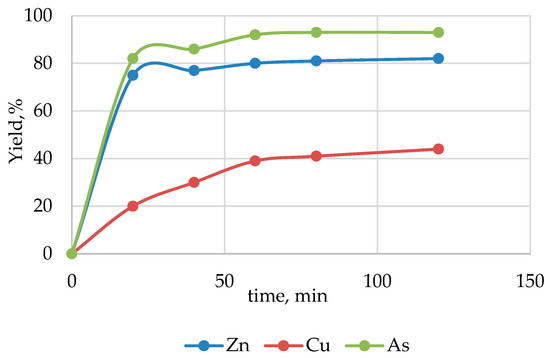
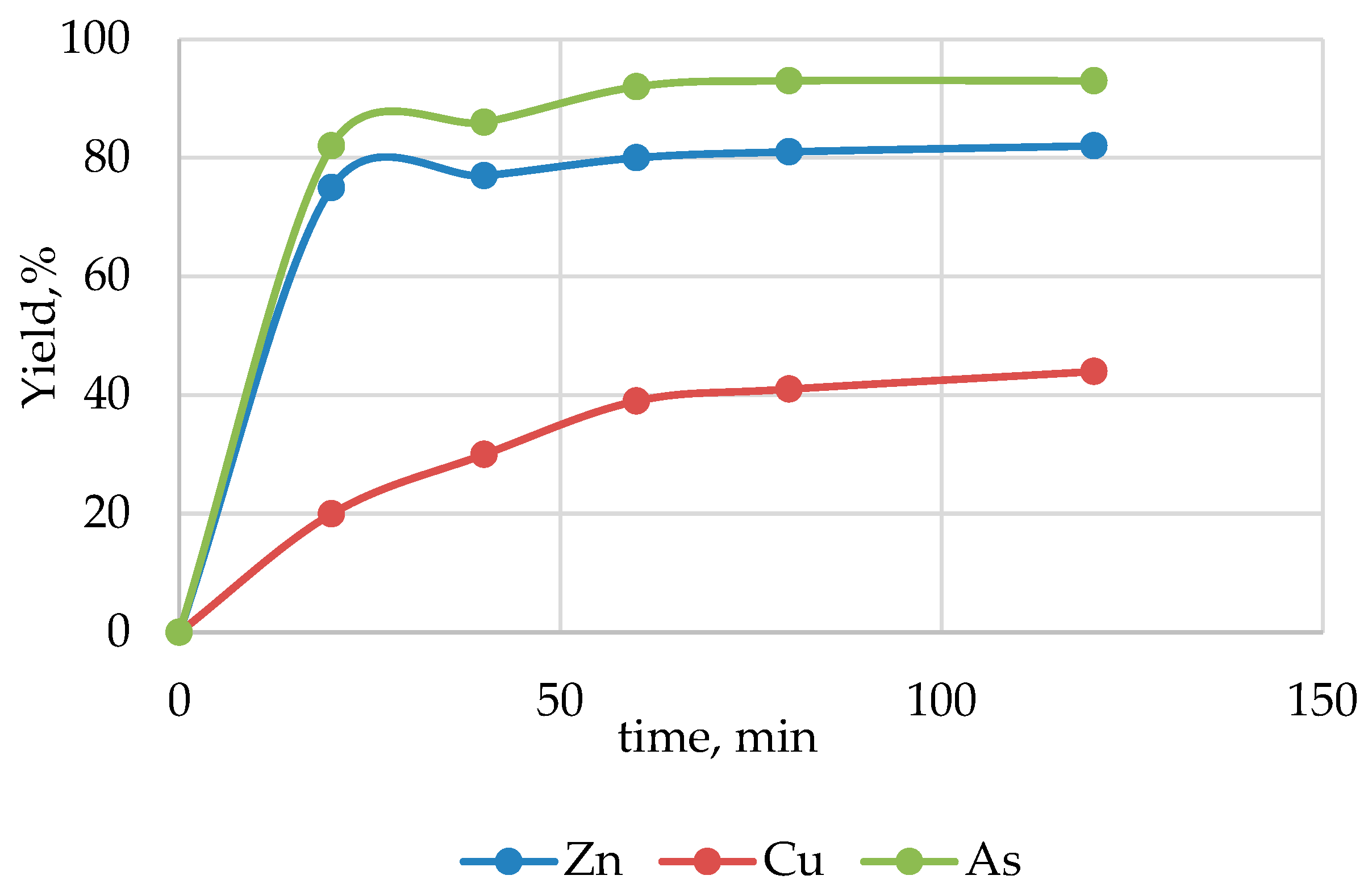
To optimize leaching duration for metal extraction into solution, experiments were conducted at intervals of 20, 40, 60, 80, and 120 min. The experiment temperature was 80 °C, and the initial sulfuric acid concentration was 25 g/dm3.
The results on the effect of leaching time on the extraction of metals into solution are presented in Figure 3.
Figure 3.
Effect of time on the extraction of metals into solution.
The dependence of metal extraction on leaching duration showed that after 60 min, the following percentages were released into solution: 93% arsenic; 80% zinc; 42% copper. The acid concentration decreased during the experiment, which is connected with the production of lead sulfate.
Leaching of polymetallic sublimates was carried out according to the following optimal parameters: t = 80–85 °C, initial acid concentration 25 g/dm3, τ = 40–60 min. The resulting solution contains g/dm3: 22.5 arsenic; 1.7 copper; 3.2 zinc; 0.9 iron; 20.5 H2SO4. The analysis of variance for leaching factors is presented in Table 3.
Table 3.
Analysis of variance (ANOVA) table for leaching factors.
The greatest influence on the extraction of arsenic and zinc is exerted by the concentration of acids and temperature.
The kinetic parameters of leaching of arsenic, zinc, and copper are presented in Table 4.
Table 4.
Kinetic parameters of leaching of arsenic and zinc–copper components.
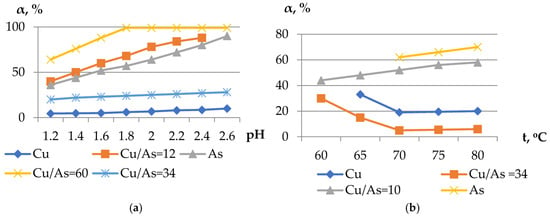
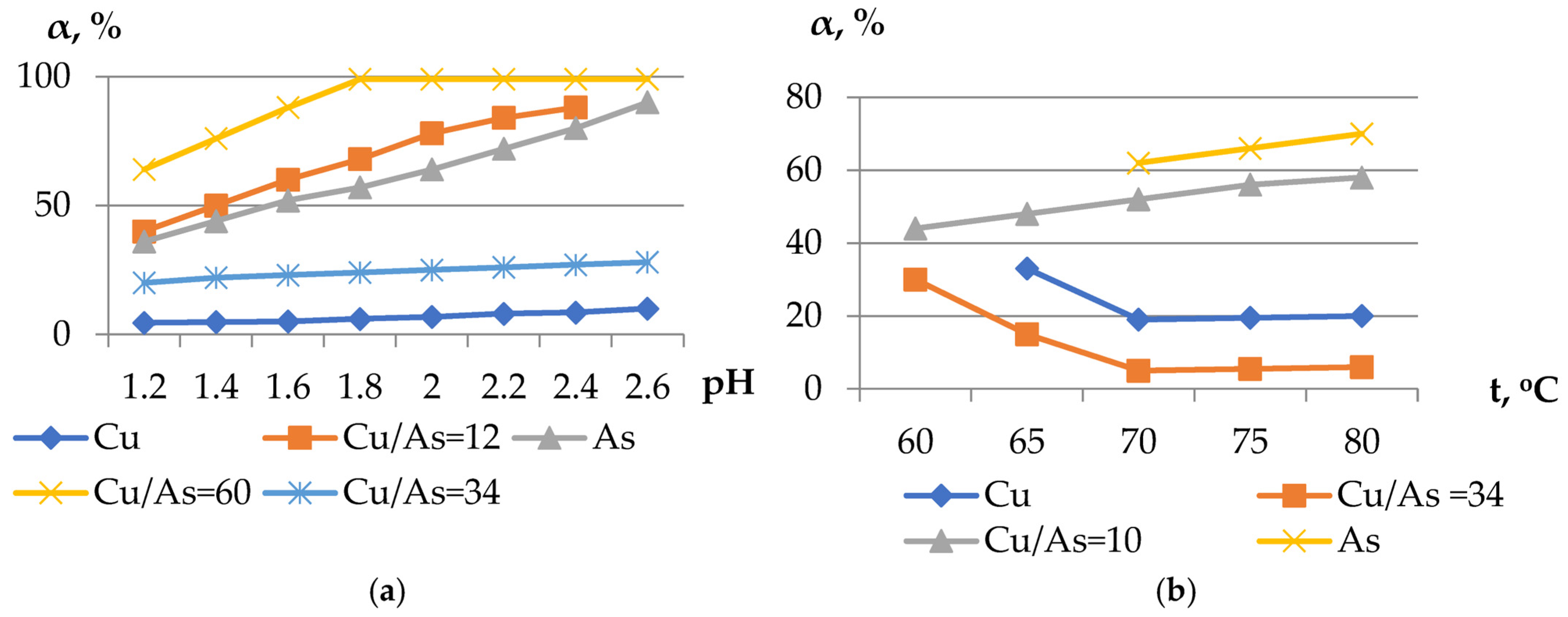
Subsequent studies were conducted to extract arsenic from the resulting solution. Sulfuric acid was used to regulate pH. In this regard, the dependence of the degree of arsenic and copper precipitation on the initial pH and temperature was examined (Figure 4).
Figure 4.
Dependence of the degree of precipitation of arsenic and copper on the pH value (a) and on the temperature (b).
When the pH of the solution changes, arsenic precipitates in the form of copper arsenates, and copper precipitates with arsenic; therefore, it is necessary to select a reagent that displaces copper from the arsenate cake and returns copper to the solution. After completion of the sulfuric acid leaching stage, the solid phase was separated by filtration, and the resulting pregnant solution was sent to a separate purification stage.
Arsenic precipitation was carried out in a separate reactor, where the pH was controlled to slightly alkaline values using an alkaline agent. Under these conditions, a Fe(OH)2 suspension was formed in situ by adding a FeSO4 solution, followed by alkaline neutralization.
The resulting Fe(OH)2 reacted with arsenate and arsenite ions to form poorly soluble iron–arsenate phases.
The resulting solid phase is FeAsO4·2H2O (scorodite).
The results of using iron(II) hydroxide for arsenic precipitation are presented in Table 5.
Table 5.
Results of arsenic precipitation with iron(ii) hydroxide.
After treatment with Fe(OH)2, the residual As content in the solution is ≤0.02 g/L; Cu returns to the solution in the form of sulfate CuSO4·5H2O (Table 6).
Table 6.
Composition of copper arsenate cake before and after treatment with Fe(OH)2.
Thus, according to the conducted studies, the addition of iron(II) hydroxide to precipitate iron arsenates from solutions and produce copper sulfate yielded good results. These results can be used to develop a theoretical basis for a new technology for processing non-ferrous metallurgy slags.
4. Results and Discussion
The experimental data obtained demonstrate the high efficiency of sulfuric acid leaching of polymetallic sublimates at moderate temperatures (80–85 °C) and relatively low acid concentrations. The observed preferential extraction of arsenic over copper and zinc is consistent with the phase composition of the source material, in which arsenic is predominantly present as the oxide As2O3 and readily soluble arsenite and arsenate compounds, while a significant portion of the copper and zinc is bound in more stable sulfate and oxide forms.
Increasing the leaching temperature leads to increased dissolution of arsenic and zinc, which may be due to both accelerated dissolution kinetics as well as increased solubility of the corresponding compounds in a sulfuric acid environment. Limited copper recovery (up to 42%) indicates partial preservation of poorly soluble copper-containing phases, which is a positive factor in this case, as it reduces copper losses during the acid leaching stage.
Of particular interest are the results of arsenic precipitation from productive solutions. Experiments have shown that when the solution is neutralized and the pH is increased, copper–arsenate precipitates form, accompanied by copper co-precipitation. This behavior is characteristic of Cu–As–H2O systems and is widely noted in the literature as the main limitation of acidic arsenic removal methods.
The introduction of iron(II) hydroxide makes it possible to fundamentally change the nature of the interaction of the system components. The equation for the reaction of copper displacement by iron(II) hydroxide from copper–arsenate cakes is presented below:
Cu3(AsO4)2 + 3Fe(OH)2 → 3FeAsO4⋅2H2O + 3Cu2+ + 2OH−
ΔH° ≈ −1587 kJ (exothermic reaction), ΔS° ≈ −342 J/K (the degree of disorder is reduced), ΔG° ≈ −1212 kJ/mol, the reaction is thermodynamically possible.
Experimental data show that Fe(II) effectively displaces copper from copper arsenate compounds, returning it to solution, while arsenic is bound as poorly soluble iron arsenates. This effect can be explained by the higher affinity of iron for arsenate and arsenite ions compared to copper, as well as the difference in the stability of the corresponding solid phases.
From a technological perspective, an important result is the production of a solution with a low residual arsenic content and the possibility of subsequent copper recovery as commercial copper sulfate. This confirms the feasibility of using iron(II) hydroxide as a selective reagent for purifying sulfuric acid solutions obtained during the processing of polymetallic sublimates.
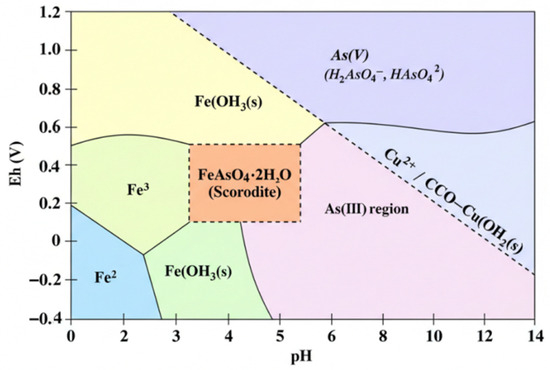
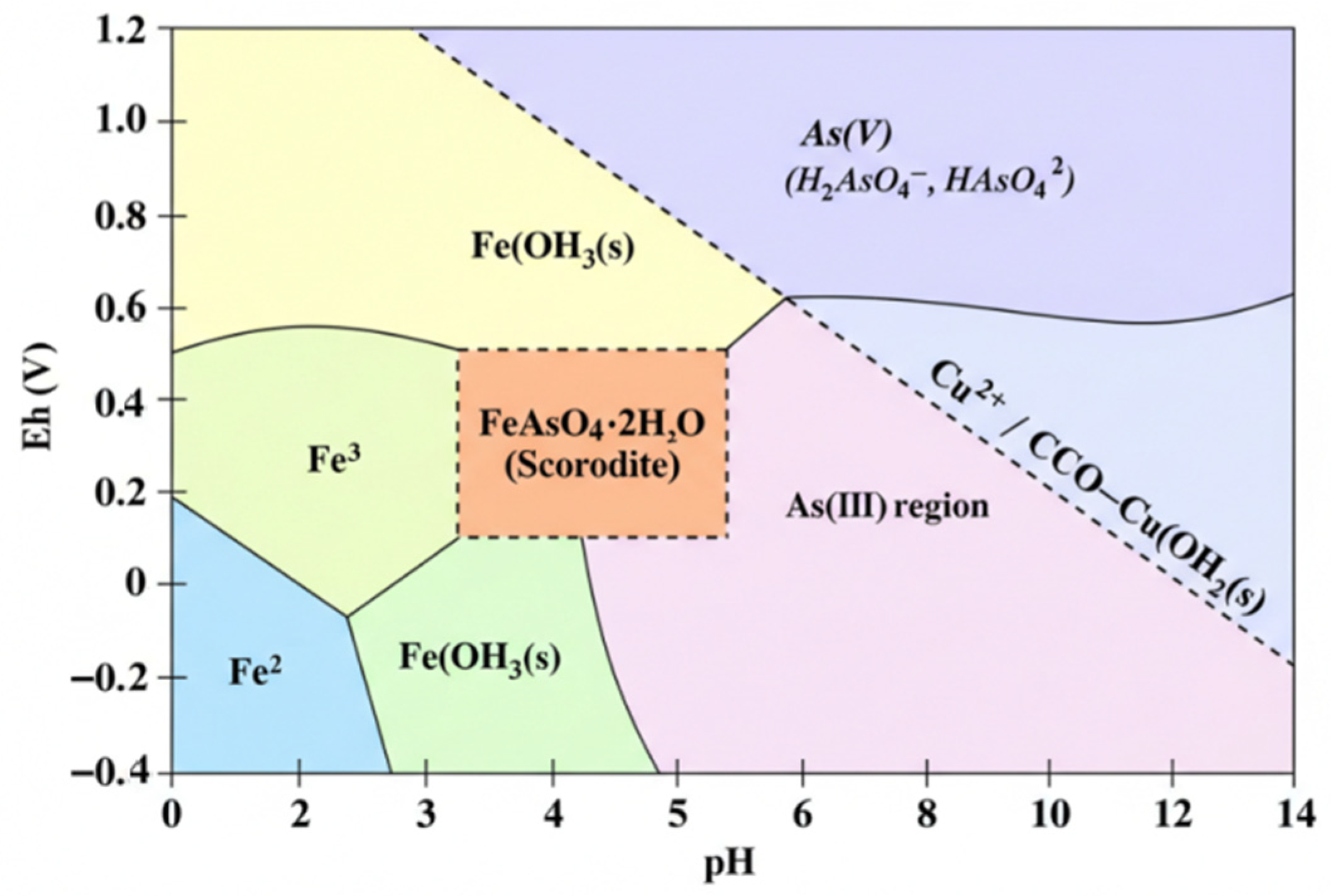
The thermodynamic behavior of arsenic in aqueous systems is determined by its valence state and environmental conditions, primarily pH and oxidation-reduction potential (Eh) values (Figure 5).
Figure 5.
Qualitative Eh–pH diagram (Pourbaix) of the Fe–As–Cu–H2O system, illustrating the stability ranges of As(III), As(V), iron arsenates, and reduced forms of copper (Adapted from Ref. [15]).
According to the Eh–pH diagram for the As–H2O and As–Fe–H2O systems, under acidic conditions (pH < 2), arsenic is predominantly in the soluble form of arsenite and arsenate ions, which corresponds to the conditions of sulfuric acid leaching.
As the pH increases to the range of 3.5–5.0, a transition to the stability zone of poorly soluble iron arsenates, such as FeAsO4·nH2O, is observed. It is in this region that the thermodynamic prerequisites for the effective precipitation of arsenic from solutions are created. Moreover, iron arsenates are more stable than the corresponding copper arsenate compounds, which explains the possibility of copper displacement from precipitates with the introduction of iron-containing reagents.
The use of a reduced form of iron (Fe2) further enhances the selectivity of the process. Under conditions of limited oxygen availability, Fe(II) remains in solution and actively interacts with arsenate ions, forming poorly soluble phases. Subsequent partial oxidation of Fe(II) to Fe(III) does not impair the stability of the precipitates, as Fe(III) arsenates are also characterized by low solubility and high environmental stability.
Behavior of arsenic: Under oxidizing conditions (Eh > 0.3–0.4 V), arsenic exists predominantly in the As(V) form: H3AsO4, H2AsO4−, HAsO42−. At pH 2–6 and the presence of Fe(II)/Fe(III), the formation reactions of FeAsO4·2H2O (scorodite) and FeAsO4·xH2O (amorphous phases) are possible. The stability region of scorodite corresponds to pH ≈ 1–4; Eh ≈ 0.2–0.8 V. With an increase in pH > 5, a transition to hydroxide forms of Fe(OH)2 with sorption of arsenate is observed.
Iron behavior: Fe2+ is stable at Eh < 0.2 V. As Eh increases, oxidation occurs: Fe2+ → Fe3+. Fe3+ hydrolyzes: Fe3+ + 3H2O → Fe(OH)3 ↓ + 3H+. At pH 3–5, an active hydroxide phase is formed, capable of co-precipitation of arsenate and adsorption binding of As(V).
Behavior of copper: Cu2+ remains dissolved in the range pH < 5 and Eh > 0.2 V. Precipitation of Cu(OH)2 begins at pH > 5.5–6. Thus, the experimentally selected pH range of 3–4 ensures maximum arsenic binding, minimal copper precipitation, and thermodynamic selectivity of the process.
Thus, the experimental results are in good agreement with thermodynamic concepts of the phase stability of arsenic compounds and confirm the validity of the chosen precipitation conditions (Table 7).
Table 7.
Comparison of arsenic removal efficiency (source data and the present work).
The obtained experimental data demonstrate that sulfuric acid leaching of polymetallic sublimates is characterized by high selectivity for arsenic compared to copper and zinc. This is due to the phase composition of the feedstock. Arsenic is present predominantly as As2O3 and partially as lead arsenites and arsenates, which are highly soluble in acidic environments, while copper and zinc are partially localized in poorly soluble oxide and sulfate phases.
Increasing the temperature to 80–85 °C leads to an increase in arsenic recovery to ~93%, due to accelerated heterogeneous dissolution reactions and reduced diffusion limitations. Copper recovery, however, remains limited (~42%), indicating the preservation of stable copper-bearing phases. Unlike conventional hydrometallurgical processes, where high copper recovery is the target parameter, in this case, limited copper dissolution is technologically advantageous, as it reduces copper losses during the solution purification stage.
The key step in the process is the selective removal of arsenic from the productive solution. Experiments have shown that increasing pH leads to the formation of copper arsenate compounds, accompanied by significant copper losses due to co-precipitation. Similar behavior has been described in Cu–As–H2O systems and is a major limitation of traditional purification methods.
The introduction of Fe(II) fundamentally alters the precipitation mechanism. Unlike the direct formation of copper–arsenate phases, arsenic is redistributed in favor of iron-containing compounds. It should be emphasized that the process cannot be accurately described by a simple stoichiometric substitution reaction, but rather consists of a series of stages, as follows:
- Partial oxidation of Fe2+ to Fe3+ in solution;
- Hydrolysis of Fe3+ with the formation of hydroxide phases;
- Sorption–precipitation binding of arsenate ions;
- Possible formation of amorphous or crystalline iron arsenates.
Thus, the arsenic removal mechanism is complex and involves both chemical precipitation and adsorption processes. This is consistent with the literature data on the formation of FeAsO4·nH2O-type phases and iron hydroxides with sorbed arsenic.
Thermodynamic analysis of the Fe–As–Cu–H2O system shows that in the pH range of 3–5 and moderate Eh values, conditions are favorable for stabilizing iron arsenates while preserving copper in solution. However, it should be noted that the presented Eh–pH analysis is qualitative and is used solely for interpreting the observed patterns, not as rigorous proof of the mechanism.
A comparison of the obtained results with the literature data shows that the proposed approach provides a comparable degree of arsenic recovery (~90–95%), but is distinguished by reduced copper losses due to the use of Fe(II) instead of traditional Fe(III). This indicates improved process selectivity, a key technological advantage.
Thus, the combination of experimental data and their interpretation allows us to conclude that selective removal of arsenic is achieved through the controlled formation of iron-containing phases, while copper predominantly remains in solution, which simplifies its subsequent extraction.
The scientific novelty lies in the development and thermodynamic substantiation of a combined hydrometallurgical method. Combining mild sulfuric acid leaching with selective arsenic precipitation with Fe(OH)2 under controlled redox conditions reduces acid consumption by 30–40% compared to known systems, increases arsenic removal selectivity, and minimizes copper losses to 3%. Unlike traditional Fe(III)-based arsenic precipitation methods, where scorodite formation is accompanied by significant copper losses due to co-precipitation and adsorption, the proposed approach utilizes an Fe(II)-controlled system. This allows for altering the arsenic fixation mechanism and reducing copper incorporation into the solid phase.
The results obtained are of interest for recycling technologies for secondary non-ferrous metallurgy in Kazakhstan and similar regions.
5. Conclusions
- It has been established that sulfuric acid leaching of polymetallic sublimates ensures selective extraction of arsenic (up to 93%) with limited dissolution of copper (~42%) due to the phase composition of the feedstock.
- The optimal process parameters were determined: temperature 80–85 °C, H2SO4 concentration 25 g/dm3, duration 60 min, ensuring the maximum degree of extraction of arsenic and zinc while minimizing the transfer of copper into solution.
- It has been shown that during neutralization of the solution, copper–arsenate precipitates are formed, accompanied by copper losses, which confirms the limitations of traditional approaches to arsenic removal.
- It has been established that the use of Fe(II) leads to the redistribution of arsenic in favor of iron-containing phases and a decrease in the co-precipitation of copper, which ensures an increase in the selectivity of the solution purification process.
- Thermodynamic analysis of the Fe–As–Cu–H2O system showed that in the pH range of 3–5, conditions are formed that are favorable for stabilizing iron arsenates while maintaining copper in a dissolved state.
- It has been shown that the proposed approach ensures a reduction in the residual arsenic content in the solution to ~0.02 g/L while maintaining the possibility of subsequent copper extraction, which confirms its technological potential.
Author Contributions
Conceptualization: A.N., K.Z. and P.B.; methodology: A.N. and K.Z.; Validation: A.N. and K.Z.; formal analysis: Y.Z. and A.B.; visualization: A.N., Y.Z. and A.B.; resources: A.N., K.Z. and P.B.; data curation: A.N., K.Z. and P.B.; writing and preparation of the original text: A.N., K.Z. and P.B.; review and editing of the text: A.N. and Y.Z.; funding acquisition: K.Z.; scientific supervision: K.Z. and P.B.; project administration: A.N. and K.Z. All authors have read and agreed to the published version of the manuscript.
Funding
This research is funded by the Committee of Industry of the Ministry of Industry and Construction of the Republic of Kazakhstan under program-targeted funding for scientific research for 2024–2026, BR23991563: «Creation of Innovative Resource-Saving Technologies for Mining and Integrated Processing of Mineral and Technogenic Raw Materials».
Data Availability Statement
The original results presented in this study are included in the article. Further questions can be directed to the corresponding author.
Conflicts of Interest
The authors declare no conflict of interest.
References
- Ma, X.; Su, R.; Zhu, X.; Zhao, Z.; Zeng, X.; Wang, S.; Jia, Y. An innovative strategy for efficient and economical arsenic removal in hydrometallurgical waste sulfuric acid by co-treatment with Fe–As co-precipitation residue via scorodite formation. J. Clean. Prod. 2022, 375, 134186. [Google Scholar] [CrossRef] [Scilit]
- Demopoulos, G.P.; Droppert, D.J.; Van Weert, G. Precipitation of crystalline scorodite (FeAsO4 · 2H2O) from chloride solutions. Hydrometallurgy 1995, 38, 245–261. [Google Scholar] [CrossRef] [Scilit]
- Otgon, N.; Zhang, G.; Zhang, K.; Yang, C. Removal and fixation of arsenic by forming a complex precipitate containing scorodite and ferrihydrite. Hydrometallurgy 2019, 186, 58–65. [Google Scholar] [CrossRef] [Scilit]
- Fujita, T.; Taguchi, R.; Abumiya, M.; Matsumoto, M.; Shibata, E.; Nakamura, T. Effects of zinc, copper and sodium ions on ferric arsenate precipitation in a novel atmospheric scorodite process. Hydrometallurgy 2008, 93, 30–38. [Google Scholar] [CrossRef] [Scilit]
- Lu, P.; Zhu, C. Arsenic Eh–pH diagrams at 25 °C and 1 bar. Env. Earth Sci. 2011, 62, 1673–1683. [Google Scholar] [CrossRef] [Scilit]
- Gomez, M.A.; Becze, L.; Cutler, J.N.; Demopoulos, G.P. Hydrothermal reaction chemistry and characterization of ferric arsenate phases precipitated from Fe2(SO4)3–As2O5–H2SO4 solutions. Hydrometallurgy 2011, 107, 74–90. [Google Scholar] [CrossRef] [Scilit]
- Dutrizac, J.E.; Jambor, J.L. Characterization of the iron arsenate–sulphate compounds precipitated at elevated temperatures. Hydrometallurgy 2007, 86, 147–163. [Google Scholar] [CrossRef] [Scilit]
- Fujita, T.; Taguchi, R.; Abumiya, M.; Matsumoto, M.; Shibata, E.; Nakamura, T. Novel atmospheric scorodite synthesis by oxidation of ferrous sulfate solution. Part II. Effect of temperature and air. Hydrometallurgy 2008, 90, 85–91. [Google Scholar] [CrossRef] [Scilit]
- Monhemius, A.J.; Swash, P.M. Removing and stabilizing As from copper refining circuits by hydrothermal processing. JOM 1999, 51, 30–33. [Google Scholar] [CrossRef] [Scilit]
- Fujita, T.; Fujieda, S.; Shinoda, K.; Suzuki, S. Environmental leaching characteristics of scorodite synthesized with Fe(II) ions. Hydrometallurgy 2012, 111–112, 87–102. [Google Scholar] [CrossRef] [Scilit]
- Qi, X.; Li, Y.; Wei, L.; Hao, F.; Zhu, X.; Wei, Y.; Li, K.; Wang, H. Disposal of high-arsenic waste acid by the stepwise formation of gypsum and scorodite. RSC Adv. 2020, 10, 29–42. [Google Scholar] [CrossRef] [Scilit]
- Ma, X.; Yuan, Z.; Zhang, G.; Zhang, J.; Wang, X.; Wang, S.; Jia, Y. Alternative Method for the Treatment of Hydrometallurgical Arsenic–Calcium Residues: The Immobilization of Arsenic as Scorodite. ACS Omega 2020, 5, 12979–12988. [Google Scholar] [CrossRef] [Scilit]
- Gomez, M.A.; Becze, L.; Celikin, M.; Demopoulos, G.P. The effect of copper on the precipitation of scorodite (FeAsO4·2H2O) under hydrothermal conditions: Evidence for a hydrated copper containing ferric arsenate sulfate-short lived intermediate. J. Colloid Interface Sci. 2011, 360, 508–518. [Google Scholar] [CrossRef] [Scilit] [PubMed]
- Paktunc, D.; Dutrizac, J.; Gertsman, V. Synthesis and phase transformations involving scorodite, ferric arsenate and arsenical ferrihydrite: Implications for arsenic mobility. Geochim. Cosmochim. Acta 2008, 72, 2649–2672. [Google Scholar] [CrossRef] [Scilit]
- Karimov, K.; Rogozhnikov, D.; Dizer, O.; Tretiak, M.; Mamyachenkov, S.; Naboichenko, S. Pressure Oxidation of Arsenic(III) Ions in the H3AsO3-Fe2+-Cu2+-H2SO4 System. Metals 2021, 11, 975. [Google Scholar]
- SanPiN 2.1.5.980-00; Hygienic Requirements for the Protection of Surface Waters. Federal Center of Russian Federation Oversight Committee for Sanitation and Epidemiology of Russian Ministry of Health: Moscow, Russia, 2000.

Disclaimer/Publisher’s Note: The statements, opinions and data contained in all publications are solely those of the individual author(s) and contributor(s) and not of MDPI and/or the editor(s). MDPI and/or the editor(s) disclaim responsibility for any injury to people or property resulting from any ideas, methods, instructions or products referred to in the content. |
© 2026 by the authors. Licensee MDPI, Basel, Switzerland. This article is an open access article distributed under the terms and conditions of the Creative Commons Attribution (CC BY) license.