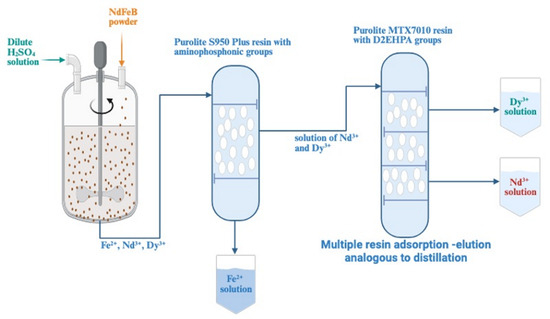
Recovering and Purifying Neodymium and Dysprosium from Simulated Leaching Solution of Spent NdFeB Magnets via Ion Exchange Processes



Abstract
1. Introduction

| Used Resin | Functional Group | Target Elements | Elution Process | Adsorption Conditions | Resin Adsorption Efficiency | Ref. | ||
|---|---|---|---|---|---|---|---|---|
| pH | T (K) | Time | ||||||
| Strongly cation resin (SQS-6) | Sulfonic groups | La and Nd | HF + HCl | 4.0 | 298 | 10 min | 13.8 mg/g for La (III) 12.7 mg/g for Nd (III). | [28] |
| Weak acrylic resin (110 resin) | Carboxylic acid | Nd | 3.0 M HCl | 6.0 | 298 | 60 h | 308 mg/g the maximum adsorption capacity | [38] |
| TRPO-impregnated Levextrel resin | Trialkylphosphine oxide | Nd, Zr | - | 5.7 | 298 | 2 h | 47 mg/g for Zr (IV) and 48 mg/g for Nd (III) | [33] |
| Cyanex 272 impregnated XAD–7 | Phosphinic acid | La, Pr, Nd, Sm, Eu, Gd | 0.01 M HNO3 or 0.01 M HCl | 2.4 | 298 | 3 h | Gd > Eu > Sm > Nd > Pr > La | [34] |
| TEHDGA impregnated XAD-7 | Diglycolamide | La, Nd, Y, and Er | 0.01 M HNO3 | - | - | 40 min | Total load capacity of the La, Nd, Y, and Er 7.07 mg/g | [32] |
| Amberlite IRC-747 and Lewatit TP-260 | Aminophosphonic Aminomethylphosph-onic | La, Nd, Gd, Dy, Er, yb, Sc, and Y | H2SO4 (9 M & 18 M) or Na2CO3 1 M | - | 323 | 3 h | Maximum 1.8 meq/g | [14] |
| Purolite S957 | Phosphonic & Sulphonic acid | La, Ce, Nd, Fe, Ni, Co, Cu and Zn | 2.0 M HNO3 or 2.0 M HCl | - | 293 | 1 h | 50% Ni (II) And 100% La (III) | [26] |
| Dowex 50WX8 | Sulphonic acid | Dy, Pr, and Y | 1.0 M HNO3 | - | 298 | 15 min | 30 mg/g Pr, 50 mg/g of Dy, 60 mg/g of Y | [31] |
| Resorcinol–terephthalaldehyde (RTPA) | Carboxylic acid | La3+, Nd3+, Eu3+, Dy3+, Yb3+ | 2.0 M HNO3 | 4.7 | 298 | 60 min | Higher than 50 mg/g | [24] |
| Coated solvent-impregnated resin (SIR) | 2-ethylhexyl- phosphonic acid mono- 2-ethylhexyl ester | Nd3+, Pr3+, Dy3+ | 1.0 M HNO3 | 2.0 and <2.0 | 298 | 24 h | 0.230 mmol/g for Nd3+ and 0.182 mmol/g for Dy3+ | [37] |
| Ion Exchange Resin | Polymer Structure | Functional Groups | Delivery Form | Bed Size (mm) | Total Capacity | Maximum Operating Temperature | pH Range |
|---|---|---|---|---|---|---|---|
| Puromet MTS 9100 | Polyacrylic crosslinked with divinylbenzene | Amidoxime | - | <0.3 max | 40 g Cu/L | - | - |
| ResinTech SIR 500 | Styrene/DVB Macroporous | Aminophosphonic | Na+ | 0.297–1.19 | >1.4 | 85 °C | 2–10 |
| Purolite S950plus | Macroporous polystyrene crosslinked with divinylbenzene | Na+ | 0.425–0.850 | 24 g Ca/L | 90 °C | 0–14 | |
| Purolite S940 | Macroporous polystyrene crosslinked with divinylbenzene | Na+ | 0.425–0.850 | 20 g Ca/L | 90 °C | 0–14 | |
| Puromet MTS9500 | Macroporous Styrene-divinylbenzene | Na+ | 0.3–1.2 | 26 g/L | 80 °C | 0–14 | |
| Purolite MTS 9570 | Macroporous polystyrene crosslinked with divinylbenzene | Phosphonic and Sulfonic acid | H+ | 0.315–0.850 | 18 g Fe/L | 0–14 | |
| Dowex G-26 | Gel/Styrene-DVB | Sulfonic acid | H+ | 0.650 ± 50 | 2 | 134 °C | 0–14 |
| Amberlite IRC-120 | Gel/Styrene divinylbenzene copolymer | H+ | 0.620–0.830 | ≥1.80 (H+ form) | 135 °C | 0–14 | |
| Lewatit vp oc 1026 | Macroporous/crosslinked polystyrene | Di-(2-ethylhexyl) phosphoric acid (D2EHPA) | H+ | 0.31–1.65 | 13 g Zn/L | −20–40 °C | <4 |
| Purolite MTX7010 | Macroporous polystyrene crosslinked with divinylbenzene | H+ | 0.3–1.66 | 13 g Zn/L | 80 °C (max) | 4 (max) | |
| Lewatit MDS TP 260 | Macroporous/Styrenic | Aminomethyl-phosphonic acid | Na+ | 0.40 (+/− 0.04) | 3 (H+ form) | −20–40 °C | 0–14 |
| Amberlite IRN-150 | Gel | Sulfonic acid (strong acid cation)/Trimethyl-ammonium(strong base anion) | H+/OH− | ≥1.20 eq/L (OH− form) ≥1.90 eq/L (H+ form) | ≥1.90 eq/L (H+ form) ≥1.20 eq/L (OH− form) | 5–100 °C | 0–14 |
| Lewatit® TP 272 | Macroporous/crosslinked polystyrene | Bis-(2,4,4-trimethylpentyl -) phosphinic acid | >90% | 12.5 g/L | −20–40 °C | 0–14 | |
| Purolite MTS9300 | Macroporous polystyrene crosslinked with divinylbenzene | Iminodiacetic | Na+ | 0.425–1.0 | 50 g/L | 80 °C | 0–14 |
| Purolite S930 Plus | Macroporous crosslinked polymer | Na+ | 0.425–1.0 | 2.9 eq/L | 80 °C | 0–14 | |
| Lewatit monoplus TP207 | Macroporous crosslinked polymer | Na+ | 0.61 (+/− 0.05) | 2.0 eq/L | −20–40 °C | 0–14 | |
| Lewatit monoplus TP208 | Macroporous crosslinked polymer | Na+ | 0.65 (+/− 0.05) | 2.5 eq/L | −20–40 °C | 0–14 | |
| Purolite S930 | Macroporous crosslinked polymer | Na+ | 0.60–0.85 | 30 g/L | 70 °C | 2–6 (H Form)/6–11 (Na Form) | |
| PuroliteMTS9140 | Macroporous polystyrene crosslinked with divinylbenzene | Thiourea | - | 0.30–1.2 | 1 eq/L | 100 °C | 0–14 |
| Lewatit monoplusTP214 | Macroporous polystyrene crosslinked with divinylbenzene | Thiourea | - | 0.55 (+/− 0.05) | 1.1 eq/L | 20–40 °C | 0–14 |
| ResinTech SIR-600 | Zeolite Crystalline | Aluminosilicate | Na+/K | 0.297–1.19 | 0.6 | 100 °C | 6–10 |
| Puromet MTS9200 | Microporous polystyrene crosslinked with divinylbenzene | Isothiouronium | H+ | 0.63 (+/− 0.05) | 1.7 eq/L | 80 °C | 0–7 |
| Puromet MTS9240 | Microporous polystyrene crosslinked with divinylbenzene | Thiol Chelating resins | H+ | 0.3–1.0 | 200 g Hg/L | 60 °C | - |
| DOWEX™ MAC-3 | Polyacrylic, microporous | Carboxylic acid | H+ | 0.30–1.2 | 3.8 eq/L | 120 °C | 5–14 |
2. Experimental
2.1. Chemicals and Instruments
2.2. Preparing and Activation of the Resins
2.3. Leaching of NdFeB Magnet Powder and Preparing Synthetic Solutions for the Adsorption Experiments
2.4. Resin Adsorption Tests
3. Results and Discussion
3.1. Iron Removal
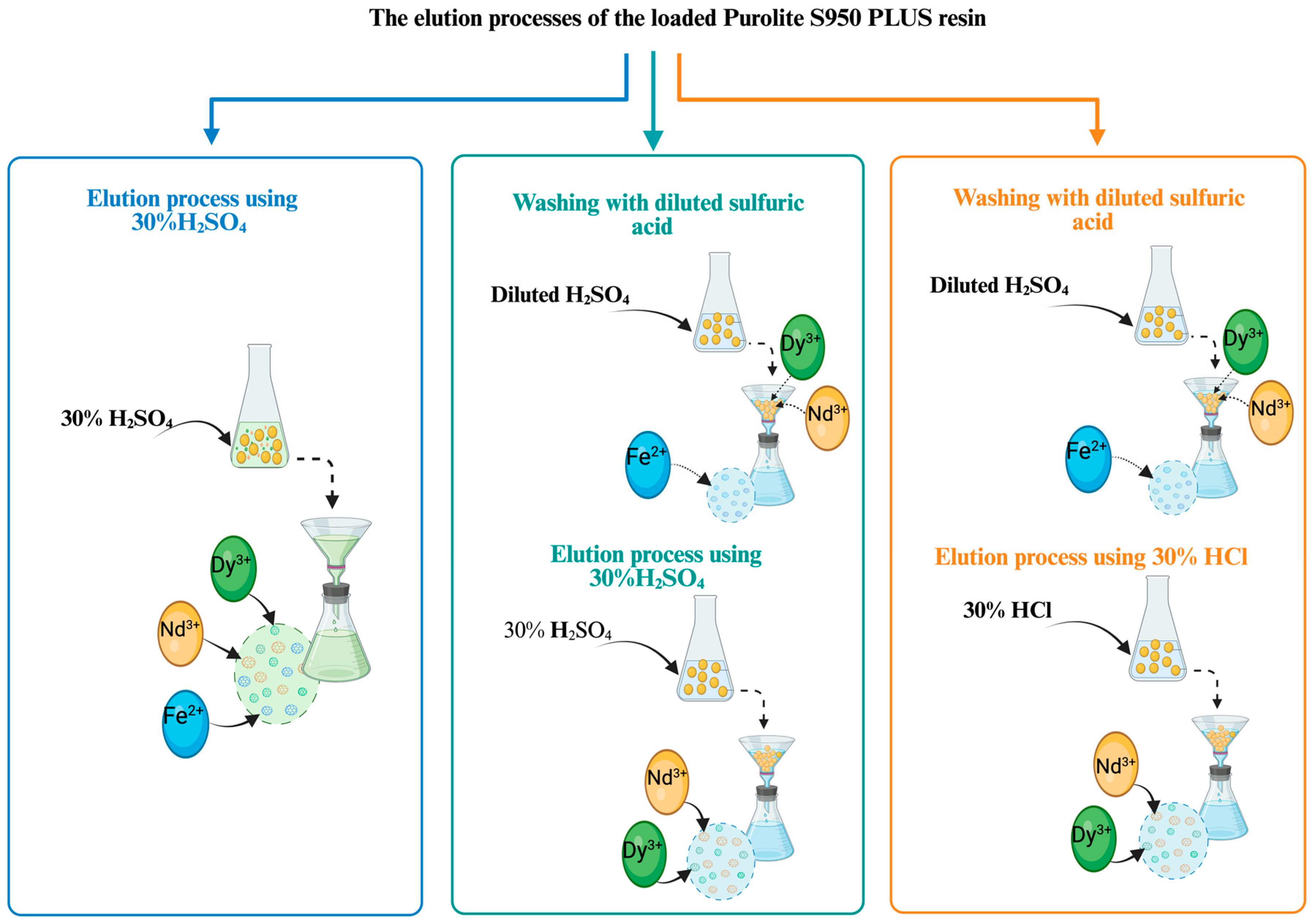
3.2. Fe, Nd and Dy Elution from Loaded Purolite S950 PLUS Resin
3.3. Separation of Dy and Nd Using Resin Impregnated with di-(2-Ethylhexyl) Phosphoric Acid (D2EHPA)
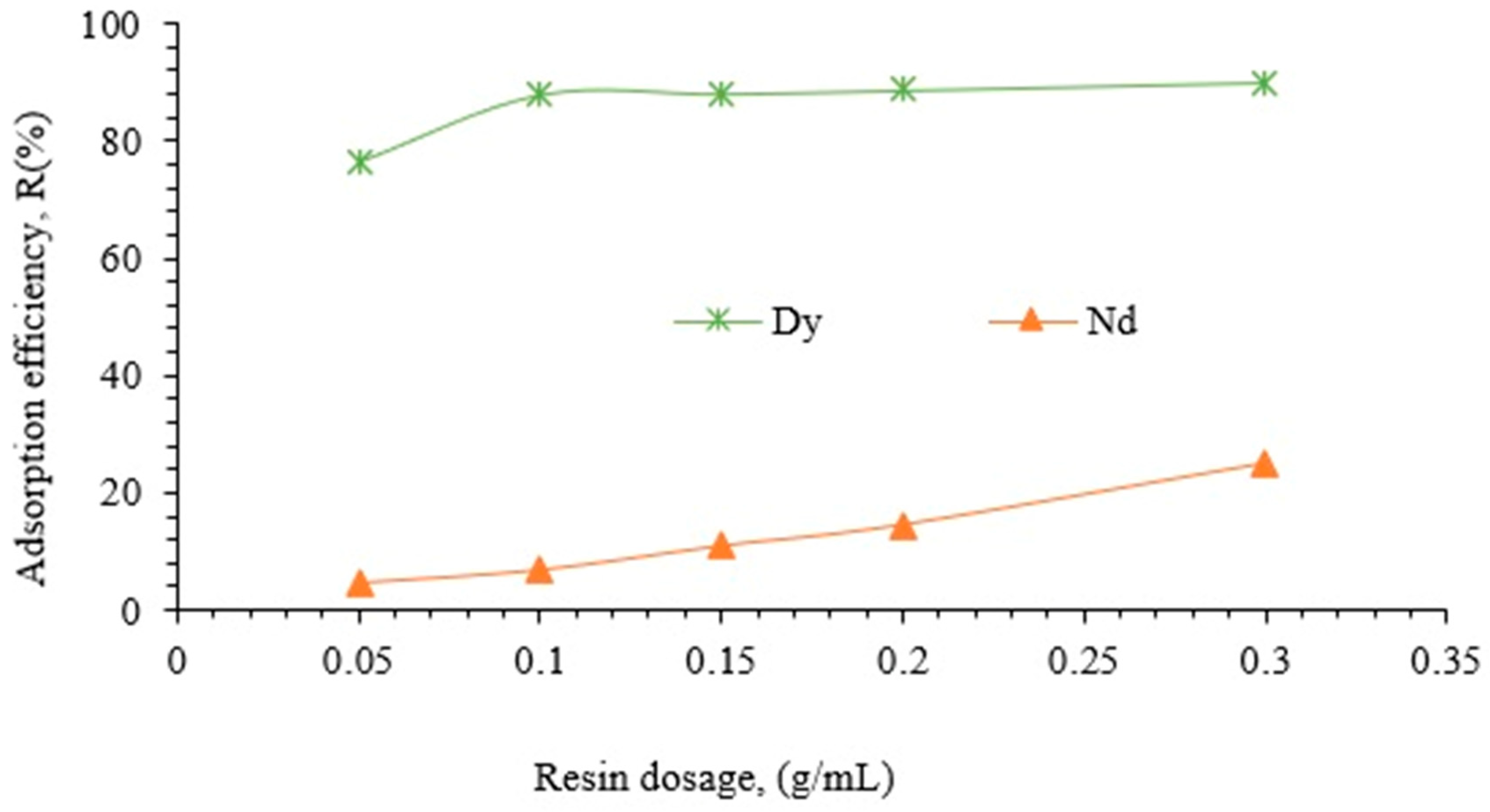
3.3.1. Effect of Resin Dosage
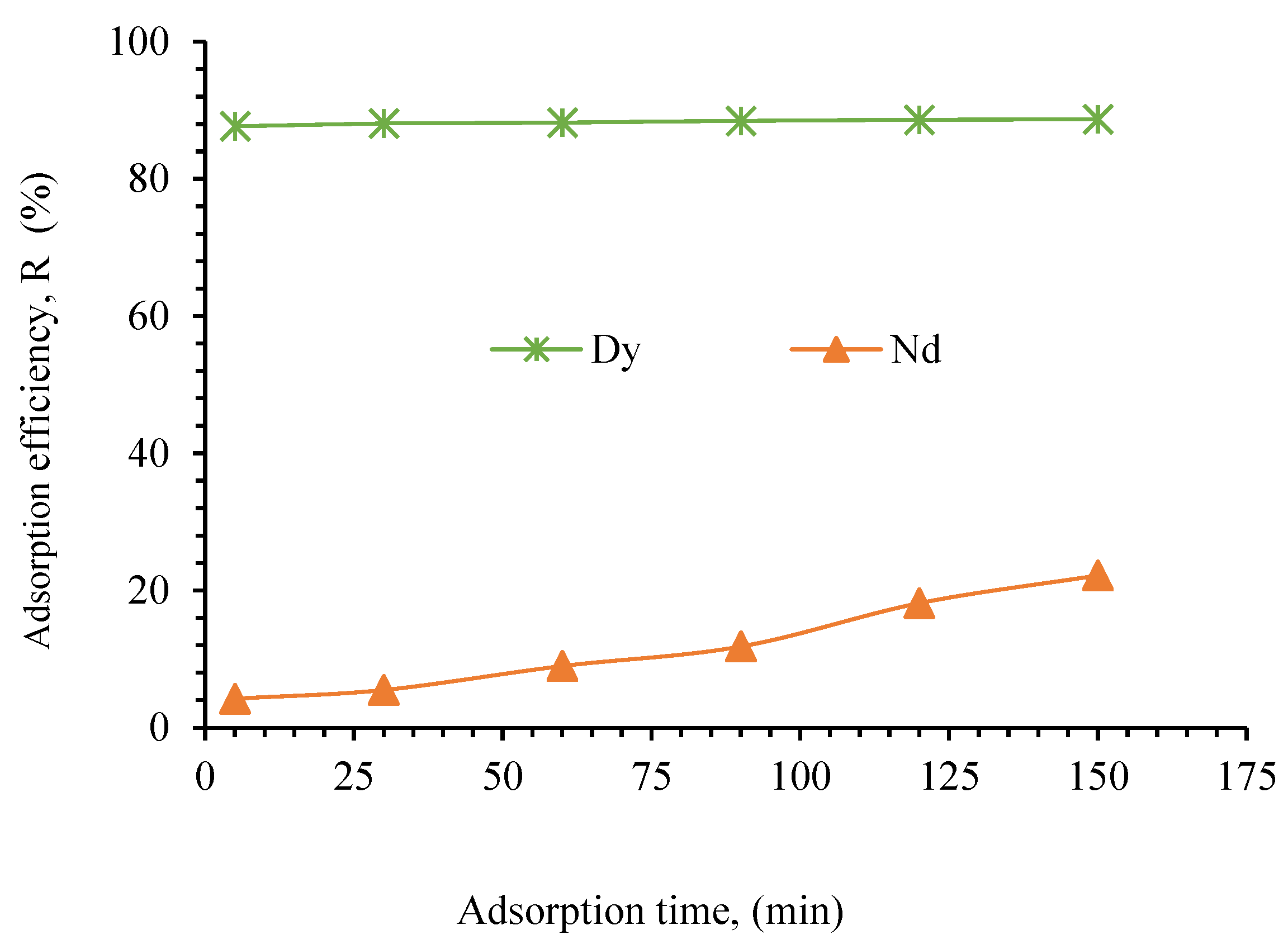
3.3.2. Effect of Adsorption Time
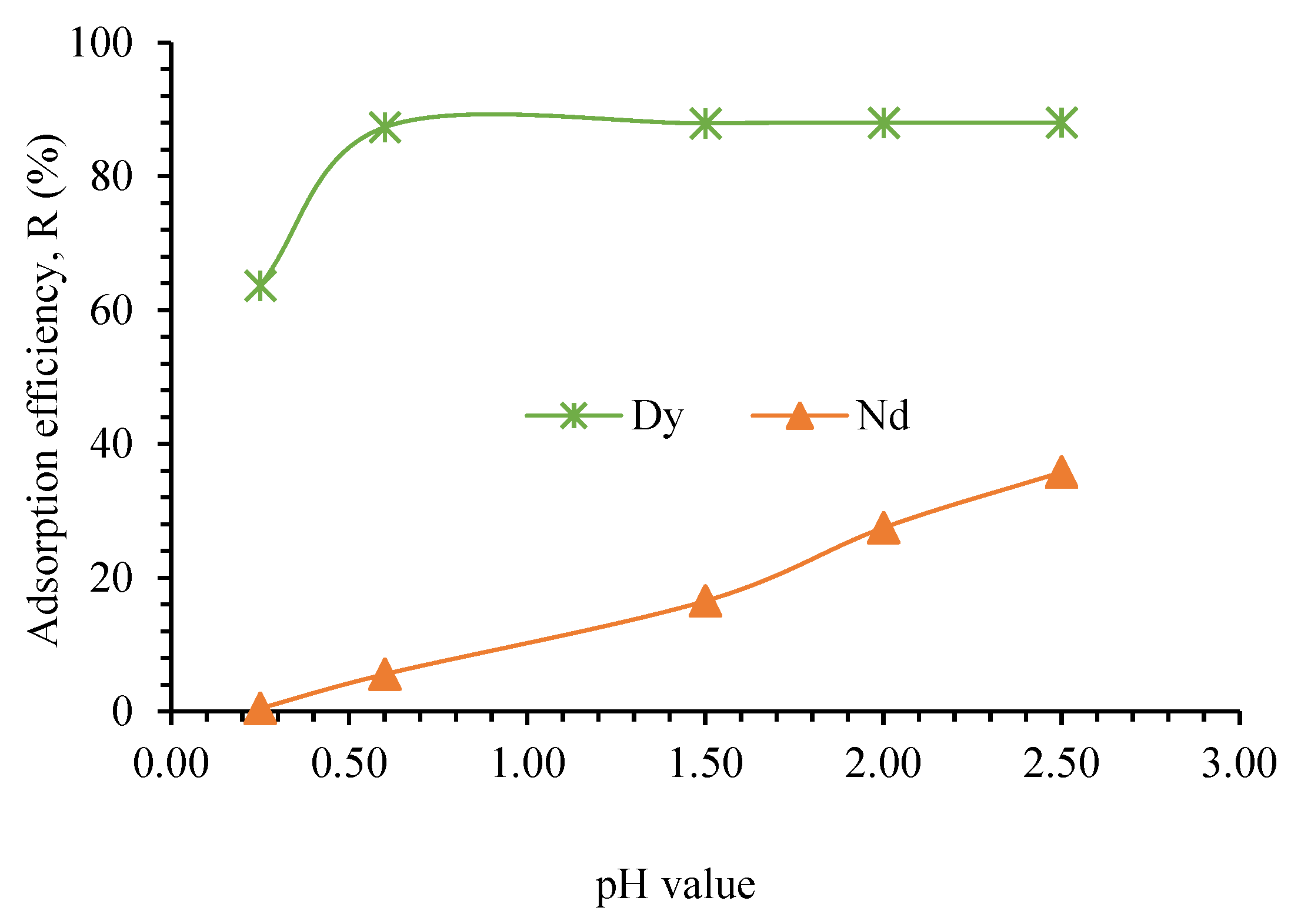
3.3.3. Effect of pH on Metal Adsorption
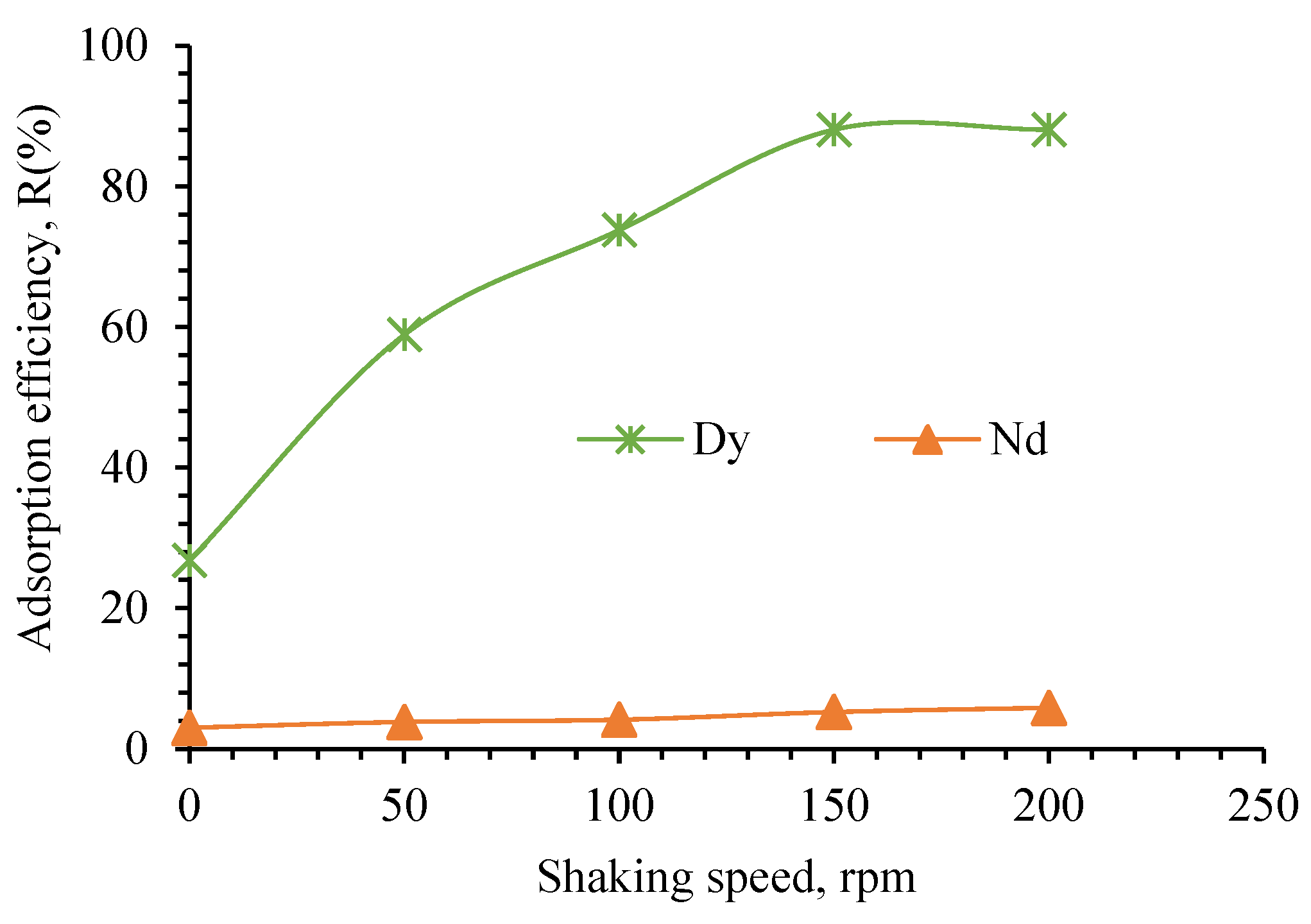
3.3.4. Effect of Shaking Speed (rpm)
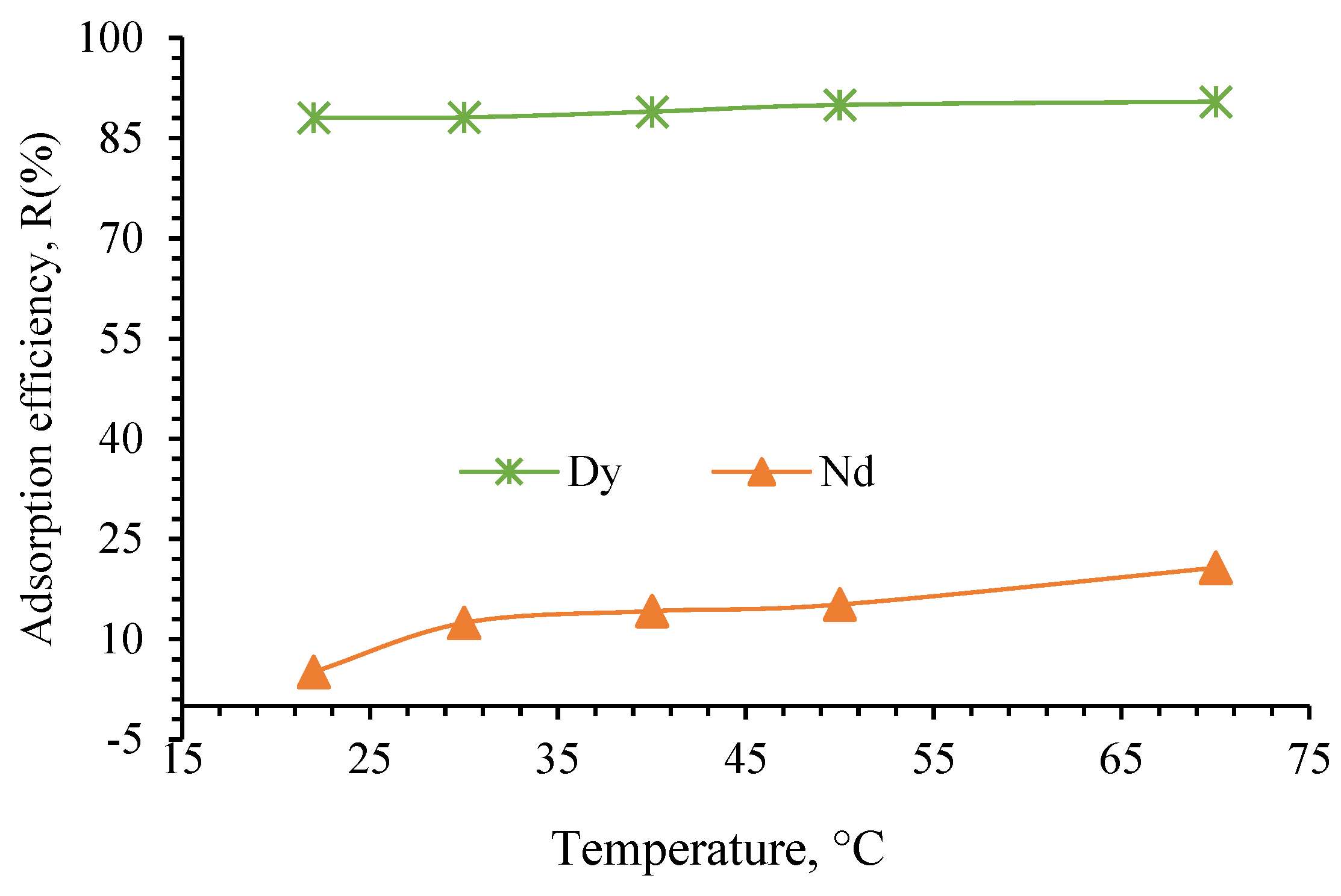
3.3.5. Impact of Temperature on Metal Adsorption
4. Nd and Dy Elution from Loaded Purolite MTX7010 Resin
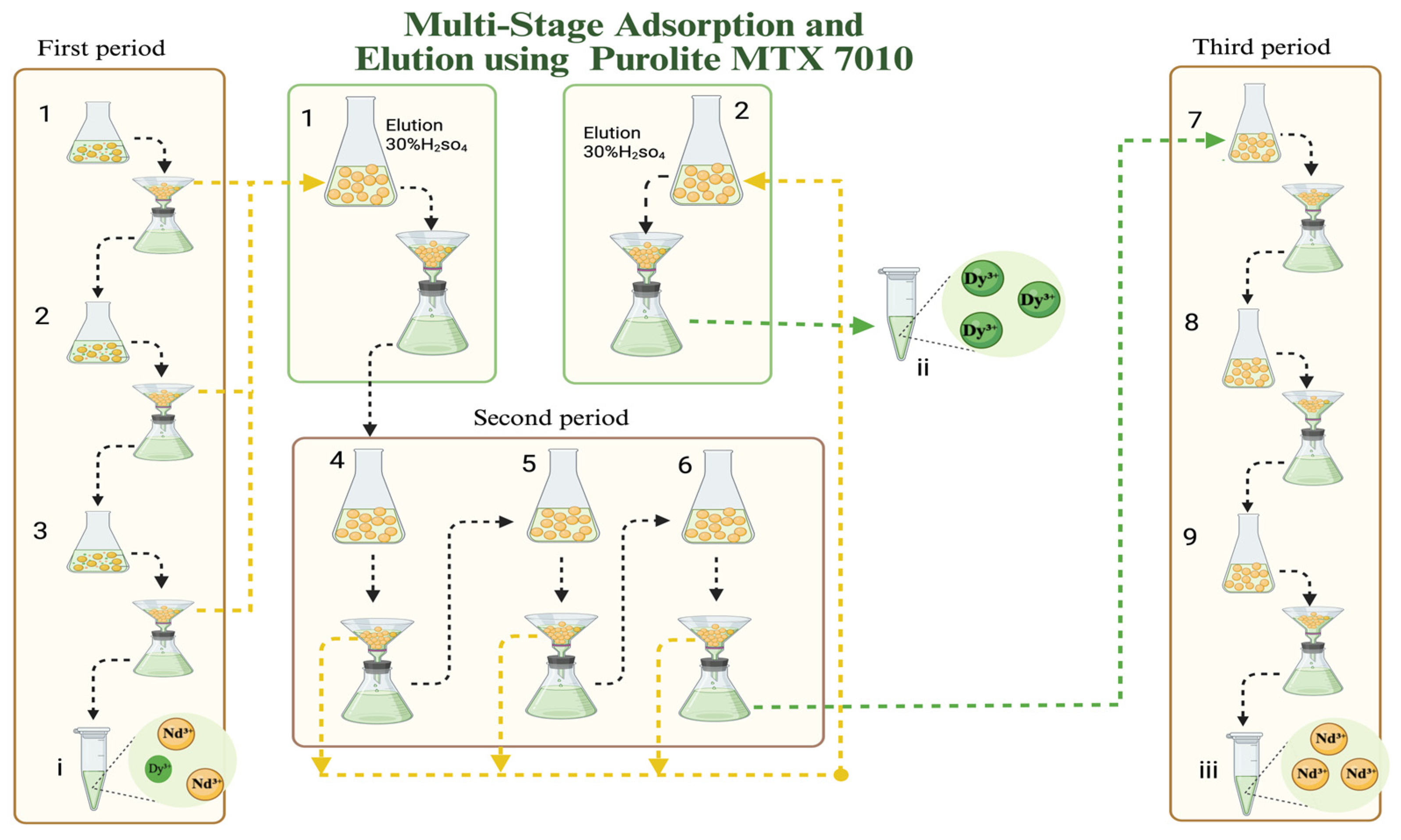
5. Multistage Adsorption–Elution Process for Nd and Dy Purification
6. Conclusions
Author Contributions
Funding
Data Availability Statement
Acknowledgments
Conflicts of Interest
References
- Zhao, D.; Liu, F.; Gao, Y.; Jiang, P.; Liu, L.; Zhao, M.; Ren, S.; Pei, W. Dy evolution and coercivity improvement mechanism of sintered NdFeB magnets in thermal diffusion process. J. Magn. Magn. Mater. 2022, 563, 169943. [Google Scholar] [CrossRef] [Scilit]
- Kumari, A.; Sinha, M.K.; Pramanik, S.; Sahu, S.K. Recovery of rare earths from spent NdFeB magnets of wind turbine: Leaching and kinetic aspects. Waste Manag. 2018, 75, 486–498. [Google Scholar] [CrossRef] [Scilit]
- Du, X.; Graedel, T.E. Uncovering the end uses of the rare earth elements. Sci. Total Environ. 2013, 461–462, 781–784. [Google Scholar] [CrossRef] [Scilit]
- Heim, J.W.; Wal, R.L.V. NdFeB Permanent Magnet Uses, Projected Growth Rates and Nd Plus Dy Demands across End-Use Sectors through 2050: A Review. Minerals 2023, 13, 1274. [Google Scholar] [CrossRef] [Scilit]
- Salfate, G.; Sánchez, J. Rare Earth Elements Uptake by Synthetic Polymeric and Cellulose-Based Materials: A Review. Polymers 2022, 14, 4786. [Google Scholar] [CrossRef] [Scilit]
- Kumari, A.; Sahu, S.K. A comprehensive review on recycling of critical raw materials from spent neodymium iron boron (NdFeB) magnet. Sep. Purif. Technol. 2023, 317, 123527. [Google Scholar] [CrossRef] [Scilit]
- Ormerod, J.; Karati, A.; Baghel, A.P.S.; Prodius, D.; Nlebedim, I.C. Sourcing, Refining and Recycling of Rare-Earth Magnets. Sustainability 2023, 15, 14901. [Google Scholar] [CrossRef] [Scilit]
- Itakura, T.; Sasai, R.; Itoh, H. Resource recovery from Nd–Fe–B sintered magnet by hydrothermal treatment. J. Alloys Compd. 2006, 408–412, 1382–1385. [Google Scholar] [CrossRef] [Scilit]
- Venkatesan, P.; Sun, Z.H.I.; Sietsma, J.; Yang, Y. An environmentally friendly electro-oxidative approach to recover valuable elements from NdFeB magnet waste. Sep. Purif. Technol. 2018, 191, 384–391. [Google Scholar] [CrossRef] [Scilit]
- Hoogerstraete, T.V.; Blanpain, B.; Van Gerven, T.; Binnemans, K. From NdFeB magnets towards the rare-earth oxides: A recycling process consuming only oxalic acid. RSC Adv. 2014, 4, 64099–64111. [Google Scholar] [CrossRef] [Scilit]
- Takeda, O.; Okabe, T.H. Current Status on Resource and Recycling Technology for Rare Earths. Metall. Mater. Trans. E 2014, 1, 160–173. [Google Scholar] [CrossRef] [Scilit]
- Abrahami, S.T.; Xiao, Y.; Yang, Y. Rare-earth elements recovery from post-consumer hard-disc drives. Miner. Process. Extr. Metall. Trans. Inst. Min. Metall. C 2015, 124, 106–115. [Google Scholar] [CrossRef] [Scilit]
- Lee, C.H.; Chen, Y.J.; Liao, C.H.; Popuri, S.R.; Tsai, S.L.; Hung, C.E. Selective leaching process for neodymium recovery from scrap Nd-Fe-B magnet. Metall. Mater. Trans. A 2013, 44, 5825–5833. [Google Scholar] [CrossRef] [Scilit]
- Hérès, X.; Blet, V.; Di Natale, P.; Ouaattou, A.; Mazouz, H.; Dhiba, D.; Cuer, F. Selective extraction of rare earth elements from phosphoric acid by ion exchange resins. Metals 2018, 8, 682. [Google Scholar] [CrossRef] [Scilit]
- Liu, F.; Porvali, A.; Halli, P.; Wilson, B.P.; Lundström, M. Comparison of Different Leaching Media and Their Effect on REEs Recovery from Spent Nd-Fe-B Magnets. JOM 2020, 72, 806–815. [Google Scholar] [CrossRef] [Scilit]
- Xie, F.; Zhang, T.A.; Dreisinger, D.; Doyle, F. A critical review on solvent extraction of rare earths from aqueous solutions. Miner. Eng. 2014, 56, 10–28. [Google Scholar] [CrossRef] [Scilit]
- Higgins, R.F.; Ruoff, K.P.; Kumar, A.; Schelter, E.J. Coordination Chemistry-Driven Approaches to Rare Earth Element Separations. Acc. Chem. Res. 2022, 55, 2616–2627. [Google Scholar] [CrossRef] [Scilit]
- Reddy, B.R.; Kumar, B.N.; Radhika, S. Solid-Liquid extraction of terbium from phosphoric acid medium using bifunctional phosphinic acid resin, tulsion CH-96. Solvent Extr. Ion. Exch. 2009, 27, 695–711. [Google Scholar] [CrossRef] [Scilit]
- Freire, M.G.; Neves, C.M.S.S.; Marrucho, I.M.; Coutinho, J.A.P.; Fernandes, A.M. Hydrolysis of tetrafluoroborate and hexafluorophosphate counter ions in imidazolium-based ionic liquids. J. Phys. Chem. A 2010, 114, 3744–3749. [Google Scholar] [CrossRef] [Scilit]
- Shamsuri, A.A.; Abdullah, D.K. Ionic Liquids: Preparations And Limitations. Makara J. Sci. 2010, 14, 1. [Google Scholar] [CrossRef] [Scilit]
- Zhang, Y.; Gu, F.; Su, Z.; Liu, S.; Anderson, C.; Jiang, T. Hydrometallurgical recovery of rare earth elements from ndfeb permanent magnet scrap: A review. Metals 2020, 10, 841. [Google Scholar] [CrossRef] [Scilit]
- Silva, R.A.; Zhang, Y.; Hawboldt, K.; James, L.A. Study on Iron-nickel Separation Using Ion Exchange Resins with Different Functional Groups for Potential Iron Sub-production. Miner. Process. Extr. Metall. Rev. 2021, 42, 75–89. [Google Scholar] [CrossRef] [Scilit]
- Judge, W.D.; Azimi, G. Recent progress in impurity removal during rare earth element processing: A review. Hydrometallurgy 2020, 196, 105435. [Google Scholar] [CrossRef] [Scilit]
- Auke, R.O.; Arrachart, G.; Tavernier, R.; David, G.; Pellet-Rostaing, S. Terephthalaldehyde–Phenolic Resins as a Solid-Phase Extraction System for the Recovery of Rare-Earth Elements. Polymers 2022, 14, 311. [Google Scholar] [CrossRef] [Scilit] [PubMed]
- Benamor, M.; Bouariche, Z.; Belaid, T.; Draa, M.T. Kinetic studies on cadmium ions by Amberlite XAD7 impregnated resins containing di(2-ethylhexyl) phosphoric acid as extractant. Sep. Purif. Technol. 2008, 59, 74–84. [Google Scholar] [CrossRef] [Scilit]
- Kołodyńska, D.; Fila, D.; Hubicki, Z. Evaluation of possible use of the macroporous ion exchanger in the adsorption process of rare earth elements and heavy metal ions from spent batteries solutions. Chem. Eng. Process.—Process Intensif. 2020, 147, 107767. [Google Scholar] [CrossRef] [Scilit]
- Hermassi, M.; Granados, M.; Valderrama, C.; Skoglund, N.; Ayora, C.; Cortina, J.L. Impact of functional group types in ion exchange resins on rare earth element recovery from treated acid mine waters. J. Clean. Prod. 2022, 379, 134742. [Google Scholar] [CrossRef] [Scilit]
- Elgoud, E.M.A.; Ismail, Z.H.; Ahmad, M.I.; El-Nadi, Y.A.; Abdelwahab, S.M.; Aly, H.F. Sorption of Lanthanum(III) and Neodymium(III) from Concentrated Phosphoric Acid by Strongly Acidic Cation Exchange Resin (SQS-6). Russ. J. Appl. Chem. 2019, 92, 1581–1592. [Google Scholar] [CrossRef] [Scilit]
- Elgoud, E.M.A.; Ismail, Z.H.; El-Nadi, Y.A.; Abdelwahab, S.M.; Aly, H.F. Solid–Liquid Extraction of Rare Earth Elements Ce(IV), Pr(III), Er(III), and Y(III) from Concentrated Phosphoric Acid Solutions Using Strongly Acidic Cation Exchange Resin (SQS–6). Russ. J. Appl. Chem. 2022, 95, 602–615. [Google Scholar] [CrossRef] [Scilit]
- Masry, B.A.; Elgoud, E.M.A.; Rizk, S.E. Modeling and equilibrium studies on the recovery of praseodymium (III), dysprosium (III) and yttrium (III) using acidic cation exchange resin. BMC Chem. 2022, 16, 37. [Google Scholar] [CrossRef] [Scilit]
- Xiong, C.; Meng, Y.; Yao, C.; Shen, C. Adsorption of erbium(III) on D113-III resin from aqueous solutions: Batch and column studies. J. Rare Earths 2009, 27, 923–931. [Google Scholar] [CrossRef] [Scilit]
- Mondal, S.; Ghar, A.; Satpati, A.; Sinharoy, P.; Singh, D.; Sharma, J.; Sreenivas, T.; Kain, V. Recovery of rare earth elements from coal fly ash using TEHDGA impregnated resin. Hydrometallurgy 2019, 185, 93–101. [Google Scholar] [CrossRef] [Scilit]
- Zhang, W.; Ye, G.; Chen, J. TRPO Impregnated Levextrel Resin: Synthesis and Extraction Behavior of Zr (IV) and Nd (III) Ions. Sep. Sci. Technol. 2012, 48, 263–271. [Google Scholar] [CrossRef] [Scilit]
- İnan, S.; Tel, H.; Sert, Ş.; Çetinkaya, B.; Sengül, S.; Özkan, B.; Altaş, Y. Extraction and separation studies of rare earth elements using Cyanex 272 impregnated Amberlite XAD-7 resin. Hydrometallurgy 2018, 181, 156–163. [Google Scholar] [CrossRef] [Scilit]
- Kovalenko, O.; Baulin, V.; Baulin, D.; Tsivadze, A. Solvent-impregnated resins based on the mixture of (2-diphenylphosphoryl)-4-ethylphenoxy)methyl) diphenylphosphine oxide and ionic liquid for nd(iii) recovery from nitric acid media. Molecules 2021, 26, 2440. [Google Scholar] [CrossRef] [Scilit]
- Falco, A.; Neri, M.; Melegari, M.; Baraldi, L.; Bonfant, G.; Tegoni, M.; Serpe, A.; Marchiò, L. Semirigid Ligands Enhance Different Coordination Behavior of Nd and Dy Relevant to Their Separation and Recovery in a Non-aqueous Environment. Inorg. Chem. 2022, 61, 16110–16121. [Google Scholar] [CrossRef] [Scilit] [PubMed]
- Yamada, E.; Murakami, H.; Nishihama, S.; Yoshizuka, K. Separation process of dysprosium and neodymium from waste neodymium magnet. Sep. Purif. Technol. 2018, 192, 62–68. [Google Scholar] [CrossRef] [Scilit]
- Xiong, C.; He, R.; Pi, L.; Li, J.; Yao, C.; Jiang, J.; Zheng, X. Adsorption of Neodymium(III) on Acrylic Resin (110 Resin) from Aqueous Solutions. Sep. Sci. Technol. 2015, 50, 564–572. [Google Scholar] [CrossRef] [Scilit]
- Sharifian, S.; Wang, N.H.L. Resin-based approaches for selective extraction and purification of rare earth elements: A comprehensive review. J. Environ. Chem. Eng. 2024, 12, 112402. [Google Scholar] [CrossRef] [Scilit]
- El Ouardi, Y.; Virolainen, S.; Mouele, E.S.M.; Laatikainen, M.; Repo, E.; Laatikainen, K. The recent progress of ion exchange for the separation of rare earths from secondary resources—A review. Hydrometallurgy 2023, 218, 106047. [Google Scholar] [CrossRef] [Scilit]
- Shannon, R.D. Revised effective ionic radii and systematic studies of interatomic distances in halides and chalcogenides. Acta Cryst. 1976, 32, 751–767. [Google Scholar] [CrossRef] [Scilit]
- Dev, K.; Pathak, R.; Rao, G.N. Sorption behaviour of lanthanum(III), neodymium(III), terbium(III), thorium(IV) and uranium(VI) on Amberlite XAD-4 resin functionalized with bicine ligands. Talanta 1999, 48, 579–584. [Google Scholar] [CrossRef] [Scilit]
- Xiong, C.; Chen, X.; Yao, C. Enhanced adsorption behavior of Nd(III) onto D113-III resin from aqueous solution. J. Rare Earths 2011, 29, 979–985. [Google Scholar] [CrossRef] [Scilit]


| Solutions | Conc. (mg/L) | Chemicals | pH |
|---|---|---|---|
| Fe2+ + Nd3+ + Dy3+ | 13,000 of Fe, 6000 of Nd and 200 of Dy | FeSO4·7H2O Nd2(SO4)3·xH2O and Dy2(SO4)3·8H2O | 0.65 |
| Nd3+ | 6000 of Nd | Nd2(SO4)3·xH2O | 0.65 |
| Dy3+ | 200 of Dy | Dy2(SO4)3·8H2O | 0.65 |
| Nd3+ + Dy3+ | 6000 of Nd and 200 of Dy | Nd2(SO4)3·xH2O and Dy2(SO4)3·8H2O | 0.65 |
| Sample | Fe2+ | Nd3+ | Dy3+ | Washing Process | Elution Process | |||||||||
|---|---|---|---|---|---|---|---|---|---|---|---|---|---|---|
| Final Conc. in Solution (mg/L) | Resin Adsorption Efficiency % | Final Conc. in Solution (mg/L) | Resin Adsorption Efficiency % | Final Conc. in Solution (mg/L) | Resin Adsorption Efficiency % | Washing Time (min.) Diluted H2SO4 (pH 0.65) | Elution Rate | Elution | Elution Rate | |||||
| Fe2+ % | Nd3+ % | Dy3+ % | Fe2+ % | Nd3+ % | Dy3+ % | |||||||||
| 1 | 11,747.78 | 5.39 | 284.34 | 94.10 | 5.81 | 97.35 | --- | --- | --- | --- | 30% H2SO4 | 91.71 | 97.53 | 98.29 |
| 2 | 11,795.85 | 5.00 | 268.67 | 94.42 | 6.10 | 97.22 | --- | --- | --- | --- | 30% H2SO4 | 95.04 | 98.13 | 97.33 |
| 3 | 11,806.58 | 4.92 | 256.00 | 94.69 | 5.36 | 97.55 | --- | --- | --- | --- | 30% H2SO4 | 95.27 | 98.56 | 98.43 |
| 4 | 11,787.82 | 5.07 | 214.46 | 95.55 | 6.10 | 97.22 | 5 min | 81.7 | 0.038 | 0.327 | 30% H2SO4 | 97.9 | 96.0 | 99.1 |
| 5 | 11,798.27 | 4.98 | 206.27 | 95.72 | 6.61 | 96.98 | 10 min | 83.1 | 0.046 | 0.329 | 30% H2SO4 | 96.0 | 95.8 | 99.4 |
| 6 | 11,728.97 | 5.54 | 275.94 | 94.27 | 7.08 | 96.77 | 20 min | 74.7 | 0.037 | 0.330 | 30% H2SO4 | 96.3 | 97.2 | 99.1 |
| 7 | 11,698.95 | 5.78 | 229.78 | 95.23 | 6.98 | 96.81 | 5 min | 82.2 | 0.043 | 0.250 | 30% HCl | 97.9 | 96.0 | 99.1 |
| 8 | 11,741.72 | 5.44 | 219.00 | 95.45 | 7.85 | 96.42 | 10 min | 83.5 | 0.049 | 0.336 | 30% HCl | 96.0 | 95.8 | 99.4 |
| 9 | 11,697.23 | 5.80 | 226.45 | 95.30 | 8.03 | 96.33 | 20 min | 82.5 | 0.057 | 0.303 | 30% HCl | 96.3 | 97.2 | 99.1 |
| Adsorption | First Elution Stage for 30 min. | Second Elution Stage for 30 min. | |||||||||||||
|---|---|---|---|---|---|---|---|---|---|---|---|---|---|---|---|
| Nd3+ | Dy3+ | Loaded Nd3+ (mg/L) | Loaded Dy3+ (mg/L) | H2SO4 | H2SO4 | ||||||||||
| Conc. (mg/L) | R% | Conc. (mg/L) | R% | Acid Conc. | Eluted Nd (mg/L) | Eluted Dy (mg/L) | Nd3+ (%) | Dy3+ (%) | Acid Conc. | Eluted Nd3+ (mg/L) | Eluted Dy3+ (mg/L) | Nd3+ (%) | Dy3+ (%) | ||
| 5137.23 | 5.62 | 24.90 | 89.10 | 306.05 | 203.49 | 10% | 236.87 | 178.93 | 75.83 | 87.50 | 10% | 64.04 | 21.35 | 84.84 | 83.50 |
| 5130.37 | 5.75 | 24.11 | 89.44 | 312.91 | 204.28 | 20% | 253.06 | 189.00 | 80.24 | 92.55 | 20% | 56.70 | 13.15 | 86.18 | 86.42 |
| 5132.13 | 5.72 | 24.70 | 89.19 | 311.15 | 203.69 | 30% | 287.88 | 195.78 | 91.15 | 95.72 | 30% | 26.27 | 8.41 | 93.92 | 96.06 |
| 2 g resin dosage and 5 min contact time | First elution stage for 30 min. | Second elution stage for 30 min. | |||||||||||||
| Nd3+ | Dy3+ | loaded Nd3+ (mg/L) | loaded Dy3+ (mg/L) | HCl | HCl | ||||||||||
| conc. (mg/L) | R% | conc. (mg/L) | R% | acid conc. | eluted Nd (mg/L) | eluted Dy (mg/L) | Nd3+ (%) | Dy3+ (%) | acid conc. | eluted Nd3+ (mg/L) | eluted Dy3+ (mg/L) | Nd3+ (%) | Dy3+ (%) | ||
| 5130.92 | 5.74 | 23.90 | 89.54 | 312.36 | 204.49 | 10% | 230.72 | 174.34 | 75.39 | 85.68 | 10% | 60.72 | 24.17 | 80.61 | 82.93 |
| 5127.89 | 5.79 | 24.17 | 89.42 | 315.38 | 204.22 | 20% | 259.67 | 182.74 | 82.99 | 89.46 | 20% | 45.58 | 19.65 | 85.62 | 86.61 |
| 5127.42 | 5.80 | 23.86 | 89.55 | 315.85 | 204.53 | 30% | 283.89 | 191.62 | 91.24 | 94.07 | 30% | 25.86 | 11.57 | 94.86 | 95.78 |
| Solution | Dy Conc. (mg/L) | Nd Conc. (mg/L) | Dy Recovery % | Nd Recovery % | Dy Purity | Nd Purity |
|---|---|---|---|---|---|---|
| Start solution | 266.34 | 6049.87 | 4.22% | 95.78% | ||
| Solution-i | 5.59 | 5660.82 | 2.10 | 93.57 | 0.10% | 99.90% |
| Solution-ii | 258.48 | 3.90 | 97.05 | 0.06 | 98.51% | 1.49% |
| Solution-iii | 0.02 | 377.04 | 0.0075 | 6.23 | 0.01% | 99.99% |
Disclaimer/Publisher’s Note: The statements, opinions and data contained in all publications are solely those of the individual author(s) and contributor(s) and not of MDPI and/or the editor(s). MDPI and/or the editor(s) disclaim responsibility for any injury to people or property resulting from any ideas, methods, instructions or products referred to in the content. |
© 2026 by the authors. Licensee MDPI, Basel, Switzerland. This article is an open access article distributed under the terms and conditions of the Creative Commons Attribution (CC BY) license.
Share and Cite
Mohammed, F.A.S.; Zhang, Y. Recovering and Purifying Neodymium and Dysprosium from Simulated Leaching Solution of Spent NdFeB Magnets via Ion Exchange Processes. Metals 2026, 16, 504. https://doi.org/10.3390/met16050504
Mohammed FAS, Zhang Y. Recovering and Purifying Neodymium and Dysprosium from Simulated Leaching Solution of Spent NdFeB Magnets via Ion Exchange Processes. Metals. 2026; 16(5):504. https://doi.org/10.3390/met16050504
Chicago/Turabian StyleMohammed, Fakhri Ali Salem, and Yahui Zhang. 2026. "Recovering and Purifying Neodymium and Dysprosium from Simulated Leaching Solution of Spent NdFeB Magnets via Ion Exchange Processes" Metals 16, no. 5: 504. https://doi.org/10.3390/met16050504
APA StyleMohammed, F. A. S., & Zhang, Y. (2026). Recovering and Purifying Neodymium and Dysprosium from Simulated Leaching Solution of Spent NdFeB Magnets via Ion Exchange Processes. Metals, 16(5), 504. https://doi.org/10.3390/met16050504