An Overview of the Benefits, Drawbacks and Strategies Used for the Fabrication of 316L Stainless Steel and Inconel 625 Functionally Graded Materials Using Wire Arc Additive Manufacturing


Abstract
1. Introduction
2. Methods
3. Basic Knowledge on 316L Stainless Steel and Inconel 625
3.1. Stainless Steel
3.2. Inconel 625

| C | Ti | Si | Ni | Cr | Mo | Nb+Ta | Fe |
|---|---|---|---|---|---|---|---|
| 0.023 | 0.3 | 0.4 | 63.8 | 21.7 | 8.9 | 3.6 | 1.3 |
4. Fabrication of FGMs
5. Joining of 316L and Inconel 625 and Phase Formation in Direct Joints
6. The Use of Interlayers in Joining 316L to Inconel 625: Approaches, Outcomes and Literature Examples
7. Methods Used in the Fabrication of FGMs
8. Wire Arc Additive Manufacturing Techniques Used in the Fabrication of Functionally Graded Materials
8.1. GMAW and GTAW-Based WAAM for FGMs
8.2. PAW-Based WAAM for FGMs
8.3. Challenges in WAAM Fabrication of FGMs
8.4. WAAM Studies Using Inconel 625 and 316L FGMs
9. Submerged Arc Additive Manufacturing: Principles, Current Applications and Potential for Future FGM Fabrication
9.1. Principles of Submerged Arc Welding
9.2. Submerged Arc Additive Manufacturing
9.3. Potential of SAAM for FGM Fabrication
10. Conclusions
Author Contributions
Funding
Data Availability Statement
Acknowledgments
Conflicts of Interest
Abbreviations
| AM | Additive Manufacturing |
| CMT | Cold Metal Transfer |
| DED | Directed Energy Deposition |
| EDS | Energy-Dispersive Spectroscopy |
| FEA | Finite Element Analysis |
| FGMs | Functionally Graded Materials |
| GMAW | Gas Metal Arc Welding |
| GTAW | Gas Tungsten Arc Welding |
| HAZ | Heat-Affected Zone |
| IN625 | Inconel 625 |
| LMD | Laser Metal Deposition |
| MIG | Metal Inert Gas |
| PAW | Plasma Arc Welding |
| SAAM | Submerged Arc Additive Manufacturing |
| SAW | Submerged Arc Welding |
| SEM | Scanning Electron Microscopy |
| SS | Stainless Steel |
| SS316L | Stainless Steel 316L |
| TIG | Tungsten Inert Gas |
| UTS | Ultimate Tensile Strength |
| WAAM | Wire Arc Additive Manufacturing |
References
- Tofail, S.A.M.; Koumoulos, E.P.; Bandyopadhyay, A.; Bose, S.; O’Donoghue, L.; Charitidis, C. Additive manufacturing: Scientific and technological challenges, market uptake and opportunities. Mater. Today 2018, 21, 22–37. [Google Scholar] [CrossRef]
- DebRoy, T.; Wei, H.L.; Zuback, J.S.; Mukherjee, T.; Elmer, J.W.; Milewski, J.O.; Beese, A.M.; Wilson-Heid, A.; De, A.; Zhang, W. Additive manufacturing of metallic components—Process, structure and properties. Prog. Mater. Sci. 2018, 92, 112–224. [Google Scholar] [CrossRef]
- Kumar, N.; Pandey, C.; Kumar, P. Dissimilar Welding of Inconel Alloys with Austenitic Stainless-Steel: A Review. J. Press. Vessel. Technol. 2023, 145, 011506. [Google Scholar] [CrossRef]
- Liu, Z.H.; Zhang, D.Q.; Sing, S.L.; Chua, C.K.; Loh, L.E. Interfacial characterization of SLM parts in multi-material processing: Metallurgical diffusion between 316L stainless steel and C18400 copper alloy. Mater. Charact. 2014, 94, 116–125. [Google Scholar] [CrossRef]
- Uralde, V.; Suarez, A.; Aldalur, E.; Veiga, F.; Ballesteros, T. Wall Fabrication by Direct Energy Deposition (DED) Combining Mild Steel (ER70) and Stainless Steel (SS 316L): Microstructure and Mechanical Properties. Materials 2022, 15, 5828. [Google Scholar] [CrossRef] [PubMed]
- Wu, B.; Qiu, Z.; Pan, Z.; Carpenter, K.; Wang, T.; Ding, D.; Van Duin, S.; Li, H. Enhanced interface strength in steel-nickel bimetallic component fabricated using wire arc additive manufacturing with interweaving deposition strategy. J. Mater. Sci. Technol. 2020, 52, 226–234. [Google Scholar] [CrossRef]
- Watanabe, I.; Sun, Z.; Kitano, H.; Goto, K. Multiscale analysis of mechanical behavior of multilayer steel structures fabricated by wire and arc additive manufacturing. Sci. Technol. Adv. Mater. 2020, 21, 461–470. [Google Scholar] [CrossRef]
- Kavitha, J.; Krishna, R.V.V.; Rathinasabapathi, G.; Srikanth Varma, R.S.; Sreenivas, P.; Ravichandran, M.; Manohara, M.; Senthilc, T.S.; Rajaprasanna, R. Insights into Functionally Graded Materials Fabricated by Wire Arc Additive Manufacturing: A Comprehensive Review. 2024. Available online: https://nano-ntp.com/index.php/nano (accessed on 23 March 2026).
- Abdo, H.S.; Seikh, A.H.; Alharbi, H.F.; Mohammed, J.A.; Soliman, M.S.; Fouly, A.; Ragab, S.A. Tribo-behavior and corrosion properties of welded 304l and 316l stainless steel. Coatings 2021, 11, 1567. [Google Scholar] [CrossRef]
- Selmi, H.; Brousseau, J.; Caron-Guillemette, G.; Goulet, S.; Desjardins, J.; Belzile, C. Weldability of 316L Parts Produced by Metal Additive Manufacturing. J. Manuf. Mater. Process. 2023, 7, 71. [Google Scholar] [CrossRef]
- Song, R.B.; Xiang, J.Y.; Hou, D.P. Characteristics of mechanical properties and microstructure for 316L austenitic stainless steel. J. Iron Steel Res. Int. 2011, 18, 53–59. [Google Scholar] [CrossRef]
- Rani, K.U.; Kumar, R.; Mahapatra, M.M.; Mulik, R.S.; Świerczyńska, A.; Fydrych, D.; Pandey, C. Wire Arc Additive Manufactured Mild Steel and Austenitic Stainless Steel Components: Microstructure, Mechanical Properties and Residual Stresses. Materials 2022, 15, 7094. [Google Scholar] [CrossRef]
- Kurgan, N.; Varol, R. Mechanical properties of P/M 316L stainless steel materials. Powder Technol. 2010, 201, 242–247. [Google Scholar] [CrossRef]
- Varmaziar, S.; Atapour, M.; Hedberg, Y.S. Corrosion and metal release characterization of stainless steel 316L weld zones in whey protein solution. npj Mater. Degrad. 2022, 6, 19. [Google Scholar] [CrossRef]
- Lynch, B.; Wang, Z.; Ma, L.; Paschalidou, E.-M.; Wiame, F.; Maurice, V.; Marcus, P. Passivation-Induced Cr and Mo Enrichments of 316L Stainless Steel Surfaces and Effects of Controlled Pre-Oxidation. J. Electrochem. Soc. 2020, 167, 141509. [Google Scholar] [CrossRef]
- Wang, Z.; Seyeux, A.; Zanna, S.; Maurice, V.; Marcus, P. Chloride-induced alterations of the passive film on 316L stainless steel and blocking effect of pre-passivation. Electrochim. Acta 2020, 329, 135159. [Google Scholar] [CrossRef]
- Liu, X.; Fan, J.; Zhang, P.; Cao, K.; Wang, Z.; Chen, F.; Liu, D.; Tang, B.; Kou, H.; Li, J. Influence of heat treatment on Inconel 625 superalloy sheet: Carbides, γ″, δ phase precipitation and tensile deformation behavior. J. Alloy. Compd. 2023, 930, 167522. [Google Scholar] [CrossRef]
- Højerslev, C.; Tiedje, N.; Hald, J. Segregation Effects and Phase Developments during Solidification of Alloy 625. Mater. Sci. Forum 2006, 508, 373–378. [Google Scholar] [CrossRef]
- Shoemaker, L.E. Alloys 625 and 725: Trends in properties and applications. Miner. Met. Mater. Soc. 2005, 718, 409–418. [Google Scholar]
- Rivolta, B.; Gerosa, R.; Panzeri, D.; Nazim, A. Optimization of the Mechanical and Corrosion Resistance of Alloy 625 through Aging Treatments. Crystals 2024, 14, 139. [Google Scholar] [CrossRef]
- Lass, E.A.; Stoudt, M.R.; Katz, M.B.; Williams, M.E. Precipitation and dissolution of δ and γ″ during heat treatment of a laser powder-bed fusion produced Ni-based superalloy. Scr. Mater. 2018, 154, 83–86. [Google Scholar] [CrossRef] [PubMed]
- Ahsan, M.; Tanvir, A.; Seo, G.-J.; Bates, B.; Hawkins, W.; Lee, C.; Liaw, P.; Noakes, M.; Nycz, A.; Kim, D.B. Heat-treatment effects on a bimetallic additively-manufactured structure (BAMS) of the low-carbon steel and austenitic-stainless steel. Addit. Manuf. 2020, 32, 101036. [Google Scholar] [CrossRef]
- Dokme, F.; Kulekci, M.K.; Esme, U. Microstructural and mechanical characterization of dissimilar metal welding of inconel 625 and aisi 316l. Metals 2018, 8, 797. [Google Scholar] [CrossRef]
- Bonagani, S.K.; Chandra, K.; Ravikanth, K.V.; Donthula, H.; Roychowdhury, S.; Kain, V. Sigma phase precipitation and growth in solution annealed 321 stainless steel during thermal aging: Effects on toughness & intergranular corrosion. Mater. Sci. Eng. A 2023, 888, 145763. [Google Scholar] [CrossRef]
- Kumar, V.; Arora, H.; Pandey, P.K.; Ratore, V. Analysis of Sensitization of Austenitic Stainless Steel By Different Welding Processes: A Review. 2015. Available online: http://www.ripublication.com (accessed on 22 April 2026).
- Floreen, S.; Fuchs, G.E.; Yang, W.J. The Metallurgy of Alloy 625. Superalloys 1994, 718, 13–37. [Google Scholar]
- Rozmus-Górnikowska, M.; Cieniek, Ł.; Blicharski, M.; Kusiński, J. Microstructure and microsegregation of an inconel 625 weld overlay produced on steel pipes by the cold metal transfer technique. Arch. Met. Mater. 2014, 59, 1081–1084. [Google Scholar] [CrossRef]
- Kreitcberg, A.; Brailovski, V. Effect of Fe and C Contents on the Microstructure and High-Temperature Mechanical Properties of IN625 Alloy Processed by Laser Powder Bed Fusion. Materials 2022, 15, 6606. [Google Scholar] [CrossRef]
- Kourdani, A.; Derakhshandeh-Haghighi, R. Evaluating the Properties of Dissimilar Metal Welding Between Inconel 625 and 316L Stainless Steel by Applying Different Welding Methods and Consumables. Metall. Mater. Trans. A 2018, 49, 1231–1243. [Google Scholar] [CrossRef]
- Rathod, D.W.; Singh, P.K.; Pandey, S.; Aravindan, S. Effect of buffer-layered buttering on microstructure and mechanical properties of dissimilar metal weld joints for nuclear plant application. Mater. Sci. Eng. A 2016, 666, 100–113. [Google Scholar] [CrossRef]
- Jie, G.; Qingchao, M.; Yan, S.; Kangning, W.; Qiang, S.; Canming, W. Effect of Nb content on microstructure and corrosion resistance of Inconel 625 coating formed by laser cladding. Surf. Coat. Technol. 2023, 458, 129311. [Google Scholar] [CrossRef]
- Rodrigues, J.P.; Thanumoorthy, R.S.; Manjhi, S.K.; Sekar, P.; Perumal, D.A.; Bontha, S.; Balan, A. Hybrid additive manufacturing of ER70S6 steel and Inconel 625: A study on microstructure and mechanical properties. Mater. Today Commun. 2023, 37, 106977. [Google Scholar] [CrossRef]
- Reichardt, A.; Shapiro, A.A.; Otis, R.; Dillon, R.P.; Borgonia, J.P.; McEnerney, B.W.; Hosemann, P.; Beese, A.M. Advances in additive manufacturing of metal-based functionally graded materials. Int. Mater. Rev. 2021, 66, 1–29. [Google Scholar] [CrossRef]
- Sirohi, S.; Pandey, C.; Goyal, A. Role of the Ni-based filler (IN625) and heat-treatment on the mechanical performance of the GTA welded dissimilar joint of P91 and SS304H steel. J. Manuf. Process. 2021, 65, 174–189. [Google Scholar] [CrossRef]
- Kiran, D.V.; Na, S.-J. Experimental Studies on Submerged Arc Welding Process. J. Weld. Join. 2014, 32, 1–10. [Google Scholar] [CrossRef][Green Version]
- Treutler, K.; Wesling, V. The current state of research of wire arc additive manufacturing (Waam): A review. Appl. Sci. 2021, 11, 8619. [Google Scholar] [CrossRef]
- Rodrigues, T.A.; Duarte, V.; Miranda, R.M.; Santos, T.G.; Oliveira, J.P. Current status and perspectives on wire and arc additive manufacturing (WAAM). Materials 2019, 12, 1121. [Google Scholar] [CrossRef] [PubMed]
- Aldalur, E.; Suárez, A.; Veiga, F. Metal transfer modes for Wire Arc Additive Manufacturing Al-Mg alloys: Influence of heat input in microstructure and porosity. J. Mech. Work. Technol. 2021, 297, 117271. [Google Scholar] [CrossRef]
- Singh, R.K.; Venkadeshwaran, K.; Singh, B.P.; Kantak, G.K. Assessing the pros and cons of wire-arc additive manufacturing for material production. Multidiscip. Rev. 2024, 6, 2023ss055. [Google Scholar] [CrossRef]
- Motwani, A.; Kumar, A.; Puri, Y.; Lautre, N.K. Mechanical characteristics and microstructural investigation of CMT deposited bimetallic SS316LSi-IN625 thin wall for WAAM. Weld. World 2023, 67, 967–980. [Google Scholar] [CrossRef]
- Sasikumar, R.; Kannan, A.R.; Kumar, S.M.; Pramod, R.; Kumar, N.P.; Shanmugam, N.S.; Palguna, Y.; Sivankalai, S. Wire arc additive manufacturing of functionally graded material with SS 316L and IN625: Microstructural and mechanical perspectives. CIRP J. Manuf. Sci. Technol. 2022, 38, 230–242. [Google Scholar] [CrossRef]
- Singh, M.; Singh, R.K.R.; Gupta, D. Metallurgical and mechanical properties of trimetallic functionally graded material fabricated by wire arc additive manufacturing. J. Alloy. Compd. 2024, 1004, 175725. [Google Scholar] [CrossRef]
- Elangovan, S.; Mohanish Jayaram, V.K.; Saravanan, M.; Hari Ganesh, S.; Subash, P. Wire Arc Additive Manufacturing of Aluminium Alloys using GTAW—A Review. In Proceedings of the International Conference on Advancements in Materials, Design and Manufacturing for Sustainable Development, ICAMDMS, Coimbatore, India, 23–24 February 2024; European Alliance for Innovation: Ghent, Belgium, 2024. [Google Scholar] [CrossRef]
- Rodrigues, T.A.; Farias, F.W.C.; Zhang, K.; Shamsolhodaei, A.; Shen, J.; Zhou, N.; Schell, N.; Capek, J.; Polatidis, E.; Santos, T.G.; et al. Wire and arc additive manufacturing of 316L stainless steel/Inconel 625 functionally graded material: Development and characterization. J. Mater. Res. Technol. 2022, 21, 237–251. [Google Scholar] [CrossRef]
- Yenusah, C.O.; Ji, Y.; Liu, Y.; Stone, T.W.; Horstemeyer, M.F.; Chen, L.-Q.; Chen, L. Three-dimensional Phase-field simulation of γ″ precipitation kinetics in Inconel 625 during heat treatment. Comput. Mater. Sci. 2021, 187, 110123. [Google Scholar] [CrossRef]
- Singh, J.; Il’yenko, V.; Oliveira, J.P. Comparative study of GTAW and GMAW for WAAM: Microstructural and mechanical insights in ER70S-6 and 316L stainless steel depositions. Sci. Technol. Weld. Join. 2025, 30, 220–230. [Google Scholar] [CrossRef]
- Pan, Z.; Ding, D.; Wu, B.; Cuiuri, D.; Li, H.; Norrish, J. Arc Welding Processes for Additive Manufacturing: A Review. In Transactions on Intelligent Welding Manufacturing; Springer: Berlin/Heidelberg, Germany, 2018; pp. 3–24. [Google Scholar] [CrossRef]
- Zhu, Q.; Yu, X.; Yao, P.; Yue, Y.; Kang, G. Study on Optimization Strategy for the Composition Transition Gradient in SS 316L/Inconel 625 Functionally Graded Materials. Materials 2024, 17, 2910. [Google Scholar] [CrossRef]
- Li, F.; Chen, S.; Wu, Z.; Yan, Z. Adaptive process control of wire and arc additive manufacturing for fabricating complex-shaped components. Int. J. Adv. Manuf. Technol. 2018, 96, 871–879. [Google Scholar] [CrossRef]
- Duan, X.; Zhuang, J.; Yang, X. Effects of Pulse Interval on Forming Process in Wire Arc Metal Additive Manufacturing Using Pulsed Arc Plasma. 3D Print. Addit. Manuf. 2024, 11, 1141–1150. [Google Scholar] [CrossRef] [PubMed]
- Ding, D.; Pan, Z.; Cuiuri, D.; Li, H. Wire-feed additive manufacturing of metal components: Technologies, developments and future interests. Int. J. Adv. Manuf. Technol. 2015, 81, 465–481. [Google Scholar] [CrossRef]
- Villabona, E.; Sandua, X.; Veiga, F.; Suárez, A.; Aldalur, E.; Rivero, P. Corrosion analysis of plasma arc welded and gas metal arc welded 316L stainless steel in wire arc additive manufacturing. Int. J. Adv. Manuf. Technol. 2025, 1–25. [Google Scholar] [CrossRef]
- Williams, S.W.; Martina, F.; Addison, A.C.; Ding, J.; Pardal, G.; Colegrove, P. Wire + Arc additive manufacturing. Mater. Sci. Technol. 2016, 32, 641–647. [Google Scholar] [CrossRef]
- Segovia-Guerrero, L.; Baladés, N.; Attard, B.; De Nicolás, M.; Scotti, A.; Zammit, A.; Sales, D.L. Multi-material stainless steel fabrication using plasma wire arc additive manufacturing. J. Mater. Res. Technol. 2024, 30, 3996–4002. [Google Scholar] [CrossRef]
- Sridar, S.; Klecka, M.A.; Xiong, W. Interfacial characteristics of P91 steel—Inconel 740Hbimetallic structure fabricated using wire-arc additive manufacturing. J. Mater. Process. Technol. 2022, 300, 117396. [Google Scholar] [CrossRef]
- Hoefer, K.; Nitsche, A.; Abstoss, K.G.; Ertugrul, G.; Haelsig, A.; Mayr, P. Multi-material Additive Manufacturing by 3D Plasma Metal Deposition for Graded Structures of Super Duplex Alloy 1.4410 and the Austenitic Corrosion Resistant Alloy 1.4404. JOM 2019, 71, 1554–1559. [Google Scholar] [CrossRef]
- Tanwar, R.S.; Jhavar, S. Multi-wire additive manufacturing: Acomprehensive review on materials microstructure methodological advances applications. Results Eng. 2025, 26, 104814. [Google Scholar] [CrossRef]
- Albannai, A.I.; León-Henao, H.; Ramirez, A.J. Preventing columnar grains growth during hybrid wire arc additive manufacturing of austenitic stainless steel, 3.1.6. L. Eng. Rep. 2024, 6, 12914. [Google Scholar] [CrossRef]
- Zhang, S.; Li, Y.; Dai, H.; Zhang, Z.; Chen, X. Achieving balanced uniform and local corrosion performance of SS 316L/IN625 hybrid alloy manufactured by directed energy deposition. J. Mater. Res. Technol. 2024, 32, 3937–3948. [Google Scholar] [CrossRef]
- Amiri, V.; Naffakh-Moosavy, H. Wire arc additive manufacturing of functionally graded carbon steel—Stainless steel 316L—Inconel 625: Microstructural characterization and mechanical behavior. J. Adv. Join. Process. 2024, 9, 100194. [Google Scholar] [CrossRef]
- Kim, Y.S.; Yun, D.; Han, J.H.; Ahsan, R.U.; Huang, E.-W.; Jain, J.; Ji, C.; Kim, D.B.; Lee, S.Y. Bimetallic additively manufactured structure (BAMS) of Inconel 625 and austenitic stainless steel: Effect of heat-treatment on microstructure and mechanical properties. Int. J. Adv. Manuf. Technol. 2022, 121, 7539–7549. [Google Scholar] [CrossRef]
- Zhang, W.; Lei, Y.; Meng, W.; Ma, Q.; Yin, X.; Guo, L. Effect of Deposition Sequence on Microstructure Properties of 316L, Inconel 625 Bimetallic Structure by Wire Arc Additive Manufacturing. J. Mater. Eng. Perform. 2021, 30, 8972–8983. [Google Scholar] [CrossRef]
- Yu, X.; Xue, J.; Shen, Q.; Zheng, Z.; Ou, N.; Wu, W. Dual-Wire Plasma Arc Additively Manufactured SS316L-Inconel 625 Functionally Graded Material: Microstructure Evolution Mechanical Properties. J. Mater. Eng. Perform. 2023, 32, 1412–1422. [Google Scholar] [CrossRef]
- Liu, G.; Ren, N.; Wang, X.; Zhu, W.; Hu, L.; Meng, W.; Yin, X.; Ma, Q. Effects of Deposition Strategies on Microstructure Mechanical Properties of 316LStainless Steel Inconel 625 Alloy Dissimilar Structure Fabricated by Cold Metal Transfer Arc Additive Manufacturing. J. Mater. Eng. Perform. 2024, 33, 9508–9521. [Google Scholar] [CrossRef]
- Li, Y.; Wu, S.; Li, H.; Cheng, F. Dramatic improvement of impact toughness for the fabricating of low-carbon steel components via submerged arc additive manufacturing. Mater. Lett. 2021, 283, 128780. [Google Scholar] [CrossRef]
- Hu, M.J.; Ji, L.K.; Chi, Q.; Ma, Q.R. Microstructures and Fatigue Properties of High-Strength Low-Alloy Steel Prepared through Submerged-Arc Additive Manufacturing. Materials 2022, 15, 8610. [Google Scholar] [CrossRef]
- Sharma, H.; Rajput, B.; Singh, R.P. A review paper on effect of input welding process parameters on structure and properties of weld in submerged arc welding process. Mater. Today: Proc. 2020, 26, 1931–1935. [Google Scholar] [CrossRef]
- Dhas, J.E.R.; Kumanan, S. Optimization of parameters of submerged arc weld using non conventional techniques. Appl. Soft Comput. 2011, 11, 5198–5204. [Google Scholar] [CrossRef]
- Robinson, M.H. Observations on electrode melting rates during submerged arc welding. Weld. J. 1961, 40, 503–515. [Google Scholar]
- Jafari, D.; Vaneker, T.H.J.; Gibson, I. Wire and arc additive manufacturing: Opportunities and challenges to control the quality and accuracy of manufactured parts. Mater. Des. 2021, 202, 109471. [Google Scholar] [CrossRef]
- Li, Y.; Wu, S.; Li, H.; Dong, Y.; Cheng, F. Submerged arc additive manufacturing (SAAM) of low-carbon steel: Effect of in-situ intrinsic heat treatment (IHT) on microstructure and mechanical properties. Addit. Manuf. 2021, 46, 102124. [Google Scholar] [CrossRef]


| C | Mn | Si | S | P | Ni | Cr | Mo | Cu | N |
|---|---|---|---|---|---|---|---|---|---|
| 0.016 | 1.11 | 0.51 | 0.001 | 0.015 | 10.11 | 16.32 | 2.06 | 0.03 | 0.032 |
| Parameter | GMAW | GTAW | PAW |
|---|---|---|---|
| Electrode type | Consumable wire | Non-consumable tungsten | Non-consumable tungsten |
| Heat input control | Moderate | High (independent of filler) | Very high (constricted arc) |
| Arc stability | Good | Very high | Highest |
| Deposition rate | ~3–4 kg/h (highest) | Lower than GMAW | Intermediate |
| Spatter | Moderate to high | Minimal | Minimal |
| Surface finish | Smoother walls | Good | Good |
| Notable variants | CMT, pulsed-GMAW | PC-GTAW | 3DPMD (powder) |
| Typical FGM systems | SS/Inconel, SS/duplex | SS/Inconel, Ni superalloys | SS austenitic/ferritic, Inconel/steel |
| Mechanism | Governing Variables | Effect on Microstructure | Effect on Mechanical Performance | Design Implication |
|---|---|---|---|---|
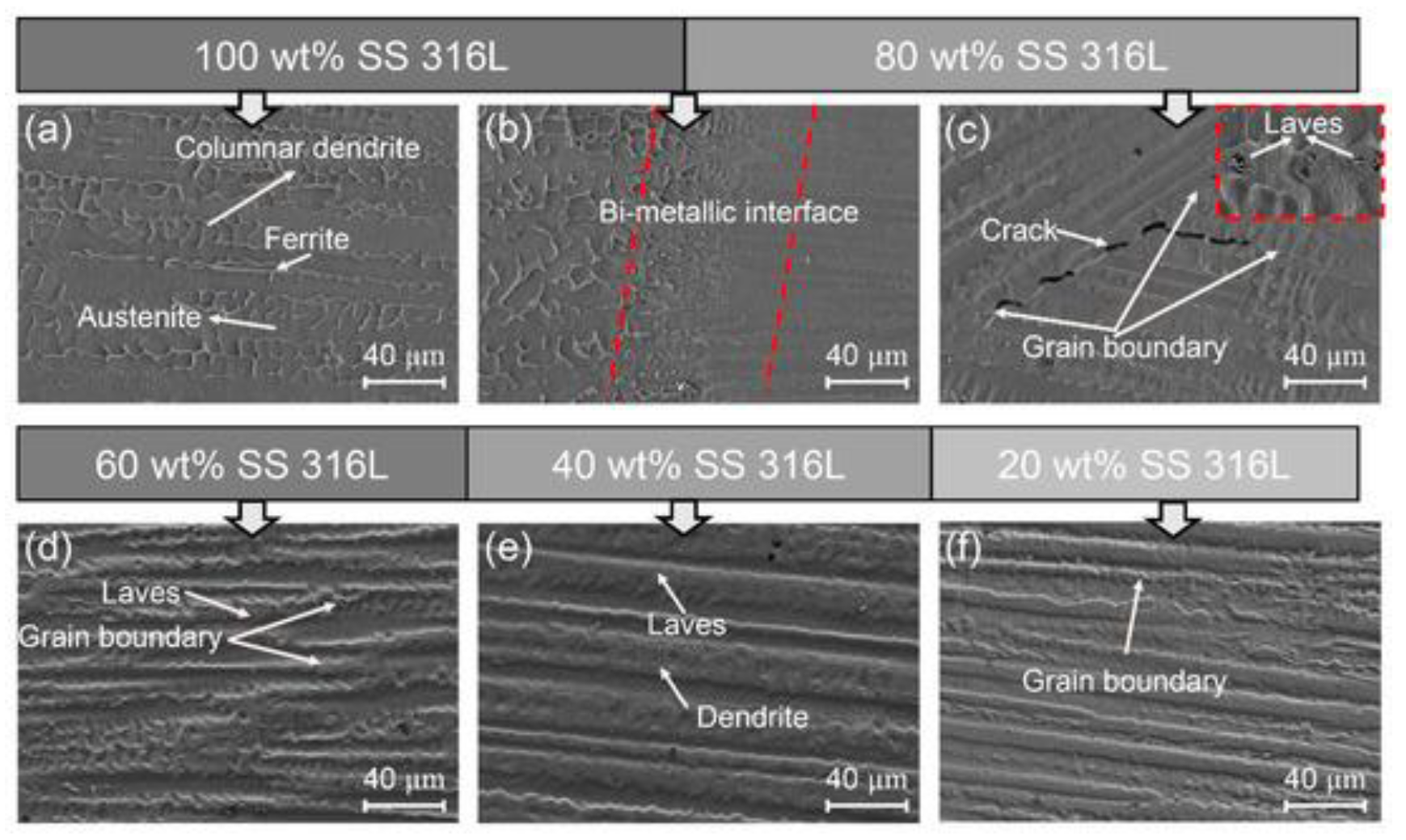
| Fe dilution into IN625 | Wire feed ratio, travel speed, inter-pass temp. | Reduces Nb/Mo solubility in γ-Ni → promotes Laves + MC carbides at interdendritic sites | Increases hardness locally; reduces ductility and impact toughness near IN625-rich region | Minimize dwell in 20–40 wt.% IN625 range; avoid slow cooling through 700–900 °C |
| Smooth vs. direct interface | Gradient strategy (step size) | Smooth gradient: δ-phase (Ni3Nb), σ-phase and MC carbides form in 60–80 wt.% IN625 range; absent in direct interface builds | Direct interface: higher UTS and elongation; smooth gradient: mixed ductile/quasi-cleavage fracture | Direct interface preferred for structural performance; smooth gradient not inherently superior for stress |
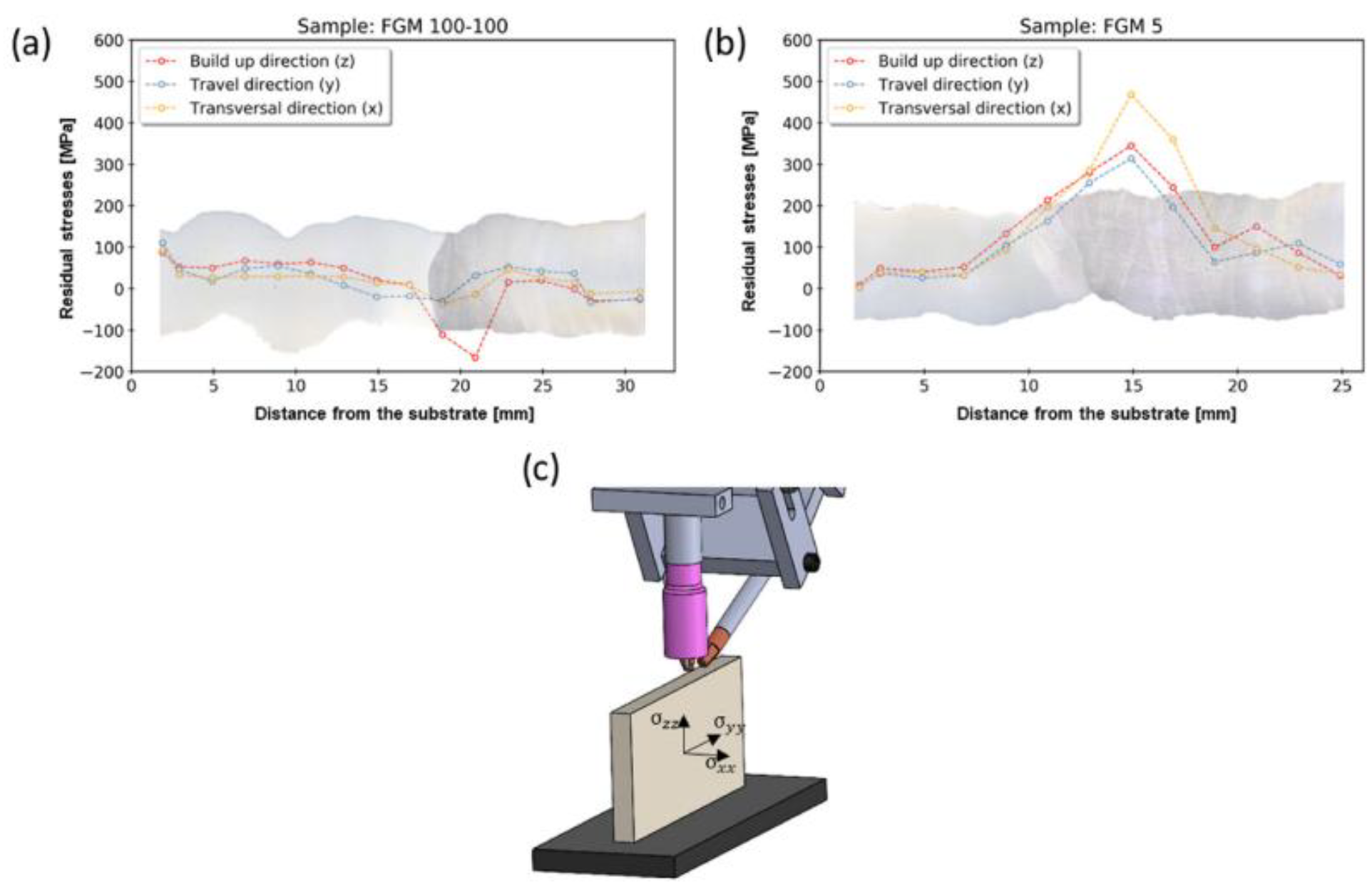
| Residual stress | Gradient strategy, CTE mismatch, inter-pass temperature | Thermal gradients build up tensile stresses along build direction; smooth gradient reaches ≥468 MPa vs. lower values in direct interface | Exceeding yield stress locally can cause distortion or cracking under service loading | Control inter-pass temperature; favor direct interface or minimize gradient length |
| Deposition sequence (316L → IN625 vs IN625 → 316L) | Order of material deposition | IN625-on-316L interface shows higher elemental mixing and larger Laves fraction than 316L-on-IN625 | Cracks observed exclusively at IN625 → 316L interface due to Laves concentration | Prefer 316L deposited first (bottom), IN625 last (top) for crack-free builds |
| Build orientation | Vertical vs. horizontal deposition | Horizontal builds: lower dilution, wavy interface; vertical builds: more uniform composition but inferior tensile properties | Vertically built specimens show inferior tensile properties vs. horizontally deposited equivalents | Horizontal deposition preferred where geometry permits |
| Post- processing (HT/rolling) | Solution HT temperature, rolling force | HT > 1000 °C: reduces δ-ferrite, improves ductility; HT ~650 °C: promotes σ-phase from δ-ferrite, raises hardness | In situ rolling refines columnar grains, reduces anisotropy, improves fatigue properties | Use HT > 1000 °C; in situ rolling between passes for property isotropy |
Disclaimer/Publisher’s Note: The statements, opinions and data contained in all publications are solely those of the individual author(s) and contributor(s) and not of MDPI and/or the editor(s). MDPI and/or the editor(s) disclaim responsibility for any injury to people or property resulting from any ideas, methods, instructions or products referred to in the content. |
© 2026 by the authors. Licensee MDPI, Basel, Switzerland. This article is an open access article distributed under the terms and conditions of the Creative Commons Attribution (CC BY) license.
Share and Cite
Antunes, G.L.; Oliveira, J.P. An Overview of the Benefits, Drawbacks and Strategies Used for the Fabrication of 316L Stainless Steel and Inconel 625 Functionally Graded Materials Using Wire Arc Additive Manufacturing. Metals 2026, 16, 467. https://doi.org/10.3390/met16050467
Antunes GL, Oliveira JP. An Overview of the Benefits, Drawbacks and Strategies Used for the Fabrication of 316L Stainless Steel and Inconel 625 Functionally Graded Materials Using Wire Arc Additive Manufacturing. Metals. 2026; 16(5):467. https://doi.org/10.3390/met16050467
Chicago/Turabian StyleAntunes, G. Lima, and J. P. Oliveira. 2026. "An Overview of the Benefits, Drawbacks and Strategies Used for the Fabrication of 316L Stainless Steel and Inconel 625 Functionally Graded Materials Using Wire Arc Additive Manufacturing" Metals 16, no. 5: 467. https://doi.org/10.3390/met16050467
APA StyleAntunes, G. L., & Oliveira, J. P. (2026). An Overview of the Benefits, Drawbacks and Strategies Used for the Fabrication of 316L Stainless Steel and Inconel 625 Functionally Graded Materials Using Wire Arc Additive Manufacturing. Metals, 16(5), 467. https://doi.org/10.3390/met16050467