Some Approaches to Quantitative Classification of Plastic Deformation Processes Based on the Parameters of Their Stress–Strain State Determined by Simulation Modeling

Abstract
1. Introduction
2. Methods for Characterization of the Deformation Processes
2.1. Methods for Characterization of the Stress State
2.2. Methods for Characterization of the Strain State
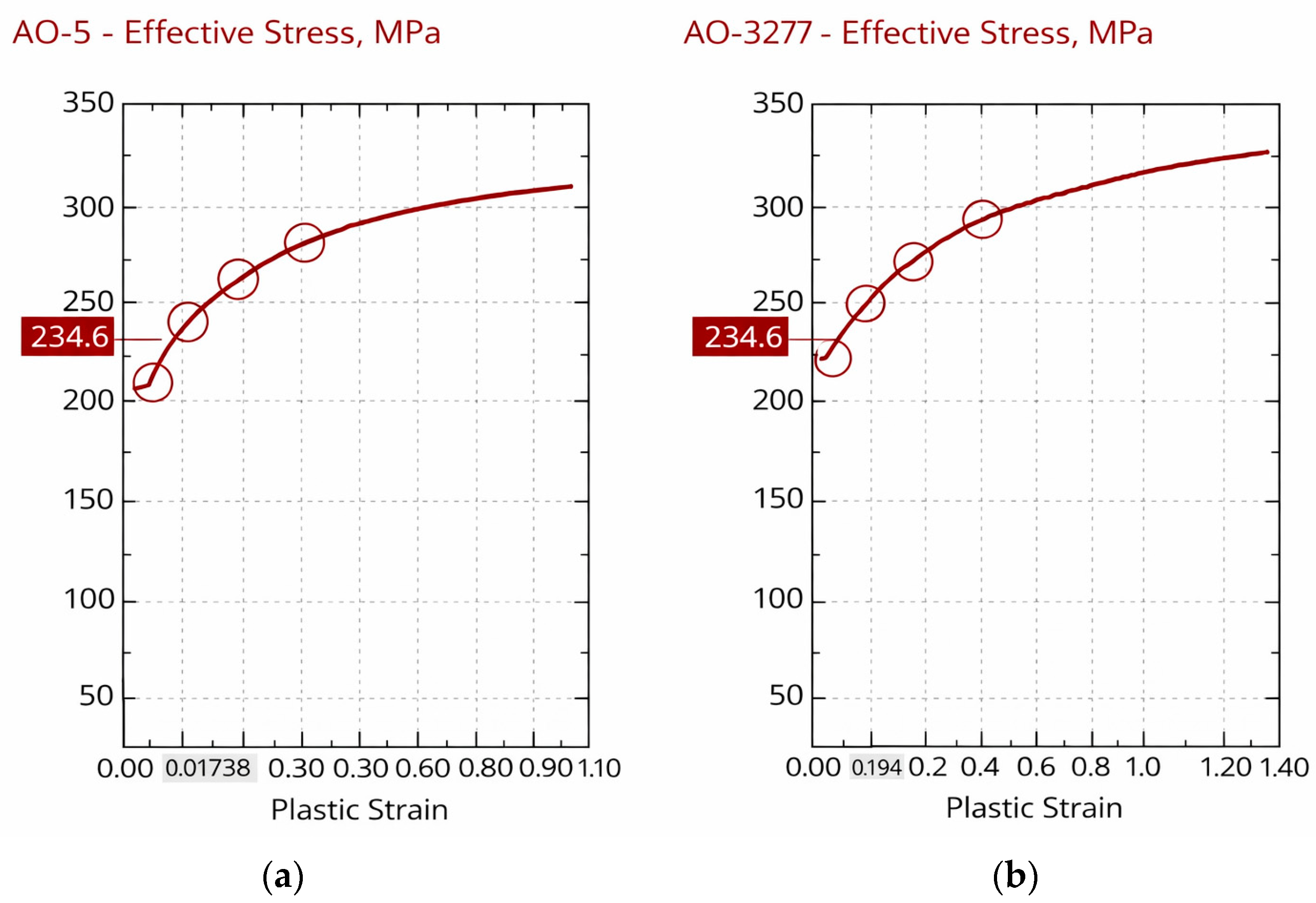
2.3. Simulation Modeling of Plastic Deformation Processes
3. Results and Discussion
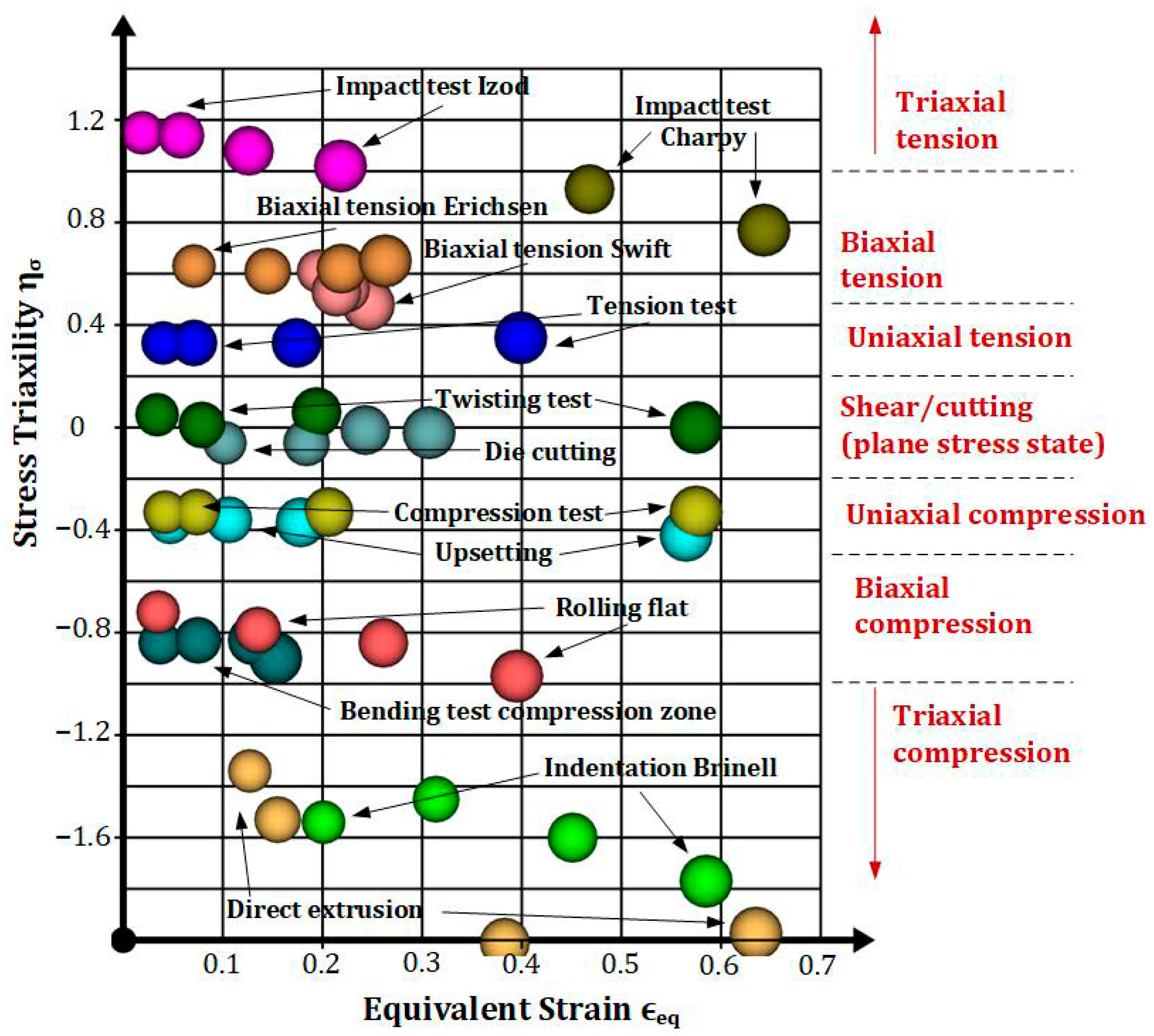
3.1. Classification of Processes According to the Plastic Strain
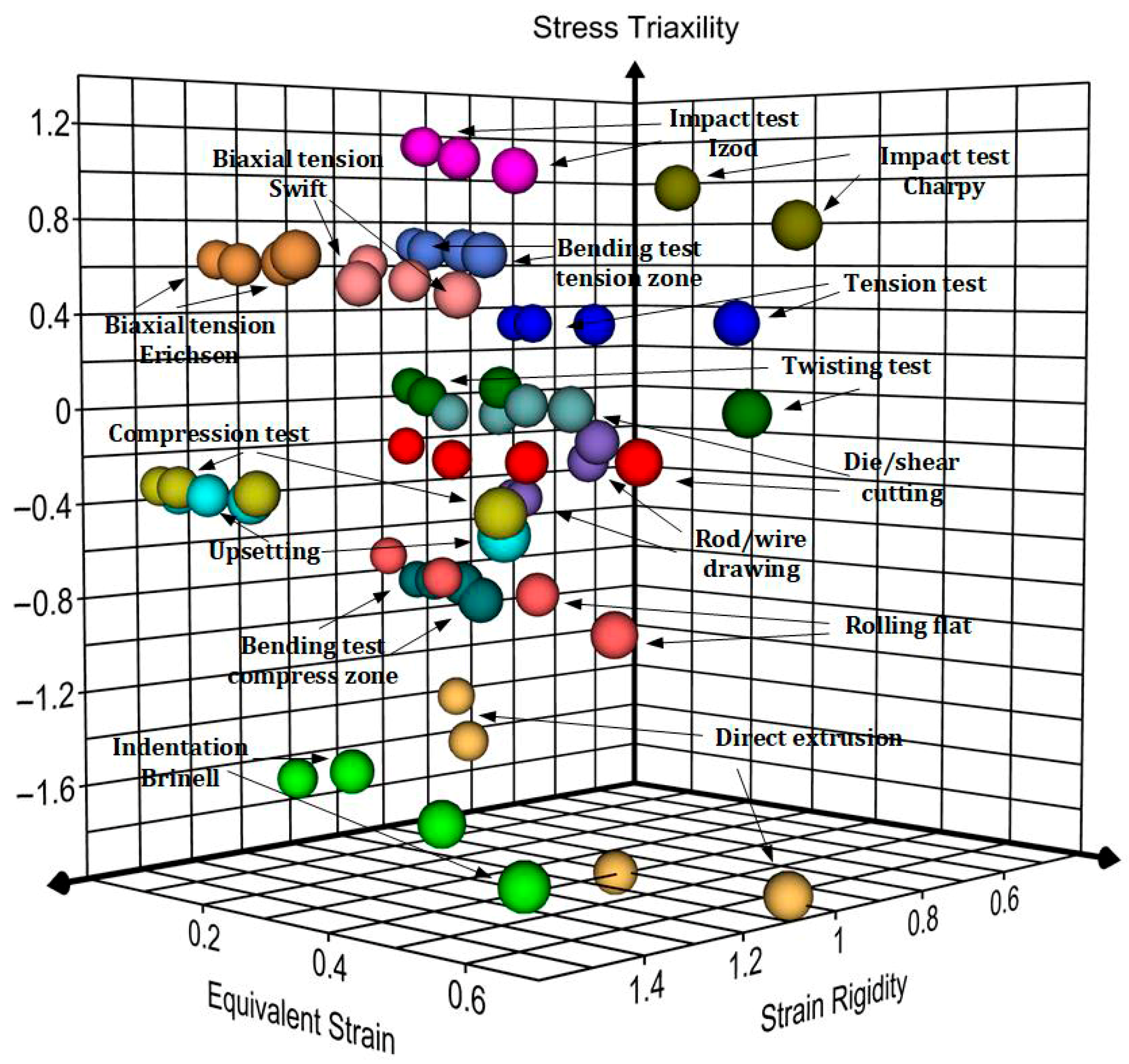
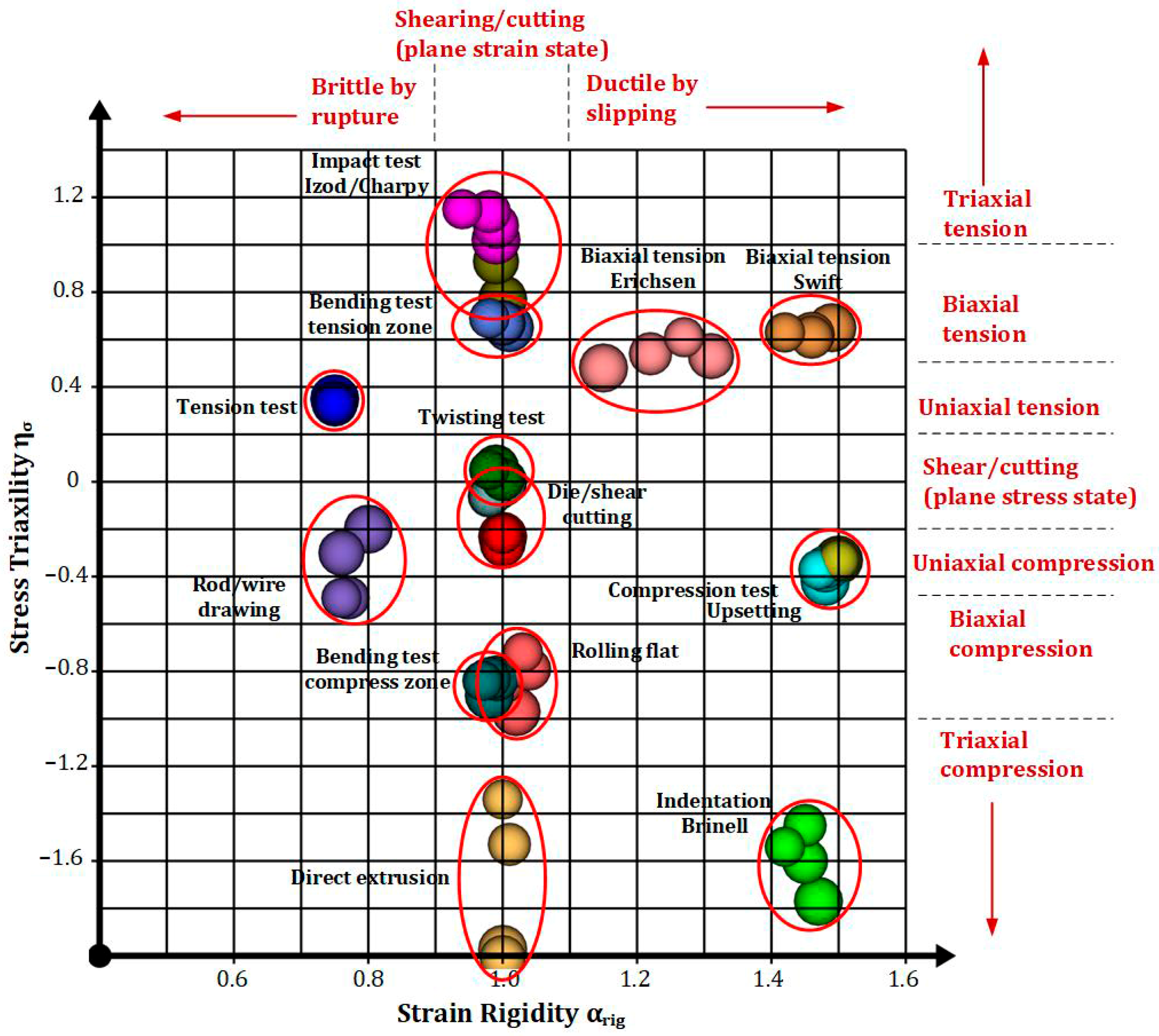
3.2. Classification of Processes Based on Stress–Strain State
3.3. Separation of Testing and Processing by Plastic Deformation Processes
4. Conclusions
- A relationship has been identified that determines the value of the strain rigidity coefficient , which represents a further development of the idea of classifying strain state by supplementing the strength theory, of the following form:providing a more direct relationship between the maximum shear strain and the maximum linear strain , grouping the deformation processes according to the type of fracture caused.
- Virtual solutions have been developed for the main deformation processes involved in processes for testing and processing by plastic deformation of metals and alloys, which have been implemented through simulation modeling within the software platform Quantor Form 8.2.4.
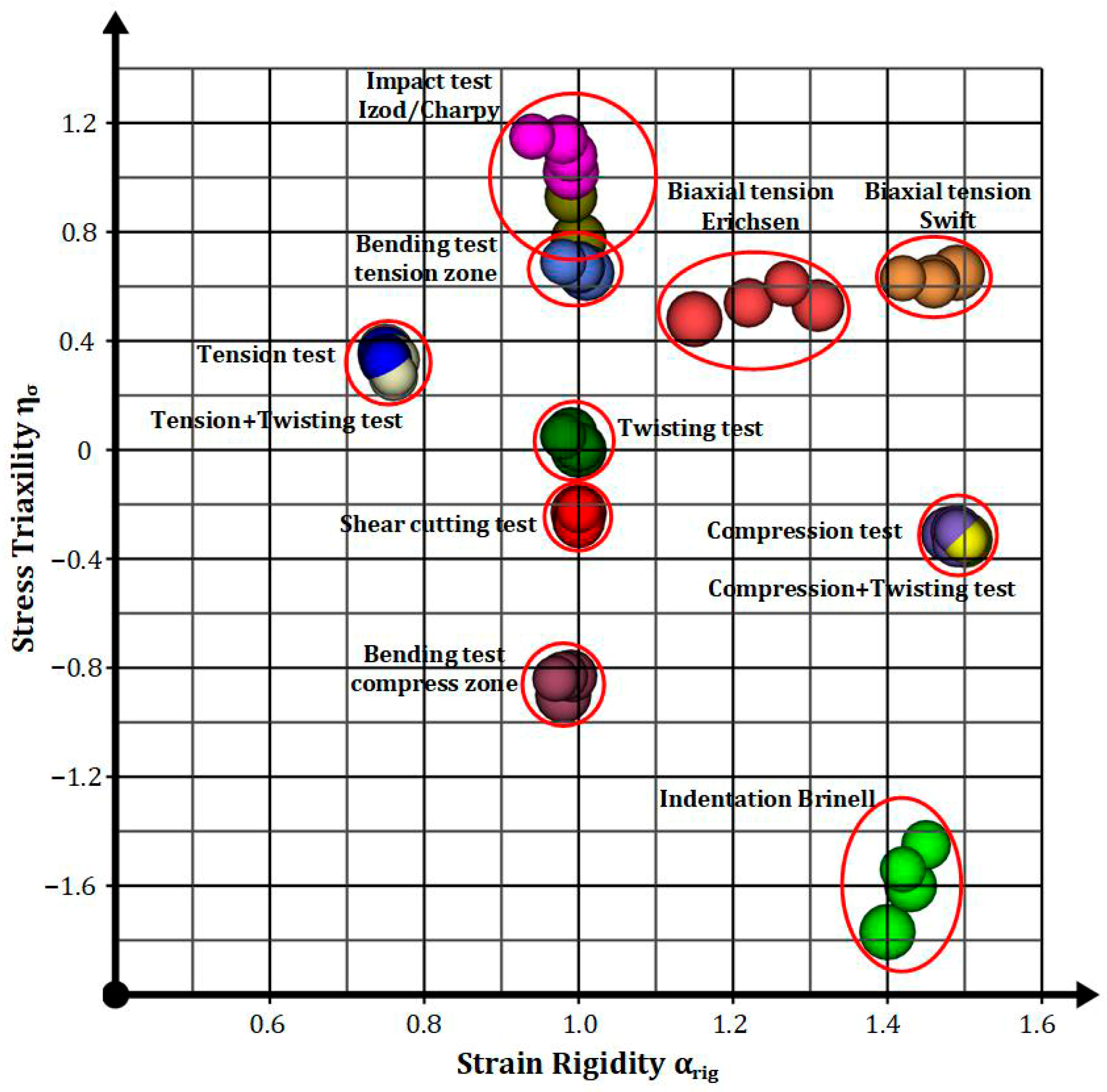
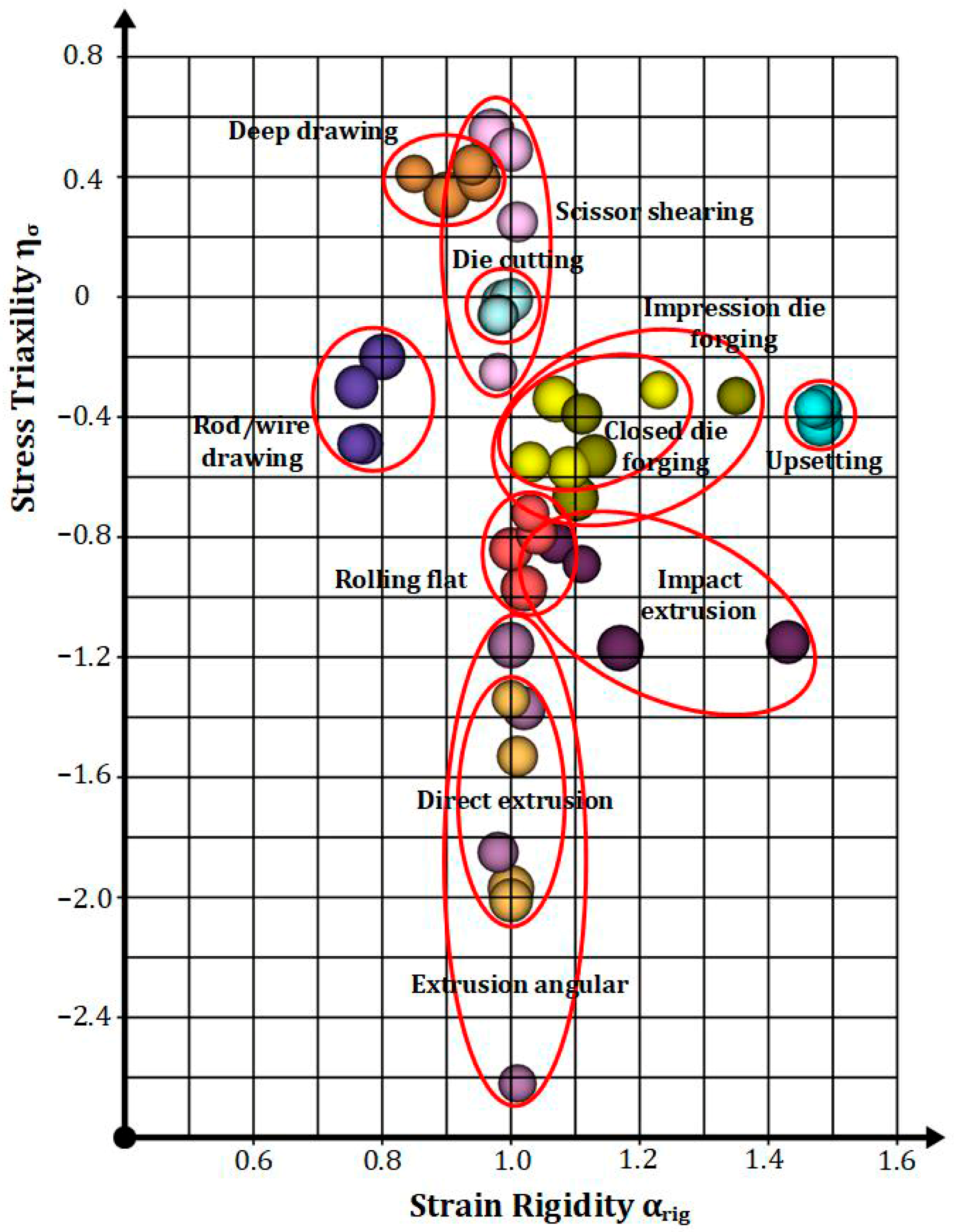
- A classification of typical deformation processes is proposed through the quantitative determination of the stress triaxiality parameter and the strain rigidity coefficient , taking into account the degree of equivalent strain achieved.
- It has been established that the graphical representation of diagrams − allows for the classification of deformation processes by determining the type of stress–strain state of the corresponding mechanical mode using simulation modeling.
- Through simulation modeling using the appropriate virtual tools, it has been confirmed that the deformation processes during the testing of metals and alloys (using uniaxial or plane strain mode) are located in the middle and upper regions of the − diagrams and are organized in such a way that their stress–strain state remains unchanged under various degrees of equivalent strain before they lose stability.
- Through simulation modeling using the appropriate virtual tools, it has been confirmed that the fundamental processes of processing by plastic deformation of metals and alloys are characterized by a variable stress–strain state, which depends on the degree of strain, as they encompass and/or fully cover other processes; i.e., at a certain stage, they represent a variant of those processes.
Author Contributions
Funding
Data Availability Statement
Acknowledgments
Conflicts of Interest
Abbreviations
| principal normal stresses | |
| principal shear stresses | |
| von Mises equivalent stress | |
| mean (hydrostatic) stress | |
| stress Lode–Nadai parameter | |
| deviatoric stress tensor invariants | |
| principal true strains | |
| principal shear strains | |
| strain Lode–Nadai parameter | |
| Poisson’s ratio | |
| second-order modulus of plasticity | |
| stress triaxiality | |
| strain rigidity coefficient |
References
- Hill, R. The Mathematical Theory of Plasticity; Oxford University Press: Oxford, UK, 1998. [Google Scholar] [CrossRef]
- Storozhev, M.; Popov, E. Teopия oбpaбoтки мeтaллoв дaвлeниeм [Theory of Metal Pressure Processing], 4th ed.; Meshterin, V., Ed.; Mashinostroenie Press: Moscow, Russia, 1977. (In Russian) [Google Scholar]
- Chakrabarty, J. Theory of Plasticity, 3rd ed.; Elsevier Butterworth-Heinemann: Oxford, UK, 2006. [Google Scholar]
- Kalpachjian, S.; Schmid, S. Manufacturing Processes for Engineering Materials, 5th ed.; Pearson Education Inc.: London, UK; Prentice Hall: Hoboken, NJ, USA, 2008. [Google Scholar]
- Genov, J.; Kamburov, V. Oбpaбoтвaнe нa мeтaлитe чpeз плacтичнa дeφopмaция [Processing of Metals by Plastic Deformation]; Tontchev, N., Ed.; Technical University of Sofia Press: Sofia, Bulgaria, 2019. (In Bulgarian) [Google Scholar]
- Hristov, S. Изпитвaнe и дeφeктocкoпия нa мeтaлитe [Testing and Non-Destructive Testing of Metals]; Higher Institute of Mechanical and Electrical Engineering Press: Sofia, Bulgaria, 1988. (In Bulgarian) [Google Scholar]
- Kisyov, I. Cъпpoтивлeниe нa мaтepиaлитe [Strength of Materials]; Popov, B., Ed.; State Publishing House Technika: Sofia, Bulgaria, 1970. (In Bulgarian) [Google Scholar]
- Friedman, Y.B. Mexaничecкиe cвoйcтвa мeтaллoв [Mechanical Properties of Metals]; Mashinostroenie Press: Moscow, Russia, 1974. (In Russian) [Google Scholar]
- Dowling, N. Mechanical Behavior of Materials: Engineering Methods for Deformation, Fracture and Fatique, 4th ed.; Pearson Educational Ltd.: London, UK, 2013. [Google Scholar]
- Gere, J.M.; Goodno, B.J. Mechanics of Materials, 8th ed.; Global Engineering: Shelby Township, MI, USA, 2013. [Google Scholar]
- White, G.N.; Drucker, D.C. Effective stress and effective strain in relation to stress theories of plasticity. J. Appl. Phys. 1950, 21, 1013–1021. [Google Scholar] [CrossRef]
- Hill, R. A remark on diagonal streaming in plane plastic strain. J. Mech. Phys. Solids 1966, 14, 245–248. [Google Scholar] [CrossRef]
- Alexandrov, S.; Rynkovskaya, M.; Li, Y. Principal Stress Trajectories in Plasticity under Plane Strain and Axial Symmetry. Symmetry 2023, 15, 981. [Google Scholar] [CrossRef]
- Mises, R. Mechanik der festen Körper im plastisch-deformablen Zustand. Nachrichten Ges. Wiss. Gött. Math.-Phys. Kl. 1913, 1, 582–592. [Google Scholar]
- Ford, H. Advanced Mechanics of Materials; Longmans: London, UK, 1963. [Google Scholar]
- Lode, W. Versuche über den Einfluß dermittleren Hauptspannung auf das Fließen der Metalle Eisen, Kupfer und Nickel. Z. Phys. 1926, 36, 913–939. [Google Scholar] [CrossRef]
- Kim, J.; Nguyen, P.V.; Hong, J.G.; Kim, Y.S. Stress-Invariants-Based Anisotropic Yield Functions and Its Application to Sheet Metal Plasticity. Metals 2023, 13, 142. [Google Scholar] [CrossRef]
- Bao, Y.B.; Wierzbicki, T. On fracture locus in the equivalent strain and stress triaxiality space. Int. J. Mech. Sci. 2004, 46, 81–98. [Google Scholar] [CrossRef]
- Bruhns, O.T. Some remarks on Lode angle and Lode parameter. Proc. Appl. Math. Mech. 2024, 2, e202400004. [Google Scholar] [CrossRef]
- Peng, J.; Zhou, P.; Wang, Y.; Dai, Q.; Knowles, D.; Mostafavi, M. Stress Triaxiality and Lode Angle Parameter Characterization of Flat Metal Specimen with Inclined Notch. Metals 2021, 11, 1627. [Google Scholar] [CrossRef]
- Xing, M.; Liu, Y.; Lu, J.; Huang, X.; Wang, X.; Xue, J.; Zhang, F.; Du, F. Fracture Criterion Calibration and Finite Element Simulation in SUS304 Stainless Steel. Materials 2024, 17, 5711. [Google Scholar] [CrossRef] [PubMed]
- Peng, J.; Wang, Y.; Dai, Q.; Liu, X.; Liu, L.; Zhang, Z. Effect of Stress Triaxiality on Plastic Damage Evolution and Failure Mode for 316L Notched Specimen. Metals 2019, 9, 1067. [Google Scholar] [CrossRef]
- Huang, J.; Guo, Y.; Qin, D.; Zhou, Z.; Li, D.; Li, Y. Influence of stress triaxiality on the failure behavior of Ti-6Al-4V alloy under a broad range of strain rates. Theor. Appl. Fract. Mech. 2018, 97, 48–67. [Google Scholar] [CrossRef]
- González, Á.; Celentano, D.; Cruchaga, M.; Ponthot, J.-P. The Triaxiality Effect on Damage Evolution in Al-2024 Tensile Samples. Metals 2024, 14, 1103. [Google Scholar] [CrossRef]
- Zhang, H.; Zhang, H.; Li, F.; Cao, J. A Novel Damage Model to Predict Ductile Fracture Behavior for Anisotropic Sheet Metal. Metals 2019, 9, 595. [Google Scholar] [CrossRef]
- Baruscotti, A.; Miori, N.; Concli, F. Determination of the Fracture Locus of a Cor-Ten Steel at Low and High Triaxiality Ranges. Appl. Sci. 2025, 15, 3569. [Google Scholar] [CrossRef]
- Rickhey, F.; Hong, S. Stress Triaxiality in Anisotropic Metal Sheets—Definition and Experimental Acquisition for Numerical Damage Prediction. Materials 2022, 15, 3738. [Google Scholar] [CrossRef] [PubMed]
- Segal, V. Review: Modes and Processes of Severe Plastic Deformation (SPD). Materials 2018, 11, 1175. [Google Scholar] [CrossRef] [PubMed]
- Kamburov, V. Teopeтични acпeкти и виpтyaлни peшeния зa интeнзивнa плacтичнa дeφopмaция c peдyциpaни и aктивни cили нa тpиeнe [Theoretical Aspects and Virtual Solutions for Severe Plastic Deformation with Reduced and Active Friction Forces]; Genov, J., Ed.; Copy Print Studio: Sofia, Bulgaria, 2021. (In Bulgarian) [Google Scholar]
- Alomari, Q.A.; Yosef, T.Y.; Bielenberg, R.W.; Faller, R.K.; Negahban, M.; Zhang, Z.; Li, W.; Humphrey, B.M. Material Characterization and Stress-State-Dependent Failure Criteria of AASHTO M180 Guardrail Steel: Experimental and Numerical Investigation. Materials 2025, 18, 2523. [Google Scholar] [CrossRef] [PubMed]
- Friedlein, J.; Böhnke, M.; Schlichter, M.; Bobbert, M.; Meschut, G.; Mergheim, J.; Steinmann, P. Material Parameter Identification for a Stress-State-Dependent Ductile Damage and Failure Model Applied to Clinch Joining. J. Manuf. Mater. Process. 2024, 8, 157. [Google Scholar] [CrossRef]



| The Stress State Mode | Example of a Deformation Process | Stress Triaxiality Parameter | Strain Rigidity Coefficient |
|---|---|---|---|
| triaxial tension | impact test (Izod) | 1.00 ÷ 1.15 | 0.97 |
| impact test (Charpy) | 0.70 ÷ 0.93 | 1.00 | |
| biaxial tension | tension zone in bending | 0.65 ÷ 0.69 | 1.00 |
| biaxial tension test (Erichsen) | 0.63 ÷ 0.65 | 1.24 | |
| biaxial tension test (Swift) | 0.48 ÷ 0.61 | 1.46 | |
| uniaxial tension | tension test | 0.33 | 0.75 |
| heterogeneous plane state | pure twisting test | 0.01 ÷ 0.05 | 0.99 |
| shear/cutting test | −0.22 ÷ −0.27 | 1.00 | |
| die-cutting | −0.11 ÷ −0.33 | 0.99 | |
| uniaxial compression | compression test | −0.33 | 1.50 |
| upsetting | −0.36 ÷ −0.42 | 1.48 | |
| biaxial compression | compression zone in bending | −0.83 ÷ −0.90 | 0.98 |
| flat rolling | −0.72 ÷ −0.97 | 1.02 | |
| triaxial compression | direct extrusion | −1.34 ÷ −2.01 | 1.00 |
| equal-channel angular extrusion | −1.37÷ −2.62 | 1.00 |
Disclaimer/Publisher’s Note: The statements, opinions and data contained in all publications are solely those of the individual author(s) and contributor(s) and not of MDPI and/or the editor(s). MDPI and/or the editor(s) disclaim responsibility for any injury to people or property resulting from any ideas, methods, instructions or products referred to in the content. |
© 2026 by the authors. Licensee MDPI, Basel, Switzerland. This article is an open access article distributed under the terms and conditions of the Creative Commons Attribution (CC BY) license.
Share and Cite
Kamburov, V.; Dimitrova, R. Some Approaches to Quantitative Classification of Plastic Deformation Processes Based on the Parameters of Their Stress–Strain State Determined by Simulation Modeling. Metals 2026, 16, 445. https://doi.org/10.3390/met16040445
Kamburov V, Dimitrova R. Some Approaches to Quantitative Classification of Plastic Deformation Processes Based on the Parameters of Their Stress–Strain State Determined by Simulation Modeling. Metals. 2026; 16(4):445. https://doi.org/10.3390/met16040445
Chicago/Turabian StyleKamburov, Valentin, and Rayna Dimitrova. 2026. "Some Approaches to Quantitative Classification of Plastic Deformation Processes Based on the Parameters of Their Stress–Strain State Determined by Simulation Modeling" Metals 16, no. 4: 445. https://doi.org/10.3390/met16040445
APA StyleKamburov, V., & Dimitrova, R. (2026). Some Approaches to Quantitative Classification of Plastic Deformation Processes Based on the Parameters of Their Stress–Strain State Determined by Simulation Modeling. Metals, 16(4), 445. https://doi.org/10.3390/met16040445