


Abstract
The microstructure, phase composition, and high-temperature oxidation behavior of Al0.5CoCr0.5NiPt0.1 and AlCoCr0.5NiPt0.1 multi-principal element alloys (MPEAs) at 1100 °C in air were investigated. Depending on the content of aluminum, the microstructure of as-cast samples contains FCC and BCC solid solutions. Similarly, the ratio of two solid solutions varies depending on the aluminum content in the alloy. When the content of aluminum is x = 0.5, the microstructure is dominated by the FCC solid solution, while a BCC solid solution is dominated when the concentration of aluminum is increased to x = 1.0. Moreover, in both MPEAs, platinum exists as a part of solid solutions rather than a separate phase. High-temperature oxidation was carried out in a Plavka.Pro PM-1 SmartKiln muffle furnace under isothermal conditions at 1100 °C for 100 h exposure in air, and weighing was performed every 10 h. The maximum specific weight gain for the Al0.5CoCr0.5NiPt0.1 alloy was 0.965 mg/cm2, and 0.675 mg/cm2 for the AlCoCr0.5NiPt0.1 alloy. Based on the high-temperature oxidation experiment results, it was established that AlCoCr0.5NiPt0.1 MPEA exhibits greater resistance towards high-temperature dry air corrosion with the formation of an exclusive Al2O3 scale on the surface with 3–5 μm thickness; the parabolic oxidation rate constant for this alloy is kp = 20.2 × 10⁻¹³ (g2/cm4s). Introduction of platinum into the composition of the Fe-free AlCoCr0.5Ni alloy reduces the value of the parabolic oxidation rate constant by half.
1. Introduction
The concept of multi-principal element alloys (MPEAs) (or high-entropy alloys (HEAs)) was proposed in the early 2000s on the assumption that to achieve the so-called “cocktail effect” from mixing different atoms within a solid solution, the alloy composition consists of five or more elements in equiatomic or near-equiatomic ratios [1,2]. This approach to creating a new class of alloys opened up broad prospects for the creation of materials with unique properties. In this context, the MPEA compositions AlxCoCrFeNi have demonstrated an optimal combination of mechanical [3,4] and tribological [5,6] characteristics with corrosion resistance in aggressive aqueous solutions [7,8]. Moreover, these alloys turned out to be promising heat-resistant materials [9,10], which can potentially replace nickel superalloys, in particular, in the manufacture of gas turbine blades. Furthermore, during the research it was observed that MPEAs can have various compositions, where several components have a concentration range from 2 to 30 at.% to achieve certain characteristics [2].
Currently, the main research focus is to investigate the influence of additionally introduced elements on heat-resistant MPEAs of the AlxCoCrFeNi type alloy to improve high-temperature oxidation resistance. There are reports on the positive effect of introducing Si [11], Zr [12], Cu [13], Y [14], Y/Hf [15], Y/Ta/Hf [16], Pt [17,18]. Among them, alloying with platinum is of particular interest, since it is not part of the oxide film but affects the diffusion processes occurring during heating and long-term isothermal holding. Platinum is a “reactive element” and makes the diffusion of Al atoms faster, as well as decreasing the diffusion rate of oxygen atoms [19,20].
Another intriguing direction for increasing heat resistance is the exclusion of iron from the composition of MPEAs by analogy with MCrAlY alloys used in thermal barrier coatings as a metal sublayer [21]. Moreover, Y-doped MPEAs of the CoNiCrAlY type have already shown their potential for use as part of a thermal barrier coating [22]. The literature review also contains data on the positive effect on the heat resistance of Fe-free AlCoCrNi alloys when alloyed with Si [23], Ti [24], and Pt [25,26]. Thus, Gawel et al. in [23] showed that the introduction of silicon can promote Al2O3 scale formation; however, the main phase in the film remains Cr2O3. At the same time, Liang et al. in [24] determined that the oxidation rate constant for the AlCoCrNiTi0.1 alloy is three orders of magnitude lower than that of the AlCoCrNiTi alloy which may indicate that alloying with a small amount of an additionally introduced element is more promising and economically justified. Li et al. in [25] found out that the introduction of Pt ensures low oxide growth stress on the surface of NiCoCrAlPt high-entropy alloy. But the introduction of a large amount of platinum is costly and causes the formation of intermetallic compounds, which affects the mechanical characteristics of the alloy. Previously, in [26], we found that the introduction of platinum not only promotes the formation of a dense protective layer of Al2O3 on the alloy surface but also increases the temperature of intensive scale formation to 1312 °C for AlCoCrNiPt0.1 MPEA. At present, the optimal heat-resistant composition has not yet been determined; however, alloying with a small amount of platinum is a promising direction.
In addition, the ratio of Al/Cr in the alloy compositions has an impact on high-temperature oxidation resistance [27]. Thus, Anupam et al. in [28] determined that decreasing the chromium concentration from the AlCoCrNi composition to the AlCoCr0.5Ni composition lowered the oxidation rate by a factor of five at 1100 °C. This study opened the prospect of creating heat-resistant Fe-free MPEAs with a reduced chromium concentration.
The aim of this study is to determine the high-temperature oxidation resistance of two new Fe-free Al0.5CoCr0.5NiPt0.1 and AlCoCr0.5NiPt0.1 MPEAs at 1100 °C. The effect of aluminum content on high-temperature dry air corrosion resistance will be assessed. The kinetic characteristics of the oxidation process will be determined, while the morphology and composition of the resulting oxide film will be studied, and its uniformity and protective properties will be assessed. This study aims to fill a scientific gap in the production of multicomponent alloys doped with Pt with high resistance to high-temperature oxidation. The compositions proposed for this study were obtained for the first time and have not been previously investigated.
2. Materials and Methods
Alloy ingots were produced by melting granules and powders of high-purity metals (>99.9 wt. %) in a NABERTHERM VHT 8/22-GR electrically heated chamber furnace with graphite heating (Nabertherm GmbH, Lilienthal, Germany). The metal mixture was loaded into alumina crucibles with a lid and melted in a vacuum at an internal temperature of 1670–1730 °C. Three remelting processes were performed to achieve a homogeneous microstructure. 100 g conical ingots with a height of about 30 mm were obtained. The chemical composition of the obtained ingots was controlled using an OPTIMA 2100 DV inductively coupled plasma atomic emission spectrometer (Perkin Elmer, Shelton, CT, USA).
For oxidation tests, samples measuring 10 mm × 6 mm × 6 mm were cut from the ingots and then polished. Oxidation tests were carried out in a Plavka.Pro PM-1 SmartKiln muffle furnace (Plavka.Pro, Korolev, Russia) at 1100 °C for 100 h in air. Weighing was performed every 10 h on a Sartorius MSE225S-000-DU laboratory analytical balance (Sartorius Group, Göttingen, Germany) with an accuracy of 0.00001 g. For each time interval, a separate sample was prepared from the ingot. Thus, ten samples were prepared for each composition, so that during the 100 h holding time, samples were removed one at a time every 10 h. The testing procedure was described in detail in our previous work [18].
Microstructural analysis before and after oxidation was performed on a JEOL JSM7001F scanning electron microscope (SEM) (JEOL, Tokyo, Japan) equipped with an Oxford INCA X-max 80 energy-dispersive X-ray spectroscopy (EDS) detector (Oxford Instruments, Abingdon, UK). To determine the microstructure before and after high-temperature oxidation tests, thin sections were made. For this, a Delta AbrasiMet (Buehler, Leinfelden-Echterdingen, Germany) cutting machine, a SimpliMet 1000 (Buehler, Leinfelden-Echterdingen, Germany) pressing machine, and an EcoMet 250/AutoMet 250 (Buehler, Leinfelden-Echterdingen, Germany) grinder-polisher were used. Grinding (and subsequent polishing) was carried out sequentially on 250 μm, 75 μm, 25 μm, and 9 μm sandpaper, and a 3 μm diamond suspension was used for final polishing.
X-ray diffraction (XRD) was used to determine the phase composition of the metal and oxide film on a Rigaku Ultima IV X-ray diffractometer (Rigaku, Tokyo, Japan) using Cu–Kα radiation (λ = 0.15406 Å) with the following parameters. The scanning range varied from 20° to 100°, the step size was equal to 0.02°, and the scanning rate was 5 degrees per minute.
3. Results and Discussion
3.1. Microstructure and Phase Composition of the As-Cast Alloys
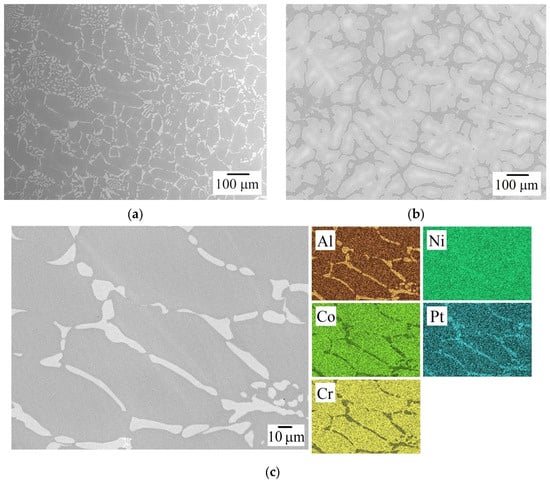
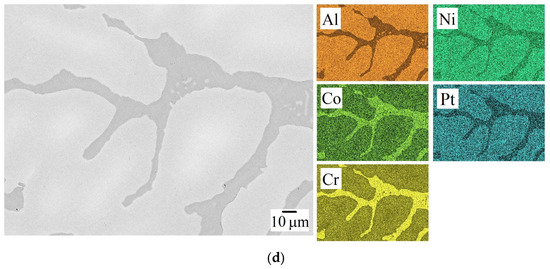
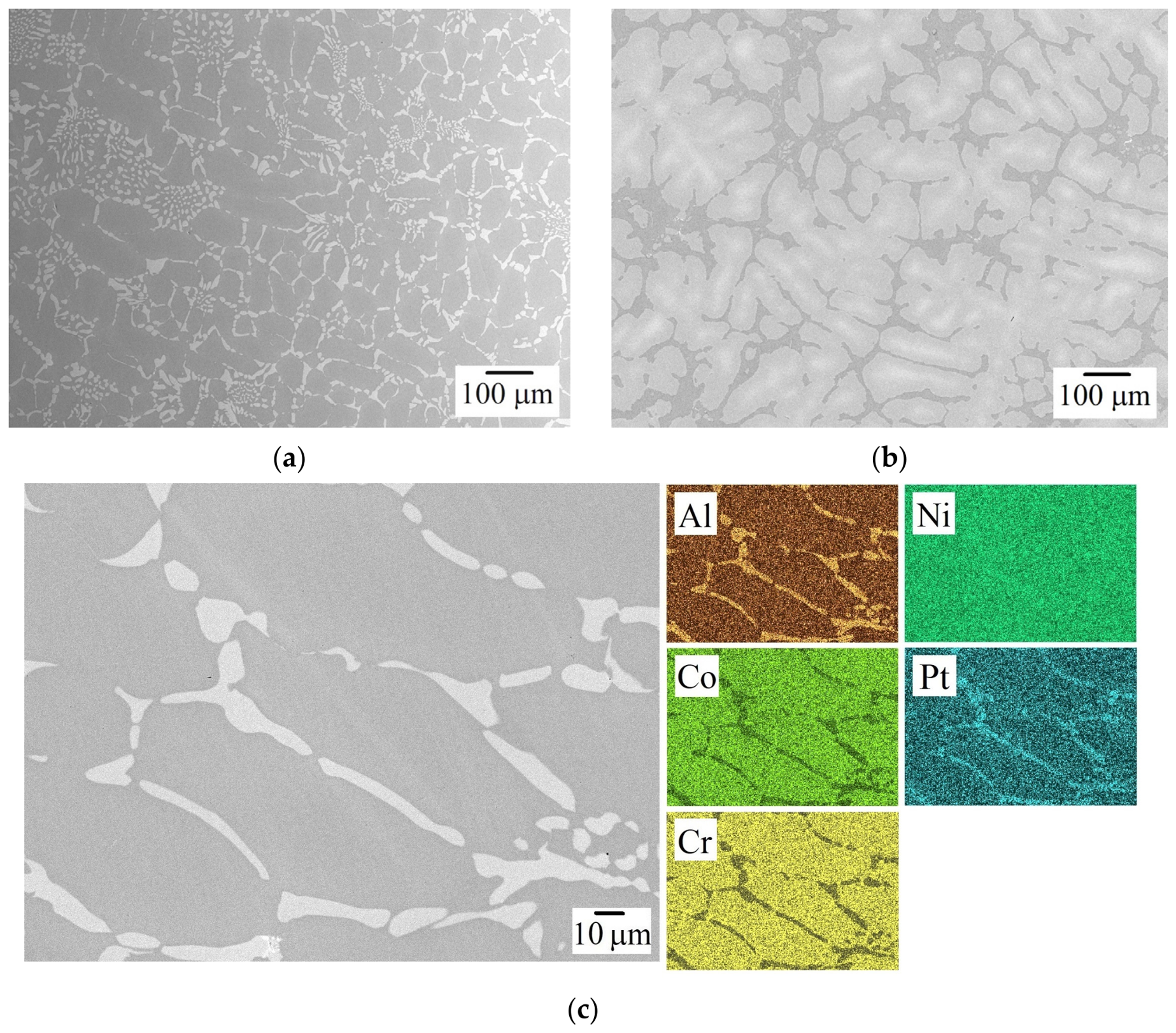
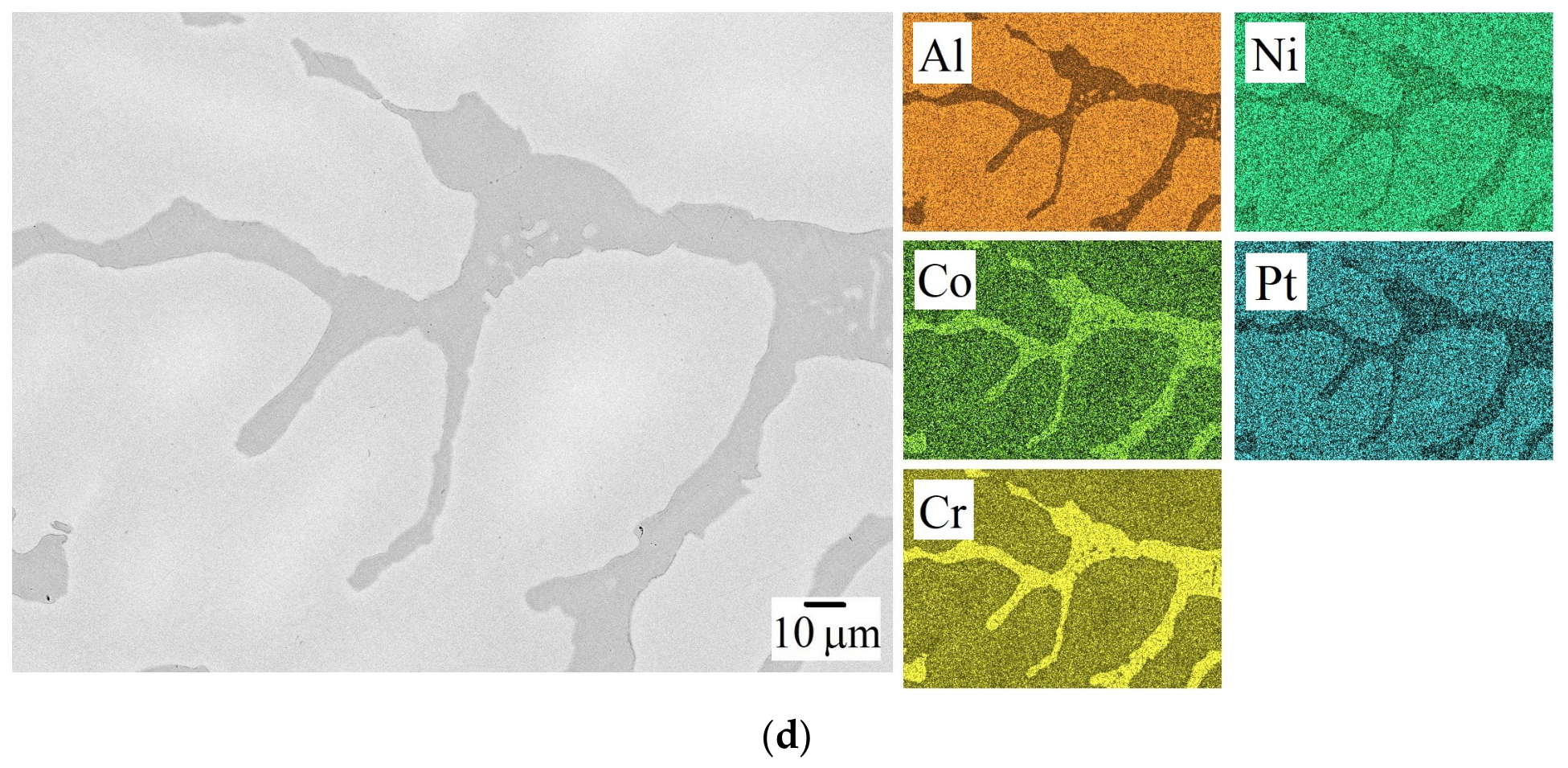
The as-cast MPEA samples exhibit a pronounced dendritic microstructure (Figure 1). Moreover, for the Al0.5CoCr0.5NiPt0.1 alloy, the dendrites (D) are enriched in cobalt and chromium, and the interdendritic space (ID) contains a phase with an increased concentration of aluminum (Figure 1a,c, Table 1). At the same time, the opposite situation is observed for the AlCoCr0.5NiPt0.1 alloy: D contains increased concentrations of aluminum and nickel, and the ID is a phase with an increased content of cobalt and chromium (Figure 1b,d, Table 1). Platinum is present in all areas of the microstructure for the studied samples, but with a slightly higher concentration in the aluminum-rich areas.
Figure 1.
SEM (back-scattered electrons mode) micrographs (a,b) and the corresponding EDS maps (c,d) of the as-cast MPEAs: (a,c) Al0.5CoCr0.5NiPt0.1; (b,d) AlCoCr0.5NiPt0.1.
Table 1.
Chemical composition (EDS data, at. %) of the as-cast alloys.
According to [29,30], a change in aluminum concentration in the composition of MPEAs affects the percentage ratio of the resulting solid solutions with a face-centered cubic (FCC) and body-centered cubic (BCC) crystal lattice in the phase composition of the alloys. When the concentration of aluminum increased, a change in the structure from FCC to BCC occurred. BCC solid solution, as a rule, is enriched by Al and Ni; the FCC solid solution contains higher concentrations of Co and Cr [31].
The criterion for determining the MPEA (HEA) crystal structure is the valence electron concentration (VEC) parameter [32]:
where Xi is the atomic fraction of the element in the alloy, and VECi is the valence electron concentration for each element in the alloy. If the VEC < 6.87, the BCC phase is favorable, while VEC > 8 favor an FCC phase. On the other hand, if the parameter lies in the interval 6.87 <VEC < 8, a (BCC + FCC) dual-phase structure is expected. For the calculation, data from [32] were used, according to which VECAl = 3; VECCo = 9; VECCr = 6; VECNi = 10; VECPt = 10. The computed values of the alloys’ VEC parameter were 7.90 and 7.23 for Al0.5CoCr0.5NiPt0.1 and AlCoCr0.5NiPt0.1, respectively.
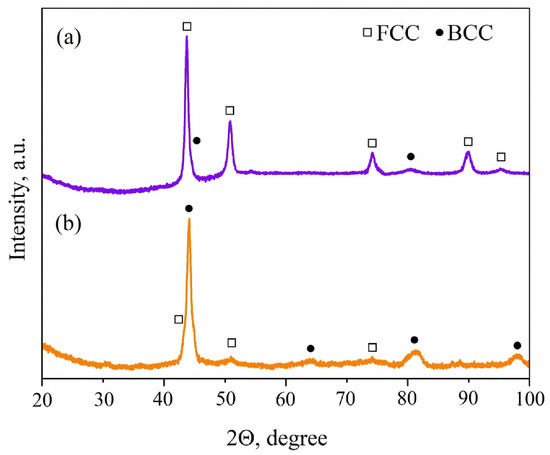
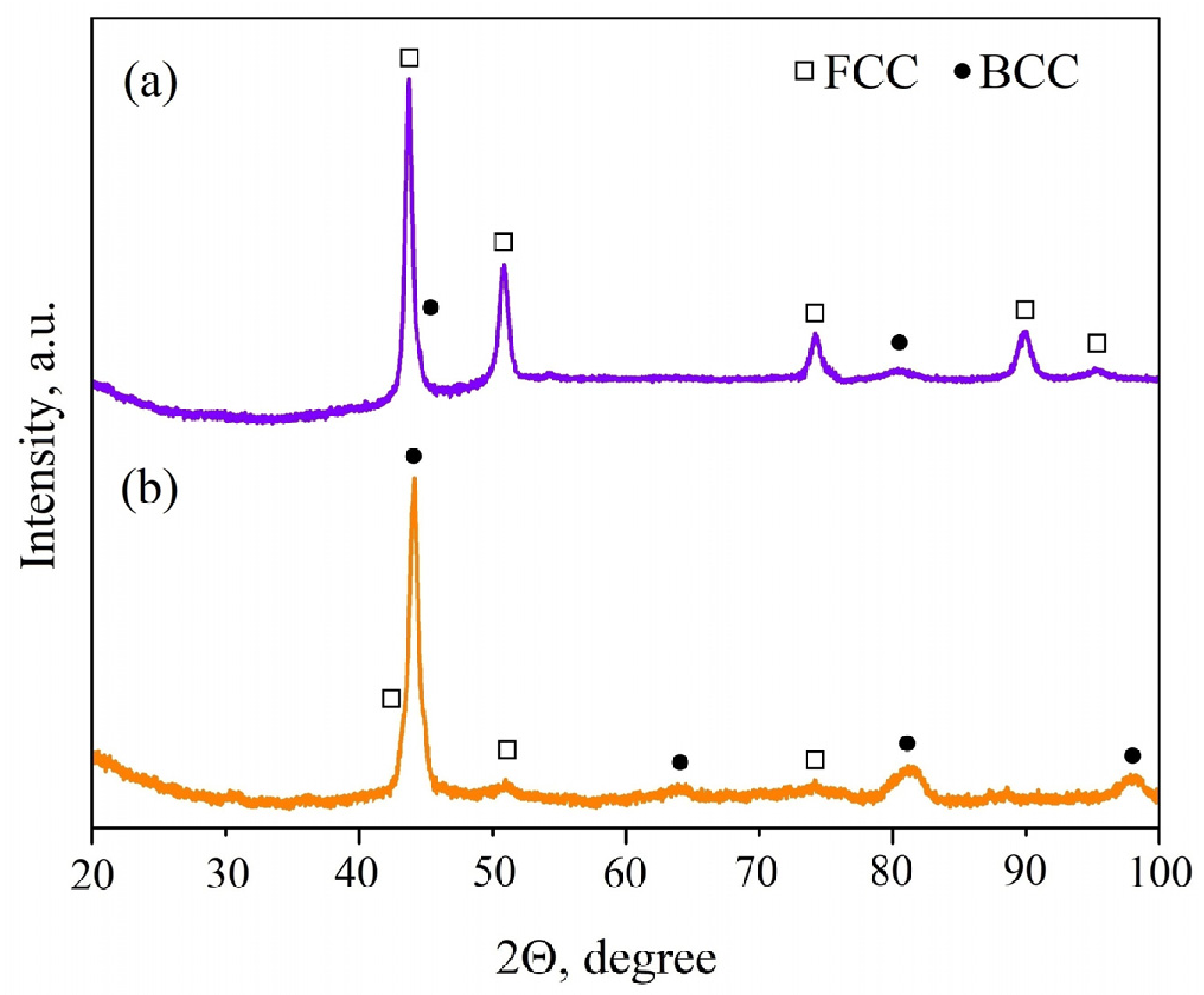
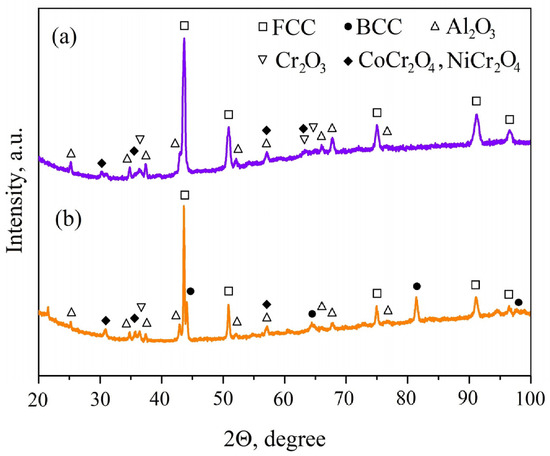
The X-ray diffraction data (Figure 2) confirms that the as-cast MPEA samples have two different phases. The diffraction patterns for the sample with an aluminum content of x = 0.5 indicate that the predominant phase is the FCC solid solution. BCC solid solution is present in large quantities for the sample with an aluminum content of x = 1.0, which coincides with the results of studies [29,30,33]. Thus, comparing the obtained XRD data with the SEM and EDS data, we can conclude that for the Al0.5CoCr0.5NiPt0.1 alloy, the dendrites (D) belong to the FCC solid solution, and ID is a BCC solid solution. At the same time, for the AlCoCr0.5NiPt0.1 alloy, the dendrites have a BCC crystal lattice, and the interdendritic space contains an FCC solid solution. Higher solubility of Pt in the BCC solid solution was previously observed by us for the AlCoCrNiPt0.1 MPEA [26].
Figure 2.
XRD patterns of as-cast MPEAs samples: (a) Al0.5CoCr0.5NiPt0.1; (b) AlCoCr0.5NiPt0.1.
3.2. High-Temperature Oxidation of Alloys
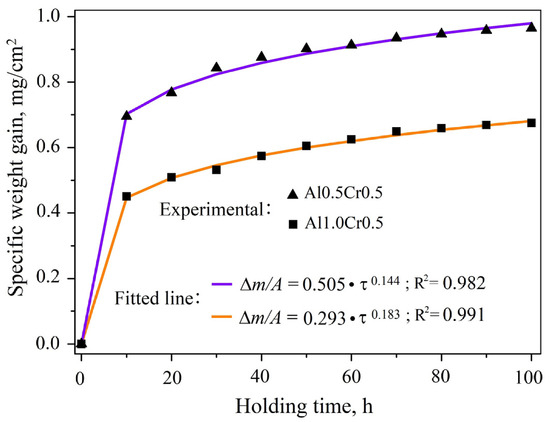
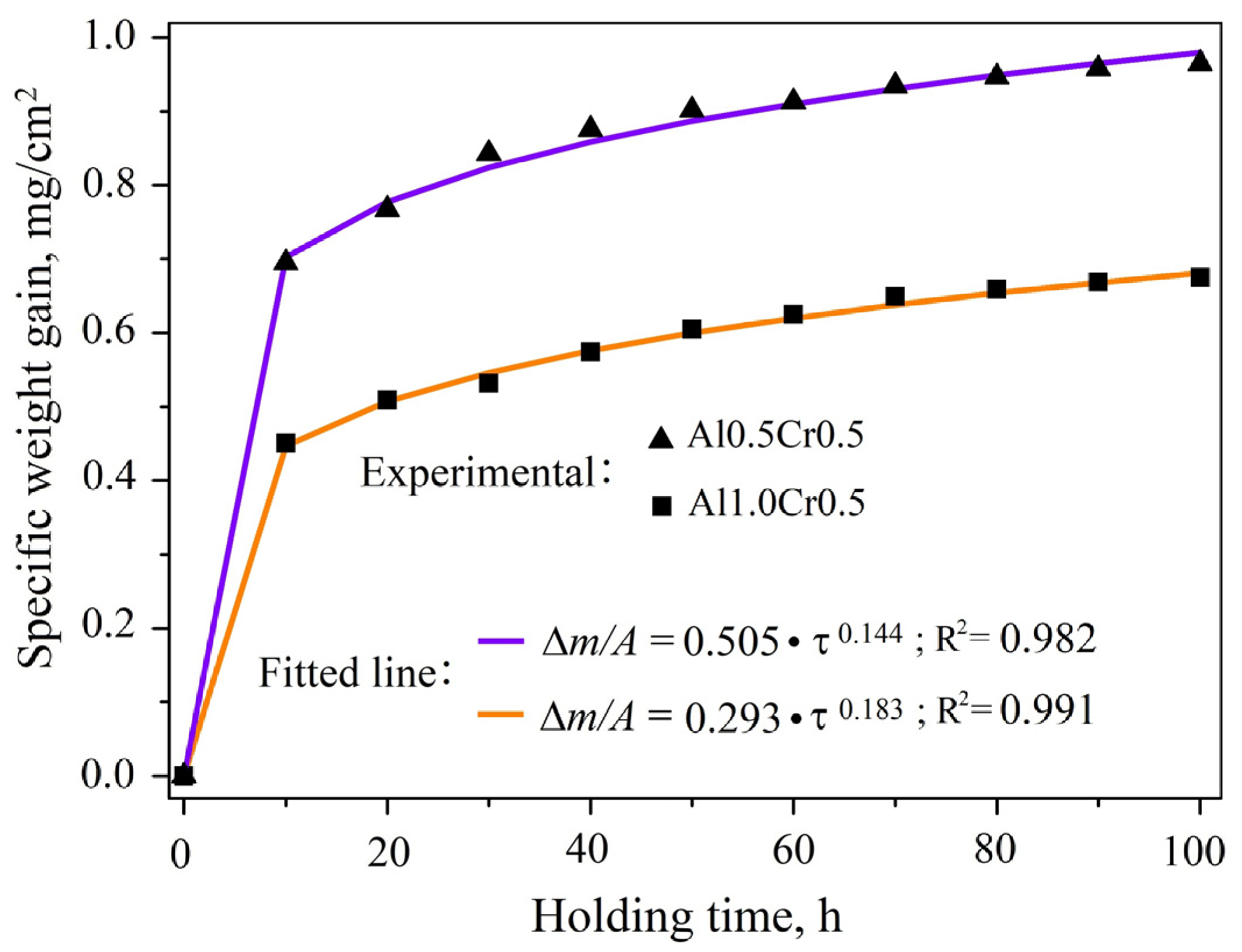
The results on the specific weight gain during a 100 h isothermal holding at 1100 °C are shown in Figure 3. Each point on the graphs represents the result of averaging three parallel experiments; the calculated errors did not exceed 5%. The maximum specific weight gain for the Al0.5CoCr0.5NiPt0.1 alloy was 0.965 mg/cm2, and 0.675 mg/cm2 for the AlCoCr0.5NiPt0.1 alloy.
Figure 3.
Kinetic curves of oxidation at 1100 °C for the samples: Al0.5Cr0.5—Al0.5CoCr0.5NiPt0.1; Al1.0Cr0.5—AlCoCr0.5NiPt0.1. In approximation equations (fitted line), time is measured in hours.
The curves in Figure 3 indicate rapid growth of the oxide film during the first 10 h of high-temperature exposure and a sharp slowdown in the oxidation rate with further increases in exposure time, indicating the high protective properties of the film formed on the surface. The general formula for oxidation kinetics can be represented as:
where Δm is mass change (g), A is surface area (cm2), τ is the holding time (h), k and n are the simplified oxidation coefficient and dimensionless oxidation exponent, respectively. The n value can represent the different oxidation behaviors (n = 1, 0.5 and 1/3 correspond to the linear, parabolic, and cubic oxidation behaviors, respectively). The calculation results are presented in Figure 3. According to the results obtained, the values of n are quite low (0.144 and 0.183) and correspond more closely to sub-parabolic law (either cubic or logarithmic). The resulting films have a high degree of protection against further oxidation of the base metal. Thus, the diffusion of atoms and ions through the formed films and deep into the metal is hindered, which may be due to the effect of platinum on the high-temperature oxidation process. Platinum is known to block oxygen diffusion pathways [26].
Although the oxidation process followed sub-parabolic law, we calculated the oxidation rate constant for a parabolic one to facilitate comparison of our data with literature data, as most calculations presented in the literature were performed for parabolic oxidation. Specific weight change (W) in parabolic law can be related to time as below:
or
where Δm is mass change (g), A is surface area (cm2), kp is the parabolic oxidation rate constant (g2/cm4s), and τ is the holding time (s). The results of the oxidation rate constant of the studied samples for the time interval of 20–100 h are given in Table 2.
Table 2.
Oxidation rate parabolic constant (kp, g2/cm4s) compared with the literature data.
Obviously, some alloys presented in Table 2 exhibit higher oxidation rates, even though being tested at a lower temperature (900, 1000, or 1050 °C), than our studied MPEAs. It is important to note that the oxidation rate of industrial Ni-based superalloys is relatively high compared to the compositions we tested, highlighting the high potential for using Pt-doped MPEAs as heat-resistant materials. However, the performance of our proposed composition, AlCoCr0.5NiPt0.1, lies behind Y-doped alloys when investigated at 1100 °C [14,15,16]. Thus, the introduction of platinum into the composition of the Fe-free AlCoCr0.5Ni alloy reduces the value of the parabolic oxidation rate constant by half. Subsequently, compared to the AlCoCrNi alloy, the oxidation rate constant is reduced by over fourfold for Al0.5CoCr0.5NiPt0.1 MPEA and nearly tenfold for AlCoCr0.5NiPt0.1 MPEA.
3.3. Morphology and Phase Composition of the Oxide Film
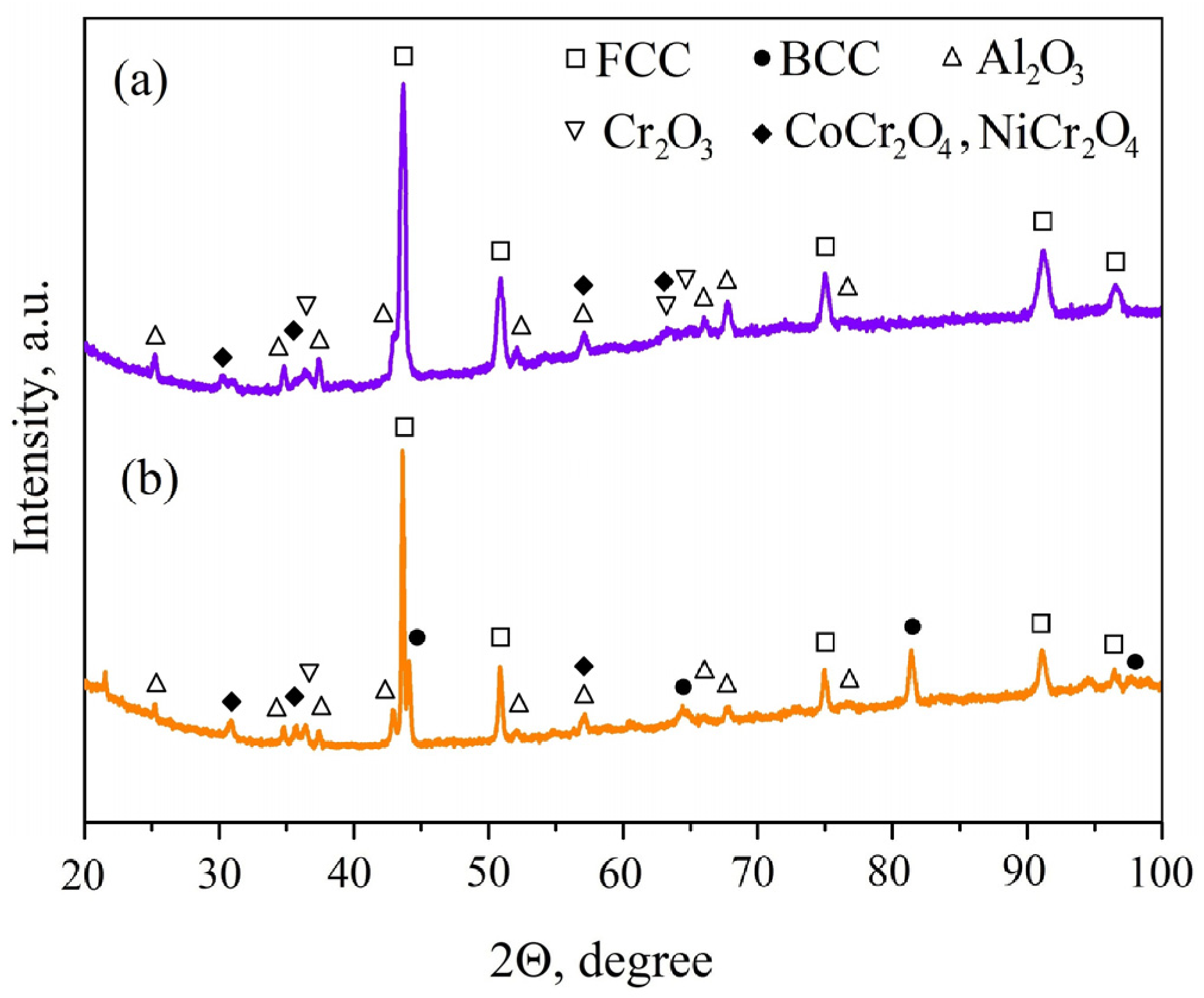
Figure 4 shows the diffraction patterns of the MPEAs surface after high-temperature oxidation. The diffraction patterns contain peaks from FCC and BCC solid solutions (matrix material), Al2O3 (pdf # 00-010-0173), Cr2O3 (pdf # 00-038-1479), NiCr2O4 (pdf # 00-023-1271) and CoCr2O4 (pdf # 00-078-0711). It should be noted that after the high-temperature experiment, Al0.5CoCr0.5NiPt0.1 MPEA exhibits no reflections from the BCC matrix phase, whereas in AlCoCr0.5NiPt0.1 MPEA they are less pronounced compared to the as-cast metal. This may be due to the depletion of aluminum in the near-surface layers of the metal. During high-temperature oxidation, aluminum reacts with atmospheric oxygen, forming an aluminum oxide film on the alloy surface.
Figure 4.
XRD patterns of the surface after high-temperature oxidation at 1100 °C for samples: (a) Al0.5CoCr0.5NiPt0.1; (b) AlCoCr0.5NiPt0.1.
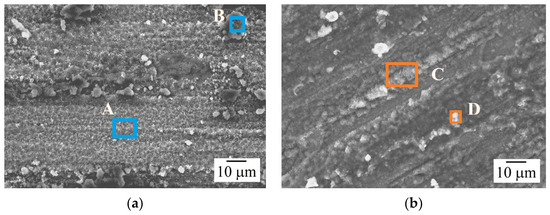
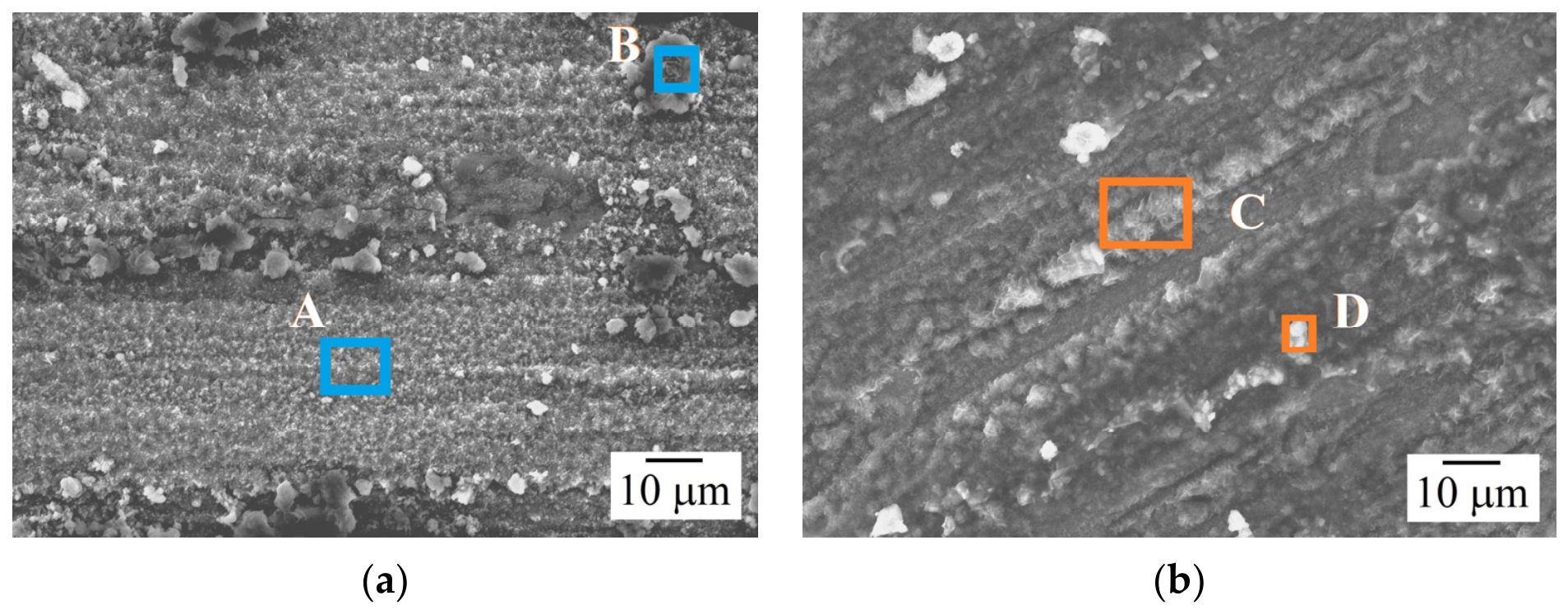
The results of surface morphology analysis of the samples after oxidation (Figure 5, Table 3) support the data from the X-ray phase analysis. Both samples are characterized by the formation of a film that predominantly consists of dispersed crystallites, with a chemical composition dominated by aluminum and oxygen (points A and C in Figure 5 and Table 3). Coarser chromium-rich crystals (points B and D in Figure 5 and Table 3) are also found on the surface oxide layer. Moreover, the number of larger and coarser chromium-containing oxide crystals is higher for the Al0.5CoCr0.5NiPt0.1 MPEA oxide scale. The EDS data on the average chemical composition of the surface film (Table 3) also demonstrate that the concentration of aluminum in the formed oxide layer of the Al0.5CoCr0.5NiPt0.1 alloy is significantly lower than that of the AlCoCr0.5NiPt0.1 alloy; on the other hand, the concentration of chromium is higher. In addition, cracks are found in scale for Al0.5CoCr0.5NiPt0.1 MPEA, while a continuous and defect-free oxide layer is observed on the surface of AlCoCr0.5NiPt0.1 MPEA.
Figure 5.
Surface morphology after high-temperature oxidation at 1100 °C of samples: (a) Al0.5CoCr0.5NiPt0.1; (b) AlCoCr0.5NiPt0.1.
Table 3.
Chemical composition (EDS data, at. %) sample surfaces after high-temperature oxidation at 1100 °C.
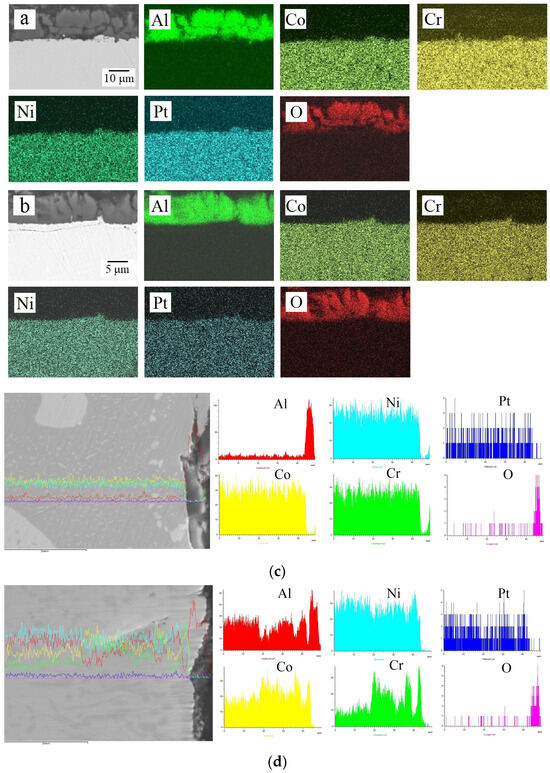
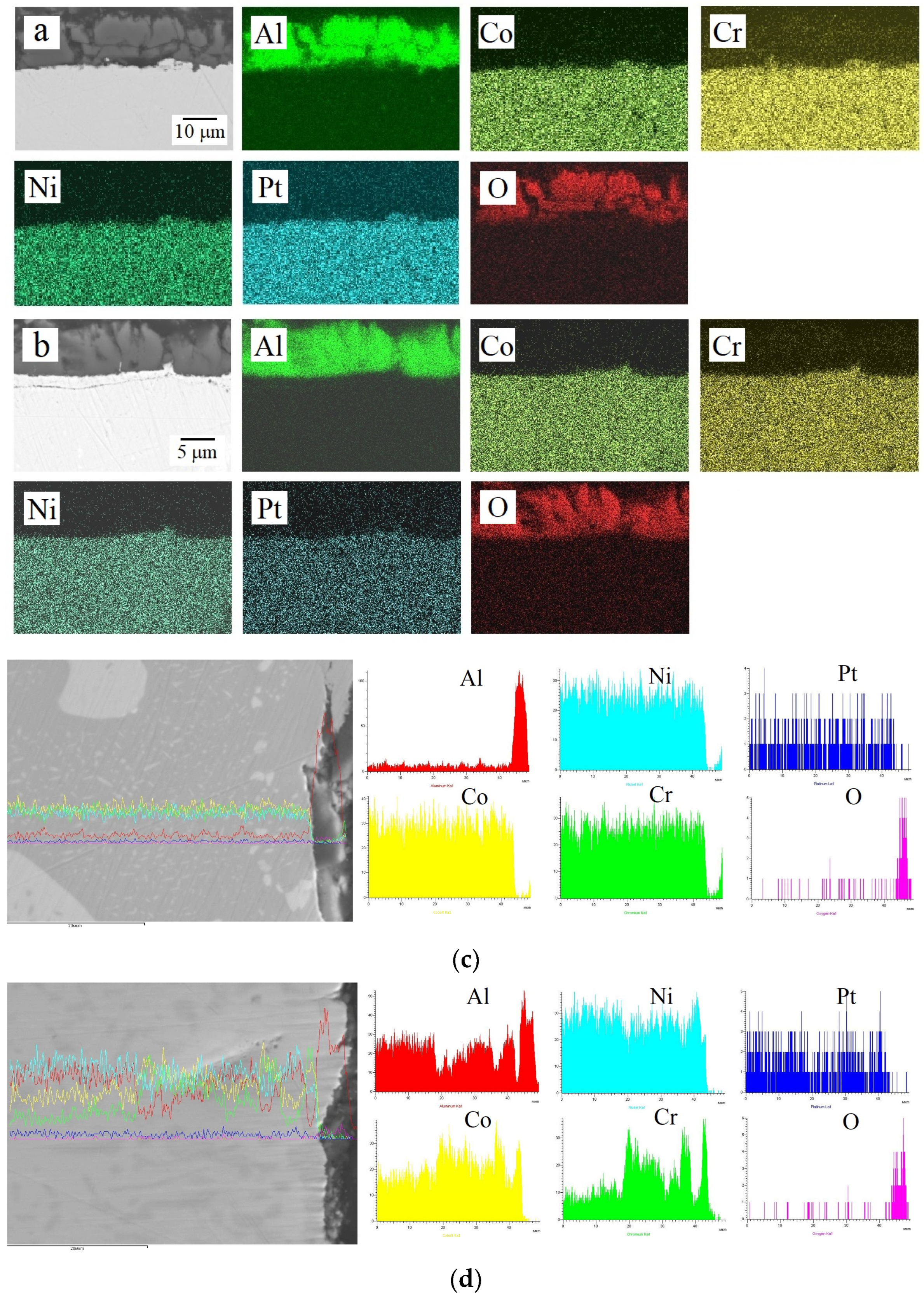
A cross-sectional examination of the surface oxide layer (Figure 6) also indicates that for both MPEAs, the main film components are composed of aluminum and oxygen throughout. Film thicknesses vary from 7 to 10 μm for the Al0.5CoCr0.5NiPt0.1 sample to 3–5 μm for the AlCoCr0.5NiPt0.1 alloy. It should be noted that film adhesion to the matrix material is also better for the alloy with a higher aluminum concentration in its composition (AlCoCr0.5NiPt0.1 MPEA). It is noted that cracks were observed not only on the surface, but in the cross-section of the oxide film for the sample Al0.5CoCr0.5NiPt0.1 MPEA (Figure 6a). However, we did not observe any film shedding throughout the high-temperature experiment. In the crucibles where the samples were located during the experiment, no particles or flakes were found that had fallen from the sample. It is possible that these defects arose as a result of cross-section sample preparation. Longer experiments are necessary to assess the stability of the formed film, which is a potential area for future research. Also to further assess the stability of the oxide film forming on the surface; it will be necessary to plan a series of continuous long-term thermogravimetric analyses with a planned heating/cooling time and a specific heating/cooling rate. Such experiments are necessary because cracks in the film can form during cooling of the samples upon removal from the furnace due to large differences in the thermal expansion coefficients of the substrate and oxide scale [39,40]. On the other hand, both alloys under study were subjected to shock cooling, but cracks in the film formed in only one of them, providing further evidence of the heat resistance of the composition AlCoCr0.5NiPt0.1.
Figure 6.
SEM micrographs (in backscattered electrons mode) and the corresponding EDS maps and lines of the transverse section of samples: (a,c) Al0.5CoCr0.5NiPt0.1; (b,d) AlCoCr0.5NiPt0.1MPEAs after 100 h of high-temperature oxidation at 1100 °C.
For the use of the alloy at elevated temperatures (including as a bond coat in a thermal barrier coating), certain requirements are imposed on the oxide scale formed on the surface. It must be dense and defect-free with an ideal thickness of 2 to 5 μm to avoid shedding. Thus, the complex of data obtained determines that AlCoCr0.5NiPt0.1 MPEA have a high potential for high-temperature applications.
3.4. Formation of an Exclusive Al2O3 Scale
After initial scale formation, continuous Al2O3 growth requires sufficient Al supply at the metal/scale interface to offset transient Al loss [41,42]. The required Al concentration (XAl) must exceed a certain minimum value (XAl(min)) that can be calculated according to Wagner’s theory [43,44,45]:
where and are the molar volumes of the Al2O3 (25.55 cm3/mol) and the alloys, respectively. and are the molar weight of Al2O3 (101.96 g/mol) and O (16 g/mol), kp is the parabolic rate constant of oxidation. is the density of Al2O3 (3.99 g/cm3). is the coefficient of diffusion of Al, 1.0 × 10⁻¹¹ cm2/s [46].
The molar volumes of the alloys are 7.08 and 7.21 cm3/mol for Al0.5CoCr0.5NiPt0.1 and AlCoCr0.5NiPt0.1, respectively. Using Equation (6), the values of calculated are 0.1754 and 0.1197 (or 17.54 and 11.97 at. %) for Al0.5CoCr0.5NiPt0.1 and AlCoCr0.5NiPt0.1 MPEA, respectively. Compared to conventional CoNiCrAlY alloys ( = 0.15 or 15 at. %) [47], lower values facilitate earlier exclusive Al2O3 formation. The calculating results that we obtained can also be compared with the data from Rong et al. [48] for a number of Si-doped alloys. The value of 11.97 at. % for AlCoCr0.5NiPt0.1 MPEA is comparable with 10.7 at. % for (Co32.4Cr26Ni33Al8Y0.6)99Si1 alloy [48] and superior to the value of 20.0 at. % for (Co32.4Cr26Ni33Al8Y0.6)98Si2 composition [48].
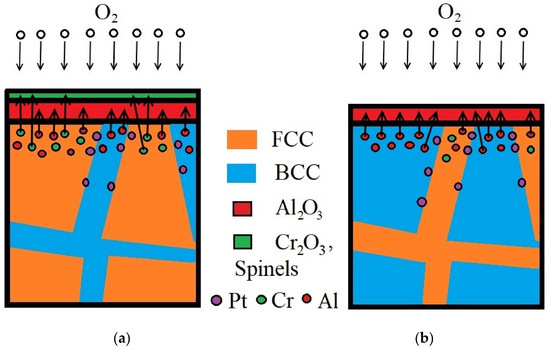
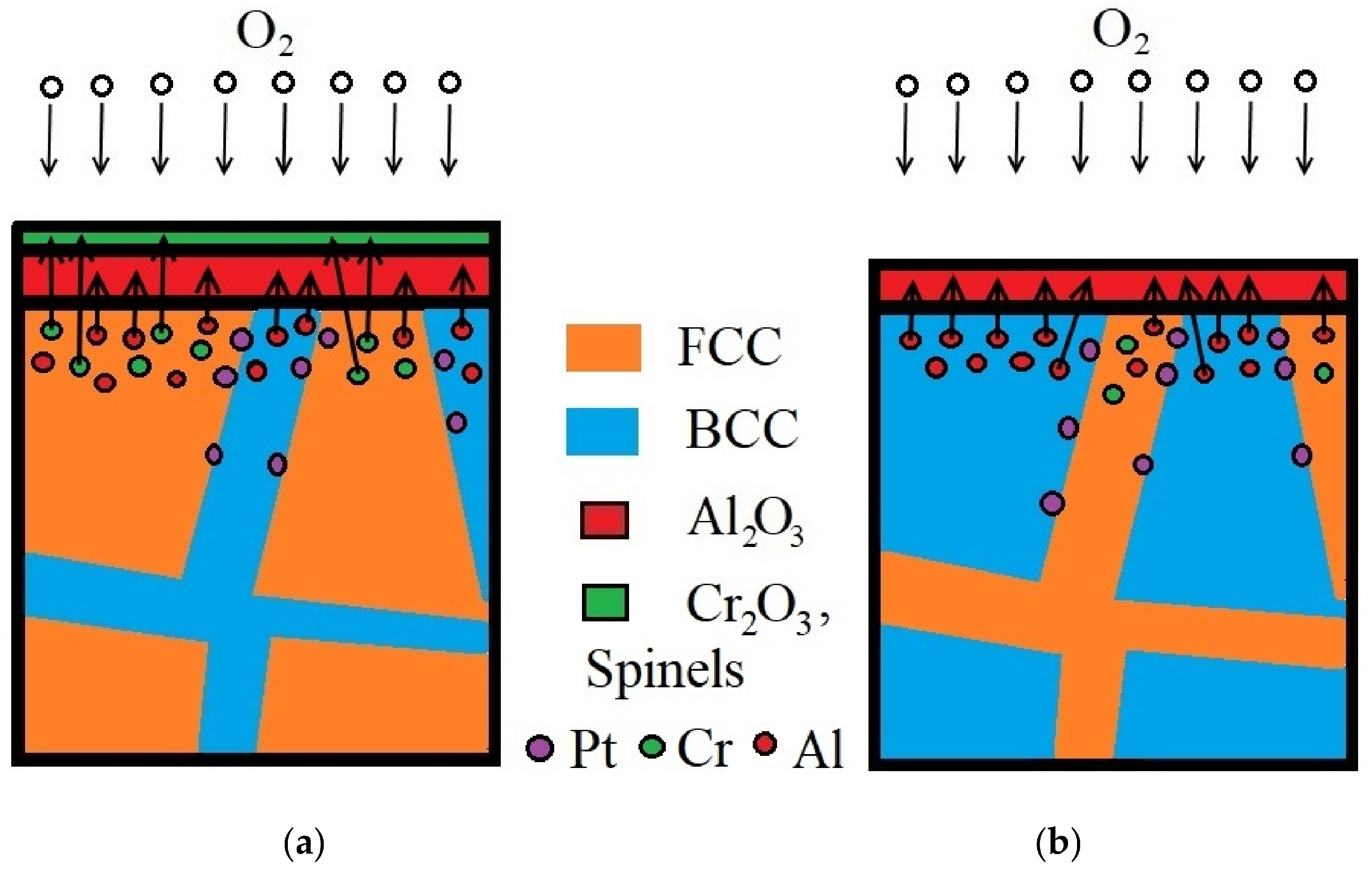
The results obtained indicate that increasing the aluminum concentration in the alloy should promote the formation of a protective film consisting primarily of aluminum oxide. The primary source of aluminum for this oxide film formation should be the BCC solid solution, whose proportion in the microstructure of the as-cast AlCoCr0.5NiPt0.1 alloy is higher than in the microstructure of the alloy with a lower aluminum content.
Moreover, it is necessary to take into account the role of platinum as a “reactive element”. Platinum reduces diffusion mobility of atoms and can block oxygen diffusion pathways. Furthermore, it enhances the stability of the oxide scale, preventing defect formation and its destruction. In addition, platinum improves adhesion between the matrix and the surface film, preventing rapid scale detachment.
The schematic diagram of oxidation process of investigated MPEAs is shown in Figure 7.
Figure 7.
Schematic diagram of sample oxidation: (a) Al0.5CoCr0.5NiPt0.1 and (b) AlCoCr0.5NiPt0.1.
3.5. Microstructure Stability of Alloys After Isothermal Holding at 1100 °C
Long-term high-temperature isothermal holding can also affect the microstructure of as-cast alloys, which can lead to changes in their characteristics. Therefore, studying the microstructure after high-temperature oxidation is also a mandatory stage of the research.
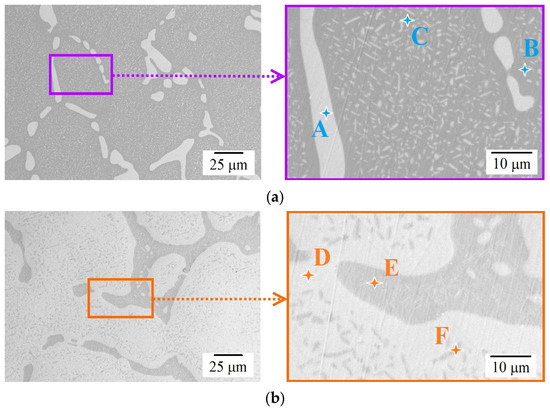
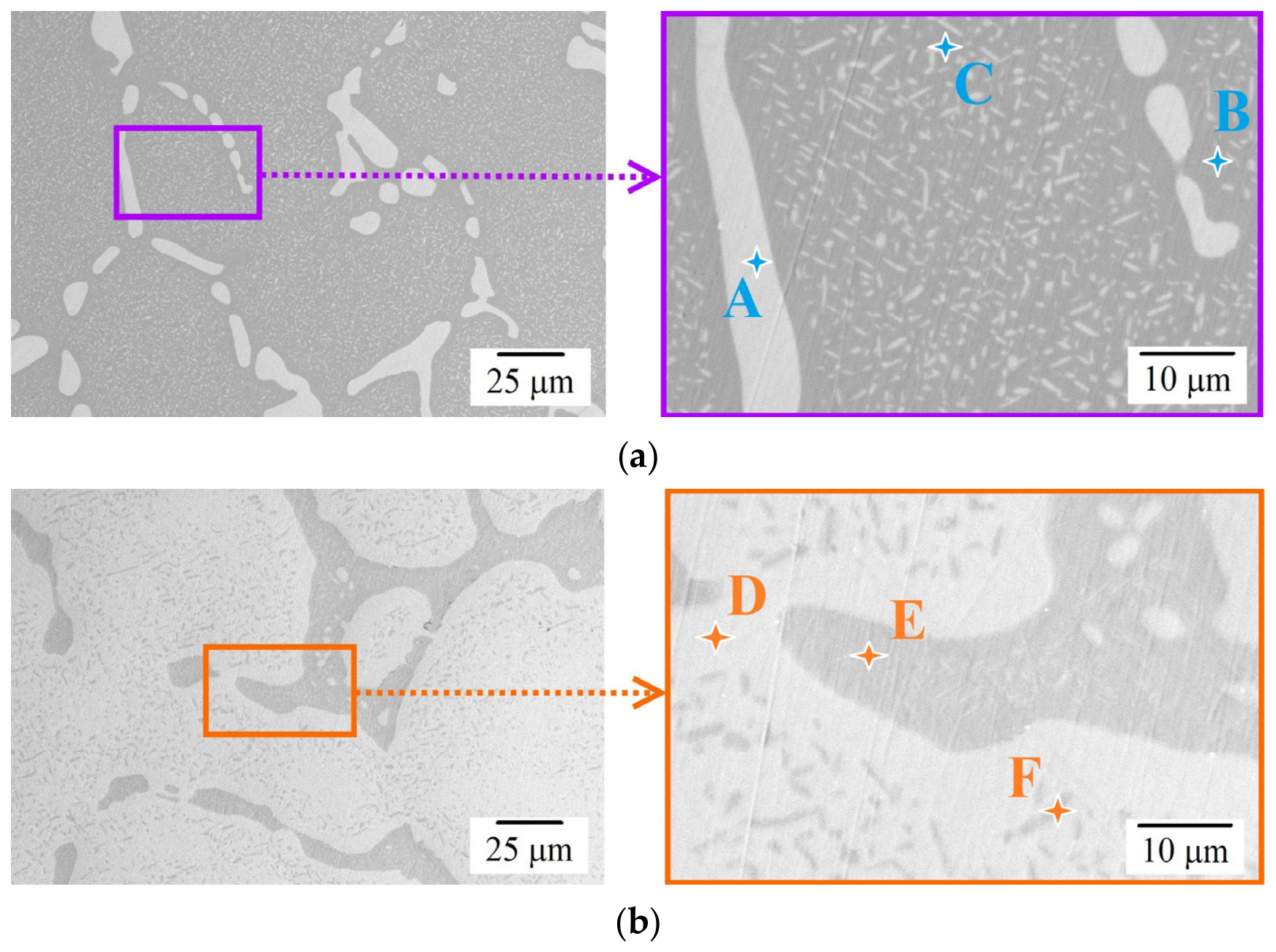
According to the obtained data (Figure 8, Table 4), for both studied MPEAs, the precipitation of dispersed particles (with sizes of about 1–3 μm) is observed in the main grains of dendrites (points C and F in Figure 8 and Table 4). However, the density of the precipitated particles is noticeably lower for the AlCoCr0.5NiPt0.1 sample. The evolution of the microstructure of MPEAs (HEAs) after long-term exposure at high temperatures is indicated in [29,49]. According to the scheme proposed in these works, at high temperatures, spinodal decomposition of the solid solutions occurs, as a result of which a secondary phase is released in the grains of dendrites.
Figure 8.
SEM micrographs (in backscattered electrons mode) microstructure of the central part of the samples: (a) Al0.5CoCr0.5NiPt0.1; (b) AlCoCr0.5NiPt0.1MPEAs after 100 h of high-temperature oxidation at 1100 °C.
Table 4.
Chemical composition (EDS data, at. %) microstructural components of studied MPEAs after high-temperature oxidation at 1100 °C.
The chemical analysis of the microstructural components of the alloys after isothermal holding (Table 4) in comparison with the as-cast alloys (Table 1) indicates that some averaging occurs in the aluminum, nickel and platinum content between the solid solutions representing dendrites and interdendritic space.
4. Conclusions
In summary:
- (1)
- Both samples are characterized by a two-phase (FCC + BCC) microstructure, and their ratios vary depending on the aluminum content in the alloys. At lower aluminum content, the FCC solid solution predominates, while at higher aluminum content, the BCC solid solution is the main phase.
- (2)
- Platinum does not exist as a separate phase but rather is incorporated into solid solutions. In as-cast alloys, platinum exhibits high solubility in the BCC solid solution (about 6–7 at. %), but after prolonged high-temperature isothermal holding, the platinum concentration tends to equalize between the two solid solutions.
- (3)
- The AlCoCr0.5NiPt0.1MPEA demonstrates greater resistance to high-temperature oxidation compared to the Al0.5CoCr0.5NiPt0.1 alloy. So, the maximum specific weight gain for the AlCoCr0.5NiPt0.1 composition was 0.675 mg/cm2 against 0.965 mg/cm2 for the Al0.5CoCr0.5NiPt0.1 MPEA. According to calculations, AlCoCr0.5NiPt0.1 MPEA has an advantage for the formation of an exclusive Al2O3 scale, which is confirmed by the conducted studies of the morphology and cross-section of the film obtained after high-temperature oxidation. The initial microstructure of as-cast samples and their phase composition, especially in terms of the distribution of aluminum between microstructural components, plays a significant role in the high-temperature oxidation resistance of alloys.
- (4)
- The oxidation rate of AlCoCr0.5NiPt0.1MPEA is lower than that of Ni-based superalloys and a number of HEAs. The calculated parabolic oxidation rate constant was kp = 45 × 10–13 (g2/cm4s) and kp = 20.2 × 10⁻¹³ (g2/cm4s) for Al0.5CoCr0.5NiPt0.1 and AlCoCr0.5NiPt0.1 MPEA accordingly.
- (5)
- Finally, both samples exhibit spinodal decomposition with secondary phase precipitation in the primary dendritic grains after prolonged high-temperature exposure. The density of the precipitated particles is significantly lower in AlCoCr0.5NiPt0.1 MPEA. Thus, the AlCoCr0.5NiPt0.1 alloy has high potential for high-temperature applications.
- (6)
- The main directions for future work on these alloys are increasing the isothermal holding time to assess the stability of the oxide film formed on the surface and using continuous long-term thermogravimetric analysis to assess the convergence of results obtained using two different methods. Further studies should also be directed at the investigated of the changes in mechanical characteristics and grain sizes after long-term high-temperature isothermal holding.
Author Contributions
Conceptualization, O.S., S.P. and E.T.; methodology, O.S., S.P. and P.P.; software, O.S., S.P. and P.P.; validation, N.S., M.A. and E.T.; formal analysis, O.S., M.A. and E.T.; investigation, O.S., S.P., P.P. and N.S.; resources, O.S. and E.T.; data curation, O.S. and S.P.; writing—original draft preparation, O.S. and N.S.; writing—review and editing, M.A. and E.T.; visualization, O.S. and P.P.; supervision, M.A. and E.T.; project administration, O.S. and E.T.; funding acquisition, O.S. All authors have read and agreed to the published version of the manuscript.
Funding
The study was supported by the Russian Science Foundation and the Government of the Chelyabinsk Region, project No. 25-23-20049, https://rscf.ru/project/25-23-20049/ (accessed on 14 May 2025).
Institutional Review Board Statement
Not applicable.
Informed Consent Statement
Not applicable.
Data Availability Statement
The original contributions presented in this study are included in the article. Further inquiries can be directed to the corresponding author.
Conflicts of Interest
The authors declare no conflicts of interest.
Abbreviations
The following abbreviations are used in this manuscript:
| MPEA | Multi-principal element alloy |
| HEA | High-entropy alloy |
| SEM | Scanning electron microscope |
| EDS | Energy-dispersive X-ray spectroscopy detector |
| XRD | X-Ray diffraction |
| FCC | Face-centered cubic crystal lattice |
| BCC | Body-centered cubic crystal lattice |
References
- Cantor, B.; Chang, I.T.H.; Knight, P.; Vincent, A.J.B. Microstructural development in equiatomic multicomponent alloys. Mater. Sci. Eng. A 2004, 375–377, 213–218. [Google Scholar] [CrossRef] [Scilit]
- George, E.P.; Raabe, D.; Ritchie, R.O. High-entropy alloys. Nat. Rev. Mater. 2019, 4, 515–534. [Google Scholar] [CrossRef] [Scilit]
- George, E.P.; Curtin, W.A.; Tasan, C.C. High entropy alloys: A focused review of mechanical properties and deformation mechanisms. Acta Mater. 2020, 188, 435–474. [Google Scholar] [CrossRef] [Scilit]
- Jain, S.; Jain, R.; Kumar, V.; Samal, S.; Lee, J. Design strategies and mechanical behaviour of high-strength eutectic high-entropy alloys: A comprehensive review. J. Alloys Compd. 2025, 1022, 180000. [Google Scholar] [CrossRef] [Scilit]
- Kasar, A.K.; Scalaro, K.; Menezes, P.L. Tribological properties of high-entropy alloys under dry conditions for a wide temperature range—A review. Materials 2021, 14, 5814. [Google Scholar] [CrossRef] [Scilit]
- Samoilova, O.; Shaburova, N.; Ostovari Moghaddam, A.; Trofimov, E. Al0.25CoCrFeNiSi0.6 high entropy alloy with high hardness and improved wear resistance. Mater. Lett. 2022, 328, 133190. [Google Scholar] [CrossRef] [Scilit]
- Shi, Y.; Yang, B.; Liaw, P.K. Corrosion-resistant high-entropy alloys: A review. Metals 2017, 7, 43. [Google Scholar] [CrossRef] [Scilit]
- Samoilova, O.; Pratskova, S.; Shaburova, N.; Ostovari Moghaddam, A.; Lezhnev, S.; Panin, E.; Trofimov, E. Effect of Al content on the microstructure, microhardness and corrosion resistance of AlxCoCrFeNiMo0.5 high-entropy alloys. J. Chem. Technol. Metall. 2025, 60, 1091–1098. [Google Scholar] [CrossRef] [Scilit]
- Kumar, P.; Lam, T.-N.; Tripathi, P.K.; Singh, S.S.; Liaw, P.K.; Huang, E.-W. Recent progress in oxidation behavior of high-entropy alloys: A review. APL Mater. 2022, 10, 120701. [Google Scholar] [CrossRef] [Scilit]
- Lin, G.; Cai, Z.; Dong, Y.; Wang, C.; Hu, J.; Zhang, P.; Gu, L. High-temperature oxidation behavior of AlCoCrFeNi2.1 eutectic high-entropy alloy: Microstructure evolution and microhardness. Mater. Charact. 2024, 210, 113830. [Google Scholar] [CrossRef] [Scilit]
- Li, Y.; Zhang, P.; Zhang, J.; Chen, Z.; Shen, B. Oxidation behavior of AlCoCrFeNiSix high-entropy alloys at 1100 °C. Corros. Sci. 2021, 190, 109633. [Google Scholar] [CrossRef] [Scilit]
- Odabas, O.; Karaoglanli, A.C.; Ozgurluk, Y.; Binal, G. Evaluation of high temperature oxidation resistance of AlCoCrFeNiZr high-entropy alloy (HEA) coating system at 1000 °C and 1100 °C. Surf. Coat. Technol. 2025, 512, 132439. [Google Scholar] [CrossRef] [Scilit]
- Chen, X.; Li, Q.; Liu, Y.; Zhang, L.; He, S.; Gorbatov, O.I.; Qu, X. Oxidation behavior of the AlCoCrFeNiCu0.5 high-entropy alloy at 800 °C and 900 °C. Met. Mater. Int. 2025, 31, 1982–1995. [Google Scholar] [CrossRef] [Scilit]
- Lu, J.; Zhang, H.; Chen, Y.; Ling, L.; Liu, X.; Xiao, W.; Ni, N.; Zhao, X.; Guo, F.; Xiao, P. Y-doped AlCoCrFeNi2.1 eutectic high-entropy alloy with excellent oxidation resistance and structure stability at 1000 °C and 1100 °C. Corros. Sci. 2021, 180, 109191. [Google Scholar] [CrossRef] [Scilit]
- Lu, J.; Chen, Y.; Zhang, H.; Ni, N.; Li, L.; He, L.; Mu, R.; Zhao, X.; Guo, F. Y/Hf-doped AlCoCrFeNi high-entropy alloy with ultra oxidation and spallation resistance. Corros. Sci. 2020, 166, 108426. [Google Scholar] [CrossRef] [Scilit]
- Hu, J.; Gu, C.; Li, J.; Li, C.; Feng, J.; Jiang, Y. Microstructure and oxidation behavior of the Y/Ta/Hf co-doped AlCoCrFeNi high-entropy alloys in air at 1100 °C. Corros. Sci. 2023, 212, 110930. [Google Scholar] [CrossRef] [Scilit]
- Samoilova, O.; Pratskova, S.; Suleymanova, I.; Shaburova, N.; Ostovari Moghaddam, A.; Trofimov, E. Effect of Pt addition on the oxidation and corrosion resistance of Al0.25CoCrFeNi high-entropy alloy. Metals 2023, 13, 1709. [Google Scholar] [CrossRef] [Scilit]
- Samoilova, O.; Suleymanova, I.; Shaburova, N.; Ostovari Moghaddam, A.; Trofimov, E. The behavior of Al0.5CoCrFeNiCuPt0.3 high-entropy alloy during high-temperature oxidation. High Temp. Corros. Mater. 2024, 101, 811–825. [Google Scholar] [CrossRef] [Scilit]
- Baskaran, T.; Esakkiraja, N.; Samartha, C.; Kumar, P.; Jayaram, V.; Paul, A. Effect of addition of Pt, Pd and Ir to β-NiAl-bond coat on oxidation resistance and growth of interdiffusion zone. Surf. Coat. Technol. 2021, 426, 127766. [Google Scholar] [CrossRef] [Scilit]
- Bai, M.; Chen, Y.; Xiao, P. Investigations on the diffusion of platinum between CMSX-4 superalloy and platinum-enriched bond coat. Coatings 2021, 11, 441. [Google Scholar] [CrossRef] [Scilit]
- Darolia, R. Thermal barrier coatings technology: Critical review, progress update, remaining challenges and prospects. Int. Mater. Rev. 2013, 58, 315–348. [Google Scholar] [CrossRef] [Scilit]
- Li, X.; Zhang, W.; Cai, X.; Liu, H.; Luo, X. High temperature hardness and thermal analysis of CoNiCrAlY alloys used as bond coats for thermal barrier coatings. J. Mater. Res. Technol. 2024, 30, 1020–1023. [Google Scholar] [CrossRef] [Scilit]
- Gawel, R.; Rogal, Ł.; Grzesik, Z. Behaviour of Al, Co, Cr, Ni-based high entropy alloys under high-temperature thermal shock oxidising conditions. Corros. Sci. 2022, 198, 110116. [Google Scholar] [CrossRef] [Scilit]
- Liang, M.; Zhang, J.; Gao, J.; Yi, H.; Yin, B.; Yang, Z.; Qi, F.; Yang, Y. Enhancing the oxidation resistance of AlCoCrNi high-entropy alloy via Ti-induced microstructural modifications. Corros. Sci. 2025, 246, 112746. [Google Scholar] [CrossRef] [Scilit]
- Li, L.; Chen, Y.; Huang, A.; Liu, X.; Zhang, H.; Zhang, H.; Zhang, X.; Lu, J.; Zhao, X. A novel NiCoCrAlPt high-entropy alloy with superb oxidation resistance at 1200 °C. Corros. Sci. 2024, 228, 111819. [Google Scholar] [CrossRef] [Scilit]
- Samoilova, O.; Pratskova, S.; Plotnikova, P.; Sudarikov, M.; Shaburova, N.; Ostovari Moghaddam, A.; Trofimov, E. Pt-doped AlCoCrNiPt0.1 multi-principal element alloy for high-temperature applications. Mater. Lett. 2026, 403, 139506. [Google Scholar] [CrossRef] [Scilit]
- Sun, X.; Li, X.; Guo, S.; Zhu, L.; Teng, J.; Jiang, L.; Moverare, J.; Li, X.-H.; Peng, R.L. The impact of Al/Cr ratio on the oxidation kinetics of Y-doped AlCoCrFeNi high-entropy alloys at 1100 °C. Intermetallics 2025, 176, 108582. [Google Scholar] [CrossRef] [Scilit]
- Anupam, A.; Ang, A.S.M.; Guruvidyathri, K.; Abbas, M.; Sivaprahasam, D.; Munroe, P.; Berndt, C.C.; Murty, B.S.; Kottada, R.S. Evaluating the influence of microstructural attributes: Fraction, composition, size and spatial distribution of phases on the oxidation behaviour of high-entropy alloys. Corros. Sci. 2021, 184, 109381. [Google Scholar] [CrossRef] [Scilit]
- Wang, W.-R.; Wang, W.-L.; Yeh, J.-W. Phases, microstructure and mechanical properties of AlxCoCrFeNi high-entropy alloys at elevated temperatures. J. Alloys Compd. 2014, 589, 143–152. [Google Scholar] [CrossRef] [Scilit]
- Ogura, M.; Fukushima, T.; Zeller, R.; Dederichs, P.H. Structure of the high-entropy alloy AlxCrFeCoNi: Fcc versus bcc. J. Alloys Compd. 2017, 715, 454–459. [Google Scholar] [CrossRef] [Scilit]
- Samoilova, O.; Sudarikov, M.; Shaburova, N.; Ostovari Moghaddam, A.; Trofimov, E. High temperature oxidation resistance of AlCoCrFeNiCu0.25W0.1 high-entropy alloy. MRS Adv. 2025, 10, 2046–2050. [Google Scholar] [CrossRef] [Scilit]
- Miracle, D.B.; Senkov, O.N. A critical review of high entropy alloys and related concepts. Acta Mater. 2017, 122, 448–511. [Google Scholar] [CrossRef] [Scilit]
- Pavel, M.J.; Weaver, M.L. Microstructural impacts on the oxidation of multi–principal element alloys. High Temp. Corros. Mater. 2024, 101, 389–412. [Google Scholar] [CrossRef] [Scilit]
- Abbaszadeh, S.; Pakseresht, A.; Omidvar, H.; Shafiei, A. Investigation of the high-temperature oxidation behavior of the Al0.5CoCrFeNi high entropy alloy. Surf. Interfaces 2020, 21, 100724. [Google Scholar] [CrossRef] [Scilit]
- Chen, L.; Zhou, Z.; Tan, Z.; He, D.; Bobzin, K.; Zhao, L.; Öte, M.; Königstein, T. High temperature oxidation behavior of Al0.6CrFeCoNi and Al0.6CrFeCoNiSi0.3 high entropy alloys. J. Alloys Compd. 2018, 764, 845–852. [Google Scholar] [CrossRef] [Scilit]
- Butler, T.M.; Alfano, J.P.; Martens, R.L.; Weaver, M.L. High-temperature oxidation behavior of Al-Co-Cr-Ni-(Fe or Si) multicomponent high-entropy alloys. JOM 2015, 67, 246–259. [Google Scholar] [CrossRef] [Scilit]
- Singh, R.K.; Paswan, S. Isothermal high-temperature oxidation behaviour of nickel-based superalloy IN740H. Trans. Indian Inst. Met. 2024, 77, 1287–1297. [Google Scholar] [CrossRef] [Scilit]
- Wang, J.; Xue, H.; Wang, Y. Oxidation behavior of Ni-based superalloy GH738 in static air between 800 and 1000 °C. Rare Met. 2021, 40, 616–625. [Google Scholar] [CrossRef] [Scilit]
- Dąbrowa, J.; Cieślak, G.; Stygar, M.; Mroczka, K.; Berent, K.; Kulik, T.; Danielewski, M. Influence of Cu content on high temperature oxidation behavior of AlCoCrCuxFeNi high entropy alloys (x = 0; 0.5; 1). Intermetallics 2017, 84, 52–61. [Google Scholar] [CrossRef] [Scilit]
- Palcut, M.; Drienovský, M.; Priputen, P.; Šulhánek, P.; Stacho, P.; Gerhátová, Ž.; Gogola, P.; Krajčovič, J.; Bónová, L.; Kusý, M. Oxidation resistance of AlCoFeNiCux high entropy alloys. J. Mater. Res. Technol. 2024, 31, 1974–1990. [Google Scholar] [CrossRef] [Scilit]
- Wagner, C. Theoretical analysis of the diffusion processes determining the oxidation rate of alloys. J. Electrochem. Soc. 1952, 99, 369. [Google Scholar] [CrossRef] [Scilit]
- Chen, Y.; Zhao, X.; Xiao, P. Effect of microstructure on early oxidation of MCrAlY coatings. Acta Mater. 2018, 159, 150–162. [Google Scholar] [CrossRef] [Scilit]
- Jiang, X.; Liu, Y.; Wu, C.; Peng, H.; Chen, J.; Zhu, X.; Tu, H.; Wang, J.; Su, X. Effect of surface finishing on the early-stage oxidation of alumina forming austenitic (AFA) alloys under low oxygen pressure. Corros. Sci. 2025, 247, 112774. [Google Scholar] [CrossRef] [Scilit]
- Dong, Z.; Sun, A.; Yang, S.; Yu, X.; Yuan, H.; Wang, Z.; Deng, L.; Song, J.; Wang, D.; Kang, Y. Machine learning-assisted discovery of Cr, Al-containing high-entropy alloys for high oxidation resistance. Corros. Sci. 2023, 220, 111222. [Google Scholar] [CrossRef] [Scilit]
- Gesmundo, F.; Viani, F.; Niu, Y.; Douglass, D.L. The transition from the formation of mixed scales to the selective oxidation of the most-reactive component in the corrosion of single and two-phase binary alloys. Oxid. Met. 1993, 40, 373–393. [Google Scholar] [CrossRef] [Scilit]
- Nijdam, T.J.; Sloof, W.G. Effect of reactive element oxide inclusions on the growth kinetics of protective oxide scales. Acta Mater. 2007, 55, 5980–5987. [Google Scholar] [CrossRef] [Scilit]
- Evans, H.E.; Taylor, M.P. Diffusion cells and chemical failure of MCrAlY bond coats in thermal-barrier coating systems. Oxid. Met. 2001, 55, 17–34. [Google Scholar] [CrossRef] [Scilit]
- Rong, X.; Jiang, Q.; Li, X.; Qiu, Z.; Zhang, Z.; Yang, C. Role of silicon in promoting exclusive Al2O3 formation on (Co32.4Cr26Ni33Al8Y0.6)100-xSix medium-entropy alloys: Unraveling oxidation resistance mechanisms. J. Alloys Compd. 2026, 1056, 186653. [Google Scholar] [CrossRef] [Scilit]
- Samoilova, O.V.; Pratskova, S.E.; Sudarikov, M.V.; Shaburova, N.A.; Suleymanova, I.I.; Trofimov, E.A. Effect of silver addition on microstructure, phase composition, microhardness and surface oxide layer formation of Al0.5CoCrCu0.5FeNi and Al0.5CoCrCuFeNi high-entropy alloys. Phys. Mesomech. 2024, 27, 183–196. [Google Scholar] [CrossRef] [Scilit]

Disclaimer/Publisher’s Note: The statements, opinions and data contained in all publications are solely those of the individual author(s) and contributor(s) and not of MDPI and/or the editor(s). MDPI and/or the editor(s) disclaim responsibility for any injury to people or property resulting from any ideas, methods, instructions or products referred to in the content. |
© 2026 by the authors. Licensee MDPI, Basel, Switzerland. This article is an open access article distributed under the terms and conditions of the Creative Commons Attribution (CC BY) license.