Article

Effect of Aluminum Carbide (Al4C3) on the Mechanical Properties of Aluminum Matrix Composites Reinforced with Graphene Nanoplatelets


by
Yana Mourdjeva
1,*,
Kateryna Valuiska
1,
Daniela Karashanova
2 and
Rumyana Lazarova
1,3
1
Institute of Metal Science, Equipment and Technologies with Hydro- and Aerodynamics Centre at the Bulgarian Academy of Sciences, 1574 Sofia, Bulgaria
2
Institute of Optical Materials and Technologies “Academician Jordan Malinowski”, Bulgarian Academy of Sciences, 1113 Sofia, Bulgaria
3
National Center for Mechatronics and Clean Technologies, 8 Kliment Ohridski Blvd., Building 8, 1756 Sofia, Bulgaria
*
Author to whom correspondence should be addressed.
Metals 2026, 16(4), 408; https://doi.org/10.3390/met16040408
Submission received: 26 February 2026 / Revised: 29 March 2026 / Accepted: 1 April 2026 / Published: 8 April 2026

Abstract

Aluminum–graphene nanoplatelet (Al/GNP) composites have attracted significant attention as lightweight structural materials, yet their mechanical performance is strongly influenced by interfacial reactions and the formation of carbides. In this study, Al/GNP composites containing 0.1–1.1 wt.% graphene were produced via powder metallurgy and hot extrusion at 400 °C and 500 °C. Hot extrusion at the higher temperature enables the controlled in situ formation of aluminum carbide (Al4C3). A comprehensive microstructural characterization using SEM and HRTEM was combined with tensile testing to elucidate the influence of carbide size on mechanical behavior. Hot extrusion at 500 °C promotes the formation of uniformly distributed, nanoscale Al4C3 carbides whose size, morphology, and aspect ratio depend on graphene content. Composites containing nano-sized carbides exhibit a markedly improved strength–ductility balance compared to carbide-free counterparts, with optimal performance achieved at 0.3 and 0.7 wt.% GNPs. The enhancement is attributed to synergistic strengthening mechanisms involving improved interfacial bonding, efficient load transfer, nanoscale dispersion strengthening, and carbide–dislocation interactions. The results indicate that the controlled formation of nanoscale Al4C3 is not detrimental; rather, it contributes to the optimization of the mechanical properties of Al/GNP composites. Unlike most previous studies that treat carbide formation as a detrimental effect, this work demonstrates that its controlled nanoscale evolution can be used as a deliberate strengthening strategy through its influence on microstructural mechanisms.

1. Introduction

Aluminum is widely used as a structural material in the aerospace, automotive, electronics, and defense industries due to its low density; however, to achieve the high strength required for such applications, it must be reinforced. This reinforcement can be achieved via two main approaches: the production of aluminum alloys (by adding alloying elements in the molten state) or the fabrication of aluminum matrix composites (by incorporating reinforcing phases). Since the discovery of graphene in 2004, aluminum–graphene (Al/GNP) composites have attracted considerable scientific interest, and numerous representative and significant research contributions have been published on this topic [1,2,3,4,5,6,7,8,9,10,11,12,13,14,15,16,17,18,19,20,21,22,23,24,25,26,27,28,29,30,31,32,33]. Al/GNP composites are employed in the manufacture of a wide range of components and structures, including satellite structural panels, vehicle frames, electromagnetic interference shielding enclosures, power distribution components, etc.
The mechanical behavior of Al/GNP composites depends not only on the intrinsic mechanical properties of aluminum and graphene but also on the content and uniform distribution of the reinforcing phase within the aluminum matrix. Aluminum with a purity of 99.5% depending on temper condition (EN 485-2) exhibits an ultimate tensile strength in the range of 65–160 MPa, depending on processing conditions; a yield strength between 20 and 120 MPa; an elongation at fracture of 1–29% [34]; and a Young’s modulus of approximately 70 GPa. Nearly defect-free graphene exhibits a tensile strength of about 130 GPa [35] and a Young’s modulus of 1.0 ± 0.1 TPa. The strength and stiffness of graphene remain exceptionally high even at high densities of sp3-type defects, with the fracture strength being only about 14% lower than that of pristine graphene. In contrast, the presence of vacancy defects leads to a significant reduction in graphene strength. Owing to these exceptional mechanical properties, graphene nanoparticles (GNPs) are regarded as a highly effective reinforcement for metallic materials, particularly for the relatively soft aluminum.
The primary challenges associated with the fabrication of Al/graphene composites include nanoparticle agglomeration, inadequate interfacial bonding between graphene and the aluminum matrix, and the formation of microscale aluminum carbide. Due to its inherent brittleness, the presence of aluminum carbide adversely affects the mechanical performance of the composite [19].
High-strength composites have been successfully produced using powder metallurgy techniques [2,6,10,11,12]. This method is one of the preferred approaches for the fabrication of aluminum–graphene composites, as it effectively reduces graphene agglomeration. The application of appropriate ball-milling conditions enables homogeneous mixing of the constituent powders of the composite. Various studies have shown that the maximum strength of aluminum–graphene composites is achieved at graphene contents between 0 and 1.1 wt.% [36,37,38,39,40], beyond which the strength decreases due to agglomeration.
In addition, using this method—either during the sintering stage or during hot plastic deformation—aluminum size-controlled carbides can be generated. At high extrusion temperatures above 500 °C [41] or following post-extrusion annealing [42], significant amounts of microscale carbides are formed, which deteriorate the mechanical properties of the composites. Therefore, the extrusion temperature must be carefully controlled to ensure the formation of nanoscale carbides while preventing the development of undesirable coarse carbide phases. The principal limitation of this widely adopted approach lies in the repeated collisions occurring during ball milling. These collisions induce structural damage to the graphene nanoplatelets, resulting in partial degradation of the intrinsic properties of pristine graphene. Nevertheless, the resulting elongation at fracture remains relatively low, always below 18%.
The presence and role of aluminum carbides (Al4C3) in aluminum–graphene composites remain a subject of ongoing debate. Several researchers have reported that Al4C3 can enhance interfacial bonding between the aluminum matrix and graphene, thereby improving load transfer efficiency and the overall mechanical performance of the composite [43,44,45]. Others, however, argue that aluminum carbides are detrimental to the mechanical properties of Al/GNP composites [46]. The presence of Al4C3 at the Al/graphene interface may also affect the long-term durability of the composites, as Al4C3 is known to hydrolyze in humid environments, forming Al(OH)3 and methane. This reaction can potentially degrade the interfacial bond and reduce mechanical performance over time. Strategies such as surface coatings, controlled heat treatment, or graphene functionalization may help mitigate this degradation and improve environmental stability.
Aluminum carbides are formed as a result of a complete or partial chemical reaction between the graphene and the aluminum matrix. The partial reaction leads to the formation of interfacial Al4C3 particles between the matrix and the reinforcement, thereby simultaneously improving interfacial bonding and enhancing the efficiency of the load transfer mechanism. The complete reaction results in the full transformation of the reinforcement into individual Al4C3 particles. The strength of the interfacial bond between Al4C3 and GNPs, as well as between the carbide and the aluminum matrix, is attributed to its coherent nature, as demonstrated in [47].
The formation of Al4C3 can be divided into two stages: nucleation and growth. During the fabrication process, the diffusion of carbon atoms from graphene nanoplatelets into the aluminum matrix leads to the nucleation of Al4C3, which preferentially occurs at surface defect sites of the nanoplatelets. In the second stage, carbon atoms diffuse both into the matrix and toward the surface of Al4C3, resulting in carbide growth. The interface between the matrix and the longitudinal direction of Al4C3 is coherent or semi-coherent. However, the interface between the width of Al4C3 and the matrix has been identified as incoherent [48], which explains the anisotropic growth rate of Al4C3. The growth rate along the length of the carbide is governed by carbon diffusion, whereas the growth rate along the width is mainly controlled by two-dimensional nucleation occurring at the interface. This carbide nucleation mechanism accounts for the rod-like morphology of Al4C3 [49].
In [50] it is reported that the average length of Al4C3 increases from approximately 82 nm to 175 nm as the heat-treatment temperature is raised from 530 °C to 630 °C. The authors concluded that nanoscale Al4C3 enhances the strength of the composites, whereas microscale Al4C3 degrades their mechanical properties.
The favorable combination of mechanical properties of the Al/GNP composites can be attributed to several key factors:
-
Strong chemical bonding between the GNPs and the matrix, ensured by the formation of carbides. The bonding is largely due to the coherent interface between the carbide and the matrix;
-
Uniform distribution of GNP and carbides throughout the volume of the composite;
-
Favorable size characteristics of the carbides themselves.
Based on the data cited above, it can be concluded that the effectiveness of aluminum carbide in influencing the mechanical properties of carbon-reinforced composites depends on its quantitative and morphometric characteristics, including size, morphology, distribution, and volume fraction.
In our previous studies [42,47,51,52], the mechanical properties of aluminum composites extruded at different temperatures were systematically investigated. The most favorable and stable combination of mechanical properties was achieved for a series of composites extruded at 500 °C. We hypothesized that the size and aspect ratio of Al4C3 carbides formed at the Al–graphene interface play a critical role in governing the balance between strength and ductility in aluminum–graphene composites. Finely dispersed, nanoscale, and equiaxed Al4C3 particles are expected to increase the yield strength by promoting efficient load transfer across the interface and enhancing dislocation pinning, while preserving ductility. In contrast, with a strongly pronounced rod-shaped shape or interconnected Al4C3 morphologies are anticipated to act as stress concentrators, facilitating premature crack initiation and deformation localization, thereby increasing strength at the expense of ductility.
Despite extensive research on Al/GNP composites, the role of in situ-formed Al4C3 carbides remains controversial, particularly regarding their influence on the strength–ductility balance. Most previous studies primarily address the presence or absence of carbides, while limited attention has been paid to the quantitative relationship between carbide morphometric characteristics (size, morphology, and aspect ratio) and the resulting mechanical behavior.
In addition, although the effect of processing conditions such as extrusion temperature on carbide formation has been reported, a systematic understanding of how controlled nanoscale carbide formation influences the synergy between multiple strengthening mechanisms is still lacking.
In this study, we address this gap by providing a detailed morphometric characterization of in situ-formed Al4C3 carbides in Al/GNP composites processed by hot extrusion at 500 °C, and by correlating their size, morphology, and distribution with the mechanical properties. Compared to previous studies, this work goes beyond qualitative observations by establishing a direct relationship between carbide geometry and the resulting strength–ductility balance.
The present study demonstrates that the controlled formation of nanoscale Al4C3 is not detrimental, but can be exploited as an effective microstructural design strategy to optimize the mechanical performance of Al/GNP composites through the synergistic activation of multiple strengthening mechanisms.
The aim of the present work is to morphometrically characterize the carbides formed during hot extrusion at 500 °C in Al/GNP composites and to elucidate their influence on the mechanical properties of the Al/GNP composites.

2. Materials and Methods

The composites investigated in this study were produced using the powder metallurgical method, utilizing two main components—aluminum powder (with a chemical purity of 99.5% and grain size of 37 µm) and GNPs. The GNPs were produced by Nanografi Nano Technology (Bursa, Turkey) with the following specifications provided by the manufacturer: purity 99.9%, size 5 nm, specific area 170 m2∙g−1, diameter 18 µm.
The preparation steps of the composites containing between 0.1 and 1.1 wt.% of GNPs are as follows:
-
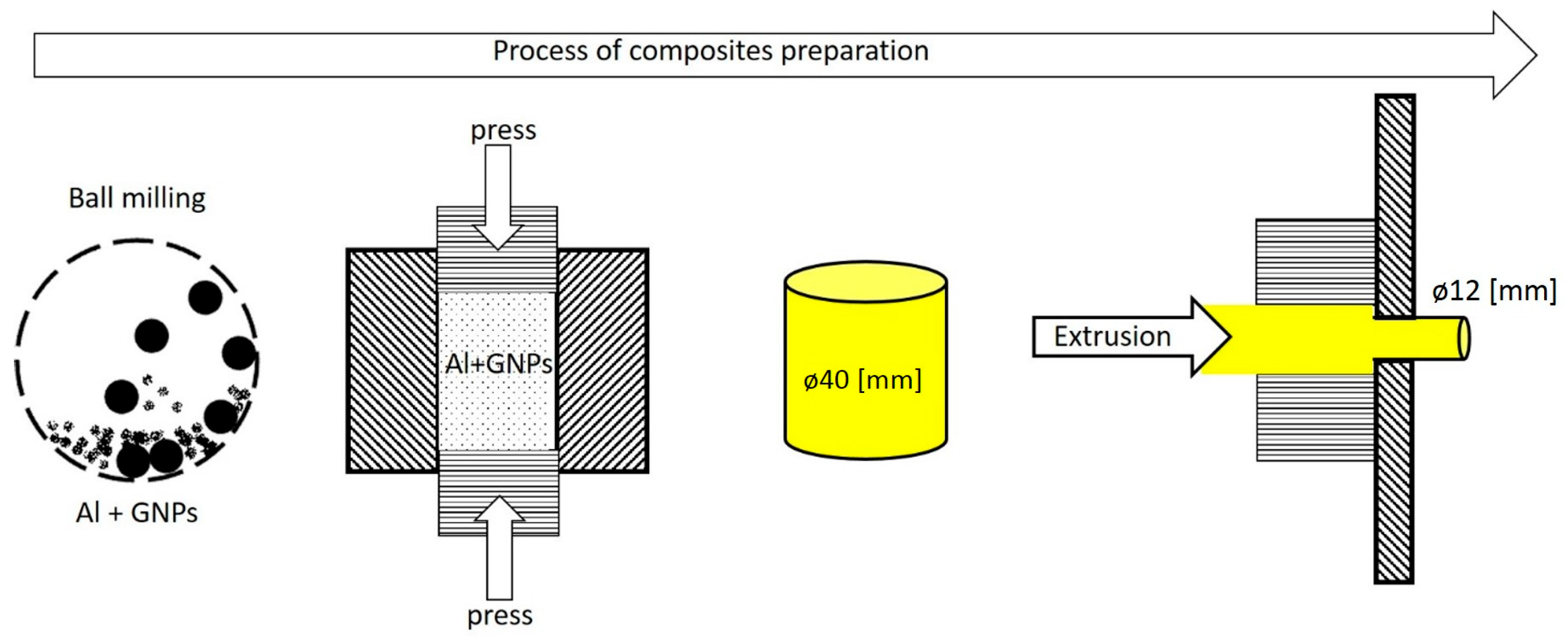
Portions of powders were mixed with graphene contents of 0, 0.1, 0.3, 0.5 and 0.7 wt.% GNPs (series 1) and 0, 0.1, 0.3, 0.5, 0.7, 0.9 and 1.1 wt.% GNPs (series 2), each weighing 300 gr, in a ball mill. The mixing process had the following parameters: 700 r∙min−1, 30 min, room temperature, argon atmosphere.
-
Cold isostatic double-sided pressing was performed for 60 s at 381 MPato to obtain compacted cylinders with a diameter of ø40 mm.
-
The compacted cylinders were heated for 20 min at 370 °C to temper and degas them. A mold with a built-in heater and variable reduction capability was used.
-
Hot extrusion was carried out at 400 °C (series 1) and at 500 °C (series 2). The mold where the compacted cylinders remained for 4.5 min was preheated to 370 ± 10 °C. The composites were extruded under a pressure of 457 MPa for 60 s each. A high-temperature lubricant “Vapor” was used to reduce friction. Extrusion was carried out on a hydraulic press RUE 250 SS (VEB Wema, Lüdenscheid, Germany).
-
The resulting cylinders were cooled with diameter of ø12 mm in air at room temperature.
The production process is schematically presented in Figure 1.
The composites from series 1 were thoroughly investigated in [41,42,51].
The carbides investigated in this article were formed during the extrusion process at 500 °C.
Specimens from the extruded composites were examined using SEM, TEM and tensile testing.
Specimens from the as-produced cylinders were wet-ground in longitudinal sections on grinding paper from 320 to 3000 # and polished in two steps using OP-S (StruersApS, Ballerup, Denmark). The microstructure was revealed by 0.5% HF water solution. The observations were performed on SEM–HIROX SH—5500P (Bruker, Billerica, MA, USA) with an integrated EDS system “QUANTAX 100 Advanced” by Bruker (Billerica, MA, USA) under the following conditions: (a) accelerating voltage: 20 kV; (b) scanning distance: 3 to 7 mm; and (c) secondary electron detector.
TEM foils were prepared from both normal and parallel directions relative to the extrusion direction of the produced composite, and were electropolished using TENUPOL 5 (Struers ApS, Ballerup, Denmark) at 40 V, 5 °C and pump flow rate 13 using electrolyte A2.
For comprehensive characterization of the composites, two transmission electron microscopes (TEM) were employed: JEM-1011 and HR STEM JEM-2100 (JEOL Ltd., Tokyo, Japan), equipped with MEGAVIEW G3 model S03U camera (EMSIS GmbH, Münster, Germany) and a GATAN Orius 832 SC1000 CCD camera (Gatan Inc., Pleasanton, CA, USA), respectively. For each investigated graphene volume fraction, TEM foils were prepared, with the observation planes either normal or perpendicular to the extrusion axis of the composites.
The measurements of lattice fringe spacing recorded in HRTEM micrographs were made using digital image analysis of reciprocal space parameters. The analysis was carried out using the camera’s software Digital Micrograph (v. 2.31.734.0 Gatan—Inc., Pleasanton, CA, USA). The diffraction patterns of Selected Area Electron Diffraction (SAED) were indexed by means of Crystallography Open Database (COD) and Match Software (Version 3.13, Crystal Impact, Bonn, Germany).
Three specimens from each weight fraction of GNPs composites were tensile tested. The tests and the determination of the values of ultimate tensile strength (Rm) and tensile elongation (A) were carried out according to ISO 6892-1:2019 [53].

3. Results and Discussion

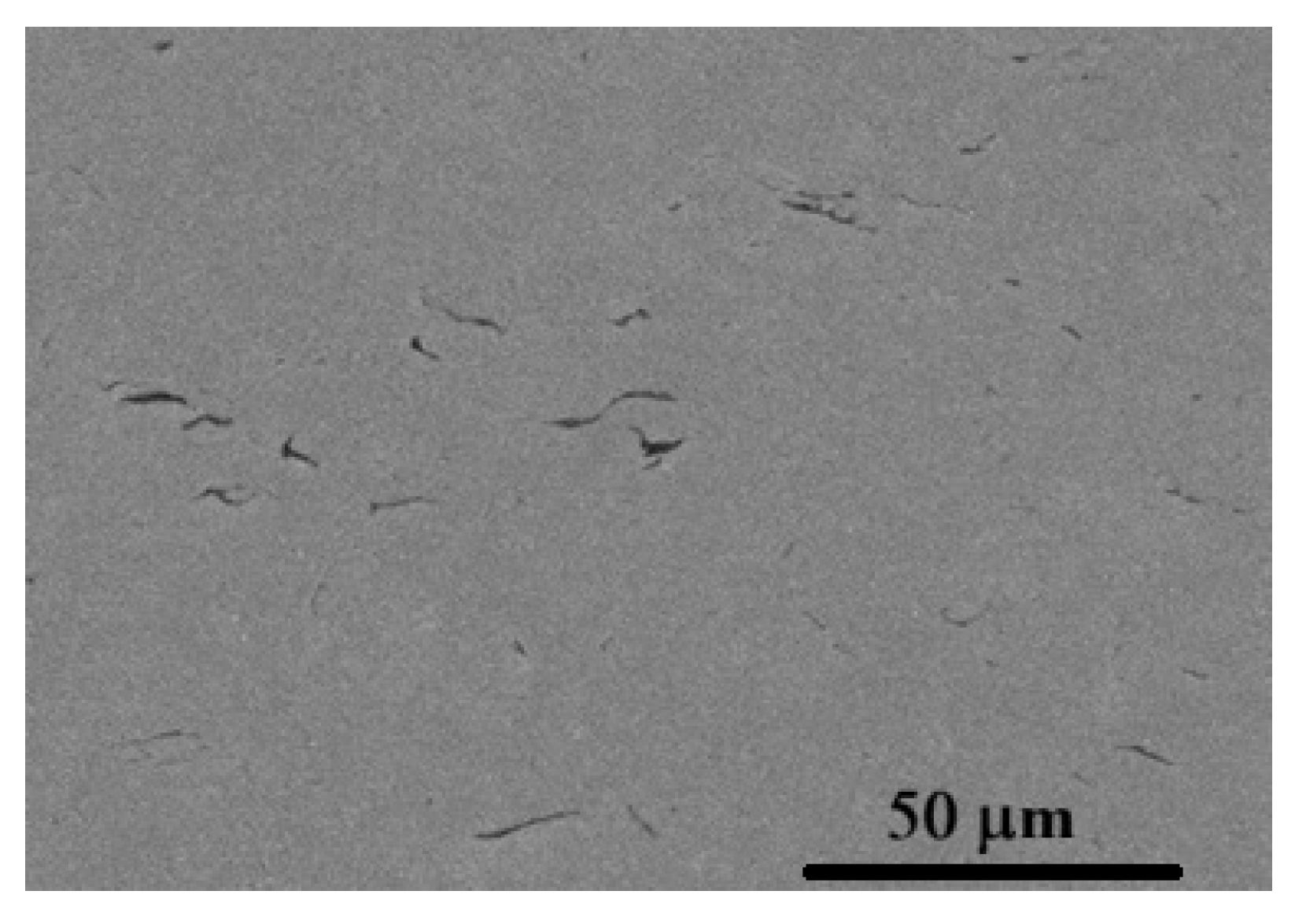
The series 2 composites obtained by the powder metallurgical method were initially examined by SEM to determine whether agglomerations of graphene or carbides were present in the structure. The uniform distribution of GNPs within the composite volume is highlighted as a major challenge, since achieving uniform reinforcement dispersion is difficult and the properties of the composite depend strongly on it. The authors of the review article [20] claim that the presence of graphene agglomerates in the composite deteriorates its mechanical properties. Microstructure analyses on the produced aluminum matrix composites (AMCs) confirm a homogeneous distribution of graphene, resulting from the efficient mixing and milling of the powders and appropriate milling parameters of the ball-milling process (Figure 2).
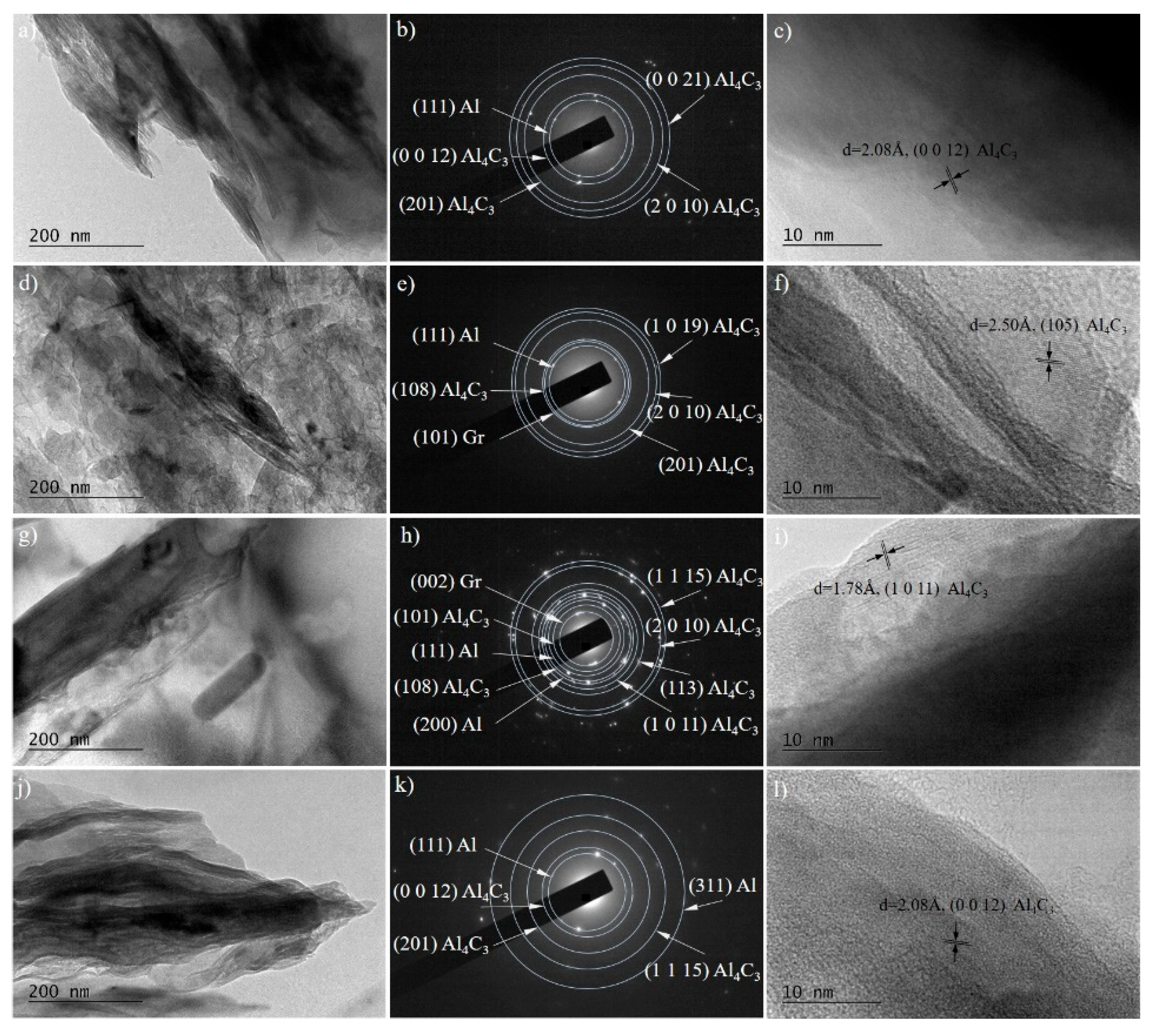
The presence of the aluminum carbides in the produced composites was confirmed by the phase composition analysis performed by applying one of the diffraction modes of TEM—SAED and a HR TEM (Figure 3). The presence of aluminum carbide in the specimens with different contents of GNPs extruded at 500 °C has been unequivocally proved (COD Entry #96—154—0875). Some of the diffraction rings corresponding to interplanar distances of crystalline Al, according to the data in the file COD Entry #96—901—2957 and graphite (COD Entry #96—101—1061), were also detected and indexed in Figure 3.
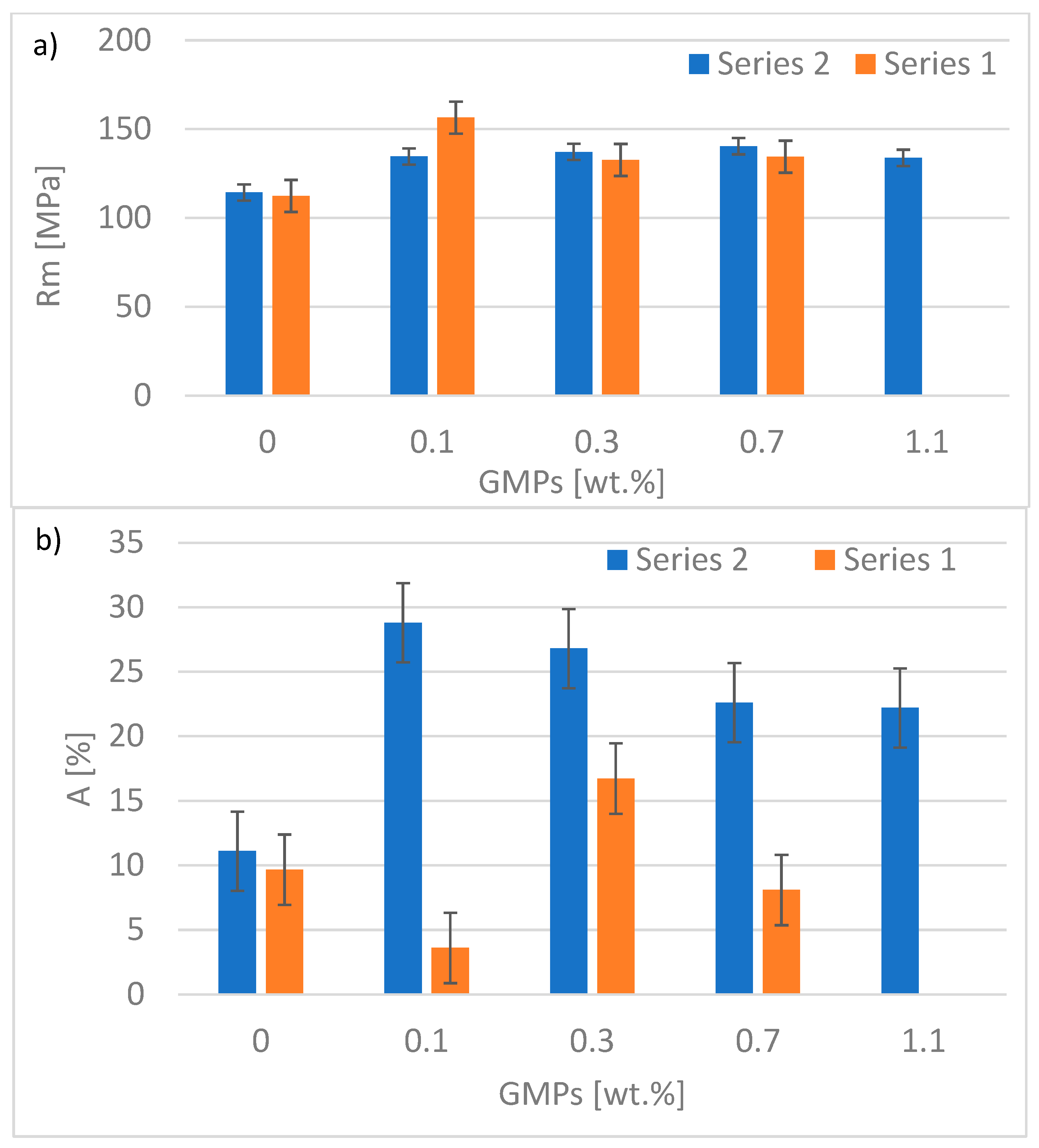
Considering the strength values of both series of composites given in Figure 4, the following trends can be observed.
At a GNPs content of 0.1 wt.%, the tensile strength of the composites in series 1 is higher, while the elongation drops sharply, in comparison with series 2. At graphene contents of 0.3 wt.% and 0.7 wt.%, the strength properties of both series are quite similar.
The slightly higher tensile strength of the composites containing carbides (series 2) is likely due to the enhanced interfacial bonding between the aluminum matrix and graphene, which improves load transfer efficiency. Nanoscale Al4C3 particles may also act as effective dispersion-strengthening phases, hindering dislocation motion and contributing to Orowan strengthening, while simultaneously stabilizing the microstructure during high-temperature exposure [51].
Considering the elongation values, they are significantly higher for the carbide-containing composites (series 2). From this, we conclude that the carbide-containing composites exhibit a better overall combination of mechanical properties at graphene contents of 0.3 and 0.7 wt.%.
It is also important to note that the combination of higher tensile strength and higher elongation indicates increased toughness. Therefore, the carbide-containing composites are expected to exhibit higher toughness.
The mechanical properties of aluminum alloys vary over a wide range [54]. The properties of our composites are comparable to those of aluminum alloys in the 1xxx, 3xxx and partially 5xxx/6xxx series in the annealed state, which are also known for their good toughness.
The mechanical properties of the presented AMCs from series 2 show stable values, varying by approximately 5% from the mean across the entire investigated interval of graphene content. This indicates the absence of large graphene clusters in all composites, preventing potential negative effects on mechanical performance [55].
Although the effects of extrusion temperature and carbide formation on the plasticity of composites cannot be unambiguously separated, in Figure 2 it can be seen that the composites with 0 wt.% GNP in series 2 exhibit lower values of Rm and A compared to the corresponding values of the composites with any content of GNPs in same series. The values of Rm and A for the composites without graphene in both series are similar. Based on these observations, we believe that series 2 tends to improve its mechanical properties, which cannot be attributed solely to the higher extrusion temperature but also to the presence of formed aluminum carbides.
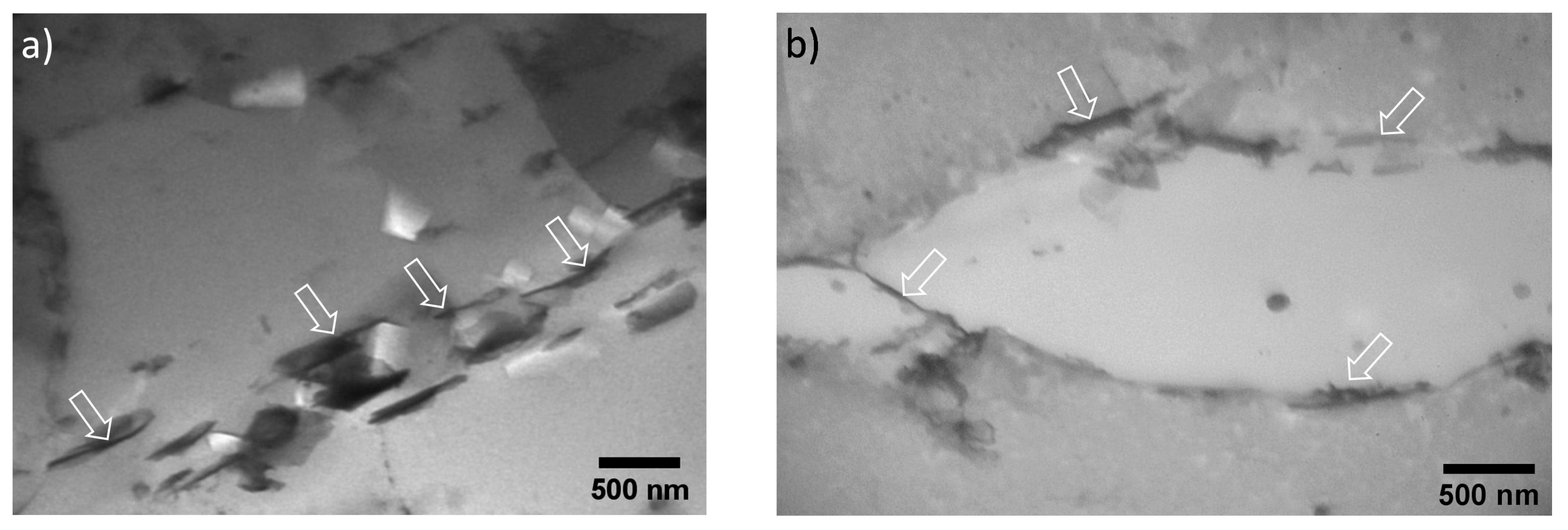
An additional TEM study was conducted to characterize the distribution of Al carbides. Characteristic TEM images of studied composites in the plane parallel to the extrusion direction are shown in Figure 5.
As observed in the SEM study (Figure 2), a uniform distribution of carbides was found in all studied specimens, with no large graphene or carbide clusters observed. In specimens containing 0.1 and 0.3 wt.% GNPs, the carbides were located both along the grain boundaries and within the grain interiors of the matrix. When the graphene content increased from 0.7 to 1.1 wt.%, the carbides were concentrated mainly along the grain boundaries or in their vicinity, longitudinally oriented either along or parallel to the boundary. This orientation of the carbides is most likely induced by the extrusion process.
As the aluminum carbide Al4C3 typically has a rod-like shape [55], its length and width were measured in AMCs of series 2. To avoid random observation, the average values of these parameters were determined from at least 30 measurements. The results are presented in Table 1.
With increasing graphene content, the length of the carbides remains within the nanoscale range, with an average measured length of 168.28 nm. There is a consistent trend of increasing carbide diameter as the graphene content rises.
Small carbides are formed through the direct transformation of carbon from GNPs, whereas larger Al4C3 particles result from diffusion between aluminum and carbon [41].
In the present study, not only the size of the carbides but also the aspect ratio, namely longitude to diameter ratio (L/D), of the aluminum carbides were evaluated. This ratio of inclusions in composites has a significant influence on the mechanical properties of the material, particularly on stiffness [56]. For modified composites, the transverse Young’s modulus, shear modulus, and bulk modulus under plane deformation conditions increase markedly with increasing inclusion concentration and L/D ratio, whereas the longitudinal Young’s modulus exhibits only a slight increase [57].
Our data do not reveal a linear relationship between the aspect ratio and the carbide content. The highest L/D value was observed in the composite containing 0.3 wt.% carbide, which may indicate a higher elastic modulus and, in combination with other mechanical properties, makes this composite particularly attractive.
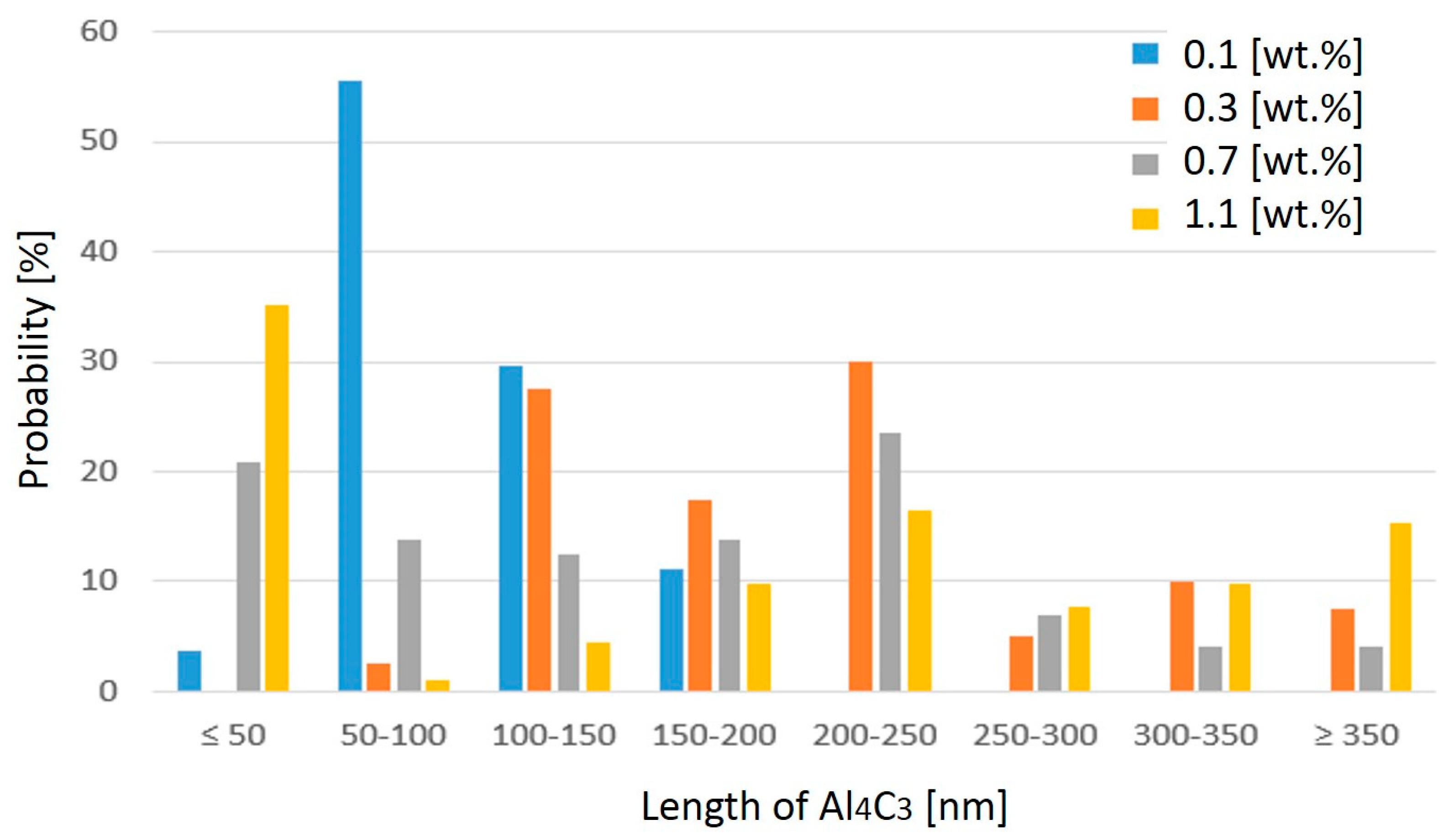
The diagram in Figure 6 presents the fractional distribution of measured lengths of aluminum carbide in the studied specimens. As noted earlier, the fformation of Al4C3 occurs in two stages: nucleation and growth.
At a low graphene content of 0.1 wt.% GNPs, most carbides are in the nucleation stage, exhibiting small lengths, with the maximum average length of Al4C3 not exceeding 110 nm.
Increasing the graphene content to 0.3–0.7 wt.% GNPs activates the growth stage, resulting in an increase in the average length of Al4C3, while the fraction of nano-sized carbides below 100 nm decreases compared to the previous sample. At 1.1 wt.% GNPs, both nucleation and growth mechanisms operate simultaneously, leading to the presence of a large number of small carbides as well as their continued growth. From the diagram in Figure 6, it is clear that the amount of Al4C3 increases proportionally with the graphene content in aluminum, as evidenced by the peak of small carbides (≤50 nm) at 1.1 wt.% GNPs. Based on these data, it can be concluded that in AMCs with 0.1 and 1.1 wt.% GNPs, the nucleation stage of aluminum carbide dominates over its growth, whereas at 0.3 and 0.7 wt.% GNPs, the growth of the carbides is predominant.
The strengthening mechanisms that have been demonstrated to be valid for these composites are ordered strengthening mechanism (OSM) and the Orowan bowing mechanism (OBM) and Hall–Petch mechanism [51]. Since these mechanisms are size-dependent, they are operative only in the case of ex situ-added or in situ-formed reinforcements.
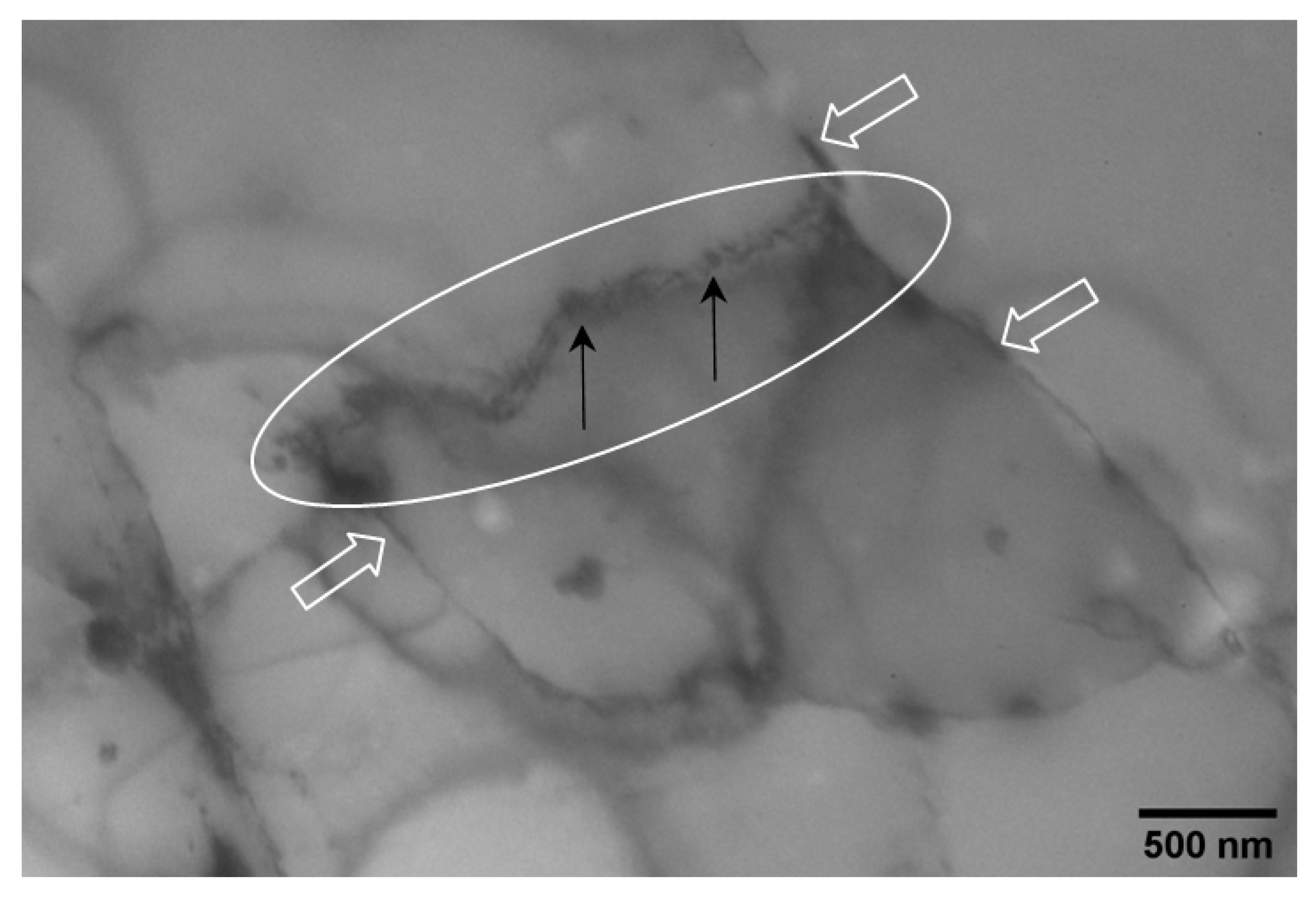
In the as-produced specimens from Series 2, characteristic microstructures are observed—high-dislocation-density zones or bands (marked by a white ellipse in Figure 7) oriented transverse to the extrusion direction as well as carbides (indicated by white and black arrows in Figure 7).
These bands will lead to the formation of a substructure, which contributes to enhanced ductility. An inverse relationship exists between grain size and yield strength, as an increased number of grain boundaries enhances resistance to dislocation motion, thereby strengthening the material (Hall–Petch mechanism).
Carbides located near or within these bands (indicated by black arrows) hinder dislocation motion along the slip planes and are likely to contribute to the cooperative action of the Orowan strengthening mechanism. By restricting dislocation mobility, the critical accumulation of dislocations is suppressed, which in turn enhances the strength-related properties of the composite.

4. Conclusions

Aluminum–graphene composites containing 0.1–1.1 wt.% GNPs were successfully produced by powder metallurgy, achieving a homogeneous distribution of graphene and the controlled in situ formation of aluminum carbide during hot extrusion at 500 °C.
  • HRTEM and SAED analyses unequivocally confirmed the presence of nanoscale Al4C3 carbides in composites extruded at 500 °C, with their size, morphology, and spatial distribution strongly dependent on the graphene content.
  • Carbide-containing composites exhibit a superior combination of tensile strength and elongation compared to carbide-free composites, with the most favorable strength–ductility balance observed at graphene contents of 0.3 and 0.7 wt.%.
  • The results show that aluminum carbide is not inherently harmful to Al/GNP composites—it improves interfacial bonding and contributes to improving the balance between the strength and ductility of aluminum composites with carbides compared to carbides-free ones. The influence on the mechanical behavior is determined by its nanoscale size, uniform distribution and favorable morphology.
  • The controlled formation of finely dispersed, nano-sized Al4C3 provides an effective strategy for tailoring the strength–ductility balance of aluminum–graphene composites, making them promising candidates for lightweight structural applications requiring enhanced toughness.
This study provides new insight into the structure–property relationships in Al/GNP composites by demonstrating the critical role of carbide morphometry, offering a pathway for microstructural design through controlled interfacial reactions.

Author Contributions

Conceptualization R.L.; methodology R.L.; formal analysis Y.M., K.V., R.L. and D.K.; investigation R.L., Y.M., K.V. and D.K.; data curation R.L.; writing—original draft preparation Y.M., K.V. and R.L.; writing—review and editing R.L.; visualization Y.M., K.V. and D.K.; project administration R.L. All authors have read and agreed to the published version of the manuscript.

Funding

This research is financially supported by the Bulgarian National Science Fund, Project KП—06—H57/17 “Fabrication of aluminum—graphene nanocomposites by powder metallurgical method and investigation of their nano—, microstructure, mechanical and tribological properties”. The study in this publication also was performed using equipment funded by project 442 BG16RFPR002—1.014—0006 “National Center for Mechatronics and Clean Technologies”. Research equipment of the Distributed Research Infrastructure INFRAMAT, part of the Bulgarian National Roadmap for Research Infrastructures, supported by Bulgarian Ministry of Education and Science, was used in this investigation.

Data Availability Statement

The original contributions presented in this study are included in the article. Further inquiries can be directed to the corresponding author.

Conflicts of Interest

The authors declare no conflicts of interest.

Abbreviations

The following abbreviations are used in this manuscript:
GNPsGraphene nanoplatelets
SEMScanning Electron Microscopy
HR STEMHigh-Resolution Scanning Transmission Microscopy
EN AWEuropean Norm Aluminum Wrought
TEMTransmission Electron Microscopy
SAEDSelected Area Electron Diffraction
CODCrystallography Open Database
ISOInternational Standard Organization
AMCAluminum Matrix Composite
OSMOrdered Strengthening Mechanism
OBMOrowan Bowing Mechanism
RmUltimate tensile strength
AElongation at break
BDSBulgarian Government Standard

References

  1. Dhand, V.; Rhee, K.Y.; Kim, H.J.; Jung, D.H. A Comprehensive Review of Graphene Nanocomposites: Research Status and Trends. J. Nanomater. 2013, 2013, 763953. [Google Scholar] [CrossRef]
  2. Rashad, M.; Pan, F.; Tang, A.; Asif, M. Effect of Graphene Nanoplatelets addition on mechanical properties of pure aluminum using a semi-powder method. Prog. Nat. Sci. Mater. Int. 2014, 24, 101–108. [Google Scholar] [CrossRef]
  3. Shin, S.E.; Choi, H.J.; Shin, J.H.; Bae, D.H. Strengthening behavior of few-layered graphene/aluminum composites. Carbon 2015, 82, 143–151. [Google Scholar] [CrossRef]
  4. Li, J.L.; Xiong, Y.C.; Wang, X.D.; Yan, S.J.; Yang, C.; He, W.W.; Chen, J.Z.; Wang, S.Q.; Zhang, X.Y.; Dai, S.L. Microstructure and tensile properties of bulk nanostructured aluminum/graphene composites prepared via cryomilling. Mater. Sci. Eng. A 2015, 626, 400–405. [Google Scholar] [CrossRef]
  5. Fadavi Boostani, A.; Yazdanib, S.; Taherzadeh Mousavian, R.; Tahamtan, S.; Azari Khosroshahi, R.; Wei, D.; Brabazon, D.; Xu, J.Z.; Zhang, X.M.; Jiang, Z.Y. Strengthening mechanisms of graphene sheets in aluminium matrix nanocomposites. Mater. Des. 2015, 88, 983–989. [Google Scholar] [CrossRef]
  6. Rashad, M.; Pan, F.; Yu, Z.; Asif, M.; Lin, H.; Pan, R. Investigation on microstructural, mechanical and electrochemical properties of aluminum composites reinforced with graphene nanoplatelets. Prog. Nat. Sci. Mater. Int. 2015, 25, 460–470. [Google Scholar] [CrossRef]
  7. Zhang, H.; Xu, C.; Xiao, W.; Ameyama, K.; Ma, C. Enhanced mechanical properties of Al 5083 alloy with graphene nanoplates prepared by ball milling and hot extrusion. Mater. Sci. Eng. A 2016, 658, 8–15. [Google Scholar] [CrossRef]
  8. Bisht, A.; Srivastava, M.; Kumar, R.M.; Lahiri, I.; Lahiri, D. Strengthening mechanism in graphene nanoplatelets reinforced aluminum composite fabricated through spark plasma sintering. Mater. Sci. Eng. A 2017, 695, 20–28. [Google Scholar] [CrossRef]
  9. Mondal, S.; Paul, G.; Mondal, S.C.; Mondol, K.; Seikh, Z.; Sekh, M. Fabrication of Graphene Reinforced Aluminium Metal Matrix Composites for Advanced Tool Materials. J. Inst. Eng. India Ser. D 2024. [Google Scholar] [CrossRef]
  10. Li, M.; Gao, H.; Liang, J.; Gu, S.; You, W.; Shu, D.; Wang, J.; Sun, B. Microstructure evolution and properties of graphene nanoplatelets reinforced aluminum matrix composites. Mater. Charact. 2018, 140, 172–278. [Google Scholar] [CrossRef]
  11. Du, X.; Zheng, K.; Liu, F. Microstructure and mechanical properties of graphene-reinforced aluminum-matrix composites. Mater. Technol. 2018, 52, 763–768. [Google Scholar] [CrossRef]
  12. Jiang, Y.; Xu, R.; Tan, Z.; Ji, G.; Fan, G.; Li, Z.; Xiong, D.B.; Guo, Q.; Li, Z.; Zhang, D. Interface-induced strain hardening of graphene nanosheet/aluminum composites. Carbon 2019, 146, 17–27. [Google Scholar] [CrossRef]
  13. Liu, X.; Liu, E.; Li, J.; He, C.; Zhao, N. Investigation of the evolution and strengthening effect of aluminum carbide for in-situ preparation of carbon nanosheets/aluminum composites. Mater. Sci. Eng. A 2019, 764, 138–139. [Google Scholar] [CrossRef]
  14. Leng, J.; Dong, Y.; Ren, B.; Wang, R.; Teng, X. Effects of Graphene Nanoplates on the Mechanical Behavior and Strengthening Mechanism of 7075Al Alloy. Materials 2020, 13, 5808. [Google Scholar] [CrossRef]
  15. Wang, X.; Xiao, W.; Wang, L.; Shi, J.; Sun, L.; Cui, J.; Wang, J. Investigation on mechanical behavior of multilayer graphene reinforced aluminum composites. Phys. E Low-Dimens. Syst. Nanostructures 2020, 123, 11417. [Google Scholar] [CrossRef]
  16. Chakrapani, P.; Suryakumari, T.S.A. Mechanical properties of aluminium metal matrix composites—A review. Mater. Today Proc. 2021, 45, 5960–5964. [Google Scholar] [CrossRef]
  17. Yu, H.; Zhang, S.; Xia, J.; Sub, Q.; Ma, B.; Wu, J.H.; Zhou, J.; Wang, X.; Hu, L. Microstructural evolution, mechanical and physical properties of graphene reinforced aluminum composites fabricated via powder metallurgy. Mater. Sci. Eng. A 2021, 802, 140669. [Google Scholar] [CrossRef]
  18. Su, J.; Teng, J. Recent progress in graphene-reinforced aluminum matrix composites. Front. Mater. Sci. 2021, 15, 79–97. [Google Scholar] [CrossRef]
  19. Ali, A.M.; Omar, M.; Hashim, H.; Salleh, M.S.; Mohamed, I. Recent development in graphene-reinforced aluminium matrix composite: A review. Rev. Adv. Mater. Sci. 2021, 60, 801–817. [Google Scholar] [CrossRef]
  20. Li, M.; Lei, X.W. Molecular dynamics studies on mechanical properties and deformation mechanism of graphene/aluminum composites. Comput. Mater. Sci. 2022, 211, 111487. [Google Scholar] [CrossRef]
  21. Kumar, R.; Harichandran, R.; Vignesh, U.; Thangavel, M.; Chandrasekhar, S.B. Influence of hot extrusion on strain hardening behaviour of graphene platelets dispersed aluminium composites. J. Alloys Compd. 2021, 855, 157448. [Google Scholar] [CrossRef]
  22. Lava Kumar, P.; Lombardi, A.; Byczynski, G.; Narayana Murty, S.V.S.; Murty, B.S.; Bichler, L. Recent advances in aluminium matrix composites reinforced with graphene-based nanomaterial: A critical review. Prog. Mater. Sci. 2022, 128, 100948. [Google Scholar] [CrossRef]
  23. Jayaseelan, J.; Pazhani, A.; Michael, A.X.; Paulchamy, J.; Batako, A.; Guruswamy, P. Characterization Studies on Graphene-Aluminium Nano Composites for Aerospace Launch Vehicle External Fuel Tank Structural Application. Materials 2022, 15, 5907. [Google Scholar] [CrossRef]
  24. Li, J.; Zhang, X.; Qian, M.; Jia, Z.; Imran, M.; Geng, J.L. Inhibiting GNPs breakage during ball milling for a balanced strength-ductility match in GNPs/Al composites. Compos. Part A 2023, 166, 107410. [Google Scholar] [CrossRef]
  25. Rahim, M.; Salleh, M.S.; Subramonian, S.; Ridzuan, M.; Kamal, M.; Al-Zubaidi, S.S. Influence of Graphene on the Microstructure and Mechanical Properties of Aluminium Matrix Composite. Malays. J. Compos. Sci. Manuf. 2023, 12, 73–83. [Google Scholar] [CrossRef]
  26. Alam, M.A.; Ya, H.B.; Azeem, M.; Mustapha, M.; Yusuf, M.; Masood, F.; Marode, R.; Sapuan, S.M.; Ansari, A.H. Advancements in aluminum matrix composites reinforced with carbides and graphene: A comprehensive review. Nanotechnol. Rev. 2023, 12, 20230111. [Google Scholar] [CrossRef]
  27. Azizi, Z.; Rahmani, K.; Taheri-Behrooz, F. Fatigue life prediction of aluminum-graphene nanocomposites: Application to high-capacity conductors. Int. J. Fatigue 2023, 175, 107749. [Google Scholar] [CrossRef]
  28. Zhou, J.; Shen, J.; Yue, W.; Liu, Y.; Chen, Z. Molecular dynamics simulation of reinforcement mechanism of graphene/aluminum composites and microstructure evolution. J. Mater. Res. Technol. 2023, 23, 2147–2159. [Google Scholar] [CrossRef]
  29. Huang, Z.; Yan, H. Improved mechanical properties of GNPs/Al composites by eliminating alumina and obtaining a strong bonded GNPs-Al direct contact interface and Mg-Rich phases. J. Alloys Compd. 2024, 984, 173982. [Google Scholar] [CrossRef]
  30. Ma, Z.; Wang, H.; Zhao, Y.; Li, Z.; Liu, H.; Yang, Y.; Zhao, Z. Enhancing Mechanical Properties of Graphene/Aluminum Nanocomposites via Microstructure Design Using Molecular Dynamics Simulations. Materials 2024, 17, 4552. [Google Scholar] [CrossRef]
  31. Lin, F.; Ren, M.; Zhu, L.; Jia, F.; Jiang, Z. Graphene-reinforced aluminium matrix nanocomposites: Fabrication, properties and applications. Adv. Nanocomposites 2025, 2, 59–85. [Google Scholar] [CrossRef]
  32. Negendank, M.; Jain, N.; Hanaor, D.; Gurlo, A.; Mueller, S. Effect of Extrusion Processing on Mechanical Properties of aluminum/Graphene Nanoplatelet Composites. J. Mater. Eng. Perform. 2025, 34, 12139. [Google Scholar] [CrossRef]
  33. Şenel, M.C.; Gürbüz, M.; Koç, E. An Investigation into the Mechanical Properties and Microstructures of Graphene Reinforced Aluminum Composites. Int’l J. Res. Chem. Metall. Civ. Engg 2018, 5, 1. [Google Scholar] [CrossRef]
  34. EN 485-2:2016; Aluminium and Aluminium Alloys—Sheet, Strip and Plate—Part 2: Mechanical Properties. European Committee for Standardization: Brussels, Belgium, 2016.
  35. Lee, C.; Wei, X.D.; Kysar, J.W.; Hone, J. Measurement of the Elastic Properties and Intrinsic Strength of Monolayer Graphene. Science 2008, 321, 385–388. [Google Scholar] [CrossRef] [PubMed]
  36. Gao, X.; Yue, H.; Guo, E.; Zhang, H.; Lin, X.; Yao, L.; Wang, B. Preparation and tensile properties of homogeneously dispersed graphene reinforced aluminum matrix composites. Mater. Design 2016, 94, 54–60. [Google Scholar] [CrossRef]
  37. Zhang, L.; Hou, G.; Zhai, W.; Ai, Q.; Feng, J.; Zhang, L.; Si, P.; Ci, L. Aluminum/graphene composites with enhanced heat-dissipation properties by in-situ reduction of graphene oxide on aluminum particles. J. Alloys Compd. 2018, 748, 854–860. [Google Scholar] [CrossRef]
  38. Yan, S.-J.; Yang, C.; Hong, Q.; Chen, J.-Z.; Liu, D.-B.; Dai, S.-L. Research of graphene-reinforced aluminum matrix nanocomposites. J. Mater. Eng. 2014, 4, 1–6. [Google Scholar] [CrossRef]
  39. Wang, J.; Guo, L.; Lin, W.M.; Chen, J.; Liu, C.L.; Chen, S.D.; Zhang, S.; Zhen, T.T. Effect of the graphene content on the microstructures and properties of graphene/aluminum composites. New Carbon Mater. 2019, 34, 3. [Google Scholar] [CrossRef]
  40. Bartolucci, S.F.; Paras, J.; Rafiee, M.A.; Rafiee, J.; Lee, S.; Kapoor, D.; Koratkar, N. Graphene–aluminum nanocomposites. Mater. Sci. Eng. A 2011, 528, 7933–7937. [Google Scholar] [CrossRef]
  41. Lazarova, R.; Mourdjeva, Y.; Valuiska, K.; Petkov, V. Microstructural Explanation of the Mechanical Properties of Al-GNPs Composites with Al4C3 Produced by Powder Metallurgy Method and Extrusion. J. Inf. Syst. Eng. Manag. 2025, 10, 900–909. [Google Scholar] [CrossRef]
  42. Lazarova, R.; Mourdjeva, Y.; Nihtianova, D.; Stefanov, G.; Petkov, V. Fabrication and Characterization of Aluminum-Graphene Nano-Platelets—Nano-Sized Al4C3 Composite. Metals 2022, 12, 2057. [Google Scholar] [CrossRef]
  43. Yu, Z.; Yang, W.; Zhou, C.; Zhang, N.; Chao, Z.; Liu, H.; Cao, Y.; Sun, Y.; Shao, P.; Wu, G. Effect of ball milling time on graphene nanosheets reinforced Al6063 composite fabricated by pressure infiltration method. Carbon 2019, 141, 25–39. [Google Scholar] [CrossRef]
  44. Zhou, W.; Mikulova, P.; Fan, Y.; Kikuchi, K.; Nomura, N.; Kawasaki, A. Interfacial reaction induced efficient load transfer in few-layer graphene reinforced Al matrix composites for high-performance conductor. Compos. Part B Eng. 2019, 167, 93–99. [Google Scholar] [CrossRef]
  45. Zhou, Q.; Qu, Y.; Li, G.; Singh, A.; Su, R.; Chen, R.; Zhou, S.; Zhao, Y.; Yang, F.; Li, R. Improvement of Interface Bonding and Thermal Conductivity of Carbon-Fiber Reinforced Aluminum Matrix Composites with Sn-Cu Coatings. JOM 2022, 74, 840–1848. [Google Scholar] [CrossRef]
  46. Guo, B.; Chen, B.; Zhang, X.; Cen, X.; Wang, X.; Song, M.; Ni, S.; Yi, J.; Shen, T.; Du, Y. Exploringthesizeeffectsof Al4C3 on the mechanica lproperties and thermal behaviors of Al-based composites reinforced by SiC and carbon nanotubes. Carbon 2018, 135, 224–235. [Google Scholar] [CrossRef]
  47. Mourdjeva, Y.; Karashanova, D.; Nihtianova, D.; Lazarova, R. Microstructural Characteristics of Al4C3 Phase and the Interfaces in Al/Graphene Nanoplatelet Composites and their Effect on the Mechanical Properties. J. Mater. Eng. Perform. 2024, 33, 11607–11616. [Google Scholar] [CrossRef]
  48. Wang, X.; Wang, C.; Zhang, Z.; Liang, P.; Shi, Y.; Zhang, G. Interfacial microstructure and growth mechanism of Al4C3 in Grf/Al composites fabricated by liquid pressure method. Micron 2014, 65, 10–14. [Google Scholar] [CrossRef]
  49. Xiong, B.; Liu, K.; Xiong, W.; Wu, X.; Sun, J. Strengthening effect induced by interfacial reaction in graphene nanoplatelets reinforced aluminum matrix composites. J. Alloys Compd. 2020, 845, 156282. [Google Scholar] [CrossRef]
  50. Velgosová, O.; Balloková, B. Influence of Al4C3 nanophase on structural stability and mechanical properties of Al-Al4C3 composites after thermale xposure. Metall. Res. Technol. 2018, 115, 606. [Google Scholar] [CrossRef]
  51. Lazarova, R.; Anestiev, L.; Mourdjeva, Y.; Valuiska, K.; Petkov, V. Microstructural Evolution, Strengthening Mechanisms, and Fracture Behavior of Aluminum Composites Reinforced with Graphene Nanoplatelets and In Situ–Formed Nano-Carbides. Metals 2025, 15, 285. [Google Scholar] [CrossRef]
  52. Lazarova, R.; Mourjeva, Y.; Petkov, V.; Anestiev, L.; Marinov, M.; Dimitrova, R.; Shuleva, D. Microstructure and Mechanical Properties of Aluminum: Graphene Composites Produced by Powder Metallurgical Method. J. Mater. Eng. Perform. 2022, 31, 10162–10170. [Google Scholar] [CrossRef]
  53. ISO 6892-1:2019; Metallic Materials—Tensile Testing—Part 1: Method of Test at Room Temperature. ISO: Geneva, Switzerland, 2019.
  54. BDS EN 755-2:2025–1; Aluminium and Aluminium Alloys—Extruded Rod/Bar, Tube and Profiles—Part 2: Mechanical Properties. Bulgarian Institute for Standardization: Sofia, Bulgaria, 2025.
  55. Jiang, Y.; Tan, Z.; Fan, G.; Zhang, Z.; Xiong, D.B.; Guo, Q.; Li, Z.; Zhang, D. Nucleation and growth mechanisms of interfacial carbide in graphene nanosheet/Al composites. Carbon 2020, 161, 17–24. [Google Scholar] [CrossRef]
  56. Tandon, G.; George Weng, G. The effect of aspect ratio of inclusions on the elastic properties of unidirectionally aligned composites. Polym. Compos. 1984, 5, 327–333. [Google Scholar] [CrossRef]
  57. Kazakov, I.; Krasnovskii, A.; Kishuk, P. The influence of randomly oriented CNTs on the elastic properties of unidirectionally aligned composites. Mech. Mater. 2019, 134, 54–60. [Google Scholar] [CrossRef]
Figure 1. The scheme of the production stages of the composite materials production process.
Metals 16 00408 g001
Figure 2. Uniform distribution of GNPs in the aluminum matrix (the composite contains 0.9 [wt.%] GNPs).
Metals 16 00408 g002
Figure 3. Bright-field TEM micrographs (a,d,g,j), the corresponding SAED patterns (b,e,h,k) and HRTEM images (c,f,i,l) of the aluminum matrix composites with different GNPs content [wt.%]: (ac) 0.1; (df) 0.3; (gi) 0.7 and (jl) 1.1 extruded at 500 °C.
Metals 16 00408 g003
Figure 4. Mechanical properties, (a) ultimate tensile strength Rm and (b) tensile elongation A of aluminum matrix composites (AMC) reinforced with graphene and not containing carbides (series 1) and AMC reinforced with graphene and containing carbides (series 2).
Metals 16 00408 g004
Figure 5. TEM images of the AMC of series 2, where GNPs content [wt.%] is: (a) 0.3; (b) 0.7. Some of the Al4C3 carbides are marked with white arrows.
Metals 16 00408 g005
Figure 6. Data on the size distribution of carbides in the studied AMCs of series 2.
Metals 16 00408 g006
Figure 7. AMC after hot extrusion at 500 °C, with a content of 1.1 [wt.%] GNPs.
Metals 16 00408 g007
Table 1. Geometrical parameters of in situ-formed carbides during extrusion at 500 °C.
Content
wt. [%]
Length of Al4C3
[nm]
Diameter of Al4C3
[nm]
Aspect Ratio
L/D
0
0.186.4943.222.00
0.3207.9850.374.13
0.7151.6853.132.85
1.1226.9962.543.63
Disclaimer/Publisher’s Note: The statements, opinions and data contained in all publications are solely those of the individual author(s) and contributor(s) and not of MDPI and/or the editor(s). MDPI and/or the editor(s) disclaim responsibility for any injury to people or property resulting from any ideas, methods, instructions or products referred to in the content.