Article

Mechanical Properties of High-Entropy Coatings of the (TiZrVCrAl)N System of Different Architectures Deposited by the Arc-PVD Method on the Surface of Ti-6Al-4V Alloy


by
Yana N. Savina
1,
Roman R. Valiev
1,
Stanislav V. Ovchinnikov
2,
Almaz Yu. Nazarov
1,
Iuliia M. Modina
1,
Aleksey A. Nikolaev
1,
Kamil’ N. Ramazanov
1,
Vitaly V. Sanin
3,
Liliya Yu. Mezhevaia
3,
Elina R. Kasimova
1,
Arnaud Caron
4 and
Ruslan Z. Valiev
1,4,*
1
Institute of Physics of Advanced Materials, Ufa University of Science and Technology, Ufa 450076, Russia
2
Institute of Strength Physics and Materials Science, Siberian Branch, Russian Academy of Sciences, Tomsk 634055, Russia
3
JSC “Giredmet” n.a. N.P. Sazhin, Moscow 111524, Russia
4
Herbert Gleiter International Institute, Liaoning Academy of Materials, Shenyang 110167, China
*
Author to whom correspondence should be addressed.
Metals 2026, 16(3), 350; https://doi.org/10.3390/met16030350
Submission received: 24 February 2026 / Revised: 18 March 2026 / Accepted: 18 March 2026 / Published: 20 March 2026
(This article belongs to the Special Issue Recent Advances in Surface Modification of Metallic Materials)

Abstract

In this work, for the first time, we applied and determined the mechanical characteristics of protective coatings made of high-entropy alloy (TiZrVCrAl)N with different architectures onto the surface of Ti-6Al-4V alloy with the initial coarse-grained and ultrafine-grained structure using arc physical vapor deposition. We designed and prepared three coating architectures: a monolayer nitride coating (TiZrVCrAl)N, a multilayer coating consisting of nine alternating layers of TiZrVCrAl and (TiZrVCrAl)N, and a multilayer coating consisting of 720 alternating layers of (TiZrVCrAl)N and TiN, with a total thickness not exceeding 2 microns. We evaluated their protective performances by nanoindentation and scratch tests. Importantly, the effect of the substrate microstructure on the coatings’ performance is investigated by comparing their mechanical behavior on coarse-grained and ultrafine-grained Ti-6Al-4V. Our experimental results show that the coating performance improves with increasing number of layers in the coating, and this effect is even more pronounced for the multilayer coating deposited on the ultrafine-grained titanium alloy substrate. We also find that the (TiZrVCrAl)N/TiN (720 layers) multilayer coating deposited on the UFG Ti-6Al-4V alloy substrate exhibits the highest H/E- and H3/E2-values, indicating the coating’s high innovative potential for performance in extreme conditions. The origins of this phenomenon are analyzed and discussed.

1. Introduction

The development of protective coatings with enhanced properties is crucial for the application of structural metallic components that are exposed to high loads and operate under extreme conditions (corrosive and abrasive), such as in aircraft engines. The requirements for such coatings are high adhesive strength to the substrate, a low friction coefficient, and enhanced wear resistance [1,2,3,4,5].
NiAl-based coatings [6,7,8,9,10,11,12,13], including those containing refractory elements as well as graphite and nanodiamonds to enhance their wear resistance, have found wide application for protecting the surface of parts under high-temperature working conditions up to 1100–1300 °C. However, at lower temperatures, due to insufficient plasticity and crack resistance, their performance may be limited under mechanical loads.
Recently, multicomponent or high-entropy alloys (HEAs) have also been considered for such applications [14,15,16,17], owing to their attractive properties and high potential as protective coatings [18,19,20,21,22,23].
High-entropy nitride coatings exhibit higher oxidation resistance [24], thermal stability [25], hardness [26], and wear resistance [27] than simple nitride systems (TiN, CrN, ZrN, etc.). The superior properties of nitride coatings are achieved through a combination of several chemical elements with distinct functionalities. Besides the selection of component elements, the deposition technique and processing parameters are important, as they significantly impact the structure and properties of coatings [28,29,30,31]. High-entropy coatings made of transition metals from groups IV–VI exhibit high hardness and wear resistance [32,33]. Additions of Ti, Zr, and V to coatings have been reported to further enhance these properties [34,35], while additions of Cr and Al lead to the formation of protective oxides that enhance resistance to high-temperature oxidation [36,37]. Based on these findings, we selected and prepared coatings in the (TiZrVCrAl)N system [38,39,40].
Enhancing the mechanical properties of structural metallic materials to create products with high serviceability is another challenge that materials scientists and engineers need to address. Grain refinement to an ultrafine-grained or nanocrystalline state in metals and alloys by various severe plastic deformation techniques has been recognized as the most effective route for this purpose [41,42,43]. To benefit from the superior properties of both nitride coatings and grain-refined structural metallic alloys, we compare the performance of high-entropy coatings on coarse-grained substrates with that on substrates processed by SPD techniques. Only a few investigations on the properties of high entropy alloy coatings have been reported so far, and among these, even fewer dealt with ultrafine-grained metallic substrates.
The scientific novelty of this work lies in the design of the architecture and the complex study of multi-component nitrogen-based protective coating systems and their combinations with titanium nitride. The transition from traditional binary compositions to five-component systems allows for the realization of a synergistic effect of all components, which will enable the creation of a new class of protective coatings with multifunctional capabilities, such as enhanced high-temperature corrosion resistance and wear resistance, along with high resistance to erosion wear. Furthermore, this work fills gaps in knowledge regarding the influence of the structural state of the Ti-6Al-4V titanium alloy substrate on the mechanical properties of coatings deposited by the PVD method.
The aim of this study is to determine the effects of substrate nanostructuring and different architectures of coatings based on the (TiZrVCrAl)N system on the mechanical properties through the comparative study of the characteristics revealed in nanoindentation and scratch testing of coatings applied on the substrates of titanium alloy with coarse- and ultrafine-grained structures.

2. Materials and Methods

A structural titanium alloy Ti-6Al-4V (Ti—84.5–91.2, Al—5.3–6.8, V—3.5–5.3, Fe—up to 0.3, Si—up to 0.15, C—up to 0.1, N—up to 0.05, Zr—up to 0.3, O—up to 0.2, H—up to 0.015, wt.) manufactured by JSC VSMPO-AVISMA Corporation was chosen to produce substrate samples. The microstructure of the original coarse-grained titanium alloy Ti-6Al-4V is a mixed globular-plate structure, consisting of a primary α-phase with grains of about 5 μm in size, and of α and β plates with a thickness of no more than 1 μm [44]. The ultimate tensile strength and relative elongation of Ti-6Al-4V in the initial state were measured to be 950 MPa and 11%, respectively.
Before the grain-refinement process, we annealed a hot-rolled Ti-6Al-4V rod (20 mm diameter, 100 mm length) for 1 h at 960 °C, then quenched it in water. We then performed a further anneal at 675 °C for 4 h, followed by air cooling. After annealing, the alloy was processed by equal-channel angular pressing (ECAP) to obtain an ultrafine-grained microstructure. Thereby, we performed six passes on a die set with channels intersecting at 120° along the Bc route at 750 °C [45]. The resulting microstructure of the Ti-6Al-4V titanium alloy consisted of an ultrafine-grained structure with an average grain size of about 350 nm in the α + β zones and primary α-phase grains with an average size of about 5 μm [44]. The ultimate tensile strength and the relative elongation of the ultrafine-grained alloy were 1180 MPa and about 9%, respectively. We then cut Ti-6Al-4V rods in their original coarse- and ultrafine-grained states into substrate samples 20 mm in diameter and 2.5 mm thick using an electric spark machine. Prior to coating deposition, the substrate surfaces were mechanically ground with a grinding machine using sandpaper of P120, P600, P1200, and P2500 grades. After mechanical grinding, the substrate surfaces were cleaned in an ultrasonic bath with isopropyl alcohol for 15 min.
In this research the coatings were deposited by the vacuum-arc PVD in an NNV 6.6-I1 unit [46] equipped with two electric arc evaporators, which are positioned on the opposite sides of the vacuum chamber, with simultaneous plasma assistance from a high-current arc discharge generated by a plasma source with a filament cathode, the location of which ensures the intersection of metal and gas plasma flows. The high-entropy alloy target with the chemical composition listed in Table 1 was prepared by vacuum arc melting (see Ref. [46] for more details). The arc-melted HEA target was then soldered to a cathode made of VT1-0 titanium alloy.
Before deposition, the substrates were cleaned by argon-ion bombardment using a high-current plasma source, thereby heating the samples to 300–350 °C. Further ionic cleaning was performed using electric arc evaporators in an inert argon atmosphere, with the substrate heated to 400–450 °C for 5 min. Coatings of various architectures were deposited with the worktable rotating around its axis under the same parameters: bias voltage (U)—50 V, arc evaporator current (I)—60 A, and a working gas pressure (P)—0.8 Pa. Monolayer (TiZrVCrAl)N coatings were deposited using a single TiZrVCrAl arc evaporator in a nitrogen environment for 30 min. In contrast, our multilayer TiZrVCrAl/(TiZrVCrAl)N coatings were deposited using a TiZrVCrAl arc evaporator, first in a nitrogen environment for 10 min and then in an argon environment for 2 min to form nitride and metal layers, respectively. The multilayer (TiZrVCrAl)N/TiN coatings were deposited using two electric arc evaporators: one made from the high-entropy TiZrVCrAl alloy and the other from commercially pure VT1-0 titanium, in a nitrogen environment. In one rotation of the worktable, the sample passed through the TiZrVCrAl sputtering zone once, then through the Ti sputtering zone, thereby forming two coating layers of different chemical compositions on the surface.
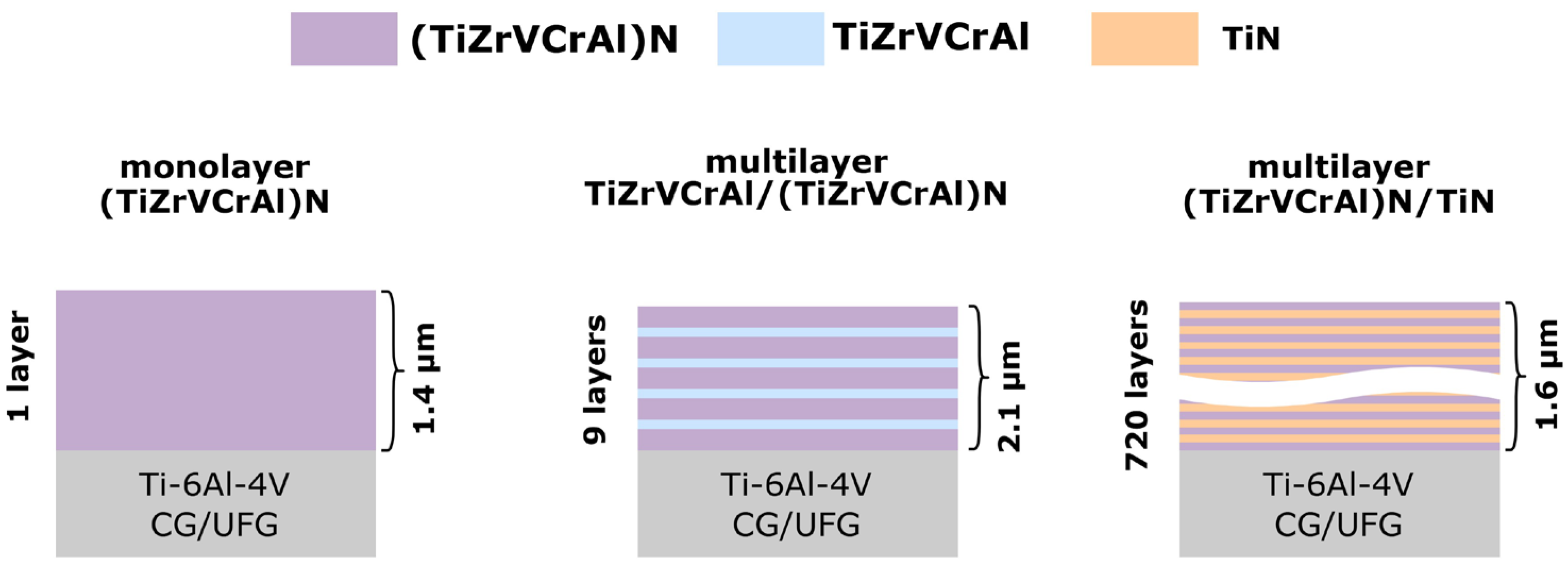
Figure 1 shows schematics of the different types of coating deposited on the coarse-grained (CG) and ultrafine-grained (UFG) Ti-6Al-4V titanium alloy substrates. The thickness of the coatings was kept between 1.4 and 2.1 μm for all architectures, while the multilayer TiZrVCrAl/(TiZrVCrAl)N coatings consisted of 9 alternating layers, and the multilayer (TiZrVCrAl)N/TiN coatings of 720 alternating layers.
The choice of the number of layers is dictated by the need to compare two fundamentally different types of architectures while maintaining a uniform deposition time (1 h).
The choice of 9 layers is based on the need to create a classical multilayer structure with pronounced interphase boundaries [47,48]. This number of layers allows for the formation of a structure where crack inhibition at the metal/nitride interfaces plays a key role in improving operational properties. The number of layers, 720, was selected to achieve a critical thickness of an individual layer in the nanoscale range (modulation period ≈ 5 nm), which, according to literature data [49,50], allows the realization of a mechanism of nanostructural strengthening through the creation of a high density of interphase boundaries, which act as barriers to dislocation motion.
Structural and phase analysis of the coatings was performed by X-ray diffraction in ambient conditions using a Bruker D2 Phaser (Bruker, Billerica, MA, USA) diffractometer equipped with a Cu anode at an accelerating voltage of 30 kV and a current of 10 mA. The exposure was performed over the diffraction angle (2θ) range of 10° to 140°, with a step size of 0.02° and an exposure time of 10 s per point. The diffraction patterns were processed using Powder Cell software (version 2.4). The coating surface was examined using a JEOL JSM-6490LV scanning electron microscope (SEM) (JEOL Ltd., Tokyo, Japan). An INCA Energy attachment (Oxford Instruments, Oxford, UK) was used for energy-dispersive spectroscopy of the coatings’ chemical composition. The coating roughness was measured with a Mahr Surf tool (Mahr Inc., Providence, RI, USA) using a diamond-tip surface-scanning technique. Elemental analysis of the coatings was performed using energy-dispersive X-ray spectroscopy on a JEOL JSM-6490LV scanning electron microscope. We determined adhesion strength using the scratch test method on a Revetest-RST unit (CSM Instruments, Peseux, Switzerland) with a 200-μm-radius Rockwell indenter. Adhesive failure events in the coatings were identified after testing using an Apreo 2 scanning microscope from ThermoFischer Scientific (Waltham, MA, USA). The critical loads of coating failure were then determined as the initial load for crack initiation (Lc1) and the threshold load for local coating delamination (Lc2). Instrumented nanoindentation was further performed on the coatings using a Tabletop Nanoindentation Tester (TTX NHT2, CSM Instruments, Switzerland) with a load of 10 mN and a dwelling time of 5 s. When measuring the hardness of the coatings, 10 indentations were made for each of the hardness value ranges listed below. The hardness values were calculated using the Oliver–Pharr method [51].

3. Results

Forming coatings with enhanced performance requires precise selection and control of deposition parameters tailored to the substrate’s structural properties. In this work, we adjusted three deposition parameters: the bias voltage, the discharge current, and the working gas pressure. The bias voltage determines the energy contribution of charged particles. Every chemical element in the cathode has a different critical bias voltage, above which deposition stops, and sputtering prevails [52]. It is thus possible to control the coating’s chemical composition by adjusting this parameter. Furthermore, the discharge current and the working gas pressure impact the composition of the metal plasma and the ratio of gas-to-metal plasma concentrations. In this work, we set the deposition parameters to produce high-entropy coatings with superior mechanical and erosion properties, as described in Ref. [46].
Table 2 lists the chemical composition of the coatings with different architectures; the data were obtained through energy-dispersive X-ray spectroscopy (EDS). The content of five metallic elements ranges from 6 to 17 at. %, the nitrogen content varies from 38 to 42 at. % in the (TiZrVCrAl)N monolayer coating and TiZrVCrAl/(TiZrVCrAl)N multilayer coating deposited on the coarse-grained and ultrafine-grained substrates. The chemical composition of the (TiZrVCrAl)N/TiN multilayer coating is characterized by a high Ti content, which can be attributed to the large, probed volume relative to the thickness of the individual layers (~2.5 nm). As such, EDS measurements averaged over a volume including several (TiZrVCrAl)N and TiN nanolayers.
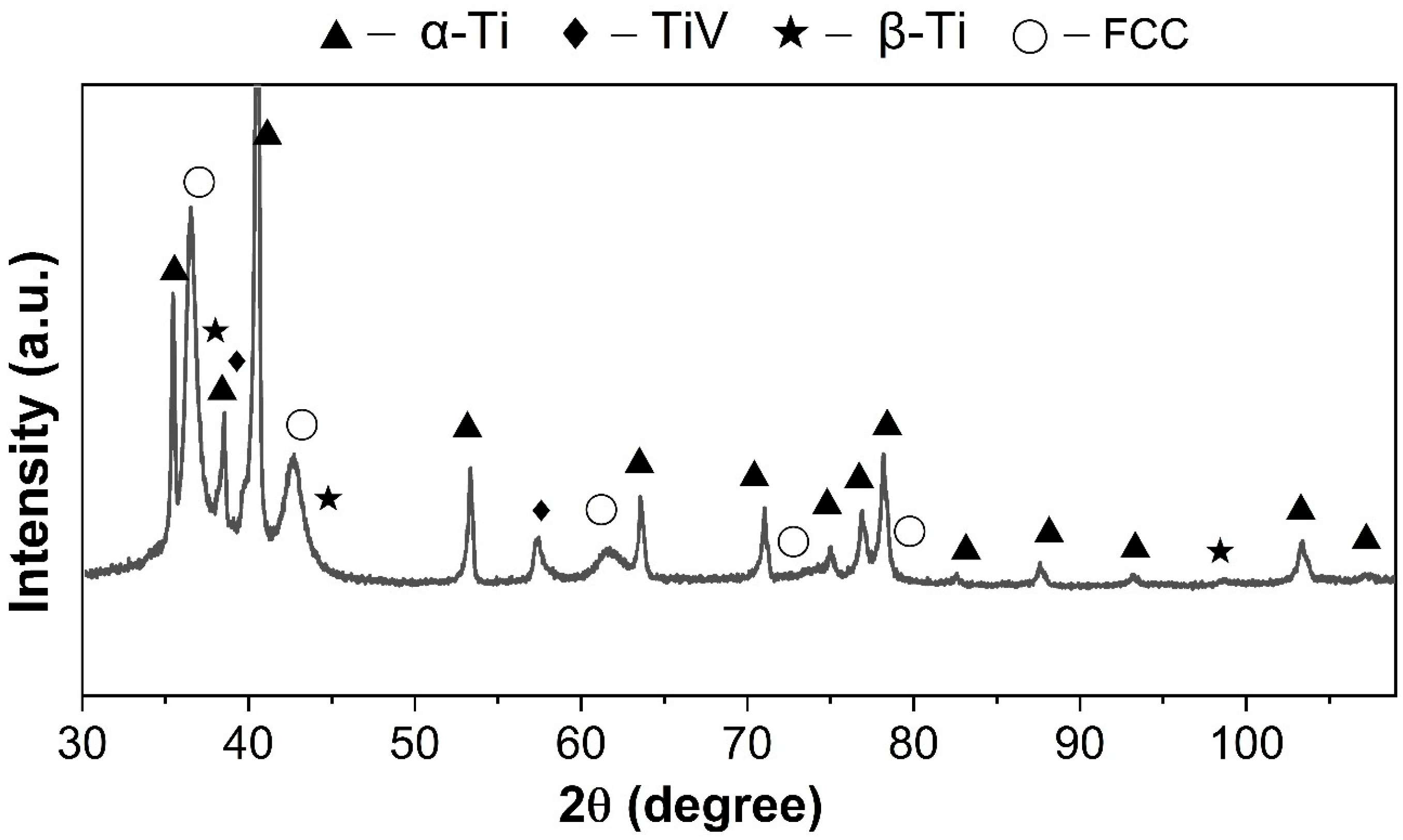
X-ray diffraction analysis (XRD) showed that the phase composition of the coatings on coarse-grained and ultrafine-grained substrates is identical. Figure 2 shows a typical X-ray diffraction pattern of a monolayer coating (TiZrVCrAl)N on a coarse-grained substrate. The main phase is the fcc phase with a lattice parameter of 4.2464 Å. We explain the formation of this phase by the mutual solubility of nitrides (see also, Ref. [53]).
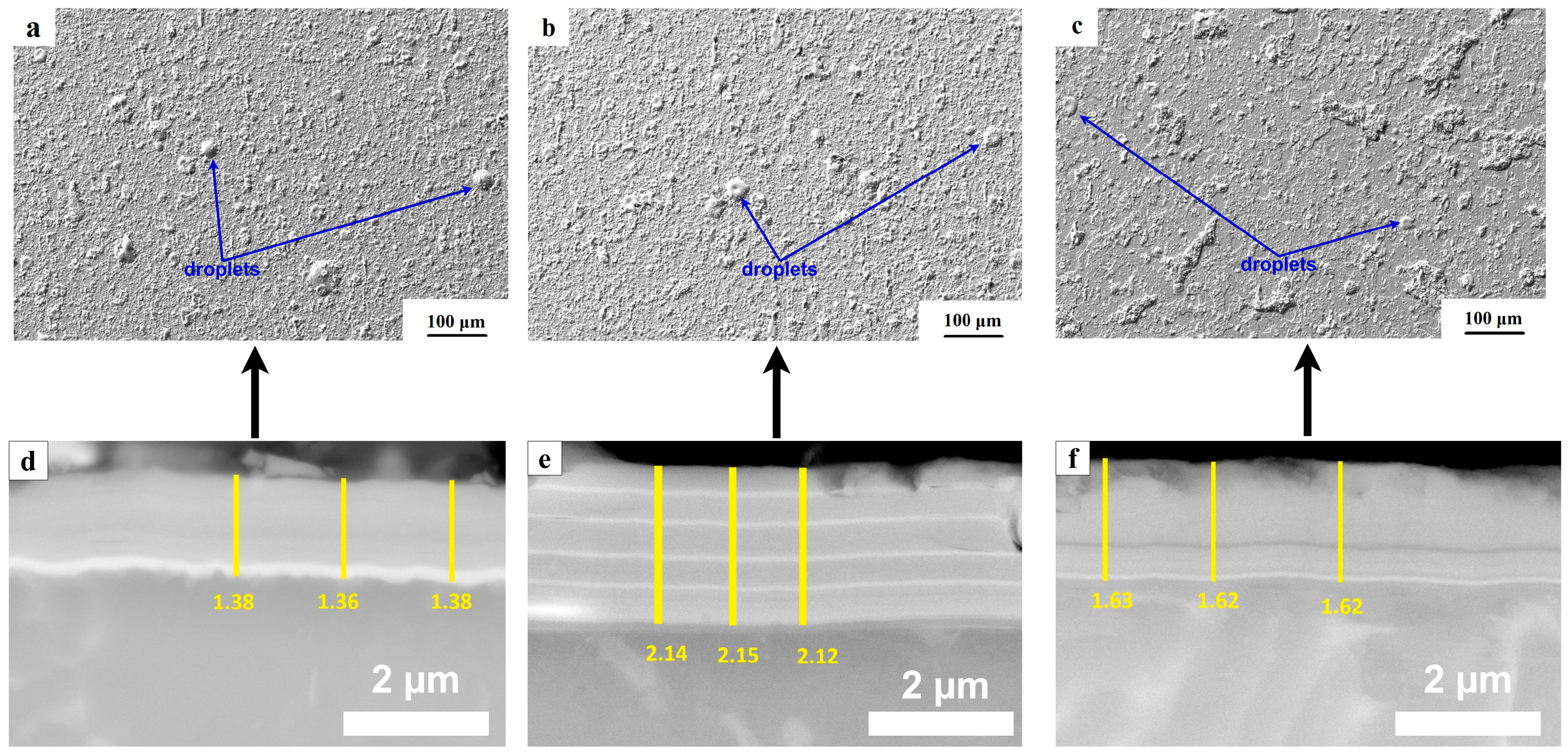
Also, Table 3 summarizes the thickness, roughness, and adhesion strength values for all coatings prepared and investigated in this work. We find that the surface roughness parameter Ra increases significantly for multilayer coatings compared to monolayer coatings. The roughness increase is even more pronounced when the number of layers increases from nine to 720. We attribute the rather high roughness values for all coatings to the formation and deposition of metallic droplets at the surface during the coating process (see Figure 3a–c). The formation of such droplets is common during vacuum-arc evaporation [54,55]. Figure 3d–f shows SEM images of cross-sections of the obtained coatings. The TiZrVCrAl/(TiZrVCrAl)N multilayer coating exhibits a layered structure with a total thickness of approximately 2.1 μm. The average thickness of the (TiZrVCrAl)N layer is approximately 350 nm, and that of the TiZrVCrAl layer is 80 nm. The (TiZrVCrAl)N/TiN multilayer coating has a total thickness of 1.6 μm; according to calculated data, the average thickness of a single layer reaches ~2.5 nm. Consequently, in the 720-layer coating, the layers cannot be detected by scanning electron microscopy.
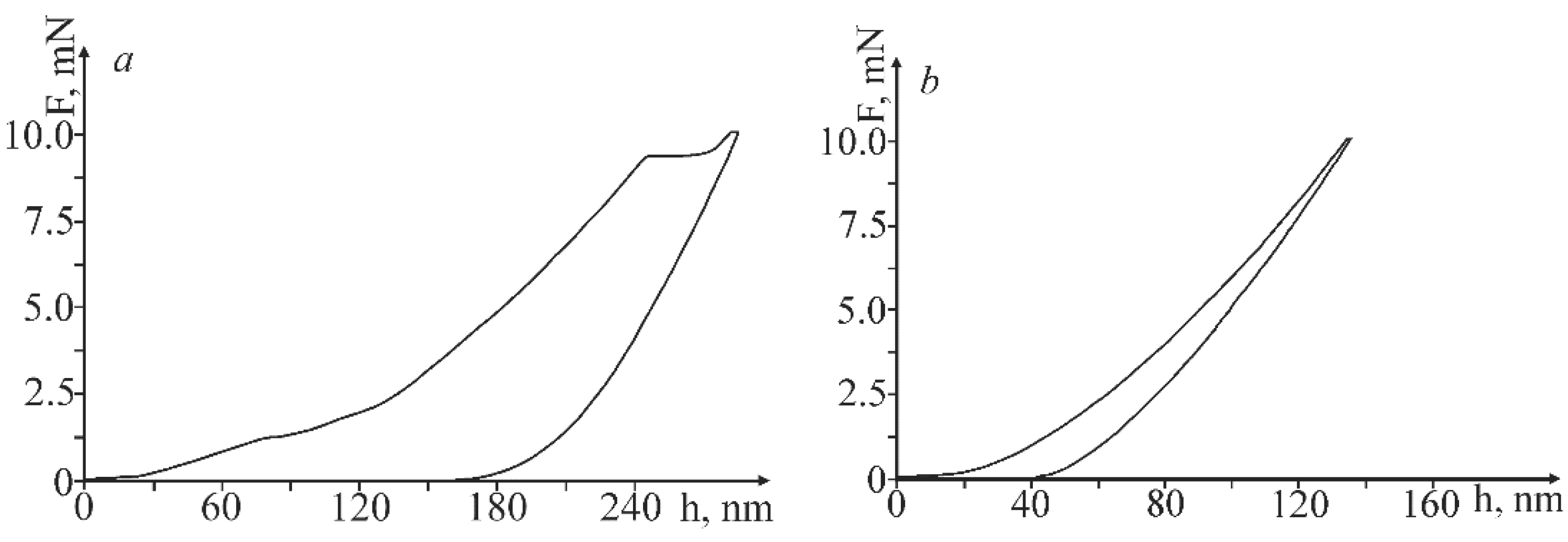
The coating structure depicted in Figure 3 consists of a ceramic matrix with metallic droplet inclusions. This structural inhomogeneity is also reflected in our nanoindentation results. Figure 4 illustrates this disparity and shows two force displacement curves corresponding to the indentation behavior of a metallic drop and the monolayer or multilayer matrix. To accurately assess the mechanical properties of the coating systems under study, measurements were conducted exclusively in zones free of droplet particles. This approach made it possible to obtain reliable values of the hardness and elastic modulus of the obtained coatings, avoiding the influence of surface structural defects that have a different nature from the main coating.
For the areas with gradual load growth, two types of indentation selection were used: the first one corresponds to the well-known rule on the ratio of indentation depth to coating thickness, which allows one to evaluate the contribution of the indentation-depth-to-coating-thickness ratio to the coating structure property without the substrate effect; the second one is connected with indentation depths being approximately 10–15% larger than one tenth of the coating thickness, which makes it possible to determine the effect of substrate structure refinement on the measured parameter.
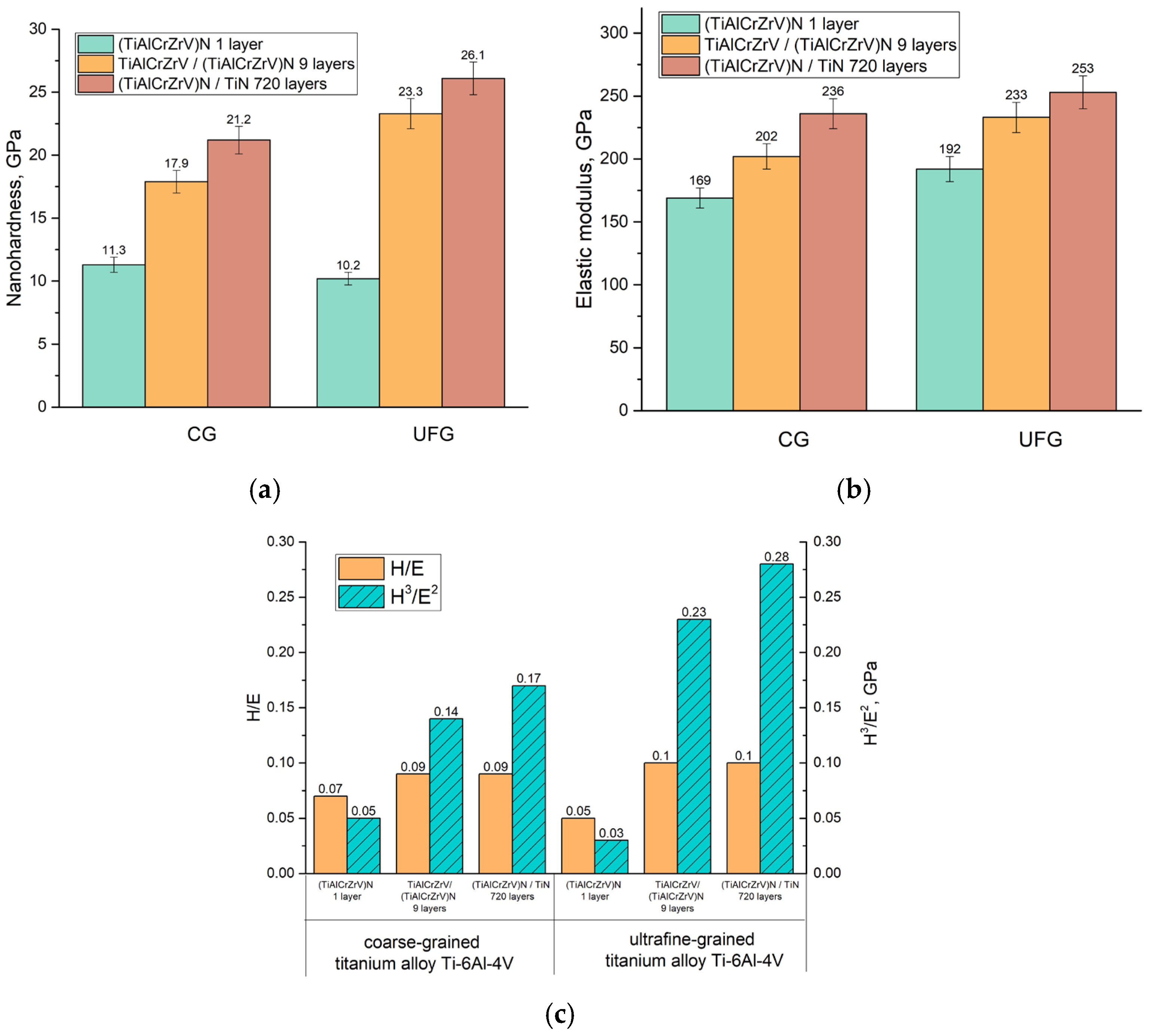
Table 4 and Figure 5 summarize the mechanical properties of the coatings deposited on the CG and UFG substrates of Ti-6Al-4V titanium alloy as determined by nanoindentation. The (TiZrVCrAl)N/TiN multilayer coating (720 layers) deposited on the UFG substrate exhibits the highest hardness value among all tested coatings.
When evaluating the differences in the hardness and Young’s modulus values of coatings on different substrates presented in Table 4, it should be noted that the reliability of the data is determined, first of all, experimental and instrumental measurement errors, which for the equipment we used in this range of values amount to ≈±5%, which corresponds, for example, to ≈±1 GPa for the hardness of multilayer coatings. Consequently, the observed differences in hardness values on different substrates for these coatings are due to differences in their structure. Second, although the distributions of hardness values and Young’s modulus for each of the coatings (with the exception of the monolayer coating) on various substrates show an overlap in their value ranges, the proportion of indentations within these common ranges does not exceed 20% of the total. Consequently, the majority, 80% of the measurement results, show differences in properties, which is also reflected in the corresponding differences in their average values. The H/E and H3/E2 ratios are used [56,57] to evaluate the toughness and fracture resistance of the coatings. Specifically, the H/E ratio corresponds to the resistance to elastic deformation, while the H3/E2 ratio corresponds to the resistance to plastic deformation. We also find that the (TiZrVCrAl)N/TiN (720 layers) multilayer coating deposited on the UFG Ti-6Al-4V alloy substrate exhibits the highest H/E and H3/E2 values. We attribute the higher resistance of this coating to deformation to the reduced mobility of dislocations across the interfaces within the multilayer film [49,58].
Our results indicate that high-entropy coatings deposited on UFG substrates exhibit superior mechanical performance, which we attribute to their distinct architecture and synergy with the substrate.
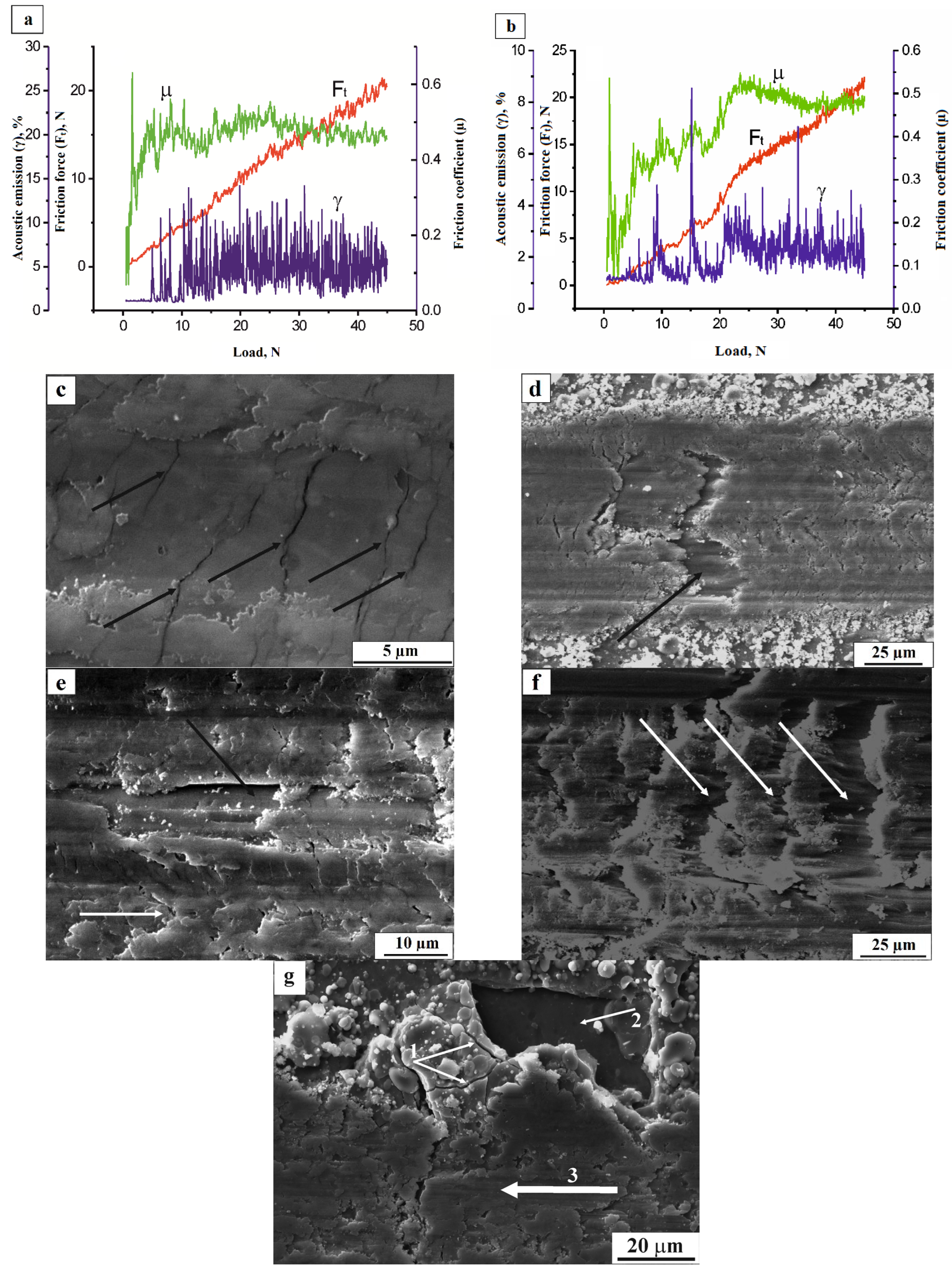
Adhesion strength is an important parameter for quantifying the quality of ion-plasma-deposited coatings, since it determines how a coating performs in a tribological setting [59,60]. In this work, we investigated the cohesive and adhesive properties of our coatings using scratch testing. Figure 6 shows the dependence of the friction force Ft, the corresponding friction coefficient μ = F t F n , and the level of acoustic emission on the load Fn, upon sliding on (TiZrVCrAl)N monolayer and (TiZrVCrAl)N/TiN multilayer coatings on ultrafine-grained substrates. For these coatings on both substrate types, two distinct friction regimes can be identified. In the early sliding stage at lower normal force values, the coefficient of friction increases to an average of 0.5 and then fluctuates around that value for the remainder of the test. For the monolayer (TiZrVCrAl)N coating, friction reaches a steady-state regime at a normal force of 5 N, corresponding to a sliding distance of 7 mm. In contrast, the (TiZrVCrAl)N/TiN multilayer coating grown on a ultrafine-grained substrate exhibits a longer transient regime that consists of several increases and plateau in the coefficient of friction plot, reaching a first plateau with a value of about 0.35–0.4 ± 0.05 at the a normal force value of ~20 N, followed by a steeper increase to 0.55 ± 0.025 at a normal force of ~23 N, corresponding to a sliding distance of 7 mm; the coefficient of friction then remained constant until the end of the test.
The local fluctuations are probably caused by the unevenness of the coating surface, i.e., by the deformation resistance and the plastic “plowing” of the coating surface with an indenter, which changes with the thickness of the deformed layer. The friction coefficient is approximately two to three times higher than that observed for nitride coatings obtained by magnetron sputtering without their pronounced failure (i.e., in the load range between Lc1 and Lc2) [61], which is connected with increased viscosity of deformation and destruction due to the presence of a droplet metal fraction
The impact of the droplet fraction on the scratch response prevents an accurate determination of the critical loads from the friction plots. Instead, we determined the Lc1 and Lc2 parameters from post-mortem wear-scar images obtained by scanning electron microscopy. From these images, we find that the critical load at which first cracks appear (Lc1) for the (TiZrVCrAl)N monolayer and (TiZrVCrAl)N/TiN multilayer coatings ranges from 7.0 to 9.6 N (Figure 6c); the upper value in this range corresponds to the monolayer coating and coatings on the UFG substrate. Similarly, we observed that coating peeling first occurred at higher load values on the UFG substrates than on the CG alloy, i.e., Lc2 ≈ 10–13 N for coated CG substrates and Lc2 ≈ 15–18 N for coated UFG substrates.

4. Discussion

In this study, the properties of protective coatings (TiZrVCrAl)N, TiZrVCrAl/(TiZrVCrAl)N, and (TiZrVCrAl)N/TiN obtained by the ArcPVD method and deposited on Ti-6Al-4V titanium alloy with coarse-grained and ultrafine-grained structure were evaluated.
The comparison of the elemental compositions of the cathode material and the (TiZrVCrAl)N monolayer coating listed in Table 1 and Table 3 notes that the Zr and Al contents in the coating are reduced by approximately 1.45 times relative to the other metals (their total concentration). This change probably reflects more intense secondary sputtering of these elements from the surface of the growing coating, which may be conditioned by a relatively higher growth of the energy of the multicomponent nitride solid solution upon dissolution of zirconium or aluminum.
Such an increase can be expected since the nitride with the B1 structure, which is isomorphic for all metals, has the largest lattice parameter with zirconium in the content (≈4.57 Å [62]) and the smallest one with aluminum (≈4.04 Å [63]). Therefore, the largest changes in the lattice parameter will be observed at the sites of zirconium and aluminum atom localization in the solid solution as compared to the equilibrium state for the corresponding single-component nitride. Consequently, in these areas, the solution will be more unstable, and under ionic action, the probability of solution decomposition with sputtering of the noted elements will be higher. Indirect confirmation of the possibility of secondary sputtering of zirconium and aluminum is their limited solubility in some nitrides of transition metals [53,64,65].
As noted for Figure 5, high-entropy coatings applied on UFG substrates generally exhibit much higher mechanical properties. At the same time, the substrate mechanical properties that are enhanced during UFG structure formation will entail enlargement of the coating-substrate composite properties. Let us compare the contributions of the coating and substrate structure modifications to the change in the elastic recovery depth (ξ) of indentation for the multilayer (TiZrVCrAl)N/TiN coating. This coating on the CG substrate has the average value of indentation depths being less than one-tenth of the coating thickness of ξ1 ≈ 65.3%, while the average value for indentations with a depth larger than one-tenth of the coating thickness (10–15% higher than the specified value) is ξ2 ≈ 54.6%. For the coatings on the UFG substrates, the following values of this parameter were obtained: ξ1 ≈ 77.6% and ξ2 ≈ 68.5%.
It proceeds from the presented data that the ratio of ξ1 values for the UFG and CG substrates is ≈1.19. Consequently, the use of UFG substrates increases the coating rigidity, i.e., enables forming a coating structure that ensures a higher level of elastic stress accumulated during indentation, facilitating the elastic recovery of the indentation depth after the load is relieved. Secondly, as the indentation depth is enlarged, the elastic recovery of the indentation depth is observed to reduce for both UFG and CG substrates, showing the impact of their ductility, which is more pronounced for CG substrates.
While evaluating the indentation results presented in Table 4, one should note a significant (up to ≈two times) increase in hardness upon transition from monolayer ceramic to multilayer metal–ceramic coatings. It is known that the formation of high-entropy alloys results in their enhanced hardness in comparison with the hardness of the metals that compose them. For example, in [66], the measured hardness Hv0.2 of the FeCoNiCuAl alloy produced by casting with subsequent annealing is above 530, whereas the Vickers hardness of the compounding metals under similar production conditions does not exceed 110 units. A similar conclusion can be made about HEA coatings of metals. For example, in [67], the hardness value of ≈11.5 GPa in CoCrFeNiMo coatings was recorded.
Therefore, it is possible that the hardness of the metallic layers in the studied multilayer coating of metallic and nitride layers is similar to that of the monolayer coating. One should also note (Table 3) the high nitrogen concentration in this multilayer coating, which testifies to saturation of the metallic layers with nitrogen and enhancement of their mechanical properties due to solid-solution hardening. Thus, the above factors of hardness enlargement in the metallic layers, along with the similar effect of the multilayer structure may condition the high hardness values of the multilayer metal–ceramic coatings.
The higher values of the critical load Lc1 and Lc2 of the monolayer (TiZrVCrAl)N coating compared to the multilayer (TiZrVCrAl)N/TiN coating may be due to the increase in surface roughness upon transition from a monolayer to a multilayer coating (Table 3), which is caused by the presence of the droplet fraction. It is widely known [68,69,70] that the droplet fraction characteristic of vacuum arc-deposited coatings (PVD, Arc-PVD) has a significant impact on adhesive strength and leads to the formation of defects that cause brittle fracture and delamination of the coating under mechanical loads. However, the data in Table 3 show that the adhesion strength values are lower for the multilayer coating (TiZrVCrAl/(TiZrVCrAl)N for both types of substrates compared to monolayer (TiZrVCrAl)N and multilayer (TiZrVCrAl)N/TiN coatings. In the TiZrVCrAl/(TiZrVCrAl)N multilayer coatings, the first coating delaminations under low loads are observed along the edge of the scratch track (Figure 6g) in the region of maximum bending and transverse shear of the coating layers under the action of external compressive stresses. Under these conditions, bending leads to tensile cracks in the coatings, while shear leads to the formation of cracks along the coating–substrate interfaces; the combination of these cracks results in coating delamination via a warping mechanism [71]. This delamination mechanism is facilitated by the lower shear strength of the metal layers, leading to mismatched deformation at the metal–ceramic interface and the failure of the coating as a whole.
One should note that enhanced surface roughness upon transition from monolayer to multilayer coatings may be connected with secondary sputtering of the coating surface (Table 2). Deposition of a multilayer (TiZrVCrAl)N/TiN coating needs the substrate holder to be rotated between the arc evaporators, which leads to oblique incidence of the plasma flow and, accordingly, a non-uniform enlargement of the surface sputtering with its ionic component on the surface irregularities or in the droplet-fraction areas. Such plasma impact will change the surface relief and its characteristics. However, the roughness is also observed to enlarge in the multilayer TiZrVCrAl/(TiZrVCrAl)N coatings, which possibly reflects stronger nonuniformity in the nucleation of crystals of the (TiZrVCrAl)N layer on the non-uniform and nonequilibrium structure of the TiZrVCrAl layer.
As follows from the obtained results, the multilayer high-entropy coating (TiZrVCrAl)N/TiN applied on the ultrafine-grained substrate demonstrates higher resistance to partial failure compared to the coating on the coarse-grained substrate, since the Lc1 and Lc2 values for the ultrafine-grained alloy are higher than those for the coarse-grained one.
It was previously shown [72,73,74] that the UFG structure formed in the substrate material significantly increased the adhesive strength of the deposited coatings, which was apparently connected with an enhancement in the number of crystallization centers during coating deposition, i.e., enlargement of grain boundaries and defects of the crystalline structure in the substrate material. As is known, the density of grain boundaries increases significantly due to grain-structure refinement in metallic materials processed by SPD [41].
The presented results of the study on the coating failure behavior in the scratch tests (Figure 6c,d) demonstrate the uniformity of failure modes (cracks, delamination) of the coatings on large areas (tens of microns) on UFG substrates, indicating a corresponding uniform stress state within the bulk of the coating material and at its interface with the substrate. However, it should be noted that the coating delamination from the CG substrate (Figure 6d) is more localized, takes the form of scratches, and is typically directed along the track. This failure morphology suggests that it occurs under the action of stress concentrators arising either from inhomogeneities of the structural state of the substrate or on the peaks of the friction counterbody asperities.
Another interesting result of the scratch test is the different behavior of the characteristics of the monolayer (TiZrVCrAl)N and multilayer (TiZrVCrAl)N/TiN coatings upon their complete failure and delamination from the substrate. This phenomenon is observed for both coatings at loads in the range 20–25 N (Figure 6a,b). However, this transition is clearly expressed for the multilayer coating (Figure 6b), for example, by the dependence of the friction coefficient (its growth in this range), whereas the dependence is smoothed out for the monolayer coating, and the growth is insignificant (Figure 6a). In our opinion, this indicates a more localized, fragmented failure. Delamination of the monolayer coating begins before the coating is completely delaminated from the substrate (Figure 6e), as wear products accumulate in front of the indenter, resulting in a high and relatively constant friction coefficient even before the coating is completely removed. However, at large scales of delamination, changes in the friction coefficient should be more significant and localized under certain loads, which can probably be facilitated by the interfaces of the layers in the multilayer (TiZrVCrAl)N/TiN coating.

5. Conclusions

In this work, we determine the mechanical performance of protective TiZrVCrAl high-entropy alloy coatings with different architectures deposited on coarse- and ultrafine-grained Ti-6Al-4V alloy substrates by arc-assisted physical vapor deposition. Three different coating architectures were formed as a variable feature: a monolayer nitride coating (TiZrVCrAl)N, a multilayer coating consisting of nine alternating layers of TiZrVCrAl and (TiZrVCrAl)N, and a multilayer coating consisting of 720 alternating layers of (TiZrVCrAl)N and TiN.
The assessment of the adhesive strength showed that the critical load values at which the first cracks appear (Lc1) are 7.0–9.6 N for the monolayer and multilayer (TiZrVCrAl)N/TiN coatings. The load values at which peeling off of parts of the coating occurs (Lc2) are higher for the UFG alloy than for the CG alloy, both for the monolayer (TiZrVCrAl)N and multilayer (TiZrVCrAl)N/TiN coatings.
The nanoindentation of all the coatings deposited on the Ti-6Al-4V titanium alloy with coarse-grained and ultrafine-grained structures revealed that the multilayer (TiZrVCrAl)N/TiN coating (720 layers) on the UFG substrate of Ti-6Al-4V titanium alloy exhibited the highest nanohardness (26.1 GPa), elastic modulus (253 GPa), as well as H/E (0.10) and H3/E2 (0.28 GPa) indices. This is due to its higher resistance to plastic straining, resulting from impeded dislocation sliding across multilayer boundaries. Overall, the formation of a high-entropy coating on a substrate with an ultrafine-grained structure enables the achievement of excellent mechanical properties, indicating its potential for application in the aviation industry.

Author Contributions

Conceptualization, Y.N.S., R.R.V., S.V.O. and R.Z.V.; methodology, A.Y.N., A.A.N., V.V.S., L.Y.M. and A.C.; visualization, Y.N.S., S.V.O. and E.R.K.; investigation, Y.N.S., S.V.O., I.M.M., A.Y.N., A.A.N., V.V.S. and L.Y.M.; writing—original draft, Y.N.S., I.M.M., R.R.V. and E.R.K.; writing—review and editing, R.R.V., K.N.R., A.C. and R.Z.V.; project administration, R.R.V.; validation, E.R.K.; supervision, K.N.R. and R.Z.V. All authors have read and agreed to the published version of the manuscript.

Funding

This work was supported by the Russian Science Foundation under grant no. 23-79-10118.

Data Availability Statement

The original contributions presented in this study are included in the article. Further inquiries can be directed to the corresponding author.

Conflicts of Interest

Vitaly V. Sanin and Liliya Yu. Mezhevaia were employed by the JSC “Giredmet” n.a. N.P. Sazhin. The remaining authors declare that the research was conducted in the absence of any commercial or financial relationships that could be construed as a potential conflict of interest.

References

  1. Shibe, V.; Chawla, V. A review of surface modification techniques in enhancing the erosion resistance of engineering components. Int. J. Res. Mech. Eng. Technol. 2014, 4, 92–95. [Google Scholar]
  2. Fotovvati, B.; Namdari, N.; Dehghanghadikolaei, A. On Coating Techniques for Surface Protection: A Review. J. Manuf. Mater. Process. 2019, 3, 28. [Google Scholar] [CrossRef]
  3. Kablov, E.N.; Muboyadzhyan, S.A. Erosion-resistant coatings for gas turbine engine compressor blades. Russ. Metall. Met. 2017, 2017, 494–504. [Google Scholar] [CrossRef]
  4. Zhang, H.; Zhang, B.; Li, Z.; Cui, L.; Cao, X.; Zhang, G.; He, W. Insight into the Transformation of Sand Erosion Damage Evolution with Varying Bi-Layer Periods in TiN/Ti Coatings. J. Mater. Res. Technol. 2025, 39, 6937–6952. [Google Scholar] [CrossRef]
  5. Li, G.; Zhang, X.; Li, H.; Zhu, B.; Yu, H.; Chen, C. The Strategies for Enhancing the Wear Resistance of Titanium Alloy via Laser Cladding: A Review. Int. J. Refract. Met. Hard Mater. 2026, 136, 107607. [Google Scholar] [CrossRef]
  6. Guo, H.; Li, B.; Yan, P.; Wu, Z.; Li, F.; Liu, Z. Microstructures, Mechanical Properties and Tribological Behaviors of NiAl-Based Composite Coatings with Various Addition of Nb. Surf. Coat. Technol. 2022, 449, 128977. [Google Scholar] [CrossRef]
  7. Wang, J.; Chen, M.; Yang, L.; Sun, W.; Zhu, S.; Wang, F. Nanocrystalline Coatings on Superalloys against High Temperature Oxidation: A Review. Corros. Commun. 2021, 1, 58–69. [Google Scholar] [CrossRef]
  8. Lin, X.; Liu, H.; Duan, J.; Zheng, B.; Zuo, X.; Liu, B.; Yuan, X.; Huang, H. High Temperature Oxidation Behavior of Al/NiAl Composite Coating on TiAl Alloy. Mater. Charact. 2025, 229, 115653. [Google Scholar] [CrossRef]
  9. Zhang, L.; Liao, X.-J.; Chen, R.; Luo, X.-T.; Li, C.-J. Tribological Behavior of NiAl Coating Deposited by Plasma Spraying of Diamond-Contained Ni/Al Composite Powder at a Wide Range Temperature from 25 °C to 700 °C. Trans. Mater. Res. 2025, 1, 100100. [Google Scholar] [CrossRef]
  10. Xue, W.; Gao, S.; Duan, D.; Zhang, J.; Liu, Y.; Li, S. Ti6Al4V Blade Wear Behavior During High-Speed Rubbing with NiAl-hBN Abradable Seal Coating. J. Therm. Spray Technol. 2017, 26, 539–553. [Google Scholar] [CrossRef]
  11. Chauhan, A.K.S.; Shukla, M.; Kumar, A. Effect of NiAl and NiCr Coatings on High Cycle Fatigue and Corrosion Behavior of Direct Metal Laser Sintered Ti-6Al-4V Alloy. Mater. Today Commun. 2025, 42, 111102. [Google Scholar] [CrossRef]
  12. Zhong, D.; Moore, J.J.; Sutter, E.; Mishra, B. Microstructure, Composition and Oxidation Resistance of Nanostructured NiAl and Ni–Al–N Coatings Produced by Magnetron Sputtering. Surf. Coat. Technol. 2005, 200, 1236–1241. [Google Scholar] [CrossRef]
  13. Izumi, T.; Nishimoto, T.; Narita, T. Superior Long-Term Oxidation Resistance of Ni–Al Coated TiAl Alloys. Intermetallics 2005, 13, 727–732. [Google Scholar] [CrossRef]
  14. Zhuo, L.; Xie, Y.; Chen, B. A Review on Recent Progress of Refractory High Entropy Alloys: From Fundamental Research to Engineering Applications. J. Mater. Res. Technol. 2024, 33, 1097–1129. [Google Scholar] [CrossRef]
  15. Cantor, B.; Chang, I.; Knight, P.; Vincent, A. Microstructural development in equiatomic multicomponent alloys. Mater. Sci. Eng. A 2004, 375, 213–218. [Google Scholar] [CrossRef]
  16. George, E.P.; Raabe, D.; Ritchie, R.O. High-entropy alloys. Nat. Rev. Mater. 2019, 4, 515–534. [Google Scholar] [CrossRef]
  17. Miracle, D.B.; Senkov, O.N. A critical review of high entropy alloys and related concepts. Acta Mater. 2017, 122, 448–511. [Google Scholar] [CrossRef]
  18. Novikov, V.; Stepanov, N.; Zherebtsov, S.; Salishchev, G. Structure and Properties of High-Entropy Nitride Coatings. Metals 2022, 12, 847. [Google Scholar] [CrossRef]
  19. Sharma, A. High Entropy Alloy Coatings and Technology. Coatings 2021, 11, 372. [Google Scholar] [CrossRef]
  20. Li, W.; Liu, P.; Liaw, P.K. Microstructures and properties of high-entropy alloy films and coatings: A review. Mater. Res. Lett. 2018, 6, 199–229. [Google Scholar] [CrossRef]
  21. Zhang, B.; Gao, Q.; Jia, D.; Fu, Y.; Wu, X. Review on the Preparation and Properties of High-Entropy Alloys Coating. Mater. Sci. Eng. A 2025, 945, 149009. [Google Scholar] [CrossRef]
  22. Wang, J.; Jia, D.; Gao, Q.; Fu, Y.; Wu, X. High-Entropy Al-loy Coatings: A Systematic Review on Composition Design, Microstructural Mechanisms, and Multifunctional Application. Mater. Des. 2025, 258, 114715. [Google Scholar] [CrossRef]
  23. Kumar, S. Comprehensive Review on High Entropy Alloy-Based Coating. Surf. Coat. Technol. 2024, 477, 130327. [Google Scholar] [CrossRef]
  24. Shen, W.-J.; Tsai, M.-H.; Yeh, J.-W. Machining Performance of Sputter-Deposited (Al0.34Cr0.22Nb0.11Si0.11Ti0.22)50N50 High-Entropy Nitride Coatings. Coatings 2015, 5, 312–325. [Google Scholar] [CrossRef]
  25. Shen, W.J.; Tsai, M.H.; Tsai, K.Y.; Juan, C.C.; Tsai, C.W.; Yeh, J.W.; Chang, Y.S. Superior Oxidation Resistance of (Al0.34Cr0.22Nb0.11Si0.11Ti0.22)50N50 High-Entropy Nitride. J. Electrochem. Soc. 2013, 160, 531–535. [Google Scholar] [CrossRef]
  26. Huang, P.-K.; Yeh, J.-W. Effects of substrate temperature and post-annealing on microstructure and properties of (AlCrNbSiTiV)N coatings. Thin Solid Films 2009, 518, 180–184. [Google Scholar] [CrossRef]
  27. Von Fieandt, K.; Paschalidou, E.M.; Srinath, A.; Soucek, P.; Riekehr, L.; Nyholm, L.; Lewin, E. Multi-component (Al, Cr, Nb, Y, Zr) N thin films by reactive magnetron sputter deposition for increased hardness and corrosion resistance. Thin Solid Films 2020, 693, 137685. [Google Scholar] [CrossRef]
  28. Lo, W.L.; Hsu, S.Y.; Lin, Y.C.; Tsai, S.Y.; Lai, Y.T.; Duh, J.G. Improvement of high entropy alloy nitride coatings (AlCrNbSiTiMo) N on mechanical and high temperature tribological properties by tuning substrate bias. Surf. Coat. Technol. 2020, 401, 126247. [Google Scholar] [CrossRef]
  29. Kuczyk, M.; Krülle, T.; Zawischa, M.; Kaspar, J.; Zimmer, O.; Leonhardt, M.; Zimmermann, M. Microstructure and mechanical properties of high entropy alloy nitride coatings deposited via direct current cathodic vacuum arc deposition. Surf. Coat. Technol. 2022, 448, 128916. [Google Scholar] [CrossRef]
  30. Chang, Z.-C.; Liang, S.-C.; Han, S.; Chen, Y.-K.; Shieu, F.-S. Characteristics of TiVCrAlZr multi-element nitride films prepared by reactive sputtering. Nucl. Instrum. Methods Phys. Res. Sect. B Beam Interact. Mater. At. 2010, 268, 2504–2509. [Google Scholar] [CrossRef]
  31. Pogrebnjak, A.D.; Yakushchenko, I.V.; Abadias, G.; Chartier, P.; Bondar, O.V.; Beresnev, V.M.; Takeda, Y.; Sobol’, O.V.; Oyoshi, K.; Andreyev, A.A.; et al. The effect of the deposition parameters of nitrides of high-entropy alloys (TiZrHfVNb) N on their structure, composition, mechanical and tribological properties. J. Superhard Mater. 2013, 35, 356–368. [Google Scholar] [CrossRef]
  32. Hsieh, T.H.; Hsu, C.H.; Wu, C.Y.; Kao, J.Y.; Hsu, C.Y. Effects of deposition parameters on the structure and mechanical properties of high-entropy alloy nitride films. Curr. Appl. Phys. 2018, 18, 512–518. [Google Scholar] [CrossRef]
  33. Xu, Y.; Li, G.; Xia, Y. Synthesis and characterization of super-hard AlCrTiVZr high-entropy alloy nitride films deposited by HiPIMS. Appl. Surf. Sci. 2020, 523, 146529. [Google Scholar] [CrossRef]
  34. Zhu, M.; Yao, L.; Liu, Y.; Zhang, M.; Li, K.; Jian, Z. Microstructure evolution and mechanical properties of a novel CrNbTiZrAlx (0.25 ≤ x ≤ 1.25) eutectic refractory high-entropy alloy. Mater. Lett. 2020, 272, 127869. [Google Scholar] [CrossRef]
  35. Pogrebnjak, A.D.; Yakushchenko, I.V.; Bagdasaryan, A.A.; Bondar, O.V.; Krause-Rehberg, R.; Abadias, G.; Chartier, P.; Oyoshi, K.; Takeda, Y.; Beresnev, V.M.; et al. Microstructure, physical and chemical properties of nanostructured (Ti–Hf–Zr–V–Nb)N coatings under different deposition conditions. Mater. Chem. Phys. 2014, 147, 1079–1091. [Google Scholar] [CrossRef]
  36. Beresnev, V.M.; Sobol, O.V.; Andreev, A.A.; Gorban, V.F.; Klimenko, S.A.; Litovchenko, S.V.; Kovteba, D.V.; Meilekhov, A.A.; Postel’nik, A.A.; Nemchenko, U.S.; et al. Formation of Superhard State of the TiZrHfNbTaYN Vacuum–Arc High-Entropy Coating. J. Superhard Mater. 2018, 40, 102–109. [Google Scholar] [CrossRef]
  37. Lin, C.M.; Juan, C.C.; Chang, C.H.; Tsai, C.W.; Yeh, J.W. Effect of Al addition on mechanical properties and microstructure of refractory AlxHfNbTaTiZr alloys. J. Alloys Compd. 2015, 624, 100–107. [Google Scholar] [CrossRef]
  38. Wang, J.; Zeng, Q.; He, W.; Wang, Z.; Ning, Z.; Zheng, C.; Pang, Z.; Wei, X. Attempt of TiZrVCrAl Coating on Aerospace Bearings—Lower Friction Coefficient in Oil–Liquid Mixed Media. J. Vac. Sci. Technol. A 2023, 41, 053108. [Google Scholar] [CrossRef]
  39. Lothrop, A.; Yang, Q.; Huang, X.; Wu, X. Characterization of (AlCrTiVZr)N High-Entropy Coating Produced by Cathodic Arc Evaporation. J. Mater. Eng. Perform. 2024, 33, 7240–7252. [Google Scholar] [CrossRef]
  40. Xu, Y.; Li, G.; Li, G.; Gao, F.; Xia, Y. Effect of Bias Voltage on the Growth of Super-Hard (AlCrTiVZr)N High-Entropy Alloy Nitride Films Synthesized by High Power Impulse Magnetron Sputtering. Appl. Surf. Sci. 2021, 564, 150417. [Google Scholar] [CrossRef]
  41. Valiev, R.Z.; Zhilyaev, A.P.; Langdon, T.G. Bulk Nanostructured Materials: Fundamentals and Applications; John Wiley & Sons: Hoboken, NJ, USA, 2013. [Google Scholar]
  42. Valiev, R.Z.; Estrin, Y.; Horita, Z.; Langdon, T.G.; Zehetbauer, M.J.; Zhu, Y. Producing bulk ultrafine-grained materials by severe plastic deformation: Ten years later. JOM 2016, 68, 1216–1226. [Google Scholar] [CrossRef]
  43. Semenova, I.P.; Polyakova, V.V.; Dyakonov, G.S.; Polyakov, A.V. Ultrafine-Grained Titanium-Based Alloys: Structure and Service Properties for Engineering Applications. Adv. Eng. Mater. 2020, 22, 1900651. [Google Scholar] [CrossRef]
  44. Smyslova, M.K.; Valiev, R.R.; Smyslov, A.M.; Modina, I.M.; Sitdikov, V.D.; Semenova, I.P. Microstructural features and surface hardening of ultrafine-grained Ti-6Al-4V alloy through plasma electrolytic polishing and nitrogen ion implantation. Metals 2021, 11, 696. [Google Scholar] [CrossRef]
  45. Semenova, I.P.; Raab, G.I.; Valiev, R.Z. Nanostructured titanium alloys: New developments and application prospects. Nanotechnol. Russia 2014, 9, 311–324. [Google Scholar] [CrossRef]
  46. Savina, Y.N.; Valiev, R.R.; Nazarov, A.Y.; Nikolaev, A.A.; Ramazanov, K.N.; Ovchinnikov, S.V.; Khaitkulov, A.R.; Filippova, G.A.; Sanin, V.V. Formation of high-entropy TiZrVCrAl coating on the surface of the TI-6AL-4V titanium alloy at different technological parameters. Mater. Technol. Des. 2024, 6, 81–91. [Google Scholar]
  47. Shuai, J.; Zuo, X.; Wang, Z.; Guo, P.; Xu, B.; Zhou, J.; Wang, A.; Ke, P. Comparative study on crack resistance of TiAlN monolithic and Ti/TiAlN multilayer coatings. Ceram. Int. 2020, 46, 6672–6681. [Google Scholar] [CrossRef]
  48. Liu, J.; Jiang, Y.; Li, J.; Pelenovich, V.; Zeng, X.; Chen, Y.; Zhang, G.; Zhang, J.; Yang, B. Tailoring the mechanical properties of AlCrNbSiTi/AlCrNbSiTiN multilayer superhard coatings by varying modulation period. Mater. Sci. Eng. A 2026, 959, 150076. [Google Scholar] [CrossRef]
  49. Cheng, W.; Wang, J.; Ma, X.; Liu, P.; Liaw, P.K.; Li, W. A review on microstructures and mechanical properties of protective nano-multilayered films or coatings. J. Mater. Res. Technol. 2023, 27, 2413–2442. [Google Scholar] [CrossRef]
  50. Yan, H.; Tian, Q.; Gao, D.; Yang, F. Microstructure and properties of TiAlN/AlN multilayers with different modulation periods. Surf. Coat. Technol. 2019, 363, 61–65. [Google Scholar] [CrossRef]
  51. Golovin, Y.I. Nanoindentation and Its Capabilities; Mashinostroenie: Moscow, Russia, 2009; 312p. (In Russian) [Google Scholar]
  52. Cavaleiro, A.; De Hosson, J.T.H. Nanostructured Coatings; Springer: New York, NY, USA, 2006; p. 651. [Google Scholar]
  53. Pierson, H.O. Handbook of Refractory Carbides and Nitrides. Properties, Characteristics, Processing and Applications; Noyes Publications: Park Ridge, NJ, USA, 1996; 340p. [Google Scholar]
  54. Panjan, P.; Drnovšek, A.; Gselman, P.; Čekada, M.; Panjan, M. Review of growth defects in thin films prepared by PVD techniques. Coatings 2020, 10, 447. [Google Scholar] [CrossRef]
  55. Muboyadzhyan, S.A. Deposition from the two-phase multicomponent flow of a vacuum-arc plasma containing droplets of an evaporated material. Russ. Metall. Met. 2008, 2008, 112–121. [Google Scholar] [CrossRef]
  56. Leyland, A.; Matthews, A. On the significance of the H/E ratio in wear control: A nanocomposite coating approach to optimised tribological behavior. Wear 2000, 246, 1–11. [Google Scholar] [CrossRef]
  57. Charitidis, C.A. Nanomechanical and nanotribological properties of carbon-based thin films: A review. Int. J. Refract. Met. Hard Mater. 2010, 28, 51–70. [Google Scholar] [CrossRef]
  58. Chang, Y.-Y.; Chung, C.-H. Tribological and mechanical Properties of Multicomponent CrVTiNbZr(N) Coatings. Coatings 2021, 11, 41. [Google Scholar] [CrossRef]
  59. Muboyadzhyan, S.A. Erosion-resistant coatings for gas turbine compressor blades. Russ. Metall. Met. 2009, 3, 3–20. [Google Scholar] [CrossRef]
  60. Selivanov, K.S.; Smyslov, A.M.; Dyblenko, Y.M.; Semenova, I.P. Erosive wear behavior of Ti/Ti (V, Zr) N multilayered PVD coatings for Ti-6Al-4V alloy. Wear 2019, 418, 160–166. [Google Scholar] [CrossRef]
  61. Ovchinnikov, S.V.; Pinzhin, Y.P.; Korotaev, A.D. Modification of the microstructure of TiN-based columnar coatings in indentation zones. Russ. Metall. Met. 2015, 2015, 278–284. [Google Scholar] [CrossRef]
  62. Stampfl, C.; Mannstadt, W.; Asahi, R.; Freeman, A.J. Electronic structure and physical properties of early transition metal mononitrides: Density-functional theory LDA, GGA, and screened-exchange LDA FLAPW calculations. Phys. Rev. B Condens. Matter 2001, 63, 155106. [Google Scholar] [CrossRef]
  63. Vollstädt, H.; Ito, E.; Akaishi, M.; Akimoto, S.I.; Fukunaga, O. High pressure synthesis of rocksalt type of AlN. Proc. Jpn. Acad. Ser. B 1990, 66, 7–9. [Google Scholar] [CrossRef]
  64. Parlinska-Wojtan, M.; Karimi, A.; Coddet, O.; Cselle, T.; Morstein, M. Characterization of thermally treated TiAlSiN coatings by TEM and nanoindentation. Surf. Coat. Technol. 2004, 188, 344–350. [Google Scholar] [CrossRef]
  65. Flink, A.; Andersson, J.M.; Alling, B.; Daniel, R.; Sjölén, J.; Karlsson, L.; Hultman, L. Structure and thermal stability of arc evaporated (Ti0.33Al0.67)1−xSixN thin films. Thin Solid. Films 2008, 517, 714–721. [Google Scholar] [CrossRef]
  66. Zhuang, Y.X.; Xue, H.D.; Chen, Z.Y.; Hu, Z.Y.; He, J.C. Effect of annealing treatment on microstructures and mechanical properties of FeCoNiCuAl high entropy alloys. Mater. Sci. Eng. A 2013, 572, 30–35. [Google Scholar] [CrossRef]
  67. Zin, V.; Montagner, F.; Miorin, E.; Mortalo, C.; Tinazzi, R.; Bolelli, G.; Lusvarghi, L.; Togni, A.; Frabboni, S.; Gazzadi, G.; et al. Effect of Mo content on the microstructure and mechanical properties of CoCrFeNiMox HEA coatings deposited by high power impulse magnetron sputtering. Surf. Coat. Technol. 2024, 476, 130244. [Google Scholar] [CrossRef]
  68. Tkadletz, M.; Mitterer, C.; Sartory, B.; Letofsky-Papst, I.; Czettl, C.; Michotte, C. The effect of droplets in arc evaporated TiAlTaN hard coatings on the wear behavior. Surf. Coat. Technol. 2014, 257, 95–101. [Google Scholar] [CrossRef]
  69. Pogrebnjak, A.D.; Kravchenko, Y.O.; Bondar, O.V.; Zhollybekov, B.; Kupchishin, A.I. Structural features and tribological properties of multilayer coatings based on refractory metals. Prot. Met. Phys. Chem. Surf. 2018, 54, 240–258. [Google Scholar] [CrossRef]
  70. Chen, X.; Lin, J.; Zhu, J.; Tao, Z.; Qiu, L. Evaluation of film adhesion strength on textured surface: Experiments and mechanisms. Surf. Coat. Technol. 2025, 513, 132452. [Google Scholar] [CrossRef]
  71. Bull, S.J.; Berasetegui, E.G. An overview of the potential of quantitative coating adhesion measurement by scratch testing. Tribol. Int. 2006, 39, 99–114. [Google Scholar] [CrossRef]
  72. Valiev, R.R.; Selivanov, K.S.; Modina, I.M.; Dyblenko, Y.M.; Semenova, I.P.; Valiev, R.Z. Architecture and Increased Adhesive Strength of Vacuum-Plasma Coating on Ultrafine-Grained Titanium Alloy. Adv. Eng. Mater. 2020, 22, 2000121. [Google Scholar] [CrossRef]
  73. Valiev, R.R.; Selivanov, K.S.; Smyslova, M.K.; Dyblenko, Y.M.; Savina, Y.N.; Valiev, R.Z.; Semenova, I.P. Enhanced erosion resistance of an ultrafine-grained Ti alloy with a PVD coating. Metals 2022, 12, 818. [Google Scholar] [CrossRef]
  74. Valiev, R.R.; Modina, Y.M.; Selivanov, K.S.; Semenova, I.P.; Khafizova, E.D.; Valiev, R.Z.; Savina, Y.N. Enhanced service properties of a protective coating on a titanium alloy with an ultrafine-grained structure. Mater. Lett. 2021, 305, 130781. [Google Scholar] [CrossRef]
Figure 1. Architecture of deposited coatings.
Metals 16 00350 g001
Figure 2. X-ray diffractogram of the monolayer (TiZrVCrAl)N coating on a coarse-grained substrate.
Metals 16 00350 g002
Figure 3. SEM of (ac) the surface and (df) architecture of (a,d) a monolayer coating (TiZrVCrAl)N, (b,e) a multilayer coating TiZrVCrAl/(TiZrVCrAl)N, and (c,f) a multilayer coating (TiZrVCrAl)N/TiN on the UFG substrate.
Metals 16 00350 g003
Figure 4. Dependence of load change on indentation depth of multilayer coating (TiAlCrZrV)N/TiN: (a) the areas affected by the droplet fraction; (b) outside such areas.
Metals 16 00350 g004
Figure 5. Mechanical properties of the coatings deposited on the CG and UFG substrates of Ti-6Al-4V alloy: (a) hardness; (b) elastic modulus; (c) H/E- and H3/E2-ratios.
Metals 16 00350 g005
Figure 6. Dependences of friction force (Ft), friction coefficient (µ), level of acoustic emission (γ) on applied load and images of scratch surfaces relating to loads Lc1 (c) and Lc2 (d,e,g) for the coatings (TiZrVCrAl)N (a,d,e), (TiZrVCrAl)N/TiN (b,c), and TiZrVCrAl/(TiZrVCrAl)N (g) on the UFG (ad) and CG (e) substrates. The arrows indicate cracks (c), parts of coating peeling off (d,e); the white arrow on (e) shows the scratch-test direction; (f)—fragmentary peel offs (arrows) of monolayer coating in the zone before its complete failure; (g)—delamination of the nine-layer coating along the edge of the scratch track, where 1 indicates cracks in the coating, 2 indicates the delaminated area, and 3 indicates the direction of the scratch.
Metals 16 00350 g006
Table 1. Chemical composition of high-entropy alloy ingot (at. %).
TiZrVCrAl
19.9429.4318.2715.4718.89
Table 2. Chemical composition of high-entropy coatings with different architectures (at. %).
CoatingSubstrate StructureTiZrVCrAlN
Monolayer
(TiZrVCrAl)N
(1 layer)
CG11.83 ± 0.1213.04 ± 0.2610.38 ± 0.1416.11 ± 0.278.23 ± 0.0640.41 ± 0.62
UFG11.66 ± 0.3912.50 ± 0.1210.15 ± 0.1415.97 ± 0.448.25 ± 0.2541.47 ± 1.32
Multilayer
TiZrVCrAl/(TiZrVCrAl)N
(9 layers)
CG11.92 ± 0.2016.08 ± 0.3411.37 ± 0.2916.38 ± 0.146.23 ± 0.0538.02 ± 0.93
UFG12.08 ± 0.2015.41 ± 0.4811.23 ± 0.3016.97 ± 0.356.16 ± 0.0838.15 ± 1.40
Multilayer
(TiZrVCrAl)N/TiN
(720 layers)
CG29.71 ± 0.448.95 ± 0.176.49 ± 0.1710.08 ± 0.195.43 ± 0.0539.34 ± 0.64
UFG28.32 ± 0.199.21 ± 0.726.67 ± 0.5410.65 ± 0.135.46 ± 0.0539.69 ± 1.36
Table 3. Characterization of high-entropy coatings.
CoatingSubstrate StructureCoating Thickness, µm Roughness, µmAdhesive Strength, N
Monolayer
(TiZrVCrAl)N
(1 layer)
CG1.4Ra = 0.78 ± 0.04
Rz = 5.95 ± 0.26
Lc1 = 7.2 ± 0.6
Lc2 = 13.1 ± 1.2N
UFG1.4Ra = 0.86 ± 0.06
Rz = 6.16 ± 0.42
Lc1 = 9.6 ± 0.9
Lc2 = 17.8 ± 1.6
Multilayer
TiZrVCrAl/(TiZrVCrAl)N
(9 layers)
CG2.1Ra = 1.14 ± 0.18
Rz = 8.44 ± 1.28
Lc1 = 4.8 ± 0.4
Lc2 = 6.8 ± 0.6
UFG2.1Ra = 1.02 ± 0.10
Rz = 7.82 ± 0.93
Lc1 = 2.6 ± 0.3
Lc2 = 5.6 ± 0.5
Multilayer
(TiZrVCrAl)N/TiN
(720 layers)
CG1.6Ra = 1.21 ± 0.12
Rz = 8.26 ± 0.80
Lc1 = 7.9 ± 0.7
Lc2 = 10.3 ± 0.9
UFG1.6Ra = 1.17 ± 0.26
Rz = 8.46 ± 1.73
Lc1 = 7.0 ± 0.6
Lc2 = 15.0 ± 1.7
Table 4. Nanoindentation results.
CoatingSubstrate StructureNanohardness
(H), GPa
Young’s Modulus (E), GPaH/EH3/E2, GPa
Monolayer
(TiZrVCrAl)N
(1 layer)
CG11.3 169 0.070.05
UFG10.2 192 0.050.03
Multilayer
TiZrVCrAl/(TiZrVCrAl)N
(9 layers)
CG17.9 202 0.090.14
UFG23.3 233 0.100.23
Multilayer
(TiZrVCrAl)N/TiN
(720 layers)
CG21.2 2360.090.17
UFG26.1 253 0.100.28
Disclaimer/Publisher’s Note: The statements, opinions and data contained in all publications are solely those of the individual author(s) and contributor(s) and not of MDPI and/or the editor(s). MDPI and/or the editor(s) disclaim responsibility for any injury to people or property resulting from any ideas, methods, instructions or products referred to in the content.