Article

On the Effect of Heat-Treatments in a PBF-LB/M Processed FeCrMnNi Medium-Entropy Alloy

by
David Maximilian Diebel
1,2,*,†,
Thomas Wegener
2,†,‡,
Zhengfei Hu
1,* and
Thomas Niendorf
2
1
School of Material Science and Engineering, Tongji University, 1239 Siping Road, Shanghai 200092, China
2
Institute of Materials Engineering-Metallic Materials, University of Kassel, Mönchebergstraße 3, 34125 Kassel, Germany
*
Authors to whom correspondence should be addressed.
These authors contributed equally during preparation of the present manuscript.
Current address: Center for Structural Materials (MPA-IfW), Technical University of Darmstadt, Ottilie-Bock-Straße 3, 64287 Darmstadt, Germany.
Metals 2026, 16(3), 351; https://doi.org/10.3390/met16030351
Submission received: 18 January 2026 / Revised: 13 March 2026 / Accepted: 14 March 2026 / Published: 21 March 2026
(This article belongs to the Special Issue Advances in Laser Processing of Metals and Alloys)

Abstract

FeCrMnNi-based alloys, derived from the well-known Cantor high-entropy alloy, have attracted increasing attention due to their excellent strength–ductility balance. Additively manufactured FeCrMnNi variants are characterized by superior hardness compared to their conventionally processed counterparts. In the present study an optimized composition of the FeCrMnNi medium-entropy alloy was additively manufactured via laser-based powder bed fusion and subsequently subjected to systematic heat treatments. CALPHAD simulations were applied to select the specific composition and post-processing heat treatment conditions, where the latter aimed at promoting the evolution of a dual-phase microstructure. Experimental characterization included X-ray diffraction, scanning electron microscopy, energy-dispersive X-ray spectroscopy, and electron backscatter diffraction, as well as Vickers hardness and tensile testing. A microstructure could be established dominated by a face-centered cubic (FCC) phase with minor fractions of a secondary phase in the non-treated condition. The evolution of an additional body-centered cubic (BCC) phase upon heat treatment at and above 700 °C was observed. The emerging BCC phase as well as increasing fractions of the secondary phase were accompanied by significantly increased hardness and strength, surpassing the literature values of similar compositions. However, a heat treatment at 1000 °C resulted in recrystallization and an increase in grain size, while the decreasing fraction of the secondary phase eventually led to a reduction in strength. These findings underscore the combined potential of composition optimization and targeted post-processing to enhance the mechanical performance of additively manufactured FeCrMnNi alloys.

1. Introduction

The discovery of multicomponent high-entropy alloys (HEAs), first officially reported by Yeh et al. and Cantor [1,2,3], marked a paradigm shift from conventional alloy design and generated significant interest in the 21st century. Originally defined by the presence of five or more principal elements in near-equiatomic concentrations, subsequent developments expanded the concept to include non-equiatomic compositions or a lower number of main elements. This led to the classifications of high-, medium- and low-entropy alloys based on the resulting configurational mixing entropy Δsmix, which has been identified to play a critical role in stabilizing the solid solutions. Among several defining effects, the high entropy effect considers that as long as the configurational mixing entropy gained from forming a solid solution exceeds the enthalpy associated with forming intermetallic compounds, the Gibbs free energy ( Δ G mix   =   Δ H mix     T Δ s mix ) favors the formation of solid solutions. Another postulated effect points at severe lattice distortion arising from atomic size differences among the constituent elements. This eventually leads to solid solution strengthening as well as potentially reduced thermal and electrical conductivity. Furthermore, sluggish diffusion has been reported in different HEAs, contributing to their tendency to form nanoscale precipitates that affect solidification behavior, grain growth and recrystallization. Finally, the postulated cocktail effect concludes that the combined properties of the resulting alloy exceed the sum of its individual elemental contributions, outperforming expectations based on the rule of mixture [4].
With ongoing research on HEAs, various manufacturing methods like casting [5], sintering [6] and additive manufacturing (AM) [7,8] have been applied. Based on best practices being known for conventional alloys, different attempts have been made to further enhance the material properties. Among these, compositional adaptions like variable element ratios [9,10,11], substitution and addition of substitutional elements [9,12] as well as interstitial elements [13,14] were addressed. Furthermore, tuning the phase stability to create microstructures with dual- [12] or metastable phases [10], as well as adjusting stacking fault energy [4,13] to promote twinning, were considered. Thereby, HEAs have been created featuring dual-phase microstructures, as well as Transformation Induced Plasticity (TRIP) and Twinning Induced Plasticity (TWIP) effects, to address the strength–ductility trade-off [4,13]. Additional post processing approaches like hot isostatic pressing (HIP) [15], severe plastic deformation [5], deep rolling [16] or heat treatment (HT) [7,17] have also been applied. Furthermore, design of the material properties by establishing a desired grain size or phase constitution was another direction of research [5,18,19].
The Cantor alloy, as one of the first reported HEAs, has been comprehensively studied and several new alloys arose by simply changing its composition through replacing, adding or removing single elements [15]. Through these adaptions the formation of new phases could be obtained, this being different from the FCC single-phase constitution of the original Cantor composition [1]. One of the most widely used attempts is adding a specific fraction of aluminum (Al) to trigger the BCC phase formation, finally affecting not only mechanical properties but also corrosion resistance [20,21,22,23,24]. Also, the change in other element fractions within the original Cantor alloy led to distinct changes in microstructure and material properties. Chromium (Cr) promotes not only the BCC phase formation, fostering enhanced strength and hardness [25,26], but simultaneously demonstrated deformation-induced phase transformation from FCC to a hexagonal close-packed (HCP) phase [25]. Iron (Fe) revealed the potential to enhance [27] the BCC phase formation or suppress it, while partially promoting the evolution of an FCC_L12 phase [28]. Manganese (Mn) can enhance hardness and wear resistance without promoting the aforementioned phase transformation [29], while Nickel (Ni) can lead to various changes in the resulting phase compositions, e.g., stabilization of FCC phases [30,31]. These effects are dependent on the specific material composition. Furthermore, studies attempted to set a balance between improved strength and remaining ductility by creating a material composed of hierarchical microstructures or multiple phases [32,33]. The combination of various phases, e.g., coherent and incoherent BCC phases [32,33] of distinct sizes, was reported as well as lamellar structures composed of BCC_B2 and FCC phases showing specific orientation relationships (ORs) [34,35]. The FCC phase revealed plastic deformation, while the inherent BCC_B2 initially stayed elastic. This effect was defined as heterogeneous deformation-induced (HDI) strengthening leading to higher strength and ductility of the examined material due to dislocation pile-ups between the distinct phases [34,36]. Among the additionally created compositions, FeCrMnNi based alloys, with/without interstitial elements and manufactured by casting, sintering or AM, have shown promising properties. Studies involving X-Ray diffraction (XRD), Vickers hardness and tensile testing have demonstrated that mechanical properties are highly sensitive to composition, processing route, and post-treatment conditions. Alongside obvious hardening effects, e.g., promoted by the addition of interstitial elements like nitrogen or emerging BCC phases via heat treatment or higher contents of elements like Cr, manufacturing processes like AM or sintering have also shown tremendous influence. It was shown that adjusting the phase fractions between FCC and BCC phases within a dual-phase microstructure can promote a higher strength while maintaining acceptable ductility [12,37,38,39,40,41].
The present study was conducted to further improve the properties of this group of alloys. FeCrMnNi samples with a dominating FCC phase manufactured by laser-based powder bed fusion (PBF-LB/M) have shown hardness values of up to 248 HV0.5, surpassing those of conventionally processed counterparts [41]. This higher hardness was attributed to the localized, rapid cooling rate resulting in a hierarchical microstructure with a smaller grain size as well as nano-sized substructures. Furthermore, samples manufactured by AM processes have exhibited higher dislocation densities and complex residual stress states, eventually increasing the strength and hardness of the material. These high hardness values can serve as a baseline that can further be enhanced using post-treatment strategies. The present study therefore investigates an Fe27Cr20Mn28Ni25 (wt. %) medium-entropy alloy fabricated by PBF-LB/M and subjected to controlled heat treatments at various temperatures guided by CALPHAD predictions. The aim was to identify the temperature range for BCC phase formation, evaluate its effect on mechanical properties, and clarify the interplay between phase transformation, dislocation recovery, and recrystallization in determining the mechanical performance of this specific alloy system. Samples were characterized using XRD, hardness and tensile testing, optical microscopy, scanning electron microscopy and energy-dispersive X-ray spectroscopy (EDS) as well as electron backscatter diffraction (EBSD). The results are critically discussed and directly compared with the literature data.

2. Material and Methods

To define suitable heat treatment conditions, CALPHAD simulations were performed using Thermo-Calc 2023b software in combination with the SSOL7: SGTE Alloy Solutions v7.0 database. For manufacturing of samples via PBF-LB/M, gas atomized, pre-alloyed powder with a particle size distribution of 15–53 μm was used. The chemical composition was confirmed by X-ray fluorescence and is listed in Table 1.
The samples have been manufactured on a Renishaw AM500 PBF-LB/M machine. The process parameters are provided in Table 2. A point distance of 60 µm and an exposure time of 70 µs were applied. These parameters are the result of a parameter study focusing on a sufficient relative density of >99.0%.
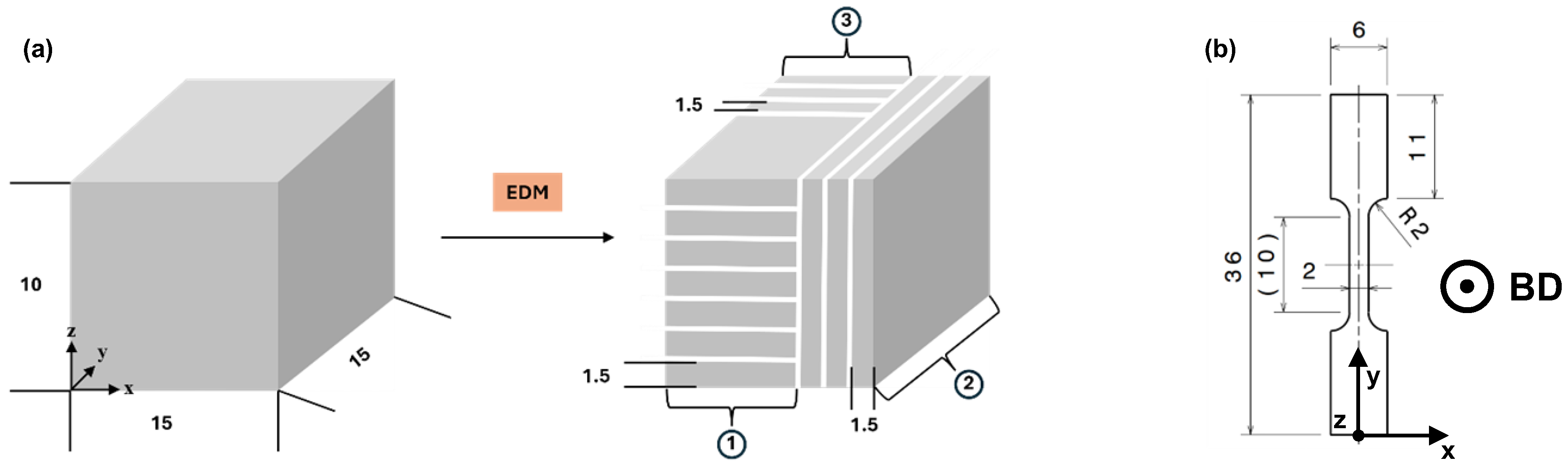
Cubes with dimensions of 15 mm × 15 mm × 10 mm were manufactured as well as near net-shape tensile testing samples in accordance with [15], which have been further machined by electrical discharge machining (EDM) (see Figure 1).
Prior to tensile testing, slices of the cubic samples were subjected to separate heat treatments in ambient atmosphere at 600 °C, 700 °C, 800 °C, and 1000 °C for 8 h, followed by water quenching. No signs of corrosion have been observed for the treated samples. For each orientation, e.g., x-y-plane (1) and z-direction (2 and 3) (see Figure 1a), three slices with a thickness of 1.5 mm were selected to assess depth-dependent hardness variations subsequent to the HT. Respective samples have been ground by P2500 or P4000 and subsequently probed by a Keyence VHX-600 (KEYENCE, Neu-Isenburg, Germany) digital optical microscope. The images of all slices have then been processed by Image J 1.54 g, formatted in 8-bit and analyzed by the function threshold to assess their relative density.
Vickers hardness testing was conducted using a Huayin HVS-1000A (Laizhou, China) system employing three indents per sample with a load of 9.8 N and a dwell time of 15 s. For phase analysis, additional slices of each orientation were ground by P2500 and subsequently polished by a W1 polishing spray before they were examined by XRD using a DX-2701BH (Haoyuan, China) diffractometer with Cu Kα radiation at 40 kV and 40 mA within a scanning angle range of 40° to 96° at a rate of 3°/min. An automated tool for background noise reduction was applied. Batches of four tensile testing samples were heat-treated under the same conditions as the slices and tested using an universal testing machine (Model E45.105, MTS Systems Corporation, Eden Prairie, MN, USA) at a strain rate of 0.18 mm/min. To avoid any influences of the rough surface, the tensile testing samples were cut into their final shape by taking off 1 mm from each surface before slicing them into their final testing shape of 1.5 mm thick slices. To optimize the surface, an additional step with reduced cutting speed was used in EDM to generate the final testing shape without further grinding or polishing. This procedure was applied to be closer to industrial applications, where not all surfaces can be ground. Elongation was measured by digital image correlation (DIC) using a GS3-U3-51S5M-C camera (FLIR, Canda, Waterloo, ON, Canada), operating at a frame rate of 500 ms, and finally analyzed using the VIC-3D software (Correlated Solutions Vic-3D V8). Evaluation of the microstructure and fracture surfaces was carried out using a Quanta 200 field emission gun (FEI Company, Hillsboro, OR, USA) scanning electron microscope (SEM) equipped with EDS to verify elemental distribution and assess homogeneity. For EDS analysis, an acceleration voltage of 15 kV and a magnification of 2000× were applied. Grain-size and morphology were investigated using an Olympus GX5 optical microscope (Olympus, Tokyo, Japan), after etching the samples in 50% aqua regia solution (20 mL HCl + 10 mL HNO3 + 30 mL H2O).
For in-depth microstructural characterization, a Helios 5 Hydra Cx Dual Beam (Thermo-Fisher, Dreieich, Germany) system equipped with an EBSD detector was employed. EBSD analysis was performed at 20 kV with various magnifications. Prior to assessment, all samples were mechanically ground to 5 μm using SiC paper and subsequently vibro-polished for 24 h with a colloidal silica suspension of 0.06 μm particle size. EBSD images presented in the present work always include the Image Quality (IQ) parameter obtained during EBSD acquisition. Phase discrimination and further quantitative evaluations were carried out using the indexed phase maps. Thereby, grain boundary rotation angles below 2° have been set to be disregarded and, thus, are not taken into account for the evaluation. No further data smoothening was carried out.

3. Results and Discussion

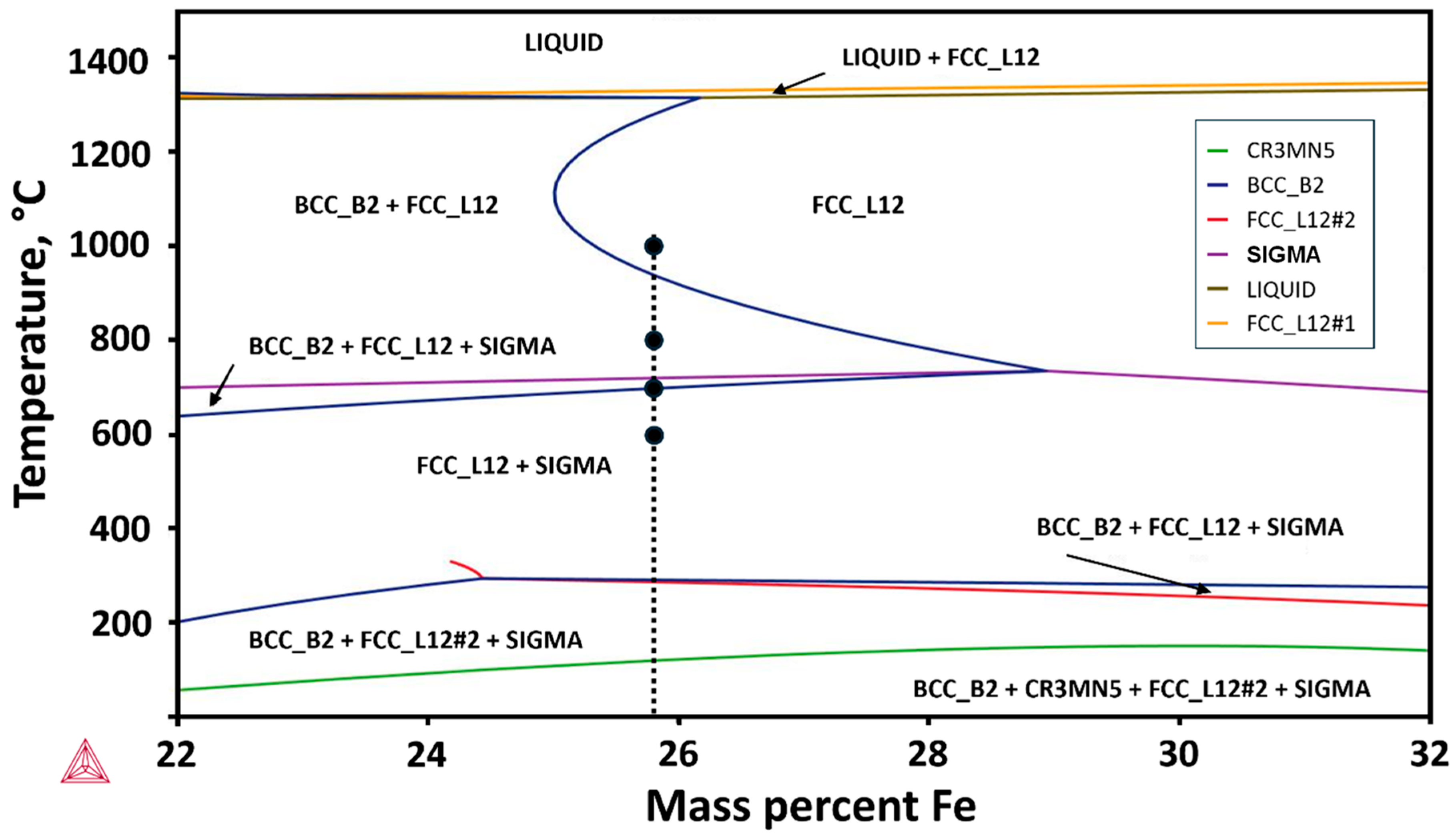
The alloy composition and selected heat treatment conditions were defined based on CALPHAD simulations. The calculated phase diagram (Figure 2) predicts a single FCC phase at 1000 °C. Upon cooling, the equilibrium phase constitution is expected to evolve sequentially from FCC + BCC to FCC + BCC + Sigma, and finally to FCC + Sigma. Complementary Scheil simulations, accounting for solute trapping, indicate that the non-treated (NT) condition should retain a single FCC phase.
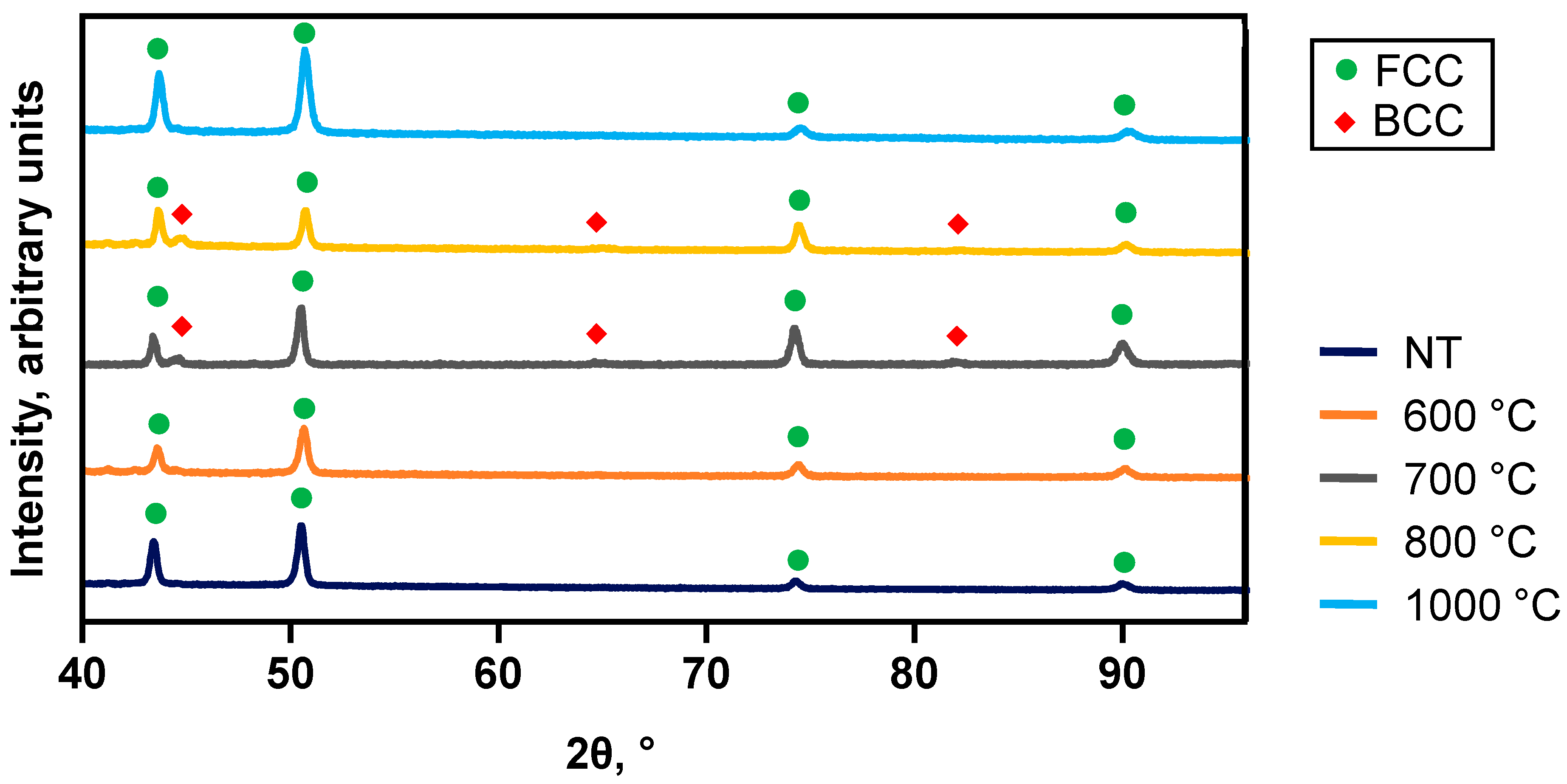
This prediction was evaluated by initial XRD measurements of the samples (Figure 3). The NT condition exhibited only reflections of the FCC structure. No Sigma-phase peaks were detected in samples heat-treated at 600 °C and 700 °C. However, those treated at 700 °C and 800 °C show additional low-intensity reflections referenced as a BCC phase. These results are consistent with previous studies reporting on single-phase FCC microstructures in additively manufactured FeCrMnNi alloys of similar composition [41]. A direct comparison with the Cr-containing alloy investigated in [39] points at the fact that the BCC phase formation sets in at 800 °C even in alloys with a relatively low Cr fraction (e.g., Cr0.8 in [39]). Likewise, data from [37] for heat-treated alloys demonstrate that targeted compositional modifications can reduce the critical temperature for BCC phase formation significantly (from about 1100 °C to a point between 700 °C and 800 °C).
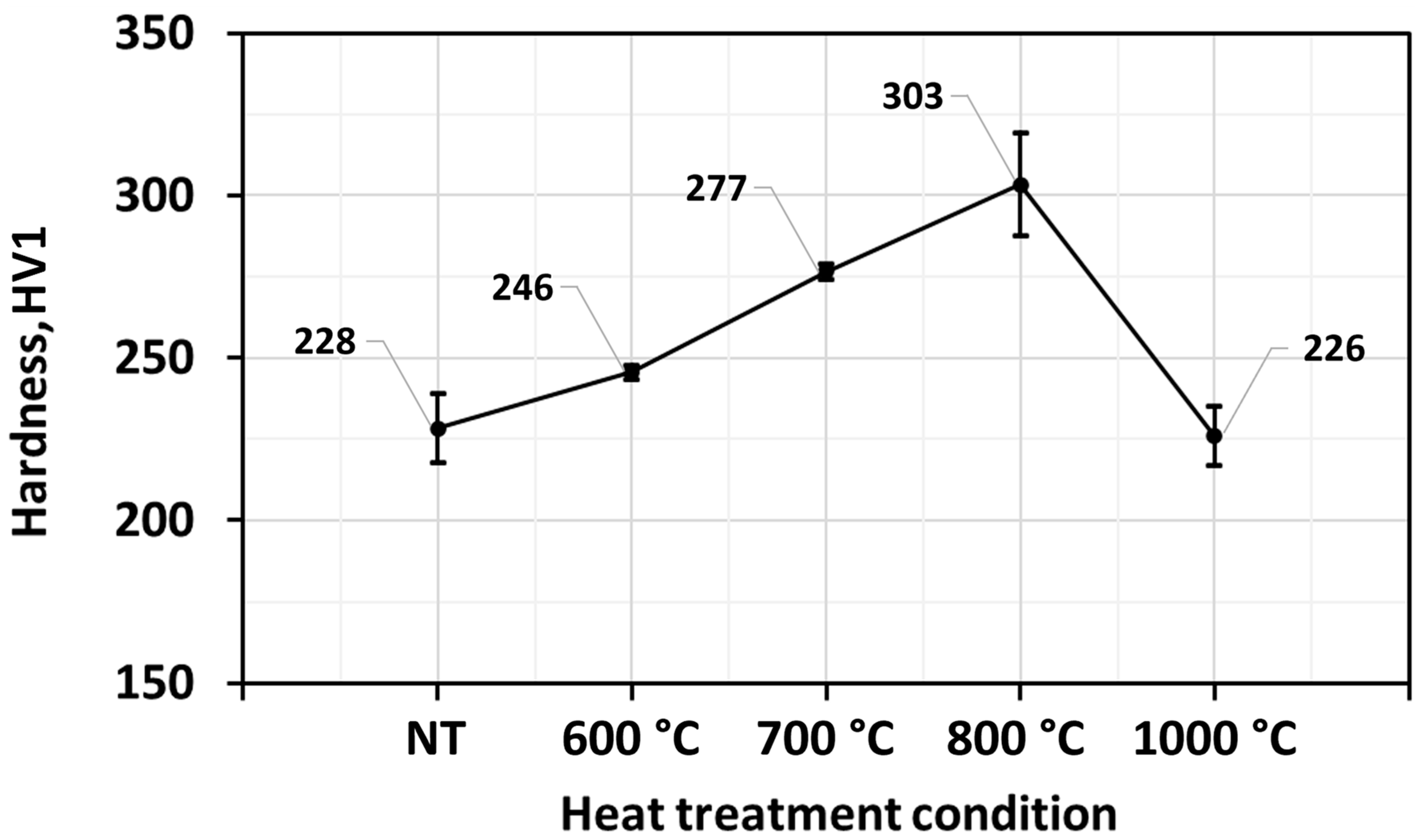
Vickers hardness measurements (Figure 4) further confirm the influence of the observed BCC phase formation. The hardness of the examined samples demonstrates an increasing trend up to a maximum value at 800 °C. This is in alignment with the observed emerging BCC phase, eventually forming an FCC/BCC dual phase after heat treatment between 700 °C and 800 °C. Among similar alloys, only the carbon-containing composition (Fe35Mn10Cr20Ni35)C1.2, with a reported hardness of 416 HV [42], exceeds the values obtained in present work. This finding emphasizes the potential of the FeCrMnNi alloy system, especially since the enhancement was achieved solely by heat treatment without compositional modification. In contrast, samples heat-treated at 1000 °C show a pronounced hardness reduction, consistent with the disappearing peaks at the 2θ-angles related to the BCC phase.
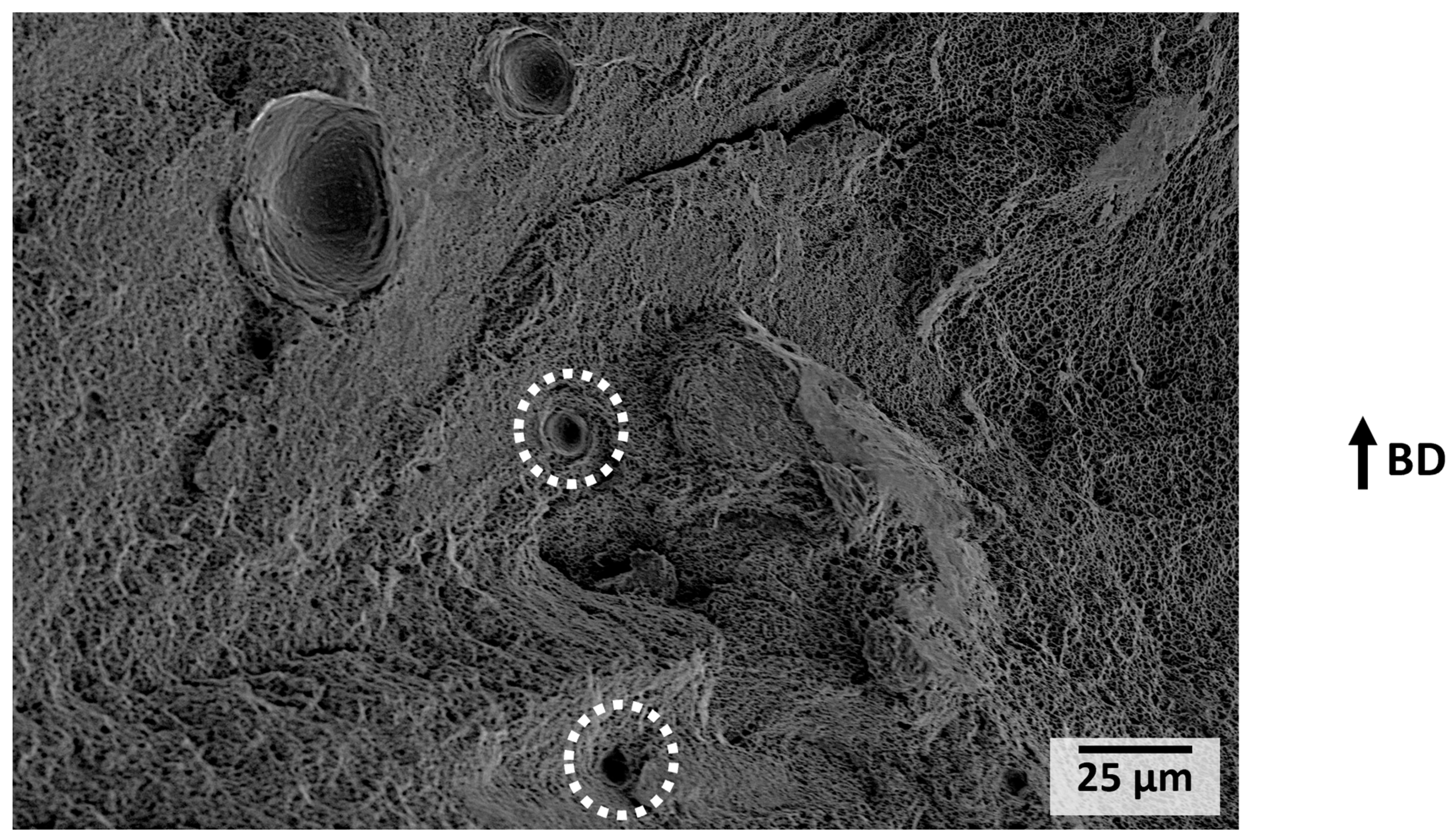
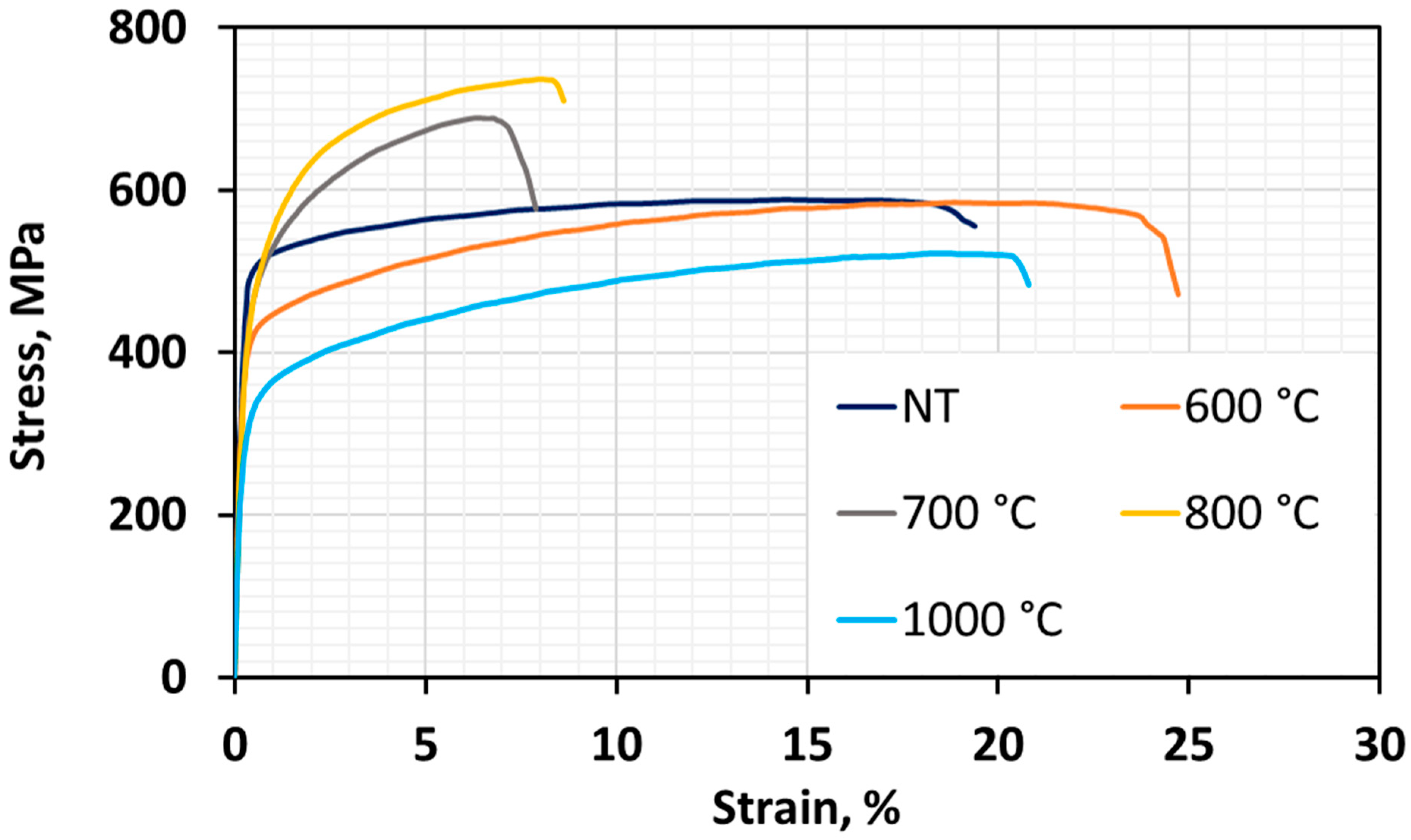
The experimentally determined hardness evolution is reflected well in the tensile tests, which pinpoint a high strength, but lower ductility, after heat treatment between 700 °C and 800 °C (Figure 5). Vice versa, heat treatment temperatures of below 700 °C and 1000 °C promote enhanced ductility, but a lower strength. The corresponding average values and standard deviations are summarized in Table 3. While the overall trend between hardness and strength is consistent, the variation in ductility among the different heat treatment conditions is pronounced and warrants further analysis. To investigate the origin of scatter, fracture surfaces were examined by SEM (see Figure 6). Apart from a few samples that failed prematurely due to pre-existing cracks, all other samples exhibited small defects typical for PBF-LB/M processed alloys (exemplary samples are marked by the white dashed circles in Figure 6). Nevertheless, four valid tensile test results were obtained for each heat treatment condition. These observations indicate that achieving a sample of the highest density through PBF-LB/M alone remains challenging, despite previous parameter optimization. Although HIP has been shown to enhance density [15], it was not applied in the present work.
Figure 4. Evolution of Vickers hardness HV1 in PBF-LB/M manufactured FeCrMnNi alloy as a function of heat treatment temperature.
Metals 16 00351 g004
Figure 5. Representative tensile stress–strain curves of the FeCrMnNi alloy fabricated via PBF-LB/M for different heat treatment conditions.
Metals 16 00351 g005
Figure 6. Representative SEM fractograph of a tensile sample heat-treated at 700 °C, showing a typical defect appearance (marked by white dashed circles) on the fracture surface of the PBF-LB/M processed FeCrMnNi alloy.
Metals 16 00351 g006
When all samples exhibiting a single FCC phase are directly compared, a clear trend can be derived, i.e., mechanical strength decreases with increasing heat treatment temperature. The enhanced strength of samples treated at 700 °C or 800 °C can be attributed to the formation of the secondary BCC phase. XRD investigations of the NT, 600 °C, and 1000 °C conditions did not point at emerging or dissolving phases. According to hardness characterization, the NT and 1000 °C samples should exhibit similar strength levels, being lower than that of the 600 °C condition. This correlation cannot be confirmed as not only the samples treated at 1000 °C demonstrated a relatively low yield strength, but also those treated at 600 °C. However, a more pronounced hardening is seen for the latter condition, such that a similar ultimate tensile strength as in case of the NT condition prevails. To clarify the underlying mechanisms, additional microstructural analyses were performed using optical microscopy (Figure 7).
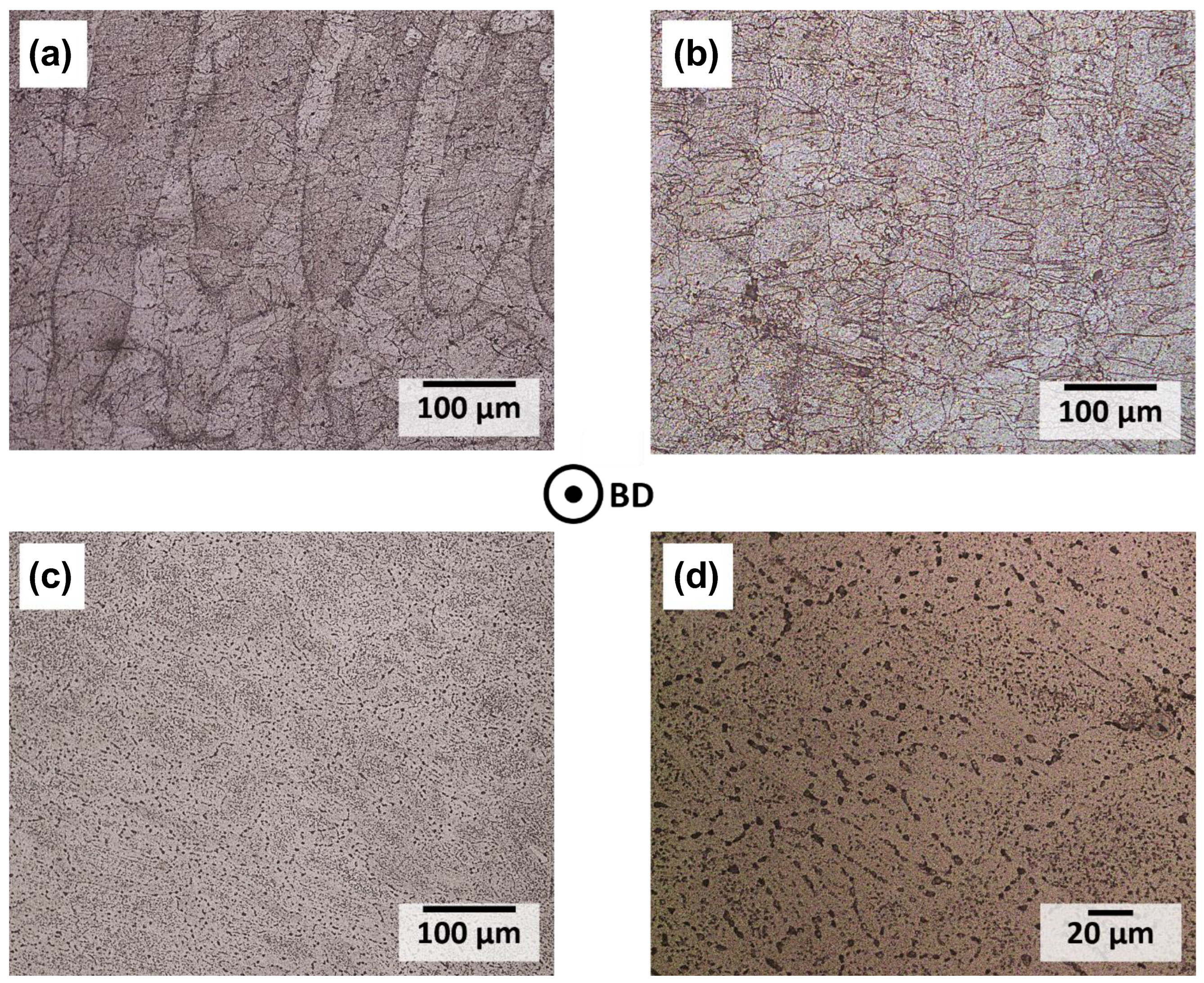
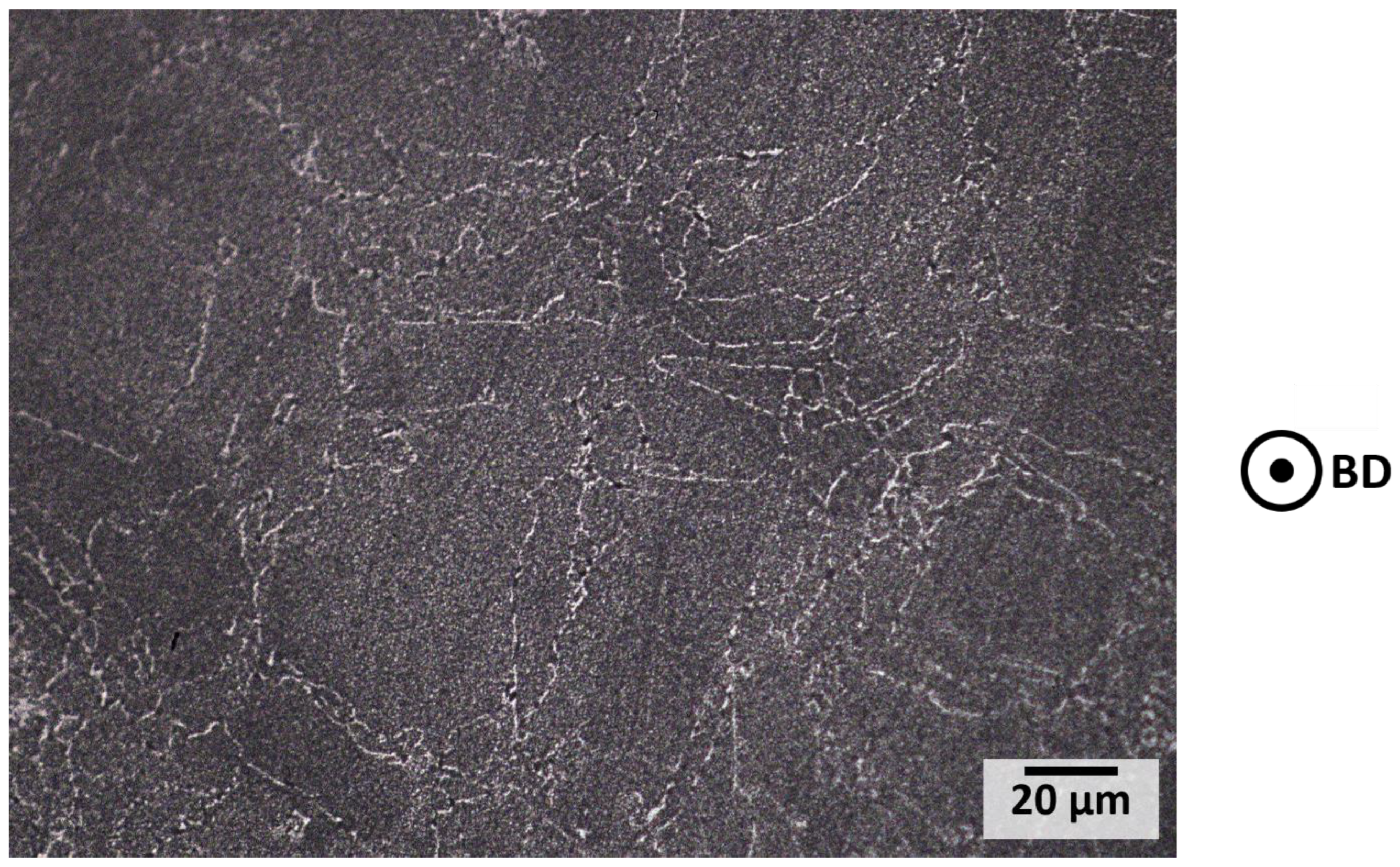
Optical micrographs of samples treated at temperatures up to 600 °C (Figure 7a,b) reveal long columnar grains being characteristic for additively manufactured materials. The features seen follow the melt pool boundaries and laser scan tracks within each layer. Within these grains, finer sub-grain structures are visible, formed by the cyclic thermal exposure during subsequent scan passes and layer deposition [41,43]. Eventually, this morphology reflects the high dislocation density generated by the steep thermal gradients (dT/dt), and the sluggish diffusion characteristic of FeCrMnNi-based alloys [43]. Per definition, the yield strength of a material defines the point on the stress–strain curve when the dislocations start to move and plastic deformation occurs [44]. The elevated yield strength of the NT condition could therefore be attributed to dislocation strengthening. According to the Bailey–Hirsch relationship [42], the interaction between dislocations impedes their motion, resulting in increased resistance to plastic deformation. During heat treatment, recovery processes enable vacancy annihilation and dislocation rearrangement, progressively reducing dislocation density [43]. As a result, grain boundary strengthening becomes increasingly dominant in samples treated after AM.
Figure 7. Optical micrographs of different conditions of the PBF-LB/M processed FeCrMnNi alloy taken at various magnifications: (a) NT-20×, (b) 600 °C-20×, (c) 1000 °C-20× and (d) 1000 °C-50×. The build direction is marked.
Metals 16 00351 g007
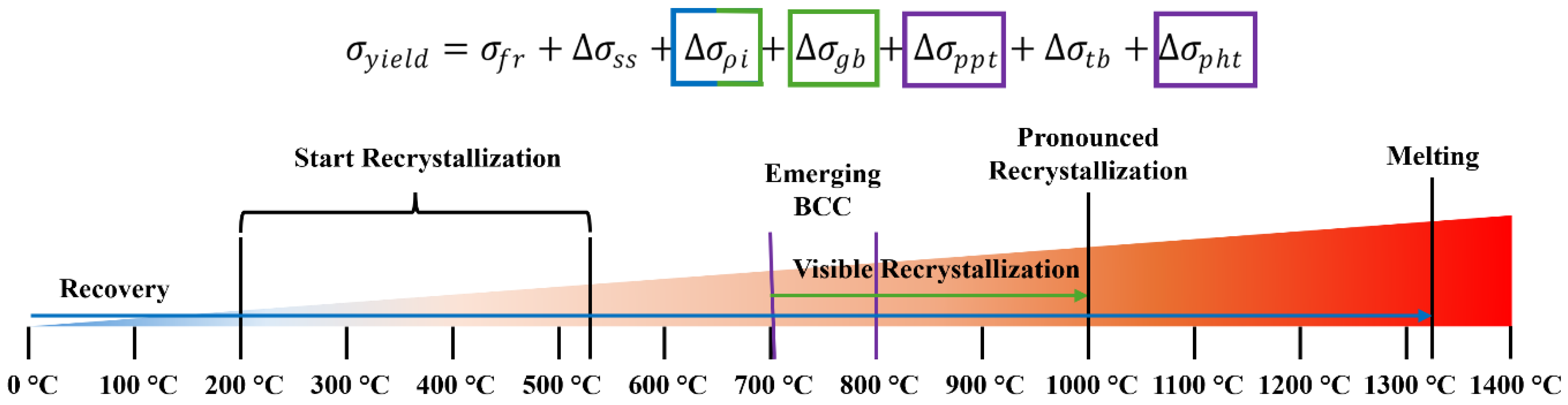
At elevated temperatures, typically above 0.3–0.5 Tm, recovery and recrystallization processes alter the grain morphology and promote the growth of sub-grain structures [43]. The extent of recrystallization and the associated reduction in dislocation density depend on both the heat treatment temperature and duration. To compensate for the sluggish diffusion behavior assumed for FeCrMnNi-based alloys, all heat treatments in the present work were performed for 8 h. CALPHAD simulations predict a melting point of approximately 1310 °C, i.e., recrystallization is expected to initiate in a temperature window between about 200 °C and 520 °C.
Optical micrographs of samples heat-treated at 600 °C reveal that the columnar grain morphology remains largely unchanged, indicating that recovery rather than recrystallization is the dominant mechanism. In contrast, the microstructure of samples treated at 1000 °C shows complete dissolution of columnar grains and the formation of new, equiaxed grains (Figure 7d), evidencing a pronounced recrystallization process. A direct comparison further demonstrates a significantly increased grain size in the 1000 °C condition (Figure 7c). The sub-grain structures seen in the samples treated up to 600 °C (Figure 7a,b) are significantly finer. Accordingly, the reduced yield strength in the 600 °C condition can be attributed primarily to recovery, while the lower yield and ultimate tensile strengths of the 1000 °C samples result from the combined effects of recovery, recrystallization, and subsequent grain growth. As grain boundaries act as barriers to dislocation motion, grain coarsening at 1000 °C further contributes to softening.
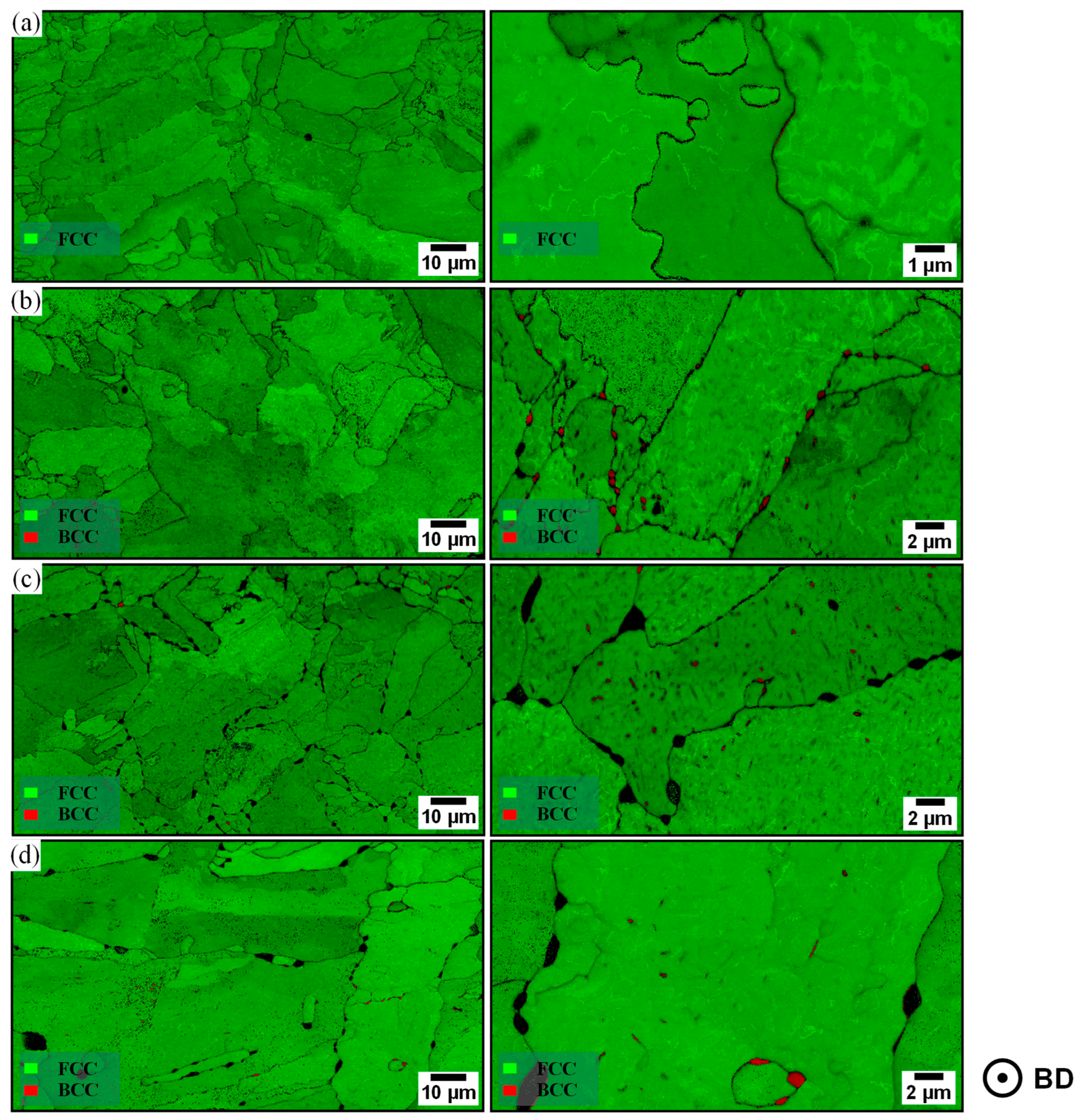
Additional insights gathered by the EBSD phase maps (Figure 8) lead to a slightly different conclusion. Samples treated at 700 °C and 800 °C reveal the presence of minor fractions of a secondary BCC phase seen at the grain boundaries (of the dominating FCC phase grains). A more detailed analysis of the phase maps at various magnifications further revealed that the observed black lines resemble highly complex patterns of a non-specified crystal structure (most likely a Sigma or laves phase). While the examined samples reveal an increasing fraction of these unknown patterns up to heat treatment temperatures of 800 °C, their position and shape is also in line with the observed dark points of the already discussed optical micrographs (Figure 7). Further increasing heat treatment temperatures demonstrate not only decreasing fractions of the unknown pattern, but also remaining fractions of the detected BCC phase. Although these additional data could be obtained by the EBSD investigations, some further details remain unresolved. The size and fraction of the precipitates embedded within the grains (Figure 8b,c), most probably being responsible for the increased strength, fall below the size being reliably indexed. However, according to XRD analysis (Figure 3), it is assumed that here the BCC phase formed (as only this would amount to a volume fraction being able to increase the BCC peak intensity to the level seen in XRD results). Further transmission electron microscopy (TEM) investigations including selected area diffraction (SAD) analysis are needed here to gain additional information, however, this is beyond the scope of the present work.
The potential of multicomponent high- or medium-entropy alloys can be rationalized by the combination of multiple strengthening mechanisms, including lattice friction (σfr), solid-solution strengthening (Δσss), dislocation strengthening (Δσρi), grain boundary strengthening (Δσgb), precipitation hardening (Δσppt), twin boundary strengthening (Δσtb), and phase-transformation strengthening (Δσpht) (cf. Figure 9). A comparison of the present results with data from the literature indicates that several of these mechanisms act simultaneously in the investigated alloy. The following discussion will focus on an elimination-based assessment, taking into account the present observations to further deduce potential reasons for the determined mechanical properties. In particular, the changing strength of samples heat-treated at 700 °C and 800 °C can be attributed to a superposition of increasing grain size, the characteristics of the grain boundaries and the formation of additional phases (Figure 8b,c). A direct comparison with similar compositions reported in the literature (Table 4) indicates that the presence of an additional phase, e.g., the BCC phase, alone does not fully account for the observed strengthening. For example, sintered samples produced from mechanically milled powders—containing only ~2.1 wt. % of the BCC phase—have shown superior yield and ultimate tensile strengths, implying that additional microstructural factors, such as dislocation density or grain boundary hardening, contribute significantly to the overall mechanical response [38]. Values reported even exceed the reported strength of similar compositions in [39], which contained a BCC fraction of about 23.1%.
Figure 8. SEM-EBSD phase map of the PBF-LB/M manufactured FeCrMnNi alloy heat-treated at (a) NT (b) 700 °C (c) 800 °C and (d) 1000 °C.
Metals 16 00351 g008
Figure 9. Strengthening mechanisms according to [4] and schematic representation of the main strengthening mechanisms—and their dependence on heat treatment—contributing to the mechanical behavior of the PBF-LB/M processed FeCrMnNi alloy. See main text for details.
Metals 16 00351 g009
In this context, a homogeneous elemental distribution and the high dislocation density inherent to the AM process appear crucial for promoting a fine dispersion of evolving precipitates during heat treatment. The nucleation mode of such precipitates—homogeneous versus heterogeneous—is expected to play an essential role. While low dislocation densities generally favor homogeneous precipitation, high dislocation densities promote heterogeneous nucleation, sometimes leading to incoherent precipitates that are less effective for strengthening [45].
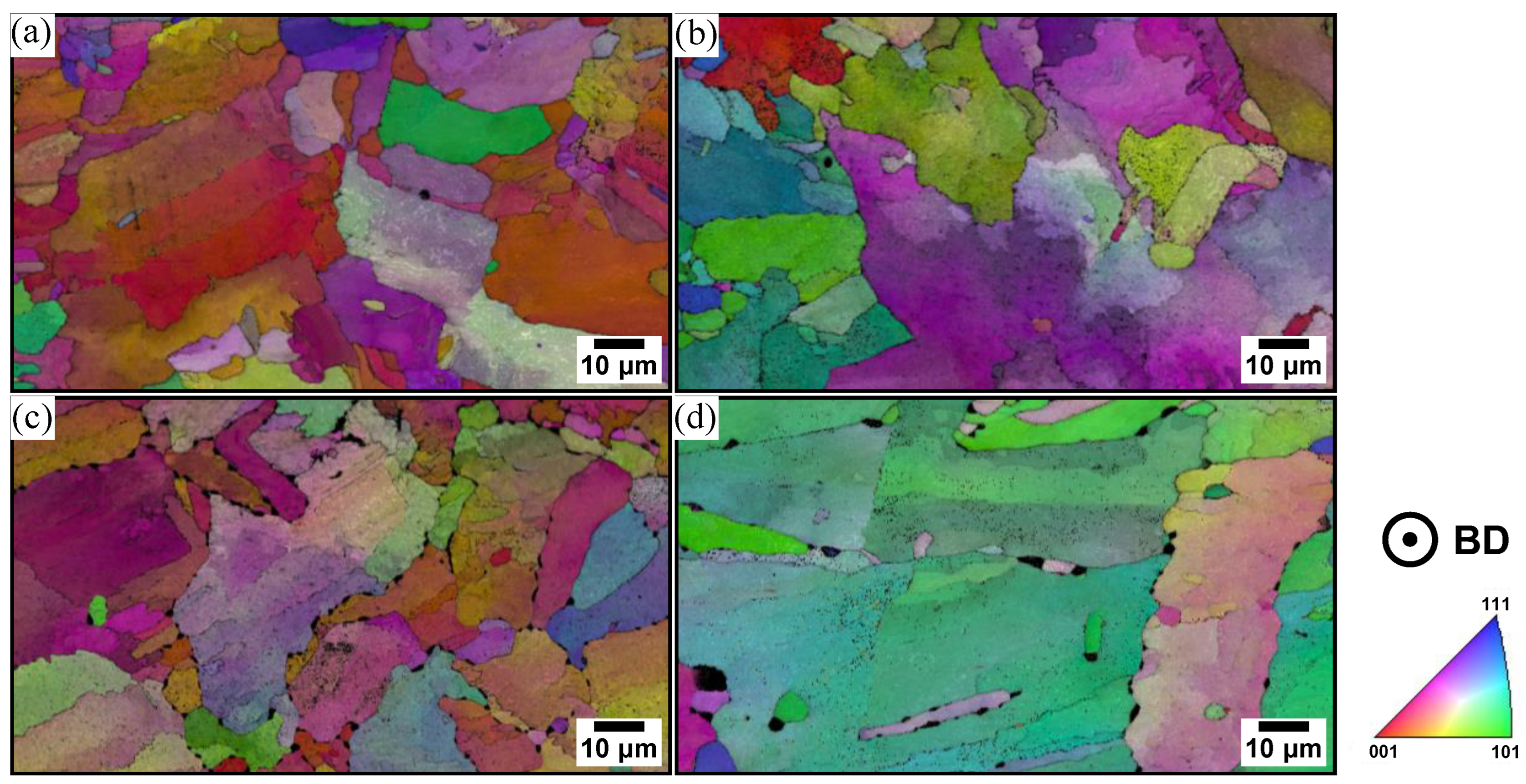
Another possible combination of strengthening effects in high- and medium-entropy alloys arises from the superposition of dislocation and grain boundary strengthening [39]. This can be illustrated by comparing the grain size of the Cr1.5 alloy reported in [39] (grain sizes 6.3–6.6 µm) with that of sintered samples produced from milled powder, which exhibited grain sizes below 1 µm after sintering at 1050 °C [38]. In contrast, nitrogen-doped alloys composed of a single FCC phase and strengthened by interstitial hardening [40] showed grain sizes between 28 and 36 µm. Optical microscopy of the present samples (Figure 7) reveals larger grains compared to those reported in [38,39]. This observation suggests that the higher yield and ultimate tensile strengths of the 800 °C heat-treated condition may, at least partially, be contradicted by a coarser grain structure. Additional assessment of the crystal orientation maps demonstrates a complex microstructure without a preferred orientation (Figure 10). The color-coded maps of crystal orientation are characterized by significant fluctuations throughout all tested samples. This fluctuation, resembling the complex nature of examined microstructure, pinpoints the presence of sub-grain structures. Thus, quantitative values for grain size derived from EBSD data are not listed here. Instead, the qualitative analysis of the grain size evolution, supported by the results depicted in the optical micrographs is thought to be sufficient for assessment at this point. Further investigations for quantitative grain-size evaluation have to be addressed in subsequent studies including TEM work.
Figure 10c and Figure 11 reveal that the characteristic columnar grain morphology of the additively manufactured samples is replaced by more equiaxed grains, indicating recrystallization. Since reduced dislocation density has already been identified as a factor lowering yield strength in single-phase FCC alloys, it can be inferred that prolonged heat treatment at 800 °C further decreases the remaining dislocation density. Nevertheless, comparison with nitrogen-doped samples from [40] shows that the yield strength of all samples in the present study—except for those treated at 1000 °C—remains higher. As the alloys in [40] consist of a single FCC phase containing Cr2N precipitates, the superior performance of the NT samples in the present study can be attributed to the small size of the prevailing sub-grain structures and the relatively high dislocation density.
As discussed, the differences in mechanical properties among the investigated samples most likely result from a combination of several factors, including recrystallization-induced changes in grain morphology, the formation of multiple complex phases, and the evolution of the prevailing dislocation structures. Since the examined microstructure is composed of the emerging BCC phase and additional fractions of a non-specified phase (revealed by complex patterns), further investigations involving TEM are necessary. Additionally, a complex grain morphology and a heterogeneous size structures have been observed. The results presented and discussed highlight the importance of the overall alloy composition and the synergistic contributions of multiple strengthening mechanisms. Here, particularly complex phase compositions, nano-sized precipitates, hierarchical grain structures and the potentially arising HDI strengthening effect have to be taken into account. A direct comparison with other studies further shows that even alloys with FCC/BCC dual-phase constitution and lower BCC phase fraction can achieve a higher strength, emphasizing that the presence of a BCC phase is not necessarily the dominant factor. A more detailed comparative investigation of compositional and microstructural effects is therefore needed in follow-up studies.

4. Summary and Conclusions

In the present study, a FeCrMnNi medium-entropy alloy was successfully fabricated by PBF-LB/M and subjected to systematic heat treatments between 600 °C and 1000 °C for 8 h. Mechanical testing and microstructural characterization led to the following conclusions:
  • Heat treatment at 700 °C and above led to the evolution of a BCC phase, resulting in significantly increased hardness and strength for samples treated at 700 °C and 800 °C.
  • Minor compositional adjustments, guided by CALPHAD simulations, effectively reduced the critical temperature for BCC phase formation to below 800 °C.
  • EBSD assessments revealed a complex phase constitution including a domination volume fraction of the FCC phase, and additional, but non-specified phases, these being characterized by a complex Kikuchi pattern.
  • Heat treatment at 700 °C and above promoted the evolution of the BCC phase. XRD investigations only revealed the presence of the BCC phase for samples treated between 700 °C and 800 °C. Other phases are below the detection limit.
  • The results obtained clearly indicate that the strengthening mainly originates from the nanoscale features and dislocation structures.
  • Recovery and recrystallization at elevated temperatures of 1000 °C led to the evolution of equiaxed grains and a reduced strength, highlighting the sensitivity of mechanical performance to microstructural evolution.
In summary, the present work demonstrates that the synergistic combination of additive manufacturing, compositional design and tailored post-processing enables targeted tuning of microstructure and mechanical properties in FeCrMnNi-based medium-entropy alloys. The presented results highlight the complexity of the examined composition that has not been reported in this form for similar compositions, leading to the necessity of further investigations.

Author Contributions

Conceptualization, D.M.D.; Methodology, D.M.D.; Writing—original draft, D.M.D. and T.W.; Writing—review and editing, D.M.D., T.W., Z.H. and T.N.; Funding Acquisition, Z.H. and T.N.; Investigation, D.M.D.; Data curation, D.M.D. and T.W.; Visualization, D.M.D. and T.W.; Project Administration, Z.H. and T.N.; Supervision, Z.H. and T.N. All authors have read and agreed to the published version of the manuscript.

Funding

This research received no external funding.

Data Availability Statement

The original contributions presented in this study are included in the article. Further inquiries can be directed to the corresponding authors.

Acknowledgments

The authors gratefully acknowledge the help of M. Wang (Wenzel Measuring Machines (Shanghai) Co., Ltd.) and S. Hui (Yin Yue Tech (Shanghai) Co., Ltd.).

Conflicts of Interest

The authors declare that they have no known competing financial interests or personal relationships that could have appeared to influence the work reported in this paper.

References

  1. Cantor, B.; Chang, I.; Knight, P.; Vincent, A. Microstructural development in equiatomic multicomponent alloys. Mater. Sci. Eng. A 2004, 375–377, 213–218. [Google Scholar] [CrossRef]
  2. Huang, P.-K.; Yeh, J.-W.; Shun, T.-T.; Chen, S.-K. Multi-Principal-Element Alloys with Improved Oxidation and Wear Resistance for Thermal Spray Coating. Adv. Eng. Mater. 2004, 6, 74–78. [Google Scholar] [CrossRef]
  3. Yeh, J.-W.; Chen, S.-K.; Lin, S.-J.; Gan, J.-Y.; Chin, T.-S.; Shun, T.-T.; Tsau, C.-H.; Chang, S.-Y. Nanostructured High-Entropy Alloys with Multiple Principal Elements: Novel Alloy Design Concepts and Outcomes. Adv. Eng. Mater. 2004, 6, 299–303. [Google Scholar] [CrossRef]
  4. Li, W.; Xie, D.; Li, D.; Zhang, Y.; Gao, Y.; Liaw, P.K. Mechanical behavior of high-entropy alloys. Prog. Mater. Sci. 2021, 118, 100777. [Google Scholar] [CrossRef]
  5. Listyawan, T.A.; Lee, H.; Park, N. A new guide for improving mechanical properties of non-equiatomic FeCoCrMnNi medium- and high-entropy alloys with ultrasonic nanocrystal surface modification process. J. Mater. Sci. Technol. 2020, 59, 37–43. [Google Scholar] [CrossRef]
  6. Long, Y.; Yang, J.; Peng, H.; Vogel, F.; Chen, W.; Su, K. Combination of enhanced strength and sufficient tensile ductility in a sintered ultrafine-grained CoFeMnNi medium-entropy alloy. Mater. Sci. Eng. A 2022, 831, 142175. [Google Scholar] [CrossRef]
  7. Shen, Q.; Kong, X.; Chen, X. Significant transitions of microstructure and mechanical properties in additively manufactured Al–Co–Cr–Fe–Ni high-entropy alloy under heat treatment. Mater. Sci. Eng. A 2021, 815, 141257. [Google Scholar] [CrossRef]
  8. Zhao, S.; Xin, D.; Chen, X.; Stasic, J.; Trtica, M.; Siddiquee, A.N.; Mohan, S. Microstructure and enhanced tensile properties of AlCo CrFeNi high entropy alloys with high Co content fabricated by laser melting deposition. J. Alloys Compd. 2022, 917, 165403. [Google Scholar] [CrossRef]
  9. Zeng, Z.; Xiang, M.; Zhang, D.; Shi, J.; Wang, W.; Tang, X.; Tang, W.; Wang, Y.; Ma, X.; Chen, Z.; et al. Mechanical properties of Cantor alloys driven by additional elements: A review. J. Mater. Res. Technol. 2021, 15, 1920–1934. [Google Scholar] [CrossRef]
  10. Hou, Y.; Liu, T.; He, D.; Li, Z.; Chen, L.; Su, H.; Fu, P.; Dai, P.; Huang, W. Sustaining strength-ductility synergy of SLM Fe50Mn30Co10Cr10 metastable high-entropy alloy by Si addition. Intermetallics 2022, 145, 107565. [Google Scholar] [CrossRef]
  11. Asghari Alamdari, A.; Hashemkhani, M.; Hendessi, S.; Yagci Acar, H.; Unal, U.; Motallebzadeh, A. A comprehensive study of microstructure, mechanical behavior, biocorrosion, and cytotoxicity of RF-PVD deposited Ti1.5ZrTa0.5Nb0.5X0.5 (X: Hf, Mo, and W) refractory high-entropy alloy films on 316L. Intermetallics 2023, 162, 108003. [Google Scholar] [CrossRef]
  12. Wang, X.; Liu, J.; Zhang, Y.; Zhang, A.; Hou, H.; Miao, Z.; Hongliang, D. Microstructure and mechanical property of novel nanoparticles strengthened AlCrCuFeNi dual-phase high entropy alloy. Mater. Today Commun. 2022, 32, 104155. [Google Scholar] [CrossRef]
  13. He, M.Y.; Shen, Y.F.; Jia, N.; Liaw, P.K. C and N doping in high-entropy alloys: A pathway to achieve desired strength-ductility synergy. Appl. Mater. Today 2021, 25, 101162. [Google Scholar] [CrossRef]
  14. Son, S.; Lee, J.; Asghari-Rad, P.; Gu, G.H.; Haftlang, F.; Kim, H.S. A facile strengthening method by co-doping boron and nitrogen in CoCrFeMnNi high-entropy alloy. Mater. Sci. Eng. A 2022, 846, 143307. [Google Scholar] [CrossRef]
  15. Ostovari Moghaddam, A.; Shaburova, N.A.; Samodurova, M.N.; Abdollahzadeh, A.; Trofimov, E.A. Additive manufacturing of high entropy alloys: A practical review. J. Mater. Sci. Technol. 2021, 77, 131–162. [Google Scholar] [CrossRef]
  16. Oevermann, T.; Wegener, T.; Liehr, A.; Hübner, L.; Niendorf, T. Evolution of residual stress, microstructure and cyclic performance of the equiatomic high-entropy alloy CoCrFeMnNi after deep rolling. Int. J. Fatigue 2021, 153, 106513. [Google Scholar] [CrossRef]
  17. Xiao, L.L.; Zheng, Z.Q.; Guo, S.W.; Huang, P.; Wang, F. Ultra-strong nanostructured CrMnFeCoNi high entropy alloys. Mater. Des. 2020, 194, 108895. [Google Scholar] [CrossRef]
  18. Wu, Y.; Luo, K.; ZHANG, Y.; KONG, C.; Yu, H. Microstructures and mechanical properties of a CoCrFeNiMn high-entropy alloy obtained by 223 K cryorolling and subsequent annealing. J. Alloys Compd. 2022, 921, 166166. [Google Scholar] [CrossRef]
  19. Ji, P.; Wang, Z.; Jia, Y.; Yang, D.; Ma, P.; Zhao, W.; Li, D.; Mu, Y.; Wang, G. Microstructural evolution and mechanical properties of (FeCoNi)85·84Al7·07Ti7.09 high-entropy alloy by selective laser melting with aging treatment. J. Mater. Res. Technol. 2023, 25, 6313–6322. [Google Scholar] [CrossRef]
  20. Zhou, Y.; Kang, J.; Ma, G.; Zhu, L.; Da, Q.; Liu, B.; Li, R. Annealing treatment’s impact on the microstructure and mechanical properties of HVOF-sprayed high-entropy alloy coatings with AlxCoCrFeNi composition (x = 0.4, 0.7, 1.0). J. Alloys Compd. 2025, 1010, 177766. [Google Scholar] [CrossRef]
  21. Li, D.; Liaw, P.K.; Zhang, Y.; Wang, W. Mechanical behavior of AlxCoCrFeNi high-entropy-alloy rods in a wide temperature range. Mater. Sci. Eng. A 2025, 927, 148037. [Google Scholar] [CrossRef]
  22. Ma, Y.; Zhang, W.; Xiang, Q.; Ren, Y.; Qiu, K. Effect of Al addition on phase constituent and corrosion behaviors of Al CrFeMo0.5Ni2 high-entropy alloys. J. Mater. Res. Technol. 2025, 35, 1519–1530. [Google Scholar] [CrossRef]
  23. Zhu, Z.; Li, N.; Yan, D.; Lu, C.; Guo, S.; Li, D.; Li, Q.; Huang, S. Corrosion behavior of additively manufactured AlCrFeNi in lead-bismuth eutectic: Dendritic oxides layer facilitate resistance to corrosion spalling. J. Mater. Res. Technol. 2025, 36, 9182–9197. [Google Scholar] [CrossRef]
  24. Gao, Z.; Xue, L.; Peng, X.; Cao, P.; Liu, Q.; Wang, H.; Wu, W.; Hu, X.; Qiu, L. Enhanced compatibility of Al-modulated Al NiCoFeCr high-entropy alloy and microstructure degradation under static oxygen-saturated lead bismuth eutectic. J. Alloys Compd. 2025, 1037, 182253. [Google Scholar] [CrossRef]
  25. Wang, L.; Tang, H.W.; Zhao, X.J.; Pi, F.W.; He, L.H.; Han, P.F.; Zhao, H.Y.; Lei, Y.Z. Deformation mechanisms and mechanical properties of metastable (Fe60Co10Cr10Mn10Ni10) 100−xCrx high-entropy alloy. J. Alloys Compd. 2025, 1036, 181694. [Google Scholar] [CrossRef]
  26. Shockner, R.; Edry, I.; Pinkas, M.; Meshi, L. Systematic study of the effect of Cr on the microstructure, phase content and hardness of the AlCrxFeCoNi alloys. J. Alloys Compd. 2023, 940, 168897. [Google Scholar] [CrossRef]
  27. Moazzen, P.; Toroghinejad, M.R.; Cavaliere, P. Effect of Iron content on the microstructure evolution, mechanical properties and wear resistance of FeXCoCrNi high-entropy alloy system produced via MA-SPS. J. Alloys Compd. 2021, 870, 159410. [Google Scholar] [CrossRef]
  28. Shen, Q.; Huang, D.; Li, F.; Liu, M.; Wang, X. Microstructures and mechanical properties of the precipitation strengthened Al0.4Cr0.7FexNi2V0.2 high entropy alloys. Mater. Sci. Eng. A 2023, 864, 144606. [Google Scholar] [CrossRef]
  29. Zhang, D.; Li, Q.; Chang, C.; Zhang, G.; Ma, X.; Sun, R. Effects of Mn addition on wear and corrosion resistances of AlCoCrFeNi high-entropy alloy coating sprayed by HVOF. J. Mater. Res. Technol. 2025, 34, 627–638. [Google Scholar] [CrossRef]
  30. Atalay Kalsen, T.S.; Polat, G.; Baloğlu, A.R.; Bostancı, V.M. Phase transformation and segregation in Ni-modified (CoCrCuFe)100-xNix (x = 5, 20, 35, 50 at%) high entropy alloys: A study of microstructure and mechanical performance. J. Alloys Compd. 2025, 1021, 179726. [Google Scholar] [CrossRef]
  31. Ji, G.-N.; Xiang, J.; Zhao, R.-D.; Wu, F.-F.; Chen, S.-H. Microstructure and mechanical properties of NixFeCoCrAl high-entropy alloys. Mater. Today Commun. 2022, 32, 103919. [Google Scholar] [CrossRef]
  32. Peng, S.; Wang, S.; Hao, Z.; Wang, D.; Shu, D. Hierarchical coherent precipitates lead to high tensile strength in casting BCC-structured Al0.8CrNiMn2Fe2.5 high-entropy alloy. J. Mater. Res. Technol. 2025, 36, 903–912. [Google Scholar] [CrossRef]
  33. Wang, X.; Xu, Z.; Guo, C.; Xie, H.; Ma, T.; Li, A. Improving the ductility of high-strength NiAl-based high-entropy alloys by introducing hierarchical nanoscale phases. Mater. Charact. 2025, 220, 114698. [Google Scholar] [CrossRef]
  34. Yun, D.; Chae, H.; Lee, T.; Lee, D.-H.; Ryu, H.J.; Banerjee, R.; Harjo, S.; Kawasaki, T.; Lee, S.Y. Stress contribution of B2 phase in Al0.7CoCrFeNi eutectic high entropy alloy. J. Alloys Compd. 2022, 918, 165673. [Google Scholar] [CrossRef]
  35. Duan, S.; Dong, Y.; Liu, S.; Zhang, J.; Hu, Y. Coherent precipitation hardening effect and hetero-deformation mechanism in eutectic medium-entropy alloy. J. Alloys Compd. 2025, 1022, 179858. [Google Scholar] [CrossRef]
  36. Gu, J.; Sun, Y.; Cheng, W.; Chong, Z.; Ma, X.; Huang, L.; Zhang, S.; Chen, Y. Microstructure and wear resistance of multi-layer graphene doped AlCoCrFeNi2.1 high-entropy alloy self-lubricating coating prepared by laser cladding. Intermetallics 2025, 176, 108578. [Google Scholar] [CrossRef]
  37. Liu, H.; Gu, C.; Zhai, K.; Wang, C. Strengthening and toughening the FeNiCrMn medium entropy alloy by novel ultrafine precipitate networks. Vacuum 2021, 184, 109995. [Google Scholar] [CrossRef]
  38. Lehtonen, J.; Lehto, P.; Ge, Y.; Juselius, A.; Hannula, S.-P. Mechanical properties of pulsed electric current sintered CrFeNiMn equiatomic alloy. Mater. Sci. Eng. A 2022, 842, 143071. [Google Scholar] [CrossRef]
  39. Zhang, Y.; Wu, H.; Yu, X.; Tang, D.; Yuan, R.; Sun, H. Microstructural evolution and strengthening mechanisms in CrxMnFeNi high-entropy alloy. J. Mater. Res. Technol. 2021, 12, 2114–2127. [Google Scholar] [CrossRef]
  40. Traversier, M.; Mestre-Rinn, P.; Peillon, N.; Rigal, E.; Boulnat, X.; Tancret, F.; Dhers, J.; Fraczkiewicz, A. Nitrogen-induced hardening in an austenitic CrFeMnNi high-entropy alloy (HEA). Mater. Sci. Eng. A 2021, 804, 140725. [Google Scholar] [CrossRef]
  41. Yang, X.; Ge, Y.; Lehtonen, J.; Hannula, S.-P. Hierarchical Microstructure of Laser Powder Bed Fusion Produced Face-Centered-Cubic-Structured Equiatomic CrFeNiMn Multicomponent Alloy. Materials 2020, 13, 4498. [Google Scholar] [CrossRef] [PubMed]
  42. Zhou, J.; Liao, H.; Chen, H.; Huang, A. Carbon-alloyed Fe35Mn10Cr20Ni35 high entropy alloy synthesized by mechanical alloying plus spark plasma sintering. J. Alloys Compd. 2021, 859, 157851. [Google Scholar] [CrossRef]
  43. Lin, D.; Xu, L.; Jing, H.; Han, Y.; Zhao, L.; Minami, F. Effects of annealing on the structure and mechanical properties of FeCoCrNi high-entropy alloy fabricated via selective laser melting. Addit. Manuf. 2020, 32, 101058. [Google Scholar] [CrossRef]
  44. Weißbach, W.; Dahms, M.; Jaroschek, C. Werkstoffkunde. Strukturen, Eigenschaften, Prüfung; Springer Fachmedien Wiesbaden: Wiesbaden, Germany, 2015. [Google Scholar]
  45. Xu, C.; Dai, W.J.; Chen, Y.; Qi, Z.X.; Zheng, G.; Cao, Y.D.; Zhang, J.P.; Bu, C.C.; Chen, G. Control of dislocation density maximizing precipitation strengthening effect. J. Mater. Sci. Technol. 2022, 127, 133–143. [Google Scholar] [CrossRef]
Figure 1. Dimensions and final appearance of (a) cubic samples processed (with z-axis parallel to building direction) and (b) additional samples machined for tensile testing by EDM. The loading direction of the samples corresponds to the y-axis. The build direction of the PBF-LB/M process is marked by BD.
Metals 16 00351 g001
Figure 2. Calculated phase diagram of the FeCrMnNi alloy. The black vertical line marks the Fe content of the composition investigated within the present study. The black dots on the vertical line indicate the heat treatment temperatures investigated.
Metals 16 00351 g002
Figure 3. XRD phase analysis of non- and post-AM heat-treated samples of the PBF-LB/M processed FeCrMnNi alloy.
Metals 16 00351 g003
Figure 10. Crystal orientation maps obtained by EBSD for PBF-LB/M processed samples in (a) NT (b) 700 °C (c) 800 °C and (d) 1000 °C condition.
Metals 16 00351 g010
Figure 11. Optical micrograph of the PBF-LB/M processed FeCrMnNi alloy heat-treated at 800 °C (50× magnification). The build direction is marked.
Metals 16 00351 g011
Table 1. Chemical composition (in wt. %) of pre-alloyed powder used for PBF-LB/M processing.
ElementFeCrMnNi
Content [wt. %]25.820.428.725.1
Table 2. Process parameters used for manufacturing of the FeCrMnNi alloy via PBF-LB/M.
Power, P
[W]
Hatch Distance, h
[mm]
Layer Thickness, t
[mm]
Volumetric Energy Density, EV
[J/mm3]
3000.060.04145.8
Table 3. Tensile properties of PBF-LB/M processed FeCrMnNi alloy. Average values (from four different tests) and corresponding standard deviations are listed.
NT600 °C700 °C800 °C1000 °C
Yield Strength
[MPa]
493 ± 4.7423 ± 10.3465 ± 14.7495 ± 32.7348 ± 11.8
Ultimate Tensile Strength
[MPa]
587 ± 1.0580 ± 13.7676 ± 30.2745 ± 55.4530 ± 17.0
Elongation at Fracture
[%]
17.5 ± 0.419.2 ± 3.36.9 ± 0.75.4 ± 5.419 ± 1.1
Table 4. Comparison of the highest yield and ultimate tensile strengths obtained in the present study with corresponding maximum values reported in the literature for FeCrMnNi-based alloys.
PropertyPresent Work[38][39][40]
Yield Strength, [MPa]495850≈600324
Ultimate Tensile Strength, [MPa]7451002≥900; <1000720
Disclaimer/Publisher’s Note: The statements, opinions and data contained in all publications are solely those of the individual author(s) and contributor(s) and not of MDPI and/or the editor(s). MDPI and/or the editor(s) disclaim responsibility for any injury to people or property resulting from any ideas, methods, instructions or products referred to in the content.