Mechanical Behavior of Gradient-Structured Nano-Crystalline NiCoAl Alloy


Abstract
1. Introduction
2. Computational Details
3. Results and Discussion
3.1. Effect of Alloying Elements on NiCoAl Alloys
3.2. Tensile Mechanical Properties and Microscopic Deformation Mechanisms of Gradient-Structured Ni60Co30Al10 Alloys
4. Conclusions
- (1)
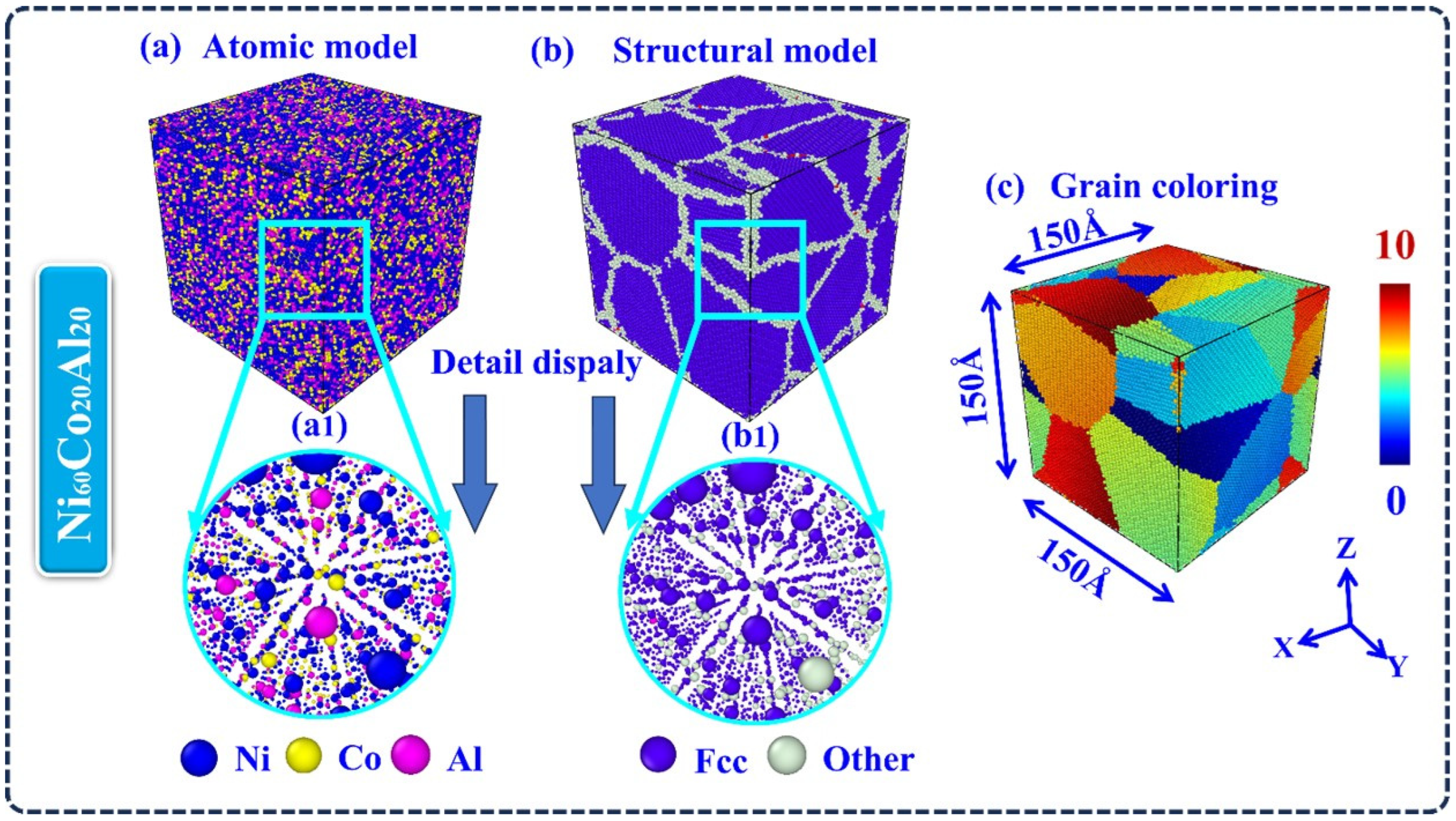
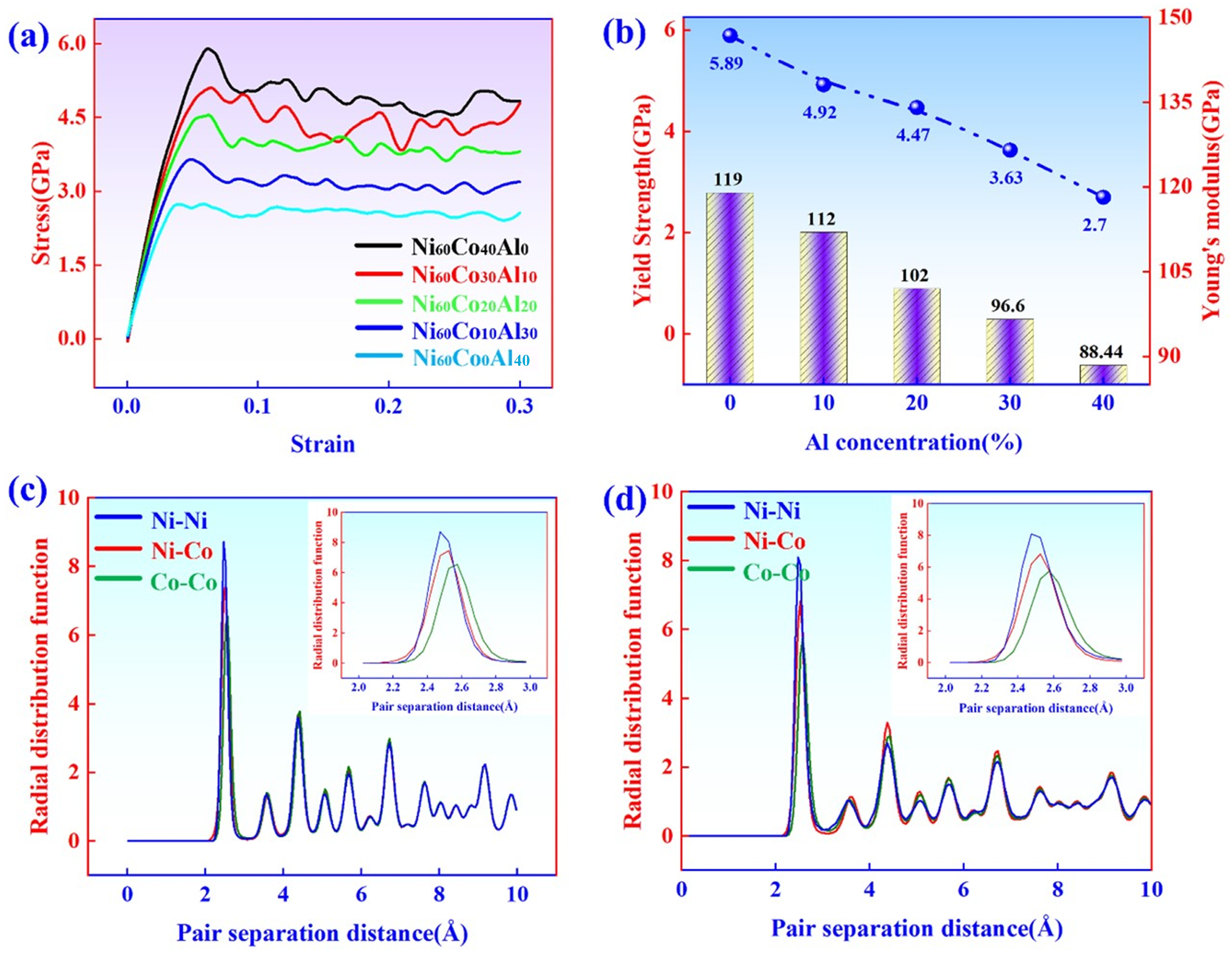
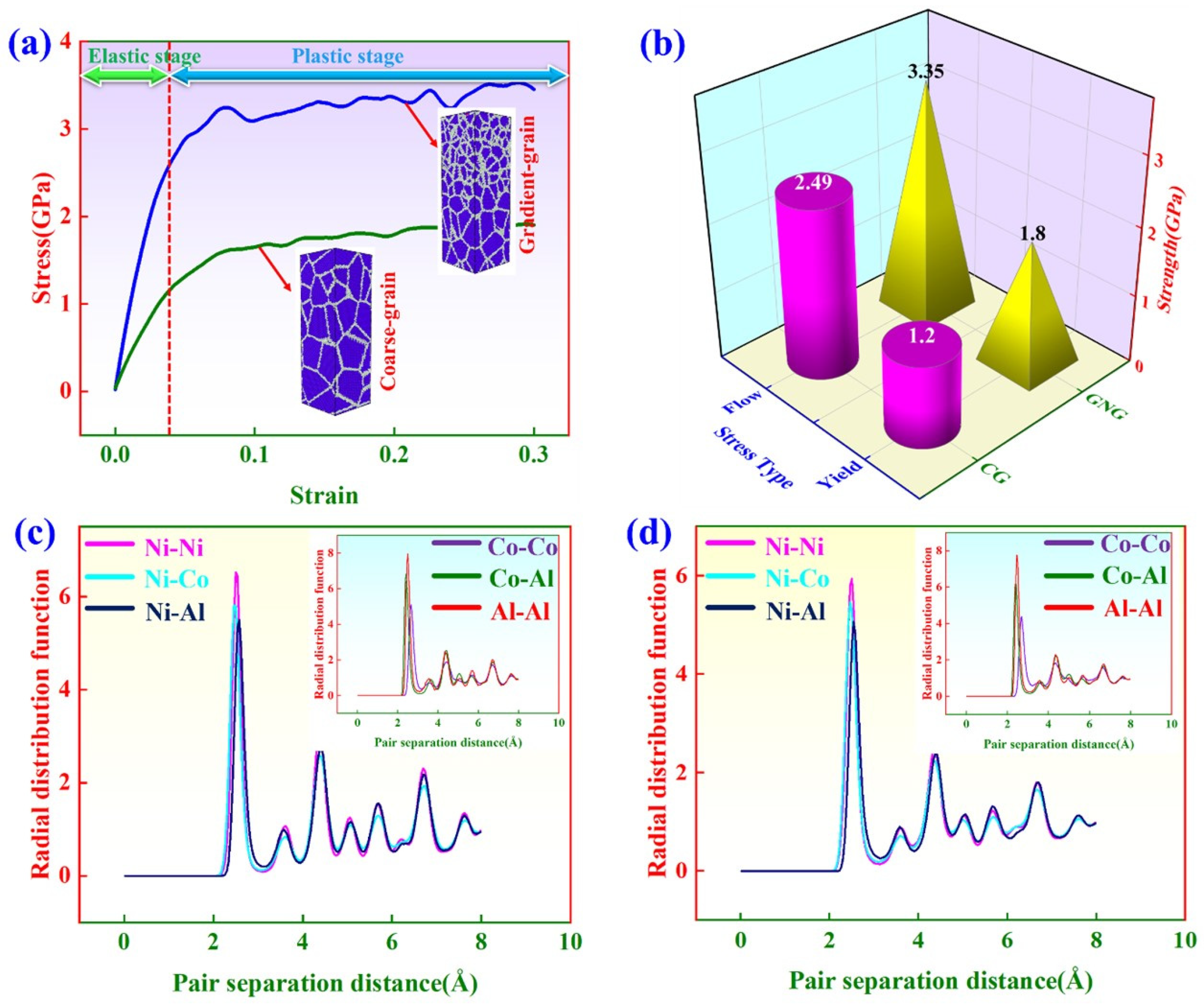
- Before proceeding with the design and simulation calculations of gradient-structured nanopolycrystalline NiCoAl alloys, the composition design is carried out first. The content of the Ni element is set to occupy 60% of the total model while maintaining the base structure as the FCC phase. Subsequently, Co and Al elements are added to the matrix with a combined content of 40%. Tensile calculations are performed via molecular dynamics simulations to investigate the impact of compositional variations on mechanical properties. It was found that increasing the Al content in the alloy reduces the material’s stiffness, significantly decreases the Young’s modulus, and leads to a gradual decline in the alloy’s deformation resistance, a substantial reduction in strength, and a decrease in work hardening capacity.
- (2)
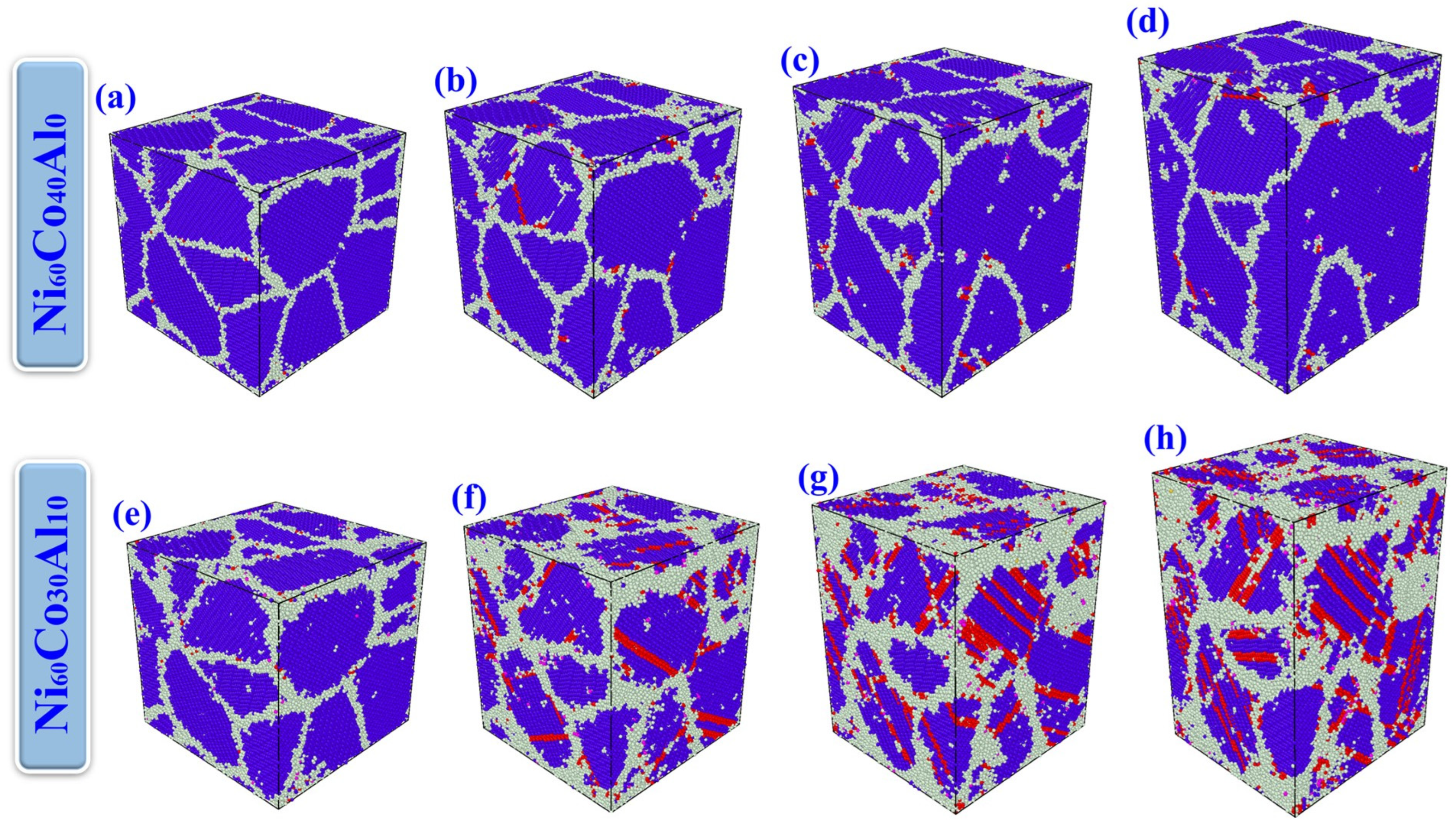
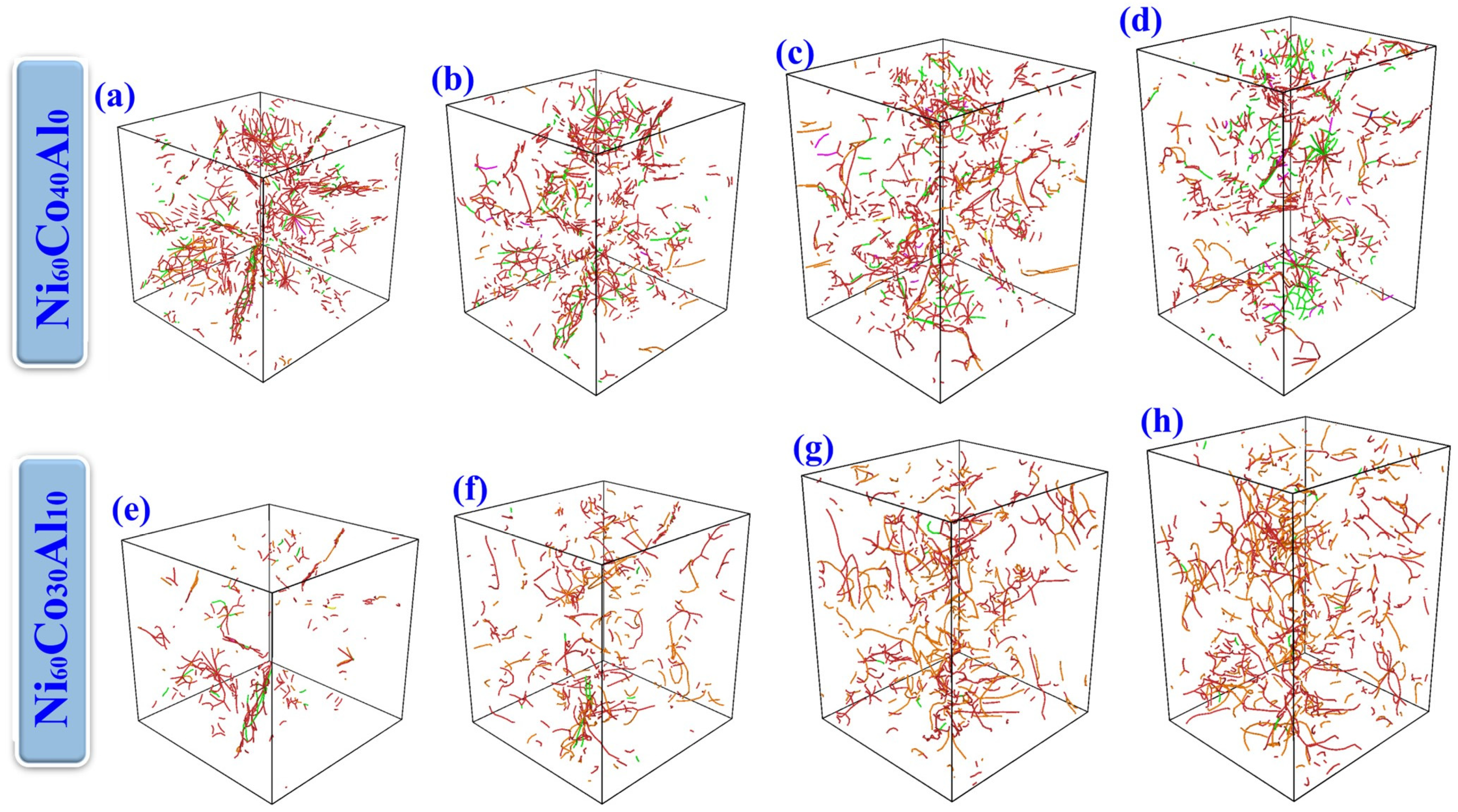
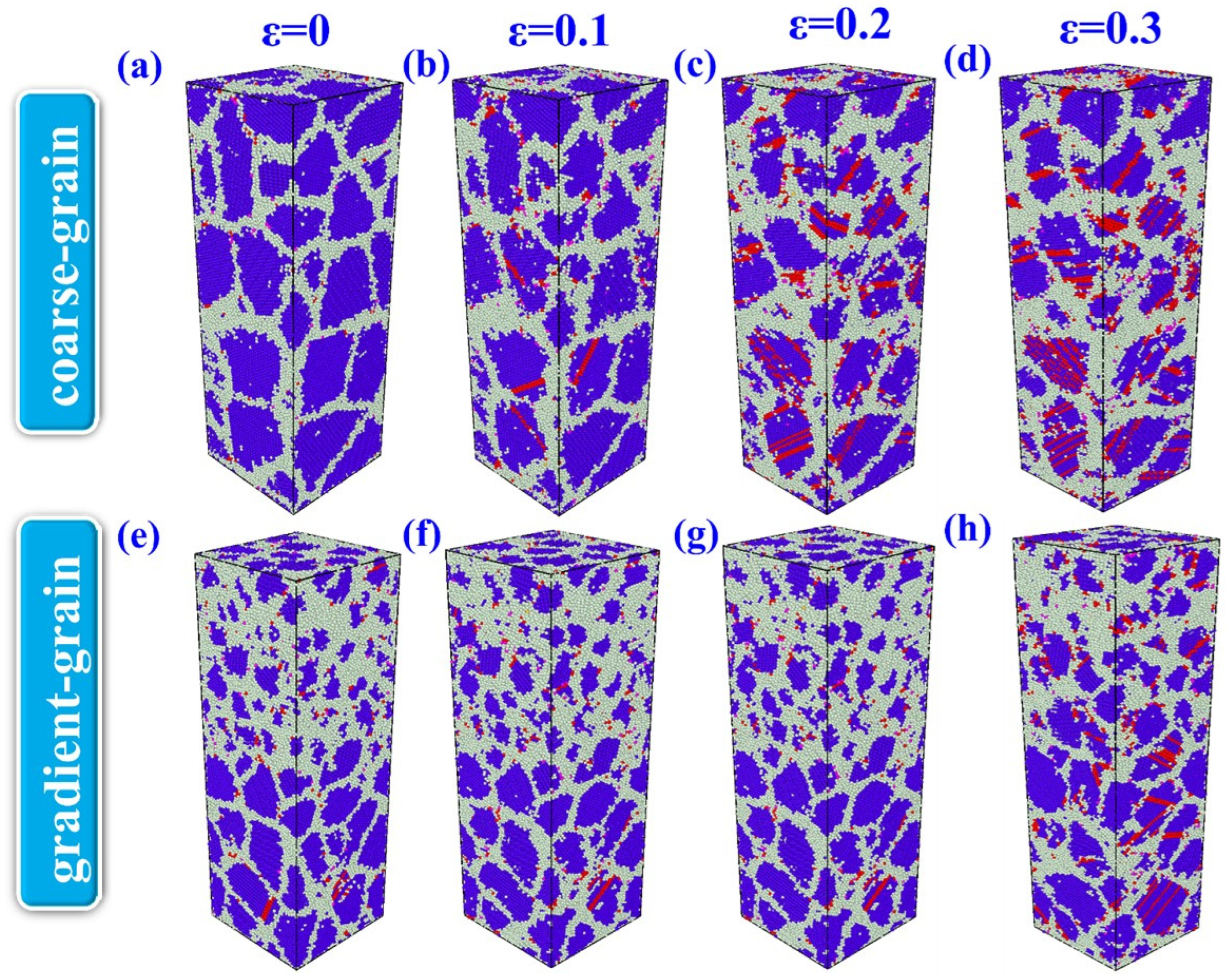
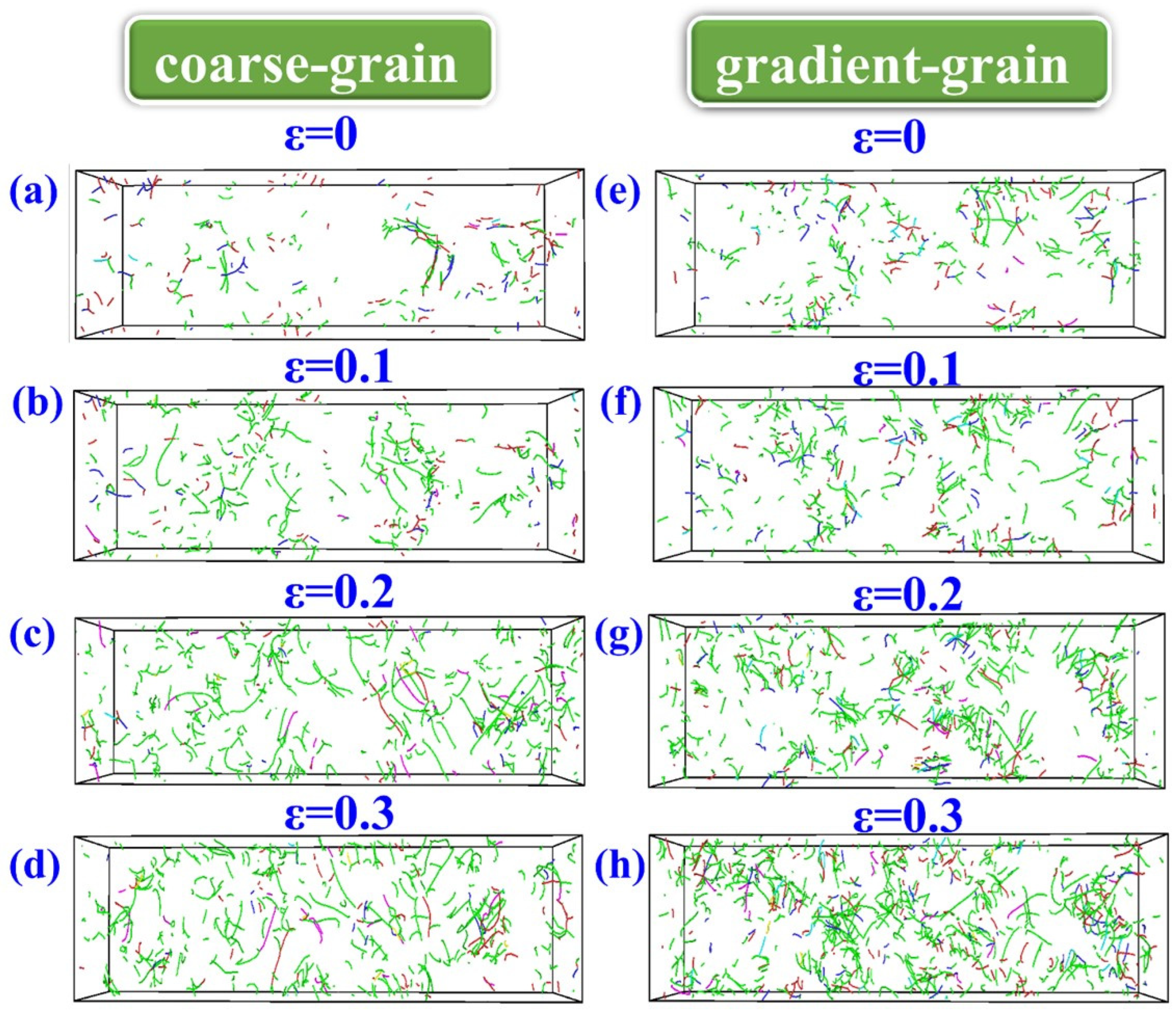
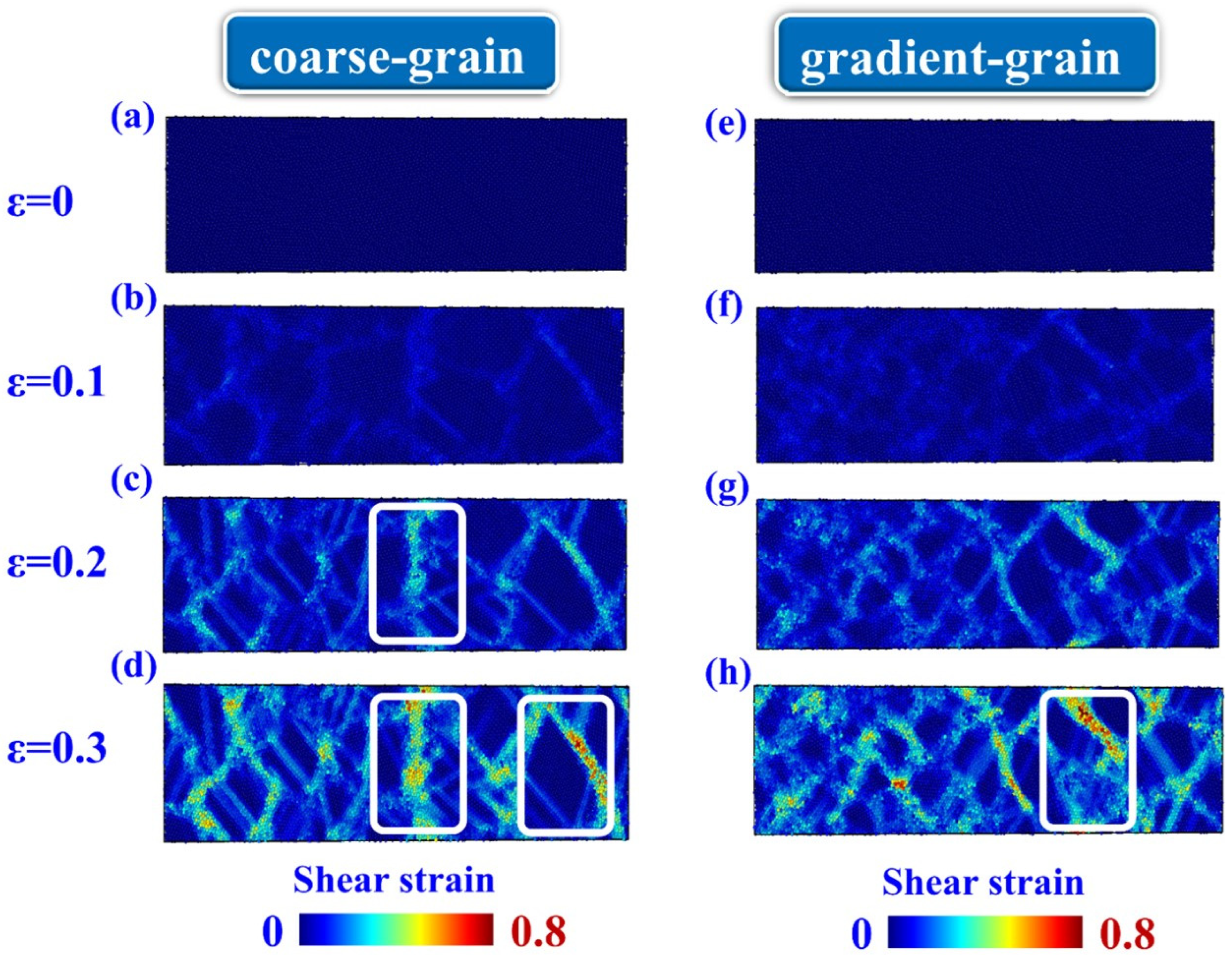
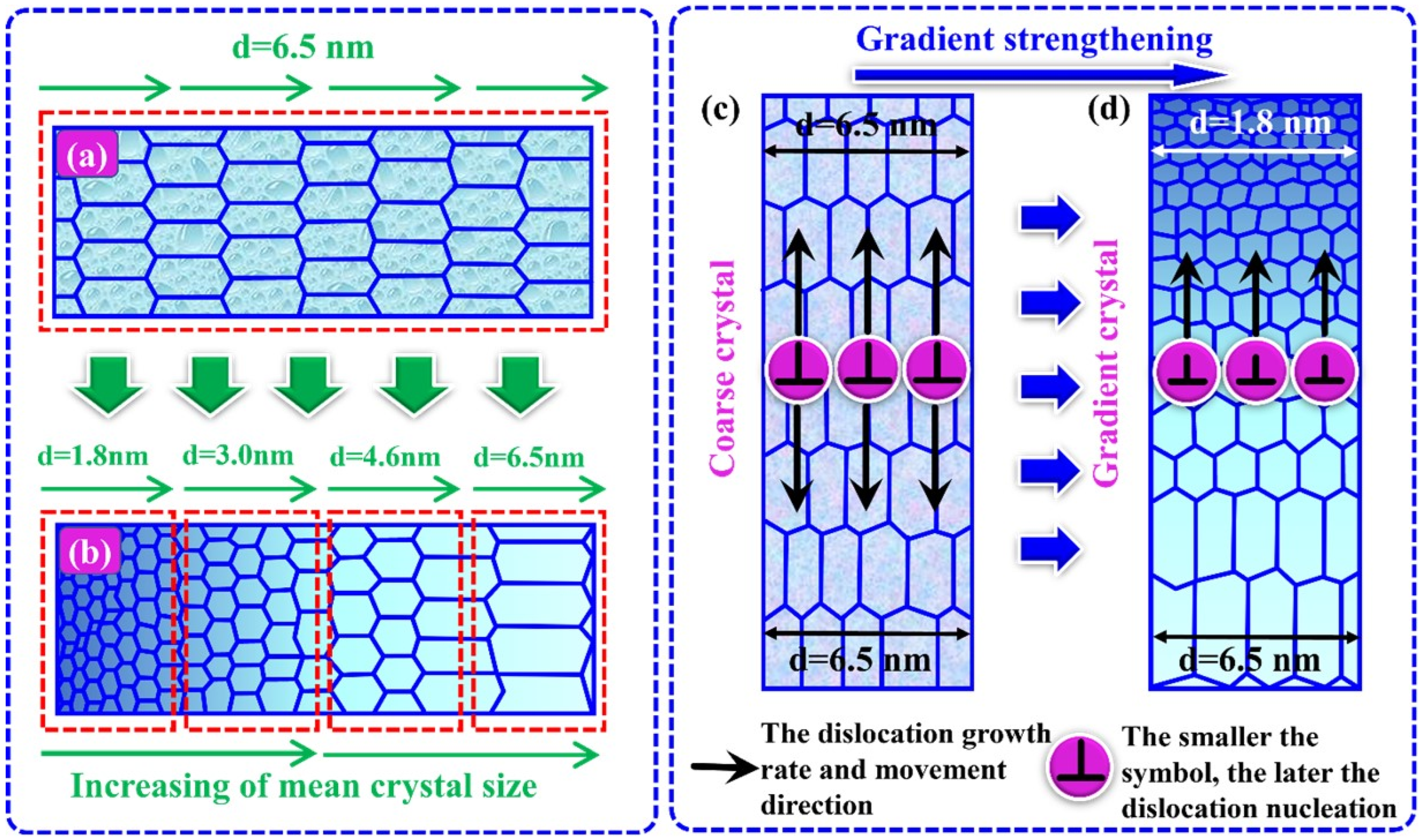
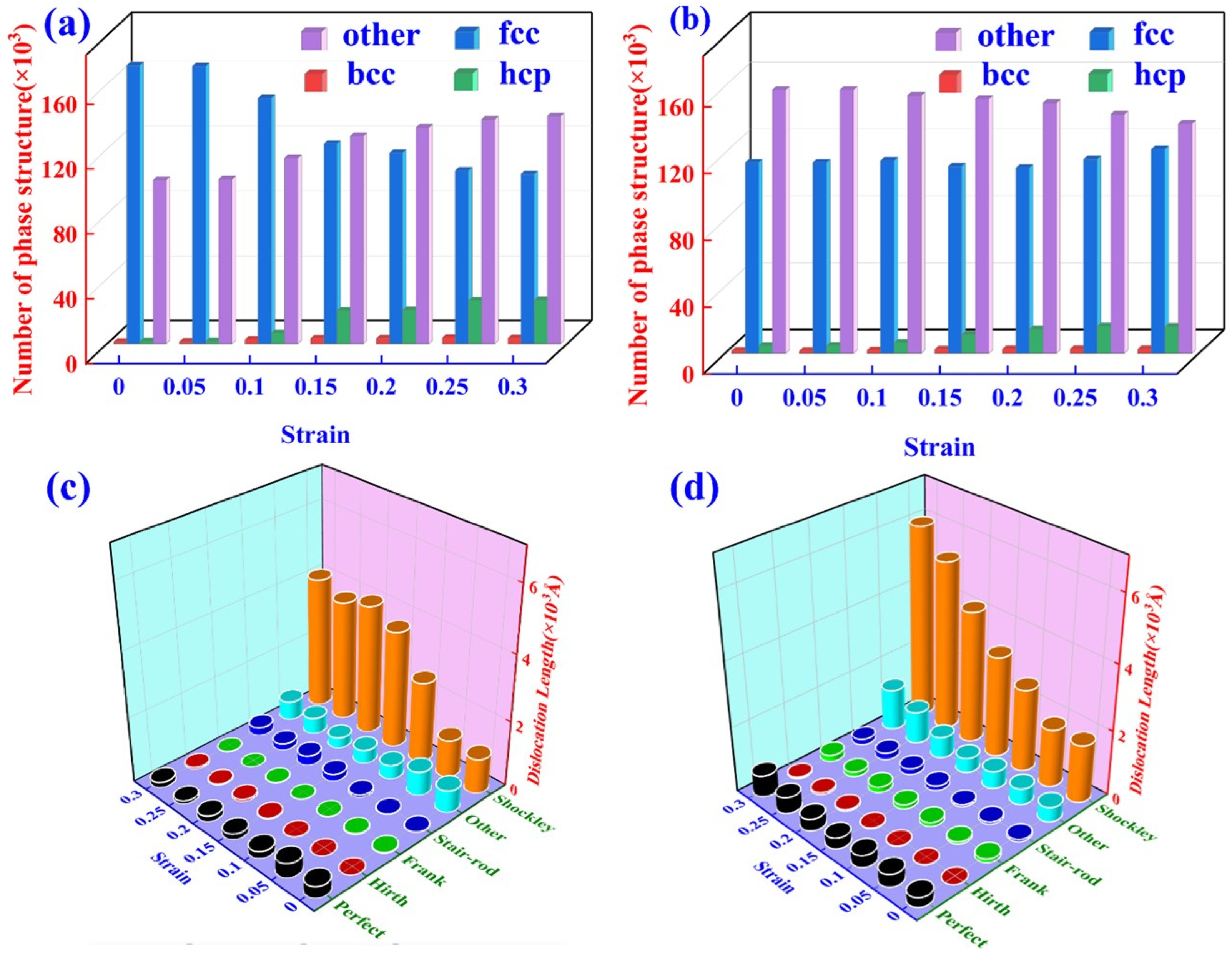
- After introducing a gradient structure into the NiCoAl alloy, to accommodate the heterogeneous structural deformation caused by different grain sizes, the dislocation form in the alloy will transform into GND. First, dislocations will form in the weakest coarse grains and gradually diffuse towards the fine grain regions. The increase in grain boundary density enhances the alloy’s ability to resist dislocations. The progressive movement of GNDs is inhibited, leading to continuous strain in the alloy and triggering its strain hardening, thereby enhancing its resistance to plastic deformation. The increased number of grain boundaries significantly enhances their capacity to accommodate GNDs. After nucleating in coarse grains, dislocations migrate slowly toward fine-grained regions. The effectiveness of grain boundaries in pinning dislocations far exceeds that of other alloy models, leading to a further enhancement of induced alloy strength beyond that achieved through gradient structure strengthening.
Author Contributions
Funding
Data Availability Statement
Conflicts of Interest
References
- Suryanarayana, C. Nanocrystalline materials. Int. Mater. Rev. 1995, 40, 41–64. [Google Scholar] [CrossRef]
- Koch, C.C. Structural nanocrystalline materials: An overview. J. Mater. Sci. 2007, 42, 1403–1414. [Google Scholar] [CrossRef]
- Meyers, M.A.; Mishra, A.; Benson, D.J. Mechanical properties of nanocrystalline materials. Prog. Mater. Sci. 2006, 51, 427–556. [Google Scholar] [CrossRef]
- Sun, Q.; Xu, R.; Han, Q.; Zhao, K.; McAdams, I.; Xu, W. Long distance chemical gradient induced by surface nanocrystallization. Appl. Mater. Today 2019, 14, 137–142. [Google Scholar] [CrossRef]
- Fang, T.; Li, W.; Tao, N.; Lu, K. Revealing extraordinary intrinsic tensile plasticity in gradient nano-grained copper. Science 2011, 331, 1587–1590. [Google Scholar] [CrossRef]
- Uddin, K.Z.; Koohbor, B. Gradient optimization of transversely graded Ti-TiB structures for enhanced fracture resistance. Int. J. Mech. Sci. 2020, 187, 105917. [Google Scholar] [CrossRef]
- Li, X.; Zhao, J.; Zhang, Z.; Zhang, P.; Zhang, Z. A fracture mechanics model for gradient-structured materials. Eng. Fract. Mech. 2025, 313, 110688. [Google Scholar] [CrossRef]
- Han, Z.; Liu, K.; Zhou, L.; Fang, F.; Jiang, J.; Zhou, X. Architecting unusual dual-gradient structures to overcome the strength-ductility trade-off in metallic materials. J. Mater. Process. Technol. 2025, 335, 118670. [Google Scholar] [CrossRef]
- Li, X.; Quan, S.; Wu, Z.; Sun, L.; Li, C.; Yang, J.; Gong, Y.; Huma, T.; Pan, H.; Xu, L. Achieving strength-ductility synergy in the Cu alloy with dual heterogeneous structure. Mater. Sci. Eng. A 2025, 947, 149241. [Google Scholar] [CrossRef]
- Sun, L.; Gong, Y.; Li, X.; Li, C.; Fu, Z.; Yang, J.; Zhu, X. The influence of zinc content on the microstructure and mechanical properties of gradient-structured copper alloys. Mater. Sci. Eng. A 2025, 943, 148873. [Google Scholar] [CrossRef]
- Zhang, Y.; Cheng, Z.; Lu, L.; Zhu, T. Strain gradient plasticity in gradient structured metals. J. Mech. Phys. Solids 2020, 140, 103946. [Google Scholar] [CrossRef]
- Bian, X.; Yuan, F.; Wu, X.; Zhu, Y. The evolution of strain gradient and anisotropy in gradient-structured metal. Metall. Mater. Trans. A 2017, 48, 3951–3960. [Google Scholar] [CrossRef]
- Lin, Y.; Yu, Q.; Pan, J.; Duan, F.; Ritchie, R.O.; Li, Y. On the impact toughness of gradient-structured metals. Acta Mater. 2020, 193, 125–137. [Google Scholar] [CrossRef]
- Wang, H.; Cao, P. Strength softening mitigation in bimodal structured metals. J. Appl. Phys. 2022, 131, 045102. [Google Scholar] [CrossRef]
- Sun, L.; Li, X.; Li, C.; Gong, Y.; Fu, Z.; Yang, J.; Qin, S.; Zhou, Z.; Quan, S.; Kang, Z. Superior strength-ductility combination in dual-phase heterostructured H62 brass via gradient microstructures. J. Alloys Compd. 2025, 1038, 182843. [Google Scholar] [CrossRef]
- Jiang, Z.; Liu, Y.; Zhang, G.; Zhu, Q.; Zhao, L.; Feng, C.; Hu, H.; Zhang, Z.; Song, K. Gradient heterostructure-induced multiscale strengthening mechanisms in ultrafine-grade copper wires. J. Alloys Compd. 2025, 1044, 184426. [Google Scholar] [CrossRef]
- Lu, X.; Zhang, W.; Guo, X.; Yang, X.; Li, J.; Ren, J.; Xue, H.; Tang, F. Strengthening mechanism of NiCoAl alloy induced by nanotwin under Hall-Petch effect. Int. J. Mech. Sci. 2023, 255, 108478. [Google Scholar] [CrossRef]
- Lu, X.; Zhang, W.; Ren, J.; Gao, Q.; Xue, H.; Tang, F.; La, P.; Guo, X. Grain boundary segregation strengthening behavior caused by carbon chain network formation in nanocrystalline NiCoAl alloy. J. Mater. Res. Technol. 2023, 26, 1016–1027. [Google Scholar] [CrossRef]
- Zhang, W.; Lu, X.; Yang, P.; Yang, X.; Ren, J.; Xue, H.; Ding, Y.; Guo, X. Effect of twin spacing and loading mode on mechanical properties and deformation mechanism of nicoal columnar polycrystalline alloy. Phys. Status Solidi B 2023, 260, 2300166. [Google Scholar] [CrossRef]
- Hirel, P. Atomsk: A tool for manipulating and converting atomic data files. Comput. Phys. Commun. 2015, 197, 212–219. [Google Scholar] [CrossRef]
- Li, S.; Li, S.; Liu, D.; Yang, J.; Zhang, M. Hardness prediction of high entropy alloys with periodic table representation of composition, processing, structure and physical parameters. J. Alloys Compd. 2023, 967, 171735. [Google Scholar] [CrossRef]
- Thompson, A.P.; Aktulga, H.M.; Berger, R.; Bolintineanu, D.S.; Brown, W.M.; Crozier, P.S.; In’t Veld, P.J.; Kohlmeyer, A.; Moore, S.G.; Nguyen, T.D. LAMMPS-a flexible simulation tool for particle-based materials modeling at the atomic, meso, and continuum scales. Comput. Phys. Commun. 2022, 271, 108171. [Google Scholar] [CrossRef]
- Daw, M.S.; Baskes, M.I. Embedded-atom method: Derivation and application to impurities, surfaces, and other defects in metals. Phys. Rev. B 1984, 29, 6443. [Google Scholar] [CrossRef]
- Stukowski, A. Visualization and analysis of atomistic simulation data with OVITO–the Open Visualization Tool. Model. Simul. Mater. Sci. Eng. 2010, 18, 015012. [Google Scholar] [CrossRef]
- Suttner, S.; Merklein, M. A new approach for the determination of the linear elastic modulus from uniaxial tensile tests of sheet metals. J. Mater. Process. Technol. 2017, 241, 64–72. [Google Scholar] [CrossRef]
- Syarif, J.; Gillette, V.; Hussien, H.A.; Badawy, K.; Jisrawi, N. Molecular dynamics simulation of the amorphization and alloying of a mechanically milled Fe-Cu system. J. Non-Cryst. Solids 2022, 580, 121410. [Google Scholar] [CrossRef]
- Li, J.; Fang, Q.; Liu, B.; Liu, Y.; Liu, Y. Mechanical behaviors of AlCrFeCuNi high-entropy alloys under uniaxial tension via molecular dynamics simulation. RSC Adv. 2016, 6, 76409–76419. [Google Scholar] [CrossRef]
- Zhang, C.; Song, H.; Oliveros, D.; Fraczkiewicz, A.; Legros, M.; Sandfeld, S. Data-mining of in-situ TEM experiments: On the dynamics of dislocations in CoCrFeMnNi alloys. Acta Mater. 2022, 241, 118394. [Google Scholar] [CrossRef]
- Baggio, R.; Salman, O.U.; Truskinovsky, L. Homogeneous nucleation of dislocations as a pattern formation phenomenon. Eur. J. Mech.-A/Solids 2023, 99, 104897. [Google Scholar] [CrossRef]
- Combe, N.; Mompiou, F.; Legros, M. Heterogeneous disconnection nucleation mechanisms during grain boundary migration. Phys. Rev. Mater. 2019, 3, 060601. [Google Scholar] [CrossRef]
- Sankaran, S.; Kumar, K.H.; Rösner, H.; Peterlechner, M.; Esin, V.A.; Divinski, S.; Wilde, G. Grain boundary diffusion and grain boundary structures of a Ni-Cr-Fe-alloy: Evidences for grain boundary phase transitions. Acta Mater. 2020, 195, 501–518. [Google Scholar]
- Wu, Y.; Gu, J.; Song, M. Strength and ductility synergy in a laminated Cu/Cu-6Al alloy with graded interfacial region. J. Alloys Compd. 2022, 921, 166102. [Google Scholar] [CrossRef]
- Chen, T.; Li, J. Modelling the shear banding in gradient nano-grained metals. Nanomaterials 2021, 11, 2468. [Google Scholar] [CrossRef] [PubMed]





Disclaimer/Publisher’s Note: The statements, opinions and data contained in all publications are solely those of the individual author(s) and contributor(s) and not of MDPI and/or the editor(s). MDPI and/or the editor(s) disclaim responsibility for any injury to people or property resulting from any ideas, methods, instructions or products referred to in the content. |
© 2026 by the authors. Licensee MDPI, Basel, Switzerland. This article is an open access article distributed under the terms and conditions of the Creative Commons Attribution (CC BY) license.
Share and Cite
Zheng, Y.; Yu, H.; Zhang, W.; Liu, B.; Yu, J.; Chen, M. Mechanical Behavior of Gradient-Structured Nano-Crystalline NiCoAl Alloy. Metals 2026, 16, 329. https://doi.org/10.3390/met16030329
Zheng Y, Yu H, Zhang W, Liu B, Yu J, Chen M. Mechanical Behavior of Gradient-Structured Nano-Crystalline NiCoAl Alloy. Metals. 2026; 16(3):329. https://doi.org/10.3390/met16030329
Chicago/Turabian StyleZheng, Yina, Huan Yu, Wei Zhang, Bangxiong Liu, Junling Yu, and Meng Chen. 2026. "Mechanical Behavior of Gradient-Structured Nano-Crystalline NiCoAl Alloy" Metals 16, no. 3: 329. https://doi.org/10.3390/met16030329
APA StyleZheng, Y., Yu, H., Zhang, W., Liu, B., Yu, J., & Chen, M. (2026). Mechanical Behavior of Gradient-Structured Nano-Crystalline NiCoAl Alloy. Metals, 16(3), 329. https://doi.org/10.3390/met16030329