Article

Prediction of Bulk Density in Laser Powder Bed Fusion of Pure Zinc Using Supervised Machine Learning

Faculty of Mechanical Engineering Maribor, University of Maribor, Smetanova 17, SI-2000 Maribor, Slovenia
*
Authors to whom correspondence should be addressed.
Metals 2026, 16(3), 309; https://doi.org/10.3390/met16030309
Submission received: 12 February 2026 / Revised: 6 March 2026 / Accepted: 9 March 2026 / Published: 11 March 2026
(This article belongs to the Special Issue Advances in Metal Additive Manufacturing: Process and Performance)

Abstract

This work used machine learning to forecast product density and optimize the laser powder bed fusion (LPBF) process for parts made of pure zinc (Zn). A relative density of 90–97% (6.42–6.95 g/cm3) was obtained by varying combinations of key process parameters, including laser power, scanning speed, track overlapping, hatch spacing, and layer thickness. Machine learning provided models for density prediction and better comprehension of the impact of input parameters. A SHapley Additive exPlanation (SHAP) analysis quantified the contributions of specific features, enhancing model interpretability. Fifty-one experimental runs were used to test several methods, including Bayesian ridge, CatBoost, elastic net, lasso, linear regression, random forest, ridge regression, and XGBoost. CatBoost performed best, with a test coefficient of determination (R2) of 0.893, a mean absolute error (MAPE) of 0.010 and a root mean square error (RMSE) of 0.015. A feature importance analysis showed that laser power (49%) and scanning speed (42%) had the greatest influence, while hatch spacing (5%) and layer thickness (4%) had minimal impacts on product density. Therefore, selecting the correct optimized set of process parameters determines the resulting density and can support more efficient LPBF process development.

1. Introduction

Additive manufacturing (AM) has transformed metal component fabrication by enabling layerwise production, which makes it possible to create intricate designs straight from digital models. When compared to traditional subtractive techniques, laser powder bed fusion (LPBF) provides better design flexibility, less material waste, and the capacity to produce parts that are customized for particular uses. In biomedical engineering, LPBF has enormous potential for producing scaffolds and tailored implants whose porous architectures mimic the trabecular bone structure and support tissue ingrowth [1]. LPBF has made it possible to fabricate complex porous structures, graded scaffolds, and triply periodic minimum surface (TPMS) lattices that enhance nutrient transport and osteoconductivity in contemporary biomedical AM research [2].
Biodegradable metals [3,4] are an innovative and promising subclass of biomaterials [5] due to their safer degradation in the body [6], which can remove the need to conduct post-surgery for implant removal. Among these materials, the use of zinc (Zn) and its alloys [7] is especially attractive because of their biocompatibility and appropriate degradation rate [8,9]. Zn degradation also releases Zn2+ ions that promote osteoblast proliferation, enhance alkaline phosphatase activity, and support extracellular-matrix mineralization [10]. Zn and its alloys are promising candidates for next-generation biodegradable orthopedic and cardiovascular implants [11], showing corrosion rates (~0.08 mm/year) that are appropriate for vascular and bone-healing environments [2].
Zn, which has a limited processing window and relatively poor mechanical strength, requires structural design solutions to achieve application-specific performance [2,8]. LPBF enables near-net shapes with precise control over internal structure [1,2]. In addition to increasing material utilization, establishing reliable LPBF processing solutions for Zn enables geometry-driven performance optimization, which is not possible with conventional manufacturing techniques [1,6].
Nonetheless, the application of Zn in LPBF involves challenges, like the lower melting (419.5 °C) and boiling points (907 °C) of Zn, which lead to considerable vaporization during the laser melting process. This destabilizes the melt pool and reduces laser energy input [11], resulting in not only the loss of elements but also gas inclusions and a range of alloy defects, such as porosity and cracking [8], keyhole pores and gas entrapment [12]. High-speed imaging and infrared monitoring studies have shown that Zn evaporation produces dense plumes that attenuate the laser beam, further lowering melt-pool stability [13]. These process instabilities make Zn parts significantly more difficult to densify in comparison with higher-boiling metals such as Fe or Ti [2].
The resulting parts suffer in terms of density and mechanical properties, both of which are critical for load-bearing biomedical applications [14,15]. Achieving high density (close to the theoretical 7.133 g/cm3 for pure Zn) is needed to ensure mechanical strength and performance. However, the conventional methods for process parameter optimization—such as laser power, scanning speed, hatch spacing, track overlapping, and layer thickness—require extensive experimental trials, which are both time- and resource-consuming. In addition, the complex interactions between the various processing parameters make it difficult to determine optimal conditions using only conventional approaches.
In recent years, machine learning (ML) has become a widely used tool for predicting and optimizing material properties in AM. When working on experimental datasets with advanced algorithms, the resulting ML models can capture the difficult-to-comprehend relationships between process parameters and resulting part properties, enabling accurate predictions before manufacturing and process optimization; e.g., studies have successfully used ML to predict density and defects in LPBF of Inconel 718 [16] and to predict microstructural features in Ti-6Al-4V [17]. Beyond these applications, the integration of ML throughout the LPBF process, from part design to parameter optimization and in situ monitoring, has been increasingly highlighted as a step toward improving process stability and repeatability [18]. ML-based clustering, autoencoders, and image-based classifiers have been shown to reliably reproduce expert assessments during parameter optimization, reducing the reliance on costly trial-and-error experimentation [13].
In the context of laser-based metal AM, ML has also proven effective for real-time defect detection and quality prediction. Using thermal, optical, or acoustic monitoring data, a number of review studies highlight the potential of ML models, specifically convolutional neural networks, support vector machines, and hybrid architectures, to identify process instabilities, detect lack-of-fusion defects, and classify pore formation mechanisms [19]. According to other studies, AI-driven sensing techniques, such as acoustic emission in conjunction with machine learning algorithms, allow for the classification of transient LPBF regimes, like conduction mode, stable keyhole, unstable keyhole, and pore-formation events. This provides indirect insight into subsurface process regimes that are difficult to capture using conventional optical monitoring alone [20]. Comprehensive topical reviews further highlight that AM’s highly coupled thermal–fluid dynamics make it an ideal candidate for ML-based modeling and prediction, particularly where conventional physics-based simulations are limited by computational cost [21].
In a recent study by Heiss et al. (2025), the authors applied unsupervised ML to predict density, pore size and shape in the LPBF of a Zn alloy Z410 [22]. This demonstrates the growing interest and usability of ML for LPBF processes of Zn-based products. In contrast, the present work focuses on supervised regression for direct prediction of bulk density in LPBF-processed pure Zn. Further evidence of the ML trend comes from the first application of supervised ML for process optimization in Zn alloys, where Zhao et al. employed Gaussian Process Regression (GPR) to predict high-density process windows for the SLM of a Zn-2Cu alloy, successfully identifying an unconventional high-power/low-speed regime that improved density and mechanical performance [23]. Similarly, ML has been used to assess defect severity and predict critical defect sizes in SLM components using supervised neural networks, highlighting the feasibility of correlating AM process parameters to defect populations [24]. Comprehensive reviews also emphasize the expanding role of AI in AM optimization, where ML assists with parameter tuning, defect detection, process monitoring, and autonomous control across different AM technologies [25,26].
Given the unique challenges associated with Zn and its promising applications, there remains a need to investigate and validate approaches using supervised ML. However, a lack of research applying ML to predict density in LPBF-processed parts made of Zn remains.
This study’s aim is to address this by researching the use of different ML regression models [27,28,29,30,31,32,33,34]. The remainder of this paper is organized as follows. Section 2 describes the materials and methods used in this study. Section 3 presents the results, followed by a discussion of the findings in Section 4. Section 5 summarizes the main conclusions.

2. Materials and Methods

2.1. Input Variable Intervals

The selected key parameters of the LPBF process are:
Laser power, which represents the energy output of the laser source during the melting process and affects the ability to effectively fuse powder particles at different material densities [35].
Scanning speed, which determines the speed at which the laser beam moves across the powder bed, affecting melting efficiency and the resulting part density [36].
Hatch spacing, the distance between parallel scan lines on the powder bed, which affects the energy distribution and consolidation of the material during layer formation [37].
Layer thickness, defined as the height of the recoated powder layer prior to laser melting during the LPBF process, which affects the resolution, build time and thermal behavior of the part to be produced [38].
The intervals for the selected inputs are presented in Table 1. Parameter ranges were selected based on preliminary stability trial windows. The sequential exploration strategy was adopted due to rapid vapor plume formation at high energy inputs.
The nominal track overlap, denoted as O, was initially recorded during experimentation to evaluate the degree of overlap between neighboring laser scan tracks, the uniformity of the melt pool, and the structural integrity of the fabricated part [39]. However, O is not an independent process variable because it depends on the hatch spacing h and the effective laser spot diameter d, as expressed in Equation (1).
O = ( 1 h   d )   ×   100 %
In this study, the laser spot diameter d was fixed at 70 µm. Therefore, the overlap O can be calculated as in Equation (2).
O = ( 1 1000 h   70 )   ×   100 %
For example, when h = 0.049 mm and h = 0.065 mm, the corresponding overlap values are 30% and 7.1429%, respectively. This indicates that, when the laser spot diameter d is constant, the value of O is directly determined by h. Therefore, if hatch spacing h is treated as the process variable, it may not be necessary to treat O as a separate variable. For modeling, we therefore retained h as the physically interpretable independent variable and excluded O from the feature set to avoid redundancy and unstable coefficient estimates in linear models.

2.2. Experiment

The experimental plan followed a sequential exploration rather than a space-filling design. This approach was chosen due to the practical challenges of printing pure Zn, including rapid changes in process stability and visible vapor (smog) when approaching higher energy inputs. The staged approach first identified a stable processing window and then expanded exploration around promising regions by varying one or two parameters at a time. While pragmatic for Zn LPBF, this sampling is not uniformly distributed in the full parameter space; therefore, the ML models should be interpreted as surrogates valid primarily within the investigated window and may not extrapolate reliably to sparsely sampled regions.

2.3. Work Material

The samples were manufactured using pure Zn powder provided by Nanografi Nano Technology, Turkey. The powder particles provided were spherical and the majority of particle diameters ranged between 25–45 µm, with minor fractions outside this interval. The powder elemental composition is presented in Table 2, the build-tray was also made from pure Zn.

2.4. Manufacturing Process

The samples were fabricated in a nitrogen environment in the Arrow Metal Printing–LMP200 LPBF machine from Dental LLC, Maribor, Slovenia. The oxygen content was kept below 100 ppm. The machine was equipped with a Yb:glass fiber laser with a focus diameter of 70 µm. The laser scanned in the form of a checkerboard pattern with a size of 4 mm2 areas. The scanning direction rotated 90° for each successive chequerboard pattern. For each subsequent layer, the scanning direction was also rotated by 60°. Although some samples were fabricated on the build-tray without support beams, most samples were fabricated on 2 mm thick support beams (see Figure 1). Despite that, the density of the samples did not differ between the samples with and without support beams. The created samples were cubic and cuboid-shaped, and their dimensions were 5 × 5 × 5 mm and 5 × 5 × 7 mm, respectively.

2.5. Density Measurements

Using ethanol as the liquid, the densities of the samples were determined using Archimedes’ method. Measurements were performed at 20 °C. Ethanol density corrections (ρ = 0.789 g/cm3) were applied.
The reported density per parameter set represents the grand mean of three specimens, each measured three times. Measurement repeatability (SD range: 0.003–0.0166 g/cm3) is reported. Masses were recorded in air and while immersed in ethanol using an analytical balance (readability ± 0.0001 g). Densities were then calculated in Microsoft Excel using the Archimedes method.

2.6. Mathematical Model

In this study CatBoost [27], XGBoost [28], Random forest [29], Linear regression [30], ridge regression [31], lasso regression [32], elastic net [33], and Bayesian ridge [34] were utilized for product density predicting. Although Elastic net combines L1 and L2 penalties, ridge and lasso were evaluated separately to benchmark shrinkage-only and sparsity-inducing behaviors independently. Fifty-one experimental runs with varied process parameters were analyzed to identify the most effective model and to quantify the influence of each parameter on density by comparing the performance of these models the research strives to identify an effective approach for accurate density predictions and thus facilitate the framework for high-quality Zn-based products. The novelty lies in the application of ML to a relatively under-researched material in the context of AM, focusing on the predictions of product density. The present study contributes (i) a controlled comparison of multiple regression families (regularized linear models and tree-based boosting/ensembles) on pure Zn density data, (ii) explicit treatment of feature redundancy arising from process-parameter definitions, and (iii) model interpretability using feature importance and SHAP analysis to identify dominant parameters and key interactions. The main limitations are the modest dataset size and the constrained exploration ranges for hatch spacing and layer thickness, which restrict generalization beyond the investigated process window. Table 3 provides a high-level taxonomy of the evaluated regression models (model family and typical use case) to provide a context for their application in density prediction.

2.6.1. Modeling Overview

The hyperparameter search spaces and default settings used for grid-search tweaking and basic references are compiled in Table 4. These models were chosen in order to optimize LPBF production conditions by balancing interpretability, regularization, and predictive accuracy.

2.6.2. Data Standardization

When standardization was employed, scikit-learn Pipelines were utilized to apply z-score normalization (mean 0; standard deviation 1) as part of the model training workflow [40]. Only the training subset (or training folds in cross-validation) was used to fit the scaler parameters, and the learnt parameters were then applied to the validation/test subsets. Scaler parameters were fitted exclusively on training data within each fold to prevent information leakage into validation or test subsets. Tree-based approaches were assessed without the need for scaling, whereas standardization was only used for models that were sensitive to feature scaling (such as linear models).

2.6.3. Nested K-Fold Cross-Validation for Model Improvement

The regression models were evaluated and their hyperparameters optimized using nested k-fold cross-validation method to obtain a better and unbiased estimate of generalization performance [41]. Method consists of two loops: an inner loop for optimizing hyperparameters through grid search and an outer loop for assessing the model’s predictive performance on unseen data, minimizing the risk of overfitting and thus providing a reliable assessment of the model’s effectiveness on new data. Outer-loop metrics represent mean performance across five folds. Inner-loop grid searches selected hyperparameters using R2 as optimization criterion.

2.6.4. Regression Metrics for Model Evaluation

Model performance was evaluated using coefficient of determination (R2), mean absolute error (MAE), root mean square error (RMSE), and mean absolute percent error (MAPE). MAE evaluates the average size of prediction errors, RMSE focuses on larger discrepancies, MAPE provides a relative accuracy metric in percentage, and the R2 statistic indicates the model’s overall forecasting ability. Cross-validation and train/test split were employed to assess the model. The dataset was split into 80% training and 20% testing data. Further, 100 runs were executed with various random seeds. Hyperparameters were tuned using grid search with R2 as the selection metric and the inner loop employed K = 3 folds for grid-search optimization, while the outer loop utilized K = 5 folds for nested K-fold cross-validation.

3. Results

3.1. Resulting Densities

The samples were fabricated using various combinations of four key fabrication parameters: laser power, scanning speed, hatch spacing and layer thickness. The investigations were carried out with 40 W low laser power owing to the low melting point of Zn. A scanning speed of 800 mm/s with hatch spacing and layer thicknesses of 0.049 and 0.035 mm were maintained, respectively. In the first step, the laser power was gradually increased to 110 W, as shown in Table 5.
Increasing laser power improved density but also increased visible Zn vapor (smog) in the chamber. In the second step, layer thickness was reduced (to 0.025 mm, as shown in Table 6) to support stable processing within this machine configuration; this observation is specific to the investigated setup and should not be generalized; we do not claim that reduced layer thickness universally reduces fumes but rather that it supported stable processing in this study’s Zn LPBF window.
At this point in the study, the 110 W laser power resulted in the best part density for both layer thicknesses. Therefore, in the third step of the study, the laser power of 110 W was kept constant and combined with higher and lower laser powers than 800 mm/s, as shown in Table 7. The layer thickness was kept at 0.035 and the hatch spacing at 0.049 mm, as in the first step of the study.
Since the third step of the study showed that lower laser power can increase part density, the fourth step of the study focused on reducing the scanning speeds for each laser power used in the previous steps. For each laser power, two to four different scanning speeds were used, as listed in Table 8. The scanning speeds were chosen as a function of laser power while maintaining the overall manufacturing energy density. The hatch spacing and layer thickness were kept at 0.049 mm and 0.035 mm, respectively.
Some of the combinations of laser power and scanning speed led to better part density results in the fourth step of the study. Therefore, the hatch spacing was increased to 0.065 in the fifth step of the study, as shown in Table 9, to reduce vapor formation. The layer thickness in this step was 0.035 mm.
To investigate the effects of higher laser powers in combination with higher scanning speeds, the hatch spacing and layer thickness were kept at 0.049 mm and 0.035 mm in the sixth step of the study. Laser powers of 120 W and 150 W were considered in combination with three different scanning speeds of 800 mm/s, 1000 mm/s and 1200 mm/s, as shown in Table 10.
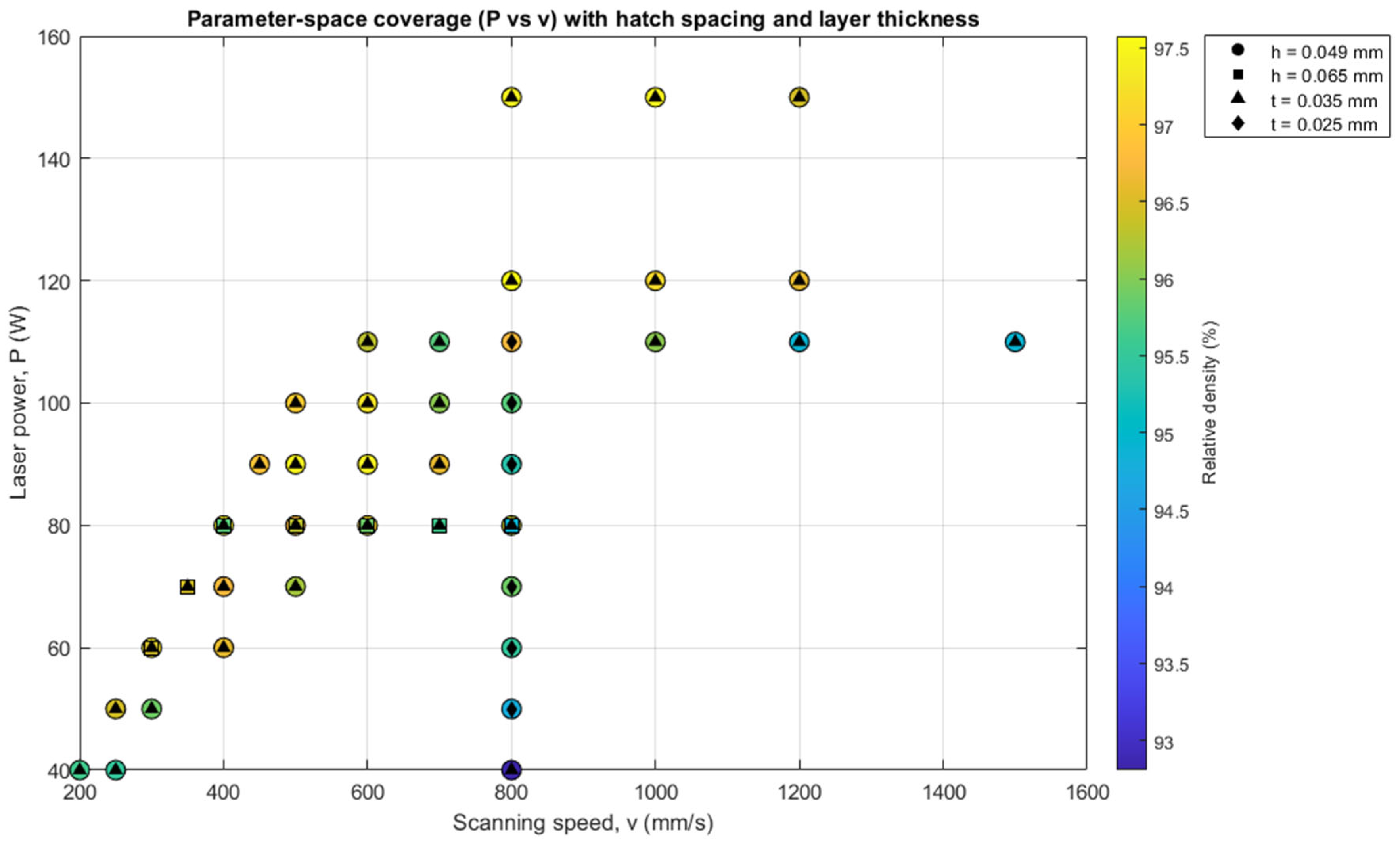
Figure 2 shows the parameter-space coverage of the 51 experimental conditions in the (laser power and scanning speed) domain. Sampling is concentrated mainly in the 60–110 W and 400–800 mm/s region, where most combinations were explored at hatch spacing 0.049 mm and layer thickness 0.035 mm. Only two discrete levels were tested for hatch spacing (0.049 and 0.065 mm) and layer thickness (0.025 and 0.035 mm), resulting in limited multidimensional coverage.
Higher laser powers (120–150 W) and extreme scanning speeds (>1200 mm/s) are sparsely sampled, with only a few data points. Therefore, model predictions are expected to be most reliable within the densely sampled central region of parameter space, while extrapolation into sparsely populated regions may increase uncertainty.

3.2. Experimental Data Analysis

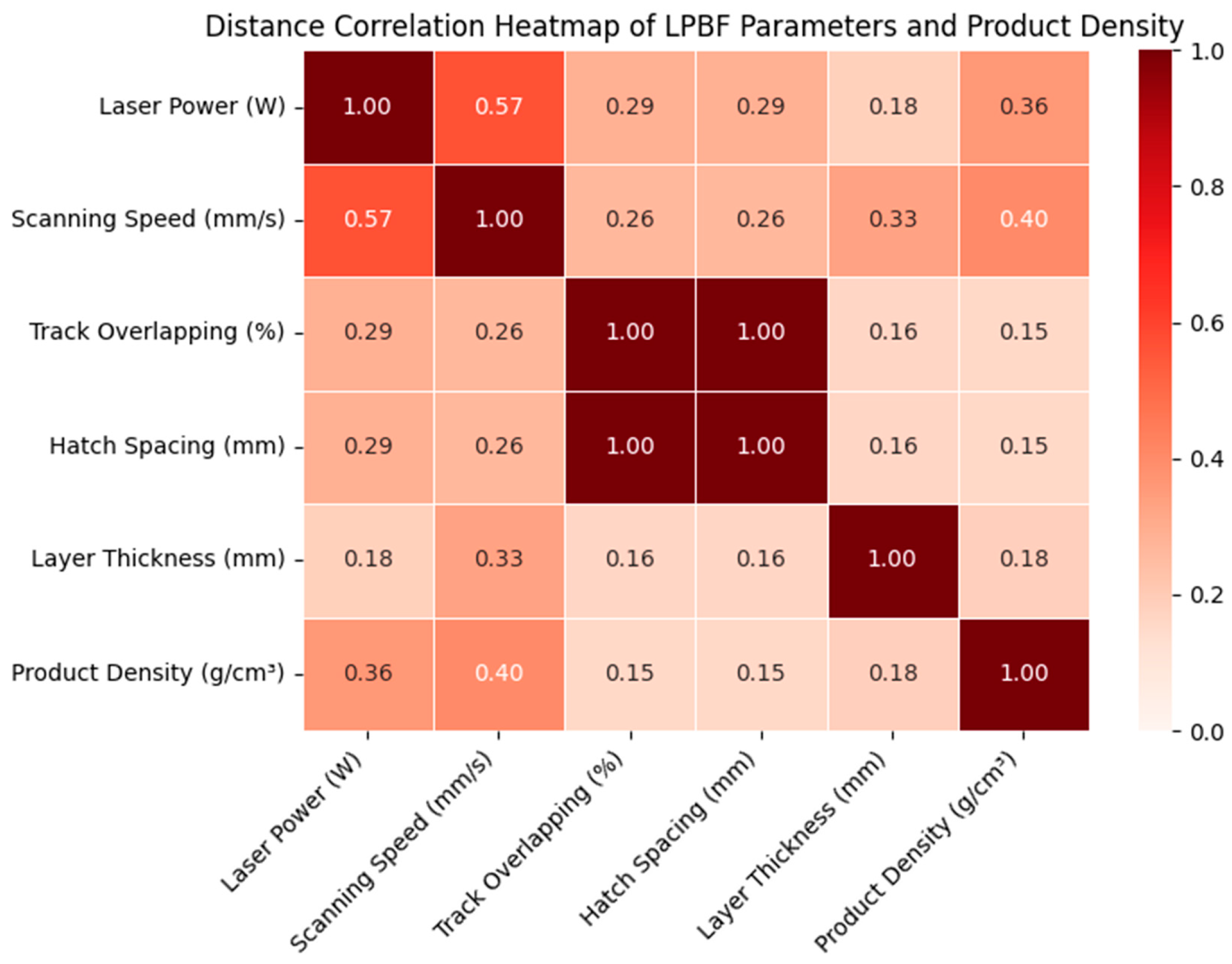
The resulting experimental data showed that the density of the produced parts was between 6.42 and 6.95 g/cm3, indicating that the parameter settings drastically influenced the result and implying the importance of understanding these influences for process optimization. The input–output relationships were evaluated by assessing the influence of the selected five parameters on product density using distance correlation. The method was selected because of its ability to capture both linear and nonlinear relationships [42]. The intent is descriptive screening (and identifying redundancy between parameter definitions), not feature selection. The subsequent regression models were trained and evaluated independently using cross-validation and held-out testing. The results (Figure 3) provide a correlation overview between the individual parameters and product density, where higher values indicate a stronger relationship.
Scanning speed showed the strongest correlation with product density (0.40). This significant influence was attributed to the effect of scanning speed allowing time for powder melting, with faster speeds likely resulting in incomplete melting and increased porosity, in line with the theoretical expectations [36]. A correlation of 0.36 was found between laser power and product density. Higher laser power leads to some extent to an improvement in powder fusion due to higher energy input and thus higher density, which is consistent with the established theory in the production of high-quality and dense parts [35]. Layer thickness showed a weaker correlation (0.18); this result was considered unexpected as it is normally assumed that a thicker layer reduces density by diluting the energy input per unit volume. The narrow range of layer thickness (0.025 to 0.035 mm) was a possible reason for the small effect. For both track overlapping and hatch spacing a weaker correlation was observed (0.15), indicating a minimal influence within the ranges tested (track overlap: 7% to 30%; hatch spacing: 0.049 to 0.065 mm). This limited effect is probably because they play a minor role in LPBF compared to primary parameters, such as laser power and scanning speed. A perfect dependence (distance correlation of 1.00) was observed between nominal track overlap and hatch spacing, which is expected because overlap is a derived quantity determined by hatch spacing when the optical spot diameter is fixed. Therefore, nominal overlap was treated as redundant and excluded from the regression feature set; hatch spacing was retained as the physically controlled variable.

3.3. Modeling Results

The predictive power of different regression models was evaluated to predict the density of Zn parts produced by LPBF. Eight regression models were trained and evaluated on separate training and test datasets to assess generalization to unseen data. Performance metrics were calculated for each model on both training and test data. The results presented in Table 11 were analyzed to determine the most effective model for density prediction within the investigated parameter window. As nominal overlap is deterministically dependent on hatch spacing (fixed optics), it was excluded from the modeling feature set; therefore, model comparisons reflect predictive capability without redundancy from derived parameters.
During model evaluation, it was observed that, in some cases, the R2 obtained on the held-out test set exceeded the corresponding training R2. Rather than being interpreted as evidence of superior generalization, this behavior was considered a diagnostic indicator. To ensure methodological correctness, the evaluation methodology was thoroughly reviewed. To prevent information leakage into the test set, all preprocessing steps were performed exclusively on the training data in each split. Differences between training and test R2 may result from sample variability and do not necessarily indicate overfitting or methodological inconsistency in datasets of limited size with a relatively narrow target range.
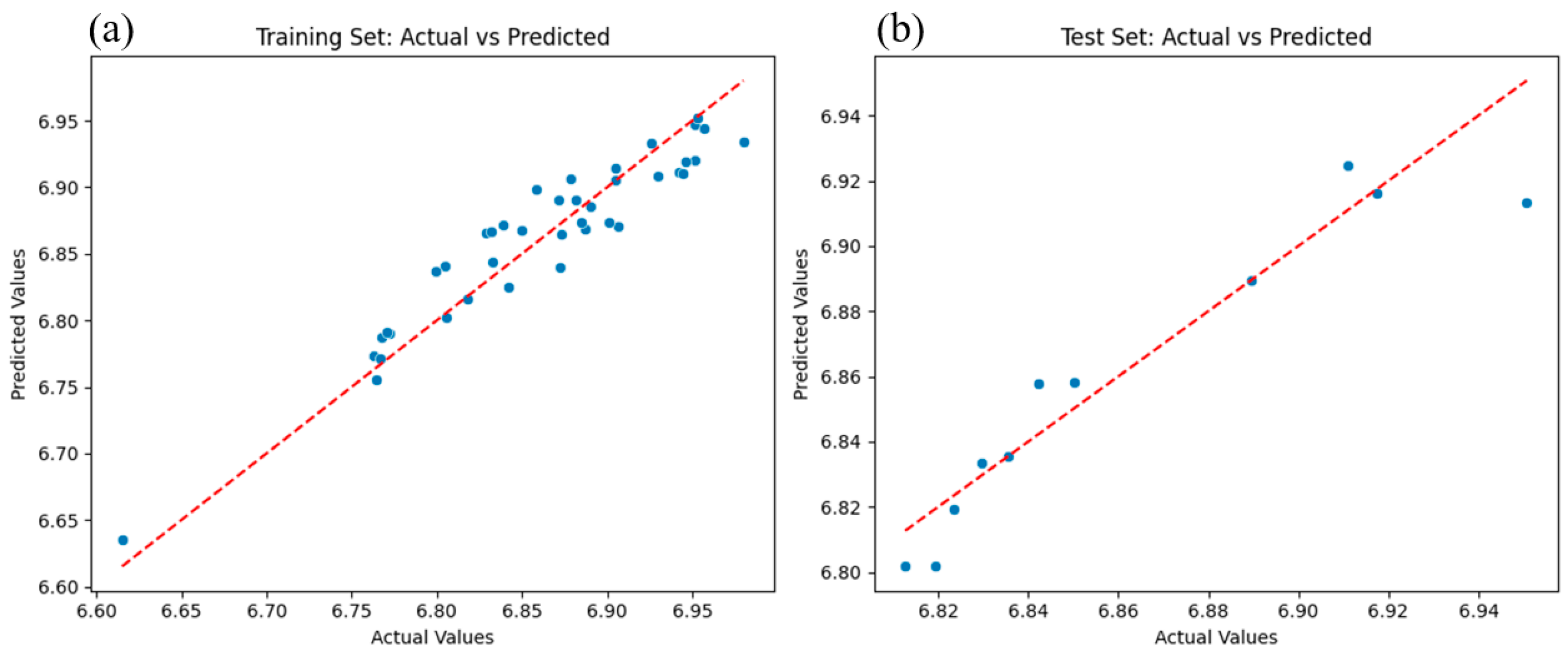
Among the evaluated regression models, CatBoost demonstrated the strongest predictive performance on the independent test set. It achieved a test R2 of 0.893 (training R2 = 0.889), as well as the lowest test MAE (0.010 g/cm3), RMSE (0.015 g/cm3), and MAPE (0.149%). XGBoost showed similar predictive capability, with a test R2 of 0.888, MAE of 0.019 g/cm3, RMSE of 0.023 g/cm3, and MAPE of 0.272%.
Compared to the tree-based methods, Bayesian ridge regression produced a similarly high test R2 (0.894), but its much lower training R2 (0.549) indicates less internal consistency and therefore lower reliability. Regularization enabled elastic net and lasso to deliver stable baseline performance suitable for a small dataset. In contrast, ridge regression and standard linear regression exhibited weaker predictive capability (training R2 ≈ 0.498), indicating that a purely linear formulation is insufficient to capture the nonlinear interactions between process parameters and resulting density within the investigated parameter window.
Given the observed density fluctuation in the dataset, the absolute prediction errors produced by CatBoost are negligible. With predictions clustered close to the 1:1 line and no discernible systematic deviation across the density range, the parity plot (Figure 4) demonstrates strong agreement between the observed and predicted densities. Deviations on the order of 0.01–0.02 g/cm3 may appear visually prominent due to the narrow range of density values even though their absolute magnitude remains modest.

4. Discussion

CatBoost presented a dependable balance between accuracy and generalization, aligning with its effectiveness for small tabular datasets featuring nonlinearities and interaction effects, which corresponds with the SHAP interaction patterns noted among the main energy-input factors. The significance of addressing collinearity was proven since the regularized models exceeded the performance of linear regression. An analysis of feature importance for CatBoost was considered as the best next step to comprehend the impact of the parameters, which will be contrasted with the distance correlation heatmap in the subsequent section.

4.1. Feature Importance Analysis

For the best-performing model (CatBoost), feature importance was quantified using the model’s built-in feature importance measure and normalized so that importance scores sum to 100%. The resulting importance ranking is reported in Table 12. Nominal track overlap was excluded from the feature set because it is deterministically dependent on hatch spacing (distance correlation of 1.00; Figure 3), which avoids redundancy. The importance ranking was then compared with the distance correlation heatmap (Figure 3) to verify the consistency between model-based importance and dependence screening.
The results were compared with the distance correlation heatmap (Figure 3). Laser power’s importance of 49.042 is consistent with the distance correlation of 0.36 and confirms its influence in increasing density through increased energy input. This was followed by scanning speed, with a significance of 42.142, again consistent with its distance correlation of 0.40, reflecting its influence on melting time and resulting porosity. Hatch spacing had a lower significance of 5.151, again consistent with its distance correlation of 0.15 and probably due to its narrow range (0.049 to 0.065 mm). Layer thickness was the least influential parameter, with an importance of 3.666, consistent with its distance correlation of 0.18 and again possibly due to its narrow range (0.025 to 0.035 mm). Agreement between feature importance and distance correlation was found, showing laser power and scanning speed as the most important factors.

4.2. SHAP Analysis for Model Interpretability

SHAP (SHapley Additive exPlanation) values were computed to better understand the significance of the input parameters on model behavior [43]. The SHAP analysis provided a complementary view by explaining the direction and interaction structure of feature effects. The SHAP-based ranking was consistent with the built-in importance ranking (Table 12), with laser power and scanning speed dominating, while hatch spacing and layer thickness make comparatively smaller contributions within the investigated ranges.
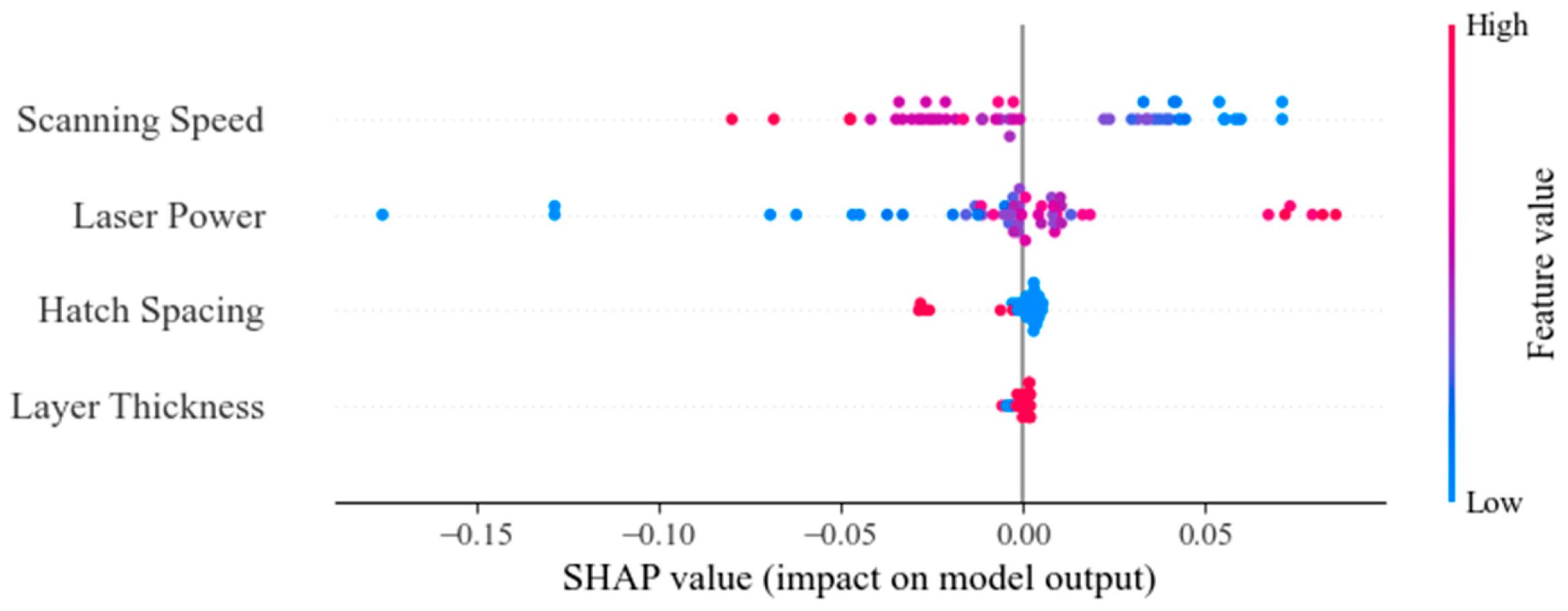
Each dot in Figure 5’s grouped SHAP values represents a sample; its color indicates the trait value (blue for low; red for high), and its location along the x-axis indicates whether the impact on density was positive or negative.
Higher values (red) for scanning speed correspond to negative SHAP values, leading to a lower density prediction due to insufficient melting time, whereas lower values (blue) increase density. Greater density results from improved powder fusion caused by greater laser powers (red). Because of their limited ranges, hatch spacing and layer thickness have lower SHAP values, which is consistent with their decreased significance.
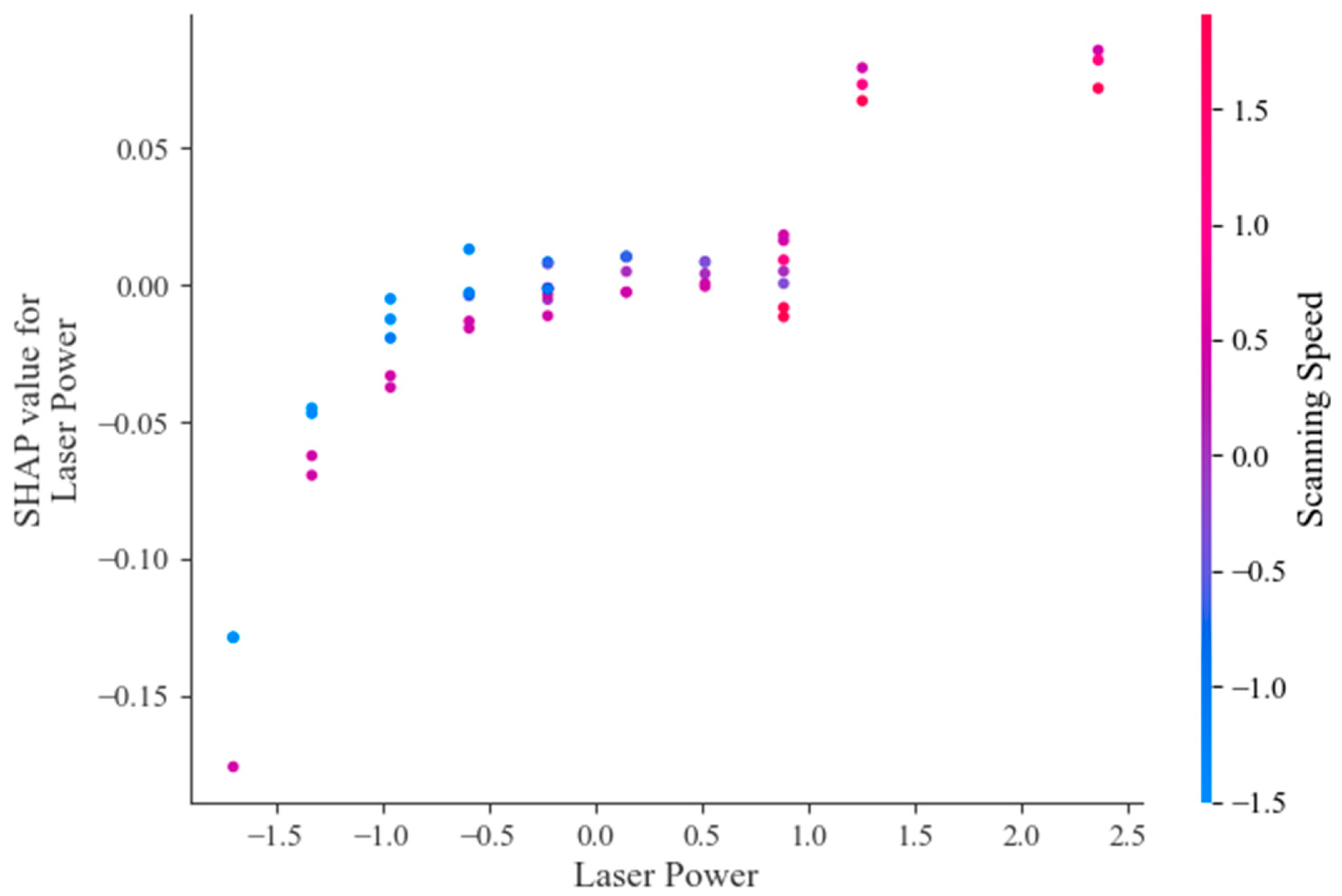
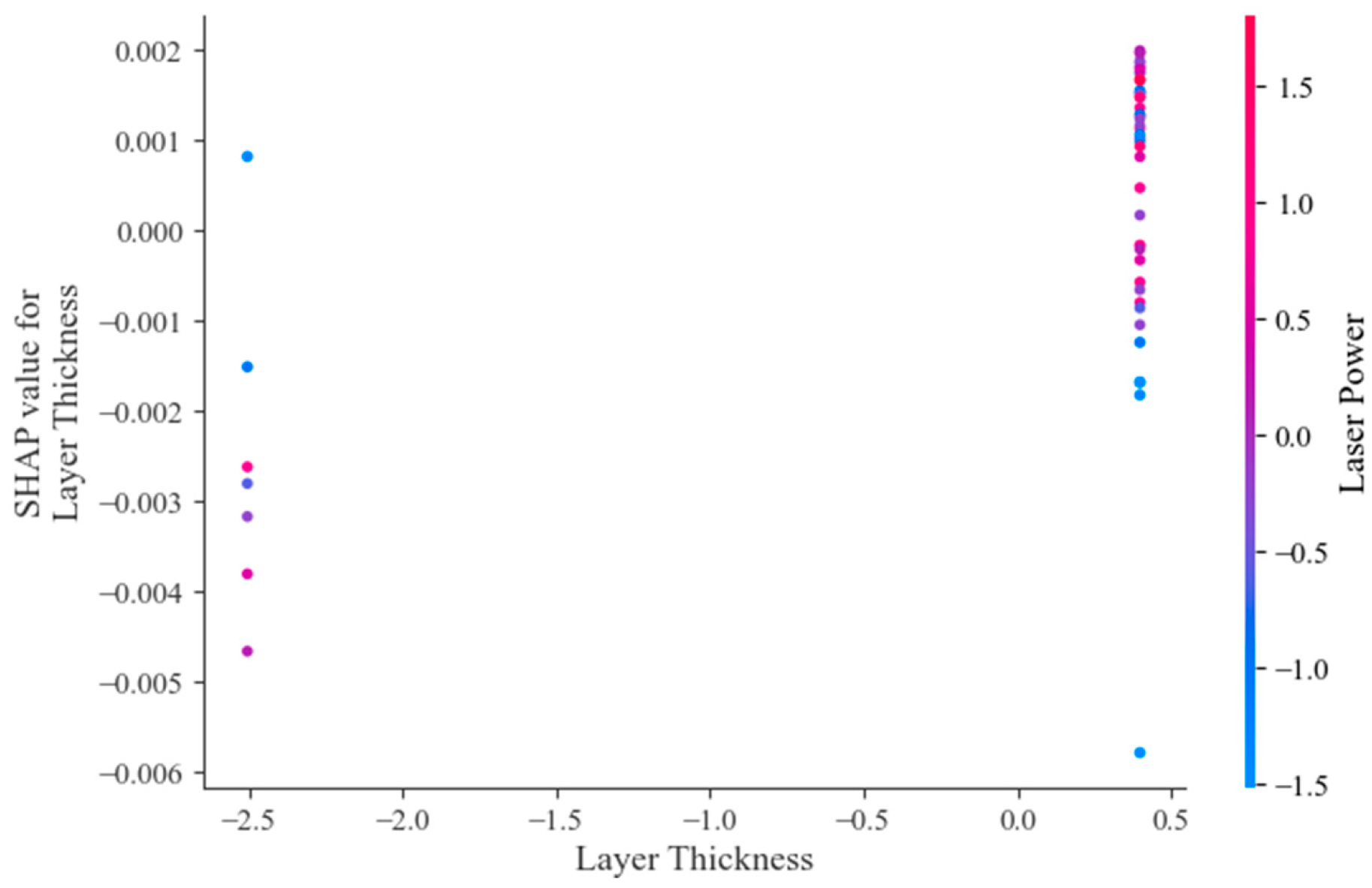
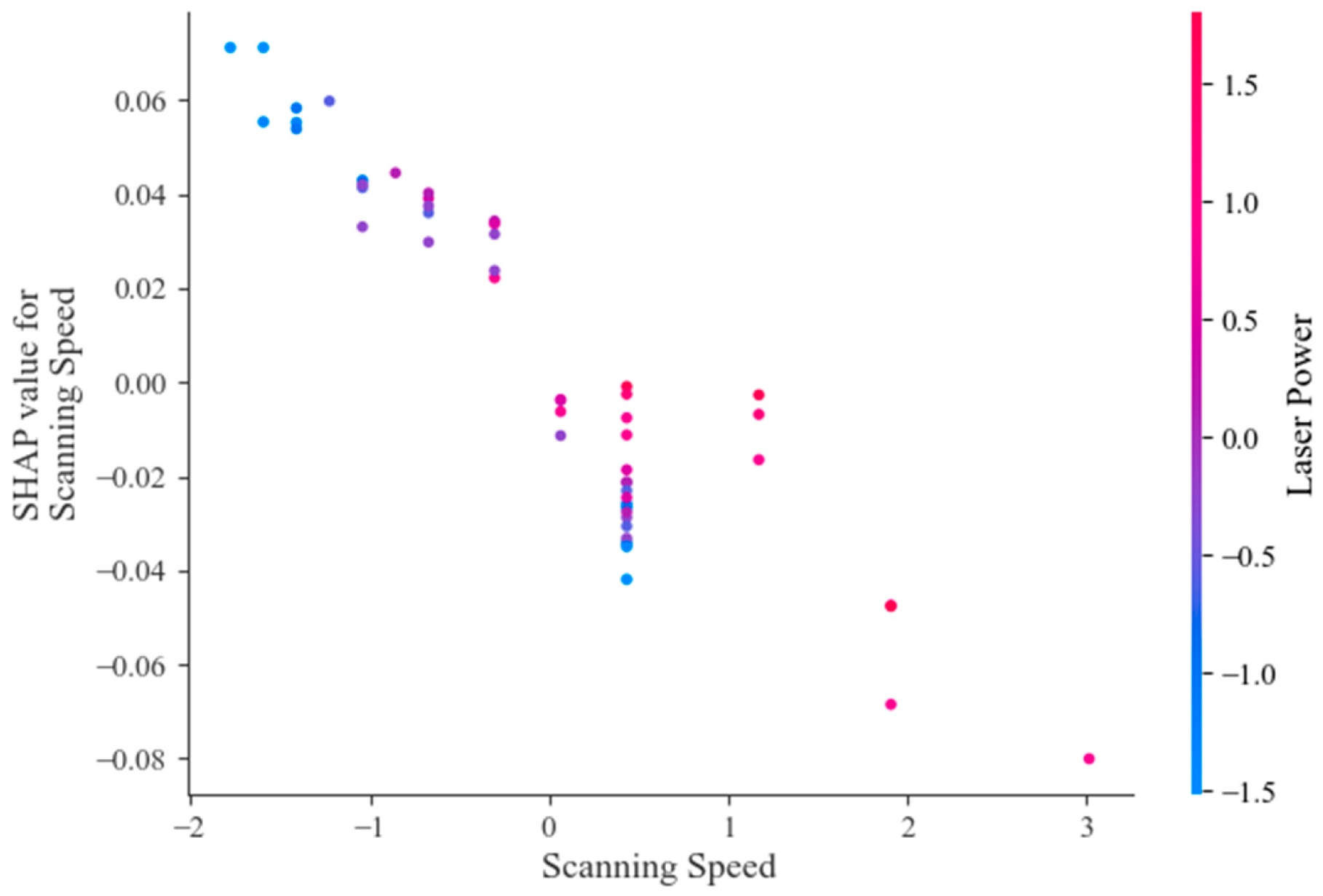
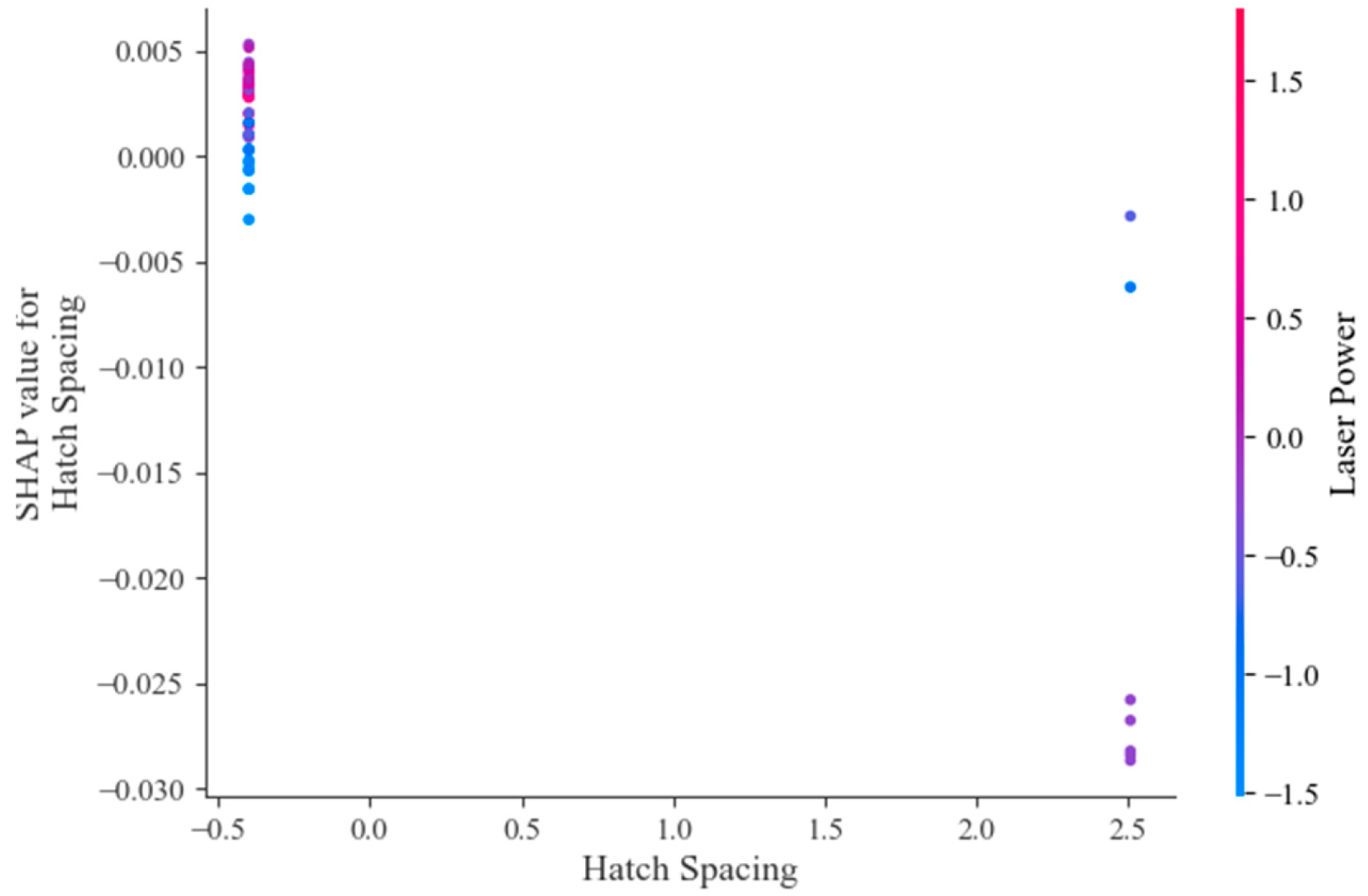
Laser power, scanning speed, hatch spacing, and layer thickness (connections between parameters) are shown in Figure 6, Figure 7, Figure 8 and Figure 9. Figure 6 illustrates that increased laser power typically enhances predicted density, with this effect being more pronounced at slower scanning speeds. Figure 7 indicates that increased scanning speeds lead to a decrease in predicted density, whereas higher laser power somewhat compensates for this decrease. Figure 8 and Figure 9 show that increased hatch spacing often leads to decreased predicted density, while layer thickness has only a slight impact.
Figure 6 presents a scatter plot with the SHAP values for laser power (x-axis: laser power values; y-axis: SHAP values), where the points are colored according to the scanning speed (red: high; blue: low). The diagram illustrates the interaction between laser power and scanning speed.
The scatter plot in Figure 7 displays the SHAP values for scanning speed (x-axis: scanning speed values; y-axis: SHAP values), with points colored based on laser power (red for high; blue for low). Increased scanning speeds lower the expected density, although this effect is diminished by the laser power.
The scatter plot in Figure 8 illustrates the SHAP values for hatch spacing (x-axis: hatch spacing values; y-axis: SHAP values), with the points shaded according to the laser power (red: high; blue: low). The plot depicts a slight effect on density.
With the dots categorized by laser power (red: high; blue: low), the scatter diagram (Figure 9) displays the SHAP values for layer thickness (x-axis: layer thickness; y-axis: SHAP values). Once more, the graphic reveals very little impact on density.
The SHAP analysis confirms that laser power and scanning speed are the most important parameters affecting the density of components made of pure Zn processed with LPBF, and it supports the results of the feature importance and distance correlation assessments. The interpretability of the created CatBoost model is further confirmed by the correlation and consistency of the results between these methods.
In addition, the SHAP approach’s ability to reveal feature interaction (particularly between laser power and scanning speed) provides useful guidance for AM process optimization, such as using slower scanning speeds at higher laser powers (to a certain value) to increase product density.

4.3. Result Comparison Against VED

In addition to modeling process parameters (P, v, h, t), volumetric energy density (VED), defined as in Equation (3), was evaluated as a physically motivated composite feature.
VED = P v × h × t   [ J / mm 3 ]
where P is laser power input [W], v is scanning speed [mm/s], h is hatch spacing [mm] and t is layer thickness [mm].
VED is frequently used in LPBF studies to represent overall energy input per unit volume. However, VED is algebraically dependent on the primitive variables; therefore, including both VED and its components introduces deterministic multicollinearity. In linear models, this results in unstable coefficient estimates and loss of identifiability of individual parameter effects. For this reason, the models were evaluated using only process variables. The preliminary results indicate that the primitive-variable models performed better, suggesting that the nonlinear interactions between parameters are not fully captured by a single scalar energy-density metric. This finding supports the use of multivariate machine learning approaches rather than sole reliance on composite energy parameters.

4.4. Achieved Densities

A critical comparison with the reported LPBF Zn studies shows that the maximum relative density achieved in this work (97.4%) falls within the upper range reported in the literature. Lietaert et al. [1] reported relative densities above 95% for LPBF-processed pure Zn under optimized conditions. Similarly, Zhou et al. [8] observed density values typically ranging from 92% to 97% depending on process parameters and melt-pool stability. More recent investigations on Zn-based systems also report densities approaching 97–99% under carefully controlled processing windows [13,22]. Compared to these studies, the densities achieved here are competitive, particularly given the limited dataset (51 parameter sets) and the constrained exploration ranges for hatch spacing and layer thickness.

4.5. Study Limitations

Due to practical and experimental difficulties, this study had certain limitations. To start, the dataset included 51 samples, which was a very small number given the high expense, time, and resource requirements of experimental AM runs. The models’ usefulness may be impacted by the tiny sample size. The parameter-space coverage plot (Figure 2) confirms that the experimental dataset is not uniformly distributed as it was generated through sequential exploration rather than a formal space-filling design. The trained machine learning models should therefore be interpreted as local surrogate models intended for interpolation within the investigated window.
The layer thickness (0.025–0.035 mm) and hatch spacing (0.049–0.065 mm) were explored over constrained ranges to maintain process stability during pure Zn LPBF and to manage visible vapor/condensate formation. As a result, the observed weak sensitivity of density to these parameters should be interpreted as conditional on the investigated window; the trained models should not be extrapolated to substantially different hatch spacing or layer thickness without additional data that expands those ranges.
Third, since overlap is a derived number with fixed optics, nominal track overlap and hatch spacing were not changed separately. Overlap was removed from the model inputs and hatch spacing was kept as the controlled variable because of this duplication, which restricts the ability to interpret overlap as a distinct physical driver.
Fourth, because it was believed to provide a fundamental understanding, the study exclusively examined pure zinc.
However, this decision lessens the results’ applicability due to the unique thermophysical characteristics of zinc alloys.
Lastly, because they are hard to detect or control, external elements like the powder’s particle size distribution and the manufacturing environment (such as the nitrogen atmosphere) were not considered in the models. However, as these factors might affect the final component density, failing to take them into consideration could result in unconsidered unpredictability.

4.6. Proposed Approaches to Overcome Limitations

Subsequent studies should expand the ranges of input parameters, especially concerning layer thickness and hatch spacing, to comprehensively understand their impacts. Track overlap and hatch spacing must be modeled separately to avoid collinearity. Incorporating chamber conditions and powder traits into the modeling is expected to enhance the model’s accuracy. The framework used should be applied to include Zn alloys and various biodegradable metals to advance the area of biomedical applications.

5. Conclusions

Despite machine learning (ML) methods being proven effective for LPBF process optimization, specific studies on zinc (Zn) are limited, thus suggesting that more research is still needed to validate these methods for additive manufacturing with Zn, particularly for density prediction. This study demonstrated that the CatBoost method offers highly accurate density predictions for LPBF-processed Zn parts (test R2 of 0.893, test MAE 0.010, test RMSE 0.015 and test MAPE of 0.149) on a relatively small database (51 samples). With a distance correlation heatmap and feature importance analysis, laser power and scanning speed were determined as the most influential manufacturing parameters, while hatch spacing and layer thickness showed lesser yet still important influence. The SHAP analysis with dependency plots confirmed the importance of laser power and scanning speed and illustrated their combined effect, where reduced scanning speeds with increased laser power increase product density, providing an opportunity for AM process improvement.

6. Future Research

It is planned that the research will be extended in future work on the prediction of LPBF-processed Zn parts by extending the experiment using the results and findings obtained with a combination of DOE techniques to further confirm the study results and improve the ML models. This study will be extended in the future to verify generalization performance independently using a small validation batch based on Latin hypercubes within the nominal window. This will attempt to provide a framework for optimizing the production parameters to obtain high-density LPBF-processed parts.

Author Contributions

Conceptualization, K.Š. and S.P.; methodology, K.Š. and S.P.; software, K.Š.; validation, M.F.; formal analysis, K.Š., T.B. and M.F.; investigation, K.Š., S.P., T.B. and I.D.; resources, S.P. and I.D.; data curation, K.Š. and S.P.; writing—original draft preparation, K.Š. and S.P.; writing—review and editing, T.B., I.D. and M.F.; visualization, K.Š., S.P. and T.B.; supervision, I.D. and M.F.; project administration, I.D.; funding acquisition, I.D. and M.F. All authors have read and agreed to the published version of the manuscript.

Funding

The authors acknowledge the financial support from the Slovenian Research and Innovation Agency (research core funding Nos. P2-0157 and P2-0137 and research projects J7-60120 and J1-60015).

Data Availability Statement

The original contributions presented in this study are included in the article. Further inquiries can be directed to the corresponding authors.

Conflicts of Interest

The authors declare that they have no known competing financial interests or personal relationships that could influence the work in this article.

Abbreviations

The following abbreviations are used in this manuscript:
AbbreviationFull Term
AMAdditive Manufacturing
LPBFLaser Powder Bed Fusion
MLMachine Learning
SHAPsSHapley Additive exPlanations
ZnZinc
TPMSTriply Periodic Minimal Surface
FeIron
TiTitanium
SLMSelective Laser Melting
GPRGaussian Process Regression
AIArtificial Intelligence
PCAPrincipal Component Analysis
R2Coefficient of Determination
MAEMean Absolute Error
RMSERoot Mean Square Error
MAPEMean Absolute Percentage Error
DOEDesign of Experiments

References

  1. Lietaert, K.; Zadpoor, A.A.; Sonnaert, M.; Schrooten, J.; Weber, L.; Mortensen, A.; Vleugels, J. Mechanical Properties and Cytocompatibility of Dense and Porous Zn Produced by Laser Powder Bed Fusion for Biodegradable Implant Applications. Acta Biomater. 2020, 110, 289–302. [Google Scholar] [CrossRef]
  2. Limón, I.; Bedmar, J.; Fernández-Hernán, J.P.; Multigner, M.; Torres, B.; Rams, J.; Cifuentes, S.C. A Review of Additive Manufacturing of Biodegradable Fe and Zn Alloys for Medical Implants Using Laser Powder Bed Fusion (LPBF). Materials 2024, 17, 6220. [Google Scholar] [CrossRef]
  3. Liu, Y.; Zheng, Y.; Chen, X.; Yang, J.; Pan, H.; Chen, D.; Wang, L.; Zhang, J.; Zhu, D.; Wu, S.; et al. Fundamental Theory of Biodegradable Metals—Definition, Criteria, and Design. Adv. Funct. Mater. 2019, 29, 1805402. [Google Scholar] [CrossRef]
  4. Prakasam, M.; Locs, J.; Salma-Ancane, K.; Loca, D.; Largeteau, A.; Berzina-Cimdina, L. Biodegradable Materials and Metallic Implants—A Review. J. Funct. Biomater. 2017, 8, 44. [Google Scholar] [CrossRef]
  5. Khalilov, R.K. Future Prospects of Biomaterials in Nanomedicine. Adv. Biol. Earth Sci. 2024, 9, 5–10. [Google Scholar] [CrossRef]
  6. Qin, Y.; Wen, P.; Guo, H.; Xia, D.; Zheng, Y.; Jauer, L.; Poprawe, R.; Voshage, M.; Schleifenbaum, J.H. Additive Manufacturing of Biodegradable Metals: Current Research Status and Future Perspectives. Acta Biomater. 2019, 98, 3–22. [Google Scholar] [CrossRef]
  7. Barnhurst, R.J. Zinc and Zinc Alloys. In Properties and Selection: Nonferrous Alloys and Special-Purpose Materials; ASM International: Materials Park, OH, USA, 1990; pp. 527–542. [Google Scholar]
  8. Zhou, Y.; Wang, J.; Yang, Y.; Yang, M.; Zheng, H.; Xie, D.; Wang, D.; Shen, L. Laser Additive Manufacturing of Zinc Targeting for Biomedical Application. Int. J. Bioprint. 2022, 8, 74–95. [Google Scholar] [CrossRef] [PubMed]
  9. Bowen, P.K.; Drelich, J.; Goldman, J. Zinc Exhibits Ideal Physiological Corrosion Behavior for Bioabsorbable Stents. Adv. Mater. 2013, 25, 2577–2582. [Google Scholar] [CrossRef]
  10. Yang, M.; Yang, L.; Peng, S.; Deng, F.; Li, Y.; Yang, Y.; Shuai, C. Laser Additive Manufacturing of Zinc: Formation Quality, Texture, and Cell Behavior. Bio-Des. Manuf. 2023, 6, 103–120. [Google Scholar] [CrossRef]
  11. Yang, X.; Peng, Z.; Fang, Y.; Tang, Y.; Shen, H.H.; Zhu, Y. Review of Additively Manufactured Zinc Alloys by Laser Powder Bed Fusion for Biomedical Applications. Rare Met. 2025, 44, 8262–8291. [Google Scholar] [CrossRef]
  12. Kaplan, A.F.H.; Mizutani, M.; Katayama, S.; Matsunawa, A. Unbounded Keyhole Collapse and Bubble Formation during Pulsed Laser Interaction with Liquid Zinc. J. Phys. D Appl. Phys. 2002, 35, 319. [Google Scholar] [CrossRef]
  13. Waqas, M.; He, D.; Tan, Z.; Yang, P.; Gao, M.; Guo, X. A Study of Selective Laser Melting Process for Pure Zinc and Zn10mg Alloy on Process Parameters and Mechanical Properties. Rapid Prototyp. J. 2023, 29, 1923–1939. [Google Scholar] [CrossRef]
  14. Qin, Y.; Yang, H.; Liu, A.; Dai, J.; Wen, P.; Zheng, Y.; Tian, Y.; Li, S.; Wang, X. Processing Optimization, Mechanical Properties, Corrosion Behavior and Cytocompatibility of Additively Manufactured Zn-0.7Li Biodegradable Metals. Acta Biomater. 2022, 142, 388–401. [Google Scholar] [CrossRef] [PubMed]
  15. Shuai, C.; Cheng, Y.; Yang, Y.; Peng, S.; Yang, W.; Qi, F. Laser Additive Manufacturing of Zn-2Al Part for Bone Repair: Formability, Microstructure and Properties. J. Alloys Compd. 2019, 798, 606–615. [Google Scholar] [CrossRef]
  16. Sah, A.K.; Agilan, M.; Dineshraj, S.; Rahul, M.R.; Govind, B. Machine Learning-Enabled Prediction of Density and Defects in Additively Manufactured Inconel 718 Alloy. Mater. Today Commun. 2022, 30, 103193. [Google Scholar] [CrossRef]
  17. Cao, Z.; Liu, Q.; Liu, Q.; Yu, X.; Kruzic, J.J.; Li, X. A Machine Learning Method to Quantitatively Predict Alpha Phase Morphology in Additively Manufactured Ti-6Al-4V. npj Comput. Mater. 2023, 9, 195. [Google Scholar] [CrossRef]
  18. Sing, S.L.; Kuo, C.N.; Shih, C.T.; Ho, C.C.; Chua, C.K. Perspectives of Using Machine Learning in Laser Powder Bed Fusion for Metal Additive Manufacturing. Virtual Phys. Prototyp. 2021, 16, 372–386. [Google Scholar] [CrossRef]
  19. Herzog, T.; Brandt, M.; Trinchi, A.; Sola, A.; Molotnikov, A. Process Monitoring and Machine Learning for Defect Detection in Laser-Based Metal Additive Manufacturing. J. Intell. Manuf. 2024, 35, 1407–1437. [Google Scholar] [CrossRef]
  20. Masinelli, G.; Shevchik, S.A.; Pandiyan, V.; Quang-Le, T.; Wasmer, K. Artificial Intelligence for Monitoring and Control of Metal Additive Manufacturing. In Industrializing Additive Manufacturing; Springer International Publishing: Berlin/Heidelberg, Germany, 2021; pp. 205–220. [Google Scholar]
  21. Ladani, L.J. Applications of Artificial Intelligence and Machine Learning in Metal Additive Manufacturing. J. Phys Materials 2021, 4, 042009. [Google Scholar]
  22. Heiss, A.; Thatikonda, V.S.; Klotz, U.E. Multi-Objective Optimization of LPBF Manufacturing with Zn-4Al-1Cu Alloy for Technical Applications. J. Manuf. Process. 2025, 134, 193–206. [Google Scholar] [CrossRef]
  23. Zhao, S.; Zhou, C.; Hou, J.; Li, P.; Che, H.; Zheng, Y.; Gao, J.; Shi, Y.; Huang, C.; Li, X.; et al. Machine Learning-Guided Process Optimization and Comprehensive Evaluation of Additively Manufactured Biodegradable Zn-2Cu Alloy. J. Mater. Sci. Technol. 2025, 236, 245–261. [Google Scholar] [CrossRef]
  24. Tridello, A.; Ciampaglia, A.; Berto, F.; Paolino, D.S. Assessment of the Critical Defect in Additive Manufacturing Components through Machine Learning Algorithms. Appl. Sci. 2023, 13, 4294. [Google Scholar] [CrossRef]
  25. Zhou, H.R.; Yang, H.; Li, H.Q.; Ma, Y.C.; Yu, S.; Shi, J.; Cheng, J.C.; Gao, P.; Yu, B.; Miao, Z.Q.; et al. Advancements in Machine Learning for Material Design and Process Optimization in the Field of Additive Manufacturing. China Foundry 2024, 21, 101–115. [Google Scholar] [CrossRef]
  26. Altun, F.; Bayar, A.; Hamzat, A.K.; Asmatulu, R.; Ali, Z.; Asmatulu, E. AI-Driven Innovations in 3D Printing: Optimization, Automation, and Intelligent Control. J. Manuf. Mater. Process. 2025, 9, 329. [Google Scholar] [CrossRef]
  27. Dorogush, A.V.; Ershov, V.; Gulin, A. CatBoost: Gradient Boosting with Categorical Features Support. arXiv 2018, arXiv:1810.11363. [Google Scholar] [CrossRef]
  28. Chen, T.; Guestrin, C. XGBoost: A Scalable Tree Boosting System. In Proceedings of the ACM SIGKDD International Conference on Knowledge Discovery and Data Mining; Association for Computing Machinery: New York, NY, USA, 2016; pp. 785–794. [Google Scholar]
  29. Breiman, L. Random Forests. Mach. Learn. 2001, 45, 5–32. [Google Scholar] [CrossRef] [PubMed]
  30. Su, X.; Yan, X.; Tsai, C. Linear Regression. WIREs Comput. Stat. 2012, 4, 275–294. [Google Scholar] [CrossRef]
  31. Hoerl, A.E.; Kennard, R.W. Ridge Regression: Biased Estimation for Nonorthogonal Problems. Technometrics 2000, 42, 80–86. [Google Scholar] [CrossRef]
  32. Tibshirani, R. Regression Shrinkage and Selection via the Lasso. J. R. Stat. Soc. Ser. B Methodol. 1996, 58, 267–288. [Google Scholar] [CrossRef]
  33. Zou, H.; Hastie, T. Regularization and Variable Selection Via the Elastic Net. J. R. Stat. Soc. Series B Stat. Methodol. 2005, 67, 301–320. [Google Scholar] [CrossRef]
  34. MacKay, D.J.C. Bayesian Interpolation. Neural Comput. 1992, 4, 415–447. [Google Scholar] [CrossRef]
  35. Kruth, J.-P.; Leu, M.C.; Nakagawa, T. Progress in Additive Manufacturing and Rapid Prototyping. CIRP Ann. 1998, 47, 525–540. [Google Scholar] [CrossRef]
  36. Yadroitsev, I.; Gusarov, A.; Yadroitsava, I.; Smurov, I. Single Track Formation in Selective Laser Melting of Metal Powders. J. Mater. Process. Technol. 2010, 210, 1624–1631. [Google Scholar] [CrossRef]
  37. Thijs, L.; Verhaeghe, F.; Craeghs, T.; Van Humbeeck, J.; Kruth, J.-P. A Study of the Microstructural Evolution during Selective Laser Melting of Ti–6Al–4V. Acta Mater. 2010, 58, 3303–3312. [Google Scholar] [CrossRef]
  38. Gibson, I.; Rosen, D.; Stucker, B. Additive Manufacturing Technologies; Springer: New York, NY, USA, 2015; ISBN 978-1-4939-2112-6. [Google Scholar]
  39. Gong, H.; Rafi, K.; Gu, H.; Starr, T.; Stucker, B. Analysis of Defect Generation in Ti–6Al–4V Parts Made Using Powder Bed Fusion Additive Manufacturing Processes. Addit. Manuf. 2014, 1–4, 87–98. [Google Scholar] [CrossRef]
  40. Kappal, S. Data Normalization Using Median & Median Absolute Deviation (MMAD) Based Z-Score for Robust Predictions vs. Min-Max Normalization. Lond. J. Res. Sci. Nat. Form. 2019, 19, 39–44. [Google Scholar]
  41. Cawley, G.C.; Talbot, N.L.C. On Over-Fitting in Model Selection and Subsequent Selection Bias in Performance Evaluation. J. Mach. Learn. Res. 2010, 11, 2079–2107. [Google Scholar]
  42. Székely, G.J.; Rizzo, M.L.; Bakirov, N.K. Measuring and Testing Dependence by Correlation of Distances. Ann. Stat. 2007, 35, 2769–2794. [Google Scholar] [CrossRef]
  43. Marcilio, W.E.; Eler, D.M. From Explanations to Feature Selection: Assessing SHAP Values as Feature Selection Mechanism. In Proceedings of the 2020 33rd SIBGRAPI Conference on Graphics, Patterns and Images (SIBGRAPI); IEEE: Piscataway, NJ, USA, 2020; pp. 340–347. [Google Scholar]
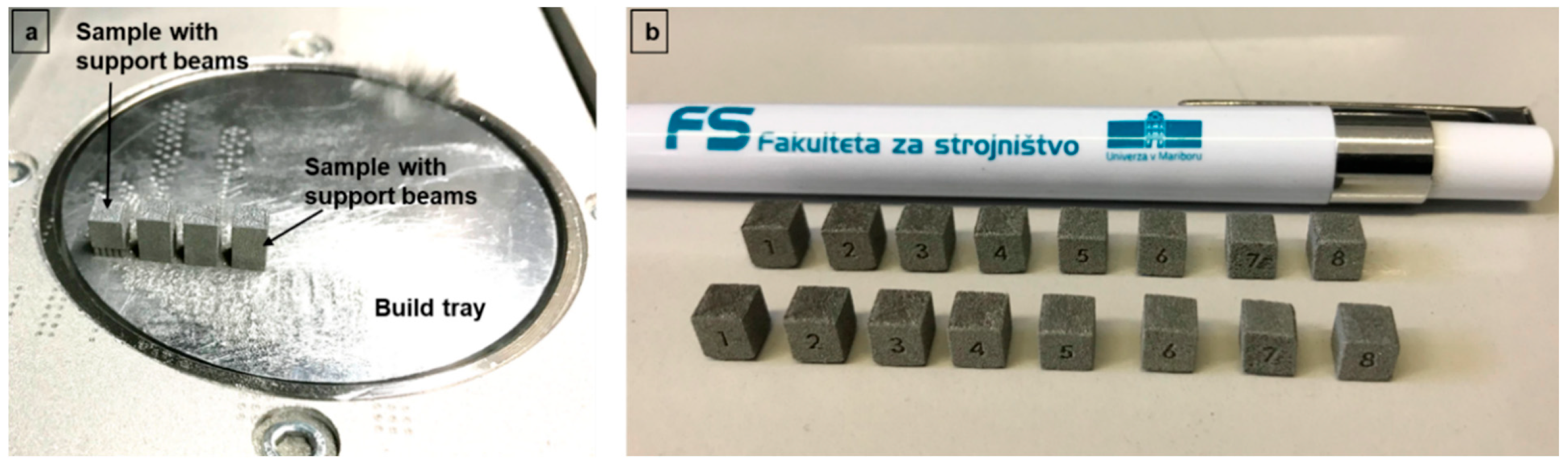
Figure 1. Photographs of the samples: (a) samples fabricated on build tray, with and without support structures. (b) Samples after support removal.
Metals 16 00309 g001
Figure 2. Fifty-one LPBF experiments’ parameter-space coverage in the laser power (P)–scanning speed (v) plane. Color indicates relative density (%), marker shape indicates hatch spacing (circles: 0.049 mm; squares: 0.065 mm) and layer thickness (triangles: 0.035 mm; diamonds: 0.025 mm).
Metals 16 00309 g002
Figure 3. Distance correlation heatmap of LPBF parameters and product density.
Metals 16 00309 g003
Figure 4. Predicted versus measured density for the best-performing model (CatBoost) on (a) the training set and (b) the test set.
Metals 16 00309 g004
Figure 5. SHAP summary plot. Red and blue dots indicate high and low feature values, with x-axis positions reflecting the contribution to predicted density.
Metals 16 00309 g005
Figure 6. SHAP dependence plot for laser power.
Metals 16 00309 g006
Figure 7. SHAP dependence plot for scanning speed.
Metals 16 00309 g007
Figure 8. SHAP dependence plot for hatch spacing.
Metals 16 00309 g008
Figure 9. SHAP dependence plot for layer thickness.
Metals 16 00309 g009
Table 1. Process parameters and their intervals.
ParameterMin ValueMax Value
Laser power [W]40150
Scanning speed [mm/s]2001500
Hatch spacing [mm]0.0490.065
Layer thickness [mm]0.0250.035
Table 2. Elemental composition and density of supplied powder.
PropertyValue
Zinc (Zn)≥99.9 wt%
Aluminum (Al)≤0.006 wt%
Lead (Pb)≤0.002 wt%
Other elements≤0.001 wt%
Material density7.133 g/cm3
Table 3. Summary of methods tested.
ModelTypeTypical Use Case
CatBoostgradient boostinghandling categorical features; nonlinear predictions
XGBoostgradient boostinghigh accuracy
complex datasets
Random forestensemble (decision trees)robustness
nonlinear relationships
Linear regressionlinear modelsimple linear relationships; baseline comparison
Ridge regressionlinear model with regularizationpreventing overfitting; multicollinearity
Lasso regressionlinear model with regularizationfeature selection
sparse models
Elastic netlinear model with regularizationcombines ridge and lasso; balanced regularization
Bayesian ridgeBayesian linear modeluncertainty quantification; small datasets
Table 4. Default model settings and hyperparameter search spaces used for tuning.
MethodDescriptionOriginal SettingsTuned Settings
Linear regressionFits a linear model by minimizing the sum of squared residualsfit_intercept = True, copy_X = True, n_jobs = NoneNone
Ridge regressionIntroduces an L2 penalty on coefficients to reduce overfitting in linear modelsalpha = 1.0, fit_intercept = True, max_iter = None, tol = 1 × 10 4 , solver = ‘auto’, random_state = <your_value>alpha: {0.1, 1.0, 10.0}
Lasso regressionApplies an L1 penalty, shrinking some coefficients to zero for implicit feature selectionalpha = 1.0, fit_intercept = True, tol = 1 × 10 4 , warm_start = False, selection = ‘cyclic’, random_state = <your_value>alpha: {0.001, 0.01, 0.1}
Elastic netCombines L1 and L2 penalties to balance sparsity and regularizationalpha = 1.0, l1_ratio = 0.5, fit_intercept = True, tol = 1 × 10 4 , warm_start = False, random_state = <your_value>alpha: {0.001, 0.01, 0.1}, l1_ratio: {0.1, 0.5, 0.9}
Bayesian ridgeExtends ridge with a Gaussian prior on coefficients, inferring hyperparameters from dataalpha_1 = 1 × 10 6 , alpha_2 = 1 × 10 6 , lambda_1 = 1 × 10 6 , lambda_2 = 1 × 10 6 , fit_intercept = True, tol = 1 × 10 3 None
Random forestBuilds an ensemble of decision trees using bootstrap sampling for robust predictionsn_estimators = 100, max_depth = None, max_features = ‘sqrt’, min_samples_split = 2, min_samples_leaf = 1, bootstrap = True, random_state = <your_value>n_estimators: {50, 100, 200}, max_depth: {None, 5, 10}, max_features: {None, “sqrt”, “log2”}, min_samples_split: {2, 5, 10}
XGBoostEmploys gradient-boosted trees with regularization for efficient and accurate regressionn_estimators = 100, max_depth = 6, learning_rate = 0.3, subsample = 1.0, alpha = 0, lambda = 1, objective = “reg:squarederror”, random_state = <your_value>n_estimators: {100, 200, 500}, max_depth: {3, 5, 7}, learning_rate: {0.01, 0.05, 0.1}, subsample: {0.6, 0.8, 1.0}, alpha: {0, 0.1, 0.5}, lambda: {1, 1.5, 2}
CatBoostUses gradient boosting with optimized handling of categorical features and reduced overfittingn_estimators = 1000, depth = 6, learning_rate = 0.03, l2_leaf_reg = 3, silent = True, random_state = <your_value>n_estimators: {100, 200, 500}, depth: {4, 6, 8}, learning_rate: {0.01, 0.05, 0.1}, l2_leaf_reg: {1, 3, 5}
Table 5. Manufacturing parameters in the 1st step of the study.
Sample
Number
Laser Power (W)Scanning Speed (mm/s)Track
Overlapping
Hatch Spacing (mm)Layer Thickness (mm)Material Density (g/cm3)
14080030%0.0490.0356.62
25080030%0.0490.0356.76
36080030%0.0490.0356.77
47080030%0.0490.0356.82
58080030%0.0490.0356.83
69080030%0.0490.0356.84
710080030%0.0490.0356.80
811080030%0.0490.0356.91
Table 6. Manufacturing parameters in the 2nd step of the study.
Sample
Number
Laser Power (W)Scanning Speed (mm/s)Track
Overlapping
Hatch Spacing (mm)Layer Thickness (mm)Material Density (g/cm3)
95080030%0.0490.0256.76
106080030%0.0490.0256.81
117080030%0.0490.0256.84
128080030%0.0490.0256.87
139080030%0.0490.0256.80
1410080030%0.0490.0256.83
1511080030%0.0490.0256.90
Table 7. Manufacturing parameters in the 3rd step of the study.
Sample
Number
Laser Power (W)Scanning Speed (mm/s)Track
Overlapping
Hatch Spacing (mm)Layer Thickness (mm)Material Density (g/cm3)
16110150030%0.0490.0356.77
17110120030%0.0490.0356.77
18110100030%0.0490.0356.85
1911070030%0.0490.0356.83
2011060030%0.0490.0356.87
2110070030%0.0490.0356.85
2210060030%0.0490.0356.94
2310050030%0.0490.0356.92
Table 8. Manufacturing parameters in the 4th step of the study.
Sample
Number
Laser Power (W)Scanning Speed (mm/s)Track
Overlapping
Hatch Spacing (mm)Layer Thickness (mm)Material Density (g/cm3)
249070030%0.0490.0356.89
259060030%0.0490.0356.95
269050030%0.0490.0356.95
279045030%0.0490.0356.91
288060030%0.0490.0356.93
298050030%0.0490.0356.90
308040030%0.0490.0356.95
317050030%0.0490.0356.86
327040030%0.0490.0356.90
336040030%0.0490.0356.89
346030030%0.0490.0356.94
355030030%0.0490.0356.84
365025030%0.0490.0356.88
374025030%0.0490.0356.81
384020030%0.0490.0356.82
Table 9. Manufacturing parameters in the 5th step of the study.
Sample
Number
Laser Power (W)Scanning Speed (mm/s)Track
Overlapping
Hatch Spacing (mm)Layer Thickness (mm)Material Density (g/cm3)
39808007%0.0650.0356.77
40807007%0.0650.0356.82
41806007%0.0650.0356.84
42805007%0.0650.0356.87
43804007%0.0650.0356.83
44703507%0.0650.0356.88
45603007%0.0650.0356.88
Table 10. Manufacturing parameters in the 6th step of the study.
Sample
Number
Laser Power (W)Scanning Speed (mm/s)Track
Overlapping
Hatch Spacing (mm)Layer Thickness (mm)Material Density (g/cm3)
46120120030%0.0490.0356.89
47120100030%0.0490.0356.93
4812080030%0.0490.0356.96
49150120030%0.0490.0356.88
50150100030%0.0490.0356.95
5115080030%0.0490.0356.95
Table 11. Training and test performance metrics of regression models for predicting material density in LPBF.
ModelTrainTest
R2MAERMSEMAPER2MAERMSEMAPE
Bayesian ridge0.5490.0370.0460.5410.8940.0180.0220.268
CatBoost0.8990.0200.0230.2880.8930.0100.0150.149
Elastic net0.5400.0380.0470.5570.8790.0170.0220.250
Lasso regression0.6010.0370.0450.5390.8060.0190.0240.269
Linear regression0.4980.0320.0390.4640.8850.0280.0340.414
Random forest0.9180.0160.0200.2360.8680.0180.0230.264
Ridge regression0.5860.0360.0450.5210.7990.0240.0290.348
XGBoost0.9650.0100.0130.1460.8880.0190.0230.272
Table 12. CatBoost built-in feature importance (normalized to 100%) for the physical input parameters.
FeatureImportance Score
Laser Power49.042
Scanning Speed42.142
Hatch Spacing5.151
Layer Thickness3.666
Disclaimer/Publisher’s Note: The statements, opinions and data contained in all publications are solely those of the individual author(s) and contributor(s) and not of MDPI and/or the editor(s). MDPI and/or the editor(s) disclaim responsibility for any injury to people or property resulting from any ideas, methods, instructions or products referred to in the content.