Article

Microstructure and Mechanical Properties of PM Ti-4Al-2Fe-3Cu Alloy Modified by Vanadium Addition

by
Mojtaba Najafizadeh
1,
Mehran Ghasempour-Mouziraji
2,* and
Ricardo Alves de Sousa
3,4
1
Independent Researcher, Bandar Abbas 79177, Iran
2
Independent Researcher, 3810-193 Aveiro, Portugal
3
TEMA, Centre for Mechanical Technology and Automation, Department of Mechanical Engineering, University of Aveiro, 3810-193 Aveiro, Portugal
4
LASI—Intelligent Systems Associate Laboratory, 4800-058 Guimarães, Portugal
*
Author to whom correspondence should be addressed.
Metals 2026, 16(3), 310; https://doi.org/10.3390/met16030310
Submission received: 1 January 2026 / Revised: 9 February 2026 / Accepted: 13 February 2026 / Published: 11 March 2026

Abstract

This study examines the effect of vanadium addition on the microstructure and mechanical properties of low-cost powder metallurgy Ti-4Al-2Fe-3Cu alloys. Alloys with and without 6 wt.% V were fabricated by hot extrusion of blended elemental powders followed by vacuum heat treatment. Microstructural analysis revealed that the base alloy exhibits a coarse lamellar α/β structure, while vanadium addition promotes a refined basketweave morphology with a significantly higher β-phase fraction, increasing from 28.1% to 46.2%. Energy-dispersive spectroscopy confirmed preferential partitioning of Fe, Cu, and V into the β phase. Mechanical testing showed that the addition of 6 wt.% V markedly enhances strength, increasing yield strength and ultimate tensile strength from 1122 MPa and 1214 MPa to 1291 MPa and 1349 MPa, respectively, while maintaining comparable tensile ductility (~3.5%). The strength improvement is attributed to α-plate refinement, increased β-phase fraction, and solid-solution strengthening of the β phase. These results demonstrate that vanadium addition is an effective approach for improving the strength of low-cost PM titanium alloys without compromising ductility.

1. Introduction

Titanium-based alloys are extensively used in advanced engineering applications owing to their exceptional combination of low density, high specific strength, superior corrosion resistance, and good thermal stability. These attributes make titanium alloys particularly suitable for aerospace, automotive, biomedical, and high-temperature structural applications where performance efficiency and weight reduction are critical requirements [1,2]. However, despite these advantages, conventional titanium alloys often face limitations related to oxidation resistance, ductility, and processing complexity, especially in alloys with relatively low aluminum content. Such limitations can restrict their applicability in demanding service environments. It has been demonstrated that the controlled addition of β-stabilizing elements, such as vanadium, can substantially enhance the mechanical properties, oxidation resistance, and corrosion behavior of titanium alloys by modifying phase stability and deformation mechanisms [3]. The high production cost of titanium alloys remains one of the primary barriers to their widespread industrial adoption. These costs arise from expensive raw materials, energy-intensive processing routes, and challenges associated with the melting, casting, and machining of titanium alloys. As a result, considerable research efforts have been directed toward the development of low-cost titanium alloys with competitive mechanical performance [4,5,6]. One effective approach involves the use of relatively inexpensive alloying elements and master alloys to design new compositions that maintain desirable properties while reducing material costs [7,8]. In parallel, powder metallurgy (PM) processing routes have gained increasing attention as cost-effective alternatives to traditional manufacturing techniques. Among these, the blended elemental powder metallurgy (BE-PM) method offers notable advantages, including reduced material waste, lower processing temperatures, near-net-shape fabrication, and enhanced compositional flexibility, which enable precise control over alloy chemistry and microstructural features [9]. The mechanical behavior of titanium alloys is highly sensitive to alloy chemistry, as each alloying element plays a distinct role in stabilizing either the α or β phase and influencing phase transformations during processing and heat treatment [10]. The Ti-1Al-8V-5Fe alloy has been reported as a representative example of a novel low-cost β-titanium alloy that employs cost-efficient alloying elements while exhibiting promising mechanical properties [11]. Vanadium, in particular, is a strong β-phase stabilizer that significantly influences microstructural evolution and deformation behavior in titanium alloys. The segregation of vanadium within the β phase can activate additional deformation mechanisms, such as dislocation slip and phase-assisted plasticity, thereby enhancing strength–ductility synergy [12]. Previous investigations have shown that increasing vanadium content leads to substantial microstructural refinement, characterized by a reduction in the average width of α lamellae and a decrease in grain boundary thickness [13]. At lower vanadium concentrations (approximately 2 at.%), martensitic α plates have been observed to decorate the inter-lath regions of primary α lamellae, indicating a strong dependence of phase transformation pathways on vanadium content [14]. These microstructural changes play a critical role in controlling mechanical performance, as refined lamellar structures are known to improve both strength and fracture resistance. The influence of vanadium addition on mechanical properties has been widely reported across various titanium alloy systems. For instance, in hot-rolled Ti–Zr-based alloys, increasing vanadium content from 0 to 7 wt.% resulted in improved ductility accompanied by a reduction in yield strength and elastic modulus, highlighting the trade-off between stiffness and plastic deformability [15]. Similarly, the addition of vanadium has been shown to enhance the microstructural uniformity and mechanical performance of Ti–Pd alloys [16]. Beyond mechanical improvements, vanadium also contributes significantly to the corrosion resistance of titanium alloys by promoting the formation of stable and protective passive films. Studies have demonstrated that corrosion resistance increases markedly with higher vanadium content, further extending the applicability of titanium alloys in aggressive environments [17].
In the present study, a blended elemental powder compact extrusion technique was employed to fabricate a series of novel Ti-4Al-2Fe-3Cu–XV alloys (X = 0, 4, and 6 wt.%). This alloy system was selected to combine the benefits of low-cost alloying elements with the strengthening and stabilization effects of vanadium addition. The primary objective of this work is to systematically investigate the influence of vanadium content on the microstructural evolution and mechanical properties of these alloys produced via a powder metallurgy route. By establishing clear correlations between vanadium addition, microstructural characteristics, and mechanical performance, this study aims to provide valuable insights into the design and development of cost-effective, high-performance titanium alloys for advanced engineering applications.

2. Experimental Procedure

Ti-Al-Fe-Cu-V alloy rods with compositions of Ti-4Al-2Fe-3Cu-XV (wt.%) (X = 0, 6) were produced by extruding compacts of mixtures of TiH2, Al, Fe, Cu, and Al40V60 master alloy powders at 1200 °C and with a holding time of 5 min, using a 200-ton hydraulic press (SOV Hydraulic Technology, Shanghai, China). The raw materials used were TiH2 powder (particle sizes −200 mesh with purity of higher than 99.5%), Al powder (particle size −325 mesh with the purity of 99.9%), Fe powder (particle sizes −200 mesh with the purity of 99.9%), Cu powder (particle sizes −300 mesh with the 99.9%), and Al40V60 master alloy powder (particle size −200 mesh). All powders were heated at 100 °C for 2 h to remove the absorbed moisture, and then mixed for 24 h using a tumbler mixing machine (Shanghai Gehang Vacuum Technology, Shanghai, China). The powder mixtures with nominal compositions of Ti-4Al-2Fe-3Cu-XV were die-pressed to produce cylindrical powder compacts of 25 mm in diameter and 45 mm in height, with a relative density of around 85%. The powder compacts were heated to 1200 °C by induction heating in an argon atmosphere with oxygen content below 200 ppm, held at a temperature for 5 min, and then extruded to produce rods of 100 mm in diameter. The extruded rods were left to cool down to room temperature after extrusion. The H13 steel extrusion cylinder and die were heated to 500 °C before the extrusion was performed. The extrusion ratio was 9:1. Samples cut from the as-extruded rods were heat-treated at 1000 °C for 1 h in a vacuum furnace (Shanghai Gehang Vacuum Technology, Shanghai, China), followed by furnace cooling.
Table 1 shows the oxygen and hydrogen contents of the heat-treated samples determined using the LECO TCH-600 nitrogen/oxygen/hydrogen analyzer (LECO Corporation, Michigan, MI, USA).
A Rigaku Ultima IV X-ray diffractometer (XRD) was used to investigate the phase structure of the heat-treated samples. The microstructures of the heat-treated samples were characterized using an OLYMPUS BX51M optical microscope (Olympus corporation company, Tokyo, Japan) and an FEI NOVA NanoSEM 230 scanning electron microscope (SEM) (FEI Co., Hillsboro, OR, USA). For the optical microscopy (OM) and SEM examination, the polished surfaces of the cross-sections of the as-extruded rod and heat-treated samples were etched with a Kroll solution (3 mL HF, 6 mL HCl, 91 mL H2O). The hardness of the samples was determined using an automatic digital hardness tester with a 500 gr indenting load and a load dwell time of 10 s. Tensile test specimens with a gauge length of 15 mm, a cross-sectional thickness of 2 mm, and a width of 3 mm were cut along the extrusion direction using an electrical discharge machining wire-cutting machine. The tensile tests were performed using a Zwick/Roll Z20 universal testing machine (Rigaku Holdings Corporation, Tokyo, Japan) at room temperature. The strain was measured using an extensometer with a gauge length of 10 mm. The strain rate of the tensile testing was 5 × 10⁻⁴ s−1. The fracture surfaces of the tensile test specimens were examined using SEM.

3. Results

3.1. Microstructure

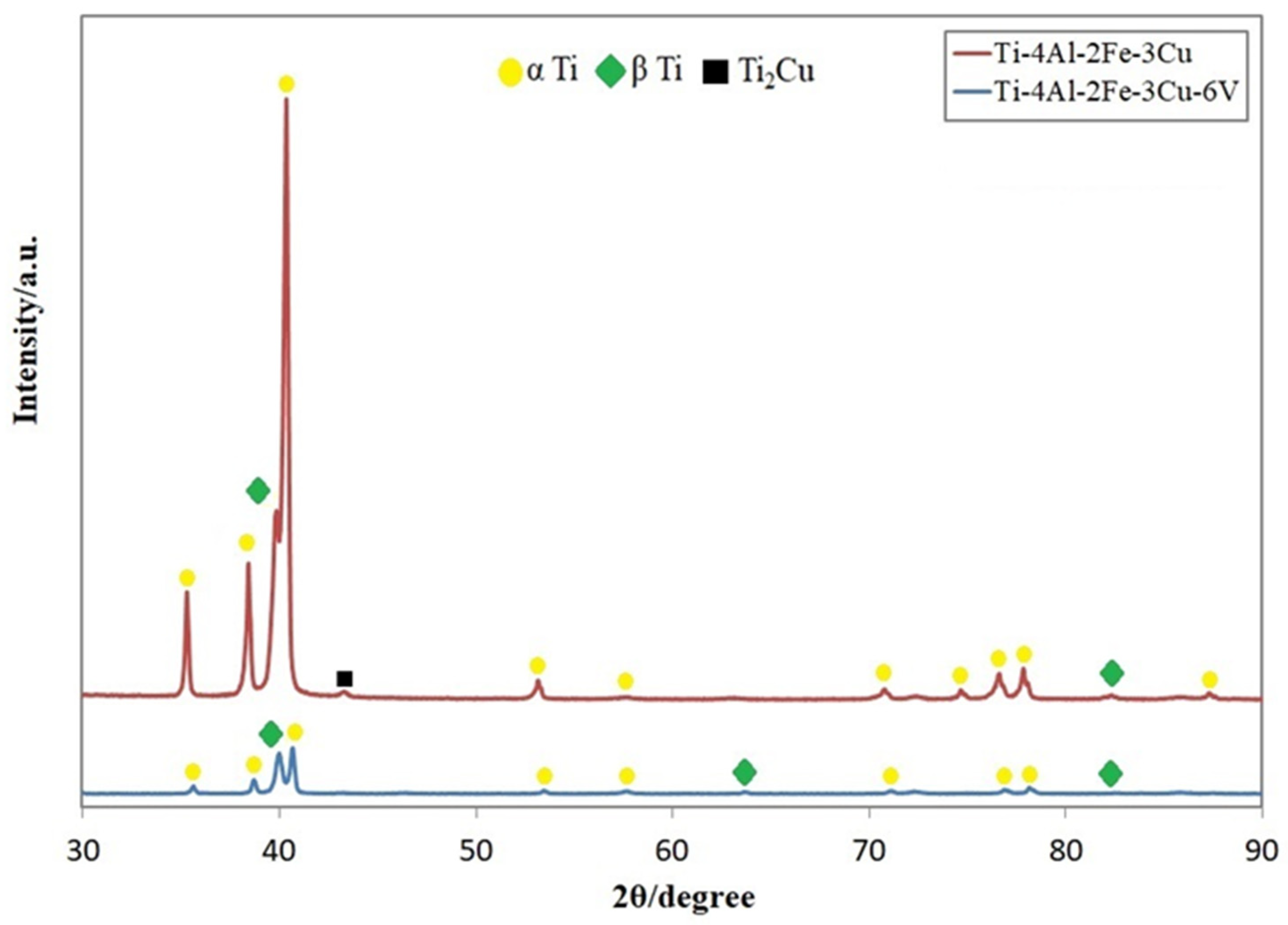
Figure 1 presents the X-ray diffraction (XRD) patterns of the heat-treated Ti-4Al-2Fe-3Cu and Ti-4Al-2Fe-3Cu-6V alloys. The diffraction results indicate that both alloys consist primarily of a dual-phase microstructure composed of α-Ti (hexagonal close-packed) and β-Ti (body-centered cubic) phases. In addition to these matrix phases, weak diffraction peaks corresponding to the intermetallic Ti2Cu phase are detected in the Ti-4Al-2Fe-3Cu alloy, suggesting the presence of a minor secondary phase formed due to the limited solubility of Cu in the α-Ti matrix. Upon the addition of vanadium, a noticeable change in phase constitution is observed. The relative intensities of the β-Ti diffraction peaks increase markedly in the Ti-4Al-2Fe-3Cu-6V alloy compared with the vanadium-free alloy. This enhancement in β-phase peak intensity clearly indicates a substantial increase in the volume fraction of the β phase as a result of vanadium addition. Since vanadium is a strong β-stabilizing element in titanium alloys, its presence effectively suppresses the α-phase stability and promotes the retention of the β phase at room temperature. Quantitative analysis of the phase fractions was performed by calculating the intensity ratios of the α{0001} and β{110} diffraction peaks with the following equation [18]:
W p = p P i
where W p is the volume phase fraction, p is the total peak intensity of a given phase in the XRD pattern, i is the number of the phase, and P i is the total peak intensity of all phases in the XRD pattern. Based on Equation (1) and Figure 1, the β-phase fraction was found to increase significantly from 28.1% in the Ti-4Al-2Fe-3Cu alloy to 46.2% in the Ti-4Al-2Fe-3Cu-6V alloy. This pronounced increase in β-phase content confirms the strong β-stabilizing effect of vanadium and suggests that vanadium addition plays a critical role in tailoring the phase balance of the Ti-4Al-2Fe-3Cu alloy system. The increased β-phase fraction is expected to have a significant influence on the subsequent microstructural evolution and mechanical behavior of the alloys, as the β phase generally contributes to improved ductility and altered deformation mechanisms. These effects will be discussed in detail in the following sections in relation to microstructural observations and mechanical property measurements.
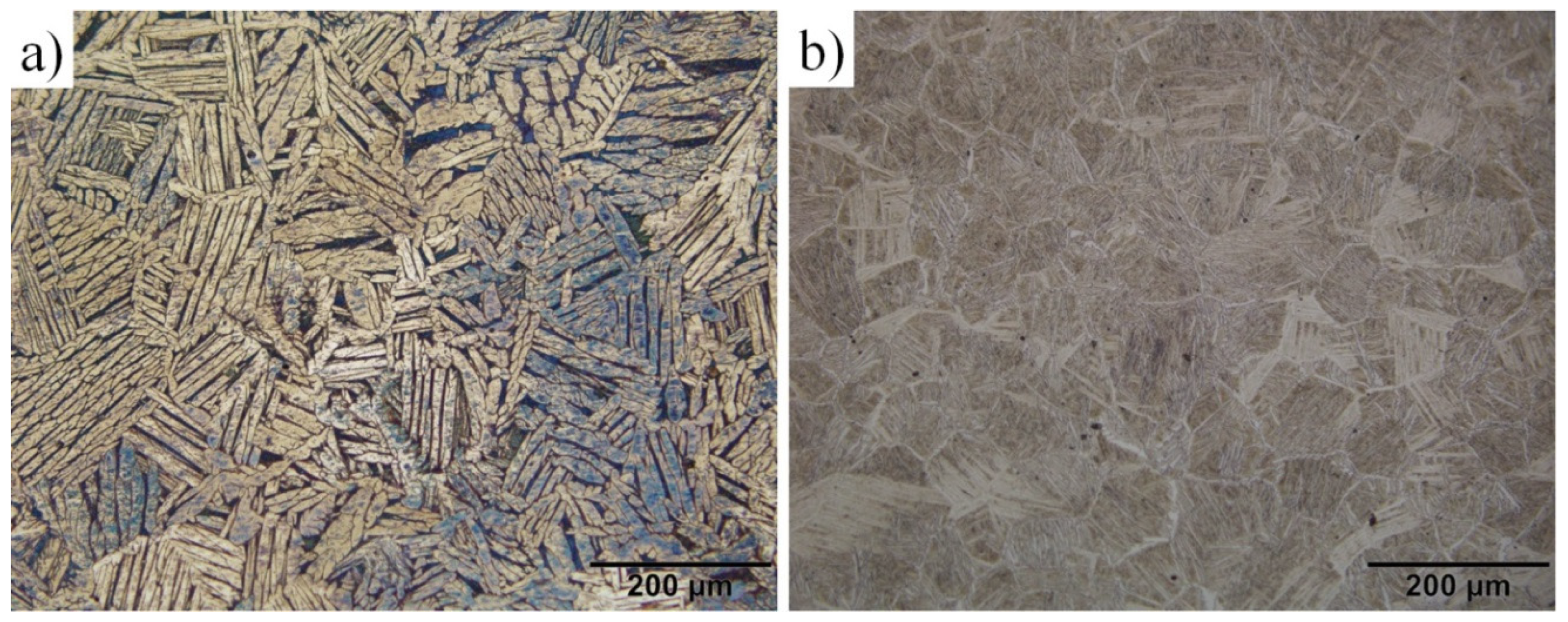
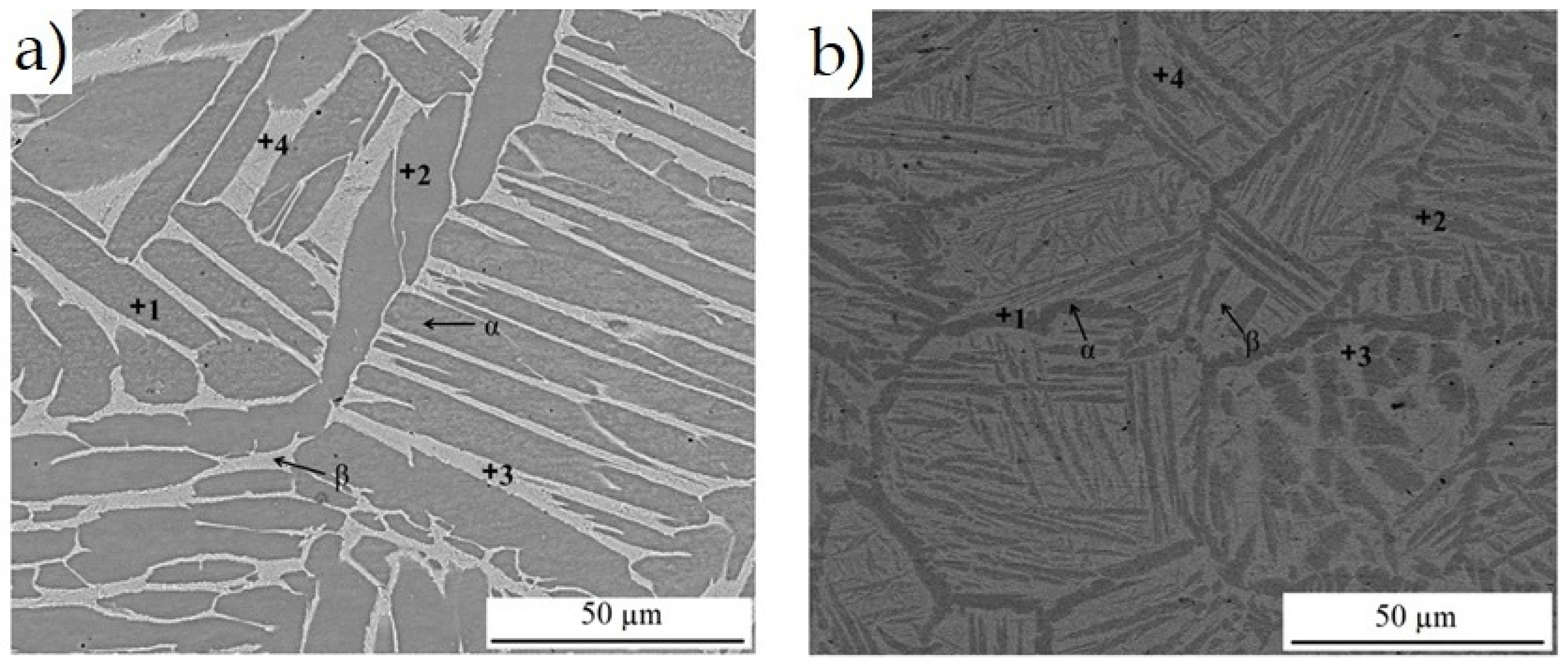
The optical microscopy (OM) and scanning electron microscopy (SEM) images of the heat-treated Ti-4Al-2Fe-3Cu-XV (X = 0 and 6) alloys are presented in Figure 2 and Figure 3. The micrographs reveal distinct differences in microstructural morphology resulting from vanadium addition. The Ti-4Al-2Fe-3Cu alloy exhibits a fully developed α/β lamellar microstructure, characterized by coarse α lamellae arranged in well-defined lamellar colonies within prior β grains. The average α-lamella thickness was measured to be approximately 11.6 µm, while the average lamellar colony size reached 142.7 µm. This coarse lamellar structure is indicative of relatively slow cooling and limited β-phase stabilization, leading to extensive α-phase growth during the β→α phase transformation. In contrast, the Ti-4Al-2Fe-3Cu-6V alloy displays a refined basketweave (Widmanstätten-type) microstructure. This microstructure consists of continuous α layers decorating the prior β grain boundaries, accompanied by interweaving intragranular α plates embedded within retained β domains. The α plates in the vanadium-containing alloy are significantly finer, with an average thickness of approximately 2.3 µm. The pronounced refinement of the α lamellae and the increased presence of β phase can be attributed to the strong β-stabilizing effect of vanadium, which suppresses α-phase coarsening and promotes the formation of a finer, more homogeneous α/β microstructure. The transition from a coarse lamellar structure to a fine basketweave morphology with vanadium addition is expected to have a significant impact on the mechanical behavior of the alloy. The refined α plates and increased β-phase fraction are likely to enhance ductility and strength by promoting more uniform plastic deformation and improving resistance to crack initiation and propagation. These microstructural features will be further correlated with the mechanical properties in the subsequent sections.
As summarized in Table 2, the energy-dispersive spectroscopy (EDS) point analysis reveals a clear elemental partitioning between the α and β phases in both alloys. In the Ti-4Al-2Fe-3Cu alloy, the α lamellae are enriched in aluminum, whereas the β lamellae contain significantly lower Al content. In the corresponding SEM micrographs, the brighter contrast regions are identified as the β phase, which exhibits substantially higher concentrations of iron and copper compared with the α phase. This elemental distribution is consistent with the preferential partitioning of β-stabilizing elements into the β phase.
A similar phase-dependent elemental segregation is observed in the Ti-4Al-2Fe-3Cu-6V alloy. The α plates are again enriched in aluminum relative to the surrounding β domains. In contrast, the bright regions observed in the SEM images correspond to the β phase and are characterized by markedly higher concentrations of vanadium, iron, and copper compared with the α phase. The strong enrichment of vanadium in the β phase further confirms its role as an effective β stabilizer in this alloy system.
The observed elemental partitioning between the α and β phases explains the microstructural differences identified by OM and SEM and is consistent with the phase fractions determined from XRD analysis. This compositional segregation is expected to influence the mechanical response of the alloys by affecting phase stability, deformation mechanisms, and load transfer between phases.
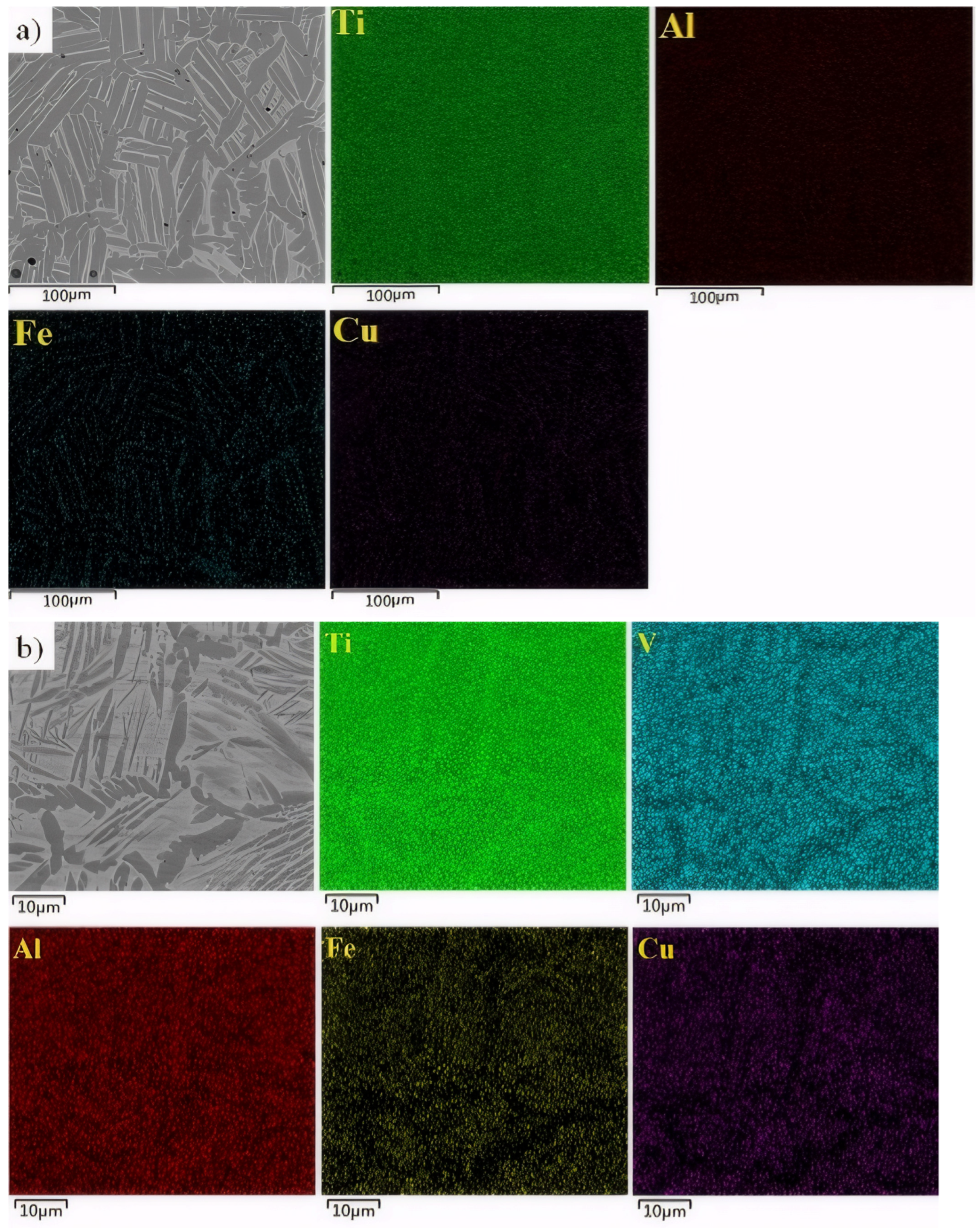
Figure 4 presents the energy-dispersive spectroscopy (EDS) elemental mapping results for the microstructures of the heat-treated Ti-4Al-2Fe-3Cu-XV (X = 0 and 6) alloys. As shown in Figure 4a,b, the elemental mappings indicate an overall homogeneous distribution of the major alloying elements across the microstructures of both alloys, suggesting effective elemental diffusion and compositional uniformity achieved during the extrusion and subsequent heat treatment processes. In the Ti-4Al-2Fe-3Cu alloy (Figure 4a), the EDS maps reveal a clear enrichment of copper and iron within the β lamellae, while aluminum is more uniformly distributed and preferentially associated with the α phase. This elemental segregation is consistent with the role of Fe and Cu as β-stabilizing elements, leading to their preferential partitioning into the β phase during phase transformation. For the Ti-4Al-2Fe-3Cu-6V alloy (Figure 4b), the EDS elemental mappings demonstrate a widespread distribution of aluminum throughout the microstructure, with a tendency toward enrichment in the α plates. In contrast, copper, iron, and vanadium are predominantly concentrated within the β lamellae. The strong partitioning of vanadium into the β phase further confirms its effectiveness as a β stabilizer and explains the increased β-phase fraction and refined basketweave microstructure observed in this alloy. The EDS mapping results corroborate the phase constitution and microstructural features identified by XRD and microscopy analyses. The observed elemental segregation between α and β phases plays a critical role in governing phase stability and is expected to significantly influence the mechanical behavior of the alloys.

3.2. Mechanical Properties and Fracture Behavior

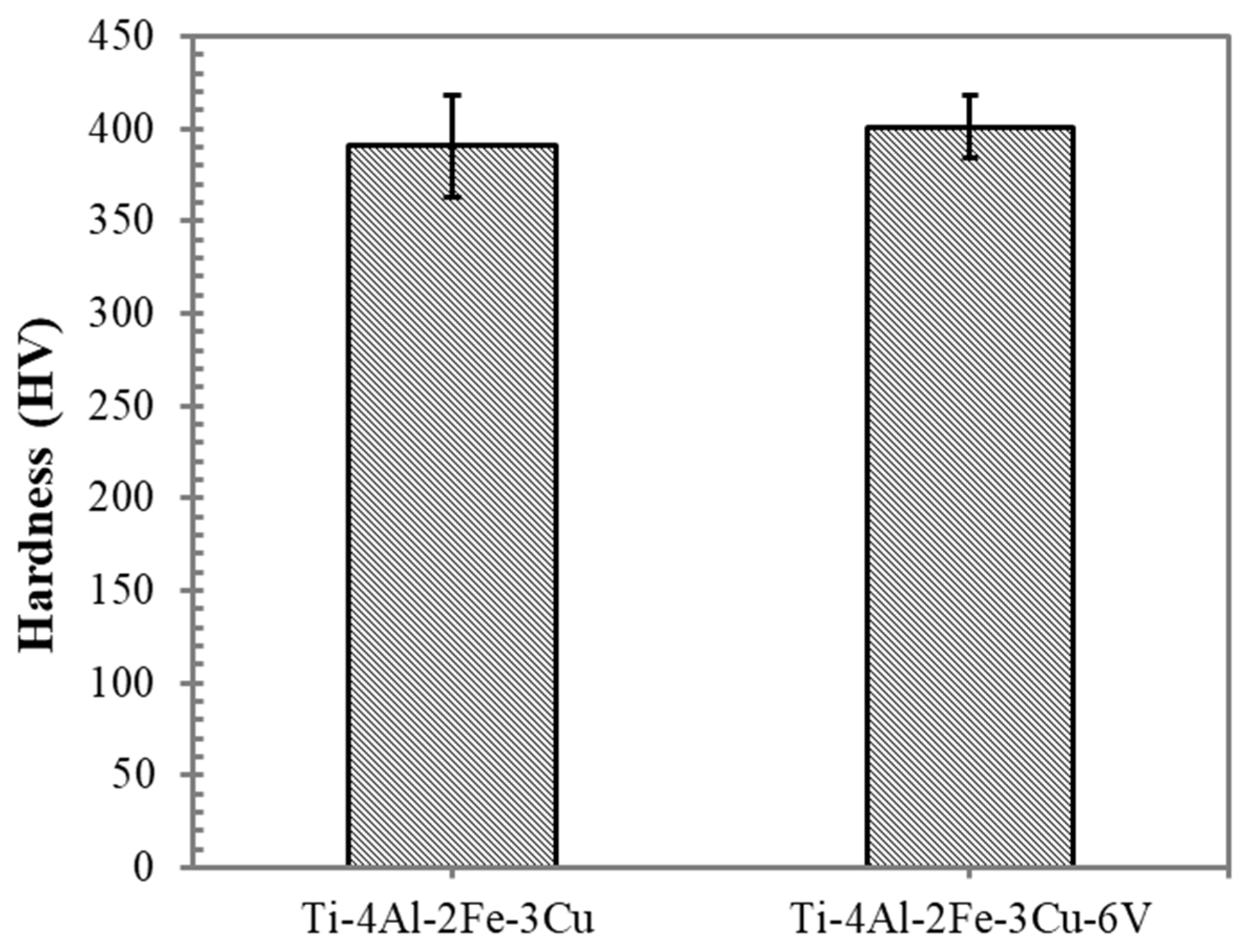
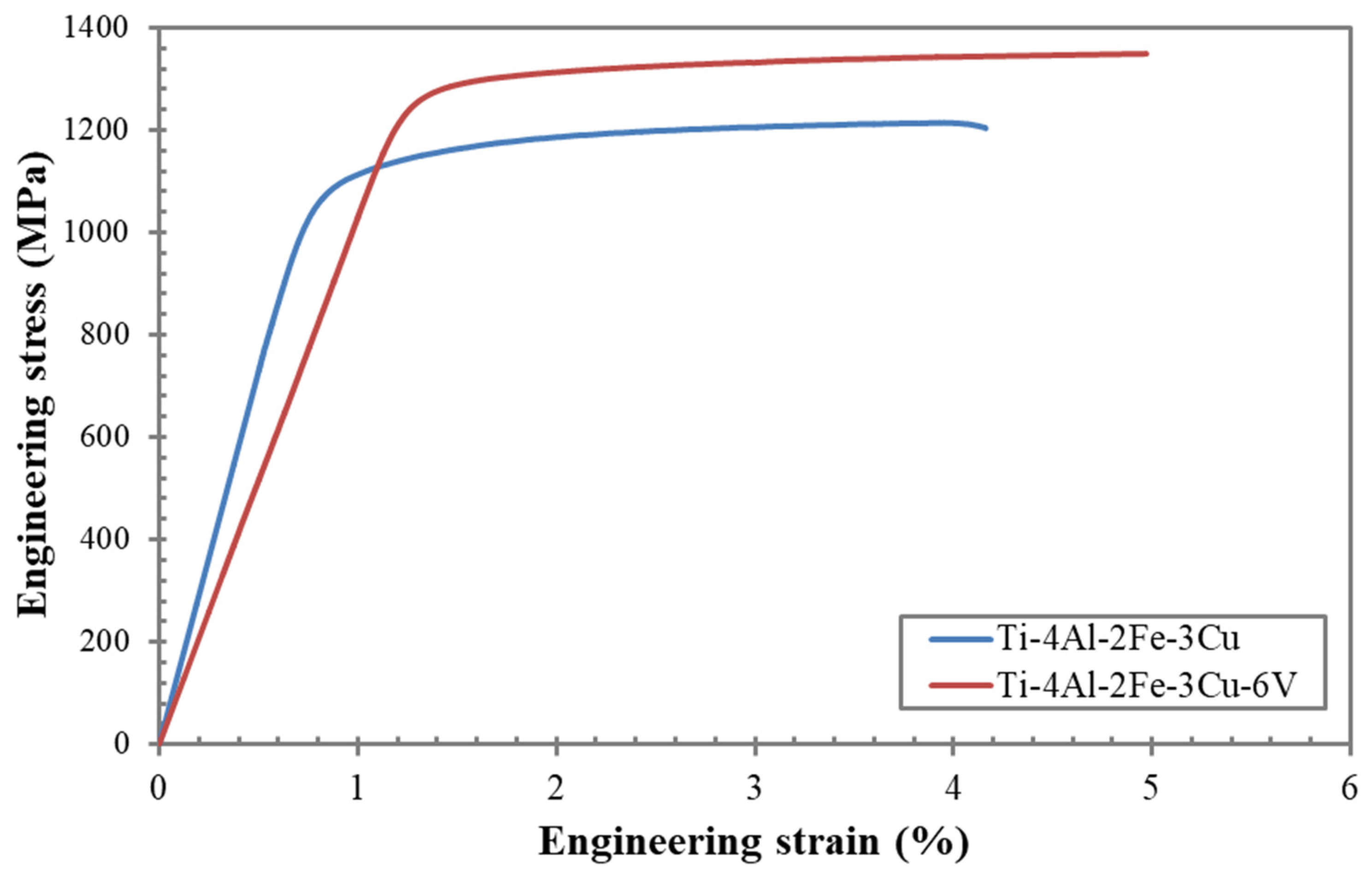
The hardness values of the Ti-4Al-2Fe-3Cu-XV (X = 0, 6) alloys are presented in Figure 5. The addition of 6 wt.% V to the Ti-4Al-2Fe-3Cu alloy results in a notable increase in hardness, rising by 6.8% from 390.3 ± 27.6 HV to 401 ± 17.15 HV. This enhancement can be attributed to solid-solution strengthening and the stabilization of the β phase induced by vanadium addition. Figure 6 displays the representative tensile engineering stress–strain curves for the Ti-4Al-2Fe-3Cu-XV alloys. The average mechanical properties, including yield strength (YS), ultimate tensile strength (UTS), and elongation to fracture (El), are summarized in Table 3. For the base Ti-4Al-2Fe-3Cu alloy, the YS, UTS, and El are 1122 MPa, 1214 MPa, and 3.5%, respectively. With the incorporation of 6 wt.% V, both YS and UTS increase substantially to 1291 MPa and 1349 MPa, representing enhancements of 15% and 11%, respectively, whereas elongation exhibits minimal change (3.5% vs. 3.8%). The mechanical properties of the Ti-4Al-2Fe-3Cu-XV alloys, as compared with those of the Ti-6Al-5Fe-0.05B-0.05C and Ti-6Al-4V, have higher YS and UTS. In addition, the elongation of the Ti-6Al-4V alloy is higher than that of the Ti-4Al-2Fe-3Cu-XV alloys, but the elongation of the Ti-6Al-5Fe-0.05B-0.05C is approximately similar to that of the Ti-4Al-2Fe-3Cu-XV alloys [19].
Analysis of the stress–strain curves shows differences in the apparent extent of the linear elastic region between the two alloys; however, Young’s modulus is governed by the slope of the elastic region rather than its length, and therefore, no direct conclusion regarding changes in Young’s modulus is drawn from these curves. Consequently, vanadium addition strengthens the alloy primarily through solid-solution strengthening and β-phase stabilization effects. The introduction of 6 wt.% V significantly enhances the strength and hardness of the Ti-4Al-2Fe-3Cu alloy while maintaining comparable ductility, demonstrating the effectiveness of vanadium as a β-phase stabilizer in optimizing the mechanical performance of this titanium alloy system.
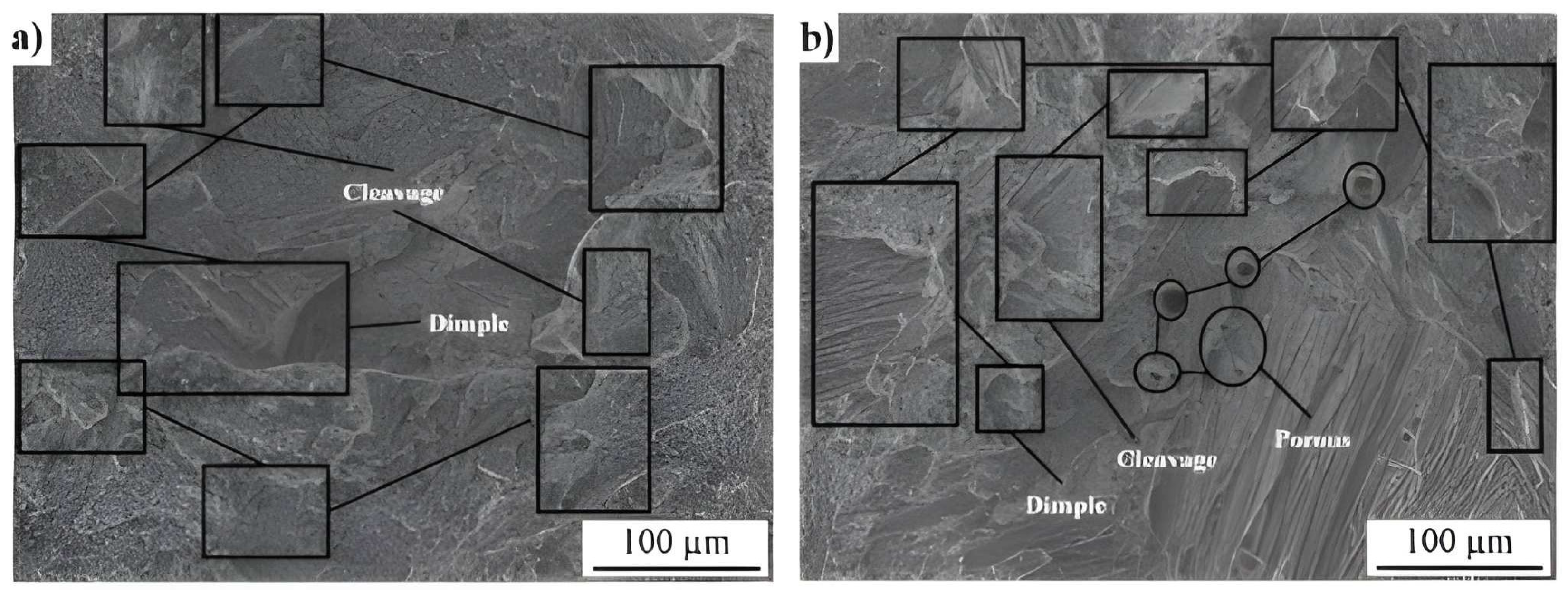
Figure 7 shows the fracture surfaces of tensile test specimens cut from the Ti-4Al-2Fe-3Cu-XV alloys. As can be seen in Figure 7a, the Ti-4Al-2Fe-3Cu alloy showed a combination of transgranular brittle cleavage facets and ductile fracture. After adding 6 wt.% V to the Ti-4Al-2Fe-3Cu, the fracture surfaces show more dimples, showing that a higher degree of plastic deformation of the lamellae occurred.

4. Discussion

Figure 2 and Figure 3 show the microstructures of the Ti-4Al-2Fe-3Cu-XV alloys after homogenization treatment. Both alloys exhibit a typical α + β microstructure. The Ti-4Al-2Fe-3Cu alloy presents a fully lamellar structure characterized by very coarse prior-β grains and continuous grain-boundary α layers. With the addition of 6 wt.% V, the microstructure evolves into a basketweave morphology while retaining continuous grain-boundary α layers. This refinement of the lamellar structure indicates a significant influence of V on phase morphology and lamellae development. The relationship between yield stress and the average thickness of α lamellae or plates can be reasonably described using the Hall–Petch relationship in conjunction with α/β interface strengthening mechanisms [20,21]. As shown in Figure 3, the addition of 6 wt.% V markedly reduces the average thickness of the α lamellae/plates from approximately 11.6 μm to 2.3 μm. According to the Hall–Petch framework, this substantial reduction in lamellar thickness enhances α/β interfacial strengthening, which is considered the primary factor responsible for the pronounced increase in yield strength resulting from the V addition. Similar observations have been reported by An et al. [22], supporting the present findings. In addition, the dislocation density is one of the factors that has an effect on the yield strength of the Ti-4Al-2Fe-3Cu-XV alloys. Figure 3 shows that the grain size of the Ti-4Al-2Fe-3Cu is smaller than that of the Ti-4Al-2Fe-3Cu-6V alloy. In addition, the following equation can be used to calculate the dislocation density [20]:
ρ = 2 3 ε D b
where b is the Burgers vector of Ti, ε is the microstrain, and D denotes the grain size (μm). From Equation (2) and Figure 3, it can be recognized that the dislocation density of the Ti-4Al-2Fe-3Cu-6V alloy is higher than that of the Ti-4Al-2Fe-3Cu alloy. Therefore, the yield strength of the alloy is enhanced by increasing the dislocation density. In addition to microstructural refinement, interstitial elements such as H, O, and N are known to significantly affect the tensile properties of powder metallurgy Ti alloys [23]. As summarized in Table 1, the oxygen content of the Ti-4Al-2Fe-3Cu alloy is 0.30 wt.%, whereas that of the Ti-4Al-2Fe-3Cu-6V alloy increases to 0.46 wt.%. The higher oxygen content in the V-containing alloy is expected to further contribute to the increase in yield strength, as oxygen is widely recognized as a strong interstitial hardening element in titanium alloys [24]. Moreover, enhanced solid-solution strengthening of the β phase also plays a role, since V preferentially partitions into the β phase at an effective concentration (~9 wt.%) significantly higher than its nominal alloy content (6 wt.%).
In addition to microstructural refinement, elemental partitioning also plays an important role in governing fracture behavior. Although the nominal Fe content is unchanged, vanadium addition modifies the chemical distribution within the β phase, effectively reducing the local Fe concentration due to competitive β stabilization. Since Fe-rich β regions are known to promote brittle fracture in titanium alloys, this relative reduction in Fe enrichment may alleviate brittleness. This effect, together with α-plate refinement and increased β-phase stability induced by vanadium, is consistent with the observed transition toward a more ductile fracture morphology characterized by a higher density of dimples in the V-containing alloy.
Despite the considerable strength improvement, the addition of 6 wt.% V does not result in a significant change in tensile ductility. Both alloys exhibit a comparable tensile elongation of approximately 3.5%, which, although appreciable, remains relatively low and may limit their practical applications as ultra-high-strength materials. The limited ductility is likely associated with dislocation transfer across coherent α/β interfaces governed by the Burgers orientation relationship during plastic deformation. This behavior promotes rapid dislocation pile-up at colony boundaries, as recently reported by Wu et al. [25], leading to strain localization and microcrack initiation. Furthermore, the lamellar microstructures in both alloys appear to be unfavorable for resisting microcrack propagation under very high flow stresses exceeding 1200 MPa. Therefore, further work is required to develop effective microstructural design strategies to improve ductility while maintaining ultrahigh strength in advanced titanium alloys.

5. Conclusions

Bulk Ti-4Al-2Fe-3Cu-XV alloys were fabricated by hot extrusion of compacts of blends of TiH2, Fe, Cu and Al40V60 master alloy powders, followed by a heat treatment of 1000 °C × 1 h × FC. The microstructure and mechanical properties of the alloys were studied, and the following conclusions were drawn:
  • For the first time, in the Ti-4Al-2Fe-3Cu alloy system processed via a TiH2-based powder metallurgy route, the addition of 6 wt.% V is shown to effectively modify the microstructure, transforming it from a fully α/β lamellar structure with an average lamella thickness of 11.6 µm into a refined basket-weave microstructure. The resulting structure exhibits a significantly reduced average α plate thickness of 2.3 µm while maintaining continuous grain boundary α layers, demonstrating the effectiveness of V as a microstructural refinement element in this low-cost alloy system.
  • This microstructural refinement leads to a notable improvement in mechanical performance, with the yield strength and ultimate tensile strength increasing from 1122 MPa and 1214 MPa to 1291 MPa and 1349 MPa, respectively, while retaining an appreciable tensile ductility of ~3.5%. These results highlight the ability of V addition to achieve an ultra-high-strength Ti alloy without a severe loss of ductility using a powder metallurgy-based processing route.
  • The strengthening mechanisms are clarified, indicating that the enhanced strength arises from the combined effects of α plate refinement, increased oxygen content, and intensified dislocation interactions across coherent α/β interfaces induced by V addition. In contrast, the limited tensile ductility in both alloys is primarily associated with strain localization and microcrack nucleation at colony boundaries under high flow stress, suggesting that further microstructural control is required to improve ductility at ultrahigh strength levels.

Author Contributions

Conceptualization, M.N. and M.G.-M.; methodology, M.N. and M.G.-M.; validation, M.N.; formal analysis, M.N. and M.G.-M.; investigation, M.N., M.G.-M. and R.A.d.S.; resources, M.N. and M.G.-M.; data curation, M.N., M.G.-M. and R.A.d.S.; writing—original draft preparation, M.N. and M.G.-M.; writing—review and editing, M.N., M.G.-M. and R.A.d.S.; visualization, M.N.; supervision, R.A.d.S.; project administration, R.A.d.S. All authors have read and agreed to the published version of the manuscript.

Funding

This research received no external funding.

Data Availability Statement

The data that support the findings of this study are available from the corresponding author upon reasonable request, due to proprietary restrictions.

Conflicts of Interest

The authors declare no conflicts of interest.

References

  1. Boyer, R.R. Attributes, characteristics, and applications of titanium and its alloys. JOM 2017, 3, 15–18. [Google Scholar] [CrossRef]
  2. Feng, Q.; Duan, B.; Mao, L.; Jiao, L.; Chen, G.; Lu, X.; Li, C. Thermodynamic Assessment of Ti-Al-Fe-V Quaternary System Applied to Novel Titanium Alloys Designing. Metals 2022, 12, 444. [Google Scholar] [CrossRef]
  3. Kostov, A.; Zikovic, D. Thermodynamic analysis of alloys Ti–Al, Ti–V, Al–V and Ti–Al–V. J. Alloys Compd. 2008, 460, 164–171. [Google Scholar] [CrossRef]
  4. Gazder, A.A.; Vu, V.Q.; Saleh, A.A.; Markovsky, P.E.; Ivasishin, O.M.; Davies, C.H.J.; Pereloma, E.V. Recrystallisation in a cold drawn low cost beta titanium alloy during rapid resistance heating. J. Alloys Compd. 2014, 585, 245–259. [Google Scholar] [CrossRef]
  5. Zadra, M.; Girardini, L. High-performance, low-cost titanium metal matrix composites. Mater. Sci. Eng. A 2014, 608, 155–163. [Google Scholar] [CrossRef]
  6. Santos, P.F.; Niinomi, M.; Cho, K.; Nakai, M.; Liu, H.; Ohtsu, N.; Hirano, M.; Ikeda, M.; Narushima, T. Microstructures, mechanical properties and cytotoxicity of low cost beta Ti-Mn alloys for biomedical applications. Acta Biomater. 2015, 26, 366–376. [Google Scholar] [CrossRef] [PubMed]
  7. Yang, F.; Gabbitas, B. Feasibility of producing Ti-6Al-4V alloy for engineering application by powder compact extrusion of blended elemental powder mixtures. J. Alloys Compd. 2017, 695, 1455–1461. [Google Scholar] [CrossRef]
  8. Ikeda, M.; Komatsu, S.; Inoue, K.; Shiota, H.; Imose, T. Microstructure and tensile properties of Ti–Fe–Cr alloys. Mater. Sci. Technol. 2000, 16, 605–608. [Google Scholar] [CrossRef]
  9. Jia, M.; Zhang, D.; Liang, J.; Gabbitas, B. Porosity, microstructure, and mechanical properties of Ti-6Al-4V alloy parts fabricated by powder compact forging. Metall. Mater. Trans. A 2017, 48, 2015–2029. [Google Scholar] [CrossRef]
  10. Yumak, N.; Aslantaş, K. A review on heat treatment efficiency in metastable β titanium alloys: The role of treatment process and parameters. J. Mater. Res. Technol. 2020, 9, 15360–15380. [Google Scholar] [CrossRef]
  11. Azizi, H.; Zurob, H.; Bose, B.; Ghiaasiaan, S.R.; Wang, X.; Coulson, S.; Duz, V.; Phillion, A.B. Additive manufacturing of a novel Ti-Al-V-Fe alloy using selective laser Melting. Addit. Manuf. 2018, 21, 529–535. [Google Scholar] [CrossRef]
  12. Haubrich, J.; Gussone, J.; Barriobero-Vila, P.; Kürnsteiner, P.; Jägle, E.A.; Raabe, D.; Schell, N.; Requena, G. The role of lattice defects, element partitioning and intrinsic heat effects on the microstructure in selective laser melted Ti-6Al-4V. Acta Mater. 2019, 167, 136148. [Google Scholar] [CrossRef]
  13. Collins, P.C.; Banerjee, R.; Banerjee, S.; Fraser, H.L. Laser deposition of compositionally graded titanium–vanadium and titanium–molybdenum alloys. Mater. Sci. Eng. A 2003, 352, 118–128. [Google Scholar] [CrossRef]
  14. Bodunrin, M.O.; Chown, L.H.; Merwe, J.W.; Alaneme, K.K. On the substitution of vanadium with iron in Ti–6Al–4V: Thermo-Calc simulation and processing map considerations for design of low-cost alloys. Mater. Sci. Eng. A 2020, 791, 139622. [Google Scholar] [CrossRef]
  15. Liang, S.; Feng, Z.; Yin, L.; Liu, X.; Ma, M.; Liu, R. The effects of V content on the microstructure and mechanical properties of hot rolled TiZr based alloys. J. Alloys Compd. 2016, 664, 11–18. [Google Scholar] [CrossRef]
  16. Arockiakumar, R.; Takahashi, M.; Takahashi, S.; Yamabe-Mitarai, Y. Microstructure, mechanical and shape memory properties of Ti-55Pd-5x (x = Zr, Hf, V, Nb) alloys. Mater. Sci. Eng. A 2013, 585, 86–93. [Google Scholar] [CrossRef]
  17. Bodunrin, M.O.; Chown, L.H.; van der Merwe, J.W.; Alaneme, K.K. Corrosion behaviour of low-cost Ti–4.5Al–xV–yFe alloys in sodium chloride and sulphuric acid solutions. Corros. Eng. Sci. Technol. 2019, 54, 637–648. [Google Scholar] [CrossRef]
  18. Reed-Hill, R.E.; Abbaschian, R. Physical Metallurgy Principles; Brooks/Cole Engineering Division: Monterey, CA, USA, 1973. [Google Scholar]
  19. Liang, Z.; Miao, J.; Brown, T.; Sachdev, A.K.; Williams, J.C.; Luo, A.A. A low-cost and high-strength Ti-Al-Fe-based cast titanium alloy for structural applications. Scr. Mater. 2018, 157, 124–128. [Google Scholar] [CrossRef]
  20. Najafizadeh, M.; Bahadoran, A.; Bozorg, M.; Sadeghi, B.; Liang, J.; Zhang, D. Microstructures and mechanical properties of high strength Ti-XAl-2Fe-3Cu alloys fabricated by powder compact extrusion. J. Alloys Compd. 2021, 884, 161136. [Google Scholar] [CrossRef]
  21. Najafizadeh, M.; Ghasempour-Mouziraji, M.; Hosseinzadeh, M.; Yazdi, S.; Sarrafan, A.; Bozorg, M.; Cavaliere, P.; Laska, A.; Szkodo, M. Optimization of biocorrosion resistance and mechanical properties of PM Ti–XAl–2Fe–3Cu alloys by response surface methodology. J. Mater. Sci. 2022, 57, 18669–18686. [Google Scholar] [CrossRef]
  22. An, F.; Zhang, B.; Yan, Y.; Wang, L. Effect of Vanadium Contents on Microstructure and Mechanical Properties of Ti-6Al-xV Components Produced by Wire + Arc Additive Manufacturing. Mater. Trans. 2021, 62, 1071–1078. [Google Scholar] [CrossRef]
  23. Najafizadeh, M.; Bozorg, M.; Bahadoran, A.; Liang, J.; Zhang, D. Compressive and biocorrosion properties of Ti-XAl-2Fe-3Cu alloys fabricated by powder metallurgy. J. Alloys Compd. 2021, 884, 161079. [Google Scholar] [CrossRef]
  24. Najafizadeh, M.; Zhang, D.; Maldar, A.; Bozorg, M.; Liang, J. Microstructure and Mechanical Properties of a High-Strength Ti-4Al-2Fe-3Cu Alloy Fabricated by Sintering and Hot Extrusion. Metall. Mater. Trans. A 2022, 53, 1955–1968. [Google Scholar] [CrossRef]
  25. Wu, X.; Zhang, B.; Zhang, Y.; Niu, H.; Zhang, D. Correlation between microstructures and tensile deformation behavior of a PM near α Ti-6Al-2Sn-4Zr-2Mo-0.1Si alloy. Mater. Sci. Eng. A 2021, 825, 141909. [Google Scholar] [CrossRef]
Figure 1. XRD patterns of Ti-4Al-2Fe-3Cu and Ti-4Al-2Fe-3Cu-6V alloys.
Metals 16 00310 g001
Figure 2. OM micrographs of the microstructures of (a) Ti-4Al-2Fe-3Cu and (b) Ti-4Al-2Fe-3Cu-6V alloys.
Metals 16 00310 g002
Figure 3. SEM backscattered electron images of the microstructures of (a) Ti-4Al-2Fe-3Cu and (b) Ti-4Al-2Fe-3Cu-6V alloys.
Metals 16 00310 g003
Figure 4. SEM images and EDS elemental mappings of the microstructures of (a) Ti-4Al-2Fe-3Cu and (b) Ti-4Al-2Fe-3Cu-6V alloys.
Metals 16 00310 g004
Figure 5. Microhardness of the Ti-4Al-2Fe-3Cu and Ti-4Al-2Fe-3Cu-6V alloys.
Metals 16 00310 g005
Figure 6. Tensile engineering stress–engineering strain curves of Ti-4Al-2Fe-3Cu and Ti-4Al-2Fe-3Cu-6V alloys.
Metals 16 00310 g006
Figure 7. SEM micrographs of the fractured surfaces of the tensile test specimens cut from the (a) Ti-4Al-2Fe-3Cu and (b) Ti-4Al-2Fe-3Cu-6V alloys.
Metals 16 00310 g007
Table 1. Oxygen and hydrogen contents (wt.%) of Ti-4Al-2Fe-3Cu and Ti-4Al-2Fe-3Cu-6V alloys.
AlloyOxygen Hydrogen
Ti-4Al-2Fe-3Cu0.30.001
Ti-4Al-2Fe-3Cu-6V0.460.002
Table 2. EDS analysis results of Ti-4Al-2Fe-3Cu and Ti-4Al-2Fe-3Cu-6V alloys.
Alloy RegionComposition (wt.%)Passible Phase
TiAlFeCuV
Ti-4Al-2Fe-3Cu193.84.961.18--------α-Ti
294.084.841.08--------α-Ti
384.063.135.477.34----β-Ti
484.783.185.896.15----β-Ti
Ti-4Al-2Fe-3Cu-6V192.274.56----0.932.24α-Ti
292.164.58----0.642.62α-Ti
380.652.493.544.438.89β-Ti
480.153.312.804.439.30β-Ti
Table 3. Tensile properties of Ti-4Al-2Fe-3Cu and Ti-4Al-2Fe-3Cu-6V alloys in comparison with Ti-6Al-5Fe-0.05B-0.05C and Ti-6Al-4V. Adapted from Ref. [19].
Alloy Yield Strength (MPa)Ultimate Tensile Strength (MPa)Elongation (%)
Ti-4Al-2Fe-3Cu112212143.5
Ti-4Al-2Fe-3Cu-6V129113493.8
Ti-6Al-5Fe-0.05B-0.05C [19]102311363.71
Ti-6Al-4V [19]89510008
Disclaimer/Publisher’s Note: The statements, opinions and data contained in all publications are solely those of the individual author(s) and contributor(s) and not of MDPI and/or the editor(s). MDPI and/or the editor(s) disclaim responsibility for any injury to people or property resulting from any ideas, methods, instructions or products referred to in the content.