Article

Sorption of Scandium from Acidic Chloride Solutions on Strong-Acid Cation-Exchange Resins: Comparative Assessment and Isotherm Modeling


by
Almagul Ultarakova
,
Bauyrzhan Orynbayev
,
Azamat Yessengaziyev
*,
Nina Lokhova
,
Azamat Toishybek
,
Kenzhegali Smailov
,
Arailym Mukangaliyeva
and
Kaisar Kassymzhanov
The Institute of Metallurgy and Ore Beneficiation JSC, Satbayev University, Almaty 050013, Kazakhstan
*
Author to whom correspondence should be addressed.
Metals 2026, 16(3), 298; https://doi.org/10.3390/met16030298
Submission received: 4 February 2026 / Revised: 2 March 2026 / Accepted: 5 March 2026 / Published: 7 March 2026
(This article belongs to the Special Issue Hydrometallurgical Processes for the Recovery of Critical Metals)

Abstract

Recovery of scandium from chloride-bearing process liquors formed during titanium–magnesium production remains constrained by trace-level metal content and chemically aggressive solution matrices. Within the present study, the retention behaviour of Sc3+ species in strongly acidic chloride media was examined through batch-mode interaction with gel-type sulfonated cation exchangers, namely KU-2-8, Lewatit SP112H, Purosorb SAC140H, and Purolite C-150H. Quantitative evaluation of sorption efficiency was performed by calculating equilibrium uptake (qe), phase distribution factor (Kd), and percentage recovery (R). Under identical liquid–solid ratios, the Lewatit SP112H matrix exhibited superior affinity toward dissolved scandium, achieving qe = 179.82 mg/g and Kd = 172.41 mL/g. Equilibrium fitting procedures revealed that scandium uptake by Purosorb SAC140H conforms to monolayer-type retention described by the Langmuir formalism (R2 = 0.9786), whereas sorption on Lewatit SP112H proceeds over energetically non-uniform sites and is more adequately represented by Freundlich and Dubinin–Radushkevich approximations. The observed retention characteristics establish a selection framework for ion-exchange media applicable to scandium concentration from acidic chloride hydrometallurgical streams.

1. Introduction

Scandium is a dispersed element occurring in a wide range of minerals. Only two minerals, thortveitite and sterrettite, are considered scandium-specific; however, their limited global occurrence and low resource base render them unsuitable as primary industrial feedstocks for large-scale scandium production. In practice, scandium is recovered mainly as a by-product from complex ores and technogenic wastes, where its content typically does not exceed hundredths of a percent and the matrix contains high levels of associated elements. Substantial scandium resources are concentrated in titanium–magnesium production wastes (100–350 g/t) and in bauxite-processing residues (10–200 g/t) [1].
Metallic scandium and its compounds are in demand in high-technology sectors. The most important industrial applications involve aluminum and magnesium alloys alloyed with scandium, which combine high strength with low density. Scandium oxide (Sc2O3) is also used in producing wear-resistant ceramics with ionic and electronic conductivity [2,3,4]. Given its strategic relevance, scandium is included in the European Union list of Critical Raw Materials (CRM) [5].
For Kazakhstan’s titanium–magnesium industry, a promising route is scandium recovery from solid chloride wastes generated during chlorination of titanium slags in molten potassium, magnesium, and sodium chlorides. In this process, scandium and rare earth elements are predominantly concentrated in the spent melt of titanium chlorinators, while a smaller fraction transfers to dust-chamber fumes. At JSC “UKTMP”, 30–35 thousand tonnes of solid chloride waste from titanium production and about 5 thousand tonnes of magnesium-production wastes are generated annually. These residues contain 50–60% potassium chlorides and 25–30% magnesium chlorides. The scandium content is 0.05–0.2%, making additional recovery economically and technologically reasonable, with scandium oxide Sc2O3 as the target concentrate [6].
During smelting of ilmenite concentrate in ore-thermal furnaces, up to 97% of scandium partitions into titanium slag. Subsequent chlorination of the slag in a MgCl2–KCl–NaCl melt leads to ~83.8% of scandium concentrating in the solid waste phase, whereas ~5.7% transfers into the chlorinator gas–vapor stream. This distribution underscores the relevance of developing technologies for scandium recovery from these chloride wastes [7].
Low scandium concentrations in the feed materials necessitate recovery and purification methods that exploit relatively small differences between scandium chemistry and the behavior of impurities. Approaches used for this purpose include precipitation, condensation, sublimation, ion exchange, and solvent extraction [8,9]. Industrial practice applies extraction methods based on neutral and acidic extractants (TBP, D2EHPA, alcohols, ketones, OCP, etc.) [10,11]. However, scandium extraction with neutral extractants is efficient mainly in strongly acidic media (HCl, HNO3, HClO4) or highly saline solutions (CaCl2, MgCl2, LiCl), which limits applicability to dilute streams; TBP extraction from hydrochloric and nitric acid media is used primarily for purification of concentrates containing at least 1% Sc2O3.
Extraction schemes based on D2EHPA and TBP may provide high process performance but are associated with extractant losses and more complicated handling of the organic phase, requiring additional measures for purification and disposal [12,13,14]. Alkylphosphoric acids (D2EHPA, OCP, etc.) can recover scandium from both acidic and neutral solutions, yet they typically exhibit lower selectivity and a tendency toward co-extraction of impurities. Back-extraction is another constraint: in a number of cases, it requires HF or alkali, resulting in fine, poorly filterable precipitates of ScF3 or Sc(OH)3 [15,16,17,18]. In sulfate, fluoride, and carbonate media, scandium may form anionic complexes that can be extracted by amines; by contrast, in hydrochloric and nitric acid solutions, scandium is generally poorly extractable by amines and the process can be hindered by technological issues (including persistent emulsions), which complicates continuous operation [19,20,21,22,23].
Ion exchange represents an alternative to solvent extraction and has been successfully applied, among other cases, to processing red mud from alumina production. Acidification combined with controlled redox conditions can reduce the impact of Fe(III) and improve scandium selectivity [24,25,26]. Various materials have also been examined for sorptive scandium separation (activated carbon, carbon nanotubes, graphene oxide, Chelex 100), along with phosphorus-containing ion exchangers; many studies report high performance and selectivity of phosphorus-containing sorbents in multicomponent systems [27,28,29,30].
Recent technological studies have increasingly prioritized solid-phase sorption routes, where separation selectivity—traditionally achieved through solvent extraction—is instead governed by ion-exchange interactions during scandium recovery from dilute technogenic solutions of complex chemical composition. The use of classical liquid–liquid extraction systems becomes problematic when processing multicomponent acidic chloride media containing elevated concentrations of Fe(III), Ti, and Zr. Co-extraction of impurities occurs. Stable emulsions may form. In some cases, third-phase generation interferes with phase disengagement and compromises the continuity of the technological process [31,32,33].
For dilute process liquors characterized by high ionic strength and strongly acidic conditions (pH < 2), typical of hydrometallurgical treatment of technogenic wastes, ion-exchange sorbents are therefore increasingly considered a practically viable alternative to conventional extractive separation techniques [34,35].
Under such chloride-rich conditions, the performance of separation processes applied to scandium-bearing chloride solutions potentially derived from titanium–magnesium technogenic wastes becomes strongly influenced by the aqueous speciation of scandium in solution. In hydrochloric media, scandium may form cationic chloro-complexes such as ScCl2+ and ScCl2+, with the relative contribution of these species increasing as the chloride ion concentration rises. At the same time, owing to its pronounced Lewis acidity, Sc3+ is susceptible to hydrolysis at elevated pH values, which may lead to the formation of hydroxo species and, under certain conditions, poorly soluble solid phases. These equilibria directly affect sorption performance, since strong-acid cation exchangers respond sensitively to competitive proton loading, background electrolyte composition, and the fraction of exchangeable scandium species present in solution [36].
Despite their high efficiency, extraction methods have well-known drawbacks (third-phase formation, flammability of organic solvents, and environmental risks). Sorption-based technologies generally require smaller volumes of organic reagents and are convenient for dilute solutions. The literature reports successful use of ion-exchange resins for treating industrial chloride scandium solutions (including impurity removal/cleanup tasks in Sc chloride liquors), supporting the practical importance of this direction [37,38].
Processing of titanium–magnesium technogenic wastes is known to generate chloride process solutions characterized by elevated ionic strength and multicomponent composition, in which scandium is predominantly present in hydrated cationic forms. However, the complex composition of such industrial liquors—typically containing elevated concentrations of Fe3+, Ti4+, and Zr4+—introduces competitive sorption effects that may obscure the intrinsic retention behaviour of Sc3+ on ion-exchange matrices.
In this context, the present study employs compositionally defined acidic chloride model solutions in order to isolate the fundamental equilibrium interactions governing scandium uptake by gel-type strong-acid cation exchangers under controlled chemical conditions. Such an approach enables comparative assessment of sorption performance and reliable isotherm modelling, thereby providing a physicochemical basis for subsequent application of these materials in the treatment of real multicomponent chloride solutions relevant to hydrometallurgical processing of titanium–magnesium technogenic wastes.

2. Materials and Methods

2.1. Materials

Hydrochloric acid (HCl, analytical grade) was used for preparation of model solutions. Metallic scandium (99.9% purity, batch No. 3-16, TU 48-4-483-87, Skat R&D Company LLC., Moscow, Russia) served as the source of dissolved Sc3+ ions following acid dissolution. All experimental solutions were prepared using laboratory-distilled water.
Sorption performance was evaluated for four commercially produced strong-acid cation exchangers in the protonic form: KU-2-8 (Tula Plant of Polymer Materials, Tula, Russia), Lewatit SP112H (Lanxess Deutschland GmbH, Cologne, Germany), Purosorb SAC140H (Purolite Ltd., Llantrisant, UK), and Purolite C-150H (Purolite Ltd., Llantrisant, UK). Structurally, each material represents a gel-type sulfonated polystyrene–divinylbenzene network incorporating fixed—SO3H exchange sites.

2.2. Equipment

Experiments were carried out using orbital shakers IKA KS 3000 i control (IKA Werke GmbH & Co. KG, Staufen, Germany) and LOIP LS-110 (Laboratory Equipment Plant, Saint Petersburg, Russia), overhead stirrers VELP ES (VELP Scientifica, Usmate Velate, Italy) and IKA RW16 (IKA Werke GmbH & Co. KG, Staufen, Germany), analytical balance ATX224R (Shimadzu Corporation, Kyoto, Japan), a SNOL 58/350 LSP 11 drying oven (SNOL-Therm, Utena, Lithuania), and an AE-14-“Ya-FP” water distiller (Ferropplast Medical LLC, Yaroslavl, Russia). Scandium concentrations in solutions were measured by ICP-OES using an Optima 8300 DV spectrometer (PerkinElmer Inc., Waltham, MA, USA).

2.3. Experimental Procedure

The initial model solution containing 5.435 g/L of Sc3+ ions was prepared by dissolving metallic scandium (purity 99.9%) in concentrated hydrochloric acid under continuous agitation at ambient temperature until complete dissolution was achieved. Synthetic acidic chloride media were deliberately employed to maintain a stable ionic environment and eliminate compositional fluctuations inherent to multicomponent industrial liquors. This approach enables isolation of intrinsic sorption interactions governing Sc3+ retention and facilitates reproducible comparison between the investigated exchange matrices by suppressing competitive effects introduced by co-dissolved metal species. The total volume of the prepared solution was 500 mL. Sorption tests were conducted in a static batch mode under continuous agitation on an orbital shaker. Conical flasks were charged with 100 mL of the stock solution and 2 mL of the respective resin (KU-2-8, Lewatit SP112H, Purosorb SAC140H, or Purolite C-150H). Contact was maintained at 170 rpm for 4 h, after which the equilibrium scandium concentration in the liquid phase was determined.
The equilibrium liquors obtained after sorption were diluted to the target concentrations and used in subsequent experiments. For the selected cation exchangers, a series of batch tests was performed with model solutions containing Sc3+ at 0.005, 0.0496, 0.1031, 0.133, 0.177, and 0.342 g/L. In each experiment, 100 mL of solution was contacted with 1 mL of resin at 220 rpm.
Under the same setup, the effects of contact time (15, 30, 60, 120, 180, 360, and 540 min) and temperature (20, 40, 60, and 80 °C) on scandium recovery were evaluated at an initial Sc3+ concentration of 0.5591 g/L. For constructing sorption isotherms, solutions with initial scandium concentrations (g/L) of 0.005, 0.0496, 0.1031, and 0.342 were used.
Under strictly maintained hydrodynamic regimes and invariant solution composition, the sorption experiments performed in batch configuration were independently repeated in three parallel runs. The resulting values of equilibrium uptake (qe), phase distribution coefficient (Kd), and scandium recovery (R) were subsequently obtained by averaging the outcomes of these replicate trials. Dispersion of the measured parameters arising from inter-experimental variability was quantified through calculation of the corresponding standard deviations.
Sorption behavior was quantified using the equilibrium sorption capacity qe, the distribution coefficient Kd, and the recovery R, calculated from equilibrium scandium concentrations in solution. The equilibrium capacity was defined as:
q e =   C 0   C e   ·   V m  
where C0 and Ce are the initial and equilibrium Sc concentrations (mg/L), V is the solution volume (L), and m is the dry resin mass (g).
The distribution coefficient was calculated as:
K d =   C 0 C e   · V C e   ·   m
Recovery was calculated as:
R =   C 0 C e   C 0   · 100

2.4. Isotherm Modeling

Equilibrium sorption data for Sc were fitted with the Langmuir [39,40], Freundlich [41], and Dubinin–Radushkevich (D–R) [42,43,44] models. Model parameters were obtained by linear regression of the linearized forms, and goodness of fit was assessed using the coefficient of determination R2.
Langmuir model:
q e = q m a x K L C e 1 + K L C e
where qe is the equilibrium uptake (mg/g), qmax is the Langmuir maximum capacity (mg/g), Ce is the equilibrium Sc concentration in solution (mg/L), and K_L is the Langmuir constant (L/mg) reflecting sorbate affinity.
Linear form:
C e q e = 1 q m a x K L +   C e q m a x
The dimensionless Langmuir separation factor was also calculated:
R L = 1 1 + K L C 0
where C0 is the initial Sc concentration (mg/L). Values 0 < RL < 1 indicate favorable sorption.
Freundlich model:
q e = K f C e 1 / n
where Kf is the Freundlich constant (L/g) characterizing sorption capacity, and n is the sorption intensity parameter (dimensionless).
Linear form:
log q e = log K f + 1 n log C e
Dubinin–Radushkevich (D–R) model:
Natural logarithms were used:
ln q e = l n q D R B D R ε 2
where qDR is the theoretical saturation capacity in the D–R model (mg/g), BDR is the D–R constant (mol2/kJ2) related to sorption energy, and ε is the Polanyi potential.
The Polanyi potential was calculated as:
ε = R T l n 1 + 1 C e
where R is the universal gas constant, T is temperature (K), and Ce is the equilibrium Sc concentration (in units consistent with the ε calculation).
The characteristic sorption energy E (kJ/mol) was calculated as:
E = 1 2 B D R
Statistical processing of the obtained equilibrium parameters was performed using standard numerical methods. The reported values are presented as mean ± standard deviation based on three independent experimental runs (n = 3).

3. Results and Discussion

3.1. Sorption of Sc on Strong-Acid Cation Exchangers Under Static Conditions

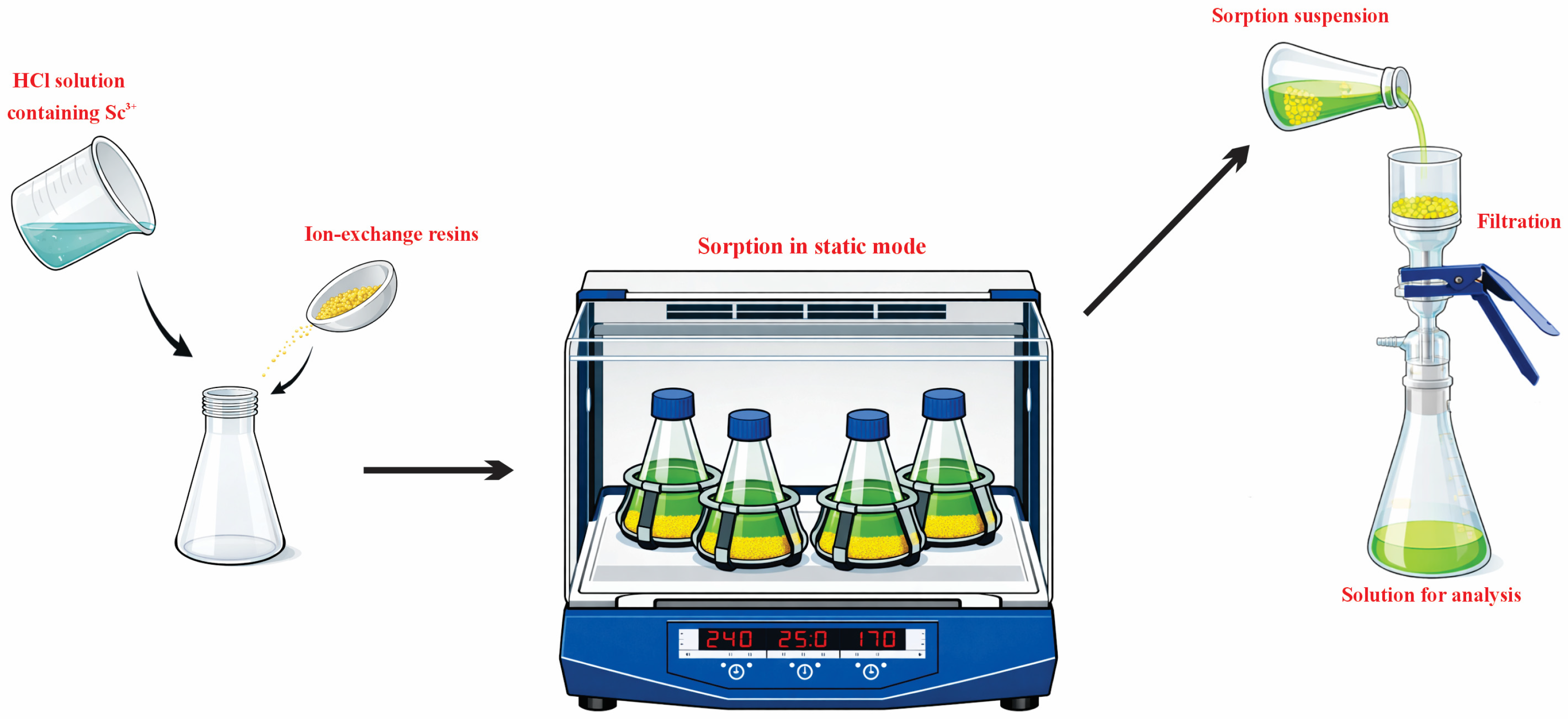
At the first stage, scandium sorption on gel-type strong-acid cation-exchange resins was compared under identical batch conditions. The experimental setup is shown in Figure 1. Sorbent performance was assessed using the equilibrium capacity (qe), distribution coefficient (Kd), and recovery (R). The comparative results are summarized in Table 1.
As shown in Table 1, Lewatit SP112H provides the highest qe and Kd values (qe = 179.82 mg/g; Kd = 172.41 mL/g). For Purosorb SAC140H, recovery is comparable (17.51%), whereas the equilibrium capacity is lower (qe = 97.14 mg/g; Kd = 102.04 mL/g). KU-2-8 and Purolite C-150H exhibit lower qe, Kd, and R under the studied conditions, which supports focusing subsequent experiments on Lewatit SP112H and Purosorb SAC140H as the most promising resins for scandium recovery from acidic chloride solutions.
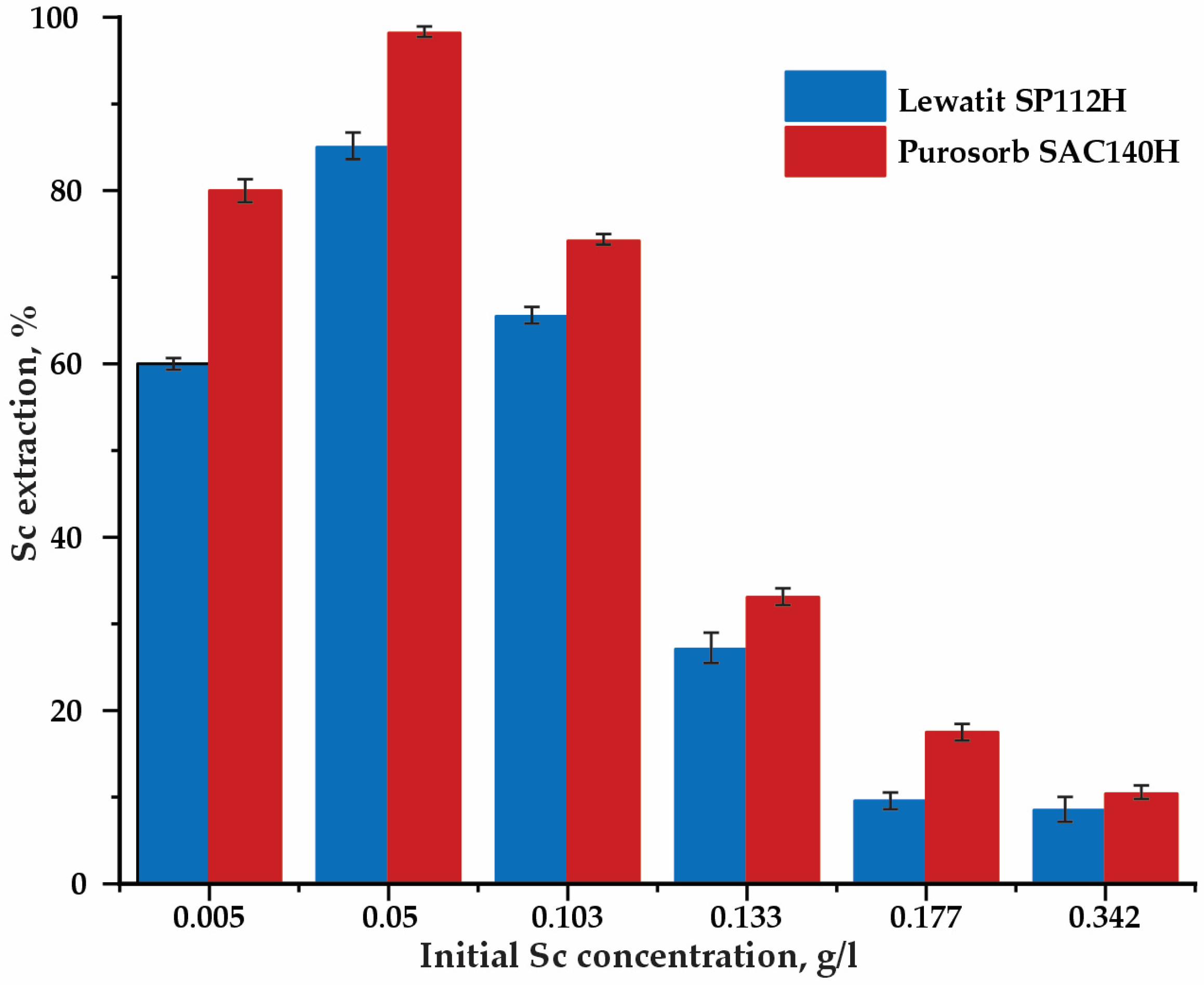
Further experiments were conducted by varying the initial scandium concentration. The dependencies of Sc recovery on C0 are shown in Figure 2. For both resins, recovery increases markedly as C0 decreases from 0.342 to 0.005 g/L (to ~85% for Lewatit SP112H and ~98.2% for Purosorb SAC140H). At higher scandium concentrations, recovery decreases in a systematic manner, which is consistent with a limited number of ion-exchange sites at a fixed phase ratio. As C0 rises, functional groups approach saturation and the effect of solution ionic strength becomes more pronounced, reducing the fraction of scandium transferred to the solid phase within the given contact time.
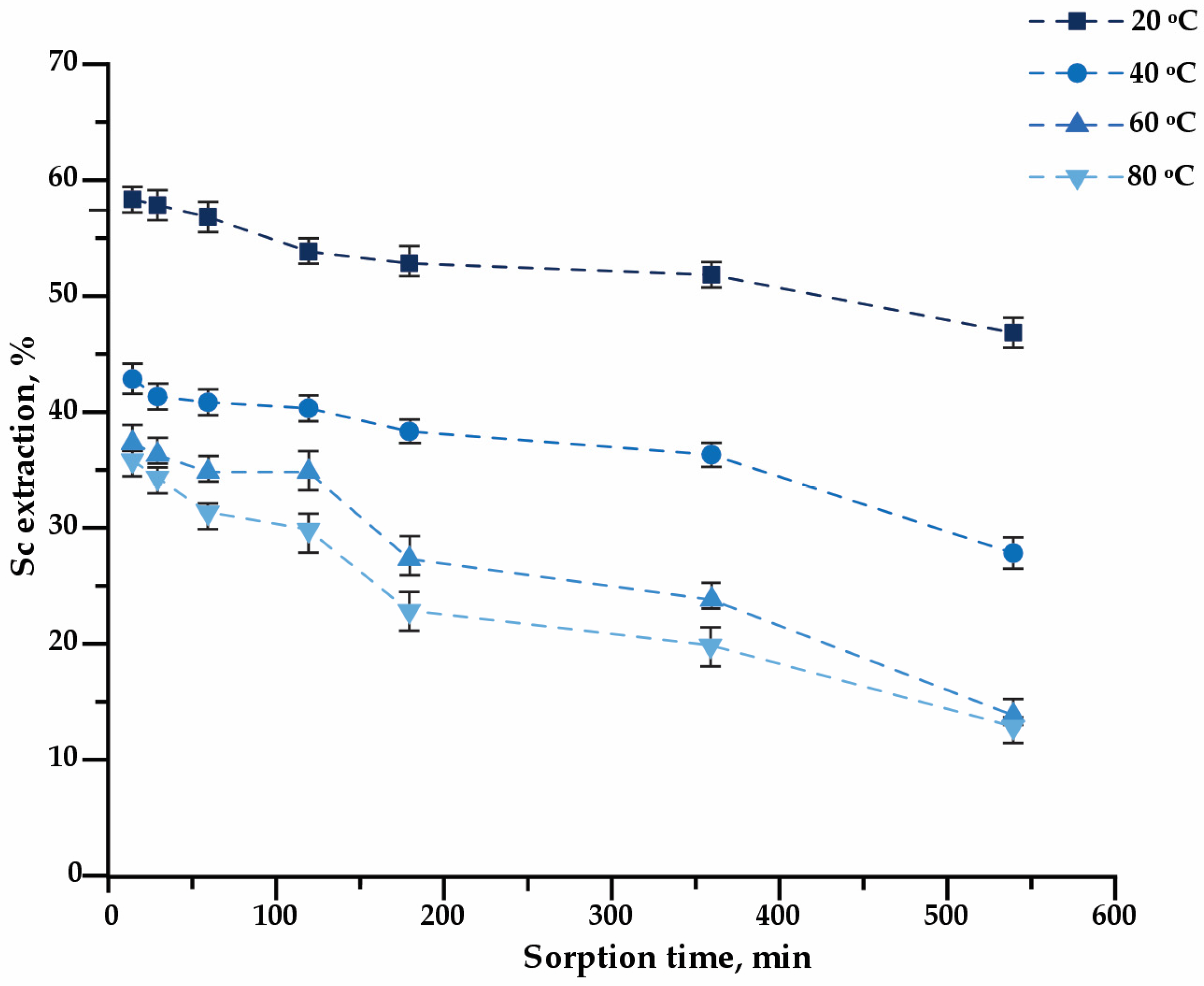
The effects of contact time and temperature were evaluated separately for the selected resins (Figure 3 and Figure 4). For Lewatit SP112H, the maximum recovery is reached at the early stage of contact (approximately 15–30 min at 20 °C), followed by a gradual decline in recovery with increasing contact time (Figure 3). The highest scandium recovery for this resin is achieved at 15 min and equals 60.33%. This behavior indicates rapid attainment of a quasi-equilibrium state and subsequent redistribution of scandium between the solid and liquid phases in a strongly acidic medium, where competition by H+ and changes in ionic strength can decrease retention stability during prolonged contact. Increasing temperature to 40–80 °C for Lewatit SP112H results in lower recovery than at 20 °C, suggesting an unfavorable shift in the sorption equilibrium upon heating in this system.
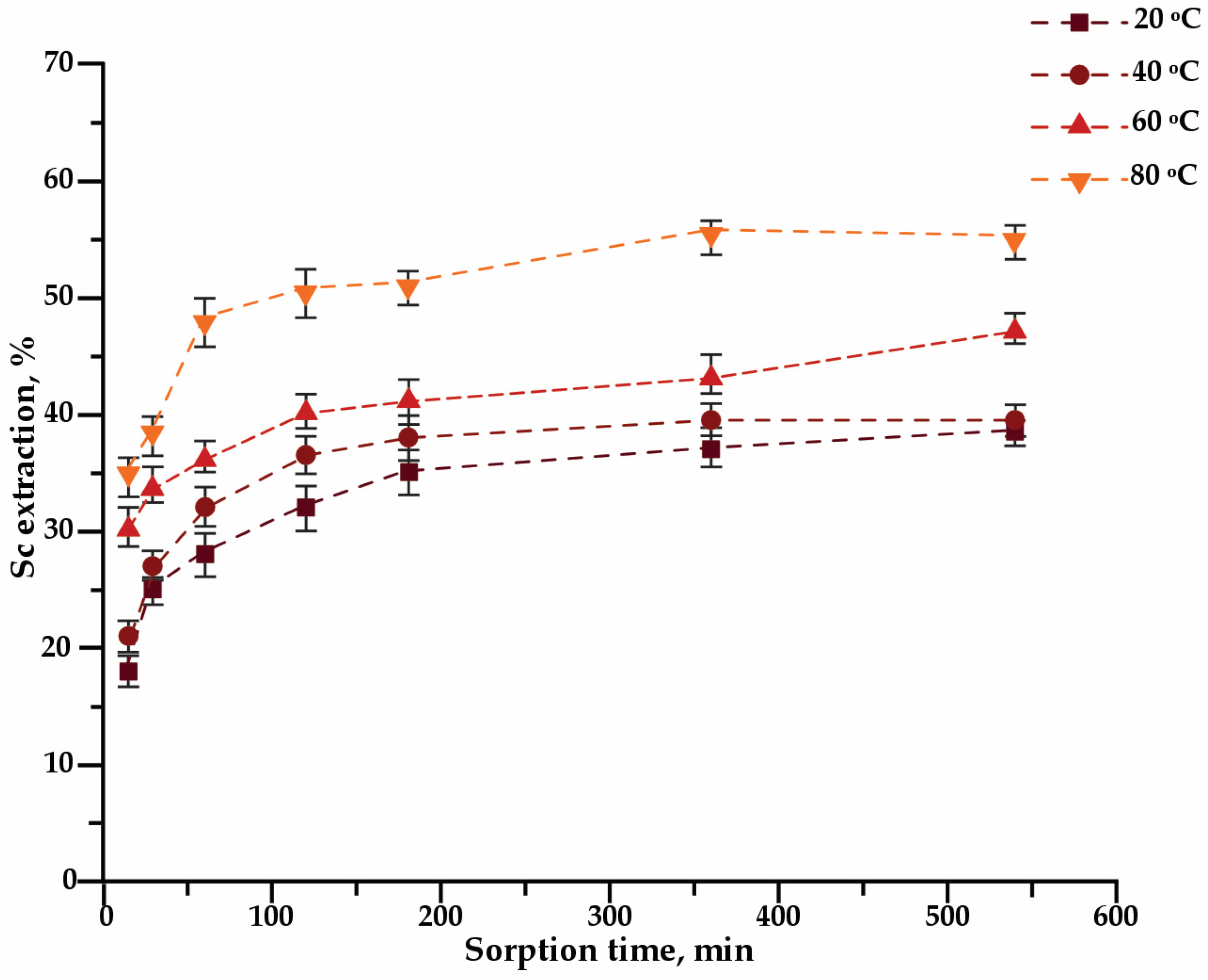
In contrast, Purosorb SAC140H exhibits a different trend (Figure 4): in most series, recovery increases with contact time and reaches a maximum in the range of ~180–360 min. Higher temperature further improves recovery, with the highest values obtained at 80 °C (about 55.5% at 360 min). This pattern is consistent with stronger diffusion limitations and/or lower initial accessibility of functional groups: increasing temperature and contact time promotes deeper intraparticle utilization and drives the system closer to equilibrium distribution.
Taken together, these results demonstrate distinct sorption behavior of the two strong-acid cation exchangers in acidic chloride scandium solutions. Lewatit SP112H responds rapidly and shows a higher equilibrium capacity in the comparative assessment, whereas Purosorb SAC140H requires longer contact time and/or elevated temperature to reach its maximum recovery.
The observed differences in sorption behaviour between Lewatit SP112H and Purosorb SAC140H may be attributed to variations in the accessibility of sulfonic exchange sites within the polymeric matrix and to differences in gel porosity influencing intraparticle diffusion resistance under strongly acidic conditions.

3.2. Modeling of Sorption Equilibrium

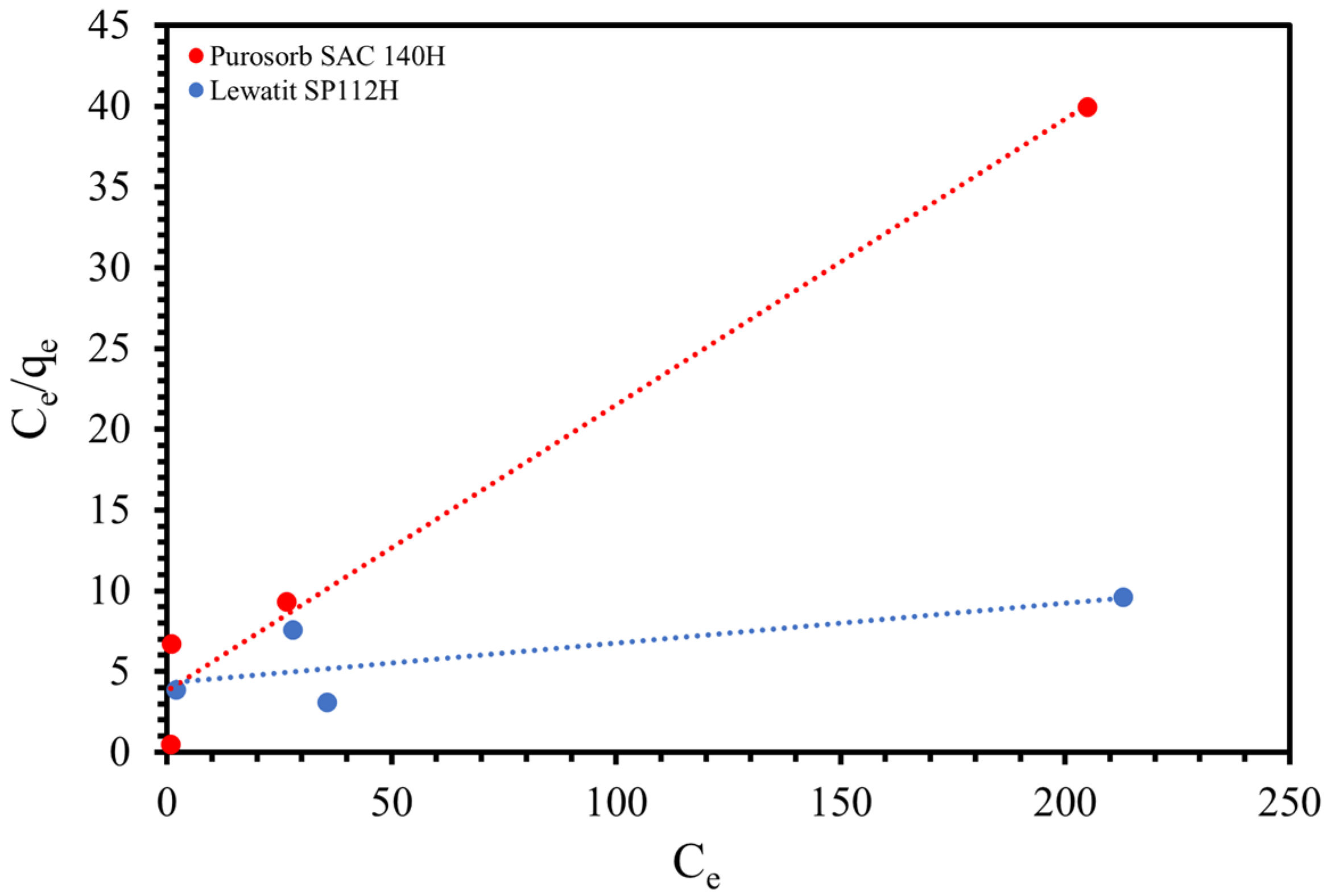
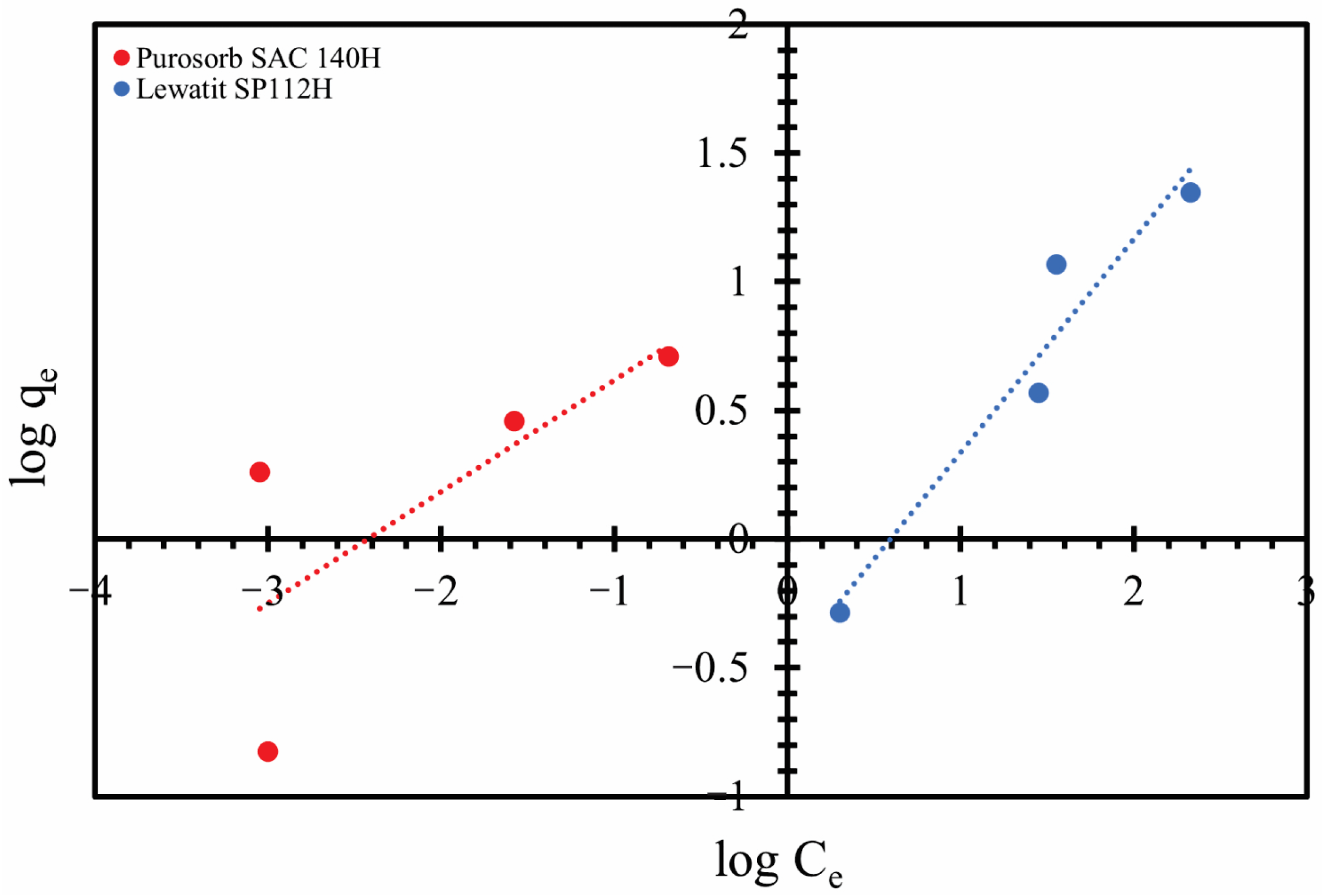
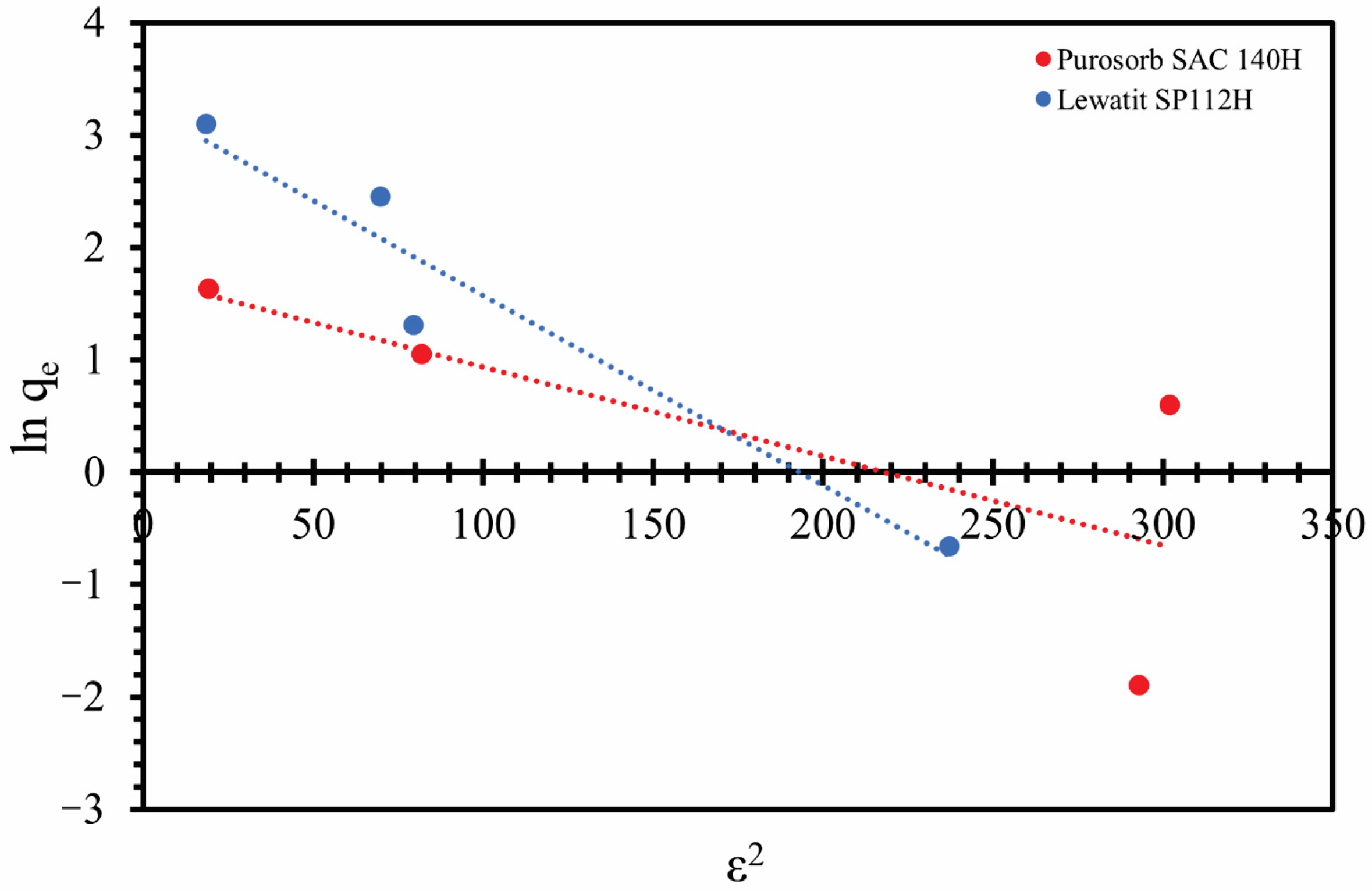
The experimental equilibrium data for Sc sorption on Purosorb SAC140H and Lewatit SP112H were fitted using the classical Langmuir, Freundlich, and Dubinin–Radushkevich (D–R) models. The models were compared to estimate sorption capacity and to analyze the distribution of active sites (homogeneous vs. heterogeneous), as well as the likely retention mechanism for scandium ions. The linearized plots are shown in Figure 5, Figure 6 and Figure 7, and the calculated parameters and coefficients of determination are listed in Table 2.
In Langmuir coordinates, the two resins exhibit fundamentally different goodness of fit. For Purosorb SAC140H, the model agrees well with the experimental data (R2 = 0.9786), indicating that the Langmuir approximation is applicable within the studied concentration range and consistent with near-monolayer uptake at a limited number of energetically comparable sites. For Lewatit SP112H, the Langmuir fit is markedly poorer (R2 = 0.5992), which points to violation of key assumptions (energetic uniformity and independence of sorption sites) and suggests heterogeneity of active sites and/or factors related to non-uniform accessibility of functional groups within the resin bead.
The Freundlich model provides a high-quality fit for Lewatit SP112H (R2 = 0.9327), supporting a heterogeneous distribution of sorption sites and nonlinear equilibrium behavior. For Purosorb SAC140H, however, the Freundlich model describes the data unsatisfactorily (R2 = 0.5463); therefore, Freundlich parameters are of limited value for mechanistic interpretation for this resin under the considered equilibrium conditions.
Linearization using the Dubinin–Radushkevich model again highlights strong contrast between the resins. For Lewatit SP112H, agreement with the experimental data is high (R2 = 0.9341), whereas for Purosorb SAC140H it is substantially lower (R2 = 0.5444). This outcome indicates differences in the energetic structure of sorption sites and/or in the extent to which factors captured by the D–R formalism (including energetic heterogeneity and intraparticle distribution effects) manifest in each system. For Purosorb SAC140H, the low R2 value implies that the D–R model is not the governing description of isotherm shape across the studied equilibrium range. Notably, the calculated qD = 5.6231 mg/g remains close to the Langmuir capacity estimate (qmax = 5.65 mg/g), supporting the robustness of capacity determination for this sorbent under the present conditions.
Comparison of the fitted parameters and determination coefficients confirms that, for Purosorb SAC140H, the Langmuir model provides a statistically adequate description of equilibrium sorption under the studied conditions (R2 = 0.9786) with an estimated capacity of qmax = 5.65 mg/g, whereas the Freundlich and D–R models do not achieve comparable fit quality. For Lewatit SP112H, by contrast, the high values R2 = 0.9327 (Freundlich) and R2 = 0.9341 (D–R), together with the low applicability of the Langmuir formalism (R2 = 0.5992), indicate pronounced heterogeneity of sorption sites and/or intraparticle limitations in functional group accessibility. Accordingly, capacity assessment for Lewatit SP112H should rely on the statistically adequate models; thus, qD = 26.05 mg/g is a more defensible estimate than qmax = 40.48 mg/g, which was obtained from the Langmuir model despite weak agreement with the experimental data.
The characteristic sorption energies derived from the D–R model were E = 7.955 kJ/mol for Purosorb SAC140H and E = 5.43 kJ/mol for Lewatit SP112H. Under the commonly used interpretation of the D–R model, values E < 8 kJ/mol are typically associated with predominantly physical/electrostatic retention, whereas the range 8–16 kJ/mol is often linked to a contribution from ion-exchange interactions. The calculated energies therefore indicate predominantly weakly specific retention of Sc ions in the studied system; for Purosorb SAC140H, the E value lies close to the threshold, allowing for an additional contribution from ion exchange. Given that both resins are sulfonic cation exchangers (–SO3H), Sc sorption equilibrium should be viewed as the combined outcome of electrostatic interactions and ion exchange, with their relative contributions controlled by the medium, including acidity and ionic strength.
Overall, the isotherm modeling shows that, for Purosorb SAC140H, equilibrium Sc sorption within the studied concentration interval follows the Langmuir approximation and is characterized by relatively low capacity. For Lewatit SP112H, the equilibrium exhibits clear signatures of heterogeneity and is better captured by the Freundlich and D–R models, supporting a higher sorption potential of Lewatit SP112H in this system and indicating that capacity should be interpreted using statistically adequate models.
Experimental evaluation was conducted using compositionally defined chloride systems in order to decouple the influence of scandium concentration and proton activity on retention equilibrium. From a process engineering perspective, the obtained equilibrium parameters may serve as input data for preliminary modelling of ion-exchange stages in multicomponent chloride systems, including column-mode operation and dynamic breakthrough analysis. In industrial leachates, however, the presence of competing high-valent cations such as Fe3+, Ti4+, or Zr4+ may alter sorption selectivity. Despite this, the equilibrium trends observed for Sc3+ uptake reflect fundamental exchange interactions between hydrated scandium species and sulfonic functional groups, thereby providing a mechanistic basis for further testing under realistic technogenic solution matrices.

4. Conclusions

Under the investigated equilibrium conditions, the application of gel-type sulfonated cation-exchange matrices to scandium recovery from chloride-bearing acidic systems has been experimentally validated through comparative sorption assessment. Maximum retention of dissolved Sc3+ species within the studied concentration interval was achieved using the Lewatit SP112H resin operating in static batch mode. In contrast, sorption onto Purosorb SAC140H exhibited a progressive increase with prolonged phase contact and thermal intensification, indicating delayed accessibility of exchange-active domains within the polymer framework. The retention behaviour observed across the investigated systems supports the feasibility of incorporating strong-acid ion-exchange stages into hydrometallurgical processing routes designed for scandium enrichment from dilute chloride technogenic liquors. Further studies should address the dynamic sorption performance of the investigated matrices under flow-through conditions and in the presence of competing metal ions in order to assess their selectivity and operational stability in real hydrometallurgical process solutions. Implementation of such materials may therefore be considered in subsequent column-mode investigations aimed at process-level integration.

Author Contributions

Conceptualization, A.U. and B.O.; methodology, A.U., B.O. and N.L.; software, A.Y., K.S., A.T. and A.M.; validation, A.U., A.Y., K.K. and B.O.; formal analysis, A.U. and N.L.; investigation, A.T., B.O., K.K. and A.M.; resources, A.U.; data curation, A.U., A.Y. and B.O.; writing—original draft preparation, A.U.; writing—review and editing, A.Y.; visualization, B.O., A.Y. and K.S.; supervision, A.U.; project administration, A.U.; funding acquisition, A.U. All authors have read and agreed to the published version of the manuscript.

Funding

This research was funded by the Science Committee of the Ministry of Science and Higher Education of the Republic of Kazakhstan (Grant No. AP23488503).

Data Availability Statement

The original contributions presented in this study are included in the article. Further inquiries can be directed to the corresponding authors.

Conflicts of Interest

The authors declare no conflicts of interest.

References

  1. Kobzhasov, A.K. Metallurgiya Vanadiya i Skandiya: Ucheb. Posobie [Metallurgy of Vanadium and Scandium: Textbook]; KazNTU: Almaty, Kazakhstan, 2007. [Google Scholar]
  2. Shibata, J.; Murayama, N. Solvent Extraction of Scandium from the Waste Solution of TiO2 Production Process. Trans. Indian Inst. Met. 2016, 70, 471–477. [Google Scholar] [CrossRef]
  3. Hartley, C.J.; Hazen, W.W.; Baughman, D.R.; Bemelmans, C.M.A.; Belits, P.F.; Lanyk, T.J.; Porter, B.F.; Liao, L.; McAllister, J.; Yang, M.S.-Y. Methods of Recovering Scandium from Titanium Residue Streams. U.S. Patent 9,102,999, 11 August 2015. [Google Scholar]
  4. Botelho Junior, A.B.; Espinosa, D.C.R.; Vaughan, J.; Tenório, J.A.S. Recovery of Scandium from Various Sources: A Critical Review of the State of the Art and Future Prospects. Miner. Eng. 2021, 172, 107148. [Google Scholar] [CrossRef]
  5. European Commission. Critical Raw Materials Resilience: Charting a Path Towards Greater Security and Sustainability; European Commission: Brussels, Belgium, 2020. [Google Scholar]
  6. Surauzhanov, K.O.; Toguzov, M.Z. Perspektivnye sposoby pererabotki khloridnykh otkhodov titanovogo proizvodstva [Promising Methods for Processing Chloride Wastes from Titanium Production]. Vestn. VKTU 2020, 2, 44–48. [Google Scholar]
  7. Kolobov, G.A.; Korenova, O.I. Methods of Extraction of Scandium from Wastes of Titanium-Magnesium Production. Metallurgist 2009, 6, 34–38. [Google Scholar]
  8. Plyushchev, V.E.; Stepin, S.B.; Fedorov, P.I. Khimiya i Tekhnologiya Redkikh i Rasseyannykh Elementov. Part I [Chemistry and Technology of Rare and Scattered Elements]; Vysshaya Shkola: Moscow, USSR, 1976. [Google Scholar]
  9. Komissarova, L.N. (Ed.) Skandiy: Sbornik Perevodov [Scandium: Collection of Translations]; Izdatel’stvo Inostrannoy Literatury: Moscow, USSR, 1958. [Google Scholar]
  10. Korshunov, B.G.; Reznik, A.M. Skandiy [Scandium]; Metallurgiya: Moscow, USSR, 1987. [Google Scholar]
  11. Shakhno, I.V.; Fedorov, P.I.; Korovin, S.S. Khimiya i Tekhnologiya Redkikh i Rasseyannykh Elementov. Part II [Chemistry and Technology of Rare and Scattered Elements]; Vysshaya Shkola: Moscow, USSR, 1976. [Google Scholar]
  12. Altinsel, Y.; Topkaya, Y.; Kaya, Ş.; Şentürk, B. Extraction of Scandium from Lateritic Nickel-Cobalt Ore Leach Solution by Ion Exchange: A Special Study and Literature Review on Previous Works; Springer: Cham, Switzerland, 2018; pp. 1545–1553. [Google Scholar]
  13. Liu, X.; Han, Y.; He, F.; Gao, P.; Yuan, S. Characteristic, Hazard and Iron Recovery Technology of Red Mud-A Critical Review. J. Hazard. Mater. 2021, 420, 126542. [Google Scholar] [CrossRef]
  14. Chen, Y.; Ma, S.; Ning, S.; Zhong, Y.; Wang, X.; Fujita, T.; Wei, Y. Highly Efficient Recovery and Purification of Scandium from the Waste Sulfuric Acid Solution from Titanium Dioxide Production by Solvent Extraction. J. Environ. Chem. Eng. 2021, 9, 106226. [Google Scholar] [CrossRef]
  15. Habibi, H.; Mokmeli, M.; Shakibania, S.; Pirouzan, D.; Pourkarimi, Z. Separation and Recovery of Titanium and Scandium from the Red Mud. Sep. Purif. Technol. 2023, 317, 123882. [Google Scholar] [CrossRef]
  16. Smirnov, G.I.; Chernyak, A.S. Issledovanie protsessa ekstraktsii skandiya di-(2-etilgeksil) fosfornoy kislotoy[Study of the Process of Scandium Extraction with Di-(2-ethylhexyl)phosphoric Acid]. Obogashchenie I Metall. Polezn. Iskop. 1970, 103–104. [Google Scholar]
  17. Sokolova, Y.V.; Koryakov, V.B.; Per’kov, P.G.; Bezrodnyy, S.A. Sposob Polucheniya Ftornogo Skandievogo Produkta [Method for Obtaining a Fluoride Scandium Product]. RU Patent 2,083,710, 10 July 1997. [Google Scholar]
  18. Smirnov, G.I.; Chernyak, A.S.; Kostromina, O.N.; Yakovlev, M.A. Mekhanizm ekstraktsii skandiya alkilfosfonovymi kislotami iz sil’no kislykh khloridnykh rastvorov [Mechanism of Scandium Extraction with Alkylphosphonic Acids from Strongly Acidic Chloride Solutions]. Zh. Neorg. Khim. 1977, 22, 2801–2805. [Google Scholar]
  19. Gil’bert, E.N.; Pronin, V.A.; Ivanov, I.M.; Ivanova, S.N. Ekstraktsiya nekotorykh elementov solyami chetvertichnykh ammonievykh osnovaniy iz solyanykh rastvorov [Extraction of Some Elements with Quaternary Ammonium Base Salts from Saline Solutions]. Zh. Neorg. Khim. 1968, 13, 1055–1057. [Google Scholar]
  20. Mityakin, Y.L.; Ivanov, I.M.; Gindin, L.M.; Glukhov, G.G. Ekstraktsiya elementov nitratom trialkilbenzilammoniya iz azotnokislykh rastvorov i ekstraktsionno-khromatograficheskoe razdelenie Pt(IV), Re(VII), Mo(VI), W(VI) [Extraction of Elements with Trialkylbenzylammonium Nitrate from Nitric Acid Solutions and Extraction-Chromatographic Separation of Pt(IV), Re(VII), Mo(VI), W(VI)]. Radiokhimiya 1972, 14, 150–151. [Google Scholar]
  21. Cattrall, R.W.; Slater, S. The Extraction of Scandium from Aqueous Sulfate Solution by Bis-(3,5,5-trimethylhexyl) Ammonium Sulfate. J. Inorg. Nucl. Chem. 1970, 32, 598–602. [Google Scholar] [CrossRef]
  22. Abdulvaliev, R.A.; Ni, L.P.; Raizman, V.L. Poluchenie Skandiya iz Boksitovogo Syr’ya [Obtaining Scandium from Bauxite Raw Materials]; Gylym: Almaty, Kazakhstan, 1992. [Google Scholar]
  23. Toli, A.; Mikeli, E.; Marinos, D.; Balomenos, E.; Panias, D. Assessing the Efficiency of Ion Exchange Resins for the Recovery of Scandium from Sulfuric Acid Leaching Solutions. Separations 2023, 10, 366. [Google Scholar] [CrossRef]
  24. Petrakova, O.; Kozyrev, A.; Suss, A.; Panov, A.; Gorbachev, S.; Perestoronina, M.; Vishnyakov, S. BR04-Industrial Trials Results of Scandium Oxide Recovery from Red Mud at UC RUSAL Alumina Refineries. Ser. Geol. Tech. Sci. 2020, 4, 156–165. [Google Scholar]
  25. Zhang, L.; Zhang, T.-A.; Lv, G.; Zhang, W.; Li, T.; Cao, X. Separation and Extraction of Scandium from Titanium Dioxide Waste Acid. JOM 2021, 73, 1301–1309. [Google Scholar] [CrossRef]
  26. Kilian, K.; Pyrzyńska, K.; Pegier, M. Comparative Study of Sc(III) Sorption onto Carbon-Based Materials. Solvent Extr. Ion Exch. 2017, 35, 450–459. [Google Scholar] [CrossRef]
  27. Yessimkanova, U.; Mataev, M.; Alekhina, M.; Kopbaeva, M.; Berezovskiy, A.; Dreisinger, D. The Study of the Kinetic Characteristics of Sorption of Scandium of Ion Exchanger Purolite MTS9580. Eurasian Chem.-Technol. J. 2020, 22, 135–140. [Google Scholar] [CrossRef]
  28. Zebreva, A.I.; Andreeva, N.N.; Romanchuk, S.A.; Savranskiy, L.I.; Manuylova, O.A.; Pasynkova, T.A.; Malakha, I.N.; Ivanova, N.V. Sposob Otdeleniya Skandiya i Lantanoidov ot Soputstvuyushchikh Elementov [Method for Separating Scandium and Lanthanoids from Accompanying Elements]. RU Patent 2,031,168, 20 March 1995. [Google Scholar]
  29. Chernoburova, O.; Chagnes, A. The Future of Scandium Recovery from Wastes. In Proceedings of the International Conference on Raw Materials and Circular Economy, Athens, Greece, 5–9 September 2021. [Google Scholar] [CrossRef]
  30. Zhou, J.; Ning, S.; Meng, J.; Zhang, S.; Zhang, W.; Wang, S.; Chen, Y.; Wang, X.; Wei, Y. Purification of Scandium from Concentrate Generated from Titanium Pigments Production Waste. J. Rare Earths 2021, 39, 194–200. [Google Scholar] [CrossRef]
  31. Adonis, S.; Oosthuysen, T. Evaluation of scandium sorption using modified Amberlite XAD-4 resin. Monatsh. Chem. Chem. Mon. 2022, 153, 1185–1196. [Google Scholar] [CrossRef]
  32. Cao, W.; Hua, J.; Jin, X.; He, M.; Xin, Y.; Liu, W. Efficient extraction and separation of scandium from scandium-bearing solid waste and acid by synergistically leaching followed by solvent extraction. Molecules 2024, 29, 4766. [Google Scholar] [CrossRef]
  33. Salman, A.D.; Alardhi, S.M.; AlJaberi, F.Y.; Mohammed, M.M.; Salman, R.H.; Al-Alawy, A.F.; Al-Mayyahi, M.A.; Hathal, M.M.; Ali, O.I.; Jakab, M. From the waste: High selective recovery of scandium REEs from the bauxite residue. Results Eng. 2025, 28, 108207. [Google Scholar] [CrossRef]
  34. Napol’skikh, J.; Shoppert, A.; Loginova, I.; Kirillov, S.; Valeev, D. Selective Recovery of Scandium (Sc) from Sulfate Solution of Bauxite Residue Leaching Using Puromet MTS9580 Ion-Exchange Sorption. Metals 2024, 14, 234. [Google Scholar] [CrossRef]
  35. Kutluata, O.B.; Obut, A. Leaching behaviour of scandium from a clayey laterite ore in sulfuric acid solutions. Physicochem. Probl. Miner. Process. 2026, 62, 218081. [Google Scholar] [CrossRef]
  36. Lindqvist-Reis, P.; Persson, I.; Sandström, M. The hydration of the scandium (III) ion in aqueous solution and crystalline hydrates studied by XAFS spectroscopy, large-angle X-ray scattering and crystallography. Dalton Trans. 2006, 32, 3868–3878. [Google Scholar] [CrossRef] [PubMed]
  37. Wang, W.; Cheng, C.Y. Separation and Purification of Scandium by Solvent Extraction and Related Technologies: A Review. J. Chem. Technol. Biotechnol. 2011, 86, 1237–1246. [Google Scholar] [CrossRef]
  38. Kenzhaliyev, B.; Fischer, D.; Temirova, S.; Ultarakova, A.; Baltabekova, Z.; Bakhytuly, N.; Smailov, K. Removal of Hexavalent Chromium Ions from Industrial Effluents Using Natural and Modified Diatomite, Taurite, Lewatit M500, and Activated Carbon. Processes 2025, 13, 997. [Google Scholar] [CrossRef]
  39. Namasivayam, C.; Yamuna, R.T. Adsorption of Direct Red 12 B by Biogas Residual Slurry: Equilibrium and Rate Processes. Environ. Pollut. 1995, 89, 1–7. [Google Scholar] [CrossRef]
  40. Ghorai, S.; Pant, K.K. Equilibrium, Kinetics and Breakthrough Studies for Adsorption of Fluoride on Activated Alumina. Sep. Purif. Technol. 2005, 42, 265–271. [Google Scholar] [CrossRef]
  41. Freundlich, H. Adsorption in Solution. Phys. Chem. Soc. 1906, 40, 1361–1368. [Google Scholar]
  42. Dubinin, M.M. The Potential Theory of Adsorption of Gases and Vapors for Adsorbents with Energetically Non Uniform Surfaces. Chem. Rev. 1960, 60, 235–241. [Google Scholar] [CrossRef]
  43. Shumilova, M.A.; Petrov, V.G. Adsorbtsionnye modeli dlya opisaniya ravnovesiya v sisteme arsenit-ion–pochva [Adsorption Models for Describing Equilibrium in the Arsenite-Ion–Soil System]. Teor. Prikl. Ekol. 2017, 4, 32–38. [Google Scholar]
  44. Dada, A.O.; Olalekan, A.P.; Olatunya, A.M.; Dada, O. Langmuir, Freundlich, Temkin and Dubinin-Radushkevich Isotherms Studies of Equilibrium Sorption of Zn2+ Unto Phosphoric Acid Modified Rice Husk. J. Appl. Chem. 2012, 3, 38–45. [Google Scholar] [CrossRef]
Figure 1. Experimental setup for scandium sorption in static mode.
Metals 16 00298 g001
Figure 2. Sc recovery on the cation exchangers as a function of the initial scandium concentration.
Metals 16 00298 g002
Figure 3. Effects of contact time and temperature on Sc recovery using Lewatit SP112H.
Metals 16 00298 g003
Figure 4. Effects of contact time and temperature on Sc recovery using Purosorb SAC140H.
Metals 16 00298 g004
Figure 5. Sc sorption isotherms for Purosorb SAC140H and Lewatit SP112H: Langmuir model.
Metals 16 00298 g005
Figure 6. Sc sorption isotherms for Purosorb SAC140H and Lewatit SP112H: Freundlich model.
Metals 16 00298 g006
Figure 7. Sc sorption isotherms for Purosorb SAC140H and Lewatit SP112H: Dubinin–Radushkevich model.
Metals 16 00298 g007
Table 1. Comparative scandium sorption metrics for the investigated cation exchangers.
Resinqe, mg/gKd, mL/gRecovery, %
KU-2-835.9358.829.92
Lewatit SP112H179.82172.4119.19
Purosorb SAC140H97.14102.0417.51
Purolite C-150H52.4362.5014.27
Table 2. Parameters of Sc sorption isotherm models for Purosorb SAC140H and Lewatit SP112H.
ModelParameterPurosorb SAC140HLewatit SP112H
LangmuirLinear formy = 0.177x + 3.7682y = 0.0247x + 4.3007
qmax, mg/g5.6540.48
KL, L/mg0.0470.005
R20.97860.5992
FreundlichLinear formy = 0.4342x + 1.0528y = 0.8281x − 0.4915
Kf11.30.3225
1/n0.43420.8281
R20.54630.9327
Dubinin–RadushkevichLinear formy = −0.0079x + 1.7269y = −0.0169x + 3.2604
qD, mg/g5.623126.05
BD, mol2/kJ20.00790.0169
E, kJ/mol7.9555.43
R20.54440.9341
Disclaimer/Publisher’s Note: The statements, opinions and data contained in all publications are solely those of the individual author(s) and contributor(s) and not of MDPI and/or the editor(s). MDPI and/or the editor(s) disclaim responsibility for any injury to people or property resulting from any ideas, methods, instructions or products referred to in the content.