Review

Research Progress on the Microstructure, Mechanical Properties, and Corrosion Behavior of TC4 Alloy Fabricated by Selective Laser Melting


1
School of Materials Science and Engineering, Jiangsu University of Science and Technology, Zhenjiang 212100, China
2
Suzhou Nuclear Power Research Institute, Suzhou 215004, China
3
State Key Laboratory for Marine Corrosion and Protection, Luoyang Ship Material Institute, Qingdao 266237, China
*
Authors to whom correspondence should be addressed.
Metals 2026, 16(3), 284; https://doi.org/10.3390/met16030284
Submission received: 16 January 2026 / Revised: 9 February 2026 / Accepted: 10 February 2026 / Published: 3 March 2026

Abstract

Selective laser melting (SLM), a pivotal additive manufacturing (AM) technology for titanium alloys, enables near-net-shape forming of complex structures with relative densities of up to 99.9%, making it indispensable in aerospace, biomedical, and marine engineering. This review comprehensively updates the state of the art on SLM-fabricated TC4 (Ti-6Al-4V) alloy, addressing critical gaps in previous studies by integrating novel research progress, in-depth mechanistic analyses, and multi-dimensional comparisons. The core focus is on the unique thermal cycle (106–108 °C/s heating/cooling rates) of SLM, which induces a predominant needle-like martensitic α′ phase (99.7%) and minimal β phase (0.3%), leading to intrinsic anisotropy and low ductility. Room-temperature tensile strength reaches 1315.32 MPa with 9.6% elongation, and high-cycle fatigue limits the range from 417 to 829 MPa, strongly dependent on process parameters and post-treatment. Corrosion anisotropy is systematically analyzed: the XY plane (parallel to scanning direction) exhibits superior corrosion resistance in 1 M HCl (fewer pits and lower corrosion current density) and 3.5% NaCl (more stable passive film) compared to the XZ plane (deposition direction). Novel insights include: (1) synergistic effects of SLM process parameters (laser power–scanning speed–hatch spacing) on defect evolution and microstructure uniformity; (2) atomistic mechanisms of α′→α + β phase transformation during post-heat treatment; and (3) corrosion–mechanical coupling behavior in harsh environments (e.g., marine and biomedical). Post-treatment strategies are refined: annealing at 800 °C for 2 h achieves 1099 MPa tensile strength and 17.4% elongation, while hot isostatic pressing (HIP) reduces porosity from 0.08% to 0.01% and weakens fatigue anisotropy. This review also identifies unresolved challenges (e.g., in situ defect monitoring and multi-field regulated performance) and proposes future directions (e.g., AI-driven process optimization and functional gradient structures).

1. Introduction

Titanium alloys, endowed with exceptional properties including low density, high specific strength, corrosion resistance, biocompatibility, low elastic modulus, excellent heat resistance, and non-magnetism, have found extensive applications in the aerospace, biomedicine, shipbuilding, and automotive sectors, among others [1,2,3,4]. Particularly in the aerospace industry—a key driver for advancing titanium alloy manufacturing technologies [5,6,7,8]—the pressing demand for high-strength, low-density materials has substantially propelled the rapid growth of the titanium alloy sector. In recent years, amid intensifying international military competition, next-generation aerospace equipment has been evolving toward lightweight design, complex structures, functional diversification, high reliability, prolonged service life, and cost-effectiveness. This trend presents considerable challenges to traditional manufacturing methods—particularly in the integrated forming of complex structures—imposing more stringent requirements on conventional fabrication processes [9,10,11,12].
Additive manufacturing (AM), commonly referred to as 3D printing [13,14], is a technology that emerged in the 1980s. It leverages CAD-generated structural data and computerized control to realize layer-by-layer material deposition, thereby fabricating solid components. Unlike traditional subtractive machining, AM adopts a “bottom-up” material accumulation approach. Components produced via laser-based additive manufacturing not only feature dense bonding and superior performance but also enable mold-free, rapid fabrication of large-scale, structurally complex parts. Currently, the four mainstream metal AM technologies include selective laser melting (SLM) [15], electron beam powder bed fusion (EBM) [16], laser directed energy deposition (L-DED) [17], and wire and arc additive manufacturing (WAAM) [18]. SLM stands out for its high precision, superior surface quality, and ability to fabricate fully dense (≥99.5%) components, making it the preferred choice for high-performance TC4 alloy parts [15].
This paper provides a comprehensive review of the forming principles and inherent characteristics of TC4 alloy fabricated by SLM, with a particular focus on analyzing its formation defects, microstructural features, and significant anisotropy, as well as its mechanical properties and the remarkable strengthening effects achieved via tailored post-heat treatment strategies. Additionally, it summarizes the corrosion resistance discrepancies across different planes and the regulatory role of microstructure in corrosion behavior, while outlining prospective research directions and future outlooks. The aim is to offer a comprehensive, forward-looking overview of SLM-TC4 alloy, guiding future research and industrial applications.

2. Microstructure Analysis

2.1. Microstructure

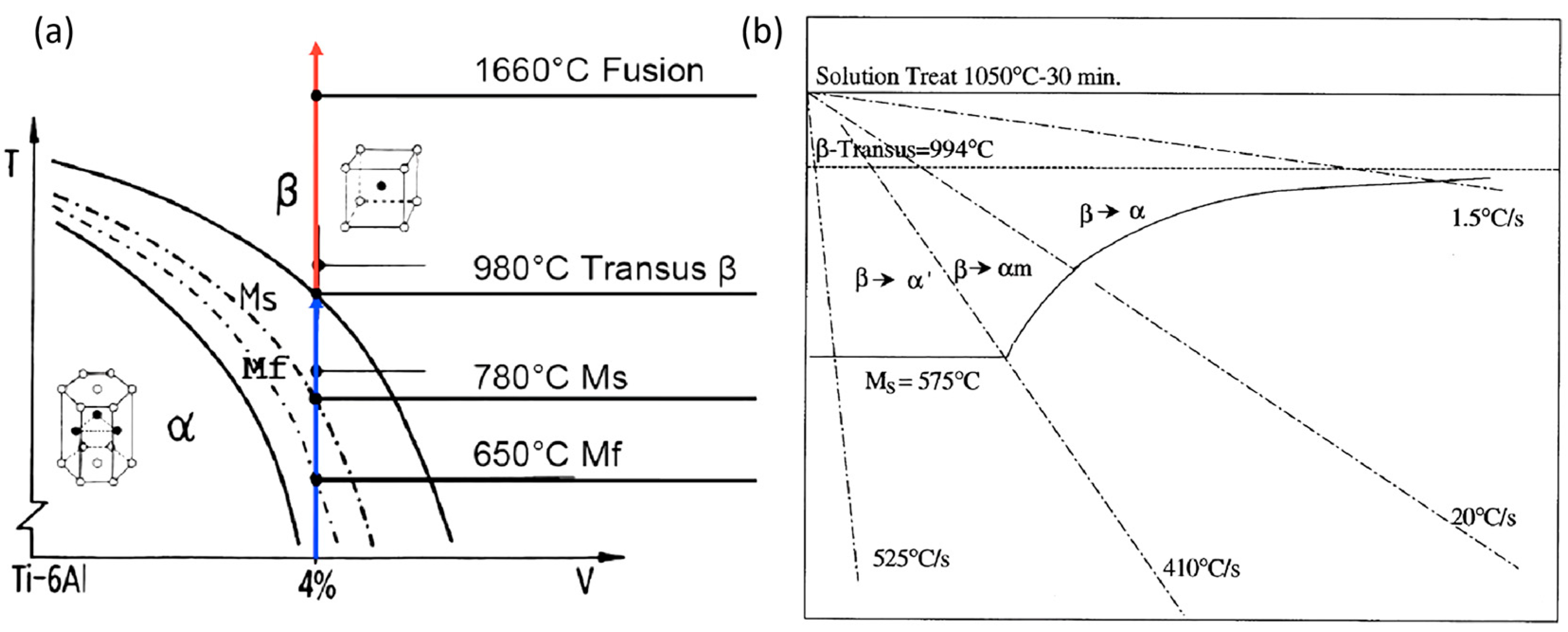
The most significant distinction from traditional processes lies in the fact that during SLM, the alloy powder not only undergoes a single heating–melting–cooling–solidification cycle under the laser’s influence—a micro-regional melting and non-equilibrium solidification crystallization process [19]—but also melts under the radiation of the high-energy laser beam and rapidly solidifies, with cooling rates reaching 106–108 °C/s. This results in typical rapid solidification and solid-state phase transformations, as illustrated in Figure 1. Consequently, the microstructure of SLM-fabricated TC4 alloy specimens is exceptionally fine.
The laser beam rapidly melts the metal powder within an extremely short time, leading to a significant temperature difference between the center of the melt pool and its surroundings. The rapid solidification and cooling of the melt pool create a steep temperature gradient [20]. With the increase in subsequent laser scanning passes, the heat conduction effect diminishes, the peak temperature during the thermal cycle decreases gradually, the solidification cooling rate slows progressively, and the temperature gradient is reduced accordingly. This thermal history directly determines the size, morphology, and microstructure of the formed melt pool and controls subsequent phase transformations. Therefore, a thorough understanding of this thermal history is crucial for studying the microstructural evolution of SLM-formed TC4 alloy [21]. Hereinafter, the planes along the scanning direction and the deposition direction will be referred to as the XY plane and XZ plane, respectively.
Figure 1. (a) Phase transition diagram of TC4 [22]. Reprinted with permission from ref. [22]. 2023, Springer Nature. (b) relationship between phase transformation and cooling rate [23]. Reprinted with permission from ref. [23]. 1998, Elsevier.
Metals 16 00284 g001

2.1.1. Microstructure of the XY Plane

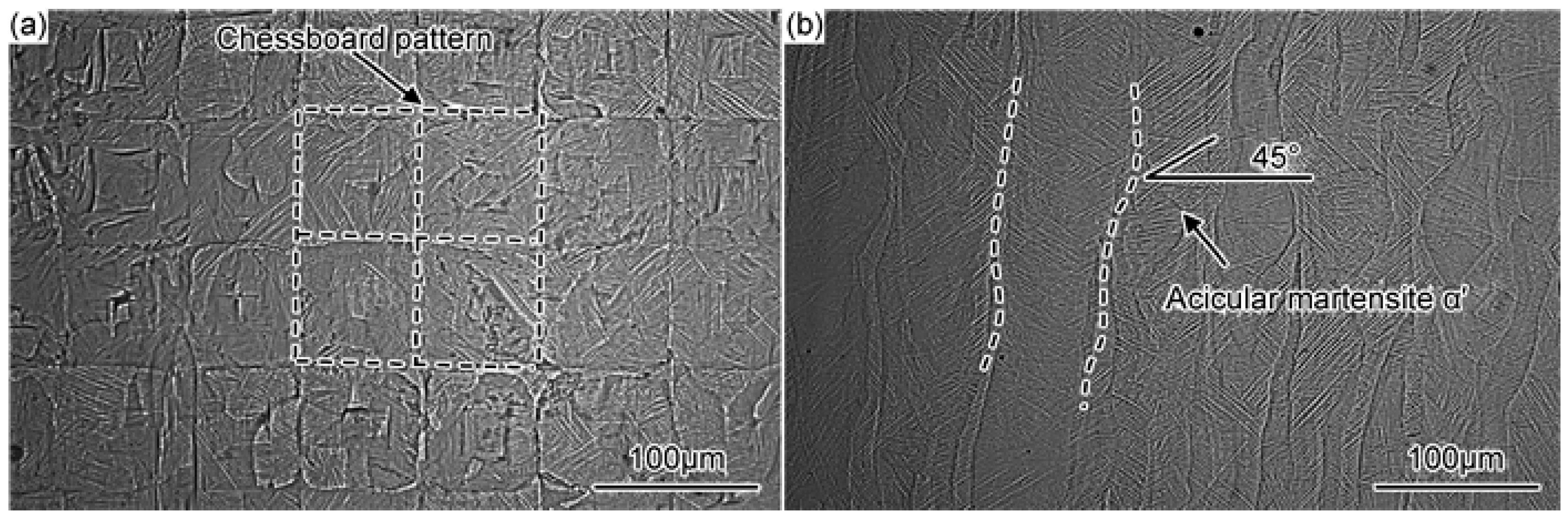
Figure 2a shows the microstructure on the cross-sectional XY plane (parallel to the scanning direction). The structure primarily consists of acicular martensitic α′ along with a small amount of β phase between the α laths. This typical microstructural characteristic arises because during the laser melting and forming process, the brief interaction between the laser beam and the powder leads to rapid melting and solidification. The primary columnar β grains formed subsequently undergo a β→α solid-state phase transformation during cooling. The α′ phase is a supersaturated non-equilibrium hexagonal close-packed structure formed through the diffusionless transformation of the β phase [24]. This process accumulates significant residual stress on the surface, providing preferential nucleation sites for martensite and increasing the nucleation rate of α′ martensite. When the phase transformation temperature is reached, the β→α transformation is partially incomplete, resulting in regular atomic migration and changes in crystal structure. This leads to the formation of acicular α′ phase during cooling [25], causing the surface microstructure to be composed of a large amount of acicular martensitic α′ phase and a certain volume fraction of β phase.

2.1.2. Microstructure of the XZ Plane

As shown in Figure 2b, elongated columnar β grains are present along the deposition direction. This occurs because when the first layer is printed via selective laser melting, the laser heats the metal powder to form a molten pool. The molten metal, adhering to the substrate surface, begins to nucleate and grow using the substrate surface as a heterogeneous nucleation site. Since the substrate is not preheated and remains relatively cool, a significant temperature gradient exists at this interface [26]. At the solid–liquid interface, grains exhibit a dendritic morphology and grow upward along the direction of the temperature gradient—that is, perpendicular to the substrate surface. The orientation of the acicular α′ forms an angle of approximately 45° with the β grain boundaries [27]. When printing proceeds to the subsequent layer, localized areas of the previously deposited layer are remelted by the laser, creating a new temperature gradient. The molten metal of the new layer then nucleates using the interface of the layer below as its substrate and continues to grow. By repeating this process, grains consistently grow along the direction of the temperature gradient—perpendicular to the substrate and the melt pool—resulting in the formation of epitaxially grown columnar grains along the building direction, a phenomenon determined by the heat conduction mode [24].
Figure 2. Microstructure of an SLM-formed TC4 specimen: (a) XY plane; (b) XZ plane [28]. Reprinted with permission from ref. [28]. 2018, Journal of Materials Engineering.
Metals 16 00284 g002

2.2. Grain Morphology and Anisotropy

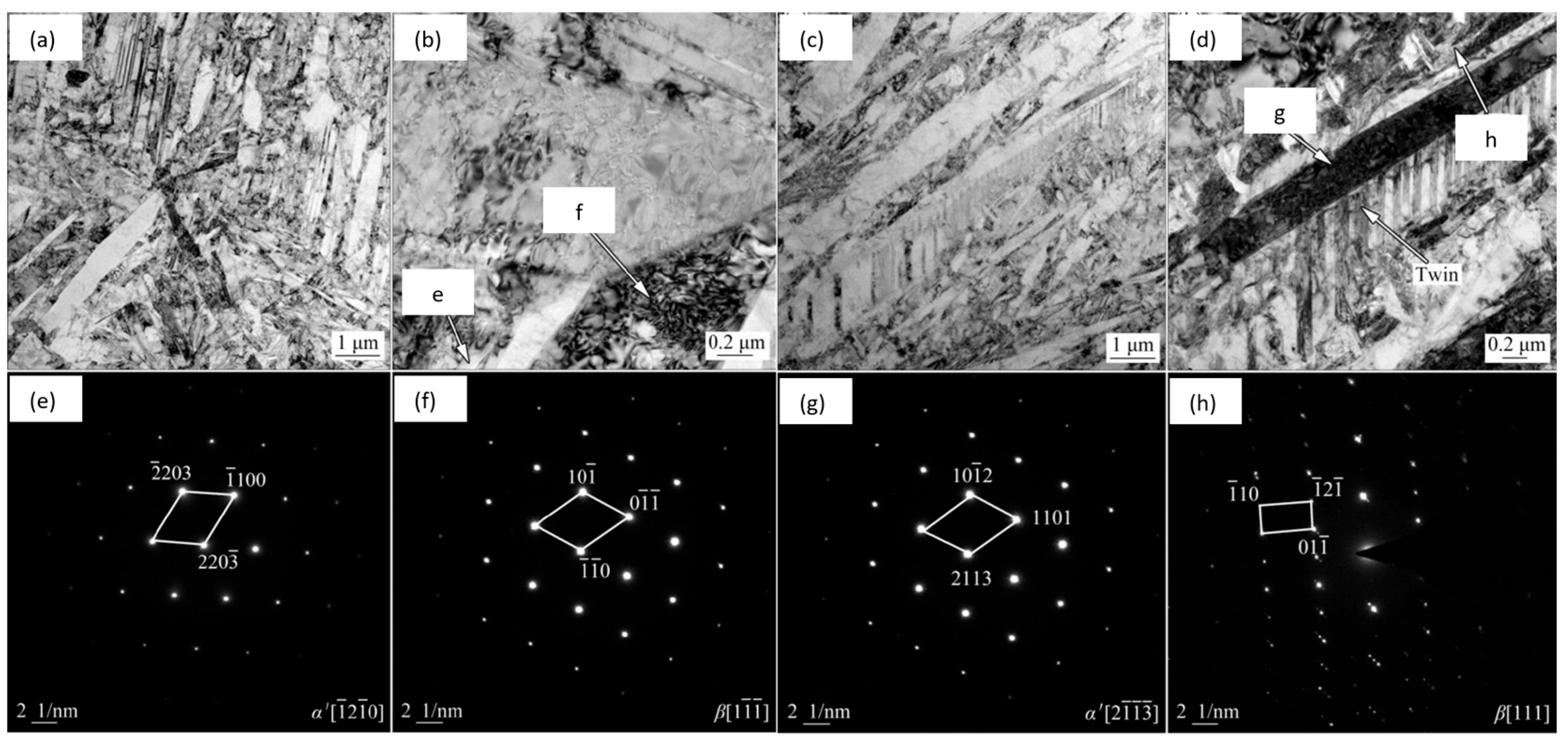
Studies on laser melting deposition have revealed that the rapid melting and subsequent rapid cooling and solidification of metal powder under laser energy, coupled with the high temperature gradients induced by the laser and the characteristic growth along the build direction, lead to anisotropy in the mechanical properties of manufactured parts [29]. Columnar β grains grow continuously and epitaxially along the deposition direction, reaching lengths of up to several hundred micrometers. Within the columnar β grain boundaries, acicular α′ martensite with varying orientations exists, measuring approximately 10–150 μm in length. In terms of orientation, these α′ martensite laths exhibit an inclination of approximately ± 45° relative to the original β grain boundaries (as shown in Figure 3), forming an orderly and structured arrangement. The different α′ martensite laths maintain parallel or perpendicular alignment relationships, with most α′ phases preferentially nucleating at the original β grain boundaries and then growing within the parent β grain boundaries. TEM observations of the microstructures of XY and XZ specimens are shown in Figure 3a–d. The selected area diffraction patterns indicate that the α/α′ phases in both the XZ and XY samples exhibit a hexagonal close-packed (hcp) structure, corresponding to Figure 3e,g, with lamellar and twin morphologies. Additionally, the β phase, corresponding to Figure 3f,h, is identified as having a body-centered cubic (bcc) structure.
It is thus evident that SLM-fabricated TC4 alloy is predominantly composed of the α′ martensite phase, which features a hexagonal close-packed (HCP) structure with low symmetry. Once the grains develop a preferred orientation and form a distinct texture, the material will exhibit significant anisotropy [29,30,31]. Owing to the intrinsic forming mechanism of SLM, anisotropy is an inevitable characteristic of additively manufactured components. Among various heat treatment approaches, hot isostatic pressing (HIP) stands out as the most effective method for mitigating anisotropy in SLM-fabricated TC4 alloys. Gangireddy et al. [31] conducted HIP treatment on SLM-produced TC4 alloy at a temperature below the β-transus. After the treatment, the metastable α′ martensite underwent transformation to form a bimodal α/β microstructure, while the original retained β phase was also modified, thereby effectively eliminating the anisotropy of the alloy.
Figure 3. TEM micrographs—(a,b) XY plane and (c,d) XZ plane—and the corresponding selected area diffraction patterns—(e,g) α/α′ phase and (f,h) β phase [32]. Reprinted from Ref. [32].
Metals 16 00284 g003

2.3. Solid Solution Strengthening and Dislocation Strengthening

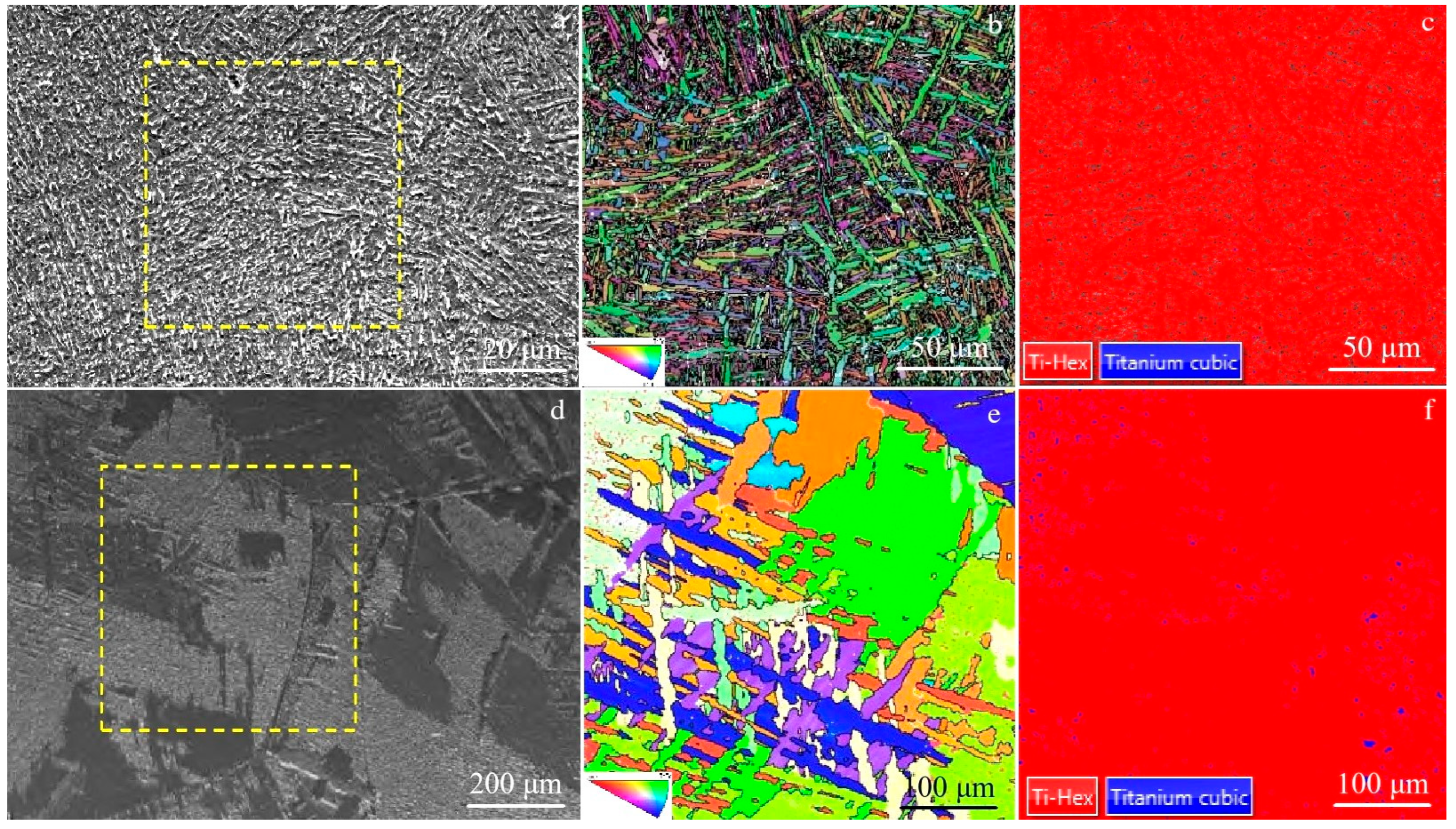
TC4 alloy fabricated by selective laser melting typically exhibits mechanical properties superior to those of its traditionally formed counterpart, including higher hardness, tensile strength, and yield strength, albeit with relatively lower elongation. Its primary strengthening mechanisms rely on a fine and dense microstructure and the solid solution strengthening provided by the α and α′ phases [20,33,34,35]. The EBSD map of SLM and cast TC4 alloy is shown in Figure 4; the SLM-TC4 alloy consists of 99.7% α phase and 0.3% β phase, whereas cast TC4 contains 98.18% α phase and 1.82% β phase, indicating a significantly higher α phase content in the SLM material. These factors enhance resistance to dislocation movement, thereby increasing the alloy’s strength but also limiting its plastic deformation capability [36,37].
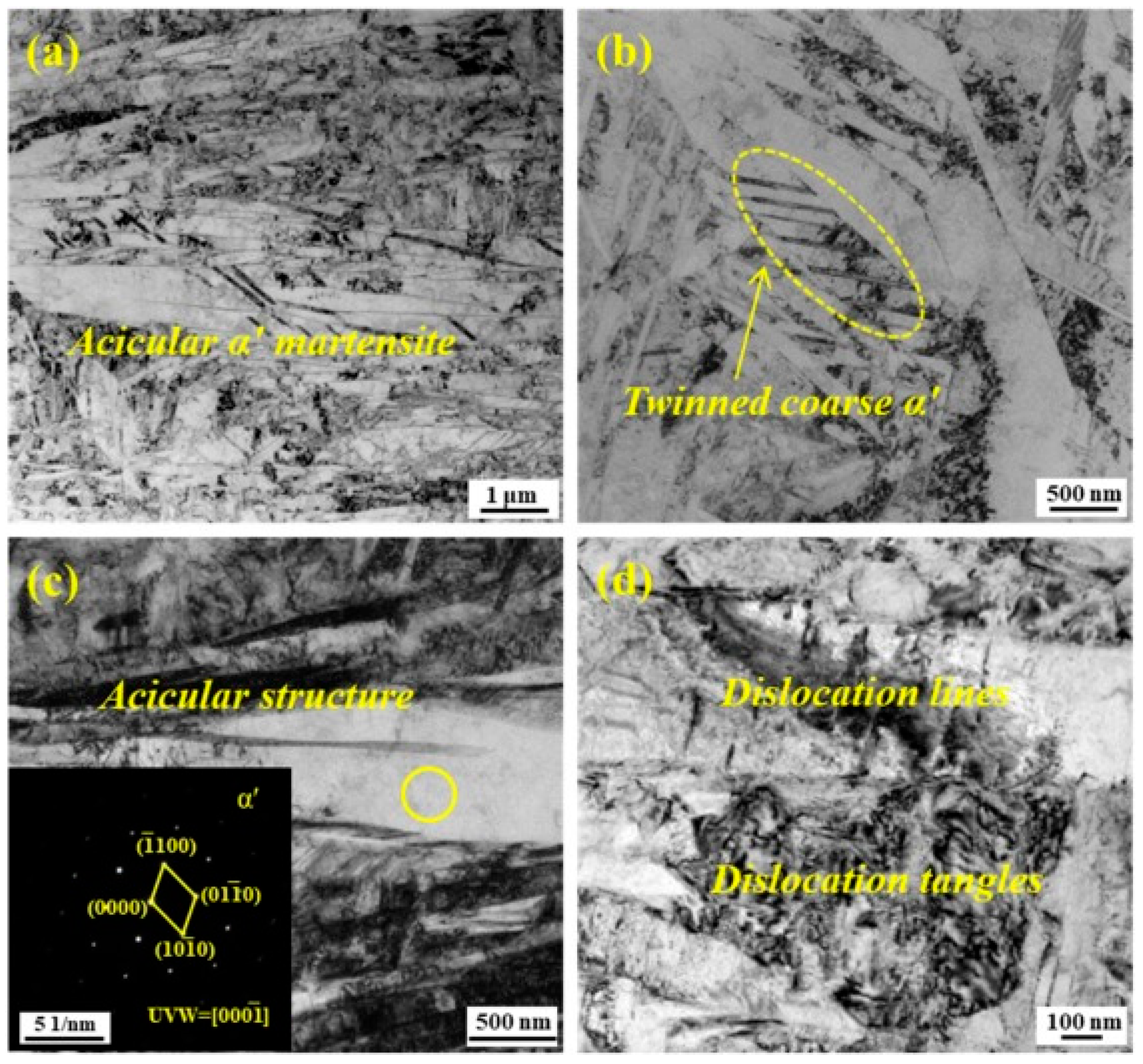
TEM images of SLM-TC4 are shown in Figure 8. The heterogeneous microstructure, composed of acicular and lamellar structures, is depicted in Figure 5a. During cooling, the β phase with a body-centered cubic (bcc) structure transforms into the α′ martensite phase with a hexagonal close-packed (hcp) structure via a diffusionless shear and dilatation process [39]. Mechanical twins (MTs) are dispersed within the lamellar α′ martensite phase, as illustrated in Figure 5b. This phenomenon can be attributed to the solid solution strengthening effect of vanadium (V), which inhibits the long-range migration of deformation-induced lamellar α′ martensite formed under cyclic thermal stresses [40].
Furthermore, martensite α′ is a non-equilibrium phase with a deformed lattice structure. Its formation introduces lattice strain, making it stronger than the α + β phase. As illustrated in Figure 5c, dislocation structures, primarily concentrated within the martensite due to the thermal effects of the SLM process, can be observed. Typical dislocation structures such as dislocation lines (DL) and dislocation tangles (DTs) are also evident in Figure 5d [41], leading to hardening through dislocation strengthening [42]. Hardness may vary across different regions. For instance, the melt pool boundaries, which experience faster cooling rates and thus develop a finer microstructure, exhibit relatively higher hardness. These finer grains not only show higher hardness but are also typically associated with a higher energy state. Moreover, finer grains generate more grain boundaries, contributing to increased energy and reactivity [43]. Conversely, the central region of the melt pool, which cools more slowly, exhibits a relatively coarser microstructure and slightly lower hardness. Regarding microstructural constituents, the hardness generally follows the descending order acicular martensite α′ phase > α phase > β phase.
Figure 5. TEM images of SLM-TC4: (a) acicular α′ martensite; (b) coarse α′ phase with twins; (c) acicular structure; and (d) dislocation lines (DL) and dislocation tangles (DTs) [39]. Reprinted with permission from ref. [39]. 2021, Elsevier.
Metals 16 00284 g005

3. Selective Laser Melting Forming and Its Defects

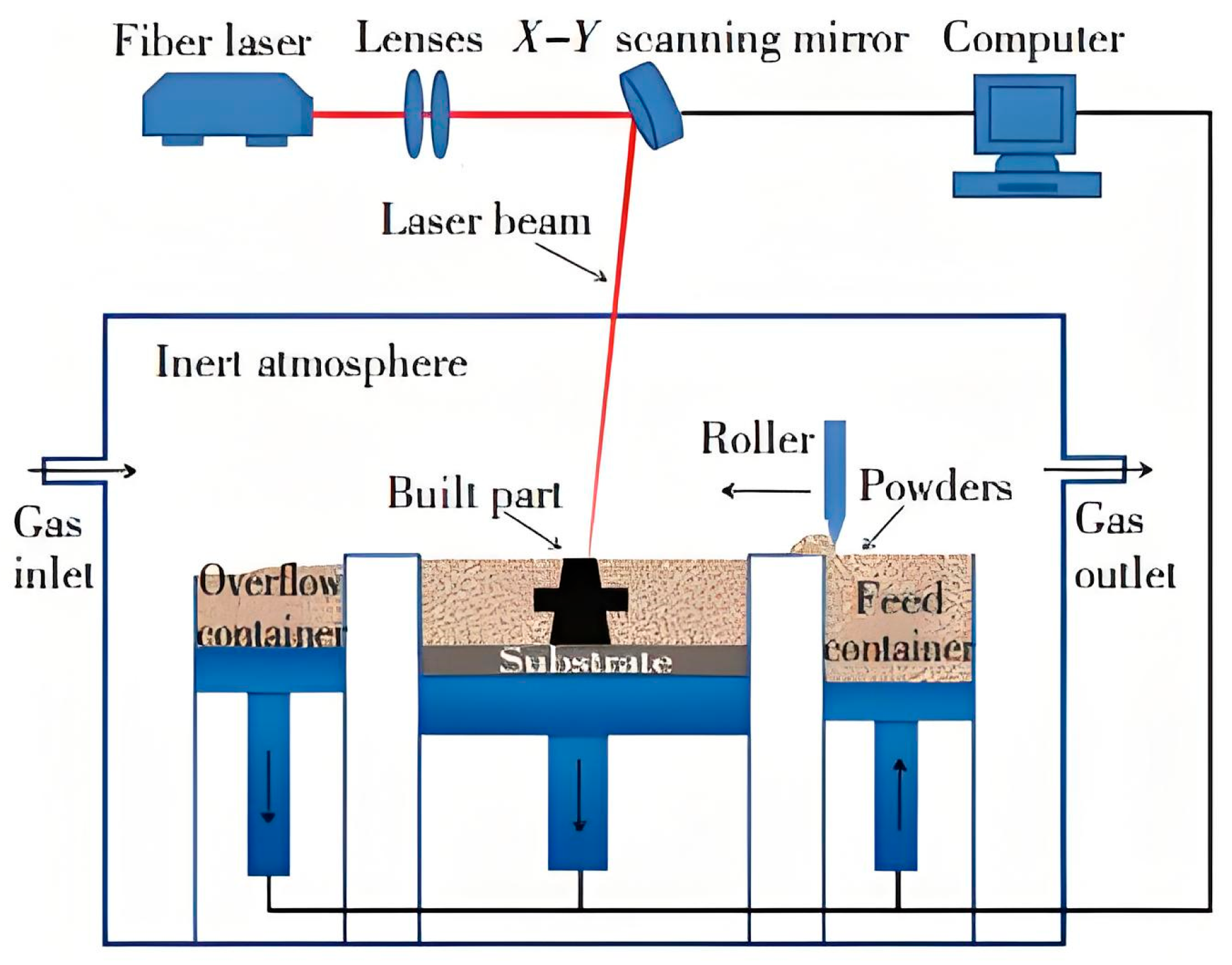
SLM, also known as laser powder bed fusion (LPBF), is an advanced AM technique enabling the layer-by-layer fabrication of components guided by CAD model data, as illustrated in Figure 6. SLM is capable of consistently producing complex structures with ultra-high relative densities reaching 99.9% [11,44]. Notably, the microstructure of SLM-formed TC4 alloy exhibits pronounced anisotropy along the scanning and building directions, featuring columnar β grains along the building direction and a near-circular, checkerboard-like morphology along the scanning direction—distinct from the equiaxed grain structure of forged titanium alloys.
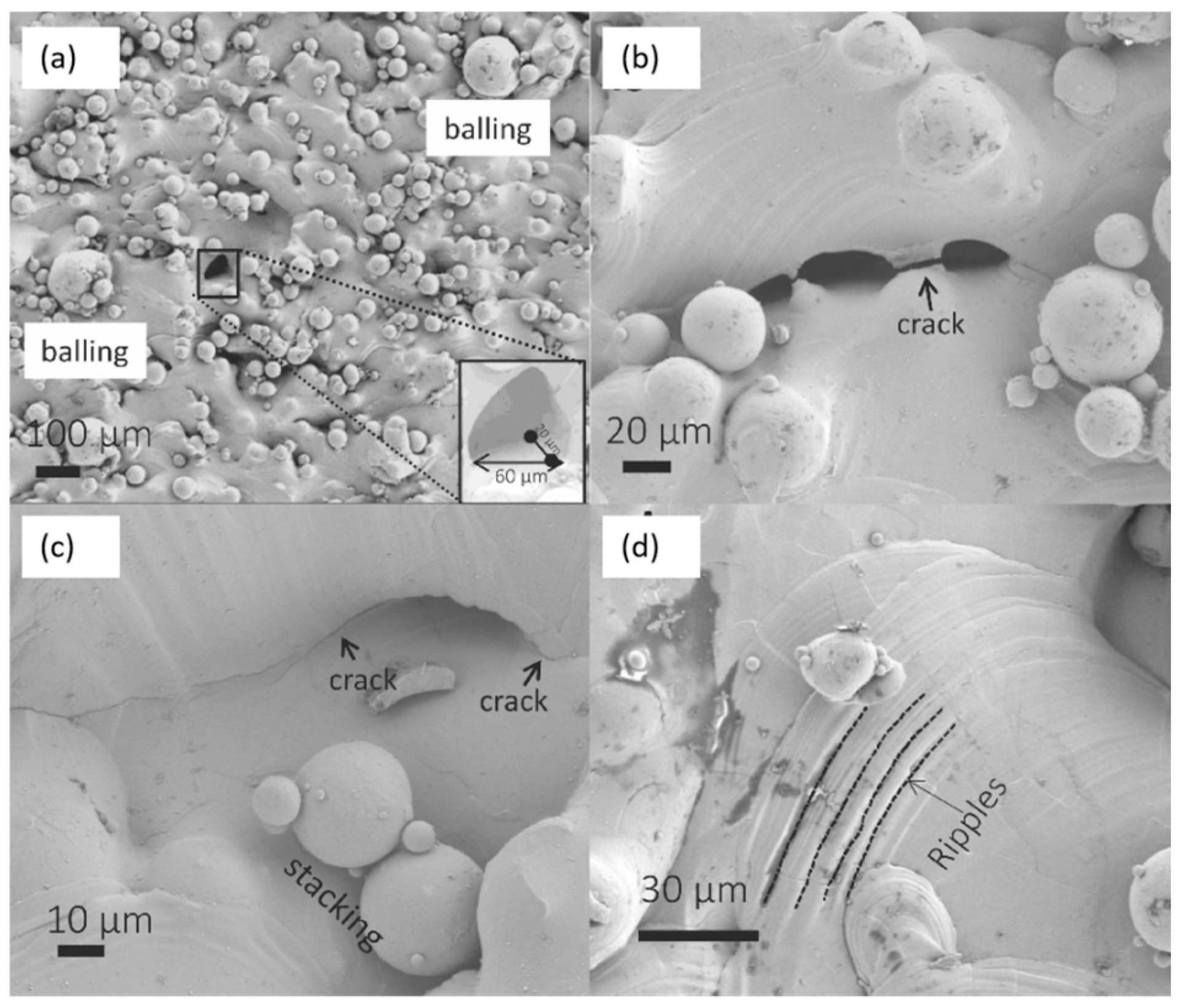
Since SLM manufacturing involves gradually developing tracks and layers through melting, fusion, and solidification processes, it relies on numerous parameters such as laser power, scanning speed, hatch spacing, layer thickness, powder material, and chamber environment. Kascak et al. [45] investigated the optimization of process parameters in the SLM process by adjusting laser power, scanning speed, and hatch spacing to mitigate residual stress and deformation, and identified optimal parameters including a laser power of 80 W, a scanning speed of 950 mm/s, and a hatch spacing of 70 μm. If any of these parameters are inappropriately selected, defects are inevitably induced. Forming defects pose a major and critical challenge in SLM, and they can be broadly classified into types including porosity, cracks, residual stress, and balling.

3.1. Porosity

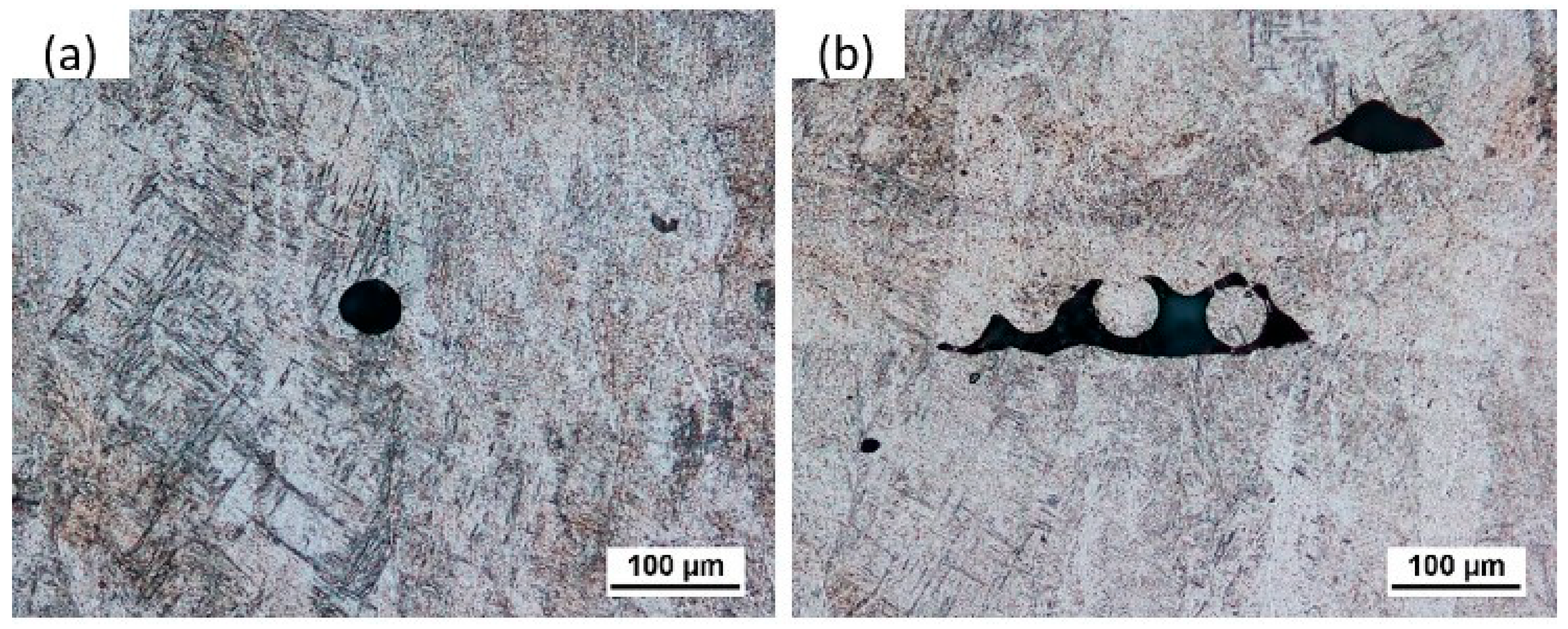
Porosity is the most significant defect in SLM-formed TC4 alloy, primarily caused by the accumulation of powder denudation around the melt pool within the build layers and the surface roughness of each layer [20]. Based on the formation mechanisms, porosity can be mainly categorized into gas pores and lack-of-fusion defects. Gas pores, as shown in Figure 7a, are further divided into metallurgical pores and keyhole pores. Metallurgical pores form when gases trapped between powders due to low powder packing density dissolve into the melt pool during powder melting and rapid solidification, or when gases inside hollow powders fail to escape in time, remaining as pores in the formed part. Keyhole pores, on the other hand, are a type of melting instability phenomenon influenced mainly by laser power and scanning speed. When the laser energy is too high or if the process parameters are inappropriate, evaporation of the melt pool surface generates a metal vapor recoil pressure, which presses deep and narrow cavities—known as keyholes—into the melt pool. Currently, the porosity of SLM-formed TC4 alloy can be controlled to relatively low levels. However, for high-performance titanium alloy components used in aerospace applications, the presence of pores still significantly impacts the mechanical properties of the parts. Kasperovich et al. [46] optimized the process parameters of SLM-formed TC4 alloy, yet they observed that a residual porosity of 0.08% could still persist, with fine pores accounting for a substantial volume fraction. To eliminate gas pores, post-processing is commonly implemented on additively manufactured components subsequent to their forming. However, such conventional post-treatments fail to achieve complete pore closure [47]. It has been demonstrated that only hot isostatic pressing (HIP) exerts a positive effect on porosity reduction [48]. Specifically, after HIP treatment, the volume fraction of gas pores is reduced drastically from 0.08% to 0.01%, accompanied by a sharp decrease in pore size as well [46,47].
Lack-of-fusion pores, also known as lack-of-fusion defects, as shown in Figure 7b, are typically distributed between scanning tracks and deposited layers. They mainly occur due to insufficient energy input or inadequate overlap of scanning tracks during the SLM forming process, leading to poor powder fusion and the formation of lack-of-fusion defects. Mukherjee et al. [49] suggest that lack-of-fusion defects may arise when the melt pool from an upper layer fails to adequately penetrate into the substrate or previously deposited layers. Insufficient penetration results in elongated voids in the formed part, with these pores typically having an equivalent diameter >10 μm. Inadequate overlap between scanning tracks can also lead to lack of fusion in the powder. Jonathan Stef et al. [50] used micro-computed tomography to perform three-dimensional reconstruction and analyze the scanning paths of pores in SLM-printed TC4 alloy, finding that pore morphology and distribution are directly related to the scanning path. Insufficient laser power, excessively high scanning speeds leading to low volumetric energy density, excessive powder feed, and low surface smoothness can all contribute to poor fusion and the formation of lack-of-fusion defects [51]. Compared with gas pores, lack-of-fusion defects exert a more pronounced influence on the performance of additively manufactured products, yet such defects are regarded as avoidable. Elevating the input energy density is proven to be an effective approach to mitigating lack-of-fusion defects [52].
Figure 7. (a) Gas pores; (b) LOF defects from unmelted metal powder [53]. Reprinted with permission from ref. [53]. 2016, Elsevier.
Metals 16 00284 g007

3.2. Crack and Residual Stress

In the SLM process, the laser heat source exhibits a Gaussian distribution, leading to uneven heating of the melt pool with extremely high cooling rates and temperature gradients. The cooling rate of the melt pool reaches 106–108 °C/s [54], generating significant temperature gradients and correspondingly large residual thermal stresses in the manufactured components. The combination of high temperature gradients and substantial residual stresses often results in crack initiation and propagation in preforms, as shown in Figure 8b–d. Cracks and residual stresses are common defects in SLM forming and are highly detrimental to components. Residual stresses can cause crack formation and warping in parts, leading to detachment of the build from the substrate and cracks in the finished components [55,56]. To reduce the incidence of cracks, preheating the substrate and increasing the ambient temperature are effective strategies. Additionally, lowering the scanning speed, hatch spacing, and layer thickness, or adopting a multi-track and multi-layer forming strategy, can yield favorable outcomes.
Residual stresses in SLM-formed parts are primarily attributed to temperature gradients and cooling rates, with large temperature gradients being the main contributing factor. Furthermore, residual stresses increase with longer scanning lengths [55,56]. When a high-energy laser beam melts the metal powder, the upper surface of the powder is rapidly heated by the laser, while the lower surface heats more slowly. This creates a temperature gradient from the upper to the lower surface, with the highest temperatures at the top. Due to the greater thermal gradient along the scanning direction, residual stresses along this direction exceed those in the perpendicular direction [57], a finding corroborated by Vrancken et al. [58], resulting in anisotropic stress distribution in the final part. Haider Ali et al. [59] examined the influence of powder bed temperature on residual stress formation, microstructure, and mechanical properties of additively manufactured components. They found that elevating the powder bed temperature to 570 °C could reduce the thermal gradient encountered during the forming process, thereby significantly decreasing the residual stresses in the as-formed parts while simultaneously enhancing their yield strength and ductility.

3.3. Balling Effect

Balling is also a common defect in the SLM forming process, primarily caused by poor wettability of the melt pool and splattering of molten metal droplets during forming, as shown in Figure 8. When metal powder is melted by the laser, it fails to spread uniformly over the previous layer and instead forms numerous isolated spherical metal droplets. This phenomenon is referred to as balling [60]. In recent years, the explanation attributing balling to “wettability issues between molten metal and solid surfaces” has gained widespread acceptance [61]. The root cause of balling lies in the principle of minimizing Gibbs free energy. During the solidification of the metal melt pool, the system formed by the molten metal surface and the surrounding medium tends to achieve the lowest free energy. Driven by the interfacial tension between the molten metal and the surrounding medium, the shape of the molten metal surface transforms into a spherical form to reduce its surface energy. Sallica Leva et al. [33] investigated the microstructure of SLM-formed TC4 parts and found that excessively high laser power reduces the surface energy of the molten metal, leading to the occurrence of balling. Hu et al. [62] discovered through research that balling results from factors such as high surface tension and viscosity of the liquid phase, as well as the lack of wetting between the molten powder and unmelted powder particles or the substrate. Their study indicates that oxygen present during the laser rapid forming process is the direct cause of balling.
Figure 8. Characteristics of side surface defects in SLM-formed titanium alloy: (a) balling formation; (b) surface porosity; (c) cracks induced by porosity; (d) rippling observed in the sample [63]. Reprinted from Ref. [63].
Metals 16 00284 g008

3.4. AI and Machine Learning Optimization for TC4 Alloys Formed by SLM

The integration of artificial intelligence (AI) and machine learning (ML) technologies has become a transformative research frontier in the selective laser melting of titanium alloy TC4, enabling high-precision control over material forming quality and performance by addressing the limitations of traditional process optimization [64,65]. For example, Bayesian networks effectively modeled process–property relations for knowledge across multiple metal AM printers, verified through three “industry use” inspired scenarios by multi-property optimization on laser powder bed fusion TC4 [66]. Deep reinforcement learning (DRL) combines the feature extraction capabilities of deep learning with the decision-making abilities of reinforcement learning, enabling it to handle the high-dimensional state space in SLM processes and giving it the potential to achieve autonomous optimization of multi-parameter coupling (laser power–scan speed– scan spacing) [67,68]. DRL-based methods have achieved success in applications involving transport phenomena and process control, such as the control of self-propelled swimmers [67] and Rayleigh–Bénard convection [68]. These advancements demonstrate their potential for optimization in complex high-dimensional state spaces.

4. Mechanical Properties

Laser power and scanning speed are critical factors influencing the quality of parts fabricated by laser additive manufacturing [21]. The microstructure of TC4 alloys formed by SLM differs significantly from that of cast or forged alloys with the same composition. The specific as-built microstructure of SLM specimens is the root cause of the observed mechanical anisotropy and low ductility.

4.1. Tensile Properties

Due to the high cooling rates, TC4 samples fabricated by SLM exhibit high residual stresses and a unique microstructure primarily composed of acicular martensitic α′ phase, which contributes to favorable mechanical properties. I. Yadroitsev et al. [69] investigated the fracture types and tensile fracture mechanisms of SLM-TC4 samples. They observed both intergranular and intragranular fracture in horizontally built specimens, while only intergranular fracture was found in vertically built specimens. Consequently, the reduced ductility observed in the tensile tests of horizontal specimens may be attributed to intergranular fracture initiated at prior β grain boundaries. Thomas Voisin et al. [70] also systematically characterized the tensile behavior of SLM-fabricated TC4 alloy samples at room temperature. Their findings demonstrated that tensile strength, yield strength, and elongation are predominantly governed by the as-built microstructure, whereas fracture strain is more susceptible to the presence of porosity. X-ray computed tomography (XCT) revealed a distinct failure mechanism involving pore coalescence and growth when the tensile axis was perpendicular to the build direction, resulting in a notably lower tensile fracture strain. These anisotropic pore evolution mechanisms are responsible for the inferior tensile performance of SLM-fabricated components compared with their conventionally manufactured counterparts.
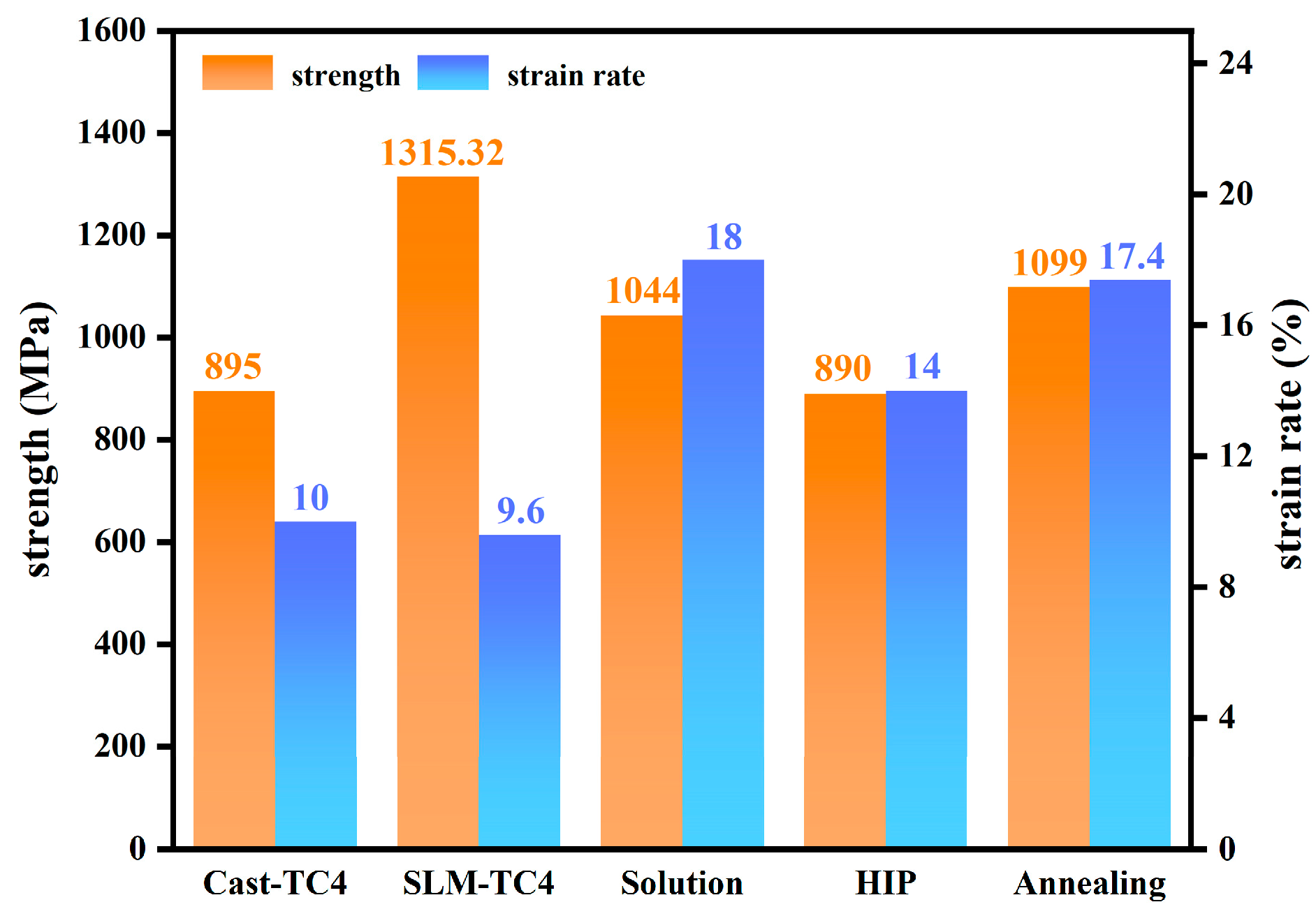
Relevant studies have shown that the tensile strength of TC4 formed parts produced by SLM is approximately 1315.32 MPa, with an elongation at fracture of 9.6% [71]. The tensile strength of traditionally cast TC4 titanium alloy is about 895 MPa, with an elongation at fracture of 10% [72]. However, TC4 produced by SLM has relatively large residual stresses, so it needs to undergo heat treatment. Liu et al. [73] conducted a detailed study on the effects of heat treatment on the microstructure and mechanical properties of SLM-TC4 titanium alloy. They found that with increasing aging temperature, the metastable α′ phase in SLM-TC4 decomposes into lamellar (α + β) phases. The α and β phases coarsen during this transformation, resulting in a gradual decrease in strength, while ductility increases and hardness decreases. In solution treatment followed by aging, the β phase transforms into α′ martensite during solution treatment. Subsequent aging leads to the decomposition of the metastable α′ phase into lamellar (α + β) phases. The strength and hardness of the TC4 alloy increase with rising temperature under this regime. Optimal mechanical properties were achieved through water quenching after holding at 960 °C for 1 h, followed by air cooling and aging at 600 °C for 8 h. The tensile strength is 1044 MPa, and the elongation at break is 18%. Yan et al. [74] studied the change in phase composition of SLM-TC4 alloy after hot isostatic pressing (HIP). The coarse lath-like α phase gradually refined, and the proportion of the α phase gradually decreased. The grain refinement strengthening effect was weakened, and the dislocation density decreased. When the hot isostatic pressing parameters were 940 °C/3 h/150 MPa, the tensile strength and elongation reached the best match, with the fracture strength being approximately 890 MPa and the tensile rate approximately 14.0%. Chen et al. [75] studied the tensile properties of SLM-TC4 alloy at different annealing temperatures (650–950 °C). The results showed that as the annealing temperature increases, the original acicular martensitic α′ phase gradually transforms into a lamellar α + β structure. This transformation leads to a trend of decreasing strength and increasing elongation. The optimal combination of strength and ductility was attained via annealing treatment at 800 °C for 2 h, with the tensile strength reaching 1099 MPa and the elongation at break measuring 17.4%. Influence of different heat treatment methods on the properties of SLM-TC4 are presented in Table 1. The tensile strength and fracture strain rate of cast TC4, SLM-fabricated TC4, and heat-treated SLM-fabricated TC4 are presented in Figure 9.

4.2. Fatigue Properties

The combination of porosity, residual stress, and low ductility is critical to the fatigue strength of SLM-produced components [76]. For additively manufactured metal parts, the fatigue strength of metallic materials is significantly influenced by material defects. Crack initiation typically occurs at defect sites, and internal crack propagation paths may also be affected by defects. V. Cain et al. [77] investigated the fatigue crack growth rate of TC4 specimens formed by SLM. They found that the relationship between the build direction and the fracture plane has the most significant impact on the fatigue crack growth rate, primarily due to the anisotropic distribution of residual stresses in the as-built parts. The characteristics of high strength and low ductility are often attributed to the brittleness and hardness of the fine acicular martensitic α′ phase.
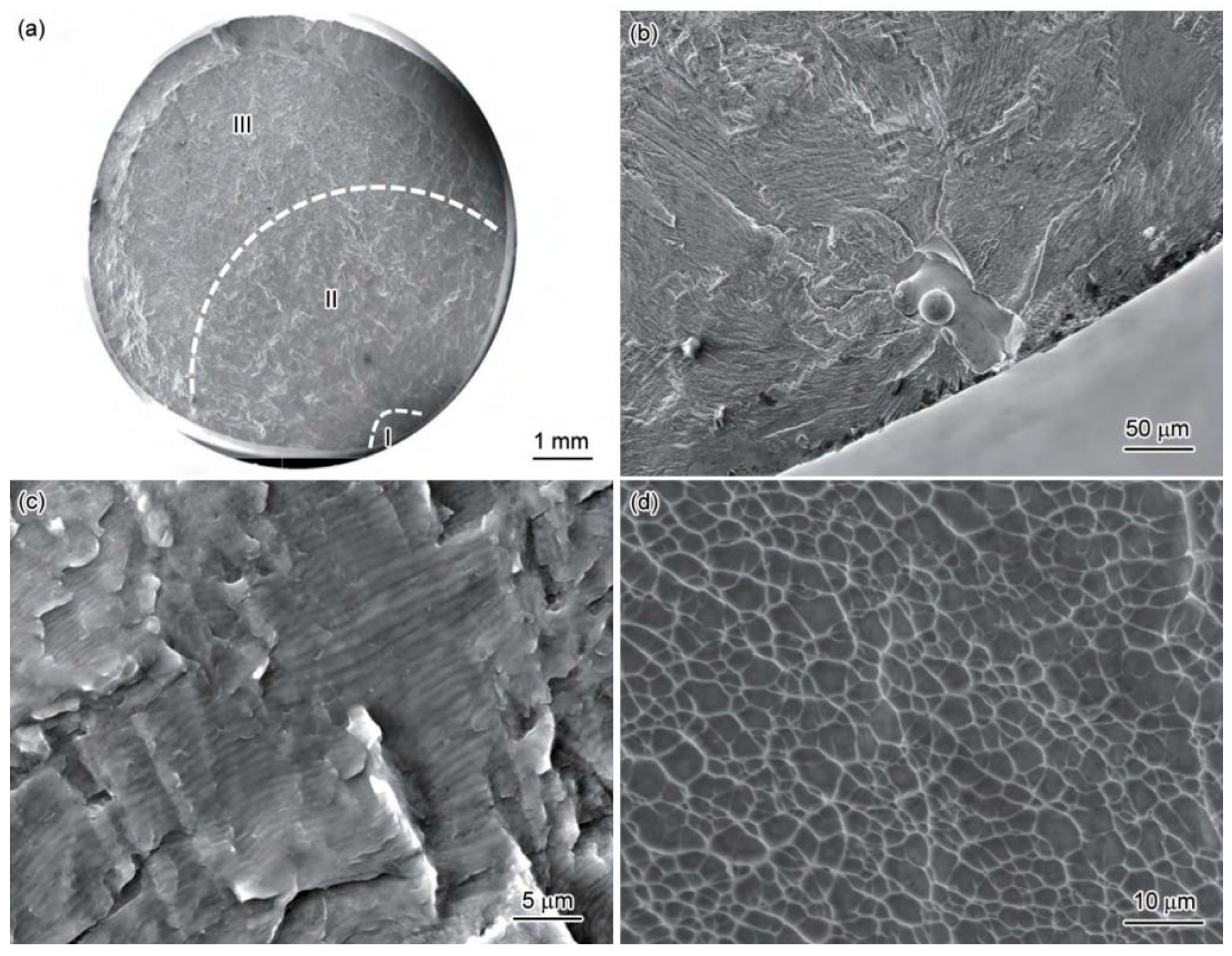
Figure 10a shows the fracture morphology of an as-built SLM-TC4 high-cycle fatigue specimen tested at a stress level of 440 MPa with a total life of Nf = 5.9 × 10⁴ cycles. The image clearly displays typical features of a fatigue fracture, including the crack initiation zone (I), fatigue crack propagation zone (II), and final fracture zone (III) [78]. It was observed that the fatigue crack initiated at the specimen surface, then propagated stably, eventually forming a typical semi-elliptical shape. The fatigue fracture surface was relatively flat. As shown in Figure 10b, the crack originated from a lack-of-fusion defect on the specimen surface, with fatigue striations radiating from the defect constituting a distinct radial pattern [78]. Figure 10c clearly reveals fatigue striations in the stable crack propagation zone. These striations are perpendicular to the crack growth direction, with their quantity and spacing correlating to the cyclic number and stress intensity factor range [79]. By measuring the width of these fatigue striations, the crack growth rate was estimated to be 6.0 × 10⁻⁷ m/cycle. The final fracture zone displays a relatively rough morphology with distinct shear lip characteristics. Simultaneously, dense and uniformly distributed dimples are observed across this zone, as illustrated in Figure 10d. These dimples are relatively small and shallow, which is indicative of the material’s inferior toughness and low plasticity.
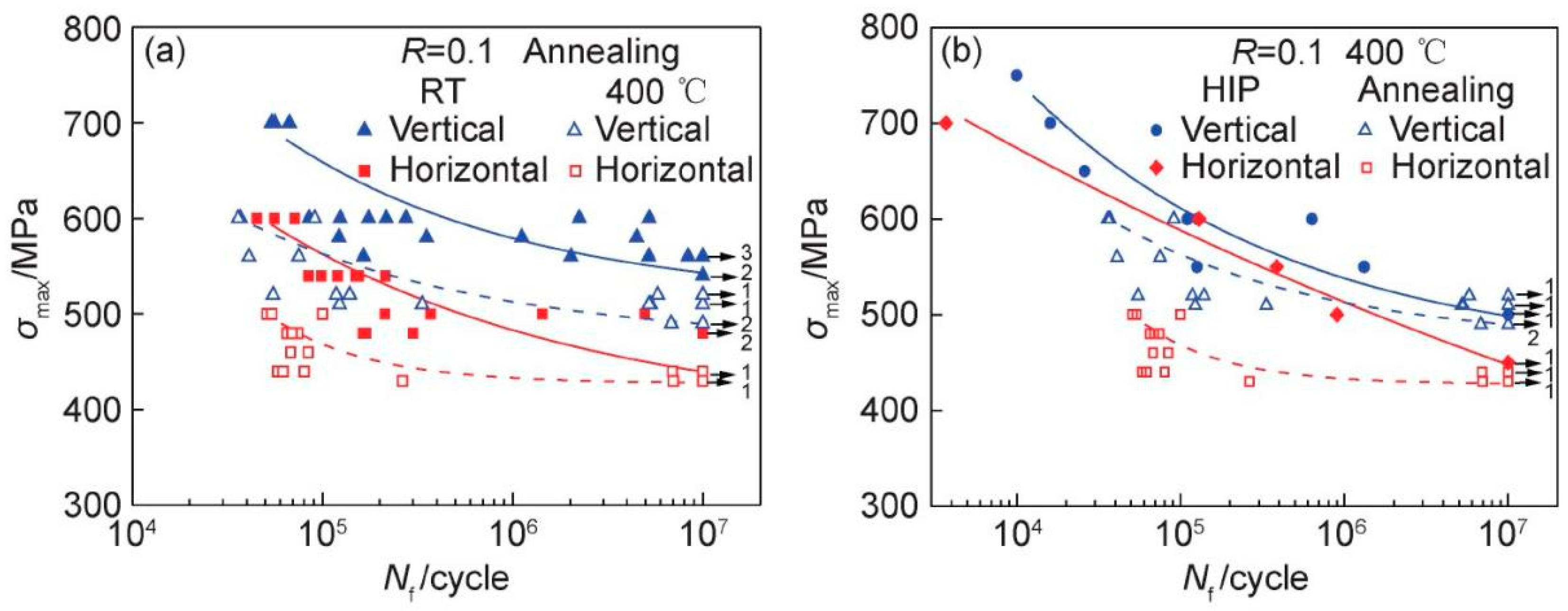
Currently, improvements in the fatigue performance of titanium alloys primarily focus on simulation testing and post-heat treatment. Conducting simulations can, to the greatest extent, avoid unknown defects and improve the efficiency of material performance research, while post-heat treatment can effectively reduce crack initiation in TC4 and extend fatigue life. Chi et al. [80] studied the very high cycle fatigue (VHCF) behavior of SLM-TC4 alloy using rotary bending fatigue tests (f = 50 Hz, R = −1) and ultrasonic frequency (20 kHz) fatigue tests. They found that in additively manufactured TC4 alloy, very high cycle fatigue crack initiation and early propagation zones contain discontinuous regions of fine grains. This is caused by the combined effects of grain refinement due to dislocation interactions leading to microcrack formation and microcracks forming at α phases and grain boundaries. Oliveira et al. [81] investigated the influence of frequency parameters on fatigue resistance. At a life of 107 cycles, the fatigue limits at frequencies of 1000 Hz, 1200 Hz, and 1500 Hz were 829 MPa, 644 MPa, and 417 MPa, respectively. Wang et al. [82] applied low-temperature vacuum heat treatment to additively manufactured TC4 alloy specimens. The results showed that low-temperature vacuum heat treatment can reduce the likelihood of thermal deformation in metals, especially for parts with complex structures. Furthermore, during this heat treatment process, a greater amount of β phase precipitated in the specimens, acting as a secondary strengthening phase. Additionally, a large number of twinned grains can improve plasticity and strength. However, as the temperature continues to increase, the β precipitates coarsen, correspondingly reducing the specimen’s strength. Further experiments indicated that with increasing vacuum level, the thickness of the oxide layer on the specimen surface decreases, leading to better surface morphology and further enhancement of the specimen’s fatigue strength. Wu Liangliang et al. [83] compared the effects of annealing at 400 °C and HIP post-treatment on SLM specimens. For HIP-treated specimens, as shown in Figure 11(The arrows in the figure represent data points where no fracture occurred during 1 × 10⁷ cycles of the experiment, and the subsequent numbers indicate the number of unbroken points at the corresponding stress levels), the vertical specimen fatigue limit (1 × 10⁷ cycles) was 498 MPa, which is 9 MPa higher than that of the annealed specimens. The horizontal specimen fatigue limit (1 × 10⁷ cycles) was 447 MPa, representing a 19 MPa increase compared to the annealed specimens. The experimental results show that, compared to the significantly anisotropic fatigue properties of the alloy after annealing, the trend of anisotropic fatigue performance is weakened after HIP treatment. This indicates that applying the HIP process after additive manufacturing can effectively reduce the anisotropy of material fatigue properties and improve the high-cycle fatigue performance of the alloy.
Figure 10. Fractography of the fatigue specimen: (a) macroscopic morphology of the fracture surface; (b) fatigue origin morphology in Zone I; (c) fatigue striations in the stable propagation in Zone II; (d) final fracture in Zone III [84]. Reprinted with permission from ref. [84]. 2019, Acta Metallurgica Sinica.
Metals 16 00284 g010
Figure 11. S–N curves for high-cycle fatigue of SLM-TC4 alloy under different conditions: (a) comparison of fatigue data between room temperature and 400 °C under annealing heat treatment conditions; (b) comparison of fatigue data between annealing heat treatment and hot isostatic pressing at 400 °C [83]. Reprinted from Ref. [83].
Metals 16 00284 g011

5. Corrosion Performance

Titanium has a low equilibrium potential, indicating a high thermodynamic tendency for corrosion in various media. However, due to its strong passivation tendency, titanium exhibits exceptional stability in numerous environments. In air or oxidizing/neutral aqueous solutions, a stable, dense, and strongly adherent oxide film (TiO2) rapidly forms on its surface [85]. Even if this film is damaged, it can quickly self-repair, granting titanium excellent corrosion resistance [86,87]. Nevertheless, due to microstructural differences, the electrochemical corrosion resistance varies across different planes of SLM-formed titanium alloys, namely the build plane and the build direction plane [32]. Therefore, a systematic study of the corrosion resistance of SLM-TC4 is warranted, focusing on the influence of different planes and microstructures.

5.1. Differences in Corrosion Resistance Across Different Planes

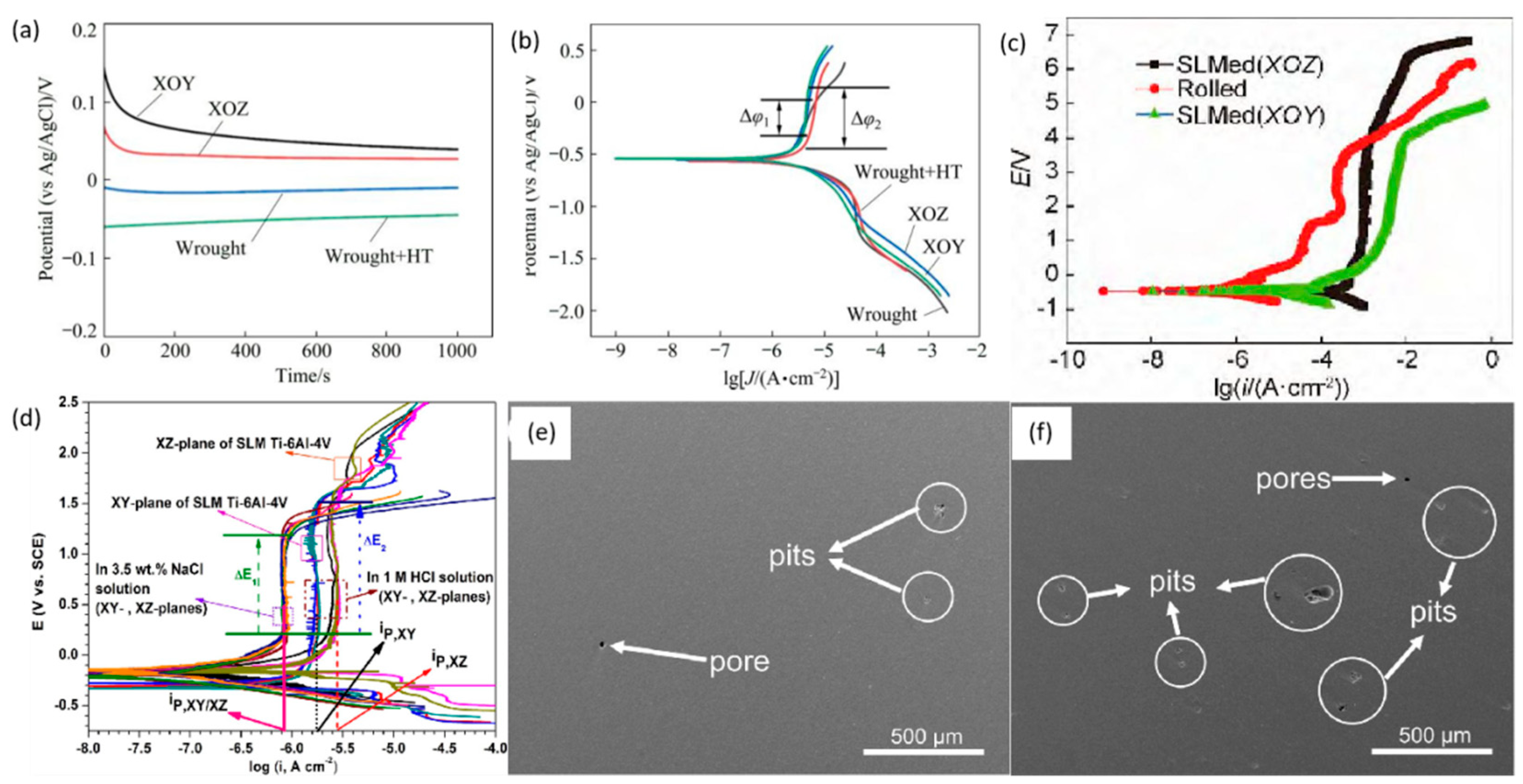
Due to the directional nature of the SLM process, the corrosion performance of TC4 alloy varies across different planes [32,38,88]. For instance, in artificial simulated saliva, the open-circuit potential (OCP) of the XY plane is superior to that of the XZ plane, and the OCP of SLM-TC4 is better than that of its forged and forged + HT counterparts. This indicates that the XY sample exhibits greater corrosion resistance than the XZ sample [32], as shown in Figure 12a. The passive film on SLM-TC4 has a wider corrosion potential range (Δφ2) compared to forged and forged + HT samples (Δφ1), suggesting the passive film on SLM-TC4 is more stable and protective. Furthermore, the corrosion current density of the XY plane is lower than that of the XZ plane, implying the XY plane has the lowest corrosion rate and strongest corrosion resistance in simulated artificial saliva (Figure 12b), a finding corroborated by Hamza et al. [89]. Figure 12c presents polarization curves of SLM-formed and rolled TC4 alloys in a 3.5% NaCl solution. In the passive region, the rolled TC4 shows better corrosion resistance than the as-built SLM-TC4. Interestingly, for the SLM material, the corrosion resistance of the XZ plane is superior to that of the XY plane [28].
Figure 12d further confirms that in a 3.5% NaCl solution, the XZ plane exhibits better corrosion resistance than the XY plane. Conversely, in a 1 M HCl solution, the opposite is observed, with the XY plane showing slightly better corrosion performance than the XZ plane [88]. In other words, while the difference is minimal in NaCl solution, SLM-formed TC4 exhibits anisotropic corrosion resistance across different planes in 1 M HCl solution. Regarding corrosion morphology, both the XY and XZ planes of SLM-TC4 alloy develop distinct corrosion pits, characteristic of pitting corrosion (Figure 12e,f). This occurs because the passive film is initially breached along grain boundaries in the corrosive medium, exposing fresh Ti substrate which reacts with Cl ions to form pits. The corrosion resistance of titanium alloys depends on the stability of the surface passivation film (TiO2). The chemical stability of the β phase, especially in neutral or weakly corrosive media, is significantly better than that of the α′ phase, which can reduce the occurrence of localized corrosion. In neutral NaCl solution, the advantage of the β phase’s oxide film stability is more pronounced, so the sensitivity of localized corrosion to the β phase content is lower. In strongly acidic HCl solution, H+ accelerates the dissolution of the oxide films of all phases, weakening the protective effect of the β phase, leading to a decrease in sensitivity. The XY plane exhibits fewer pits compared to the XZ plane, indicating that the passive film formed on the XY plane is more stable and protective. In summary, for SLM-fabricated TC4 alloy, the XY plane generally exhibits superior corrosion resistance to the XZ plane in a 3.5 wt.% NaCl solution, albeit with only a marginal disparity between the two planes. This phenomenon is primarily attributed to the characteristic microstructure of SLM-fabricated TC4 alloy, which is dominated by acicular α′ martensite and β-Ti phases [38]. The higher the β-Ti content, the more pronounced the stability advantage of the surface oxide film (TiO2), resulting in lower corrosion sensitivity of β-phase content in neutral media. Compared with the XY plane, the XZ plane has a higher α′ -Ti content and lower β-Ti content, which leads to relatively poorer corrosion resistance of the XZ plane [88].
Figure 12. Open circuit potential, polarization curves, and post-electrochemical corrosion morphology on different planes: (a,b) open circuit potential and polarization curves of XY and XZ planes as well as forged TC4 in simulated artificial saliva [32]. Reprinted from Ref. [32] (c) polarization curves of SLMed and rolled TC4 alloys in a 3.5% NaCl solution [28]. Reprinted with permission from ref. [28]. 2018, Journal of Materials Engineering. (d) potentiodynamic polarization curves of XY and XZ planes of SLM-formed TC4 alloy in 3.5 wt.% NaCl solution and 1 M HCl solution; (e,f) SEM images of XY and XZ planes of SLM-formed TC4 alloy after electrochemical corrosion [88]. Reprinted with permission from ref. [88]. 2016, Elsevier.
Metals 16 00284 g012

5.2. Influence of Microstructure on Corrosion Behavior

5.2.1. Phase Structure

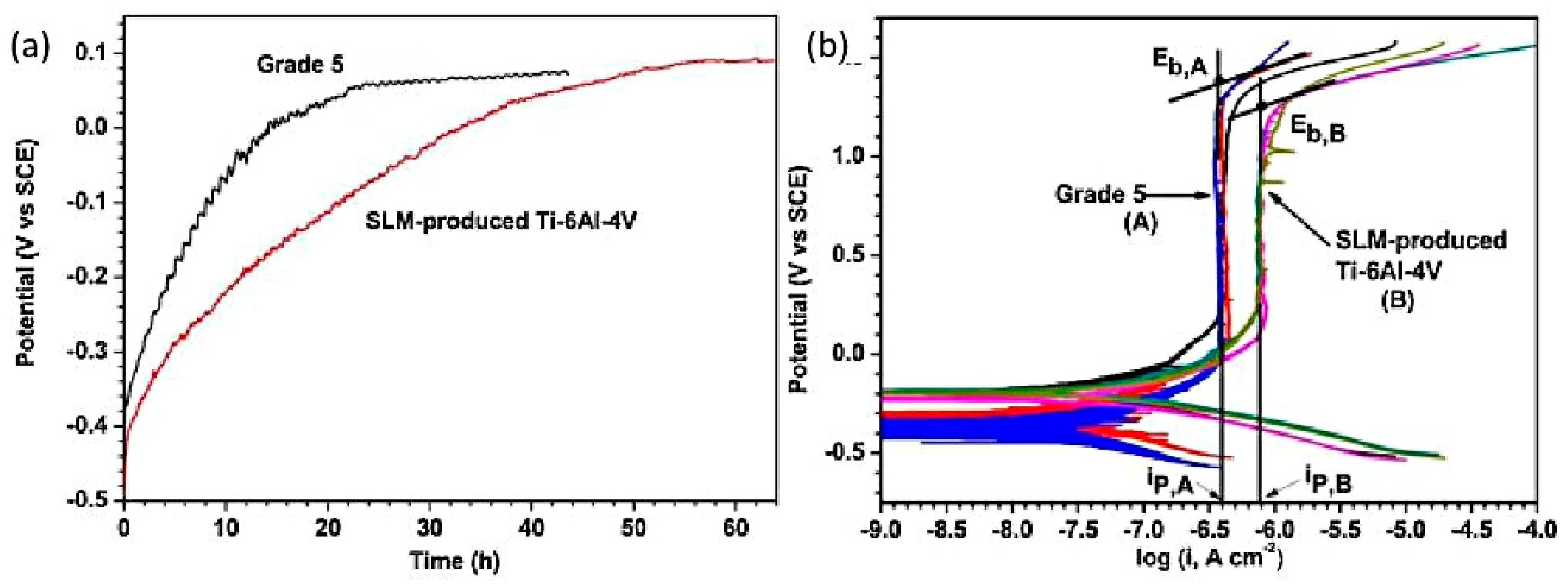
Liu et al. [90] investigated the relationship between corrosion current density and corrosion potential in both as-built and heat-treated states. They found that the composition of phases within the microstructure is the primary factor influencing its electrochemical performance. The uneven distribution of the α′ phase hinders the formation of a dense passive film on the workpiece surface, leading to weaker corrosion resistance. In contrast, the large size of the α phase and the uniformly dispersed (α + β) phases facilitate the formation of a passive film, thereby impeding corrosion. Zhang et al. [91] studied the corrosion behavior of SLM-formed and forged TC4 in artificial saliva with different fluoride concentrations and pH levels. The results indicated that the corrosion resistance of forged TC4 was significantly superior to that of SLM-formed TC4. The reason is that SLM-formed TC4 typically exhibits a microstructure dominated by acicular α′ phase, which is distinctly different from the microstructure of traditionally manufactured TC4, consequently leading to differing corrosion behaviors. As summarized by Dai [92], the oxide film generated on the β phase in NaCl solution is more stable than that formed on the α phase. This also accounts for the relatively inferior corrosion resistance of SLM-fabricated TC4 alloy. As illustrated in Figure 13, therefore, the corrosion resistance of SLM-fabricated TC4 alloy is inferior to that of the commercial Grade 5 alloy, which can be attributed to its microstructure characterized by a substantial content of α′ -Ti phase and a relatively low content of β-Ti phase.

5.2.2. Grain Size

Furthermore, some studies indicate that the corrosion resistance of SLM-formed TC4 alloy is superior to that of forged TC4 [94]. The reason lies in the faster cooling rate of SLM-formed TC4, resulting in finer grains. The self-corrosion current density of TC4 alloy is directly related to the size of its α laths [95]. As the α lath size decreases, the self-corrosion current density decreases. This is because the reduction in α lath size significantly increases the number of α/β phase boundaries. During the corrosion process, the nucleation sites for the dense oxide film are primarily at these α/β interfaces. An increase in nucleation sites can effectively lower the self-corrosion current density [96]. Yuan Jingwei et al. [97] investigated the influence of laser additive manufacturing and subsequent heat treatment processes on the corrosion resistance of TC4 alloy. They found that double annealing reduces the aspect ratio and size of α laths, decreasing the self-corrosion current by 26.14%. In contrast, solution treatment and aging increase the aspect ratio of α laths while significantly reducing their size, ultimately lowering the self-corrosion current by 64.92% and improving the corrosion resistance of the TC4 titanium alloy. Therefore, improving the corrosion resistance of SLM-TC4 can be achieved by reducing the ratio and size of the α laths, with heat treatment being one of the key processes.

6. Conclusions and Perspective

Compared to the relatively mature research and engineering applications of traditionally formed TC4, studies on SLM-formed TC4 alloy are not yet systematic or in-depth. The main existing problems and potential future work are as follows:
(1) Forming defects ultimately affect the mechanical and corrosion properties of the material components and are the primary and critical issues in SLM. The key to solving SLM forming defects lies in regulating laser power, scanning speed, process parameters, and related research. Furthermore, the thermal history directly determines the size, morphology, and microstructure of the formed melt pool and controls subsequent phase transformation types. Therefore, a profound understanding of this thermal history is crucial for studying the microstructural evolution of SLM-formed TC4 alloy.
(2) SLM-formed titanium alloys often exhibit epitaxially grown coarse primary β columnar grains and fine basket-weave structures within the grains. Consequently, compared to titanium alloys produced by traditional casting processes, additively manufactured titanium alloys demonstrate higher strength, slightly lower ductility and toughness, and better hardness. Due to forming defects, SLM components exhibit poorer high-cycle fatigue performance and higher residual stresses, necessitating heat treatment to regulate the microstructural characteristics of the TC4 alloy and improve its mechanical properties.
(3) Since the corrosion resistance of the α′ phase is inferior to that of the β phase, differences in the volume fractions of α′ and β phases lead to anisotropy in the electrochemical activity or corrosion resistance across different sample planes of SLM-formed TC4 alloy. The XY plane of SLM-formed TC4 alloy generally exhibits better corrosion resistance than the XZ plane. Future research aimed at improving the corrosion resistance of SLM-TC4 can focus on optimizing process parameters to eliminate columnar grains, applying post-heat treatments to remove microstructural defects and inhomogeneity, and adjusting the composition of SLM-TC4 to inhibit preferential corrosion at grain-boundary-sensitive regions.
(4) Another promising future research direction lies in developing AI and machine learning (ML)-enabled intelligent frameworks for the SLM fabrication of TC4 alloy. Specifically, multi-source data fusion (encompassing process parameters, real-time thermal history, in situ sensing signals, microstructural characteristics, and mechanical/corrosion performance data) can be integrated to establish high-fidelity ML models. These models are expected to achieve precise predictive modeling of forming defects (e.g., porosity, lack of fusion, and residual stress) and quantitative correlations between process, microstructure, and performance. Furthermore, leveraging advanced algorithms such as deep learning and reinforcement learning, real-time adaptive optimization of SLM process parameters can be realized to dynamically suppress defect formation during fabrication.
(5) Additionally, AI-driven inverse design methodologies could be explored to tailor the phase composition (α′/β phase ratio) and grain morphology of TC4 alloy, thereby achieving targeted regulation of mechanical anisotropy and corrosion resistance. This intelligent approach not only has the potential to significantly reduce the trial-and-error costs in traditional process optimization but also paves the way for the autonomous and high-reliability production of SLM-TC4 components with customized performance requirements.

7. Literature Review Methodology

To systematically and comprehensively sort out the research progress of microstructure, mechanical properties and corrosion behavior of TC4 alloy prepared by selective laser melting (SLM), this review adopts standardized and reproducible literature retrieval and screening methods, focuses on the high-impact research results in the past 5 years (2020–2025), and combines quantitative analysis and multi-dimensional comparison to make up for the deficiencies of previous reviews in mechanism analysis, data integration and emerging trend combing. The specific methodology is as follows.

7.1. Literature Retrieval Sources

(1) Web of Science: Focuses on retrieving SCI/SSCI indexed literature in the fields of engineering technology, materials science, metallurgical engineering, etc., and limits the research types to “Article” and “Review” to ensure the academic authority and research cutting-edge of the literature;
(2) ScienceDirect: Covers global multilingual relevant research, makes up for the deficiency of Web of Science in the collection of some emerging journals and conference papers, and broadens the retrieval scope;
(3) Google Scholar: Retrieves highly cited gray literature, dissertations and some latest research results not immediately included in the above databases to improve the research data chain.
A combined keyword strategy is adopted for retrieval, with “Selective Laser Melting”, “SLM”, “Ti-6Al-4V” and “TC4 alloy” as the core keywords, combined with secondary keywords such as “microstructure”, “mechanical properties”, “corrosion behavior”, “anisotropy” and “post-treatment”. At the same time, multi-dimensional retrieval of the subject, title and keyword is set to ensure the relevance of retrieval results.

7.2. Literature Selection Criteria

To ensure the scientificity and rigor of the review, the retrieved studies are screened at three levels. The studies finally included in the analysis must meet the following inclusion criteria, while studies related to exclusion criteria are excluded:

7.2.1. Inclusion Criteria

(1) The research object is TC4 (Ti-6Al-4V) alloy prepared by SLM, focusing on the core research directions such as microstructure evolution, mechanical properties (tensile strength and fatigue), corrosion behavior and post-treatment modification;
(2) The publication time is from January 2020 to August 2025, and the high-impact studies in the past 5 years are selected first, which is in line with the review’s demand for combing the latest research progress;
(3) Published in high-impact journals (JCR Q1, Chinese Academy of Sciences Zone 1) in the fields of materials science, metallurgical engineering and additive manufacturing, or key studies with high citation characteristics (Web of Science citation times ≥ 50);
(4) The research content includes clear experimental data, mechanism analysis or quantitative conclusions, which can provide empirical support for the performance regulation of SLM-TC4 alloy.

7.2.2. Exclusion Criteria

(1) The research object is other titanium alloys or modified TC4 alloys (such as adding rare earth and ceramic phases), without focusing on the SLM preparation of pure TC4 alloy;
(2) Published before 2020, and the traditional achievements lack subsequent research updates or are falsified by new studies;
(3) Studies with incomplete research data, vague conclusions, or weak correlation with the core research direction of this review.

7.3. Core Differences Between

This Review and Previous Reviews Compared with the previous reviews on SLM-TC4 alloy, this study breaks through the limitation of traditional qualitative combing, combines three characteristics of emerging trend mining, quantitative comprehensive analysis and multi-dimensional comparative analysis, and makes up for the key gaps of previous research. The core differences are reflected in the following four aspects:
(1) Focus on the emerging research trends in the past 5 years and make up for the gap in combing cutting-edge achievements: Most of the previous reviews ended in 2020, and did not fully cover the latest research from 2020 to 2025, such as corrosion–mechanical coupling behavior under multi-field coupling, preparation of functionally gradient SLM-TC4 alloy and other emerging directions. This review focuses on combing the above cutting-edge fields, and for the first time integrates the latest achievements of atomic-scale phase transformation mechanisms and in situ defect monitoring of SLM-TC4 alloy in high-impact journals in the past 5 years.
(2) Carry out quantitative comprehensive analysis and realize systematic integration of data: Previous reviews were mainly based on qualitative description, lacking quantitative integration and comparison of experimental data. This review standardly extracts the core experimental data (such as tensile strength, elongation, fatigue limit, corrosion current density, etc.) and clarifies the quantitative law of the influence of SLM process parameters and post-treatment methods on the performance of TC4 alloy through quantitative statistical analysis, such as the correlation between tensile strength and elongation at different annealing temperatures, and the quantitative effect of HIP treatment on porosity reduction.
(3) Adopt multi-dimensional comparative analysis and strengthen the relevance and guidance of research: This review carries out multi-dimensional comparison from the whole chain of process–structure–performance–corrosion, systematically analyzes the regulation mechanism of microstructure evolution under the unique thermal cycle of SLM on mechanical anisotropy and corrosion anisotropy, and compares the performance differences of TC4 alloy between the XY and XZ planes, SLM preparation and traditional casting forging processes, and different post-treatment methods, providing direct quantitative reference for process selection in industrial applications.

Author Contributions

Conceptualization, H.Z. (Huiling Zhou), J.L. and Y.Q.; Writing—Original Draft Preparation, H.Z. (Huiling Zhou), J.L., S.Z., B.Y., Y.G., X.L., H.Z. (Huixia Zhang), X.Z., S.L. and Y.Q.; Writing—Review and Editing, H.Z. (Huiling Zhou), J.L., S.Z., B.Y., Y.G., X.L., H.Z. (Huixia Zhang), X.Z., S.L. and Y.Q.; Supervision, S.L.; Funding Acquisition, H.Z. (Huiling Zhou). All authors have read and agreed to the published version of the manuscript.

Funding

This research was funded by the National Natural Science Foundation of China (Grant No. U25A20201).

Data Availability Statement

The original contributions presented in this study are included in the article. Further inquiries can be directed to the corresponding authors.

Conflicts of Interest

Shugang Zhang, Bin Yang and Yuanbin Gui were employed by the Suzhou Nuclear Power Research Institute. The remaining authors declare that the research was conducted in the absence of any commercial or financial relationships that could be construed as a potential conflict of interest.

References

  1. Lu, Z.C.; Zhang, X.H.; Wei, S. Research Progresses of Titanium Alloys and Relevant Precision Forming Technology for the Aerospace Industry. Astronaut. Mater. Process 2020, 50, 1–7. [Google Scholar]
  2. Xu, J.B.; Zhang, B.W.; Qu, W.T.; Sun, L.L. Advancements and Applications of Laser Surface Treatment on Titanium Alloys. Rare Met. Mater. Eng. 2024, 53, 1296–1309. [Google Scholar]
  3. Cui, C.X.; Hu, B.M.; Zhao, L.C.; Liu, S.J. Titanium alloy production technology, market prospects and industry development. Mater. Des. 2010, 32, 1684–1691. [Google Scholar] [CrossRef]
  4. Yu, L.H.; Shu, J.L.; Rui, Y. Biomedical titanium alloys and their additive manufacturing. Rare Met. 2016, 35, 661–671. [Google Scholar] [CrossRef]
  5. Xin, S.W.; Liu, X.H.; Zhang, S.Y.; Zhou, W.; Li, Q.; Guo, D.Z.; Guo, P.; Zhang, P.X. An Overview on Research and Development of Low Cost Titanium Alloys. Rare Met. Mater. Eng. 2023, 52, 3971–3980. [Google Scholar]
  6. Liu, J.; Zhang, K.; Bermingham, M.J.; Fraser, H.L.; Hodgson, P.; Heilmaier, M.; Boretti, A.; Zhu, Y.; Huang, A. Fatigue and damage tolerance performance of additively-manufactured titanium alloys for structural application: A comprehensive review. Mater. Sci. Eng. R Rep. 2026, 167, 101135. [Google Scholar] [CrossRef]
  7. Cao, C.X. Applications of Titanium Alloys on Large Transporter. Rare Met. Lett. 2006, 25, 17–21. [Google Scholar]
  8. Davies, P.; John, S.; Davies, H.; Bache, M.; Fox, K.; Collins, C.; Martin, N.; Sandala, R. The Low-Cycle Fatigue Performance of Emerging Titanium Alloys for Aeroengine Applications. Metals 2025, 15, 1274. [Google Scholar] [CrossRef]
  9. Biswas, N.; Ding, J.L.; Balla, V.K.; Field, D.P.; Bandyopadhyay, A. Deformation and fracture behavior of laser processed dense and porous Ti6Al4V alloy under static and dynamic loading. Mater. Sci. Eng. A 2012, 549, 213–221. [Google Scholar] [CrossRef]
  10. Beretta, S.; Romano, S. A comparison of fatigue strength sensitivity to defects for materials manufactured by AM or traditional processes. Int. J. Fatigue 2017, 94, 178–191. [Google Scholar] [CrossRef]
  11. Cui, Y.D.; Wu, Z.Y.; Zhao, J.; Liu, H.Y.; Chen, X.M.; Yan, P.; Liu, P.L.; Liu, T.Y.; Zhang, L.L. Research on Titanium Alloy by Additive Manufacturing Technology and Its Application Status. Engineering 2024, 73, 1635–1646. [Google Scholar]
  12. Kaščák, Ľ.; Varga, J.; Bidulská, J.; Bidulský, R.; Manfredi, D. Weight Factor as a Parameter for Optimal Part Orientation in the L-PBF Printing Process Using Numerical Simulation. Materials 2024, 17, 3604. [Google Scholar] [CrossRef]
  13. Kharat, V.J.; Singh, P.; Raju, G.S.; Yadav, D.K.; Satyanarayana, G.M.; Arun, V.; Majeed, A.H.; Singh, N. Additive manufacturing (3D printing): A review of materials, methods, applications and challenges. Mater. Today Proc. 2023, in press. [Google Scholar] [CrossRef]
  14. Xu, J.; Fei, Y.; Zhu, Y.; Yu, W.; Yao, D.; Zhou, J.G. A Review of Non-Powder-Bed Metal Additive Manufacturing: Techniques and Challenges. Materials 2024, 17, 4717. [Google Scholar] [CrossRef]
  15. Wysocki, B.; Maj, P.; Sitek, R.; Buhagiar, J.; Kurzydłowski, K.J.; Święszkowski, W. Laser and Electron Beam Additive Manufacturing Methods of Fabricating Titanium Bone Implants. Appl. Sci. 2017, 7, 657. [Google Scholar] [CrossRef]
  16. Thompson, S.M.; Bian, L.; Shamsaei, N.; Yadollahi, A. An overview of Direct Laser Deposition for additive manufacturing; Part I: Transport phenomena, modeling and diagnostics. Addit. Manuf. 2015, 8, 36–62. [Google Scholar] [CrossRef]
  17. Huang, L.; Zheng, S.L.; Qin, Y.; Han, J.Y.; Qiao, Y.X.; Chen, J. Corrosion Behavior of Selective Laser Melted Ti-6Al-4V in 0.1 mol/L NaOH Solution. Coatings 2023, 13, 150. [Google Scholar] [CrossRef]
  18. Bermingham, M.; Nicastro, L.; Kent, D.; Chen, Y.; Dargusch, M. Optimising the mechanical properties of Ti-6Al-4V components produced by wire plus arc additive manufacturing with post-process heat treatments. J. Alloys Compd. 2018, 753, 247–255. [Google Scholar] [CrossRef]
  19. Lin, X.; Xue, L.; Chen, J. Microstructure and mechanical properties of laser forming repaired Ti-6Al-4V alloy component. China Surf. Eng. 2009, 22, 19–24. [Google Scholar]
  20. Thijs, L.; Verhaeghe, F.; Craeghs, T.; Van Humbeeck, J.; Kruth, J.-P. A study of the microstructural evolution during selective laser melting of Ti–6Al–4V. Acta Mater. 2010, 58, 3303–3312. [Google Scholar] [CrossRef]
  21. Zou, T.; Zhang, M.; Chen, C.J.; Li, Y.; Liu, X.; Wu, Z.F. Study on the Microstructure of Ti6Al4V Alloy Prepared by Laser Additive Manufacturing (3D Printing). Laser Appl. 2016, 36, 286–290. [Google Scholar]
  22. Ducato, A.; Fratini, L.; La Cascia, M.; Mazzola, G. An automated visual inspection system for the classification of the phases of Ti-6Al-4V titanium alloy. In Computer Analysis of Images and Patterns, Proceedings of the15th International Conference on Computer Analysis of Images and Patterns, York, UK, 27–29 August 2013; CAIP 2013; Springer: Berlin/Heidelberg, Germany, 2013; pp. 362–369. [Google Scholar] [CrossRef]
  23. Ahmed, T.; Rack, H.J. Phase transformations during cooling in α+β titanium alloys. Mater. Sci. Eng. A 1998, 243, 206–211. [Google Scholar] [CrossRef]
  24. Wang, T.; Zhu, Y.Y.; Zhang, S.Q.; Tang, H.B.; Wang, H.M. Grain morphology evolution behavior of titanium alloy components during laser melting deposition additive manufacturing. J. Alloys Compd. 2015, 632, 505–513. [Google Scholar] [CrossRef]
  25. Yang, J.J.; Yu, H.C.; Yin, J.; Gao, M.; Wang, Z.M.; Zeng, X.Y. Formation and control of martensite in Ti-6Al-4V alloy produced by selective laser melting. Mater. Des. 2016, 108, 308–318. [Google Scholar] [CrossRef]
  26. Roberts, I.A.; Wang, C.J.; Esterlein, R.; Stanford, M.; Mynors, D.J. A three-dimensional finite element analysis of the temperature field during laser melting of metal powders in additive layer manufacturing. Int. J. Mach. Tools Manuf. 2009, 49, 916–923. [Google Scholar] [CrossRef]
  27. Du, J.H.; Liu, H.B.; Wang, F.; Bao, W.; Feng, N.; Li, H.; Liu, T. Immersion and electrochemical corrosion properties and combined corrosion mechanism of TC4 alloy by keyhole TIG welding. J. Mater. Res. Technol. 2024, 28, 2455–2465. [Google Scholar] [CrossRef]
  28. Yang, H.H.; Yang, J.J.; Yu, H.C.; Wang, Z.M.; Zeng, X.Y. Corrosion Behaviour of Selective Laser Melted TC4 Alloy. Mater. Eng. 2018, 46, 127–133. [Google Scholar]
  29. Blackwell, P.L. The mechanical and microstructural characteristics of laser-deposited IN718. J. Mater. Process. Tech. 2005, 170, 240–246. [Google Scholar] [CrossRef]
  30. Simonelli, M.; Tse, Y.Y.; Tuck, C. On the Texture Formation of Selective Laser Melted Ti-6Al-4V. Metall. Mater. Trans. A 2014, 45, 2863–2872. [Google Scholar] [CrossRef]
  31. Gangireddy, S.; Faierson, E.J.; Mishra, R.S. Influences of Post-processing, Location, Orientation, and Induced Porosity on the Dynamic Compression Behavior of Ti–6Al–4V Alloy Built Through Additive Manufacturing. J. Dyn. Behav. Mater. 2018, 4, 441–451. [Google Scholar] [CrossRef]
  32. Ju, J.; Li, J.J.; Jiang, M.; Li, M.Y.; Yang, L.X.; Wang, K.M.; Yang, C.; Kang, M.D.; Wang, J. Microstructure and electrochemical corrosion behavior of selective laser melted Ti-6Al-4V alloy in simulated artificial saliva. Trans. Nonferrous Met. Soc. China 2021, 31, 167–177. [Google Scholar] [CrossRef]
  33. Sallica-Leva, E.; Jardini, A.L.; Fogagnolo, J.B. Microstructure and mechanical behavior of porous Ti–6Al–4V parts obtained by selective laser melting. J. Mech. Behav. Biomed. Mater. 2013, 26, 98–108. [Google Scholar] [CrossRef]
  34. Facchini, L.; Magalini, E.; Robotti, P.; Molinari, A.; Höges, S.; Wissenbach, K. Ductility of a Ti-6Al-4V alloy produced by selective laser melting of prealloyed powders. Rapid Prototyp. J. 2010, 16, 450–459. [Google Scholar] [CrossRef]
  35. Kim, Y.-K.; Park, S.-H.; Yu, J.-H.; AlMangour, B.; Lee, K.-A. Improvement in the high-temperature creep properties via heat treatment of Ti-6Al-4V alloy manufactured by selective laser melting. Mater. Sci. Eng. A 2018, 715, 33–40. [Google Scholar] [CrossRef]
  36. Gupta, A.; Bennett, C.J.; Sun, W. Fatigue response of selective laser melted Ti-6Al-4V bracket: An experimental study. Procedia Struct. Integr. 2021, 31, 15–21. [Google Scholar] [CrossRef]
  37. Lee, W.S.; Lin, C.F. High-temperature deformation behaviour of Ti6Al4V alloy evaluated by high strain-rate compression tests. J. Mater. Process. Technol. 1998, 75, 127–136. [Google Scholar] [CrossRef]
  38. Nie, J.J.; Ma, P.Y.; Sun, J.L.; Ke, L.D.; Kang, L.; Xia, X.C.; Yuan, Y. High Temperature Mechanical Properties and Corrosion Behavior of Selective Laser Melted TC4 Alloy. Rare Met. Mater. Eng. 2023, 52, 2126–2133. [Google Scholar]
  39. Lu, H.F.; Wang, Z.; Cai, J.; Xu, X.; Luo, K.; Wu, L.; Lu, J. Effects of laser shock peening on the hot corrosion behaviour of the selective laser melted Ti6Al4V titanium alloy. Corros. Sci. 2021, 188, 109558. [Google Scholar] [CrossRef]
  40. Liang, Z.L.; Sun, Z.G.; Zhang, W.S.; Wu, S.K.; Chang, H. The effect of heat treatment on microstructure evolution and tensile properties of selective laser melted Ti6Al4V alloy. J. Alloys Compd. 2018, 782, 1041–1048. [Google Scholar] [CrossRef]
  41. Ren, X.D.; Zhou, W.F.; Liu, F.F.; Ren, Y.P.; Yuan, S.Q.; Ren, N.F.; Xu, S.D.; Yang, T. Microstructure evolution and grain refinement of Ti-6Al-4V alloy by laser shock processing. Appl. Surf. Sci. 2016, 363, 44–49. [Google Scholar] [CrossRef]
  42. Liu, J.B.; Jin, Y.B.; Fang, X.Y.; Chen, C.X.; Feng, Q.; Liu, X.W.; Chen, Y.Z.; Suo, T.; Zhao, F.; Huang, T.; et al. Dislocation Strengthening without Ductility Trade-off in Metastable Austenitic Steels. Sci. Rep. 2016, 6, 35345. [Google Scholar] [CrossRef]
  43. Luo, C.; Zhou, X.; Thompson, G.E.; Hughes, A. Observations of intergranular corrosion in AA2024-T351: The influence of grain stored energy. Corros. Sci. 2012, 61, 35–44. [Google Scholar] [CrossRef]
  44. Wang, Q.P.; Guan, J.R. Microstructure Characteristic and Its Impact on Nanohardness of LPBF-Processed Al-based Alloy with Ti Addition. Rare Met. Mater. Eng. 2024, 53, 676–684. [Google Scholar]
  45. Jia, Y.D.; Ma, Y.J.; Shi, R.P.; Zhou, Y.X.; Wang, Q.; Huang, S.S.; Qi, M.; Wang, D.; Lei, J.F.; Yang, R. Probing nanoscale variant distribution in a heterogenous α/β titanium alloy. Acta Mater. 2025, 296, 121148. [Google Scholar] [CrossRef]
  46. Kasperovich, G.; Hausmann, J. Improvement of fatigue resistance and ductility of TiAl6V4 processed by selective laser melting. J. Mater. Process. Technol. 2015, 220, 202–214. [Google Scholar] [CrossRef]
  47. Leuders, S.; Thöne, M.; Riemer, A.; Niendorf, T.; Tröster, T.; Richard, H.; Maier, H. On the mechanical behaviour of titanium alloy TiAl6V4 manufactured by selective laser melting: Fatigue resistance and crack growth performance. Int. J. Fatigue 2013, 48, 300–307. [Google Scholar] [CrossRef]
  48. Qiu, C.; Adkins, N.J.E.; Attallah, M.M. Microstructure and tensile properties of selectively laser-melted and of HIPed laser-melted Ti-6Al-4V. Mater. Sci. Eng. 2013, 578, 230–239. [Google Scholar] [CrossRef]
  49. Mukherjee, T.; Zuback, J.S.; De, A.; DebRoy, T. Printability of alloys for additive manufacturing. Sci. Rep. 2016, 6, 19717. [Google Scholar] [CrossRef]
  50. Stef, J.; Poulon-Quintin, A.; Redjaimia, A.; Ghanbaja, J.; Ferry, O.; De Sousa, M.; Gouné, M. Mechanism of porosity formation and influence on mechanical properties in selective laser melting of Ti-6Al-4V parts. Mater. Des. 2018, 156, 480–493. [Google Scholar] [CrossRef]
  51. Zhang, W.; Yang, X.M.; Jian, H.G.; Nie, W.J.; Yu, Z.Y. Influence Factors and Formation Mechanism of Selective Laser Melting Aluminum Alloy Defects. Foundry Eng. 2021, 45, 20–27. [Google Scholar]
  52. Hrabe, N.; Gnäupel-Herold, T.; Quinn, T. Fatigue properties of a titanium alloy (Ti–6Al–4V) fabricated via electron beam melting (EBM): Effects of internal defects and residual stress. Int. J. Fatigue 2017, 94, 202–210. [Google Scholar] [CrossRef]
  53. Galarraga, H.; Lados, D.A.; Dehoff, R.R.; Kirka, M.M.; Nandwana, P. Effects of the microstructure and porosity on properties of Ti-6Al-4V ELI alloy fabricated by electron beam melting (EBM). Addit. Manuf. 2016, 10, 47–57. [Google Scholar] [CrossRef]
  54. Gu, D.D.; Hagedorn, Y.C.; Meiners, W.; Meng, G.; Batista, R.J.S.; Wissenbach, K.; Poprawe, R. Densification behavior, microstructure evolution, and wear performance of selective laser melting processed commercially pure titanium. Acta Mater. 2012, 60, 3849–3860. [Google Scholar] [CrossRef]
  55. Liu, Y.; Yang, Y.Q.; Wang, D. A study on the residual stress during selective laser melting (SLM) of metallic powder. Int. J. Adv. Manuf. Technol. 2016, 87, 647–656. [Google Scholar] [CrossRef]
  56. Mercelis, P.; Kruth, J.P. Residual stresses in selective laser sintering and selective laser melting. Rapid Prototyp. J. 2006, 12, 254–265. [Google Scholar] [CrossRef]
  57. Parry, L.; Ashcroft, I.A.; Wildman, R.D. Understanding the effect of laser scan strategy on residual stress in selective laser melting through thermo-mechanical simulation. Addit. Manuf. 2016, 12, 1–15. [Google Scholar] [CrossRef]
  58. Vrancken, B.; Cain, V.; Knutsen, R.; Van Humbeeck, J. Residual stress via the contour method in compact tension specimens produced via selective laser melting. Scr. Mater. 2014, 87, 29–32. [Google Scholar] [CrossRef]
  59. Ali, H.; Ma, L.; Ghadbeigi, H.; Mumtaz, K. In-situ residual stress reduction, martensitic decomposition and mechanical properties enhancement through high temperature powder bed pre-heating of Selective Laser Melted Ti6Al4V. Mater. Sci. Eng. A 2017, 695, 211–220. [Google Scholar] [CrossRef]
  60. Gu, D.D.; Shen, Y.F. Balling phenomena in direct laser sintering of stainless steel powder: Metallurgical mechanisms and control methods. Mater. Des. 2009, 30, 2903–2910. [Google Scholar] [CrossRef]
  61. Li, R.D.; Wei, Q.S.; Liu, J.H.; Shi, Y.S.; Yuan, T.C. Research Progress of Key Basic Issue in Selective Laser Melting of Metallic Powder. Aeronaut. Manuf. Technol. 2012, 5, 26–31. [Google Scholar]
  62. Hu, X.Y.; Shen, Y.F.; Li, Z.Q. Process and material considerations in laser rapid manufacturing of metal parts. Mater. Sci. Technol. 2008, 16, 378–383. [Google Scholar]
  63. Ahmed, M.; Obeidi, M.A.; Yin, S.; Lupoi, R. Influence of processing parameters on density, surface morphologies and hardness of as-built Ti-5Al-5Mo-5V-3Cr alloy manufactured by selective laser melting. J. Alloys Compd. 2022, 910, 164760. [Google Scholar] [CrossRef]
  64. Ghungrad, S.; Gould, B.; Soltanalian, M.; Wolff, S.J.; Haghighi, A. Model-based deep learning for additive manufacturing: New frontiers and applications. Manuf. Lett. 2021, 29, 94–98. [Google Scholar] [CrossRef]
  65. Li, Y.; Su, Q.; Sheng, G.; Hosseini, S.R.E.; Badran, B.E.; Gong, P.; Xin, C.; Wang, H. Recent advances in artificial-intelligence enhanced additive manufacturing of heat exchangers for thermal management: A review. Mater. Des. 2025, 256, 114339. [Google Scholar] [CrossRef]
  66. Liu, S.; Stebner, A.P.; Kappes, B.B.; Zhang, X. Machine learning for knowledge transfer across multiple metals additive manufacturing printers. Addit. Manuf. 2021, 39, 101877. [Google Scholar] [CrossRef]
  67. Siddhartha, V.; Guido, N.; Petros, K. Efficient collective swimming by harnessing vortices through deep reinforcement learning. Proc. Natl. Acad. Sci. USA 2018, 115, 5849–5854. [Google Scholar]
  68. Beintema, G.; Corbetta, A.; Biferale, L.; Toschi, F. Controlling Rayleigh–Bénard convection via reinforcement learning. J. Turbul. 2020, 21, 585–605. [Google Scholar] [CrossRef]
  69. Yadroitsev, I.; Krakhmalev, P.; Yadroitsava, I.; Du Plessis, A. Qualification of Ti6Al4V ELI Alloy Produced by Laser Powder Bed Fusion for Biomedical Applications. JOM 2018, 70, 372–377. [Google Scholar] [CrossRef]
  70. Voisin, T.; Calta, N.P.; Khairallah, S.A.; Forien, J.-B.; Balogh, L.; Cunningham, R.W.; Rollett, A.D.; Wang, Y.M. Defects-dictated tensile properties of selective laser melted Ti-6Al-4V. Mater. Des. 2018, 158, 113–126. [Google Scholar] [CrossRef]
  71. Zhang, W.; Liu, H.; Liu, Z.; Liang, Y.; Hao, Y. Experimental Study of Performance of Ti-6Al-4V Femoral Implants Using Selective Laser Melting (SLM) Methodology. Metals 2024, 14, 492. [Google Scholar] [CrossRef]
  72. Wang, S.Z.; Meng, H.; Wang, F.; Fan, H.W.; Li, Y.; Tang, C. Heat treatment for improving mechanical properties of hypoxic TC4-LC and remelted TC4 alloys. Heat Treat. Met. 2022, 47, 204–207. [Google Scholar]
  73. Liu, X.; Cui, W.; Wang, Y.; Long, Y.; Liu, F.; Liu, Y. Effects of Heat Treatment on the Microstructure Evolution and Mechanical Properties of Selective Laser Melted TC4 Titanium Alloy. Metals 2022, 12, 702. [Google Scholar] [CrossRef]
  74. Yan, T.Q.; Chen, B.Q.; Ji, X.; Guo, S.Q. Influence of hot isostatic pressing on microstructure, properties and deformability of selective laser melting TC4 alloy. China Foundry 2021, 18, 389–396. [Google Scholar] [CrossRef]
  75. Chen, B.; Wu, Z.; Yan, T.; He, Z.; Sun, B.; Guo, G.; Wu, S. Experimental study on mechanical properties of laser powder bed fused Ti-6Al-4V alloy under post-heat treatment. Eng. Fract. Mech. 2022, 261, 108264. [Google Scholar] [CrossRef]
  76. Benedetti, M.; Fontanari, V.; Bandini, M.; Zanini, F.; Carmignato, S. Low- and high-cycle fatigue resistance of Ti-6Al-4V ELI additively manufactured via selective laser melting: Mean stress and defect sensitivity. Int. J. Fatigue 2018, 107, 96–109. [Google Scholar] [CrossRef]
  77. Cain, V.; Thijs, L.; Van Humbeeck, J.; Van Hooreweder, B.; Knutsen, R. Crack propagation and fracture toughness of Ti6Al4V alloy produced by selective laser melting. Addit. Manuf. 2015, 5, 68–76. [Google Scholar] [CrossRef]
  78. Schijve, J. Fatigue damage in aircraft structures, not wanted, but tolerated? Int. J. Fatigue 2008, 31, 998–1011. [Google Scholar] [CrossRef]
  79. Chen, W.; Chen, Z.Y.; You, Y.; Li, J.S. Microstructure and Fatigue Behavior of EBSM Ti-6Al-4V Alloy. Rare Met. Mater. Eng. 2017, 46, 25–30. [Google Scholar]
  80. Chi, W.Q.; Wang, W.J.; Sun, C.Q. Mechanisms of Ultra-High Cycle Fatigue Crack Initiation and Evolution in Additively Manufactured Ti-6Al-4V Alloy. Chin. Congr. Theor. Appl. Mech. 2022, 721–721, 721. [Google Scholar]
  81. Oliveira, V.; Cioffi, M.; Barboza, M.; Landers, R.; Schmitt, B.; Tapia, D.; Voorwald, H. Plasma immersion ion implantation (PIII) influence on Ti-6Al-4V alloy: Frequency effect. Int. J. Fatigue 2018, 109, 157–165. [Google Scholar] [CrossRef]
  82. Wang, Q.; Kong, J.; Liu, X.; Dong, K.; Song, X.; Yang, Y.; Xu, J.; Chen, X. The effect of a novel low-temperature vacuum heat treatment on the microstructure and properties of Ti-6Al-4V alloys manufactured by selective laser melting. Vacuum 2021, 193, 110554. [Google Scholar] [CrossRef]
  83. Wu, L.L.; Xu, R.D.; Jiao, Z.H.; Yu, H.C. High cycle fatigue behavior of selective laser melting TC4 alloy. Mater. Eng. 2024, 52, 61–70. [Google Scholar]
  84. Wu, Z.K.; Wu, S.C.; Zhang, J.; Song, Z.; Hu, Y.N.; Kang, G.Z.; Zhang, H.O. Defect Induced Fatigue Behaviors of Selective Laser Melted Ti-6Al-4V via Synchrotron Radiation X-Ray Tomography. Acta Metall. Sin. 2019, 55, 811–820. [Google Scholar]
  85. Prestat, M.; Vucko, F.; Holzer, L.; Thierry, D. Microstructural aspects of Ti6Al4V degradation in H2O2-containing phosphate buffered saline. Corros. Sci. 2021, 190, 109640. [Google Scholar] [CrossRef]
  86. Lv, X.; Liu, L.; Li, J.; Yu, H.; Xie, J. Corrosion Behavior of Titanium Alloy in High pH Value Completion Fluid. Rare Met. Mater. Eng. 2020, 49, 2326–2332. [Google Scholar]
  87. Huang, C.; Wang, Q.; Shi, X. Electrochemical Corrosion Behaviors of Micro-arc Oxidation Titanium Alloy. Rare Met. Mater. Eng. 2012, 41, 1161–1165. [Google Scholar]
  88. Dai, N.; Zhang, L.-C.; Zhang, J.; Zhang, X.; Ni, Q.; Chen, Y.; Wu, M.; Yang, C. Distinction in corrosion resistance of selective laser melted Ti-6Al-4V alloy on different planes. Corros. Sci. 2016, 111, 703–710. [Google Scholar] [CrossRef]
  89. Hamza, H.M.; Deen, K.M.; Haider, W. Microstructural examination and corrosion behavior of selective laser melted and conventionally manufactured Ti6Al4V for dental applications. Mater. Sci. Eng. C 2020, 113, 110980. [Google Scholar] [CrossRef]
  90. Liu, K.; Yao, X.; Dongfang, K.; Fan, H.; Liu, P. Effect of Annealing on Microstructures and Properties of TC4 Heat Dissipation Structure Prepared by LPBF. Mater. Res. 2024, 27, e20240123. [Google Scholar] [CrossRef]
  91. Zhang, H.; Man, C.; Dong, C.; Wang, L.; Li, W.; Kong, D.; Wang, L.; Wang, X. The corrosion behavior of Ti6Al4V fabricated by selective laser melting in the artificial saliva with different fluoride concentrations and pH values. Corros. Sci. 2021, 179, 109097. [Google Scholar] [CrossRef]
  92. Dai, N.; Zhang, L.-C.; Zhang, J.; Chen, Q.; Wu, M. Corrosion behavior of selective laser melted Ti-6Al-4V alloy in NaCl solution. Corros. Sci. 2016, 102, 484–489. [Google Scholar] [CrossRef]
  93. Fang, J.; Zhang, L.C.; Dai, N.; Liu, R.; Yao, H.; Lao, Z.; Chen, C.; Zhang, Y.; Wu, S. Femtosecond laser-induced micro/nanostructures facilitated multiple passivation and long-term anti-corrosion property of laser powder bed fused Ti-6Al-4V alloy. Corros. Sci. 2025, 246, 112757. [Google Scholar] [CrossRef]
  94. Zhang, Y.; Li, J.; Xu, H.; Feng, L.; Zhang, T. Dynamic evolution of oxide film on selective laser melted Ti–6Al–4V alloy. J. Alloys Compd. 2020, 849, 156622. [Google Scholar] [CrossRef]
  95. Amaya-Vazquez, M.; Sánchez-Amaya, J.; Boukha, Z.; Botana, F. Microstructure, microhardness and corrosion resistance of remelted TiG2 and Ti6Al4V by a high power diode laser. Corros. Sci. 2012, 56, 36–48. [Google Scholar] [CrossRef]
  96. Zhao, Z.; Guo, Y.; Du, W.; Bai, P.; Zhang, Z.; Wang, L.; Ma, K.; Zhang, S.; Han, X.; Yang, C. Corrosion behavior of SiC/Ti6Al4V titanium matrix composites fabricated by SLM. J. Mater. Res. Technol. 2024, 31, 534–542. [Google Scholar] [CrossRef]
  97. Yuan, J.W.; Li, Z.; Tang, H.B. Effect of heat treatment on corrosion resistance and room temperature compression creep of LAMed TC4 alloy. Acta Aeronaut. Astronaut. Sin. 2021, 42, 478–485. [Google Scholar]
Figure 4. EBSD maps of SLM-fabricated and cast TC4 alloys: (ac) SLM-TC4. The (b,c) image is the image in the yellow dashed box of Figure (a); (df) cast TC4. The (e,f) image is the image in the yellow dashed box of Figure (d) [38]. Reprinted with permission from ref. [38]. 2023, Science Press.
Metals 16 00284 g004
Figure 6. Schematic diagram of the working principle of SLM forming equipment.
Metals 16 00284 g006
Figure 9. Tensile strength and elongation at fracture of cast TC4, SLM-TC4, and SLM-TC4 after heat treatment.
Metals 16 00284 g009
Figure 13. Potentiodynamic polarization curves of SLM-formed TC4 alloy and commercial Grade 5 alloy in 3.5 wt.% NaCl solution: (a) open circuit potential; (b) polarization curves [93]. Reprinted with permission from ref. [93]. 2025, Elsevier.
Metals 16 00284 g013
Table 1. Influence of different heat treatment methods on the properties of SLM-TC4.
Heat TreatmentInfluenceAdvantageDisadvantageReferences
Solution and agingIncreases elongation, compressive strength, and yield strength Improves comprehensive performanceNecessity of HIP[73]
HIPEliminates anisotropy; increases hardness and densityReduces internal defects, increases density, and increases plasticityReduces strength[74]
AnnealingIncreases strain hardening and elongation; decreases strengthStable microstructure and performanceDecreases tensile strength[75]
Disclaimer/Publisher’s Note: The statements, opinions and data contained in all publications are solely those of the individual author(s) and contributor(s) and not of MDPI and/or the editor(s). MDPI and/or the editor(s) disclaim responsibility for any injury to people or property resulting from any ideas, methods, instructions or products referred to in the content.