


Abstract
Aluminum conductor cables are exposed to environmental conditions in service, where wind-induced vibrations generate multiaxial stresses and cause partial sliding between the stranded layers. Such dynamic loading can lead to fatigue or wear failure, particularly at the contact zones between wire layers. The influence of heat treatment and cold work on the wear of these aluminum wires remains unstudied. This work aims to evaluate the microabrasive wear of rolled and heat-treated 6201 aluminum alloy wires used in conductor cables. The wear tests were performed using free-ball microabrasive wear equipment and alumina (Al2O3) abrasive paste at a concentration of 0.40 g/mL of distilled water. The parameters used were as follows: 100 Cr6 steel balls with a diameter of 25.4 mm, sample inclination of 60°, normal force of 0.3 N, and shaft speed of 0.185 m/s or 280 rpm. The test time was set at 20 min, 30 min, 40 min, 50 min, and 60 min. The wear test data were processed using the Achard equation. The microabrasive wear test results indicate that the wear coefficient decreased by 19.1% after the artificial aging process, compared with the solution-treated alloy (95% CI: 15.5–22.3%), and this reduction was statistically significant (p < 0.001). After the combined treatment of rolling and artificial aging, the alloy had a drop in wear coefficient of 36.1% compared to the same solution-treated alloy (95% CI: 32.6–39.6%), representing the largest statistically significant improvement among the tested conditions (p < 0.001). Cold work (rolling) reduces the mobility of dislocations, requiring greater stress to deform the material, thereby increasing its stiffness and wear resistance. In this 6201 alloy, it is inferred that artificial aging led to the formation of Guinier-Preston zones, which evolved into the formation of metastable β” precipitates in needle-like form, coherent with the matrix. As the aging process progresses, the β’ particles evolve into larger β particles that are no longer coherent with the matrix. The combined processes of rolling and aging decrease the wear coefficient. Statistical analysis demonstrated that microstructural conditions explain approximately half of the total variability in the wear coefficient (η2 = 0.495), indicating that the wear performance under the present experimental configuration is primarily governed by intrinsic strengthening mechanisms rather than experimental variability.
1. Introduction
Aluminum alloy 6201 cables (CAL) are widely utilized in overhead power transmission lines. These cables are exposed to environmental conditions in service, where wind-induced vibrations generate multiaxial stresses and cause partial sliding between the stranded layers. Such dynamic loading can result in fatigue or wear failures, particularly at the contact zones between wire layers and at the interface between wires and suspension clamps. While these mechanical and tribological challenges are known, the specific effects of heat treatments and cold working on the microabrasive wear resistance of 6201 aluminum alloys remain unstudied. Aluminum alloy cables (AACs) are used in high-voltage electrical cables. It was developed to provide an economical conductor for aerial applications that require higher mechanical strength than AC aluminum conductors and better corrosion resistance than steel-core aluminum cables. It consists of concentric layers of aluminum alloy wires. As the cables are suspended, they are subjected to wind-induced vibrations that produce multiaxial stresses and partial wire slip between the stranded layers, which can lead to line failures. These failures typically occur due to fatigue or friction, beginning with wear craters that appear in the contact zone between the wire layers and between the wires and the suspension clamps. These small craters act as stress concentrators, leading to cable fatigue and eventual failure under fretting conditions In the case of two surfaces in sliding, rolling, or pivoting contact, abrasion can occur due to a roughness on the harder surface that deforms (scratches) the softer surface, or due to a preexisting particle and/or a wear fragment removed from the softer surface. Through successive plastic deformations, these fragments are hardened and behave as abrasive particles [1]. The most common treatment techniques for aluminum alloys are cold work hardening and heat treatment. Each technique can exhibit different behavior under tribological conditions. The specific effects of heat treatments and cold work on the microabrasive wear resistance of 6201 aluminum alloys remain unexplored. The microabrasive wear used in this work, employing aluminum oxide particles as abrasives, more efficiently replicates the service conditions of high-voltage conductor cables than pin-on-disc wear.
1.1. Work Hardening
Hardening, also called cold working [1,2], is the phenomenon by which a ductile metal becomes harder and stronger when subjected to plastic deformation. It results from the movement of many dislocations. Cold working, such as rolling, spinning, or bending, increases the hardness and mechanical properties of materials. However, these operations reduce their ductility and their ability to deform. The greater the deformation, the more the mechanical properties are modified, whatever the composition of the alloy. Hardening occurs regardless of the cold forming technique used.
According to Siqueira et al. [3], the literature provides evidence that cold deformation significantly affects wear resistance. Toppo et al. [4], in their studies on the effect of cold deformation on the sliding wear of carbon steels, observed that, for low pre-strain levels, wear rates increased with deformation. The authors attributed this fact to an increase in dislocation density in metallic materials, which contributes to the formation of voids in the matrix or at the particle–matrix interface. At higher deformation levels, wear rates decreased with work hardening, since very high deformations create a state of high internal energy in the material, promoting surface oxidation and leading to moderate wear. The work by Yan et al. [5], which investigated the effect of shot blasting on the abrasive wear of Hadfield steels (austenitic manganese steel), showed that repeated high-speed impacts generated high-density dislocations and deformation twins. These deformation twins subdivided the original grains, refining the microstructure and forming a nanostructured region responsible for a very significant work-hardening effect. This work-hardening effect could not be achieved simply by the stresses induced during abrasion, which explains the increased abrasion resistance with work hardening. These studies provide evidence that work hardening can affect abrasion resistance, provided the severity of the test does not produce effects comparable to those observed with previous cold rolling. This may be the case with microabrasion tests, particularly those using fine abrasive particles and low normal force, as in this study.
1.2. Hardening by Heat Treatment
Solution heat treatment consists of heating the alloy to a temperature between the solvus and solidus lines for a specified time to promote solid-state diffusion. This procedure results in the alloying elements being dissolved in the aluminum matrix. Soares [6] emphasized that for diffusion to be complete, the alloy must remain within the defined temperature range for a sufficient period of time; otherwise, the dissolution of the alloying elements may be incomplete, subsequently hindering the formation of hardening precipitates. This situation, according to Campbell [7], can induce undesirable precipitation, compromising the distribution and size of precipitates and significantly affecting the alloy’s final mechanical strength. Once the state of complete solution treatment is reached, the alloying elements must be kept in solid solution at room temperature. To achieve this, the alloy must undergo quenching, which involves rapidly cooling the solubilized alloy to room temperature without interruption, preserving the primary supersaturated solute phase (SSSS) structure in a metastable, out-of-equilibrium state [3]. This prevents diffusion processes, preserving the supersaturated solid solution [8,9]. Following the routine of improving the alloy’s mechanical properties, solution heat treatment and tempering are followed by aging. Aging can occur naturally at room temperature or artificially at higher temperatures. Artificial aging generally leads to higher peak hardness in a shorter period. However, depending on the desired properties, natural precipitation is sometimes used. The time required to reach the most stable condition ranges from a few days to months at room temperature [8,9]. Aging, whether natural or artificial, significantly improves the mechanical properties of the aluminum alloy. However, the nature of the microscopic β particles, strength, and hardness depend on both the precipitation temperature and the aging time. The increase in alloy strength resulting from heat treatment depends on the nature of the precipitates formed. According to [10], the shape and size of precipitates directly influence hardening, and when time and/or temperature are too high, precipitates tend to grow. If the precipitate size is too large, the alloy’s mechanical properties are adversely affected. Therefore, the precipitation of large particles should be avoided. This makes it essential to select a heat cycle that produces precipitates with optimal size and distribution [6,11]. Generally, finer precipitates can be obtained at lower aging temperatures. When the supersaturated solid solution of the alloy is aged at a relatively low temperature, clusters of segregated atoms, called precipitation zones or Guinier–Preston (GP) zones, form. These are regions enriched in solute atoms in a matrix primarily made of aluminum. As aging continues, these zones give rise to β” precipitates, which are needle-shaped and coherent with the aluminum matrix. As the aging process continues, the β” particles are transformed into β’ particles, which have a hexagonal, rod-shaped structure and are semi-coherent with the matrix. Finally, as the aging process progresses, these β’ particles transform into larger β particles that are incoherent with the matrix [10,11]. Higher temperatures are generally associated with lower nucleation rates and coalesced precipitates, resulting in smaller quantities [12,13].
1.3. Wear
The wear of a solid is generally defined as a loss of matter, a movement of matter, or a transformation of matter on the surface of the solid under the effect of an interaction with another medium, which can be solid or fluid. Damage to mechanical parts due to abrasive wear accounts for about 60% of industrial wear cases [14,15]. Generally, two modes of abrasive wear can be found on the surface of a worn crater: two-body abrasive wear (or scratch abrasive wear) and three-body abrasive wear (or rolling abrasive wear) [16,17,18]. Two-body abrasive wear is a process in which abrasive particles slide over the sample and remove material from the friction surface of a mechanical part, driven by fixed hard asperities [19]. In scratch abrasion, the abrasive particles are adhered to one surface but are not necessarily embedded or fixed there. However, they are unable to perform any movement other than translation over the surface of the test specimen. Meanwhile, rolling abrasion, or three-body abrasive wear, occurs when abrasive particles roll over the test surface, resulting in specific surface characteristics on the worn cap. In this case, the abrasive particles are free between the two surfaces, allowing them to roll.
Material Wear and Hardness
For aluminum alloys, no studies on abrasion were found that examined the correlation between resistance to abrasive wear and the type of hardening, an essential point in most industrial situations. Studies are usually based on quantitative analyses of wear, depending on the type of hardening. Increasing hardness by hardening metals such as aluminum, bronze, and steel does not necessarily improve wear resistance. Resistance to abrasive wear depends on the type of hardening [20]. For Mezlini [17], regarding the effects of hardening and additional elements on hardness, the results to date are insufficient to clarify the relationship between hardness and abrasive wear. The explanations found are based on hypotheses that still need verification.
2. Materials and Methods
In this work, the aluminum alloy 6201, supplied in a cold-drawn round profile with a diameter of 9.52 mm, was studied. Thermal treatments of the solution and artificial aging of the 6201 alloy were performed to evaluate changes in its resistance to microabrasive wear. The alloy was cold-rolled, reducing its diameter from 9.52 mm to 4 mm. It was followed by a solution treatment at 520 °C for 2 h, then water quenching at room temperature. Artificial aging was subsequently carried out at 200 °C for 8 h, with cooling inside the closed furnace until room temperature was reached.
2.1. Identification of Samples
To facilitate sample identification and ensure the integrity of results during testing and analysis, the samples were labeled according to the specific treatment conditions they received. Examples of sample nomenclature are in Table 1.
Table 1.
Sample nomenclature and their descriptions.
2.2. Tests and Analysis Performed
Several tests and analyses were carried out during this work. The microhardness of the material was evaluated using Vickers microhardness testing, with a 200 g load applied for 10 s at 1 mm intervals across the sample surface. The laser confocal microscope OLS 4100 Lext (Olympus, Tokyo, Japan) was used to reconstruct craters generated in microabrasive wear tests and to analyze their profiles. In addition, the microstructural evaluation of the samples, including energy dispersive mapping, and the evaluation of the wear mode observed inside the wear craters, were performed using the scanning electron microscopy (SEM) JEOL JSM 7100 fa Field Emission (JEOL, Tokyo, Japan). Transmission electron microscopy (TEM) FEI TECNAI G2 S-TWIN (TECNAI, Hillsboro, OR, USA) is a tool used to characterize materials. The technique allows not only visualization of morphology but also identification of defects, crystalline structure, orientation, and phase relations, among other features. In this work, the technique was used to analyze the microstructure of the samples after artificial aging
2.3. Microabrasive Testing Parameters
For the microabrasive tests, a 100Cr6 steel ball with a diameter of 25.4 mm was used. The sample was inclined at 60°, with a normal force of 0.3 N, and the spindle speed was 0.185 m/s (280 rpm). The abrasive slurry was a suspension of alumina (Al2O3) abrasive particles with an average size of 1 μm in distilled water. The abrasive slurry concentration was 0.40 g of abrasive per cm3 of water. The abrasive suspension was continuously stirred throughout the test using a magnetic stirrer coupled to the microabrasion apparatus to prevent any settling of the abrasive particles. The abrasive material was pumped to the ball–sample interface by a peristaltic pump coupled to the Calowear equipment at a flow rate of one drop every 6 s. The test times were set at 20 min, 30 min, 40 min, 50 min, and 60 min. Three craters were made at each time point. After the test, the samples were rinsed with water and detergent, then wiped with an alcohol wipe. Finally, they were cleaned ultrasonically with distilled water and detergent. The angle between the sample and the sphere was measured with good accuracy by supporting an external inclinometer on the table assembly, which was parallel to the sample base. To analyze microabrasive wear in the alloys, laser confocal microscopy was used to measure wear craters. For each wear crater produced, the diameter was determined by averaging five measurements. Four measurements were taken in different directions: perpendicular to and parallel to the wear profile, and in oblique directions. The fifth measurement was obtained by applying a circular aperture in the confocal microscope analysis. Since three craters were produced for each test time, 15 diameters were measured for each test time.
2.4. Sliding Distance
Wear tests were performed by varying the ball’s sliding distance. Thus, for the times used, the sliding distance was calculated using the following equation:
L is the sliding distance, is the number of rotations of the drive shaft of the equipment used in the wear test, and is the diameter of the wear sphere used. Table 2 presents the sliding distance for each test time.
Table 2.
Sliding distance corresponding to each test time.
2.5. Wear Volume
Since the volume of the crater is very small in relation to the volume of the sphere, the wear volume after each interval of sliding of the sphere over the surface of the sample was calculated by the expression [21,22,23,24,25,26].
where b is the diameter of the wear crater, and is the diameter of the sphere used for the test.
2.6. Wear Coefficient (K)
To calculate the wear coefficient of the samples, the Archard equation is expressed by the following formula:
where K is the wear coefficient, b is the diameter of the wear crater, L is the distance of sliding, is the diameter of the test sphere, and is the normal force applied to the sample.
3. Results
3.1. Transmission Electron Microscopy (TEM)
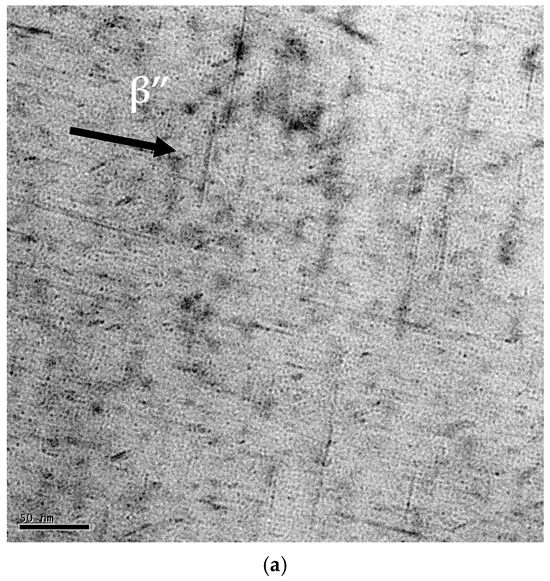
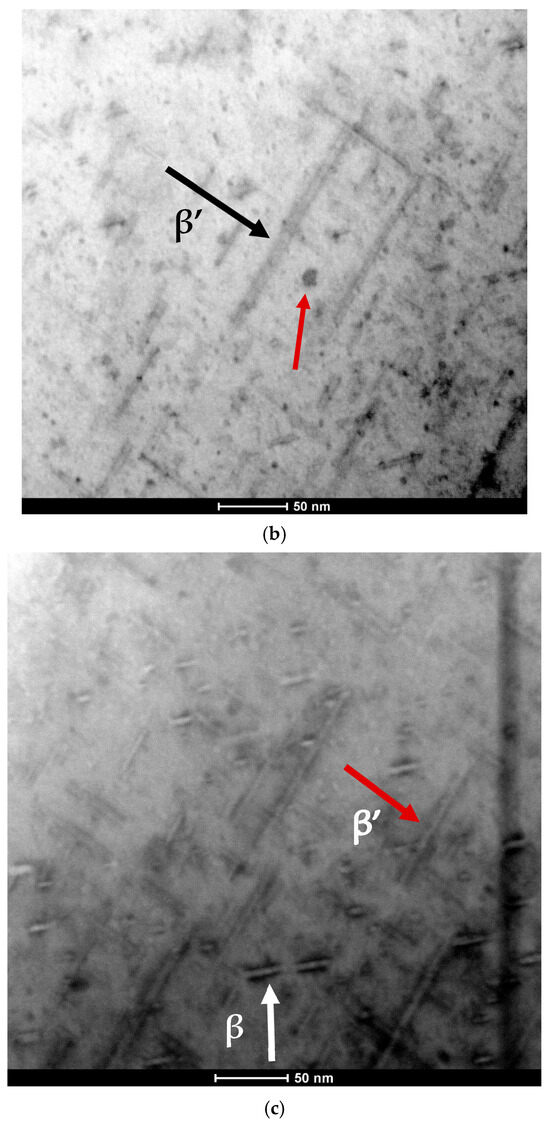
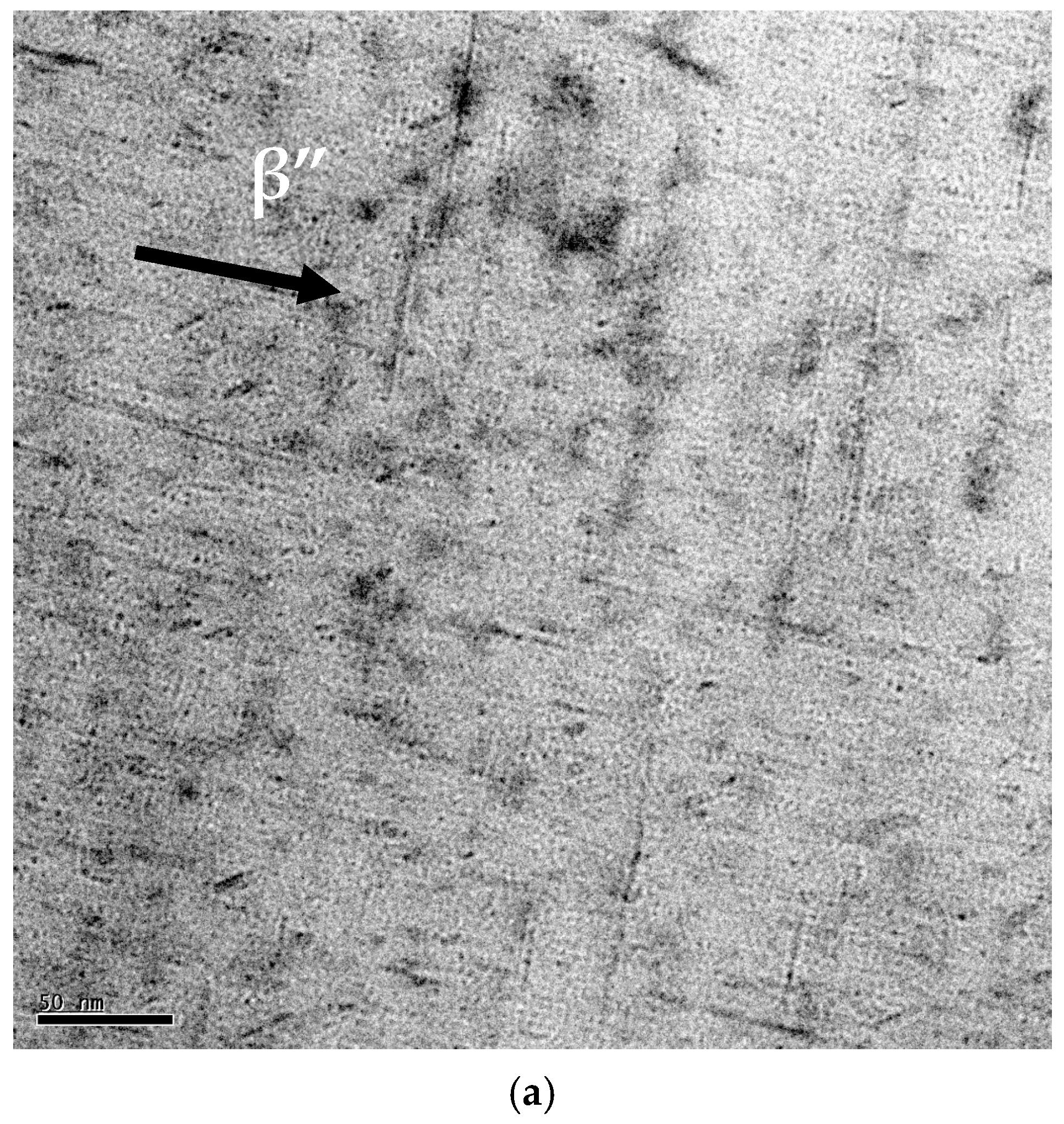
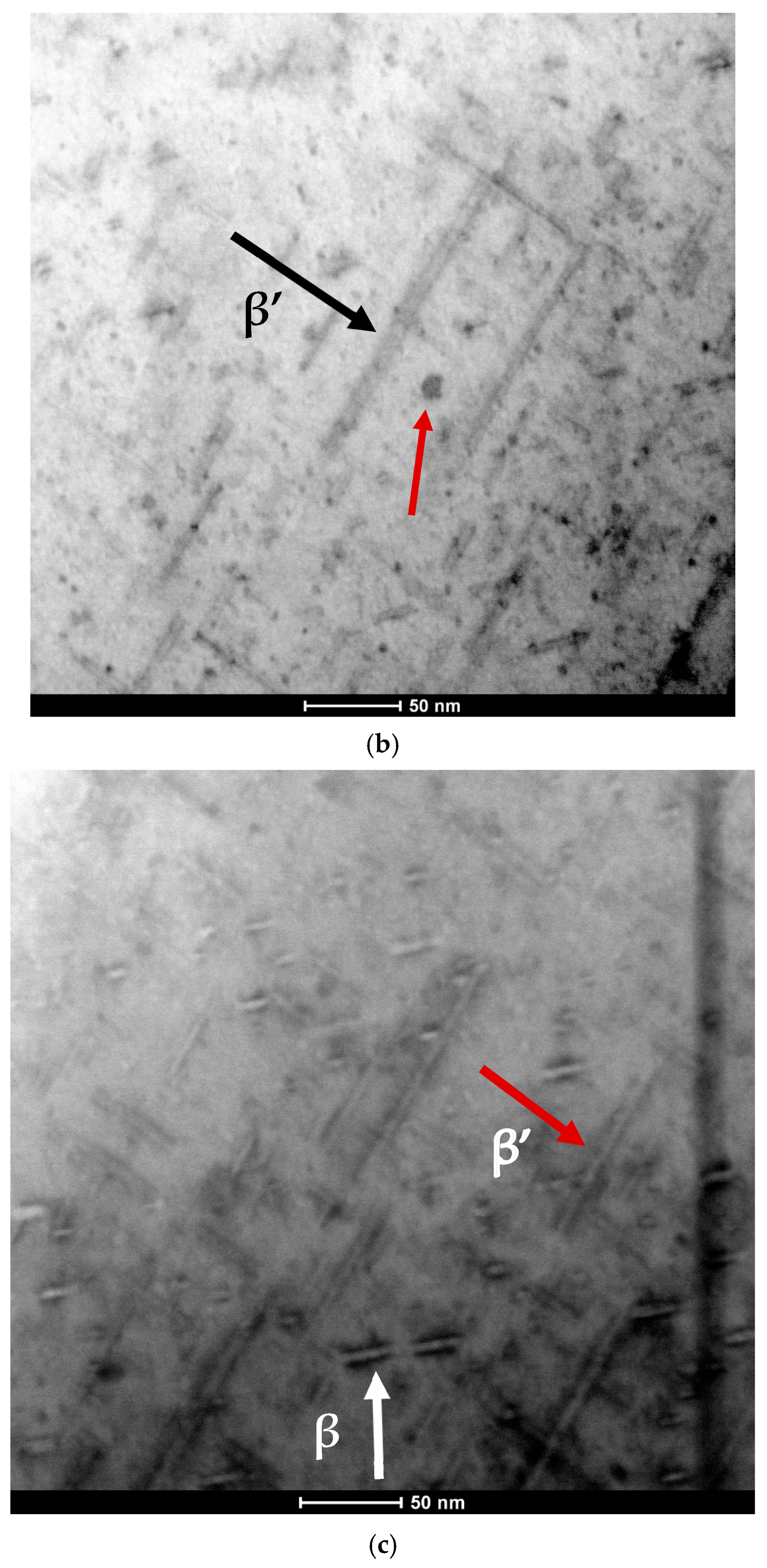
Figure 1a–c shows the precipitates in aged 6201 alloy: (a) needle-shaped β” precipitates, (b) a mixture of coarse rod-shaped β’ particles and fine needle-shaped β” phase, and (c) β particles.
Figure 1.
(a) Sample aged at 200 °C, 1 h, showing needle-like β” phase. (b) Another region of the sample aged at 200 °C, 8 h, with a mixture of coarse rod-shaped β’ particles (black arrow) and round precipitates (red arrow). (c) Sample after rolling (cold work) and heat treated at 200 °C, 8 h, showing β precipitate (white arrow) with coarse rod-shaped β’ phase (red arrow).
Figure 1a–c shows that the alloy underwent normal transformation during the artificial aging process. First, clusters of segregated atoms form precipitation zones or Guinier–Preston (GP) zones, which are regions enriched in solute atoms in a matrix that is essentially aluminum. As aging progresses, the GP zones transform into β” precipitates in needle-like form. The β” particles are coherent with the aluminum matrix. In addition, the β” particles are transformed into β’ particles, with a hexagonal structure in the form of rods. These particles are semi-coherent with the aluminum matrix. As the aging process progresses for the alloy after rolling, β’ particles transform into β particles that are incoherent with the matrix [10,11,13].
3.2. Vickers Microhardness
Aluminum alloy 6201 exhibits a significant difference in hardness between the two treatment types. The solution-treated Al6201 alloy has a hardness of 39.75 HV, while the same alloy aged had a hardness of 64.13 HV. This yields a 38.02% advantage for the aged alloy. This difference can be explained by precipitation kinetics, in which small zones or groupings of solute atoms form, constituted by small portions of the aluminum network enriched in solute atoms that are coherent with the matrix. The maximum hardness is attributed to the formation of this metastable precipitate. Furthermore, the combination of the rolling process and artificial aging increases the alloy hardness to 75.30 HV, yielding increases of 47.2% and 14.8% relative to the same alloy solution-treated and aged, respectively. This positive variation in hardness is attributable to cold working during rolling, which increases rigidity. This cold-work effect, combined with the changes induced by artificial aging, contributes to the alloy’s increased hardness.
3.3. Diameters of Wear Craters
For microabrasive wear analysis, laser confocal microscopy was used to measure wear craters. For each wear crater produced, the diameter was calculated as the average of five measurements. The diameter values for the two alloys are presented in Table 3.
Table 3.
Wear crater diameters in alloy 6201.
3.4. Severity of Wear Tests
One way to analyze the severity of the wear test (Stest) is the product Pv of the contact pressure developed in the wear system formed between the sphere, abrasive particles, and test specimen (P) and the sliding speed (v) [27]. The severity of the test is defined by the following Equation:
Stest = Pv
Since the depth of the crater (h) is much lower (ℎ ≪ D) than the diameter of the sphere, the pressure value is determined by the following Equation:
where Ap is the total projected area of the wear crater and can be calculated by Equation (6):
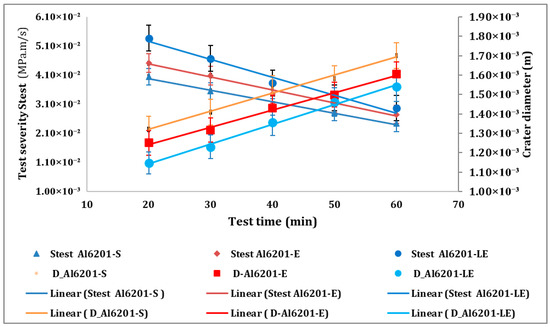
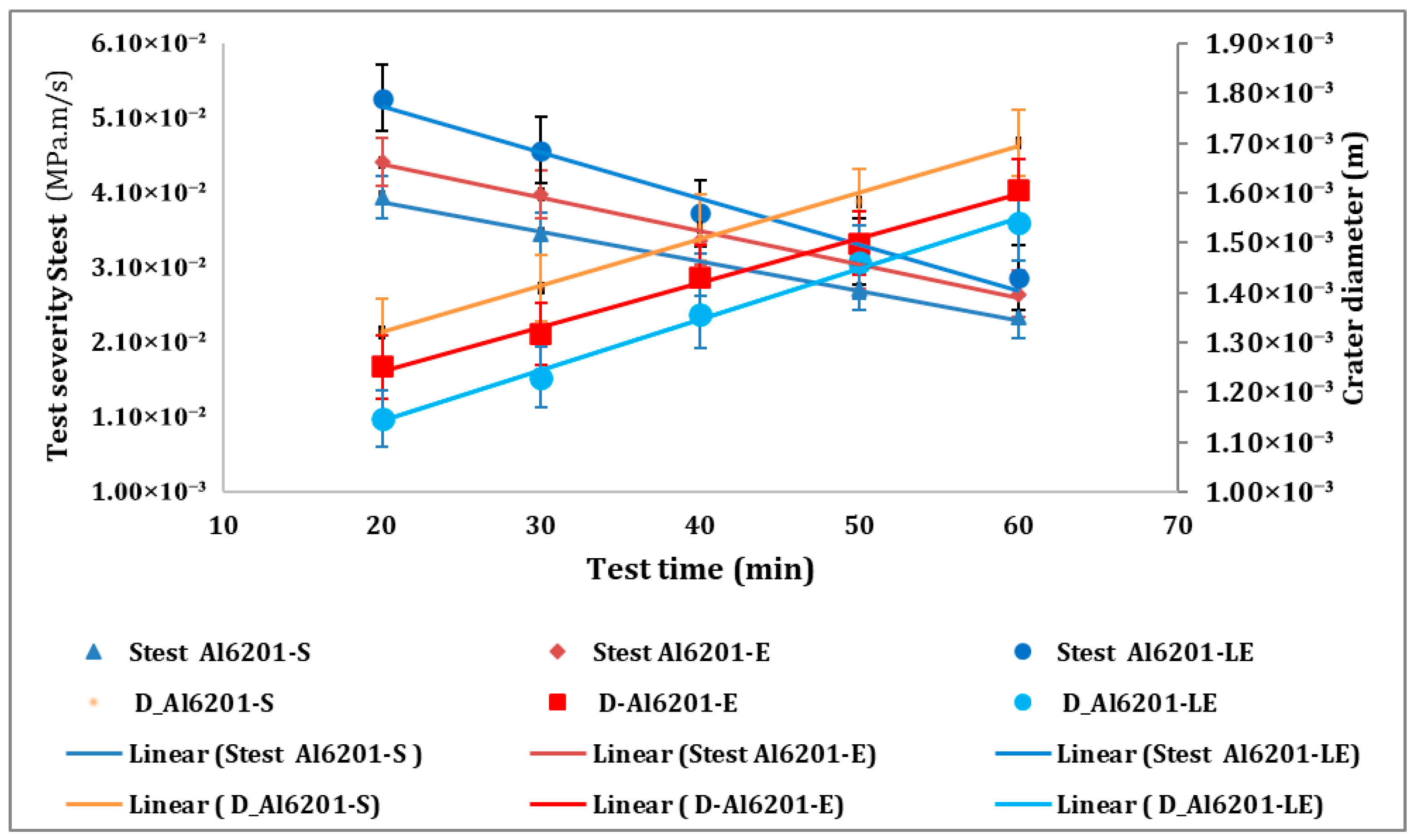
where b is the diameter of the projected area of the wear crater, and N is the normal load applied for wear. The results of the evolution of the test severity (Stest) as a function of time are shown in Figure 2. The test severity values decrease from the beginning to the end of the tests. This means that the severity is greater for small sliding distances, since the crater area is smaller and the pressure is higher. In addition, the severity of the test on aluminum alloy 6201 in the aged condition is higher than that in the solution-treated condition at all test times. This may be because the aged 6201 alloy exhibited a smaller wear-crater projected area at the same test time, resulting in higher pressure after aging. This demonstrates the effect of artificial aging on the microabrasive wear resistance of the alloy. Compared with the solution-treated alloy aged only, the combined treatment of rolling and artificial aging yields greater test severity because it produces smaller projected wear-crater areas for the same test time. The gradual decrease in severity over the test times could be explained by the decrease in contact pressure caused by the increase in the projected contact area over time larger, since in rotating ball microabrasive wear tests, the pressure decreases with the progress of the tests conducted, because the force remains constant during the test and the area increases. Consequently, as pressure decreases, the test severity decreases, as indicated by the pressure equation P = N/Ap. The intensity of microabrasive wear can be assessed by the evolution of crater diameter over time. This evolution is shown in the same Figure 2 for aluminum alloy 6201 samples in the solution-treated (Al6201-S), aged (Al6201-E), and rolled-aged (Al6201-LE) conditions. From the graphs, it is evident that the crater diameters under the solubilized (Al6201-S), aged (Al6201-E), and rolled-aged (Al6201-LE) conditions tend to increase significantly with increasing test time. The results indicate that the alloy’s crater wear diameter decreases following various treatments. Specifically, aged 6201 aluminum alloy samples consistently exhibit smaller crater diameters across all testing intervals compared to those subjected only to solution treatment. This demonstrates that artificial aging enhances the alloy’s resistance to microabrasive wear. Furthermore, when artificial aging is combined with rolling treatment, the alloy shows even greater resistance to microabrasive wear, as evidenced by the reduced wear crater diameters observed throughout the tests.
P = N/Ap
Figure 2.
Evolution of test severity as a function of test time in aluminum alloy 6201 samples: solution-annealed (Al6201-S), aged (Al6201-E), and aged-rolled (Al6201-LE), and evolution of the diameters of the wear craters as a function of the test time for the same samples.
3.5. Relationship Between Wear Volume and Sliding Time and Distance
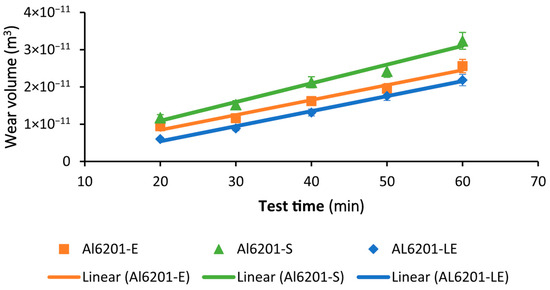
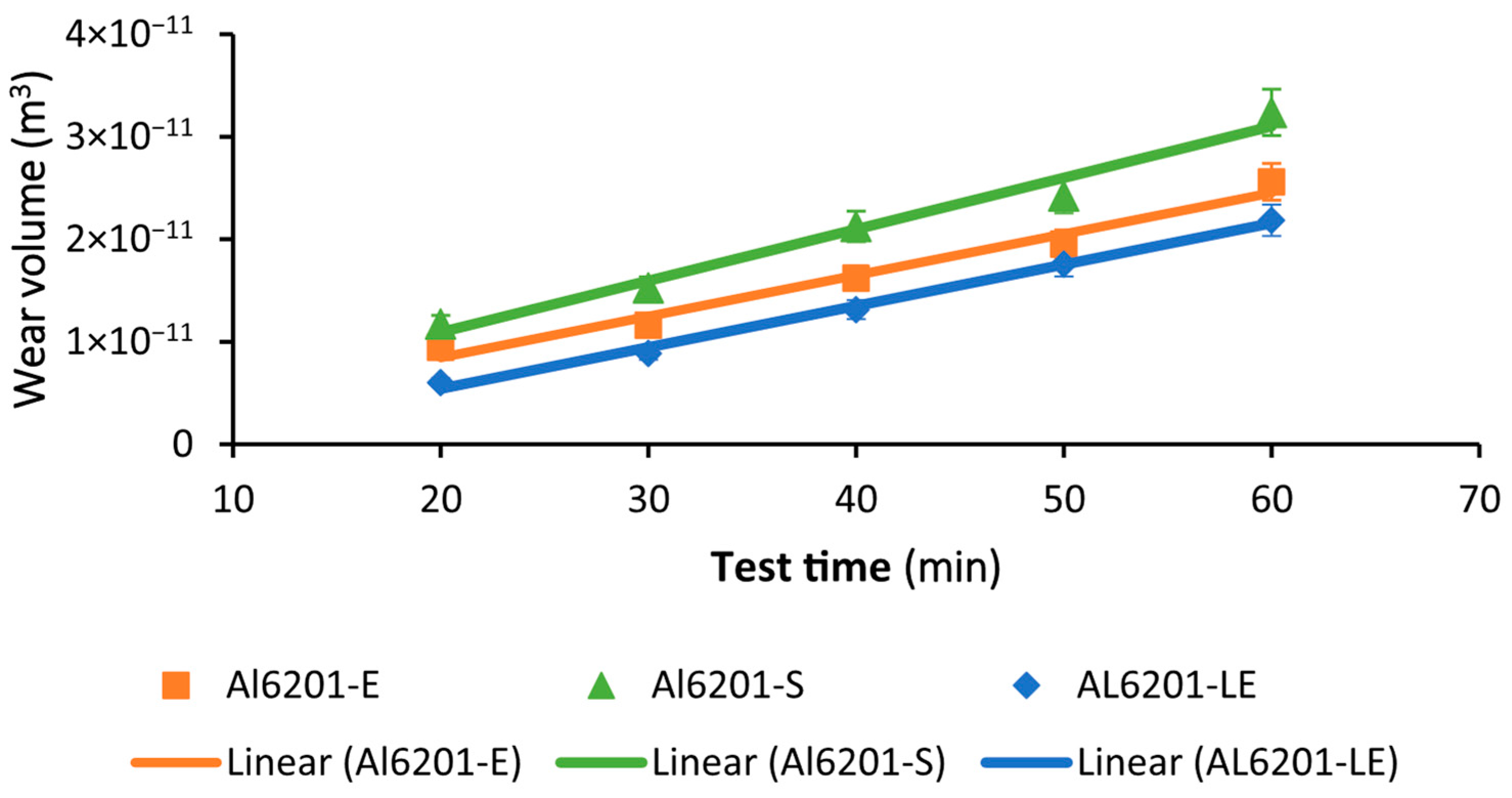
The calculated wear volume values for the solution-treated and aged 6201 aluminum alloy are presented in Figure 3. The wear volume increases with test time, as expected. Furthermore, the graph shows that, for the same test time, volume wear decreases for the aged 6201 alloy relative to the solution-treated alloy, indicating that artificial aging improves the alloy’s resistance to microabrasive wear. It was also found that, after the combination of rolling treatment and artificial aging, the alloy showed a reduction in wear volume throughout the test, compared with the solution-treated and aged alloy. Therefore, the work hardening of the material by cold working, combined with the transformation of the alloy’s microstructure during the aging process—which produces β” phases coherent with the aluminum matrix—greatly influenced the microabrasive wear resistance of the treated alloy. The wear volume as a function of test time is also presented in Table 4.
Figure 3.
Wear volume in relation to test time for aluminum alloy 6201: solution-treated (Al6201-S), aged (Al6201-E), and aged-rolled (Al6201-LE).
Table 4.
Wear volumes relative to test time for the two 6201 aluminum alloys.
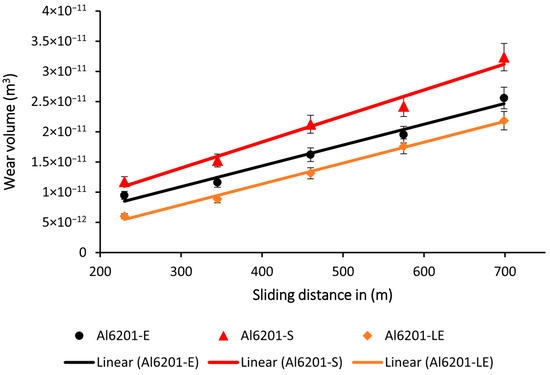
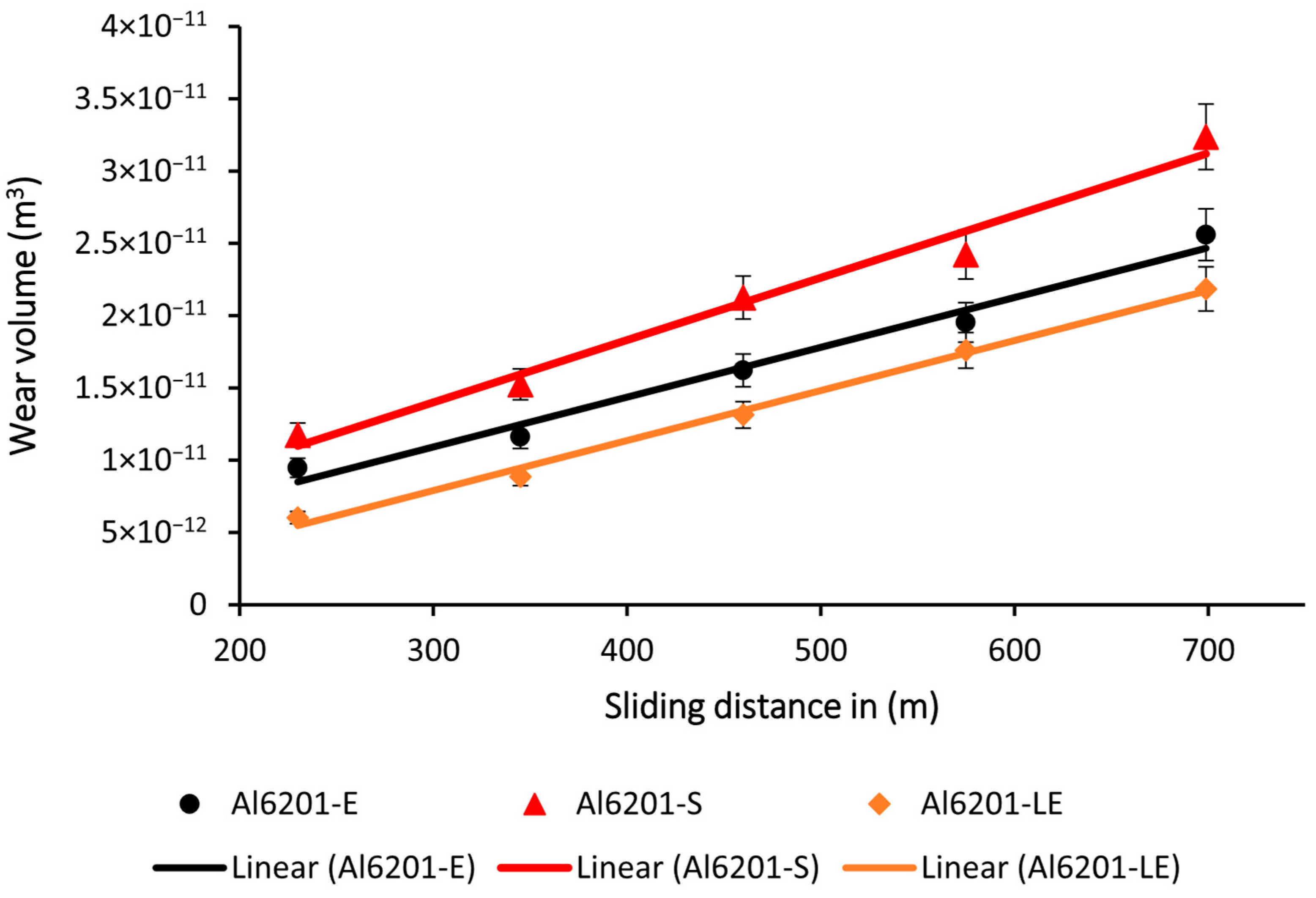
The volume of worn material also increases with increasing sliding distance. However, this increase in wear volume with increasing sliding distance does not imply a decrease in wear resistance, since greater wear is expected for samples that remained in the microabrasive wear process for longer. Furthermore, a comparison of the results reveals that the rolled and aged 6201 alloy samples exhibit lower volume losses at all measurement points. This demonstrates the effectiveness of combining rolling treatment with aging to reduce microabrasive wear in the alloy. Figure 4 presents the total wear volume as a function of sliding distance for the 6201 aluminum alloy samples in solubilized, artificially aged, and rolled-aged conditions.
Figure 4.
Variation of wear volume as a function of sliding distance for samples of 6201 aluminum alloy in solution- annealed, aged, and aged-rolled conditions.
Furthermore, the graphs of wear volume as a function of sliding distance, V = f(L), display a linear growth trend. This indicates that the permanent wear regime was reached during the test period for this parameter set [26]. Consequently, the results are consistent with the Archard Equation for microabrasive wear. Taking into account that the steady-state wear regime was achieved and that the graphs in Figure 4 show trends close to a straight line, the wear rate (Q) was determined using the equations of the straight lines from the graphs. The wear rate was obtained by deriving the equations for each curve, as follows:
Q = dV/dL
The equations and their results are presented in Table 5 for both alloys.
Table 5.
Wear rate (Q) for alloy 6201 under the treatment conditions used.
The results indicate that the aged 6201 aluminum alloy exhibits a 20% reduction in wear rate compared with the same solution-treated alloy. This indicates that aged 6201 aluminum alloy exhibits greater resistance to microabrasive wear. This decrease can be attributed to the well-distributed and finer Mg-Si precipitates formed during artificial aging. These precipitates act as obstacles that impede dislocation motion during wear tests. As a result, they enhance the material’s resistance to microabrasive wear. Moharami et al. [28], in their work on alloy 6061, attributed the resistance to dislocation motion to the hard Mg2Si particles, thereby enhancing wear resistance.
3.6. Wear Coefficients
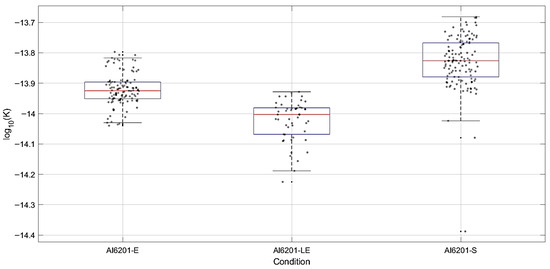
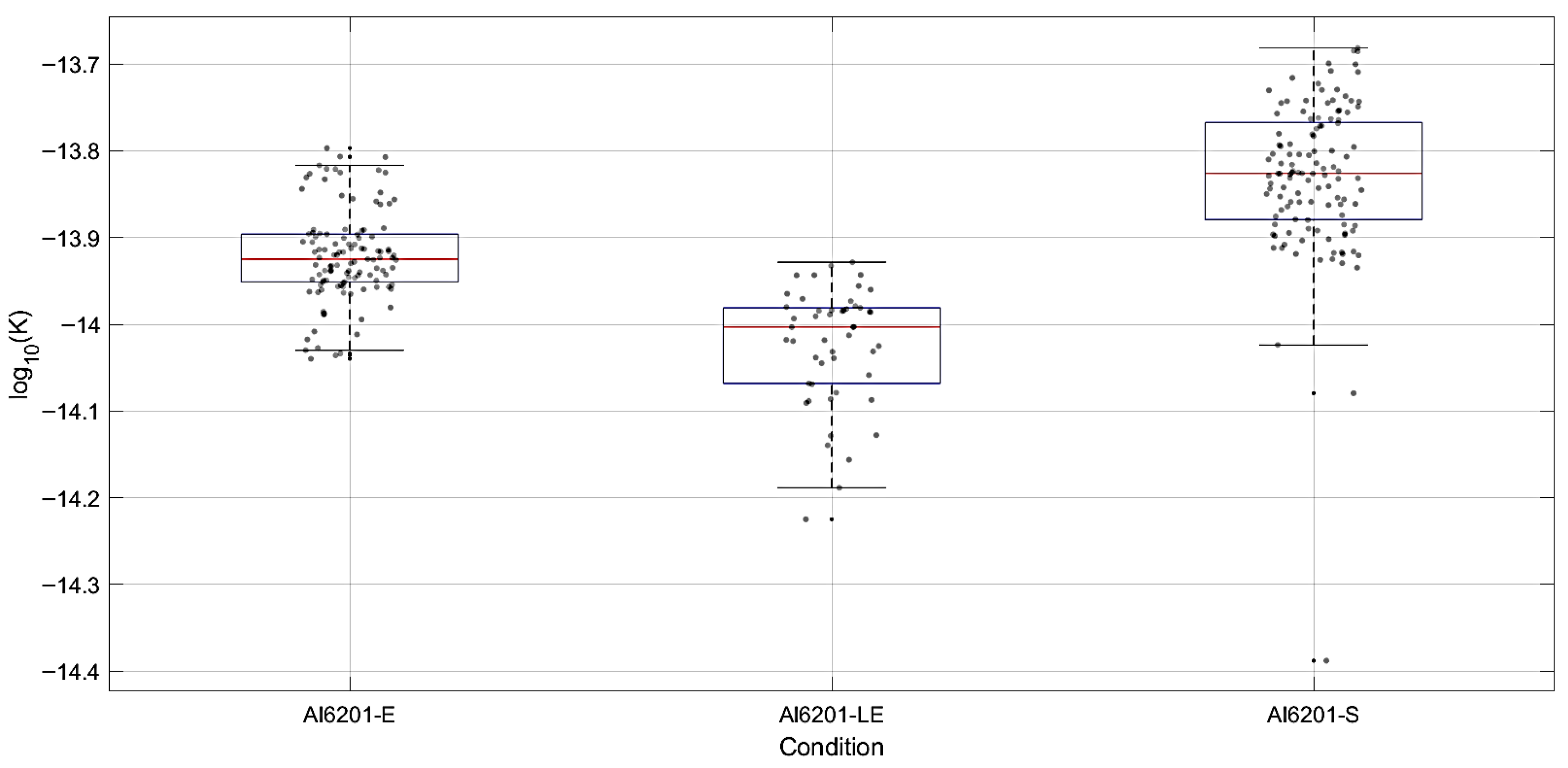
To compare the wear coefficient of the Al6201 alloy under different treatment conditions, the wear coefficients were calculated using Archard’s equation (Equation (3)). The results are summarized in Table 6, which reports the geometric mean values of K along with their respective 95% confidence intervals, and the statistical distribution of log10(K) is presented in Figure 5.
Table 6.
Geometric mean wear coefficient (K) and 95% confidence intervals for Al6201 alloy under different treatment conditions.
Figure 5.
Distribution of wear coefficients expressed as log10(K) for Al6201-S, Al6201-E, and Al6201-LE conditions.
Quantitatively, the geometric mean wear coefficient decreases from 1.48 × 10⁻¹⁴ m3/Nm for the solution-treated condition (Al6201-S) to 1.20 × 10⁻¹⁴ m3/Nm after artificial aging (Al6201-E), and further to 9.46 × 10⁻¹⁵ m3/Nm for the rolled-aged condition (Al6201-LE). The associated 95% confidence intervals show clear separation between the three conditions, indicating statistically resolved differences. The reduction relative to the solution-treated alloy is 19.1% for artificial aging and 36.1% for the combined rolling and aging treatment. Bootstrap confidence intervals confirm that these reductions are well beyond experimental scatter, demonstrating mechanically meaningful improvements in microabrasive wear resistance. The wear coefficient data were statistically analyzed to verify the behavior observed during microabrasive wear. Analysis of the statistical measures calculated, such as variance, standard deviation, and range, shows that the data were well distributed and that there are no extreme values in the series. In addition to the range, outliers were analyzed by calculating the upper and lower limits of the data series. As shown in Figure 5, a systematic downward shift in the distribution of log10(K) is observed as a function of treatment condition. The solution-treated alloy exhibits the highest wear coefficients, followed by the artificially aged condition, while the rolled-aged material presents the lowest values. The separation between groups is consistent across the entire distribution and not limited to the mean. To formally evaluate the treatment effect, a one-way ANOVA was performed on log10(K). A highly significant effect of treatment condition was observed (F(2.283) = 138.7, p < 10−40), with a large effect size (η2 = 0.495), indicating that nearly half of the total variability in the wear coefficient is explained by microstructural state. Post-hoc Tukey–Kramer comparisons confirmed statistically significant differences among all treatment pairs (p < 0.001). Complementary Welch and Kruskal–Wallis tests yielded consistent conclusions, demonstrating robustness to moderate heteroscedasticity and deviations from normality. From a physical perspective, bootstrap estimation of treatment effects shows that artificial aging results in a 19.1% reduction in the wear coefficient relative to the solution-treated condition (95% CI: 15.5–22.3%), while the combined rolling and aging treatment produces a 36.1% reduction (95% CI: 32.6–39.6%). These reductions are well resolved beyond experimental scatter and represent mechanically meaningful improvements in microabrasive wear resistance. From a broader perspective, the statistical magnitude of the treatment effect reinforces the microstructural interpretation developed throughout this work. The progressive reduction in the wear coefficient from the solution-treated to the aged and rolled-aged conditions is consistent with the combined effects of precipitation strengthening and strain hardening. Artificial aging promotes the formation of strengthening precipitates that increase matrix hardness and reduce plastic accommodation under abrasive contact. The additional rolling step introduces a refined, defect-rich microstructure, further increasing the material’s resistance to removal. The fact that nearly half of the total variability in K is explained by treatment conditions indicates that the wear response is primarily controlled by microstructural state rather than experimental scatter or secondary factors. This strong coupling between microstructure and tribological performance suggests that, under the present microabrasive regime, wear is governed by the material’s capacity to resist localized plastic deformation and micro-cutting processes. Consequently, the combined thermomechanical treatment not only improves strength but also shifts the dominant wear-resistance mechanism, resulting in a statistically robust and mechanically significant performance enhancement.
3.7. Microabrasive Wear Mode
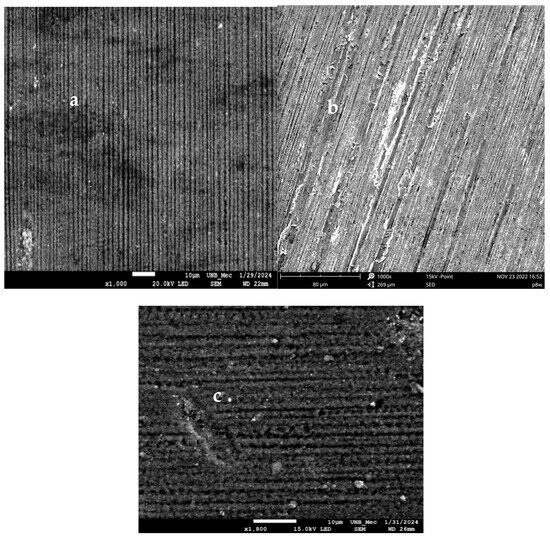
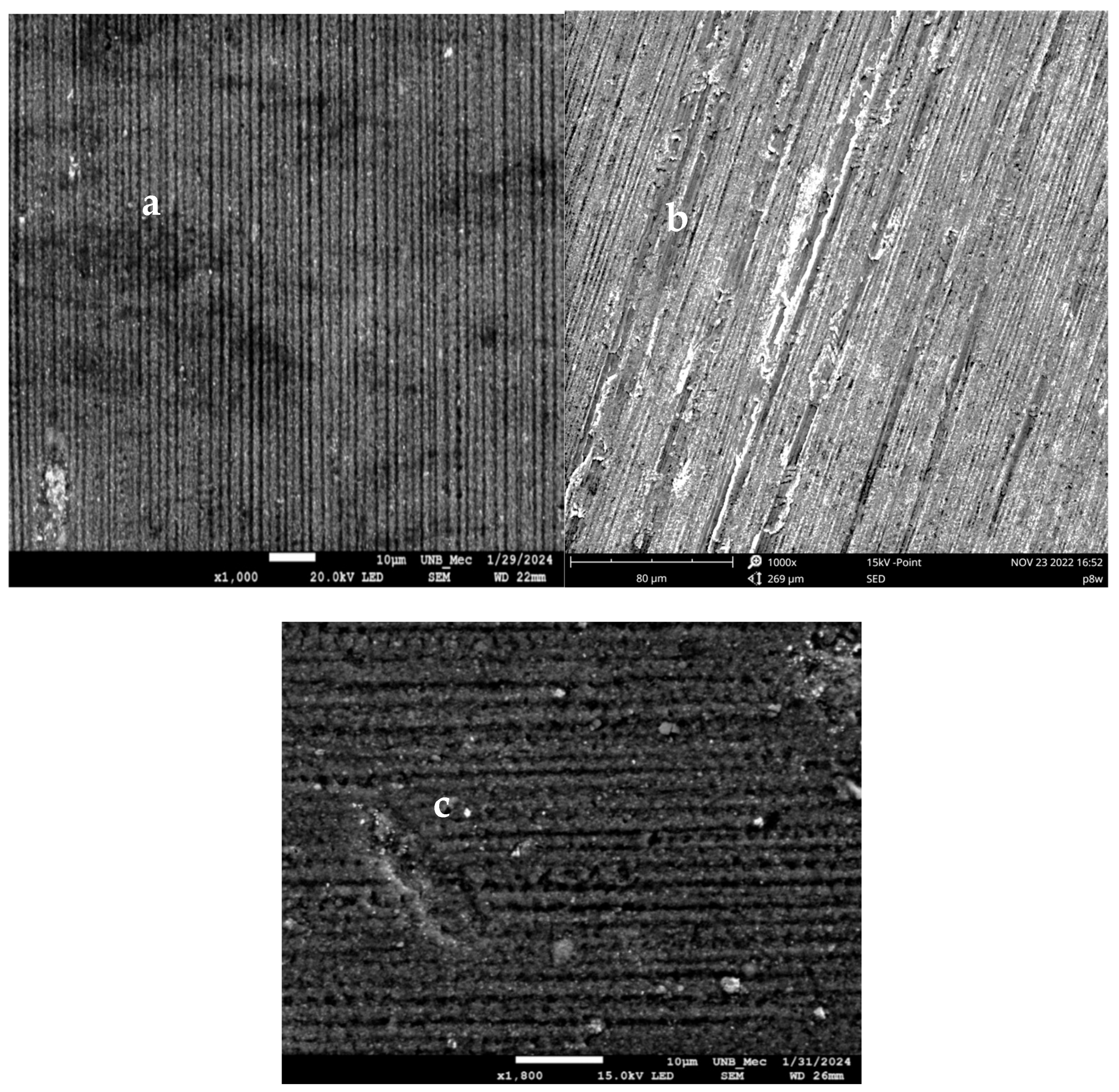
Generally, microabrasive wear is classified into two modes: (i) microabrasive wear by scratching and (ii) microabrasive wear by rolling. Tribological testing has demonstrated that variations in several parameters—including normal force, abrasive slurry concentration, hardness (H), abrasive particle shape and size, and the materials used for both the test sphere and the test specimen—can alter the prevailing microabrasive wear mode. This finding is supported by research in the literature [26,29,30,31,32]. In the mechanism of abrasive wear by micro-rolling, it is essential that free or loose particles are present between the two contacting surfaces (the counter body and the sample). These particles act as rolling elements, moving between the surfaces and causing wear through a rolling action rather than purely sliding or plowing [30]. Analyzing the images obtained in scanning electron microscopy (SEM) (Figure 6a), it is observed that the samples of alloy 6201, in the only solubilized condition, present microabrasive wear due to scratching. The occurrence of abrasive wear by scratching occurs when the abrasive particles are embedded in the test specimen or in the sphere (counter-body). In this research, specific particles must be embedded within the rotating sphere [16,17,18]. This is because, in nearly all regions of the craters formed during testing, scratching is predominantly parallel. These observations indicate that the embedded particles are responsible for scratching the softer test specimen, producing parallel scratches across the craters. In addition, one can consider that the material in this case (Figure 6a) underwent solution treatment and, after tempering, remained in a supersaturated solid solution. In this condition, the alloy is unstable, with large particle sizes of the alloying elements that do not increase resistance to microabrasive wear, leading to microabrasive wear via scratching (i.e., more severe wear). Figure 6b shows images of the wear craters on the alloy samples after solution treatment and artificial aging. The artificial aging heat treatment, following solution treatment, increases the wear resistance of the aged alloy. This fact makes it difficult to remove material from the sample surface, leading to simultaneous sliding and rolling that cause micro-abrasion via micro-rolling. The microabrasive wear of the alloy after combining cold-rolling and artificial aging is shown in Figure 6c. By analyzing these figures, it is possible to identify microabrasive wear caused by rolling. This result can be attributed to cold work, which, through plastic deformation, reduces dislocation mobility, thereby requiring greater stress to induce deformation and thereby increasing the material’s stiffness. This effect, combined with the formation of metastable β” phase, makes it difficult to further material removal during the microabrasive wear process. Therefore, the abrasive particles were free to roll along the sample surface, generating microabrasive wear.
Figure 6.
Wear pattern of alloy 6201 solution treated at 520 h for 2 h, showing microabrasive wear by scratching (a), treated with solution treatment at 520 h for 2 h and artificial aging with wear by microabrasion (b) and after the combined treatment process of cold rolling and artificial aging, showing microabrasive wear by microabrasion and microrolling (c).
4. Conclusions
In this work, the microabrasive wear of rolled aluminum alloy 6201 was investigated following solution treatment and artificial aging. After analyzing the results obtained from the tests, the conclusions are as follows:
- The results obtained by the analysis carried out via scanning electron microscope revealed that the samples of alloy 6201 after solution treatment show microabrasive wear due to scratching. These observations indicate that the embedded particles are responsible for scratching the softer test specimen, producing parallel scratches across the craters. The material in this case underwent solution treatment, and after tempering, it remained in a supersaturated solid solution. In this state, the alloy is unstable. Following artificial aging, the alloy exhibited microabrasive wear from rolling.
- For the aged 6201 alloy, the drop-in wear coefficient shown is 19.1%, compared to the solution-treated alloy (95% CI: 15.5–22.3%), and this reduction was statistically significant (p < 0.001). In artificial aging, clusters of segregated atoms initially form precipitation areas, or Guinier–Preston (GP) zones, regions enriched in solute atoms within an essentially aluminum matrix. As aging progresses, the GP zones transform into β” precipitates in needle-like form. The β” particles are coherent with the aluminum matrix. After that, the β” particles are transformed into β’ particles, with a hexagonal structure in the form of rods. These particles are semi-coherent with the aluminum matrix. As the aging process progresses, the β’ particles evolve into larger β particles that are no longer coherent with the matrix. As a result, the wear coefficient decreases for the aged 6201 aluminum alloy.
- After the combined treatment of rolling and artificial aging, the alloy had a drop-in wear coefficient of 36,1% compared to the same solution-treated alloy (95% CI:32.6–39.6%), representing the largest statistically significant improvement among the tested conditions (p < 0.001). The increase in resistance to microabrasive wear after rolling and aging heat treatment is attributed to the combined effects of these processes.
- (a)
- Aging heat treatment, which promotes rearrangement in the crystal lattice, as depicted in conclusion 2.
- (b)
- Cold work (rolling), which, through plastic deformation, leads to a reduction in the mobility of dislocations, generating the need for greater tension to cause deformation in the material, thus increasing its stiffness. It can be inferred that during this process, a significant number of dislocations are generated within the crystal structure by fluctuations in local stress fields within the material, culminating in a lattice rearrangement as the dislocations propagate through the lattice, enhancing the wear resistance of the aluminum alloy.
- (c)
- Statistical analysis demonstrated that microstructural condition explains approximately half of the total variability in the wear coefficient (η2 = 0.495), indicating that wear performance under the present experimental configuration is primarily governed by intrinsic strengthening mechanisms rather than experimental variability.
Author Contributions
P.A.—Conceptualization, methodology, validation, writing—original draft preparation, visualization. C.R.L.—Conceptualization, methodology, validation, visualization. J.A.A.—Methodology, validation, visualization, resources. J.L.d.A.F.—Methodology, validation, writing, visualization, and resources. C.R.M.d.S.—Conceptualization, methodology, validation, writing—original draft preparation, visualization, writing—review and editing. All authors have read and agreed to the published version of the manuscript.
Funding
This research received no external funding.
Data Availability Statement
The original contributions presented in this study are included in the article. Further inquiries can be directed to the corresponding author.
Acknowledgments
The authors thank DPI/BCE/UnB for their support through Call for Proposals No. 001/2025 DPI/BCE/UnB and CNPq for their support of project 307769/2022-4.
Conflicts of Interest
The authors declare no conflicts of interest.
References
- Hu, J.; Zhang, C.; Wang, X.; Meng, X.; Dou, C.; Yu, H.; Wang, C.; Xue, J.; Qiao, Z.; Jiang, T. Improving the Wear Resistance Properties of 7A04 Aluminum Alloy with Three Surface Modification. Coatings 2024, 14, 476. [Google Scholar] [CrossRef] [Scilit]
- Scales, M.; Kornuta, J.A.; Switzner, N.; Veloo, P. Automated Calculation of Strain Hardening Parameters from Tensile Stress vs. Strain Data for Low Carbon Steel Exhibiting Yield Point Elongation. Exp. Tech. 2023, 47, 1311–1322. [Google Scholar] [CrossRef] [Scilit]
- Siqueira, M.L.; Silva, A.; Meloa, M.L.N.M.; Geovani, G.R. Mechanical Properties Analysis of Al2024 alloy Submitted to Different Aging Time and different Cold Plastic Deformation degree. Mater. Res. 2019, 22, e20180598. [Google Scholar] [CrossRef] [Scilit]
- Toppo, V.; Singh, S.B.; Ray, K.K. Wear resistance of annealed plain carbon steels in pre-strained condition. Wear 2009, 266, 907–916. [Google Scholar] [CrossRef] [Scilit]
- Yan, W.; Fang, L.; Sun, K.; Xu, Y. Effect of surface work hardening on wear behavior of Hadfield steel. Mater. Sci. Eng. A 2007, 460–461, 542–549. [Google Scholar] [CrossRef] [Scilit]
- Zhang, H.G.; Chen, R.; Gu, X.M. Effect of aging process on precipitated phase and properties of mechanical extruded aluminum alloy. J. Meas. Eng. 2024, 12, 270–283. [Google Scholar] [CrossRef] [Scilit]
- Campbell, F.C. Elements of Metallurgy and Engineering Alloys; ASM International: Materials Park, OH, USA, 2008. [Google Scholar]
- Siddesh Kumar, N.M.; Dhruthi; Pramod, G.K.; Samrat, P.; Sadashiva, M. A Critical Review on Heat Treatment of Aluminium Alloys. Mater. Today Proc. 2022, 58, 71–79. [Google Scholar] [CrossRef] [Scilit]
- Kaufman, J.G.; Rooy, E.L.; American Foundry Society. Aluminum Alloy Castings: Properties, Processes, and Applications; ASM International: Materials Park, OH, USA, 2004. [Google Scholar]
- Zhang, R.; Wang, W.; Jiang, J. Precipitation hardening: Unravelling mechanisms of trade-off between strength and ductility/formability of Al-Mg-Si alloys. J. Alloys Compd. 2025, 1012, 178443. [Google Scholar] [CrossRef] [Scilit]
- Zhang, L.; Xie, J.; Xiong, Z.; Zhao, C. Refinement mechanism of large-size precipitates in as cast Al-Zn-Mg alloy under rolling. J. Alloys Compd. 2025, 1021, 179712. [Google Scholar] [CrossRef] [Scilit]
- American Society of Materials. ASM Metals Handbook: Properties and Selection: Nonferrous Alloys and Special-Purpose Materials; ASM International: Materials Park, OH, USA, 1990; Volume 2. [Google Scholar]
- Liu, M.; Miao, Y.; Guo, Z.; Liu, T.; Peng, P.; Wang, Z.; Gao, H.; Sun, B. Microstructure and Property Evolution of an Al-Mg-Si Alloy Cable during the Production Process. J. Mater. Eng. Perform. 2025, 34, 12205–12215. [Google Scholar] [CrossRef] [Scilit]
- Swain, B.; Bhuyan, S.; Behera, R.; Mohapatra, S.S.; Behera, A. Wear: A Serious Problem in Industry. In Tribology in Materials and Manufacturing—Wear, Friction and Lubrication; Intech: Vienna, Austria, 2020; pp. 1–20. [Google Scholar]
- Brunetière, N. Introduction à la Tribologie. Master’s Thesis, Institut Pprime—Futuroscope, Chasseneuil-du-Poitou, France, 2016. [Google Scholar]
- Cozza, C. Third abrasive wear mode: Is it possible? J. Mater. Res. Technol. 2014, 3, 191–193. [Google Scholar] [CrossRef] [Scilit]
- Mezlini, S. Etude de l’Usure par Abrasion d’Alliages d’Aluminium. Ph.D. Thesis, Laboratoire de Tribologie et Dynamique des Systèmes UMR 5513, l’Ecole Centrale de Lyon, Lyon, France, 2003. [Google Scholar]
- Purba, R.H.; Shimizu, K.; Kusumoto, K. Three-Body Abrasive Wear-Resistance Characteristics of a 27Cr-Based 3V-3Mo-3W-3Co Multicomponent White Cast Iron with Different Ti Additions. J. Manuf. Mater. Process. 2023, 7, 21. [Google Scholar] [CrossRef] [Scilit]
- Zambelli, G.; Vincent, L. (Eds.) Matériaux et Contacts: Une Techniques Ingénieur; Presses Polytechniques et Universitaires Romandes: Lausanne, Switzerland, 1998. [Google Scholar]
- Rodinger, T.; Lukšić, H.; Ćorić, D.; Rede, V. Abrasion Wear Resistance of Precipitation-Hardened Al-Zn-Mg Alloy. Materials 2024, 17, 2446. [Google Scholar] [CrossRef] [Scilit] [PubMed]
- Sharma, R.; Anesh; Dwivedi, D.K. Solutionizing temperature and abrasive wear behaviour of cast Al–Si–Mg alloys. Mater. Des. 2007, 28, 1975–1981. [Google Scholar] [CrossRef] [Scilit]
- Zemlik, M.; Białobrzeska, B.; Stachowicz, M.; Hanszke, J. The Influence of Grain Size on the Abrasive Wear Resistance of Hardox 500 Steel. Appl. Sci. 2024, 14, 11490. [Google Scholar] [CrossRef] [Scilit]
- Lopes, H.S.; Moreto, J.A.; Manfrinato, M.D.; da Cruz, N.C.; Rangel, E.C.; Rossino, L.S. Micro Abrasive Wear Behaviour Study of Carburization and Ion Plasma Nitriding of P20 Steel. Mater. Res. 2016, 19, 686–694. [Google Scholar] [CrossRef] [Scilit]
- Kelly, D.A.; Hutchings, I.M. A new method for measurement of particle abrasivity. Wear 2001, 250, 76–80. [Google Scholar] [CrossRef] [Scilit]
- Silva, W.M.; Souza, P.S.; Carneiro, J.R. Methods of data analysis for the ball cratering test on TiN and DLC coated steel. Mater. Res. 2016, 19, 9–17. [Google Scholar] [CrossRef] [Scilit]
- Trezona, R.I.; Allsopp, D.N.; Hutchings, I.M. Transitions between two-body and three-body abrasive wear: Influence of test conditions in the microscale abrasive wear test. Wear 1999, 225–229, 205–214. [Google Scholar] [CrossRef] [Scilit]
- Cozza, R.C.; De Mello, J.D.; Tanaka, D.K.; Souza, R.M. Relationship between test severity and wear mode transition in micro-abrasive wear tests. Wear 2007, 263, 111–116. [Google Scholar] [CrossRef] [Scilit]
- Moharami, A.; Razaghian, A.; Babaei, B.; Ojo, O.; Šlapáková, M. Role of Mg2Si particles on mechanical, wear, and corrosion behaviors of friction stir welding of AA6061-T6 and Al-Mg2Si composite. J. Compos. Mater. 2020, 54, 4035–4057. [Google Scholar] [CrossRef] [Scilit]
- Faridi, M.A.; Nayak, S.K.; Prasad, D.K.V.D.; Mustafa, S.E.; Babu, D.A.; Murthy, J.K.N.; Laha, T. Evolution of Wear Mechanism Under Different Sliding Conditions of an Fe-Based Amorphous Coating Synthesized by Plasma Spraying. J. Therm. Spray Technol. 2024, 33, 2593–2610. [Google Scholar] [CrossRef] [Scilit]
- Mergler, Y.J.; Huis In ’T Veld, A.J. Micro-abrasive wear of semi-crystalline polymers. Tribol. Interface Eng. Ser. 2003, 41, 165–173. [Google Scholar]
- Cozza, R. Influence of the normal force, abrasive slurry concentration and abrasive wear modes on the coefficient of friction in ball-cratering wear tests. Tribol. Int. 2014, 70, 52–62. [Google Scholar] [CrossRef] [Scilit]
- Cozza, R.C.; Tanaka, D.K.; Souza, R.M. Friction coefficient and wear mode transition in micro-scale abrasion tests. Tribol. Int. 2011, 44, 1878–1889. [Google Scholar] [CrossRef] [Scilit]

Disclaimer/Publisher’s Note: The statements, opinions and data contained in all publications are solely those of the individual author(s) and contributor(s) and not of MDPI and/or the editor(s). MDPI and/or the editor(s) disclaim responsibility for any injury to people or property resulting from any ideas, methods, instructions or products referred to in the content. |
© 2026 by the authors. Licensee MDPI, Basel, Switzerland. This article is an open access article distributed under the terms and conditions of the Creative Commons Attribution (CC BY) license.