


Abstract
An AZ31 magnesium (Mg) alloy sheet with a bimodal non-basal texture (BNT sample) exhibits significant potential for a lightweight component design in the aerospace field. However, its mechanical properties and microstructure characteristics during plastic deformation under service conditions when approaching cryogenic temperatures have not been thoroughly investigated. Aiming to elucidate this issue, cryogenic tensile experiments were conducted on a BNT sample and its control group (BT sample), which possesses the typical basal texture. Furthermore, relationships between the underlying deformation mechanisms and the deformation behavior of studied sheets were investigated through a synergistic approach combining a variety of characterization techniques with visco-plastic self-consistent (VPSC) simulations. The BNT sample shows 109.1% higher ductility (~0.23 fracture elongation, FE) but 40.2% lower 0.2% proof yield stress (YS) (~155 MPa) than its BT counterpart during cryogenic tensile deformation. As for the BNT sample, initial deformation is governed by a basal ⟨a⟩ slip and {10-12} extension twin (ET). The latter mainly contributes to accommodate intergranular plastic deformation, and this role cannot be captured in VPSC modeling. Subsequent activation of unusual {10-12}-{10-12} double twin (DT), instead of pyramidal <c+a> slip, enhances strain accommodation, boosting ductility. The discrepancy between simulation and experimental results also primarily stems from the lack of explicit incorporation of {10-12}-{10-12} DT.
1. Introduction
Magnesium (Mg) alloys have attracted widespread interest in the aerospace industry due to the considerable potential of a lightweight design of components [1,2]. When used in spacecraft, the service environment is harsh, and the corresponding temperature can be as low as a cryogenic temperature (77 K). The mechanical properties of Mg alloys under this circumstance play crucial roles in engineering applications. Therefore, it is essential to obtain a comprehensive understanding about the microstructure evolution and mechanical behavior of Mg alloys at cryogenic temperatures for further expanding their applications in the aerospace field.
Up to the present, several investigations have been conducted on the cryogenic deformation behaviors of Mg alloys. Jain et al. [3] analyzed the work hardening behavior and texture evolution of an AZ80 Mg alloy deformed at a cryogenic temperature (77 K) and attributed the elevated hardening rate to texture hardening and reduced dynamic recovery. Wang et al. [4] reported that an AZ31 Mg alloy deformed at 77 K exhibits enhanced strength and work hardening due to a shift from forest-dislocation interactions to lattice friction-controlled dislocation motion, with suppressed twinning and reduced activation volume. Zhang et al. [5] compared the compression deformation behavior of cast AZ31 Mg alloy at room and cryogenic temperatures. They reported that the increased fraction of finer twins and twin–twin interactions rather than dislocation density leads to higher stress and higher strain hardening at cryogenic temperatures. Muhammad Rehan Tariq et al. [6] studied the cryogenic temperature deformation behavior of a Mg-Al-Zn-Ca alloy and attributed the exceptional strength to the synergistic effect of dislocation strengthening and boundary strengthening, where the increased barriers to dislocation movement lead to significant hardening. It is worth noting that most of these abovementioned studies are limited to Mg alloys with traditional basal texture.
Actually, the cryogenic deformation behavior of Mg alloys with non-basal texture has been rarely reported. Recently, Tu et al. [7] proposed a novel equal channel angular rolling and continuous bending process with a subsequent annealing (ECAR-CB-A) method, by which they successfully introduced a bimodal non-basal texture into an AZ31 Mg alloy sheet, where basal poles tilt about ±40° away from normal direction (ND) to rolling direction (RD). Owing to this introduced bimodal non-basal texture, the formability of an AZ31 Mg alloy sheet could be significantly enhanced at room temperature. Furthermore, Zhang et al. [8] investigated the cryogenic rollability of this newly developed AZ31 Mg alloy sheet, and they reported that the cryogenic rollability could be enhanced approximately 105.6% by comparison with that of sheet with basal texture. However, there is a lack of systematic research on the mechanical properties of this bimodal non-basal textured AZ31 Mg alloy sheet at cryogenic temperatures, let alone for laws of microstructure evolution and the relationships between the underlying deformation mechanisms and the deformation behavior. This is detrimental to the promotion and application of this highly formable AZ31 Mg alloy sheet in the aerospace field.
Therefore, cryogenic tensile experiments are conducted in the present study to investigate the mechanical behavior of a bimodal non-basal textured AZ31 Mg alloy sheet. The same experiments are also conducted on a traditional basal textured AZ31 Mg alloy sheet as a control group. Afterwards, the optical microstructure (OM) technique and the electron back-scattered diffraction (EBSD) technique are adopted to characterize the evolution of microstructure. Furthermore, numerical investigations via the visco-plastic self-consistent (VPSC) model are performed in the present study to illuminate the relationship between these involved deformation mechanisms and the deformation behavior of the bimodal non-basal textured AZ31 Mg alloy sheet at a cryogenic temperature.
2. Materials and Methods
2.1. Experimental Procedures
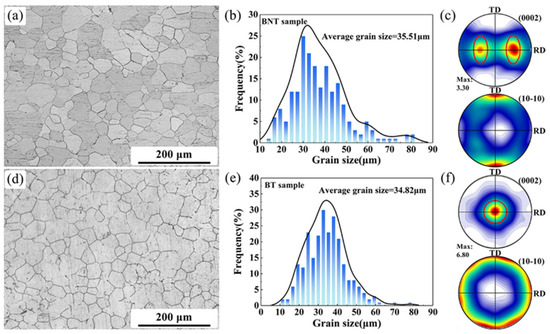
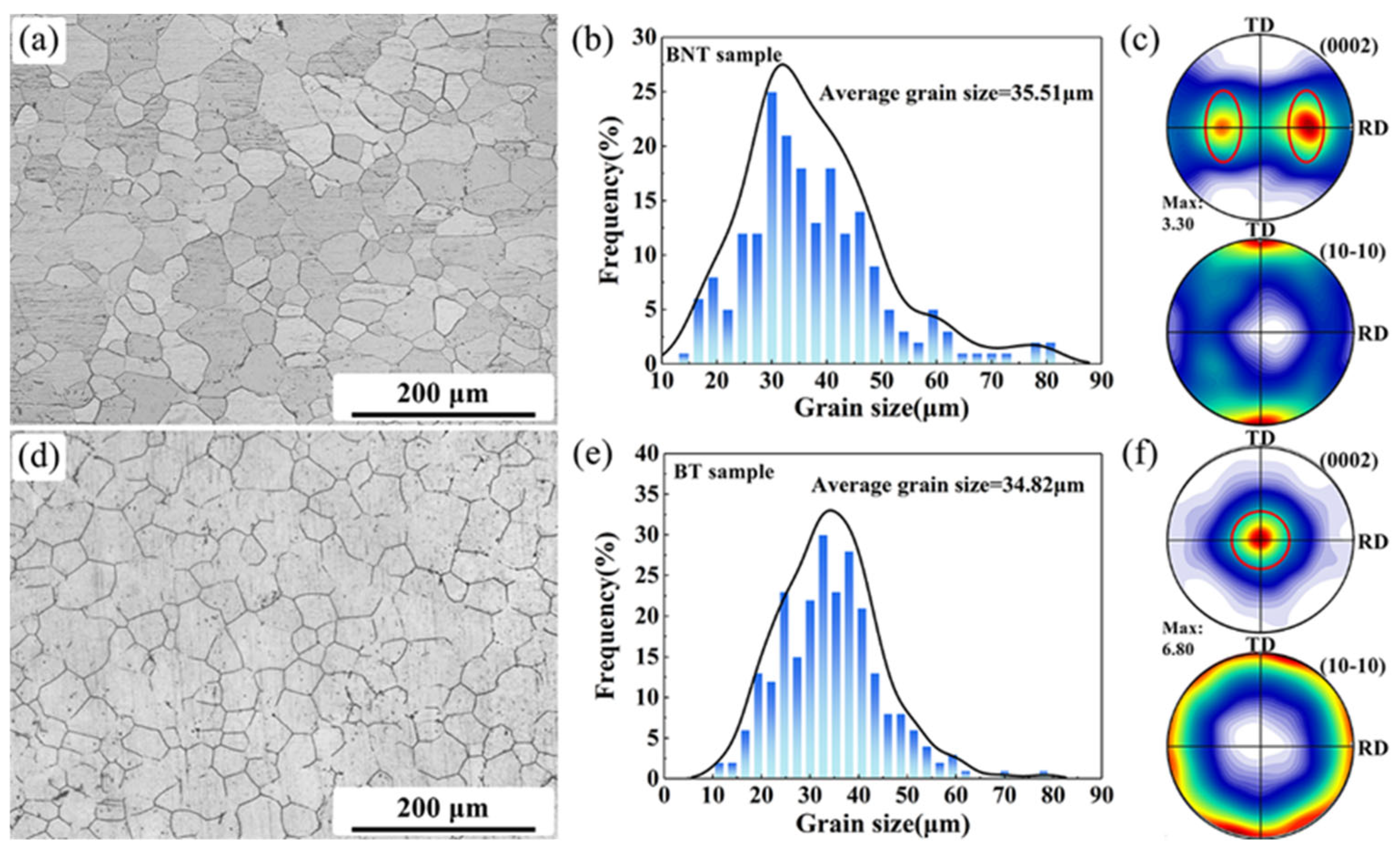
The as-received bimodal non-basal textured AZ31 Mg alloy sheets were fabricated by the ECAR-CB process. Detailed equipment parameters and processing specifics have been well documented in the work of Tu et al. [7], and thus it is not specified in the present study. Afterwards, an annealing treatment was conducted under the condition of 773 K/12 h to obtain a fully recrystallized microstructure. Based on the obtained EBSD data, texture characteristics depicted by (0002) and (10-10) pole figures are shown in Figure 1c, where basal poles tilt about ±40° away from ND to RD with the maximum intensity of 3.30 times random. As a control group, the typical basal textured AZ31 Mg alloy sheets with the maximum intensity of 6.80 times random were also applied in the present study, as shown in Figure 1f. These sheets were manufactured by the traditional hot rolling process, accompanied by the subsequent annealing treatment at 773 K/12 h. The correspondingly etched OM maps (Figure 1a,d) and the statistical results about grain size via the linear interception method (Figure 1b,e) collectively confirm that both two kinds of sheets possess a rather uniform microstructure and an approximately average grain size (35.51 μm for bimodal non-basal textured AZ31 Mg alloy sheets and 34.82 μm for basal textured AZ31 Mg alloy sheets).
Figure 1.
Initial microstructure characteristics of sheets with bimodal non-basal texture (a–c) and sheets with typical basal texture (d–f): (a,d) OM images; (b,e) the corresponding distribution of grain size; and (c,f) the corresponding (0002) and (10-10) pole figures.
Cryogenic tensile samples with dog-bone shape were machined along RD from both two kinds of sheets. The dimensions are 6 mm × 1.2 mm in cross-section and 22.5 mm in gauge length. To keep concise in the following sections, samples with a bimodal non-basal texture are named as BNT samples, whereas samples with a basal texture are referred to as BT samples. For tests performed at cryogenic temperature, tensile samples were soaked into the liquid nitrogen for 20 min to achieve an uniform temperature distribution (77 K). Subsequently, tensile-to-failure tests at the constant strain rate of 0.01 s−1 were conducted on a SANS testing machine (Shenzhen Suns Testing Machines Co., Ltd, Shenzhen, China) to obtain the mechanical response. To confirm the reliability of obtained data, three tests were repeated for BNT samples and BT samples. Afterwards, the average mechanical response was applied in the present study. In addition, some BNT samples were deformed to the true strain of 0.04, 0.08 and 0.20, while some BT samples were deformed to the true strain of 0.04 and 0.08. These cryogenic tensile experiments aim to observe the corresponding microstructure evolution and texture evolution of deformed samples under the chosen plastic strains.
The OM technique was applied in the present study to obtain the initial microstructure via a Leica DMI5000M metallographic microscope (Leica Microsystems GmbH, Wetzlar, Germany). The EBSD technique was chosen in the present study to analyze the evolution of microstructure and texture during cryogenic tensile deformation. The applied device was a FEI NOVA 400 Zeiss Sigma (FEI Corporation, Hillsboro, OR, USA) field emission scanning electron microscope equipped with an HKL-Nordlys MAX detector (Oxford Instruments NanoAnalysis, High Wycombe, UK). The operated voltage was 20 KeV, and the applied post-processing software included HKL Channel 5 software (Version 2019) and MTEX toolbox (Version 5.7.0) [9]. Contents about sample preparation have been well documented elsewhere [8], and therefore they are not specified here.
2.2. Modeling Procedures
As the comprehensive descriptions of VPSC model have been well documented elsewhere [10,11,12], the present study mainly focuses on the hardening model associated with dislocation and twinning, as well as the determination of material parameters.
An “affine” linearization scheme, which correlates to the global mechanical behavior and the mechanical behavior in each grain, was used in VPSC model [13]. In addition, a rate-sensitivity exponent, n = 20, was adopted in the VPSC model, which is advised for these hexagonal close-packed (HCP) metallic materials [13]. To simulate tensile deformation in the present study, increments of plastic strain () were imposed parallel to RD. Meanwhile, the normal stresses parallel to transverse direction (TD) and ND were set to be zero, as well as the remaining shear stress components. To obtain the essential orientation data for VPSC modeling, which could effectively reflect the texture characteristics of the BNT sample and BT sample, 5000 discrete orientations were sampled in the present study by discretizing the orientation distribution function (ODF) of measured EBSD data. This could be realized with the assistance of MTEX toolbox [14].
During VPSC modeling in the present study, three slip modes, including basal <a> slip {0001}⟨11-20⟩, prismatic <a> slip {10-10}⟨11-20⟩ and pyramidal <c+a> slip {11-22}⟨11-23⟩, and one twinning mode ({10-12} extension twin (ET) were considered to sustain plastic strain. {10-11} compression twin (CT) and {10-11}-{10-12} double-twin (DT) were not included here on the basis of microstructure observation results, which is presented below.
In the VPSC model, the extended Voce-type hardening law is the most applied one, and it is suitable for both the slip mode and twinning mode. Actually, this law could correlate the threshold stress () of each deformation mechanism with the accumulated shear strain () by the following equation:
where , , and are four key material parameters, controlling the hardening behavior of individual deformation mechanism. Besides, the hardening effect resulting from interactions between different deformation mechanisms was considered in VPSC model as follows:
where refers to the self-hardening coefficient and all self-hardening coefficients are set to be one in the present study [15]. represents the latent-hardening coefficient. As for the latent-hardening resulting from slip–slip interaction, its value is equivalent to that of the self-hardening. In the case of the latent-hardening resulting from slip–twin and twin–twin interactions, its suggested value is four times bigger than the self-hardening [16].
Furthermore, the predominant twin reorientation (PTR) scheme proposed by Tomé et al. [17] was embedded into VPSC code to consider the twin effect on the evolution of texture. The PTR scheme reorients a given grain when the volume fraction of {10-12} ET within this grain () is as follows:
where and represent the volume fraction of already reoriented grains and the total volume fraction of {10-12} ET. and are two material parameters, controlling the activation and saturation of {10-12} ET. In other words, {10-12} ET does not occur until a threshold volume fraction of is obtained in any grain. Then the volume fraction of {10-12} ET increases rapidly and saturates at a value of . The proposal of Jain et al. [3] for the cryogenic deformation of Mg alloy is as follows: the specific values of and are 0.10 and 0.50, respectively, for {10-12} ET.
A minimum parameter approach was further applied in VPSC model here [15]. Through this simplified assumption, only seven material parameters are needed in the present study (four different values for involved deformation mechanisms and three , and values for the working hardening of all involved deformation mechanisms). Chen et al. [15] have confirmed that the VPSC model with a minimum parameter approach possesses relatively high and acceptable simulation accuracy about the prediction of plastic deformation in Mg alloy. As will be described below, the experimental results about cryogenic tensile deformation of the BNT sample and BT sample can be used to determine these needed material parameters.
3. Results
3.1. Mechanical Behaviors of BNT Sample and BT Sample at Cryogenic Temperature
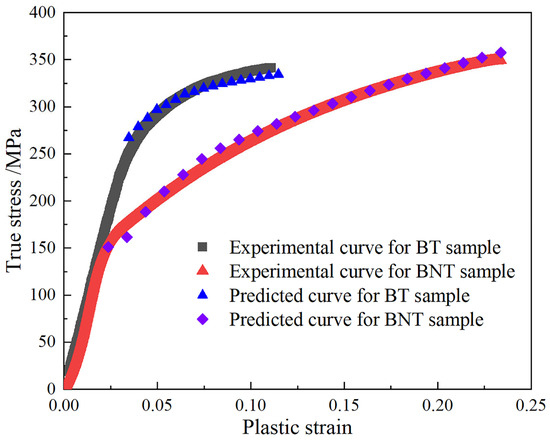
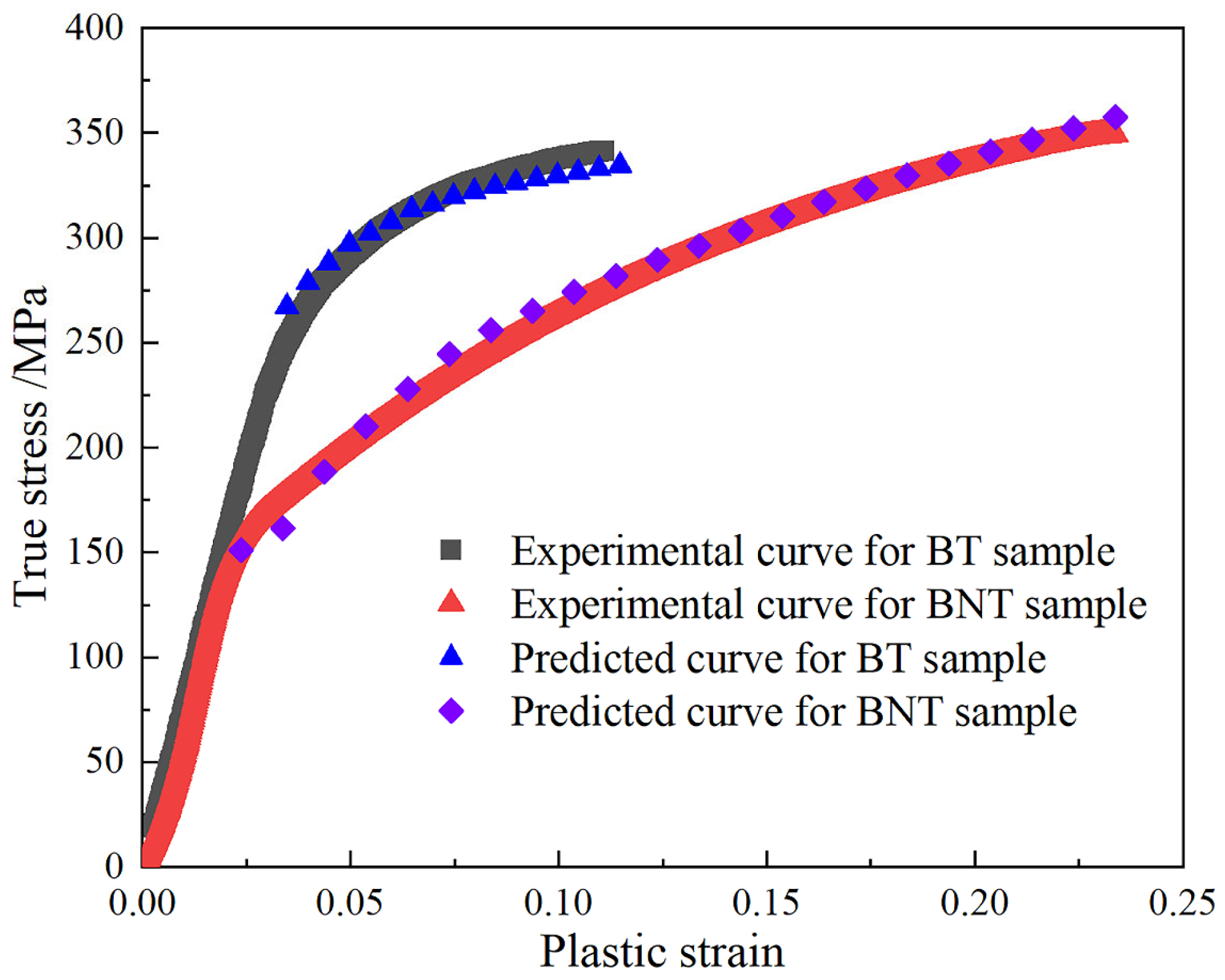
Figure 2 presents the mechanical responses of the BNT sample and BT sample during cryogenic tensile experiments. It can be seen that the fracture elongation (FE) and the 0.2% proof yield stress (YS) of these two specimens are significantly different from each other. The FE value of BT sample is ~0.11, while the FE value of BNT sample is as high as ~0.23, which is ~109.1% larger than that of BT sample. Chen et al. [18] have reported that the FE values of the BNT sample and BT sample are ~0.24 and ~0.14, respectively, during tensile deformation at room temperature. Obviously, the FE values of the BNT sample and BT sample at the cryogenic temperature are slightly decreased by comparison with those at room temperature. The underneath mechanisms for the abovementioned phenomenon will be discussed in the following section. With regard to YS, the YS value of the BT sample is ~259 MPa, while the YS value of the BNT sample is only ~155 MPa, which is ~40.2% smaller than that of the BT sample. Similar results have been observed in [18], where the YS value (~73 MPa) of the BNT sample during tensile deformation at room temperature is ~55.2% lower than that (~163 MPa) of the BT sample. This issue is attributed to the effect of texture softening induced by the bimodal non-basal texture.
Figure 2.
Measured mechanical responses of BNT sample and BT sample during cryogenic tensile deformation as well as predicted results via VPSC modeling.
The obtained mechanical response of the BNT sample in Figure 2 is further applied to verify these needed material parameters in the VPSC model. During the calibration process, the particle swarm optimization (PSO) algorithm is used in the present study, instead of the commonly adopted “trial-error” method which artificially regulates these values of material parameters via the optical observation on the difference between the experimental result and the predicted one. A specific description of the PSO algorithm can be found elsewhere [19]. Actually, by automatically tracking the personal best (pBest) and global best (gBest) in each iteration, the PSO algorithm shows high efficiency and accuracy during the identification of material parameters, as reported by our previous studies [20,21]. These identified material parameters are obtained and presented in Table 1, and the corresponding predicted mechanical responses are displayed in Figure 2. Obviously, these numerical results demonstrate high consistency with regard to these experimental results. It is worth noting that the hardening behaviors of these two samples are quite different from each other. Therefore, these , and values, which are closely associated with the hardening response, are different for the BNT sample and BT sample. Besides, it is interesting to note that {10-12} ET, instead of basal <a> slip, possesses the lowest critical resolved shear stress (CRSS) at the cryogenic temperature. This phenomenon agrees well with the reported results by Jain et al. [3].
Table 1.
Identified material parameters for BNT sample and BT sample in VPSC modeling (MPa).
3.2. Microstructure Evolution of BNT Sample and BT Sample at Cryogenic Temperature
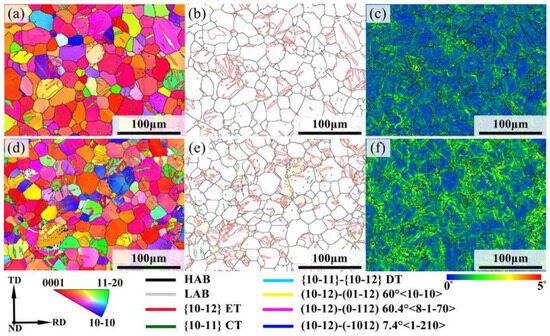
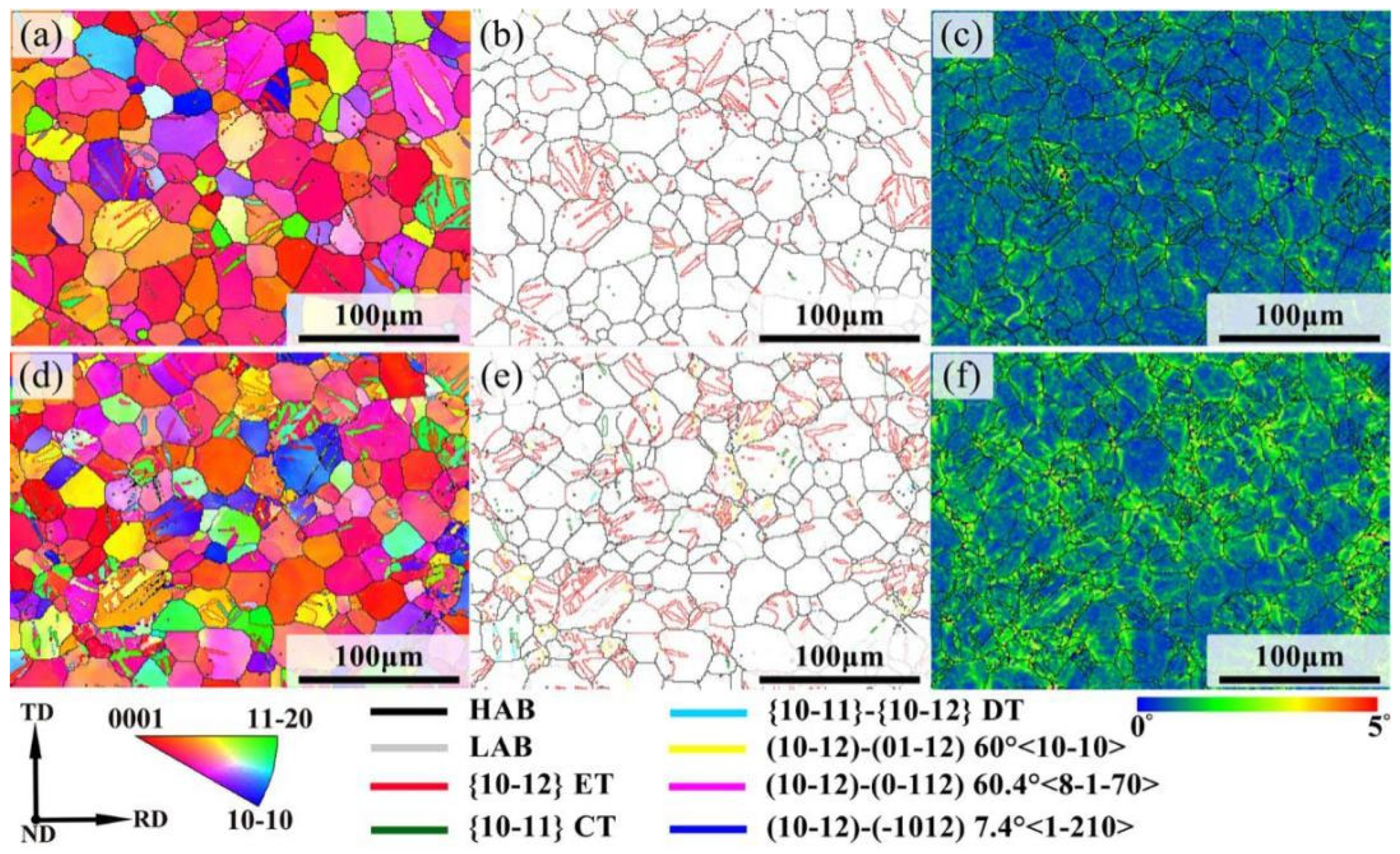
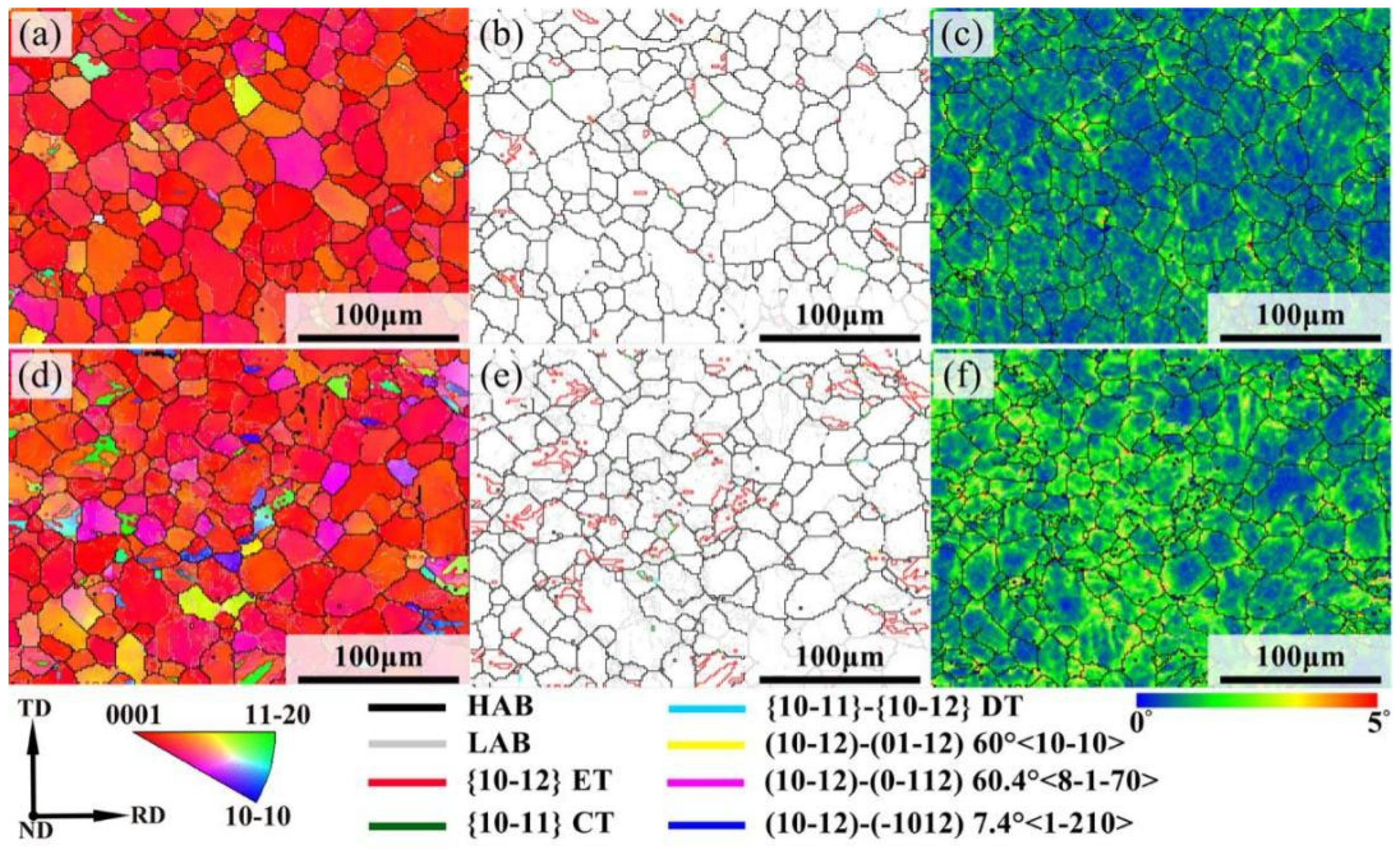
Figure 3 and Figure 4 illustrate the microstructure characteristics of samples deformed to true strains of 0.04 and 0.08 via the inverse pole figure (IPF) map, the grain boundary (GB) map, and the kernel average misorientation (KAM) map. In the present study, these boundaries with misorientations between 2° to 15° are known as the low angle boundaries (LABs) and are highlighted by grey lines, while these boundaries with misorientations larger than 15° are referred to as the high angle boundaries (HABs) and are highlighted by black lines. These identified twinning modes in the present study include {10-12} ET (red line), {10-11} CT (green line), and {10-11}-{10-12} DT (blue line). In addition, three types of {10-12}-{10-12} twin–twin interactions, as reported by Nave and Barnett [22], are also considered and highlighted in the present study, including (10-12)-(01-12) by a yellow line, (10-12)-(-1012) by a sky blue line, and (10-12)-(0-112) by a pink line. The HKL Channel 5 software is applied to calculate these KAM values using the average misorientation between a given pixel and its nearest neighboring pixels. In fact, the KAM value is not only directly associated with the deformation heterogeneity at microscale and the geometrically necessary dislocation density [5,23], but also indirectly correlated with the statistically stored dislocation density, which sustains plastic strain during the plastic deformation of metallic materials [24].
Figure 3.
EBSD analysis of BNT sample deformed to true strain of 0.04 and 0.08: (a,d) IPF maps; (b,e) GB maps; and (c,f) KAM maps.
Figure 4.
EBSD analysis of BT sample deformed to true strain of 0.04 and 0.08: (a,d) IPF maps; (b,e) GB maps; and (c,f) KAM maps.
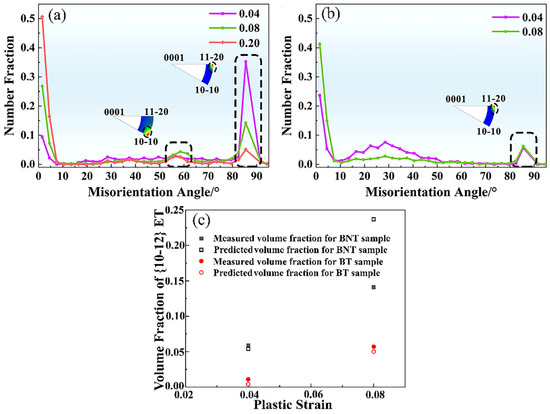
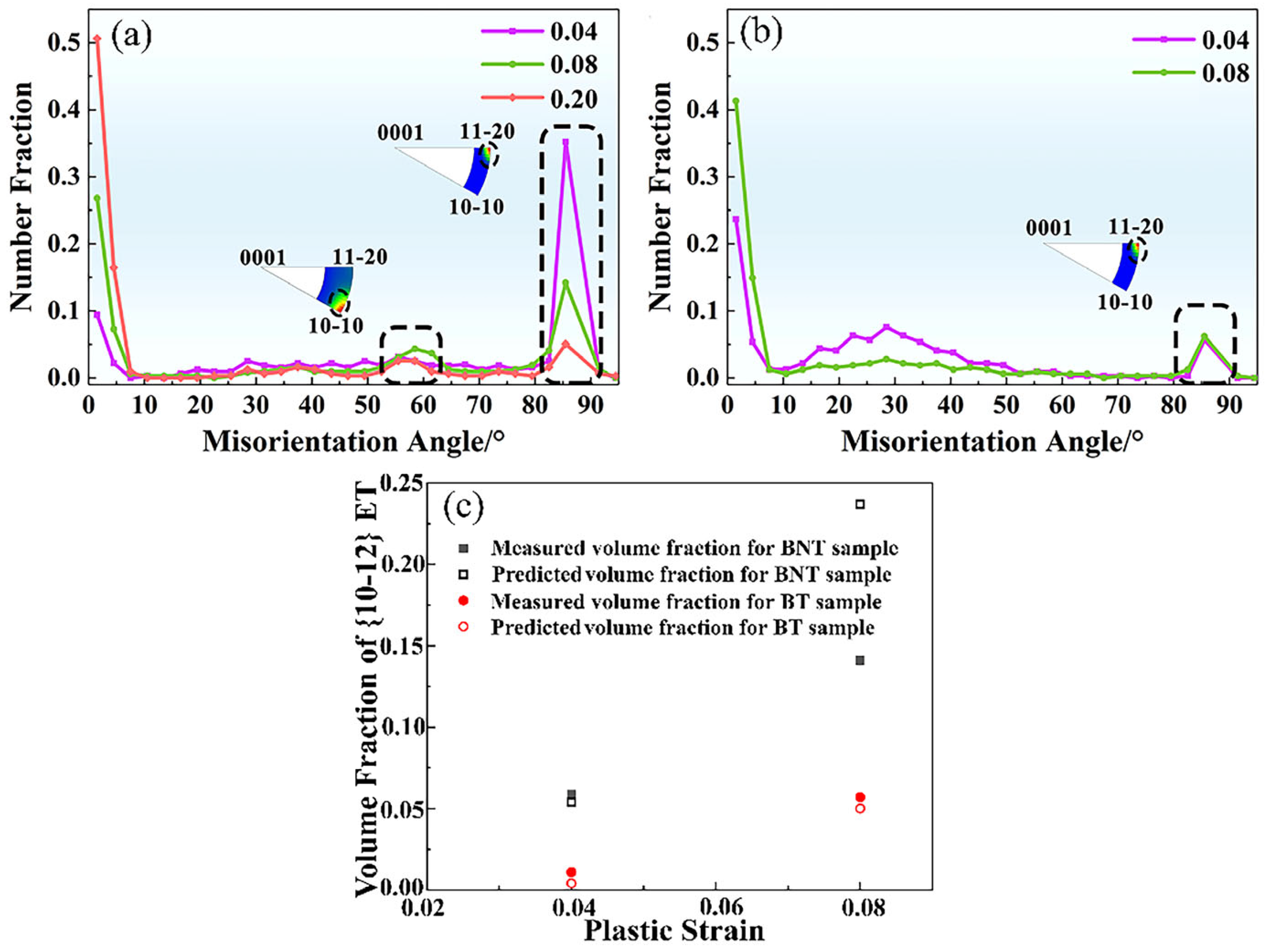
For the BNT sample deformed to the true strain of 0.04, IPF and GB maps in Figure 3a,b show that {10-12} ETs are extensively activated. These {10-12} ET lamellas are thin, and most of them are non-intersecting with each other. The misorientation angle distribution (MAD) map in Figure 5a confirms that the relative frequency of 86.3°/<11-20>-type boundary is remarkably higher than those of other grain boundaries. As true strain increases to 0.08, these {10-12} ET lamellas thicken, interact with each other, and gradually swallow the matrix grains, as shown in Figure 3d,e. This issue can be verified by the decreasing tendency of the relative frequency of the {10-12} ET boundary in Figure 5a and the increasing tendency of volume fraction of {10-12} ET in Figure 5c. Furthermore, Figure 5a confirms that these observed twin–twin interactions mainly belong to (10-12)-(01-12) twin–twin interactions (60.0°<10-10>). Similar phenomenon has been reported in our previous study about the microstructure characteristics of cryogenic-rolled BNT sample [8].
Figure 5.
Statistical analysis of misorientation angle of (a) BNT sample and (b) BT sample and statistical analysis of volume fraction of {10-12} ET within both deformed samples (c) during cryogenic tensile deformation.
With respect to BT samples deformed to the true strain of 0.04 and 0.08, {10-12} ETs can be seldom observed at the true strain of 0.04 and then occur more frequently at the true strain of 0.08, as shown in Figure 4a,b,d,e. Accordingly, Figure 5c shows that the volume fraction of {10-12} ET is as low as 0.01 at the true strain of 0.04 and only about 0.06 at the true strain of 0.08 for the BT sample. Meanwhile, {10-11} CTs and {10-11}-{10-12} DTs can rarely be identified in these deformed microstructures. The corresponding MAD map in Figure 5b also confirms this observation, and only small peaks referring to {10-12} ETs occur here. Actually, this has also been reported by Wang et al. [4]. Based on the KAM maps of Figure 4c,f, the calculated average KAM values of BT samples deformed to true strain of 0.04 and 0.08 are ~0.90 and ~1.27, respectively. These values are obviously larger than the average KAM values of ~0.72 and ~0.98 at corresponding strains for deformed BNT samples. The effect of this difference on the plastic deformation of BNT samples and BT samples during the cryogenic tensile experiment will be discussed in the following section.
Furthermore, the predicted volume fractions of {10-12} ET within both deformed samples via VPSC modeling are also included in Figure 5c. It is clear that the difference between measured results and predicted ones are rather small at a true strain of 0.04. This could further verify the reliability of obtained material parameters in the present study. However, the predicted volume fraction of {10-12} ET at a true strain of 0.08 for the BNT sample is about 0.24, which is about 0.10 larger than that of the measured volume fraction of {10-12} ET. This phenomenon has also been reported in our previous study [25], where disagreement between VPSC predictions and experiments inevitably occurred as the interaction between twin variants cannot be effectively and concisely considered in this current-version VPSC simulation.
3.3. Texture Evolution of BNT Sample and BT Sample at Cryogenic Temperature
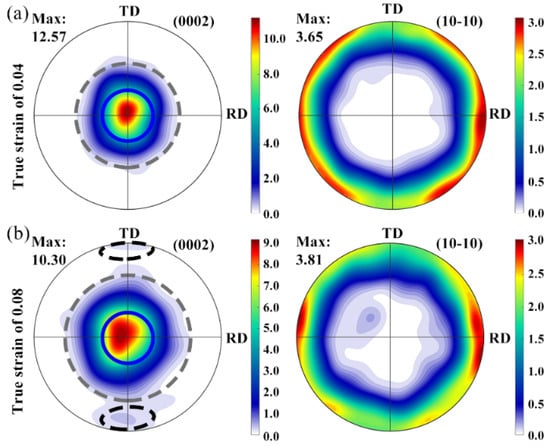
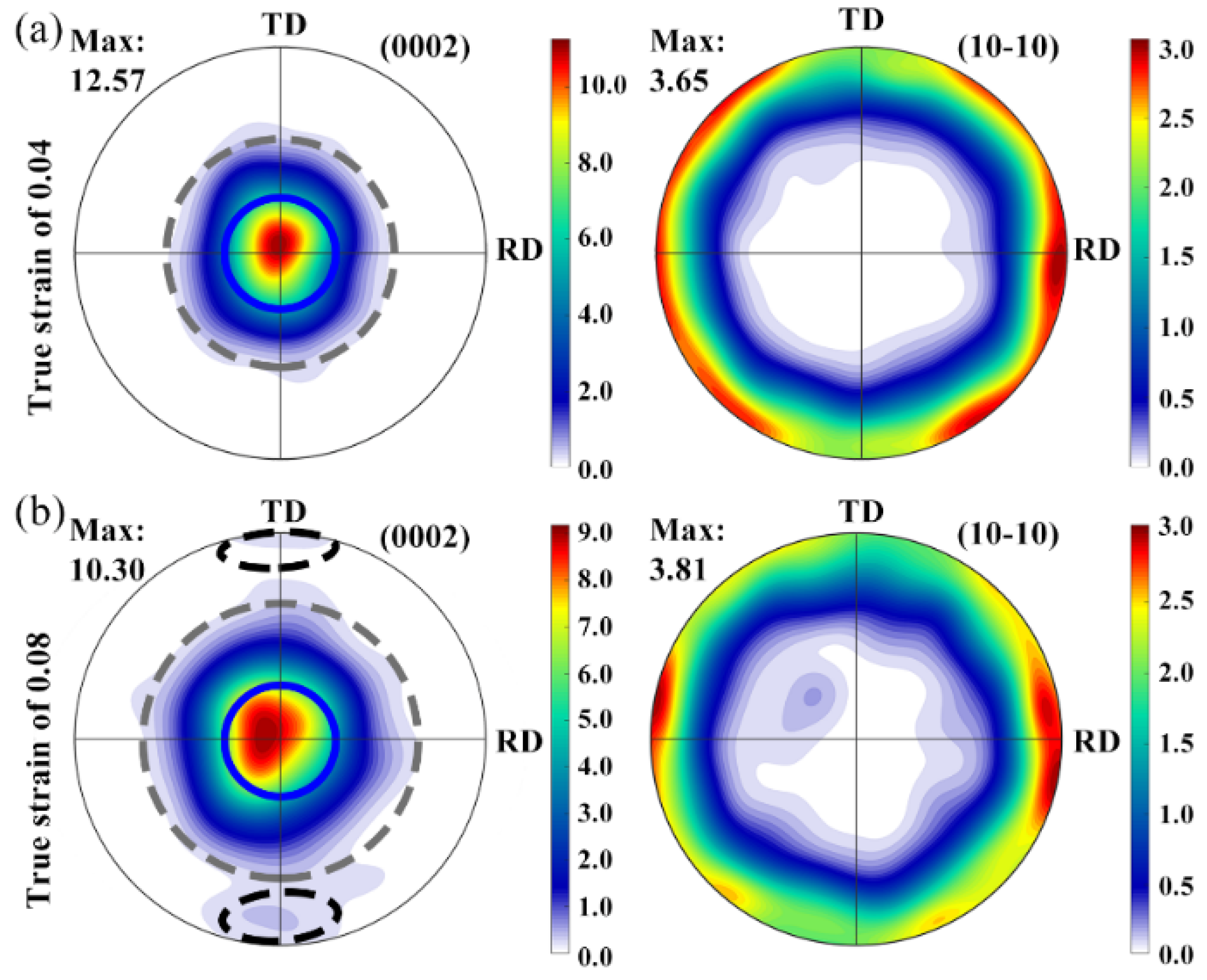
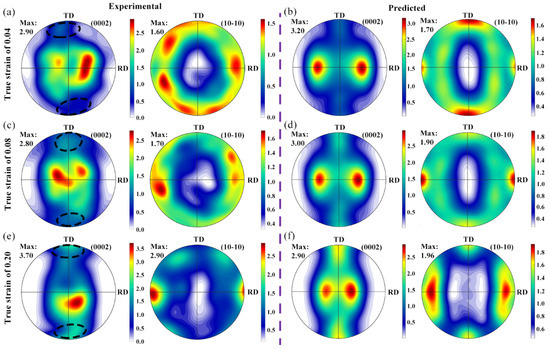
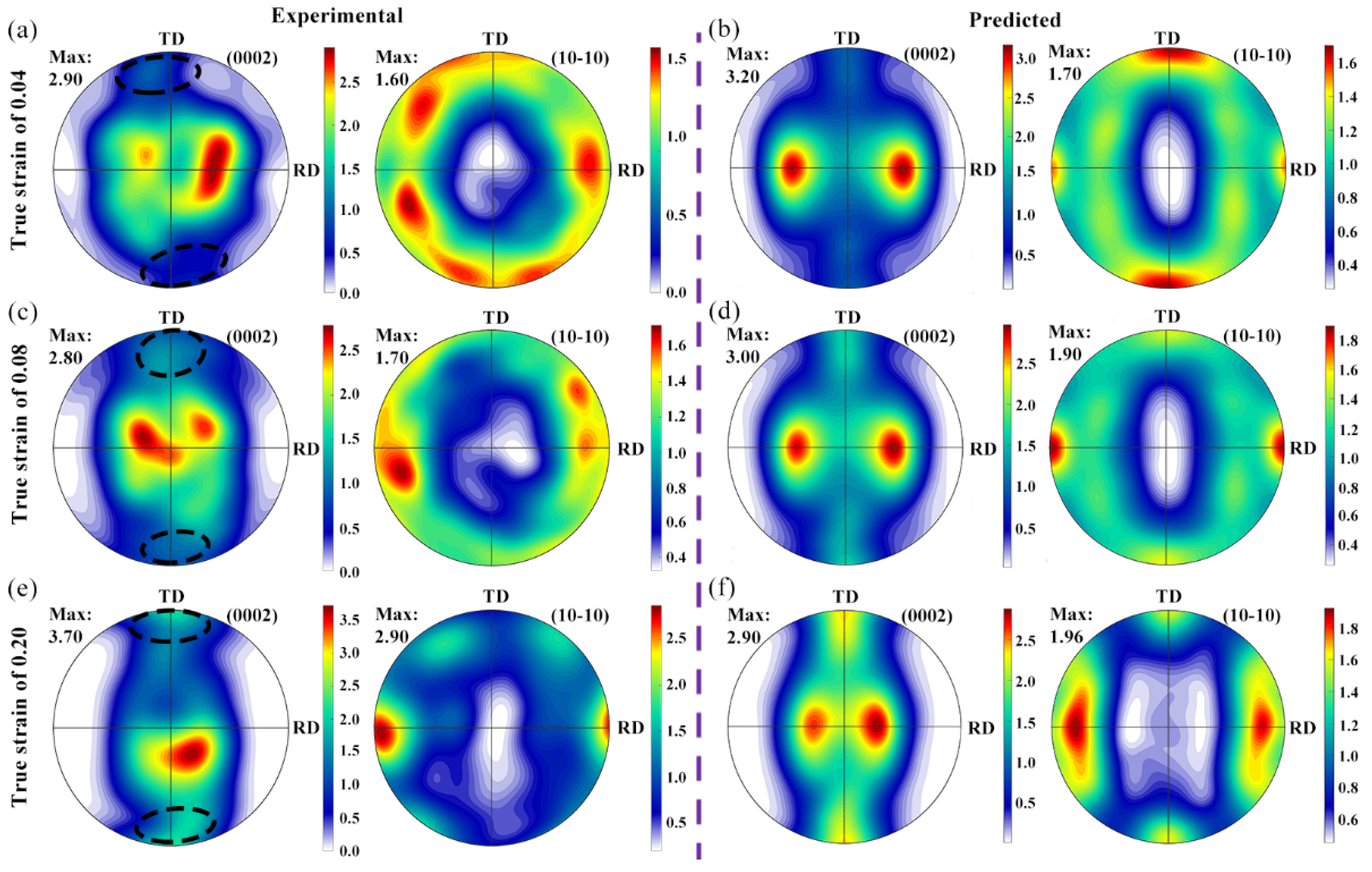
Figure 6 and Figure 7 depict the texture evolution of both samples via (0002) and (10-10) pole figures. As for BT sample, the basal pole tends to diffuse with the progression of plastic strain via the highlighted grey dotted circle in Figure 6. The corresponding maximum intensity of the (0002) pole figure decreases from 12.57 times random to 10.30 times random. In addition, a minor TD-texture component (c-axis//TD), highlighted by black dotted circle, has been formed at the true strain of 0.08 in Figure 6b. With regard to the BNT sample, these two tilted basal poles in the (0002) pole figure concentrate obviously towards ND (c-axis//ND) during cryogenic tensile deformation, as shown in Figure 7a,c,e. Besides, a new TD-texture component occurs at the early stage of cryogenic tensile deformation, as shown in Figure 7a. Afterwards, this generated TD-texture component tends to enhance gradually with the progression of plastic strain. The corresponding predicted results of texture evolution during cryogenic tensile deformation of the BNT sample are shown in Figure 7b,d,f. Clearly, these predicted (0002) and (10-10) pole figures rightly show the aforementioned main texture characteristics of the BNT sample in Figure 7a,c,e. This could further verify the reliability of fitted material parameters in the present study. It is worth noting that the separated angle between ND and maximum intensity in the (0002) pole figure is relatively smaller in the experimental result than in the predicted result under the same plastic strain. Reasons leading to this phenomenon will be discussed in the following section.
Figure 6.
Texture evolution of BT sample during cryogenic tensile experiment: (a) at true strain of 0.04 and (b) at true strain of 0.08.
Figure 7.
Comparison between the measured and predicted texture evolution of the BNT sample during cryogenic tensile deformation: (a,b) at true strain of 0.04; (c,d) at true strain of 0.08; and (e,f) at true strain of 0.20.
4. Discussion
4.1. Underlying Mechanisms of Flow Stress for BNT Sample
Compared with the reported mechanical properties of the BNT sample and BT sample during tensile deformation at room temperature [18], the cryogenic temperature remarkably enhances the corresponding mechanical properties during tensile deformation. The YS values of BNT sample and BT sample are elevated by ~82 MPa and ~96 MPa, respectively. Although there exists an obvious difference between the average grain size of studied samples and the ones reported in [18] (35.51 μm vs. 14.91 μm for BNT samples and 34.82 μm vs. 11.05 μm for BT samples), this difference in grain size is not the key reason resulting in the abovementioned improvement in YS. An estimate of this effect can be made through the Hall–Petch relationship:
where the flow strength of is the function of the mean grain size (). The coefficient and represent the lattice friction stress and the stress intensity constant, respectively. Based on the reported investigations about the Hall–Petch relationship in Mg alloys by Yu et al. [26], the value of the BNT sample and BT sample in [18] at room temperature can be used as ~250 MPa μm1/2, whereas the value of the BNT sample and BT sample in the present study at the cryogenic temperature can be applied as ~350 MPa μm1/2. Consequently, the reduction in YS values resulting from the difference in grain size is calculated to be as low as ~6.01 MPa for the BNT sample and ~15.89 MPa for the BT sample. Chapuis et al. [27] have reported that the huge increase in YS for the Mg alloy is mainly attributed to the effect of a temperature decrease on improving the initial CRSS values of involved deformation mechanisms, which corresponds to the values of in VPSC simulation. Specifically, a basal <a> slip and {10-12} ET are two approximately athermal deformation modes, and their initial CRSS values are relatively insensitive to temperature change. By comparison, the remaining slip modes and twinning modes are thermally activated ones to different extents, and their initial CRSS values increase markedly with decreasing temperature. This issue has been verified by the fitted material parameters in VPSC modeling of a AZ80 Mg alloy deformed at room temperature and cryogenic temperature, as reported by Jain et al. [3].
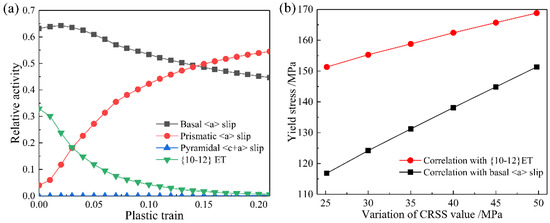
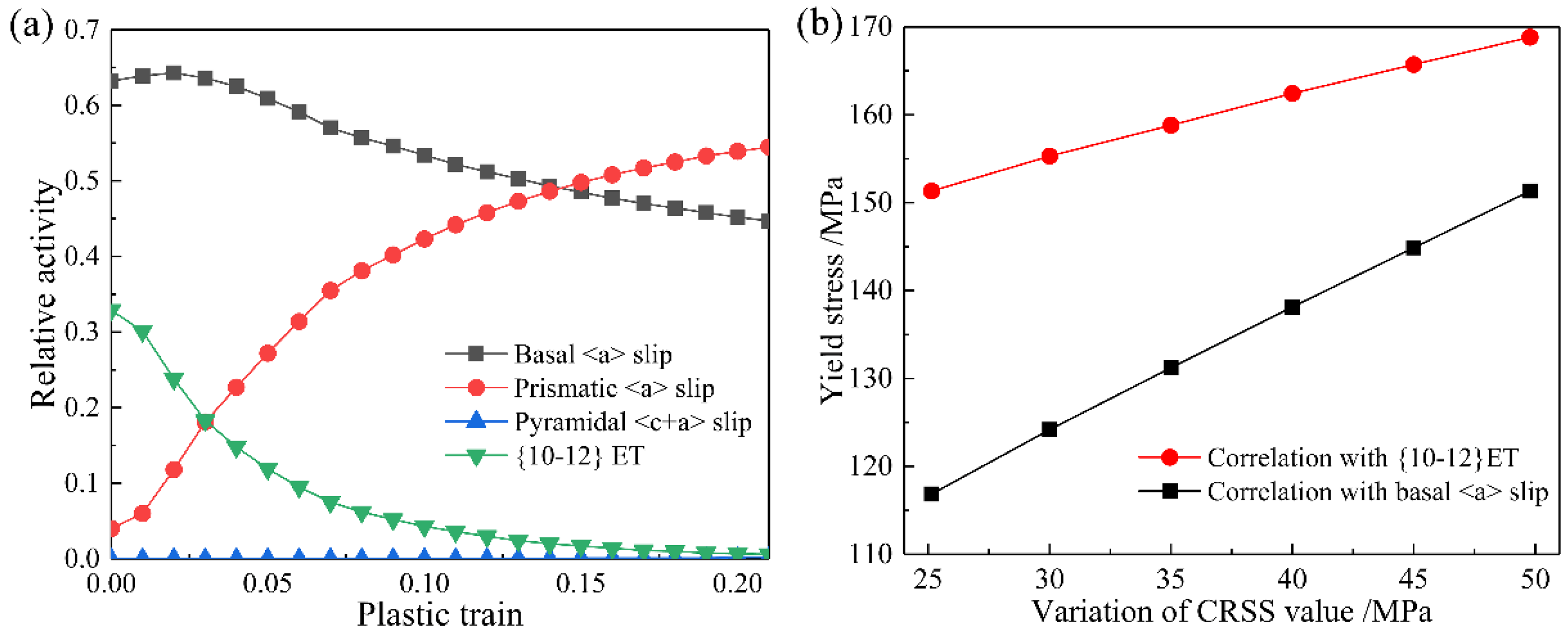
To determine which deformation mechanisms are key ones affecting the YS of BNT sample during cryogenic tensile deformation, the predicted slip and twinning activities are depicted in Figure 8a. Since the VPSC model excludes the elastic–plastic transition, the predicted YS is defined as the flow stress at a plastic strain of 0.2% to maintain the consistency with the experimental 0.2% proof stress. As shown in Figure 8a, basal <a> slip and {10-12} ET are two major deformation mechanisms at the onset of plastic strain for the BNT sample. This issue is different from the predicted results regarding the Mg alloy with basal texture at cryogenic temperature, where basal <a> slip and prismatic <a> slip are the major mechanisms sustaining plastic strain at the beginning of cryogenic tensile deformation [3]. Therefore, it can be concluded that the YS of BNT sample during cryogenic tensile deformation is collectively determined by basal <a> slip and {10-12} ET. In addition, Figure 8b shows how a variation of initial CRSS will affect the YS of BNT sample. For this purpose, univariate analysis is applied in the present study. For example, the initial CRSS for {10-12} ET would be changed at a constant interval from its fitted value in Table 1 to the one for basal <a> slip. Meanwhile, the initial CRSS values for other deformation mechanisms are kept to their fitted values. Obviously, the CRSS variation for basal <a> slip possesses relatively high sensitivity to the predicted YS, while the CRSS variation for {10-12} ET possesses relatively low sensitivity to the predicted YS. Chapuis et al. [13] have reported similar phenomenon, and they correlate it with the activation degree of a given deformation mode.
Figure 8.
(a) Predicted slip and twinning activities of BNT sample during cryogenic tensile deformation and (b) simulated YS dependence with CRSS variation for basal <a> slip and {10-12} ET.
4.2. Underlying Mechanisms of Texture Evolution for BNT Sample
Chen et al. [18] and Hu et al. [25] have confirmed that the extensive activation of {10-12} ET is responsible not only for the appearance of TD-texture component in (0002) pole figure, but also for the obvious concentration of tilted basal poles towards ND. Therefore, the observed texture characteristics at true strain of 0.04 and 0.08 (Figure 7a,c) can be understood because {10-12} ET could serve as a major deformation mechanism at the early stage of cryogenic tensile deformation for the BNT sample. With the progression of plastic strain, Figure 8a demonstrates that basal <a> slip and prismatic <a> slip are the major ones to sustain plastic strain. This is different from the reported mechanisms of BNT sample deformed at room temperature [25], where except for basal <a> slip and prismatic <a> slip, pyramidal <c+a> slip also plays an important role in accommodating plastic strain. It has been generally accepted that basal <a> slip is beneficial for concentrating the c-axis of grain to ND, prismatic <a> slip mainly leads to the rotation of grain around its c-axis, and pyramidal <c+a> slip tends to rotate the c-axis of grain to loading direction during tensile deformation [28,29]. Therefore, the further concentration of tilted basal poles at true strain of 0.20 in Figure 7e can also be explained due to the extensive activation of basal <a> slip. Meanwhile, as there only exists rare activation of pyramidal <c+a> slip from the beginning of plastic deformation, as shown in Figure 8a, there is ample reason to believe that the separated angle showing the separation degree between ND and maximum intensity in (0002) pole figure would be smaller to some extent in the case of cryogenic tensile deformation of the BNT sample than in the case of tensile deformation of the BNT sample at room temperature.
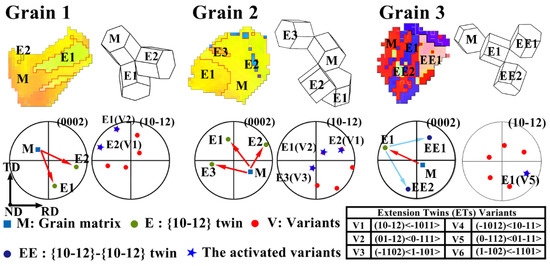
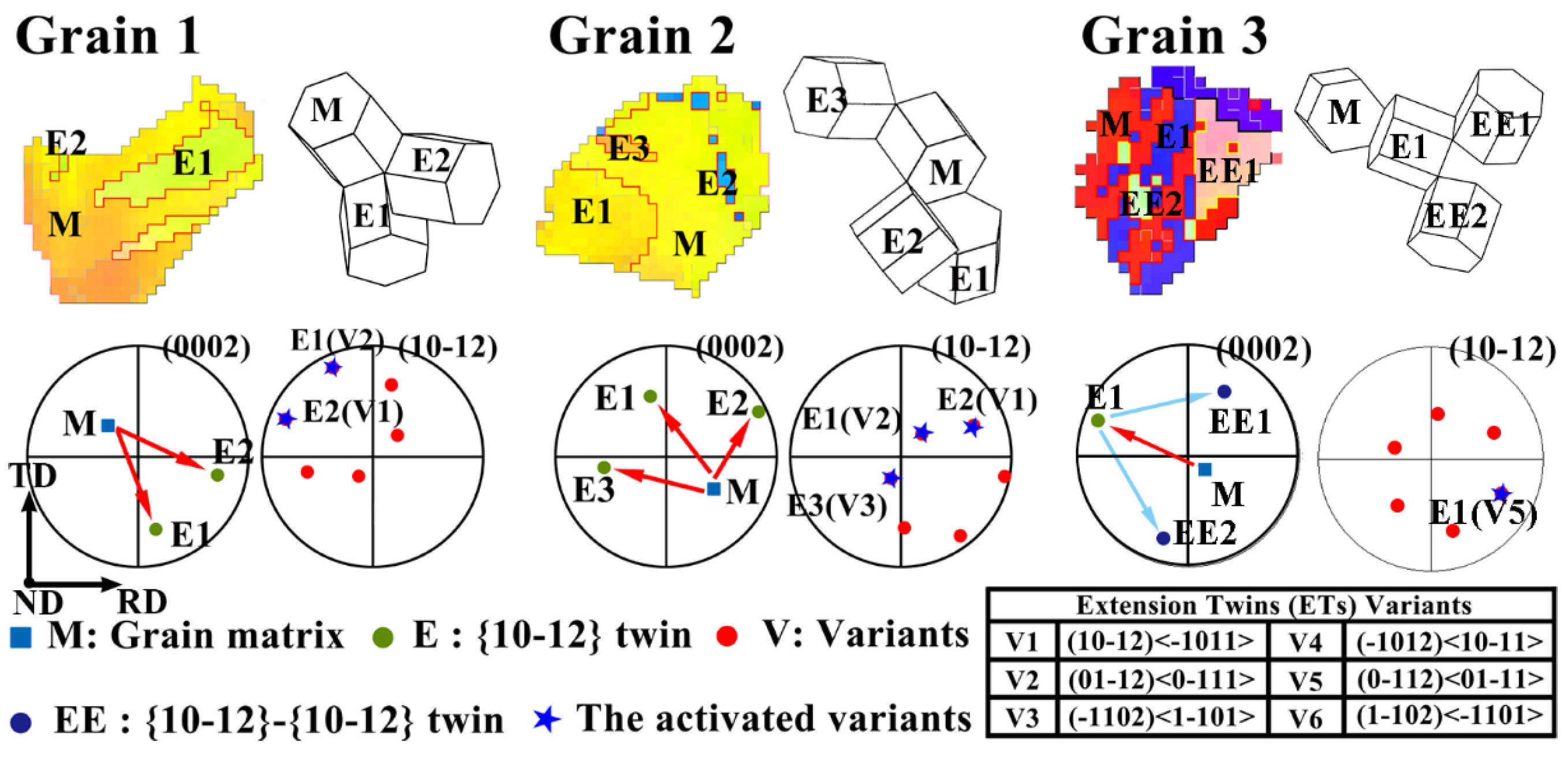
Moreover, it is worth noting that the concentration degrees of tilted basal poles for measured results and predicted results have some difference to each other, as shown in Figure 7. Specifically, the separated angle showing the separation degree between ND and maximum intensity in (0002) pole figure is relatively smaller in the experimental result than in the predicted result under the same deformation degree. This indicates that there may exist additional mechanisms, which have not been considered in the conducted VPSC modeling. To verify this point, three representative grains are selected from the deformed BNT sample at true strain of 0.08. Their IPF maps, (0002), (10-12) pole figure maps, and the corresponding schematic representations based on 3D orientation in the crystal frame are displayed in Figure 9. It is clear that multiple {10-12} ET variants are activated within these grains, which mainly rotate the c-axis of grain to ND and TD. Table 2 shows the theoretical Schmid factor (SF) values of six {10-12} ET variants, and these actually activated variants are marked in bold. It is worth noting that some SF values in bold are negative, demonstrating that these selected grains are to a certain extent not favorable for the activation of {10-12} ET. This has not been observed and reported at the early stage of tensile deformation for the BNT sample at room temperature [18]. Guo et al. [30] and Zhang et al. [8] both reported the occurrence of {10-12} ET variants with negative SF values, and they attribute this to the necessity of accommodating deformation between neighboring grains of Mg alloys during plastic deformation. Actually, this impact of {10-12} ET has not been considered in the current version of VPSC modeling in the present study. Besides, Figure 9 also shows the occurrence of rarely reported {10-12}-{10-12} DT in the BNT sample deformed to the true strain of 0.08. Stress concentration in local regions and the inhibition of activities for non-basal slips at low temperature are responsible for the formation of this unusual {10-12}-{10-12} DT [31,32]. Actually, {10-12}-{10-12} DT has not yet been considered in VPSC modeling in the present study.
Figure 9.
IPF maps, (0002), (10-12) pole figure maps, and the corresponding schematic representations based on 3D orientation in the crystal frame within three selected grains of the BNT sample deformed to the true strain of 0.08.
Table 2.
Calculated SF values of six {10-12} variants of selected grains in Figure 9.
4.3. Underlying Mechanisms Responsible for Good FE in BNT Sample
Compared with the reported FE value (~0.24) of the BNT sample during tensile deformation at room temperature [18], only a minor decrease of ~0.01 has been observed in the BNT sample during cryogenic tensile deformation. The underlying mechanisms can be concluded as follows: At the onset of deformation, basal <a> slip and {10-12} ET would be extensively activated to sustain plastic strain. Meanwhile, the cryogenic temperature benefits in activating additional {10-12} ETs with negative SF values to accommodate deformation between neighboring grains. With the progression of plastic strain, prismatic <a> slip begins to sustain more plastic strain. At the same time, plastic strain can also be sustained via the thicken of these activated {10-12} ET lamellas, the multiplication of (10-12)-(01-12) twin–twin intersection, and the formation of unusual {10-12}-{10-12} DT. Due to the remarkable thermal sensitivity of initial CRSS (380.25 MPa), pyramidal <c+a> slip can seldom be activated in the present study. This is different from the reported result that pyramidal <c+a> slip serves as a major mechanism to coordinate plastic deformation between neighboring grains for BNT sample deformed at room temperature [25]. However, the cryogenic temperature contributes to the formation of {10-12}-{10-12} DT in the deformed BNT sample. Zhang et al. [33] and Hu et al. [25] reported that the formation of this unusual {10-12}-{10-12} DT benefits in accommodating in-homogeneous plastic strain and relieving the stress concentration of Mg alloy at low temperature. This is favorable for the good FE of the BNT sample during cryogenic tensile deformation.
5. Conclusions
In the present study, specific microstructure characterization via EBSD measurement and numerical simulation via VPSC simulation has been conducted to explore the underlying mechanisms of mechanical properties and the microstructure evolution in a bimodal non-basal textured AZ31 Mg alloy sheet during cryogenic tensile deformation. The following conclusions can be drawn:
- The studied BNT sample possesses a FE value of ~0.23 and a YS value of ~155 MPa during cryogenic tensile deformation. This obtained FE value is quite close to that (~0.24) of the BNT sample at room temperature, showing the good plasticity of this bimodal non-basal textured AZ31 Mg alloy sheet at cryogenic temperature. The major characteristic of texture evolution is as follows: Those tilted basal poles concentrate obviously towards ND (c-axis//ND). Meanwhile, a TD-texture component (c-axis//TD) begins to emerge and enhance gradually with the increasing plastic strain.
- The initial YS value of the studied BNT sample at cryogenic temperature is mainly determined by the activation of a basal <a> slip and {10-12} ET. Although the initial CRSS (49.79 MPa) of a basal <a> slip is larger than that (25.14 MPa) of {10-12} ET, the initial YS value is more sensitive to the variation of CRSS for a basal <a> slip.
The obvious concentration of the c-axis of grain to ND at the early stage of cryogenic tensile deformation is mainly due to the extensive activation of {10-12} ET. By comparison, the concentration of the c-axis of grain towards ND at the later stage of cryogenic tensile deformation is mainly derived from the heavily activated basal <a> slip. In the current version of VPSC, as the role of {10-12} ET for coordinating plastic deformation between neighboring grains and the role of {10-12}-{10-12} DT cannot be effectively and concisely considered, the discrepancies between simulation and experimental results about texture characteristics and twin volume fraction are inevitable. This can also serve as a promising research direction for future VPSC simulations.
Author Contributions
Conceptualization, L.H.; Methodology, Q.G. and L.H.; Formal analysis, S.Z. and L.W.; Investigation, Q.G.; Data curation, S.Z. and L.W.; Writing – original draft, Q.G.; Writing—review & editing, L.H.; Visualization, S.Z. and L.W. All authors have read and agreed to the published version of the manuscript.
Funding
This research was funded by the Research and Innovation Team Cultivation Project of Chongqing University of Technology (Grant No. 2023TDZ010).
Data Availability Statement
The original contributions presented in this study are included in the article. Further inquiries can be directed to the corresponding author.
Conflicts of Interest
The authors declare no conflicts of interest.
Abbreviations
The following abbreviations are used in this manuscript:
| BNT | Bimodal Non-Basal Textured |
| BT | Basal Texture |
| CRSS | Critical Resolved Shear Stress |
| CT | Compression Twin |
| DT | Double-Twin |
| EBSD | Electron Back-Scattered Diffraction |
| ECAR-CB | Equal Channel Angular Rolling-Continuous Bending |
| ET | Extension Twin |
| FE | Fracture Elongation |
| GB | Grain Boundary |
| HABs | High Angle Boundaries |
| HCP | Hexagonal Close-Packed |
| IPF | Inverse Pole Figure |
| KAM | Kernel Average Misorientation |
| LABs | Low Angle Boundaries |
| MAD | Misorientation Angle Distribution |
| Mg | Magnesium |
| ND | Normal Direction |
| ODF | Orientation Distribution Function |
| OM | Optical Microstructure |
| PSO | Particle Swarm Optimization |
| PTR | Predominant Twin Reorientation |
| RD | Rolling Direction |
| SF | Schmid Factor |
| TD | Transverse Direction |
| VPSC | Visco-Plastic Self-Consistent |
| YS | Yield Stress |
References
- Song, J.F.; She, J.; Chen, D.L.; Pan, F.S. Latest research advances on magnesium and magnesium alloys worldwide. J. Magnes. Alloy. 2020, 8, 1–41. [Google Scholar] [CrossRef] [Scilit]
- Chen, B.; Lu, L.W.; Zhang, J.L.; Teng, J.; Chen, L.; Xu, Y.; Wang, T.; Huang, L.; Wu, Z.Q. Investigation on microstructure and mechanical properties of hot-rolled AZ31 Mg alloy with various cryogenic treatments. J. Mater. Res. Technol. 2022, 19, 4557–4570. [Google Scholar] [CrossRef] [Scilit]
- Jain, J.; Poole, W.J.; Sinclair, C.W. The deformation behaviour of the magnesium alloy AZ80 at 77 and 293K. Mater. Sci. Eng. A 2012, 547, 128–137. [Google Scholar] [CrossRef] [Scilit]
- Wang, H.; Dong, S.L.; Lv, G. Plastic deformation characteristics of an Mg-3Al-1Zn alloy at low temperatures. Mater. Des. 2016, 92, 143–150. [Google Scholar] [CrossRef] [Scilit]
- Zhang, K.; Shao, Z.T.; Daniel, C.S.; Turski, M.; Pruncu, C.; Lang, L.H.; Robson, J.; Jiang, J. A comparative study of plastic deformation mechanisms in room-temperature and cryogenically deformed magnesium alloy AZ31. Mater. Sci. Eng. A 2021, 807, 140821. [Google Scholar] [CrossRef] [Scilit]
- Muhammad Rehan Tariq, H.; Masood Chaudry, U.; Ishtiaq, M.; Kim, M.; Ali, M.; Jun, T. Effect of Al addition on the room and cryogenic temperature deformation of Mg-xAl-1Zn-1Ca alloy (x = 2, 3 wt.%). J. Magnes. Alloy. 2024, 12, 4694–4708. [Google Scholar] [CrossRef] [Scilit]
- Tu, J.; Zhou, T.; Liu, L.; Shi, L.X.; Hu, L.; Song, D.H.; Song, B.; Yang, M.B.; Chen, Q.; Pan, F.S. Effect of rolling speeds on texture modification and mechanical properties of the AZ31 sheet by a combination of equal channel angular rolling and continuous bending at high temperature. J. Alloys Compd. 2018, 768, 598–607. [Google Scholar] [CrossRef] [Scilit]
- Zhang, S.Z.; Hu, L.; Ruan, Y.T.; Zhou, T.; Chen, Q.; Zhong, Y.; Shi, L.X.; Li, M.A.; Yang, M.B.; Jiang, S.Y. Influence of bimodal non-basal texture on microstructure characteristics, texture evolution and deformation mechanisms of AZ31 magnesium alloy sheet rolled at liquid-nitrogen temperature. J. Magnes. Alloy. 2022, 11, 2600–2609. [Google Scholar] [CrossRef] [Scilit]
- Hielscher, R.; Schaeben, H. A novel pole figure inversion method: Specification of the MTEX algorithm. J. Appl. Crystallogr. 2008, 41, 1024–1037. [Google Scholar] [CrossRef] [Scilit]
- Lebensohn, R.A.; Tomé, C.N. A self-consistent anisotropic approach for the simulation of plastic deformation and texture development of polycrystals: Application to zirconium alloys. Acta Met. Mater. 1993, 41, 2611–2624. [Google Scholar] [CrossRef] [Scilit]
- Li, H.; Zhang, H.Q.; Yang, H.; Fu, M.W.; Yang, H. Anisotropic and asymmetrical yielding and its evolution in plastic deformation: Titanium tubular materials. Int. J. Plast. 2017, 90, 177–211. [Google Scholar] [CrossRef] [Scilit]
- Kang, J.R.; Liu, X.; Niezgoda, S.R. Crystal plasticity modeling of ultrasonic softening effect considering anisotropy in the softening of slip systems. Int. J. Plast. 2022, 156, 103343. [Google Scholar] [CrossRef] [Scilit]
- Chapuis, A.; Wang, Z.Q.; Liu, Q. Influence of material parameters on modeling plastic deformation of Mg alloys. Mater. Sci. Eng. A 2016, 655, 244–250. [Google Scholar] [CrossRef] [Scilit]
- Li, L.T.; Lin, Y.C.; Li, L.; Shen, L.M.; Wen, D.X. Three-Dimensional Crystal Plasticity Finite Element Simulation of Hot Compressive Deformation Behaviors of 7075 Al Alloy. J. Mater. Eng. Perform. 2015, 24, 1294–1304. [Google Scholar] [CrossRef] [Scilit]
- Chen, Q.; Hu, L.; Shi, L.X.; Zhou, T.; Yang, M.B.; Tu, J. Assessment in predictability of visco-plastic self-consistent model with a minimum parameter approach: Numerical investigation of plastic deformation behavior of AZ31 magnesium alloy for various loading conditions. Mater. Sci. Eng. A 2020, 774, 138912. [Google Scholar] [CrossRef] [Scilit]
- Jain, A.; Agnew, S.R. Modeling the temperature dependent effect of twinning on the behavior of magnesium alloy AZ31B sheet. Mater. Sci. Eng. A 2006, 462, 29–36. [Google Scholar] [CrossRef] [Scilit]
- Tomé, C.N.; Lebensohn, R.A.; Kocks, U.F. A model for texture development dominated by deformation twinning: Application to zirconium alloys. Acta Met. Mater. 1991, 39, 2667–2680. [Google Scholar] [CrossRef] [Scilit]
- Chen, Y.; Hu, L.; Shi, L.X.; Zhou, T.; Tu, J.; Chen, Q.; Yang, M.B. Effect of texture types on microstructure evolution and mechanical properties of AZ31 magnesium alloy undergoing uniaxial tension deformation at room temperature. Mater. Sci. Eng. A 2020, 769, 138497. [Google Scholar] [CrossRef] [Scilit]
- Esmin, A.A.A.; Coelho, R.A.; Matwin, S. A review on particle swarm optimization algorithm and its variants to clustering high-dimensional data. Artif. Intell. Rev. 2015, 44, 23–45. [Google Scholar] [CrossRef] [Scilit]
- Hu, L.; Jiang, S.Y.; Zhang, Y.Q. A combined experimental-numerical approach for investigating texture evolution of NiTi shape memory alloy under uniaxial compression. Metals 2017, 7, 356. [Google Scholar] [CrossRef] [Scilit]
- Hu, L.; Jiang, S.Y.; Zhou, T.; Chen, Q. A coupled finite element and crystal plasticity study of friction effect on texture evolution in uniaxial compression of NiTi shape memory alloy. Materials 2018, 11, 2162. [Google Scholar] [CrossRef] [Scilit]
- Nave, M.D.; Barnett, M.R. Microstructures and textures of pure magnesium deformed in plane-strain compression. Scr. Mater. 2004, 51, 881–885. [Google Scholar] [CrossRef] [Scilit]
- Pantleon, W. Resolving the geometrically necessary dislocation content by conventional electron backscattering diffraction. Scr. Mater. 2008, 58, 994–997. [Google Scholar] [CrossRef] [Scilit]
- Wu, Y.S.; Liu, Z.; Qin, X.Z.; Wang, C.S.; Zhou, L.Z. Effect of initial state on hot deformation and dynamic recrystallization of Ni-Fe based alloy GH984G for steam boiler applications. J. Alloys Compd. 2019, 795, 370–384. [Google Scholar] [CrossRef] [Scilit]
- Hu, L.; Lv, H.Y.; Shi, L.X.; Chen, Y.; Chen, Q.; Zhou, T.; Li, M.A.; Yang, M.B. Research on deformation mechanism of AZ31 magnesium alloy sheet with non-basal texture during uniaxial tension at room temperature: A visco-plastic self-consistent analysis. J. Magnes. Alloy. 2022, 10, 1994–2008. [Google Scholar] [CrossRef] [Scilit]
- Yu, H.; Xin, Y.; Wang, M.; Liu, Q. Hall-Petch relationship in Mg alloys: A review. J. Mater. Sci. Technol. 2018, 34, 248–256. [Google Scholar] [CrossRef] [Scilit]
- Chapuis, A.; Driver, J.H. Temperature dependency of slip and twinning in plane strain compressed magnesium single crystals. Acta Mater. 2011, 59, 1986–1994. [Google Scholar] [CrossRef] [Scilit]
- Zhao, J.; Jiang, B.; Tang, A.T.; Chai, Y.F.; Liu, B.; Sheng, H.; Yang, T.H.; Huang, G.S.; Zhang, D.F.; Pan, F.S. Deformation behavior and texture evolution in an extruded Mg-Li sheet with non-basal texture during tensile deformation. Mater. Charact. 2020, 159, 110041. [Google Scholar] [CrossRef] [Scilit]
- Chapuis, A.; Liu, Q. Simulations of texture evolution for HCP metals: Influence of the main slip systems. Comput. Mater. Sci. 2015, 97, 121–126. [Google Scholar] [CrossRef] [Scilit]
- Guo, C.F.; Xin, R.L.; Xu, J.B.; Song, B.; Liu, Q. Strain compatibility effect on the variant selection of connected twins in magnesium. Mater. Des. 2015, 76, 71–76. [Google Scholar] [CrossRef] [Scilit]
- Xin, R.L.; Ding, C.H.; Guo, C.F.; Liu, Q. Crystallographic analysis on the activation of multiple twins in rolled AZ31 Mg alloy sheets during uniaxial and plane strain compression. Mater. Sci. Eng. A 2016, 652, 42–50. [Google Scholar] [CrossRef] [Scilit]
- Jain, J.; Zou, J.; Sinclair, C.W.; Poole, W.J. Double tensile twinning in a Mg-8Al-0.5Zn alloy. J. Microsc. 2011, 242, 26–36. [Google Scholar] [CrossRef] [Scilit] [PubMed]
- Zhang, K.; Zheng, J.H.; Huang, Y.; Pruncu, C.; Jiang, J. Evolution of twinning and shear bands in magnesium alloys during rolling at room and cryogenic temperature. Mater. Des. 2020, 193, 108793. [Google Scholar] [CrossRef] [Scilit]

Disclaimer/Publisher’s Note: The statements, opinions and data contained in all publications are solely those of the individual author(s) and contributor(s) and not of MDPI and/or the editor(s). MDPI and/or the editor(s) disclaim responsibility for any injury to people or property resulting from any ideas, methods, instructions or products referred to in the content. |
© 2026 by the authors. Licensee MDPI, Basel, Switzerland. This article is an open access article distributed under the terms and conditions of the Creative Commons Attribution (CC BY) license.