
Effects of the Scrap Steel Ratio and Bottom-Blowing Process Parameters on the Fluid Flow Characteristics in a Physical Model of a Steelmaking Converter


Abstract
1. Introduction
2. Materials and Methods
3. Results and Discussion
3.1. Effects of the Scrap Steel Ratio
3.1.1. Mixing Time
3.1.2. Velocity Distribution
3.1.3. Turbulent Characteristics
3.2. Effects of Bottom-Blowing Process Parameters
3.2.1. Mixing Time
3.2.2. Velocity Distribution
3.2.3. Turbulent Characteristics
4. Conclusions
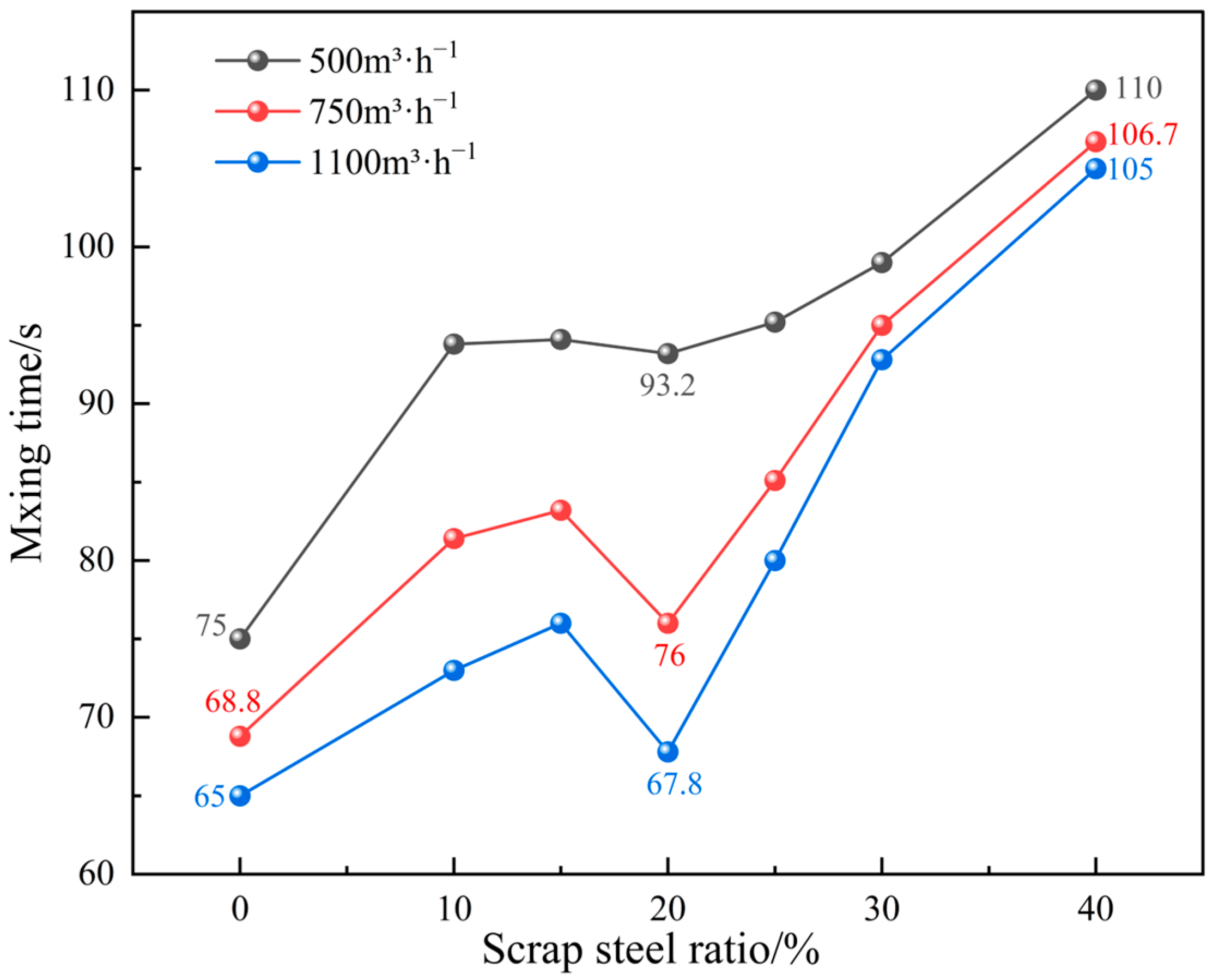
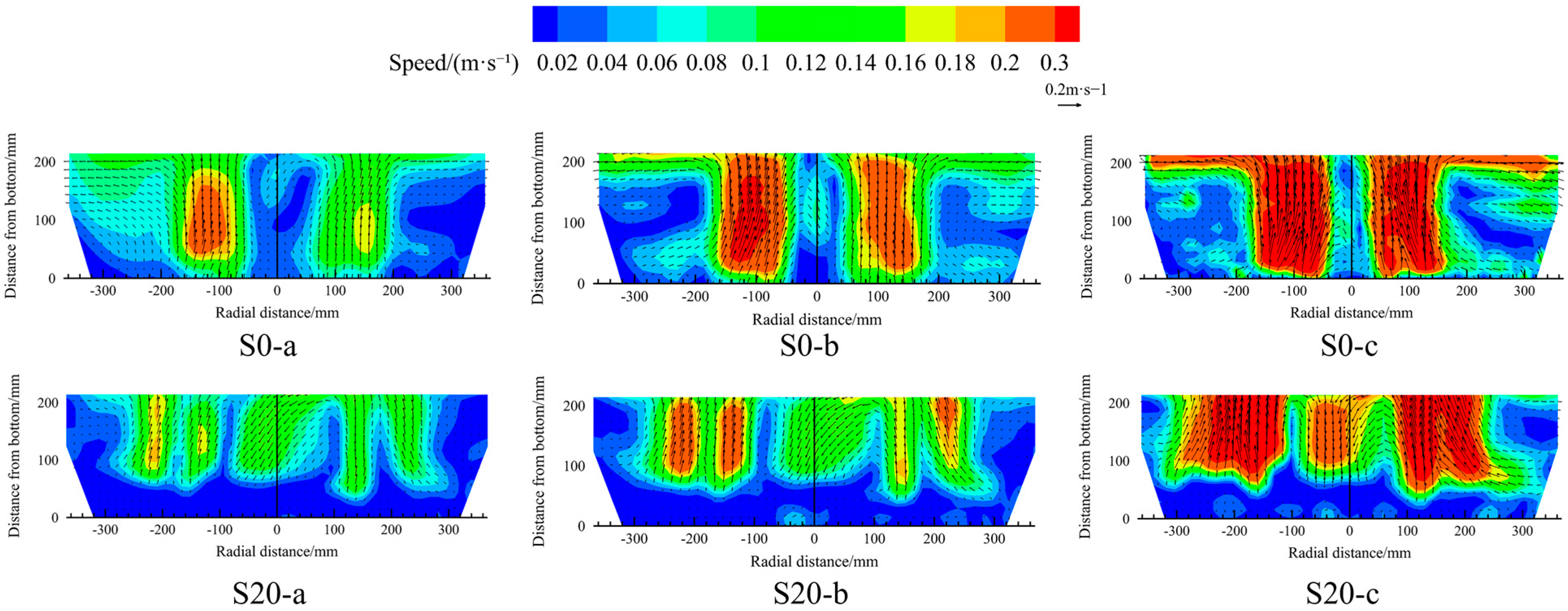
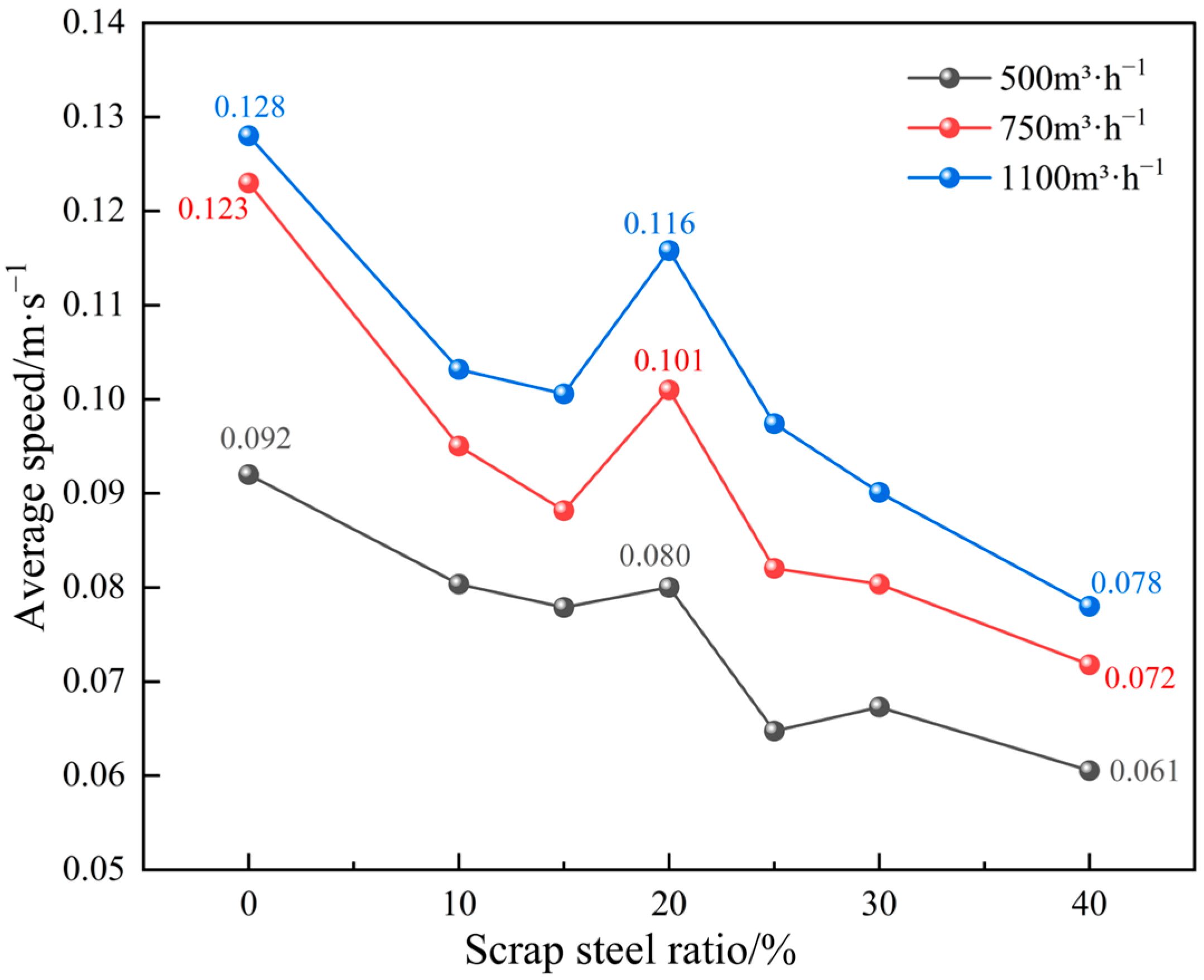
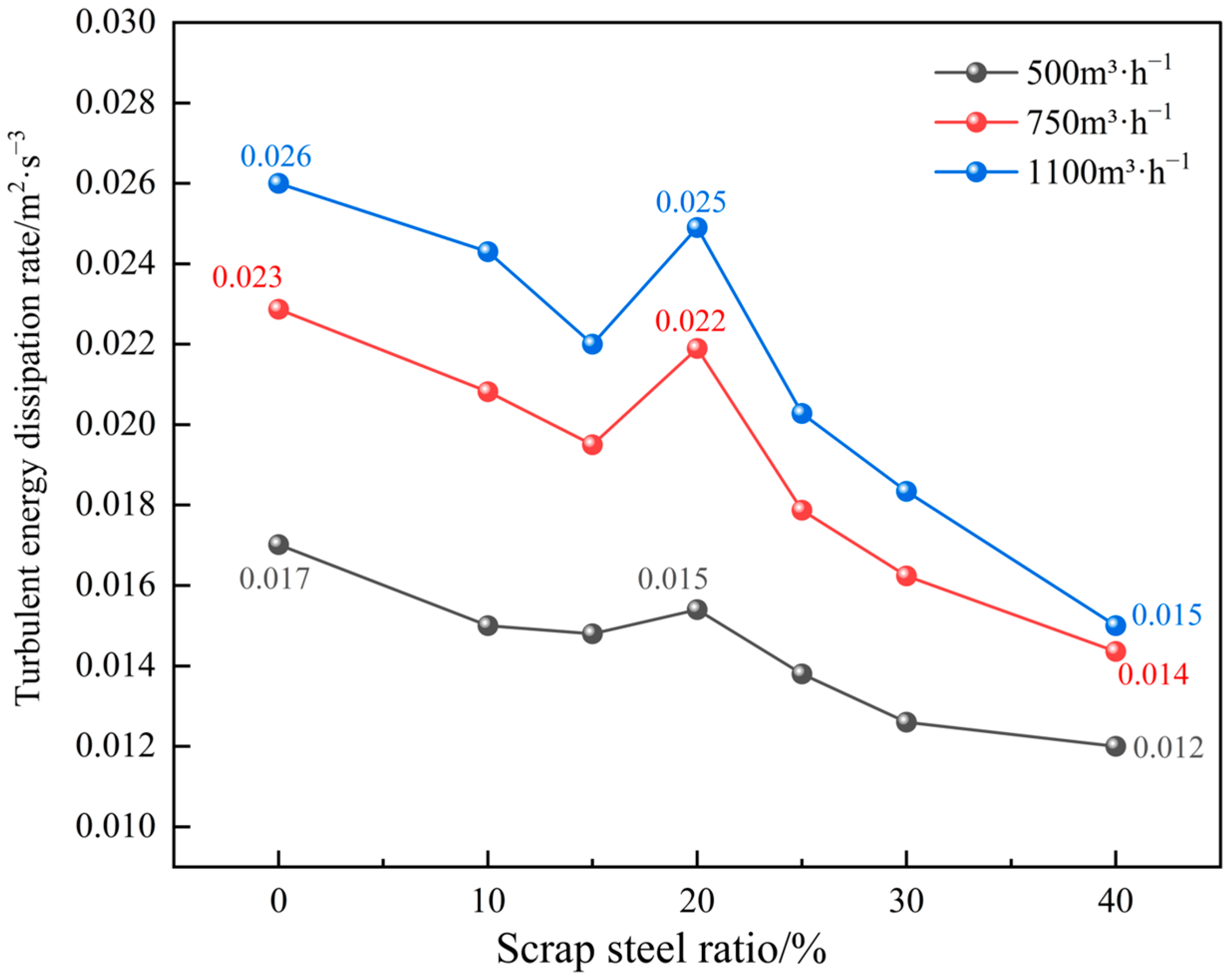
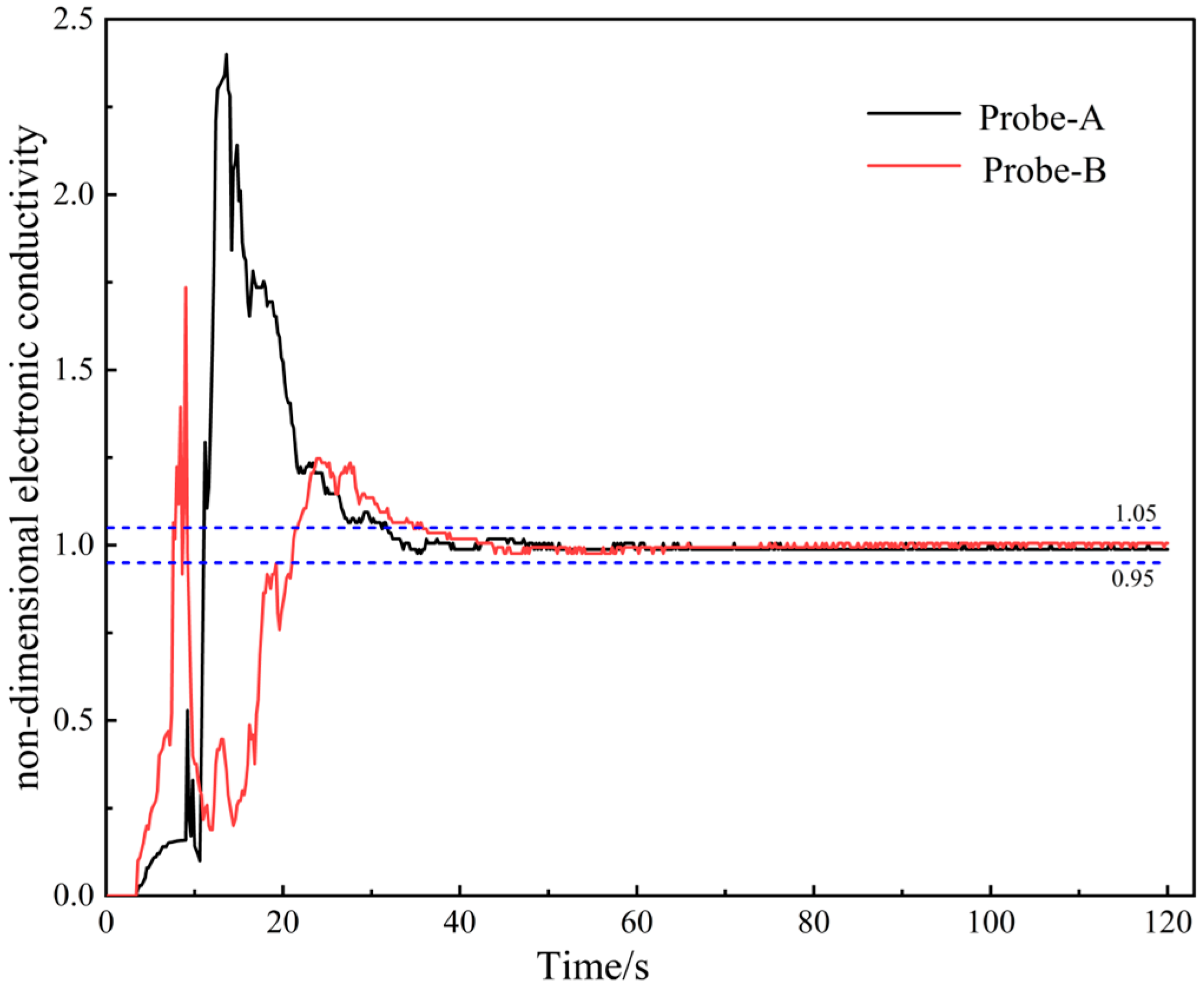
- Increasing the scrap steel ratio worsened the dynamic conditions of the melt pool. Increasing the scrap steel ratio from 20% to 40% increased the mixing time by 54.9%, decreased the average velocity by 32.6%, and decreased the average turbulent energy dissipation rate by 39.8%.
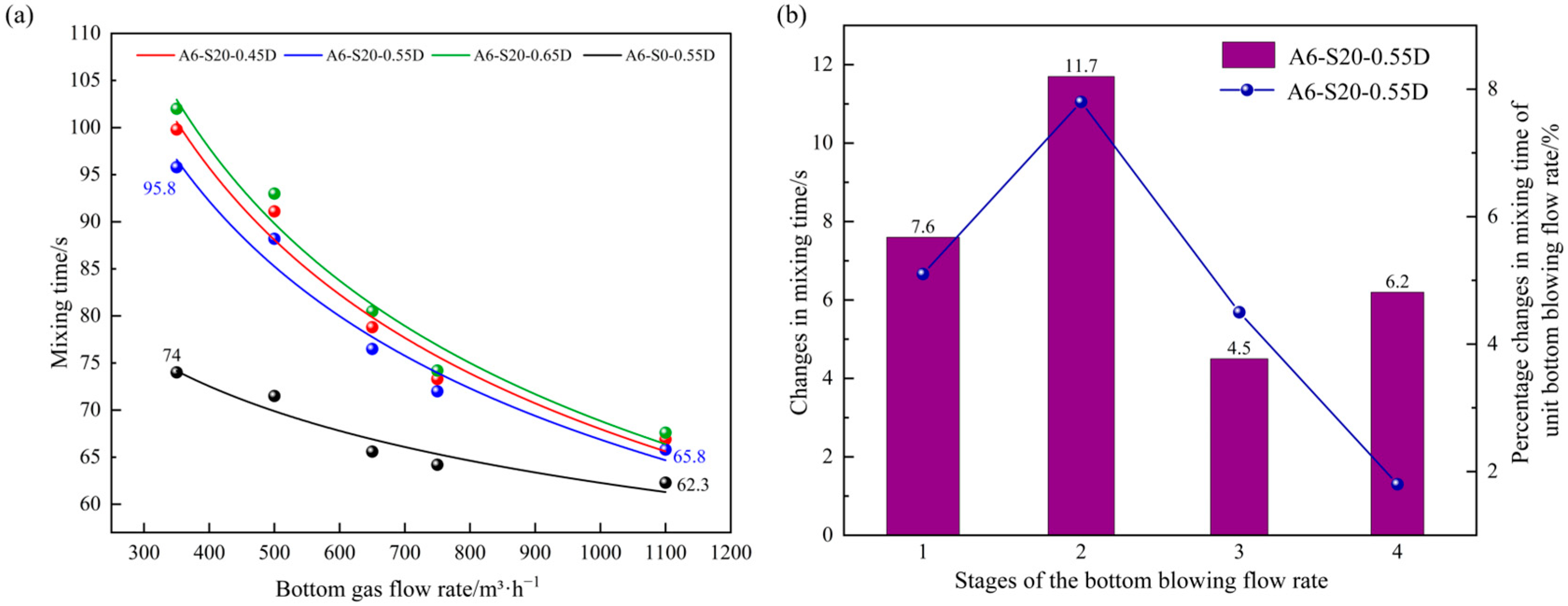
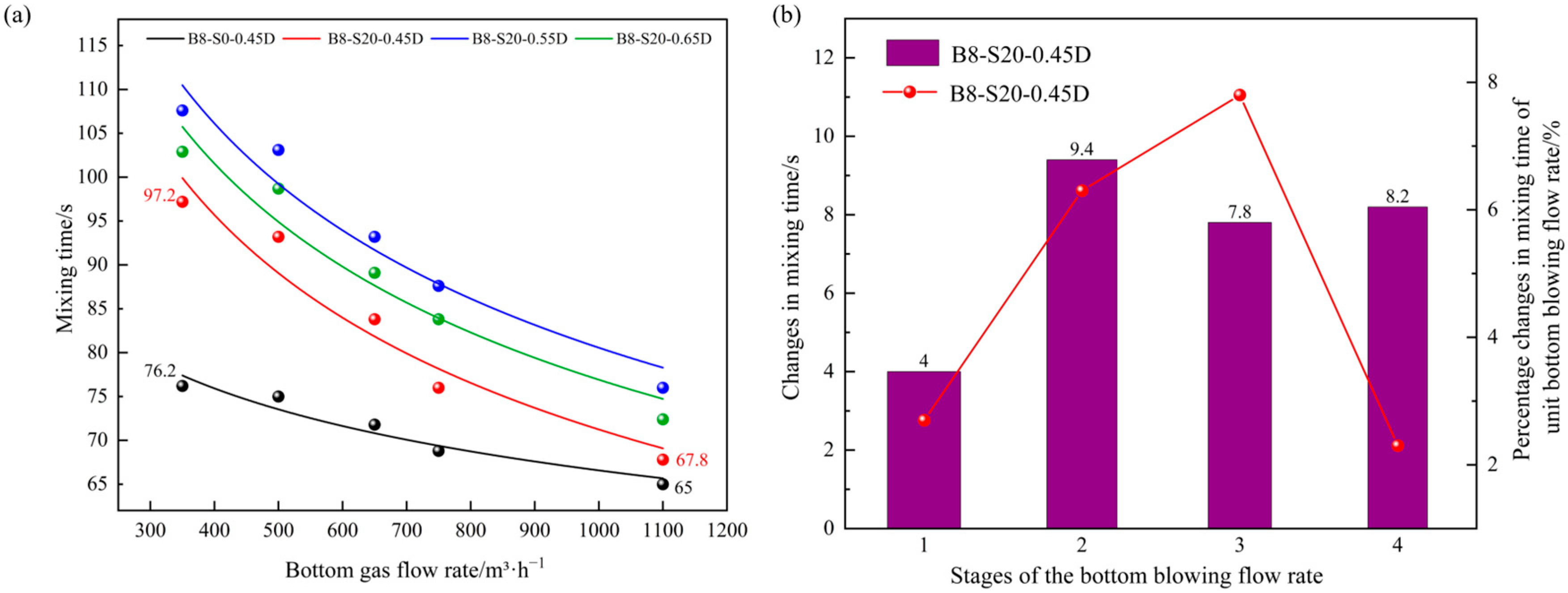
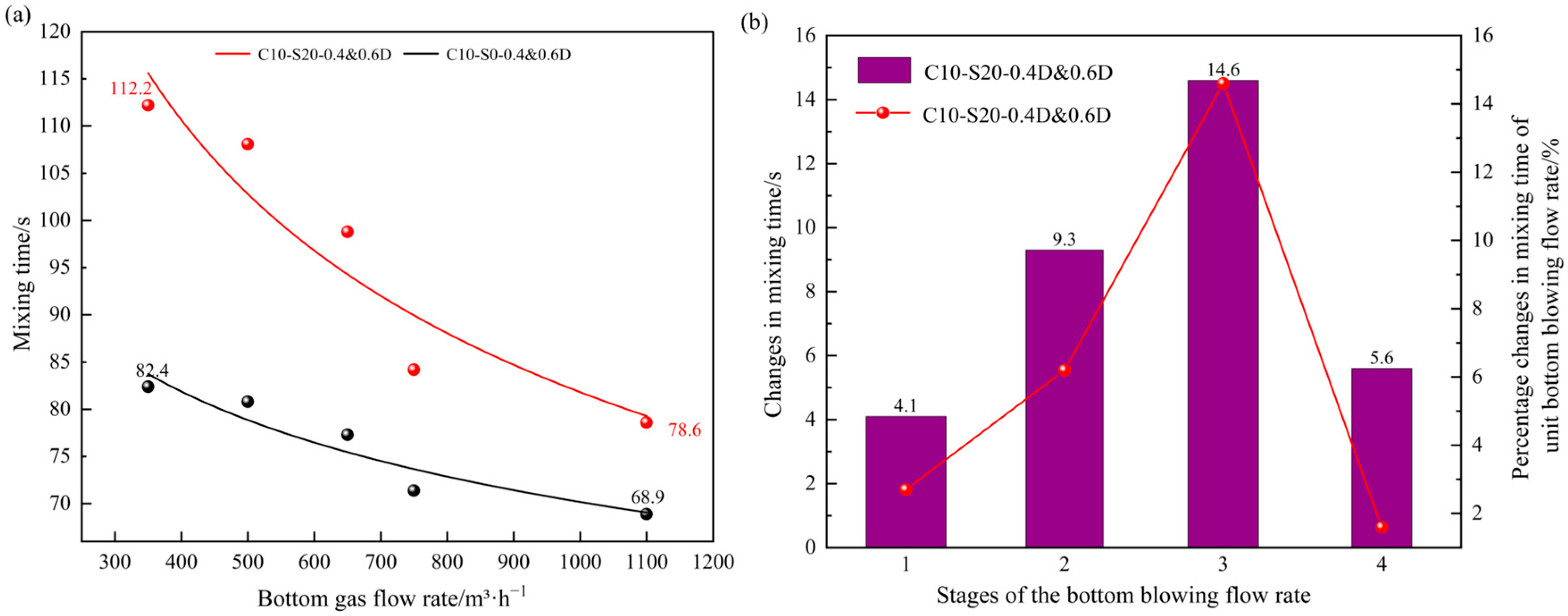
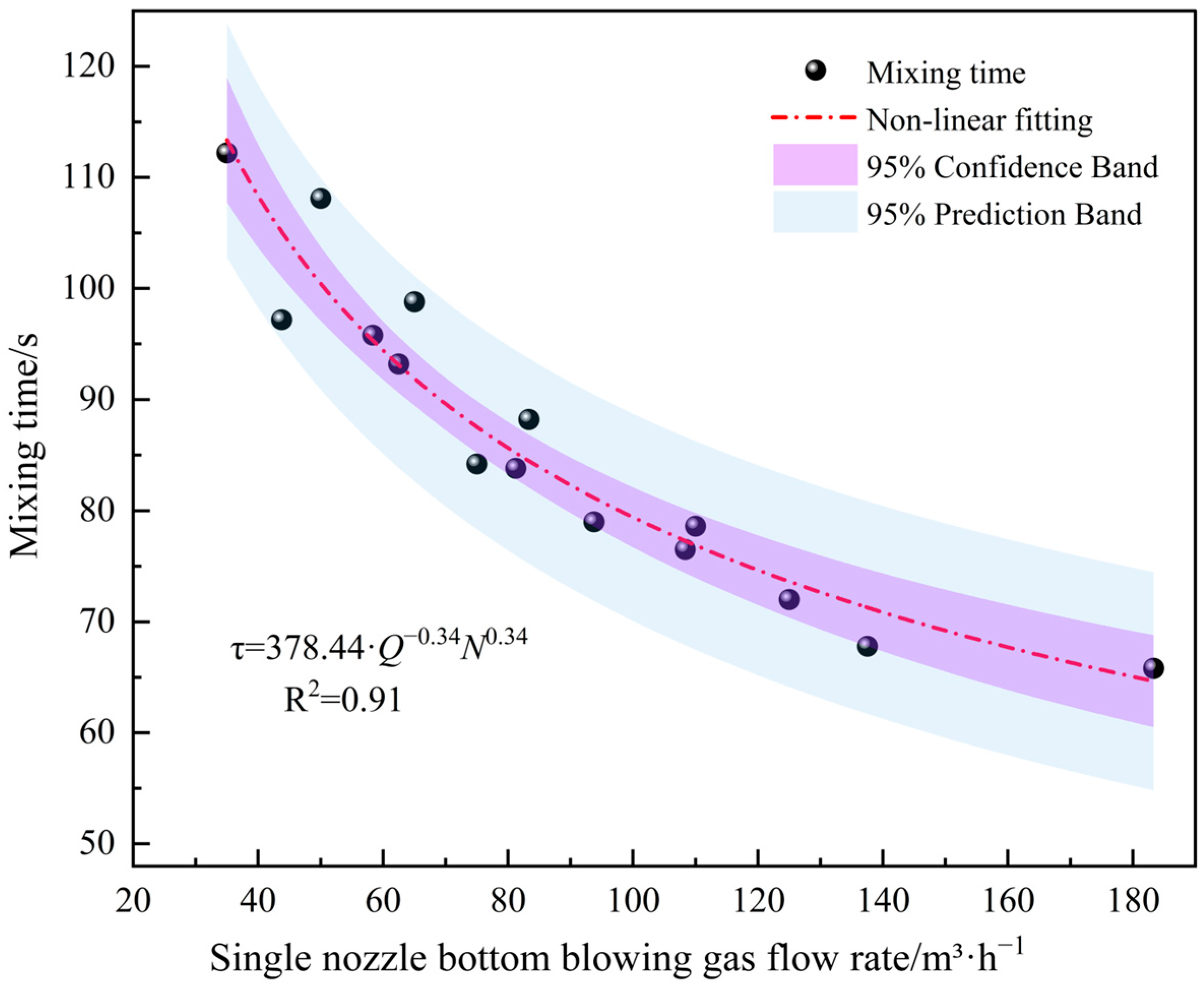
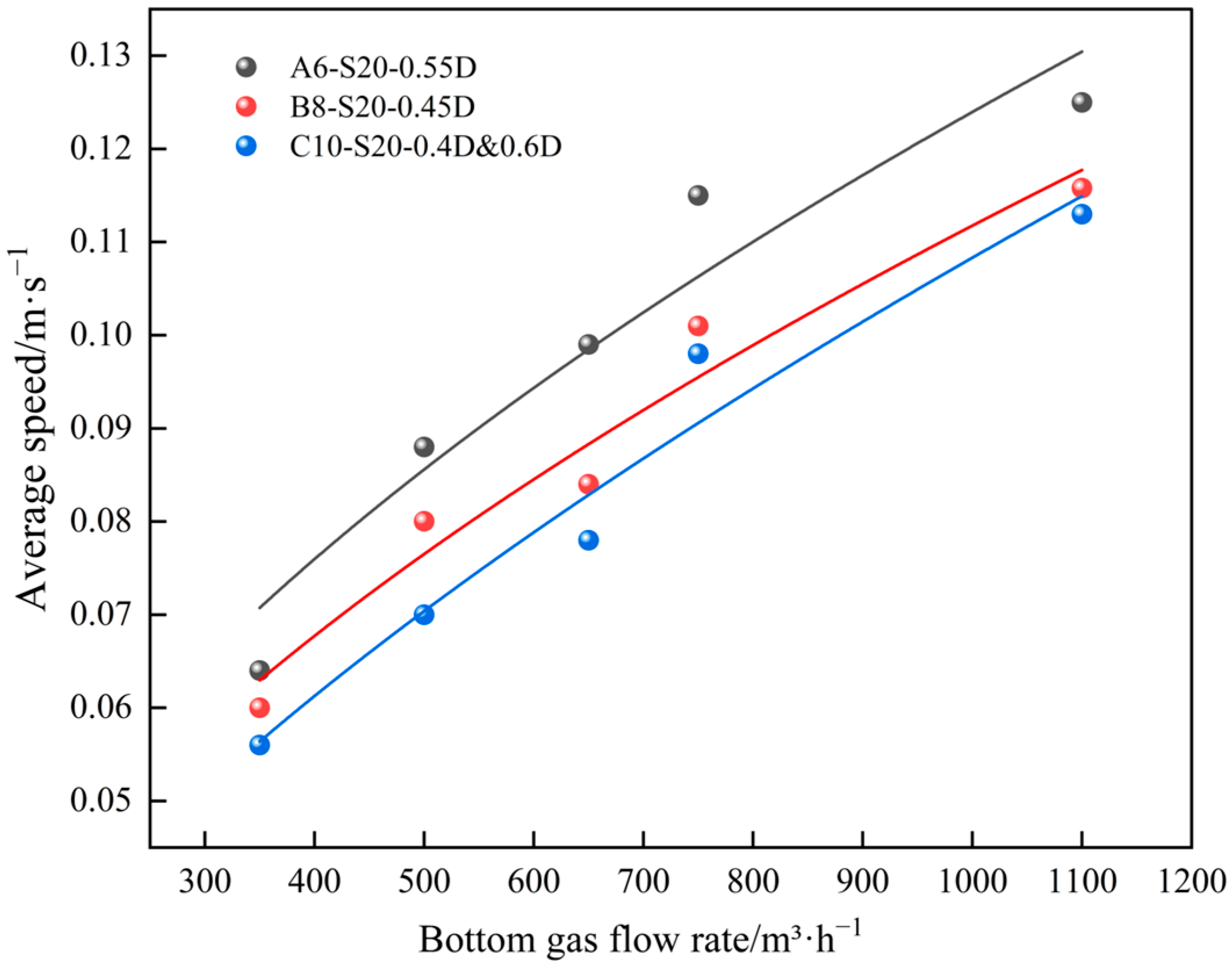
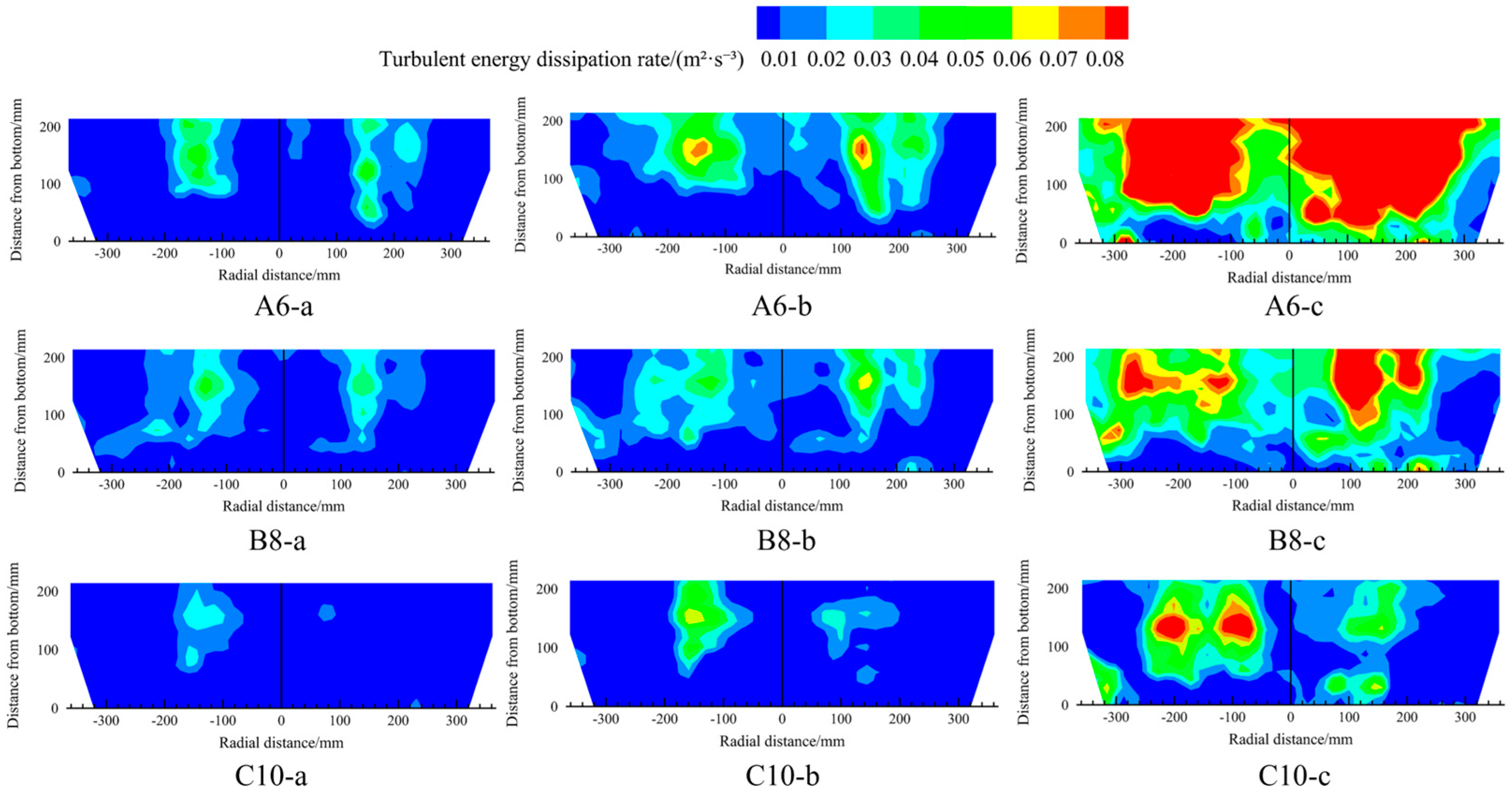
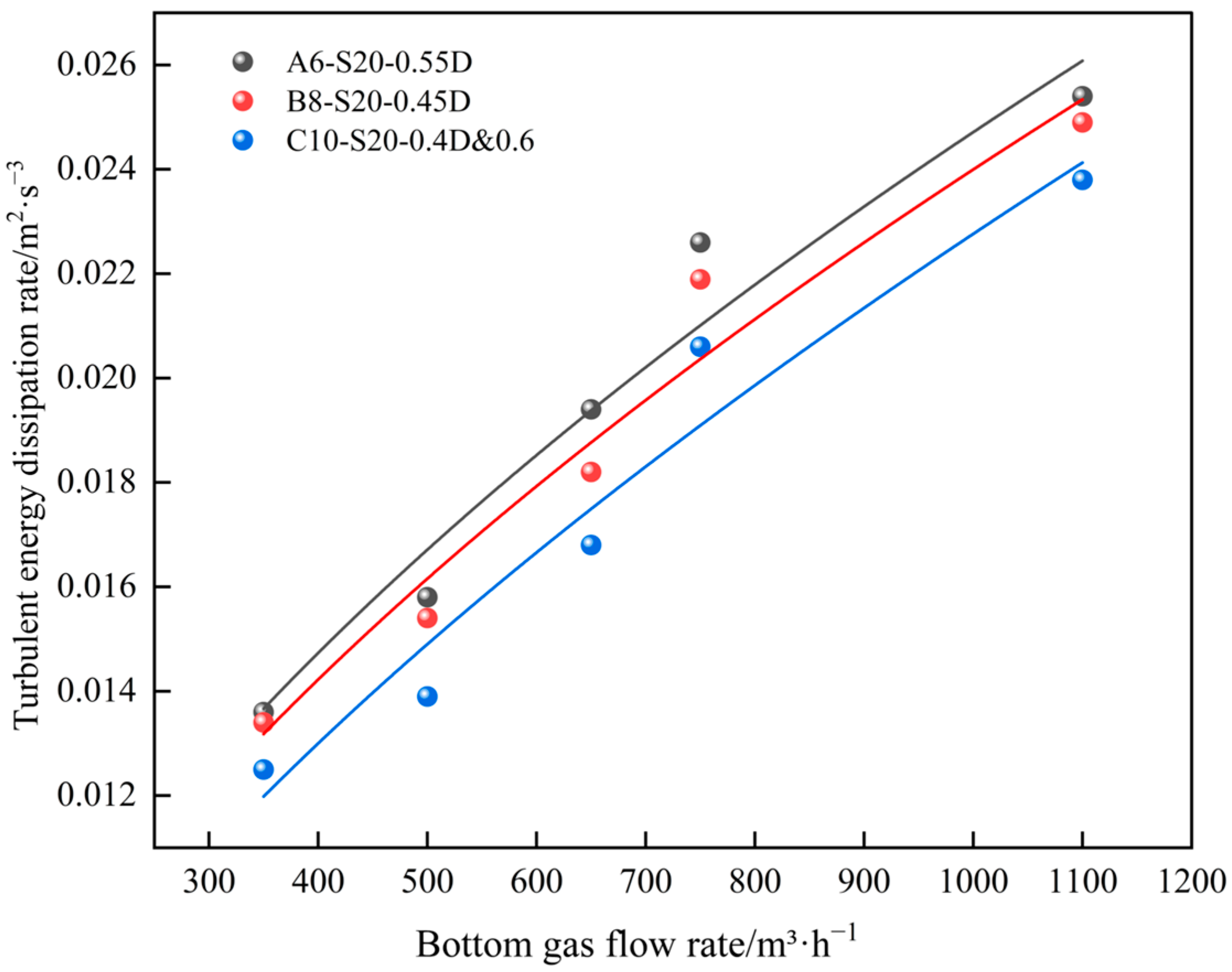
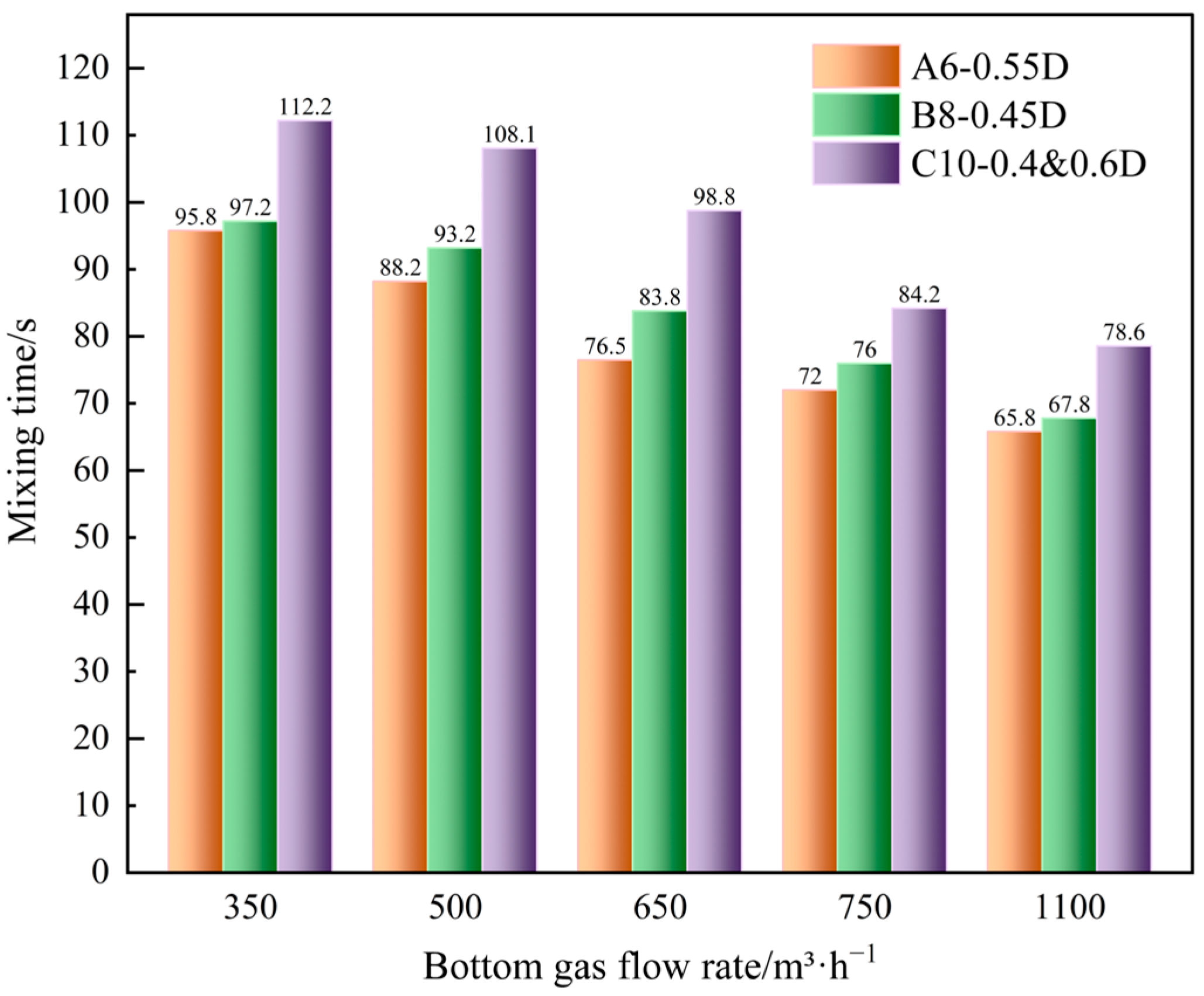
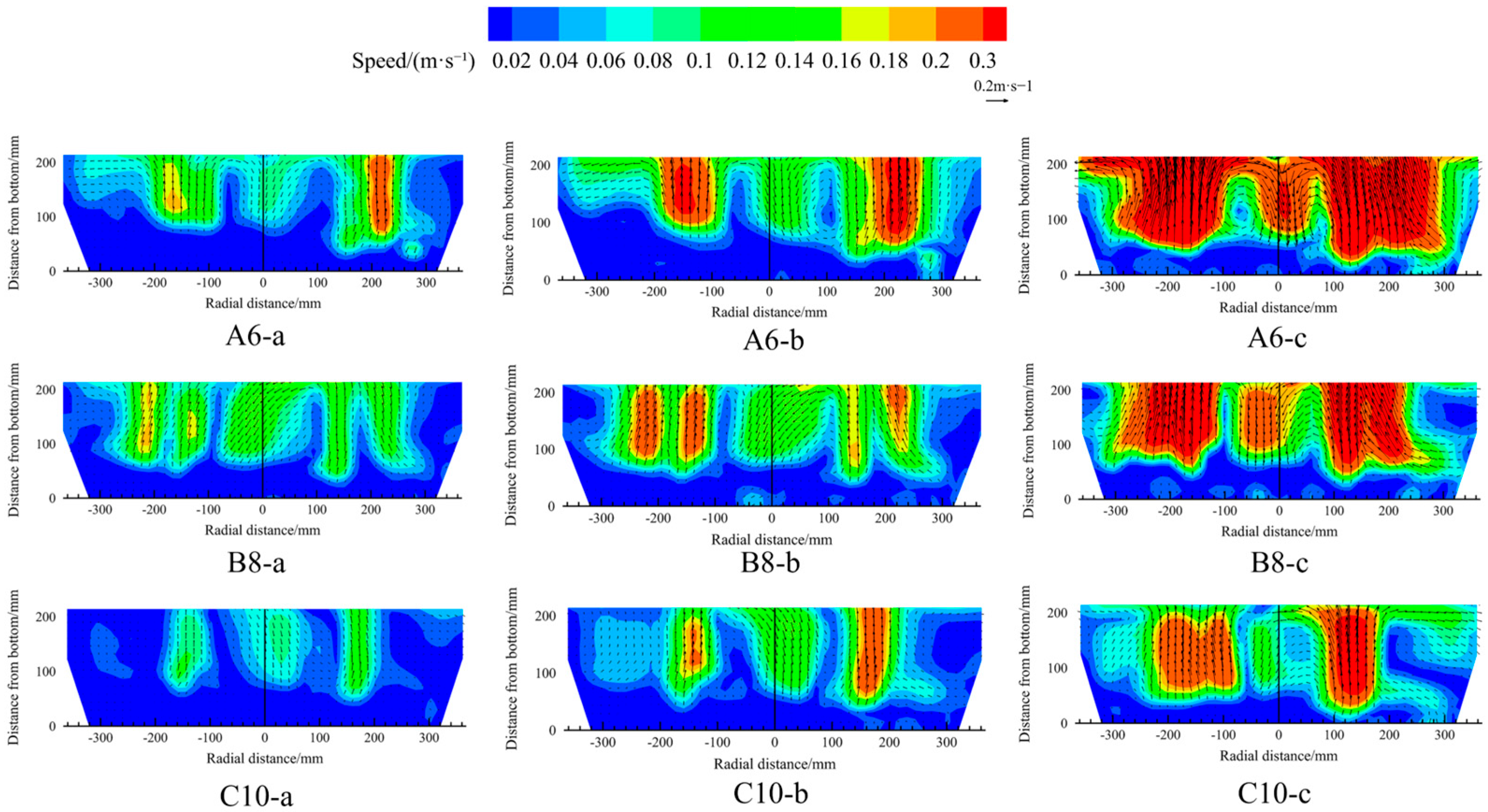
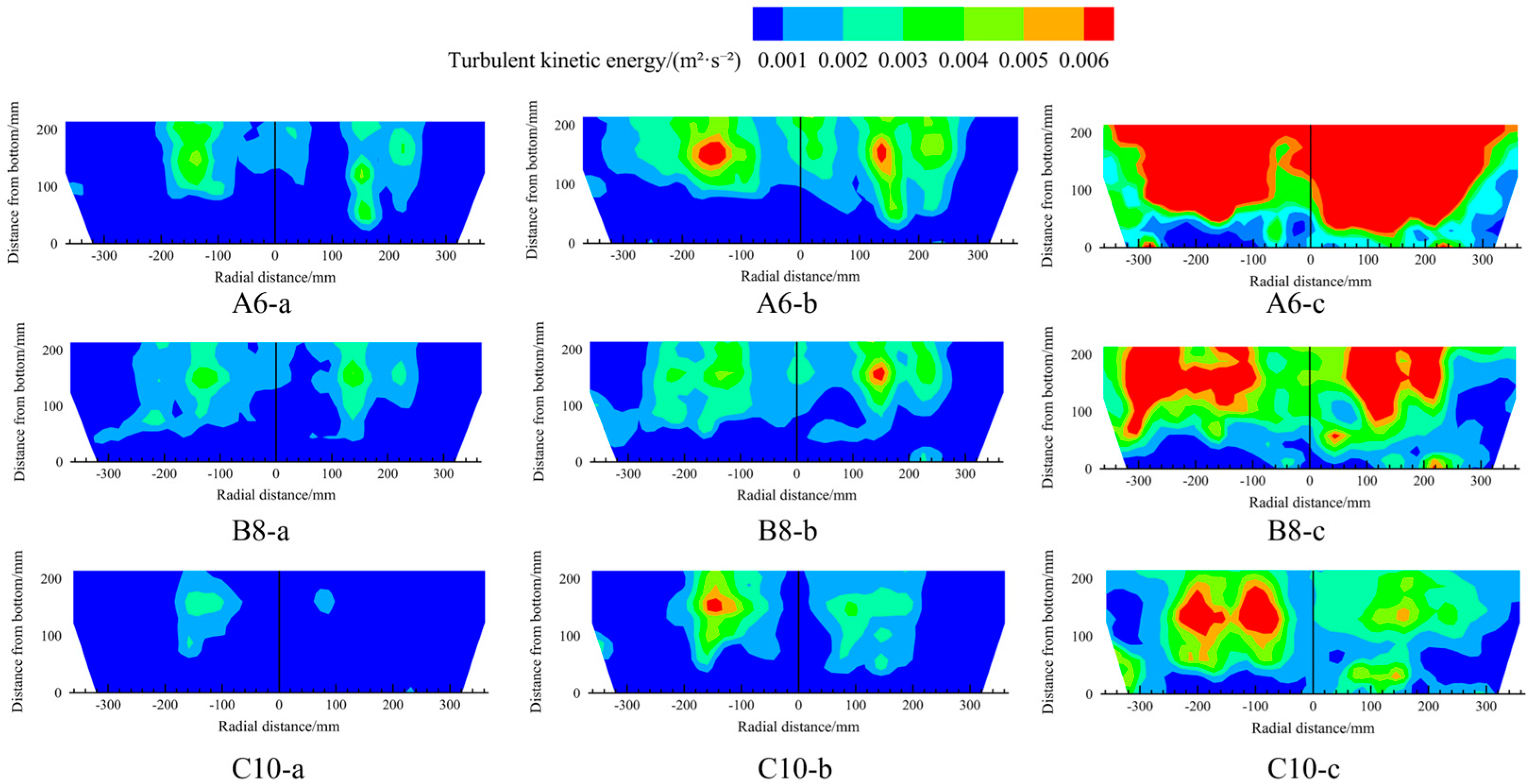
- At a scrap steel ratio of 20%, the best of the explored combination of bottom-blowing process parameters was the six-nozzle arrangement, 0.55D nozzle position, and gas flow rate of 650 m3·h−1. This combination resulted in an average velocity of 0.099 m·s−1, an average turbulent energy dissipation rate of 0.0194 m2·s−3, a mixing time of 76.5 s, and a stirring power of 19.4 W ton−1. The relationship between the mixing time, gas flow rate, and number of nozzles was established in Equation (11): . The presence of scrap steel in the melt pool necessitates increasing the gas flow rate of each nozzle to improve the mixing effect.
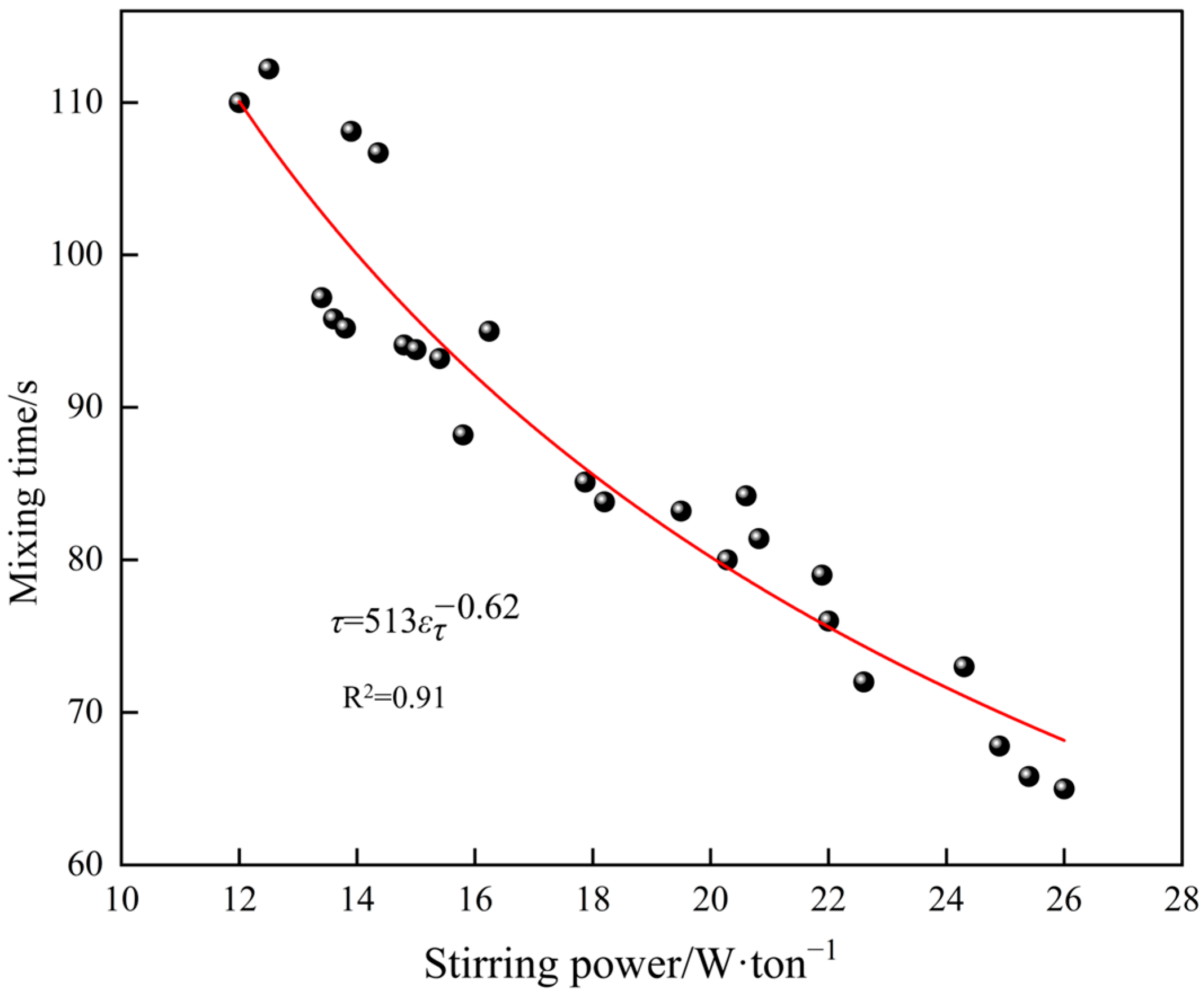
- The effects of the gas flow rate, number of nozzles, nozzle arrangement and scrap steel on the mixing time can be expressed by the stirring power. The relationship between the stirring power and mixing time was established in Equation (12): . The mixing time decreases as the stirring power increases.
Author Contributions
Funding
Data Availability Statement
Conflicts of Interest
References
- Holappa, L. Historical overview on the development of converter steelmaking from Bessemer to modern practices and future outlook. Miner. Process. Extr. Metall. 2018, 128, 3–16. [Google Scholar] [CrossRef]
- Li, C.; Xu, A.; Liu, X. Research progress on several key technologies of converter steelmaking. Steelmaking 2024, 40, 1–8+46. [Google Scholar]
- Wang, Z.; Gu, C.; Wang, M.; Bao, Y.-p. Research progress and application status of deep learning in steelmaking process. Chin. J. Eng. 2022, 44, 1171–1182. [Google Scholar]
- Li, M.; Li, Q.; Zou, Z.; Li, B.-k. Characterization of cavity oscillation and splashing distribution under excitation by bottom gas blowing in a steelmaking converter. JOM 2019, 71, 729. [Google Scholar] [CrossRef]
- Quiyoom, A.; Golani, R.; Singh, V.; Buwa, V.V. Effect of differential flow schemes on gas-liquid flow and liquid phase mixing in a Basic Oxygen Furnace. Chem. Eng. Sci. 2017, 170, 777–789. [Google Scholar] [CrossRef]
- Liu, X.; Xu, A.; Yuan, F.; Pang, C. Optimisation of the bottom blowing process for a 200 t converter. Ironmak. Steelmak. 2023, 50, 1–12. [Google Scholar] [CrossRef]
- Fang, W.; Wan, Z.; Hu, Z.; Wang, Y.; Shi, P.; Huang, J.; Zhong, L.; Li, M. Gas–slag–matte multiphase flow and bubble dynamics in an industrial side-blown smelting furnace. Phys. Fluids 2025, 37, 083356. [Google Scholar] [CrossRef]
- Yao, L.; Zhu, R.; Dong, K.; Wei, G.; Zhao, F.; Tang, Y. Influence of the non-uniform bottom blowing gas supply mode on the dynamic conditions of molten pool during the converter steelmaking process. Ironmak. Steelmak. 2021, 48, 180–190. [Google Scholar] [CrossRef]
- Hu, J.; Yang, S.; Wang, H. VOF study of mesoscale bubble flow dynamics in the side-blown gas–liquid two-phase reactor. Chem. Eng. J. 2024, 480, 147983. [Google Scholar] [CrossRef]
- Xiao, Y.; Liu, Y.; Zhang, T.; Li, X.; Wang, K. Water model experiments on the gas flow stability of swirl nozzles in a copper side-blown smelting furnace. Metall. Mater. Trans. B 2025, 56, 3440–3453. [Google Scholar] [CrossRef]
- Wang, Z.; Chen, S.; Wu, C.; Chen, N.; Li, J.; Liu, Q. Effect of bottom stirring on bath mixing and transfer behavior during scrap melting in BOF steelmaking: A review. High Temp. Mater. Process. 2024, 43, 20220322. [Google Scholar] [CrossRef]
- Dong, P.; Zheng, S.; Zhu, M. Numerical study on gas-metal-slag interaction with single-flow postcombustion oxygen lance in the steelmaking process of a top-blown converter. JOM 2022, 74, 1509–1520. [Google Scholar] [CrossRef]
- Nigmatulin, R.I.; Lahey, R.T., Jr.; Drew, D.A. On the different forms of momentum equations and on the intra-and interphase interaction in the hydromechanics of a monodispersed mixture. Chem. Eng. Commun. 1996, 141, 287–302. [Google Scholar] [CrossRef]
- Zhang, F.; Hong, L.; Xu, Y. Prospects for green steelmaking technology with low carbon emissions in China. Carbon Energy 2024, 6, e456. [Google Scholar] [CrossRef]
- Wang, X.; Shangguan, F.; Xing, Y.; Hou, C.; Tian, J. Research on the low-carbon development technology route of iron and steel enterprises under the “double carbon” target. Chin. J. Eng. 2023, 45, 853–862. [Google Scholar]
- Xi, X.; Yang, S.F.; Li, J.S.; Wu, J.; Zhao, M.; Ye, M. Physical model experiment and theoretical analysis of scrap melting process in electric arc furnace combined blowing system. Ironmak. Steelmak. 2020, 47, 748–756. [Google Scholar] [CrossRef]
- Pei, K.; Chen, C.; Zhao, Y.; Lin, Y.; Yang, R.; Zhu, J.; Wang, T.; Yang, K.; Lin, W. Water model experiment on the motion, melting, and mixing of scrap in bottom stirred reactors. Chin. J. Process Eng. 2022, 22, 1601–1612. [Google Scholar]
- Liu, M.; Zheng, D.; Ma, G.; Fang, Q.; Lv, R.; Gu, H.; Zhang, X. Cold model experiment to simulate the melting process of recycled steel for a converter using ice water mixture. Steel Res. Int. 2025, 96, 2300845. [Google Scholar] [CrossRef]
- Zhang, C.; Cheng, J.; Zhang, L.; Wang, Y.; Zhang, W.; Yuan, J.; Wang, H. Intelligent proportioning model of converter scrap based on optimization algorithm. Prog. Nat. Sci. Mater. Int. 2024, 34, 37–44. [Google Scholar] [CrossRef]
- Chen, S.; Wang, Z.; Chen, N.; Li, J.; Liu, Q. Effect of gas distribution mode on bath stirring and mixing in a bottom-blown converter. Steel Res. Int. 2024, 95, 2300702. [Google Scholar] [CrossRef]
- Cao, L.; Wang, Y.; Liu, Q.; Feng, X. Physical and mathematical modeling of multiphase flows in a converter. ISIJ Int. 2018, 58, 573–584. [Google Scholar] [CrossRef]
- Ajmani, S.; Chatterjee, A. Cold model study of mixing and mass transfer in LD converters at Tata Steel. Ironmak. Steelmak. 1996, 23, 335–345. [Google Scholar]
- Ersson, M.; Tilliander, A.; Iguchi, M.; Jonsson, L.; Jönsson, P. Fluid flow in a combined top and bottom blown reactor. ISIJ Int. 2006, 46, 1137–1142. [Google Scholar] [CrossRef]
- Szekely, J.; Wang, H.J.; Kiser, K. Flow pattern velocity and turbulence energy measurements and predictions in a water model of an argon-stirred ladle. Metall. Trans. B 1976, 7, 287–295. [Google Scholar] [CrossRef]
- Zhou, X.; Ersson, M.; Zhong, L.; Jönsson, P. Optimization of combined blown converter process. ISIJ Int. 2014, 54, 2255–2262. [Google Scholar] [CrossRef]
- Choudhary, S.K.; Ajmani, S.K. Evaluation of bottom stirring system in BOF steelmaking vessel using cold model study and thermodynamic analysis. ISIJ Int. 2006, 46, 1171–1176. [Google Scholar] [CrossRef]
- Ballal, N.; Ghosh, A. A water model study of bottom-blown oxygen steelmaking processes. Metall. Trans. B 1981, 12, 525–534. [Google Scholar] [CrossRef]
- Lai, Z.; Xie, Z.; Zhong, L. Influence of bottom tuyere configuration on bath stirring in a top and bottom combined blown converter. ISIJ Int. 2008, 48, 793–798. [Google Scholar] [CrossRef]
- Ajmani, S.; Chatterjee, A. Cold model studies of mixing and mass transfer in steelmaking vessels. Ironmak. Steelmak. 2005, 32, 515–527. [Google Scholar] [CrossRef]
- Wu, W.; Yang, L.-b.; Zheng, C.-j.; Liu, L. Cold simulation of oxygen transfer rate in BOF. J. Iron Steel Res. Int. 2010, 17, 7–13. [Google Scholar] [CrossRef]
- Cai, X.; Duan, H.; Li, D.; Xu, A.; Zhang, L. Water modeling on fluid flow and mixing phenomena in a BOF steelmaking converter. J. Iron Steel Res. Int. 2024, 31, 595–607. [Google Scholar] [CrossRef]
- Liu, F.; Yao, L.; Ma, H. Effect of shrouding nozzle arrangement on the flow field characteristics of coherent jet. Chin. J. Eng. 2018, 40, 116–122. [Google Scholar]
- Sun, Y.; Liang, X.; Zeng, J.; Chen, J.; Chen, L. Numerical simulation and application of oxygen lance in 120t BOF of PANSTEEL. Ironmak. Steelmak. 2017, 44, 76–80. [Google Scholar] [CrossRef]
- Dhiman, V.; Beunder, E.M. Euler-Euler multiphase simulation for optimization of bottom tuyere configuration in a combined-blowing worn out converter. BHM Berg-Hüttenmänn. Monatshefte 2022, 167, 123–128. [Google Scholar] [CrossRef]
- Yao, L.; Zhu, R.; Tang, Y.; Wei, G.; Dong, K. Effect of furnace gas composition on characteristics of supersonic oxygen jets in the converter steelmaking process. Materials 2020, 13, 3353. [Google Scholar] [CrossRef]
- Sun, J.; Zhang, J.; Jiang, R.; Feng, X.; Liu, Q. Effect of bottom tuyere arrangement based on impact cavity morphology on kinetic behavior of molten bbath in converter. Steel Res. Int. 2023, 94, 2200532. [Google Scholar] [CrossRef]
- Zhou, X.; Ersson, M.; Zhong, L.; Jönsson, P. Numerical simulations of the kinetic energy transfer in the bath of a BOF converter. Metall. Mater. Trans. B 2016, 47, 434–445. [Google Scholar] [CrossRef]
- Wu, K. Principles of Metallurgical Transport; Metallurgical Industry Press: Beijing, China, 2011. [Google Scholar]
- Bao, Y.; Wang, M. Intermediate Package Metallurgy; Metallurgical Industry Press: Beijing, China, 2019. [Google Scholar]
- Wang, X.; Li, J.; Liu, F. Technological progress of BOF steelmaking in period of development mode transition. Steelmaking 2017, 33, 1–11+55. [Google Scholar]
- Zhong, L.; Zhu, Y.; Zeng, X.; Lai, Z.; Chen, B. Technology of bath stirring in top and bottom combination blown converters and its application. Steelmaking 2016, 32, 1–10. [Google Scholar]
- Liu, Y.; Deng, N.; Zhou, X.; Wang, D.; Peng, S. Influence of steel scrap on the mixing of converter bath. Chin. J. Process Eng. 2019, 19, 1178–1185. [Google Scholar]
- Nakanishi, K.; Kato, Y.; Nozaki, T.; Emi, T. Cold model study on the mixing rates of slag and metal bath in Q-BOP. Tetsu-to-Hagané 1980, 66, 1307–1316. [Google Scholar] [CrossRef] [PubMed]









| Physical Parameters | Prototype | Model | ||
|---|---|---|---|---|
| Steel | Argon | Water | Air | |
| Density, kg m−3 | 7000.00 | 1.63 | 1000.00 | 1.29 |
| Viscosity, kg m−1 s−1 | 6.400 × 10⁻³ | 2.125 × 10⁻⁵ | 0.001 | 1.789 × 10⁻⁵ |
| Surface tension, N m−1 | 1.500 | / | 0.071 | / |
| Thermal conductivity, W m−1 K−1 | 15.0000 | 0.0158 | 0.6000 | 0.0242 |
| Specific heat, J kg−1 K−1 | 670.00 | 520.64 | 4182.00 | 1006.43 |
| Temperature, K | 1873 | 300 | 300 | 300 |
| Scheme | Prototype/Nm3·h−1 | Model/Nm3·h−1 |
|---|---|---|
| 1 | 350 | 0.6 |
| 2 | 500 | 0.9 |
| 3 | 650 | 1.2 |
| 4 | 750 | 1.4 |
| 5 | 1100 | 2.0 |
| Stage | The Variation Range of Gas Flow Rates/m3·h−1 |
|---|---|
| 1 | 350–500 |
| 2 | 500–650 |
| 3 | 500–750 |
| 4 | 650–750 |
| 5 | 750–1100 |
| Number | Scheme | |
|---|---|---|
| 1 | Bottom blowing gas flow rates/Nm3·h−1 | 350 |
| 500 | ||
| 650 | ||
| 750 | ||
| 1100 | ||
| 2 | Number of bottom-blowing nozzles | 6 |
| 8 | ||
| 10 | ||
| 3 | Layout position of bottom-blowing nozzle | 0.40D |
| 0.45D | ||
| 0.55D | ||
| 0.60D | ||
| 0.65D | ||
| 4 | Scrap steel ratio/% | 0 |
| 10 | ||
| 15 | ||
| 20 | ||
| 25 | ||
| 30 | ||
| 40 | ||
| Parameter | Converter | |
|---|---|---|
| Prototype | Model | |
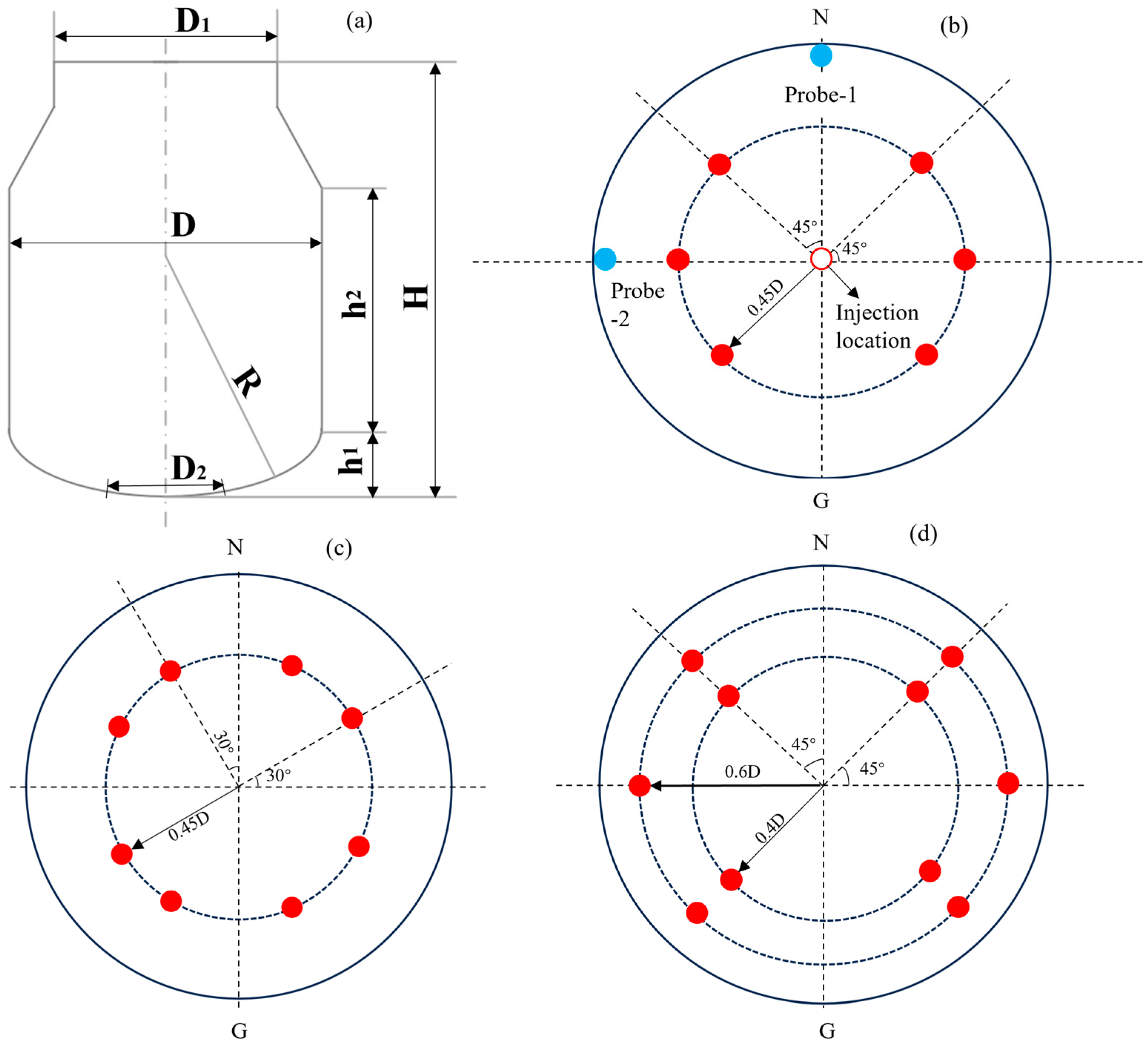
| Converter capacity/tons | 300 | / |
| D1/mm | 3600.0 | 409.1 |
| D2/mm | 2912.4 | 331.0 |
| H/mm | 11,500.0 | 1306.8 |
| D/mm | 6472.0 | 735.5 |
| Molten bath depth/mm | 1865 | 212 |
| Gas Flow Rate Change Stage | Percentage Reduction in Mixing Time per 100 m3·h−1/% | ||||||
|---|---|---|---|---|---|---|---|
| S0 | S10 (a) | S15 | S20 | S25 | S30 | S40 | |
| 3 | 3.3 | 5.3 | 4.6 | 7.4 | 4.2 | 1.6 | 1.2 |
| 5 | 1.6 | 2.9 | 2.5 | 3.1 | 1.7 | 0.7 | 0.5 |
| Gas Flow Rate Change Stage | Percentage Increase in Average Speed per 100 m3·h−1/% | |||||
|---|---|---|---|---|---|---|
| S10 | S15 | S20 | S25 | S30 | S40 | |
| 3 | 0.59 | 0.41 | 0.84 | 0.69 | 0.52 | 0.45 |
| 5 | 0.23 | 0.35 | 0.42 | 0.44 | 0.28 | 0.18 |
Disclaimer/Publisher’s Note: The statements, opinions and data contained in all publications are solely those of the individual author(s) and contributor(s) and not of MDPI and/or the editor(s). MDPI and/or the editor(s) disclaim responsibility for any injury to people or property resulting from any ideas, methods, instructions or products referred to in the content. |
© 2026 by the authors. Licensee MDPI, Basel, Switzerland. This article is an open access article distributed under the terms and conditions of the Creative Commons Attribution (CC BY) license.
Share and Cite
Yuan, F.; Liu, X.; Xu, A.; Li, X. Effects of the Scrap Steel Ratio and Bottom-Blowing Process Parameters on the Fluid Flow Characteristics in a Physical Model of a Steelmaking Converter. Metals 2026, 16, 160. https://doi.org/10.3390/met16020160
Yuan F, Liu X, Xu A, Li X. Effects of the Scrap Steel Ratio and Bottom-Blowing Process Parameters on the Fluid Flow Characteristics in a Physical Model of a Steelmaking Converter. Metals. 2026; 16(2):160. https://doi.org/10.3390/met16020160
Chicago/Turabian StyleYuan, Fei, Xuan Liu, Anjun Xu, and Xueying Li. 2026. "Effects of the Scrap Steel Ratio and Bottom-Blowing Process Parameters on the Fluid Flow Characteristics in a Physical Model of a Steelmaking Converter" Metals 16, no. 2: 160. https://doi.org/10.3390/met16020160
APA StyleYuan, F., Liu, X., Xu, A., & Li, X. (2026). Effects of the Scrap Steel Ratio and Bottom-Blowing Process Parameters on the Fluid Flow Characteristics in a Physical Model of a Steelmaking Converter. Metals, 16(2), 160. https://doi.org/10.3390/met16020160