Article

Accelerated Optimization of Superalloys by Integrating Thermodynamic Calculation Data with Machine Learning Models: A Reference Alloy Approach


1
State Key Laboratory of Clean and Efficient Turbomachinery Power Equipment, Dongfang Electric Corporation Dongfang Turbine Co., LTD, Deyang 618000, China
2
School of Materials Science and Engineering, Sichuan University, Chengdu 610065, China
3
State Key Laboratory for Advanced Metals and Materials, University of Science and Technology Beijing, Beijing 100083, China
*
Authors to whom correspondence should be addressed.
Metals 2026, 16(2), 154; https://doi.org/10.3390/met16020154
Submission received: 21 December 2025 / Revised: 6 January 2026 / Accepted: 9 January 2026 / Published: 27 January 2026

Abstract

The multi-objective optimization of multicomponent superalloys has long been impeded by not only the complex interactions among multiple elements but also the low efficiency and high cost of traditional trial-and-error methods. To address this issue, this study proposed a thermodynamic calculation data-driven optimization framework that integrates machine learning (ML) and multi-objective screening based on domain knowledge. The core of this methodology involves introducing a commercial reference alloy and rapidly generating a large-scale thermodynamic dataset through ML models. After training, the ML models were verified to be more efficient at predicting phase transition temperatures and γ′ volume fractions than the CALPHAD methods. Focusing on the mechanical properties, critical strength indices, including solid solution strengthening, precipitation strengthening, and creep resistance based on the calculated γ/γ′ two-phase compositions, were compared with the reference alloy and set as the critical screen criteria. Optimal alloys were selected from the 388,000 candidates. Compared with the reference alloy, two new alloys were experimentally verified to have superior or comparable compressive yield strength and creep resistance at 900 °C at the expense of oxidation resistance and density, while maintaining comparable cost. This work demonstrates the significant potential of combining high-throughput thermodynamic data with intelligent multi-objective optimization to accelerate the development of new alloys with tailored property profiles.

1. Introduction

Ni-based superalloys are indispensable for key hot-end components in aeroengines and industrial gas turbines due to their excellent balance of microstructural stability, processability, mechanical and environmental properties [1]. Consequently, extensive research has focused on designing or optimizing these alloys to enhance temperature capability and to tailor specialized performance to specific service environments [2,3,4,5]. However, their compositional complexity renders traditional trial-and-error approaches inefficient and costly, as they rely heavily on extensive experimentation. This underscores the urgent need to develop simple, effective, and low-cost methods to accelerate the development of novel alloys.
In recent years, significant progress has been made in the optimization and design of Ni-based superalloys. The establishment of models and empirical formulas for properties such as strength, microstructural stability, oxidation resistance, and processability has laid the foundation for efficient and reliable design methodologies, such as the “Alloy-By-Design (ABD)” method [5]. Moreover, with advances in artificial intelligence and big data, methods such as “Alloy Design Program (ADP)” [6] and “Multi-criteria Global Optimization (MultOPT)” [7,8,9] have been proposed by integrating experimental datasets with mathematical and theoretical models. Nevertheless, it is almost impossible for any theoretical models to rely entirely on experimental data, especially when specific thermodynamic or physical parameters are required. Therefore, CALculation of PHAse Diagrams (CALPHAD) and First-principles calculations have been introduced [2,10,11]. Although these methods are reasonably accurate at predicting relative trends, they often struggle with absolute accuracy—a challenge particularly difficult to overcome in complex alloy systems, which demand substantial experimental validation. To address these issues, high-throughput experimental techniques, such as diffusion multiples, have been employed to investigate interactions among alloying elements in complex systems and to calibrate thermodynamic calculations [12,13,14]. However, such methods still face difficulties in characterization and analysis [15]. Although rapid characterization techniques and machine learning (ML) models have partially mitigated these issues, the extrapolation capabilities of related models trained on experimental databases remain limited, and continuous data expansion is required to improve predictive performance [16,17]. Thus, it can be seen that each existing method faces its own challenges, making it difficult to achieve a truly simple, efficient, and robust approach.
What these methods share, however, is a reliance on data—whether obtained experimentally or through calculations. Despite ongoing concerns about accuracy, thermodynamic calculations remain one of the fastest ways to generate large datasets and have been increasingly adopted in the search for optimal alloys [10,18]. Furthermore, it should be noted that alloy design in well-established systems rarely begins without drawing on prior knowledge or established frameworks, built over years of development. More often, it focused on optimizing existing compositions rather than designing entirely new alloys [19]. Therefore, by building upon well-established reference alloys, leveraging the strength of thermodynamic calculations in predicting relative trends, and incorporating domain knowledge—such as indices for solid solution strengthening, γ′ phase strengthening, creep resistance, and microstructural stability—it should be able to achieve rapid adjustment and optimization of their properties. However, related research and validation remain limited.
Hence, this study proposes a multi-objective optimization framework that integrates batch thermodynamic data and machine learning models, using typical industrial gas turbine blade alloys to generate screening criteria. Primarily aimed at enhancing mechanical properties, a commercial alloy was selected as the basis of inference, and the framework employs “thermodynamic data + machine learning” in conjunction with various strength indices to guide design within a specified composition range. The work examines the advantages of ML models in predicting relationships between alloy composition and key thermodynamic parameters, compares predictions from different thermodynamic databases for both the inference and candidate alloys, and validates the resulting multi-property profiles. This research will guide the rapid optimization of existing alloys.

2. Materials and Methods

2.1. Workflow of Alloy Design

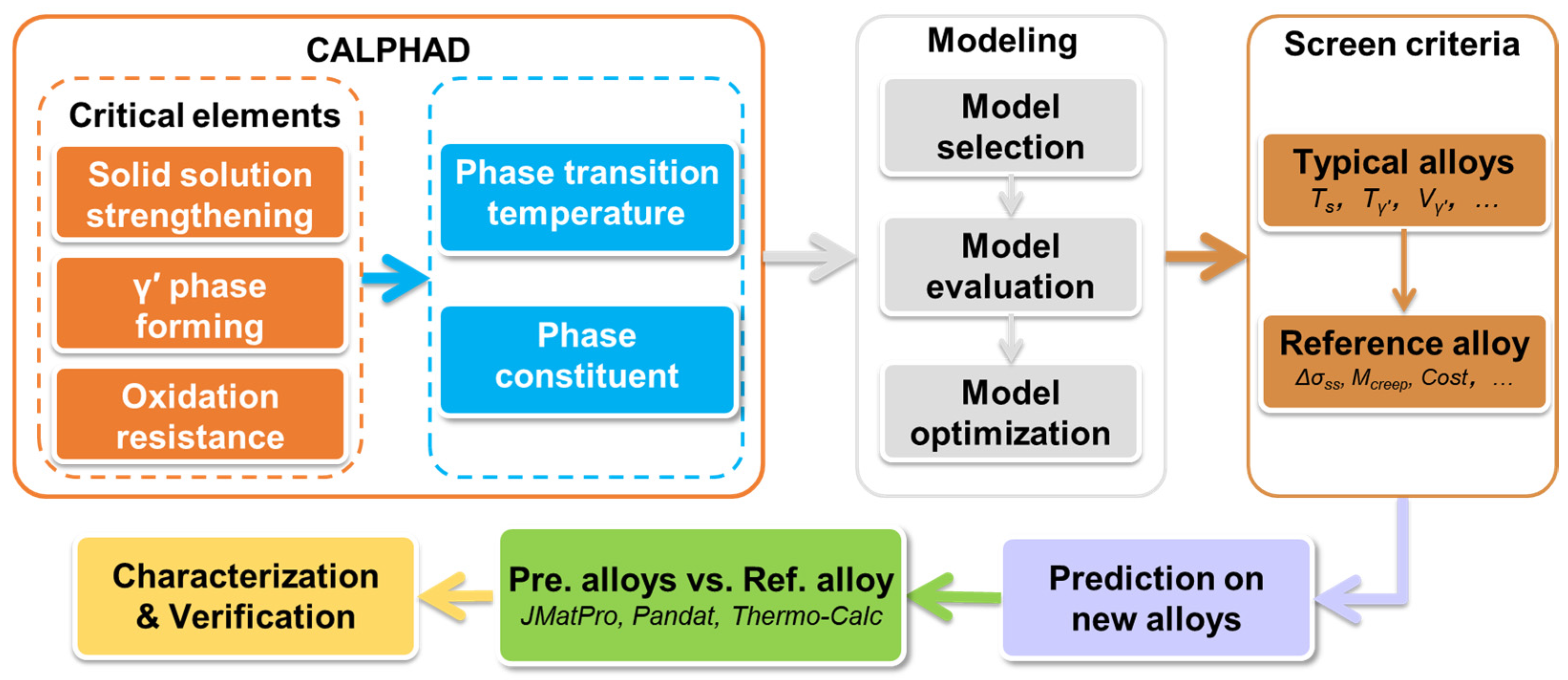
Figure 1 shows the workflow of multi-performance optimization for Ni-based superalloys by integrating CALPHAD methods with ML models. First, a composition space I, including 45,000 alloys, was selected based on published work and domain knowledge [20,21,22,23]. A high-Cr content range was set for the oxidation and corrosion resistance. Then, a CALPHAD method was used to calculate the equilibrium phase constituents and transition temperatures of the alloy compositions, which typically include critical elements that account for solution strengthening, γ′ formation, and oxidation resistance. Then, the calculated dataset was collected and employed to develop ML prediction models for the equilibrium phase constituents and their transition temperatures in a new composition space II, including 388,800 alloys, by reducing the step size in the original composition space I. Table 1 lists the upper and lower compositional limits and step sizes for the composition spaces I and II, respectively. After evaluating and optimizing selected ML algorithms, the final prediction models were determined and subsequently applied to a subsequent multi-objective search within the range of interest. To obtain an optimal alloy with good comprehensive properties, some typical alloys were considered during the initial screening to assess processability and phase constituents. Then, a reference alloy was introduced to set the screening criteria of strength (based on the calculated data) and cost. After the screening, the predicted alloy will be further evaluated using multiple thermodynamic databases to verify the reliability of the CALPHAD methods. Finally, the properties of some predicted alloys will be evaluated by systematic experimental investigations.

2.2. Thermodynamic Analysis

The thermodynamic calculations of the equilibrium phase diagram and phase constituent were performed using the commercial thermodynamic software JMatPro (Version 9.0), Pandat (PanNi2018), and Thermo-Calc (TTNI8). To enhance calculation efficiency, the batch mode of JMatPro was employed.

2.3. Machine Learning

All data preprocessing, model training, optimization, and evaluation in this study were conducted using the Python (Version 3.12) machine learning library Scikit-learn. Seven ML algorithms, including Ridge Regression (Ridge), Lasso Regression (Lasso), K-Nearest Neighbors (KNN), Random Forest Regression (RFR), Gradient Boosting Regression (GBR), Support Vector Regression (SVR), and Back Propagation Neural Network (BPNN), were applied to build the prediction models for the liquidus temperature (TL), solidus temperature (TS), γ′ solvus temperature (Tγ′), and γ′ volume fraction (Vγ′). The modeling workflow consisted of two main stages:
(1)
Data preprocessing: For algorithms that rely on distance or gradient calculations (e.g., KNN, SVR, and BPNN), feature normalization was performed using the MinMaxScaler from Scikit-learn—a preprocessing module that linearly scales each feature to the [0, 1] interval to improve training efficiency and numerical stability. In contrast, tree-based models such as RFR and GBR, whose splitting rules depend on feature ordering rather than absolute magnitudes, were trained without normalization.
(2)
Hyperparameter optimization: For each algorithm, hyperparameters were tuned via grid search coupled with widely used 10-fold cross-validation using the GridSearchCV framework from Scikit-learn. Candidate ranges were defined for key hyperparameters. For example, in the KNN model, the number of neighbors (n_neighbors, K) was varied over {2, 3, 4, 5, 6} to balance bias and variance. The distance metric, which defines how similarity between samples is quantified in the feature space, was not treated as an independent hyperparameter; instead, Euclidean distance was adopted as the default choice after normalization. This design choice is reasonable and widely adopted for continuous, normalized features, and it yields stable, interpretable similarity measurements. For each parameter combination, the dataset was randomly partitioned into 10 mutually exclusive subsets: 9 for training and 1 for testing, with all 10 folds used in turn. The validity was evaluated by the value of the explained variance (R2) expressed as follows:
R 2 = 1 i = 1 n ( Y a c t Y p r e ) 2 i = 1 n ( Y a c t Y a v e ) 2
where Yact is the actual value, Ypre is the predicted value, Yave is the average of Yact, and n is the number of predicted data points in the dataset. The responses of R2 range from 0 to 1, with better model performance corresponding to values closer to 1.

2.4. Experimental Tests

The predicted alloys were prepared by arc-melting high-purity (>99.9 wt.%) elements in an Ar atmosphere, and alloy button ingots weighing 200 g were obtained. Then, the alloys were heat-treated as follows: 1180 °C/2 h, air cooling (AC) + 1240 °C/3 h, AC + 1050 °C/5 h, AC + 870 °C/18 h, AC. The phase transition temperatures were measured by differential scanning calorimetry (DSC-NETZSCH STA 449C, NETZSCH, Selb, Germany) experiments under high-purity Ar flow with a heating rate of 10 °C·min−1. The density was measured using a drainage method based on Archimedes principle.
Compressive specimens were machined from heat-treated samples with a gauge length of 7.5 mm and a diameter of 5 mm. Uniaxial compressive tests were conducted at 760 °C, 800 °C, and 900 °C with a strain rate of 10−4 s−1. Meanwhile, constant-load compressive creep tests were performed at 900 °C and 320 MPa. Isothermal oxidation tests were carried out at 900 °C for 100 h in air. Mass gains were measured by an analytical balance with an accuracy of 10−4 g.
The metallographic specimens of ingots were prepared using standard metallographic sample preparation techniques and etched in a solution of 1% HF + 33% HNO3 + 33% CH3COOH + 33% H2O (by volume). The microstructure was characterized by a ZEISS SUPRA 55 (ZEISS, Oberkochen, Germany) field-emission scanning electron microscope.

3. Results and Discussion

3.1. Dataset Built by the CALPHAD Method

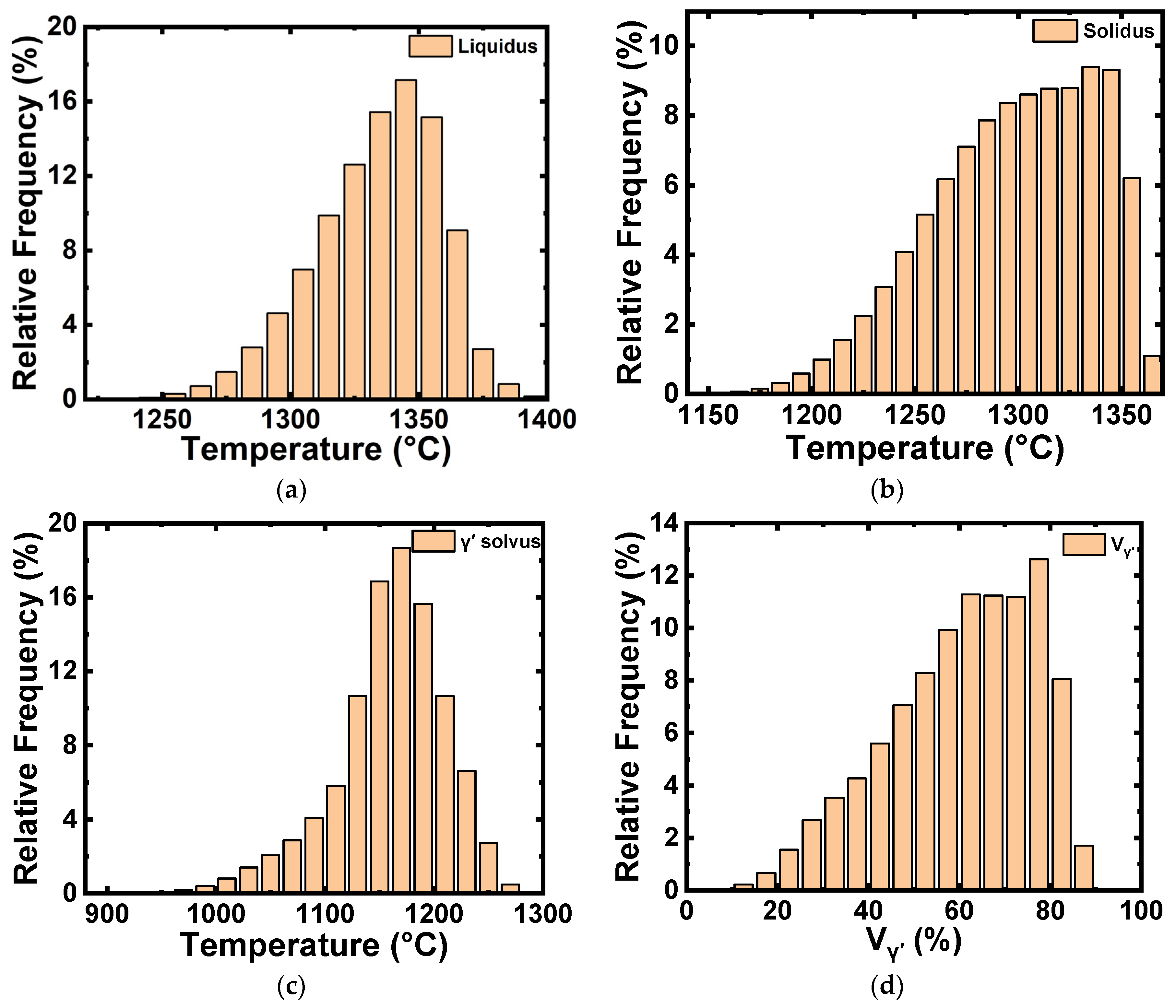
Figure 2a–d exhibit the data distribution of TL, TS, Tγ′, and Vγ′, respectively, calculated using the batch mode of JMatPro in the composition space I. The entire thermodynamic calculation process took ~100 h. Within this composition space, the TL of the alloys spanned from 1227 °C to 1399 °C, with the majority (~80%) falling between 1310 °C and 1370 °C. The TS ranged from 1150 °C to 1368 °C, with most values located in the 1260–1360 °C interval. The Tγ′ ranged from 900 °C to 1279 °C and was predominantly concentrated between 1120 °C and 1240 °C. Accordingly, the Vγ′ at 900 °C varied widely from 0.2% to 90.6%, with most data points falling within the 45–85% range.

3.2. Machine Learning Models

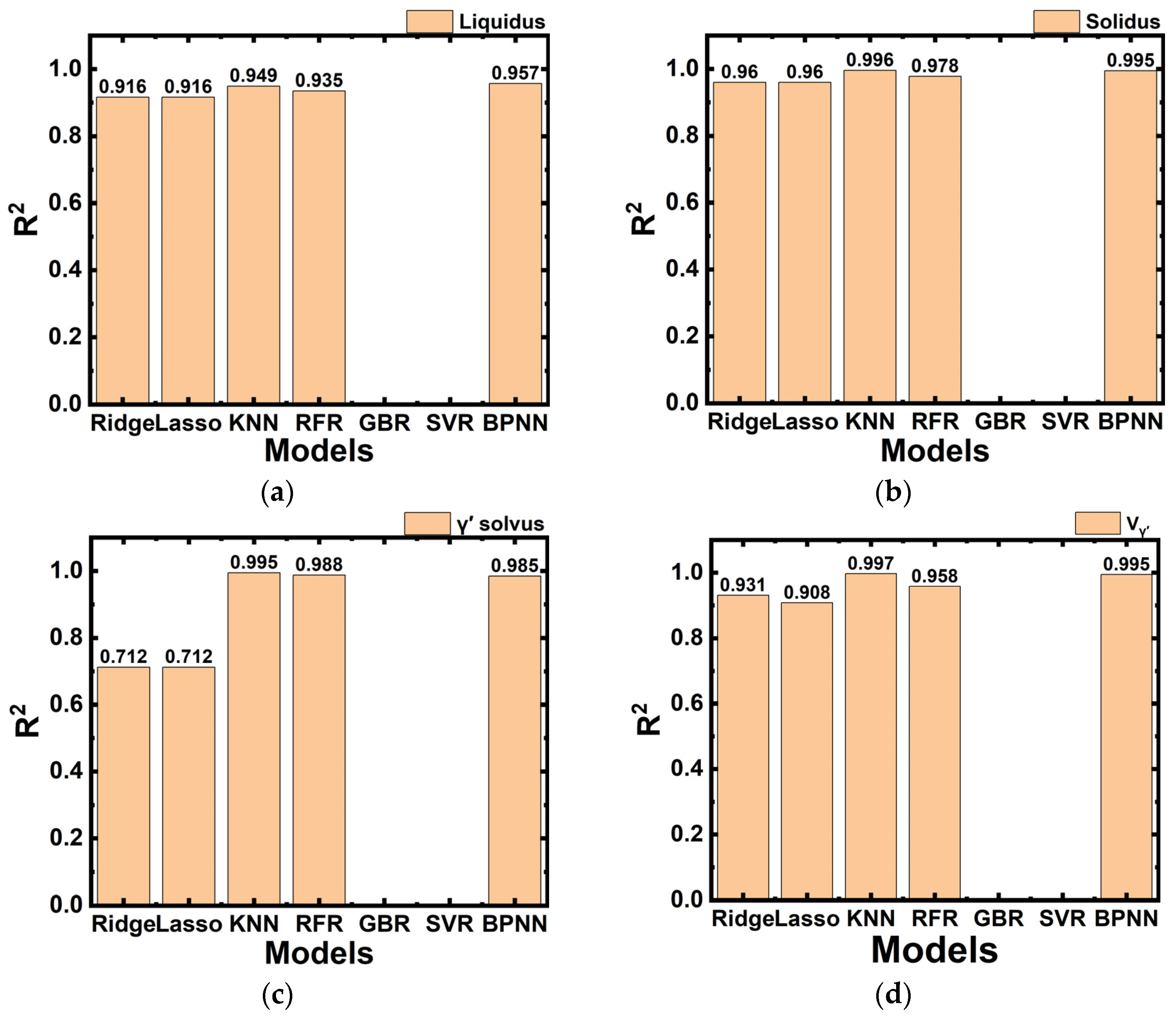
To accelerate the establishment of composition-process-microstructure relationships, this study developed prediction models to map alloy composition to TL, TS, Tγ′, and Vγ′ at 900 °C. These models were constructed using various ML algorithms based on the thermodynamic calculation dataset shown in Figure 2. The prediction performance of the different algorithms is shown in Figure 3. The results indicated that the KNN and BPNN models achieved comparable accuracy in predicting the four relationships, and both outperformed the other models. However, the computational time required for the BPNN model (8~10 h) was significantly longer than that for the KNN model (<0.5 h). It is important to note that the GBR and SVR models demanded substantially greater computational resources when handling large datasets, resulting in excessively long processing times. Therefore, considering both accuracy and computational efficiency, the KNN models (with optimal hyperparameters n_neighbors = 6 for TL, n_neighbors = 6 for TS, n_neighbors = 4 for Tγ′, and n_neighbors = 5 for Vγ′ predictions) were ultimately selected to predict the four relationships. In addition, model robustness was further evaluated by examining the sensitivity of predictive performance to variations in K (n_neighbors) and by assessing the consistency of cross-validation results. The relatively small variance in cross-validated R2 across folds indicates that the KNN model exhibits stable predictive behavior within the investigated parameter space. Despite its favorable performance and computational efficiency, KNN remains an instance-based, non-parametric method with inherently limited extrapolation capability. As predictions are strictly constrained by the local neighborhoods defined by the training data, the model is primarily suitable for interpolation within the sampled feature space rather than extrapolation beyond it. This limitation should be considered when applying the model to compositional or processing conditions outside the domain covered by the present dataset.
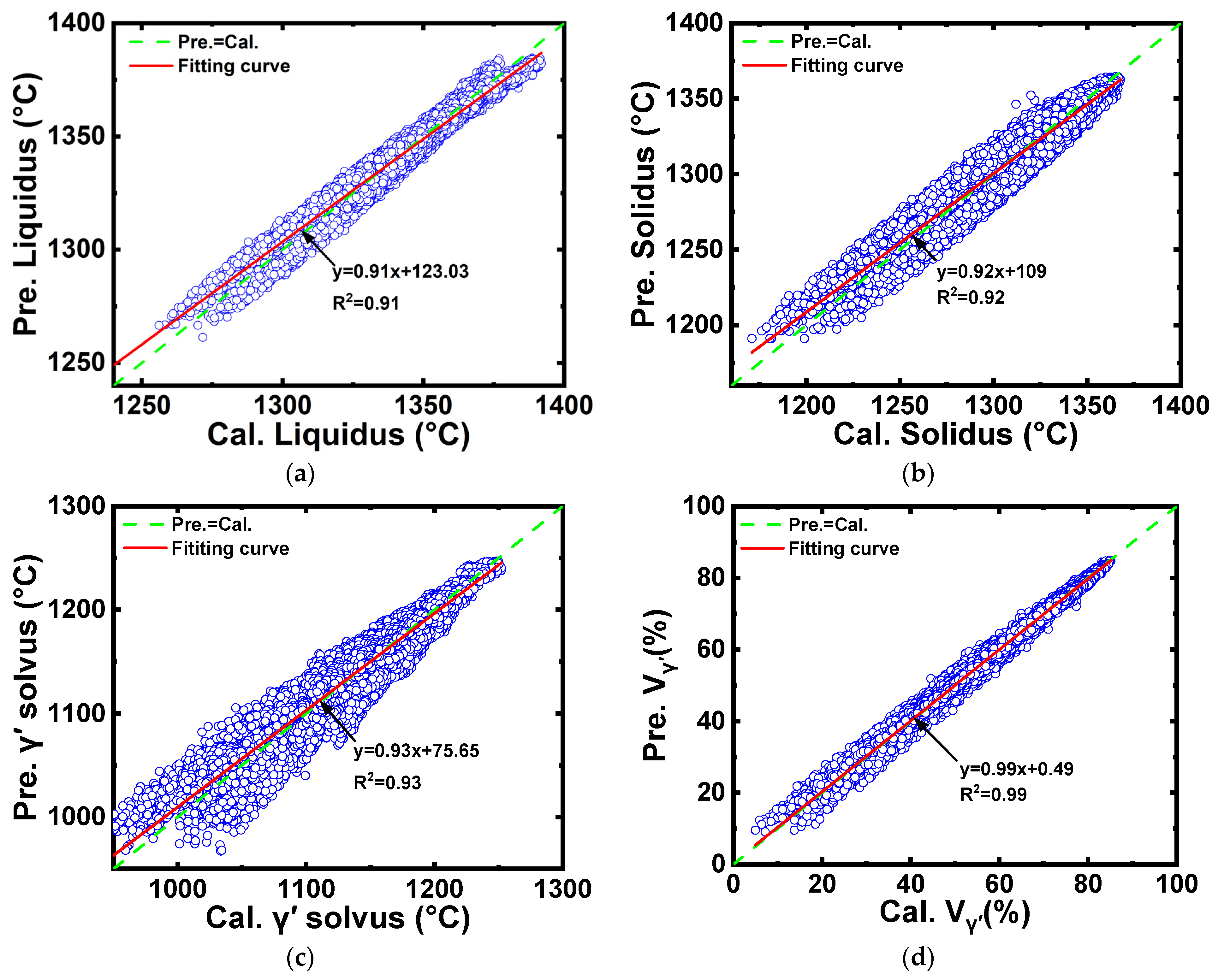
Based on the established KNN model, this study rapidly acquired the mapping relationships for 388,800 alloy compositions and their TL, TS, Tγ′, and Vγ′ at 900 °C in composition space II (Table 1). In contrast to the thermodynamic calculations (~100 h for the 45,000 alloys), the ML models required only ~3 min to predict 8.5 times as many alloys in composition space I. In addition, 20,000 ML predictions (blue circles) were randomly extracted and compared with the thermodynamic calculations, as detailed in Figure 4. Among the predictions, the results for Vγ′ at 900 °C showed the closest agreement (Figure 4d). In contrast, those for the TL (Figure 4a) exhibited slightly lower consistency with the thermodynamic calculations than the other three properties (Figure 4a–c), as indicated by the deviation between the red solid lines and green dashed lines. These comparisons demonstrated that the ML model’s predictions closely matched thermodynamic calculations, providing validation of its effectiveness as a substitute for batch thermodynamic calculations to some extent. Even so, it should be noted that the data generated by a single thermodynamic calculation not only contain the aforementioned parameters (TL, TS, Tγ′, and Vγ′ at 900 °C), but also other detailed information, such as Vγ′ and the corresponding γ/γ′ phase compositions at different temperatures. Here, we just built the models for some critical parameters based on domain knowledge. More ML models were required to predict complex data calculated by the CALPHAD methods, and their efficiency should be re-evaluated.

3.3. Multi-Objective Optimization

Based on thermodynamic calculations and the optimal ML models, preliminary screening criteria for processability and phase constituents were established using domain knowledge [19,21,24]. Firstly, to ensure the temperature capability, the Vγ′ was set within a range of 45% to 55%. Secondly, considering the heat treatment process, the TS was defined as ≥1245 °C, and the Tγ′ as ≤1210 °C. Lastly, the freckle tendency during processing large-size blades was controlled by the criterion of “0.7 ≤ (1.5Hf + 0.5Mo + Ta − 0.5Ti)/(1.2Re + W) ≤ 1” based on the work from Konter et al. [25]. Following this screening process, 3054 candidate alloys remained for further analysis.
Building on the above results, subsequent screening focused on the mechanical properties of the alloys, specifically on strength-related parameters. The primary aspects considered included (1) solid solution strengthening of the γ matrix, (2) precipitation strengthening from the γ′ phase, and (3) creep resistance.
The solid solution strengthening of the γ matrix is denoted by ΔσSS, and the specific calculation expression is as follows [26]:
Δ σ SS = ( 1 V γ ) i α i γ C i γ
where α i γ is the strengthening coefficient of element i in the γ matrix (Table 2), and C i γ is the atomic fraction of element i in the γ matrix.
The precipitation strengthening from the γ′ phase is denoted by Δσγ′, and the specific calculation expression is as follows [27]:
Δ σ γ = V γ σ ( T ) N i 3 A l + i β i γ C i γ
where σ ( T ) N i 3 A l is the intrinsic strength of γ′-Ni3Al at a given temperature, β i γ is the strengthening coefficient of element i in the γ′ phase, as listed in Table 2, and C i γ is the atomic percentage of element i in the γ′ phase.
The creep resistance is denoted by creep merit index (Mcreep), and the specific calculation expression is as follows [5]:
M c r e e p = i x i D ~ i
D ~ i = D 0 i , N i e x p Q i , N i R T
where x i is the atomic percentage of element i in the alloy, and D ~ i is the effective diffusion coefficient of element i in the Ni matrix. The pre-exponential factor D 0 i , N i and the diffusion activation energy Q i , N i for alloying elements in pure Ni are presented in Table 3.
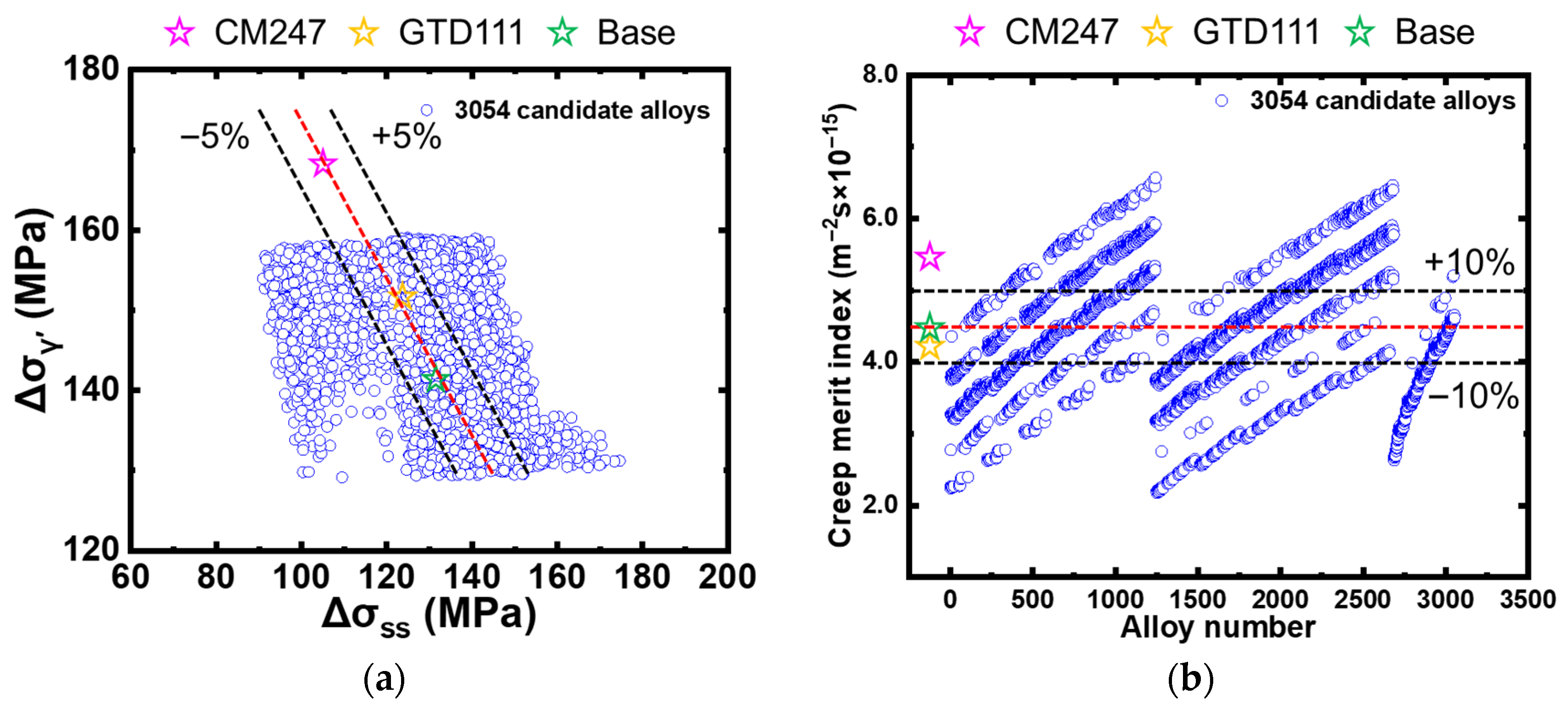
According to Formulas (2) and (3), the calculations and assessments of ΔσSS and Δσγ′ require the content of the constituent elements in the γ and γ′ phases. To address this requirement, a custom Python script was developed and integrated with the thermodynamic calculation files (JMatPro) to automatically batch-extract atomic percentage data for the constituent elements in the γ and γ′ phases at 900 °C for the 3054 remaining candidate alloys. Figure 5a summarizes the distribution of solid solution strengthening of the γ matrix (ΔσSS) and precipitation strengthening from the γ′ phase (Δσγ′) for these alloys. To further optimize the 3054 alloys, a commercial alloy (Base) with high Cr content (~14 wt.%) was selected as a reference, based on (ΔσSS + Δσγ′) values from thermodynamic calculations. A screening criterion was established by taking a ±5% deviation band (black dotted line) from the straight line (ΔσSS + Δσγ′)Base (red dotted line). Similarly, the ΔσSS and Δσγ′ of the other two commercial alloys, namely CM247 [35] and GTD111 [21], were calculated and plotted, as labeled in Figure 5. Interestingly, the results showed that the data points for the two alloys approximately aligned along the straight line of the base alloy. Figure 5b shows the distribution of the creep merit index (Mcreep) for the 3054 candidate alloys. A screening criterion was defined as a ±10% deviation band (black dotted line) around the base alloy (Mbase, red dotted line). The ranking of the creep merit index for the three commercial alloys was as follows: MCM247 > MBase > MGTD111.
It should be mentioned that the strength indices ((ΔσSS + Δσγ′) and Mcreep) adopted in this study are based on simplified empirical formulations that condense multiple contributing factors into scalar descriptors. Such an approach inevitably involves approximations and does not explicitly resolve the full complexity of strengthening mechanisms or creep deformation processes, especially in multicomponent alloy systems. Consequently, the direct applicability of these indices to predict absolute mechanical properties across a broad compositional space is inherently limited. Within the present optimization framework, the merit indices are not intended to serve as exact mechanical property models. Instead, they function as physically informed, computationally efficient metrics for comparative evaluation and ranking of candidate compositions within a constrained design space. By focusing on relative trends rather than absolute values, the indices enable rapid screening of promising alloy modifications while maintaining a transparent connection to established metallurgical principles. The empirical coefficients embedded in the merit formulations represent another source of uncertainty, as different coefficient choices may affect the numerical values of the indices. Nevertheless, sensitivity considerations suggest that, within physically reasonable coefficient ranges, the relative ranking of candidate alloys and the qualitative optimization outcomes remain essentially unchanged. This indicates that the optimization results are driven primarily by underlying compositional trends rather than by fine-tuning of specific coefficients.
Besides the strength parameter, microstructural stability was also considered by M d γ ¯ , which is commonly employed to avoid the preference for the Topologically Close-Packed (TCP) phase precipitation [36], normally M d γ ¯ ≤ 0.92. The specific expression is as follows [37]:
M d γ ¯ =   i C i γ M d i
where M d i is the d-orbital energy level of the element i in the alloy (Table 4) [37].
At last, oxidation resistance, density, and cost were considered for the final screening based on domain knowledge. Oxidation resistance was assessed using a compositional criterion of Cr content greater than 10 wt.%. The alloy density ( ρ ) was required to be no higher than 8.5 g/cm3 and was estimated using a simple rule of mixtures based on the densities of the constituent pure elements, scaled by a factor of 1.05 [5].
ρ = 1.05 i X i ρ i
where X i is the weight percentage of element i in the alloy, and ρ i is the effective density of element i.
The cost ($) criterion was defined as a relative cost index not exceeding 1.10 times that of the base alloy. The cost was calculated by multiplying each alloying element’s mass fraction by its normalized raw-material price and summing over all elements. Meanwhile, these estimates assumed that processing costs were identical for all alloys, i.e., that the product yield was not affected by composition [5].
All the screening criteria set for the superalloys designed for industrial gas turbine blades in this study are listed in Table 5. Based on these screening criteria, seven candidate alloys were ultimately selected for experimental validation, as shown in Table 6.

3.4. Experimental Verification

(1) phase transition temperatures
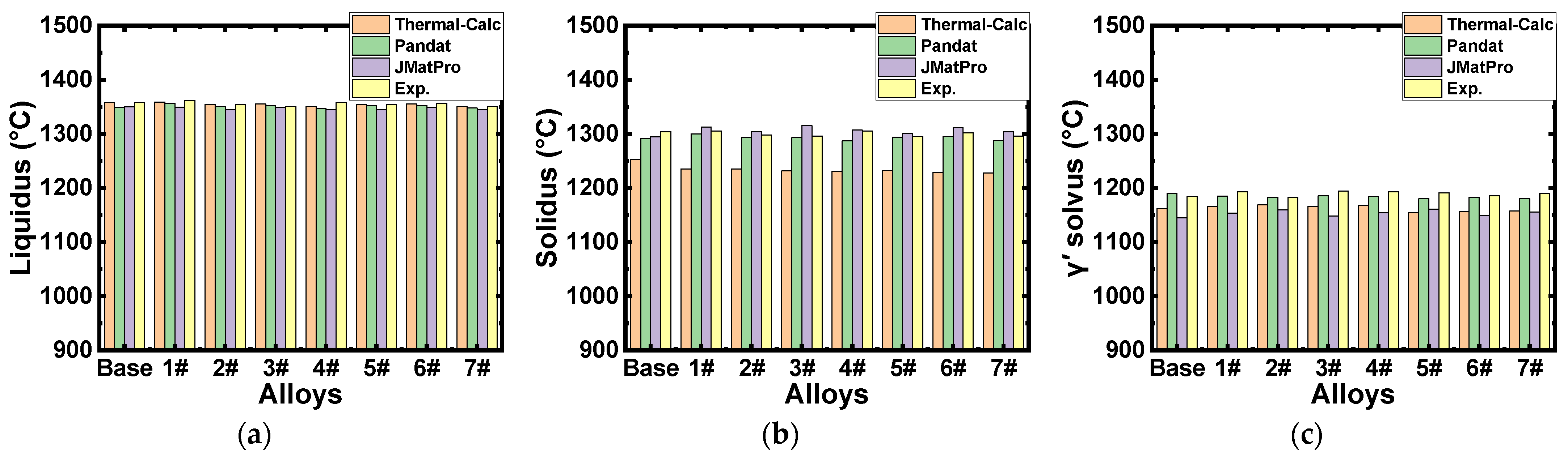
To validate the reliability of the thermodynamic data obtained from JMatPro, the TL, TS, and Tγ′ of the alloys listed in Table 6 were measured by DSC (Differential Scanning Calorimetry) and subsequently calculated using both Thermo-Calc and Pandat. This cross-comparison was performed to assess the variations between different thermodynamic databases. Figure 6 compares the calculated and experimental values of TL, TS, and Tγ′ for the base alloy and seven candidate alloys. The results revealed distinct differences among the three thermodynamic software, which highlight the intrinsic uncertainties of thermodynamic modeling for complex multicomponent superalloys. For the TL, calculated values from Thermo-Calc, Pandat, and JMatPro showed close agreement with experiments. Regarding the TS, Pandat and JMatPro provided more accurate predictions, whereas Thermo-Calc exhibited a significant discrepancy. For the Tγ′, only Pandat’s calculations were in close agreement with experimental values, whereas both Thermo-Calc and JMatPro showed substantial deviations.
In summary, Pandat demonstrated the highest predictive accuracy across all three parameters. JMatPro performed well for TL and TS predictions but poorly for the Tγ′. Thermo-Calc showed good TL prediction capability, but its accuracy was lower for TS and Tγ′. Nevertheless, it is important to emphasize that the primary objective of this study was not to identify the most accurate thermodynamic database. Instead, the cross-comparison was conducted to evaluate the differences of critical thermodynamic parameters (TL, TL, and Tγ′) between the seven candidate alloys and the base alloy. Critically, results from all three pieces of thermodynamic software consistently demonstrated a marked similarity for the eight alloys. For any given database, the deviations in TL, TS, and Tγ′ between the base alloy and the seven candidate alloys were not apparent. Therefore, the same heat-treatment schedule (Section 2.4) used for the base alloy was applied to all seven candidate alloys.
In addition, given the discrepancies among thermodynamic databases and experiments (especially for TS and Tγ′), the ML models shown in this work should be regarded as surrogate representations of the thermodynamic database rather than as direct predictors of experimentally measured thermodynamic quantities. Their primary strength lies in efficiently capturing internal trends and complex nonlinear relationships within a self-consistent thermodynamic framework, thereby enabling rapid interpolation across high-dimensional compositional spaces. Consequently, while the ML models in this study can provide reliable trend predictions and comparative insights within the domain defined by the JMatPro database, caution should be exercised when interpreting absolute values or extrapolating the predictions beyond the training domain. Future improvements may be achieved by incorporating multi-database data (i.e., Pandat, which showed the best predictive performance in this study) or experimental constraints into the training process, thereby reducing database-specific biases and enhancing the generalizability of ML-based predictions.
(2) Microstructures
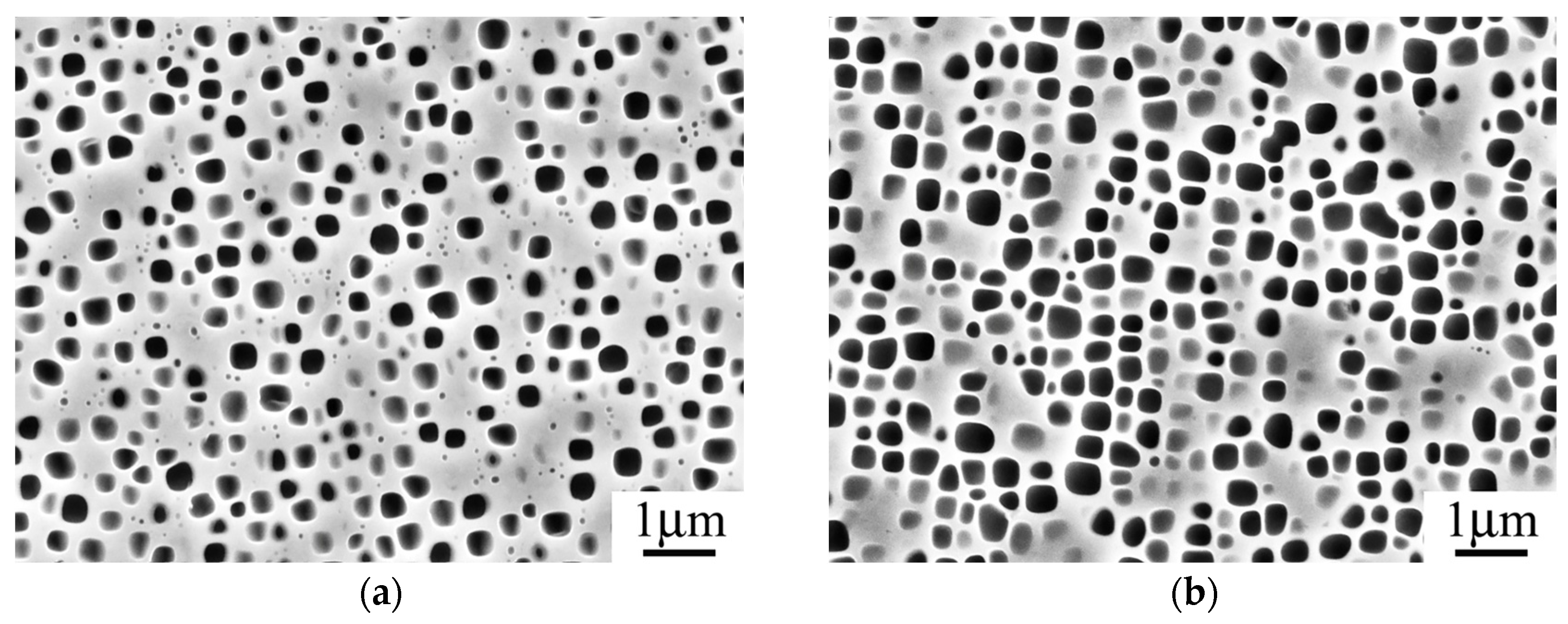
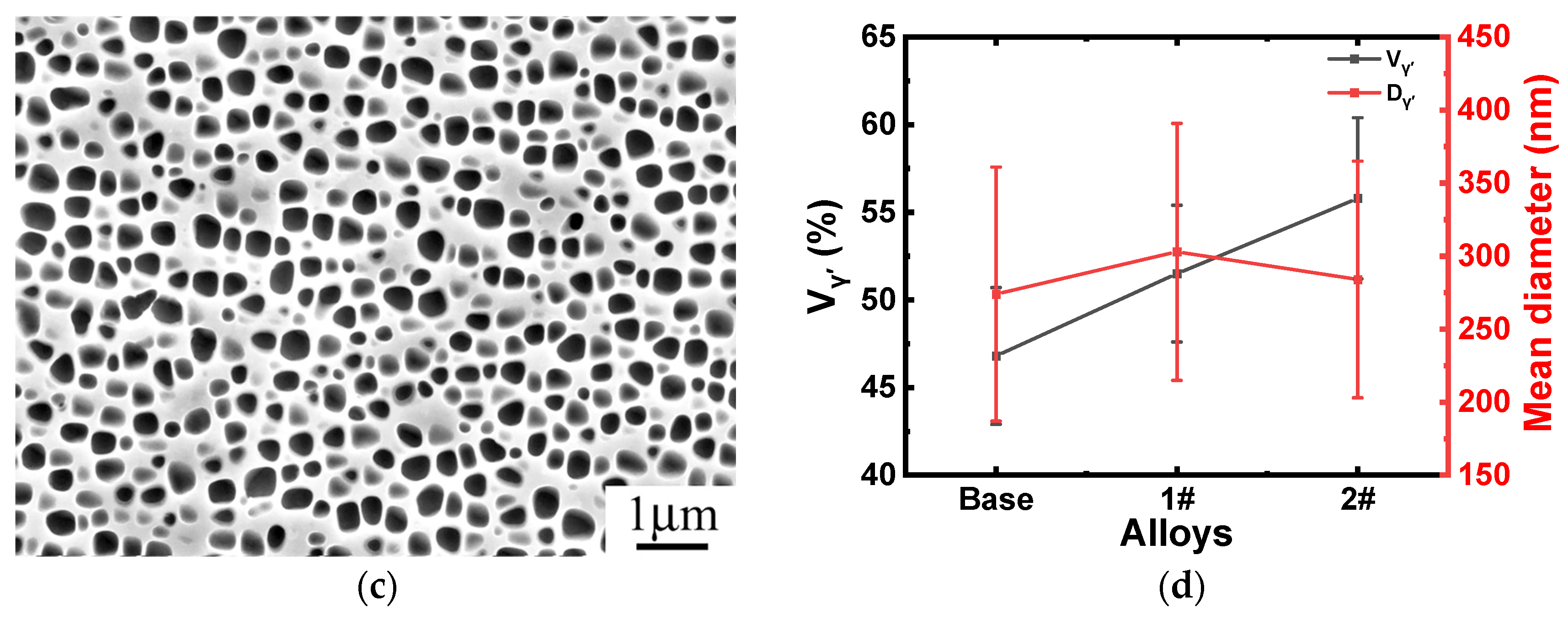
To avoid excessive detail, the analysis in this section focuses specifically on 1# and 2# alloys. Both exhibit strength indices ((ΔσSS + Δσγ′) and Mcreep) positioned at the upper boundary of the established screening criteria in Table 5. Figure 7a–c show the typical γ/γ′ microstructures of the base, 1# and 2# alloys after heat treatment, respectively. Similar to the base alloy, both the 1# and 2# alloys exhibited a well-formed γ/γ′ microstructure without precipitation of TCP phases. Despite similar content of γ′-forming elements (Al + Ta + Ti + Nb = ~11.5 wt.%) in the three alloys, the Vγ′ of 1# and 2 alloys were measured to be 51.5 ± 3.8% and 55.8 ± 4.6%, respectively, both of which are higher than that of the base alloy (46.8 ± 3.9%). This deviation should be related to the higher Cr content in the base alloy (~14 wt.%) than that in 1# and 2 alloys (11.0 wt.%), which is reported to decrease the Vγ′ of Ni-based superalloys [1,23]. The mean diameters of γ′ precipitations were similar for all three alloys, falling within a range of 250–300 nm, as shown in Figure 7d. No fine γ′ precipitates were observed in the 1# and 2 alloys, whereas they were present in the base alloy, suggesting different precipitate-dynamic processes between the base alloy and the two candidate alloys.
(3) Mechanical, oxidation and other properties
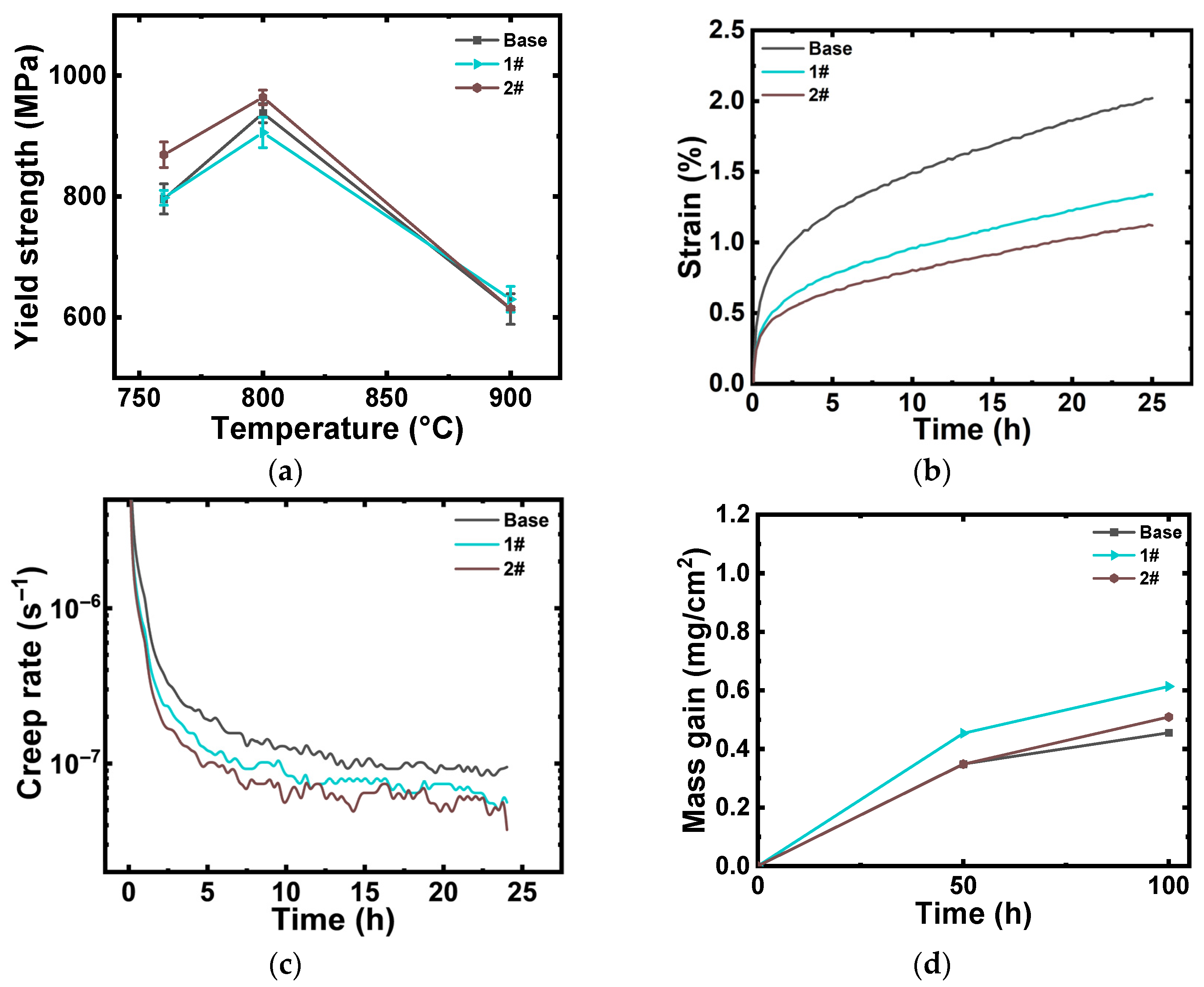
Figure 8a shows the compressive yield strength of the base, 1#, and 2# alloys at different temperatures. The compressive yield strength of the three alloys initially increased with increasing temperature, exhibiting anomalous yield behavior in the 760–800 °C range. This has been widely reported in Ni- or CoNi-based superalloys [38,39] and was associated with thermally activated cross-slips of dislocations from the octahedral {111} planes to the hexahedral {100} planes of the γ′ phase. As the temperature increased further, the compressive yield strength decreased. In addition, 2# alloy demonstrated superior yield strength (869 ± 21 MPa and 964 ± 12 MPa) compared to the other alloys at 760 °C and 800 °C. In contrast, the three alloys exhibited comparable compressive yield strengths at 900 °C, with the 1# alloy (630 ± 21 MPa) slightly higher than both the base alloy (614 ± 25 MPa) and the 2# alloy (615 ± 2 MPa). Besides the compressive properties, Figure 8b,c present the compressive creep properties of the base, 1#, and 2# alloys at 900 °C/320 MPa with a duration of 25 h. 1# and 2# alloys demonstrated a higher creep resistance than the base alloys, as indicated by the lower creep strains and creep rates. These results indicated the validity of the screen criteria for the strength indices (0.95(ΔσSS + Δσγ′)Base ≤ (ΔσSS + Δσγ′) ≤ 1.05(ΔσSS + Δσγ′)Base and 0.9MBase ≤ M ≤ 1.1MBase). While these experiments demonstrate the feasibility and effectiveness of the proposed optimization framework, they do not constitute a comprehensive evaluation of long-term creep resistance or the full spectrum of mechanical properties required for service-relevant applications. The selected experiments are intended to serve as representative case studies that qualitatively verify the predicted strengthening and creep-related trends suggested by the optimization results. Consequently, caution should be exercised when generalizing the present experimental findings beyond the specific alloys and test conditions investigated. Future work involving a larger set of candidate alloys, extended creep testing durations, and additional mechanical properties will be necessary to fully validate and benchmark the optimization framework for practical alloy development.
Figure 8d shows the oxidation mass gains of the three alloys tested at 900 °C for 100 h. The base alloy exhibited superior oxidation resistance compared with 1# and 2# alloys, likely due to its higher Cr content, which facilitates the formation of a protective Cr2O3 oxide film [23].
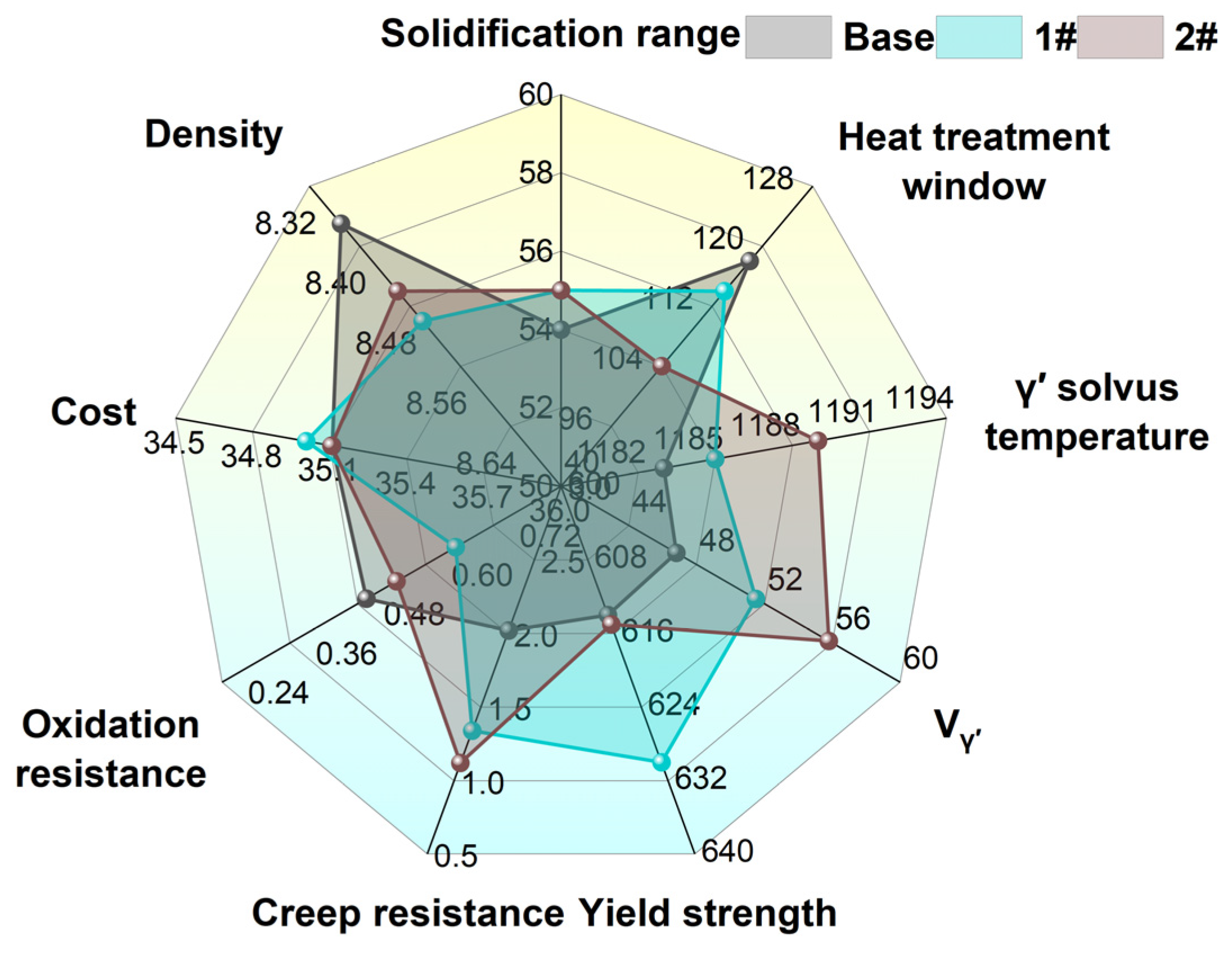
In addition to the aforementioned properties, the densities of the base, 1#, and 2# alloys, measured using the drainage method, were 8.35, 8.48, and 8.44 g/cm3, respectively. On the other hand, the estimated material costs for these three alloys, based on the mass fraction of constituent elements and current raw material prices, were 35.11, 35.02, and 35.10 USD/kg, respectively.
To facilitate a comprehensive comparison, the key characteristics of the three alloys—including solidification range (TL-TS), heat treatment window (TS-Tγ′), Tγ′, Vγ′, yield strength (compressive yield strength at 900 °C), creep resistance (strain at 900 °C/320 MPa-25 h), oxidation resistance (weight gain after 900 °C/100 h), cost, and density—were visualized using a radar chart (Figure 9). The results indicated that 1# and 2# alloys exhibited yield strength and creep resistance that are superior or comparable to those of the base alloy at a comparable cost. This enhancement is likely attributable to their higher Vγ′ and strength indices ((ΔσSS + Δσγ′) and Mcreep). The higher Vγ′ is due to an elevated Tγ′, which also narrows the heat treatment window, as a maximum limit on the solidus temperature (TS) was imposed in the screening criteria. The solidification ranges of the three alloys did not differ significantly. On the other hand, while W is a key element for enhancing solid solution strengthening and creep resistance, it significantly increases alloy density, resulting in higher densities for 1# and 2# alloys than for the base alloy. Similarly, the comparatively lower oxidation resistance of 1# and 2# alloys relative to the base alloy is due to their lower Cr content, which is crucial for this property.
In summary, this study successfully developed and validated a novel alloy design methodology. The core of this approach lies in establishing a reference alloy, integrating thermodynamic calculations and applying strength-related screening criteria. This strategy enabled the design of cost-effective candidate alloys with mechanical properties comparable to or superior to the base alloy, albeit with lower oxidation resistance and higher density. Screen criteria can be optimized to further improve the oxidation resistance and lower the density of the candidate alloys.
On the other hand, by introducing a reference alloy, the proposed framework enables efficient exploration of physically meaningful composition variations while avoiding unrealistic or extrapolative predictions. Within this domain, integrating thermodynamic calculations with machine learning models provides a powerful tool for identifying promising compositional trends and trade-offs among competing design objectives. Nevertheless, the methodology itself is not inherently restricted to a specific alloy system. With appropriate redefinition of the reference composition, compositional bounds, and thermodynamic databases, the same framework can be readily extended to other alloy families or design targets.

4. Conclusions

This study proposed an optimization strategy for existing alloys by integrating CALPHAD data with machine learning methods, and its reliability was experimentally validated. The main conclusions are as follows:
(1) Based on a thermodynamic dataset (45,000 alloys) established through thermodynamic calculations, the machine learning approach enables faster predictions of the relationships between a greater number of alloy compositions (388,800 alloys) and their phase constituents, phase transition temperatures, and γ′ volume fractions within the same composition range, while maintaining comparable accuracy, thereby significantly improving design efficiency.
(2) While discrepancies exist among different thermodynamic databases when calculating various thermodynamic parameters of a given alloy, the relative trends in thermodynamic characteristics among different alloys remain consistent within any single database. This consistency establishes a foundation for alloy composition optimization based on the thermodynamic data of a reference alloy.
(3) By integrating thermodynamic calculations with machine learning and using the strength indices ((ΔσSS + Δσγ′) and Mcreep) of a reference alloy (commercial alloy) as the key screening criterion, two new alloys were identified within a constrained compositional space. These alloys exhibit strength comparable to or higher than that of the base alloy under the tested conditions at a similar cost, despite some trade-offs in oxidation resistance and density.
This finding lays the groundwork for alloy composition optimization using thermodynamic databases, particularly for existing commercial alloys.

Author Contributions

Conceptualization, S.L., L.L. and X.G.; methodology, Y.P., Z.G. and J.T.; software, Z.G., J.W., L.N., S.L., J.T. and Z.W.; validation, Z.G., J.W., L.N., S.L., J.T. and Z.W.; formal analysis, Y.P., S.L. and J.T.; investigation, Y.P. and L.L.; resources, S.L.; writing—original draft preparation, Y.P., Z.G., J.W., L.N., S.L. and J.T.; writing—review and editing, Y.P., Z.G., J.W., L.N., S.L., Z.W., L.L. and X.G.; supervision, Z.W., L.L. and X.G.; funding acquisition, S.L. and X.G. All authors have read and agreed to the published version of the manuscript.

Funding

The authors would like to acknowledge the financial support provided by the National Natural Science Foundation of China (Grant No.: 52201100 and 92060113), State Key Laboratory of Clean and Efficient Turbomachinery Power Equipment (Grant No.: DEC8300CG202418403A1228115), Leading Scientist Program for Basic Research (Advanced Technology) of Sichuan Province (Grant No.: 2024JDKXJ0002) and Sichuan Science and Technology Program No 2024ZDZX0039.

Data Availability Statement

The original contributions presented in this study are included in the article. Further inquiries can be directed to the corresponding authors.

Conflicts of Interest

Authors Yubing Pei, Zhenhuan Gao, Junjie Wu, Liping Nie, Ziyun Wu and Xiufang Gong were employed by the company Dongfang Electric Corporation Dongfang Turbine Co., LTD. The remaining authors declare that the research was conducted in the absence of any commercial or financial relationships that could be construed as a potential conflict of interest.

References

  1. Reed, R.C. The Superalloys: Fundamentals and Applications; Cambridge University Press: Cambridge, UK, 2006. [Google Scholar]
  2. Zhang, Y.; Wang, C.; Zheng, D.; Yu, X.; Guo, Y.; Yang, C.; Huang, Y.; Yang, S.; Liu, X. CALPHAD-guided design and experimental optimization of nico-based superalloys with enhanced γ′ phase stability and mechanical performance. J. Mater. Res. Technol. 2025, 39, 8243–8255. [Google Scholar] [CrossRef]
  3. Zhang, L.; Huang, Z.; Pan, Y.; Jiang, L. Design of re-free nickel-base single crystal superalloys using modelling and experimental validations. Model. Simul. Mater. Sci. Eng. 2019, 27, 065002. [Google Scholar] [CrossRef]
  4. Crudden, D.J.; Raeisinia, B.; Warnken, N.; Reed, R.C. Analysis of the chemistry of Ni-base turbine disk superalloys using an alloys-by-design modeling approach. Metall. Mater. Trans. A 2013, 44, 2418–2430. [Google Scholar] [CrossRef]
  5. Reed, R.C.; Tao, T.; Warnken, N. Alloys-By-Design: Application to nickel-based single crystal superalloys. Acta Mater. 2009, 57, 5898–5913. [Google Scholar] [CrossRef]
  6. Yokokawa, T.; Harada, H.; Kawagishi, K.; Koizumi, Y.; Kobayashi, T. Quantitative analysis of creep strengthening factors in Ni-base single crystal superalloys. In Proceedings of the SuperaIloys, Seven Springs, PA, USA, 9–13 September 2012; Huron, E.S., Reed, R.C., Hardy, M.C., Mills, M.J., Montero, R.E., Portella, P.D., Telesman, J., Eds.; TMS: Warrendale, PA, USA, 2012; pp. 285–292. [Google Scholar]
  7. Müller, A.; Roslyakova, I.; Sprenger, M.; Git, P.; Rettig, R.; Markl, M.; Körner, C.; Singer, R.F. MultOpt++: A fast regression-based model for the development of compositions with high robustness against scatter of element concentrations. Model. Simul. Mater. Sci. Eng. 2019, 27, 024001. [Google Scholar] [CrossRef]
  8. Markl, M.; Müller, A.; Ritter, N.; Hofmeister, M.; Naujoks, D.; Schaar, H.; Abrahams, K.; Frenzel, J.; Subramanyam, A.P.A.; Ludwig, A.; et al. Development of single-crystal Ni-base superalloys based on multi-criteria numerical optimization and efficient use of refractory elements. Metall. Mater. Trans. A 2018, 49, 4134–4145. [Google Scholar] [CrossRef]
  9. Rettig, R.; Ritter, N.C.; Helmer, H.E.; Neumeier, S.; Singer, R.F. Single-crystal nickel-based superalloys developed by numerical multi-criteria optimization techniques: Design based on thermodynamic calculations and experimental validation. Model. Simul. Mater. Sci. Eng. 2015, 23, 035004. [Google Scholar] [CrossRef]
  10. Yang, W.; Lin, S.; Wang, Q.; Liu, C.; Qin, J.; Zhang, J. Accelerated design of L12-strengthened single crystal high entropy alloys based on machine learning and multi-objective optimization. Mater. Adv. 2024, 5, 5772–5780. [Google Scholar] [CrossRef]
  11. Gao, Q.; Zhang, X.; Ma, Q.; Zhu, H.; Zhang, H.; Sun, L.; Li, H. Accelerating design of novel cobalt-based superalloys based on first-principles calculations. J. Alloys Compd. 2022, 927, 167012. [Google Scholar] [CrossRef]
  12. Lu, S.; Zou, M.; Zhang, X.; Antonov, S.; Li, W.; Li, L.; Feng, Q. Data-driven “Cross-component” design and optimization of γ′-strengthened Co-based superalloys. Adv. Eng. Mater. 2023, 25, 2201257. [Google Scholar] [CrossRef]
  13. Li, W.; Wheeler, J.M.; Han, H.; Li, L.; Feng, Q. High-throughput investigation of the alloying effects of W, Ti, and Ta on the microstructural stability and mechanical properties of CoNi-base superalloys. Mater. Sci. Eng. A 2025, 925, 147857. [Google Scholar] [CrossRef]
  14. Li, W.; Li, L.; Antonov, S.; Wei, C.; Zhao, J.-C.; Feng, Q. High-throughput exploration of alloying effects on the microstructural stability and properties of multicomponent CoNi-base superalloys. J. Alloys Compd. 2021, 881, 160618. [Google Scholar] [CrossRef]
  15. Zhuang, X.; Antonov, S.; Li, W.; Lu, S.; Li, L.; Feng, Q. Alloying effects and effective alloy design of high-Cr CoNi-based superalloys via a high-throughput experiments and machine learning framework. Acta Mater. 2023, 243, 118525. [Google Scholar] [CrossRef]
  16. Xu, J.; Li, L.; Liu, X.; Li, H.; Feng, Q. Quantitative models of high temperature creep microstructure-property correlation of a nickel-based single crystal superalloy with physical and statistical features. J. Mater. Res. Technol. 2022, 19, 2301–2313. [Google Scholar] [CrossRef]
  17. Xu, J.; Li, L.; Liu, X.; Li, H.; Feng, Q. Fast characterization framework for creep microstructure of a nickel-based SX superalloy with high-throughput experiments and deep learning methods. Mater. Charact. 2022, 187, 111857. [Google Scholar] [CrossRef]
  18. Li, W.; Li, L.; Antonov, S.; Feng, Q. Effective design of a Co-Ni-Al-W-Ta-Ti alloy with high γ′ solvus temperature and microstructural stability using combined calphad and experimental approaches. Mater. Des. 2019, 180, 107912. [Google Scholar] [CrossRef]
  19. Okada, I.; Torigoe, T.; Takahashi, K.; Izutsu, D. Development of Ni base superalloy for industrial gas turbine. In Proceedings of the Superalloys 2004; Green, K.A., Pollock, T.M., Harada, H., Howson, T.E., Reed, R.C., Schirra, J.J., Walston, S., Eds.; TMS: Warrendale, PA, USA, 2004; pp. 707–712. [Google Scholar]
  20. Oguma, H.; Tsukimoto, K.; Goya, S.; Okajima, Y.; Ishizaka, K.; Ito, E. Development of advanced materials and manufacturing technologies for high-efficiency gas turbines. Mitsubishi Heavy Ind. Tech. Rev. 2015, 52, 5–14. [Google Scholar]
  21. Peng, J.Q.; Zhang, H.T.; Li, Y.F. Review of blade materials for IGT. Procedia Eng. 2015, 130, 668–675. [Google Scholar] [CrossRef]
  22. Erickson, G.L. The development of the CMSX-11B and CMSX-11C alloys for industrial gas turbine application. In Proceedings of the Superalloys 1996; Kissinger, R.D., Deye, D.J., Anton, D.L., Cetel, A.D., Nathal, M.V., Pollock, T.M., Woodford, D.A., Eds.; TMS: Warrendale, PA, USA, 1996; pp. 45–52. [Google Scholar]
  23. Zhang, H.W.; Qin, X.Z.; Wu, Y.S.; Zhou, L.Z.; Li, X.W. Effects of Cr content on the microstructure and stress rupture property of a directionally solidified Ni-based superalloy during long-term thermal exposure. Mater. Sci. Eng. A 2018, 718, 449–460. [Google Scholar] [CrossRef]
  24. Chang, J.X.; Wang, D.; Zhang, G.; Lou, L.H.; Zhang, J. Interaction of Ta and Cr on Type-I hot corrosion resistance of single crystal Ni-base superalloys. Corros. Sci. 2017, 117, 35–42. [Google Scholar] [CrossRef]
  25. Konter, M.; Newnham, M.; Tonnes, C. Nickel-Base Superalloy. U.S. Patent No. 5888451, 30 March 1999. [Google Scholar]
  26. Roth, H.A.; Davis, C.L.; Thomson, R.C. Modeling solid solution strengthening in nickel alloys. Metall. Mater. Trans. A 1997, 28, 1329–1335. [Google Scholar] [CrossRef]
  27. Kozar, R.W.; Suzuki, A.; Milligan, W.W.; Schirra, J.J.; Savage, M.F.; Pollock, T.M. Strengthening mechanisms in polycrystalline multimodal nickel-base superalloys. Metall. Mater. Trans. A 2009, 40, 1588–1603. [Google Scholar] [CrossRef]
  28. Antonov, S.; Detrois, M.; Isheim, D.; Seidman, D.; Helmink, R.C.; Goetz, R.L.; Sun, E.; Tin, S. Comparison of thermodynamic database models and APT data for strength modeling in high Nb content γ–γ′ Ni-base superalloys. Mater. Des. 2015, 86, 649–655. [Google Scholar] [CrossRef]
  29. Mishima, Y.; Ochiai, S.; Hamao, N.; Yodogawa, M.; Suzuki, T. Solid solution hardening of Ni3Al with ternary additions. Trans. Jpn. Inst. Met. 1986, 27, 648–655. [Google Scholar] [CrossRef]
  30. Karunaratne, M.S.A.; Carter, P.; Reed, R.C. Interdiffusion in the face-centred cubic phase of the Ni–Re, Ni–Ta and Ni–W systems between 900 and 1300 °C. Mater. Sci. Eng. A 2000, 281, 229–233. [Google Scholar] [CrossRef]
  31. Zhu, Z.; Basoalto, H.; Warnken, N.; Reed, R.C. A model for the creep deformation behaviour of nickel-based single crystal superalloys. Acta Mater. 2012, 60, 4888–4900. [Google Scholar] [CrossRef]
  32. Janssen, M.M.P. Diffusion in the nickel-rich part of the Ni-Al system at 1000~ to 1300~ Ni3Al layer growth, diffusion coefficients, and interface concentrations. Metall. Mater. Trans. B 1973, 4, 1623–1633. [Google Scholar] [CrossRef]
  33. Karunaratne, M.S.A.; Reed, R.C. Interdiffusion of niobium and molybdenum in nickel between 900–1300 °C. Defect Diffus. Forum 2005, 237, 420–425. [Google Scholar] [CrossRef]
  34. Jung, S.B.; Yamane, T.; Minamino, Y.; Hirao, K.; Araki, H.; Saji, S. Interdiffusion and Its Size Effect in Nickel Solid Solutions of Ni-Co, Ni-Cr and Ni-Ti Systems. J. Mater. Sci. Lett. 1992, 11, 1333–1337. [Google Scholar] [CrossRef]
  35. Harris, K.; Erickson, G.L.; Schwer, R.E. MAR-M247 derivations—CM247 LC DS alloy, CMSX single crystal alloys, properties and performance. In Proceedings of the Superalloys 1984; Gell, M., Kortovich, C., Bricknell, R.H., Kent, W.B., Radavich, J.F., Eds.; TMS: Warrandale, PA, USA, 1984; pp. 221–230. [Google Scholar]
  36. Zhang, J.S.; Hu, Z.Q.; Murata, Y.; Morinaga, M.; Yukawa, N. Design and development of hot corrosion-resistant nickel-base single-crystal superalloys by the d-electrons alloy design theory: Part II. Effects of refractory metals Ti, Ta, and Nb on microstructures and properties. Metall. Trans. A 1993, 24, 2451–2464. [Google Scholar] [CrossRef]
  37. Morinaga, M.; Yukawa, N.; Adachi, H.; Ezaki, H. New phacomp and its applications to alloy design. In Proceedings of the Superalloys 1984; Gell, M., Kortovich, C., Bricknell, R.H., Kent, W.B., Radavich, J.F., Eds.; TMS: Warrandale, PA, USA, 1984; pp. 523–532. [Google Scholar]
  38. Ding, Q.; Bei, H.; Yao, X.; Zhao, X.; Wei, X.; Wang, J.; Zhang, Z. Temperature effects on deformation substructures and mechanisms of a Ni-based single crystal superalloy. Appl. Mater. Today 2021, 23, 101061. [Google Scholar] [CrossRef]
  39. Bezold, A.; Volz, N.; Lenz, M.; Karpstein, N.; Zenk, C.H.; Spiecker, E.; Göken, M.; Neumeier, S. Quantification of the temperature-dependent evolution of defect structures in a CoNi-base superalloy. Acta Mater. 2022, 227, 117702. [Google Scholar] [CrossRef]
Figure 1. Workflow of multi-performance optimization for Ni-based superalloys by integrating CALPHAD methods and machine learning models.
Metals 16 00154 g001
Figure 2. Data distribution of (a) liquidus temperature, (b) solidus temperature, (c) γ′ solvus temperature and (d) γ′ volume fraction at 900 °C, respectively, calculated using the batch mode of JMatPro in the composition space I.
Metals 16 00154 g002
Figure 3. Prediction performance of the selected machine learning models for (a) liquidus temperature, (b) solidus temperature, (c) γ′ solvus temperature and (d) γ′ volume fraction at 900 °C.
Metals 16 00154 g003
Figure 4. Comparison of 20,000 machine learning predictions and JMatPro calculations for (a) liquidus temperature, (b) solidus temperature, (c) γ′ solvus temperature, and (d) γ′ volume fraction at 900 °C.
Metals 16 00154 g004
Figure 5. Distribution of (a) solid solution strengthening of the γ matrix (ΔσSS) and (b) precipitation strengthening from the γ′ phase (Δσγ′) for the 3054 candidate alloys.
Metals 16 00154 g005
Figure 6. Comparison between the calculated and experimental values of the (a) liquidus temperature, (b) solidus temperature, and (c) γ′ solvus temperature for the base alloy and seven candidate alloys.
Metals 16 00154 g006
Figure 7. Typical γ/γ′ microstructures of the (a) base, (b) 1#, and (c) 2# alloys after the heat treatment, as well as their (d) volume fractions and mean diameters of γ′ precipitations.
Metals 16 00154 g007aMetals 16 00154 g007b
Figure 8. Mechanical and oxidation properties of the base, 1#, and 2# alloys. (a) compressive yield strength at different temperatures; (b) creep strain vs. time curves; (c) creep rate vs. time curves; (d) oxidation mass gains at 900 °C for 100 h.
Metals 16 00154 g008
Figure 9. The radar chart of base, 1#, and 2# alloys on multiple properties.
Metals 16 00154 g009
Table 1. The upper and lower compositional limits (wt.%) and step sizes for the composition spaces I and II, respectively.
ElementNiCoAlCrWMoTaTiNb
RangeBal.2~103~68~162~100.7~2.11~81~50.5~1
Step for I-21220.71.520.5
Step for II-11210.7110.5
Table 2. Strengthening coefficients of alloying elements in the γ matrix and γ′ phase [27,28,29].
ElementsCoAlCrWMoTaTiNb
α i γ (MPa/ a t . f r a c t i o n )39.4225337977101511917751183
β i γ (MPa/at. percentage)0072516.8802576
Table 3. The pre-exponential factor D 0 i , N i and the diffusion activation energy Q i , N i for alloying elements in pure Ni [30,31,32,33,34].
Elements D 0 i , N i ( m 2 / s ) Q i , N i ( k J / m o l )
Co7.50 × 10−5285.1 [31]
Al1.00 × 10−3272.1 [32]
Cr3.00 × 10−6170.7 [31]
W8.00 × 10−6264.0 [30]
Mo1.15 × 10−4281.3 [33]
Ta2.19 × 10−5251.0 [30]
Ti4.10 × 10−4275.0 [34]
Nb8.80 × 10−5257.0 [33]
Table 4. The d-orbital energy levels for different alloying elements. Adapted from Ref. [37].
ElementsNiCoAlCrWMoTaTiNb
Md0.7170.7771.9001.1421.6551.5502.2242.2712.117
Table 5. Screening criteria set for the superalloys designed for industrial gas turbine blades in this study.
PropertyScreening Criteria
ProcessabilityTS ≥ 1245 °CJMatPro + ML
Tγ′ ≤ 1210 °CJMatPro + ML
0.7 ≤ (1.5Hf + 0.5Mo + Ta − 0.5Ti)/(1.2Re + W) ≤ 1Empirical
Phase constituent45% ≤ Vγ′ ≤ 55%JMatPro + ML
Strength0.95(Δσss + Δσγ′)Base ≤ (ΔσSS + Δσγ′) ≤ 1.05(Δσss + Δσγ′)BaseJMatPro + Empirical
0.9MBaseM ≤ 1.1MBaseJMatPro + Empirical
Microstructural stability M d γ ¯     0 .92JMatPro + Empirical
OxidationCr > 10 wt.%Empirical
Density ρ ≤ 8.5 g/cm3Empirical
Cost$ ≤ 1.10$Base-
Table 6. Nominal compositions of the seven candidate alloys screened based on Table 5 (wt.%).
AlloysNiCoAlCrWMoTaTiNb
1#Bal.10.53.51161.44.530.5
2#Bal.10.53.51161.44.531
3#Bal.10.53.51160.74.531
4#Bal.8.53.51160.74.530.5
5#Bal.8.53.51160.74.531
6#Bal.8.53.51161.44.530.5
7#Bal.8.53.51161.44.531
Disclaimer/Publisher’s Note: The statements, opinions and data contained in all publications are solely those of the individual author(s) and contributor(s) and not of MDPI and/or the editor(s). MDPI and/or the editor(s) disclaim responsibility for any injury to people or property resulting from any ideas, methods, instructions or products referred to in the content.