Article

High-Temperature Mechanical Properties and Friction-Wear Performance of CrAlN Coatings Prepared by Arc Ion Plating via Mo Doping


School of Materials Science and Engineering, Xiamen University of Technology, Xiamen 361024, China
*
Authors to whom correspondence should be addressed.
Metals 2026, 16(2), 152; https://doi.org/10.3390/met16020152
Submission received: 25 December 2025 / Revised: 20 January 2026 / Accepted: 22 January 2026 / Published: 27 January 2026
(This article belongs to the Section Corrosion and Protection)

Abstract

CrAlN coatings are widely used for surface protection because of their excellent properties. Alloying with additional elements has been shown to effectively modify mechanical and tribological behavior of these coatings. In this study, CrAlMoxN coatings (x = 0–18.83 at%) were prepared by an arc ion plating technology, corresponding to CrAlN and Mo-doped variants CrAlMoN-1, CrAlMoN-2 and CrAlMoN-3, respectively). The effects of Mo incorporation on the microstructure, mechanical properties, and friction-wear performance at both room and high temperature were systematically investigated. Results indicate that Mo dissolves into the CrAlN lattice to form a solid-solution structure, which induces lattice expansion as confirmed by the shift of XRD peaks toward lower angles. Furthermore, a moderate addition of Mo substantially improves the hardness, toughness, and crack propagation resistance of the coatings. All four coatings exhibit friction coefficients of approximately 0.5 at room temperature. However, at 600 °C, the CrAlMoN-2 coating demonstrates a much more stable friction coefficient curve and achieves the lowest average friction coefficient of 0.75, together with a wear rate of 3.94 × 10⁻⁶ mm3/N·m, indicating greatly improved high-temperature tribological performance.

1. Introduction

Alloying CrN with aluminum promotes the development of a stable face-centered cubic (fcc) solid solution, thereby substantially enhancing both hardness and high-temperature oxidation resistance [1,2]. Meanwhile, solid-solution strengthening further enhances the wear resistance of CrAlN coatings [3], making physical vapor deposition (PVD) deposited CrAlN an important protective coating for high-performance cutting tools [4,5]. The performance of CrAlN coatings, however, is still limited by several issues, including insufficient adhesion, low toughness, and poor wear resistance under severe conditions such as high-speed cutting or thermal exposure. These limitations hinder its application in next-generation advanced equipment [6].
To improve the above shortcomings, researchers have explored multi-layer and gradient coatings to achieve outstanding mechanical strength [7,8]. Alternatively, introducing a fourth element, has been shown to further improve hardness and strength [9,10]. Chen et al. [11,12] established that solid solution strengthening and grain refinement contribute more significantly to coating hardness than the softening effect induced by w-AlN formation. Specifically, the hardness of Cr0.42Al0.49Si0.09N and Cr0.37Al0.54Si0.09N coatings rose from 25.6 ± 1.2 GPa (for Cr0.48Al0.52N) to 34.4 ± 1.8 GPa and 32.7 ± 1.3 GPa, respectively. In a related study, the same group reported that Cr0.44Al0.50Zr0.06N, Cr0.30Al0.68Zr0.02N, and Cr0.29Al0.66Zr0.05N coatings exhibited hardness values of 32.4 ± 1.7, 32.2 ± 2.1, and 34.1 ± 1.8 GPa, all exceeding that of the baseline CrAlN coating. Trindade et al. [13] noted a linear, positive relationship between Nb content (up to 15 at.%) and the hardness of as-deposited CrAlNbN coatings. Beyond this threshold, hardness declined with further Nb addition, a trend linked to the formation of NbN phases. Interestingly, after annealing at 900 °C, coatings with higher Nb content—especially Cr0.47Al0.36Nb0.45N and Cr0.57Al0.59Nb0.89N showed marked increases in hardness and elastic modulus relative to their as-deposited states. Expanding on this, Hu et al. [14,15] conducted systematic annealing experiments from 600 to 1200 °C. The CrAlN coating hardness dropped to about 24.9 GPa at 1100 °C and fell further to ~21.1 GPa at 1200 °C. In contrast, Cr0.38Al0.57Nb0.05N retained 29.5 GPa at 1100 °C and ~25.1 GPa at 1200 °C, while Cr0.31Al0.59Ta0.10N maintained 32.4 ± 0.6 GPa at 1100 °C and 24.1 ± 1.0 GPa at 1200 °C, demonstrating the superior thermal stability of CrAlNbN and CrAlTaN coatings. Wang et al. [10] further demonstrated that Y doping not only improved the toughness and adhesion of CrAlN coatings but also enhanced their tribological performance. The average friction coefficient decreased from 0.41 (CrAlN) to 0.32 for the CrAlYN-1.2 coating, and the wear rate was reduced from 1.4 × 10⁻⁶ mm3 N−1 m−1 to 1.1 × 10⁻⁶ mm3 N−1 m−1, confirming the beneficial role of Y in friction and wear resistance.
However, there have been few reports on the influence of molybdenum content in CrAlN coatings deposited by arc ion plating on high-temperature mechanical properties and friction performance. Molybdenum (Mo) has attracted considerable interest owing to its distinctive physicochemical characteristics [16,17]. For example, the solid solution of Mo in CrAlN lattice has been demonstrated to suppress columnar crystal growth and refine grain size, thereby increasing coating density. In addition, some studies have shown that elements such as Mo and V readily form lubricious oxides during sliding, which can significantly improve the wear resistance of coatings [18,19]. Further investigation is required to elucidate the influence of Mo doping on the comprehensive performance of CrAlN coatings.
In this work, a series of CrAlMoN coatings with different Mo contents were deposited by the arc ion plating technology by adjusting the powers of CrAl and Mo targets. The effects of Mo content on the microstructure, high-temperature mechanical properties and friction-wear performance were systematically investigated. By characterizing the evolution of the coating microstructure, the mechanisms governing coating toughness and wear resistance were investigated. The findings provide a theoretical basis for designing protective coatings that combine toughness with high-temperature wear resistance.

2. Materials and Methods

2.1. Coating Deposition

The CrAlMoN coatings were deposited by the arc ion plating technology following the steps outlined below: One Cr target (99.9% purity) was used to deposit the transition layer, whereas two CrAl targets (Cr:Al atomic ratio of 30:70) together with a Mo target were used for depositing the CrAlMoN coating.
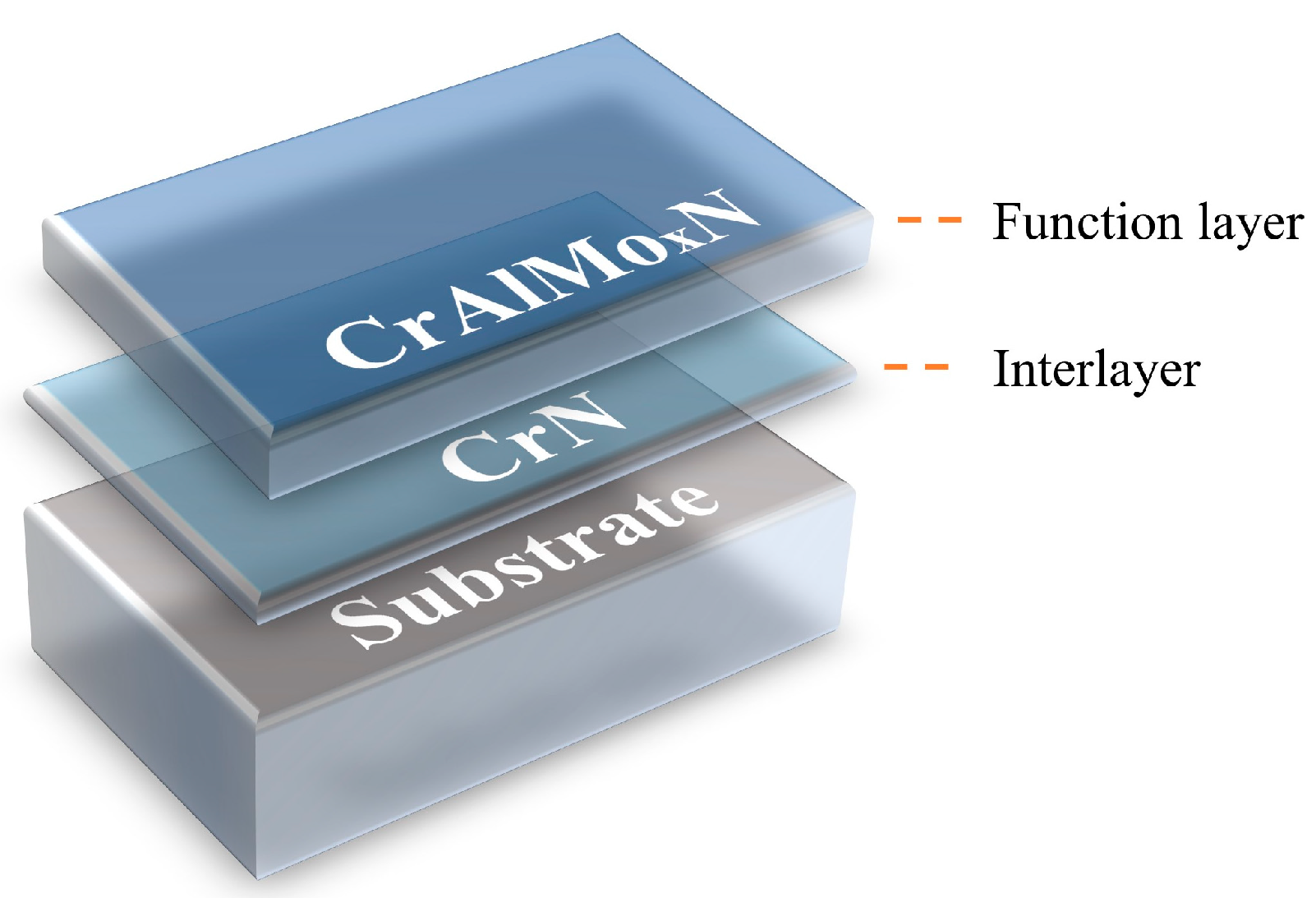
Before deposition, the polished substrates were sequentially cleaned in acetone and ethanol for 15 min each. The cleaned and dried substrate samples were then mounted on a rotating holder at 2 r/min. When the chamber pressure reached 0.1 Pa, the chamber temperature was increased to 350 °C to commence the experiment. Then, 500 sccm of Ar gas was introduced, and the substrate were etched for 15 min using an ion source to remove surface oxides and impurities. Next, introduce 400 sccm of Ar gas and apply a bias voltage of −900 V to the substrate for etching, for 10 min to enhance coating adhesion. Subsequently, deposition was initiated by shutting off the Ar flow, introducing 500 sccm of N2, setting the Cr target current to 120 A, and maintained a substrate bias of −100 V for 15 min. This yielded a CrN transition layer approximately 0.2–0.3 μm thick. The CrAl target and Mo target were then activated. The CrAl target current was set to 120 A, while the Mo target current ranged from 120 to 160 A. The bias voltage remained unchanged, and the deposition time was 60 min. A schematic diagram of the coating structure is shown in Figure 1. CrAlMoxN coatings were prepared via the aforementioned process, where x represents the atomic fraction of Mo. The specific experimental parameters are detailed in Table 1.

2.2. Materials Designation

Stainless steel 316L (10 mm × 10 mm × 2 mm) and cemented carbide YG8 (WC-92 wt% Co-8 wt%, dimensions 25 mm × 25 mm × 3 mm, surface roughness approximately 20 nm) as substrate materials. Supplied by a carbide company in Zhuzhou, Hunan Province, China, stainless steel 316L was used for coating surface and cross-sectional morphology observation and composition analysis (A portion is used for analyzing oxidation products resulting from friction wear of the coating), while cemented carbide YG8 was employed for mechanical property and friction-wear performance testing.

2.3. Characterization of Coating Properties

2.3.1. Microstructure and Chemical Composition

Scanning electron microscopy (SEM, Zeiss, Oberkochen, Germany) was used to observe the surface and cross-sectional morphology of the coatings, and energy dispersive spectroscopy (EDS) analysis was performed to determine the Mo content; An X-ray diffractometer (XRD, SmartLab 3 KW model, Rigaku, Tokyo, Japan) was employed, utilizing a Cu target Kα source with λ = 1.5406 Å. The tube voltage and current were set to 40 kV and 100 mA, respectively. The 2θ range was 20° to 80°, with a scan step of 0.02° and a scan speed of 5°/min. The diffraction patterns of the coatings were analyzed to obtain information on phase composition.

2.3.2. Mechanical Properties

The hardness was tested using a Micro Vickers Hardness Tester (401MVD, Berg Engineering, Rolling Meadows, IL, USA) under a load of 500 g and a loading time of 10 s. The average of six measurements was taken as the hardness value. The coating adhesion strength was tested using an automatic coating adhesion scratch tester (WS-2005, Lanzhou Zhongke Kaihua Technology Development Co., Ltd., Lanzhou, Gansu, China). The scratch length was 5 mm, the loading speed was 100 N/min, and the termination load was 100 N. The average of five measurements was taken as the coating adhesion strength. After testing, the scratch morphology of the sample was observed under an optical microscope to evaluate the coating’s film substrate adhesion and toughness. All mechanical property tests were conducted at room temperature. The notation “at 600 °C” in the figure refers to tests performed after annealing at 600 °C, followed by furnace cooling to room temperature.

2.3.3. Friction and Wear Properties

Friction testing of the coating was conducted using a high-temperature friction and wear tester (HT-1000, Lanzhou Zhongke Kaihua Technology Development Co., Ltd., Lanzhou, Gansu, China). The friction pair consisted of a 6 mm diameter Al2O3 ball with a 2 mm indentation radius, operating at 300 r/min. Subsequently, a 60 min room-temperature test (compared to a 10 min high-temperature test) was conducted, yielding the friction coefficient curve and the average friction coefficient. After friction testing, a 3D profilometer (New View 9000, ZYGO Corporation, Middlefield, CT, USA) was used to measure the cross-sectional profile of the wear scar, and the wear rate was calculated. The calculation of the coating wear rate k is shown in Equation (1):
k = V/FL = S/n·F
where V is the wear volume of the coating (mm3), F denotes the load applied to the coating (N), L indicates the sliding distance (m), S signifies the cross-sectional area of the wear scar, and n represents the number of rolling revolutions.

2.3.4. Wear Mechanisms

Zeiss SEM was employed to investigate the microstructure of coating scratches, combined with EDS analysis to examine elemental composition changes within the scratches and resulting debris. The Raman spectrometer (Thermo Fisher DXR2 xi, Waltham, MA, USA) was utilized for further analysis of the phase composition of debris generated during the friction process.

3. Results

3.1. Chemical Composition, Deposition Rate and Microstructures

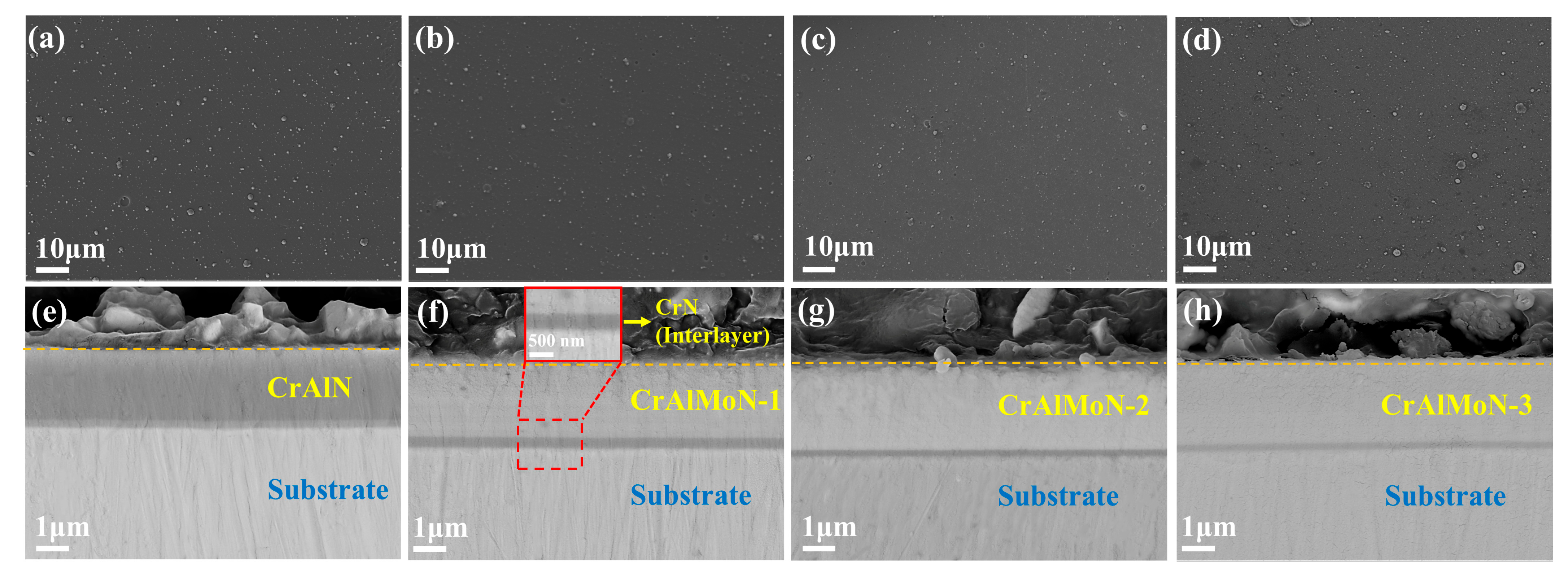
SEM observation was conducted on the CrAlMoxN coatings from surface and cross-section (Figure 2), and the content ratios of different element by EDS analysis are shown in Table 2. In CrAlMoxN coatings, when only the CrAl target is powered, the resulting coating is CrAlN. Upon activation of the Mo target, the Mo content in the coating progressively increases with the rising Mo target current. This leads to coatings with x = 7.27, 15.56, and 18.86, referred to as CrAlMoN-1, CrAlMoN-2, and CrAlMoN-3 coatings, respectively. From Figure 2a–d, it is found that distinct large particles on the surfaces of all coatings. This phenomenon is a typical characteristic of arc ion plating [20,21]. The cross-sectional images (Figure 2e–h), four coatings exhibit a dense structure, a CrN transition inter layer (dark gray) and a CrAlMoxN coating (light gray). The coating structure shows no visible delamination or cracking. The thicknesses of the four coatings are 2.1 μm, 2.29 μm, 2.40 μm, and 2.44 μm, respectively.
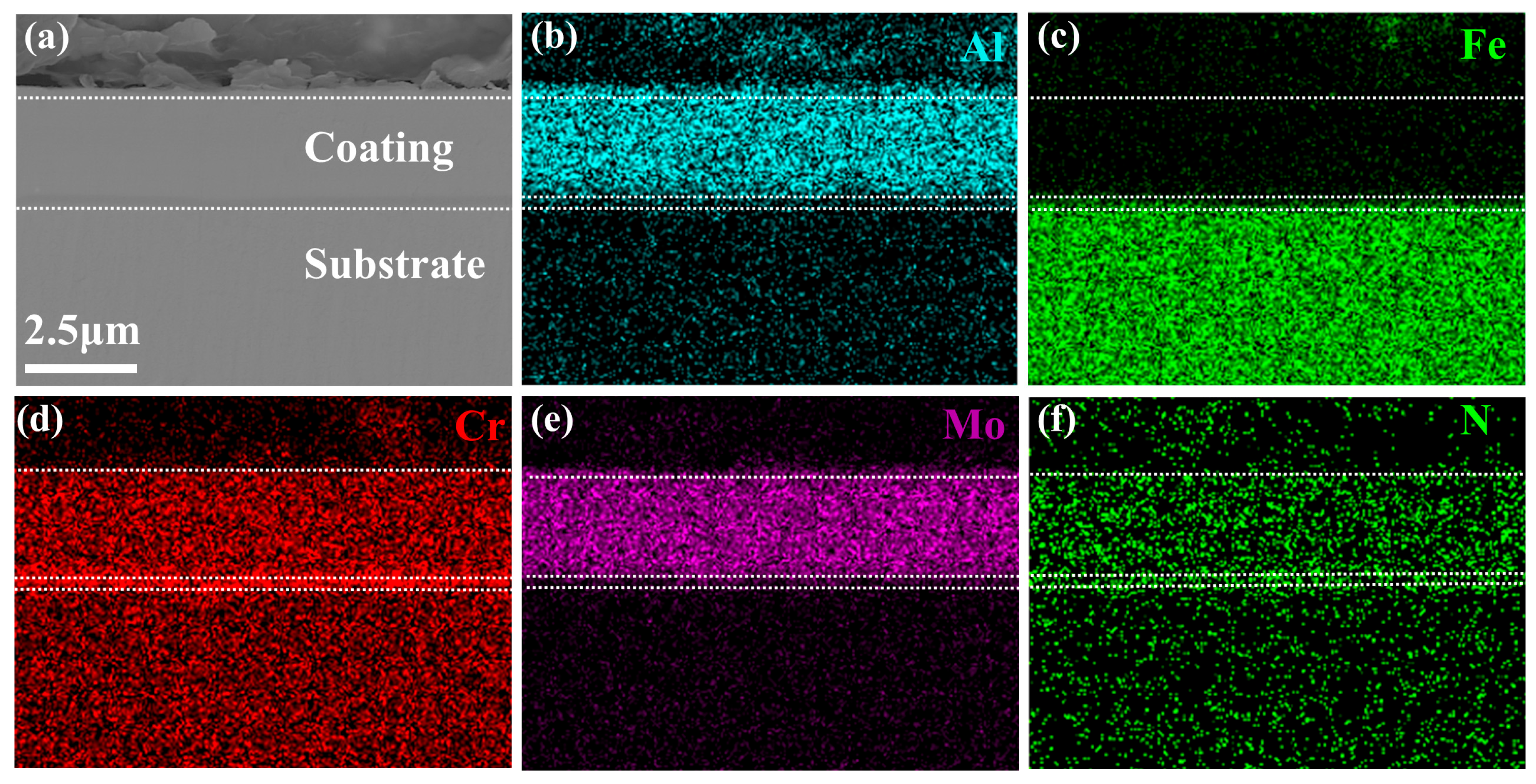
The cross-sectional elemental distribution of the CrAlMoN-2 coating was characterized by EDS, as shown in Figure 3. The Cr signal exhibits a gradient distribution across the coating, consistent with the function of the CrN interlayer, which supplies Cr source for the coating and enhancing interfacial adhesion. In contrast, Al and Mo signals are exclusively enriched within the CrAlMoN coating, while the N signal is uniformly distributed at a high intensity throughout the entire coating. This elemental distribution confirms the successful deposition of a uniform and structurally sound nitride coating on the substrate.
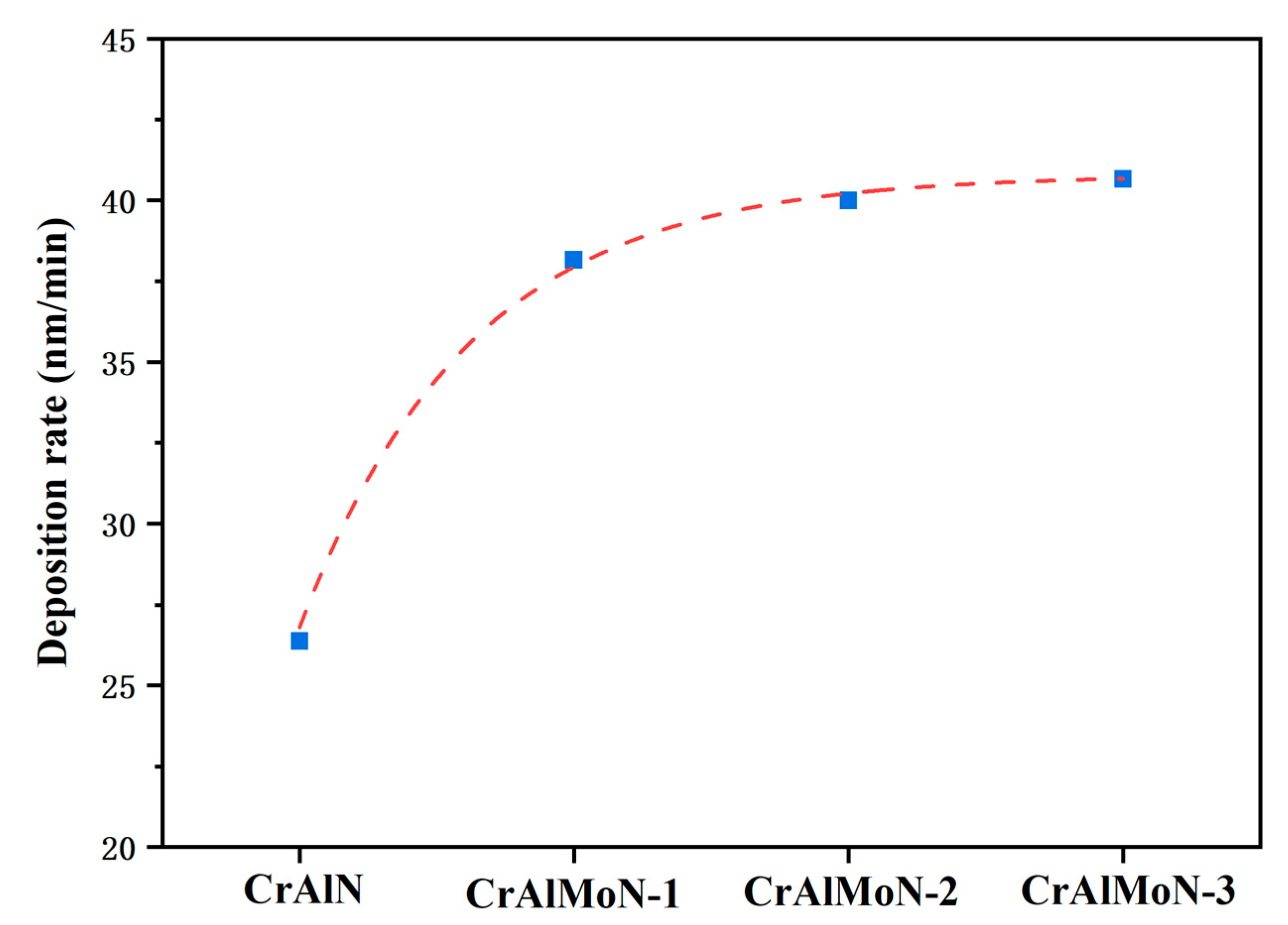
The deposition rates of CrAlMoxN coatings with different Mo contents are compared in Figure 4. Compared with the binary CrAlN coating, the incorporation of Mo significantly increases the plasma density and promotes the ionization of metal species. Under the applied substrate bias, results in more efficient ion acceleration and a higher ion flux towards the growing film, thereby enhancing the deposition efficiency. Accordingly, the measured rate increased from 26.4 nm/min (CrAlN) to 38.2 nm/min for the CrAlMoN-1 coating. Higher Mo target currents were found to stabilize the arc discharge and widen the sputtering area, thereby increasing the quantity of Mo atoms ejected per unit time. This explains the subsequent rise in deposition rates to 40 nm/min and 40.67 nm/min for the CrAlMoN-2 and CrAlMoN-3 coatings, respectively. In summary, the deposition rate exhibits a positive correlation with the target current within the appropriate operating range.
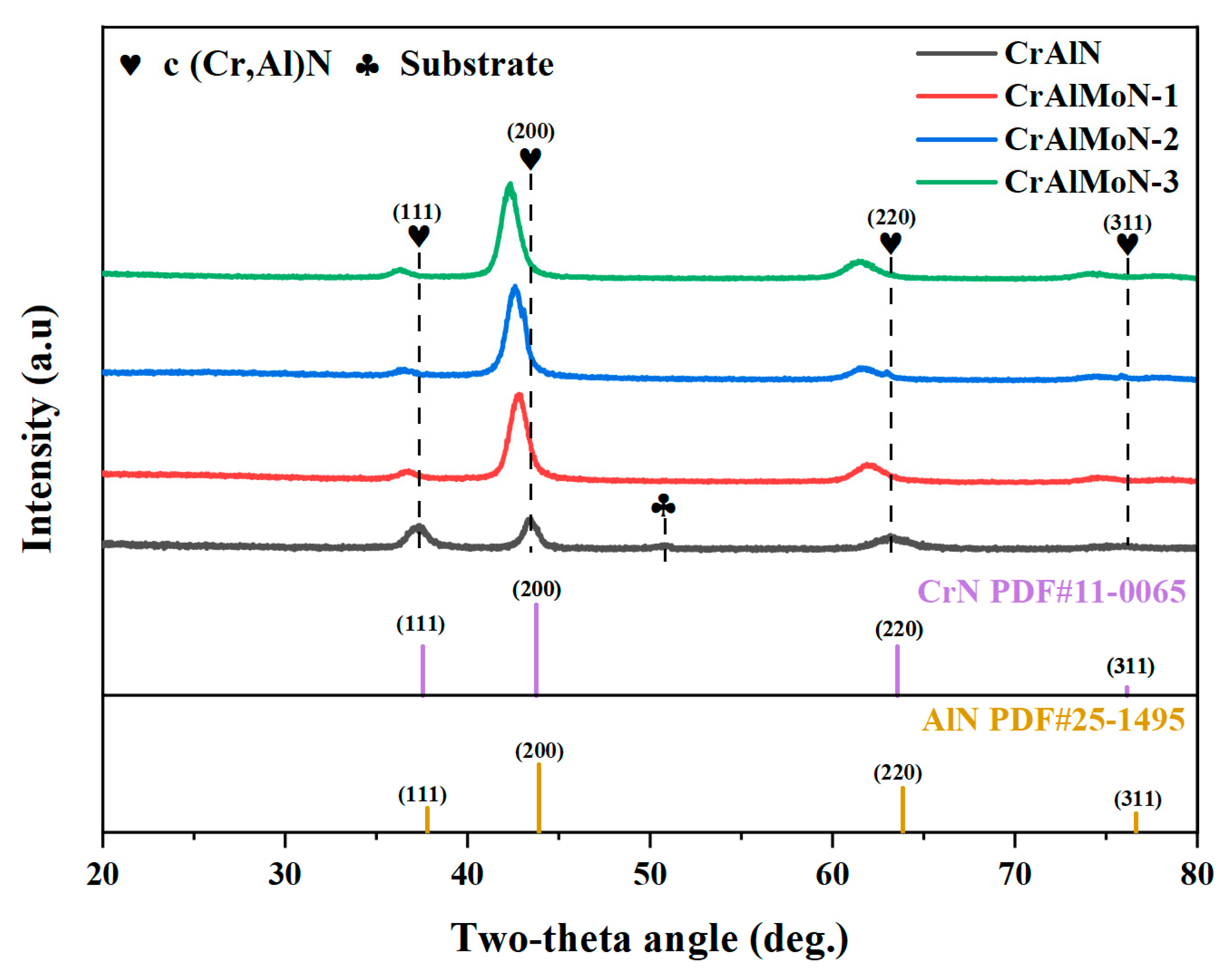
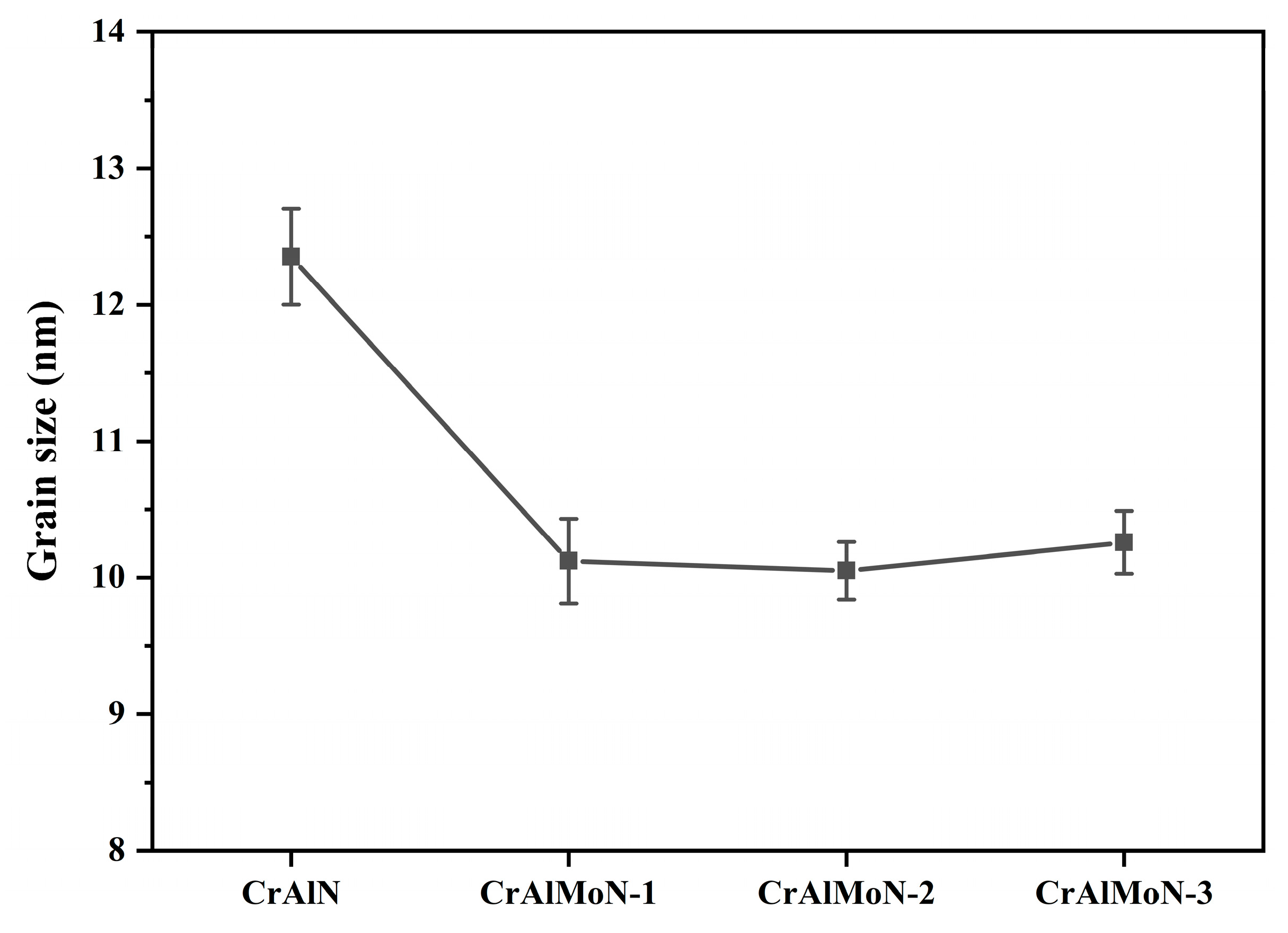
The XRD analysis in Figure 5 reveals the structural evolution of CrAlMoxN coatings with varying Mo content. The similarity in the diffraction patterns of the CrN and AlN phases is attributed to their close lattice constants (CrN: a = 4.14 Å, ICDD 00-011-0065; AlN: a = 4.12 Å, ICDD 00-025-1495), which originate from the comparable atomic radii of Cr (1.40 Å) and Al (1.35 Å) [22,23]. The four identified peaks—(111), (200), (220), and (311)—are common to all coatings, with Mo doping strengthens the (200) preferred orientation. Critically, a systematic peak shift to lower angles is evident with rising Mo content, signaling an increase in the lattice constant. This expansion is rationally explained by the solid solution substitution of smaller Cr and Al atoms by larger Mo atoms. The incorporation of Mo into the lattice creates repulsive interactions with adjacent atoms, thereby causing the observed lattice strain [19]. This phenomenon can be detailed using the Bragg equation. As the θ angle decreases, the interplanar spacing and lattice parameter are observed to increase. Correspondingly, the full width at half maximum (FWHM) demonstrates an initial rise followed by a reduction, which coincides with a trend where the grain size first decreases and then increases (Figure 6). The underlying mechanism can be attributed to the solid solution of Mo atoms into the CrAlN lattice upon doping, which induces lattice distortion. Such distortion raises the dislocation density and introduces additional crystal defects. These defects act as barriers to grain boundary migration, thereby restraining grain growth and leading to a reduction in grain size with increasing Mo content. However, when the Mo concentration surpasses the solubility limit, complete dissolution into the CrAlN lattice is no longer achievable. This results in compositional segregation or the formation of a second phase. The precipitated phase tends to be coarse and non-uniformly distributed, which diminishes the inhibition of grain growth. In certain cases, the mechanism may even transition to one that promotes grain coarsening, consequently leading to an increase in grain size.

3.2. Mechanical Properties

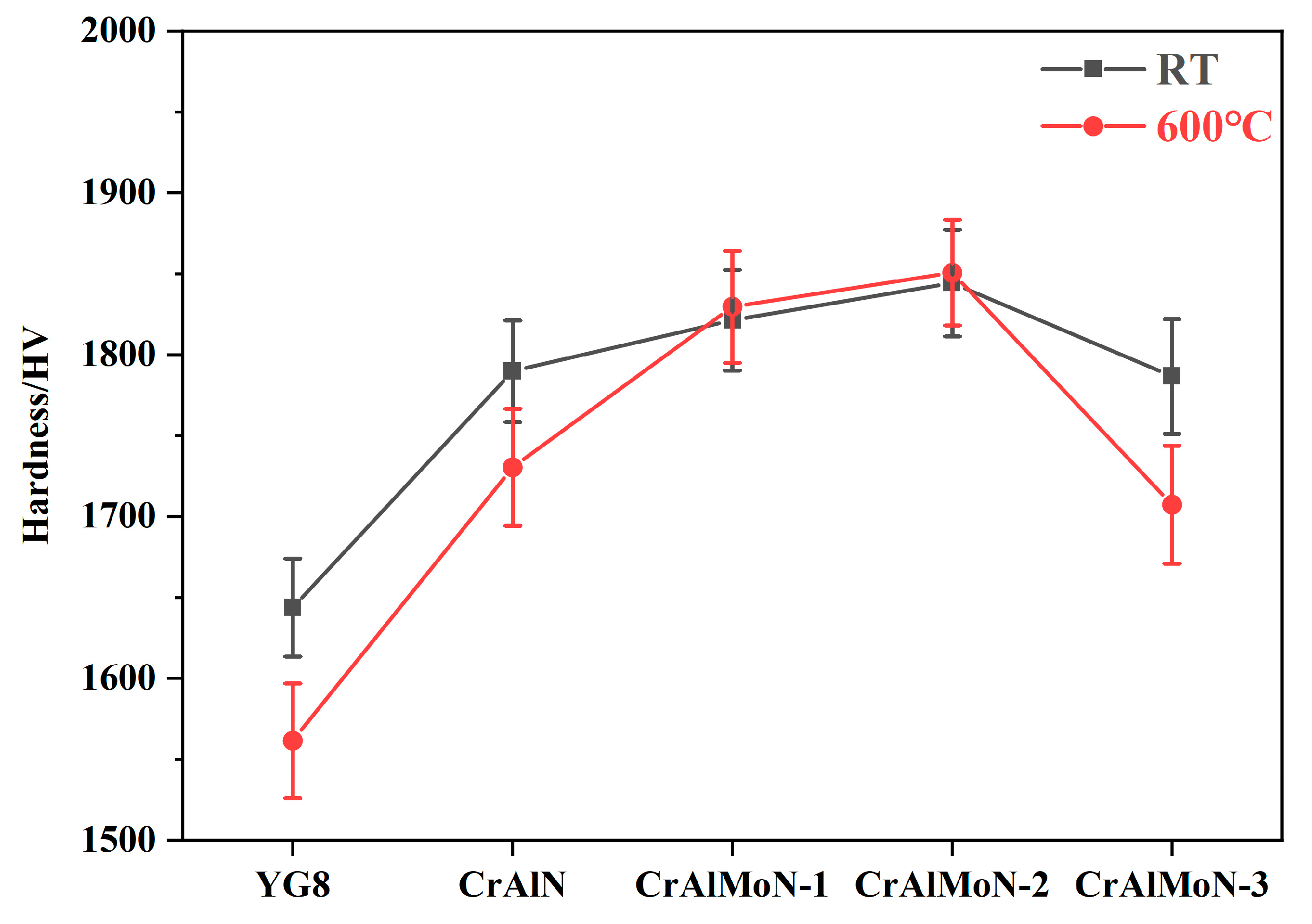
Figure 7 presents the Vickers hardness measurements for the YG8 substrate and the CrAlMoxN coatings in both the as-deposited coatings and after annealing at 600 °C. A comparable variation trend is observed in the hardness data for both conditions. At room temperature, compared to YG8, the hardness of the CrAlN coating increases from 1643.6 to 1789.9 HV. With Mo incorporation, the Vickers hardness further increases to 1821.4 HV for the CrAlMoN-1 coating and 1844.3 HV for the CrAlMoN-2 coating. However, with further Mo addition, the hardness decreases to 1786.6 HV for CrAlMoN-3, exhibiting an overall trend of increasing first and then decreasing. Concerning the 600 °C annealing, a decrease in hardness was noted for the YG8 substrate, the CrAlN coating, and the CrAlMoN-3 coating, which is primarily attributed to the relief of residual stresses during the thermal treatment. In contrast, the hardness values of the CrAlMoN-1 and CrAlMoN-2 coatings remain nearly unchanged, indicating their improved stability. In summary, the CrAlMoN-2 coating demonstrates the most favorable combination of high hardness and thermal stability both before and after annealing at 600 °C.
Initially, with Mo doping, Mo atoms dissolve into the CrAlN lattice via solid solution, inducing lattice distortion that hinders dislocation glide and thereby boosting hardness. Once Mo content surpasses the solid solubility limit, excess Mo atoms cannot be fully incorporated into the (Al, Cr)N lattice and may form secondary phases. Given that the hardness of secondary phases such as Mo2N is lower than that of CrN and AlN [24], the coating’s overall hardness trends toward the softer phase’s value, resulting in reduced total hardness. This behavior aligns with the well-known Hall-Petch formula [25]. The formula demonstrates that grain refinement enhances the material’s yield strength. High-yield-strength materials resist deformation and sustain higher external stresses, translating to improved hardness.
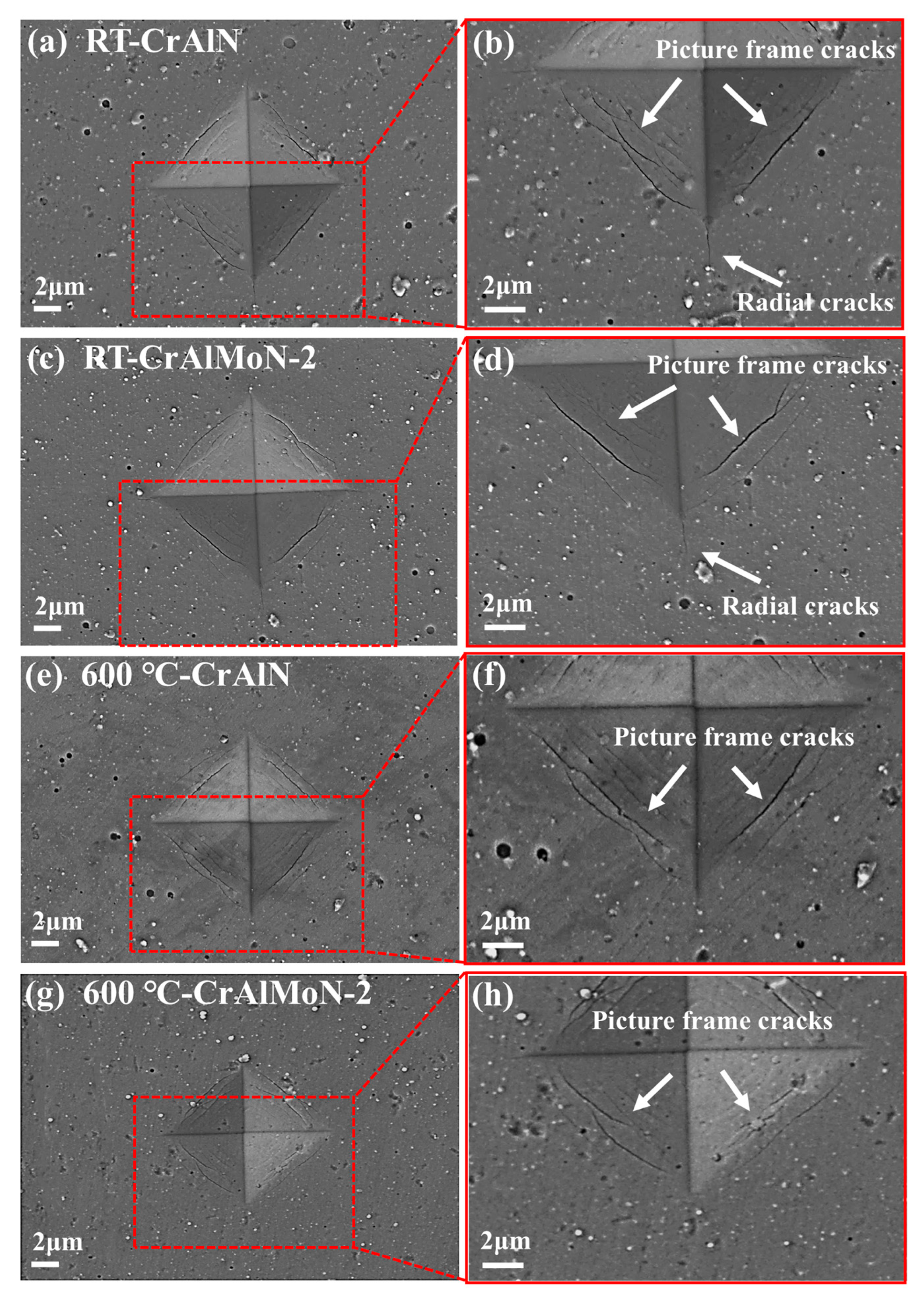
Figure 8a,c show SEM images of Vickers indentations for CrAlN and CrAlMoN-2 coatings, with selected regions shown at higher magnification in Figure 8b,d. Both coatings exhibit radial and frame-like cracks around the indentations in the deposited state. Figure 8e,f show the indentation morphologies of CrAlN and CrAlMoN-2 coatings after annealing at 600 °C. It is noteworthy that radial cracking in CrAlN and CrAlMoN-2 coatings is significantly reduced compared to room-temperature conditions. Additionally, the frame-like cracking in CrAlMoN-2 coatings is also mitigated. This improvement is ascribed to the enhancement of coating toughness, resulting from the relaxation of residual stresses and microstructural refinement induced by annealing.
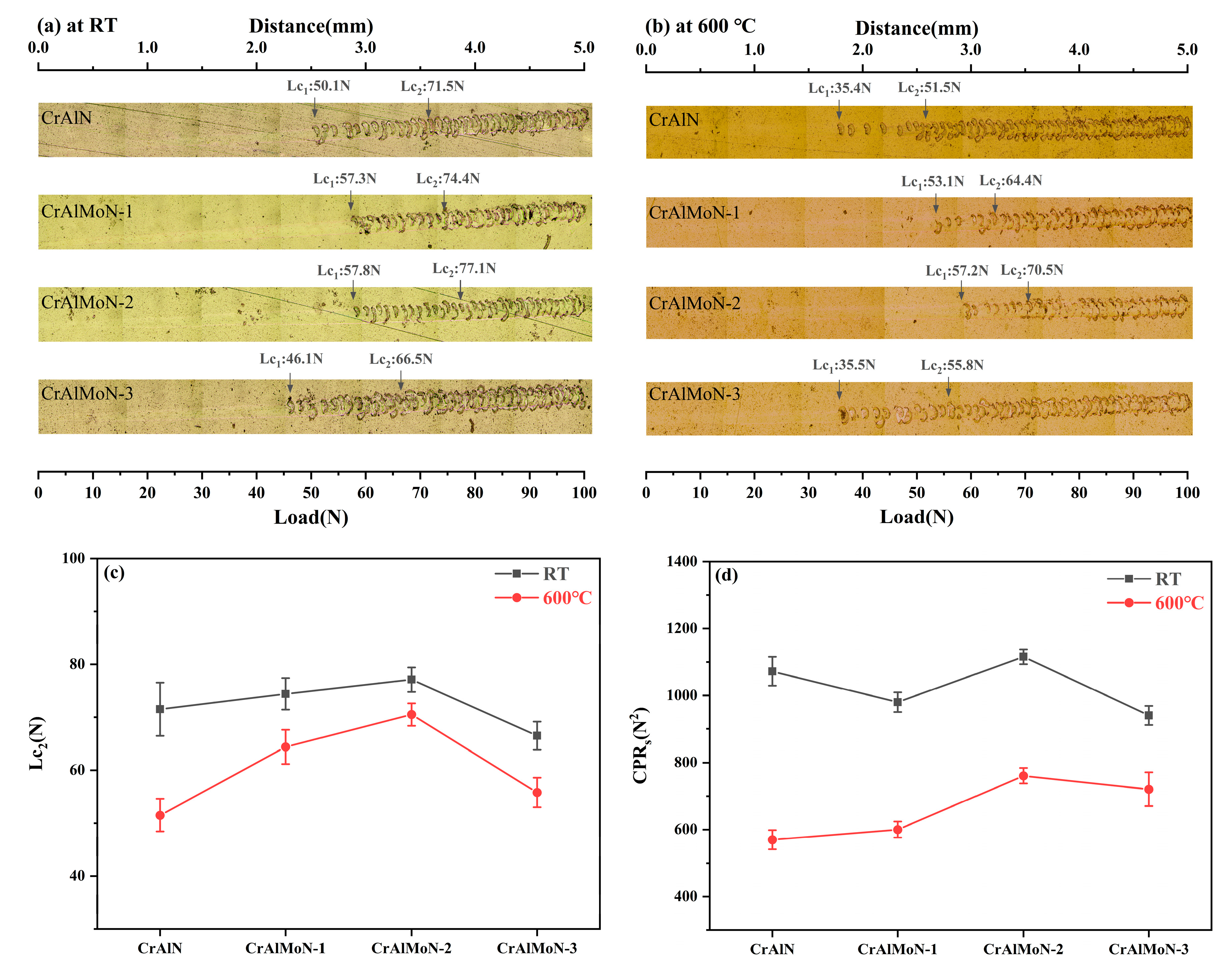
Figure 9a,b present the scratching morphology of CrAlMoxN coatings before and after 600 °C annealed, respectively. In scratch testing, Lc1 is defined as the critical load for crack initiation, whereas Lc2 corresponds to the load triggering delamination from the substrate [26]. Higher Lc1 and Lc2 values indicate superior adhesion strength and peel resistance of the coating. At room temperature, scratch testing indicates that the critical load (Lc1) at which cracks initiate in CrAlN coatings is approximately 50.1 N. The CrAlMoN-1 and CrAlMoN-2 coatings exhibit improved crack initiation resistance, with higher Lc1 values of 57.3 N and 57.8 N, respectively. In contrast, the Lc1 for CrAlMoN-3 drops to 46.1 N. After annealing at 600 °C (scratch testing conducted after furnace cooling to room temperature), the results indicate: the Lc1 values of CrAlN and CrAlMoN-3 decrease to 35.4 N and 35.5 N, respectively. Meanwhile, the Lc1 values for CrAlMoN-1 and CrAlMoN-2 remain largely stable at 53.1 N and 57.2 N. Figure 9c compares the critical load for coating delamination (Lc2) of the four coatings before and after annealing at 600 °C. All coatings experienced a reduction in Lc2 after annealing. The largest decrease, about 20 N, occurs in the CrAlN coating (from 71.5 N to 51.5 N). Smaller declines of approximately 10 N were recorded for CrAlMoN-1 and CrAlMoN-3. Notably, CrAlMoN-2 shows the best performance, with an Lc2 reduction of only 7 N, while its Lc1 remains unchanged. This combination suggests that the CrAlMoN-2 coating maintains superior adhesion to the substrate after thermal exposure.
On the other hand, the toughness of coatings is also related to crack propagation resistance (CPRs), commonly regarded as an indicator of coating adhesion strength [27]. The crack propagation resistance of coating scratches can be calculated using the following equation: CPRs = Lc1(Lc2 − Lc1). Figure 9d shows the CPRs of the four coatings. At room temperature, their CPRs exhibit little difference; however, after high-temperature treatment, the CPRs increases from 569.94 N2 for the CrAlN coating to 760.76 N2 for CrAlMoN-2 and 720.65 N2 for CrAlMoN-3, representing an improvement of about200 N2. In summary, the incorporation of an appropriate amount of Mo into CrAlN coatings promotes grain refinement and increases grain boundary density. This refined microstructure effectively delays the onset of cracking, thereby enhancing the critical load and the coating’s resistance to peeling. Furthermore, as cracks propagate, they are forced to traverse an increased number of grain boundaries. The cumulative pinning effect exerted by these boundaries on the crack tip significantly impedes crack growth, resulting in improved overall adhesion strength to the substrate.

3.3. Friction and Wear Properties

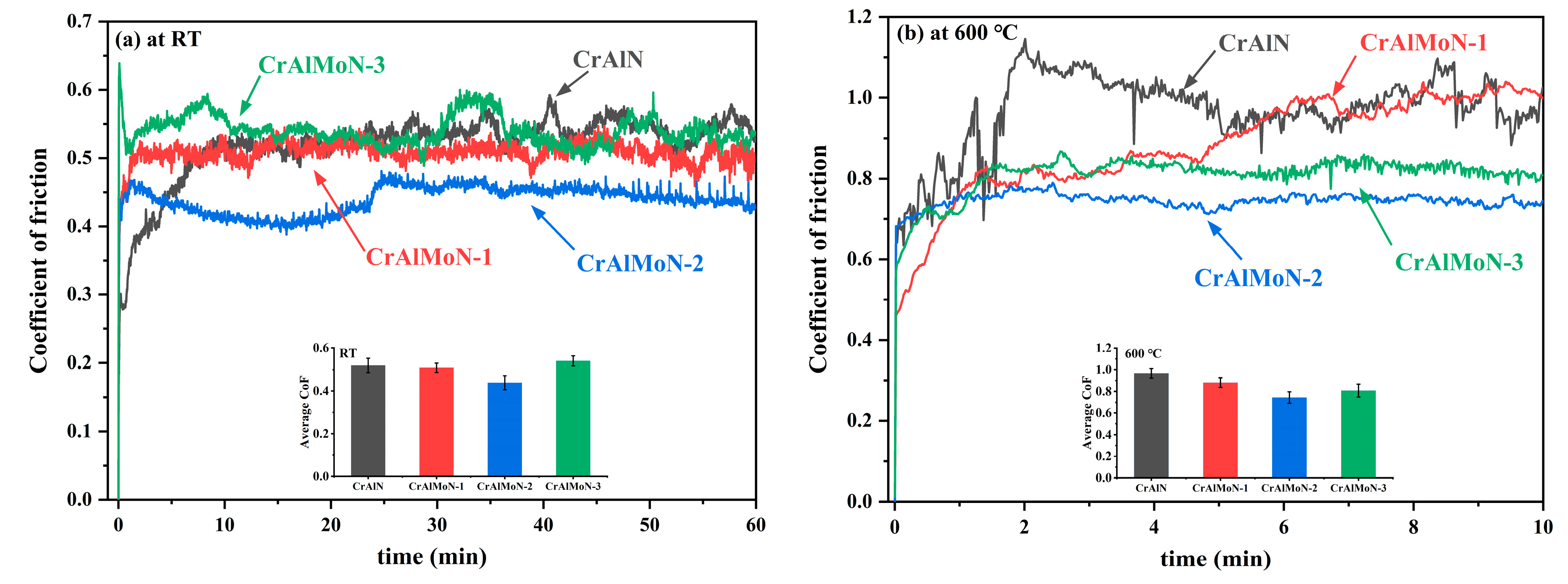
Das The measurement of friction coefficient curves is aimed at characterizing the dynamic tribological behavior of coatings under realistic working environments, which offers greater practical relevance than a single static value. These insights are vital for predicting performance metrics such as wear resistance, lubrication capability, operational reliability, and service lifetime. Figure 10 displays the frictional responses of the CrAlMoxN coatings. At room temperature (Figure 10a), each coating undergoes a running-in period prior to entering a steady-state friction stage that continues until test termination. Specifically, the CrAlN coating reaches a stable state after about 10 min, with an average friction coefficient of 0.51. By comparison, the Mo-alloyed CrAlMoN-1 and CrAlMoN-2 coatings complete the running-in stage within about 3 min, achieving lower average coefficients of 0.50 and 0.44, respectively. Conversely, the CrAlMoN-3 coating, with the highest Mo concentration, demonstrates an increased average friction coefficient of 0.54.
Compared to room temperature, the average coefficient of friction of CrAlMoxN coatings at 600 °C (Figure 10b) also exhibits a similar pattern: the friction coefficient curve of the CrAlN coating exhibits significant overall fluctuations. However, with the incorporation of Mo, the friction process of the CrAlMoN coating leads to the formation of an oxide film containing MoO3 on the wear track surface [28]. This transforms the original direct contact between the coating and the Al2O3 friction pair into relative sliding between the coating and the oxide layer. The shear strength of these lubricating phases is significantly lower than that of the CrAlN coating, effectively reducing interfacial shear resistance. This directly suppresses severe sticking behavior during the early friction-wear stage, shortening the break-in period. The friction coefficient curve transitions to the stable friction phase within approximately 2 min, with the average friction coefficient decreasing from 0.97 for the CrAlN coating to 0.88 for the CrAlMoN-1 coating. An adequate supply of Mo facilitates oxidation, leading to the formation of a persistently stable MoO3 lubricating film at the wear sites of the CrAlMoN-2 coating. This oxide layer serves as a highly efficient solid lubricant, substantially lowering the interfacial shear strength. Furthermore, the self-repairing characteristic of this film ensures consistent shear behavior at the sliding interface, thereby maintaining excellent stability of the friction coefficient throughout the test duration. Based on this, the average friction coefficient of the CrAlMoN-2 coating decreases to 0.75, reflecting improved high-temperature wear resistance. When the Mo concentration surpasses a critical threshold, it adversely affects the stabilization of the solid-solution phase. At high temperatures, this promotes substantial sublimation of MoO3, increasing the number of pores and reducing the coating density [29,30]. This structural degradation creates localized stress concentrators during friction, hindering the formation of an effective lubricating layer. The accompanying rise in interfacial shear forces ultimately leads to an increased friction coefficient of 0.81 for the CrAlMoN-3 coating, confirming the decline in its friction performance.
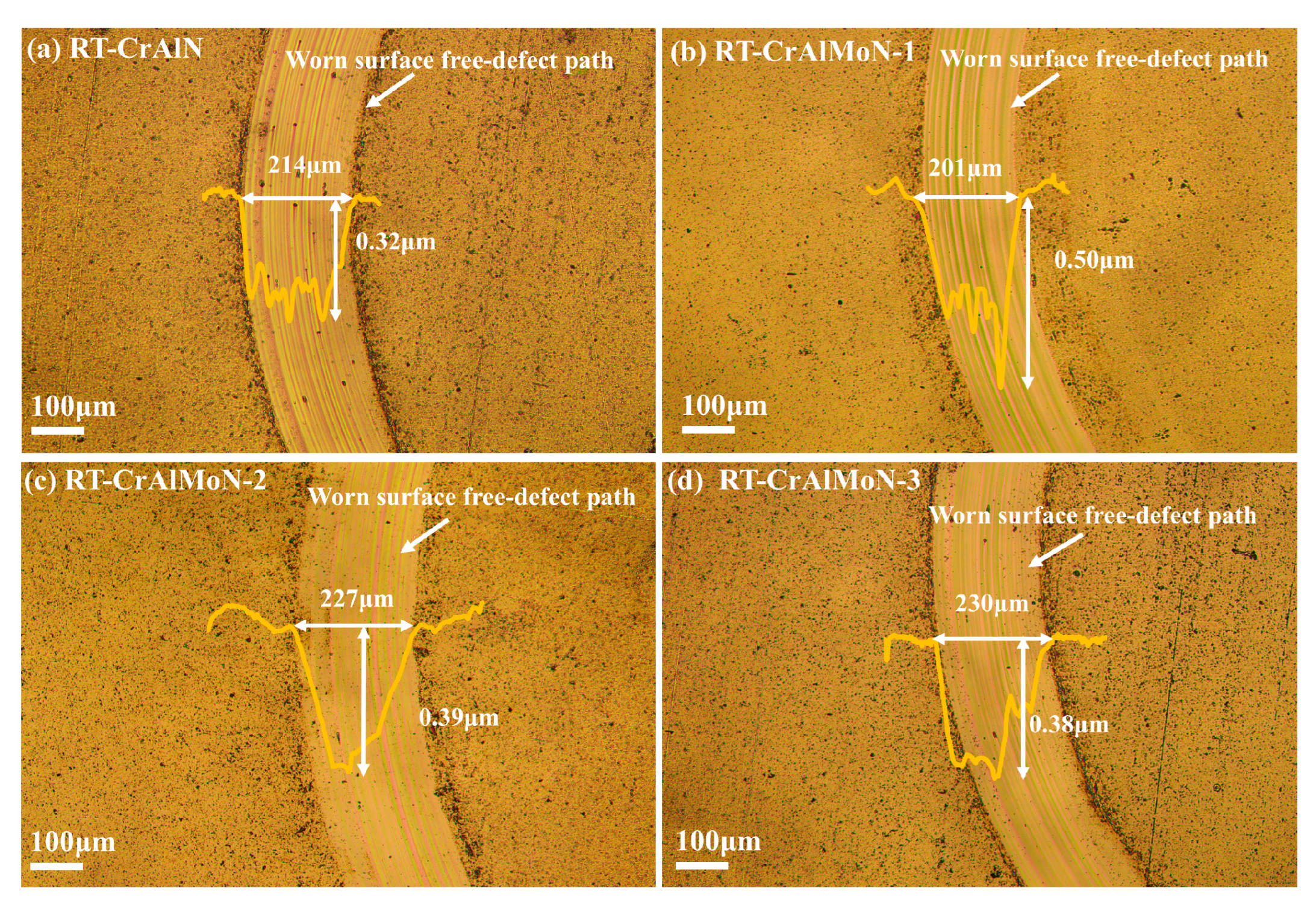
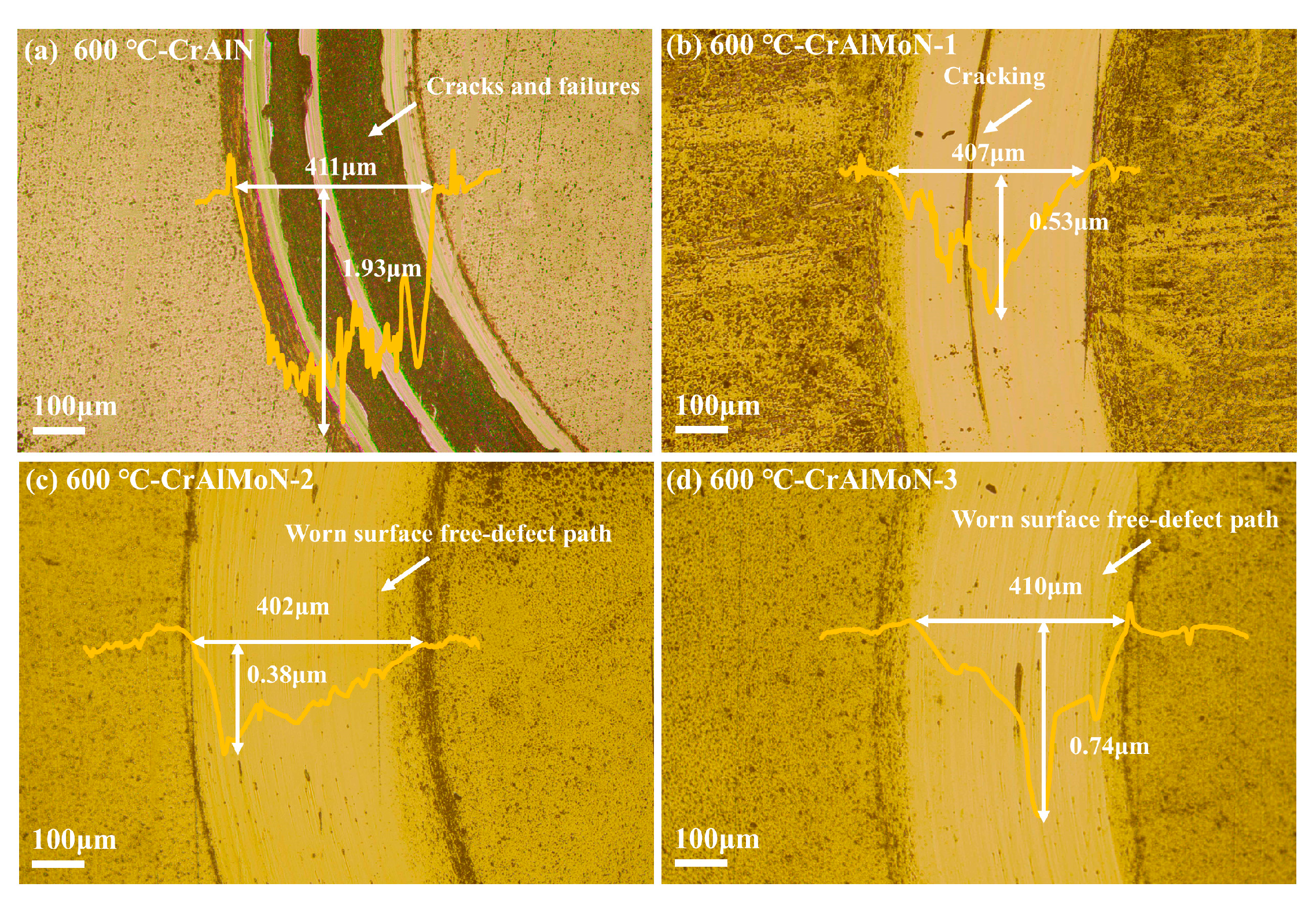
Figure 11 and Figure 12 show the optical microscopic images and two-dimensional profilometric curves of CrAlMoxN coating wear tracks at room temperature and high temperature. In room-temperature conditions, all four coatings exhibit only minimal evidence of surface wear. The corresponding two-dimensional profile curves indicated wear track widths of approximately 210 μm and depths below 1 μm, revealing no substantial variation in wear performance among them. However, A distinct contrast emerged during high-temperature testing. The CrAlN coating suffered severe damage within its wear tracks, characterized by extensive fracture and delamination. The maximum depth reached 1.93 μm, indicating a near-complete loss of protective capability. Conversely, the CrAlMoN-1 coating demonstrated only localized fracture zones, with a maximum track depth of 0.53 μm. Both the CrAlMoN-2 and CrAlMoN-3 coatings exhibited virtually no fracture features, with their maximum wear track depths measured at 0.38 μm and 0.74 μm, respectively. This further confirms that appropriate Mo incorporation can enhance the high-temperature wear resistance of CrAlN coatings.
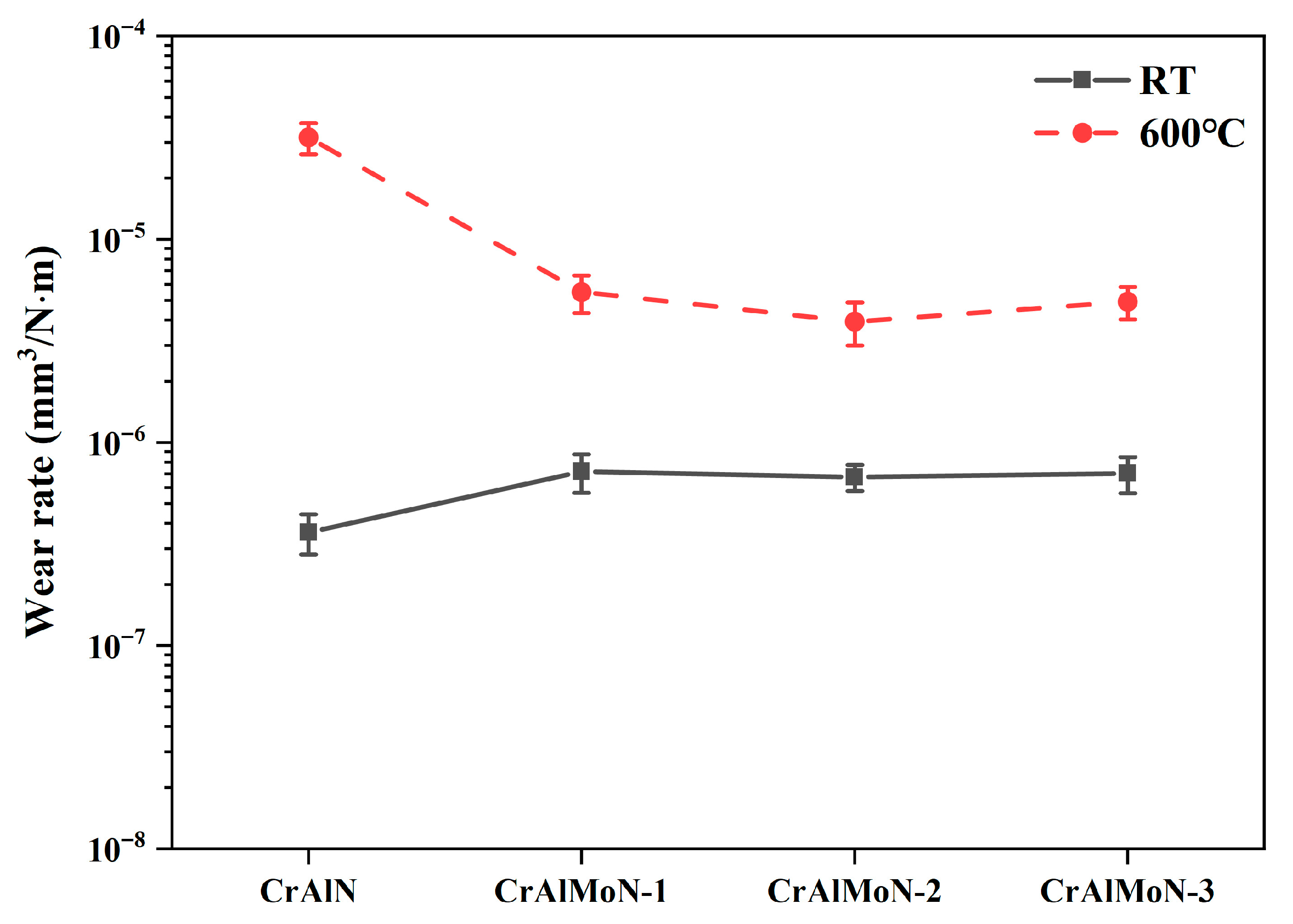
The wear rates of CrAlMoxN coatings were calculated using Formula 1, and results are shown in Figure 13. The wear rates of the four CrAlMoxN coatings exhibit significant differences under varying environmental conditions: the wear rate of the CrAlN coating increases from 3.6 × 10⁻⁷ mm3/N·m at room temperature to 3.2 × 10⁻⁵ mm3/N·m at 600 °C, representing a nearly hundredfold difference. With the incorporation of Mo, the difference in wear rates between room temperature and high-temperature environments has been effectively minimized. The wear rates of the CrAlMoN-1, CrAlMoN-2, and CrAlMoN-3 coatings exhibit wear rates of 7.2 × 10⁻⁷, 6.8 × 10⁻⁷, and 7.0 × 10⁻⁷ mm3/N·m at room temperature, respectively, rising to 5.5 × 10⁻⁶, 3.9 × 10⁻⁶, and 4.9 × 10⁻⁶ mm3/N·m at 600 °C. Evidently, the wear rate fluctuations remain within one order of magnitude, demonstrating that Mo alloying substantially enhances the high-temperature wear resistance of CrAlN coatings.
Due to Mo’s high melting point and excellent high-temperature stability, when Mo is doped into CrAlN coatings, an oxide film composed of Al2O3, Cr2O3 and MoO3 is formed on the coating surface at 600 °C. The synergistic interactions among these in situ formed oxide lubricating phases effectively mitigate frictional forces and material loss within the coating, thereby significantly reducing the overall wear rate. At the same time, the experimental findings are consistent with the principle outlined by Archard’s law [31]. A detailed interpretation based on Archard’s equation is provided as follows:V = k·P·L/H. where the V represents the wear volume, k is the wear factor, P denotes the normal pressure on the contact surface, L is the sliding distance, and H indicates the material hardness. Under unlubricated conditions, the wear volume is directly proportional to the applied load and sliding distance, as well as inversely proportional to the hardness of the worn surface. In the experiment, the test parameters for normal pressure (P) and sliding distance (L), were maintained at constant values for all four coatings, and their average coefficients of friction were statistically comparable. Therefore, the coating hardness (H) emerges as the dominant variable accounting for the observed differences in their wear rates. Vickers hardness results indicate that the CrAlMoN-2 coating possesses the greatest hardness. In accordance with Archard’s law, it should correspondingly achieve the lowest wear rate, which agrees with previously documented mechanical behavior [32].

4. Discussion

Based on the above research findings, it can be concluded that appropriate Mo doping significantly influences the microstructure and properties of CrAlN coatings. To systematically establish the composition-microstructure-property relationship, this study focuses on Mo content as the primary variable. The research design builds upon the work of Zhang et al. [33], who previously investigated the effects of different deposition parameters on AlCrMoN coatings. Regarding material characterization, the findings of this study align with and extend upon previous research. Chen et al. [19] confirmed that Mo doping significantly enhances the high-temperature wear resistance of AlCrN coatings. This study also comprehensively evaluated the mechanical and tribological properties of CrAlMoN coatings under various environmental conditions. Regarding microstructure, Yang et al. [34] reported that CrMoN coatings exhibit larger grain sizes (minimum 12.54 nm), attributed to high Mo content (>30%) inhibiting solid solution formation and promoting grain growth. In contrast, the CrAlMoN coatings in this study exhibit a finer microstructure with grain sizes around 10 nm, positively influencing mechanical properties such as hardness. Indeed, this result aligns with findings by Bobzin et al. [35], who confirmed that moderately increasing Mo content enhances the cutting performance of CrAlMoN-coated tools. In addition to hardness, the adhesion between the coating and substrate also reflects the mechanical properties of the coating. Qi et al. [36] reported the effects of different process parameters on the microstructure and properties of CrMoN coatings. At a bias voltage of −100 V and a deposition temperature of 300 °C, the maximum Lc value reached 54 N. In contrast, the Lc1 value of the CrAlMoN-2 coating at room temperature in this study is 57.8 N. These results indicate that the adhesion of CrAlMoN coatings is slightly improved compared to CrMoN coatings. The CrAlMoN-2 coating developed in this study further demonstrates its superiority in wear resistance, research findings by Moussaoui et al. [37] indicated that when Mo content in TiN coatings reaches approximately 18%, the wear rate was about 7 × 10⁻⁵ mm3/N·m. In contrast, the CrAlMoN coating studied in this work exhibits a wear rate of 7 × 10⁻⁷ mm3/N·m at room temperature, demonstrating that CrAlMoN coatings offer significantly enhanced wear resistance compared to TiMoN coatings.
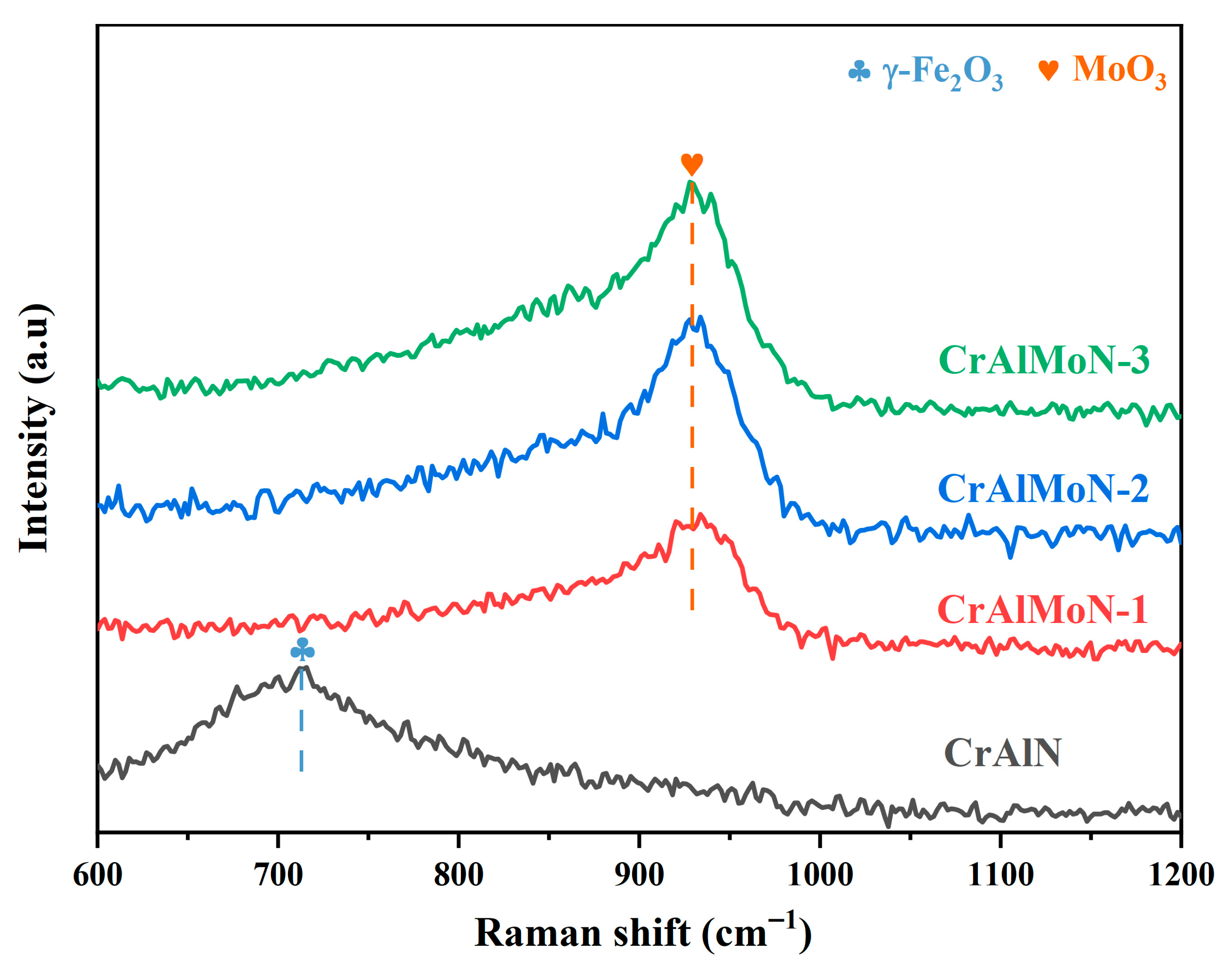
To further explain wear resistance, Figure 14 shows the Raman spectrum analysis of CrAlMoxN coating grinding debris. The spectrum exhibits a prominent peak at 930 cm−1, which is assigned to the MoO3 phase [38,39], in friction and wear testing, undoped CrAlN coatings exhibited severe wear and failure, exposing the iron-containing substrate. The exposed iron-rich substrate may form iron oxide, resulting in characteristic γ-Fe2O3 peaks in the collected Raman spectra [40]. The intensity of the MoO3 peak is observed to escalate progressively with higher Mo content in the coating, suggesting a corresponding increase in the concentration of this oxide within the wear debris. Given the low shear strength of MoO3, its presence significantly reduces both the friction coefficient and the wear rate. However, once the Mo content exceeds a certain threshold, the formation of MoO3 no longer increases substantially, providing diminishing additional lubrication benefits. In summary, the tribological properties of CrAlMoN coatings are strongly correlated with the lubricating efficacy of the generated MoO3.
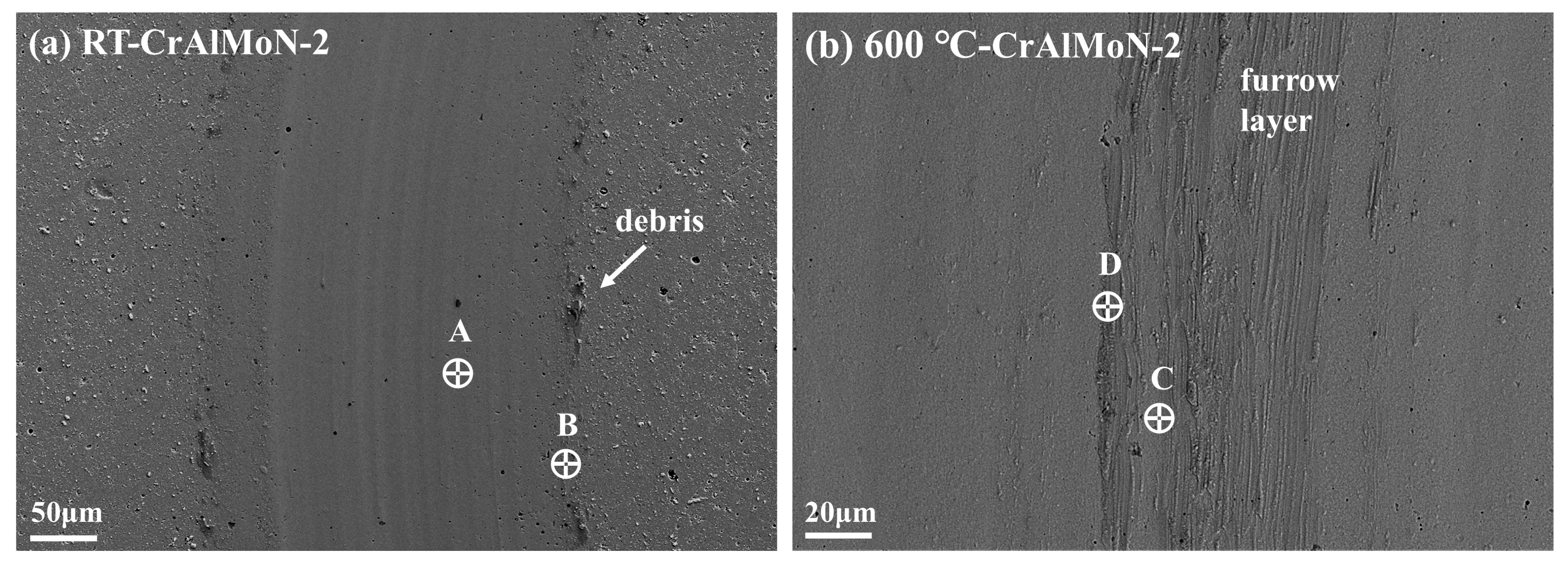
The evolution of wear mechanisms is closely linked to alterations in the coating’s microstructure. Representative SEM images of the CrAlMoN-2 coating wear tracks at room temperature and 600 °C are shown in Figure 15a,b, respectively, with corresponding EDS analyses summarized in Table 3. During sliding, Mo tends to segregate toward the surface, where it transforms into easily sheared MoO3 phases. These oxides act as an interfacial layer between the Al2O3 counter ball and the nitride coating, effectively lowering the friction coefficient. EDS results in Table 3 reveal a pronounced difference in oxygen content between the inner (Point A) and outer (Point B) regions of the room-temperature wear track. While Point A shows negligible oxygen, Point B contains 13.45 at%, confirming the accumulation of MoO3 along the track periphery. At elevated temperatures, this outward diffusion of Mo is further enhanced. The Mo concentration outside the 600 °C wear track (Region D) is markedly higher than that at room temperature (Region B), consistent with the thermally activated interdiffusion typically observed in nitride/metal nanocomposites [41,42,43]. As seen in Figure 16, the room-temperature wear track displays adhesive protrusions and pits accompanied by debris, indicative of a combined adhesive-abrasive mechanism. In contrast, the high-temperature morphology is dominated by a plowing layer, characteristic of abrasive wear. Meanwhile, the elevated oxygen content detected in regions C and D at 600 °C confirms the contribution of oxidative wear. Collectively, these results indicate a transition in the dominant wear mechanism of the CrAlMoN-2 coating from a mixed adhesive-abrasive mode at room temperature to a combined abrasive-oxidative mode under high-temperature sliding conditions.
At elevated temperatures (600 °C), an optimal Mo content suppresses grain coarsening and promotes the formation of a protective oxide film, significantly reducing the coating’s wear rate. Mo incorporation also enhances the high-temperature wear resistance of CrAlMoxN coatings, effectively narrowing the wear rate disparity compared to their room-temperature performance.
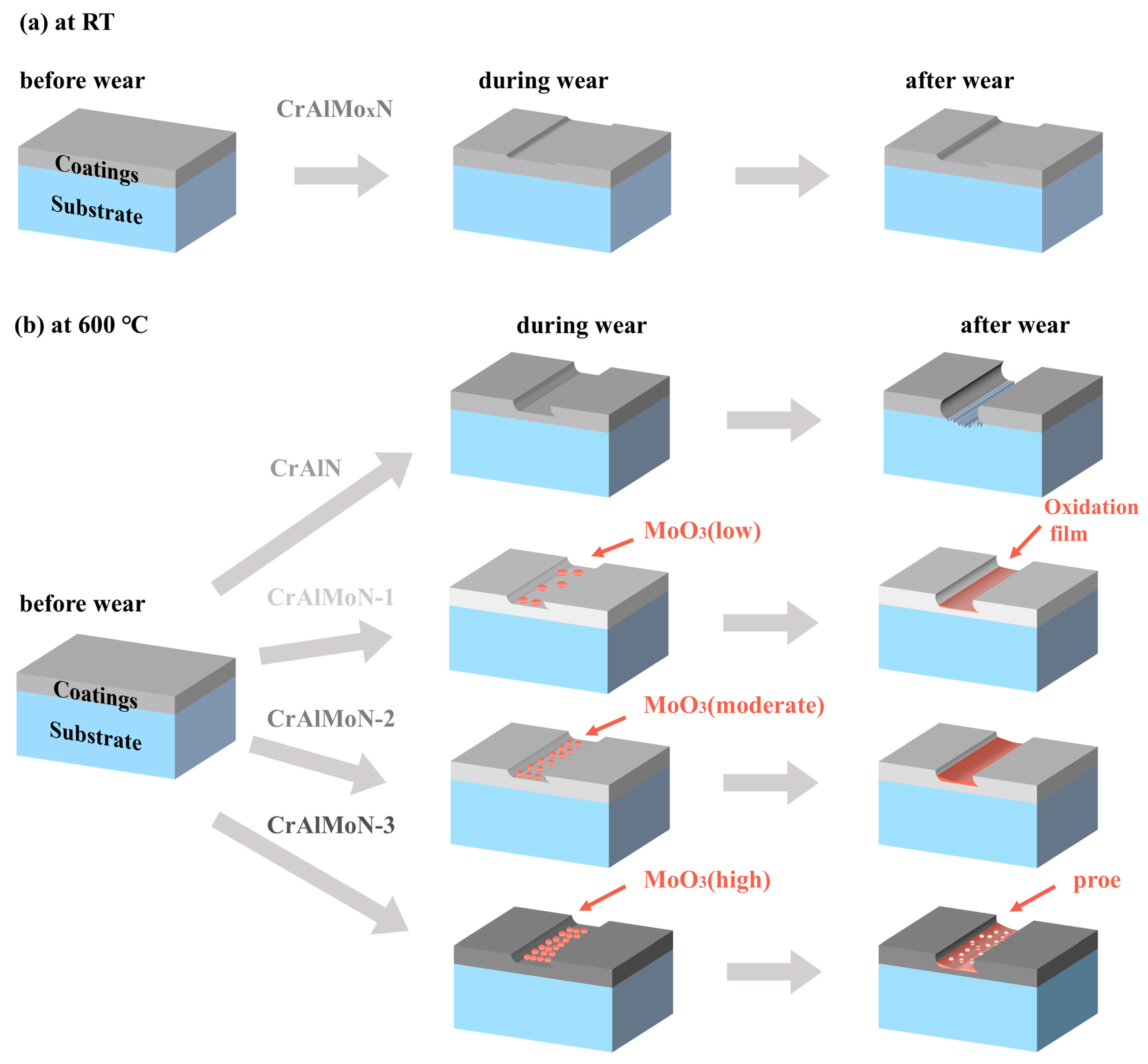
To elucidate the underlying wear mechanisms, Figure 16 schematically illustrates the room temperature (a) and the 600 °C (b) wear process for the four coatings. As previously summarized, the lubricating effect provided by MoO3 shows a limited influence on both wear rates and wear tracks at room temperature when compared to the performance across the four coating variants, with all systems maintaining excellent resistance to wear. However, the CrAlN coating, which lacks a self-lubricating phase, undergoes substantial material removal during sliding at 600 °C. By comparison, the introduction of Mo leads to the in situ formation of oxides (mainly MoO3), which possess low shear strength and high ductility. These oxides adhere to the wear track, thereby reducing the depth of wear. In the case of the CrAlMoN-1 coating, its relatively low Mo content generates just a limited amount of lubricious MoO3, resulting in just a minor improvement in tribological behavior. Conversely, the CrAlMoN-2 coating produces a sufficient and continuous MoO3-rich layer, which significantly decreases both the friction coefficient and the wear rate. For the CrAlMoN-3 coating, despite the abundant generation of MoO3, the excessive Mo content inhibits solid solution formation and increases coating porosity [44,45,46], which consequently degrades its friction and wear performance.
In practical engineering applications, the Mo content in CrAlMoN coatings can be selected according to the dominant service temperature and wear mechanism:
(i)
At room temperature, the wear mechanism is primarily adhesive-abrasive wear, a low-to-medium Mo content is recommended to improve load-bearing capacity and crack resistance (toughness/adhesion) without introducing diminishing returns;
(ii)
At high temperatures, such as approximately 600 °C, the primary wear mechanism is abrasive-oxidation wear, a moderate Mo content (corresponding to CrAlMoN-2 in this study) is preferred, as it provides sufficient Mo to form a Mo-rich lubricious tribo-oxide film (MoO3-containing) while maintaining overall mechanical integrity. In contrast, undoped CrAlN tends to suffer localized failure under the same condition and is thus unsuitable for sustained high-temperature wear;
(iii)
Mixed environments (thermal cycling or RT and elevated temperature): a moderate Mo level is preferred as a compromise, combining both adequate RT load support and high-temperature oxide-assisted friction stabilization.

5. Conclusions

CrAlMoxN coatings (with Mo atomic percentages ranging from 0 to 18.8) were prepared by using an arc ion plating technology. The effects of varying Mo content on the coating microstructure, mechanical properties, and friction characteristics were systematically investigated and summarized as follows:
(1)
In terms of phase structure, Mo doping promotes a stronger (200) preferred orientation in the coatings. Concurrently, the diffraction peaks exhibit a noticeable shift toward lower angles with rising Mo content, and the grain size exhibits a trend of first decreasing and then increasing. As a result of solid solution strengthening, the coating hardness is enhanced, increasing from 1789.9 HV for CrAlN to 1844.3 HV for CrAlMoN-2. Compared to the CrAlN coating, CrAlMoN-2 displays superior critical loads, with Lc1 and Lc2 values of 57.8 N and 77.1 N, respectively. Following high-temperature annealing, these critical load values for CrAlMoN-2 remain largely unchanged. Moreover, radial cracks are rarely observed in its Vickers indentation morphology, confirming its excellent mechanical integrity.
(2)
Owing to the lubricating effect of MoO3, the CrAlMoN coatings transition more rapidly into a stable friction stage. At room temperature, the average friction coefficient for all coatings remains around 0.5. When tested at 600 °C, the average coefficient decreases from 0.97 for CrAlN to 0.75 for CrAlMoN-2, while the wear rate is reduced to 3.9 × 10⁻⁶ mm3/N·m, reflecting significantly improved tribological performance. With increasing temperature, the dominant wear mechanism progressively transitions from a mixed abrasive-adhesive mode to one characterized by abrasive-oxidative wear.

Author Contributions

Conceptualization, R.Y.; methodology, R.Y.; validation, R.Y.; formal analysis, L.Z. and S.Z.; investigation, S.Z.; resources, H.L.; data curation, L.Z.; writing—original draft preparation, R.Y., L.Z. and S.Z.; writing—review and editing, W.L., M.J. and W.C.; visualization, H.L. and W.C.; supervision, W.L. and M.J.; funding acquisition, W.L. All authors have read and agreed to the published version of the manuscript.

Funding

This research was funded by the Fujian Provincial “Minjiang Scholar” Distinguished Professor Talent Plan Project and Advanced Talents Fund of Xiamen University of Technology, grant number No. YKJ22056R and YKJ22059R.

Informed Consent Statement

Not applicable.

Data Availability Statement

The raw data supporting the conclusions of this article will be made available by the authors on request.

Acknowledgments

The authors acknowledge the (Minjiang Scholarship) Program of Fujian Province, Advanced Talents Fund of Xiamen University of Technology and received technical support for electron microscopic characterization from the XMUT Analysis and Testing Center.

Conflicts of Interest

The authors declare no conflicts of interest.

Abbreviations

The following abbreviations are used in this manuscript:
PVDPhysical Vapor Deposition
CoFCoefficient of Friction
MoO3Molybdenum Trioxide
RTRoom temperature

References

  1. Torabi, S.; Ghasemi, R.; Shahrabi Farahani, A.; Zamani, P.; Memari, M.; Mirjani, B.; Alizadeh, M.; Elmkhah, H. Modeling, microstructural characterization, mechanical and corrosion properties of the CrN/CrAlN multilayer coating produced by physical vapor deposition. Ceram. Int. 2024, 50, 21451–21462. [Google Scholar] [CrossRef]
  2. Beake, B.D.; Roberts, J.; Zhu, Y.; Liskiewicz, T.W. Simulating erosion tests with statistically distributed micro-scale impact: A study on PVD TiAlN and AlCrN coatings. Wear 2025, 570, 205911. [Google Scholar] [CrossRef]
  3. He, Q.; DePaiva, J.M.; Martins, M.M.; Amorim, F.L.; Torres, R.D.; Arif, A.F.; Veldhuis, S.C. PVD coating strategies: Developing a combination of AlCrN and AlTiSiN for enhanced surface performance during threading of super duplex stainless steel. Int. J. Refract. Met. Hard Mater. 2024, 121, 106670. [Google Scholar] [CrossRef]
  4. Ling, C.L.; Yajid, M.A.M.; Tamin, M.N.; Kamarudin, M.; Taib, M.A.A.; Nosbi, N.; Ali, W.F.F.W. Effect of substrate roughness and PVD deposition temperatures on hardness and wear performance of AlCrN-coated WC-Co. Surf. Coat. Technol. 2022, 436, 128304. [Google Scholar] [CrossRef]
  5. Zhao, J.; Zheng, L.; Li, W.; Liu, Z.; Li, L.; Wang, B.; Cai, Y.; Ren, X.; Liang, X. Effects of PVD CrAlN/(CrAlB)N/CrAlN Coating on Pin–Disc Friction Properties of Ti2AlNb Alloys Compared to WC/Co Carbide at Evaluated Temperatures. Metals 2024, 14, 662. [Google Scholar] [CrossRef]
  6. Chang, Y.-Y.; Chung, C.-H.; Tsai, Z.-H.; Tsai, J.-M. Tribological and mechanical properties of AlCrBN hard coating deposited using cathodic arc evaporation. Surf. Coat. Technol. 2022, 432, 128097. [Google Scholar] [CrossRef]
  7. Yaqoob, S.; Ghani, J.A.; Jouini, N.; Juri, A.Z. Performance Evaluation of PVD and CVD Multilayer-Coated Tools in Machining High-Strength Steel. Coatings 2024, 14, 865. [Google Scholar] [CrossRef]
  8. Iram, S.; Peng, S.; Zhang, C.; Zhang, S.; Sun, D. Improving the mechanical properties and wear resistance of Mo-doped AlCrN coating via implementing a gradient structural design. Surf. Coat. Technol. 2025, 512, 132425. [Google Scholar] [CrossRef]
  9. Yan, C.; Yu, Y.; Mei, F.; Gao, J.; Lin, X.; Lin, J. A Si-Nb co-alloyed AlCrN coating with good mechanical properties, excellent thermal stability and resistance to high temperature oxidation. Surf. Coat. Technol. 2024, 484, 130825. [Google Scholar] [CrossRef]
  10. Wang, Z.; Zhou, S.; Ma, G.; Dong, Y.; Zhang, X.; Liu, Y.; Wang, Z.; Wang, A. Achieving ultrastrong-tough CrAlN coatings with low friction coefficient by Y incorporating. Ceram. Int. 2024, 50, 23621–23633. [Google Scholar] [CrossRef]
  11. Liu, C.B.; Pei, W.; Huang, F.; Chen, L. Improved mechanical and thermal properties of CrAlN coatings by Si solid solution. Vacuum 2016, 125, 180–184. [Google Scholar] [CrossRef]
  12. Chen, L.; Liu, Z.Q.; Xu, Y.X.; Du, Y. Influence of Zr on structure, mechanical and thermal properties of Cr–Al–N coatings. Surf. Coat. Technol. 2015, 275, 289–295. [Google Scholar] [CrossRef]
  13. Trindade, B.; Li, W.Z.; Fernandes, F.; Cavaleiro, A. Effect of Nb target power on the structure, mechanical properties, thermal stability and oxidation resistance of Cr–Al–Nb–N coatings. Surf. Coat. Technol. 2016, 285, 270–277. [Google Scholar] [CrossRef]
  14. Hu, C.; Xu, Y.X.; Chen, L.; Pei, F.; Zhang, L.J.; Du, Y. Structural, mechanical and thermal properties of CrAlNbN coatings. Surf. Coat. Technol. 2018, 349, 894–900. [Google Scholar] [CrossRef]
  15. Hu, C.; Xu, Y.X.; Chen, L.; Pei, F.; Du, Y. Mechanical properties, thermal stability and oxidation resistance of Ta-doped CrAlN coatings. Surf. Coat. Technol. 2019, 368, 25–32. [Google Scholar] [CrossRef]
  16. Bobzin, K.; Brögelmann, T.; Kalscheuer, C. Arc PVD (Cr, Al, Mo)N and (Cr, Al, Cu)N coatings for mobility applications. Surf. Coat. Technol. 2020, 384, 125046. [Google Scholar] [CrossRef]
  17. Chang, Q.C.; Liu, Y.; Xia, Y.L.; Liu, X.Y.; Xie, Y.X.; Hu, J.K.; Li, W. Effect of Mo on microstructure and sliding wear performance of CoCrFeNiMox high entropy alloy coatings by laser cladding. Mater. Res. Express 2023, 10, 126514. [Google Scholar] [CrossRef]
  18. Xu, Y.X.; Hu, C.; Chen, L.; Pei, F.; Du, Y. Effect of V-addition on the thermal stability and oxidation resistance of CrAlN coatings. Ceram. Int. 2018, 44, 7013–7019. [Google Scholar] [CrossRef]
  19. Chen, Y.; Xu, Y.X.; Zhang, H.; Wang, Q.; Wei, T.; Zhang, F.; Kim, K.H. Improving high-temperature wear resistance of arc-evaporated AlCrN coatings by Mo alloying. Surf. Coat. Technol. 2023, 456, 129253. [Google Scholar] [CrossRef]
  20. Arnell, R.D.; Colligon, J.S.; Minnebaev, K.F.; Yurasova, V.E. The effect of nitrogen content on the structure and mechanical properties of TiN films produced by magnetron sputtering. Vacuum 1996, 47, 425–431. [Google Scholar] [CrossRef]
  21. Yousif, A.E.; Nacy, S.M. The lubrication of conical journal bearings with bi-phase (liquid-solid) lubricants. Wear 1994, 172, 23–28. [Google Scholar] [CrossRef]
  22. Sanders, D.M.; Anders, A. Review of cathodic arc deposition technology at the start of the new millennium. Surf. Coat. Technol. 2000, 133–134, 78–90. [Google Scholar] [CrossRef]
  23. Iram, S.; Wang, J.; Cai, F.; Zhang, J.; Ahmad, F.; Liang, J.; Zhang, S. Effect of bilayer number on mechanical and wear behaviours of the AlCrN/AlCrMoN coatings by AIP method. Surf. Eng. 2021, 37, 536–544. [Google Scholar] [CrossRef]
  24. Lu, C.; Jia, J.; Fu, Y.; Yi, G.; Feng, X.; Yang, J.; Zhou, Q.; Xie, E.; Sun, Y. Influence of Mo contents on the tribological properties of CrMoN/MoS2 coatings at 25–700 °C. Surf. Coat. Technol. 2019, 378, 125072. [Google Scholar] [CrossRef]
  25. Naik, S.N.; Walley, S.M. The Hall-Petch and inverse Hall-Petch relations and the hardness of nanocrystalline metals. J. Mater. Sci. 2020, 55, 2661–2681. [Google Scholar] [CrossRef]
  26. Sha, C.H.; Zhou, Z.F.; Xie, Z.H.; Munroe, P. FeMnNiCoCr-based high entropy alloy coatings: Effect of nitrogen additions on microstructural development, mechanical properties and tribological performance. Appl. Surf. Sci. 2020, 507, 145101. [Google Scholar] [CrossRef]
  27. Zhang, S.; Sun, D.; Fu, Y.; Du, H. Toughness measurement of thin films: A critical review. Surf. Coat. Technol. 2005, 198, 74–84. [Google Scholar] [CrossRef]
  28. Sergevnin, V.S.; Blinkov, I.V.; Belov, D.S.; Smirnov, N.I.; Volkhonskii, A.O.; Kuptsov, K.A. Wear and erosion of arc-PVD multilayer Ti-Al-Mo-N coatings under various conditions of friction and loading. Int. J. Adv. Manuf. Technol. 2018, 98, 593–601. [Google Scholar] [CrossRef]
  29. Wang, Y.X.; Lou, B.Y.; Pan, J.; Zhang, X. High temperature oxidation resistance of CrMoAlN gradient coatings prepared by unbalanced magnetron sputtering. J. Nonferrous Met. 2017, 27, 1403–1410. [Google Scholar] [CrossRef]
  30. Wang, Y.; Lou, B. Microstructure and High-Temperature Friction and Wear Properties of CrAlMoN Film. Oxid. Met. 2021, 95, 239–250. [Google Scholar] [CrossRef]
  31. Archard, J.F. Contact and Rubbing of Flat Surfaces. J. Appl. Phys. 1953, 24, 981–988. [Google Scholar] [CrossRef]
  32. Liu, J.H.; Yan, J.X.; Pei, Z.L.; Gong, J.; Sun, C. Effects of Mo content on the grain size, hardness and anti-wear performance of electrodeposited nanocrystalline and amorphous Ni-Mo alloys. Surf. Coat. Technol. 2020, 404, 126476. [Google Scholar] [CrossRef]
  33. Zhang, H.; Liu, J.; Wang, X.; Wang, C.; Sun, H.; Zhang, H.; Jiang, T.; Yu, H.; Xu, L.; Wei, S. Optimizing Substrate Bias to Enhance the Microstructure and Wear Resistance of AlCrMoN Coatings via AIP. Coatings 2025, 15, 673. [Google Scholar] [CrossRef]
  34. Yang, C.-F.; Hu, C.-C.; Chang, C.-T.; Hsu, C.-C.; Lin, K.-Y.; Hsu, C.-Y. Microstructure and performances of MoN/CrMoN bi-layer coatings. J. Aust. Ceram. Soc. 2025, 61, 1027–1039. [Google Scholar] [CrossRef]
  35. Bobzin, K.; Kalscheuer, C.; Stachowski, N.; Dege, J.; Hintze, W.; Möller, C.; Ploog, P. Oxidation and wear behavior of CrAlMoN with varied Mo-content for cutting Ti6Al4V. Prod. Eng. 2024, 18, 87–97. [Google Scholar] [CrossRef]
  36. Qi, D.; Lei, H.; Wang, T.; Pei, Z.; Gong, J.; Sun, C. Mechanical, Microstructural and Tribological Properties of Reactive Magnetron Sputtered Cr–Mo–N Films. J. Mater. Sci. Technol. 2015, 31, 55–64. [Google Scholar] [CrossRef]
  37. Moussaoui, A.; Abboudi, A.; Aissani, L.; Belgroune, A.; Cheriet, A.; Alhussein, A.; Rtimi, S. Effect of Mo addition on the mechanical and tribological properties of magnetron sputtered TiN films. Surf. Coat. Technol. 2023, 470, 129862. [Google Scholar] [CrossRef]
  38. Camacho-López, M.A.; Escobar-Alarcón, L.; Picquart, M.; Arroyo, R.; Córdoba, G.; Haro-Poniatowski, E. Micro-Raman study of the m-MoO2 to α-MoO3 transformation induced by cw-laser irradiation. Opt. Mater. 2011, 33, 480–484. [Google Scholar] [CrossRef]
  39. Iram, S.; Cai, F.; Wang, J.M.; Zhang, J.M.; Liang, J.G.; Ahmad, F.; Zhang, S.H. Effect of Addition of Mo or V on the Structure and Cutting Performance of AlCrN-Based Coatings. Coatings 2020, 10, 298. [Google Scholar] [CrossRef]
  40. Dubois, P.; Chourpa, I.; Douziech-Eyrolles, L.; Ngaboni-Okassa, L.; Fouquenet, J.F.O.; Cohen-Jonathan, S.; Soucé, M.; Marchais, H. Molecular composition of iron oxide nanoparticles, precursors for magnetic drug targeting, as characterized by confocal Raman microspectroscopy. Analyst 2005, 130, 1395–1403. [Google Scholar] [CrossRef]
  41. Mulligan, C.P.; Blanchet, T.A.; Gall, D. CrN–Ag nanocomposite coatings: High-temperature tribological response. Wear 2010, 269, 125–131. [Google Scholar] [CrossRef]
  42. Aouadi, S.M.; Singh, D.P.; Stone, D.S.; Polychronopoulou, K.; Nahif, F.; Rebholz, C.; Muratore, C.; Voevodin, A.A. Adaptive VN/Ag nanocomposite coatings with lubricious behavior from 25 to 1000 °C. Acta Mater. 2010, 58, 5326–5331. [Google Scholar] [CrossRef]
  43. Liu, Z.R.; Xu, Y.X.; Peng, B.; Wei, W.; Chen, L.; Wang, Q. Structure and property optimization of Ni-containing AlCrSiN coatings by nano-multilayer construction. J. Alloys Compd. 2019, 808, 151630. [Google Scholar] [CrossRef]
  44. Sun, H.; Li, G.H.; Yu, J.J.; Luo, J.; Rao, M.J.; Peng, Z.W.; Zhang, Y.B.; Jiang, T. Preparation of high purity MoO3 through volatilization of technical-grade Mo calcine in water vapor atmosphere. Int. J. Refract. Met. Hard Mater. 2018, 77, 1–7. [Google Scholar] [CrossRef]
  45. Zhang, Y.K.; Wang, L.; Xue, Z.L. Volatilization behavior of high-purity MoO3 in the range of 600 °C to 750 °C: Influences of water-vapor concentration and reaction temperature. Int. J. Refract. Met. Hard Mater. 2025, 132, 107264. [Google Scholar] [CrossRef]
  46. Solak, N.; Ustel, F.; Urgen, M.; Aydin, S.; Cakir, A.F. Oxidation behavior of molybdenum nitride coatings. Surf. Coat. Technol. 2003, 174–175, 713–719. [Google Scholar] [CrossRef]
Figure 1. Schematic diagram of CrAlMoxN coating structure.
Metals 16 00152 g001
Figure 2. SEM surface and cross-sectional morphologies of CrAlN (a,e), CrAlMoN-1 (b,f), CrAlMoN-2 (c,g), CrAlMoN-3 (d,h) coatings on 316L stainless steel substrates.
Metals 16 00152 g002
Figure 3. Cross-sectional morphology of the CrAlMoN-2 coating (a) and EDS maps of different elements in the cross-section: Al (b), Fe (c), Cr (d), Mo (e) and N (f).
Metals 16 00152 g003
Figure 4. Deposition rate of CrAlMoxN coating.
Metals 16 00152 g004
Figure 5. XRD diffractograms of CrAlMoxN coatings with different Mo contents.
Metals 16 00152 g005
Figure 6. Grain size of CrAlMoxN coating.
Metals 16 00152 g006
Figure 7. Vickers hardness of cemented carbide substrate and CrAlMoxN coating.
Metals 16 00152 g007
Figure 8. Typical Vickers indentation and crack morphology of CrAlMoxN coatings at RT and after 600 °C annealing: RT: (a,b) CrAlN, (c,d) CrAlMoN-2; 600 °C annealing: (e,f) CrAlN, (g,h) CrAlMoN-2.
Metals 16 00152 g008
Figure 9. Microstructure of CrAlMoxN coating after scratching at room temperature (a) and after annealing at 600 °C (b), along with critical load 2 (c) and crack propagation resistance (d).
Metals 16 00152 g009
Figure 10. Friction coefficients of CrAlMoxN coatings at (a) room temperature and (b) 600 °C.
Metals 16 00152 g010
Figure 11. Optical microscopic images of wear tracks and two-dimensional profilometric curves on CrAlMoxN Coatings at room temperature: CrAlN (a), CrAlMoN-1 (b), CrAlMoN-2 (c), CrAlMo-3 (d) (The yellow lines represent the two-dimensional profilometric curves of the wear tracks).
Metals 16 00152 g011
Figure 12. Optical microscopic images of wear tracks and two-dimensional profilometric curves on CrAlMoxN Coatings at 600 °C: CrAlN (a), CrAlMoN-1 (b), CrAlMoN-2 (c), CrAlMo-3 (d) (The yellow lines represent the two-dimensional profilometric curves of the wear tracks).
Metals 16 00152 g012
Figure 13. Wear rate of CrAlMoxN coatings at room temperature and high temperature (600 °C).
Metals 16 00152 g013
Figure 14. Raman spectra at the wear mark of CrAlMoxN coatings.
Metals 16 00152 g014
Figure 15. SEM images of wear tracks of CrAlMoN-2 coating at (a) RT and (b) 600 °C.
Metals 16 00152 g015
Figure 16. Schematic diagram of the friction and wear process of CrAlMoxN coating: RT (a), 600 °C (b).
Metals 16 00152 g016
Table 1. Deposition parameters in detail.
SampleBias Voltage/VN2 Flow Rate/sccmTarget Current/ADeposition Time/min
CrAlCrMo
Ar+ etching−150000015
Ar+ etching−900000010
CrN inter layer−1004000120015
CrAlN coating−100400120120060
CrAlMoN-1 coating−10040012012012060
CrAlMoN-2 coating−10040012012014060
CrAlMoN-3 coating−10040012012016060
Table 2. Chemical compositions for CrAlMoxN coatings.
CoatingElementary Composition (at%)
CrAlMoN
CrAlN34.7120.07-45.22
CrAlMoN-129.0917.247.2746.40
CrAlMoN-224.2514.1415.5646.05
CrAlMoN-322.5512.0518.8346.57
Table 3. EDS analysis results of wear tracks on CrAlMoN-2 coating.
RegionElementary Composition (at%)
CrAlMoNO
A (RT)24.1514.4514.7946.61-
B (RT)23.3813.7813.7635.6413.45
C (600 °C)16.6211.0421.2028.5622.58
D (600 °C)14.7311.8817.28-56.11
Disclaimer/Publisher’s Note: The statements, opinions and data contained in all publications are solely those of the individual author(s) and contributor(s) and not of MDPI and/or the editor(s). MDPI and/or the editor(s) disclaim responsibility for any injury to people or property resulting from any ideas, methods, instructions or products referred to in the content.