Article

Research on Defect Detection by Finite Element Simulation Combined with Magnetic Imaging

1
School of Computer Science and Technology, Southwest University of Science and Technology, Mianyang 621010, China
2
School of Electromechanical Engineering, Guangdong University of Technology, Guangzhou 510006, China
3
School of Automobile and Transportation Engineering, Guangdong Polytechnic Normal University, Guangzhou 510632, China
*
Authors to whom correspondence should be addressed.
Metals 2026, 16(1), 95; https://doi.org/10.3390/met16010095
Submission received: 15 December 2025 / Revised: 9 January 2026 / Accepted: 13 January 2026 / Published: 15 January 2026
(This article belongs to the Special Issue Advanced Laser Welding Technology of Alloys)

Abstract

This study investigates the magneto-optical imaging (MOI) characteristics of weld defects under alternating magnetic field excitation. A magneto-optical sensor is employed to detect different types of weld defects, and the correlation between MOI features and magnetic field intensity is analyzed based on the Faraday magneto-optical effect. A finite element analysis (FEA) model integrated with a magnetic dipole model is established to explore the relationship between lift-off values and leakage magnetic field intensity, while clarifying the connection between magnetic flux leakage (MFL) signals and defect size as well as type. The results demonstrate that defects of varying sizes and types generate distinct MFL intensities. Meanwhile, in the MOI-based nondestructive testing (NDT) experiments, the gray values of MO images corresponding to defects of different sizes and types exhibit significant differences, indicating that the gray values of MO images can reflect the magnitude of leakage magnetic field defects. This research lays a theoretical foundation for industrial MOI nondestructive testing and provides clear engineering guidance for defect detection.

1. Introduction

Welding is a manufacturing process that joins two or more metallic components, typically by applying high temperature or pressure, to form robust interatomic bonds. It is widely employed across diverse industrial fields, such as aerospace, automotive manufacturing, petrochemical engineering, microelectronics, metallurgical machinery, nuclear power, and bridge construction. Nevertheless, during the welding process, defects may be introduced into welded joints due to various factors. These welding defects can impair the quality of welded joints, potentially deteriorating their performance metrics including strength, sealing capability, toughness, and corrosion resistance [1]. In extreme cases, they may result in catastrophic failures such as joint breakage and fracture. Common types of welding defects encompass pits, cracks, lack of penetration, and porosity. Therefore, to guarantee the quality of welded products and prevent safety accidents, the implementation of NDT is indispensable [2].
NDT techniques consist of a set of methodologies for inspecting subtle surface and internal defects. Their primary advantage lies in the ability to detect and identify flaws without compromising the structural integrity of the tested components [3]. A multitude of NDT methods are currently utilized for welding defect detection, which can be broadly classified into techniques for inspecting surface and near-surface defects, and those for detecting internal defects within weld seams. For example, methods like Magnetic Particle Testing (MPT), Penetrant Testing (PT), and Visual Testing (VT) are applied for surface weld defects [4]. Ultrasonic Testing (UT) and Radiographic Testing (RT) are employed to examine internal defects, while Eddy Current Testing (ECT) is capable of detecting both surface and near-surface flaws. However, these conventional methods possess certain limitations. For instance, the ionizing radiation associated with RT poses health hazards to personnel. Additionally, the signal processing procedures for both UT and ECT are intricate, rendering the achievement of direct and intuitive imaging challenging [5,6].
In this paper, a novel MOI NDT method based on the Faraday rotation effect is proposed and investigated [7,8]. This technique enables the detection of microcracks on both the surface and in the subsurface of aerospace materials, and has been successfully applied to the inspection of rivet cracks in aircraft structures. In comparison with the traditional contact-based eddy current testing (ECT), the proposed MOI-based NDT method achieves direct visualization of weld cracks without the need for complex signal processing procedures. Distinguished from conventional testing methodologies, MOI technology features non-radiation properties and realizes intuitive visualization of welding defects without sophisticated signal manipulation [9]. It exhibits remarkable advantages in subsurface defect detection, with a maximum detectable depth of 6 mm, while maintaining a relatively low experimental cost [10]. This method has been further applied to the identification and tracking of micro-gap welds, demonstrating high detection accuracy and strong adaptability in complex industrial environments [11,12]. Dharmawan et al. [13] from South Korea adopted a transfer learning approach based on deep convolutional neural networks (DCNNs) to quantitatively evaluate the position, shape, and size of defects. Professor Chen Yuhua and his research team from the University of Electronic Science and Technology of China (UESTC) have conducted in-depth and systematic studies on MOI from multiple perspectives, including eddy current excitation sources [14], excitation coil design [15], and image processing methods [16]. Their research has realized high-sensitivity and high-resolution detection of internal defects in aluminum alloys, as well as image reconstruction of complex cracks [17]. However, despite the extensive attention garnered by MOI technology, it still faces numerous challenges. Specifically, the intrinsic relationship between the characteristics of the MFL field and the corresponding magneto-optical images has not been fully elucidated, which restricts the practical application of MOI in weld defect detection. Furthermore, most existing studies have been carried out under constant magnetic field conditions, while the mechanism and application scenarios of MOI in alternating magnetic field environments remain insufficiently explored. Currently, the MOI technology employed for weld defect detection still adopts a constant magnetic field excitation mode, where both the magnetic field strength and direction remain unchanged. Nevertheless, this technology struggles to detect multi-directional weld cracks under constant magnetic field conditions, and the static magnetic field is prone to induce magnetic saturation phenomena. Therefore, in this paper, finite element simulation and magneto-optical imaging experiments are established to explore the relationship between different defect types and the intensity of the magnetic flux leakage field [18,19,20].
In this study, a magnetic dipole model is adopted to simulate the magnetic field distribution of various defects. Through a three-dimensional (3D) finite element model, the relationship between the lift-off value and the intensity of the magnetic flux leakage field is first determined, followed by an analysis of the distribution characteristics of the MFL signals generated by weld defects [21,22,23,24]. Subsequently, MOI non-destructive testing is performed on different types of defects to analyze their imaging characteristics under alternating magnetic field excitation. Finally, the validity of the finite element simulation model is verified through magneto-optical imaging experiments. By combining the MFL signals of weld defects with the gray-scale distribution laws of magneto-optical images, the characteristics of magneto-optical images corresponding to different types of weld defects are investigated, which lays a solid foundation for improving the detection accuracy of weld defects [25,26].
The structure of this paper is organized as follows: Section 2 introduces the mechanism of MFL generation and the MOI mechanism; Section 3 conducts finite element simulation by establishing a theoretical model of crack MFL to analyze the magnetic field distribution of weld defects with different sizes; Section 4 verifies the simulation results through experiments on weld defect detection using MOI; Section 5 summarizes the full text. Figure 1 presents the technical roadmap of this study.

2. The Principle of MFL Field Formation from Defects Under Alternating Magnetic Field Excitation

2.1. The Principle of MFL Testing

MFL testing is a non-destructive type of testing that detects defects by sensing the presence of leakage fields on the surface of a magnetized ferromagnetic specimen. This leakage field is essentially a distortion of the magnetic field caused by a defect. When a structurally homogeneous ferromagnetic specimen is magnetized to saturation, if its surface is free of defects, the magnetic flux lines are confined within the specimen, resulting in no field leakage from the surface. However, when a surface or near-surface defect that intercepts the MFL is present, the magnetic permeability at the location of the defect decreases, which in turn increases its magnetic reluctance [27]. Magnetic reluctance determines the difficulty of magnetic field conduction: the higher the magnetic reluctance, the more difficult the magnetic flux flow. MFL is a phenomenon of magnetic field leakage caused by differences in magnetic reluctance or changes in geometric shape, usually occurring at defects, cracks, or edges of materials. The relationship between them is reflected by the inverse proportionality between magnetic flux and magnetic reluctance: as magnetic reluctance increases, magnetic flux decreases, and the magnetic flux leakage phenomenon intensifies. Consequently, a portion of the MFL is forced to divert out of the material’s surface, travel through the air to bypass the high-reluctance defect area, and then re-enter the specimen, thereby forming a detectable magnetic leakage field on the surface. In MFL NDT, monitoring magnetic flux leakage enables the identification of defects or inhomogeneities in materials, thereby achieving non-destructive inspection of structures [28].
According to magnetic domain theory, the weldment under test is magnetically neutral prior to magnetization. When the test weldment is magnetized by a magnetizing apparatus, the direction of the induced magnetic field and the magnetization of the weldment align with the external magnetic field, indicating that the magnetic field distribution is predominantly influenced by the external field strength. The magnetic flux density (B) in the test weldment can be correspondingly expressed by Equation (1):
B   =   μ 0 M   +   μ 0 H
In this equation, M represents the magnetization of the test weldment, H is the external magnetic field applied during the excitation process, and μ 0 is the magnetic permeability of free space [29,30].
As seen from the above equation, the magnetic flux density in the test component accumulates under the influence of the external magnetic field [22]. It can be inferred that the magnetic induction of the entire component is generated under this influence. Given that defects are irregular, the magnetization relationship for the test weldment (a ferromagnetic material) can be expressed as:
B   =   μ H
where μ is the magnetic permeability of the test weldment (a ferromagnetic material).
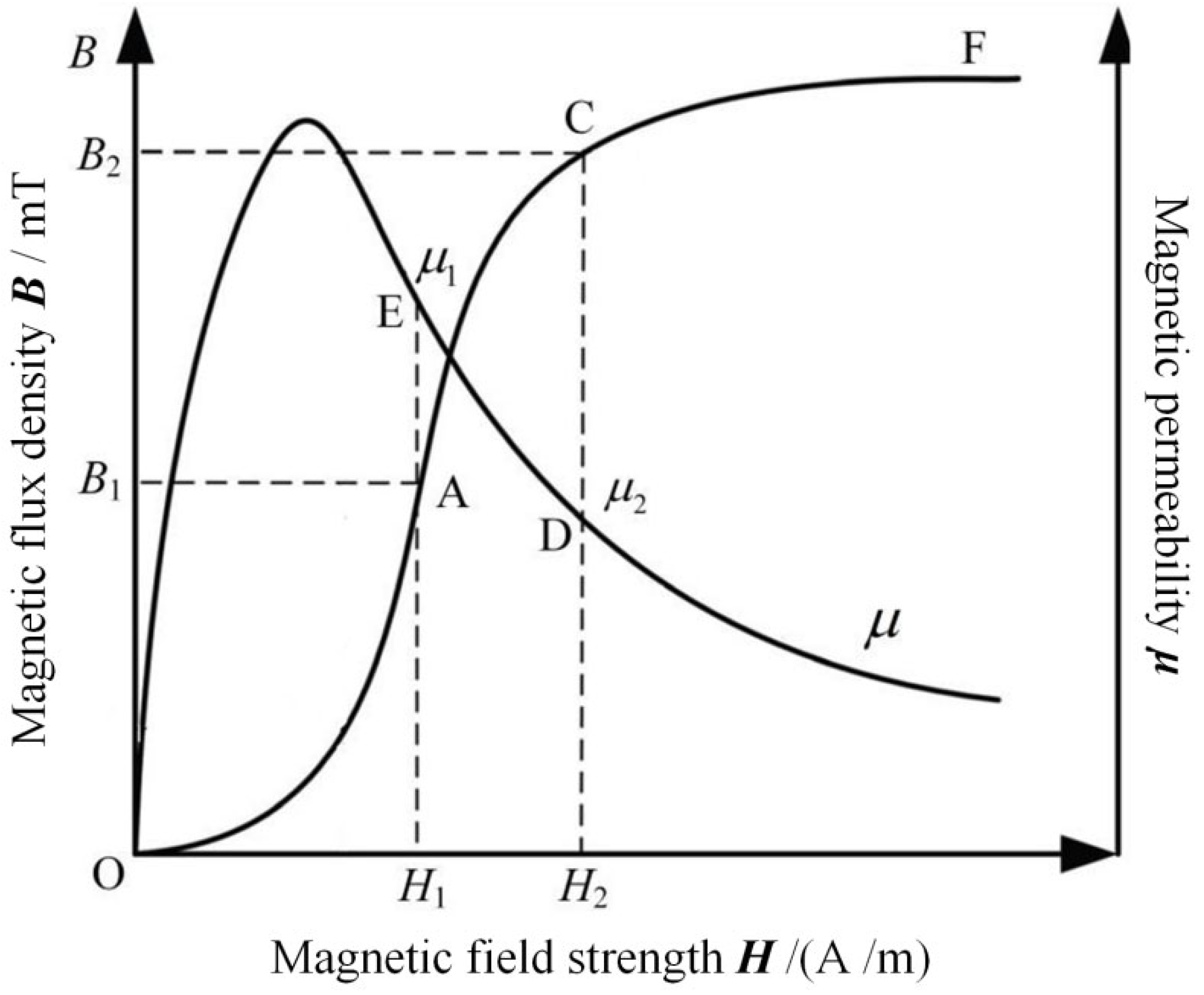
The magnetic permeability of a magnetic material typically varies with the external magnetic field, exhibiting a non-linear relationship. This non-linearity arises because the magnetic moments within the material undergo directional alignment or reversal under the influence of the external magnetic field. This process alters the average orientation and dynamic behavior of the magnetic moments, consequently causing the magnetic permeability to change. Therefore, from the constitutive relation, the relationship between the magnetic flux density B and the external magnetic field H is also non-linear, as illustrated in Figure 2. The figure plots the curves showing the variation in magnetic flux density B and magnetic permeability μ as a function of the external magnetic field strength H [31].
As can be seen from Figure 1, the B-H and μ-H curves for the weldment material are divided into three sections: The first section is the OA segment; as the magnetic field strength H increases from 0 to H1, the magnetic flux density B increases slowly. The second section is the AC segment; as H increases from H1 to H2, the magnetic flux density B increases rapidly with the magnetic field strength H. The third section is the CF segment, where B changes slowly with the increase in H and gradually levels off. From these three sections, it is evident that the weldment is in an unsaturated state in the first and second sections. In the third section, the CF segment, the magnetic flux density B of the weldment gradually approaches saturation. Furthermore, the figure shows that the magnetic permeability μ of the weldment increases rapidly with the magnetic field strength H, reaches a peak, and then gradually decreases. When the magnetic permeability of the test weldment decreases, its magnetic reluctance correspondingly increases, and the MFL will tend to seek the path of minimum reluctance. If a defect is present in the test weldment, its magnetic reluctance increases further, causing the magnetic field to become distorted. As the defect location impedes the normal passage of magnetic flux, a portion of the field is diverted through low-reluctance media, such as air, forming a magnetic leakage field [32].

2.2. Analysis of MFL Signal Characteristics

Due to variations in the shape, size, and material of defects, the distribution of the resulting magnetic leakage field is often complex. To facilitate comparison and calculation, approximate models are employed, and the complex magnetic leakage fields are typically classified and grouped for ease of study. The magnetic dipole model can be used to represent the defect’s magnetic leakage field. Subsequently, various models are used to estimate the static magnetic field strength of the leakage field at any point in space.
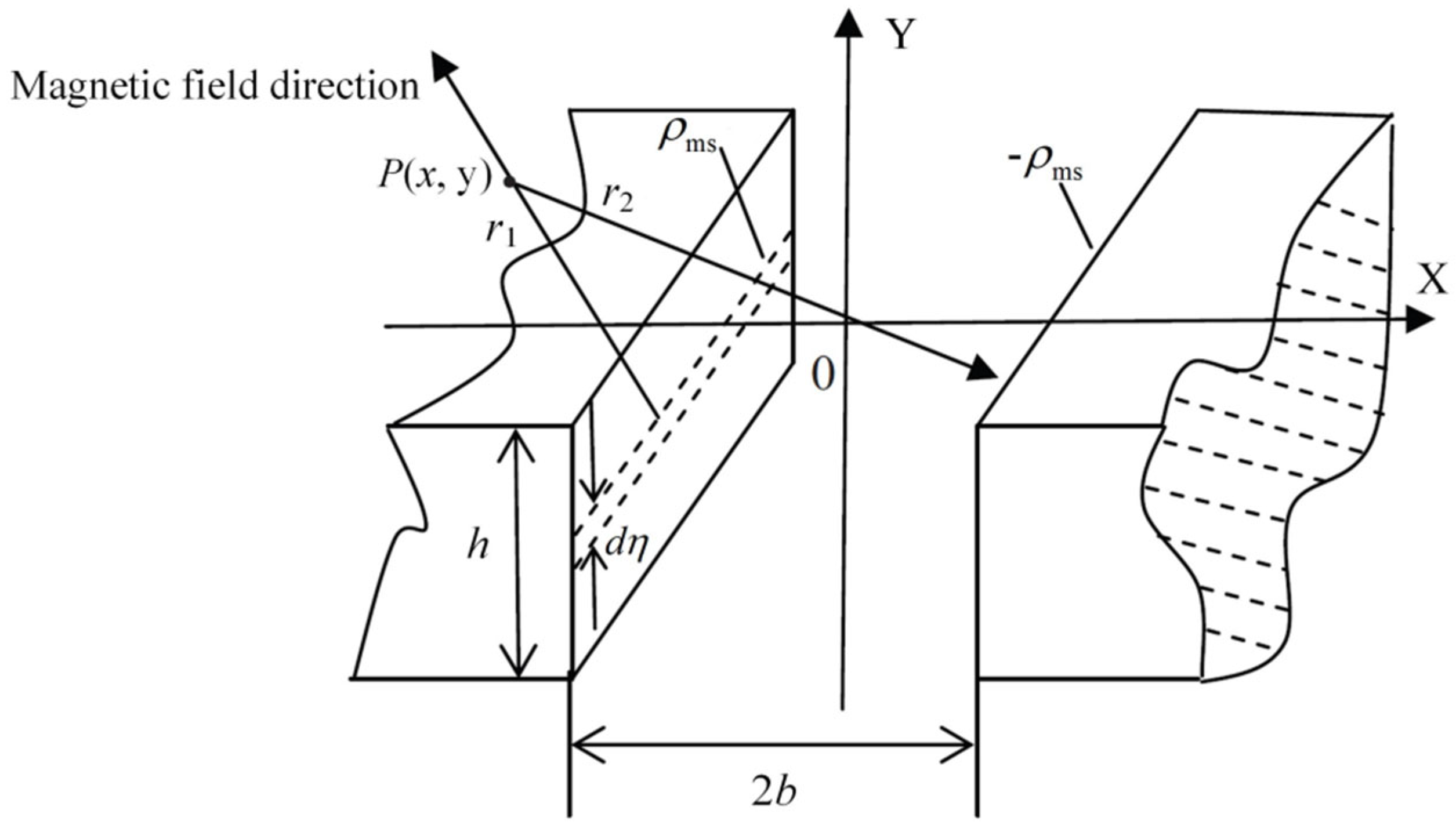
Assume that the defect corresponds to an infinitely long rectangular slot with a width of 2b and a depth of h. In this model, two bands of magnetic charge with opposite polarity and the same surface density are assumed to be uniformly distributed on the opposing side walls of the rectangular slot under magnetization. As shown in Figure 3, it is assumed that no magnetic charge is present on other parts of the slot. In the figure: η is the width of the magnetic charge surface; H is the magnetic field strength produced by the magnetic charge; μ 0 is the magnetic permeability of vacuum; ρ is the surface density of the charge; r is the distance from a point in space to the magnetic charge; h is the depth of the rectangular slot; and 2b is the width of the rectangular slot [33].
Based on the model, the magnetic field distribution at point O, produced by the magnetic charge on a differential surface element of width dμ on the groove wall, is given by [34]:
d H 1   =   ρ ms d η 2 π μ 0 r 2 2 r 1
d H 2 = ρ ms d η 2 π μ 0 r 2 2 r 2
Their x- and y-components are given by:
d H 1 x   =   ρ ms ( b   + x ) d η 2 π μ 0 x   + b 2 +   y   +   η 2
d H 1 y = ρ ms ( y   + η ) d η 2 π μ 0 x   + b 2 + y   + η 2
d H 2 y   = ρ ms ( y   + η ) d η 2 π μ 0 x b 2 +   y   + η 2
The total horizontal component H x can then be obtained by integrating d H x :
H x   =   0 h d H 1 x + 0 h d H 2 x   =   ρ ms 2 π μ 0 arc tan h x   +   b x   + b 2 +   y y   + h     arc tan h x     b x   +   b 2   +   y y   +   h
Similarly, the vertical component H y is given by:
H y   = 0 h d H 1 y + 0 h d H 2 y = ρ ms 4 π μ 0 ln x   +   b 2   +   y   +   h 2 x     b 2   +   y 2 x   +   b 2   +   y 2 x     b 2 + y   +   h 2
When the crack is very deep, i.e., as h→∞, the above two equations can be simplified to [30]:
H x   =   ρ ms 2 π μ 0 arc tan x   +   b y     arc tan x     b y
H y = ρ ms 4 π μ 0 ln x   b 2 + y 2 x   + b 2 + y 2
Then, the magnetic field strength at a certain point in space can be obtained from H = H x 2   +   H y 2 .
Similarly, the magnetic induction B of the leakage magnetic field can also be calculated:
B x   =   ρ ms 2 π μ 0 arc tan h x   +   b x   +   b 2   +   y y   +   h     arc tan h x     b x   +   b 2   +   y y   +   h
B y = ρ ms   4 π μ 0 ln x   + b 2 + y   + h 2 x b 2 + y 2 x   + b 2   + y 2 x   b 2 + y   + h 2
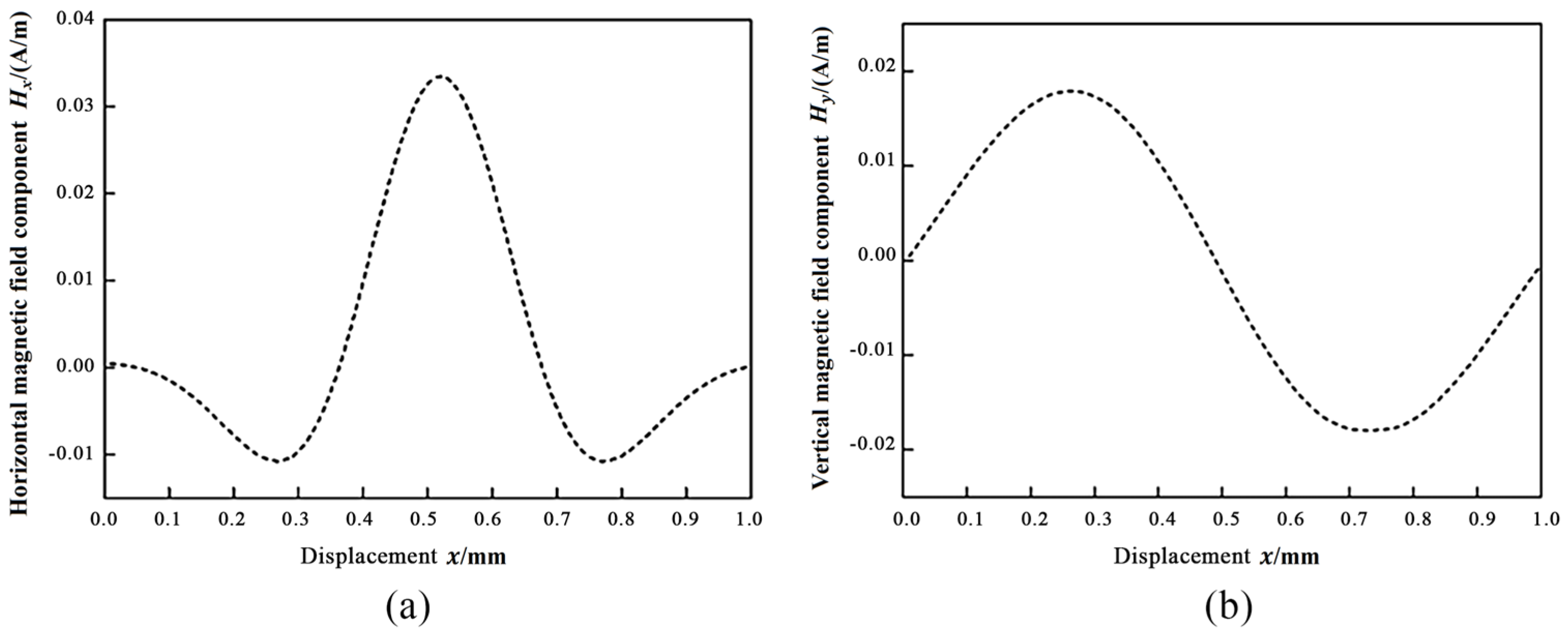
For the convenience of analysis, the ratio of α s / 2 π φ 0 in Equation (12) is set to 1, and the ratio of σ s / 4 π ϱ 0 in Equation (13) is set to 0.5. The width 2w of the welding defect is 0.5 mm, and the depth h is 1 mm. The distribution of the magnetic field strength H at 0.5 mm above the defect is illustrated in Figure 4. As shown in Figure 4a, the distribution of the horizontal component of the MFL intensity is symmetric with respect to the Y-axis, attaining its maximum value on the Y-axis and gradually decreasing along both sides of the defect. Since the horizontal component of the magnetic field is perpendicular to the direction of the incident polarized light, its distribution exerts a negligible influence on MOI. In contrast, the vertical component of the magnetic field is parallel to the direction of the incident polarized light, thereby directly affecting the MOI effect. As depicted in Figure 4b, the vertical component of the MFL intensity is positive on the left side of the zero-crossing point and negative on the right side. The region to the left of the zero-crossing point corresponds to the N-pole of the magnetic field, while the region to the right corresponds to the S-pole. Figure 4 shows the waveform of the magnetic field strength H above the welding defect [18]. As can be observed from the figure, the magnetic dipole model can effectively explain the distribution of the MFL field of welding defects and plays a significant role in understanding the MFL characteristics of welding defects.
Regardless of whether the normal or tangential component of the leakage field is considered, the characteristics of their respective signals can be compared. The general characteristics of the signals from both components are fundamentally similar; however, the slight difference in their peak-to-peak separation suggests that their distortion profiles are distinct. However, these two signals reveal that the parameters of the welding defect can be reflected to varying degrees by the characteristics of the MFL signal. In particular, the peak-to-peak amplitude clearly correlates with information about the defect’s depth. Therefore, further investigation of the MFL signal is necessary to achieve the objective of detecting and identifying relevant signal features. A relationship between the characteristics of the welding defect and the MFL signal can then be established. A qualitative investigation of the MFL signal is conducted to enable the two-dimensional and three-dimensional profile reconstruction of the welding defect [35].

2.3. The Faraday Effect

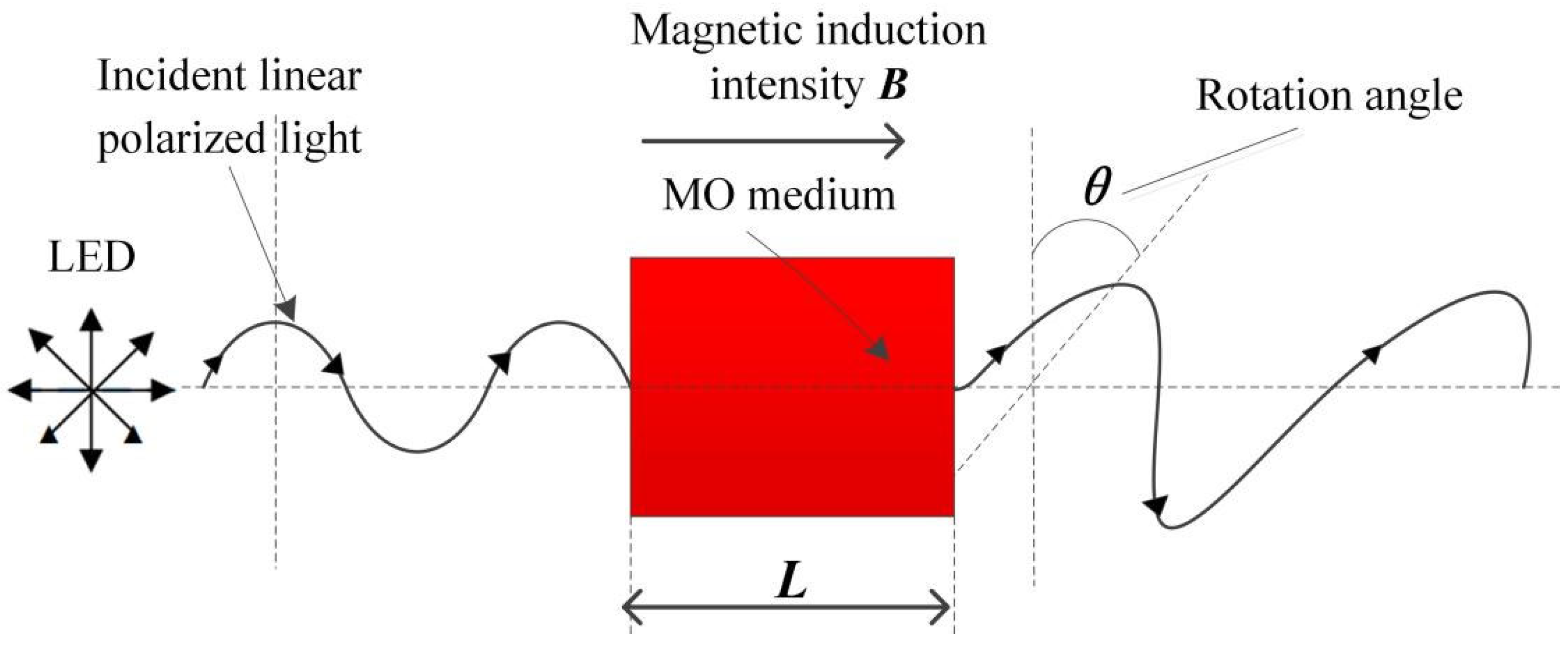
The Faraday effect and Malus’s law form the fundamental principles of MOI inspection techniques. This technology enables the visualization of defects by converting information from the MFL field into variations in light intensity. The Faraday effect is essentially an interaction between light and a magnetic field within a medium, which alters the medium’s optical properties. The principle of this effect is illustrated in Figure 5. An incident light source first passes through a polarizer to produce linearly polarized light. When this light propagates through a magneto-optical medium in the absence of a magnetic field, its plane of polarization does not rotate. However, if a magnetic field is applied to the medium parallel to the direction of light propagation, this external field alters the optical properties of the magneto-optical medium, causing the plane of polarization of the light to rotate. The angle of rotation, θ, is primarily determined by the component of the magnetic flux density, B, that is parallel to the direction of light propagation, and the effective length, L, that the light travels through the magneto-optical film. It is expressed as [11]:
θ = V B L
In the equation, V is the Verdet constant, which represents a characteristic of the magneto-optical medium. For a given magneto-optical film material, the direction of rotation is determined by the direction of the external magnetic field. The angle of rotation is independent of the light’s direction of propagation and is directly proportional to the magnetic flux density of the leakage field [14].

2.4. Working Principle of the Magneto-Optical Sensor

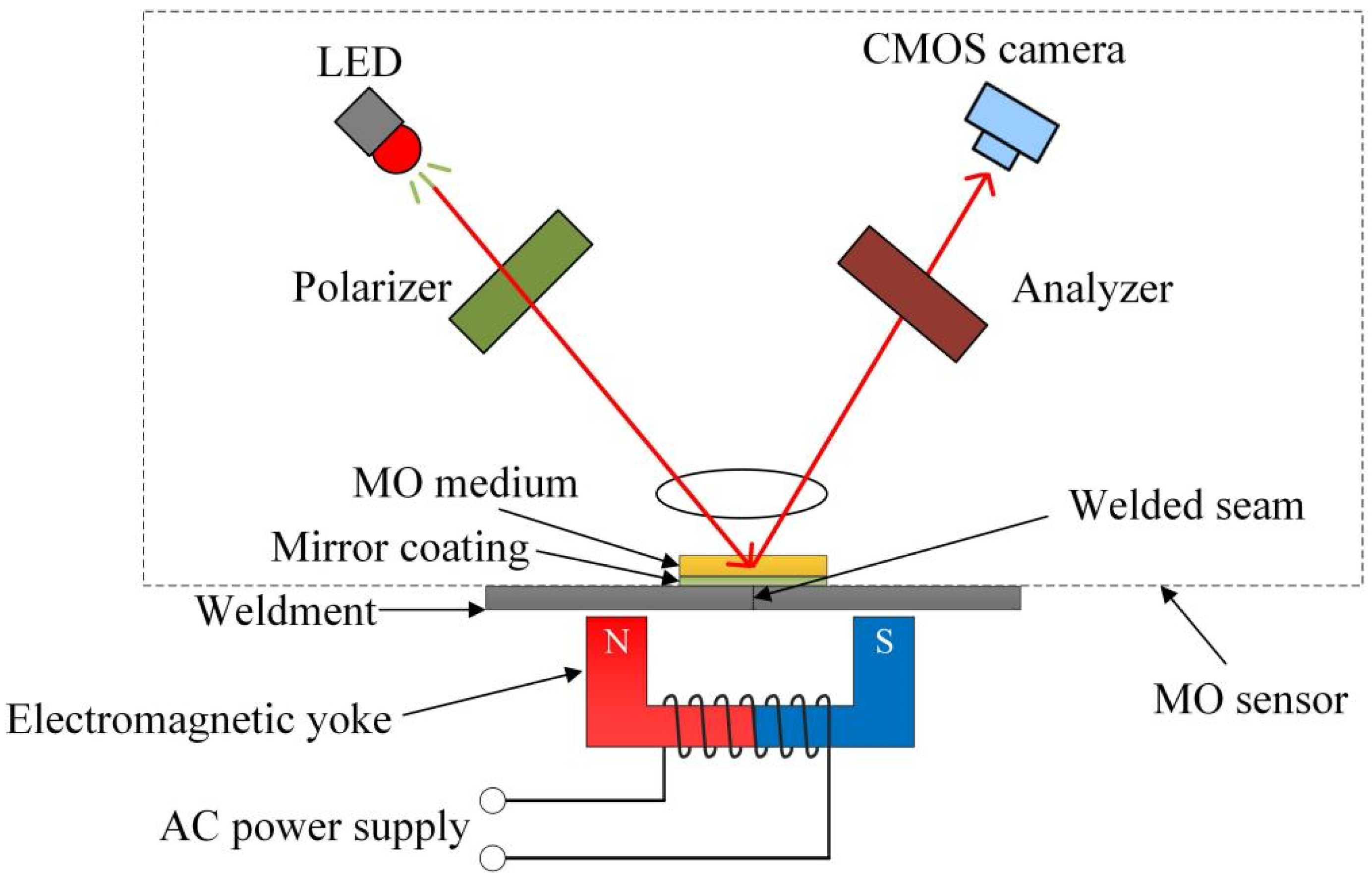
The MOI method is a novel, visual MFL inspection technique. Compared to traditional methods that use Hall sensors to detect the leakage field, it transforms the defect’s MFL information into a light intensity signal, which enables the visual detection of the defect. The imaging principle of the magneto-optical sensor is illustrated in Figure 6. Light from an LED source passes through a polarizer to become linearly polarized. An external magnetic field is generated by an electromagnet, and the induced field, influenced by the welding defect, alters the magnetic state of the magneto-optical film. After the linearly polarized light passes through the magneto-optical film, it is reflected by a reflective surface. The reflected linearly polarized light consequently contains information about the welding defect. According to the Faraday effect, the rotation angle of the linearly polarized light’s plane of polarization is changed. This light, now carrying information on the weld quality, passes through an analyzer and is subsequently received by a CMOS sensor to form the magneto-optical image of the welding defect [36].
When a defect is present on the specimen, a magnetic leakage field is formed in its vicinity upon magnetization. The incident polarized light passes through the magneto-optical film, reflects off a mirror surface, and the reflected light then passes through an analyzer before being captured by a CCD camera. During this process, the polarized light traverses the magneto-optical film twice. According to the Faraday effect, the plane of polarization undergoes two rotations; let the total rotation angle be 2θ. According to Malus’s law, the change in the rotation angle of the polarized light causes a change in light intensity. Let I0 be the incident light intensity and I be the transmitted light intensity; then I0 and I satisfy Equation (15) [9]:
I = I0 (cos(α ± 2θ))2
where α is the angle between the polarization directions of the polarizer and the analyzer, and 2θ is the rotation angle, whose direction depends on the magnetic field direction.
In the equation, I0 is the incident linearly polarized light intensity. When the external magnetic field direction corresponds to a North pole, it rotates the plane of polarization clockwise by an angle θ (as viewed along the direction of propagation), whereas a South pole causes a counter-clockwise rotation by θ. Applying an AC power source to the field generator produces an alternating magnetic field at the yoke ends, with its direction and magnitude varying at a specific frequency. Consequently, the Faraday rotation angle also varies accordingly [37,38,39,40,41]. When the magnetic field is stronger, the contrast between light and dark areas becomes more pronounced. The varying magnetic field strengths at defect and defect-free locations are thus translated into variations in light intensity in the magneto-optical image, enabling the identification of defects.

3. Numerical Modeling for Welding Defect Detection

3.1. Establishment of the Welding Defect Model

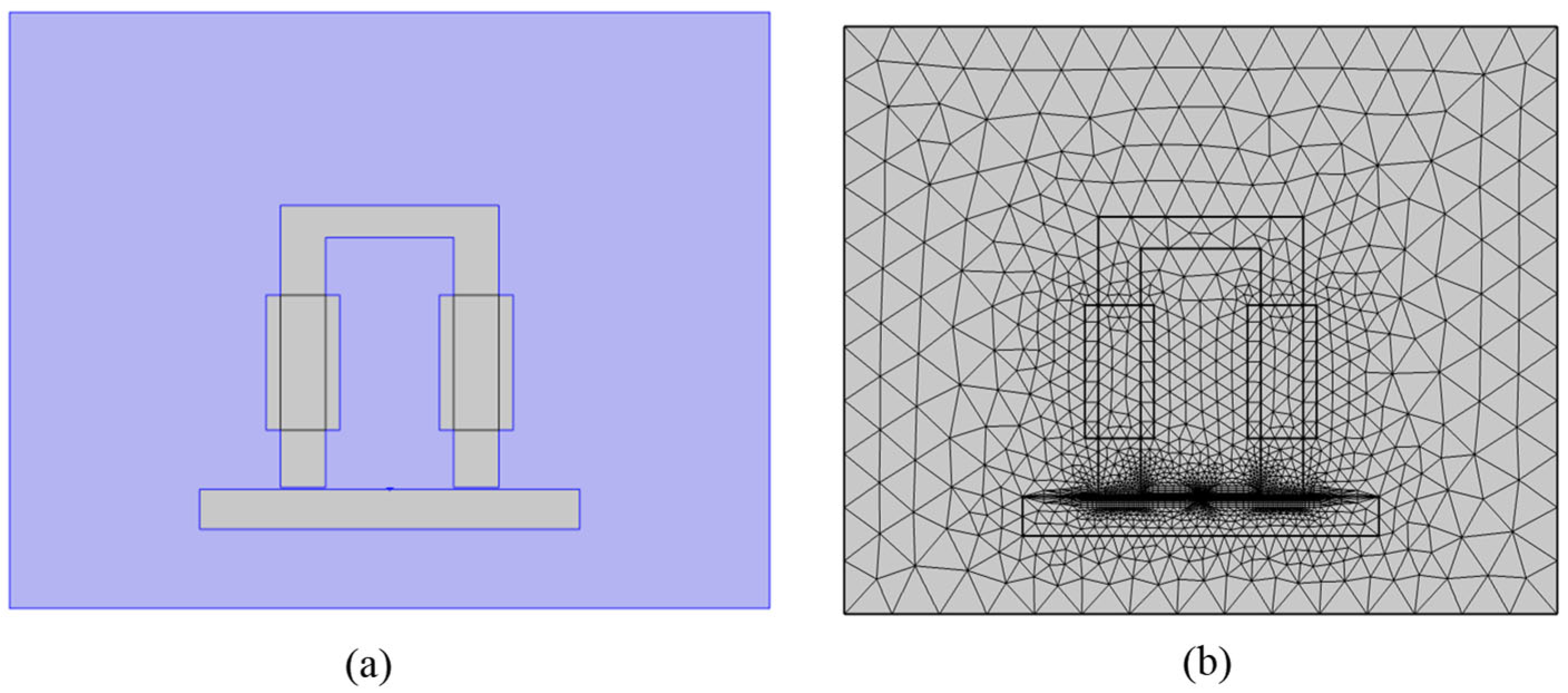
This study adopts a direct solid modeling method based on the configuration of the magneto-optical imaging inspection system and establishes a finite element model of welding defects using COMSOL Multiphysics 6.0 As shown in Figure 7a, the model consists of an AC electromagnet, a low-carbon steel plate (Q235), a simulated defect, and an excitation coil. An alternating magnetic field solver is used as the excitation source in the model, and a rectangular surface slot representing a crack is defined on a Q235 steel plate with dimensions of 100 mm × 100 mm× 20 mm (length × width × thickness). After establishing the finite element model, material properties are assigned to each region of the model according to experimental conditions and material parameters, as detailed in Table 1. Due to the extremely small size of the defect relative to the overall size of the weldment in the simulation model, and the minimal lift-off values between the weldment-electromagnet and weldment-sensor, relying solely on the software’s default adaptive meshing will lead to inaccurate calculation of the MFL distribution above the defect. Therefore, a manual meshing method is adopted to achieve refined meshing in the region of interest (ROI), thereby accurately calculating the actual magnetic field distribution. The result of the manual mesh refinement for the three-dimensional finite element simulation model is shown in Figure 7b [37].
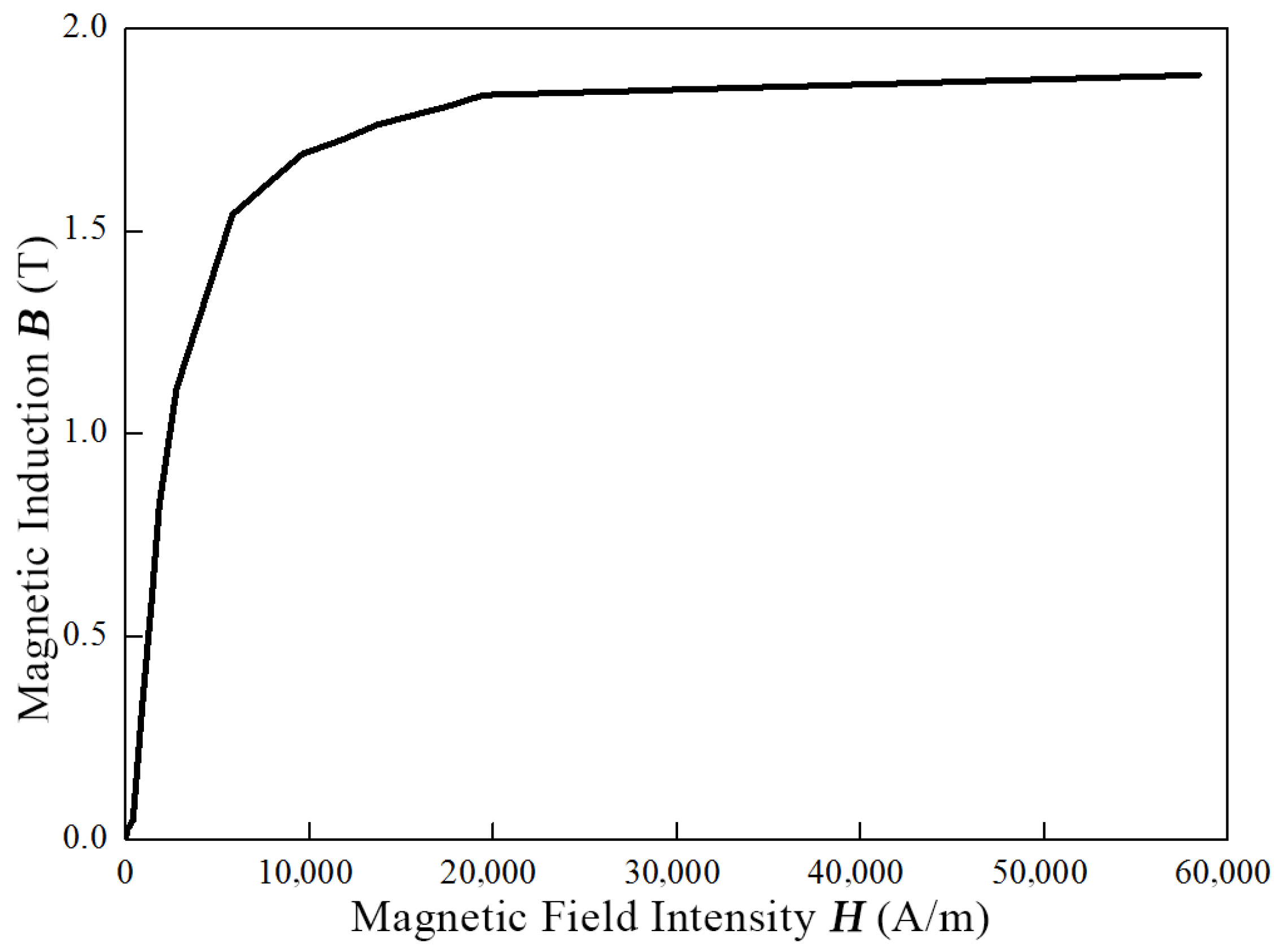
In this section, a self-fabricated AC electromagnet serves as the experimental excitation device. The excitation coil is wound with 700 turns of 0.5 mm enameled copper wire, and an alternating current (AC) with an effective value of 16 V (1 A current) is applied. The 700-turn excitation coil is supplied with an alternating current (1 A effective value, 50 Hz frequency) to generate an alternating electromagnetic field. 50 Hz is the standard power frequency, aligning with engineering application scenarios for industrial non-destructive testing—thus, this frequency is selected. Within the 3D model, the U-shaped electromagnet is constructed from Mn-Zn ferrite, the excitation coil from copper, and the welded component from custom Q235 steel. Specific material parameters are detailed in Table 2. Q235 steel is a nonlinear ferromagnetic material, and its magnetic hysteresis curve (B-H profile) is illustrated in Figure 8. To approximate real-world detection conditions, the computational domain of the 3D finite element model is set to air (relative permeability = 1), with the model’s boundary condition configured as the balloon boundary condition. The Hall sensor is positioned 0.5 mm above the weld defect. To enhance the accuracy of detection results from the 3D finite element model, a refined mesh is generated in the region of interest for the defect [38].

3.2. Analysis of the Influence of Instrument Lift-Off Value on the MFL

In MFL inspection, the magnitude of the lift-off value directly affects the accuracy of the detection results. If the lift-off value is too high, genuine leakage signals may be missed, leading to deviations or false negatives. Conversely, if the lift-off value is too low, it can increase noise and the probability of false positives, also leading to inaccurate results. In practical applications, a suitable lift-off value must be determined through experimental adjustments, comprehensively considering not only the equipment’s performance and the working environment but also factors such as the material, size, and shape of the object under test to achieve accurate and reliable detection. In this study, based on the established MFL inspection setup and the workpiece, a series of simulation experiments were conducted to investigate the effect of lift-off on the MFL by varying the lift-off value from an initial 0.5 mm to 2.0 mm in increments of 0.1 mm [39,40].
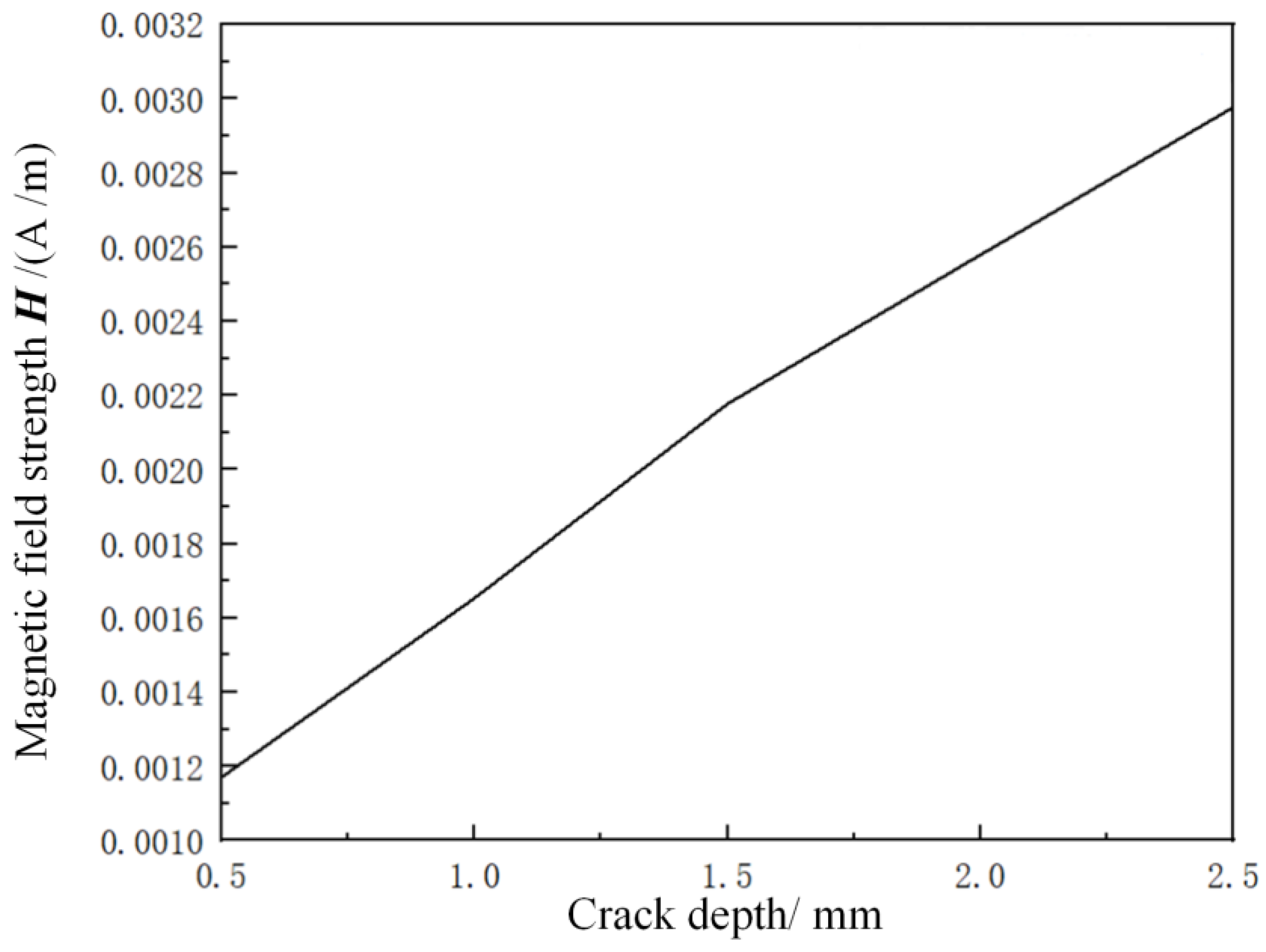
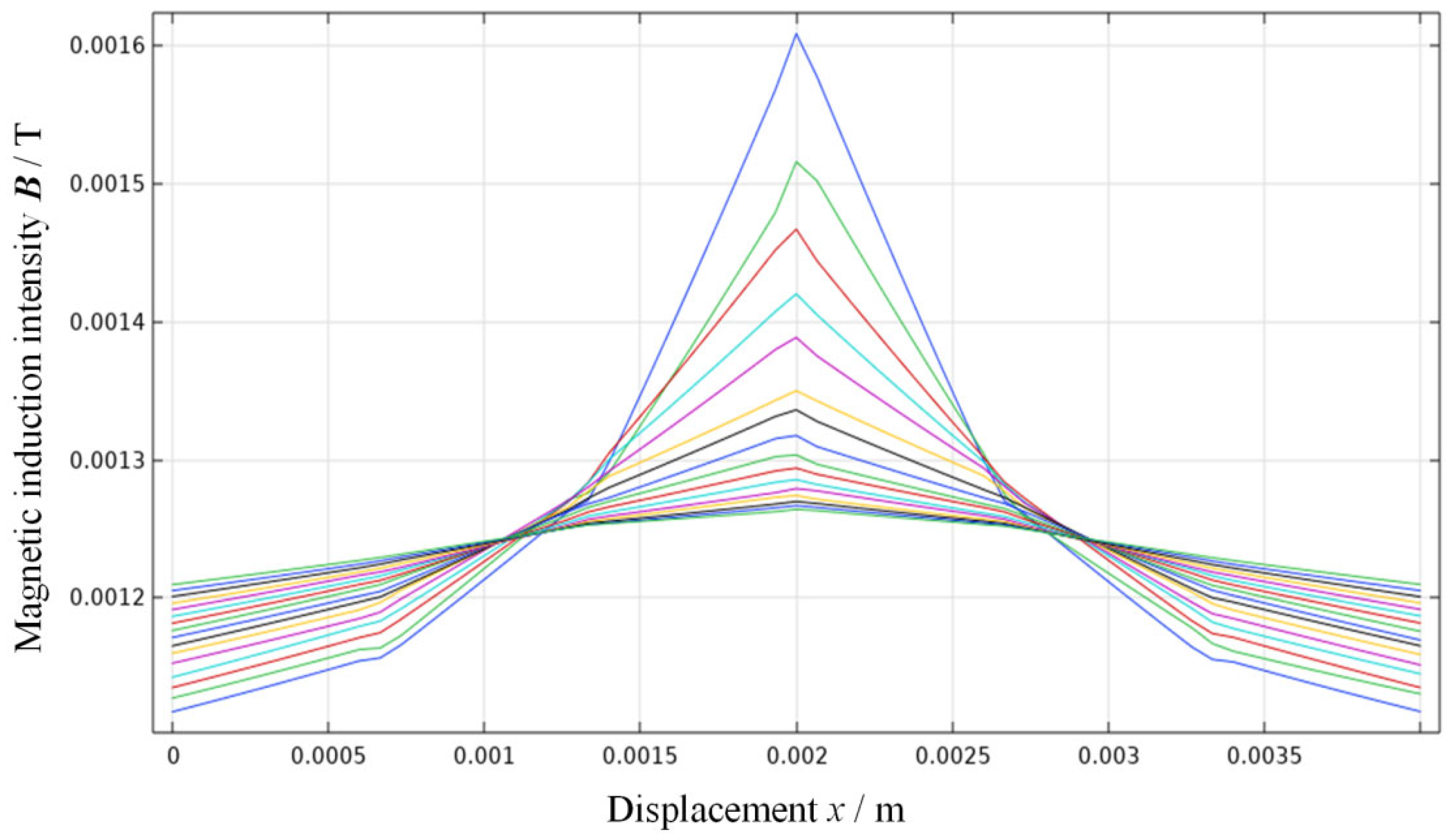
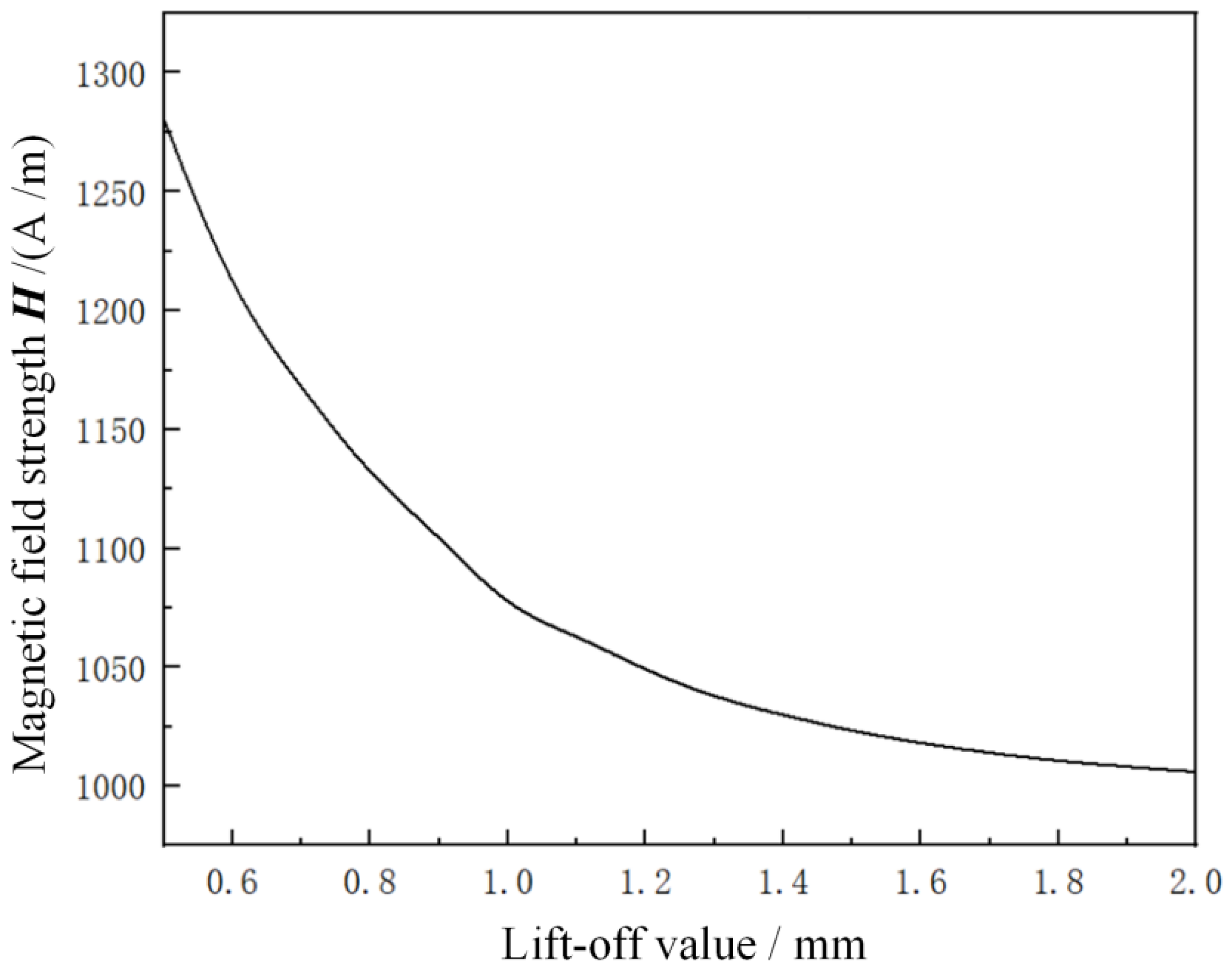
Figure 9 shows the magnetic flux density B distribution curves obtained at different lift-off values for a defect of 0.5 mm depth and 0.5 mm width located at the center of the workpiece. It is evident from the figure that an inverse relationship exists between the lift-off value and the amplitude of the MFL magnetic flux density; the amplitude decreases as the lift-off value increases. Furthermore, after the lift-off reaches 1 mm, the change in amplitude is not significant with further increases in height. Therefore, in this model, when the lift-off is greater than 1 mm, the MFL signal is prone to error, making it difficult to accurately identify the defect. This implies that if the detector lift-off is too large, the induced MFL amplitude will decrease, which is detrimental to the extraction of effective signals. Figure 10 illustrates the relationship between the lift-off value and the MFL strength amplitude: the amplitude decreases sharply as the lift-off value increases, and the rate of change diminishes when the lift-off exceeds 1 mm. In summary, an excessively large detector lift-off weakens the sensed MFL signal, thereby adversely affecting the detection results.

3.3. Analysis of the Influence of Defect Depth on the MFL

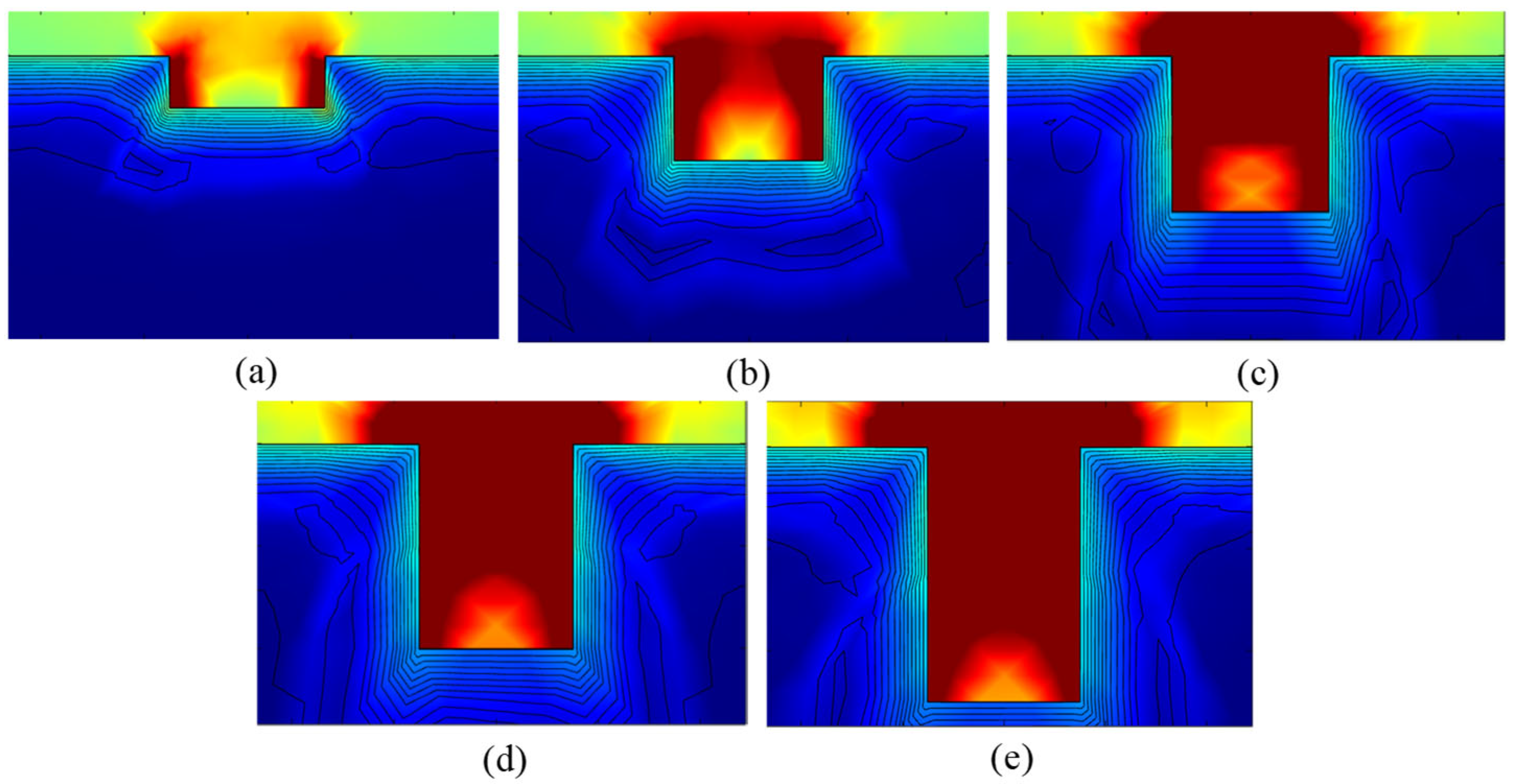
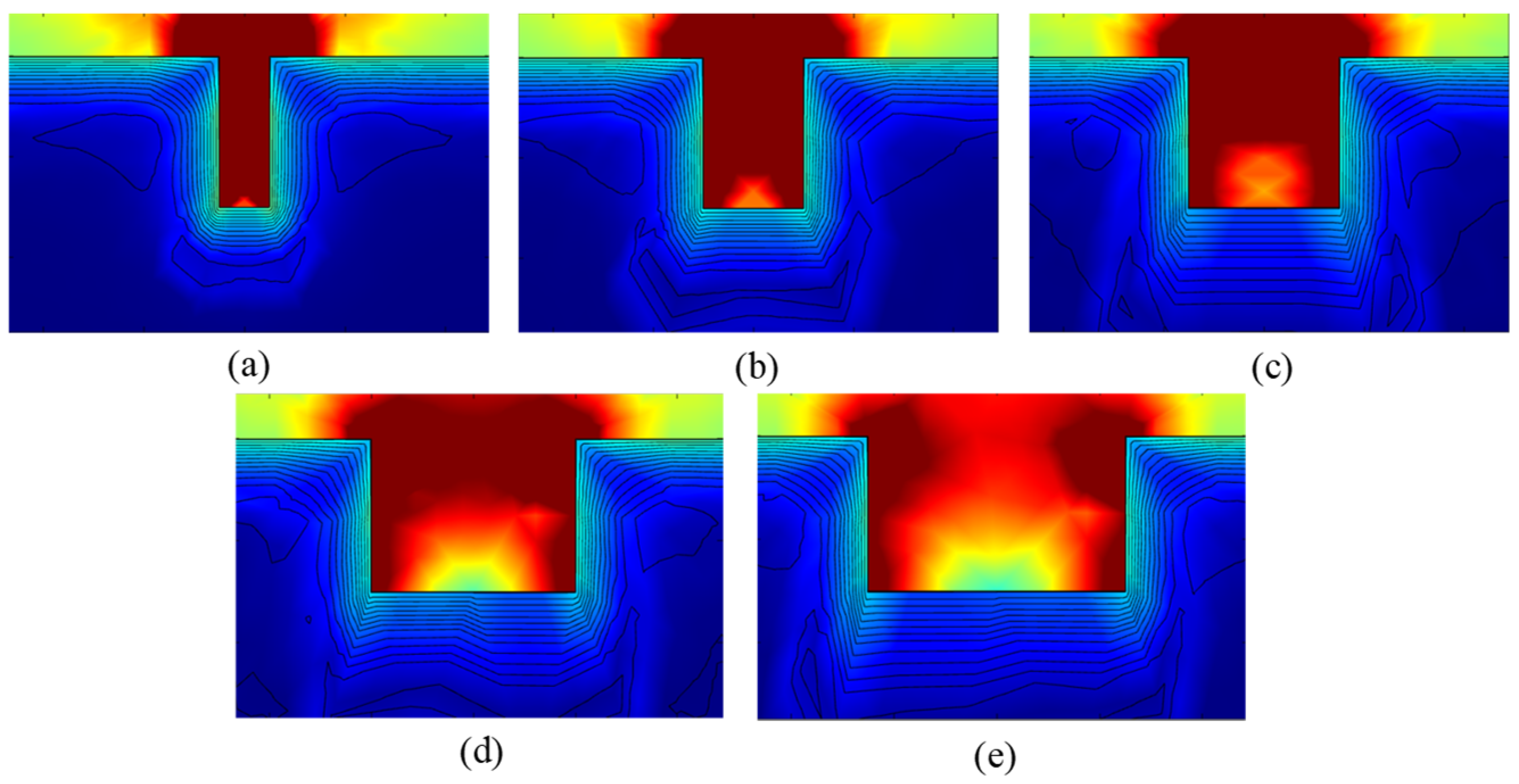
In the context of surface defects, depth is typically the geometric parameter that most significantly affects the component’s performance. Both the theory and practical application of MFL inspection are highly dependent on how defect depth influences the distribution of the magnetic leakage field. To investigate the relationship between defect depth and the MFL, the depth was incrementally increased in fixed steps while the defect width was held constant. Figure 9 displays the magnetic flux density contour plots of the MFL for defects with depths of 0.5 mm, 1.0 mm, 1.5 mm, 2.0 mm, and 2.5 mm, while the width is maintained at 1.5 mm. In these color contour plots, red typically represents the region with the strongest MFL signal, whereas green and blue denote areas of weaker signal strength. In grayscale maps, signal intensity is generally indicated by darker or lighter shades. Figure 11 provides a clear visual representation of how the amplitude of the magnetic flux density distribution varies with defect size. For defects with smaller depths, the contour plot appears lighter, indicating a lower magnetic flux density. As the defect depth increases, the colors in the contour plot around the defect intensify, signifying that the magnetic field strength around the defect increases correspondingly. To further investigate the influence of depth on the MFL strength, the corresponding leakage field strength curves above the defect were extracted for detailed analysis.
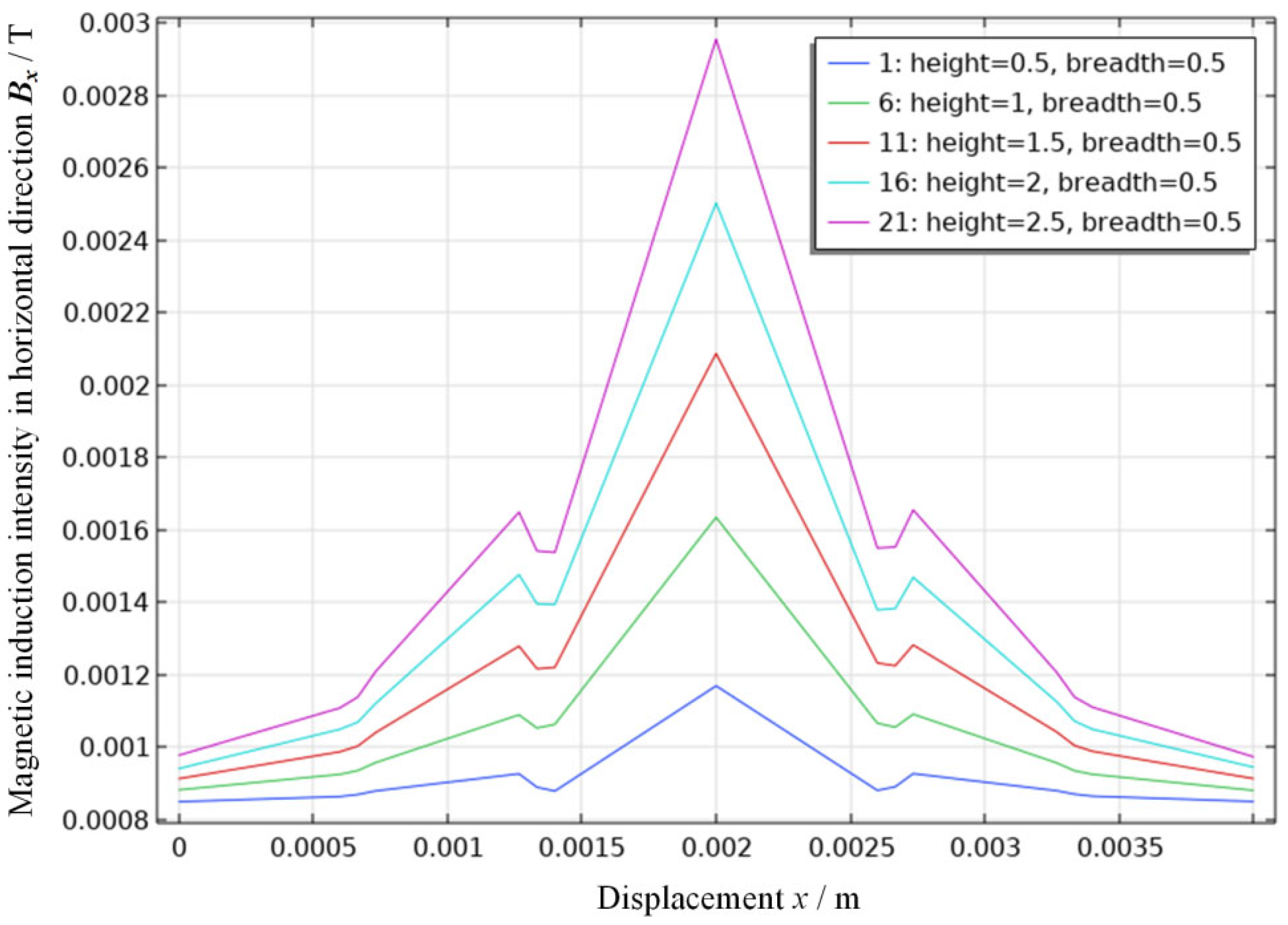
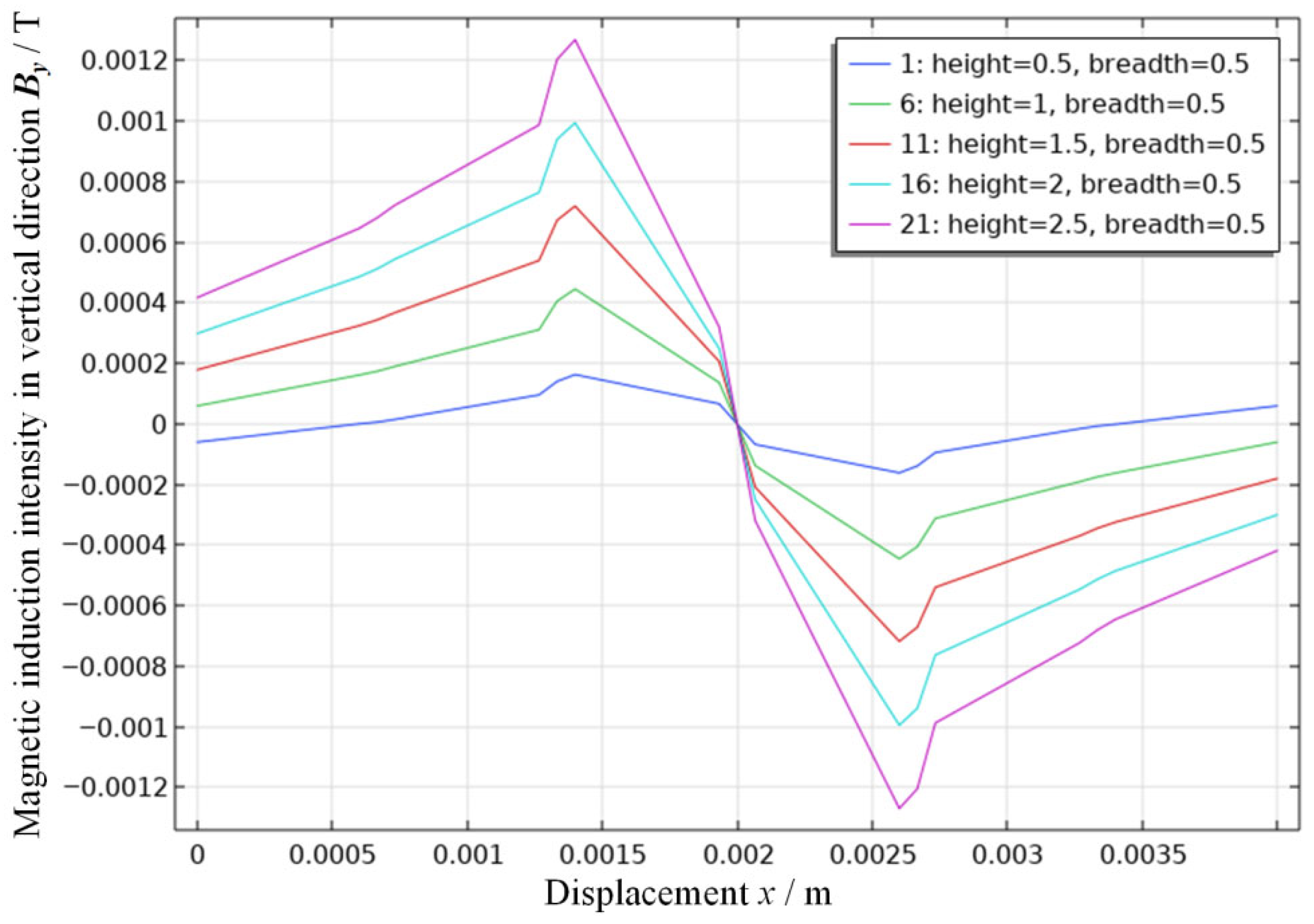
In this paper, five groups of defects in a 20 mm-thick weldment are analyzed as an example. The defect width is held constant at 0.5 mm, while the depth is increased from 0.5 mm to 2.5 mm in steps of 0.5 mm. The resulting curves of the horizontal component of the MFL magnetic flux density for defects of different depths are presented in Figure 12. As shown in the figure, the peak value of the Bx component of the magnetic flux density increases as the defect depth increases. This finding is consistent with the pattern observed in the magnetic field strength contour plots of Figure 11. The relationship between the amplitude of the horizontal component and the defect depth, plotted in Figure 13, also clearly demonstrates that as the defect depth increases, the leakage flux increases as well.
Therefore, the relationship between the horizontal component B x of the defect’s MFL magnetic flux density and the defect width can be expressed as follows:
B xp   =   a h   +   b
In the formula, B xp represents the amplitude of the horizontal x-component of the magnetic flux density, h is the defect depth, a is a coefficient, and b is a constant. The values of a and b are dependent on the defect’s geometry and practical conditions, such as the inspection equipment and testing parameters.
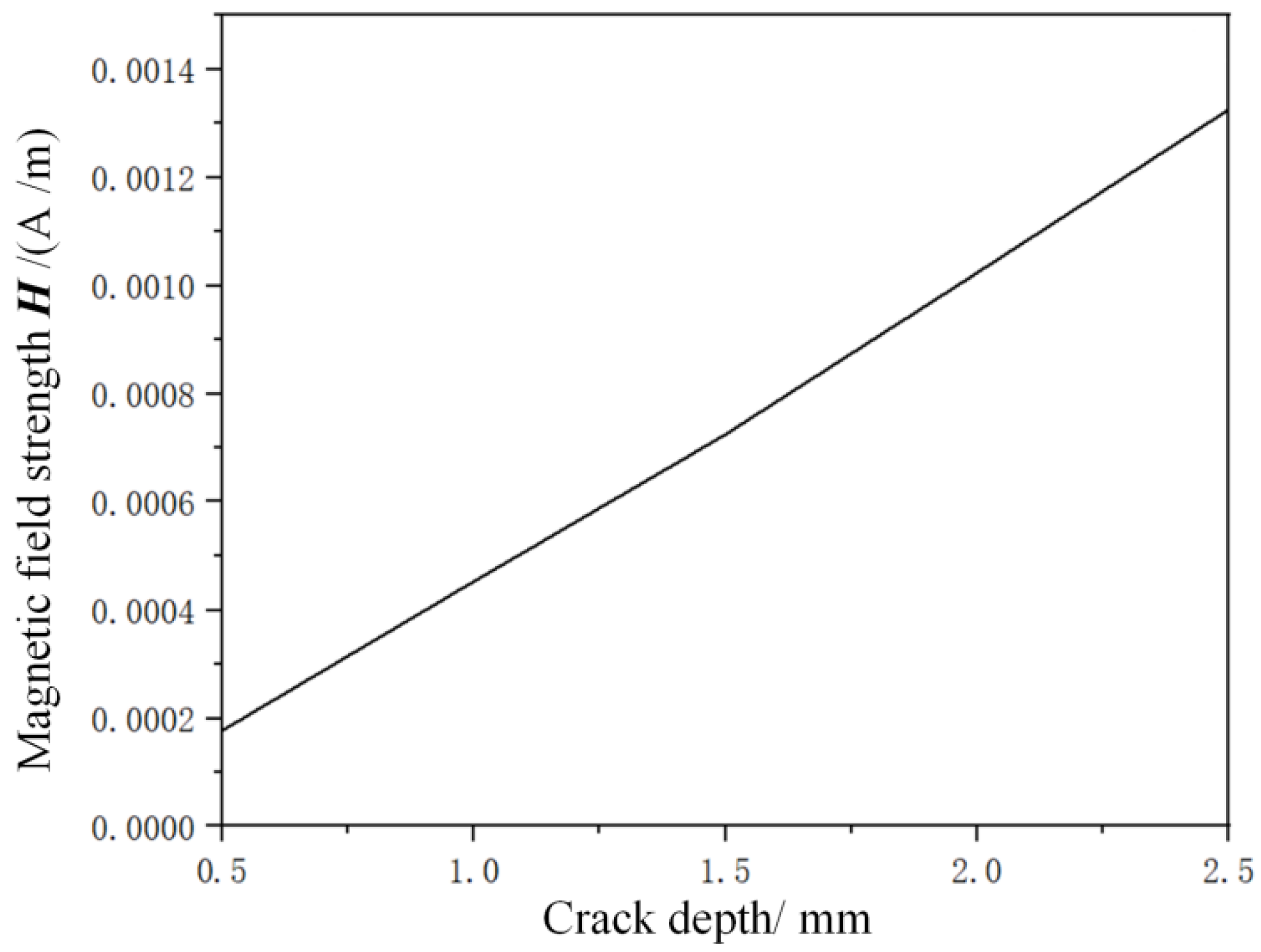
Figure 14 shows the distribution curves of the horizontal component By of the magnetic flux density for defects of different depths. It is clearly evident from the figure that the amplitude of the By component increases with the increase in defect depth. This trend is analogous to the increasing relationship observed between the Bx component and defect depth. The increasing relationship between the amplitude of the horizontal y-component and the defect depth, as depicted in Figure 15, further corroborates the reliability of the contour plots shown in Figure 15.
Therefore, the relationship between the horizontal component By of the defect’s MFL magnetic flux density and the defect width can be expressed as follows:
B yp   =   m h   +   n
In the formula, B yp represents the amplitude of the horizontal y-component of the magnetic flux density, h is the defect depth, m is a coefficient, and n is a constant. The values of m and n are dependent on the defect’s geometry and practical conditions (such as inspection equipment and testing parameters).

3.4. Analysis of the Influence of Defect Width on the MFL

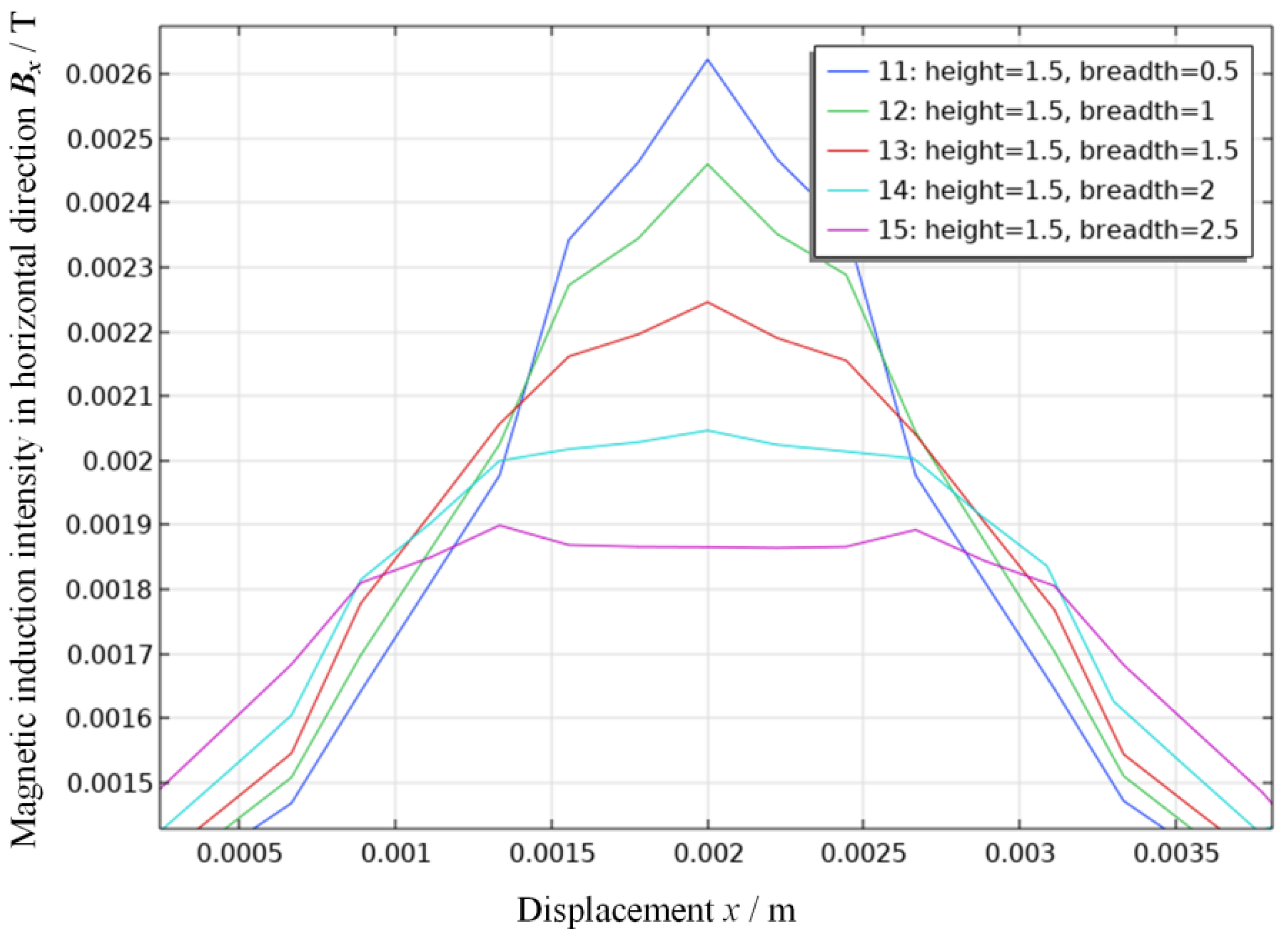
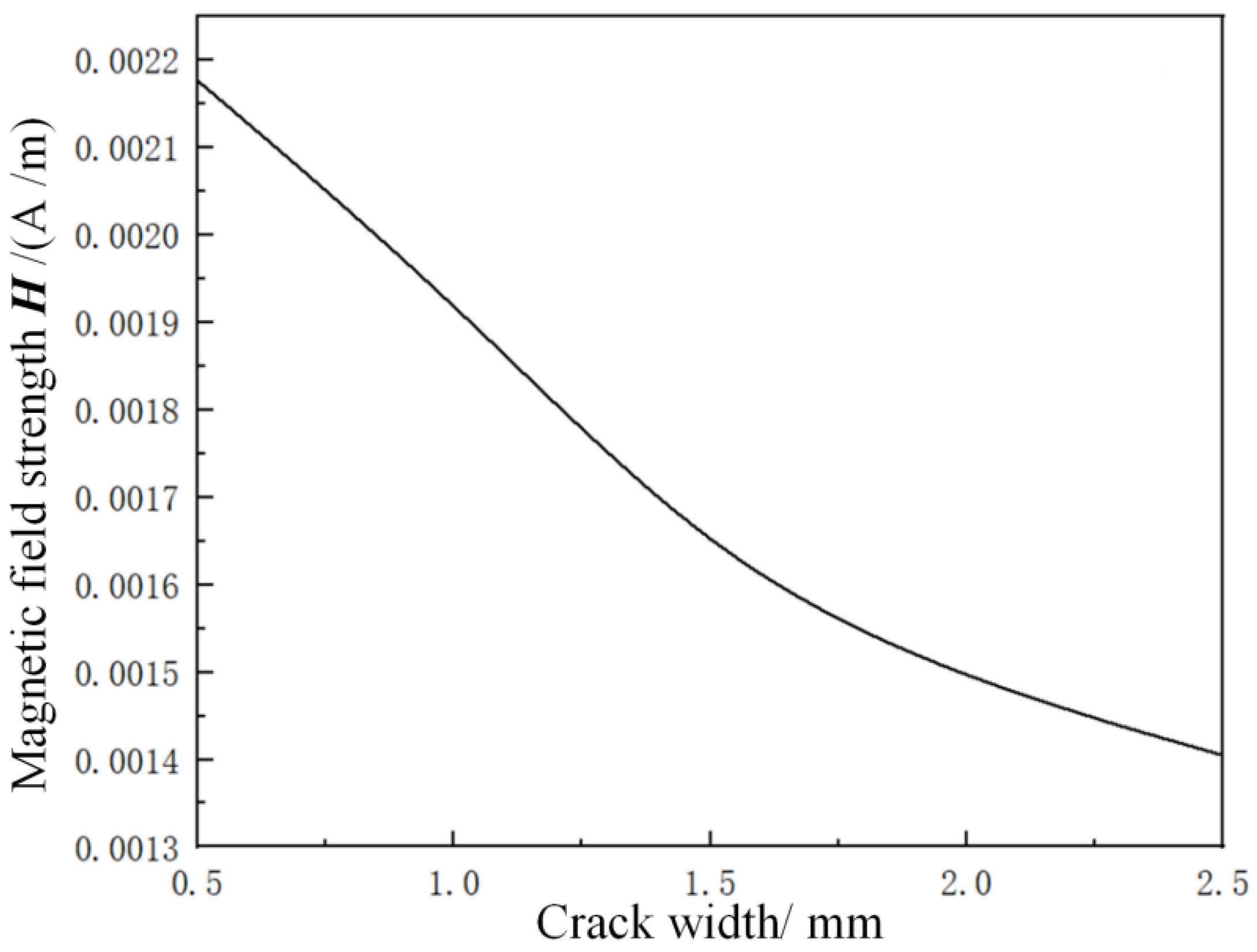
In addition to depth, the width of the defect is another important geometric parameter that affects the mechanical properties of the weldment. For defects of the same depth, variations in width will cause changes in the MFL, and the relationship between the defect width and the amplitude of the leakage field directly influences the detection results. In this study, a finite element analysis model of a weldment with a height of 20 mm and a length of 200 mm was established. To analyze the influence of defect width on the MFL, the defect depth was fixed at 1.5 mm, while the width was varied from 0.5 mm to 2.5 mm in 0.5 mm increments. Figure 10 shows a selection of MFL magnetic flux density contour plots for defects of different widths. Consistent with Figure 16, the red areas indicate stronger magnetic field strength and more pronounced leakage signals. It can be observed from the figure that as the defect width increases, the strength of the surrounding leakage field decreases. To better investigate the effect of width on the MFL strength, the relevant leakage field strength curves above the defect are now extracted for analysis.
From the contour plots in Figure 16, it is evident that as the width increases, the color of the magnetic flux density plot around the defect becomes lighter, indicating a decrease in magnetic flux density. This provides a more intuitive visualization of the decreasing relationship between the amplitude of the horizontal x-component of the MFL and the defect width. The relationship between the defect width and the amplitude of the MFL strength is shown by the curve in Figure 17. The figure indicates that when the defect depth is held constant, the amplitude of the MFL strength decreases as the defect width increases, exhibiting a decreasing relationship. The influence of defect width on the amplitude of the magnetic field strength is illustrated in Figure 18. It can be clearly seen that the magnetic field strength has a decreasing relationship with the defect width, and the resulting amplitude curve is therefore a descending, approximately straight line.

3.5. Analysis of the Influence of Defect Aspect Ratio on the Magnetic Leakage Field

The MFL increases with the depth of a welding defect but decreases with its width. This indicates that defect depth and width have opposing effects on the MFL. Therefore, it is necessary to investigate the relative influence of defect depth and width on the leakage field signal.
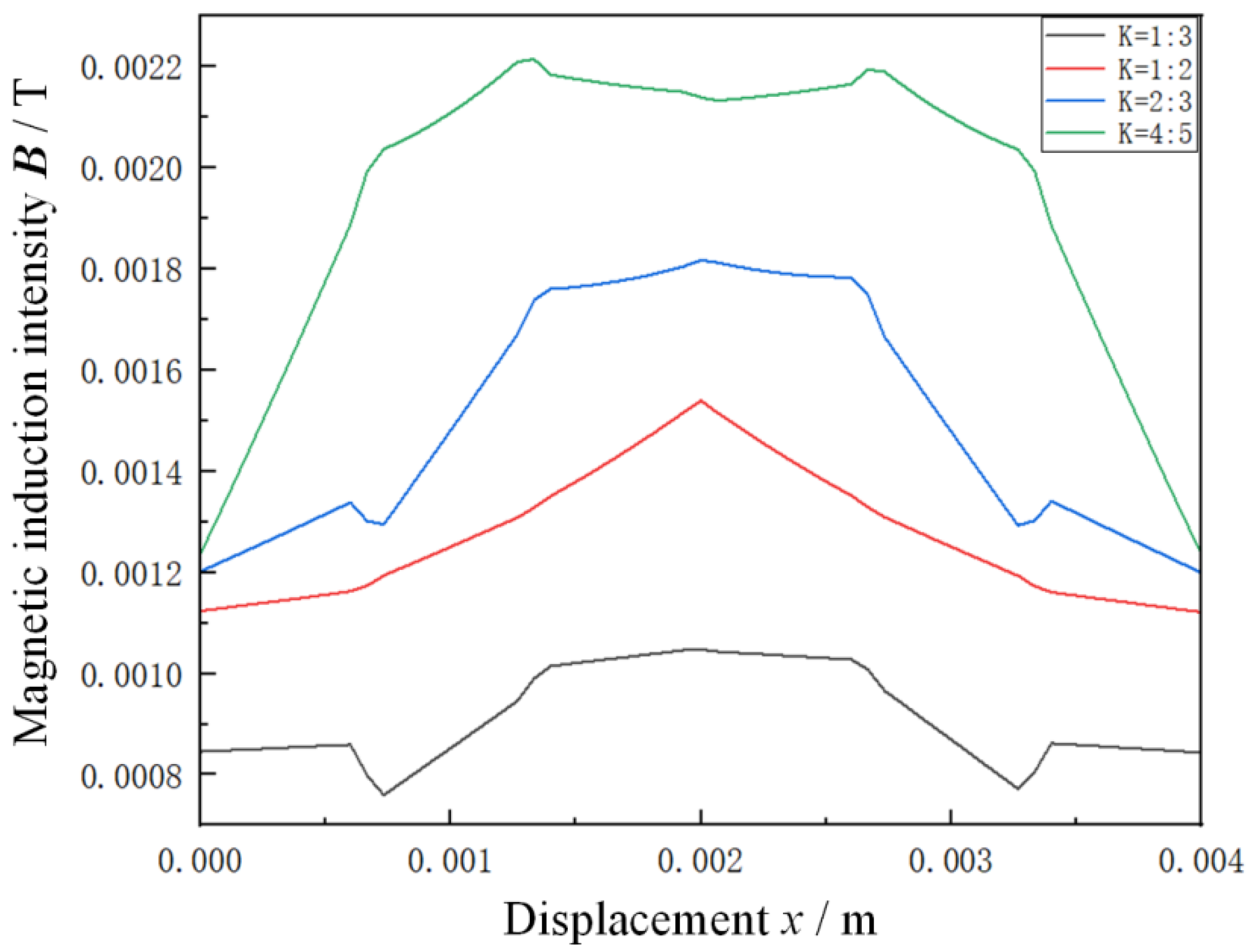
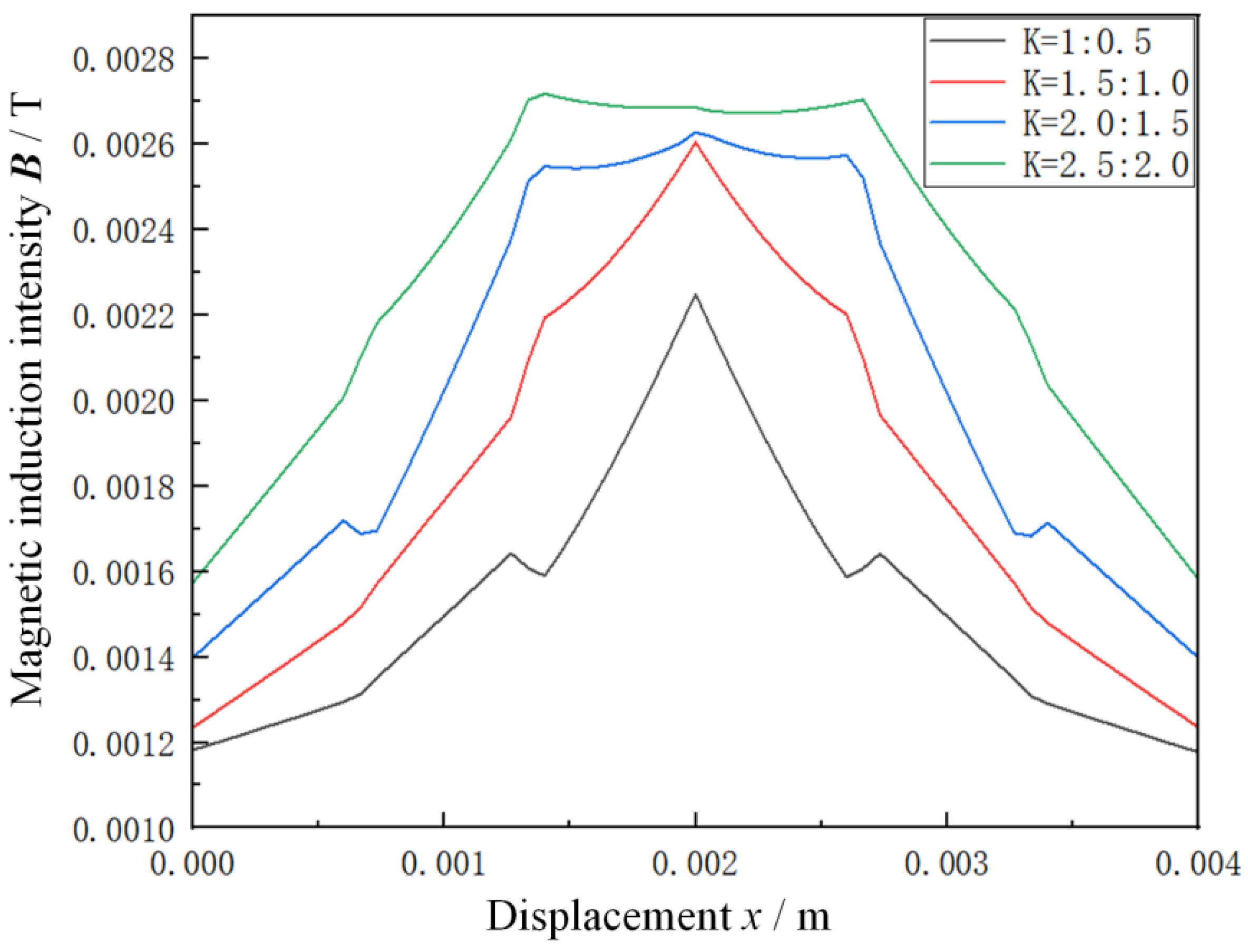
To investigate the combined effect of defect depth and width on the MFL of cracks, the ratio of defect depth to width is introduced as a parameter, denoted as K. This section employs the three-dimensional finite element model of alternating magnetic fields established in Section 3 to study the relationship between surface cracks with different aspect ratios and the magnetic induction intensity of crack MFL. The surface crack is located at the center of the two magnetic yokes, with a length of 20 mm and a sensor lift-off value of 0.5 mm. A finite element analysis model is established to analyze the influence of K on MFL, and the MFL variations under different K values are evaluated accordingly. The selected aspect ratio K values are listed in Table 3 and Table 4 [39].
When K is increasing and less than 1, the chosen values are shown in Table 3.
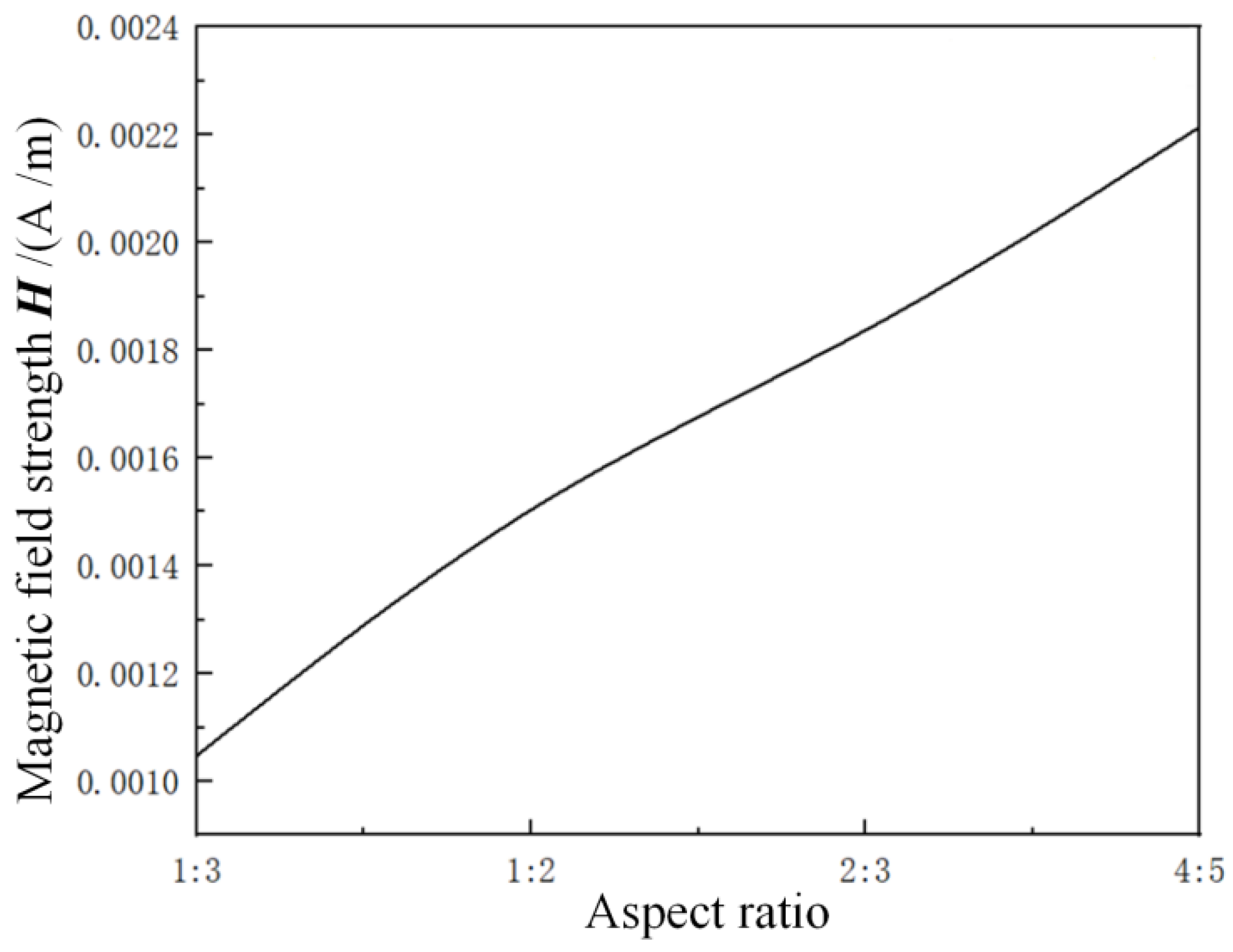
Figure 19 shows the magnetic flux density curves of the magnetic flux leakage field for defects with different K values where K is greater than 1. It can be seen from the figure that as the crack depth and width, and thus the K value, increase, the magnetic flux density of the defect’s leakage field also increases correspondingly. Figure 20 shows the relationship between the defect aspect ratio and the magnetic field strength amplitude for cases where K is less than 1 and increasing. It clearly shows an increasing trend, which is consistent with the conclusion drawn from the magnetic flux density curves.
When K is greater than 1 and decreasing, the chosen values are shown in Table 4.
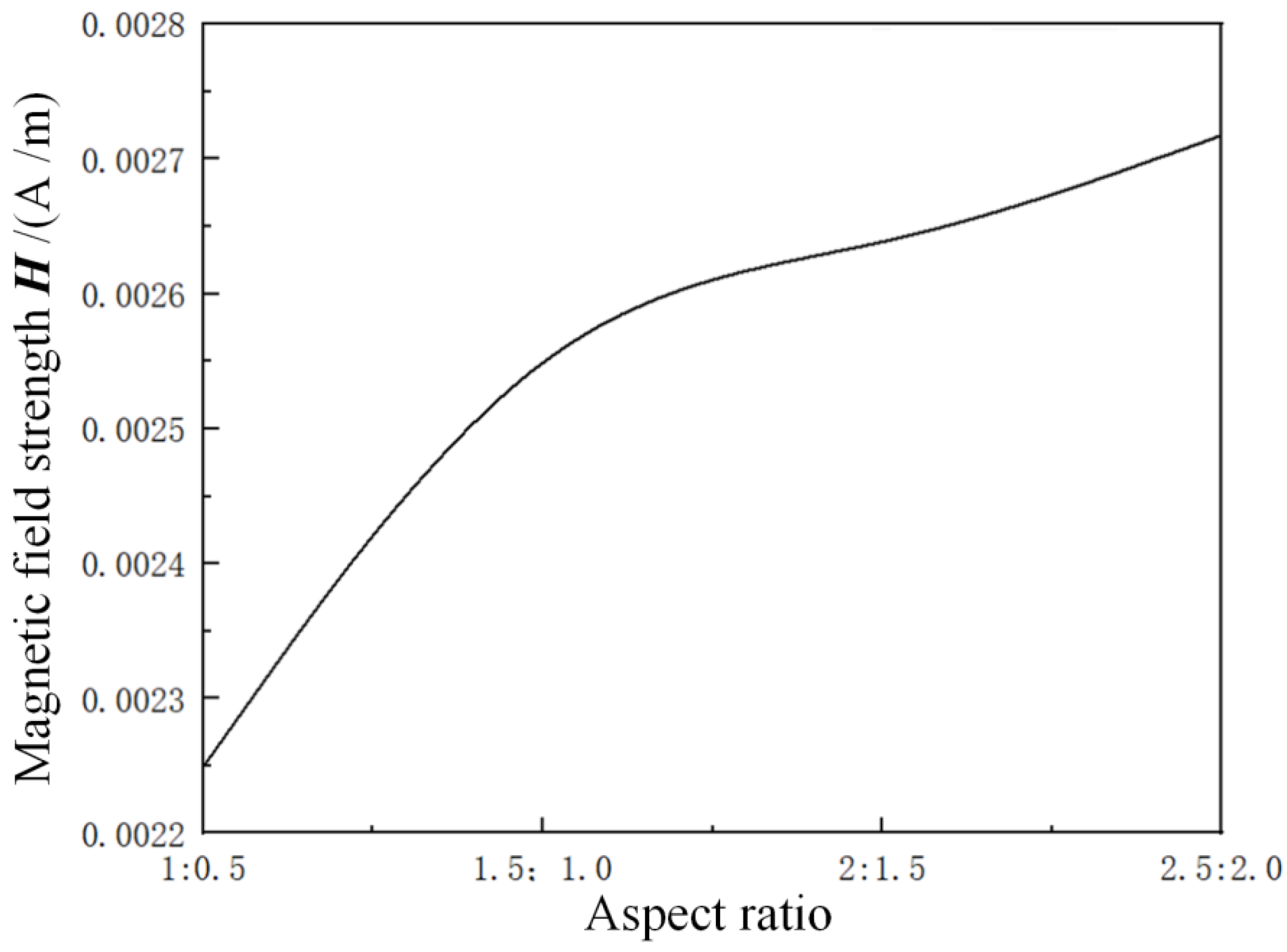
Figure 21 shows the magnetic flux density curves for K greater than 1. From the figure, it can be seen that as K decreases, the magnetic flux density of the defect leakage field increases accordingly. According to the relationship curve between the defect aspect ratio and the peak value of the MFL magnetic field strength H, shown in Figure 22, it can be observed that this curve is a straight line. That is to say, as the defect depth and width increase, the amplitude of the MFL also increases. However, at the same time, the aspect ratio K of the defect gradually decreases as the defect size increases. Therefore, the amplitude of the MFL increases as the aspect ratio K decreases. In other words, there is a decreasing relationship between the amplitude of the MFL magnetic field strength H and the defect aspect ratio K.

4. Results and Discussion

4.1. Experimental Results

As described in Section 3, a finite element model for the alternating magnetic field was used to simulate the MFL distribution for welding defects of various sizes and locations. To validate the MFL distribution patterns for different types of welding defects, this section presents MOI non-destructive testing experiments on four cases: lack of fusion, a surface crack, a subsurface crack, and a defect-free area, in order to analyze their imaging characteristics under alternating magnetic field excitation. The validity of the finite element model is verified through MOI experiments on welding defects of different sizes and locations. By combining the defect’s MFL signal with the grayscale distribution of the magneto-optical images, the characteristics of MOI images for welding defects of various types and widths are studied, laying a foundation for improving the accuracy of welding defect classification.
The welding defect specimens adopted in this study were artificially fabricated Q235 steel plates. A manual Tungsten Inert Gas (TIG) welding machine (manufacturer: Shenzhen Jasic Technology Co., Ltd., Shenzhen, China) was utilized to conduct the butt welding process, enabling the controllable fabrication of three typical categories of welding defects, namely lack of fusion, surface cracks, and deep cracks. The geometric dimensions of the specimen steel plates were 150 mm × 50 mm × 2 mm (length × width × thickness). The welding process parameters were configured as follows: a welding current of 50 A, a shielding gas flow rate of 11 L/min, and all other process parameters were maintained at the factory default values of the equipment. To ensure the reproducibility of the experiment, five standard parallel samples were prepared for each of the aforementioned defect types. In the subsequent magneto-optical imaging detection experiment, the operating voltage of the alternating magnetic field excitation module was uniformly set to 120 V. Table 5 presents the magneto-optical imaging detection results of various welding defects under alternating magnetic field excitation, specifically including three consecutive dynamic magneto-optical images and the physical photos of the corresponding defect specimens [41].
From Table 5, the information of different welding defects can be clearly observed, showing the specific location of the defects. In the MOI of the welding defect, the imaging effect excited by the North pole of the magnetic field appears as a red region, while the effect from the South pole is a blue region. Therefore, the MOI can clearly reflect the MFL distribution of the welding defect [7]. The grayscale values in the MOI can be correlated with the corresponding MFL strength, and based on the grayscale distribution, the position of the welding defect in the image can be obtained. It can be seen from the table that the grayscale value distribution for the lack of fusion is the most widespread, indicating that its MFL strength is the greatest. The grayscale distribution for the defect-free image is relatively uniform and consistent, signifying that its MFL strength is the weakest. The three-dimensional grayscale distribution range for the surface crack image is more extensive than that of the subsurface crack, which implies that the MFL strength of the surface crack is greater than that of the subsurface crack.
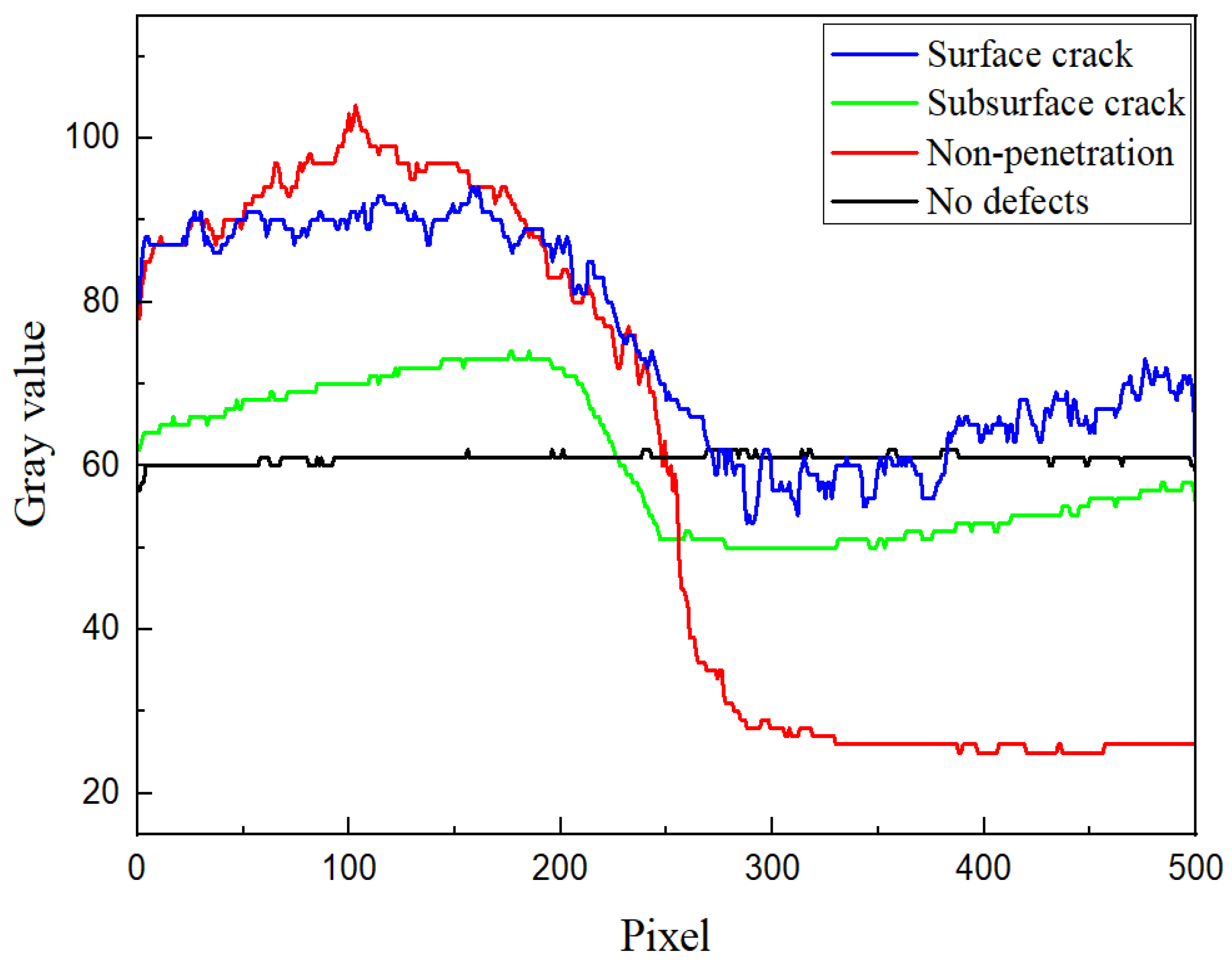
In the practical process of magneto-optical imaging for welding defects, background light and system noise are present. To mitigate the influence of this noise on the magneto-optical images, this study employs the median filtering method for image preprocessing. The grayscale values were extracted from the magneto-optical images of the different welding defects in Table 5, and the results are plotted in Figure 23. The inflection points in the grayscale plot indicate the leakage of magnetic flux lines at the defect boundaries. As seen in Figure 23, the grayscale values for the lack of fusion region are distributed within the range of 25 to 104, while the ranges for the surface crack and subsurface crack are 53 to 94 and 50 to 74, respectively.

4.2. Discussion

Based on the Faraday magneto-optical effect and Malus’ law, the following conclusion can be drawn: the higher the intensity of the MFL field induced by a defect, the larger the rotation angle of linearly polarized light passing through the magneto-optical medium, and the more significant the resulting change in light intensity. This relationship is ultimately manifested as a wider grayscale distribution range in the magneto-optical image. The results of MOI for welding defects under an alternating magnetic field reveal the corresponding relationship between the grayscale characteristics of magneto-optical images and MFL field intensity, as illustrated in Figure 23. Specifically, the incomplete fusion defect exhibits a grayscale value distribution of 25–104, corresponding to the strongest MFL field. The grayscale range of surface cracks (53–94) is wider than that of subsurface cracks (50–74), which reflects the lower MFL field intensity induced by surface defects. In contrast, the defect-free area shows a uniform grayscale distribution, corresponding to the minimum MFL field intensity. These results indicate that defects of different sizes generate distinct MFL field intensities, which is consistent with the simulation outcomes. Furthermore, the grayscale distribution characteristics of the magneto-optical images are highly consistent with the analytical results derived from the magnetic dipole model and finite element simulations. This not only verifies the feasibility of using the three-dimensional finite element model to simulate the MFL field distribution of different types of welding defects under an alternating magnetic field but also realizes the mutual confirmation of simulation data and experimental images. Consequently, this study provides crucial support for the visualization and precise quantification of non-destructive testing.

5. Conclusions

This study systematically investigates the formation mechanism and distribution law of MFL around welding defects under alternating magnetic fields through finite element simulation and MOI technology. The research results indicate that the geometric characteristics of defects (depth and width) and the sensor lift-off value exert a significant influence on the MFL: with a fixed width, an increase in defect depth enhances the MFL flux; conversely, with a fixed depth, an increase in defect width reduces the MFL flux. An excessively large lift-off value impairs signal sensitivity, and thus optimizing the sensor spacing is necessary to improve detection accuracy.
Subsequently, non-destructive testing experiments based on MOI were conducted to explore the MOI rules of weld defects with different sizes and types under alternating magnetic fields, including lack of fusion, surface cracks, and subsurface cracks. The MO images of weld defects can reflect the magnitude of MFL intensity through varying brightness, and the gray-scale values of MO images are matched with the corresponding magnetic field intensity. Therefore, the column pixel gray-scale features and texture features of MO images can characterize the MFL characteristics of defects. The MOI experiments verified the reliability of the theoretical model, and the gray-scale features of defects with different geometric shapes are highly consistent with the MFL distribution law, providing theoretical support for the visual identification of defects. In addition, parameter analysis revealed the influence of the defect depth-width ratio on the MFL signal intensity, offering a reference basis for the quantitative evaluation of defect sizes in engineering applications.
Despite the certain research achievements obtained in this study, several limitations and constraints need to be clarified. Firstly, the excitation mode adopted in the current experiments is only a single alternating magnetic field mode. The magnetic field excitation mode is a key factor affecting the MFL distribution of weld defects, and different excitation modes (such as static magnetic fields, rotating magnetic fields, or composite magnetic fields) may generate significantly different MFL characteristics for the same defect. The single alternating magnetic field excitation cannot fully simulate the complex magnetic field environment in actual industrial non-destructive testing scenarios, which may limit the applicability and generalization ability of the research results. Secondly, the types of weld defects involved in this study are not sufficient. The experiments mainly focused on common defects such as surface cracks and lack of fusion, while other typical weld defects in industrial production were not included in the simulation and experimental analysis. Due to the unique geometric structures and physical properties of these unstudied defects, the differences in their induced MFL distribution and MOI characteristics remain unclear, which to a certain extent restricts the comprehensiveness of the proposed detection method in practical engineering applications. Furthermore, the finite element model established in this study assumes ideal conditions such as uniform material properties of welded components and regular defect shapes. However, in actual working conditions, welded components may have material inhomogeneities, and defects often present irregular morphologies, which may lead to certain deviations between simulation results and actual detection data.
Based on the above limitations, future research in this field can focus on the following potential open issues and directions. Firstly, expand the research on multi-mode magnetic field excitation mechanisms. In the future, various excitation combination modes such as alternating-static composite magnetic fields and rotating-alternating composite magnetic fields can be introduced to systematically explore the MFL distribution laws of weld defects under different excitation combinations, analyze the synergistic or inhibitory effects of different magnetic fields on defect detection sensitivity, and further develop excitation strategies more suitable for complex industrial scenarios. Secondly, enrich the types and morphologies of studied defects. It is necessary to construct finite element models and prepare experimental samples for weld defects with different morphologies, sizes, and spatial distributions such as porosity, inclusions, and composite defects, conduct in-depth research on their MFL characteristics and MOI rules, and establish a more comprehensive defect database to improve the universality of the detection method.

Author Contributions

Data curation, C.X., H.G. and Y.Z.; Funding acquisition, C.X., Y.Z. and Y.L. (Yanfeng Li); Methodology, Z.W., Y.L. (Yongbiao Luo) and J.W.; Project administration, M.R.H., T.M. and Y.L. (Yanfeng Li); Writing—original draft, C.X., H.G., Y.Z., Y.L. (Yanfeng Li) and Z.W.; Writing—review and editing, J.W., M.R.H. and T.M.; Conceptualization, Y.Z., J.W. and Y.L. (Yongbiao Luo); Supervision, J.W., Y.L. (Yanfeng Li) and M.R.H. All authors have read and agreed to the published version of the manuscript.

Funding

This research was funded by the Guangdong Natural Science Foundation of China, grant number 2025A1515010910; Opening Project of Key Laboratory of Ministry of Education (Cultivation), Southwest University of Science and Technology, grant number 24kfsk04; Science and Technology Program of Guangzhou, grant number 202201011405; Special Talents for Scientific Research Projects of Guangdong Polytechnic Normal University, grant number 2021SDKYA018, 991641218. Natural Science Fund of Southwest University of Science and Technology: 23zx7130; Major Project of Sichuan Provincial Natural Science Foundation: 2025ZNSFSC0005.

Data Availability Statement

The original contributions presented in the study are included in the article, further inquiries can be directed to the corresponding authors.

Conflicts of Interest

The authors declare no conflict of interest.

References

  1. Yang, S.T.; Yang, Q.H.; Zhang, D.; Zhang, Y.J.; Yu, J.Y.; Li, H.; Wang, F.; Zhang, H.W. Magneto-optical imaging technology and application of garnet thin films in non-destructive testing. J. Magn. Mater. Devices 2024, 55, 90–101. [Google Scholar]
  2. Ji, Y.K.; Wang, C.Y.; Liu, Q.W.; Zhang, Y.X.; Gao, X.D. Three-dimensional contour reconstruction of welding defects using magneto-optical imaging. Opt. Precis. Eng. 2022, 30, 108–116. [Google Scholar] [CrossRef]
  3. Rautiainen, M.; Remes, H.; Niemela, A.; Romanoff, J. Fatigue strength assessment of complex welded structures with severe force concentrations along a weld seam. Int. J. Fatigue 2023, 167, 107321. [Google Scholar] [CrossRef]
  4. Pape, F.; Coors, T.; Matthias, T.; Poll, G.; Behrens, B.A. Ultrasonic Evaluation of Tailored Forming Components. In Bearing Steel Technologies: 12th Volume, Progress in Bearing Steel Metallurgical Testing and Quality Assurance; ASTM International: West Conshohocken, PA, USA, 2020. [Google Scholar]
  5. Yuan, X.; Wang, H.; Li, W.; Yin, X.; Zhao, J.; Zhao, J.; Ding, J.; Li, X.; Wang, W.; Hu, D.; et al. Uniform alternating current field monitoring sensor array for imaging and quantitation of cracks in aluminum alloy structures. IEEE Sens. J. 2024, 24, 679–688. [Google Scholar] [CrossRef]
  6. Nijssen, T.M.J.; Dijk, M.A.H.; Kuipers, H.A.M.; van der Stel, J.; Adema, A.T.; Buist, K.A. Experiments on floating bed rotating drums using magnetic particle tracking. AIChE J. 2022, 68, e17627. [Google Scholar] [CrossRef]
  7. Li, Y.; Gao, X.; Zhang, Y.; You, D.; Zhang, N.; Wang, C.; Wang, C. Detection model of invisible weld defects by magneto-optical imaging at rotating magnetic field directions. Opt. Laser Technol. 2020, 121, 105772. [Google Scholar] [CrossRef]
  8. Deng, Y.; Liu, X.; Udpa, L. Magneto-optic imaging for aircraft skins inspection: A probability of detection study of simulated and experimental image data. IEEE Trans. Reliab. 2012, 61, 901–908. [Google Scholar] [CrossRef]
  9. Jesenska, E.; Yoshida, T.; Shinozaki, K. Optical and magneto-optical properties of Bi substituted yttrium iron garnets prepared by metal organic decomposition. Opt. Mater. Express 2016, 6, 1986–1997. [Google Scholar] [CrossRef]
  10. Tian, M.; Gao, X.D.; Xie, Y.X.; Zhang, Y. Study on Noise feature analysis and processing algorithm of magneto-optical image of welding defects. Laser Technol. 2023, 47, 646–652. [Google Scholar]
  11. Gao, X.; Du, L.; Ma, N.; Zhou, X.; Wang, C.; Gao, P.P. Magneto-optical imaging characteristics of weld defects under alternating and rotating magnetic field excitation. Opt. Laser Technol. 2019, 112, 188–197. [Google Scholar] [CrossRef]
  12. Gao, X.; Mo, L.; Xiao, Z.; Chen, X.; Katayama, S. Seam tracking based on Kalman filtering of micro-gap weld using magneto-optical image. Int. J. Adv. Manuf. Technol. 2016, 83, 21–32. [Google Scholar]
  13. Dharmawan, I.D.M.O.; Lee, J.; Sim, S. Defect shape classification using transfer learning in deep convolutional neural network on magneto-optical nondestructive inspection. Appl. Sci. 2022, 12, 7613. [Google Scholar] [CrossRef]
  14. Cheng, Y.H.; Liu, X.M.; Tian, G.Y.; Bai, L. Visual detection of subsurface defects using enhanced magneto-optic imaging system. In Proceedings of the Eighth International Symposium on Precision Engineering Measurement and Instrumentation, Chengdu, China, 8–11 August 2012; pp. 385–390. [Google Scholar]
  15. Cheng, Y.; Liu, X.; Deng, Y. An innovative exciting coil design for magneto-optic imaging in nondestructive evaluation. In Proceedings of the 2013 IEEE International Instrumentation and Measurement Technology Conference (I2MTC), Minneapolis, MN, USA, 6–9 May 2013; pp. 1795–1800. [Google Scholar]
  16. Cheng, Y.; Tian, L.; Yin, C.; Huang, X.; Cao, J.; Bai, L. Research on crack detection applications of improved PCNN algorithm in moi nondestructive test method. Neurocomputing 2018, 277, 249–259. [Google Scholar] [CrossRef]
  17. Li, S.; Zhang, J.; Liu, G.; Chen, N.; Tian, L.; Bai, L.; Chen, C. Image Registration for Visualizing Magnetic Flux Leakage Testing under Different Orientations of Magnetization. Entropy 2023, 25, 167. [Google Scholar] [CrossRef]
  18. Li, Y.; Gao, X.; Chen, Y.; Zhou, X.; Zhang, Y.; You, D. Modeling for tracking micro gap weld based on magneto-optical sensing and Kalman filtering. IEEE Sens. J. 2020, 21, 11598–11614. [Google Scholar] [CrossRef]
  19. Gatzen, H.H.; Wu, K.H.; Traisigkhachol, O. Development of a recording head for magnetic storage of information on machine components. ECS Trans. 2007, 3, 191. [Google Scholar] [CrossRef]
  20. van Dendriessche, S.; Valev, V.K.; Verbiest, T. Faraday rotation and its dispersion in the visible region for saturated organic liquids. Phys. Chem. Chem. Phys. 2012, 14, 1860–1864. [Google Scholar] [CrossRef] [PubMed]
  21. Chai, D. Study on Scanning Eddy Current Magneto-Optical Imaging Defect Detection System. Master’s Thesis, Henan University of Technology, Zhengzhou, China, 2025. [Google Scholar]
  22. Gao, F.; Li, X.Y.; Zhang, S.; Lu, C.H. Orthogonal excitation magneto-optical imaging restoration of damaged characters. Laser Optoelectron. Prog. 2023, 60, 301–308. [Google Scholar]
  23. Liu, Y.T. Magneto-optical imaging enhancement based on dynamic universe algorithm. Laser Infrared 2022, 52, 368–374. [Google Scholar]
  24. Dai, X.X.; Gao, X.D.; Zheng, Q.Q.; Ji, Y.K. Fuzzy clustering identification of weld defects using magneto-optical imaging. Trans. China Weld. Inst. 2021, 42, 54–57+101. [Google Scholar]
  25. Li, Y.F.; Ji, Y.K.; Gao, X.D.; Zhang, Y.; Sun, Y.; Xiao, X.; Pan, C. Analysis of magneto-optical imaging characteristics of weld defects under alternating magnetic fields. China Mech. Eng. 2021, 32, 1547–1554. [Google Scholar]
  26. He, X.; Li, L.Y.; Wang, T.Q. Surface defects detection and classification of low-carbon steel WAAM formed parts based on magneto-optical imaging. Chin. J. Sci. Instrum. 2020, 41, 255–262. [Google Scholar]
  27. Wang, C.C. Microstructure and Defect Detection of Welds Using Magneto-Optical Imaging. Master’s Thesis, Guangdong University of Technology, Guangzhou, China, 2020. [Google Scholar]
  28. Lu, Y.; Wang, D.; Cao, L.; Ma, L.; Zeng, H. Comparative Analysis of Mechanical Properties and Microstructure of 7B52 Aluminum Alloy Laser-MIG Hybrid Welding and MIG Welding Joints. Metals 2024, 14, 1110. [Google Scholar] [CrossRef]
  29. Li, Y. Magneto-Optical Imaging Feature Analysis and Identification of Welding Defects Under Alternating/Rotating Magnetic Fields. Ph.D. Thesis, Guangdong University of Technology, Guangzhou, China, 2019. [Google Scholar]
  30. Shin, S.; Jin, C.; Yu, J.; Rhee, S. Real-Time Detection of Weld Defects for Automated Welding Process Base on Deep Neural Network. Metals 2020, 10, 389. [Google Scholar] [CrossRef]
  31. Zhang, S.; Ducharne, B.; Uchimoto, T.; Kita, A.; Deffo, Y.T. Simulation tool for eddy current magnetic signature (EC-MS) non-destructive method. J. Magn. Magn. Mater. 2020, 513, 167221. [Google Scholar] [CrossRef]
  32. Qiu, F.S. Stress Characterization Based on Magnetic Domain Dynamic Behavior. Ph.D. Thesis, University of Electronic Science and Technology of China, Chengdu, China, 2019. [Google Scholar]
  33. Arslan, M.; Tosun, İ. Fracture load and microcrack comparison of crowns manufactured from tooth-shaped and traditional blocks. Microsc. Res. Tech. 2021, 84, 111–118. [Google Scholar] [CrossRef]
  34. Zhang, J. Magneto-Optical Imaging Defect Detection Based on Low-Frequency Orthogonal Excitation. Ph.D. Thesis, University of Electronic Science and Technology of China, Chengdu, China, 2019. [Google Scholar]
  35. Rao, B.S. Dynamic histogram equalization for contrast enhancement for digital images. Appl. Soft Comput. 2020, 89, 106114. [Google Scholar] [CrossRef]
  36. Zheng, Q.Q.; Gao, X.D.; Dai, X.X. Dynamic magneto-optical imaging detection and classification of welding defects. Appl. Laser 2018, 38, 656–661. [Google Scholar]
  37. Long, Y.; Huang, S.L.; Peng, L.S.; Wang, S.; Zhao, W. Characteristic approximation approach for defect opening profile recognition in magnetic flux leakage detection. IEEE Trans. Instrum. Meas. 2021, 70, 6003912. [Google Scholar] [CrossRef]
  38. Greebmalai, J.; Sadasue, S.; Marumoto, K.; Warinsiriruk, E.; Yamamoto, M. Weld Formation and Characteristics of Hot-Wire Laser Welding in Aluminum Alloy Narrow-Gap Joints. Metals 2025, 15, 809. [Google Scholar] [CrossRef]
  39. Xiang, Q.; Wu, G.; Liu, Z.; Zeng, X. Improved of YOLOv8-n Algorithm for Steel Surface Defect Detection. Metals 2025, 15, 843. [Google Scholar] [CrossRef]
  40. Tian, L.L.; Cheng, Y.H.; Yin, C.; Ding, D.; Song, Y.; Bai, L. Design of MOI method based on artificial neural network for crack detection. Neurocomputing 2017, 226, 80–89. [Google Scholar] [CrossRef]
  41. Ling, M.O. Study on Magneto-Optical Imaging Recognition Model for Micro-Gap Welds. Ph.D. Thesis, Guangdong University of Technology, Guangzhou, China, 2016. [Google Scholar]
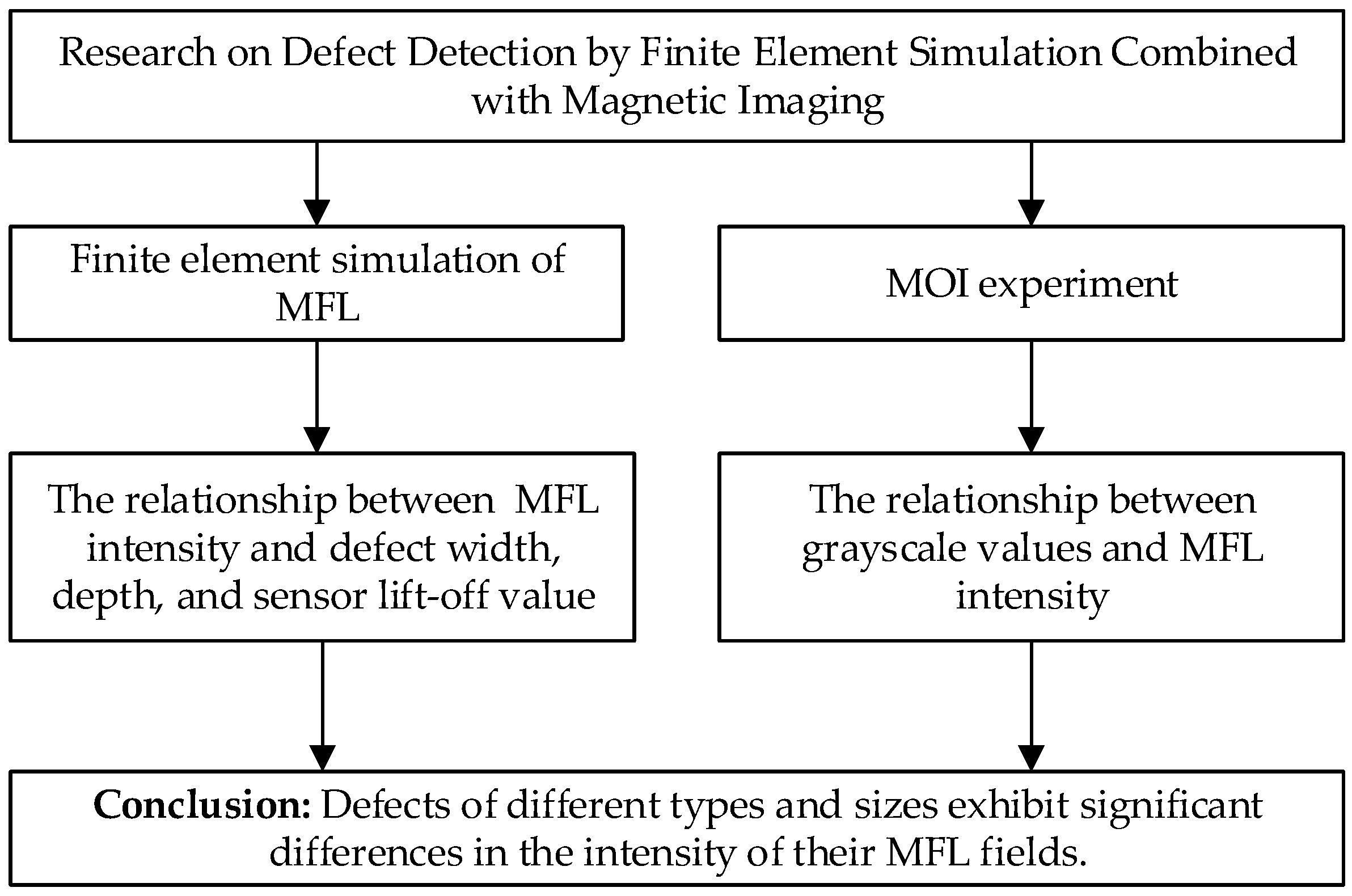
Figure 1. The technical roadmap of this study.
Metals 16 00095 g001
Figure 2. Variation curves of magnetic flux density B and magnetic permeability μ with respect to the external magnetic field strength H.
Metals 16 00095 g002
Figure 3. Schematic of modeling for a micro crack.
Metals 16 00095 g003
Figure 4. Distribution of the Magnetic Field Intensity H Above Welding Defects: (a) Hx Distribution (b) Hy Distribution.
Metals 16 00095 g004
Figure 5. Schematic diagram of Faraday rotation effect.
Metals 16 00095 g005
Figure 6. Working principle of the magneto-optical sensor.
Metals 16 00095 g006
Figure 7. Welding model (a) Finite element (b) Mesh division of the model.
Metals 16 00095 g007
Figure 8. B-H curve of Q235 steel.
Metals 16 00095 g008
Figure 9. Magnetic flux density curves for different lift-off values.
Metals 16 00095 g009
Figure 10. Relationship between lift-off value and magnetic field strength amplitude.
Metals 16 00095 g010
Figure 11. MFL magnetic flux density contour plots for defects of different depths (a) 0.5 mm (b) 1 mm (c) 1.5 mm (d) 2 mm (e) 2.5 mm.
Metals 16 00095 g011
Figure 12. Bx curves for defects of different depths.
Metals 16 00095 g012
Figure 13. Relationship between the amplitude of the Bx component and defect depth.
Metals 16 00095 g013
Figure 14. By curves for defects of different depths.
Metals 16 00095 g014
Figure 15. Relationship between the amplitude of the By component and defect depth.
Metals 16 00095 g015
Figure 16. MFL magnetic flux density contour plots for defects of different widths (a) 0.5 mm (b) 1 mm (c) 1.5 mm (d) 2 mm (e) 2.5 mm.
Metals 16 00095 g016
Figure 17. Relationship curve between defect width and MFL strength amplitude.
Metals 16 00095 g017
Figure 18. Relationship curve between defects of different widths and magnetic field strength amplitude.
Metals 16 00095 g018
Figure 19. Magnetic flux density curves for aspect ratios less than 1.
Metals 16 00095 g019
Figure 20. Relationship between aspect ratio K (K < 1) and magnetic flux density amplitude.
Metals 16 00095 g020
Figure 21. Magnetic flux density curves for aspect ratios greater than 1.
Metals 16 00095 g021
Figure 22. Relationship between aspect ratio K (K > 1) and magnetic field strength amplitude.
Metals 16 00095 g022
Figure 23. Grayscale values of the 250th column of pixels from magneto-optical images of different welding defects.
Metals 16 00095 g023
Table 1. Material Properties.
PropertyValue
Relative Permeability4000
Electrical Conductivity1.12 × 107 S/m
Relative Permittivity1
Coefficient of Thermal Expansion12.2 × 10−6
Constant Pressure Heat Capacity440 J/(kg∗K)
Density7870 kg/m3
Thermal Conductivity76.2 W/(m∗K)
Young’s Modulus200 × 109 Pa
Poisson’s Ratio0.29
Table 2. List of material parameters related to three-dimensional finite element model of welded defect.
Model NameMaterialRelative Permeability μResistivity/(Ω·m)
Magnetic CoreMn-Zn Ferrite5500 1.5 × 1 0 4
Excitation CoilCopper0.999991 1.68 × 1 0 3
Test SpecimenQ235B-H Curve 1.43 × 1 0 7
Table 3. Values for aspect ratio K (K < 1).
Depth/mm0.50.51.01.52
Width/mm1.51.01.52.02.5
Aspect Ratio K1:31:22:33:44:5
Table 4. Values for aspect ratio K (K > 1).
Depth/mm11.52.02.5
Width/mm0.51.01.52.0
Aspect Ratio K2:13:24:35:4
Table 5. Magneto-optical images of different welding defects under alternating magnetic field excitation.
Defect TypesPIWFrame 1Frame 2Frame 3
Surface crackMetals 16 00095 i001Metals 16 00095 i002Metals 16 00095 i003Metals 16 00095 i004
Subsurface crackMetals 16 00095 i005Metals 16 00095 i006Metals 16 00095 i007Metals 16 00095 i008
Non-
penetration
Metals 16 00095 i009Metals 16 00095 i010Metals 16 00095 i011Metals 16 00095 i012
No defectsMetals 16 00095 i013Metals 16 00095 i014Metals 16 00095 i015Metals 16 00095 i016
Disclaimer/Publisher’s Note: The statements, opinions and data contained in all publications are solely those of the individual author(s) and contributor(s) and not of MDPI and/or the editor(s). MDPI and/or the editor(s) disclaim responsibility for any injury to people or property resulting from any ideas, methods, instructions or products referred to in the content.