Article

The Correlation of Thermodynamic Modelling and Experimental Methods in the Production of Nickel Matte from Saprolite Nickel Ore via CaS

1
Industrial Science and Technology Research Center, Pukyong National University, Busan 48513, Republic of Korea
2
Darkhan School of Technology, Mongolian University of Science and Technology, Darkhan City 45051, Mongolia
3
Department of Metallurgical Engineering, School of Engineering, Pukyong National University, Busan 48513, Republic of Korea
*
Author to whom correspondence should be addressed.
Metals 2026, 16(1), 119; https://doi.org/10.3390/met16010119
Submission received: 5 December 2025 / Revised: 15 January 2026 / Accepted: 15 January 2026 / Published: 20 January 2026
(This article belongs to the Special Issue Pyrometallurgy and Waste Recycling: Experiment and Simulation)

Abstract

Given the importance of nickel in lithium-ion batteries and the expectation of the growth in electric vehicles and electrical devices, the demand for nickel in battery production is expected to increase dramatically. Nickel is primarily sourced from laterite saprolite ore, and there is now substantial interest in moving from ferronickel smelting technology to nickel matte technology in its processing to produce high-grade nickel. This research involved a thermodynamic modelling and lab–scale experiment on the smelting of nickel matte. Nickel concentrate from laterite saprolite was used, and CaS, produced from commercially available gypsum, was employed as a sulfurizing agent. The matte smelting experiment was conducted at 1500 °C to optimize CaS and C consumption. During smelting with CaS, matte particles form, although sufficient reduction of nickel and iron from the concentrate is not achieved. By consuming carbon, the reduction potential of iron is increased, and this process, along with enriching the matte with iron, aids in the transportation of nickel. At a nickel grade in the matte with a Ni/Fe ratio of approximately 1, the nickel recovery only reached 63%. Upon achieving a nickel recovery exceeding 93%, the Ni/Fe ratio reached 0.44, corresponding to a nickel grade reduction to 22.78%. By employing analytical techniques and thermodynamic modelling, we have successfully determined the sulfidizing of nickel, identified the ideal CaS and C additions, and characterized the structure and quality of the slag produced during nickel matte smelting, supplying vital technological data necessary for practical application.

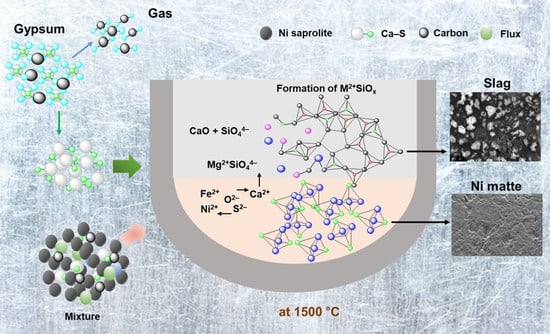
Graphical Abstract

1. Introduction

Near the surface of the earth, nickel laterite ore can be found, and it is enriched with nickel due to the leaching of elements during weathering in humid environments. Laterite ore, which accounts for approximately 70% of the world’s nickel resources [1,2,3], is commonly found in areas close to the equator, including nations such as Indonesia, the Philippines, and New Caledonia. The mineral composition of laterite ore is the basis for its division into limonitic and saprolite ore layers. The saprolite ore, comprising silicate rocks rich in magnesium, typically contains 1.5–3% nickel; therefore, it is often processed via pyrometallurgical techniques for ferronickel extraction [4,5]. Because of the high iron concentration in the ore, which ranges from 10 to 25% [6,7,8], ferronickel extraction is an important process, and the widely used method of smelting in an electric arc furnace with carbon reduction provides economic advantages. Ferronickel production makes up approximately 65% of the total nickel production worldwide, and by optimizing both the consumption of carbon and the composition of the slag, it becomes workable to produce ferronickel with a nickel recovery rate exceeding 95%, along with a composition ratio of 20% nickel to 80% iron, a fact that has been validated by many research investigations, such as those in studies [9,10,11]. The nickel is used in several applications, with 12% going to nickel superalloys, 8% to electroplating, and the balance to nickel batteries and chemical compounds [12,13,14].
Nickel, a crucial element found in various battery types including NiCd (nickel–cadmium), NiMH (nickel–metal hydride), and Li-ion batteries like NMC (nickel manganese cobalt) and NCA (nickel cobalt aluminum), is a key component; these batteries have acquired widespread use due to their advantageous characteristics such as high energy density, extended lifespan, and cost-effectiveness. Due to the rising demand for electrical devices and the growing EV market, forecasts indicate that the battery manufacturing sector will use 50% of total nickel consumption by 2030 [15,16]. As the nickel market has expanded, the focus is now on sulfidizing saprolite ore, subsequently smelting it to create nickel matte, and ultimately extracting high-grade nickel (nickel content in matte). Many research papers suggest that nickel sulfidizing can be achieved within a rotary kiln, and then the nickel matte smelting can be performed in an electric arc furnace, all without any modifications to the production line of ferronickel technology. As confirmed by Cao et al. [17], Muhammad et al. [18], and Li et al. [19], the sulfidizing of nickel and iron in saprolite ore is successfully achieved at temperatures ranging from 900 to 1000 °C when considering the partial pressure factors of PS and PSO2. However, during sulfidizing within a rotary kiln, the emission of sulfur gas along with furnace gas leads to a considerable environmental pollution issue, thus making up a disadvantage of this method. Consequently, combining saprolite ore with sulfurizing agents like pyrite, gypsum, CaS, and nickel sulfide concentrate, followed by smelting in an electric furnace to yield nickel matte, is regarded as a processing technique with minimal adverse environmental effects and economic advantages. Many studies have been conducted on smelting nickel matte with pyrite (FeS2). These studies have showed a potential for nickel recovery of up to 90–95% [20,21,22] because of the widespread availability of pyrite and the ease with which the Fe–Ni–S system is created. However, a nickel grade in the nickel matte of 15–20% has certain disadvantages, such as complicating the process through iron removal in further processing and increasing smelting costs. Using nickel sulfide concentrate in the smelting process offers a potential solution; however, reliance on this concentrate poses a limitation. Conversely, widely available gypsum, or CaS obtained via gypsum reduction, presents an affordable and selective sulfurizing agent, and additionally, the resulting CaO is considered beneficial, for instance, in improving the slag’s physical properties and promoting efficient matte–slag separation.
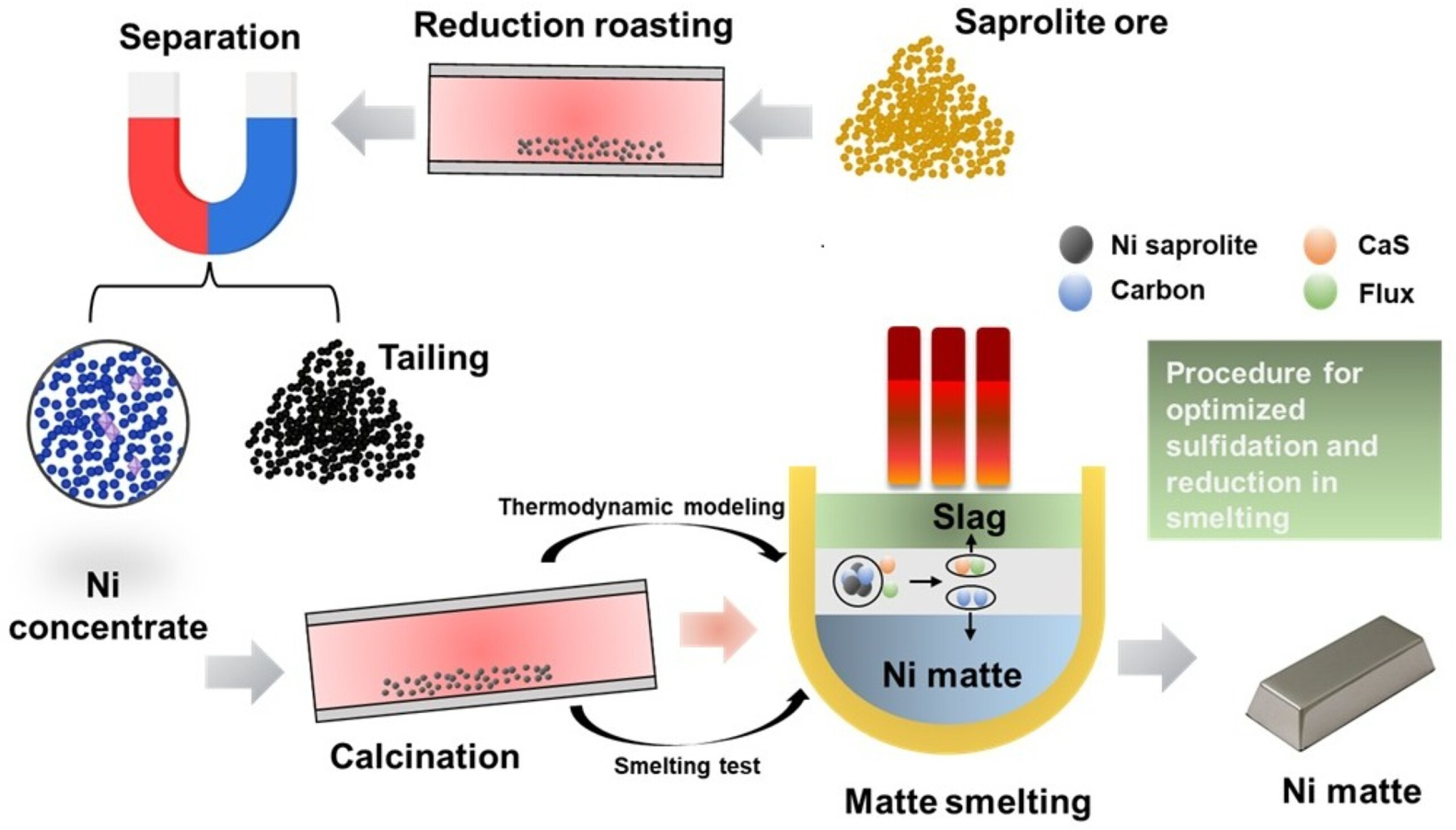
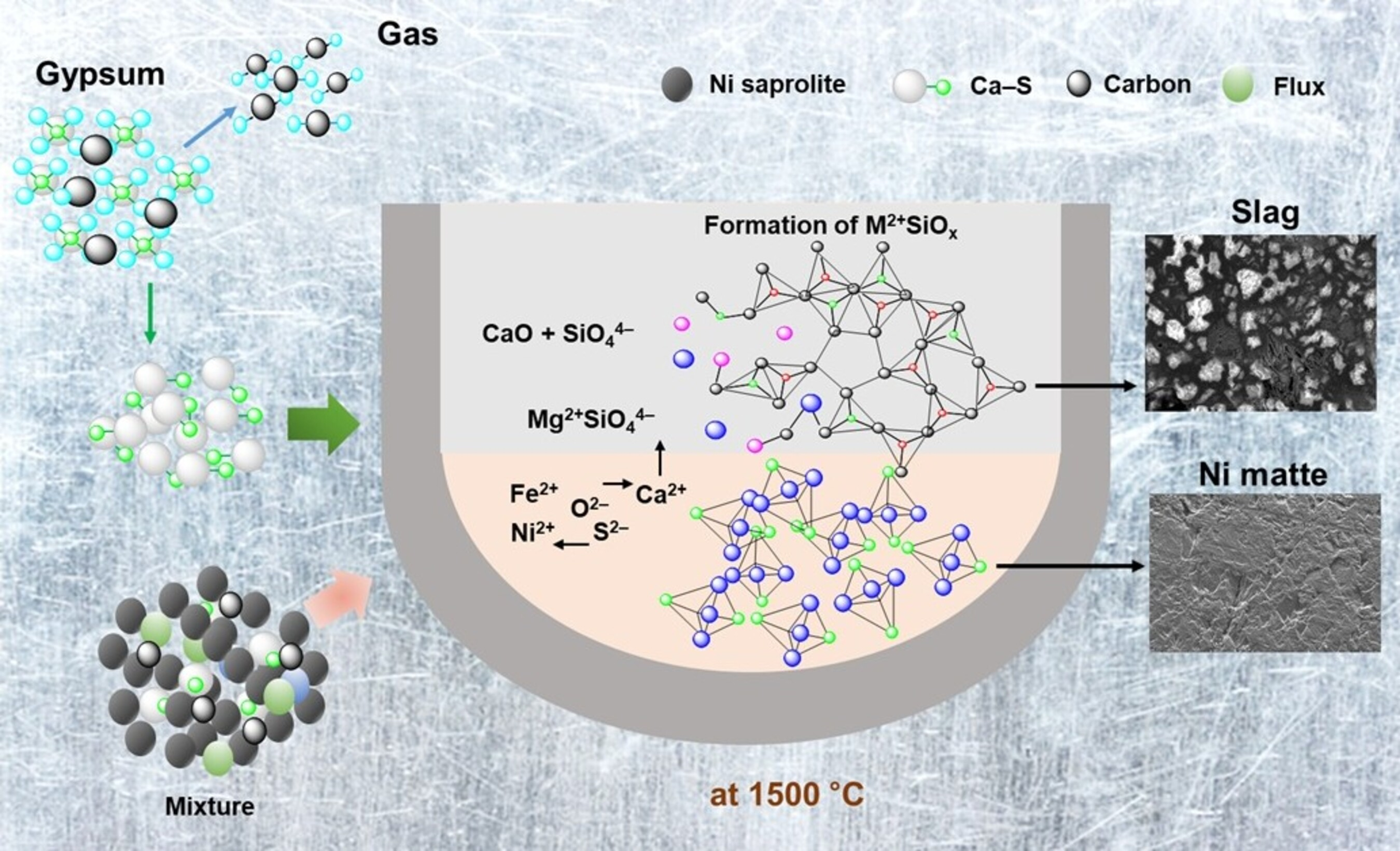
According to Wang et al. [23] and Zhang et al. [24], the utilization of gypsum during the nickel matte smelting procedure augments the consumption of carbon, thus encouraging the reduction in both iron and nickel, ultimately resulting in the production of ferronickel metal, which, in turn, decreases the efficacy of the sulfidizing process and produces a lower quality matte. Consequently, gypsum is initially reduced to CaS and subsequently used as a sulfidizer. The presence of CaO significantly affects the structure and characteristics of the slag within the FeO–SiO2–MgO system, leading to the formation of phases specific to the CaO–FeO–SiO2 system. This process diminishes the impact of the FeO-SiO2 system phase, consequently enhancing nickel recovery, as evidenced by multiple studies [25,26,27]. Scheme 1 shows the fundamental concept of directly applying the established technology of ferronickel smelting from laterite saprolite ore to nickel matte production. To optimize the smelting procedure, the saprolite ore is subjected to a reduction process, with magnetic separation used to increase the nickel, thus producing a concentrate. Subsequently, the concentrate undergoes pre-roasting within a rotary kiln furnace before its smelting into an electric arc furnace alongside carbon and sulfidizing additives to smelt nickel matte smelting. Focusing on this technological evolution, this study was designed to improve the smelting procedure in order to produce matte with a significant nickel content, achieved by regulating the appropriate amounts of CaS and carbon that are added. Using the FactSage 8.2 program, the thermodynamic and material balance calculations for nickel matte smelting were executed, and through a comparison of the theoretical simulation results with experimental findings, a reduction and simplification of various experimental variants was achieved. The theoretical and experimental equilibrium conditions were conducted under a steady-state temperature of 1500 °C.

2. Materials and Methods

2.1. Experimental Materials

The nickel concentrate from New Caledonia was used in this study. The concentrate was processed by reduction roasting and magnetic separation. Analysis was conducted to determine the chemical composition and mineralogical characteristics of the nickel concentrate. Table 1 shows the XRF (X-ray fluorescence spectrometer) analysis results, which determine the chemical composition of this concentrate. The concentrate is predominantly composed of silicon, iron, and magnesium oxides. The MgO/SiO2 (M/S) ratio, which is 0.48, is the critical parameter in determining the slag composition in the nickel smelting process. Elemental concentrations are determined in oxide form using XRF. XRF analysis cannot differentiate elemental oxidation states. The search results, however, are restricted to the most prevalent oxide form. Iron shows diverse oxidation states, including those observed in FeO, Fe3O4, and Fe2O3. It is imperative to underscore the Fe calculation’s dependence on the Fe2O3 state, as stipulated in reference [28]. The nickel content was detected using an Inductively Coupled Plasma Optical Emission Spectrometer (ICP-OES).
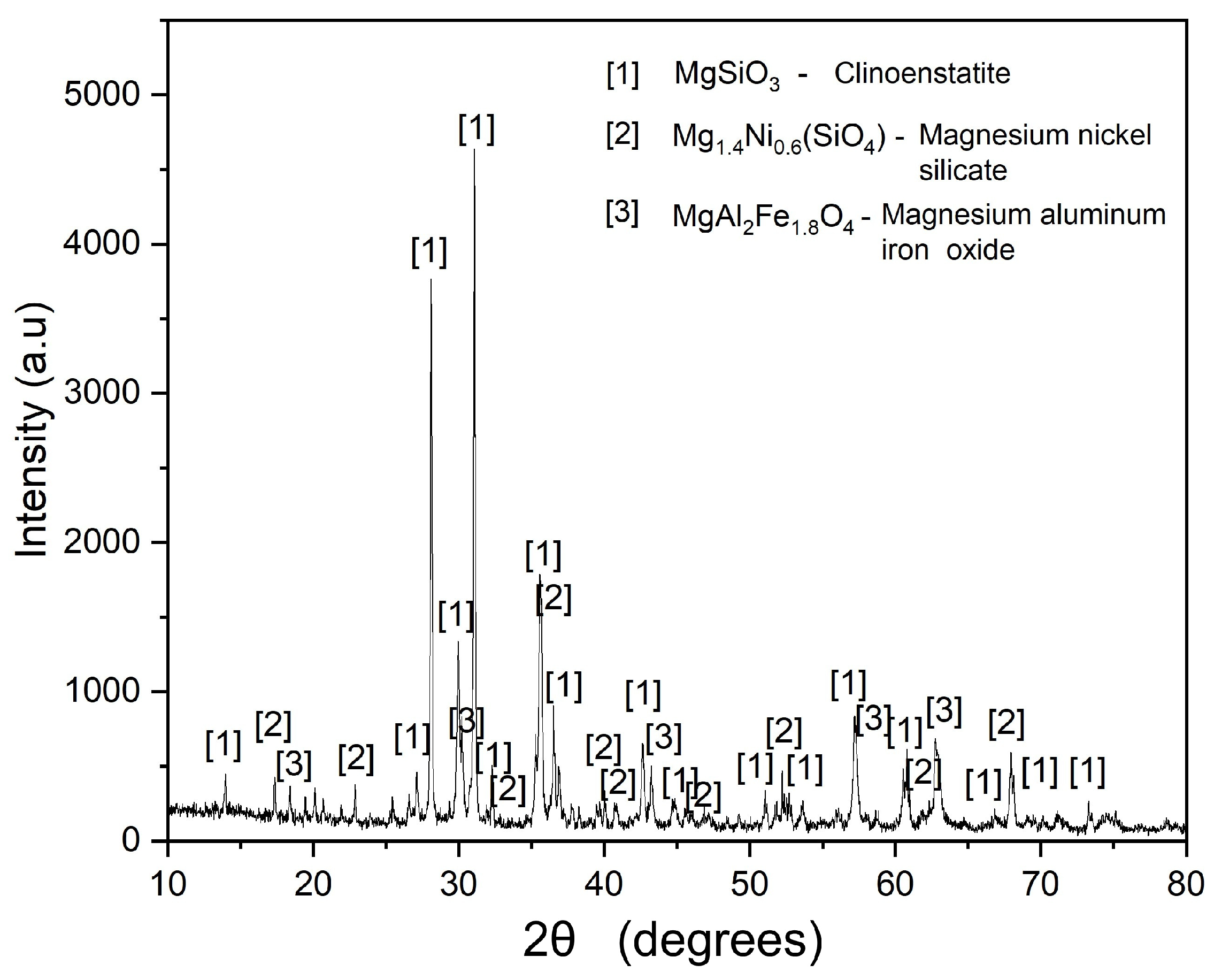
Figure 1 shows the XRD (X-Ray Diffractometer) pattern for the nickel concentrate. The nickel ore primarily consists of silicates that are composed of magnesium, silicon, iron, and aluminum elements following XRF analysis. The formation of these oxides occurs within the chemical frameworks of silicates as MgxSiOy and [MgAl]xSiOy. The primary minerals found in the nickel concentrate were found as clinoenstatite and magnesium silicate, according to PDF (Powder Diffraction File datdabase) number 00-035-0610. Furthermore, the magnesium nickel silicate, indicated by the PDF number 01-084-1986, was found to contain nickel, and the magnesium aluminum iron oxide, which has the PDF card number 01-071-1233, included a mixture of iron and aluminum.
In this experiment, calcium sulfide (CaS) was used as the sulfurizing agent. CaS was produced using carbon and 98% pure calcium sulfate anhydrous (CaSO4) powder from Daejung Chemical and Metals Co., Ltd., Incheon, Republic of Korea. The reducing agent used is pure activated carbon powder procured by Deajung Chemical Company in Korea. A mixture of 100 g of CaSO4 and 35.3 g of carbon powders was put in a chemical plastic bottle and mixed thoroughly by shaking for 10 min. Following this, the mixture was put in an alumina crucible and inserted into the furnace. Based on the research conducted by Dong et al. [29] and Jordan et al. [30], the experimental findings show that CaS can be created from CaSO4 through a carbon reduction process, which proves to be successful within a temperature range of 800–1100 °C. According to the findings of the research, the reduction roasting of CaSO4 was performed at a temperature of 1000 °C, and this process occurred in an atmosphere of Ar gas. Equation (1) shows the modelling of the roasting process used to produce CaS, and the Gibbs free energy was measured to be −275.71 kJ/mol.
CaSO 4   ( s ) + 2 C   ( s ) = CaS   ( s ) + 2 CO 2   ( g )       Δ G 1000 ° C ° = 275.71 kJ
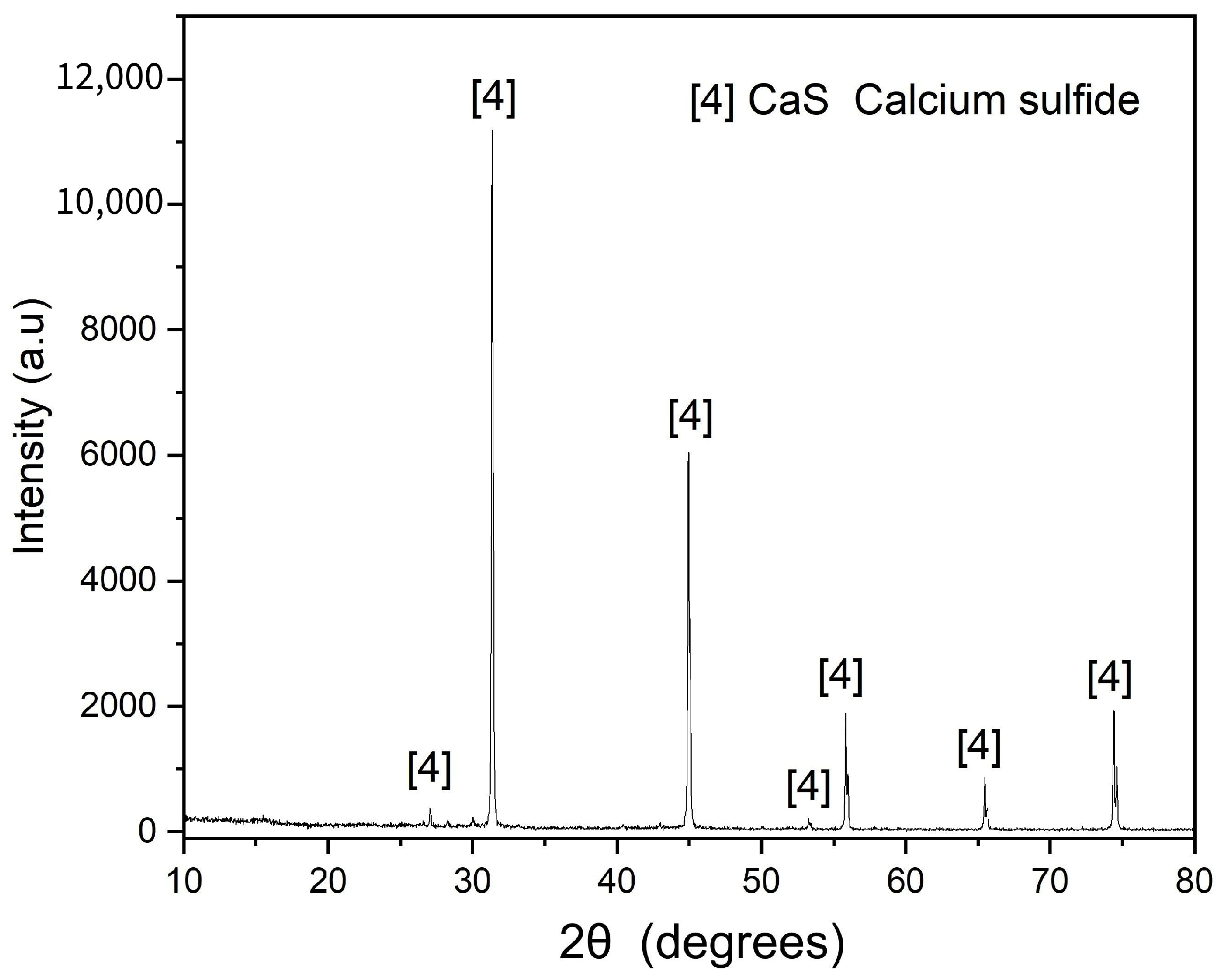
The mineral composition of the CaS powder, which was acquired via reduction roasting, was examined using XRD analysis, as shown in Figure 2. The XRD analysis yielded results that confirm the formation of pure CaS, with no impurities present, as evidenced by the PDF number 03-065-2926.

2.2. Experimental Apparatus

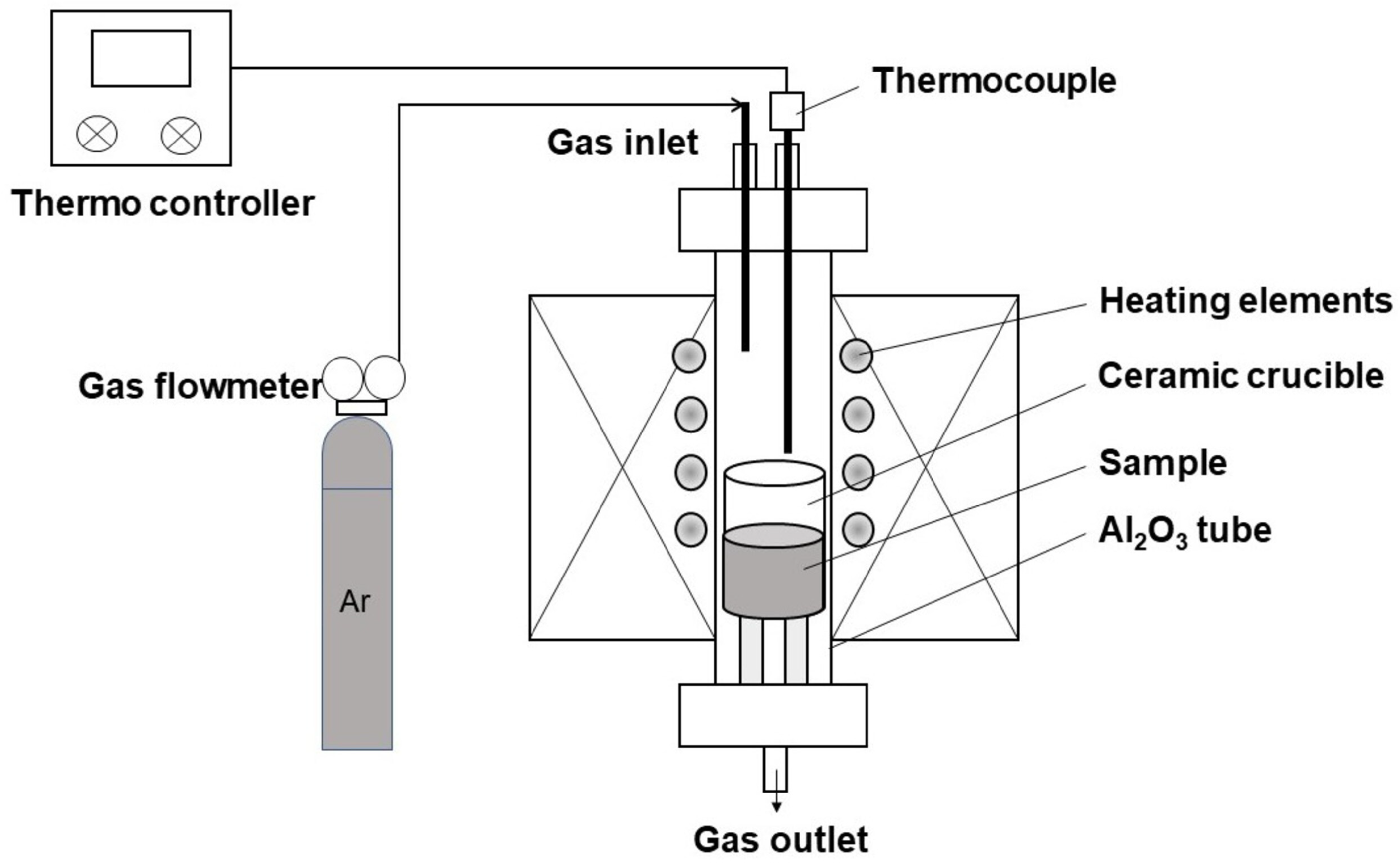
In the nickel matte smelting experiment, a vertical tube furnace was used, and the heated by molybdenum disilicide (MoSi) elements, as shown in Figure 3. The tube furnace has a heating box, a controller, and a B-type thermocouple. A 75 mm alumina tube, 900 mm long, formed the work area. The sample was in an Alumina (Al2O3) crucible at the workplace’s centre. Argon (Ar) gas was introduced into the furnace for the experiment. The thermocouple accurately monitored the furnace’s temperature. Ar gas flowed into the furnace from one side, regulated by a Gas Mass Flow Controller. The fluid flowed smoothly at 300 mL/min. The furnace was sealed and filled with Ar gas after sample insertion. The sample was heated at 5 °C/min to 1500 °C. The sample was cooled to room temperature at a rate of 5 °C per minute while remaining within the furnace before removal.

2.3. Experimental Condition

The nickel matte smelting conducted at temperatures exceeding the melting points of minerals containing nickel metal, its oxides, and silicates, which have high melting temperatures. Generally, matte smelting is performed at temperatures ranging from 1400 to 1600 °C, and the most efficient temperature for this process is believed to be 1500 °C, according to sources [21,23]. The cost of energy rises when smelting at temperatures above 1500 °C, and, concurrently, this accelerates the rate at which the furnace lining deteriorates. For this reason, our research involved both theoretical and experimental investigations conducted at a consistent temperature of 1500 °C. To determine the amounts of CaS and C needed for the experiment conducted under smelting equilibrium conditions, which aimed to produce a matte with a high nickel grade, a stoichiometric calculation was performed based on Equation (2), which illustrates the reducing–sulfidizing reaction of nickel oxide, and these were considered as the experimental factors for the nickel matte smelting.
3NiO (s) + C (s) + 2CaS (s) = Ni3S2 (s) + 2CaO (s) + CO (g)
The amounts of carbon and CaS used in the experiments were determined using stoichiometric calculation based on Equation (2), calculated per 100g of concentrate. Table 2 shows the experimental parameters for nickel matte smelting. The experiments are labelled M1–M11.

2.4. Analytical Methods

2.4.1. Equilibrium Modelling

In this study, the software Factsage 8.2 was used for thermodynamic modelling. FactSage can calculate the equilibrium conditions for multiple phases and components. In our study of nickel matte smelting, the Equilib module was used to calculate the concentrations of the various chemical species. Equilibrium calculations were conducted using data from FactPS, Factoxid, and FSstel. The smelting of nickel matte was simulated at a constant temperature of 1500 °C. As a variable, the simulation used the amount of CaS introduced as a sulfurizing agent in order to optimize its effect on the quantities of slag, matte, and gas that were formed during smelting. Following the saving of the output streams from the Equilib calculations, they were then used for further optimizing the impact of carbon addition in the cases that followed. The chemical makeup of the input material used in the computations was sourced from the nickel concentrate (shown in Table 1). The phase diagram module was used by us to analyze the behavioural composition of the slag. Employing the Phase Diagram module for the calculation of the plot enabled the capturing of intricate details, specifically those found within the context of ternary and multi–component phase diagrams. The axes were customized regarding temperature and composition.

2.4.2. Calculating Nickel Recovery Degree

Recovery degree was key to nickel extraction’s effectiveness in smelting. The Ni mass in the raw material before matte smelting was compared to the Ni mass in the Ni matte after the smelting process. Equation (3) is the representation of the degree of nickel recovery:
η = M i M 0 × 100 %
where η is the Metal recovery degree, %; M0 is the Ni mass in the nickel concentrate, g; and Mi is the Ni mass in Ni matte, g.

2.4.3. Chemical and Mineralogical Analysis

For the chemical element and mineralogical analyses, the samples were powdered to a size of approximately 45 μm and mixed thoroughly. The chemical composition of the nickel concentrate was determined using a Shimadzu XRF-1800 X-ray fluorescence spectrometer manufactured by the Shimadzu Co., Ltd., in Kyoto, Japan. The nickel content in the concentrate was detected precisely through an analysis using the Agilent 5800 ICP-OES model of the Inductively Coupled Plasma Optical Emission Spectrometer from Agilent Technologies Inc. in Santa Clara, CA, USA. The mineral composition of the samples was determined using an X-Ray Diffractometer (XRD), manufactured by Malvern Panalytical Ltd., Malvern, UK, X’Pert3–Powder model with a high-intensity 3 kW Cu-Kα X-ray tube. XRD data was collected from 10 to 80° in 10 min with a 0.02° step. Malvern Panalytical uses the HighScore software for XRD pattern identification of the phase, semi-quantitative phase analysis, pattern treatment, profile fitting, and similar applications. Using an EM-30AX produced by COXEM Co., Ltd., in Daejeon, Republic of Korea, a Scanning Electron Microscope and Energy Disperse X-ray Spectrometer (SEM-EDS) in this study facilitated a comprehensive examination of the nickel matte and slag, allowing us to study its morphology and the distribution of its elements. Analyses were performed at the Central Laboratory of Pukyong National University.

3. Results

3.1. Thermodynamic Analysis of Nickel Matte Smelting

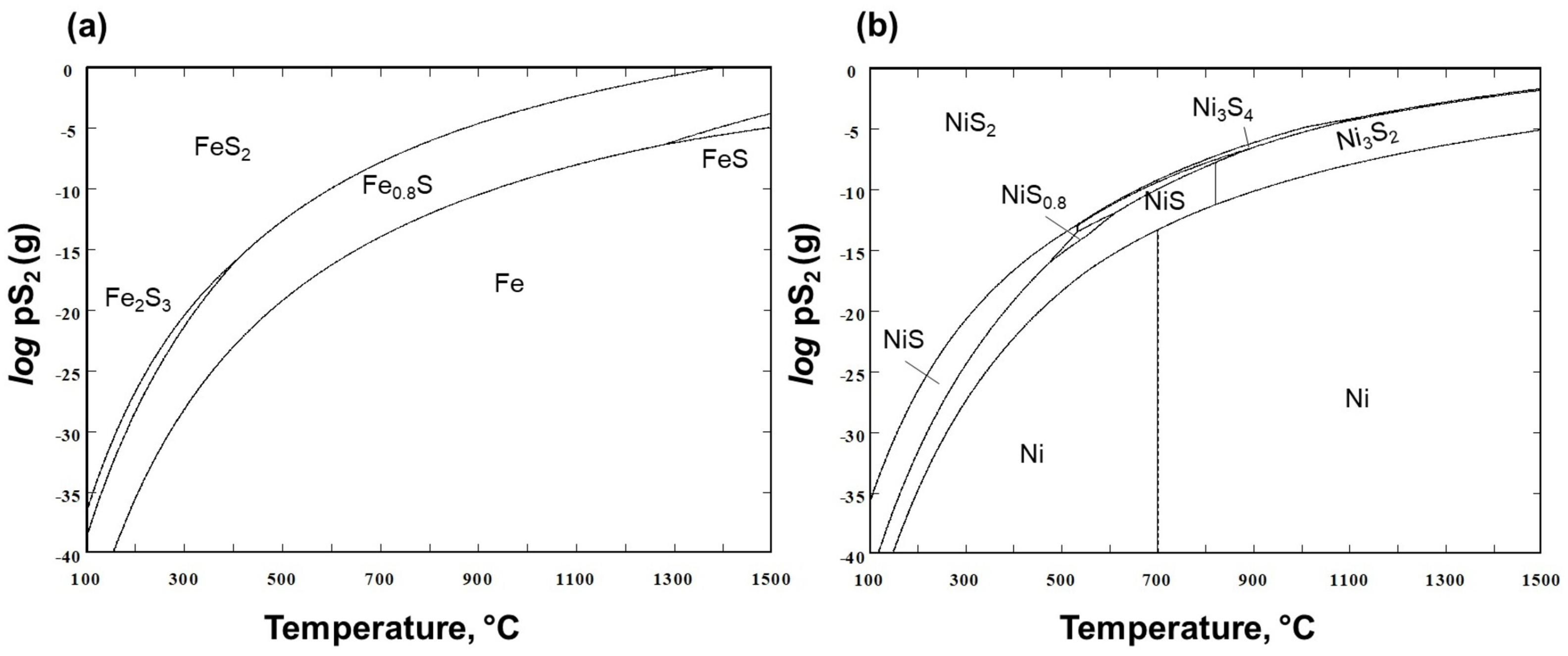
Phase stability diagrams were employed to examine the potential for iron and nickel to combine with sulfur during nickel matte smelting, concentrating on predominance areas and their relationship with temperature variations. In Figure 4, phase stability diagrams for the Fe–S and Ni–S systems are shown. Several phases of iron are possible, such as Fe2S3, FeS2, FexS, and FeS, as shown in Figure 4a. The FexS phase is most stable at 1500 °C. In contrast, nickel shows the capacity to occur within a range of transitional sulfide phases, a characteristic contingent on both temperature and the partial pressure of sulfur. At 1500 °C, nickel existed as NiS2 or Ni3S2, depending on sulfur’s partial pressure (Figure 4b).
The chemical reactions occurring during the nickel matte smelting process are typically represented and can be generally modelled using the equations that are listed as Equations (4)–(10). Assuming that the nickel and iron in the nickel concentrate are primarily in an oxidized state, their interaction with CaS might proceed as depicted in Equation (4), which could then result in the generation of SO2 gas as a reaction product. Using carbon leads to the enhancement of sulfidiznig in metals, and consequently, CO2 gas is generated in place of gases that contain sulfur, as shown in Equation (5). Equations (6) and (7) describe the reduction in metal oxides, along with the subsequent formation of carbon monoxide gas, which acts as a reducing agent. Equation (8) presents the sulfidizing reactions of nickel and iron. Through a chemical and mineralogical analysis of the nickel concentrate, it was determined that the metals were mainly found in silicate phases. The reaction described in Equation (9) shows that the use of CO gas at high temperatures allows for the reduction of nickel and iron from these silicates. As detailed in Equation (10), the formation of slag during smelting is partly attributed to the SiO2 produced from the breakdown of iron and nickel silicates, which then functions as a fundamental ingredient of the MgO–CaO–SiO2 slag structure.
MexOy (s) + 2CaS (s) = MeS (s) + 2CaO (s) + SO2 (g)
MexOy (s) + C (s) + CaS (s) = MexSy−1 (s) + CaO (s) + CO2 (g)
MexOy (s) + C (s) = Me (s) + CO2 (g)
CO2 (g) + C (s) = 2CO (g)
Me (s) + CaS (s) = MexSy−1 (s) + CaO (s)
Me2SiO4 (s) + 2CO (g) = 2Me (s) + SiO2 (s) + 2CO2 (g)
CaO (s) + MgO (s) + SiO2 (s) = CaMgSiO4 (s)
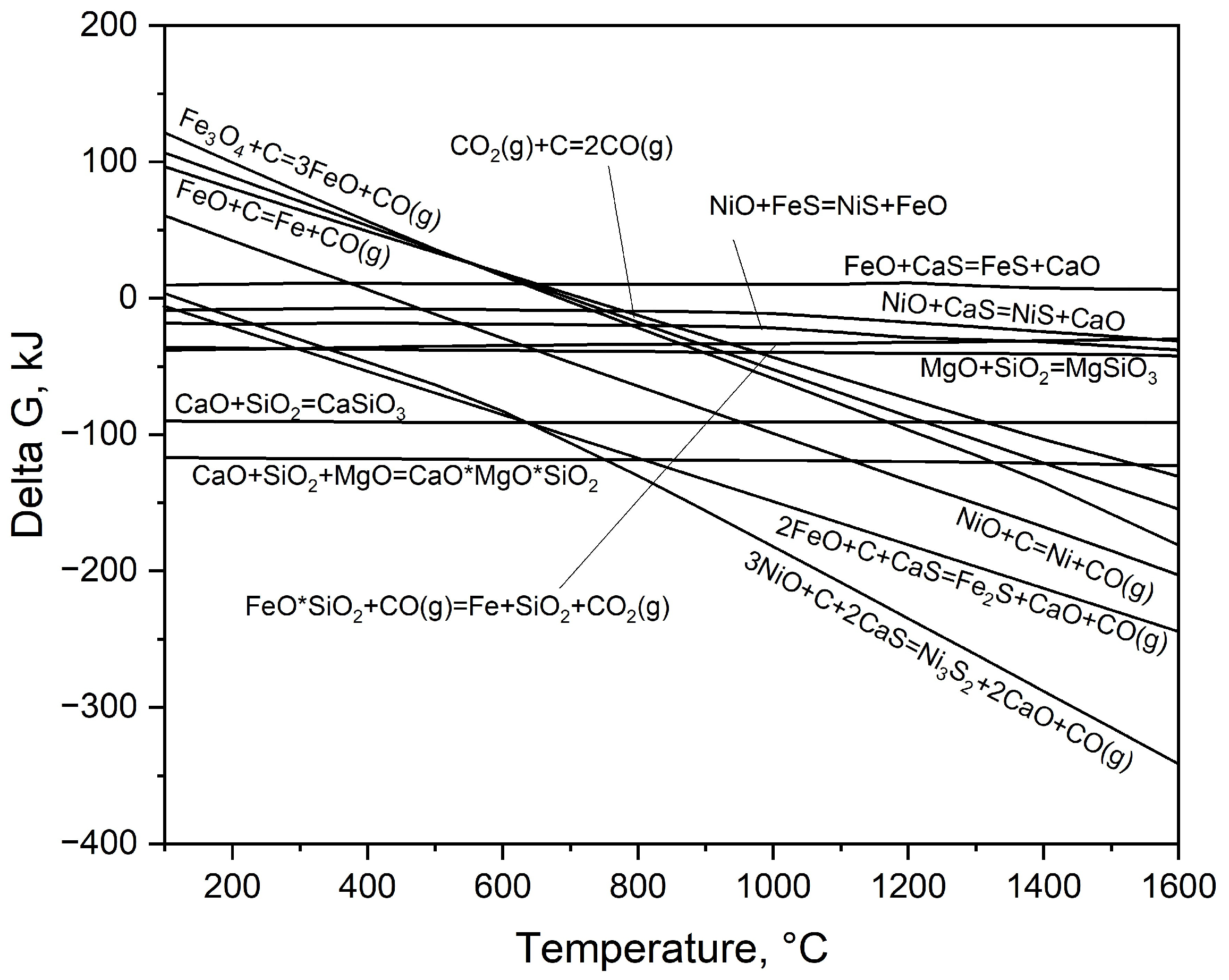
According to the findings shown in Figure 5, a thermodynamic analysis was conducted comparing Gibbs free energies to model potential reactions occurring during the smelting process with the aid of a spontaneity reaction. The sulfidation reactions of iron and nickel oxides as shown in Equation (4) appear unable to proceed directly by CaS. The reduction of nickel oxide occurs more easily than iron at 1500 °C, and, based on the modelling provided in Equation (5), nickel sulfidizing can also happen extensively under the same conditions. With a rise in temperature, the process that reduces iron and nickel oxides becomes more intense, thus enabling the formation of metal phase during smelting. Separation of the nickel matte from the slag is achieved by this metal phase. Through the simulation of the Gibbs free energy of the reactions, it becomes evident that carbon plays a considerable role in the smelting of nickel matte.

3.2. Equilib Modelling for Nickel Matte Smelting with CaS and Carbon Addition

For the simulation, the Fe2O3 content underwent a conversion process to determine its Fe3O4 equivalent. In Table 3, the effect of adding CaS on both the quantity and the composition of products that were generated in nickel matte smelting at 1500 °C is shown. By increasing the CaS addition from 1 to 10 wt.%, it became possible to compare the changes in the mass of smelting products with the changes in the composition of the resulting matte. When CaS additions ranged from 1 to 3 wt.%, the formation of matte was absent, while a substantial increase was observed in the amounts of slag and gas. The matte formed with more than 4 wt.% CaS. In this research project, the aim was to create high-grade nickel matte, with the key aspect being the continuous monitoring of the Ni/Fe ratio to ensure it remained at or above 1. Using this criterion as a reference, the CaS additions of 6 and 7 wt.% were noteworthy, since these resulted in Ni/Fe ratios of 2.05 and 0.89.
The correlation between the slag composition produced in the simulation and the quantity of CaS added is shown in Table 4. With CaS additions ranging from 1 to 3 wt.%, the slag composition undergoes significant changes, specifically in the quantities of FeO, Fe2O3, and SiO2, which are the main components. During this process, the iron that has undergone sulfidizing and subsequently moved into the matte then extracts oxygen from the slag, whereas the resulting CaO then integrates into the slag, which causes the slag’s CaO content to increase. The basicity of the slag (B) was determined using the (CaO + MgO)/SiO2 ratio. The slag basicity will rise as the amount of CaO that goes into the slag increases.
By controlling the amount of CaS sulfurizing agent that is used, the formation of nickel matte during smelting can be directly influenced, thus allowing for control over the matte yield and nickel grade so that desired levels can be reached. Table 5 shows the findings from nickel matte smelting simulations, conducted at 1500 °C with a 6 wt.% concentration of CaS, and these results effectively show the influence of carbon additions, specifically in the range of 0.1–0.5 wt.%, on the overall efficiency of the smelting process. With the increase in carbon addition, there was also an increase in the matte mass, whereas the mass of the slag decreased.
According to the data illustrated in Table 6, the variations in the slag’s composition are a direct consequence of carbon additions, which were implemented in increments from 0.1 to 0.5 wt.%, during the nickel matte smelting simulation that included 6 wt.% CaS. As previously mentioned, the addition of carbon facilitates the reduction of iron and nickel within the slag, as evidenced by a reduction in the content of these metals in the slag. The addition of carbon causes a reduction in NiO within the slag, which indicates that nickel is being transferred to the matte.

3.3. Nickel Matte Smelting with CaS Sulfurizing Agent and Carbon

An investigation was conducted to find out how increasing the CaS addition affected matte formation during the matte smelting process, and, as part of this, the CaS dosage was optimized across a range of conditions, specifically M1–M7, which are provided in Table 2. According to the findings of the Equilib modelling, it appears that the simulations conducted under conditions M6 and M7 are expected to be the most successful in creating matte that has a high nickel grade. Table 7 shows a comprehensive overview of the chemical composition of the slag, which resulted from the smelting experiments that involved CaS additions, and were conducted under conditions labelled M1–M7. Slag is primarily composed of the following oxide components: SiO2, Fe2O3, MgO, and Al2O3. The CaO content increased from 2.10% in condition M1 to 7.68% in condition M7 as the addition of CaS was increased. Consequently, the slag basicity increased from 0.41 to 0.66. For conditions M1–M5, the slag’s nickel content showed an average variance between 3.5% and 4.0%; however, the nickel dropped to less than 3% when conditions M6 and M7 were applied.
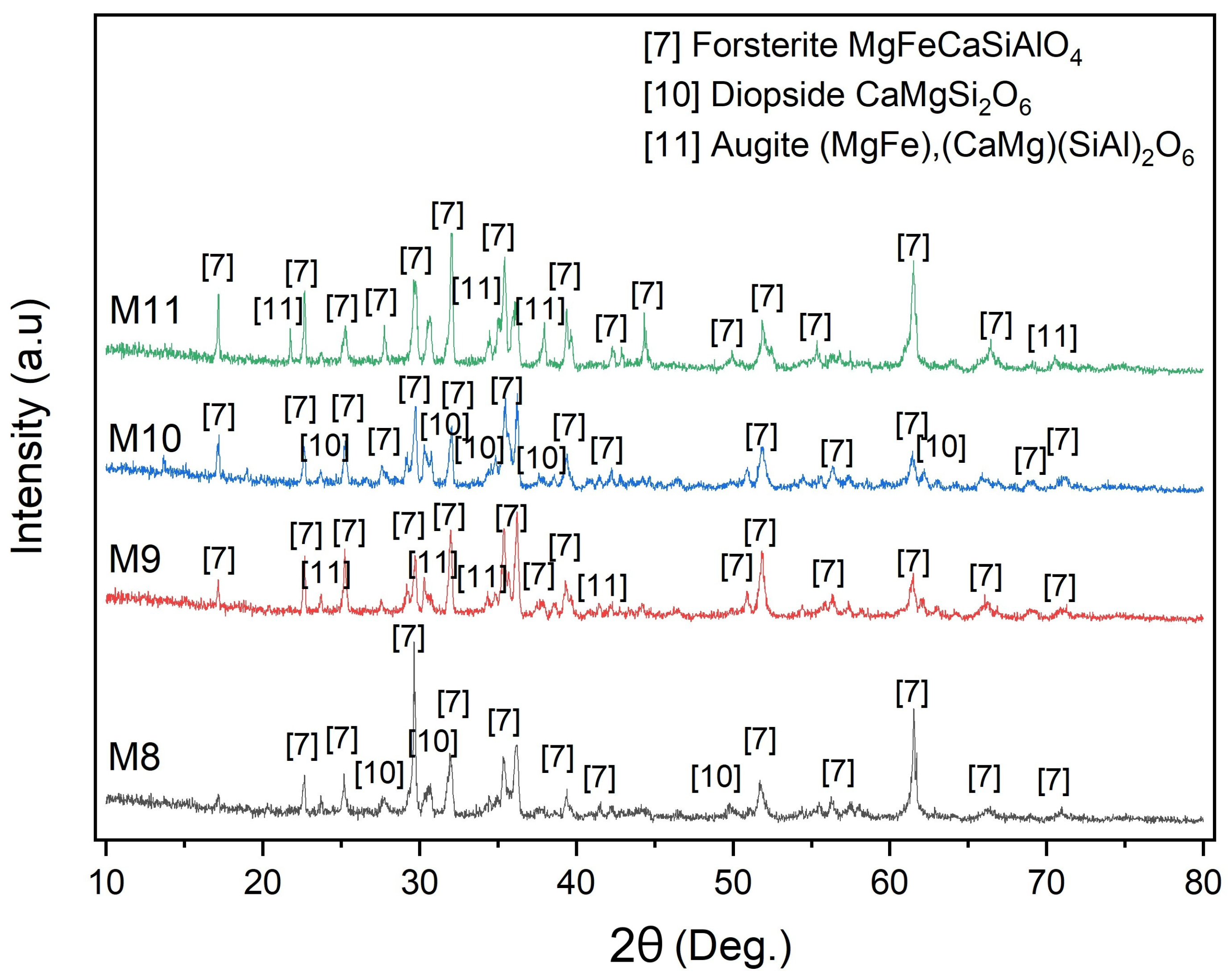
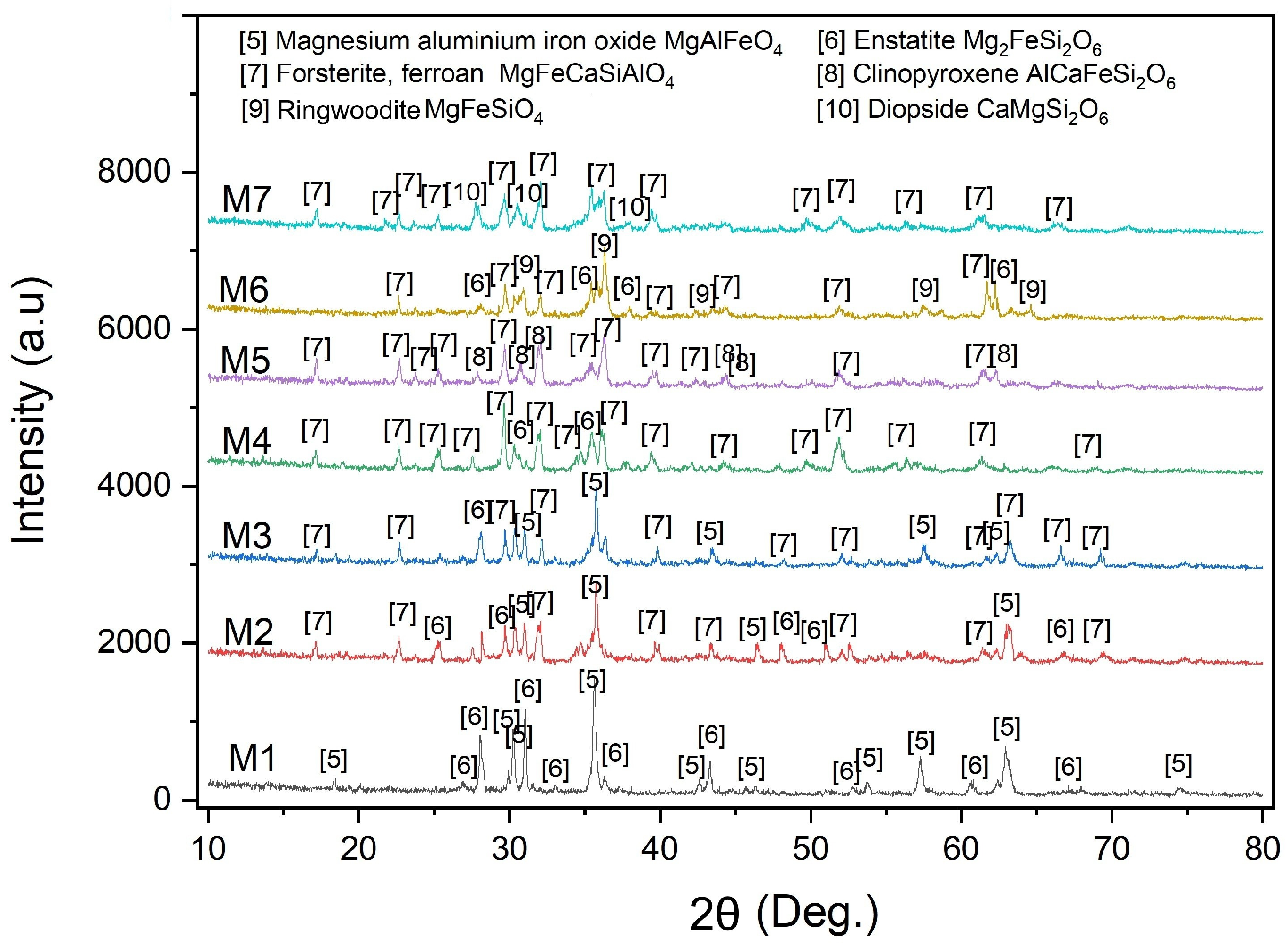
XRD was used to conduct a mineralogical analysis of the slag. The results of the mineralogical analysis for samples M1–M7 are presented in Figure 6, correlated with varying amounts of CaS sulfurizing agent. The mineralogical structure of the slag produced during the M1 condition experiment was found to be a multi-component system, including magnesium–aluminum–iron oxide (MgAlFeO4) as evidenced by the PDF number 01–071–1233, and Enstatite, Mg2FeSi2O6, with the PDF number 01–084–2029. With the addition of a relatively small amount of 1.46 wt.% CaS (M1 test), there were no instances of detecting any phases that included CaO. On the other hand, the M2 slag sample exhibited a prevalent formation of the forsterite phase MgFeCaSiAlO4, according to the PDF number 01–079–1202, which implies that the CaO derived from the CaS addition had been incorporated into the multi–component slag system. Both the M3 and M4 samples showed forsterite as the primary phase, which indicates the increased activity of CaO within the slag. Upon examination of the M5 sample, the presence of the clinopyroxene phase AlCaFeSi2O6, which corresponds to the PDF number 01–085–1740, was identified, and this discovery suggests that CaO played a significant role in the creation of new multi-component phases. In the M6 sample, forsterite and ringwoodite (MgFeSiO4), as indicated by PDF number 01–021–1258, were found, representing a phase originating from the slag’s main constituents. The M7 sample showed that forsterite was still the primary phase and the observation of Diopside, CaMgSi2O6, PDF number 01–075–1092, supported the conclusion that the slag contained a higher amount of CaO. Through a synthesis of mineralogical analysis results and XRF measurements, the conclusion was drawn that the multi-component system finds stability in the oxides of primary constituents such as Mg, Fe, Si, and Al, while the role of CaO is notably active in both the creation and stabilization of these phases.
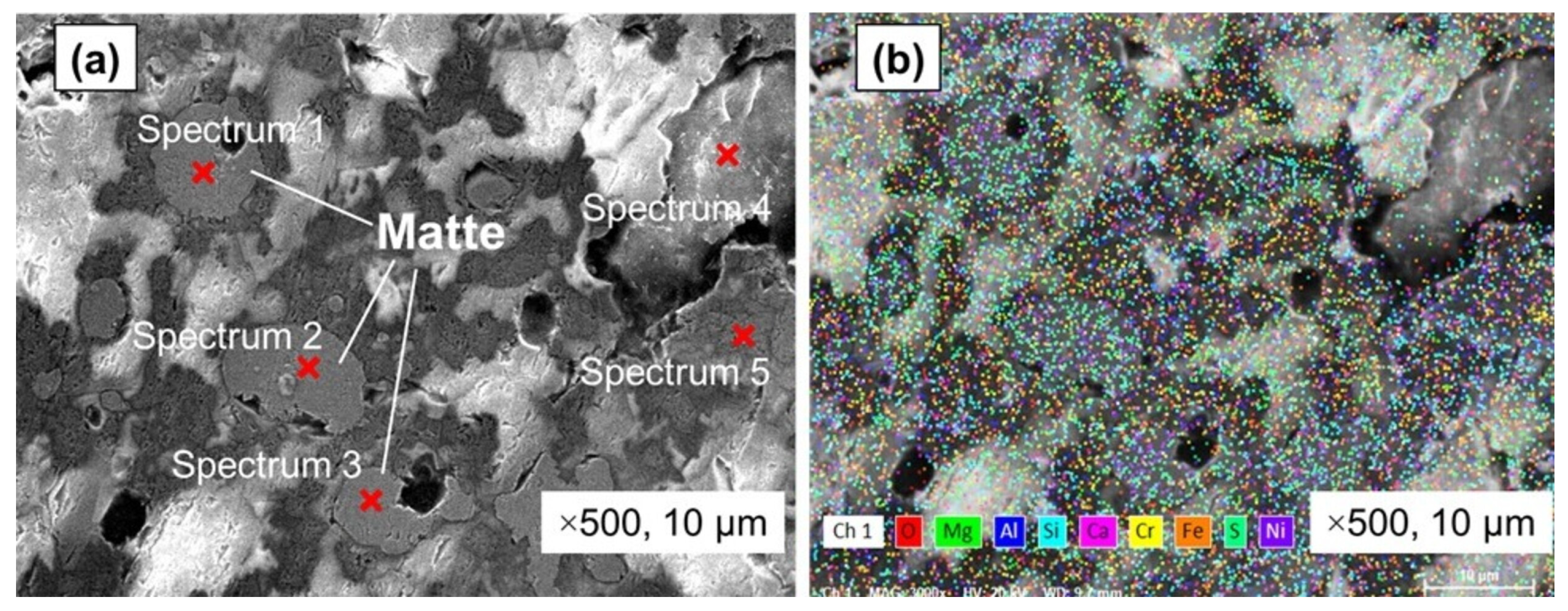
In the smelting experiments that involved varying CaS additions conducted under the M1–M7 conditions, there was no visually observable distinct separation of matte from the slag. However, during the melts from M4 to M7, a dense, thin layer, easily distinguishable from the bulk slag, was observed forming at the slag’s bottom side. The thickness of the layer, which was already dense, grew as the amount of CaS added increased, and in the M6 and M7 trials, the layers that were formed looked similar and had about the same thickness. Using SEM–EDS, the M4, M5, and M6 samples were analyzed for the morphology of the dense bottom layer, and the results can be seen in Figure 7. Morphological imaging, the mapping of elemental distribution, and the identification of localized phases were all provided through the use of SEM–EDS analysis. As illustrated in the SEM image shown in Figure 7a, the M4 sample’s bottom layer contained small, matte droplets that had a rounded morphology. Due to their size, the droplets were unable to coalesce and remained within the slag. According to the mapping analysis in Figure 7b, the areas corresponding to the rounded matte droplets reveal high concentrations of Ni and S, unlike the surrounding dark regions which show an elevated Fe distribution, thus suggesting the formation of small matte droplets. According to the findings of our prior study [11], we determined that dark iron–magnesium silicates are generated at the base of the slag during the ferronickel extraction from nickel concentrate. The transformation of iron oxide into this zone takes place through a reduction process, wherein iron oxide relinquishes its oxygen, which is subsequently transferred to calcium. The lighter phases, by comparison, demonstrate heightened distributions of Al, Ca, Si, and Mg, which suggests slag components. The results of the elemental distribution mapping for samples M4, M5, and M6 are presented in Table 8. The presence of matte droplet was confirmed by the detection of 7.73% nickel and 3.65% sulfur in the dense lower layer of the M4 slag. As a result of the accumulation of exceedingly small matte droplets and a phase abundant in Fe, it was established that the thick, bottom layer of the slag was created. Upon morphological analysis of the M5 sample, as illustrated in Figure 7c,d, it was observed that the matte droplets not only had increased in size, but also that a higher concentration of droplets developed. The mapping analysis showed a clearer distinction in the matte’s separation droplets, with the elemental distributions showing 8.73% nickel and 6.32% sulfur, and these percentages were higher than the corresponding values observed in the M4 sample. The morphological analysis of the M6 sample, as depicted in Figure 7e,f, revealed that the initially separate matte droplets had, in fact, combined to create considerably larger groupings. While a few minor droplets persisted, they were significantly fewer. The dark areas rich in iron that usually surround the droplets of matte were not something that was seen. The elemental distribution map revealed that the concentrations of nickel and sulfur were 10.95% and 10.22%, respectively, suggesting an increased level of matte accumulation in the lower layer.
The elemental composition of the spectrums in Figure 7, as determined by EDS point analysis, is shown in Table 9. As shown in Figure 7a, an analysis of the M4 sample revealed three distinct matte droplets correlated with spectrum 1, 2, and 3, and each of these droplets presented Fe, Ni, and S elemental distributions. Spectrum 1 showed 51.54% Ni and 48.46% S. Spectrum 2 showed 11.26% Fe, 60.72% Ni, and 28.02% S. Spectrum 3 showed 15.07% Fe, 52.04% Ni, and 32.89% S. The outcomes confirm the creation of matte with a comparatively high nickel composition. Conversely, spectrums 4 and 5 exhibited distributions of Fe, Mg, Al, Si, and Ca—elements indicative of slag-forming constituents—suggesting that those areas correlate with slag. The presence of Ni, Fe, and S was also confirmed by the elemental distributions that were gained from spectrum analyzes 6 and 7 of sample M5, as shown in Figure 7c, and from spectrum 10 of sample M6, shown in Figure 7e, which shows that high-nickel matte had formed. In contrast, the principal slag-forming elements were observed in spectra 8 and 9 for sample M5 (Figure 7c) and spectrum 10, 11, and 12 for sample M6 (Figure 7e). Spectrum EDS analysis of matte droplets in samples M4–M6 revealed nickel concentrations ranging from 40% to 50%, iron concentrations from 10% to 25%, and sulfur concentrations from 28% to 39%. These values are in close agreement with the matrix composition predicted by Equilib modelling for 4–6 wt.% CaS addition (Table 3), showing strong agreement between experimental and modelling results.
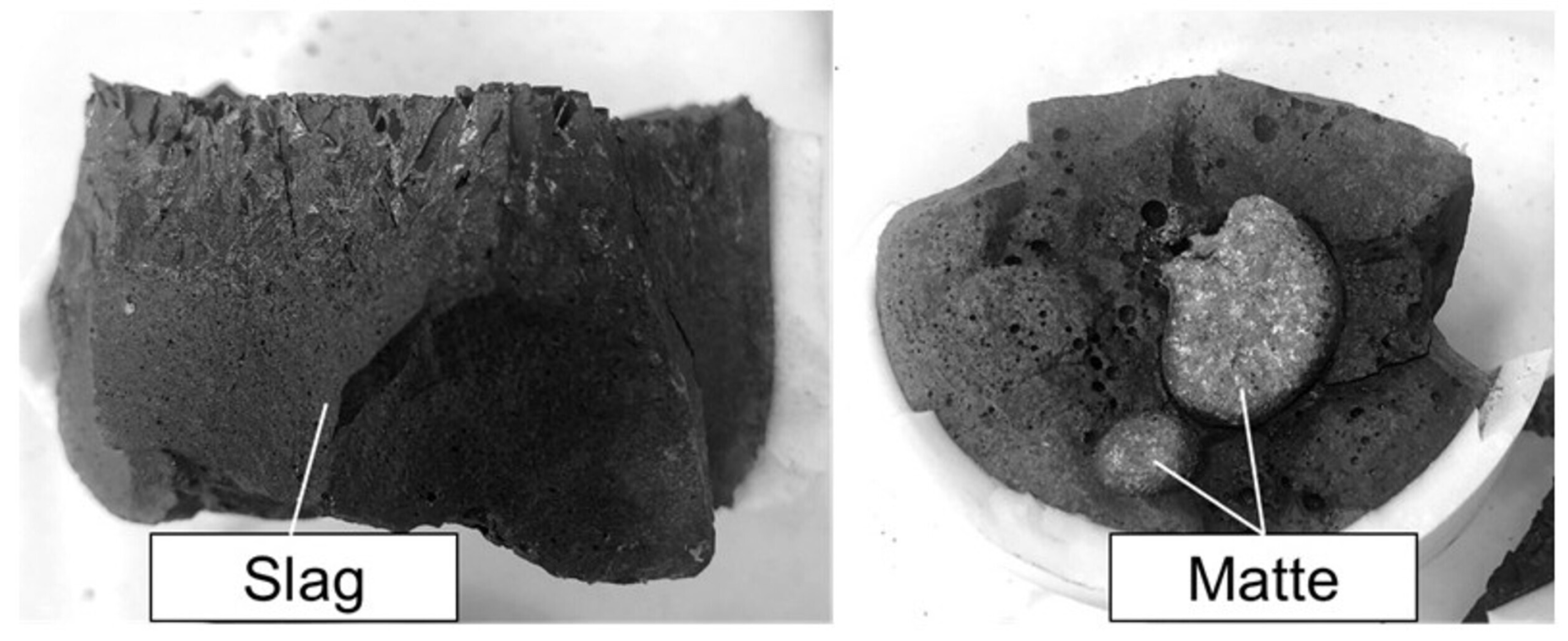
According to calculations based on stoichiometry, the reduction in both iron and nickel is intensified by increasing the required amount of carbon, which is described in Equation (5). Following the reduction in metal phases, they then merge into the matte, resulting in an increase in the production of matte. With the goal of conducting nickel smelting experiments, the amount of carbon added was adjusted to both two and three times the baseline stoichiometric requirements for the conditions where the concentration of CaS was measured at 5 and 6 wt.%. The experiments were identified using the labels M8, M9, M10, and M11. Increasing carbon addition significantly improved metal separation, confirmed by solid mass formation. The products of slag and matte, as they appeared under condition M9, are illustrated in Figure 8. The slag had a zoned structure; the bottom side area looked dark and porous, whereas the upper area was notable for its dark, glassy fracturing. Two solid metal bulks with dissimilar sizes were created at the bottom of the crucible.
The chemical compositions of the matte, which resulted from the experiments M8–M11 that were performed with CaS and carbon additions, are shown in Table 10. The composition of the matte produced in experiment M8 was as follows, 37.17% Fe, 35.62% Ni, and 24.4% S, with a Ni/Fe ratio of 0.96, a result that achieves nearly within the intended target range. Elements like Si, Mg, and Cr were found in small quantities, indicating minor impurities. In experiment M9, the iron content in the matte increased to 45.55% when the carbon addition was increased by 0.35 wt.%, whilst the nickel and sulfur contents saw a decline to 33.2% and 20.48%, respectively. As the experiments M10 and M11 were performed, the iron content continued to rise. According to these findings, the direct addition of carbon does indeed impact the composition of the matte, which is in corresponding with the Equilib modelling results shown in Table 5.
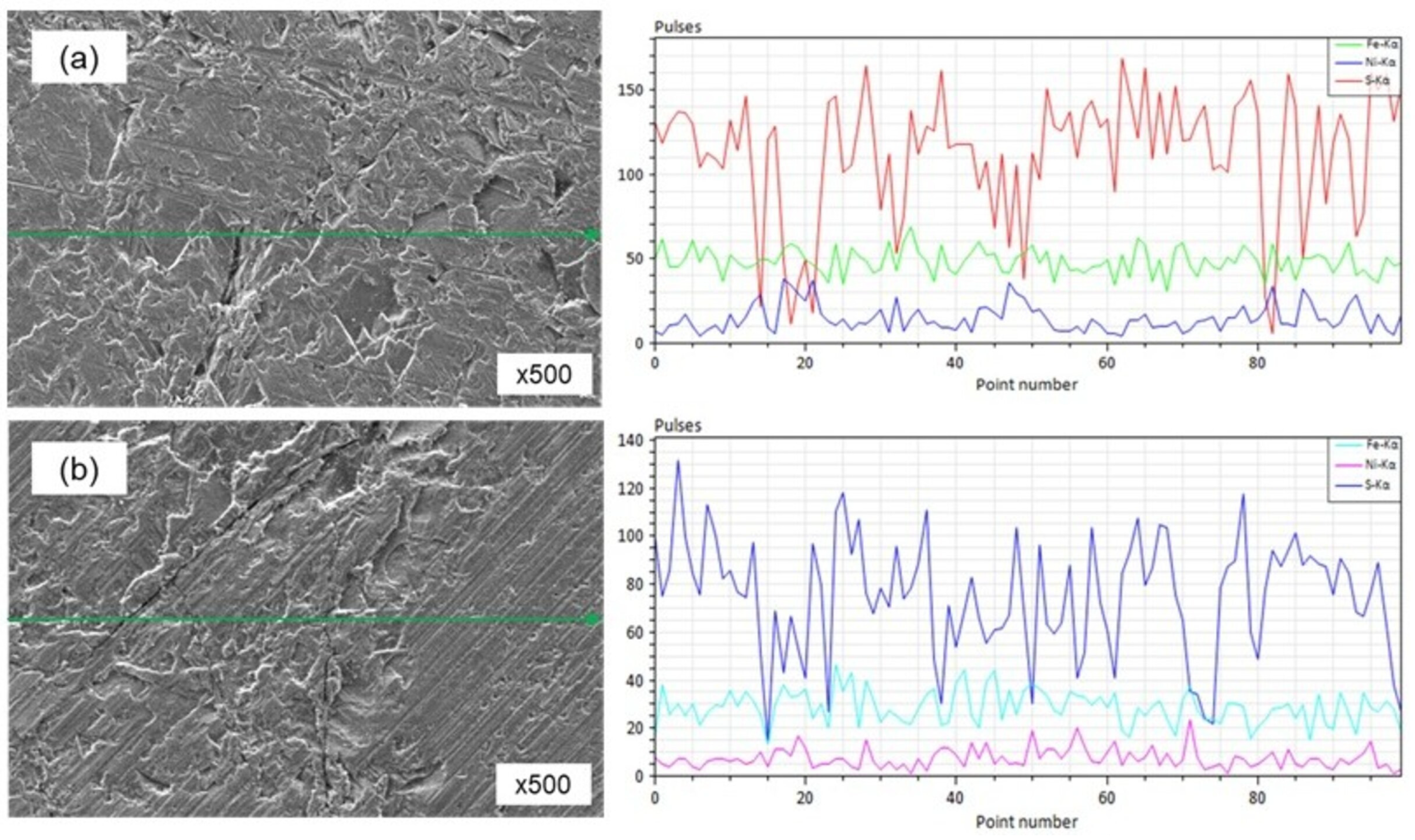
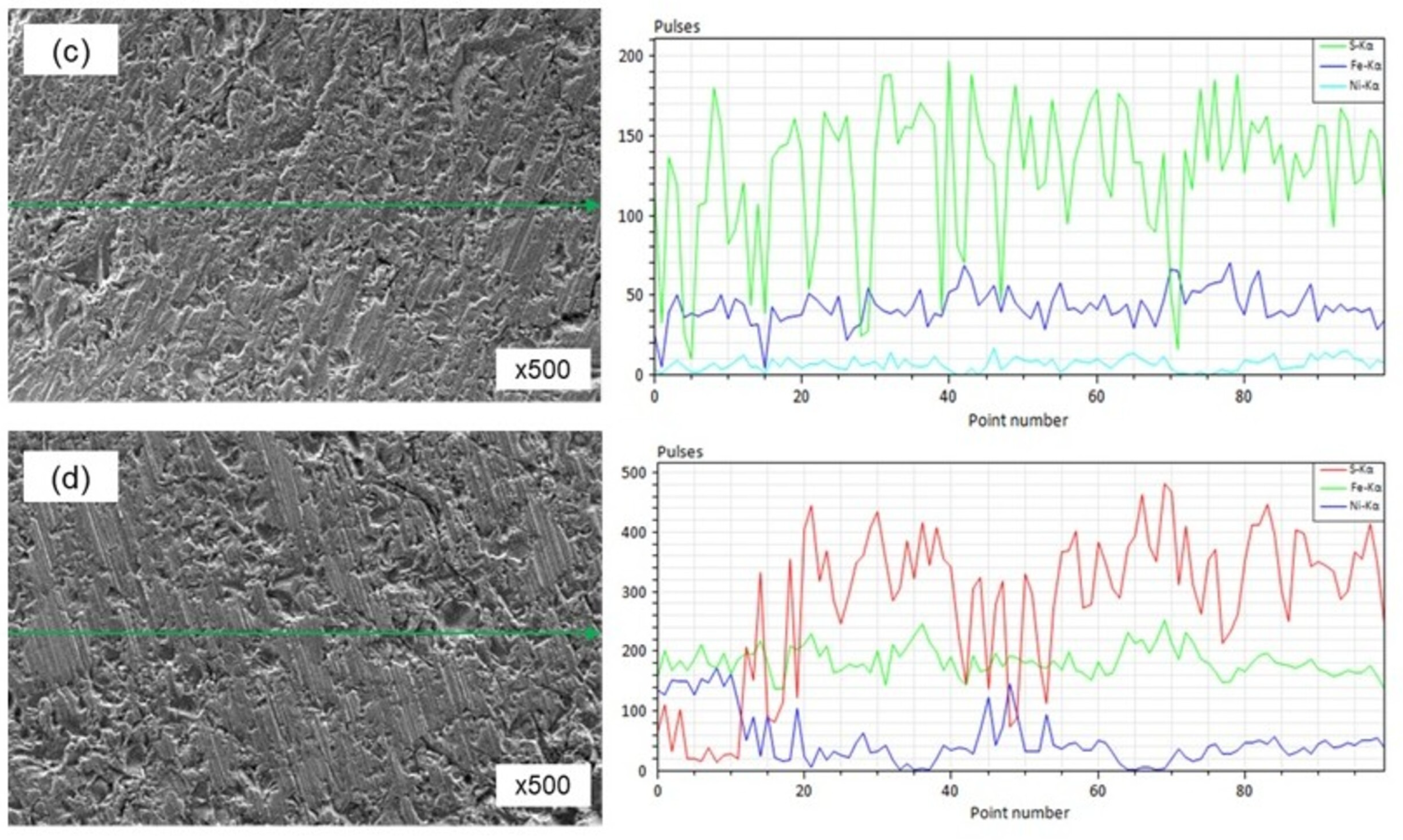
In the smelting experiments conducted under conditions M8–M11, the morphology and chemical composition of the resultant matte were examined using the analysis of SEM–EDS lining. Figure 9 provides a visual representation using SEM images showing the morphology of matte samples M8, M9, M10, and M11, additionally displaying the EDS line–scan X-ray intensity pulses. Upon analysis, it was observed that the nickel matte was composed of layered crystals of [Fe,Ni]SX sulfides, and there was no metallic matrix present. It was observed that the addition of CaS and carbon did not cause any major changes in the matte morphology. Through EDS line-scan analysis, it was found that Fe, Ni, and S were present in all the matte samples from M8 to M11, but the concentrations of these elements differed, which was shown by the X-ray intensity curves. Furthermore, the elemental intensities that were highly fluctuating along the scan lines provided evidence that the matte was not made up of a single, uniform [Fe,Ni]SX phase.
The elemental distributions for the M8–M11 matte samples, as determined by the EDS line-scan, are shown in Table 11. The M8–M11 samples all have iron, nickel, and sulfur in them; however, there are compositional distinctions between them. More carbon enhances iron reduction, increasing iron transfer to the matte phase. As shown in Table 10, the XRF results and these discoveries show a pattern of consistency.
Table 12 shows the analysis of the slag’s composition under experimental conditions M8–M11. The FeO–SiO2–MgO basic system is where the slag is formed, as its major components show. When the carbon additive was increased three times in the M9 and M11 experiments, the Fe2O3 content in the resulting slag decreased to 32.25% and 32.17%, respectively, which suggests that iron reduction occurred. When the CaS additive was 7.30 wt.% and 8.76 wt.%, the CaO content in the slag increased to approximately 7% and 8%. During experiments from M8 to M11, the nickel content dropped from 1.25% to 0.22%, and the M11 experiment, which featured three times increase in the carbon additive, showed a substantial decrease in nickel content, showing a strong correlation between nickel reduction and the carbon additive quantity.
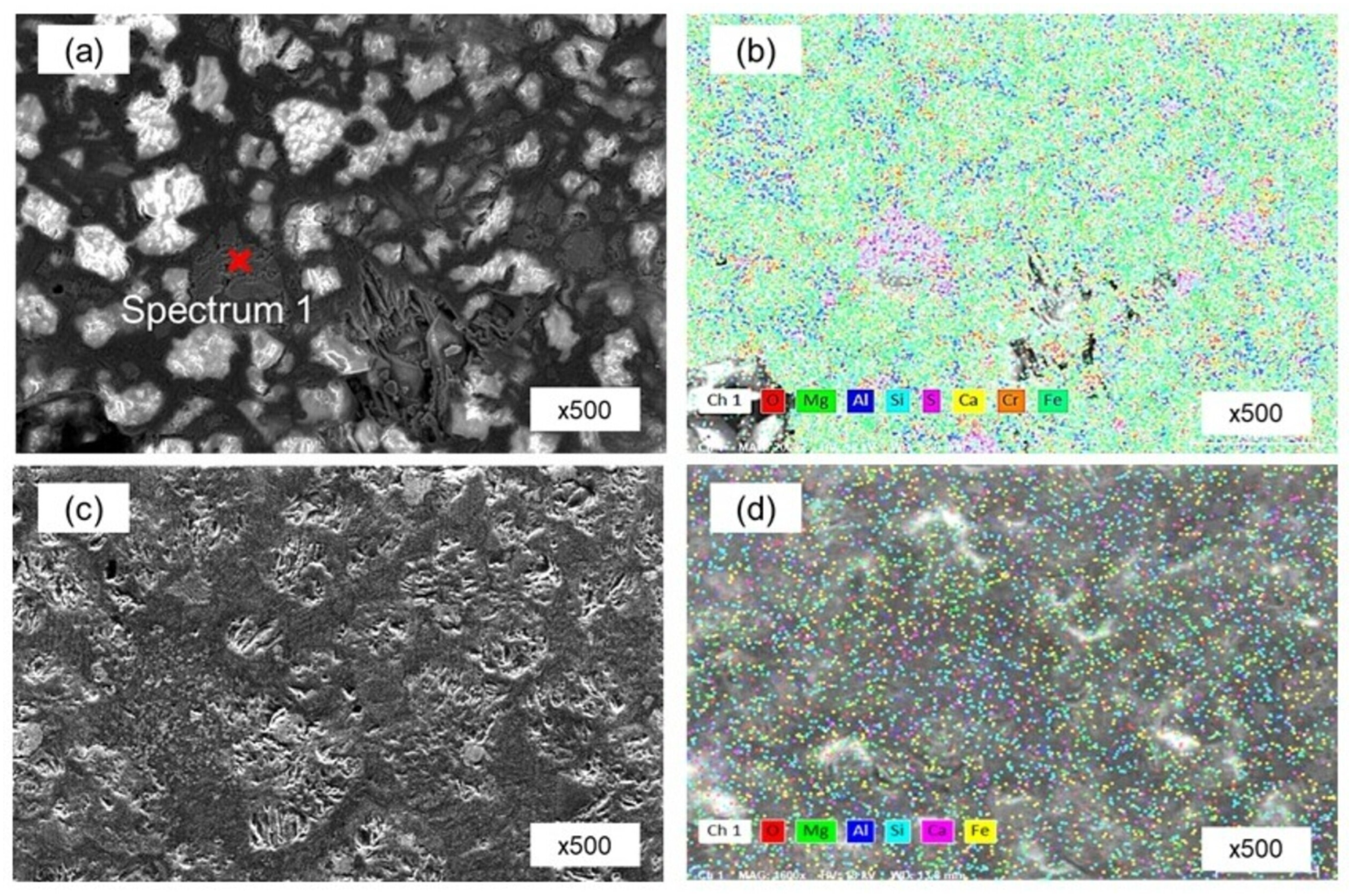
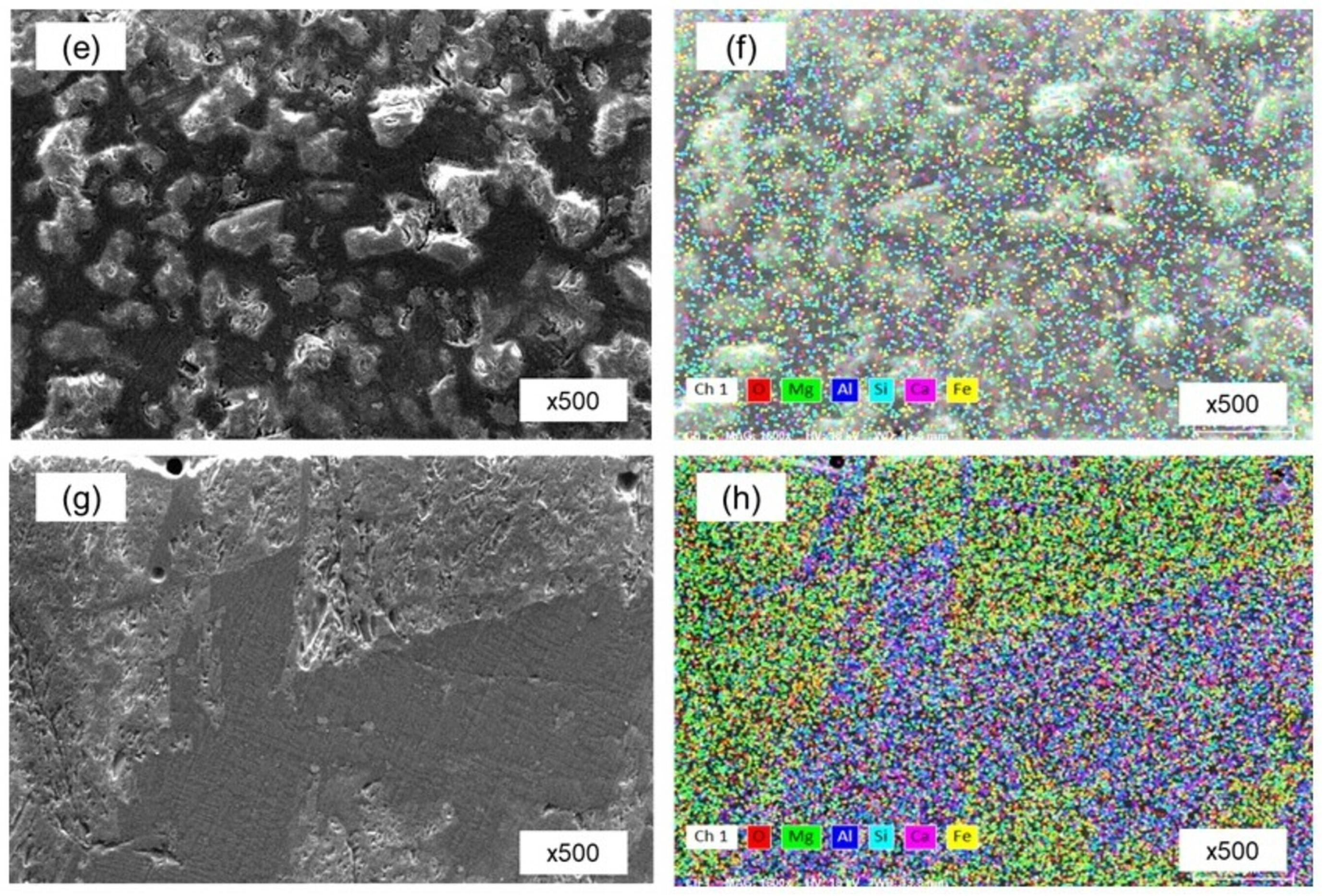
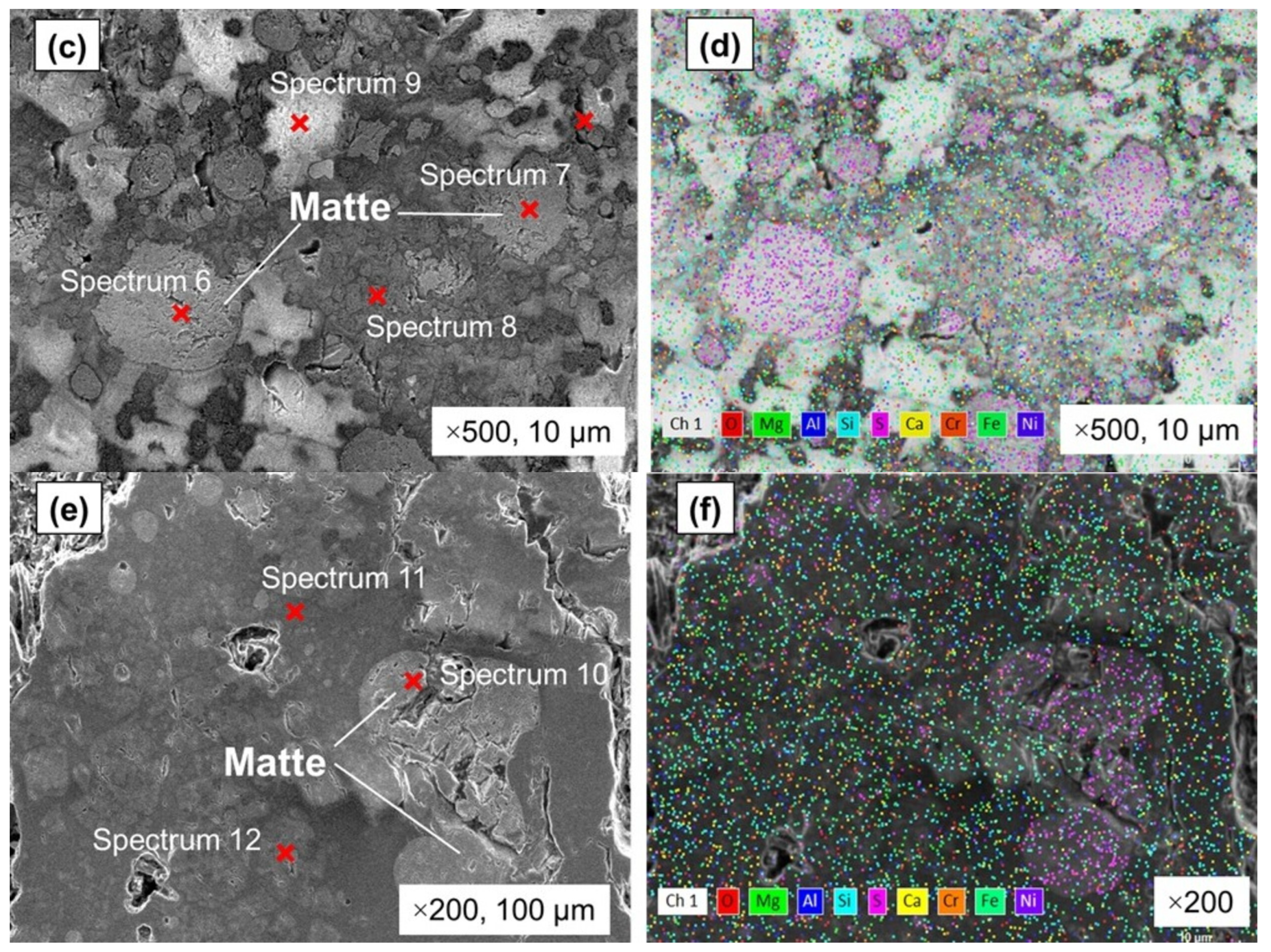
The morphology structure of the slag formed during the matte smelting experiments performed under conditions ranging from M8 to M11, along with the distribution of chemical elements found within the slag, are shown in Figure 10. The SEM image in Figure 10a provides a view of the morphology analysis results that were obtained from the M8 slag sample. Differing from the morphological structure of the M4–M6 slags, which was influenced by the CaS additive amount, as presented in Figure 7, this slag is mainly composed of the slag matrix and irregularly shaped white crystals that have sharp edges embedded within the matrix, and there was no considerable distribution of matte droplets to be seen. Based on the elemental distribution obtained through EDS mapping analysis (Figure 10b), the slag composition primarily comprises oxides of Fe, Si, Mg, Al, and Ca, with a prominent sulfur distribution, stated in pink. Upon conducting an EDS point analysis within this specific region, the results show a matte droplet with the following elemental composition: 34.02% sulfur, 33.80% iron, and 32.18% nickel, as shown in Spectrum 1 of Figure 10a. The slag samples from M9, as shown in Figure 10c, and M10, which is shown in Figure 10e, did not contain any detectable matte droplets. The structure of their morphology is composed of hard crystals, which are embedded within the matrix, a characteristic that resembles the M8 slag sample. Based on the EDS mapping analysis displayed in Figure 10d,f, the slag is composed of various oxides, including those of elements like Mg, Fe, Si, Al, and Ca. The M11 slag sample’s morphology stood in contrast to that of the other samples, featuring an arrangement of large, rigid crystals, as depicted in Figure 10g. Through detection, the distribution of elements including Mg, Fe, Si, Al, and Ca was observed, and it was also determined that the dark-coloured slag matrix resulted from compounds based on Al, Ca and Si, as shown in Figure 10h.
Table 13 shows the results of the element distribution analysis conducted on the slag samples produced during the M8–M11 condition. The slags, which are part of the FeO–SiO2–MgO system, have been confirmed as such by analyzing the distribution of Fe, Si, and Mg elements. The M8 sample uniquely exhibited a sulfur detection at 2.22%, and this finding corresponds directly with the matte sections displayed in Figure 10a, as stated in Spectrum 1. It was found that Al and Ca were present as elements that were not part of the primary composition, showing that they were impurities.
Figure 11 displays the results of the mineralogical analysis of the slag from experiments M8–M11. As was previously stated in Figure 6, the CaS changes the slag structure into primarily composed of forsterite MgFeCaSiAlO4. The slags that resulted from the M8–M11 experiments exhibited a structure that was largely characterized by forsterite. When examining the M11 slag, despite the emergence of Augite (MgFe),(CaMg)(SiAl)2O6 phases (PDF number 01–076–0544), there were no other remarkably different alterations observed.

3.4. Effect of CaS and C Addition on Nickel Matte Smelting

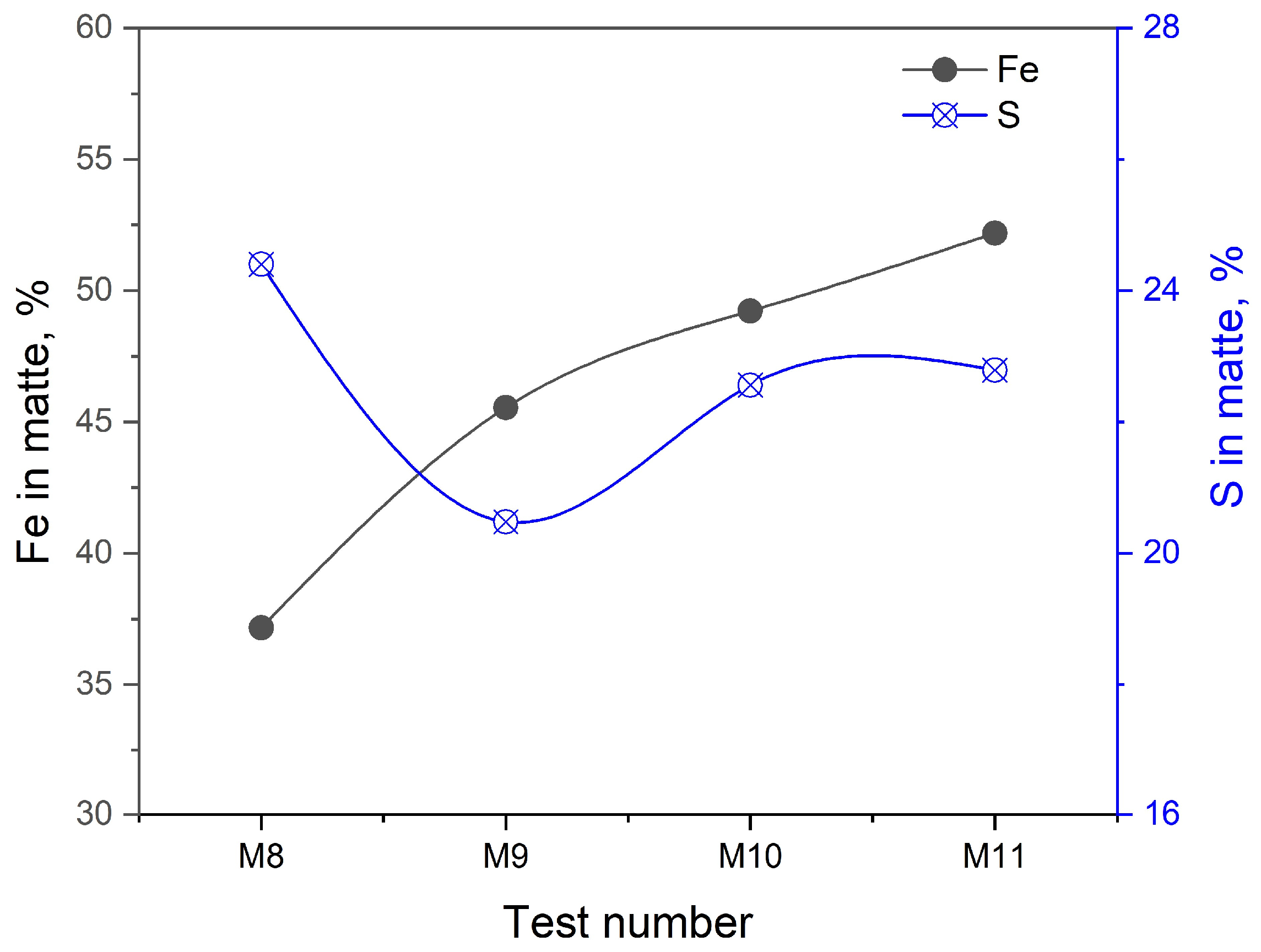
Smelting tests were performed at 1500 °C using ideal quantities of CaS and carbon, according to Equation (2), in an effort to produce high–grade nickel matte. The experimental conditions in Table 2 reveal that M8–M11 caused matte fractions, with CaS additive by 7.30 and 8.76 wt.% and carbon additive by 0.24 and 0.36 wt.%. The degree of nickel recovery was determined using a calculation that considered the chemical composition of the separated matte and the amount of nickel present in the matte itself. The variations in the quantities of iron and sulfur, which are the primary components of nickel matte that was obtained through smelting in experiments labelled M8–M11, are shown in Figure 12. Corresponding to the increase in the carbon additive, the sulfur content decreased, moving from 24.4% in the M8 sample to 20.48% in the M9 sample. The increase in the iron content, rising from 37.17% to 45.55%, is a direct result of the enhanced extraction of iron from the slag. It is important to note that in the M10 and M11 samples, the addition of the CaS additive was increased by a factor of six, which resulted in an average sulfur content of 22%, in addition to a further increase in the iron content to 49.23% and 52.19%. The outcome of this is determined by the iron content within the slag and the level of activity revealed by the iron, both of which are important. According to this diagram, the amount of carbon additive has a remarkably sensitive influence on the reduction of iron.
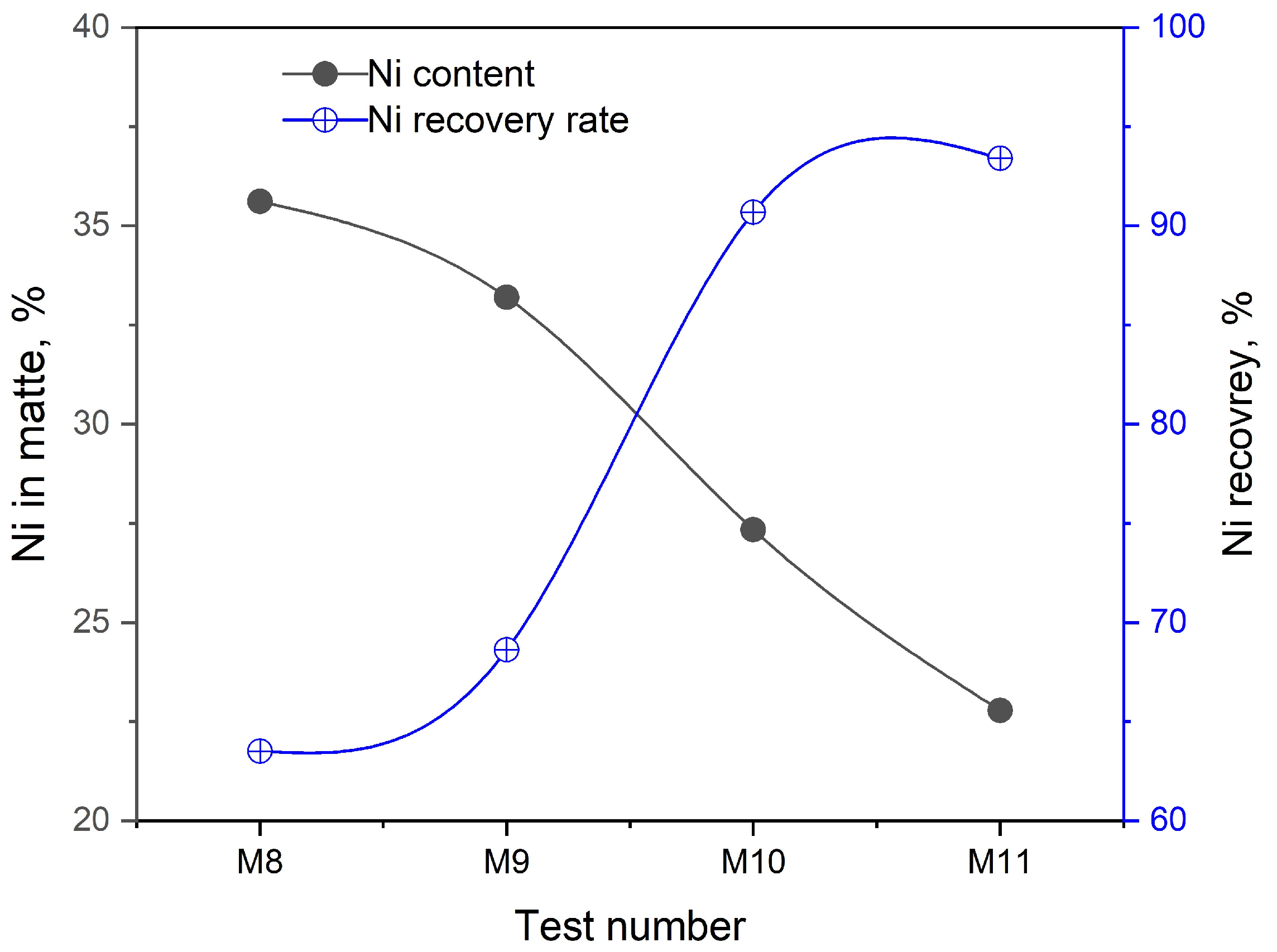
The nickel grade and the degree of recovery are shown in Figure 13. The nickel grade declined in proportion to the increase in iron content present in the nickel matte. As observed in the samples from M8 to M11, the nickel concentration showed a stepwise decrease, reaching values of 35.62%, 33.2%, 27.34%, and 22.78%, a phenomenon that is a direct consequence of the reduction of iron and its eventual incorporation into the matte. Even though the nickel grade in the matte is reduced and becomes more concentrated with iron, observations showed that there was a rise in the degree to which nickel was recovered. The degree of nickel recovery in the M8 experiment reached 63.52%, indicating that the results obtained were not sufficient. As evidenced by the M9 experiment, the recovery of nickel was improved to 68.61% as a direct result of the influence of carbon. Following this, in the M10 and M11 experiments, the nickel recovery percentages rose to 90.68% and 93.40%, respectively, which revealed that the best results were obtained by combining CaS sulfidizer and carbon reducer.

4. Discussion

In the equilibrium modelling of nickel matte smelting using FactSage software, the addition of CaS was calculated to range from 1 wt.% to 10 wt.%. Matte formation was observed when the CaS addition surpassed 4 wt.%, producing a matte obtained by a high Ni/Fe ratio of 7.4, low iron impurity, and a high nickel grade of 66.26%. However, both the matte yield and nickel recovery were not at the desired level. Adding CaS improved nickel matte yield; however, the Ni/Fe ratio dropped to 0.34. The addition of 6 wt.% CaS resulted in the formation of a matte, achieved by a Ni/Fe ratio of 2.05 and a Ni content of 47.49%. The equilibrium model, considering carbon addition, indicated that iron reduction within the concentrate occurred at a higher activity. Following this, the reduced iron moves into the matte and transports the nickel, which lowers the nickel grade of the matte. Based on the Equilib modelling, matte smelting experiments were performed to determine the optimal amounts of CaS and carbon additions. There was no observed separation of matte from the slag when the CaS addition was between 1.46 wt.% and 4.38 wt.%. Above 5.48 wt.% CaS (above M5 test), matte droplets formed in the slag; however, a separate matte phase was not observed. In experiments, the matte phase was separated from the slag, with 7.30 and 8.76 wt.% of CaS and 0.24 and 0.36 wt.% of carbon, respectively. With 7.30 wt.% CaS and 0.24 wt.% carbon (M8 test), the Fe/Ni ratio was 0.96, while the nickel recovery rate was only 63.5%. Based on the M11 test results, with 8.76 wt.% CaS and 0.36 wt.% carbon, the nickel recovery rate was recorded at 93.4%.
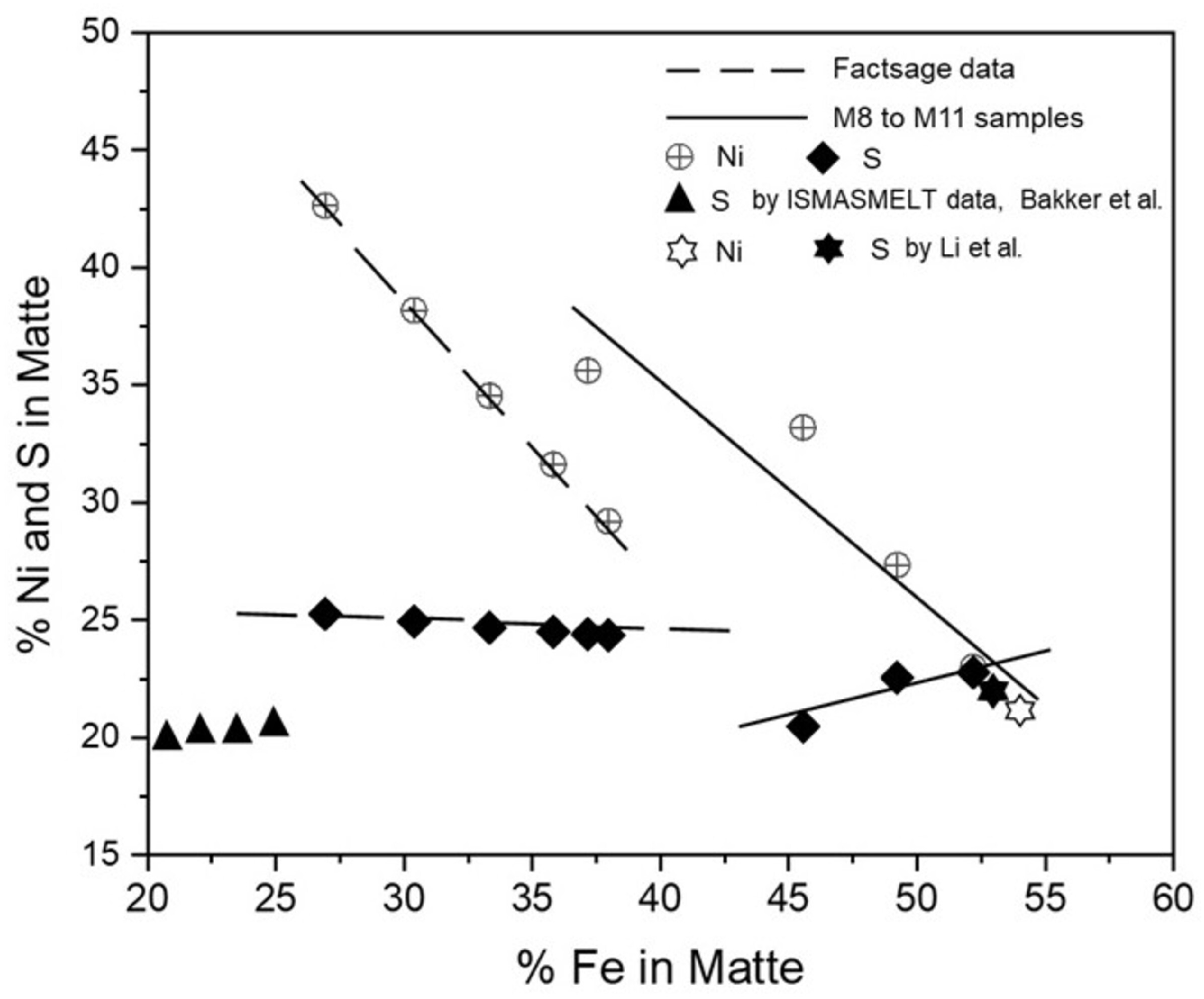
Therefore, the nickel grade of the nickel matte is directly proportional to the iron content, which influences the effectiveness of nickel recovery. The correlation between nickel and sulfur grades regarding the iron content in the matte is shown in Figure 14. According to this calculation, an increase in iron content from 26% up to 38% results in a decrease in the nickel grade, which decreases from 42.6% to 29%. As previously mentioned, the addition of more carbon intensifies the process of iron reduction, which causes a greater amount of iron to move into the matte. As these proceeds, the sulfur grade appears consistent, with no noteworthy fluctuations. Bakker et al. [31] presented a study that produced similar results, and it was shown that an increase in iron content within the matte does not cause sulfur levels to rise in conjunction (as shown in Figure 14), but, conversely, it causes a decrease in the grade of nickel. The nickel grade was observed to decrease when the iron content was increased, which is consistent with the results of the FactSage modelling. An observation was made that there was a small improvement in the sulfur grade. The research conducted by Li et al. [32] confirmed that a nickel matte composition of 21.35% Ni, 22.92% S, and an average of 55% Fe was the optimal composition for obtaining the highest possible recovery of nickel during the nickel matte smelting process (compared in Figure 14). According to the graph, the simultaneous reduction and separation of nickel can be accomplished with greater effectiveness by increasing the consumption of carbon and, consequently, intensifying the process of iron reduction.
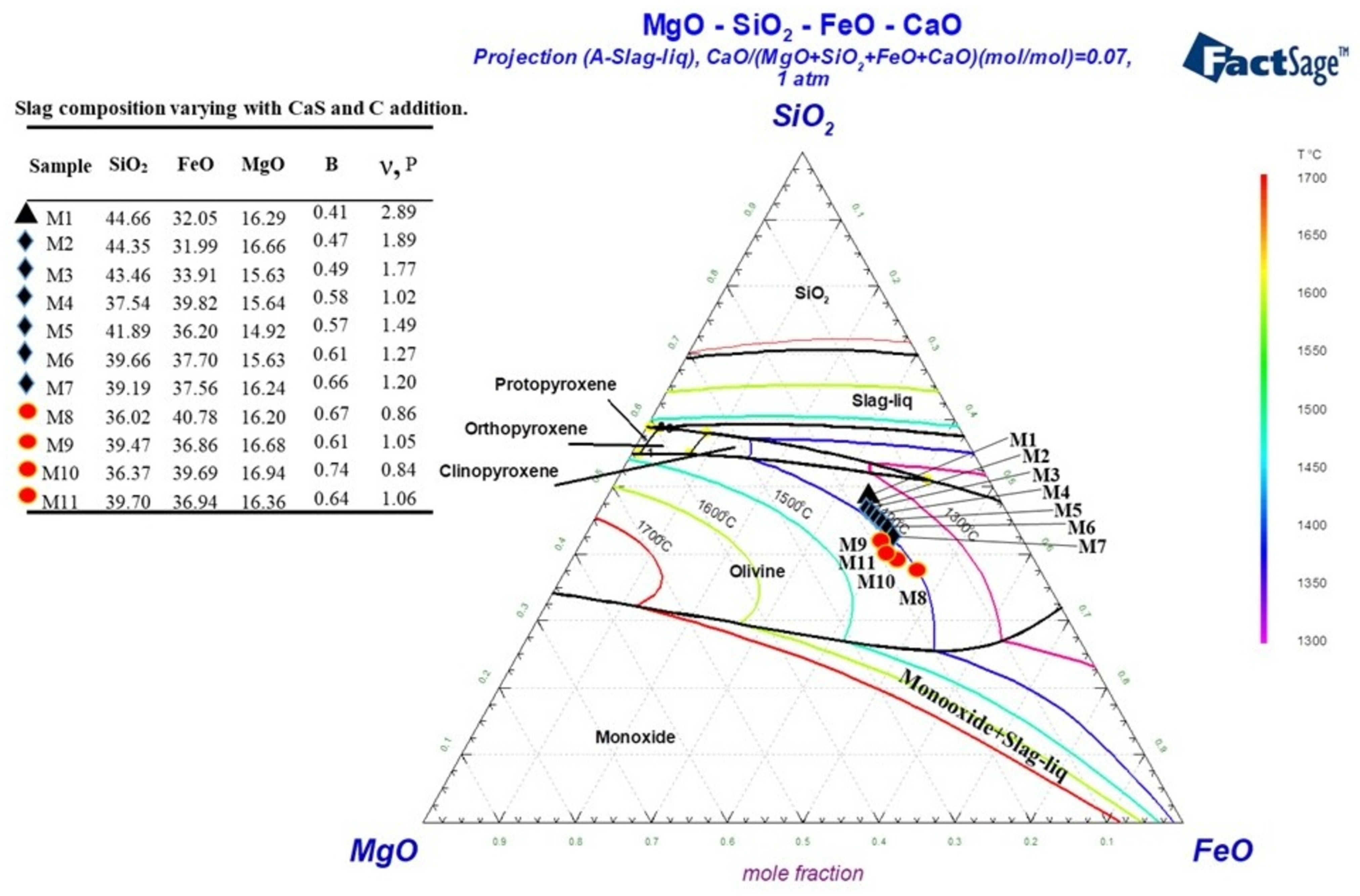
During the melting process at a temperature of 1500 °C, nickel concentrate creates slag consisting of the FeO–SiO2–MgO system. Considering the nickel matte melting process with CaS, the slag’s physical and chemical characteristics are crucial; thus, there are specific requirements for easy melting and low viscosity. During the melting of nickel matte, an overview of the chemical and structural changes occurring in the slag reveals that the CaO, which enters with the CaS sulfurizer, has an impact on the composition and structure of the slag, thus altering the basicity of the slag. In addition, the carbon additive promotes the reduction of iron, subsequently decreasing the FeO content within the slag, ultimately resulting in alterations to the fundamental structure of the slag and creating a tendency for SiO2 to become the dominant component. Because of the effect of available CaO, the prevalence of SiO2 is constrained, giving rise to the formation of CaxSiOy compounds within the slag system. Based on the ternary system FeO–SiO2–MgO with 7% CaO, as shown in Figure 15, the isothermally modelling is shown through the zonation of the slag’s melting characteristics. The ratios of FeO, SiO2, and MgO within the slag, which were obtained under the conditions ranging from M1 to M11, are presented in a table that is located on the left side of Figure 14. Furthermore, both the basicity and viscosity properties of the slag, relative to changes in composition, are presented. Although all slags from M1 to M11 are situated within the 1500 °C melting zone, the M1 slag was entirely contained in the 1400 °C zone. The slags from M2 to M7 were positioned on the border of the 1400 °C zone, compared to the slags from M8 to M11, which were in different locations outside the 1400 °C zone. The basicity of the slag is between 0.41 and 0.74, and depends on the composition. The basicity of slags M1 through M5 with high SiO2 content was below 0.6. However, for slags M6–M11, the basicity, highly influenced by CaO, ranged from 0.6 to 0.7. Studies from Wang et al. [25], Li et al. [32], and Hidayat et al. [26], indicate that the liquid state zone of the slag shows a considerable expansion when the CaO content is maintained at 10–15%. Viscosity is a key indicator of the physical characteristics of the slag, and as such it provides a direct measure of the effects of both the slag’s composition and temperature. The process of separating the metal phase from the slag, coupled with the adequate movement of small metal droplets through the slag, is guaranteed under conditions where the slag exhibits a low viscosity. The correlation between slag composition and viscosity, as computed using FactSage at a constant temperature of 1500 °C, is also shown in Figure 14. The M1–M3 samples, which are characterized by a slag composition predominantly of SiO2 with an average basicity of 0.45, exhibited elevated viscosity values ranging from 2.89 P to 1.77 P (Poise). However, as the SiO2 content decreases and basicity increases to 0.65–0.7, the slag viscosity drops below 1 P. Wang et al. [25] and Shen et al. [33] both stated in their studies that during the nickel matte melting process, slag with a composition of 13–15% CaO has a viscosity below 3 P when the temperature is 1350 °C. Furthermore, according to Erdenebold et al. [34], the viscosity of nickel slag at 1550 °C reached 0.9 P when the basicity was 0.8, confirming a viscosity decrease with increasing basicity. The experiment revealed through calculation that the slags formed in this nickel matte melting experiment have properties of low viscosity and ease of melting.
5. Conclusions

The nickel concentrate, which sampled from laterite saprolite ore, exhibited a nickel concentration of 4.77%, and its minerals were predominantly clinoenstatite, a magnesium–silicate-based mineral (MgXSiOγ). The nickel matte smelting process, which used CaS and C additives, was examined through a combination of thermodynamic modelling using the Equilib module of FactSage 8.2 and experimental procedures conducted in a laboratory setting for this study. Carbon addition is crucial during nickel matte smelting because it promotes nickel and iron reduction, thus improving their capacity to bond with sulfur. In accordance with the nickel content in the concentrate, smelting experiments were conducted, gradually increasing the CaS addition needed for sulfidation from 1.46 wt.% to 10.72 wt.%. When the CaS addition exceeded 5.84 wt.%, nickel matte droplets were observed in the slag; however, the separation of the nickel matte phase remained unachievable. The matte phase separation was achieved by adding 0.24 wt.% and 0.36 wt.% of carbon, increasing two and three times, respectively, the amount required for the reduction of nickel in the concentrate. Carbon enhances iron reduction, improving nickel recovery, but increases iron in the matte, decreasing nickel purity. Adding 7.30 wt.% CaS and 0.24 wt.% C yielded a matte with a Ni/Fe ratio of 0.96 and nickel content of 35.62% Ni, although nickel recovery was just 63.5%. However, the nickel recovery rate reached a maximum of 93.4% under the condition of 8.76 wt.% CaS and 0.36 wt.% C addition. Despite this, the nickel content in the matte decreased to 22.78%, along with a rise in iron impurities, while the Ni/Fe ratio also fell to 0.44. The research results confirm that the precise carbon adjustment in nickel matte smelting is necessary. Furthermore, it has been shown that the addition of CaS acts as a source of CaO and affects the slag’s composition and characteristics. With the addition of 8.76 wt.% CaS, the slag’s CaO content reached 8% and its basicity increased to 0.7, decreasing the slag viscosity to approximately 1 P, thereby supporting the separation of matte. This research provides critical foundational knowledge on the most effective use of CaS and carbon, which we believe is directly applicable in practice.

Author Contributions

E.U.: Methodology, Data curation, Investigation, writing—original draft, Software; C.-H.J.: Data curation; formal analysis, software; J.-P.W.: Writing—review and editing, Project administration, Conceptualization, Funding acquisition. All authors have read and agreed to the published version of the manuscript.

Funding

This research, supported by the Brain Pool program (Grant Number RS-2023-00222959), receives funding from the Ministry of Science and ICT through the National Research Foundation of Korea.

Data Availability Statement

The original contributions presented in the study are included in the article, further inquiries can be directed to the corresponding author.

Conflicts of Interest

The authors declare no conflicts of interest.

References

  1. Saeed, F.; Michel, C.; Simon, B.B.; Odile, L.; Lev, F. Characterization of Weda Bay nickel laterite ore from Indonesia. J. Geochem. Explor. 2019, 196, 270–281. [Google Scholar] [CrossRef]
  2. Fu, W.; Feng, Y.; Luo, P.; Zhang, Y.; Huang, X.; Zeng, X.; Cai, Q.; Zhou, Y. Weathering of Ophiolite Remnant and Formation of Ni Laterite in a Strong Uplifted Tectonic Region (Yuanjiang, Southwest China). Minerals 2019, 9, 51. [Google Scholar] [CrossRef]
  3. Pandey, N.; Tripathy, S.K.; Patra, S.K.; Jha, G. Recent Progress in Hydrometallurgical Processing of Nickel Lateritic Ore. Trans. Indian Inst. Met. 2023, 76, 11–30. [Google Scholar] [CrossRef]
  4. Anne, O.; Barcza, N. Hydro–pyro integration in the processing of nickel laterites. Miner. Eng. 2013, 54, 2–13. [Google Scholar] [CrossRef]
  5. Fajar, N.; Widi, A.; Fathan, B.; Suharno, B. Study of selective reduction in lateritic nickel ore: Saprolite versus limonite. Mater. Today 2021, 44, 1488–1494. [Google Scholar] [CrossRef]
  6. Pickles, C.A.; Marzoughi, O. Temperature and frequency dependencies of the permittivities of nickeliferous silicate laterite ores and reaction mixtures. Powder Technol. 2023, 428, 118867. [Google Scholar] [CrossRef]
  7. Vahed, A.; Mackey, P.J.; Warner, A.E.M.; Anderson, C. A Review of Nickel Pyrometallurgy Over the Past 50 Years with Special Reference to the Former Inco Ltd. and Falconbridge Ltd. In Proceedings of the Ni-Co 2021: The 5th International Symposium on Nickel and Cobalt, Orlando, FL, USA, 14–18 March 2021; The Minerals, Metals & Materials Series; Springer: Cham, Switzerland. [CrossRef]
  8. Hongyu, T.; Jian, P.; Deqing, Z.; Congcong, Y.; Zhengqi, G.; Yuxiao, X. Improved beneficiation of nickel and iron from a low-grade saprolite laterite by addition of limonitic laterite ore and CaCO3. J. Mater. Res. Technol. 2020, 9, 2578–2589. [Google Scholar] [CrossRef]
  9. Chen, Y.f.; Lv, X.m.; Pang, Z.d. Effect of basicity and Al2O3 on viscosity of ferronickel smelting slag. J. Iron Steel Res. Int. 2020, 27, 1400–1406. [Google Scholar] [CrossRef]
  10. Jun, L.; Guanghui, L.; Mingjun, R.; Zhiwei, P.; Guoshen, L.; Tao, J.; Xueyi, G. Control of slag formation in the electric furnace smelting of ferronickel for an energy-saving production. J. Clean. Prod. 2021, 287, 125082. [Google Scholar] [CrossRef]
  11. Urtnasan, E.; Heo, S.-B.; Yu, J.-W.; Jung, C.-H.; Wang, J.-P. Relationship Between Thermodynamic Modelling and Experimental Process for Optimization Ferro-Nickel Smelting. Minerals 2025, 15, 101. [Google Scholar] [CrossRef]
  12. Pubudi, D.; Bandara, A.; Ranjith, P.; Nimila, D.; Nalin, R.; Sandun, S.; Amila, S.R.; Nadeera, B. The role of nickel (Ni) as a critical metal in clean energy transition: Applications, global distribution and occurrences, production-demand and phytomining. J. Asian Earth Sci. 2024, 259, 105912. [Google Scholar] [CrossRef]
  13. Xuanru, Z.; Hua, Z.; Shuxian, Z.; Wanli, X.; Hanshi, Y.; Zhao, Y. A study on the transmission of trade behavior of global nickel products from the perspective of the industrial chain. Resour. Policy 2023, 81, 103376. [Google Scholar] [CrossRef]
  14. Franziska, M.; Christoph, N.; Frank, M.W.; Nils, F.N. A forecast on future raw material demand and recycling potential of lithium-ion batteries in electric vehicles. Resour. Conserv. Recycl. 2023, 192, 106920. [Google Scholar] [CrossRef]
  15. Benchmark. Battery Nickel Demand Set to Triple by 2030. Available online: https://source.benchmarkminerals.com/article/battery-nickel-demand-set-to-triple-by-2030 (accessed on 11 November 2024).
  16. Global Carbon Fund. Nickel Demand to Triple by 2030: Can the Market Keep Up? Available online: https://globalcarbonfund.com/carbon-news/nickel-demand-to-triple-by-2030-can-the-market-keep-up/#:~:text=Demand%20for%20battery%2Dgrade%20nickel,outside%20China%20support%20this%20trend (accessed on 18 October 2024).
  17. Cao, J.; Sun, F.; Zhang, X.; Lu, S.; Hwang, J.-Y.; Chen, A. Thermodynamic Analysis of Sulfurization of Ferronickel. JOM 2024, 76, 705–717. [Google Scholar] [CrossRef]
  18. Muhammad, H.U.; Leili, T.K. The effect of sulfur in rotary kiln fuels on nickel laterite calcination. Miner. Eng. 2020, 157, 106563. [Google Scholar] [CrossRef]
  19. Li, C.h.; Liu, W.; Jiao, F.; Zhang, T.; Han, J.; Qin, J. Intensifying the selective sulfidation of nickel in saprolitic laterites by sodium salts. Miner. Eng. 2024, 218, 109022. [Google Scholar] [CrossRef]
  20. Liu, W.; Liu, S.; Ling, H.; Li, C.; Jiao, F. Production of nickel matte from saprolitic laterite ore by sulfide smelting with pyrite. Miner. Eng. 2023, 233, 109658. [Google Scholar] [CrossRef]
  21. Li, Z.; Tian, Q.; Wang, Q.; Zulhan, Z.; Wang, S.; Hidayat, T.; Guo, X. Preparation of Nickel Matte from Laterite Nickel Ore Using Pyrite as the Sulfurization Agent. Metall. Mater. Trans. B 2025, 56, 4964–4976. [Google Scholar] [CrossRef]
  22. Wang, Z.; Wang, H.; Jie, X.W.; Xu, Z.; Waters, K.E.; Northwood, D.O.; Senlin, C.; Ma, H. Reduction–Sulfurization Smelting Process of Waste Hydrogenation Catalysts, Automotive Exhaust Purifier Waste Catalysts, and Laterite Nickel Ore. ACS Omega 2023, 8, 40713–40728. [Google Scholar] [CrossRef]
  23. Wang, H.Y.; Hou, Y.; Chang, H.Q.; Zhang, G.H.; Chou, K.C. Preparation of Ni–Fe–S Matte from Nickeliferous Laterite Ore Using CaS as the Sulfurization Agent. Metall. Mater. Trans. B 2022, 53, 1136–1147. [Google Scholar] [CrossRef]
  24. Zhang, Z.F.; Zhang, W.B.; Zhang, Z.G.; Chen, X.G. Nickel extraction from nickel laterites: Processes, resources, environment and cost. China Geol. 2025, 8, 187–213. [Google Scholar] [CrossRef]
  25. Wang, G.; Cui, Y.; Li, X.; Yang, S.; Zhao, J.; Tang, H.; Li, X. Molecular Dynamics Simulation on Microstructure and Physicochemical Properties of FexO-SiO2-CaO-MgO-“NiO” Slag in Nickel Matte Smelting under Modulating CaO Content. Minerals 2020, 10, 149. [Google Scholar] [CrossRef]
  26. Hidayat, T.; Shishin, D.; Grimsey, D.; Hayes, P.C.; Jak, E. The Integration of Plant Sample Analysis, Laboratory Studies, and Thermodynamic Modelling to Predict Slag-Matte Equilibria in Nickel Sulfide Converting. Metall. Mater. Trans. B 2018, 49, 132–145. [Google Scholar] [CrossRef]
  27. Su, K.; Wang, F.; Parianos, J.; Cui, X.; Zhao, B.; Ma, X. Alternative Resources for Producing Nickel Matte—Laterite Ores and Polymetallic Nodules. Miner. Process. Extr. Met. Rev. 2022, 43, 584–597. [Google Scholar] [CrossRef]
  28. Harry, R.; Niki, H.; Krystin, R. The quantification and application of handheld energy-dispersive x-ray fluorescence (ED-XRF) in mudrock chemostratigraphy and geochemistry. Chem. Geol. 2012, 324–325, 122–131. [Google Scholar] [CrossRef]
  29. Dong, M.; Qinhui, W. Experimental study on preparation of calcium oxide by coal reduction of calcium sulfate in carbon dioxide atmosphere. J. Chem. Technol. Biotechnol. 2023, 98, 2192–2202. [Google Scholar] [CrossRef]
  30. Jordan, L.A.; Vuuren, D. Heat-constrained modelling of calcium sulphate reduction. J. South. Afr. Inst. Min. Metall. 2022, 122, 607–616. [Google Scholar] [CrossRef]
  31. Bakker, M.L.; Nikolic, S.; Burrows, A.S.; Alvear, G.R. ISACONVERT—Continuous converting of nickel/PGM mattes. J. South. Afr. Inst. Min. Metall. 2011, 111, 659–664. [Google Scholar]
  32. Li, Z.; Tian, Q.; Wang, S.; Wang, Q.; Guo, X. Thermodynamic and Experimental Study on Sulphidizing Smelting of Laterite Nickel Ore for Nickel Matte Production. J. Sustain. Metall. 2025, 11, 2744–2756. [Google Scholar] [CrossRef]
  33. Shen, Y.; Chong, J.; Huang, Z.; Tian, J.; Zhang, W.; Tang, X.; Ding, W.; Du, X. Viscosity and Structure of a CaO-SiO2-FeO-MgO System during a Modified Process from Nickel Slag by CaO. Materials 2019, 12, 2562. [Google Scholar] [CrossRef]
  34. Urtnasan, E.; Kumar, A.; Wang, J.P. Artificial Slags with Modulated Properties for Controlled Nickel Dissolution in Smelting Process. Trans. Indian Inst. Met. 2024, 77, 2293–2302. [Google Scholar] [CrossRef]
Scheme 1. The procedural stream for the pyrometallurgical process of nickel matte from nickel saprolite ore.
Metals 16 00119 sch001
Figure 1. XRD pattern of nickel concentrate.
Metals 16 00119 g001
Figure 2. XRD pattern of Calcium sulfide produced from Calcium sulfate anhydrous (CaSO4).
Metals 16 00119 g002
Figure 3. Schematic diagram of the experimental apparatus.
Metals 16 00119 g003
Figure 4. Isothermal predominance area of the (a) Fe–S and (b) Ni–S systems depend on the sulfur’s partial pressure and temperature.
Metals 16 00119 g004
Figure 5. Thermodynamic analysis of potential reactions during the nickel matte smelting process using CaS.
Metals 16 00119 g005
Figure 6. XRD pattern: Effect of CaS on nickel slag phases with addition of 1.46 wt.%–10.72 wt.%.
Metals 16 00119 g006
Figure 7. SEM-EDS image of samples of M4 with 5.84 wt.% of CaS, M5 with 7.30 wt.% of CaS, and M6 with 8.76 wt.% of CaS in nickel matte smelting. (a,c,e) SEM image and (b,d,f) EDS mapping image.
Metals 16 00119 g007aMetals 16 00119 g007b
Figure 8. The products of slag and matte in the nickel matte smelting experiment under the M9 condition with 57.30 wt.% of CaS and 0.36 wt.% C.
Metals 16 00119 g008
Figure 9. SEM-EDS image of matte samples in nickel matte smelting. (ad) As shown in M8–M11 samples with CaS of 7.30 wt.% and 8.76 wt.% and carbon of 0.24 wt.% and 0.36 wt.%.
Metals 16 00119 g009aMetals 16 00119 g009b
Figure 10. Influence of CaS and carbon additions on the nickel slag structure: ((a,c,e,g)—SEM image, and (b,d,f,h)—EDS mapping image of M8–M11 slag samples with CaS of 7.30 wt.% and 8.76 wt.% and carbon of 0.24 wt.% and 0.36 wt.%).
Metals 16 00119 g010aMetals 16 00119 g010b
Figure 11. XRD pattern: Impact of addition of CaS of 7.30 wt.% and 8.76 wt.% and carbon of 0.24 wt.% and 0.36 wt.% on nickel slag phases in M8–M11 tests.
Metals 16 00119 g011
Figure 12. The impact of addition with CaS of 7.30 wt.% and 8.76 wt.% and carbon of 0.24 wt.% and 0.36 wt.% on the matte composition during nickel matte smelting under M8–M11 conditions.
Metals 16 00119 g012
Figure 13. Effect of addition with CaS of 7.30 wt.% and 8.76 wt.% and carbon of 0.24 wt.% and 0.36 wt.% on nickel grade and recovery level during nickel matte smelting under M8–M11 conditions.
Metals 16 00119 g013
Figure 14. The relationship between Fe and Ni, S in matte formed during matte smelting by CaS sulfidizer. Dashed line—FactSage modelling by 6 wt.% CaS with a carbon additives; ISMASMELT data adapted from Bakker et al. [31], nickel matte composition data from Li et al. [32].
Metals 16 00119 g014
Figure 15. Analysis of the slag structure and properties within the MgO–SiO2–FeO ternary system with 7% CaO by FToxid data, Factsage at isotherms, and 1 atm.
Metals 16 00119 g015
Table 1. Chemical composition of nickel concentrate.
OxideSiO2Fe2O3MgOAl2O3NiOCaOCr2O3MnOM/SICP-OES
wt.%40.6231.2319.323.582.590.491.690.430.48
ElementSiFeMgAlNiCaCrMn Ni *
wt.%30.1942.0817.052.954.450.602.030.624.77
* Analyzed by ICP-OES.
Table 2. CaS and Carbon consumption for experiment conditions.
Test NumberCaS and C Addition, wt.%
Carbon, TimesCaS, TimesRequired CRequired CaSRequired S
M1110.121.460.65
M2120.122.921.30
M3130.124.381.95
M4140.125.842.60
M5150.127.303.25
M6160.128.763.90
M7170.1210.724.55
M8250.247.303.25
M9350.367.303.25
M10260.248.763.90
M11360.368.763.90
Table 3. The composition and product weight in nickel matte smelting determined by Equilib modelling with CaS addition.
CaS, wt.%Element of Matte, %Ni/FeWeight of Stable Compounds, g
FeNiSCrOFe3+GasSlag_liqSpinelMatte_liq
10.987.26712.83
21.5194.325.89
32.6698.71.62
48.8966.2623.870.0010.880.077.43.2199.890.790.92
514.0859.3625.040.0011.20.024.213.3699.530.841.24
623.1847.4925.490.0032.70.012.053.4499.290.882.36
733.8333.0524.260.0045.53.250.893.4598.620.933.97
839.9825.5523.570.0066.883.990.583.4597.880.995.65
944.1120.923.310.0087.474.170.433.4697.141.047.33
1047.1417.6423.240.017.74.170.343.4796.391.19.02
Table 4. Calculation of the equilibrium module for the slag composition in smelting, varying by CaS addition.
CaS, wt.%Oxide, % B
FeOFe2O3SiO2MgOAl2O3CaONiOMnOCr2O3CaSFeSNiSEtc.
119.014.2740.8118.53.451.381.550.420.52.2 × 10−92.9 × 10−102.4 × 10−90.120.49
224.7811.4137.7617.593.262.11.960.410.641.9 × 10−72.1 × 10−61.7 × 10−70.090.52
330.327.0336.0817.043.152.792.210.410.863.3 × 10−53.4 × 10−42.5 × 10−50.110.55
433.563.4635.5916.863.123.532.160.410.97.9 × 10−37.1 × 10−20.0040.410.57
533.713.1535.6916.893.134.321.310.410.850.010.10.0040.540.59
633.462.935.7316.93.135.10.830.410.80.020.160.0030.740.62
732.682.735.9417.03.155.920.590.410.760.020.190.0030.850.64
831.752.5336.1817.13.176.750.430.420.720.040.210.0030.950.66
930.732.3736.4417.213.197.590.320.420.680.060.230.0021.050.68
1029.652.2336.717.333.228.450.240.420.640.070.240.0011.120.70
Table 5. Equilib module calculation on a carbon addition for Ni matte composition and the product’s weight in smelting with 6 wt.% of CaS.
C, wt.%Element of Matte, %Ni/FeWeight of Stable Compounds, g
FeNiSCrOFe3+GasSlag_liqSpinelMatte_liq
0.126.9342.6325.270.0033.521.631.583.4998.860.862.86
0.230.3938.1824.960.0044.292.151.263.5398.400.853.40
0.333.3334.5524.690.0054.892.511.043.5797.920.843.95
0.435.8231.6224.50.0065.312.720.883.6297.450.824.49
0.537.9629.2124.370.0075.622.810.773.6696.980.815.03
Table 6. Calculation of equilibrium module related on the carbon addition for slag composition in smelting with 6 wt.% of CaS.
C, wt.%Oxide, %
FeOFe2O3SiO2MgOAl2O3CaONiOMnOCr2O3CaSFeSNiSEtc.
0.133.452.7335.8716.973.155.130.710.410.810.020.170.0030.78
0.233.392.5736.0317.053.165.160.610.420.800.030.180.0030.81
0.333.302.4236.2017.133.175.170.530.420.790.030.190.0030.87
0.433.192.2736.3617.213.195.200.460.420.790.030.200.0020.91
0.533.062.1336.5317.283.205.220.400.420.780.030.210.0020.98
Table 7. Slag composition during matte smelting with the addition of CaS with 1.46 wt.%–10.72 wt.%.
Sample Oxide, %B
SiO2Fe2O3MgOAl2O3CaONiOCr2O3MnOTiO2ZnOP2O5SO3Ni *
M141.4229.7215.118.202.101.821.00.440.070.030.033.250.41
M239.5328.5114.8510.363.682.040.540.420.050.023.710.47
M337.6329.3613.5312.084.841.750.260.470.030.013.050.49
M432.7834.7713.669.425.262.530.710.430.020.374.090.58
M534.4029.7312.2512.787.222.150.470.430.080.010.020.393.630.57
M632.4230.8212.7812.607.071.800.980.450.070.020.030.882.370.61
M731.7530.4313.1612.127.682.011.210.420.071.102.940.66
* Analyzed by ICP–OES.
Table 8. Elemental distribution of M4, M5, and M6 slag samples in matte smelting with 5.84 wt.%, 7.30 wt.%, and 8.76 wt.% of CaS.
SampleElement, wt.%
OFeSiMgAlNiSCrCa
M425.6224.7814.0510.057.887.733.653.282.95
M521.2625.9713.0411.566.088.736.324.812.22
M622.5624.3112.408.405.4510.9510.221.684.05
Table 9. Spectrum’s elemental composition of M4, M5, and M6 slag samples with 5.84 wt.%, 7.30 wt.% and 8.76 wt.% of CaS.
SpectrumElement, wt.%
FeNiSOMgAlSiCaCr
151.5448.46
211.2660.7228.02
315.0752.0432.89
431.5129.5517.5612.688.69
529.3430.0519.578.383.309.37
614.0454.4231.54
726.5941.8731.53
840.1217.6216.779.4916.0
963.5736.43
1012.6948.2339.08
1152.8810.9719.2816.87
1217.7032.2826.8723.15
Table 10. Nickel matte variations influenced by CaS of 7.30 wt.% and 8.76 wt.% and carbon of 0.24 wt.% and 0.36 wt.% by XRF analysis.
Sample Element, %Ni/Fe
FeNiSSiMgCr
M837.1735.6224.41.470.860.480.96
M945.5533.220.480.370.170.230.73
M1049.2327.3422.560.470.170.230.56
M1152.1922.7822.791.020.880.340.44
Table 11. Composition of nickel matte on addition with CaS of 7.30 wt.% and 8.76 wt.% and carbon of 0.24 wt.% and 0.36 wt.% by EDS line scanning.
Sample Element, wt.%
FeNiS
M832.3233.5034.37
M939.4830.8429.68
M1047.1720.0932.75
M1155.3420.4128.78
Table 12. The impact of additions with CaS of 7.30 wt.% and 8.76 wt.% and carbon of 0.24 wt.% and 0.36 wt.% on the chemical composition of slag during matte smelting.
Sample Oxide, wt.%B
SiO2Fe2O3MgOAl2O3CaONiOCr2O3MnOSO3Ni *
M830.8534.9313.888.157.071.701.030.441.781.250.67
M934.5332.2514.596.846.721.441.570.451.511.170.61
M1030.5833.3714.247.328.431.191.820.442.560.970.74
M1134.5732.1714.257.878.140.520.750.461.220.220.64
* Analyzed by ICP–OES.
Table 13. Analysis of elemental distribution in M8–M11 slag samples in matte smelting with CaS and carbon additives with CaS of 7.30 wt.% and 8.76 wt.% and carbon of 0.24 wt.% and 0.36 wt.%.
SampleElement, wt.%
OFeSiMgAlSCrCa
M823.4032.0521.6211.303.152.221.714.59
M926.2127.3023.9111.915.565.10
M1025.6027.1623.3014.234.824.88
M1134.0727.5118.6210.015.394.41
Disclaimer/Publisher’s Note: The statements, opinions and data contained in all publications are solely those of the individual author(s) and contributor(s) and not of MDPI and/or the editor(s). MDPI and/or the editor(s) disclaim responsibility for any injury to people or property resulting from any ideas, methods, instructions or products referred to in the content.