Article

Characterizing the Behavior and Microstructure of Cu-La2O3 Composite Processed via Equal Channel Angular Pressing

Department of Metallurgical Technologies, Faculty of Materials Science and Technology, VŠB Technical University of Ostrava, 17. listopadu 2172-15, 708 00 Ostrava, Czech Republic
*
Author to whom correspondence should be addressed.
Metals 2025, 15(4), 368; https://doi.org/10.3390/met15040368
Submission received: 2 March 2025 / Revised: 24 March 2025 / Accepted: 26 March 2025 / Published: 27 March 2025
(This article belongs to the Special Issue Design and Development of Metal Matrix Composites)

Abstract

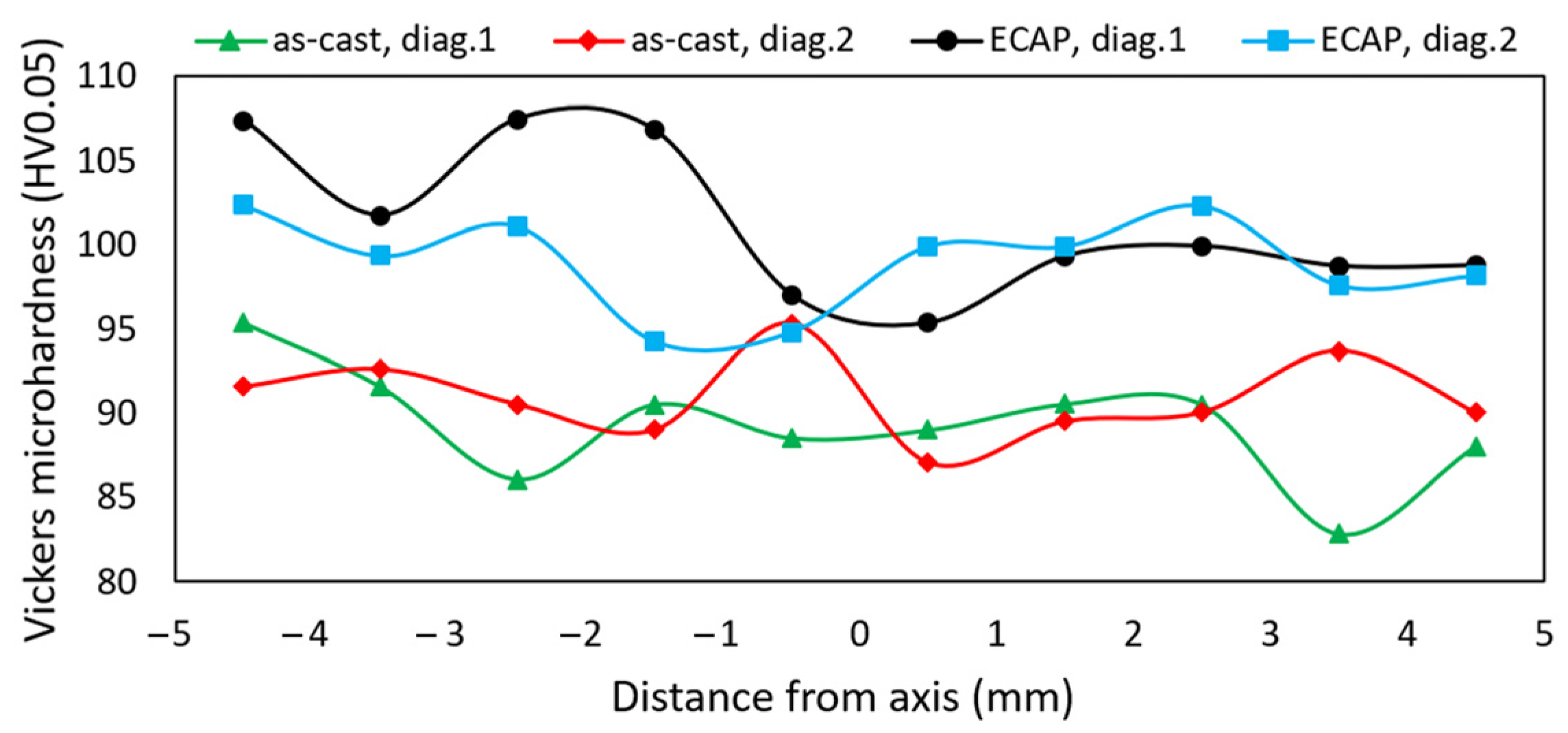
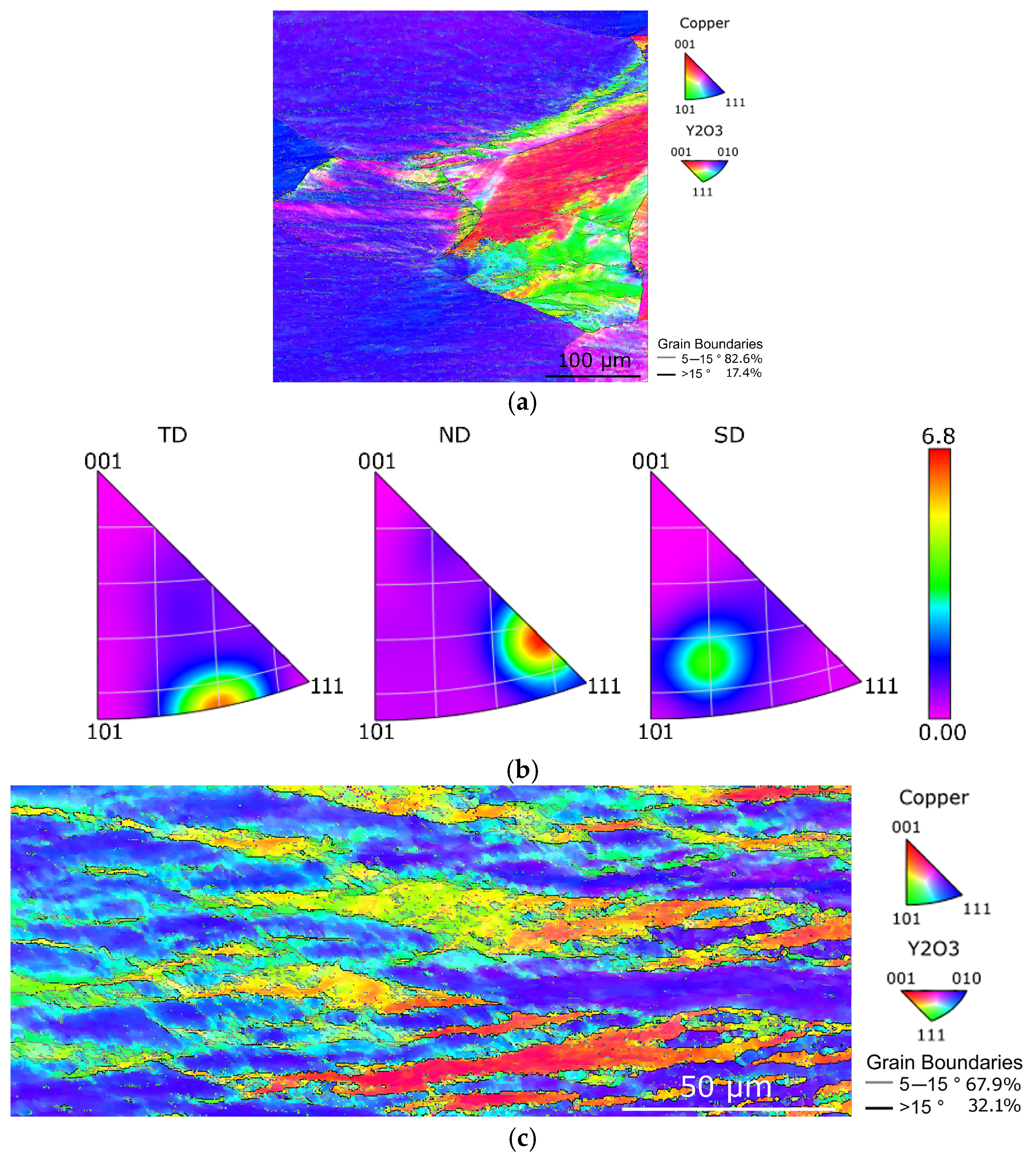
Cu-based alloys and composites are popular to prepare electroconductive parts. However, their processing can be challenging, especially in case of composites strengthened with oxides. To save the necessary time and costs, numerical simulations can be of help when determining the deformation behaviour of (newly introduced) materials. The study presents a combined method of strengthening of Cu by adding 5 wt.% of La2O3 particles and performing shear-based deformation by equal channel angular pressing (ECAP). The effects of the method on the microstructure, mechanical properties, and thermal stability of the composite are examined both numerically and experimentally. The results showed that the La2O3 addition caused the maximum imposed strain to be higher for the composite than for commercially pure Cu, which led to the development of subgrains and shear bands within the microstructure, and a consequent increase in microhardness. The numerical predictions revealed that the observed differences could be explained by the differences in the material plastic flow (comparing the composite to commercially pure Cu). The work hardening supported by the addition of La2O3 led to a significant increase in stress and punch load during processing, as well as contributed to a slight increase in deformation temperature in the main deformation zone of the ECAP die. Certain inhomogeneity of the parameters of interest across the processed workpiece was observed. Nevertheless, such inhomogeneity is typical for the ECAP process and steps prospectively leading to its elimination are proposed.
Keywords: copper; composite; equal channel angular pressing; finite element method; microstructure copper; composite; equal channel angular pressing; finite element method; microstructure