Article

Surface Integrity and Corrosion Resistance of Additively Manufactured AZ91 Mg Alloys Post-Processed by Laser Shock Peening

1
School of Materials Science and Engineering, Guangdong Ocean University, Yangjiang 529500, China
2
Centre for Advanced Laser Manufacturing (CALM), School of Mechanical Engineering, Shandong University of Technology, Zibo 255000, China
3
Guangdong-Hong Kong Joint Laboratory of Modern Surface Engineering Technology/Guangdong Provincial Key Laboratory of Modern Surface Engineering Technology, Institute of New Materials, Guangdong Academy of Sciences, Guangzhou 510651, China
4
Department of Mechanical Engineering, School of Engineering, College of Engineering Science and Technology, University of South Africa, Johannesburg 1709, South Africa
*
Author to whom correspondence should be addressed.
Metals 2025, 15(12), 1374; https://doi.org/10.3390/met15121374
Submission received: 30 October 2025 / Revised: 10 December 2025 / Accepted: 13 December 2025 / Published: 15 December 2025
(This article belongs to the Special Issue Laser Shock Peening: From Fundamentals to Applications)

Abstract

Mg alloys show great potential in biomedical fields due to superior biocompatibility and biodegradability. Additive manufacturing (AM) provides opportunities in fabricating metallic implants with complex geometries while inherent defects during AM limit its further applications. In this work, laser shock peening (LSP) was employed as a post-processing technique to tailor the surface integrity and corrosion resistance of additively manufactured AZ91 Mg alloy by selective laser melting (SLM). The surface morphology, microstructure and porosity, surface hardness and residual stress, and corrosion resistance of the SLMed alloy before and after LSP were examined. The results show that a gradient structure is formed along the depth direction after LSP and high-density dislocations and high-fraction low-angle grain boundaries are induced. The porosity is gradually reduced in number and size and the highest density of 1.794 g/cm3 is obtained after two impacts of LSP. The surface hardness and residual compressive stress both increase with LSP number and the highest values of 135.26 HV and 40.13 MPa after four impacts, respectively. All of the SLMed alloy samples show improved corrosion resistance after LSP. This work provides a promising route for enhancing the performance of additively manufactured Mg alloys through laser materials surface modification.

1. Introduction

Mg and its alloys have drawn considerable attention in biomedical fields due to their excellent mechanical properties, biocompatibility and biodegradability [1,2]. Specifically, their excellent biological properties, ultra-low density close to human bone, and no stress shielding phenomenon extensively promote their applications in biological fields [3]. However, conventional processing techniques, such as casting, forging and extrusion, have limitations in fabricating components with complex shapes or structures. Compared to traditional manufacturing processes, additive manufacturing (AM) techniques show superiority in developing complex and personalized geometries, and have emerged as promising methods for fabrication of metallic biomaterials [4,5]. Selective laser melting (SLM), an emerging AM technique belonging to the broad category of powder bed fusion, enables rapid prototyping of components with complex geometric features, thus greatly reducing design and production cycles [6]. Recently, SLM-produced Mg and its alloys have been investigated and exhibit great potentials in the future medical market [7,8]. However, owing to the low boiling point, high saturated vapor pressure and high affinity with oxygen of Mg element, severe elemental burnout and evaporation during SLM greatly deteriorate its integrity of mechanical properties [6]. Additionally, inherent defects during AM, such as porosities, residual tensile stress and anisotropy, obviously restrict its further applications especially in Mg alloys with poor corrosion resistance [9].
Laser shock peening (LSP) is a surface modification technique that enhances the surface integrity and macroscopic properties by tailoring the residual stress state and microstructure [10]. Compared to traditional shot peening, LSP provides better surface quality and deeper layer of residual compressive stress, making it suitable for processing AMed components. Now it has been successfully utilized to post-process AM-produced metallic materials, including Ti alloys, Al alloys, stainless steels and high-entropy alloys [11]. Bai et al. employed LSP to modify the surface microstructure and low-cycle fatigue performance of electron beam powder bed fusion processed Ti-6Al-4V alloy [12]. They found that the deeper gradient microstructure, work hardening layer, and residual compressive stress induced by LSP contributed to the improvement of low-cycle fatigue performance. Dou et al. investigated the influence of LSP energy on residual stress distribution and microstructural evolution of laser AMed AlSi10Mg alloy components [13]. A residual compressive stress layer and increased surface hardness with an affected depth of exceeding 2.0 mm were achieved after LSP, and the sub-grain formation was promoted by high laser energy. Thangamani et al. investigated the effect of LSP on biocompatibility and corrosion resistance of SS316L bone staples fabricated by wire arc AM technique [14]. Significant enhancement of corrosion resistance was achieved with a decrease in corrosion current density and corrosion rate. Tong et al. examined the microstructure, microhardness and residual stress of laser AMed CoCrFeMnNi high-entropy alloy subjected to LSP [15]. A thick hardened layer with high microhardness and transformation of tensile stress in the subsurface into compressive stress were also achieved after LSP. As for Mg alloys, Li et al. successfully adopted LSP as a post-treatment technique to modify the stress state and microstructure of AZ31 Mg alloy fabricated by wire-arc directed energy deposition [16]. However, until now there are very limited reports on LSP of AZ91 Mg alloy fabricated by SLM and a lack of detailed analysis of the surface modification mechanism. Hence, the present study made an attempt to explore the availability of LSP on SLMed AZ91 Mg alloy by evaluating its surface integrity and corrosion resistance. The influence of LSP and its impact number on surface morphology and roughness, microstructure evolution, porosity and density, harness and residual stress, and electrochemical corrosion resistance was investigated and relevant mechanism was discussed.

2. Materials and Methods

In this experiment, AZ91 (Mg-9.53Al-0.59Zn-0.28Mn, wt.%) Mg alloy samples were prepared via SLM with self-developed equipment by the Institute of New Materials of the Guangdong Academy of Sciences and input parameters shown in Figure 1a,b. The optimized SLM parameters are adopted as laser power of 120 W, scanning speed of 500 mm/s, hatch spacing of 45 µm, and layer thickness of 40 µm [3]. A 67° layer rotation scanning strategy was applied between layers, as illustrated in Fig. 1a. As shown in Figure 1b, an explosion-proof filter system was specially customized to store the recycled Mg-based powders. A focus-tunable lens device was mounted near the galvo mirror to slightly adjust the laser focal length and reduce keyhole-induced micro-pores during SLM [3]. In addition, two high-precision oxygen probes were equipped in the working chamber to detect the oxygen content. The spherical gas-atomized powder morphology and SLMed samples are also presented in Figure 1c. Subsequently, LSP was conducted to the samples as a post-treatment technique and 4 impacts of LSP were carried out to evaluate the effects of impact number. As shown in Figure 1a,d, Nimma-900 pulsed laser with a wavelength of 1064 nm, a pulse width of 9 ns, a laser frequency of 1 Hz, a spot diameter of about 1 mm, an overlap rate of 50%, and a laser power density of 1.87 GW/cm2 was used for the experiments. During LSP, as illustrated in Figure 1e, the short pulse of high peak power laser penetrates the confinement medium and irradiates the protective layer. The irradiated area rapidly heats up, resulting in the generation of a high temperature, high-pressure plasma. The diffusion of the plasma is then constrained by the confining layer, generating a shock wave that is transmitted to the sheet sample. The sample then undergoes plastic deformation at an extremely high strain rate, producing residual compressive stresses and strain strengthening [17]. The fatigue, corrosion and wear resistance of the strengthened materials can be significantly enhanced. In this experiment, a 20 μm-thick aluminum foil was used as the sacrificial layer, and a 5 mm-thick K9 glass was used as the confining layer.
Surface integrity, microstructure and corrosion resistance for the SLMed samples before and after different impacts of LSP were characterized. Surface roughness was characterized with a KMS laser spectroscopic confocal microscope (Nanjing KathMatic Technology Co., LTD, Nanjing, China), and 3D surface morphology and 2D profiles were measured at BD-TD surfaces illustrated in Figure 1c. After mechanical grinding, polishing and etching, the surface and cross-section microstructure of samples was observed using an Olympus optical microscope (Olympus Corporation, Tokyo, Japan). The porosity of the samples was evaluated based on optical micrographs, and the density was tested using an OHAUS JA11003N precision balance (OHAUS CORPORATION, Parsippany, NJ, USA). Crystallography-related information was analyzed by SIGMA500 scanning electron microscope (SEM) (Carl Zeiss AG, Oberkochen, Germany) equipped with an Oxford electron back-scattered diffraction (EBSD) probe. An area of about 70 μm × 70 μm was examined with the step size of 0.13 μm. The EBSD analysis was undertaken by the HKL CHANNEL 5.0 software package. D8 Advance X-ray diffractometer (XRD) (Bruker Corporation, Billerica, Germany) was used to determine the phase composition, with Cu Kɑ radiation operated with 50 kV/20 mA. The continuous scan rate of 2°/min with a step of 0.02° was adopted when the diffraction angle varied from 20° to 90°. A digital microhardness tester (200HVS-5, Hangzhou Laihua Testing Instrument Co., LTD, Hangzhou, China) was used to measure the surface and cross-section hardness. The test force was 9.807 N and the dwelling time was 15 s, and each test was repeated five times to obtain an average value. The surface residual stress was tested using an Xstress 3000G2R residual stress analyzer (Stresstech Oy, Vaajakoski, Finland) and each sample was tested five times to obtain representative results. The surface wettability was tested by a JC2000D11 contact angle meter (Shanghai Zhongchen Digital Technology Equipment Co., LTD, Shanghai, China). A three-electrode system was employed in the electrochemical corrosion experiments. The Tafel polarization curves of the samples in 3.5% NaCl solution were tested using VERTEX.5A electrochemical workstation (Ivium Technologies B.V., Eindhoven, The Netherlands) with a scanning rate of 5 mV/s, ranging from −3.5 V to 0.5 V. The electrochemical impedance spectroscopy (EIS) test was performed with a frequency range of 10−1 Hz to 105 Hz and an amplitude of 10 mV. The surface morphology after corrosion was observed with Quantum 250 FEG SEM (Thermo Fisher Scientific/FEI, Hillsboro, OR, USA), and the elemental content was determined by energy dispersive spectrometer (EDS) (Oxford Company, Tokyo, Japan).

3. Results

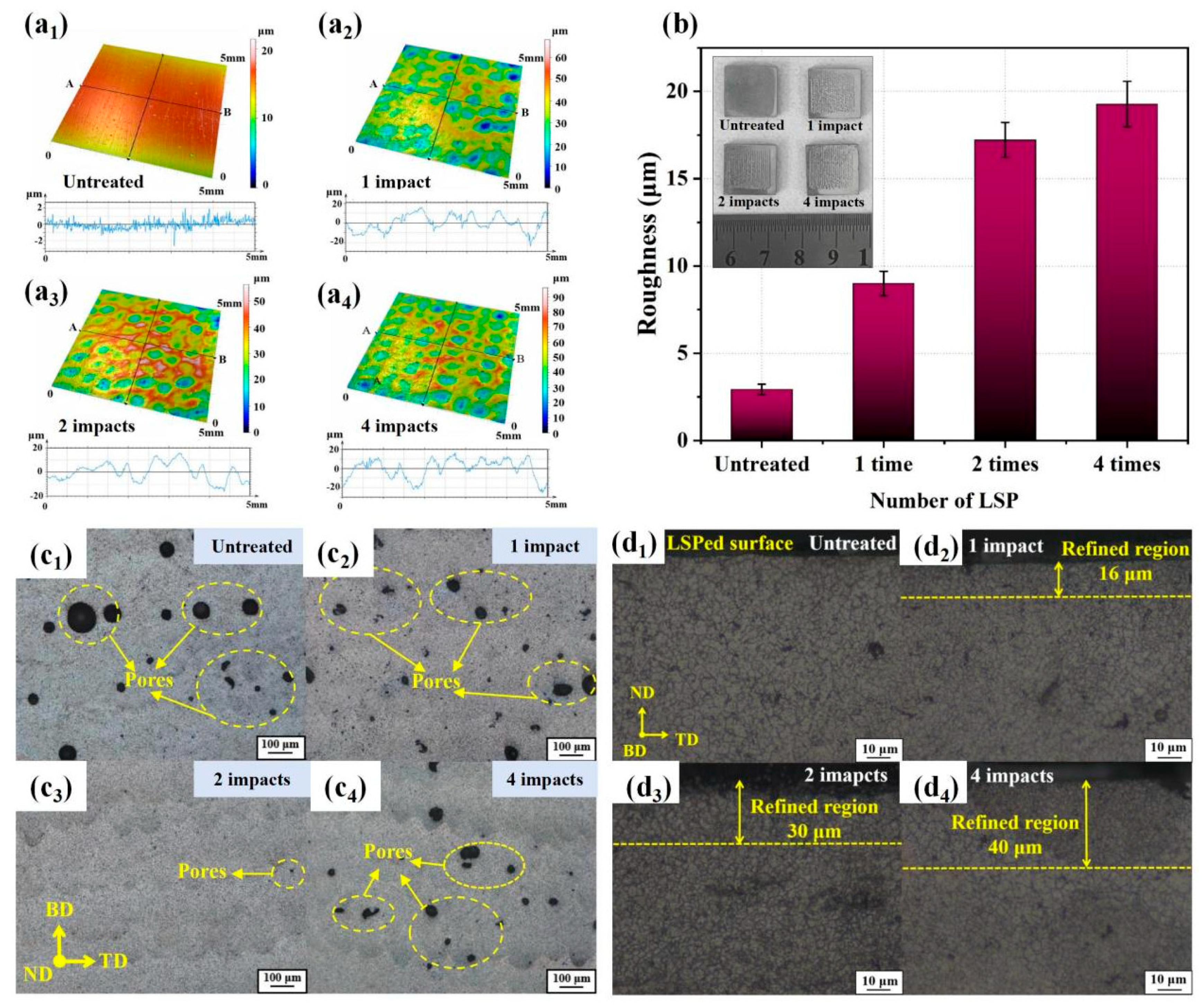
Usually the traditional materials processing and manufacturing mainly aim for lower surface roughness, that is, higher surface accuracy and quality. However, the influence of surface roughness on potential implant materials like Mg alloys is complex and difficult to evaluate. On one hand, the roughness will have an impact on the contact angle as well as wettability of the surface, and will further affect the corrosion resistance of the materials. On the other hand, as for biological implant materials, the biocompatibility and degradability are very important and related to the surface wettability [18]. Generally, a highly wettable surface could accelerate the corrosion process while promoting cell attachment. In addition, accelerated and uncontrollable degradation is not acceptable. In order to reveal the influence of LSP on surface morphology and roughness, Figure 2a shows 3D surface morphology and 2D cross-section profiles of SLMed samples before and after LSP, and Figure 2b gives corresponding surface roughness values. Evidently, the surface roughness of the as-polished sample is about 2.93 μm, which gradually increases with LSP number and reaches 19.27 μm after four impacts. The increase in surface roughness of LSPed samples is basically attributed to the formation of craters on the surface due to the mechanical and thermal action of the laser pulse [11]. It is worth mentioning that the initial roughness of the unpolished sample is about 15.47 μm. Mg has a narrow temperature range between boiling and melting points and evaporates more easily than other alloying elements during high-power laser input. Thus, the surface roughness of SLMed parts is high and defects, such as porosity and thermal cracks, appear [19,20]. In our previous work regarding the influence of LSP on the unpolished SLMed samples, an obvious decrease in surface roughness was achieved after LSP, owing to the introduced mechanical and limited thermal effects [21]. By means of the high-energy pulsed laser during LSP and its induced high-temperature and high-pressure plasma, on the one hand, it introduces intense plastic deformation to the sample surface through its mechanical effect; on the other hand, the repetition of LSP delays the increase in surface roughness by enhancing the uniformity of deformation.
It is well known that many challenges exist to manufacture Mg alloys by SLM, such as poor weldability due to a low boiling point and excellent affinity for oxygen, easily producing hot cracks owing to a large coefficient of thermal expansion, and readily producing micro-pores caused by the hydrogen escape and high vaporization pressure phenomena [3]. The instability of the molten pool during the AM process can easily lead to splashing or evaporation, resulting in pore defects and causing significant impact on the performance of components. The surface optical micrographs shown in Figure 2c indicate that a large number of pores exist within the untreated alloy and their size and number decrease gradually with LSP number, indicating that LSP effectively reduces the pore defects of SLMed Mg alloy. This suggests that the metal flow induced by mechanical external forces generally closes the internal pores of the AMed sample [22]. The pulsed laser with high energy density generates a high-pressure shock wave on the sample surface. During the transmission of the shock wave to the interior, the material undergoes compressive deformation, and the pores may close or partially close under pressure [23]. In addition, as the number of impacts increases, the effect of the shock wave intensifies, the pores are further closed, and their volume fraction is much more reduced. Generally, the intense plastic deformation introduced by LSP causes the near-surface pores to close under compression. The reduction in the number of pores increases the effective cross-section area of the components, enhances their density, and may accordingly improve their load-bearing capacity. In addition to the reduction in quantity, the aspect ratio of the remaining pores has decreased, becoming closer to a spherical shape, which leads to a decrease in the stress concentration coefficient around the pores [24]. This confirms the availability of LSP in improving the internal porosity defects of AMed components. The cross-section microstructure before and after the LSP is shown in Figure 2d. Obviously, relatively fine grains are obtained during SLM process, and a gradient structure is induced after LSP. The depth of the refined region is about 16 μm and 30 μm after one and two impacts, and reaches about 40 μm after four impacts. It has been demonstrated that LSP produces grain refinement in the near-surface zone, which affects mechanical properties like hardness and tensile properties [25].
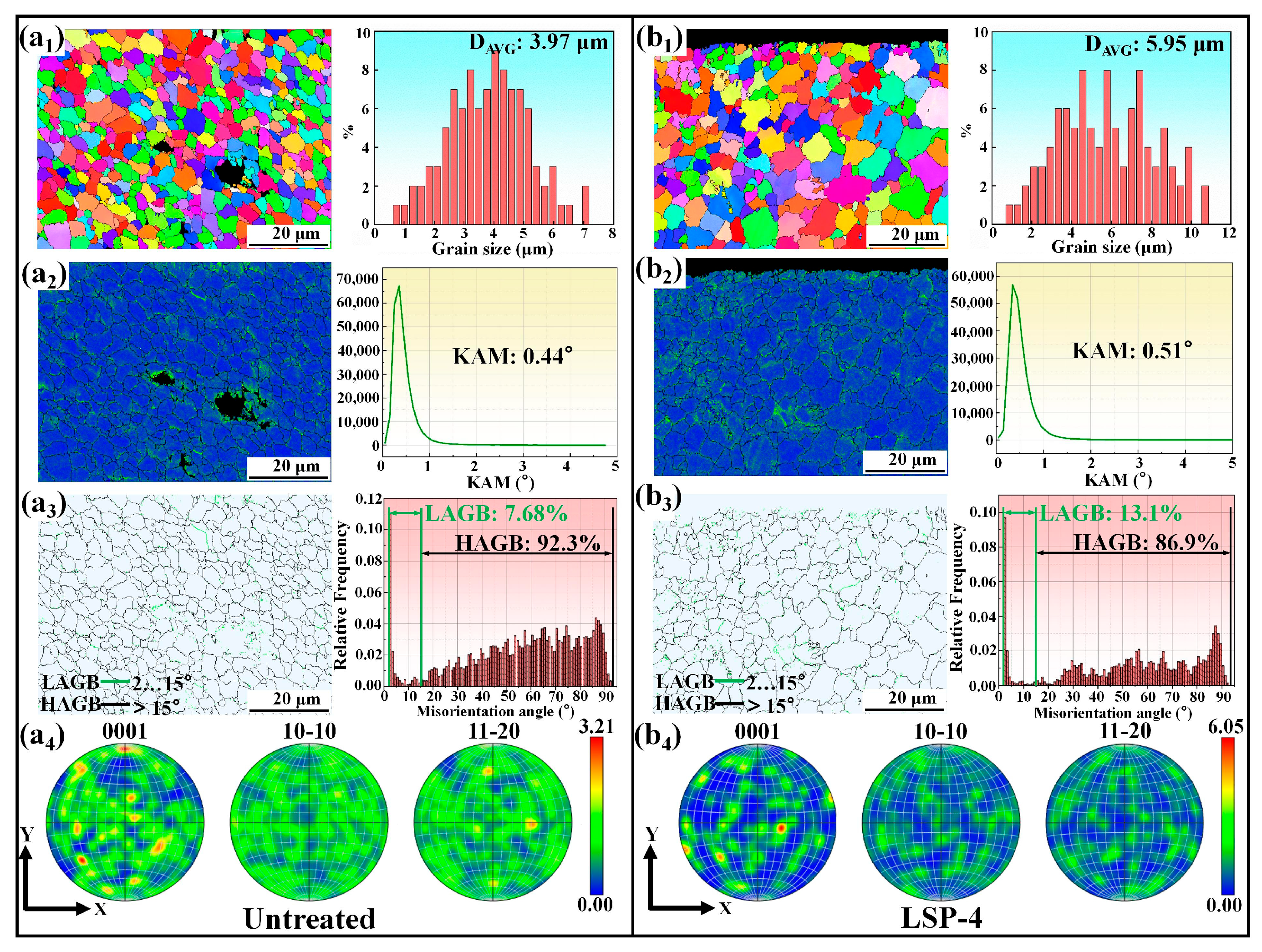
To further investigate the cross-section microstructure evolution of the SLMed samples before and after LSP, Figure 3 presents the near-surface EBSD analysis results of the untreated and LSPed samples after four impacts. As shown in Figure 3(a1–a4), the SLMed sample mainly consists of equiaxed and refined grains with relatively random orientation distribution, and the average grain size is approximately 3.97 μm. The average kernel average misorientation (KAM) value is about 0.44°, and the grain boundaries are predominantly high-angle grain boundaries (HAGBs), accounting for 92.3%. PF analysis further indicates that the maximum pole intensity of the sample is approximately 3.21. This is primarily attributed to the intrinsic rapid melt-solidification process during SLM and its interlayer rotation scanning strategy, limiting the grain growth along preferred crystallographic orientations. In contrast, for LSPed sample, EBSD results presented in Figure 3(b1–b4) demonstrate that LSP induces gradient structure within the near-surface region although limited grain refinement is observed with the grain size of about 5.95 μm due to the ununiform plastic deformation and initially refined microstructure. After LSP, the average KAM value is increased to 0.51°, while the proportion of HAGBs slightly decreases to 86.9%, accompanied by a relevant increase in high-angle grain boundaries (LAGBs) to 13.1%. This indicates that LSP promotes severe plastic deformation within the near-surface region, which enhances lattice distortion and increases dislocation density [26]. The accumulated dislocations tend to entangle and gradually rearrange into sub-boundary structures, thereby increasing the fraction of LAGBs. Furthermore, the PF shows that the maximum intensity reaches 6.05, higher than that of the initial sample, suggesting the shock loading facilitates the preferential alignment of certain grain orientations [27].
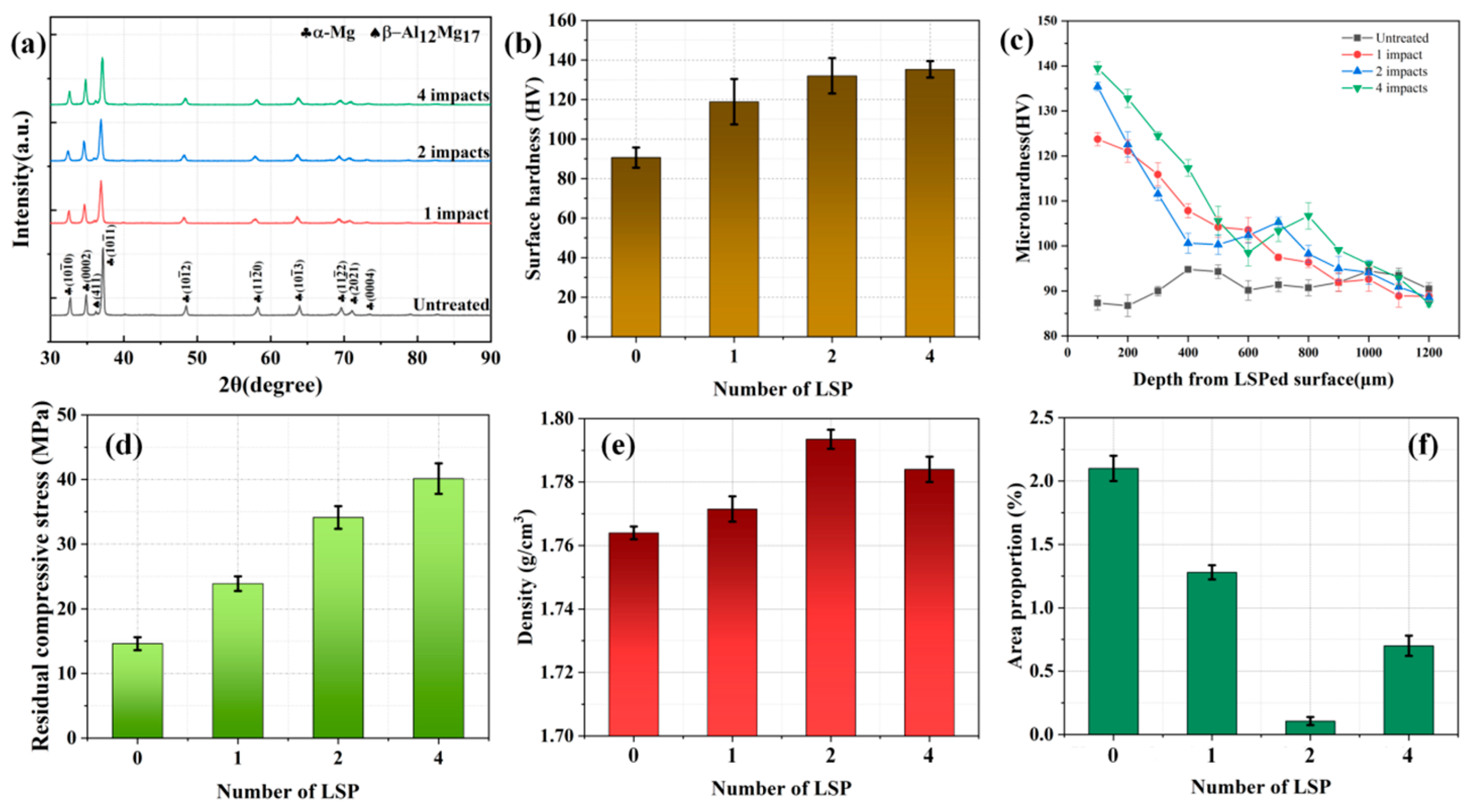
To further evaluate the influence of LSP on the microstructure evolution and phase composition of the surface layer, the XRD patterns of the SLMed samples before and after LSP are shown in Figure 4a. It can be found that the main phases are still ɑ-Mg and β-Al12Mg17. There are no additional diffraction peaks after LSP, indicating that there is no phase transformation and no new crystalline phase appears. The ( 10 1 ¯ 0 ), ( 0002 ), ( 10 1 ¯ 1 ), and ( 10 1 ¯ 2 ) peaks show different degrees of broadening, which indicates the combined effect of grain refinement and microscopic strain. Thus, this suggests the presence of the gradient grain refinement layer. Based on the surface and cross-section microstructure observations, it can be inferred that LSP, as a post-treatment, introduces obvious plastic deformation on the surface layer of SLMed Mg alloy samples, which could produce a certain degree of grain refinement and thereby effectively improve their surface integrity.
Figure 4b,c show the variations in surface hardness and cross-section hardness of the samples along the depth direction before and after LSP. The surface hardness increases gradually from 90.63 HV for the SLMed sample to 135.26 HV after four impacts of LSP by around 50%. It demonstrates LSP introduces a work hardening effect on the near-surface layer while there is a tendency of gradual saturation of the surface hardness with the increase in LSP number. Basically, the increase in surface hardness after LSP is mainly due to factors, such as work hardening caused by surface severe plastic deformation, fine-grained strengthening, and the induced surface residual compressive stress state [28]. With the accumulation of impacts, the increase in hardness of the strengthened sample surfaces has an inhibitory effect on the subsequent treatment, that is, the surface strengthening effect is no longer significant, and the change in hardness level tends to stabilize [29]. The accumulation of internal plastic deformation in materials after LSP usually increases their hardness. During LSP, grain refinement mainly occurs near the surface, while the deeper influence layer is introduced by diffusing inward through plastic deformation. As shown in Figure 4c, the cross-section hardness reveals a gradient distribution along the depth direction, which is basically more significant with the number of LSP. With increasing distance from the peened surface, the hardness gradually decreases to the level of the parent material and then remains constant, which may be due to the attenuation of shock wave pressure [30,31]. Meanwhile, LSP introduces high-density dislocations, leading to surface hardening. As the depth increases, the dislocation density gradually decreases, resulting in a corresponding reduction in hardness levels. With the increase in the number of impacts, the hardness distribution gradient level gradually rises, and it is most significant after four impacts, and the depth of the affected layer is approximately maintained at 500 μm.
During the AM process, the repeated rapid heating and cooling of the deposited layer cause the metal to undergo complex thermal cycles, which have a significant impact on the residual stress distribution of the components. Residual stress and its distribution are the key factors affecting the fatigue performance of components [32]. The existence of the residual compressive stress field can effectively inhibit the initiation and propagation of cracks and plays an important role in improving the fatigue performance of materials. Figure 4d presents the variation in residual stress on the sample surface before and after LSP. The residual compressive stress of the SLMed sample is about 14.60 MPa, and after LSP, the residual compressive stress level is significantly enhanced. After four impacts, the residual compressive stress value of the LSPed sample reaches 40.13 MPa by an increase of about 170%. Previous reports confirmed that LSP could adjust the surface residual stress state of AMed Ti6Al4V alloy from tensile stress to compressive stress [33]. During LSP, the kinetic energy of the laser-induced high-pressure plasma shock wave propagating into the sample is mainly converted into plastic strain energy, causing severe plastic deformation near the surface and generating residual compressive stress within the affected layer. Owing to higher power densities, local volume changes due to plastic strain are more intense and can reach farther below the surface, resulting in deeper residual compressive stresses [34]. Increasing the number of impacts to a certain extent improves the coverage of LSP, suggesting that an increase in coverage may lead to an increase in surface residual compressive stress. When multiple LSP treatments are carried out, the high-pressure shock wave generated by the second impact attenuates as it passes through the hardened layer produced by the previous impact, while generating greater residual compressive stress. Subsequently, the effect of increasing the number of impacts on residual stress is no longer significant. The reason is that the residual stress on the surface after multiple impacts tends to be uniform, a large amount of plastic deformation accumulates, and the work hardening effect is significant. The influence of increasing impacts on the degree of near-surface plastic deformation is significantly weakened. The laser pulse during LSP generates plasma on the sample surface, which produces a shock wave in the material when the plasma expands. This wave in turn produces plastic deformation and embeds mechanical stresses [35]. Typically, high strain levels in deformed metallic materials favor slip and thus promote formation of dislocation structures [36]. In order to quantificationally evaluate the influence of LSP on porosity, the sample density and pore area proportion calculated from optical micrographs are provided in Figure 4e,f. Generally, the initial density of about 1.764 g/cm3 is obviously increased after LSP and the highest value of 1.794 g/cm3 is obtained after two impacts. Correspondingly, the sample porosity is significantly reduced by LSP and the lowest value is also achieved after two impacts. The relative density of the as-SLMed sample is calculated to be about 98.0%, which is increased to about 99.6% after two impacts of LSP. Generally the SLM defects are gradually reduced with an increase in LSP number and the optimal results are achieved after two impacts. However, continuing the increase in LSP number induces slight recovery in defects, which may be caused by the limitation of just repeating the LSP process with constant pulse energy and excessive thermal effect introduced by more repetition of LSP.
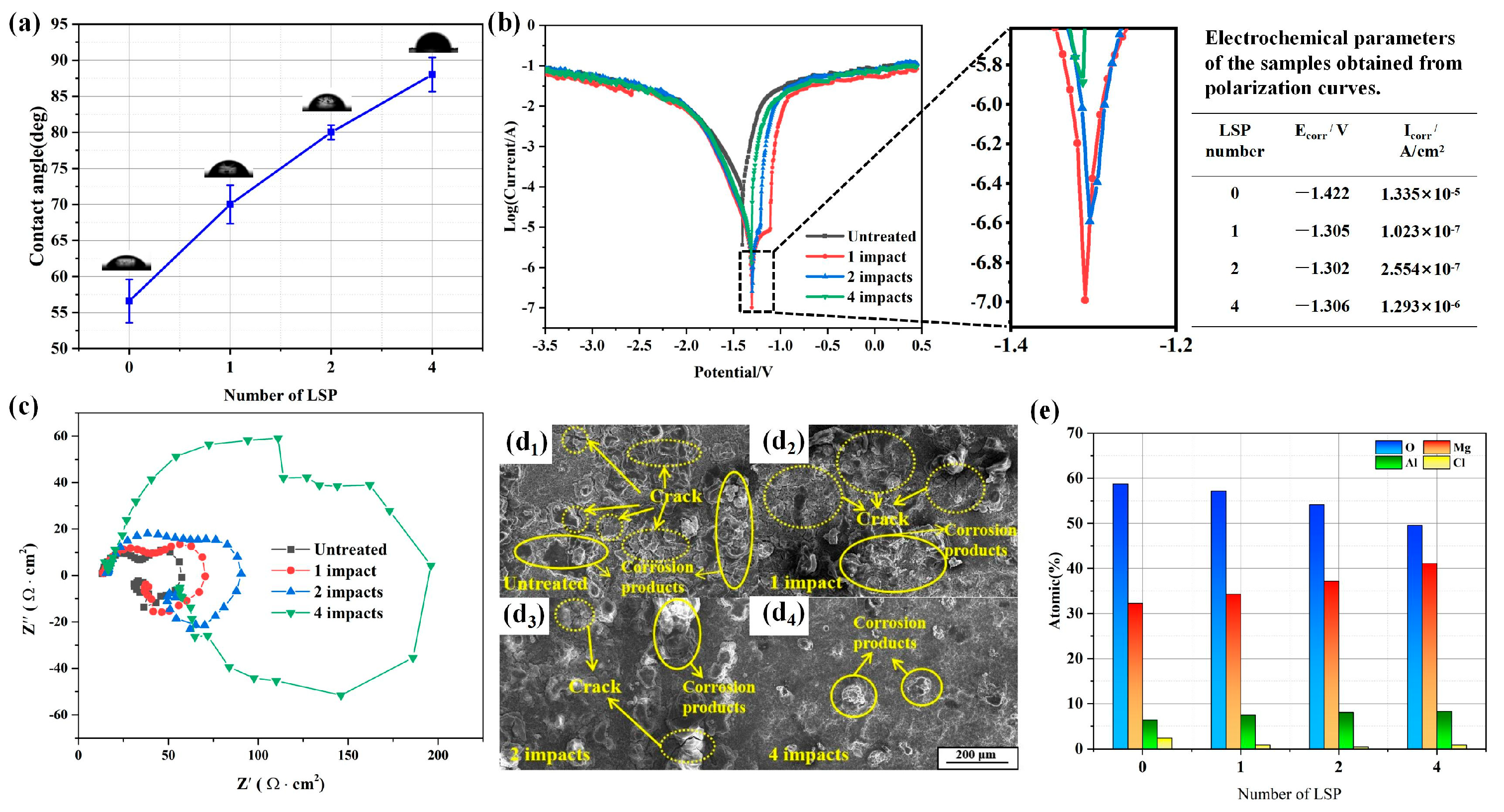
The contact angle is a key indicator for evaluating the wettability of metal surfaces and is also one of the important factors determining the corrosion resistance of metals in corrosive media. To evaluate the surface wettability of SLMed samples before and after LSP, the contact angles are shown in Figure 5a. It can be seen that, with the increase in the number of impacts, the contact angle of the material shows a significant increase from the initial 56.6° to 88.1° after four impacts. It is well known that the surface wettability and corrosion resistance are closely related to the contact angle. The sample surface is less likely to come into contact with corrosive media with a higher contact angle, and the improved corrosion resistance could be achieved [37]. The increase in the contact angle after LSP will improve the corrosion resistance of the sample to a certain extent although all contact angles are less than 90° and exhibit hydrophilicity.
The polarization curve can reflect the thermodynamic and kinetic characteristics of corrosion. The corrosion current density reflects the corrosion kinetic characteristics, that is, the corrosion rate, while the corrosion potential reflects the corrosion thermodynamic characteristics, that is, the trend of the corrosion reaction. The Tafel polarization curves and calculated corrosion potential and corrosion current density are shown in Figure 5b. It is found that there are various degrees of positive displacement of the corrosion potential and reduction in corrosion current density after LSP, indicating a decrease in the corrosion tendency and corrosion rate, respectively [38]. For example, the initial corrosion potential and corrosion current density are −1.422 V and 1.335 × 10⁻⁵ A/cm2, respectively. After two impacts of LSP, the corrosion potential increases to −1.302 V and the corrosion current density decreases to 2.554 × 10⁻⁷ A/cm2. The positive shift of the corrosion potential after LSP indicates that LSP can effectively enhance the corrosion resistance of samples, and the corrosion resistance continues to improve with the increase in impacts. Meanwhile, the lower the corrosion current density is, the greater the charge transfer resistance of the material is, and the slower the rate of electrochemical reaction occurs, thereby demonstrating superior corrosion resistance. In addition, the short passive state regarding the polarization curves after one and two impacts of LSP might be interpreted by the surface intense reactions with solution during the formation of dense and stable oxide film. The Nyquist plots is shown in Figure 5c. The diameter of the capacitance ring represents the charge transfer impedance during corrosion [39]. Generally, the larger the diameter of the capacitance ring, the lower the rate of dissolution by the corrosion solution, and the better the corrosion resistance of the sample. Accordingly, the increase in ring diameter with LSP number also reflects the enhancement of corrosion resistance. The surface morphology after electrochemical corrosion is shown in Figure 5d. It can be seen that severe corrosion behavior has occurred on the surface of the as-SLMed sample. Corrosion products almost covering the entire surface have appeared on the surface, accompanied by corrosion pits. After corrosion, many large and deep cracks have also emerged. As the LSP number increases, the surface slowly develops from more and larger corrosion cracks and more corrosion products for the as-SLMed sample to smaller and fewer cracks and fewer corrosion products. This change indicates a certain increase in the corrosion resistance of the alloy. Figure 5e also provides the EDS analysis of sample surface after electrochemical corrosion. It can be found that, with the increase in LSP number, the content of Mg element has increased, which indicates that the Mg element on the surface has been effectively protected. The O element on the surface shows a decreasing trend after LSP, and this trend becomes more and more obvious with the increase in impacts, indicating that the corrosion products generated during the electrochemical corrosion process are reduced. Meanwhile, the content of Cl element is gradually reduced, suggesting the decrease in the amount of Cl- invading into the matrix and the enhancement of corrosion resistance of the SLMed Mg alloy.

4. Discussion

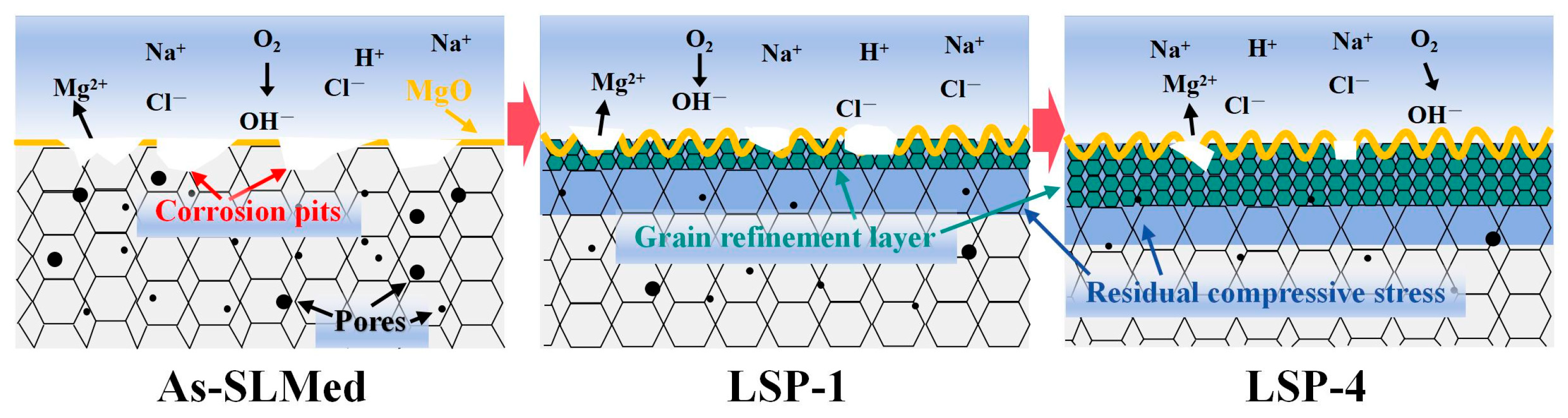
The possible mechanism by which LSP enhances the corrosion resistance of AMed AZ91 Mg alloy fabricated by SLM is illustrated in Figure 6. Generally, the improvement in corrosion resistance after LSP may be due to the introduction of significant residual compressive stress on the surface of AZ91 Mg alloy by LSP. The grain refinement caused by plastic deformation forms a refined layer. The surface residual compressive stress and the refined grain layer effectively prevent the corrosive liquid from penetrating into the sample. At the same time, the MgO protective film formed on the sample surface after impact will also play a role in protecting the alloy matrix from corrosion. As shown in Figure 6, the MgO film formed on the surface of the as-SLMed sample is easily damaged by Cl due to its relatively coarse grain microstructure, leading to accelerated local corrosion. In contrast, the surface severe plastic deformation induced by LSP results in a gradient structure as well as fine near-surface grains and increased grain boundary density, which effectively hinders the penetration of corrosive liquid into the interior. Moreover, the introduction of the residual compressive stress layer by LSP significantly enhances the ability of Mg alloys to resist the propagation of corrosion cracks. The high-density grain boundaries could delay the corrosion process through the following approaches: increasing the complexity of corrosion crack propagation path and suppressing the local concentration of galvanic corrosion [40]. In summary, the LSP process achieves the synergistic optimization for corrosion resistance of the AMed Mg alloy by regulating the surface residual stress field and microstructure characteristics. In addition, the present study mainly evaluates the influence of LSP number whereas only repeating the LSP process with the same pulse energy may contribute very little to the results. Thus, the effect of laser pulse energy on LSP of SLMed Mg alloys is in progress.

5. Conclusions

In this work, as a post-treatment technique, LSP is successfully employed to tailor the surface integrity and corrosion resistance of the AMed AZ91 Mg alloy fabricated by SLM. A gradient microstructure is fabricated by LSP and high-density dislocations and high-fraction LAGBs are introduced. The number and size of pores are gradually reduced and the sample density is increased from 1.764 g/cm3 to 1.794 g/cm3 after two impacts. The surface hardness and residual compressive stress increase from the initial 90.63 HV and 14.60 MPa to 135.26 HV and 40.13 MPa after four impacts, respectively. All of the SLMed samples exhibit enhanced corrosion resistance after LSP, indicated by the positive displacement of corrosion potential and reduction in corrosion current density as well as improved corrosion surface morphology.

Author Contributions

Conceptualization, Z.W.; methodology, X.Z., W.Y. and Z.W.; investigation, S.G., W.W., X.Z., W.Y., H.Z., X.Y., C.C., H.M.N. and X.C.; resources, S.G., H.Z. and X.Y.; data curation, W.W., X.Z. and X.C.; writing—original draft preparation, W.W.; writing—review and editing, C.C., H.M.N. and Z.W.; supervision, Z.W.; project administration, H.Z.; funding acquisition, S.G., H.Z., X.Y., X.C. and Z.W. All authors have read and agreed to the published version of the manuscript.

Funding

This research was funded by National Natural Science Foundation of China (U24A20109), Shandong Provincial Natural Science Foundation (ZR2023ME134 and ZR2022ZD07), Shandong Provincial Key Research and Development Plan Project (2025CXPT053), Scientific Innovation Project for Young Scientists in Shandong Provincial Universities (2021KJ068), Guangdong Basic and Applied Basic Research Foundation (2024A1515011024), Shandong Key Laboratory of Advanced Engine Piston Assembly (BH202507) and program for scientific research start-up funds of Guangdong Ocean University (360302032503 and 360302032504).

Data Availability Statement

The original contributions presented in this study are included in the article. Further inquiries can be directed to the corresponding author.

Conflicts of Interest

The authors declare no conflicts of interest.

Abbreviations

The following abbreviations are used in this manuscript:
AMAdditive manufacturing
LSPLaser shock peening
SLMSelective laser melting
SEMScanning electron microscope
XRDX-ray diffractometer
EDSEnergy dispersive spectrometer
EBSDElectron back-scattered diffraction
HAGBsHigh-angle grain boundaries
LAGBsLow-angle grain boundaries
KAMKernel average misorientation

References

  1. Chen, L.; Blawert, C.; Yang, J.; Hou, R.; Wang, X.; Zheludkevich, M.L.; Li, W. The stress corrosion cracking behaviour of biomedical Mg-1Zn alloy in synthetic or natural biological media. Corros. Sci. 2020, 175, 108876. [Google Scholar] [CrossRef]
  2. Gonzalez, J.; Hou, R.Q.; Nidadavolu, E.P.S.; Willumeit-Römer, R.; Feyerabend, F. Magnesium degradation under physiological conditions—Best practice. Bioact. Mater. 2018, 3, 174–185. [Google Scholar] [CrossRef]
  3. Chang, C.; Liao, H.; Yi, L.; Dai, Y.; Cox, S.C.; Yan, M.; Liu, M.; Yan, X. Achieving ultra-high strength and ductility in Mg–9Al–1Zn–0.5Mn alloy via selective laser melting. Adv. Powder Mater. 2023, 2, 100097. [Google Scholar] [CrossRef]
  4. Cho, D.H.; Dean, D.; Luo, A.A. Mechanical and corrosion properties of full liquid phase sintered WE43 magnesium alloy specimens fabricated via binder jetting additive manufacturing. J. Magnes. Alloys 2024, 12, 2711–2724. [Google Scholar] [CrossRef]
  5. Fu, Q.; Liang, W.; Huang, J.; Jin, W.; Guo, B.; Li, P.; Xu, S.; Chu, P.K.; Yu, Z. Research perspective and prospective of additive manufacturing of biodegradable magnesium-based materials. J. Magnes. Alloys 2023, 11, 1485–1504. [Google Scholar] [CrossRef]
  6. Li, X.; Fang, X.; Wang, S.; Wang, S.; Zha, M.; Huang, K. Selective laser melted AZ91D magnesium alloy with superior balance of strength and ductility. J. Magnes. Alloys 2023, 11, 4644–4658. [Google Scholar] [CrossRef]
  7. Yadroitsev, I.; Gusarov, A.; Yadroitsava, I.; Smurov, I. Single track formation in selective laser melting of metal powders. J. Mater. Process. Technol. 2010, 210, 1624–1631. [Google Scholar] [CrossRef]
  8. Yadroitsev, I.; Krakhmalev, P.; Yadroitsava, I.; Johansson, S.; Smurov, I. Energy input effect on morphology and microstructure of selective laser melting single track from metallic powder. J. Mater. Process. Technol. 2013, 213, 606–613. [Google Scholar] [CrossRef]
  9. Chen, Z.; Wu, X.; Tomus, D.; Davies, C.H.J. Surface roughness of Selective Laser Melted Ti-6Al-4V alloy components. Addit. Manuf. 2018, 21, 91–103. [Google Scholar] [CrossRef]
  10. Zhang, Y.; Guo, W.; Zhang, H.; Han, P.; Li, S.; Zhao, J.; Cui, Z.; Zhu, Y.; Zhang, H. Synergistic enhancement of strength and plasticity for laser direct energy deposited Ti60 joint by locally applied laser shock peening. Mater. Sci. Eng. A 2025, 932, 148255. [Google Scholar] [CrossRef]
  11. Jiang, Q.; Li, S.; Zhou, C.; Zhang, B.; Zhang, Y. Effects of laser shock peening on the ultra-high cycle fatigue performance of additively manufactured Ti6Al4V alloy. Opt. Laser Technol. 2021, 144, 107391. [Google Scholar] [CrossRef]
  12. Bai, C.; Lan, L.; Jiang, L.; He, B.; Li, Y.; Zhang, Y. Improvement of low-cycle fatigue properties in electron beam powder bed fusion processed Ti-6Al-4V alloy by laser shock peening. Eng. Fract. Mech. 2025, 319, 110992. [Google Scholar] [CrossRef]
  13. Dou, S.; Ji, P.; Zhang, J.; Zheng, L.; Zhao, F.; Lian, Y.; Xu, W.; Chen, X.; Wu, L.; Luo, J.; et al. Effect of laser shock peening on near-surface residual stress and microstructure of laser additive manufacturing AlSi10Mg alloy. Opt. Laser Technol. 2025, 189, 113114. [Google Scholar] [CrossRef]
  14. Sandmann, P.; Keller, S.; Kashaev, N.; Ghouse, S.; Hooper, P.A.; Klusemann, B.; Davies, C.M. Influence of laser shock peening on the residual stresses in additively manufactured 316L by Laser Powder Bed Fusion: A combined experimental–numerical study. Addit. Manuf. 2022, 60, 103204. [Google Scholar] [CrossRef]
  15. Tong, Z.; Liu, H.; Jiao, J.; Zhou, W.; Yang, Y.; Ren, X. Microstructure, microhardness and residual stress of laser additive manufactured CoCrFeMnNi high-entropy alloy subjected to laser shock peening. J. Mater. Process. Technol. 2020, 285, 116806. [Google Scholar] [CrossRef]
  16. Li, X.; Fang, X.; Zhang, M.; Zhang, H.; Duan, Y.; Huang, K. Gradient microstructure and prominent performance of wire-arc directed energy deposited magnesium alloy via laser shock peening. Int. J. Mach. Tools Manuf. 2023, 188, 104029. [Google Scholar] [CrossRef]
  17. Jia, M.; Wang, Y.; Yue, J.; Cao, C.; Li, K.; Yu, Y.; Li, Y.; Lu, Z. Recent progress in laser shock peening: Mechanism, laser systems and development prospects. Surf. Interfaces 2024, 44, 103757. [Google Scholar] [CrossRef]
  18. Luo, K.; Sun, M.; Lu, J.; Zhang, Q.; Jiang, X.; Wang, C.; Lu, J. The effect of laser shock peening with and without coating on microstructure and electrochemical corrosion behavior of AZ31b magnesium alloy. Surf. Coat. Technol. 2025, 496, 131709. [Google Scholar] [CrossRef]
  19. Zhang, W.-n.; Wang, L.-z.; Feng, Z.-x.; Chen, Y.-m. Research progress on selective laser melting (SLM) of magnesium alloys: A review. Optik 2020, 207, 163842. [Google Scholar] [CrossRef]
  20. Pawlak, A.; Rosienkiewicz, M.; Chlebus, E. Design of experiments approach in AZ31 powder selective laser melting process optimization. Arch. Civ. Mech. Eng. 2017, 17, 9–18. [Google Scholar] [CrossRef]
  21. Wang, W.; Zhao, X.; Yu, W.; Zheng, H.; Wang, Z. Effect of Laser Shock Peening on Surface Integrity of Additively Manufactured MgAlloy. Surf. Technol. 2025, 54, 173–183. [Google Scholar] [CrossRef]
  22. Tong, Z.; Liu, H.; Jiao, J.; Zhou, W.; Yang, Y.; Ren, X. Improving the strength and ductility of laser directed energy deposited CrMnFeCoNi high-entropy alloy by laser shock peening. Addit. Manuf. 2020, 35, 101417. [Google Scholar] [CrossRef]
  23. Xiao, J.; Guo, W.; Zhang, H.; Dai, W.; Zhu, Y.; Cong, B.; Qi, Z.; Zhu, H.; Ren, X.; Li, M. Microstructure and mechanical properties of wire and arc additive manufactured 2319 aluminum alloy treated by laser shock peening. Mater. Charact. 2024, 217, 114354. [Google Scholar] [CrossRef]
  24. Kalentics, N.; de Seijas, M.O.V.; Griffiths, S.; Leinenbach, C.; Logé, R.E. 3D laser shock peening—A new method for improving fatigue properties of selective laser melted parts. Addit. Manuf. 2020, 33, 101112. [Google Scholar] [CrossRef]
  25. Ye, Y.; Feng, Y.; Lian, Z.; Hua, Y. Mold-free fs laser shock micro forming and its plastic deformation mechanism. Opt. Lasers Eng. 2015, 67, 74–82. [Google Scholar] [CrossRef]
  26. Kong, M.; Zang, T.; Wang, Z.; Zhu, L.; Zheng, H.; Gao, S.; Ngwangwa, H.M. A study on the tribological behavior of AZ31 magnesium alloy sheets processed by temperature-assisted ultrasonic shot peening. J. Mater. Res. Technol. 2023, 27, 1223–1241. [Google Scholar] [CrossRef]
  27. Yang, B.; Tan, C.; Zhao, Y.; Wu, L.; Chen, B.; Song, X.; Zhao, H.; Feng, J. Influence of ultrasonic peening on microstructure and surface performance of laser-arc hybrid welded 5A06 aluminum alloy joint. J. Mater. Res. Technol. 2020, 9, 9576–9587. [Google Scholar] [CrossRef]
  28. Zang, T.; Wang, Z.; Chen, L.; Kong, M.; Gao, S.; Ngwangwa, H.M.; Zhu, L.; Yu, W.; Zheng, H. Influence of pulse energy on surface integrity of AZ31 magnesium alloy processed by femtosecond laser shock peening. J. Mater. Res. Technol. 2023, 25, 4425–4440. [Google Scholar] [CrossRef]
  29. Li, Y.; Ren, Z.; Jia, X.; Yang, W.; Nassreddin, N.; Dong, Y.; Ye, C.; Fortunato, A.; Zhao, X. The effects of the confining medium and protective layer during femtosecond laser shock peening. Manuf. Lett. 2021, 27, 26–30. [Google Scholar] [CrossRef]
  30. He, Z.; Shen, Y.; Tao, J.; Chen, H.; Zeng, X.; Huang, X.; El-Aty, A.A. Laser shock peening regulating aluminum alloy surface residual stresses for enhancing the mechanical properties: Roles of shock number and energy. Surf. Coat. Technol. 2021, 421, 127481. [Google Scholar] [CrossRef]
  31. Lu, J.Z.; Luo, K.Y.; Zhang, Y.K.; Cui, C.Y.; Sun, G.F.; Zhou, J.Z.; Zhang, L.; You, J.; Chen, K.M.; Zhong, J.W. Grain refinement of LY2 aluminum alloy induced by ultra-high plastic strain during multiple laser shock processing impacts. Acta Mater. 2010, 58, 3984–3994. [Google Scholar] [CrossRef]
  32. Yi, M.; Zhang, X.; Hu, W.; Zhou, L.; Liu, S.; Zheng, D. Laser shock peening for improving fatigue property of additively manufacturedmetals. Aeronaut. Manuf. Technol. 2023, 66, 38–49. [Google Scholar] [CrossRef]
  33. Leo, J.R.O.; Zabeen, S.; Fitzpatrick, M.E.; Zou, J.; Attallah, M.M. A study on the effects of laser shock peening on the microstructure and substructure of Ti–6Al–4V manufactured by Selective Laser Melting. J. Mater. Process. Technol. 2023, 316, 117959. [Google Scholar] [CrossRef]
  34. Wang, W.; Kattoura, M.; Bovid, S.; Zhang, Z.; Lahrman, D.; Cai, W. Effects of nanosecond laser shock peening on residual stress, corrosion and tribocorrosion behavior of WE43 magnesium alloys. Wear 2023, 524–525, 204866. [Google Scholar] [CrossRef]
  35. Warzanskyj, W.; Angulo, I.; Cordovilla, F.; Díaz, M.; Porro, J.A.; García-Beltrán, A.; Cabeza, S.; Ocaña, J.L. Analysis of the thermal stability of residual stresses induced in Ti-6Al-4 V by high density LSP treatments. J. Alloys Compd. 2023, 931, 167530. [Google Scholar] [CrossRef]
  36. Liu, P.; Sun, S.; Hu, J. Effect of laser shock peening on the microstructure and corrosion resistance in the surface of weld nugget zone and heat-affected zone of FSW joints of 7050 Al alloy. Opt. Laser Technol. 2019, 112, 1–7. [Google Scholar] [CrossRef]
  37. Yang, L.; Ding, X.; Zhou, Y. Femtosecond laser induced periodic nanostructures towards enhanced anti-corrosive property of titanium. Surf. Coat. Technol. 2023, 463, 129533. [Google Scholar] [CrossRef]
  38. Luo, Y.; Huang, J.; Yu, X.; Xie, Y.; Zhang, J.; Yu, S.; Fan, D.; Liu, J. Surface microstructure and corrosion characterization of AZ31 magnesium alloys fabricated by laser surface-modification. J. Alloys Compd. 2024, 994, 174708. [Google Scholar] [CrossRef]
  39. Zhou, W.; Xue, J.; Zhang, Z. Improving Electrochemical Corrosion Property of Magnesium Alloy Prepared by the Combination of Ultrasonic Shot Peening and Laser Etching. J. Mater. Eng. Perform. 2025, 34, 23311–23320. [Google Scholar] [CrossRef]
  40. Hong, B.; Bao, D.; Yuan, C.; Jiang, L.; Li, Q.; Zhang, X.; Li, X.; Deng, Z. Microstructure, wear and corrosion behavior of AZ91D magnesium alloys fabricated by laser surface-modification. Surf. Coat. Technol. 2025, 498, 131863. [Google Scholar] [CrossRef]
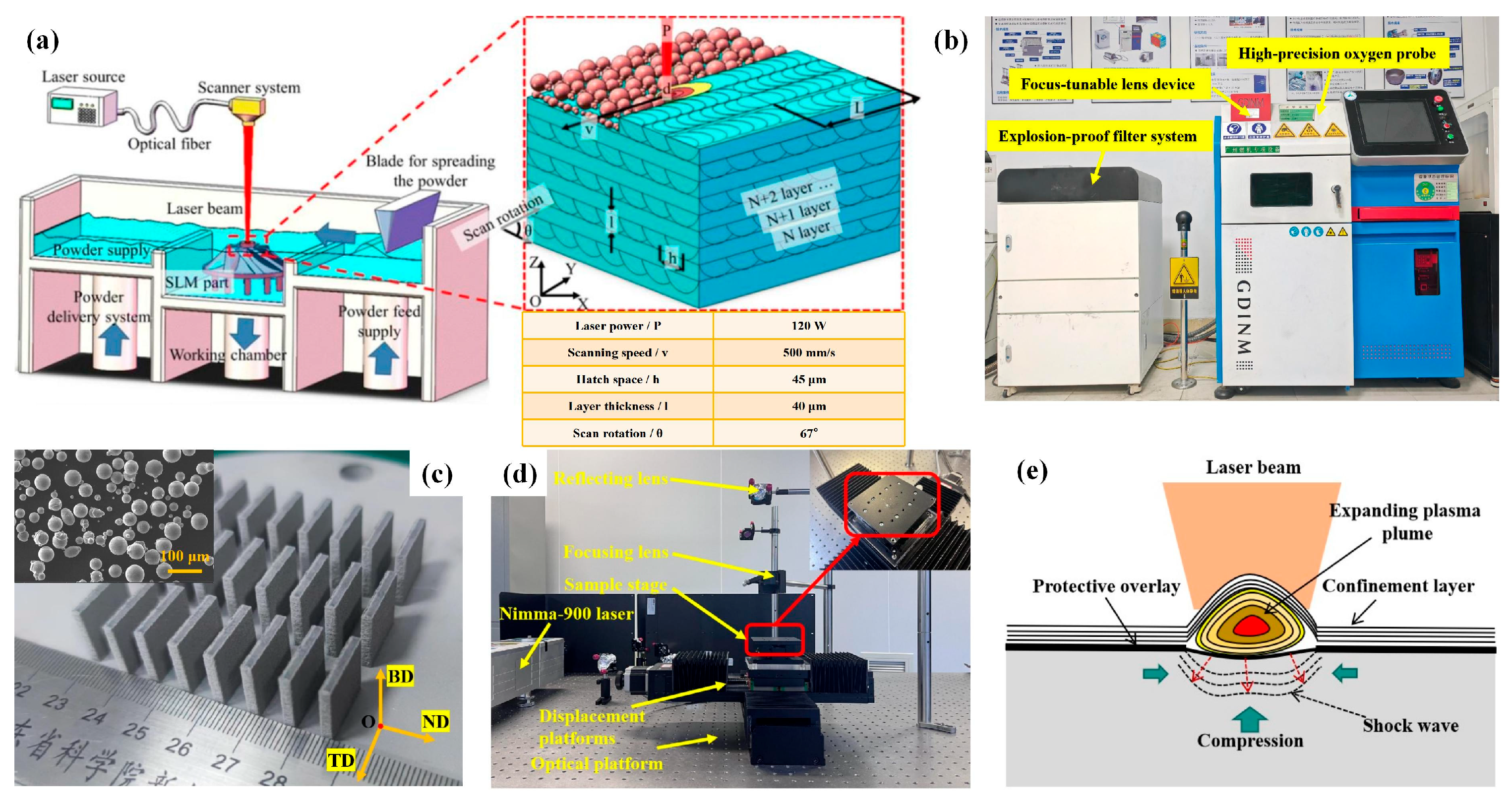
Figure 1. Schematic illustration of (a) SLM process and parameters, (b) SLM equipment, (c) SLMed AZ91 Mg alloy samples and powder morphology used in SLM, (d) LSP experimental system and (e) LSP process.
Metals 15 01374 g001
Figure 2. (a) 3D surface morphology and 2D profiles, (b) surface roughness and photos and (c) surface and (d) cross-section optical micrographs of samples before and after LSP.
Metals 15 01374 g002
Figure 3. EBSD results of (a1,b1) IPF maps and grain size distribution, (a2,b2) KAM maps and its distribution, (a3,b3) GB maps and misorientation angle distribution and (a4,b4) PF maps for the SLMed sample and that after four impacts of LSP, respectively.
Metals 15 01374 g003
Figure 4. (a) XRD patterns, (b) surface and (c) cross-section microhardness, (d) surface residual compressive stress, (e) density and (f) pore area proportion for samples before and after LSP.
Metals 15 01374 g004
Figure 5. (a) Contact angles, (b) polarization curves and calculated data, (c) Nyquist curves, (d) SEM surface morphology and (e) EDS analysis results after corrosion for samples before and after LSP.
Metals 15 01374 g005
Figure 6. Corrosion mechanism for as-SLMed Mg alloy samples before and after LSP.
Metals 15 01374 g006
Disclaimer/Publisher’s Note: The statements, opinions and data contained in all publications are solely those of the individual author(s) and contributor(s) and not of MDPI and/or the editor(s). MDPI and/or the editor(s) disclaim responsibility for any injury to people or property resulting from any ideas, methods, instructions or products referred to in the content.