You are currently viewing a new version of our website. To view the old version click .
Metals
  • Article
  • Open Access

9 December 2025

Theoretical Prediction of Yield Strength in Co(1-x-y)CryNix Medium-Entropy Alloys: Integrated Solid Solution and Grain Boundary Strengthening


,
,
and
1
School of Materials Science and Engineering, Dongguan University of Technology, Dongguan 523808, China
2
State Key Laboratory of Advanced Design and Manufacturing Technology for Vehicle, Hunan University, Changsha 410082, China
3
State Key Laboratory for Powder Metallurgy, Central South University, Changsha 410083, China
4
Institute for Advanced Studies in Precision Materials, Yantai University, Yantai 264005, China
This article belongs to the Special Issue Advanced Theoretical Technology for Understanding Microstructures and Mechanical Properties of Alloys

Abstract

CoCrNi medium-entropy alloys (MEAs) have emerged as a promising class of structural materials due to their exceptional strength–ductility synergy. However, the lack of composition-dependent predictive models severely hinders rational alloy design, forcing reliance on costly trial-and-error experimentation. This study develops a comprehensive theoretical model to predict the yield strength of single-phase face-centered-cubic (FCC) Co(1-x-y)CryNix MEAs by quantitatively evaluating the contributions of grain boundary and solid solution strengthening. The model demonstrates that increasing Cr content significantly enhances grain boundary strengthening through elevated shear modulus and Peierls stress, whereas Ni has a minimal effect. Solid solution strengthening, determined by the minimum resistance among Co–Cr, Co–Ni, and Cr–Ni atomic pairs, peaks at 1726.21 MPa for the composition Co17Cr64Ni19. For equiatomic CoCrNi, theoretical yield strengths range from 1287.8 to 1575.4 MPa across grain sizes of 0.5–50 µm, showing excellent agreement with experimental results. This work provides a reliable, composition-dependent predictive framework that surpasses traditional trial-and-error methods, enabling efficient design of high-strength MEAs through targeted control of lattice distortion and elemental interactions.

1. Introduction

Alloy materials have been instrumental in advancing technological innovation, with continuous research dedicated to achieving superior mechanical performance. Multi-principal element alloys (MPEAs), including medium-entropy alloys (MEAs) and high-entropy alloys (HEAs), have emerged as a transformative class of metallic materials, attracting intense interest in the materials science community [1]. In contrast to conventional alloys, which rely on one or two primary elements with minor solute additions to modulate properties, MPEAs incorporate three or more principal elements, each with atomic concentrations ranging from 5% to 35% [2]. This compositional strategy induces pronounced local atomic-scale heterogeneity, resulting in distinctive mechanical properties driven by multicomponent interactions [3,4,5]. MPEAs are characterized by four core effects, such as high-entropy effect, severe lattice distortion, sluggish diffusion, and cocktail effect [6], which collectively contributes to exceptional performances, including high hardness and strength, superior wear and corrosion resistance, excellent thermal stability, and remarkable cryogenic toughness [7,8,9]. These properties establish MPEAs as highly promising candidates for advanced structural applications, with transformative potential for next-generation engineering technologies.
Recent investigations have increasingly targeted CoCrNi MEAs due to their exceptional mechanical properties. Wu et al. [10] utilized MPEA design principles to develop equiatomic CoCrNi MEAs, investigating their temperature-dependent mechanical behavior. Their results demonstrated marked enhancements in strength and ductility with decreasing temperature, underscoring the alloy’s potential for cryogenic applications. Yoshida et al. [11] explored the friction stress and Hall-Petch relationship in equiatomic CoCrNi MEAs compared to Ni-40Co alloys and pure metals. Using high-pressure torsion followed by annealing, they achieved a fully recrystallized microstructure with micrometer-scale grains. Their findings revealed elevated friction stress in CoCrNi, attributed to severe local lattice distortion governing dislocation dynamics. Liu et al. [12] employed weak-beam dark-field transmission electron microscopy to measure the stacking-fault energy (SFE) in face-centered-cubic (FCC) HEAs and MEAs, reporting significantly lower SFE in CoCrNi compared to Cantor alloy (FeCoNiCrMn), suggesting distinct deformation mechanisms driven by composition. Furthermore, Feng et al. [13] developed heavily twinned CoCrNi MEAs via tensile deformation in a liquid nitrogen environment, achieving an impressive yield strength of 2.1 GPa. Their analysis indicated that highly distorted deformation twins effectively impede crack propagation, while activated dislocation motion enhances plastic deformation. This work introduces a novel approach for designing high-strength and crack-resistant MEAs in advanced structural applications.
Despite superior mechanical properties of CoCrNi MEAs, the theoretical mechanisms of solid solution strengthening driven by lattice distortion remain incompletely elucidated. This work develops a comprehensive predictive model for high-strength CoCrNi MEAs with a single-phase FCC structure, systematically quantifying the influence of compositional variation on yield strength of Co(1-x-y)CryNix (0 ≤ x ≤ 1; 0 ≤ y ≤ 1) MEAs. The novelty of this work lies in establishing the composition-dependent model of solid-solution strengthening via a dislocation minimum-resistance-path analysis in random multi-component lattices, achieving high-accuracy prediction of solid-solution strengthening. Additionally, this work maps solid solution strengthening across the full compositional ranges in Co(1-x-y)CryNix (0 ≤ x ≤ 1; 0 ≤ y ≤1) MEAs, providing a predictive model to guide experimental design and accelerate the development of high-performance MEAs.

2. Theoretical Model

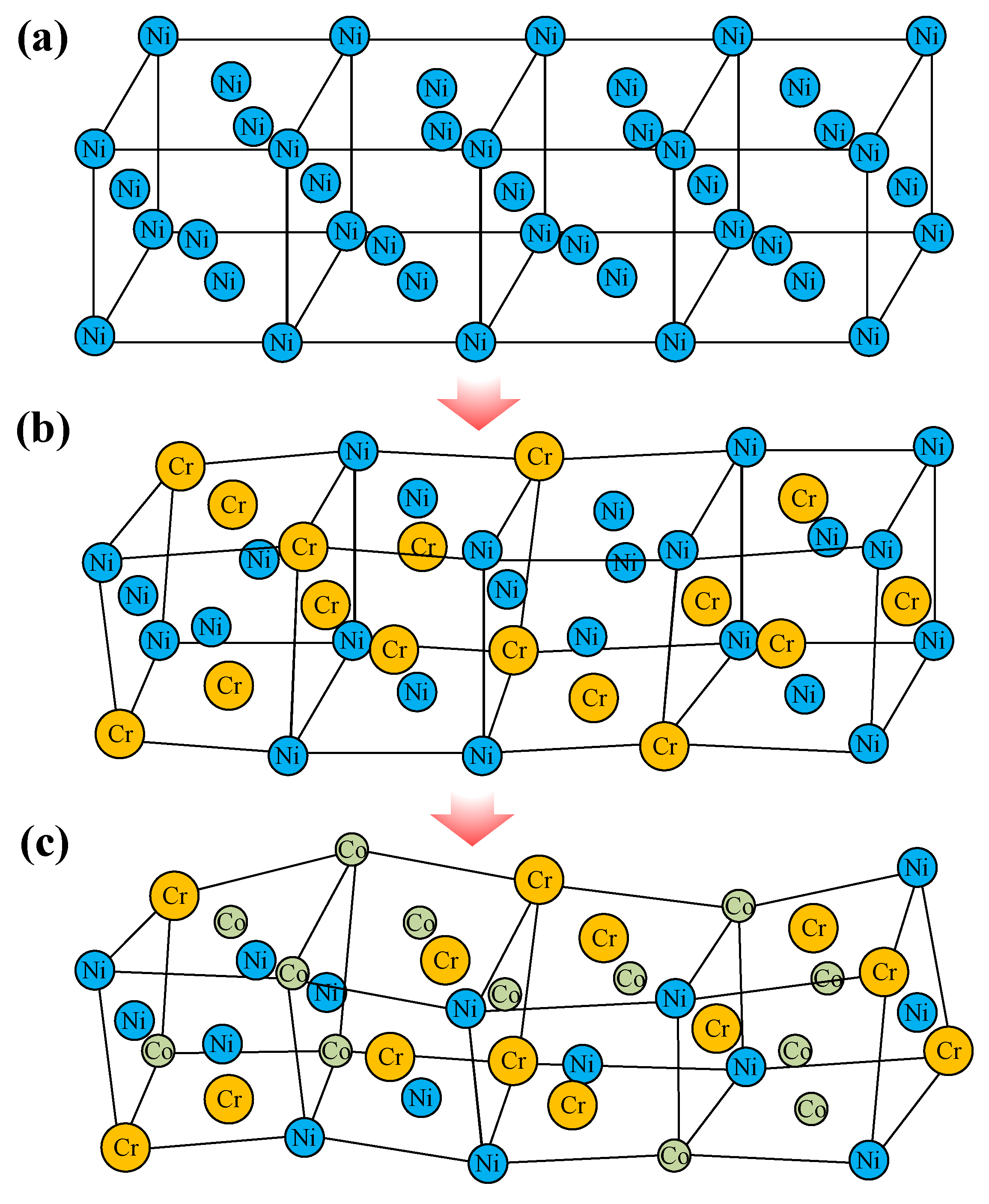
In MEAs, the incorporation of multiple principal elements results in a complex mixture of solute and solvent atoms within the alloy matrix. The integration of elements with varying atomic radii and shear moduli into a single lattice induces severe lattice distortion, which substantially impedes dislocation motion compared to pure metals or conventional alloys [14,15]. This phenomenon markedly enhances the mechanical strength of MEAs. As illustrated in Figure 1, the crystal structure of pure nickel (Ni) exhibits a highly ordered FCC arrangement (Figure 1a). Incorporating chromium (Cr), with a distinct atomic radius, introduces moderate lattice distortion in Ni–Cr binary alloys (Figure 1b). This distortion intensifies in ternary Co(1-x-y)CryNix MEAs (Figure 1c), where constituent atoms occupy lattice sites randomly with equal probability, forming a homogeneous solid solution. The increasing degree of lattice distortion with higher elemental diversity plays a critical role in enhancing the mechanical properties of MEAs.
Figure 1. Schematic illustration of FCC crystal structures: (a) Ordered FCC lattice of a pure metal (e.g., Ni); (b) FCC lattice exhibiting moderate distortion due to the incorporation of an additional element (e.g., Ni-Cr solid solution); (c) FCC lattice with pronounced distortion resulting from the integration of three distinct elements (e.g., Co(1-x-y)CryNix MEAs).
CoCrNi MEAs exhibit enhanced yield strength through a combination of strengthening mechanisms. The dominant contributions include grain boundary strengthening, solid solution strengthening, second-phase strengthening (encompassing dispersion and precipitation strengthening), and dislocation strengthening. The yield strength of these alloys can be quantitatively expressed through a composite equation that integrates the contributions of these mechanisms:
σ y = σ g b + σ s s + σ s p + σ d s
where σ y is the yield strength of MEAs, σ g b is the grain boundary strengthening, σ s s is the solid solution strengthening, σ s p is the second-phase particle strengthening, and σ d s is the dislocation strengthening. Given that Co(1-x-y)CryNix MEAs possess a single-phase FCC crystal structure without second-phase particles, the contribution from second-phase particle strengthening is negligible (i.e., σ s p = 0 ). Furthermore, since this study does not consider deformation processes, dislocation strengthening is also ignored (i.e., σ d s = 0 ). Consequently, the investigation focuses exclusively on the contributions of grain boundary strengthening ( σ g b ) and solid solution strengthening ( σ s s ) to the overall yield strength of Co(1-x-y)CryNix MEAs.
Grain boundary strengthening plays a crucial role in enhancing the yield strength of materials by refining grain size, which promotes dislocation accumulation at grain boundaries and impedes dislocation motion. This mechanism can be quantitatively described using the classical Hall–Petch relationship [16,17]:
σ g b = σ f + k D 1 / 2
where σ f represents the lattice friction stress, typically equivalent to the Peierls–Nabarro (P-N) stress σ p ( σ f = σ p ), k denotes the Hall–Petch slope, and D denotes the average grain size of the material. According to the widely established P-N model [18,19,20], the Peierls stress σ p can be calculated as follows:
σ p = μ exp 2 π d / b
where b is the Burgers vector, and the shear modulus μ is a critical parameter influenced by the alloy’s constituent elements, reflecting their compositional effects on mechanical properties, which is determined by the well-known Vegard’s law [21]. The parameter d denotes the temperature-dependent dislocation core width. The expressions for calculating μ and d are provided as follows [10,22,23,24]:
μ = c i μ i
d = d 0 1 + α T
where c i represents the atomic fraction of the i-th element in the alloy, while μ i denotes the shear modulus of the corresponding element. Additionally, d 0 signifies the dislocation core width at 0 K, T indicates the absolute temperature, and α is a small positive constant, approximately equal to the reciprocal of the melting temperature (i.e.,) [10,24], and T m = i = 1 n c i ( T m ) i [25]. By integrating these parameters listed in Table 1, the model provides a robust framework for calculating the grain boundary strengthening effect in Co(1-x-y)CryNix MEAs.
Table 1. Basic parameters of the constituent elements.
Solid solution strengthening in multi-principal element alloys plays a critical role in enhancing the mechanical properties of metallic materials, primarily due to significant lattice distortion, as extensively documented in the literature [26,27]. According to the established Fleischer [28] and Labusch [29] solid-solution theories, we developed the optimized theoretical model of solid solution strengthening [3], and the contribution of lattice distortion to solid solution strengthening arises from the mismatches of atomic radius ( δ r ) and shear modulus ( δ μ ), which can be quantitatively described by the following expression:
σ s s = A μ c 2 / 3 δ 4 / 3 + B μ c δ
where A and B are dimensionless constants with A = 0.1 and B = 0.03 [29,30]. δ = δ μ + β δ r , δ μ = δ μ / 1 + δ μ / 2 , δ r = 1 / a d a / d c , δ μ = 1 / μ d μ / d c [3,28]. a signifies the lattice constant, and the parameter β depends on the dislocation type [30,31].
The severe lattice distortion in MEAs results in solid solution strengthening that diverges significantly from that observed in conventional metals. To address this, a distorted FCC unit cell model has been developed, drawing on the foundational works of Salishchev et al. [32] and Rao et al. [33]. In this model, each atom within the FCC lattice is coordinated by twelve nearest-neighbor atoms, forming a 13-atom cluster. According to random elemental distribution within the FCC MEA, the local atomic environment of any i-th element can be approximately characterized, thereby estimating the lattice distortion. The resulting stress field significantly influences dislocation motion. In this framework, element i is surrounded by N j = 13 c j neighboring j-atoms and N i = 13 c i 1 neighboring i-atoms, where c i and c j represent the atomic fractions of elements i and j in the FCC unit cell, respectively. Consequently, the lattice distortion ( δ r i ) and modulus distortion ( δ μ i ) near element i can be approximated as the average differences ( δ r i j = 2 r i r j / r i + r j and δ μ i j = 2 μ i μ j / μ i + μ j ) in atomic size and shear modulus between element i and its neighboring j-elements, providing a quantitative basis for analyzing the solid solution strengthening in MEAs. The average differences δ r i j and δ μ i j are calculated and listed in Table 2.
δ r i = 13 12 c j δ r i j
δ μ i = 13 12 c j δ μ i j
Table 2. Calculated atomic size difference (δrij) and shear modulus difference (δμij) for various atom pairs.
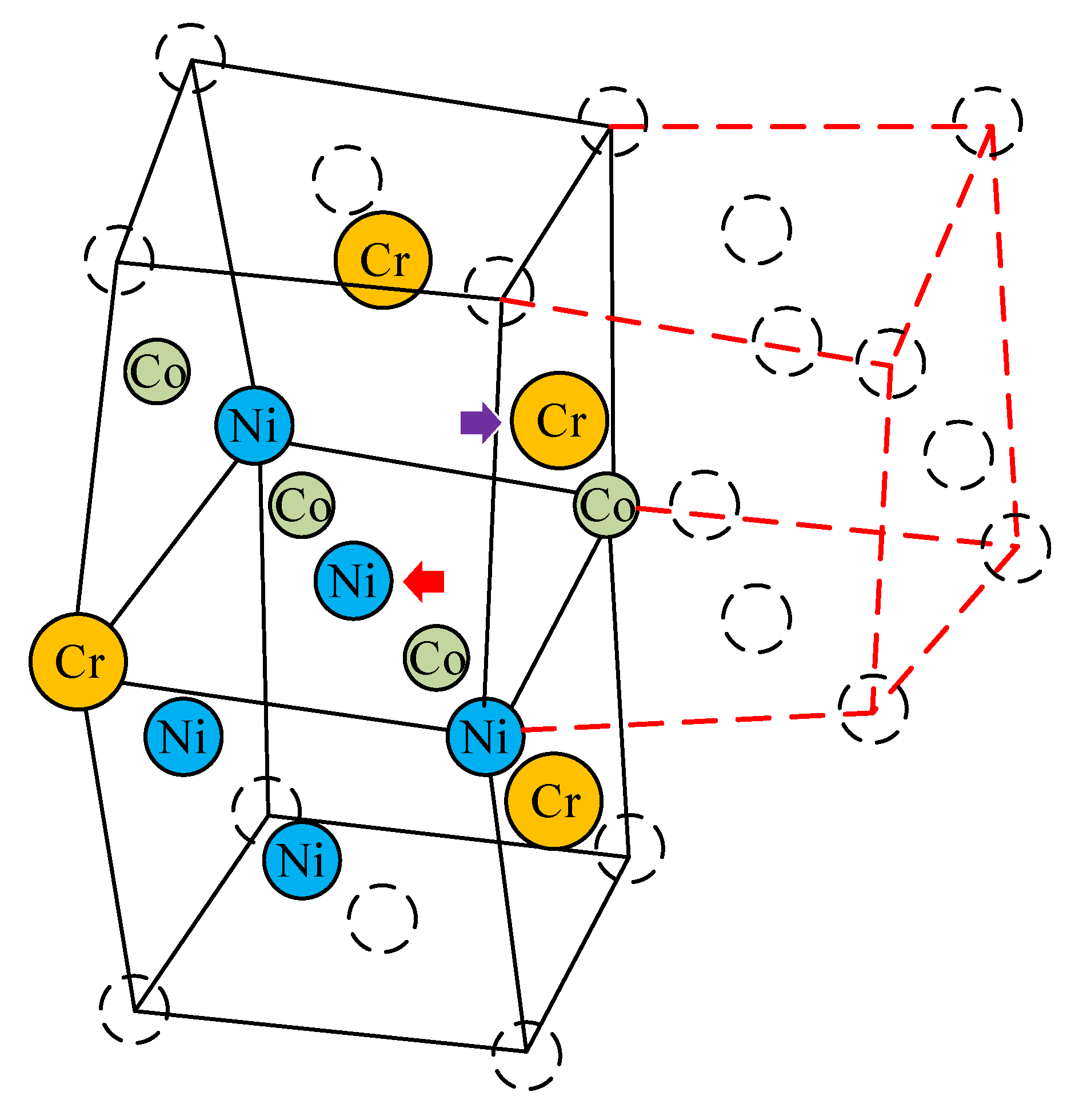
In the study of yield strength in MEAs, the effects of lattice distortion and modulus distortion on dislocation motion are critical factors. The solid-solution strengthening in concentrated alloys arises from random solute–pair interactions, which generate dislocation pinning forces governed by atomic size and shear modulus differences. Specifically, when dislocations are positioned within atomic clusters centered on a particular i-atom, their motion is governed by interactions between clusters centered on different atoms. For instance, as depicted in Figure 2, when a dislocation resides within a Ni-centered cluster (highlighted by red arrows), resistance to its motion arises from two sources: interactions within the Ni-centered cluster itself and interactions with a j-atom-centered cluster (e.g., those centered on Co or Cr, indicated by purple arrows). These interactions give rise to various atomic pairs, such as Ni-Co, Ni-Cr and Co-Cr, which induce severe lattice distortion, thereby influencing dislocation dynamics and contributing to the alloy’s strengthening. The resistance to dislocation motion varies depending on the interactions between atomic pairs within clusters centered on different atoms. According to classical dislocation theory, dislocations preferentially move along paths of least resistance, adhering to the principle of least resistance, which aligns with the principle of the minimum energy path for dislocation motion proposed by Ma et al. [34,35]. In MEAs, severe lattice and modulus distortions significantly disrupt the alloy’s slip systems, thereby impeding dislocation motion [3]. These distortions arise from interactions between atomic clusters, which collectively enhance the alloy’s mechanical strength by hindering dislocation glide.
Figure 2. Schematic representation of a 13-atom cluster model centered on a Ni atom in MEAs.

3. Results and Discussions

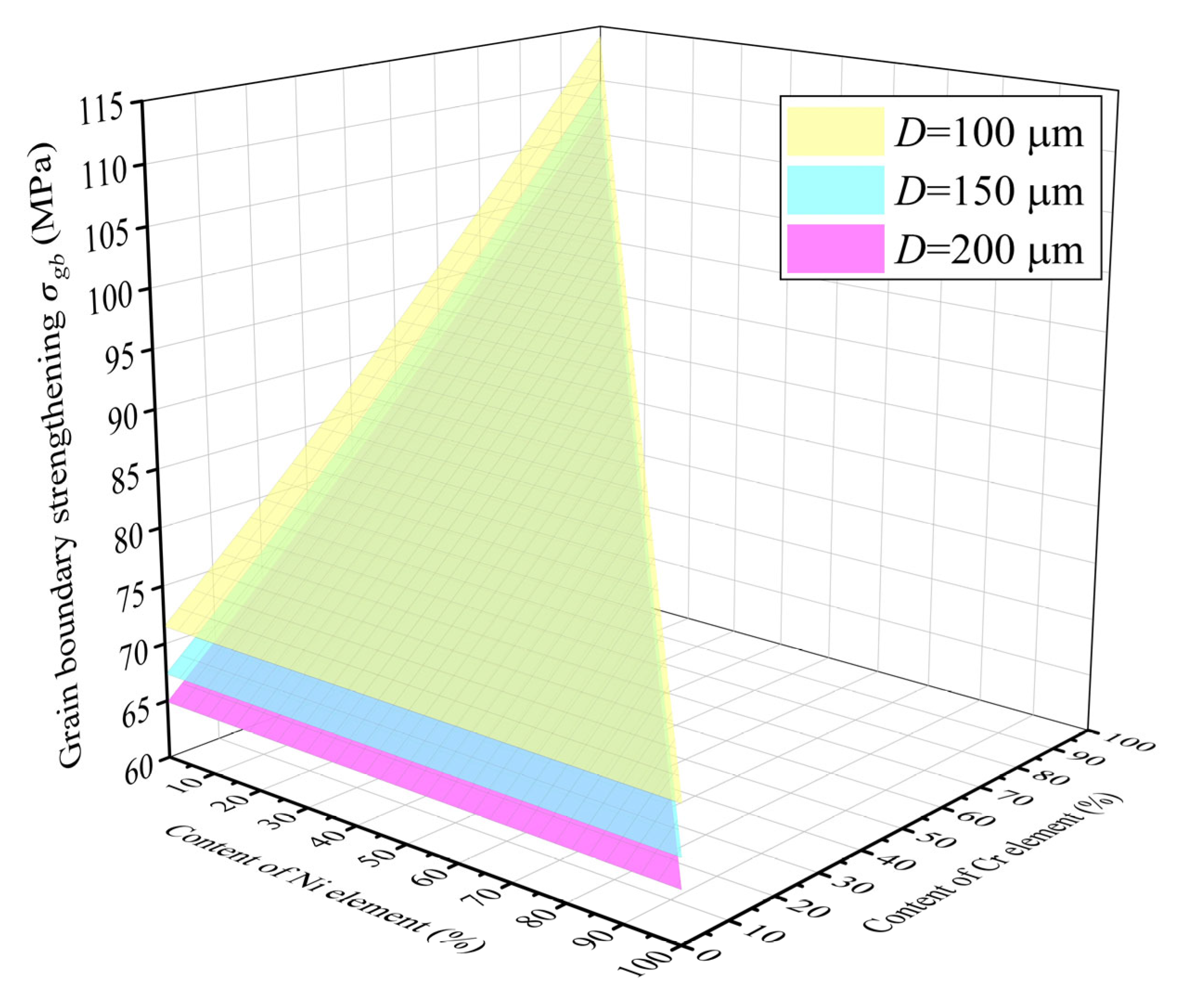
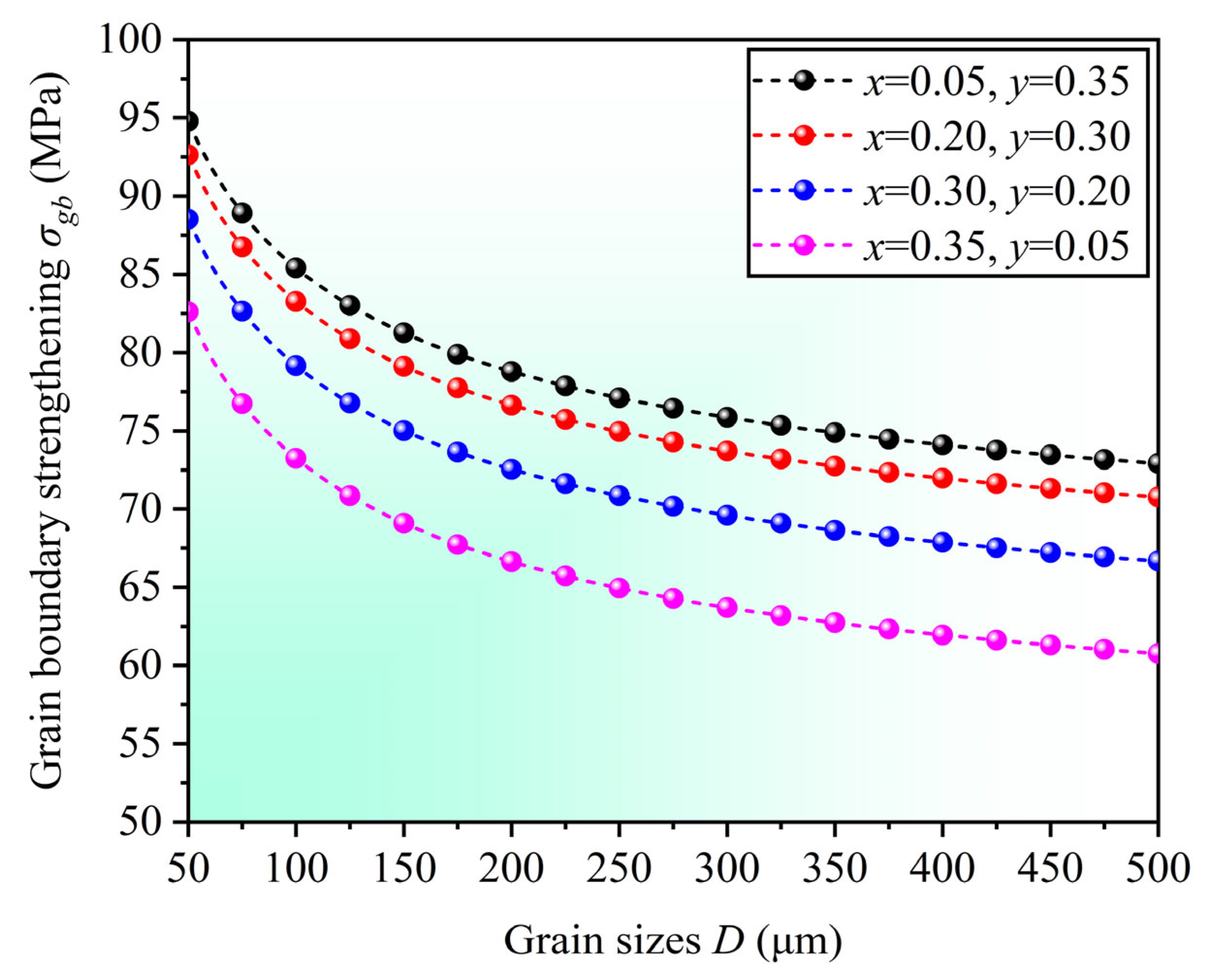
In the analysis of grain boundary strengthening σ g b in Co(1-x-y)CryNix MEAs, according to the above analysis and combined with Equations (2)–(5), the specified parameters k = 226 MPa μ m [36], d 0 = b [10], and T = 296 K have been chosen for calculation. As depicted in Figure 3, variations in grain size (D = 100, 200, 300 µm) reveal that an increase in the Cr atomic fraction (y) significantly enhances grain boundary strengthening ( σ g b ) in Co(1-x-y)CryNix MEAs. In contrast, the influence of the Ni atomic fraction (x) on σ g b is minimal and can be considered negligible. Additionally, Figure 4 across four distinct elemental composition groups, grain boundary strengthening ( σ g b ) consistently decreases with increasing grain size from 50 to 500 μ m . The results from Figure 3 and Figure 4 reveal the predominant influence of grain size and chemical composition on grain boundary strengthening. Table 1 indicates that the shear modulus ( μ Cr = 115 GPa ) of Cr is significantly higher than that of Co ( μ Co = 75 GPa ) and Ni ( μ Ni = 76 GPa ). Consequently, increasing the Cr atomic fraction (y) markedly elevates the alloy’s overall shear modulus, which in turn enhances both the Peierls stress ( σ p ) and grain boundary strengthening ( σ g b ), as governed by Equation (2). These results underscore the critical influence of Cr content on the mechanical properties of Co(1-x-y)CryNix MEAs.
Figure 3. Dependence of grain boundary strengthening ( σ g b ) on the atomic fractions of constituent elements in Co(1-x-y)CryNix MEAs across varying grain sizes.
Figure 4. Dependence of grain boundary strengthening ( σ g b ) on grain sizes (D) in Co(1-x-y)CryNix MEAs with varying atomic fraction compositions.
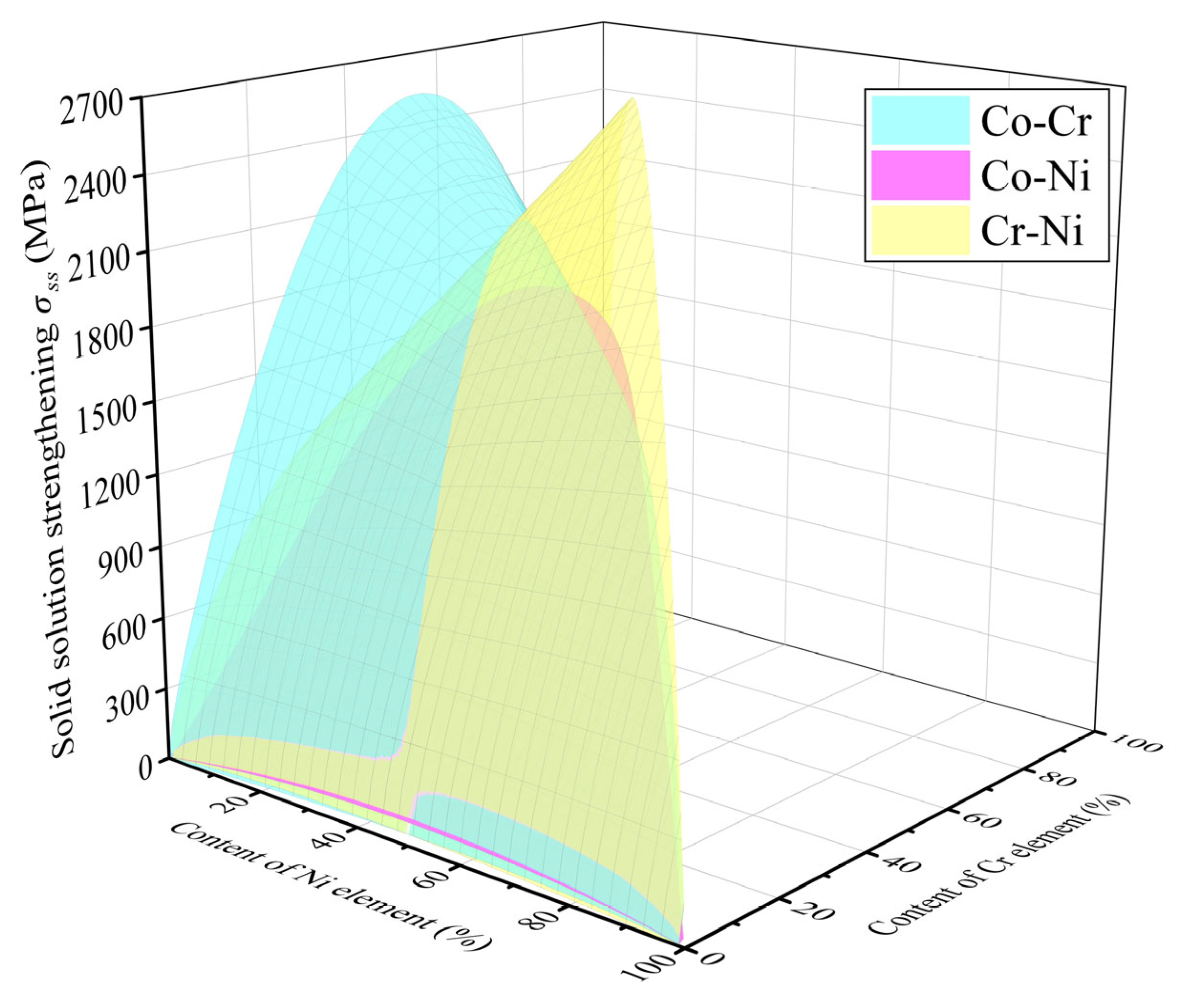
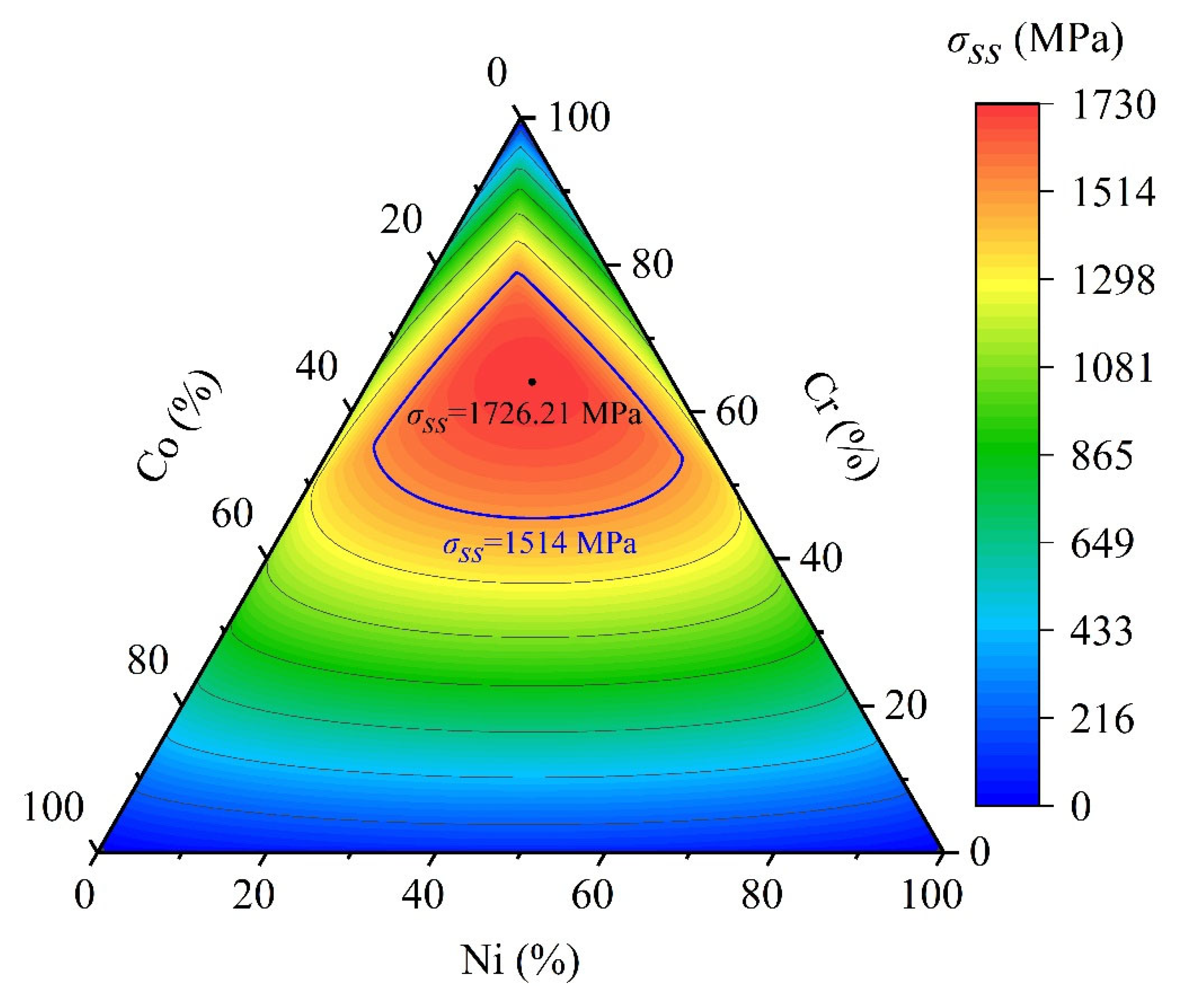
The solid solution strengthening σ s s of Co(1-x-y)CryNix MEAs is calculated using the model described in Equation (6), with the parameter ( β = 3 ) according to established theoretical frameworks [28,29]. This strengthening arises from the resistance to dislocation motion induced by interactions between pairs of randomly distributed solute atoms. As shown in Figure 5, σ s s varies with the atomic fractions x (Ni) and y (Cr), yielding three distinct strengthening contributions corresponding to the Co–Cr, Co–Ni, and Cr–Ni atomic pairs. Each value reflects the local lattice distortion and elastic mismatch associated with a specific solute pair within the FCC lattice. In accordance with the principle of least resistance, dislocation motion proceeds along the path of least resistance. Therefore, for any given composition (x, y), the effective solid solution strengthening is determined by the minimum σ s s among the three pair interactions. To elucidate the compositional dependence of this effective strengthening, Figure 6 presents a simplified two-dimensional contour representation derived from the three-dimensional surface in Figure 5. The color gradient spans from blue (0 MPa) to red (1726.21 MPa), illustrating the nonlinear variation of σ s s across the compositional space. The blue contour line demarcates a threshold of 1514 MPa, with σ s s of all compositions within the enclosed region exceeding this value. The maximum solid solution strengthening of 1726.21 MPa is achieved at the composition Co17Cr64Ni19 (marked by the black point), highlighting the pivotal role of high Cr content in enhancing lattice distortion and dislocation pinning. These results underscore the importance of precise compositional control in optimizing solid solution strengthening in Co(1-x-y)CryNix MEAs, providing a robust theoretical foundation for tailoring high-performance multi-principal element alloys.
Figure 5. Dependence of solid solution strengthening ( σ s s ) on atomic content of constituent elements in Co(1-x-y)CryNix MEAs with different atom pairs.
Figure 6. Simplified ternary contour diagram of the effective solid solution strengthening ( σ s s ) in Co(1-x-y)CryNix MEAs, derived from the least resistance principle applied to atomic pair interactions in Figure 5.
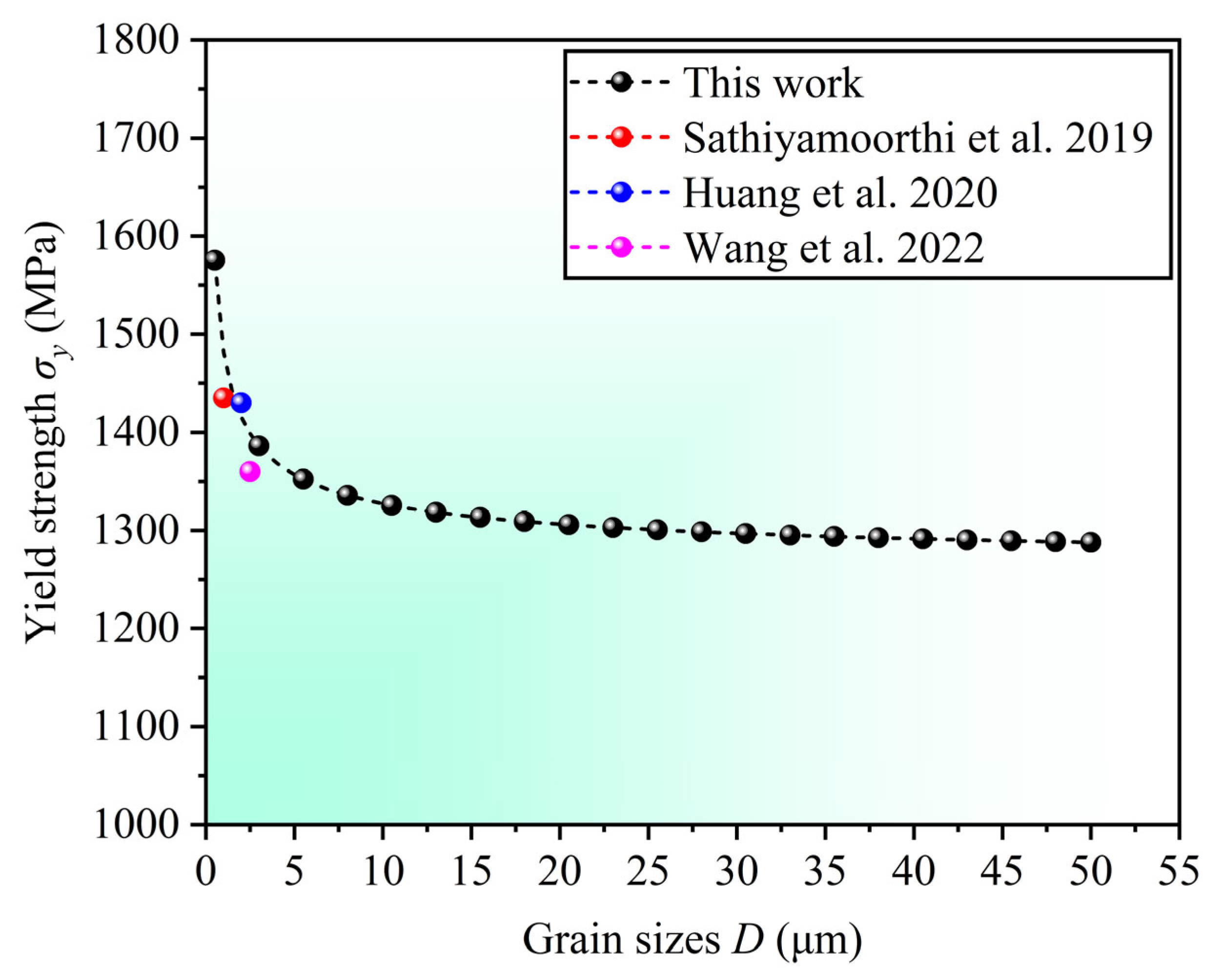
The theoretical predictions developed in this study are rigorously validated against recent experimental results reported in the literature. For equiatomic CoCrNi MEAs, Sathiyamoorthi et al. [37] measured a yield strength of approximately 1435 MPa at an average grain size of 0.65 µm. Similarly, Huang et al. [38] reported a yield strength of ~1430 MPa for a grain size of ~2.0 µm, while Wang et al. [39] observed ~1360 MPa at an average grain size of 2.35 µm. In the present model, the calculated solid solution strengthening value for equiatomic CoCrNi is 1194 MPa. Combining this with grain boundary strengthening, the predicted yield strength ranges from 1287.8 MPa to 1575.4 MPa for grain sizes between 0.5 µm and 50 µm. As shown in Figure 7, a direct comparison between the theoretically calculated yield strengths and the experimental data reveals good agreement across the investigated grain size range. The close correspondence validates the accuracy of the proposed model in revealing the dominant strengthening mechanisms (solid solution and grain boundary strengthening) in CoCrNi MEAs. The differences between theory and experiment are attributable to secondary factors not included in the current analysis, such as second-phase particle strengthening and dislocation strengthening, which are expected to have limited influence on overall yield strength in this work. In addition, another major limitation of the current study is the lack of experimental data on the yield strength of single-phase non-equiatomic CoCrNi MEAs, which may also limit further comparisons of this solid-solution strengthening model.
Figure 7. Comparisons between theoretically predicted yield strengths and experimental data (Adapted from Refs. [37,38,39]) for equiatomic CoCrNi MEAs across varying grain sizes.

4. Conclusions

This study establishes a robust theoretical framework for predicting the yield strength of single-phase FCC Co(1-x-y)CryNix MEAs by integrating grain boundary and solid solution strengthening mechanisms. The model reveals that an increase in Cr atomic fraction significantly enhances both shear modulus and Peierls stress, thereby improving grain boundary strengthening, while Ni exerts negligible influence. Solid solution strengthening, governed by the principle of least resistance among Co–Cr, Co–Ni, and Cr–Ni atomic pairs, reaches a maximum of 1726.21 MPa at the composition Co17Cr64Ni19. Theoretical yield strength predictions for equiatomic CoCrNi, ranging from 1287.8 to 1575.4 MPa across grain sizes of 0.5–50 µm, align well with experimental values reported in the literature (1360–1430 MPa at 1.5–2.35 µm). These findings validate the model’s predictive accuracy and highlight the critical role of compositional tuning and lattice distortion in optimizing mechanical performance, offering a computationally efficient alternative to empirical alloy design. Nevertheless, the current work neglects second-phase particle strengthening and dislocation strengthening, focusing solely on single-phase FCC systems. Future work will incorporate precipitation and dislocation interactions to extend applicability to multiphase and deformed MEAs.

Author Contributions

Methodology, Formal analysis, Investigation, and Writing—original draft, Z.W., Z.Y. and L.Z.; Project administration, Visualization, and Data curation, Z.Y. and L.Z.; Conceptualization, Funding acquisition, Supervision, and Writing—review and editing, Z.W. and S.C. All authors have read and agreed to the published version of the manuscript.

Funding

This research was funded by the National Natural Science Foundation of China (12202141 and 52371163), the Guangdong Basic and Applied Basic Research Foundation (2024A1515140095), the Characteristic Innovation Project of Ordinary Universities in Guangdong Province (2023KTSCX149), the Taishan Scholars Program of Shandong Province (tsqn202408154), and the Yantai city matching fund for Taishan Scholars Program of Shandong Province.

Data Availability Statement

The original contributions presented in this study are included in the article. Further inquiries can be directed to the corresponding authors.

Conflicts of Interest

The authors declare no conflicts of interest.

References

  1. Ye, Y.F.; Wang, Q.; Lu, J.; Liu, C.T.; Yang, Y. The generalized thermodynamic rule for phase selection in multicomponent alloys. Intermetallics 2015, 59, 75–80. [Google Scholar] [CrossRef]
  2. Zhang, Y.; Zuo, T.T.; Tang, Z.; Gao, M.C.; Dahmen, K.A.; Liaw, P.K.; Lu, Z.P. Microstructures and properties of high-entropy alloys. Prog. Mater. Sci. 2014, 61, 1–93. [Google Scholar] [CrossRef]
  3. Wang, Z.P.; Fang, Q.H.; Li, J.; Liu, B.; Liu, Y. Effect of lattice distortion on solid solution strengthening of BCC high-entropy alloys. J. Mater. Sci. Technol. 2018, 34, 349–354. [Google Scholar] [CrossRef]
  4. Zhang, M.D.; Ma, Y.M.; Dong, W.Q.; Liu, X.S.; Lu, Y.; Zhang, Y.F.; Li, R.; Wang, Y.Y.; Yu, P.F.; Gao, Y.P.; et al. Phase evolution, microstructure, and mechanical behaviors of the CrFeNiAlxTiy medium-entropy alloys. Mater. Sci. Eng. A 2020, 771, 138566. [Google Scholar] [CrossRef]
  5. Gludovatz, B.; Hohenwarter, A.; Thurston, K.V.S.; Bei, H.B.; Wu, Z.G.; George, E.P.; Ritchie, R.O. Exceptional damage-tolerance of a medium-entropy alloy CrCoNi at cryogenic temperatures. Nat. Commun. 2016, 7, 10602. [Google Scholar] [CrossRef]
  6. Yeh, J.W.; Chen, S.K.; Lin, S.J.; Gan, J.Y.; Chin, T.S.; Shun, T.T.; Tsau, C.H.; Chang, S.Y. Nanostructured High-Entropy Alloys with Multiple Principal Elements: Novel Alloy Design Concepts and Outcomes. Adv. Eng. Mater. 2004, 6, 299–303. [Google Scholar] [CrossRef]
  7. Li, A.X.; Kang, K.W.; Zhang, J.S.; Xu, M.K.; Huang, D.; Liu, S.K.; Jiang, Y.T.; Li, G. Pursuing ultrahigh strength–ductility CoCrNi-based medium-entropy alloy by low-temperature pre-aging. J. Mater. Sci. Technol. 2025, 220, 115–128. [Google Scholar] [CrossRef]
  8. Ji, Y.P.; Zhou, D.Z.; Jiang, D.; Song, X.J.; Zhang, G.S.; Wang, G.J.; Suo, T.; Zhang, Y.; Cui, H.Z. Wear and wear-corrosion performance of CoCrNi-based high-entropy alloys modified by Mo and C under ultrasonic-assisted laser cladding. Surf. Coat. Technol. 2025, 513, 132446. [Google Scholar] [CrossRef]
  9. Iftikhar, H.; Park, K.; Jung, Y.J.; Lee, K.J.; Hong, S.H.; Kim, K.B.; Lee, C.; Song, G. Overcoming strength-ductility trade-off via L21 precipitate-strengthening in Al0.3CoCrNiTi0.1 high entropy alloy at room and cryogenic temperatures. J. Mater. Res. Technol. 2025, 39, 933–944. [Google Scholar] [CrossRef]
  10. Wu, Z.; Bei, H.; Pharr, G.M.; George, E.P. Temperature dependence of the mechanical properties of equiatomic solid solution alloys with face-centered cubic crystal structures. Acta Mater. 2014, 81, 428–441. [Google Scholar] [CrossRef]
  11. Yoshida, S.; Bhattacharjee, T.; Bai, Y.; Tsuji, N. Friction stress and Hall-Petch relationship in CoCrNi equi-atomic medium entropy alloy processed by severe plastic deformation and subsequent annealing. Scr. Mater. 2017, 134, 33–36. [Google Scholar] [CrossRef]
  12. Liu, S.F.; Wu, Y.; Wang, H.T.; He, J.Y.; Liu, J.B.; Chen, C.X.; Liu, X.J.; Wang, H.; Lu, Z.P. Stacking fault energy of face-centered-cubic high entropy alloys. Intermetallics 2018, 93, 269–273. [Google Scholar] [CrossRef]
  13. Feng, X.B.; Yang, H.K.; Fan, R.; Zhang, W.Q.; Meng, F.L.; Gan, B.; Lu, Y. Heavily twinned CoCrNi medium-entropy alloy with superior strength and crack resistance. Mater. Sci. Eng. A 2020, 788, 139591. [Google Scholar] [CrossRef]
  14. Wang, H.; He, Q.F.; Gao, X.; Shang, Y.H.; Zhu, W.Q.; Zhao, W.J.; Chen, Z.Q.; Gong, H.; Yang, Y. Multifunctional high entropy alloys enabled by severe lattice distortion. Adv. Mater. 2024, 36, 2305453. [Google Scholar] [CrossRef]
  15. Sharma, P.; Tucker, W.C.; Balasubramanian, G. Optimal interplay of charge localization, lattice dynamics and slip systems drives structural softening in dilute W alloys with Re additives. Int. J. Refract. Met. Hard Mater. 2025, 128, 107086. [Google Scholar] [CrossRef]
  16. Hall, E.O. The Deformation and Ageing of Mild Steel: III Discussion of Results. Proc. Phys. Soc. B 1951, 64, 747. [Google Scholar] [CrossRef]
  17. Petch, N.J. The Cleavage Strength of Polycrystals. J. Iron Steel Inst. Jpn. 1953, 174, 25–28. [Google Scholar]
  18. Wang, J.N. A new modification of the formulation of Peierls stress. Acta Mater. 1996, 44, 1541–1546. [Google Scholar] [CrossRef]
  19. Wang, J.N. Prediction of Peierls stresses for different crystals. Mater. Sci. Eng. A 1996, 206, 259–269. [Google Scholar] [CrossRef]
  20. Davidson, D.L. Transition metal alloys: Elastic properties and Peierls–Nabarro stresses. Mater. Sci. Eng. A 2000, 293, 281–291. [Google Scholar] [CrossRef]
  21. Vegard, L. Die konstitution der mischkristalle und die raumfüllung der atome. Z. Phys. 1921, 5, 17–26. [Google Scholar] [CrossRef]
  22. Couzinié, J.P.; Senkov, O.N.; Miracle, D.B.; Dirras, G. Comprehensive data compilation on the mechanical properties of refractory high-entropy alloys. Data Brief. 2018, 21, 1622–1641. [Google Scholar] [CrossRef]
  23. Gorsse, S.; Nguyen, M.H.; Senkov, O.N.; Miracle, D.B. Database on the mechanical properties of high entropy alloys and complex concentrated alloys. Data Brief. 2018, 21, 2664–2678. [Google Scholar] [CrossRef]
  24. Petch, N.J. The ductile-brittle transition in the fracture of α-iron: I. Philos. Mag. A 1958, 3, 1089–1097. [Google Scholar] [CrossRef]
  25. Shaikh, S.M.; Hariharan, V.S.; Yadav, S.K.; Murty, B.S. CALPHAD and rule-of-mixtures: A comparative study for refractory high entropy alloys. Intermetallics 2020, 127, 106926. [Google Scholar] [CrossRef]
  26. Tan, Y.Y.; Chen, Z.J.; Su, M.Y.; Ding, G.; Jiang, M.Q.; Xie, Z.C.; Gong, Y.; Wu, T.; Wu, Z.H.; Wang, H.Y.; et al. Lattice distortion and magnetic property of high entropy alloys at low temperatures. J. Mater. Sci. Technol. 2022, 104, 236–243. [Google Scholar] [CrossRef]
  27. Dasari, S.; Sharma, A.; Jiang, C.; Gwalani, B.; Lin, W.C.; Lo, K.C.; Gorsse, S.; Yeh, A.C.; Srinivasan, S.G.; Banerjee, R. Exceptional enhancement of mechanical properties in high-entropy alloys via thermodynamically guided local chemical ordering. Proc. Natl. Acad. Sci. USA 2023, 120, e2211787120. [Google Scholar] [CrossRef]
  28. Fleischer, R.L. Substitutional solution hardening. Acta Metall. 1963, 11, 203–209. [Google Scholar] [CrossRef]
  29. Labusch, R. A statistical theory of solid solution hardening. Phys. Status Solidi B 1970, 41, 659–669. [Google Scholar] [CrossRef]
  30. Senkov, O.N.; Scott, J.M.; Senkova, S.V.; Miracle, D.B.; Woodward, C.F. Microstructure and room temperature properties of a high-entropy TaNbHfZrTi alloy. J. Alloys Compd. 2011, 509, 6043–6048. [Google Scholar] [CrossRef]
  31. Gypen, L.A.; Deruyttere, A. Multi-component solid solution hardening. J. Mater. Sci. 1977, 12, 1028–1033. [Google Scholar] [CrossRef]
  32. Salishchev, G.A.; Tikhonovsky, M.A.; Shaysultanov, D.G.; Stepanov, N.D.; Kuznetsov, A.V.; Kolodiy, I.V.; Tortika, A.S.; Senkov, O.N. Effect of Mn and V on structure and mechanical properties of high-entropy alloys based on CoCrFeNi system. J. Alloys Compd. 2014, 591, 11–21. [Google Scholar] [CrossRef]
  33. Rao, Z.Y.; Wang, X.; Zhu, J.; Chen, X.H.; Wang, L.; Si, J.J.; Wu, Y.D.; Hui, X.D. Affordable FeCrNiMnCu high entropy alloys with excellent comprehensive tensile properties. Intermetallics 2016, 77, 23–33. [Google Scholar] [CrossRef]
  34. Ma, E. Unusual dislocation behavior in high-entropy alloys. Scr. Mater. 2020, 181, 127–133. [Google Scholar] [CrossRef]
  35. Chen, B.; Li, S.Z.; Zong, H.X.; Ding, X.D.; Sun, J.; Ma, E. Unusual activated processes controlling dislocation motion in body-centered-cubic high-entropy alloys. Proc. Natl. Acad. Sci. USA 2020, 117, 16199–16206. [Google Scholar] [CrossRef]
  36. Liu, B.; Wang, J.S.; Liu, Y.; Fang, Q.H.; Wu, Y.; Chen, S.Q.; Liu, C.T. Microstructure and mechanical properties of equimolar FeCoCrNi high entropy alloy prepared via powder extrusion. Intermetallics 2016, 75, 25–30. [Google Scholar]
  37. Sathiyamoorthi, P.; Moon, J.; Bae, J.W.; Asghari-Rad, P.; Kim, H.S. Superior cryogenic tensile properties of ultrafine-grained CoCrNi medium-entropy alloy produced by high-pressure torsion and annealing. Scr. Mater. 2019, 163, 152–156. [Google Scholar]
  38. Huang, H.; Wang, J.Y.; Yang, H.L.; Ji, S.X.; Yu, H.L.; Liu, Z.L. Strengthening CoCrNi medium-entropy alloy by tuning lattice defects. Scr. Mater. 2020, 188, 216–221. [Google Scholar]
  39. Wang, J.Y.; Zou, J.P.; Yang, H.L.; Huang, H.; Liu, Z.L.; Ji, S.X. Strength improvement of CoCrNi medium-entropy alloy through introducing lattice defects in refined grains. Mater. Charact. 2022, 193, 112254. [Google Scholar]
Disclaimer/Publisher’s Note: The statements, opinions and data contained in all publications are solely those of the individual author(s) and contributor(s) and not of MDPI and/or the editor(s). MDPI and/or the editor(s) disclaim responsibility for any injury to people or property resulting from any ideas, methods, instructions or products referred to in the content.

Article Metrics

Citations

Article Access Statistics

Multiple requests from the same IP address are counted as one view.