Article

A Hybrid Multilevel Model for Describing the Full Manufacturing–Operation Cycle

by
Nikita Kondratev
*,
Andrey Podsedertsev
and
Dmitry Bezverkhy
Laboratory of Multilevel Structural and Functional Materials Modeling, Perm National Research Polytechnic University, 614990 Perm, Russia
*
Author to whom correspondence should be addressed.
Metals 2025, 15(12), 1325; https://doi.org/10.3390/met15121325
Submission received: 24 October 2025 / Revised: 26 November 2025 / Accepted: 28 November 2025 / Published: 30 November 2025
(This article belongs to the Section Computation and Simulation on Metals)

Abstract

A hybrid multilevel model for a representative volume has been developed to describe the thermomechanical treatment of materials throughout the manufacturing–operation cycle. The model serves as an efficient tool for the digital design of functional materials and products. It quantitatively evaluates defects and grain structure formed under various thermomechanical treatment modes using statistical distributions of internal variables. These data are subsequently employed to construct polyhedral grain structure and to transfer defect-related information, expressed by using critical shear stresses and crystallographic lattice orientations in operational simulations. The model was calibrated, tested for Inconel 718 alloy, and applied to design alloy blanks during rolling and annealing, as well as to the analysis of low-cycle fatigue during operation.

1. Introduction

In the modern world, the requirements for the strength and performance characteristics of metal and alloy products are permanently increasing [1,2]. The mechanical properties and the reliability of metallic structural components depend not only on the chemical composition, but also on the material structure’s state formed during manufacturing [3,4,5]. To improve the quality and reliability of structures, thermomechanical treatment methods are used to enable the formation of tailored internal structures suitable for certain operating conditions [6,7,8].
In industry, multi-stage metal forming processes are most frequently used [9,10]. The combination of cold rolling followed by annealing is one of the most widely applied thermomechanical techniques for achieving an optimal balance between strength and ductility [11,12,13]. During rolling, the material undergoes intense deformation, which leads to increased dislocation density and the formation of elongated, oriented grain structures. Such deformation results in high residual stresses and a non-equilibrium structure of defects, which impair ductility and increase brittleness [14,15]. Subsequent annealing initiates recrystallization and recovery processes and distributes secondary phases, thus improving fatigue characteristics and increasing service life under operations [16,17,18]. The deformed, defect-intense grain structure transforms into a homogeneous, fine-grained, and low-defect recrystallized structure [19,20]. This enables an effective elimination of residual stresses and formation of low-energy defect configurations [18,21,22]. As the crystallographic orientations of newly formed grains and the defect structure significantly affect their mechanical properties, studying their evolution is essential [19,23,24].
Nickel-based superalloys are widely used in the aerospace, energy, and related industries to create critical components and parts that often experience cyclic and high-temperature loading [25,26]. In this paper, we consider a high-strength nickel-based Inconel 718, which is widely used in industrial applications. The parts manufactured from Inconel 718 are functional products, which have desired properties from the formation of specific microstructural states during manufacturing, primarily through recovery and recrystallization [27,28]. The microstructure of Inconel 718 subjected to standard thermomechanical processing consists of a γ -phase (FCC Ni–Cr matrix) strengthened primarily by γ phase Ni 3 Al and γ   Ni 3 Nb precipitates [29,30]. Depending on the processing route, the microstructure may also contain phases δ , σ , μ , Laves phase, and various carbide particles [29,30]. Phases γ , γ , and δ contribute to high-temperature strength and creep resistance by pinning grain boundaries and hindering dislocation motion [31,32,33]. Carbide particles additionally strengthen the material by impeding grain-boundary sliding, but they may also serve as sites for crack initiation and propagation [29,32,34]. In contrast, the σ , μ phases are generally undesirable, as they promote embrittlement [35,36]. Thermomechanical treatment can significantly alter the phase composition—specifically, the volume fraction, size, morphology, and spatial distribution of phases—which affects mechanical properties [30,32,33].
For many products, cyclic loading is the dominant operating condition. At high temperatures and load amplitudes beyond the macroelastic range, such loading often leads to low-cycle fatigue (LCF) failure. For example, in aerospace and power-generating equipment, LCF determines the durability and reliability of rotor components. Accurate prediction of LCF and structure optimization for increased performance underscore the importance of LCF research [37]. Numerous theoretical and experimental works demonstrate that products are often subjected to predominantly uniaxial tension/compression under operating conditions [38,39]. Studying this mode in critical regions of products makes it possible to estimate their service life and durability [40,41].
Complex structural transformations during thermomechanical treatment, combined with multiple factors determining material behavior under cyclic loading, indicate the necessity of digital design methods. Such methods can describe microstructural evolution at different stages of thermomechanical processing, as well as support the formulation and solution of optimization problems with product operation constraints [42,43,44]. The relevance of simulating thermomechanical processing is well established [45,46,47], and it becomes significant in designing critical components because it enables quantitative prediction of macroscopic properties of materials depending on applied loading parameters [48,49].
Modeling the manufacturing and operational stages of components can be performed through fundamentally different approaches. Direct approach relies on a detailed model that explicitly simulates the grain topology; the inelastic deformation problem is typically solved by the finite element method, in which individual grains are uniquely associated with unique finite elements [50,51]. Such models capture mechanical interactions between adjacent grains and their spatial arrangement, which is close to the real one, ensuring high accuracy and physical reliability of the obtained results. However, full three-dimensional simulations require significant computational resources and cannot be used to describe constructions in technological processes, especially when a finite element mesh is restructured during grain refinement and new grains are formed due to recrystallization [52,53].
Dimensionality-reduction methods offer an alternative by simplifying the problem with a large number of internal variables via decreasing the number of global variables, or via an approximation that eliminates most of the degrees of freedom and thereby increases computational efficiency [54,55,56,57]. Among these methods, researchers outline ersatz models that rely on approximating complex microstructures with compact mechanical schemes having several generalized coordinates and control points describing the behavior of the material [58], as well as machine learning-based surrogate constitutive relationships by training a neural network on a sample of high-precision calculations of a representative volume or appropriate experimental data [59,60]. Dimensionality reduction methods speed up calculations, but sacrifice physical meanings and details in macro-characteristics, as they cannot provide an explicit description of material structure and its restructuring mechanisms. The predictive power of these methods is largely limited by the range of impact parameters used in identification [61,62].
The actively developed statistical multilevel models have supplemented the above methods [63,64,65] and enabled applications to individual critical regions of components [66]. These models rely on the idea that the microstructural features and key physical mechanisms of the material’s structure evolution can be described by effective statistical methods, hierarchical decomposition, and aggregation techniques. This approach provides a balance between modeling accuracy and computational efficiency, and makes these models particularly suitable for the description of structural evolution during thermomechanical processing. Therefore, it is promising to combine the macro-phenomenological finite element analysis of manufacturing or operational loading with subsequent local multilevel simulations of material structure evolution in identified critical areas [66].
In view of the above, we use a modified multilevel statistical model for inelastic deformation of a representative volume that accounts for recrystallization and recovery to describe computationally intensive manufacturing processes [67]. The model describes the evolution of grain and defect structures in Inconel 718 during multi-stage thermomechanical processing, including cold rolling and subsequent annealing. This ensures a quantitative statistical description of grain size and orientation distributions at each processing stage.
When the representative volume is modeled during manufacturing, statistical data about grain and defect structures become known. Based on these data, a three-dimensional polyhedral volume of the material is generated using the Neper package [68] according to the obtained grain size, sphericity, and orientation distributions. Crystallites are also assigned internal variables describing the defect state after rolling. The generated volume is then imported to Abaqus, where stress and plastic deformation fields were computed using the developed constitutive model. Fatigue life under operational loading is predicted using the simulations. Including the grain structure topology into operational modeling is important for the high precision in product design, as local stress and deformation fields of individual grains, and their internal variables [69] strongly influence strength and fatigue characteristics [70,71].
A diagram of the research process for modeling manufacturing and operational stages of a representative volume is shown in Figure 1. The key novelty of the proposed approach consists of the integration of statistical and direct models, hereinafter referred to as a hybrid model. This approach enables accurate descriptions of inelastic deformation and accounts for microstructural evolution. By integrating the statistical model, predicting structure evolution during computationally intensive manufacturing processes, and a detailed direct simulation of a representative volume during the operational stage, the hybrid method achieves an optimal balance between computational efficiency and physical fidelity. It ensures the ability to capture the key physical mechanisms affecting structural rearrangements and strength of the final product.
The study aims at creating a hybrid model for a representative volume of Inconel 718 taking into account material structure evolution and applying it to rolling and annealing. In addition, the effective mechanical properties of a product’s processed region under operational cyclic loading are investigated.

2. Materials and Methods

2.1. Multilevel Modeling of a Representative Volume of Material During Rolling and Annealing

Inelastic deformation in rolling was modeled by a standard statistical model describing severe plastic deformation [72]. Within the manufacturing model, the effective material response at the macroscale was predicted by transferring external loading and thermal conditions to lower levels of the multilevel scheme [73,74,75,76]. At each time instant, t, the mechanical and thermal effects were assumed to be given; at the macro level, the velocity gradient ^ V t and temperature Θ t are known. The stress–strain state and internal variables were calculated for each grain. The effect of grain refinement during cold deformation was observed; to describe this phenomenon, a submodel involving a phenomenological relationship for grain size change was applied [77]. At the macro level, the average stress Σ , elastic properties Π , inelastic component of the velocity gradient ^ V i n , and average grain size (diameter) D ¯ were determined after completion of thermomechanical processing. At the level of individual grains, a lattice rotation model able to simulate the evolution of crystal lattice orientations was used [78,79]. Shear rates were calculated by applying the viscous–plastic relation [80]. The evolution of critical stress on slip systems was described by a hardening law with saturation [81,82], and the dependence of yield stress on grain size was considered according to the Hall–Petch relation [83,84].
At the annealing stage, recrystallization is a main process that governs changes in defect and grain structure in materials, and the statistical model applied in this case is mainly based on [67]. The distinguishing features of this model are described below. Recrystallization occurs in Inconel 718 near grain boundaries due to the bending of the high-angle boundary according to the Bailey–Hirsch mechanism [19,29,85]. It is assumed that the shape of grains and subgrains is spherical, and the number of potential nuclei N s u b near grain boundaries is proportional to the ratio of grain area (D—grain diameter) and area of the effective subgrain ( d ¯ —effective subgrain diameter): N s u b = 64 D 2 π 2 d 2 ¯ [67,86]. The way to determine d ¯ is given further in the text.
Within the developed model, the rate of nucleation N ˙ for static recrystallization is described by modifying the classical relation [87,88,89]:
N ˙ = C r e s t e s t 0 exp Q r / R G θ f r ,
where C r is the material constant, e s t is the stored energy of defects in a grain, e s t 0 is the critical energy for nucleation initiation, Q r is the activation energy of nucleation, R G is the universal gas constant, θ is the absolute annealing temperature, and f r is the quantitative fraction of potential nuclei at grain boundaries. In our investigation, the fraction f r is determined by dividing the value of N s u b by the average amount of subgrains with the size d ¯ in a grain N t o t = D 3 / d 3 ¯ [90,91,92]:
f r = N s u b / N t o t = 64 D 2 π 2 d 2 ¯ / D 3 d 3 ¯ = 64 d ¯ π 2 D .
The number of subgrains Δ N r e c that become recrystallized from the parent grain into new grains at the time step Δ t , is found by multiplying N ˙ by the grain area and the time Δ t :
Δ N r e c = N ˙ π D 2 Δ t .
The values of parameters of new grains correspond to the grain reference configuration prior to rolling: the energy stored in defects e s t is assumed to be equal to zero, the orientation of new grains is inherited from the parent grain with a misorientation angle [ 10 ; 15 ] ° about the arbitrary axis, the size of a new grain is equal to that of the original subgrain d ¯ , and critical stresses are the same as the initial critical stresses τ c 0 . The volume of the parent grain is reduced by the amount of the volume of newly recrystallized grains.
The migration of grain boundaries changes the size of recrystallized grains. To describe this phenomenon, the examined grain study was immersed in the effective matrix, and the following relation was used [86]:
D ˙ = M H A G P
where M H A G is the mobility of a high-angle boundary, which is dependent on temperature as follows:
M H A G = M H A G , 0 exp Q R G θ
where M H A G , 0 is the pre-exponential term, Q is the activation energy for high-angle boundary migration, R G is the universal gas constant, and P is the grain boundary driving pressure [93]:
P = P E + P G B + P Z
where P E is the pressure caused by the difference in the stored energy of defects, P G B is the pressure generated by a boundary’s curvature, and P Z is the braking pressure due to the presence of second-phase particles in the material. For the grain with the stored energy of defects e s t , P E is expressed as:
P E = e ¯ s t e s t
where e ¯ s t = i = 1 N D i 2 e s t , i / i = 1 N D i 2 is the average over the grain areas stored energy of polycrystalline defects [86]. Following the approach from [89,94], P G B is written as:
P G B = γ 1 D ¯ 1 D
where γ is the high-angle boundary energy, and D ¯ is the average size of polycrystalline grains. In Inconel 718, the process of grain boundary migration is affected by the δ phase particles ( Ni 3 Nb ), which slows down the movement of these boundaries [93]. The braking pressure P z was described by applying the modified version of the classical Zener relation for disk-shaped particles δ [95]:
P z = f δ γ b 1 + a / b a / b 1 / 3
where f δ is the volume fraction of second-phase particles, and a and b are the average small and large semi-axes of disk-shaped particles, respectively.
A defect-free region is observed behind a migrating boundary [86]. To describe this phenomenon, the model involves the homogenization of the stored energy of defects [86]:
e s t n e w = e s t o l d V o l d / V n e w
where V o l d , V n e w are the grain volumes before and after growth, respectively, and e s t o l d , e s t n e w denote the stored energy of defects in a grain before and after homogenization, respectively.
The subgrain structure undergoes a change in size during annealing. Capillary forces cause subgrains to increase in volume [86]; the driving force is the energy stored in defects on small-angle boundaries [89]. During annealing, the subgrain structure evolves due to recovery processes such as subgrain coalescence and subgrain boundary migration. In a previous study, we developed an advanced statistical multilevel model for describing the recovery process and applied it to Inconel 718 [96]. In the present paper, to describe changes in the average subgrain size d ¯ , we use an approximation based on the model results reported in [96]. For approximation, the well-known macro-phenomenological relation [97,98] is employed:
d n ¯ = d 0 n ¯ + k t
where d ¯ is the average subgrain size after annealing for time t, d ¯ 0 is the subgrain size prior to annealing, n is the power exponent, and k is the temperature-dependent parameter:
k = k 0 exp Q s g r / R G θ
where k 0 is the pre-exponential term, and Q s g r is the subgrain growth activation energy.
In the calculations performed, all internal variables of the model, including the statistical data on grain size D, the grain crystallographic lattice orientations relative to the laboratory coordinate system o and the critical stresses on slip systems τ c ( k ) , were determined. The values of o and τ c ( k ) gained after rolling were transferred to the annealing calculation module. For recrystallized grains, the values of τ c ( k ) were assumed to be equal to the initial value of τ c 0 ( k ) , which corresponds to the annealed state of the alloy.

2.2. Multilevel Modeling of Operational Behavior

The operational-stage model focuses on low-cycle fatigue (LCF) of a representative volume with explicit polyhedral grain topology and defect structure formed during manufacturing. A key contribution of the hybrid scheme (Figure 1) is the implementation of a module that reconstructs a polyhedral grain representation—consistent with statistical data obtained at the end of rolling and annealing—for use in operational simulations.
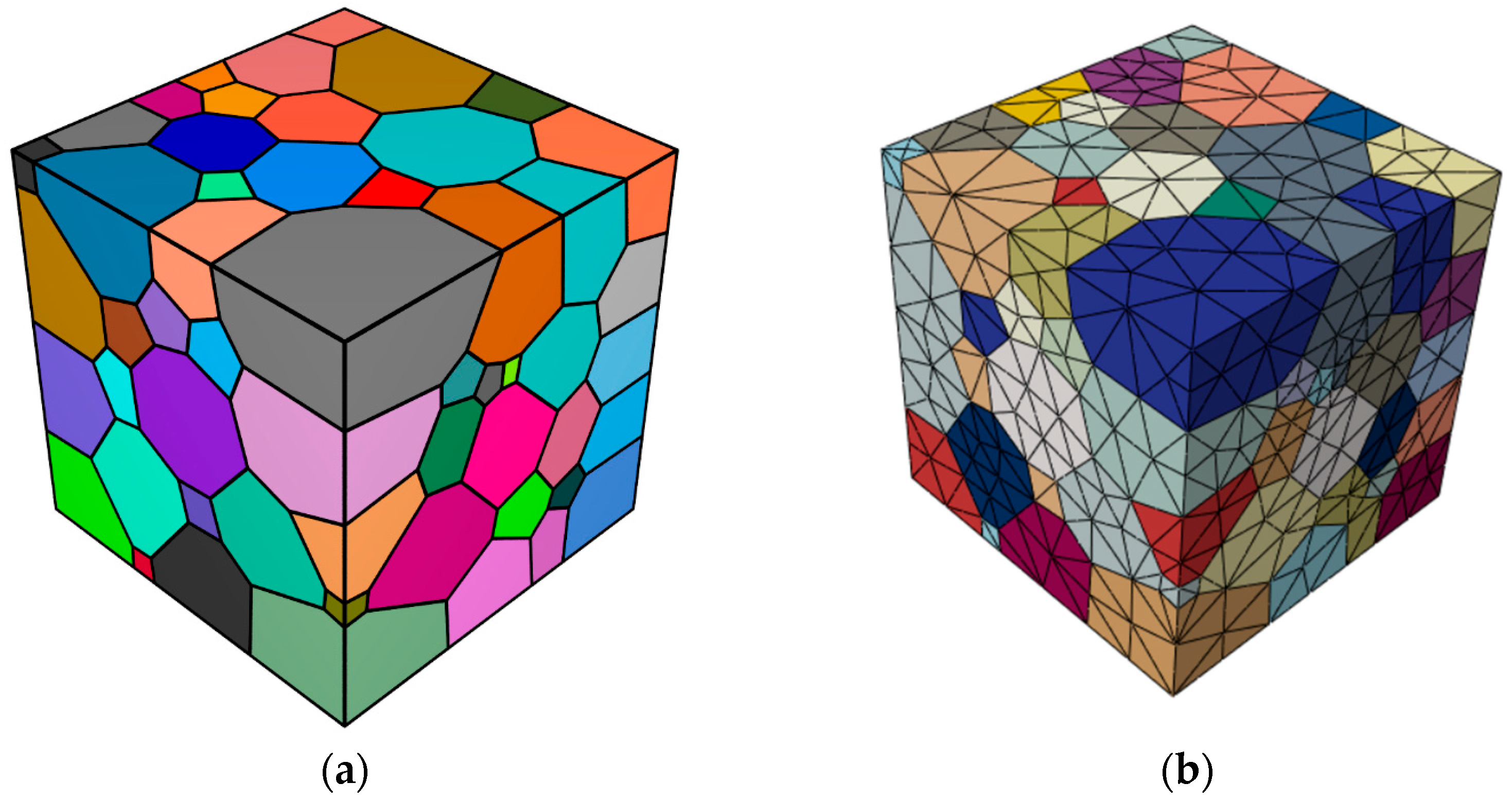
The first step in describing the operation process using the multilevel model, which considers grain topology, was to find a solution to the problem of topology formation. An algorithm for constructing a polyhedral grain structure was previously developed by the authors [99]. It was based on using the Neper 4.8.2 [68] software package and statistical data describing the sphericity parameter ψg (the ratio of the surface area of a sphere, the volume of which is the same as the volume of the grain considered, to the surface area of the grain) and the relative grain size D e q = D D ¯ , where D is the grain size, and D ¯ is the average grain size. The generated grain structure is illustrated in Figure 2a. Statistical data for D e q were obtained using the developed statistical model at the end of the manufacturing process. It was assumed that, after annealing, the recrystallized grains acquire a shape close to spherical, which can be assigned to grain boundary energy minimization. Therefore, in the calculations, the sphericity parameter was considered to be close to unity, ψ g 0.9 [100].
All deformation history obtained during rolling and annealing was stored in the internal variables of the statistical model. A unified material model was used for both manufacturing (rolling and annealing) and operational (LCF) simulations, which enabled a direct transfer of internal variables between modeling stages. The one-way coupling procedure was as follows:
  • Creating polyhedra. A polyhedral grain structure was created in Neper [68] and discretized using tetrahedral simplex elements. This ensured accurate approximation of grain boundaries (see [101]).
  • Element grouping. A custom script parsed Neper output and automatically identified finite elements belonging to each polyhedron. These elements were grouped into sections corresponding to grains and exported for use in Abaqus.
  • Grain matching. A separate user-developed procedure implemented a greedy matching algorithm [102] to associate each polyhedron with a grain from the statistical model based on size (polyhedral diameter was defined as the diameter of a sphere with equal volume).
  • Assignment of grain properties. All finite elements within each polyhedral section in Abaqus were assigned the corresponding grain properties. The model parameters relevant to rolling and LCF deformation are listed in Table 1.
  • Transfer of internal variables. Key internal variables—including lattice orientation o and CRSS τ c ( k ) —were transferred to each polyhedral grain according to the established matching. These variables preserve the full manufacturing history.
This process produced a polyhedral representation suitable for LCF simulations in which each grain was initially homogeneous with respect to all internal variables. During subsequent numerical experiments, this homogeneity evolved, allowing for the description of plastic localization near grain boundaries (see Section 3).
The prepared finite-element mesh was imported into the Abaqus 2022 software package [103]. The proposed model was implemented in Abaqus as a user subroutine VUMAT, which was integrated into a finite-element method (FEM) computation. At each integration point, the system of equations describing the material behavior at the level of an individual grain fragment was solved numerically using the finite-element method [72,104,105]. The generated polyhedral structure and its finite-element mesh discretization are shown in Figure 2b.
Direct modeling implies solving the initial-boundary value problem of solid mechanics at the mesoscale and an explicit consideration of the topology of grains. A representative volume at this scale represents a part of the polycrystal that captures its characteristic microstructural morphology. In this approach, the internal structure of the material in the considered region is assigned an explicit spatial image. To calculate stress–strain state fields, it is necessary to solve the equation of motion, supplemented by a constitutive material model and appropriate initial-boundary conditions:
ρ ^ v ˙ = ^ σ + f
where ρ ^ is the density (density in the current configuration), v is the velocity vector of displacements, f is the vector of applied distributed forces, and σ is the second rank Cauchy stress tensor. The applied basic two-level material model was described in [72,104,105] and then integrated into the subroutine VUMAT. This model considers shear mechanisms along slip systems and hardening caused by the interaction of mobile dislocations with forest dislocations.
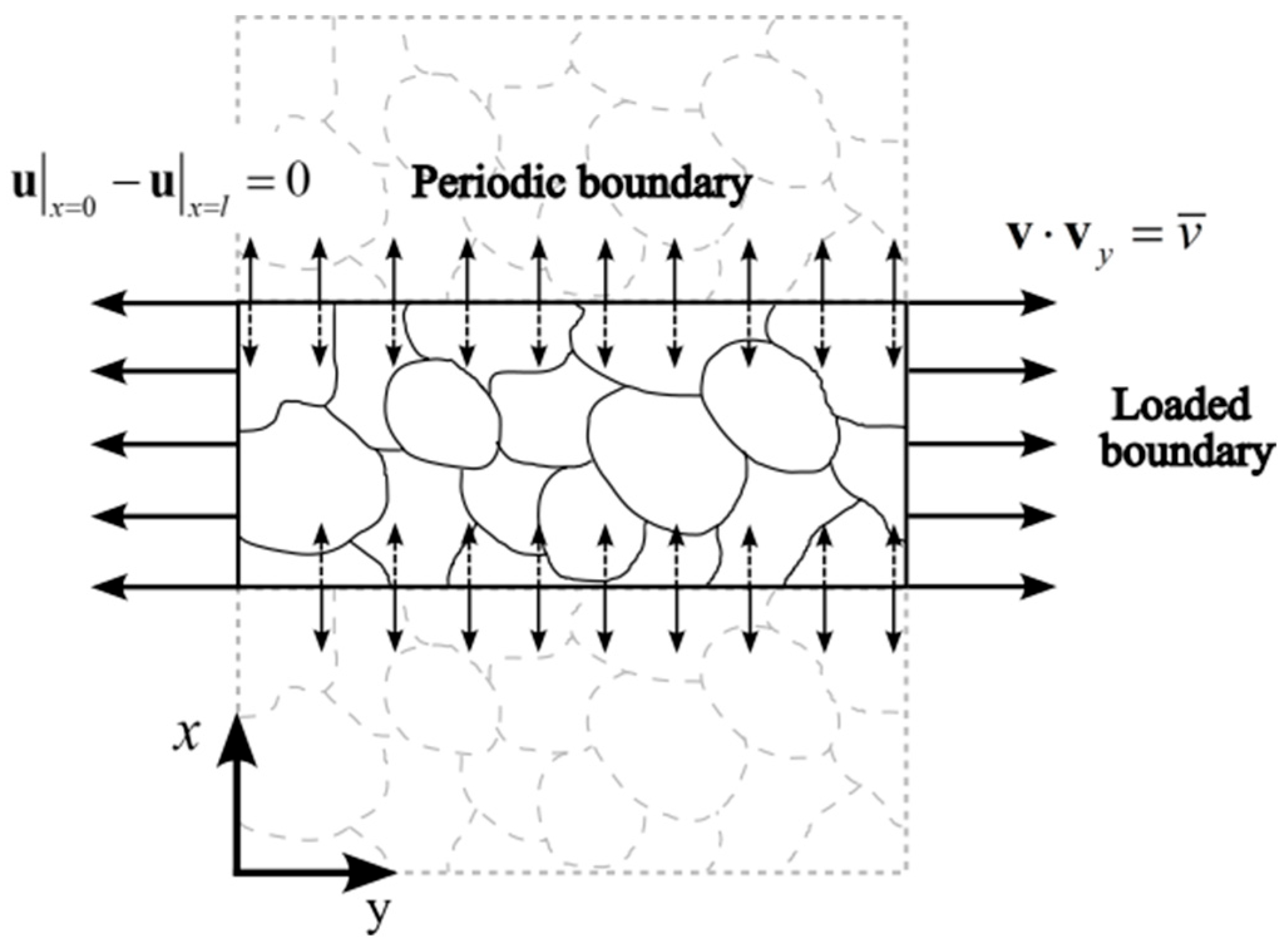
The operational problem was reduced to the study of uniaxial loading. Boundary conditions for tension along the unit vector v were defined as follows:
v v y = v ¯ , n σ I v y v y = 0 , for   the   loaded   boundary
where v ¯ is the prescribed rate of tension along v y , n is the unit normal vector to the boundary, and I is the second-rank unit tensor. Sample loading is schematically shown in Figure 3. The coordinate system Oxyz was aligned with the rolling directions: Ox corresponds to the rolling direction (RD), Oy to the transverse direction (TD), and Oz to the normal direction (ND).
To correctly describe the representative volume of material, this volume is assumed to be in a confined environment, so periodic boundary conditions were used [106,107]. The conditions for conjugation on opposite faces are presented as follows:
u x = 0 u x = l = 0 , for   the   unloaded   boundary ,
where u x = 0 and u x = l are the displacements on the opposite volume boundaries.
The Smith–Watson–Topper criterion (SWT) was used to describe low-cycle fatigue [70,108]. This criterion was developed to evaluate the fatigue life of materials under uniaxial loads (tension–compression) in the range up to the initiation of a fatigue crack [70], and it relies on the analysis of stress and strain [70]. In this study, the SWT criterion is applied in its classical form [108]:
S W T = E Σ m a x Δ ε / 2 0.5 ,
where E is the Young’s modulus, Σ m a x is the maximum stress, and Δ ε is the cyclic strain amplitude value. In this research, the relation between the SWT criterion and the number of cycles N f prior to failure is written as [70]:
S W T = A N f B ,
where A and B are the material parameters. The fatigue characteristics of alloys are dependent on material structure conditions, particularly on the average grain size [109,110]. To demonstrate this dependence, the parameters A and B were incorporated in the SWT criterion. In this work, the low-cycle fatigue behavior at a temperature of 650 ° C is described for diverse grain structure conditions. The following dependencies of the parameters A and B on the average size (diameter) of grains D are introduced:
A = A 1 + A 2 D , B = B 1 + B 2 D .

2.3. Identification of the Hybrid Model for Describing Manufacturing and Operational Processes

Identification of the inelastic deformation model—including the parameters of the hardening law, yield stress, and elastic moduli—was performed using data from uniaxial tension tests conducted at room temperature and at a strain rate of 10−3 s−1 [111]. Prior to testing, the samples made of Inconel 718 were subjected to a two-stage heat treatment [111]. This thermal processing forms the original microstructure characteristic of Inconel 718 [112]. The model assumes that the grain size distribution follows the one-parameter Rayleigh distribution with a mean value of 65 μm [113].
The identification of the inelastic strain model parameters under quasi-static loading was performed using the specialized IOSO 4.0 platform [114] designed for solving the multi-criteria and multi-parameter problems of optimization of complex nonlinear systems. The identification involved a series of iterations, in which the model parameters were adjusted to minimize the difference between the simulated and experimental stress–strain diagrams and fatigue characteristics. The parameters of the multilevel model are given in Table 1.
Table 1. Material parameters in the multilevel model of inelastic quasistatic deformation at room temperature.
ParameterValueSource
Mass density
ρ
8193 kg/m3[115]
Anisotropic   elastic   moduli   Π 11 , Π 12 , Π 44 274.2, 129, 72.6 GPa[116]
Reference shear rate
[80]
γ ˙ 0
0.001 s−1Experimental data-based identification
[117]
Velocity sensitivity degree
[80]
m
83.3Experimental data-based identification
[117]
Hall–Petch parameter
[83,84]
k y
1.2Experimental data-based identification
[118]
Initial critical stresses
[82]
τ 0
470 GPaExperimental data-based identification
[118]
Saturation stresses
[82]
τ s a t
630 GPaExperimental data-based identification
[111]
Hardening law parameter for slip systems
[82]
h0
370 GPaExperimental data-based identification
[111]
Hardening law parameter for slip systems
[82]
a
1.4Experimental data-based identification [111]
Hardening law parameter for slip systems
[82]
qlat
1.4[72]
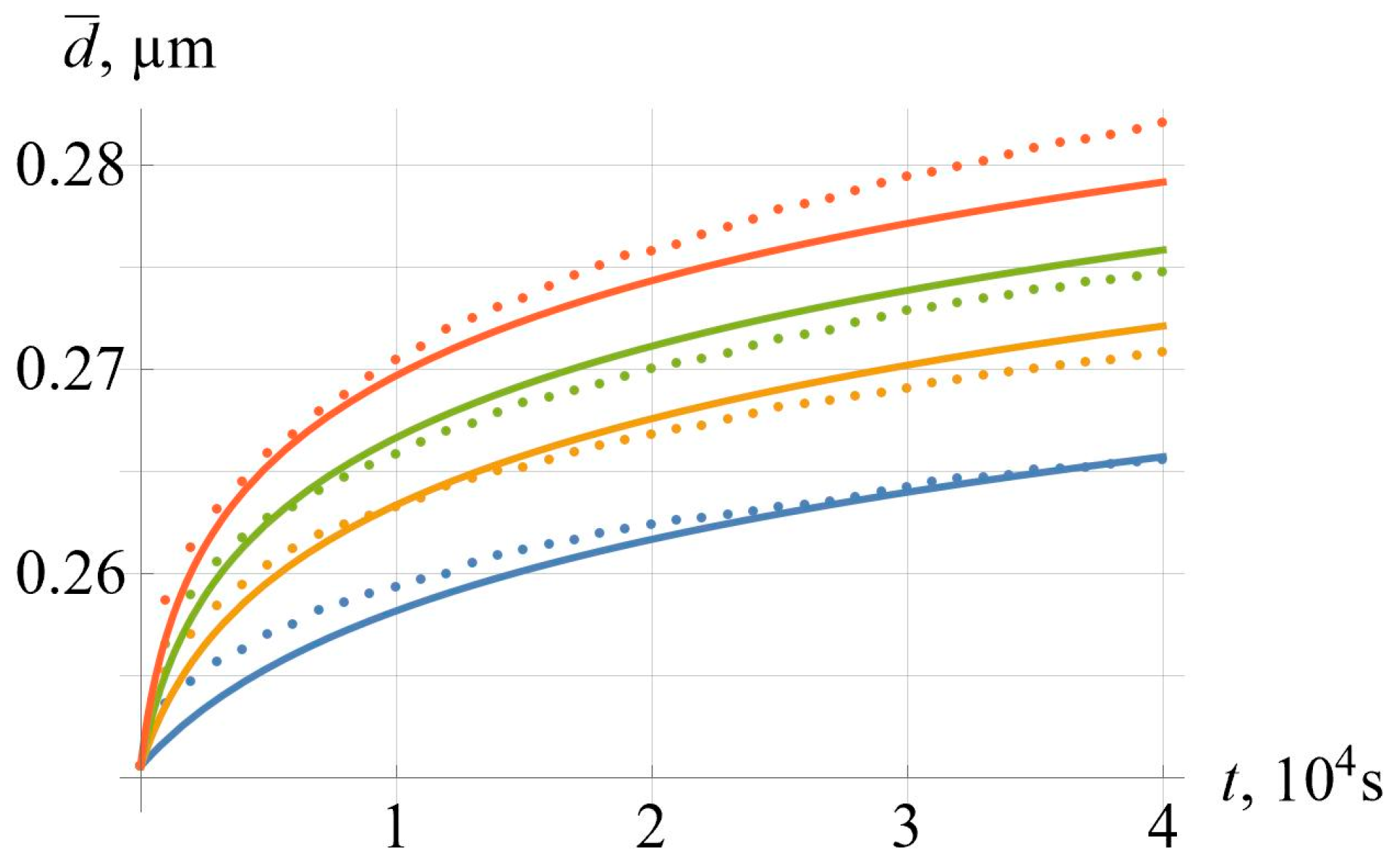
The parameters of the approximation Relation (11) used to describe the average size of subgrains d ¯ were obtained during solving the optimization problem based on existing data [96]. The results of the identification procedure for d ¯ t are shown in Figure 4, where the data from [96] are indicated by dotted lines, and their approximation—by solid lines. The dependence of the average subgrain size on annealing time at various temperatures was identified in two stages. First, the identification was performed for pure nickel (with an error of 1.3%). At the second stage, the Zener drag effect resulting from the presence of secondary-phase particles γ and γ was incorporated. The identification procedure is described in detail in [96].
For Relation (9), and based on the data from [119,120], the parameters a and b were assumed to be 0.150 μm and 1.150 μm, respectively. In [121], the authors estimated the change in the volume fraction of the δ phase particles after rolling with different deformation levels and for different annealing durations at a temperature of 910 ° C . It was shown that, under thermomechanical conditions, the particle volume fraction approaches a saturation value of about 9%, i.e., f δ = 0.09 .
The parameter α in the relation for the stored energy of defects after cold rolling was assumed to be 0.1, as reported in [122]. The high-angle grain boundary energy γ for Inconel 718 was equal to 0.93 J / m 2 [123]. The activation energy parameters Q and Q r were taken from [124]. Identification of other parameters of the recrystallization model was carried out using experimental data on the evolution of the average grain size during annealing following cold rolling [125]. The parameter values were determined so that the predicted final grain size matched the experimental data. The identified parameters of the static recrystallization model are summarized in Table 2.
Table 3 contains the final average grain size taken from [125] and the model computational data. As one can see, the simulation results agree well with the experimental data.
To identify the LCF model parameters, we used experimental data obtained from the loading diagrams for the steady-state (average) low-cycle fatigue (LCF) for the material with its average grain size D = 30   μm [127]. No such diagrams were found in the literature for other grain sizes. So the missing diagrams were generated from the quasi-static uniaxial loading diagrams with the grain size D in the range [ 22.5 ; 179.6 ]   μm [110,127]. According to the Hall–Petch relation, the yield stress of the macrolevel Σ depends on the grain size D as follows:
Σ = Σ 0 + K / D ,
where Σ 0 and K are the material constants. Based on the results from [110,127], the parameters Σ 0 and K for quasistatic loading, were identified, at D = 30   μm the yield strength for the average cycle [127] and quasistatic loading [110,127] diagrams were compared, and the scaling coefficient k m between these diagrams was found. For the range [ 22.5 ; 179.6 ] μm, the required average cycle diagrams were determined by applying this coefficient.
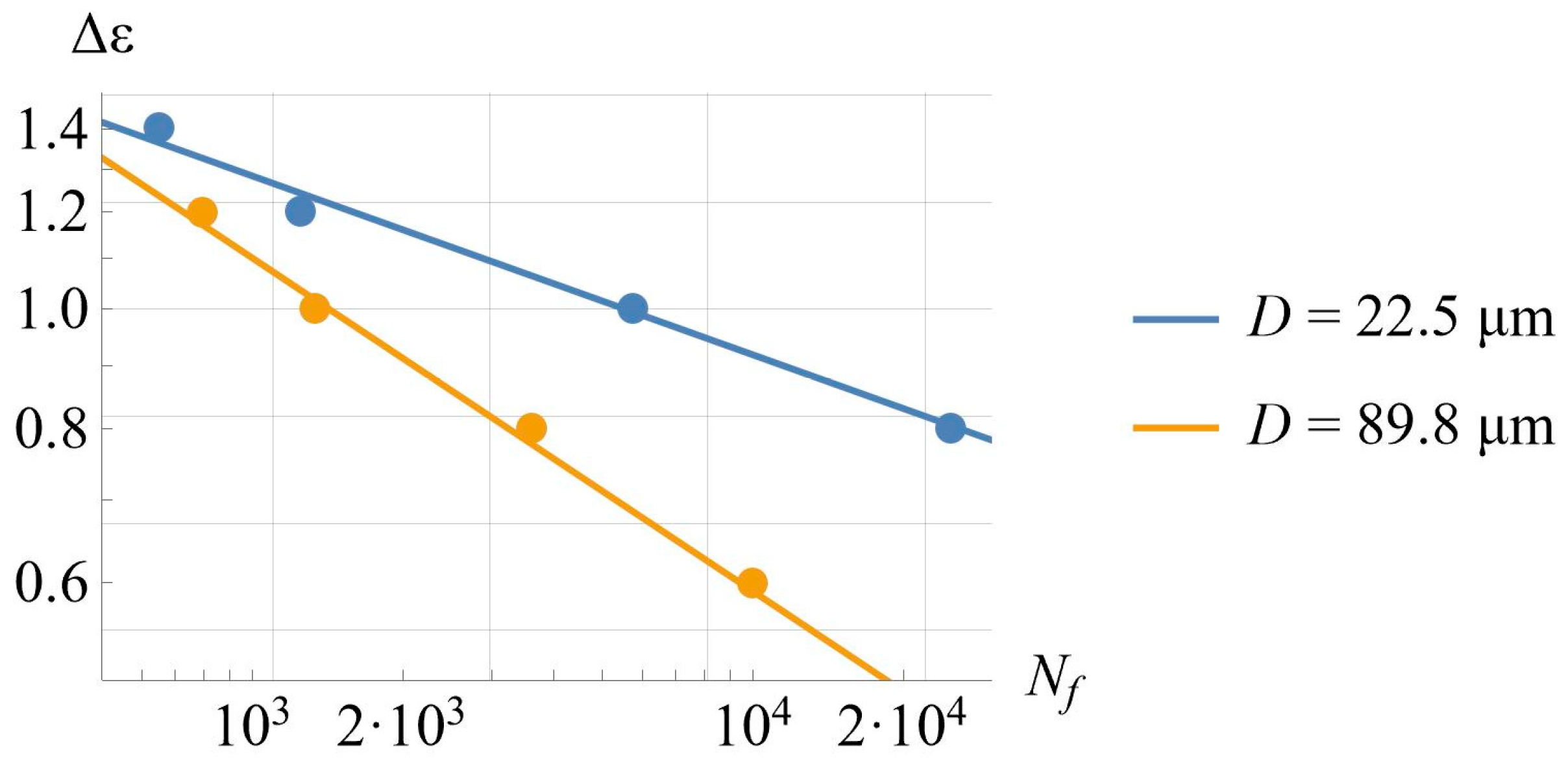
In addition, to identify the SWT criterion, the experimental dependencies of the deformation range Δ ε on the number of cycles N f for the grain sizes of 22.5 and 89.8 μm were used [110]. The stress Σ m a x , which corresponds to the considered Δ ε , was found through the use of the stress–strain diagrams for a steady state cycle. Parameters for the SWT criterion were identified with logarithmic coordinates by the least squares method, and the material parameters from (17) and (18), namely A 1 , A 2 , B 1 and B 2 , were determined. The identification result is given in Figure 5 (error about 7.4%). The calculated parameters of the LCF model are listed in Table 4.
An effective method for assessing the adequacy and correctness of a developed mathematical model is a comprehensive analysis of its stability with respect to perturbations of model parameters and input data [128,129]. This methodology was previously applied to evaluate the stability of the basic multilevel model [128,129], a modified version of which is used in the present work to describe inelastic deformation and low-cycle fatigue (see Section 2).
In this study, the stability of the recrystallization model was examined with respect to perturbations in the defect-stored energy e s t and temperature θ . The dependent (output) variable was the average grain size D . The choice of perturbed parameters is determined by their physical significance. Differences in the stored energy e s t between grains is the primary driving force for grain boundary migration (see Equations (6) and (7)), while the temperature θ is the principal external parameter controlling the annealing process. Consequently, the quantities D and varied e s t and θ represent key characteristics of the internal microstructure during recrystallization. Because these values cannot be determined precisely without complex and costly experiments, it is essential to examine how variations in e s t and θ influence the model response D .
Following the methodology described in [128,129] the first stage involved determining a baseline (unperturbed) solution relative to which stability was evaluated. In the present case, the baseline solution was the dependence of average grain size on annealing time D ( t ) . At the second stage, perturbations of model parameters were introduced. The stability of the model with respect to perturbations in θ and e s t at the initial moment of annealing was examined. In the general case, a perturbed parameter A * is defined as A * 0 = A 0 1 + α , where A is the baseline value and, α is a uniformly distributed random variable within the interval δ , δ .
At the third stage, a computational experiment plan was constructed to evaluate the deviations of the solution from the baseline curve D ( t ) under perturbations of e s t and θ . In this study, individual perturbations of these parameters were considered for a single baseline solution, which corresponded to the dependence D ( t ) , obtained in numerical experiment 2 (see Section 3).
The fourth stage consisted of executing a series of computational experiments according to the developed plan. At this stage, the ranges of relative perturbations were also selected, δ . For the stored energy e s t : δ e s t = 0.01 ; 0.02 ; 0.03 and for temperature θ : δ θ = 0.001 ; 0.002 ; 0.003 . For each δ e s t , δ θ a series of 15 simulations was performed. It should be noted that temperature θ is a structurally sensitive parameter of the model, such that small changes (on the order of a few percent) lead to changes in the response of several tens of percent. This sensitivity reflects the physical nature of the thermally activated recrystallization process and is consistent with experimental data. For example, for Inconel 718 annealed for 3 h, increasing the temperature from 950 ° C to 1000 ° C increases the average grain size from 12 μm to 29 μm [125].
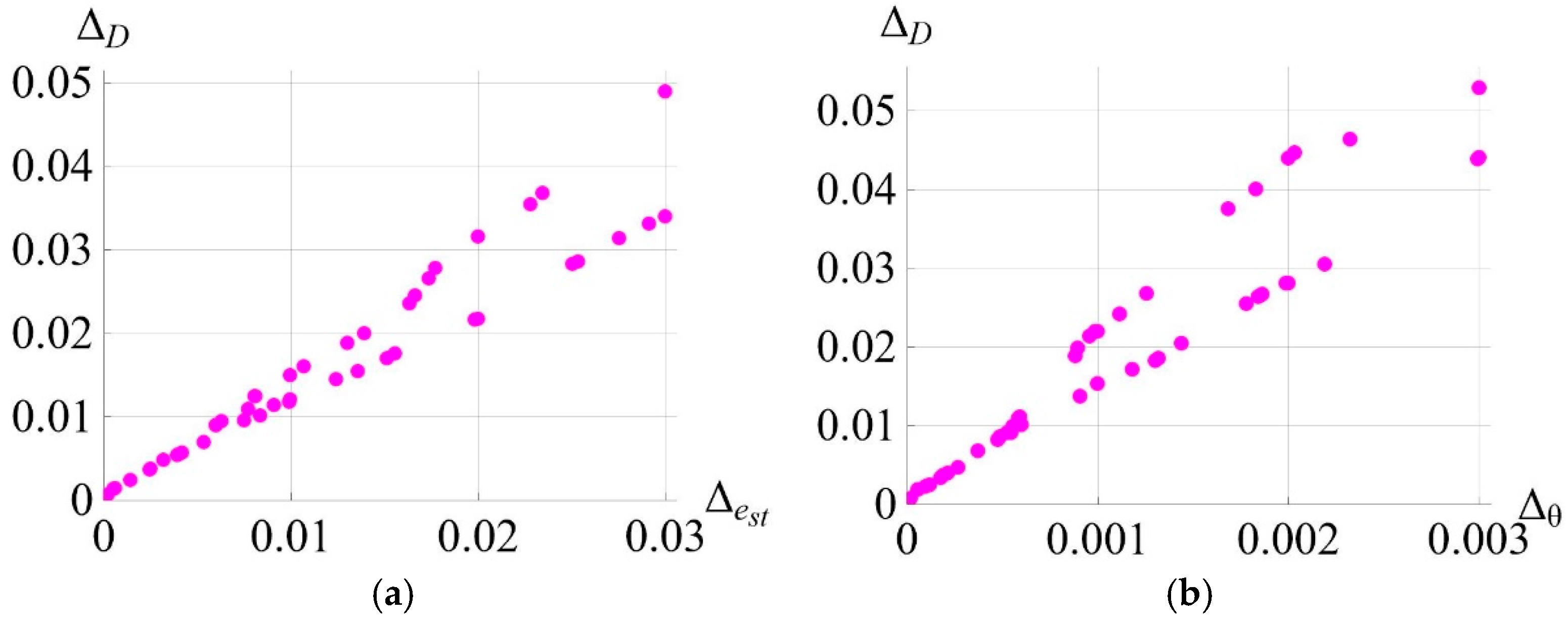
At the fifth stage, the stability conditions specified in [128] were verified. For this purpose, the relative norms of deviations of the perturbed parameters Δ A = A * 0 A 0 A 0 and the response Δ D = D * t D t D t [128] were calculated. In this work, the average integral norm was used. The resulting values for each computational experiment are shown on a plot of the relative norm of the response Δ D versus the relative norm of the perturbed parameter Δ e s t , Δ θ .
As shown in Figure 6, a decrease in the relative norm of the perturbed parameters leads to a corresponding decrease in the relative norm of the model response, which confirms the stability of the model according to the methodology proposed in [128]. The obtained results demonstrate that the temperature θ is a more sensitive parameter compared with the stored energy e s t . In the numerical stability analysis, perturbations of θ were assigned to be an order of magnitude smaller than those of e s t (as explained earlier), yet the resulting deviations of the response remained comparable. It should also be noted (Figure 6) that, for perturbations in both Δ e s t , Δ θ , two distinct divergence trends of the response Δ D were observed. This behavior is associated with the different effects of the sign of the imposed perturbation, Δ e s t , Δ θ . The deviation Δ D is larger for negative perturbations in δ e s t or for positive perturbations in δ θ . This can be explained as follows. An increase in θ enhances the mobility of grain boundaries (see Equation (5)), which, in turn, increases the deviation of the perturbed solution from the baseline D ( t ) . Conversely, a decrease in θ lowers the deviation Δ D . An increase in e s t leads to a higher nucleation rate of new grains (Equation (1)); as a result, the number of nuclei increases, reducing the driving force for grain boundary migration and driving the system closer to the baseline solution D ( t ) . A decrease in e s t produces the opposite effect.

3. Results and Discussion of Hybrid Modeling of the Full Manufacturing–Operation Cycle

Cold rolling at room temperature was modeled using the statistical inelastic deformation model (see Section 1), and the kinematic effect was set within Voigt’s hypothesis:
^ V = γ ˙ k 01 k 01 γ ˙ 2 k 02 k 02 γ ˙ 2 k 03 k 03 ,
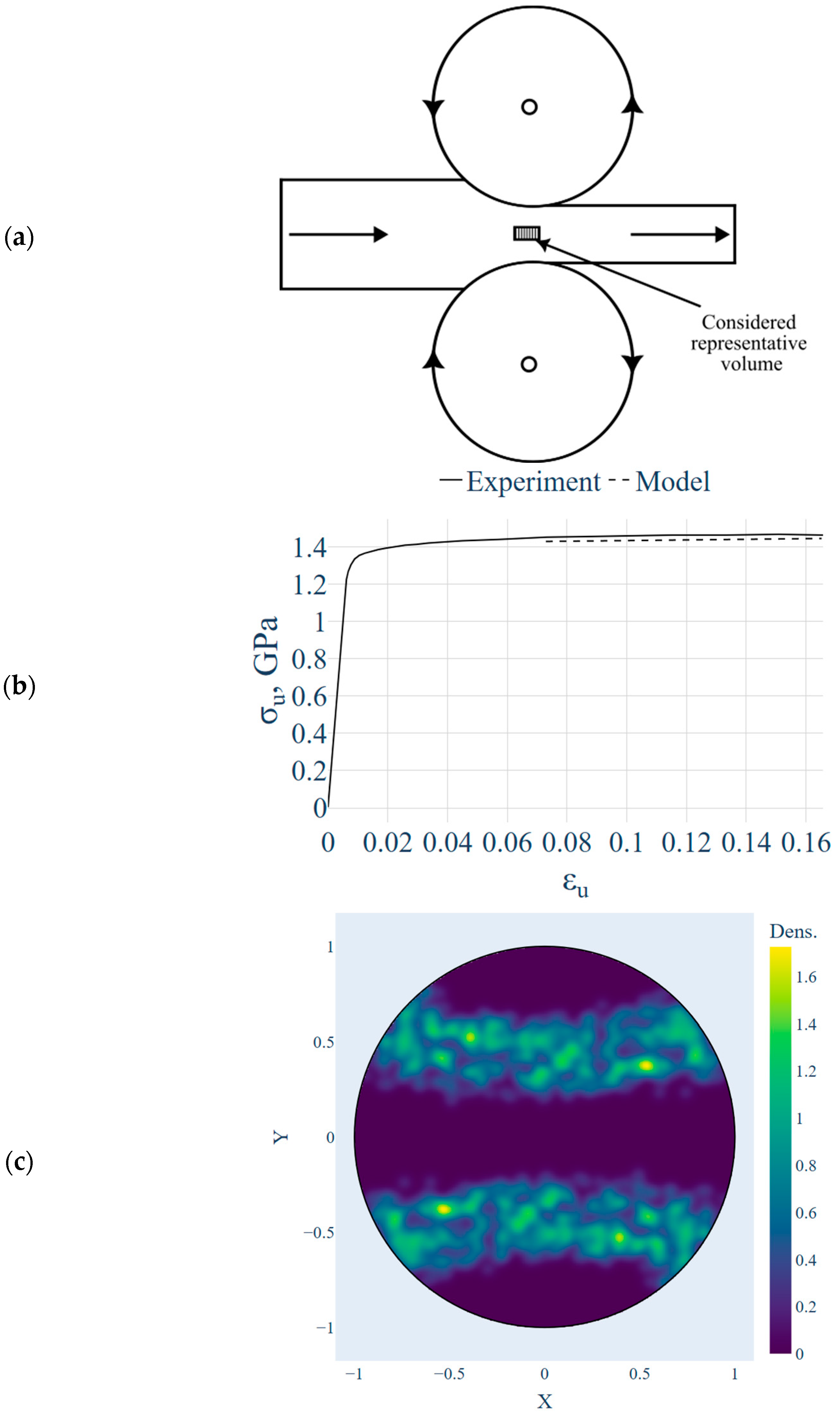
where k 0 i is the orthonormal basis of the laboratory coordinate system. The effect defined in (20) corresponds to considering the center region of a rolled sheet [130]. The layout of the examined area inside the sample is shown in Figure 7a. At the stage of cold rolling, the deformation rate was assumed to be constant γ ˙ = 8 × 10 2   s 1 in all computations. Figure 7b,c present a loading diagram and a straight pole figure {111} at the end of rolling ( ε u = 0.45 is the deformation intensity magnitude), respectively. The average discrepancy between the experimental and calculated data was 3%. The pole figure shown in Figure 7c corresponds to a typical rolling texture [131,132].
After the rolling stage, we modeled the annealing process (see Section 2) for the representative material volume at different degrees of the rolling-driven preceding deformation. For all experiments, the annealing time and temperature (t = 30 min, and θ = 1248 K ) were fixed. In simulation, Experiment 1, the amount of sample deformation reaches ε u = 0.35 , and in Experiment 2 it is ε u = 0.45 .
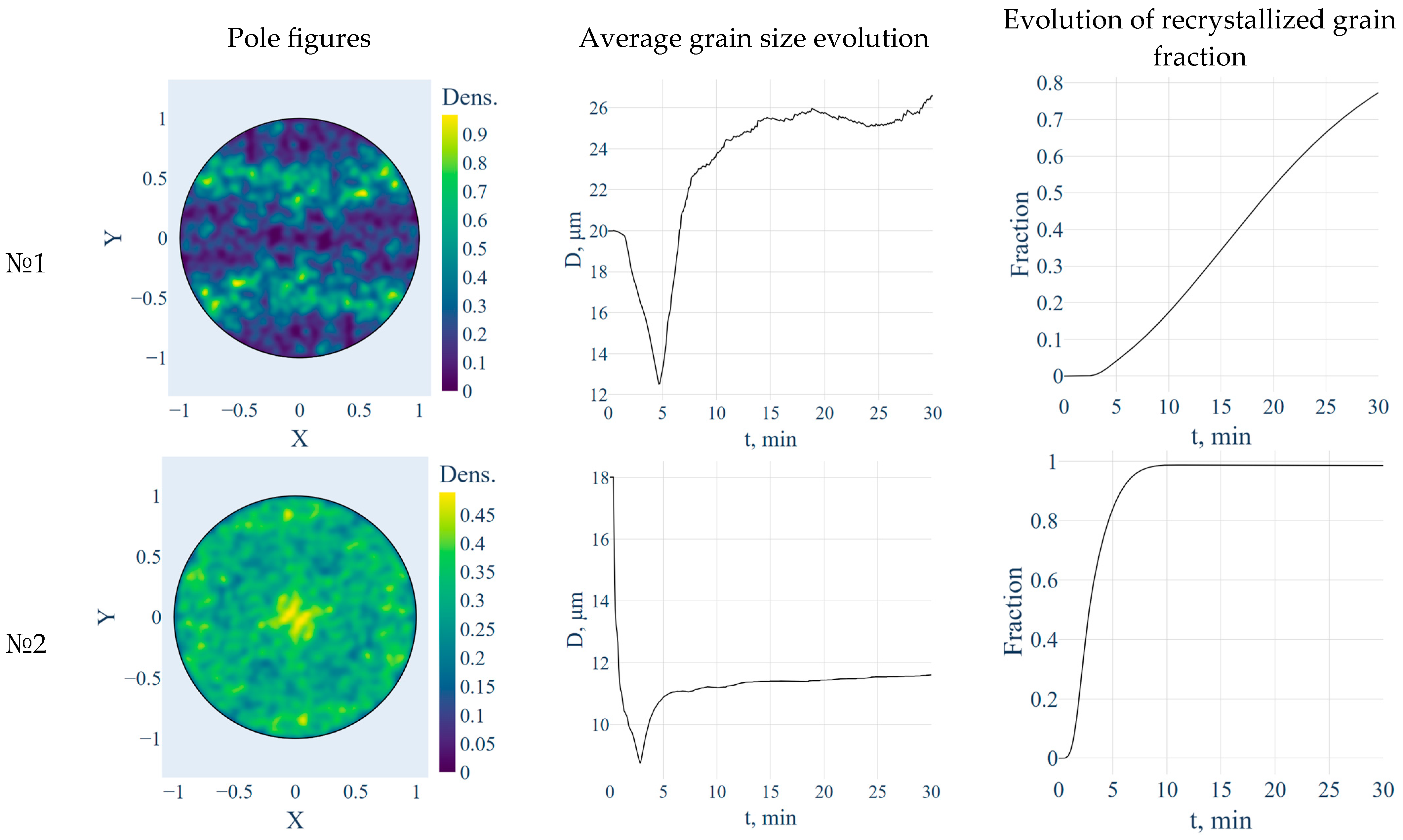
Figure 8 presents the {111} straight pole figures for the final stage of the simulated annealing experiments, which illustrate the effect of different deformation conditions and annealing on the microstructure state. For Experiment 1, in which the amount of preceding deformation was ε u = 0.35 , the annealing time was t = 30 min and temperature was θ = 1248 K , the stored energy is insufficient for complete recrystallization; the volume fraction of recrystallized material f was 77%. After annealing, the rolling texture was blurred, but could be traced clearly. This was indicated by the predominance of orientation inherited from the original deformed structure and by the rolling texture in primary grains. The process of recrystallization evolved slowly and was accompanied by the intense boundary migration of original grains. As a result, the average grain size increased, unlike that after rolling, and was equal to 26.5 μm .
In Experiment 2, recrystallization is intensified: during the first 10 min of annealing, practically the entire volume of the material was recrystallized. This is due to the high driving force of recrystallization P E occurred because of a deeper, compared to Experiment 1, preceding deformation ε u = 0.45 . In addition to the magnitude of the stored energy P E- an effective means of controlling the recrystallization rate is to vary the temperature. At the onset of recrystallization, intensive nucleation and, consequently, grain structure refinement were observed, as evidenced by Relations (1)–(3). As new grains appear, the stored energy decreases (Relation (7)) so rapidly that the grain boundary migration does not occur. Thus, in this experiment, the average grain size decreases and reaches the value of 11.6 μm . The texture is completely blurred, and the orientation distribution is close to uniform. This observation and completely recrystallized grains cause the material to develop isotropic properties. Experiments 1 and 2 illustrate various scenarios for the grain structure evolution depending on the processing conditions of the material [133,134]. The blurring effect observed in the pole figures shown in Figure 8 for both computational experiments is consistent with a wide body of experimental evidence [20,135].
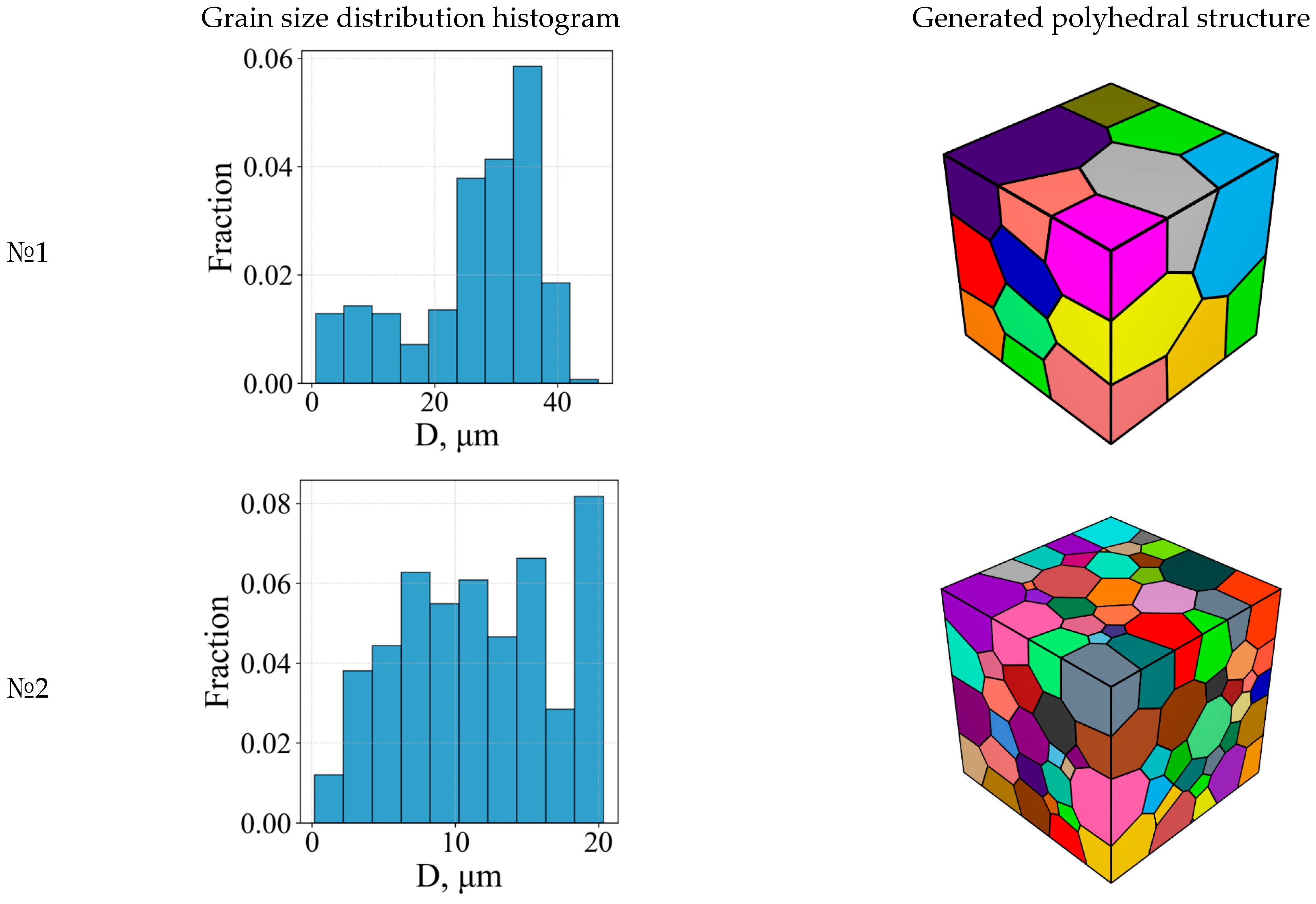
To study the material behavior during operation, a grain structure was generated based on the statistical laws obtained through modeling rolling and annealing. The grain structure was shaped as a cube with a fixed edge size of 70 μm . Figure 9 shows the polyhedral grain structures and the corresponding grain size distribution histograms obtained in numerical Experiments 1 and 2. In each case, the sphericity of grains was assumed to be close to unity ψ g 0.9 for all experiments. The generated structures reflect the geometric grain structure features that correspond to different processing options.
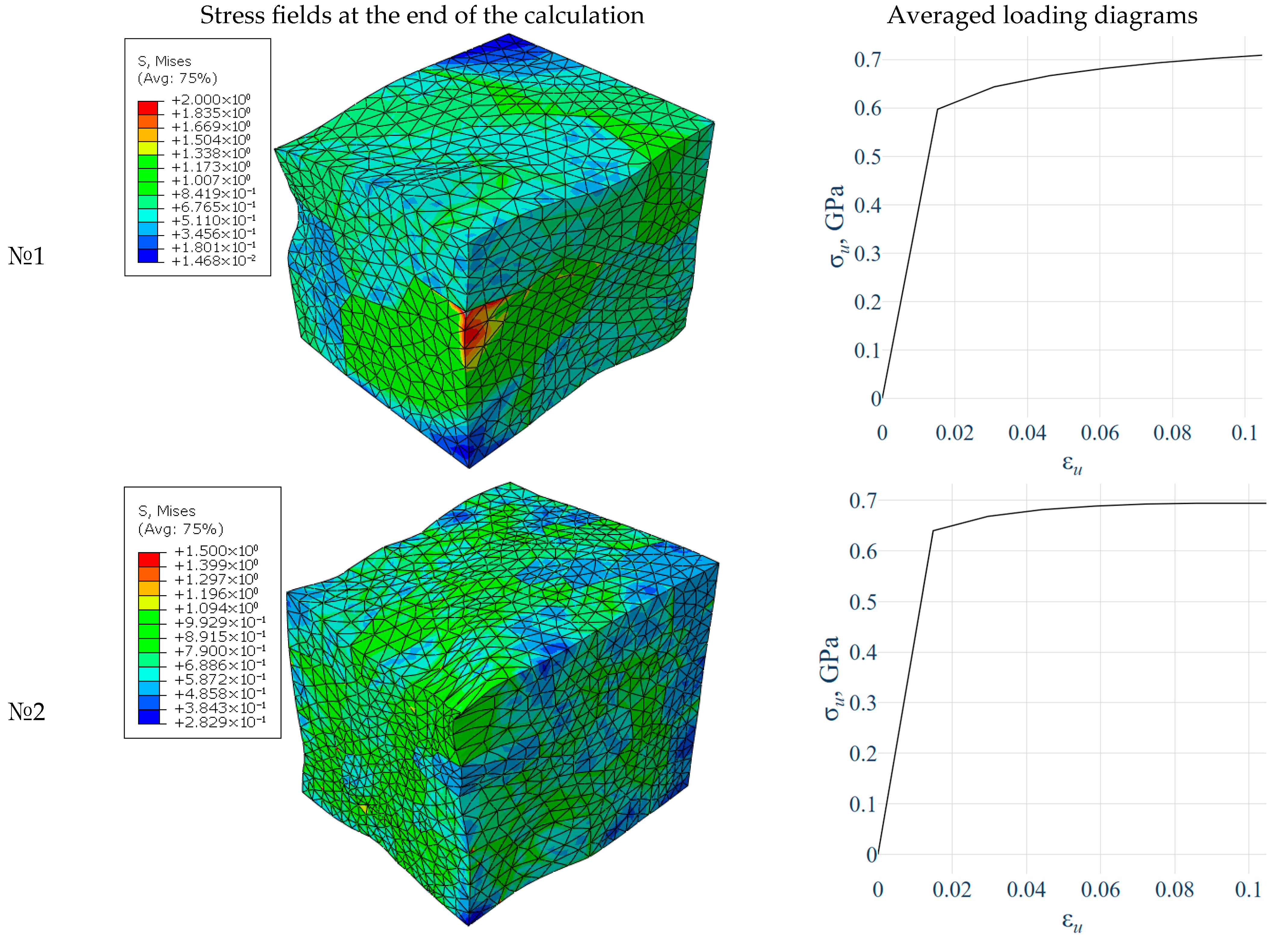
Numerical modeling results for the material response to operational mechanical loading are presented below. The representative volume of the material was assumed to undergo uniaxial loading (the material model and boundary conditions are given in Section 1). Figure 10 presents the uniaxial tensile stress–strain diagrams for a strain rate v ¯   = 10 3   s 1 at room temperature. The inelastic behavior of the material is governed by two main factors: (1) the average grain size, which defines the yield stress according to the Hall–Petch law; (2) the state of the defect structure in both the original or recrystallized grains; for the original grains that remain after deformation, the critical stresses of the slip systems are increased.
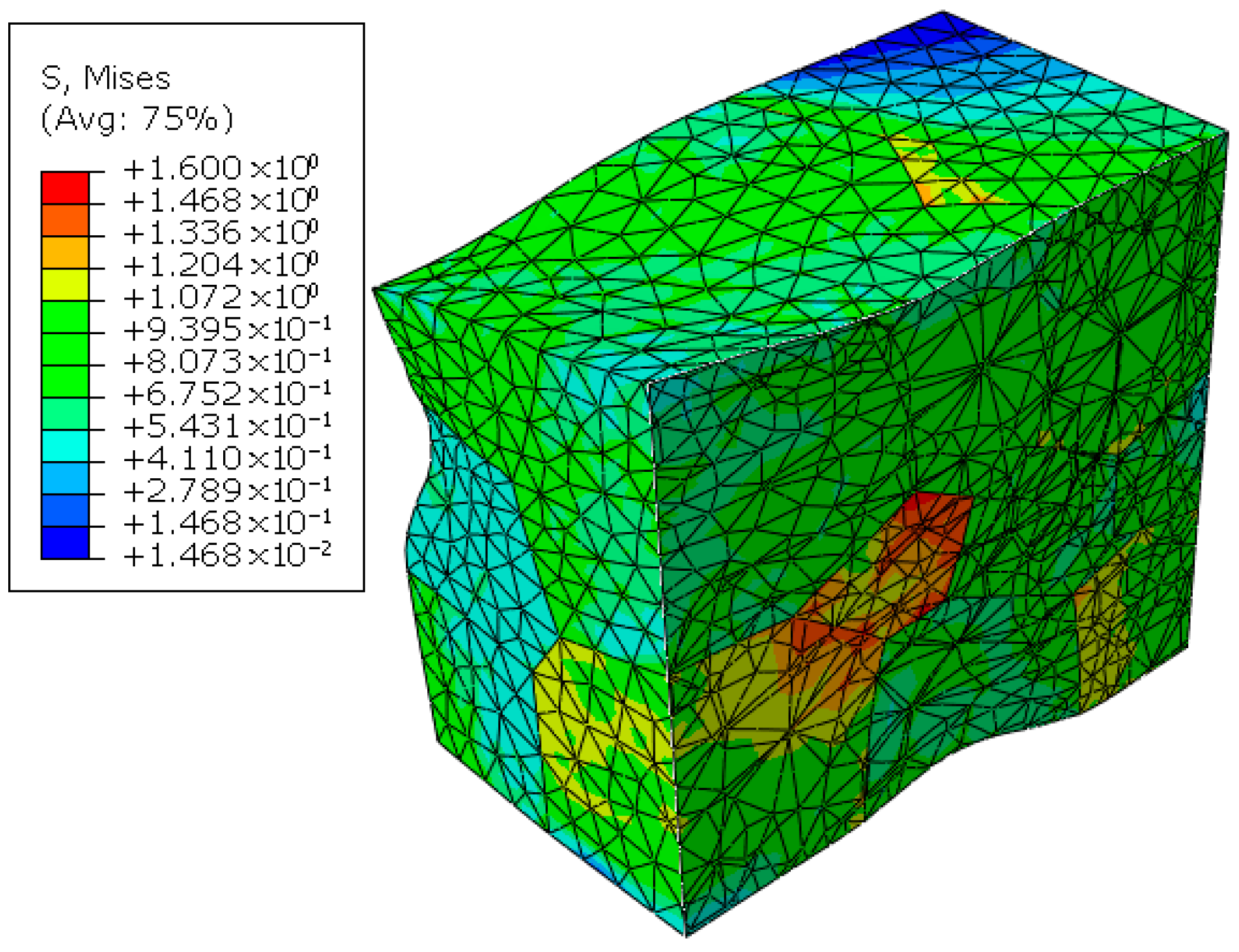
In Experiment 2, the obtained grain structure is completely recrystallized and becomes almost free of accumulated defects. In this case, the yield stress is governed primarily by the grain size and agrees well with the predictions of the Hall–Petch law. This is supported by the relatively uniform stress distribution pattern without localized concentrators, indicating the absence of significant internal obstacles to dislocation motion (Figure 10). In contrast, a yield stress higher than that expected for a given average grain size is observed in Experiment 1. The effect arises from incomplete recrystallization; the original grains retain defects inherited from the prior rolling, which also impedes dislocation slip. This effect is clearly seen in the diagram (Figure 10): a curve for Experiment 1 is located higher than a curve for Experiment 2, while exhibiting a similar strain hardening. Moreover, due to the incomplete recrystallization, the structure in Experiment 1 exhibits stress localization near non-recrystallized grains. In the equivalent von Mises stress fields (Figure 11), this appears as pronounced local inhomogeneities, in contrast to the uniform distribution characteristic of the fully recrystallized structure.
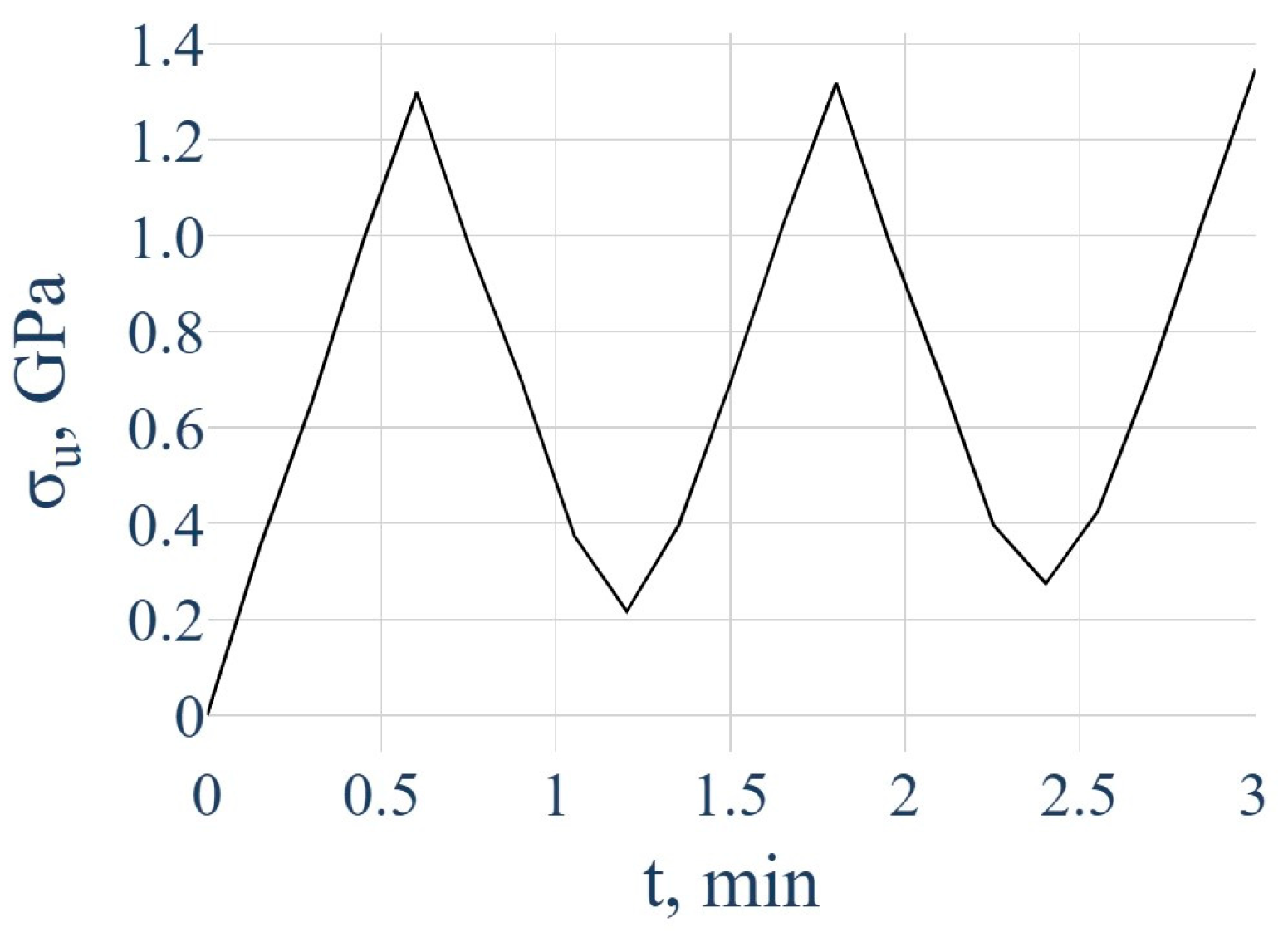
The results of cyclic loading of a representative volume are presented below. Loading conditions for the numerical experiment were specified as a symmetrical triangular cycle with a constant stress amplitude Δ σ = 300   MPa , the maximum stresses σ max in the cycle exceeded the yield stress by 5%. The time dependence of stresses is shown in Figure 12. This cycle was implemented in Abaqus by specifying the tension and compression stages through boundary conditions due to alternating directions of the strain rate at one of the representative volume facets. The deformation rate was prescribed to be v ¯   = 5 × 10 2   s 1 . One steady state (average) cycle was modeled. After stretching, the strain direction was immediately reversed, and the material underwent compressive strain, after which the cycle was repeated. The strain rate selected for the numerical study and the loading cycle considered are typical for low-cycle fatigue (LCF) testing [136,137]. This choice enabled validation of the proposed model and allowed the number of cycles to failure to be reproduced with a high degree of accuracy.
The Smith–Watson–Topper criterion was calculated for each grain in the volume under study. To do this, we applied a procedure to determine the average stress and strain values in each grain. Then, the weakest grain, i.e., the one with the lowest number of cycles, was identified. It was this grain that determined the fatigue crack formation and material service life. As the grain size decreased, the number of cycles to failure significantly increased. In addition, the material lifetime was strongly affected by the density of defects accumulated in the non-recrystallized grains during rolling, which reduced the fatigue strength. The number of cycles before failure in Experiment 1 was 12,898, and in Experiment 2 it was 56,181. This difference is explained by the fact that a fine-grained structure has numerous grain boundaries, which effectively impede the propagation of fatigue cracks. Grain boundaries act as barriers, slowing up crack growth, thus increasing the material’s resistance to fatigue failure. Furthermore, a homogeneous fine-grained structure ensures a more uniform stress distribution, reducing the likelihood of localized stress concentrations that act as potential sites for crack initiation. The lower number of cycles in Experiment 1 compared to Experiment 2 arises from the defects accumulated in non-recrystallized grains during deformation. These defects locally reduce the fatigue resistance of the material, thus accelerating crack initiation in the affected regions.

4. Conclusions

The main findings of the study are as follows.
(i)
A hybrid model was developed to describe the full manufacturing–operation cycle of a representative volume of the Inconel 718 alloy workpiece. The proposed approach integrates statistical modeling of the structure and properties of polycrystalline materials and subsequent direct modeling that explicitly accounts for grain topology. This is achieved through the transfer of statistically evaluated data for specifying both the defect and polyhedral grain structures.
(ii)
A statistical inelastic strain model and a recrystallization model were applied to describe the cold rolling and subsequent annealing. Structural statistical data were obtained under various loading conditions. The previously proposed statistical model for dynamic recrystallization was modified to analyze static recrystallization, and the relationships and parameters needed to describe the evolution of the average subgrain size using a detailed multiscale model were determined.
(iii)
To directly model operational impacts, the geometric characteristics of the grain structure were derived from statistical computational results. Based on these results, a polyhedral grain structure was generated using the Neper 4.8.2 software package. The resulting topology was imported into Abaqus to simulate cyclic operational loads. A detailed model that accounts for the actual shape of grains and their spatial arrangement demonstrated its high accuracy in predicting the material behavior under cyclic uniaxial tension and compression.
(iv)
Two scenarios for grain structure evolution were described: refinement via recrystallization, and the migration-driven growth of the average grain size. An increase in the magnitude of prior deformation (with all other annealing conditions held constant) accelerates the recrystallization process. This leads to a decrease in the average grain size due to a greater amount of recrystallization nuclei, a lower driving pressure, and texture blurring. A fully recrystallized structure is homogeneous, low in defects, with isotropic properties enhancing material performance under cyclic loading.

Author Contributions

Conceptualization, N.K.; methodology, N.K.; software, A.P.; validation, A.P., D.B., and N.K.; formal analysis, N.K. and A.P.; investigation, N.K., D.B., and A.P.; data curation, N.K. and D.B.; writing—original draft preparation, A.P.; writing—review and editing, N.K., A.P., and D.B.; visualization, A.P. and D.B.; supervision, N.K.; funding acquisition, N.K. All authors have read and agreed to the published version of the manuscript.

Funding

The work was supported by the Russian Science Foundation Grant No. 25-29-00460, https://rscf.ru/project/25-29-00460/ (accessed on 27 November 2025).

Data Availability Statement

The original contributions presented in this study are included in the article. Further inquiries can be directed to the corresponding author.

Conflicts of Interest

The authors declare no conflicts of interest.

References

  1. Jeong, W.; Lee, T.-H.; Youn, S.-J.; Lee, M.; Kong, T.; Ryu, H.J. Effect of Decomposed TiCp on the Mechanical Properties of Laser Powder Directed Energy Depositioned Inconel 718. J. Mater. Sci. Technol. 2024, 224, 66–79. [Google Scholar] [CrossRef]
  2. Liu, W.; Zou, B.; Wang, X.; Liu, J.; Ding, S.; Li, L. Enhanced High Temperature Mechanical and Oxidation Behavior of Direct Energy Deposited TiC/Inconel 718 Gradient Coatings. Appl. Surf. Sci. 2024, 680, 161361. [Google Scholar] [CrossRef]
  3. Lopez, H. Numerical Modelling and Simulation of Metal Processing; MDPI: Basel, Switzerland, 2021. [Google Scholar] [CrossRef]
  4. Ran, R.; Wang, Y.; Zhang, Y.; Fang, F.; Wang, H.; Yuan, G.; Wang, G. Microstructure, Precipitates and Mechanical Properties of Inconel 718 Alloy Produced by Two-Stage Cold Rolling Method. Mater. Sci. Eng. A 2020, 793, 139860. [Google Scholar] [CrossRef]
  5. Yang, X.; Wang, B.; Jiang, W.; Chen, S.; Wang, J. The Superplasticity Improvement of Inconel 718 through Grain Refinement by Large Reduction Cold Rolling and Two-Stage Annealing. Mater. Sci. Eng. A 2021, 823, 141713. [Google Scholar] [CrossRef]
  6. Hua, K.; Zhang, Y.; Tong, Y.; Zhang, F.; Kou, H.; Li, X.; Wang, H.; Li, J. Enhanced Mechanical Properties of a Metastable β Titanium Alloy via Optimized Thermomechanical Processing. Mater. Sci. Eng. A 2022, 840, 142997. [Google Scholar] [CrossRef]
  7. Kluy, L.; Klinge, L.; Spiegel, C.; Siemers, C.; Groche, P. Design of Thermomechanical Processes for Tailored Microstructures. Manuf. Lett. 2024, 41, 421–428. [Google Scholar] [CrossRef]
  8. Wei, H.L.; Knapp, G.L.; Mukherjee, T.; DebRoy, T. Three-Dimensional Grain Growth during Multi-Layer Printing of a Nickel-Based Alloy Inconel 718. Addit. Manuf. 2019, 25, 448–459. [Google Scholar] [CrossRef]
  9. Kaletsch, A.; Qin, S.; Broeckmann, C. Influence of Different Build Orientations and Heat Treatments on the Creep Properties of Inconel 718 Produced by PBF-LB. Materials 2023, 16, 4087. [Google Scholar] [CrossRef]
  10. Yadav, P.C.; Shekhar, S. Enhanced Strength of Inconel 718 by High Rate Severe Plastic Deformation. In Proceedings of the 9th International Symposium on Superalloy 718 & Derivatives: Energy, Aerospace, and Industrial Applications; Ott, E., Liu, X., Andersson, J., Bi, Z., Bockenstedt, K., Dempster, I., Groh, J., Heck, K., Jablonski, P., Kaplan, M., et al., Eds.; Springer: Cham, Switzerland, 2018; pp. 541–552. [Google Scholar]
  11. Liu, T.; Zheng, Q.; Cheng, X.; Luo, R.; Zhang, Y.; Ding, H.; Chen, L.; Gao, P.; Wang, Q.; Zhang, B. Effect of Recrystallization Annealing on Microstructure and Tensile Properties of Inconel 617B Alloy Cold Rolled Pipes. Mater. Sci. Eng. A 2022, 850, 143549. [Google Scholar] [CrossRef]
  12. Mohammadzehi, S.; Roostaei, M.; Mirzadeh, H.; Mahmudi, R.; Weißensteiner, I. Effect of Cold Rolling Route and Annealing on the Microstructure and Mechanical Properties of AISI 316 L Stainless Steel. Mater. Charact. 2024, 214, 114072. [Google Scholar] [CrossRef]
  13. Sun, X.; Ma, L.; Li, J.; Zhang, M.; Ma, X. An Analysis of Microstructure and Mechanical Properties of Ferritic Stainless Steel 430 during Cold Rolling and Subsequent Annealing. Int. J. Adv. Manuf. Technol. 2022, 123, 1159–1173. [Google Scholar] [CrossRef]
  14. Chen, L.; Du, Q.; Yu, M.; Guo, X.; Zhao, W. Measuring the Effect of Residual Stress on the Machined Subsurface of Inconel 718 by Nanoindentation. PLoS ONE 2021, 16, e0245391. [Google Scholar] [CrossRef]
  15. Zhao, D.; Liu, F.; Tan, Y.; Shi, W.; Xiang, S. Improving the Strength-Ductility Synergy and Corrosion Resistance of Inconel 718/316L Dissimilar Laser Beam Welding Joint via Post-Weld Heat Treatment. J. Mater. Res. Technol. 2023, 26, 71–87. [Google Scholar] [CrossRef]
  16. Alaneme, K.K.; Okotete, E.A. Recrystallization Mechanisms and Microstructure Development in Emerging Metallic Materials: A Review. J. Sci. Adv. Mater. Devices 2019, 4, 19–33. [Google Scholar] [CrossRef]
  17. Nasiri, Z.; Ghaemifar, S.; Naghizadeh, M.; Mirzadeh, H. Thermal Mechanisms of Grain Refinement in Steels: A Review. Met. Mater. Int. 2021, 27, 2078–2094. [Google Scholar] [CrossRef]
  18. Zhitelev, P.S.; Adigamov, R.R.; Glukhov, P.A.; Sokolov, S.F.; Golubkov, N.A. Investigation of the Recovery Process During Continuous Annealing of Cold-Rolled Automotive Steels. Metallurgist 2024, 67, 1351–1361. [Google Scholar] [CrossRef]
  19. Chen, S.; Yang, X.; Wang, B.; Li, Z.; Gao, X.; Wang, B.; Tian, Y. Effect of Deformation and Annealing Process on Microstructure and Properties of Inconel 718 Foil. Mater. Charact. 2023, 205, 113322. [Google Scholar] [CrossRef]
  20. Ran, R.; Wang, Y.; Ren, F.; Zhang, Y.; Fang, F.; Zhang, W.; Yuan, G.; Wang, G. Ultra-High Strength Inconel 718 Alloy Produced by a Novel Heat Treatment. Trans. Nonferrous Met. Soc. China 2024, 34, 2204–2218. [Google Scholar] [CrossRef]
  21. Kuhlmann-Wilsdorf, D.; Hansen, N. Geometrically Necessary, Incidental and Subgrain Boundaries. Scr. Metall. Mater. 1991, 25, 1557–1562. [Google Scholar] [CrossRef]
  22. Sabban, R.; Dash, K.; Suwas, S.; Murty, B.S. Strength–Ductility Synergy in High Entropy Alloys by Tuning the Thermo-Mechanical Process Parameters: A Comprehensive Review. J. Indian Inst. Sci. 2022, 102, 91–116. [Google Scholar] [CrossRef]
  23. Deng, H.; Wang, Y.; Lv, L.; Zhang, S.; Bian, Q.; Luo, J.; Wu, Z.; Liu, Z.; Chen, Z.; Tan, L.; et al. Orientation Dependence of Microstructure and Mechanical Property in Selective Laser-Melted Inconel 718 Alloy. Mater. Charact. 2025, 220, 114664. [Google Scholar] [CrossRef]
  24. Panov, D.; Permyakov, G.; Naumov, S.; Mirontsov, V.; Kudryavtsev, E.; Sun, L.; Aksenov, A.; Stepanov, N.; Trushnikov, D.; Salishchev, G. The Effect of Post-Deposition Heat Treatment on the Microstructure, Texture, and Mechanical Properties of Inconel 718 Produced by Hybrid Wire-Arc Additive Manufacturing with Inter-Pass Forging. Metals 2025, 15, 78. [Google Scholar] [CrossRef]
  25. Jalaja, K.; Chakravadhanula, V.; Manwatkar, S.K.; Murty, S. Microstructural Characterization of XH 67 Nickel-Based Superalloy Under Different Heat Treatment Conditions. Metallogr. Microstruct. Anal. 2021, 10, 257–265. [Google Scholar] [CrossRef]
  26. Ma, Y.; Liu, B.; Wang, W.; Jin, P.; Jin, H.; Cai, G. Study on Low-Cycle Fatigue Life of Nickel-Based Superalloy GH4586 at Various Temperatures. Nonlinear Eng. 2025, 14, 20250093. [Google Scholar] [CrossRef]
  27. Saremi, M.; Arabi, H.; Sadeghi, B.M.; Mirzakhani, B.; Yousefipour, K. Constitutive Modeling and Microstructural Investigations for Evaluating Hot Deformation Behavior of Additively Manufactured Inconel 718 Superalloy. J. Mater. Eng. Perform. 2023, 33, 12772–12780. [Google Scholar] [CrossRef]
  28. Sujan, G.; Gazder, A.; Awannegbe, E.; Li, H.; Pan, Z.; Liang, D.; Alam, N. Hot Deformation Behavior and Microstructural Evolution of Wire-Arc Additively Fabricated Inconel 718 Superalloy. Metall. Mater. Trans. A 2022, 54, 226–240. [Google Scholar] [CrossRef]
  29. Galpin, S.J. A Review of Microstructure Phenomena during Manufacture of Polycrystalline Ni-Based Superalloys. Mater. Sci. Technol. 2022, 38, 1315–1331. [Google Scholar] [CrossRef]
  30. Ajay, P.; Dabhade, V.V. Heat Treatments of Inconel 718 Nickel-Based Superalloy: A Review. Met. Mater. Int. 2025, 31, 1204–1231. [Google Scholar] [CrossRef]
  31. Lawitzki, R.; Hassan, S.; Karge, L.; Wagner, J.; Wang, D.; von Kobylinski, J.; Krempaszky, C.; Hofmann, M.; Gilles, R.; Schmitz, G. Differentiation of Γ′- and Γ″- Precipitates in Inconel 718 by a Complementary Study with Small-Angle Neutron Scattering and Analytical Microscopy. Acta Mater. 2019, 163, 28–39. [Google Scholar] [CrossRef]
  32. Zhang, Z.; Khong, J.C.; Koe, B.; Luo, S.; Huang, S.; Qin, L.; Cipiccia, S.; Batey, D.; Bodey, A.J.; Rau, C.; et al. Multiscale Characterization of the 3D Network Structure of Metal Carbides in a Ni Superalloy by Synchrotron X-Ray Microtomography and Ptychography. Scr. Mater. 2021, 193, 71–76. [Google Scholar] [CrossRef]
  33. Kumar, A.; Mukherjee, R.; Singh, M.K. Synergistic Effect of Cold Rolling and Heat Treatment on Tribological Performance of Inconel-718 at Room and High Temperature. Wear 2026, 584–585, 206384. [Google Scholar] [CrossRef]
  34. Kontis, P.; Collins, D.M.; Wilkinson, A.J.; Reed, R.C.; Raabe, D.; Gault, B. Microstructural Degradation of Polycrystalline Superalloys from Oxidized Carbides and Implications on Crack Initiation. Scr. Mater. 2018, 147, 59–63. [Google Scholar] [CrossRef]
  35. Guzman, I.; Granda, E.; Mendez, R.; Lopez, G.; Acevedo, J.; Gonzalez, D. Particle Size of Gamma Prime as a Result of Vacuum Heat Treatment of INCONEL 738 Super Alloy. J. Mater. Eng. Perform. 2013, 22, 1143–1148. [Google Scholar] [CrossRef]
  36. Sohrabi, M.J.; Mirzadeh, H.; Rafiei, M. Solidification Behavior and Laves Phase Dissolution during Homogenization Heat Treatment of Inconel 718 Superalloy. Vacuum 2018, 154, 235–243. [Google Scholar] [CrossRef]
  37. Bartošák, M.; Horváth, J.; Gálíková, M.; Slaný, M.; Šulák, I. High-Temperature Low-Cycle Fatigue and Fatigue–Creep Behaviour of Inconel 718 Superalloy: Damage and Deformation Mechanisms. Int. J. Fatigue 2024, 186, 108369. [Google Scholar] [CrossRef]
  38. Gruber, K.; Szymczyk-Ziółkowska, P.; Dziuba, S.; Duda, S.; Zielonka, P.; Seitl, S.; Lesiuk, G. Fatigue Crack Growth Characterization of Inconel 718 after Additive Manufacturing by Laser Powder Bed Fusion and Heat Treatment. Int. J. Fatigue 2023, 166, 107287. [Google Scholar] [CrossRef]
  39. Peng, X.; Liang, Y.; Qin, X.; Gu, J. The Effect of Ultrasonic Surface Rolling Process on Tension-Tension Fatigue Limit of Small Diameter Specimens of Inconel 718 Superalloy. Int. J. Fatigue 2022, 162, 106964. [Google Scholar] [CrossRef]
  40. Šulák, I.; Obrtlík, K. Thermomechanical and Isothermal Fatigue Properties of MAR-M247 Superalloy. Theor. Appl. Fract. Mech. 2024, 131, 104443. [Google Scholar] [CrossRef]
  41. Vantadori, S.; Carpinteri, A.; Luciano, R.; Ronchei, C.; Scorza, D.; Zanichelli, A. Mean Stress Effects on Low-Cycle Fatigue Behaviour of Inconel 718 Alloy. MATEC Web Conf. 2020, 300, 15004. [Google Scholar] [CrossRef]
  42. Burczynski, T.; Pietrzyk, M.; Kus, W.; Madej, L.; Mrozek, A.; Rauch, L. Multiscale Modelling and Optimisation of Materials and Structures; John Wiley & Sons: Hoboken, NJ, USA, 2022; ISBN 978-1-118-53645-2. [Google Scholar]
  43. Trusov, P.V.; Shveykin, A.I.; Kondratyev, N.S.; Yants, A.Y. Multilevel Models in Physical Mesomechanics of Metals and Alloys: Results and Prospects. Phys. Mesomech. 2021, 24, 391–417. [Google Scholar] [CrossRef]
  44. Weber, G.; Pinz, M.; Ghosh, S. Machine Learning-Enabled Self-Consistent Parametrically-Upscaled Crystal Plasticity Model for Ni-Based Superalloys. Comput. Methods Appl. Mech. Eng. 2022, 402, 115384. [Google Scholar] [CrossRef]
  45. Chen, M.; Du, Q.; Shi, R.; Fu, H.; Liu, Z.; Xie, J. Phase Field Simulation of Microstructure Evolution and Process Optimization during Homogenization of Additively Manufactured Inconel 718 Alloy. Front. Mater. 2022, 9, 1043249. [Google Scholar] [CrossRef]
  46. Padasale, B.; Potphode, L.; D’silva, P.C.; Hegde, S.R. Role of δ-Phase on Recrystallisation Behaviour of Inconel 718. Mater. Sci. Technol. 2024, 40, 120–140. [Google Scholar] [CrossRef]
  47. Yousefimiab, E.; Kendibilir, A.; Yalcin, Y.; Cardillo, C.; Aydogan, E.; Kefal, A. Thermomechanical Process Modelling and Simulation for Additive Manufacturing of Nanoparticle Dispersed Inconel 718 Alloys. Contin. Mech. Thermodyn. 2024, 37, 11. [Google Scholar] [CrossRef]
  48. Mahalle, G.; Kotkunde, N.; Gupta, A.K.; Singh, S.K. Prediction of Flow Stress Behaviour by Materials Modelling Technique for Inconel 718 Alloy at Elevated Temperature. Adv. Mater. Process. Technol. 2020, 6, 376–383. [Google Scholar] [CrossRef]
  49. Rinaldi, S.; Imbrogno, S.; Rotella, G.; Umbrello, D.; Filice, L. Physics Based Modeling of Machining Inconel 718 to Predict Surface Integrity Modification. Procedia CIRP 2019, 82, 350–355. [Google Scholar] [CrossRef]
  50. Chen, J.; Lu, J.; Cheng, X.; Zhang, Y.; Zhang, Z. In-Situ Study of the Effect of Grain Boundary Misorientation on Plastic Deformation of Inconel 718 at High Temperature. J. Mater. Sci. 2024, 59, 7473–7488. [Google Scholar] [CrossRef]
  51. Lakshmanan, A.; Yaghoobi, M.; Stopka, K.S.; Sundararaghavan, V. Crystal Plasticity Finite Element Modeling of Grain Size and Morphology Effects on Yield Strength and Extreme Value Fatigue Response. J. Mater. Res. Technol. 2022, 19, 3337–3354. [Google Scholar] [CrossRef]
  52. Florez, S.; Alvarado, K.; Bernacki, M. A New Front-Tracking Lagrangian Model for the Modeling of Dynamic and Post-Dynamic Recrystallization. Model. Simul. Mater. Sci. Eng. 2021, 29, 035004. [Google Scholar] [CrossRef]
  53. Ruiz Sarrazola, D.A.; Pino Muñoz, D.; Bernacki, M. A New Numerical Framework for the Full Field Modeling of Dynamic Recrystallization in a CPFEM Context. Comput. Mater. Sci. 2020, 179, 109645. [Google Scholar] [CrossRef]
  54. Fritzen, F.; Leuschner, M. Nonlinear Reduced Order Homogenization of Materials Including Cohesive Interfaces. Comput. Mech. 2015, 56, 131–151. [Google Scholar] [CrossRef]
  55. Hernández, J.A.; Caicedo, M.A.; Ferrer, A. Dimensional Hyper-Reduction of Nonlinear Finite Element Models via Empirical Cubature. Comput. Methods Appl. Mech. Eng. 2017, 313, 687–722. [Google Scholar] [CrossRef]
  56. Yvonnet, J.; He, Q.-C. The Reduced Model Multiscale Method (R3M) for the Non-Linear Homogenization of Hyperelastic Media at Finite Strains. J. Comput. Phys. 2007, 223, 341–368. [Google Scholar] [CrossRef]
  57. Zahr, M.J.; Avery, P.; Farhat, C. A Multilevel Projection-Based Model Order Reduction Framework for Nonlinear Dynamic Multiscale Problems in Structural and Solid Mechanics. Int. J. Numer. Methods Eng. 2017, 112, 855–881. [Google Scholar] [CrossRef]
  58. Shutov, A.; Ufimzev, K. Computationally Efficient Ersatz Models for Mechanical Structures and Refined Material Modeling; SSRN: Rochester, NY, USA, 2024. [Google Scholar]
  59. Liu, X.; Tian, S.; Tao, F.; Yu, W. A Review of Artificial Neural Networks in the Constitutive Modeling of Composite Materials. Compos. Part B Eng. 2021, 224, 109152. [Google Scholar] [CrossRef]
  60. Rocha, I.B.C.M.; Kerfriden, P.; van der Meer, F.P. Micromechanics-Based Surrogate Models for the Response of Composites: A Critical Comparison between a Classical Mesoscale Constitutive Model, Hyper-Reduction and Neural Networks. Eur. J. Mech.-A/Solids 2020, 82, 103995. [Google Scholar] [CrossRef]
  61. Pandey, A.; Pokharel, R. Machine Learning Enabled Surrogate Crystal Plasticity Model for Spatially Resolved 3D Orientation Evolution under Uniaxial Tension. arXiv 2020, arXiv:2005.00951. [Google Scholar] [CrossRef]
  62. Pokharel, R.; Pandey, A.; Scheinker, A. Physics-Informed Data-Driven Surrogate Modeling for Full-Field 3D Microstructure and Micromechanical Field Evolution of Polycrystalline Materials. JOM 2021, 73, 3371–3382. [Google Scholar] [CrossRef]
  63. Kondratev, N.; Trusov, P.; Podsedertsev, A.; Baldin, M. Subgrain Coalescence Simulation by Means of an Advanced Statistical Model of Inelastic Deformation. Materials 2022, 15, 5406. [Google Scholar] [CrossRef] [PubMed]
  64. Shveykin, A.I.; Romanov, K.A.; Trusov, P.V. Some Issues with Statistical Crystal Plasticity Models: Description of the Effects Triggered in FCC Crystals by Loading with Strain-Path Changes. Materials 2022, 15, 6586. [Google Scholar] [CrossRef] [PubMed]
  65. Trusov, P.; Kondratev, N.; Podsedertsev, A. Description of Dynamic Recrystallization by Means of An Advanced Statistical Multilevel Model: Grain Structure Evolution Analysis. Crystals 2022, 12, 653. [Google Scholar] [CrossRef]
  66. Baldin, M.; Kondratev, N.; Trusov, P.; Ostapovich, K. A Combined Approach to Solving Applied Metal Forming Problems. Crystals 2025, 15, 101. [Google Scholar] [CrossRef]
  67. Bezverkhy, D.S.; Kondratev, N.S. Multilevel Statistical Model Describing Discontinuous Dynamic Recrystallization. Russ. Phys. J. 2025, 67, 1538–1547. [Google Scholar] [CrossRef]
  68. Quey, R.; Renversade, L. Optimal Polyhedral Description of 3D Polycrystals: Method and Application to Statistical and Synchrotron X-Ray Diffraction Data. Comput. Methods Appl. Mech. Eng. 2018, 330, 308–333. [Google Scholar] [CrossRef]
  69. Bretin, R.; Levesque, M.; Bocher, P. Neighborhood Effect on the Strain Distribution in Linearly Elastic Polycrystals: Part 1—Finite Element Study of the Interaction between Grains. Int. J. Solids Struct. 2019, 176–177, 36–48. [Google Scholar] [CrossRef]
  70. Łagoda, T.; Vantadori, S.; Głowacka, K.; Kurek, M.; Kluger, K. Using the Smith-Watson-Topper Parameter and Its Modifications to Calculate the Fatigue Life of Metals: The State-of-the-Art. Materials 2022, 15, 3481. [Google Scholar] [CrossRef] [PubMed]
  71. Marano, A. Numerical Simulation of Strain Localization in Irradiated Polycristals; Université Paris Sciences et Lettres: Paris, France, 2019. [Google Scholar]
  72. Trusov, P.V.; Shveykin, A.I. Multilevel Models of Mono- and Polycrystalline Materials: Theory, Algorithms, and Application Examples; SB RAS Publishing House: Novosibirsk, Russia, 2019. (In Russian) [Google Scholar]
  73. Bagherpour, V.; Delfani, M.R. Computational Homogenization of the Elastic Properties of Polycrystalline Fcc Metals within Mindlin’s Second Strain-Gradient Theory. Int. J. Solids Struct. 2024, 301, 112942. [Google Scholar] [CrossRef]
  74. Giambanco, G.; Ribolla, E.L.M.; Spada, A. The FE-Meshless multiscale approach applied to masonry structures. In AIMETA 2015-Atti del Congresso; AIMETA: Genova, Italy, 2015; p. 298. [Google Scholar]
  75. Kocks, F.; Mecking, H. Physics and Phenomenology of Strain Hardening: The FCC Case. Prog. Mater. Sci. 2003, 48, 171–273. [Google Scholar] [CrossRef]
  76. Taylor, G.I. Plastic Strain in Metals. J. Inst. Met. 1938, 62, 307–324. [Google Scholar]
  77. Abioye, T.E.; Wei, C.Y.; Zuhailawati, H.; Abdullah, A.B. Enhancing the Single-Track Deposition Quality of AISI 308L Wire Arc Additive Manufacturing via Process Optimization and Cold Forging Treatment. Proc. Inst. Mech. Eng. Part E J. Process Mech. Eng. 2023, 239, 2677–2687. [Google Scholar] [CrossRef]
  78. Shveykin, A.I.; Trusov, P.V.; Kondratev, N.S. Multiplicative Representation of the Deformation Gradient Tensor in Geometrically Nonlinear Multilevel Constitutive Models. Lobachevskii J. Math. 2021, 42, 2047–2055. [Google Scholar] [CrossRef]
  79. Trusov, P.V.; Shveykin, A.I. On Motion Decomposition and Constitutive Relations in Geometrically Nonlinear Elastoviscoplasticity of Crystallites. Phys. Mesomech. 2017, 20, 377–391. [Google Scholar] [CrossRef]
  80. Shveykin, A.I. Multilevel Models of Polycrystalline Metals: A Comparison of Constitutive Relations for Crystallites. Probl. Strength Plast. 2017, 79, 385–397. (In Russian) [Google Scholar] [CrossRef]
  81. Anand, L. Single-Crystal Elasto-Viscoplasticity: Application to Texture Evolution in Polycrystalline Metals at Large Strains. Comput. Methods Appl. Mech. Eng. 2004, 193, 5359–5383. [Google Scholar] [CrossRef]
  82. Bronkhorst, C.A.; Kalidindi, S.R.; Anand, L. Polycrystalline Plasticity and the Evolution of Crystallographic Texture in FCC Metals. Philos. Trans. R. Soc. Lond. Ser. Phys. Eng. Sci. 1992, 341, 443–477. [Google Scholar] [CrossRef]
  83. Hall, E.O. The Deformation and Ageing of Mild Steel: III Discussion of Results. Proc. Phys. Soc. Sect. B 1951, 64, 747. [Google Scholar] [CrossRef]
  84. Petch, N.J. The Cleavage Strength of Polycrystals. J. Iron Steel Inst. 1953, 174, 25–28. [Google Scholar]
  85. Bailey, J.E.; Hirsch, P.B.; Mott, N.F. The Recrystallization Process in Some Polycrystalline Metals. Proc. R. Soc. Lond. Ser. Math. Phys. Sci. 1997, 267, 11–30. [Google Scholar] [CrossRef]
  86. Cram, D.G.; Zurob, H.S.; Brechet, Y.J.M.; Hutchinson, C.R. Modelling Discontinuous Dynamic Recrystallization Using a Physically Based Model for Nucleation. Acta Mater. 2009, 57, 5218–5228. [Google Scholar] [CrossRef]
  87. Christian, J. The Theory of Transformations in Metals and Alloys; Newnes: Oxford, UK, 2002; ISBN 978-0-08-054277-5. [Google Scholar]
  88. Ding, R.; Guo, Z.X. Coupled Quantitative Simulation of Microstructural Evolution and Plastic Flow during Dynamic Recrystallization. Acta Mater. 2001, 49, 3163–3175. [Google Scholar] [CrossRef]
  89. Humphreys, J.; Rohrer, G.; Rollett, A. Grain Growth Following Recrystallization. In Recrystallization and Related Annealing Phenomena, 3rd ed.; Elsevier: Amsterdam, The Netherlands, 2017; pp. 375–429. [Google Scholar] [CrossRef]
  90. Ivasishin, O.M.; Shevchenko, S.V.; Vasiliev, N.L.; Semiatin, S.L. A 3-D Monte-Carlo (Potts) Model for Recrystallization and Grain Growth in Polycrystalline Materials. Mater. Sci. Eng. A 2006, 433, 216–232. [Google Scholar] [CrossRef]
  91. Li, H.; Wu, C.; Yang, H. Crystal Plasticity Modeling of the Dynamic Recrystallization of Two-Phase Titanium Alloys during Isothermal Processing. Int. J. Plast. 2013, 51, 271–291. [Google Scholar] [CrossRef]
  92. Zheng, C.; Xiao, N.; Li, D.; Li, Y. Microstructure Prediction of the Austenite Recrystallization during Multi-Pass Steel Strip Hot Rolling: A Cellular Automaton Modeling. Comput. Mater. Sci. 2008, 44, 507–514. [Google Scholar] [CrossRef]
  93. Agnoli, A.; Bernacki, M.; Logé, R.E.; Franchet, J.-M.; Laigo, J.; Bozzolo, N. Understanding and Modeling of Gain Boundary Pinning in Inconel718. In Proceedings of the 12th International Symposium on Superalloys, Seven Springs, PA, USA, 9–13 September 2012; p. 73. [Google Scholar]
  94. Humphreys, F.J. A Unified Theory of Recovery, Recrystallization and Grain Growth, Based on the Stability and Growth of Cellular Microstructures—I. The Basic Model. Acta Mater. 1997, 45, 4231–4240. [Google Scholar] [CrossRef]
  95. Zhang, F.; Liu, D.; Yang, Y.; Liu, C.; Zhang, Z.; Wang, H.; Wang, J. Investigation on the Meta-Dynamic Recrystallization Behavior of Inconel 718 Superalloy in the Presence of δ Phase through a Modified Cellular Automaton Model. J. Alloys Compd. 2020, 817, 152773. [Google Scholar] [CrossRef]
  96. Kondratev, N.S.; Bezverkhy, D.S.; Baldin, M.N. Modeling subgrain structure evolution during heat treatment. Contin. Mech. Thermodyn. 2026; in progress. [Google Scholar]
  97. Ispánovity, P.D.; Groma, I.; Hoffelner, W.; Samaras, M. Abnormal Subgrain Growth in a Dislocation-Based Model of Recovery. Model. Simul. Mater. Sci. Eng. 2011, 19, 045008. [Google Scholar] [CrossRef][Green Version]
  98. Tseng, M.-W.; Varma, S.K. Development of an Empirical Model for Subgrain Growth in Al-0.6Fe Alloy, Aluminium, Copper and Nickel during Recovery. J. Mater. Sci. 1992, 27, 5509–5515. [Google Scholar] [CrossRef]
  99. Kondratev, N.; Podsedertsev, A.; Trusov, P. The Polycrystals Grain Structure Formation for Modified Two-Level Crystal Plasticity Statistical Models. Procedia Struct. Integr. 2022, 40, 239–244. [Google Scholar] [CrossRef]
  100. Sagara, K.; Fukada, T.; Tokuda, K.; Matsunaga, T.; Nikbin, K.; Shibanuma, K. Integrated Model for Simulating Coble Creep Deformation and Void Nucleation/Growth in Polycrystalline Solids − Part II: Validation for Material Design. Mater. Des. 2024, 244, 113197. [Google Scholar] [CrossRef]
  101. Quey, R.; Dawson, P.R.; Barbe, F. Large-Scale 3D Random Polycrystals for the Finite Element Method: Generation, Meshing and Remeshing. Comput. Methods Appl. Mech. Eng. 2011, 200, 1729–1745. [Google Scholar] [CrossRef]
  102. Wang, Y. Review on Greedy Algorithm. Theor. Nat. Sci. 2023, 14, 233–239. [Google Scholar] [CrossRef]
  103. Abaqus Finite Element Analysis|SIMULIA-Dassault Systèmes. Available online: https://www.3ds.com/products/simulia/abaqus (accessed on 17 December 2024).
  104. Viatkin, V.Y.; Trusov, P.V. A Direct Physically-Based Elastoviscoplastic Model: Application to the Study of the Influence of a Free Surface on the Inelastic Deformation of Single-Crystal Specimens. Probl. Strength Plast. 2024, 86, 505–524. (In Russian) [Google Scholar] [CrossRef]
  105. Yants, A.Y.; Trusov, P.V.; Tokarev, A.A. Direct Crystal Plasticity Model for Describing The Deformation of Samples of Polycrystalline Materials: Influence of External and Internal Boundaries of Samples. Nanosci. Technol. Int. J. 2021, 12, 1–21. [Google Scholar] [CrossRef]
  106. Omairey, S.L.; Dunning, P.D.; Sriramula, S. Development of an ABAQUS Plugin Tool for Periodic RVE Homogenisation. Eng. Comput. 2019, 35, 567–577. [Google Scholar] [CrossRef]
  107. Wu, H.; Zhang, Y.; Zou, T.; Wang, Q.; Zhang, H.; Wang, T.; Liu, Y.; Lei, L.; Wang, Q. Crystal Plasticity Analysis of Tensile Plastic Behavior and Damage Mechanisms of Additive Manufactured TiAl Alloy under Elevated Temperatures. J. Mater. Res. Technol. 2024, 32, 2188–2199. [Google Scholar] [CrossRef]
  108. Smith, K. A Stress-Strain Function for the Fatigue of Metals. J. Mater. 1970, 5, 767–778. [Google Scholar]
  109. Alexandre, F.; Deyber, S.; Pineau, A. Modelling the Optimum Grain Size on the Low Cycle Fatigue Life of a Ni Based Superalloy in the Presence of Two Possible Crack Initiation Sites. Scr. Mater. 2004, 50, 25–30. [Google Scholar] [CrossRef]
  110. Song, Y.; Lee, M.; Kim, J. Effect of Grain Size for the Tensile Strength and the Low Cycle Fatigue at Elevated Temperature of Alloy 718 Cogged by Open Die Forging Press. Superalloys 2005, 718, 625–706. [Google Scholar]
  111. Rao, G.S.; Saravanan, K.; Harikrishnan, G.; Sharma, V.M.J.; Narayanan, P.R.; Sreekumar, K.; Sinha, P.P. Local Deformation Behavior of Inconel 718 TIG Weldment at Room Temperature and at 550 °C. Mater. Sci. Forum 2012, 710, 439–444. [Google Scholar] [CrossRef]
  112. Rhodes, S.; Valencia, J.; Ryan, J.; Stawarz, S.; Humiston, C.; ARDEC, W.A. Flowforming of a Nickel Based Superalloy. In Proceedings of the 7th International Symposium on Superalloy 718 and Derivatives 2010, Pittsburgh, PA, USA, 10–13 October 2010; Volume 1, pp. 487–498. [Google Scholar]
  113. Wang, J.; Liu, D.; Hu, Y.; Yang, Y.; Zhu, X. Effect of Grain Size Distribution on Processing Maps for Isothermal Compression of Inconel 718 Superalloy. J. Mater. Eng. Perform. 2016, 25, 677–686. [Google Scholar] [CrossRef]
  114. Sigma Technology. Novel Optimization Strategy—IOSO. Available online: https://iosotech.com/ (accessed on 17 December 2024).
  115. Evans, R.M. The Welding and Brazing of Alloy 718; Defense Metals Information Center, Battelle Memorial Institute: Columbus, OH, USA, 1964. [Google Scholar]
  116. Ghorbanpour, S.; Zecevic, M.; Kumar, A.; Jahedi, M.; Bicknell, J.; Jorgensen, L.; Beyerlein, I.J.; Knezevic, M. A Crystal Plasticity Model Incorporating the Effects of Precipitates in Superalloys: Application to Tensile, Compressive, and Cyclic Deformation of Inconel 718. Int. J. Plast. 2017, 99, 162–185. [Google Scholar] [CrossRef]
  117. Saberi, E.; Nakhodchi, S.; Dargahi, A.; Nikbin, K. Predicting Stress and Creep Life in Inconel 718 Blade-Disk Attachments. Eng. Fail. Anal. 2020, 108, 104226. [Google Scholar] [CrossRef]
  118. Liu, B.B.; Han, J.Q.; Zhao, R.; Liu, W.; Wan, M. Grain Size Effect on Fracture Behavior of the Axis-Tensile Test of Inconel 718 Sheet. High Temp. Mater. Process. 2016, 35, 989–998. [Google Scholar] [CrossRef]
  119. Azadian, S. Aspects of Precipitation in Alloy Inconel 718; Luleå Tekniska Universitet: Luleå, Sweden, 2004; p. 122. [Google Scholar]
  120. Low, Z.K.; Chaise, T.; Bardel, D.; Cazottes, S.; Chaudet, P.; Perez, M.; Nelias, D. A Novel Approach to Investigate Delta Phase Precipitation in Cold-Rolled 718 Alloys. Acta Mater. 2018, 156, 31–42. [Google Scholar] [CrossRef]
  121. Liu, W.C.; Xiao, F.R.; Yao, M.; Chen, Z.L.; Jiang, Z.Q.; Wang, S.G. Relationship between the Lattice Constant of ϒ Phase and the Content of δ Phase, γ″ and γ′ Phases in Inconel 718. Scr. Mater. 1997, 37, 59–64. [Google Scholar] [CrossRef]
  122. Diligent, S.; Gautier, E.; Lemoine, X.; Berveiller, M. Lattice Orientation Dependence of the Stored Energy during Cold-Rolling of Polycrystalline Steels. Acta Mater. 2001, 49, 4079–4088. [Google Scholar] [CrossRef]
  123. Roth, T.A. The Surface and Grain Boundary Energies of Iron, Cobalt and Nickel. Mater. Sci. Eng. 1975, 18, 183–192. [Google Scholar] [CrossRef]
  124. Guimaraes, A.A.; Jonas, J.J. Recrystallization and Aging Effects Associated with the High Temperature Deformation of Waspaloy and Inconel 718. Metall. Trans. A 1981, 12, 1655–1666. [Google Scholar] [CrossRef]
  125. Mei, Y.; Liu, C.; Liu, Y.; Zhou, X.; Yu, L.; Li, C.; Ma, Z.; Huang, Y. Effects of Cold Rolling on the Precipitation and the Morphology of δ-Phase in Inconel 718 Alloy. J. Mater. Res. 2016, 31, 443–454. [Google Scholar] [CrossRef]
  126. Trusov, P.V.; Kondratyev, N.S. Two-Level Elastoviscoplastic Model: An Application to the Analysis of Grain Structure Evolution under Static Recrystallization. Phys. Mesomech. 2019, 22, 230–241. [Google Scholar] [CrossRef]
  127. Clavel, M.; Pineau, A. Fatigue Behaviour of Two Nickel-Base Alloys I: Experimental Results on Low Cycle Fatigue, Fatigue Crack Propagation and Substructures. Mater. Sci. Eng. 1982, 55, 157–171. [Google Scholar] [CrossRef]
  128. Shveykin, A.I.; Trusov, P.V.; Romanov, K.A. Selected Results of a Numerical Assessment of the Stability of a Two-Level Constitutive Model of an FCC Polycrystal. Computational Continuum Mechanics 2021, 14, 127–143. (In Russian) [Google Scholar] [CrossRef]
  129. Shveykin, A.; Trusov, P.; Romanov, K. Stability of Crystal Plasticity Constitutive Models: Observations in Numerical Studies and Analytical Justification. Metals 2024, 14, 947. [Google Scholar] [CrossRef]
  130. Shishov, I.A.; Mishin, V.V.; Kasatkin, I.A. Experimental and Numerical Study of the Through-Thickness Texture Gradient Formation in Beryllium Foils during Cold Rolling. Mater. Charact. 2021, 180, 111427. [Google Scholar] [CrossRef]
  131. Burton, C.J.; Baranow, S.; Tien, J.K. Recrystallization and Texture Development in Dispersion-Strengthened Nickel-Base Superalloys. Metall. Trans. A 1979, 10, 1297–1302. [Google Scholar] [CrossRef]
  132. Kumar, B.R.; Singh, A.K.; Das, S.; Bhattacharya, D.K. Cold Rolling Texture in AISI 304 Stainless Steel. Mater. Sci. Eng. A 2004, 364, 132–139. [Google Scholar] [CrossRef]
  133. Wang, Z.; Zhao, X.; Zhang, Z.; Wu, Y.; Chen, K.; Ren, X.; Wang, D.; Wang, W. Strengthening Effect of Prefabrication (10–12) Tensile Twinning on AZ80+0.4%Ce Magnesium Alloy and Inhibition Mechanism of Discontinuous Precipitation. J. Magnes. Alloys 2024, 12, 1918–1930. [Google Scholar] [CrossRef]
  134. Yadav, P.C.; Shekhar, S.; Jayabalan, B.; Sharma, N.K. Controlled Precipitation and Recrystallization to Achieve Superior Mechanical Properties of Severely Deformed Inconel 718 Alloy. Mater. Chem. Phys. 2023, 295, 127098. [Google Scholar] [CrossRef]
  135. Zhang, T.; Li, H.; Gong, H.; Wu, Y.; Chen, X.; Zhang, X. Study on Location-Related Thermal Cycles and Microstructure Variation of Additively Manufactured Inconel 718. J. Mater. Res. Technol. 2022, 18, 3056–3072. [Google Scholar] [CrossRef]
  136. Taina, F.; Pasqualon, M.; Velay, V.; Delagnes, D.; Lours, P. Effect of the LCF Loading Cycle Characteristics on the Fatigue Life of Inconel 718 at High Temperature; John Wiley & Sons: Hoboken, NJ, USA, 2012; pp. 892–905. [Google Scholar] [CrossRef]
  137. Luo, Y.; Huang, C.; Tian, R.; Wang, Q. Effects of Strain Rate on Low Cycle Fatigue Behaviors of High-Strength Structural Steel. J. Iron Steel Res. Int. 2013, 20, 50–56. [Google Scholar] [CrossRef]
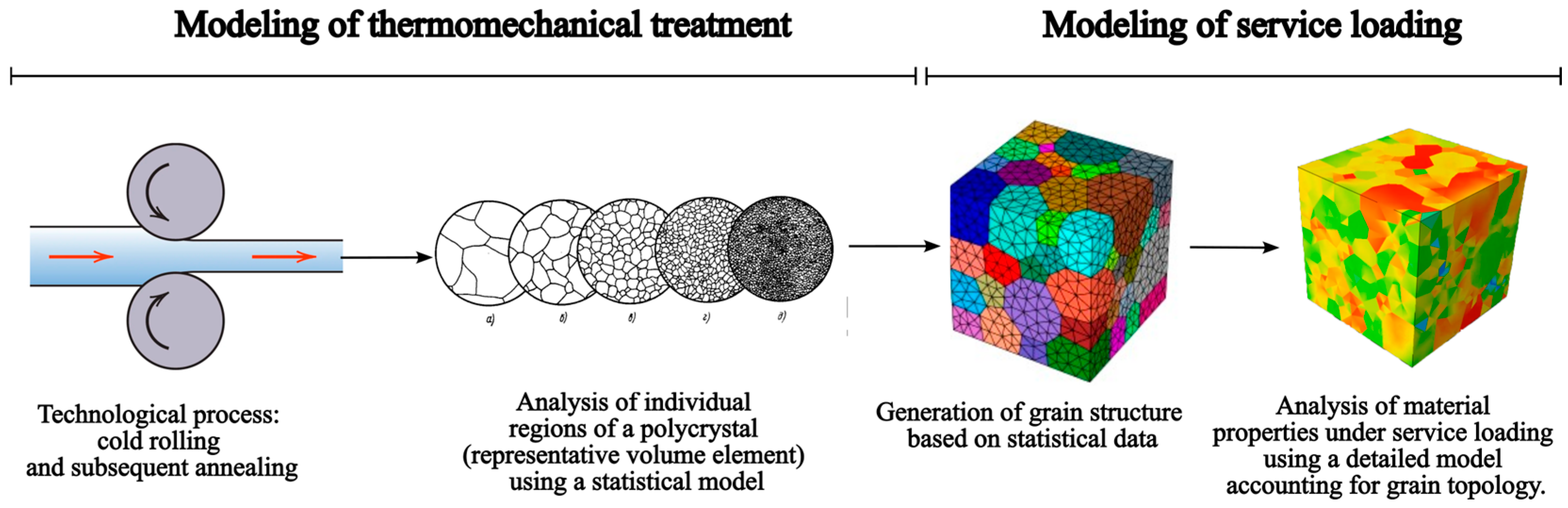
Figure 1. The diagram of the end-to-end “manufacturing–operation” modeling for the representative volume of a material.
Metals 15 01325 g001
Figure 2. Polyhedral decomposition of the area representing grain structure (a) and its finite-element discretization (b).
Metals 15 01325 g002
Figure 3. Schematic representation of the periodic boundary conditions.
Metals 15 01325 g003
Figure 4. Data on changes in the average subgrain size [96] and their approximation (colors: blue—200, yellow—260, green—300, red—340 ° C ).
Metals 15 01325 g004
Figure 5. Dependence of the deformation range Δ ε on the number of cycles N f for grain sizes 22.5 and 89.8 μm : dots show experimental data from [110], lines show the identification result for the SWT criterion.
Metals 15 01325 g005
Figure 6. Dependence of Δ D on (a) Δ e s t , (b) Δ θ within the specified relative perturbation ranges of parameters δ e s t = 0.01 ; 0.02 ; 0.03 and for temperature θ : δ θ = 0.001 ; 0.002 ; 0.003 .
Metals 15 01325 g006
Figure 7. Schematic representation of the considered representative volume during rolling (a), a diagram of the cold-rolled material loading (b), and a straight pole figure {111} at the end of rolling ε u = 0.8 (c).
Metals 15 01325 g007
Figure 8. The {111} pole figures at the end of annealing, evolution of the average grain size D t and the fraction of recrystallized grains f t for simulated annealing experiments.
Metals 15 01325 g008
Figure 9. Generated polyhedral grain structures and grain size distribution histograms for different processing options used in Experiments 1 and 2.
Metals 15 01325 g009
Figure 10. Equivalent von Mises stress fields and averaged loading diagrams for the uniaxial tension of a grain structure (stress in GPa).
Metals 15 01325 g010
Figure 11. Section of the distribution pattern for the equivalent von Mises stress fields in the grain structure partially recrystallized under uniaxial tension (stress in GPa).
Metals 15 01325 g011
Figure 12. Time dependence of stress intensity under cyclic loading.
Metals 15 01325 g012
Table 2. The identified parameters of the static recrystallization model.
ParameterValueSource
Fraction of the stored energy of defects
[126]
α
0.1[122]
Material constant in (2) for recrystallization rate
C r
3.862 × 10 16 Experimental data-based identification
[125]
Critical energy for nucleation initiation
e s t 0
55.5 MJ/m2Experimental data-based identification
[125]
Nucleation activation energy
Q r
400.0 kJ/mol[124]
Pre-exponential term in (8) for high-angle boundary mobility
M H A G , 0
6.721 × 10 6 Experimental data-based identification
[125]
High-angle boundary mobility activation energy
Q
230.0 kJ/mol[124]
High-angle boundary energy
γ
0.930 J/m2[123]
Volume fraction of second-phase particles
f δ
0.09[121]
Minor semi-axis of phase δ particles
a
0.150   μm [119,120]
Major semi-axis of phase δ particles
b
1.150   μm [119,120]
Power parameter in (11)
n
38.9Experimental data-based identification
Pre-exponential term in (12)
k 0
6.155 × 10 24   μm n   s 1 Experimental data-based identification
Subgrain growth activation energy
Q s g r
34,683.1 J/molExperimental data-based identification
Table 3. Model identification and verification results presented in the form of data on the final average grain size [ μm ] after cold rolling and 3 h annealing.
Average   Grain   Size [μm]
Modeling ResultsExperimental Data [125]
Temperature 950   ° C 1000   ° C 950   ° C 1000   ° C
Rolling Degree
25%47.652.448.051.0
40%11.127.112.029.0
55%8.314.89.015.0
Table 4. Parameters identified for the LCF model.
ParameterValueSource
Young’s modulus
E
165.0 GPa[127]
Material parameter in (19)
Σ 0
471.980 GPaExperimental data-based identification
[110,127]
Material parameter in (19)
K
949.312   μm 0.5 Experimental data-based identification
[110,127]
SWT criterion parameter
A 1
1.205 GPaExperimental data-based identification
[110,127]
SWT criterion parameter
A 2
2.219 × 10 4 GPa/mExperimental data-based identification
[110,127]
SWT criterion parameter
B 1
0.060 Experimental data-based identification
[110,127]
SWT criterion parameter
B 2
1742.460 m–1Experimental data-based identification
[110,127]
Disclaimer/Publisher’s Note: The statements, opinions and data contained in all publications are solely those of the individual author(s) and contributor(s) and not of MDPI and/or the editor(s). MDPI and/or the editor(s) disclaim responsibility for any injury to people or property resulting from any ideas, methods, instructions or products referred to in the content.