Article

Design of Novel Non-Cytotoxic Ti-15Nb-xTa Alloys for Orthopedic Implants

by
Yasmin Monteiro Schumacher
1,
Carlos Roberto Grandini
2,
Gerson Santos de Almeida
3,
Willian Fernando Zambuzzi
3 and
Pedro Akira Bazaglia Kuroda
1,*
1
Instituto Latino-Americano de Ciências da Vida e da Natureza, UNILA—Universidade Federal de Integração Latino-Americana, Foz do Iguaçu 85870-650, PR, Brazil
2
Laboratório de Anelasticidade e Biomateriais, UNESP—Universidade Estadual Paulista, Bauru 17033-360, SP, Brazil
3
Laboratory of Bioassays and Cellular Dynamics, Department of Chemical & Biochemistry, Institute of Biosciences, UNESP—Universidade Estadual Paulista, Botucatu 18618-689, SP, Brazil
*
Author to whom correspondence should be addressed.
Metals 2025, 15(11), 1201; https://doi.org/10.3390/met15111201
Submission received: 16 September 2025 / Revised: 25 October 2025 / Accepted: 26 October 2025 / Published: 28 October 2025
(This article belongs to the Special Issue Advances in Metallic Materials for Biomedical Applications)

Abstract

The objective of this study was to develop novel alloys of the Ti-15Nb-xTa system (x = 0, 10, 20, and 30 wt.%) and to evaluate the effect of tantalum addition on the structure, microstructure, hardness, and elastic modulus for biomedical applications. The ingots were produced using an arc melting furnace under a controlled argon atmosphere. Chemical composition analyses were performed using energy-dispersive spectroscopy (EDS) to determine the alloying element fractions and to conduct chemical mapping. The Thermo-Calc software was employed to predict the influence of Ta on the phase transformation temperatures. Structural and microstructural characterizations were performed using X-ray diffraction (XRD) and scanning electron microscopy (SEM). XRD patterns enabled the identification of the phases, the relative volume fractions, and the lattice parameters of the unit cells. As mechanical properties, Vickers microhardness and elastic modulus were measured. The results revealed that increasing Ta content decreased the β-transus temperature but increased the melting temperature of the alloys. Structural and microstructural characterizations indicated that the Ti-15Nb alloy consisted of α′ + α″ phases, Ti-15Nb-10Ta of α″ + β phases, Ti-15Nb-20Ta of α″ + β + ω phases, and Ti-15Nb-30Ta of metastable β phase. Hardness and elastic modulus results exhibited similar behavior: the alloy with the highest fraction of the α″ phase (Ti-15Nb-10Ta) displayed the lowest hardness and elastic modulus, whereas the alloy containing the ω phase (Ti-15Nb-20Ta) presented significantly higher values. Among the studied alloys, Ti-15Nb-10Ta stands out due to its low elastic modulus (57 GPa). In vitro cellular assays demonstrated that Ti-15Nb-Ta alloys promote osteoblast proliferation while exhibiting no cytotoxicity.

Graphical Abstract

1. Introduction

The increase in life expectancy and the aging population have led to a growing demand for orthopedic prostheses that enhance quality of life. As a result, developing new metallic alloys with improved mechanical properties has become essential for orthopedic applications, such as hip and knee prostheses [1]. Many studies have concentrated on titanium alloys that contain β-stabilizing elements for orthopedic implants due to their excellent biocompatibility, high resistance to corrosion and wear, favorable mechanical properties, enhanced osseointegration, and a lower elastic modulus compared to other metallic biomaterials [2,3,4,5,6].
Currently, the most widely used implants are manufactured from the Ti-6Al-4V alloy, which, in the long term, may pose toxicity risks to the human body due to the release of vanadium and aluminum ions resulting from prosthesis wear. In addition, this alloy exhibits a relatively high elastic modulus, approximately 114 GPa, whereas human cortical bone presents values around 30 GPa [7,8,9]. This significant mismatch may, in the long term, lead to the phenomenon known as stress shielding. This effect occurs when the mechanical stress that should be absorbed by the bone during daily activities, such as walking and running, is predominantly borne by the metallic implant. Consequently, the bone no longer receives the necessary mechanical stimulus to maintain its density and may gradually weaken, leading to resorption [10]. This process can ultimately result in implant loosening, pain, and, eventually, the need for revision surgeries [11].
The addition of tantalum and niobium to titanium, forming a substitutional solid solution, decreases the phase transformation temperature and stabilizes the β phase, which exhibits a body-centered cubic structure [12,13]. Both are isomorphic β-stabilizers and retain this phase stable at room temperature with approximately 40% Nb and 70% Ta in the respective binary systems with Ti [14,15]. The β phase exhibits a lower atomic packing factor (0.68) when compared to the α phase, which has a hexagonal close-packed structure (0.74), resulting in a less dense and more flexible crystal lattice [16], which leads to a reduction in the elastic modulus. For this reason, current research efforts focus on developing β-type Ti alloys to mitigate the stress shielding effect [17,18,19].
In recent years, alloys of the Ti-Nb-Ta system have gained prominence in the field of biomaterials, particularly for implant applications, due to their combination of mechanical and biological properties. Sass et al. (2024) investigated the development and characterization of Ti-xNb-6Ta alloys (x = 20, 27, 35 wt.%) produced by laser powder bed fusion [20]. The study evaluated samples produced in different building orientations. Mechanical testing results indicated that both the chemical composition and the manufacturing orientation directly influence the elastic modulus and compressive strength of the alloys. The Ti-20Nb-6Ta sample produced in the 90° orientation exhibited an elastic modulus of 43.2 ± 2.7 GPa, a value significantly lower and more compatible with that of human bone, which has an elastic modulus of approximately 30 GPa. Furthermore, biological assays with osteoblasts cultured on Ti-xNb-6Ta alloys demonstrated a morphology more favorable for osseointegration and reduced inflammatory response compared to the conventional Ti-6Al-4V alloy. Cells on Ti-xNb-6Ta alloys displayed a flattened and elongated shape, covering most of the material surface, particularly in samples manufactured in the 90° build orientation, providing a more favorable substrate for cell adhesion and proliferation. In contrast, osteoblasts seeded on Ti-6Al-4V samples exhibited many rounded cells in the 90° orientation. These findings support growing evidence that ternary Ti-Nb-Ta alloys possess superior properties compared to traditional implant materials.
Praveen Kumar et al. (2025) produced Ti-xNb-3Ta alloys (x = 16 and 28 wt.%) [21]. The niobium content at 28 wt.% in the substitutional solid solution influenced the formation and stabilization of the β phase, resulting in an alloy with high stability and surface protection conferred by protective oxide layers. Corrosion and tribocorrosion tests demonstrated that the alloy containing 28 wt.% Nb exhibits superior resistance to corrosion and wear, factors that are critical for performance in biological environments and for implant longevity.
Bastos et al. (2025) investigated the development and functionalization of novel titanium alloys within the Ti–20Nb–Ta system, varying the tantalum content (0, 10, and 20 wt%) for biomedical applications [22]. The authors demonstrated that the addition of Nb and Ta acts as β-phase stabilizers, directly influencing the microstructure and elastic properties of the alloys. The Ti–20Nb alloy exhibited the lowest elastic modulus, around 58 GPa, which was associated with the predominant presence of the martensitic α″ phase. This single-phase α″ structure is generally difficult to obtain in titanium alloys but tends to be favored by the addition of weaker β-stabilizers, such as Nb and Ta, which promote a controlled transition between the α and β phases. When achieved, single-phase α″ alloys display elastic moduli comparable to β-type alloys, providing improved mechanical compatibility with bone tissue. Furthermore, the authors functionalized the alloy surfaces through the micro-arc oxidation (MAO) technique, resulting in a porous TiO2 layer enriched with bioactive ions such as calcium and phosphorus, essential for bone growth and regeneration. Therefore, the study highlights the importance of combining β-titanium alloy design with surface modification strategies as a pathway toward the development of advanced biomaterials, particularly within the Ti–Nb–Ta alloy system.
These studies highlight that the addition of β-stabilizing elements, Nb and Ta, promotes the formation of the β phase, which is responsible for the significant reduction in the elastic modulus, bringing the mechanical properties closer to those of bone tissue. Therefore, the increasing global academic attention devoted to ternary Ti-Nb-Ta alloys underscores the importance of further research to optimize the production and characterization of new alloys for biomedical applications.
The objective of this study is to evaluate how the incorporation of tantalum and niobium, as β-stabilizing elements, influences the crystal structure, microstructure, hardness, and elastic modulus of titanium alloys, making them excellent alternatives for orthopedic prostheses. Although reducing the elastic modulus may result in some decrease in mechanical strength, a detailed understanding of the relationships between microstructure, composition, and properties is essential to guide the future development of titanium alloys.

2. Materials and Methods

2.1. Ti-15Nb-Ta Alloys Production

For the melting of 60 g ingots of Ti-15Nb, Ti-15Nb-10Ta, Ti-15Nb-20Ta, and Ti-15Nb-30Ta (wt.%), an arc melting furnace equipped with a water-cooled copper crucible and a non-consumable tungsten electrode was used. Argon was employed as an ionized gas during the dielectric breakdown to control the atmosphere and prevent gas contamination during alloy melting. Commercially pure titanium (CP-Ti, 99.9% purity, Sandinox, Sorocaba, Brazil) and niobium and tantalum sheets (99.85% purity, Sigma-Aldrich, Saint Louis, MO, USA) were used as raw materials. Due to the high melting points of Nb and Ta, the alloys were remelted five times to ensure good chemical homogeneity [23].

2.2. Chemical Characterization

To assess the quality of the produced samples, semi-quantitative measurements using energy-dispersive spectroscopy (EDS) were performed after the melting process. For these analyses, a piece of each alloy was subjected to standard metallographic preparation for metals, following a grinding sequence with water-resistant sandpapers (150, 320, 400, 500, 600, 800, 1000, 1200, and 1500 mesh) (Alcrisa, Cotia, Brazil), polishing with 1 μm alumina (Alcrisa, Cotia, Brazil), and chemical etching using an acidic solution composed of 80% water, 15% nitric acid, and 5% hydrofluoric acid by volume. An Oxford EDS detector coupled with a Carl Zeiss scanning electron microscope (SEM, Carl Zeiss, Oberkochen, Germany) was used to quantify the chemical composition of the ingots. Additionally, chemical mapping of the alloying elements was conducted to verify the chemical homogeneity of the materials.

2.3. Structural Characterization

Thermo-Calc software (https://thermocalc.com/, 4 September 2024) was used as a thermodynamic simulation tool to determine the critical temperatures of the studied alloys. Specifically, the β-transus (the boundary between the α and β phases) and liquidus temperatures of the Ti-15Nb, Ti-15Nb-10Ta, Ti-15Nb-20Ta, and Ti-15Nb-30Ta alloys were estimated. The PURE5 database, suitable for multicomponent systems, was employed for these calculations. Numerous studies involving titanium alloys have relied on the Thermo-Calc (PURE5) database for phase diagram prediction, thermodynamic property estimation, and phase stability assessment. All simulations were conducted at atmospheric pressure and 20 °C, ensuring standard conditions for thermodynamic equilibrium analysis.
X-ray diffraction (XRD) measurements were performed to analyze the crystal structures present in the alloys. The analyses were conducted using a PANalytical EMPYREAN (Malvern Panalytical Ltd., Malvern, UK) diffractometer with Cu-Kα radiation (λ = 1.544 Å), a current of 20 mA, and a voltage of 40 kV.
The phase fractions present in the alloys were calculated from the diffraction peaks based on the relative intensities of each phase [24], as described in Equation (1):
% p h a s e =   I p h a s e I   a l l   p h a s e s × 100 %
where Iphase represents the intensity of the characteristic peak of the phase under analysis.
The lattice parameters of the α′, α″, and β phases were determined using Bragg’s equation, where n is the diffraction order (n = 1), λ is the wavelength of the employed radiation (λ = 1.544 Å), is the diffraction angle. For the β phase, the lattice parameter aβ is given by Equation (2) [25]:
a β =   λ 2 s i n θ h 2 + k 2 + l 2
For the martensitic α″ phase, the lattice parameters aα”, bα”, and cα″ were determined using the specific equations for the orthorhombic system, as described in Equation (3) [25]:
2 s i n θ λ = h 2 a α 2 + k 2 b α 2 + l 2 c α 2
For the α′ phase, the lattice parameters aα′, and cα′ were determined using the specific equations for the hexagonal system, as presented in Equation (4) [25]:
2 s i n θ λ = 4 3   h 2 + h k + k 2 a α 2 + l 2 c α 2
where h, k, and l in Equations (2)–(4) are the Miller indices identifying the crystallographic planes responsible for the observed diffraction peaks.
The microstructural characterization of the metallic alloys was performed following standard metallographic preparation procedures, as previously described for the EDS analyses. Scanning electron microscopy (SEM) examinations were conducted on the metallic surfaces using a Carl Zeiss EVO-MA10 scanning electron microscope (Carl Zeiss, Oberkochen, Germany).

2.4. Mechanical Properties

The mechanical evaluation of the alloys focused on two fundamental properties for their application as biomaterials: hardness and elastic modulus. Hardness is associated with resistance to plastic deformation, a crucial characteristic for structural performance, while the elastic modulus is directly related to biomechanical compatibility with bone tissue. Values of elastic modulus significantly higher than those of human bones can induce the stress shielding phenomenon, resulting in reduced bone density adjacent to the implant and potential implant failure. Hardness tests were conducted via Vickers indentation, applying a load of 300 kgf for 15 s [26] (Shimadzu, Barueri, Brazil). The elastic modulus (E) was determined using the impulse excitation technique with the Sonelastic® system (ATCP Physical Engineering, São Carlos, Brazil), which allows the non-destructive assessment of the samples’ elastic stiffness [27].

2.5. Cell Culture and Viability Assay

MC3T3-E1 (subclone 4) and mouse pre-osteoblastic cells (ATCC CRL-2593) were used in this study. Cells were cultured in alpha-MEM supplemented with 10% fetal bovine serum (FBS) at 37 °C and 5% CO2. Sub-confluent passages were trypsinized and used in all experiments. For the cell viability assay, αMEM was conditioned with “the materials” (0.2 g/mL) for 24 h. After 24 h incubation at 37 °C, conditioned medium was collected and tested for cell viability profile. A 4 × 10⁴ cells/mL were seeded in 96-well dish plates and after 24 h at the sub-confluent stage, they were incubated for 24 h with the conditioned medium (n = 6). An internal control was assayed by keeping the cells exposed to conventional culture medium (control). After 24 h, cell viability was evaluated by using the MTT assay [28,29]. The cell viability was estimated by measuring the absorbance in a microplate reader (SYNERGY-HTX multi-mode reader, Biotek, Shoreline, WA, USA) at 570 nm wavelength.

2.6. Cell Adhesion Assay

Pre-osteoblast cells were treated with conditioned medium for 24 h. Thereafter, the cells were trypsinized, counted and then re-seeded at 4 × 10⁴ cells/well in 96-well culture plates for 24 h. Briefly, adherent cells were rinsed in warm PBS and fixed in absolute ethanol-glacial acetic acid (3:1; v/v) for 10 min at room temperature and air-dried. The adherent cells were stained with 0.1% crystal violet (w/v) for 10 min at room temperature. Excess dye was removed by decantation and washed twice with distilled water. The dye was extracted with 10% acetic acid (v/v), and the optical density was measured at 540 nm using a microplate reader (Biotek Co., Ltd., Winooski, VT, USA). Data from each experiment were analyzed with six observations in each group. For the scanning electron microscopy test, the cells were plated directly on the materials at a density of 5 × 10⁴ cells per well and cultivated for 24 h.
Observations of the surface morphology and cellular interactions on the titanium coatings were conducted with a FEI Quanta 200 scanning electron microscope (FEI Company, Hillsboro, OR, USA). Cellular morphology was investigated at magnifications of 6000, 3000 and 1000 and an accelerating voltage of 12.5 kV.

3. Results and Discussion

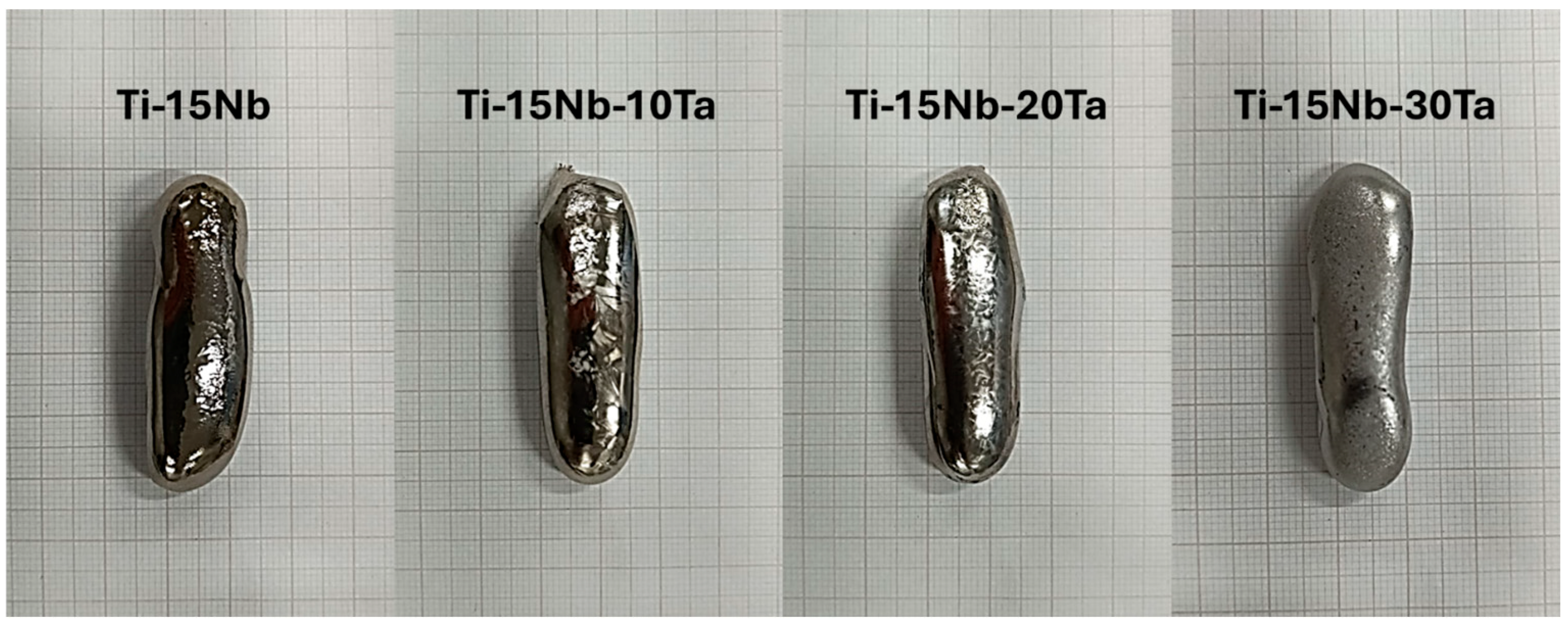
Figure 1 shows images of the 60 g ingots of Ti-15Nb, Ti-15Nb-10Ta, Ti-15Nb-20Ta, and Ti-15Nb-30Ta. All alloys exhibit a silver coloration, indicating that no gas contamination from the atmospheric air occurred, which would have resulted in surface oxidation of the alloys.
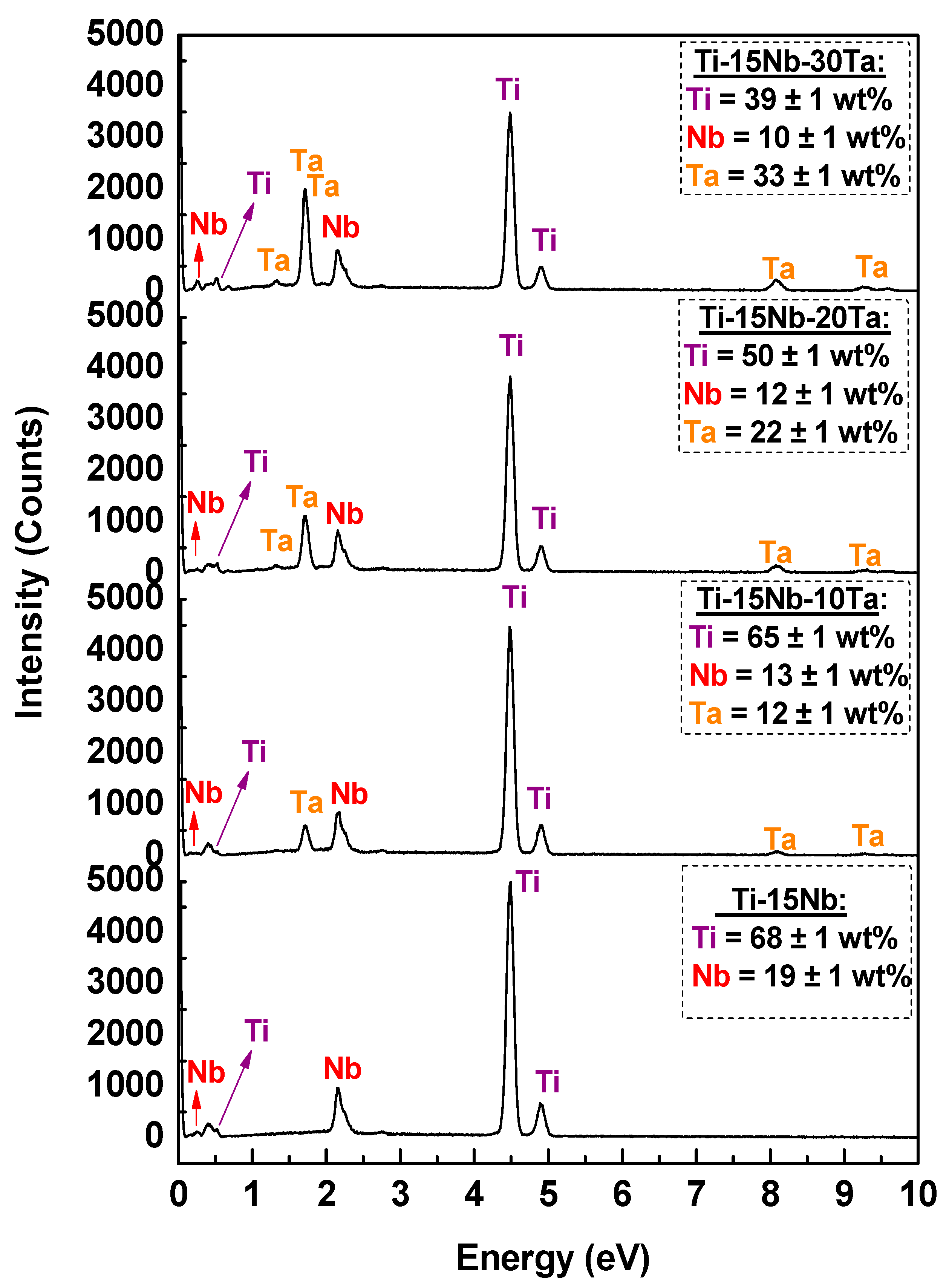
Compositional analyses (chemical composition and homogeneity) were performed using energy-dispersive X-ray spectroscopy (EDS). This technique enables the identification and quantification of chemical elements present in metals by detecting characteristic photons emitted during interaction with the electron beam. Figure 2 shows the obtained spectra, with each peak corresponding to the characteristic energy of specific electronic transitions of Ti, Ta, and Nb. EDS quantification provided the average content of each element, with an uncertainty of ±1 wt.% due to the limitations of the semi-quantitative technique.
The EDS results show a satisfactory agreement between the measured chemical composition of the samples and the nominal compositions defined in this work. Small variations in Nb and Ta contents are acceptable, as these elements are considered weak β-stabilizers; that is, minor fluctuations in chemical composition do not significantly alter the crystal structures and, consequently, the mechanical properties. This represents an advantage of using Ta and Nb as alloying elements compared to strong β-stabilizers, such as Mo. Even small variations in Mo content can significantly modify the crystal structure of Ti alloys, which is why the ASTM F2066-13 standard allows a maximum deviation of only 1 wt.% for the Ti-15Mo alloy [30].
Figure 2 also shows that no peaks from contaminant elements are present, demonstrating the quality and purity of the produced alloys.
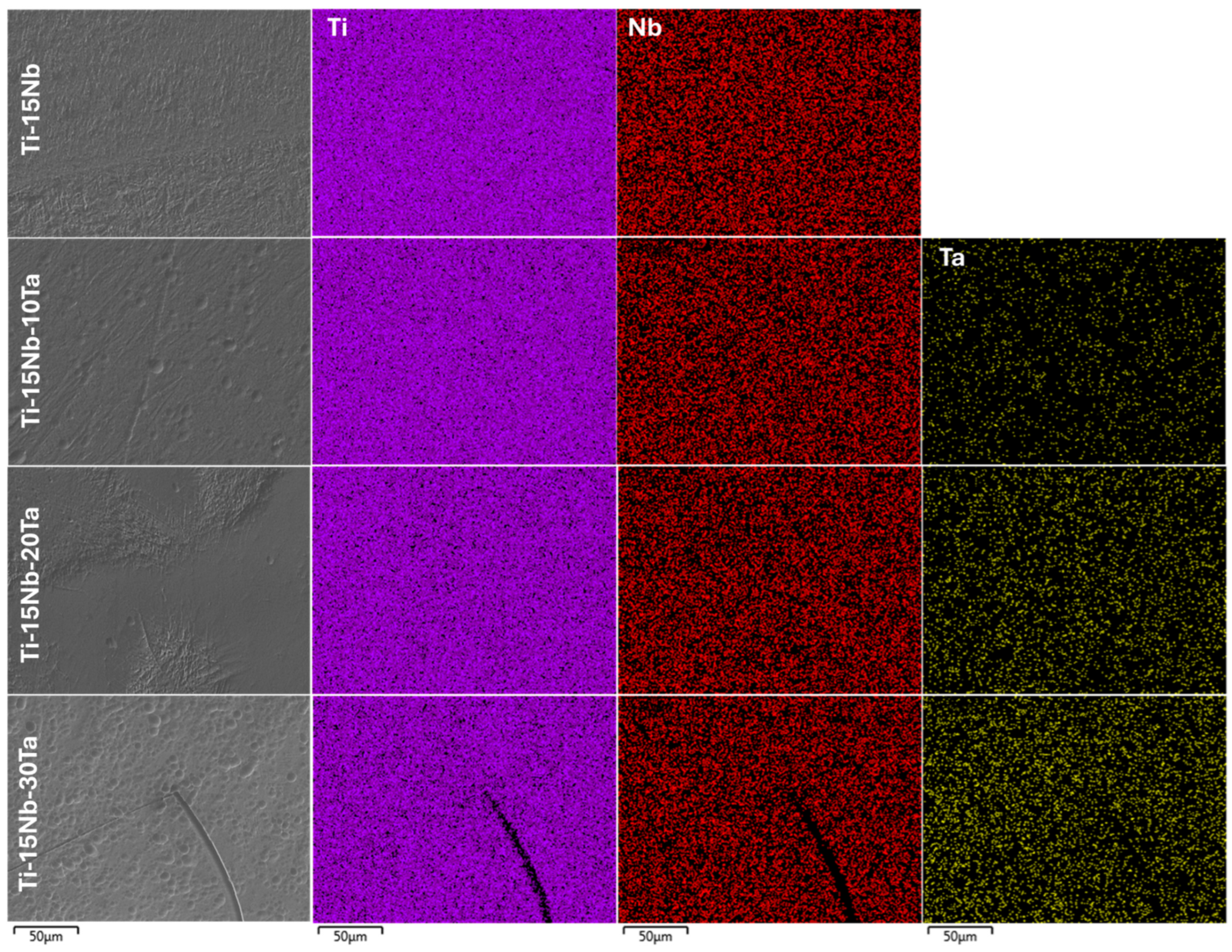
Figure 3 shows the chemical mappings, where Ti is highlighted in purple, Nb in red, and Ta in yellow. A uniform distribution of the elements can be observed, indicating that a homogeneous melting of the solid solution occurred and that the alloying elements are evenly incorporated throughout the structure. The mapping corroborates the results obtained from the quantitative analysis, as the distributions of Ti, Nb, and Ta appear without local accumulation or visible segregation. This demonstrates that the processing was adequate and that the ternary Ti-15Nb-xTa alloys exhibit good chemical homogeneity.
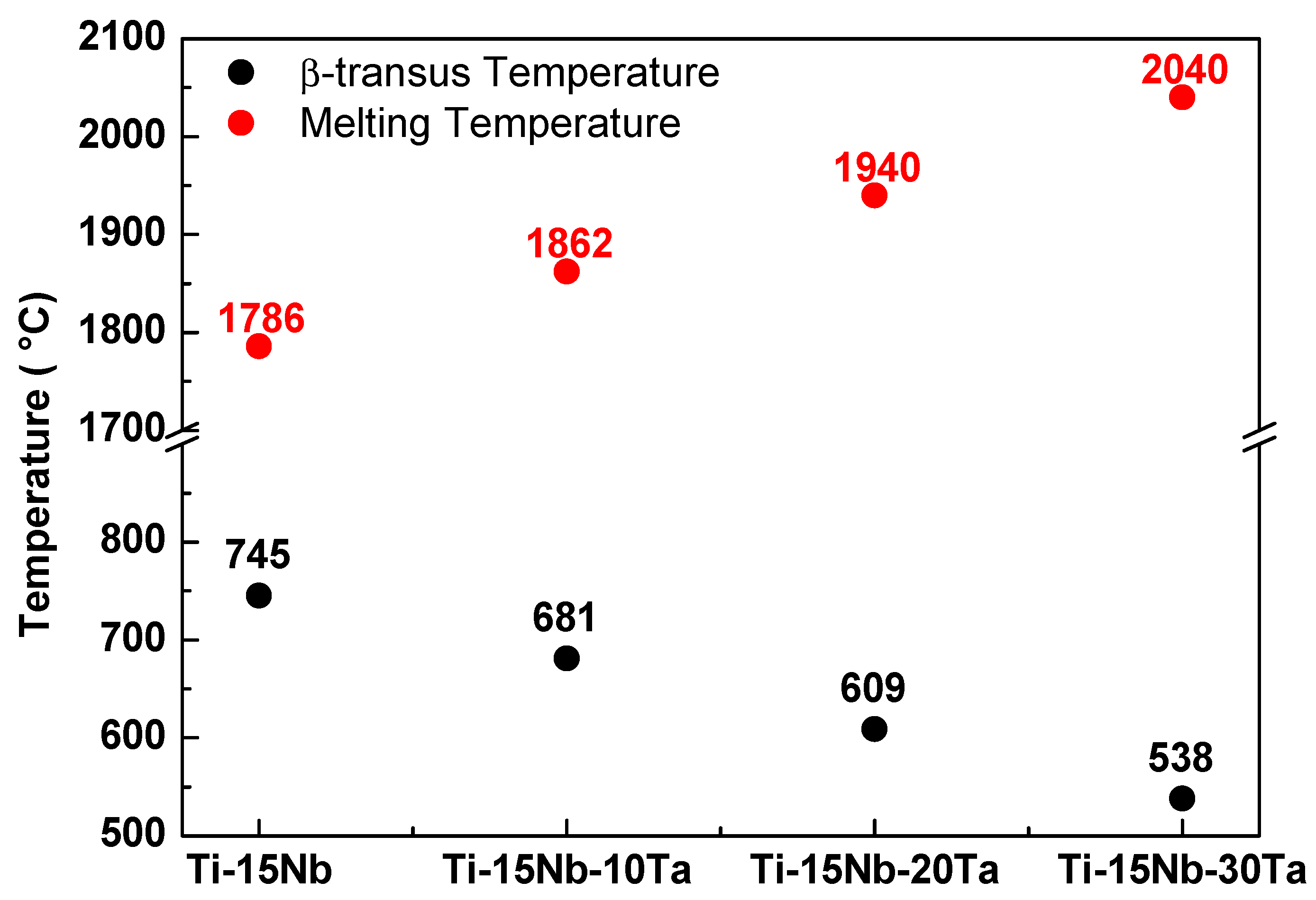
The melting and β-transus temperatures were obtained through Thermo-Calc simulations and are presented in Figure 4. It was observed that the β-transus temperature decreases with increasing tantalum content in the samples. For the Ti-15Nb alloy, the β-transus temperature is approximately 750 °C, whereas in the composition with 30% Ta, it reaches around 530 °C. This reduction in temperature is attributed to the β-phase stabilizing effect of tantalum. This β-stabilizing element expands the stability range of the β phase to lower temperatures, thereby facilitating its retention at room temperature.
The melting temperature follows the opposite trend, increasing with the addition of Ta. The Ti-15Nb alloy melts around 1780 °C and rises to approximately 2050 °C for the alloy containing 30% Ta. This behavior can be attributed to the high melting point of tantalum (3017 °C), which, when incorporated into the alloy, increases the energy required to break the crystal structure, thereby raising the material’s melting point. The addition of tantalum promotes β-phase stabilization while also enhancing thermal resistance by increasing the material’s melting point. This contribution is highly advantageous as it ensures structural stability at elevated temperatures and expands the operational range of the alloy.
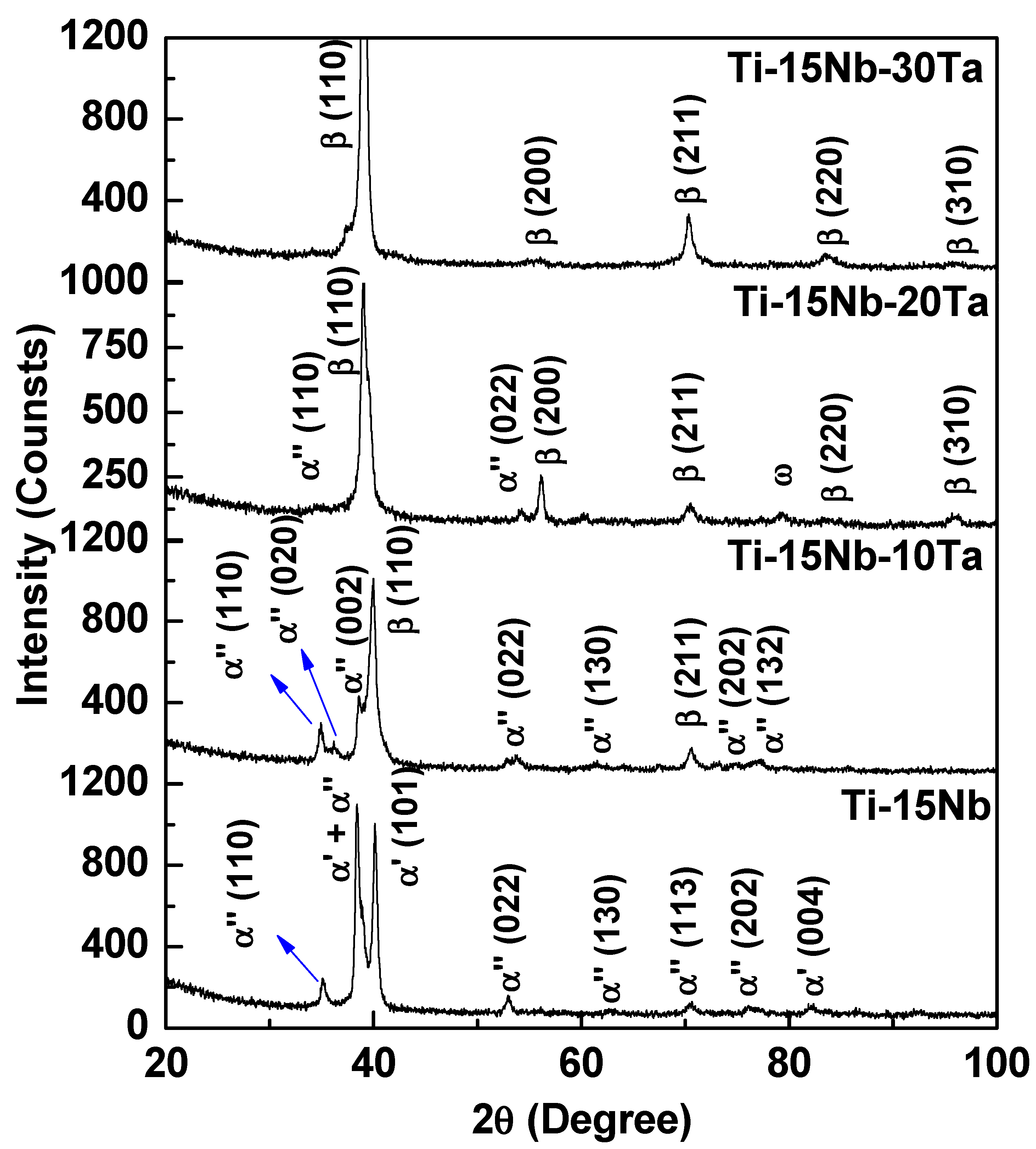
Figure 5 shows the diffractograms obtained using X-ray diffraction. In the diffraction pattern of the Ti-15Nb alloy, characteristic peaks of the orthorhombic martensitic α″ phase and the hexagonal close-packed α′ phase can be observed. The α″ structure forms at high cooling rates from the β-phase field. This phase is readily formed in metastable β-type Ti alloys under as-cast conditions due to the rapid cooling of the alloy in contact with the water-cooled copper crucible of the melting furnace.
The addition of 10 wt.% Ta (Ti-15Nb-10Ta) results in a mixed diffractogram, showing peaks corresponding to the α″ phase and the β phase, while the α′ phase is suppressed. The coexistence of the α″ + β phases can be advantageous for tailoring the desired properties. For instance, heat treatments involving rapid cooling with water or oil from the β-phase field tend to promote the formation of the β phase, consequently reducing the elastic modulus. In contrast, if the same alloy is subjected to the same heat treatment followed by slow cooling to reach thermodynamic equilibrium, the α phase is promoted, resulting in higher elastic modulus and hardness values in Ti alloys [31].
In the Ti-15Nb-20Ta alloy, β-phase peaks are observed at the (110), (200), (211), (220), and (310) diffraction planes, along with a smaller fraction of α″. Additionally, a small peak at approximately 79° corresponding to the hexagonal ω phase was detected. The ω phase forms through nucleation and growth during rapid cooling from the β phase, resulting from the collapse of the body-centered cubic (BCC) plane along the (111) direction. In many metastable β-type Ti alloys, ω-phase formation occurs, dispersed within the β matrix [25], and is often difficult to detect using X-ray diffraction. Overall, the presence of the ω phase increases hardness and raises the elastic modulus, as the small ω precipitates, which are incoherent with the β matrix, impede the movement of atomic dislocations.
Finally, in the Ti-15Nb-30Ta alloy, only β-phase peaks are observed, with Miller indices identical to those highlighted for the Ti-15Nb-20Ta alloy. This result indicates that, at 30% Ta, the β phase is fully stabilized at room temperature. This confirms the role of Ta as a β-stabilizer, as the β-transus shifts to lower temperatures, allowing the retention of the β phase at ambient conditions.
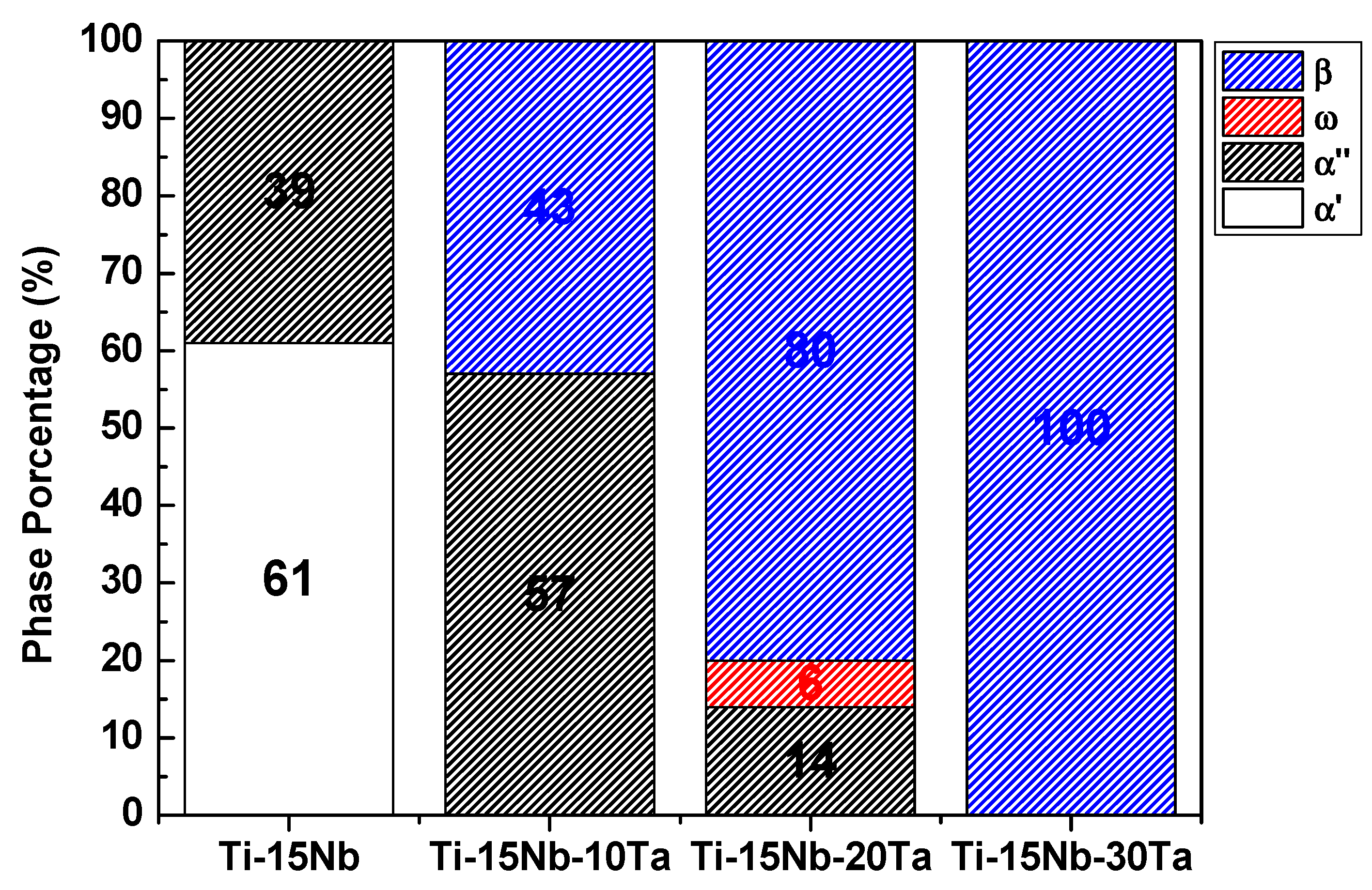
Figure 6 presents a comparative graph quantifying the phase fractions detected in each alloy. As previously discussed, the Ti-15Nb alloy is biphasic, consisting of α′ and α″, with approximately 60% α′ and 40% α″. In the Ti-15Nb-10Ta alloy, a significant mixture of the two phases is observed, with roughly 55% α″ coexisting with 45% β. This behavior indicates that the Ta content already begins to stabilize the β phase, making this alloy the one with the highest fraction of α″. For the Ti-15Nb-20Ta alloy, the quantification reveals that the β phase is dominant, accounting for 80%, coexisting with 15% α″ and a small but detectable 5% fraction of the ω phase. The high fraction of β observed indicates that Ta significantly stabilizes the β phase at room temperature, which is desirable for reducing the elastic modulus. Finally, in the Ti-15Nb-30Ta alloy, the quantification indicates the presence of 100% β phase.
The behavior observed in the XRD analysis follows the trend predicted by Thermo-Calc: increasing Ta content in the samples results in a reduction in the β-transus temperature and, consequently, a higher fraction of β at room temperature. Thus, compositions with 20 wt.% Ta or higher exhibit the onset of β-phase stabilization, whereas compositions with little or no Ta favor the formation of α″.
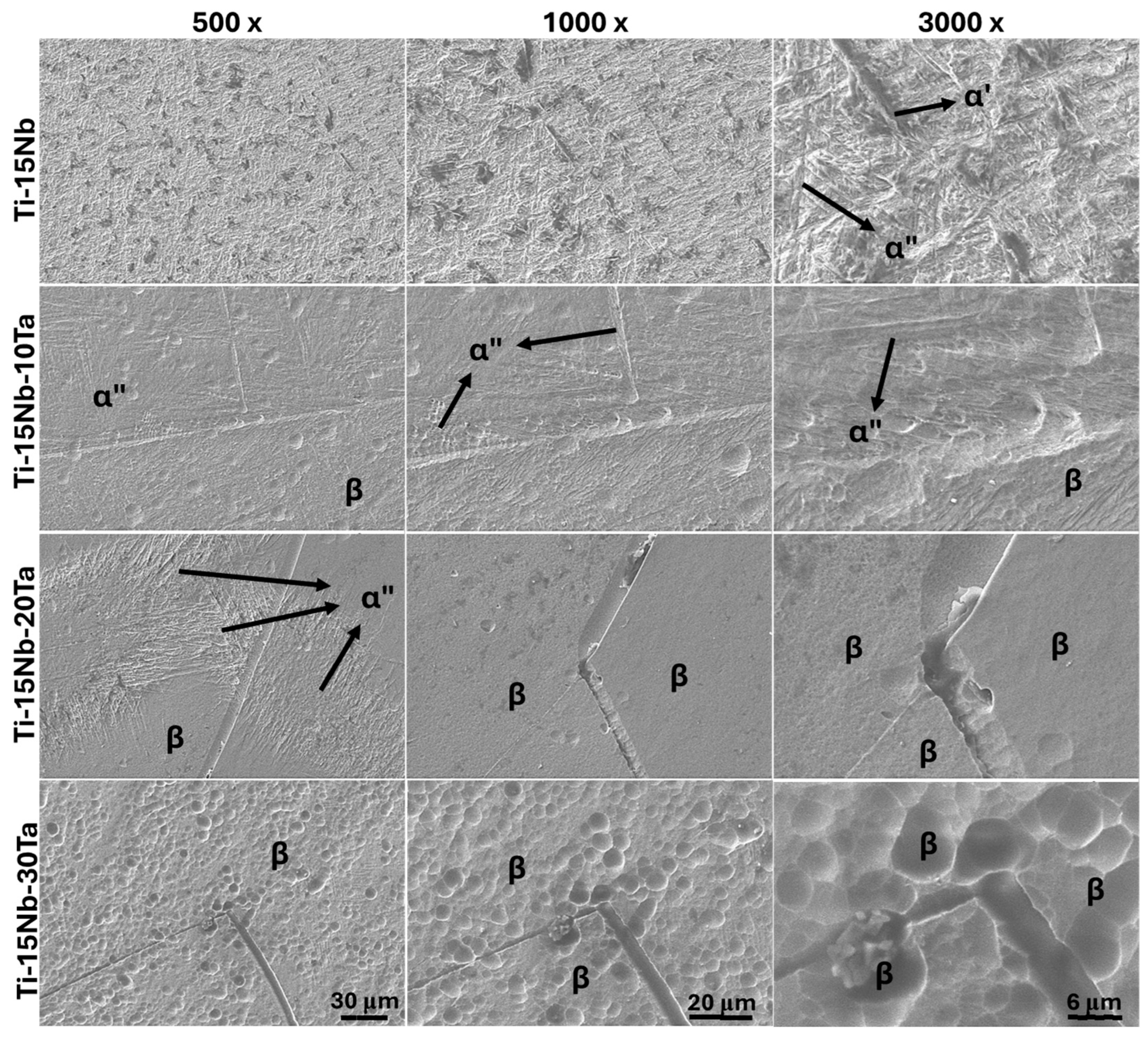
The microstructural analyses using scanning electron microscopy (SEM) were performed at various magnifications (500×, 1000×, and 3000×) (Figure 7).
The micrographs of the Ti-15Nb alloy reveal that it is composed of the α″ phase, characterized by fine, parallel needles distributed uniformly, which form a typical martensitic transformation pattern from the β phase during cooling. Additionally, the lamellae characteristic of the α′ phase in Ti alloys is observed. In the Ti-15Nb-10Ta alloy, the α″ needles are more widely spaced compared to Ti-15Nb, and the β regions appear as smooth areas without a defined lamellar orientation. This mixed morphology confirms the presence of both phases detected by XRD, with β beginning to stabilize with the addition of 10Ta. With the addition of 20 wt.% Ta (Ti-15Nb-20Ta), the microstructure shows a predominance of β regions with some areas containing residual α″ needles. The β regions are continuous and well-defined, while the α″ lamellae appear localized at grain boundaries, suggesting that β stabilization is significant but not yet complete. The possible presence of the ω phase, identified by XRD, is not directly visible in the SEM micrographs due to its nanometric size. In the Ti-15Nb-30Ta alloy, the microstructure consists entirely of the β phase, with well-defined grains and an absence of α″ lamellae.
The XRD and SEM results demonstrate a clear microstructural transition with increasing Ta content: from α′ + α″ (Ti-15Nb), to a mixture of α″ + β (Ti-15Nb-10 Ta), to β-dominant with traces of ω (Ti-15Nb-20 Ta), and finally to fully β (Ti-15Nb-30 Ta).
The molybdenum equivalent (Moeq) theory is an empirical method widely used to estimate the stabilizing effect of different alloying elements on the formation and stability of titanium crystal phases [32]. Pure titanium exhibits a stable α phase at room temperature, while the β phase is stable only above the allotropic transition temperature (~882 °C). β-stabilizing alloying elements, such as Mo, Nb, and Ta, lower this transition temperature and promote the retention of the β phase at room temperature. The Moeq expresses, as a single value, the combined contribution of all β stabilizers in an alloy by converting their weight concentrations to a scale equivalent to the effect of molybdenum [33,34], as described in Equation (5):
M o e q = M o + ( N b / 3.6 ) + ( T a / 5.0 )
In the present study, this theory was applied to the Ti–15Nb–Ta system alloys to predict the expected crystal phases based on their chemical compositions. Moeq values of approximately 4, 6, 8, and 10 wt.% were obtained for the Ti-15Nb, Ti-15Nb-10Ta, Ti-15Nb-20Ta, and Ti-15Nb-30Ta alloys, respectively. These results indicate that the Ti-15Nb alloy is expected to exhibit a crystal structure like that of Ti-4Mo. Ti-15Nb-10Ta is comparable to Ti-6Mo, Ti-15Nb-20Ta resembles Ti-8Mo, and finally, the Ti-15Nb-30Ta alloy is expected to present the same crystal structure as the binary Ti-10Mo alloy.
Ho and collaborators conducted a detailed study of the Ti-Mo system [35]. According to the authors, in the binary system with approximately 6–7.5 wt.% Mo, the α″ phase predominates, which is associated with lower hardness and a reduced elastic modulus; between 7.5 and 10 wt.% Mo, a metastable β phase forms, often accompanied by the ω phase, which increases hardness and reduces ductility. Above ~10–12 wt.% Mo, the β phase becomes stable at room temperature, with only a small amount of ω present.
According to the Moeq theory, the Ti-15Nb alloy is analogous to Ti-4Mo and, therefore, may contain fractions of α′ and α″ phases, as reported in Ho’s study. Several studies in the literature also report on the presence of α′, α″, and occasionally β phases in Ti-15Nb [31,36,37]. The phase distribution depends on the cooling rate from the β field, with higher cooling rates promoting the sequence: β → α″ → α′ → α. For the Ti-15Nb-10Ta, Ti-15Nb-20Ta, and Ti-15Nb-30Ta alloys, the theory predicts α″-type, β + ω, and metastable β-type alloys, respectively.
The application of the Moeq theory proved effective in predicting the crystal phases in the Ti–15Nb–Ta system alloys. The calculated values indicated that Ta plays a role as a β-phase stabilizer, modifying the alloy phases in agreement with the experimental results obtained from X-ray diffraction and SEM analyses. This agreement confirms the utility of Moeq as a microstructural prediction tool, enabling a direct correlation between the chemical composition of alloys, phase stability, and their mechanical properties.
After initially analyzing the alloys using the Moeq parameter, an additional predictive tool was sought to validate and further explore the results. In this context, Molecular Orbital Theory was employed as a complementary approach [38]. This theory enables a direct correlation between the electronic properties of the alloying elements, through the Bo and Md parameters, and the tendency to form the α and β phases in titanium alloys [39]. The values of Bo and Md are obtained by Equations (6) and (7), respectively:
B o =   i n X i . B o i
M d = i n X i . M d i
Xi represents the atomic fraction of component i in the alloy, while Bo and Md correspond to the Bo and Md values of component i, respectively. The Bo and Md values of pure metals (Ti, Ta and Nb) are presented by Morinaga et al. [38].
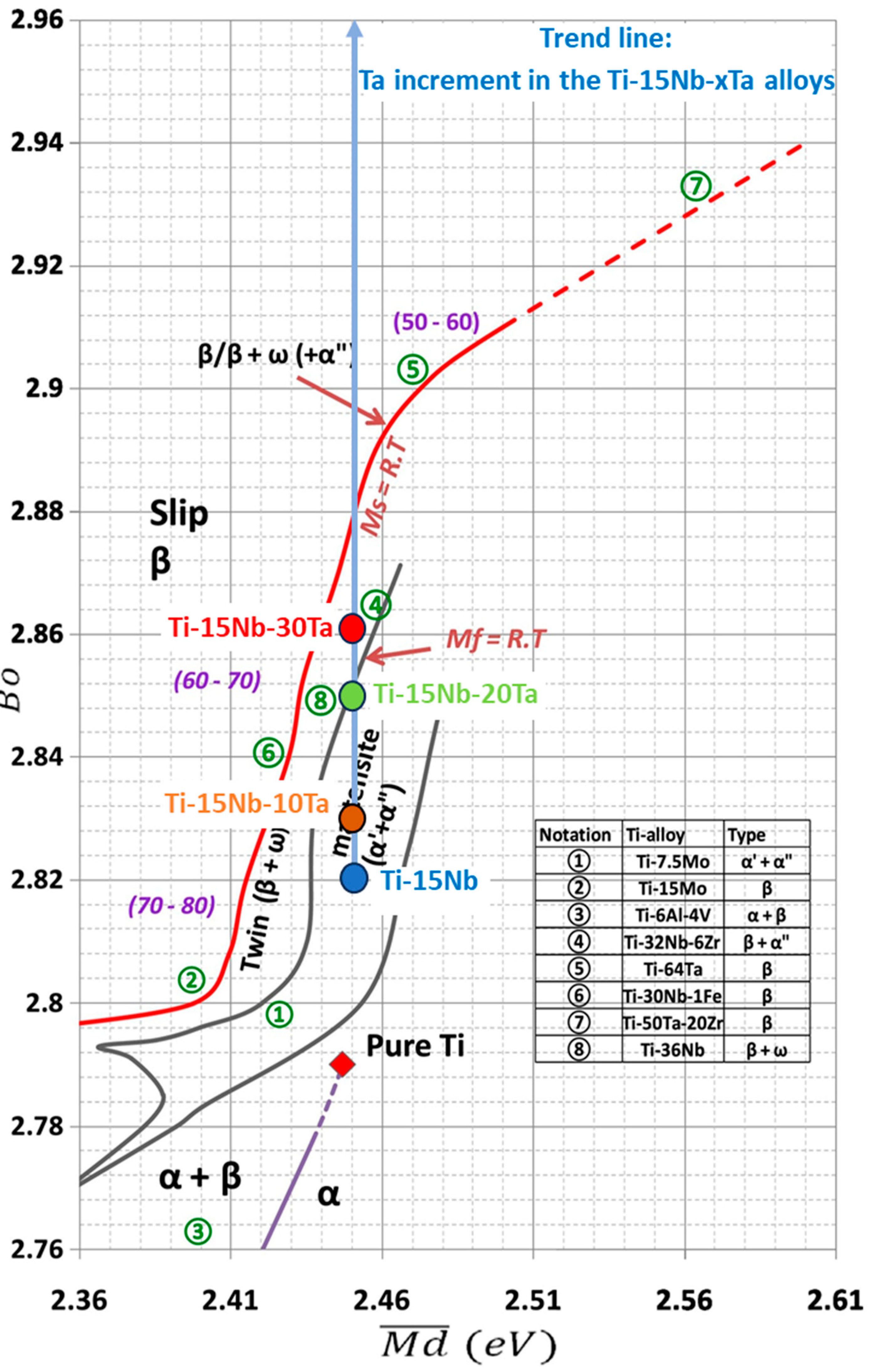
Figure 8 shows the Bo–Md diagram used to predict the crystal structure of the Ti-15Nb–Ta alloys. The calculated Bo and Md values for Ti-15Nb, Ti-15Nb-10Ta, Ti-15Nb-20Ta, and Ti-15Nb-30Ta were plotted on the diagram, allowing the assessment of each composition’s tendency to form the β phase. It can be observed that the Ti-15Nb and Ti-15Nb-10Ta alloys are located in a region corresponding to α′+α″-type alloys, whereas Ti-15Nb-20Ta and Ti-15Nb-30Ta fall within the β + ω region, with particular emphasis on Ti-15Nb-20Ta, which is positioned near Ti-36Nb, classified as a metastable β + ω alloy. A trend line was observed regarding the Bo and Md values of the Ti-15Nb–Ta alloys: increasing Ta content raises the Bo values (3.144), as Ta has a higher Bo compared to Ti (2.790) and Nb (3.099) [40,41]. This effect highlights the β-stabilizing character of Ta, as the trend line shows that the alloy without Ta (Ti-15Nb) is located in the martensitic field, trending toward the β field, passing through the α′ + α″, β + ω + α″, β + ω, and β regions.
In addition to the molybdenum equivalent calculation, Molecular Orbital Theory also proved effective in predicting the constituent phases in the Ti-15Nb–Ta system alloys, corroborating the experimental results from structural characterization.
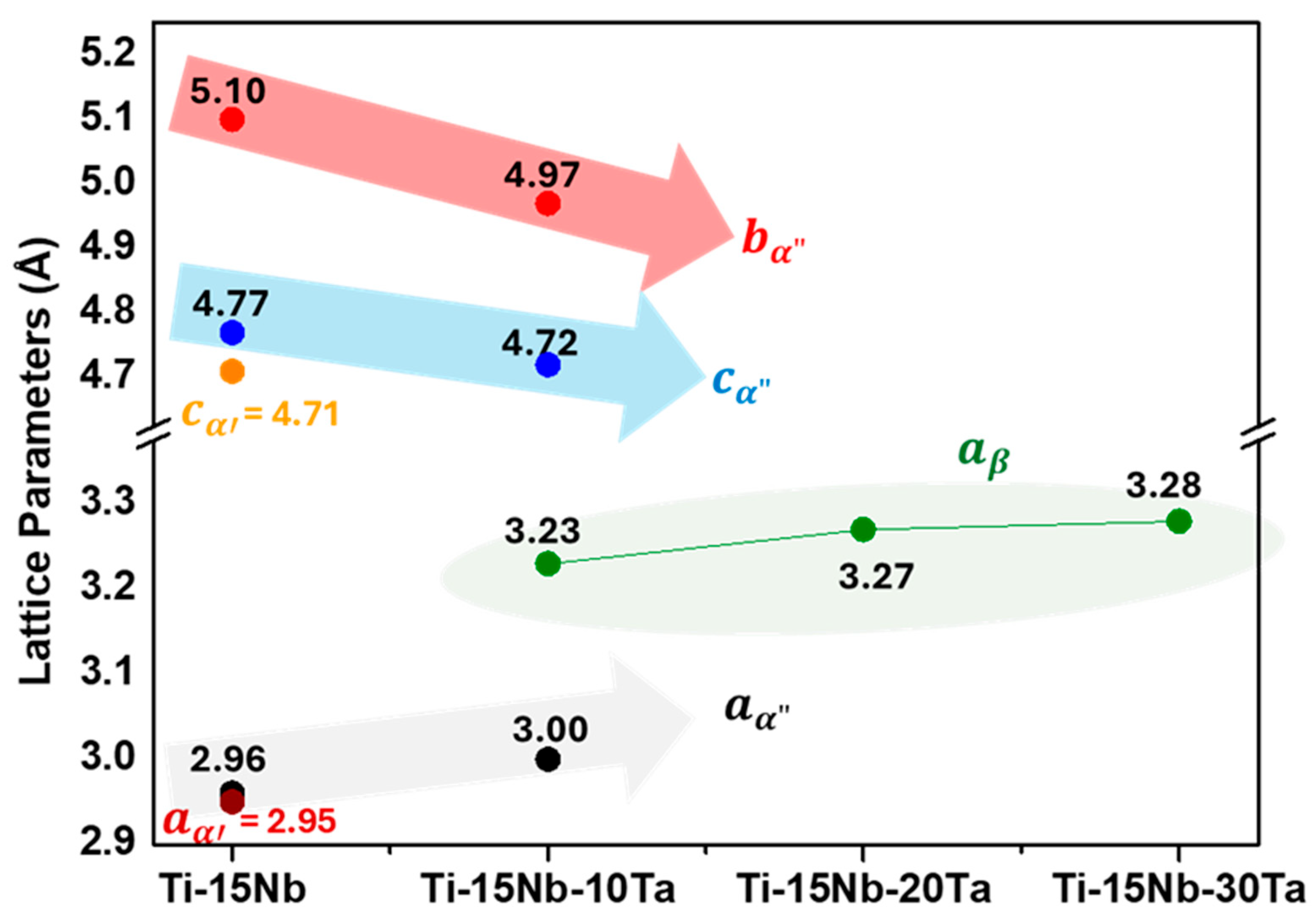
Based on the X-ray diffraction results, the lattice parameters corresponding to the α′, α″, and β phases were determined (Figure 9). In Figure 9, a trend is observed in which the α″ lattice parameters cα″ and bα″ decrease, while aα″ increases with the addition of tantalum (0 Ta → 10 Ta). These variations in lattice parameters are related to the progressive transformation of the α″ phase into the β phase induced by the increased Ta content, reflecting the structural modifications resulting from β-phase stabilization. Notably, the alloy containing 10% Ta exhibits a β-phase lattice parameter (aβ) of 3.23 Å, which is lower than the α″ phase parameters cα″ and bα″, but slightly higher than aα″. This proximity between the parameters indicates a structural tendency of the α″ phase toward uniformity of the lattice edges, which is associated with the gradual transformation into the cubic β phase, in which all lattice parameters are equivalent.
The observed trend of decreasing cα″ and bα″ parameters, along with the increase in aα″, has been previously reported in a study by Pathak et al. [42]. The authors analyzed the influence of Nb on the lattice parameters of the α″ phase. These findings corroborate the results obtained in the present work, demonstrating that Ta, similarly to Nb, affects the lattice parameters of Ti alloys comparably.
It is observed that the addition of Ta promotes an increase in the lattice parameter of the β phase (aβ). This behavior can be attributed to the larger atomic radius of Ta (1.43 Å) compared to titanium (1.32 Å), which results in the expansion of the crystal lattice when Ta atoms substitute for Ti atoms in the body-centered cubic structure of the β phase. This increase in the β-phase lattice parameter is significant in the biomedical field, as alloys with higher β lattice parameters tend to exhibit lower elastic modulus, a consequence of the reduction in interatomic forces.
For the Ti-15Nb alloy, the lattice parameters of the hexagonal α′ phase were determined as aα′ = 2.95 Å and cα′ = 4,71 Å. Compared to pure titanium with a hexagonal close-packed structure, which has typical parameters of a(Ti-HCP) = 2.95  Å and c(Ti-HCP) = 4.68 Å , it is observed that the a parameter remains practically unchanged, while c shows a slight increase. The c/a ratio for pure Ti is approximately 1.59 [43], whereas in the Ti-15Nb alloy it is about 1.60.
The presence of Nb in the Ti-15Nb alloy induces a slight increase in the cα′ parameter of the hexagonal cell due to the larger atomic radius of Nb compared to Ti. As Nb acts as a substitute element, it occupies positions in the crystal lattice originally occupied by Ti, slightly expanding the dimension along the c-axis.
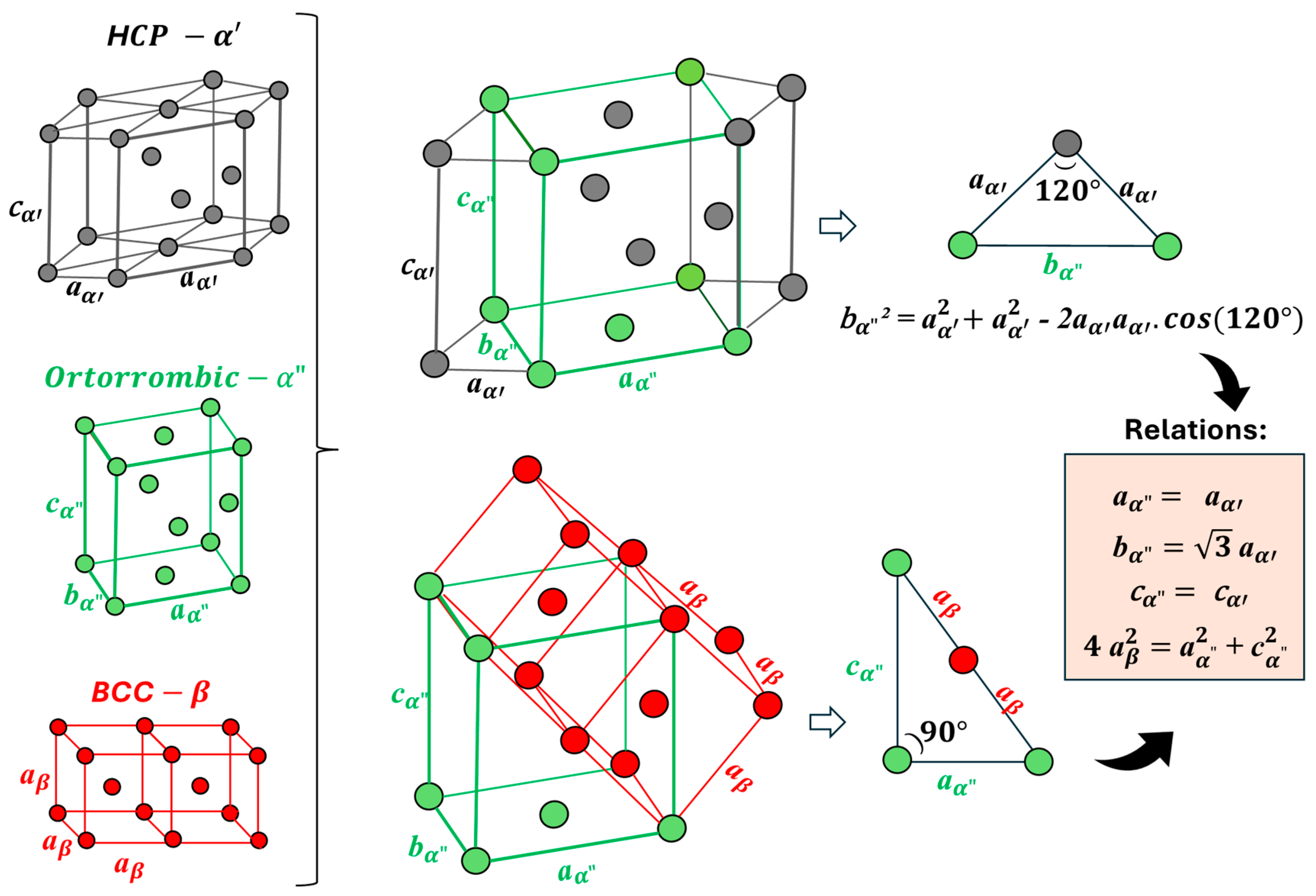
A three-dimensional representation of the crystallographic coupling between the orthorhombic α″, hexagonal α′, and cubic β phases of titanium was developed (Figure 9). Based on the complete structural and microstructural characterization of the Ti-15Nb-Ta alloys, a 3D model was constructed to analyze the relationships among the present phases. In this model, dimensionless ratios between the lattice parameters of the phases were determined using the Pythagorean theorem. This approach allows for a direct comparative assessment of the structural distortions induced by phase transformations and the addition of Ta to the alloys.
A three-dimensional representation of the crystallographic coupling between the orthorhombic α″, hexagonal α′, and cubic β phases of titanium was developed (Figure 10). Based on the complete structural and microstructural characterization of the Ti-15Nb-Ta alloys, a 3D model was constructed to analyze the relationships among the present phases. In this model, dimensionless ratios between the lattice parameters of the phases were determined using the Pythagorean theorem. This approach allows for a direct comparative assessment of the structural distortions induced by phase transformations.
From the illustrations, it can be observed that the lattice parameters a and c of the α′ and α″ phases tend to converge aα′ = aα″ and cα′ = cα″, highlighting a strong structural similarity between them. This proximity of parameters is visualized in the results shown in Figure 8, particularly for the Ti-15Nb alloy, where the a and c de values of both phases are nearly identical, with a percentage difference of less than 1% in parameter c. Furthermore, using the relationship bα″ = √3 aα′, derived from the isosceles triangle formed at the junction of the α′ and α″ phases, a theoretical value of bα″ of 5.12 Å is obtained, also exhibiting a difference of less than 1% compared to the experimental value measured for the Ti-15Nb alloy.
A correlation between the lattice constants of the α″ and β phases is presented in Figure 10. This relationship was tested for the Ti-15Nb-10Ta alloy in order to estimate the lattice parameter of the β phase (aβ) from the lattice parameters of the α″ phase. The correlation was applicable only for the Ti-15Nb-10Ta alloy, allowing a comparison with the experimentally measured value. For the calculations, the values of aα″ = 3.00 Å and cα″ = 4.72 Å for the α″ phase, as shown in Figure 9, were considered. Using these values, the β-phase lattice parameter was determined to be aβ = 2.80 Å, which represents a 15% deviation from the experimentally observed value.
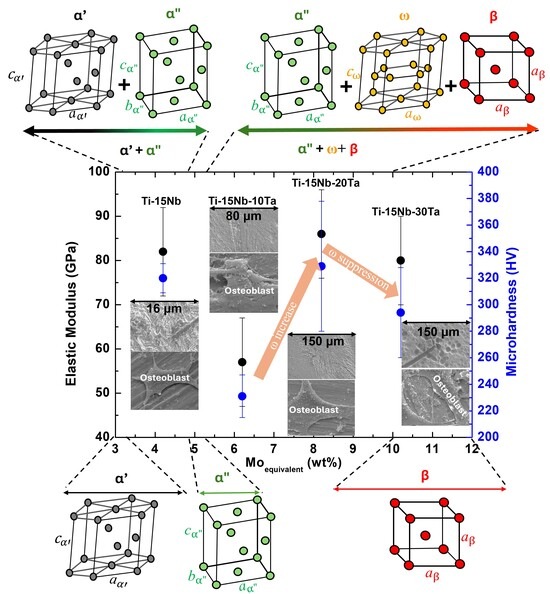
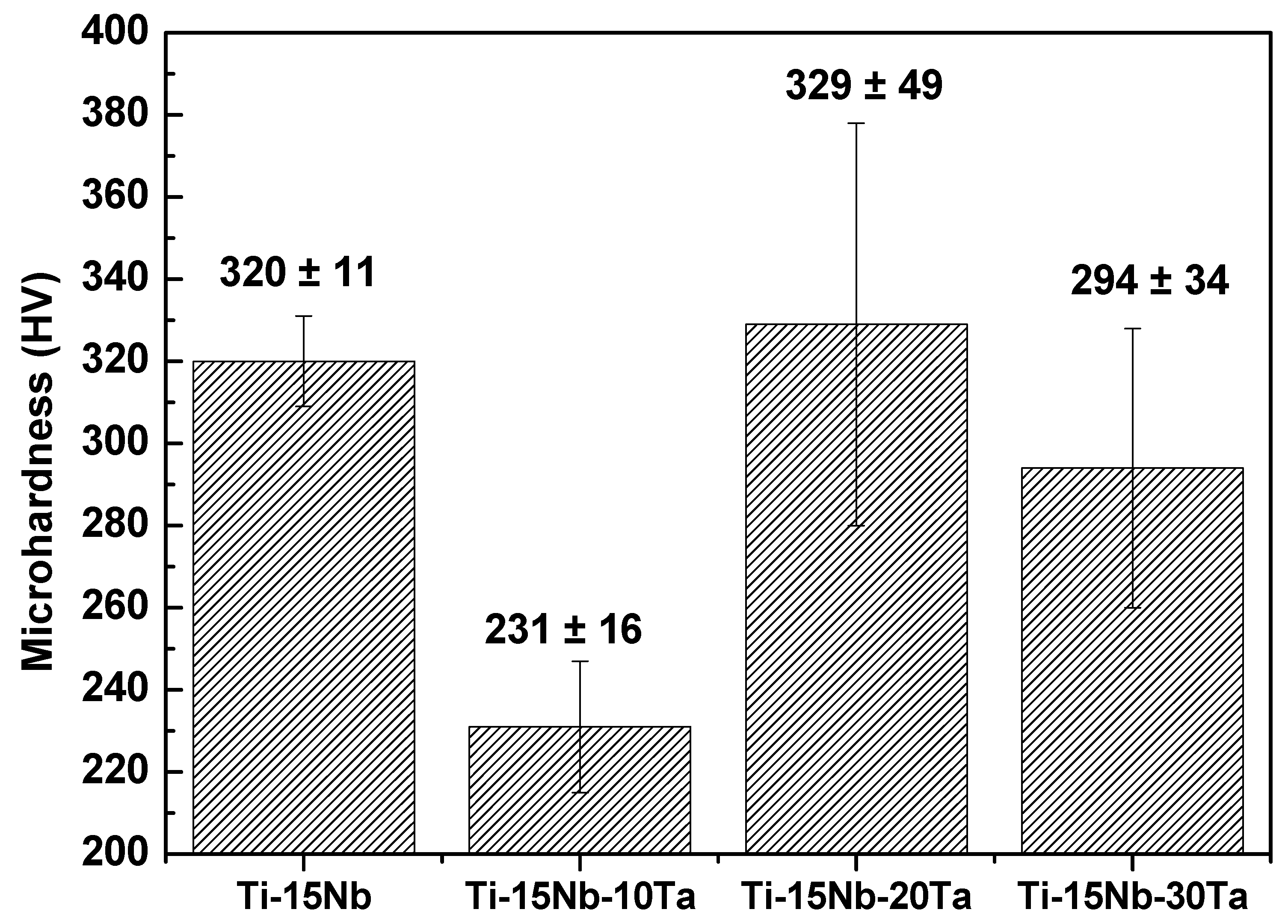
Regarding the Vickers microhardness results obtained for the alloys (Figure 11), it is observed that the alloy without Ta addition exhibits an average microhardness of approximately 320 HV, which decreases sharply to around 230 HV in the alloy containing 10 wt.% Ta. This reduction can be attributed to the decrease in the α″ phase fraction and the increase in the ductile β phase, as evidenced by the microstructural analyses, with the addition of 20 wt.% Ta, the microhardness increases again, reaching close to 330 HV due to the presence of the ω phase, which is recognized for its high hardness. For 30 wt.% Ta, the microhardness shows a moderate decrease to 295 HV, suggesting that the excess Ta may promote greater homogeneity of the β phase and, consequently, a reduction in resistance to plastic deformation.
It is also observed that all the alloys exhibit hardness values higher than that of CP-Ti (164 HV). This hardening is attributed to the solid solution strengthening process [7].
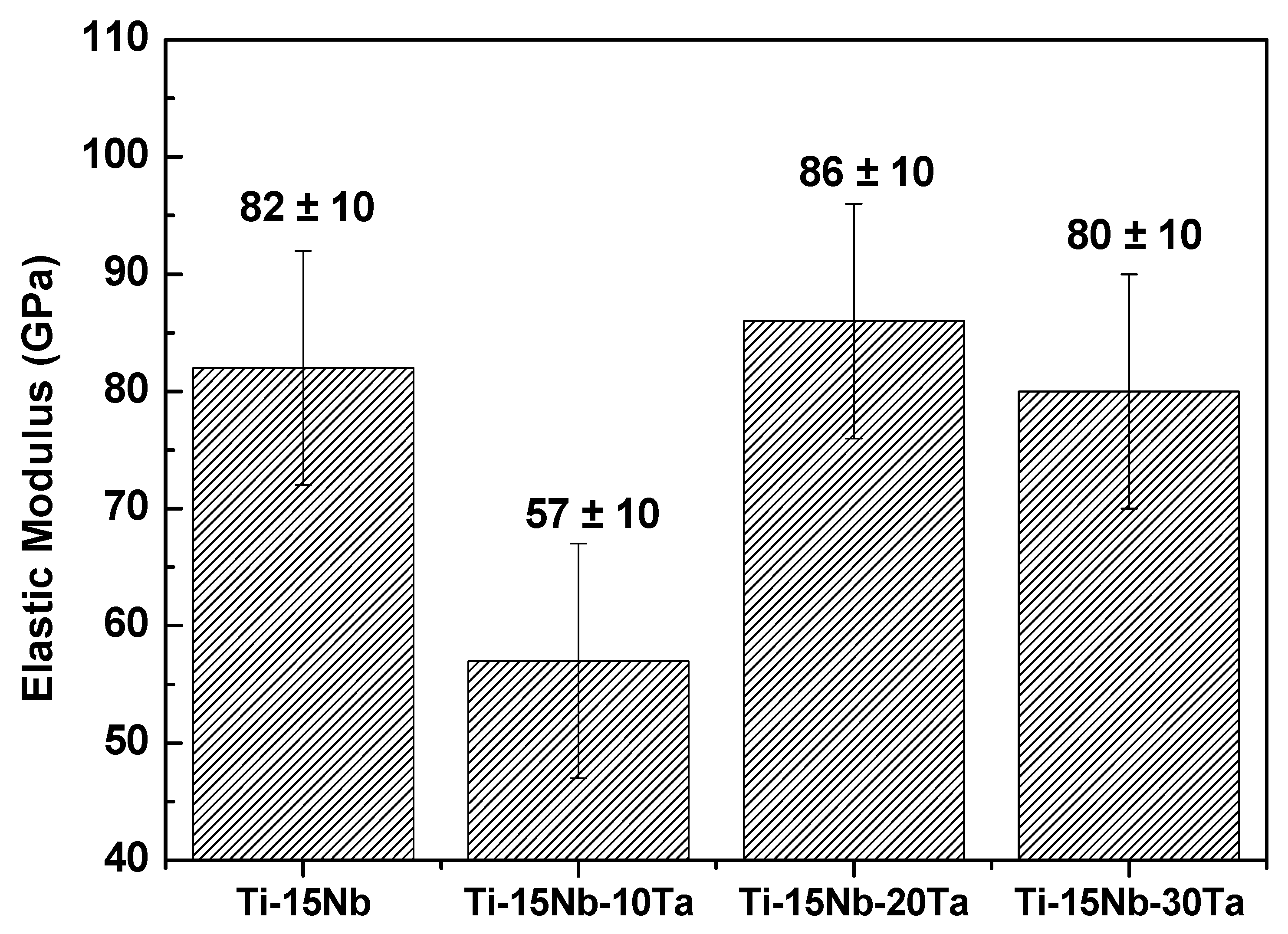
The elastic modulus results are presented in Figure 12. The elastic modulus exhibits a non-linear behavior: 82 GPa (Ti-15Nb), 57 GPa (Ti-15Nb-10Ta), 86 GPa (Ti-15Nb-20Ta), and 80 GPa (Ti-15Nb-30Ta). The β phase, with a BCC geometry and a lower packing factor (0.68), tends to have a lower elastic modulus compared to the α alloys with an HCP geometry.
The Ti-15Nb alloy exhibits an α′ + α″ microstructure, presenting a high elastic modulus due to the presence of stiffer atomic bonds and lower atomic mobility. The Ti-15Nb-10Ta alloy exhibits an α″ + β microstructure, where the predominance of the metastable β phase results in a lower elastic modulus, attributed to the reduced bond density and packing factor of this structure. Although the Ti-15Nb-20Ta alloy has a high β-phase fraction, the formation of the ω phase and solid-solution strengthening, due to the higher Ta content, increases rigidity, explaining the observed rise in elastic modulus. Finally, the Ti-15Nb-30Ta alloy, with a high Ta content, fully stabilizes the β phase; the absence of the ω phase results in a lower elastic modulus compared to the Ti-15Nb-20Ta alloy.
It is observed that all the alloys developed in this study exhibit lower elastic modulus values compared to CP-Ti, Ti-6Al-4V, Co-Cr alloys, and stainless steel, presenting promising values for orthopedic applications [7]. Among them, Ti-15Nb-10Ta stands out, as it shows the lowest elastic modulus and hardness, which contributes to minimizing the stress shielding effect.
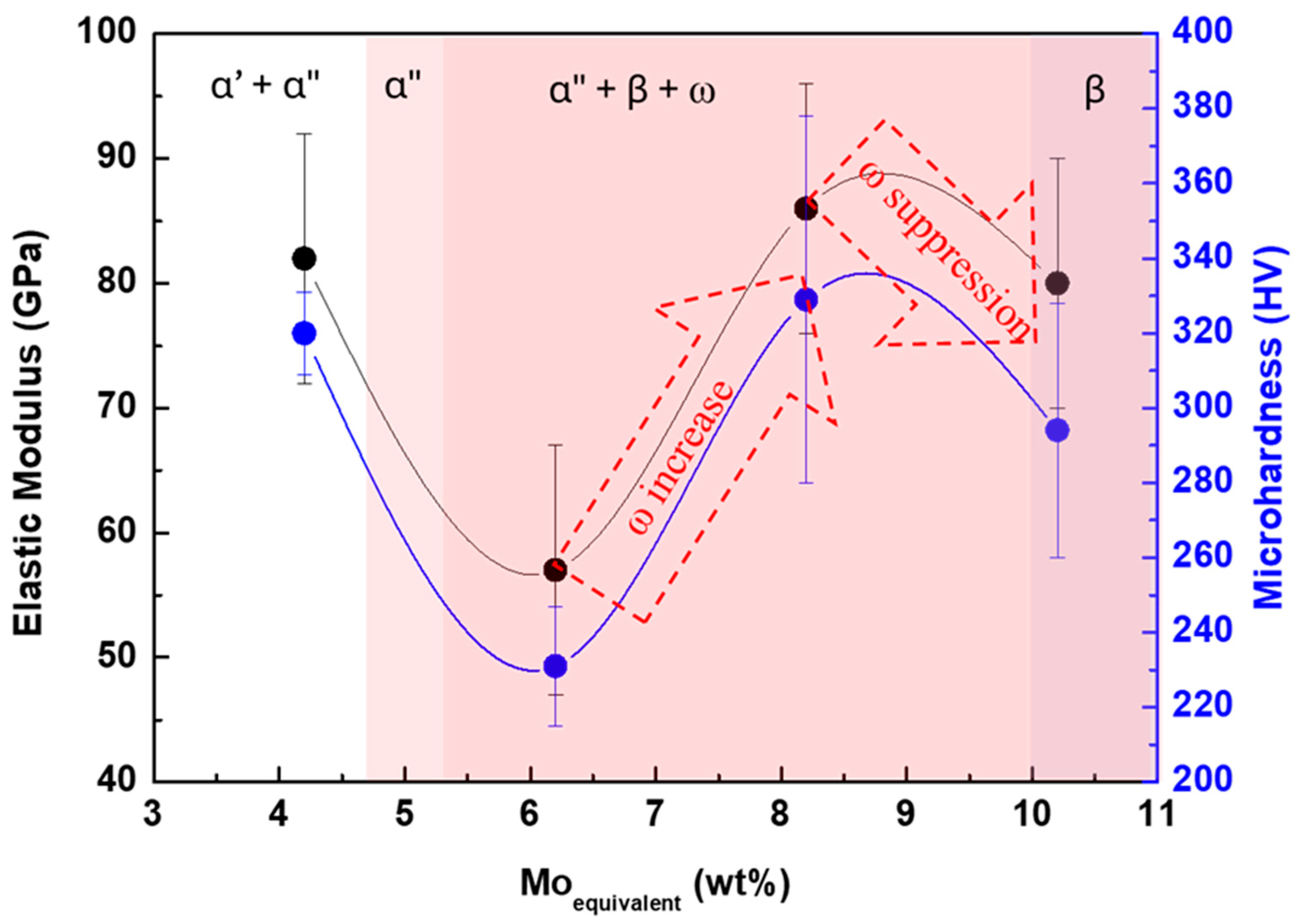
Figure 13 presents the hardness and elastic modulus results as a function of the molybdenum equivalent (Moeq) for each alloy analyzed. The same trend observed with Ta addition is evident, showing that both hardness and elastic modulus vary consistently with increasing Moeq values.
The values of elastic modulus and hardness decrease until reaching a limit corresponding to the transformation of the α′ phase into the α″ structure. At this point, single-phase α″ alloys tend to exhibit low elastic modulus values. With the addition of tantalum, increasing the Moeq, the α′ phase is suppressed, the fraction of α″ increases, and the β phase forms. For a Moeq around 6 wt%, further addition of β-stabilizing elements can promote the nucleation of the ω phase, resulting in increased hardness and elastic modulus, as observed in this study. When the ω phase is suppressed due to an excess of β-stabilizing elements, a subsequent decrease in elastic modulus is observed. Thus, alloys with metastable β phase, without significant presence of ω, tend to exhibit reduced elastic modulus values. It is essential to note that at high Moeq values, exceeding 15 wt%, the alloy becomes β-stable, resulting in increased material stiffness.
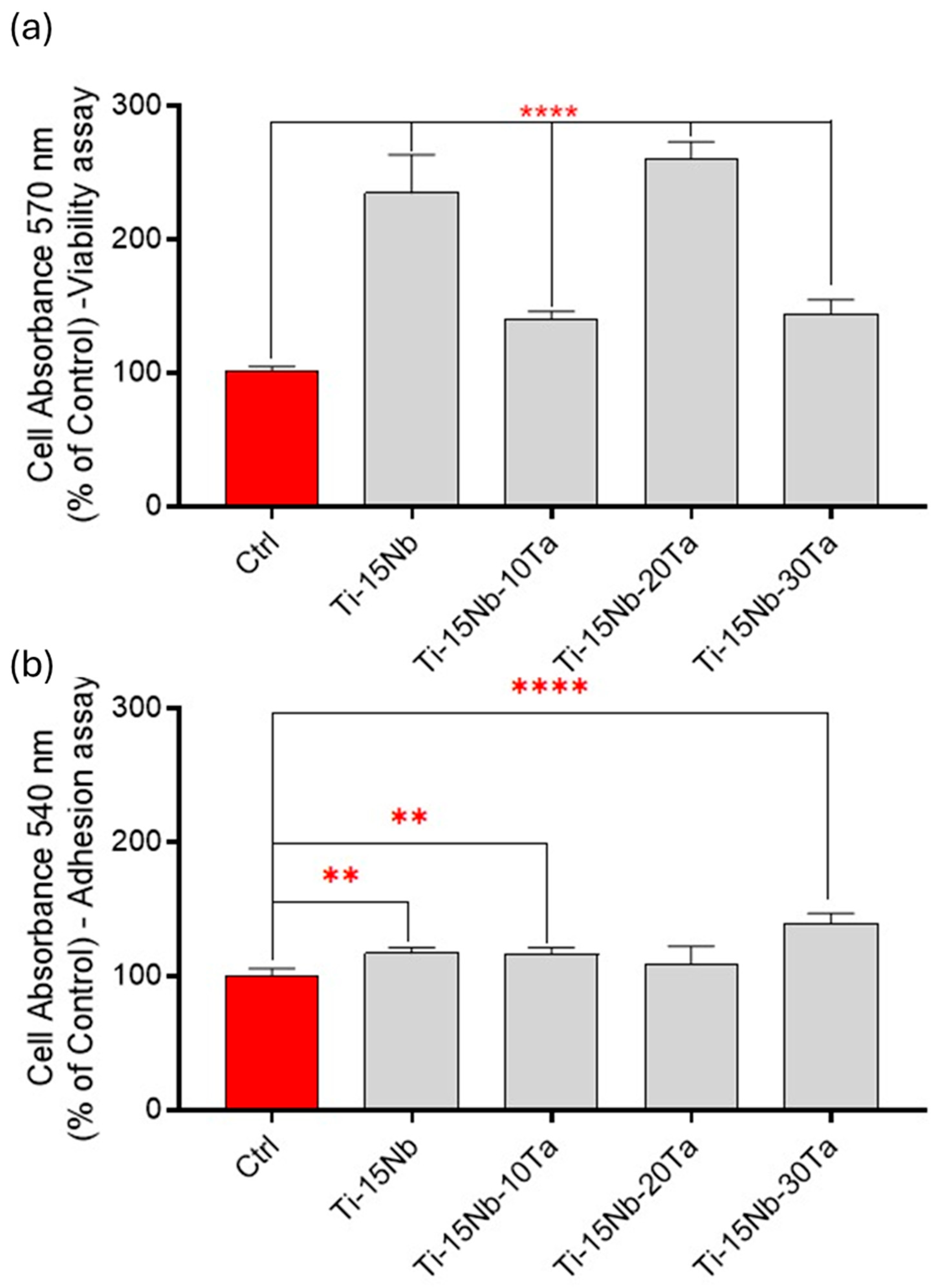
Following ISO 10993, after 24 h, the MTT assay indicated that all produced alloys exhibited significant differences in cell viability compared to the control group (Ctrl) (Figure 14a). The absorbance of the samples was higher than that of reference control, indicating an enhancement and preservation of cell viability. It is noteworthy that, according to standard cytotoxicity parameters, a toxic effect is considered when cell absorbance is below 70% of that observed in the control [44]. Therefore, the results suggest that all evaluated alloys are biocompatible and do not compromise cell viability.
Regarding the results of the crystal violet (CV) assay (Figure 14b), after 24 h of incubation, all samples showed significant differences compared to the control group (Ctrl), except for the Ti-15Nb-20Ta alloy, which did not differ significantly from the control. The CV assay evaluates cell density; that is, the higher the number of cells adhered to the surface of the plate, the greater the dye retention and, consequently, the higher the absorbance recorded.
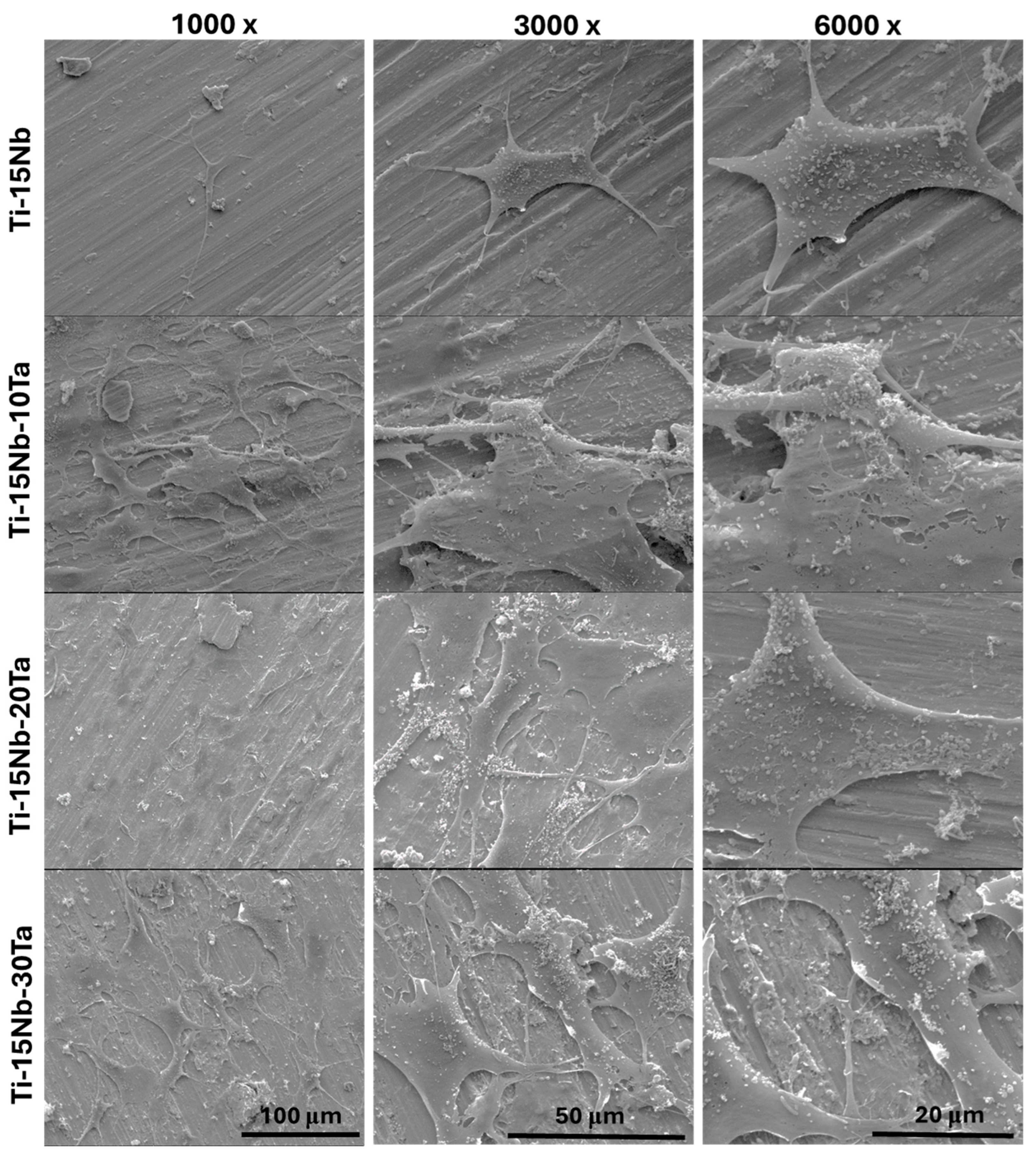
Additionally, morphological images of cells cultured on the metallic alloys were obtained by scanning electron microscopy (SEM), allowing direct observation of cell adhesion and morphology on each metallic surface (Figure 15).
The scanning electron microscopy (SEM) images of osteoblastic cells cultured on the Ti-15Nb-Ta system alloys show strong initial anchorage of the cells to the material surfaces, suggesting good compatibility between the alloys and osteoblastic cells. Cell proliferation is evident, with clusters indicating interaction and communication between cells, which is particularly noticeable in the Ti-15Nb-20Ta and Ti-15Nb-30Ta alloys. The cells exhibit typical osteoblastic morphology, including cytoplasmic extensions that establish connections with both the alloy surfaces and neighboring cells, promoting adhesion and cellular signaling.
These observations (MTT, CV, and SEM) suggest that the alloys developed in this study are suitable for supporting adhesion, proliferation, and functional organization of osteoblastic cells. No cytotoxic effects were observed, indicating that the alloys are biologically viable for orthopedic applications.

4. Conclusions

Based on the results presented in this study, the following conclusions can be drawn:
  • The alloys were successfully cast, yielding high-quality materials with excellent homogeneity, as evidenced by the chemical composition analysis (EDS). Niobium contributes to the stabilization of the β phase in combination with tantalum.
  • Structural and microstructural analyses revealed that the Ti-15Nb alloy consists of α′ and α″ phases; Ti-15Nb-10Ta exhibits α″ and β phases; Ti-15Nb-20Ta contains α″, β, and ω phases, with β being predominant; Ti-15Nb-30Ta is fully β. The addition of Ta increases the lattice parameter of the β phase and decreases the b and c lattice parameters while increasing the a parameter of the α″ phase. The Mo equivalent and molecular orbital theories are effective in predicting the phases formed in the Ti-15Nb-Ta system.
  • The microhardness of all alloys is higher than that of CP-Ti due to solid solution strengthening. Ti-15Nb-20Ta exhibits elevated hardness due to ω phase precipitation. The elastic modulus decreases with increasing Ta content due to β phase stabilization and ω phase suppression (values above 30 wt% Ta). Additionally, the presence of the α″ martensitic phase also contributes to lower elastic modulus values. Ti-15Nb-10Ta exhibits the lowest elastic modulus (57 GPa) and hardness (230 HV), indicating the highest potential for orthopedic applications.
  • Biocompatibility tests (MTT, CV, and adhesion via SEM) show that the alloys developed in this work have good biocompatibility with osteoblastic cells.

Author Contributions

Conceptualization, P.A.B.K. and C.R.G.; methodology, P.A.B.K., C.R.G. and W.F.Z.; validation, P.A.B.K. and C.R.G.; formal analysis, P.A.B.K.; investigation, Y.M.S. and G.S.d.A.; resources, C.R.G. and W.F.Z.; data curation, Y.M.S., G.S.d.A. and P.A.B.K.; writing—original draft preparation, Y.M.S., G.S.d.A. and P.A.B.K.; writing—review and editing, P.A.B.K.; visualization, C.R.G. and W.F.Z.; supervision, P.A.B.K.; project administration, P.A.B.K.; funding acquisition, C.R.G. All authors have read and agreed to the published version of the manuscript.

Funding

This research was funded by Unila (Scientific initiation scholarship awarded to Yasmim Schumaquer), FAPESP (Proc. 2024/01132-2; Proc. “2022/15157-1; and Proc. 2024/03886-4), CAPES, (Finance Code 001), CNPq (Proc. 314.810/2021-8 and Proc. 421.677/2023-6), and FINEP (Proc. 0122/21).

Data Availability Statement

The original contributions presented in this study are included in the article. Further inquiries can be directed to the corresponding author.

Acknowledgments

The authors would like to thank the Laboratório de Microscopia Eletrônica de Varredura and Laboratório de difração de Raios X belonging to the Universidade Federal de Integração Latino-americana (UNILA), for the scanning electron microscopy and X-ray diffraction measurements. Pedro Kuroda and Yasmin Schumacher gratefully acknowledge the scientific initiation scholarship (PIB3758-2024) granted by UNILA.

Conflicts of Interest

The authors declare no conflicts of interest.

References

  1. Kacsó, A.-B.; Peter, I. A Review of Past Research and Some Future Perspectives Regarding Titanium Alloys in Biomedical Applications. J. Funct. Biomater. 2025, 16, 144. [Google Scholar] [CrossRef]
  2. Pesode, P.; Barve, S. A review—Metastable β titanium alloy for biomedical applications. J. Eng. Appl. Sci. 2023, 70, 25. [Google Scholar] [CrossRef]
  3. Kanapaakala, G.; Subramani, V. A review on β-Ti alloys for biomedical applications: The influence of alloy composition and thermomechanical processing on mechanical properties, phase composition, and microstructure. Proc. Inst. Mech. Eng. Part L J. Mater. Des. Appl. 2022, 237, 14644207221141768. [Google Scholar] [CrossRef]
  4. Nicholson, J.W. Titanium Alloys for Dental Implants: A Review. Prosthesis 2020, 2, 100–116. [Google Scholar] [CrossRef]
  5. Senopati, G.; Rahman Rashid, R.A.; Kartika, I.; Palanisamy, S. Recent Development of Low-Cost β-Ti Alloys for Biomedical Applications: A Review. Metals 2023, 13, 194. [Google Scholar] [CrossRef]
  6. Gabriel, S.B.; Panaino, J.V.P.; Santos, I.D.; Araujo, L.S.; Mei, P.R.; de Almeida, L.H.; Nunes, C.A. Characterization of a new beta titanium alloy, Ti–12Mo–3Nb, for biomedical applications. J. Alloys Compd. 2012, 536, S208–S210. [Google Scholar] [CrossRef]
  7. Geetha, M.; Singh, A.K.; Asokamani, R.; Gogia, A.K. Ti based biomaterials, the ultimate choice for orthopaedic implants—A review. Prog. Mater. Sci. 2009, 54, 397–425. [Google Scholar] [CrossRef]
  8. Bahl, S.; Das, S.; Suwas, S.; Chatterjee, K. Engineering the next-generation tin containing β titanium alloys with high strength and low modulus for orthopedic applications. J. Mech. Behav. Biomed. Mater. 2018, 78, 124–133. [Google Scholar] [CrossRef] [PubMed]
  9. Miura, K.; Yamada, N.; Hanada, S.; Jung, T.-K.; Itoi, E. The bone tissue compatibility of a new Ti–Nb–Sn alloy with a low Young’s modulus. Acta Biomater. 2011, 7, 2320–2326. [Google Scholar] [CrossRef]
  10. Yin, R.; Gong, J.; Li, P.; Zhang, Y.; Zhang, J.; Liang, S.; Zhang, X. Strengthening mechanisms of developed biomedical titanium alloys with ultra-high ratio of yield strength to Young’s modulus. J. Alloys Compd. 2025, 1035, 181530. [Google Scholar] [CrossRef]
  11. Savio, D.; Bagno, A. When the Total Hip Replacement Fails: A Review on the Stress-Shielding Effect. Processes 2022, 10, 612. [Google Scholar] [CrossRef]
  12. Gupta, J.; Jha, I.K.; Singh, J. Recent advances in the aging of β-titanium alloys. J. Alloys Compd. 2025, 1024, 180098. [Google Scholar] [CrossRef]
  13. Yuliza, E.; Wella, S.A.; Amalia, N. Stability and mechanical properties of Ti-Nb-Ta ternary alloys. Phys. Scr. 2025, 100, 025904. [Google Scholar] [CrossRef]
  14. Zhou, Y.L.; Niinomi, M.; Akahori, T. Effects of Ta content on Young’s modulus and tensile properties of binary Ti–Ta alloys for biomedical applications. Mater. Sci. Eng. A 2004, 371, 283–290. [Google Scholar] [CrossRef]
  15. dos Santos, R.F.; Rossi, M.C.; Vidilli, A.L.; Amigó Borrás, V.; Afonso, C.R.M. Assessment of β stabilizers additions on microstructure and properties of as-cast β Ti–Nb based alloys. J. Mater. Res. Technol. 2023, 22, 3511–3524. [Google Scholar] [CrossRef]
  16. Callister, W.D., Jr.; Rethwisch, D.G. Callister’s Materials Science and Engineering; John Wiley & Sons: Hoboken, NJ, USA, 2020. [Google Scholar]
  17. Kuroda, P.A.B.; Grandini, C.R.; Afonso, C.R. Development of new β Ti and Zr-based alloys in the Ta-(75-x)Ti-xZr system. J. Mater. Res. Technol. 2024, 29, 4579–4587. [Google Scholar] [CrossRef]
  18. Chen, L.-Y.; Cui, Y.-W.; Zhang, L.-C. Recent Development in Beta Titanium Alloys for Biomedical Applications. Metals 2020, 10, 1139. [Google Scholar] [CrossRef]
  19. Han, M.-K.; Kim, J.-Y.; Hwang, M.-J.; Song, H.-J.; Park, Y.-J. Effect of Nb on the Microstructure, Mechanical Properties, Corrosion Behavior, and Cytotoxicity of Ti-Nb Alloys. Materials 2015, 8, 5986–6003. [Google Scholar] [CrossRef]
  20. Sass, J.-O.; Sellin, M.-L.; Kauertz, E.; Johannsen, J.; Weinmann, M.; Stenzel, M.; Frank, M.; Vogel, D.; Bader, R.; Jonitz-Heincke, A. Advanced Ti–Nb–Ta Alloys for Bone Implants with Improved Functionality. J. Funct. Biomater. 2024, 15, 46. [Google Scholar] [CrossRef]
  21. Praveen Kumar, K.; Gopal, V.; Prasanth, S.; Manivasagam, G.; Chatterjee, K.; Suwas, S. Tribocorrosion of biomedical Ti-Nb-Ta alloys fabricated by directed energy deposition using elemental powders. Tribol. Int. 2025, 211, 110906. [Google Scholar] [CrossRef]
  22. Bastos, M.; Rossi, M.C.; Afonso, C.R.M.; Grandini, C.R.; Kuroda, P.A.B. Development and functionalization of novel Ti–20Nb–Ta alloys for biomedical applications. J. Mater. Res. Technol. 2025, 39, 3127–3136. [Google Scholar] [CrossRef]
  23. Kuroda, P.A.B.; Buzalaf, M.A.R.; Grandini, C.R. Preparation, Microstructural Characterization, and Selected Mechanical Properties of Ti-20Zr-2.5Mo and Ti-20Zr-7.5Mo Used as Biomaterial. Mater. Sci. Forum 2016, 869, 946–951. [Google Scholar] [CrossRef]
  24. Çaha, I.; Alves, A.C.; Affonço, L.J.; Lisboa-Filho, P.N.; da Silva, J.H.D.; Rocha, L.A.; Pinto, A.M.P.; Toptan, F. Corrosion and tribocorrosion behaviour of titanium nitride thin films grown on titanium under different deposition times. Surf. Coat. Technol. 2019, 374, 878–888. [Google Scholar] [CrossRef]
  25. Liu, Y.; Liu, Y.; Drew, M.G.B. Comparison of calculations for interplanar distances in a crystal lattice. Crystallogr. Rev. 2017, 23, 252–301. [Google Scholar] [CrossRef]
  26. ASTM E92-17; Standard Test Methods for Vickers Hardness and Knoop Hardness of Metallic Materials. ASTM International: West Conshohocken, PA, USA, 2016.
  27. ASTM E1876-22; Standard Test Method for Dynamic Young’s Modulus, Shear Modulus, and Poisson’s Ratio by Impulse Excitation of Vibration. ASTM International: West Conshohocken, PA, USA, 2015.
  28. Mosmann, T. Rapid colorimetric assay for cellular growth and survival: Application to proliferation and cytotoxicity assays. J. Immunol. Methods 1983, 65, 55–63. [Google Scholar] [CrossRef]
  29. Xu, W.; Li, M.; Wen, C.; Lv, S.; Liu, C.; Lu, X.; Qu, X. The Mechanical Properties and In Vitro Biocompatibility of PM-Fabricated Ti-28Nb-35.4Zr Alloy for Orthopedic Implant Applications. Materials 2018, 11, 531. [Google Scholar] [CrossRef]
  30. ASTM F2066-13; Standard Specification for Wrought Titanium-15 Molybdenum Alloy for Surgical Implant Applications (UNS R58150). ASTM International: West Conshohocken, PA, USA, 2013. [CrossRef]
  31. Mattos, F.N.d.; Kuroda, P.A.B.; Rossi, M.C.; Afonso, C.R.M. Wear Behavior of Ti-xNb Biomedical Alloys by Ball Cratering. Mater. Res. 2024, 27, e20230494. [Google Scholar] [CrossRef]
  32. Li, H.; Cai, Q.; Li, S.; Xu, H. Effects of Mo equivalent on the phase constituent, microstructure and compressive mechanical properties of Ti–Nb–Mo–Ta alloys prepared by powder metallurgy. J. Mater. Res. Technol. 2022, 16, 588–598. [Google Scholar] [CrossRef]
  33. Guo, Y.; Niu, J.; Cao, J.; Sun, Z.; Dan, Z.; Chang, H. Relative strength of β phase stabilization by transition metals in titanium alloys: The Mo equivalent from a first principles study. Mater. Today Commun. 2023, 35, 106123. [Google Scholar] [CrossRef]
  34. Wang, D.; Chen, J.; Tang, J.; Zhang, Q.; Zou, M.; Xu, Z. Research on the microstructure and properties of Ti-VMoCrZrAl alloys with different Mo equivalents. J. Alloys Compd. 2025, 1044, 184055. [Google Scholar] [CrossRef]
  35. Ho, W.F.; Ju, C.P.; Chern Lin, J.H. Structure and properties of cast binary Ti–Mo alloys. Biomaterials 1999, 20, 2115–2122. [Google Scholar] [CrossRef] [PubMed]
  36. Donato, T.A.G.; Sousa, K.; Kuroda, P.A.B.; Grandini, C.R. A New α + β Ti-15Nb Alloy with Low Elastic Modulus: Characterization and In Vitro Evaluation on Osteogenic Phenotype. J Funct Biomater 2023, 14, 452. [Google Scholar] [CrossRef]
  37. Tavares, A.M.G.; Souza, E.A.d.; Silva, M.S.C.d.; Matos, G.R.L.; Batista, W.W.; Souza, S.A.S.d.A. Role of Silicon in the Microstructural Development and Properties of Ti-15Nb-xSi Alloys for Biomedical Applications. Mater. Res. 2021, 24, e20200417. [Google Scholar] [CrossRef]
  38. Morinaga, M.; Kato, M.; Kamimura, T.; Fukumoto, M.; Harada, I.; Kubo, K. Theoretical design of beta-type titanium alloys. In Titanium’92: Science and Technology; Minerals, Metals and Materials Society: Pittsburgh, PA, USA, 1993; pp. 217–224. [Google Scholar]
  39. Kuroda, D.; Niinomi, M.; Morinaga, M.; Kato, Y.; Yashiro, T. Design and mechanical properties of new β type titanium alloys for implant materials. Mater. Sci. Eng. A 1998, 243, 244–249. [Google Scholar] [CrossRef]
  40. Sidhu, S.S.; Singh, H.; Gepreel, M.A.-H. A review on alloy design, biological response, and strengthening of β-titanium alloys as biomaterials. Mater. Sci. Eng. C 2021, 121, 111661. [Google Scholar] [CrossRef]
  41. Abdel-Hady, M.; Hinoshita, K.; Morinaga, M. General approach to phase stability and elastic properties of β-type Ti-alloys using electronic parameters. Scr. Mater. 2006, 55, 477–480. [Google Scholar] [CrossRef]
  42. Pathak, A.; Banumathy, S.; Sankarasubramanian, R.; Singh, A.K. Orthorhombic martensitic phase in Ti–Nb alloys: A first principles study. Comput. Mater. Sci. 2014, 83, 222–228. [Google Scholar] [CrossRef]
  43. Ogi, H.; Kai, S.; Ledbetter, H.; Tarumi, R.; Hirao, M.; Takashima, K. Titanium’s high-temperature elastic constants through the hcp–bcc phase transformation. Acta Mater. 2004, 52, 2075–2080. [Google Scholar] [CrossRef]
  44. ISO 10993-5:2009; Biological Evaluation of Medical Devices—Part 5: Tests for In Vitro Cytotoxicity. International Standard Organization: Geneva, Switzerland, 2009.
Figure 1. Ti-15Nb-Ta system ingots.
Metals 15 01201 g001
Figure 2. EDS spectra for Ti-15Nb-Ta alloys.
Metals 15 01201 g002
Figure 3. Chemical mapping of Ti-15Nb-Ta alloys.
Metals 15 01201 g003
Figure 4. Melting and β-transus temperatures of Ti-15Nb-Ta alloys obtained by Thermo-Calc.
Metals 15 01201 g004
Figure 5. XRD patterns of the Ti-15Nb, Ti-15Nb-10Ta, Ti-15Nb-20Ta, and Ti-15Nb-30Ta.
Metals 15 01201 g005
Figure 6. Percentage of α′, α”, ω, and β phases of Ti-15Nb-Ta alloys.
Metals 15 01201 g006
Figure 7. SEM micrographs of the Ti-15Nb-Ta alloys, showing the α″ phase in Ti-15Nb, Ti-15Nb-10Ta, and Ti-15Nb-20Ta, and the α′ phase in Ti-15Nb, with arrows indicating each phase.
Metals 15 01201 g007
Figure 8. Bo-Md diagram, with Ti-15Nb-Ta values plot (Reprinted with permission from ref. [40]. 2021 Elsevier).
Metals 15 01201 g008
Figure 9. Lettice parameter of the α′ (Ti-15Nb), α″ (Ti-15Nb and Ti-15Nb-10Ta), and β phases (Ti-15Nb-10Ta, Ti-15Nb-20Ta, and Ti-15Nb-30Ta).
Metals 15 01201 g009
Figure 10. Three-dimensional representation of the crystal structures of the α′ (black), α″ (green), and β (red) phases of Ti alloys.
Metals 15 01201 g010
Figure 11. The microhardness values of Ti-15Nb-Ta alloys.
Metals 15 01201 g011
Figure 12. The elastic modulus values of Ti-15Nb-Ta alloys.
Metals 15 01201 g012
Figure 13. Microhardness and elastic modulus values as a function of Moeq.
Metals 15 01201 g013
Figure 14. Comparison of the cell viability (a) and cell adhesion (b) assay considering the control group and the Ti-15Nb-Ta alloys (** indicates p < 0.01, and **** indicates p < 0.0001).
Metals 15 01201 g014
Figure 15. SEM images of osteoblast adhesion on the Ti-15Nb-Ta alloy surfaces.
Metals 15 01201 g015
Disclaimer/Publisher’s Note: The statements, opinions and data contained in all publications are solely those of the individual author(s) and contributor(s) and not of MDPI and/or the editor(s). MDPI and/or the editor(s) disclaim responsibility for any injury to people or property resulting from any ideas, methods, instructions or products referred to in the content.