Article

Reliability Simulation of IGBT Module with Different Solders Based on the Finite Element Method

by
Haoran Ma
*,
Min Gou
,
Xingjian Tian
,
Wei Tan
and
Hongwei Liang
School of Integrated Circuits, Dalian University of Technology, Dalian 116024, China
*
Author to whom correspondence should be addressed.
Metals 2024, 14(10), 1141; https://doi.org/10.3390/met14101141
Submission received: 31 August 2024 / Revised: 4 October 2024 / Accepted: 5 October 2024 / Published: 6 October 2024
(This article belongs to the Special Issue New Welding Materials and Green Joint Technology—2nd Edition)

Abstract

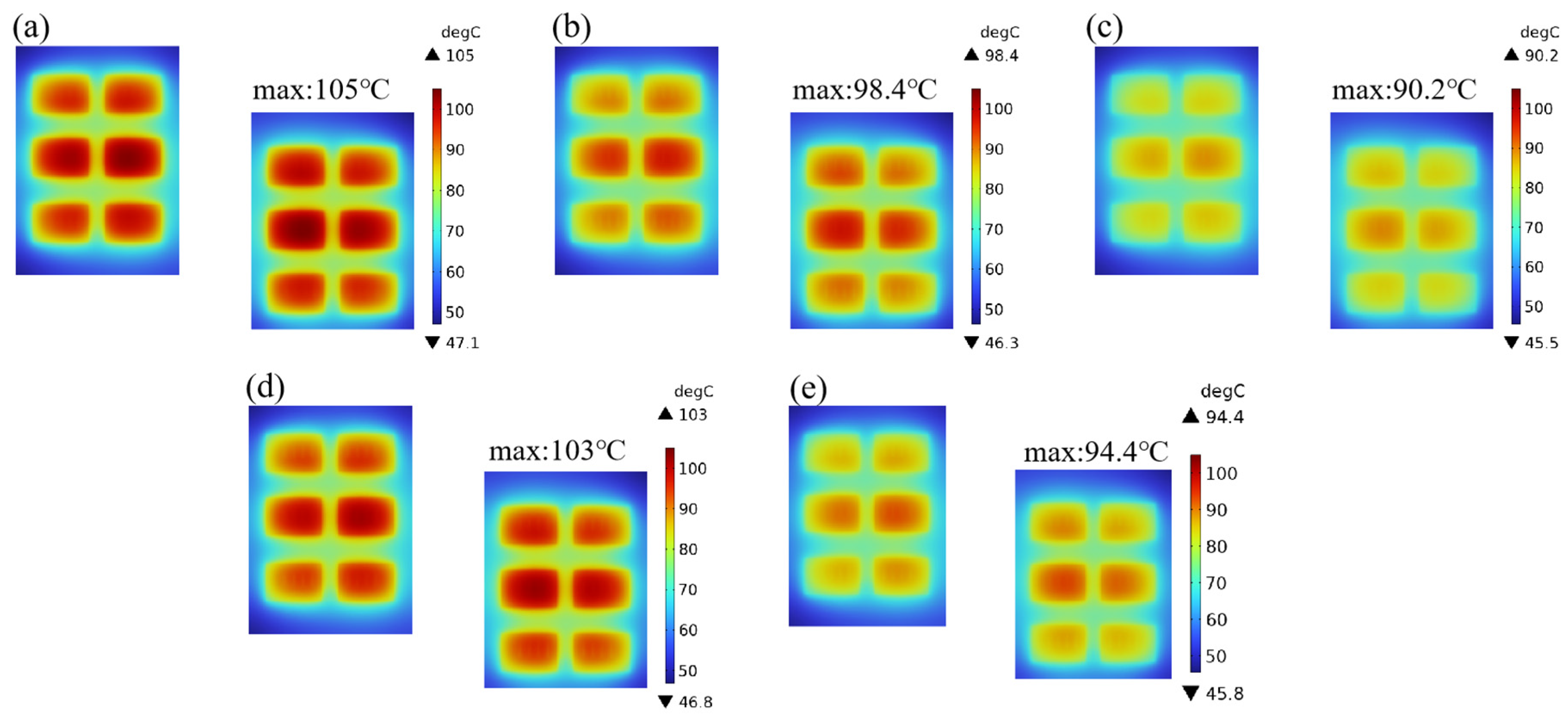
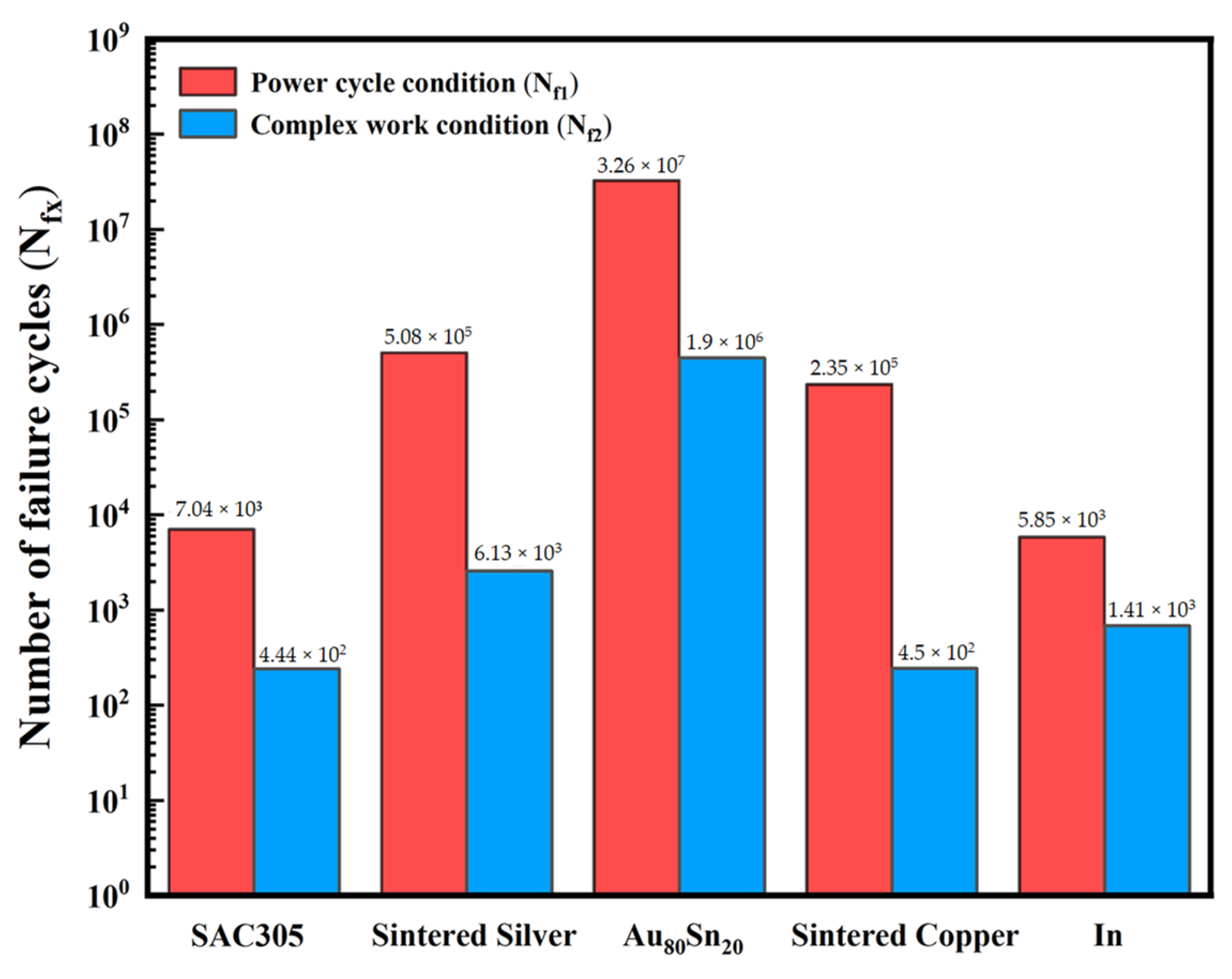
The interconnecting solder is a key control factor for the reliability of electronic power packaging because it highly affects the junction temperature of insulated-gate bipolar transistor (IGBT) modules and is prone to plasticity, creep, and other failure behaviors under temperature-change environments. In this paper, the interconnecting performance and fatigue life of five different kinds of solders such as SAC305, sintered silver, Au80Sn20, sintered copper, and pure In under direct current (DC), power cycle, and electro-thermal coupling complex environments were studied based on electro-thermal multi-physical field coupling finite element simulation method, respectively. Results show that the sintered silver owns the most outstanding thermal reliability and the DC operating junction temperature of the IGBT module after utilizing sintered silver solder is only 90.2 °C, which is nearly 15 °C lower than that of the IGBT module utilizing SAC305 solder. Furthermore, in the power cycle reliability test, the fatigue life of Au80Sn20 solder reaches a maximum of 3.26 × 10⁷ cycles while the life of indium presents only 5.85 × 10³ cycles, a difference of nearly four orders of magnitude. Finally, under the complex environment of electro-thermal coupling, the fatigue life of Au80Sn20 solder is also the largest at 1.9 × 10⁶ cycles, while the smallest life of solder becomes SAC305 solder at 4.44 × 10² cycles. The results of this paper can provide a theoretical basis for solder selection and life prediction of the IGBT module, which is of great significance in improving the reliability of power electronic packaging.
Keywords: solder; fatigue life; reliability; finite element solder; fatigue life; reliability; finite element