Article

Influence of Heat Control on Properties and Residual Stresses of Additive-Welded High-Strength Steel Components
1
Welding Technology, Chemnitz University of Technology, D-09107 Chemnitz, Germany
2
Bundesanstalt fuer Materialforschung und -pruefung (BAM), D-12205 Berlin, Germany
*
Author to whom correspondence should be addressed.
Metals 2022, 12(6), 951; https://doi.org/10.3390/met12060951
Submission received: 28 April 2022 / Revised: 19 May 2022 / Accepted: 27 May 2022 / Published: 31 May 2022

Abstract

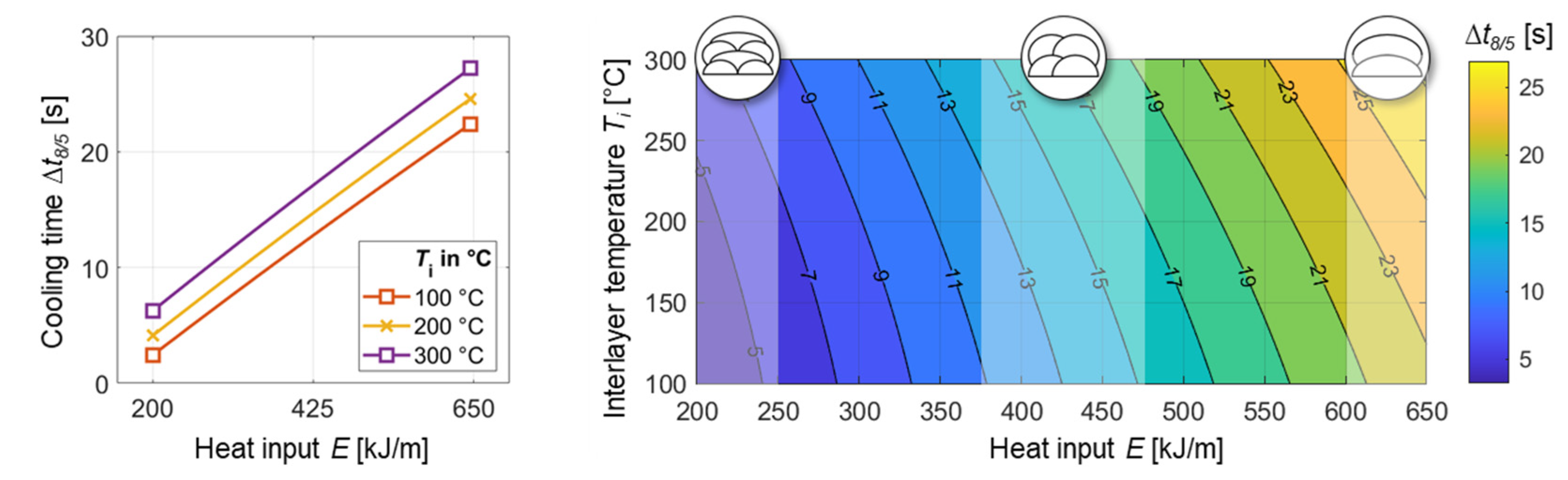
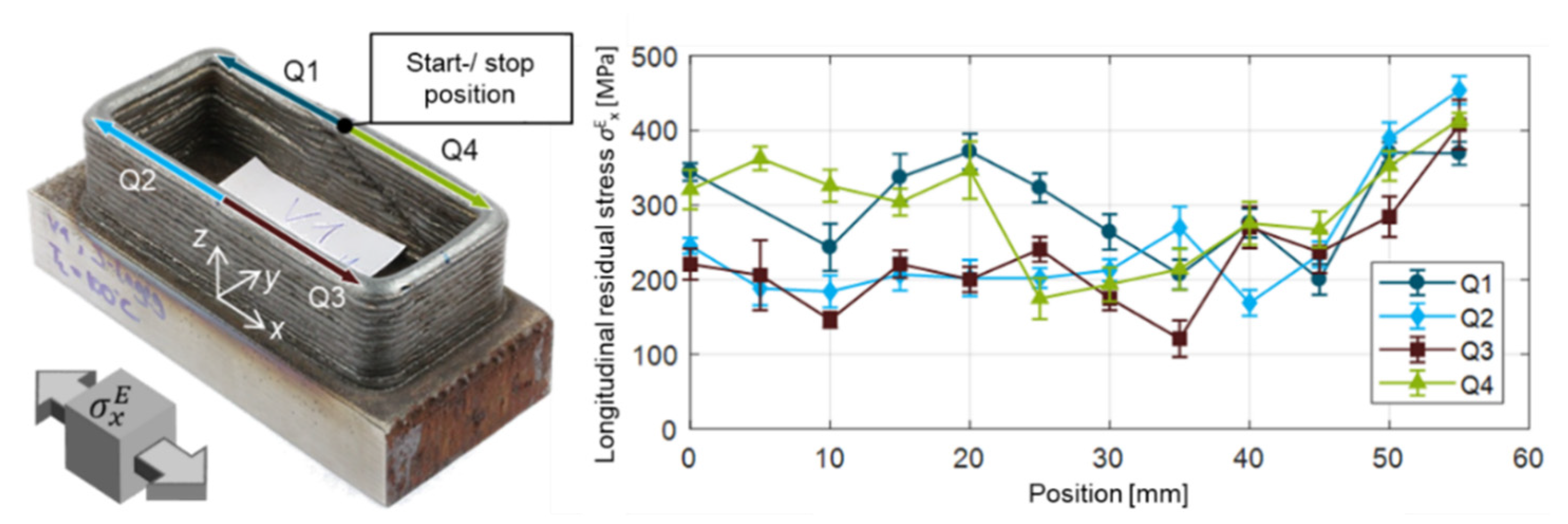
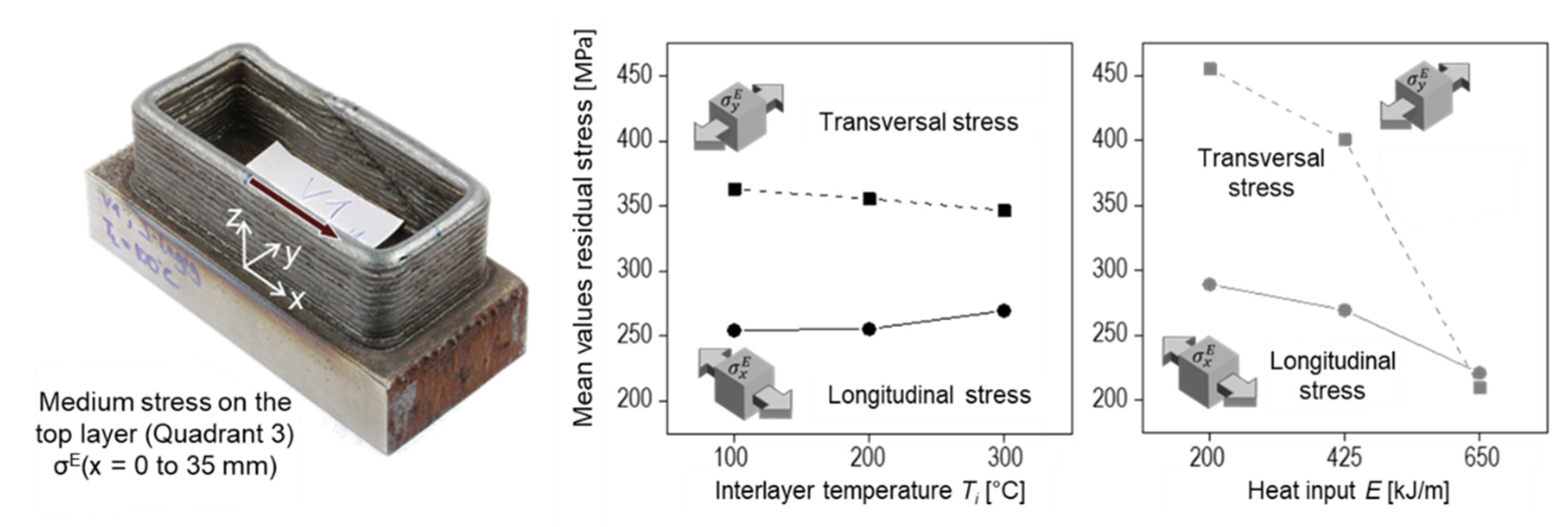
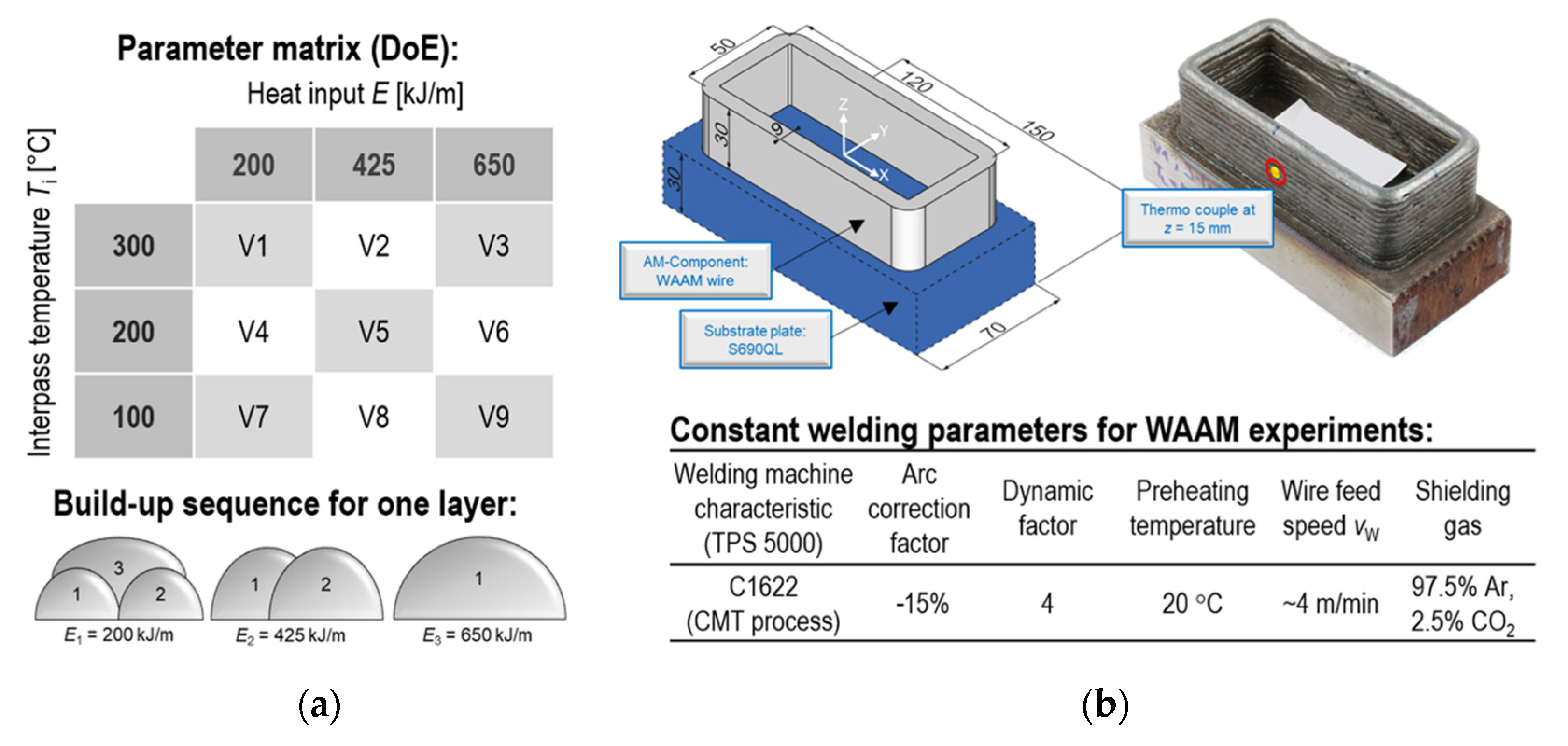
Advanced high-performance filler metals for wire arc additive manufacturing (WAAM) exist on the market already. Nevertheless, these high-strength steels are not yet widely used in industrial applications due to limited knowledge of cold-cracking susceptibility, welding residual stresses, and therefore sufficient safety in terms of manufacturing and operation. High residual stresses promote cold-cracking risk, especially in the welding of high-strength steels, as the result of a complex interaction between the applied material, process conditions, and component design. The focus of the present investigation was the determination of the influence of the process parameters on the ∆t8/5 cooling time, mechanical properties, and residual stresses to correlate, for the first time, heat control, cooling conditions, and residual stress for WAAM of high-strength filler materials. This contributed to the knowledge regarding the safe avoidance of cold cracking. In addition to a thermophysical simulation using a dilatometer of different high-strength steels with subsequent tensile testing, reference WAAM specimens (open hollow cuboids) were welded while utilizing a high-strength filler metal (ultimate tensile strength > 790 MPa). The heat control was varied by means of the heat input and interlayer temperature such that the ∆t8/5 cooling times corresponded to the recommended processing range (approx. 5 s to 20 s). For the heat input, significant effects were exhibited, in particular on the local residual stresses in the component. Welding with an excessive heat input or deposition rate may lead to low cooling rates, and hence to unfavorable microstructure and component properties, but at the same time, is intended to result in lower tensile residual stress levels. Such complex interactions must ultimately be clarified to provide users with easily applicable processing recommendations and standard specifications for an economical WAAM of high-strength steels. These investigations demonstrated a major influence of the heat input on both the cooling conditions and the residual stresses of components manufactured with WAAM using high-strength filler materials. A higher heat input led to longer cooling times (∆t8/5) and approx. 200 MPa lower residual stresses in the surface of the top layer.
Keywords: WAAM; additive manufacturing; heat control; high-strength filler metals; residual stress WAAM; additive manufacturing; heat control; high-strength filler metals; residual stress