1. Introduction
Identifying the dynamic load acting on a metal structure is essential for a large variety of applications. For example, dynamic loads applied on a structure are responsible for the majority of failures during service [
1,
2,
3,
4]. Therefore, to improve the safety and the reliability of a structure, it is not enough to ensure that the static characteristics meet the design requirements. Dynamic loads should also be closely monitored in order to ensure that they do not exceed certain limits.
Current dynamic loads identification methods are mostly based on specified systems with known parameters, e.g., the stiffness and the damping [
5,
6,
7]. These parameters are usually identified by applying artificial excitations. However, in many cases, this identification method may affect the normal operation of a structure (such as bridges and rotors in operation) [
8,
9]. Such artificial excitation may also cause structural damage. A practical approach to obtaining modal parameters is ambient vibration tests (AVTs) [
10,
11], which are usually economical and time-saving. Several modal parameter identification methods based on ambient excitation, such as the lbrahim time domain technique (ITD) [
12], the autoregressive moving average model (ARMA) [
13], and the random subspace method [
14], are available in the literature. Among these approaches, the fast Fourier transform modal parameter identification method based on Bayesian probability [
15,
16] is the most efficient, as it makes full use of the response data and obtains the modal priori parameters. Furthermore, in the presence of noise, the identification results are often more accurate than other methods thanks to the Bayesian probability principle.
In the field of dynamic load identification, among Bayesian methods we have the Bayesian regularization method [
17] and the Bayesian particle filter method [
18]. Furthermore, the Kalman filter method [
19] can also be considered as a special case of Bayesian methods where the Kalman filter is usually combined with the least square method [
20]. Zhang et al. [
21] used the Bayesian method to reconstruct a structural load with measurement noise and model uncertainty. Yan [
22] identified the impact load on a composite plate by the Bayesian regularization method, and they also used the Kalman filter algorithm to identify the impact position. Faure et al. [
23] used the Bayesian regularization method to identify the load position by assessing the displacement response. This method does not need the boundary conditions but is highly sensitive to the noise in the response measurement. The Kalman filter is developed in the modern control theory and has been successfully applied in the field of dynamic load identification. When considering a dynamic model that contains a Gaussian model error and the response signal is corrupted by a Gaussian noise, the Kalman filter load identification method [
24,
25,
26,
27,
28] can accurately reconstruct the time-domain information of the load in both the physical space and the modal space. Several scholars have proposed the extended Kalman filter [
20,
29,
30] and the unscented Kalman filter [
27,
31] to correct these errors and to identify loads. Lourens [
25] proposed the extended Kalman filter to identify the load, which extends the unknown force vector to the state vector to form the augmented state vector, and uses the Kalman filter to identify the augmented state vector so as to identify the load. Naets et al. [
26] studied the observability of this method and pointed out that the system is unobservable when only the acceleration response is used to identify the load. In order to solve this problem, they combined the virtual displacement technology with the acceleration response and improved the Kalman filter to identify the load. Yang et al. [
27,
28,
29] composed the state vector and the model parameters into an augmented state vector. They used the extended Kalman filter to identify the augmented state vector and employed complex mathematical equations to identify the load.
The methods mentioned above are all based on the assumption of known system parameters. However, it remains to be studied how to identify the load when only the response data are known for an unspecified system under a random excitation. Moreover, these methods are only developed in the physical space and not in the modal space, which can lead to complicated computation when applied to large-scale structures. Developing a similar approach for the modal space is useful for large-scale engineering structures. In this paper, we firstly introduced the extended Kalman filter method into the modal space to identify the modal parameters and load of unspecified systems using only random excitation response data.
This paper is organized as follows: In
Section 1, the introduction of the research background is described. In
Section 2, the posterior PDF and covariance of modal parameters were obtained by the Fourier transform of the response data. Then, the modal parameters of the structure were obtained based on unconstrained optimization (
Section 2.1). The extended Kalman filter load identification method in the modal space was derived to update the modal parameters with errors and identify the excitation (
Section 2.2). In
Section 3, a 3-DOF structure was simulated to verify the correctness of the extended Kalman filter. A simply supported beam under random loads was used to demonstrate the effectiveness and feasibility of the proposed methods in
Section 2. Finally, the conclusions are presented in
Section 5.
4. Experimental Study
In this section, we aimed to evaluate the accuracy of the proposed algorithm using experimental validation. Many engineering metal structures can be abstracted into beams and plates. To this end, a simply supported beam made of steel was used. The acceleration responses of the beam under random loads were collected, and the modal parameters were obtained using the Bayesian modal parameter identification method. Furthermore, the extended Kalman filter in the modal space was used to correct the error parameters and to identify random loads.
The known parameters included the acceleration response of the simply supported beam under a random excitation (generated by a modal shaker) and the mass matrix of the beam. The geometric dimensions and the material properties are shown in
Table 5.
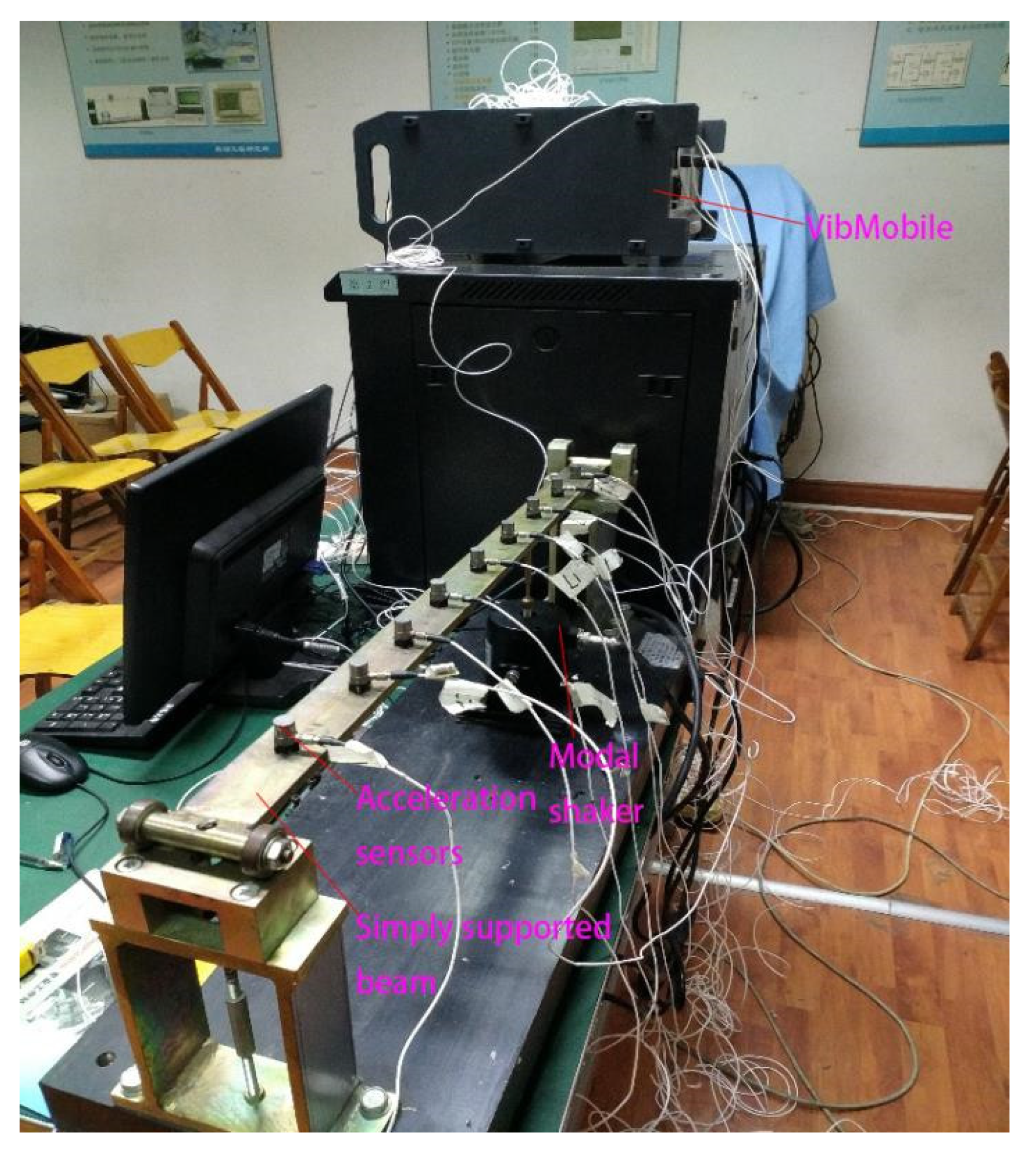
The simply supported beam was meshed into 10 elements, each of which had a length of 0.07 m and a total of 11 nodes. The beam was supported in the vertical direction at the nodes of both ends. The acceleration sensors were placed at the other nine sections. The test setup is shown in
Figure 8.
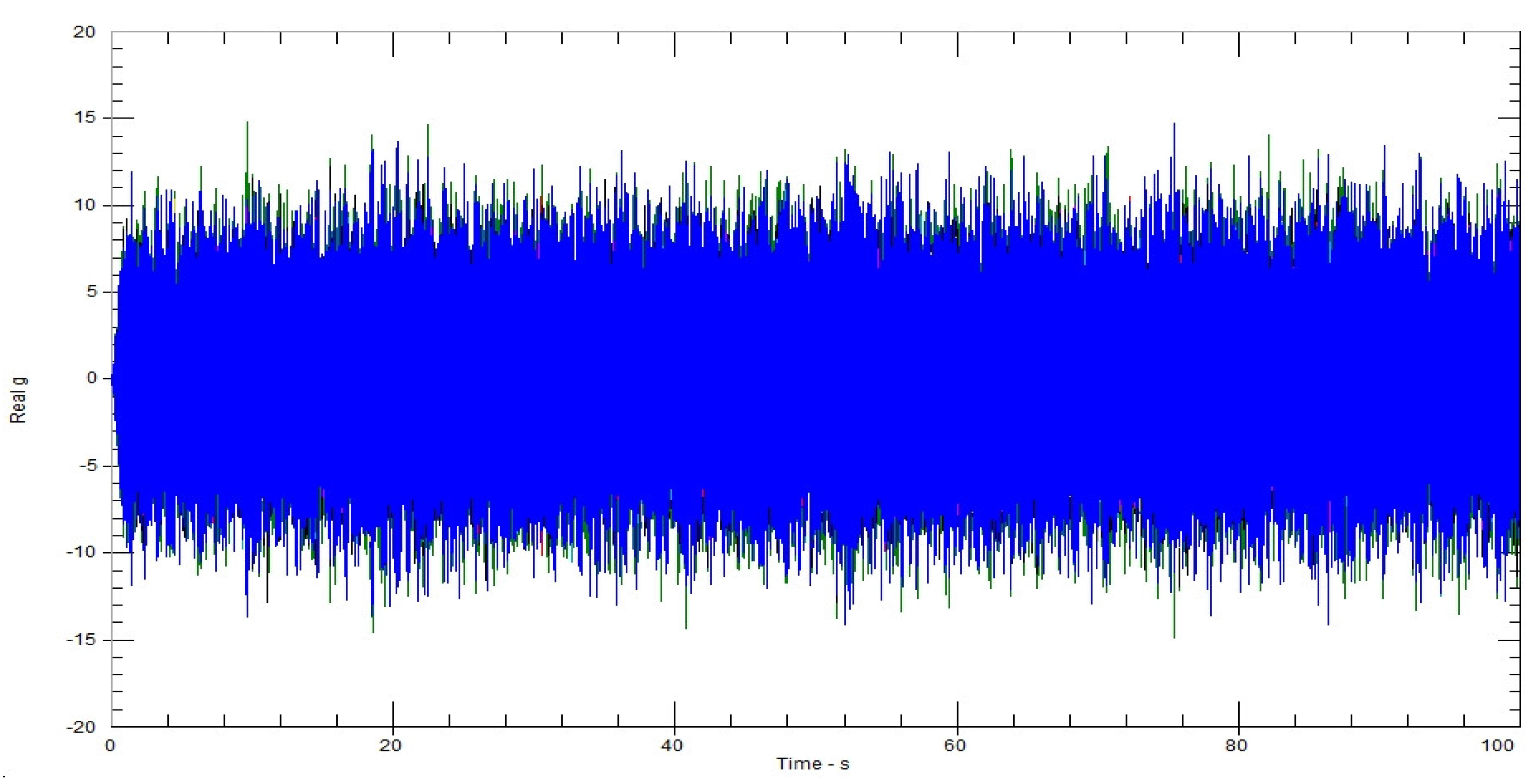
A random excitation with a frequency bandwidth from 0 to 1500 Hz was then applied on the beam. The sampling frequency of the sensor was 4096 Hz. The Fourier transformation of the response signal is shown in
Figure 9.
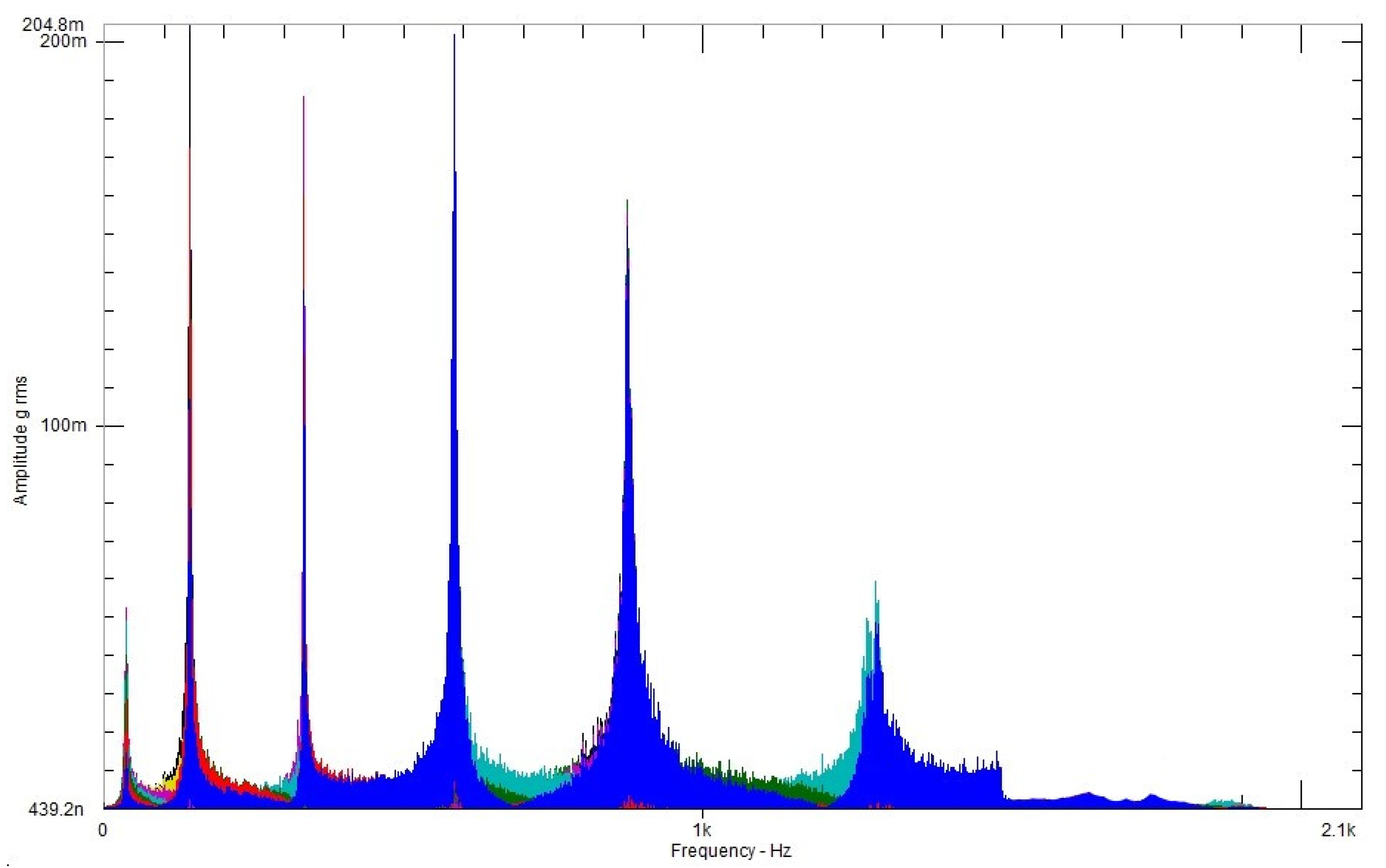
Figure 10 shows the Fourier spectra of the response signals.
It can be clearly seen that the spectrum had six peaks and the adjacent peaks were far apart. Hence, a single mode analysis can be performed. Furthermore, the seventh mode frequency was 1821 Hz, which was not considered in the simulation. We then considered the frequency corresponding to each peak as an initial value of the modal frequency in the unconstrained numerical optimization equation, which is also called a priori parameter in the Bayesian theory. The initial assumptions and the frequency bands are shown in
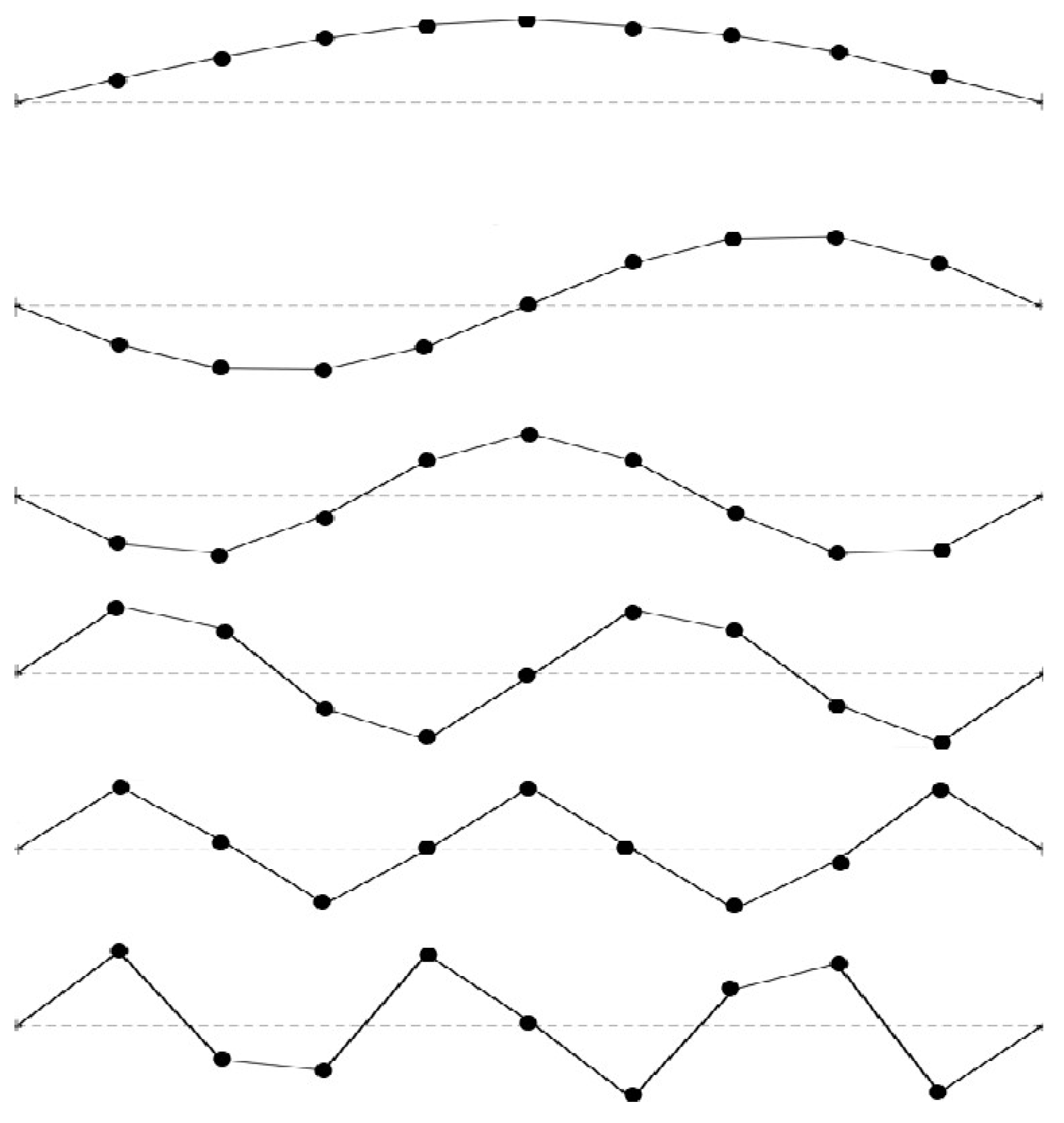
Table 6. The identified modes are shown in
Figure 11.
Four frequency bands were selected for each order modal analysis. The final modal frequency and damping ratio were the average values of the four calculations.
Table 7 shows the identification values of the modal frequencies and the damping ratios for each order of the modal analysis compared with the results of the modal tests, as well as the MAC values of each mode.
The results shown in
Table 7 indicated that the Bayesian modal parameter identification method has relatively large errors in the identification of high-order modal frequencies. Hence, the first two modal frequencies can be considered to be accurate. The third to sixth order modal frequencies were used as errors parameters to form an extended vector with the state vector. The extended Kalman filter load identification method in the modal space was then used to correct these errors parameters and to identify the time-domain load.
The modal error parameter vector was . The extended state vector was then . The unknown quantities to be identified are as follows:
The extended vector;
The random excitation.
The initial values for the state variables were zero, and the initial assumptions for
were the identified values:
. The initial error covariance matrix of the extended state vector was taken to be
. The initial value of the excitation was zero. The covariance matrices of both the measurement noise and the model noise were chosen to be
and
, respectively. The identified parameters are presented in
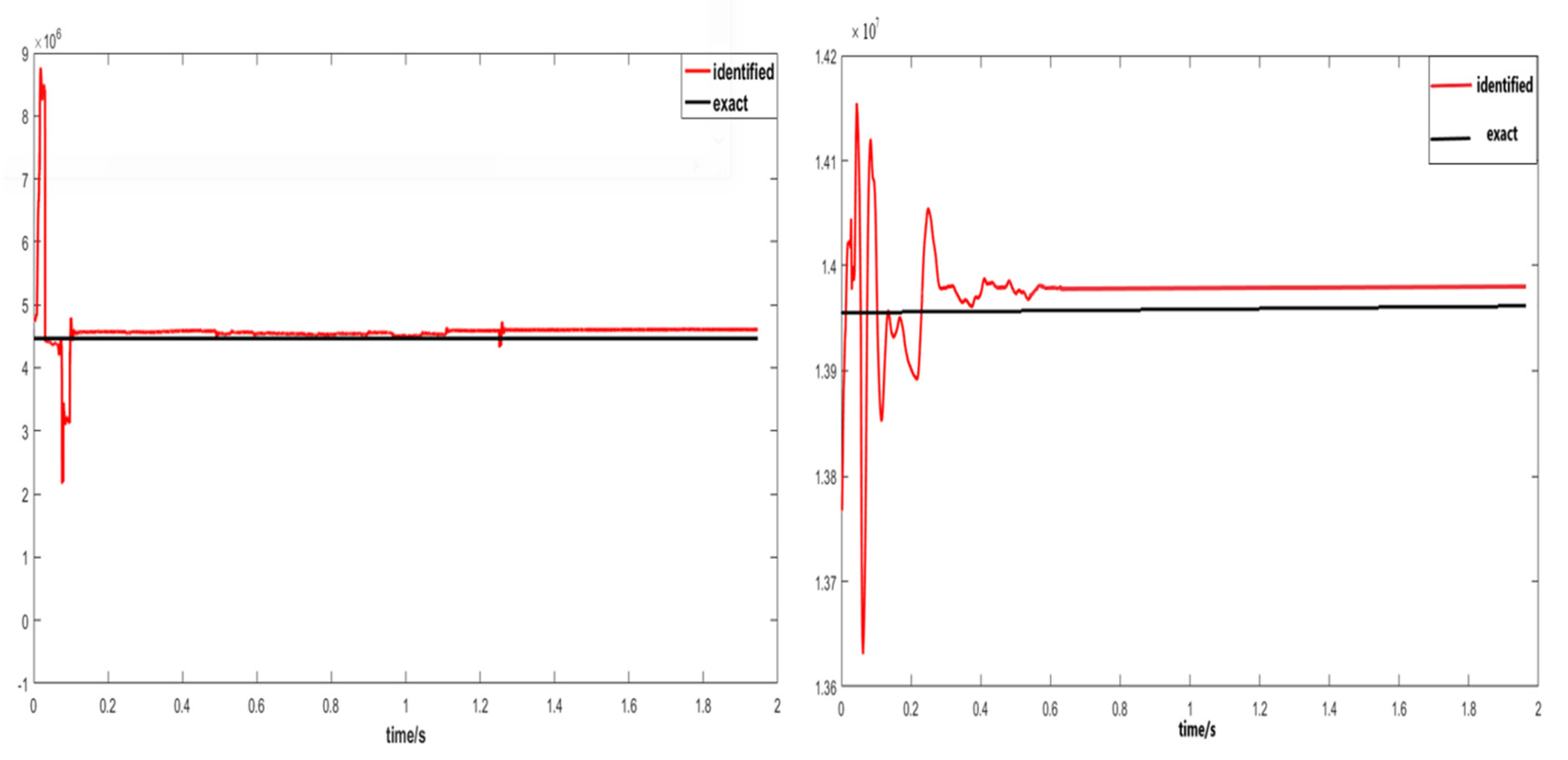
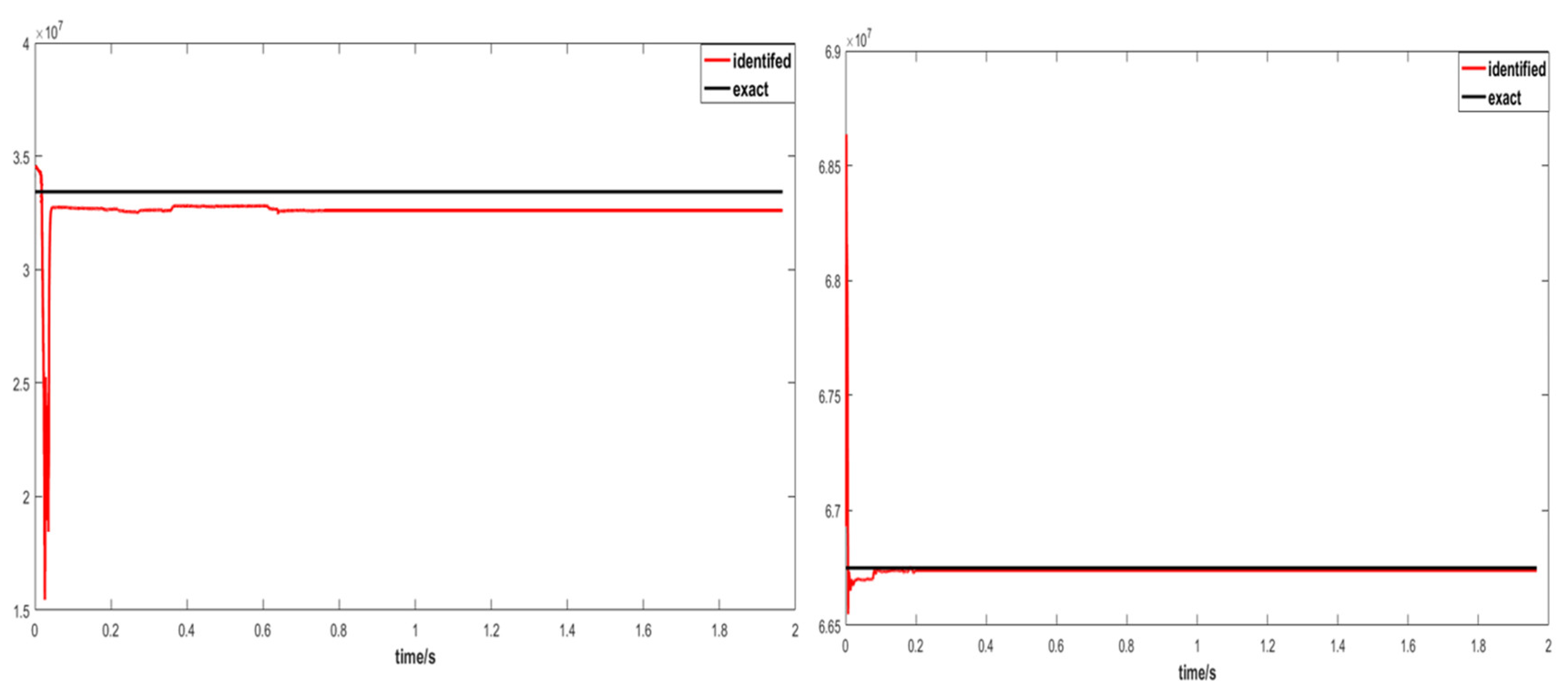
Figure 12 and
Figure 13. The identified eigenvalues and the natural frequencies and the error comparisons are shown in the
Table 8. In the first few iterations of filtering, the identified value had a very large jump, but it converged to the exact value after several iterations.
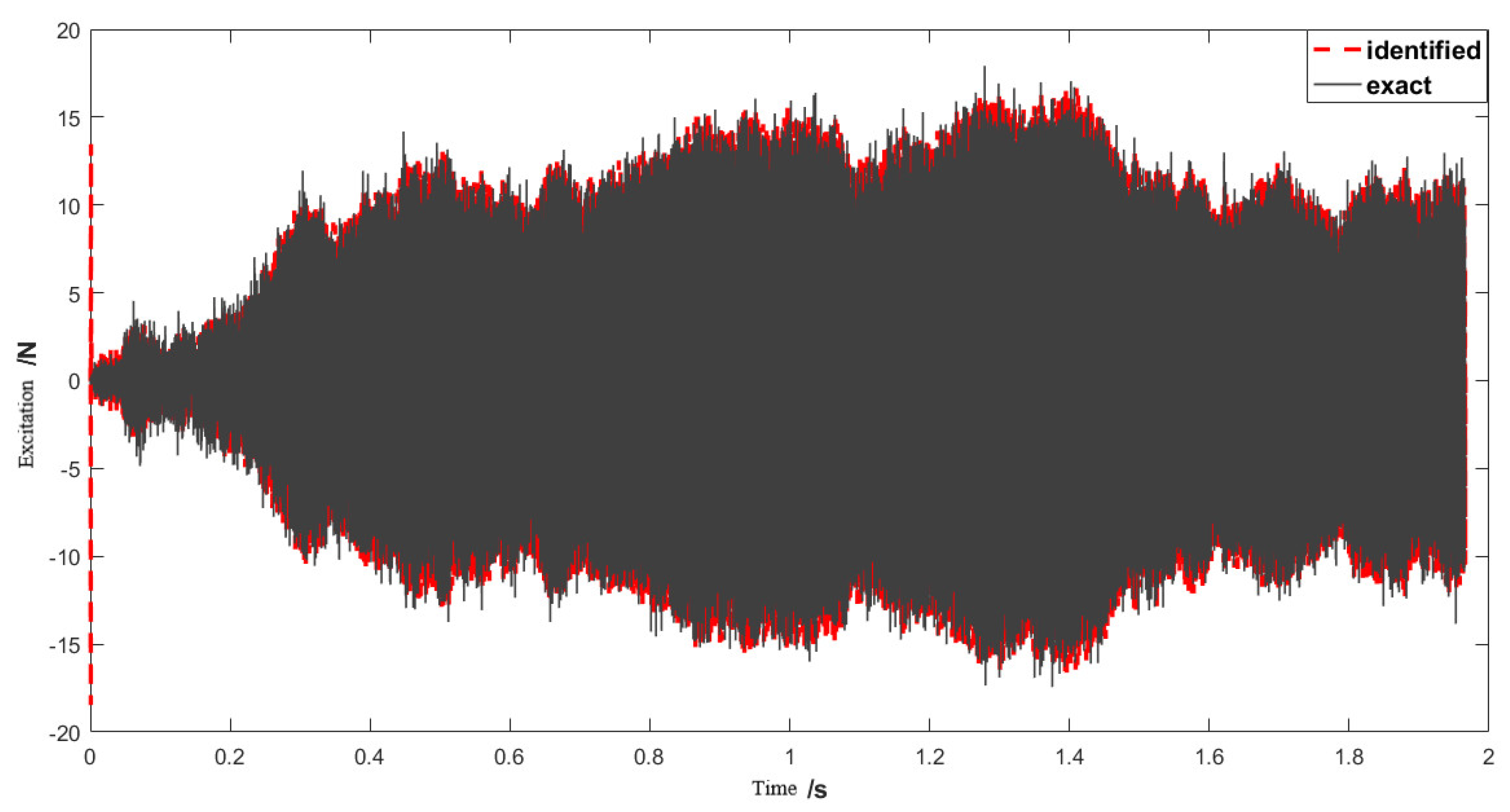
Figure 14 shows the identified load for the first two seconds. Since the identification result was extremely abnormal in several iterative steps of the initial calculation, the statistics started from 0.02 s.
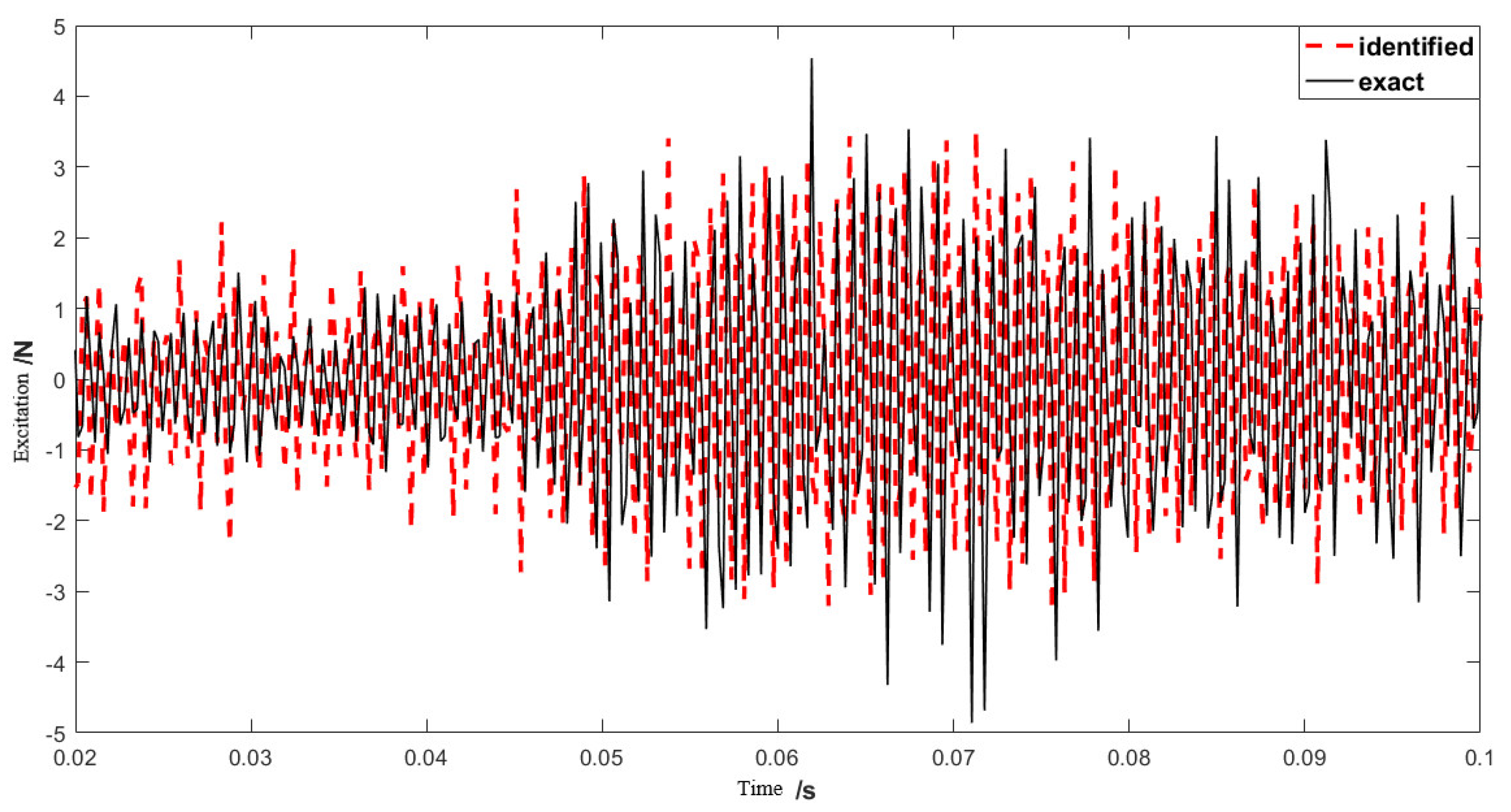
Figure 15 shows the load from 0.02 to 0.1 s when the parameters were still being identified.
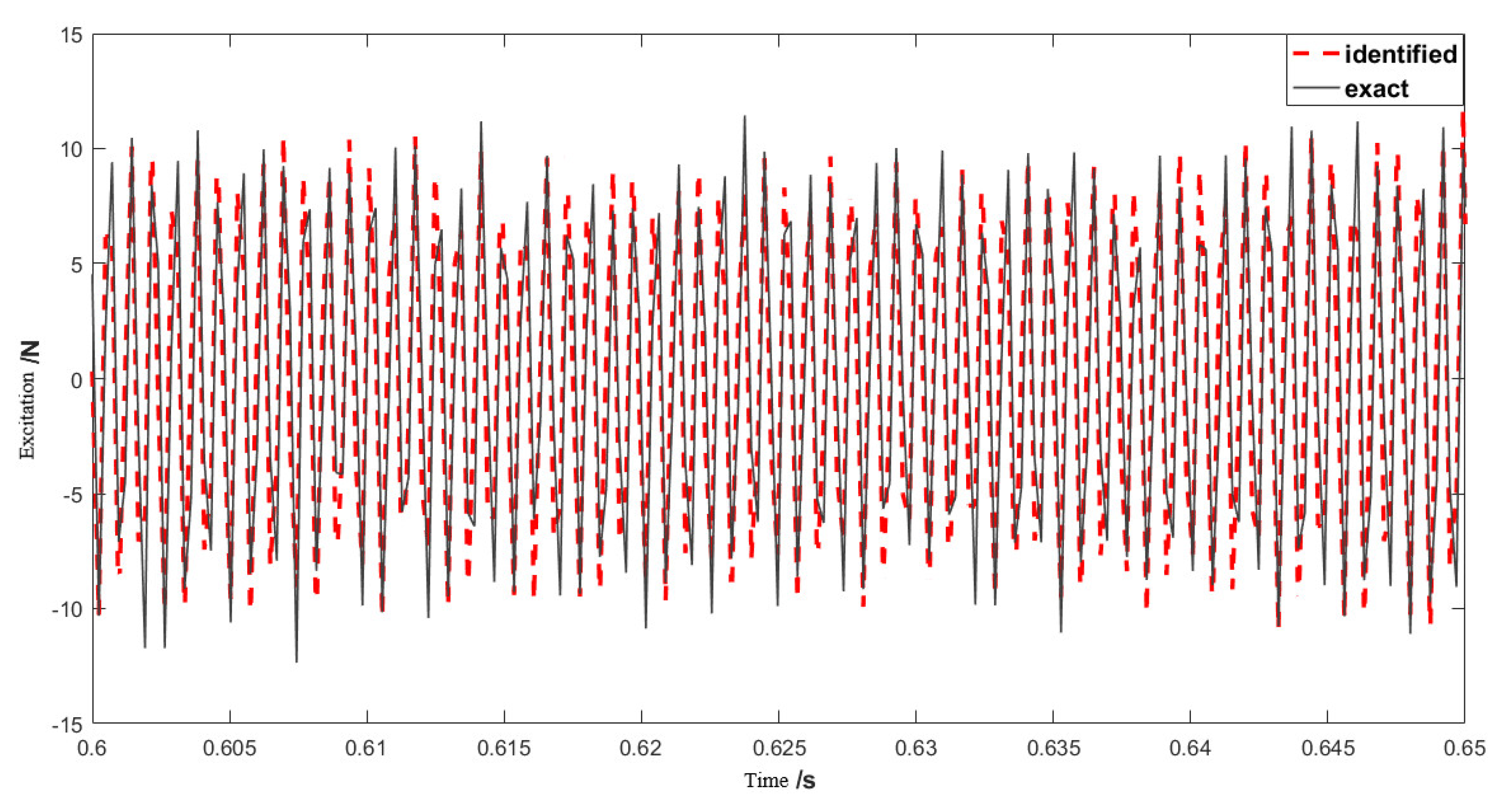
Figure 16 shows the excitation identification results from 0.6 to 0.65 s, during which the modal parameters converged.
The MSE and the PREM were evaluated for the time span from 0.02 to 0.1 s, where the identification algorithm is still in the process of the model parameters updating. The errors measurements were then evaluated again for the time span from 0.6 to 0.65 s, when the load identification started to use converged parameters. The errors for both time spans are displayed in
Table 9. The errors showed a significant improvement in the error once the algorithm has converged. The small errors for the time span from 0.6 to 0.65 s showed a good accuracy of the proposed algorithm in capturing the dynamic load.
Author Contributions
Conceptualization and methodology, J.J.; investigation and formal analysis, N.S.; writing—original draft preparation, J.J. and N.S.; writing—review and editing, N.S. and M.S.M.; validation and supervision, F.Z. All authors have read and agreed to the published version of the manuscript.
Funding
Our research is supported by Supported by the Foundation of National Key Laboratory of Science and Technology on Rotorcraft Aeromechanics (No. 61422202105), Qing Lan Project and National Natural Science Foundation of China (No. 51775270). Financial support provided by the project of Qatar National Research Fund under the contract NPRP11S-1220- 170112 is gratefully acknowledged.
Institutional Review Board Statement
Not applicable.
Informed Consent Statement
Not applicable.
Data Availability Statement
Not applicable.
Conflicts of Interest
The authors declare no conflict of interest.
References
- Bai, X.; Wei, X.; Ma, Q.; An, Z. Failure Rate Model of Materials under Uncertain Constant Amplitude Cyclic Load. Metals 2022, 12, 1181. [Google Scholar] [CrossRef]
- Wang, L.; Peng, Y.; Xie, Y.; Chen, B.; Du, Y. A new iteration regularization method for dynamic load identification of stochastic structures. Mech. Syst. Signal Process. 2021, 156, 107586. [Google Scholar] [CrossRef]
- Liu, R.; Dobriban, E.; Hou, Z.; Qian, K. Dynamic Load Identification for Mechanical Systems: A Review. Arch. Comput. Methods Eng. 2022, 29, 831–863. [Google Scholar] [CrossRef]
- Li, H.; Jiang, J.; Mohamed, M. Online Dynamic Load Identification Based on Extended Kalman Filter for Structures with Varying Parameters. Symmetry 2021, 13, 1372. [Google Scholar] [CrossRef]
- Jiang, J.; Ding, M.; Li, J. A novel time-domain dynamic load identification numerical algorithm for continuous systems. Mech. Syst. Signal Process. 2021, 160, 107881. [Google Scholar] [CrossRef]
- Yang, H.; Jiang, J.; Chen, G.; Mohamed, M.S.; Lu, F. A Recurrent Neural Network-Based Method for Dynamic Load Identification of Beam Structures. Materials 2021, 14, 7846. [Google Scholar] [CrossRef]
- Yang, H.; Jiang, J.; Chen, G.; Zhao, J. Dynamic load identification based on deep convolution neural network. Mech. Syst. Signal Process. 2023, 185, 109757. [Google Scholar] [CrossRef]
- Ronasi, H.; Johansson, H.; Larsson, F. A numerical framework for load identification and regularization with application to rolling disc problem. Comput. Struct. 2011, 89, 38–47. [Google Scholar] [CrossRef]
- Pan, C.D.; Yu, L.; Liu, H.L. Identification of moving vehicle forces on bridge structures via moving average Tikhonov regularization. Smart Mater. Struct. 2017, 26, 085041. [Google Scholar] [CrossRef]
- Huang, F.-L.; Wang, X.-M.; Chen, Z.-Q.; He, X.-H.; Ni, Y.-Q. A new approach to identification of structural damping ratios. J. Sound Vib. 2007, 303, 144–153. [Google Scholar] [CrossRef]
- Mirtaheri, M.; Salehi, F. Ambient vibration testing of existing buildings: Experimental, numerical and code provisions. Adv. Mech. Eng. 2018, 10, 1687814018772718. [Google Scholar] [CrossRef]
- Ibrahim, S.R. An upper hessenberg sparse matrix algorithm for modal identification on minicomputers. J. Sound Vib. 1987, 113, 47–57. [Google Scholar] [CrossRef]
- Lardies, J.; Larbi, N. A new method for model order selection and modal parameter estimation in time domain. J. Sound Vib. 2001, 245, 187–203. [Google Scholar] [CrossRef]
- Liu, K. Modal parameter estimation using the state space method. J. Sound Vib. 1996, 197, 387–402. [Google Scholar] [CrossRef]
- Yuen, K.-V.; Katafygiotis, L.S.; Beck, J.L. Spectral density estimation of stochastic vector processes. Probabilistic Eng. Mech. 2002, 17, 265–272. [Google Scholar] [CrossRef]
- Yuen, K.-V.; Katafygiotis, L.S. Bayesian Fast Fourier Transform Approach for Modal Updating Using Ambient Data. Adv. Struct. Eng. 2003, 6, 81–95. [Google Scholar] [CrossRef]
- Feng, W.; Li, Q.; Lu, Q.; Li, C.; Wang, B. Element-wise Bayesian regularization for fast and adaptive force reconstruction. J. Sound Vib. 2020, 490, 115713. [Google Scholar] [CrossRef]
- De Freitas, J.F.G.; Niranjan, M.; Gee, A.H.; Doucet, A. Sequential Monte Carlo Methods to Train Neural Network Models. Neural Comput. 2014, 12, 955–993. [Google Scholar] [CrossRef]
- Azam, S.E.; Chatzi, E.; Papadimitriou, C. A dual Kalman filter approach for state estimation via output-only acceleration measurements. Mech. Syst. Signal Process. 2015, 60–61, 866–886. [Google Scholar] [CrossRef]
- Lei, Y.; Jiang, Y.; Xu, Z. Structural damage detection with limited input and output measurement signals. Mech. Syst. Signal Process. 2012, 28, 229–243. [Google Scholar] [CrossRef]
- Zhang, E.; Antoni, J.; Feissel, P. Bayesian force reconstruction with an uncertain modal. J. Sound Vib. 2012, 331, 798–814. [Google Scholar] [CrossRef]
- Yan, G. A Bayesian approach for impact load identification of stiffened composite panel. Inverse Probl. Sci. Eng. 2014, 22, 940–965. [Google Scholar] [CrossRef]
- Faure, C.; Ablitzer, F.; Antoni, J.; Pézerat, C. Empirical and fully Bayesian approaches for the identification of vibration sources from transverse displacement measurements. Mech. Syst. Signal Process. 2017, 94, 180–201. [Google Scholar] [CrossRef]
- Hwang, J.S.; Lee, S.G.; Ji-hoon, P.; Eun-Jong, Y. Force identification from structural responses using kalman filter. Inst. Mater. Eng. 2008, 33, 257–266. [Google Scholar]
- Lourens, E.; Reynders, E.; De Roeck, G.; Degrande, G.; Lombaert, G. An augmented Kalman filter for force identification in structural dynamics. Mech. Syst. Signal Process. 2012, 27, 446–460. [Google Scholar] [CrossRef]
- Naets, F.; Cuadrado, J.; Desmet, W. Stable force identification in structural dynamics using Kalman filtering and dummy-measurements. Mech. Syst. Signal Process. 2015, 50–51, 235–248. [Google Scholar] [CrossRef]
- Yang, J.N.; Pan, S.; Lin, S. Least-Squares Estimation with Unknown Excitations for Damage Identification of Structures. J. Eng. Mech. 2007, 133, 12–21. [Google Scholar] [CrossRef]
- Yang, J.N.; Lin, S.; Huang, H.W.; Zhou, L. An adaptive extended Kalman filter for structural damage identification. Struct. Control Health Monit. 2006, 13, 849–867. [Google Scholar] [CrossRef]
- Yang, J.N.; Pan, S.; Huang, H.-W. An adaptive extended Kalman filter for structural damage identifications II: Unknown inputs. Struct. Control Health Monit. 2007, 14, 497–521. [Google Scholar] [CrossRef]
- Débarbouillé, A.; Renaud, F.; Dimitrijevic, Z.; Chojnacki, D.; Rota, L.; Dion, J.-L. Wheel forces estimation with an Augmented and Constrained Extended Kalman Filter applied on a nonlinear multi-body model of a half vehicle. Procedia Struct. Integr. 2022, 38, 342–351. [Google Scholar] [CrossRef]
- Ding, Y.; Zhao, B.; Wu, B.; Zhang, X.; Guo, L. Simultaneous identification of structural parameter and external excitation with an improved unscented kalman filter. Adv. Struct. Eng. 2015, 11, 5–18. [Google Scholar] [CrossRef]
- Wang, B.P. Improved Approximate Methods for Computing Eigenvector Derivatives in Structural Dynamics. AIAA J. 1991, 29, 1018–1020. [Google Scholar] [CrossRef]
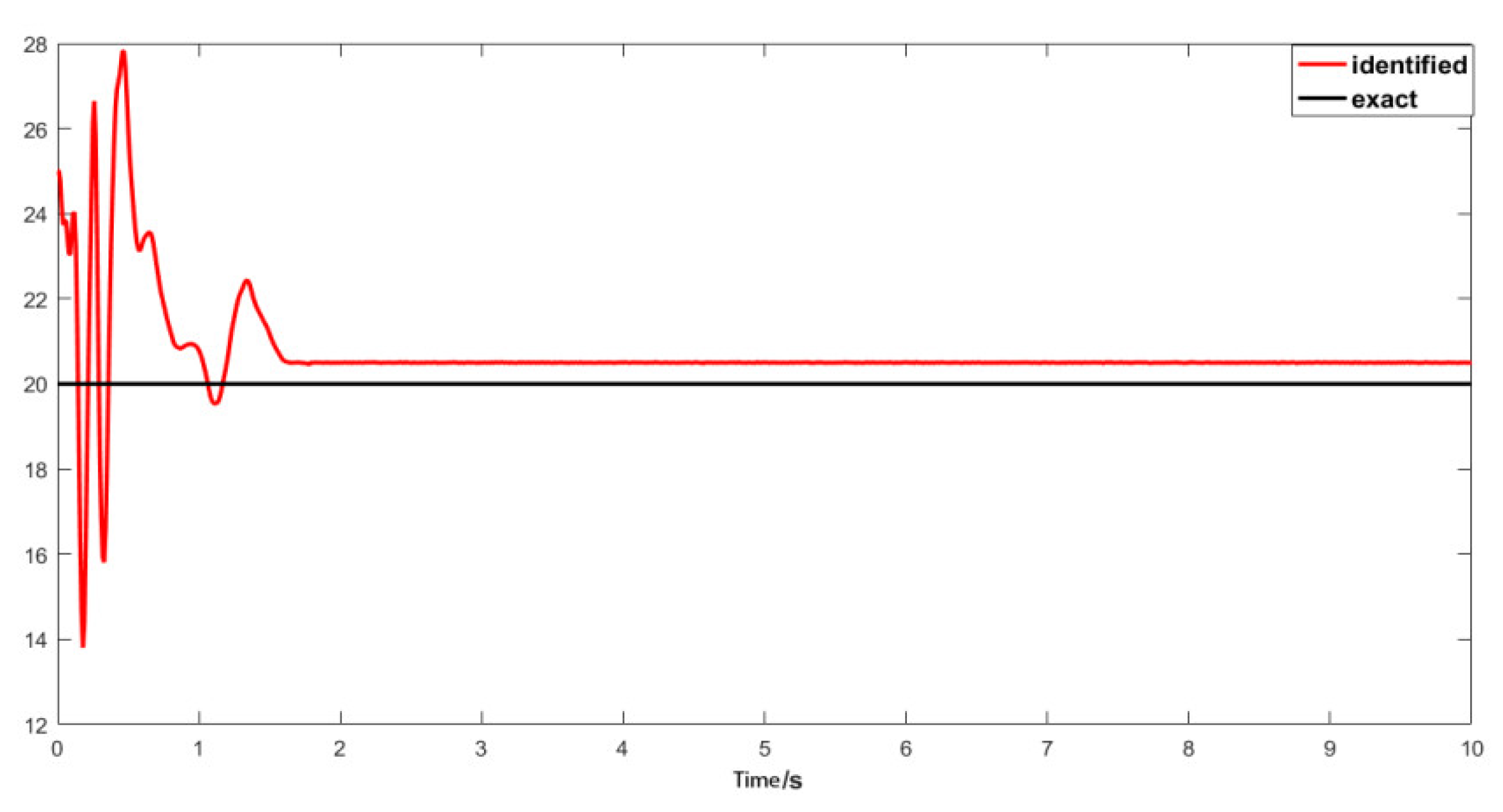
Figure 2.
Identification result diagram.
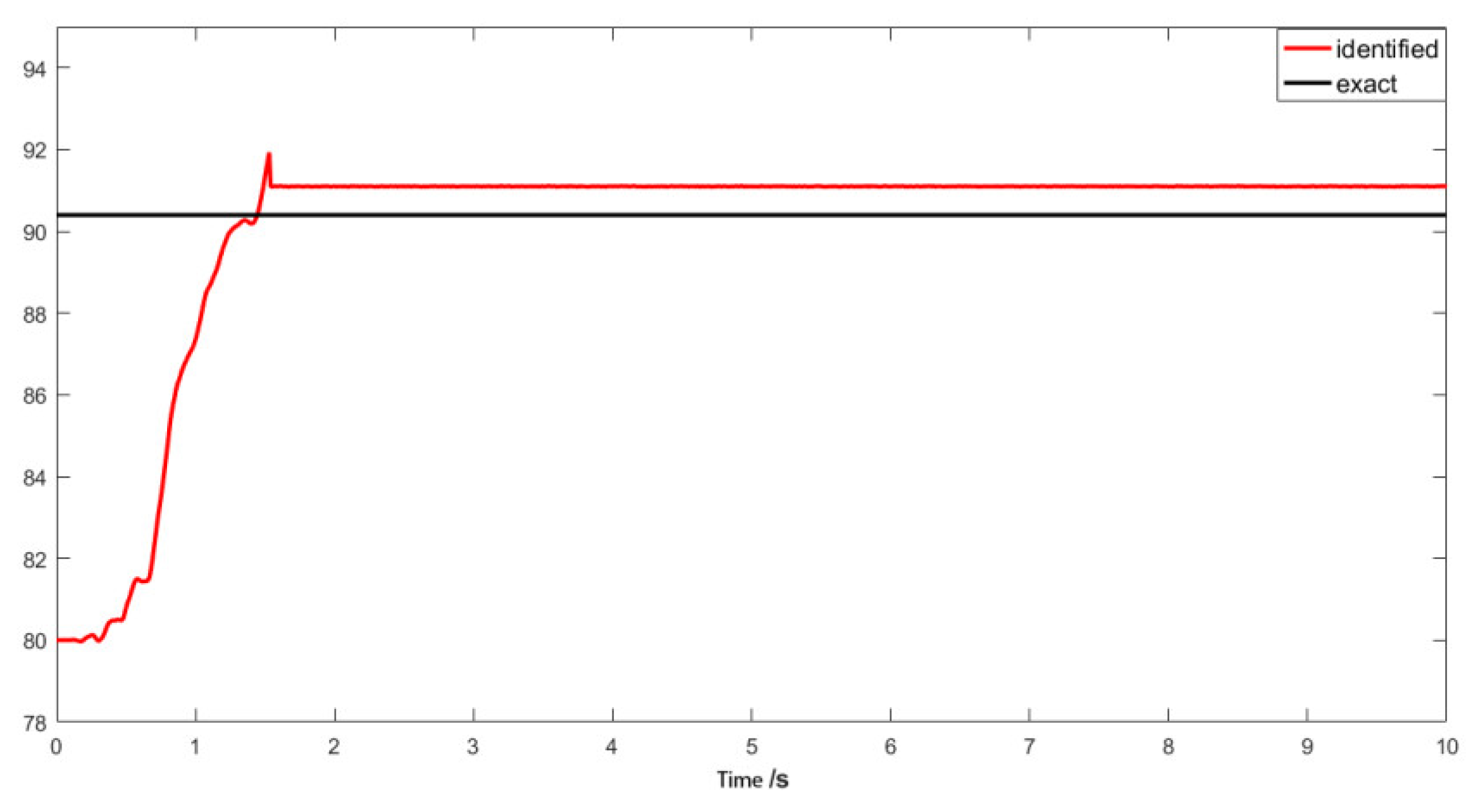
Figure 3.
Identification result diagram.
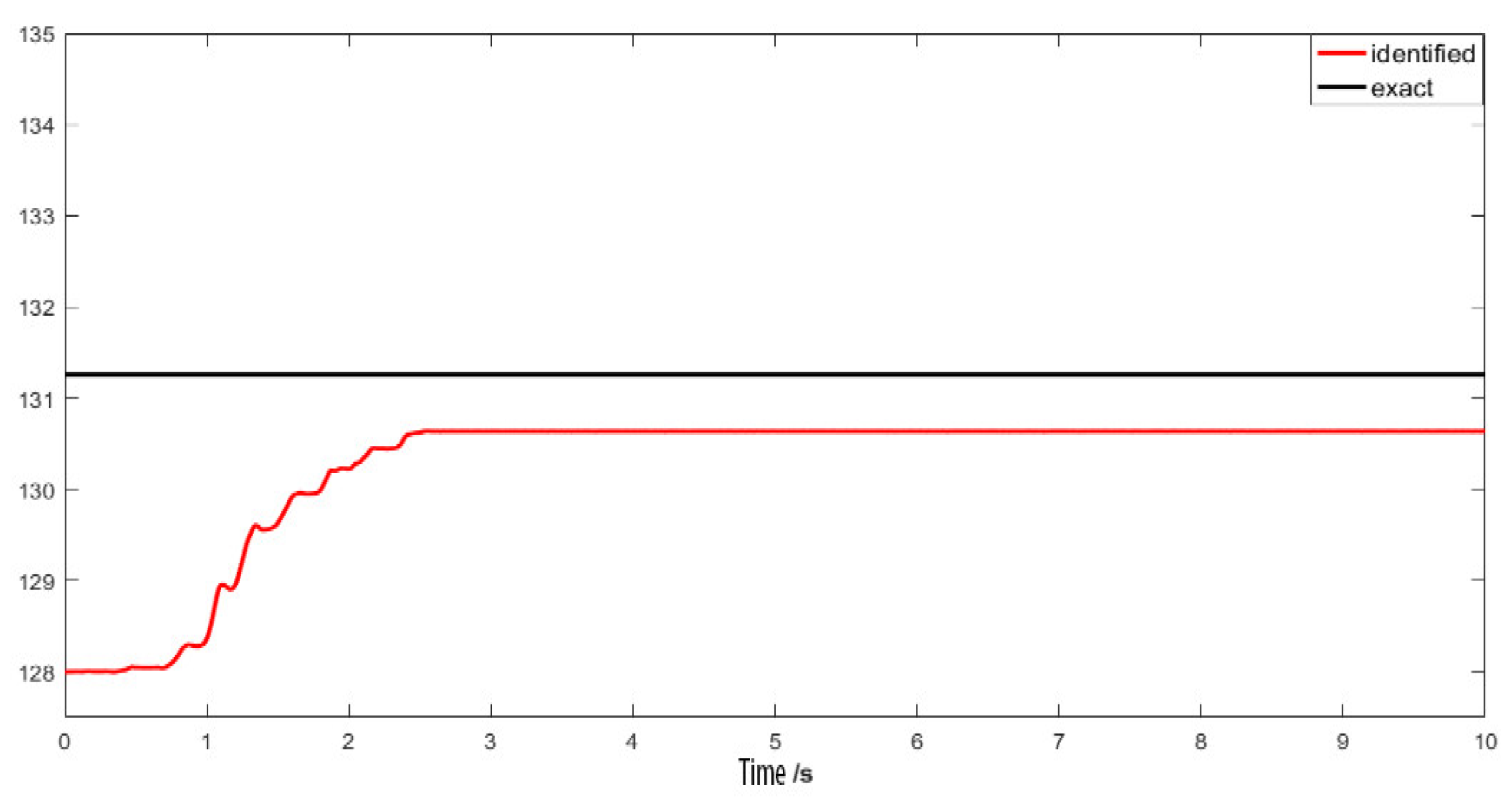
Figure 4.
Identification result diagram.
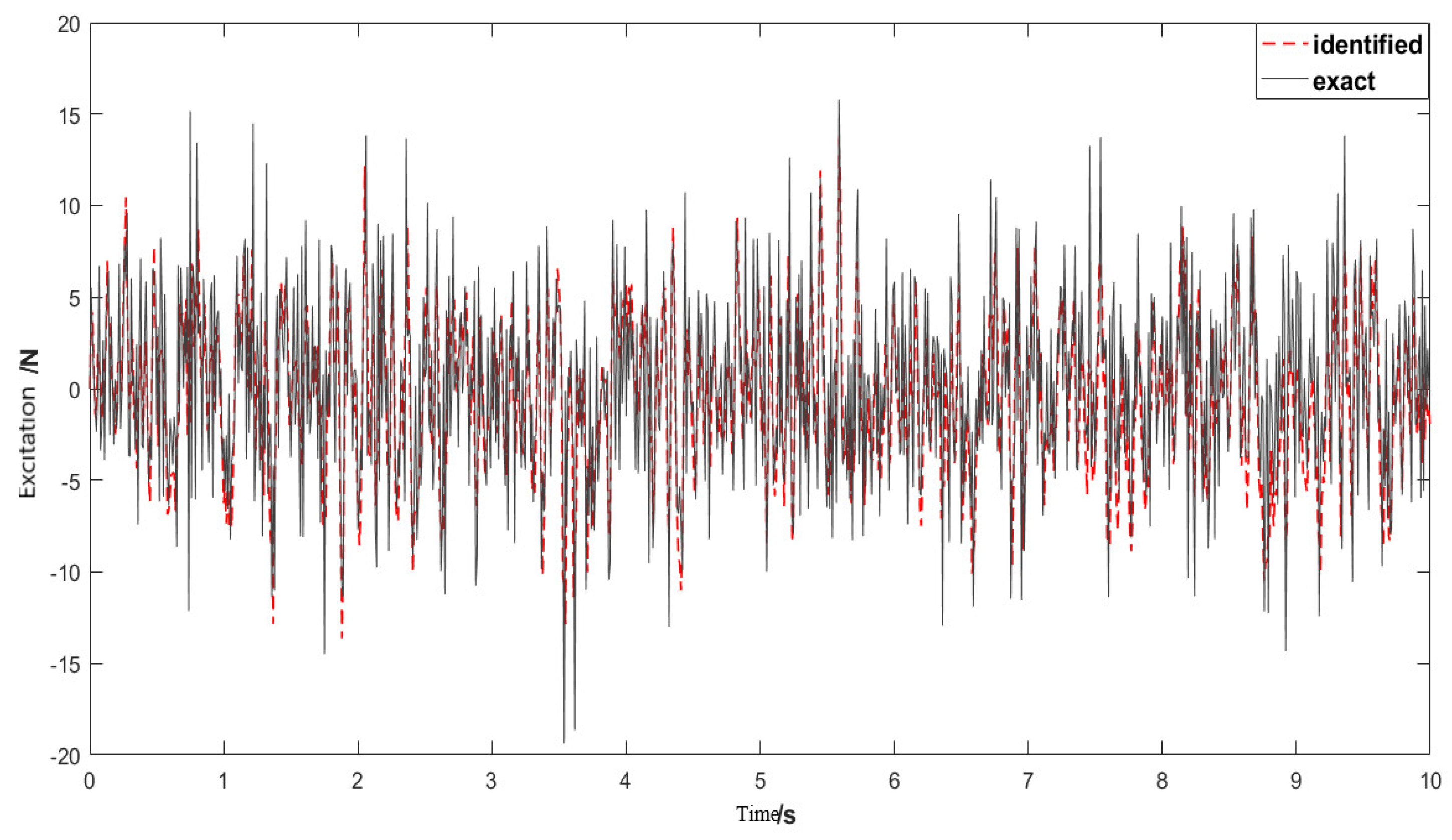
Figure 5.
Load identification results.
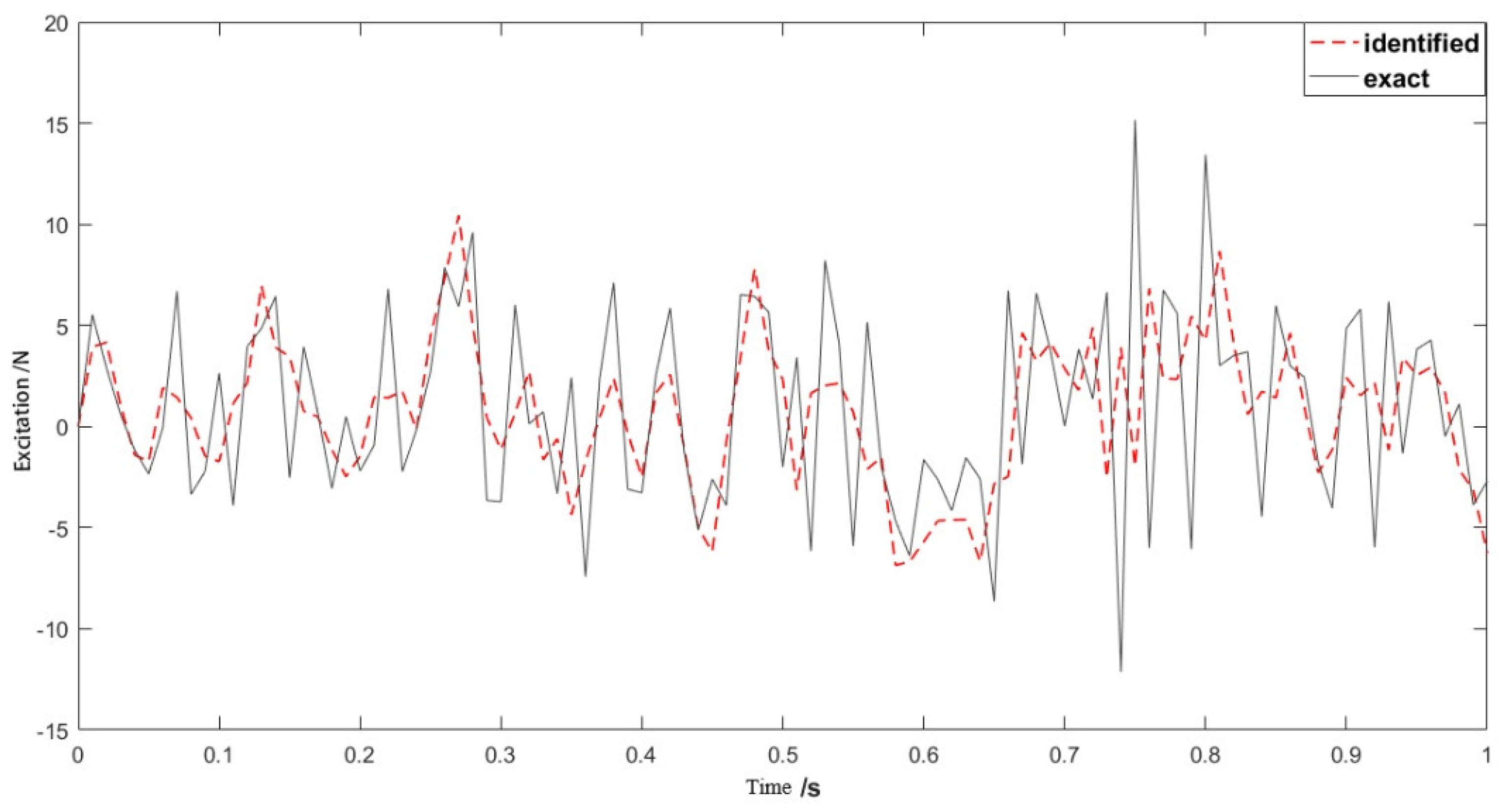
Figure 6.
Load identification results from 0–1 s.
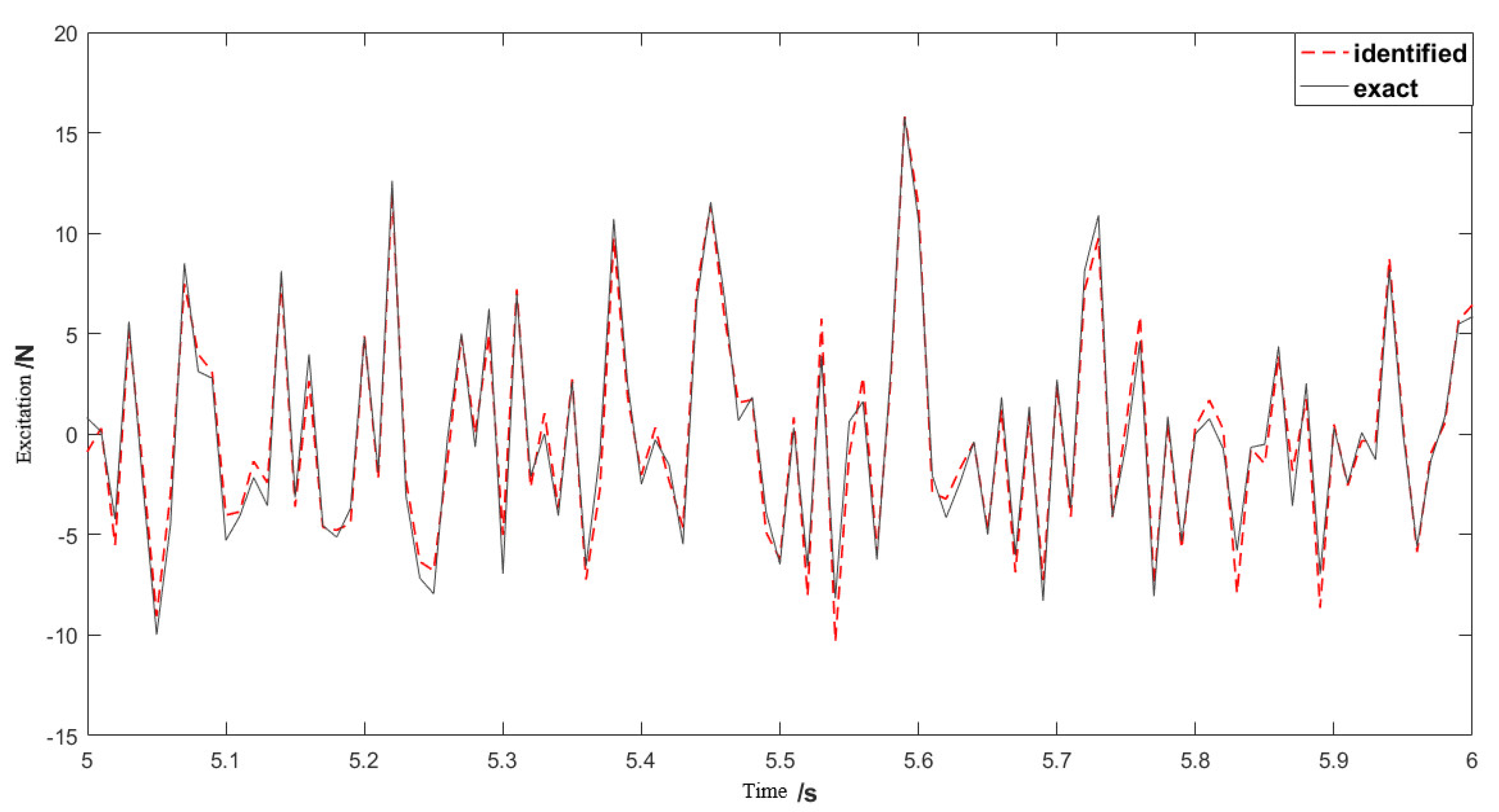
Figure 7.
Load identification results from 5–6 s.
Figure 9.
Acceleration response signals of all channels.
Figure 10.
Fourier spectra of the response signals.
Figure 11.
Identification of the first six modes.
Figure 12.
Identified parameters of and .
Figure 13.
Identified parameters of and .
Figure 14.
Identified excitation from 0 to 2 s.
Figure 15.
Identified excitation from 0.02 to 0.1 s.
Figure 16.
Identified excitation from 0.6 to 0.65 s.
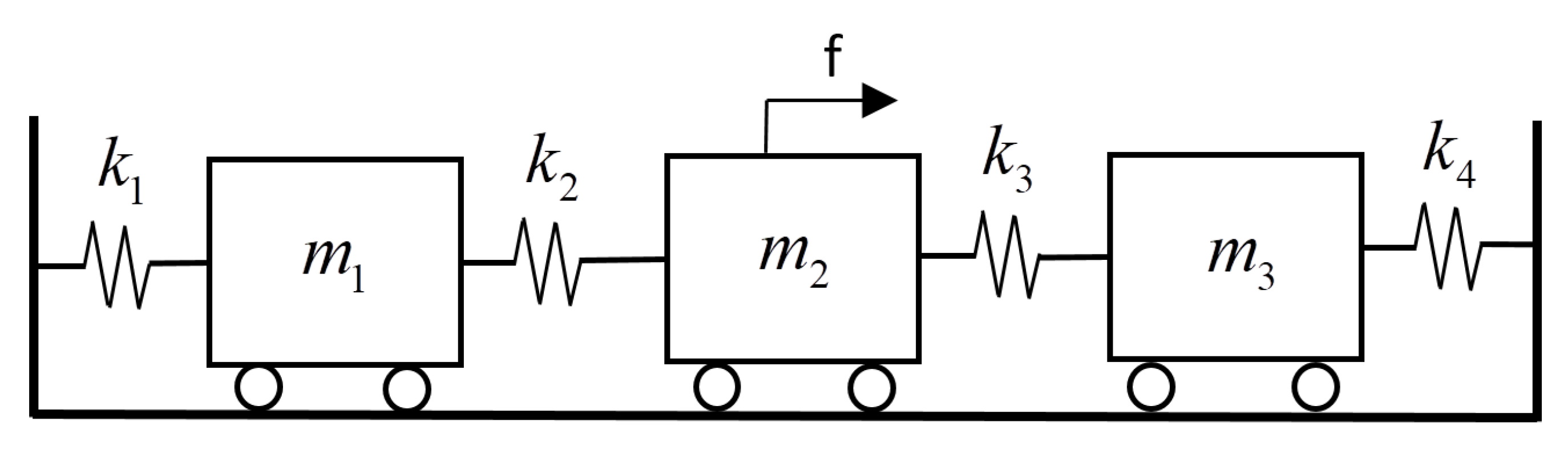
Table 1.
Stiffness values of the springs.
| k1 | k2 | k3 | k4 |
|---|
| | | |
Table 2.
Masses of the loads.
Table 3.
Modification results of the modal parameters.
| Modal Parameter | Convergent Value | Accurate Value | Error (%) |
|---|
| Characteristic value | 20.6 | 20 | 3 |
| Characteristic value | 90.6 | 90.4 | 0.2 |
| Characteristic value | 130.6 | 131.26 | −0.7 |
| Modal frequency (Hz) | 0.722 | 0.712 | 1.4 |
| Modal frequency (Hz) | 1.514 | 1.513 | 0.06 |
| Modal frequency (Hz) | 1.818 | 1.823 | -0.2 |
Table 4.
Error assessment of load identification results in different periods.
| Time | MSE | PREM |
|---|
| 0–1 s | 8.7 | 93.4 |
| 5–6 s | 0.056 | 18.57 |
Table 5.
Geometric dimensions and material properties of the simply supported beam.
| Parameters | Value |
|---|
| length | |
| Section width | |
| Section height | |
| Density | |
| Modulus of elasticity | |
| Poisson ratio | |
Table 6.
Initial assumptions and initial frequency bands.
| Mode | Initial Assumption (Hz) | Frequency Band (Hz) |
|---|
| Lower | Upper |
|---|
| 1 | 39 | 38 | 40 |
| 2 | 150.1 | 145 | 155 |
| 3 | 339.2 | 330 | 350 |
| 4 | 602.6 | 590 | 615 |
| 5 | 931.8 | 900 | 960 |
| 6 | 1322.6 | 1290 | 1360 |
Table 7.
Identification results of the modal parameters.
| Modal | Modal Frequency MPV(Hz) | Damping Ratio MPV (%) | MAC |
|---|
| Identification Value | Test Value | Identification Value | Test Value |
|---|
| 1 | 38.12 | 38.14 | 0.88 | 1.08 | 1 |
| 2 | 149.1 | 149.13 | 0.42 | 0.31 | 0.997 |
| 3 | 336.4 | 336.36 | 0.16 | 0.21 | 1 |
| 4 | 597.6 | 594.73 | 0.23 | 0.24 | 1 |
| 5 | 928.8 | 920.23 | 1.04 | 1.16 | 0.995 |
| 6 | 1314.2 | 1300.29 | 0.8 | 0.48 | 0.99 |
Table 8.
Eigenvalue and modal frequency identification results.
| Modal Parameters | | | | | | | | |
|---|
| Identification value | 4.48 × 10⁶ | 1.39 × 10⁷ | 3.29 × 10⁷ | 6.67 × 10⁷ | 336.96 | 595.07 | 914.52 | 1299.91 |
| Test value | 4.46 × 10⁶ | 1.39 × 10⁷ | 3.34 × 10⁷ | 6.67 × 10⁷ | 336.36 | 594.73 | 920.23 | 1300.29 |
| Error (%) | 2.57 | 0.14 | −2.66 | −0.06 | 0.17 | 0.057 | −0.65 | −0.15 |
Table 9.
Statistical errors of load identification results in different periods.
| Periods (s) | MSE | PREM |
|---|
| 0.02–0.5 | 3.6 | 174.4 |
| 0.6–0.65 | 1.34 | 26.7 |
| Publisher’s Note: MDPI stays neutral with regard to jurisdictional claims in published maps and institutional affiliations. |
© 2022 by the authors. Licensee MDPI, Basel, Switzerland. This article is an open access article distributed under the terms and conditions of the Creative Commons Attribution (CC BY) license (https://creativecommons.org/licenses/by/4.0/).