
Influence of Modified Bio-Coals on Carbonization and Bio-Coke Reactivity
Abstract
1. Introduction
2. Materials and Methods
2.1. Materials
2.2. Pre-Treatment of Bio-Coals
2.2.1. Washing of Bio-Coal
2.2.2. Kaolin Coating
2.2.3. Bio-Coal Ashing
2.3. Methodology
2.3.1. Thermoplastic Properties of Coking Coals Evaluated by Using Optical Dilatometer
2.3.2. Preparation of Coke
2.3.3. Thermogravimetric Analysis
3. Results
3.1. Bio-Coals and Coal Properties
3.1.1. Chemical Analysis of Washed Bio-Coals
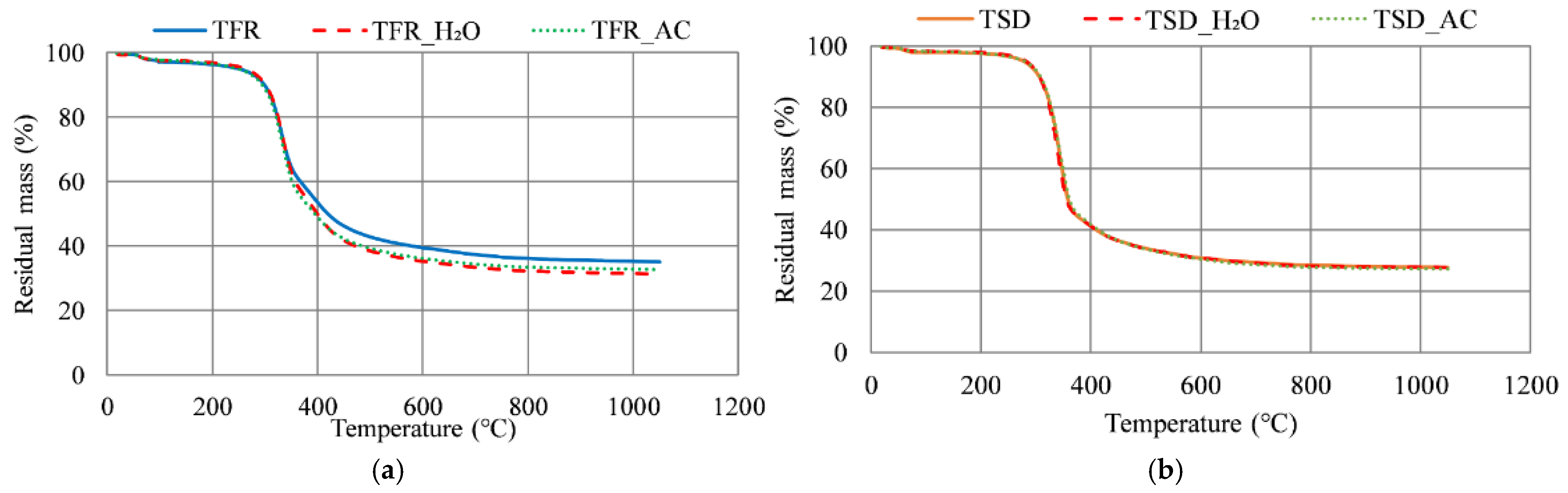
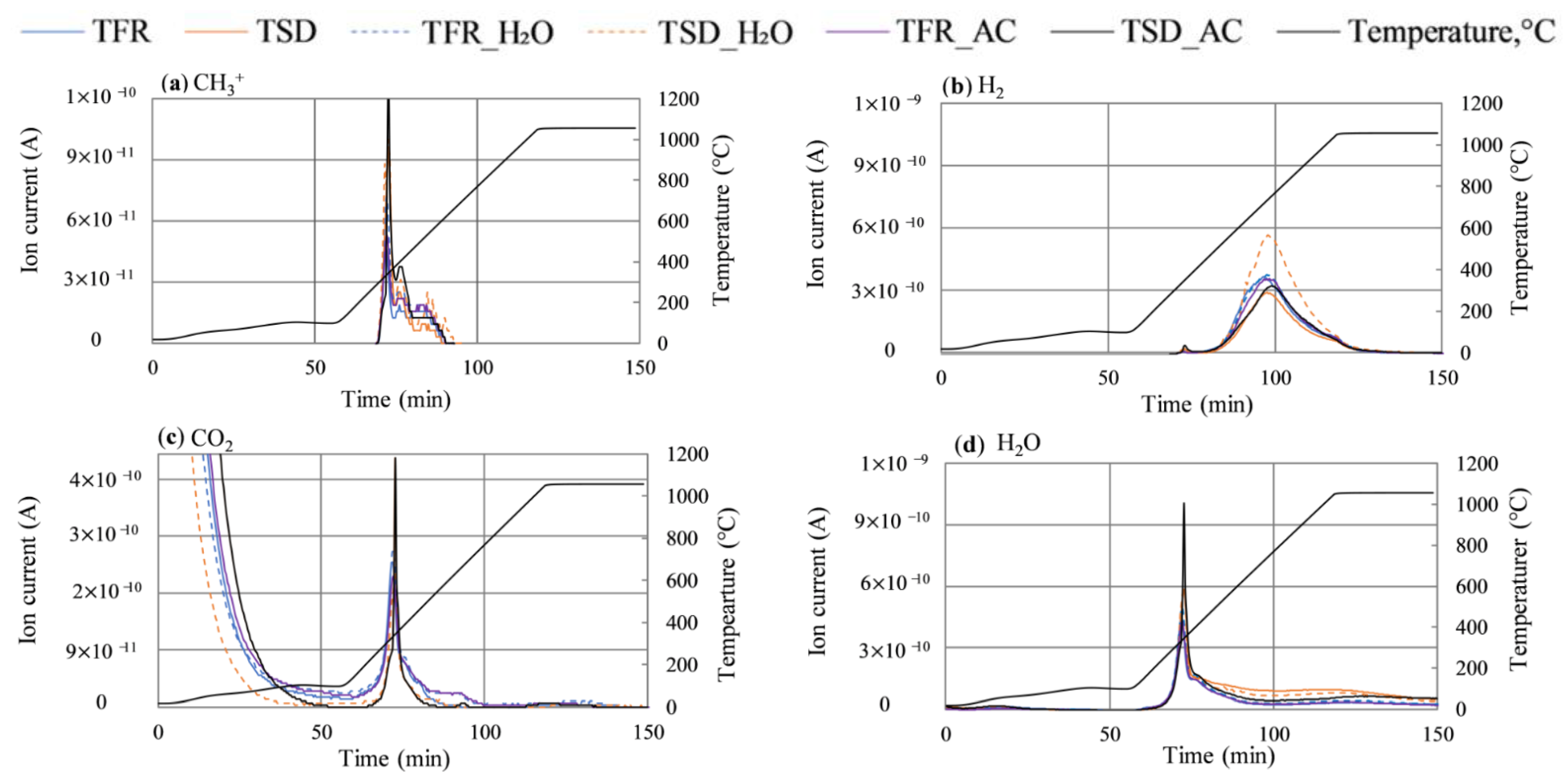
3.1.2. Thermal Behavior of Original and Washed Bio-Coals under Carbonization Conditions
3.2. Plastic Properties of Coking Coal Blends
3.3. Properties of Coke
3.4. Reactivity of Coke
4. Discussion
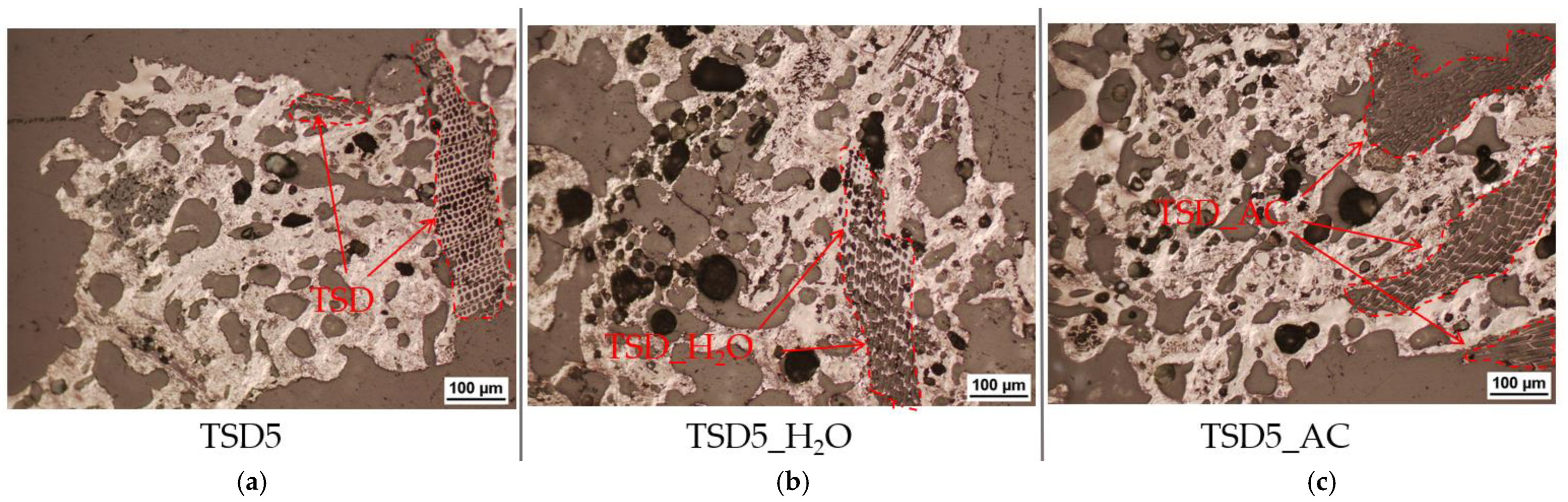
4.1. Influence of Modified Bio-Coal Addition on Thermoplastic Properties of Coking Coal
4.2. Influence of Modified Bio-Coal Addition on Coke Reactivity
5. Conclusions
- Washing of bio-coals will contribute to decreased max. dilatation and higher max. contraction of coking coal blend due to the changing of bio-coal structure during washing and possible presence of precipitated free minerals in the bio-coal after drying.
- For the specific bio-coals used, the removal of catalytic ash oxides by washing from bio-coal with higher contents of them lower bio-coke reactivity. Contrarily, the washing of bio-coal with a low content of catalytic ash oxides results in increased reactivity due to the changed bio-coal structure.
- The reactive carbon structure of bio-coal in bio-coke contributes to lowering the start of the gasification temperature; therefore, the start of reaction temperature is higher if only bio-coal ash is present.
- Kaolin coating stabilizes plastic properties by a 5% addition, but types with substantial contents of K2O should be avoided, as its catalytic effect enhances gasification of bio-coke.
Author Contributions
Funding
Data Availability Statement
Acknowledgments
Conflicts of Interest
References
- Geerdes, M.; Chaigneau, R.; Kurunov, I. Modern Blast Furnace Ironmaking: An Introduction, 3rd ed.; IOS Press: Amsterdam, The Netherlands, 2015; ISBN 1614994994. [Google Scholar]
- World Steel Association. Available online: https://www.worldsteel.org/publications/bookshop/product-details~Steel-s-contribution-to-a-low-carbon-future--update-version-coming-shortly-~PRODUCT~contribution-low-carbon-pp~.html (accessed on 18 September 2020).
- European Commission. 2050 Long-Term Strategy. Available online: https://ec.europa.eu/clima/eu-action/climate-strategies-targets/2050-long-term-strategy_en (accessed on 16 November 2021).
- Mandova, H.; LeDuc, S.; Wang, C.; Wetterlund, E.; Patrizio, P.; Gale, W.; Kraxner, F. Possibilities for CO2 emission reduction using biomass in European integrated steel plants. Biomass Bioenergy 2018, 115, 231–243. [Google Scholar] [CrossRef] [Scilit]
- Babich, A.; Senk, D.; Fernandez, M. Charcoal Behaviour by Its Injection into the Modern Blast Furnace. ISIJ Int. 2010, 50, 81–88. [Google Scholar] [CrossRef] [Scilit]
- Feliciano-Bruzual, C. Charcoal injection in blast furnaces (Bio-PCI): CO2 reduction potential and economic prospects. J. Mater. Res. Technol. 2014, 3, 233–243. [Google Scholar] [CrossRef] [Scilit]
- Gupta, R.C. Woodchar as a sustainable reductant for ironmaking in the 21st century. Miner. Process. Extr. Met. Rev. 2003, 24, 203–231. [Google Scholar] [CrossRef] [Scilit]
- Keown, D.; Favas, G.; Hayashi, J.; Li, C.-Z. Volatilisation of alkali and alkaline earth metallic species during the pyrolysis of biomass: Differences between sugar cane bagasse and cane trash. Bioresour. Technol. 2005, 96, 1570–1577. [Google Scholar] [CrossRef] [Scilit]
- Agblevor, F.A.; Besler, S. Inorganic Compounds in Biomass Feedstocks. 1. Effect on the Quality of Fast Pyrolysis Oils. Energy Fuels 1996, 10, 293–298. [Google Scholar] [CrossRef] [Scilit]
- Phanphanich, M.; Mani, S. Impact of torrefaction on the grindability and fuel characteristics of forest biomass. Bioresour. Technol. 2011, 102, 1246–1253. [Google Scholar] [CrossRef] [Scilit] [PubMed]
- Dastidar, M.G.; Sarkar, B.K.; Mitra, M.K.; Dey, R. Effect of alkali on different iron making processes. Mater. Sci Eng. 2018, 2, 304–313. [Google Scholar] [CrossRef]
- Grigore, M.; Sakurovs, R.; French, D.; Sahajwalla, V. Influence of Mineral Matter on Coke Reactivity with Carbon Dioxide. ISIJ Int. 2006, 46, 503–512. [Google Scholar] [CrossRef] [Scilit]
- Nomura, S.; Ayukawa, H.; Kitaguchi, H.; Tahara, T.; Matsuzaki, S.; Naito, M.; Koizumi, S.; Ogata, Y.; Nakayama, T.; Abe, T. Improvement in Blast Furnace Reaction Efficiency through the Use of Highly Reactive Calcium Rich Coke. ISIJ Int. 2005, 45, 316–324. [Google Scholar] [CrossRef] [Scilit]
- Nomura, S.; Kitaguchi, H.; Yamaguchi, K.; Naito, M. The Characteristics of Catalyst-coated Highly Reactive Coke. ISIJ Int. 2007, 47, 245–253. [Google Scholar] [CrossRef] [Scilit]
- Ng, K.; MacPhee, J.; Giroux, L.; Todoschuk, T. Reactivity of bio-coke with CO2. Fuel Process. Technol. 2011, 92, 801–804. [Google Scholar] [CrossRef] [Scilit]
- Montiano, M.; Díaz-Faes, E.; Barriocanal, C.; Alvarez, R. Influence of biomass on metallurgical coke quality. Fuel 2014, 116, 175–182. [Google Scholar] [CrossRef] [Scilit]
- MacPhee, J.; Gransden, J.; Giroux, L.; Price, J. Possible CO2 mitigation via addition of charcoal to coking coal blends. Fuel Process. Technol. 2009, 90, 16–20. [Google Scholar] [CrossRef] [Scilit]
- Ng, K.W.; Giroux, L.; MacPhee, T.; Todoschuk, T. Incorporation of charcoal in coking coal blend—A study of the effects on carbonization conditions and coke quality. In Proceedings of the AISTech 2012—Iron & Steel Technology Conference, Atlanta, GA, USA, 7–10 May 2021; pp. 225–236. [Google Scholar]
- Ng, K.W.; Giroux, L.; MacPhee, T.; Todoschuk, T. Biofuel Ironmaking Strategy from a Canadian Perspective: Short-Term Potential and Long-Term Outlook. In Proceedings of the 1st International Conference on Energy Efficiency and CO2 Reduction in the Steel Industry, Session 9, Düsseldorf, Germany, 27 June–1 July 2011. [Google Scholar]
- Solar, J.; Caballero, B.; Barriocanal, C.; Lopez-Urionabarrenechea, A.; Acha, E. Impact of the Addition of Pyrolysed Forestry Waste to the Coking Process on the Resulting Green Biocoke. Metals 2021, 11, 613. [Google Scholar] [CrossRef] [Scilit]
- Reid, M.H.; Mahoney, M.R.; Monaghan, B.J. A Coke Analogue for the Study of the Effects of Minerals on Coke Reactivity. ISIJ Int. 2014, 54, 628–633. [Google Scholar] [CrossRef] [Scilit]
- Liu, X.; Bi, X.T. Removal of inorganic constituents from pine barks and switchgrass. Fuel Process. Technol. 2011, 92, 1273–1279. [Google Scholar] [CrossRef] [Scilit]
- Mourant, D.; Wang, Z.; He, M.; Wang, X.S.; Garcia-Perez, M.; Ling, K.; Li, C.-Z. Mallee wood fast pyrolysis: Effects of alkali and alkaline earth metallic species on the yield and composition of bio-oil. Fuel 2011, 90, 2915–2922. [Google Scholar] [CrossRef] [Scilit]
- Das, P.; Ganesh, A.; Wangikar, P. Influence of pretreatment for deashing of sugarcane bagasse on pyrolysis products. Biomass-Bioenergy 2004, 27, 445–457. [Google Scholar] [CrossRef] [Scilit]
- Mayer, Z.A.; Apfelbacher, A.; Hornung, A. Effect of sample preparation on the thermal degradation of metal-added biomass. J. Anal. Appl. Pyrolysis 2012, 94, 170–176. [Google Scholar] [CrossRef] [Scilit]
- Eom, I.-Y.; Kim, K.-H.; Kim, J.-Y.; Lee, S.-M.; Yeo, H.-M.; Choi, I.-G.; Choi, J.-W. Characterization of primary thermal degradation features of lignocellulosic biomass after removal of inorganic metals by diverse solvents. Bioresour. Technol. 2011, 102, 3437–3444. [Google Scholar] [CrossRef] [Scilit] [PubMed]
- Asadieraghi, M.; Daud, W.M.A.W. Characterization of lignocellulosic biomass thermal degradation and physiochemical structure: Effects of demineralization by diverse acid solutions. Energy Convers. Manag. 2014, 82, 71–82. [Google Scholar] [CrossRef] [Scilit]
- Jiang, L.; Hu, S.; Sun, L.-S.; Su, S.; Xu, K.; He, L.-M.; Xiang, J. Influence of different demineralization treatments on physicochemical structure and thermal degradation of biomass. Bioresour. Technol. 2013, 146, 254–260. [Google Scholar] [CrossRef] [Scilit]
- Lundgren, M. Development of Coke Properties during the Descent in the Blast Furnace. Ph.D. Thesis, Luleå Tekniska Universitet: Sustainable Process Engineering, Department of Civil, Environmental and Natural Resources Engineering, Luleå, Sweden, 2013. [Google Scholar]
- Fernández, A.; Barriocanal, C.; Díez, M.; Alvarez, R. Influence of additives of various origins on thermoplastic properties of coal. Fuel 2009, 88, 2365–2372. [Google Scholar] [CrossRef] [Scilit]
- Diez, M.A.; Alvarez, R.; Fernández, M. Biomass derived products as modifiers of the rheological properties of coking coals. Fuel 2012, 96, 306–313. [Google Scholar] [CrossRef] [Scilit]
- Guerrero, A.; Diez, M.A.; Borrego, A.G. Influence of charcoal fines on the thermoplastic properties of coking coals and the optical properties of the semicoke. Int. J. Coal Geol. 2015, 147–148, 105–114. [Google Scholar] [CrossRef] [Scilit]
- Ueki, Y.; Nunome, Y.; Yoshiie, R.; Naruse, I.; Nishibata, Y.; Aizawa, S. Effect of Woody Biomass Addition on Coke Properties. ISIJ Int. 2014, 54, 2454–2460. [Google Scholar] [CrossRef] [Scilit]
- Yustanti, E.; Wardhono, E.Y.; Mursito, A.T.; Alhamidi, A. Types and Composition of Biomass in Biocoke Synthesis with the Coal Blending Method. Energies 2021, 14, 6570. [Google Scholar] [CrossRef] [Scilit]
- Fraga, M.; Flores, B.; Osório, E.; Vilela, A. Evaluation of the thermoplastic behavior of charcoal, coal tar and coking coal blends. J. Mater. Res. Technol. 2020, 9, 3406–3410. [Google Scholar] [CrossRef] [Scilit]
- Khan, M.R.; Walker, P.L., Jr.; Jenkins, R.G. Swelling and plastic properties of coal devolatilized at elevated pressures of H2 and He: Influences of added iron oxides. Fuel 1988, 67, 693–699. [Google Scholar] [CrossRef] [Scilit]
- Khan, M.R.; Jenkins, R.G. Influence of added calcium compounds on swelling, plastic, and pyrolysis behaviour of coal de-volatilized at elevated pressures. Fuel 1986, 65, 1203–1208. [Google Scholar] [CrossRef] [Scilit]
- Khan, M.; Jenkins, R.G. Influence of K and Ca additives in combination on swelling, plastic and devolatilization properties of coal at elevated pressure. Fuel 1989, 68, 1336–1339. [Google Scholar] [CrossRef] [Scilit]
- Patrick, J.; Shaw, F. Influence of sodium carbonate on coke reactivity. Fuel 1972, 51, 69–75. [Google Scholar] [CrossRef] [Scilit]
- Khan, M.; Jenkins, R. Swelling and plastic properties of coal devolatilized at elevated pressures of H2 and HeInfluence of potassium and silicon additives. Fuel 1986, 65, 1291–1299. [Google Scholar] [CrossRef] [Scilit]
- Meng, F.; Gupta, S.; Yu, J.; Jiang, Y.; Koshy, P.; Sorrell, C.; Shen, Y. Effects of kaolinite addition on the thermoplastic behaviour of coking coal during low temperature pyrolysis. Fuel Process. Technol. 2017, 167, 502–510. [Google Scholar] [CrossRef] [Scilit]
- El-Tawil, A.A.; Björkman, B.; Lundgren, M.; Robles, A.; Sundqvist Ökvist, L. Influence of Bio-Coal Properties on Carbonization and Bio-Coke Reactivity. Metals 2021, 11, 1752. [Google Scholar] [CrossRef] [Scilit]
- ALS Scandinavia AB. Available online: https://www.alsglobal.se/en (accessed on 15 September 2020).
- SSAB. Available online: https://www.ssab.se/ssab-koncern/om-ssab/produktionsorter-i-sverige/lulea (accessed on 15 September 2020).
- D-LAB AB. Available online: https://www.degerforslab.se/en-us/ (accessed on 15 June 2021).
- Mochizuki, Y.; Naganuma, R.; Tsubouchi, N. Influence of Inherently Present Oxygen-Functional Groups on Coal Fluidity and Coke Strength. Energy Fuels 2018, 32, 1657–1664. [Google Scholar] [CrossRef] [Scilit]
- Tsubouchi, N.; Mochizuki, Y.; Naganuma, R.; Kamiya, K.; Nishio, M.; Ono, Y.; Uebo, K. Influence of Inherent Oxygen Species on the Fluidity of Coal during Carbonization. Energy Fuels 2016, 30, 2095–2101. [Google Scholar] [CrossRef] [Scilit]
- Xu, W.; Wei, J.; Chen, J.; Zhang, B.; Xu, P.; Ren, J.; Yu, Q. Comparative Study of Water-Leaching and Acid-Leaching Pretreatment on the Thermal Stability and Reactivity of Biomass Silica for Viability as a Pozzolanic Additive in Cement. Materials 2018, 11, 1697. [Google Scholar] [CrossRef] [Scilit] [PubMed]
- Loison, R.; Foch, P.; Boyer, A. Coke: Quality and Production; University Press: Cambridge, UK, 2014; ISBN 1483165272. [Google Scholar]
- Kidena, K.; Murata, A.S.; Nomura, M. Studies on the Chemical Structural Change during Carbonization Process. Energy Fuels 1996, 10, 672–678. [Google Scholar] [CrossRef] [Scilit]
- Xu, L.; Liu, J.; Kang, Y.; Miao, Y.; Ren, W.; Wang, T. Safely Burning High Alkali Coal with Kaolin Additive in a Pulverized Fuel Boiler. Energy Fuels 2014, 28, 5640–5648. [Google Scholar] [CrossRef] [Scilit]
- Flores, B.D.; Flores, I.V.; Guerrero, A.; Orellana, D.R.; Pohlmann, J.G.; Diez, M.A.; Borrego, A.G.; Osorio, E.; Vilela, A. Effect of charcoal blending with a vitrinite rich coking coal on coke reactivity. Fuel Process. Technol. 2017, 155, 97–105. [Google Scholar] [CrossRef] [Scilit]
- Xing, X. Pore Structure and Integrity of a Bio-Coke under Simulated Blast Furnace Conditions. Energy Fuels 2019, 33, 2133–2141. [Google Scholar] [CrossRef] [Scilit]
- Yang, H.; Song, H.; Zhao, C.; Hu, J.; Li, S.; Chen, H. Catalytic gasification reactivity and mechanism of petroleum coke at high temperature. Fuel 2021, 293, 120469. [Google Scholar] [CrossRef] [Scilit]
- Wang, Q.; Wang, E.; Li, K.; Husnain, N.; Li, D. Synergistic effects and kinetics analysis of biochar with semi-coke during CO2 co-gasification. Energy 2019, 191, 116528. [Google Scholar] [CrossRef] [Scilit]
- Malekshahian, M.; Hill, J. Potassium catalyzed CO2 gasification of petroleum coke at elevated pressures. Fuel Process. Technol. 2013, 113, 34–40. [Google Scholar] [CrossRef] [Scilit]



| Abbreviation | Proximate Analysis (wt%) | Ultimate Analysis (wt%) | Description | ||||||
|---|---|---|---|---|---|---|---|---|---|
| * Cfix | VM | Ash | Ctot | H | N | S | O | ||
| TFR | 25.1 | 72.7 | 2.2 | 58.0 | 5.30 | 0.48 | 0.03 | 34 | Torrefied forest residue |
| TSD | 26.1 | 73.5 | 0.4 | 57.5 | 5.50 | <0.1 | < 0.01 | 37 | Torrefied sawdust |
| HTT | 69.5 | 29.2 | 1.3 | 79.0 | 4.00 | 0.11 | 0.01 | 16 | High-temperature torrefied pellets |
| HV | 61.5 | 32.3 | 6.1 | 81.3 | 5.15 | 1.57 | 0.85 | 5 | High Volatile coal |
| MV | 67.4 | 24.0 | 9.0 | 81.4 | 4.46 | 1.86 | 0.50 | 3 | Medium volatile coal |
| LV | 70.0 | 19.4 | 10.6 | 79.7 | 4.27 | 1.79 | 0.63 | 3 | Low volatile coal |
| Bio-Coals | Al2O3 | CaO | SiO2 | Fe2O3 | K2O | MgO | MnO | Na2O | P2O5 |
|---|---|---|---|---|---|---|---|---|---|
| TFR | 0.006 | 0.71 | 0.062 | 0.009 | 0.23 | 0.10 | 0.005 | 0.02 | 0.11 |
| TSD | 0.005 | 0.16 | 0.028 | 0.007 | 0.07 | 0.02 | 0.017 | - | 0.01 |
| HTT | 0.020 | 0.31 | 0.259 | 0.086 | 0.14 | 0.06 | 0.039 | 0.02 | 0.03 |
| CaO | MgO | SiO2 | Al2O3 | K2O | P2O5 | Fe2O3 | LOI |
|---|---|---|---|---|---|---|---|
| 0.05 | 0.17 | 57.1 | 38.5 | 3.15 | 0.14 | 0.79 | 12.3 |
| Coal Blend | Mixing Ratio (wt%) | ||||
|---|---|---|---|---|---|
| HV | MV | LV | Bio-Coal | Ash | |
| Basic coal blend (BB) | 28.0 | 32.0 | 40.0 | - | - |
| BB + 5% bio-coal | 26.6 | 30.4 | 38.0 | 5.0 | - |
| BB + ash from 5% TSD/TFR | 26.6 | 30.4 | 38.0 | - | 0.02%/0.11% |
| Base Blend and Added Bio-Coal | Blend Composition | Abbreviation |
|---|---|---|
| BB | HV, LV and MV | BB |
| TFR | BB + 5%TFR | TFR5 |
| BB + 5%TFR_H2O | TFR5_H2O | |
| BB + 5%TFR_AC | TFR5_AC | |
| BB + 0.11%TFR_Ash | TFR_Ash | |
| TSD | BB + 5%TSD | TSD5 |
| BB + 5%TSD_H2O | TSD5_H2O | |
| BB + 5%TSD_AC | TSD5_AC | |
| BB + 0.02% TSD_Ash | TSD_Ash | |
| BB + 5%TSD_5KC | TSD5_5KC | |
| BB + 5%TSD_10KC | TSD5_10KC | |
| HTT | BB + 5% HTT | HTT5 |
| BB + 5%HTT_5KC | HTT5_5KC | |
| BB + 5%HTT_10KC | HTT5_10KC |
| Washed Bio-Coals | Ca | Si | Mn | Mg | Na | K |
|---|---|---|---|---|---|---|
| TFR_H2O | 2.10 | 3.48 | 0.73 | 3.55 | 53.2 | 37.0 |
| TSD_H2O | 17.4 | 3.59 | 13.1 | 19.8 | - | 53.2 |
| TFR_AC | 56.4 | 2.52 | 59.9 | 53.4 | 45.8 | 60.7 |
| TSD_AC | 31.7 | 18.4 | 71.0 | 37.9 | - | 46.1 |
| Coal Blend | Max Contraction | Max Dilatation | SI | |||
|---|---|---|---|---|---|---|
| °C | % | °C | % | % | ||
| Basic coal blend | BB | 500 | 436 | 15.8 | 68.3 | |
| 5% original bio-coal | TFR5 | 500 | 5.7 | 425 | 10.4 | 22.1 |
| TSD5 | 500 | 2.1 | 430 | 8.3 | 19.9 | |
| HTT5 | 500 | −0.6 | 422 | 15.3 | 20.4 | |
| 5% washed bio-coal | TFR5_H2O | 500 | 12.4 | 431 | 0.6 | 0.67 |
| TSD5_H2O | 500 | 12.1 | 429 | 0.2 | 0.9 | |
| TFR5_AC | 500 | 10.7 | 424 | −0.8 | 0.6 | |
| TSD5_AC | 500 | 11.2 | 431 | 1.2 | 2.5 | |
| Ash from 5% of bio-coal | TFR_Ash * | 500 | −3.3 | 432 | 13.3 | 28.4 |
| TSD_Ash ** | 500 | −1.6 | 434 | 12.4 | 25.5 | |
| 5% bio-coal coated by kaolin | TSD5_5KC | 500 | 5.0 | 437 | 14.1 | 15.8 |
| TSD5_10KC | 500 | 8.2 | 430 | 8.7 | 5.9 | |
| HTT5_5KC | 412 | 2.3 | 455 | 12.6 | 8.7 | |
| HTT5_10KC | 500 | 8.2 | 429 | 8.7 | 5.9 | |
| Base Blend and Additives | Samples | Start of Gasification Temperature (°C) | Accumulated Mass Loss (%), Up to Each Temperature | |||
|---|---|---|---|---|---|---|
| 950 °C | 1000 °C | 1050 °C | 1100 °C | |||
| Basic coal blend | BB | 947 | 0.23 | 1.6 | 4.9 | 11.2 |
| 5% original bio-coal | TFR5 | 895 | 2.7 | 5.3 | 10.8 | 19.8 |
| TSD5 | 912 | 1.4 | 3.3 | 7.7 | 15.4 | |
| HTT5 | 905 | 1.4 | 3.3 | 6.4 | 11.9 | |
| 5% washed bio-coal | TFR5_H2O | 898 | 1.8 | 4.3 | 9.4 | 18.5 |
| TSD5_H2O | 868 | 1.5 | 4.5 | 10.9 | 20.5 | |
| TFR5_AC | 928 | 1.5 | 3.4 | 8.8 | 17.9 | |
| TSD5_AC | 918 | 1.2 | 3.6 | 8.9 | 17.3 | |
| Ash from 5% of bio-coal | TFR_Ash | 943 | 0.3 | 2.2 | 6.9 | 15.4 |
| TSD_Ash | 930 | 0.5 | 2.6 | 7.6 | 16.3 | |
| 5% bio-coal coated by kaolin | TSD5_5KC | 891 | 1.5 | 3.6 | 8.7 | 17.0 |
| TSD5_10KC | 890 | 1.3 | 3.6 | 8.5 | 16.8 | |
| HTT5_5KC | 895 | 2.6 | 5.8 | 10.5 | 18.4 | |
| HTT5_10KC | 894 | 1.7 | 4.0 | 8.1 | 15.3 | |
Publisher’s Note: MDPI stays neutral with regard to jurisdictional claims in published maps and institutional affiliations. |
© 2021 by the authors. Licensee MDPI, Basel, Switzerland. This article is an open access article distributed under the terms and conditions of the Creative Commons Attribution (CC BY) license (https://creativecommons.org/licenses/by/4.0/).
Share and Cite
El-Tawil, A.A.; Björkman, B.; Lundgren, M.; Bäck, F.; Ökvist, L.S. Influence of Modified Bio-Coals on Carbonization and Bio-Coke Reactivity. Metals 2022, 12, 61. https://doi.org/10.3390/met12010061
El-Tawil AA, Björkman B, Lundgren M, Bäck F, Ökvist LS. Influence of Modified Bio-Coals on Carbonization and Bio-Coke Reactivity. Metals. 2022; 12(1):61. https://doi.org/10.3390/met12010061
Chicago/Turabian StyleEl-Tawil, Asmaa A., Bo Björkman, Maria Lundgren, Frida Bäck, and Lena Sundqvist Ökvist. 2022. "Influence of Modified Bio-Coals on Carbonization and Bio-Coke Reactivity" Metals 12, no. 1: 61. https://doi.org/10.3390/met12010061
APA StyleEl-Tawil, A. A., Björkman, B., Lundgren, M., Bäck, F., & Ökvist, L. S. (2022). Influence of Modified Bio-Coals on Carbonization and Bio-Coke Reactivity. Metals, 12(1), 61. https://doi.org/10.3390/met12010061