


Inclusive AI-Enhanced Civic Engagement: Empowering Marginalized Voices
 , , , , and
Abstract
1. Introduction
2. Study 1: Citizen Requirements and Feature Preferences
2.1. Methods
2.1.1. Participants
2.1.2. Material and Procedure
2.2. Results
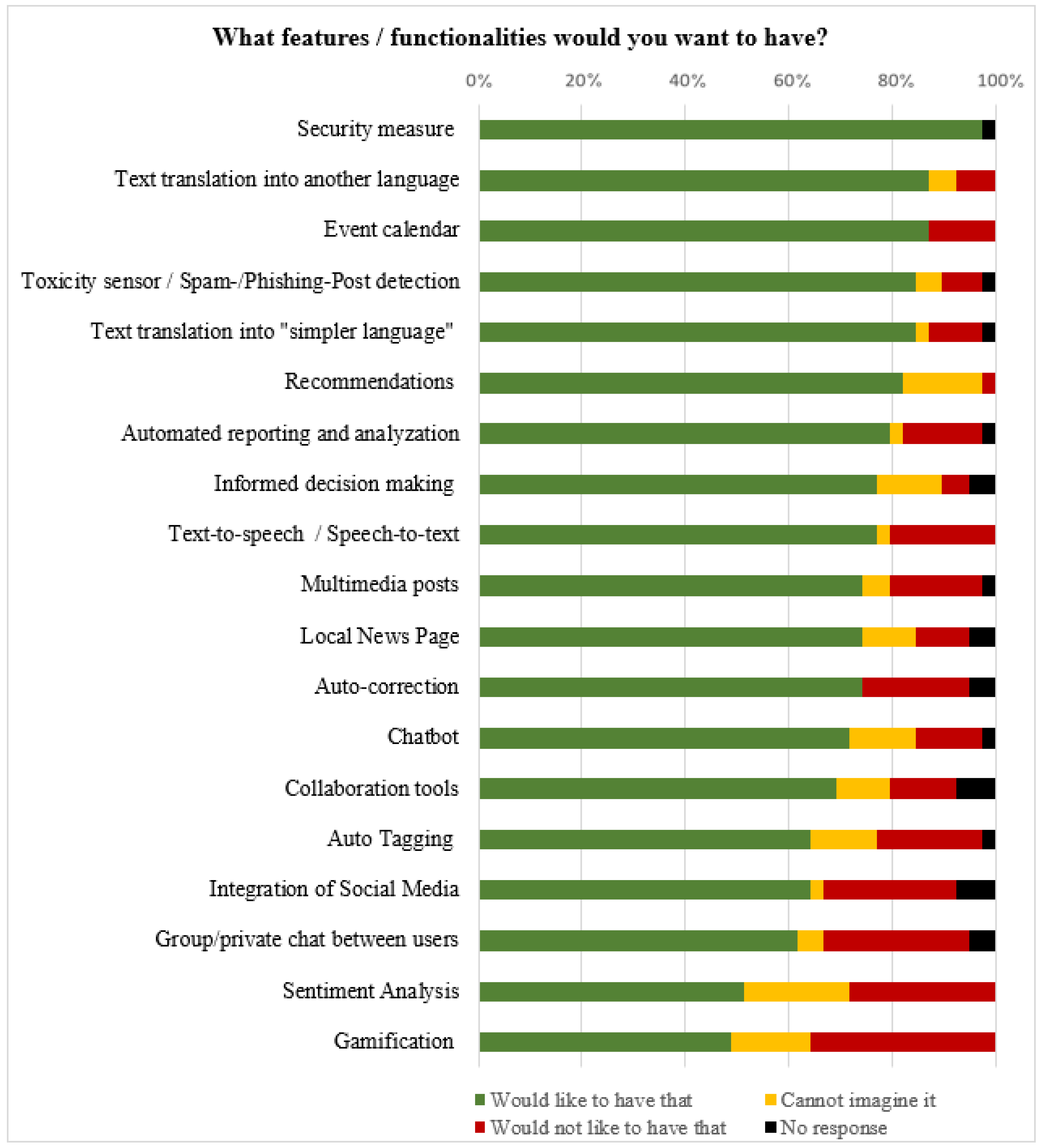
2.2.1. User Preferences—Safety and Accessibility over Entertainment
2.2.2. Core Dimensions: Safety and Accessibility as Prerequisites
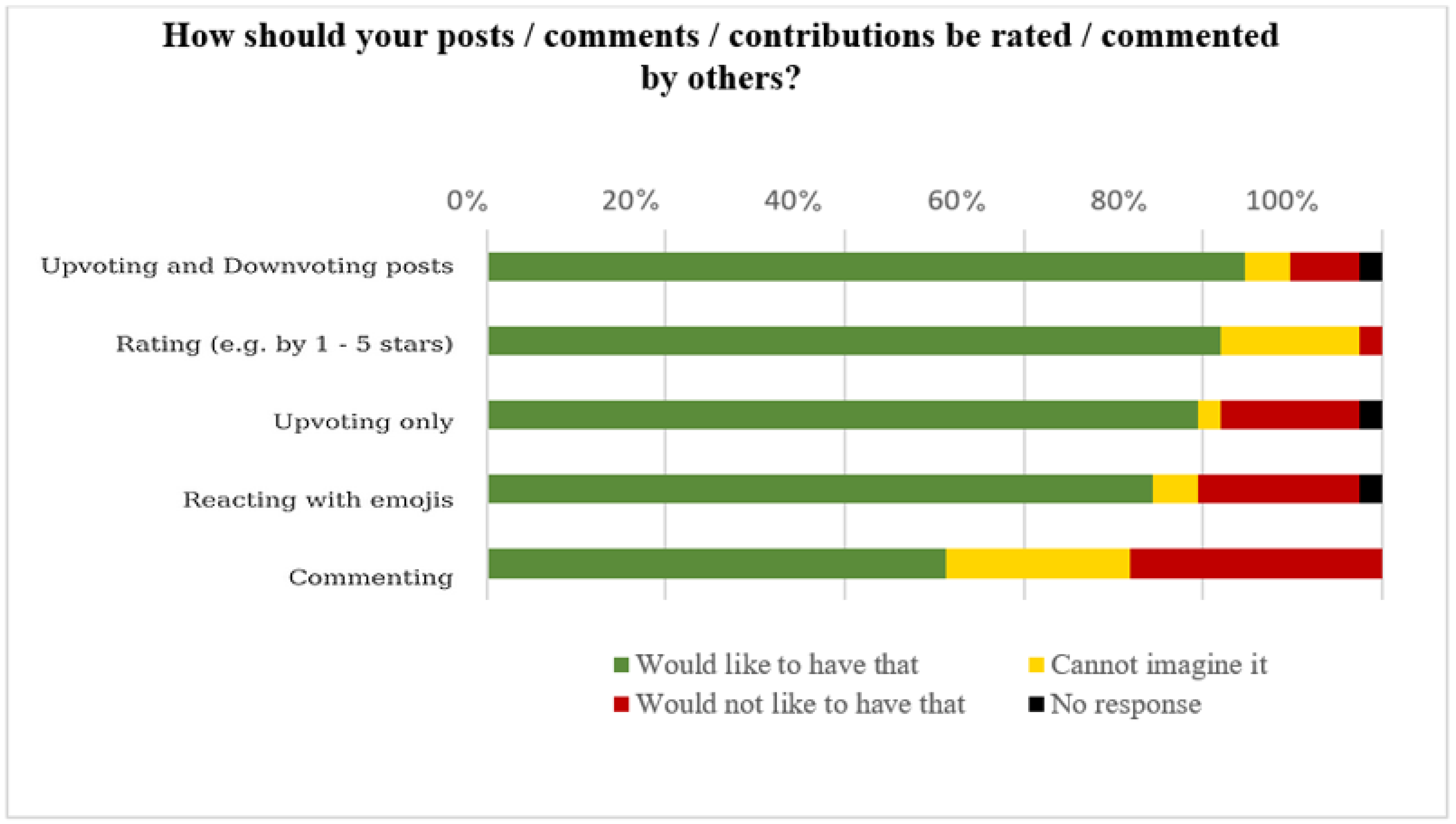
2.2.3. Social Interaction vs. Entertainment


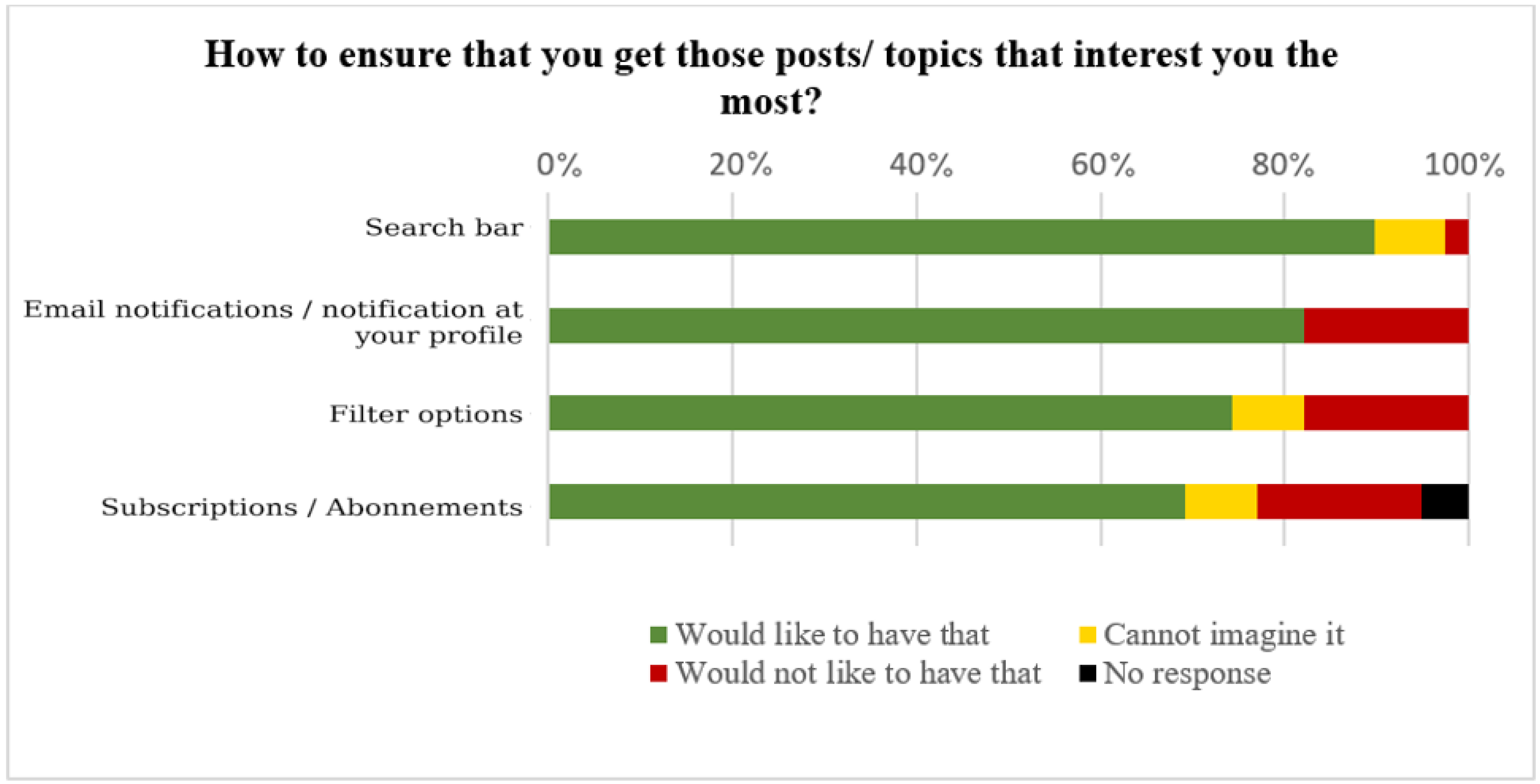
2.2.4. Information Control: Active Seeking vs. Passive Consumption
3. Study 2: Expert Recommendations and Technical Requirements
3.1. Methods
3.1.1. Participants
3.1.2. Material and Procedure
3.1.3. Data Analysis
3.2. Results
 ), Speech-to-text transformers (
 ), Spam-filters/Moderation (
 ), Interaction/Posting possibilities (
 ), Simplification/Summarization/Translation tools (
 ) and general requirements applicable to any AI tool (
 ).
).- Transparency and Human Oversight
- Data Privacy and Fairness
- Platform Safety and Content Moderation
- Accessibility and Inclusivity
- Transparency and Managing Expectations
- Data Governance and Fairness
- Accountability and Human Oversight
- Accessibility and Inclusivity
4. General Discussion
4.1. Strengths and Limitations
4.2. Conclusions
Author Contributions
Funding
Institutional Review Board Statement
Informed Consent Statement
Data Availability Statement
Acknowledgments
Conflicts of Interest
Appendix A

| Variables & Criteria | Brasov (ro) | Martin (svk) | ||
|---|---|---|---|---|
| Weights | Weights | |||
| Gender | ||||
| Female | 0.75 | 0.75 | ||
| Male | 0.50 | 0.50 | ||
| Divers | 1.00 | 1.00 | ||
| Age | 2 | 2 | ||
| 18–30 years | 0.50 | 0.50 | ||
| 31–60 years | 0.50 | 0.50 | ||
| Over 61 years | 1.00 | 1.00 | ||
| Highest educational level | 1.5 | 1.5 | ||
| Compulsory education (grade 10 or vocational school) | 1.00 | 1.00 | ||
| High school (with matura) | 0.50 | 0.50 | ||
| University degree | 0.00 | 0.00 | ||
| Do not want to answer | 0.50 | 0.50 | ||
| Current occupation | 2 | 2 | ||
| Student | 0.50 | 0.50 | ||
| Education | 0.50 | 0.50 | ||
| Full time | 0.30 | 0.30 | ||
| Part-time | 0.40 | 0.40 | ||
| Marginal | 0.50 | 0.50 | ||
| Unemployed | 0.80 | 0.80 | ||
| Maternity leave | 0.60 | 0.80 | ||
| Parental leave | N/A | 0.80 | ||
| Sick leave | 0.60 | 0.60 | ||
| Pension | 0.60 | 0.60 | ||
| Do not want to answer | 0.50 | 0.50 | ||
| Household type | 2 | 2 | ||
| Single house | 0.20 | 0.20 | ||
| Own flat | 0.20 | 0.20 | ||
| Rented flat | 0.70 | 0.70 | ||
| Social apartment/shared flat | 0.80 | 0.80 | ||
| Homeless | 1.00 | 1.00 | ||
| Assisted living | 0.95 | 0.95 | ||
| Other | 0.90 | 0.90 | ||
| Do not want to answer | 0.50 | 0.50 | ||
| Size of your household | ||||
| Less than 40 m2 | ||||
| 41–60 m2 | ||||
| 61–80 m2 | ||||
| More than 80 m2 | ||||
| Do not want to answer | ||||
| Number of people in your household (open field with integer to be entered only appeared in case of response ‘I live with others’) | ||||
| I live alone | ||||
| I live with others | ||||
| Do not want to answer | ||||
| Square Meters per person (inferred from the responses of the two items above as well as the number of people in the household). | 2 | 2 | ||
| >40 | 0.00 | 0.00 | ||
| 31–40 | 0.25 | 0.25 | ||
| 21–30 | 0.50 | 0.50 | ||
| 11–20 | 0.75 | 0.75 | ||
| <10 | 1.00 | 1.00 | ||
| N/a (not possible to calculate. If not answer to m2 and/or person per household) | 0.75 | 0.75 | ||
| Number of children in your household | 1.5 | 1.5 | ||
| 0 | 0.00 | 0.00 | ||
| 1 | 0.50 | 0.50 | ||
| 2 | 0.75 | 0.75 | ||
| 3 | 1.00 | 1.00 | ||
| 3+ | 1.00 | 1.00 | ||
| Number of adult that need personal care in your household | 2 | 2 | ||
| 0 | 0 | 1 | ||
| 1+ | 1 | 0 | ||
| Infrastructure | Yes/no/do not want to answer | Yes/no/do not want to answer | ||
| Access to internet | 0.30 | 0/1/0.5 | 0.30 | 0/1/0.5 |
| Mobile telephone owner | 0.30 | 0/1/0.5 | 0.30 | 0/1/0.5 |
| Access to personal transport (car, e.g.) | 0.20 | 0/1/0.5 | 0.20 | 0/1/0.5 |
| Access to public transport | 0.50 | 0/1/0.5 | 0.50 | 0/1/0.5 |
| Access to hot water | 1.50 | 0/1/0.5 | 1.50 | 0/1/0.5 |
| Able to heat sufficiently | 2.00 | 0/1/0.5 | 2.00 | 0/1/0.5 |
| Access to electricity | 2.00 | 0/1/0.5 | 2.00 | 0/1/0.5 |
| I have the following left over each month at my free disposal (for food, leisure activities. clothes…) After deducting all monthly fixed costs which are required for living (such as electricity, heating, rent, repayments, necessary expenses for other people): | 2 | 2 | ||
| Nothing | 1.00 | 1.00 | ||
| Less than 200 euros | 0.80 | 0.80 | ||
| Between 200 and 500 euros | 0.50 | 0.50 | ||
| More than 500 euros | 0.00 | 0.00 | ||
| I do not want to answer | 0.50 | 0.50 | ||
| Personal situation | 1 | Yes/no/do not want to answer | 1 | Yes/no/do not want to answer |
| I have physical limitations and/or illnesses | 1.50 | 0/1/0.5 | 1.50 | 0/1/0.5 |
| I have mental limitations and/or illnesses | 1.50 | 0/1/0.5 | 1.50 | 0/1/0.5 |
| I am satisfied with my financial situation | 0.50 | 0/1/0.5 | 0.50 | 0/1/0.5 |
| I feel satisfied with my social life and environment | 0.50 | 0/1/0.5 | 0.50 | 0/1/0.5 |
| I feel involved in participating in community affairs | 0.50 | 0/1/0.5 | 1.00 | 0/1/0.5 |
| I receive the medical support/care I need | 2.00 | 0/1/0.5 | 2.00 | 0/1/0.5 |
| I have the opportunity to use cultural, social and leisure facilities (e.g., Cinema or restaurant visits, sport activities, etc.) | 1.00 | 0/1/0.5 | 0.70 | 0/1/0.5 |
| I am satisfied with the standard/quality of my living space | 0.50 | 0/1/0.5 | 0.50 | 0/1/0.5 |
| Minority affiliation | 1 | Yes/no/do not want to answer | 1 | Yes/no/do not want to answer |
| Religious minority | 0.2 | 1/0/0.5 | 0.2 | 1/0/0.5 |
| Linguistic minority | 0.5 | 1/0/0.5 | 0.5 | 1/0/0.5 |
| Ethnic minority | 1 | 1/0/0.5 | 1 | 1/0/0.5 |
| Other minority | 0.75 | 1/0/0.5 | 0.75 | 1/0/0.5 |
| Because of the affiliation to this minority. i feel discriminated in my daily life | 2 | 2 | ||
| Totally disagree | 0 | 0 | ||
| Rather disagree | 0.5 | 0.5 | ||
| Rather agree | 0.75 | 0.75 | ||
| Totally agree | 1 | 1 | ||
| Do not want to answer | 0.5 | 0.5 | ||
| Filling the questionnaire | 1 | 1 | ||
| Filled it by myself | 0.00 | 0.00 | ||
| Filled it by myself with support from others | 0.75 | 0.75 | ||
| Another person filled it out for me | 1.00 | 1.00 | ||
| Do not want to answer | 0.50 | 0.50 | ||
| Motivation to participate in the juries | (open answer) | (open answer) | ||
| Variables & Criteria | Brasov (ro) | Martin (svk) |
|---|---|---|
| Weights | Weights | |
| Pregnant women OR women with children AND low income | 1.00 | 1.50 |
| Single parents | 1.00 | 1.00 |
| NO access to personal transport AND NO access to public transport | 1.00 | 1.00 |
| Low educational level AND small amount of money left after deduction of fix costs | 1.00 | 1.00 |
| 1. | https://www.merriam-webster.com/dictionary/marginalized (accessed on 14 March 2026). |
| 2. | https://osf.io/nh3qb/files (accessed on 14 March 2026). |
References
- Davies, J.; Procter, R. Online Platforms of Public Participation—A Deliberative Democracy or a Delusion? (Version 1). arXiv 2020, arXiv:2009.14074. [Google Scholar] [CrossRef]
- Guldvik, I.; Askheim, O.P.; Johansen, V. Political citizenship and local political participation for disabled people. Citizsh. Stud. 2013, 17, 76–91. [Google Scholar] [CrossRef]
- Raisio, H.; Valkama, K.; Peltola, E. Disability and deliberative democracy: Towards involving the whole human spectrum in public deliberation. Scand. J. Disabil. Res. 2014, 16, 77–97. [Google Scholar] [CrossRef][Green Version]
- Skorge, Ø.S. Mobilizing the Underrepresented: Electoral Systems and Gender Inequality in Political Participation. Am. J. Political Sci. 2023, 67, 538–552. [Google Scholar] [CrossRef]
- Pérez-Escolar, M.; Canet, F. Research on vulnerable people and digital inclusion: Toward a consolidated taxonomical framework. Univers. Access Inf. Soc. 2023, 22, 1059–1072. [Google Scholar] [CrossRef] [PubMed]
- Forbes-Mewett, H.; Nguyen-Trung, K. Defining Vulnerability. In Vulnerability in a Mobile World; Forbes-Mewett, H., Ed.; Emerald Publishing Limited: Leeds, UK, 2019; pp. 5–27. [Google Scholar] [CrossRef]
- Shin, B.; Floch, J.; Rask, M.; Bæck, P.; Edgar, C.; Berditchevskaia, A.; Mesure, P.; Branlat, M. A systematic analysis of digital tools for citizen participation. Gov. Inf. Q. 2024, 41, 101954. [Google Scholar] [CrossRef]
- Gerbaudo, P. The Digital Party: Political Organisation and Online Democracy; Pluto Press: London, UK, 2018. [Google Scholar]
- Secinaro, S.; Brescia, V.; Iannaci, D.; Jonathan, G.M. Does Citizen Involvement Feed on Digital Platforms? Int. J. Public Adm. 2022, 45, 708–725. [Google Scholar] [CrossRef]
- European Commission. Digital Economy and Society Index (DESI) 2022; European Commission: Luxembourg, 2022; Available online: https://digital-strategy.ec.europa.eu/en/policies/desi (accessed on 14 March 2026).
- Chen, Z. Ethics and discrimination in artificial intelligence-enabled recruitment practices. Humanit. Soc. Sci. Commun. 2023, 10, 1–12. [Google Scholar] [CrossRef]
- Garcia Valencia, O.A.; Thongprayoon, C.; Miao, J.; Suppadungsuk, S.; Krisanapan, P.; Craici, I.M.; Jadlowiec, C.C.; Mao, S.A.; Mao, M.A.; Leeaphorn, N.; et al. Empowering inclusivity: Improving readability of living kidney donation information with ChatGPT. Front. Digit. Health 2024, 6, 1366967. [Google Scholar] [CrossRef]
- Yenduri, G.; Kaluri, R.; Rajput, D.S.; Lakshmanna, K.; Gadekallu, T.R.; Mahmud, M.; Brown, D.J. From Assistive Technologies to Metaverse—Technologies in Inclusive Higher Education for Students With Specific Learning Difficulties: A Review. IEEE Access 2023, 11, 64907–64927. [Google Scholar] [CrossRef]
- Zhang, W.; Lim, G.; Perrault, S.; Wang, C. A Review of Research on Civic Technology: Definitions, Theories, History and Insights. arXiv 2022, arXiv:2204.11461. [Google Scholar] [CrossRef]
- Kocsis, O.; De Lera, E.; Bedek, M.A.; Zangl, M.; Colt, R.; Šaušová, V.; Birasova, L. Facilitators and Barriers of Marginalized Groups for the Engagement in Online Civic Activities. In Electronic Government and the Information Systems Perspective; Kö, A., Kotsis, G., Tjoa, A.M., Khalil, I., Eds.; Springer Nature Switzerland: Cham, Switzerland, 2024; Volume 14913, pp. 105–121. [Google Scholar] [CrossRef]
- Mellon, J.; Sjoberg, F.M.; Peixoto, T.; Lueders, J. The haves and the have nots: Civic technologies and the pathways to government responsiveness. Gov. Inf. Q. 2025, 42, 102007. [Google Scholar] [CrossRef]
- Spada, P.; Mellon, J.; Tiago, P.; Sjoberg, F.M. Effects of the internet on participation: Study of a public policy referendum in Brazil. J. Inf. Technol. Politics 2016, 13, 187–207. [Google Scholar] [CrossRef]
- Rosello, N.B.; Simonofski, A.; Castiaux, A. Artificial intelligence for digital citizen participation: Design principles for a collective intelligence architecture. Gov. Inf. Q. 2025, 42, 102020. [Google Scholar] [CrossRef]
- Rosenberg, D. Older adults’ e-government use for bureaucratic and transactional purposes: The role of website-related perceptions and subjective digital skills. Transform. Gov. People Process Policy 2024, 18, 257–269. [Google Scholar] [CrossRef]
- Liu, H.; Zhou, Q.; Liang, S. Digital inclusion in public services for vulnerable groups: A systematic review for research themes and goal-action framework from the lens of public service ecosystem theory. Gov. Inf. Q. 2025, 42, 102019. [Google Scholar] [CrossRef]
- Buß, R. Inclusive Design–Go Beyond Accessibility. In Human-Computer Interaction. Human Values and Quality of Life; Kurosu, M., Ed.; Springer International Publishing: Copenhagen, Denmark, 2020; Volume 12183, pp. 400–407. [Google Scholar] [CrossRef]
- Bianchi, F.; Hovy, D. On the Gap between Adoption and Understanding in NLP. In Findings of the Association for Computational Linguistics: ACL-IJCNLP; Association for Computational Linguistics: Stroudsburg, PA, USA, 2021; Volume 2021, pp. 3895–3901. [Google Scholar]
- Amaratunga, T. Understanding Large Language Models: Learning Their Underlying Concepts and Technologies; Apress: New York, NY, USA, 2023. [Google Scholar] [CrossRef]
- Weidinger, L.; Uesato, J.; Rauh, M.; Griffin, C.; Huang, P.-S.; Mellor, J.; Glaese, A.; Cheng, M.; Balle, B.; Kasirzadeh, A.; et al. Taxonomy of Risks posed by Language Models. In Proceedings of the 2022 ACM Conference on Fairness, Accountability, and Transparency; Association for Computing Machinery: New York, NY, USA, 2022; pp. 214–229. [Google Scholar] [CrossRef]
- Stewart, J.; Kendall, E.; Coote, A. (Eds.) Citizens’ Juries; Institute for Public Policy Research: London, UK, 1994. [Google Scholar]
- Ritchie, J.; Spencer, L. Qualitative Data Analysis for Applied Policy Research. In Analyzing Qualitative Data; Bryman, A., Burgess, R., Eds.; Routledge: Abingdon, UK, 1994; pp. 305–329. [Google Scholar]
- European Commission. High Level Expert Group on Artificial Intelligence. Ethics Guidelines for Trustworthy AI|Shaping Europe’s Digital Future; European Commission: Luxembourg, 2019; Available online: https://digital-strategy.ec.europa.eu/en/library/ethics-guidelines-trustworthy-ai (accessed on 14 March 2026).
- Smirnov, I.; Oprea, C.; Strohmaier, M. Toxic comments are associated with reduced activity of volunteer editors on Wikipedia. Proc. Natl. Acad. Sci. USA Nexus 2023, 2, pgad385. [Google Scholar] [CrossRef]
- Silva, L.; Mondal, M.; Correa, D.; Benevenuto, F.; Weber, I. Analyzing the Targets of Hate in Online Social Media. In Proceedings of the International AAAI Conference on Web and Social Media, Cologne, Germany, 17–20 May 2021; Volume 10, pp. 687–690. [Google Scholar] [CrossRef]
- George Pallivathukal, R.; Kyaw Soe, H.H.; Donald, P.M.; Samson, R.S.; Hj Ismail, A.R. ChatGPT for Academic Purposes: Survey Among Undergraduate Healthcare Students in Malaysia. Cureus 2024, 16, e53032. [Google Scholar] [CrossRef]
- Kamoun, F.; El Ayeb, W.; Jabri, I.; Sifi, S.; Iqbal, F. Exploring Students’ and Faculty’s Knowledge, Attitudes, and Perceptions Towards ChatGPT: A Cross-Sectional Empirical Study. J. Inf. Technol. Educ. Res. 2024, 23, 004. [Google Scholar] [CrossRef]
- Bewersdorff, A.; Zhai, X.; Roberts, J.; Nerdel, C. Myths, mis- and preconceptions of artificial intelligence: A review of the literature. Comput. Educ. Artif. Intell. 2023, 4, 100143. [Google Scholar] [CrossRef]
- Fischer, B.; Peine, A.; Östlund, B. The Importance of User Involvement: A Systematic Review of Involving Older Users in Technology Design. Gerontologist 2020, 60, e513–e523. [Google Scholar] [CrossRef]
- Ma, H.; McAreavey, K.; McConville, R.; Liu, W. Explainable AI for Non-Experts: Energy Tariff Forecasting. In Proceedings of the 2022 27th International Conference on Automation and Computing (ICAC); IEEE: Piscataway, NJ, USA, 2022; pp. 1–6. [Google Scholar] [CrossRef]

| Category | Demographic Variable | Absolute Frequency |
|---|---|---|
| Gender | Female | 27 |
| Male | 12 | |
| Age Groups (years) | 18–30 | 9 |
| 31–60 | 17 | |
| >61 | 13 | |
| Country of Residence | Slovakia | 19 |
| Romania | 20 | |
| Internet Experience | No experience at all | 2 |
| Occasional use | 11 | |
| Daily use | 26 |
| Theme | Technical Recommendation | Tool | Ethical Principle | Description |
|---|---|---|---|---|
| Transparency & Human Oversight | Context Ensurance | |  | Provide links to the original text for simplifications, summarizations, and translations |
| User Feedback System | |  | Enable users to report bugs or suggest platform/tool improvements | |
| Data Privacy & Fairness | Fair Training Data | |  | Ensure unbiased data to avoid reinforcing stereotypes |
| Federated Learning | |  | Store language models locally to reduce data misuse concerns (federated learning) | |
| Platform Safety & Content Moderation | Bot Detection | |  | Provide bot detection that identifies unusual platform behavior |
| Collaborative Moderation | |  | Let users mark comments as spam for collaborative moderation | |
| Blurring | |  | Automatically blur sensitive images | |
| Flagging | | | Let users flag toxic messages/images for human review; hide them until resolved | |
| Duplicated Voting Prevention | | | Prevent multiple votes from the same user | |
| Accessibility & Inclusivity | Fluency | | | Automatically remove hesitation sounds for more fluency |
| Quick Selection Options | | | Offer quick selection options—sentence versions recognized by the tool for speech-to-text tools | |
| Speech-Commanded Navigation | | | Let speech-to-text handle both chatbot interactions and navigation for users with physical disabilities. | |
| Help-Bot | | | Provide help and solutions within a chatbot instead of only providing links to other pages | |
| Customizable Display | | | Allow font, size, contrast, and color adjustments for accessibility | |
| Assistive Tech Compatibility | | | Ensure compatibility with existing assistive technologies (e.g., screen readers) |
= Human agency and oversight; = Technical robustness and safety; = Diversity, non-discrimination, and fairness; = Accountability; = Societal and environmental wellbeing; = Transparency; = Privacy. Legend of concerning tools: = Chatbots; = Spam-filter/Moderation; = Interaction/Posting; = Simplification/Summarization/Translation tools; = Speech-to-text transformers; = Tool-unspecific.| Theme | Information Requirements | Tool | Description |
|---|---|---|---|
| Transparency & Managing Expectations | Chatbot Type | | Inform if the bot is rule-based (reliable answers) or generative (possible hallucinations). |
| Distinct Chatbots Names | | Assign distinct names if multiple chatbots are provided (e.g., help, city info) that indicate the function and purpose of the bot. | |
| Chatbot Role | | Inform about the chatbot’s main purpose (e.g., city facts, service guidance, form assistance). | |
| Data Basis | | Explain the data sources behind the chatbot so users understand what it “knows.” | |
| Misleading answers | | Warn that generative AI can produce incorrect or misleading answers. | |
| Simplification | | Inform users how text was simplified (e.g., shorter sentences, simpler words) to build trust. | |
| Varying Outputs | | Inform if generative AI may give different responses for the same prompt and explain why. | |
| Repeated Questions | | Suggest users ask the same question again to get different answers. | |
| Probabilistic Nature | | Clarify that AI chatbots generate answers based on likelihood, not strict logic or pre-defined answers. | |
| Differences to Search Engines | | Outline how generative AI chatbots differ from standard web search | |
| Black Box | | Communicate that even experts do not understand exact mechanisms of AI chatbot’s functionality | |
| Summarization | | Point out that summarized text may lose context | |
| Avoid humanizing | | Communicate that the bot is not human (e.g., use a robot icon) to maintain critical distance. | |
| Societal Impact | | Provide information on how AI chatbots influence society and different sectors | |
| Framing awareness | | Raise awareness that chatbot suggestions might limit users’ choices by framing interactions. | |
| Data Governance & Fairness | Recommendation Parameters | | Disclose which (user) factors (e.g., gender, age, location) influence the system’s outputs or decisions |
| Rare languages | | Warn of reduced accuracy in less common languages (and even some mainstream ones). | |
| Accountability & Human Oversight | Moderation Rules | | Publish clear posting rules and note any delay from moderation checks. |
| Filtering Criteria | | Clearly outline criteria about content filtering (e.g., toxic words) | |
| Label AI-Content | | Mark AI outputs (text, images) and inform that they may contain mistakes. | |
| Error-proneness | | Remind that AI is human-made technology, prone to mistakes and biases. | |
| Accessibility & Inclusivity | User Guidance | | Offer tips and sample questions for Chatbot use for new users |
| Summarization Metrics | | Inform how much a text was shortened (e.g., summarization length or percentage) | |
| Assistive role | | Communicate that the chatbot is an error-prone assistant to avoid self-blame of users | |
| Feature Purpose | | Justify why each AI function (e.g., speech-to-text) is offered (e.g., accessibility) | |
| Dialect | | Advise users not to speak in dialect for better recognition accuracy. | |
| Clear Speech | | Encourage distinct, clear speech to optimize speech-to-text results. |
= Chatbots; = Spam-filters/Moderation; = Simplification/Summarization/Translation; = Speech-to-text transformer; = Tool-unspecific.Disclaimer/Publisher’s Note: The statements, opinions and data contained in all publications are solely those of the individual author(s) and contributor(s) and not of MDPI and/or the editor(s). MDPI and/or the editor(s) disclaim responsibility for any injury to people or property resulting from any ideas, methods, instructions or products referred to in the content. |
© 2026 by the authors. Licensee MDPI, Basel, Switzerland. This article is an open access article distributed under the terms and conditions of the Creative Commons Attribution (CC BY) license.
Share and Cite
Schneller, M.; Bedek, M.; De Lera, E.; Kocsis, O.; Seier, J.; Albert, D. Inclusive AI-Enhanced Civic Engagement: Empowering Marginalized Voices. Societies 2026, 16, 115. https://doi.org/10.3390/soc16040115
Schneller M, Bedek M, De Lera E, Kocsis O, Seier J, Albert D. Inclusive AI-Enhanced Civic Engagement: Empowering Marginalized Voices. Societies. 2026; 16(4):115. https://doi.org/10.3390/soc16040115
Chicago/Turabian StyleSchneller, Maria, Michael Bedek, Eva De Lera, Otilia Kocsis, Jonas Seier, and Dietrich Albert. 2026. "Inclusive AI-Enhanced Civic Engagement: Empowering Marginalized Voices" Societies 16, no. 4: 115. https://doi.org/10.3390/soc16040115
APA StyleSchneller, M., Bedek, M., De Lera, E., Kocsis, O., Seier, J., & Albert, D. (2026). Inclusive AI-Enhanced Civic Engagement: Empowering Marginalized Voices. Societies, 16(4), 115. https://doi.org/10.3390/soc16040115