Article

Adapting Through Responsible Consumption: Organizational Strategies for Equity and Inclusive Development

by
Elizabeth Emperatriz García-Salirrosas
1,*,
Dany Yudet Millions-Liza
2 and
Angel Acevedo-Duque
3,*
1
Research and Innovation Group for Entrepreneurship and Sustainability, Universidad Nacional Tecnológica de Lima Sur, Lima 15816, Peru
2
Unidad de Ciencias Empresariales, Escuela de Posgrado, Universidad Peruana Unión, Lima 15102, Peru
3
Programa Doctorado Ciencias Sociales, Universidad Autónoma de Chile, Santiago 7500912, Chile
*
Authors to whom correspondence should be addressed.
Societies 2026, 16(2), 72; https://doi.org/10.3390/soc16020072
Submission received: 9 September 2025 / Revised: 12 February 2026 / Accepted: 13 February 2026 / Published: 21 February 2026

Abstract

In Peru, where socioeconomic inequalities remain a critical challenge, responsible consumption has shifted from individual decisions to organizational strategies with the potential to reduce structural disparities. This study adopted an exploratory–descriptive qualitative design to gain an in-depth understanding of organizational initiatives for responsible consumption and their contributions to social equity. Using documentary analysis, the READ protocol (Read, Extract, Analyze, Distill) was applied to systematically examine public information from 104 Perú Sustainable-affiliated organizations across 16 economic sectors. The analysis identified six categories of initiatives: eco-efficient management, circular economy, sustainable supply chains, education and awareness, sustainable products, and green financing that are linked to five dimensions of equity: economic inclusion, access to essential services, gender equality, inclusion of vulnerable populations, and capacity building. The circular economy (54.8%) and sustainable supply chains stood out for their greater potential to include vulnerable groups by integrating them into formal value chains. The reported impacts ranged from 100 to over one million beneficiaries, in addition to environmental reductions of 30–50%, although methodological heterogeneity limited comparability. Financial constraints (67.3%), along with cultural resistance and institutional barriers, were identified as the main obstacles. Overall, the findings show that responsible organizational consumption can be an effective mechanism for reducing inequality if designed using systemic and integrated approaches, reinforcing the need for public policies, specialized financial instruments, and regulatory frameworks that enhance its transformative impact in favor of inclusive development in the country.

1. Introduction

Socioeconomic inequality constitutes one of the most persistent and complex challenges facing contemporary societies, particularly in Latin American countries, where significant structural gaps in access to opportunities and resources persist [1,2]. Structural barriers, including social inequalities, corruption, and dependence on natural resources, have hindered development and exacerbated inequality, originating in historical factors such as colonialism and public instability [3,4]. In Peru, this problem manifests itself with particular intensity, positioning the country among those with the highest concentration of wealth in the region, where the 10% of the population with the highest income concentrates approximately 66% of total wealth [5]. In this context, the concept of responsible consumption emerges with increasing relevance as a potential strategy to address these inequalities from an organizational perspective and as an appropriate practice to address inequalities by guaranteeing a fair distribution of resources and business practices [6,7].
Responsible consumption, defined as the adoption of consumption patterns that consider social, environmental, and ethical criteria in decision-making, seeking to satisfy immediate needs without compromising future responsibilities [6,8], has evolved from predominantly individualistic approaches to systemic approaches that recognize the transformative role of organizations as transformative agents [9]. The United Nations has positioned responsible consumption and production as Sustainable Development Goal 12, setting specific targets that include “encouraging business enterprises, particularly large and transnational enterprises, to adopt sustainable practices and to incorporate sustainability information into their reporting cycle” [8,10]. This organizational perspective of responsible consumption recognizes that business decisions about what, how, and from whom to purchase can generate significant multiplier effects on the social and economic structure.
Recent academic literature has documented a significant shift in consumer awareness, particularly in the wake of the COVID-19 pandemic, with 73% of consumers expressing a willingness to prioritize sustainable products and pay premium prices for products from companies that “give back [1,11,12,13,14].” This shift in consumer preferences is challenging organizations and motivating them to shift their production processes, supply chains, and business models toward more sustainable and inclusive approaches [15,16,17]. However, a significant gap remains in our empirical understanding of how these organizational transformations effectively reduce structural inequalities.
In the field of corporate social responsibility (CSR), recent studies in Latin America reveal that corporate initiatives are adapting to specific contexts and facing particular challenges in implementing sustainable practices [18,19,20,21]. Research on 130 CSR programs in Argentina, Brazil, Colombia, and Chile during the period 2015–2023 shows that 68% of the initiatives can be categorized into five dimensions, including social, environmental, and governance aspects, suggesting a shift toward more integrated approaches [18]. However, questions remain about the effectiveness of these initiatives in driving structural changes in the distribution of opportunities and resources, particularly in contexts marked by high economic informality and pronounced regional disparities, such as Peru.
The theoretical perspective of social equity, understood as the guarantee of equal access to economic opportunities, basic services, and social participation, and a scenario in which all people maintain the same rights [22,23,24], provides an analytical framework for assessing the impact of organizational initiatives. The Commitment to Reducing Inequality Index 2024 reveals that 84% of countries have reduced investments in education, health, and social protection, while 81% have weakened their progressive tax systems [22]. This withdrawal of the State from the provision of universal public services creates additional opportunities and responsibilities for private organizations to contribute to reducing social gaps through their operating practices and sustainability strategies. To this end, some governments have adopted redistributive, cooperative, and social welfare policies in order to mitigate inequality in a sustainable manner [25,26,27].
Empirical evidence on the relationship between organizational initiatives for responsible consumption and inequality reduction yields mixed results and heterogeneous methodologies, limiting the generalizability of the findings. While some studies document positive impacts on job creation and the inclusion of vulnerable populations in value chains [28,29,30]. Others point to the persistence of rather cosmetic or “greenwashing” approaches that do not generate significant structural transformations [15,31]. This ambiguity in the results suggests the need for more rigorous analytical frameworks that distinguish between initiatives with a real impact on social equity and those that primarily serve as organizational legitimization strategies.
In the specific context of Peru, organizational membership in sustainability networks such as Perú Sustainable reflects the business sector’s growing interest in adopting responsible practices. Still, it requires empirical evaluation of their translation into tangible results of social inclusion. The sectoral diversity of the participating organizations, ranging from financial institutions to extractive companies and universities, offers a unique opportunity to examine how different types of organizations address the intersection of environmental sustainability and social equity through their responsible consumption practices.
The relevance of this research lies in three central aspects: First, it helps fill an empirical gap in understanding the specific mechanisms by which organizational responsible consumption practices affect inequality reduction, providing contextualized evidence for the Peruvian case. Second, it provides input for the design of public policies that promote private-sector participation in inclusive development strategies, complementing state efforts in the context of limited public resources. Third, it provides practical guidance for organizations seeking to maximize the social impact of their sustainability initiatives, identifying facilitating factors and barriers to the effective implementation of responsible consumption practices with an equity focus.
This research seeks to contribute to scientific knowledge on responsible consumption and social equity by systematically analyzing organizational initiatives in the Peruvian context, providing empirical evidence that informs both theory and practice in this emerging interdisciplinary field.
In this context, this research is articulated around the following research question: How do organizational responsible consumption initiatives implemented by Peruvian organizations contribute to the reduction in socioeconomic inequalities, and what are the determining factors of their effectiveness? To answer this question, four specific objectives have been established: (1) identify the main organizational initiatives that promote responsible consumption and equity in Peru; (2) evaluate the impact of these initiatives on reducing inequality; (3) analyze the key factors that determine the success or failure of these practices; and (4) propose policy strengthening strategies and actions for greater social outreach.
The results of this study are necessary to fill a critical gap in the empirical understanding of the specific mechanisms through which organizational practices generate distributional impacts in developing country contexts, providing contextualized evidence that can inform both public policy design and the formulation of more effective organizational strategies for inclusive development. Furthermore, the findings will contribute to the development of more robust theoretical frameworks that integrate environmental sustainability and social equity, offering practical guidance for organizations seeking to maximize the social impact of their sustainability investments in a regional context marked by persistent structural inequalities.
Despite the growing recognition of responsible consumption as a strategy to address social and environmental challenges, empirical evidence on how organizational responsible consumption initiatives contribute to reducing socioeconomic inequalities in Latin American contexts remains limited and fragmented. In Peru, existing studies tend to focus either on individual consumer behavior or on isolated corporate social responsibility practices, offering limited insight into the organizational mechanisms through which responsible consumption initiatives may influence structural dimensions of inequality. This gap is particularly relevant in contexts characterized by high levels of informality, institutional heterogeneity, and persistent social disparities. In response to this gap, this article provides a systematic, exploratory analysis of organizational responsible consumption initiatives implemented by Peruvian organizations, identifying key categories, mechanisms, enabling factors, and structural barriers that shape their potential contribution to social equity. By mapping declared organizational practices across multiple economic sectors, the study offers empirical evidence that advances conceptual understanding of responsible consumption at the organizational level and informs policy-relevant discussions on the conditions required to enhance its transformative impact in emerging economies.

2. Literature Review

Responsible consumption has undergone a significant conceptual transformation in recent academic literature, evolving from individual-based approaches to systemic approaches that recognize the fundamental role of organizations. Some authors define responsible consumption behavior as a multidimensional construct that encompasses economic, environmental, health, philanthropic, social, and ethical criteria in decision-making [32,33,34]. This broad conceptualization reflects a paradigm shift from business-oriented (reactive) approaches to self-oriented (proactive) approaches that emphasize both individual and organizational agency.
The systematic review of 203 articles conducted by Nangia et al. [32] identifies five main themes that structure the field of responsible consumption: social values, corporate social responsibility, ethical obligations, environmental concerns, and economic behavior. This theoretical taxonomy provides an integrative framework for understanding how different factors converge to shape consumption patterns that transcend purely economic considerations to incorporate sustainability and social impact criteria.
Particularly relevant to developing country contexts is the conceptualization proposed by Bhar and Xu et al. [33,34], who argue that responsible consumption in the Global South faces specific challenges arising from the adoption of neoliberal economic models focused on growth and developmentalism. This critical perspective notes that contemporary capitalism “fetishizes the wealthy and valorizes aspirations that shape sociocultural notions of the good life towards overconsumption,” creating particular tensions in regions where populations with consumption levels comparable to the global middle classes coexist alongside sectors that fail to access decent living standards [33].

2.1. Corporate Social Responsibility and Responsible Consumption

The intersection between corporate social responsibility (CSR) and responsible consumption has emerged as an increasingly important area of research, reflecting the recognition that organizational purchasing and production decisions can generate significant social impacts [35]. Dzage and Szabados’ Bibliometric review of 2173 publications on CSR and corporate performance documents a sustained growth of academic interest in this intersection, identifying emerging trends toward the integration of Environmental, Social, and Governance (ESG) criteria into corporate strategies [36].
Research on CSR in controversial industries offers insights into how organizations navigate tensions between sustainability and profitability. Jansen [37] analyzed 88 articles on CSR in controversial industries, finding that these companies require more sophisticated legitimation frameworks due to the greater scrutiny and skepticism they face. The findings suggest that responsible consumption initiatives in these contexts should focus on transparency, regulatory compliance, and harm avoidance rather than harm in direct connection with the common good, providing applicable lessons for organizations in socially sensitive sectors.
The Latin American context presents specific characteristics in the evolution of CSR that influence responsible consumption practices. Escamilla-Solano et al. analyze CSR programs in Argentina, Brazil, Colombia, and Chile during the period 2015–2023, finding that 68% of corporate initiatives can be categorized into five dimensions, including social, environmental, and governance aspects [18]. This research demonstrates a contextual adaptation of CSR practices to regional specificities, suggesting that approaches to responsible consumption require consideration of cultural, institutional, and economic factors specific to Latin America.

2.2. Responsible Consumption and Reduction in Inequalities

The emerging literature on the relationship between responsible consumption and inequality reduction identifies multiple mechanisms through which organizational decisions can generate distributive impacts. The conceptual framework of “impact inclusion” proposed by studies on Latin America suggests that market mechanisms can constitute effective alternatives for building inclusive societies, particularly in contexts where governments are weak and unable to provide adequate social services [38,39,40,41].
This perspective recognizes that organizations can act as agents of social inclusion through strategic decisions regarding supply chains, hiring practices, and the development of products or services that address the needs of vulnerable populations. Documented examples include companies such as Iluméxico in Mexico, which provides solar energy to excluded rural communities, and Altitude, which integrates women living in poverty into textile industry value chains [38,42,43].
Researchers’ analysis of ESG practices at leading Latin American organizations reveals that key organizational concerns include climate change, water management, waste management, biodiversity, local communities, and diversity and inclusion [44,45,46]. This thematic convergence suggests an emerging understanding that environmental sustainability and social equity are intrinsically interconnected, requiring integrated approaches that simultaneously address multiple dimensions of organizational responsibility.

2.3. Organizational Diversity, Equity, and Inclusion

The literature on Diversity, Equity, and Inclusion (DEI) in organizational contexts provides complementary insights into how organizations’ internal practices can amplify the impact of responsible consumption initiatives. In its 2022–2023 progress report, the World Bank’s Institute for Diversity and Inclusion (IEI) highlights that the development of structured Diversity, Equity, and Inclusion (DEI) frameworks can empower organizations to fulfill their mission and generate meaningful impact across Latin America and the Caribbean. This is achieved by amplifying diverse voices and actively recruiting talent from historically underrepresented communities [28].
Diversity and inclusion trends identified for 2024 include the use of artificial intelligence to combat unconscious bias in selection processes, the development of specific metrics to measure progress on DEI initiatives, and the deeper integration of diversity considerations into ESG and Sustainable Development Goal (SDG) frameworks [47,48]. These trends suggest growing sophistication in understanding how internal organizational practices can enhance the external impact of sustainability initiatives.
Specific DEI challenges in Latin America, documented by human resource policy organizations, include complex histories of colonialism and slavery that created deeply entrenched racial hierarchies, cultural diversity that requires culturally sensitive approaches, and competing interests among different stakeholder groups [49]. This contextual complexity suggests that responsible consumption initiatives in the region must consider specific intersections between identity, power, and privilege to be effective in promoting social equity.

2.4. Sustainable Consumption in the Context of the Sustainable Development Goals

Sustainable Development Goal 12 (SDG 12) on “Ensure sustainable consumption and production patterns” provides the most relevant international normative framework for understanding expectations regarding organizational responsible consumption. Target 12.6 specifically “encourages enterprises, especially large and transnational enterprises, to adopt sustainable practices and incorporate sustainability information into their reporting cycle [8],” setting a clear expectation for organizations’ role in transforming consumption patterns.
Progress toward SDG 12 shows mixed trends, highlighting the challenges organizations face. On the one hand, the 2024 progress report documents that 530 policies related to sustainable consumption and production were introduced in 71 countries, representing a 6% increase compared to 2023 [8]. On the other hand, significant challenges remain: the global materials footprint increased 71% between 2000 and 2022, reaching 98 billion metric tons, with Latin America and the Caribbean experiencing the largest regional increase of 132% [8].
Particularly relevant to the analysis of the equity impact is the connection identified between SDG 12 and SDG 10 on reducing inequalities. Available evidence suggests that the incomes of the poorest 40% of the population have been growing faster than the national average in most countries, but emerging evidence indicates that COVID-19 may have disrupted this positive trend of reducing inequalities within countries [8]. This context underscores the importance of organizational initiatives that can help reverse setbacks in social equity.

2.5. Organizational Implementation of Sustainability Principles

The practical implementation of sustainable consumption principles in organizations requires consideration of multiple operational and strategic dimensions. Evidence shows promising changes across industries, including the growing adoption of sustainability reporting practices, which has nearly tripled in recent years, reflecting increased commitment and awareness of the need to prioritize sustainable practices across business sectors [8,50,51].
However, the literature also documents the phenomenon of “diversity washing,” or the use of symbolic sustainability practices, whereby organizations present themselves as inclusive or responsible without implementing substantive organizational changes [15,52]. This risk is particularly relevant in the context of organizational responsible consumption, where tensions frequently emerge between marketing imperatives, reputational concerns, and genuine organizational transformation.
Research on responsible consumer behavior provides additional insights into the pressures facing organizations. Recent studies indicate that 90% of Spanish households engage in conscious purchasing practices, with 62% of consumers considering sustainability criteria when making purchasing decisions—a proportion that increases among women [53].This growing consumer awareness creates both opportunities and challenges for organizations attempting to align responsible consumption initiatives with broader social equity objectives.
Despite these advances, the literature review reveals several significant methodological limitations that constrain our understanding of the relationship between organizational responsible consumption initiatives and inequality reduction. Existing research on responsible consumption behavior has predominantly focused on advanced economies, particularly the United States, and has relied heavily on quantitative methods, although qualitative and mixed-methods approaches have begun to emerge [32]. This geographic and methodological concentration limits the transferability of findings to developing-country contexts.
A further limitation concerns the field’s conceptual fragmentation. Numerous studies employ overlapping and inconsistently defined constructs such as “ethical consumption,” “sustainable consumption,” “green consumer behavior,” and “socially responsible consumption” to describe related phenomena [32,54,55]. While these approaches converge around ethical and social considerations in consumption decisions, the proliferation of terminology reflects the absence of integrated analytical frameworks capable of capturing organizational-level dynamics.
Research on corporate social responsibility in controversial and highly scrutinized sectors further highlights gaps in the strategic implementation of sustainability principles. Jansen et al. report that only a limited number of studies examine how organizations assess their internal CSR performance, benchmark their practices against competitors, or integrate sustainability commitments into core organizational strategies [37]. This gap is particularly relevant for understanding how responsible consumption commitments are translated into concrete and sustained organizational actions.
Moreover, the literature on responsible consumption in developing-country contexts remains limited, particularly in Latin America. Although Bhar [33] offers a critical conceptual discussion of sustainable consumption in the Global South, he emphasizes that relatively little empirical attention has been paid to regions that host approximately 85% of the world’s population. This gap is especially problematic given that these contexts simultaneously experience rising income inequality, weak environmental governance, and the expansion of consumption patterns associated with luxury and status signaling [33].
Empirical research explicitly linking organizational responsible consumption initiatives to inequality reduction in Latin America remains scarce. While studies such as Escamilla-Solano et al. analyze CSR programs in the region [18], and other case-based evidence illustrates social inclusion initiatives—such as the deployment of long-distance Wi-Fi networks to reduce educational and economic exclusion [56]—the specific mechanisms through which organizational responsible consumption practices contribute to social equity remain underexplored.
Taken together, four major methodological gaps persist in the literature: (i) a strong empirical bias toward Global North contexts, (ii) conceptual fragmentation surrounding responsible and sustainable consumption constructs, (iii) a predominant focus on individual-level behavior rather than organizational practices, and (iv) weak and heterogeneous empirical linkages between responsible consumption initiatives and concrete inequality-related outcomes [32,33,37,54,55]. These limitations hinder cumulative knowledge building and restrict the development of robust, policy-relevant theoretical frameworks.
This study is explicitly designed to respond to these gaps. By focusing on Peru, it provides empirical evidence from a developing country context characterized by institutional heterogeneity, high informality, and persistent socioeconomic inequality. The adoption of an organizational-level unit of analysis shifts analytical attention from individual consumption patterns to institutional practices and strategic decisions. The application of the READ protocol to publicly available information from 104 organizations enables a systematic and comparable documentary analysis of declared responsible consumption initiatives. Furthermore, by linking these initiatives to specific mechanisms and dimensions of inequality reduction, the study offers an exploratory yet structured response to the fragmented empirical evidence connecting organizational responsible consumption to social equity outcomes.
These identified gaps and methodological considerations provide the foundation for the conceptual framework developed in the following section, which articulates the mechanisms through which organizational responsible consumption may contribute to reducing socioeconomic inequalities.

2.6. Conceptual Framework: Linking Organizational Responsible Consumption and Inequality Reduction

Building on the literature reviewed, organizational responsible consumption can be conceptualized as a strategic orientation embedded within corporate social responsibility and sustainability frameworks, rather than as a set of isolated or individual behaviors. As documented in prior studies, responsible consumption at the organizational level encompasses decisions related to production processes, supply chains, product and service design, and stakeholder engagement, all of which can generate social and distributive effects beyond environmental outcomes [32,33,34,35,36].
In developing economies, particularly in Latin America, the relationship between responsible consumption and inequality reduction is shaped by structural constraints, institutional heterogeneity, and persistent social disparities [33,38,39,40,41]. The literature suggests that responsible consumption initiatives do not directly reduce inequalities; instead, they operate through intermediate organizational mechanisms that mediate their social impact. These mechanisms include, first, economic and social inclusion, through inclusive employment practices, responsible sourcing, and the integration of vulnerable populations into formal value chains [38,42,43]. Second, access-enhancing mechanisms, whereby organizations contribute to improving access to essential goods, services, energy, connectivity, or financial instruments for underserved communities [38,39,40,41,56]. Third, capacity-building mechanisms, which involve education, training, skills development, and empowerment initiatives that strengthen individual and collective capabilities, often reinforced by internal diversity, equity, and inclusion (DEI) practices [28,47,48,49].
Through these mechanisms, organizationally responsible consumption initiatives may influence multiple dimensions of inequality, including economic inclusion, access to essential services, gender equality, inclusion of vulnerable populations, and human capital development. However, the effectiveness of these pathways depends on organizational capabilities, sectoral characteristics, and enabling institutional environments, as well as on supportive regulatory frameworks and societal pressure [37,44,45,46].
Accordingly, this study adopts a conceptual narrative in which organizational responsible consumption practices activate specific mechanisms (inclusion, access, and capacity building), which, in turn, shape distinct dimensions of socioeconomic inequality [43]. This framework provides the analytical lens guiding the empirical exploration of declared organizational initiatives in the Peruvian context, allowing for a structured examination of how responsible consumption is operationalized across sectors, which mechanisms are mobilized, and which inequality dimensions are most frequently addressed.

3. Materials and Methods

3.1. Research Design

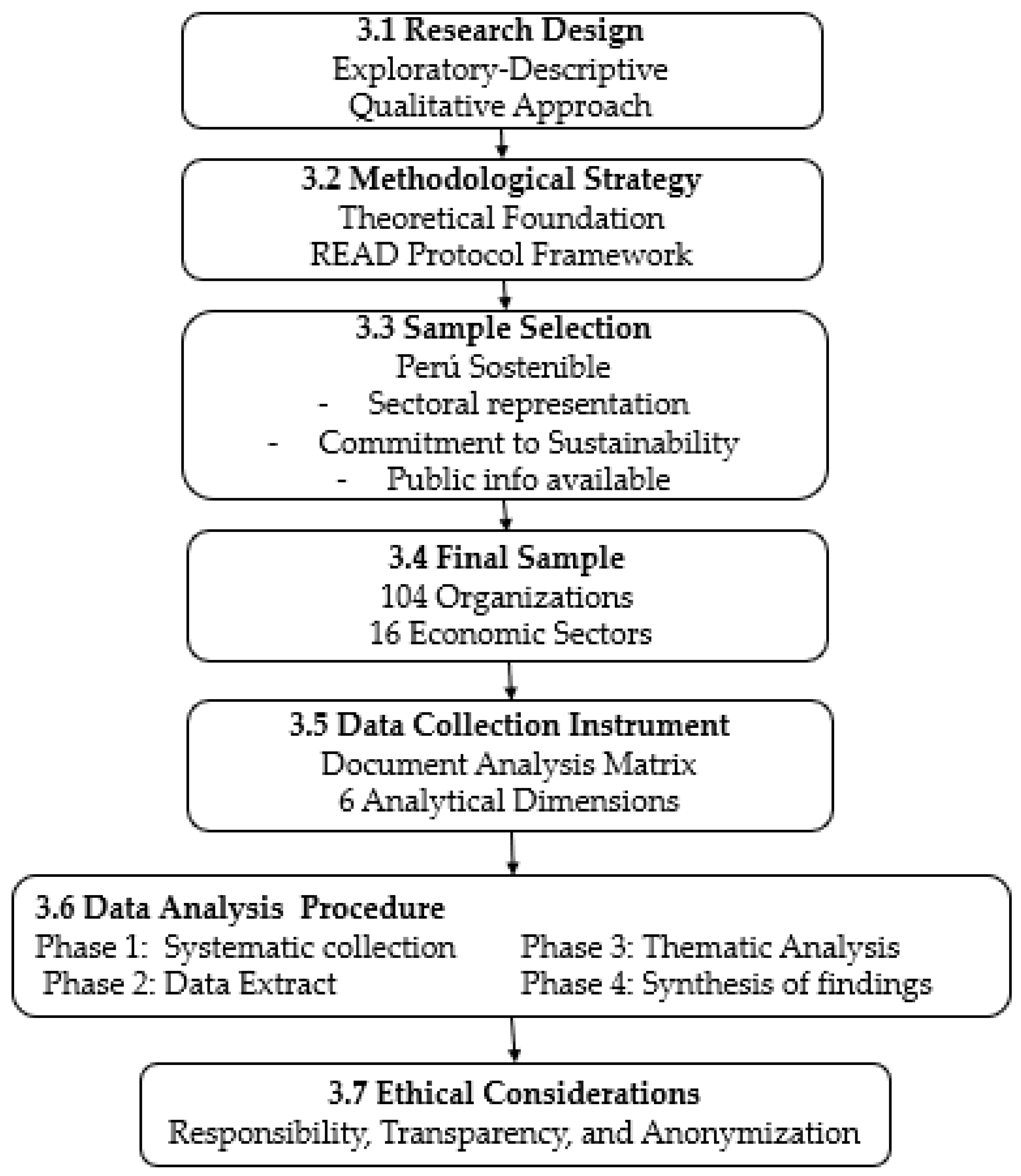
This research adopted a qualitative, exploratory-descriptive approach, appropriate for understanding complex, contextual phenomena that require in-depth exploration [57]. Qualitative research is inherently connected to real-world issues, exploring phenomena in their natural settings and providing insights particularly relevant to social scientists, policymakers, and stakeholders addressing social challenges. The exploratory-descriptive design allows both for the discovery of emerging patterns and the systematic characterization of identified initiatives (See Figure 1).

3.2. Methodological Strategy: Documentary Analysis

3.2.1. Theoretical Foundation

The central methodological strategy is documentary analysis, defined by Bowen [58] as “a systematic procedure for reviewing or evaluating documents, both printed and electronic” (p. 27). Documents, according to Prior [59], are defined as physical or virtual artifacts designed by creators for specific users to function within a particular environment. In this research, documents are not considered independent objects of study but must be understood within the social network of meaning in which they are produced and consumed.
Documentary analysis offers multiple advantages: time and cost efficiency, wide availability of online documents, lack of intrusiveness and reactivity, stability as a data source, accuracy in recording, and broad coverage of time, events, and settings [58]. These characteristics are particularly relevant for the study of organizations that may be difficult to access directly or for which a comprehensive perspective across multiple organizations simultaneously is required.

3.2.2. READ Protocol Framework

To ensure methodological rigor, an adaptation of the READ protocol (Reading materials, Extracting data, Analyzing data, Distilling findings) developed by Dalglish et al. [60] was adopted. This framework provides a structured, four-step process that has been demonstrated to be effective in public policy research and is particularly suitable for understanding the meanings constructed within organizational documents.
The READ protocol was selected for its systematic approach, which combines interpretive flexibility with methodological rigor—essential characteristics for analyzing diverse organizational documents. This framework allows for the identification of both manifest (explicitly expressed) and latent (implicit in the style, tone, and agenda) content of documents, following the recommendations of O’Leary [61]. The importance of considering “unintentional” evidence in document analysis.

3.3. Sample Selection and Characterization

Selection Criteria

The target population includes member organizations of the Perú Sostenible network (https://perusostenible.org/), (accessed on 31 August 2025) selected based on three criteria: (1) sectoral representation, across diverse economic sectors; (2) explicit sustainability commitment through voluntary membership; and (3) public information availability on their social responsibility and sustainability initiatives.
The inclusion criteria for organizations were: (a) active membership in Perú Sostenible at the time of the study (August 2025); (b) availability of an institutional website with information on sustainability or social responsibility initiatives; (c) sufficient information to allow analysis of at least three of the six established analytical dimensions. Exclusion criteria included: (a) no identifiable web presence; (b) websites entirely in languages other than Spanish; (c) insufficient or purely promotional information.

3.4. Final Sample and Characteristics

The final sample consisted of 104 organizations distributed across 16 economic sectors, representing approximately 85% of the organizations listed on Perú Sostenible that met the inclusion criteria. The distribution sector includes Banking, Insurance and AFP (16 organizations, 15.4%), Food and Beverages (11 organizations, 10.6%), Energy (11 organizations, 10.6%), General Services and Others (9 organizations, 8.7%), Consulting Services (8 organizations, 7.7%), ICT and Telecommunications (8 organizations, 7.7%), and other less represented sectors.
This sectoral distribution reflects both the country’s economic structure and the varying levels of maturity in adopting sustainability practices across industries. The sectoral diversity of the sample enables comparative analysis of differentiated approaches to responsible consumption and their links to social equity, grounded in the specific characteristics of each economic sector.

3.5. Data Collection Instrument

3.5.1. Documentary Analysis Matrix

A documentary analysis matrix structured into six analytical dimensions was developed: (1) responsible consumption initiatives, (2) contribution to equity, (3) measurable impacts, (4) barriers and opportunities, (5) implemented strategies, and (6) alignment challenges. The matrix was validated through expert judgment involving three academics specializing in corporate social responsibility and sustainability, and two professionals with experience in organizational sustainability management. The experts assessed the relevance, clarity, and comprehensiveness of the analytical dimensions, leading to minor adjustments that enhanced the conceptual precision of the analytical criteria.

3.5.2. Data Extraction Protocol

Following Bowen’s [58] recommendations, the protocol included: (a) initial complete webpage reading for overview; (b) specific information related to each analytical dimension; (c) contextual information recording (sector, organizational size, geographic scope); and (d) analytical memo documentation. A coding manual defining each dimension and providing examples was refined during a pilot analysis with 10 organizations.

3.6. Data Analysis Procedure

Phase 1 (Readying): Systematic collection and organization of digital documents with metadata database creation and a consistent naming system.
Phase 2 (Extracting): Systematic reading and coding, applying six analytical dimensions. Internal triangulation minimized interpretive bias by seeking multiple supporting pieces of evidence within each document [58].
Phase 3 (Analyzing): Thematic analysis using constant comparative method principles [60], involving initial coding, pattern identification, systematic comparison, and typology development.
Phase 4 (Distilling): Synthesis of findings responding to each research objective, organized into analytical tables allowing systematic comparison across dimensions, sectors, and organization types.

3.7. Ethical Considerations

This research is based exclusively on publicly available information on institutional websites and therefore does not require informed consent from the studied organizations. However, ethical research principles were applied, including: (a) responsible use of organizational information, appropriately citing sources and avoiding interpretations potentially damaging to organizational reputation; (b) methodological transparency allowing replication and verification of findings; and (c) anonymization when discussing specific cases potentially sensitive for organizations.

4. Results

The results section is organized in direct correspondence with the four specific objectives of the research, ensuring analytical consistency and transparent interpretation of the empirical findings. Each subsection addresses one objective sequentially: (1) identification of the main organizational initiatives that promote responsible consumption and equity in Peru; (2) evaluation of the impact of these initiatives on reducing inequality; (3) analysis of the key factors that determine the success or failure of these practices; and (4) proposals for evidence-based strategies and actions for greater social outreach.
All findings derive from systematic documentary analysis of publicly available information from 104 organizations, conducted using the READ protocol (Readying materials, Extracting data, Analyzing data, Distilling findings). Tables and figures present frequency data (absolute numbers and percentages), sectoral distributions, and comparative analyses based on the coding and categorization of organizational initiatives, impact indicators, mechanisms, facilitating factors, and barriers identified through this analytical process. This objective-aligned structure facilitates direct assessment of how empirical evidence addresses each research question.

4.1. Main Organizational Initiatives Promoting Responsible Consumption and Equity in Peru

4.1.1. Sectoral Distribution of the Sample

The analyzed sample of 104 member organizations of Perú Sostenible shows a sectoral distribution that reflects both the country’s economic structure and the degree of maturity in adopting responsible consumption practices. The Banking, Insurance, and AFP sectors have the largest representation, with 16 companies (15.4%), consistent with the growing adoption of ESG (Environmental, Social, and Governance) criteria in the Peruvian financial system and its strategic role as a channel for sustainable investments to other economic sectors. Next in importance are the Food and Beverage and Energy sectors, each with 11 companies (10.6%), sectors that by their nature have a significant direct impact on the consumption of natural resources and on the value chains that connect with vulnerable populations, especially in rural areas.
The significant presence of academic organizations (7 companies, 6.7%) underscores universities’ roles as spaces for training and research in sustainability and as laboratories for social innovation. The service sectors (General Services, Consulting, and ICT) account for 25 companies (24.1% of the total), reflecting the transition toward a knowledge-based economy and the use of digitalization as a strategy to dematerialize consumption. It is notable that traditionally resource-intensive sectors such as Mining (6 companies), Construction and Real Estate (6 companies), and Cement (3 companies) are also represented, suggesting a gradual transformation toward more sustainable operating models in extractive and high-environment industries.
The lower representation of sectors such as Textile (3 companies), Fishing (2 companies), and Steel (2 companies) could indicate both a lower integration of these industries in corporate sustainability networks, as well as growth opportunities for future responsible consumption initiatives in key sectors for the national economy and the employment of vulnerable populations (See Table 1).

4.1.2. Types of Responsible Consumption Initiatives

Analysis of responsible consumption initiatives reveals six main categories that operate on a continuum from operational improvements to systemic transformations. The most prevalent categories are Sustainable Products and Services (59 organizations, 56.7%) and Circular Economy and Waste Management (57 organizations, 54.8%), reflecting their maturity in organizational practice and compatibility with various business models. In contrast, Sustainable Financing has the lowest adoption rate (5 organizations, 4.8%), concentrated almost exclusively in the financial sector.
The categories are not mutually exclusive: each organization implements an average of 2.1 initiatives across categories (range: 1–5). Only 18 organizations (17.3%) implement a single category, while 23 (22.1%) implement four or more simultaneously, showing a trend toward integrated approaches among more mature organizations. The most frequent combinations are: Circular Economy + Sustainable Products (38 organizations, 36.5%), Eco-efficiency + Circular Economy (31 organizations, 29.8%), and Sustainable Products + Education (27 organizations, 26.0%).
Eco-efficient resource management is becoming established in energy-intensive sectors (energy, banking, academia), offering measurable returns on investment through proven technologies. The circular economy goes beyond operational efficiency to address the entire life cycle of resources, and is particularly relevant to social equity as it involves vulnerable populations in recycling value chains.
The Sustainable Supply Chain, concentrated in Food, Retail, and Construction, represents a direct mechanism for economic inclusion by prioritizing local suppliers and establishing socio-environmental criteria that benefit MSMEs and subsistence producers. Education and awareness act as a cross-cutting catalyst (Academia, Services, ICTs), generating the cognitive basis necessary for the effective implementation of other initiatives.
The development of Sustainable Products and Services (Food, ICTs, Energy) represents the deepest integration of sustainability criteria into the core organizational activity, with potential for equity when designed for vulnerable populations. Sustainable Financing, although in its infancy, represents a systemic leverage mechanism for all other categories.
The observed sectoral concentration suggests differentiated trajectories of maturity: regulated sectors (banking, energy) and those with high reputational impact (academia, food) adopt more integrated practices, while sectors traditionally focused on operational efficiency maintain more technical approaches. The categories with the greatest potential for reducing inequalities are those that directly involve vulnerable populations in value chains (sustainable supply chain, circular economy) or expand access to knowledge (education and awareness) (See Table 2).

4.1.3. Dimensions of Social Equity Addressed

The organizations studied address social equity through five complementary dimensions that reflect a multidimensional understanding of inequality. On average, each organization addresses 2.9 dimensions (range: 0–5). While 12 organizations (11.5%) do not report specific equity initiatives, 34 (32.7%) address three or more dimensions simultaneously, reflecting comprehensive approaches.
Access to Essential Services is the most prevalent (82 organizations, 78.8%), distributed across 15 of the 16 sectors analyzed. This universality demonstrates that the organizations recognize the provision of basic services (education, health, banking) as a direct mechanism for reducing social gaps, particularly relevant in the Peruvian context, where significant inequalities persist between urban and rural populations.
Economic Inclusion emerges as the second-most-consolidated dimension (71 organizations, 68.3%), concentrated in the banking, food, and mining sectors. Decent work initiatives, MSME programs, and inclusive value chains align naturally with existing business models, suggesting that providing banking services to vulnerable populations and integrating local producers into agro-industrial chains are proven strategies for generating inclusive economic opportunities.
Capacity Building (68 organizations, 65.4%) is positioned as a cross-cutting strategy with particular relevance in Academia (100% of the sector) and ICT (87.5%). This dimension represents a long-term approach that equips vulnerable populations with the skills to take advantage of emerging economic opportunities, particularly in the context of digital transformation.
Inclusion of Vulnerable Populations (44 organizations, 42.3%) is most prevalent in Mining (100% of the sector) and Energy (72.7%), reflecting the historical social responsibility of these extractive industries toward the communities in whose territories they operate. This concentration suggests specific capacities developed to work with rural and indigenous populations, although their effectiveness requires continuous evaluation to avoid purely paternalistic approaches.
Gender equality shows the lowest prevalence (37 organizations, 35.6%), concentrated in academia (85.7% of the sector) and services (62.5%). Its low presence in traditionally male-dominated sectors such as mining and construction indicates growth opportunities for initiatives that address structural barriers women face in these work environments.
The observed sectoral distribution indicates that different industries have developed comparative advantages by addressing specific equity dimensions, suggesting the need for collaborative, cross-sectoral strategies that leverage these complementary strengths. The concentration of economic inclusion in sectors with the capacity to generate direct employment, coupled with the academic sector’s leadership in capacity building, suggests opportunities for strategic alliances that maximize the social impact of each initiative (See Table 3).

4.2. Impact of Responsible Consumption Initiatives on Reducing Inequality

4.2.1. Quantifiable Indicators of Impact

Table 4 shows significant heterogeneity in the organizations’ impact measurement capacity, reflecting different levels of maturity in their monitoring and evaluation systems. Direct Beneficiaries show the widest range of variations (From 100 to over 1,000,000 people), suggesting differences in both organizational scale and the criteria used to define and count beneficiaries. This breadth indicates the need to standardize measurement methodologies to enable comparability across initiatives and sectors.
Environmental Impact Indicators are more consistent, with reported reductions of 30–50% in energy consumption, reflecting the relative maturity of environmental measurement methodologies and the availability of international standards for these types of metrics. This consistency contrasts with the greater variability observed in social indicators, suggesting that organizations have developed greater technical capacity to measure environmental impacts than social impacts.
Local Economic Development, measured by the number of MSMEs supported and the income generated, falls within an intermediate range (50–500 companies benefited), reflecting the limited but growing capacity of organizations to generate multiplier effects in their local ecosystems. The variability in this indicator suggests different strategic approaches: from intensive programs with few beneficiaries to extensive initiatives with a more diffuse impact.
The Access to Services and Financial Inclusion indicators show significant scale (200–50,000 beneficiaries and thousands of users, respectively), demonstrating the organizations’ potential to address structural gaps in basic services. However, the lack of qualitative metrics on the sustainability and quality of these services limits understanding of their real impact on reducing inequalities (See Table 4).

4.2.2. Mechanisms Contributing to the Reduction in Inequalities

The analysis identifies five main mechanisms through which organizational initiatives contribute to reducing inequalities. Capacity Building shows the highest prevalence (68 organizations, 65.4%), leading in knowledge-intensive sectors: Academia (100% of the sector), ICTs (87.5%), and Consulting Services (75%). This mechanism represents a long-term impact strategy that equips vulnerable populations with skills to take advantage of emerging economic opportunities, particularly in the context of digital transformation.
Inclusive Job Creation (48 organizations, 46.2%) is concentrated in labor-intensive sectors: Mining, Construction, and Energy, reflecting both their capacity to create direct jobs and their responsibility to the communities in which they operate. The quality of this employment, measured in terms of dignity and sustainability, is a critical factor in determining its real impact on equity.
Market Access (32 organizations, 30.8%), led by the Food and Retail sectors, demonstrates the transformative power of organizational purchasing decisions to integrate local producers into formal value chains. This mechanism is particularly relevant in the Peruvian context, where economic informality constitutes a significant barrier to inclusive development.
Social Infrastructure (26 organizations, 25.0%), led by Energy and Telecommunications, addresses structural determinants of inequality by improving access to basic services in historically excluded areas, representing high-impact investments with long-term social returns.
Inclusive Financial Services have the lowest prevalence (18 organizations, 17.3%) and concentrate almost exclusively in the financial sector due to specific regulatory barriers and specialized technical expertise requirements. However, their impact transcends sectoral boundaries by facilitating access to savings, credit, and insurance for vulnerable populations, thus emerging as a prerequisite for greater economic inclusion.
The observed sectoral distribution suggests natural comparative advantages that can be leveraged through strategic cross-sectoral alliances, combining, for example, academic expertise in capacity building with the implementation capacity of productive sectors (See Table 5).

4.3. Key Factors That Determine the Success or Failure of These Practices

4.3.1. Facilitating Factors for Success

The analysis reveals a complex architecture of enabling factors where internal organizational elements interact with external environmental conditions. Committed Leadership emerges as the most prevalent and universal enabling factor (89 organizations, 85.6%), distributed across all economic sectors. This finding demonstrates that the explicit and sustained commitment of organizational leadership is a necessary, though not sufficient, condition for the successful implementation of responsible consumption and equity initiatives. Its universality indicates that, regardless of sector or organizational size, a lack of management commitment represents an insurmountable barrier.
Strategic Alliances (67 organizations, 64.4%) are particularly important in Academia (100% of the sector), Services (87.5%), and ICT (75%), reflecting the collaborative nature of knowledge and the need to complement technical and operational capabilities. This concentration indicates that knowledge-based organizations have developed greater expertise in creating cooperative networks, suggesting replicable models for other sectors. The evidence points to a collective learning effect where alliances not only combine resources but also generate emergent capabilities that no single organization could develop in isolation.
Technical Capabilities (58 organizations, 55.8%) are critical in ICT (100% of the sector), Academia (85.7%), and Energy (63.6%) sectors, where technological innovation constitutes a core organizational competency. This specialization suggests that the transfer of technical knowledge between sectors could accelerate the adoption of sustainable practices, particularly from knowledge-intensive sectors to more traditional ones.
Sufficient Financial Resources (52 organizations, 50.0%) are especially crucial in capital-intensive sectors: Mining (100% of the sector), Energy (72.7%), and Banking (56.3%), where sustainability investments require significant scale and long-term profitability horizons. This concentration demonstrates that financial availability is not equally decisive in all contexts, becoming critical when initiatives require technological or infrastructure transformations.
Community Participation (44 organizations, 42.3%) is fundamental in Mining (100% of the sector), Energy (63.6%), and Construction (50%) sectors, where operations directly impact territories and local communities, requiring a social license to operate.
A Favorable Regulatory Framework (41 organizations, 39.4%) is identified as crucial in highly regulated sectors: Energy (81.8% of the sector), Banking (68.8%), and Telecommunications (50%), where public policies act as catalysts or inhibitors of sustainable innovation. This regulatory dependence suggests that in these sectors, business sustainability is intrinsically linked to the stability and predictability of the institutional framework (See Table 6).

4.3.2. Main Barriers to Effective Implementation

The analysis reveals a pattern of barriers operating at multiple systemic levels, from organizational limitations to structural constraints. Financial barriers are the most prevalent and impactful obstacle, reported by 70 organizations (67.3%) and characterized as “critical” in limiting the implementation, scalability, and sustainability of initiatives. This barrier is particularly intense in sectors with tight operating margins: Textiles (100% of the sector), Fishing (100%), and Retail (80%), where investment in sustainability directly competes with immediate operational priorities.
A significant finding is that 47 organizations (45.2%) report both financial and cultural barriers, suggesting that these obstacles are frequently interrelated and mutually reinforcing. Organizations in this situation face both resource constraints and internal skepticism about the return on investment in sustainability, creating a vicious cycle that hinders progress toward more responsible practices. This pattern indicates that intervention strategies must address material limitations (access to financing) and cognitive and cultural barriers (change in mindset and appreciation of sustainability) in an integrated manner.
Cultural barriers (54 organizations, 51.9%) are present with medium-high frequency and significant impact, concentrated in Construction (83.3% of the sector), Mining (66.7%), and Food (54.5%). Resistance to change transcends economic rationale and incorporates psychological and social dimensions that require change management strategies specifically designed for sustainability contexts.
Technical barriers (42 organizations, 40.4%) show medium frequency and moderate impact, primarily affecting Academia (57.1%), Services (37.5%), and ICT (37.5%). Limitations in specialized skills and appropriate technology constitute significant but surmountable obstacles that can be addressed through capacity-building and technology-transfer strategies, offering opportunities for intersectoral collaboration.
Institutional barriers (38 organizations, 36.5%) are of medium frequency and have a moderate impact, with a cross-sectoral distribution. They reflect limitations of the Peruvian regulatory and institutional framework in facilitating responsible consumption practices. Although they are not the main obstacle, they represent a significant opportunity for improvement to create more favorable conditions for sustainable innovation.
Social/community barriers are the least frequent (28 organizations, 26.9%) but have a variable impact, concentrated in Mining (83.3%), Energy (36.4%), and Construction (33.3%). Community acceptance and participation, while not the main obstacle, can be decisive in specific contexts, particularly when initiatives directly involve vulnerable populations (See Table 7).

4.4. Strategies to Strengthen Policies and Actions for Greater Social Impact

4.4.1. Strengthening Strategies by Level of Intervention

The proposed strategies are grounded in patterns identified in the empirical analysis and are designed to operate in a complementary manner across four systemic levels. The multilevel architecture recognizes that the identified challenges require coordinated interventions with differentiated time horizons according to the nature and scope of each level.
The Public Policy Strategy (3–5 year horizon) recognizes that 39.4% of organizations identify a favorable regulatory framework as a critical enabler, while its absence or inconsistency limits both initial adoption and the scalability of successful initiatives. It proposes a comprehensive regulatory framework for responsible consumption, involving the National Government, Congress, and sectoral Ministries. The long-term horizon recognizes that institutionalization requires structural transformations of the regulatory framework that transcend traditional political cycles and require broad political consensus to guarantee sustainability beyond changes in government.
The Sectoral Strategy (2–3 year horizon) addresses methodological fragmentation, where only 22.1% use standardized frameworks, limiting comparability of results and intersectoral learning. It proposes minimum industry standards and certifications, recognizing that different industries have developed distinct capabilities and face specific challenges. The participation of business associations and sector regulators suggests a collaborative governance approach that leverages each industry’s specialized knowledge.
The Organizational Strategy (1–2 year horizon) recognizes that organizations with multiple aligned enablers (36.5% of the sample) demonstrate superior performance, suggesting a need to institutionalize these capabilities. It proposes integrated ESG management systems focused on factors directly under each company’s control, in line with evidence that committed leadership and internal capabilities are key success factors. This approach recognizes that systemic transformations require a critical mass of organizations implementing advanced ESG management practices.
The Territorial Strategy (2–4 year horizon) recognizes that 64.4% identify partnerships as a critical success factor, underscoring the need for platforms that facilitate systematic collaboration. It proposes regional collaboration platforms involving regional/local governments, businesses, and civil society. It addresses the spatial dimension of inequality, recognizing that responsible consumption initiatives must be adapted to the specific characteristics of each territory. The participation of local governments underscores the importance of institutional proximity in facilitating coordination between public and private actors in specific contexts (See Table 8).

4.4.2. Strategies for Greater Social Reach

The specific recommendations translate empirical findings into concrete proposals that address the main gaps identified, each with supporting empirical evidence and monitoring indicators that allow for objective evaluation of their effectiveness.
The National Fund for Responsible Consumption and Equity directly addresses the most prevalent critical barrier: 70 organizations (67.3%) report financial limitations as a critical obstacle to scalability. This proportion provides a solid empirical basis for prioritizing this recommendation. The proposed indicators (total amount disbursed annually, number of projects funded, percentage of small- and medium-sized organizations benefiting) allow for monitoring both the scope and the targeting of organizations with limited capacity for self-financing.
The National System of Social Impact Indicators addresses the identified methodological fragmentation: while 88 organizations (84.6%) report indicators, only 23 (22.1%) use recognized standardized frameworks. This heterogeneity limits the comparability of results and the capacity for intersectoral learning in the formulation of evidence-based policies. The proposed indicators (number of reporting organizations, methodological comparability index, and adoption rate of international standards) assess both the adoption and quality of standardization.
The National Network of Sustainable Organizations identifies strategic alliances as the most frequently mentioned enabling factor after leadership: 67 organizations (64.4%) cite them as a critical success factor, particularly in academia and services. This recommendation recognizes that the exchange of experiences and intersectoral collaboration can accelerate the adoption of innovative practices and reduce experimentation costs for organizations initiating a transformation toward sustainability. The proposed indicators (number of member organizations, collaborative projects implemented, and documented exchanges of best practices) measure both network growth and the intensity of effective collaboration.
The National Sustainability Training Program addresses both technical and cultural barriers: 42 organizations (40.4%) report technical barriers, while 54 (51.9%) report cultural resistance to change. This combination acknowledges that transformation toward responsible consumption requires both specialized skills and changes in organizational values and attitudes. The proposed indicators (number of people trained annually, specific competencies developed, and active participating organizations) reflect a dual approach that considers both coverage and the quality of training.
The Social Innovation Labs seek to replicate the superior effectiveness pattern identified: 19 organizations (18.3%) with multiple integrated mechanisms demonstrate significantly greater impact, underscoring the need to develop scalable solutions. This recommendation leverages the private sector’s innovation capabilities to address complex social equity challenges that have traditionally been considered public issues. The proposed indicators (social innovations developed, adoption rates by other organizations, and number of beneficiaries reached) evaluate the generation, dissemination, and scalability of solutions (See Table 9).

4.4.3. Integrated Public Policy Framework for Responsible Consumption

The comprehensive public policy proposal recognizes that effectively promoting responsible consumption and equity requires simultaneously aligning multiple instruments operating across different dimensions of the system, articulating regulatory, economic, institutional, and participatory elements identified as crucial to the success of initiatives.
The Regulatory Framework (High priority) addresses the fact that 41 organizations (39.4%) identify a favorable regulatory framework as a critical enabler. It proposes institutionalizing responsible consumption as a development strategy through a National Responsible Consumption Law and sector-specific regulations, leveraging legislative resources and specialized technical assistance. This component establishes rules of the game and long-term signals that provide certainty and predictability for private investments in sustainability.
The Economic Incentives (Very High priority) directly address the most prevalent critical barrier: 70 organizations (67.3%) report critical financial barriers. It proposes reducing these barriers and promoting sustainable private investment through tax deductions, competitive funds, and guarantees for impact investing. The combination of tax incentives and direct subsidies reflects a mixed approach that reduces the costs of adopting sustainable practices and improves the profitability of investments with social impact.
Institutional Strengthening (High priority) addresses the fact that 38 organizations (36.5%) report moderate institutional barriers. It proposes building state capacities for monitoring and evaluation through a specialized agency, integrated information systems, and qualified technical personnel, all of which require specialized human resources and technological infrastructure. It recognizes that policy effectiveness requires specialized state capacities to monitor and evaluate complex initiatives operating at the intersection of environmental sustainability and social equity.
Social Participation (Medium priority) notes that 44 organizations (42.3%) value community participation as a facilitator. It proposes involving civil society in design and implementation through multi-sectoral advisory councils and citizen oversight mechanisms, requiring spaces for participation and participatory budgeting. It addresses the importance of social legitimacy and citizen ownership, recognizing that transformations toward responsible consumption require cultural changes that transcend the business sphere to permeate society.
Proposed financial architecture: Given that 70 organizations (67.3%) identify critical financial barriers as the main obstacle to scalability, a National Fund for Responsible Consumption and Equity would require strategic public investment during the initial implementation period. The design should prioritize co-financing mechanisms that leverage private investment at a ratio of 3–4 units of private investment for every unit of public investment, maximizing the impact of limited fiscal resources. This financial architecture would allow for the generation of a total volume of resources significantly greater than the initial public contribution, facilitating the expansion and sustainability of responsible consumption initiatives with a demonstrable impact on social equity (See Table 10).

5. Discussion

The findings of this research provide significant empirical evidence on how organizational responsible consumption initiatives contribute to reducing inequalities in the Peruvian context, converging with and extending recent international literature on corporate social responsibility and sustainable development. The discussion of results is structured around the four specific objectives of the research, and the findings are contrasted with recent studies published in high-impact scientific databases.
Specifically, three key empirical findings anchor our discussion. First, organizations commonly implement multiple initiative categories, with Eco-efficient Resource Management, Circular Economy, and Sustainable Supply Chains being the most prevalent. Second, these initiatives contribute to inequality reduction through five complementary mechanisms: inclusive employment generation, capacity building, market access, inclusive financial services, and social infrastructure. Third, sectoral specialization patterns emerged, with regulated and high-reputation sectors (e.g., Banking, Academia, Energy) leading integrated initiatives, while more traditional sectors focus on operational efficiency. These findings provide a foundation for understanding how responsible consumption strategies interact with social equity in the Peruvian context and set the stage for comparison with international studies.
The identification of six main categories of responsible consumption initiatives in this study (eco-efficient management, circular economy, sustainable supply chain, education and awareness, sustainable products, and green financing) finds significant resonance with recent international literature on the evolution of CSR practices, even though the literature has certain limitations, previous research has focused on analyzing the diversity of the workforce, with proposals on methodological approaches capable of measuring and monitoring the diversity of organizations [62], while other studies refer that to generate organizational change, individual learning is an assertive route to incorporate diversity objectives into performance management plans, thus ensuring sustainable change [63].
While there is much interest from companies in maintaining CSR practices, it is important to consider that for SMEs, regulatory and administrative processes, as well as economic and knowledge barriers, are limitations to implementing CSR-aligned practices [64,65]. In one systematic review of the relationship between CSR and financial performance, they document a similar trend toward diversification and integration of sustainable initiatives into core corporate strategies [66]. The analysis of 89 empirical studies confirms that organizations have evolved from reactive philanthropic approaches to proactive ones that integrate environmental, social, and governance criteria into their core operations.
Particularly relevant is the convergence between our findings on the prominence of circular economy initiatives (57 organizations, 54.8% of the sample) and the results of a study of Bansal et al. on social enterprises in India [67]. Their multi-stage study found that the most effective social enterprises in contributing to the SDGs are those that integrate circular business models that simultaneously generate economic value and address social and environmental challenges. This convergence suggests that the circular economy is emerging as a universal paradigm for organizations seeking to maximize the social impact of their operations, regardless of the specific geographic context.
The sector identified in our study, where the financial sector leads in adopting sustainable practices (15.4% of organizations analyzed), is also reflected in recent international research. Xiong et al. analyze how financial institutions have adopted ESG criteria not only in their internal operations but also as catalysts for sustainable transformation in other sectors through their financing and investment decisions [68]. Their evidence from developed markets suggests that financial institutions operate as “sustainability multipliers,” a finding our results confirm in the context of an emerging economy like Peru.

5.1. Integration of Environmental and Social Dimensions

A particularly significant finding from our research is that the most effective initiatives for advancing equity are those that simultaneously integrate environmental and social objectives, particularly in the areas of circular economy and sustainable supply chains. This result aligns with the theoretical framework of “sustainable “ proposed by Hariram et al. [69], which argues that traditional approaches to capitalism, socialism, and communism have failed to comprehensively address sustainable development, requiring new models that simultaneously prioritize quality of life, social equity, social justice, and environmental well-being.
Empirical evidence from Chang et al. [70] and Taiwanese firms provides further support for this finding. Their analysis of 1590 non-financial firms from 2007 to 2020 demonstrates that organizations with greater gender diversity on their boards implement more comprehensive CSR initiatives that simultaneously address multiple dimensions of sustainability. The authors argue that this multidimensional integration reflects a more sophisticated understanding of the interconnections between environmental and social challenges, consistent with our findings of the superior effectiveness of integrated initiatives versus fragmented approaches.

5.2. Mechanisms for Contributing to the Reduction in Inequalities

The range of beneficiaries identified in our study (100 to 1,000,000+ people) and the documented environmental reductions (30–50% in energy consumption) provide quantifiable evidence of the social impact of responsible consumption initiatives, supported by recent international studies. Research by Razia et al. [71] on the implementation of social sustainability initiatives in developing country cities has documented similar impact ranges, with successful programs reaching between 50,000 and 2 million beneficiaries in urban contexts in Bangladesh.
Particularly significant is our finding that the five inequality-reducing mechanisms identified (inclusive employment generation, capacity development, market access, inclusive financial services, and social infrastructure) operate with complementary synergies. This result aligns with the evidence presented in the United Nations Sustainable Development Goals Report 2024, which documents that only 16% of the SDG targets are on track to be achieved by 2030, suggesting that piecemeal approaches have been insufficient and that systemic, integrated approaches are required.
The bibliometric analysis of Kumar et al. [72] over 4276 academic papers related to CSR and social welfare (2009–2024) provides a theoretical context for our findings. Their research identifies an evolution in the conceptualization of CSR, from isolated initiatives to integrated frameworks that recognize the interdependence among the different dimensions of sustainability. This theoretical evolution is reflected in our empirical findings on the superior effectiveness of organizations that implement multiple mechanisms to reduce inequality simultaneously.

5.3. Specificities of the Developing Country Context

A distinctive aspect of our findings is the identification of equity-enhancing mechanisms that reflect the specific characteristics of developing country contexts. The prominence of initiatives aimed at economic inclusion and capacity building (present in 68% of the organizations analyzed) is echoed in research on social enterprises in Ghana [73]. Their study documents that in contexts where government institutions are weak or insufficient to provide basic social services, private organizations develop alternative service delivery mechanisms that can be more effective than traditional public policy approaches.
The concentration of initiatives in specific sectors identified in our study (particularly in banking, food, and energy) also reflects patterns identified in other developing countries. Research on the implementation of social sustainability initiatives in Dhaka identifies 18 main challenges, including poor urban governance, inefficient management systems, and a lack of political stability [71]. These contextual challenges explain why, in our study, sectors with greater financial and technical capacity (such as banking and energy) lead in implementing sophisticated initiatives, while more fragmented sectors (such as textiles and fishing) show lower participation.

5.4. Success Factors and Barriers to Implementation

The six enabling factors identified in our study (committed leadership, strategic alliances, favorable regulatory framework, sufficient financial resources, technical capabilities, and community involvement) show notable convergence with the international literature on critical success factors in organizational sustainability initiatives. Research on the impact of the CEO-employee pay gap on CSR provides empirical evidence supporting our finding of the critical importance of committed leadership [74]. Their analysis of Australian companies demonstrates that organizations with lower internal compensation inequalities implement more comprehensive and effective CSR initiatives, suggesting that leadership commitment is reflected in both internal and external policies.
Particularly relevant is the international confirmation of our finding on the importance of strategic partnerships. Research on sustainable entrepreneurship documents that the most successful companies in generating social impact are those that develop “collaborative ecosystems” that include government organizations, civil society, and the private sector [75]. Their bibliometric analysis of 1658 academic papers (2017–2023) identifies multisector partnerships as the factor most consistently associated with the success of long-term sustainable initiatives.
The evidence on the importance of a favorable regulatory framework in our study receives particular support from research on developing country contexts. The Corporate Equality Index 2025 documents that 98% of companies with high inclusion and equity scores operate in jurisdictions with regulatory frameworks that specifically protect the rights of vulnerable populations, suggesting that the institutional environment is a necessary, though not sufficient, condition for the success of equity initiatives [76].

5.5. Systemic Barriers and Their Theoretical Implications

This research provides a theoretical framework for interpreting our findings on cultural barriers and resistance to change [77]. Their review of the literature on CSR implementation identifies an “implementation gap” in which organizations express commitment to sustainability but face internal resistance to translating these commitments into concrete operational changes. This tension between stated intentions and operational practice explains why, in our study, organizations with well-documented initiatives frequently report significant challenges in scaling and institutionalizing their programs.
The finding on institutional barriers (medium frequency, moderate impact) aligns with research on Latin American countries [78]. Analysis of ESG practices in leading Latin American organizations identifies inconsistent regulatory frameworks and a lack of government incentives as factors limiting the adoption of more ambitious sustainable practices [78]. This regional evidence suggests that our findings on institutional constraints reflect specific characteristics of the Latin American regulatory context that require targeted public policy interventions.

5.6. Implications for Strengthening Strategies and Public Policy

Our proposed strengthening strategies, particularly the recommendation for a Comprehensive Public Policy Framework that simultaneously addresses normative, economic, institutional, and participatory dimensions, are supported by recent international public policy initiatives. Research on the United Nations Future Summit (2024) documents that the country’s most successful in advancing the SDGs have adopted “multi-level governance” approaches that integrate public, private, and civil society actors into coherent institutional frameworks [79].
Particularly relevant is the convergence between our proposal for a National Fund for Responsible Consumption and Equity (CAF) and similar initiatives implemented in other contexts. The analysis of CAF [80] documents that the institution approved USD 2.478 trillion for sustainable development in the region through 2024, with 35% of the funding specifically targeted to initiatives promoting biodiversity protection, preserving strategic ecosystems, and adapting to climate change. This evidence suggests both demand and institutional viability for specialized financing instruments like those proposed in our study.

5.7. Innovation in Metrics and Impact Assessment

Our proposal for a National System of Social Impact Indicators is supported by recent developments in sustainability assessment methodologies. Research on social enterprises develops a multistage measurement framework that includes scale development, refinement, pretesting, and construct validation to assess organizations’ contribution to the SDGs [67]. This methodology provides a technically feasible model for the practical implementation of standardized indicator systems, such as the one proposed in our study.
The Corporate Equality Index 2025 provides further evidence on the viability of comprehensive measurement systems. Its evaluation of 1449 organizations using standardized criteria demonstrates the potential to develop metrics that enable systematic comparison across organizations, sectors, and geographic contexts, thereby validating the technical feasibility of our methodological proposals [81].

5.8. Specific Contributions to Scientific Knowledge

The present study makes several novel contributions to the literature. Unlike previous research that often analyzes individual initiatives in isolation, we demonstrate how multiple initiative categories are implemented simultaneously, revealing synergistic strategies. Additionally, we map five distinct mechanisms through which responsible consumption initiatives reduce social inequality, offering a previously unstructured framework. Finally, we document sectoral specialization patterns in Peru, highlighting context-specific strategies and comparative advantages that inform both organizational practices and public policy in developing countries.
The findings of this research contribute to scientific knowledge in several specific dimensions that extend existing literature. First, empirical evidence on the differential effectiveness of specific types of initiatives (circular economy and sustainable supply chain as most promising for equity) provides practical guidance for organizations seeking to maximize the social impact of their sustainability investments. This contribution is particularly relevant considering documents that, although there is consensus on the positive relationship between CSR and organizational performance, uncertainty persists regarding which specific types of initiatives generate the greatest impact or which initiatives are considered fundamental elements in the business system [66,82,83,84].
Second, the identification of five specific inequality-reducing mechanisms with empirical evidence of their operation in developing country contexts fills a significant gap in the literature. Research documents that most studies on CSR and social welfare focus on developed countries, limiting our understanding of how these mechanisms operate in contexts of greater structural inequality and weaker government institutional capacities [72].
Third, evidence on enabling factors and barriers specific to the Latin American context provides valuable insights for the transfer of policies and best practices across countries in the region. The concentration of financial and cultural barriers identified in our study suggests that responsible consumption promotion strategies in Latin America require specific adaptations that account for these contextual constraints.

5.9. Limitations and Future Research

Despite the contributions of this study, several key limitations should be considered when interpreting the results. First, the research relies exclusively on self-reported information from organizations, which may introduce a positive bias and overestimate the effectiveness of initiatives; additionally, there is a risk of greenwashing, where organizations report more favorable achievements than they actually attain. Second, the cross-sectional design limits the assessment of structural changes over time and the identification of robust causal relationships, as the impacts on inequality may only manifest over 5 to 10 years. Third, the selection bias toward Perú Sostenible members may reflect above-average sustainability performance, reducing the generalizability of the findings to other companies. Finally, the lack of methodological triangulation limits the validation of information and the interpretation of reported social impacts. These limitations may bias the results in several ways: self-reporting and greenwashing can inflate coverage or impact figures; selection bias may favor perceptions of a more mature sustainability sector; and the absence of triangulation may limit the accuracy of findings on the effective reduction in inequalities.
For future research, more specific and actionable strategies are recommended. Longitudinal or panel designs are essential for evaluating the temporal evolution of initiatives and for establishing causal mechanisms that cross-sectional designs cannot capture. Mixed-methods approaches combining documentary analysis with in-depth interviews, focus groups, and surveys of key stakeholders, particularly final beneficiaries, would validate effective implementation and address current limitations regarding beneficiary perspectives. Experimental or quasi-experimental studies could establish robust causal relationships between initiative types and equity outcomes.
Research on sectoral specialization could explore how different sectors develop complementary roles in national sustainable development strategies. International comparative studies should examine how contextual factors facilitate or constrain initiative effectiveness, providing guidance for policy transfer between countries with different institutional and economic development levels.
Two research priorities emerge as most urgent: longitudinal tracking of organizations over 5–10 years to establish causality, and mixed-methods research incorporating beneficiary voices to triangulate organizational claims with lived experiences. Addressing these priorities would provide the robust empirical foundation needed for evidence-based policy design.

6. Conclusions

This research provides robust empirical evidence on the role of organizational responsible consumption initiatives in addressing social inequalities within the Peruvian context. The analysis of 104 organizations affiliated with Perú Sostenible demonstrates that responsible consumption extends beyond individual behavior to serve as a multidimensional organizational strategy with the potential to address structural social challenges when embedded in broader sustainability frameworks.
Six main categories of responsible consumption initiatives were identified, operating along a continuum that ranges from operational improvements such as eco-efficient management practices to more systemic interventions, including sustainable products and green financing. Among these, circular economy practices and sustainable supply chains stand out as initiatives with the greatest potential for social inclusion, as they directly integrate vulnerable populations into formal value chains and generate tangible economic opportunities.
The findings further reveal that organizations address social equity through five complementary dimensions: economic inclusion, access to essential services, gender equality, inclusion of vulnerable populations, and capacity building. Sectoral differences highlight specific comparative advantages: the financial sector leading in economic inclusion initiatives, academic institutions showing stronger engagement in capacity building and gender equality, and extractive industries concentrating efforts on the inclusion of vulnerable populations.
Impact indicators reported by organizations show wide variation in the number of beneficiaries, ranging from fewer than 100 to more than one million individuals, and relatively consistent environmental performance improvements (30–50%). However, the methodological heterogeneity in impact measurement limits cross-sector comparability. The five inequality-reduction mechanisms identified, inclusive employment generation, capacity development, market access, inclusive financial services, and social infrastructure provision, operate across different temporal horizons and require systemic coordination to maximize their transformative potential.
The effectiveness of responsible consumption initiatives depends on the alignment of six enabling factors: committed leadership, strategic partnerships, supportive regulatory frameworks, access to financial resources, technical capabilities, and active community participation. Conversely, five categories of barriers: financial, cultural, institutional, technical, and social, constrain implementation, with financial constraints emerging as the most significant systemic obstacle, reported by 67% of organizations and critically affecting scalability.
The study also reveals distinctive features of the Peruvian corporate sustainability ecosystem. The concentration of initiatives in highly regulated sectors (such as banking and energy) and in sectors with strong reputational exposure (food and academia) suggests that institutional and social pressures play a decisive role in driving the adoption of responsible consumption practices. In contrast, the limited participation of economically and socially relevant sectors such as textiles and fisheries highlights missed opportunities to integrate labor-intensive production chains that employ vulnerable populations.
Overall, the sectoral analysis indicates that Peruvian organizations have developed differentiated approaches to responsible consumption, reflecting both organizational capacities and contextual constraints. This specialization points to fragmented sustainable innovation ecosystems, underscoring the need for stronger coordination among public institutions, regulatory bodies, and private actors to scale successful practices, enhance cross-sector learning, and strengthen the transformative impact of responsible consumption on social equity.


Author Contributions

Conceptualization, E.E.G.-S., D.Y.M.-L. and A.A.-D.; methodology, E.E.G.-S., D.Y.M.-L. and A.A.-D.; software, E.E.G.-S. and D.Y.M.-L.; validation, E.E.G.-S., D.Y.M.-L. and A.A.-D.; formal analysis E.E.G.-S., D.Y.M.-L. and A.A.-D.; investigation E.E.G.-S., D.Y.M.-L. and A.A.-D.; resources, E.E.G.-S., D.Y.M.-L. and A.A.-D.; data curation, E.E.G.-S.; writing—original draft preparation, E.E.G.-S., D.Y.M.-L. and A.A.-D.; writing—review and editing, E.E.G.-S., D.Y.M.-L. and A.A.-D.; visualization, E.E.G.-S., D.Y.M.-L. and A.A.-D.; supervision, E.E.G.-S., D.Y.M.-L. and A.A.-D.; project administration, E.E.G.-S.; funding acquisition, E.E.G.-S. All authors have read and agreed to the published version of the manuscript.

Funding

This research was funded by Programa Nacional de Investigación Científica y Estudios Avanzados PROCIENCIA (PE501088976-2024).

Institutional Review Board Statement

Not applicable, for studies not involving humans or animals.

Data Availability Statement

The original contributions presented in this study are included in the article.

Conflicts of Interest

The authors declare no conflicts of interest.

References

  1. D’Angelo, J. 5 Trends of 2023 in Social Responsibility and Sustainable Development. Available online: https://www.ambito.com/opiniones/consumo/5-tendencias-del-2023-materia-responsabilidad-social-y-desarrollo-sostenible-n5628506 (accessed on 16 August 2025).
  2. Lavinas, L.; Fritz, B. Redistribution and Persistent Challenges: An Introduction. In A Moment of Equality for Latin America? Routledge: Oxfordshire, UK, 2016; pp. 19–28. [Google Scholar]
  3. Gottschakl, R.; Justino, P. (Eds.) Overcoming Inequality in Latin America; Routledge: Oxfordshire, UK, 2005; ISBN 9781134230136. [Google Scholar]
  4. Mohieldin, M.; Piedrahita-Carvajal, D.; Velez-Ocampo, J.; Gonzalez-Perez, M. Sustainable Development Challenges in Latin America and the Caribbean. In Regenerative and Sustainable Futures for Latin America and the Caribbean; Emerald Publishing Limited: Leeds, UK, 2022; pp. 65–79. [Google Scholar]
  5. ECLAC. ECLAC: The Regional Poverty Rate, Which Rose with the Pandemic, Has Declined to a Level Similar to 2014 and in 2023 Reached the Lowest Figure on Record, but Income Inequality Remains High. Available online: https://www.cepal.org/en/pressreleases/eclac-regional-poverty-rate-which-rose-pandemic-has-declined-level-similar-2014-and (accessed on 16 August 2025).
  6. Heath, T.; Lichrou, M. Towards Responsible Consumption. In Integrated Science to Achieve Sustainable Development Goals; Springer: Cham, Switzerland, 2025; pp. 221–236. [Google Scholar]
  7. Amis, J.; Mair, J.; Munir, K. The Organizational Reproduction of Inequality. Acad. Manag. Ann. 2020, 14, 195–230. [Google Scholar] [CrossRef]
  8. United Nations. Goal 12: Ensure Sustainable Consumption and Production Patterns. Available online: https://www.un.org/sustainabledevelopment/sustainable-consumption-production/ (accessed on 16 August 2025).
  9. Haapasaari, A.; Kerosuo, H. Transformative Agency: The Challenges of Sustainability in a Long Chain of Double Stimulation. Learn. Cult. Soc. Interact. 2015, 4, 37–47. [Google Scholar] [CrossRef]
  10. González, M.E.; Londono, S.; Martina, M.; Ruíz, V.; Correa, A.; López, J.; Angulo, K. Relevance of Responsible Consumption in Colombia and Its Alignment at a Regional and Local Level. WSEAS Trans. Environ. Dev. 2023, 19, 852–862. [Google Scholar] [CrossRef]
  11. Zhong, S.; Chen, J. How Environmental Beliefs Affect Consumer Willingness to Pay for the Greenness Premium of Low-Carbon Agricultural Products in China: Theoretical Model and Survey-Based Evidence. Sustainability 2019, 11, 592. [Google Scholar] [CrossRef]
  12. Tey, Y.; Brendal, M.; Dibba, H. Factors Influencing Willingness to Pay for Sustainable Apparel: A Literature Review. J. Glob. Fash. Mark. 2018, 9, 129–147. [Google Scholar] [CrossRef]
  13. Ishak, S.; Zabil, N. Impact of Consumer Awareness and Knowledge to Consumer Effective Behavior. Asian Soc. Sci. 2012, 8, 108. [Google Scholar] [CrossRef]
  14. Budrin, A.; Soldatova, A.; Vorobeva, A.; Korytova, V. Responsible Consumption in the Context of ESG Transformation of the Economy. E3S Web Conf. 2024, 531, 05029. [Google Scholar] [CrossRef]
  15. Adecco Foundation Trends and Keys to Diversity, Equity and Inclusion. 2025. Available online: https://fundacionadecco.org/blog-diversidad-inclusion/tendencias-diversidad-equidad-inclusion/ (accessed on 16 August 2025).
  16. Shaikh, F.; Shahbaz, M.; Odhano, N. A Short Review on Green Supply Chain Management Practices: The Impact on Operational and Environmental Performance. Eng. Technol. Appl. Sci. Res. 2020, 10, 5367–5370. [Google Scholar] [CrossRef]
  17. Martínez-Falcó, J.; Marco-Lajara, B.; Sánchez-García, E.; Millán-Tudela, L.A. (Eds.) Green Supply Chain Management Practice and Principles; IGI Global: Hershey, PA, USA, 2024; ISBN 9798369334867. [Google Scholar]
  18. Escamilla-Solano, S.; Paule -Vianez, J.; Plaza-Casado, P.; Díaz-Iglesias, S. Scientific Evolution of Corporate Social Responsibility. A Bibliometric Analysis with Mapping Analysis Tools. Acad. Bras. Cienc. 2023, 95, e20210215. [Google Scholar] [CrossRef] [PubMed]
  19. Arnold, M. Corporate Strategies for Sustainable Innovations. In Facilitating Sustainable Innovation Through Collaboration; Springer: Dordrecht, The Netherlands, 2010; pp. 217–232. [Google Scholar]
  20. Khan, S. (Ed.) Innovation and Sustainability Through Circular Economy in Businesses; IGI Global: Sheffield, UK, 2024; ISBN 9798369341230. [Google Scholar]
  21. Alinda, K. Nurturing Sustainability Practices: A Qualitative Inquiry into Environmental Innovations as a Catalyst in Manufacturing Enterprises in an Emerging Economy. Manag. Sustain. Arab Rev. 2024, 4, 589–610. [Google Scholar] [CrossRef]
  22. Kamande, A.; Walker, J.; Lawson, M. Commitment to Reducing Inequality Index 2024; Oxfam International: Nairobi, Kenya, 2024. [Google Scholar]
  23. Garcia -Zamor, J.-C. Reconciling Gentrification with Social Equity. In Public Administration, Governance and Globalization; Springer: New York, NY, USA, 2014; pp. 107–113. [Google Scholar]
  24. Guy, M.E.; McCandless, S.A. Social Equity: Its Legacy, Its Promise. Public Adm. Rev. 2012, 72, S5–S13. [Google Scholar] [CrossRef]
  25. Ramos, M.E.; Gibaja-Romero, D.-E.; Ochoa, S.A. Gender Inequality and Gender-Based Poverty in Mexico. Heliyon 2020, 6, e03322. [Google Scholar] [CrossRef]
  26. Wang, Z.; Lin, T.; Chen, Y.; Zhang, S. Is It Actually Working Well? A Comparative Study of the Redistributive Effectiveness of Public Social Benefits in 33 Countries. Soc. Indic. Res. 2025, 179, 235–267. [Google Scholar] [CrossRef]
  27. Ramalingam, A.; Stoddard, B.V. Does Reducing Inequality Increase Cooperation? J. Econ. Behav. Organ. 2024, 217, 170–183. [Google Scholar] [CrossRef]
  28. World Bank. Two Decades Transforming Lives Through Social Protection Programs in Latin America and the Caribbean. Available online: https://www.worldbank.org/en/results/2024/06/04/social-protection-programs-latin-america-and-caribbean (accessed on 16 August 2025).
  29. Perez -Encinas, A.; Well, Y.; Santos, B.; Nieto-Mejia, C. Are There Differences and Complementarities between Senior and Young Entrepreneurs? An Intergenerational Perspective. Sustainability 2021, 13, 5202. [Google Scholar] [CrossRef]
  30. Revankar, D.S.; Mishra, A.K. Bibliometric Mapping of Employment Deprivation. Int. Res. J. Multidiscip. Scope 2024, 5, 1216–1230. [Google Scholar] [CrossRef]
  31. Lyon, T.P.; Montgomery, A.W. The Means and End of Greenwash. Organization & Environment 2024, 28, 223–249. [Google Scholar] [CrossRef]
  32. Nangia, P.; Bansal, S.; Thaichon, P. Doing More with Less: An Integrative Literature Review on Responsible Consumption Behavior. J. Consum. Behav. 2024, 23, 141–155. [Google Scholar] [CrossRef]
  33. Bhar, S. Sustainable Consumption and the Global South: A Conceptual Exposition. Front. Sustain. 2023, 4, 965421. [Google Scholar] [CrossRef]
  34. Xu, S.; Zhang, S.; Ren, Y.; Jiang, Q.; Wu, D. Can Digital Transformation Restrain Corporate ESG Greenwashing—A Test Based on Internal and External Joint Perspectives. Systems 2024, 12, 334. [Google Scholar] [CrossRef]
  35. Chan, E.; Tang, F.; Chu, M.Y. All Hands on Deck Special Session: Cultivating Socially Responsible Consumers and Corporations: An Abstract. In Marketing Opportunities and Challenges in a Changing Global Marketplace; Springer: Cham, Switzerland, 2020; pp. 17–18. [Google Scholar]
  36. Dzage, E.J.; Szabados, G.N. The Relationship of Corporate Social Responsibility with Business Performance—A Bibliometric Literature Review. Sustainability 2024, 16, 2637. [Google Scholar] [CrossRef]
  37. Jansen, L.; Cunningham, P.; Diehl, S.; Terlutter, R. Corporate Social Responsibility in Controversial Industries: A Literature Review and Research Agenda. Corp. Soc. Responsib. Environ. Manag. 2024, 31, 4398–4427. [Google Scholar] [CrossRef]
  38. Symmes, F. Impact Inclusion in Latin America: Generating a Positive Impact on Societies Through Market Mechanisms. Available online: https://globalnetwork.io/perspectives/2022/05/impact-inclusion-latin-america-generating-positive-impact-societies-through (accessed on 16 August 2025).
  39. Jones, N.; Vargas, R.; Villar, E. Cash Transfers to Tackle Childhood Poverty and Vulnerability: An Analysis of Peru’s Juntos Programme. Environ. Urban. 2008, 20, 255–273. [Google Scholar] [CrossRef]
  40. Benites, O.; Jilaja, E.; Castro, D.; Ayala, L. Educational Exclusion in Peru: From Pre-Hispanic Times to the Bicentennial of the Republic. Rev. Cienc. Soc. 2022, 28, 470–483. [Google Scholar] [CrossRef]
  41. Epstein, G.; Gang, I. Inequality, Good Governance, and Endemic Corruption. Int. Tax Public Financ. 2019, 26, 999–1017. [Google Scholar] [CrossRef]
  42. Nittrouer, C.; Arena, D.; Silver, E.; Avery, D.; Hebl, M. Despite the Haters: The Immense Promise and Progress of Diversity, Equity, and Inclusion Initiatives. J. Organ. Behav. 2025, 46, 188–201. [Google Scholar] [CrossRef]
  43. Nguyen, L.A.; Evan, R.; Chaudhuri, S.; Hagen, M.; Williams, D. Inclusion in the Workplace: An Integrative Literature Review. Eur. J. Train. Dev. 2024, 48, 334–356. [Google Scholar] [CrossRef]
  44. Gabriel-Campos, E.; Werner-Masters, K.; Cordova- Buiza, F.; Paucar-Caceres, A. Community Eco-Tourism in Rural Peru: Resilience and Adaptive Capacities to the COVID-19 Pandemic and Climate Change. J. Hosp. Tour. Manag. 2021, 48, 416–427. [Google Scholar] [CrossRef]
  45. Shonkoff, S.; Morello-Frosch, R.; Pastor, M.; Sadd, J. The Climate Gap: Environmental Health and Equity Implications of Climate Change and Mitigation Policies in California—A Review of the Literature. Clim. Change 2011, 109, 485–503. [Google Scholar] [CrossRef]
  46. Lioubimtseva, E.; Zylman, H.; Carron, K.; Poynter, K.; Rashrash, B.M.-E. Equity and Inclusion in Climate Action and Adaptation Plans of Michigan Cities. Sustainability 2024, 16, 7745. [Google Scholar] [CrossRef]
  47. Gala, A.S. 10 Diversity and Inclusion Trends for 2024. Available online: https://www.gala-group.com/pdf/ESG_Report_2024_EN.pdf (accessed on 16 August 2025).
  48. Wang, G.; Zhao, B. Research Hotspots and Trends in Sustainable Development Goals. Environ. Sustain. Indic. 2025, 26, 100722. [Google Scholar] [CrossRef]
  49. HR Policy Association. DEI Challenges in Latin America—Things to Consider. 2023. Available online: https://www.chro.org/w/diversity-equity-and-inclusion-challenges-in-latin (accessed on 16 August 2025).
  50. Rusu, T.; Odagiu, A.; Pop, H.; Paulette, L. Sustainability Performance Reporting. Sustainability 2024, 16, 8538. [Google Scholar] [CrossRef]
  51. Lindsey, C.; Janus, B.; Murphy, H. Growing Expectations: The Rising Tide of Sustainability Reporting Initiatives and Their Challenges for the Oil and Gas Industry. In Proceedings of the SPE International Conference on Health, Safety, and Environment; SPE: Houston, TX, USA, 2014. [Google Scholar]
  52. Beckert, J.; Koch, T. Corporate Perspectives on Diversity: Engagement, Communication Motives, and the Diversity-Washing Dilemma. J. Mark. Commun. 2025, 31, 538–555. [Google Scholar] [CrossRef]
  53. Kantar; Wallapop. La Red del Cambio: Un nuevo paradigma en el consumo, donde la consciencia gana al impulso; Report; Wallapop: Barcelona, Spain, 2022; Available online: https://www.kantar.com/es/Inspiracion/Consumidor/Consumo-consciente-y-tendencias-de-consumo-en-Espana (accessed on 12 February 2026).
  54. Hu, J. Dispositional Awe, Meaning in Life, and Socially Responsible Consumption. Serv. Ind. J. 2025, 45, 27–53. [Google Scholar] [CrossRef]
  55. Villa, L.; Herrera, W. Estándares internacionales de rendición de cuentas social: Entre la justificación y el apresamiento directive. Innovar 2020, 30, 135–150. [Google Scholar] [CrossRef]
  56. Huerta, M.; Garizurieta, J.; González, R.; Infante, L.-Á.; Horna, M.; Rivera, R.; Clotet, R. A Long -Distance WiFi Network as a Tool to Promote Social Inclusion in Southern Veracruz, Mexico. Sustainability 2023, 15, 9939. [Google Scholar] [CrossRef]
  57. Lim, W.M. What Is Qualitative Research? An Overview and Guidelines. Australas. Mark. J. 2025, 33, 199–229. [Google Scholar] [CrossRef]
  58. Bowen, G.A. Document Analysis as a Qualitative Research Method. Qual. Res. J. 2009, 9, 27–40. [Google Scholar] [CrossRef]
  59. Prior, L. Documents in Action I. Documents in Organizational Settings. In Using Documents in Social Research; SAGE Publications Ltd.: London, UK, 2003; pp. 51–69. [Google Scholar]
  60. Dalglish, S.L.; Khalid, H.; McMahon, S.A. Document Analysis in Health Policy Research: The READ Approach. Health Policy Plan. 2020, 35, 1424–1431. [Google Scholar] [CrossRef]
  61. O’Leary, Z. The Essential Guide to Doing Your Research Project, 2nd ed.; SAGE Publications Ltd.: London, UK, 2004. [Google Scholar]
  62. Maturo, F.; Migliori, S.; Paolone, F. Measuring and Monitoring Diversity in Organizations through Functional Instruments with an Application to Ethnic Workforce Diversity of the US Federal Agencies. Comput. Math. Organ. Theory 2019, 25, 357–388. [Google Scholar] [CrossRef]
  63. Van Den Brink, M. “Reinventing the Wheel, over and over Again.” Organizational Learning, Memory and Forgetting in Doing Diversity Work. Dev. Learn. Organ. Int. J. 2023, 37, 23–25. [CrossRef]
  64. Garcés- Ayerbe, C.; Rivera-Torres, P.; Suárez-Perales, I.; Leyva-de la Hiz, D.I. Is It Possible to Change from a Linear to a Circular Economy? An Overview of Opportunities and Barriers for European Small and Medium-Sized Enterprise Companies. Int. J. Environ. Res. Public Health 2019, 16, 851. [Google Scholar] [CrossRef]
  65. Chrispim, M.; Mattsson, M.; Ulvenblad, P. Beyond Carbon Footprint: Practices and Tools to Implement Circular Economy in Swedish Companies. Clean. Environ. Syst. 2025, 18, 100294. [Google Scholar] [CrossRef]
  66. Coelho, R.; Jayantilal, S.; Ferreira, J.J. The Impact of Social Responsibility on Corporate Financial Performance: A Systematic Literature Review. Corp. Soc. Responsib. Environ. Manag. 2023, 30, 1535–1560. [Google Scholar] [CrossRef]
  67. Bansal, S.; Garg, I.; Vasa, L. Can Social Enterprises Aid Sustainable Development? Evidence from Multi-Stage Investigations. PLoS ONE 2023, 18, e0281273. [Google Scholar] [CrossRef] [PubMed]
  68. Xiong, W.; Dong, M.; Xu, C. Institutional Investors and Corporate Social Responsibility: Evidence from China. Emerg. Mark. Financ. Trade 2023, 59, 3281–3292. [Google Scholar] [CrossRef]
  69. Hariram, N.P.; Mekha, K.B.; Suganthan, V.; Sudhakar, K. Sustainalism: An Integrated Socio-Economic-Environmental Model to Address Sustainable Development and Sustainability. Sustainability 2023, 15, 10682. [Google Scholar] [CrossRef]
  70. Chang, Y.; Wu, K.-T.; Lin, S.-H.; Lin, C.-J. Board Gender Diversity and Corporate Social Responsibility. Int. J. Corp. Soc. Responsib. 2024, 9, 7. [Google Scholar] [CrossRef]
  71. Razia, S.; Abu Bakar Ah, S.H. A Call to Action: Unpacking the Challenges to Implementing Social Sustainability Initiatives in a Developing Country City. Heliyon 2023, 9, e19085. [Google Scholar] [CrossRef]
  72. Kumar, R.R.; Stauvermann, P.J. Environmental Injustice: The Effects of Environmental Taxes on Income Distribution in an Oligopolistic General Equilibrium Model. Sustainability 2024, 16, 4142. [Google Scholar] [CrossRef]
  73. Quaye, J.N.A.; Halsall, J.P.; Winful, E.C.; Snowden, M.; Opuni, F.F.; Hyams-Ssekasi, D.; Afriyie, E.O.; Opoku-Asante, K.; Ocloo, E.C.; Fairhurst, B. Social Enterprises and the Sustainable Development Goals (SDGs): A Means to an End. Environ. Dev. Sustain. 2024. [Google Scholar] [CrossRef]
  74. Yiqing, T. The Impact of the CEO–Employee Pay Gap on Corporate Social Responsibility. Aust. Account. Rev. 2025, 35, 241–256. [Google Scholar] [CrossRef]
  75. Rosário, A.T.; Figueiredo, J. Sustainable Entrepreneurship and Corporate Social Responsibility: Analyzing the State of Research. Sustain. Environ. 2024, 10, 2324572. [Google Scholar] [CrossRef]
  76. Human Rights Campaign. Corporate Equality Index 2025. Available online: https://www.hrc.org/resources/corporate-equality-index (accessed on 16 August 2025).
  77. Fatima, T.; Elbanna, S. Corporate Social Responsibility (CSR) Implementation: A Review and a Research Agenda Towards an Integrative Framework. J. Bus. Ethics 2023, 183, 105–121. [Google Scholar] [CrossRef] [PubMed]
  78. Gavilanes-Carranza, E.A.; Tapia-Urbina, M.B.; Rodríguez-Benavides, M.L.; Delgado-Flores, E.N. Sostenibilidad Financiera en las Empresas: Criterios ESG. Multidiscip. Lat. Am. J. 2024, 2, 1–16. [Google Scholar] [CrossRef]
  79. United Nations General Assembly. Pact for the Future (A/RES/79/1). Adopted at the Summit of the Future. 22–23 September 2024. Available online: https://www.un.org/pact-for-the-future (accessed on 16 August 2025).
  80. CAF. CAF Approves USD 2.478 Billion for Sustainable Development in Latin America and the Caribbean. Available online: https://www.caf.com/en/currently/news/caf-approves-usd-2478-billion-for-sustainable-development-in-latin-america-and-the-caribbean/ (accessed on 16 August 2025).
  81. Human Rights Campaign Foundation. Corporate Equality Index 2025: Rating Workplaces on Lesbian, Gay, Bisexual, Transgender and Queer Equality. 2025. Available online: https://reports.hrc.org/corporate-equality-index-2025 (accessed on 12 February 2026).
  82. Lozano, R. Towards Better Embedding Sustainability into Companies’ Systems: An Analysis of Voluntary Corporate Initiatives. J. Clean. Prod. 2012, 25, 14–26. [Google Scholar] [CrossRef]
  83. Lozano, R. Analyzing the Use of Tools, Initiatives, and Approaches to Promote Sustainability in Corporations. Corp. Soc. Responsib. Environ. Manag. 2020, 27, 982–998. [Google Scholar] [CrossRef]
  84. Radwan, E.K.A.; Russo, A. Web-based Corporate Social Responsibility Disclosure Practices: A Systematic Literature Review and Research Directions. Corp. Soc. Responsib. Environ. Manag. 2024, 31, 5049–5106. [Google Scholar] [CrossRef]
Figure 1. Methodological Framework: Sequential Research Design for Document Analysis Source: Authors’ own elaboration, 2026.
Societies 16 00072 g001
Table 1. Sectoral Distribution of Analyzed Organizations (N = 104).
Economic SectorNumber of CompaniesPercentage (%)
Banking, Insurance, and AFP1615.4%
Food and Beverages1110.6%
Energy1110.6%
Services and others98.7%
Consulting Services87.7%
ICT and Telecommunications87.7%
Academy76.7%
Mining65.8%
Construction and Real Estate65.8%
Transportation and Logistics65.8%
Retail and Consumption Massive54.8%
Cement32.9%
Textile32.9%
Fishing21.9%
Steel industry21.9%
Chemical Industries11.0%
Total104100%
Source: Own elaboration, 2026.
Table 2. Categories of Responsible Consumption Initiatives (N = 104).
Initiative Category%DescriptionDominant Sectors
Circular Economy and Waste Management5754.8%Recycling, reuse, and waste reduction programsFood (9/11, 81.8%), Academia (6/7, 85.7%), Banking (10/16, 62.5%)
Sustainable Products and Services5956.7%Offers with environmental and social criteriaFood (10/11, 90.9%), ICT (7/8, 87.5%), Energy (8/11, 72.7%)
Eco-efficient Resource Management4139.4%Responsible use of water, energy, and materials with quantifiable goalsEnergy (9/11, 81.8%), Academia (5/7, 71.4%), Banking (8/16, 50%)
Sustainable Supply Chain3230.8%ESG criteria for suppliers, support for SMEs, and local purchasingFood (7/11, 63.6%), Retail (3/5, 60%), Construction (3/6, 50%)
Education and Awareness3129.8%Internal and external sustainability training programsAcademia (6/7, 85.7%), Services (5/8, 62.5%), ICT (4/8, 50%)
Sustainable Financing54.8%Financial products with explicit ESG criteriaBanking (4/16, 25%), Energy (1/11, 9.1%)
Source: Own elaboration, 2026.
Table 3. Social equity initiatives by dimension.
Equity DimensionN° of Organizations% of Total Initiatives IdentifiedSectors with the Highest Frequency
Access to Essential Services8278.8%Basic services, financial inclusion for various sectorsEducation, Health, Cross-cutting (15/16)
Economic Inclusion7168.3%Micro, Small, and Medium-Sized Enterprises (MSMEs) programs, inclusive supply chainsFood (9/11, 81.8%), Banking (14/16, 87.5%), Mining (5/6, 83.3%), Microfinance
Capacity Building6865.4%Higher education, knowledge transferAcademia (7/7, 100%), ICT (7/8, 87.5%), Services (6/8, 75%), Technology
Inclusion of Vulnerable Populations4442.3%Community projects, local development, supportMining (6/6, 100%), Energy (8/11, 72.7%), Construction (3/6, 50%), Indigenous/Rural
Gender Equality3735.6%Non-discrimination policies, mentoringAcademia (6/7, 85.7%), Services (5/8, 62.5%), Banking (7/16, 43.8%)
Source: Own elaboration, 2026.
Table 4. Quantifiable Impact Indicators Identified.
Indicator TypeExamples of Metrics ReportedObserved Impact Range
Beneficiaries DirectTrained people, jobs generatedFrom 100 to over 1,000,000 people
Environmental ImpactReduced energy, waste managed30–50% reduction in consumption
Local Economic DevelopmentSupported SMEs, income generated50–500 companies beneficiaries
Access to ServicesScholarship recipients, patients attended to200–50.000 beneficiaries
Financial InclusionCredits granted, accounts openThousands of users included
Source: Own elaboration, 2026.
Table 5. Evidence of Contribution to Inequality Reduction.
Reduction MechanismN° Evidence-Based Organizations%Example of an Impact IndicatorSectors with the Most Evidence
Capacity Building6865.4%5000 people trained in digital skillsAcademia, ICTs, Services
Inclusive Job Creation4846.2%2400 local jobs created in rural areasMining, Construction, Energy
Market Access3230.8%450 local producers integrated into the value chainFood, Retail
Social Infrastructure2625.0%Electrification of 80 remote communitiesEnergy, Telecommunications
Inclusive Financial Services1817.3%50,000 bank accounts opened in rural areasBanking, Insurance
Source: Own elaboration, 2026.
Table 6. Main Enabling Factors Identified (N = 104).
Enabling FactorsN° of Organizations Mentioned% of TotalSectors Where It Is Critical
Committed Leadership (Support from senior management and organizational culture)8985.6%Universal (present in all sectors)
Strategic Alliances (Multi-sectoral collaboration and cooperation networks)6764.4%Academia (7/7, 100%), Services (7/8, 87.5%), ICT (6/8, 75%)
Technical Capabilities (Technical knowledge and specialized experience)5855.8%Academia (6/7, 85.7%), Energy (7/11, 63.6%), ICT (8/8, 100%)
Sufficient Financial Resources (Dedicated budget and financial sustainability)5250.0%Mining (6/6, 100%), Energy (8/11, 72.7%), Banking (9/16, 56.3%)
Community Participation (Participation of beneficiaries in design and implementation)4442.3%Mining (6/6, 100%), Energy (7/11, 63.6%), Construction (3/6, 50%)
Favorable Regulatory Framework (Public policies and government incentives)4139.4%Energy (9/11, 81.8%), Banking (11/16, 68.8%), Telecommunications (4/8, 50%)
Source: Own elaboration, 2026.
Table 7. Main Barriers Identified (N = 104).
Type of BarrierN° of Organizations Reporting% of the TotalImpactMost Affected Sectors
Financial (Budgetary constraints, lack of sustainable funding)7067.3%CriticalTextiles (3/3, 100%), Fishing (2/2, 100%), Retail (4/5, 80%)
Cultural (Resistance to change, lack of awareness)5451.9%SignificantConstruction (5/6, 83.3%), Mining (4/6, 66.7%), Food (6/11, 54.5%)
Technical (Lack of specialized skills, insufficient technology)4240.4%ModerateAcademia (4/7, 57.1%), Services (3/8, 37.5%), ICT (3/8, 37.5%)
Institutional (Lack of public policies, inadequate regulatory frameworks)3836.5%ModerateCross-sector distribution
Social/Community (Community mistrust, lack of participation)2826.9%VariableMining (5/6, 83.3%), Energy (4/11, 36.4%), Construction (2/6, 33.3%)
Source: Own elaboration, 2026.
Table 8. Summary of Strengthening Strategies by Level of Intervention.
Level of InterventionProposed StrategyJustification Based on Empirical FindingsKey ActorsEstimated Timeframe
Public PolicyComprehensive regulatory framework for responsible consumption39.4% of organizations identify the regulatory framework as a critical enabler; its absence limits scalability.National Government, Congresses, Sectoral Ministries3–5 years
SectoralMinimum industry standards and certifications22.1% of organizations use standardized business initiatives; methodological heterogeneity limits comparability.Business Associations, Sectoral Regulators2–3 years
OrganizationalIntegrated ESG management systems36.5% of organizations show improved performance; there is a need to institutionalize capabilities.Individual Companies, Specialized Consulting Firms1–2 years
TerritorialRegional collaboration platforms40.4% of organizations identify partnerships as a key enabler; effective coordination is needed.Regional and Local Governments, Businesses, Civil Society2–4 years
Source: Own elaboration, 2026.
Table 9. Specific Recommendations for Greater Social Reach.
DimensionRecommendationEvidence-Based JustificationProposed Monitoring Indicators
FundingNational Fund for Responsible Consumption and Equity67.3% of organizations report financial limitationsTotal amount disbursed, Number of projects funded, Percentage of small/medium-sized organizations benefiting
MeasurementNational System of Social Impact Indicators84.6% report indicators, but with heterogeneous methodologies; only 23.1% use international standardsNumber of organizations reporting, Comparability index, Standards adoption rate
ArticulationNational Network of Sustainable Organizations64.4% identify strategic alliances as a critical success factorNumber of member organizations; Collaborative projects; Documented best practice exchanges
TrainingNational Sustainability Training Program40.4% report technical barriers; 51.9% report cultural resistance to changePeople trained; Skills developed; Active participating organizations
InnovationSocial Innovation Laboratories18.3% with multiple developed mechanisms demonstrate greater impact and scalable solutionsIntegrated social innovations; Adoption rate; Number of beneficiaries reached
Source: Own elaboration, 2026.
Table 10. Comprehensive Public Policy Proposal.
Policy ComponentSpecific ObjectiveProposed InstrumentsRequired ResourcesPriority Based on Empirical Evidence
Regulatory FrameworkTo institutionalize responsible consumption as a development strategyNational Responsible Consumption Law, specific sectoral regulationsLegislative resources, specialized technical assistanceHIGH: 41 organizations (39.4%) identify a favorable regulatory framework as a critical enabler
Economic IncentivesTo reduce financial barriers and promote sustainable private investmentTax deductions, competitive funds, guarantees for impact investmentEstimated public budget based on GDPVERY HIGH: 70 organizations (67.3%) report critical financial barriers
Institutional StrengtheningTo build state capacities for monitoring and evaluationSpecialized agency, integrated information systems, qualified technical staffSpecialized human resources, technological infrastructureHIGH: 38 organizations (36.5%) report moderate institutional barriers
Social ParticipationTo involve civil society in design and implementationMultisectoral advisory councils, citizen oversight mechanismsParticipatory spaces, participatory budgetingMEDIUM: 44 organizations (42.3%) value community participation as an enabler
Source: Own elaboration, 2026.
Disclaimer/Publisher’s Note: The statements, opinions and data contained in all publications are solely those of the individual author(s) and contributor(s) and not of MDPI and/or the editor(s). MDPI and/or the editor(s) disclaim responsibility for any injury to people or property resulting from any ideas, methods, instructions or products referred to in the content.