1. Introduction
The perception of Australia as a land primarily inhabited by Caucasians who speak only English has undergone a remarkable transformation thanks to waves of migration. This vibrant influx of diverse cultures and languages has reshaped the nation, creating a rich tapestry of identities and experiences that redefine what it means to be Australian today.
According to the Australian Bureau of Statistics (ABS) 2021 Cultural diversity: Census Information on country of birth, year of arrival, ancestry, language and religion: “In the first Census in 1911, the proportion of Australians born overseas was 18 per cent. In 2021, more than seven million people in Australia were born overseas, almost 30 per cent of the population” (ABS [
1], 2022, para. 3). Additionally, 5.6 million people, or 22 per cent, reported using a language other than English at home in 2021, up from 20.6 per cent in 2016 (ABS [
1], para. 6). These findings indicate an increasing culturally and linguistically diverse (CALD) population in Australia, which not only enrich the cultural fabric of the nation but also raises critical questions about social cohesion and national identity. Abur [
2] underscores this point by documenting the settlement experiences of African migrants in Australia, showing how systemic challenges to inclusion often accompany opportunities for contribution.
Despite this significant shift, there is a notable lack of literature on the number of Australian educational leaders from CALD backgrounds. Existing research focuses primarily on the public and business sectors, revealing stark disparities. For instance, new research has established that “Anglo-Celtic Australians and those of European background continue to dominate the ranks of Australian chief executives by as much as 97%” (Australian Human Rights Commission, [
3], para 2). This severe underrepresentation highlights the need for leadership that reflects the diversity of the Australian population, particularly in schools. Lingard et al. [
4] further argue that Australia’s accountability infrastructures routinely reframe equity in narrow, performance-oriented terms, a shift that obscures cultural and contextual diversity among educators and leaders and thereby intensifies the structural challenges facing CALD leadership representation.
According to the Australian Institute for Teaching and School Leadership (AITSL), “The teaching/school leadership workforce is not representative of the broader Australian population and students. In particular, Australia’s cultural and linguistic diversity is not reflected in the proportion of teachers and leaders with language backgrounds other than English” (AITSL, [
5], p. 19). This situation has underscored the need for leadership selection panels to prioritise cultural diversity in the selection process. Policy directions such as the National Schools Reform Agreement (DESE, [
6]) reinforce this imperative, signalling that diversity in leadership is not only a moral commitment but also a national priority.
Researchers have noted a discrepancy between the cultural diversity within Australian society and the representation of culturally diverse leaders across educational institutions. This discrepancy may stem from the “relatively short amount of time that Australian society has been multicultural” (Southphommasane, [
7], p. 291). In particular, despite Australia’s perceived multiculturalism, significant gaps remain in representation, particularly within schools. Australian schools continue to lack specific statistical data on CALD teachers and leaders. For example, in the Australian Teacher Workforce Data (ATWD), published in December 2021, it was found that this dataset did not collect specific information on the racial and cultural identities of the teaching workforce (Dwyer et al., [
8]). This significant invisibility gap indicates an ongoing lack of evidence on the CALD demographic within the teaching workforce.
Efforts to promote cultural diversity within the Australian education sector often face scepticism. Mohamed [
9] argues that, despite good intentions, many school-based cultural diversity initiatives amount to surface-level gestures and are therefore experienced as tokenistic, particularly when cultural celebrations become one-off events rather than sustained practices embedded into school culture. Santoro [
10] reinforces this point, showing that teacher education frequently struggles to move beyond tokenistic approaches, leaving CALD leaders to negotiate cultural diversity without adequate institutional support. One proposed strategy to address the lack of cultural diversity among Australian teachers is to implement a strategic shift towards cultural change within schools. However, Rice et al. [
11] emphasise that “encouraging a person from a minority group to enter teaching will not help if the structures and cultures in the workplace do not support them and accommodate diversity” (p. 32). Attracting minorities, such as those from CALD backgrounds, into leadership, and reshaping school norms and structures can create a culturally diverse teaching workforce.
This article is explicitly derived from my doctoral thesis (Goodman, [
12]), which examined the acculturation of middle-level CALD leaders in Victorian schools. While the thesis provided detailed empirical insights, this article extends that work by synthesising theoretical perspectives and offering implications for policy and practice.
For clarity, “middle-level leadership” in this article refers to roles such as Year Level Coordinators, Heads of Learning and other positions situated between classroom teaching and senior leadership (AITSL, [
13]; De Nobile, [
14]. These roles are pivotal in mediating policy and practice, linking the strategic priorities of senior leaders with the everyday realities of classroom teaching. De Nobile [
14] provides a comprehensive review of scholarship on middle leadership, emphasising its relational and organisational dimensions. His analysis highlights how middle leaders shape staff development, foster collaboration and influence student outcomes, thereby reinforcing the significance of this leadership level within contemporary school structures.
The research question guiding the discussion in this paper is: How do the experiences of middle-level CALD school leaders within Australian school organisations influence their personal leadership acculturation and practice?
Interestingly enough, UNESCO [
15] has situated this question within a global context, noting that educational systems worldwide are grappling with increasing cultural and linguistic diversity and the need for inclusive leadership frameworks.
2. Culture: Definitions, Contestations and Constructs
Culture has been conceptualised as “the whole way of life of a given group that distinguishes it from other groups” (Goodman, [
12], p.33: see also Hofstede [
16]; Schein & Schein [
17]; Jahoda [
18]). This broad definition encompasses values, norms, traditions, language, dress, and non-verbal communication, capturing both explicit practices and implicit assumptions. Hofstede’s [
16] notion of culture as the “collective programming of the mind” underscores the deep-seated, largely unconscious frameworks through which groups interpret their environments. However, whereas Hofstede emphasises national cultural dimensions, there is a need to probe deeper, invoking Schein and Schein’s [
17] tripartite organisational culture model to distinguish three levels of culture. Firstly, artefacts (the observable), constituting the first level of visible cultural expression, including school rituals and symbols. Beneath those are espoused values (the professed ideals), which are in effect formal statements of mission and principle. Lastly, underlying assumptions (the unconscious bedrock), at the deepest level, include basic assumptions that members rarely question yet which shape their sense-making and interpersonal trust. This layered framing not only broadens the analytic lens but also alerts educational leaders to the multifaceted ways in which culture influences organisational life of schools; revealing, for example, why a school’s written commitment to inclusivity may falter if deep-structure assumptions about leadership remain unexamined.
This article navigates the contested terrain of definitional debates, while also drawing on complementary perspectives from Hofstede [
16], Squire [
19] and Chiu et al. [
20]. In this way, it brings into dialogue four complementary perspectives: the definitional lens, asking what culture is; the constructivist lens, considering how culture is created through interaction; the critical lens, analysing how culture reproduces power relations; and the hybrid lens, recognising the intermingling of local and global cultural elements. This synthesis demonstrates that culture is not a static construct but a dynamic, contested and multi-layered phenomenon. By situating CALD middle-level leadership within this pluralistic framework, this article highlights the complexity of cultural dynamics in schools. It also underscores the need for leaders to exercise cultural agility when negotiating identity, organisational expectations and systemic barriers.
This hybrid perspective is particularly pertinent in an age of globalisation, where Chiu et al. [
20] observe overlapping cultural symbols in the same physical space, resulting in “third-space” identities that defy neat categorisation. Chiu et al.’s [
20] notion of “cultural hybridity” captures this phenomenon, highlighting how individuals and organisations selectively draw on multiple cultural repertoires to forge novel, context-sensitive practices. For middle-level CALD leaders, such hybridity offers both opportunity and challenge. Elias and Mansouri [
21] emphasise that in increasingly superdiverse school environments, intercultural competence becomes essential, enabling leaders to move beyond surface recognition of difference and instead engage in deeper, transformative practices suited to navigating hybrid identities and complex cultural expectations. This competence allows leaders to innovate while also navigating tensions between competing value sets (Triandis et al., [
22]; Jahoda [
18]).
Squire [
19] emphasises culture as traditional and communicated through meanings and practices, yet acknowledges its elasticity and the varying disciplinary interpretations of it. In an increasingly globalised landscape, hybrid manifestations of culture where local and global symbols coexist challenge singular, nationalistic conceptions of culture (Chiu et al., [
20]. Comparative debates in Europe have questioned whether multiculturalism undermines social cohesion (Vertovec [
23]), yet the Australian context demonstrates a distinctive trajectory in which cultural diversity has been constitutionally affirmed since Federation. This article, therefore, argues for a pluralistic understanding that values intercultural exchange and recognises the hybrid cultural landscape of Australian schools. UNESCO’s [
15] global monitoring report underscores that educational inclusion is a worldwide concern, situating the Australian case within broader international debates. In such a milieu, local traditions and global influences coexist within the same institutions: the same school assembly may blend Indigenous Welcome to Country protocols with UNESCO’s Sustainable Development Goals, while also upholding colonial educational traditions. These layered practices exemplify how CALD leaders must navigate institutional spaces that simultaneously reproduce historical legacies and embrace globalised cultural frameworks, reinforcing the importance of intercultural competence in leadership.
Building on these definitional and contestational insights, culture can be unpacked at a more granular level through constructs such as cultural identity, diversity, and the collectivist–individualist spectrum. In collectivist cultures, group harmony and interdependence predominate, whereas in individualist cultures personal autonomy and self-expression are valued (Goodman [
12]). Triandis et al. [
22] describe collective cultures as prioritising group goals and interdependence, in contrast to individualist cultures that valorise personal autonomy and self-expression. Australia’s documented high individualism index suggests that workplace expectations around independent decision-making and explicit accountability may clash with the relational norms of CALD leaders from collectivist backgrounds (Hofstede, [
16]). For these leaders, practices such as consensus-based decision-making, highly prized in their home contexts, may be misread by colleagues socialised in individualist paradigms as indecision or inefficiency (Goodman [
12]). Likewise, relational leadership styles may be undervalued in environments that reward assertive, individual initiative. This tension highlights potential fault lines in intercultural encounters, emphasising the importance of cultural agility for educational leaders and underscoring the imperative for leadership development programmes that unpack cultural assumptions and foster intercultural competence (Sue et al., [
24]).
Jahoda [
18] further problematises culture as a dynamic social construct, highlighting individual agency in selecting cultural elements while operating within broader environmental constraints. These definitional complexities give rise to ongoing contestations. Jahoda [
18] suggests that individuals exercise their agency in selecting, adapting, and synthesising cultural elements while navigating cultural complexity, even as they operate within structural constraints such as institutional policies, social expectations, and access to power. In practice, this means that CALD leaders in schools are not passive recipients of the Australian workplace culture; instead, they are active cultural brokers who negotiate, resist or transform prevailing norms, thereby contributing to more inclusive and adaptive school cultures (Ainscow & Sandill [
25]). Santoro and Basit [
26] extend this argument by showing how CALD teachers are often positioned as “cultural experts” a role that risks reinforcing tokenism unless institutions embed systemic support.
3. Individual Acculturation: Processes and Strategies
Building on the foundational understanding of culture, this article conceptualises acculturation as the suite of behavioural, symbolic, cognitive and emotional adjustments individuals undergo upon encountering a new cultural milieu (Samnani et al., [
27], p. 167). While Berry’s [
28] classic model emphasises acculturation as behavioural change following group contact, the framework developed here extends Berry’s model by incorporating ritual adaptation, cognitive restructuring of schemas and the affective labour of emotional regulation (Ward & Geeraet [
29]. Through this multidimensional framing, acculturation is understood to encompass changes in cultural practices, values and identifications, aligning with contemporary models that conceptualise acculturation as a cognitive, behavioural and emotional process (Schwartz et al., [
30].
Drawing on Goodman’s doctoral thesis [
12] as a foundation, alongside Berry [
28] and Samnani et al. [
27], three core processes of cultural maintenance are synthesised: Cultural accommodation enables multiple cultures to coexist without compromising their core identities. In a school context, this might manifest in the celebration of cultural festivals while retaining standard Western curricular structures. It refers to the modest reshaping of organisational routines and social rituals to accommodate minority cultural practices without demanding profound identity shifts; in the school context, this might be evident when institutional calendars acknowledge cultural festivals even though the underlying pedagogical model remains unchanged. Alagappar et al. [
31] illustrate similar processes of cultural maintenance among Tamil minorities across generations, reinforcing the importance of accommodation strategies in sustaining identity.
Adjustment involves behavioural shifts to conform more closely to the host culture’s norms; CALD leaders may adopt more direct communication styles in staff meetings even when such directness contravenes their relational preferences. Newcomers might adopt direct modes of communication in staff meetings or adhere to local conventions around punctuality and formality, even if such practices feel at odds with their prior experiences. Amit and Bar-Lev [
32] show that language proficiency and religious identity strongly influence such adjustment processes, shaping immigrants’ sense of belonging in host societies.
Adaptation marks the deepest level of internalisation, where new cultural assumptions are so thoroughly integrated that leaders develop hybrid cultural repertoires, seamlessly switching between modes of operation depending on context. Cramton and Hinds [
33] describe such hybridised team cultures, where original and host-country practices merge to create new, context-specific forms of collaboration. Angelini et al. [
34] add that assimilation and adaptation can increase life satisfaction, though often at the cost of cultural identity, highlighting the tensions leaders must navigate.
Framed within wider scholarship (Berry [
28]; Ward and Geeraert [
29]), this paper focuses on five identified acculturation strategies: assimilation, dissimulation, separation, marginalisation and integration. Assimilation describes the wholesale embrace of host-culture practices to the detriment of original cultural expressions. Dissimulation, or surface conformity, involves sustained code-switching, presenting a host-culture façade of conformity while privately retaining the individual’s cultural identity. Separation refers to a deliberate in-group focus, with minimal engagement in broader organisational or societal norms. Marginalisation signifies emotional and behavioural withdrawal from both original and host cultures, often producing psychological distress and a sense of rootlessness. Such negative outcomes are consistent with research showing that misalignment across cultural practices, values and identifications undermines psychological adjustment (Schwartz et al. [
30]).
Integration, deemed the most balanced strategy, allows individuals to selectively blend home and host cultural elements, supporting bicultural competence and psychological well-being. Integration is widely recognised as the most adaptive strategy (Berry [
28]; Ward and Geeraert [
29]) enabling individuals to blend home and host cultural elements, supporting bicultural competence and psychological well-being. Nguyen and Benet-Martínez [
35] demonstrate that bicultural competence is central to this process, enabling leaders to balance heritage and host cultural expectations while sustaining a coherent professional identity. Barriers such as the lack of formal mentoring structures or non-recognition of overseas qualifications may, however, push capable leaders toward separation strategies and hinder career progression.
To illustrate these acculturation strategies in practice, consider the case of a CALD middle-level leader who migrated from a collectivist cultural background and assumed the role of Year Level Coordinator in a Victorian secondary school. Initially, she adopted an assimilation strategy, conforming to the dominant communication style of direct, individualised decision-making. Over time, however, she shifted towards integration, blending consensus-based approaches from her heritage culture with the school’s emphasis on accountability. For example, in staff meetings, she facilitated collaborative discussions that honoured diverse perspectives, while ensuring decisions were documented in line with institutional requirements. This hybrid practice not only enhanced team cohesion but also demonstrated how acculturation unfolds as a dynamic negotiation between personal identity and organisational expectations.
In summary, acculturation is not a unidimensional process restricted to observable behaviours but rather a multifaceted phenomenon that encompasses how individuals re-interpret their worldviews, regulate the anxieties of cultural dislocation, and recalibrate their everyday habits in light of new normative expectations. For CALD middle-level leaders, acculturation is both personal and relational, shaped by organisational culture, systemic barriers and opportunities for intercultural exchange. Recognising acculturation as an evolving journey underscores the importance of leadership development programmes that foster resilience, cultural agility and inclusive practice. Arifeen and Syed [
36] reinforce this by showing how minority ethnic women managers navigate challenges of fitting in, underscoring the need for systemic supports that go beyond individual adaptation.
4. Individual Acculturation Framework for CALD Leaders
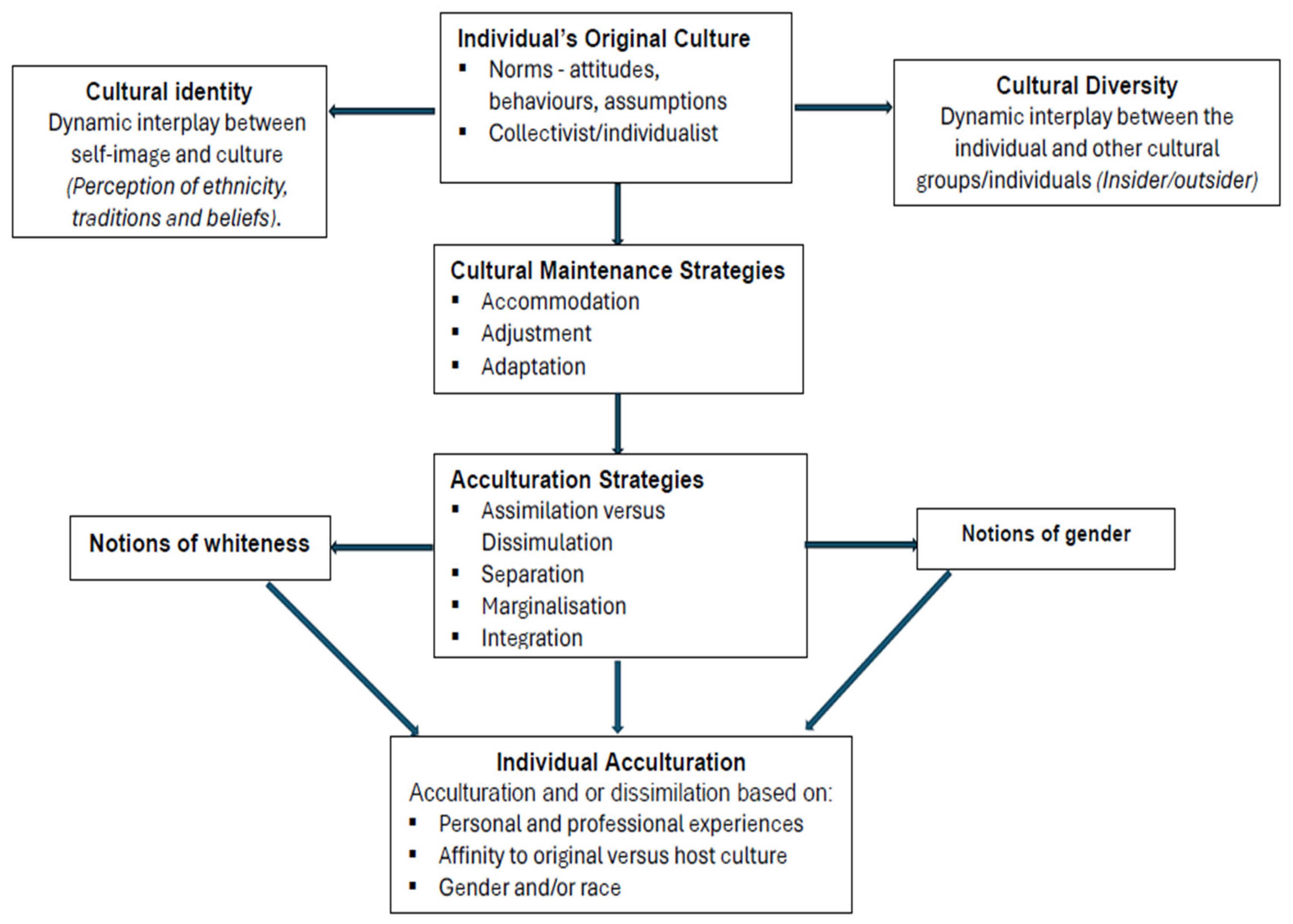
Based on the findings of this study, this article presents an individual-level conceptual framework (
Figure 1) that maps the interplay between cultural maintenance strategies, personal characteristics (such as race and gender), and outcomes related to identity, social integration, and mental health. This framework is situated within wider scholarship on acculturation and intersectionality (Berry [
28]; Ward and Geeraert [
29]). This reflects contemporary theorising that emphasises the interaction of cultural practices, values, identifications and structural context in shaping acculturative outcomes (Schwartz et al. [
30]). Abur [
2] reinforces this by showing how African migrant’s settlement experiences review both opportunities and systemic challenges, underscoring the importance of contextual factors in shaping acculturative outcomes.
Arrows indicate the directional relationships among components of the acculturation process. Straight vertical arrows represent the sequential flow from an individual’s original culture through maintenance strategies to acculturation strategies and onward to acculturative outcomes. Straight horizontal arrows show the influence of acculturation strategies on notions of whiteness (left) and notions of gender (right), while angled arrows from these contextual factors point downward to illustrate their shaping effect on individual acculturation outcomes.
This framework highlights the non-linear, context-sensitive nature of acculturation, shaped by power dynamics and the salience of identity. It illustrates how intersectionality compounds acculturative stress; for example, female leaders from collectivist cultures may simultaneously encounter gendered expectations and ethnic stereotyping, increasing the emotional labour of code-switching. Moreover, the framework recognises that acculturation unfolds over time: initial phases of separation or assimilation may give way to emergent integration as individuals accumulate cultural capital, develop local networks and receive targeted support. This temporal dimension reinforces the view that acculturation is not a one-off transaction, but an evolving journey marked by gains, setbacks and periodic renegotiations of identity.
Critically, the preference for integration in theoretical models often belies the structural barriers that CALD leaders encounter. Rigid institutional policies, unacknowledged offshore qualifications, and the persistence of microaggressions can all conspire to channel newcomers toward assimilation or dissimulation as mere survival strategies. Organisational receptivity, manifested through mentoring programmes, clear career-pathway frameworks and genuine diversity commitments, become a decisive factor in enabling or constraining integration (Khalifa et al. [
37]; Fernandes and Pate [
38]). Colic-Peisker and Tilbury [
39] further demonstrate how segmented labour markets confine refugees and migrants to, mirroring similar exclusionary dynamics in education. In the absence of supportive structures, talented leaders may feel compelled either to suppress their cultural identities or to retreat into insular networks, with attendant implications for both their well-being and their capacity to contribute fully to school communities.
Notably, the inclusion of dissimulation foregrounds the emotional labour inherent in “passing” as a member of the host culture. The conceptual framework presented in
Figure 1 draws on broader scholarship on emotional labour (Hochschild [
40]; Sue et al. [
24]) to highlight the psychological costs of sustained monitoring of language choice, non-verbal cues, and appropriate self-presentation. These demands heighten vulnerability to stress and burnout. Organisations are therefore called upon to recognise this hidden labour by embedding well-being supports, such as reflective supervision, peer-support circles, and access to culturally informed counselling, into their leadership development frameworks. By doing so, schools can signal that they value not only the professional contributions of CALD leaders but also their holistic well-being, thereby fostering environments in which integration becomes a genuine possibility rather than an aspirational ideal.
Within
Figure 1, whiteness is positioned as an unmarked norm against which all other racial and cultural identities are measured, particularly in Australian schools. This insight is supported by the studies carried out by Wilkinson and Bristol [
41] and Rogers and Mosley [
42]. Furthermore, Matias [
43] and Tascon [
44] collectively demonstrate how Anglo-masculinist perspectives dominate leadership norms and sustain inequality. Aveling [
45] adds to this narrative by suggesting that anti-racism in schools is fundamentally a leadership issue, requiring leaders to change entrenched cultural hierarchies. These perspectives highlight that challenging the myth of meritocracy and exposing the structural supports of whiteness are crucial steps towards building inclusive school cultures.
The framework synthesises intrapsychic, social-structural, and role congruity theories to elucidate how gendered expectations intersect with race to influence the CALD leaders’ experiences. From an intrapsychic standpoint, Ayman and Korabik [
46] examine gender schema and identity, emphasising how internally held beliefs about traits, attitudes, and values associated with gender roles shape self-perception and conduct, often compelling women, particularly those from minority backgrounds, to negotiate between cultural heritage and prevailing workplace norms. The social-structural perspective, as articulated by White and Diekman [
47], underscores the ongoing gendered division of care labour, which constrains career advancement and reinforces stereotypical notions of leadership. Role congruity theory, proposed by Eagly and Karau [
48], posits that societal perceptions of leadership as inherently “male” engender a dual bias: women are perceived as less suitable for leadership, and when they exhibit assertive behaviours aligned with leadership roles, they are judged more severely than their male counterparts. For minority women, these gender biases are exacerbated by racial stereotyping, thereby intensifying the double jeopardy they face. Arifeen and Syed [
36] reinforce this by showing how minority ethnic women managers navigate intersectional challenges of fitting in, underscoring the need for systemic supports that go beyond individual adaptation. Targeted mentoring and coaching programmes are therefore essential in assisting aspiring female leaders to develop resilience and navigate intersecting barriers (Fernandes & Pate [
38]).
Finally, this article focuses on the micro-level analysis of individual acculturation while considering broader policy implications. It argues for induction programmes that are tailored to diverse acculturation trajectories rather than relying on a one-size-fits-all orientation (Fernandes and Pate [
38]). Such programmes might combine orientation to institutional policies with facilitated dialogue on cultural norms, supported by ongoing coaching that acknowledges the fluctuating nature of acculturation. Educational authorities are encouraged to review credential recognition processes and partner with CALD communities to co-design leadership pathways. Santoro and Basit [
26] emphasise that without systemic support, CALD teachers and leaders are often positioned as tokenistic “cultural experts”, reinforcing the need for co-designed pathways that embed diversity meaningfully. By decentralising decision-making and co-creating inclusive practices, schools can move beyond performative diversity statements to cultivate authentic, culturally literate leadership cadres.
Acculturation as a multidimensional, dynamic process encompasses behavioural adaptation, cognitive reframing and emotional regulation. The conceptual framework presented here in
Figure 1 offers a nuanced roadmap for understanding the challenges and possibilities facing CALD leaders in educational settings. By calling for tailored organisational supports and culturally responsive policies, it positions the field to move beyond reductive models of assimilation toward genuinely integrated, hybrid leadership paradigms.
4.1. Organisational Culture in Educational Settings
Conceptualising Organisational Culture
Organisational culture has been described as the invisible infrastructure that shapes how members interpret their roles and relationships. Ainscow and Sandill [
25] emphasise that culture resides in “the deeper levels of basic assumptions and beliefs” shared by members guiding everything from pedagogical priorities to interpersonal trust (p. 406). In Australian schools, such a deep-structure of culture is evident not only in formal rituals, such as daily assemblies, award ceremonies, and community open days, but also in the subtle expectations regarding communication styles, decision-making protocols, and the relative value placed on teaching versus administrative duties. This perspective is situated within wider scholarship that highlights how misalignments between individual and organisational values can lead to distrust and diminished job satisfaction (Warrick et al. [
49]). Santoro [
50] reinforces this by demonstrating that diversity and inclusion efforts in Australian schools often falter when institutional cultures fail to recognise and accommodate the lived realities of CALD educators, resulting in tensions between policy aspirations and everyday workplace experiences.
This article synthesises insights from organisational culture theory (Schein and Schein [
17]; Khalifa et al. [
37]) to show how historical legacies continue to shape Australian schools. Colonial traditions have normalised hierarchical models of leadership that often conflict with contemporary efforts to introduce culturally responsive pedagogy or distributed decision-making. Blackmore [
51] argues that neoliberal managerial reforms have reframed diversity and equity work in schools into performative, compliance-oriented practices, thereby limiting the potential for genuine cultural transformation. Similarly, Connell [
52] shows how neoliberal policy logics reshape educational priorities toward market accountability at the expense of deeper social justice commitments. A meaningful cultural change thus demands a dual focus: on visible artefacts and espoused values, and, more critically, on surfacing and interrogating the underlying assumptions that render certain behaviours unthinkable or deviant within the school context.
Organisational culture in educational institutions functions as a dynamic, living ecosystem that is continuously reproduced through daily interactions. Informal rituals, such as the arrangement of morning teas or the unspoken etiquette observed during staff-room conversations, convey significant messages regarding inclusion, hierarchy and belonging. When new staff members are informally invited to participate in decision-making discussions, they receive an implicit affirmation of their legitimacy; conversely, exclusion reinforces assumptions that “outsiders” lack credibility (Wilkinson and Bristol [
41]). Anderson and Johnson [
53] demonstrate that inclusive leadership practices, such as deliberate mentoring and participatory decision-making, are critical for shifting these dynamics.
The levels of organisational culture within educational institutions, as delineated by Schein and Schein [
17], comprise artefacts, espoused values, and underlying assumptions. In school contexts, artefacts such as uniforms and mission statements often carry layered meanings: heritage buildings may symbolise tradition and stability but also evoke colonial connotations for Indigenous and CALD staff. Espoused values are evident in strategic plans that articulate commitments, yet these may falter if underlying assumptions privilege white and Anglo-masculinist leadership norms (Sue et al. [
24]; Tascon [
44]). These underlying assumptions significantly shape decision-making processes, often privileging white male candidates in leadership selection, elevating the perceived prestige of disciplines such as STEM, and reinforcing communication styles that favour directness over relationality (Wilkinson and Bristol [
41]). Colic-Peisker and Tilbury [
39] show that similar exclusionary dynamics exist in labour markets, where refugees and migrants are confined to niches, reinforcing systemic inequities mirrored in education. While Goodman [
12] highlights how these assumptions influence recruitment and promotion, broader scholarship confirms that such tacit norms are rarely articulated yet profoundly shape everyday interactions within schools (Teasley [
54]; Warrick et al. [
49]).
Within schools, misalignment among these levels generates cultural dissonance (Hill [
55]; Thomas [
56]), eroding trust and hampering performance. For example, when a school’s published vision celebrates diversity but its promotion panels repeatedly select candidates from narrow cultural backgrounds, the message to staff is that the espoused values are tokenistic. This dissonance not only undermines morale among CALD leaders but also fosters cynicism across the broader community, reinforcing perceptions that diversity commitments are performative rather than substantive. Brussino [
57] benchmarking confirms that such gaps between policy and practice are common internationally, highlighting the need for systemic alignment. Authentic cultural transformation must therefore begin by surfacing underlying assumptions through facilitated reflection, inviting staff to share personal experiences of inclusion and exclusion, before aligning artefacts and policies to reinforce newly articulated, co-created values. Such reflective practice, supported by professional learning communities and reflexive dialogue (Khalifa et al. [
37]), enables Australian schools to move beyond cosmetic change toward genuine shifts in the collective meaning-making systems. By embedding these processes into leadership development and policy review, Australian schools can create organisational cultures that are both inclusive and sustainable.
5. Influence of Organisational Culture on Leadership Acculturation
Leadership styles and dispositions are pivotal in determining an organisation’s overall success. The manner in which leaders exercise their leadership skills can exert either a positive or negative influence on their organisations. Leadership dispositions pertain to “a leader’s general personality, demeanour, and communication patterns in guiding others toward accomplishing organisational or personal goals” (Hoyle [
58], p. 595). Within the context of school leadership, it is crucial to possess dispositions that facilitate effective collaboration with the organisation’s stakeholders. Leaders from CALD backgrounds consistently struggle to understand how their acculturation process affects their leadership dispositions and their influence within their teams.
Building on Goodman’s work ([
12]) as a foundation, this article situates CALD leadership acculturation within wider scholarship on organisational culture and leadership (Bass and Riggio [
59]; Greenleaf [
60]; Eagly and Karau [
48]). Tacit norms and power dynamics embedded in school culture function as both a lens and a filter, shaping how newcomers interpret expectations and influencing their responses to role demands. In hierarchical cultures where authority is centralised and transactional exchanges dominate, CALD leaders often adopt deferential postures, suppressing parts of their cultural identity to conform to the majority. Conversely, in schools that embrace distributed leadership, where decision-making is shared and collaborative, CALD leaders report feeling more psychologically safe when introducing culturally informed practices and hybrid leadership models. Studies of Victorian schools demonstrate that when staff-room environments encourage open dialogue and reflexivity, newcomers feel empowered to share fresh perspectives; in contrast, guarded communication and implicit gatekeeping often push CALD leaders towards survival strategies like dissimulation or withdrawal (Sue et al. [
24]). Anderson et al. [
61] further show that subtle and overt behaviours toward ethnic minority leaders are moderated by perceptions of competence, underscoring how organisational culture shapes acculturation outcomes.
Organisational culture affects both behavioural adaptation and identity outcomes. In inclusive cultures that genuinely celebrate diversity, CALD leaders feel affirmed in their dual cultural identities, thereby promoting integration and bicultural competence. Conversely, in exclusive cultures, leaders face ongoing pressure to assimilate, often sacrificing parts of their heritage to reduce friction. Leadership acculturation is therefore a joint process: while individual strategies are important, organisational culture, leadership team openness, communication norms, and symbolic gestures of inclusion ultimately shape the boundaries within which acculturation occurs (Khalifa et al. [
37]). Ainscow and Sandill [
25] emphasise that without alignment between espoused values and underlying assumptions, organisational culture risk undermining trust and inclusion.
Transactional leadership rewards following procedures and penalises deviations, offering clarity and measurable criteria, which benefits CALD leaders by reducing uncertainty and demonstrating competence. However, it can hinder innovation due to strict compliance and bureaucratic protocols. While objective metrics promote fairness, overemphasising outcomes may marginalise relational and emotional leadership aspects in which CALD leaders excel (Hoyle [
58]). Transactional leadership thus provides predictability but struggles with complex, cultural challenges that require adaptive responses. Goodman [
12] recommends CALD leaders learn to navigate transactional systems for legitimacy while fostering spaces for relational and transformational leadership. Drysdale et al. [
62] illustrate how successful Australian school leaders balance transactional clarity with transformational vision, reinforcing the need for hybrid approaches.
Transformational leadership acts as a catalyst for cultural change, with CALD leaders using vision, trust building and vulnerability to bridge cultural gaps (Bass and Riggio [
59]). Case studies highlight leaders who draw on migration stories to promote inclusivity and solidarity, demonstrating how narrative and empathy can strengthen organisational cohesion. However, without organisational supports such as mentoring, coaching and reflective dialogue (Fernandes and Pate [
38]), transformational goals risk failure, leaving CALD leaders vulnerable to misunderstanding and tokenism. Buchanan and Chapman [
63] add that faith-based schools internationally face similar challenges, in which transformational leadership must be supported by institutional structures that succeed.
Servant leadership, rooted in Greenleaf’s [
60] model, aligns with many CALD cultural traditions of harmony and care. Studies show that servant leadership emphasises stewardship and responsibility, yet in contexts that equate leadership with assertiveness, servant leaders may be perceived as lacking authority. CALD leaders therefore blend servant values with strategic communication, linking empathy and collaboration to organisational goals, student engagement and community ties. This approach demonstrates that communal values can enhance performance and foster a positive school culture. Eacott and Asuga [
64] highlight that servant and relational leadership traditions resonate strongly in African school contexts, reinforcing the global relevance of culturally grounded leadership dispositions.
6. Organisational Enablers of Acculturation
Within its organisational culture, there are both formal and informal mechanisms through which schools can deliberately facilitate the acculturation of CALD leaders. Goodman [
12] identifies the presence of robust diversity and inclusion policies as foundational, noting that articulated, consistently enforced policies signal to newcomers that their cultural identities are valued rather than peripheral. However, policy alone is insufficient unless accompanied by targeted cultural-competency training co-designed with CALD staff. Such training educates the broader community about diverse norms and practices and affirms the legitimacy of CALD leaders’ cultural identities (Khalifa et al. [
37]) Mentoring and sponsorship programmes are crucial enablers (Fernandes & Pate, [
38]). Mentoring provides psychosocial support and skill development, whereas sponsorship involves senior leaders advocating for protégés in promotions and facilitating networking. Research shows that combined mentoring–sponsorship models accelerate integration by offering both emotional support and strategic advocacy, thereby opening previously closed doors (Eagley & Karau, [
48]). Coleman and Campbell-Stephens [
40] reinforce this by showing that Black and minority ethnic school leaders in the UK benefit most when mentoring is combined with advocacy, highlighting the transferability of such models to CALD contexts in Australia.
Symbolic recognition, such as celebrating cultural events, showcasing CALD leaders in school communications, and naming spaces after diverse heritages, embeds cultural differences within the school’s narrative. These enablers create a practical ecosystem for integration, turning acculturation from an individual challenge into a shared organisational commitment. The Australian Institute for Teaching and School Leadership [
5] emphasises that visible recognition of diversity in leadership pipelines is critical for embedding inclusion into school culture.
7. Organisational Barriers to Acculturation
Structural and cultural obstacles that impede CALD leaders’ acculturation are interrogated when the pervasive myth of meritocracy, the belief that talent and effort are the sole determinants of success, is challenged. Wilkinson and Bristol [
41] argue that notions of merit in educational leadership are culturally constructed, often obscuring the ways that social capital, cultural fit, and access to influential networks shape leadership advancement. The frequent devaluation of overseas qualifications and experience perpetuates deficit narratives rather than recognising their capabilities (Thomas, [
56]). Colic-Peisker and Tilbury [
39] demonstrate how segmented labour markets confine migrants and refugees to niches, a dynamic mirrored in education, where CALD leaders’ credentials are undervalued.
Racial microaggressions further erode psychological safety by sending recurring messages that cultural differences are unwelcome (Sue et al., [
24]). Goodman’s [
12] analysis reveals how these barriers interact synergistically. When overseas credentials go unrecognised in performance reviews, and when microaggressions punctuate everyday interactions, CALD leaders may internalise feelings of inadequacy and retreat into separation or dissimulation strategies. Excessive administrative workloads, intensified by growing compliance demands and chronic time poverty, significantly undermine school leaders’ capacity to engage in strategic leadership, relational work, and innovation (Creagh et al., [
65].
Addressing these entrenched barriers requires systemic interventions, policy reforms, bias-interruption training, and workload equity audits, rather than piecemeal solutions at the individual or team level. This aligns with broader scholarship emphasising that organisational transformation must be systemic to achieve genuine inclusion (Khalifa et al., [
37]). The Australian Human Rights Commission [
3] similarly argues that cultural diversity in leadership remains critically underdeveloped in Australia, reinforcing the urgency for systemic reform.
8. An Expanded Conceptual Framework of CALD Leadership Acculturation Through Individual and Organisational Factors
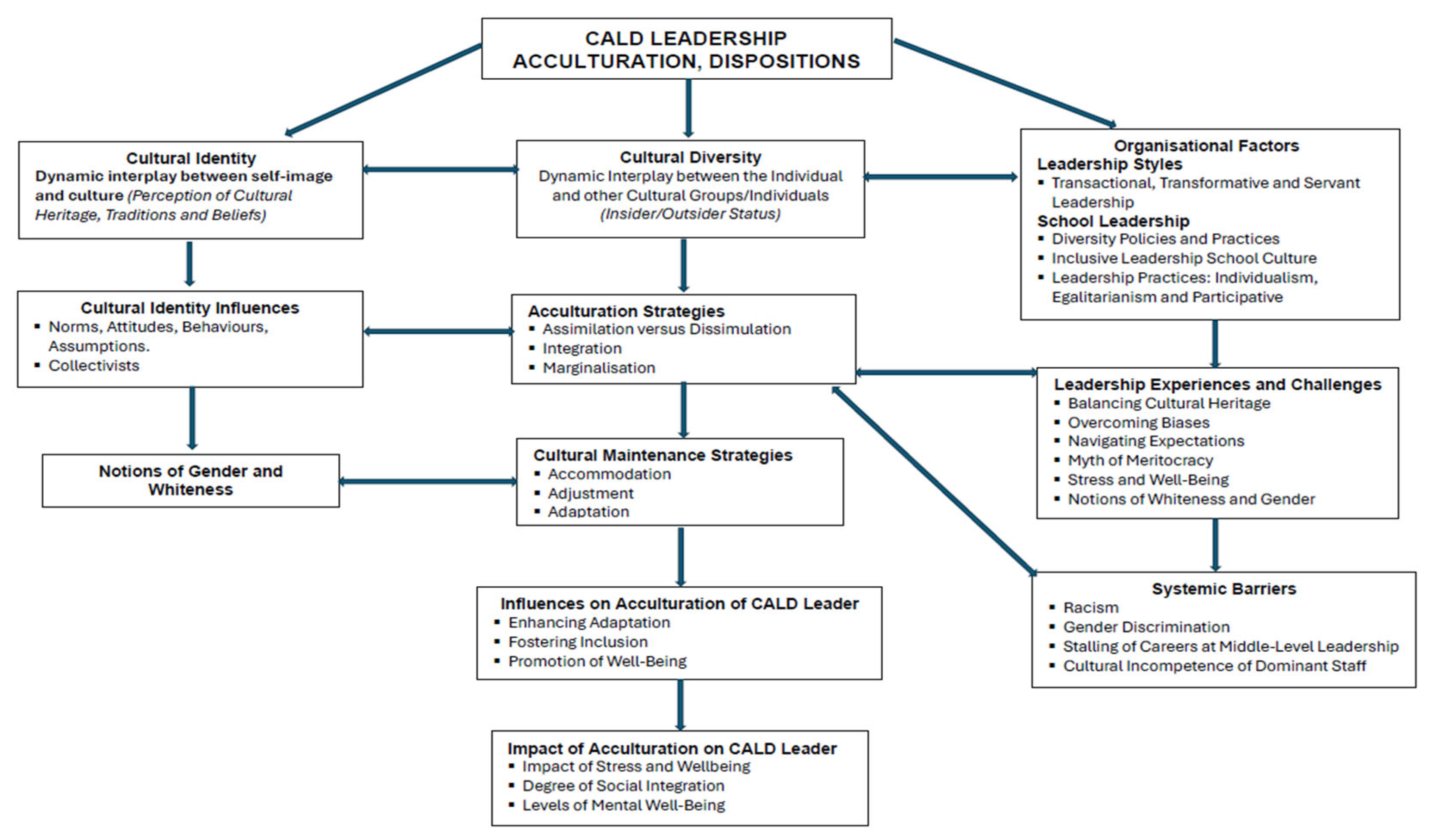
Goodman’s [
12] study combines both individual and organisational acculturation strategies within a comprehensive conceptual framework that outlines the interactions among personal identity factors, acculturation methods, leadership styles, and systemic supports or barriers. This multi-layered framework (
Figure 2) connects personal experiences, such as encounters with racism or gender bias, with systemic elements, including policies, leadership approaches, and support mechanisms. It offers a lens for understanding how CALD leaders navigate identity, agency, and effectiveness within educational settings, drawing on Vertovec’s [
23] conceptualisation of acculturation as a long-term, iterative process characterised by repeated cycles of adaptation, feedback, and identity renegotiation. Berry [
66] reinforces this by conceptualising acculturation as an ongoing negotiation between heritage and host cultures, highlighting its iterative and cyclical nature. Within this framework, effective integration strategies create positive feedback cycles: as CALD leaders demonstrate impact through culturally responsive initiatives, organisational commitment to diversity grows, leading to more enablers and fewer barriers over time. Conversely, ongoing systemic obstacles may trigger defensive acculturation strategies, such as assimilation or dissimulation, which further entrench exclusionary norms. By mapping these dynamic interactions, the framework offers both an analytical perspective and practical guidance for policymakers and practitioners designing leadership pathways. It encourages educational stakeholders to move beyond static diversity checklists toward dynamic, context-aware approaches that promote genuinely inclusive school cultures (White & Diekman, [
47]).
Arrows indicate directional relationships among components: vertical arrows represent sequential processes, horizontal arrows denote cross-domain influences, and diagonal arrows illustrate mutually reinforcing or interconnected effects across the framework.
This expanded framework builds on the framework shown earlier in
Figure 1. It stresses organisational elements that influence leadership acculturation and explores their overall effect on promoting acculturation, inclusion, and well-being. The literature identifies three main leadership styles: transactional, transformational, and servant leadership. Each style offers a different pathway for supporting leaders as they navigate the acculturation process. Transformational leadership drives change and growth; transactional leadership provides clarity and structures; and servant leadership highlights empathy and stewardship. Together, these styles illustrate how leadership practice interacts with organisational culture to shape CALD leaders’ acculturation trajectories. Drysdale et al. [
62] demonstrate that successful Australian leaders often blend transactional clarity with transformational vision, underscoring the importance of hybrid leadership approaches in diverse contexts.
The framework also incorporates the myth of meritocracy, highlighting its illusory nature and the systemic enablers that benefit non-CALD leaders. Stress and well-being are emphasised as critical dimensions, underscoring the mental and emotional effects of acculturative experiences. Tackling these issues is crucial for protecting leaders’ overall well-being and preparing them to handle related stress. Arifeen and Syed [
36] suggest that minority women managers often face compounded stress due to intersectional barriers, reinforcing the need to embed well-being supports into leadership pathways.
Ultimately, these influences impact identity, social integration, and mental health. This comprehensive framework underscores the importance of supportive environments and inclusive practices in enabling successful integration and enhancing well-being, offering a roadmap for schools seeking to cultivate diverse and resilient leadership. The Australian Government’s Department of Education [
67] highlights that inclusion and diversity strategies must be embedded at systemic levels to ensure CALD leaders are supported across both individual and organisational dimensions.
9. Implications for Policy and Practice
The theoretical insights from Goodman’s [
12] work have important implications for policymakers and educational practitioners. However, broader scholarship confirms that acculturation is a multidimensional process shaped by organisational culture, leadership styles and systemic supports (Khalifa et al., [
37]; Wilkinson & Bristol, [
41]). First, recognising the diversity of acculturation strategies highlights that one-size-fits-all induction programmes for CALD leaders are inadequate. Flexible frameworks are needed that support different levels of cultural preservation and adaptation, allowing leaders to integrate their heritage while navigating organisational expectations (Vertovec, [
23]. Lingard et al. [
4] demonstrate that data-driven accountability frameworks in Australian schooling, particularly those built around NAPLAN and PISA redefine equity through performance metrics, reinforcing the need for differentiated induction and leadership pathways that recognise the diverse cultural backgrounds and contexts of CALD leaders.
Second, improving cultural competency across all staff through professional learning communities, reflective dialogues, and experiential training can help reduce unconscious biases and foster genuine inclusion. Embedding these practices into ongoing professional development ensures that cultural awareness is not treated as a one-off initiative but as a sustained organisational priority. Gay [
68] reinforces this point, demonstrating that tokenistic multicultural practices are common in schools and teacher education, and that meaningful cultural competence requires embedded, ongoing professional learning.
Third, implementing mentorship and sponsorship programmes tailored to CALD leaders can promote integration, strengthen networks, and ease feelings of isolation. Evidence shows that sponsorship, in particular, accelerates career progression by providing access to influential networks and advocacy in promotion processes (Fernandes and Pate [
38]). Coleman and Campbell-Stephens [
40] demonstrate that minority ethnic school leaders benefit most when mentoring is combined with advocacy, highlighting the importance of sponsorship in breaking systemic barriers. Building on this, Santamaría and Santamaría [
69] argue that equity-driven leadership requires organisational cultures to intentionally embed structures that support the advancement of marginalised leaders, including developmental relationships such as mentoring and sponsorship. Their work emphasises that culturally responsive and socially just leadership practices must be woven into everyday organisational routines so that inclusion becomes sustained rather than episodic.
CALD middle-level leaders in Australian schools manage dual acculturative processes: personal adaptation and alignment with deeply rooted organisational cultures. Goodman [
12] identifies transactional, transformational, and servant leadership styles as important approaches. Transactional leadership provides clarity and structure; transformational leadership motivates change with a vision; and servant leadership focuses on empathy and support. Transformational leadership, in particular, can help bridge cultural gaps by rallying different stakeholders around common goals, while servant leadership resonates with communal values that emphasises care and stewardship (Bass & Riggio, [
59]; Greenleaf, [
60].
Organisational enablers, such as diversity and inclusion policies, targeted cultural competency training, and mentoring schemes, drive integration. Conversely, barriers such as the myth of meritocracy, credential devaluation, heavy administrative workloads, and microaggressions undermine CALD leaders’ well-being and effectiveness, increasing stress and ultimately hindering effective leadership (Wilkinson and Bristol [
41]; Sue et al. [
24]). Similarly, Brussino [
57] benchmarking confirms that gaps between policy and practice are common internationally, reinforcing the urgency of systemic reforms. Thus, as Weldon [
70] highlights, systemic workforce planning must address diversity gaps to ensure representative leadership pipelines.
10. Conclusions
This article is derived from Goodman’s doctoral research, but it extends beyond the thesis by synthesising broader scholarship and offering practical policy implications. In response to the research question, the experiences of CALD middle-level leaders demonstrate that acculturation is shaped by both individual strategies and organisational culture. Their leadership practice evolves through negotiation of identity, systemic barriers, and organisational enablers, resulting in hybrid forms of leadership that enrich school communities.
The article has presented an expanded conceptual framework that connects cultural definitions, acculturation processes and organisational dynamics, underscoring acculturation as multidimensional and iterative, marked by cycles of adaptation, feedback and identity renegotiation. By linking individual and systemic perspectives and drawing on wider scholarship, it highlights how CALD leaders navigate identity, social integration, and well-being in complex school environments.
Importantly, the discussion offers practical insights for stakeholders. For example, mentoring and sponsorship programmes, bias-interruption training, and culturally responsive induction processes can support CALD leaders’ integration and advancement. The findings from this study suggests that CALD leaders thrive when organisational cultures actively dismantle barriers such as credential bias and microaggressions, and when relational trust is fostered through inclusive leadership. These observations are reinforced by broader evidence that systemic reforms, rather than tokenistic diversity statements, are necessary to achieve genuine inclusion.
While this analysis is situated within Australian schools, the framework has global resonance. Educational systems worldwide are grappling with increasing cultural and linguistic diversity, and the findings here offer transferable lessons for international policy formation and leadership development.
In summary, acculturation is not a one-off transaction but an evolving journey. Explicitly answering the research question, this study shows that CALD middle-level leaders’ acculturation is shaped by the interplay of individual strategies (identity negotiation, bicultural competence) and organisational culture (policies, leadership styles, enablers and barriers). By recognising this interplay, schools can move beyond tokenistic diversity statements to cultivate authentic, culturally literate leadership cadres.