1. Introduction
Contemporary news cycles frequently feature reports of “natural” disasters—tornados, earthquakes, and floods—that drastically impact urban settings. Hurricane Katrina’s impact on New Orleans in 2005 was one of the first of these disasters that was widely viewed over the 24 h cycle of cable TV’s “breaking” news reportage that had become normalized after the broadcast response to 11 September 2001 [
1]. During and after Hurricane Katrina, New Orleans became a study in urban trauma and response that is considered something of a touchstone, both for disaster management and for considerations of how to reconstruct the city’s social and material contexts [
2,
3,
4,
5,
6]. Apart from its environmental impact, Hurricane Katrina was particularly shocking for how it revealed issues about racial disparities in the USA and the difficulties of managing effective urban design and development in relation to social justice, equity, access, and inclusion. The issue of managing housing in New Orleans was particularly acute, with the crisis in affordable, well-designed homes only increasing since 2005, now being a central concern for cities around the world [
7,
8,
9]. The focus of our paper is a detailed explication of the
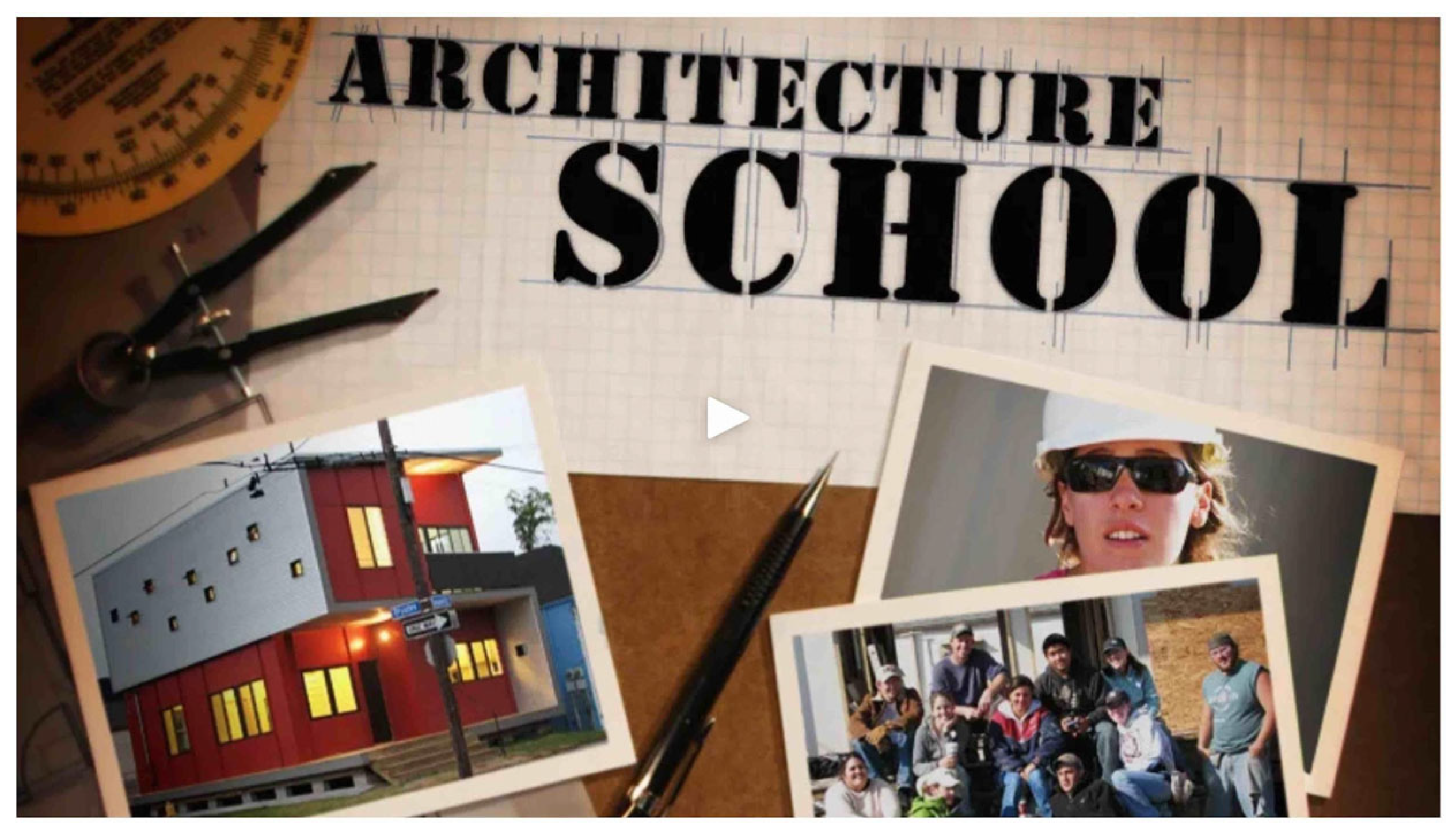
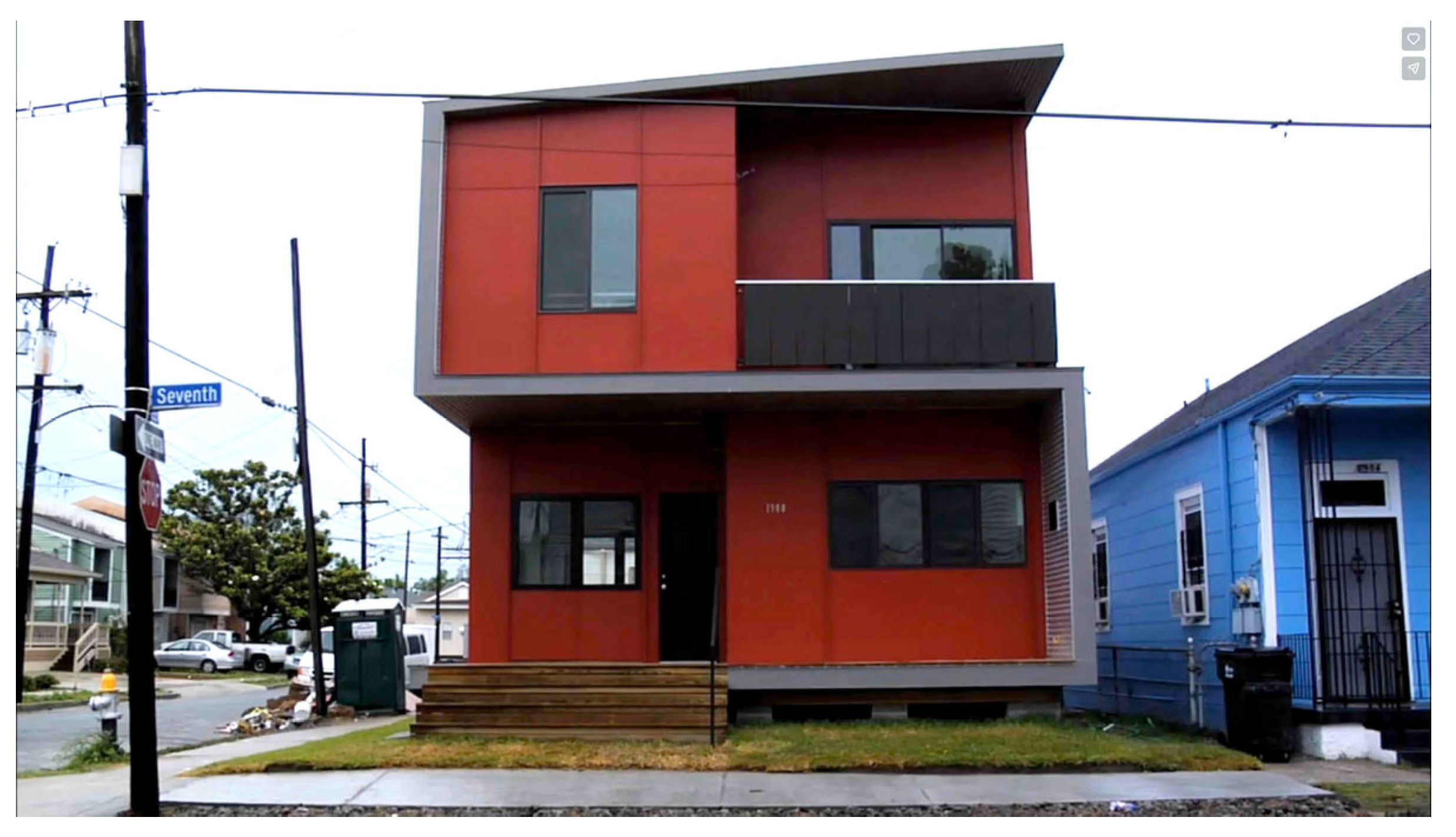
Architecture School TV series: six half-hour episodes that showcase the activities of Tulane University architecture students as they design and build new homes in the situated context of (post-Katrina) New Orleans, in the neighborhood of Central City [
Figure 1].
Architecture School was produced and directed by Michael Selditch (working with co-creator Stan Bertheaud) between 2007 and 2008 and broadcast in the USA on the Sundance Channel in 2008 (the complete series is available to view for free at selditch.com [
10]). The show was highly praised for its accuracy, winning the #1 documentary (limited TV series) award from the International Documentary Association [
11] and lauded by
Time Magazine as one of that year’s top ten TV shows [
12]. Although
Architecture School was broadcast just a few years after Hurricane Katrina, the show remains important today for the salutary lessons it offers about the practice of socially conscious design and design education in urban contexts that are still found today, that is, the contexts of challenging administrative policies and the disadvantaged socio-economic conditions of many citizens.
Considering a documentary-style, reality TV series in relation to the topic of critical design thinking and social innovation in the urban environment might seem unusual, but here we consider critical design thinking in terms of this Special Issue’s call for papers, wherein the “problem-identification and problem-solving,” and the making activities of designers “respond to social issues” with the aim to improve “equity, access, and inclusion” [
13]. Architects working in a critical design thinking orientation create homes and other built environments that emerge from contexts of social conscience and that seek to respond to “community-driven” (ibid) needs. With reference to the “inside/outside” theme of this Special Issue, our paper outlines how
Architecture School’s close-up presentation of an insider’s view of architectural design and education contrasts with its depiction of the outside world’s circumstances of bureaucratic governance and the persisting conditions of systemic inequity. (Discussion of how
Architecture School relates to the work of theorists of critical design thinking is outlined in the Findings
Section 3.1).
We perceive Architecture School to be an effective portrayal of designers working within a critical design thinking framework, as they seek to respond to the complex challenges of social precarity and environmental challenge through providing innovative (home) design for members of a historically marginalized community. As such, Architecture School is a media text that deserves to be widely recognized and studied today for its comprehensive portrayal of the processes of critical design thinking (and building). However, what makes Architecture School, and our discussion of it, particularly valuable, is that, as well as portraying the ideals and successes of transformative social innovation through design, the TV series and our paper also show some of the challenges of these ideals. Here, we draw attention to how, in Architecture School, the well-intentioned aims of the designer-builders to foster equity, access, and inclusion encounter structural obstacles that constrain the designers’ abilities to fully meet their goals.
Architecture School also remains relevant and important today because many members of the general public continue to learn about design and design practice through televisual depictions [
14,
15]. This means that many people have a limited understanding of design, particularly of architecture. This is due to many of the design-focused documentary-style or “reality TV” shows in North America and the UK [
16,
17] featuring (Western) architecture in aspirational and/or transformational terms, where the neoliberal promise of beautiful, “good” design for social elites is the usual outcome [
18,
19,
20,
21,
22]. We are thinking here of, e.g., the successful, long-running, and internationally distributed television series
Grand Designs [
23,
24]. In contrast,
Architecture School presents the wide-ranging practical and ideological underpinnings of architectural design undertaken in the constrained setting of urban precarity and within the dominant cultural and political values of city planning and governance.
Architecture School shows the viewing audience the “socio-materiality” of architectural practice (i.e., its social interactions and tensions, as these are entwined with the complexities of its physical and technological materiality) without the explanatory instruction of “talking head” experts [
25,
26]. That the voices of all the participants shape the narrative, and the audience’s understanding, is important. The political questions of “Who speaks? Who is spoken to?” [
27] are answered by the series, as the episodes include the expressions of all, including those experiencing extreme hardship (e.g., Caroline, see excerpt 4 below). In this way,
Architecture School serves as an important corrective to the usual aspirational and didactic televisual depictions of design outlined above.
Architecture School’s unvarnished depiction rather than instructive justification of the entwined circumstances of designing, building, administrating, and home acquisition draws its audience in, enabling them to make their own critical interpretations of design’s capacity to act as a driver of social innovation.
While, as noted above,
Architecture School both falls into the category of and is a contrast to most TV-based depictions of (home) design, the TV series also offers nuanced instruction about the goals and dilemmas of architectural education, particularly when it aims to provide for underserved populations. As a case study of Tulane University’s award-winning URBANbuild program for “design-build” education,
Architecture School shows students as they both plan and construct a full-scale home (
https://urbanbuild.tulane.edu). The TV series depicts design–build as a mode of teaching and learning that challenges aspects of the dominant norms found in much architecture education, wherein the focus is on the challenging and experimental aesthetic and spatial outcomes associated with a “high design” [
28] approach.
In traditional architecture education, such outcomes are typically presented as representations (drawings and models) rather than as “really built” structures. In contrast, “design-build” is a pedagogy that aims to foster within its students the ability to plan aesthetically interesting structures that will actually be constructed for and be used by “real” people [
29,
30,
31]. This stance towards teaching and learning means that students work with “real” materials and building techniques in an institutional culture that is situated in interdisciplinary teamwork (students work with educators and trades professionals) and that engages with “real” clients, building-code requirements, and budgets [
32,
33,
34,
35]. (“Design-build” is also often referred to as “live projects” education, particularly in the UK [
36]). The differences between the norms of typical architecture education and the design–build education presented in
Architecture School is characterized by Doerfler, who notes that “design-build projects provide holistic student experiences that are lacking in traditional architecture education. Design-build combines theory and practice, drawing and building, empathy, and social engagement” [
37] (p. 71).
The people that design–build education designs for are often members of non-profit organizations, individuals who are experiencing challenging economic circumstances, and/or other persons who typically would not have access to the services of professional designers. Because of its frequent orientation to providing structures for (relatively) disenfranchised groups or individuals, design–build education is often linked to the concepts of “socially-conscious” or “public-interest” design [
38], and so it may be referred to as “public-centered” or “community-design” education [
39]. A public-interest design approach is aligned with the aforementioned area of critical design thinking, as its practices and outcomes are centered on human needs (rather than primarily on the visual and material qualities of buildings). Public-interest designers value working for underserved groups as they put their “creative abilities to practical use” to “improve the quality of life in communities” [
40]. When such public-interest, social justice-oriented design is practiced through designers collaborating closely with end users, the approach is often referred to as “participatory design” [
41]. Although the
Architecture School students are shown consulting with community members in a focus group meeting, they are not depicted in consistent, collaborative encounters with such people. Therefore, the TV series can be understood as presenting design–build education within the context of “public-interest” critical design thinking rather than through the framework of participatory design.
Despite or perhaps, in part, because of the challenges of practicing sophisticated, socially conscious architecture for local communities, design–build education is often popular with students, with hundreds of courses now offered around the world [
42]. The URBANbuild program itself, featured in
Architecture School, is still going strong, with Byron Mouton (featured as the professor in the series) still guiding students as they annually build a home in a district of New Orleans. Accordingly, we believe that
Architecture School remains a useful representation of the challenges of such public-interest design education. The show’s value lies in its straightforward depiction of design–build’s difficulties and constraints, alongside the teamwork, camaraderie, and deep learning about design and about people that this pedagogy can offer [
32,
43].
While design–build education’s dual engagement with design innovation in contexts of “the real” is of interest to us as researchers [
29,
44,
45], we are explicating
Architecture School in this Special Issue of
Societies (focused on critical design thinking) because we believe the TV show is important for how it offers both a clear description of a critical design thinking approach to creative practice and also a nuanced critique of it. Viewers of the series watch a rare, realistic portrayal of well-intentioned designers and community partners who negotiate their aims to improve equity and the access of potential homeowners to “good design” within the circumstances of an environmental disaster and the long-term social and economic marginalization of prospective buyers.
This paper considers
Architecture School’s presentation of three groups: first, the students (and their professor) from Tulane University’s URBANbuild “design-build” program; second, the administrators of the non-profit, Neighborhood Housing Services (NHS) who assist disadvantaged individuals with acquiring a home; and third, the potential homeowners themselves. In this paper’s Findings section (
Section 3), we focus on each of these groups and present and discuss characteristic segments of dialog from specific episodes. These excerpts of talk illustrate how each group is meaningfully presented on the show in relation to the complexities, conflicts, and situated particularities of designing, administrating, and seeking home occupancy. Prior to this, in
Section 2, we outline our research context, including the methodological approaches that underpin our consideration of the TV series. We end with the Discussion and Conclusion.
We believe that
Architecture School’s message remains as important today as when it was first broadcast. The show supports the importance of “humility” [
46,
47,
48,
49] in the practice of architecture, whether or not that practice is self-consciously undertaken in the context of critical design thinking. By showing how the complex realities of designing and building are intrinsically connected to wider policies and modes of governance,
Architecture School’s presentation stands as a useful audio-visual text for scholars, design educators, students, and members of the general public who seek to engage with a text that comprehensively outlines design’s engagement with the socio-economic contexts of communities and the “real life” struggles of individuals.
2. Research Context and Methods
As authors, we approach
Architecture School with extensive professional backgrounds and previous research experience that bear directly on our interpretation of the TV series. Our reception and analysis of
Architecture School is informed by over 10 years of collaborative research on design–build architecture education in the North American higher education context and, to a lesser extent, in that of the UK and Europe. During these years (and currently), the authors have conducted extensive and comparative ethnographic fieldwork within several design–build programs in the US and Canada, interviewing and observing the interactions of students, faculty, and clients from classroom to construction site [
29,
44]. We have closely followed, researched, and written about design–build education’s intensity and drama, particularly in and through its social interactions, as well as its socio-material practices of individual and collaborative model making, prototyping, and construction [
29,
31,
44]. Since our research is conducted under the auspices of our institutional research ethics boards, the specific locations and participants we have studied are confidential. We have also informally visited Tulane University’s URBANbuild program, spoken to some of its participants, and visited several of the houses created by the architecture students (including the one featured in the
Architecture School series). This extensive knowledge underpins our analytic and interpretive positioning, which gives us confidence in our conviction that
Architecture School faithfully hews to the “realities” of design–build education.
As authors from the interpretive social sciences, we come from analytic traditions that attend closely to language (i.e., Oak, ethnomethodological social psychology, and Nicholas, socio-cultural anthropology). As specialists in the domain-specific research area of design practice, we are also oriented towards noticing material contexts. Our unique perspectives on the socio-material conditions of interactions and embodied behaviors of Architecture School’s participants shaped our interpretations as we watched the series and undertook our analyses. We were particularly sensitive to how sociability was entwined with circumstances of materiality—from the actions of designing and constructing a home to the embodied experiences of those who desired, viewed, and sought to occupy it. As we watched the episodes, we especially noticed how dilemmas of creativity and inequities of opportunity were presented through talk, gesture, and the wider contexts of physical surroundings. Given the density of visual and aural material within Architecture School, our forthcoming analysis focuses on selected aspects of the series.
Our analysis of
Architecture School follows methodological approaches of discourse analysts who study (reality and documentary) TV’s talk and imagery [
50,
51,
52,
53,
54,
55], particularly in design-related contexts [
23,
29,
56]. Our research is also informed by ethnomethodological and anthropological perspectives, wherein people’s own ways of sense-making, visible through their social interactions (i.e., talk), are considered within the analysis [
57,
58,
59]. Since the TV series is unscripted, the viewers of the series, in effect, overhear the participants as they talk [
60]. This means that those watching the series both listen to the real-time sense-making of the speakers, while also themselves interpreting the meaningfulness of what is being said. The viewers of the series are particularly engaged in this interpretive action, because, as noted earlier, the show’s narrative unfolds only through the participants’ talk; there are no voice-overs to explain or assess what is happening on screen.
The authors undertook this research through first viewing the Architecture School series in its entirety, both together and independently at least twice, taking analytical notes while watching. This was an inductive process, through which we noted key “insider” terminology or language (a form of in vivo coding) used by individuals in the show, synthetic comments on important plot developments, and relational dynamics, as these were presented between different stakeholders. We also took notes on directorial and editorial choices and on the depiction of architecture education and judgments of architectural designs by different stakeholders. These notes and viewing experiences provided a range of multimodal phenomena (including participant talk, gesture, and collaborative action, alongside visual imagery, scene sequencing and cutting, episode openings and closings, etc.). We then facilitated a team discussion to identify specific, limited segments of episodes or notable interactional exchanges from each group represented in the show (i.e., students/educator; administrators; and potential occupants). By focusing the large amount of potential data into an agreed set of succinct segments that were illustrative of the central issues presented, we then undertook detailed verbatim transcriptions of these segments.
Transcripts were generated using computer-assisted transcription services and subsequently cleaned up and validated by the researchers. Transcriptions were read multiple times while also viewing their corresponding video excerpts. Imagery supported the analysis of the spoken interaction rather than being primary to our interpretation, and is presented here through selected still images taken from the series (rather than being formally analyzed as visual data). From this larger data analysis process, we determined a preliminary set of themes related to public-interest, design–build architecture education. We also achieved consensus on an analytical structure articulated around the show’s narrative arc and its focus on three main stakeholder groups—architecture students and faculty; community residents and potential occupants; and community partners as intermediaries between these two groups.
In keeping with the norms of discourse analytical and ethnomethodological approaches to analyzing social interaction, we opted to mainly focus on the talk of the shows’ participants rather than to also fully explicate the show’s visual elements, since excerpts of talk most succinctly communicate the main issues we want to focus on (i.e., the way the show presents the specific, though interconnected, challenges encountered by the three groups). Also, the talk is relevant as a focus because it is “natural” (i.e., non-scripted) and is therefore an effective presentation of participant interaction (the director created the show as a “fly-on-the-wall” documentary rather than following the more contrived, semi-scripted and structured format of “reality-TV” [
61]. Accordingly, we present some visual images here and describe some aspects of speakers’ gestures and/or their presentation on camera, but we do not analyze details of each episode’s mise-en-scene.
In the extracts of talk featured here, we represent speakers’ utterances as they were presented in vernacular speech as heard on TV. However, for the reader’s comprehension, and because we are not undertaking a very close-grained analysis of speech prosody, we have simplified the level of idiosyncrasy and naturalism present in the actual talk (see Button, Lynch, & Sharrock, 2022 on “Technical and vernacular description,” [
62], pp. 114–139). We are mindful that transcription impacts the way that participants are perceived and aim for representation that communicates both the informational content of the talk and some elements of that talk’s verbatim depiction on the show [
63,
64]. In the extracts of talk provided, on occasion an ellipse (…) is used to indicate that words have been removed. These excisions are for brevity but do not substantially alter the meaning of the utterances for the purposes of our analysis. At times, square brackets with text in them offer our own brief explanation of an utterance, and some excerpts include information about relevant gestures or other information that may otherwise not be evident to a reader.
In addition to these key methodological and theoretical influences on and approaches to our work, our analysis is informed by scholarship on public-interest architecture, especially as it is carried out through a design–build pedagogy. These influences include studies of design–build educational practice in relation to its communities [
35,
37,
39,
43,
65,
66,
67]. These works sensitized us to the nuances of power relations in community-oriented design–build (in
Architecture School, both as these relations occur between the Tulane participants and between the Tulane participants and local citizens). Accordingly, by using instances of interaction transcribed from the series and occasional references to its imagery, we attend to
Architecture School as a TV documentary that foregrounds natural talk and real experiences. We also recognize that the series is edited, and so it can be considered a “cultural, constructed fiction” [
51] (p. 8). The show’s editing presents distinct groups (i.e., architecture students, administrators, and home buyers) in a particular narrative that is actively encountered by the participants in the show and perceived by the viewers watching at home. In effect, the “real life” actions of the show’s participants are seen by the TV audience, who themselves perform the role of witness/participant [
68,
69]. As such, along with the Tulane students, the audience is also learning about some of the challenges and successes of architecture and the pedagogy of design–build.
We are not the first to write on
Architecture School as a specific (audio-visual) text, with social theorist Brenda Weber discussing the series in some depth in her chapter titled “In Desperate Need (of a Makeover): The Neoliberal Project, the Design Expert, and the Post-Katrina Social Body in Distress” (2010) [
70]. In this work, Weber describes
Architecture School as a series that serves to “fetishize the role of designers through neoliberal tropes that accentuate a racialized power imbalance… a form of reality TV replete with neoliberal messages about racial relations and free markets” [
70] (p. 194). Weber goes on to interpret and criticize the series as presenting a “logic” wherein the reasons for the mass of unsafe and crumbling shotgun shacks packed into New Orleans’s poorer neighborhoods (and occupied primarily by African American residents [
71]) seems to be [the residents’] commitment to outmoded design traditions [and their inability] to appreciate the forward-thinking represented by URBANbuild’s avant-garde design [
70] (p. 195).
A similar argument is picked up by Glynn & Cupples (2024), who position
Architecture School as a media presentation of post-Katrina New Orleans that is “ideologically conservative” [
72] (p. 76), given the show’s presentation of designing and building private instead of public housing. However, here, we argue against these simplistic readings of this TV series. We acknowledge
Architecture School’s free-market elements, e.g., the show’s premise is based on the desirability of owning a one-off, single-family home [
5]. However, we position the show as a text that succeeds as informal public education, where the TV viewer witnesses the real practices of a critical design thinking approach that occurs alongside and within the complex constraints encountered by individuals in a distressed urban environment.
As we outline below, a close reading of
Architecture School shows that it is not a straightforward depiction of a binary, “racialized power imbalance” [
70] (p. 194) between privileged (often white) architecture students and Black community members. Instead, we argue for the show’s more subtle delineation of complex networks that include a range of actors: students and a professor who are committed proponents of well-intended, socially conscious design; inadequate, obdurate, and inefficient infrastructures of government bureaucracy; and individuals whose specific circumstances challenge opportunities to benefit from those who aim to make “good” design more accessible.
3. Findings
3.1. Design–Build as Education and Critique
Architecture School’s opening episode is focused on depicting Tulane University’s URBANbuild program as an example of experiential, public-interest design pedagogy. Students are shown in their school’s design studio, but they also visit the neighborhood in which their home will be sited and are depicted as considering the area’s economic and environmental conditions. As such, the URBANbuild program is characteristic of design–build education’s frequent public-interest design stance [
35,
43,
66]. In the early segments of
Architecture School, viewers see educators as they guide the students through the early stages of designing their home and undertake the process through which an individual student’s project is chosen for building. Opening the series with a focus on design establishes the narrative arc of the series that moves from initial sketches to completed construction. However, throughout the series, students are shown as they encounter Central City citizens and neighborhood circumstances. In portions of episodes four and six, the students speak directly with locals in a focus group meeting that is specifically centered on discussing the URBANbuild house.
Design–build education’s engagement with “real” end-users, materials, tools, construction codes and practices, site constraints, etc., are accurately presented in
Architecture School. Throughout the episodes, students are depicted as they deal with issues such as materials sourcing and construction techniques. The series is also realistic in its portrayal of the students’ concurrent desire to both design in ways that are sensitive to neighborhood conditions and to design in ways that will challenge the aesthetic and structural conventions of standardized tract housing (familiar in many urban and suburban contexts [
73]).
Architecture School does not shy away from this tension for students in design–build education – to generate a structure that is both “really” functional for its occupants and “really” interesting for them to create as novice architects (as seen in the extracts of talk below). Showing such frictions is a valuable aspect of
Architecture School: the series presents its viewing audience with real dilemmas within architecture and its pedagogies that do not have simple answers, i.e., in this case, what “should” students be learning as both providers of a public-interest service to others and as innovators of form and space?
Tulane University’s URBANbuild program positions itself as a challenge to the “high design” [
28], imagination-focused orientation of traditional architecture education (as briefly described earlier). Two explicit aims of the URBANbuild program are “to provide higher quality design projects to underprivileged communities with an awareness of affordability” and to pursue “progress” through the production of “structures for families within some of the city’s most struggling neighborhoods” [
74]. Further, the Tulane program faculty state that their design–build pedagogy offers “full potential as a tool for political intervention and transformation of the built environment—leading to meaningful social change” [
75] (p. 102). As such, the URBANbuild program follows the ideals of a critical design thinking approach that considers design as an agent for the revitalization of both community and the built environment.
Tulane’s perspectives on design as offering the potential for material transformation and meaningful social change follow those established by critical design thinkers including, e.g., early theorist Victor Papanek, who argued for design to be “socially responsive” as well as “revolutionary and radical” [
76] (pp. 346–347), and well-known designer and influential author Ezio Manzini [
77,
78]. Manzini’s longstanding position is for design to be recognized as a “a champion of positive social change” [
79] (p. 77). He advocates following a three-step framework to facilitate design as a driver of social innovation. In this structure, designers engage with others to put their “design abilities to work” [
79] (p. 81). The steps to follow are, first, recognizing “something that should be changed;” then, second, imagining “a world in which this change has occurred;” and third, finding “the practical steps to realize this newly imagined situation” (ibid). Such an orderly process for design-engaged transformation is appealing though difficult to enact, as the series
Architecture School clearly demonstrates (and as Manzini himself has noted (ibid)).
Other recent critical design thinking commentators develop the idea of design’s potential to transform societies in positive ways, with, e.g., activist/design theorist Sasha Costanza-Chock noting that the first principle of the Design Justice Network is to “use design to sustain, heal, and empower our communities, as well as to seek liberation from exploitative and oppressive systems” [
80] (p. 6) and anthropologist Arturo Escobar (2018) [
81] (with de la Cadena (2021) [
82]) positing “12 principles for pluriversal designing” in which designers are urged to reject the “object-driven ontology of modernity” in favor of “creating spaces of healing, re-communalization, and re-earthing that re-establish biophysical balance through a different urban metabolism” [
82] (1:23:58).
A “pluriversal” idea posits design’s activities and impacts as occurring in more than a singular, Western context. This decolonizing and “demodern” [
83] perspective links to public-interest, critical design thinking through its concern for design practice and design education to actively aim to repair, heal, and care [
84], particularly through considering and engaging with “marginal voices” (ibid, p. 38).
Architecture School is interesting as a resource to be considered alongside such critical design thinking texts, since it serves as an example of both the elements of this approach and also as a “reality check” on its more confidently optimistic and speculative assertions. The series indicates how difficult it is for designers to improve material and/or community conditions, even when thoroughly aware of the marginalized conditions of long-term disenfranchisement and when working within established networks of organizational support. Yet, the series is not overtly negative, instead presenting a realistic and (somewhat wryly) affirmative stance that supports Manzini’s position that “those who wish to operate in the design field for social innovation must adopt a positive approach toward people and society” [
79] (p. 78).
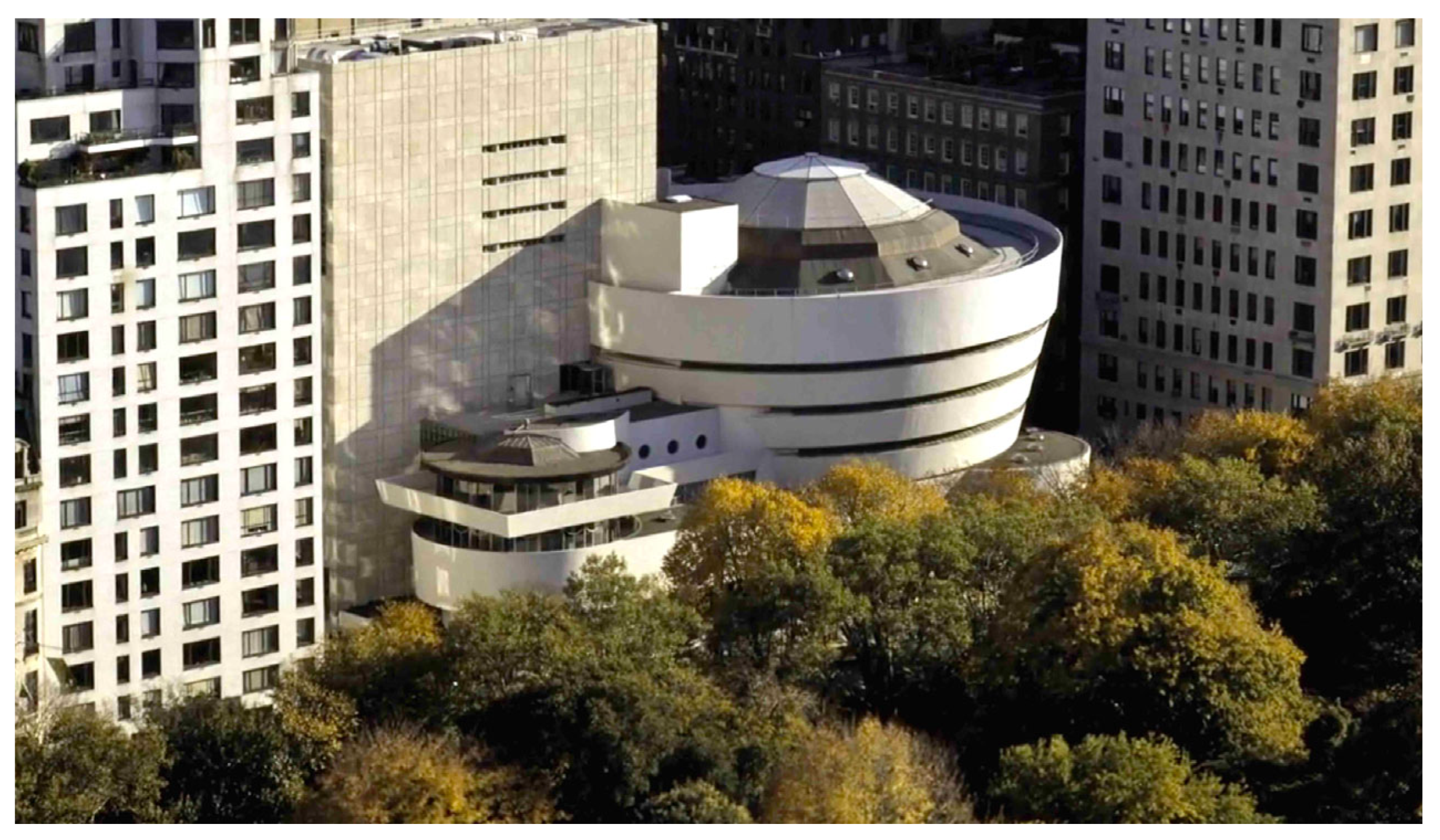
Some of the specific underlying paradoxes associated with architecture education emerge early in the series. That is, in the first two episodes we see the URBANbuild students dealing with both the program’s avowed interest in public-interest design and also its aim for students to engage with the theory-led approaches associated with the high-design educational perspective outlined earlier. For example, the series’ opener focuses on several individual students as they grapple with their home design’s “architectural concept”—the central idea for the house that each student is planning (subsequent quotations in this paragraph are from episode one). To explain what is meant by an “architectural concept,” Byron Mouton, the design–build course instructor, is shown with the students inside the Tulane studio talking about the Guggenheim Museum in New York City (while images of it are shown on screen, [
Figure 2]). This art gallery is presented as an example of a building that displays a “clear, clear concept,” with its “circulation spine” acting as a “gesture” that “can help us understand the priority of the scheme.”
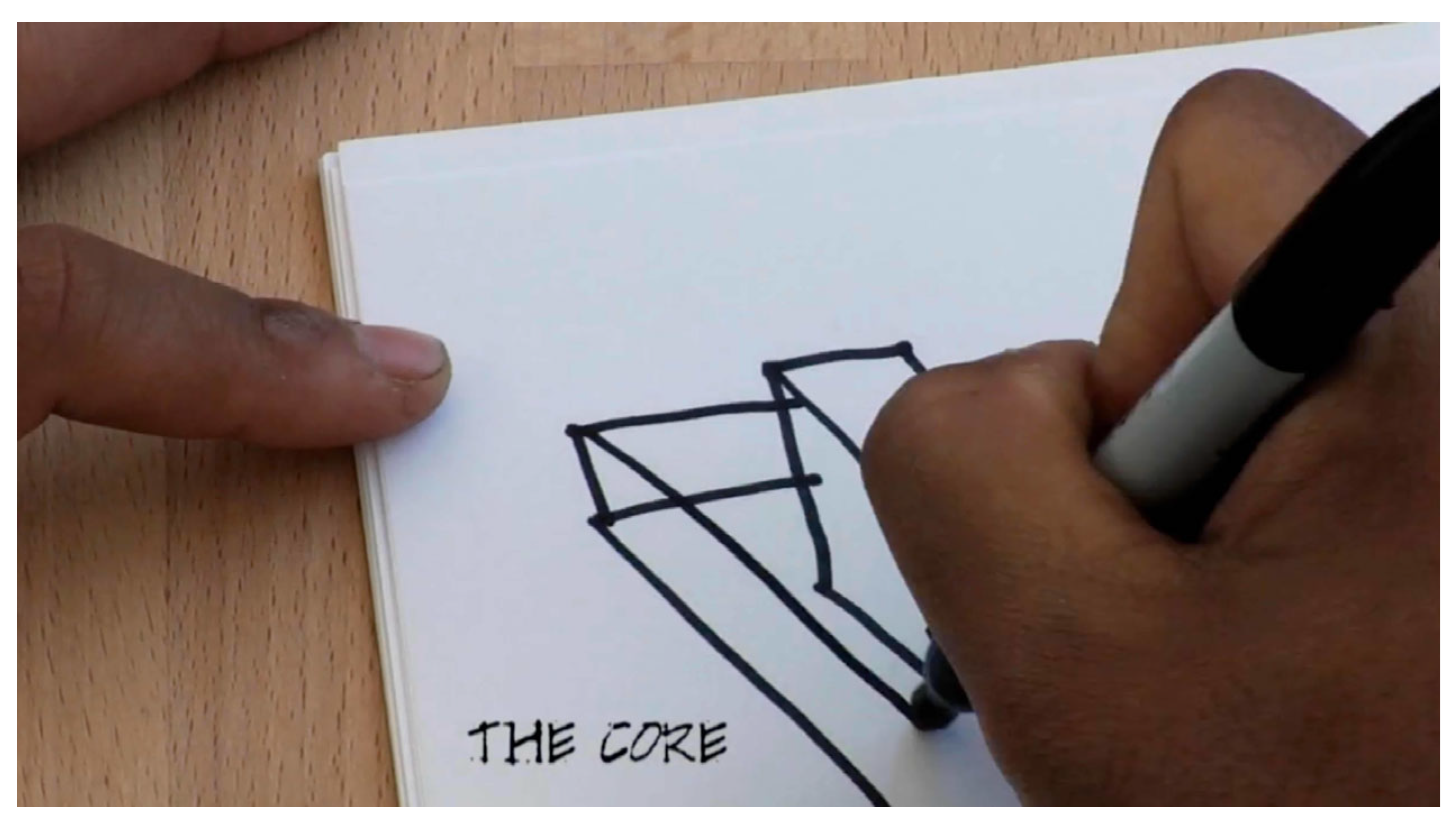
After Mouton’s words, the camera follows students as they draw and talk about their “concepts,” using the terms of architectural theory and expertise, including phrases such as, “volumes to create indoor and outdoor spaces,” a “core that houses all the utilities of the house,” and “shifting columns both vertically and horizontally” [
Figure 3]. The students are portrayed as enthusiastically engaged in the processes of planning their structurally and aesthetically innovative houses and thus are perhaps focused less on the needs of the eventual users than on the competitive nature and “high-design” [
28] concepts emphasized in this early stage of their design–build course. Each student was required to develop their own proposal, with all of these voted on by the class (shown in episode two). The model and explanation that received the most votes would go on to be the house actually constructed in the Central City neighborhood and whose development the series follows in subsequent episodes.
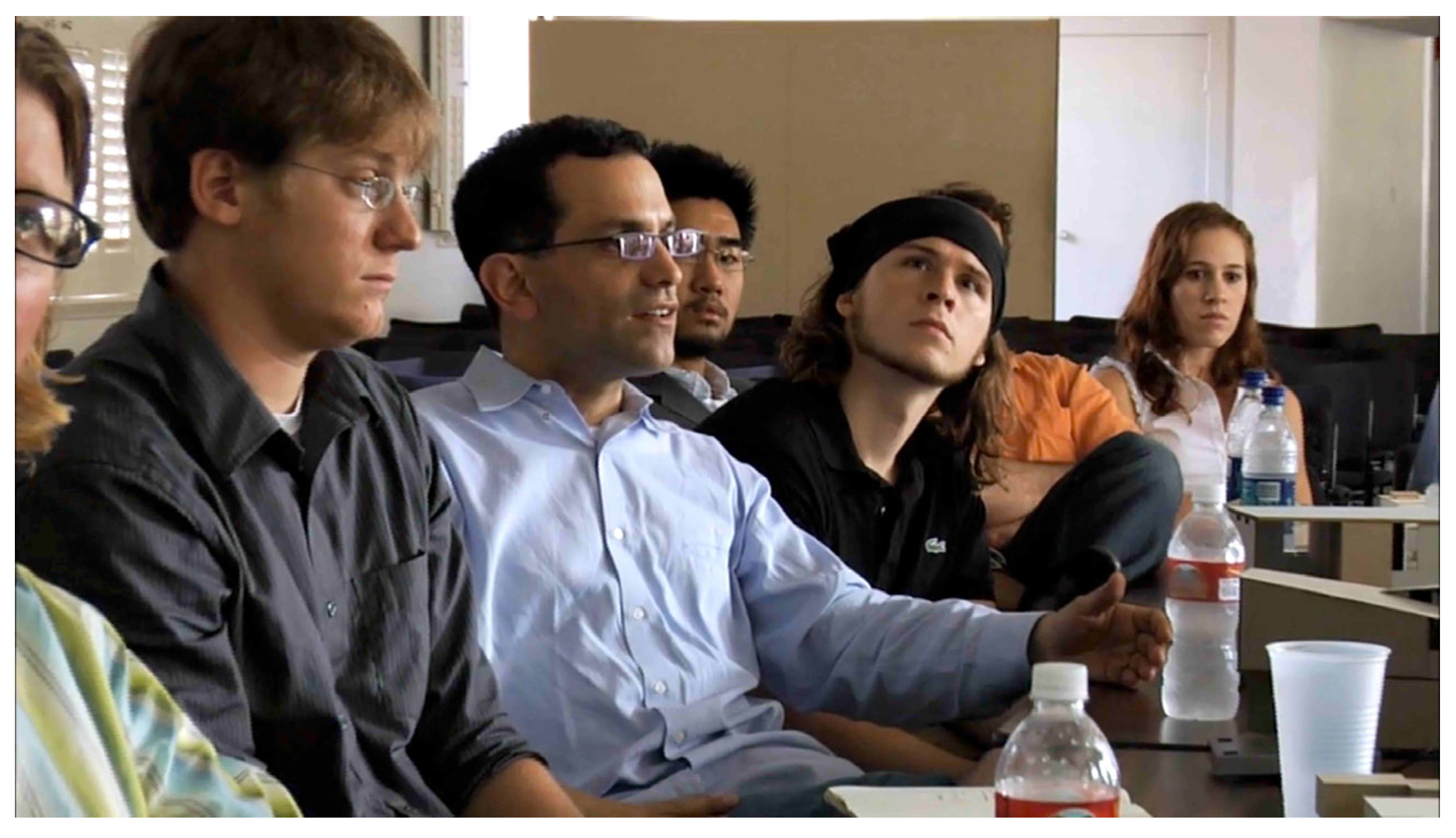
The concept models for the students’ houses receive a class review or “jury” (also known as a “crit” [
85]), which is shown in the second episode of the series. Here, we see and hear the friction between modes of speculative and aesthetically challenging design associated with traditional architectural education and the more socially conscious aspects of design–build, where the needs of users are the focus. This conflict is especially indicated when co-founder of the URBANbuild program and Dean of Architecture (at the time of filming), Reed Kroloff, critiques the students’ work [
Figure 4]. Below are excerpts of talk from the critique, indicating, first, Kroloff’s assessment of the student, Nik, whose work Kroloff believes features a rather blinkered perception of neighborhood aesthetics and, second, Kroloff’s unsympathetic responses to the student Amarit’s lack of attention to the lives of the home’s potential occupiers.
| Excerpt 1: | The Review: Nik (student) and Kroloff (Dean and professor) |
| Nik: | My scheme is a very form-driven idea. I started with a system of placing windows where material change happens. I kinda made these minimal openings |
| Kroloff: | Is that a rule that’s driven by construction or is that a rule that’s driven by what is best for the client living inside of it? |
| Nik: | Construction |
| Kroloff: | Okay so do you think that’s probably the best kind of rule to set? |
| Nik: | No but I thought it gave way to an interesting form. |
| Kroloff: | Convince me that it’s more important to obey a set of rules that you’ve devised… there is something about that elevation that you should look at and the first thing that should come to you is NO! this is wrong! |
| Excerpt 2: | The Review: Amarit (student) and Kroloff (Dean and professor) |
| Amarit: | So I began this project with a utility core… we can see this core is prevalent in every area of the house… you’re constantly engaging the core |
| Kroloff: | Why do I care? |
| Amarit: | Excuse me? |
| Kroloff: | Why as the user do I give a damn about your core… how does this make better the life of someone who lives in this house versus stoke the architectural ego of someone who wants to express their nifty idea? |
As we see in these extracts from episode two, each student begins their unscripted presentation by outlining what they consider to be the most relevant features of their project. In the work presented here, these features are, for Nik, the scheme’s form and window placement (in relation to materials used) and, for Amarit, his plan for the home’s “utility core.” In each case, Kroloff’s, pointed response questions the student’s apparent lack of concern for the “client living inside” the proposed home. These two extracts briefly outline some of the ways that design–build pedagogies face an ambivalent relationship between their public-interest, critical design thinking aims and traditional architecture education’s emphasis on aesthetics: an emphasis often embraced by the students themselves as they value opportunities to demonstrate their imaginative creativity. While the emphatic judgments of Kroloff are directed at the models presented by Nik and Amarit due to the social nature of the jury as an interactional situation, Kroloff’s comments are also heard by the students’ classmates, their professors, and the other invited critics. Of course, Kroloff’s assessments are also heard by the TV audience. In this way, the review-talk of episode two provides some moments of televisual drama that also serve to explicitly contrast the students’ inventive ideas with Kroloff’s perceptions of what the prospective occupants would prefer. Also, importantly, the talk between Kroloff and the students presents to the participants and those watching the episode a tacit but critical question faced by all who engage in public-interest architecture, whether as novice students or as professionals: how can I attend to others and respect the formal traditions of an existing neighborhood while also practicing as an inventive and innovative architect?
3.2. From the Studio to the Community
Architecture School’s second episode ends with the students in the Tulane design studio voting to select the house that they will collaboratively construct. Subsequent episodes focus on the circumstances of the Central City neighborhood, the realities of administering housing assistance for those seeking to acquire a home, and the physical conditions of house construction. The series thus moves from representations and discussions of abstract models and drawings to the students’ physically embodied activities—from pouring the house’s concrete foundation to fitting its custom windows. These collaborative building practices are depicted as exciting, frustrating, occasionally dangerous, and highly rewarding for the students, particularly in terms of their acquisition of the hands-on skills involved in construction [
30,
33]. Also shown are social activities, including the students’ on-site teamwork, the group gathering for meals or evening outings, and instances of the students having meaningful—if not always positive—engagements with members of the Central City neighborhood (not all community members welcome the students and the aesthetics of the home they are building).
One particularly relevant example of student–community engagement occurs in episode four, where a focus group meeting is held between the students and a range of interested locals. This event, held in a large, bright room, includes four of the students who are constructing the house and three Central City citizens. The meeting begins with a student asking “What do you think of the aesthetic and the design and everything?” The local participants generally like the design, with one calling it “a blessing to the neighborhood,” thus demonstrating a general willingness to embrace what the show refers to as the home’s “avant-garde design.” Nevertheless, strong concerns about the house emerge when a student asks this follow-up question: “We’ve been getting a lot of criticism about the security issues, how do you guys feel about that?” The first community member to answer says “With all these windows, in this neighborhood, it’d be a concern–it’s easy to break in.” Followed by another’s agreement, “It would be a concern for me too.” While yet another says “I guarantee that the person who buys [the house] they will protect it—if they have to put burglar bars on it, they will do it.”
This exchange between students and locals is brief but important, since it indicates to the viewer that, although the students were aware of the house’s location, they did not grasp the real impact of local conditions until they spent time there and heard detailed stories of neighborhood “crack heads” openly dealing drugs and instances of local violence. (During filming, there was a murder near the construction site, six other deaths in the surrounding area, and a student’s bag was stolen from a locked car). After hearing the circumstances recounted by local citizens in the focus group meeting, one student says “just talking to them makes me realize how important it is to talk to the people you are designing for.” These words, coming when they do in the series, imply that this importance was perhaps recognized too late since, by the time of the focus group, the students’ design had been approved and the materials purchased, so the house was constructed as planned with the large windows that locals noted were a “concern.”
By featuring the focus group interaction, this episode of Architecture School indicates to the viewing audience that decisions taken during design practice are not neutral but instead emerge through context-specific, embodied experiences; for instance, the large expanses of plate glass that feature in many suburban houses may indicate as much about the rarity of an architect’s exposure to high levels of neighborhood crime as they do about popular aesthetics in home design. Through including the focus group scene for viewers to consider, Architecture School directly recognizes the impact of urban crime on individuals and also offers a subtle critique of the students’ lack of awareness. That is, despite URBANbuild’s close ties with Central City, and Kroloff’s pointed critiques of students’ architectural desires and “nifty ideas” (as opposed to making “better the life of someone who lives in this house”), the students’ choices for the home’s design and materiality nevertheless indicated limited knowledge of some local conditions.
While architecture and its traditional pedagogies have been critiqued for being elite and out of touch, with programs such as URBANbuild set up to counter such judgments, socially oriented design programs such as Tulane’s also receive negative judgments, for example, for their paternalism [
86], ethical complexity [
34,
87,
88], and neoliberal/colonialist practices [
89,
90,
91].
Architecture School does not avoid such assessments, with students (e.g., in episode five) discussing “how some of the neighbors don’t want us here,” while other students note that people have complained about “how all these white kids are down here in these predominantly black neighborhoods, fixing up the areas.” Despite such critiques, programs such as URBANbuild are popular with students [
32,
33,
66] who value the real, hands-on achievement of creating something useful for someone else. At one point in the series, when the students read and feel discouraged by online criticisms of their project by anonymous commenters, students are overtly reminded of design–build education’s pragmatic perspective. This occurs when project manager Emilie Taylor Welty reassures the students and says “there’s always going to be people with bad things to say about what we’re doing, but the fact is, we’re doing something, and doing something is better than sitting around and blogging all day.” Through this and other scenes, we see how the realities of the “outside world” of Central City meet and contrast with the students’ level of architectural knowledge that, at this early point in their education, is mostly based on the initial, concept-focused stages of their project work.
Architecture School depicts without didactic editorializing or voice-over commentary phenomena such as student awareness of the ambivalence expressed by some Central City inhabitants concerning their presence and the realities of urban crime and other neighborhood challenges. This neutral, documentary-style approach effectively moves the onus of interpretation onto the viewer, with the audience called on to weigh the pros and cons of public-interest architectural practice. In so doing, Architecture School—through its name as a TV series—suggests that the dilemmas of such situated practices are, or should be, part of an architecture student’s education and part of the education of the TV audience. As a show, Architecture School’s ambivalence is thus an important element of its value as a text that effectively portrays the uncertainty and thereby the authenticity of local circumstances. That is, the design and construction of the house is not presented as a simplistic instance of triumphal, public-interest design. Instead, community members are shown as all too aware of the home’s limitations within its local ecology, and students are all too aware of their position (to some) as interlopers. However, what is suggested in the series as a positive element of the students’ experience is their growing awareness of the actual lived contexts within which urban building exists.
3.3. The Administrators: Mediators of Constraint
As well as focusing on the students and their design–build professors as they construct the home,
Architecture School gives sustained attention to URBANbuild’s partner, the non-profit New Orleans’ Neighborhood Housing Services (NHS). This organization’s mission is to improve access to affordable, quality housing in New Orleans (
nhsnola.org) [
92]. NHS employees assist individuals and families, often in challenging circumstances, to acquire homes (not only those provided through the URBANbuild program).
Architecture School depicts the NHS employees as they work behind the scenes of the students’ designing and building. Administrators are shown as they manage the complex, bureaucratic circumstances of prospective homeowner/clients’ credit scores, housing vouchers, and potential subsidies that bridge the financial gap between what the new house is worth and what potential owners can afford. Particularly featured are Lauren Anderson, NHS CEO (from 1993 to 2013), and NHS administrator/receptionist, Lakica Watkins. Both women are depicted as mediators between URBANbuild’s structures and those seeking a home.
Throughout the series, the viewing audience is made aware of tensions between local residents and the NHS employees. Given that numerous scholars have demonstrated that the “revitalization” of a given neighborhood is multi-directional and not always of benefit to its community [
93,
94,
95], it is perhaps not surprising that some locals might view the NHS (as well as the URBANbuild program itself) with some mistrust. However, what is notable about
Architecture School is that it does not gloss over or evade the complex role played by the NHS employees. Instead, the series shows individual NHS employees carrying out the organization’s goal of community rebuilding through situated, often difficult, interactions with prospective homeowners. The conversations presented in the series are notable for their depiction of each party’s experience of wariness and frustration. By paying attention to the difficult balancing act performed by members of the NHS,
Architecture School shows how the NHS is called on to simultaneously embody their organization’s partnership with Tulane University, their responsibilities as administrators of housing policy, and their role as citizen supports to those whose constrained circumstances often ultimately disqualify them from homeownership.
In
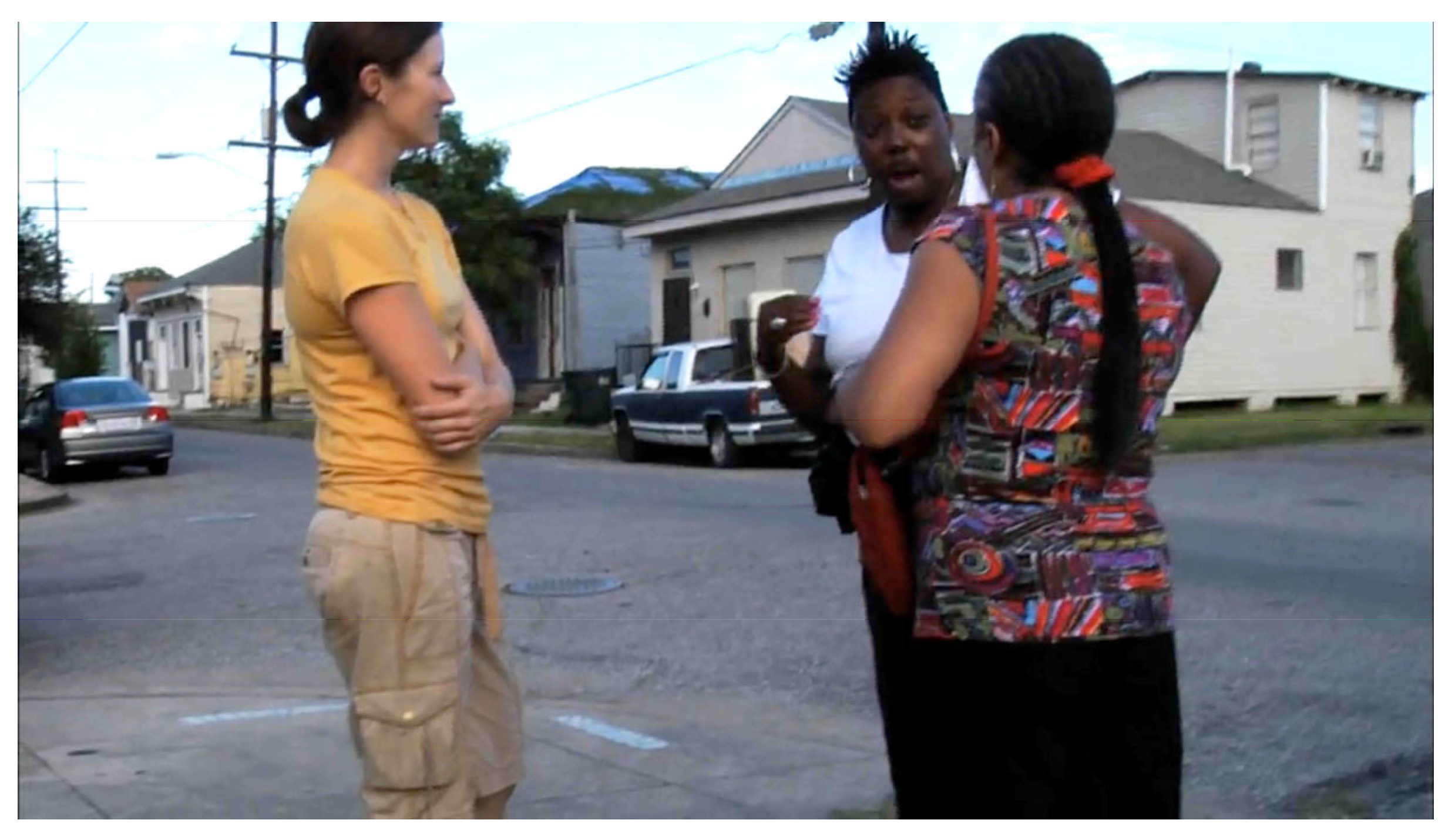
Architecture School, we see and hear NHS staff as they perform this balancing act through instances of explicit and indirect conflict between local residents and NHS staff, in particular, through the experiences of Anderson as CEO. One notable depiction of tension between Lauren and a long-standing resident of Central City, Tess Lassai, occurs early in the series in episode one, where we see and hear that Tess’s daughter, Nikkol, was refused an NHS financial subsidy to purchase the previous year’s URBANbuild home (Tulane students design and build a house annually). In the following excerpt of talk from that episode, Tess meets with NHS CEO, Lauren, in the presence of the Tulane URBANbuild program’s project manager, Emilie Taylor Welty (Welty has long-standing relationships with Central City due to her sustained involvement in the design–build program [
67]). Filmed outside on the construction site of the URBANbuild house that is the focus of the TV series, Tess, Lauren, and Emilie have the following lengthy exchange [
Figure 5]:
| Excerpt 3: | Emilie, Tess, and Lauren |
| Tess: | Oh, I been havin’ problems with y’all. |
| Lauren: | Oh? |
| Tess: | My daughter was tryin’ to get that house for four months. She got good credit. Very good credit. |
| Lauren: | Ok. |
| Tess: | But whoever she talked to discouraged her. She come home crying. |
| Lauren: | Oh, no, no, no, no. |
| Emilie: | It’d be great to keep you guys in the neighborhood. |
| Tess: | They say they want this house for people in the community. |
| Lauren: | Mm, hmm. |
| Tess: | But they got people comin’ to look at the house not from our community.
Come on, give us some help. We trying to come back, that’s why these houses are empty now. |
| Lauren: | ((Directing her comments to the camera rather than Tess, possibly indicating that her following comments were later edited into this scene))
When NHS develops a home we’re developing a very high-quality home and we know that the cost of that house is more than the neighbors can afford. So, it’s my job to find funds to provide the subsidies to make it more affordable. |
| Tess: | ((Talk returns to face-to-face interaction between Tess and Lauren))
She didn’t get that [a subsidy]. She didn’t get that. |
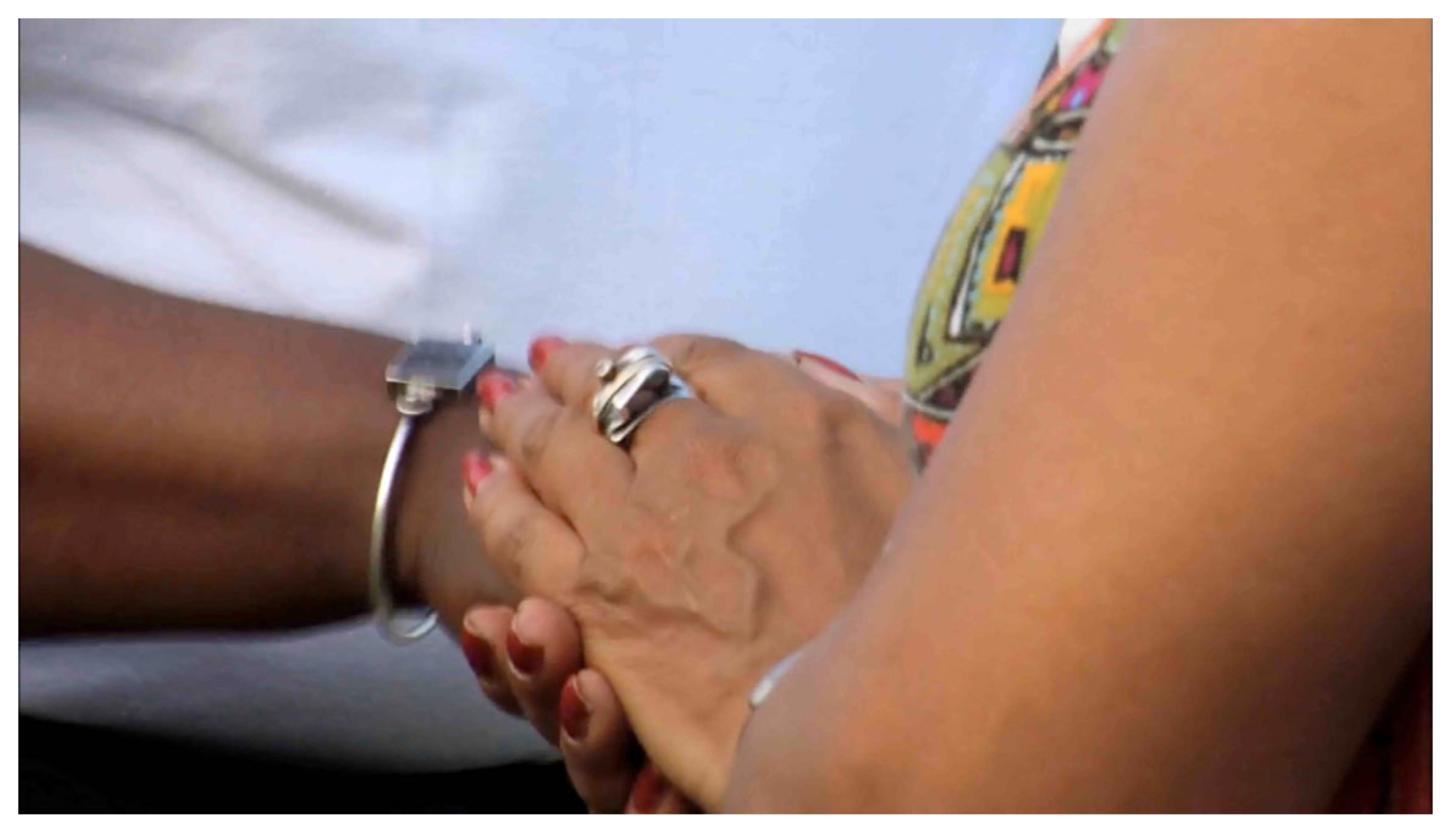
| Lauren: | No? Okay, sometimes our counselors aren’t telling people what they want to hear ((Cut to close-up shot of Lauren, clasping Tess’s hand in comfort [Figure 6])). |
| Tess: | No, but you’d hold our hand and take us through it [i.e., the home-buying process]. |
| Lauren: | Oh ya, absolutely. |
This excerpt opens with Tess directly making a complaint to Lauren on behalf of her daughter (Nikkol, who is not present). Nikkol had sought to acquire an URBANbuild house but, according to Tess, despite Nikkol speaking to an NHS representative, she had, upsettingly, been unsuccessful in her application. Emilie speaks for the URBANbuild program’s desire to maintain the ability of locals to purchase the homes they are building (as she says “It’d be great to keep you guys in the neighborhood”). Tess builds on this expressed aspiration but states that this is not what is happening with the home under discussion, which is being viewed by people “not from our community.” Tess furthers her complaint by specifying that her daughter did not receive the financial subsidy she was expecting. In response, Lauren sympathetically holds Tess’s hand [
Figure 6], apparently expressing a willingness to engage directly with her despite her criticisms.
Lauren’s embodied clasp of Tess’s hand and her talk (“ya, absolutely”) both reassure Tess that she and her counselors are there to help, while also remaining non-committal about what they can actually do. Lauren’s comment, “sometimes our counselors aren’t telling people what they want to hear,” implies that it is not always administrative inefficiencies that get in the way of home acquisition but that problems beyond the purview of the NHS might underpin a potential occupant’s lack of success. This exchange demonstrates the heightened affect and frustration with bureaucracy experienced by those who seek an URBANbuild home. It also portrays the emotional and practical labor of the NHS staff as they negotiate the complexities of meeting people’s needs for housing and their organization’s requirements to follow procedures and modes of legislation. In a subsequent episode to the one excerpted above, we find that Nikkol’s ineligibility to purchase the house is due to her existing car loan. The fact that she still owes money prohibits her from having a credit score that would qualify her for the NHS assistance that would help her buy the Tulane home. Problems caused by lingering debt are common across all sectors, though often with particular constraints on low-income families [
96].
We saw in the excerpt above how the frustrations of Tess and her daughter (as a potential home purchaser) were depicted compassionately, arousing the sympathy of the viewer. At other moments, Architecture School shows the frustrations experienced by NHS administrators themselves as they deal with community members who refuse the homes that have been designed and built by the Tulane students. For example, in episode four, NHS CEO, Anderson, is filmed as she sits at a table, tirelessly phoning a list of potential purchasers for the previous year’s URBANbuild home (the one sought by Nikkol). In these calls, she is attempting to generate interest in the “special house” that was “built by students,” but the neighborhood’s reputation as an area of high crime works against her efforts, as no one wants to view the house. At one point, Lauren shows single mother and part-time hair stylist, Jocelyn, the house completed in the previous year. Jocelyn is an interested and enthusiastic potential buyer—she is shown excitedly envisioning how her art collection could be positioned “going up the stairs.” Yet, she ultimately rejects the NHS’s offer of financial support to buy the house because levels of crime in the area made her too “fearful” to purchase it.
Throughout the series, the talk of the NHS participants starkly indicates how, despite their attempts to explain, console, and persuade community members, the NHS employees are left to manage, through face-to-face encounters with struggling individuals, the immense and implacable conditions of systemic exclusion. By regularly focusing on Anderson’s interactions,
Architecture School shows viewers how “personal narratives present individuals as the face of larger groups” [
97] (p. 113). The series’ attention to the on-the-ground circumstances of the NHS staff is a plausible and rarely seen (on TV) depiction of bureaucrats not as nameless obstacles to the potential homeowners but as individuals whose role as intermediaries is to navigate the structural conditions of governmental and financial procedures. Both Anderson and her colleague Lakica Watkins are shown as working between the inside world of URBANbuild’s novice, student architects (and the products they create) and the outside world that the students seldom fully confront: the world of the complex and constrained lives of their home’s potential, albeit frequently thwarted, occupants. An important message conveyed by
Architecture School’s explicit attention to the NHS staff is that providing innovative design, even when its proponents aim to help dismantle structural inequality and engage design’s “full potential as a tool for political intervention and transformation of the built environment” [
75] (p. 102), requires much complex, bureaucratic wrangling.
3.4. Potential Occupants
As described above, it is the NHS partner to Tulane’s program that helps it meet its aims to stimulate socio-material transformation in the challenged neighborhoods of New Orleans. While the students and their professor design and build, it is the NHS employees who navigate the narrow margins of integrating socially engaged design within the lives and constrained conditions of citizens. Accordingly, as well as the worlds and words of the students and NHS employees, Architecture School weaves a number of narratives that depict these citizens—the potential occupants of the URBANbuild homes—through the series.
At points in the series, the NHS staff are shown in relation to their own homes; for instance, NHS administrator Lakica Watkins is filmed sitting on the front steps of her house. Her home is located just a few doors down from the new build featured in the show, so, as well as working for the NHS, she is a member of the local community. Viewers discover that Watkins, self-described as having had “the worse credit you could ever want to have”, was able to purchase her home through a government subsidy. The presentation of Watkins as a member of Central City who herself had needed housing assistance reminds the viewer of the thin boundary between those who miss opportunities for home ownership and those who succeed.
By showing the real lives of neighborhood citizens, such as Watkins,
Architecture School presents a more fine-grained picture of what it means to design for the economically challenged than is often presented, even in many text-based collections that feature public-interest architecture, e.g.,
Design Like You Give a Damn [
98];
Small Scale, Big Change: New Architectures of Social Engagement [
99];
Local Architecture: A Return to Place, Craft, and Community [
100];
Design With Love: At Home in America [
101]; and
Assemble(d): Architecture For All [
102]. These volumes provide overviews of new models for professional and pedagogic public-interest design. However, through a tendency to focus on architectural structures, such texts can unintendedly homogenize the “community” of clients and wider neighborhoods. Partly thanks to the extended narrative offered by a six-episode series,
Architecture School is able to depict some of the heterogeneity of Central City as it involves long-time local residents, employees of the NHS, and prospective buyers both from inside and outside the area.
One story of a neighborhood “insider” is briefly featured in episode one. Timothy, a policeman and Katrina “first responder”, is shown outside his URBANbuild home as he talks about growing up in Central City. Despite having lived away for some years, and his mother having been murdered in the neighborhood, he willingly moved back to help be a “positive force in the regeneration of that community.” Timothy is grateful for the opportunities presented by URBANbuild’s subsidized homes, noting that “if it weren’t for you guys, I wouldn’t be living here.” Timothy’s case is a notable success for the URBANbuild program: he is a local who is aware of the area’s challenges yet desires to participate in its revitalization. Thanks to his acquisition of one of the Tulane houses, he has met his goal of home ownership and is shown as being happy with his circumstances.
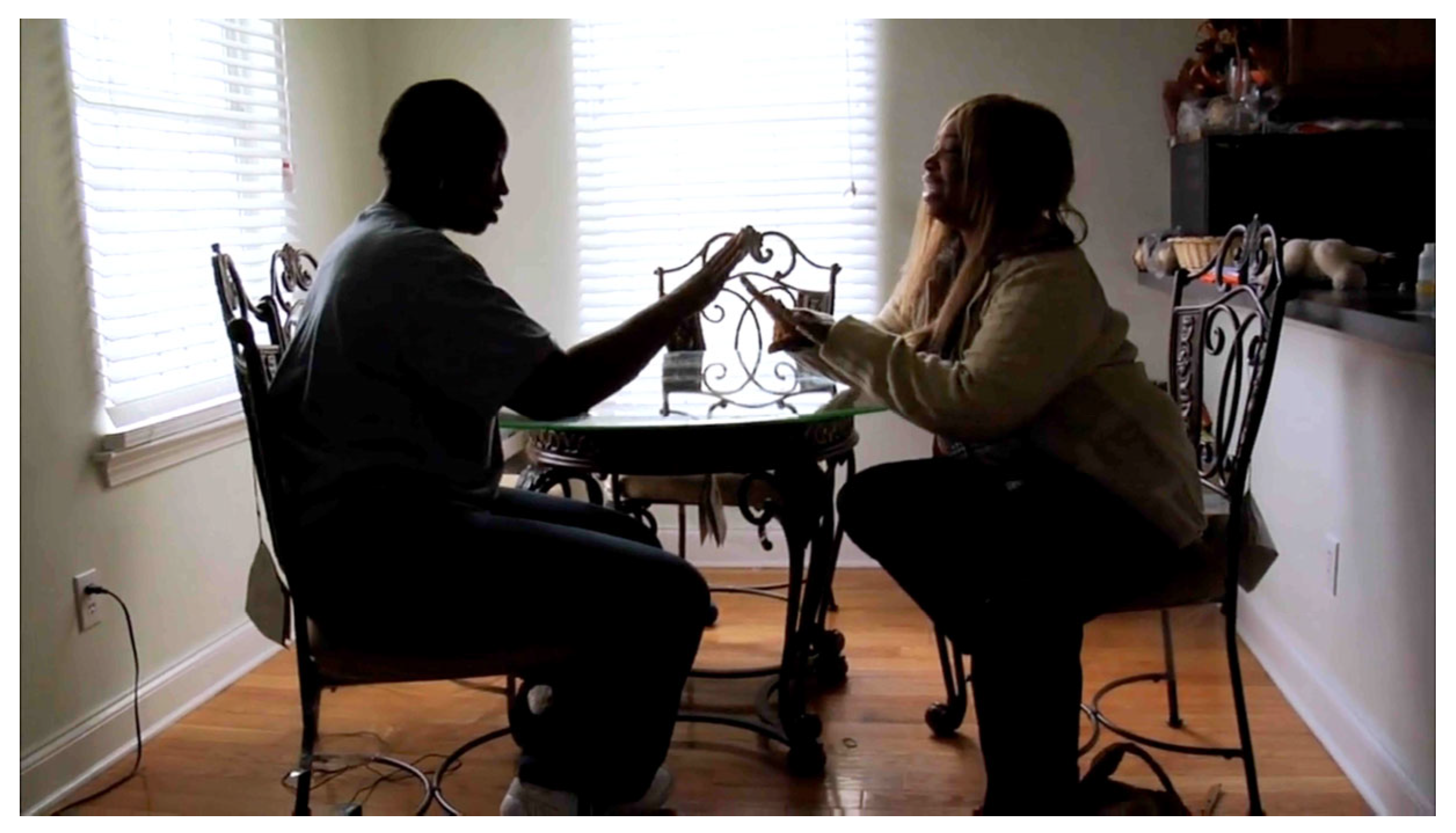
A longer segment regarding a potential owner is presented later in the series in episode five. Here, we see Caroline, a Central City “outsider” who happens upon the URBANbuild construction site when she was “strolling through the neighborhood looking for a house.” As a social worker and single mother of four young boys, she had at one time lived with her family in a “middle-class neighborhood.” Caroline’s predicament is dire: neither her previous home nor her marriage survived Katrina, and she and her children are shown as being essentially homeless, with her experiences of downward mobility compounded by the effects of the hurricane, the complexities of negotiating the bureaucracy of support, and her (possibly accurate) conviction that her specific circumstances will prohibit her from homeownership. In a kitchen table-based meeting between Caroline and Lakica Watkins, the local NHS staff member mentioned earlier, Caroline is confronted with the limitations of her bad credit and the (probable) inability of the NHS to assist her despite the extraordinary circumstances she has endured [
Figure 7].
| Excerpt 4: | Caroline and Lakica |
| Lakica: | We want you to come over to the NHS, pick up a personal profile form fill it out we’re gonna write your credit [form] |
| Caroline: | I don’t have good credit… now you’re talkin’ fast… so now I feel like its hoop and hurdle time. This is on the road to nowhere…
((Speaking sarcastically, as if in the voice of an employee of NHS)) ‘Well the victims that we’re gonna help are the ones that have good credit’. |
| Lakica: | ((Defensive tone, louder volume))
If it qualifies you for the subsidy that we have at my organization |
| Caroline: | That’s why you’re a victim [i.e., if you have bad credit] |
| Lakica: | Ok, wait, wait, don’t break me off |
| Caroline: | You’re not a victim if you got good credit! Most of the people who have been victims of Katrina are in situations like I am in, and there’s people under bridges, there’s people in trailers, they’re in no position to |
| Lakica: | Pay off credit. |
| Caroline: | You know [the NHS assistance] is for a college student who’s just gonna pay their loans off, work a job and then they have a home—this isn’t for someone who’s just been wiped out by a hurricane. |
As this scene unfolds, Caroline’s frustration with the NHS and the system as a whole is evident (“it’s hoop and hurdle time”), as is Lakica’s irritation with Caroline’s critical comments towards the NHS (“Ok, wait, wait, don’t break me off”). Their conversation highlights the structural tensions between the NHS as a community partner and the potential home occupants who must meet the criteria the NHS sets out prior to offering support (legal and financial criteria that are ill-equipped to support victims of environmental disasters). Caroline’s words articulate the limitations of social assistance for the near-destitute precariat as she states the specific circumstances of many “victims of Katrina.” As she lists these extreme conditions (“people under bridges… in trailers”), Caroline links such destitution to an inability to follow through on the financial rules that underpin home ownership: rules articulated by Lakica, who completes Caroline’s sentence as she says, “Pay off credit.” (TV viewers of this segment may recall that earlier it was revealed that Watkins herself had a history of bad credit but managed to buy a home with government assistance). Later in episode five, after Caroline’s conversation with Lakica, Caroline misses an appointment she had made with the NHS. It is implied that she has given up on seeking the NHS’s help to acquire an URBANbuild home. Her situation is left unresolved and is not returned to again in the series.
By including storylines that depict how the systemic realities of crime, debt, and displacement impact the ability of potential residents to acquire URBANbuild homes, Architecture School avoids a simplistic depiction of the unmitigated success of public-interest architecture practiced through the lenses of critical design thinking. On the one hand, the show portrays a material triumph: a house is designed and built by the students by the end of the academic year (and by the end of the TV series), and the previous year’s home finds its buyer. On the other hand, the ambivalent and fraying social fabric depicted in the episodes reveals how difficult it is for the students’ inventive project to be acquired by the low-income, first-time, neighborhood-based buyers that the structure is aimed at. Towards the end of episode one, these circumstances are noted by a student who, in a conversation with another student, says “to hear [Tess] who’s that passionate about something that Tulane School of Architecture designed, and they [Tess’s daughter] can’t even move in? And she lives in that neighborhood? Ahhh, I’m going to start to cry.”
The people who eventually obtain the home that was built during the six episodes of Architecture School are not shown, since the series only covers the time up to the end of the home’s construction. However, a prominent storyline of the series concerns the house that was built by the previous year’s group of URBANbuild students. This aesthetically sophisticated structure was mentioned earlier: it is the house of interest to Nikkol (whose car loan restricted her access to NHS support) and to Jocelyn, who opted not to buy due the levels of local crime. This home languishes unsold through most of the series before we see its purchase in episode six. The buyer is Michael Wong, a young, single, and childless male. He is a schoolteacher and outsider to the Central City community who, as such, belongs to a different demographic than the long-term residents and local families for whom that structure—like the new build featured in the series—was intended.
In the final (sixth) episode, we see Tess Lassai, the local whose daughter was unable to acquire the house purchased by Wong. She is filmed as she states: “When Tulane first broke ground on that house I was nosy, I went and I asked them what they were doing and they said, ‘Oh we designed this house for somebody in the neighborhood to come back.’” Tess shakes her head and says “Not true.” Lassai is then shown meeting and shaking hands with the home’s new owner. In a conversation with Wong, she tells him that “we fought for about a year for this house for my daughter and the criteria [to qualify] was just sooooo technical.” After this, she is seen, perhaps somewhat grudgingly, accepting Wong despite his outsider status, once she realizes he is more of a community insider than she thought. Wong tells her that he used to “work down the street at First and Dryads, at the church… with Amy” (a friend of Tess’s). Tess replies to Michael by saying “So you with Amy, you might be all right… I kind of like you already.” Her words indicate how mitigating factors, such as shared acquaintances, might somewhat soften the blow felt by Central City insiders by the influx of outsiders to their neighborhood.
In Architecture School, potential occupants of the homes are presented as diverse individuals whose circumstances represent multiple locations on a spectrum from extreme precarity to modest success. The series presents, e.g., Jocelyn’s enthusiasm for obtaining an URBANbuild home being thwarted by her fear of crime, Nikkol’s lack of success due to her credit-related constraints, and Caroline’s challenging and extreme vulnerabilities. These individuals’ experiences are implicitly contrasted with the achievements of home acquisition experienced by Timothy, Michael Wong, and Lakica Watkins. Through portraying such diversity, Architecture School unsettles simple narratives of design as inevitably linked to personal empowerment and neighborhood transformation. Architecture School’s attention to diverse voices enables the series to shift from the students’ perspectives—inside the studio and on the building site—through to the mediating situations of the NHS staff and also through to the real-word experiences of those for whom the public-interest housing is intended.
4. Discussion/Conclusions
As we have outlined here,
Architecture School shows some of the entanglements that occur between the actions of designing, building, administrating, and dwelling. While
Architecture School ends with the completion of the featured home’s construction and not its acquisition, the closing moments of the series show the students enthusiastically viewing their completed structure with excitement, relief, and pride [
Figure 8]. As one student notes, “I think while you’re doing it, it sucks, but in the long run, it’s one of the coolest things you’ll ever do,” and Amarit (whose review was featured earlier) cheerfully notes “the best part? Building a house! … that’s nuts!” These scenes are followed by Lauren Anderson as she shows potential occupants around the newly completed house. As she does so, she states to the people viewing it “we just need to get you pre-qualified, and get you into a home,” with one prospective owner saying “that would be like a dream come true.” As the closing credits cross the screen, Anderson replies “we just have to make it happen.” By ending the series not with the students studying architecture but instead with those who struggle to accomplish home acquisition,
Architecture School as a media text indicates its tacit aim: to educate the viewing audience in recognizing that the critical design thinking and building practices that underpin public-interest housing are not enough to succeed on their own.
Each urban environment, and each person seeking a home, is a unique situation.
Architecture School shows how urban improvement is made difficult by the complexity of individualized constraints, as these occur in wider, socio-economic and political systems. As well as specific circumstances of personal challenge, intractable structural conditions—from norms of architecture education and the naivete of novice learners to neighborhood crime and forms of systemic disenfranchisement—form obstacles to the successful provision of innovative, public-interest design. As we have shown here, and what we believe is valuable about our explication and of the series itself, is how
Architecture School clearly presents this web of entanglements. Sometimes referred to as a “matrix of domination” [
80,
103] (p. 20), these intersecting conditions stubbornly get in the way of design’s capacities to create “spaces of healing,” contributing to “a different urban metabolism” [
82] (1:23:58).
Through presenting an insider’s view of an URBANbuild project, based on showing the real-life images and words of its student participants, Architecture School directs attention to the actual complexities of architectural learning and real building. In addition, by explicating the perspectives of the NHS mediators and the constrained occupants they engage with, the show also depicts the difficulties of dwelling. Viewers of the series see how the circumstances outside the context and control of Tulane’s program shape the success of its aims. Consequently, Architecture School is valuable as both a realistic presentation and a critique of the possibilities of architectural education in general and of design–build education in particular.
Additionally, the series can be viewed as a critique of the design of governmental and economic policies. These apparently invisible but orderly and intentionally created bureaucratic systems, procedures, and criteria regulate and restrict the lives of the precariat and help to limit their opportunities to acquire innovative homes. While theorists of critical design thinking remind us that social design requires practitioners to negotiate their personal creativity alongside the structuring constraints of wider society (e.g., Manzini in Muratovsky, 2023) [
79],
Architecture School demonstrates how difficult this is to achieve. Further, then, the series can also be interpreted as a subtle judgment of some of the inclinations of critical design thinkers themselves. The real complexities presented in
Architecture School act as a sober response to enthusiastic declarations concerning, e.g., the urgent need for designers to demonstrate the “power of design for collective liberation” [
80] (p. 236) through, e.g., “re-communalization, and re-earthing [the]… biophysical balance” [
82] (1:23:58). We recognize that not all pronouncements by critical design thinkers are quite so polemical (e.g., Manzini in Muratovsky, 2023) [
79], and some words are perhaps intended more to “stir the imagination” [
104] (p. 366) than to offer actual solutions.
Architecture School’s empirically detailed presentation of reality is a salient rejoinder and complement to the assertions of such critical design thinkers. The series clearly indicates the positive impacts of public-interest design (on some community members), while not shying away from the difficulties encountered when designers work to even modestly shift society’s needle towards epistemic justice.
Architecture School’s straightforward yet sensitive presentation of the conditions of students and educators, administrators, and potential homeowners in a city impacted by the twinned complexities of natural disaster and obdurate governance remains highly relevant today for how it reveals the social and material complexities that point away from a simplistic rendering of design’s moral clarity. We advocate for designers, design students, and others to closely view the series. Doing so, we believe, will encourage the recognition of how contingent “successful” design is. This knowledge is particularly relevant to students, perhaps especially to those in design–build education. These students can, at times, become discouraged when their projects do not meet their goals for equity and wide accessibility. Watching and discussing Architecture School may help such students to recognize how difficult it is to achieve the goals of public-interest design, even in a program as well-established and resourced as Tulane’s. Accordingly, students might gain a more realistic perception of the modest interventions that creative design can achieve—interventions that are nevertheless valuable to the students themselves as well as to those served by their work.
Architecture School clearly exposes the tensions between the ideals of public-interest design, as carried out through a notable program of design–build education, and the real, structural circumstances that inhibit the achievement of these ideals. The show serves as a nuanced and astute representation and constructive critique. The series is, in effect, a “reality check” to the notion that design alone can be a fully transformational practice. In a wider social context where climate change, urban challenge, and humanitarian urgency provide opportunities for design-based interventions, Architecture School reminds us of how innovative solutions need to involve networks that extend beyond creative practitioners. From our perspective, the central lesson of Architecture School is evident if the series is watched attentively: to approach with humility both the possibilities of creative design and the real lives entangled with it.