
The Promise and the Paradox of Innovation: Understanding Stagnation in the Living Lab Enrekang, Indonesia


Abstract
1. Introduction
2. Conceptual Framework
2.1. Governance of Innovation Lifecycle
2.2. Social Capital Theory
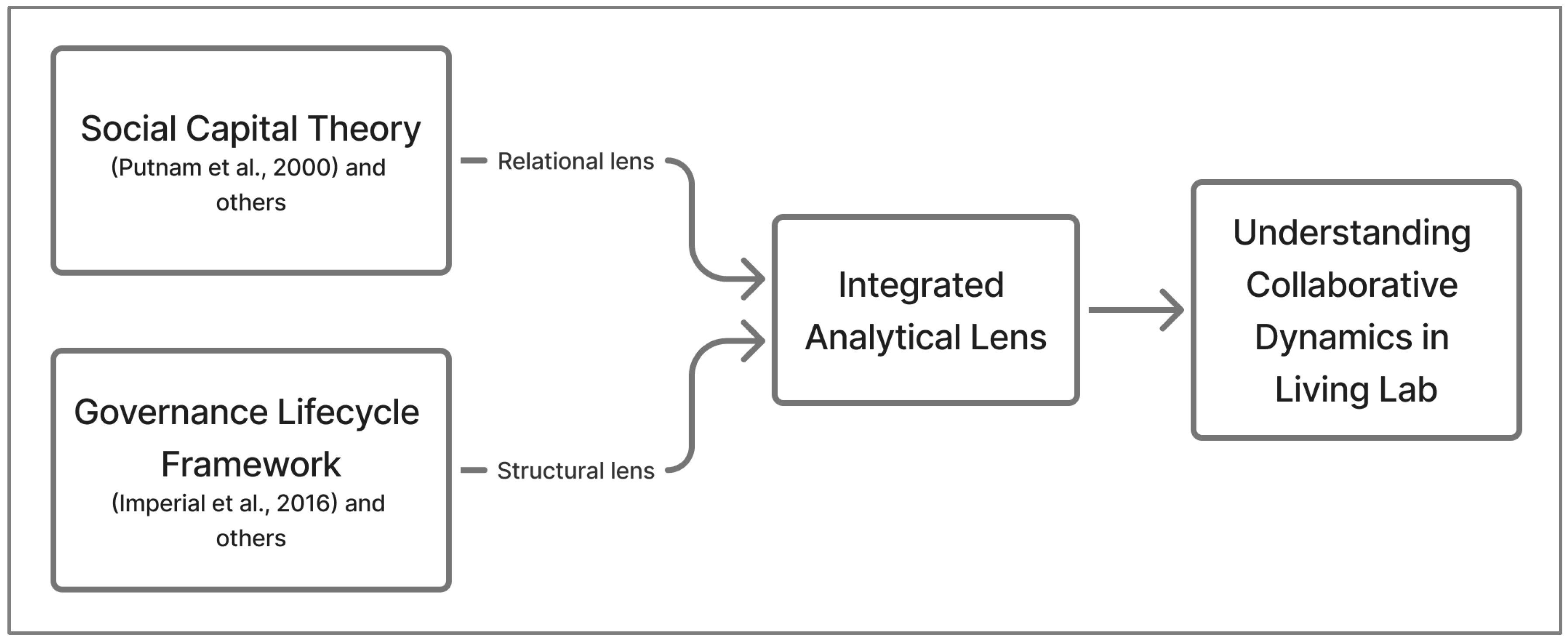
2.3. Integrating Framework
3. Materials and Methods
3.1. Research Design
3.2. Data Collection Methods
3.3. Data Analysis
4. Results
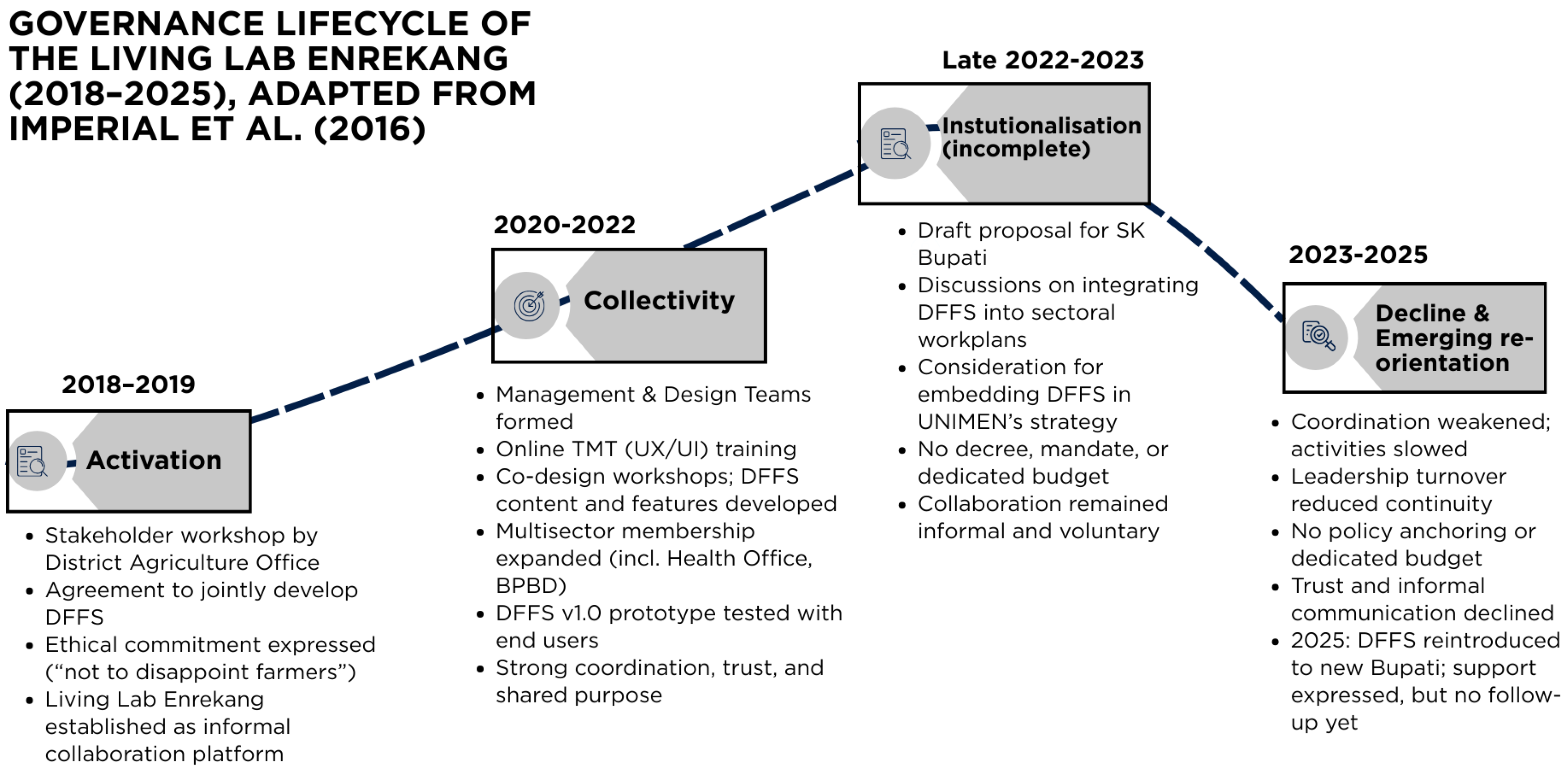
4.1. Activation Stage (2018–2019): Building Initial Commitment
4.2. Collectivity Stage: Collaborative Design and Prototype Development
4.3. Institutionalization Stage (Late 2022–2023): Formalization Attempts Without Follow-Through
“Discussions about drafting an SK Bupati began in early 2023, initially coordinated by the Regional Development Planning Agency (Bappeda). However, when the responsible official was reassigned, the process did not continue, and no subsequent unit took over the follow-up.”(DFFS Management Team, Interview 2025).
4.4. Stagnation Stage (2023–2025): Declining Coordination and Momentum
“Although I have been reassigned to a different post, I can only continue supporting the DFFS if my new supervisor approves my involvement. He has not been exposed to the initiative yet.”(Design Team Member, 2024)
“If the living lab had been formalised and had a legal basis, we could have continued even with leadership and staff changes. We proposed this before, but it was never realised, and eventually everything stalled.”(Management Team Member, 2024)
“Each department has its own budget, but none can be allocated to DFFS because it is not formally registered.”(District Official, 2024)
“Because DFFS is still in the experimentation stage, it is difficult for us to include it in the district budget. I propose that it be supported first through university research grants. When it is more established, then we can consider government funding”(District Official, 2025).
“We believe the new government will continue DFFS because it is for the benefit of farmers.”(Farmer Group Representative, 2025).
“We need to explain DFFS again to the new administration so they understand how it supports their priorities.”(DFFS Design Team Member, 2025).
“It would be regrettable if the DFFS initiative is not continued, because it has strong potential to reduce information gaps for farmers. The collaborative platform we created—where different actors could work and learn together—should not have to dissolve. We hope the next administration will be able to continue this work.”(Design Team Interviews, 2025).
5. Discussion
5.1. How Stagnation Unfolds Across the Innovation Lifecycle
5.2. Governance Vulnerabilities
5.3. Shifts in Stakeholder Engagement and Interaction Patterns During Stagnation
5.4. Resource Dependencies and the Limits of Informal Coordination
6. Conclusions
Author Contributions
Funding
Institutional Review Board Statement
Informed Consent Statement
Data Availability Statement
Acknowledgments
Conflicts of Interest
Abbreviations
| Bappeda | Indonesian Badan Perencanaan Pembangunan Daerah/Regional Development Planning Agency |
| BPBD | Indonesian Badan Penanggulangan Bencana Daerah/Regional Disaster Management Agency |
| Bupati | Indonesian term for Head of District |
| DFFS | Digital Farmer Field School |
| DAO | District Agriculture Office of Enrekang |
| DEO | District Environmental Office of Enrekang |
| DHO | District Health Office of Enrekang |
| DLFO | District Livestock and Fisheries Office of Enrekang |
| LLs | Living Labs |
| NUFFIC | Netherlands Organization for International Cooperation in Higher Education |
| NESO | Netherlands Education Support Office |
| SK | Surat Keputusan/Decree |
| TMT | Tailor-Made Training |
| UNIMEN | Universitas Muhammadiyah Enrekang/The University of Muhammadiyah Enrekang |
References
- Manyise, T.; Dentoni, D. Value chain partnerships and farmer entrepreneurship as balancing ecosystem services: Implications for agri-food systems resilience. Ecosyst. Serv. 2021, 49, 101279. [Google Scholar] [CrossRef] [Scilit]
- De Bruin, S.; Dengerink, J.; Van Vliet, J. Urbanisation as driver of food system transformation and opportunities for rural livelihoods. Food Secur. 2021, 13, 781–798. [Google Scholar] [CrossRef] [Scilit]
- Schuurman, D.; Baccarne, B.; De Marez, L.; Veeckman, C.; Ballon, P. Living Labs as open innovation systems for knowledge exchange: Solutions for sustainable innovation development. Int. J. Bus. Innov. Res. 2016, 10, 322–340. [Google Scholar] [CrossRef] [Scilit]
- Bronson, K.; Devkota, R.; Nguyen, V. Moving toward generalizability? A scoping review on measuring the impact of living labs. Sustainability 2021, 13, 502. [Google Scholar] [CrossRef] [Scilit]
- Berberi, A.; Beaudoin, C.; McPhee, C.; Guay, J.; Bronson, K.; Nguyen, V.M. Enablers, barriers, and future considerations for living lab effectiveness in environmental and agricultural sustainability transitions: A review of studies evaluating living labs. Local Environ. 2023, 1–19. [Google Scholar] [CrossRef] [Scilit]
- Cascone, G.; Scuderi, A.; Guarnaccia, P.; Timpanaro, G. Promoting innovations in agriculture: Living labs in the development of rural areas. J. Clean. Prod. 2024, 443, 141247. [Google Scholar] [CrossRef] [Scilit]
- Lairing, N.; Witteveen, L.; Busa, Y.; Bagenda, A.; Bagenda, M.; Addi. Co-constructing principles for Digital Farmer Field School Enrekang Design in South Sulawesi—Indonesia. E3S Web Conf. 2021, 306, 03013. [Google Scholar] [CrossRef] [Scilit]
- Lairing, N. Developing Contemporary Rural Communication Services in Indonesia. Prototype Testing of Digital Farmer Field School (DFFS). In Proceedings of the IAMCR Conference, Lyon, France, 9–13 July 2023. [Google Scholar]
- Toffolini, Q.; Capitaine, M.; Hannachi, M.; Cerf, M. Implementing agricultural living labs that renew actors’ roles within existing innovation systems: A case study in France. J. Rural Stud. 2021, 88, 157–168. [Google Scholar] [CrossRef] [Scilit]
- Habiyaremye, A. Knowledge exchange and innovation co-creation in living labs projects in South Africa. Innov. Dev. 2019, 10, 207–222. [Google Scholar] [CrossRef] [Scilit]
- Imperial, M.T.; Johnston, E.; Pruett-Jones, M.; Leong, K.; Thomsen, J. Sustaining the useful life of network governance: Life cycles and developmental challenges. Front. Ecol. Environ. 2016, 14, 135–144. [Google Scholar] [CrossRef] [Scilit]
- Putnam, R.D. Bowling alone: The collapse and revival of American community. In Proceedings of the 2000 ACM Conference on Computer Supported Cooperative Work, in CSCW ’00, Philadelphia, PA, USA, 2–6 December 2000; Association for Computing Machinery: New York, NY, USA, 2000; p. 357. [Google Scholar] [CrossRef] [Scilit]
- Leeuwis, C.; Aarts, N. Rethinking Communication in Innovation Processes: Creating Space for Change in Complex Systems. J. Agric. Educ. Ext. 2011, 17, 21–36. [Google Scholar] [CrossRef] [Scilit]
- Klerkx, L. Digital and virtual spaces as sites of extension and advisory services research: Social media, gaming, and digitally integrated and augmented advice. J. Agric. Educ. Ext. 2021, 27, 277–286. [Google Scholar] [CrossRef] [Scilit]
- Ansell, C.; Gash, A. Collaborative governance in theory and practice. J. Public Adm. Res. Theory 2008, 18, 543–571. [Google Scholar] [CrossRef] [Scilit]
- Klerkx, L.; van Mierlo, B.; Leeuwis, C. Evolution of systems approaches to agricultural innovation: Concepts, analysis and interventions. In Farming Systems Research into the 21st Century: The New Dynamic; Darnhofer, I., Gibbon, D., Dedieu, B., Eds.; Springer: Dordrecht, The Netherlands, 2012; pp. 457–483. [Google Scholar] [CrossRef] [Scilit]
- Schuurman, D.; Leminen, S. Living Labs Past Achievements, Current Developments, and Future Trajectories. Sustainability 2021, 13, 10703. [Google Scholar] [CrossRef] [Scilit]
- Ingram, J.; Maye, D. What Are the Implications of Digitalisation for Agricultural Knowledge? Front. Sustain. Food Syst. 2020, 4, 66. [Google Scholar] [CrossRef] [Scilit]
- Muñiz, E.M.; Ludwig, D.; El-Hani, C.N. Research as a Mangrove: Emancipatory Science and the Messy Reality of Transdisciplinarity. Int. Rev. Qual. Res. 2025, 18, 237–259. [Google Scholar] [CrossRef] [Scilit]
- Ceseracciu, C.; Branca, G.; Deriu, R.; Roggero, P.P. Using the right words or using the words right? Re-conceptualising living labs for systemic innovation in socio-ecological systems. J. Rural Stud. 2023, 104, 103154. [Google Scholar] [CrossRef] [Scilit]
- McPhee, C.; Bancerz, M.; Mambrini-Doudet, M.; Chrétien, F.; Huyghe, C.; Gracia-Garza, J. The defining characteristics of agroecosystem living labs. Sustainability 2021, 13, 1718. [Google Scholar] [CrossRef] [Scilit]
- Nesbitt, H.K.; Hamilton, M.; Ulibarri, N.; Williamson, M.A. Operationalizing the social capital of collaborative environmental governance with network metrics. Environ. Res. Lett. 2024, 19, 113003. [Google Scholar] [CrossRef] [Scilit]
- Calò, F.; Teasdale, S.; Roy, M.J.; Bellazzecca, E.; Mazzei, M. Exploring Collaborative Governance Processes Involving Nonprofits. Nonprofit Volunt. Sect. Q. 2023, 53, 54–78. [Google Scholar] [CrossRef] [Scilit]
- Sienkiewicz-Małyjurek, K. Social Capital and Transformational Leadership in Building the Resilience of Local Governance Networks. Sustainability 2022, 14, 4720. [Google Scholar] [CrossRef] [Scilit]
- Shrestha, M.K. How Do Bridging and Bonding Networks Emerge in Local Economic Development Collaboration? Int. J. Public Adm. 2022, 46, 889–901. [Google Scholar] [CrossRef] [Scilit]
- Witteveen, L.; Fliervoet, J.; Roosmini, D.; van Eijk, P.; Lairing, N. Reflecting on four Living Labs in the Netherlands and Indonesia: A perspective on performance, public engagement and participation. J. Sci. Commun. 2023, 22, A01. [Google Scholar] [CrossRef] [Scilit]
- Gamache, G.; Anglade, J.; Feche, R.; Barataud, F.; Mignolet, C.; Coquil, X. Can living labs offer a pathway to support local agri-food sustainability transitions? Environ. Innov. Soc. Transit. 2020, 37, 93–107. [Google Scholar] [CrossRef] [Scilit]
- Molinari, M.; Vogel, J.A.; Rolando, D.; Lundqvist, P. Using living labs to tackle innovation bottlenecks: The KTH Live-In Lab case study. Appl. Energy 2023, 338, 120877. [Google Scholar] [CrossRef] [Scilit]
- Potters, J.; Collins, K.; Schoorlemmer, H.; Stræte, E.P.; Kilis, E.; Lane, A.; Leloup, H. Living Labs as an Approach to Strengthen Agricultural Knowledge and Innovation Systems. Eurochoices 2022, 21, 23–29. [Google Scholar] [CrossRef] [Scilit]
- Kalinauskaite, I.; Brankaert, R.; Lu, Y.; Bekker, T.; Brombacher, A.; Vos, S. Facing societal challenges in living labs: Towards a conceptual framework to facilitate transdisciplinary collaborations. Sustainability 2021, 13, 614. [Google Scholar] [CrossRef] [Scilit]
- Steinke, J.; Ortiz-Crespo, B.; van Etten, J.; Müller, A. Participatory design of digital innovation in agricultural research-for-development: Insights from practice. Agric. Syst. 2022, 195, 103313. [Google Scholar] [CrossRef] [Scilit]
- Hansen, B.D.; Leonard, E.; Mitchell, M.C.; Easton, J.; Shariati, N.; Mortlock, M.Y.; Schaefer, M.; Lamb, D.W. Current status of and future opportunities for digital agriculture in Australia. Crop. Pasture Sci. 2022, 74, 524–537. [Google Scholar] [CrossRef] [Scilit]
- Nyström, A.G.; Leminen, S.; Westerlund, M.; Kortelainen, M. Actor roles and role patterns influencing innovation in living labs. Ind. Mark. Manag. 2014, 43, 483–495. [Google Scholar] [CrossRef] [Scilit]
- Burch, K.A.; Legun, K. Overcoming Barriers to Including Agricultural Workers in the Co-Design of New AgTech: Lessons from a COVID-19-Present World. Cult. Agric. Food Environ. 2021, 43, 147–160. [Google Scholar] [CrossRef] [Scilit]
- Hadfield, P.; Sharp, D.; Pigeon, J.; Raven, R. Governing University Living Labs for sustainability transformations: Insights from 18 international case studies. Sustain. Sci. 2025, 20, 1753–1774. [Google Scholar] [CrossRef] [Scilit]
- Herth, A.; Verburg, R.; Blok, K. The Innovation Power of Living Labs to Enable Sustainability Transitions: Challenges and Opportunities of On-Campus Initiatives. Creat. Innov. Manag. 2024, 34, 427–442. [Google Scholar] [CrossRef] [Scilit]
- Dolmans, S.; Galen, W.V.; Walrave, B.; Ouden, E.; Valkenburg, R.; Romme, G. A Dynamic Perspective on Collaborative Innovation for Smart City Development: The role of uncertainty, governance, and institutional logics. Organ. Stud. 2023, 44, 1577–1601. [Google Scholar] [CrossRef] [Scilit]
- Zhang, X.; Fan, D. Can agricultural digital transformation help farmers increase income? An empirical study based on thousands of farmers in Hubei Province. Environ. Dev. Sustain. 2023, 26, 14405–14431. [Google Scholar] [CrossRef] [Scilit]
- Van Dijck, C.; Steen, T. Hidden pressure: The effects of politicians on projects of collaborative innovation. Int. Rev. Adm. Sci. 2022, 89, 996–1011. [Google Scholar] [CrossRef] [Scilit]
- Zambrano-Gutiérrez, J.C.; de Macedo, L.S.V.; Picavet, M.E.B.; de Oliveira, J.A.P. Individuals in Collaborative Governance for Environmental Management. Environ. Manag. 2023, 71, 565–586. [Google Scholar] [CrossRef] [Scilit]
- Fernandes, E.B.; Wegner, D.; Möllering, G. Governance of Interorganizational Projects: A Process-Based Approach Applied to a Latin American–European Case. Proj. Manag. J. 2023, 54, 219–234. [Google Scholar] [CrossRef] [Scilit]
- Fauth, J.; De Moortel, K.; Schuurman, D. Living labs as orchestrators in the regional innovation ecosystem: A conceptual framework. J. Responsible Innov. 2024, 11, 2414505. [Google Scholar] [CrossRef] [Scilit]
- Bradley, S.; Mahmoud, I.H.; Arlati, A. Integrated Collaborative Governance Approaches towards Urban Transformation: Experiences from the CLEVER Cities Project. Sustainability 2022, 14, 15566. [Google Scholar] [CrossRef] [Scilit]
- Nguyen, H.T.; Marques, P. The promise of living labs to the Quadruple Helix stakeholders: Exploring the sources of (dis)satisfaction. Eur. Plan. Stud. 2022, 30, 1124–1143. [Google Scholar] [CrossRef] [Scilit]
- Devine, D.; Valgarðsson, V.O. Stability and change in political trust: Evidence and implications from six panel studies. Eur. J. Politi Res. 2023, 63, 478–497. [Google Scholar] [CrossRef] [Scilit]
- Zavratnik, V.; Superina, A.; Duh, E.S. Living Labs for Rural Areas: Contextualization of Living Lab Frameworks, Concepts and Practices. Sustainability 2019, 11, 3797. [Google Scholar] [CrossRef] [Scilit]
- Leminen, S.; Defillippi, R.; Westerlund, M. Paradoxical Tensions in Living Labs. 2015. Available online: https://www.researchgate.net/publication/278899570 (accessed on 23 October 2025).
- Mahmoud, I.H.; Morello, E.; Ludlow, D.; Salvia, G. Co-creation Pathways to Inform Shared Governance of Urban Living Labs in Practice: Lessons from Three European Projects. Front. Sustain. Cities 2021, 3, 690458. [Google Scholar] [CrossRef] [Scilit]
- Imperial, M.T. Life Cycle Dynamics and Developmental Processes in Collaborative Partnerships: Examples from Four Watersheds in the U.S. Environ. Manag. 2023, 71, 601–619. [Google Scholar] [CrossRef] [Scilit]
- Ulibarri, N.; Imperial, M.T.; Siddiki, S.; Henderson, H. Drivers and Dynamics of Collaborative Governance in Environmental Management. Environ. Manag. 2023, 71, 495–504. [Google Scholar] [CrossRef] [Scilit]



| Stakeholder Category | Participants/Materials | Method | Notes/Purpose |
|---|---|---|---|
| Archival materials | Meeting minutes, workshop report, design documents, activity reports (2018–2023) | Document review | To reconstruct the development of the living lab and DFFS, clarify key events and decisions, and triangulate governance processes not fully captured through interviews. |
| Farmer Group | 10 | FGD (in person) | To explore the continued relevance of DFFS, farmers’ interest in re-engaging, and expectations for future development. |
| Extension Officers (FGD) | 6 | FGD (online via Zoom) | To assess the perceived usefulness of DFFS for extension work, explore readiness to re-engage in future activities, and understand their experiences of collaboration within the living lab. |
| Government Officials | 4 | Semi-structured interviews | To examine leadership transitions, institutional support, governance challenges, and budgeting constraints. |
| DFFS Design Team Members | 6 | Semi-structured interviews | To document coordination issues, staff rotation impacts, technical development needs, and ideas for revitalizing DFFS. |
| Relational Dimension of Social Capital | Activation Stage (2018–2019) | Collectivity Stage (2020–2022) | Stagnation Stage (2023–2025) |
|---|---|---|---|
| Trust | High interpersonal trust developed among university staff, government officers, and farmers through early joint discussions and shared motivation. | Trust deepened as actors collaborated intensively during co-design workshops, TMT, and prototype testing. | Trust weakened as follow-up stalled, leaving farmers, extension officers, and staff without updates despite earlier commitments |
| Shared Norms & Collective Commitment | A shared sense of accountability and responsible action toward farmers emerged as a unifying norm. | Shared purpose was reinforced as actors worked toward producing DFFS v1.0 and observed its potential to support farmers. | Shared norms became difficult to uphold as promised follow-up did not occur, raising concerns about unfulfilled promise. |
| Interpersonal Expectations & Interaction Patterns | Frequent informal interaction and open communication supported idea exchange and early planning processes. | Interaction became more structured through Design and Management Teams; coordination routines strengthened. | Coordination channels diminished; meetings stopped; and expectations about next steps became increasingly uncertain |
Disclaimer/Publisher’s Note: The statements, opinions and data contained in all publications are solely those of the individual author(s) and contributor(s) and not of MDPI and/or the editor(s). MDPI and/or the editor(s) disclaim responsibility for any injury to people or property resulting from any ideas, methods, instructions or products referred to in the content. |
© 2025 by the authors. Licensee MDPI, Basel, Switzerland. This article is an open access article distributed under the terms and conditions of the Creative Commons Attribution (CC BY) license.
Share and Cite
Lairing, N.; Salman, D.; Amrawaty, A.A.; Witteveen, L. The Promise and the Paradox of Innovation: Understanding Stagnation in the Living Lab Enrekang, Indonesia. Societies 2026, 16, 7. https://doi.org/10.3390/soc16010007
Lairing N, Salman D, Amrawaty AA, Witteveen L. The Promise and the Paradox of Innovation: Understanding Stagnation in the Living Lab Enrekang, Indonesia. Societies. 2026; 16(1):7. https://doi.org/10.3390/soc16010007
Chicago/Turabian StyleLairing, Nurdahalia, Darmawan Salman, A. Amidah Amrawaty, and Loes Witteveen. 2026. "The Promise and the Paradox of Innovation: Understanding Stagnation in the Living Lab Enrekang, Indonesia" Societies 16, no. 1: 7. https://doi.org/10.3390/soc16010007
APA StyleLairing, N., Salman, D., Amrawaty, A. A., & Witteveen, L. (2026). The Promise and the Paradox of Innovation: Understanding Stagnation in the Living Lab Enrekang, Indonesia. Societies, 16(1), 7. https://doi.org/10.3390/soc16010007