
Will AI Replace Us? Changing the University Teacher Role




Abstract
1. Introduction
- Research hypothesis 1: University teachers perceive an imbalance between technological requirements and available professional resources, which is positively associated with the expectation that AI tools will replace faculty within the next five years. This expectation signals the need for universities to identify risks early and develop staff support strategies.
- Research hypothesis 2: University teachers fear that the implementation and use of AI will spiral out of control within the next five years. This fear may be related to the expectation of a breach of the unspoken professional contract. Such fears can reduce faculty engagement and necessitate targeted management decisions to foster trust and psychological resilience.
- Research hypothesis 3: The expectation that AI tools will replace university teachers is an important, but not the primary, source of their fears about losing control over AI technologies. University leaders need to transform their HR policies, addressing the sources of these fears and developing new adaptation mechanisms.
2. Literature Review
2.1. AI and University Teacher Management: Opportunities and Challenges for SDGs 4, 8, and 9
- The rapid implementation and application of generative AI tools in universities pose the following challenges (SDG 8):
2.2. Transformation of Higher Education Under the AI’s Influence
2.3. Theoretical Framework
3. Materials and Methods
3.1. General Description
- Will AI replace university teachers in 5 years?
- Do you feel afraid that the use of AI will get out of control within the next 5 years?
- (1)
- definitely no,
- (2)
- rather no,
- (3)
- difficult to say,
- (4)
- rather yes,
- (5)
- definitely yes.
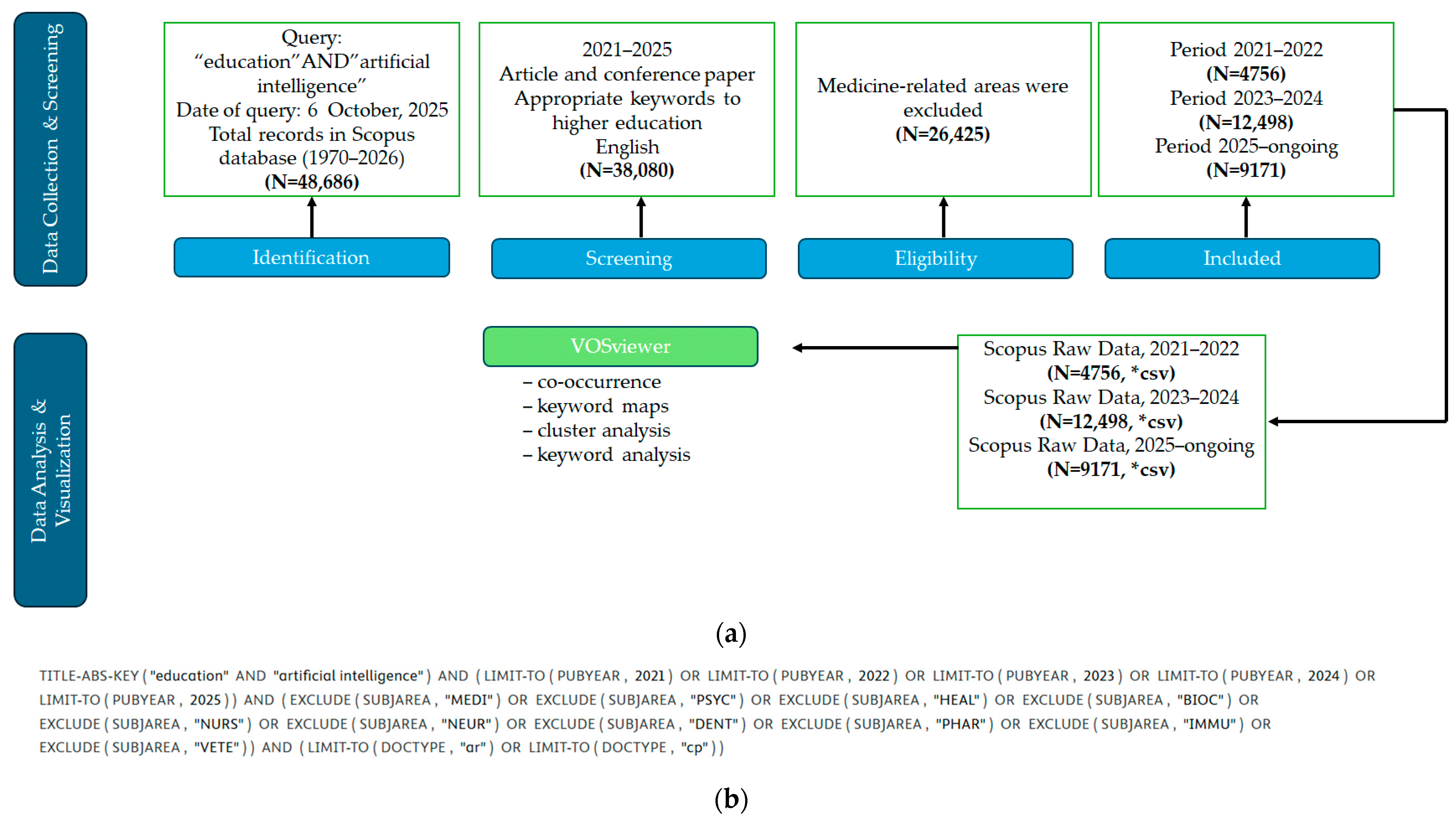
- Keyword normalization.
- Singular–plural harmonization.
- Spelling standardization.
- Acronym and full-term unification.
- Synonym merging.
- Removal of overly generic or non-informative keywords.
- Removal of domain-irrelevant keywords.
- Multi-word keyword consolidation.
3.2. Respondents
3.3. Statistics
- −
- Mean values and standard deviations across groups;
- −
- Comparison of mean values for Q1 and Q2;
- −
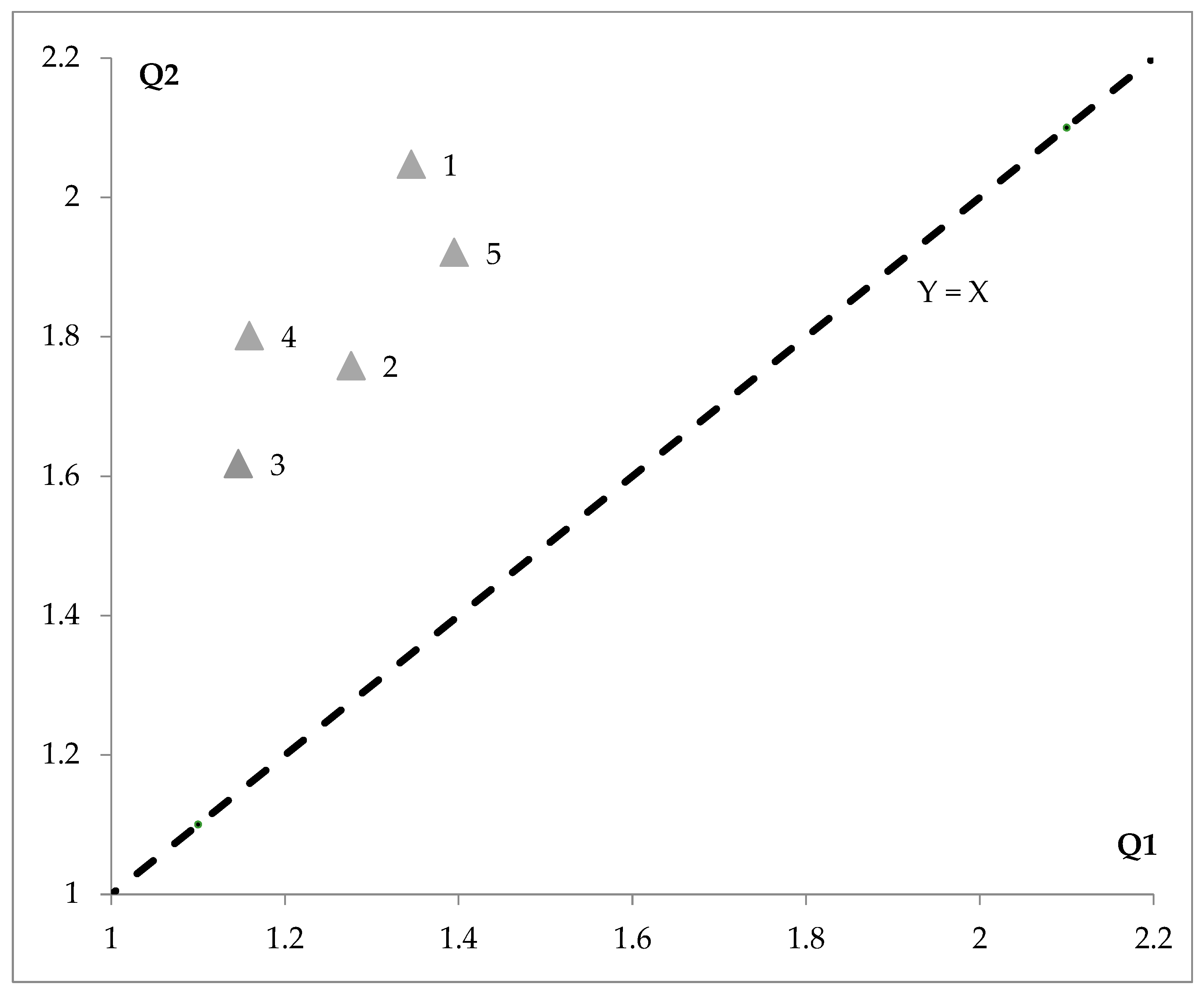
- Visualization of differences using a two-dimensional graph (Section 4.1), allowing us to assess the structural asymmetry between expectations of teacher replacement and concerns about loss of control over AI.
- Definitely yes = 4;
- Rather yes = 3;
- Hard to say = 2;
- Rather not = 1;
- Definitely no = 0.
4. Results
4.1. Calculation and Visualization of Statistical Indicators
4.2. Descriptive Analysis of Differences in Mean Values
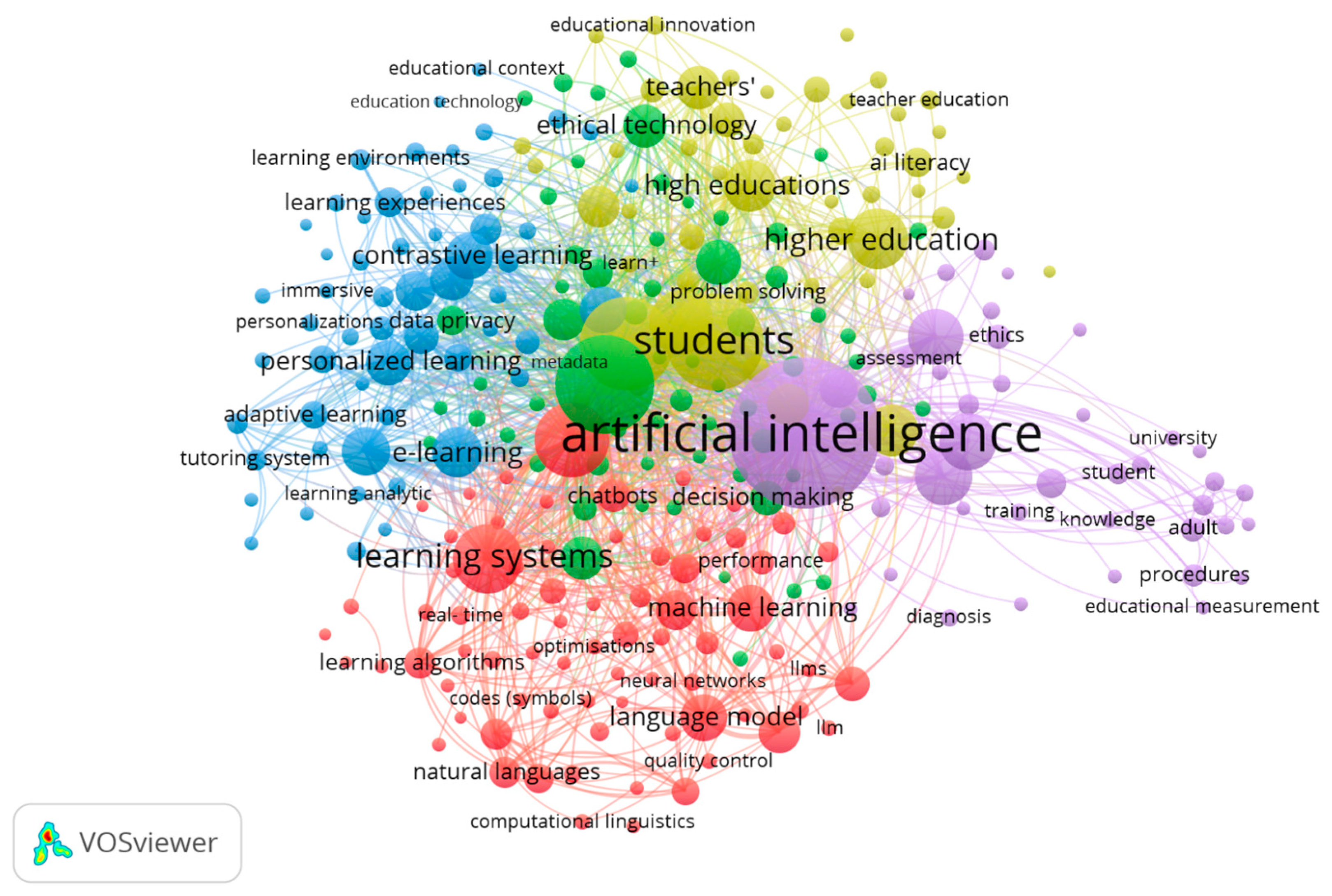
4.3. Evolution of the University Teacher’s Role in an AI-Driven Educational Environment
5. Discussion
5.1. For Governments
- Develop national strategies for digital adaptation of teachers;
- Integrate digital resilience indicators into university accreditation and funding systems;
- Include the development of digital and emotional competence of university teachers in state support and modernization programs for higher education;
- Ensure interdepartmental cooperation between the ministries of education, digitalization, and labor to coordinate personnel and technological reforms.
5.2. For University Leaders
- Implement new HR strategies aimed at developing digital competencies of university teachers and building their trust in technology;
- Creating ethical codes and regulations for the responsible use of AI in educational activities;
- Monitoring the level of digital stress and the emotional state of university teachers;
- Engaging university teachers in the co-design of educational courses using AI tools.
5.3. For Educational Researchers
- Developing a concept for “student + AI + university teacher” interaction in teaching and mentoring;
- Revisiting the concepts of authorship and academic integrity in the context of generative technologies;
- Participating in the development of international standards for digital didactics.
6. Conclusions
Author Contributions
Funding
Institutional Review Board Statement
Informed Consent Statement
Data Availability Statement
Acknowledgments
Conflicts of Interest
Abbreviations
| AI | Artificial Intelligence |
| DCT | Dynamic Capabilities Theory |
References
- United Nations. Promote Inclusive and Sustainable Economic Growth, Employment and Decent Work for All. Available online: https://www.un.org/sustainabledevelopment/economic-growth/ (accessed on 8 September 2025).
- United Nations. 2017 HLFP Thematic Review of SDG 9: Build Resilient Infrastructure, Promote Inclusive and Sustainable Industrialization and Foster Innovation. Available online: https://sustainabledevelopment.un.org/content/documents/14363SDG9format-revOD.pdf (accessed on 10 September 2025).
- United Nations. Goal 9: Build Resilient Infrastructure, Promote Sustainable Industrialization and Foster Innovation. Available online: https://www.un.org/sustainabledevelopment/infrastructure-industrialization/ (accessed on 12 September 2025).
- United Nations. Ensure Inclusive and Equitable Quality Education and Promote Lifelong Learning Opportunities for All. Available online: https://sdgs.un.org/goals/goal4 (accessed on 1 October 2025).
- UNESCO. Global Education Monitoring Report 2020: Inclusion and Education—All Means All; UNESCO: Paris, France, 2020. [Google Scholar] [CrossRef]
- Nyberg, A.J.; Schleicher, D.J.; Bell, B.S.; Boon, C.; Cappelli, P.; Collings, D.G.; Dalle Molle, J.E.; Feuerriegel, S.; Gerhart, B.; Jeong, Y.; et al. A Brave New World of Human Resources Research: Navigating Perils and Identifying Grand Challenges of the GenAI Revolution. J. Manag. 2025, 51, 2677–2718. [Google Scholar] [CrossRef]
- Huang, M.-H.; Rust, R.T. The Caring Machine: Feeling AI for Customer Care. J. Mark. 2024, 88, 1–23. [Google Scholar] [CrossRef]
- Eom, H.J.; Lee, M.J. Labor Market Changes in the Era of Intelligent Information Society Based on Artificial Intelligence (AI): A Socioeconomic Approach. Inf. Soc. Media 2020, 21, 1–20. [Google Scholar] [CrossRef]
- Koo, G.J.; Kim, J.W.; Choi, Y.B.; Kim, G.H.; Hong, J.E. Development of a Job Substitution Possibility Index for Analyzing the Labor Market Impact of Artificial Intelligence and Robotics. Korean J. Public Adm. 2024, 62, 37–74. [Google Scholar] [CrossRef]
- Dubey, S.S.; Astvansh, V.; Kopalle, P.K. Generative AI Solutions to Empower Financial Firms. J. Public Policy Mark. 2025, 44, 411–435. [Google Scholar] [CrossRef]
- Grewal, D.; Okazaki, S.; Guha, A.; Liu-Thompkins, Y. Generative AI: Delivering on the Promises and Understanding the Perils. J. Public Policy Mark. 2025, 44, 299–308. [Google Scholar] [CrossRef]
- Xie, Y.; Avila, S. The Social Impact of Generative LLM-Based AI. Chin. J. Sociol. 2025, 11, 31–57. [Google Scholar] [CrossRef]
- Warr, M.; Heath, M.K. Uncovering the Hidden Curriculum in Generative AI: A Reflective Technology Audit for Teacher Educators. J. Teach. Educ. 2025, 76, 245–261. [Google Scholar] [CrossRef]
- Pence, H.E. Artificial Intelligence in Higher Education: New Wine in Old Wineskins? J. Educ. Technol. Syst. 2019, 48, 5–13. [Google Scholar] [CrossRef]
- Frey, C.B.; Osborne, M.A. The Future of Employment: How Susceptible Are Jobs to Computerisation? 2013. Available online: https://www.oxfordmartin.ox.ac.uk/downloads/academic/The_Future_of_Employment.pdf (accessed on 1 October 2025).
- Artyukhov, A.; Wołowiec, T.; Artyukhova, N.; Bogacki, S.; Vasylieva, T. SDG 4, Academic Integrity and Artificial Intelligence: Clash or Win-Win Cooperation? Sustainability 2024, 16, 8483. [Google Scholar] [CrossRef]
- Bilgic, E.; Gorgy, A.; Young, M.; Abbasgholizadeh-Rahimi, S.; Harley, J.M. Artificial Intelligence in Surgical Education: Considerations for Interdisciplinary Collaborations. Surg. Innov. 2021, 29, 137–138. [Google Scholar] [CrossRef]
- Hsu, C.H.; Tan, G.; Stantic, B. A Fine-Tuned Tourism-Specific Generative AI Concept. Ann. Tour. Res. 2024, 104, 103723. [Google Scholar] [CrossRef]
- Henriet, J. Artificial Intelligence–Virtual Trainer: An Educative System Based on Artificial Intelligence and Designed to Produce Varied and Consistent Training Lessons. Proc. Inst. Mech. Eng. Part P J. Sports Eng. Technol. 2016, 231, 110–124. [Google Scholar] [CrossRef]
- Randhawa, G.K.; Jackson, M. The Role of Artificial Intelligence in Learning and Professional Development for Healthcare Professionals. Healthc. Manag. Forum 2019, 33, 19–24. [Google Scholar] [CrossRef] [PubMed]
- Hockly, N. Artificial Intelligence in English Language Teaching: The Good, the Bad and the Ugly. RELC J. 2023, 54, 445–451. [Google Scholar] [CrossRef]
- Teece, D.J.; Pisano, G.; Shuen, A. Dynamic Capabilities and Strategic Management. Strateg. Manag. J. 1997, 18, 509–533. [Google Scholar] [CrossRef]
- Schilke, O.; Helfat, C.E. Unlocking Dynamic Capabilities: Pathways for Empirical Research. J. Manag. Sci. Rep. 2025, 3, 71–87. [Google Scholar] [CrossRef]
- Helfat, C.E.; Finkelstein, S.; Mitchell, W.; Peteraf, M.; Singh, H.; Teece, D.; Winter, S.G. Dynamic Capabilities: Understanding Strategic Change in Organizations; John Wiley & Sons: Hoboken, NJ, USA, 2009. [Google Scholar]
- Li, Y.; Cui, L.; Wu, L.; Lowry, P.B.; Kumar, A.; Tan, K.H. Digitalization and Network Capability as Enablers of Business Model Innovation and Sustainability Performance: The Moderating Effect of Environmental Dynamism. J. Inf. Technol. 2023, 39, 687–715. [Google Scholar] [CrossRef]
- Okulich-Kazarin, V.; Artyukhov, A. (Un)invited Assistant: AI as a Structural Element of the University Environment. Societies 2025, 15, 297. [Google Scholar] [CrossRef]
- Gellai, D.B. Enterprising Academics: Heterarchical Policy Networks for Artificial Intelligence in British Higher Education. ECNU Rev. Educ. 2022, 6, 568–596. [Google Scholar] [CrossRef]
- McKenzie, L. Pushing the Boundaries of Learning with AI. Inside Higher Ed. 2018. Available online: https://www.insidehighered.com/digital-learning/article/2018/09/26/academics-push-expand-use-ai-higher-ed-teaching-and-learning (accessed on 10 October 2025).
- Sánchez-Morales, L.N.; Alor-Hernández, G.; Rosales-Morales, V.Y.; Cortes-Camarillo, C.A.; Sánchez-Cervantes, J.L. Generating Educational Mobile Applications Using UIDPs Identified by Artificial Intelligence Techniques. Comput. Stand. Interfaces 2020, 70, 103407. [Google Scholar] [CrossRef]
- Mollick, E.R.; Mollick, L. New Modes of Learning Enabled by AI Chatbots: Three Methods and Assignments. SSRN 2022, preprint. [Google Scholar] [CrossRef]
- Zawacki-Richter, O.; Marín, V.I.; Bond, M.; Gouverneur, F. Systematic Review of Research on Artificial Intelligence Applications in Higher Education—Where Are the Educators? Int. J. Educ. Technol. High. Educ. 2019, 16, 39. [Google Scholar] [CrossRef]
- Jessop, B. The Rise of Governance and the Risks of Failure: The Case of Economic Development. Int. Soc. Sci. J. 1998, 50, 29–45. [Google Scholar] [CrossRef]
- Abdelwahab, H.R.; Rauf, A.; Chen, D. Business Students’ Perceptions of Dutch Higher Educational Institutions in Preparing Them for Artificial Intelligence Work Environments. Ind. High. Educ. 2022, 37, 22–34. [Google Scholar] [CrossRef]
- Yang, X. Accelerated Move for AI Education in China. ECNU Rev. Educ. 2019, 2, 347–352. [Google Scholar] [CrossRef]
- Hamzah, H.A.; Abu Seman, M.S.; Ahmed, M. The Impact of Artificial Intelligence in Enhancing Online Learning Platform Effectiveness in Higher Education. Inf. Dev. 2025, 41, 794–810. [Google Scholar] [CrossRef]
- Ruano-Borbalan, J.-C. The Transformative Impact of Artificial Intelligence on Higher Education: A Critical Reflection on Current Trends and Futures Directions. Int. J. Chin. Educ. 2025, 14. [Google Scholar] [CrossRef]
- Koć-Januchta, M.M.; Schönborn, K.J.; Tibell, L.A.E.; Chaudhri, V.K.; Heller, H.C. Engaging with Biology by Asking Questions: Investigating Students’ Interaction and Learning with an Artificial Intelligence-Enriched Textbook. J. Educ. Comput. Res. 2020, 58, 1190–1224. [Google Scholar] [CrossRef]
- Wang, H.; Liu, M. Methods and Content Innovation Strategies of Digital Education in Higher Vocational Colleges under the Background of Artificial Intelligence. J. Comput. Methods Sci. Eng. 2025, 25, 2630–2641. [Google Scholar] [CrossRef]
- Liu, X.; Guo, B.; He, W.; Hu, X. Effects of Generative Artificial Intelligence on K-12 and Higher Education Students’ Learning Outcomes: A Meta-Analysis. J. Educ. Comput. Res. 2025, 63, 1249–1291. [Google Scholar] [CrossRef]
- Bhat, N.A. Job Market in the Era of Illiberalism, Trade Wars, Artificial Intelligence and Big Data: A Study. Indian J. Public Adm. 2024, 70, 817–828. [Google Scholar] [CrossRef]
- Marshik, T.; McCracken, C.; Kopp, B.; O’Marrah, M. Student and Instructor Perceptions and Uses of Artificial Intelligence in Higher Education. Teach. Psychol. 2024, 52, 339–346. [Google Scholar] [CrossRef]
- Al-Zahrani, A.M. Exploring the Impact of Artificial Intelligence Chatbots on Human Connection and Emotional Support Among Higher Education Students. Sage Open 2025, 15. [Google Scholar] [CrossRef]
- Gilmore, J.N.; Whims, T.; Blair, B.W.; Katarzynski, B.; Steffen, L. Technology Acceptance, Moral Panic, and Perceived Ease of Use: Negotiating ChatGPT at Research One Universities. Convergence 2025, 31, 1251–1266. [Google Scholar] [CrossRef]
- Filgueiras, F. Artificial Intelligence and Education Governance. Educ. Citizsh. Soc. Justice 2023, 19, 349–361. [Google Scholar] [CrossRef]
- Lin, T.; Zhang, J.; Xiong, B. Effects of Technology Perceptions, Teacher Beliefs, and AI Literacy on AI Technology Adoption in Sustainable Mathematics Education. Sustainability 2025, 17, 3698. [Google Scholar] [CrossRef]
- Okulich-Kazarin, V.; Artyukhov, A.; Skowron, Ł.; Artyukhova, N.; Dluhopolskyi, O.; Cwynar, W. Sustainability of Higher Education: Study of Student Opinions about the Possibility of Replacing Teachers with AI Technologies. Sustainability 2024, 16, 55. [Google Scholar] [CrossRef]
- Aguado-García, J.-M.; Alonso-Muñoz, S.; De-Pablos-Heredero, C. Using Artificial Intelligence for Higher Education: An Overview and Future Research Avenues. Sage Open 2025, 15. [Google Scholar] [CrossRef]
- Holgado-Apaza, L.A.; Ulloa-Gallardo, N.J.; Aragon-Navarrete, R.N.; Riva-Ruiz, R.; Odagawa-Aragon, N.K.; Castellon-Apaza, D.D.; Carpio-Vargas, E.E.; Villasante-Saravia, F.H.; Alvarez-Rozas, T.P.; Quispe-Layme, M. The Exploration of Predictors for Peruvian Teachers’ Life Satisfaction through an Ensemble of Feature Selection Methods and Machine Learning. Sustainability 2024, 16, 7532. [Google Scholar] [CrossRef]
- Behera, M.; Nigam, S. Automation, Artificial Intelligence (AI) and Labour Market in India: Challenges and Road Ahead. Indian. J. Hum. Dev. 2025, 19, 159–167. [Google Scholar] [CrossRef]
- Yu, Y.; Ruoxi, L.; Tingting, Y.; Xinxin, W. Convergence and Disparities in Higher Education Fiscal Expenditures in China: A Regional Perspective. Financ. Mark. Inst. Risks 2023, 7, 31–47. [Google Scholar] [CrossRef]
- Zindi, B.; Majam, T. Harnessing SDG 4 (Quality Education) towards Post COVID-19 Recovery in the Education Sector. Health Econ. Manag. Rev. 2025, 6, 111–130. [Google Scholar] [CrossRef]
- Davlikanova, O. Evolution of the Development of the Ukrainian Pattern of Dual Higher Education. Knowl. Econ. Lifelong Learn. 2025, 1, 1–20. [Google Scholar] [CrossRef]
- Dachi, A.; Kasztelnik, K. Building Bridges: Implementing Governance for Sustainability in the Microfinance Banks of Developing Countries. Financ. Mark. Inst. Risks 2024, 8, 1–16. [Google Scholar] [CrossRef]
- Filipova, M.; Djakona, A.; Haram, V. Determinants of Government Expenditures in the Baltic States. Financ. Mark. Inst. Risks 2025, 9, 66–89. [Google Scholar] [CrossRef]
- Iurchenko, M.; Ponomarenko, M. Ukrainian Educational and Scientific Potential After the Full-Scale Invasion: Socioeconomic Challenges and Prospects. SocioEcon. Chall. 2025, 9, 21–38. [Google Scholar] [CrossRef]
- Kettaf, R.; Karima, K.; Zohra, D. Investigating the Impact of Organizational Climate on Organizational Silence in Higher Education Institutions. SocioEcon. Chall. 2024, 8, 170–182. [Google Scholar] [CrossRef]
- Akther, R.; Hossain, M.M.; Kamrozzaman, M.; Manik, M.M.H. Professional Standards and Educational Leadership: Higher Secondary Teachers’ Behavioral Intention Towards Adopting New Teaching Technologies. Bus. Ethics Leadersh. 2024, 8, 184–198. [Google Scholar] [CrossRef]
- Lama, P.B.; Budhathoki, P.B.; Ojha, H.P. Fostering an Inclusive Academic Workforce: Assessing the Impact of Age, Ethnic and Educational Diversity on Employee Performance. Bus. Ethics Leadersh. 2025, 9, 167–179. [Google Scholar] [CrossRef]
- Koibichuk, V.; Samoilikova, A.; Vasylieva, T. Digitalization and Innovation Transfer as a Leadership Trend in Education: Bibliometric Analysis and Social Analytics. In Leadership, Entrepreneurship and Sustainable Development Post COVID-19, Proceedings of the NILBEC 2022, 2022 Prague Institute for Qualification Enhancement (PRIZK) International Leadership Conference, Prague, Czech Republic, 24–25 June 2022; Strielkowski, W., Ed.; Springer Proceedings in Business and Economics; Springer: Cham, Switzerland, 2023. [Google Scholar] [CrossRef]
- Mursalov, M.; Yarovenko, H.; Vasilyeva, T. Entrepreneurial Ecosystem and Digitalization: Relationship and Synergy of Development. In Leadership, Entrepreneurship and Sustainable Development Post COVID-19, Proceedings of the NILBEC 2022, 2022 Prague Institute for Qualification Enhancement (PRIZK) International Leadership Conference, Prague, Czech Republic, 24–25 June 2022; Strielkowski, W., Ed.; Springer Proceedings in Business and Economics; Springer: Cham, Switzerland, 2023. [Google Scholar] [CrossRef]
- Bugrov, V.; Sitnicki, M.W.; Serbin, O. Strategic Management of Creative Industries: A Case Study of University Information Institutions. Probl. Perspect. Manag. 2021, 19, 453–467. [Google Scholar] [CrossRef]
- Kozová, K.; Grenčíková, A.; Habánik, J. Building a Sustainable Future: Gender, Education & Workforce Needs of Gen Z. Econ. Sociol. 2024, 17, 209–223. [Google Scholar] [CrossRef]
- Skrynnyk, O.; Lyeonov, S.; Lenska, S.; Litvinchuk, S.; Galaieva, L.; Radkevych, O. Artificial Intelligence in Solving Educational Problems. J. Inf. Technol. Manag. 2022, 14, 132–146. [Google Scholar] [CrossRef]
- Skrynnyk, O.; Vasilyeva, T. Comparison of Open Learning Forms in Organizational Education. CEUR Workshop Proc. 2020, 2732, 1314–1328. [Google Scholar]
- Vorontsova, A.; Tarasenko, S.; Duranowski, W.; Durasiewicz, A.; Soss, J.; Bilovol, A. A Bibliometric Analysis of the Economic Effects of Using Artificial Intelligence and ChatGPT Tools in Higher Education Institutions. Probl. Perspect. Manag. 2025, 23, 101–114. [Google Scholar] [CrossRef]
- Pollifroni, M.; Ioana, A.; Canuta, I.L.; Pollifroni, F. AI-Driven E-Recruitment in Education and Science: Moving Towards Good Governance, Prevention of Corruption, Administrative Transparency, and Bias-Free Decision-Making. Bus. Ethics Leadersh. 2025, 9, 225–237. [Google Scholar] [CrossRef]
- Schinello, S. Challenges and Opportunities in the Use of Artificial Intelligence in Creative Economy: Insights from Expert Interviews. Econ. Sociol. 2025, 18, 199–216. [Google Scholar] [CrossRef]
- Perevozova, I.; Babenko, V.; Krykhovetska, Z.; Popadynets, I. Holistic Approach Based Assessment of Social Efficiency of Research Conducted by Higher Educational Establishments. E3S Web Conf. 2020, 166, 13022. [Google Scholar] [CrossRef]
- Teece, D.J. Managing the University: Why “Organized Anarchy” Is Unacceptable in the Age of Massive Open Online Courses. Strateg. Organ. 2017, 16, 92–102. [Google Scholar] [CrossRef]
- Leih, S.; Teece, D. Campus Leadership and the Entrepreneurial University: A Dynamic Capabilities Perspective. Acad. Manag. Perspect. 2016, 30, 182–210. [Google Scholar] [CrossRef]
- Zajac, E.J.; Kraatz, M.S. A Diametric Forces Model of Strategic Change: Assessing the Antecedents and Consequences of Restructuring in the Higher Education Industry. Strateg. Manag. J. 1993, 14, 83–102. [Google Scholar] [CrossRef]
- Bornay-Barrachina, M.; López-Cabrales, Á.; Salas-Vallina, A. Sensing, Seizing, and Reconfiguring Dynamic Capabilities in Innovative Firms: Why Does Strategic Leadership Make a Difference? BRQ Bus. Res. Q. 2023, 28, 399–420. [Google Scholar] [CrossRef]
- Phalswal, S.; Bhardwaj, R.; Sahay, A.; Akbar, M. Dynamic Capabilities of Environmentally Sustainable Enterprises: An Exploratory Study. South Asian J. Bus. Manag. Cases 2024, 13, 148–165. [Google Scholar] [CrossRef]
- Zabel, C.; Duckwitz, A. Seizing AI: Dynamic Seizing Capabilities in Emerging Technology Markets. The Case of Artificial Intelligence Adoption by German Influencer Marketing Agencies. Emerg. Media 2025, 3, 664–687. [Google Scholar] [CrossRef]
- BUS_9641; Business Statistics: Textbook for the Program “Masters of Business Administration”. Kingston University: London, UK, 2010.
- Okulich-Kazarin, V. Statistics Using Neural Networks in the Context of Sustainable Development Goal 9.5. Sustainability 2024, 16, 8395. [Google Scholar] [CrossRef]
- Scanmarket. Calculator to Calculate a Sufficient Sample Size. Available online: https://scanmarket.ru/blog/vyborka-razmer-ne-glavnoe-ili-glavnoe#calc1 (accessed on 8 May 2025).
- Ho, M.; Soo, C.; Tian, A.; Teo, S.T. Influence of Strategic HRM and Entrepreneurial Orientation on Dynamic Capabilities and Innovation in Small- and Medium-Sized Enterprises. Int. Small Bus. J. 2023, 42, 611–640. [Google Scholar] [CrossRef]
- Li, J. Construction of Undergraduate Education Teacher Team under the Background of Big Data and Artificial Intelligence. J. Comput. Methods Sci. Eng. 2025, 25, 963–976. [Google Scholar] [CrossRef]
- Okulich-Kazarin, V. Sustainable Development Goal 4 and Education Research: A Review of Polish Specifics Against the Background of Global Trends. Sustainability 2025, 17, 2747. [Google Scholar] [CrossRef]



| Indicator | Group 1 | Group 2 | Group 3 | Group 4 | Group 5 | Common |
|---|---|---|---|---|---|---|
| Survey date | 23 June 2023 | 23 December 2023 | 20 May 2024 | 30 November 2024 | 17 May 2025 | 23 June 2023– 17 May 2025 |
| Total | 84 | 116 | 89 | 126 | 38 | 453 |
| Men | 18 | 34 | 22 | 33 | 7 | 114 |
| Women | 65 | 82 | 67 | 93 | 30 | 337 |
| No data | 1 | 0 | 0 | 0 | 1 | 2 |
| Indicator | Group 1 | Group 2 | Group 3 | Group 4 | Group 5 | Common |
|---|---|---|---|---|---|---|
| 15–24 | 0 | 3 | 0 | 2 | 2 | 7 |
| 25–34 | 4 | 11 | 16 | 16 | 3 | 50 |
| 35–44 | 36 | 45 | 32 | 30 | 17 | 160 |
| 45–54 | 24 | 35 | 30 | 43 | 7 | 139 |
| 55–64 | 16 | 18 | 7 | 26 | 8 | 75 |
| 65–74 | 4 | 4 | 4 | 9 | 1 | 22 |
| Total | 84 | 116 | 89 | 126 | 38 | 453 |
| No | Reply | Group 1 | Group 2 | Group 3 | Group 4 | Group 5 | Common |
|---|---|---|---|---|---|---|---|
| 1 | Definitely yes | 0 | 2 | 1 | 2 | 1 | 6 |
| 2 | Rather yes | 12 | 10 | 12 | 9 | 6 | 49 |
| 3 | Hard to say | 20 | 28 | 17 | 33 | 10 | 108 |
| 4 | Rather not | 37 | 54 | 28 | 45 | 11 | 175 |
| 5 | Definitely no | 15 | 22 | 31 | 37 | 10 | 115 |
| 6 | Total | 84 | 116 | 89 | 126 | 38 | 453 |
| No | Reply | Group 1 | Group 2 | Group 3 | Group 4 | Group 5 | Common |
|---|---|---|---|---|---|---|---|
| 1 | Definitely yes | 6 | 5 | 3 | 8 | 2 | 24 |
| 2 | Rather yes | 24 | 27 | 15 | 30 | 11 | 106 |
| 3 | Hard to say | 25 | 28 | 26 | 29 | 10 | 119 |
| 4 | Rather not | 26 | 47 | 35 | 47 | 12 | 167 |
| 5 | Definitely no | 3 | 9 | 10 | 12 | 3 | 37 |
| 6 | Total | 84 | 116 | 89 | 126 | 38 | 453 |
| Indicator | Group 1 | Group 2 | Group 3 | Group 4 | Group 5 | Common |
|---|---|---|---|---|---|---|
| Sample size, n | 84 | 116 | 89 | 126 | 38 | 453 |
| The average of the sample, M(x) | 1.3452 | 1.2759 | 1.1461 | 1.1587 | 1.3947 | 1.2406 |
| The standard deviation for the sample, δx | 0.9322 | 0.9246 | 1.0763 | 0.9793 | 1.1131 | 0.9931 |
| Indicator | Group 1 | Group 2 | Group 3 | Group 4 | Group 5 | Common |
|---|---|---|---|---|---|---|
| Sample size, n | 84 | 116 | 89 | 126 | 38 | 453 |
| The average of the sample, M(x) | 2.0476 | 1.7586 | 1.6180 | 1.8016 | 1.9211 | 1.8079 |
| The standard deviation for the sample, δx | 1.0107 | 1.0307 | 1.0001 | 1.0985 | 1.0608 | 1.0509 |
| Period | Dominant Research Focus | Position of the Teacher in the AI-Education Network | Role of the Teacher | Main Competencies and Responsibilities | Relation to SDGs | Economic and Institutional Implications |
|---|---|---|---|---|---|---|
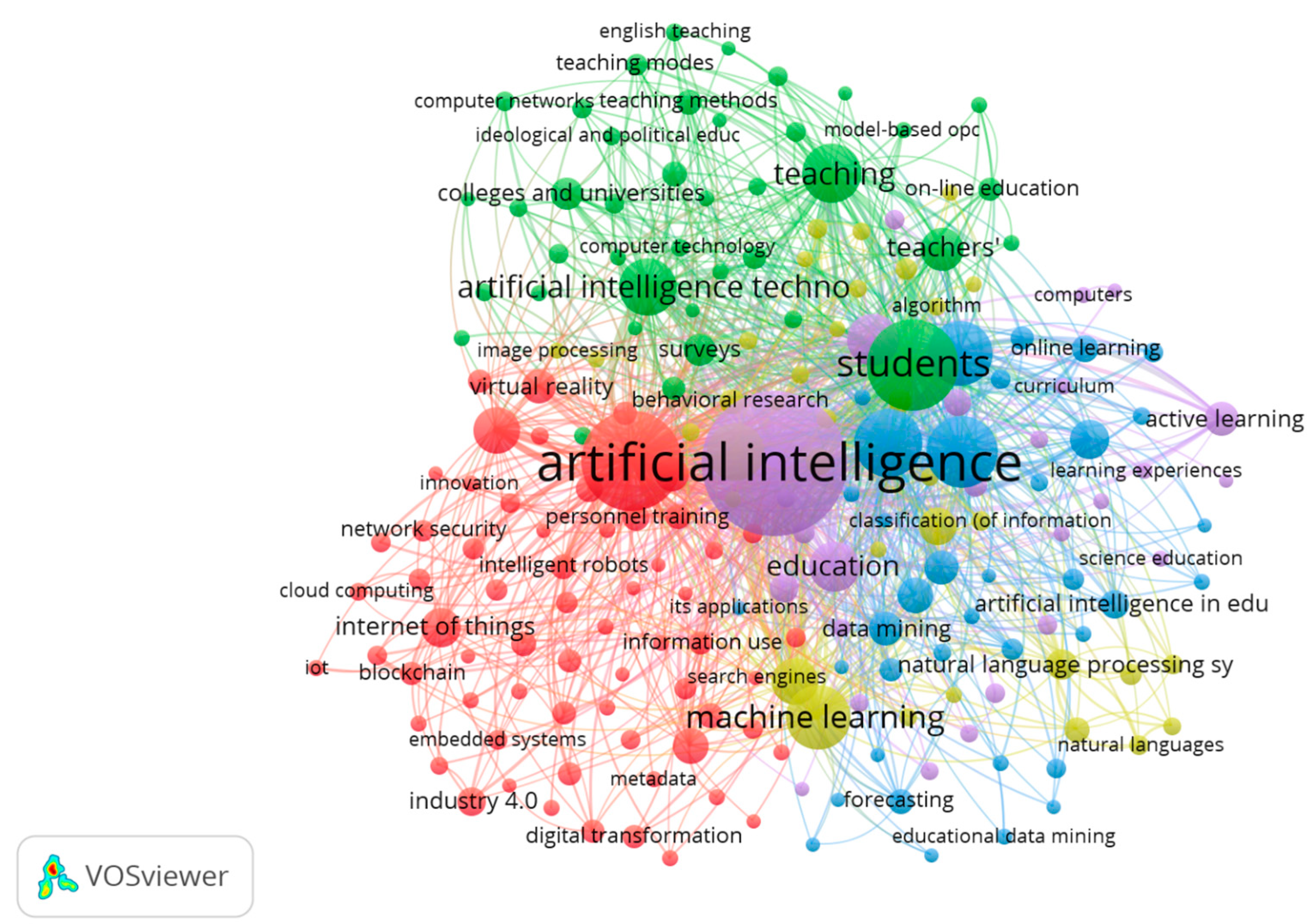
| 2021–2022 | Technological adoption and digital transformation | Peripheral: linked to “teaching methods”, “online learning”, “students” | Technology adopter (facilitator) | - Integrating AI tools into existing teaching methods; - experimenting with online and blended learning; - supporting students’ digital engagement. | SDG 4 | - Focus on digital infrastructure and automation; - teachers as implementers, not decision-makers; - early connection to SDG 8 through digital skills training. |
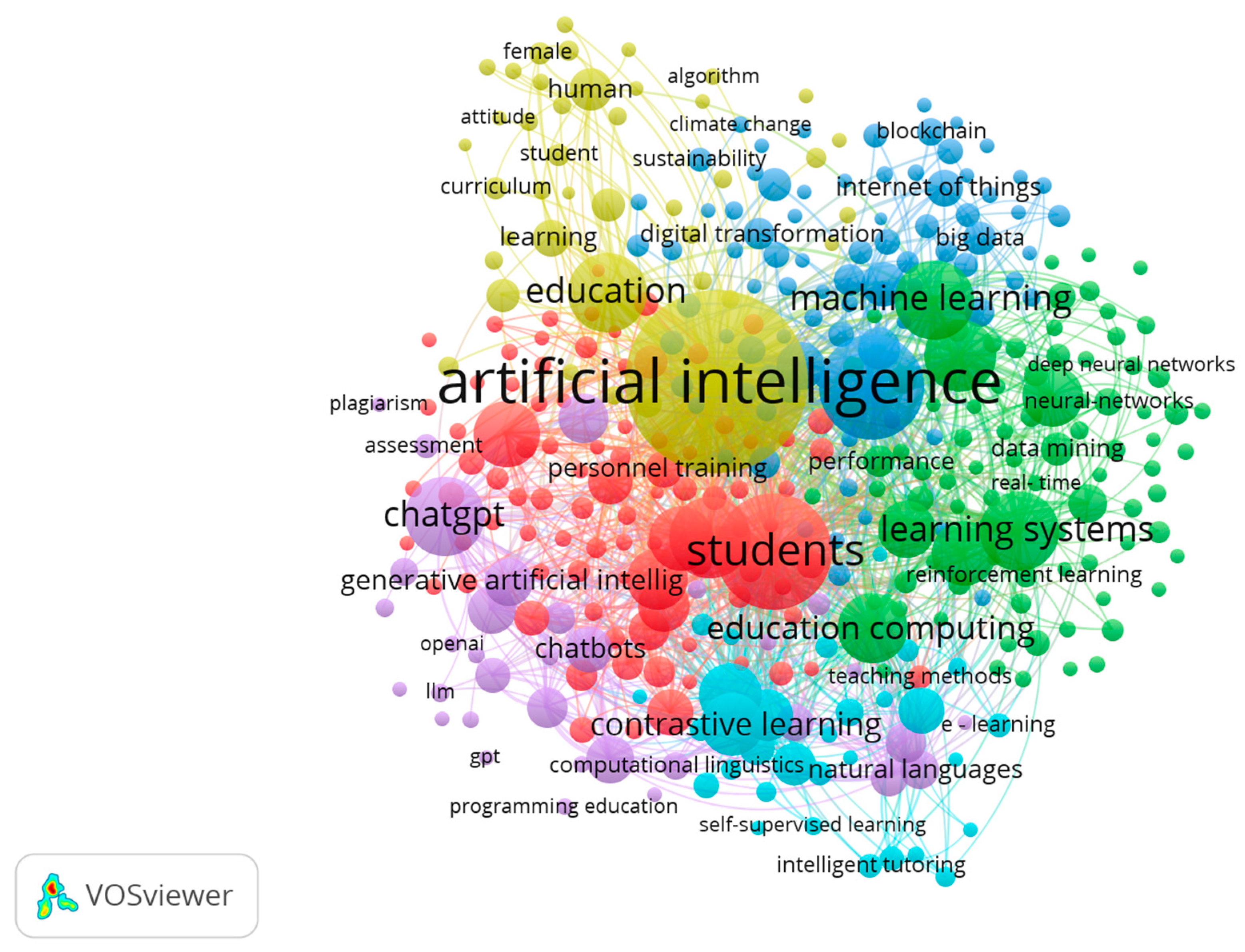
| 2023–2024 | Generative AI, ethics, and academic integrity | More central: connected to “curriculum”, “assessment”, “ChatGPT”, and “learning systems” | Mediator/evaluator/ethical guide | - Managing academic integrity and AI ethics; - adapting assessment to AI-generated content; - teaching AI literacy and critical thinking; - guiding responsible AI use. | SDG 4 SDG 8 | - Recognition of teachers as key to ethical and employability-oriented AI education; - universities emphasize digital competence and ethical governance; - growing demand for teacher training in AI literacy. |
| 2025 | Ethical innovation, AI literacy, and educational ecosystems | Central: connected to “decision making”, “ethics”, “AI literacy”, “learning systems”, and “higher education” | Designer/mentor/architect of learning environments | - Co-designing AI-supported curricula and adaptive systems - leading ethical and inclusive implementation of AI - mentoring students as creators, not consumers of knowledge - promoting lifelong learning and innovation skills | SDG 4 SDG 8 SDG 9 | - Teachers as strategic agents in innovation and workforce development; - education as an engine of sustainable economic growth; - institutional shift toward AI-informed policy, research, and leadership roles. |
Disclaimer/Publisher’s Note: The statements, opinions and data contained in all publications are solely those of the individual author(s) and contributor(s) and not of MDPI and/or the editor(s). MDPI and/or the editor(s) disclaim responsibility for any injury to people or property resulting from any ideas, methods, instructions or products referred to in the content. |
© 2026 by the authors. Licensee MDPI, Basel, Switzerland. This article is an open access article distributed under the terms and conditions of the Creative Commons Attribution (CC BY) license.
Share and Cite
Okulicz-Kozaryn, W.; Artyukhov, A.; Artyukhova, N. Will AI Replace Us? Changing the University Teacher Role. Societies 2026, 16, 32. https://doi.org/10.3390/soc16010032
Okulicz-Kozaryn W, Artyukhov A, Artyukhova N. Will AI Replace Us? Changing the University Teacher Role. Societies. 2026; 16(1):32. https://doi.org/10.3390/soc16010032
Chicago/Turabian StyleOkulicz-Kozaryn, Walery, Artem Artyukhov, and Nadiia Artyukhova. 2026. "Will AI Replace Us? Changing the University Teacher Role" Societies 16, no. 1: 32. https://doi.org/10.3390/soc16010032
APA StyleOkulicz-Kozaryn, W., Artyukhov, A., & Artyukhova, N. (2026). Will AI Replace Us? Changing the University Teacher Role. Societies, 16(1), 32. https://doi.org/10.3390/soc16010032