

Biological Markers of Cognitive Impairments in Combat and Contact-Sport Athletes: A Systematic Review

 , , , ,
Abstract
1. Introduction
2. Methods
2.1. Eligibility Criteria
2.2. Information Sources and Search Strategy
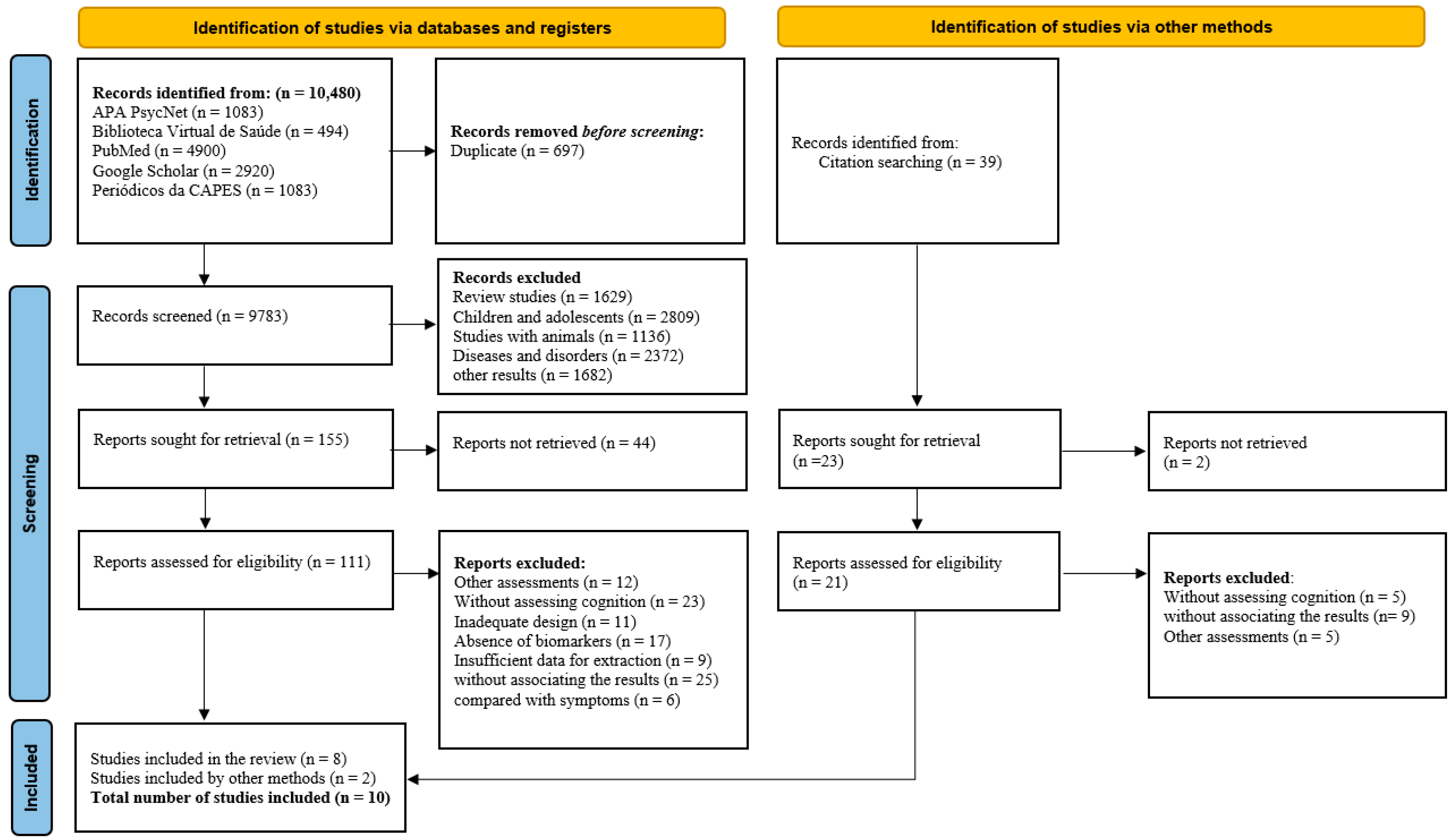
2.3. Study Selection Process
2.4. Risk-of-Bias Assessment
- (a)
- Low risk of bias (high methodological quality)—The study received ≥8 “Yes” responses out of the applicable items. Furthermore, all critical items (1, 2, 3, 4, 5a, 5b, and, for cohorts, 6a, 6b) must be rated as “Yes”. No more than one “No” response was allowed among the six internal validity items. “Cannot be determined” responses were not counted as “Yes”, but they did not automatically downgrade the study unless they reached the threshold described below.
- (b)
- Moderate risk of bias (reasonable methodological quality)—The study received 5–7 “Yes” responses out of the applicable items OR met all critical items but had a relevant limitation in another domain (e.g., loss to follow-up >20% without sensitivity analysis; lack of adjustment for important confounders). Up to two “No” or “Cannot be determined” ratings among the six internal validity items were accepted.
- (c)
- High risk of bias (low methodological quality)—The study received <5 “Yes” responses out of the applicable items OR failed to meet at least one critical item (1, 2, 3, 4, 5a, 5b, and, for cohorts, 6a, 6b) OR had three or more “No” responses among the six internal validity items.
2.5. Data Synthesis and Descriptive Certainty Assessment Adapted from Grading of Recommendations, Assessment, Development and Evaluations (GRADE)
- (a)
- Risk of bias: Methodological quality was previously assessed using the CASP checklist for cohort studies. For descriptive purposes, the CASP classification was mapped as follows: “High” CASP quality = low risk of bias (good quality); “Moderate” CASP quality = moderate risk of bias; “Low” CASP quality = high risk of bias. For the adapted GRADE domain, risk of bias was considered “not critical” (no downgrade) when the study was classified as high CASP quality (low risk of bias).
- (b)
- Publication bias: Formal assessment of publication bias using funnel plots or Egger’s test was not feasible due to the small number of studies per biomarker (a maximum of 15 eligible comparisons across different outcomes). Therefore, this domain was not downgraded for any study. However, publication bias is acknowledged as a potential limitation in Section 4.
- (c)
- Inconsistency: Because each row in Table 3 corresponds to a single study reporting consistent results for a given biomarker–outcome pair (or a set of internally consistent findings), inconsistency across multiple effect estimates was not applicable. Hence, the “Inconsistency” column is marked N/A for all studies. For future syntheses pooling multiple studies per outcome, this domain should be reassessed.
- (d)
- Indirectness: Indirectness was evaluated regarding population, exposure, outcome, and comparator. The domain was rated as “Direct” when the study directly assessed athletes from contact or combat sports (boxing, MMA, American football, rugby, soccer) and used objective cognitive tests (e.g., standardized neuropsychological batteries) or validated neuroimaging metrics. Indirectness would be rated as “Indirect” (with downgrade) if surrogate outcomes were used without clear correlation to clinical endpoints or if biomarker detection windows were biologically implausible. All studies in Table 3 were rated as “Direct” because only studies directly correlating biomarkers with cognitive or structural outcomes were included (see eligibility criteria).
- (e)
- Imprecision: Imprecision was assessed based on sample size and reporting of confidence intervals (CIs), using predefined thresholds (see Table 3 legend): (1) Not critical (no downgrade): n ≥ 100 per group, or CIs consistently reported; (2) Moderate (downgrade by one level): n = 51–99, or borderline precision; (3) Serious (downgrade by one level, or two levels if extreme): n ≤ 50 per group, or sample size not reported, or no CIs provided. This domain was applied at the study level as a descriptive indicator of precision.
- (f)
- Integration of domains and final descriptive rating: For each study, the five domains were combined to generate a descriptive certainty rating (High, Moderate, Low, or Very Low) following the general GRADE logic (starting from “High” for well-conducted observational studies and downgrading for serious limitations). Table 3 presents the domain ratings and the final descriptive certainty for each individual study. The observations column provides a brief justification for the rating.
3. Results
4. Discussion
4.1. Methodological Quality and Risk of Bias
4.2. Characteristics of Included Studies
4.3. Cognitive Assessment, Biomarkers, and Results
5. Conclusions
Supplementary Materials
Author Contributions
Funding
Data Availability Statement
Conflicts of Interest
References
- Barcelos, G.; Miranda De Oliveira, J.G.; Melo, R.; Norte, C.E.; Filgueiras, A. Concussion and executive functions in combat sports: A systematic review. J. Sports Sci. 2024, 42, 2402–2411. [Google Scholar] [CrossRef] [PubMed]
- McKee, A.C.; Stein, T.D.; Huber, B.R.; Crary, J.F.; Bieniek, K.; Dickson, D.; Alvarez, V.E.; Cherry, J.D.; Farrell, K.; Butler, M.; et al. Chronic traumatic encephalopathy (CTE): Criteria for neuropathological diagnosis and relationship to repetitive head impacts. Acta Neuropathol. 2023, 145, 371–394. [Google Scholar] [CrossRef] [PubMed]
- Hunter, L.E.; Branch, C.A.; Lipton, M.L. The neurobiological effects of repetitive head impacts in collision sports. Neurobiol. Dis. 2019, 123, 122–126. [Google Scholar] [CrossRef] [PubMed]
- Ntikas, M.; Binkofski, F.; Shah, N.J.; Ietswaart, M. Repeated sub-concussive impacts and the negative effects of contact sports on cognition and brain integrity. Int. J. Environ. Res. Public Health 2022, 19, 7098. [Google Scholar] [CrossRef] [PubMed]
- Stephen, S.J.; Shan, G.; Banks, S.J.; Bernick, C.; Bennett, L.L. The relationship between fighting style, cognition, and regional brain volume in professional combatants: A preliminary examination using brief neurocognitive measures. J. Head Trauma Rehabil. 2020, 35, E280–E287. [Google Scholar] [CrossRef] [PubMed]
- Gajek-Flanczewska, W.; Flanczewski, S.; Wirkijowska, M.; Wójtowicz, K.; Wirkijowski, J.; Walczak, A.; Woźniak, P.; Wietrzykowska, E.; Sobolewska, D.; Michalczyk-Fraszka, K.; et al. Consequences of Repetitive Head-Impact Exposure in Sports—Literature review. Qual. Sport 2025, 37, 57587. [Google Scholar] [CrossRef]
- Iverson, G.L.; Castellani, R.J.; Cassidy, J.D.; Schneider, G.M.; Schneider, K.J.; Echemendia, R.J.; Bailes, J.E.; Hayden, K.A.; Koerte, I.K.; Manley, G.T.; et al. Examining later-in-life health risks associated with sport-related concussion and repetitive head impacts: A systematic review of case-control and cohort studies. Br. J. Sports Med. 2023, 57, 810–824. [Google Scholar] [CrossRef] [PubMed]
- Batty, G.D.; Frank, P.; Kujala, U.M.; Sarna, S.J.; Valencia-Hernandez, C.A.; Kaprio, J. Dementia in former amateur and professional contact sports participants: Population-based cohort study, systematic review, and meta-analysis. eClinicalMedicine 2023, 61, 102056. [Google Scholar] [CrossRef] [PubMed]
- De Brito, M.A.; Fernandes, J.R.; Costa, K.F.; Maurício, C.A.; Gonçalves, A.F.; Nóbrega, O.d.T.; Aedo-Muñhoz, E.; Brito, C.J.; Pérez, D.I.V.; Miarka, B. Long-Term Cognitive Decline in MMA Fighters: A Two-Year Cohort Study on Executive Function Impairments Due to Repetitive Head Strikes. Int. J. Environ. Res. Public Health 2025, 22, 1004. [Google Scholar] [CrossRef] [PubMed]
- Giza, C.C.; Hovda, D.A. The new neurometabolic cascade of concussion. Neurosurgery 2014, 75, S24–S33. [Google Scholar] [CrossRef] [PubMed]
- Senaratne, N.; Hunt, A.; Sotsman, E.; Grey, M.J. Biomarkers to aid the return to play decision following sports-related concussion: A systematic review. J. Concussion 2022, 6, 20597002211070735. [Google Scholar] [CrossRef]
- Swaney, E.E.; Cai, T.; Seal, M.L.; Ignjatovic, V. Blood biomarkers of secondary outcomes following concussion: A systematic review. Front. Neurol. 2023, 14, 989974. [Google Scholar] [CrossRef] [PubMed]
- Papa, L. The Path Toward a Blood Test for Concussion: A Review of Biofluid Biomarkers for Concussive and Subconcussive Brain Trauma. In Tackling the Concussion Epidemic; Schweizer, T.A., Baker, A.J., Eds.; Springer International Publishing: Cham, Switzerland, 2022; pp. 71–84. [Google Scholar] [CrossRef]
- O’Connell, B.; Kelly, Á.M.; Mockler, D.; Orešič, M.; Denvir, K.; Farrell, G.; Janigro, D.; Wilson, F. Use of blood biomarkers in the assessment of sports-related concussion—A systematic review in the context of their biological significance. Clin. J. Sport Med. 2018, 28, 561–571. [Google Scholar] [PubMed]
- Shahim, P.; Zetterberg, H.; Tegner, Y.; Blennow, K. Serum neurofilament light as a biomarker for mild traumatic brain injury in contact sports. Neurology 2017, 88, 1788–1794. [Google Scholar] [CrossRef] [PubMed]
- Zetterberg, H.; Blennow, K. Fluid biomarkers for mild traumatic brain injury and related conditions. Nat. Rev. Neurol. 2016, 12, 563–574. [Google Scholar] [CrossRef] [PubMed]
- Meyer, J.; Bartolomei, C.; Sauer, A.; Sajatovic, M.; Bailey, C.M. The relationship between fluid biomarkers and clinical outcomes in sports-related concussions: A systematic review. Brain Inj. 2020, 34, 1435–1445. [Google Scholar] [CrossRef] [PubMed]
- Porteny, J.; Tovar, E.; Lin, S.; Anwar, A.; Osier, N. Salivary Biomarkers as Indicators of TBI Diagnosis and Prognosis: A Systematic Review. Mol. Diagn. Ther. 2022, 26, 169–187. [Google Scholar] [CrossRef] [PubMed]
- Page, M.J.; McKenzie, J.E.; Bossuyt, P.M.; Boutron, I.; Hoffmann, T.C.; Mulrow, C.D.; Shamseer, L.; Tetzlaff, J.M.; Akl, E.A.; Brennan, S.E.; et al. The PRISMA 2020 statement: An updated guideline for reporting systematic reviews. BMJ 2021, 372, n71. [Google Scholar] [CrossRef] [PubMed]
- Morgan, R.L.; Whaley, P.; Thayer, K.A.; Schünemann, H.J. Identifying the PECO: A framework for formulating good questions to explore the association of environmental and other exposures with health outcomes. Environ. Int. 2018, 121, 1027–1031. [Google Scholar] [CrossRef] [PubMed]
- Ouzzani, M.; Hammady, H.; Fedorowicz, Z.; Elmagarmid, A. Rayyan—A web and mobile app for systematic reviews. Syst. Rev. 2016, 5, 210. [Google Scholar] [CrossRef] [PubMed]
- Bailey, C.; Soden, D.; Maroon, J.; Selman, W.; Tangen, C.; Gunstad, J.; Briskin, S.; Miskovsky, S.; Miller, E.; Pieper, A.A. Elevated Autoantibodies to the GluA1 Subunit of the AMPA Receptor in Blood Indicate Risk of Cognitive Impairment in Contact Sports Athletes, Irrespective of Concussion. Neurotrauma Rep. 2024, 5, 552–562. [Google Scholar] [CrossRef] [PubMed]
- Bernick, C.; Zetterberg, H.; Shan, G.; Banks, S.; Blennow, K. Longitudinal Performance of Plasma Neurofilament Light and Tau in Professional Fighters: The Professional Fighters Brain Health Study. J. Neurotrauma 2018, 35, 2351–2356. [Google Scholar] [CrossRef] [PubMed]
- Bernick, C.; Shan, G.; Ritter, A.; Ashton, N.J.; Blennow, K.; Lantero-Rodriguez, J.; Snellman, A.; Zetterberg, H. Blood biomarkers and neurodegeneration in individuals exposed to repetitive head impacts. Alzheimer’s Res. Ther. 2023, 15, 173. [Google Scholar] [CrossRef] [PubMed]
- Garcia-Cordero, I.; Vasilevskaya, A.; Taghdiri, F.; Khodadadi, M.; Mikulis, D.; Tarazi, A.; Mushtaque, A.; Anssari, N.; Colella, B.; Green, R.; et al. Functional connectivity changes in neurodegenerative biomarker-positive athletes with repeated concussions. J. Neurol. 2024, 271, 4180–4190. [Google Scholar] [CrossRef] [PubMed]
- Gard, A.; Vedung, F.; Piehl, F.; Khademi, M.; Wernersson, M.P.; Rorsman, I.; Tegner, Y.; Pessah-Rasmussen, H.; Ruscher, K.; Marklund, N. Cerebrospinal fluid levels of neuroinflammatory biomarkers are increased in athletes with persistent post-concussive symptoms following sports-related concussion. J. Neuroinflamm. 2023, 20, 189. [Google Scholar] [CrossRef] [PubMed]
- LaRocca, D.; Barns, S.; Hicks, S.D.; Brindle, A.; Williams, J.; Uhlig, R.; Johnson, P.; Neville, C.; Middleton, F.A. Comparison of serum and saliva miRNAs for identification and characterization of mTBI in adult mixed martial arts fighters. PLoS ONE 2019, 14, e0207785. [Google Scholar] [CrossRef] [PubMed]
- Neselius, S.; Brisby, H.; Marcusson, J.; Zetterberg, H.; Blennow, K.; Karlsson, T. Neurological Assessment and Its Relationship to CSF Biomarkers in Amateur Boxers. PLoS ONE 2014, 9, e99870. [Google Scholar] [CrossRef] [PubMed]
- O’bRien, W.T.; Spitz, G.; Xie, B.; Major, B.P.; Mutimer, S.; Giesler, L.P.; Bain, J.; Evans, L.J.; Martins, B.D.; Piantella, S.; et al. Biomarkers of Neurobiologic Recovery in Adults with Sport-Related Concussion. JAMA Netw. Open 2024, 7, e2415983. [Google Scholar] [CrossRef] [PubMed]
- Van Amerongen, S.; Pulukuri, S.V.; Tuz-Zahra, F.; Tripodis, Y.; Cherry, J.D.; Bernick, C.; Geda, Y.E.; Wethe, J.V.; Katz, D.I.; Alosco, M.L.; et al. Inflammatory biomarkers for neurobehavioral dysregulation in former American football players: Findings from the DIAGNOSE CTE Research Project. J. Neuroinflamm. 2024, 21, 46. [Google Scholar] [CrossRef] [PubMed]
- Van Amerongen, S.; Peskind, E.R.; Tripodis, Y.; Adler, C.H.; Balcer, L.J.; Bernick, C.; Alosco, M.L.; Katz, D.; Banks, S.J.; Barr, W.B.; et al. Catecholamine Dysregulation in Former American Football Players: Findings From the DIAGNOSE CTE Research Project. Neurology 2025, 104, e213584. [Google Scholar] [CrossRef] [PubMed]
- Patricios, J.S.; Schneider, K.J.; Dvorak, J.; Ahmed, O.H.; Blauwet, C.; Cantu, R.C.; Davis, G.A.; Echemendia, R.J.; Makdissi, M.; McNamee, M.; et al. Consensus statement on concussion in sport: The 6th International Conference on Concussion in Sport–Amsterdam, October 2022. Br. J. Sports Med. 2023, 57, 695–711. [Google Scholar] [CrossRef] [PubMed]
- McCrory, P.; Meeuwisse, W.; Dvorak, J.; Aubry, M.; Bailes, J.; Broglio, S.; Cantu, R.C.; Cassidy, D.; Echemendia, R.J.; Castellani, R.J.; et al. Consensus statement on concussion in sport—The 5th international conference on concussion in sport held in Berlin, October 2016. Br. J. Sports Med. 2017, 51, 838–847. [Google Scholar] [CrossRef] [PubMed]
- Fabiyi, O.; Kalinina, D.; Kontos, A.P.; Zynda, A.J.; Ali, S.; Abidi, S.H. Potential salivary protein biomarkers for the identification of mild traumatic brain injury: A systematic review. Adv. Clin. Exp. Med. 2026, 35, 529–541. [Google Scholar] [CrossRef] [PubMed]
- Feinberg, C.; Mayes, K.D.; Portman, E.; Carr, C.; Mannix, R. Non-invasive fluid biomarkers in the diagnosis of mild traumatic brain injury (mTBI): A systematic review. J. Neurol. Neurosurg. Psychiatry 2024, 95, 184–192. [Google Scholar] [CrossRef] [PubMed]
- Caballero Ballesteros, Á.; Alonso Gallardo, M.I.; Mora-Delgado, J. Blood Biomarkers as Optimization Tools for Computed Tomography in Mild Traumatic Brain Injury Management in Emergency Departments: A Systematic Review. J. Pers. Med. 2025, 15, 350. [Google Scholar] [CrossRef] [PubMed]
- Xun, Y.; Guo, Q.; Ren, M.; Liu, Y.; Sun, Y.; Wu, S.; Lan, H.; Zhang, J.; Liu, H.; Wang, J.; et al. Characteristics of the sources, evaluation, and grading of the certainty of evidence in systematic reviews in public health: A methodological study. Front. Public Health 2023, 11, 998588. [Google Scholar] [CrossRef] [PubMed]
- Falavigna, M.; Stein, A.T.; Buehler, A.; Souza, K.M.; de Oliveira, M.A.R. Diretrizes Metodológicas: Sistema GRADE–Manual de Graduação da Qualidade da Evidência e Força de Recomendação Para Tomada de Decisão em Saúde. 2014; p. 71. Available online: https://rebrats.saude.gov.br/images/Documentos/2024/Diretrizes_metodologicas_Sistema_GRADE.pdf (accessed on 8 April 2026).
- Bezerra, C.T.; Grande, A.J.; Galvão, V.K.; dos Santos, D.H.M.; Atallah, Á.N.; Silva, V. Assessment of the strength of recommendation and quality of evidence: GRADE checklist. A descriptive study. Sao Paulo Med. J. 2022, 140, 829–836. [Google Scholar] [CrossRef] [PubMed]
- Grimshaw, J.M.; Eccles, M.P.; Lavis, J.N.; Hill, S.J.; Squires, J.E. Knowledge translation of research findings. Implement. Sci. 2012, 7, 50. [Google Scholar] [CrossRef] [PubMed]
- Murad, M.H.; Mustafa, R.A.; Schünemann, H.J.; Sultan, S.; Santesso, N. Rating the certainty in evidence in the absence of a single estimate of effect. Evid. Based Med. 2017, 22, 85–87. [Google Scholar] [CrossRef] [PubMed]
- Purssell, E. Can the Critical Appraisal Skills Programme check-lists be used alongside Grading of Recommendations Assessment, Development and Evaluation to improve transparency and decision-making? J. Adv. Nurs. 2020, 76, 1082–1089. [Google Scholar] [CrossRef] [PubMed]
- Guyatt, G.H.; Oxman, A.D.; Kunz, R.; Brozek, J.; Alonso-Coello, P.; Rind, D.; Devereaux, P.; Montori, V.M.; Freyschuss, B.; Vist, G.; et al. GRADE guidelines 6. Rating the quality of evidence—Imprecision. J. Clin. Epidemiol. 2011, 64, 1283–1293. [Google Scholar] [CrossRef] [PubMed]
- Schünemann, H.J.; Neumann, I.; Hultcrantz, M.; Brignardello-Petersen, R.; Zeng, L.; Murad, M.H.; Izcovich, A.; Morgano, G.P.; Baldeh, T.; Santesso, N.; et al. GRADE guidance 35: Update on rating imprecision for assessing contextualized certainty of evidence and making decisions. J. Clin. Epidemiol. 2022, 150, 225–242. [Google Scholar] [CrossRef] [PubMed]
- Zeng, L.; Brignardello-Petersen, R.; Hultcrantz, M.; Mustafa, R.A.; Murad, M.H.; Iorio, A.; Traversy, G.; Akl, E.A.; Mayer, M.; Schünemann, H.J.; et al. GRADE Guidance 34: Update on rating imprecision using a minimally contextualized approach. J. Clin. Epidemiol. 2022, 150, 216–224. [Google Scholar] [CrossRef] [PubMed]
- Castellini, G.; Bruschettini, M.; Gianola, S.; Gluud, C.; Moja, L. Assessing imprecision in Cochrane systematic reviews: A comparison of GRADE and Trial Sequential Analysis. Syst. Rev. 2018, 7, 110. [Google Scholar] [CrossRef] [PubMed]
- Zhang, Y.; Alonso-Coello, P.; Guyatt, G.H.; Yepes-Nuñez, J.J.; Akl, E.A.; Hazlewood, G.; Pardo-Hernandez, H.; Etxeandia-Ikobaltzeta, I.; Qaseem, A.; Williams, J.W.; et al. GRADE Guidelines: 19. Assessing the certainty of evidence in the importance of outcomes or values and preferences—Risk of bias and indirectness. J. Clin. Epidemiol. 2019, 111, 94–104. [Google Scholar] [CrossRef] [PubMed]
- Zhang, Y.; Coello, P.A.; Guyatt, G.H.; Yepes-Nuñez, J.J.; Akl, E.A.; Hazlewood, G.; Pardo-Hernandez, H.; Etxeandia-Ikobaltzeta, I.; Qaseem, A.; Williams, J.W.; et al. GRADE guidelines: 20. Assessing the certainty of evidence in the importance of outcomes or values and preferences—Inconsistency, imprecision, and other domains. J. Clin. Epidemiol. 2019, 111, 83–93. [Google Scholar] [CrossRef] [PubMed]
- CASP (Critical Appraisal Skills Programme). CASP Checklist: For Cohort Studies; CASP: Oxford, UK, 2024. [Google Scholar]
- Schneider, K.J.; Patricios, J.S.; Meeuwisse, W.; Schneider, G.M.; Hayden, K.A.; Premji, Z.; Ahmed, O.H.; Blauwet, C.; Broglio, S.; Cantu, R.C.; et al. Amsterdam 2022 process: A summary of the methodology for the Amsterdam International Consensus on Concussion in Sport. Br. J. Sports Med. 2023, 57, 712–721. [Google Scholar] [CrossRef] [PubMed]
- Asken, B.M.; Tanner, J.A.; VandeVrede, L.; Mantyh, W.G.; Casaletto, K.B.; Staffaroni, A.M.; La Joie, R.; Iaccarino, L.; Soleimani-Meigooni, D.; Rojas, J.C.; et al. Plasma P-tau181 and P-tau217 in Patients with Traumatic Encephalopathy Syndrome with and Without Evidence of Alzheimer Disease Pathology. Neurology 2022, 99, e594–e604. [Google Scholar] [CrossRef] [PubMed]
- Covassin, T.; Moran, R.; Elbin, R.J. Sex Differences in Reported Concussion Injury Rates and Time Loss From Participation: An Update of the National Collegiate Athletic Association Injury Surveillance Program From 2004–2005 Through 2008–2009. J. Athl. Train. 2016, 51, 189–194. [Google Scholar] [CrossRef] [PubMed]
- McGroarty, N.K.; Brown, S.M.; Mulcahey, M.K. Sport-Related Concussion in Female Athletes: A Systematic Review. Orthop. J. Sports Med. 2020, 8, 2325967120932306. [Google Scholar] [CrossRef] [PubMed]
- Button, K.S.; Ioannidis, J.P.; Mokrysz, C.; Nosek, B.A.; Flint, J.; Robinson, E.S.; Munafò, M.R. Confidence and precision increase with high statistical power. Nat. Rev. Neurosci. 2013, 14, 585. [Google Scholar] [CrossRef] [PubMed]
- Montenigro, P.H.; Alosco, M.L.; Martin, B.M.; Daneshvar, D.H.; Mez, J.; Chaisson, C.E.; Nowinski, C.J.; Au, R.; McKee, A.C.; Cantu, R.C.; et al. Cumulative head impact exposure predicts later-life depression, apathy, executive dysfunction, and cognitive impairment in former high school and college football players. J. Neurotrauma 2017, 34, 328–340. [Google Scholar] [CrossRef] [PubMed]
- Crisco, J.J.; Wilcox, B.J.; Beckwith, J.G.; Chu, J.J.; Duhaime, A.-C.; Rowson, S.; Duma, S.M.; Maerlender, A.C.; McAllister, T.W.; Greenwald, R.M. Head impact exposure in collegiate football players. J. Biomech. 2011, 44, 2673–2678. [Google Scholar] [CrossRef] [PubMed]
- Broglio, S.P.; Syrydiuk, R.; Pasquina, P.; McAllister, T.; McCrea, M.; Boltz, A. Age Of First Exposure To American Football Is Not Related To Clinical Outcomes In Former Athletes: 2019. Med. Sci. Sports Exerc. 2025, 57, 668. [Google Scholar]
- Broglio, S.P.; Zhu, W.; Sopiarz, K.; Park, Y. Generalizability Theory Analysis of Balance Error Scoring System Reliability in Healthy Young Adults. J. Athl. Train. 2009, 44, 497–502. [Google Scholar] [CrossRef] [PubMed]
- Donnelly, R.R.; Ugbolue, U.C.; Gao, Y.; Gu, Y.; Dutheil, F.; Baker, J.S. A Systematic Review and Meta-Analysis Investigating Head Trauma in Boxing. Clin. J. Sport Med. 2023, 33, 658–674. [Google Scholar] [CrossRef] [PubMed]
- Manley, G.; Gardner, A.J.; Schneider, K.J.; Guskiewicz, K.M.; Bailes, J.; Cantu, R.C.; Castellani, R.J.; Turner, M.; Jordan, B.D.; Randolph, C.; et al. A systematic review of potential long-term effects of sport-related concussion. Br. J. Sports Med. 2017, 51, 969–977. [Google Scholar] [CrossRef] [PubMed]
- Neidecker, J.; Sethi, N.K.; Taylor, R.; Monsell, R.; Muzzi, D.; Spizler, B.; Lovelace, L.; Ayoub, E.; Weinstein, R.; Estwanik, J.; et al. Concussion management in combat sports: Consensus statement from the Association of Ringside Physicians. Br. J. Sports Med. 2019, 53, 328–333. [Google Scholar] [PubMed]
- Stern, Y.; Arenaza-Urquiljo, E.M.; Bartrés-Faz, D.; Belleville, S.; Cantillon, M.; Chetelat, G.; Ewers, M.; Franzmeier, N.; Kempermann, G.; Kremen, W.S.; et al. Whitepaper: Defining and investigating cognitive reserve, brain reserve, and brain maintenance. Alzheimer’s Dement. 2020, 16, 1305–1311. [Google Scholar] [CrossRef] [PubMed]
- Argiris, G.; Habeck, C.; Stern, Y. Brain Plasticity, Cognitive Reserve, and Aging. In The Human Brain and Neuroplasticity; The Guilford Press: New York, NY, USA, 2026; p. 118. Available online: https://books.google.com.br/books?hl=pt-BR&lr=&id=ti3KEQAAQBAJ&oi=fnd&pg=PA118&dq=Yaakov+Stern+(2009).+Cognitive+Reserve.+Neuropsychologia,+47(10),+2015%E2%80%932028.&ots=gK7dyniIzD&sig=5VAw7q9rZg_ZKpRibWDnBtF6zEo (accessed on 12 April 2026).
- Lempke, L.B.; Howell, D.R.; Eckner, J.T.; Lynall, R.C. Examination of Reaction Time Deficits Following Concussion: A Systematic Review and Meta-analysis. Sports Med. 2020, 50, 1341–1359. [Google Scholar] [CrossRef] [PubMed]
- Fernandes, J.R.; de Brito, M.A.; Ferreira, A.; Pérez, D.V.; Muñoz, E.A.; Miarka, B.; Brito, C.J. Acute impact of mixed martial art bouts on cognitive function: A comparative study of regular and occasional sparring practitioners. Rev. Iberoam. Psicol. Ejerc. Deporte 2024, 19, 454–457. [Google Scholar]
- Paizante, R.O.; Queiroz, A.C.C.; Fernandes, J.R.; Brito, M.d.A.; Dos Santos, M.H.; Aedo-Muñoz, E.; Pérez, D.I.V.; Nóbrega, O.d.T.; Miarka, B.; Brito, C.J. Headgear increases protection against acute concussion symptoms in amateur Olympic boxers. Retos Nuevas Tend. Educ. Física Deporte Recreación 2024, 60, 405–412. [Google Scholar] [CrossRef]
- Collins, L.K.; Ofa, S.A.; Miskimin, C.; Mulcahey, M. Cognitive Deficits Following Concussion: A Systematic Review. J. Orthop. Exp. Innov. 2023, 4. [Google Scholar] [CrossRef]
- Koerte, I.K.; Nichols, E.; Tripodis, Y.; Schultz, V.; Lehner, S.; Igbinoba, R.; Chuang, A.Z.; Mayinger, M.; Klier, E.M.; Muehlmann, M.; et al. Impaired Cognitive Performance in Youth Athletes Exposed to Repetitive Head Impacts. J. Neurotrauma 2017, 34, 2389–2395. [Google Scholar] [CrossRef] [PubMed]
- Di Battista, A.P.; Churchill, N.; Schweizer, T.A.; Rhind, S.G.; Richards, D.; Baker, A.J.; Hutchison, M.G. Blood biomarkers are associated with brain function and blood flow following sport concussion. J. Neuroimmunol. 2018, 319, 1–8. [Google Scholar] [CrossRef] [PubMed]
- McDonald, T.; Burghart, M.A.; Nazir, N. Underreporting of concussions and concussion-like symptoms in female high school athletes. J. Trauma Nurs. JTN 2016, 23, 241–246. [Google Scholar] [CrossRef] [PubMed]
- Miner, A.E.; Groh, J.R.; Tripodis, Y.; Adler, C.H.; Balcer, L.J.; Bernick, C.; Zetterberg, H.; Blennow, K.; Peskind, E.; Ashton, N.J.; et al. Examination of plasma biomarkers of amyloid, tau, neurodegeneration, and neuroinflammation in former elite American football players. Alzheimer’s Dement. 2024, 20, 7529–7546. [Google Scholar] [CrossRef] [PubMed]
- Cherry, J.D.; Tripodis, Y.; Alvarez, V.E.; Huber, B.; Kiernan, P.T.; Daneshvar, D.H.; Mez, J.; Montenigro, P.H.; Solomon, T.M.; Alosco, M.L.; et al. Microglial neuroinflammation contributes to tau accumulation in chronic traumatic encephalopathy. Acta Neuropathol. Commun. 2016, 4, 112. [Google Scholar] [CrossRef] [PubMed]
- McKee, A.C.; Alosco, M.L.; Huber, B.R. Repetitive head impacts and chronic traumatic encephalopathy. Neurosurg. Clin. North Am. 2016, 27, 529–535. [Google Scholar] [CrossRef]
- Feiger, J.A.; Snyder, R.L.; Walsh, M.J.; Cissne, M.; Cwiek, A.; Al-Momani, S.I.; Chiou, K.S. The Role of Neuroinflammation in Neuropsychiatric Disorders Following Traumatic Brain Injury: A Systematic Review. J. Head Trauma Rehabil. 2022, 37, E370–E382. [Google Scholar] [CrossRef] [PubMed]
- Malik, S.; Alnaji, O.; Malik, M.; Gambale, T.; Rathbone, M.P. Correlation between Mild Traumatic Brain Injury-Induced Inflammatory Cytokines and Emotional Symptom Traits: A Systematic Review. Brain Sci. 2022, 12, 102. [Google Scholar] [CrossRef] [PubMed]
- Mayer, M.G.; Fischer, T. Microglia at the blood brain barrier in health and disease. Front. Cell. Neurosci. 2024, 18, 1360195. [Google Scholar] [CrossRef] [PubMed]
- Banks, W.A.; Gray, A.M.; Erickson, M.A.; Salameh, T.S.; Damodarasamy, M.; Sheibani, N.; Meabon, J.S.; Wing, E.E.; Morofuji, Y.; Cook, D.G.; et al. Lipopolysaccharide-induced blood-brain barrier disruption: Roles of cyclooxygenase, oxidative stress, neuroinflammation, and elements of the neurovascular unit. J. Neuroinflamm. 2015, 12, 223. [Google Scholar] [CrossRef] [PubMed]
- Pick, S.; Goldstein, L.H.; Perez, D.L.; Nicholson, T.R. Emotional processing in functional neurological disorder: A review, biopsychosocial model and research agenda. J. Neurol. Neurosurg. Psychiatry 2019, 90, 704–711. [Google Scholar] [CrossRef] [PubMed]
- Di Pietro, V.; Yakoub, K.M.; Scarpa, U.; Di Pietro, C.; Belli, A. MicroRNA Signature of Traumatic Brain Injury: From the Biomarker Discovery to the Point-of-Care. Front. Neurol. 2018, 9, 429. [Google Scholar] [CrossRef] [PubMed]
- Hicks, S.D.; Jacob, P.; Middleton, F.A.; Perez, O.; Gagnon, Z. Distance running alters peripheral microRNAs implicated in metabolism, fluid balance, and myosin regulation in a sex-specific manner. Physiol. Genom. 2018, 50, 658–667. [Google Scholar] [CrossRef] [PubMed]
- Katz, D.I.; Bernick, C.; Dodick, D.W.; Mez, J.; Mariani, M.L.; Adler, C.H.; Alosco, M.L.; Balcer, L.J.; Banks, S.J.; Barr, W.B.; et al. National Institute of Neurological Disorders and Stroke Consensus Diagnostic Criteria for Traumatic Encephalopathy Syndrome. Neurology 2021, 96, 848–863. [Google Scholar] [CrossRef] [PubMed]


| Category | Inclusion Criteria | Exclusion Criteria |
|---|---|---|
| Population (P) | Adult athletes (≥18 years), active or retired, from combat or contact sports with direct exposure to head impacts. | Individuals with pre-existing neurological pathologies not related to sport. |
| Exposure (E) | Documented history of participation in combat or contact sports, including repeated subconcussive impacts or clinically diagnosed sport-related concussion (SRC). | Studies focused exclusively on traumatic brain injury (TBI) from external causes not related to sport. |
| Comparator (C) | Observational studies that include at least one comparison group: athletes with vs. without cognitive impairment; combat/contact-sport athletes vs. non-contact-sport athletes, or healthy individuals. Studies without a comparator group that objectively assess the association between biomarkers and cognition. | Studies that do not assess cognition or biomarkers objectively. |
| Outcomes (O) (a) Biomarkers | Measurement of peripheral biological biomarkers (blood, saliva, cerebrospinal fluid) or molecular markers associated with neuronal damage, neuroinflammation, or synaptic plasticity. | Studies based exclusively on imaging biomarkers (e.g., MRI, EEG) without biological fluid collection. |
| (b) Cognition | Objective assessment of cognitive performance using validated neuropsychological tests. | Studies reporting only subjective symptoms, self-reported cognitive complaints, or non-standardized screenings. |
| (c) Association | Studies that explicitly analyze the correlation between biomarkers and cognition. | Studies that assessed only biomarkers (without corresponding cognitive measures) or only cognition (without biomarkers). |
| Study Design (S) | Observational studies: cross-sectional, cohort (prospective or retrospective), and longitudinal studies. | Gray literature without peer review, reviews, editorials, letters, opinions, or conference abstracts. |
| Study | 1 | 2 | 3 | 4 | 5a | 5b | 6a | 6b | 7 | 8 | 9 | 10 | 11 | 12 | Classification |
|---|---|---|---|---|---|---|---|---|---|---|---|---|---|---|---|
| [22] | Y | Y | Y | Y | Y | Y | Y | Y | Y | U | Y | Y | Y | Y | High |
| [23] | Y | Y | Y | Y | Y | Y | Y | Y | Y | Y | Y | Y | Y | Y | High |
| [24] | Y | Y | Y | Y | Y | Y | Y | Y | Y | Y | Y | Y | Y | Y | High |
| [25] | Y | Y | Y | Y | Y | Y | - | - | Y | U | Y | Y | Y | Y | High |
| [26] | Y | Y | Y | Y | Y | Y | - | - | Y | U | Y | Y | Y | Y | High |
| [27] | Y | Y | Y | Y | Y | Y | Y | Y | Y | U | Y | Y | Y | Y | High |
| [28] | Y | Y | Y | Y | Y | Y | Y | Y | Y | U | Y | Y | Y | Y | High |
| [29] | Y | Y | Y | Y | Y | Y | Y | Y | Y | Y | Y | Y | Y | Y | High |
| [30] | Y | Y | Y | Y | Y | Y | - | - | Y | Y | Y | Y | Y | Y | High |
| [31] | Y | Y | Y | Y | Y | Y | - | - | Y | Y | Y | Y | Y | Y | High |
| Study | Type | (n) | Classification Risk of Bias | Publication Bias | Inconsistency | Indirect Evidence | Imprecision | GRADE Certainty | Observations |
|---|---|---|---|---|---|---|---|---|---|
| [22] | Cohort | 60 | High | Low | N/A | Direct | Moderate | Moderate | Well-conducted study |
| [23] | Cohort | 417 | High | Low | N/A | Direct | Not critical | High | Adequate sample and follow-up |
| [24] | Cohort | 472 | High | Low | N/A | Direct | Not critical | High | Adequate sample and follow-up |
| [25] | Cross-sectional | 47 | High | Low | N/A | Direct | Serious | Very Low | Extremely small sample size |
| [26] | Cross-sectional | 36 | High | Low | N/A | Direct | Serious | Very Low | Extremely small sample size |
| [27] | Cohort | 50 | High | Low | N/A | Direct | Serious | Very Low | Extremely small sample size |
| [28] | Cohort | 55 | High | Low | N/A | Direct | Moderate | Moderate | Adequate sample and follow-up |
| [29] | Cohort | 137 | High | Low | N/A | Direct | Not critical | High | Adequate sample and follow-up |
| [30] | Cohort | 235 | High | Low | N/A | Direct | Not critical | High | Adequate sample and follow-up |
| [31] | Cross-sectional | 158 | High | Low | N/A | Direct | Not critical | High | Adequate sample and follow-up |
| Study | Type of Study | Modality | General Characteristics | Exposure | Exposure Time |
|---|---|---|---|---|---|
| [22] | Cohort | American Football, Hockey, Cross-country, Ultimate frisbee (College athletes) | Contact (n = 20M/24F—20.4 ± 1.5 y); Non-contact (n = 9M/7F; 20.9 ± 1.1 y) | ↑ RHI ↓ cognition | 1 session of 24 and 48 h |
| [23] | Cohort | Boxing and MMA | Active MMA (n = 152M/17F; 29.6 ± 4.7 y), Control (n = 69M/10F; 30.8 ± 10.0); Active Boxing (n = 110M/7F; 30.4 ± 6.9 y); Retired Boxing (n = 50M/2F; 48.0 ± 10.2 y) | ↑ RHI ↔ cognition | Active MMA (5.6 ± 4.2 y); Control (0); Active Boxing (5.9 ± 4.5 y); Retired Boxing (11.7 ± 5.3) |
| [24] | Cohort | Boxing e and MMA | Active Boxing (n = 130M/10F; 31 ± 8 y); Active MMA (n = 178M/33F; 30 ± 5 y); Retired Boxing (n = 65M/4F; 48.7 ± 9 y); Control (n = 39M/13F; 35.6 ± 12 y) | ↑ RHI ↓ cognition | Active MMA (3.5 y); Control (0); Active Boxing (4.4 y); Retired Boxing (10.7) |
| [25] | Cross-sectional | Boxing, American football, Soccer, Hockey | ExPRO+ (n = 16M; 58.9 ± 11.4 y); ExPRO− (n = 25M; 55.2 ± 6.9 y); Control (n = 6M; 54.0 ± 7.5 y) | ↑ RHI ↔ cognition | ExPRO+ (10.1 ± 4.3); ExPRO− (10.6 ± 3.4 y); Control (0) |
| [26] | Cross-sectional | Boxing, American Football, Soccer, Hockey, Karate, Wrestling | SRC (n = 13M/11F; 25 ± 5.1 y), Controls (n = 5M/7F; 28 ± 4.9 y) | ↑ RHI ↔ cognition | Athletes (17.8 ± 5.0 y) and control (0) |
| [27] | Cohort | MMA | MMA (n = 48M/2F; 26.5 ± 5.8 y) | ↑ RHI ↓ cognition | 3 weeks post-fight |
| [28] | Cohort | Olympic boxers | Olympic boxers (n = 30M; 22 y); Controls (n = 25M; 22 y) | ↑ RHI ↓ cognition | Chronic |
| [29] | Cohort | Former football players | SRC (n = 72M/9F; 22.8 y), Controls (n = 54M/2F; 24.6 y) | ↑ RHI ↔ cognition | 13.5 y SRC and control (14.0 y) |
| [30] | Cohort | American football | NBD+ (n = 104M; 58.2 ± 7.7 y); NBD− (n = 76M; 58.2 ± 8.7 y); Control (n = 55M; 59.8 ± 8.3 y) | ↑ RHI ↓ cognition | Chronic, NBD+ 16.3 y; NBD− 15.2 y, control 0 |
| [31] | Cross-sectional | Football players | Player (n = 120M; 57.5 ± 8.2 y); Control (n = 38M; 59.8 ± 8.9 y) | ↑ RHI ↓ cognition | Chronic 16.3 y |
| Study | Cognitive Assessments | Biomarkers | Association with Cognition | Temporal Points |
|---|---|---|---|---|
| [22] | ImPACT (Reaction Time), PCS-R (self-reported of concussion) | Synaptic (Anti-GluA1, GluA1) | In contact-sport athletes, reaction time ↓ after the season (0.06 ± 0.19 vs. low contact 0.00 ± 0.04) and showed a low correlation (r = 0.37; p = 0.043) with the ↑ GluA1 autoantibodies, associated with ↓ reaction time only in this group. | Pre, post, and acute post-concussion phase, 24–48 h after injury, and return to sport |
| [23] | CNS Vital Signs (verbal memory, processing speed, attention span, executive function, psychomotor speed) | Axonal (NfL); neurodegenerative (Tau) | Active boxers showed + ↑ NF-L levels (21.55 pg/mL; p = 0.0001) vs. active MMA fighters (14.58 pg/mL), retired (15.12 pg/mL), and controls (11.27 pg/mL). Significant ↑ Tau over time only in active MMA fighters (p = 0.01). The ↑ tau was not associated with a change in cognitive performance. Basal + ↑ NF-L levels were associated with ↓ basal performance in the domains of psychomotor speed (r = −0.1219, p = 0.0203) and processing speed (r = −0.1097, p = 0.0378). However, no correlation was observed between basal tau level and performance on basal cognitive tests. | Annual monitoring for 5 years |
| [24] | CNS Vital Signs (verbal memory, processing speed, attention span, executive function, psychomotor speed) | Axonal (GFAP, NfL), neurodegenerative (p-tau231, NTA tau) | Basal GFAP ↑ in retired boxers vs. active MMA fighters (p = 0.019); NfL ↑ in active boxers vs. MMA (p = 0.047). ↑ GFAP was associated with cognitive ↓ (memory, processing speed, psychomotor speed, reaction time). In active fighters, ↑ GFAP correlated with ↓ psychomotor speed. | Baseline and annual, with an average follow-up of 2 to 4 years |
| [25] | RAVLT (immediate and delayed memory), Digit Span (working memory), PASAT (sustained attention and processing speed), Verbal Fluency (lexical production and executive function), Mood and behavior scales, PAI (anxiety, depression, mania, and aggression), WTAR (premorbid IQ estimate). | Axonal (NfL); neurodegenerative (p-tau181, Aβ1-42, and t-tau) | In the EXPRO− group, 12% had abnormal pTau181, but without levels of MCI or AD. In the PRO+ group, 25% had abnormal pTau181, including cases in the MCI and AD ranges. Mean performance in executive functions, memory, and mood/behavior was normal in all groups, with no significant differences. | follow-up from 2011 to 2021 |
| [26] | RBANS (attention, language, immediate memory, delayed memory, visuospatial/constructive), SCAT5 (self-reported of concussion) | Inflammatory (IL-2, IL-5, IL-7, IL-12/23p40, IL-15, IL-16, IL-17A, TNF-β, VEGF, IFN-γ, IL-1β, IL-4, IL-6, IL-8, IL-10, IL-13, TNF-α, Eotaxin, Eotaxin-3, IP-10, MCP-1, MCP-4, MDC, MIP-1α, MIP-1β, TARC.) | 10 athletes showed impaired performance in cognitive tests. There was no strong correlation between most biomarkers and cognition or symptoms. | Acute (Post-injury) |
| [27] | Trail Making Test A and B (digital) (attention, processing speed, and executive function), Digit Span (working memory) | Axonal (UCHL1, MBP, NSE2, GFAP, S100B), Inflammatory (IL-6, VCAM-1, CCL2/MCP-1, CRP, ICAM-1), neurodegenerative (miRNA, BDNF) | Salivary and serum miRNAs predicted the probability of TBI and were associated with head impacts, cognitive measures, and balance. Serum proteins had much less utility. | Pre-fight (1 week before and 1 h before), post-fight (immediately, 15–30 min, 2–3 days, 1 week, and ≥3 weeks) |
| [28] | ROCF (memory), WAIS-R (memory), COWAT (verbal fluency), Digit Span (immediate memory), Listening Span Test (complex memory and attention), Trail Making Test A and B (attention, speed and cognitive flexibility), Reaction Time (simple and complex), Finger Tapping Test (motor speed). | Axonal (NfL, S100B, GFAP), neurodegenerative (tau total, BDNF, Aβ42) | Boxers vs. controls had more “know” responses in a visual memory task (p = 0.02); they performed better on working memory (p = 0.049). Boxers with prolonged ↑ NFL (after a rest period) showed deficits in Trail Making A (p = 0.041) and simple reaction time (p = 0.042). | 1 to 6 days and 14 days after the fight |
| [29] | RPQ (Self-reported concussion symptoms), Cogstate Battery (psychomotor speed, attention, visual memory, working memory, reaction time, and accuracy) | Axonal (GFAP, NfL) | ↑ GFAP and NfL levels are linked to greater clinical severity, loss of consciousness, and slower recovery, but the relationship with cognition is limited. | Applied at multiple points: 24 h, 1, 2, 4, 6, 8, 12, and 26 weeks post-injury. |
| [30] | Diagnosis of NBD, NINDS 2021 Criteria, Neurobehavioral dysregulation (explosiveness, emotional dyscontrol, affective lability, and impulsivity), Cognitive (verbal memory and executive functions, processing speed) | Axonal (NfL), Inflammatory (IL-1β, IL-6, IL-8, IL-10, CRP, TNF-α) | Former American football players with bipolar disorder had ↑ CSF IL-6, associated with ↑ emotional dyscontrol, affective lability, impulsivity, and total bipolar disorder scores. In older players, ↑ plasma NfL was associated with ↑ emotional dyscontrol and impulsivity, as well as ↓ executive function and processing speed. | We conducted baseline visits between September 2016 and February 2020 |
| [31] | NINDS criteria, Neurobehavioral dysregulation (explosiveness, emotional dyscontrol, affective lability, and impulsivity), Cognition (Learning, verbal memory, executive function, psychomotor speed, visual memory), Number span (Verbal fluency), Mood scales, BDI-II, and BAI. | Neurodegenerative (NE, DHPG, DA, L-DOPA, DOPAC) | Former players showed ↓ NE, L-DOPA, and DOPAC vs. controls. In the COL subgroup, ↑ NE and ↑ L-DOPA were associated with worse executive function/psychomotor speed, higher impulsivity, and emotional dyscontrol. | We conducted baseline visits between September 2016 and February 2020 |
Disclaimer/Publisher’s Note: The statements, opinions and data contained in all publications are solely those of the individual author(s) and contributor(s) and not of MDPI and/or the editor(s). MDPI and/or the editor(s) disclaim responsibility for any injury to people or property resulting from any ideas, methods, instructions or products referred to in the content. |
© 2026 by the authors. Licensee MDPI, Basel, Switzerland. This article is an open access article distributed under the terms and conditions of the Creative Commons Attribution (CC BY) license.
Share and Cite
Fernandes, J.R.; de Brito, M.A.; Costa, K.F.; Rios, F.I.; Roa-Gamboa, I.; Almeida, N.R.; de Camargos, E.F.; Díaz de Durana, A.L.; Miarka, B.; Nóbrega, O.d.T.; et al. Biological Markers of Cognitive Impairments in Combat and Contact-Sport Athletes: A Systematic Review. Sports 2026, 14, 272. https://doi.org/10.3390/sports14070272
Fernandes JR, de Brito MA, Costa KF, Rios FI, Roa-Gamboa I, Almeida NR, de Camargos EF, Díaz de Durana AL, Miarka B, Nóbrega OdT, et al. Biological Markers of Cognitive Impairments in Combat and Contact-Sport Athletes: A Systematic Review. Sports. 2026; 14(7):272. https://doi.org/10.3390/sports14070272
Chicago/Turabian StyleFernandes, José Raimundo, Michele Andrade de Brito, Keveenrick Ferreira Costa, Felipe Inostroza Rios, Ignacio Roa-Gamboa, Naiara Ribeiro Almeida, Einstein Francisco de Camargos, Alfonso López Díaz de Durana, Bianca Miarka, Otávio de Toledo Nóbrega, and et al. 2026. "Biological Markers of Cognitive Impairments in Combat and Contact-Sport Athletes: A Systematic Review" Sports 14, no. 7: 272. https://doi.org/10.3390/sports14070272
APA StyleFernandes, J. R., de Brito, M. A., Costa, K. F., Rios, F. I., Roa-Gamboa, I., Almeida, N. R., de Camargos, E. F., Díaz de Durana, A. L., Miarka, B., Nóbrega, O. d. T., & Brito, C. J. (2026). Biological Markers of Cognitive Impairments in Combat and Contact-Sport Athletes: A Systematic Review. Sports, 14(7), 272. https://doi.org/10.3390/sports14070272