
Sex Patterns of Statin Therapy and Multicomponent Exercise Training on Cardiorespiratory Fitness in Older Adults with Dyslipidemia: A 24-Month Cohort Study

 , , and
Abstract
1. Introduction
2. Materials and Methods
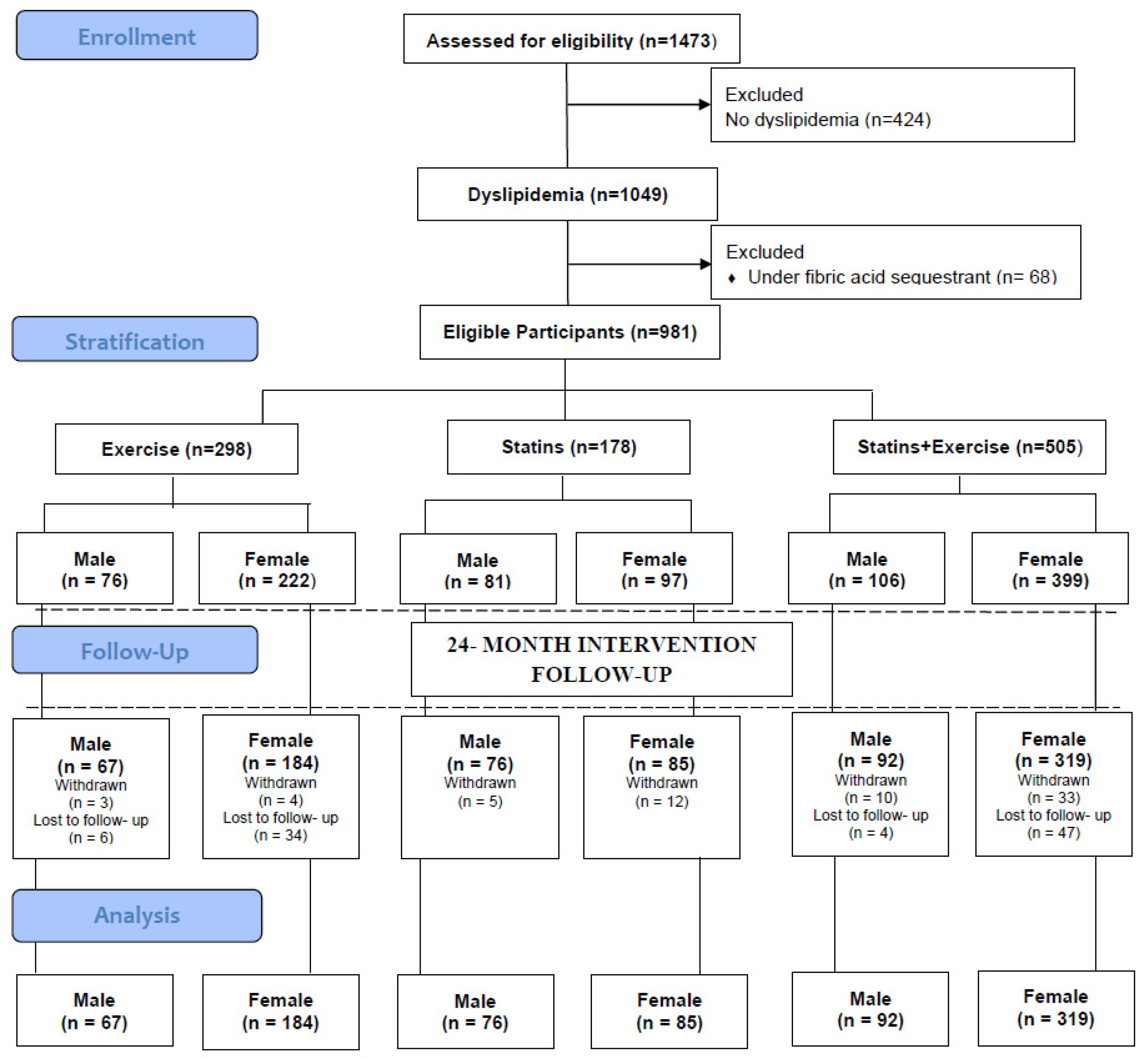
2.1. Study Design Overview
2.2. Participants
2.3. Intervention
2.3.1. Pharmacological Treatment
2.3.2. Multicomponent Exercise Training
2.4. Outcomes
2.4.1. Cardiorespiratory Fitness
2.4.2. Functional Status
2.4.3. Lipid Profile
2.4.4. Clinical and Medication History
2.5. Statistical Analysis
3. Results
3.1. Participant Baseline Characteristics
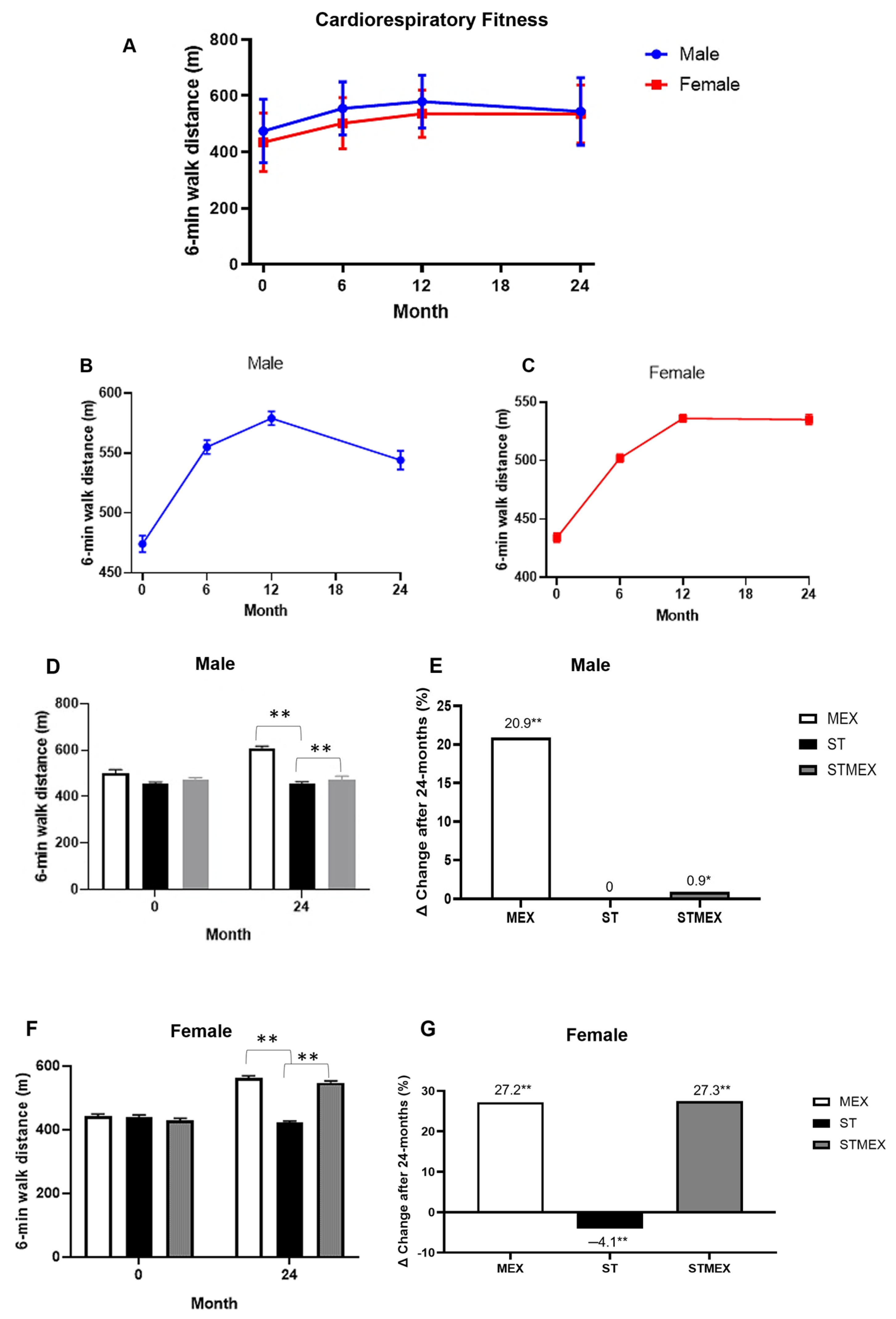
3.2. Sex Patterns in Cardiorespiratory Fitness
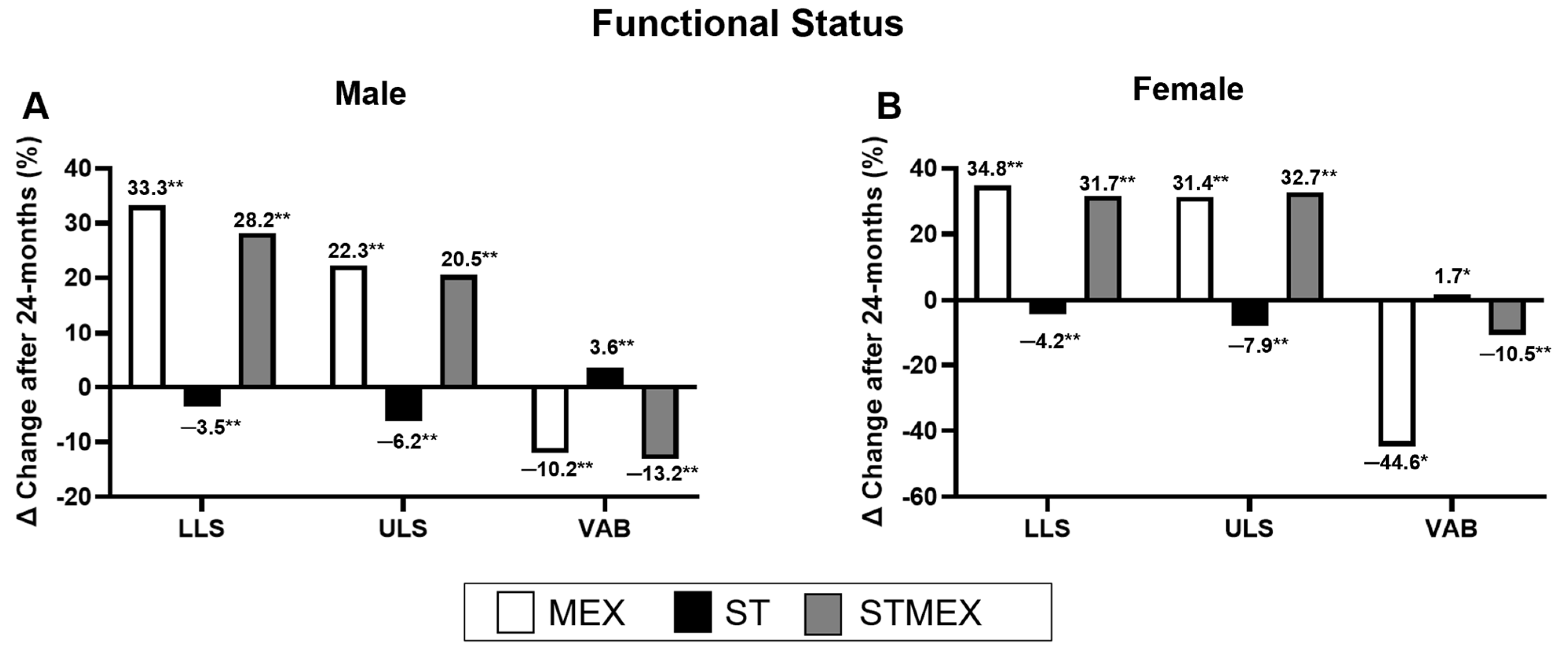
3.3. Distinct Longitudinal Treatment Changes in Functional Status
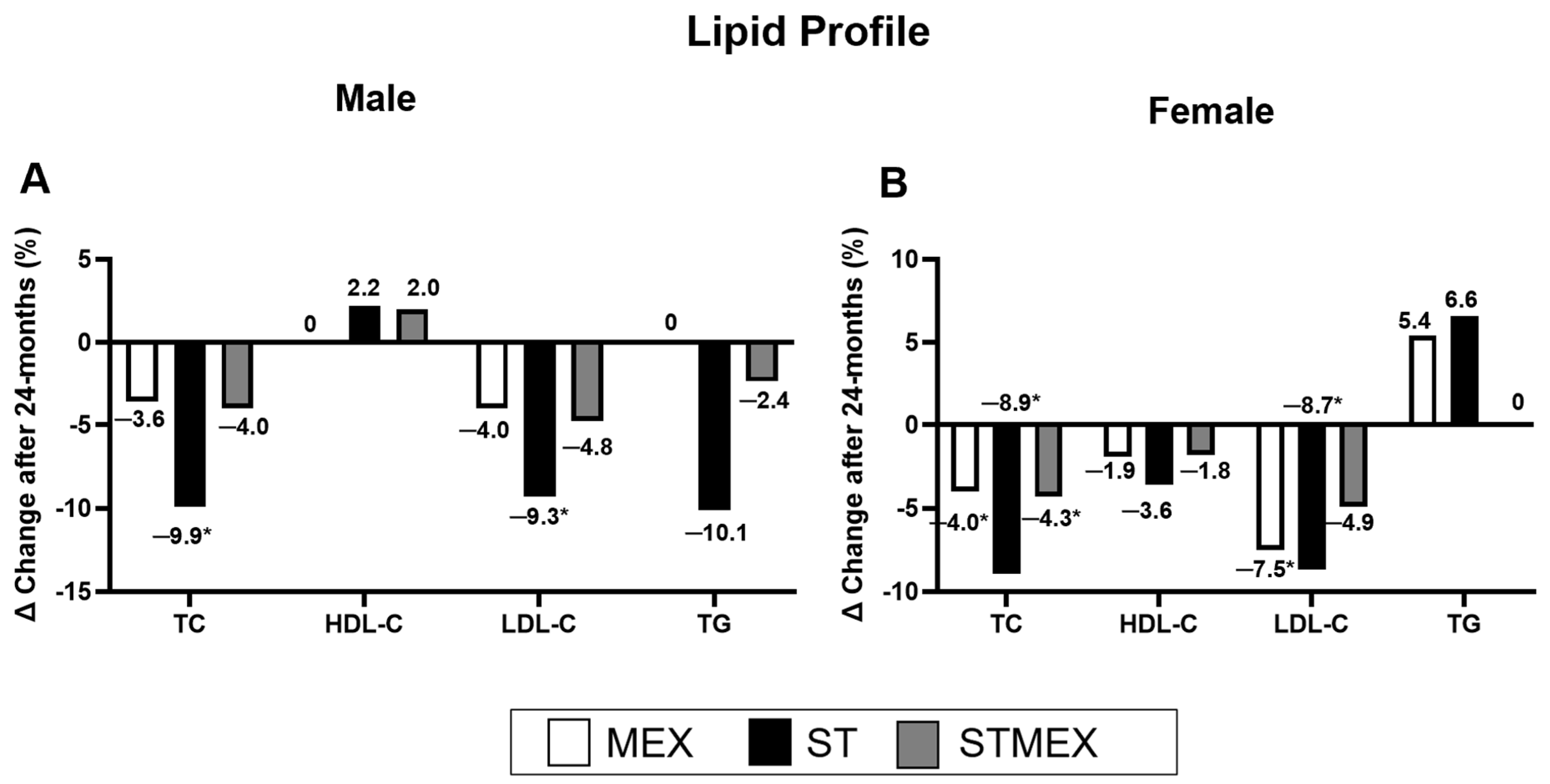
3.4. Different Effects of Sex and Treatment on Lipid Metabolic Profile
4. Discussion
5. Conclusions
Supplementary Materials
Author Contributions
Funding
Institutional Review Board Statement
Informed Consent Statement
Data Availability Statement
Acknowledgments
Conflicts of Interest
Abbreviations
| 1-RM | One-repetition maximum |
| BM | Body mass |
| BMI | Body mass index |
| CRF | Cardiorespiratory fitness |
| CVD | Cardiovascular disease |
| HbA1c- | Hemoglobin glycated |
| HDL-C | High-density lipoprotein cholesterol |
| HMG-CoA | hydroxymethylglutaryl-coenzyme A |
| HR max | Heart rate maximum |
| LDL-C | Low-density lipoprotein cholesterol |
| LLS | Lower-limb strength |
| MET | Metabolic equivalent of task |
| MEX | Multicomponent exercise training |
| ST | Statins |
| STMEX | Statins combined with multicomponent exercise training |
| TC | Total cholesterol |
| TG | Triglycerides |
| ULS | Upper-limb strength |
| VAB | Velocity, agility and dynamic balance |
| VO2max | Volume oxygen consumption maximum |
| WC | Waist circumference |
| WHR | Waist-to-hip ratio |
References
- Kokkinos, P.; Faselis, C.; Samuel, I.B.H.; Pittaras, A.; Doumas, M.; Murphy, R.; Heimall, M.S.; Sui, X.; Zhang, J.; Myers, J. Cardiorespiratory Fitness and Mortality Risk Across the Spectra of Age, Race, and Sex. J. Am. Coll. Cardiol. 2022, 80, 598–609. [Google Scholar] [CrossRef] [PubMed]
- Steell, L.; Ho, F.K.; Sillars, A.; Petermann-Rocha, F.; Li, H.; Lyall, D.M.; Iliodromiti, S.; Welsh, P.; Anderson, J.; Mackay, D.F.; et al. Dose-response associations of cardiorespiratory fitness with all-cause mortality and incidence and mortality of cancer and cardiovascular and respiratory diseases: The UK Biobank cohort study. Br. J. Sports Med. 2019, 53, 1371–1378. [Google Scholar] [CrossRef]
- Mandsager, K.; Harb, S.; Cremer, P.; Phelan, D.; Nissen, S.E.; Jaber, W. Association of Cardiorespiratory Fitness With Long-term Mortality Among Adults Undergoing Exercise Treadmill Testing. JAMA Netw. Open 2018, 1, e183605. [Google Scholar] [CrossRef]
- Kodama, S.; Saito, K.; Tanaka, S.; Maki, M.; Yachi, Y.; Asumi, M.; Sugawara, A.; Totsuka, K.; Shimano, H.; Ohashi, Y.; et al. Cardiorespiratory Fitness as a Quantitative Predictor of All-Cause Mortality and Cardiovascular Events in Healthy Men and Women: A Meta-analysis. JAMA 2009, 301, 2024–2035. [Google Scholar] [CrossRef]
- Harb, S.C.; Wang, T.K.M.; Cremer, P.C.; Wu, Y.; Cho, L.; Menon, V.; Jaber, W.A. Associations between cardiorespiratory fitness, sex and long term mortality amongst adults undergoing exercise treadmill testing. Int. J. Cardiol. 2021, 342, 103–107. [Google Scholar] [CrossRef]
- Harms, C.A.; Cooper, D.; Tanaka, H. Exercise physiology of normal development, sex differences, and aging. Compr. Physiol. 2011, 1, 1649–1678. [Google Scholar] [CrossRef] [PubMed]
- Lavin, K.M.; Coen, P.M.; Baptista, L.C.; Bell, M.B.; Drummer, D.; Harper, S.A.; Lixandrão, M.E.; McAdam, J.S.; O’BRyan, S.M.; Ramos, S.; et al. State of Knowledge on Molecular Adaptations to Exercise in Humans: Historical Perspectives and Future Directions. Compr. Physiol. 2022, 12, 3193–3279. [Google Scholar] [CrossRef]
- Ingle, L.; Mellis, M.; Brodie, D.; Sandercock, G.R. Associations between cardiorespiratory fitness and the metabolic syndrome in British men. Heart 2017, 103, 524–528. [Google Scholar] [CrossRef]
- Myers, J.; Prakash, M.; Froelicher, V.; Do, D.; Partington, S.; Atwood, J.E. Exercise Capacity and Mortality among Men Referred for Exercise Testing. N. Engl. J. Med. 2002, 346, 793–801. [Google Scholar] [CrossRef] [PubMed]
- Catapano, A.L.; Graham, I.; De Backer, G.; Wiklund, O.; Chapman, M.J.; Drexel, H.; Hoes, A.W.; Jennings, C.S.; Landmesser, U.; Pedersen, T.R.; et al. 2016 ESC/EAS Guidelines for the Management of Dyslipidaemias. Eur. Heart J. 2016, 37, 2999–3058. [Google Scholar] [CrossRef]
- Gui, Y.; Liao, C.; Liu, Q.; Guo, Y.; Yang, T.; Chen, J.; Wang, Y.-T.; Hu, J.-H.; Xu, D.-Y. Efficacy and safety of statins and exercise combination therapy compared to statin monotherapy in patients with dyslipidaemia: A systematic review and meta-analysis. Eur. J. Prev. Cardiol. 2017, 24, 907–916. [Google Scholar] [CrossRef] [PubMed]
- Stone, N.J.; Robinson, J.G.; Lichtenstein, A.H.; Bairey Merz, C.N.; Blum, C.B.; Eckel, R.H.; Goldberg, A.C.; Gordon, D.; Levy, D.; Lloyd-Jones, D.M.; et al. 2013 ACC/AHA Guideline on the Treatment of Blood Cholesterol to Reduce Atherosclerotic Cardiovascular Risk in Adults: A Report of the American College of Cardiology/American Heart Association Task Force on Practice Guidelines. J. Am. Coll. Cardiol. 2014, 63, 2889–2934. [Google Scholar] [CrossRef] [PubMed]
- Chapman, M.J.; Carrie, A. Mechanisms of Statin-Induced Myopathy. Arterioscler. Thromb. Vasc. Biol. 2005, 25, 2441–2444. [Google Scholar] [CrossRef]
- Sahebkar, A.; Cicero, A.F.G.; Di Giosia, P.; Pomilio, I.; Stamerra, C.A.; Giorgini, P.; Ferri, C.; von Haehling, S.; Banach, M.; Jamialahmadi, T. Pathophysiological mechanisms of statin-associated myopathies: Possible role of the ubiquitin-proteasome system. J. Cachexia Sarcopenia Muscle 2020, 11, 1177–1186. [Google Scholar] [CrossRef]
- Bruckert, E.; Hayem, G.; Dejager, S.; Yau, C.; Begaud, B. Mild to moderate muscular symptoms with high-dosage statin therapy in hyperlipidemic patients--the PRIMO study. Cardiovasc. Drugs Ther. 2005, 19, 403–414. [Google Scholar] [CrossRef]
- Parker, B.A.; Capizzi, J.A.; Grimaldi, A.S.; Clarkson, P.M.; Cole, S.M.; Keadle, J.; Chipkin, S.; Pescatello, L.S.; Simpson, K.; White, C.M.; et al. The effect of statins on skeletal muscle function. Circulation 2013, 127, 96–103. [Google Scholar] [CrossRef] [PubMed]
- Williams, P.T.; Thompson, P.D. Effects of Statin Therapy on Exercise Levels in Participants in the National Runners’ and Walkers’ Health Study. Mayo Clin. Proc. 2015, 90, 1338–1347. [Google Scholar] [CrossRef]
- Hung, R.K.; Al-Mallah, M.H.; Qadi, M.A.; Shaya, G.E.; Blumenthal, R.S.; Nasir, K.; Brawner, C.A.; Keteyian, S.J.; Blaha, M.J. Cardiorespiratory fitness attenuates risk for major adverse cardiac events in hyperlipidemic men and women independent of statin therapy: The Henry Ford ExercIse Testing Project. Am. Heart J. 2015, 170, 390–399.e6. [Google Scholar] [CrossRef]
- Qureshi, W.T.; Keteyian, S.J.; Brawner, C.A.; Dardari, Z.; Blaha, M.J.; Al-Mallah, M.H. Impact of statin use on cardiorespiratory fitness in multi-racial men and women: The Henry Ford Exercise Testing (FIT) Project. Int. J. Cardiol. 2015, 197, 76–77. [Google Scholar] [CrossRef]
- Henderson, R.M.; Lovato, L.; Miller, M.E.; Fielding, R.A.; Church, T.S.; Newman, A.B.; Buford, T.W.; Pahor, M.; McDermott, M.M.; Stafford, R.S.; et al. Effect of Statin Use on Mobility Disability and its Prevention in At-risk Older Adults: The LIFE Study. J. Gerontol. A Biol. Sci. Med. Sci. 2016, 71, 1519–1524. [Google Scholar] [CrossRef]
- Singla, M.; Rastogi, A.; Aggarwal, A.N.; Bhat, O.M.; Badal, D.; Bhansali, A. Vitamin D supplementation improves simvastatin-mediated decline in exercise performance: A randomized double-blind placebo-controlled study. J. Diabetes 2017, 9, 1100–1106. [Google Scholar] [CrossRef]
- Mikus, C.R.; Boyle, L.J.; Borengasser, S.J.; Oberlin, D.J.; Naples, S.P.; Fletcher, J.; Meers, G.M.; Ruebel, M.; Laughlin, M.H.; Dellsperger, K.C.; et al. Simvastatin impairs exercise training adaptations. J. Am. Coll. Cardiol. 2013, 62, 709–714. [Google Scholar] [CrossRef] [PubMed]
- Kokkinos, P.; Faselis, C.; Narayan, P.; Myers, J.; Nylen, E.; Sui, X.; Zhang, J.; Lavie, C.J. Cardiorespiratory Fitness and Incidence of Type 2 Diabetes in United States Veterans on Statin Therapy. Am. J. Med. 2017, 130, 1192–1198. [Google Scholar] [CrossRef]
- Baptista, L.C.; Verissimo, M.T.; Martins, R.A. Statin combined with exercise training is more effective to improve functional status in dyslipidemic older adults. Scand. J. Med. Sci. Sports. 2018, 28, 2659–2667. [Google Scholar] [CrossRef] [PubMed]
- World Health Organisation. Declaration of Helsinki World Medical Association Declaration of Helsinki Ethical Principles for Medical Research Involving Human Subjects. J. Am. Med. Assoc. 2013, 310, 2191–2194. [Google Scholar] [CrossRef]
- Rikli, R.E.; Jones, C.J. Development and validation of criterion-referenced clinically relevant fitness standards for maintaining physical independence in later years. Gerontologist 2013, 53, 255–267. [Google Scholar] [CrossRef]
- American College of Sports Medicine. ACSM’s Guidelines for Exercise Testing and Prescription, 9th ed.; Wolters KluwerLippincott Williams & Wilkings: Philadelphia, PA, USA, 2014. [Google Scholar]
- Patrizio, E.; Calvani, R.; Marzetti, E.; Cesari, M. Physical Functional Assessment in Older Adults. J. Frailty Aging 2021, 10, 141–149. [Google Scholar] [CrossRef]
- Pencina, M.J.; Navar-Boggan, A.M.; D’Agostino, R.B.; Williams, K.; Neely, B.; Sniderman, A.D.; Peterson, E.D. Application of New Cholesterol Guidelines to a Population-Based Sample. N. Engl. J. Med. 2014, 370, 1422–1431. [Google Scholar] [CrossRef] [PubMed]
- Hedges, L.V.; Olkin, I. Statistical Methods for Meta-Analysis; Academic Press: New York, NY, USA, 1985. [Google Scholar]
- Cohen, J. A Power Primer. Psychol. Bull. 1992, 112, 155–159. [Google Scholar] [CrossRef]
- Morales-Palomo, F.; Ramirez-Jimenez, M.; Ortega, J.F.; Moreno-Cabañas, A.; Mora-Rodriguez, R. Exercise Training Adaptations in Metabolic Syndrome Individuals on Chronic Statin Treatment. J. Clin. Endocrinol. Metab. 2020, 105, e1695–e1704. [Google Scholar] [CrossRef]
- Bahls, M.; Groß, S.; Ittermann, T.; Busch, R.; Gläser, S.; Ewert, R.; Völzke, H.; Felix, S.B.; Dörr, M. Statins are related to impaired exercise capacity in males but not females. PLoS Med. 2017, 12, e0179534. [Google Scholar] [CrossRef]
- Mier, C.M.; Domenick, M.A.; Turner, N.S.; Wilmore, J.H. Changes in stroke volume and maximal aerobic capacity with increased blood volume in men women. J. Appl. Physiol. 1996, 80, 1180–1186. [Google Scholar] [CrossRef] [PubMed]
- Schantz, P.; Randall-Fox, E.; Hutchison, W.; Tydén, A.; Åstrand, P.-O. Muscle fibre type distribution, muscle cross-sectional area and maximal voluntary strength in humans. Acta Physiol. Scand. 1983, 117, 219–226. [Google Scholar] [CrossRef] [PubMed]
- Sohn, S.; Jeon, J.; Lee, J.E.; Park, S.H.; Kang, D.O.; Park, E.J.; Lee, D.-I.; Choi, J.Y.; Roh, S.Y.; Na, J.O.; et al. Prognostic value of the six-minute walk test in patients with cardiovascular disease. Sci. Rep. 2025, 15, 20817. [Google Scholar] [CrossRef]
- Myhre, P.L.; Kleiven, Ø.; Berge, K.; Grundtvig, M.; Gullestad, L.; Ørn, S. Changes in 6-min walk test is an independent predictor of death in chronic heart failure with reduced ejection fraction. Eur. J. Heart Fail. 2024, 26, 2608–2615. [Google Scholar] [CrossRef] [PubMed]
- Shoemaker, M.J.; Curtis, A.B.; Vangsnes, E.; Dickinson, M.G. Clinically meaningful change estimates for the six-minute walk test and daily activity in individuals with chronic heart failure. Cardiopulm. Phys. Ther. J. 2013, 24, 21–29. [Google Scholar] [CrossRef]
- Bohannon, R.W.; Crouch, R. Minimal clinically important difference for change in 6-minute walk test distance of adults with pathology: A systematic review. J. Eval. Clin. Pract. 2017, 23, 377–381. [Google Scholar] [CrossRef]
- Wang, S.P.; Yang, H.; Wu, J.W.; Gauthier, N.; Fukao, T.; Mitchell, G.A. Metabolism as a tool for understanding human brain evolution: Lipid energy metabolism as an example. J. Hum. Evol. 2014, 77, 41–49. [Google Scholar] [CrossRef]
- Adams, S.P.; Sekhon, S.S.; Wright, J.M. Lipid-lowering efficacy of rosuvastatin. Cochrane Database Syst. Rev. 2014, 2014, CD010254. [Google Scholar] [CrossRef]



| Variables | Total (N = 981) | Male (N = 263) | Female (N = 718) | ||||
|---|---|---|---|---|---|---|---|
| Group, n | MEX (n = 76) | ST (n = 81) | STMEX (n = 106) | MEX (n = 222) | ST (n = 97) | STMEX (n = 399) | |
| Age, years | 66.9 ± 7.8 | 68.8 ± 6.5 | 66.3 ± 7.0 | 70.2 ± 7.3 *† | 65.2 ± 8.2 *‡ | 62.3 ± 7.2 | 67.9 ± 7.5 **⸹ |
| 6-min walk test, m | 445 ± 108 | 501 ± 130 | 455 ± 67 | 471 ± 113 | 441 ± 108 | 439 ± 67 | 429 ± 110 |
| SBP, mmHg | 139 ± 18 | 142 ± 15 *‡ | 134 ± 15 | 143 ± 16 *† | 140 ± 18 **‡ | 129 ± 17 | 141 ± 18 **† |
| DBP, mmHg | 79 ± 11 | 81 ± 10 | 77 ± 8 | 81 ± 13 *† | 79 ± 12 *‡ | 75 ± 9 | 79 ± 11 *† |
| Total cholesterol, mg/dL | 202 ± 39 | 194 ± 35 | 192 ± 38 | 180 ± 38 *⸹ | 209 ± 34 | 208 ± 39 | 205 ± 41 |
| HDL cholesterol, mg/dL | 53 ± 14 | 47 ± 11 | 46 ± 12 | 50 ± 11 | 54 ± 12 | 55 ± 13 | 56 ± 17 |
| LDL cholesterol, mg/dL | 124 ± 34 | 125 ± 32 | 118 ± 31 | 105 ± 34 *⸹ | 134 ± 27 | 126 ± 34 | 123 ± 36 *⸹ |
| Triglycerides, mg/dL | 124 ± 58 | 116 ± 53 | 136 ± 78 | 125 ± 61 | 112 ± 45 | 122 ± 62 | 131 ± 61 **⸹ |
| Glycaemia, mg/dL | 105 ± 39 | 103 ± 24 | 118 ± 124 | 110 ± 30 | 98 ± 19 *‡ | 107 ± 27 | 106 ± 29 *⸹ |
| HbA1c, % | 6.7 ± 1.1 | 6.4 ± 0.9 | 6.5 ± 1.4 | 6.6 ± 0.9 | 6.4 ± 1.1 | 6.8 ± 1.1 | 6.8 ± 1.1 |
| Body mass, kg | 74.0 ± 12.0 | 77.5 ± 10.8 | 81.7 ± 12.1 | 82.4 ± 12.8 | 72.0 ± 10.5 | 72.3 ± 10.3 | 71.0 ± 11.0 |
| Waist circumference, cm | 91.5 ± 9.7 | 94.1 ± 7.0 | 96.3 ± 8.7 | 99.4 ± 8.9 **⸹ | 89.4 ± 9.2 | 87.0 ± 9.6 | 90.4 ± 9.3 *† |
| Body mass index, kg/m2 | 28.9 ± 4.1 | 27.5 ± 3.5 | 28.3 ± 3.6 | 29.5 ± 4.6 *⸹ | 28.9 ± 4.1 | 28.8 ± 4.0 | 29.1 ± 4.1 |
| Waist-to-hip ratio | 0.90 ± 0.07 | 0.95 ± 0.05 | 0.97 ± 0.07 | 0.98 ± 0.05 *⸹ | 0.86 ± 0.06 | 0.87 ± 0.07 | 0.88 ± 0.06 *⸹ |
| Comorbidity, n | 2.4 ± 1.6 | 1.8 ± 1.3 *‡ | 2.4 ± 1.4 | 2.1 ± 1.4 | 2.3 ± 1.5 | 2.5 ± 1.6 | 2.5 ± 1.7 |
| Hypertension, n (%) | 489 (50) | 28 (10) | 39 (15) | 52 (19) | 113 (15) | 44 (6) | 213 (27) |
| Type II Diabetes, n (%) | 199 (20) | 17 (6) | 18 (7) | 37 (14) | 19 (2) | 13 (2) | 95 (12) †⸹ |
| Osteoarthrosis, n (%) | 284 (29) | 8 (3) | 13 (5) | 18 (7) | 76 (10) | 28 (4) | 141 (18) |
| Osteoporosis, n (%) | 233 (24) | 4 (2) | 1 (1) | 6 (2) | 70 (9) | 27 (4) | 125 (16) |
Disclaimer/Publisher’s Note: The statements, opinions and data contained in all publications are solely those of the individual author(s) and contributor(s) and not of MDPI and/or the editor(s). MDPI and/or the editor(s) disclaim responsibility for any injury to people or property resulting from any ideas, methods, instructions or products referred to in the content. |
© 2026 by the authors. Licensee MDPI, Basel, Switzerland. This article is an open access article distributed under the terms and conditions of the Creative Commons Attribution (CC BY) license.
Share and Cite
Baptista, L.C.; Machado-Rodrigues, A.M.; Da Silva, M.A.R.; De França, E.; Martins, R.A. Sex Patterns of Statin Therapy and Multicomponent Exercise Training on Cardiorespiratory Fitness in Older Adults with Dyslipidemia: A 24-Month Cohort Study. Sports 2026, 14, 215. https://doi.org/10.3390/sports14060215
Baptista LC, Machado-Rodrigues AM, Da Silva MAR, De França E, Martins RA. Sex Patterns of Statin Therapy and Multicomponent Exercise Training on Cardiorespiratory Fitness in Older Adults with Dyslipidemia: A 24-Month Cohort Study. Sports. 2026; 14(6):215. https://doi.org/10.3390/sports14060215
Chicago/Turabian StyleBaptista, Liliana C., Aristides M. Machado-Rodrigues, Marco Antônio Rabelo Da Silva, Elias De França, and Raul A. Martins. 2026. "Sex Patterns of Statin Therapy and Multicomponent Exercise Training on Cardiorespiratory Fitness in Older Adults with Dyslipidemia: A 24-Month Cohort Study" Sports 14, no. 6: 215. https://doi.org/10.3390/sports14060215
APA StyleBaptista, L. C., Machado-Rodrigues, A. M., Da Silva, M. A. R., De França, E., & Martins, R. A. (2026). Sex Patterns of Statin Therapy and Multicomponent Exercise Training on Cardiorespiratory Fitness in Older Adults with Dyslipidemia: A 24-Month Cohort Study. Sports, 14(6), 215. https://doi.org/10.3390/sports14060215