
Do Long-Haul Travel and Jet Lag Affect Athletes’ Physiological, Humoral and Performance Outcomes? A Systematic Narrative Review

 ,
, 
 , ,
, , 
Abstract
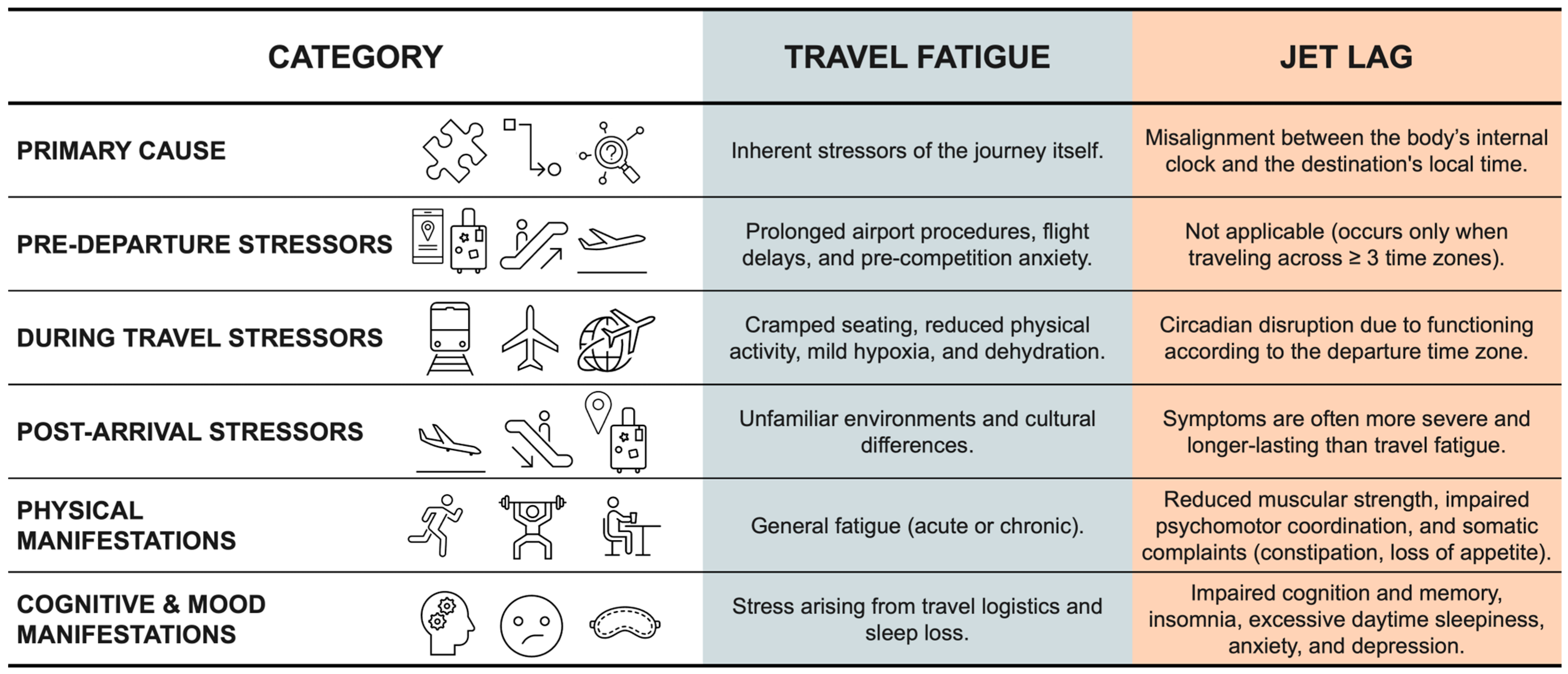
1. Introduction
2. Materials and Methods
2.1. Eligibility
- Participants—Athletes of all levels, ages, and both sexes (male and female);
- Interventions—Jet lag and long-haul travel. Long-haul travel refers to journeys that typically exceed 4000 km and often involve crossing multiple time zones or continental boundaries. While long-haul travel offers significant economic and cultural benefits, it may also pose specific challenges, including health and performance-related impacts;
- Comparators—Athletes who are frequently exposed to long-haul travel for training and/or competition;
- Outcomes—The primary outcomes in this review include humoral alterations, gastrointestinal disturbances, circadian rhythm disruptions, psychophysiological responses, hemodynamic changes, and variations in blood biomarkers. Additionally, secondary outcomes encompass physical fitness and performance-related indicators such as cardiorespiratory fitness, body composition, bone health, and various measures of muscular strength (isometric, dynamic, explosive, and reactive), as well as flexibility, agility and speed;
- Study Design—The review did not impose restrictions on study design, and all types of studies were deemed eligible for inclusion.
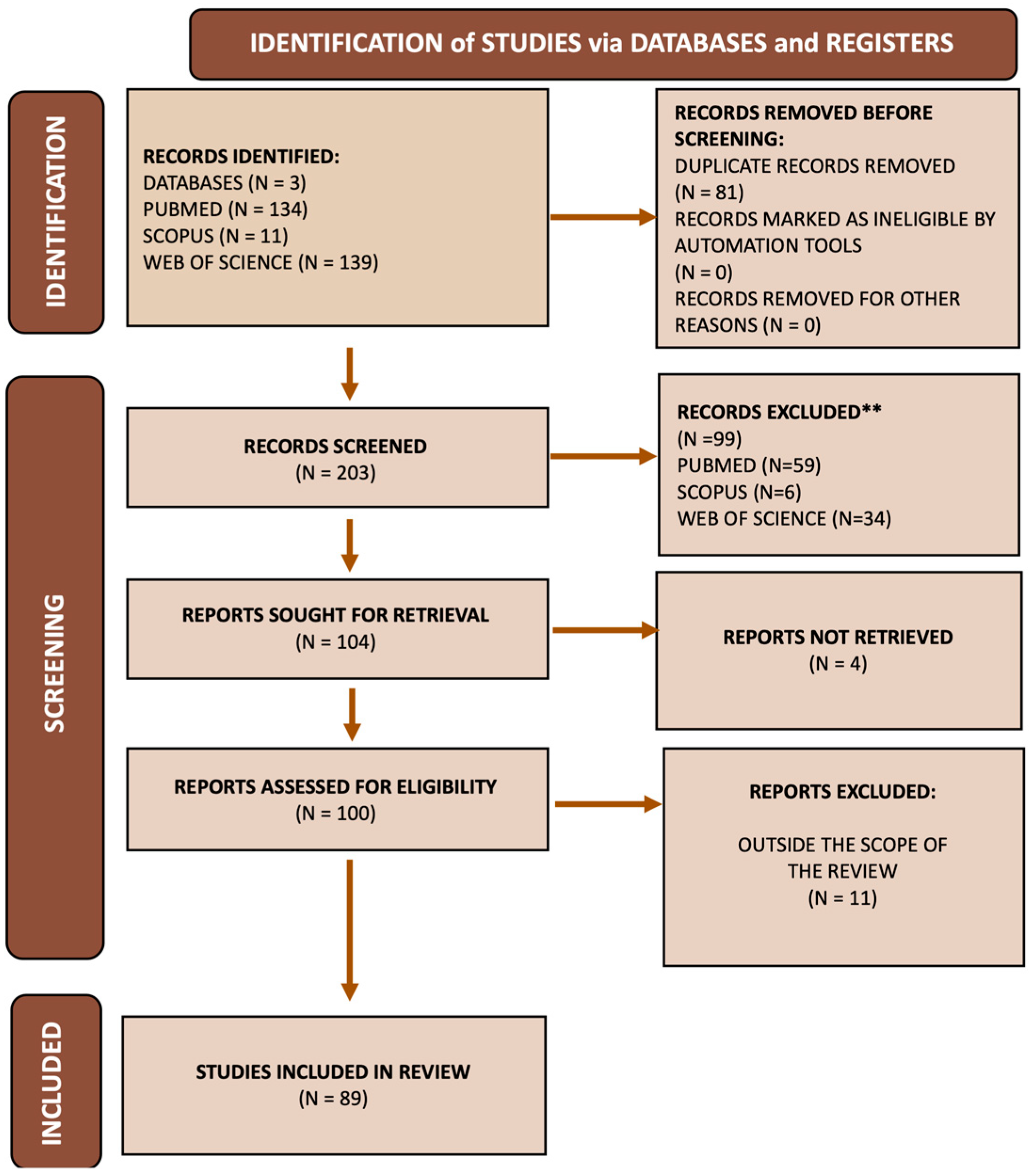
2.2. Study Selection
2.3. Data Extraction
2.4. Risk of Bias Assessment
3. Results
3.1. Travel Details
3.2. Interventions to Mitigate Travel Effects
3.3. Physiological and Hemodynamic Markers
3.4. Travel Effects
3.5. Physical Performance Markers
3.6. Risk of Bias
4. Discussion
4.1. Physiological and Hemodynamic Markers
4.1.1. Body Temperature
4.1.2. Blood Pressure
4.1.3. Sleep
4.1.4. Cortisol
4.1.5. Heart Rate Variability (HRV)
4.2. Physical Performance Markers
4.2.1. Anaerobic Power
4.2.2. Strength
4.2.3. Velocity
4.2.4. Aerobic Power and Capacity
4.2.5. Coordination and Reaction Time
4.2.6. Sport Specific Tasks
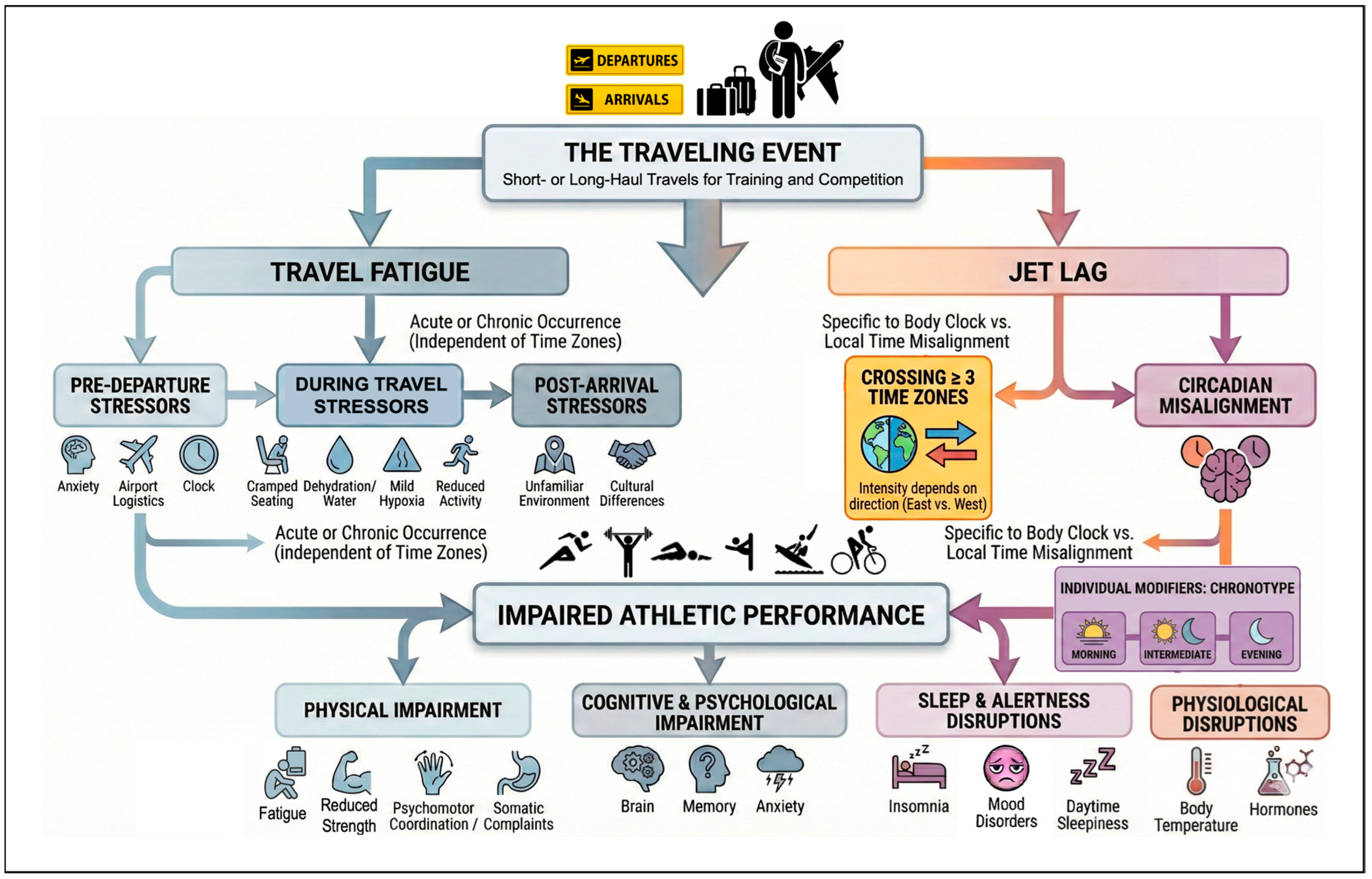
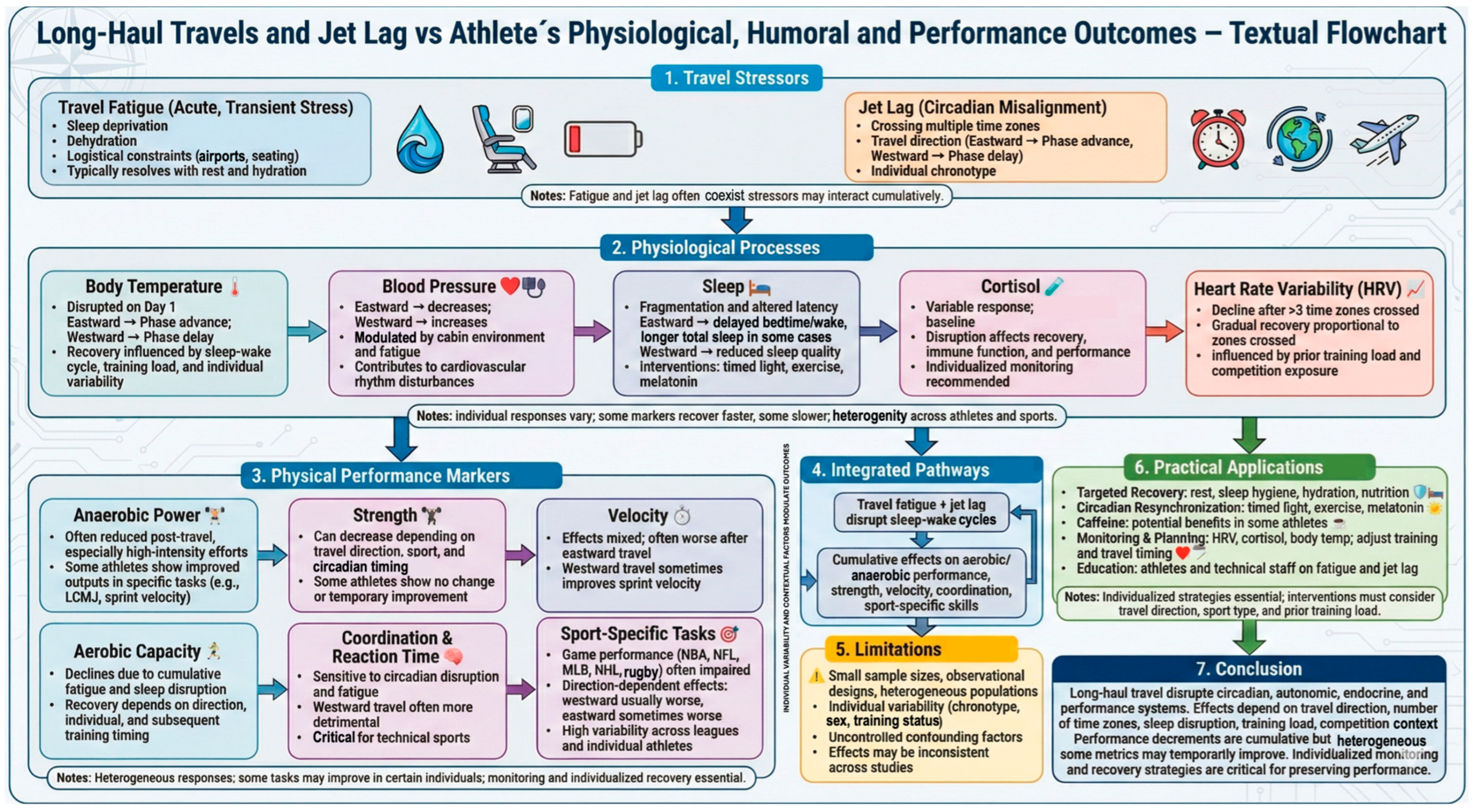
4.3. Integrated Pathways Linking Travel, Circadian Disruption, and Performance
4.4. Limitations
4.5. Practical Applications
4.6. Future Research Directions
- Female athlete representation: There is an evident need for studies focusing on female athletes.
- Standardization of performance metrics: Standardized performance testing protocols are welcome;
- Mechanistic links: Future studies should move beyond descriptive observations to establish clearer mechanistic links between biological markers and sport-specific performance related outcomes;
- Diversified interventions: While light exposure and melatonin are well-studied, there is a need for randomized controlled trials (RCTs) exploring alternative interventions, such as nutritional ergonomics, blood flow restriction (BFR);
- Between-sport and within-sport comparisons: Comparative research is needed, for example, to determine if the social external timing cues (zeitgebers) and logistical demands of team sports result in different adaptation patterns compared to the highly individualized environments of individual sports.
5. Conclusions
Supplementary Materials
Author Contributions
Funding
Institutional Review Board Statement
Informed Consent Statement
Data Availability Statement
Acknowledgments
Conflicts of Interest
Abbreviations
| AM | Ante Meridiem |
| ATP | Adenosine Triphosphate |
| ASSQ | Athlete Sleep Screening Questionnaire |
| BDJ | Broad Jump |
| BFR | Blood Flow Restriction |
| CG | Control Group |
| CMJ | Countermovement Jump |
| CV | Cardiovascular |
| EC | East Coast |
| ES | Effect Size |
| GS | Grip Strength |
| HR | Heart Rate |
| HRV | Heart Rate Variability |
| INT | Intervention Group |
| JBI | Joanna Briggs Institute |
| LCMJ | Loaded Countermovement Jump |
| LH | Long-Haul |
| MBB | Men’s Basketball |
| ME5 | 5-Minute Maximal Effort Test |
| MLB | Major League Baseball |
| MNF | Monday Night Football |
| NBA | National Basketball Association |
| NCAA | National Collegiate Athletic Association |
| NHL | National Hockey League |
| NOS | Newcastle-Ottawa Scale |
| NRL | National Rugby League |
| NS | Not Significant |
| PICOS | Participants, Interventions, Comparators, Outcomes, Study Design |
| PRE | Pre-Intervention |
| PPT | Peak Power Test |
| PROSPERO | International Prospective Register of Systematic Reviews |
| PRISMA | Preferred Reporting Items for Systematic Reviews and Meta-Analyses |
| RPE | Rating of Perceived Exertion |
| REM | Rapid Eye Movement sleep |
| ROC | Receiver Operating Characteristic |
| SD | Standard Deviation |
| SE | Sleep Efficiency |
| SJ | Squat Jump |
| SOL | Sleep Onset Latency |
| SSC | Stretch-Shortening Cycle |
| S&C | Strength and Conditioning |
| SM | Supplemented |
| SCN | Suprachiasmatic Nucleus |
| TIB | Time in Bed |
| TST | Total Sleep Time |
| TZ | Time Zone |
| UR | Upper Respiratory |
| O2max | Maximal Oxygen Uptake |
| WASO | Wake After Sleep Onset |
| WC | World Cup |
| WHR | Waist-Hip Ratio |
References
- Young, M.; Fricker, P.; Maughan, R.; MacAuley, D. The traveling athlete: Issues relating to the commonwealth games, Malaysia, 1998. Clin. J. Sport Med. 1998, 8, 130–135. [Google Scholar] [CrossRef] [PubMed]
- Waterhouse, J.; Edwards, B.; Nevill, A.; Carvalho, S.; Atkinson, G.; Buckley, P.; Reilly, T.; Godfrey, R.; Ramsay, R. Identifying some determinants of “jet lag” and its symptoms: A study of athletes and other travellers. Br. J. Sports Med. 2002, 36, 54–60. [Google Scholar] [CrossRef]
- Loat, C.E.; Rhodes, E.C. Jet-lag and human performance. Sports Med. 1989, 8, 226–238. [Google Scholar] [CrossRef]
- Reilly, T.; Atkinson, G.; Waterhouse, J. Travel fatigue and jet-lag. J. Sports Sci. 1997, 15, 365–369. [Google Scholar] [CrossRef]
- Schobersberger, W.; Schobersberger, B. The Traveling Athlete: From Jet Leg to Jet Lag. Curr. Sports Med. Rep. 2012, 11, 222–223. [Google Scholar] [CrossRef] [PubMed]
- Samuels, C.H. Jet lag and travel fatigue: A comprehensive management plan for sport medicine physicians and high-performance support teams. Clin. J. Sport Med. 2012, 22, 268–273. [Google Scholar] [CrossRef]
- Pipe, A.L. International travel and the elite athlete. Clin. J. Sport Med. 2011, 21, 62–66. [Google Scholar] [CrossRef]
- Waterhouse, J.; Reilly, T.; Edwards, B. The stress of travel. J. Sports Sci. 2004, 22, 946–965, discussion 965–966. [Google Scholar] [CrossRef]
- Tsukahara, Y.; Kamada, H.; Torii, S.; Yamasawa, F. Improvement of Jet Lag and Travel Fatigue Symptoms and Their Association with Prior International Travel Experience in Junior Athletes. Sports 2024, 12, 220. [Google Scholar] [CrossRef]
- Reilly, T.; Waterhouse, J.; Edwards, B. Jet lag and air travel: Implications for performance. Clin. Sports Med. 2005, 24, 367–380, xii. [Google Scholar] [CrossRef] [PubMed]
- Reilly, T.; Atkinson, G.; Edwards, B.; Waterhouse, J.; Åkerstedt, T.; Davenne, D.; Lemmer, B.; Wirz-Justice, A. Coping with jet-lag: A position statement for the European College of Sport Science. Eur. J. Sport Sci. 2007, 7, 1–7. [Google Scholar] [CrossRef]
- Forbes-Robertson, S.; Dudley, E.; Vadgama, P.; Cook, C.; Drawer, S.; Kilduff, L. Circadian disruption and remedial interventions: Effects and interventions for jet lag for athletic peak performance. Sports Med. 2012, 42, 185–208. [Google Scholar] [CrossRef]
- Glinski, J.; Chandy, D. Impact of jet lag on free throw shooting in the National Basketball Association. Chronobiol. Int. 2022, 39, 1001–1005. [Google Scholar] [CrossRef] [PubMed]
- Lee, A.; Galvez, J.C. Jet lag in athletes. Sports Health 2012, 4, 211–216. [Google Scholar] [CrossRef]
- Winget, C.M.; DeRoshia, C.W.; Holley, D.C. Circadian rhythms and athletic performance. Med. Sci. Sports Exerc. 1985, 17, 498–516. [Google Scholar] [CrossRef]
- Smith, R.S.; Guilleminault, C.; Efron, B. Circadian rhythms and enhanced athletic performance in the National Football League. Sleep 1997, 20, 362–365. [Google Scholar]
- Jehue, R.; Street, D.; Huizenga, R. Effect of time zone and game time changes on team performance: National Football League. Med. Sci. Sports Exerc. 1993, 25, 127–131. [Google Scholar] [CrossRef]
- Eichner, E.R. Circadian-rhythms—The latest word on health and performance. Physician Sportsmed. 1994, 22, 82–93. [Google Scholar] [CrossRef] [PubMed]
- Heyde, I.; Oster, H. Differentiating external zeitgeber impact on peripheral circadian clock resetting. Sci. Rep. 2019, 9, 20114. [Google Scholar] [CrossRef] [PubMed]
- Lastella, M.; Roach, G.D.; Halson, S.L.; Sargent, C. The Chronotype of Elite Athletes. J. Hum. Kinet. 2016, 54, 219–225. [Google Scholar] [CrossRef]
- Rosenthal, L.; Day, R.; Gerhardstein, R.; Meixner, R.; Roth, T.; Guido, P.; Fortier, J. Sleepiness/alertness among healthy evening and morning type individuals. Sleep Med. 2001, 2, 243–248. [Google Scholar] [CrossRef]
- Lastella, M.; Roach, G.D.; Halson, S.L.; Martin, D.T.; West, N.P.; Sargent, C. Sleep/wake behaviour of endurance cyclists before and during competition. J. Sports Sci. 2015, 33, 293–299. [Google Scholar] [CrossRef]
- Drust, B.; Waterhouse, J.; Atkinson, G.; Edwards, B.; Reilly, T. Circadian rhythms in sports performance—An update. Chronobiol. Int. 2005, 22, 21–44. [Google Scholar] [CrossRef]
- Page, M.J.; McKenzie, J.E.; Bossuyt, P.M.; Boutron, I.; Hoffmann, T.C.; Mulrow, C.D.; Shamseer, L.; Tetzlaff, J.M.; Akl, E.A.; Brennan, S.E.; et al. The PRISMA 2020 statement: An updated guideline for reporting systematic reviews. BMJ 2021, 372, n71. [Google Scholar] [CrossRef]
- Hill, D.W.; Hill, C.M.; Fields, K.L.; Smith, J.C. Effects of jet lag on factors related to sport performance. Can. J. Appl. Physiol. 1993, 18, 91–103. [Google Scholar] [CrossRef]
- Manfredini, R.; Mandredini, F.; Conconi, F. Standard melatonin intake and circadian rhythms of elite athletes after a transmeridian flight. J. Int. Med. Res. 2000, 28, 182–186. [Google Scholar] [CrossRef]
- Straub, W.F.; Spino, M.P.; Alattar, M.M.; Pfleger, B.; Downes, J.W.; Belizaire, M.A.; Heinonen, O.J.; Vasankari, T. The effect of chiropractic care on jet lag of Finnish junior elite athletes. J. Manip. Physiol. Ther. 2001, 24, 191–198. [Google Scholar] [CrossRef]
- Cardinali, D.P.; Bortman, G.P.; Liotta, G.; Pérez Lloret, S.; Albornoz, L.E.; Cutrera, R.A.; Batista, J.; Gallo, P.O. A multifactorial approach employing melatonin to accelerate resynchronization of sleep-wake cycle after a 12 time-zone westerly transmeridian flight in elite soccer athletes. J. Pineal Res. 2002, 32, 41–46. [Google Scholar] [CrossRef] [PubMed]
- Lemmer, B.; Kern, R.I.; Nold, G.; Lohrer, H. Jet lag in athletes after eastward and westward time-zone transition. Chronobiol. Int. 2002, 19, 743–764. [Google Scholar] [CrossRef] [PubMed]
- Postolache, T.T.; Hung, T.M.; Rosenthal, R.N.; Soriano, J.J.; Montes, F.; Stiller, J.W. Sports chronobiology consultation: From the lab to the arena. Clin. Sports Med. 2005, 24, 415–456, xiv. [Google Scholar] [CrossRef] [PubMed]
- Armstrong, L.E. Nutritional strategies for football: Counteracting heat, cold, high altitude, and jet lag. J. Sports Sci. 2006, 24, 723–740. [Google Scholar] [CrossRef] [PubMed]
- Milne, C.J.; Fuard, M.H. Beating jet lag. Br. J. Sports Med. 2007, 41, 401. [Google Scholar] [CrossRef]
- Bullock, N.; Martin, D.T.; Ross, A.; Rosemond, D.; Marino, F.E. Effect of long haul travel on maximal sprint performance and diurnal variations in elite skeleton athletes. Br. J. Sports Med. 2007, 41, 569–573; discussion 573. [Google Scholar] [CrossRef]
- Reilly, T.; Waterhouse, J.; Burke, L.M.; Alonso, J.M. Nutrition for travel. J. Sports Sci. 2007, 25, S125–S134. [Google Scholar] [CrossRef]
- Meijer, J.H.; Deboer, T.; Michel, S. In time for Beijing: Influence of the biological clock on athletic performance. Ned. Tijdschr. Voor Geneeskd. 2008, 152, 1809–1812. [Google Scholar]
- Dranitsin, O.V. The effect on heart rate variability of acclimatization to a humid, hot environment after a transition across five time zones in elite junior rowers. Eur. J. Sport Sci. 2008, 8, 251–258. [Google Scholar] [CrossRef]
- Montaruli, A.; Roveda, E.; Calogiuri, G.; La Torre, A.; Carandente, F. The sportsman readjustment after transcontinental flight: A study on marathon runners. J. Sports Med. Phys. Fit. 2009, 49, 372–381. [Google Scholar]
- Chapman, D.W.; Bullock, N.; Ross, A.; Rosemond, D.; Martin, D.T. Detrimental effects of west to east transmeridian flight on jump performance. Eur. J. Appl. Physiol. 2012, 112, 1663–1669. [Google Scholar] [CrossRef]
- Leatherwood, W.E.; Dragoo, J.L. Effect of airline travel on performance: A review of the literature. Br. J. Sports Med. 2013, 47, 561–567. [Google Scholar] [CrossRef]
- Thompson, A.; Batterham, A.M.; Jones, H.; Gregson, W.; Scott, D.; Atkinson, G. The Practicality and Effectiveness of Supplementary Bright Light for Reducing Jet-Lag in Elite Female Athletes. Int. J. Sports Med. 2013, 34, 582–589. [Google Scholar] [CrossRef] [PubMed]
- Stellingwerff, T.; Pyne, D.B.; Burke, L.M. Nutrition considerations in special environments for aquatic sports. Int. J. Sport Nutr. Exerc. Metab. 2014, 24, 470–479. [Google Scholar] [CrossRef]
- Fuller, C.W.; Taylor, A.E.; Raftery, M. Does long-distance air travel associated with the Sevens World Series increase players’ risk of injury? Br. J. Sports Med. 2015, 49, 458–464. [Google Scholar]
- Fowler, P.; Duffield, R.; Howle, K.; Waterson, A.; Vaile, J. Effects of northbound long-haul international air travel on sleep quantity and subjective jet lag and wellness in professional Australian soccer players. Int. J. Sports Physiol. Perform. 2015, 10, 648–654. [Google Scholar] [CrossRef]
- Simmons, E.; McGrane, O.; Wedmore, I. Jet lag modification. Curr. Sports Med. Rep. 2015, 14, 123–128. [Google Scholar] [CrossRef]
- Silva, M.R.G.; Pascoal, A.; Silva, H.H.; Paiva, T. Assessing sleep, travelling habits and jetlag in kite surfers according to competition level. Biol. Rhythm Res. 2016, 47, 677–689. [Google Scholar] [CrossRef]
- Fowler, P.M.; Duffield, R.; Lu, D.; Hickmans, J.A.; Scott, T.J. Effects of Long-Haul Transmeridian Travel on Subjective Jet-Lag and Self-Reported Sleep and Upper Respiratory Symptoms in Professional Rugby League Players. Int. J. Sports Physiol. Perform. 2016, 11, 876–884. [Google Scholar] [CrossRef]
- Fullagar, H.H.; Duffield, R.; Skorski, S.; White, D.; Bloomfield, J.; Kölling, S.; Meyer, T. Sleep, Travel, and Recovery Responses of National Footballers During and After Long-Haul International Air Travel. Int. J. Sports Physiol. Perform. 2016, 11, 86–95. [Google Scholar] [CrossRef] [PubMed]
- Fowler, P.M.; McCall, A.; Jones, M.; Duffield, R. Effects of long-haul transmeridian travel on player preparedness: Case study of a national team at the 2014 FIFA World Cup. J. Sci. Med. Sport 2017, 20, 322–327. [Google Scholar] [CrossRef] [PubMed]
- Williams, B.; Clarke, R.; Aspe, R.; Cole, M.; Hughes, J. Managing Performance Throughout Periods of Travel. Strength Cond. J. 2017, 39, 22–29. [Google Scholar] [CrossRef]
- Fowler, P.M.; Knez, W.; Crowcroft, S.; Mendham, A.E.; Miller, J.; Sargent, C.; Halson, S.; Duffield, R. Greater Effect of East versus West Travel on Jet Lag, Sleep, and Team Sport Performance. Med. Sci. Sports Exerc. 2017, 49, 2548–2561. [Google Scholar] [CrossRef]
- Kölling, S.; Treff, G.; Winkert, K.; Ferrauti, A.; Meyer, T.; Pfeiffer, M.; Kellmann, M. The effect of westward travel across five time zones on sleep and subjective jet-lag ratings in athletes before and during the 2015’s World Rowing Junior Championships. J. Sports Sci. 2017, 35, 2240–2248. [Google Scholar] [CrossRef]
- Song, A.; Severini, T.; Allada, R. How jet lag impairs Major League Baseball performance. Proc. Natl. Acad. Sci. USA 2017, 114, 1407–1412. [Google Scholar] [CrossRef]
- Roy, J.; Forest, G. Greater circadian disadvantage during evening games for the National Basketball Association (NBA), National Hockey League (NHL) and National Football League (NFL) teams travelling westward. J. Sleep Res. 2018, 27, 86–89. [Google Scholar] [CrossRef]
- Stevens, C.J.; Thornton, H.R.; Fowler, P.M.; Esh, C.; Taylor, L. Long-Haul Northeast Travel Disrupts Sleep and Induces Perceived Fatigue in Endurance Athletes. Front. Physiol. 2018, 9, 1826. [Google Scholar] [CrossRef]
- Thornton, H.R.; Miller, J.; Taylor, L.; Sargent, C.; Lastella, M.; Fowler, P.M. Impact of short- compared to long-haul international travel on the sleep and wellbeing of national wheelchair basketball athletes. J. Sports Sci. 2018, 36, 1476–1484. [Google Scholar] [CrossRef] [PubMed]
- Silva, M.G.; Paiva, T.; Silva, H.H. The elite athlete as a special risk traveler and the jet lag’s effect: Lessons learned from the past and how to be prepared for the next Olympic Games 2020 Tokyo. J. Sports Med. Phys. Fit. 2019, 59, 1420–1429. [Google Scholar] [CrossRef] [PubMed]
- Halson, S.L.; Burke, L.M.; Pearce, J. Nutrition for Travel: From Jet lag To Catering. Int. J. Sport Nutr. Exerc. Metab. 2019, 29, 228–235. [Google Scholar] [CrossRef]
- Broatch, J.R.; Bishop, D.J.; Zadow, E.K.; Halson, S. Effects of sports compression socks on performance, physiological, and hematological alterations after long-haul air travel in elite female volleyballers. J. Strength Cond. Res. 2019, 33, 492–501. [Google Scholar] [CrossRef]
- Fullagar, H.H.K.; Delaney, J.; Duffield, R.; Murray, A. Factors influencing home advantage in American collegiate football. Sci. Med. Footb. 2019, 3, 163–168. [Google Scholar] [CrossRef]
- Lo, M.; Aughey, R.J.; Hopkins, W.G.; Gill, N.; Stewart, A.M. The longest journeys in Super Rugby: 11 years of travel and performance indicators. J. Sports Sci. 2019, 37, 2045–2050. [Google Scholar] [CrossRef]
- Atalag, O.; Gotshalk, L.A.; Queen, L.; Wottlin, S. More stress for the eastward travelling student athlete: A preliminary analysis. Isokinet. Exerc. Sci. 2019, 27, 275–282. [Google Scholar] [CrossRef]
- Lo, M.; Aughey, R.J.; Hopkins, W.G.; Gill, N.; Stewart, A.M. Out of your zone? 21 years of travel and performance in Super Rugby. J. Sports Sci. 2019, 37, 2051–2056. [Google Scholar] [CrossRef]
- Lastella, M.; Roach, G.D.; Sargent, C. Travel fatigue and sleep/wake behaviors of professional soccer players during international competition. Sleep Health 2019, 5, 141–147. [Google Scholar] [CrossRef]
- Roach, G.D.; Sargent, C. Interventions to Minimize Jet Lag After Westward and Eastward Flight. Front. Physiol. 2019, 10, 927. [Google Scholar] [CrossRef]
- van Rensburg, D.C.J.; van Rensburg, A.J.; Fowler, P.; Fullagar, H.; Stevens, D.; Halson, S.; Bender, A.; Vincent, G.; Claassen-Smithers, A.; Dunican, I.; et al. How to manage travel fatigue and jet lag in athletes? A systematic review of interventions. Br. J. Sports Med. 2020, 54, 960–968. [Google Scholar] [CrossRef] [PubMed]
- Zubac, D.; Buoite Stella, A.; Morrison, S.A. Up in the Air: Evidence of Dehydration Risk and Long-Haul Flight on Athletic Performance. Nutrients 2020, 12, 2574. [Google Scholar] [CrossRef] [PubMed]
- Nikolaidi, M.K.; Muniz-Pardos, B.; Giannopoulou, I.; Guppy, F.M.; Fossati, C.; Van Rensburg, D.C.J.; Constantinou, D.; Pigozzi, F.; Pitsiladis, Y. The potential of blood flow restriction exercise to overcome jetlag: Important implications for Tokyo 2020. Med. Dello Sport 2021, 74, 435–440. [Google Scholar]
- Augusto, D.; Brito, J.; Aquino, R.; Figueiredo, P.; Eiras, F.; Tannure, M.; Veiga, B.; Vasconcellos, F. Contextual Variables Affect Running Performance in Professional Soccer Players: A Brief Report. Front. Sports Act. Living 2021, 3, 778813. [Google Scholar] [CrossRef]
- Charest, J.; Samuels, C.H.; Bastien, C.H.; Lawson, D.; Grandner, M.A. Impacts of travel distance and travel direction on back-to-back games in the National Basketball Association. J. Clin. Sleep Med. 2021, 17, 2269–2274. [Google Scholar] [CrossRef]
- Fowler, P.M.; Knez, W.; Thornton, H.R.; Sargent, C.; Mendham, A.E.; Crowcroft, S.; Miller, J.; Halson, S.; Duffield, R. Sleep Hygiene and Light Exposure Can Improve Performance Following Long-Haul Air Travel. Int. J. Sports Physiol. Perform. 2021, 16, 517–526. [Google Scholar] [CrossRef]
- Janse van Rensburg, D.C.; Jansen van Rensburg, A.; Fowler, P.M.; Bender, A.M.; Stevens, D.; Sullivan, K.O.; Fullagar, H.H.K.; Alonso, J.-M.; Biggins, M.; Claassen-Smithers, A.; et al. Managing Travel Fatigue and Jet Lag in Athletes: A Review and Consensus Statement. Sports Med. 2021, 51, 2029–2050. [Google Scholar] [CrossRef] [PubMed]
- Lalor, B.J.; Tran, J.; Halson, S.L.; Kemp, J.G.; Cormack, S.J. Business Class Travel Preserves Sleep Quality and Quantity and Minimizes Jet Lag During the ICC Women’s T20 World Cup. Int. J. Sports Physiol. Perform. 2021, 16, 1490–1501. [Google Scholar] [CrossRef] [PubMed]
- Leduc, C.; Robineau, J.; Tee, J.C.; Cheradame, J.; Jones, B.; Piscione, J.; Lacome, M. The Travel Demands of an Elite Rugby Sevens Team: Effects on Objective and Subjective Sleep Parameters. Int. J. Sports Physiol. Perform. 2021, 16, 688–694. [Google Scholar] [CrossRef]
- Lo, M.; Aughey, R.J.; Stewart, A.M.; Gill, N.; McDonald, B. The road goes ever on and on-a socio-physiological analysis of travel-related issues in Super Rugby. J. Sports Sci. 2021, 39, 289–295. [Google Scholar] [CrossRef]
- Smithies, T.D.; Eastwood, P.R.; Walsh, J.; Murray, K.; Markwick, W.; Dunican, I.C. Around the world in 16 days: The effect of long-distance transmeridian travel on the sleep habits and behaviours of a professional Super Rugby team. J. Sports Sci. 2021, 39, 2596–2602. [Google Scholar] [CrossRef]
- Everett, K.L.A.; Chapman, D.W.; Mitchell, J.A.; Ball, N. Effects of Westbound Trans-meridian Travel on Countermovement Jump Performance in International-Level Rowers. J. Strength Cond. Res. 2022, 36, 1961–1965. [Google Scholar] [CrossRef]
- Rossiter, A.; Warrington, G.D.; Comyns, T.M. Effects of Long-Haul Travel on Recovery and Performance in Elite Athletes: A Systematic Review. J. Strength Cond. Res. 2022, 36, 3234–3245. [Google Scholar] [CrossRef]
- Flatt, A.A.; Howells, D. Effects of Long-Haul Travel and the Olympic Games on Heart-Rate Variability in Rugby Sevens Medalists. Int. J. Sports Physiol. Perform. 2022, 17, 951–960. [Google Scholar] [CrossRef] [PubMed]
- Lever, J.R.; Janse van Rensburg, D.C.; Jansen van Rensburg, A.; Fowler, P.; Fullagar, H.H.K. Subjective Sleep Patterns and Jet Lag Symptoms of Junior Netball Players Prior to and During an International Tournament: A Case Study. Int. J. Sports Physiol. Perform. 2022, 17, 137–141. [Google Scholar] [CrossRef]
- Biggins, M.; Purtill, H.; Fowler, P.; O’Sullivan, K.; Cahalan, R. Impact of Long-Haul Travel to International Competition on Sleep and Recovery in Elite Male and Female Soccer Athletes. Int. J. Sports Physiol. Perform. 2022, 17, 1361–1370. [Google Scholar] [CrossRef]
- Charest, J.; Cook, J.D.; Bender, A.M.; Walch, O.; Grandner, M.A.; Samuels, C.H. Associations between time zone changes, travel distance and performance: A retrospective analysis of 2013–2020 National Hockey League Data. J. Sci. Med. Sport. 2022, 25, 1008–1016. [Google Scholar] [CrossRef]
- Jasper, S.C.; Leenders, M.; O’Shannassy, T. Travel across time zones and the implications for human performance post pandemic: Insights from elite sport. Front. Public Health 2022, 10, 998484. [Google Scholar] [CrossRef] [PubMed]
- Leota, J.; Hoffman, D.; Czeisler, M.; Mascaro, L.; Drummond, S.P.A.; Anderson, C.; Rajaratnam, S.M.W.; Facer-Childs, E.R. Eastward Jet Lag is Associated with Impaired Performance and Game Outcome in the National Basketball Association. Front. Physiol. 2022, 13, 892681. [Google Scholar] [CrossRef]
- Read, D.B.; Williams, S.; Fullagar, H.H.K.; Weakley, J.J.S. The effects of travel on performance: A 13-year analysis of the National Rugby League (NRL) competition. Sci. Med. Footb. 2022, 6, 60–65. [Google Scholar] [CrossRef]
- Rossiter, A.; Comyns, T.M.; Sherwin, I.; Nevill, A.M.; Campbell, M.J.; Warrington, G.D. Effects of long-haul transmeridian travel on physiological, sleep, perceptual and mood markers in Olympic team support staff. Chronobiol. Int. 2022, 39, 1640–1655. [Google Scholar] [CrossRef] [PubMed]
- Cullen, T.; Clarke, N.D.; Vaquera, A. Sleep and mood of elite basketball referees during international competitions. Sport Sci. Health 2023, 19, 321–327. [Google Scholar] [CrossRef]
- Doherty, R.; Madigan, S.M.; Nevill, A.; Warrington, G.; Ellis, J.G. The impact of long haul travel on the sleep of elite athletes. Neurobiol. Sleep Circadian Rhythm. 2023, 15, 100102. [Google Scholar] [CrossRef]
- Clements, E.; Ehrmann, F.; Clark, A.; Jones, M.; Lu, D.; Duffield, R. The type and extent of travel for professional footballers undertaking national team duties for a national football federation. Biol. Sport 2023, 40, 707–713. [Google Scholar] [CrossRef]
- Clements, E.; Ehrmann, F.; Clark, A.; Jones, M.; McCall, A.; Duffield, R. Flight Path and Scheduling Effects on Perceived Jet Lag, Fatigue, and Sleep in Footballers Traveling to and From National Teams. Int. J. Sports Physiol. Perform. 2023, 18, 1132–1140. [Google Scholar] [CrossRef]
- Clements, E.; Ehrmann, F.; Clark, A.; Jones, M.; McCall, A.; Duffield, R. Travel Across More Time Zones Results in Worse Perceived Fatigue and Sleep in National-Team Footballers. Int. J. Sports Physiol. Perform. 2023, 18, 268–275. [Google Scholar] [CrossRef] [PubMed]
- Garbellotto, L.; Petit, E.; Brunet, E.; Guirronnet, S.; Clolus, Y.; Gillet, V.; Bourdin, H.; Mougin, F. Gradual Advance of Sleep-Wake Schedules Before an Eastward Flight and Phase Adjustment After Flight in Elite Cross-Country Mountain Bikers: Effects on Sleep and Performance. J. Strength Cond. Res. 2023, 37, 872–880. [Google Scholar] [CrossRef]
- Paule-Koba, A.L.; Burson, C.; Gibbons, B.; Lobban, B. It effects everything we do: Collegiate athlete’s perceptions of sport-related travel. J. Study Sports Athl. Educ. 2024, 18, 292–309. [Google Scholar] [CrossRef]
- Anderson, T.; Adams, W.M.; Burns, G.T.; Post, E.G.; Baumann, S.; Clark, E.; Cogan, K.; Finnoff, J.T. Addressing Circadian Disruptions in Visually Impaired Paralympic Athletes. Int. J. Sports Physiol. Perform. 2024, 19, 212–218. [Google Scholar] [CrossRef] [PubMed]
- Varesco, G.; Yao, C.W.; Dubé, E.; Simonelli, G.; Bieuzen, F. The impact of long-haul travel and 13 h time change on sleep and rest activity circadian rhythm in speed skaters during World Cup competitions. Exp. Physiol. 2024, 110, 1732–1743. [Google Scholar] [CrossRef]
- Özdalyan, F.; Çene, E.; Gümüş, H.; Açıkgöz, O. Investigation of the effect of circadian rhythm on the performances of NBA teams. Chronobiol. Int. 2024, 41, 599–608. [Google Scholar] [CrossRef]
- Rossiter, A.; Comyns, T.M.; Sherwin, I.; Nevill, A.M.; Warrington, G.D. Elite athletes’ and support staffs’ experiences and perceptions of long-haul travel, and the self-management strategies they use. Int. J. Sports Sci. Coach. 2024, 19, 698–709. [Google Scholar] [CrossRef]
- Hoshikawa, M.; Uchida, S.; Dohi, M. Intervention for Reducing Sleep Disturbances After a 12-Time Zone Transition. J. Strength Cond. Res. 2020, 34, 1803–1807. [Google Scholar] [CrossRef]
- Botonis, P.G.; Toubekis, A.G.; Hill, D.W. Effects of Consecutive Long-Haul Travel on Jet-Lag Symptoms: Case Study of a National Water Polo Team Preparing for World-Class Events. Int. J. Sports Physiol. Perform. 2025, 21, 267–273. [Google Scholar] [CrossRef]
- Varesco, G.; Renaud-Roy, A.; Bieuzen, F.; Pattyn, N.; Simonelli, G. Timing-based strategies to minimize the impact of long-haul travel on sleep: A pilot study in elite athletes traveling for competition. Physiol. Rep. 2025, 13, e70654. [Google Scholar] [CrossRef] [PubMed]
- Andreadi, A.; Andreadi, S.; Todaro, F.; Ippoliti, L.; Bellia, A.; Magrini, A.; Chrousos, G.P.; Lauro, D. Modified Cortisol Circadian Rhythm: The Hidden Toll of Night-Shift Work. Int. J. Mol. Sci. 2025, 26, 2090. [Google Scholar] [CrossRef]
- Perini, R.; Tironi, A.; Cautero, M.; Di Nino, A.; Tam, E.; Capelli, C. Seasonal training and heart rate and blood pressure variabilities in young swimmers. Eur. J. Appl. Physiol. 2006, 97, 395–403. [Google Scholar] [CrossRef]



| n | |
|---|---|
| PUBMED (((((“jet lag”) OR (“travel fatigue”)) OR (“long travel”)) OR (“transmeridian travel”)) AND (Performance)) AND (athletes) Filters: Full Text | 134 |
| SCOPUS TITLE-ABS-KEY((((((“jet lag”) OR (“travel fatigue”)) OR (“long travel”)) OR (“transmeridian travel”)) AND (Performance)) AND (athletes)) | 11 |
| WEB OF SCIENCE ALL = ((((((“jet lag”) OR (“travel fatigue”)) OR (“long travel”)) OR (“transmeridian travel”)) AND (Performance)) AND (athletes)) | 139 |
| Reference | Study Design | Participants | Sport Modalities | Travel Details | Supplementation | Main Results | Conclusions |
|---|---|---|---|---|---|---|---|
| Winget et al. (1985) [15] | Review | n/a | n/a | n/a | n/a | n/a | Athletic performance undergoes significantly daily oscillations under the control of the circadian system. The window for optimal performance is between 12:00 and 21:00. |
| Loat et al. (1989) [3] | Review | n/a | n/a | n/a | n/a | n/a | Circadian rhythm disruptions negatively affect performance and require consideration in competition |
| Hill et al. (1993) [25] | Review | USA Women’s National Soccer team (n = 7); Healthy individuals (n = 19) | Soccer | WC NA to Taiwan; NA to West Europe; Europe to NA | n/a | Mood disturbances (↑ fatigue/confusion; ↓ vigor) in first 1–2 days; grip strength ↓; anaerobic power and work capacity ↓; mainly Days 1–2 post-travel | Rapid travel across 6–8 time zones temporarily disrupts mood, sleep and anaerobic performance with recovery occurring within a few days |
| Jehue et al. (1993) [17] | Observational design | All 28 NFL Teams | American Football | All in America (west to east; east to west) | n/a | Day games: home 56.6%, away 43.8%; night games: home 61.9%, away −23.8% change. Away teams lost more in East/Central; WC teams kept high home win % | Home field advantage is strong, but West-to-East travel impairs performance, whereas East/Central teams are less affected. Adaptation appears faster after westbound travel |
| Eichner (1994) [18] | Review | college swimmers (22 men, 18 women); 27 National Football League teams | Swimming; American Football | Wisconsin to Hawaii and back (4 time zones) | n/a | Travel across 4 time zones had minimal impact on mood, soreness or perceived effort in swimming. WC teams lose more in day games when traveling east but win night games regardless location | Circadian rhythms significantly influence health and performance and should guide training and daily activity timing |
| Smith et al. (1997) [16] | Observational design | NFL teams from 1970 to 1994 seasons | American Football | n/a | n/a | WC teams won more overall (63.5%) and on MNF (59–71%). EC MNF home wins (43.8%) but increases vs. non-WC opponents (67.5%) | Circadian timing can affect performance as much as home/away status; competing near peak time may be more beneficial than full time zone acclimation |
| Reilly et al. (1997) [4] | Review | Swimmers; Rugby players; Military personnel; British; Olympic squad members; American footballers | Swimming; Rugby; American Football | England to Australia (eastward, 6 time zones); London to Tallahassee (westward, 5 time zones) | Melatonin Hypnotics | Muscle strength affected more by time-of-day than short sleep; performance drops lasted ~5 days. Simpler tasks adapted within 3 days; eastward travel caused greater performance decline than westward | Fatigue from travel is worsened by jet lag and environmental stress; athletes benefit from behavioral, not pharmacological strategies |
| Manfredini et al. (2000) [26] | Quasi-Experimental design | elite athletes of the Italian National Biathlon Team (n = 8 men, mean age 25.9 years; n = 4 women, mean age 22.5 years) | Biathlon | Milan to Japan (eastward, 8 time zones) | Melatonin | Men with delayed body temperature peaks showed little change after flight; melatonin advanced peaks afternoon. Women showed an 8 h shift after flight; melatonin had no effect. No adverse effects or sleep disturbances were reported | Standardized melatonin intake may variably affect biological rhythms, with incomplete resynchronization influenced by inter-individual variability |
| Straub et al. (2001) [27] | Experimental | (n = 15) were male (n = 12) and female (n = 3) Finnish junior elite track and field athletes | track and field | Helsinki to Marietta (westward, 7 time zones) | n/a | No significant effects of treatment or group were observed on TMD, HR or jet lag ratings. Total jet lag scores: westward 160, eastward 126.5 | No significant effects observed; emphasizing sleep is important, particularly alongside jet lag |
| Cardinali et al. (2002) [28] | Case report | Male professional soccer players and their coaches from Boca Juniors Club (n = 22) | soccer | Buenos Aires—Tokyo (westward, 12 time zones) | Melatonin | Sleep largely unchanged; awakenings ↑ (days 1 and 3), sleep latency ↓ (days 2,6,8). Mean resynchronization 2.13 ± 0.88 days vs. expected 6 days (significant) | Melatonin plus timed light and exercise accelerates resynchronization; individualized dosing improves jet lag outcomes |
| Waterhouse et al. (2002) [2] | Observational Study | Athletes (n = 51) Trainers (n = 18) Academics (n = 16) | n/a | UK to Australia (eastward, 10 time zones) | n/a | Jet lag symptoms decreased over days in Australia. Older subjects experienced less fatigue, men slept later and had less early fatigue. Fitter/repeat travelers reported worse jet lag. Later arrivals experienced less jet lag and better appetite. Phase-advance ↑ jet lag on final days | Flexibility in sleep, time of arrival, age, and adjustment direction affect jet lag and fatigue; phase-advance adjustments may worsen symptoms, especially early in the day |
| Lemmer et al. (2002) [29] | Observational Study | Members of the German Olympic gymnastics team (n = 15) | Athletics | Frankfurt to Atlanta (westward, 6 time zones) Munich to Osaka (eastward, 7 time zones) | n/a | Jet lag peaked first 3 days; eastward flights worse initially; training less affected than westward. West: BP, HR, cortisol, melatonin, temperature, GS, disrupted up to 11 days. East: HR stable; cortisol, melatonin, temperature, GS disrupted; melatonin peak delayed ~4 h | Time zone changes disrupts cardiovascular rhythms and performance; ≥2 weeks needed post westward flight; individual differences must be considered |
| Waterhouse et al. (2004) [8] | Review | n/a | n/a | n/a | n/a | Travel stressors impair health and cognition; frequent travelers at higher risk. Stress management, sleep hygiene, hydration, nutrition and activity reduce effects | Jet lag impairs mood, training and performance; preparation, sleep, melatonin and light exposure are key countermeasures, especially in endurance sports |
| Reilly et al. (2005) [10] | Review | Elite athletes, sedentary controls, and military personnel and airline crew members | Soccer; rugby; swimming; cycling; tennis; badminton; golf; American football | UK to Florida (westward,5 time zones); UK to Australia (eastward, 10 time zones) | Melatonin; caffeine; hypnotic agents and other banned stimulants (amphetamines, modafinil) | Jet lag disrupts sleep, cognition and performance (worse eastward, 5–7 d). Circadian misalignment impairs strength/power; light and sleep shifts help; melatonin inconsistent | Jet lag hinders performance; behavioral strategies > drugs; athlete/staff education is essential |
| Postolache et al. (2005) [30] | Review | American footballers; Olympic athletes; Sedentary subjects; Swimmers; Female soccer players; Rugby League players | American Football; Swimming; Soccer; Rugby | n/a | stimulants (amphetamines, methylphenidate, ephedrine, cocaine); caffeine; pseudoephedrine; melatonin | Adjustment matched zones crossed; eastward worse. Pre-shift training helped. Symptoms: appetite loss, constipation. Women distinct, staff at higher CV risk. Body temperature readapted before BP | Jet lag is transient, training continues, but with reduced quality of performance. Behavioral strategies + rehydration is effective; drugs are limited. Educate athletes and staff to optimize adaptation |
| Armstrong (2006) [31] | Review | n/a | Soccer | Transmeridian travel | n/a | Performance peaks: 14–18 h (physical), 12–15 h (mental). Jet lag often causes sleep loss, slight thermoregulation impairment. Food timing affects sleep; pre-travel training shifts help. Melatonin ± caffeine ↓ symptoms | When athletes experience jet lag, caffeine consumption and adjustments of meal size/composition may be helpful |
| Milne et al. (2007) [32] | Case report | Rugby Player (n = 1) | Rugby | Great Britain to New Zealand (eastward, 12 time zones); Great Britain to New Zealand (westward, 12 time zones) | Melatonin; Triazolam | Performance in the final was up to its usual high standard, directing play effectively, plus he kicked a conversion and three penalty goals | Appropriate advice and selective use of medications, travel across many time zones do not need to be associated with a detriment in performance in the sporting arena |
| Bullock et al. (2007) [33] | Observational Study | Elite Australian skeleton athletes (n = 5) Elite Canadian skeleton athletes (n = 7) | Skeleton | Canberra, Australia to Calgary, Canada (eastward, 4 time zones) | n/a | Cortisol ↓ 67% day 1, 47% day 2 (NS). Sprint and urine SG unchanged. Jet lag ↑ days 1–4, 7; improved on day 11. Hunger, motivation, concentration, tiredness remained stable | Eastward travel: cortisol rhythm disrupted, jet lag ↑ 7 days; sprint performance unaffected. Circadian resynchronization ~1 day/time zones (varies individually) |
| Reilly et al. (2007) [34] | Narrative review | n/a | n/a | n/a | Melatonin; caffeine; probiotics | Jet lag ↓ sleep, mood, digestion, performance. Nutrition strategies ↓ symptoms, ↑ hydration levels. Travel risks: limited food, hygiene, culture, buffet temptations, diarrhea (up to 60% of travelers) | Plan and educate athletes. Key: meals, hydration, light, hygiene. Behavioral strategies are the macronutrients. Drugs/supplements ⟶ cautions. Adaptation leads to optimal performance |
| Reilly et al. (2007) [11] | Position statement | n/a | n/a | n/a | n/a | n/a | Education ⟶ informed travel choices. Behavioral adjustments preferred over drugs for time-zone adaptation |
| Meijer et al. (2008) [35] | Narrative review | Elite athletes; Healthy volunteers; General population | Track and field; Swimming; Cycling; Soccer; Tennis; Badminton; High Jump/Long Jump | eastward to Beijing (≥6 time zones) | Melatonin | Performance peaks early evening, lowest morning. Eastward jet lag ↓ performance; disrupts BP, body temperature, strength rhythms. Sleep loss ⟶ impaired hormonal balance (↑cortisol, ↓ GH), glucose metabolism and tissue recovery | Circadian misalignment ↓ performance; adjust clocks ≥ 2 weeks pre-event. Light, sleep, local meals, no alcohol/caffeine ⟶ ↓ jet lag and competitive readiness ↑ |
| Dranitsin (2008) [36] | Experimental | (12 males and 1 female); age 17.7 years, s = 0.8; height 1.89 m, s = 0.06; body mass 88.9 kg, s= 13.1; training history 4.0 years, s = 0.9 | Rowing | Kiev, Ukraine to Beijing, China (eastward, 5 time zones) | n/a | Beijing ↑ temperature/humidity vs. Kiev. HRV stable days 1–3, ↓ standing position days 4–5, partial recovery day6, ↓ again days 8–10, baseline day 13. Competition ⟶ no HRV change. Standing HRV was strongly related to humidity. Supine HRV unaffected | Standing HRV adapts first 5 days post 5 time zone shift; supine HRV correlates with prior training load |
| Montaruli et al. (2009) [37] | Case study | Amateur level marathon runners (n = 18 males) | Athletics | Milan to New York (westward, 5 time zones) | n/a | Sleep parameters and efficiency ⟶ no group differences post-flight. Cosine peak: day 1 differences persist; day 2 ⟶ CG/ETG 20–30 min delay, MTG 2.5 h delay. Questionnaire ⟶ no worsening; CG vs. marathon groups NS | Evening physical activity ↑ sleep quality; shifts circadian rhythms ⟶ faster westward adaptation. Scheduled exercise ↓ jet lag sleep disturbances |
| Pipe (2011) [7] | Review | n/a | n/a | n/a | n/a | n/a | Travel planning + sleep/light/activity ⟶ restore sleep–wake cycles. Training timing/intensity ↓ injury, ↑ circadian reset |
| Chapman et al. (2012) [38] | pre–post intervention comparison with a control group | national team skeleton athletes (World Cup athletes and America’s Cup athletes) (n = 12) | Skeleton | Canberra, Australia to Canada (eastward, 4 time zones) | n/a | Contact time unchanged. Flight time ↓ 6% day 9; BDJ ↓ 4.2% day 5. CMJ height ↓ 1–2 days; CMJ velocity/power stable. SJ velocity/power ↓ post-flight; EUR power ↑ days 2,4,7 | Long-haul travel ↓ acyclic power; velocity/power EUR disrupted 48 h. Slow SSC more affected; BDJ minor changes. Arrive ≥ 5 days pre-competition |
| Schobersberger et al. (2012) [5] | Report | n/a | n/a | n/a | Melatonin | Travel related thrombosis is rare but should be considered. Crossing 1–2 time zones ⟶ minimal jet lag. Eastward ⟶ harder sleep. Adjustment: west 1 day/zone, east 1–5 days/zone | Prioritize sleep and recovery before flight. East ⟶ sleep/wake 1 h earlier; West ⟶ 1 h later. Hydrate, avoid alcohol/caffeine, light exercise. Align sleep and meals to local time. Pretreatment or melatonin if ≥5–8 time zones |
| Samuels (2012) [6] | Review | n/a | n/a | n/a | Melatonin | n/a | Jet lag and travel fatigue ⟶ major disturbances. Structured travel program + monitoring ⟶ symptoms ↓, performance ↑ |
| Lee et al. (2012) [14] | Descriptive review | n/a | n/a | n/a | n/a | Behavioral > pharmacological strategies. Sleep, light timing, ± melatonin ⟶ adaptation | Travel ⟶ physical and cognitive function ↓; mood, cognition, performance are impaired by jet lag |
| Forbes-Robertson et al. (2012) [12] | Review | Elite and sub-elite athletes from various sports, plus data from general population and shift workers | Soccer; rugby; swimming; cycling; tennis; American football; endurance skill-based sports | Eastward and westward intercontinental travel crossing multiple time zones | Caffeine; melatonin; prescribed hypnotics (zopiclone, temazepam) | Circadian misalignment ↓ performance, reaction skill, cognition. East travel slower. Light ⟶ strongest cue; melatonin aids sleep; caffeine ↑ alertness, may ↓ recovery. Macronutrient timing has limited effect | Circadian disruption ↓ performance/recovery. Behavioral strategies primary; drugs selective. Education + individualized plans are essential to performance |
| Leatherwood et al. (2013) [39] | Review | n/a | n/a | n/a | n/a | n/a | Air travel effects are hard to study; small samples, variable measures, limited generalizability |
| Thompson et al. (2013) [40] | parallel group randomized controlled trial | elite female soccer players from a national team (n = 22; 26 ± 4 years; 65.1 ± 5.9 kg; height of 1.71 ± 0.05 m) | Soccer | East coast of USA to Lisbon, Portugal (westward, 5 time zones) | Bright Light | LG: jet lag ↑ first 24 h ⟶ over 4 days ↓; function worst 8–12 h, best improvement on day 2. Sleep night 1 was best. Temperature ↑ day 1. GS differed, unclear pattern | Light ↑ body temperature acutely; no jet lag relief in elite female footballers (west 5–8 time zones). Effects mainly acute, not chronobiological |
| Stellingwerff et al. (2014) [41] | Review | aquatic athletes | Swimming | n/a | n/a | Melatonin ↓ sleep onset ~7 min; well tolerated; unclear impact on performance/recovery | Adequate hydration, carbs, iron, fluid management, hygiene ⟶ mitigate environmental stress during travel |
| Fuller et al. (2015) [42] | cohort study | All players from nine core teams competing in the Sevens World Series from 2008/2009 to 2013/2014 | Rugby | n/a | n/a | Injury incidence is similar across travel categories; Category C ↓ injuries. No differences in type, cause, timing or activity. One country showed potential performance effect | 4 days recovery are generally sufficient to recover; long-distance travel ⟶ no ↑ in overall, muscle or forwards’ injury risk |
| Fowler et al. (2015) [43] | Observational Study | Professional Australian football (soccer) players (n = 16) | Soccer | Australia to Japan (northbound, 1 time zone) | n/a | Away travel ↓ training load/intensity/speed; ↓ sleep and wellness; ↑ jet lag; ↑ fatigue and soreness; stress/mood were unaffected. High jet lag in fewer first-team appearances | Minimal time-zone travel ⟶ little effect; sleep disruption and competition fatigue ⟶ larger impact; experience athletes ↓ impact; avoid early/late travel |
| Simmons et al. (2015) [44] | Review | n/a | n/a | n/a | n/a | n/a | Short trips ⟶ naps/caffeine/limited use of sedatives; long trips ⟶ rapid sleep–wake synchronization, timed melatonin/light; medications may be helpful but carry side effects |
| Silva et al. (2016) [45] | cross-sectional survey | male kite surfers (34.3 ± 8.8 years) n = 94 | kite surf | n/a | n/a | SM ⟶ farther travel, earlier arrival, ↑ fluids/fruit, broader jet-lag strategies; NoSM ⟶ mainly eating/drinking. No meds. More training/sleep/water ⟶ fewer travel effects | Travel effects ⟶ distance, sleep, hydration, nutrition education needed. Mitigate jet lag: early arrival, ↓ training, sleep hygiene. Eastward travel ⟶ worse symptoms, ↓ performance |
| Fowler et al. (2016) [46] | Observational Study | male professional rugby league players (n = 18) | Rugby | Sydney, Australia, to London, UK (westward, 11 time zones) | Melatonin | Jet lag↑ post-2, 6, 8; sleep/fatigue improved post-8; UR symptoms ↑ post-6; wellness stable; strength/soreness unchanged; training load ↓ post-travel | Strength and ROM recover in 24 h; training preserves wellness; jet lag, sleep, UR symptoms ↑ ≤8 days, use sleep hygiene for recovery |
| Fullagar et al. (2016) [47] | Observational study | Elite male football players (n = 15) | Soccer | London, United Kingdom to Montevideo, Uruguay (westward, 4 time zones) | n/a | NS changes from baseline in perceptual measures; jet lag ES large on day 2, moderate on day; sleep restfulness ES moderate on day 6 | LH travel ↓ sleep, minimal recovery impact; rebound ↑ sleep on first night |
| Fowler et al. (2017) [48] | Case study | male professional football players from the Australian national football (n= 22; Mean ± SD; age 26 ± 4 y, height 180 ± 6 cm, body mass 75.8 ± 6.5 kg) | Soccer | Sydney, Australia to Vitoria, Brazil (eastward, 11 time zones) | Melatonin | Jet lag ↑ post 1–4; sleep ↓ during travel/arrival; wellness ↓ post-travel week | Eastward travel ⟶ sleep disruption, jet lag ↓ wellness and readiness |
| Williams et al. (2017) [49] | Review | n/a | n/a | n/a | n/a | n/a | Sleep, light, nutrition, exercise, hygiene and travel planning mitigate travel effects |
| Fowler et al. (2017) [50] | Observational Study | healthy, physically trained men (n = 10) | n/a | Sydney, Australia to Doha, Qatar (westward, 8 time zones) | n/a | Eastward travel impaired peak force, sprint speed, YYIR1 performance, sleep, motivation and hydration more than westward; most effects recovered by day 4 | Lower-body power recovers within ~96 h after long-haul travel, but eastward flights disrupt sleep, jet lag, fatigue and sprit performance more than westward, especially in the first 48–72 h |
| Kölling et al. (2017) [51] | Observational Study | Rowers (male n = 30, 190.6 ± 7.5 cm, 86.3 ± 10.9 kg; female n = 25, 176.8 ± 6.3 cm, 71.3 ± 6.3 kg; mean age 17.8 ± 0.5 years) | Rowing | Germany to Brazil (westward, 5 time zones) | n/a | Fatigue peaked on the first evening post-travel; general and sport-specific recovery improved in Brazil, with most jet-lag symptoms decreasing over subsequent evenings | Jet lag peaked on arrival and persisted through day 6; early sleep times and reduced daylight delayed adaptation. Recovery ↑ by day 6 |
| Song et al. (2017) [52] | Observational Study | Major League Baseball teams | Baseball | n/a | n/a | Winning%: Home teams +3.9%; eastward travel worse than westward; Offense: eastward travel ↓ doubles, triples, stolen bases; ↑ double plays; westward ↓ stolen base attempts; Defense: eastward travel ↓ performance; westward ↑ triples allowed; Away-team slugging: NS effects of travel direction | Jet-lag effects on winning percentage and runs scored were generally stronger after eastward travel. |
| Roy et al. (2018) [53] | Observational Study | Athletes of al teams competing in NBA, NHL and NFL | Basketball; American football; Ice Hockey | n/a | n/a | NBA: Westward evening ↓ win%, eastward evening ↑ win%; time zones explain 18.5%; no afternoon effect. NHL: Westward ↓ win%, eastward no advantage; time zones explain 23.2%; no afternoon effect. NFL: No travel direction effect; time zones explain 11.3%; no afternoon effect | Evening away games show a significant link between winning % and number of time zones traveled in NBA, NHL and NFL. Westward travel in the evening is disadvantageous, with greater effects as time zones increase. Teams performing closer to their circadian peak have an advantage, highlighting the role of circadian rhythms in sports performance |
| Stevens et al. (2018) [54] | Prospective cohort study | Masters level triathletes (age: 48 ± 14 years, height: 172 ± 11 cm, body mass: 72 ± 11 kg) (n = 12) | Triathlon | Australia to Hawaii (eastward, 21 time zones) | n/a | Sleep duration: ↓ during flight, ↑ Night 1, returned to baseline, ↓ night before competition; sleep quality and efficiency unchanged; 25% of athletes developed mild to severe illness 3–5 days post-arrival; sIgA and cortisol unchanged from day 2 onward | LH NE travel ↑ sleep disruption and fatigue, but immunity and stress markers remain stable; recovery occurs within 48 h |
| Thornton et al. (2018) [55] | Longitudinal research | National wheelchair basketball athletes (n = 11) | Wheelchair basketball | USA (eastward travel) and Australia (westward travel) crossed up to 7 time zones to Manchester, UK; Europe crossed at least one but no more than 2 time zones to Manchester, UK | n/a | Long trips ↑ early bedtime/get-up and naps; ↓ vigor, ↑ jet lag/fatigue; Short trips ↑ vigor post 1–5 | LH trips ↑ subjective jet lag, ↓ vigor and ↑ fatigue vs. short trips; subjective effects exceed objective sleep changes; adequate recovery time is needed before competition; circadian adjustment rates for Paralympic athletes may require re-evaluation |
| Silva et al. (2019) [56] | Narrative review of the literature | International team soccer players | Soccer | n/a | n/a | n/a | Jet lag arises after >3 time zones crossing; resynchronization depends on direction, cues and individual factors. Usually benign but may harm health and performance |
| Halson et al. (2019) [57] | Review | n/a | n/a | n/a | Melatonin; caffeine | Melatonin ↓ jet lag but had side effects; caffeine ↓ fatigue, mixed sleep effects; Argonne diet ↓ symptoms (1 study) | Pre-sleep diet (CHO, caffeine, alcohol, fluids) influence sleep; probiotics ↓ illness; antibiotic use is unclear; nutrition issues = scarcity or overeating |
| Broatch et al. (2019) [58] | Quasi-experimental | elite Australian female volleyball athletes (mean 6 SD: age, 25 6 2 years and range 22–27 years; body mass, 78.9 6 4.5 kg; and years competing at the international level, 5 6 2 years) n = 12 | Volleyball | Canberra, Australia to Manila, Philippines (westward,2 time zones) | n/a | COMP vs. CG ⟶ CMJ ↑ (24–48 h), ↓ calf girth, altered SBP, HR, SO2; jet lag ↑ (+12 h); no major effects on mood, fatigue, soreness or coagulation markers | Compression socks ⟶ ↑ performance, wellness ↑, ↓ swelling, ↓ CV strain, stabilize SO2; no coagulation issues |
| Fullagar et al. (2019) [59] | Observational Study | American Football College Teams (NCAA) | American Football | n/a | n/a | Home ⟶ +5.3 points advantage; Penalty yards ⟶ no clear differences; Away < 483 kms ⟶ minimal effect; Away > 484 kms ⟶ moderate disadvantage; Crossing ≥ 1 time zone ⟶ −5 points disadvantage; East travel ⟶ no clear disadvantage; West travel ⟶ −7.5 points disadvantage | Playing at home in NCAA football is worth +5 points. Away travel > 483 km imposes a—point disadvantage, further exacerbated (−7.5 points) by westward time-zone travel. No clear disadvantage with short travel (<483 km) or eastward travel. |
| Lo et al. (2019) [60] | Observational Study | Super Rugby Teams from 2006 to 2017 season | Super Rugby | n/a | n/a | Travel effects trivial-moderate; East ↓ overall; West mixed (↑ tries, ↓ carries); small KPI differences after East | East LH travel ↓ performance/KPIs; Westward was unchanged or slight ↑. LH travel ↓ players and team KPIs; Eastward more detrimental than Westward |
| Atalag et al. (2019) [61] | Quasi-experimental | Division II university men basketball players (MBB) (age = 21.32 y ± 1.7 y; body weight 98.99 kg ± 16.15, total body fat = 16.81% (n = 36); age-matched men full-time university students (CT) (age = 22.67 y ± 1.2 y; body weight = 79.51 kg ± 17.1, total body fat = 20.37% ± 6.1 (n = 37) | Basketball | Hawaii to the mainland United States (eastward, 2 to 5 time zones) | n/a | MBB ↑ fat, waist/WHR, ↓ knee flexion, ↓ vertical jump, ↑ RHR and BP, ↑ cortisol; CG NS changes in body composition, performance, CV markers; ↑ vertical jump; BMD unchanged in both groups | East travel ↑ cortisol and trunk fat; ↓ knee strength in student athletes due to circadian disruption, cabin environment, limited movement and combined travel, academic and competitive stressors |
| Lo et al. (2019) [62] | Observational Study | Super Rugby Teams from 1996 to 2017 season | Super Rugby | n/a | n/a | Over 21 years: Wins ↑ east > west; away disadvantage ↓; points ↑; travel effect trivial-positive (east), unclear (west) | Continuous LH travel ↓ individual/team performance; over time, teams improved travel management, ↓ travel effects |
| Lastella et al. (2019) [63] | Case study | male professional soccer players (mean ± SD: age 25.2 ± 3.2 years, height 182.8 ± 5.2 cm, body mass 84.6 ± 7.4 kg; n = 7) | Soccer | Adelaide, Australia to Hiroshima, Japan (eastward, 1.5 time zones) | n/a | Location type affected bedtime, time in bed and total sleep time. Bedtime was later during flights vs. Adelaide and Hiroshima. No differences in get-up time, sleep latency, sleep efficiency, fatigue, movement, or subjective sleep quality | Flights disrupted sleep time and duration in professional soccer players. Sleep onset was later (+3.5 h), total sleep reduced (−3.h), quality poorer vs. home/away. Likely due to congested schedules and multiple flights, not minor time zone changes |
| Roach et al. (2019) [64] | Experimental | International-level athletes n = 11 (men from a wrestling team n = 6; mean age 5 20.2 6 0.8 years [age range: 19–21 years]; height5 176.1 6 7.6 cm; mass 86.3 6 17.9 kg, and women from the national fencing team n = 5; mean age5 23.6 6 2.7 years [age range: 21–28 years]; height5 169.4 6 4.0 cm; mass 59.1 6 5.4 kg) | Wrestling | Tokyo, Japan to Rio de Janeiro, Brazil (westward, 12 time zones) | 8 mg of ramelton | Rio: TIB ↑, Experimental group sleep efficiency ↑ 1st to 3rd nights; SOL ↓; morning tiredness ↑ 1st night | Light + sleep + ramelteon ⟶ better sleep, less strain post LH travel |
| van Rensburg et al. (2020) [65] | Systematic review | Athletes | n/a | n/a | n/a | Little high-quality evidence exists for interventions managing travel fatigue or jet lag; exercise can induce circadian phase shifts, but timing is critical; sleep hygiene is essential; nutrition may help reducing jet lag symptoms; evidence for exogenous melatonin is weak; benzodiazepines may improve sleep quality and accelerate circadian readjustments (in some cases) | Caffeine ↑ alertness but delays circadian rhythms; Tasimelteon dose-dependent sleep/alertness effects, memory ↓; glucocorticoids realign circadian rhythms; antihistamines not advised; evidence in athletes is limited |
| Zubac et al. (2020) [66] | Narrative Review | Athletes (e.g., kite surfers, endurance athletes, rugby players, gymnasts); Healthy volunteers; Military aviators | Marathon; triathlon; volleyball; skeleton; rugby; gymnastics; combat sports; sailing | Europe to Middle East; Australia to Canada/UK/USA; crossing multiple time zones (up to 12 h difference) | Electrolyte; caffeine | Flight ↑ water loss; fluid intake often ↓; plasma volume sometimes ↓; impact on performance is unclear | LH travel ⟶ probable dehydration; combined effects with jet lag are unclear; hydration advice largely anecdotal |
| Nikolaidi et al. (2021) [67] | Commentary | Athletes | Athletics | n/a | n/a | BFR ↑ mTOR, corticomotor excitability, cortical activation ⟶ faster reactions | BFR is safe; can ↓ jet lag via physiological adaptations |
| Augusto et al. (2021) [68] | Observational design | male players from one club participating in the 1st Division of the Brazilian soccer championship (n = 20; aged, 27 ± 5 years; height, 180.5 ± 6.9 cm; body mass, 74.8 ± 7.8 kg) | Soccer | All in Brazil (short travel games with travel < 520 km; long-travel games with travel > 520 km) | n/a | TD ↑ in losses; sprint ↑ in draws; coach change ↓ running, HI sprint distance, HI actions, deaccelerations; long travel ↓ HI sprint distance; short travel NS | Long trips ↓ recovery and intense actions; travel factors also affect performance; running performance ↓ with long travel |
| Charest et al. (2021) [69] | Observational design | NBA Players from season 2013 to 2020 | Basketball | n/a | n/a | Home-Away = Away-Away; win%: Away-Home 54.4%, Away-Away 39.2%, Home-Away 36.8%; travel ↓ impact except Away-Home; sequences ending home: travel ↓ results; eastward travel ↑ wins vs. west/no time zone change | Time zone travel ↓ recovery/mindset; home return ↑ wins (15–18%); distance effects vary by sequence; Away-Home ↑ sleep/circadian risk; long flights + inactivity ↓ O2 ⟶ wins ↓; eastward travel ↑ win% vs. west; fatigue/circadian disruption depend on distance |
| Fowler et al. (2021) [70] | randomized, matched-pairs design | healthy, physically trained males (n = 20) | n/a | Doha, Qatar to Sydney, Australia (eastward, 8 time zones) | n/a | INT ↑ CMJ peak/height, ↑ 5/20 m sprint (at 17:00 h); T-test/Yo-Yo NS; travel/post travel ↑ sleep duration/efficiency, earlier sleep; motivation/mood ↑; CG worse day 3; jet lag NS | Light + sleep hygiene ↓ sleep disruption, ↑ mood/motivation, ↑ CMJ; baseline recovery 72 h (INT) vs. 96 h (CG); sleep timing ↑ duration (2.5 h); jet lag NS |
| Janse van Rensburg et al. (2021) [71] | Review | Professional and elite athletes | Basketball; football; rugby; track and field | Short (<3 h) and long (>3 h) travel; trans meridian (east–west or west–east) and trans latitudinal (north–south) | Melatonin | Travel fatigue: no high-quality evidence; strategies ⟶ sleep, planning, hydration/nutrition, illness, prevention; Jet lag: limited evidence; strategies ⟶ light, melatonin, sleep/exercise adjustment, nutrition | Travel fatigue/jet lag ↓ performance/health; expert consensus guides management; future studies ⟶ validated tools, RCTs, individualized strategies, physiological markers (melatonin, CBTmin) |
| Lalor et al. (2021) [72] | Observational Study | Elite female cricketers from the national team (n = 11) | Cricket | Melbourne, Australia to Chennai, India (westward, 5.5 time zones) | n/a | AM jet lag ↑ days 1–3; PM jet lag ↑ day 2; in-flight ↑ sleep efficiency ⟶ ↓ fatigue; stress ↑ total average wake; soreness ⟶ ↑ wake and ↓ efficiency; well-being ⟶ longer wake bouts; higher AM jet lag ratings ⟶ ↓ sleep efficiency and ↑ total wake | In-flight sleep ↑; during competition ⟶ ↓ sleep; planning departure ⟶ better recovery, ↓ jet lag; stress/soreness ↓ efficiency, ↑ wake; sleep fragmentation possible despite low stress; avoid early AM activity to optimize sleep |
| Leduc et al. (2021) [73] | Observational Study | male international rugby sevens players from an international team based in Europe (n = 17) | Rugby | eastward and westward | n/a | Pre-tour ⟶ TST ↓; WASO ↓ pre-tour; sleep quality ↓ tourn. 1–2 + relocation; eastward ⟶ earlier sleep onset; westward ⟶ earlier wake; tourn.1 westward ⟶ sleep ↓; eastward pre-competition ⟶ quality/efficiency ↑; westward pre-competition ⟶ WASO ↑ | LH travel did not negatively affect short-term sleep; tourn/relocation ⟶ biggest sleep ↓; pre comp > pre-tourn sleep; east vs. west ⟶ sleep differences; direction unclear, westward ↓ quality |
| Lo et al. (2021) [74] | Qualitative description | (S&C) Coaches (n = 3) or Medical Doctors (n = 5) from Super Rugby Teams from 2016 season (n = 8) | Super Rugby | n/a | n/a | Main issues: fatigue + sleep disruption; all teams use strategies ⟶ same choices, different implementation; some rely on sleep meds; naps variably allowed; flight planning common; practice > literature; one clinical/individualized vs. one humanistic | Travel ↓ performance; teams use mixed strategies (experience > literature); gap science-practice; travel management = space for innovation ⟶ ↑ performance and cohesion |
| Smithies et al. (2021) [75] | Longitudinal Observational Study | male professional rugby players (n = 37) | Super Rugby | Westward | n/a | 6% ↑ sleepiness, 39% ↓ sleep quality; chronotype: 50% intermediate, 43% morning, 7% evening; Day 7: TASO ↑ 143 min, TST ↓, TAW ↑ (day 4–5) | LDTT ⟶ sleep timing shifts, TST stable; avoid AM activities/flights post-match; westward AM flights ↓ adaptations; TST ↓ short term, normalizes in 2 d |
| Everett et al. (2022) [76] | Prospective single-group observational pre-post measures | Highly trained male rowers (n = 21, 23.7 ± 1.4 years, 190.9 ± 7.5 cm, 86.9 ± 9.9 kg) | Rowing | Canberra, Australia to Milan, Italy (westward, 9 time zones) | n/a | Westbound travel ⟶ JH ↑10.3% (NS), Mean Velocity ↑ 4.6%, EMV ↑, Dip ↑ 7.4%, JH:Dip ↑5.9%, Power ↑5.5% | Westbound travel ⟶ concentric/eccentric velocity ↑, mean power ↑, eccentric displacement ↑; CMJ ↓ |
| Rossiter et al. (2022) [77] | Systematic review | elite athletes | n/a | n/a | n/a | 14 studies (197 athletes); NOS 6 ± 1. Jet lag ↑ post LH, less severe westward. Temperature, BP, cortisol disturbed ≤11 days, sometimes recover at day 3. Jump and sprint performance: ↓ skeleton, ↑ rowers | Perceived jet lag ↑, sleep/psychometrics minimally affected; recovery ⟶ 1 day/time zone; performance effects unclear: GS ↓, complex tasks =); symptom/recovery variability ⟶ sex, age, chronotype; mechanisms poorly understood |
| Flatt et al. (2022) [78] | Observational study | Great Britain athletes selected for Olympic Summer Games (n = 12 men; height = 185 [7] cm; weight = 91 [7] kg; maximum aerobic speed = 4.60 [0.15] m·s−1) | Rugby | Grain Britain to Brazil (westward, 4 time zones) | Caffeine supplementation (100– 200 mg) | LnRMSSD average ↓ days 4–7; LnRMSSD ↑ day; sleep/soreness/recovery/energy significant ↓, mood NS; recovery ↓ day 1, ↑ day 13; energy ↑ day 13 | Tournament/travel ⟶ HRV ↓, returns ↑; AM activity westward ⟶ circadian resynchronization; low-intensity > high-intensity for HRV recovery; CWI ⟶ parasympathetic ↑; elite athletes: HRV ↑ and stable; less experienced players = more vulnerable |
| Lever et al. (2022) [79] | Case study | junior national level netball players (n = 11) | netball | Johannesburg to Sydney (eastward, 11 time zones); Sydney to Johannesburg (westward, 11 time zones) | n/a | TIB ↑ on match and pre-travel vs. travel and training days; sleep rating ↑ on pre-travel vs. match days; nº of awakenings ↑ on pre-travel, training days and matches vs. travel days; jet lag ↑ match vs. pre-travel; sleep ↓ pre-travel, travel and match vs. post-travel; NS for ASSQ | LDTT ↓ sleep vs. pre-travel and tournament days; travel and competition disrupted routines and sleep |
| Biggins et al. (2022) [80] | Observational, longitudinal, repeated-measures | elite soccer athletes (n = 41) | Soccer | Ireland to Taiwan (eastward, 7 time zones) | n/a | Jet lag ↑ pre-competition vs. competitions; Symptoms lasted up to ≤10 d on females, ≤13 d on males; no association was found between chronotype and jet lag; 76% were intermediate type | Jet lag may persist; young athletes cope better; sleep hygiene is insufficient; females ↑ pre-sleep anxiety; eastward 7 time zones ⟶ ↓ sleep, ↓ quality, up to ≤13 d |
| Charest et al. (2022) [81] | Longitudinal Observational Study | All NHL teams from seasons 2013–2020 | Ice Hockey | n/a | n/a | NS associations between circadian change or travel distance and most hockey performance outcomes; GameDistance was strongly associated with GoalDifferential when controlling for TZ, but not for AdjTZ_B; quadratic AdjTZ_B was associated with GoalDifferential when controlling for GameDistance; Interections were observed between GameDistance and circadian change; GameDistance was also associated with DiffActExpFSv% | ↑ Distance and circadian change ⟶ ↓ skill performance; +900 km ⟶ −0.04 GoalDifferential; ability/location > travel; circadian misalignment + long travel = worst impact |
| Glinski et al. (2022) [13] | Longitudinal observational Study | NBA Players from season 1999 to 2000 | Basketball | n/a | n/a | Jet lag ⟶ ↓teams FT%; main shooters NS; others ↓; effect only on eastward travel | Jet lag ↓ FT; Eastward travel worsens FT; performance declines are mainly due to circadian disruption; repeated exposure mitigates effects |
| Jasper et al. (2022) [82] | Original research | elite and professional athletes; general populations; military personnel; occupational shift workers | Athletics | n/a | n/a | Time zone changes ⟶ ↓medal; eastward travel is worse for gold, silver, bronze and total medals | ↑TZ ⟶ ↓ performance; eastward travel is worse; ↑ TZs ⟶ larger decline; amateurs and unsupported teams are more affected |
| Leota et al. (2022) [83] | Longitudinal Observational Study | NBA teams from season 2011/2012 to the 2020/ 2021 | Basketball | n/a | n/a | Eastward jet lag ⟶ ↓ wins, points, rebounds, FG%; westward jet lag = no effect on wins, points, rebounds, FG%; + eastward jet lag ⟶ ↓worse points | Eastward jet lag ⟶ ↓ shooting, rebounds, points, wins (home only); westward jet lag no effect; circadian disruption from eastward travel harms performance |
| Read et al. (2022) [84] | Descriptive longitudinal design | NRL teams from seasons 2007–2019 | Rugby | n/a | n/a | Per 1.000 km ⟶ −2.7% win, −1.1 pts; away team Odds Ratio 0.5, −6 pts; +1 day turnaround ⟶ Odds Ratio 0.98, −0.1 pts | Travel ↓ performance; travel impact has been reduced over time (fatigue management, recovery strategies); no inter-state differences |
| Rossiter et al. (2022) [85] | Observational study | Olympic team support staff (n = 9) | n/a | Ireland to Japan (eastward, 8 time zones) | n/a | Jet lag ↑ am day 1 to day 6, pm day 1 to day 4 and day 6; appetite/bowel disturbances on days 1, 3, 5 and 6; cortisol am was ↓ 66% on day 1 to day 5, returns to baseline on day 6; cortisol pm = baseline; sAA ↑ evening on day 3 only; mood am: confusion ↓, depression ↓, vigor ↑; mood pm: confusion ↑, depression ↑, fatigue ↑, vigor ↓; tension ↓ am and pm | Eastward travel crossing 8 TZ ⟶ manage first 7 days for jet lag/fatigue; sleep and mood strategies recommended on pre/post LH travel for Olympic staff |
| Cullen et al. (2023) [86] | Observational study | referees n = 65; (47 males and 18 females; mean age 35 ± 5 years; height 180.3 ± 8.6 cm, weight 79.1 ± 10.5 kgs; BMI 24.2 ± 1.8) | Basketball | n/a | n/a | Poor sleep: early wake (16.4%), jet lag (14.9%), late/evening game (14.9%); jet lag-related poor sleep occurred in the 1st half of the tournament, with 70% on the 1st day | Jet lag ⟶ acute early sleep disruption (70% day 1, 3 days post-flight); earlier bedtimes on day 1 to day 2; sleep likely worse immediately post-travel; jet lag main early factor |
| Doherty et al. (2023) [87] | Case report | elite international track cycling squad (n = 7; n = 3 males and n = 4 females) | cymincling | Maiorca to Hong Kong (eastward, 7 time zones) | n/a | TIB ↓ 213 min on travel day and ↓ 257 min on arrival; TST ↓ 140 min 4 days before travel, 268 min on travel day, 197 min on arrival, ↑ 87 min on 4th day of arrival; SOL ↑ on travel day; SE ↓ 22.63% o travel day, 13.12% on arrival, ↑ 10.27% on 4th of arrival; effects were observed for TIB × day, TST × day, SE × day and fatigue at bedtime × day | LHT ↓ TIB, TST, SE; LHT ↑ fatigue; jet lag impacts 48 h; travel 5–6 days pre competition; individualized sleep, jet lag strategies are recommended; early post-travel sleep loss harms health and performance |
| Clements et al. (2023) [88] | Case-study | male senior Australian national football (soccer) team (n = 58) | Soccer | n/a | n/a | Trips: ≤3 h TZ %, >3 h 34%, ≥8 h 17%; westward direction 50%, eastward 43%, none 7%; travel ≥ 10 h 51%, ≥24 h 8%; flight ≥ 10 h 41%, ≥20 h 7%; overnight 64% none, 33% one night, 3% two nights; arrival at evenings 39%, early morning 23%, day (09:00–18:00) 39%; location ⟶ significant TZ change, travel and flight time | Most trips are unlikely to impair performance or wellbeing; travel strategies ⟶ location-specific; interventions: sleep, naps, schedule; European based face greater challenges arriving at camp, Australian based players are at higher risk post-return |
| Clements et al. (2023) [89] | Observational Study | professional footballers (n = 68) | Soccer | n/a | n/a | Asia ⟶ Europe and Europe ⟶ Australia ⟶ highest jet lag; Australia ⟶ Asia < Asia ⟶ Asia; transition travel ↑ jet lag; older players ↑ jet lag, experience players ↓; flight path ⟶ wellness, fatigue, sleep, soreness (Europe ⟶ Australia, Asia ⟶ Europe worst); return travel is worse; night arrivals ↑ stress | Jet lag ratings > wellness for travel effects; older players ↑ jet lag, experience players ↓; post-national team return ⟶ recovery challenge; individualized travel, recovery strategies; midday-late afternoon arrival preferred |
| Clements et al. (2023) [90] | Observational Study | elite senior male national footballers (n = 62) | Soccer | n/a | n/a | TZ difference ⟶ wellness, fatigue, sleep, soreness; direction ⟶ sleep, stress; ≥9 h ⟶ worse wellness, fatigue, sleep, improves on day 1 and day 2; soreness was worse after 6–9 h compared with <3 h; stress ↑ after ≥9 h on day 2 compared with 3–6 h | Large TZ changes ⟶ ↑ fatigue, soreness ↓ sleep, wellness; eastward ⟶ worse sleep, ↑ stress; <6 h minimal effect; first 48 h post eastward travel ⟶ sleep interventions |
| Garbellotto et al. (2023) [91] | Observational design | elite mountain bikers of the French national team [(5 men (age: 28.2 ± 4.5 years; height: 178.6 ± 4.1 cm; body mass: 66.5 6 3.6 kg) 1 woman (age: 19 years; height: 166 cm; mass: 56.1 kg)] | Mouintain Bike | France to Japan (eastward, 8 time zones) | Melatonin; light therapy | Sleep metrics (TST, TIB, WASO; REM) = baseline; SOL ↑ day11; bedtime and wake were earlier on days 9–11; Body temperature recovered to baseline in 3 days; Wingate and ME5 tests showed no differences in Pmean, Pmax, Pmin, fatigue index or cardiorespiratory parameters (VO2, VE, RER, HR, VE/VO2) at different times of day or after phase adavances/adjustments | 3 h sleep–wake advance + melatonin + morning light ⟶ minimized eastward travel disruption; anaerobic/aerobic performance maintained; partial circadian resynchronization pre-arrival; high melatonin ⟶ initial sleep; nonstop flight and early sunrise ⟶ faster body temperature adjustment; peak power, fatiguer ⟶ unchanged |
| Paule-Koba et al. (2024) [92] | Qualitative | NCAA Division I football and hockey players from the Big Ten, Big 12, WCHA, and Hockey East conferences (n = 133) | Hockey; Football | n/a | n/a | Travel enjoyed for new places; away games ⟶ long travel, missed classes, routine disruption; 52% report ↓ athletic performance; legs and sleep affected; academic impact mixed; less time with non-team individuals | Circadian disruption ⟶ jet lag, fatigue; early classes post travel ⟶ ↓ academic performance; reduced travel supports university engagement and overall development |
| Anderson et al. (2024) [93] | Invited commentary | Visually Impaired Paralympic Athletes | n/a | n/a | n/a | n/a | Paralympic athletes pre, intra, post-flight strategies: bedtime shifting, light exposure, sleep hygiene and melatonin; visual impaired athletes: non-photic cues (meals, exercise, social), maintain habitual sleep–wake; some residual light sensitivity; melatonin; non-photic cues < light circadian entrainment |
| Varesco et al. (2024) [94] | prospective observational design with non- invasive procedures | elite short-track speed skaters from the Canadian National Team (11 females, age: 24 ± 4 years; height: 169 ± 0.06 m; body mass: 64.4 ± 7.3 kg); | speed skaters | Montréal to Asia (eastward, 10 time zones) | n/a | Sleep ↑ SIA > Baseline, travel, race; Travel, Race ↓ vs. Baseline; SIA +9 min/night, breakpoint on day 5; SE ↑ SIA, slight ↓ over time: bedtime, wake later Race, ↑ linearly SIA; MESOR ↓; CMJ ↑ SIA, Race; RPE ↑ baseline | Sleep debt, jet lag resolved ≤5 days; ensure sleep and activity as zeitgeber; informs long-haul travel planning for coaches, staff |
| Tsukahara et al. (2024) [9] | Observational Study | athletes (26 men and 20 women) who competed in the 2018 World U20 Athletics Championships | athletics | Tokyo to Helsinki (westward, 7 time zones) | n/a | Performance and agility = AD vs. GD; flexibility ↓ GD; sleep onset ↑, quality ↓, duration ↓, awakenings ↓ GD; hunger, fullness ↓ GD; travel experience ↑ sleep, alertness; males ↑ awakenings; sophomores ↑ sleep difficulty | Prior international travel ↑ adaptation; sophomores ↑ sleep difficulty 4 days post-travel; travel ⟶ digestive circadian shift, ↓ flexibility and sleep quality; scheduling critical; educate young athletes to manage jet lag for performance |
| Özdalyan et al. (2024) [95] | Case report | NBA Teams from 2000 to 2001 season to 2020–2021 season | Basketball | n/a | n/a | Home win 59.3%, away 40.7%; LB < P and FGM groups; LA > LB, ↑FGA, ↓ W/L and FG%; LS PD/FGM > LA; OA > OS; OA TR > OB | Forward westward circadian shift ↑ performance; backward eastward ↓ performance; full local adaptation ⟶ best away performance; home eastward shift ⟶ ↓ performance; away circadian rhythm shift negative, forward worse; consider in game planning |
| Rossiter et al. (2024) [96] | Original research | Irish HP athletes, coaches, and support staff, >18 years and competing or working with athletes at an elite level (professional, Olympic/Paralympic, international, and national); n = 144 | Athletics; Boxing; clay target shooting; cricket; cycling; diving; golf; gymnastics; hockey; rugby; sailing; skeleton; swimming; triathlon | n/a | n/a | LH travel ⟶ ↓ physical (86.4%) and mental (72.7%) performance, ↑ illness, injury risk (86.4%), 93.2% symptoms ≤ 3 days, fatigue most common; females ↑ fatigue and appetite; age, chronotype, experience, TZ affect symptoms; recovery ≤ 7 fays, longer with more TZs; travel strategies widely used (sleep, meals, movement, stretching, fluids); ≥9 TZs ⟶ sleep schedule adjusted in-flight | More TZs ⟶ longer recovery; all recovered ≤7 d (most ≤ 3 d); early waking, fatigue ↑ with TZs; ≤3 TZ also experienced sleep, fatigue issues; strategies; schedule, naps, sleep hygiene, movement; females and evening chronotypes ↑ symptoms; athletes, younger↑ sleep adjustment |
| Reference | Type of Study | Q1 | Q2 | Q3 | Q4 | Q5 | Q6 | Q7 | Q8 | Q9 | Q10 | Q11 | Q12 | Q13 | RoB (%) | Evaluation | Tool * |
|---|---|---|---|---|---|---|---|---|---|---|---|---|---|---|---|---|---|
| Winget et al. (1985) [15] | Narrative Review | Yes | No | No | No | No | Yes | No | 29 | Include | 4 | ||||||
| Loat et al. (1989) [3] | Narrative Review | Yes | No | No | Yes | No | Yes | No | 43 | Include | 4 | ||||||
| Hill et al. (1993) [25] | Narrative Review | Yes | No | No | No | No | No | No | 14 | Include | 4 | ||||||
| Eichner (1994) [18] | Narrative Review | Yes | Yes | No | No | No | No | No | 29 | Include | 4 | ||||||
| Reilly et al. (1997) [4] | Narrative Review | No | No | No | No | No | Yes | No | 14 | Include | 4 | ||||||
| Waterhouse et al. (2004) [8] | Narrative Review | Yes | No | No | No | No | Yes | No | 29 | Include | 4 | ||||||
| Postolache et al. (2005) [30] | Narrative Review | No | No | No | No | No | Yes | No | 14 | Include | 4 | ||||||
| Reilly et al. (2005) [10] | Critical Review | Yes | No | No | No | No | Yes | No | No | No | Yes | Yes | 36 | Include | 4 | ||
| Armstrong (2006) [31] | Critical Review | Yes | No | No | No | No | No | No | No | No | No | Yes | 18 | Include | 4 | ||
| Reilly et al. (2007) [34] | Narrative Review | Yes | No | No | No | No | Yes | 33 | Include | 4 | |||||||
| Meijer et al. (2008) [35] | Narrative Review | Yes | Yes | Yes | No | Yes | Yes | 83 | Include | 4 | |||||||
| Pipe (2011) [7] | Narrative Review | Yes | No | No | No | No | No | 16 | Include | 4 | |||||||
| Samuels (2012) [6] | Narrative Review | Yes | No | No | No | No | No | 16 | Include | 4 | |||||||
| Lee et al. (2012) [14] | Narrative Review | Yes | No | Yes | Yes | No | Yes | 66 | Include | 4 | |||||||
| Forbes-Robertson et al. (2012) [12] | Narrative Review | Yes | No | No | No | No | Yes | 33 | Include | 4 | |||||||
| Leatherwood et al. (2013) [39] | Narrative Review | Yes | No | No | No | No | Yes | 33 | Include | 4 | |||||||
| Stellingwerff et al. (2014) [41] | Narrative Review | No | No | No | No | No | Yes | 16 | Include | 4 | |||||||
| Simmons et al. (2015) [44] | Narrative Review | No | No | No | No | No | Yes | 16 | Include | 4 | |||||||
| Williams et al. (2017) [49] | Narrative Review | Yes | No | No | No | No | Yes | 33 | Include | 4 | |||||||
| Silva et al. (2019) [56] | Narrative Review | Yes | No | No | No | No | Yes | 33 | Include | 4 | |||||||
| Halson et al. (2019) [57] | Narrative Review | Yes | No | No | No | No | Yes | 33 | Include | 4 | |||||||
| Zubac et al. (2020) [66] | Narrative Review | Yes | No | No | No | No | Yes | 33 | Include | 4 | |||||||
| Janse van Rensburg et al. (2021) [71] | Narrative Review | Yes | Yes | No | Yes | No | Yes | 66 | Include | 4 | |||||||
| Janse van Rensburg et al. (2020) [65] | Systematic Review | Yes | Yes | Yes | No | Yes | Yes | Yes | Yes | Yes | Yes | Yes | 91 | Include | 4 | ||
| Rossiter et al. (2022) [77] | Systematic Review | Yes | No | No | Yes | No | Yes | Yes | Yes | No | Yes | Yes | 64 | Include | 4 | ||
| GLOBAL RISK OF BIAS SCORE (%) | 36 | ||||||||||||||||
| Jehue et al. (1993) [17] | Observational | Yes | No | No | Yes | No | Yes | Yes | Yes | No | No | Yes | 55 | Include | 5 | ||
| Smith et al. (1997) [16] | Observational | Yes | Yes | Yes | No | No | Yes | Yes | Yes | Yes | No | Yes | 73 | Include | 5 | ||
| Waterhouse (2002) [2] | Observational | No | No | No | Yes | Yes | Yes | No | Yes | No | No | Yes | 45 | Include | 5 | ||
| Lemmer et al. (2002) [29] | Observational | Yes | No | No | Yes | No | Yes | Yes | Yes | Yes | No | Yes | 64 | Include | 5 | ||
| Bullock et al. (2007) [33] | Observational | Yes | Yes | Yes | No | No | Yes | Yes | Yes | Yes | No | Yes | 73 | Include | 5 | ||
| Fowler et al. (2015) [43] | Observational | Yes | Yes | Yes | No | No | Yes | Yes | Yes | Yes | No | Yes | 73 | Include | 5 | ||
| Fowler et al. (2016) [46] | Observational | Yes | Yes | Yes | Yes | Yes | Yes | Yes | Yes | Yes | No | Yes | 91 | Include | 5 | ||
| Fullagar et al. (2016) [47] | Observational | Yes | Yes | Yes | Yes | No | Yes | Yes | Yes | Yes | Yes | Yes | 91 | Include | 5 | ||
| Silva et al. (2016) [45] | Observational | Yes | No | No | No | No | Yes | No | Yes | Yes | No | Yes | 45 | Include | 5 | ||
| Fowler et al. (2017) [50] | Observational | Yes | Yes | Yes | Yes | Yes | Yes | Yes | Yes | Yes | No | Yes | 91 | Include | 5 | ||
| Fowler et al. (2017) [48] | Observational | Yes | Yes | Yes | Yes | Yes | Yes | Yes | No | Yes | Yes | Yes | 91 | Include | 5 | ||
| Kölling et al. (2017) [51] | Observational | Yes | Yes | No | Yes | No | Yes | Yes | Yes | Yes | No | Yes | 73 | Include | 5 | ||
| Song et al. (2017) [52] | Observational | Yes | Yes | Yes | Yes | Yes | Yes | No | Yes | Yes | Yes | Yes | 91 | Include | 5 | ||
| Roy et al. (2018) [53] | Observational | Yes | Yes | Yes | Yes | Yes | Yes | Yes | Yes | Yes | Yes | Yes | 100 | Include | 5 | ||
| Thornton et al. (2018) [55] | Observational | Yes | Yes | Yes | No | No | Yes | Yes | Yes | Yes | No | Yes | 73 | Include | 5 | ||
| Lo et al. (2019) [60] | Observational | Yes | Yes | Yes | Yes | No | Yes | Yes | Yes | Yes | No | Yes | 82 | Include | 5 | ||
| Fullagar et al. (2019) [59] | Observational | Yes | Yes | Yes | Yes | Yes | Yes | Yes | Yes | Yes | No | Yes | 91 | Include | 5 | ||
| Lo et al. (2019) [62] | Observational | Yes | Yes | Yes | Yes | No | Yes | Yes | Yes | Yes | No | Yes | 82 | Include | 5 | ||
| Augusto et al. (2021) [68] | Observational | Yes | Yes | Yes | No | No | Yes | Yes | Yes | Yes | No | Yes | 73 | Include | 5 | ||
| Leduc et al. (2021) [73] | Observational | Yes | Yes | Yes | Yes | No | Yes | Yes | No | Yes | No | Yes | 73 | Include | 5 | ||
| Lalor et al. (2021) [72] | Observational | Yes | Yes | Yes | Yes | No | Yes | Yes | Yes | Yes | No | Yes | 82 | Include | 5 | ||
| Charest et al. (2021) [69] | Observational | Yes | Yes | No | Yes | No | Yes | Yes | Yes | Yes | No | Yes | 73 | Include | 5 | ||
| Smithies et al. (2021) [75] | Observational | Yes | Yes | Yes | No | No | Yes | Yes | Yes | Yes | No | Yes | 73 | Include | 5 | ||
| Charest et al. (2022) [81] | Observational | Yes | Yes | Yes | Yes | Yes | Yes | Yes | Yes | Yes | No | Yes | 91 | Include | 5 | ||
| Glinski et al. (2022) [13] | Observational | Yes | Yes | Yes | No | No | Yes | Yes | Yes | Yes | No | Yes | 73 | Include | 5 | ||
| Leota et al. (2022) [83] | Observational | Yes | Yes | Yes | No | No | Yes | Yes | Yes | Yes | No | Yes | 73 | Include | 5 | ||
| Flatt et al. (2022) [78] | Observational | Yes | Yes | Yes | Yes | Yes | Yes | Yes | Yes | Yes | No | Yes | 91 | Include | 5 | ||
| Read et al. (2022) [84] | Observational | Yes | Yes | Yes | No | No | Yes | Yes | Yes | Yes | No | Yes | 73 | Include | 5 | ||
| Biggins et al. (2022) [80] | Observational | Yes | Yes | Yes | No | No | Yes | Yes | Yes | Yes | No | Yes | 73 | Include | 5 | ||
| Everett et al. (2022) [76] | Observational | Yes | Yes | Yes | No | No | Yes | No | Yes | Yes | No | Yes | 64 | Include | 5 | ||
| Rossiter et al. (2022) [77] | Observational | Yes | Yes | Yes | No | No | Yes | Yes | Yes | Yes | No | Yes | 73 | Include | 5 | ||
| Clements et al. (2023) [89] | Observational | Yes | Yes | No | No | No | Yes | Yes | Yes | Yes | No | Yes | 64 | Include | 5 | ||
| Clements et al. (2023) [90] | Observational | Yes | No | No | No | No | Yes | Yes | Yes | Yes | No | Yes | 55 | Include | 5 | ||
| Cullen et al. (2023) [86] | Observational | Yes | Yes | No | No | No | Yes | Yes | Yes | Yes | No | Yes | 64 | Include | 5 | ||
| Garbellotto et al. (2023) [91] | Observational | Yes | Yes | Yes | No | No | Yes | Yes | Yes | Yes | No | Yes | 73 | Include | 5 | ||
| Tsukahara et al. (2024) [9] | Observational | Yes | Yes | No | No | No | Yes | No | Yes | Yes | No | No | 45 | Include | 5 | ||
| Varesco et al. (2024) [94] | Observational | Yes | Yes | Yes | No | No | Yes | Yes | Yes | Yes | No | Yes | 73 | Include | 5 | ||
| GLOBAL RISK OF BIAS SCORE (%) | 74 | ||||||||||||||||
| Fuller et al. (2015) [42] | Cohort study | Yes | Yes | No | No | No | Yes | Yes | Yes | Yes | No | Yes | 64 | Include | 5 | ||
| Stevens et al. (2018) [54] | Cohort study | Yes | Yes | Yes | No | No | Yes | Yes | Yes | Yes | No | Yes | 73 | Include | 5 | ||
| Jasper et al. (2022) [82] | Cohort study | No | No | No | No | No | Yes | No | Yes | Yes | No | Yes | 36 | Include | 5 | ||
| GLOBAL RISK OF BIAS SCORE (%) | 58 | ||||||||||||||||
| Milne et al. (2007) [32] | Case report | No | Yes | No | Yes | No | No | No | Yes | 38 | Include | 2 | |||||
| GLOBAL RISK OF BIAS SCORE (%) | 38 | ||||||||||||||||
| Cardinali et al. (2002) [28] | Case study | Yes | Yes | No | Yes | Yes | Yes | No | Yes | No | Yes | 70 | Include | 1 | |||
| Montaruli et al. (2009) [37] | Case study | No | Yes | Yes | No | No | No | No | Yes | No | Yes | 40 | Include | 1 | |||
| Lastella, M. et al. (2019) [63] | Case study | No | Yes | No | No | No | Yes | No | Yes | No | Yes | 40 | Include | 1 | |||
| Lever, J. R. et al. (2022) [79] | Case study | No | No | No | No | No | No | No | Yes | No | Yes | 20 | Include | 1 | |||
| Doherty, R. et al. (2023) [87] | Case study | No | No | No | No | No | Yes | Yes | Yes | No | Yes | 40 | Include | 1 | |||
| Clements, E. et al. (2023) [88] | Case study | Yes | No | No | No | No | Yes | Yes | Yes | Yes | Yes | 60 | Include | 1 | |||
| Özdalyan, F. et al. (2024) [95] | Case study | Yes | Yes | Yes | Yes | Yes | No | No | Yes | Yes | Yes | 80 | Include | 1 | |||
| GLOBAL RISK OF BIAS SCORE (%) | 50 | ||||||||||||||||
| Manfredini, R. et al. (2000) [26] | Quasi-experimental | Yes | No | No | Yes | Yes | No | No | Yes | Yes | 56 | Include | 3 | ||||
| Chapman, D. W. et al. (2012) [38] | Quasi-experimental | Yes | Yes | No | No | Yes | Yes | Yes | Yes | Yes | 78 | Include | 3 | ||||
| Broatch, J. R. et al. (2019) [58] | Quasi-experimental | Yes | Yes | Yes | No | Yes | Yes | Yes | Yes | Yes | 89 | Include | 3 | ||||
| Atalag, O. et al. (2019) [61] | Quasi-experimental | Yes | Yes | No | No | Yes | Yes | Yes | Yes | Yes | 78 | Include | 3 | ||||
| Straub, W. F. et al. (2001) [27] | Experimental | Yes | No | Yes | Yes | Yes | Yes | Yes | Yes | Yes | 89 | Include | 3 | ||||
| Dranitsin, O. V. et al. (2008) [36] | Experimental | Yes | No | Yes | Yes | Yes | Yes | No | Yes | Yes | 78 | Include | 3 | ||||
| Hoshikawa, M. et al. (2020) [97] | Experimental | Yes | Yes | Yes | No | Yes | Yes | Yes | Yes | Yes | 89 | Include | 3 | ||||
| GLOBAL RISK OF BIAS SCORE (%) | 80 | ||||||||||||||||
| Thompson, A. et al. (2013) [40] | Parallel-group RCT | Yes | Yes | Yes | No | No | Yes | No | Yes | Yes | Yes | Yes | Yes | Yes | 77 | Include | 6 |
| Fowler, P. M. et al. (2021) [70] | RCT | No | No | Yes | No | No | Yes | No | Yes | Yes | Yes | Yes | Yes | Yes | 62 | Include | 6 |
| GLOBAL RISK OF BIAS SCORE (%) | 70 | ||||||||||||||||
| Lo, M. et al. (2021) [74] | Qualitative description | Yes | Yes | Yes | Yes | Yes | Yes | Yes | No | Yes | Yes | 90 | Include | 7 | |||
| Paule-Koba, A. L. et al. (2024) [92] | Qualitative description | Yes | Yes | Yes | Yes | Yes | Yes | Yes | Yes | Yes | Yes | 100 | Include | 7 | |||
| GLOBAL RISK OF BIAS SCORE (%) | 95 | ||||||||||||||||
| Schobersberger, W. et al. (2012) [5] | Commentary | Yes | No | No | Yes | Yes | Yes | 67 | Include | 8 | |||||||
| Nikolaidi, M. K. et al. (2021) [67] | Commentary | Yes | Yes | Yes | Yes | Yes | Yes | 100 | Include | 8 | |||||||
| Anderson, T. et al. (2024) [93] | Commentary | No | Yes | Yes | Yes | Yes | No | 67 | Include | 8 | |||||||
| Reilly, T. et al. (2007) [11] | Position statement | Yes | Yes | Yes | Yes | Yes | Yes | 100 | Include | 8 | |||||||
| GLOBAL RISK OF BIAS SCORE (%) | 84 | ||||||||||||||||
| Rossiter, A. et al. (2024) [96] | Cross-sectional survey | Yes | No | No | No | No | No | No | Yes | 25 | Include | 9 | |||||
| GLOBAL RISK OF BIAS SCORE (%) | 25 |
Disclaimer/Publisher’s Note: The statements, opinions and data contained in all publications are solely those of the individual author(s) and contributor(s) and not of MDPI and/or the editor(s). MDPI and/or the editor(s) disclaim responsibility for any injury to people or property resulting from any ideas, methods, instructions or products referred to in the content. |
© 2026 by the authors. Licensee MDPI, Basel, Switzerland. This article is an open access article distributed under the terms and conditions of the Creative Commons Attribution (CC BY) license.
Share and Cite
Benito, A.; Boppre, G.; Lopes, A.; Cruz, D.; Moreira-Gonçalves, D.; Pyne, D.B.; Baptista, L.C.; Zacca, R. Do Long-Haul Travel and Jet Lag Affect Athletes’ Physiological, Humoral and Performance Outcomes? A Systematic Narrative Review. Sports 2026, 14, 93. https://doi.org/10.3390/sports14030093
Benito A, Boppre G, Lopes A, Cruz D, Moreira-Gonçalves D, Pyne DB, Baptista LC, Zacca R. Do Long-Haul Travel and Jet Lag Affect Athletes’ Physiological, Humoral and Performance Outcomes? A Systematic Narrative Review. Sports. 2026; 14(3):93. https://doi.org/10.3390/sports14030093
Chicago/Turabian StyleBenito, António, Giorjines Boppre, André Lopes, Diogo Cruz, Daniel Moreira-Gonçalves, David Bruce Pyne, Liliana C. Baptista, and Rodrigo Zacca. 2026. "Do Long-Haul Travel and Jet Lag Affect Athletes’ Physiological, Humoral and Performance Outcomes? A Systematic Narrative Review" Sports 14, no. 3: 93. https://doi.org/10.3390/sports14030093
APA StyleBenito, A., Boppre, G., Lopes, A., Cruz, D., Moreira-Gonçalves, D., Pyne, D. B., Baptista, L. C., & Zacca, R. (2026). Do Long-Haul Travel and Jet Lag Affect Athletes’ Physiological, Humoral and Performance Outcomes? A Systematic Narrative Review. Sports, 14(3), 93. https://doi.org/10.3390/sports14030093