Article

Somatometric, Training, and Behavioral Profiles of Resistance Training Practitioners and Recreational Exercisers in Greece: A Multivariate Comparative Study


by
Ioannis Tsartsapakis
1,*,
Aglaia Zafeiroudi
2,
Athanasia Chatzipanteli
2 and
Maria Gerou
1
1
Department of Physical Education and Sport Science, Aristotle University of Thessaloniki, 62122 Serres, Greece
2
Department of Physical Education and Sport Science, University of Thessaly, 42100 Trikala, Greece
*
Author to whom correspondence should be addressed.
Sports 2026, 14(3), 120; https://doi.org/10.3390/sports14030120

Submission received: 26 December 2025 / Revised: 12 February 2026 / Accepted: 17 March 2026 / Published: 19 March 2026

Abstract

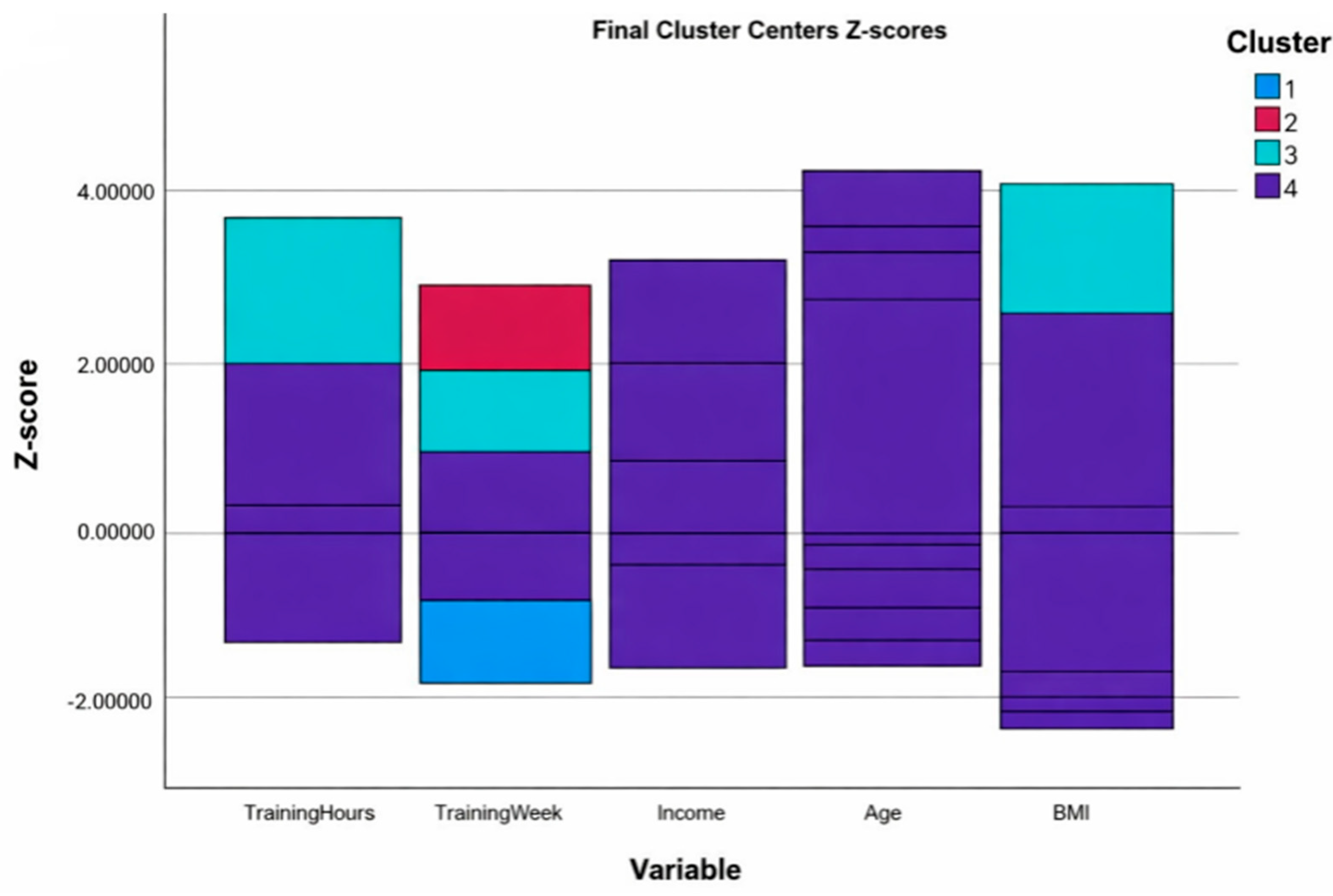
This cross-sectional study compared somatometric, training, and behavioral characteristics of adult exercisers in Greece, contrasting self-identified resistance-training practitioners with recreational exercisers. A total of 1187 adults completed a structured questionnaire capturing demographics, self-reported height and weight (BMI), weekly training frequency, session duration, competition participation, and self-reported use of performance-enhancing substances. Given non-normal distributions, analyses used nonparametric tests, binary logistic regression, and two-step cluster analysis based on the elbow method. Resistance-training practitioners reported higher BMI, greater weekly training frequency, and longer session duration than recreational exercisers (all p < 0.001). Substance use was more prevalent among resistance-training practitioners and exhibited a marked gender asymmetry, with anabolic-agent use concentrated among men. A logistic regression predicting competition participation identified age, BMI, gender, and education as significant predictors; the model explained a modest proportion of variance (Nagelkerke R2 = 0.10). Cluster analysis produced four distinct participant profiles differing in BMI, training intensity, and behavioral orientation. These results indicate systematic somatometric and behavioral differences between exercise orientations and demonstrate the utility of multivariate profiling for characterizing heterogeneity in exercise engagement. Findings should be interpreted cautiously because all anthropometric and substance-use measures were self-reported, and BMI cannot distinguish lean from fat mass in resistance-trained populations; future research should prioritize representative sampling and objective somatometric assessment.
Keywords: exercise participation; public health; resistance training; recreational exercise; somatometric indicators; training patterns; cluster analysis exercise participation; public health; resistance training; recreational exercise; somatometric indicators; training patterns; cluster analysis