Article

Skin Temperature as a Marker of Physical Fitness Profile: The Impact of High-Speed Running in Professional Soccer Players

by
Victor-Luis Escamilla-Galindo
1,2,*,
Armiche Vega-Ramos
3,
Jose Luis Felipe
4,5,
Antonio Alonso-Callejo
6 and
Ismael Fernandez-Cuevas
2,7,8
1
Department of Nutrition and Sports Sciences, Universidad de La Rioja, 26006 Logroño, Spain
2
Department of Research, ThermoHuman, 28030 Madrid, Spain
3
Department of Performance, Orenburg FC, 460008 Orenburg, Russia
4
IGOID Research Group, Department of Physical Activity and Sport Sciences, University of Castilla-La Mancha, 45071 Toledo, Spain
5
Performance Analysis Department, UD Las Palmas, 35019 Las Palmas de Gran Canaria, Spain
6
Department of Sports Sciences, Faculty of Medicine, Health and Sports, Universidad Europea de Madrid, 28670 Madrid, Spain
7
Sports Department, Faculty of Sciences for Physical Activity and Sport (INEF), Universidad Politécnica de Madrid, 28040 Madrid, Spain
8
Department of Performance, Real Madrid CF, 28055 Madrid, Spain
*
Author to whom correspondence should be addressed.
Sports 2025, 13(12), 443; https://doi.org/10.3390/sports13120443
Submission received: 8 October 2025 / Revised: 10 November 2025 / Accepted: 13 November 2025 / Published: 9 December 2025

Abstract

High-speed running (HSR) has the greatest physiological impact on soccer players. It is closely linked to neuromuscular fatigue and muscle damage post-match, emphasizing the role that load monitoring plays in both performance and recovery. The aim of this study was to examine the relationship between match locomotor demands and the relative change in skin temperature (%ΔT) following official matches. A professional soccer team was analyzed during 14 regular-season matches. Infrared thermography (IRT) assessments were conducted before the match and up to 36 h after the match. The analyzed regions included posterior protocols of the lower limb. The kinematic variables of the match were obtained through a GPS device. Players were classified into high- and low-load groups based on the median values of HSR distance (372 m) and total distance (9675 m). Linear mixed-effects models showed that players in the high HSR group (≥372 m) demonstrated greater post-match decreases in %ΔT, particularly in the hamstring region (β = −1.79 ± 0.54 °C, 95% CI: −2.87 to −0.72, p = 0.001, R2 = 0.18), with a moderate-to-large effect size (ES = 0.67). Total distance also explained temperature change in the hamstrings (β = −1.46 ± 0.73 °C, p = 0.04). These findings suggest that post-match skin temperature reduction is sensitive to high-intensity running exposure, supporting IRT as a complementary internal load monitoring tool.

1. Introduction

High-intensity movement patterns in soccer have increased in magnitude during matches in recent years [1,2]. These high-intensity actions have proven to be the most relevant in identifying those players with greater success in competitions [3,4,5]. These actions occur mostly during the moments closest to scoring a goal [6].
Also, high-intensity actions have the greatest physiological impact on soccer players and are associated with a neuromuscular fatigue response and cause more muscle damage post-match [5,7,8]. Thereby, the physical demands with the highest injury rate in soccer are those that occur at high-speed running (HSR) (>21 km/h), with the muscles of the lower limb being the most affected [9].
This physiological impact has consequences for the recovery time of soccer players’ status after match [10]. Usually, players take between 48 and 72 h to return to their previous physiological normal values [11,12,13]. The growing density of competitive matches, especially during congested schedules, has further highlighted the importance of accurately monitoring recovery processes to optimize performance and reduce injury incidence [14,15].
To quantify external load, Global Positioning Systems (GPS) have become an essential tool in elite soccer to control physical demands during training and competition [16]. Proper interpretation of these data allows practitioners to individualize training microcycles in order to reduce injuries and maximize player performance [17]. However, GPS metrics alone do not provide direct information about internal physiological responses, emphasizing the need to integrate complementary technologies to better understand the performance and recovery status in soccer players [18].
Traditionally, the assessment of internal load and recovery in soccer players has been performed using invasive technologies (blood biomarker samples) [13] or requires the subject’s willingness and may be intrusive (questionnaires and isometric or jump tests) [19]. In this context, infrared thermography (IRT) has emerged as a promising non-invasive, contact-free, and safe alternative to monitor physiological status through skin temperature measurement as an objective alternative to measure internal load [20]. Under resting conditions, players typically maintain a stable thermal balance. However, the metabolic and mechanical stress of training and competition could potentially induce localized or systemic thermal changes that reflect underlying physiological processes [21].
Recent studies have explored the relationship between external workload (analyzed with GPS) and internal thermal responses (analyzed with IRT), with significant findings for changes in skin temperature asymmetries that may indicate localized fatigue, inflammation, or incomplete recovery [22,23]. Despite these advances, the use of IRT as a reliable marker of post-match recovery in elite soccer remains insufficiently validated. Specifically, few studies have simultaneously analyzed GPS-derived external load and microcycle-by-microcycle thermographic responses after competition, and the potential link between high-intensity actions and post-match responses is still unclear [24,25,26]. Furthermore, thermal responses have not been analyzed in parallel with objective high-intensity metrics, such as HSR meters, which limit the ability to interpret thermographic changes within the context of match demands.
Therefore, this study aimed to evaluate the association between high-intensity movement patterns, particularly HSR, and distance covered with variations in skin temperature responses to matches in professional soccer players during a period of the regular season. It was hypothesized that players who perform a higher volume of HSR and cover greater distances would show a different relative change in skin temperatures after the match than those who run less, reflecting a greater physiological load and delayed recovery.

2. Materials and Methods

2.1. Participants and Inclusion Criteria

The study design was longitudinal observational, aiming to analyze changes in skin temperature throughout the soccer season in a single professional team. A total of 24 players of a professional soccer team competing in the Russian Premier League (25.58 ± 4.42 years; 76.56 ± 6.7 kg; 181.23 ± 3.56 cm) were monitored using a GPS positioning system (Catapult Group International Ltd., Melbourne, Australia) during the regular 2022/2023 season. During the same period, players were evaluated in a baseline state before and after the matches using IRT. The inclusion criteria were as follows: having participated in at least one of the regular matches of the competition for a minimum of 60 min, being a field player, being available for pre- and post-match IRT measurements in the match they participated in, and not having suffered any injuries during the evaluation period.

2.2. Procedures

2.2.1. Description of IRT Assessment

A thermographic analysis was performed between 24 and 36 h before the match day (MD-1/MD-2) and between 24 and 36 h after the match day (MD + 1/2), with a baseline before training without any treatment or exercise performed by the player. An IRT-certified specialist technician performed image capture, meeting the requirements of the TISEM checklist [27], and players were instructed to avoid consuming stimulants, such as coffee or alcohol, maintain an 8 min acclimatization period, sit in an upright position perpendicular to the camera at a distance of 3 m with the camera at knee height. Shots were taken with an emissivity of 0.98 during the early morning hours when the players accessed the club facilities, where the room was climate-controlled with a temperature range between the assessments of (20 °C ± 2 °C) and a relative humidity of (53% ± 9%). They underwent thermal evaluation in sequential order, and their weight was also recorded. For image capture, a FLIR E-54 EST camera (Teledyne FLIR, Wilsonville, OR, USA) was used, and for image analysis, the ThermoHuman software, version 2.10 (Pema Thermo Group SL., Madrid, Spain) was employed. The software automatically extracted regions of interest by means of artificial vision algorithms that were previously validated [28], reporting on the average, minimum, and maximum temperature, and the asymmetry between contralateral regions from the lower limbs using two types of protocols: the anterior-inferior protocol and the postero-inferior (PI) protocol (Figure 1).

2.2.2. Extraction of Thermal Regions Using the Software

For the purpose of this study, the means of three grouped regions were selected: all the regions on the back of the body, which included regions from the hamstrings to the Achilles tendon, were grouped and referred to as the PI region; the three regions located in the hamstring area were also grouped to perform a single analysis of that region (hamstring); and finally, the two calves regions were grouped to analyze a single combined region (calves). All these areas comprised the IRT variables (PI, hamstrings, and calves).

2.2.3. Acquisition of GPS Data During the Season

For GPS analysis during matches, the players wore an individual GPS device during the match that recorded the kinetic and kinematic parameters developed. A total of 24 different players participated in the matches, completing at least 60 min of the match, which amounted to a total of (m = 115 samples). On average, each player contributed to 2.95 matches during the study period (with one player who only played one game and the player who played the most games playing 10 games). Missing data were retained as ‘NaN’ values and were not imputed; statistical analyses were performed only on complete cases for each variable. They recorded data such as distance covered (total distance (DIST); m), and distance covered (m) at speeds above 21 km/h (high-speed running; HSR). This technology has previously demonstrated its validity in measuring these kinematic variables [29].
To analyze the thermal response provoked by load, two groups were made for each load variable (total distance and HSR) based on the median value of each distribution. Each player who participated in over 60 min of a match was included for observation. Observations which covered a total distance lower than 9675 m (median value for total distance) were classified as −DIST (n = 54) and those who covered more were grouped as +DIST (n = 54). The same process was used to divide the sample in the HSR variable with a split value of 372 m (+HSR, n = 54; −HSR, n = 54). All groups have the same number of observations since, by median, group distribution is equal.

2.3. Statistical Analysis

For each of the IRT variables (PI, hamstrings, and calves), the relative temperature change (ΔT) between pre- and post-match was calculated, with %ΔT defined as (((post-match temperature − pre-match temperature)/pre-match temperature) × 100). Subsequently, normality testing using the Kolmogorov–Smirnov test was performed on the newly derived variables, confirming a normal distribution. Descriptive statistics (mean ± standard deviation) by group (HSR split and distance split) were calculated for the variables: minutes played, distance covered, HSR, and skin temperatures recorded in the three IRT variables.
To test associations while accounting for repeated measures within players, linear mixed-effects models (LMMs) were fitted separately for each IRT variable. Two primary LMMs were specified:
A linear mixed-effects model (MLM) was fitted with %ΔT as the outcome and minutes as a covariate and HSRgroup (+HSR vs. −HSR) as the main predictor. An intercept random effect for player was included to account for repeated measures:
ΔTij = β0 + β1(Minutesij) + β2(HSRgroupi) + u0j + εij.
On the other hand, an analogous MLM with Distgroup (+DIST vs. −DIST) as main predictor, controlling for minutes and including player as a random intercept:
ΔTij = β0 + β1(Minutesij) + β2(Distgroupi) + u0j + εij.
Model parameters reported are unstandardized β coefficients and two-sided p-values; statistical significance was set at α = 0.05, where u0j is the random intercept for the player j and εij is the residual error. Minutes were included as a covariate in both models.
In addition, Cohen’s d effect sizes were computed to quantify the magnitude of the group differences. For the HSR and distance splits, Cohen’s d was calculated as the difference in group means of %ΔT divided by the pooled standard deviation. Effect sizes were classified as small (≈0.2), medium (≈0.5), and large (≈0.8), following conventional thresholds. There was a 95% confident interval of the differences (95%CI). Conditional R2 and marginal R2 were calculated to inform the explained variance of the model, taking both the fixed and random effects into account. All statistical analyses were performed in Python, version 3.10 (pandas, numpy, statsmodels, Pingouin).

3. Results

Table 1 shows descriptive values (mean ± sd) for both groups of each load variable and the %ΔT as a percentage between pre-match and post-match.
Linear mixed-effects models were applied to examine the influence of HSR exposure on the %ΔT across the postero-inferior region (PI), hamstrings, and calves, with minutes played included as a covariate and player as a random intercept (Table 2).
The results indicated that players classified in the +HSR group (≥372 m) showed greater decreases in skin temperature compared to players in the −HSR group, who showed an increase in the %ΔT. It is observed that for each player throughout the season, there was a significant negative response every time more HSR actions were performed. For the hamstring region, the +HSR group also exhibited the greatest relative decrease in temperature (β = −1.79 ± 0.54 °C, 95% CI: −2.87 to −0.72, p = 0.001), with a conditional R2 of 0.18. In this case, the effect size is moderate to large (ES = 0.67), showing the hamstring region has the most pronounced %ΔT after the matches. Across all regions, the coefficient for minutes played was negative but small and non-significant, indicating that match duration contributed minimally to temperature change compared to HSR load.
A second set of mixed-effects models evaluated whether total distance covered influenced relative skin temperature change, again controlling for minutes played. The high-distance group (≥9675 m) exhibited only a significant post-match relative temperature decrease in the hamstring region, suggesting that only this region could be affected by a high load (Table 3).
In the hamstring region, higher total distance was associated with a significant decrease in temperature (β = −1.46 ± 0.73 °C, 95% CI: −2.90 to −0.30, p = 0.04) with a conditional R2 of 0.09. In this case, the effect size is small (ES = 0.36), indicating that the total distance variable has less impact than the meters to HSR.
Again, minutes played did not significantly predict temperature change, suggesting that movement intensity (HSR and distance load) was more relevant than total match exposure time.
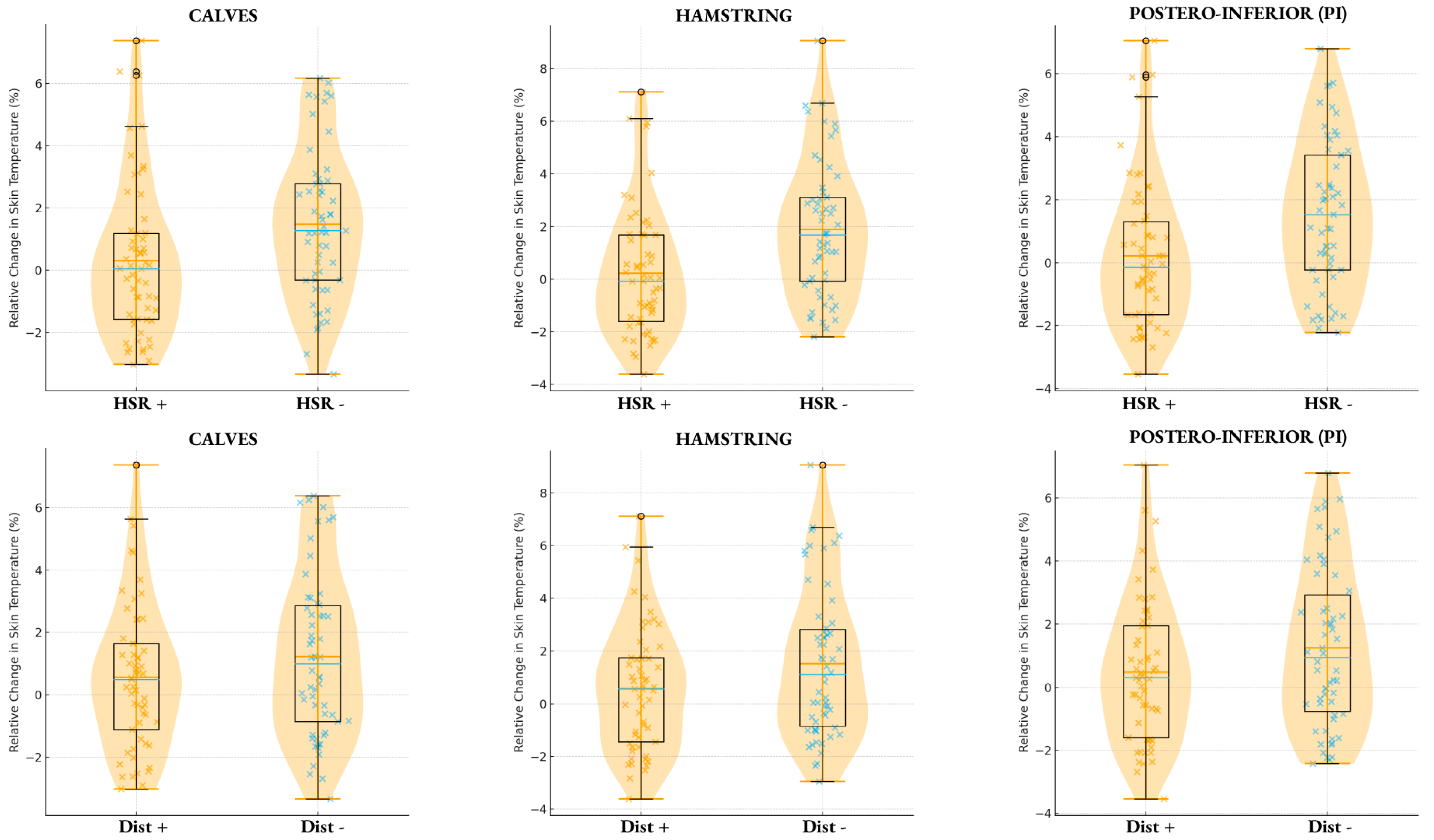
Figure 2 displays combined violin and boxplot distributions for pre-to-post %ΔT across the three analyzed regions (PI, hamstrings, and calves), comparing high vs. low HSR groups and high vs. low total distance groups. In all regions, the +HSR group showed lower median and mean temperature values following match play, consistent with the mixed-model results. Meanwhile, only +DIST in hamstrings showed lower median and mean temperature values following match play.
Overall, the findings indicate that match-related locomotor demands, particularly HSR exposure, have a meaningful impact on post-match %ΔT. Players performing greater HSR distances consistently demonstrated larger relative decreases in temperature, most notably in the hamstring region, where the effect was moderate to large. In contrast, total distance covered showed a weaker influence, with significant effects only detected in the hamstrings and with smaller effect sizes.

4. Discussion

The aim of this study was to examine the effects of match-related locomotor demands (HSR and total distance) on post-match changes in skin temperature during a professional soccer season, using %ΔT as an intra-player indicator.
One of the most determining variables, both in individual and team success, and with significant physiological impact on the player, is HSR. This action has been used in the literature to differentiate players with more success during the competition [4]. Furthermore, it is a risk factor for injury as it exposes players to high neuromuscular demands, particularly in the hamstring region [7,9]. Therefore, the control and monitoring of HSR have gained great importance in the planning of competitive microcycles [3].
In this sense, to the knowledge of the authors, this is the first study with professional soccer players to understand how competition match-related locomotor demands affect the skin temperature of the players during a regular season.
Previous research analyzing the response of athletes to long-duration aerobic stimuli has been evaluated using IRT, and the results have shown an increase in skin temperature in the days following competition [24]. Other studies have assessed multiple exposures to strength, speed, or endurance training, and all of them have shown an increase in skin temperature within the next 8 h [20]. Furthermore, competitions in hot environments have been found to lead to an increase in skin temperature in the subsequent days [30]. This means that mean temperature usually increases after competition. However, these studies do not distinguish between intra-player variations and do not analyze whether different loads elicit similar variations.
Previous studies analyzed a professional soccer team in a baseline state and after a 16-week competitive period, allowing for 72 h of recovery at the end of the competitive period. The results they obtained show an increase in skin temperature between the two periods, with competitive load being a factor in the temperature increase [25]. These findings are consistent with the significant data from the group −HSR and the −DIST group, in which the %ΔT is higher than +HSR and +DIST groups.
The perspective of this research is to consider high-intensity HSR load during the match as a mediator of skin response. The results include two measurements taken at very close time points, from 36 h before to 36 h after the match, aiming to minimize external factors that may affect changes in ambient temperature. Analyzing absolute temperatures may have been a limiting factor in other studies.
The main finding was that exposure to high-speed running (HSR ≥ 372 m) consistently predicted a greater post-match decrease in skin temperature, particularly in the hamstring region. This effect remained after controlling for minutes played, which showed a negligible association with %ΔT across all regions. In contrast, total distance ≥ 9675 m showed a smaller and region-specific effect, with only the hamstring region showing a statistically significant decrease in %ΔT. The effect size for total distance was small, indicating lower practical relevance when compared to HSR. In summary, these results suggest that HSR is a more significant indicator of acute physiological cost than total match distance, highlighting %ΔT hamstring as a key variable in monitoring internal load for performance monitoring tools in professional soccer.
The hamstring region appears to be the most responsive to this type of stimulus during the match, especially considering the HSR variable. These results regarding the temperature variation in the hamstring region after the match are novel, although there is previous research on sprints and hamstring temperature indicating that this region’s thermoregulation is affected when external fatigue is imposed through high-speed running work [23]. Therefore, when energy substrates are fully depleted, athletes’ skin temperature decreases [31]. Additionally, different types of fatigue can affect the nervous, muscular, and/or metabolic systems to varying degrees of %ΔT [32]. The type of high-intensity stimulus that will generate fatigue could condition the different responses in the relative change in temperature after matches.
As practical applications, the direction (positive or negative) and the magnitude of the observed effects suggest that relative skin temperature changes, especially in the hamstring region, could provide a non-invasive indicator. This indicator could help to contextualize how players respond to high-intensity loads during matches within athlete monitoring systems. It is important to note that the interpretation of %ΔT must be individualized, given the random intercept structure that indicates inter-player variability. Therefore, thermal responses should be assessed longitudinally and for each player, rather than comparing them between players or generalizing them across teams.
The limitations of this study include the inability to control the soccer team throughout the entire season due to the idiosyncrasies of the competitive calendar, which includes a break during the winter period. Additionally, due to the anonymous nature of the sample, neither the position nor the tactical model have been taken into account in the analyses, which could be a confusing factor for obtaining meters at high intensity and which could be considered as covariate, potential bias, or limitations in generalizing the findings. The results should be interpreted within the context of a single professional team and a non-consecutive sample.
Despite these limitations, we consider that the study outcomes may be of great utility for technical soccer staff to have an objective criterion through thermal behavior of the body to make decisions in order to individualize the load during the microcycle. Future work should examine whether similar patterns are observed across different competitive leagues, tactical contexts, position of the player, or a complete season.

5. Conclusions

This study evaluated the relative skin temperature change following official matches in professional soccer players and examined its relationship with match locomotor demands. From a monitoring perspective, the assessment of %ΔT through IRT after competition may serve as an internal load indicator. Among the analyzed regions, the hamstring region appears to be the most responsive to high-intensity demands, decreasing the temperature after the match, suggesting its relevance for individualized follow-up during congested schedules or periods of high external load.
Overall, incorporating IRT into post-match assessments may complement other monitoring tools, helping sport scientists and performance staff contextualize high-intensity movement patterns and guide individualized recovery and training decisions throughout the competitive season.

Author Contributions

Conceptualization, V.-L.E.-G., A.V.-R., J.L.F. and I.F.-C.; data curation, A.A.-C.; formal analysis, J.L.F. and A.A.-C.; investigation, V.-L.E.-G. and A.V.-R.; methodology, V.-L.E.-G., J.L.F., A.A.-C. and I.F.-C.; software, V.-L.E.-G. and I.F.-C.; supervision, I.F.-C.; writing—original draft, V.-L.E.-G.; writing—review and editing, V.-L.E.-G., A.V.-R., J.L.F., A.A.-C. and I.F.-C. All authors have read and agreed to the published version of the manuscript.

Funding

This research received no external funding.

Institutional Review Board Statement

The current study was approved by The Social Research Ethics Committee of the University of Castilla-La Mancha (Ref.: CAU-732752-Z1C6) on 22 October 2022 and conformed to the recommendations of the Declaration of Helsinki.

Informed Consent Statement

Patient consent was waived because participants routinely underwent both thermography assessments and GPS-based monitoring as part of their regular performance and load control procedures within the team’s daily practice. The data collected for research purposes were fully anonymized and did not involve any modification to the players’ standard routines or any intervention beyond the regular evaluation process.

Data Availability Statement

The current study shares its research data in the Mendeley repository: “Skin Temperature Football Players during a season”, Mendeley Data, V1, https://doi.org/10.17632/spkmxfsmhv.1.

Conflicts of Interest

Authors Victor-Luis Escamilla-Galindo and Ismael Fernandez-Cuevas were employed by the company ThermoHuman. Both participated in conceptualization, writing and reviewing in the study. Their roles in the company were Sports Scientist and CEO, respectively. The remaining authors declare that the research was conducted in the absence of any commercial or financial relationships that could be construed as a potential conflict of interest. Other authors have no conflicts of interest.

Abbreviations

The following abbreviations are used in this manuscript:
HSRHigh-speed running
GPSGlobal Positioning Systems
IRTInfrared thermography
PIPostero-inferior
ΔTRelative temperature change
MDMatch day
DISTTotal distance

References

  1. Pons, E.; Ponce-Bordón, J.C.; Díaz-García, J.; López del Campo, R.; Resta, R.; Peirau, X.; García-Calvo, T. A longitudinal exploration of match running performance during a football match in the Spanish La Liga: A four-season study. Int. J. Environ. Res. Public Health 2021, 18, 1133. [Google Scholar] [CrossRef]
  2. Teixeira, J.E.; Forte, P.; Ferraz, R.; Leal, M.; Ribeiro, J.; Silva, A.J.; Barbosa, T.M.; Monteiro, A.M. Monitoring accumulated training and match load in football: A systematic review. Int. J. Environ. Res. Public Health 2021, 18, 3906. [Google Scholar] [CrossRef]
  3. Ju, W.; Doran, D.; Hawkins, R.; Evans, M.; Laws, A.; Bradley, P. Contextualised high-intensity running profiles of elite football players with reference to general and specialised tactical roles. Biol. Sport 2023, 40, 291–301. [Google Scholar] [CrossRef]
  4. Mohr, M.; Krustrup, P.; Bangsbo, J. Match performance of high-standard soccer players with special reference to development of fatigue. J. Sports Sci. 2003, 21, 519–528. [Google Scholar] [CrossRef]
  5. Schimpchen, J.; Gopaladesikan, S.; Meyer, T. The intermittent nature of player physical output in professional football matches: An analysis of sequences of peak intensity and associated fatigue responses. Eur. J. Sport Sci. 2021, 21, 793–802. [Google Scholar] [CrossRef]
  6. Martínez-Hernández, D.; Quinn, M.; Jones, P. Linear advancing actions followed by deceleration and turn are the most common movements preceding goals in male professional soccer. Sci. Med. Footb. 2023, 7, 25–33. [Google Scholar] [CrossRef] [PubMed]
  7. Hostrup, M.; Bangsbo, J. Performance Adaptations to Intensified Training in Top-Level Football. Sports Med. 2023, 53, 577–594. [Google Scholar] [CrossRef]
  8. Wells, C.; Edwards, A.; Fysh, M.; Drust, B. Effects of high-intensity running training on soccer-specific fitness in professional male players. Appl. Physiol. Nutr. Metab. 2014, 39, 763–769. [Google Scholar] [CrossRef] [PubMed]
  9. Malone, S.; Owen, A.; Mendes, B.; Hughes, B.; Collins, K.; Gabbett, T.J. High-speed running and sprinting as an injury risk factor in soccer: Can well-developed physical qualities reduce the risk? J. Sci. Med. Sport 2018, 21, 257–262. [Google Scholar] [CrossRef] [PubMed]
  10. Djaoui, L.; Garcia, J.D.-C.; Hautier, C.; Dellal, A. Kinetic post-match fatigue in professional and youth soccer players during the competitive period. Asian J. Sports Med. 2016, 7, e28267. [Google Scholar] [CrossRef]
  11. Krustrup, P.; Ørtenblad, N.; Nielsen, J.; Nybo, L.; Gunnarsson, T.P.; Iaia, F.M.; Madsen, K.; Stephens, F.; Greenhaff, P.; Bangsbo, J. Maximal voluntary contraction force, SR function and glycogen resynthesis during the first 72 h after a high-level competitive soccer game. Eur. J. Appl. Physiol. 2011, 111, 2987–2995. [Google Scholar] [CrossRef] [PubMed]
  12. Nédélec, M.; McCall, A.; Carling, C.; Legall, F.; Berthoin, S.; Dupont, G. Recovery in soccer: Part I—Post-match fatigue and time course of recovery. Sports Med. 2012, 42, 997–1015. [Google Scholar]
  13. Pérez-Castillo, Í.M.; Rueda, R.; Bouzamondo, H.; López-Chicharro, J.; Mihic, N. Biomarkers of post-match recovery in semi-professional and professional football (soccer). Front. Physiol. 2023, 14, 592. [Google Scholar] [CrossRef]
  14. Julian, R.; Page, R.M.; Harper, L.D. The effect of fixture congestion on performance during professional male soccer match-play: A systematic critical review with meta-analysis. Sports Med. 2021, 51, 255–273. [Google Scholar] [CrossRef]
  15. Lundberg, T.R.; Weckström, K. Fixture congestion modulates post-match recovery kinetics in professional soccer players. Res. Sports Med. 2017, 25, 408–420. [Google Scholar] [CrossRef]
  16. Oliva Lozano, J.M.; Muyor, J.M.; Pérez-Guerra, A.; Gómez, D.; Garcia-Unanue, J.; Sanchez-Sanchez, J.; Felipe, J.L. Effect of the length of the microcycle on the daily external load, fatigue, sleep quality, stress, and muscle soreness of professional soccer players: A full-season study. Sports Health 2023, 15, 695–699. [Google Scholar] [CrossRef]
  17. Oliva-Lozano, J.M.; Muyor, J.M.; Fortes, V.; McLaren, S.J. Decomposing the variability of match physical performance in professional soccer: Implications for monitoring individuals. Eur. J. Sport Sci. 2021, 21, 1588–1596. [Google Scholar] [CrossRef] [PubMed]
  18. Oliveira, R.; Brito, J.P.; Martins, A.; Mendes, B.; Marinho, D.A.; Ferraz, R.; Marques, M.C. In-season internal and external training load quantification of an elite European soccer team. PLoS ONE 2019, 14, e0209393. [Google Scholar] [CrossRef]
  19. Makaruk, H.; Starzak, M.; Porter, J.M. Influence of attentional manipulation on jumping performance: A systematic review and meta-analysis. J. Hum. Kinet. 2020, 75, 65–75. [Google Scholar] [CrossRef] [PubMed]
  20. Fernández-Cuevas, I.; Marins, J.C.B.; Lastras, J.A.; Carmona, P.M.G.; Cano, S.P.; García-Concepción, M.Á.; Sillero-Quintana, M. Classification of factors influencing the use of infrared thermography in humans: A review. Infrared Phys. Technol. 2015, 71, 28–55. [Google Scholar] [CrossRef]
  21. Marins, J.C.B.; Fernandes, A.A.; Cano, S.P.; Moreira, D.G.; da Silva, F.S.; Costa, C.M.A.; Fernandez-Cuevas, I.; Sillero-Quintana, M. Thermal body patterns for healthy Brazilian adults (male and female). J. Therm. Biol. 2014, 42, 1–8. [Google Scholar] [CrossRef] [PubMed]
  22. Duarte, W.; Júnior, J.L.R.; Paula, L.V.; Chagas, M.H.; Andrade, A.G.; Veneroso, C.E.; Chaves, S.F.; Serpa, T.K.; Pimenta, E.M. C-Reactive Protein and Skin Temperature of the lower limbs of Brazilian elite soccer players like load markers following three consecutive games. J. Therm. Biol. 2022, 105, 103188. [Google Scholar] [CrossRef] [PubMed]
  23. Majano, C.; García-Unanue, J.; Hernandez-Martin, A.; Sánchez-Sánchez, J.; Gallardo, L.; Felipe, J.L. Relationship between Repeated Sprint Ability, Countermovement Jump and Thermography in Elite Football Players. Sensors 2023, 23, 631. [Google Scholar] [CrossRef] [PubMed]
  24. de Andrade Fernandes, A.; Pimenta, E.M.; Moreira, D.G.; Sillero-Quintana, M.; Marins, J.C.B.; Morandi, R.F.; Kanope, T.; Garcia, E.S. Effect of a professional soccer match in skin temperature of the lower limbs: A case study. J. Exerc. Rehabil. 2017, 13, 330. [Google Scholar] [CrossRef]
  25. Júnior, J.L.R.; Duarte, W.; Falqueto, H.; Andrade, A.G.; Morandi, R.F.; Albuquerque, M.R.; de Assis, M.G.; Serpa, T.K.; Pimenta, E.M. Correlation between strength and skin temperature asymmetries in the lower limbs of Brazilian elite soccer players before and after a competitive season. J. Therm. Biol. 2021, 99, 102919. [Google Scholar] [CrossRef]
  26. Matta, L.; Rhea, M.R.; Maior, A.S. Physiological evaluation post-match as implications to prevent injury in elite soccer players. In Archivos de Medicina del Deporte: Revista de la Federación Española de Medicina del Deporte y de la Confederación Iberoamericana de Medicina del Deporte; Spanish Federation of Sports Medicine: Zaragoza, Spain, 2019; Volume 36, pp. 220–226. [Google Scholar]
  27. Moreira, D.G.; Costello, J.T.; Brito, C.J.; Adamczyk, J.G.; Ammer, K.; Bach, A.J.; Costa, C.M.; Eglin, C.; Fernandes, A.A.; Fernández-Cuevas, I. Thermographic imaging in sports and exercise medicine: A Delphi study and consensus statement on the measurement of human skin temperature. J. Therm. Biol. 2017, 69, 155–162. [Google Scholar] [CrossRef]
  28. Requena-Bueno, L.; Priego-Quesada, J.I.; Jimenez-Perez, I.; Gil-Calvo, M.; Pérez-Soriano, P. Validation of ThermoHuman automatic thermographic software for assessing foot temperature before and after running. J. Therm. Biol. 2020, 92, 102639. [Google Scholar] [CrossRef]
  29. Felipe, J.L.; Garcia-Unanue, J.; Viejo-Romero, D.; Navandar, A.; Sánchez-Sánchez, J. Validation of a video-based performance analysis system (Mediacoach®) to analyze the physical demands during matches in LaLiga. Sensors 2019, 19, 4113. [Google Scholar] [CrossRef]
  30. Priego-Quesada, J.I.; De la Fuente, C.; Kunzler, M.R.; Perez-Soriano, P.; Hervás-Marín, D.; Carpes, F.P. Relationship between skin temperature, electrical manifestations of muscle fatigue, and exercise-induced delayed onset muscle soreness for dynamic contractions: A preliminary study. Int. J. Environ. Res. Public Health 2020, 17, 6817. [Google Scholar] [CrossRef]
  31. Hillen, B.; Pfirrmann, D.; Nägele, M.; Simon, P. Infrared thermography in exercise physiology: The dawning of exercise radiomics. Sports Med. 2020, 50, 263–282. [Google Scholar] [CrossRef]
  32. Thorpe, R.T. Post-exercise recovery: Cooling and heating, a periodized approach. Front. Sports Act. Living 2021, 3, 707503. [Google Scholar] [CrossRef] [PubMed]
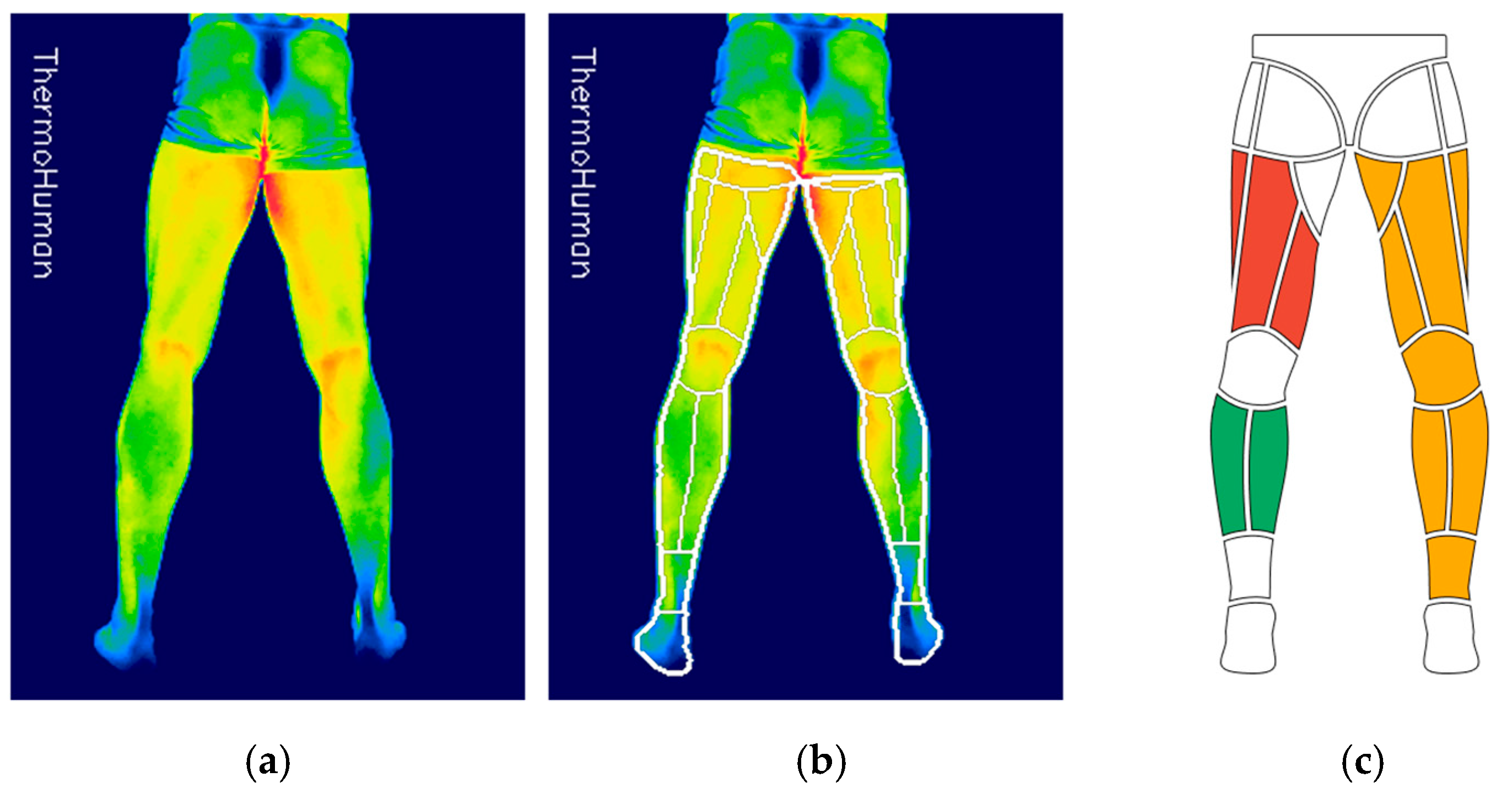
Figure 1. Skin temperature analysis protocol using ThermoHuman software. (a) Thermogram of the posterior leg. (b) Segmentation of regions of interest through software. (c) Grouped regions for analysis: red for hamstrings, green for calves, yellow for the postero-inferior (PI) region (right and left sides included in every grouped region).
Sports 13 00443 g001
Figure 2. Violin and boxplot composite of %ΔT for the postero-inferior region (PI), hamstrings, and calves, comparing players in the high-load and low-load groups for HSR (>372 m (HSR+) or <372 m (HSR-)) and total distance covered (>9675 m (DIST+) or <9675 m (DIST-).
Sports 13 00443 g002
Table 1. Descriptive values (mean ± sd) for total distance and HSR with the %ΔT as percentage differences between pre-match and post-match for the regions of the postero-inferior protocol, hamstring, and calves.
Load Variable
(DIST in km; HSR in m)
Minutes Played
(min)
Pre PI ST (°C)Post PI ST (°C)PI (%ΔT)Pre Hamstrings ST (°C)Post Hamstrings ST (°C)Hamstrings (%ΔT)Pre Calves ST (°C)Post Calves ST (°C)Calves (%ΔT)
DIST+DIST10.5 ± 0.697.5 ± 3.531.82 ± 0.631.97 ± 0.60.4 ± 231.9 ± 0.732.1 ± 0.90.5 ± 231.9 ± 0.732 ± 0.70.5 ± 2
−DIST8.3 ± 1.182.60 ± 13.5731.5 ± 0.631.96 ± 0.71.2 ± 231.6 ± 0.732.1 ± 0.81.5 ± 331.6 ± 0.631.9 ± 0.71.2 ± 3
HSR+HSR584.79 ± 176.3291.76 ± 11.1631.70 ± 0.631.76 ± 0.70.1 ± 231.80 ± 0.631.79 ± 0.8−0.1 ± 331.65 ± 0.7431.74 ± 0.710.3 ± 2
−HSR269.70 ± 66.4888.23 ± 13.4431.69 ± 0.532.17 ± 0.61.5 ± 231.74 ± 0.732.3 ± 0.71.8 ± 331.75 ± 0.5732.21 ± 0.611.5 ± 2
PI %ΔT: Relative temperature change extracted from IRT assessment for the postero-inferior protocol.
Table 2. Results of the Linear Mixed Effects Model on %ΔT for the regions of interest split by HSR analyzed with thermography, and with minutes played as a covariate.
HSR (m)
Interceptβ1 Minutesβ2 HSR GroupCI 95%p-ValueEffect Size (Cohen’s d)R2 (Marginal = Conditional)
PI (°C) ΔT−2.57 × 10⁻⁵−0.006−1.46 ± 0.52[−2.49, −0.43]0.005 *0.560.13
Hamstring (°C) ΔT−2.69 × 10⁻⁵−0.009−1.79 ± 0.54[−2.87, −0.72]0.001 *0.670.18
Calves (°C) ΔT−2.74 × 10⁻⁵−0.007−1.23 ± 0.55[−2.32, −0.13]0.027 *0.480.09
* p < 0.05. Cond. R2: Conditional R2.
Table 3. Results of the Linear Mixed Effects Model on %ΔT for the regions of interest split by total distance analyzed with thermography, and with minutes played as a covariate.
Total Distance (m)
Interceptβ1 Minutesβ2 Dist GroupCI 95%p-ValueEffect Size (Cohen’s d)R2 (Marginal = Conditional)
PI (°C) ΔT−2.62 × 10−50.01−1.26 ± 0.69[−2.62, 0.09]0.060.320.07
Hamstring (°C) ΔT−2.77 × 10−50.01−1.46 ± 0.73[−2.90, −0.3]0.04 *0.360.09
Calves (°C) ΔT−2.79 × 10−50.003−0.82 ± 0.73[−2.26, 0.62]0.260.260.03
* p < 0.05. Cond. R2: Conditional R2.
Disclaimer/Publisher’s Note: The statements, opinions and data contained in all publications are solely those of the individual author(s) and contributor(s) and not of MDPI and/or the editor(s). MDPI and/or the editor(s) disclaim responsibility for any injury to people or property resulting from any ideas, methods, instructions or products referred to in the content.