Article

Prevalence and Distribution of Endosymbionts in Bemisia tabaci Populations from Pakistan: Dominance of Arsenophonus in Indigenous Asia II-1 Population

1
Agricultural Biotechnology Division, National Institute for Biotechnology and Genetic Engineering, Faisalabad 44000, Pakistan
2
Center for Advanced Studies in Agriculture and Food Security, University of Agriculture, Faisalabad 38040, Pakistan
3
Central Laboratories, King Faisal University, Al-Ahsa 31982, Saudi Arabia
4
Department of Biotechnology, Sardar Bahadur Khan Women’s University of Quetta, Quetta 87300, Baluchistan, Pakistan
5
Department of Physics, College of Science, King Faisal University, Al-Ahsa 31982, Saudi Arabia
*
Author to whom correspondence should be addressed.
Insects 2026, 17(6), 585; https://doi.org/10.3390/insects17060585
Submission received: 1 April 2026 / Revised: 26 May 2026 / Accepted: 28 May 2026 / Published: 3 June 2026
(This article belongs to the Topic Diversity of Insect-Associated Microorganisms)

Simple Summary

Whiteflies are tiny insects that cause major damage to crops by feeding on plants and spreading plant viruses that reduce yield and quality. In Pakistan, these insects are a key reason for recurring disease outbreaks in important crops such as cotton. While much attention has focused on the insects themselves, less is known about the bacteria living inside them and how these microbes influence their ability to spread disease. This study examined whitefly populations collected from major agricultural regions of Pakistan to understand which bacteria they carry and how these are distributed. We found that most whiteflies harbor one or more types of bacteria, with one group, called Arsenophonus, being the most common, especially in the dominant local whitefly type. This bacterium was particularly frequent in regions where plant virus problems are severe. Our results suggest that these internal bacteria may influence how effectively whiteflies transmit plant viruses, although further work is needed to confirm this role. Understanding these hidden microbial partners provides new insight into why plant diseases persist and spread, and may help develop improved, environmentally friendly strategies to manage whiteflies and protect crop production.

Abstract

Bemisia tabaci is a globally destructive agricultural pest and an efficient vector of begomoviruses, which cause recurrent epidemics across South Asia, including cotton leaf curl disease in Pakistan. Increasing evidence shows that bacterial endosymbionts play a central role in shaping whitefly biology, population dynamics, and vector competence. However, the distribution of these symbionts remains poorly resolved in Pakistan, a region where begomoviruses are persistent and widespread. This study investigated the cryptic species diversity, secondary endosymbiont composition and their infection frequency in B. tabaci populations collected from major agricultural regions of Pakistan. A total of 274 adult whiteflies belonging to Asia II-1 (n = 199), MEAM-1 (n = 67), Asia I (n = 7), and Asia II-8 (n = 1) were screened using a symbiont-specific PCR assay for six endosymbionts. The primary endosymbiont Candidatus Portiera aleyrodidarum was detected in all individuals, whereas five secondary endosymbionts (Arsenophonus, Cardinium, Hamiltonella, Wolbachia and Rickettsia) were identified with distinct cryptic species- and region-specific patterns. Notably, Arsenophonus was the most prevalent endosymbiont, occurring in 68% of Asia II-1, 100% of Asia I, and 21% of MEAM-1 individuals, with the highest regional prevalence in Punjab (80%) and Khyber Pakhtunkhwa (77%). Logistic regression analyses confirmed significantly higher infection probabilities in indigenous Asia II-1 populations. Network analysis revealed structured co-occurrence patterns, including strong negative associations between Arsenophonus and Hamiltonella. Phylogenetic analyses revealed close relatedness of Pakistani Arsenophonus strains to those reported from neighboring regions, indicating regional community rather than unique local diversification. The dominance of Arsenophonus in Pakistani whitefly populations is of particular significance, given its role in protecting begomoviruses within the insect vector and its implication in facilitating virus persistence and transmission. This study, for the first time in Pakistan, provides a comprehensive assessment of endosymbiont–cryptic species associations in Pakistani B. tabaci populations and highlights the dominant prevalence of Arsenophonus as a potential key player in local virus vector dynamics.

1. Introduction

The whitefly (Bemisia tabaci) is one of the most economically important insect pests distributed worldwide and represents a cryptic species complex consisting of at least 45 morphologically indistinguishable species [1,2,3]. B. tabaci is a highly polyphagous insect infesting a wide range of agricultural and horticultural crops. It causes direct damage to the plants by sucking the phloem and indirect damage by secreting the honeydew which promotes the growth of sooty mold and reduces photosynthetic efficiency. Most importantly, B. tabaci is a vector of several phytopathogenic viral genera [4], among which the most important are the single-stranded DNA viruses of the genus Begomovirus (family Geminiviridae; [5]). Pakistan is a major global hotspot for begomovirus diseases, including cotton leaf curl disease (CLCuD), sustained despite long-term management. Indigenous B. tabaci, particularly Asia II-1, dominates across Pakistan, particularly in Punjab and northern regions, where it efficiently transmits CLCuD. It harbors greater begomovirus diversity than invasive MEAM1, which remains largely restricted to Sindh province in the southern region [6]. The predominance of Asia II-1 shows its adaptability to local climates and diverse hosts, with distinct genetic variants in virus transmission and insecticide resistance genes relative to MEAM1 [7]. Despite established distribution patterns, data linking endosymbiont compositions to virus transmission dynamics in Pakistan remain scarce. However, host genetics alone cannot explain persistent, regionally variable transmission, highlighting the role of microbial symbionts in vector competence.
Like other sap-feeding insects, B. tabaci harbors an obligate primary (P)-endosymbiont, Candidatus Portiera aleyrodidarum, which provides essential amino acids and vitamins deficient or absent in plant phloem sap [8]. This obligatory symbiosis is assumed to have co-evolved with their insect hosts for a long time [8,9] and has quite small genomes—smaller than 1000 kb and 600 genes. The synthesis of these essential nutrients requires metabolic complementation both from the host and the other endosymbionts [10]. While the nutritional contributions of P-endosymbionts are well-documented, the other important biological functions, such as their role in virus transmission, host fitness, and reproductive manipulation, remain less explored.
Beyond P-endosymbiont Portiera, B. tabaci variably harbor one or more facultative secondary (S)-endosymbionts, such as Arsenophonus, Hamiltonella, Cardinium, Rickettsia, and Wolbachia. These S-endosymbionts are transmitted both vertically and horizontally within the insect population [9,11,12]. These can profoundly influence host fitness, provide essential nutrients [13,14], resistance against parasitic wasps and fungal/viral pathogens [15,16,17,18,19,20], and stress and heat tolerance [21]. Conversely, certain S-endosymbionts, notably Wolbachia, Arsenophonus, Cardinium, and Rickettsia, act as reproductive manipulators by introducing cytoplasmic incompatibility, parthenogenesis, sex-ratio distortion, or male killing, thereby promoting their own spread to other hosts and ecological niches [22,23,24]. Beyond these effects, S-endosymbionts are increasingly recognized as key determinants of whitefly vector competence. In addition, they modulate virus acquisition, retention, and transmission [25] by providing thermotolerance [26] and resistance to parasitoids and various insecticides [27,28,29]. The Candidatus Fritschea bemisiae, an obligate intracellular endosymbiont harbored within bacteriocytes of the A biotype B. tabaci (USA), has been shown to have a role in reducing host fecundity and narrowing host range relative to B. argentifolii, though its precise role in begomovirus vector competence remains elusive [30].
The influence of S-endosymbionts on begomovirus transmission is rooted in specific molecular and physiological mechanisms. Hamiltonella defensa, Rickettsia spp., and Arsenophonus spp. have emerged as key modulators of this process. Notably, Hamiltonella-derived GroEL proteins protect tomato yellow leaf curl virus (TYLCV) within the insect vector [25], while Hamiltonella-associated modulation of odorant-binding proteins affects tomato chlorosis virus transmission [31,32]. Similarly, Rickettsia infections enhance virus retention, virus acquisition, and transmission efficiency [33]. Among these, Arsenophonus is a pivotal mediator of B. tabaci competence, forming stable, high-frequency associations with dominant cryptic species across Asia, the Middle East, and Africa [3,34,35]. Its mechanistic influence on begomovirus transmission is primarily driven by the expression of GroEL chaperonin proteins, which bind to coat proteins, protecting virions from degradation within the hemolymph and facilitating their circulation to the salivary glands [36]. Beyond direct viroprotection, Arsenophonus contributes to host nutritional supplementation and physiological homeostasis, potentially enhancing viral acquisition and retention [37,38]. Despite the importance of these mechanisms in driving persistent begomovirus epidemics, particularly in regions like Pakistan, dominated by the Asia II-1 cryptic species [39,40,41], the prevalence and epidemiological significance of Arsenophonus in local populations, particularly in Asia II 1, remains understudied.
Therefore, the present study investigates the occurrence and distribution of different endosymbionts, including Arsenophonus, Porteira, Hamiltonella, Cardinium, Wolbachia, Rickettsia and Fritschea, in the field populations of B. tabaci collected from major agricultural regions of Pakistan, including major cotton-growing areas. By integrating endosymbiont infection patterns, particularly Arsenophonus, with cryptic species composition, this study provides the first comprehensive assessment of the microbial ecology of Pakistani B. tabaci whiteflies and evaluates the potential role of Arsenophonus as a cryptic driver of begomovirus epidemiology. Ultimately, this research identifies an underappreciated biological lever in whitefly-mediated epidemics, offering new insights for the development of symbiont-targeted management strategies in South Asian agrosystems.

2. Materials and Methods

2.1. Whitefly Sampling and DNA Extraction

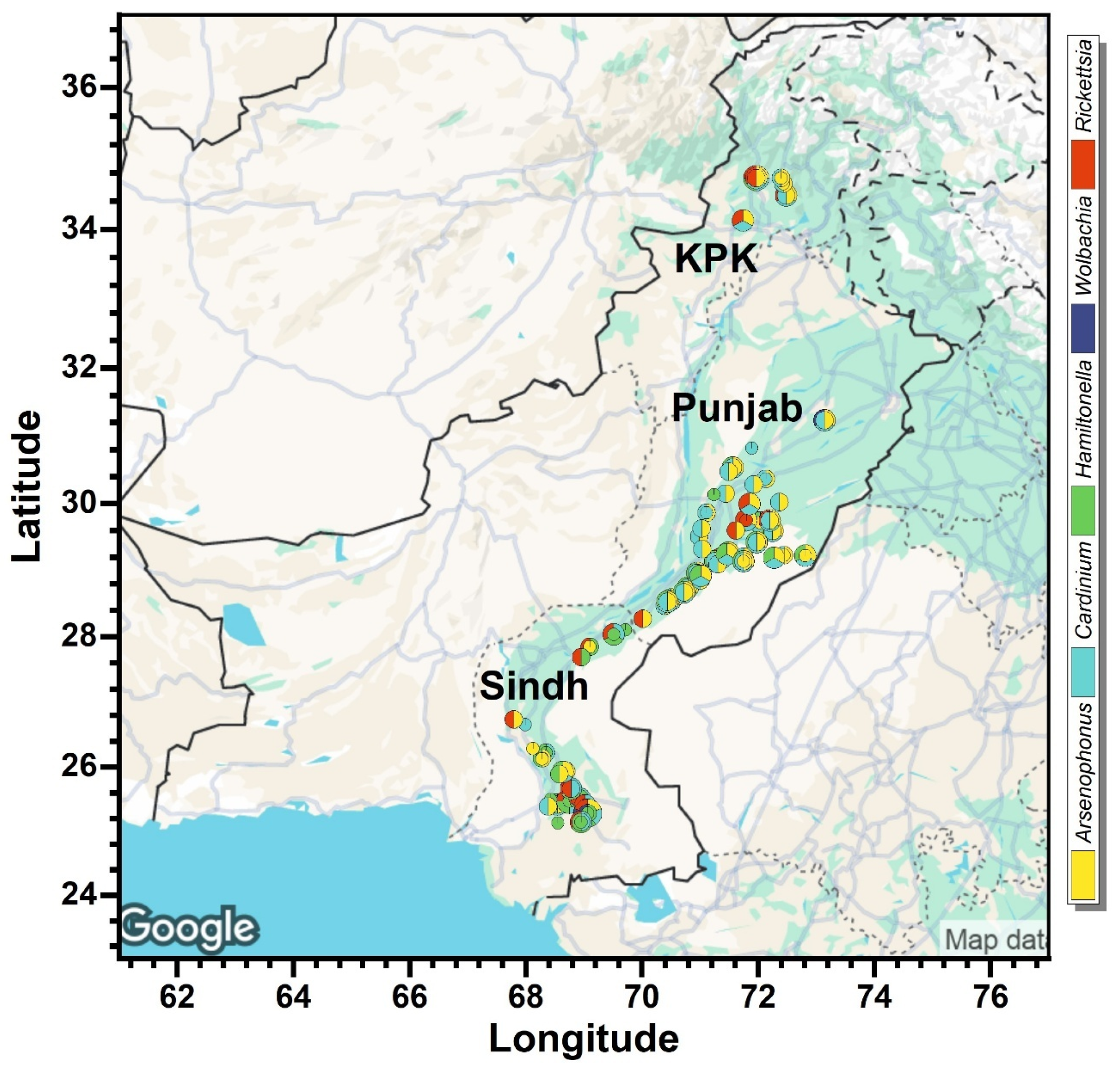
Adult B. tabaci were collected from various host plants, including cotton, chili, and okra, all showing leaf curl phenotype, as described earlier [6,40]. Sampling was conducted during 2012–2014 across major agricultural regions of Pakistan, with a primary focus on CLCuD-affected regions of Punjab, Sindh, and Khyber Pakhtunkhwa (KPK; Figure 1; Table S1). This targeted sampling strategy ensured representation from epidemiologically relevant hotspots of CLCuD, where disease pressure is consistently high and vector–virus dynamics are most pronounced. The GPS coordinates for each whitefly collection site were recorded using a handheld GPS device (eTrex 10; Garmin, Schaffhausen, Switzerland). The collected whitefly samples were kept in absolute ethanol at −80 °C until further processing. Total genomic DNA was extracted from a single whitefly and subjected to quantification and amplification of a 780 bp fragment of the mitochondrial cytochrome oxidase I (mtCOI-3ʹ) region, as previously described [40]. The resultant amplicons were sequenced (Macrogen, Seoul, Republic of Korea), and a total of 274 whiteflies were selected for downstream endosymbiont screening.

2.2. Molecular Identification of S-Endosymbionts

Each individual whitefly (n = 274) was screened for S-endosymbiont infection using species-specific PCR primers targeting the 16S ribosomal RNA (rRNA) gene for Arsenophonus, Porteira, Hamiltonella, Cardinium, Wolbachia, and Rickettsia and the 23S rRNA gene for Arsenophonus and Fritschea (Table 1). For Arsenophonus, initial amplification using 16S rDNA primers occasionally produced non-specific amplicons. Therefore, 23S rDNA primers were subsequently employed to improve detection specificity and ensure reliable identification. PCR was carried out along with all the necessary controls in a 10 µL reaction volume using 2X Green master mix (Thermo Fisher Scientific, Waltham, MA, USA) containing standard PCR reagents (dNTPs, Taq Buffer, MgCl2) and 2 µL of (3–6 ng.µL−1) template DNA. The resultant PCR products were resolved on agarose gel (1%), after staining with ethidium bromide, and visualized under UV illumination.

2.3. Cloning and Sequencing

The resultant PCR amplicons of each detected S-endosymbiont were purified and ligated into the pTZ57R/T vector (Thermo Fisher Scientific, USA). The resultant recombinant plasmids were transformed into competent E. coli cells (Top 10), and positive clones were sequenced by Sanger sequencing (at the USDA Mid-South Area Genomics Laboratory, Stoneville, MS, USA). Sequences were assembled and edited using the Lasergene software suite (DNAStar, Madison, WI, USA) and subsequently deposited in NCBI GenBank. The assigned accession numbers are listed in Table S1.

2.4. Phylogenetic Analysis

The nucleotide sequence alignments of all the S-endosymbionts, along with the NCBI-retrieved GenBank sequences, were used to infer phylogenetic relationships of each S-endosymbiont. The maximum likelihood (ML) phylogenetic trees employing the best-fit substitution model (according to the Bayesian information criteria [BIC]) were reconstructed using the IQTREE webserver (http://iqtree.cibiv.univie.ac.at/, accessed on 26 February 2026). The nodal support was evaluated by 1000 ultrafast bootstrap pseudoreplicates and the SH-aLRT branch test [47].
Subsequently, the resulting trees were visualized, edited, and appropriately re-rooted using related outgroup taxa, where applicable, in the FigTree v.1.4.2 (http://tree.bio.ed.ac.uk/software/figtree/, accessed on 2 March 2026).

2.5. Infection Frequency, Network- and Statistical Analysis

Infection frequencies of S-endosymbionts were estimated using binomial logistic regression. For each symbiont, infection status was modeled as the response variable, with B. tabaci cryptic species as categorical predictors. Predicted infection probabilities and standard errors were derived from fitted, generalized linear models (GLMs) with a binomial error distribution. Pairwise differences among cryptic species were evaluated using Tukey’s honestly significant difference (HSD) post hoc test with adjustment for multiple comparisons. All analyses were conducted in XLSTAT (Addinsoft, Paris, France), with significance set at p ≤ 0.05 and (k-1) degrees of freedom. To ensure clarity, statistical outcomes are reported based on pairwise comparisons and significance levels, without mentioning F-values.
Network analysis based on infection frequencies was performed in OriginPro v2024 using Pearson correlation coefficients calculated across S-endosymbiont presence in the collected B. tabaci populations. Pairwise associations (co-occurrence patterns) were inferred using Pearson correlation coefficients on binary presence–absence data, equivalent to the phi (φ) coefficient for dichotomous variables. All the figures were generated in OriginPro v2024 (OriginLab Corporation, Northampton, MA, USA).

3. Results

3.1. Identification of B. tabaci Species

Mitochondrial COI-based identification revealed the presence of six cryptic species of the B. tabaci complex in Pakistan, including Asia II-1, Asia II-5, Asia II-7, Asia II-8, Asia I and MEAM-1. Species identification was performed using the mtCOI-3 gene sequence through comparison with reference sequences available in the Genbank and phylogenetic analysis according to the established criteria for the B. tabaci species complex [2]. Among these, Asia II-1 prevailed in the Punjab region, while MEAM-1 was the most common biotype identified in Sindh [40]. Asia 1 was detected at low frequency, while Asia II-5, Asia II-7, and Asia II-8 were rare and represented by very few individuals.

3.2. Identification of Secondary Endosymbiont Infection

Of the six B. tabaci species identified in this study, Asia II-5 and Asia II-7 had just a few individuals and yielded no PCR amplification. Therefore, these species were excluded from the subsequent analyses. The remaining 274 adult whiteflies, representing four species, Asia II-1 (n = 199), MEAM-1 (n = 67), Asia 1 (n = 7), and Asia II-8 (n = 1), were screened for P- and S-endosymbionts (Table 1). The P-endosymbiont Portiera was detected in 100% of these whiteflies, confirming its obligate and ubiquitous association with B. tabaci populations in Pakistan.
Five S-endosymbionts, including Arsenophonus, Cardinium, Hamiltonella, Rickettsia, and Wolbachia, were identified in the B. tabaci, showing varying rates of infection frequency. Overall, 221 whiteflies (81%) harbored at least one S-endosymbiont, and multiple infections were common, with several whiteflies carrying up to four S-endosymbionts simultaneously. PCR amplification initially suggested the presence of Fritschea; however, sequencing of the amplicon revealed these to be false positives. This suggests that B. tabaci populations in Pakistan are not hosts to Fritschea.

3.3. Cryptic Species-Specific Infection Patterns

Marked differences in S-endosymbiont prevalence were observed among cryptic species. Of the five S-endosymbionts, four were present in the most prevalent biotype (cryptic species) Asia II-1; Rickettsia was identified but in only one sample. Arsenophonus was the most prevalent S-endosymbiont overall, detected in 68% (136/199) of Asia II-1 whiteflies, 21% (14/67) in MEAM-1, and 100% (7/7) in Asia 1. Cardinium was also widespread, with infection rates of 57% (4/7) in Asia 1, 37% (25/67) in MEAM-1, and 58% (117/199) in Asia II-1. Hamiltonella exhibited a contrasting distribution pattern, occurring at high frequency in MEAM-1 61% (41/67) but lower in Asia II-1 20% (39/199), and being undetected in Asia 1 (0/7). Wolbachia infection rate was 11% in Asia II-1 (22/199), 14% (1/7) in Asia 1 and 20% (14/67) in MEAM-1. Rickettsia was rare, detected in only a few whiteflies across all sampled populations.

3.4. Geographic Variation in Endosymbiont Prevalence

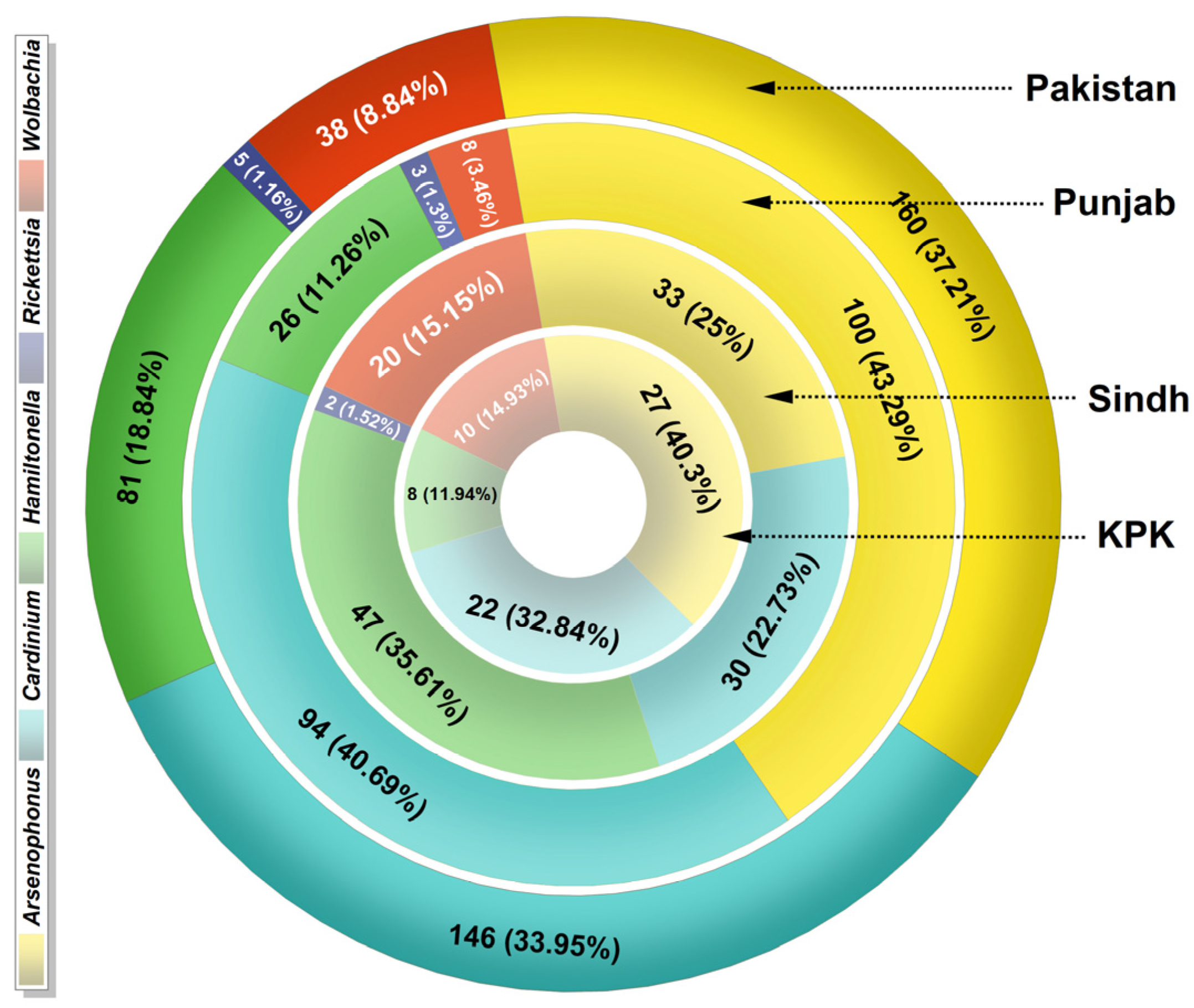
The distribution of S-endosymbionts varied significantly among the sampled whiteflies across Pakistan and three different provinces, including Punjab, Sindh, and KPK (Figure 2). At the national level, Arsenophonus was the most prevalent S-endosymbiont and was identified in 160 whiteflies (37%), followed by Cardinium in 147 (34%) and Hamiltonella in 82 (19%). While Wolbachia and Rickettsia were found in just 38 (8.8%) and 5 (1.2%) whiteflies, respectively.
Regional analysis revealed distinct variation in endosymbiont prevalence. In Punjab, Arsenophonus (n = 100, 43.3%) and Cardinium (n = 94, 40.7%) were the dominant endosymbionts. While Wolbachia (n = 8, 3.5%) and Rickettsia (n = 5, 1.24%) showed minimal presence. In contrast, the population in Sindh exhibited a higher prevalence of Hamiltonella (n = 47, 35.6%) compared to other regions, followed by Arsenophonus (n = 33, 25%), Cardinium (n = 30, 22.7%), and Wolbachia (n = 20, 15.26%). While Rickettsia (n = 2, 1.5%) was the least dominant in Sindh. In the KPK, Arsenophonus remained the most frequent endosymbiont (n = 27, 40.3%), followed by Cardinium (n = 23, 32.8%), while Wolbachia (n = 10, 14.9%) and Hamiltonella (n = 8, 11.9%) were present at lower frequencies. The results thus revealed that endosymbiont community composition is geographically structured and species-associated, with Punjab showing the highest overall diversity and Sindh exhibiting the strongest Asia II-1–Arsenophonus association.

3.5. Infection Frequency of S-Endosymbionts

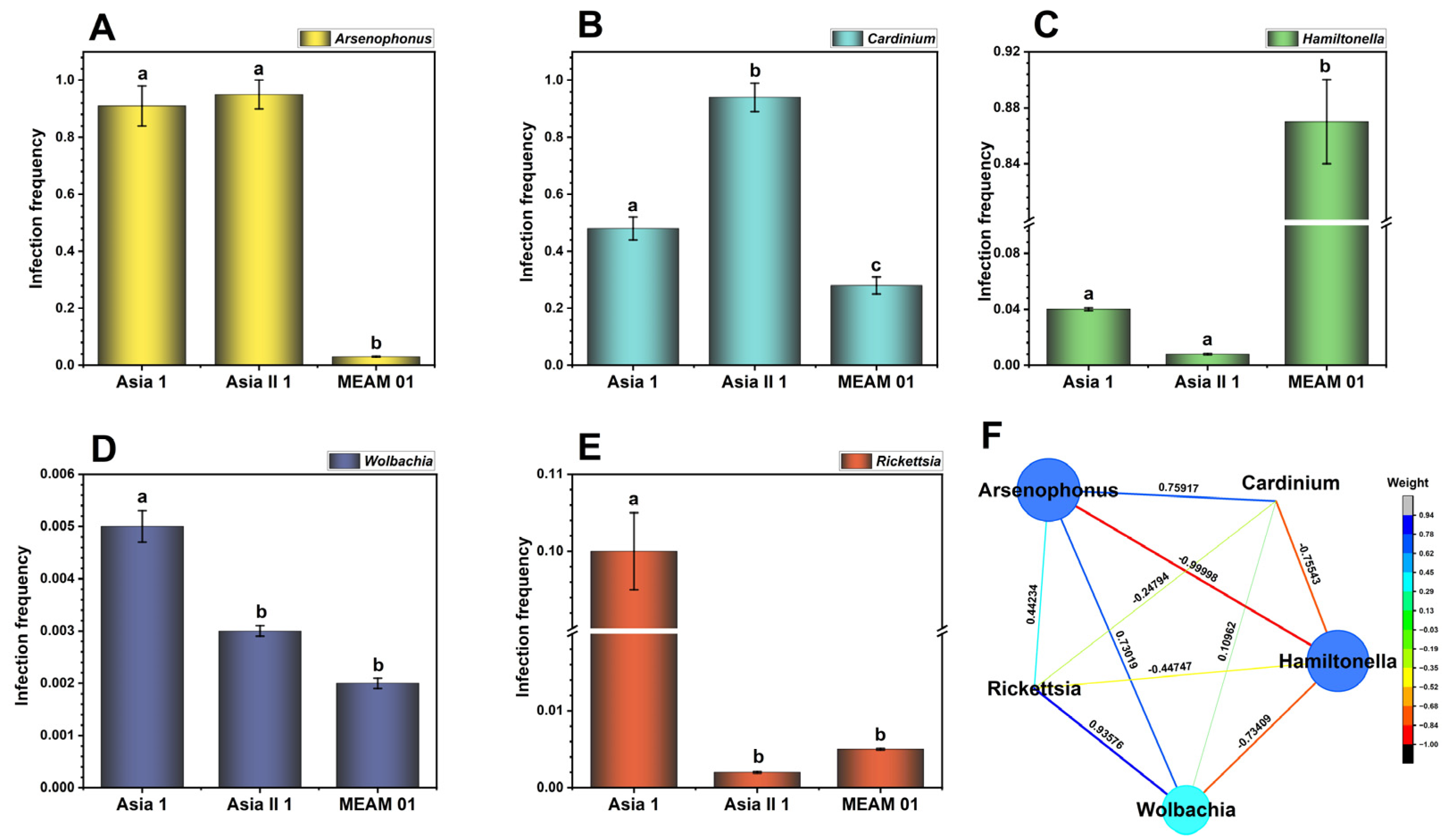
Infection frequency analysis showed distinctive cryptic species-associated patterns of S-endosymbiont occurrence in B. tabaci populations from Pakistan (Figure 3). Arsenophonus showed significantly (p ≤ 0.05) the highest infection frequency in dominant Asia II-1 and Asia 1 compared with all other S-endosymbionts. Cardinium also showed a moderate to high infection frequency of S-endosymbionts in Asia II-1 and Asia 1, while its probability was highest in MEAM-1 as compared to all other cryptic species. Whereas Hamiltonella and Wolbachia occurred at comparatively lower probabilities. In MEAM-1, infection frequency was dominated by Hamiltonella, which showed the highest likelihood of occurrence, followed by Arsenophonus and Cardinium. Wolbachia was present at a moderate frequency, while Rickettsia remained infrequent. Overall, these results demonstrate pronounced cryptic species-dependent variation in S-endosymbiont infection frequency.
The endosymbiont interaction network (Figure 3F) showed complex synergistic and antagonistic co-occurrence relationships between the endosymbiont communities. A strong synergistic association was identified between Rickettsia and Wolbachia (weight = 0.936) and Arsenophonus and Cardinium (0.759), suggesting frequent co-occurrence. Conversely, an antagonistic co-occurrence was inferred between Arsenophonus and Hamiltonella (−1.00), indicating a strong negative association, suggestive of competitive exclusion. Hamiltonella also showed negative correlations with Cardinium (−0.755) and Wolbachia (−0.734). These results suggest that while certain taxa readily co-infect the host, Hamiltonella acts as a primary competitor, significantly shaping the internal microbial community structure through niche partitioning or physiological incompatibility.

3.6. Phylogenetic Analysis of S-Endosymbionts

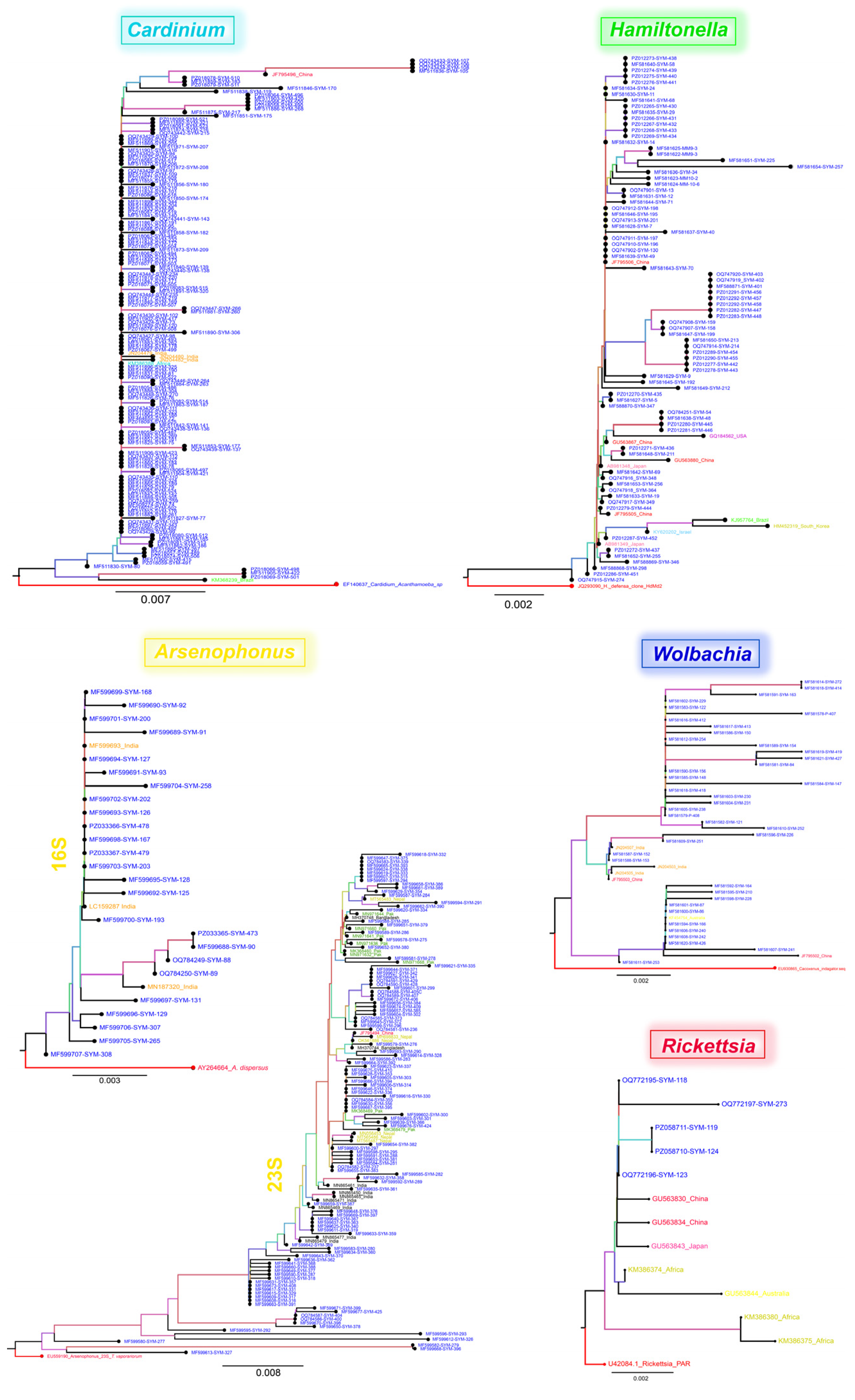
Phylogenetic analyses, based on 16S rRNA sequences for all endosymbionts and 16S and 23S rRNA for Arsenophonus, demonstrated that the Pakistani S-endosymbiont clustered with sequences reported from neighboring countries (Figure 4). Cardinium sequences from Asia II-1 and MEAM 1 obtained from Punjab, Sindh, and KPK grouped with Cardinium sequences reported from different species across different regions. While Wolbachia sequences clustered into three distinct groups, one of which showed resemblance to Wolbachia sequences obtained from India. This result demonstrated that Wolbachia may have three strains in Pakistani whiteflies. The Hamiltonella sequences from Asia II-1 and MEAM 1 were nearly identical; they clustered with the Hamiltonella sequences reported from MED and MEAM-1 biotypes in China. The Arsenophonus sequences, both 16S and 23S, from all three cryptic species, Asia II-1, Asia I, and MEAM-1, clustered into two major well-supported clades (Figure 4). Clade I, comprising all 23S rRNA sequences, formed a monophyletic group with sub-clusters corresponding to Pakistani, Indian, Bangladeshi, Nepali, and Chinese isolates, indicating geographic structuring. Clade II, comprising 16S rRNA sequences, grouped all the Arsenophonus isolates from this study with Indian isolates, supporting regional continuity of Arsenophonus strains among South Asian whitefly populations.

4. Discussion

The current study provides a comprehensive assessment of S-endosymbiont diversity and distribution in B. tabaci from CLCuD-affected regions of Pakistan. Our findings reveal a clear dominance of Arsenophonus in indigenous whitefly populations, particularly within the predominant Asia II-1 cryptic species. This contrasts with MEAM-1, which remained largely confined to the Sindh region. Although Cardinium shows comparable frequency, the emphasis on Arsenophonus is based on functional relevance rather than prevalence alone. Arsenophonus showed the most consistent distribution across cryptic species and regions, particularly virus-endemic areas. In contrast, Cardinium showed greater variability and was frequently co-infected with Arsenophonus, especially in Punjab. This pattern suggests that Cardinium may play a complementary or modulatory role, whereas Arsenophonus may be associated with virus transmission, consistent with its established role in virus transmission [48]. However, these associations remain observational and require functional validation.
Among the initially tested six S-endosymbionts, the primers for Fritschea gave false positive results, as verified by sequencing the product. So, it was concluded that Pakistani B. tabaci populations are not infected with the Fritschea. This aligns with global surveys in Israel [49], China [50], Croatia [35,51] and some European and African countries [52], where Fritschea was absent in Bemisia populations, remaining largely restricted to New World species in the USA [30,53].
The low prevalence of Rickettsia (detected in only five samples) suggests it is not a primary driver of whitefly fitness or reproductive manipulation in Pakistani populations, contrasting with the high abundance reported in neighboring India and China [36,54]. While Rickettsia is known as a reproductive manipulator [55,56], fertility booster [57], provision of heat tolerance [26], and enhancement of susceptibility to various chemical insecticides [28], its ecological significance in the Pakistani Bemisia population remains unclear. Its low presence may possibly be attributed to the difference in biotypes in these regions or specific ecological constraints. We anticipate that the dominant Pakistani biotype may possess a genetic background incompatible with Rickettsia colonization. Furthermore, while Rickettsia can confer heat tolerance in temperate climates, the extreme temperatures of the Pakistani agro-ecosystem, often exceeding 45 °C, may render the metabolic cost of maintaining the symbiont higher than its protective value. Additionally, competitive exclusion by S-endosymbionts, such as Arsenophonus, may prevent Rickettsia from achieving a stable foothold. Consequently, the interaction of host genetics, extreme heat, and microbial competition likely exerts selective pressure that maintains Rickettsia at near-incidental levels within these populations.
In the current study, Hamiltonella was detected in all samples of MEAM-1 biotypes collected from Sindh, Pakistan. This finding aligns with previous reports [49,54], confirming the high prevalence of this S-endosymbiont in MEAM-1. Importantly, we also identified a small number of Asia II-1 samples positive for Hamiltonella, while there have been no global reports documenting the presence of Asia II-1 positive for Hamiltonella. The presence of Hamiltonella is in a few Asia II-1 samples, maybe due to the horizontal transfer among different insects. Whether such low-frequency infections translate into functional effects on virus transmission remains unknown but warrants targeted experimental investigation. Nonetheless, a previous study indicated that GroEL proteins produced by Hamiltonella present in the MEAM 1 population are known to facilitate TYLCV transmission [25]. This is further supported by observations in Israel, where MED populations, which do not harbor Hamiltonella, exhibit poor TYLCV transmission efficiency. Conversely, in China, both MEAM1 and MED populations harbor Hamiltonella at high incidences [50,54] and are highly efficient vectors of TYLCV [58]. However, native Asia II-1 does not harbor Hamiltonella, but still, it remains highly capable of transmitting several begomoviruses, including TYLCV and cotton leaf curl Multan virus (CLCuMuV) with high efficiency [39,48,58,59,60]. This suggests that Asia II-1 may rely on alternative mechanisms or different endosymbionts to achieve high transmission efficiency.
Arsenophonus was by far the most prevalent, especially in Asia II-1 and Asia I populations, and exhibited pronounced geographic structuring, with the highest frequencies in Punjab and KPK regions characterized by intense and persistent begomovirus pressure. Our finding coincides with earlier reports, which reported the presence of Arsenophonus in different whitefly species in different regions of the world [36,49,52,54]. In this study, Arsenophonus infection was found in MEAM 1 but with a very low rate. Previous studies have suggested potential molecular interactions between Arsenophonus and virus components, including reported binding of bacterial GroEL with viral coat proteins of CLCuD-associated begomoviruses (possibly CLCuMuV), which may influence virus retention or stability in the insect vector. In addition, Arsenophonus has been detected in multiple whitefly tissues, including bacteriocytes, salivary glands, and the midgut of Bemisia tabaci [36]. It has been revealed that Asia II-1 transmits CLCuMuV efficiently [48], and the occurrence of Arsenophonus in Asia II-1 suggests a potential association in virus transmission in the Pakistani Asia II-1 population which needs to be investigated. The high prevalence of Arsenophonus in dominant Pakistani whitefly populations therefore may represent a microbial factor contributing to the efficiency and durability of begomovirus transmission in the region.
While Wolbachia was identified across all tested biotypes, including Asia II-1, MEAM-1, and Asia 1, its infection frequency was notably lower in MEAM 1 and Asia 1. This suggests that in the Pakistani Bemisia population, Wolbachia may not be actively involved in manipulating reproduction or sex ratios, a role it commonly plays in many arthropods. Typically, Wolbachia acts as a reproductive manipulator by inducing cytoplasmic incompatibility, parthenogenesis, and killing males [61,62]. However, Wolbachia presence varies globally; earlier reports showed it was restricted to the Q biotype/species but not in the B biotype/species in Israeli populations [49]. Similarly, ref. [52] reported the Wolbachia presence in Q1 and Q2 but not in B and Q3. However, in Chinese B. tabaci populations, Wolbachia infection occurs at a high rate in B and Q biotypes/species and indigenous biotypes/species [63,64]. However, no reproductive or fitness-related traits were examined in the present study; therefore, any functional interpretation remains speculative. Low Wolbachia prevalence across all cryptic species may suggest that reproductive manipulation is not a primary driver of whitefly population structure in Pakistan.
The high infection rate of Cardinium in Asia II-1, often occurring as a co-infection with Arsenophonus in high viral incidence areas, points towards a potential synergistic effect on host biology. Cardinium is vastly present in several insects and arthropods like mites, ticks, spiders, spider mites, and copepods and approximately 7% of all arthropod species are infected with members of this genus [65,66,67]. Cardinium hertigii, for the first time, was detected in the Encarsia wasp, which parasitoids B. tabaci [65]. In many arthropods, C. hertigii has been defined to induce feminization, cytoplasmic incompatibility, and parthenogenesis [68]. While Cardinium is often considered mutualistic in Bemisia, a recent report [69] showed that Cardinium reduced its genome size to improve its survival within the B. tabaci. As per previous studies, the infection of Cardinium in MEAM-1 and MED was very low as compared to the native whiteflies [50,52,70]. In the current study, Cardinium was detected in all three species, albeit with variable infection frequency. Notably, the infection rate was highest in Asia II-1. In the Punjab region—an area characterized by high viral incidence—Cardinium was often found in co-infection with Arsenophonus. Specifically, within Punjab populations, Arsenophonus (43.1%) and Cardinium (40.5%) exhibited the highest regional prevalence. This co-occurrence in Asia II-1 suggests that the presence of Cardinium may exert an influence on host biology, potentially modulating fitness or whitefly virus interactions under these specific agro-ecological stresses. The heavy pesticide use in this region may further select for symbiont combinations that enhance host detoxification or survival, reinforcing the dominance of these specific lineages.
Phylogenetic analyses revealed that Pakistani symbiont strains cluster with those from neighboring countries, indicating regional continuity rather than the emergence of highly divergent local lineages [71]. This finding suggests that ecological factors, host species composition, and symbiont prevalence—rather than strain novelty—are likely the primary contributors shaping vector–virus dynamics in Pakistan.
This study offers valuable insights into the genetic landscape of cryptic species and their endosymbionts yet has key limitations. First, samples collected between 2012 and 2014 provide a critical historical baseline but may not reflect current evolutionary dynamics or recent population shifts. Second, reliance on PCR-based sequencing, while effective for known lineages, may miss highly divergent cryptic symbionts detectable only via unbiased high-throughput sequencing. Third, findings are based on molecular and phylogenetic associations without functional validation. Nonetheless, this work establishes a foundational framework to guide future experimental validation and long-term epidemiological surveillance in the region.

5. Conclusions

This study establishes that Pakistani B. tabaci populations function as a structured microbial holobiont, with Arsenophonus and Cardinium as dominant components. Their high prevalence, particularly in Asia II-1, suggests a possible potential interaction between symbiont composition, vector population and begomovirus epidemiology; the findings remain correlative. These results provide a strong foundation for understanding the host-symbiont associations in Pakistan and require further functional and mechanistic studies to clarify the role of symbionts in virus transmission and vector biology.

Supplementary Materials

The following supporting information can be downloaded at: https://www.mdpi.com/article/10.3390/insects17060585/s1, Table S1: Whitefly collection, their species, and endosymbionts details, including their collection sites, accession numbers, and host.

Author Contributions

M.M., Investigation, Writing—Original Draft Preparation; Z.I., Writing—Review and Editing, Analysis, and Funding; R.M., S.A.A.H. and A.A., Writing—Review and Editing; R.W.B., Conceptualization, Supervision, Project Administration, Writing—Review and Editing. All authors have read and agreed to the published version of the manuscript.

Funding

This scientific paper is derived from a research grant funded by the Research, Development, and Innovation Authority (RDIA)—Kingdom of Saudi Arabia—with grant number (12877-KFU-2023-KFU-R-2-1-SE-), and publication of this research was supported by the Deanship of Scientific Research (DSR), King Faisal University, Kingdom of Saudi Arabia (Grant KFU262912).

Data Availability Statement

The datasets generated and/or analyzed during the current study are available in the Gen bank INSDC member repository. Accessions for the Arsenophonus: PZ044229-PZ044252, MF599578-MF599707, OQ784249- OQ784250, OQ784581-OQ784591. Accessions for the Cardinium: PZ018054-PZ018094, MF464655, MF509274, MF511825-MF511906, OQ743424-OQ743448. Accessions of Hamiltonella: MF581627-MF581654, MF588868-MF588871, OQ747901-OQ747920, OQ784251, PZ012265-PZ012293. Accessions of Wolbachia: MF581581-MF581592, MF581594-MF581596, MF581598, MF581600-MF581612, MF581614-MF581619-MF581621, MF581578-MF581579. Accessions of Rickettsia: OQ772195-OQ772197, PZ058710, PZ05815711.

Acknowledgments

During the preparation of this manuscript/study, the authors used AI tools (ChatGPT v5.3, Gemini v3.0) to improve the language of the manuscript. The authors have reviewed and edited the output and take full responsibility for the content of this publication.

Conflicts of Interest

The authors declare no conflicts of interest.

Abbreviations

The following abbreviations are used in this manuscript:
MEAM 1Middle East Asia Minor 1
MEDMediterranean
TYLCVtomato Yellow Leaf Curl Virus
CLCuMuVCotton leaf curl Multan virus

References

  1. De Barro, P.; Ahmed, M.Z. Genetic Networking of the Bemisia tabaci Cryptic Species Complex Reveals Pattern of Biological Invasions. PLoS ONE 2011, 6, e25579. [Google Scholar] [CrossRef]
  2. Dinsdale, A.; Cook, L.; Riginos, C.; Buckley, Y.M.; De Barro, P. Refined Global Analysis of Bemisia tabaci (Hemiptera: Sternorrhyncha: Aleyrodoidea: Aleyrodidae) Mitochondrial Cytochrome Oxidase 1 to Identify Species Level Genetic Boundaries. Ann. Entomol. Soc. Am. 2010, 103, 196–208. [Google Scholar] [CrossRef]
  3. Kanakala, S.; Ghanim, M. Global Genetic Diversity and Geographical Distribution of Bemisia tabaci and Its Bacterial Endosymbionts. PLoS ONE 2019, 14, e0213946. [Google Scholar] [CrossRef]
  4. Navas-Castillo, J.; Fiallo-Olivé, E.; Sánchez-Campos, S. Emerging Virus Diseases Transmitted by Whiteflies. Annu. Rev. Phytopathol. 2011, 49, 219–248. [Google Scholar] [CrossRef] [PubMed]
  5. Brown, J.K.; Zerbini, F.M.; Navas-Castillo, J.; Moriones, E.; Ramos-Sobrinho, R.; Silva, J.C.F.; Fiallo-Olivé, E.; Briddon, R.W.; Hernández-Zepeda, C.; Idris, A.; et al. Revision of Begomovirus Taxonomy Based on Pairwise Sequence Comparisons. Arch. Virol. 2015, 160, 1593–1619. [Google Scholar] [CrossRef]
  6. Iqbal, Z.; Masood, M.; Bukhari, S.A.R.; Amin, I.; Alshoaibi, A.; Briddon, R.W. Begomovirus and DNA Satellites Diversity in Bemisia tabaci from Cotton Growing Areas of Pakistan: Begomovirus Diversity in Whiteflies. Not. Bot. Horti Agrobot. Cluj-Napoca 2025, 53, 14575. [Google Scholar] [CrossRef]
  7. Hussain, S.; Farooq, M.; Malik, H.J.; Amin, I.; Scheffler, B.E.; Scheffler, J.A.; Liu, S.-S.; Mansoor, S. Whole Genome Sequencing of Asia Ii 1 Species of Whitefly Reveals That Genes Involved in Virus Transmission and Insecticide Resistance Have Genetic Variances between Asia Ii 1 and Meam1 Species. BMC Genom. 2019, 20, 507. [Google Scholar] [CrossRef] [PubMed]
  8. Baumann, P. Biology of Bacteriocyte-Associated Endosymbionts of Plant-Sucking Insects. Annu. Rev. Microbiol. 2005, 59, 155–189. [Google Scholar] [CrossRef]
  9. Rosell, R.C.; Blackmer, J.L.; Czosnek, H.; Inbar, M. Mutualistic and Dependent Relationships with Other Organisms. In Bemisia: Bionomics and Management of a Global Pest; Stansly, P.A., Naranjo, S.E., Eds.; Springer: Dordrecht, The Netherlands, 2010; pp. 161–183. [Google Scholar]
  10. McCutcheon, J.P.; Moran, N.A. Extreme Genome Reduction in Symbiotic Bacteria. Nat. Rev. Microbiol. 2012, 10, 13–26. [Google Scholar] [CrossRef]
  11. Chiel, E.; Zchori-Fein, E.; Inbar, M.; Gottlieb, Y.; Adachi-Hagimori, T.; Kelly, S.E.; Asplen, M.K.; Hunter, M.S. Almost There: Transmission Routes of Bacterial Symbionts between Trophic Levels. PLoS ONE 2009, 4, e4767. [Google Scholar] [CrossRef]
  12. Sintupachee, S.; Milne, J.R.; Poonchaisri, S.; Baimai, V.; Kittayapong, P. Closely Related Wolbachia Strains within the Pumpkin Arthropod Community and the Potential for Horizontal Transmission Via the Plant. Microb. Ecol. 2006, 51, 294–301. [Google Scholar] [CrossRef]
  13. Brownlie, J.C.; Johnson, K.N. Symbiont-Mediated Protection in Insect Hosts. Trends Microbiol. 2009, 17, 348–354. [Google Scholar] [CrossRef]
  14. Koga, R.; Tsuchida, T.; Fukatsu, T. Changing Partners in an Obligate Symbiosis: A Facultative Endosymbiont Can Compensate for Loss of the Essential Endosymbiont Buchnera in an Aphid. Proc. R. Soc. B Biol. Sci. 2003, 270, 2543–2550. [Google Scholar] [CrossRef] [PubMed]
  15. Ferrari, J.; Darby, A.C.; Daniell, T.J.; Godfray, H.C.J.; Douglas, A.E. Linking the Bacterial Community in Pea Aphids with Host-Plant Use and Natural Enemy Resistance. Ecol. Entomol. 2004, 29, 60–65. [Google Scholar] [CrossRef]
  16. Haine, E.R. Symbiont-Mediated Protection. Proc. R. Soc. B Biol. Sci. 2008, 275, 353–361. [Google Scholar] [CrossRef] [PubMed]
  17. Hedges, L.M.; Brownlie, J.C.; O’Neill, S.L.; Johnson, K.N. Wolbachia and Virus Protection in Insects. Science 2008, 322, 702. [Google Scholar] [CrossRef]
  18. Oliver, K.M.; Russell, J.A.; Moran, N.A.; Hunter, M.S. Facultative Bacterial Symbionts in Aphids Confer Resistance to Parasitic Wasps. Proc. Natl. Acad. Sci. USA 2003, 100, 1803–1807. [Google Scholar] [CrossRef]
  19. Teixeira, L.; Ferreira, A.; Ashburner, M. The Bacterial Symbiont Wolbachia Induces Resistance to Rna Viral Infections in Drosophila melanogaster. PLoS Biol. 2008, 6, e1000002. [Google Scholar] [CrossRef]
  20. Vorburger, C.; Gehrer, L.; Rodriguez, P. A Strain of the Bacterial Symbiont Regiella Insecticola Protects Aphids against Parasitoids. Biol. Lett. 2009, 6, 109–111. [Google Scholar] [CrossRef]
  21. Montllor, C.B.; Maxmen, A.; Purcell, A.H. Facultative Bacterial Endosymbionts Benefit Pea Aphids Acyrthosiphon Pisum under Heat Stress. Ecol. Entomol. 2002, 27, 189–195. [Google Scholar] [CrossRef]
  22. Werren, J.H.; O’Neill, S.L. The Evolution of Heritable Symbionts. In Influential Passengers: Inherited Microorganisms and Arthropod Reproduction; Oxford University Press: Oxford, UK, 1997; Volume 1, pp. 1–41. [Google Scholar]
  23. Werren, J.H.; Baldo, L.; Clark, M.E. Wolbachia: Master Manipulators of Invertebrate Biology. Nat. Rev. Microbiol. 2008, 6, 741–751. [Google Scholar] [CrossRef]
  24. Engelstädter, J.; Hurst, G.D. The Ecology and Evolution of Microbes That Manipulate Host Reproduction. Annu. Rev. Ecol. Evol. Syst. 2009, 40, 127–149. [Google Scholar] [CrossRef]
  25. Gottlieb, Y.; Zchori-Fein, E.; Mozes-Daube, N.; Kontsedalov, S.; Skaljac, M.; Brumin, M.; Sobol, I.; Czosnek, H.; Vavre, F.; Fleury, F.; et al. The Transmission Efficiency of Tomato Yellow Leaf Curl Virus by the Whitefly Bemisia tabaci Is Correlated with the Presence of a Specific Symbiotic Bacterium Species. J. Virol. 2010, 84, 9310–9317. [Google Scholar] [CrossRef]
  26. Brumin, M.; Kontsedalov, S.; Ghanim, M. Rickettsia Influences Thermotolerance in the Whitefly Bemisia tabaci B Biotype. Insect Sci. 2011, 18, 57–66. [Google Scholar] [CrossRef]
  27. Mahadav, A.; Gerling, D.; Gottlieb, Y.; Czosnek, H.; Ghanim, M. Parasitization by the Wasp Eretmocerus Mundus Induces Transcription of Genes Related to Immune Response and Symbiotic Bacteria Proliferation in the Whitefly Bemisia tabaci. BMC Genom. 2008, 9, 342. [Google Scholar] [CrossRef]
  28. Kontsedalov, S.; Zchori-Fein, E.; Chiel, E.; Gottlieb, Y.; Inbar, M.; Ghanim, M. The Presence of Rickettsia Is Associated with Increased Susceptibility of Bemisia tabaci (Homoptera: Aleyrodidae) to Insecticides. Pest Manag. Sci. 2008, 64, 789–792. [Google Scholar] [CrossRef] [PubMed]
  29. Ghanim, M.; Kontsedalov, S. Susceptibility to Insecticides in the Q Biotype of Bemisia tabaci Is Correlated with Bacterial Symbiont Densities. Pest Manag. Sci. 2009, 65, 939–942. [Google Scholar] [CrossRef] [PubMed]
  30. Everett, K.D.E.; Thao, M.; Horn, M.; Dyszynski, G.E.; Baumann, P. Novel Chlamydiae in Whiteflies and Scale Insects: Endosymbionts ‘Candidatus Fritschea bemisiae’ Strain Falk and ‘Candidatus Fritschea eriococci’ Strain Elm. Int. J. Syst. Evol. Microbiol. 2005, 55, 1581–1587. [Google Scholar] [CrossRef] [PubMed]
  31. Bello, V.H.; Watanabe, L.F.M.; Santos, B.R.; Marubayashi, J.M.; Yuki, V.A.; De Marchi, B.R.; Pavan, M.A.; Krause-Sakate, R. Evidence for Increased Efficiency of Virus Transmission by Populations of Mediterranean Species of Bemisia tabaci with High Hamiltonella Prevalence. Phytoparasitica 2019, 47, 293–300. [Google Scholar] [CrossRef]
  32. Shi, X.-B.; Wang, X.-Z.; Zhang, D.-Y.; Zhang, Z.-H.; Zhang, Z.; Cheng, J.; Zheng, L.-M.; Zhou, X.-G.; Tan, X.-Q.; Liu, Y. Silencing of Odorant-Binding Protein Gene OBP3 Using Rna Interference Reduced Virus Transmission of Tomato Chlorosis Virus. Int. J. Mol. Sci. 2019, 20, 4969. [Google Scholar] [CrossRef]
  33. Kliot, A.; Ghanim, M. The Role of Bacterial Chaperones in the Circulative Transmission of Plant Viruses by Insect Vectors. Viruses 2013, 5, 1516–1535. [Google Scholar] [CrossRef]
  34. Thao, M.L.; Baumann, P. Evolutionary Relationships of Primary Prokaryotic Endosymbionts of Whiteflies and Their Hosts. Appl. Environ. Microbiol. 2004, 70, 3401–3406. [Google Scholar] [CrossRef]
  35. Škaljac, M.; Žanić, K.; Hrnčić, S.; Radonjić, S.; Perović, T.; Ghanim, M. Diversity and Localization of Bacterial Symbionts in Three Whitefly Species (Hemiptera: Aleyrodidae) from the East Coast of the Adriatic Sea. Bull. Entomol. Res. 2013, 103, 48–59. [Google Scholar] [CrossRef] [PubMed]
  36. Rana, V.S.; Singh, S.T.; Priya, N.G.; Kumar, J.; Rajagopal, R. Arsenophonus Groel Interacts with CLCuV and Is Localized in Midgut and Salivary Gland of Whitefly B. tabaci. PLoS ONE 2012, 7, e42168. [Google Scholar] [CrossRef] [PubMed]
  37. Bressan, A. Emergence and Evolution of Arsenophonus Bacteria as Insect-Vectored Plant Pathogens. Infect. Genet. Evol. 2014, 22, 81–90. [Google Scholar] [CrossRef]
  38. Santos-Garcia, D.; Mestre-Rincon, N.; Zchori-Fein, E.; Morin, S. Inside Out: Microbiota Dynamics During Host-Plant Adaptation of Whiteflies. ISME J. 2020, 14, 847–856. [Google Scholar] [CrossRef]
  39. Ahmed, M.Z.; De Barro, P.J.; Greeff, J.M.; Ren, S.; Naveed, M.; Qiu, B. Genetic Identity of the Bemisia tabaci Species Complex and Association with High Cotton Leaf Curl Disease (Clcud) Incidence in Pakistan. Pest Manag. Sci. 2011, 67, 307–317. [Google Scholar] [CrossRef]
  40. Masood, M.; Amin, I.; Hassan, I.; Mansoor, S.; Brown, J.K.; Briddon, R.W. Diversity and Distribution of Cryptic Species of the Bemisia tabaci (Hemiptera: Aleyrodidae) Complex in Pakistan. J. Econ. Entomol. 2017, 110, 2295–2300. [Google Scholar] [CrossRef] [PubMed]
  41. Mahmood, M.A.; Ahmed, N.; Hussain, S.; Muntaha, S.T.; Amin, I.; Mansoor, S. Dominance of Asia Ii 1 Species of Bemisia tabaci in Pakistan and Beyond. Sci. Rep. 2022, 12, 1528. [Google Scholar] [CrossRef]
  42. Simon, C.; Frati, F.; Beckenbach, A.; Crespi, B.; Liu, H.; Flook, P. Evolution, Weighting, and Phylogenetic Utility of Mitochondrial Gene Sequences and a Compilation of Conserved Polymerase Chain Reaction Primers. Ann. Entomol. Soc. Am. 1994, 87, 651–701. [Google Scholar] [CrossRef]
  43. Zchori-Fein, E.; Brown, J.K. Diversity of Prokaryotes Associated with Bemisia tabaci (Gennadius) (Hemiptera: Aleyrodidae). Ann. Entomol. Soc. Am. 2002, 95, 711–718. [Google Scholar] [CrossRef]
  44. Weeks, A.R.; Velten, R.; Stouthamer, R. Incidence of a New Sex-Ratio-Distorting Endosymbiotic Bacterium among Arthropods. Proc. R. Soc. B Biol. Sci. 2003, 270, 1857–1865. [Google Scholar] [CrossRef] [PubMed]
  45. Gottlieb, Y.; Ghanim, M.; Chiel, E.; Gerling, D.; Portnoy, V.; Steinberg, S.; Tzuri, G.; Horowitz, A.R.; Belausov, E.; Mozes-Daube, N.; et al. Identification and Localization of a Rickettsia sp. In Bemisia tabaci (Homoptera: Aleyrodidae). Appl. Environ. Microbiol. 2006, 72, 3646–3652. [Google Scholar] [CrossRef]
  46. Heddi, A.; Grenier, A.-M.; Khatchadourian, C.; Charles, H.; Nardon, P. Four Intracellular Genomes Direct Weevil Biology: Nuclear, Mitochondrial, Principal Endosymbiont, and Wolbachia. Proc. Natl. Acad. Sci. USA 1999, 96, 6814–6819. [Google Scholar] [CrossRef]
  47. Nguyen, L.-T.; Schmidt, H.A.; Von Haeseler, A.; Minh, B.Q. Iq-Tree: A Fast and Effective Stochastic Algorithm for Estimating Maximum Likelihood Phylogenies. Mol. Biol. Evol. 2015, 32, 268–274. [Google Scholar] [CrossRef]
  48. Pan, L.L.; Cui, X.Y.; Chen, Q.F.; Wang, X.W.; Liu, S.S. Cotton Leaf Curl Disease: Which Whitefly Is the Vector? Phytopathology 2018, 108, 1172–1183. [Google Scholar] [CrossRef]
  49. Chiel, E.; Gottlieb, Y.; Zchori-Fein, E.; Mozes-Daube, N.; Katzir, N.; Inbar, M.; Ghanim, M. Biotype-Dependent Secondary Symbiont Communities in Sympatric Populations of Bemisia tabaci. Bull. Entomol. Res. 2007, 97, 407–413. [Google Scholar] [CrossRef]
  50. Chu, D.; Gao, C.; De Barro, P.; Zhang, Y.; Wan, F.; Khan, I. Further Insights into the Strange Role of Bacterial Endosymbionts in Whitefly, Bemisia tabaci: Comparison of Secondary Symbionts from Biotypes B and Q in China. Bull. Entomol. Res. 2011, 101, 477–486. [Google Scholar] [CrossRef]
  51. Skaljac, M.; Zanic, K.; Ban, S.G.; Kontsedalov, S.; Ghanim, M. Co-Infection and Localization of Secondary Symbionts in Two Whitefly Species. BMC Microbiol. 2010, 10, 142. [Google Scholar] [CrossRef]
  52. Gueguen, G.; Vavre, F.; Gnankine, O.; Peterschmitt, M.; Charif, D.; Chiel, E.; Gottlieb, Y.; Ghanim, M.; Zchori-Fein, E.; Fleury, F. Endosymbiont Metacommunities, Mtdna Diversity and the Evolution of the Bemisia tabaci (Hemiptera: Aleyrodidae) Species Complex. Mol. Ecol. 2010, 19, 4365–4376. [Google Scholar] [CrossRef] [PubMed]
  53. Marubayashi, J.M.; Kliot, A.; Yuki, V.A.; Rezende, J.A.M.; Krause-Sakate, R.; Pavan, M.A.; Ghanim, M. Diversity and Localization of Bacterial Endosymbionts from Whitefly Species Collected in Brazil. PLoS ONE 2014, 9, e108363. [Google Scholar] [CrossRef]
  54. Bing, X.-L.; Ruan, Y.-M.; Rao, Q.; Wang, X.-W.; Liu, S.-S. Diversity of Secondary Endosymbionts among Different Putative Species of the Whitefly Bemisia tabaci. Insect Sci. 2013, 20, 194–206. [Google Scholar] [CrossRef]
  55. Balas, M.T.; Lee, M.H.; Werren, J.H. Distribution and Fitness Effects of the Son-Killer Bacterium in Nasonia. Evol. Ecol. 1996, 10, 593–607. [Google Scholar] [CrossRef]
  56. Lawson, E.T.; Mousseau, T.A.; Klaper, R.; Hunter, M.D.; Werren, J.H. Rickettsia Associated with Male-Killing in a Buprestid Beetle. Heredity 2001, 86, 497–505. [Google Scholar] [CrossRef] [PubMed]
  57. Himler, A.G.; Adachi-Hagimori, T.; Bergen, J.E.; Kozuch, A.; Kelly, S.E.; Tabashnik, B.E.; Chiel, E.; Duckworth, V.E.; Dennehy, T.J.; Zchori-Fein, E.; et al. Rapid Spread of a Bacterial Symbiont in an Invasive Whitefly Is Driven by Fitness Benefits and Female Bias. Science 2011, 332, 254–256. [Google Scholar] [CrossRef] [PubMed]
  58. Li, M.; Hu, J.; Xu, F.C.; Liu, S.S. Transmission of Tomato Yellow Leaf Curl Virus by Two Invasive Biotypes and a Chinese Indigenous Biotype of the Whitefly Bemisia tabaci. Int. J. Pest Manag. 2010, 56, 275–280. [Google Scholar] [CrossRef]
  59. Jiu, M.; Zhou, X.; Liu, S. Acquisition and Transmission of Two Begomoviruses by the B and a Non-B Biotype of Bemisia tabaci from Zhejiang, China. J. Phytopathol. 2006, 154, 587–591. [Google Scholar] [CrossRef]
  60. Liu, J.; Zhao, H.; Jiang, K.; Zhou, X.; Liu, S. Differential Indirect Effects of Two Plant Viruses on an Invasive and an Indigenous Whitefly Vector: Implications for Competitive Displacement. Ann. Appl. Biol. 2009, 155, 439–448. [Google Scholar] [CrossRef]
  61. Tsai, K.H.; Huang, C.G.; Wu, W.J.; Chuang, C.K.; Lin, C.C.; Chen, W.J. Parallel Infection of Japanese Encephalitis Virus and Wolbachia within Cells of Mosquito Salivary Glands. J. Med. Entomol. 2006, 43, 752–756. [Google Scholar] [CrossRef]
  62. Saridaki, A.; Bourtzis, K. Wolbachia: More Than Just a Bug in Insects Genitals. Curr. Opin. Microbiol. 2010, 13, 67–72. [Google Scholar] [CrossRef]
  63. Li, Z.-X.; Lin, H.-Z.; Guo, X.-P. Prevalence of Wolbachia Infection in Bemisia tabaci. Curr. Microbiol. 2007, 54, 467–471. [Google Scholar] [CrossRef]
  64. Ahmed, M.Z.; Ren, S.-X.; Mandour, N.S.; Maruthi, M.N.; Naveed, M.; Qiu, B.-L. Phylogenetic Analysis of Bemisia tabaci (Hemiptera: Aleyrodidae) Populations from Cotton Plants in Pakistan, China, and Egypt. J. Pest Sci. 2010, 83, 135–141. [Google Scholar] [CrossRef]
  65. Zchori-Fein, E.; Perlman, S.J. Distribution of the Bacterial Symbiont Cardinium in Arthropods. Mol. Ecol. 2004, 13, 2009–2016. [Google Scholar] [CrossRef] [PubMed]
  66. Gruwell, M.E.; Wu, J.; Normark, B.B. Diversity and Phylogeny of Cardinium (Bacteroidetes) in Armored Scale Insects (Hemiptera: Diaspididae). Ann. Entomol. Soc. Am. 2009, 102, 1050–1061. [Google Scholar] [CrossRef]
  67. Nakamura, Y.; Kawai, S.; Yukuhiro, F.; Ito, S.; Gotoh, T.; Kisimoto, R.; Yanase, T.; Matsumoto, Y.; Kageyama, D.; Noda, H. Prevalence of Cardinium Bacteria in Planthoppers and Spider Mites and Taxonomic Revision of “Candidatus Cardinium hertigii” Based on Detection of a New Cardinium Group from Biting Midges. Appl. Environ. Microbiol. 2009, 75, 6757–6763. [Google Scholar] [CrossRef] [PubMed]
  68. White, J.A.; E Kelly, S.; Cockburn, S.N.; Perlman, S.J.; Hunter, M.S. Endosymbiont Costs and Benefits in a Parasitoid Infected with Both Wolbachia and Cardinium. Heredity 2011, 106, 585–591. [Google Scholar] [CrossRef] [PubMed]
  69. Santos-Garcia, D.; Vargas-Chavez, C.; Moya, A.; Latorre, A.; Silva, F.J. Genome Evolution in the Primary Endosymbiont of Whiteflies Sheds Light on Their Divergence. Genome Biol. Evol. 2015, 7, 873–888. [Google Scholar] [CrossRef]
  70. Thierry, M.; Becker, N.; Hajri, A.; Reynaud, B.; Lett, J.M.; Delatte, H. Symbiont Diversity and Non-Random Hybridization among Indigenous (Ms) and Invasive (B) Biotypes of Bemisia tabaci. Mol. Ecol. 2011, 20, 2172–2187. [Google Scholar] [CrossRef]
  71. Paredes-Montero, J.R.; Zia-Ur-Rehman, M.; Hameed, U.; Haider, M.S.; Herrmann, H.; Brown, J.K. Genetic Variability, Community Structure, and Horizontal Transfer of Endosymbionts among Three Asia Ii-Bemisia tabaci Mitotypes in Pakistan. Ecol. Evol. 2020, 10, 2928–2943. [Google Scholar] [CrossRef]
Figure 1. Spatial distribution of secondary endosymbionts in B. tabaci populations across Pakistan, including Punjab, Sindh, and Khyber Pakhtunkhwa (KPK). Each sampling location is represented by a pie chart positioned according to its geographic coordinates. The size, composition, and color of pies reflect the symbiont community structure of individual endosymbionts: Rickettsia (red), Wolbachia (blue), Hamiltonella (green), Cardinium (cyan), and Arsenophonus (yellow).
Insects 17 00585 g001
Figure 2. Regional prevalence of S-endosymbionts in Pakistani B. tabaci populations. Data are visualized using concentric donut charts: the outermost ring displays the aggregate national frequency, while inner rings represent provincial data for Punjab, Sindh, and Khyber Pakhtunkhwa (KPK). Color coding identifies specific endosymbionts: Rickettsia (blue), Wolbachia (red), Hamiltonella (green), Cardinium (cyan), and Arsenophonus (yellow). Segment labels provide both the raw number of infected individuals and their corresponding percentage within each region.
Insects 17 00585 g002
Figure 3. Infection frequency and co-occurrence network of S-endosymbionts across different B. tabaci cryptic species. (AE) Prevalence and infection frequency of five S-endosymbionts—Arsenophonus (A), Cardinium (B), Hamiltonella (C), Wolbachia (D), and Rickettsia (E)—within the B. tabaci cryptic species Asia 1, Asia II-1, and MEAM 1. Vertical bars represent the mean infection frequency, and error bars indicate the standard error. Different lowercase letters above the bars denote statistically significant differences (p ≤ 0.05) based on post hoc testing. (F) Correlation-based network map illustrating the interactions between the endosymbiont communities. Nodes represent genera, with size indicating relative abundance and correlation strength. Blue and red lines represent positive and negative correlations, respectively, line thickness and numerical labels represent the weight of the interaction.
Insects 17 00585 g003
Figure 4. Phylogenetic analysis of S-endosymbionts identified in B. tabaci. Individual maximum-likelihood trees illustrate the evolutionary relationships and genetic diversity of Arsenophonus, Cardinium, Hamiltonella, Wolbachia, and Rickettsia based on representative marker sequences. All the trees were inferred with 1000 bootstrap values and all clades showed 50–100% bootstrap values. The best-fit models selected via BIC for each genus were: Arsenophonus (TPM3u + F [16S] and HKY + F + G4 [23S]), Cardinium (TPM2 + F), Hamiltonella (HKY + F), Rickettsia (HKY + F + I), and Wolbachia (K2P). Tip labels indicate sequence accessions, host information, or geographical origin (India [orange], China [red], Africa [green], Australia [yellow], USA [dark purple], Pakistan [dark green], Japan [pink], Nepal [brown], Bangladesh [light purple], and this study isolates in blue). All outgroup taxa are indicated by red lines and red font. Phylogenetic trees of all identified endosymbionts were constructed using 16S rDNA sequences, whereas the Arsenophonus phylogenies were inferred using both 16S and 23S rDNA sequences. Scale bars represent the number of nucleotide substitutions per site, and double slashes indicate shortened branches for visual clarity.
Insects 17 00585 g004
Table 1. Primers and PCR conditions used in the analysis of endosymbiont diversity.
Target GenePrimer NamePrimer Sequence (5’−3’)Annealing Temperature (°C)Amplicon Size (bp)Reference
B. tabaci mtCOIC1-J-2195
L2-N-3014
TTGATTTTTTGGTCATCCAGAAGT
TCCAATGCACTAATCTGCCATATTA
45~866[42]
Portiera 16S rDNA28F
1495R
TGCAAGTCGAGCGGCATCAT
CTACGGCTACCTTGTTACGA
60~1500[43]
Arsenophonus
23S rDNA
Ars-23S-1
Ars-23S-2
CGTTTGATGAATTCATAGTCAAA
GGTCCTCCAGTTAGTGTTACCCAAC
60~600[34]
Arsenophonus
16S rDNA
92-F
1343-R
TGAGTAAAGTCTGGGAATCTGG
CCCGGGAACGTATTCACCGTAG
58~1250[43]
Cardinium
16S rDNA
CFB-F
CFB-R
GCGGTGTAAAATGAGCTTG
ACCTCTTCTTTAACTCAAGCCT
58~400[44]
Fritschea
23 rDNA
U23GISR
23GISR
GATGCCTTGGCATTGATAGGCGATGAAGGA
TGGCTCATCATGCAAAAGGCA
60~600[30]
Hamiltonella
16S rDNA
Ham-F
Ham-R
TGAGTAAAGTCTGGGAATCTGG
AGTTCAAGACCGCAACCTC
60~700[43]
Rickettsia
16S rDNA
Rb-F
Rb-R
GCTCAGAACGAACGCTATC
GAAGGAAAGCATCTCTGC
60~900[45]
Wolbachia
16S rDNA
Wol16S-F
Wol16S-R
CGGGGGAAAAATTTATTGCT
AGCTGTAATACAGAAAGTAAA
55~700[46]
Disclaimer/Publisher’s Note: The statements, opinions and data contained in all publications are solely those of the individual author(s) and contributor(s) and not of MDPI and/or the editor(s). MDPI and/or the editor(s) disclaim responsibility for any injury to people or property resulting from any ideas, methods, instructions or products referred to in the content.