Optimizing UV-A Solar-Powered Lights to Enhance Lures for Codling Moth, Cydia pomonella L. (Lepidoptera: Tortricidae)


1
Instar Biologicals, Yakima, WA 98908, USA
2
Facultad de Ciencias Agrarias y Alimentarias, Instituto de Producción y Sanidad Vegetal, Universidad Austral de Chile, Valdivia 5090000, Chile
*
Authors to whom correspondence should be addressed.
Insects 2026, 17(4), 354; https://doi.org/10.3390/insects17040354
Submission received: 27 February 2026
/
Revised: 20 March 2026
/
Accepted: 21 March 2026
/
Published: 24 March 2026
(This article belongs to the Special Issue Optimizing Insect Trap Systems: Advances in Lures, Dispensers, and Field Performance)
Simple Summary
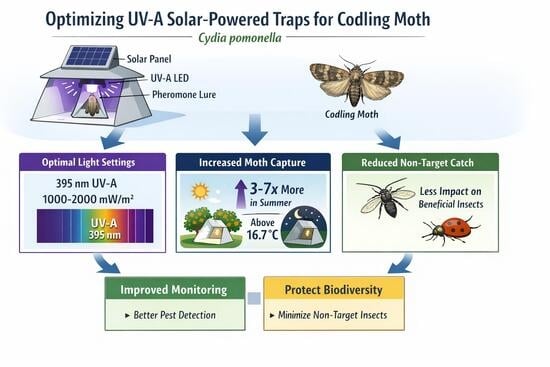
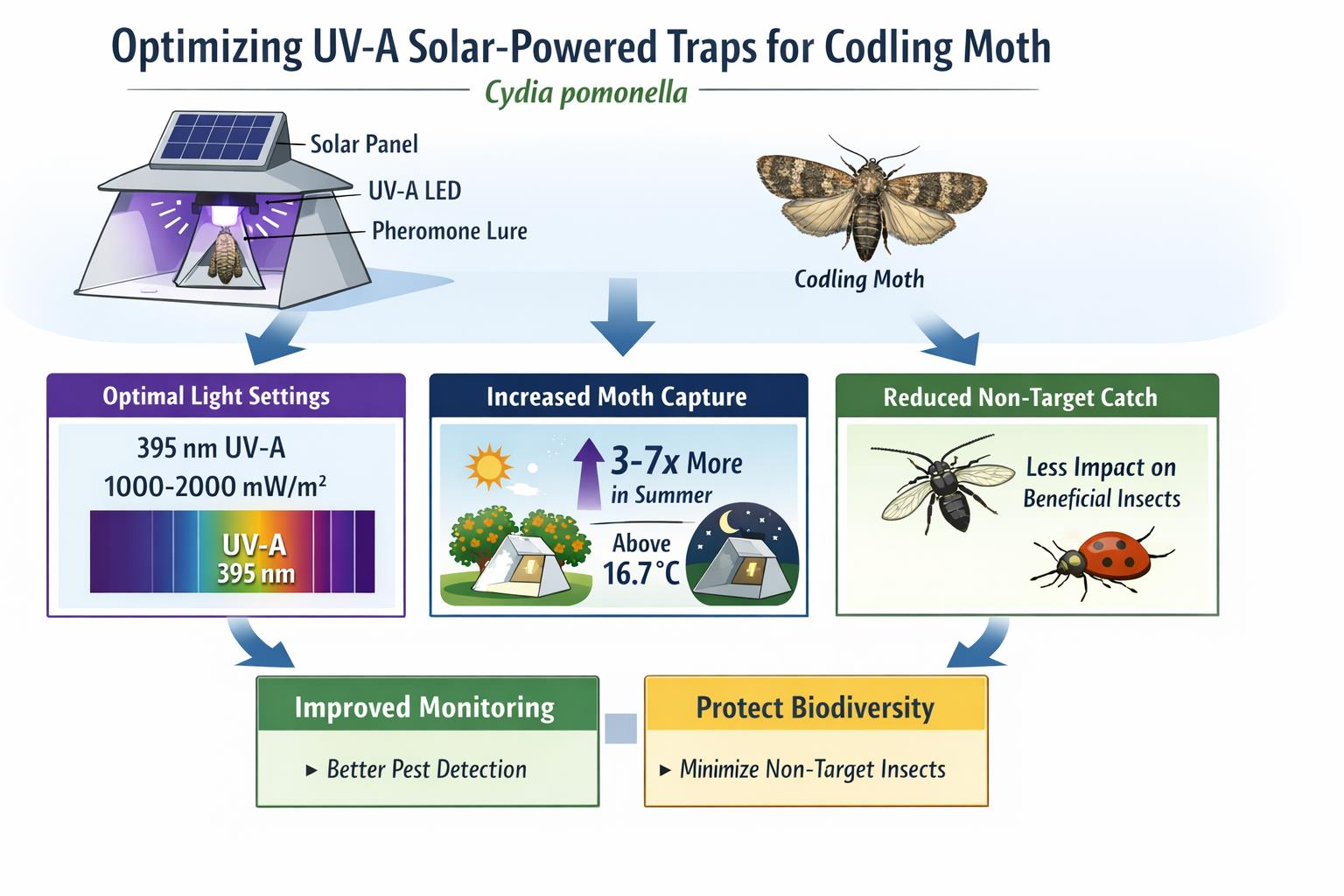
The integration of UV-A LEDs into traditional pheromone and non-pheromone baited traps addresses the challenge of effective monitoring for the codling moth (Cydia pomonella), a primary pest in fruit orchards. Monitoring adult moths in orchards treated with sex pheromone-based mating disruption technologies can be difficult. This study aimed to optimize trap efficacy by defining the ideal light wavelength and intensity while minimizing the accidental capture of beneficial natural enemies. Results indicated that LEDs peaking at 395 nm with an intensity of 1000–2000 mW/m2 were the most effective. Adjusting these parameters lower or higher did not increase moth capture but significantly increased the unintended catch of non-target insects. While the lights did not impact spring catches, they increased summer moth capture by 3- to 7-fold, particularly when evening temperatures exceeded the lower threshold for moth activity, 16.7 °C. Adding the light can override the impact of plant volatiles limiting moth catches, such as in weedy apple and pear orchards. These new monitoring traps can provide growers with pest data enabling more targeted and efficient interventions, such as pesticide applications. Limiting the non-target catches helps to protect the biodiversity of orchard ecosystems.
Abstract
Field trials were conducted to define several parameters associated with adding LEDs to monitoring traps for codling moth (CM), Cydia pomonella (L.), using both a sex pheromone lure (PH1X) and a non-pheromone lure (CM4K). Traps with LEDs emitting at a peak of 395 nm with 1000–2000 mW/m2 were the most effective. Lights with greater intensities caught similar numbers of CMs and significantly more non-targets. Adding the UV-A lights did not increase moth catches early in the season with either the PH1X or CM4K lures. However, UV-A LEDs, when used with these two lures, significantly increased total moth catches 7- and 3-fold in July and August, respectively. The addition of the UV-A LEDs allowed CM4K-baited traps to perform significantly better in previously limiting situations, such as in weedy orchards, and in pear relative to apple. Distance from the light source is a key factor affecting light energy. Irradiance dropped >90% at 15 cm, which is the distance from the lure to the entrance of a standard delta trap. A smaller trap (7.5 cm radius) had a 4-fold greater irradiance at its entrance and caught greater numbers of non-targets but not CMs than delta traps without LEDs.
Keywords:
apple; pear ester; sex pheromone; pear; monitoring; natural enemies; UV LED