Article

Behavioral Responses and Contact Toxicity of Australian Tea Tree Oil and Its Major Constituents Against the Asian Citrus Psyllid, Diaphorina citri Kuwayama

1
Fruit Tree Research Institute, Zhaoqing University, Zhaoqing 526061, China
2
School of Life Sciences, Zhaoqing University, Zhaoqing 526061, China
*
Authors to whom correspondence should be addressed.
Insects 2026, 17(4), 355; https://doi.org/10.3390/insects17040355
Submission received: 31 January 2026 / Revised: 20 March 2026 / Accepted: 21 March 2026 / Published: 24 March 2026
(This article belongs to the Section Insect Pest and Vector Management)

Simple Summary

The Asian citrus psyllid, Diaphorina citri, is a major threat to citrus farming worldwide because it spreads the devastating plant disease Huanglongbing (citrus greening). To protect citrus trees, farmers rely heavily on chemical pesticides, which can harm the environment and become less effective as insects develop resistance. This study explored a more natural solution: Australian tea tree oil (TTO). We aimed to understand the oil’s chemical makeup and test its ability to repel and kill this harmful psyllid. Our results showed that the complete oil is a powerful repellent. Interestingly, its most abundant component, Terpinen-4-ol, attracted the psyllids at low concentrations, suggesting the oil’s effectiveness comes from a complex blend of its ingredients. The oil also proved toxic to the psyllids on contact. Although not as fast-acting as synthetic chemicals, our findings show that TTO is a promising, environmentally friendly alternative that could be integrated into pest control programs to manage the Asian citrus psyllid.

Abstract

The Asian citrus psyllid Diaphorina citri Kuwayama (Hemiptera: Liviidae) is the vector of the devastating citrus disease Huanglongbing, posing a significant threat to the global citrus industry and necessitating environmentally sound management strategies. This study aimed to evaluate Australian tea tree oil (TTO) and its primary constituents as potential botanical insecticides. Gas chromatography-mass spectrometry (GC-MS) was performed to analyze the chemical profile of commercial TTO, and behavioral effects on D. citri adults were assessed using a Y-tube olfactometer. Direct spray bioassays were conducted to determine contact toxicity. A total of 12 compounds were identified, with TTO being a Terpinen-4-ol chemotype, dominated by Terpinen-4-ol (40.62%), γ-Terpinene (21.46%), and α-Terpinene (10.45%). TTO demonstrated potent, concentration-dependent repellency, achieving 100% repellency at 10 g/L. In contrast, Terpinen-4-ol alone was attractive to psyllids at low concentrations, suggesting synergistic or masking effects within the complex oil blend. TTO and its major constituents also exhibited significant dose- and time-dependent contact toxicity. Although the 72 h LC50 of TTO (19.18 g/L) indicates lower potency compared to conventional insecticides (0.59–1.23 g/L), its combined repellent and toxic properties make it a promising candidate for integrated pest management (IPM) programs aimed at controlling D. citri and mitigating insecticide resistance.

1. Introduction

Huanglongbing (HLB), or citrus greening, is one of the most destructive diseases of citrus worldwide. To date, over 10 provinces in China have reported severe damage to citrus orchards by HLB, with annual losses estimated at 2 million tons of citrus fruits [1]. The disease is primarily vectored by the Asian citrus psyllid, Diaphorina citri Kuwayama (Hemiptera: Liviidae), a globally significant pest capable of spreading the infection year-round and inflicting enormous economic losses [2]. Currently, management of D. citri relies heavily on frequent applications of chemical insecticides, including neonicotinoids, pyrethroids, and avermectins [3]. However, this intensive use has led to significant environmental risks, including pesticide residues, harm to non-target organisms, and the widespread development of insecticide resistance in D. citri populations to major chemical classes, particularly neonicotinoids and pyrethroids, as documented in field studies [4,5,6]. Consequently, there is an urgent need to explore sustainable and ecologically sound alternatives, such as plant-derived essential oils, for integrated pest management (IPM).
Plant essential oils are complex mixtures of volatile secondary metabolites that are promising natural alternatives to synthetic pesticides. They can directly inhibit pests through toxic, antifeedant, or repellent mechanisms, or indirectly by attracting natural enemies [7]. Previous studies have validated the role of various essential oils in D. citri and other pest control strategies. For instance, guava essential oil alters the feeding behavior of D. citri, reducing host damage [8], while the floral essential oil of Praxelis clematidea functions as a repellent and fumigant against this pest [9]. A systematic evaluation of seven plant essential oils for their fumigant toxicity and repellency against the red flour beetle, Tribolium castaneum, identified Mexican tea and native Indian palm oils as highly effective repellents [10]. A previous study also revealed that essential oils from Citrus reticulata and Melaleuca alternifolia exhibited significant efficacy in inhibiting Drosophila suzukii oviposition and acting as repellents [11].
Melaleuca alternifolia, commonly known as tea tree, is a fast-growing plant in the Myrtaceae family with a high oil yield [12]. Essential oils from the Myrtaceae family, particularly from the genera Eucalyptus and Melaleuca, have demonstrated high insecticidal potential due to their rich terpene content [13]. The essential oil extracted from its leaves and shoots, known as tea tree oil (TTO), is a natural product with a pleasant aroma and well-documented antibacterial and anti-inflammatory [12]. Although TTO has been widely studied for medical and industrial applications, its potential for controlling D. citri remains largely unexplored. Our preliminary field observations indicated that the distinct aroma of TTO has a repellent effect on D. citri, prompting a more systematic investigation. This study therefore aimed to: (1) characterize the chemical composition of a commercial TTO, and (2) investigate the behavioral and toxicological effects of the oil and its major constituents on D. citri adults. This work is anticipated to provide a scientific basis for developing novel, green management strategies for D. citri using TTO.

2. Materials and Methods

2.1. Materials

2.1.1. Plants and Reagents

Melaleuca alternifolia and Murraya exotica plants were cultivated in a screen house at the Fruit Tree Research Institute of Zhaoqing University, China, with sufficient light and water, a soil pH maintained between 4.5 and 6.5, and an average annual temperature of 19–22 °C. The pure TTO (99.99%) was extracted from the leaves of these 4–5-year-old M. alternifolia trees of the Terpinen-4-ol chemotype, and purchased from Jiangxi Xuesong Natural Medicinal Oil Co., Ltd. (Ji’an, China). Analytical standards of Terpinen-4-ol (98% purity), γ-Terpinene (98%), α-Terpinene (98%), α-Terpineol (98%), and p-Cymene (98%) were purchased from Beijing Jingdong Industrial Products Trading Co., Ltd. (Beijing, China). Tween-80 and analytical grade absolute ethanol were also acquired from this supplier. Commercial emulsifiable concentrate formulations of 5% Abamectin, 5% λ-Cyhalothrin, and a 20% Biphenyl·thiamethoxam mixture were purchased from Zhengzhou Jinyunong Agricultural Technology Co., Ltd. (Zhengzhou, China).

2.1.2. Insect Rearing

The Diaphorina citri colony was originally collected from fingered citron (Citrus medica var. sarcodactylis) plants in an abandoned orchard in Dinghu District, Zhaoqing City. The population was subsequently maintained on fresh M. exotica shoots in a screen house at the Fruit Tree Research Institute of Zhaoqing University, and had no prior exposure to any chemical insecticides. All bioassays were conducted using mixed-sex adult psyllids, 3–5 days after eclosion. Insects were starved for 2 h before testing.

2.2. Methods

2.2.1. Gas Chromatography-Mass Spectrometry (GC-MS) Analysis

The TTO sample was sent to Shanghai Weipu Inspection Technology Group Co., Ltd. (Shanghai, China) for compositional analysis by GC-MS. The analysis was performed on an Agilent GC-MS system (Agilent Technologies, Santa Clara, CA, USA) (GC: 7890B, MS: 5977A) equipped with a TG-5 ms capillary column (30 m × 0.25 mm × 0.25 μm). Helium was used as the carrier gas at a flow rate of 1 mL/min. The injector temperature was 220 °C, and 1 μL of the sample was injected with a split ratio of 50:1. The oven temperature was programmed as follows: initial temperature of 60 °C held for 2 min, ramped to 120 °C at 4 °C/min, then to 180 °C at 2 °C/min, and finally to 230 °C at 10 °C/min, with no hold time at the end of each ramp. The solvent delay was 3 min. The MS was operated in electron ionization (EI) mode with an ion source temperature of 230 °C. The mass scan range was m/z 30–450.
Compounds were identified by comparing their mass spectra with those in the NIST 2017 library. Major terpenoids were identified by comparing their retention times and mass spectra with those of authentic standards (in n-hexane) under the same conditions, with three biological replicates performed for each sample. The relative content of each component was quantified by the peak area normalization method.

2.2.2. Preparation of Test Solutions

Preliminary experiments were conducted to evaluate the emulsifying efficacy of Tween-80 at concentrations of 0.1%, 0.2%, 0.3%, 0.4%, 0.5%, and 0.6% (v/v) with TTO. The 0.5% (v/v) Tween-80 solution was found to form a stable and uniform oil-in-water emulsion and is widely used in bioassays of botanical insecticides to effectively emulsify hydrophobic essential oils without exhibiting toxicity to target insects [14]. Accordingly, a 0.5% (v/v) aqueous solution of Tween-80 was prepared using sterile distilled water to serve as the surfactant and control. Stock solutions of TTO and its five major individual components were prepared by emulsifying a specific volume of the oil or compound in the 0.5% Tween-80 solution, followed by vigorous vortexing for 1 min to create stable emulsions of the desired concentrations. All test emulsions were freshly prepared for immediate use to ensure consistency in concentration and state for each behavioral test.

2.2.3. Behavioral Assay

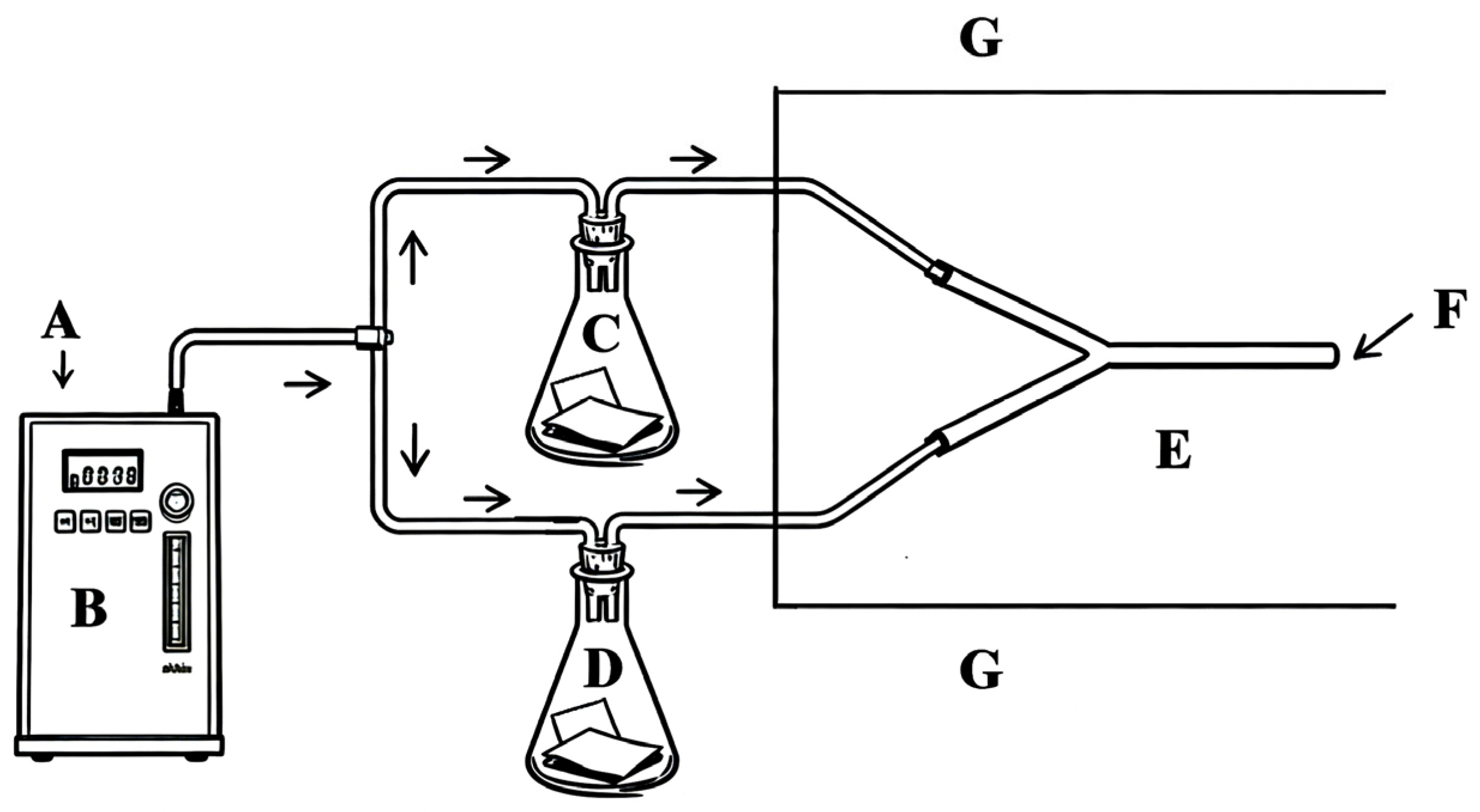
The behavioral responses of adult D. citri were assessed using a glass Y-tube olfactometer (main arm: 15 cm; side arms: 15 cm at a 70° angle; internal diameter: 1.5 cm), custom-made by Henan Scientific Instrument Factory (Zhengzhou, China). The setup consisted of an air source, an atmospheric sampler (QC-1B, Beijing Ke’an Labor Protection New Technology Co., Beijing, China), two sample bottles (for treatment and control), and the Y-tube (Figure 1). An opaque black cloth was placed over the olfactometer to eliminate interference from external light sources.
Purified and humidified air was drawn through the two sample bottles and into the corresponding arms of the olfactometer at a total flow rate of 20 mL/min. For each trial, a filter paper treated with the diluted TTO emulsion was placed in one sample bottle (treatment arm), while a filter paper treated with 0.5% Tween-80 solution was placed in the other bottle (control arm). The system was aerated for 30 min before introducing the insects.
For each replicate, 15 vigorous adult psyllids were introduced individually into the main arm. A choice was recorded when a psyllid moved more than 2.5 cm into either arm and remained there for at least 1 min, timed with a stopwatch. Psyllids that did not make a choice within 5 min were recorded as non-responders. Each concentration was tested with three independent replicates (total n = 45). To avoid positional bias, the positions of the treatment and control arms were swapped after each replicate. The glassware was cleaned with 75% ethanol and rinsed with distilled water between replicates, followed by air-drying. The repellency rate was calculated as follows: Repellency Rate (%) = (Number of insects in control arm/Total number of responding insects) × 100%.

2.2.4. Contact Toxicity Assay

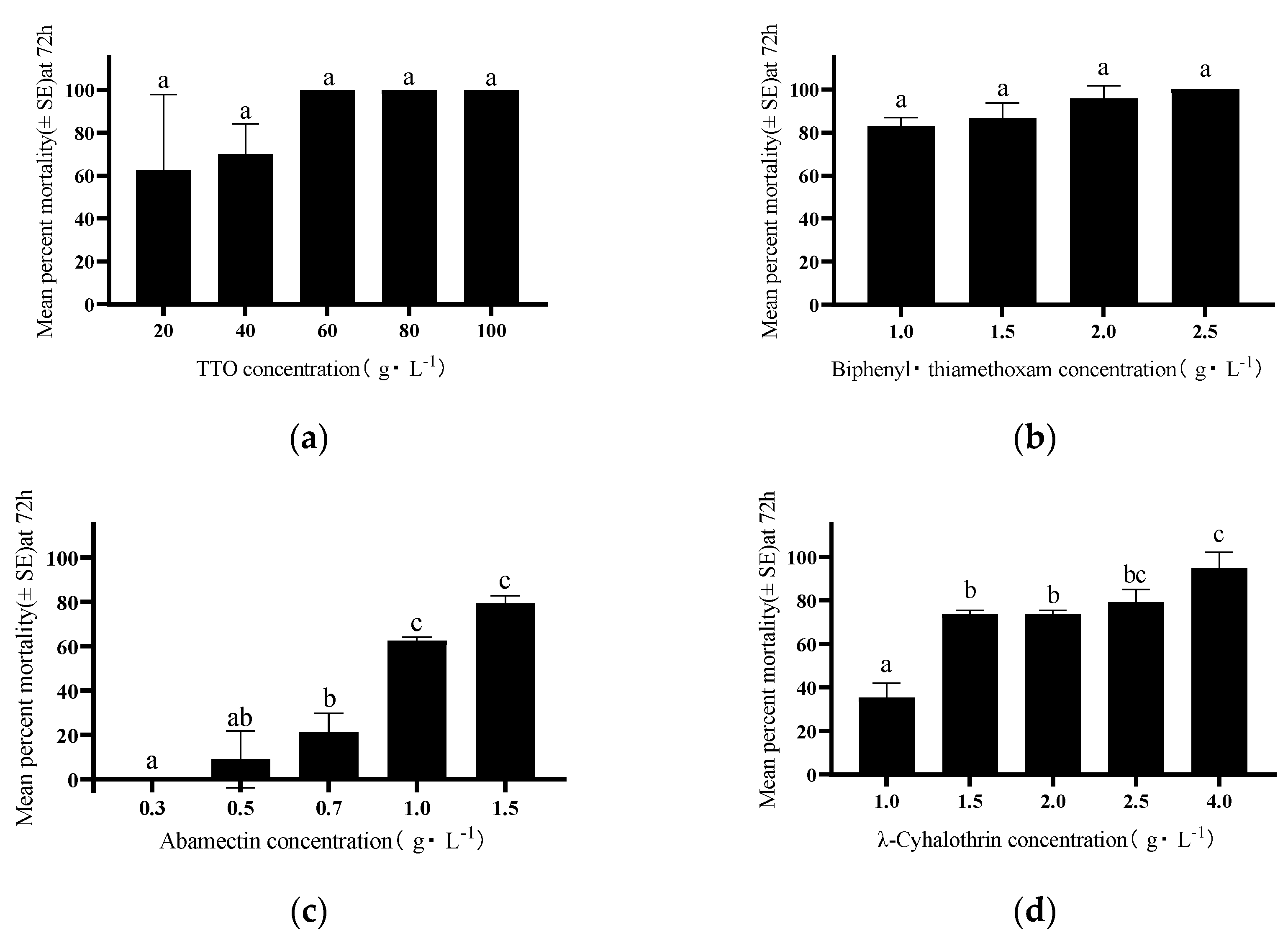
Based on preliminary range-finding experiments, TTO was diluted to 20, 40, 60, 80, and 100 g/L. The five major components and three conventional insecticides were diluted as shown in Table 1. For each replicate, 15 active adult psyllids were collected from the screen house using a bottle (a modified 150 mL transparent plastic bottle, 52 mm diameter × 72 mm height, with a 34 mm outer opening diameter) and kept inside. The bottle was then sealed with a 200-mesh screen. A handheld fine-mist sprayer was used to apply 2 mL of the test solution into the bottle from a fixed distance of 5 cm. After the solution on the insects had air-dried (approx. 10 min), a fresh, untreated branch of M. exotica was placed in the bottle as a food source. The control group was treated with a 0.5% Tween-80 solution. Each treatment was replicated three times. The bottles were maintained in an artificial climate chamber at 25 ± 1 °C and 65 ± 5% RH. Mortality was recorded at 24, 48, and 72 h post-treatment. Psyllids were considered dead if they did not move when prodded with a fine brush. The experiment was considered valid if mortality in the control group was ≤20%. Raw mortality was calculated as Mortality (%) = (Number of dead insects/Total number of insects) × 100%. Psyllid mortality was then corrected using Abbott’s formula: Corrected Mortality (%) = [(Treatment mortality − Control mortality)/(100 − Control mortality)] × 100%.

2.2.5. Data Processing and Analysis

Data were organized and processed using Microsoft Excel 2019. In the Y-tube olfactometer bioassay, the number of psyllids choosing the treatment arm versus the control arm was analyzed using a chi-square (χ2) goodness-of-fit test and Fisher’s exact test to determine if the observed distribution deviated significantly from an expected 50:50 ratio. For the contact toxicity assays, mortality data were subjected to probit analysis using SPSS Statistics 26 (IBM Corp., Armonk, NY, USA) to calculate the 50% lethal concentration (LC50), 95% confidence intervals, and the slope of the dose–response line. Toxicity data and behavioral responses were visualized using GraphPad Prism 9.5.0 (GraphPad Software, San Diego, CA, USA).

3. Results

3.1. Chemical Composition of TTO

GC-MS analysis of the commercial TTO identified 12 compounds with relative abundances > 0.2%, accounting for 99.99% of the total oil composition (Table 2). The oil was primarily composed of oxygenated monoterpenes (49.96%) and monoterpene hydrocarbons (47.85%). The most abundant compound was Terpinen-4-ol (40.62%), followed by γ-Terpinene (21.46%) and α-Terpinene (10.45%). The five most abundant compounds—Terpinen-4-ol, γ-Terpinene, α-Terpinene, p-Cymene (6.33%), and α-Terpineol (6.40%)—accounted for over 85% of the total oil. Based on the high concentration of Terpinen-4-ol (>30%) and low concentration of 1,8-Cineole (<5%), the TTO was confirmed to be of the Terpinen-4-ol chemotype, consistent with international standards (ISO 4730:2017) [15] and the national standard of China (GB/T 26514-2011) [16].

3.2. Behavioral Effects of TTO and Its Major Components on Adult D. citri

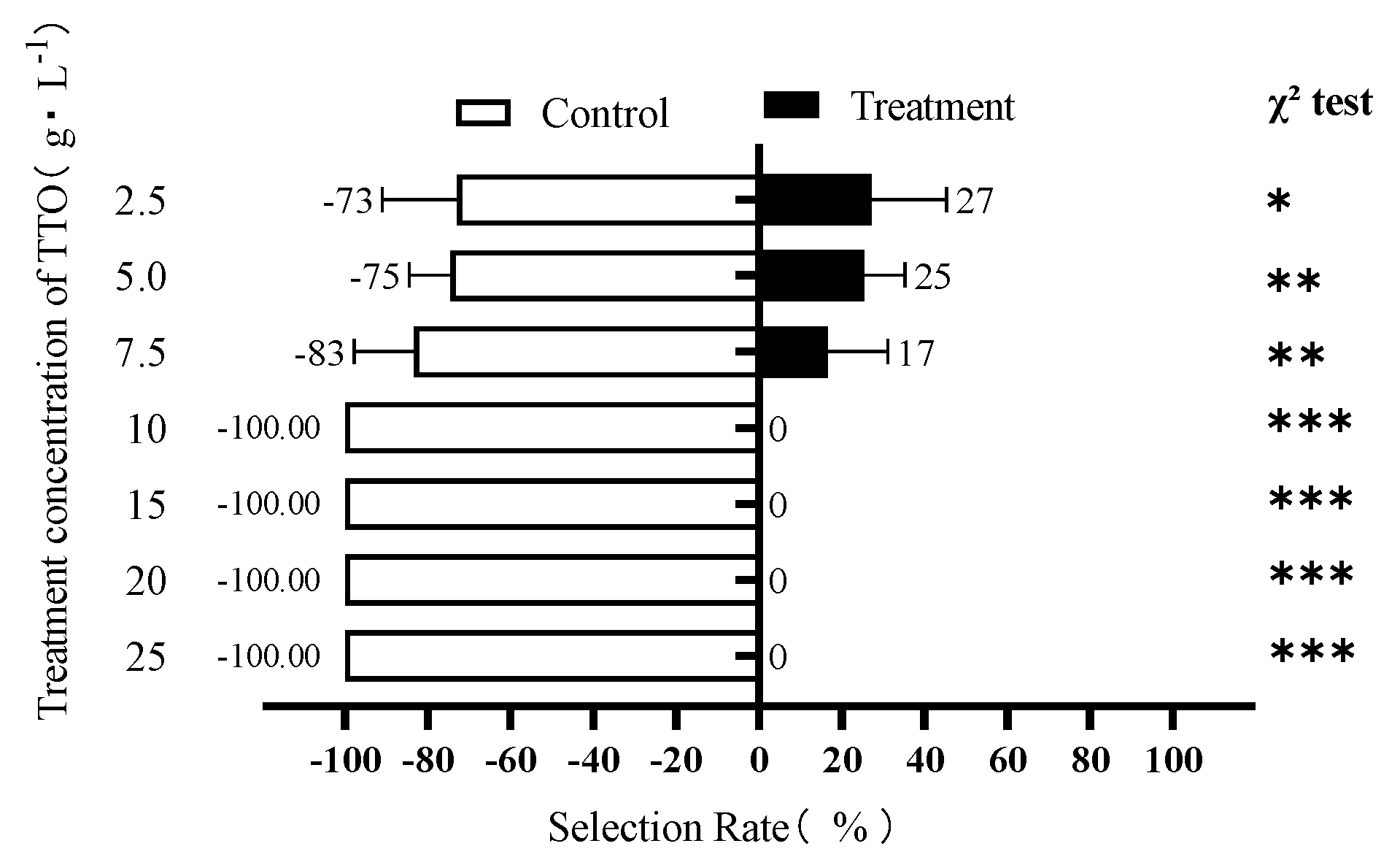
In the Y-tube olfactometer assay, TTO exhibited a significant, concentration-dependent repellent effect on adult D. citri (Figure 2). Repellency increased with concentration, reaching 100% at concentrations of 10 g/L and above, where all psyllids chose the control arm (mean = 13 ± 1; χ2 = 26.00, df = 1, p < 0.0001).
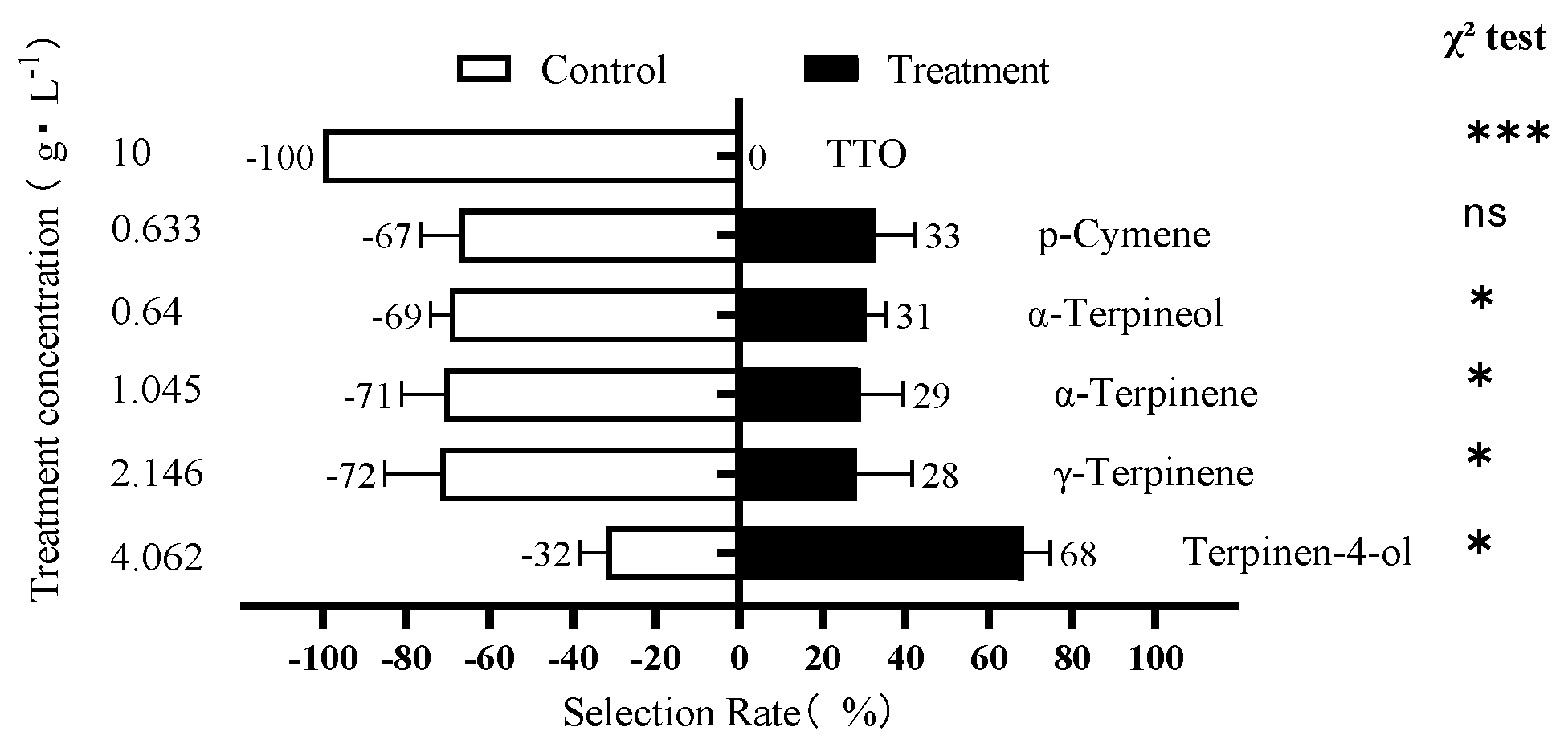
Based on these results, the behavioral effects of TTO at 10 g/L and its five major components at their corresponding concentrations were compared (Figure 3). TTO at 10 g/L was strongly repellent (100%). γ-Terpinene and α-Terpinene were also significantly repellent, with repellency rates of 72% (mean = 11 ± 1; χ2 = 3.86, df = 1, p < 0.05) and 71% (mean = 13 ± 1; χ2 = 5.76, df = 1, p < 0.02). In stark contrast, Terpinen-4-ol at its corresponding concentration (4.06 g/L) was significantly attractive, with 68% of psyllids choosing the treatment arm (mean = 13 ± 2; χ2 = 4.24, df = 1, p < 0.05). α-Terpineol and p-Cymene did not elicit a significant attractive or repellent response at the tested concentrations.

3.3. Contact Toxicity of TTO and Its Components Against D. citri

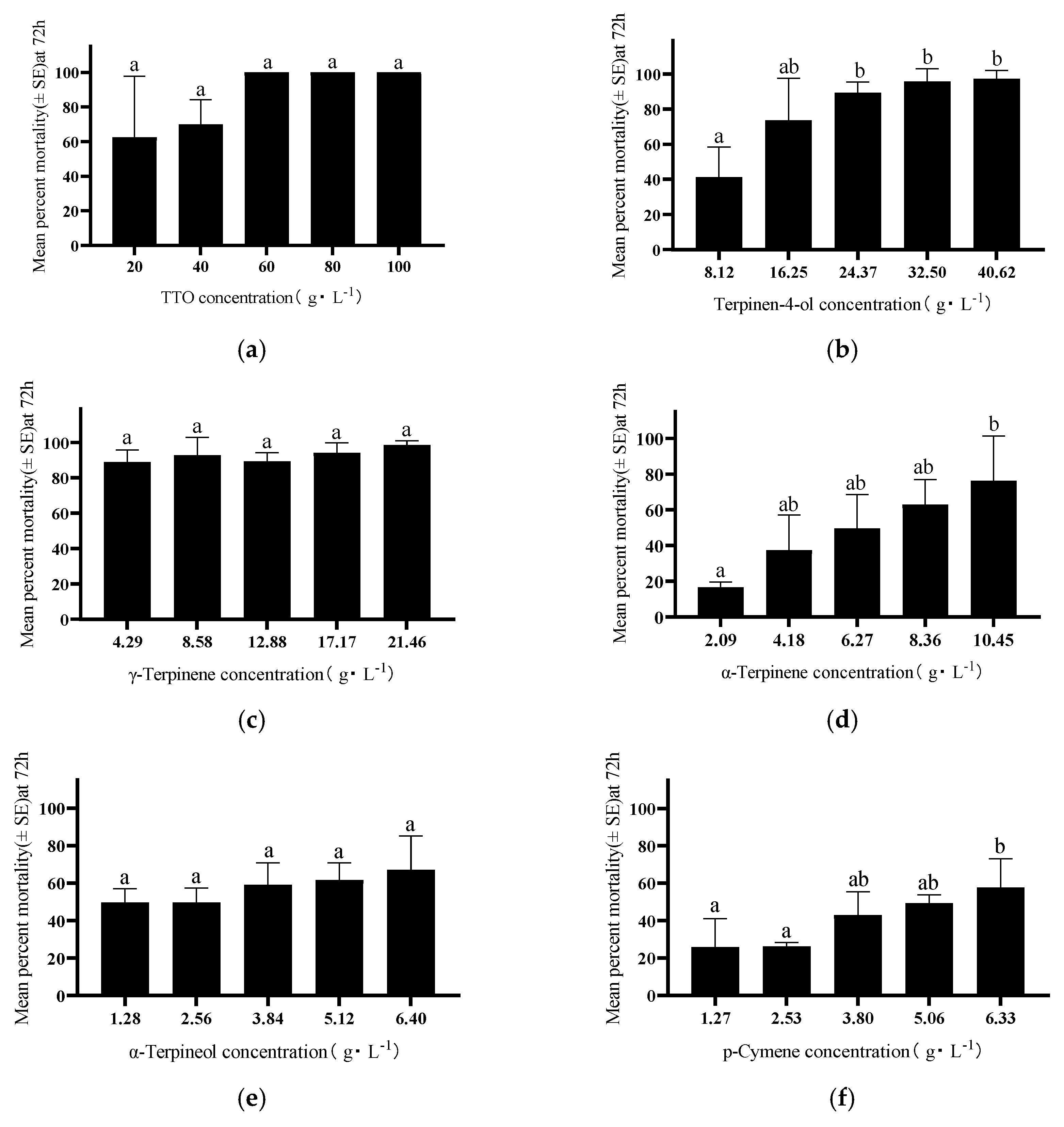
TTO and its five major components exhibited concentration- and time-dependent contact toxicity against D. citri adults (Figure 4). The toxicity of TTO and its components was significantly higher than the control at all time points (24, 48, and 72 h). Among the compounds, TTO was the most toxic, followed by Terpinen-4-ol and γ-Terpinene. After 72 h, mortality rates exceeded 70% for TTO at ≥40 g/L, Terpinen-4-ol at ≥16.25 g/L, γ-Terpinene at ≥4.29 g/L, and α-Terpinene at ≥10.45 g/L, demonstrating their potent toxic effects.

3.4. Contact Toxicity of TTO vs. Conventional Insecticides

TTO and the three conventional insecticides all exhibited significant dose- and time-dependent contact lethality against D. citri adults (Figure 5). The Biphenyl·thiamethoxam mixture was highly lethal (81.28% mortality) at a low concentration (2.5 g/L) within 24 h of exposure. Similarly, TTO demonstrated good efficacy (>85.5% mortality) at higher concentrations (≥80 g/L) after 24 h of exposure. After 72 h, the mortality rates for 40 g/L TTO, 1.0 g/L Biphenyl·thiamethoxam, 1.5 g/L Abamectin, and 1.5 g/L λ-Cyhalothrin were 70.00%, 82.86%, 79.37% and 73.86%, respectively, indicating effective contact control at these concentrations.
As shown in Table 3, the toxicity of all tested agents increased over time. Based on the 72 h LC50 values, the order of toxicity was: Biphenyl·thiamethoxam (0.59 g/L) > Abamectin (0.93 g/L) > λ-Cyhalothrin (1.23 g/L) > TTO (19.18 g/L). Biphenyl·thiamethoxam was the most potent insecticide, being approximately 32.5 times more toxic than TTO after 72 h.

4. Discussion

4.1. Variation in Essential Oil Composition and Activity

The chemical composition of M. alternifolia essential oil can vary based on geography, harvest time, and extraction method, leading to different chemotypes [17,18]. Among the constituents of TTO identified here, Terpinen-4-ol (40.62%) was paramount and 1,8-cineole (2.92%) remained minimal, aligning with standard Terpinen-4-ol chemotypes. Terpinen-4-ol is the dominant compound in M. alternifolia, which is consistent with many previous reports [17,19]. Terpinen-4-ol has consistently demonstrated strong biological activities, including insecticidal effects against the red flour beetle and maize weevil through enzyme inhibition and fumigant toxicity [20]. The combined presence of Terpinen-4-ol and highly volatile hydrocarbons (γ-Terpinene, α-Terpinene) in TTO likely generates the potent synergistic toxicity observed in our bioassays. The superior overall efficacy of the complete oil compared to its individual components strongly points towards a synergistic action among the constituents, a phenomenon also reported for other essential oils against different pests [21].

4.2. Differential Repellent and Toxic Activities

Our study indicates that TTO exerts significant repellent and lethal activities against D. citri in a dose- and time-dependent manner. TTO exhibited the strongest repellency (100%) against D. citri adults at concentrations ≥ 10 g/L. This corresponds closely with prior screening efforts. For example, Mann et al. (2012) tested various plant-based essential oils, observing that full-strength botanical blends induced superior repellent and avoidance behaviors in D. citri compared to single-component isolates [22]. Similarly, Ye et al. (2024) reported that Terpinen-4-ol-type M. alternifolia branches and leaves effectively repelled D. citri in field trials [17].
Notably, in the present study, TTO at ≥10 g/L and the individual components γ-Terpinene (2.15 g/L) and α-Terpinene (1.05 g/L) were highly repellant (>70% repellency). However, in contrast, Terpinen-4-ol, the most abundant component of TTO, was attractive to D. citri at 4.06 g/L. This discrepancy suggests that the behavioral response of D. citri to Terpinen-4-ol may be dose-dependent, acting as an attractant at lower concentrations while potentially becoming repellent at higher vapor saturation. The contrasting behavioral effects of TTO components can be plausibly explained by their physicochemical properties and the concept of blend synergy. The highly volatile monoterpene hydrocarbons (γ-Terpinene and α-Terpinene, both have a boiling point below 200 °C) likely act as primary repellents by rapidly creating an “odor barrier”. In contrast, the less volatile oxygenated monoterpene (Terpinen-4-ol, a boiling point of 212 °C) may only be perceived at low concentrations, potentially mimicking a host cue or a pheromone component, leading to attraction. The strong repellency of the complete TTO, despite the attractiveness of its main component, suggests a synergistic or masking effect where other constituents either enhance the repellency of the terpenes or mask the attractive nature of Terpinen-4-ol. Although, not explicitly emphasized in the literature, data from Ye et al. (2024) show that low concentrations of γ-Terpinene (0.1 μL/mL) in TTO can also exert a significant attractant effect [17]. However, these explanations remain hypothetical without further physiological (e.g., EAG/SSR) and detailed dose–response behavioral assays.
When comparing our toxicity results to previous work, Mann et al. (2012) reported LC50 values for D. citri adults ranging from 0.16 μg/insect (lavender oil) to 17.26 μg/insect (thyme oil) [22]. Although direct comparisons are constrained by differences in reporting units and bioassay methodology (our TTO LC50 was 19.18 g/L on adults), these findings confirm that plant-derived essential oils possess significant contact toxicity against this vector. Given the increasing development of resistance to conventional synthetic insecticides [4,5,6], our findings support the further exploration of TTO as a viable, albeit distinct, tool for integrated pest management programs.

4.3. Development Prospects of TTO

Our study confirms that TTO has significant repellent and lethal activities against D. citri, and its individual components exhibit attraction at lower concentrations, making TTO a promising candidate for development as a botanical insecticide or its components as attractants. Compared to conventional pesticides, essential oils like TTO offer the advantages of lower mammalian toxicity, higher biodegradability, and novel modes of action, which can be valuable in managing insecticide resistance [23].
However, recognizing the limitations of essential oils in field conditions is crucial. The contact assay in our study (utilizing 2 mL spray volumes) provides uniform target coverage that may not perfectly reflect variable field spraying efficiencies. Additionally, the high volatility and susceptibility to photodegradation of essential oil components often lead to poor persistence in the field [24,25]. Furthermore, the high LC50 value observed in our study indicates that relatively large amounts of TTO would be required for effective control, which may be cost-prohibitive. To overcome these limitations, future research should focus on developing advanced formulations, such as microencapsulations or nanoemulsions, to improve stability, enhance residual activity, and reduce the required dosage [26,27]. Integrating TTO-based products into a broader IPM strategy, possibly in rotation with other biopesticides or conventional insecticides, could provide a sustainable solution for D. citri management.

Author Contributions

Conceptualization, F.Y., Y.G. and Q.J.; methodology, F.Y., Y.G. and Q.J.; formal analysis, F.Y. and Y.L.; investigation, Y.L., R.N., Y.F., B.C. and Q.Z.; data curation, Y.L., R.N., Y.F., B.C. and Q.Z.; writing—original draft preparation, F.Y. and Y.L.; writing—review and editing, F.Y.; supervision, F.Y., Y.G. and Q.J.; project administration, F.Y.; funding acquisition, Y.G. and Q.J. All authors have read and agreed to the published version of the manuscript.

Funding

This research was funded by the China Agriculture Research System of MOF and MARA (CARS-26); the Special Project of Guangdong Province for Promoting Coordinated Urban-Rural Regional Development (2025B0202010051); the 2025 Zhaoqing Science and Technology Innovation Guidance Project (250818100810025); and the School-level Youth Project of Zhaoqing University (QN202443).

Data Availability Statement

The original contributions presented in this study are included in the article. Further inquiries can be directed to the corresponding authors.

Acknowledgments

The authors would like to thank Hui Jiang and Liying Guo (Zhaoqing University, China) for their assistance with material procurement and instrument training, and thank Cong Chen for his guidance during the experimental process. We are also grateful to the three anonymous reviewers for their insightful comments and constructive suggestions, which significantly improved the quality of this manuscript.

Conflicts of Interest

The authors declare no conflicts of interest.

Abbreviations

The following abbreviations are used in this manuscript:
GC-MSGas chromatography-mass spectrometry
HLBHuanglongbing
TTOTea tree oil

References

  1. Li, L.Y. Current Situation and Countermeasures of Citrus Huanglongbing Disease Control in Guilin, Guangxi. Master’s Thesis, Guangxi University, Nanning, China, 2021. [Google Scholar]
  2. Yu, J.H.; Huang, Z.D.; Zhang, M.R.; Zhang, N.; Li, P.; Lu, L.; Yang, X. The biological research progress and prevention of Asian citrus psyllid. Plant Quar. 2018, 32, 8–13. [Google Scholar]
  3. Luo, Y.C. Sensitivity of Citrus Psyllid Field Population to Insecticides and the Development of Pesticides Selected Kits. Master’s Thesis, South China Agricultural University, Guangzhou, China, 2020. [Google Scholar]
  4. Wang, S.J.; Fang, Y.L.; Sun, H.L.; Zhou, Q. Research progress in insecticide resistance of Diaphorina citri Kuwayama. Insect Res. Cent. China 2025, 19, 33–41. [Google Scholar]
  5. Song, X.B.; Cui, Y.P.; Peng, A.T.; Ling, J.F.; Chen, X. Resistance to commonly used insecticides of Diaphorina citri field populations in Zhaoqing city, Guangdong Province. J. Environ. Entomol. 2021, 43, 1321–1324. [Google Scholar]
  6. Hu, Y.Y.; Sun, Y.; Zou, Z.W.; Huang, S.J. Resistance of Diaphorina citri Kuwayama to five conventional insecticides in Jiangxi province. Chin. J. Appl. Entomol. 2022, 59, 419–425. [Google Scholar]
  7. Schnee, C.; Köllner, T.G.; Held, M.; Turlings, T.C.J.; Gershenzon, J.; Degenhardt, J. The products of a single maize sesquiterpene synthase form a volatile defense signal that attracts natural enemies of maize herbivores. Proc. Natl. Acad. Sci. USA 2006, 103, 1129–1134. [Google Scholar] [CrossRef]
  8. Zhu, H.M.; Zeng, X.N.; Zaka, S.M.; Cen, Y.J. Influence of the essential oil of guava leaves on the feeding behavior of the Asian citrus psyllid. J. Environ. Entomol. 2010, 32, 483–487. [Google Scholar]
  9. Wang, Q.Z.; Liu, Y.M.; Li, S.M.; Zhao, Y.; Wang, W. Chemical composition of essential oil of the invasive plant Praxelis clematidea and its repellence and lethality to Diaphorina citri. Chin. J. Appl. Entomol. 2018, 55, 117–125. [Google Scholar]
  10. Khalil, M.; Khizar, M.; Alshaya, D.S.; Hameed, A.; Muhammad, N.; Binyameen, M.; Azeem, M.; Hussain, M.; Abbas, Q.; Attia, K.A.; et al. Insecticidal and Repellent Activity of Essential Oils from Seven Different Plant Species against Tribolium castaneum (Coleoptera: Tenebrionidae). Insects 2024, 15, 755. [Google Scholar] [CrossRef]
  11. Bedini, S.; Cosci, F.; Tani, C.; Pierattini, E.C.; Venturi, F.; Lucchi, A.; Ioriatti, C.; Ascrizzi, R.; Flamini, G.; Ferroni, G.; et al. Essential Oils as Post-Harvest Crop Protectants against the Fruit Fly Drosophila suzukii: Bioactivity and Organoleptic Profile. Insects 2020, 11, 508. [Google Scholar] [CrossRef]
  12. Yang, F.M.; Nie, R.R.; Fu, Y.R.; Liao, Y.Y.; Chen, B.K.; Zhang, Q.W.; Ji, Q.H.; Guo, Y.J. Biological Functions of the Active Components of Melaleuca alternifolia Essential Oil and Their Applications in Agricultural Pest Control. Plant Dis. Pests 2025, 16, 1–5. [Google Scholar]
  13. Batish, D.R.; Singh, H.P.; Kohli, R.K.; Kaur, S. Eucalyptus essential oil as a natural pesticide. For. Ecol. Manag. 2008, 256, 2166–2174. [Google Scholar] [CrossRef]
  14. Palermo, D.; Giunti, G.; Laudani, F.; Palmeri, V.; Campolo, O. Essential oil-based nano-biopesticides: Formulation and bioactivity against the confused flour beetle Tribolium confusum. Sustainability 2021, 13, 9746. [Google Scholar] [CrossRef]
  15. ISO 4730:2017; Essential Oil of Melaleuca, Terpinen-4-ol Type (Tea Tree Oil). International Organization for Standardization: Geneva, Switzerland, 2017.
  16. GB/T 26514-2011; General Administration of Quality Supervision, Inspection and Quarantine of the People’s Republic of China; Standardization Administration of China. Melaleuca alternifolia Essential Oil, Terpinen-4-ol Chemotype: GB/T 26514-2011. China Standards Press: Beijing, China, 2011.
  17. Ye, Z.D.; Lin, Z.Y.; Yang, C.Y.; Cai, H.D.; Han, Q.X. Effect of Melaleuca alternifolia Cheel and Its Volatile Compounds on Behavior of Diaphorina citri Kuwayama and Its Application. Plant Health Med. 2024, 3, 63–73. [Google Scholar]
  18. Xiao, Y.F.; Qin, Z.H.; Zhang, Y.; Zhang, X.N.; Chen, B.W.; Liang, Z.Y.; Qin, Y.F.; Yan, C.; Liu, H.L. Essential Oils in Parts of Melaleuca alternifolia Plant. Fujian J. Agric. Sci. 2020, 35, 957–963. [Google Scholar]
  19. Xiao, L.N.; Zhong, J.M.; Ling, S.Q.; Xu, J.Z.; Ruan, Z.J.; Yang, H.; Hou, C.; Li, Z.Q.; Lin, Z.Y.; Qiu, H.L. Repellent effect of Melaleuca alternifolia essential oil on Solenopsis invicta Buren and identification of active components. J. Environ. Entomol. 2024, 46, 1224–1232. [Google Scholar]
  20. Liao, M. Studies on the Toxicity and Insecticidal Mechanism of the Melaleuca alternifolia Essential Oil Against Stored-Product Insect Pests. Ph.D. Thesis, Anhui Agricultural University, Hefei, China, 2016. [Google Scholar]
  21. Han, Y.; Zhu, M.; Qiu, B.; Ali, S.; Wu, J. Insecticidal Effect of Lemongrass Essential Oil Against Megalurothrips usitatus (Bagnall). Agronomy 2025, 15, 1733. [Google Scholar] [CrossRef]
  22. Mann, R.S.; Kaufman, P.E.; Butler, J.F. Repellency and toxicity of plant-based essential oils and their constituents against Diaphorina citri (Hemiptera: Psyllidae). J. Appl. Entomol. 2012, 136, 87–96. [Google Scholar] [CrossRef]
  23. Dziągwa-Becker, M.; Oleszek, M. Is the Biopesticide from Tea Tree Oil an Effective and Low-Risk Alternative to Chemical Pesticides? A Critical Review. Molecules 2024, 29, 3248. [Google Scholar] [CrossRef]
  24. Bakkali, F.; Averbeck, S.; Averbeck, D.; Idaomar, M. Biological effects of essential oils—A review. Food Chem. Toxicol. 2008, 46, 446–475. [Google Scholar] [CrossRef]
  25. Regnault-Roger, C.; Vincent, C.; Arnason, J.T. Essential oils in insect control: Low-risk products in a high-stakes world. Annu. Rev. Entomol. 2012, 57, 405–424. [Google Scholar] [CrossRef]
  26. Long, M.; Feng, C.; Li, Y.J.; Wang, X.H.; Cai, H.Z.; Zhan, G. Preparation, Characterization and in Vitro Release Characteristics of Sustained-Release Chitosan Microcapsules Containing Tea Tree Oil. Food Sci. 2019, 40, 242–248. [Google Scholar]
  27. Zhang, H.H.; Chen, H.P.; Cao, C.; Zhao, P.Y.; Li, F.M.; Huang, Q.L.; Cao, L.D. Research progress of nanoemulsion of pesticides. J. Pestic. Sci. 2022, 24, 1340–1357. [Google Scholar]
Figure 1. The diagram of the olfactometer. A, Air source; B, Atmospheric sampler; C, Erlenmeyer flask containing treatment odors; D, Erlenmeyer flask containing control odors; E, Y-tube olfactometer; F, Release point of adult psyllids; G, Dark treatment with black cloth.
Insects 17 00355 g001
Figure 2. Behavioral response of D. citri adults to different concentrations of TTO in a Y-tube olfactometer. Bars represent the percentage of psyllids choosing the treatment (TTO) or control (CK) arm. Error bars represent the Standard Error of the Mean (SEM) of three replicates. Asterisks indicate a significant difference between the number of insects choosing the treatment versus control arm within a concentration (Chi-square test: * p < 0.05; ** p < 0.01; *** p < 0.001).
Insects 17 00355 g002
Figure 3. Behavioral response of D. citri adults to 10 g/L TTO and its five major components at their corresponding concentrations. Bars represent the percentage of psyllids choosing the treatment or control (CK) arm. Error bars represent SEM of three replicates. Asterisks indicate a significant difference (Chi-square test: * p < 0.05; *** p < 0.001; ns, not significant).
Insects 17 00355 g003
Figure 4. Contact toxicity of TTO and its five major components against D. citri adults within 72 h: (a) TTO; (b) Terpinen-4-ol; (c) γ-Terpinene; (d) α-Terpinene; (e) α-Terpineol; (f) p-Cymene. Different lowercase letters above the bars indicate significant differences among treatments (p < 0.05, Tukey’s HSD test).
Insects 17 00355 g004
Figure 5. Contact toxicity of TTO and three common chemical insecticides against D. citri adults within 72 h: (a) TTO; (b) Biphenyl·thiamethoxam; (c) Abamectin; (d) λ-Cyhalothrin. Different lowercase letters above the bars indicate significant differences among treatments (p < 0.05, Tukey’s HSD test).
Insects 17 00355 g005
Table 1. Concentrations of the test agents.
Treatment Conc. 1 (g/L) Conc. 2 (g/L) Conc. 3 (g/L) Conc. 4 (g/L) Conc. 5 (g/L)
TTO20406080100
Terpinen-4-ol8.1216.2524.3732.540.62
γ-Terpinene4.298.5812.8817.1721.46
α-Terpinene2.094.186.278.3610.45
α-Terpineol1.282.565.125.126.4
p-Cymene1.272.533.85.066.33
λ-Cyhalothrin1.01.52.02.54.0
Abamectin0.30.50.71.01.5
Biphenyl·thiamethoxam1.01.52.02.5-
Table 2. Chemical composition of Australian tea tree oil (TTO).
No. Retention Time (min) Compound Molecular Formula Content (%)
16.174PineneC10H163.81
28.579α-TerpineneC10H1610.45
38.808p-CymeneC10H146.33
48.968D-LimoneneC10H162.35
59.0711,8-CineoleC10H18O2.92
69.918γ-TerpineneC10H1621.46
710.814TerpinoleneC10H162.75
814.105Terpinen-4-olC10H18O40.62
914.558α-TerpineolC10H18O6.40
1023.579AromadendreneC15H242.18
1125.902LedeneC15H240.49
1230.215GlobulolC15H26O0.24
Table 3. Contact toxicity of TTO and three common insecticides against D. citri adults.
TreatmentProcessing Time (h)LC50 (g/L)95% Confidence Interval (g/L)Regression Equation (Y=)χ2dfp-ValueCorrelation Coefficient (r)Relative Toxicity
(72 h)
TTO24 h46.7233.93~57.52−8.46 + 5.07x2.0930.551.000.03
48 h33.4220.33~43.73−5.92 + 3.89x0.8130.851.000.02
72 h19.183.18~28.57−4.33 + 3.38x3.1730.370.890.03
λ-Cyhalothrin24 h3.102.41~5.40−1.71 + 3.48x0.8530.841.000.45
48 h2.101.64~2.76−1.18 + 3.66x1.0630.791.000.35
72 h1.230.72~1.57−0.33 + 3.59x1.6130.661.000.48
Abamectin24 h1.771.29~10.68−0.98 + 3.94x0.3630.950.980.80
48 h1.260.98~2.17−0.38 + 3.80x0.6630.881.000.59
72 h0.930.76~1.220.14 + 4.40x1.3430.721.000.63
Biphenyl·thiamethoxam24 h1.410.66~1.81−0.54 + 3.66x0.8620.651.001.00
48 h0.74-0.29 + 2.13x1.6320.440.801.00
72 h0.59-0.78 + 3.36x0.6520.721.001.00
Note: Relative Toxicity (72 h) calculated as (LC50 of most toxic agent/LC50 of test agent).
Disclaimer/Publisher’s Note: The statements, opinions and data contained in all publications are solely those of the individual author(s) and contributor(s) and not of MDPI and/or the editor(s). MDPI and/or the editor(s) disclaim responsibility for any injury to people or property resulting from any ideas, methods, instructions or products referred to in the content.