The Genus Apis in a Changing World: Distribution, Conservation, Climate, and Anthropogenic Stressors



Simple Summary
Abstract
1. Introduction
2. Biodiversity Within the Genus Apis
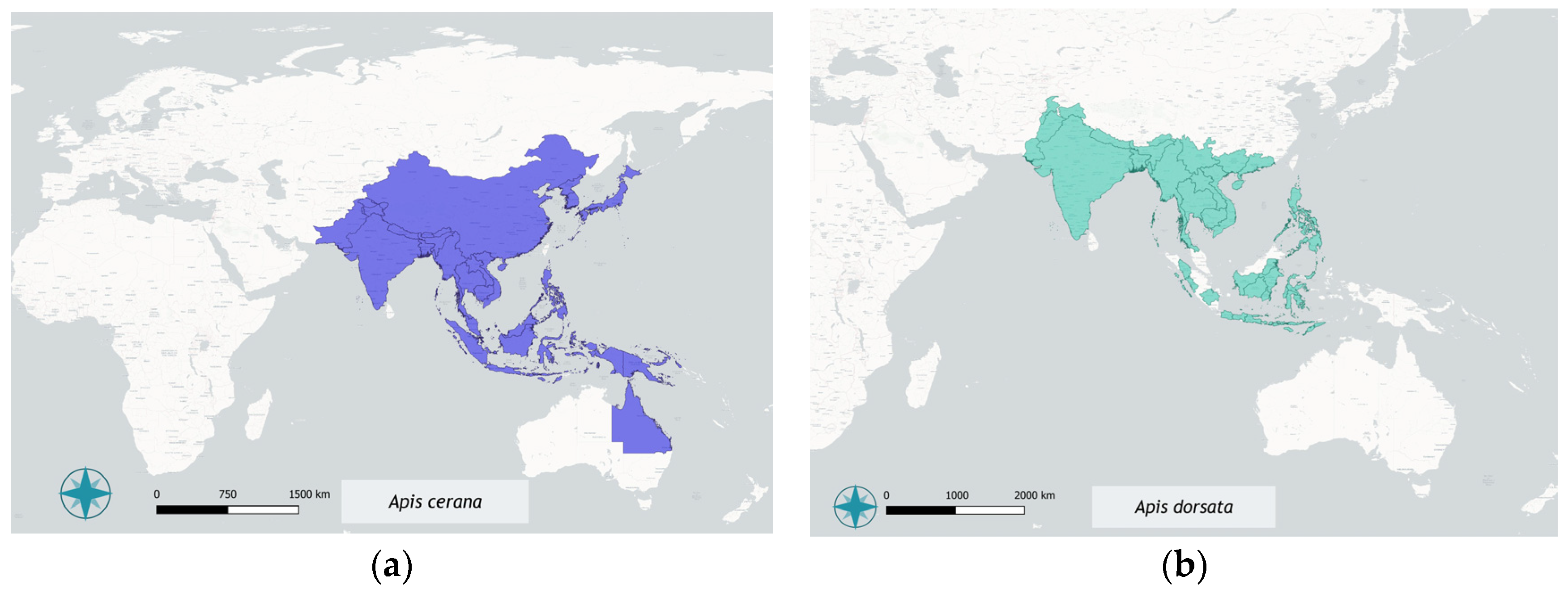
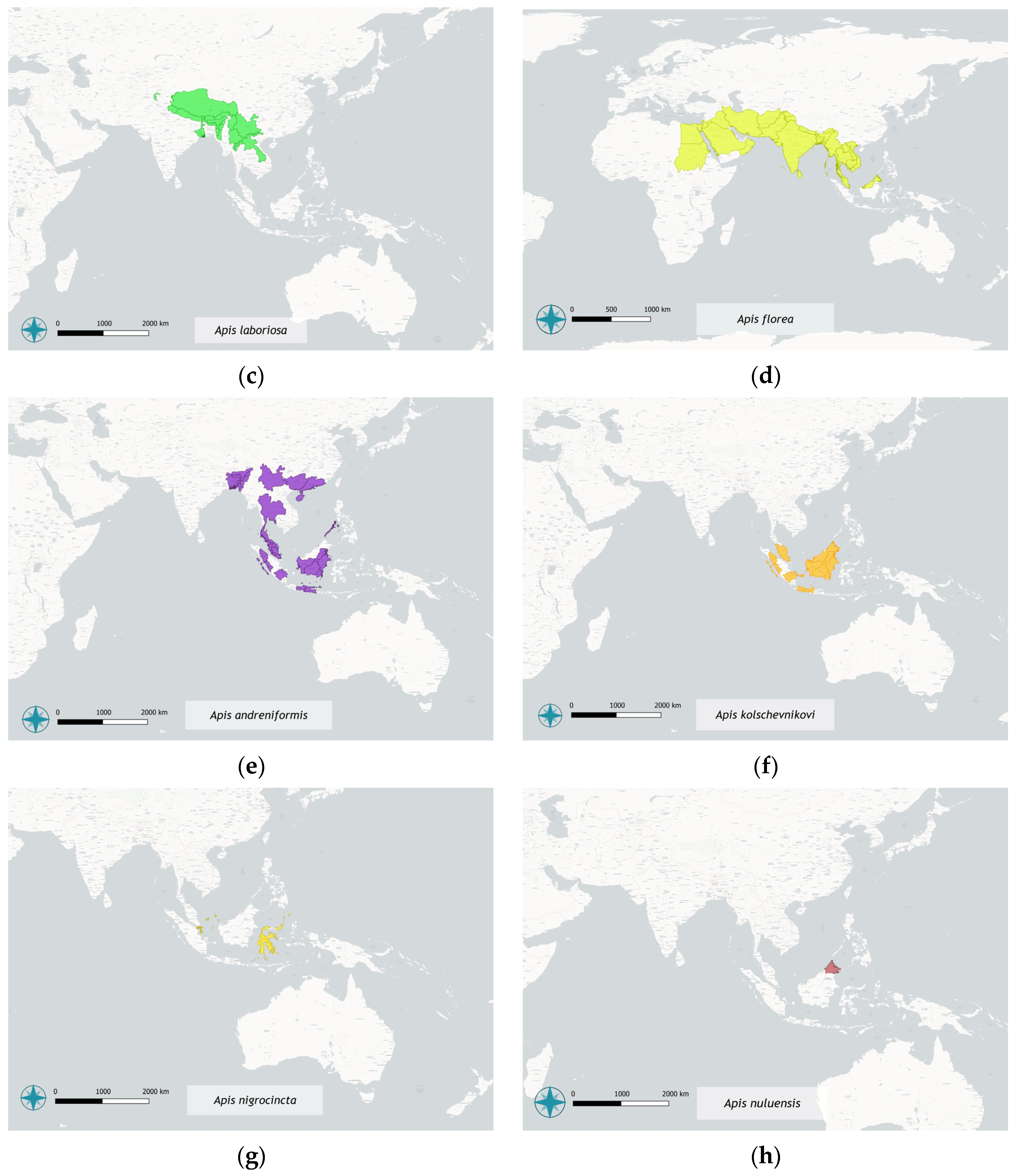
2.1. Biogeographical Patterns and Evolution of Apis Species
2.2. Domestication Process of Honeybees
3. Anthropogenic Pressures on Apiculture
3.1. Habitat Fragmentation and Loss
3.2. Pollution and Agrochemicals
3.3. Effects of Climate Change
4. Competition Between Honeybees and Other Hymenoptera Pollinators
5. Transmission of Pathogens, Viral Diseases, and Spillover
6. Discussion and Conclusions
Author Contributions
Funding
Data Availability Statement
Conflicts of Interest
References
- Ollerton, J.; Winfree, R.; Tarrant, S. How many flowering plants are pollinated by animals? Oikos 2011, 120, 321–326. [Google Scholar] [CrossRef] [Scilit]
- Khalifa, S.A.; Elshafiey, E.H.; Shetaia, A.A.; El-Wahed, A.A.A.; Algethami, A.F.; Musharraf, S.G.; AIAjimi, M.; Zhao, C.; Masry, S.H.D.; Abdel-Daim, M.M.; et al. Overview of bee pollination and its economic value for crop production. Insects 2021, 12, 688. [Google Scholar] [CrossRef] [Scilit]
- Papa, G.; Maier, R.; Durazzo, A.; Lucarini, M.; Karabagias, I.K.; Plutino, M.; Bianchetto, E.; Aromolo, R.; Pignatti, G.; Ambrogio, A.; et al. The honey bee Apis mellifera: An insect at the interface between human and ecosystem health. Biology 2022, 11, 233. [Google Scholar] [CrossRef] [Scilit]
- Rader, R.; Howlett, B.G.; Cunningham, S.A.; Westcott, D.A.; Newstrom-Lloyd, L.E.; Walker, M.K.; Teulon, D.A.J.; Edwards, W. Alternative pollinator taxa are equally efficient but not as effective as the honeybee in a mass flowering crop. J. Appl. Ecol. 2009, 46, 1080–1087. [Google Scholar] [CrossRef] [Scilit]
- Aebi, A.; Vaissière, B.E.; Delaplane, K.S.; Roubik, D.W.; Neumann, P. Back to the future: Apis versus non-Apis pollination—A response to Ollerton et al. Trends Ecol. Evol. 2012, 27, 142–143. [Google Scholar] [CrossRef] [Scilit]
- Hung, K.J.; Kingston, J.M.; Albrecht, M.; Holway, D.A.; Kohn, J.R. The worldwide importance of honey bees as pollinators in natural habitats. Proc. Biol. Sci. 2018, 285, 20172140. [Google Scholar] [CrossRef] [Scilit] [PubMed]
- Hristov, P.; Neov, B.; Shumkova, R.; Palova, N. Significance of Apoidea as Main Pollinators. Ecological and Economic Impact and Implications for Human Nutrition. Diversity 2020, 12, 280. [Google Scholar] [CrossRef] [Scilit]
- Mulatu, D.W. An Economic Valuation and Mapping of Pollination Services in Ethiopia. In Changing Ecosystems and Their Services; IntechOpen: London, UK, 2020. [Google Scholar] [CrossRef] [Scilit]
- Murphy, J.T.; Breeze, T.D.; Willcox, B.; Kavanagh, S.; Stout, J.C. Globalisation and pollinators: Pollinator declines are an economic threat to global food systems. People Nat. 2022, 4, 773–785. [Google Scholar] [CrossRef] [Scilit]
- Tatsuno, M.; Osawa, N. Flower visitation patterns of the coexisting honey bees Apis cerana japonica and Apis mellifera (Hymenoptera: Apidae). Entomol. Sci. 2016, 19, 255–267. [Google Scholar] [CrossRef] [Scilit]
- Phiri, B.J.; Fèvre, D.; Hidano, A. Uptrend in global managed honey bee colonies and production based on a six-decade viewpoint, 1961–2017. Sci. Rep. 2022, 12, 21298. [Google Scholar] [CrossRef] [Scilit]
- Kritsky, G. The Tears of Re: Beekeeping in Ancient Egypt; Oxford University Press: New York, NY, USA, 2015. [Google Scholar]
- Prendergast, K.S.; Garcia, J.E.; Howard, S.R.; Ren, Z.X.; McFarlane, S.J.; Dyer, A.G. Bee representations in human art and culture through the ages. ARTP 2021, 10, 1–62. [Google Scholar] [CrossRef] [Scilit]
- Wang, X.; Zhang, X.; Zhang, Z.; Lang, H.; Zheng, H. Honey bee as a model organism to study gut microbiota and diseases. Drug Discov. Today Dis. Models 2018, 28, 35–42. [Google Scholar] [CrossRef] [Scilit]
- Campani, T.; Manieri, G.; Caliani, I.; Di Noi, A.; Casini, S. Apis mellifera as a Model Species to Evaluate Toxicological Effects of Fungicides Used in Vineyard Agroecosystems. JoX 2025, 15, 18. [Google Scholar] [CrossRef] [Scilit]
- Henry, M.; Rodet, G. Controlling the impact of the managed honeybee on wild bees in protected areas. Sci. Rep. 2018, 8, 9308. [Google Scholar] [CrossRef] [Scilit]
- Pasquali, L.; Bruschini, C.; Benetello, F.; Bonifacino, M.; Giannini, F.; Monterastelli, E.; Penco, M.; Pesarini, S.; Salvati, V.; Simbula, G.; et al. Island-wide removal of honeybees reveals exploitative trophic competition with strongly declining wild bee populations. Curr. Biol. 2025, 35, 1576–1590. [Google Scholar] [CrossRef] [Scilit]
- Steffan-Dewenter, I.; Tscharntke, T. Resource overlap and possible competition between honey bees and wild bees in central Europe. Oecologia 2000, 122, 288–296. [Google Scholar] [CrossRef] [Scilit]
- Paini, D.R. Impact of the introduced honey bee (Apis mellifera) (Hymenoptera: Apidae) on native bees: A review. Austral Ecol. 2004, 29, 399–407. [Google Scholar] [CrossRef] [Scilit]
- Alix, A.; Steeger, T.; Brittain, C.; Fischer, D.; Johnson, R.; Moriarty, T.; Johansen, E.C.J.; Streissel, F.; Fischer, R.; Miles, M.J.; et al. Overview of a Proposed Ecological Risk Assessment Process for Honey bees (Apis mellifera) and Non-Apis Bees. In Pesticide Risk Assessment for Pollinators, 1st ed.; David, F., Thomas, M., Eds.; John Wiley & Sons, Inc.: Hoboken, NJ, USA, 2014; pp. 121–148. [Google Scholar] [CrossRef] [Scilit]
- Herbertsson, L.; Lindström, S.A.; Rundlöf, M.; Bommarco, R.; Smith, H.G. Competition between managed honeybees and wild bumblebees depends on landscape context. Basic Appl. Ecol. 2016, 17, 609–616. [Google Scholar] [CrossRef] [Scilit]
- Valido, A.; Rodríguez-Rodríguez, M.C.; Jordano, P. Honeybees disrupt the structure and functionality of plant-pollinator networks. Sci. Rep. 2019, 9, 4711–4721. [Google Scholar] [CrossRef] [Scilit]
- Prendergast, K.S.; Dixon, K.W.; Bateman, P.W. The evidence for and against competition between the European honeybee and Australian native bees. Pac. Conserv. Biol. 2022, 29, 89–109. [Google Scholar] [CrossRef] [Scilit]
- Page, M.L.; Williams, N.M. Evidence of exploitative competition between honey bees and native bees in two California landscapes. J. Anim. Ecol. 2023, 92, 1802–1814. [Google Scholar] [CrossRef] [Scilit] [PubMed]
- Pike, W.A.; Rittschof, C.C. Honey bee (Apis mellifera L.) and wild bee resource competition: How big is this problem? Integr. Comp. Biol. 2025, 65, 893–918. [Google Scholar] [CrossRef] [Scilit] [PubMed]
- Tokarev, Y.S.; Huang, W.F.; Solter, L.F.; Malysh, J.M.; Becnel, J.J.; Vossbrinck, C.R. A formal redefinition of the genera Nosema and Vairimorpha (Microsporidia: Nosematidae) and reassignment of species based on molecular phylogenetics. J. Invertebr. Pathol. 2020, 169, 107279. [Google Scholar] [CrossRef] [Scilit]
- Dolezal, A.G.; Toth, A.L. Feedbacks between nutrition and disease in honey bee health. Curr. Opin. Insect Sci. 2018, 26, 114–119. [Google Scholar] [CrossRef] [Scilit]
- Tehel, A.; Brown, M.J.F.; Paxton, R.J. Impact of managed honey bee viruses on wild bees. Curr. Opin. Virol. 2016, 19, 16–22. [Google Scholar] [CrossRef] [Scilit] [PubMed]
- Sorvillo, C.; Malabusini, S.; Holzer, E.; Frasnelli, M.; Giovanetti, M.; Lavazza, A.; Lupi, D. Urban Green Areas: Examining Honeybee Pathogen Spillover in Wild Bees Through Shared Foraging Niches. Appl. Sci. 2025, 15, 2879. [Google Scholar] [CrossRef] [Scilit]
- Almeida, E.A.; Porto, D.S. Investigating eusociality in bees while trusting the uncertainty. Sociobiology 2014, 61, 355–368. [Google Scholar] [CrossRef] [Scilit]
- Carr, S.M. Multiple mitogenomes indicate Things Fall Apart with Out of Africa or Asia hypotheses for the phylogeographic evolution of Honey Bees (Apis mellifera). Sci. Rep. 2023, 13, 9386. [Google Scholar] [CrossRef] [Scilit]
- Engel, M.S. The taxonomy of recent and fossil honey bees (Hymenoptera: Apidae; Apis). J. Hym. Res. 1999, 8, 165–169. [Google Scholar]
- Ruttner, F. The Genus Apis. In Biogeography and Taxonomy of Honeybees; Springer: Berlin/Heidelberg, Germany, 1988; pp. 3–12. [Google Scholar] [CrossRef] [Scilit]
- Su, Y.C.; Chiu, Y.F.; Warrit, N.; Otis, G.W.; Smith, D.R. Phylogeography and species delimitation of the Asian cavity-nesting honeybees. ISD 2023, 7, 5. [Google Scholar] [CrossRef] [Scilit]
- Arias, M.C.; Sheppard, W.S. Phylogenetic relationships of honey bees (Hymenoptera: Apinae: Apini) inferred from nuclear and mitochondrial DNA sequence data. Mol. Phylogenet Evol. 2005, 37, 25–35. [Google Scholar] [CrossRef] [Scilit]
- Bustamante, T.; Fuchs, S.; Grünewald, B.; Ellis, J.D. A geometric morphometric method and web application for identifying honey bee species (Apis spp.) using only forewings. Apidologie 2021, 52, 697–706. [Google Scholar] [CrossRef] [Scilit]
- Cornuet, J.M.; Garnery, L. Mitochondrial-DNA variability in honeybees and its phylogeographic implications. Apidologie 1991, 22, 627–642. [Google Scholar] [CrossRef] [Scilit]
- Ilyasov, R.A.; Lee, M.L.; Takahashi, J.I.; Kwon, H.W.; Nikolenko, A.G. A revision of subspecies structure of western honey bee Apis mellifera. Saudi J. Biol. Sci. 2020, 27, 3615–3621. [Google Scholar] [CrossRef] [Scilit]
- De la Rúa, P.; Jaffé, R.; Dall’Olio, R.; Muñoz, I.; Serrano, J. Biodiversity, conservation and current threats to European honeybees. Apidologie 2009, 40, 263–284. [Google Scholar] [CrossRef] [Scilit]
- Parker, R.; Melathopoulos, A.P.; White, R.; Pernal, S.F.; Guarna, M.M.; Foster, L.J. Ecological adaptation of diverse honey bee (Apis mellifera) populations. PLoS ONE 2010, 5, e11096. [Google Scholar] [CrossRef] [Scilit] [PubMed]
- Franck, P.; Garnery, L.; Loiseau, A.; Oldroyd, B.P.; Hepburn, H.R.; Solignac, M.; Cournet, J.-M. Genetic diversity of the honeybee in Africa: Microsatellite and mitochondrial data. Heredity 2001, 86, 420–430. [Google Scholar] [CrossRef] [Scilit]
- Soland-Reckeweg, G.; Heckel, G.; Neumann, P.; Fluri, P.; Excoffier, L. Gene flow in admixed populations and implications for the conservation of the Western honeybee, Apis mellifera. J. Insect Conserv. 2009, 13, 317–328. [Google Scholar] [CrossRef] [Scilit]
- Oleksa, A.; Wilde, J.; Tofilski, A.; Chybicki, I.J. Partial reproductive isolation between European subspecies of honey bees. Apidologie 2013, 44, 611–619. [Google Scholar] [CrossRef] [Scilit]
- Johnson, B.R. Honey Bee Biology; Princeton University Press: Princeton, NJ, USA, 2023; ISBN 9780691246093. [Google Scholar]
- Ilyasov, R.A.; Boguslavsky, D.V.; Ilyasova, A.Y.; Sattarov, V.N.; Mannapov, A.G. Coevolution of the Honeybee and Man: Adaptive Evolution of Two Species. Biol. Bull. Rev. 2024, 14, S336–S350. [Google Scholar] [CrossRef] [Scilit]
- Weber, E. Apis mellifera: The domestication and spread of European honey bees for agriculture in North America. Univ. Mich. Undergrad. Res. J. 2013, 9, 20–23. [Google Scholar]
- Ji, Y. The geographical origin, refugia, and diversification of honey bees (Apis spp.) based on biogeography and niche modeling. Apidologie 2021, 52, 367–377. [Google Scholar] [CrossRef] [Scilit]
- Crane, E. The World History of Beekeeping and Honey Hunting, 1st ed.; Routledge: New York, NY, USA, 1999. [Google Scholar] [CrossRef] [Scilit]
- Maa, T.C. An inquiry into the systematics in the tribus of Apidini or honeybees (Hym). Treubia 1953, 2, 525–640. [Google Scholar]
- Engel, M.S.; Schultz, T.R. Phylogeny and behavior in honey bees (Hymenoptera: Apidae). Ann. Entomol. Soc. Am. 1997, 90, 43–53. [Google Scholar] [CrossRef] [Scilit]
- Oldroyd, B.P.; Wongsiri, S. Asian Honey Bees: Biology, Conservation and Human Interactions; Harvard University Press: Cambridge, MA, USA; London, UK, 2006. [Google Scholar]
- Raffiudin, R.; Crozier, R.H. Phylogenetic analysis of honey bee behavioral evolution. Mol. Phylogenet. Evol. 2007, 43, 543–552. [Google Scholar] [CrossRef] [Scilit]
- Smith, M.L.; Loope, K.J.; Chuttong, B.; Dobelmann, J.; Makinson, J.C.; Saga, T.; Petersen, K.H.; Napp, N. Honey bees and social wasps reach convergent architectural solutions to nest-building problems. PLoS Biol. 2023, 21, e3002211. [Google Scholar] [CrossRef] [Scilit]
- Kitnya, N.; Prabhudev, M.V.; Bhatta, C.P.; Pham, T.H.; Nidup, T.; Megu, K.; Chakravorty, J.; Brockmann, A.; Otis, G.W. Geographical distribution of the giant honey bee Apis laboriosa Smith 1871 (Hymenoptera, Apidae, Apis). ZooKeys 2020, 951, 67–81. [Google Scholar] [CrossRef] [Scilit] [PubMed]
- Otis, G.W.; Huang, M.J.; Kitnya, N.; Sheikh, U.A.A.; Faiz, A.U.H.; Phung, C.H.; Warrit, N.; Peng, Y.; Zhou, X.; Oo, H.M.; et al. The distribution of Apis laboriosa revisited: Range extensions, biogeographic affinities, and species distribution modelling. Front. Bee Sci. 2024, 2, 1374852. [Google Scholar] [CrossRef] [Scilit]
- Starr, C.K. Enciclopedia of Social Insects; Springer Nature: Cham, Switzerland, 2021. [Google Scholar] [CrossRef] [Scilit]
- Sakagami, S.F.; Matsumura, T.; Ito, K. Apis laboriosa in Himalaya, the little known world largest honeybee (Hymenoptera, Apidae). Insecta Matsumurana 1980, 19, 47–77. Available online: https://hdl.handle.net/2115/9801 (accessed on 5 February 2026).
- Banjade, D.; Dahal, B.; Khanal, D.; Shrestha, A. Role of Apis laboriosa bees for the himalayan biodiversity conservation and their potential conservation efforts. TRAB 2024, 5, 101–105. [Google Scholar] [CrossRef] [Scilit]
- Voraphab, I.; Chatthanabun, N.; Nalinrachatakan, P.; Thanoosing, C.; Traiyasut, P.; Kunsete, C.; Warrit, N. Discovery of the Himalayan giant honey bee, Apis laboriosa, in Thailand: A major range extension. Apidologie 2024, 55, 31. [Google Scholar] [CrossRef] [Scilit]
- Perichon, S.; Bhatta, C. Honey gathering (Apis laboriosa) and beekeeping (A. cerana) in the Annapurna conservation area–Nepal. Bee World 2019, 96, 69–74. [Google Scholar] [CrossRef] [Scilit]
- Sihag, R.C. Conservation of Giant Honey Bee (Apis dorsata F.) for Honey and Beeswax Production and Sustainable Pollination Services. Insects 2025, 16, 560. [Google Scholar] [CrossRef] [Scilit]
- Raffiudin, R.; Dyahastuti, M.; Nugraha, R.; Sayusti, T.; Djuita, N.R.; Suwananda, E.; Allvioningru, V.; Mardhony, R.; Biagioni, S.; Seryaningsih, C.A.; et al. The effect of land cover on the foraging behavior and pollen in the honey of the giant bee Apis dorsata in Sumatra. Front. Bee Sci. 2024, 2, 1366287. [Google Scholar] [CrossRef] [Scilit]
- Hepburn, H.R.; Radloff, S.E. Honeybees of Asia; Springer: Berlin/Heidelberg, Germany, 2011. [Google Scholar] [CrossRef] [Scilit]
- Abou-Shaara, H.F.; Mahfouz, H.M.; Owayss, A.A. Species distribution modeling of potential invasion of dwarf honey bee, Apis florea Fab., to Africa and Europe after occurrence in Egypt in view of climatic changes. JPPP 2021, 12, 609–614. [Google Scholar] [CrossRef] [Scilit]
- Moritz, R.F.; Haddad, N.; Bataieneh, A.; Shalmon, B.; Hefetz, A. Invasion of the dwarf honeybee Apis florea into the near East. Biol. Invasions 2010, 12, 1093–1099. [Google Scholar] [CrossRef] [Scilit]
- Bezabih, G.; Adgaba, N.; Hepburn, H.R.; Pirk, C.W.W. The territorial invasion of Apis florea in Africa. Afr. Entomol. 2014, 22, 888–890. Available online: https://hdl.handle.net/10520/EJC163586 (accessed on 5 February 2026). [CrossRef] [Scilit]
- Ghisbain, G.; Gérard, M.; Wood, T.J.; Hines, H.M.; Michez, D. Expanding insect pollinators in the Anthropocene. Biol. Rev. 2021, 96, 2755–2770. [Google Scholar] [CrossRef] [Scilit]
- Uzunov, A.; Galea, T.; Chen, C.; Cilia, G.; Costa, C.; Mifsud, D. Apis florea in Europe: First report of the dwarf honey bee in Malta. J. Apic. Res. 2024, 63, 1122–1125. [Google Scholar] [CrossRef] [Scilit]
- De Leo, S.; Zulian, L.; Bordin, F.; Federico, G.; Zucca, P.; Spiteri, C.; Mutinelli, F.; Granato, A. Bee pathogens in Apis florea samples accidentally introduced into Malta and Italy. In Proceedings of the 2nd International Electronic Conference on Entomology, Basel, Switzerland, 19–21 May 2025. [Google Scholar]
- Rattanawannee, A.; Chanchao, C. Changing Diversity in Changing Environment: Bee Diversity in Thailand and the Applications of Bee Products; Grillo, O., Venora, G., Eds.; IntechOpen: Rijeka, Croatia, 2011; pp. 133–162. [Google Scholar]
- Nordgulen, M.; Johnson, B.; Jack, C. Black Dwarf Honey Bee, Apis andreniformis Smith, 1858 (Insecta: Hymenoptera: Apidae). EDIS 2021, 2021, 5. [Google Scholar] [CrossRef] [Scilit]
- Radloff, S.E.; Hepburn, H.R.; Hepburn, C.; Fuchs, S.; Hadisoesilo, S.; Tan, K.; Engel, M.S. Population structure and classification of Apis cerana. Apidologie 2010, 41, 589–601. [Google Scholar] [CrossRef] [Scilit]
- Koetz, A.H. Ecology, behaviour and control of Apis cerana with a focus on relevance to the Australian Incursion. Insects 2013, 4, 558–592. [Google Scholar] [CrossRef] [Scilit] [PubMed]
- Hagan, T.; Ding, G.; Buchmann, G.; Oldroyd, B.P.; Gloag, R. Serial founder effects slow range expansion in an invasive social insect. Nat. Commun. 2024, 15, 3608. [Google Scholar] [CrossRef] [Scilit] [PubMed]
- Dogantzis, K.A.; Raffiudin, R.; Putra, R.E.; Shaleh, I.; Conflitti, I.M.; Pepinelli, M.; Roberts, J.; Holmes, M.; Oldroyd, B.P.; Gloag, R.; et al. Post-invasion selection acts on standing genetic variation despite a severe founding bottleneck. Curr. Biol. 2024, 34, 1349–1356. [Google Scholar] [CrossRef] [Scilit]
- Tingek, S.; Koeniger, G.; Koeniger, N. Description of a new cavity nesting species of Apis (Apis nuluensis n. sp.) from Sabah, Borneo, with notes on its occurrence and reproductive biology (Insecta: Hymenoptera: Apoidea: Apini). Senck. Biol. 1996, 76, 115–120. [Google Scholar]
- Fuchs, S.; Koeniger, N.; Tingek, S. The morphometric position of Apis nuluensis Tingek, Koeniger and Koeniger, 1996 within cavity-nesting honey bees. Apidologie 1996, 27, 397–405. [Google Scholar] [CrossRef] [Scilit]
- Takahashi, J.I.; Nakamura, J.; Sasaki, M.; Tingek, S.; Akimoto, S.I. New haplotypes for the non-coding region of mitochondrial DNA in cavity-nesting honey bees Apis koschevnikovi and Apis nuluensis. Apidologie 2002, 33, 25–31. [Google Scholar] [CrossRef] [Scilit]
- Eimanifar, A.; Kimball, R.T.; Braun, E.L.; Fuchs, S.; Grünewald, B.; Ellis, J.D. The complete mitochondrial genome of Apis nuluensis Tingek, an Asian honey bee (Insecta: Hymenoptera: Apidae). Mitochondrial DNA Part B Resour. 2017, 2, 552–553. [Google Scholar] [CrossRef] [Scilit]
- Otis, G.W. Distributions of recently recognized species of honey bees (Hymenoptera: Apidae; Apis) in Asia. J. Kans. Entomol. Soc. 1996, 69, 311–333. Available online: http://www.jstor.org/stable/25085727 (accessed on 7 January 2026).
- Tingek, S.; Mardan, M.; Rinderer, G.; Koeniger, N.; Koeniger, G. Rediscovery of Apis vechti (Maa, 1953): The Sabah honeybee. Apidologie 1988, 19, 97–102. [Google Scholar] [CrossRef] [Scilit]
- Koeniger, N.; Koeniger, G.; Tingek, S.; Rinderer, T.E. Reproductive isolation by different time of drone flight between Apis cerana Fabricius 1793 and Apis vechti Maa 1953. Apidologie 1988, 19, 103–106. [Google Scholar] [CrossRef] [Scilit]
- Hadisoesilo, S.; Raffiudin, R.; Susanti, W.; Atmowidi, T.; Hepburn, C.; Radloff, S.E.; Fuchus, S.; Hepburn, H.R. Morphometric analysis and biogeography of Apis koschevnikovi Enderlein (1906). Apidologie 2008, 39, 495–503. [Google Scholar] [CrossRef] [Scilit]
- Moritz, R.F.; Härtel, S.; Neumann, P. Global invasions of the western honeybee (Apis mellifera) and the consequences for biodiversity. Ecoscience 2005, 12, 289–301. [Google Scholar] [CrossRef] [Scilit]
- Aslan, C.E.; Liang, C.T.; Galindo, B.; Kimberly, H.; Topete, W. The role of honey bees as pollinators in natural areas. Nat. Areas J. 2016, 36, 478–488. [Google Scholar] [CrossRef] [Scilit]
- Lecocq, T. Insects: The disregarded domestication histories. In Animal Domestication; IntechOpen: London, UK, 2018. [Google Scholar] [CrossRef] [Scilit]
- Giordano, R.; Galindo-Cardona, A.; Melendez-Ackerman, E.; Chen, S.C.; Giray, T. Adaptation of Invasive Species to Islands and the Puerto Rican Honey Bee. Front. Ecol. Evol. 2022, 10, 946737. [Google Scholar] [CrossRef] [Scilit]
- Marcelino, J.; Braese, C.; Christmon, K.; Evans, J.D.; Gilligan, T.; Giray, T.; Nearman, A.; Nino, E.L.; Rose, R.; Sheppard, W.; et al. The movement of western honey bees (Apis mellifera L.) among US States and territories: History, benefits, risks, and mitigation strategies. Front. Ecol. Evol. 2022, 10, 850600. [Google Scholar] [CrossRef] [Scilit]
- Dams, L.R. Bees and honey-hunting scenes in the Mesolithic rock art of eastern Spain. Bee World 1978, 59, 45–53. [Google Scholar] [CrossRef] [Scilit]
- Ransome, H.M. The Sacred Bee in Ancient Times and Folklore; Courier Corporation: Dover, UK; Mineola, NY, USA, 2004. [Google Scholar]
- Engel, M.S.; Hinojosa-Díaz, I.A.; Rasnit︠s︡yn, A.P. A honey bee from the Miocene of Nevada and the biogeography of Apis (Hymenoptera: Apidae: Apini). Proc. Calif. Acad. Sci. 2009, 60, 22–38. [Google Scholar]
- Carpenter, M.H.; Harpur, B.A. Genetic past, present, and future of the honey bee (Apis mellifera) in the United States of America. Apidologie 2021, 52, 63–79. [Google Scholar] [CrossRef] [Scilit]
- Oldroyd, B.P.; Sheppard, W.S.; Stelzer, J.A. Genetic characterisation of the bees of Kangaroo Island, South Australia. J. Apic. Res. 1993, 31, 141–148. [Google Scholar] [CrossRef] [Scilit]
- Ziegler, K.I. Leatherwood Nectar Resource Management Report; Forests and Forest Industry Council: Hobart, Australia, 1993. [Google Scholar]
- Paton, D.C. Overview of Feral and Managed Honeybeed in Australia: Distribution, Abundance, Extent of Interactions with Native Biota, Evidence of Impacts and Future Research; Canberra ACT 2601; Australian Nature Conservation Agency: Carlton, Australia, 1996. [Google Scholar]
- Chapman, N.C.; Harpur, B.A.; Lim, J.; Rinderer, T.E.; Allsopp, M.H.; Zayed, A.; Oldroyd, B.P. Hybrid origins of Australian honeybees (Apis mellifera). Apidologie 2016, 47, 26–34. [Google Scholar] [CrossRef] [Scilit]
- Schumacher, M.J.; Egen, N.B. Significance of Africanized bees for public health: A review. Arch. Intern. Med. 1995, 155, 2038–2043. [Google Scholar] [CrossRef] [Scilit]
- Schneider, S.; DeGrandi-Hoffman, G.; Smith, D.R. The African honey bee: Factors contributing to a successful biological invasion. Annu. Rev. Entomol. 2004, 49, 351–376. [Google Scholar] [CrossRef] [Scilit]
- Harpur, B.A.; Kadri, S.M.; Orsi, R.O.; Whitfield, C.W.; Zayed, A. Defense response in Brazilian honey bees (Apis mellifera scutellata× spp.) is underpinned by complex patterns of admixture. GBE 2020, 12, 1367–1377. [Google Scholar] [CrossRef] [Scilit]
- Zarate, D.; Travis, D.; Geffre, A.; Nieh, J.; Kohn, J.R. Three decades of “Africanized” honey bees in California. Calif. Agric. 2023, 77, 15–20. [Google Scholar] [CrossRef] [Scilit]
- Theisen-Jones, H.; Bienefeld, K. The Asian honey bee (Apis cerana) is significantly in decline. Bee World 2016, 93, 90–97. [Google Scholar] [CrossRef] [Scilit]
- Vandame, J. Conservation and Management of Pollinators For Sustainable Agriculture through an Ecosystem Approach. In National Agricultural Biodiversity Programme; Lao PDR Ministry of Agriculture and Forestry: Vientiane, Laos, 2006. [Google Scholar]
- Yasuda, M.; Sakamoto, Y.; Goka, K.; Nagamitsu, T.; Taki, H. Insecticide susceptibility in Asian honey bees (Apis cerana (Hymenoptera: Apidae)) and implications for wild honey bees in Asia. J. Econ. Entomol. 2017, 110, 447–452. [Google Scholar] [CrossRef] [Scilit] [PubMed]
- Chakrabarti, P.; Sarkar, S.; Basu, P. Field populations of wild Apis cerana honey bees exhibit increased genetic diversity under pesticide stress along an agricultural intensification gradient in eastern India. J. Insect Sci. 2018, 18, 3. [Google Scholar] [CrossRef] [Scilit] [PubMed]
- Guo, X.; Wang, S.; Feng, J. Diversity of Plants Foraged by Apis cerana Fabricius Around Qinling Mountains (Central China) Based on Honey Pollen Samples. Sociobiology 2023, 70, e8876. [Google Scholar] [CrossRef] [Scilit]
- Rath, W. Co-adaptation of Apis cerana Fabr. and Varroa jacobsoni Oud. Apidologie 1999, 30, 97–110. [Google Scholar] [CrossRef] [Scilit]
- Ruttner, F.; Kauhausen, D.; Koeniger, N. Position of the Red Honey bee, Apis koschevnikovi (Buttel-Reepen 1906), within the genus Apis. Apidologie 1989, 20, 395–404. [Google Scholar] [CrossRef] [Scilit]
- Oldroyd, B.P.; Nanork, P. Conservation of Asian honey bees. Apidologie 2009, 40, 296–312. [Google Scholar] [CrossRef] [Scilit]
- Devkota, K. Beekeeping: Sustainable livelihoods and agriculture production in Nepal. In Modern Beekeeping-Bases for Sustainable Production; IntechOpen: London, UK, 2020. [Google Scholar] [CrossRef] [Scilit]
- Thapa, R. Integrated pest management strategies for protecting honey bees from pesticides. Integr. Pest. Manag. 2003, 1, 147–153. [Google Scholar]
- Thapa, R.; Aryal, S.; Jung, C. Beekeeping and honey hunting in Nepal: Current status and future perspectives. In Asian Beekeeping in the 21st Century; Springer: Singapore, 2018; pp. 111–127. [Google Scholar] [CrossRef] [Scilit]
- Dalsgaard, B. Land-use and climate impacts on plant-pollinator interactions and pollination services. Diversity 2020, 12, 168. [Google Scholar] [CrossRef] [Scilit]
- Goulson, D.; Nicholls, E.; Botías, C.; Rotheray, E.L. Bee declines driven by combined stress from parasites, pesticides, and lack of flowers. Science 2015, 347, 1255957. [Google Scholar] [CrossRef] [Scilit]
- González-Varo, J.P.; Biesmeijer, J.C.; Bommarco, R.; Potts, S.G.; Schweiger, O.; Smith, H.G.; Steffan-Dewenter, I.; Szentgyörgyi, H.; Woyciechowski, M.; Vilà, M. Combined effects of global change pressures on animal-mediated pollination. TREE 2013, 28, 524–530. [Google Scholar] [CrossRef] [Scilit] [PubMed]
- Genersch, E. Honey bee pathology: Current threats to honey bees and beekeeping. Appl. Microbiol. Biotechnol. 2010, 87, 87–97. [Google Scholar] [CrossRef] [Scilit] [PubMed]
- Meixner, M.D. A historical review of managed honey bee populations in Europe and the United States and the factors that may affect them. J. Invertebr. Pathol. 2010, 103, S80–S95. [Google Scholar] [CrossRef] [Scilit]
- Manley, R.; Boots, M.; Wilfert, L. Emerging viral disease risk to pollinating insects: Ecological, evolutionary, and anthropogenic factors. Annu. Rev. Entomol. 2015, 64, 243–264. [Google Scholar] [CrossRef] [Scilit]
- Everaars, J.; Settele, J.; Dormann, C.F. Fragmentation of nest and foraging habitat affects time budgets of solitary bees, their fitness and pollination services, depending on traits: Results from an individual-based model. PLoS ONE 2018, 13, e0188269. [Google Scholar] [CrossRef] [Scilit]
- Nery, L.S.; Takata, J.T.; De Camargo, B.B.; Chaves, A.M.; Ferreira, P.A.; Boscolo, D. Bee diversity responses to forest and open areas in heterogeneous Atlantic Forest. Sociobiology 2018, 65, 686–695. [Google Scholar] [CrossRef] [Scilit]
- Rivers-Moore, J.; Andrieu, E.; Vialatte, A.; Ouin, A. Wooded semi-natural habitats complement permanent grasslands in supporting wild bee diversity in agricultural landscapes. Insects 2020, 11, 812. [Google Scholar] [CrossRef] [Scilit]
- Theodorou, P.; Herbst, S.C.; Kahnt, B.; Landaverde-González, P.; Baltz, L.M.; Osterman, J.; Paxton, R.J. Urban fragmentation leads to lower floral diversity, with knock-on impacts on bee biodiversity. Sci. Rep. 2020, 10, 21756. [Google Scholar] [CrossRef] [Scilit]
- Rahimi, E.; Barghjelveh, S.; Dong, P. Amount, distance-dependent and structural effects of forest patches on bees in agricultural landscapes. Agric. Food Secur. 2022, 11, 10. [Google Scholar] [CrossRef] [Scilit]
- Danner, N.; Molitor, A.M.; Schiele, S.; Härtel, S.; Steffan-Dewenter, I. Season and landscape composition affect pollen foraging distances and habitat use of honey bees. Ecol. Appl. 2016, 26, 1920–1929. [Google Scholar] [CrossRef] [Scilit]
- Nürnberger, F.; Steffan-Dewenter, I.; Härtel, S. Combined effects of waggle dance communication and landscape heterogeneity on nectar and pollen uptake in honey bee colonies. PeerJ 2017, 5, e3441. [Google Scholar] [CrossRef] [Scilit] [PubMed]
- Ostrom, R.B.; Couvillon, M.J.; Ohlinger, B.D.; Schürch, R. Concrete consequences: Construction on prime honey bee habitat doubles foraging distances. Biol. Open 2025, 14, bio061807. [Google Scholar] [CrossRef] [Scilit]
- Mallinger, R.E.; Gaines-Day, H.R.; Gratton, C. Do managed bees have negative effects on wild bees? A systematic review of the literature. PLoS ONE 2017, 12, e0189268. [Google Scholar] [CrossRef] [Scilit] [PubMed]
- Prendergast, K.; Murphy, M.V.; Kevan, P.G.; Ren, Z.X.; Milne, L.A. Introduced honey bees (Apis mellifera) potentially reduce fitness of cavity-nesting native bees through a male-bias sex ratio, brood mortality and reduced reproduction. Front. Bee Sci. 2025, 3, 1508958. [Google Scholar] [CrossRef] [Scilit]
- An, R.; Sun, S. Introduced Western Honeybees Dramatically Reduce the Abundance of Wild Bees in Alpine Meadows, Eastern Tibet Plateau. Biology 2025, 14, 1186. [Google Scholar] [CrossRef] [Scilit] [PubMed]
- Belsky, J.; Joshi, N.K. Effects of fungicide and herbicide chemical exposure on Apis and non-Apis bees in agricultural landscape. Front. Environ. Sci. 2020, 8, 81. [Google Scholar] [CrossRef] [Scilit]
- Fischer, J.; Müller, T.; Spatz, A.K.; Greggers, U.; Grünewald, B.; Menzel, R. Neonicotinoids interfere with specific components of navigation in honeybees. PLoS ONE 2014, 9, e91364. [Google Scholar] [CrossRef] [Scilit]
- Cabirol, A.; Haase, A. The neurophysiological bases of the impact of neonicotinoid pesticides on the behaviour of honeybees. Insects 2019, 10, 344. [Google Scholar] [CrossRef] [Scilit]
- Keodara, A.; Jeker, L.; Straub, L.; Grossar, D.; Müller, J.; Christen, V. Novel fungicide and neonicotinoid insecticide impair flight behavior in pollen foraging honey bees, Apis mellifera. Sci. Rep. 2024, 14, 22865. [Google Scholar] [CrossRef] [Scilit] [PubMed]
- Williamson, S.M.; Willis, S.J.; Wright, G.A. Exposure to neonicotinoids influences the motor function of adult worker honeybees. Ecotoxicology 2014, 23, 1409–1418. [Google Scholar] [CrossRef] [Scilit]
- Dötterl, S.; Vater, M.; Rupp, T.; Held, A. Ozone differentially affects perception of plant volatiles in western honey bees. J. Chem. Ecol. 2016, 42, 486–489. [Google Scholar] [CrossRef] [Scilit]
- Monchanin, C.; Drujont, E.; Devaud, J.M.; Lihoreau, M.; Barron, A.B. Metal pollutants have additive negative effects on honey bee cognition. J. Exp. Biol. 2021, 224, jeb241869. [Google Scholar] [CrossRef] [Scilit] [PubMed]
- Li, H.; Feng, W.; An, T.; Dai, P.; Liu, Y.J. Polystyrene microplastics reduce honeybee survival by disrupting gut microbiota and metabolism. Environ. Toxicol. Pharmacol. 2025, 116, 104704. [Google Scholar] [CrossRef] [Scilit]
- Pacífico da Silva, I.; Oliveira, F.A.S.; Pedroza, H.P.; Gadelha, I.C.N.; Melo, M.M.; Soto-Blanco, B. Pesticide exposure of honeybees (Apis mellifera) pollinating melon crops. Apidologie 2015, 46, 703–715. [Google Scholar] [CrossRef] [Scilit]
- Tosi, S.; Costa, C.; Vesco, U.; Quaglia, G.; Guido, G. A 3-year survey of Italian honey bee-collected pollen reveals widespread contamination by agricultural pesticides. Sci. Total. Environ. 2018, 615, 208–218. [Google Scholar] [CrossRef] [Scilit]
- Démares, F.J.; Schmehl, D.; Bloomquist, J.R.; Cabrera, A.R.; Huang, Z.Y.; Lau, P.; Rangel, J.; Sullivan, J.; Xie, X.; Ellis, J.D. Honey bee (Apis mellifera) exposure to pesticide residues in nectar and pollen in urban and suburban environments from four regions of the United States. Environ. Toxicol. Chem. 2022, 41, 991–1003. [Google Scholar] [CrossRef] [Scilit]
- Barroso, P.; Reza-Varzandi, A.; Sardo, A.; Pesavento, A.; Allais, L.; Zanet, S.; Ferroglio, E. Impact of intensive agriculture and pathogens on honeybee (Apis mellifera) colony strength in northwestern Italy. Environ. Pollut. 2025, 367, 125571. [Google Scholar] [CrossRef] [Scilit]
- Henry, M.; Cerrutti, N.; Aupinel, P.; Decourtye, A.; Gayrard, M.; Odoux, J.F.; Pissard, A.; Ruger, C.; Bretagnolle, V. Reconciling laboratory and field assessments of neonicotinoid toxicity to honeybees. Proc. R. Soc. B Biol. Sci. 2015, 282, 20152110. [Google Scholar] [CrossRef] [Scilit] [PubMed]
- Lupi, D.; Palamara Mesiano, M.; Adani, A.; Benocci, R.; Giacchini, R.; Parenti, P.; Zambon, G.; Lavazza, A.; Boniotti, M.B.; Bassi, S.; et al. Combined effects of pesticides and electromagnetic-fields on honeybees: Multi-stress exposure. Insects 2021, 12, 716. [Google Scholar] [CrossRef] [Scilit] [PubMed]
- Traynor, K.S.; Lamas, Z.S. Social disruption: Sublethal pesticides in pollen lead to Apis mellifera queen events and brood loss. Ecotoxicol. Environ. Saf. 2021, 214, 112105. [Google Scholar] [CrossRef] [Scilit] [PubMed]
- Malagnini, V.; Cappellari, A.; Marini, L.; Zanotelli, L.; Zorer, R.; Angeli, G.; Ioriatti, C.; Fontana, P. Seasonality and landscape composition drive the diversity of pollen collected by managed honey bees. Front. Sustain. Food Syst. 2022, 6, 865368. [Google Scholar] [CrossRef] [Scilit]
- Amiri, E.; Abou-Shaara, H.; Mcafee, A. The effect of major abiotic stressors on honey bee (Apis mellifera L.) queens and potential impact on their progeny. Apidologie 2025, 56, 2. [Google Scholar] [CrossRef] [Scilit]
- Wu, J.Y.; Anelli, C.M.; Sheppard, W.S. Sub-lethal effects of pesticide residues in brood comb on worker honey bee (Apis mellifera) development and longevity. PLoS ONE 2011, 6, e14720. [Google Scholar] [CrossRef] [Scilit]
- Morales, M.M.; Ramos, M.J.G.; Vázquez, P.P.; Galiano, F.J.D.; Valverde, M.G.; López, V.G.; Flores, J.M.; Fernandez-Alba, A.R. Distribution of chemical residues in the beehive compartments and their transfer to the honeybee brood. Sci. Total Environ. 2020, 710, 136288. [Google Scholar] [CrossRef] [Scilit]
- European Food Safety Authority (EFSA); Adriaanse, P.; Arce, A.; Focks, A.; Ingels, B.; Jölli, D.; Lambin, S.; Rundlöf, M.; Süßenbach, D.; Auteri, D.; et al. Revised guidance on the risk assessment of plant protection products on bees (Apis mellifera, Bombus spp. and solitary bees). EFSA J. 2023, 21, e07989. [Google Scholar] [CrossRef] [Scilit]
- Ma, C.; Shi, X.; Chen, S.; Han, J.; Bai, H.; Li, Z.; Li-Byarlay, H.; Bai, L. Combined pesticides in field doses weaken honey bee (Apis cerana F.) flight ability and analyses of transcriptomics and metabolomics. Pestic. Biochem. Physiol. 2024, 201, 105793. [Google Scholar] [CrossRef] [Scilit] [PubMed]
- Wang, F.; Wang, Y.; Li, Y.; Zhang, S.; Shi, P.; Li-Byarlay, H.; Luo, S. Pesticide residues in beebread and honey in Apis cerana cerana and their hazards to honey bees and human. Ecotoxicol. Environ. Saf. 2022, 238, 113574. [Google Scholar] [CrossRef] [Scilit]
- Memmott, J.; Craze, P.G.; Waser, N.M.; Price, M.V. Global warming and the disruption of plant–pollinator interactions. Ecol. Lett. 2007, 10, 710–717. [Google Scholar] [CrossRef] [Scilit]
- Hegland, S.J.; Nielsen, A.; Lázaro, A.; Bjerknes, A.L.; Totland, Ø. How does climate warming affect plant–pollinator interactions? Ecol. Lett. 2009, 12, 184–195. [Google Scholar] [CrossRef] [Scilit]
- Le Conte, Y.; Navajas, M. Climate change: Impact on honey bee populations and diseases. Rev. Sci. Tech. Off. Int. Epiz. 2008, 27, 499–510. [Google Scholar] [CrossRef] [Scilit]
- Rangel, J.; Fisher, A. Factors affecting the reproductive health of honey bee (Apis mellifera) drones—A review. Apidologie 2019, 50, 759–778. [Google Scholar] [CrossRef] [Scilit]
- Roulston, T.H.; Goodell, K. The role of resources and risks in regulating wild bee populations. Annu. Rev. Entomol. 2011, 56, 293–312. [Google Scholar] [CrossRef] [Scilit]
- Van Engelsdorp, D.; Evans, J.D.; Saegerman, C.; Mullin, C.; Haubruge, E.; Nguyen, B.K.; Frazier, M.; Frazier, J.; Cox-Foster, D.; Chen, Y.; et al. Colony collapse disorder. Annu. Rev. Entomol. 2009, 54, 123–147. [Google Scholar] [CrossRef] [Scilit]
- Ali, M.A.; Abdellah, I.M.; Eletmany, M.R. Climate change impacts on honeybee spread and activity: A scientific review. Chelonian Conserv. Biol. 2023, 18, 531–554. [Google Scholar]
- Kerr, J.T.; Pindar, A.; Galpern, P.; Packer, L.; Potts, S.G.; Roberts, S.M.; Rasmont, P.; Schweiger, O.; Colla, S.R.; Richardson, L.L.; et al. Climate change impacts on bumblebees converge across continents. Science 2015, 349, 177–180. [Google Scholar] [CrossRef] [Scilit] [PubMed]
- Soroye, P.; Newbold, T.; Kerr, J. Climate change contributes to widespread declines among bumble bees across continents. Science 2020, 367, 685–688. [Google Scholar] [CrossRef] [Scilit]
- Khan, T.U.; Luan, X.; Nabi, G.; Raza, M.F.; Iqbal, A.; Khan, S.N.; Hu, H. Forecasting the Impact of Climate Change on Apis dorsata (Fabricius, 1793) Habitat and Distribution in Pakistan. Insects 2025, 16, 289. [Google Scholar] [CrossRef] [Scilit]
- Giacobino, A.; Molineri, A.; Bulacio Cagnolo, N.; Merke, J.; Orellano, E.; Salto, C.; Signorini, M.; Bertozzi, E.; Masciangelo, G.; Pietronave, H.; et al. Varroa destructor and climate. Exp. Appl. Acarol. 2016, 69, 327–343. [Google Scholar] [CrossRef] [Scilit]
- Cornelissen, B.; Neumann, P.; Schweiger, O. Global warming promotes biological invasion of a honey bee pest. Glob. Change Biol. 2019, 25, 3642–3655. [Google Scholar] [CrossRef] [Scilit]
- Smoliński, S.; Langowska, A.; Glazaczow, A. Raised seasonal temperatures reinforce autumn Varroa destructor infestation in honey bee colonies. Sci. Rep. 2021, 11, 22256. [Google Scholar] [CrossRef] [Scilit] [PubMed]
- Giliba, R.A.; Mpinga, I.H.; Ndimuligo, S.A.; Mpanda, M.M. Changing climate patterns risk the spread of Varroa destructor infestation of African honey bees in Tanzania. Ecol. Process. 2020, 9, 48. [Google Scholar] [CrossRef] [Scilit]
- Rajagopalan, K.; DeGrandi-Hoffman, G.; Pruett, M.; Jones, V.P.; Corby-Harris, V.; Pireaud, J.; Curry, R.; Hopkins, B.; Northfield, T.D. Warmer autumns and winters could reduce honey bee overwintering survival with potential risks for pollination services. Sci. Rep. 2024, 14, 5410. [Google Scholar] [CrossRef] [Scilit]
- Manlik, O.; Mundra, S.; Schmid-Hempel, R.; Schmid-Hempel, P. Impact of climate change on parasite infection of an important pollinator depends on host genotypes. Glob. Change Biol. 2023, 29, 69–80. [Google Scholar] [CrossRef] [Scilit]
- Sugden, E.A.; Thorp, R.W.; Buchmann, S.L. Honey bee-native bee competition: Focal point for environmental change and apicultural response in Australia. Bee World 1996, 77, 26–44. [Google Scholar] [CrossRef] [Scilit]
- Pinkus-Rendon, M.A.; Parra-Tabla, V.; Meléndez-Ramírez, V. Floral resource use and interactions between Apis mellifera and native bees in cucurbit crops in Yucatán, México. Can. Entomol. 2005, 137, 441–449. [Google Scholar] [CrossRef] [Scilit]
- Hudewenz, A.; Klein, A.M. Competition between honey bees and wild bees and the role of nesting resources in a nature reserve. J. Insect Conserv. 2013, 17, 1275–1283. [Google Scholar] [CrossRef] [Scilit]
- Requier, F.; Abdelli, M.; Baude, M.; Genoud, D.; Gens, H.; Geslin, B.; Henry, M.; Ropars, L. Neglecting non-bee pollinators may lead to substantial underestimation of competition risk among pollinators. Curr. Res. Insect Sci. 2024, 6, 100093. [Google Scholar] [CrossRef] [Scilit]
- MacInnis, G.; Normandin, E.; Ziter, C.D. Decline in wild bee species richness associated with honey bee (Apis mellifera L.) abundance in an urban ecosystem. PeerJ 2023, 11, e14699. [Google Scholar] [CrossRef] [Scilit]
- Cappellari, A.; Bonaldi, G.; Mei, M.; Paniccia, D.; Cerretti, P.; Marini, L. Functional traits of plants and pollinators explain resource overlap between honeybees and wild pollinators. Oecologia 2022, 198, 1019–1029. [Google Scholar] [CrossRef] [Scilit]
- Boni, C.B.; Coppola, F.; Sagona, S.; Quaranta, M.; Flaminio, S.; Biella, P.; Tempesti, S.; Lazzeri, A.M.; Di Santo, M.; Felicioli, A. Pollen Resource Repartition Between Managed Honey Bees (Apis mellifera L. 1758) and Unmanaged Bees in Three Italian National Parks. Conservation 2025, 5, 5. [Google Scholar] [CrossRef] [Scilit]
- Marín-Henao, D.; Quijano-Abril, M.; Giraldo Sanchez, C.E.; Calvo-Cardona, S.J.; Zapata-Vahos, I.C. Limited foraging overlap between introduced Apis mellifera and native Melipona eburnea in a Colombian moist forest as revealed through pollen analysis. Palynology 2022, 46, 1–14. [Google Scholar] [CrossRef] [Scilit]
- Thomson, D.M.; Page, M.L. The importance of competition between insect pollinators in the Anthropocene. Curr. Opin. Insect Sci. 2020, 38, 55–62. [Google Scholar] [CrossRef] [Scilit] [PubMed]
- Do Carmo, R.M.; Franceschinelli, E.V.; da Silveira, F.A. Introduced honeybees (Apis mellifera) reduce pollination success without affecting the floral resource taken by native pollinators. Biotropica 2004, 36, 371–376. [Google Scholar] [CrossRef] [Scilit]
- Garibaldi, L.A.; Pérez-Méndez, N.; Cordeiro, G.D.; Hughes, A.; Orr, M.; Alves-dos-Santos, I.; Viana, B.F. Negative impacts of dominance on bee communities: Does the influence of invasive honey bees differ from native bees? Ecology 2021, 102, e03526. [Google Scholar] [CrossRef] [Scilit]
- Athayde, S.; Stepp, J.R.; Ballester, W.C. Engaging indigenous and academic knowledge on bees in the Amazon: Implications for environmental management and transdisciplinary research. J. Ethnobiol. Ethnomed. 2016, 12, 26. [Google Scholar] [CrossRef] [Scilit]
- Carr, J. Managing Bee Health: A Practical Guide for Beekeepers; 5m Books Ltd.: Sheffield, UK, 2021. [Google Scholar]
- Donkersley, P.; Covell, L.; Ota, T. Japanese honeybees (Apis cerana japonica Radoszkowski, 1877) may be resilient to land use change. Insects 2021, 12, 685. [Google Scholar] [CrossRef] [Scilit]
- El-Niweiri, M.A.; Moritz, R.F.; Lattorff, H.M.G. The invasion of the dwarf honeybee, Apis florea, along the River Nile in Sudan. Insects 2019, 10, 405. [Google Scholar] [CrossRef] [Scilit]
- Ibrahim, M.M.; Devi, Y.K. Ascientific note: Apis florea Fabricius, (Hymenoptera: Apidae), invasion and present status in Sudan. Asian J. Agric. Allied Sci. 2022, 5, 26–29. [Google Scholar]
- Beaurepaire, A.; Piot, N.; Doublet, V.; Antunez, K.; Campbell, E.; Chantawannakul, P.; Chejanovsky, N.; Gajda, A.; Heerman, M.; Panziera, D. Diversity and Global Distribution of Viruses of the Western Honey Bee, Apis mellifera. Insects 2020, 11, 239. [Google Scholar] [CrossRef] [Scilit]
- Fünfhaus, A.; Ebeling, J.; Genersch, E. Bacterial pathogens of bees. Curr. Opin. Insect Sci. 2018, 26, 89–96. [Google Scholar] [CrossRef] [Scilit]
- Martínez-López, V.; Ruiz, C.; Muñoz, I.; Ornosa, C.; Higes, M.; Martín-Hernández, R.; De la Rúa, P. Detection of microsporidia in pollinator communities of a mediterranean biodiversity hotspot for wild bees. Microb. Ecol. 2021, 84, 638–642. [Google Scholar] [CrossRef] [Scilit]
- Yañez, O.; Piot, N.; Dalmon, A.; de Miranda, J.R.; Chantawannakul, P.; Panziera, D.; Amiri, E.; Smagghe, G.; Schroeder, D.; Chejanovsky, N. Bee Viruses: Routes of Infection in Hymenoptera. Front. Microbiol. 2020, 11, 943. [Google Scholar] [CrossRef] [Scilit]
- Le Conte, Y.; Ellis, M.; Ritter, W. Varroa mites and honey bee health: Can Varroa explain part of the colony losses? Apidologie 2010, 41, 353–363. [Google Scholar] [CrossRef] [Scilit]
- Traynor, K.S.; Mondet, F.; de Miranda, J.R.; Techer, M.; Kowallik, V.; Oddie, M.A.Y.; Chantawannakul, P.; McAfee, A. Varroa destructor: A complex parasite, crippling honey bees worldwide. Trends Parasitol. 2020, 36, 592–606. [Google Scholar] [CrossRef] [Scilit]
- Warner, S.; Pokhrel, L.R.; Akula, S.M.; Ubah, C.S.; Richards, S.L.; Jensen, H.; Kearney, G.D. A scoping review on the effects of Varroa mite (Varroa destructor) on global honey bee decline. Sci. Total Environ. 2024, 906, 167492. [Google Scholar] [CrossRef] [Scilit] [PubMed]
- Klee, J.; Besana, A.M.; Genersch, E.; Gisder, S.; Nanetti, A.; Tam, D.Q.; Chinh, T.X.; Puerta, F.; Ruz, J.M.; Kryger, P.; et al. Widespread dispersal of the microsporidian Nosema ceranae, an emergent pathogen of the western honey bee, Apis mellifera. J. Invertebr. Pathol. 2007, 96, 1–10. [Google Scholar] [CrossRef] [Scilit]
- Hoffmann, D.; Pettis, J.S.; Neumann, P. Potential host shift of the small hive beetle (Aethina tumida) to bumblebee colonies (Bombus impatiens). Insectes Soc. 2008, 55, 153–162. [Google Scholar] [CrossRef] [Scilit]
- Villemant, C.; Barbet-Massin, M.; Perrard, A.; Muller, F.; Gargominy, O.; Jiguet, F.; Rome, Q. Predicting the invasion risk by the alien bee-hawking yellow-legged hornet Vespa velutina nigrithorax across Europe and other continents with niche models. Biol. Conserv. 2011, 144, 2142–2150. [Google Scholar] [CrossRef] [Scilit]
- Robinet, C.; Suppo, C.; Darrouzet, E. Rapid spread of the invasive yellow-legged hornet in France: The role of human-mediated dispersal and the effects of control measures. J. Appl. Ecol. 2017, 54, 205–215. [Google Scholar] [CrossRef] [Scilit]
- Lioy, S.; Bergamino, C.; Porporato, M. The invasive hornet Vespa velutina: Distribution, impacts and management options. CABI Rev. 2022, 17, 11. [Google Scholar] [CrossRef] [Scilit]
- European and Mediterranean Plant Protection Organization (EPPO). Update on the Situation of the Asian Hornet Vespa velutina in Europe. EPPO Reporting Service, No. 05–2025, Article 2025/122, 2025. Available online: https://gd.eppo.int/reporting/article-8135 (accessed on 30 December 2025).
- Monceau, K.; Bonnard, O.; Thiéry, D. Vespa velutina: A new invasive predator of honeybees in Europe. J. Pest. Sci. 2014, 87, 1–16. [Google Scholar] [CrossRef] [Scilit]
- Fürst, M.A.; McMahon, D.P.; Osborne, J.L.; Paxton, R.J.; Brown, M.J.F. Disease associations between honeybees and bumblebees as a threat to wild pollinators. Nature 2014, 506, 364–366. [Google Scholar] [CrossRef] [Scilit]
- Nanetti, A.; Bortolotti, L.; Cilia, G. Pathogens spillover from honey bees to other arthropods. Pathogens 2021, 10, 1044. [Google Scholar] [CrossRef] [Scilit]
- Graystock, P.; Blane, E.J.; McFrederick, Q.S.; Goulson, D.; Hughes, W.O. Do managed bees drive parasite spread and emergence in wild bees? Int. J. Parasitol. Parasites Wildl. 2016, 5, 64–75. [Google Scholar] [CrossRef] [Scilit]
- Adler, L.S.; Irwin, R.E.; McArt, S.H.; Vannette, R.L. Floral traits affecting the transmission of beneficial and pathogenic pollinator-associated microbes. Curr. Opin. Insect Sci. 2021, 44, 1–7. [Google Scholar] [CrossRef] [Scilit]
- Dalmon, A.; Diévart, V.; Thomasson, M.; Fouque, R.; Vaissière, B.E.; Guilbaud, L.; Le Conte, Y.; Henry, M. Possible spillover of pathogens between bee communities foraging on the same floral resource. Insects 2021, 12, 122. [Google Scholar] [CrossRef] [Scilit] [PubMed]
- Paxton, R.J.; Schäfer, M.O.; Nazzi, F.; Zanni, V.; Annoscia, D.; Marroni, F.; Bigot, D.; Laws-Quinn, E.R.; Panziera, D.; Jenkins, C.; et al. Epidemiology of a major honey bee pathogen, deformed wing virus: Potential worldwide replacement of genotype A by genotype B. Int. J. Parasitol. Parasites Wildl. 2022, 18, 157–171. [Google Scholar] [CrossRef] [Scilit]
- Graystock, P.; Goulson, D.; Hughes, W.O.H. Parasites in bloom: Flowers aid dispersal and transmission of pollinator parasites within and between bee species. Proc. R. Soc. B 2015, 282, 20151371. [Google Scholar] [CrossRef] [Scilit] [PubMed]
- Genersch, E.; Yue, C.; Fries, I.; de Miranda, J.R. Detection of Deformed Wing Virus, a Honey Bee Viral Pathogen, in Bumble Bees (Bombus Terrestris and Bombus Pascuorum) with Wing Deformities. J. Invertebr. Pathol. 2006, 91, 61–63. [Google Scholar] [CrossRef] [Scilit]
- Meeus, I.; de Miranda, J.R.; de Graaf, D.C.; Wäckers, F.; Smagghe, G. Effect of oral infection with Kashmir bee virus and Israeli acute paralysis virus on bumblebee (Bombus terrestris) reproductive success. J. Invertebr. Pathol. 2014, 121, 64–69. [Google Scholar] [CrossRef] [Scilit]
- Mazzei, M.; Carrozza, M.L.; Luisi, E.; Forzan, M.; Giusti, M.; Sagona, S.; Felicioli, A. Infectivity of DWV associated to flower pollen: Experimental evidence of a horizontal transmission route. PLoS ONE 2014, 9, e113448. [Google Scholar] [CrossRef] [Scilit]
- Martin, S.J.; Brettell, L.E. Deformed wing virus in honeybees and other insects. Annu. Rev. Virol. 2019, 6, 49–69. [Google Scholar] [CrossRef] [Scilit] [PubMed]
- Remnant, E.J.; Shi, M.; Buchmann, G.; Blacquière, T.; Holmes, E.C.; Beekman, M.; Ashe, A. A diverse range of novel RNA viruses in geographically distinct honey bee populations. J. Virol. 2017, 91, e00158-17. [Google Scholar] [CrossRef] [Scilit]
- Levitt, A.L.; Singh, R.; Cox-Foster, D.L.; Rajotte, E.; Hoover, K.; Ostiguy, N.; Holmes, E.C. Cross-species transmission of honey bee viruses in associated arthropods. Virus Res. 2013, 176, 232–240. [Google Scholar] [CrossRef] [Scilit]
- Purkiss, T.; Lach, L. Pathogen spillover from Apis mellifera to a stingless bee. Proc. R. Soc. B Biol. Sci. 2019, 286, 20191071. [Google Scholar] [CrossRef] [Scilit]
- Plischuk, S.; Martın-Hernandez, R.; Prieto, L.; Lucıa, M.; Botıas, C.; Meana, A. South American native bumblebees (Hymenoptera: Apidae) infected by Nosema ceranae (Microsporidia), an emerging pathogen of honeybees (Apis mellifera). Environ. Microbiol. Rep. 2009, 1, 131–135. [Google Scholar] [CrossRef] [Scilit]
- Dobelmann, J.; Felden, A.; Lester, P.J. Genetic strain diversity of multi-host RNA viruses that infect a wide range of pollinators and associates is shaped by geographic origins. Viruses 2020, 12, 358. [Google Scholar] [CrossRef] [Scilit]
- Doublet, V.; Doyle, T.D.; Carvell, C.; Brown, M.J.F.; Wilfert, L. Host ecology and phylogeny shape the temporal dynamics of social bee viromes. Nat. Commun. 2025, 16, 2207. [Google Scholar] [CrossRef] [Scilit] [PubMed]
- Porrini, M.P.; Porrini, L.P.; Garrido, P.M.; de Melo e Silva Neto, C.; Porrini, D.P.; Muller, F.; Eguaras, M.J. Nosema ceranae in South American native stingless bees and social wasp. Microb. Ecol. 2017, 74, 761–764. [Google Scholar] [CrossRef] [Scilit]
- Gisder, S.; Horchler, L.; Pieper, F.; Schüler, V.; Šima, P.; Genersch, E. Rapid gastrointestinal passage may protect Bombus terrestris from becoming a true host for Nosema ceranae. Appl. Environ. Microbiol. 2020, 86, e00629-20. [Google Scholar] [CrossRef] [Scilit] [PubMed]
- Bramke, K.; Müller, U.; McMahon, D.P.; Rolff, J. Exposure of larvae of the solitary bee Osmia bicornis to the honey bee pathogen Nosema ceranae affects life history. Insects 2019, 10, 380. [Google Scholar] [CrossRef] [Scilit] [PubMed]


Disclaimer/Publisher’s Note: The statements, opinions and data contained in all publications are solely those of the individual author(s) and contributor(s) and not of MDPI and/or the editor(s). MDPI and/or the editor(s) disclaim responsibility for any injury to people or property resulting from any ideas, methods, instructions or products referred to in the content. |
© 2026 by the authors. Licensee MDPI, Basel, Switzerland. This article is an open access article distributed under the terms and conditions of the Creative Commons Attribution (CC BY) license.
Share and Cite
Holzer, E.; Malabusini, S.; Savoldelli, S.; Lupi, D. The Genus Apis in a Changing World: Distribution, Conservation, Climate, and Anthropogenic Stressors. Insects 2026, 17, 185. https://doi.org/10.3390/insects17020185
Holzer E, Malabusini S, Savoldelli S, Lupi D. The Genus Apis in a Changing World: Distribution, Conservation, Climate, and Anthropogenic Stressors. Insects. 2026; 17(2):185. https://doi.org/10.3390/insects17020185
Chicago/Turabian StyleHolzer, Erica, Serena Malabusini, Sara Savoldelli, and Daniela Lupi. 2026. "The Genus Apis in a Changing World: Distribution, Conservation, Climate, and Anthropogenic Stressors" Insects 17, no. 2: 185. https://doi.org/10.3390/insects17020185
APA StyleHolzer, E., Malabusini, S., Savoldelli, S., & Lupi, D. (2026). The Genus Apis in a Changing World: Distribution, Conservation, Climate, and Anthropogenic Stressors. Insects, 17(2), 185. https://doi.org/10.3390/insects17020185