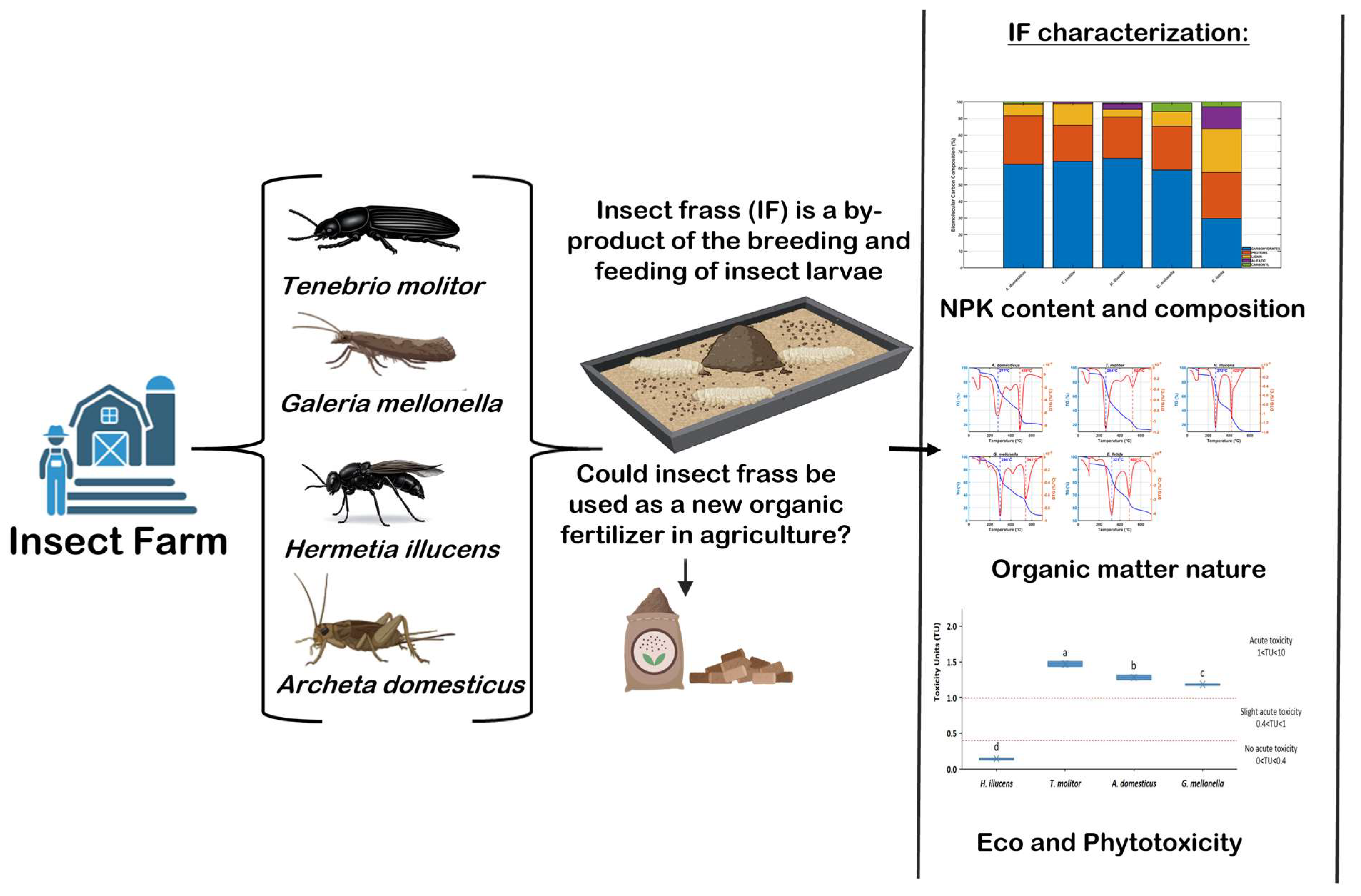
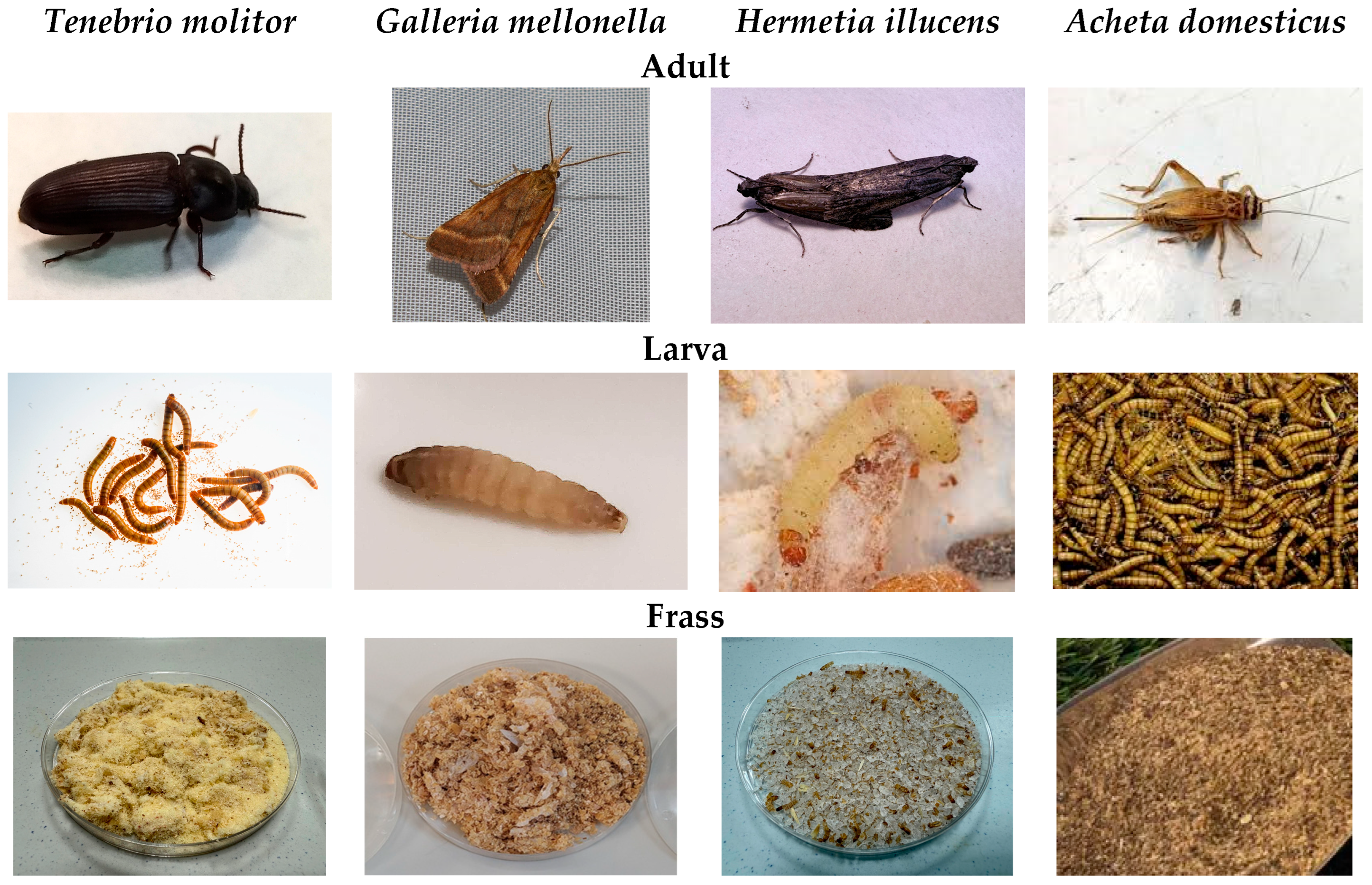
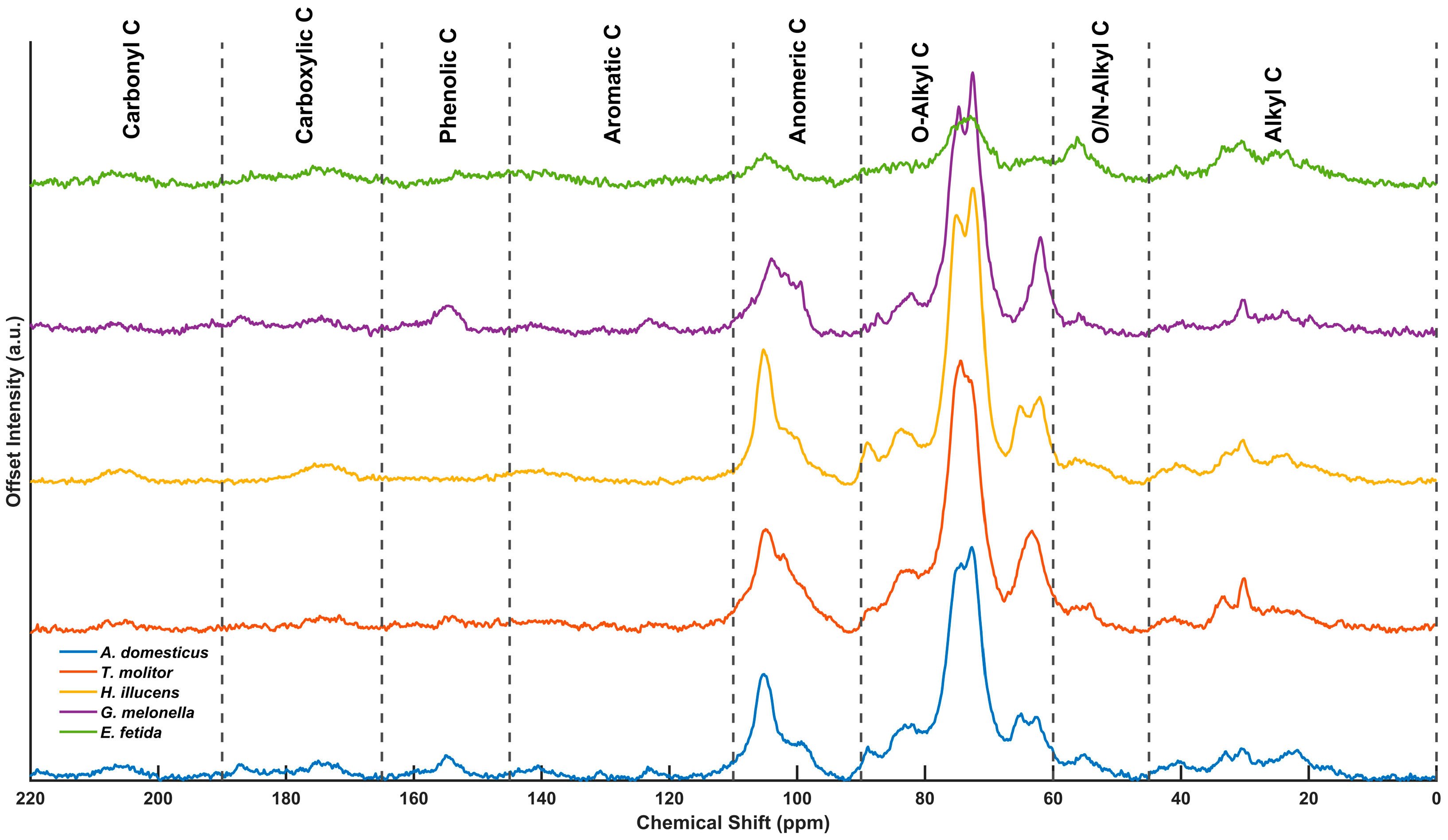
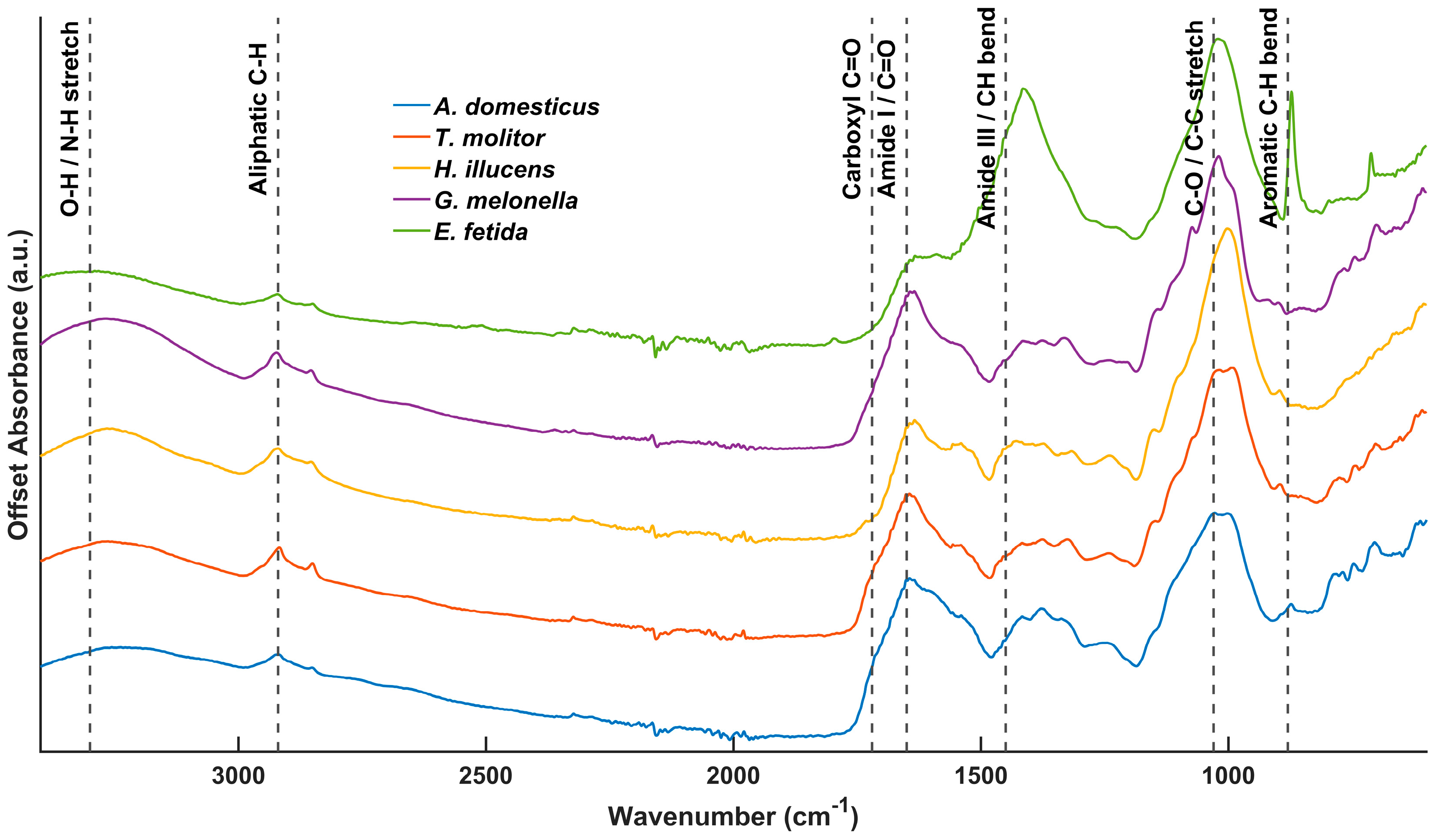
Could Insect Frass Be Used as a New Organic Fertilizer in Agriculture? Nutritional Composition, Nature of Organic Matter, Ecotoxicity, and Phytotoxicity of Insect Excrement Compared to Eisenia fetida Vermicompost

 , , , , , , ,
  , , and
Simple Summary
Abstract
1. Introduction
2. Materials and Methods
2.1. Sampling of Insects of Study
2.2. Assessment of the Nature and Composition of Ifs and EFVs
2.3. Biological Parameters
2.4. Solid-State 13C NMR Spectroscopy, Fourier-Transform Infrared (FTIR) Spectroscopy, Thermogravimetric Analysis (TG/DTG) and Differential Scanning Calorimetry (DSC)
2.5. Statistical Analysis
3. Results
3.1. Chemical Composition of IF
3.2. Nature of Organic Matter in IF Compared to EFV
3.3. Spectral and Structural Composition
3.4. Biomolecular Composition
3.5. Functional Group Characterization
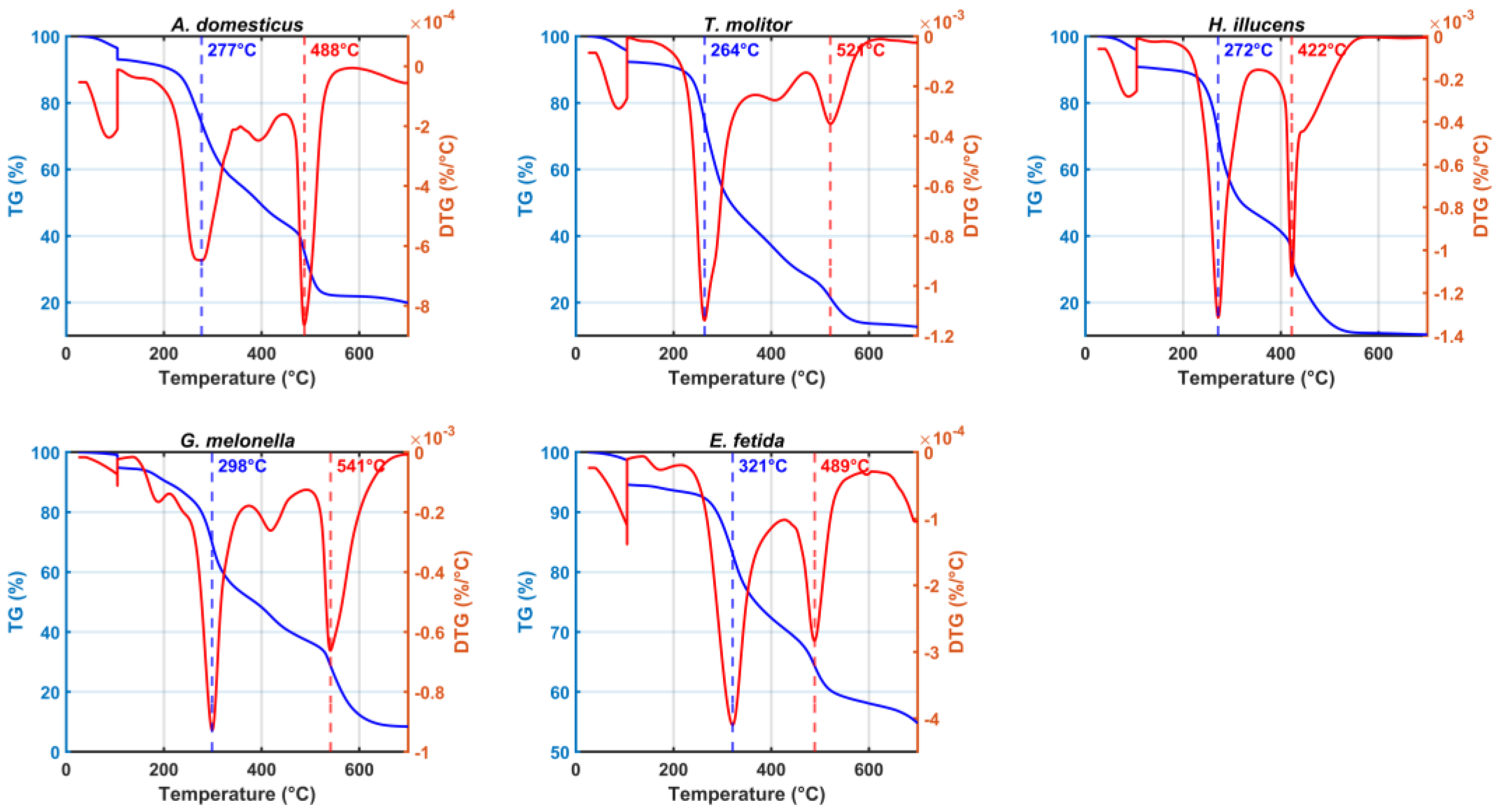
3.6. Degradability Assessment
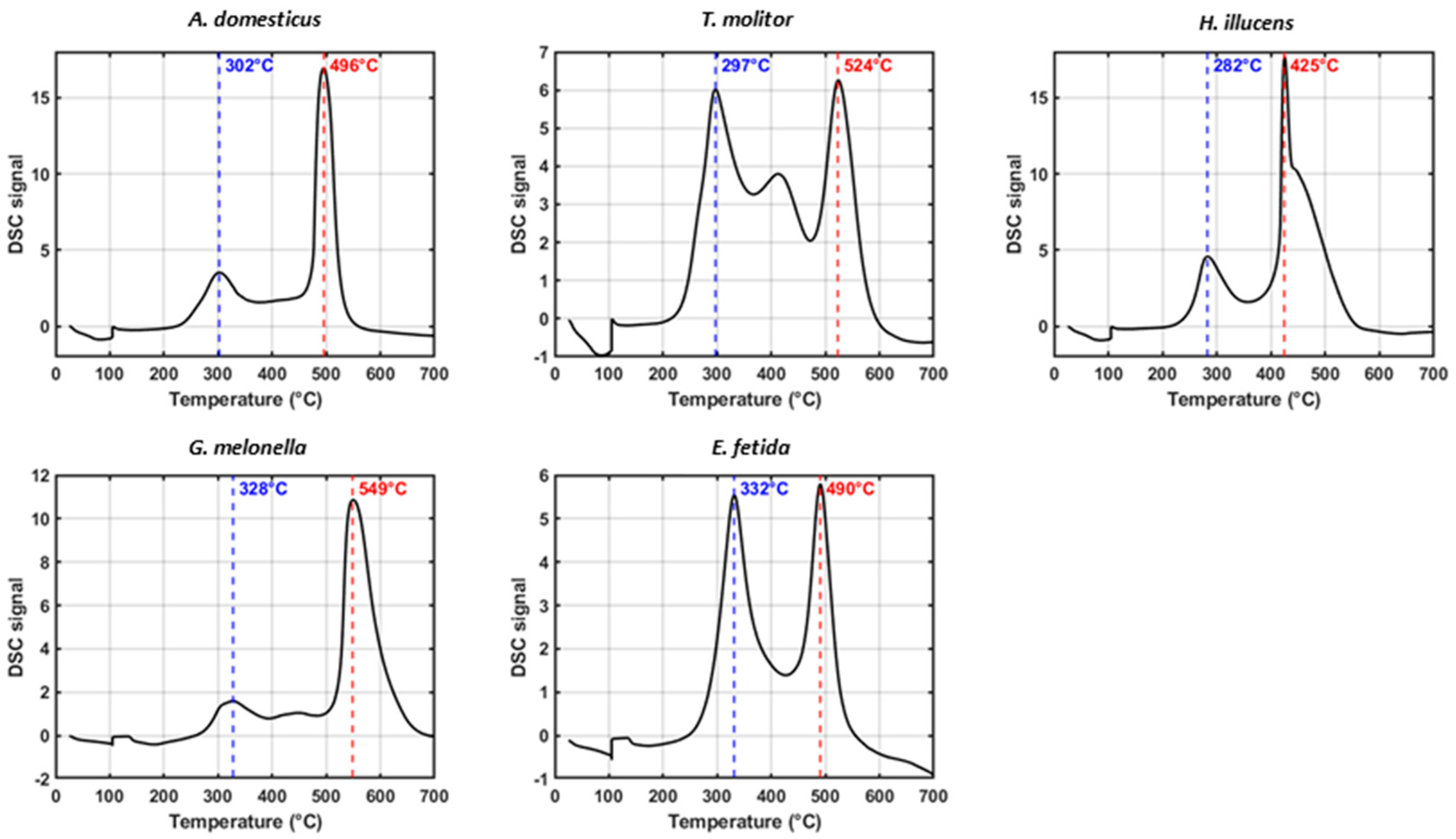
3.7. Differential Scanning Calorimetry (DSC)
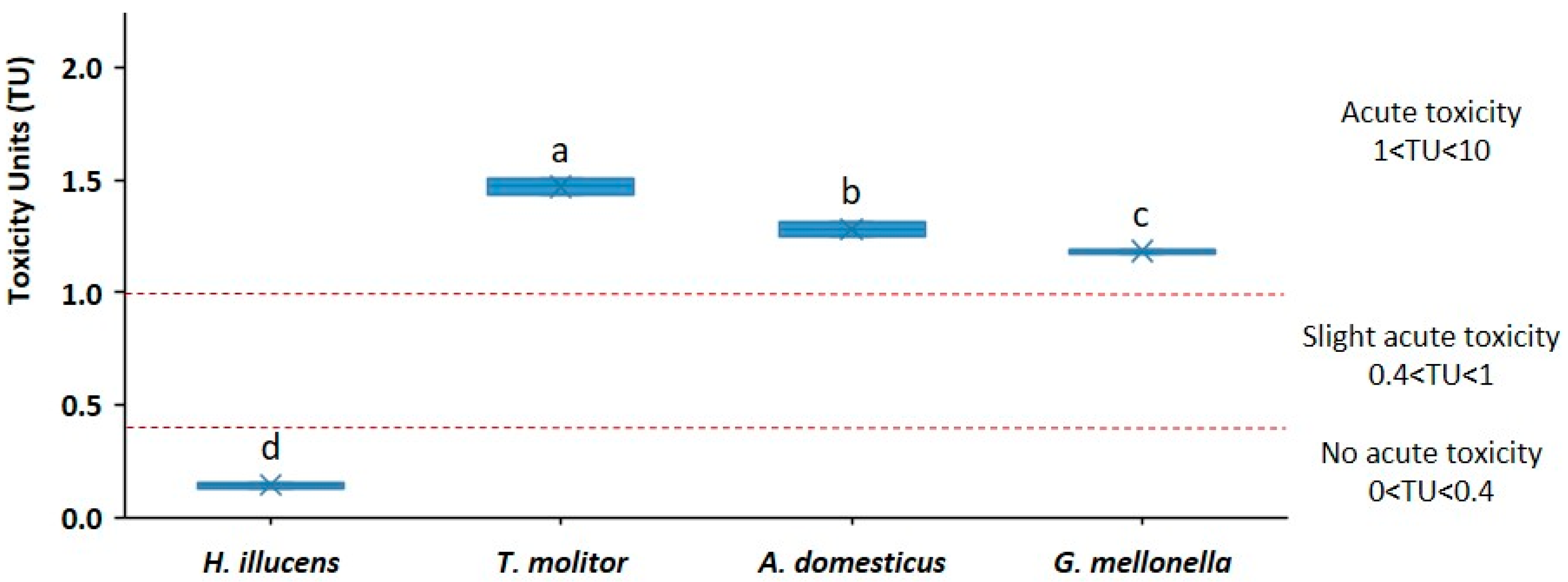
3.8. Biological Parameters: Eco- and Phytotoxicity of IF
4. Discussion
4.1. IF Agronomic Properties
4.2. Environmental Issues of IF
4.3. Organic-Matter Nature of IF
4.4. Structural/Molecular Nature of IF vs. EFV
4.5. Methodological Considerations and Broader Implications
4.6. Evaluation of Spectral Figures
4.7. Degradability and Thermal Stability (R1, R2 Continuum)
4.8. Eco- and Phytotoxicity
4.9. An Integrated Framework
4.10. Future Research Directions
5. Conclusions
Supplementary Materials
Author Contributions
Funding
Data Availability Statement
Conflicts of Interest
Abbreviations
| IF | Insect frass |
| EFV | Eisenia fetida vermicompost |
| GI | Germination index |
| EC50 | Effective concentration 50% |
| TU | Toxicity units |
| NMR | Nuclear magnetic resonance |
| CP-MAS | Cross-polarization magic angle spinning |
| FTIR | Fourier-transform infrared spectroscopy |
| ATR | Attenuated total reflection |
| TG | Thermogravimetry |
| DTG | Derivative thermogravimetry |
| TGA | Thermogravimetric analysis |
| DSC | Differential scanning calorimetry |
| Tmax | Temperature of maximum signal |
| Tmax1 | Temperature of first maximum signal |
| Tmax2 | Temperature of second maximum signal |
| R1 | Thermal stability ratio (mass loss 400–550 °C/200–400 °C) |
| R2 | Calorimetric ratio (DSC Area2/Area1) |
| EC | Electrical conductivity |
| OM | Organic matter |
| DOC | Dissolved organic carbon |
| CHA | Carbon in humic acids |
| CFA | Carbon in fulvic acids |
| TOM | Total organic matter |
| TN | Total nitrogen |
| TOC | Total organic carbon |
| NaOH | Sodium hydroxide |
| ICP-OES | Inductively coupled plasma–optical emission spectrometry |
| %G | Germination percentage |
| %L | Root length percentage |
| %GI | Germination index percentage |
References
- Raheem, D.; Carrascosa, C.; Oluwole, O.B.; Nieuwland, M.; Saraiva, A.; Millán, R.; Raposo, A. Traditional Consumption of and Rearing Edible Insects in Africa, Asia and Europe. Crit. Rev. Food Sci. Nutr. 2019, 59, 2169–2188. [Google Scholar] [CrossRef]
- Rowe, A. Insects Raised for Food and Feed-Global Scale, Practices, and Policy. 2020. Available online: https://rethinkpriorities.org/publications/insects-raised-for-food-and-feed (accessed on 15 December 2025).
- Desbois, A.P.; Coote, P.J. Wax Moth Larva (Galleria mellonella): An in Vivo Model for Assessing the Efficacy of Antistaphylococcal Agents. J. Antimicrob. Chemother. 2011, 66, 1785–1790. [Google Scholar] [CrossRef]
- Yue, H.; Hu, J.; Guan, G.; Tao, L.; Du, H.; Li, H.; Huang, G. Discovery of the Gray Phenotype and White-Gray-Opaque Tristable Phenotypic Transitions in Candida dubliniensis. Virulence 2016, 7, 230–242. [Google Scholar] [CrossRef] [PubMed][Green Version]
- Govorushko, S. Global Status of Insects as Food and Feed Source: A Review. Trends Food Sci. Technol. 2019, 91, 436–445. [Google Scholar] [CrossRef]
- Gautam, A.; Gyawali, I.; Poudel, S.; Devkota, S.; Acharya, R.; Kandel, M.; Subedi, D. Insects as Food and Feed Source: A Comprehensive Review on Nutritional Value, Food Safety Concern, Environmental Benefits, Economic Potential, Technological Innovations, Challenges, and Future Prospects. Food Front. 2025, 6, 2591–2646. [Google Scholar] [CrossRef]
- Prakoso, V.A.; Irawan, A.; Iswantari, A.; Maulana, F.; Samsudin, R.; Jayanegara, A. Evaluation of Dietary Inclusion of Black Soldier Fly (Hermetia illucens) Larvae on Fish Production Performance: A Meta-Analysis. J. Insects Food Feed 2022, 8, 1373–1384. [Google Scholar] [CrossRef]
- Tinder, A.C.; Puckett, R.T.; Turner, N.D.; Cammack, J.A.; Tomberlin, J.K. Bioconversion of Sorghum and Cowpea by Black Soldier Fly (Hermetia illucens (L.)) Larvae for Alternative Protein Production. J. Insects Food Feed 2017, 3, 121–130. [Google Scholar] [CrossRef]
- Wang, Y.S.; Shelomi, M. Review of Black Soldier Fly (Hermetia illucens) as Animal Feed and Human Food. Foods 2017, 6, 91. [Google Scholar] [CrossRef]
- Junqueira, J.C. Galleria mellonella as a Model Host for Human Pathogens: Recent Studies and New Perspectives. Virulence 2012, 3, 474–476. [Google Scholar] [CrossRef]
- Kavanagh, K.; Fallon, J.P. Galleria mellonella Larvae as Models for Studying Fungal Virulence. Fungal Biol. Rev. 2010, 24, 79–83. [Google Scholar] [CrossRef]
- Phillips, T.W.; Throne, J.E. Biorational Approaches to Managing Stored-Product Insects. Annu. Rev. Entomol. 2010, 55, 375–397. [Google Scholar] [CrossRef]
- Zunzunegui, I.; Martín-García, J.; Santamaría, Ó.; Poveda, J. Analysis of Yellow Mealworm (Tenebrio molitor) Frass as a Resource for a Sustainable Agriculture in the Current Context of Insect Farming Industry Growth. J. Clean. Prod. 2024, 460, 142608. [Google Scholar] [CrossRef]
- Gärttling, D.; Schulz, H. Compilation of Black Soldier Fly Frass Analyses. J. Soil Sci. Plant Nutr. 2021, 22, 937–943. [Google Scholar] [CrossRef]
- Beesigamukama, D.; Subramanian, S.; Tanga, C.M. Nutrient Quality and Maturity Status of Frass Fertilizer from Nine Edible Insects. Sci. Rep. 2022, 12, 7182. [Google Scholar] [CrossRef]
- Beesigamukama, D.; Mochoge, B.; Korir, N.; Musyoka, M.W.; Fiaboe, K.K.M.; Nakimbugwe, D.; Khamis, F.M.; Subramanian, S.; Dubois, T.; Ekesi, S.; et al. Nitrogen Fertilizer Equivalence of Black Soldier Fly Frass Fertilizer and Synchrony of Nitrogen Mineralization for Maize Production. Agronomy 2020, 10, 1395. [Google Scholar] [CrossRef]
- Beesigamukama, D.; Mochoge, B.; Korir, N.K.; Fiaboe, K.K.M.; Nakimbugwe, D.; Khamis, F.M.; Subramanian, S.; Dubois, T.; Musyoka, M.W.; Ekesi, S. Exploring Black Soldier Fly Frass as Novel Fertilizer for Improved Growth, Yield, and Nitrogen Use Efficiency of Maize Under Field Conditions. Front. Plant Sci. 2020, 11, 574592. [Google Scholar] [CrossRef]
- Cappellozza, S.; Leonardi, M.G.; Savoldelli, S.; Carminati, D.; Rizzolo, A.; Cortellino, G.; Terova, G.; Moretto, E.; Badaile, A.; Concheri, G.; et al. A First Attempt to Produce Proteins from Insects by Means of a Circular Economy. Animals 2019, 9, 278. [Google Scholar] [CrossRef]
- Poveda, J. Insect Frass in the Development of Sustainable Agriculture. A Review. Agron. Sustain. Dev. 2021, 41, 5. [Google Scholar] [CrossRef]
- Gligorescu, A.; Macavei, L.I.; Larsen, B.F.; Markfoged, R.; Fischer, C.H.; Koch, J.D.; Jensen, K.; Lau Heckmann, L.H.; Nørgaard, J.V.; Maistrello, L. Pilot Scale Production of Hermetia illucens (L.) Larvae and Frass Using Former Foodstuffs. Clean. Eng. Technol. 2022, 10, 100546. [Google Scholar] [CrossRef]
- Fuertes-Mendizábal, T.; Salcedo, I.; Huérfano, X.; Riga, P.; Estavillo, J.M.; Ávila Blanco, D.; Duñabeitia, M.K. Mealworm Frass as a Potential Organic Fertilizer in Synergy with PGP-Based Biostimulant for Lettuce Plants. Agronomy 2023, 13, 1258. [Google Scholar] [CrossRef]
- Sawinska, Z.; Radzikowska-Kujawska, D.; Kowalczewski, P.Ł.; Grzanka, M.; Sobiech, Ł.; Skrzypczak, G.; Drożdżyńska, A.; Ślachciński, M.; Świtek, S. Hermetia illucens Frass Fertilization: A Novel Approach for Enhancing Lettuce Resilience and Photosynthetic Efficiency under Drought Stress Conditions. Appl. Sci. 2024, 14, 2386. [Google Scholar] [CrossRef]
- Safitri, R.A.; Vandeweyer, D.; Deruytter, D.; Meijer, N.; Coudron, C.L.; Banach, J.L.; van der Fels-Klerx, H.J. Exploring Potential Uses of Insect Frass for Agricultural Production Considering Its Nutrients, and Chemical and Microbiological Safety. J. Insects Food Feed 2024, 11, 167–190. [Google Scholar] [CrossRef]
- Zheng, K.; Zeng, Z.; Tian, Q.; Huang, J.; Zhong, Q.; Huo, X. Epidemiological Evidence for the Effect of Environmental Heavy Metal Exposure on the Immune System in Children. Sci. Total Environ. 2023, 868, 161691. [Google Scholar] [CrossRef] [PubMed]
- Schrögel, P.; Wätjen, W. Insects for Food and Feed-Safety Aspects Related to Mycotoxins and Metals. Foods 2019, 8, 288. [Google Scholar] [CrossRef] [PubMed]
- Lomonaco, G.; Franco, A.; De Smet, J.; Scieuzo, C.; Salvia, R.; Falabella, P. Larval Frass of Hermetia illucens as Organic Fertilizer: Composition and Beneficial Effects on Different Crops. Insects 2024, 15, 293. [Google Scholar] [CrossRef] [PubMed]
- Tsochatzis, E.D.; Berggreen, I.E.; Vidal, N.P.; Roman, L.; Gika, H.; Corredig, M. Cellular Lipids and Protein Alteration during Biodegradation of Expanded Polystyrene by Mealworm Larvae under Different Feeding Conditions. Chemosphere 2022, 300, 134420. [Google Scholar] [CrossRef]
- Tsochatzis, E.D.; Berggreen, I.E.; Nørgaard, J.V.; Theodoridis, G.; Dalsgaard, T.K. Biodegradation of Expanded Polystyrene by Mealworm Larvae under Different Feeding Strategies Evaluated by Metabolic Profiling Using GC-TOF-MS. Chemosphere 2021, 281, 130840. [Google Scholar] [CrossRef]
- Hénault-Ethier, L.; Quinche, M.; Reid, B.; Hotte, N.; Fortin, A.; Normandin, É.; de La Rochelle Renaud, G.; Rasooli Zadeh, A.; Deschamps, M.H.; Vandenberg, G. Opportunities and Challenges in Upcycling Agri-Food Byproducts to Generate Insect Manure (Frass): A Literature Review. Waste Manag. 2024, 176, 169–191. [Google Scholar] [CrossRef]
- Bloukounon-Goubalan, A.Y.; Saïdou, A.; Clottey, V.A.; Coulibaly, K.; Erokotan, N.; Obognon, N.; Chabi, F.; Chrysostome, C.A.A.M. By-Products of Insect Rearing: Insect Residues as Biofertilizers. In Insects as Animal Feed: Novel Ingredients for Use in Pet, Aquaculture and Livestock Diets; CABI: Wallingford, UK, 2021; pp. 60–71. [Google Scholar] [CrossRef]
- Arabzadeh, G.; Delisle-Houde, M.; Vandenberg, G.W.; Deschamps, M.H.; Dorais, M.; Derome, N.; Tweddell, R.J. Suppressive Effect of Black Soldier Fly Larvae Frass on Fusarium Wilt Disease in Tomato Plants. Insects 2024, 15, 613. [Google Scholar] [CrossRef]
- Kisaakye, J.; Beesigamukama, D.; Haukeland, S.; Subramanian, S.; Thiongo, P.K.; Kelemu, S.; Tanga, C.M. Chitin-Enriched Insect Frass Fertilizer as a Biorational Alternative for Root-Knot Nematode (Meloidogyne incognita) Management. Front. Plant Sci. 2024, 15, 1361739. [Google Scholar] [CrossRef]
- Watson, C.; Leal, H.; Wichern, F. Urease Inhibition Stimulates Fungal Degradation of Chitin in Frass-Amended Soil. J. Plant Nutr. Soil Sci. 2025, 188, 45–51. [Google Scholar] [CrossRef]
- Amorim, H.C.S.; Ashworth, A.J.; Arsi, K.; Rojas, M.G.; Morales-Ramos, J.A.; Donoghue, A.; Robinson, K. Insect Frass Composition and Potential Use as an Organic Fertilizer in Circular Economies. J. Econ. Entomol. 2024, 117, 1261–1268. [Google Scholar] [CrossRef]
- Smidt, E.; Böhm, K.; Schwanninger, M. The Application of FT-IR Spectroscopy in Waste Management. In Fourier Transforms—New Analytical Approaches and FTIR Strategies; Nikolic, G., Ed.; InTech: Rijeka, Croatia, 2011; pp. 405–430. [Google Scholar]
- Carballo, T.; Gil, M.V.; Gómez, X.; González-Andrés, F.; Morán, A. Characterization of Different Compost Extracts Using Fourier-Transform Infrared Spectroscopy (FTIR) and Thermal Analysis. Biodegradation 2008, 19, 815–830. [Google Scholar] [CrossRef]
- Martín, A.P.S.; Marhuenda-Egea, F.C.; Bustamante, M.A.; Curaqueo, G. Spectroscopy Techniques for Monitoring the Composting Process: A Review. Agronomy 2023, 13, 2245. [Google Scholar] [CrossRef]
- Nelson, P.N.; Baldock, J.A. Estimating the Molecular Composition of a Diverse Range of Natural Organic Materials from Solid-State 13C NMR and Elemental Analyses. Biogeochemistry 2005, 72, 1–34. [Google Scholar] [CrossRef]
- Baffi, C.; Dell’Abate, M.T.; Nassisi, A.; Silva, S.; Benedetti, A.; Genevini, P.L.; Adani, F. Determination of Biological Stability in Compost: A Comparison of Methodologies. Soil Biol. Biochem. 2007, 39, 1284–1293. [Google Scholar] [CrossRef]
- Dell’Abate, M.T.; Tittarelli, F. Monitoring of a Composting Process: Thermal Stability of Raw Materials and Products. In Microbiology of Composting; Springer: Berlin/Heidelberg, Germany, 2002; pp. 357–371. [Google Scholar] [CrossRef]
- Dell’Abate, M.T.; Canali, S.; Trinchera, A.; Benedetti, A.; Sequi, P. Thermal Analysis in the Evaluation of Compost Stability: A Comparison with Humification Parameters. Nutr. Cycl. Agroecosyst. 1998, 51, 217–224. [Google Scholar] [CrossRef]
- Dulaurent, A.M.; Daoulas, G.; Faucon, M.P.; Houben, D. Earthworms (Lumbricus terrestris L.) Mediate the Fertilizing Effect of Frass. Agronomy 2020, 10, 783. [Google Scholar] [CrossRef]
- Praeg, N.; Klammsteiner, T. Primary Study on Frass Fertilizers from Mass-Reared Insects: Species Variation, Heat Treatment Effects, and Implications for Soil Application at Laboratory Scale. J. Environ. Manag. 2024, 356, 120622. [Google Scholar] [CrossRef]
- Salomon, M.J.; Cavagnaro, T.R.; Burton, R.A. Potential of Black Soldier Fly Larvae Frass (BSFL) as a Novel Fertilizer: Impacts on Tomato Growth, Nutrient Uptake, and Mycorrhizal Formation. Plant Soil 2025, 513, 417–434. [Google Scholar] [CrossRef]
- Mostafaie, A.; Silva, A.R.R.; Pinto, J.N.; Prodana, M.; Lopes, I.G.; Murta, D.; Brooks, B.W.; Loureiro, S.; Cardoso, D.N. Towards Circularity for Agro-Waste: Minimal Soil Hazards of Olive Pomace Bioconverted Frass by Insect Larvae as an Organic Fertilizer. J. Environ. Manag. 2025, 375, 124151. [Google Scholar] [CrossRef]
- Rubio, P.; Todolí, J.; Martínez-Sánchez, A.; Rojo, S. Evolution of the mineral concentration and bioaccumulation of the black soldier fly, Hermetia illucens, feeding on two different larval media. J. Insect Food Feed 2022, 8, 367–378. [Google Scholar] [CrossRef]
- Sánchez-Monedero, M.A.; Cegarra, J.; García, D.; Roig, A. Chemical and Structural Evolution of Humic Acids during Organic Waste Composting. Biodegradation 2002, 13, 361–371. [Google Scholar] [CrossRef]
- Zucconi, F.; Pera, A.; Forte, M.; De Bertoldi, M. Evaluating Toxicity of Immature Compost. Biocycle 1981, 22, 54–57. [Google Scholar]
- UNE-EN ISO 11348-3:2009; Water Quality—Determination of the Inhibitory Effect of Water Samples on the Light Emission of Vibrio fischeri (Luminescent bacteria Test). Part 3: Method Using Freeze-Dried Bacteria. AENOR: Madrid, Spain, 2009.
- Smidt, E.; Meissl, K. The Applicability of Fourier Transform Infrared (FT-IR) Spectroscopy in Waste Management. Waste Manag. 2007, 27, 268–276. [Google Scholar] [CrossRef] [PubMed]
- Kögel-Knabner, I. Analytical Approaches for Characterizing Soil Organic Matter. Org. Geochem. 2000, 31, 609–625. [Google Scholar] [CrossRef]
- Rinaudo, M. Chitin and Chitosan: Properties and Applications. Prog. Polym. Sci. 2006, 31, 603–632. [Google Scholar] [CrossRef]
- Kumari, S.; Kishor, R. Chitin and Chitosan: Origin, Properties, and Applications. In Handbook of Chitin and Chitosan: Volume 1: Preparation and Properties; Elsevier: Amsterdam, The Netherlands, 2020; pp. 1–33. [Google Scholar] [CrossRef]
- Persoone, G.; Marsalek, B.; Blinova, I.; Törökne, A.; Zarina, D.; Manusadzianas, L.; Nalecz-Jawecki, G.; Tofan, L.; Stepanova, N.; Tothova, L.; et al. A Practical and User-Friendly Toxicity Classification System with Microbiotests for Natural Waters and Wastewaters. Environ. Toxicol. 2003, 18, 395–402. [Google Scholar] [CrossRef] [PubMed]
- Lazcano, C.; Domínguez, J. The Use of Vermicompost in Sustainable Agriculture: Impact on Plant Growth and Soil Fertility. In Soil Nutrients; Miransari, M., Ed.; Nova Science Publishers: Hauppauge, NY, USA, 2011; pp. 230–254. [Google Scholar]
- Klammsteiner, T.; Turan, V.; Juárez, M.F.D.; Oberegger, S.; Insam, H. Suitability of Black Soldier Fly Frass as Soil Amendment and Implication for Organic Waste Hygienization. Agronomy 2020, 10, 1578. [Google Scholar] [CrossRef]
- Barragan-Fonseca, K.B.; Dicke, M.; van Loon, J.J.A. Nutritional Value of the Black Soldier Fly (Hermetia illucens L.) and Its Suitability as Animal Feed—A Review. J. Insects Food Feed 2017, 3, 105–120. [Google Scholar] [CrossRef]
- Ashworth, A.J.; Amorim, H.C.S.; Drescher, G.L.; Moore, P.A.; Rojas, M.G.; Morales-Ramos, J.; Donoghue, A.M. Insect Frass Fertilizer as Soil Amendment for Improved Forage and Soil Health in Circular Systems. Sci. Rep. 2025, 15, 3024. [Google Scholar] [CrossRef] [PubMed]
- Houben, D.; Daoulas, G.; Faucon, M.P.; Dulaurent, A.M. Potential Use of Mealworm Frass as a Fertilizer: Impact on Crop Growth and Soil Properties. Sci. Rep. 2020, 10, 4659. [Google Scholar] [CrossRef]
- Diener, S. Valorisation of Organic Solid Waste Using the Black Soldier Fly, Hermetia illucens, in Low and Middle-Income Countries. Ph.D. Thesis, ETH Zürich, Zürich, Switzerland, 2010. [Google Scholar] [CrossRef]
- Delin, S.; Engström, L. Timing of Organic Fertiliser Application to Synchronise Nitrogen Supply with Crop Demand. Acta Agric. Scand. B Soil Plant Sci. 2010, 60, 78–88. [Google Scholar] [CrossRef]
- Alidadi, H.; Najafpoor, A.A.; Hosseinzadeh, A.; Dolatabadi Takabi, M.; Esmaili, H.; Zanganeh, J.; Piranloo, F.G. Waste Recycling by Vermicomposting: Maturity and Quality Assessment via Dehydrogenase Enzyme Activity, Lignin, Water Soluble Carbon, Nitrogen, Phosphorous and Other Indicators. J. Environ. Manag. 2016, 182, 134–140. [Google Scholar] [CrossRef]
- Hait, S.; Tare, V. Optimizing Vermistabilization of Waste Activated Sludge Using Vermicompost as Bulking Material. Waste Manag. 2011, 31, 502–511. [Google Scholar] [CrossRef] [PubMed]
- Yadav, A.; Garg, V.K. Biotransformation of Bakery Industry Sludge into Valuable Product Using Vermicomposting. Bioresour. Technol. 2019, 274, 512–517. [Google Scholar] [CrossRef] [PubMed]
- Liu, T.; Awasthi, M.K.; Awasthi, S.K.; Duan, Y.; Zhang, Z. Effects of Black Soldier Fly Larvae (Diptera: Stratiomyidae) on Food Waste and Sewage Sludge Composting. J. Environ. Manag. 2020, 256, 109967. [Google Scholar] [CrossRef]
- Liu, T.; Awasthi, S.K.; Qin, S.; Liu, H.; Awasthi, M.K.; Zhou, Y.; Jiao, M.; Pandey, A.; Varjani, S.; Zhang, Z. Conversion Food Waste and Sawdust into Compost Employing Black Soldier Fly Larvae (Diptera: Stratiomyidae) under the Optimized Condition. Chemosphere 2021, 272, 129931. [Google Scholar] [CrossRef]
- Atiyeh, R.M.; Arancon, N.; Edwards, C.A.; Metzger, J.D. Influence of Earthworm-Processed Pig Manure on the Growth and Yield of Greenhouse Tomatoes. Bioresour. Technol. 2000, 75, 175–180. [Google Scholar] [CrossRef]
- Bernal, M.P.; Alburquerque, J.A.; Moral, R. Composting of Animal Manures and Chemical Criteria for Compost Maturity Assessment. A Review. Bioresour. Technol. 2009, 100, 5444–5453. [Google Scholar] [CrossRef]
- Poma, G.; Yin, S.; Tang, B.; Fujii, Y.; Cuykx, M.; Covaci, A. Occurrence of Selected Organic Contaminants in Edible Insects and Assessment of Their Chemical Safety. Environ. Health Perspect. 2019, 127, 127009. [Google Scholar] [CrossRef] [PubMed]
- van der Fels-Klerx, H.J.; Meijer, N.; Nijkamp, M.M.; Schmitt, E.; van Loon, J.J.A. Chemical Food Safety of Using Former Foodstuffs for Rearing Black Soldier Fly Larvae (Hermetia illucens) for Feed and Food Use. J. Insects Food Feed 2020, 6, 475–488. [Google Scholar] [CrossRef]
- Smetana, S.; Schmitt, E.; Mathys, A. Sustainable Use of Hermetia illucens Insect Biomass for Feed and Food: Attributional and Consequential Life Cycle Assessment. Resour. Conserv. Recycl. 2019, 144, 285–296. [Google Scholar] [CrossRef]
- Broeckx, L.; Frooninckx, L.; Slegers, L.; Berrens, S.; Noyens, I.; Goossens, S.; Verheyen, G.; Wuyts, A.; Van Miert, S. Growth of Black Soldier Fly Larvae Reared on Organic Side-Streams. Sustainability 2021, 13, 12953. [Google Scholar] [CrossRef]
- European Commission. Regulation (EU) 2019/1009 of the European Parliament and of the Council of 5 June 2019 Laying Down Rules on the Making Available on the Market of EU Fertilising Products. Off. J. Eur. Union 2019, 170, 1–114. [Google Scholar]
- Parodi, A.; Leip, A.; De Boer, I.J.M.; Slegers, P.M.; Ziegler, F.; Temme, E.H.M.; Herrero, M.; Tuomisto, H.; Valin, H.; Van Middelaar, C.E.; et al. The Potential of Future Foods for Sustainable and Healthy Diets. Nat. Sustain. 2018, 1, 782–789. [Google Scholar] [CrossRef]
- Kaye, J.P.; Hart, S.C. Competition for Nitrogen between Plants and Soil Microorganisms. Trends Ecol. Evol. 1997, 12, 139–143. [Google Scholar] [CrossRef]
- Warman, P.R. Evaluation of Seed Germination and Growth Tests for Assessing Compost Maturity. Compost Sci. Util. 1999, 7, 33–37. [Google Scholar] [CrossRef]
- Sharma, K.; Garg, V.K. Comparative Analysis of Vermicompost Quality Produced from Rice Straw and Paper Waste Employing Earthworm Eisenia fetida (Sav.). Bioresour. Technol. 2018, 250, 708–715. [Google Scholar] [CrossRef]
- Rehman, K.; Rehman, A.; Cai, M.; Zheng, L.; Xiao, X.; Somroo, A.A.; Wang, H.; Li, W.; Yu, Z.; Zhang, J. Conversion of Mixtures of Dairy Manure and Soybean Curd Residue by Black Soldier Fly Larvae (Hermetia illucens L.). J. Clean. Prod. 2017, 154, 366–373. [Google Scholar] [CrossRef]
- Popescu, I.S.; Covaliu-Mierlă, C.I.; Niculescu, V.C.; Șandru, C. Home Composting: A Sustainable Solution at Community Level. Sustainability 2025, 17, 3368. [Google Scholar] [CrossRef]
- Lopes, I.G.; Yong, J.W.; Lalander, C. Frass derived from black soldier fly larvae treatment of biodegradable wastes. A critical review and future perspectives. Waste Manag. 2022, 142, 65–76. [Google Scholar] [CrossRef]
- Baldock, J.A.; Smernik, R.J. Chemical Composition and Bioavailability of Thermally Altered Pinus resinosa (Red Pine) Wood. Org. Geochem. 2002, 33, 1093–1109. [Google Scholar] [CrossRef]
- Skjemstad, J.O.; Clarke, P.; Taylor, J.A.; Oades, J.M.; McClure, S.G. The Chemistry and Nature of Protected Carbon in Soil. Aust. J. Soil Res. 1996, 34, 251–271. [Google Scholar] [CrossRef]
- Skjemstad, J.O.; Waters, A.G.; Hanna, J.V.; Oades, J.M. Genesis of Podzols on Coastal Dunes in Southern Queensland.I.V. Nature of the Organic Fraction as Seen by 13C Nuclear Magnetic Resonance Spectroscopy. Aust. J. Soil Res. 1992, 30, 667–681. [Google Scholar] [CrossRef]
- Smernik, R.J.; Oades, J.M. The Use of Spin Counting for Determining Quantitation in Solid State 13C NMR Spectra of Natural Organic Matter 2. HF-Treated Soil Fractions. Geoderma 2000, 96, 159–171. [Google Scholar] [CrossRef]
- Lehmann, J.; Kleber, M. The Contentious Nature of Soil Organic Matter. Nature 2015, 7580, 60–68. [Google Scholar] [CrossRef] [PubMed]
- Tambone, F.; Scaglia, B.; D’Imporzano, G.; Schievano, A.; Orzi, V.; Salati, S.; Adani, F. Assessing Amendment and Fertilizing Properties of Digestates from Anaerobic Digestion through a Comparative Study with Digested Sludge and Compost. Chemosphere 2010, 81, 577–583. [Google Scholar] [CrossRef]
- Margenot, A.J.; Parikh, S.J.; Calderón, F.J. Fourier-Transform Infrared Spectroscopy for Soil Organic Matter Analysis. Soil Sci. Soc. Am. J. 2023, 87, 1503–1528. [Google Scholar] [CrossRef]
- Ukalska-Jaruga, A.; Bejger, R.; Debaene, G.; Smreczak, B. Characterization of Soil Organic Matter Individual Fractions (Fulvic Acids, Humic Acids, and Humins) by Spectroscopic and Electrochemical Techniques in Agricultural Soils. Agronomy 2021, 11, 1067. [Google Scholar] [CrossRef]
- Machado, W.; Franchini, J.C.; de Fátima Guimarães, M.; Filho, J.T. Spectroscopic Characterization of Humic and Fulvic Acids in Soil Aggregates, Brazil. Heliyon 2020, 6, e04078. [Google Scholar] [CrossRef] [PubMed]
- Nebbioso, A.; Piccolo, A. Molecular Characterization of Dissolved Organic Matter (DOM): A Critical Review. Anal. Bioanal. Chem. 2013, 405, 109–124. [Google Scholar] [CrossRef]
- Tiquia, S.M. Microbiological Parameters as Indicators of Compost Maturity. J. Appl. Microbiol. 2005, 99, 816–828. [Google Scholar] [CrossRef]
- Hsu, J.H.; Lo, S.L. Chemical and Spectroscopic Analysis of Organic Matter Transformations during Composting of Pig Manure. Environ. Pollut. 1999, 104, 189–196. [Google Scholar] [CrossRef]
- Tiquia, S.M. Reduction of Compost Phytotoxicity during the Process of Decomposition. Chemosphere 2010, 79, 506–512. [Google Scholar] [CrossRef] [PubMed]
- Doña-Grimaldi, V.M.; Palma, A.; Ruiz-Montoya, M.; Morales, E.; Díaz, M.J. Energetic Valorization of MSW Compost Valorization by Selecting the Maturity Conditions. J. Environ. Manag. 2019, 238, 153–158. [Google Scholar] [CrossRef]
- Siddiqui, S.; Alamri, S.; Al Rumman, S.; Al-Kahtani, M.A.; Meghvansi, M.K.; Jeridi, M.; Shumail, T.; Moustafa, M. Recent Advances in Assessing the Maturity and Stability of Compost. In Biology of Composts. Soil Biology; Meghvansi, M., Varma, A., Eds.; Springer: Cham, Switzerland, 2020; Volume 58, pp. 181–202. [Google Scholar] [CrossRef]
- Wichuk, K.M.; McCartney, D. Compost Stability and Maturity Evaluation—A Literature Review. J. Environ. Eng. Sci. 2010, 37, 1505–1523. [Google Scholar] [CrossRef]
- Zbytniewski, R.; Buszewski, B. Characterization of Natural Organic Matter (NOM) Derived from Sewage Sludge Compost. Part 1: Chemical and Spectroscopic Properties. Bioresour. Technol. 2005, 96, 471–478. [Google Scholar] [CrossRef]
- Kok, D.D.; Scherer, L.; de Vries, W.; Trimbos, K.; van Bodegom, P.M. Relationships of Priming Effects with Organic Amendment Composition and Soil Microbial Properties. Geoderma 2022, 422, 115951. [Google Scholar] [CrossRef]



| Insect Frass | |||||||||
|---|---|---|---|---|---|---|---|---|---|
| Parameter | T. molitor (n = 6) | G. mellonella (n = 4) | H. illucens (n = 8) | A. domesticus (n = 12) | E. fetida (n = 10) | F-ANOVA | IFA (n = 30) | EFV (n = 10) | F-ANOVA |
| C (%) | 39.6 d | 41.9 e | 37.2 c | 34.8 b | 25.3 a | 175 *** | 38.6 b | 25.3 a | 75 *** |
| N (%) | 3.6 bc | 4.0 c | 2.9 ab | 6.4 d | 2.4 a | 59 *** | 4.1 b | 2.4 a | 17 ** |
| P (%) | 1.20 b | 0.77 a | 0.92 a | 1.44 c | 0.81 a | 23 *** | 1.10 a | 0.81 a | 0.5 ns |
| K (%) | 1.54 c | 0.99 a | 2.05 d | 3.02 e | 1.28 b | 38 *** | 1.83 a | 1.28 a | 0.7 ns |
| Ca (%) | 0.19 a | 0.59 b | 0.28 a | 2.21 c | 2.93 d | 1026 *** | 0.69 a | 2.93 b | 6.9 *** |
| Mg (%) | 0.47 c | 0.15 a | 0.27 b | 0.66 d | 0.44 c | 524 *** | 0.40 a | 0.44 a | 0.6 ns |
| Na (%) | 0.03 a | 0.24 c | 0.05 b | 0.60 d | 0.21 c | 20,340 *** | 0.19 a | 0.21 a | 2.2 ns |
| S (%) | 0.21 a | 0.23 b | 0.27 c | 0.53 d | 0.31 c | 1429 *** | 0.29 a | 0.21 a | 1.9 ns |
| Si (%) | 0.22 a | 1.32 b | 0.04 a | 0.04 a | 0.15 b | 54 *** | 0.37 b | 0.15 a | 4.1 ** |
| B (ppm) | 117 c | 756 d | 14 a | 33 a | 55 b | 55 *** | 208 a | 55 b | 2.1 ns |
| Fe (ppm) | 232 b | 42 a | 437 c | 871 d | 6575 e | 679 *** | 363 a | 6575 b | 971 *** |
| Cu (ppm) | 14.8 b | 4.3 a | 17.5 c | 66.2 d | 75.1 e | 6232 *** | 23.5 a | 75.1 b | 361 *** |
| Mn (ppm) | 167 c | 39 a | 91 b | 473 e | 347 d | 163 *** | 187 a | 347 b | 96 *** |
| Zn (ppm) | 94 b | 57 a | 103 b | 587 d | 287 c | 1592 *** | 187 a | 287 b | 225 *** |
| Al (ppm) | 212 a | 306 ab | 449 b | 871 c | 390 b | 51 *** | 410 a | 390 a | 0.3 ns |
| Mo (ppm) | 1.41 b | 0.27 a | 2.17 c | 6.37 d | 2.8 c | 925 *** | 2.3 a | 2.8 a | 2.1 ns |
| Cd (ppm) | 0.12 c | 0.06 b | 0.04 a | 0.17 d | 0.40 e | 117 *** | 0.10 a | 0.40 b | 63 ** |
| Ni (ppm) | 1.2 a | 1.8 b | 2.6 c | 9.4 d | 10.3 d | 3697 *** | 3.2 a | 10.3 b | 29 ** |
| Cr (ppm) | 1.5 a | 2.4 b | 4.4 c | 11.0 d | 27.1 e | 724 *** | 4.2 a | 27.1 b | 230 *** |
| Pb (ppm) | 0.43 ab | 0.01 ab | 0.95 b | 1.03 b | 12.2 c | 45 ** | 0.57 a | 12.2 b | 567 *** |
| Co (ppm) | 0.43 ab | 0.1 ab | 0.95 b | 1.03 b | 1.8 c | 14 *** | 0.15 a | 1.8 b | 12 ** |
| Ti (ppm) | 8.5 a | 7.3 a | 12.6 a | 27.1 b | 15 a | 17 ** | 13 a | 15 a | 1.3 ns |
| Li (ppm) | 0.1 a | 1.3 a | 1.5 a | 1.9 a | 3.1 b | 9.1 ** | 1.2 a | 3.1 b | 6.6 * |
| Be (ppm) | 0.02 a | 0.16 b | 0.05 a | 0.05 a | 0.21 b | 12 ** | 0.06 a | 0.21 c | 8.3 ** |
| Sr (ppm) | 9.1 b | 6.0 a | 15.9 c | 36.9 d | 25.1 cd | 212 *** | 15.4 a | 25.1 b | 5.3 ** |
| Rb (ppm) | 9.9 a | 11.1 a | 10.6 a | 25.4 b | 31 b | 339 *** | 13.4 a | 31 b | 11 ** |
| IF | pH | EC (dS m−1) | OM (%) | C/N | DOC (g kg−1) | CHA (%) | CFA (%) |
|---|---|---|---|---|---|---|---|
| T. molitor (n = 6) | 5.66 a | 5.32 b | 88.9 c | 11.3 bc | 74.1 d | 8.10 d | 9.05 d |
| G. mellonella (n = 4) | 6.74 b | 4.81 a | 82.0 b | 10.4 b | 36.1 b | 8.60 e | 9.60 e |
| H. illucens (n = 8) | 7.55 c | 4.74 a | 90.1 c | 12.6 c | 49.9 c | 7.63 c | 8.53 c |
| A. domesticus (n = 12) | 6.49 b | 9.59 c | 86.4 b | 5.4 a | 35.3 b | 7.13 b | 7.96 b |
| EFV (n = 10) | 7.48 c | 5.42 b | 52.9 a | 10.2 b | 8.84 | 3.98 a | 2.93 a |
| F-ANOVA | 113 *** | 238 *** | 259 *** | 23 *** | 1097 *** | 2718 *** | 2230 *** |
| IF Average (n = 30) | 6.53 a | 6.05 | 87.0 | 10.2 a | 50.8 b | 7.88 b | 8.81 b |
| EFV (n = 10) | 7.48 b | 5.42 | 52.9 | 10.2 a | 8.83 a | 3.9 a | 2.93 a |
| F-ANOVA | 8.52 ** | 0.5 ns | 438 *** | 0.2 ns | 34 *** | 287 *** | 399 *** |
| IF | Carbohydrates | Protein | Lignin | Aliphatic | Carbonyl |
|---|---|---|---|---|---|
| T. molitor | 64.23 | 21.73 | 12.98 | 2.27 | 0.00 |
| G. mellonella | 58.92 | 26.40 | 8.93 | 0.00 | 5.06 |
| H. illucens | 66.01 | 24.87 | 4.75 | 3.24 | 0.51 |
| A. domesticus | 62.38 | 29.29 | 7.07 | 0.11 | 1.48 |
| EFV | 29.71 | 27.83 | 26.43 | 13.02 | 5.58 |
| IF | %G | %L | %GI |
|---|---|---|---|
| T. molitor | 13.8 a | 8.8 a | 1.3 a |
| G. mellonella | 99.1 c | 73.9 c | 72.6 c |
| H. illucens | 85.4 bc | 81.2 c | 69.7 c |
| A. domesticus | 70.3 b | 40.7 b | 28.6 b |
| EFV | 100 c | 128 d | 129 d |
| F-ANOVA | 63 *** | 229 *** | 140 *** |
Disclaimer/Publisher’s Note: The statements, opinions and data contained in all publications are solely those of the individual author(s) and contributor(s) and not of MDPI and/or the editor(s). MDPI and/or the editor(s) disclaim responsibility for any injury to people or property resulting from any ideas, methods, instructions or products referred to in the content. |
© 2026 by the authors. Licensee MDPI, Basel, Switzerland. This article is an open access article distributed under the terms and conditions of the Creative Commons Attribution (CC BY) license.
Share and Cite
Castillo, P.; Sáez-Tovar, J.A.; Andreu-Rodríguez, F.J.; Estrada-Medina, H.; Marhuenda-Egea, F.C.; Bustamante, M.Á.; Martínez-Sánchez, A.; Martínez-Sabater, E.; Orden, L.; Barranco, P.; et al. Could Insect Frass Be Used as a New Organic Fertilizer in Agriculture? Nutritional Composition, Nature of Organic Matter, Ecotoxicity, and Phytotoxicity of Insect Excrement Compared to Eisenia fetida Vermicompost. Insects 2026, 17, 142. https://doi.org/10.3390/insects17020142
Castillo P, Sáez-Tovar JA, Andreu-Rodríguez FJ, Estrada-Medina H, Marhuenda-Egea FC, Bustamante MÁ, Martínez-Sánchez A, Martínez-Sabater E, Orden L, Barranco P, et al. Could Insect Frass Be Used as a New Organic Fertilizer in Agriculture? Nutritional Composition, Nature of Organic Matter, Ecotoxicity, and Phytotoxicity of Insect Excrement Compared to Eisenia fetida Vermicompost. Insects. 2026; 17(2):142. https://doi.org/10.3390/insects17020142
Chicago/Turabian StyleCastillo, Patricia, José Antonio Sáez-Tovar, Francisco Javier Andreu-Rodríguez, Héctor Estrada-Medina, Frutos Carlos Marhuenda-Egea, María Ángeles Bustamante, Anabel Martínez-Sánchez, Encarnación Martínez-Sabater, Luciano Orden, Pablo Barranco, and et al. 2026. "Could Insect Frass Be Used as a New Organic Fertilizer in Agriculture? Nutritional Composition, Nature of Organic Matter, Ecotoxicity, and Phytotoxicity of Insect Excrement Compared to Eisenia fetida Vermicompost" Insects 17, no. 2: 142. https://doi.org/10.3390/insects17020142
APA StyleCastillo, P., Sáez-Tovar, J. A., Andreu-Rodríguez, F. J., Estrada-Medina, H., Marhuenda-Egea, F. C., Bustamante, M. Á., Martínez-Sánchez, A., Martínez-Sabater, E., Orden, L., Barranco, P., López, M. J., & Moral, R. (2026). Could Insect Frass Be Used as a New Organic Fertilizer in Agriculture? Nutritional Composition, Nature of Organic Matter, Ecotoxicity, and Phytotoxicity of Insect Excrement Compared to Eisenia fetida Vermicompost. Insects, 17(2), 142. https://doi.org/10.3390/insects17020142